menu

How we covered the Pro Tour

Are you a Quiet Speculation member?

If not, now is a perfect time to join up! Our powerful tools, breaking-news analysis, and exclusive Discord channel will make sure you stay up to date and ahead of the curve.

If you were a QS Insider, you had the benefit of a lot of research going into this weekend. We prepared articles and emails to get you up to speed on Magic: Origins. Today, we're recapping it for Insiders who didn't see everything (as well as letting everyone else see what Insiders could get).

In the emails, check out the prices in the email pics - those were what you could buy in at when we sent. There's no truer form of accountability than sharing it all upfront.


This went out at 11:30am, a few hours before the Constructed event kicked off. We were able to get this early info out due to some confidential sources at the event. We watch a ton of coverage and surrounding media during the entire PT, a job that begins a few days before the event itself.

Pro Tour Origins Starts Today

You can expect Standard to begin around 5pm EST / 2pm PST.

We've got our own little "thopter spy network" working the room as usual (actually, they're people, but wouldn't little drones be awesome?)  and they've got some tips for us to share with Insiders.

Thopter Spy Network

Our source tells us that TSN is selling out with the dealers at crazy inflated prices.  This card was an early winner of ORI, and it's no surprise; "BitterBident" is a powerhouse of a Magic card that does just about everything you need a Magic card to do.

Pros competing for $45,000 have no problem shelling out a bit of extra cash for these, but that doesn't mean the price will stick.  $5 is a very reasonable retail price for this card, so unless it positively dominates the event, I doubt there's a ton of gas left in the tank.  Even so, it's unlikely this card will trend lower in the coming months, especially once BFZ steals the spotlight from this amazing final core set.

Rally the Ancestors

Two important quotes about Rally:

1) From our source on the floor: "Some notable pros are on the Rally deck".

2) From our staff writer Ryan Overturf, who is competing in the Pro Tour: "Rally underperformed against non-Abzan decks in our testing. People will play it because Abzan is probably the consensus best deck, but it really struggles against anything else".

This is another card that saw a recent spike, this time from obscurity into relevance.  If the deck can dominate this weekend, another small spike is not unreasonable.  As I have said a dozen time on our Forums, the effect is unique, powerful, well-costed and at instant speed.  It's got "broken combo enabler" written all over it.  I'm curious to see if there are any good combos in Modern, but that's a story for another day.

My suggestion here is the same as Hangarback Walker; if you can snag copies for somewhere between buylist and retail, you'l do well for yourself.  It's possible that the Rally decks underperform against a heavily tuned field, in which case the card could lose some steam.  In that case, I'd be buying on the way down, bolstering my position with cheap copies and hoping that it can make some waves in Modern.

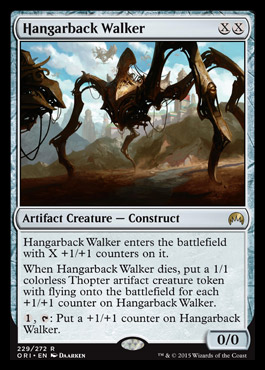
Hangarback Walker

What more is there to say about this card?  QS's own Brian deMars just won 2 byes for the Vintage Championships by playing 4x in a vintage-format trial, for goodness' sake!  The card is shaping up to be a 4-format all-star, something that's very rare these days.

You know what else is rare?  Double-spikes.  Walker went from a dollar rare to $5 within a short span, and then shot up to $10.  It's entirely possible that we see an insane third spike to $15 if this card is truly as dominant as it is shaping up to be.  It's really, really hard to say "buy in at $10", but if you can find an LGS in your area that's selling them for anything less, you go get them.

Mono Red Burn

We're told that burn cards are "moving" steadily, though without the same apparent sense of urgency as the Thopter cards.  Exquisite Firecraft is one of the cards they're talking about, but it's hard to see it gaining a whole lot above $4.25 unless, once again, it proceeds to dominate the event.

Burn is a great deck to bring to a new metagame, as it's matchups are generally baseline good and it adheres to the principle of  "no wrong threats, only wrong answers".  There isn't really a "right" answer to Firecraft; the solution certainly is not Clash of Wills or anything of its ilk.  Other cards like Zurgo Bellstriker and Atarka's Command might generate some interest as well, but Burn is probably not going to present too many opportunities for gains (only headaches for opponents).

Jace, Vryn's Prodigy

Sometimes other peoples' thoughts come to me.  It's generally via email or text message, and usually about Magic cards.  I lead a simple life.

The thought that appeared in my inbox this morning was a confirmation that Jace is still strong at the Pro Tour.  He's become the marquee card of Origins, and I must say that I totally mis-evaluated him at first glance.  Sorry, bud.

Anyway, word on the floor is that yes, Jace is a ridiculously powerful, possibly format-defining, two-drop.  Currently retailing for $40, with a fairly pedestrian 38% spread, our sources think that there is still possibly room to grow here.  I would NOT consider this a particularly juicy speculative target for obvious reasons, but if you intend to play with this card in the coming months, or years, it's not likely to be cheaper any time soon.


Here's what went out midway through Day One. I'm glad we talked about both Ghostfire Blade and Abbot, two big breakout cards. I'm also glad because I love the Wu-Tang Clan and we refer to the blade as "Liquid Swords" and the Abbot as RZA. We had not expected Abbot to rise as much as it did, but I'm glad we advised getting a playset. We're not perfect, but I'm glad we have so many eyes on this that we can get money-making information to our Insiders.

Here's What's Going On.

We're mid-way through Day 1 of Standard.

There haven't been any surprises...yet.  No one is shocked that Hangarback Walker is everywhere, or that Exquisite Firecraft is burning faces.  We've got some intel coming in about who's playing what.  There are no insane, omg, must-buy-now cards at the moment, but we'll let you know if anything crops up.

Demonic Pact

Our sources tell us that one Pascal Maynard has been sighted playing this card.  It's been heralded is a powerhouse, something almost worth building around.  It remains to be seen if Maynard can go the distance, but if a player of his caliber is playing with the card, it must be good.

These are a risky pickup at $5, but I could look like a fool for saying anything other than "buy" right now.  Still, I am a cautious speculator;  chances are that if you thought this card was good, you thought so when it came out, and during the weeks leading up to this PT.  Buy in now at your own risk.  It could prove to be a good bet, but I'm holding my cash until I see more results.

Abbot of Keral Keep

We're told that the majority of mono-red decks, and it's no surprise.  It's a source of much-needed card advantage in a deck that has no other way to generate it, and it's a solid beater, especillay considering its prowess trigger.

The current price around 3.50 seems proper, unless the Top 8 is dominated by them.  This is yet another example of a card that is probably worth buying if you need a playset and have yet to buy in, but it's not a juicy spec target.

Ghostfire Blade

It was easy to look at this card and dismiss it, but as we have all seen, Hangarback Walker changes everything.  When hooking this up to artifact creatures (or Eldrazi spawn tokens, maybe?), it becomes a better Bonesplitter; that's a pretty high compliment for a 1-drop artifact.

This card has seen some gains on MTGO, but the paper price has barely budged.  It's not a bad place to have some money, especially if you can get them for a quarter rather than 2 for a buck.  If not for the Eldrazi in BFZ, I would be skeptical, but I think this will prove to be a very powerful weapon in the months to come.

UR Thopters

We're hearing that a lot of Team CFB are on this deck, which didn't surprise me in the least, since it might be the best use of Hangarback Walker in the format.

We'll let you know what else we hear on this front, but right now, just hold tight.  We still have many more rounds of Standard to go, and plenty of great decks will never see the light of day due to disastrous drafting.

We'll keep you updated throughout the weekend.  Have fun!


Of course, after Day One ends, there's still a lot of overnight trading to be had. Here's our MTGO-focused evening recap email. Also, check out Hangarback Walker's price; a $2 jump over just a few hours is significant.

Getting Ready for Day 2

Let's see what happened in the market overnight

It's always fun to see what cards popped while we were asleep.  It's not as crazy this time around as it has been in other PTs, which is good in a way; it means the market is healthy.  I expect the BFZ Pro Tour to be a wild ride, so I'm glad this one has, so far, been fairly reasonable.

Exquisite Firecraft

Interestingly enough, this card has barely moved on paper.  The buylist price ticked up by a few cents, and the retail price actually dropped down by a few cents.

That's interesting because we know this card is heavily played, meaning that a $4-$5 retail price tag is a good estimate for what staple rares from Origins ('walker aside) will sell for.  I would hold copies right now, as the buylist price is too low and the spread too wide to be worth selling.  If you can get $5 retail somehow, take your profits.

On MTGO, however, the story is very different.  It's seen some amazing gains, rising from 1.2tix mid-week to over 6tix this morning, with about half of that increase happening in the last 24 hours.  Talk about a hot card...

Demonic Pact

Buylist price is up by $0.40, and retail up by $0.20.  Not exactly a big gain, but worth reporting.  Expect this trend to continue if this card performs well this afternoon.  If $5 is a fair price point for a rare staple, and this turns out to be a big player, $10 is not unreasonable to expect.

I am still cautious on this card, as I feel I will not truly understand it's power until I play some games with it.  Still, if Pro Tour competitors have deemed it playable, it's probably pretty good.  Unless it totally fizzles in the late rounds of Standard today, I think it's a good pickup at $5.

Ghostfire Blade

Little to no movement here, aside from the small bump on Magic Online.   I am going to be keeping an eye on this one, as I think it's better than a 50 cent rare.

Hangarback Walker

Sick of this little guy yet?  I'm not!  I'm in love with this card!  The breakout card of Origins continues to impress, with buylist prices increasing by about $4 overnight, and retail increasing about $3.

The narrow spread here is interesting, especially if you sell to Card Kingdom for store credit as I prefer to do;  in that case you're actually getting 10% above TCG Mid for your card.  Seems good, but there's no way I'm selling mine.

Abbot of Keral Keep

Buylist price hasn't moved, but the retail price is up $0.40.  I would not expect the retail price to move much higher unless, once again, the card proves dominant.  $4 is a fair price for a rare that sees play as a 4-of in one or two decks.  Obviously do not buylist your copies at  61% spread; I won't even sell garbage rares at a spread that wide, and the Abbot is far from garbage.

Tragic Arrogance

QS staff writer and Pro Tour Competitor Ryan Overturf was talking about this card before the event, saying that it had outperformed expectations in playtesting.  It's seen a staggering rise on MTGO, from bulk levels to parity with paper prices.

Ryan made it clear that the card is only used in 2-3 copies, and often in the sideboard, but that it is pretty clearly better than bulk.   If we see a lot of these on camera, expect a paper price increase.  I venture to guess that the plays we see with this card will be flashy, memorable and game-breaking, but there's no guarantee it gets any play or camera time as we move towards a Top 8.

It's been relatively quiet so far, but we still have a lot of Magic to play.  We'll let you know as news breaks and things change!


There are a number of good finance stories that come out of a robust Pro Tour. While Demonic Pact failed to T8, it was a coverage darling and got a lot of camera time. The markets responded, causing us to send this Insider email:

Demonic Pact Is Moving

We don't know the Top 8 yet, but it's clear this card has power.

I've been talking about this card all weekend, but after watching the market for the last 2 hours, it's clear that other people besides me are finally convinced that Pact is the real deal.  There are plenty of ways to not only destroy Pact, but to reset it outright, which means that you are essentially looking at a Cruel Ultimatum for 4 mana (without spending RRBBBUU...) which you can recur multiple times per game.

We reported Pascal Meynard as playing this card yesterday, but it seems like the Spaniard Antonio del Moral Leon has been using Pact to great effect as well.  As of Round 13, he has 27 points ( 1st place currently sits at 33).

Whether it ends up making Top 8 or not, this card is moving.  When I checked an hour ago, TCGPlayer had copies under $6.   When I checked just now, that was no longer true.  It seems to have passed the $6 mark.  Remember, this is a mythic rare.  $6 is very reasonable, even if it's not ultimately a 4-of.  It's closer to $7 than $6 at the time of writing.

On MTGO, we've seen the sell price rise from 3 tix on the 28th to over 6 tix today, August 1st.  It was not 6 tix even an hour ago!

It could be that this card doesn't make an appearance in the top 8.  It could be that this is a poor buy-in at $6 / 6 tix.  I think I'd rather be on the right side of history here, and despite the fact that the best time to buy this was, surprise! before the Pro Tour, I think the next best time is probably now.   There -is- risk involved here; this isn't a slam-dunk until it makes Top 8, but I think it's a fine place to deploy some capital if you're looking for ways to spend money.   Pro Tour Top 8s aren't always indicative of what's actually great in the format, as it's heavily skewed towards those who 3-0'd their drafts as well as crushed Constructed.  One way or another, this card seems like it's here to stay.


I'm proud of the work that our coverage team did this past weekend. We hit many of the big stories. We educated Insiders to be wary of a few things (early market movement, 3-0 drafters skating by with middling Constructed lists, etc) and we delivered a lot of great finance tips to our readers. If you're an Insider, let us know how we did on coverage! If you're not an Insider yet, well, here's how to fix that (featuring our 111% guarantee).


Douglas Linn

Doug Linn has been playing Magic since 1996 and has had a keen interest in Legacy and Modern. By keeping up closely with emerging trends in the field, Doug is able to predict what cards to buy and when to sell them for a substantial profit. Since the Eternal market follows a routine boom-bust cycle, the time to buy and sell short-term speculative investments is often a narrow window. Because Eternal cards often spike in value once people know why they are good, it is essential for a trader to be connected to the format to get great buys before anyone else. Outside of Magic, Doug is an attorney in the state of Ohio.  Doug is a founding member of Quiet Speculation, and brings with him a tremendous amount of business savvy.

View More By Douglas Linn

Posted in Free, Free Finance, Free Insider, Magic Origins, Pro Tour8 Comments on How we covered the Pro Tour

Have you joined the Quiet Speculation Discord?

If you haven't, you're leaving value on the table! Join our community of experts, enthusiasts, entertainers, and educators and enjoy exclusive podcasts, questions asked and answered, trades, sales, and everything else Discord has to offer.

Want to create content with Quiet Speculation?

All you need to succeed is a passion for Magic: The Gathering, and the ability to write coherently. Share your knowledge of MTG and how you leverage it to win games, get value from your cards – or even turn a profit.

Insider: MTG Stock Watch for August 4, 2015

Are you a Quiet Speculation member?

If not, now is a perfect time to join up! Our powerful tools, breaking-news analysis, and exclusive Discord channel will make sure you stay up to date and ahead of the curve.

Welcome back, readers! It's been a while since I've done a Stock Watch article, but with the Pro Tour this past weekend, there were certainly some financial changes, though nothing as spectacular as we've seen before.

1. Ensoul Artifact (+330.4%) - With two U/R Ensoul Artifact decks making it into the Top 8 of PT Origins, it's no surprise that this card saw a big spike. The fact that M15 had only one chase mythic (Nissa, Worldwaker) means that many players weren't cracking M15 packs. Thus, this uncommon is rarer than usual. It plays really well with our #3 card too.

It is important to keep in mind that M15 rotates October 2nd, so this spike will likely start to rescind in the near term. If you have extra copies, I'd out them now and consider reacquiring after rotation (though this is the type of card that if it's reprinted will crash, like Smash to Smithereens).

2. Abbot of Keral Keep (+179.9%) - One of the other big winners from PT Origins, Abbot provides red decks with something they desperately need: card advantage. He's a pretty big upgrade from Ire Shaman, since it costs a full two mana less to get your extra card. While red burn decks proved to be a solid choice for this Pro Tour, they tend to get overshadowed quickly as the metagame shifts to beat them.

3. Hangarback Walker (+137%) - This guy is on a tear lately with three recent spikes (jumping from $2 to around $5 after the first SCG Open, then from $5 to $10 after the second, and now he's nearly $20). As good as this card is (and it is very good) it's not likely to sustain this price since Origins has plenty of chase mythics (including most of the new flip planeswalkers), and packs will continue to get cracked as players search for these treasures.

As a regular rare, I can see his price rescinding back to the $10 range within a few months. I hope that you picked up your personal playset back when they first came out (especially since sadly I passed on them).

4. Demonic Pact (+121.8%) - This was another PT Origins breakout card. It was featured prominently in a G/B Demonic Pact deck, which used Woodland Bellower to go fetch for Invasive Species to bounce Demonic Pact before it cost its owner the game. Several of our members jumped on this ship early and it proved to be a big gainer. The buylist has already jumped up above what you could buy them for on Friday/Saturday (it's at $6.50 as I type this), so you could out your copies for a decent 30% profit without any difficulty.

Personally, I love the idea of the deck, but it honestly seems rather gimicky, and as cool as the Pact is...paying four mana and not immediately affecting the board at all (or providing you with any actual advantage until your next upkeep) isn't where I want to be.

5. Null Rod (+66.8%) - This jump seems to be from a buyout. While the card itself is very good (namely it is brutal in Vintage against most decks and good in Legacy against artifact heavy decks), its lack of playability in Modern makes this an odd spike. Looking over various websites it appears that it has just been bought out completely. It is on the reserved list though, so it's likely this price will stick over the long term.

6. Riddlekeeper (+60.6%) - This card actually popped up on the QS forums late last week, as it appeared the internet was simply drying out of them. The spread on this guy is nearly 50% which means that either the stores haven't seen a strong increase in demand or they are just slow to react. This card is very much an EDH card and I've never seen it played in any other format, but it is extremely good against any weenie/token deck in that format.

7. See the Unwritten (+42.1%) - With Battle for Zendikar looming on the horizon it's not surprising to see a card that cheats in huge fatties (which are expected thanks to the latest BFZ spoilers) get a bump. This card was less than $2 at the beginning of the year and it has always had potential. Unfortunately, coming from Khans (which was heavily opened) means that there are still a lot of them out there, so the ceiling is quite a bit lower than a third set mythic.

8. Life from the Loam (Modern Masters) (+25.8%) - Lands variants have been on a tear on the SCG Legacy circuit recently (in Richmond they took two of the Top 8 spots), so it's not surprising that one of the cheaper cards (and the engine of the deck) is finally starting to see some movement. It's one of the few decks that can play the long game against Miracles (and do it well) and it helps that its card advantage engine keeps coming back, which makes counterspells less effective.

9. Thopter Spy Network (+23.5%) - Another big gainer prior to PT Origins, this is one of the key ingredients in the new Standard control decks (which love a hard-to-remove recursive threat that provides card advantage). We first saw it on camera at the first SCG Open in a U/W control shell and more recently it found a home in U/R on the Pro Tour.

10. Life from the Loam (Ravnica) (+21.7%) - As mentioned above, this card is the key engine piece in a strong Legacy deck. As this version started out more expensive than its Modern Masters counterpart, it's not surprising that the rise was slightly smaller.

11. Nissa, Vastwood Seer (+18.8%) - G/R Devotion decks are still a heavy amount of the current Standard metagame and this latest addition courtesy of Origins gives them both card advantage (by replacing herself with a land when you cast her) and is arguably the most powerful of the new flip walkers when you flip her.

12. Ojutai's Command (+18.1%) - This card's recent jump is primarily due to how well it plays with Jace, Vryn's Prodigy. When it was first spoiled it pre-sold for over $10 as many thought it was the second coming of Cryptic Command. They were wrong, but it's taken until now for everyone else to accept that it is better than many of us (myself included) originally thought.

13. Pia and Kiran Nalaar (+14.8%) - This is the card on my list that I honestly feel has the most room for continual growth. Even with its 14.8% increase in the past week it's still under $2.50 almost everywhere. It provides three bodies totaling four power for four mana (not ridiculous in this day in age, but in years past that would have been almost unthinkable). More importantly, two of those bodies have flying and Pia and Kiran even come with the ability to Siege Gang the tokens.

14. Jace, Vryn's Prodigy (+12.8%) - The most expensive card from Origins, this was originally one of the cheaper (and undervalued) planeswalkers from the set. QS's own Brian DeMars mentions in his article this week just how difficult it is to find these guys in trade binders, so it's not surprising that his value continues to go up.

However, it is important to note that zero copies made the Top 8 of PT Origins, so some of the demand may begin to wane. More packs will continue to get opened and $40 is typically the ceiling on most Standard mythics this day in age, so if you have any you aren't using, now would be a good time to unload them.

15. Obelisk of Urd (+10.9%) - This one is probably the most surprising...while it's jump the past week was relatively modest (10.9%), it sat around $1.25 for months and months. It saw a big jump after SCG Richmond when people realized how good it could be when your creature type was thopter (let alone that it could also turn on a Thopter Spy Network).

~

I'm sure some of you guys have noticed, I'm currently playing around with the formatting of this series--for example, this time I focused on the top 15 movers/shakers of the previous week, with a detailed breakdown of the reason for the movement (when known). I also didn't include the price graphs, which I have done previously (as I'm not sure exactly how much they add to the article, other than as a nice break from words). Please feel free to comment on what you like/dislike below so I can take your thoughts into account for any future formatting changes.

Thanks for reading!

Keep the Mulligan Rule

Are you a Quiet Speculation member?

If not, now is a perfect time to join up! Our powerful tools, breaking-news analysis, and exclusive Discord channel will make sure you stay up to date and ahead of the curve.

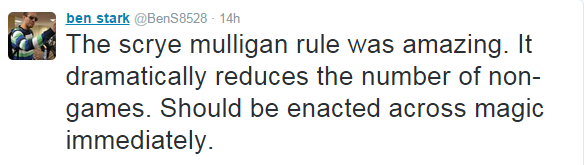
At Pro Tour Origins and in the weeks leading up I played a lot of matches with the new mulligan rule. As soon as I saw the rule I liked it, and playing with it more has only upset me in that it hasn't been implemented for every tournament yet. I'm firmly in Ben Stark's camp on this one.

Ben Mull

Those opposed to the mulligan rule cite the success of aggressive decks at this PT, but I believe this argument is somewhat dubious. For the first time that the cards have been in Standard, we finally had a shell that could utilize Ensoul Artifact and Shrapnel Blast. That deck was going to be strong one way or the other. And if you want to talk about the Monored decks, well, they won the last Pro Tour, too. If you design a card like Searing Blood, and even it isn't clearly the best card in the red decks, then people are going to get demolished by some red decks.

There was an error retrieving a chart for Searing Blood

Of course, this is just an example of critiquing a bad example, and ignored the overall point. The argument is that the rule favors aggressive decks more than controlling ones. It's true that when you're always looking for something very specific that "scry one" is going to have a higher impact in your deck, but it seems to me that whatever deck has access to more relevant tools in a given matchup is going to take the best advantage of this rule, rather than just whoever is playing the aggressor.

This rule helps combo decks and aggressive decks, but that doesn't mean that it doesn't help controlling ones. I do like that people want to see more data. I'm not one to criticize the scientific method, but I think it's clear that this rule reduces non-games, and if it just makes aggressive decks too good then we can address that problem later.

Avatar photo

Ryan Overturf

Ryan has been playing Magic since Legions and playing competitively since Lorwyn. While he fancies himself a Legacy specialist, you'll always find him with strong opinions on every constructed format.

View More By Ryan Overturf

Posted in FreeTagged , , 3 Comments on Keep the Mulligan Rule

Have you joined the Quiet Speculation Discord?

If you haven't, you're leaving value on the table! Join our community of experts, enthusiasts, entertainers, and educators and enjoy exclusive podcasts, questions asked and answered, trades, sales, and everything else Discord has to offer.

Want to create content with Quiet Speculation?

All you need to succeed is a passion for Magic: The Gathering, and the ability to write coherently. Share your knowledge of MTG and how you leverage it to win games, get value from your cards – or even turn a profit.

Deck Overview: Standard Jund

Are you a Quiet Speculation member?

If not, now is a perfect time to join up! Our powerful tools, breaking-news analysis, and exclusive Discord channel will make sure you stay up to date and ahead of the curve.

This weekend at PT Origins I was excited to be battling with the Izzet Robots deck, with a list about 10 cards off from Mike Sigrist's second place build. For as much fun as I was having though, I found myself extremely jealous when I played against Luke Mulcahy. He started our game with a Gather the Pack milling a Flamewake Phoenix and grabbing a Tasigur, the Golden Fang- an element of my early builds of Chromanticore. He wasn't interested in Soulflayer though, he had something different in mind.

Jund Self Mill

creatures

4 Satyr Wayfinder
4 Tasigur, the Golden Fang
4 Gurmag Angler
4 Reaper of the Wilds
1 Herald of Torment
4 Flamewake Phoenix
1 Kolaghan, the Storm's Fury
1 Dragonlord Kolaghan

spells

4 Commune with the Gods
4 Gather the Pack
4 Languish

lands

4 Wooded Foothills
4 Bloodstained Mire
4 Temple of Malady
4 Llanowar Wastes
3 Mountain
3 Swamp
3 Forest

sideboard

2 Herald of Torment
2 Crux of Fate
1 Fleshbag Marauder
1 Reclamation Sage
4 Seismic Rupture
1 Whip of Erebos
4 Bloodsoaked Champion

The plan is to make a fast Tasigur or Gurmag Angler and to beatdown. You also get to play a full set of Languish, which just doesn't do anything against the type of creatures that you're playing and is likely to have detrimental effects on your opponent. If the Languish plan isn't good, then you get to board into Bloodsoaked Champion and add more speed and resilience to your beatdown plan.

There's quite a lot that could be played with in this deck. The Reaper of the Wilds are on-theme, but seem kind of weak. I could see playing some bullets like Dragonlord Atarka and more copies of Whip of Erebos. I am quite impressed by the core of this deck though, and Luke's seven wins in the Standard portion of the Pro Tour are a testament to its power.

Insider: On the Trading Floor at Gen Con 2015

Are you a Quiet Speculation member?

If not, now is a perfect time to join up! Our powerful tools, breaking-news analysis, and exclusive Discord channel will make sure you stay up to date and ahead of the curve.

I'm not going to lie to you all--I didn't tune in for even five minutes of the Pro Tour coverage this weekend.

Typically, I'd have the Pro Tour coverage on and be following the event round by round, but last weekend was different because: I WAS AT GEN CON AND I WAS HAVING TOO MUCH FUN GAMING.

In all seriousness, I'm sure the coverage was entertaining (I know that lots of people had lots of nice things to say about the commentary...) but I was simply too busy getting my game and trades on.

The last time I went to Gen Con was to play in the Vintage Championship the last year it was held before being moved to Eternal Weekend.  With the prestigious Vintage Champs at Eternal Weekend (which is a fantastic and better event), there really hasn't been a pressing reason for me to return to Indy for The Best 4 Days of Gaming in the world.

Vintage brought me to Gen Con my first time and this year was no different.  I was pretty excited to get a chance to go back to Gen Con just to play in some sanctioned, no-proxy events and win byes for Eternal Weekend.  There were three scheduled Vintage events over the course of the weekend and I was hoping to take one down in order to maximize my chances at Eternal Weekend.

Fortunately, I took down the very first Vintage tournament I played in with a unique Mishra's Workshop variant that was jamming Hangarback Walker in the main deck.  Unfortunately, I can't discuss my Vintage tech here today (that will be an exclusive strategy article on Vintage Magic next week), but I feel the Walker part is highly relevant to a finance article.

There was an error retrieving a chart for Hangarback Walker

The card has spiked dramatically this past week based on its success at the Pro Tour.  However, I think it is also significant that it is playable in any format because, well, it is just an OP card.  I think foils will end up being very desirable in the long and short term.

After me and my friend Hangarback Walker Texas Ranger secured byes for Eternal Weekend, it left me without much of a purpose to play more Vintage.

So I decided to hit the trading tables with an absolute vengeance. One of the cool things about doing a ton of trading with a ton of different people is that you can really learn a lot about what is going on in MTG Finance.  Gen Con is a pretty awesome place to be a student of MTG Finance because there are a lot of people from all over the world, and it also tends to be a locus of collectors.

1.  APPARENTLY NOBODY OPENED JACE, VRYN'S PRODIGY

I must have looked through 200+ binders this weekend and I'm certain I didn't see a single copy of this Magic Origins mythic rare for trade.  So, I guess that nobody opened any because apparently the card was simply non existent.

There was an error retrieving a chart for Jace, Vryn's Prodigy

It is also interesting that there were no copies of the card in the Top 8 of the Pro Tour.

Personally, as a pretty good Magic player, the new Jace isn't anything that blew my mind.  Merfolk Looter is a fine card but not something I'd feel compelled to play no matter what. I was also aware that there were multiple dealers on site at Gen Con who were offering $35.00 for the card.  The demand was basically sky high on this single.

I'm not sure how much of it was speculative leading into the Pro Tour or if there are just that many people who want to own the card.  Jace is strange because it is a card that I keep hearing people talk about: "Put it into a Delve deck in Modern," "The card is going to make Modern Dredge a thing." But that I very rarely actually see people actually playing with.

My general confusion of knowing it is pretty good but not knowing what to do with it seems to mirror the way everybody else feels.  The game seems to be that everybody wants to have it for when it "gets broken" but the speculating has already pushed the card's value up well above where it would be if it was actually good in a niche deck somewhere!

I decided to just pretend the card didn't exist.  I have my play set in case I want to use it, tucked away in my player collection. Other than that, I didn't have any for trade and wasn't looking to trade for the card.

2. PEOPLE WERE TRYING TO DUMP DUALS

I'm not saying that everybody should go out and get rid of all of their Revised Edition dual lands or anything, but there were a lot of people specifically trying to trade off dual lands aggressively at the trade tables.

There was an error retrieving a chart for Tundra

I know that SCG has dramatically reduced their support of Legacy via the Open Series, and perhaps this is a big reason.  All I know is that typically collectors and players don't want to trade away dual lands for other cards and are instead are trying to trade into more duals.

I did not see this to be the case at Gen Con last weekend.

I had multiple people try to "offer me dual lands" for good Modern Staples in the form of: "Hey, I'd like to get these two Emrakul off you--I'd give you a Savannah for them?"

It kind of makes sense to me that with SCG reducing their support of Legacy, maybe the supply of duals is simply higher than the demand, at least in the sense of the cards being so darn expensive.  We have to keep in mind that there was TONS of Revised printed.

I also saw a lot of people trying to move FBB and Beta dual lands, which is not typically the case.

I'm not exactly sure how to put all of these pieces together into a sure thing narrative, but I think it's pretty fascinating.  I'm typically the kind of guy who favors an "old card and land heavy" portfolio with duals being a very solid investment.

While I don't see the prices going down substantially or anything like that, I would certainly entertain the notion that the prices of duals are sufficiently high that, with demand waning, they probably won't go up too much more for a while.

If that is the case, it would make sense that collectors and investors might be looking to sell.  Why hold onto a card that is likely to stay the same or dip slightly when we could be buying into other cards that have more potential to grow?

3. THE SUMMER LULL IS INSANE

I may actually make it a custom to go to Gen Con just for the trades every year from here on out.  It is right smack dab in the middle of a slow period of Magic where the prices are suppressed, which makes trading an absolute delight.  Last week I wrote about my picks for the "Summer Lull" and these were the cards I targeted heavily in my trades.

I can't even tell you how many copies of Rattleclaw Mystic and Hooded Hydra I was able to snag for nearly nothing.

As an avid trader, I know how important it is to rebuild your trade stock over the summer when the prices of the cards are cheap and the latest block random cards are in very low demand.

Honestly, I'm more of a player who has a deep understanding of how the prices work because of my time working in the industry rather than a hard core collector or investor.  When I go to a Magic event, it is typically to play first and to trade as something to do if I get bounced out of the event and am waiting on friends to finish.

However, having multiple days to sit back and just do trade after trade after trade was pretty awesome and I was amazed at how I was able to transform my collection of undesirable trade bait into a new set of cards!  It was crazy.

4. THERE WAS A VERY HIGH DEMAND FOR 'COOL' PLAY MATS

Everybody knows that the play mats have value and that dealers buy them at Grand Prix.  However, one thing that I observed that I didn't realize before is that play mats are extremely liquid for cash.  There were a lot of people buying random GP and Top 8 Mats and paying a lot of money for them.

Typically, when I go to a GP and get the exclusive mat, I just keep it and stash it away and my friends will sell theirs to the dealers.  I'm actually thinking of just buying my friend's mats for whatever the dealers are paying and having multiples stashed away.

I think there is likely a lot of value to be had in play mats that people either don't see or ignore.  A lot of times at a Grand Prix, the artist who illustrated the play mat is on site doing signatures and alters.  Taking the time to have the artist sign, alter, and--importantly--date the mat creates a pretty significant boost in value.  It makes sense, because it's actually a pretty cool thing to have done.  It is something I am going to try and do at every Grand Prix from here on out.

And I had never really thought of that until I talked to somebody who was telling me about it at Gen Con.

Anyways, the fact remains: there is a ton of interest and money in people wanting cool, collectible, and unique playmats--so, what is the best way to use that information in order to generate some value?

~

It had been so long since that last time I'd been to Gen Con that I'd almost forgotten what a fun event it was.  I had a blast playing Vintage and just as much fun fully engaging in the trading and collectible side of the game.  In addition to picking up lots of my summer lull target cards, I was also able to pick up a bunch of awesome Japanese cards for my decks, which was pretty exciting for me.  It's amazing what you can find if you go looking for it in people's binders.

Checking the Claim of Rising Modern Prices

Are you a Quiet Speculation member?

If not, now is a perfect time to join up! Our powerful tools, breaking-news analysis, and exclusive Discord channel will make sure you stay up to date and ahead of the curve.

Following the success of last week’s article comparing Legacy to Modern prices, I want to take a look at some other questions about Modern finance. We had a lot of requests in the comments, both on this site and on others where the article appeared, but one stood out as more important than the rest: rising Modern prices. We’ve all heard about Modern prices spiking since the beginning of the year. Some of us may even have experienced it, especially if you were trying to arm your sideboard with Blood Moon for the June Grand Prix season. One of the biggest contributors to this interpretation of Modern was an MTG Goldfish article about prices rising 25% since January. In this article, I want to perform my own analysis of the Modern data to see if that 25% claim holds water.

Mox Opal Art

One of the biggest problems in comparing Modern prices between time periods is metagame shifts. If a deck becomes more or less competitive/popular, this often has an effect on its price from month to month. These shifts can artificially increase or decrease a price difference, which need to be accounted for. Instead of asking about price increase for specific cards, I want to focus on the increase for decks and the overall metagame.  Does it cost the same amount of money to be competitive in Modern today as it did in January? Does a tiered deck from January cost as much as the August version? This article answers these questions to see if Modern really has become more expensive.

[wp_ad_camp_1]

Methodology

The biggest success in the MTG Goldfish article was putting concrete numbers to an otherwise intangible (even baseless) claim about rising Modern prices. Everyone felt like Modern prices skyrocketed (just look Snapcaster Mageat Snapcaster Mage, Liliana of the Veil, Cavern of Souls, etc.), but there weren’t a lot of evidence-based analyses to support this general sentiment. In that respect, the MTG Goldfish article helped ground us in the data. Unfortunately, it also had some misleading characterizations which blunted the analysis. Decks like Elves and Grishoalbrand were tier 3 or lower back in January. Grixis Control, Twin, and Delver didn’t exist at all because neither Tasigur nor Kolaghan’s Command were around to make them work. Many wondered why decks like this were included. True, these lists may have seen January to August price increases, but that doesn’t necessarily mean the entire format is spiking. As one popular deck rises in price, perhaps another falls. Maybe different cards are used now versus in January. Because of these nuances, such decks become an odd point of comparison when trying to see how Modern prices have changed over time.

I want to run a different kind of analysis in this article, accounting for metagame shifts on top of price changes. To do this, I look at the tier 1 and tier 2 decks from both the January 2015 metagame and that of August 2015. I find representative lists for of all the decks, focusing on the highest finisher from the biggest event in the time period (also looking for representative card choices and not too much weird tech: no Myr Enforcers in Affinity). After identifying these lists, I calculate deck costs using TCGPlayer middle prices from either January 1, 2015 or August 1, 2015.  This method shows how much it cost to be competitive, i.e. play a tiered deck, during that particular metagame. Naturally, there are specific list changes between January and August to reflect the different metagame contexts. This is actually good: we want to calculate costs for the different lists. A competitive list in January might not be a competitive list in August, so if we want to calculate price differences for competitive decks, we need to accept variance in the cards played.

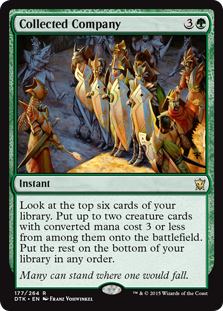
collected companyWhy not look at exact lists and their changes between January and July? Although this method would certainly show price differences in cards, it doesn’t answer the fundamental question of Modern as a format being more or less expensive. No one really cares if Heritage Druid as a card spikes after Collected Company gets printed. They care that to play a tier 2 Modern deck (Elves), you now need to fork out a lot of money for its cards. The emphasis is on the decks that play cards, not cards themselves. List changes reflect the different requirements of competitive Modern, and that’s what players really care about when they ask about rising format prices. Of course, in answering the question about rising Modern deck and metagame prices, we’ll also get at the underlying issue of card prices.

January and August Metagame Comparison

Let’s start with the January 2015 metagame. As many of you probably remember, this was a format completely shaped by Treasure Cruise and Birthing Pod, and a very different one from our Modern of today. Before tracking data as part of the Nexus Top Decks page, I tracked it on spreadsheets for the Salvation Modern forums (our data still informs those forums). The table below reflects those metagame numbers (unweighted MTGO/Paper average), showing deck prevalence in the October 1, 2014 through January 1, 2015 periods, along with the January 2015 prices of those decks. It also shows average deck price for tier 1 decks in the time (anything with 4%+ of the metagame), tier 2 decks, and the overall metagame.

January 2015 Metagame Prices

DeckJanuary 2015
Metagame %
Metagame
Tier
Janaury 2015
Deck Price
UR Delver11.7%Tier 1$525.70
Melira Pod10.2%Tier 1$746.10
Burn8.1%Tier 1$582.60
Affinity7.4%Tier 1$597.30
Scapeshift6.6%Tier 1$771.60
Abzan4.3%Tier 1$1,690.50
Merfolk3.3%Tier 2$408.90
UR Twin3.2%Tier 2$925.80
UWR Control2.5%Tier 2$959.20
Bogles2.4%Tier 2$549.20
RG Tron2.4%Tier 2$583.90
Temur Delver2.3%Tier 2$1,372.90
UWR Midrange2.2%Tier 2$945.70
UWR Delver1.6%Tier 2$582.90
Naya Zoo1.6%Tier 2$1,388.20
Jeskai Ascendancy1.5%Tier 2$637.30
Infect1.2%Tier 2$664.60
Kiki Pod1.1%Tier 2$879.60

Tier 1 metagame (1/1) average: $818.97
Tier 2 metagame (1/1) average: 
$824.85
Overall metagame (1/1) average: 
$822.89

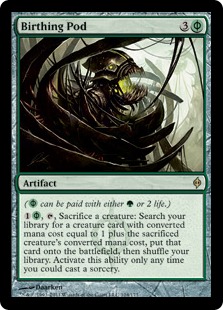
Birthing PodIt’s interesting that there aren’t any substantial differences between the tier 1, tier 2, and overall metagame prices. In fact, they are all within a remarkable $10 of each other. The most expensive tier 1 deck was Abzan, followed by Naya Zoo and Temur Delver in tier 2. The least expensive tier 1 decks were Burn and UR Delver, with Affinity close behind. For the most part, these decks are all clustered closely around $822, with all but one of the six tier 1 decks actually falling beneath that pricepoint. The two “best” decks at the time, UR Delver and Melira Pod, were well under the $822 average, suggesting you could be highly competitive in Cruise/Pod-era Modern without spending as much as most people were paying for their less competitive builds.

How does all of this compare to the August 2015 metagame? Without stealing the thunder of my upcoming metagame breakdown article (coming up on Wednesday!), here are the current deck shares for the 7/1-8/1 metagame, broken down by tier and priced out with TCG mid values from 8/1. No one should be surprised to see an overall increase in the prices relative to January: even the most anecdotal price analysis would show this. You might be more surprised, however, to see a familiar number at the end of the graph when comparing the average format price on 8/1 to the old one on 1/1.

August 2015 Metagame Prices

DeckAugust 2015
Metagame %
Metagame
Tier
August 2015
Deck Price
Jund8.8%Tier 1$1,922.47
Burn8.4%Tier 1$594.24
Affinity8.3%Tier 1$759.41
Grixis Control5.4%Tier 1$1,188.10
UR Twin5.3%Tier 1$1,311.72
Grixis Twin4.9%Tier 1$1,229.10
Merfolk4.9%Tier 2$499.22
RG Tron4.1%Tier 1$800.51
Amulet Bloom3.4%Tier 2$640.94
Abzan3.4%Tier 2$1,918.67
Infect3.4%Tier 2$728.10
Grixis Delver3.1%Tier 2$957.96
Abzan Company2.8%Tier 2$867.63
Temur Twin2.3%Tier 2$1,710.71
Naya Company2.2%Tier 2$1,411.97
Elves2.1%Tier 2$598.78
Grishoalbrand2.0%Tier 2$755.56
Scapeshift1.9%Tier 2$836.51

Tier 1 metagame (8/1) average: $1,115.08
Tier 2 metagame (8/1) average: 
$993.28
Overall metagame (8/1) average: 
$1,040.64

Different method, same result. If you wanted to play competitive Modern in January 2015, your average deck would cost you about $822. What about August 2015? $1040, roughly a 26% increase in the intervening period. This increase is reflected across the 8/1 metagame, impacting both pricy decks like Jund and cheaper ones like Merfolk and Affinity. The new tier 1 deck price average is around $1115, which amounts to a sizable 36% price increase relative to the January tier 1 decks. The tier 2 deck cost also increased, but not by the same margin: only 20%, up from $827 to $993. The table below summarizes these three points of comparison.

January to August 2015 Price Changes

AnalysisJanuary 2015
Metagame
August 2015
Metagame
% Change
in Price
Average Price$822.89$1,040.64+26.5%
Tier 1 Price$818.97$1,115.08+36.2%
Tier 2 Price$824.85$993.28+20.4%

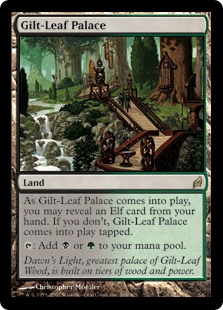
Gilt Leaf PalaceThis analysis suggests the Modern price increase is more consistent and comprehensive than many acknowledge. It’s one thing if card prices are increasing as a result of speculation or fringe decks. Gilt-Leaf Palace spiked about 1000% in June, yet you only see a handful of Elves decks running it. It also doesn’t really matter if Grixis prices increased from January to August because those decks saw zero play until after Pro Tour Fate Reforged. Those kinds of increases are either expected and/or irrelevant in determining the real cost of Modern play, especially if not accounting for prices that may have fallen in the same time period. It’s something else entirely if all the tier 1 and tier 2 decks are as a whole more expensive in August than they were in January. This means the cost of competitiveness has increased, not just the cost of a few staples. It also shows that price increases are being felt by players at all levels, not just investors and those who are netdecking a top three deck like Burn, Jund, or Twin.

Deck-to-Deck Comparison

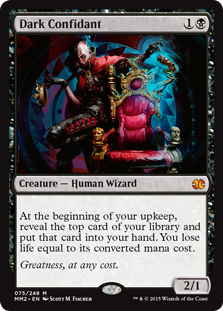
Dark Confidant MM2015This January to August breakdown isn’t the only way to analyze the price issue at the metagame level. We can also look at individual decks in the different time periods, similar to MTG Goldfish’s approach. Except this time, I don’t want to look at the same lists from metagame to metagame: this doesn’t account for the different requirements of playing the deck at any given time in Modern. Instead, we’ll look at pairs of distinct lists from the two distinct time periods, checking the January price for one and the August price for the other. For instance, January Jund was an underplayed deck which didn’t even run Dark Confidant, due to all of the Burn and Delver out there. By contrast, August Jund practically requires Bob.

To gather more datapoints, I expanded this analysis to include decks that were tier 1 or 2 in only one period (e.g. Bogles in January 2015 or Jund in August 2015) and not as well-represented in the other. The percent difference between list prices is also given.

January to August 2015 Deck Price Comparison

DeckJanuary 2015
Price
August 2015
Price
% Change
in Price
Burn$582.60$594.24+2.0%
Affinity$597.30$759.41+27.1%
Scapeshift$771.60$836.51+8.4%
Abzan$1,690.50$1,918.67+13.5%
Merfolk$408.90$499.22+22.1%
UR Twin$925.80$1,311.72+41.7%
RG Tron$583.90$800.51+37.1%
Infect$664.60$728.10+9.6%
Amulet Bloom$381.48$640.94+68.0%
Bogles$549.20$580.66+5.7%
UWR Control$959.20$986.57+2.9%
UWR Midrange$945.70$1,166.01+23.3%
Jund$1,618.60$1,922.47+18.8%
Temur Twin$1,795.90$1,710.71-4.7%

Even breaking the data down this way, we still see a roughly 20% price increase from January 2015 to August 2015. With the exception of Temur Twin (Tarmogoyf‘s reprinting helped here), every single deck increased in price. Amulet Bloom is a big outlier here with a 68% spike from January 2015, but even if we remove it from the picture, we are still looking at a 16% price increase between lists. This only confirms our suspicions about a real increase in the price of competitive Modern. If you wanted to play one of these decks in August 2015, the successful lists would cost you 20% more than the old version would have cost in January. Note this is in spite of Modern Masters 2015 reprints, many of which targeted these competitive decks in an effort to lower their prices. Although cards like Goyf, Twin, Spellskite, and others may have benefited from the set, the decks playing those cards still managed to go up. Popularity is, in part, to blame for this, but it’s still a real impact which many Modern players will feel when buying into the format.

Modern Prices From Here?

In the MTG Goldfish case of individual card prices, we saw cards go up by about 25% from January through the summer. Even expanding this analysis to other comparisons, we still see this 20%-25% price spike. Competitive Modern is more expensive in August than it was in January. This is true of tiered decks, the overall competitive metagame, and the January vs. August versions of certain lists. When we have this many datapoints supporting the same conclusion, it’s hard to ignore that conclusion and its impact on the format. Modern prices really do appear to have increased between that 20%-25% range, at least in all the ways that matter. As I said before, I don’t think this is necessarily unexpected, or even necessarily a bad thing. A growing format will almost certainly mean increased prices of non-reprinted staples, in addition to speculation and non-player entities also causing a change.

What do you think of the methods in this article or the findings? Where else do you see Modern prices increasing? Do you see examples that challenge these conclusions? What other finance questions are you interested in?

Modern may be getting more expensive but it’s also getting more popular, and I’m excited to be playing the format at this time. Let me know what you all think in the comments and join us later this week as we look at the July Modern metagame.

Insider: Potential Pro Tour Breakout Archetypes

Are you a Quiet Speculation member?

If not, now is a perfect time to join up! Our powerful tools, breaking-news analysis, and exclusive Discord channel will make sure you stay up to date and ahead of the curve.

Pro Tour Magic Origins is upon us. This weekend, the best Magic players in the world meet in Vancouver to compete in Standard and booster draft. Magic Origins has added dozens of excellent new cards to the Standard cardpool, and they threaten to rewrite the rules of the format. The Standard metagame this evening will look vastly different than it did yesterday, and the Standard decks from the Pro Tour will define the metagame until rotation this fall.

This week, in attempt to predict the Pro Tour’s Standard metagame, I have been playing a lot of Standard on Magic Online, networking, and studying pricing trends. Along the way, I discovered some off-the-radar deck that could have a big impact on the tournament, so today I will explore some potential breakout decks from the Standard portion of Pro Tour Magic Origins.


There was an error retrieving a chart for Jace, Vryn's Prodigy

Jace, Vryn's Prodigy is still very unexplored, but its power is assured. Notable for its low cost, this card offers blue strategies with a proactive, two-mana play that forces the opponent to react, lest it generate an avalanche of card selection and card advantage. I expect a large number of different strategies will incorporate the planeswalker this weekend, from the controlling to the more aggressive, perhaps even with burn spells. The safe money is on Sultai Control, like Robert Vaughan’s SCG Richmond Top 8 deck, as the archetype that best leverages the planeswalker.

There was an error retrieving a chart for Hangarback Walker

Perhaps no card will have a greater impact this weekend than Hangarback Walker. Hangarback Walker is a threatening two-mana play because it can grow bigger as each turn passes, but it’s also a great late-game topdeck because it’s a mana sink with no upper limit. It’s possible that the most successful players this weekend will be those that best take advantage of this powerful new tool.

Hangarback Walker is promising in many different decks, but perhaps no existing archetype is better suited for the card than the UR Ensoul Artifact deck, aka UR Thopters:

UR Thopters

Land

4 Temple of Epiphany
4 Mana Confluence
4 Darksteel Citadel
4 Island
4 Shivan Reef

Creatures

4 Ensoul Artifact
4 Ornithopter
4 Hangarback Walker
4 Chief Engineer
4 Whirler Rogue
4 Chief of the Foundry
3 Scuttling Doom Engine

Spells

3 Springleaf Drum
4 Shrapnel Blast
3 Ghostfire Blade
3 Artificer's Epiphany

This deck craves artifacts, and Hangarback Walker is the perfect fit. It requires a critical mass of artifacts in play to take advantage of its synergies, so Hangarback Walker fuels the deck in many ways. Ensoul Artifact and Shrapnel Blast require artifacts, and either Hangarback Walker or its tokens are great candidates.

Chief Engineer allows artifacts to be convoked into play, so not only are Thopter tokens great for Convoking, Hangarback Walker itself can be convoked into play!

Chief of the Foundry is an anthem effect for artifacts, so any Thopter tokens will hit extra hard.

Whirler Rogue may be a bit surprising, but the card is powerful in a format of targeted removal spells, and the unblockable ability is relevant in an aggressive deck. I might also also expect to see Pia and Kira Nalaar in versions skewed towards red mana.


I encountered this GW Hardened Scales deck this week on Magic Online and was wholly impressed, and I expect it to have a breakthrough performance at the Pro Tour:

GW Hardened Scales

Land

4 Temple of Plenty
4 Windswept Heath
7 Forest
7 Plains

Creatures

4 Hangarback Walker
4 Servant of the Scale
4 Honored Hierarch
4 Avatar of the Resolute
4 Fleecemane Lion
4 Den Protector
4 Managorger Hydra

Spells

4 Hardened Scales
4 Citadel Siege
2 Gods Willing

This deck takes full advantage of Hangarback Walker by abusing its interactions with Hardened Scales and Citadel Siege. Hardened Scales puts an extra +1/1 counter on each creature that would get one, so Hangarback Walker will enter play one +1/+1 larger, and any activations will add two counters rather than one. Citadel Siege adds two +1/+1 counters on a creature, three with Hardened Scales in play, including Hangarback Walker, which will make even more creatures when it dies.

Turning these synergies into a well-polished and effective entity is a big challenge, but this decklist seems to have accomplished that. The rest of the list is filled with aggressive creatures that will gladly accept counters from Citadel Siege, and creatures that have +1/+1 counters themselves to abuse Hardened Scales. Servant of the Scale is particularly interesting because with Hardened Scales it will enter play as a 2/2, and then add three +1/+1 counters when it dies. Managorger Hydra, Den Protector, and even Fleecemane Lion also benefit from Hardened Scales. Avatar of the Resolute has potential to enter play as an exceedingly large creature on the right board state.


There was an error retrieving a chart for Harbinger of the Tides

Monoblue Devotion has had serious potential since Shorecrasher Elemental was printed, and early innovations with Collected Company were promising, but the deck has fallen flat competitively. Magic Origins may have given the archetype exactly what it needs to compete with two new tools, Harbinger of the Tides and Faerie Miscreant.

Ug Devotion

Land

4 Yavimaya Coast
4 Thornwood Falls
4 Temple of Mystery
12 Island

Creatures

4 Faerie Miscreant
4 Harbinger of the Tides
4 Kiora's Follower
4 Master of Waves
4 Thassa, God of the Sea
4 Shorecrasher Elemental
4 Stratus Dancer
4 Silumgar Sorcerer

Spells

4 Collected Company

Harbinger of the Tides is a two drop, which the deck sorely needed, and a UU at that, meaning it’s great with the devotion cards. Not only is this card great on curve up to a devotion play, it’s great later in the game as a tempo play and source of disruption.

Another addition to the archetype is Faerie Miscreant. This card would be unspectacular, but this archetype requires one-mana blue creatures to work, and current offerings are lackluster. Faerie Miscreant offers some hope of card advantage, but consider the interaction with Collected Company. With Collected Company providing the ability to dig deep into the deck, Faerie Miscreant can potentially draw several extra cards and fuel this deck’s aggression. From an empty board state, Collected Company into two Faerie Miscreant will yield two “Draw a card” triggers. It’s these sort of subtle but powerful additions that can bring a deck from tier two to tier one in the blink of an eye, so this is another archetype I’ll have my eyes on this weekend.


There was an error retrieving a chart for Woodland Bellower

Green midrange may have to reinvent itself in order to find success this weekend. It has plenty of new tools for the job, including Woodland Bellower and Nissa, Vastwood Seer. Look for these cards in green control decks that look to overpower opponents in the attrition war with their loads of card advantage. Here's an early example from MTGO.

It's shaping up to be a very interesting weekend.  Hangarback Walker looks like it might be the defining card of the format, especially considering the raw power of the GW deck above.   Coverage of Standard will start mid afternoon / early evening depending on where in the country you are, so be sure to tune in and keep up!

What’s Good? Modern Sleepers (Part 2)

Are you a Quiet Speculation member?

If not, now is a perfect time to join up! Our powerful tools, breaking-news analysis, and exclusive Discord channel will make sure you stay up to date and ahead of the curve.

In Modern Sleepers (Part 1), I led with a blurb about what makes Modern such a great format. Today, I’ll begin with a bit about what makes a card playable in Modern and how to hone card analysis skills.

Mana_Tithe_640

Improving at card analysis benefits players and collectors alike. When a budget player “buys in” on a card he can tell has potential, before others come to the same conclusion, he gives himself a larger budget to play and build with. Consider Hangarback Walker. The innocuous Origins artifact, which presold for less than a dollar, has now climbed past the $10 mark. Somewhere, a smart trader who spent just $15 on these is already looking at a shiny new Tarmogoyf (or maybe a beat-up Future Sight Tarmogoyf whose owner traded a set of Ice Age Brainstorms for the Lhurgoyf before it made its own splash in Standard).

[wp_ad_camp_1]

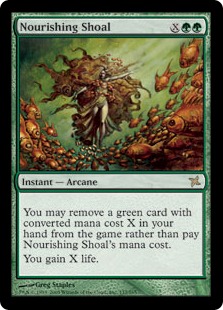
Nourishing ShoalTo some Modern players, money is no object, but detecting a card’s power also has competitive applications: it gives Spikes an opportunity to take events by storm with their new tech. Understanding what makes the card in question usable in Modern helps these Spikes build optimal piles. I’ve heard a few players dismiss this recent Modern Affinity list, which runs four mainboard Day's Undoings, as lucky and bad, saying they’d rather have Thoughtcast or other colored spells in Undoing’s slot. These critics don’t grasp the role Undoing plays in the deck, and that misunderstanding exposes their weakness at card analysis. Trevor Holmes’s recent article on Jace, Vryn’s Prodigy, and mine on Day’s Undoing, aim to describe the thought processes behind our faith in these cards, hopefully helping readers become better at judging cards themselves.

Since all cards are different, and all cases vary, I’ll leave readers with a general investment tip. If a card does something no other card does for the mana cost, and has an effect that could be relevant in a Modern metagame, it’s a fine spec. Nourishing Shoal is a good example of a card that fits into these parameters – it gains life for as low as 0 mana, and Burn is enough of a presence in Modern that lifegain will always hold some relevance. Feed the Clan is another – no other card gains up to 10 life for just two mana. Foil Feeds were priced under 50 cents each for months, and now cost over $7. Properly speculating on cards like these helps players expand their personal collections and stay one stop ahead of the metagame.

Five More Modern Sleepers

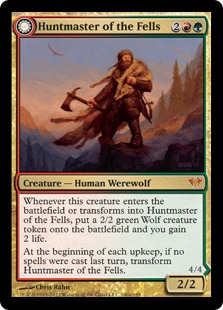
1. Huntmaster of the Fells

Huntmaster of the Fells

In his Origins review, Sheridan called out Pia and Kiran Nalaar as a potential Modern playable, citing its similarities to Huntmaster of the Fells and perceived aggressive benefits over the transforming Werewolf. The card has yet to make any waves, while Huntmaster remains a Jund staple. How come?

Huntmaster’s main benefit over the Origins newcomer is its nonreliance on mana. Post-resolution, he never asks players to spend more than their initial 2GR investment. Additionally, flipping Huntmaster back and forth in Modern is easy enough that, mana aside, I’d actually consider him more aggressive than Pia and Kiran. Against an answerless opponent, he deals 8 damage after resolving, 6 the turn after, and 10 the next, rivaling even Geist of Saint Traft in terms of pure aggression-for-cost. Being on-color with Blood Moon, not to mention on-curve, also helps lock opponents out of their answers before the beatings begin.

Another plus for Huntmaster is his ability to entirely take over a game. Modern has some 3 CC permanents with the same claim to fame, like Vedalken Shackles and Liliana of the Veil, but their costs make them susceptible to Abrupt Decay. At 4 CC, only Olivia Voldaren can hope to control a game alone, but her weak stats and continued mana requirement make her much easier to stop and pretty embarrassing against an onslaught of low-curve attackers. Bolting a resolved Olivia gives red mages a huge tempo boost, and with Lightning Bolt occupying four slots in 48% of all Modern decks, Huntmaster starts to look a lot more attractive. He also gets around bounce effects like Cryptic Command or Vapor Snag with his ETB ability, while these spells single-handedly reset any advantage gained by Olivia.

The goods Huntmaster provides upon entering the battlefield are only matched by Siege Rhino. Like the trampling 4/5, he generates value on multiple axes. Rhino gains life and deals damage, while Huntmaster gains life and provides a body. Pia and Kiran charge mana for anything in excess of the bodies they make, and even then, they only ever deal damage. Siege Rhino generally does a better job of stabilizing the board and redefining a damage race, but unlike Huntmaster, it never grinds opponents out on its own. It’s also harder to splash.

Fits into:

  • Fair Gx decks that could easily splash for Lightning Bolt or Blood Moon (Mono Green Stompy, Devotion).
  • Decks in GR that need a hand against other fair strategies.
  • Decks in GR that reliably hit four mana in games against aggressive decks.

2. Gitaxian Probe

Gitaxian Probe

Probe does some things unconditionally and others situationally. It always provides perfect hand information and some non-negligible degree of deckbuilding consistency (as per Alan Comer’s Turbo Xerox principle). Many decks benefit greatly from information, a statement endorsed by Jund’s rich history of tearing opponents to shreds after an early Inquisition of Kozilek. As for consistency, shaving lands for spells has always benefited decks that can swing it, since it prevents mana flooding for a minimal cost.

Onto Probe’s situational value. Casting one with Young Pyromancer on the board makes a token, and revealing one to Delver of Secrets makes a flying, blue Wild Nacatl. Probe fills the graveyard for splashy Delve spells like Tasigur, the Golden Fang, and squeezes value out of an early Snapcaster Mage. Some decks (i.e. Grixis Delver) frequently encounter many of these Probe-friendly situations, making the card a natural fit there.

As of today, Gitaxian Probe sees play at an average of 3.9 copies per deck, in an average of 32% of all Legacy decks. By any metric, the card is undoubtedly a Legacy staple. So why doesn’t the card see much play in Modern? For one, Probe plays especially nicely with cards we don’t have. Many of Magic’s best consistency tools (Preordain, Sensei's Divining Top, Green Sun's Zenith) are banned in Modern. With these tools legal, players have extra decisions to make, and Gitaxian Probe helps make these decisions. Without dedicated consistency effects, many Modern decks aim simply to “play on-curve,” casting whatever spell taps all their lands. With their play choices already limited, the knowledge gained from Probe becomes less valuable.

But the main factor keeping Probe out of Modern is the format’s elephant-in-the-room orbit around Burn. In Legacy, Burn hardly ever makes it to the top tables, but its Modern iteration is one of the most consistent and powerful decks around. With great strength comes great representation, and Burn currently holds an impressive 8.3% share of the format. Obviously, Gitaxian Probe seems silly in a room full of Lava Spikes.

That said, I don’t think the card sees enough play. I’ve tuned even four-color decks to have favorable matchups against Burn with Gitaxian Probe in the mainboard. If a deck can make extra use of the information, consistency, stocked graveyard, or Instant/Sorcery density Probe provides, and it doesn’t have a terrible Burn matchup, I think it deserves a few copies.

Fits into:

  • All tempo and combo decks with a decent plan against Burn (Delver, RUG Twin, Amulet).
  • Linear aggressive decks that generally decide the pace of a game with their own speed (Infect, Suicide Zoo).
  • Blue decks that have many decisions to make and can gain value from Probe in some other way (Grixis Control, UWR).

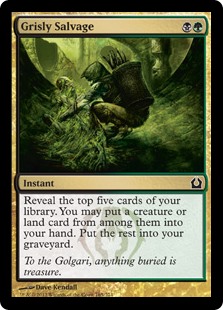
3. Grisly Salvage

Grisly Salvage


Some consistency tools offer card selection universal enough to homogenize Modern decks. Supporting this claim, a quick look at the decks played while these cards were legal reveals that many lists started with 4 Ponder, 4 Preordain. Grisly Salvage provides a powerful consistency effect that only benefits certain strategies, but with the host of graveyard-related goodies playable in Modern, even decks other than Dredgevine stand to make great use of the card.

Fits into:

  • Decks that benefit greatly from finding a specific threat.
  • Decks that already rely on the graveyard for value.
  • Decks with extra mana to spend (i.e. from Aether Vial).

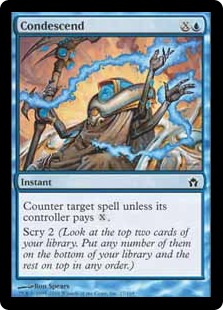
4. Condescend

condescend

Wizards hasn’t been very generous with Modern-era countermagic. Interacting with spells on the stack is still such a powerful ability that cards like Mana Leak and Deprive end up Modern staples anyway. I’ve always wondered why Condescend sees little play outside of Blue Tron and, occasionally, the nearly-extinct UWR Control.

Given the format’s blistering speed, Modern countermagic needs to address low-curve threats as early as the second turn. The best spells for the job, Mana Leak and Spell Snare, do less in the later game, and the decks that want counterspells are often designed to end up in that stage. Condescend bridges the gap between Remand and Cryptic Command, offering a hard “no” at any stage in the game and backing it up with library manipulation (which, in a topdeck war or a combo deck, is often even better than a cantrip).

As far as I can tell, Condescend best meshes with URx Twin, a deck that gains a lot from soft permission since it can “just win” as early as the fourth turn. Twin also has no reservations about entering the late game, and unlike Mana Leak, Condescend continues to counter spells as players make their land drops. Finally, scry is right at home in a deck that runs a playset of Serum Visions to assemble a combo or find silver bullets. Twin often leaves two lands up on turn two, but only sometimes has the Remand; adding Condescend gives the deck another two-mana play and makes it even harder for opponents to tap out. Additionally, any time gained from opponents playing around Exarch-Twin or Condescend only makes the counterspell better, since it improves with every land drop.

Fits into:

  • Most blue midrange and control decks.
  • All blue combo decks that operate on a higher curve (3-4 CC spells).

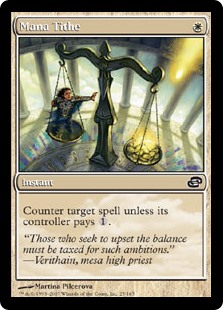
5. Mana Tithe

Mana Tithe

Here’s a card nobody ever sees coming – and that’s what makes it potent. Mana Tithe brings its A-game as a one-off that often gets put in the sideboard once opponents have seen it. The opponent is then forced into a guessing game: play around Tithe the rest of the match or have their spells countered. Usually Tithe is worth running just to “get” that on-curve bomb. More than possibly any other format, Modern rewards players for casting spells on-curve: turn three Exarch, turn four Twin; turn three Liliana, turn four Rhino; turn two Plating, turn three Champion. Mana Tithe gives even non-blue decks ways to interact with the stack in a meaningful way against opponents doing what they must to win the game: playing on curve.

Fits into:

  • Decks that can employ or make use of soft permission effects and run white (Jeskai tempo, Mardu midrange, Hatebears decks).
  • Nonblue midrange decks as a catch-all against high-curve combo (i.e. Abzan against Twin or Ad Nauseam).

Brew of the Month

I actually don’t know how often I’ll publish brews at the ends of my articles, but here’s a fun one I’ve been working on for some time. Grisly Vial wants to spend its mana on Grisly Salvage, Life from the Loam, Lingering Souls, and activating utility lands, while Aether Vial puts above-curve creatures into play. Tarmogoyf grows to 8/9 post-board, but if you prefer cute interactions to boring beaters, the deck also runs the Haakon-Inversion combo and a Grim Harvest engine to turn dying Spirit tokens into big green guys. Salvage helps find hosers from the sideboard to slow down midrange and combo while attacking opposing life totals.

Grisly Vial, by Jordan Boisvert

Creatures

2 Tidehollow Sculler
4 Tarmogoyf
4 Voice of Resurgence
2 Tasigur, the Golden Fang
1 Scavenging Ooze
1 Haakon, Stromgald Scourge

Sorceries

4 Inquisition of Kozilek
4 Lingering Souls
1 Life from the Loam

Instants

4 Grisly Salvage
4 Path to Exile
1 Nameless Inversion
1 Grim Harvest

Artifacts

4 AEther Vial

Planeswalkers

2 Liliana of the Veil

Lands

4 Verdant Catacombs
4 Marsh Flats
2 Overgrown Tomb
2 Godless Shrine
1 Temple Garden
2 Swamp
1 Forest
1 Plains
1 Urborg, Tomb of Yawgmoth
1 Gavony Township
1 Stirring Wildwood
1 Vault of the Archangel

Sideboard

4 Fulminator Mage
2 Spellskite
3 Kitchen Finks
3 Aven Mindcensor
1 Darkblast
2 Bitterblossom

Modern leaves players with plenty of cards and options to explore. I look forward to hearing about your favorites in the comments below.

Jordan Boisvert

Jordan is Assistant Director of Content at Quiet Speculation and a longtime contributor to Modern Nexus. Best known for his innovations in Temur Delver and Colorless Eldrazi, Jordan favors highly reversible aggro-control decks and is always striving to embrace his biases when playing or brewing.

View More By Jordan Boisvert

Posted in Modern, Opinion, TechTagged , 3 Comments on What’s Good? Modern Sleepers (Part 2)

Have you joined the Quiet Speculation Discord?

If you haven't, you're leaving value on the table! Join our community of experts, enthusiasts, entertainers, and educators and enjoy exclusive podcasts, questions asked and answered, trades, sales, and everything else Discord has to offer.

Want to create content with Quiet Speculation?

All you need to succeed is a passion for Magic: The Gathering, and the ability to write coherently. Share your knowledge of MTG and how you leverage it to win games, get value from your cards – or even turn a profit.

Major Updates to Trade Routes! Turn your cards into cash faster than ever before.

Are you a Quiet Speculation member?

If not, now is a perfect time to join up! Our powerful tools, breaking-news analysis, and exclusive Discord channel will make sure you stay up to date and ahead of the curve.

Greetings from the rainy, windy mountains of Western Montana!  I'm spending the week here, just outside Helena, parked in a field by a lake.  Yesterday we saw a giant double rainbow.

What better place to hole up inside, squashing Trader Tools bugs and adding awesome new features?

Photo Credit: Anna Edgren, Small House Big World

No, that's not a stock photo.  That was the view from my living room window last night.

Anyway, while I'm traveling around the US in my motorhome, I stop into game stores and troll Craigslist for Magic collections.  I had to sell most of my collection to purchase this RV, so now I'm in the process of rebuilding.  As much as I love Magic cards, I also like to be able to enjoy the beautiful places I visit, so I don't want to spend all my free time sorting and selling cards.

What Is Trade Routes?

Before I get to the new features and bugfixes, I realize not everyone knows what Trade Routes is or what it does. Quite simply, it's probably the most powerful tool that QS offers Insider members.  It's saved me--personally--hundreds of hours of pointless labor, and it allows me to extract the most value out of my cards every week.   If you're not familiar with Trade Routes, watch this quick video that shows you how it works.

One of our core beliefs at QS is that you should only ever have to inventory a Magic card once.  To that end, we've invested many hours of developer time into automation tools that ensure no one has to waste time managing their collection.

Our importer can take your spreadsheet and quickly turn it into a Trader Tools list, helping you correct errors along the way.  Of course, you can always create a new List within Trader Tools, which is how I prefer to work, as it's faster than creating a spreadsheet from scratch.  You can also import your PucaTrade inventory.

The point is, you can take lists you already have and use them without having to waste time re-entering cards.

Once you have a list in Trader Tools, that's where Trade Routes comes into play.  Trade Routes is a way to turn Magic cards into cash, quickly and easily.

It does this by taking a list of cards, checking their prices against our robust database of buylist and retail prices, and intelligently splits up the list based on which merchants are paying the most for your cards.

So far, so good.  That's one more layer of intelligence than you had before!  I remember the days, back when I was running a retail game store, when I had half a dozen buylist tabs open and had to manually check every single one for every single card I had.  I cannot tell you how many nights out with friends I skipped because I had  buylisting to do, or how many Saturday afternoons in the park with my girlfriend I missed because I was too busy trimming down my overstock.  It was a massive waste of time!

So, Trade Routes fixes that problem.  But, if we stopped there, we'd still have to manually go to the merchant's buylist website and enter each card, one by one.  I forget who said this, but it's one of my favorite quotes - "Copy and Paste is not a scalable business solution". This is where Trade Routes gets good;--we've taken the time to dissect the internals of how each merchant's buylist works, and our tool automatically outputs data in a format they'll recognize.

With some merchants, like ABU Games, Card Kingdom and AdventuresON, we have a direct link to their shopping cart system.  Once Trade Routes has divided up your collection, you can go to each of these merchants' tabs and press one button to populate your buylist cart on their site.  Then you can check-out as normal, without having to re-enter cards.  This was another process that wasted countless hours of my precious and quickly-fading youth.  

The problem with a system this fast and efficient is that sometimes it'll try to sell cards that aren't worth selling, or cards you don't want to sell.  Sure, you could split up your list manually before sending it to Trade Routes, but come on, ain't nobody got time for that.

We added a minimum price filter so that you could tell TR to ignore all those 2 cent cards that ABU Games likes to buy.

 Pro Tip:  In packages up to about 13 ounces, a Magic card costs about 1.5 cents to ship.

That's great, too, but we can do better, and that's where today's updates come into play. Between doing my own buylisting and listening to our Insiders' suggestions on our Forum, I found a few workflow problems that could be solved with a few days of developer time.  The description of the problems and their solutions are below, along with some screenshots showing how to make use of these new additions.

The Updates

Problem: Trade Routes is trying to sell cards that aren't worth selling.  The existing solution to filter out cards by minimum price got us half-way, but what about expensive cards that still aren't worth selling?  This is where we teach our Insiders to look at the card's Spread, which is a short-hand for understanding how much less than retail price you'll be getting when you sell to a buylist.

Reminder: 50% spreads are basically average.  Spreads smaller than 30% are very favorable, especially since many of our merchants pay out 25-30% more in store credit.  As a rule, I don't sell cards with spreads wider than 60%.  I will be patient and wait for a buy price that reflects a narrower spread.

Solution: Trade Routes now allows Spread Filtering.  You'll see a new box on the Trade Routes screen that asks you for a maximum spread, defaulting to 50%.  This ensures you're not selling cards for way less than they're worth.

Screen Shot 2015-07-27 at 11.17.40 AM


Problem:  After submitting buylist orders, I had to go back and manually remove cards from my list.  This was obviously a non-starter, as Trade Routes is at its best when you're dealing with large quantities of Magic cards.  In a system designed to work at massive scale, having this bottleneck was just unacceptable and was wasting hours of user time.

Solution:  Now, after you click the Start Selling button, you'll be given a link on the confirmation screen, to a new list that Trade Routes created on your behalf, minus all the cards that are being sent out.  If you decide not to send out the orders, or were just testing out Trade Routes, no problem--you can just ignore that list.  Otherwise, just click it to make it your active list.

Screen Shot 2015-07-27 at 11.18.40 AM


Problem: Troll and Toad wasn't set up for Trade Routes automatic integration (also known as Direct-to-Cart).  The way their buylist was set up, we couldn't use the normal technology we developed to do one-click integration.   This meant that Insiders who wanted to sell to Troll and Toad had to do the dreaded re-entry.  I know that I have often disabled TNT in my Trade Routes for this exact reason, as I'd rather take a little less money on my cards than waste time re-entering them into someone else's site.

Solution:  We found a way to utilize TNT's CSV buylist uploader that allows Trade Routes to talk to it effectively.  It's not quite as easy as the one-click solutions for Card Kingdom, ABU Games and AdventuresON, but 2 clicks is good enough for me!  On the Trade Routes cart screen for TNT, you'll see a button that'll let you save a properly-formatted CSV, along with a link where you can upload it.  Disregard steps 1 and 2 in the example below, since Trade Routes will auto-generate and edit the file described in the first 2 steps.

Export the CSV as a file by clicking the nice green button.
Export the CSV as a file by clicking the nice green button, then...
Screen Shot 2015-07-27 at 11.17.02 AM
Upload the file via the uploader on TNT's Site (Trade Routes lets you start at Step 3!)


Problem: Sometimes, the right way to out a card is through PucaTrade.

Solution: Easy!  We added an option to dump your entire list to into your PucaTrade "have" inventory.   This won't affect the list in Trader Tools, so if you choose to send a card via PT, you'll want to remove it manually.

Screen Shot 2015-07-27 at 11.23.04 AM

Copy the output from Trader Tools...
Then just paste it into PucaTrade
...Then just paste it into PucaTrade


Problem:  I want to be able to import my MTGO collection!

Solution: So, now Trader Tools can import from MTGO lists.  We plan to add MTGO prices in the very near future, so this is just one small step.  MTGO-specific editions will need to be added, so for now, work around that by choosing a different edition.

Screen Shot 2015-07-27 at 2.16.14 PM


So, that's what we've been working on lately! We have a whole pipeline full of interesting things that'll make your Magic trading faster, easier and more profitable. We're really excited at how efficient Trade Routes is becoming, and I've been using it almost every day to crunch through my overstock. As I said in the video, I'm saving up store credit from buylisting low-end cards that I'll never need, and hope to buy some Vintage staples and / or Power soon!

Magic Origins in Modern: Jace, Vryn’s Prodigy

Are you a Quiet Speculation member?

If not, now is a perfect time to join up! Our powerful tools, breaking-news analysis, and exclusive Discord channel will make sure you stay up to date and ahead of the curve.

With Magic Origins finally in our hands, and the results of two Standard SCG events in the books, weeks of predictions and conjecture concerning our new gifts can finally be put to the test. While no large, high-level Modern events will occur for a few weeks, we still have MTGO Daily results, SCG IQ’s, and our own individual testing to determine what, if any, changes Origins will have on Modern.
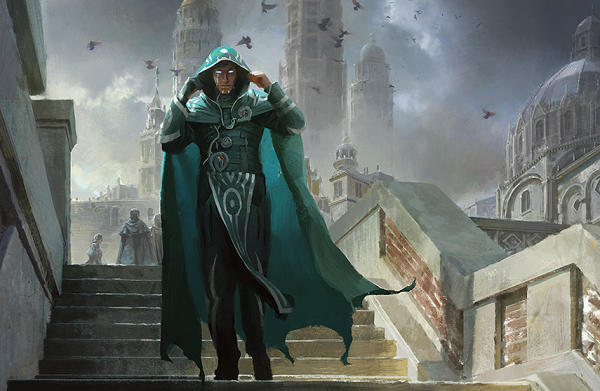
Jace Unbound resize

As I write this, I’m on a plane bound for Vancouver, where the world’s best (and then myself) will battle with Magic Origins in Standard and Draft. My testing complete, I’ve narrowed my options down to two decks, and my mind is left to contemplate two things; Modern with Magic Origins, and how to politely ask the middle-aged woman next to me to remove her head from my shoulder. Let’s go!

[wp_ad_camp_1]

Through the Lens of Standard: Initial Impressions

Every set release, new card evaluations usually follow a predictable trend. As spoilers flow in, cards are initially evaluated purely on rate ("Hero of Bladeholddoes so much for four mana!"). Once the full spoiler is available, more restrained minds join in, analyzing new cards both on rate and context, to determine how they fit into the current environment. Evaluation based on pure theory is rarely accurate, however, as every three months Wizards tries its best to bring something new to the table, and most new cards are hard to judge without putting them through their paces in actual games of Magic. For those following Standard results and discussion, Hangarback Walker is a great recent example.
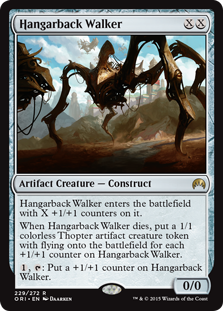
Hangarback WalkerInitially overlooked by most everyone in favor of splashy, powerful effects like Languish, Harbinger of the Tides and the flip-walkers, Hangarback is one Walker that flew in under the radar, only to make a powerful debut at SCG Chicago. A Chronomaton fused with a Doomed Traveler, Hangarback’s skill set fits well into the grindy, value-oriented midrange-fest that is current Standard. The ability to turn excess mana into tangible value, along with its usefulness at every stage of the game, Hangarback Walker’s bright future in Standard is relatively assured, as long as Delver of Secrets and Vapor Snag don’t make a comeback.

In Modern, however, Hangarback Walker is practically unplayable, as the conditions that guarantee its success in Standard are entirely absent. Cheap exile and bounce effects are everywhere, and most strategies are defined by the fundamental principle of 'Mana as a Resource'. Sorry, Jeff Hoogland, I know you love your Modern U/W Control, but please leave Hangarback on the sidelines (or, you know, break it and prove me wrong). The fluctuating value of Hangarback Walker perfectly illustrates how important context matters as it pertains to card evaluations. Evaluating cards on rate first, and then on context makes things easier to understand (as rate is a measurable factor that we can use to compare new, unique cards to past versions) but with each passing set release, I’ve become more convinced that we should instead be evaluating cards on context first, as it seems to be most important (I’m looking directly at you, Agent of Erebos).

Jace, Vryn’s Prodigy in Modern
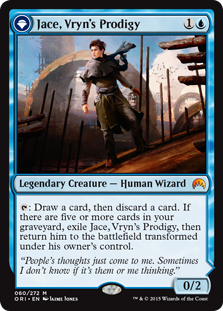
Jace ProdigyInitially maligned by pretty much everyone as the worst flip-planeswalker of the cycle, Jace, Vryn's Prodigy has stepped up in a big way, shutting down those nay-saying Mage-Ring Bullys and igniting his spark to greatness. In Standard, a Merfolk Looter is exactly what the doctor ordered, and plentiful graveyard synergies and strategies of every flavor have seen Jace supplement existing decks like Jeskai Tokens and Sultai Control, while enabling new strategies like Five-Color Rally. Capable of flipping as early as the third turn with the help of fetchlands and Satyr Wayfinder, Jace provides a cheap way to ensure card quality in hand, and card advantage through his Snapcaster Mage ability.

Unlike Hangarback Walker, the possible transition from Standard to Modern is much kinder to Jace. A plethora of cheap one and two mana spells ensure early Jace flips, and the card advantage gained by his Snapcaster ability is much easier to leverage towards a win in Modern, where most exchanges are equal and less haymakers exist. Jace is happier alongside a full graveyard, which suggests (but does not require) him to associate with other cards that care about the graveyard, such as Snapcaster Mage and Gurmag Angler. If only there were a Satyr Wayfinder type effect in Modern that could help enable Jace while smoothing draws and get the graveyard value train rolling….
Thought Scour

Now that’s what I’m talking about! Thought Scour has to be Jace’s best buddy, so much so that I suggest we question Jace’s Mad Scientist roots. Alongside a single fetchland activation, Thought Scour can immediately set up a Jace loot/flip as early as the third turn. Even without Thought Scour, a normal play sequence of turn 1 spell, turn 2 Jace, turn 3 double spell can achieve a flip with the help of a fetch. Add in free spells such as Gitaxian Probe, and we’re looking at a planeswalker that is incredibly easy to turn on, even more so than the universally popular Nissa, Vastwood Seer and Liliana, Heretical Healer. Personally, I always went for the quiet ones myself, which I guess explains my bro-love for Jace.

As we’ve talked about before, the most important thing to keep in mind when evaluating cards is context. We’ve established that Jace is powerful, and can be enabled without much difficulty, but does a deck exist that could use what he has to offer? And if not, does a new strategy that either employs or revolves around Jace bring something new to the table that is better than what currently exists in Modern? While it might take a few weeks to figure out the latter, today I’d like to start at level 1, finding a home for Jace among current decks. We’ll start with my personal favorite in Modern, Grixis Control.

Grixis Control with Jace

"Grixis Prodigy, by Trevor Holmes"

Creatures

4 Snapcaster Mage
2 Tasigur, the Golden Fang
2 Gurmag Angler
3 Jace, Vryn's Prodigy

Instants

4 Lightning Bolt
4 Terminate
4 Thought Scour
4 Serum Visions
2 Cryptic Command
3 Kolaghan's Command
1 Electrolyze
2 Mana Leak
2 Spell Snare
1 Deprive

Lands

4 Polluted Delta
4 Scalding Tarn
4 Island
3 Creeping Tar Pit
2 Steam Vents
2 Watery Grave
1 Sulfur Falls
1 Mountain
1 Swamp

Sideboard

4 Fulminator Mage
3 Dispel
1 Anger of the Gods
1 Damnation
1 Bitterblossom
1 Vandalblast
1 Duress
1 Izzet Staticaster
1 Deathmark
1 Engineered Explosives

If we’re looking for a strategy that wouldn’t mind a little extra power, Grixis Control is definitely where I would start. The opportunity cost of adding Jace is basically free, as Grixis already employs fetchlands, cheap spells, and a full playset of Thought Scour to support multiple graveyard synergies like Gurmag Angler, Snapcaster Mage, and Kolaghan's Command. Grixis is definitely interested in both of Jace, Telepath Unbound’s abilities, as shrinking a Tarmogoyf to manageable levels lets us buy time to find Terminates, and Delver of Secrets becomes a pretty anemic clock once his Lava Spikes become Hornet Stings. More than any other deck in Modern, Grixis has access to some of the most powerful instants and sorceries in the format, as anyone who’s chained multiple Kolaghan's Commands or Cryptic Commands can tell you.
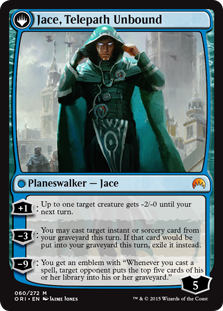
Jace UnboundIn addition, Grixis is uniquely capable of utilizing Jace, Vryn's Prodigy as just a Merfolk Looter, if the situation demands it, through the use of our delve creatures. Some polarizing matchups like Amulet Bloom or Living End see us digging frantically for counterspells and cursing every Terminate that enters our hand. Jace can help us power through our deck, digging us to exactly what we need. Openers with double delve creatures are often awkward and unkeepable, but Jace can help us loot away unneeded Gurmag Anglers, or work towards casting the second one. A relatively low land count of 22 lands means we aren’t flooding often, but random draws off Thought Scour can often be disastrous, and the deck rarely wants to see more than five lands until the very late-game. Jace, like Merfolk Looter before him, allows us to pull back from bad draws while supplementing our normal draws by keeping the good spells coming, and untapping with him gives a feeling akin to untapping with Jeskai Ascendancy in Standard; we feel like we’re operating on a more powerful axis than our opponent. While the poor peasants are bound to their draw step, we get to power through our deck, finding exactly what we need.

A lover not a fighter, Jace is disadvantaged in Modern by his puny body and un-hasty nature. Look man, I call it like I see it; he’s weak, and weird, and can’t put up much of a fight. It’s no wonder he got bullied in school. Protecting Jace can often be a problem, as he attracts Lightning Bolts and Abrupt Decays like no other. I mean it, literally no other creature in our deck cares about either of those spells. One of the strengths of Grixis Control is its avoidance of creatures under 3 CMC, not counting Snapcaster Mage (as he replaces himself, and is the single strongest card in Modern so we’d be crazy not to play him). The size and cost of our delve creatures allow us to play them for one mana while dodging both Decay and Bolt (yeah, tell me how that’s fair), giving us virtual card advantage as our opponent is stuck with dead removal in hand Game 1. Adding Jace to our deck negates that advantage, which isn’t necessarily a bad thing (as we are gaining something in return) but it is something to keep in mind as we think about deck construction and gameflow.

A final note on Jace in Grixis; you haven’t lived until you cast Jace on turn 2, untap, Thought Scour, flip, plus land a Tasigur, and say "Go" with Spell Snare protection.

Let that soak in.

U/R Delver with Jace

"Prodigy Delver, by Trevor Holmes"

Creatures

3 Young Pyromancer
4 Snapcaster Mage
4 Delver of Secrets
2 Jace, Vryn's Prodigy
1 Vendilion Clique

Instants

4 Lightning Bolt
3 Electrolyze
3 Remand
2 Spell Pierce
2 Spell Snare
2 Mana Leak
2 Vapor Snag
1 Dismember

Sorceries

4 Serum Visions
4 Gitaxian Probe
1 Forked Bolt

Lands

4 Island
4 Misty Rainforest
4 Scalding Tarn
3 Steam Vents
3 Mountain

Sideboard

1 Smash to Smithereens
2 Blood Moon
1 Roast
4 Dispel
1 Vandalblast
1 Flashfreeze
1 Izzet Staticaster
2 Rending Volley
1 Dragon's Claw
1 Grim Lavamancer

A solid tier 2 strategy, U/R Delver rose to prominence with the printing of Treasure Cruise, then experienced a sharp decline with its subsequent banning. Gitaxian ProbeU/R Delver is able to take advantage of smooth mana and a plethora of cheap tempo spells, but traditionally has trouble dealing with large creatures like Tarmogoyf and Gurmag Angler. Outside of Spell Snare, U/R has to rely on sub-par sideboard options like Roast if one of them lands, but it is able to take advantage of strong tempo plays like Vapor Snag and Remand to keep problematic creatures off the table. Jace, Vryn's Prodigy would be a helpful aid for U/R, letting it transition through the midgame and find specific answers/tempo spells to seal the game. U/R has no shortage of cheap creatures between Delver of Secrets, Snapcaster Mage, Young Pyromancer, and sometimes Grim Lavamancer, so opposing removal will already be stretched thin. If U/R Delver desires an extra form of Snapcaster-like card advantage, they can definitely find it in Jace.
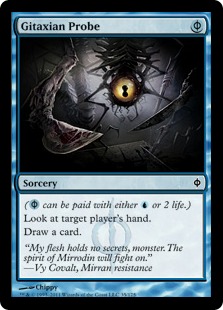
Splinter Twin with Jace

"Prodigy Twin, by Trevor Holmes"

Creatures

4 Pestermite
3 Deceiver Exarch
4 Snapcaster Mage
3 Jace, Vryn's Prodigy
1 Grim Lavamancer

Instants

4 Lightning Bolt
4 Remand
2 Cryptic Command
1 Dispel
2 Electrolyze
1 Spell Snare

Sorceries

4 Serum Visions
1 Roast

Enchantments

4 Splinter Twin

Lands

5 Island
4 Scalding Tarn
4 Sulfur Falls
3 Steam Vents
2 Polluted Delta
1 Mountain
1 Breeding Pool
1 Desolate Lighthouse
1 Tectonic Edge

Sideboard

2 Blood Moon
2 Ancient Grudge
2 Dispel
1 Relic of Progenitus
1 Spellskite
1 Izzet Staticaster
1 Combust
1 Chandra, Pyromaster
1 Roast
1 Dismember
1 Keranos, God of Storms
1 Counterflux

Combo strategies like Splinter Twin, and to a lesser extent Scapeshift, are all about trying to stay alive while sculpting a powerful hand that accomplishes their objective. Splinter TwinMerfolk Looter could possibly be welcome in strategies like these, as it helps them find the missing pieces to their puzzle. In addition, Jace can act as a pseudo-fog against an opposing Tarmogoyf/Gurmag Angler by looting and flipping after blocks. It’s possible that these lists are too tight to fit Jace (especially Scapeshift, as they need to devote almost all slots to ramp, counterspells, and card draw) but I could definitely see Jace in some number in Twin strategies as an alternate angle of attack that works to progress their gameplan, discarding extra combo pieces for critical protection or interaction. I plan on building and testing both Twin and Delver with Jace, so expect a follow-up article soon with more insight into these archetypes! If you have experience with either, let me know in the comments.
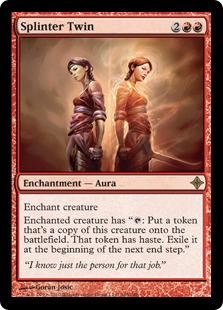
Conclusion

We’ve barely dipped our toes into the water with Magic Origins, and while it may not contain many exciting, splashy Modern plants like other sets have, I’m excited to see what tools it has to offer for Modern. Jace, Vryn's Prodigy might end up being too slow and too weak to compete in a format defined by removal and resilient creatures, but I have a growing suspicion that Jace could grow up (get it!) to be a force to be reckoned with in the format.

If you have any ideas for how best to use Jace in Modern, let me know in the comments! If you want to see Jace in action, feel free to stop by my stream at twitch.tv/Architect_Gaming. I return from the Pro Tour on Tuesday (hopefully victorious) and I look forward to breaking Modern with Jace! See you there!

Trevor Holmes
The_Architect on MTGO
Twitch.tv/Architect_Gaming
Twitter.com/7he4rchitect

 

Insider: My Final Devotion

Are you a Quiet Speculation member?

If not, now is a perfect time to join up! Our powerful tools, breaking-news analysis, and exclusive Discord channel will make sure you stay up to date and ahead of the curve.

All things must come to an end. Theros Block is winding down its path towards rotation oblivion. Prices from the three sets of the enchantment-themed block are diminishing swiftly but after this recent decline, most seem stable for now. They have yet to go cliff diving towards their post-rotation price trajectories.

For most players, they have been devoted to green. In the past, I would have been amongst the masses of the green monster as well. In week one of our new Origins format, the G/r Devotion beast reared its unstoppable head and not only won the event but placed many players highly. Going into week two, it was the clear deck to beat and players brought out their tree chopping axes and left no devoted tree mages standing.

There was one green mage who managed to survive the fires brewing to burn down the forest and it was Adam Bialkowski. He is more devoted to dragons, but that’s okay too. This unique take on G/R Dragons lit up the hearts of mages around the globe. Here’s the inspirational list:

GR Dragons by Adam Bialkowski (7th place SCG Rich)

Creatures

4 Elvish Mystic
4 Rattleclaw Mystic
2 Sylvan Caryatid
2 Yasova Dragonclaw
4 Thunderbreak Regent
3 Surrak, the Hunt Caller
3 Atarka, World Render
2 Xenagos, God of Revels
1 Dragonlord Atarka

Spells

2 Crater's Claws
4 Draconic Roar
2 Xenagos, the Reveler
4 See the Unwritten

Lands

4 Rugged Highlands
4 Temple of Abandon
4 Wooded Foothills
7 Forest
4 Mountain

Sideboard

4 Gaea's Revenge
2 Destructive Revelry
2 Display of Dominance
2 Twin Bolt
2 Wild Slash
1 Roast
2 Scouring Sands

Not only does this deck have a solid, proven game plan of playing dragons and attacking with them, it also has a combo element. In place of Stormbreath Dragon, whose price was truly demolished recently, we see the fun switch to Atarka, World Render. This adjustment in deck design is made possible by those Eldrazi-loving designers who planted See the Unwritten to open our minds to Magical Christmasland on Zendikar this year (or possibly crush our hopes and dreams).

Ideally, you will hit two creatures from your ferocious See the Unwritten. Any two fat flying monsters you find are likely to get the job done, but Atarka, World Render plus Xenagos, God of Revels is a lethal combination from your opponent’s full twenty.

This deck may look like kitchen table fun time, but I think it was not only a brilliant deck design, but also the best positioned deck for the event. When I metagame against the current, this type of next-leveling is what I dream of. He even has amazing sideboard cards like Twin Bolt and Scouring Sands to fight against some beatdown.

As the format adjusts and the pieces move around, I’m not sure how great this deck will be, but for now, get started burninating the countryside.

My Devotion

You know you’re in love when you work through your problems and keep coming back to each other. Sometimes you start as friends and work your way up to a relationship, while other times it’s love at first sight.

The moment I first laid eyes on her, I was struck by the love bug. She was everything I could have ever wanted and our crazy ride started in one whirlwind of a night. First there was rustling about the spare bedroom, throwing caution to the wind. Then there were the sleeves coming on and off like water cascading down the waterfall. That all climaxed into one crazy night that left me exhausted and passed out on my bed dreaming of tomorrow when I could live it all over again.

Endlessly I dreamed of my lady in blue and the adrenaline that goes along with thoughts of her. Now, she’s back in my life and I couldn’t be more ecstatic. Take a look at that sexy lady now.

U/g Devotion by Mike Lanigan

Creatures

4 Faerie Miscreant
4 Harbinger of the Tides
4 Kiora's Follower
4 Bounding Krasis
4 Shorecrasher Elemental
3 Thassa, God of the Sea
4 Master of Waves

Spells

1 Triton Tactics
3 Clash of Wills
1 Hall of Triumph
4 Collected Company

Lands

4 Temple of Mystery
4 Thornwood Falls
4 Yavimaya Coast
1 Foundry of the Consuls
11 Island

Sideboard

1 Triton Tactics
2 Stratus Dancer
4 Dissolve
1 Bident of Thassa
3 Reclamation Sage
4 Profaner of the Dead

A couple weeks ago, I wrote about how I thought this deck was due for a comeback. With all the new tools Origins brought to the workshop, certainly there was a list lurking about the shadows waiting to be discovered. After tinkering around with some of the knick-knacks, I think we’ve moved out of the beta version and we’re ready for our first test run this weekend.

All of the things I surmised have proven true so far in testing. In my opinion, this is the best Collected Company deck in Standard by a large margin. Hitting any of the new cards, like Harbinger of the Tides, Bounding Krasis, or Shorecrasher Elemental, turns on Thassa, God of the Sea mid-combat. Often Collected Company acts like Restoration Angel, giving you not only value but also ambushing the attackers.

Even Faerie Miscreant has been overperforming. Starting your game out with early aggression and devotion is important. When you get to cantrip the second one, you’ll never look back from this faerie’s inclusion and the first time you hit two of them from your Collected Company to draw two cards, you feel like you hit the lottery.

Another note on our triple-blue best friend. Shorecrasher Elemental is definitely one of the most important cards in the deck and it’s worth protecting most of the time by not running it out there on turn three. Whether you’re blinking it or pumping it, this is one heck of a devotion roadblock for your opponent to bust through. Often you won’t even spend the time to flip it face up again because you have so much other action going on.

The hidden hero of the deck though has to be Kiora's Follower. With how potent your four-drops are, it’s no surprise that getting to them a turn early is like winning at the high roller table. The depth this card provides is astounding. Allowing you to both hold up mana as well as untap to block is interaction that is so rarely seen and gives you a huge edge against any opponent.

Cloudfin Raptor, Frostburn Weird, Tidebinder Mage, Nightveil Specter and even Judge's Familiar will always be missed, but I’m starting to think that with the card pool available now, this new blue is even better than it was before. The main proponent of my viewpoint is Clash of Wills. Silumgar's Sorcerer has not been missed since I booted him from my initial version for this strict upgrade.

The truth is that sometimes Clash of Wills just sits in your hand as you amass your blue army, but it provides an essential service in combination with many of your threats. Being able to choose whether to increase the pressure on the board or counter whatever your opponent is doing to slow you down is versatility that we’re not used to in this archetype. You may not think having a random counter changes much, but the context is key in this instance.

Supreme Verdict has brainwashed us all. Before and after this card, sweepers can be countered! Sometimes I have that random thought and it makes me smile. The uncounterable wrath put a huge noose on the format that many didn’t even realize was choking them.

Now, when they reach their critical turn to cast one of their many sweeper options, all you have to do is hold up mana. Your mana can be representing a Counterspell or more threats and it will be extremely hard for them to navigate a path to victory. Either their sweeper resolves and you cast more threats or you counter their spell and keep your board intact. Both lines of play will help you be victorious.

Post-board, you still have the common sideboard strategy of bringing in a metric ton of other Counterspell options. Previously I didn’t like this plan because it still didn’t get you through their Supreme Verdict, but now you get to play an actual fish deck where you are mainly playing all your cards on their turn and truly dictating the flow of the game. Against most blue based control decks, I’ve been theorizing this sideboard strategy:

-4 Faerie Miscreant
-2 Kiora's Follower
-1 Triton Tactics

+4 Dissolve
+2 Stratus Dancer
+1 Bident of Thassa

Always think through the matchup you’re in to determine how to sideboard. Blindly following someone else’s strategy doesn’t usually lead to success. This is a great guideline though. One main hiccup is that if you find yourself up against Thopter Spy Network, you will need to cut some more cards for Reclamation Sages so that enchantment doesn’t get out of hand. If they have black removal spells though like Bile Blight and Languish, then Triton Tactics is an all-star. So, you have to alter your plans based on the individual deck you are playing against.

The other main sideboard strategy that I’m giddy about employing will catch every opponent with their pants down. I’m telling all of you faithful readers and letting you in on my hidden secret. Go ahead and read Profaner of the Dead. Unless you noticed this hidden gem in the sideboard above, I’m sure you likely don’t know what the card does. The short version is you get to overload Cyclonic Rift on turn three or four! Let’s say your opponent is playing Goblins, Elves, or even Jeskai Tokens. Once you cast this spell, and usually exploit it to itself, you will be left with an empty board to attack into. I’m very excited to execute this maneuver.

This weekend I’ll be at Gen Con, living it up at the biggest gaming convention on the planet. If you’re there, stop over and say hi. You will see me playing all the formats but most definitely some of these aggressive blue creatures in Standard. Next week, I’m sure there will be lots of stories to share.

Until then,
Unleash the Devotion Force!

Mike Lanigan
MtgJedi on Twitter
Jedicouncilman23@gmail.com

The Most Traded Card on Puca Trade

Are you a Quiet Speculation member?

If not, now is a perfect time to join up! Our powerful tools, breaking-news analysis, and exclusive Discord channel will make sure you stay up to date and ahead of the curve.

There have been some great articles here on Quiet Speculation about using Puca Trade, which are worth a look for all Insiders. Even if you're not using Puca Trade though, it's a site worth paying attention to. In particular, I recommend paying attention to their top traded page.

The thing about Puca Trade, is that while many cards are moved through this medium, it doesn't have any direct impact on the market. I can't just start asking for more Puca Points for my cards- all of the prices are locked in at TCG mid. Therefor, Puca Trade will evidence demand for cards without reflecting any direct changes in the market. This will often have predictive power for market gains in the near future.

Frequently, the most traded card on Puca Trade is an uncommon. This uncommon is usually worth a buck or two, but there's not a lot of financial relevance there. Currently, this is the most traded card on Puca Trade:

There was an error retrieving a chart for Hangarback Walker

A lot of people thought Hangarback Walker was trash at first blush, but its slowly seeing more and more play and is worth a good chunk of change already. The buy in price is high here, but it's entirely possible that we're looking at the next Goblin Rabblemaster.

Avatar photo

Ryan Overturf

Ryan has been playing Magic since Legions and playing competitively since Lorwyn. While he fancies himself a Legacy specialist, you'll always find him with strong opinions on every constructed format.

View More By Ryan Overturf

Posted in FreeTagged , 3 Comments on The Most Traded Card on Puca Trade

Have you joined the Quiet Speculation Discord?

If you haven't, you're leaving value on the table! Join our community of experts, enthusiasts, entertainers, and educators and enjoy exclusive podcasts, questions asked and answered, trades, sales, and everything else Discord has to offer.

Want to create content with Quiet Speculation?

All you need to succeed is a passion for Magic: The Gathering, and the ability to write coherently. Share your knowledge of MTG and how you leverage it to win games, get value from your cards – or even turn a profit.

Deck of the Week – Soulflayer Aggro

Are you a Quiet Speculation member?

If not, now is a perfect time to join up! Our powerful tools, breaking-news analysis, and exclusive Discord channel will make sure you stay up to date and ahead of the curve.

Delve is one of the more broken mechanics in Magic. It cheats mana costs, dodges cost-specific removal like Abrupt Decay, and rewards you for doing nothing else beyond playing a game of Magic. Mark Rosewater may have given delve a mere five on his "Storm Scale" back in 2014, but I am sure the mechanic will be going up after R&D's experience with Treasure Cruise and Dig Through Time. Following the January 2015 bannings, Modern players can still use delve with the almighty Tasigur, the Golden Fang and Gurmag Angler, but many players might be looking for new delve tech. Enter Soulflayer. If you've ever wanted to swing with a turn three flying, lifelinking, double-striking, and hasted 4/4, the Soulflayer is your guy.

Soulflayer Art

Following last week's Deck of the Week premier, we'll be looking at a unique take on the Dredgevine and Dredge/Smallpox Loam strategies. "Soulflayer Aggro" combines some dredge mainstays like Stinkweed Imp and Grisly Salvage with the deck's namesake creature to hit hard and hit fast. If you're looking for a new delve strategy or a cool new aggro deck, Soulflayer Aggro is your five-armed Demon of choice.

[wp_ad_camp_1]

The List and Strategy

I've never seen a competitive Soulflayer list in Modern. Travis Woo released a brew with the card back in January, and we've seen a few attempts on forums to make the creature work. To my knowledge, none of these lists ever enjoyed recorded competitive success, even if some of the Soulflayer brewers reported some scattered LGS victories. This changed last weekend at a PPTQ in Padova, where Andrea Ferrarese piloted his Soulflayer Aggro list to a 5th place finish at the 43-player event. His lean and mean take on Soulflayer Aggro is below:

Soulflayer Aggro, by Andrea Ferrarese (PPTQ Padova 7/25/2015, 5th Place)

Creatures

4 Soulflayer
4 Viashino Slaughtermaster
2 Vault Skirge
4 Stinkweed Imp
4 Birds of Paradise
4 Sylvan Caryatid
4 Vengevine
4 Lotleth Troll
3 Falkenrath Aristocrat

Instants

4 Grisly Salvage

Sorceries

4 Faithless Looting

Lands

4 Verdant Catacombs
2 Wooded Foothills
2 Bloodstained Mire
2 Stomping Ground
2 Overgrown Tomb
1 Blood Crypt
1 Copperline Gorge
1 Urborg, Tomb of Yawgmoth
1 Kessig Wolf Run
1 Swamp
1 Mountain
1 Forest

Sideboard

2 Choke
4 Abrupt Decay
4 Blood Moon
2 Engineered Explosives
2 Vault Skirge
1 Firespout

Some of Ferrarese's tech is clearly in the Dredgevine lineage, as showcased in Legion273's winning Dredgevine list from the Modern Festival Finals. If you are trying to abuse the graveyard and the dredge mechanic in Modern, you should probably consider some combination of Grisly Salvage, Faithless Looting, and Vengevine. Ferrarese adopts these cards but also pushes them a step further. Soulflayer Aggro packs in enough synergies that you can win with or without the deck's namesake delve creature. This is exactly the kind of redundancy you want in Modern aggro decks, and here are some of the key strengths in that regard.

  • Consistency tools
    Ponder and Preordain are banned in Modern for providing combo decks too much card selection, efficiency, and consistency. This underscores the Faithless Lootingpower of cantrips and card-selection spells, and shows how powerful these cards can be in decks. Looting and Salvage are the Ponder and Preordain of graveyard-based decks. They serve a dual function in Soulflayer Aggro style strategies, digging for the cards you need and filling the graveyard to fuel your delves, stock your Vengevines, and get your Stinkweed Imps online. Looting may be card disadvantage in most decks, but Soulflayer Aggro is happy to lose that one card for added Flayer food and a larger graveyard. Salvage is even better, despite its two-mana pricetag: think of it like a cantripping Cabal Ritual for your Soulflayer. In case you needed any more reasons to run the Looting/Salvage pair, these cards also allow Ferrarese to skimp on lands and pack in more action for his gameplan.
  • Alternate win conditions
    One of the biggest problems with most Soulflayer lists I see is an over-reliance on Soulflayer itself. Flayer may be Bolt and Decay-proof, but Lotleth Trollthe widely-played Terminate doesn't care how many keywords the Demon has (unless that keyword is "hexproof"). Mana Leak and Cryptic Command also handle the Flayer before it hits play, and Remand is just as strong against this new delve creature as against his buddies Tasigur and Angler. Ferrarese doesn't fall into the all-in Soulflayer trap, diversifying his win conditions with Vengevine, Falkenrath Aristocrat, and even the criminally underappreciated Lotleth Troll. This gives Soulflayer Aggro 15 win conditions instead of just four, which vastly improves its chances of punching through the spot removal walls of Jund and Grixis Control. Bonus points for the synergy between these win conditions, especially with Soulflayer itself who gets keywords from all of them.
  • Acceleration and Flayer food
    An early mana-dork is one of the strongest plays in Magic, and Modern is no exception. Cards like Birds of Paradise get you a turn ahead of the action and one step closer to Sylvan Caryatidwinning on Modern's critical fourth turn (or at least put you far enough ahead that victory is inevitable). Unfortunately, these cards lose utility in the late game (unless your name is Deathrite Shaman, may he rest in pieces). Abzan Company decks get around this with their Gavony Townships, and Abzan Liege and Midrange lists run Noble Hierarch to benefit from both the early-game boost and some late-game pumping. Soulflayer Aggro has a similar balance. In the early game, accelerators like Birds and Sylvan Caryatid put you a turn ahead. In the case of Caryatid, they also stonewall Goblin Guides and smaller Monastery Swiftspears. In the mid and late-games, these cards feed your Soulflayer delves, your Aristocrat sacrifices, and your Troll discards. You can also pitch them to Looting or keep them around for larger Kessig Wolf Run activations. If you use dorks in Modern, this is how you want to use them, and Soulflayer Aggro does a great job of maximizing their utility.
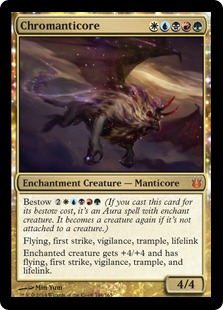
When I look over Ferrarese's list, the big concept that stands out to me is synergy. The deck is full of mini-combos, none of which are gamebreaking on their own but the collection of which is very strong. Unlike most Soulflayer decks, however, Ferrarese isn't trying to pull off any gamebreaking macro-synergies. This includes giant plays with Chromanticore or Sphinx of the Steel Wind. Instead, he's playing an aggressive Dredgevine-style list where his win conditions happen to fuel Soulflayer on top of winning the game on their own. Although the list has some serious holes we need to patch up (you can't play a turn four aggro deck in Modern with zero interaction), this is a great starting point for Soulflayer and offbeat aggro fans.

Soulflayer Aggro in Context

Soulflayer may see next to no Modern play, but the Demon has been a Standard presence since its arrival in Fate Reforged. It took about one minute of frantic Gatherer searches to figure out the synergy Chromanticorebetween Flayer and Chromanticore, a combination many Standard players took to the tournament tables. The deck never took off (sorry to you Chromanticore speculators responsible for the $2 price jump in late January) but a few players enjoyed success with the Demon/Manticore synergy. Hector Carceles Mendez made Day 2 at GP Seville with his take on the deck. Zwi Mowshowitz took a similar version to an 18 point finish at Pro Tour Dragons of Tarkir, adding in the Standard mainstay synergy of Deathmist Raptor/Den Protector on top of his Soulflayer delve package. Ferrarese's list doesn't use the big Chromanticore synergy, but it does borrow other aspects from Mowshowitz's and Mendeze's lists including dig/fueling spells (Grisly Salvage over Commune with the Gods), mana creatures, and alternate win conditions if plan A doesn't work out (Sidisi, Brood Tyrant, Shaman of the Great Hunt, etc.). When considering our Soulflayer Aggro list today, you should be encouraged that it bears similarities to these more tested versions from Standard.
When trying to import a combo or deck from another format to Modern, it's always a good idea to see what's already present in our format. Existing decks give you an idea of what cards and synergies work, Vengevineand what kinds of decks have competitive potential. One thing I really like about Ferrarese's list is its similarity to the Dredgevine core. Dredgevine may not be a tier 1 or 2 monstrosity (some Magic friends I know like to joke about it being "tier 5 Dredgevine"), but it has enough successes to be a decent starting point for Soulflayer Aggro. Knowing the similarities between the two decks, both in card choices and gameplan, we can also gauge Soulflayer Aggro's viability in a broader metagame. Like Dredgevine, Soulflayer Aggro is going to struggle in metagames with lots of graveyard hate. Also like Dredgevine, this deck isn't well-positioned to handle metagames packed with Burn and Affinity: these decks are almost always going to be faster. We don't have enough interaction to slow down the Burn or Affinity player, and we don't have enough speed to beat them in the race. This gives us a great starting point for improving the deck. We don't want to be a "worse" version of Dredgevine, so we need to keep the core strengths of our base deck while also adding new ones Dredgevine can't bring to the table.
Improvements and Updates

There are lots of ways to build Soulflayer in Modern, including the Chromanticore combo, a Sphinx of the Steel Wind and Unburial Rites package, a hyper-aggressive Become Immense or Tainted Strike version, and a number of other takes. Because Ferrarese's Soulflayer Aggro has the best tournament result (however limited it is), and because his list makes sense in the broader Standard/Modern context, I don't want to deviate too heavily from his approach. That's not to say our current list is perfect. In fact, over the course of the article, we've identified a number of key action steps for improvements before taking this list to the next level:

  • Add interaction
    On the one hand, I appreciate Ferrarese's Abrupt Decay playset in the Lightning Axesideboard. He's acknowledging the importance of removal in certain matchups and trying to keep his maindeck as streamlined as possible. On the other hand, this deck is about a turn too fair and slow to completely cut interaction from the maindeck. You can get away with this approach if you're on Infect, Grishoalbrand, Amulet Bloom, etc., but remember that we are living in the Dredgevine lineage. It's no coincidence that the most successful Dredgevine lists are running a healthy assortment of removal spells: Darkblast, Lightning Axe, Murderous Cut, and the previously-mentioned Decay. We need cards like this to succeed in Modern. I'm a big fan of Axe especially because it kills almost every creature in top-tier Modern (except Bloom's Primeval Titan) and sets up better turn 2-3 Soulflayers with minimal work.
  • Add scarier Soulflayer synergies
    I don't want to play a worse Dredgevine. That's like playing a worse Soul Sisters or Esper Gifts. This means we need to emphasize the unique advantages of Soulflayer and push those as much as Drogskol Reaverpossible. Dredgevine can struggle against hyper-aggressive decks (some lists have taken to running Death's Shadow to address this), and Soulflayer Aggro is well-positioned to address that. In that spirit, say goodbye to low-impact Viashino Slaughtermaster and hello to big daddy Drogskol Reaver. This change is in the Chromanticore tradition, an approach that was missing from our initial list. Turn one Looting into turn two Soulflayer gets real scary real fast when Reaver is in the mix. You might not win flat-out in two hits, but you will definitely pull the game well out of reach of most aggressive decks. This includes Merfolk, Zoo, Burn, Affinity (careful of Inkmoth), and others. If they don't kill that early Soulflayer, the Demon is going to double strike and lifelink its way to victory. Reaver also lets us cut the Skirges and put in some better delve creatures to take advantage of our full graveyards. I'm using Hooting Mandrills here instead of the more traditional Angler to give Flayer more ways to get trample, and because Mandrills is easier to cast to enable our Vengevine plan Bs.


In addition to these top-level takeaways, we also need to clean up the manabase (basic Mountain plus BB Flayer, BG Troll, and BG Salvage is a recipe for disaster and rage) and streamline the sideboard (four Blood Moon is only excusable if your local metagame is 50% Amulet Bloom). Based on these points, here's a new take on "Soulreaver" Aggro.

Soulreaver Aggro, by Sheridan Lardner

Creatures

4 Soulflayer
2 Hooting Mandrills
4 Stinkweed Imp
4 Birds of Paradise
3 Sylvan Caryatid
4 Vengevine
4 Lotleth Troll
1 Falkenrath Aristocrat
4 Drogskol Reaver

Instants

3 Grisly Salvage
2 Abrupt Decay
2 Lightning Axe

Sorceries

4 Faithless Looting

Lands

4 Verdant Catacombs
3 Wooded Foothills
3 Bloodstained Mire
2 Stomping Ground
3 Overgrown Tomb
1 Blood Crypt
1 Urborg, Tomb of Yawgmoth
1 Swamp
1 Forest

Sideboard

1 Spellskite
3 Blood Moon
1 Darkblast
2 Faerie Macabre
2 Gnaw to the Bone
2 Ancient Grudge
3 Thoughtseize
1 Murderous Cut

One criticism I heard last week from my previous Vial Humans list was that it was basically a worse version of an existing deck. This naturally begs the question: is Soulflayer/Soulreaver Aggro just a worse Dredgevine? As mentioned earlier, Drogskol Reaver is having none of that. Modern has been known as a linear format with high-risk, high-reward strategies, and Soulreaver Aggro fits nicely into that mix. Dredgevine is capable of some speedy starts but nothing as explosive as a turn two Reaver-charged Soulflayer. Aggro players are never recovering from that, especially if you got hexproof in the mix from your Caryatid, or haste from Aristocrat/Vengevine. Although I don't know if the deck would be "better" than Dredgevine in a testing gauntlet, it is certainly "different" enough to have unique strengths and weaknesses. If you want middle-variance, Dredgevine is the deck for you. If you want something a little more explosive and bursty, Soulreaver Aggro is where you want to be.

How else would you build Soulflayer decks in Modern? What synergies are you interested in exploring with the Demon? Any thoughts and takeaways on "Deck of the Week" and how we can improve? Let me know in the comments and join me next week as we look at another cool Modern list from around the competitive scene!


Want Prices?

Browse thousands of prices with the first and most comprehensive MTG Finance tool around.


Trader Tools lists both buylist and retail prices for every MTG card, going back a decade.

Quiet Speculation