menu

GB Fight Rigging | Adam Plays Magic

Are you a Quiet Speculation member?

If not, now is a perfect time to join up! Our powerful tools, breaking-news analysis, and exclusive Discord channel will make sure you stay up to date and ahead of the curve.

It's time to talk about the fresh new archetype on the block made possible by Streets of New Capenna, Fight Rigging. This deck has been popping up in both Explorer and Pioneer and is an absolute blast to play. The core concept is to use a cheap, bulky beater like Rotting Regisaur to turn on Rigging's Hideaway effect. Doing so enables casting a massive spell like Titan of Industry for free as early as turn three. These cards go over the top of what opponents are trying to do, and come down before they can stabilize.

What I Like

I'm a sucker for a good combo deck, and Magic has no shortage of them. However, decks like these struggle when the combo is disrupted or the right pieces don't come together on time.

I like that Rigging doesn't rely heavily on its titular card to function. Mana dorks like Llanowar Elves accelerate out midrange bombs like Elder Gargaroth and Rotting Regisaur, then force opponents to remove them immediately. Often times, they simply can't.

There was an error retrieving a chart for Fight Rigging

And Rigging itself is a strong card even without immediate access to the free spell. Buffing mana dorks to give them respectable stats turns them into real cards in a drawn out game. Opponents will need to kill every creature played, which is much easier said than done.

Additionally, this build of the deck is able to accommodate Obosh, the Preypiercer as a companion. Between Gargaroth, Verdurous Gearhulk, and Titan of Industry, there are plenty of high-power trample threats that can work with Obosh to close out just about any board state in a single swing.

What I Don't Like

While Regisaur is an excellent enabler, it's not enough to reliably turn on the one-two punch of the combo. There's a significant drop off in strength for the next-best enabler, Shakedown Heavy.

There was an error retrieving a chart for Shakedown Heavy

Sometimes, we can fail to draw a dork, or the turn one dork is removed. Such games may often be too slow to develop, and the deck gets run over. Similarly, it's possible to draw a few too many of the expensive spells and end up a sitting duck to curve outs from across the table.

Ditching Obosh for Valki, God of Lies // Tibalt, Cosmic Impostor may end up being the right call to smooth out the curve in future builds of the deck. I do wish there was some form of card draw or card selection to more reliably hit that turn three/four combo sweet spot. This will be a priority as I continue to iterate on the archetype.

The Deck

GB Fight Rigging

Companion

1 Obosh, the Preypiercer

Creatures

2 Titan of Industry
3 Verdurous Gearhulk
2 Elder Gargaroth
4 Shakedown Heavy
4 Rotting Regisaur
4 Llanowar Elves
4 Gilded Goose
1 Rhonas the Indomitable

Artifacts

3 The Great Henge

Enchantments

4 Fight Rigging

Spells

4 Thoughtseize
4 Turntimber Symbiosis

Lands

1 Swamp
1 Takenuma, Abandoned Mire
1 Boseiju, Who Endures
2 Forest
2 Lair of the Hydra
2 Deathcap Glade
4 Blooming Marsh
4 Darkbore Pathway
4 Overgrown Tomb

Sideboard

2 Nissa, Who Shakes the World
3 Soul-Guide Lantern
4 Fatal Push
2 Ray of Enfeeblement
3 Graveyard Trespasser

End Step

I had a great time this week and I absolutely think the Fight Rigging deck is here to stay. It's hard-hitting and creates threats on multiple axes that opponents can struggle to interact with.

If you want to keep up to date with me as I continue to tinker with the deck, make sure to follow me on Twitter at @AdamECohen. In the meantime, if you have any suggestions on what other decks I should play, feel free to leave a comment or shoot me a DM. Catch you all next time!

Izzet Summer Yet?: May ’22 Metagame Update

Are you a Quiet Speculation member?

If not, now is a perfect time to join up! Our powerful tools, breaking-news analysis, and exclusive Discord channel will make sure you stay up to date and ahead of the curve.

It has been a full month since Streets of New Capenna released and Modern has adjusted. Not by much, but there have been changes. Though you’d be forgiven for thinking otherwise. So today it’s time to reveal how those changes have affected the I can’t keep up the pretense. This metagame update will look very similar to the previous one. Those adjustments that have taken place are frankly rather concerning, and I don’t like what the data is saying.

Another Set of Outliers

Starting with the fact that for the third month in a row, May has outliers. And quite a few in both paper and online, unlike in April, where it was only MTGO that showed outliers. And yes, UR Murktide is once again an outlier. In fact, it is an outlier among the outliers. Which is deeply concerning. Murktide is joined by 4-Color Blink as in outlier and paper has a third one in Cascade Crashers. All these outliers were confirmed by several tests and frankly when you see the data I think it will be fairly obvious. 

As always, the outliers are excluded from the actual statistical analysis. They’re reported in their correct place on the metagame chart. 

A Tier 0 Situation?

Given that Murktide has been a consistent outlier since Lurrus of the Dream-Den was banned, the data makes it look like this is a Tier 0 situation. I understand and don’t fault anyone for thinking so. However, I can’t say that because this is completely unlike Eldrazi Winter or Hogaak Summer. Consequently, I don’t think that Murktide is a true Tier 0 deck. 

graph name="Eye of Ugin"]

The problem is that Eye of Ugin Eldrazi and Hogaak, Arisen Necropolis were winning everything during their runs. It was quite literally play Eldrazi/Hogaak or lose. Conversely, Murktide doesn’t actually win many events. It makes the Top 32 in large numbers but rapidly dwindles as we cut towards Top 8. Not playing Murktide is a perfectly fine and arguably correct call. If you just want to place, Murktide is a great choice; less so if you want to win the event. 

There was an error retrieving a chart for Murktide Regent

Thus, on the numbers, Murktide looks very, very Tier 0. On the actual gameplay front, I’d say no. But it nonetheless isn't a great look health-wise. 

May MTGO Population Metagame

To make the tier list, a given deck has to beat the overall average population for the month. The average is my estimate for how many results a given deck “should” produce on MTGO. Being a tiered deck requires being better than “good enough.” Every deck that posts at least the average number of results is "good enough" and makes the tier list. Then we go one standard deviation (STdev) above average to set the limit of Tier 3 and cutoff for Tier 2. This mathematically defines Tier 3 as those decks clustered near the average. Tier 2 goes from the cutoff to the next standard deviation. These are decks which perform well above average. Tier 1 consists of those decks at least 2 standard deviations above the mean result, encompassing the truly exceptional performing decks. 

The MTGO Population Data

In May the adjusted average population was 4.82 setting the Tier 3 cutoff at 5 decks, which is well below the average for the previous year. This is the consequence of removing the outliers from the data. Tier 3 therefore begins with decks posting 5 results. The STdev was 7.13, which means that means Tier 3 runs to 13 results. Again, it's the starting point to the cutoff, then next whole number for the next Tier. Therefore Tier 2 starts with 14 results and runs to 23. Subsequently, to make Tier 1, 23 decks are required. Which is all below the norm for pre-Lurrus-ban Modern. 

May’s numbers are down relative to April. To recap, January had 502 decks, February had 436 decks, and March only hit 356, April was up to 437, but May only managed 419 total decks on MTGO. It’s not too surprising considering that Commander was the main Wizards focus this month. There were also a number of preliminaries that didn’t fire and non-Wizards entities appear to have stopped using MTGO for events now, so there are fewer results to work with. That said, the total number of decks making the tier list is up to 19 out of 68 total unique decks. 

Deck NameTotal # Total %
Tier 1
UR Murktide5613.37
4-Color Blink4510.74
Hammer Time307.16
Yawgmoth307.16
Living End286.68
Cascade Crashers235.49
Tier 2
Amulet Titan194.53
Burn174.06
4-Color Control153.58
UW Control153.58
Tier 3
UW Urza92.15
Affinity81.91
Calibrated Blast81.91
Rakdos Rock71.67
Mono-Green Tron71.68
Grixis Shadow71.68
Wishshift61.43
Coffers Control51.19
Manufactor Combo51.19

The outliers are quite noticeable. 4-Color Blink is significantly outside the normal range as is, but then Murktide is an outlier to the outlier. Again, that’s a pretty bad look even if Murktide isn’t actually dominating events.  

There was an error retrieving a chart for Risen Reef

Were I willing to differentiate between the versions of 4-C Blink that play Risen Reef versus those that don’t, it would not have been an outlier, and might not have been Tier 1 at all. I don’t think there’s enough practical distinction for that, and also feel that trying to make one is disingenuously misleading about the actual metagame. It’d be like separating Murktide into Ledger Shredder versus non-Shredder lists: technically correct, but missing the point. 

The Paper Population Data

The paper tiers are calculated the same way as the MTGO tiers, just with different data. More paper events are reported each month, but they rarely report more than the Top 8 (sometimes less). However, that doesn't mean that the overall population is lower. Indeed, paper Modern is far more popular than online and the data reflects this fact. There were 698 decks in the data, representing 95 unique decks. Paper is consistently more popular and more diverse than the online metagame. 

Paper's adjusted average decks were 5.52, meaning the starting point is 6 decks. It increasingly looks like paper will always have a higher average than MTGO. The STDev is 7.70, so Tier 3 runs from 6 to 14 decks. Tier 2 begins with 15 decks and runs to 23, and Tier 1 requires 24 decks. It will take most of the year to know whether these are indicative of what paper Modern "should" look like. 28 decks made the paper population tier, and again, it's looking like paper's size should always be higher than online's. 

Deck NameTotal # Total %
Tier 1
UR Murktide8912.75
4-Color Blink517.31
Cascade Crashers507.16
Hammer Time375.30
Yawgmoth334.73
Burn334.73
Grixis Shadow294.15
UW Control273.87
Amulet Titan243.44
Tier 2
4-Color Control192.72
Living End182.58
Mono-Green Tron172.44
Tier 3
Jund131.86
Affinity101.43
Coffers Control101.43
DnT101.43
Ponza101.43
Jund Saga101.43
Izzet Breach Combo81.14
Rakdos Rock81.14
Izzet Prowess71.00
Dredge71.00
Tribal Elementals71.00
Mono-Red Prowess71.00
Glimpse Combo60.86
Tameshi Combo60.86
UW Urza60.86
4-Color Creativity60.86

So, yeah. Murktide just stomped everything else here. Not even remotely close. Crashers and 4-Color Blink tried but just couldn’t make it. They were actually fairly borderline in terms of being outliers, and had the trendline looked a little different, I would have left them in.

There was an error retrieving a chart for Omnath, Locus of Creation

For those wondering why I remove the outliers from the analysis, May’s paper results are indicative. If I left them in, Tier 3 would compose the decks from Affinity to 4-Color Control, with just Hammer Time joining the outliers as Tier 1. Which doesn’t feel correct even if it’s technically right. 

May Power Metagame

Tracking the metagame in terms of population is standard practice. But how do results actually factor in? Better decks should also have better results. In an effort to measure this, I use a power ranking system in addition to the prevalence list. By doing so, I measure the relative strengths of each deck within the metagame. The population method gives a deck that consistently just squeaks into Top 32 the same weight as one that Top 8’s. Using a power ranking rewards good results and moves the winningest decks to the top of the pile and better reflects their metagame potential. 

The MTGO Power Tiers

For the MTGO data, points are awarded based on the population of the event. Preliminaries award points for record (1 for 3 wins, 2 for 4 wins, 3 for 5) and Challenges are scored 3 points for Top 8, 2 for Top 16, 1 for Top 32. If I can find them, non-Wizards events will be awarded points the same as Challenges or Preliminaries depending on what the event in question reports/behaves like. Super Qualifiers and similar higher-level events get an extra point and so do other events if they’re over 200 players, with a fifth point for going over 400 players. There was only one 4 point event in May and no 5 pointers. 

Unlike the population numbers, points in May were up fromApril, from 729 to 738. I'm not entirely sure how that happened, but it did. 

The adjusted average points were 8.45. Therefore 9 points makes Tier 3. The STDev was 13.53, which is relatively normal. And remarkably similar to April’s stats. Thus add 14 to the starting point and Tier 3 runs to 23 points. Tier 2 starts with 24 points and runs to 38. Tier 1 requires at least 39 points. There’s a good deal of reshuffling within tiers but no changes between them. However, there are only 16 decks in the power tier with Grixis Shadow, Coffers Control, and Wishshift all failing to make the cutoff. 

Deck NameTotal PointsTotal %
Tier 1
UR Murktide10113.69
4-Color Blink7910.70
Living End597.99
Yawgmoth537.18
Hammer Time527.04
Cascade Crashers405.42
Tier 2
Amulet Titan364.87
UW Control354.74
Burn314.20
4-Color Control283.79
Tier 3
Affinity202.71
UW Urza141.90
Calibrated Blast131.76
Rakdos Rock131.76
Mono-Green Tron131.76
Manufactor Combo91.22

The point spread makes the outliers look particularly outlierish. Again, I don’t like the implications. 

The Paper Power Tiers

Unlike with population, the paper power data works differently than the equivalent MTGO data. The data is usually limited to Top 8 lists, even for big events. Not that I know how big most events are, that doesn't always get reported. In other cases, decks are missing. Applying the MTGO point system just doesn't work when I don't know how many points to award and there may be data gaps. 

Thus, I award points based on the size of the tournament rather than placement. That way I'm being internally consistent with the paper results. When there's a Modern Pro Tour again it would qualify for 3 points, as would Grand Prix or whatever the GP equivalent will be. Star City Modern Opens and similar events also award 3 points. SCG 5k-10k and similar events award 2 points. Side events are evaluated based on the number of players and type of event. The purely local events get 1 point. There were a number of events awarding 2 points in April, but no 3-point events. There was a team event that would have qualified, but team events never count. I awarded at total of 832 points in May. 

The adjusted average points were 6.41. This sets the cutoff at 7 decks. The STDev was 9.36, thus add 10 to the starting point and Tier 3 runs to 17 points. Tier 2 starts with 18 points and runs to 28. Tier 1 requires at least 29 points. If that seems low, it is. But that’s what happens with three outliers. There was a lot less movement between the tiers compared to previous months, but UW Urza did fall off Tier 3 to be replaced by Esper Control. 

Deck NameTotal Points Total %
Tier 1
UR Murktide10712.86
4-Color Blink718.53
Cascade Crashers637.57
Yawgmoth455.41
Hammer Time425.05
Burn374.45
Amulet Titan344.09
Grixis Shadow333.97
UW Control333.97
Tier 2
4-Color Control232.76
Living End232.76
Mono-Green Tron182.16
Tier 3
Jund151.80
Affinity111.32
Coffers Control111.32
DnT111.32
Ponza111.32
Jund Saga101.20
Izzet Breach Combo101.20
Rakdos Rock80.96
Mono-Red Prowess80.96
Tribal Elementals80.96
Tameshi Combo80.96
Dredge71.84
Izzet Prowess70.84
Glimpse Combo70.84
Esper Control70.84
4-Color Creativity70.84

It’s interesting but irrelevant to note that Murktide and Blink had very close to the same point totals in paper and online. That’s only possible due to the differences in the point system between the two. 

Average Power Rankings

Finally, we come to the average power rankings. These are found by taking total points earned and dividing it by total decks, which measures points per deck. I use this to measure strength vs. popularity. Measuring deck strength is hard. There is no Wins-Above-Replacement metric for Magic, and I'm not certain that one could be credibly devised. The game is too complex, and even then, power is very contextual. Using the power rankings certainly helps and serves to show how justified a deck’s popularity is. However, more popular decks will still necessarily earn a lot of points. Which tracks, but also means that the top tier doesn't move much between population and power, and obscures whether they really earned their position. 

There was an error retrieving a chart for Puresteel Paladin

This is where the averaging comes in. Decks that earn a lot of points because they get a lot of results will do worse than decks that win more events, indicating which deck actually performs better. A higher average indicates lots of high finishes, where low averages result from mediocre performances and high population. Lower-tier decks typically do very well here, likely due to their pilots being enthusiasts. So be careful about reading too much into the results. However, as a general rule decks which place above the baseline average are overperforming and vice versa. How far above or below that average determines how "justified" a decks position on the power tiers are. Decks well above baseline are therefore undervalued while decks well below baseline are very popular but aren't necessarily good. 

The Real Story

When considering the average points, the key is looking at how far-off a deck is from the Baseline stat (the overall average of points/population). The closer a deck’s performance to the Baseline, the more likely it is to be performing close to its “true” potential. A deck that is exactly average would therefore perform exactly as well as expected. The greater the deviation from average, the more a deck under- or over-performs. On the low end, a deck’s placing was mainly due to population rather than power, which suggests it’s overrated. A high-scoring deck is the opposite. 

I'll begin with the average for MTGO: 

Deck NameAverage PointsTier
Affinity2.503
UW Control2.332
Living End2.111
Amulet Titan1.892
4-Color Control1.872
Mono-Green Tron1.873
Rakdos Rock1.863
Burn1.822
UR Murktide1.801
Manufactor Combo1.803
Yawgmoth1.771
4-Color Blink1.761
Cascade Crashers1.741
Calibrated Blast1.743
Hammer Time1.731
Baseline1.59
UW Urza1.563

Congratulations to Living End for being the highest placing Tier 1 deck! And by quite a margin over the baseline. When everyone’s watching for Rhinos, the undead skate by, apparantly. 

Onto the paper averages: 

Deck NameTotal Points Total %
Amulet Titan1.421
Esper Control1.403
4-Color Blink1.391
Yawgmoth1.361
Tameshi Combo1.333
Living End1.282
Cascade Crashers1.261
Izzet Breach Combo1.253
UW Control1.221
4-Color Control1.212
UR Murktide1.201
Glimpse Combo1.173
4-Color Creativity1.173
Jund1.153
Baseline1.14
Grixis Shadow1.141
Mono-Red Prowess1.143
Tribal Elementals1.143
Hammer Time1.131
Burn1.121
Affinity1.103
Coffers Control1.103
DnT1.103
Ponza1.103
Mono-Green Tron1.062
Jund Saga1.003
Rakdos Rock1.003
Dredge1.003
Izzet Prowess1.003

Well done Amulet Titan for being not only the highest placing Tier 1 deck, but also the top deck overall. And unlike previous times that happened, it wasn’t entirely thanks to an SCG event. 

Composite Metagame

That's a lot of data, but what does it all mean? When Modern Nexus first started, we had a statistical method to combine the MTGO and paper data, but the math of that system doesn't work without the big paper events. I tried. So, I'm using an averaging system to combine the data. I take the MTGO results and average the tier, then separately average the paper results, then average the paper and MTGO results together for final tier placement. 

This generates a lot of partial Tiers. That's not a bug; it's a feature. The nuance separates the solidly Tiered decks from the more flexible ones and shows the true relative power differences between the decks. Every deck in the paper and MTGO results is on the table, and when they don't appear in a given category they're marked N/A. This is treated as a 4 for averaging purposes. 

Deck NamePaper Population TierPaper Power TierAverage Paper TierMTGO Population TierMTGO Power TierAverage MTGO TierOverall Tier
UR Murktide1111111.0
Cascade Crashers1111111.0
Hammer Time1111111.0
Yawgmoth1111111.0
4-Color Blink1111111.0
Amulet Titan1112221.5
Living End2221111.5
Burn1112221.5
UW Control1112221.5
Grixis Shadow1113332.0
4-Color Control2222222.0
Mono-Green Tron2223332.5
Affinity3333333.0
Rakdos Rock3333333.0
UW Urza3N/A3.53333.25
Coffers Control3333N/A3.53.25
Jund333N/AN/AN/A3.5
DnT333N/AN/AN/A3.5
Jund Saga333N/AN/AN/A3.5
Ponza333N/AN/AN/A3.5
Izzet Breach Combo333N/AN/AN/A3.5
Izzet Prowess333N/AN/AN/A3.5
Dredge333N/AN/AN/A3.5
Tribal Elementals333N/AN/AN/A3.5
Mono-Red Prowess333N/AN/AN/A3.5
4-Color Creativity333N/AN/AN/A3.5
Tameshi combo333N/AN/AN/A3.5
Maufacturer ComboN/AN/AN/A3333.5
WishshiftN/AN/AN/A3333.5
Calibrated BlastN/AN/AN/A3333.5
Esper ControlN/A33.5N/AN/AN/A3.75

For first time, Murktide and Cascade Crashers aren’t the only purely Tier 1 decks. This happens when everything is remarkably stable across the play mediums. 

Concerning Signs

It is starting to appear that Modern’s churn is settling down. That isn’t necessarily a good thing considering how it is settling. There will always be a best deck in Modern, but for it to be one that is putting up the kind of numbers that Murktide is doesn’t bode well. And even if Murktide is knocked off, the 4-Color piles are on its heels. Hopefully, this will calm down, because I’d take continued churn over an arguable Tier 0 deck. 

Two-Drops: The Most Important Part of Your Curve

Are you a Quiet Speculation member?

If not, now is a perfect time to join up! Our powerful tools, breaking-news analysis, and exclusive Discord channel will make sure you stay up to date and ahead of the curve.

Draft formats start on turn two. If you have a one-drop on turn one, that's great, but it's usually the exception. Good two-drops are valuable and are often the first high-leverage game pieces we see. They define the early battlefield and dictate development. If you don't play a creature on turn two, you can expect to fall behind.

Playing a two-drop on two (or at worst, removing your opponent's) is oftentimes the first meaningful move you'll make. It's easier to stay ahead than get ahead, and since this is the first point of interaction with the opponent it has an oversized impact on the game. In Streets of New Capenna (SNC) the two-drops show us exactly what we should be doing.

Two-Drops in Streets of New Capenna

One of the reasons white is so strong in SNC draft is that it's the only color with a deep bank of two-drops. Raffine's Informant and Bounty Agent are excellent, but Sky Crier is also formidable. Additionally, you get Citizen's Crowbar and Illuminator Virtuoso at uncommon. These are all cards that you actively want to include in your deck. This is significantly more than we see in any other color.

While all the gold two-drops are good, most other colors rely on filler for their early creatures. Mayhem Patrol and Attended Socialite are aggressive, but not excitingly so. You have to include them because they cost two and there aren't many options. Sometimes they'll be good, but they're not nearly as consistent as the white ones.

Not all Two-Drops Are Created Equal

There's an old paradigm in Magic: the Gathering that claims every (good) creature is either a Mulldrifter or a Baneslayer Angel. This roughly means that a creature gives you value or it kills your opponent. While you won't often find five-power evasive threats or divination on a stick for two mana, this dichotomy is a good place to start.

Mulldrifters

Value Town

What I really want from a two-drop is quite simple. I want it to trade off and I want it to leave something behind. Preferably more than what their two-drop left them. Professor of Symbology and Hunt for Specimens did this well in Strixhaven, using the learn mechanic. In SNC, many of the aforementioned white cards fit into this group, granting a connive trigger, a counter, or the equipment half of Citizen's Crowbar.

When evaluating the quality of a two-drop through this lens, we want the value to be reliable and meaningful. But the creature itself must also find a use. Spirited Companion, from Kamigawa Neon Dynasty (NEO) draft, didn't always get to trade off. However, the card draw is above the mark for value, and being an enchantment was also worth a lot.

Comparatively, Corrupt Court Official falls short. Making your opponent cough up their worst card is nice, but the meager body rarely amounts to anything. It can be sacrificed for casualty, but it's important to trade off with early creatures in this format. The fact that a 1/1 doesn't trade well is a problem. You want more presence on the battlefield from creatures in SNC.

Baneslayer Angels

*Checks Life Total*

These are the creatures that immediately threaten your opponent's life total. In SNC, Civil Servant or Illuminator Virtuoso are the best examples. In the past, these have been headliners for some of the best archetypes. They are aggressive threats and will put pressure on the opponent's life total faster than they might expect. Forcing blocks creates its own type of value.

Occasionally, these cards need some help. Two-drops can be both enablers or pay-offs within the various synergies of a given set. Typically, creatures in this category are going to be pay-offs, because dealing damage is usually just that. Cards like Festival Crasher or Towashi Songshaper can threaten an opponent's life total when they're in the right archetype. Playing an early two-drop that synergizes with your next few plays can lead to very explosive starts.

Crooked Custodian and Attended Socialite are reasonable versions of this type of creature outside of white. They can clock an opponent and they trade up, but they're not especially great or reliable at either of those goals. I'm willing to play these cards because it's a crucial spot on the curve, but I'm not excited about it.

Sengir Vampires

Miracle Grow

We've looked at Mulldrifters and Baneslayer Angels, but what about another possible category? I call this one Sengir Vampires, or cards that can permanently grow when triggered. In truth, all of these cards can easily fall into one of the two categories above. However, I think this group needs to be specifically pointed out. In general, we need our creatures to be good now, not "hopefully later on." However, investing two mana on something we expect to grow throughout the game can be a worthy investment. In Standard, we see this with Luminarch Aspirant.

Cards like Ajani's Pridemate and Patchwork Automaton have enormous upside when you build around them. In SNC, we get Faerie Vandal at uncommon, which is supported by the connive mechanic, as well as any other way to draw a card (as if you needed more incentive to draft Inspiring Overseer). Body Dropper is another great representation of this in SNC. Blitz and casualty both trigger the devil warrior, making it a threat. The fact that it has a built-in option to grow at instant speed makes this two-drop a real problem and a critical piece of the blitz deck.

Sometimes these cards demand an early answer, as they might grow out of reach of removal or generate too much value. It can be advantageous if your opponent has to stop developing their board in order to deal with yours.

Going Forward

When I evaluate a new set, I look for two-drops that fit one of these categories. If a color pair or an archetype lacks two-drops like these, it's a red flag. When you find clusters of two-drops in a color, it's always a positive sign. A critical mass of two-drops can dictate the entire tempo of a format, as it did for the Boros decks in Guilds of Ravnica or the Rakdos decks in Adventures in the Forgotten Realms. In Strixhaven they laid the groundwork for the two poles of the format. In SNC they play kingmaker.

While scouting out new sets, your eyes will be drawn to the rares, removal, and fixing. But two-drops will be a major part of every game you play. By the end of the format, you'll know them well. So take the inside track and consider what they might offer you, as you explore new sets and reexamine older ones. What's your favorite two-drop of all time in Limited? Let me know in the comments.

Unusual and Uncommon Signatures

Are you a Quiet Speculation member?

If not, now is a perfect time to join up! Our powerful tools, breaking-news analysis, and exclusive Discord channel will make sure you stay up to date and ahead of the curve.

I maintain two saved eBay searches for Magic cards: one for Alpha cards sold by ABUGames at auction, and the other for Beta cards from the same seller. Most of these listings start at too high a price, but when the cards don’t receive a bid for the entire five-day listing, ABUGames will proceed to relist the cards with a lower price point. They rinse and repeat until the cards sell, so every once in a while I get lucky and find a great deal on a played card.

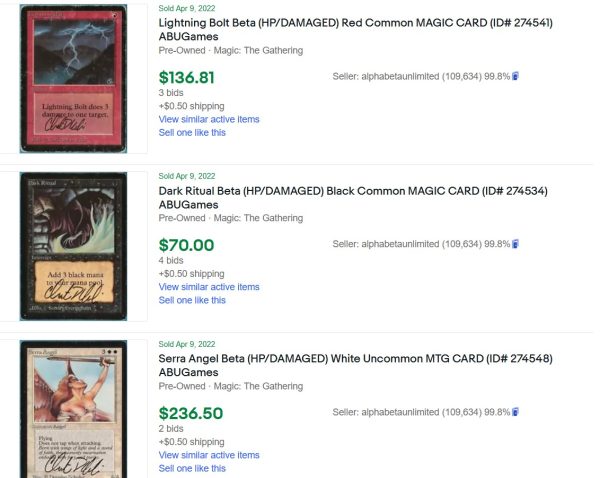
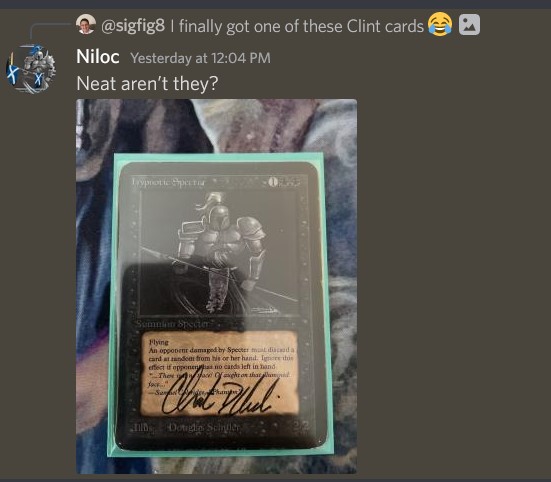
Over the past few months, I noticed they started listing cards as “damaged” because they had a signature written on them that wasn’t from the artist.

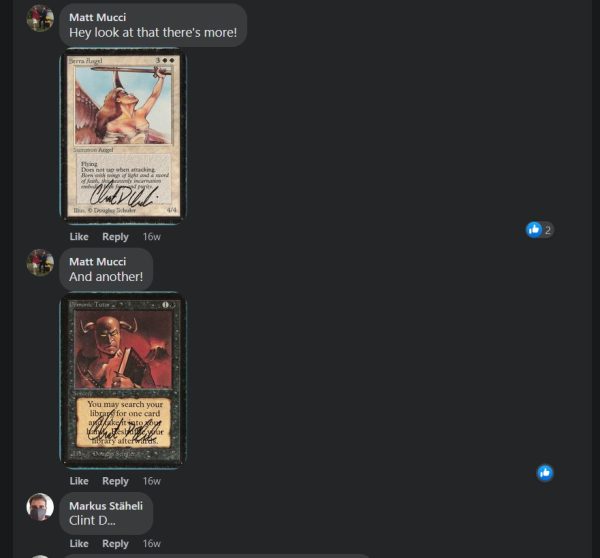
The mysterious signature appeared again and again, on some highly desirable cards. The Old School Discord and associated Facebook groups were abuzz with inquiries about the person whose signature this is. My interest was piqued as well because some of these prices are quite reasonable for a sleeve playable copy of the card.

The Hunt for a “Clint” Card

I tried bidding on one of the Beta Serra Angels that ABUGames was selling with the mystery signature, but I was outbid as the auction neared closing. It turns out I’m not the only one who finds this story interesting.

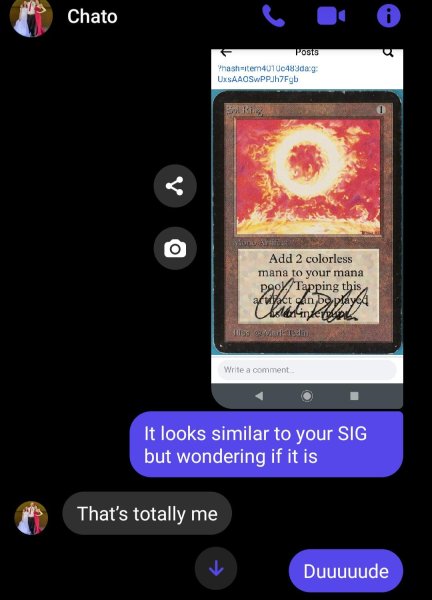
While I was waiting for the auction to end, I did some research and came across a Facebook post on the subject. Someone was watching an auction for an Alpha Sol Ring and was trying to figure out (like everyone else) whose signature was on the card. Then people started to notice just how many of these “Clint” cards existed!

Finally, someone chimed in with the background, lifting the mask from our mystery signer.

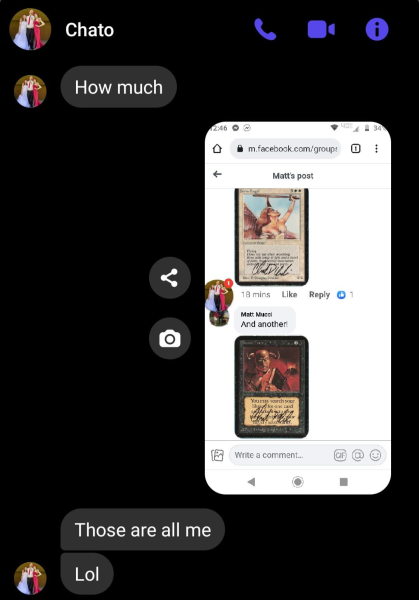
It turns out the person who signed these cards is named Chato Urbin, from Coeur d’Alene, Idaho. Chato played Magic competitively back in the day and was a Top 10 Vintage player back when the format was still called Type 1. Apparently, it was a thing back then to sign one’s cards so that if they were ever stolen, it would be easy to identify who the true owner is.

What’s really funny is that when Chato was approached about these cards, he expressed interest in buying them all back! Does this mean these cards suddenly have a premium to them?

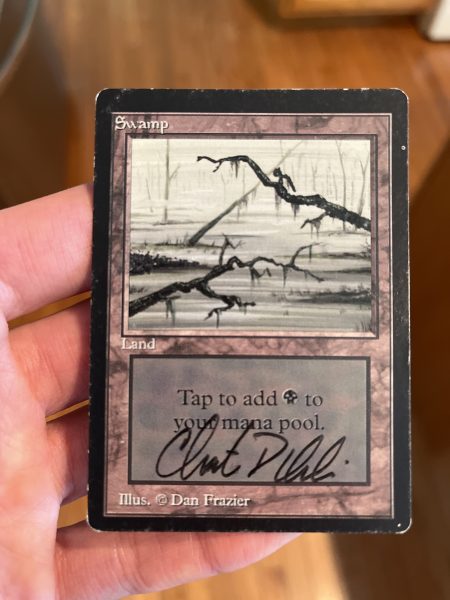
Not exactly. Not yet, anyway. I finally managed to win an auction (after being outbid once) for a damaged Beta Swamp, so I can proudly(?) claim to own a piece of this extremely niche collection of cards.

Eager to share my acquisition, I posted a picture in the Old School Discord. As usual, people responded with pictures of their own cards signed by Chato.

But then someone posted a new bit of information—they referenced the claim that Chato would purchase the cards back if possible. Unfortunately, when they approached Chato about buying the cards to once again bring the collection together, he said the cards were more expensive than he realized. Imagine that, Alpha and Beta cards are more expensive now than they were many years ago, by a huge margin!

Either way, there’s still an entertaining meme of a story with these signatures. I don’t know if pieces from this collection will ever merit much premium, but it’ll be a funny card in my collection for years to come.

Speaking of Interesting Signatures

This exploration led me to consider other signed cards in my collection. Of course, there are the cards I own that are signed by the artist. Kaja Foglio is my favorite artist and signature, so I have a small pile of cards signed by her. I also have a single card signed by Quinton Hoover (a Fifth Edition Wrath of God) and my iconic signed War Elephant from Arabian Nights. The former is noteworthy because the artist, Quinton Hoover passed away a while ago, and the latter is famous because the artist, Kristen Bishop, almost never signs Magic cards.

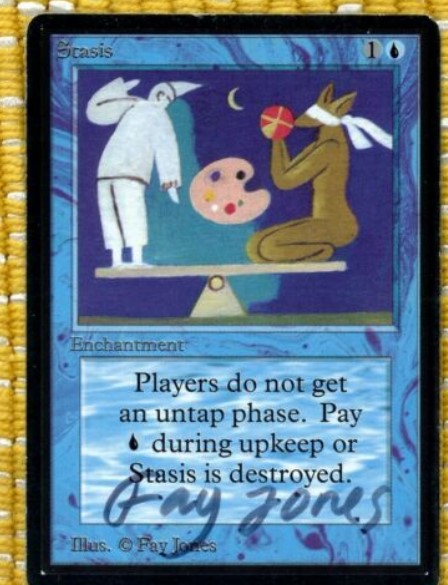
The artist for the original Stasis, Fay Jones, is an established artist in the Seattle area. Her notoriety and the rarity of her signature on copies of the card add significant value.

Beyond artist signatures, there are a handful of autographs out there that likely make a Magic card more valuable—or at least more interesting.

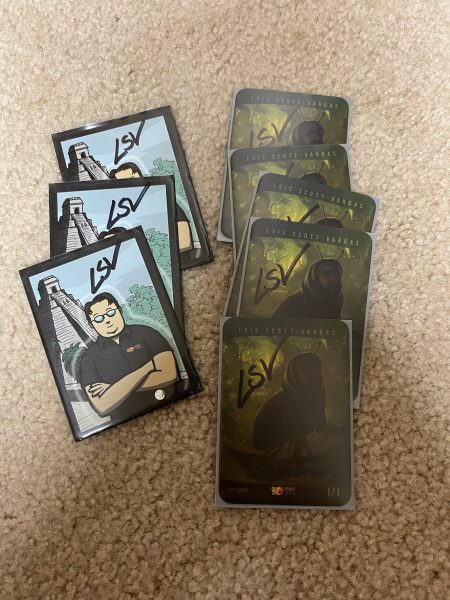
For example, cards signed by certain professional players may be noteworthy. I have a handful of tokens signed by Luis Scott-Vargas that I cherish. Three of them I obtained in person myself at an event long ago (I still remember how nervous I was approaching him to ask!). Since then I have had the pleasure of meeting LSV in person and even battling him in Old School--it was one of the best Magic days of my life!

I know of other stories where people have asked Chris Pikula to sign their copies of Meddling Mage and whatnot. I remember seeing a card signed by John Finkel for sale on ABUGames’ website at one point as well. Often times these signatures are obtained by fans of the respective player, so they don’t hit the secondary market all that much. I’m not sure these merit much premium either, but there may be exceptions.

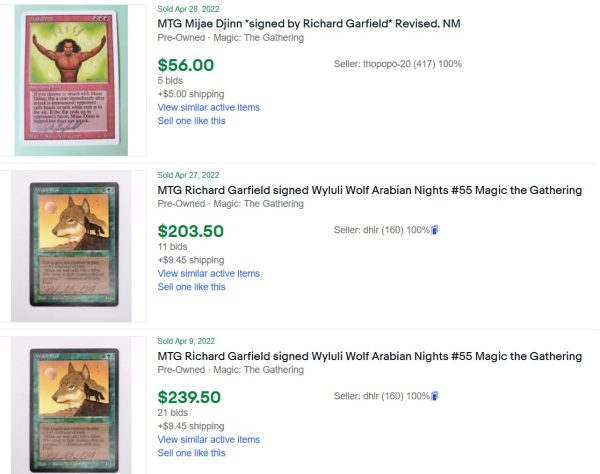
What does merit a nice premium are cards signed by Magic: the Gathering’s creator, Richard Garfield.

I know Old School cards are more expensive nowadays, but these cards signed by Richard Garfield earned a tremendous premium! Consider, Mijae Djinn from Revised is typically worth around a buck. Arabian Nights copies of Wyluli Wolf are worth a few bucks unless in minty condition. These copies sold for many times more. Of course, part of the reason that the Wolf in particular merits such a large premium could be tied to the card’s association with Garfield—the name Wyluli is an anagram of Lily Wu, the name of Garfield’s first wife.

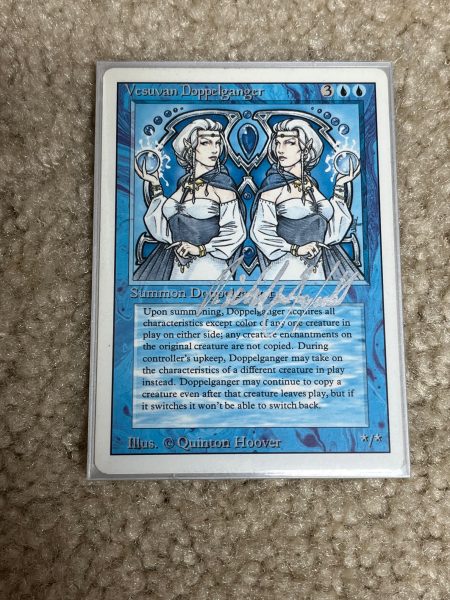
I am happy to own one signed Garfield card myself: a Revised Vesuvan Doppelganger.

I’m not sure how much premium this signature merits, but I don’t really plan on letting go of this card anyway. I acquired it in an elaborate trade and my plan is to hold onto it indefinitely. In fact, the person I acquired it from has an entire cube dedicated to Richard Garfield! This is just too cool a card to have and it’s not easily replaceable.

Other Famous Signatures?

I don’t see any on eBay, but I suspect Magic cards signed by famous people who play the game could be noteworthy. For example, we know Post Malone is an avid fan of Magic—could someone acquire a card signed by him for their collection? I don’t see why not! The same would go for former Major League Baseball player Hunter Pence. Even something signed by Martin Shkreli, once the most hated man in America, could be valuable. Remember that one time he made a comment somewhere about buying up all the Black Lotuses?

I searched for Magic cards with these signatures on eBay, but came up empty. In fact, I tried searching “MTG signed” on eBay and sorted by price, high to low, hoping to find something that stood out. What I found, however, was mostly a selection of Power, Dual Lands, and Old School cards signed by the artists themselves. Nothing off-the-wall like a famous actor, singer, or athlete. I guess for now this isn’t as much of a thing as I had hoped.

Either that or people who acquire such signatures have no plans of selling them—I wouldn’t blame them if that is the case. If I had a Magic card signed by someone famous, I wouldn’t be interested in letting it go either.

Wrapping It Up

It was fun to dive into the world of non-traditional signatures on Magic cards this week! Who knew that the extremely niche space would still find a following? Whether it be a collector of Richard Garfield signatures or a meme “Clint” signature, players have found interest in cards signed by people other than the original artist.

Personally, I think my quest is satisfied for the time being. Once I acquired the Beta Swamp signed by Chato, trying to buy a second would yield diminishing returns. One is enough. Maybe my next goal will be to acquire a card signed by someone more famous, to see if I can make that into a thing. Besides, who wouldn’t want a sweet Time Warp signed by Britney Spears or something? (Oops!... I did it again! Get it??)

If you own a card signed by someone special, please feel free to share it with me on Twitter! I’d love to see what else is out there—chances are, whatever you’re going to share will be more exciting than the signature of some random player from Idaho!

Generational Magic Player Spotlight: Julie Tysen

Are you a Quiet Speculation member?

If not, now is a perfect time to join up! Our powerful tools, breaking-news analysis, and exclusive Discord channel will make sure you stay up to date and ahead of the curve.

I Play a Game Called Magic: The Gathering... No, It's a Card Game

Sharing our Magic: the Gathering journey with each other is what makes this game more than just a game, it becomes a community. We create enjoyable moments with people who become friends and friends who become family. Here's a glimpse into someone's Magical life and how the game has been a part of it.

Today we're meeting Julie, one of the die-hard drafters at Mavericks. Julie and I have known and drafted against each other for a long time. Julie shares her Magic journey; not only as a player but as a female player in a male-dominated environment.

Help Me Welcome Our Next Contestant!

What's your name and how long have you played Magic: the Gathering?
My name is Julie Tysen and I started playing in college when Revised came out in '94. Sometime later, after I was married, my husband and I moved to Germany for 10 years and our Magic playing slowed down a lot. We played some on the Army base where my husband was stationed, but it was very infrequent.

After we got back to the states I wanted to pick it up again, but my first experience coming back was very odd. I played in a small local draft with six elementary-age children and one other adult. I then questioned how much the game had changed at that point.

Sometime in 2009, my husband suggested we go to something called GenCon. I had no idea what it was but saw Magic events, so we gave it a try. Of course, there were a ton of people playing, so I got my game on and the fire was back.

Julie

How did you first learn about Magic and who initially shared it with you?
The guy I was dating at the time had a stack of Magic cards laying around. I saw a white-bordered Forest that had rocks, moss, and trees, and it just spoke to me. I thought it was beautiful. So I told him, "You have to teach me this game!" After a little pushing, he relented and taught me how to play. I was totally hooked. I think it turned out pretty well since we ended up getting married.

Can you recall one of your first experiences playing the game?
Like many other new players, we were pretty bad starting out. We didn't have a lot of cards, but I had this obsession with a black/white deck highlighted by two cards: Serra Angel and Sengir Vampire.

At the time I was overly concerned about my creatures dying, so I was very bad at trading off my creatures to win the game. Thankfully, I've gotten better about that.

What format and type of deck did you play tonight?
I absolutely love drafting. I drafted Streets of New Capenna and played a Maestros deck which is completely out of my wheelhouse. I love playing green/white, but of course, with drafting you have to go with what comes your way. I like playing Commander occasionally, but drafting is my first love.

Any cards that were better or worse than you expected?
Nothing that stood out, but I built the deck around Maestros Diabolist. He was fine but definitely needed support from the other cards.

You mentioned drafting is your favorite format, why?
I enjoy the randomness of the deck-building process. Being able to use cards that you would never use in a constructed environment. Cards that generally aren't good, but are somewhat useful in draft. I enjoy putting those cards to use.

Do you play digital Magic and if so, how are you enjoying it?
I play Magic: Arena, but I take breaks every so often. For me, playing in person is a better overall experience. Even if I lose, I'm around others having fun, and that changes the atmosphere. When I play Arena it can be easy to get upset when you're facing an annoying deck. Arena is nice where if I want to get in on a draft, I don't have to wait until Friday, but it's still not the same. You lose something in the translation.

How did you have to adjust through the Pandemic?
Probably what you would expect. When we were able to attend in person I attended and followed the appropriate safety protocols, but when things were closed I utilized Arena quite a bit.

What's one of your favorite Magic cards?
There are a few, but the one that pops into my head is Felidar Sovereign. As I mentioned, I really enjoy green/white and trying to win through life gain. It's not the most effective strategy, but I still have fun trying.

Who do you normally play with?
I generally draft with the group of people at the store.

Do you and your husband still play Magic?
We played for a long time, but he's moved onto other hobbies. He now plays Pathfinder and really enjoys GMing.

Is there anyone else in your family that plays?
Not at the moment, but I'm looking forward to introducing Magic to my nieces. They're getting to the age where they're starting to be inquisitive. One in particular; she's 12 and I believe she would have a great time.

Is there anyone else you try to mentor or assist with the game?
I try to connect with the other women who come into the store and when we go to a convention like GenCon. The last time I was at GenCon a teenage girl expressed interest in learning the game, so we sat down, and played a few practice games. She had a great time and asked a lot of questions. It was very enjoyable. I talk with the guys as well, but I feel there are so few women that play, that I try to make an effort to welcome them.

Do you believe it's difficult for women to get involved in Magic?
I've personally never felt there was anything stopping me or other women from playing. I feel it's more of a cultural or societal issue. I work in a STEM field that has similar issues for women. While I was growing up, I definitely felt discouraged from playing these types of games. Though it wasn't as if someone said, "You can't play that.", it was a general thought that girls just didn't play them.

Do the game stores you've attended generally make you feel welcome?
Yes, they do. My experiences have been good. There have been times when I've felt uncomfortable when another player has a very suggestive playmat or sleeves. Fortunately, without me saying anything, the staff comes up and recommends that the player use something more appropriate. I truly do appreciate that. Many of the other players, by and large, treat me with the same respect that you would give anyone playing.

I remember one time when a player who was new to the store started "mansplaining" things to me. The guys around us, who knew me, started rolling their eyes at him expressing, "You don't need to explain anything to Julie." They knew that I was a competent player and sympathized accordingly. One small item I do like is when their restrooms don't just say 'MEN' on them. Overall, my experience has been very welcoming, everyone's really nice, and I feel that I'm valued for who I am.

From when you started in comparison to now, has the Magic experience improved for women?
Very slowly, but it is going in the right direction. I didn't see much change from when I started playing to when I got back into it in 2009. I would be in various events and there were maybe two or three other women attending. It has gotten better. When we go to GenCon I'm starting to see more and more women overall. There's always room for improvement, though.

Other than drafting, is there anything else that you focus on within Magic?
Magic provides me with a creative break. That's why I enjoy drafting. I get to bring a lot of creativity to my deck-building process. I know I could be more focused and dedicated to improving my play, but I use this game to relax. I like collecting cards, but I don't want to spend a lot of money. Through drafting, I'm able to do both and get the maximum enjoyment for myself.

Are there any interesting stories or moments that stand out from your years of playing?
I actually have a couple. The first one is where my opponent was able to defeat me with my own Ornithopter. They took control of it, pumped it up with a plus-X spell I don't remember, and took me down.

In the second example, I was playing in a casual tournament, and my opponent wanted to stop playing. So, to give me the win, he played a Lava Axe on himself. We both got a good laugh out of it.

To finish up, is there anything else you'd like to share?
The hope is for more girls to have the opportunity to try Magic. I believe it can be difficult, culturally, for them to get involved in a similar way to boys. I can't completely speak for how it is now, but when I started, I wasn't exposed to a lot of opportunities in this genre. The one thing I would encourage people to do is if you think one of your female relatives or friends might enjoy the game, reach out. You might be surprised.

The Wrap-Up.

I want to thank Julie for sharing her story and how Magic has been a part of it. I hope you enjoyed our discussion and look forward to the next installment.

Real-world Flavor: Green’s Philosophy in Citations

Are you a Quiet Speculation member?

If not, now is a perfect time to join up! Our powerful tools, breaking-news analysis, and exclusive Discord channel will make sure you stay up to date and ahead of the curve.

The love of nature […] is a furious, burning, physical greed…

Mary Webb

What's better than the concept of "nature" to evoke the philosophy of the color Green? The flavor text above is clearly referring to a green card. And Green might easily be the color with the strongest connection between its mana symbol (a stylized tree) and its philosophy. So, what is Green about, and what do Forests have in common with that?

Just like with Red, there are not that many green cards with real-world quotations for flavor text. Black and White are by far the most widely represented, with Blue somewhere in the middle. we have already dealt with the most interesting green cards in the past. However, there are still plenty of spells from this color we've yet to discuss that do an excellent job of embodying the philosophy of Green. Let's look at what that philosophy is, and then look at some representative cards and their flavor.

Green's Color Philosophy

Green is the last color in the Magic: the Gathering color pie. Its allies are Red and White. The first thing that comes to mind when thinking of the color is simply the concept of Nature. What else? We could also mention peace. Green doesn't try to change the natural course of things. In that, it's similar to its allied color White. On the other side, Green is also wild and relies on instinct rather than calculation. This puts it in alignment with its other ally Red.

How does green put into practice such beliefs? First of all, green wizards tend to live in peace with nature and do not alter the natural world. Sometimes, they can even get aggressive, when it comes to dealing with those who disrespect nature. For instance, one of Green's enemies is Blue, due to its drive towards inventions and artificial creations. Its other enemy is Black, due to the color's love for interfering with the natural course of life. In gameplay terms, we see Green's attributes reflected in its hate for artifacts and flying creatures, and its abundant mana.

Radjan Spirit

There was an error retrieving a chart for Radjan Spirit

Crawing, crawing,
For my crowse crawing,
I lost the best feather i’ my wing
For my crowse crawing.

Anonymous Scottish ballad

Radjan Spirit is a great example of Green's hate for flying creatures. Flying creatures are most commonly found in the color Blue, which, as we already discussed, is one of Green's enemies. Green has many ways of dealing with flyers. From creatures with reach, to kill spells that target them.

In this case, Radjan Spirit is a 3/2 creature for four mana with an ability that allows you to remove the flying from a target creature. While not the strongest of creatures, it's a good example of Green's dislike of flyers.

Naturalize

There was an error retrieving a chart for Naturalize

One touch of nature makes the whole world kin.

William Shakespeare, Troilus and Cressida

There is something else, though, that Green hates even more than flying creatures. I'm talking about the opposite of Nature: Artifacts. And, secondly, also Enchantments. But Artifacts are definitely the worst.

Again, green wizards don't like people to interfere with Nature, which means they hate artificial creations of any kind. Naturalize costs two mana, and it allows you to destroy any target Enchantment or Artifact at instant speed. It's a typical sideboard card, and the flavor text by Shakespeare is a nice addition, with its mention of nature and the concept of seeing the whole world as connected.

Quirion Ranger

There was an error retrieving a chart for Quirion Ranger

I went to the woods because I wished to live deliberately.

Henry David Thoreau, Walden

Nature, unity... what is missing? Well, mana is another thing that definitely belongs to Green. Mana in Magic for all five colors is drawn from the natural surroundings of the lands. Green, and to a lesser extent red, get the ability to produce mana from other sources. In red it's often a result of elemental channeling (think Rite of Flame or Pyretic Ritual). In Green, mana production is represented by the primal life force of nature, and the ability to tap into it. This translates in gameplay terms not just into mana production, but also into mana ramping, i.e. speeding up the process of playing Lands, and mana fixing, allowing the production of mana outside its own color.

Quirion Ranger is one card that contributes to this purpose, though it might not be obvious at first glance. It's not a straightforward mana producer like Llanowar Elves. Any Elves player can tell you though, that Ranger is great because it allows you to untap mana producers like Priest of Titania and generate incredible amounts of mana.

Fertile Ground

There was an error retrieving a chart for Fertile Ground

The love of nature … is a furious, burning, physical greed… .

Mary Webb, The House in Dormer Forest

Fertile Ground is similar, in its purpose, to the card we have seen above. However, it's an Enchantment - Aura, and thus it works a bit differently. It's part of the big family of Auras whose progenitor is Limited Edition Alpha's Wild Growth. There are many cards working the same way, and the point is to enchant one of your lands and then untap it in order to gain tons of mana.

Another card worth mentioning here is Early Harvest. Early Harvest is an Instant that lets you untap all basic lands you control. This is great when you have some other effect on the board like Heartbeat of Spring, allowing your lands to each tap for multiple mana. Early Harvest is very similar to an older card from Legends, Reset. What's funky about Reset is you can only play it on an opponent's turn, and it's a Blue spell! This just goes to show that the color pie was a little wonky in Magic's early days. It's a quite natural ability for Green to have, and another example of

Conclusions

As we have seen in the course of this installment, Green has an easily recognizable color identity. Its philosophy, lore, and gameplay effects all work well together. Green doesn't like to change what's naturally going on. It's the enemy of weird spells such as artifacts and anything concerning necromancy, for instance. On the other side, it relies on Nature and the unity of all its creatures. The life force of nature translates into mana production in gameplay terms, and Green allows you to generate huge amounts of mana.

What do you think of this color? What other cards would you say define the color Green and its values? Let me know in the comments or on Twitter. Stay tuned for more delving into Magic's lore and philosophy.

Baldur’s Gate: The Best Commander Set EVER? Yes, Actually!

Are you a Quiet Speculation member?

If not, now is a perfect time to join up! Our powerful tools, breaking-news analysis, and exclusive Discord channel will make sure you stay up to date and ahead of the curve.

As a long-time player and fan of Dungeons and Dragons, Magic: The Gathering, and the Commander format it's easy for me to say Commander Legends: Battle For Baldur's Gate looks like a great set. But, let's face it, this looks like a great set! There is something for everyone out there whether it's the new Background mechanic, new Adventure cards, or even more cool tribal ideas. Let's take a look at some of the more exotic ones and I'm sure you will agree that this set has a lot to look forward to!

Removal!

Yes, Lightning Bolt! This is my absolute number one pick of all-time for removal in the game with only Swords to Plowshares ever fighting for that spot. The thing is, Bolt can kill both Planeswalkers *and* players along with most creatures that see significant play all for the low cost of one mana. For those reasons, it takes the top spot. It's an iconic Magic spell, and, while less iconic than Fireball or Magic Missile, is still a noteworthy spell in D&D.

New Mechanics!

Backgrounds are a very interesting mechanic and are essentially a follow-up and more balanced version of Partner. Wizards clearly saw that Partner is a popular mechanic but had to be sure not to create too much future power creep and Backgrounds are essentially the way forward. This is a uniquely D&D concept that became a core game mechanic in Fifth Edition although there were similar sub-systems in earlier versions as well.

Not only are Backgrounds a cool build around functionally speaking, but they also allow for expression in terms of flavor. Twice as many parameters to build around is definitely twice as much fun. The raw number of possible combinations from Commanders that have the Background Mechanic (27) + the Background itself (25) is something like 728 possible combinations. This is definitely enough room for variation and replayability.

A New And Darker Dungeon

Undercity and The Initiative gives us a new Dungeon to delve. This is my absolute single favorite new *and* returning mechanic to Baldur's. Going into the Dungeon was a cool and thematic effect but it was not nearly powerful enough for what it required to do it well. Now with both a better Dungeon in Undercity and the ability to trigger The Initiative *immediately* you get better and faster rewards. This is a nice addition from Wizards and I feel like it shows that Magic *can* continue to innovate.

Literally Baldur's Gate!

They had to and they did! Not only did they make a ton of new Gates but they made the one, the only, Baldur's Gate and it's good! I hope you will agree that the best part about the new Gate cards is actually powering up cards like Maze's End! Great flavor, good power, awesome synergy, sign me up.

Elder Dragons

While not *Legendary* Elder Dragons all of these creatures pack a huge punch and the D20 mechanic will create some spicy game moments. A roll of five or less certainly is not game-ending but each step higher is likely to be game-changing. I rate them from low to high as Gold, Bronze, Brass, Silver, and at the top Copper. The lower mana cost and the mathematical average of adding ten more mana on turn seven certainly looks strong but all of the Dragons are at the very least playable.

Mechanics From Random Sets

Escape(6), Foretell(5), Monstrosity(4), Overload(6), Replicate(5), Suspend(9), Unearth(5). I may have missed one but this is a crazy amount of different keywords for one set *on top of* everything else. If you checked out my last article here it's about some of the older, forgotten abilities that have cycled through Magic's life. The number next to each keyword above is the Storm Scale from one to ten on how likely something will be reprinted as a keyword in Standard. The simple fact is, this is a Commander set. At the same time, I think it's always nice to see that even Suspend which is rated at *nine* "I never say never, but this would require a minor miracle" can show up in a set at all. The other keywords are effectively "Is it right for the set? If so they can show up." As a huge fan of Magic's history, it's good to see these throwbacks when possible. Banding is coming, people!

And Now For Something Completely Different...

While the more powerful cards coming from the set will get piles or air time, these cards are my favorites for a variety of reasons and I wanted to go over each one briefly.

Wrathful Red Dragon

Wrathful Red Dragon is everything a red card should be and, also, it is everything a red dragon in D&D is. Are you not a Dragon? Take damage. The thing that strikes me the most about this card is that it is *NOT* a may ability. While you likely always have your opponents as non-Dragon targets, technically, you have to deal the damage. Circumstances could force you to hit your own non-Dragon creatures or even yourself or there could be higher upsides to such a play. For me, this card captures both the destructive nature of red Dragons in D&D while also calling back to older Magic design mechanics when there were significantly more symmetrical abilities and virtually nothing said "may." In the millions upon millions of Commander games that will be played in the future someone, eventually, is going to get killed by their *own* Wrathful Red Dragon just as it should be. To quote another game I am fond of "Never deal with a Dragon."

Nalia de'Arnise

Nalia de'Arnise is a *really* nifty card. If you've read my Heart of Commander article then you know all about the Deathtouch deck headed by Atraxa, Praetor's Voice. Looking at Nalia you can see she helps me synergize with Deathtouch, +1/+1 counters, and finally adds a potential tribal spin on top of all that! Now instead of just checking for Deathtouchers with additional abilities, I'm trying to specifically find Clerics, Rogues, Warriors, and Wizards with Deathtouch! Long live Party Touch! I'm always on the hunt for cards that offer this kind of unique intersectionality. As a slight aside, since I run Primal Surge as an ultimate win condition, she adds a hefty amount of damage so it's not *only* about flavor there's a decent power spike too!

Captain N'ghathrod

Captain N'ghathrod is yet another card for my boat deck wherein all cards must have boat-based artwork on them, with no exceptions. This deck was started in approximately 2012 as a joke but soon took on a life all its own because Wizards just kept printing boats on every card. Now it has transformed from mostly a thematic but very bad pile of cards into a somewhat functional deck with some high power cards like Demonic Tutor and Capsize. I'm not entirely sure if I'm going to replace my current boat-punching commander Wrexial, The Risen Deep with N'ghathrod but it's likely I can use him just as a solid five drop for five with a cool ability to replace something significantly worse. Again, there is the possibility that there's a significant amount of new synergy to find with boat-based Horrors both in recent sets and in future sets. Is this the part where I make a boat pun? No, if I do that I might get a stern talking to.

Black Market Connections

This is my favorite card from the entire set. I have written more than once about using life as a resource and really think that black has done a good job with this idea over the entirety of Magic's life. Looking at what Black Market Connections does is just so fun. First, there is the fact that it does not trigger during your Upkeep so you get to use the card *right away*. Next, you make decisions after your draw step with more information. You can choose up to three modes but realistically you are almost always going to draw a card and get a treasure. Finally, you have the option of paying three extra life to get a 3/2 colorless creature with all creature types. This is really huge for so many reasons. There are lots of tribal effects that *do care* if you are a Knight, Dragon, Zombie, etc. A colorless creature also has the ability to block creatures with various Protection effects. Last but not least, it has three power which really is the amount required to be a credible threat, especially to Planeswalkers. Signs point to paying roughly six life per turn and getting insane value out of it. And, yeah, it's an Enchantment which is the type of card that seems to be sneaking under most radars. I give this five of five stars and will be trying it in most of my black decks.

Fraying Line

Finally, Fraying Line is a card that probably looks a little odd to mention. For two mana it's a fairly slow and terrible board wipe. Nothing to write home about, yeah? The thing is, there is a story here, a D&D story. I had a group of players who were not new to D&D but we had never played together. We spent a fairly long time getting characters made and setting the adventure into motion. It was a rather standard affair, go kill some goblins in their underground lair.

At the top of the cave entrance was a rope that they could use to steady themselves while descending the steep cave floor. The difficulty to do this? Literally zero. Yes, I mean that, zero. On a D20 if they could get a one or better, they would succeed...except for penalties from armor. And yeah, these guys had a lot of armor. A few incredibly low rolls later and three party members had dropped the rope and tumbled down the steep slope taking damage and waking up the goblin sentries. A few shots later and the party was hurt and scrambling, they had to go back up the rope to retreat...and then it happened again. They slid down, smashed into the wall at the bottom, and thus we had a TPK (that's Total Party Kill).

To this day we reference the party that died to a piece of rope. Fraying Line, in your memory, I will build an entire deck around you being the most legendary rope in all the land and I will play this deck until it wins. Now that's dedication.

Dragons, Boats, Ropes, and More!

I am looking forward to Baldur's Gate for so many reasons but the single biggest reason is the building material. There are tons of good concept cards from D&D lore, mechanics like Backgrounds, and so many new tribal cards that the only limit here is your own imagination. That makes for a great Commander set in my opinion. What cards are you looking forward to from Baldur's Gate?

Strolling Down the Street: New Capenna’s Modern Impact

Are you a Quiet Speculation member?

If not, now is a perfect time to join up! Our powerful tools, breaking-news analysis, and exclusive Discord channel will make sure you stay up to date and ahead of the curve.

It's been a month since Streets of New Capenna released and it has had an impact on Modern. That has certainly been felt. By some decks. To an extent. Why yes, I am being quite cagey. The set has a lot of interesting cards in it and there is power enough for Modern there, but it is quite limited. The most visible addition has been fairly limited in impact and the most impactful additions are nearly invisible. That's just how it goes.

Which is mostly what I said in my preview articles. However, leaving it there is ignoring a lot of nuances involved and trivializing the impacts that SNC has had. Which is particularly relevant since the metagame update article is next week, otherwise known as the first look at how SNC impacted Modern. And it will look like nothing's changed, which isn't true. So today I'll be going through my predictions for SNC and comparing that to what's actually happened.

The Big Catchall Disclaimer

Obviously, I can't cover every single card that's seeing play from SNC. I can't find every niche card seeing niche play across all of Modern. It's just impossibly time consuming and this article would run to the dozens of pages. So I'm sticking to the cards that I actually covered in my preview articles. Also, I covered the big SNC card, Ledger Shredder, in detail last week. No need to retread old ground.

With that out of the way, and going in the order that I reviewed them in:

Allied Triomes

These were always going to be a cheat since they completed a cycle that was already seeing Modern play. The new triomes are being played in three-color-plus decks as one-of fetch targets, just as predicted. Just a massive gimmie.

There was an error retrieving a chart for Spara's Headquarters

I thought that the Triomes would be used in 4-Color decks sparingly since they don't need more fixing, and would instead primarily give hope to struggling three-color archetypes. Specifically, Spara's Headquarters and Xander's Lounge would lead to a boost in their Alara shard midrange deck. That didn't exactly happen.

Instead, Headquarters has been fully incorporated by the 4-Color decks and Lounge sees almost no play. As of May 28 (which is the day that I pulled all the data I'm using in this article from MTGGoldfish), Headquarters had been played in 103 deck during may compared to Lounge's 11. I knew that midrange Grixis wasn't going to work out, and was proven right. Headquarters making it outside of straight Bant was a little surprising.

There was an error retrieving a chart for Raffine's Tower

As for the other three triomes, they're in the middle, nearly literally. Raffine's Tower is second most played at 50, while Ziatora's Proving Grounds and Jetmir's Garden both have 47. Garden's play is split between 4-Color and actual Naya decks while the other two are exclusively in their Alara shard decks.

Headquarter blowing up like this was unexpected because I overlooked the reality that 4-Color Omnath leans heavily into Bant colors with red being a support color. It's natural that such a deck will need more fixing for Bant. My underestimating of Tower is tied to Shredder seeing lots of play, as most of the decks running Tower are Shredder-centric decks. That Proving Grounds sees play in Jund isn't as surprising as how much Jund is seeing play. I would never have expected that to be the case, but the deck is truly eternal, apparently.

What I Missed

There was an error retrieving a chart for Ziatora's Proving Grounds

More importantly, the distribution of the decks highlights an oddity in Modern: black is very underrepresented. The average representation of the non-black lands is 75 while the black average is 36. The top decks in the metagame don't run black. This is an imbalance to keep track of.

An Offer You Can't Refuse

This was a card that I thought would see niche play as an anti-combo card. The drawback is quite steep; too steep for use against fair decks. However, interrupting combo often justifies extreme measures. There was an outside possibility of countering your own spells to ramp, but I discounted it as too cute.

There was an error retrieving a chart for An Offer You Can't Refuse

On that last point, the data agrees. I stopped hearing about Offer countering Mishra's Bauble very quickly and nobody's talked about it since release. It is far too cute without being good. As for the first point, I'm shocked to say that so far I was completely wrong. The only decks playing Offer at all are combo decks maindecking the spell. And in numbers that strongly indicate that they're intending to use it to protect their combos rather than for the ramp trick.

What I Missed

I would never have called Offer as combo protection. I can't say unequivocally that it isn't being used for ramp purposes in these decks, of course. However, the most common configuration is two maindeck and that indicates intention to counter opposing spells, not your own. Unless they're really going for that low-probability gotcha line.

There was an error retrieving a chart for Ad Nauseam

The best explanation I can come up with is that these decks are afraid of Teferi, Time Raveler and want a maindeck counter for him, specifically. There's no other noncreature spell that actually sees maindeck play which any combo deck might care about because counters and discard could be answered for value via Veil of Summer, which all the decks I found have in their sideboards.

It gets more perplexing considering just how much play Counterspell sees. If combo players are really worried about winning counter wars Flusterstorm and Veil make more sense than Offer. There has to be something I'm still missing here.

Ob Nixilis, the Adversary

I pegged Ob Nixilis, the Adversary as a niche card for decks that already had sacrifice fodder, and that's where Ob is actually seeing play. The abilities are too mediocre on their own to be worthwhile for most decks. However, an otherwise bricked Ragavan, Nimble Pilferer is a solid sacrifice to get and additional mediocre effect.

There was an error retrieving a chart for Ob Nixilis, the Adversary

One thing I didn't mention (but thought about) is that double Ob is extremely good against Burn. Making a devil token and then draining for two goes a long way against Burn, and if it happens twice a turn the game is over. That shouldn't be taken as advice to sideboard Ob specifically for the Burn matchup.

Mage's Attendant

The metagame continues to be dominated by UR Murktide. Making lots of Wizard tokens with Mage's Attendant would be theoretically crippling against said deck. In practice, that is not the case as I suspected and Attendant isn't doing anything in Modern. Much to my chagrin.

Luxior, Giada's Gift

After SCGCon Pittsburg, there hasn't been a single Luxior, Giada's Gift list that didn't run it alongside Devoted Druid. Also, as expected, they're all Urza's Saga decks to help find Luxior. And also as expected, they're not exactly reviving the creature combo deck. The problem's with the deck have been switched around and the backup plan is better, but that has not altered the structural weaknesses of the deck. Maybe next set.

Extraction Specialist

Another niche card, I mainly used Extraction Specialist to make a point about SNC's impact on Modern. There were so many conditions on Specialist being good that I didn't think it would see much play despite filling a niche that is going unfilled. The only possibility was in Humans to get back utility creatures.

There was an error retrieving a chart for Extraction Specialist

So imagine my surprise when that turned out incorrect. Specialist isn't seeing much play, but the play it does see is mostly in non-Humans decks. And even one Humans list is mainly doing so because of Pyre of Heroes!

What I Missed

Never underestimate the power of the fringe. You never know what odd interactions are out there that can make a card worthwhile. Fringe decks might be one piece of redundancy or resiliency away from being actively good. Also, Yorion, Sky Nomad decks are perfectly willing to maindeck niche cards, reasons need not apply.

Witness Protection

In a similar vein is Witness Protection. It's a card with a good effect eclipsed by something Modern already has, specifically Dress Down, and so sees no Modern play. As if to prove the point, Protection is seeing decent play in Pioneer, which lacks Dress Down.

Sticky Fingers

The only reason anyone might play Sticky Fingers was if Ragavan was banned. Ragavan is still legal, and so the slight possibility of Fingers being played becomes zero. Moving on.

Vivien on the Hunt

I was dismissive of Vivien on the Hunt. There have been so many attempts to recreate Birthing Pod over the years that I'm burned out on the possibilities. I'm not saying a pretender can't be good, but I am calling them pretenders for a reason. And Vivien has...done a surprisingly good job of pretending so far.

There was an error retrieving a chart for Vivien on the Hunt

The early attempts at making Vivien work went roughly as I expected. Dedicated shells, often incorporating the Felidar Guardian/Saheeli Rai combo. Some included Luxior to combo with Saheeli because, frankly, why not? However, as May's worn on the decks have gone the Omnath, Locus of Creation route. I worried about the implications of this a few weeks ago and while Vivien combo hasn't caught on overall, being an Omnath deck certainly has.

What I Missed

I thought that having to play Planebound Accomplice would severely limit Vivien's play. That has been less burdensome than expected because of Yorion. Most of the Vivien decks are also Yorion decks and so there's space to burn. I also didn't appreciate how well the Vivien combo compliments Saheeli combo and that Accomplice can help that combo too.

There was an error retrieving a chart for Yorion, the Sky Nomad

Which brings up an interesting point about Modern combo decks. If Vivien strategically synergizes with Saheeli and the deck can function thanks to Yorion, are there more combos that can as well? With 80 cards, could there be more decks that can successfully hybridize? I have no idea, I don't have the creativity to conceive of such a deck nor the madness necessary to try. But current Vivien decks do suggest that there is an untapped potential of such decks in Modern to be discovered. Combo players, get cracking!

Bootleggers' Stash

Had Bootleggers' Stash worked out, it would have been a first for Modern. Not only would it (finally) make Time Sieve good, it would have brought a bit of Vintage gameplay to Modern never previously possible. Sadly, that wasn't to be. I suspect that other players found out as I did that making Stash work in Modern was too much work. It costs too much and is in a color that doesn't really play well with artifact decks.

There was an error retrieving a chart for Time Sieve

However, the gameplay that Stash might have brought around is in fact trying to gain a foothold in Modern. Whether out of a desire to get their money's worth out of Sieve or genuine interest in the deck I can't say, but players have combined Academy Manufactor, Underworld Cookbook, and Asmor...Asmorandwhatwasitagain? Asmo... Asmoran... AsmorandcomeonIcandothis... Asmoranomardicadaistinaculdacar (THERE! GOT IT!) to create a token engine to feed Sieve and eventually win via giant Shredder or Saga tokens.

What I Missed

I consistently underestimate the appeal of Asmorandwasthisjokeevenfunnythefirsttime and that whole food engine. Everyone was so high on Modern food right after MH2 dropped but it never lived up to the hype. When everything comes together its a solid midrange system but if anything's out of sync the deck just doesn't do anything.

There was an error retrieving a chart for Asmoranomardicadaistinaculdacar

Adding Manufactor doesn't really fix the main problem with the Asmoandherfoodiefriends engine but it does provide some durdly ways to get out of it and get some payoff. And taking infinite turns also alleviates the otherwise extremely anemic clock. However, the problems with the overall deck persist and I doubt it will seriously catch on, at which point we can all go back to assuming that AsmoIdontcareanymore just isn't worthwhile.

Street Sweeping

Despite appearances, Streets of New Capenna has had an unexpected effect on Modern. It just isn't an especially dramatic one so far. Should some of the fringier cards and/or strategies manage to defy current trends and catch on, that would lead to a dramatic overhaul of Modern. But whether that's possible has yet to be seen.

Detours in New Capenna Draft: The Decks that Matter

Are you a Quiet Speculation member?

If not, now is a perfect time to join up! Our powerful tools, breaking-news analysis, and exclusive Discord channel will make sure you stay up to date and ahead of the curve.

The biggest criticism of Streets of New Capenna limited is the dominance of the Brokers Family. There is some merit to this complaint. GW, WU, and the full three-color family have the highest winning percentages in their respective categories. Fortunately, draft is self-correcting. When drafters harvest the available Brokers cards, it forces us to rethink our game plan. The tension between availability and raw power level makes navigating Streets of New Capenna tricky. Let's look at the decks in the format I want to end up in at the end of the draft, and the order I believe they should be prioritized. Hopefully, this guide serves as your GPS, helping you get to where you want to end up in SNC Limited.

1.) Brokers, UW, and GW

Breaking Brokers

Drafters are prioritizing green, white, and blue for a reason. GW can be fine-tuned to optimize citizen synergies. UW can be fine-tuned to optimize counters strategies. Both avenues make Backup Agent a valuable glue-card, improving either deck. Similarly, the archetype has a lot of cheap cards that provide value. The best versions use low-cost creatures and spells to build an early lead, while still providing enough of a late-game advantage. Cards like Warm Welcome, Majestic Metamorphosis, Raffine's Informant, and Rooftop Nuisance are all good examples of this effect. At this stage in the format, it's not likely to see them come around on the wheel like they used to.

The top-end uncommons and gold commons are also ahead of the class. You don't need a ton of incentive to find yourself in this family. The power level of Brokers is such that you should start the draft wanting to be in these colors. The premium commons and uncommons are more than incentive enough. When I see a Psychic Pickpocket, Inspiring Overseer, Jewel Thief, or even something like Elegant Entourage, I'm going to take the bait. However, the days of putting on the blinders and committing to those decks have come and gone. Players have learned and adapted.

2.) Rakdos Blitz

Blitz for Damage and Value

On the complete opposite end of the color pie is the second deck I want to play. Avoiding the heavily prioritized Brokers cards, lets you see more playable options later in the pack. While the individual pulls of this deck aren't as enticing as some of the first picks in Brokers, the synergy between casualty and blitz offers a lot of power. I've expounded on why Blitz is such a powerful mechanic in this format, cashing out with a post-combat casualty effect is extremely potent. For this reason, I prioritize the cheaper casualty cards like Grisly Sigil and Light 'Em Up.

The most important card in this deck is Body Dropper. If I'm being honest, I'm not happy unless my Blitz deck has multiple copies of the two-drop. Running out a growing threat on turn two can instantly put the opponent on the defensive. It feasts off both blitz and casualty and can grow very quickly. At uncommon, Involuntary Employment is extremely powerful. Act of Treason variants are always more powerful in racing formats, and this one has sacrifice pay-offs in both casualty and Body Dropper. Finally, this is the best deck for Fake Your Own Death. It works swimmingly with your blitzers, especially the premium uncommon Night Clubber.

These decks might splash for blue or green, but because of their aggressive nature, they do so at a cost. While cards like Caldaia Strongarm or Maestros Charm have upside, I'm a little more reluctant to splash them in such an aggressive archetype.

3.) Big Green Piles

Prioritize Fixing and Let the Power Flow

If the plan is to take advantage of the cards that aren't being taken, then Riveteers (BRG)and Cabaretti (GWR) based packages offer a lot of opportunities. I do think RG is the worst allied-color pair in the format, but one man's trash is another man's treasure. By prioritizing fixing you can play something that harnesses a very high power level on a per-card basis. While decks like this don't offer the synergy of something more focused, many limited games are determined by independently powerful cards. When you see a late Ziatora's Envoy or Incandescent Aria floating around the table, you'll be able to take advantage.

This is a good way to utilize early white picks when UW isn't open. It is also a good home for early picks like Murder or Pugnacious Pugilist. To make this worthwhile, you need to prioritize your fixing. Playing haymaker after haymaker isn't what this format is really about, but it's still strong enough to beat up on the over-drafted colors if they're scraping for playables. Strangle and other early interaction can help you from falling behind, but this deck really relies on the strength of its rares and uncommons. You settle here because you're anticipating being passed bombs. Without premium cards, this deck will struggle.

Even though this format's aggressive nature should prey on this type of deck, zigging while the table zags can be a tactical counter. Unlike the Brokers family, however, I need a good reason to get into this type of deck. That usually means a bomb or a series of especially strong cards.

4.) Maestros-centric Control Decks

Answers, Card Advantage, and a Way to Win

In my heart of hearts, this is probably my favorite deck in the format, but it's not a particularly strong one. If you're playing a long-game deck, you're staking a claim that the pile of cards in front of you is more powerful than the stack of cards in front of your opponent. When both players are going to see a lot of their deck, you want to make sure that favors you. I've splashed Depopulate, Ziatora, the Incinerator and even Toluz, Clever Conductor to get the requisite power level to a satisfactory spot.

Because this format is aggressive, you are going to need a plan to blunt an opponent's early game. The Maestros ability triggers upside for its cards when you have five different mana costs in your graveyard. It's not particularly powerful, but you already need to prioritize cheap interaction, so getting a payoff there is nice. Strangle is great in this deck, but I'm often willing to play a Witness Protection here as well.

The problem is you need the power level to win, as well as a way to stabilize against the incessant pressure that comes from blitz and the Brokers decks. Fortunately, Snooping Newsie is picked fairly late in the pack (currently around pick eight on average). Its winning percentage is far better than that pick selection would imply. Lifelink is a huge boon for a deck that is often playing from behind and it definitely is a key part of the deck.

Arriving at Your Destination

Pack one, Pick one, I still think you're supposed to lean towards the Brokers family. It's deep and has a lot of options. Just be wary of committing too early. Sometimes it's hard to say goodbye to a first or second pick, but there are powerful cards in other colors too. While the best versions of the Brokers decks make you feel like a genius, finishing your deck off with Chrome Cat, Halo Scarab, and Paragon of Modernity will make you wish you took those powerful cards in other colors. Read the signs. Avoid the dead ends. Because in a world full of Brokers, sometimes it pays off to be anything but. Sometimes.

Speculating on New Standard Powerhouses

Are you a Quiet Speculation member?

If not, now is a perfect time to join up! Our powerful tools, breaking-news analysis, and exclusive Discord channel will make sure you stay up to date and ahead of the curve.

Lately, it feels like Wizards of the Coast is constantly iterating on their organized play system. When COVID-19 became a pandemic, they had to make some changes in order to ensure some level of professional play would endure, since paper Magic was out of the question. Magic Arena did an acceptable job filling that gap.

However after over two years of flux and uncertainty, the Pro Tour will be coming back at a frequency (for now) of three times per year. That means players from all over the world will be competing in paper Magic events likely spanning both Limited and Standard formats. I welcome this update with open arms and an eager heart.

In fact, this news has even motivated me to look at Standard again for potential speculation. With the return of competitive paper Magic, we just may find ourselves re-living the golden years, where metagame shifts unfold during Pro Tours and card prices move drastically in response. Here’s hoping!

What’s on the Radar

Before touching on some cards, I need to transparently share that I will probably be a bit rusty in picking newer cards for speculation. That being said, I reviewed the Streets of New Capenna Set Championship top 8 lists and noticed a few standouts worth mentioning.

Fable of the Mirror-Breaker

There was an error retrieving a chart for Fable of the Mirror-Breaker

Holy ubiquity Batman, this card is everywhere and it’s so versatile! Because this card offers so many applications for just three mana, it shows up across multiple archetypes. The first mode provides you with a 2/2 creature that can attach to produce treasure tokens, which works very well in lists jamming Goldspan Dragons. The second mode provides helpful card filtering by letting you rummage twice. The third and final mode grants you a mini Kiki-Jiki, Mirror Breaker. Talk about powerful!

It's no wonder 24 copies showed up in the top 8 of the Set Championship—that means six of the eight decks played the full playset. The card also shows up as the number one most played card in Standard on MTG Stocks and I can believe it!

Copies of this card are still findable in the $7 range, but Kamigawa: Neon Dynasty is approaching that sweet spot where prices bottom and then start to rebound as players shift focus toward newer sets. If this enchantment remains as dominant as the Pro Tours ramp up, I can see it doubling in price before the end of 2023. So far I’ve purchased just a single copy, but will keep an eye out for more if I can get them at a good price.

Tenacious Underdog

There was an error retrieving a chart for Tenacious Underdog

This new creature from Streets of New Capenna also made waves at the Set Championship. It showed up in five of the eight top 8 decks, though not always as a 4-of. I counted thirteen total copies, ranging from a singleton to the full playset. While it may not quite do as much as Fable of the Mirror-Breaker, the Tenacious Underdog still packs a punch, with solid stats for a two-mana creature.

Where this card really shines, though, is in its ability to come back over and over again from the graveyard. Not only does this make Tenacious Underdog tough to deal with on a permanent basis, it also offers you card draw when its blitzed from the graveyard, providing players with card advantage.

I wouldn’t be so hot on this card if it wasn’t so inexpensive! Copies start at just around a buck each plus shipping—it’s hard to imagine it will get too much cheaper. So far, I’ve bought six copies, but would love to get a solid chunk of 20 if I can find more in the $1 range. Granted, we may not have hit peak supply yet on the market, but if demand picks up as prospective professional players return to paper Magic, I can see this card climbing toward $5.

Raffine, Scheming Seer

There was an error retrieving a chart for Raffine, Scheming Seer

The first two cards I mentioned were rares, but Raffine is a mythic rare. This means the creature from Streets of New Capenna could have a higher ceiling. Two players included a full playset of this creature during the set championship. While my occasional Standard play on Arena probably doesn’t provide me with a true look at the metagame, I can confidently say I’ve faced down this creature on the opposite side of the battlefield multiple times. It can definitely impact the board, especially when combined with other creatures for a large-scale attack.

The ward ability make this card slightly more annoying to deal with, and that toughness of four means certain removal spells just won’t do the trick. Once the creature can attack and connive for a counter, it goes out of range of Voltage Surge as well.

I recently purchased two copies of this card in the $7 price range. Like the Tenacious Underdog, this card could see a slight increase in supply before the price can bottom and then climb higher. This card is also slightly more speculative because it costs three colors, narrowing the lists into which this deck is a smooth inclusion. Still, it shows up currently as the seventeenth most played card in Standard on MTG Stocks and I like it for a gamble.

Lands Lands Lands

After watching David Inglis pilot his Jeskai Storm build throughout live coverage of the Set Championship, I was inspired to try the list out myself. I must admit, this is the most fun I’ve had playing Standard in years. Being a fan of Storm lists in Legacy and Vintage, the opportunity to cast a dozen spells in a single turn in Standard was too juicy to pass up.

Throughout my budding experience playing this deck, I’ve learned how crucial it is to have a consistent mana base. In fact, on Arena I (like many others I suspect) have a short supply of wildcards. Because I wanted a functioning deck, I decided to craft the spells I needed for the deck, forgoing the optimal mana base in the short term. While this has been sufficient to experience the deck and have some success, I must say there are plenty of times when I’m punished for my weak mana base.

Swiftwater Cliffs just isn’t as good as Stormcarved Coast or Riverglide Pathway.

There was an error retrieving a chart for Stormcarved Coast
There was an error retrieving a chart for Riverglide Pathway

As I look at David’s list, I see he played 20 lands (plus a smattering of modal double-faced cards) and 12 of those 20, or 60%, were rares. On Arena, this is a major wildcard drain to include the optimal mana base for such a deck. In paper, the pain is magnified because these rare lands add up quickly!

When I counted the lands on MTG Stocks’ most played cards of Standard, I found there were 15 in the top 50! Part of this is because lands from Kamigawa: Neon Dynasty double as utility spells with little downside (they always come into play untapped) so there’s little reason not to include a couple.

The largest reason, however, is the fact that Standard decks currently favor three colors. When I browsed through the Set Championship top 8 lists, every one of them is named for a three-color shard. With the powerful cards introduced by Streets of New Capenna, along with the bevy of mana-fixing lands available to build with, there seems to be little reason not to run three colors.

Of course, three colors means an expensive manabase. I’m not going to single out individual lands in this article, but I just want to emphasize the importance of the rare lands in Standard. Some are older and closer to rotation, while others are brand new and may not have reached peak supply. No matter what you choose to speculate on though, you’ll likely not lose money as long as you flip the cards while they are still Standard legal. I haven’t purchased any myself yet because I need to research more on which ones may offer the most upside.

If I was forced to choose, I’d look closely at the Streets of New Capenna tri-lands as my first choice—maybe in the coming weeks, as supply peaks, I’ll pick up a few copies here or there. Not yet, though. I want to see how the metagame evolves more first.

There was an error retrieving a chart for Raffine's Tower

Wrapping It Up

It’s not often I find a Standard format entertaining enough that my interest is maintained for more than a week. So far, I’m just now passing the week mark for the newest metagame introduced by Streets of New Capenna, and the format has still been fun. Perhaps that’s partly because I can play Storm in the format!

As Standard gets more attention and paper pro play resumes, I’m anticipating an increase in demand for the format’s most played cards. With this theory in hand, I started examining the most successful lists from the recent Set Championship to identify key standouts with upside potential. In my opinion, this includes Fable of the Mirror-Breaker, Tenacious Underdog, and Raffine, Scheming Seer.

I’m sure there are other potential standouts, and I just may have to follow the metagame a little more closely to stay on top of the latest tech. No matter how the metagame evolves, however, I can guarantee rare lands will be a crux of each deck. This is because some of the recently printed rare lands offer utility beyond just tapping for mana. Most importantly, mana-fixing lands are critical in a format dominated by three-color decks.

It'll be interesting to see how organized play’s influence on card prices unfolds in the coming months. I’m optimistic for an inspiring season of engaging gameplay and dynamic card prices, yielding opportunity to speculate and profit along the way. I look forward to the ride!

Generational Magic: Store Spotlight – Mavericks

Are you a Quiet Speculation member?

If not, now is a perfect time to join up! Our powerful tools, breaking-news analysis, and exclusive Discord channel will make sure you stay up to date and ahead of the curve.

Getting to Know You, Getting to Know All About You…

Along with sharing my own Magic: the Gathering journey, I would like to share what's going on with others in the community. Not just the players, but the people that provide a place to gather. The Greater Cincinnati/Dayton area is fortunate to have a lot of options when it comes to Magic and gaming in general. Here's a glimpse into one of them.

Come On Down!

What's your name, the name of your store, and where are you located?
I'm Luke Browning and I'm a supervisor at Mavericks Cards and Hobbies in Mason, Ohio.

Luke of Mavericks

How long has Mavericks been around?
We began as Game Swap selling movies and video games about 10-11 years ago. The store then started hosting Magic events in 2013, so we've been fortunate to be around for a long time. In 2020 we updated and changed our name to Mavericks.

A busy Friday evening

When are you open?
Our normal business days are Tuesday through Saturday. We do open on Sundays for special events.

How do you connect with your customers?
Generally, Facebook and Discord.

What gaming experiences and events do you offer?
Of course, Magic: the Gathering, but Pokemon, Digimon, Warhammer 40k, Warhammer: Age of Sigmar, and D&D events. We also host a special group called DMs Anonymous where that group helps teach those that want learn more about 'DMing'.

I hear Pokemon is a thing as well

What Magic experiences do you provide?
We run weekly events for Modern, Pioneer, Canadian Highlander, and drafts on demand. We also have a Legacy event every other Saturday.

Do you host any special events?
We currently host a tournament series called 'The Mavericks Cup' once every other month. They are larger and can be of a higher caliber depending on attendance. The minimum is a $2k payout up to 5k. So far, we've had Modern and Sealed. We've got two more coming first thing in June. They'll be Modern and Pioneer events.

What are your most popular formats currently?
Currently, our most popular competitive events are Modern. Commander is the most popular in the more casual arena. We fire about 6 pods of Commander on a Friday.

Friday Night Modern Tournament

How did Mavericks deal with and adjust to the pandemic?
Like most game stores and other service-related businesses, we were terrified. We lost 'the Gathering' of Magic. After a few months, we saw that people adapted their gaming styles as needed. Commander became even larger since someone would come in, grab what they wanted, and play at home with their close friends.

Now that we're (hopefully) coming out of the pandemic, how have things been?
Slow, but steady. There were some players that sold out of the game, but we are seeing more and more people attending our events and it feels great.. Commander has been and is still huge. The competitive events took a little longer to start back up. It is exciting to see more people come out and hopefully get back to where we can play together again without worries.

How do you draw in and incorporate new players?
Magic has a pretty high learning curve. A lot of moving parts. One thing that we do is we'll give them general information on what we offer, but we try to get to know them and see what their interests are. That way we can help direct them to what they would enjoy.

Drafting Streets of New Capenna beside the Wall of Singles

How has Magic: The Gathering Arena affected in-store play?
Arena has been a great resource for people that are learning the game or are new. I'm sure it's helped people continue to play through the pandemic. Unfortunately, it has really supplanted the in-store Standard environment. With pandemic considerations included, we haven't fired a standard tournament for quite a long time.

Arena has also changed the dynamic of drafting. When a new set releases we still get a ton of interest and people come out for the set pre-releases and we'll fire off a good amount of draft for a few weeks, but with Arena in the mix, the numbers don't last as long throughout the set. Another factor is people still love to draft in person. Sometimes they're just tired after a long week, so they play at home to relax.

Arena has definitely provided more options for the customer in general and we have received some new players through them playing on Arena, but it's still a work in progress.

What are your hot sellers for Magic?
Not knocking anyone, but I would say we have one of the largest card inventories in the area. We have just about anything a customer would want, but our hot sellers are mostly Commander cards that can be hard to get. If someone comes in with a 100-card decklist that needs filling we usually can take care of the whole thing.

What do you personally enjoy playing?
I enjoy most formats, but I've been having a lot of fun with Pioneer lately. Mostly online in my off-hours though. That's the irony of working at a game store, you don't get much time to play in your own events. I was super excited to hear Wizard's pro-play announcement that they're going to support the format. Due to that, I'm starting to see people show more interest in Pioneer lately.

What's one of your favorite Magic cards?

I don't actually have a favorite card per se, but My favorite character is Tamiyo.

My favorite creature type is spirit, and my favorite Magic artist is Alayna Danner.

To finish up, is there anything else you'd like to share, maybe how you started?
Through my close friend Kyle. He wanted to share in the fun and I kept telling him I'll give it a try sometime, but never did. After some cajoling, he finally convinced me to try it with the 2017 precon Commander decks.

I chose the 'Cat' deck and we played a couple of games. They were fun, but I didn't believe that I would really get into it. Of course, six months later I'm traveling with him and another friend to Atlanta, Georgia to play in the StarCityGames team event where we made it into the Top 4! Here I was, brand new to the game, playing on camera. I was hooked. I enjoy the competitive aspect of the game very much and I am looking forward to seeing more major events.

Commander and trading areas

In Closing.

I want to thank Luke and Mavericks for providing us a glimpse into their daily Magic lives. I hope you enjoyed the visit and look forward to the next.

Forgotten Magic Keywords And Mechanics Deserving A Second Chance

Are you a Quiet Speculation member?

If not, now is a perfect time to join up! Our powerful tools, breaking-news analysis, and exclusive Discord channel will make sure you stay up to date and ahead of the curve.

What's Old Is New Again

Now that SpellTable has made it so easy to play with Magic players all around the world, there are often times where we are waiting on a player to head back to the table, shuffling up or otherwise killing some dead time while waiting. Inevitably, as we are a table full of Magic enthusiasts, someone will bring up an element that they enjoyed from Magic's past.

As an older player I like to bring up *ancient* mechanics that have long been either removed, forgotten or simply have not shown up lately. I enjoy both showing off some of the history and variety that Magic offers. Oftentimes my current table has never seen some of these abilities and definitely have never experienced a game utilizing these mechanics. I'd say they have missed out and I think it's time for Magic to really "return" to its roots.

There's a great article by Ethan Rodger over at DraftSim that talks in significant detail about the likelihood of old mechanics being reprinted in Standard. Take that article with a huge chunk of salt because I think the proof is in the pudding. Wizards is actively looking to bring back mechanics to sell more cards, at least for Commander, and they HAVE been printing cards even in Standard with these old keyword abilities.

Proof Wizards Is Doing This

We went many years between Old Fogey in 2004 and the next card Teferi's Protection in Commander 2017. Then, suddenly, there were new cards with the same mechanic appearing often. Phasing gets an EIGHT on the "Storm Scale" which, I quote, means "It’s unlikely to return, but possible if the stars align." So the stars aligned for *multiple sets* within the same year? Well, that's just Commander product. Or reprints. Right? No. Try Standard legal sets like 2021, AFR, NEO and SNC.

How Does Banding Work?

Call it one of the most confusing keyword abilities in Magic, I have had very few people understand Banding or Bands with abilities. I'm going to take a stab at describing this ability in two sentences and I do feel that it captures 95% of what the ability does.

Banding allows a group of creatures to attack as if it were one creature, is blocked if any of the creatures in the band could be blocked, and also can block together in a band. In any case, the player who controls the band can assign combat damage as they wish.

That's it. Yes, there are a lot of little edge cases that technically exist but for the vast majority of gameplay, this is how it works. There are plenty of abilities in Magic that have many extra rules and corner cases that are being printed regularly and they still print cards with poor and confusing wording in every set like Lagrella, the Magpie.

I think we will see a Banding card in the future even though it is rated 10 on the Storm Scale. Why though? Banding is a highly interactive ability, automatically scales and is a direct counter for other abilities like deathtouch or on damage triggers. I think that some of the early game design around Banding was too "mathematically perfect" thus it was overcosted on mana and the ability was too difficult for new players at the time to grasp. Furthermore, combat seems to be somewhat lacking these days at the typical Magic table and here is a way to inject some complexity without developing an entirely "new mechanic" which just tends to be a rework of one or more existing mechanics.

Time will tell if I'm correct on this one.

Bushido, Rampage, Flanking and Combat

If you take a brief look at the latest prints or re-prints for these abilities you can see that Sidar is from Commander 2016 and Fumiko was re-printed in Commander 2020, so some of these abilities are not completely off the Magic radar but they definitely have been gone from Standard forever.

Let me quote this note from the Draft Sim article: "Bushido and Ninjitsu have flavor reasons why it may be chosen to not reprint them. If the mechanics were given new flavorless names (ha!), then the chance increases."

I'm not sure why that only applies to Bushido and Ninjitsu, even though Ninjitsu was just reprinted in NEO. In any case the primary theme here is, again, combat. Reducing the complexity of attacking and blocking reduces the interaction possible which, ultimately, reduces fun. There is a huge difference between all of these abilities saying "I'm hard to block" versus "I'm hard to gang block" versus "You definitely should not block me with multiple creatures" versus the absolute glut of new cards that simply say "Cannot be blocked."

Here I would suggest that rather than cards with these keywords making a comeback, Wizards will look to make a new keyword that encapsulates one or more of these abilities simultaneously. A combined Rampage/Bushido/Flanking sounds cool to me—the creatures interact with one another normally, but, if they are blocked or blocking something that does not have that keyword they get a huge boost. This is how you can print a rather "vanilla" 2/2 for two but if it interacts it becomes a 7/7, maybe with trample. I think it's much more likely that we just get a nod towards these abilities rather than a full on reprint.

Playing For Ante

I would bet (see what I did there?) that there are very, very few Magic players that have ever played for keeps. This is not about that idea. I fully support Wizards needing to avoid the idea that Magic was gambling from a legal standpoint.

Ante was a *game mechanic*. Follow me on this one. Let's say you're playing a heavy control deck and you have very few win conditions. It's not uncommon that these types of decks go so heavy into control that they only play one or two wincons. Well if you ante one of those cards and the other is the bottom of your library you may end up losing that game. What about combo decks? If you ante one of your combo pieces your odds to get your combo suddenly decrease a tremendous amount.

Ante Balanced Unfair Decks

On the contrary a deck full of Grizzly Bear and Lightning Bolt really does not care about losing one random card and plays a much more fair game of Magic. For me, the case for ante *as a mechanic* is very strong. It allows for many new, strange and unique cards to be printed that access the Ante zone and can use that as a way to tutor or otherwise interact with said zone. There's also a little bit of interaction from cards printed in the past, however, Contract from Below would become the best card ever printed and quickly be banned again.

A New Take On Ante And "Stakes"

I propose a more friendly and way more "fun" version of Ante where there are "Stakes" but there is no gambling. In the past both myself and other players have had opponents sign cards with a sharpie. I've done this at pre-releases and drafts if a card has won me a game or even lost me a game. To codify this as a rule you simply exile one card face down from your deck before the game starts and the winner signs it.

Obviously many players will scoff at someone potentially signing their Gaea's Cradle and that's totally fine; don't play for Ante! But I am totally going to continue to play my stock Wyleth, Soul of Steel or Obuun, Mul Daya Ancestor for Ante any time I get the chance. I hope to collect and distribute a bunch of signatures and the stories that go with them to turn my games from a grind into an experience.

So Much History, So Little Time

I'm looking to the future with The Brother's War and also thinking about the past in terms of historic and iconic keywords coming back. I'm looking forward to seeing nods to older players as well as new players getting exposed to some flavorful, interactive and combat centric abilities. What are you favorite forgotten abilities from Magic's past? Let us know in the comments!

Lessons Learned: My First Time Vending, Pt. 2

Are you a Quiet Speculation member?

If not, now is a perfect time to join up! Our powerful tools, breaking-news analysis, and exclusive Discord channel will make sure you stay up to date and ahead of the curve.

As I mentioned in my previous article, I recently had an opportunity to buy/sell/trade at an event run by a local game store. That article covered all my pre-event preparation, and this article will cover the results. I learned a great deal about what to do, not to do, and watch out for when vending an event. Read on for the goods!

"Pack-In"

The first thing I had to do when I got to the site was unpack my inventory and set up my table. Luckily, I planned ahead and had almost everything packed up in a suitcase with wheels. This allowed me to get my inventory from my car to my table in one trip, something many other sellers were unable to do. Here's how I set up my table:

Presales

Before the event even began, I had 3 orders for some of the local players. The upside was that those orders were more than double what I had paid for the table, which made me feel confident that this was a worthwhile endeavour. However, the majority of the value was in one person's order. And when that person came to my table, he informed me that he had no cash and was hoping to trade for the cards.

This wouldn't be a problem if the orderer has a decently size collection, but in this case, I only had a small handful of cards to choose from. Those cards didn't come out to his order's value even when trading at 1:1.

The situation presented a blow to my moral given that the event started very slow and I was counting on this order to justify vending. Luckily, one of the cards he did have was a Cabal Coffers, which I was able to sell to another player about 30 minutes after getting it. Another pre-sale became a bigger sale when the customer looked through my additional binders.

While I was fortunate to reclaim some value elsewhere, that might not happen every time. It might be a good idea to not bank too hard on presales going through when it comes to assessing if vending an event is worthwhile.

Buying

As most big-name dealers will tell you, the reason to vend an event isn't so much to sell cards, but to buy them and build up inventory. I was not sure exactly what to expect on this front, as in my experience, casual players more often than not tend to dislike the idea of trading their cards at less than the going rate and have a harder time accepting the fact that the store needs to make a profit.

There was an error retrieving a chart for Wheel and Deal

Luckily, I had a gentlemen come to me with a small binder full of mostly $10+ cards looking to sell and knowing that I would be offering buylist prices. I was able to purchase a fair number of Modern Horizons 2 fetch lands in various borders and failings at competitive prices that will allow me to turn a profit. Unfortunately, I had to pass on a pretty good condition Gaea's Cradle, as I had failed to bring along jeweler's loupe. I will not buy high dollar older cards without a good inspection.

Selling

As this event had a lot of other games and collectibles, its crowd was quite varied. I didn't sell as much as I had hoped, but given it was a 4-hour event and the Magic playerbase at the store isn't that large, I don't think it was a bad vending experience.

One issue I did run into was two potential customers that didn't have cash and wanted to pay with credit cards. I was able to work with a third customer via PayPal, but the first two didn't have it. One key takeaway here is to have multiple payment options set up in advance so as not to miss out on juicy sales!

There was an error retrieving a chart for Jaded Sell-sword

Another important side of selling was noticing what did NOT sell. Unfortunately, the herculean effort I went through to make cheap draft repacks has seemingly been for naught, as I sold no packs. While some people did ask about them, the idea of reliving old draft formats was not as desirable as I had imagined. I also had no luck moving any of my expensive sealed Commander 2013 decks. I failed to take into account that mostly-casual players do not tend to shell out $100+ for cards. Another lesson: knowing the audience at a given event is key to maximizing your transactions.

Always Getting Better

The same game store announced that they will be doing another of these events next quarter, so I will take the lessons learned from this event and make adjustments to my table layout and inventory strategy. I also expect a better turnout and more prepared customers next time. As with all things, the more you vend, the better you get! Taking stock of the wins and losses at each event can enhance that progress.

Want Prices?

Browse thousands of prices with the first and most comprehensive MTG Finance tool around.


Trader Tools lists both buylist and retail prices for every MTG card, going back a decade.

Quiet Speculation