
menu

Clawed Our Way Up: The ’22 Counter-Cat Reboot, Pt. 2ïżŒ

Are you a Quiet Speculation member?

If not, now is a perfect time to join up! Our powerful tools, breaking-news analysis, and exclusive Discord channel will make sure you stay up to date and ahead of the curve.

Welcome to the second of a pair of articles detailing my misadventures retuning Counter-Cat for a Modern flipped turned upside-down. If you missed Part 1, click here to get up to speed. Today, we'll examine the deck's draw and removal suites, its manabase, and the sideboard. And yes, there is a decklist! Who among you bears the mental fortitude required to keep from immediately scrolling down?

To Draw Another Breath

On to the card draw that isn't stapled to creatures.

We are lighter on air than Murktide, since we'd rather affect the board and game texture than spend our precious mana sculpting. But we still need our Channelers to be good. That's where Bauble comes in. The all-star cantrip is also sick alongside Iteration (freebie), Wrenn (repeated fetchland scrying) and Shredder (immediate connives). It was great with Lurrus too, but that ship has unfortunately sailed. (You should have seen my online record! Granted, I have won quite a few games with good ol' Jegantha.)

One ship that hasn't sailed (at least, not in Modern) is the aforementioned Cruise-light, Expressive Iteration. This is the only draw spell we're spending mana on, and for good reason: it provides both filtering and card advantage.

Something that rubbed me wrong about my last build of Counter-Cat was how bad my card draw was with the gotcha cards.

Right after MH2 was spoiled, I went to town with Abundant Harvest and Light Up the Stage, which gave me great goldfishes (14 lands, all action, no problem) but couldn't add up to wins in real games. That's because Pierce and Muta remained our most impactful cards for the mana, but became so much worse once opponents had seen them. Iteration keeps them hidden while doing a great job of digging them up, giving the sorcery heaps of value here.

I'd argue that EI is even better in a low-to-the-ground shell like ours than in Murktide, as we can more reliably cast one or both cards peeled off the top in the same turn cycle and have more obvious cards to bottom since our cheaper spells are also more niche in application.

In for the Kill

As hinted at, our removal suite is a good deal more robust than UR Murktide's, and every spell costs just one mana.

For starters, we are maxing Bolt. Counter-Cat is aggressive enough that Bolt is a real win condition. Maybe my age is showing, but honestly, trimming Bolt in any aggro-control deck strikes me as a bit psycho, and not in a good way (unlike, say, shoehorning Wild Nacatl into the format's premier UR deck).

Unholy Heat is the removal spell thresh decks have always wanted. But we're still not maxing it. For one, we are maxing Bolt, and the two do have similar coverage. I also wanted to make room for the white removal spells, which I think earn their place here.

There was an error retrieving a chart for Run Afoul

Path to Exile is among the only one-mana ways to deal with Murktide Regent. And man, is it ever good at dealing with Murktide Regent! I kid you not when I say people are actually playing 3 Run Afoul in their sideboards to remove this creature. Now read Path to Exile again. Now read Run Afoul.

Prismatic Ending is a card I immediately called as being a format-defining removal spell upon spoiling, and promptly addd four of to my Counter-Cat decks. As time wore on, though, I simply didn't have space for it anymore. One still makes the mainboard, as we can dig for it with our many card selection tools and randomly beat stuff like Solidarity game 1. Two more copies call their home the sideboard, where they replace more narrow permanent answers like Ancient Grudge and also come in to help out in creature matchups.

Greed... Is Good

The manabase has always been an important part of Counter-Cat, and something casual onlookers have always questioned. Read on for a window into how to craft an extremely greedy manabase that's also consistent and resilient.

Early in the deck's story, I liked having two "shock pairs" which together could produce all four colors of mana and fully grow Nacatl. It was also valuable for the deck's most represented colors to be split between both lands. For instance, when the deck was mostly blue and green cards, Breeding Pool wasn't a great option for a shock pair, since we couldn't reliably cast Nacatl and Pierce in the same turn cycle. However, since it cast the most spells in the deck, I still ran one (without Foundry, which cast only Bolt and Path) as an optimal "third shock" to compliment a shock pair.

Introducing multicolored cards skews the math a bit, as it's important that our pairs can cast every multicolored card. In this build, we run both RG cards (Kavu and Wrenn) and UR ones (Iteration). The only shock pair that can cast both is Pool-Foundry. So rather than running two different shock pairs, I've elected to run two of each of those lands.

Pool-Foundry is also a great shock pair for us since the deck now has considerably more red than it did in the past, so Foundry itself is no longer dead weight. Indeed, the deck has so much red that both of my chosen third shocks (Vents and Ground) also produce the color, and we'll fetch up one of those ASAP after establishing our pair. Vents is more important since it lets us do Iteration-Pierce in a turn cycle, but there are spots where we've got plenty of green stuff to sling, especially post-board when Veil of Summer shows up, and Ground is the better third.

I've also been testing Blood Crypt in its slot, which lets Kavu out-grow a delirious Heat via Mutagenic Growth and further dominate the battlefield. But so far it seems like giving up Ground's utility for that benefit when we're on just two Kavus isn't worth it.

Finally, I like to run a basic to hedge against Field of Ruin, Path, and the like. While I've experimented with Mountain in this build, Forest still gets my vote. Fetching that up lets us cast everything under Blood Moon except for EI, Pierce, and Shredder, and Ragavan can always dash in to turn those spells back on. Forest is especially good against the Ponza decks that used to hassle this deck, as it keeps Wrenn and Six highly accessible. Opening Forest also doesn't hurt as much as, say, Island would, since we can use the green land to cast Wrenn, retrieve our fetchland, and then go for the shock pair.

There was an error retrieving a chart for Wooded Foothills

Fetchland splits are the easiest. With all of the above figured out, choosing which fetches to run is a matter of drawing up a table and figuring out which ones get the most lands. In this build, Wooded Foothills is our best fetch, grabbing everything in the deck. I like Scalding Tarn next; it grabs every shock. Last up is Windswept Heath, which whiffs on Steam Vents but ups our access to basic Forest. (I would rather run a fetch that only whiffs on Stomping Ground instead, but there isn't one.) Critically, every fetch in the deck grabs Pool-Foundry, making our opening mana very consistent.

With a Side of Hate

While I'm pouring out my heart, we might as well run through the sideboard, which I've spent quite a while tuning.

  • Jegantha, the Wellspring: It's no Lurrus, but Jegantha still poses a solid backup plan and an out to board stalls and topdeck wars alike.
  • Snapcaster Mage: Comes in almost everywhere. Extra copies of our best spells for the matchup.
  • Alpine Moon: For Saga decks but also Tron, Valakut, etc.
  • Life Goes On: My Burn hate of choice. It's not rare for us to go down to 7 just from fetching when we're the aggressor. Taking it slow is a must against Burn, but often a piece of hate is needed to seal the deal against them if we don't have find Pierces.
  • Mystical Dispute: Great where it's good, which is all over the place. But it's clearly not widely applicable enough for the mainboard. Especially killer against Murktide and Omnath.
  • Veil of Summer: Same story, but this card may be overkill against black-based decks, which we trounce anyway. Great fun to cast though.
  • Prismatic Ending: More copies for when they're good. Lets us avoid running more narrow permanent hate.
  • Pyroclasm: My all-time favorite sideboard card, Clasm continues to win me tons of games out of nowhere. It's impossible to respect and incredibly easy to set up.
There was an error retrieving a chart for Pyroclasm

At Long Last, a List!

It's writing Magic articles 101 and a refrain I harp on when editing other creators. Make sure you include decklists! People love decklists! Most people won't even read it, they'll just scroll to the decklist! I do believe it, too. And I usually lead out with the decklist. But I had so much to say about this deck, which has undergone oodles of changes over the past couple years, that I wanted to do things a little differently this time.

There was an error retrieving a chart for Stop That

Seriously, this guy is still talking? Just drop the freaking decklist already!

Counter-Cat '22, by Jordan Boisvert

Threats (19)

4 Ragavan, Nimble Pilferer
4 Dragon's Rage Channeler
4 Wild Nacatl
2 Territorial Kavu
2 Ledger Shredder
3 Wrenn and Six

Gotcha! (6)

3 Mutagenic Growth
3 Spell Pierce

Draw (8)

4 Mishra's Bauble
4 Expressive Iteration

Removal (9)

4 Lightning Bolt
2 Unholy Heat
2 Path to Exile
1 Prismatic Ending

Lands (18)

4 Wooded Foothills
4 Scalding Tarn
3 Windswept Heath
2 Sacred Foundry
2 Breeding Pool
1 Steam Vents
1 Stomping Ground
1 Forest

Sideboard (15)

1 Engineered Explosives
1 Snapcaster Mage
1 Jegantha, the Wellspring
1 Alpine Moon
2 Veil of Summer
1 Surgical Extraction
2 Life Goes On
2 Mystical Dispute
2 Pyroclasm
2 Prismatic Ending

Naughty Jungle of Love

Modern is the average enfranchised player’s format of choice precisely because it so deeply rewards players for identifying their preferences and going all-in on a pet deck. The format doesn’t have to be about always jamming the new hotness or whatever latest broken interaction; there’s plenty of fun to be had getting creative within the confines of the format and figuring out ways to hold your own with the cast you’ve always wanted.

Is this deck necessarily better than UR Murktide? Of course not. Are the trade-offs worth it to get sling the spells I most enjoy? Absolutely!

There was an error retrieving a chart for Wild Nacatl

Thanks for riding along for this in-depth brewing exposĂ©. Full of my favorite cards and marked by a personal brewing history now spanning close to a decade, Counter-Cat is my labor of love. What’s yours? Drop me a line in the comments. Until then, may you keep the pressure on
 and get ‘em good!

Simply Eclipsed: MTGO Summer Testing #2

Are you a Quiet Speculation member?

If not, now is a perfect time to join up! Our powerful tools, breaking-news analysis, and exclusive Discord channel will make sure you stay up to date and ahead of the curve.

In this week's installment of my foray into Modern's fringe decks, I'm looking at fair decks. It isn't only combo decks that are fringe, after all. Fair decks can be fringe too. Even now when fairer decks are ruling the metagame.

Being weird and wonky isn't the only reason a deck can be fringe. Decks can also get pushed out due to niche competition and shifting card pools. It may also be a case that a deck was never that popular in the first place, and players have just forgotten it. Figuring out whether that can change is the purpose of this mini-series.

The Return of Scapeshift

I'll begin with a deck that is less fringy than the others I'm testing. Wishshift made MTGO Tier 3 in the last metagame update, though I've seen it hanging around results for some time. This was a little surprising the first time, as I thought this deck was dead.

Years ago, Titanshift was a major force in the metagame. However, starting in 2018, it began to decline, and once Dryad of the Ilysian Grove arrived, Titanshift was finished. Amulet Titan used Dryad to facilitate the signature Valakut, the Molten Pinnacle kill, and obviated Scapeshift, pushing out other ramp decks.

There was an error retrieving a chart for Valakut, the Molten Pinnacle

While I've seen the odd Titanshift deck from time to time in the years since, the strategy never fully recovered, and Scapeshift disappeared from the metagame. Within the past few months, though, a new version has emerged. Well... I say new version, but really, it's not. It's remarkably close to the old version, except for the addition of a wishboard. Literally. The deck is now running four copies of Wish to find Scapeshift and bullets.

The Deck

There haven't been many Wishshift decks, but based on what I've seen, there is a standardized maindeck emerging. There remains a lot of variation between decks, but enough remains consistent between them that I decided to just focus in on the common cards. As for the sideboard, there is a general-purpose Wish package alongside additional cards that are actually meant to be brought in.

Wishshift, Test Deck

Creatures

4 Sakura-Tribe Elder
4 Dryad of the Ilysian Grove
4 Primeval Titan

Planeswalkers

4 Wrenn and Six

Sorceries

4 Explore
4 Wish
4 Search for Tomorrow

Instants

4 Lightning Bolt

Lands

4 Wooded Foothills
3 Arid Mesa
3 Scalding Tarn
3 Valakut, the Molten Pinnacle
1 Boseiju, Who Shelters All
5 Mountain
3 Stomping Ground
2 Sheltered Thicket
2 Dwarven Mine
1 Cinder Glade
1 Forest

Sideboard

3 Chalice of the Void
1 Engineered Explosives
1 Valakut, the Molten Pinnacle
3 Veil of Summer
1 Pithing Needle
1 Tormod's Crypt
1 Anger of the Gods
1 Tireless Tracker
2 Force of Vigor
1 Scapeshift

As with all the decks I'm testing, I mostly copied other lists. The only change unique to me was Anger of the Gods. That card is underplayed in a metagame filled with recursive threats and I also wanted another answer to Dredge. In retrospect, I feel that two Forces were wrong, and playing a cheaper Naturalize effect would be better, but it was never relevant.

Initial Impression

I have a long history of playing decks that lost to Titanshift, so I wasn't going in completely blind. However, this deck looked really weird to me. The older decks played a lot more ramp to get to five Mountains, and usually ran sweepers maindeck, specifically Sweltering Suns. As such, this deck looked really slow and weak to aggro. However, I am an outsider coming in at the end of enthusiasts grinding away with their pet deck. Safe to assume they know much I don't.

There was an error retrieving a chart for Wish

The wishboard also looked a little weird, but the weird parts were also near-universal. Pithing Needle and Tormod's Crypt are usually part of a Karnboard, leading me to think that Wishshift used to be Karnshift, but I can't remember seeing such a deck. They're still good Wish options, but did strike me as seeming out of place.

My Experience

I was pleasantly surprised by Wishshift. Over the past week, I played 16 matches with this deck, winning 10. These were not just wins against weak decks, misplays, and mistakes. In my two matches against UR Murktide, I felt invincible. The only game I dropped was an unanswered Ragavan's fault. I also felt heavily advantaged in the one match against 4-Color Blink. They couldn't meaningfully interact with Valakut and Dryad into Wished-for Scapeshift kills even if Omnath had gone wild. And I had Bolt for their Magus of the Moon.

There was an error retrieving a chart for Primeval Titan

Every match I lost was to a faster deck. As I expected, this deck is a huge dog to aggro game one. With four Bolts and blockers as my only interaction, I was effectively powerless against Hammertime and go-wide aggro. The deck's goldfish is slower than I remember and not as consistent, making racing very hard. In addition, the only way to fight combo is Chalice of the Void, which is good but not enough usually. Fortunately, true combo is rather rare. The match against Tron was a bad time. I vaguely recall this always being the case though.

What Happened?

Simply put, I was very well positioned against Tier 1 decks. Their interaction revolves around counterspells and creature removal while hurting themselves with their mana base. What are they going to do against a deck that just keeps playing lands and getting value from them? 4-Color in particular is not prepared for this type of attack. At least Murktide can race, though Bolt is a solid answer to that plan.

There was an error retrieving a chart for Veil of Summer

That's also the deck's weakness. It can win just by playing lands every turn, but that's not a fast process. Metaphorically, this was not an avalanche-type deck, just burying the opponent quickly. It's like a mud-slide: powerful and inexorable, yet plodding and avoidable. Indeed, I'd argue that in almost every matchup, I held inevitability. The problem is that any deck that could race or just dodge me would win quite easily.

There was an error retrieving a chart for Force of Vigor

Wish provides this deck with tremendous flexibility, but the mana cost is prohibitive. If it put the spell into the hand it'd be one thing, but as is, it could be clunky. However, that is made up for with all the ramp and the late-game power it brings.

Deck Observations

Once again, most of my notes taken while playing the deck constitute the earlier paragraphs. Here are a few more that seem relevant:

  1. If you're going to side in Veil, bring them all in. Wishing for Veil really isn't going to happen. Also, Veil is a very strong sideboard card.
  2. Bring in one Force, and leave one as a Wish target. The odds are a bit better of hitting Force that way.
  3. Having another, cheaper Wish target against artifacts would be good.
  4. Wish for Valakut is surprisingly strong.
  5. This deck runs out of stuff to do really quickly. Cycling Sheltered Thicket repeatedly with Wrenn and Six seems like more of a Plan A than anticipated.
  6. This deck is really slow. Even with a good draw. It's upper-level plodding.
  7. I never Wished for Tireless Tracker. I'm not sure when I was supposed to.
  8. Knowing what to Wish for and when is hard.

My Verdict

This is a very solid deck. However, I feel that it's only really good in a fairly slow metagame. As long as the deliberate pace of UR Murktide and 4-Color Blink defines the metagame, Wishshift is a very strong option. However, if the metagame gets any faster, this deck falls behind very fast.

The fact that two Wishshifts were in the MOCS this weekend and one pilot, XWhale, won the event would seem to back up that sentiment. As currently built, this is a metagame buster. In a more open field, Amulet Titan is just better. It's fast enough to beat the aggro decks and has more tools against the slow decks.

Throwing Down the Musical Gauntlet

For my other deck, I decided to look into a deck that has never actually made the tier list, but I've seen at least one list in the data every month. Which was actually quite hard, because Showdown of the Skalds is the only consistent element linking these Boros midrange decks. Some have tended towards prison decks; some went more aggressive. One was closer to a Superfriends deck. Building around Showdown seemed to be the main appeal, and there were consistent elements between all of them. So, I simply ran the only deck that made the MTGO data this month. So far.

The Deck

Nothing special here, I ran Icteridae's deck from the June 8 Preliminary card for card.

Boros Showdown, Icteridae (Prelim 3-1)

Creatures

4 Esper Sentinel
4 Ragavan, Nimble Pilferer
4 Seasoned Pyromancer
4 Fury
4 Solitude

Sorceries

4 Prismatic Ending

Instants

2 Ephemerate
4 Brought Back

Enchantments

2 Blood Moon
4 Fable of the Mirror-Breaker
2 Showdown of the Skalds

Lands (22)

4 Arid Mesa
3 Flooded Strand
4 Marsh Flats
4 Sacred Foundry
2 Snow-Covered Mountain
5 Snow-Covered Plains

Sideboard

3 Chalice of the Void
2 Drannith Magistrate
2 Rest in Peace
2 Sanctifier en-Vec
2 Stony Silence
2 Magus of the Moon
2 Wear // Tear

Initial Impression

This looked like a Boros Blink deck more than anything, but I do see what this deck intends. Play all the good red and white creatures, make lots of treasure to boost Prismatic Ending, and cycle through your deck with all the filtering. Just playing more cards than the opponent should flood the board sufficiently to win a good amount of the time. Or potentially lock them out with Blood Moon.

There was an error retrieving a chart for Brought Back

The Brought Backs were weird to me. The card requires very specific conditions to do anything. I guess that cracking two fetchlands and then Bringing Them Back is decent ramp turn two, but what am I ramping into? Everything except Showdown is really cheap. Am I expecting to lose multiple permanents every turn? Trying to set it up to get value via the elementals or Pyromancer seemed like a lot of work for little gain.

My Experience

I had a very bad time playing this deck. I played nine matches, only won two, and then rage quit. I was extremely unimpressed. I assume that either Icteridae got very lucky or has some special insight into this deck to make it in the Preliminary. Primarily, they must have some particular plan for the Brought Backs because they were the most singularly disappointing card in the deck and never did what I wanted. Again, I'm coming in blind so I could have played the deck very wrong there, but there were other problems that can't be explained that way.

There was an error retrieving a chart for Showdown of the Skalds

The overwhelming problem I had with this deck was the infuriatingly anemic clock. The only threat with some impact to it is Fury. Everything else is a dinky 1 or 2 toughness dork. I was never able to get a massive enough board to overwhelm anyone, and while copying elementals or Pyromancer with Reflection of Kiki-Jiki could be game-winning, actually getting through Fable of the Mirror Breaker and untapping with Reflection took too long too often. There were a lot of best-case scenarios in this deck that never came together for me.

What Happened?

The best example of my problem with this deck was against Lotus Field Jeskai control. I locked their mana hard with Blood Moon and proceeded to lose the game because they Fury'd away all my creatures, and by the time I had a reasonable clock again they'd gained four turns and found the Plains they needed to unlock March of Otherworldly Light and just crush me. I had all the time in the world to do something, but I had nothing meaningful to do.

There was an error retrieving a chart for Seasoned Pyromancer

This deck can burn through its hand with incredible speed. However, it struggles to actually gain card advantage without Pyromancer and Brought Back, both of which can be hard to set up. Burning through cards isn't a bad thing, but they have to be meaningful and do something to impact the board. Frequently, I would jump out to an early lead and watch as it slipped away as my opponent played better cards than I had. I manipulated a lot of cardboard, but it didn't mean anything.

Deck Observations

To pile on some more to my rant:

  1. Showdown of the Skalds is a surprisingly good card. It's definitely Modern playable, but it needs a better shell around it. I rarely got more than two cards off it.
  2. I made a lot of treasure in a lot of games. It usually just sat around unused.
  3. I cleared a lot of boards very early in many games. I struggled to turn that into a win consistently.
  4. Evoking Solitude and Fury and Bringing Them Back can wipe a board quite easily. Shame the Brought Back was countered.
  5. The sideboard assumes that Fury is all that's needed against aggressive creatures. I found this to not be the case.
  6. Brought Back sat in my hand a lot. Its main job was to be discarded because I never had a good use for it.
  7. Stealing Omnath was great, I finally had a real threat on the board. Shame that I never noticed Glimpse of Tomorrow affects all owned permanents, not controlled ones.

Final Verdict

There is a Showdown of the Skalds deck somewhere in Modern. This was not it. Unless I was really off about how I'm supposed to be playing the deck, this particular deck was great at spinning its wheels and little else. However, even if I wasn't wrong about Brought Back, why bother with that card? Simply playing more Ephemerates seems like a better and more mana-efficient plan.

There was an error retrieving a chart for Ephemerate

Moreover, this deck is anemic and underpowered compared to any other Blink deck I've seen, either Omnath or just Bant. Blinking Sentinel and Ragavan isn't great and there are plenty of scenarios where blinking Pyromancer is undesirable. I'd rather have more value creatures and drop the Brought Back plan, so I'd rather just be an Ephemerate-value deck.

There is a Reason

Wishshift is a good deck that in an open field is going to have a rough time compared to Amulet Titan. That deck fills the Valakut niche well enough while also being quite fast, which makes 'shift's clock look glacial. Meanwhile, there are much better uses for Showdown of the Skalds than the deck I tried. If you want to go that route, Blink is so much more straightforward to play. There's a reason that Wishshift did well at the invitational event and why Brought Back doesn't see widespread play.

Modern Deck Spotlight: Grixis Shadow

Are you a Quiet Speculation member?

If not, now is a perfect time to join up! Our powerful tools, breaking-news analysis, and exclusive Discord channel will make sure you stay up to date and ahead of the curve.

The tales of Grixis Shadow's demise following the banning of Lurrus of the Dream-Den have been greatly exaggerated. In recent weeks, Shadow has reemerged as a key player in the Modern metagame thanks to the Streets of New Capenna multi-format all-star, Ledger Shredder.

Not only did @kanister_mtg take down a Magic Online Modern Challenge with the deck earlier this month, Soichiro Kohara and Tom White both chose the deck for the Modern portion of the Magic Online Championship Showcase this weekend (with Tom making it to the finals of the event). I also took the deck a second place finish of a local $1k this weekend, losing to the higher seed mirror in the finals.

It's clear that Shadow is back, and in a big way.

Key Pieces

What Does It Do?

The Grixis Shadow deck pairs low-cost threats like Ragavan, Nimble Pilferer and Dragon's Rage Channeler with disruption such as Unholy Heat and Thoughtseize to snowball card and mana advantage as early as turn one.

These low-cost spells naturally pair well with Shredder, often creating opportunities to play the Bird and connive in the same turn. Doing so creates a 2/4 evasive, Bolt-resistant, quasi-Rule of Law creature that needs to be removed quickly lest it grow even bigger.

Between Seize and a fetchland mana base, life totals can drop quickly. This is where the titular Death's Shadow comes in. Shadow is a cheap beater that will outsize just about every creature in the format, often threatening lethal in a mere one or two attacks.

Other notable spells utilized by this archetype are Expressive Iteration, which is simply the most efficient draw spell in the format, and Drown in the Loch, a versatile removal spell or counterspell.

There was an error retrieving a chart for Death's Shadow

What I Like

Grixis Shadow is a deck that "just plays the good cards." It has some of the best creatures, the best draw spells, and the best interaction. Everything is efficient, powerful, and purposeful. Even without Lurrus providing late-game card advantage and inevitability, the resources this deck already has access to are strong enough to dismantle most opposing game plans.

I'm a big advocate for Ragavan (and Channeler) in the current metagame. These creatures are one-mana must-answer threats. Even if they trade immediately with a one-mana removal spell, it's done at card and mana parity. If an opponent uses Counterspell or March of Otherwordly Light as their answer, they've spent twice as much mana to answer the threat as it costs. That opens up the opportunities to cast multiple spells in the same turn while the opponent's shields are down.

Notably, the four-color Omnath, Locus of Creation decks which sit at the top of the metagame predominantly rely on sorcery-speed answers like Wrenn and Six and Prismatic Ending to deal with cheap creatures. A dashed Ragavan is exceptionally hard to answer and can ultimately accumulate multiple cards and treasure tokens before being dealt with.

As a cheap haste threat, Ragavan also offers the ability to "revenge kill" a down-ticked Wrenn or Teferi, Time Raveler without going down on cards. Commonly, these decks often need to two-for-one themselves with Solitude just to answer the monkey nuisance. Post-sideboard, this matchup improves considerably thanks to Tourach, Dread Cantor. Protection from white might as well be hexproof given that it dodges Teferi, Solitude, Ending, and March.

There was an error retrieving a chart for Ledger Shredder

Another element I like about the new builds of Shadow are the different axes its creatures fight on. Dragon's Rage Channeler and Kroxa, Titan of Death's Hunger are graveyard-reliant threats, which can be mostly neutralized by hate pieces like Endurance and Rest in Peace. However, those answers prove ineffective against Shredder and Shadow. Chalice of the Void can deal with one-drops, but not with Shredder or Kroxa. There's no singular silver bullet that beats this deck's suite of threats.

While something of an afterthought, if given the opportunity to play a companion without heavily hindering your strategy, players should do so. This deck gets to play Jegantha, the Wellspring because the best set of 74 other cards are incidentally compliant. It's hard to complain about a free 5/5 that both hedges against mana flood and incidentally outs Blood Moon.

What I Don't Like

One of the major reasons Grixis Shadow fell off the map once Lurrus was banned was the presence of Solitude. Since Shadow's power and toughness are equal to the amount of life you are at below 13, Solitude exiling a Shadow will always set your life total back to 13. With multiple Shadows out, the first will be exiled and the rest will die to state-based actions from having zero toughness.

There was an error retrieving a chart for Solitude

A potentially free and instant-speed Plague Wind from the opponent is enough to steer anyone in the opposite direction. This is partially why Shadow itself has dropped down to three copies instead of the full four, and why Shredder is such an important pivot.

Fortunately, with Omnath so prevalent, aggressive decks like Burn have dropped in popularity. That development grants much more agency over your life total by playing untapped shocks and Seize without fear of getting Lightning Bolted out of the game. However, Shadow's return opens the doors for Burn to make a resurgence. That matchup is highly skill-intensive, and preferably avoided by most Shadow players. Eidolon of the Great Revels and Deflecting Palm are especially concerning, and I personally do not want to see them near the top tables.

What's in the Box?

Grixis Shadow

Companion

1 Jegantha, the Wellspring

Artifacts

4 Mishra's Bauble

Creatures

3 Death's Shadow
4 Ragavan, Nimble Pilferer
4 Dragon's Rage Channeler
4 Ledger Shredder
2 Kroxa, Titan of Death's Hunger

Spells

1 Fatal Push
4 Thoughtseize
1 Lightning Bolt
4 Unholy Heat
4 Drown in the Loch
4 Expressive Iteration
2 Terminate

Lands

2 Blood Crypt
2 Watery Grave
2 Steam Vents
1 Mountain
1 Swamp
4 Bloodstained Mire
4 Polluted Delta
3 Scalding Tarn

Sideboard

1 Flusterstorm
2 Spell Pierce
2 Dress Down
1 Mystical Dispute
2 Tourach, Dread Cantor
1 Alpine Moon
2 Kolaghan's Command
1 Engineered Explosives
2 Unlicensed Hearse

What Else?

Reflecting on the deck, I think Grixis Shadow an incredibly potent player in the current metagame. The removal suite is phenomenal against creature decks like Hammer, Yawgmoth, and Amulet Titan. Much of the spell suite is identical to UR Murktide's, but with the added benefits of Thoughtseize, unconditional removal, and sideboard Tourach. There is plenty of room to innovate and adjust in this archetype, and I look forward to seeing how it performs going forward.

If you have any questions about the deck or want to keep up with me, drop a follow and reach out on Twitter at @AdamECohen. Catch you all next time!

The Glorious History of Cheese in Limited

Are you a Quiet Speculation member?

If not, now is a perfect time to join up! Our powerful tools, breaking-news analysis, and exclusive Discord channel will make sure you stay up to date and ahead of the curve.

The year was 2011. I was at my local game store excited to play a freshly-drafted Innistrad deck. Bloodline Keeper, Sever the Bloodline, Kessig Cagebreakers, Moan of the Unhallow were the headliners. Additional removal backed up my threats in the form of Dead Weight and multiple copies of Victim of Night. It was a masterpiece. I remember it well.

The first round started uncomfortably as my opponent's first play was Invisible Stalker. While my removal could not interact with the hexproof creature, I was confident I could race it with my late-game power. Unfortunately, his next play was the last card that would matter: Butcher's Cleaver. On turn four I carefully read both pieces of this combo. Much to my dismay, the unblockable, untargetable threat was, in fact, human and did, in fact, receive lifelink. I continued to play as the gap in life totals expanded. As I'm sure you can guess, game two started and ended in an identical fashion.

Even Picard gets cheesed out.

This is a quintessential example of "being cheesed out." You had a good deck but it was irrelevant. An opponent did something that you couldn't interact with and it assured any sequence of draws would be meaningless. Though it is frustrating to lose this way, this tradition has a glorious history and remains present in modern drafts.

Hexproof, Evasion, and Hopefully Not Lifelink

Losing in a Snap in Dominaria

A card as simple as Giant Strength offers a lot to a new player. For the bargain of two mana, you can make your creature the biggest on the board. It's an exciting feeling—until a more experienced player puts both the creature and the aura in the graveyard with a single removal spell. When your well-dressed threat is bounced, it feels even worse. However, Magic: the Gathering's least popular mechanic, hexproof, minimizes this downside.

In the Dominaria limited format, removal was plentiful and the commons were generally weak. Games ended by looping kicker cards like Ghitu Chronicler and Soul Salvage. But no amount of Eviscerate or Vicious Offering could slow down Cold-Water Snapper. The only problem was that it moved pretty slowly on its own. A lumbering turtle could be double-blocked easily. However, give that turtle wings via Arcane Flight and you just made a game plan from two late picks. If you were fortunate enough to grab a copy of On Serra's Wings you made your plan harder to race, as the lifelink quickly buried opponents.

Snapper holds the ground well until you enable the combo. It's a common, as is Arcane Flight, and neither was ever particularly high picks, meaning you could expect to see (or even wheel) these cards. These are the cheesy combos that can put a format on its head.

Cheese Like These

Cheesy combos should usually be seen as a backup plan in the drafting and deck-building phases. Decks need a way to win, and that's what these combinations provide. Invisible Stalker and Butcher's Cleaver are not as desirable as the dominant rares or potent uncommons you might take early and build around. They take up more slots in deck-building and are typically less flexible. These combinations are valuable because they provide a game plan and can generate wins. Sometimes these pieces are good on their own, without the combo, and sometimes they slot nicely into strong archetypes.

Quick and Strong in Ixalan

Ixalan was an incredibly aggressive format. The raid mechanic incentivized attacking and the removal was slow and clunky. You wanted as many two drops as you could find. The most coveted deck was GU Merfolk, an aggressive deck that snowballed its advantage, using combat tricks and evasion. The deck was powerful on its own, but as hamburgers and pizza have taught us, everything is better with cheese.

Flying Fish

Essentially, the games would go back and forth trading damage, but once the Jade Guardian took to flight, the game ended. One with the Wind shot up pick orders because of aggression and the lack of quality removal. In reflection, this set was primed for a cheesy combination like this, though one might imagine the aggressive nature of the format would pressure combos. However, in this instance, both pieces are optimized in an aggressive shell.

The Cheese of Yesteryear - Today!

It is fun to complain about cheesy combos like the ones we've looked at through Magic's past. However, there is value in recognizing their inherent strength. While I don't want to lose to a hexproof creature and an aura, I have no issues winning with them. And while Streets of New Capenna (SNC) doesn't give us as easy of a puzzle to solve, we can find a home for its cheesiest combo in the format's strongest family: the Brokers.

White Cheddar? Blue Cheese?

Illuminator Virtuoso is already great in this format. You want two drops and this one plays very nicely with Backup Agent, Revelation of Power and Majestic Metamorphosis. Security Bypass is a dubious inclusion as its 54% game-in-hand win rate is relatively low for blue cards. However, let's theory-craft a little bit. Assuming optimal conditions, you play the aura, triggering the first instance of connive, making the Virtuoso a 2/2. The subsequent attack threatens five damage on turn three, with another nine on board for turn four (thanks to double-strike). This assumes you are pitching spells to connive. Actual mileage may vary.

Hexproof? Where We're Going, We Won't Need Hexproof

Now, we still face the timeless aura conundrum, as our attacker lacks safety from two-for-one removal spells. Fortunately, SNC lets us build our own with its suite of one mana protection spells. Not only do Boon of Safety and Slip out the back defend our burgeoning rogue, they provide an additional instance of connive, potentially growing our creature further.

Uncheesing Auras?

There Is Something Here

Finally, Sticky Fingers has a lot going for it. It provides (minimal) evasion and generates value each time it makes contact. However, the good people at Wizards of the Coast have really found something in the design here. The fact that this card replaces itself when you would otherwise be two-for-one'd by an opponent's removal spell is wonderful. This is a great design space for auras. It makes them more playable and less swingy. While the memories of "getting there" with a suited-up Wind Drake make for good stories, they aren't beloved fixtures of a good format.

Cheddar Luck Next Time

Building these combinations can help you win games, but you should never aspire toward them. Most often they are a backup plan for when deck-building and drafting go poorly. Every time you put an aura in your deck, there is a risk of ruin. These types of win conditions are famously inconsistent. However, when you know you need something to help you win games, try to play these cards in a shell that will support them.

When you take a look at each new format, keep an eye open for the auras and equipment. They usually go overlooked. But somewhere in that spoiler will be a strong match for it. So what are your best cheese-em-out stories or noteworthy combos? Let me know about them in the comments.
’90s Magic and the Power of Nostalgia

Are you a Quiet Speculation member?

If not, now is a perfect time to join up! Our powerful tools, breaking-news analysis, and exclusive Discord channel will make sure you stay up to date and ahead of the curve.

A fond memory:

It’s 3:00 in the afternoon on a lazy Saturday. My best friend is over at my house and he, my younger brother, and I have been playing games of Magic most of the day. Then my mother abruptly steps in and laments that we’ve done nothing but sit inside all day, letting the gorgeous weather go to waste. As far as she was concerned, our gameplay for the day had ended—she declared we must all go to the local park and play outside for a while.

My brother, friend, and I packed up our cards, begrudgingly hopped into the car, and my mother drove us to the park


where we proceed to play Magic at the park’s picnic table for the rest of the afternoon.

Not only did we have a fantastic time playing Magic at the park (despite the constant wind threatening to blow our cards around every few minutes), but we also had one of the most epic games of my childhood. It was one of those games where each player was clogging up the ground with Craw Wurms and Scaled Wurms so that no one could make a profitable attack without leaving themselves vulnerable to the third player.

As they say, it was Magic the way Garfield had intended the game to be enjoyed.

The Power of Nostalgia

For those who have been playing Magic for many years, do you have a nostalgic memory you’re particularly fond of? I suspect many experienced players will have some story or another. Perhaps for one, it's an epic game that took hours to complete. For another, it might be a strange location where you and a friend played to pass the time. For someone else, it was the realization of a combination of cards that led to an unexpected game state no player at the table had experienced before.

Magic was a very different game many years ago—partly because the internet was not as ubiquitous as it is today. The cards were harder to come by. Most people couldn't just order them online and have them shipped. You had to have a local hobby shop near you that carried the game and go there to purchase them. The cards were not as valuable, and it was harder to determine rarity because it wasn't printed on the cards. Trading away an Underground Sea for a Craw Wurm was not unusual. Even looking up card values required either a subscription to a magazine or calling a local hobby shop for their price data. The lack of internet use also meant far less “net-decking.” Because of these “barriers” (features?), Magic gameplay in the early and mid-1990s had a different feel than it does today.

Many older players like myself pine for those “golden years.” We reminisce about the days when you’d open a booster pack of Mirage, find a flashy card inside (you didn’t know what rarity it was), and immediately feel inspired to build an entire deck around that single card. We remember the power of removal spells like Dark Banishing and Rolling Thunder, and we used such cards liberally to crush our opponent’s vanilla 6/4 creatures. Of course, we also remember the thrill of casting Shivan Dragon, Lord of the Pit, and Force of Nature—chase cards that everyone dreamed of one day owning.

There was an error retrieving a chart for Lord of the Pit

This appreciation for nostalgia is a powerful driving force. It motivates older players to pursue facsimiles of these experiences, even if they’re artificial in nature. Importantly, it drives older, enfranchised players to spend significant amounts of money on older product in order to reexperience their childhood.

Example: Mirage Starter Decks

I frequent the Old School Discord, browsing what people are posting for sale as a way of constantly keeping my finger on the pulse of the market. I don’t take advantage of other players’ deals, leaving them for other players who need the cards posted for their decks. It’s my passive way of acknowledging that the Old School community isn’t about grinding value and making a profit, but rather about helping other players find cards they need for their decks (much like it felt in the 1990s).

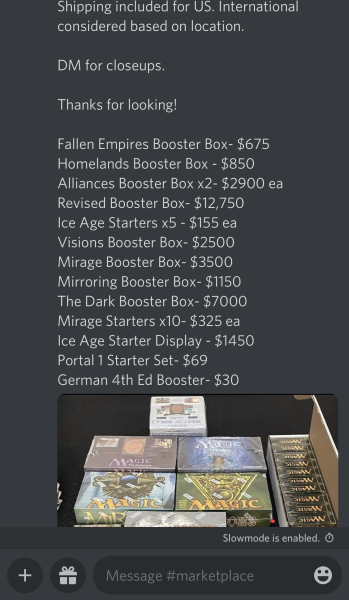
Every once in a while, though, a post catches my eye. Last week, I thought long and hard about this one in particular:

Discord Sale

Because I started playing in 1997, this post screamed “Sig’s childhood” more than almost any other post I see in the Discord. I distinctly remember seeing these sealed products for sale at my local hobby shop. Especially the Mirage starter decks—those were my favorite back when I first started playing.

It was 1997-1998 when I really started ramping up my involvement in the game. One primary objective back then was simply expanding my collection. When you have to play cards like Krovikan Fetish and Mistfolk just because you have nothing better, purchasing any sealed product almost guarantees you’ll be able to find an upgrade to a deck.

As Tempest block launched, my hobby shop started marking down some of “last year’s” wares. This included Mirage starter decks, which were reduced from $8.95 to $7.50. I quickly did the math: booster packs were $2.95 and gave you one rare. A Mirage starter was $7.50 and included three rares—that’s a discounted price of $2.50 per rare! The basic lands were much needed too, so that was an added benefit.

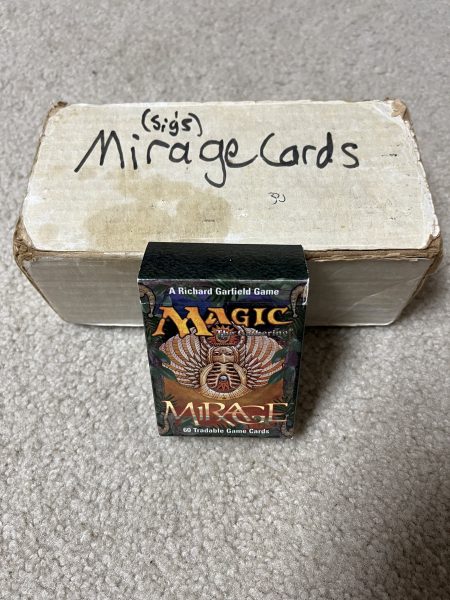
I purchased as many of these decks as I could—which is to say I bought maybe five or six, as that’s all I had the money for when I was 14. Mirage became my favorite set and I even thought about trying to collect the entire set at one point. I never completed the mission, but I do have 24-year-old proof of the attempt (the starter box isn’t one of my originals, but the card box itself is the original one within which I once collected all of my Mirage cards).

The original box I collected my Mirage cards within, along with an empty Mirage starter

With this attachment to Mirage, my favorite set of all time, it’s no wonder I’d be very tempted to purchase starter decks from that Old School Discord seller at $325 a piece, 43x the price I used to pay but just as exciting.

Soaring Sealed Product

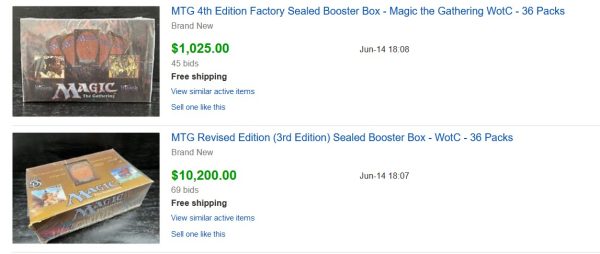
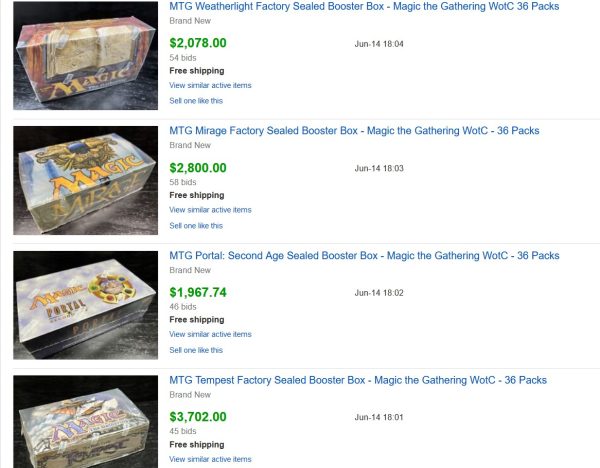
If you think I’m the only one longing for opportunities to crack open product from my childhood, you’d be grossly underestimating nostalgia's power. In fact, I recently watched a number of Star City Games’ auctions close on eBay for sealed product from this same era of Magic. Here are some of the highlights:

Frankly, I was shocked at some of these closing prices. For example, Stronghold is another set I cherished as a kid. I’ll always remember the day I opened a Mox Diamond in the hobby shop and immediately sold it to another kid for $20, thinking I had won the lottery. But nearly $6000 for a booster box? Really?! Even if you open a BGS 9.5 Mox Diamond and Sliver Queen, you’re not going to recoup that cost.

People aren’t paying up for these products to make money. They’re doing so to experience nostalgia. They want the feeling of opening a booster pack, windmill slamming Flame Wave in a draft, and having those epic games of childhood once more. Clearly, the premium for doing this is quite steep. The Fourth Edition booster box especially surprised me--$1000 for a booster box where the most valuable card is around $60 (not to mention white-bordered!) is wild.

There was an error retrieving a chart for Mana Vault

Introduce nostalgia into the equation, however, and suddenly a $1000 price tag to travel back in time with some friends can be an attractive proposition—especially if you’re splitting the cost with those friends.

Keep in mind that the number of times someone can draft these older sets is finite. Every time a booster box of Mirage is cracked, the number of times that it can happen again reduces by one. Over time, quantities will decrease until these become extremely difficult to find. If Magic sticks around for another decade, expect these prices to look attractive relative to where they’ll be in 2032. We’re talking Silver Age of comic book proportions, here.

Wrapping It Up

When I first became interested in sealed product, I viewed it strictly as an investment tool. I once owned an array of sealed booster boxes from Magic’s middle years, sets that launched between 2000 and 2010. Those products have all steadily climbed in price over the years as well. Unfortunately, I lost patience with the products and found myself preferring singles with which I can play games rather than sealed product that sits on a shelf collecting dust. Regretfully, I sold every booster box I had owned.

Today as I consider the utility of an older booster box, I realized that my interest in them lies not in their investment potential, but rather their nostalgia potential. With this new lens, I’m suddenly finding myself wishing for a sealed box of Mirage, Ice Age, and Visions. This wouldn’t be because I want to make money on them, but instead because I’d want that opportunity to sit down at a picnic table and re-live an epic battle from childhood.

This is going to be very difficult to organize, mind you, given that my childhood friend lives a few hundred miles away. I’m also married with two kids, and adulting tends to conflict with attempting to live like I am 14 again. But if I don’t purchase the products now, I’ll only be forced to pay even more years from now. I suspect other people are also latching onto this same sentiment, and that’s why this older sealed product is selling so expensively.

Lastly, I often say that owning Magic cards as an investment is a strong plan as long as the game itself remains healthy and popular. This rule doesn’t fully apply to the older sealed product. Even if paper Magic were to lose support altogether, something tells me there will always be a population of players willing to pay up for the experience of opening a booster box of cards printed in the 1990s. As a result, these products may even transcend the game itself.

All things considered, there are far worse places to park capital—just make sure you know your motivation for purchasing older sealed product: investment or nostalgia. Unlike playing with Old School cards, it’s difficult to have your cake and eat it too when it comes to nostalgic sealed product. You either save them to make a return on your investment or you crack them open to re-live childhood. Unfortunately, you can’t really have both. Choose wisely.

Generational Magic: Store Spotlight—The Illuminaudi

Are you a Quiet Speculation member?

If not, now is a perfect time to join up! Our powerful tools, breaking-news analysis, and exclusive Discord channel will make sure you stay up to date and ahead of the curve.

Along with sharing my own Magic: the Gathering journey, I would like to share what's going on with others in the community. Not just the players, but the people that provide a place to gather. The Greater Cincinnati/Dayton area is fortunate to have a lot of options when it comes to Magic and gaming in general. Here's a glimpse into one of them.

Come On Down!

What's your name, the name of your store, and where are you located?
I'm Lannie Richardson and I'm the owner of The Illuminaudi in Hamilton, Ohio.

Lannie, Owner of The Illuminaudi

How did The Illuminaudi begin for you?
The store actually began out of a desire to refocus my life. I was heading down an unhealthy path and decided I wanted something better for myself. I was talking with one of the local game store owners and expressed an interest in running my own store. He told me he wanted to branch out into the Hamilton area and so after some back and forth, we started developing the store together.

I put everything I had and then some into it. After four years of planning, work, and the thousands of dollars I scraped together, the Hamilton branch of The Illuminaudi was ready. We opened for business July 3rd, 2014 (8-year anniversary coming up soon!). A couple of years later, that game store owner had decided to close his store. I then had the opportunity to buy the name and here we are!

When are you open?
We're open every day except for the major holidays.

The Illuminaudi

How do you connect with your customers?
Facebook is our main connection. I'm working on a Discord channel, but it's still in the early stages.

What gaming experiences and events do you offer?
Magic: the Gathering and Yu-Gi-Oh! are our main focus, but we do provide space for any games that people want to come in and play, like Dungeons and Dragons, Warhammer, etc.

What Magic experiences do you provide?
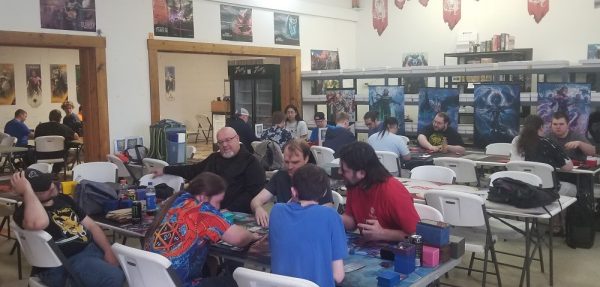
We run weekly events for Standard, Modern, and Commander. Standard has been touch and go, but our Modern events on Sundays and Wednesdays have been running well. Commander is our most popular currently. We have people playing Commander most every day, but have specific events on Sundays and Tuesdays.

Do you host any special events?
We consistently host Magic pre-releases, but I'm really looking forward to the Regional Championship Qualifiers. Details are coming soon and will be available on our Facebook page once Wizards sends us the information. We're currently scheduled for August 14th.

What are your most popular formats currently?
Our most popular competitive events are Modern. In the more casual arena, Commander is where it's at.

Modern and Commander events

How did The Illuminaudi deal with and adjust to the pandemic?
When Covid first hit, there were definitely issues. Not just for my business, but personally as well. The initial hit was rough, but I put everything into my store. I was going to do everything I could to navigate the choppy waters.

I was able to work for Harry's House of Cards during the early months when the store was closed. With his help and instruction, I was able to expand and improve my own online sales. Harry was great; the experience forced me to organize my inventory and provide a better service to my customers.

Since everyone still wanted to play, but couldn't get out, we provided what they needed for at home use. This was a godsend to keep us going. Once everyone started coming back out and with our improved online sales, 2022 has been one of our better years.

What are your hot sellers for Magic?
We sell a crazy amount of Commander product, especially the Commander pre-constructed decks. I couldn't keep it in stock. Kamigawa: Neon Dynasty was huge as well. I still get requests for that set.

Helping customers

How did you get started with Magic?
I was introduced to it in the 10th grade. I mainly played other card games at lunch with friends, but wasn't really into Magic. I didn’t know too much about the game until I was gifted a bunch of cards. My buddy Ryan, who was very much into it, taught me the basic rules.

Yu-Gi-Oh! was my main interest and I still wasn't hooked, so I traded to Ryan what I had collected at that time. Soon after, our local library became the place for everyone to meet up. Of course the free internet was a huge draw as well. I was hanging with a few guys that were really into Magic, so I joined in. We were all very much kitchen table level, nothing too serious.

Eventually Chris, a recent addition to our group, showed us there were different formats and really opened our eyes to the bigger picture. Along with that, Legends, Hamilton’s first real game shop, opened. And that’s when I came into my competitive streak. Onslaught was the latest set and I loved it and the competition. Onslaught is still one of my favorite sets.

I then left the game again, between Ravinca and Innistrad. When my desire to run a store started becoming a reality, and Return to Ravnica was the new set. I finally got back into the game and haven’t stopped since.

What do you personally enjoy playing?
I like most formats, but competitively, I enjoy Legacy the most. I don't get much time for it, but when I enter a tournament I'll play either ANT (Ad Nauseam Tendrils) or my version of Bant Stoneblade.
Of course, if I'm relaxing with the players at the store, I'll try to get into a Commander game every now and then.

What's one of your favorite Magic cards?
I have a few of them. In a competitive setting, I've loved Snapcaster Mage and Liliana of the Veil. Casually, it would have to be Sidisi, Brood Tyrant. I have an almost completely foiled reanimator deck that I've been tweaking for seven years headlined by the Naga Shaman.

Sultai all the way!

To finish up, is there anything else you'd like to share?
I've worked hard get and keep this store going and try my best for people feel comfortable while they are here. I enjoy getting to know my customers not only in the store, but personally. There was one player that I became friends with through the store and he had unexpectedly died. I went into the store one day after his passing and the realization that he wouldn't be there anymore stared me in the face. My players and customers mean a lot to me.

The Illuminaudi has allowed me to stay positive and out of trouble. Even though it's not always roses, I'm very thankful for what I have. Making friends has been one of the best aspects of my role.

LGS Is Where the Heart Is

I want to thank Lannie for providing us a glimpse into The Illuminaudi's Magic life. I hope you enjoyed the visit and look forward to the next! Do you know the story behind your own LGS? Feel free to share in the comments. And if not, maybe now's a good time to get up to speed...

Meow-Mixing It Up: The ’22 Counter-Cat Reboot, Pt. 1

Are you a Quiet Speculation member?

If not, now is a perfect time to join up! Our powerful tools, breaking-news analysis, and exclusive Discord channel will make sure you stay up to date and ahead of the curve.

Way back in 2017, I tied together the loose ends of deck archetype theory I'd been working on for years into a piece called "Death’s Shadow of Doubt: Exploring Aggro-Control." The article coined the term reversibility and gave a name I've since stuck with to the decks I've always loved best: thresh.

Thresh decks are protect-the-queen strategies stocked with permission, removal, and cantrips. The name refers specifically to Threshold, a format-hoppingtournament staple that included the first stand-alone "queens" in Nimble Mongoose and Werebear (today, All Grown Up! as Delver of Secrets // Insectile Aberration and Tarmogoyf).

Just as not all fish deck creatures boast a Merfolk creature type, thresh decks don't necessarily have to use the graveyard. But they often do, as the undercosted threats Wizards prints tend to come with graveyard-reliant conditions.

Death’s Shadow of Doubt: Exploring Aggro-Control

The thresh strategy I've spent the most brewing hours on by far is Counter-Cat, a Delver of Secrets deck that doubles up on aggressive one-drops by employing Wild Nacatl. In 2022, its concept alone seems utterly laughable. We live in an era where Delver itself was powercrept out of even Legacy by Wizards' ever-stronger suite of one-drops, and when was the last time Nacatl was playable in any format?

There was an error retrieving a chart for Wild Nacatl

Natch, I couldn't leave well enough alone. I'm a firm believer in playing what you love, and owe my devotion to Modern to my conviction that this is the most rewarding format to be doing that in. In this two-part article, I'll illustrate the myriad tweaks made to Counter-Cat since Modern Horizons 2 (in fact, I rebuilt the deck from scratch close to a dozen times over the last two years) and eventually unveil a list I'm quite pleased with.

Building a Better Thresh

The best deck in Modern is also a thresh deck, so the Counter-Cat shell needs to answer a few pressing questions if it is to justify continued exploration. After all, Modern Horizons 2 nigh single-handedly solved most of the conundrums that have faced Modern thresh decks for years:

  • Murktide Regent removes the need to splash outside of UR for a big, sticky Stage 2 threat (no more Tarmogoyf, Angler, or Mandrills)
  • Unholy Heat provides a heavy-duty removal spell both in-color and on-theme; gone are the days of splashing Path or Push
  • Counterspell serves as high-quality permission that solves the it-stops-working issues facing runner-up Mana Leak
  • Archmage's Charm gives the deck its Swiss Army knife, a bag of tricks more potent than even splashed solutions like Simic Charm and Kolaghan's Command
  • Expressive Iteration really is the new Treasure Cruise, outpacing value-generating planeswalkers like Liliana, the Last Hope
  • Ragavan, Nimble Pilferer and Dragon's Rage Channeler are the best one-drops thresh has ever seen, even ousting Delver of Secrets from Legacy builds (until Ragavan's banning) and eliminating the would-be benefits of stretching to accommodate an additional one-mana threat like Wild Nacatl
There was an error retrieving a chart for Murktide Regent

All that to say, given the power of Modern's premier thresh deck, why the heck would you splash one, let alone two colors? Counter-Cat will need rebuttals to all six of the above reasons UR Murktide owns 100% of the format's thresh economy and lays claim to being Modern's only Tier 1 thresh deck ever outside of a Cruise meta.

Ga-Ga for Gotcha!

One of my favorite things about deckbuilding in Magic has always been "getting" opponents with off-kilter tech or simply the perfect tool for a niche scenario. You can trace this love of mine across my brewing and tournament history in Modern: Disrupting Shoal and Simic Charm put me on the map as a competitive brewer, and the gotcha-tunities of cards like Peppersmoke have always been way too cute for me to steer clear of.

There was an error retrieving a chart for Disrupting Shoal

As a strategy, thresh-style tempo decks encourage gotcha-style plays more than perhaps any other—with their low curves forcing pilots into surgical interactive suites, the raw power and versatility of costlier Vindicate-type spells have long been out of reach.

Yet the cards wielded by UR Murktide are patently safe. And honestly a bit pricey. Maybe the meta did have space for Counter-Cat so long as the deck was redesigned with a view to maximizing the most heavy-hitting gotcha cards in its arsenal.

Spell Pierce and Mutagenic Growth forge the heart of Counter-Cat. Both are at their very best protecting or pushing through early aggression, which is exactly what we have to offer. We'll want to out-aggro the Murktide decks, which go bigger with more expensive spells, and run not just eight, but 12 one-drops to compliment our gotchas.

Theory-wise, I've championed Growth as a card that often functions as Mental Misstep in this particular strategy and as one of the rare playables that transcends the stages of combat (click through either of those links for the deets). With the rise of cards like Unholy Heat and Bonecrusher Giant, Growth now saves x/1s like Ragavan of unflipped Channelers from burn spells a good portion of the time.

As for Pierce, it's as on-plan as ever, hitting half as much as Counterspell but for half the price. Between Heat and the removal options afforded us in white, I'd say we have creatures covered. Sure, catch-all permission is fantastic. But you can't put a price on one mana. Indeed, Pierce even holds more of a metagame share currently than good ol' Counterspell (clocking in at #9 vs. the latter's #11), a testament to the value of its efficiency.

Setting the Stage

Up next are the Stage 1 creatures. We did say we wanted 12 of these. I won't argue—Ragavan and Channeler are the new blue chippers for early aggression out of thresh. But while Nacatl once acted as extra Delvers, I'm no longer sure the little Human Wizard that could still pulls enough weight to make the cut.

Nacatl applies early pressure more reliably and is better on defense, giving us additional equity vs. Murktide. It's a lot like a mini-Tarmogoyf in this deck. 3/3 is a good deal better than 3/2 in post-MH2 Modern, where Unholy Heat is a card many decks lean on to snipe Stage 1 creatures even without delirium, and so much so that they're trimming Lightning Bolt (Murktide among them). Then there's the fact that Nacatl is much harder to gun down with Wrenn and Six or Gut Shot.

There was an error retrieving a chart for Delver of Secrets

The best thing about going with Nacatl, though, is that doing so allows us to stop sweating the instant/sorcery count. Delver's a hardliner on deck construction, and if we want to remain aggressive, stocking up on threats will do us much better than loading up on air like Consider.

Stage 2... Fight!

These slots were more contentious. Back in the day, I would fill them with Goyf and Mandrills, both of which are a good deal worse than Murktide Regent. But some other newcomers have arrived of late to sweeten the pot. The number I settled on for Stage 2 threats to maximize our odds of having one on the second turn (or a pair of castable one-drops) was 7.

Early on, I tried both Kavu and Goyf. And Kavu was just so much better than Goyf. A consistent 4/4 for two that ignores grave hate, provides incidental grave hate, and sifts through the deck just applies a ton of pressure while ignoring a lot of what opponents could do to interact with it. It was often swinging for more than Goyf early and the same amount late-game.

The looting effect is also totally bonkers, as we rarely need much land beyond two or three in play. Conditional but high-impact spells like Pierce and Muta form a fantastic pairing with Kavu, who digs to them when they're good and cycles them away otherwise—indeed, Muta specifically boosts Kavu past Dismember and past the whopping 6 damage of Heat with full domain. Add something like Wrenn and Six in play to recur lands for a stream of discard fodder to build your own Dark Goyfidant, a mini-engine that overwhelms other fair decks and quickly gets us to the right interaction against combo.

Soon I was cutting Goyf entirely and supplementing 4 Kavu with 3 Wrenn. I loved it, but for one glaring weakness: Kavu straight-up dies to Dress Down (the 13th most-played spell in Modern). The solution? To split Kavu with something else. That was Goyf for awhile, even though the Lhurgoyf left much to be desired. Thankfully, another powerful Stage 2 creature was soon printed.

There was an error retrieving a chart for Ledger Shredder

Ledger Shredder grew like Goyf and Kavu, outgrowing both in longer games. It attacked and blocked. It flew. It even cycled through cards. In other words, it was almost Territorial Kavu:

  • Kavu is better on offense. If it didn't die to Dress, I would still be playing 4. Shredder takes a couple turns to get going and sometimes asks us to give up business over excess lands if we want it to clock respectably.
  • Shredder is better on defense. It's a better blocker and holds down the skies. It also draws us into answers without forcing us to attack.
  • Too many Kavus has us soft to Dress. Too many Shredders can clog. 2-2 split? All roses.

Running a split does have its benefits beyond just insulating us against Dress. In a hand with both creatures, we can deploy the best one for the situation. When I find myself taking the midrange role, I sometimes board out the Kavus but keep the Shredders. Ragavan and Nacatl are also fine board-outs depending on the nuances of the matchup. Then against linear combo decks like Tron, Shredder and occasionally Channeler get the cut and I keep creatures that hit harder and faster.

There was an error retrieving a chart for Wrenn and Six

Filling out the Stage 2 threats is Wrenn and Six. I loved this guy in my last published build of Counter-Cat, where it combined with the now-banned Faithless Looting to draw us plenty of cards and help us mulligan aggressively into explosive starts. It's still great with the looting of Kavu and Shredder. And it's a great way to chase our creature getting killed, something that frequently happens against midrange decks that hate staring down such a cheap value machine.

As anyone who's tried Wrenn in an aggressive deck knows, the downticks are real, turning it into a cantripping Boros Charm against passive opponents. Finally, the ultimate does win us the game in this deck. Like with Pierce and Muta, we can use our other two-drops to cycle through extra planeswalkers or even the first if an established board advantage leads us to prefer committing aggression and slinging disruption while beating down.

Drawing the Curtain

For spatial reasons, we'll have to tie things up there for now. Can you guess the deck's composition based on the creatures outlined above? Next week, I'll unveil the final decklist, as well as unpack the deck's draw card suite, its funky removal spread, the ever-misunderstood manabase (this one among Counter-Cat's most consistent ever), and a sideboard full of goodies.

There was an error retrieving a chart for Wooded Foothills

In the meantime, I'd love to hear which close-to-your-heart strategies have benefitted the most from recent expansions. Drop me a line below or on the Insider discord!

Jordan Boisvert

Jordan is Assistant Director of Content at Quiet Speculation and a longtime contributor to Modern Nexus. Best known for his innovations in Temur Delver and Colorless Eldrazi, Jordan favors highly reversible aggro-control decks and is always striving to embrace his biases when playing or brewing.

View More By Jordan Boisvert

Posted in Free InsiderLeave a Comment on Meow-Mixing It Up: The ’22 Counter-Cat Reboot, Pt. 1

Have you joined the Quiet Speculation Discord?

If you haven't, you're leaving value on the table! Join our community of experts, enthusiasts, entertainers, and educators and enjoy exclusive podcasts, questions asked and answered, trades, sales, and everything else Discord has to offer.

Want to create content with Quiet Speculation?

All you need to succeed is a passion for Magic: The Gathering, and the ability to write coherently. Share your knowledge of MTG and how you leverage it to win games, get value from your cards – or even turn a profit.

How to Avoid Common Commander’s Deckbuilding Traps

Are you a Quiet Speculation member?

If not, now is a perfect time to join up! Our powerful tools, breaking-news analysis, and exclusive Discord channel will make sure you stay up to date and ahead of the curve.

There are numerous factors when it comes to deckbuilding in Magic. Because Commander has such a massive card pool along with bigger deck size, it can easily be the most difficult. Experimentation is a valuable tool when tuning a deck but there are limits whether it be time, budget, and/or experience. Here are some stories with tips that can save players new and old time, frustration, and in some cases even hard-earned cash.

Real-World Examples

I buy and sell Magic cards, no surprise there. On the buying end it's typically entire collections from retiring players as I detail here. For sales it's most often singles or custom Commander decks. Many of my sales involve newer players. My general rule is that the customer is always right, except for when they're new. In that case, sometimes, they need a little help to make a more informed purchasing decision. The most help, however, comes during custom deck creation. Just the other day I spoke with a brand new player and they asked, "Can you build me a Dragon deck?" My response:

"I Can, But..."

Knowing that the player is new allowed me to steer the conversation in a productive direction. I needed to get an idea of current or potential play groups so that I could help build their 100. Of course, new players do not know... that which they do not know. So how do you help them help *you* to... uh... help them?

You can get an idea with questions like "Do you know if your friends are tournament players or play for fun?" or "Do you know if your friends have spent considerable money on their decks, or if they have precons?" These are questions that even a player with little game knowledge can answer rather than asking them about something more esoteric like "power level." With these bare bones questions answered, it becomes possible to make good recommendations.

When this player told me they had played tournament Yu-Gi-Oh! years ago and were looking to get back into card games on the competitive side, that told me everything I needed to know. With a budget prepared, it's time to build Tribal Dragons! We don't have to potentially consider Vintage cards like Shivan Dragon while Old Gnawbone and Ancient Copper Dragon exist. This player is fine purchasing chase cards from the start, letting him avoid spending money on budget cards that will eventually get replaced by higher end rares and mythics.

Here, we avoided a potential cost trap.

Meanwhile, in Another Build...

A newer player wanted help building their second Commander deck. They already had acquired the Spirit Squadron precon, played it many times, and even upgraded it to give it a stronger Spirit Tribal focus, removing most of the non-Spirit cards for pure bodies. Because this deck was blue and white, they wanted to try out different colors and opted for black and green.

I pitched a few different ideas like Skullbriar, The Walking Grave with a +1/+1 counters theme that could utilize scavenge and self-mill. Milling was acceptable, and they wanted to play some cards they enjoyed like Spider Spawning, but the +1/+1 counters angle was not appealing. We looked through some cards and Falthis, Shadowcat Familiar soon become a requirement.

Who Pairs With a Grey Ogre for Profit? Hill Giant, of Course!

First off, there were few options and, second, fewer great options to pair with Falthis. Eventually Anara, Wolvid Familiar struck their fancy, and the ball was in my court to figure out how to make something work. Several playtests and builds later I felt that I had a very spicy brew utilizing creature cards with mill. It used the commanders as graveyard bonus creatures and got extra synergy from undergrowth. After a few games of pumping out 39/39 haste Golgari Raiders or nuking people for over 20 with Lotleth Giant, I happily presented the deck for testing.

Surprise, They Hated It!

While almost every card in the deck had some form of graveyard synergy, the player did not enjoy the mechanics therein. In typical Beardy fashion there were a dozen different keywords, some cards from older sets with old, confusing wording, and the player was bummed out that their commanders were "useless."

Now, we had to agree to disagree there. To me, I felt that the "best" use of their commanders was as fodder for the graveyard, and in my playtest games the ability to pitch a couple of extra creatures into the 'yard early made the deck function better come late game. Also, shout out to Falthis! Turns out having a 2/2 deathtouch creature is really effective at discouraging attacks. I digress.

The player simply had different needs and expectations. Counting the graveyard for one HUGE Spider Spawning appealed to them. Constantly counting it to determine Mortivore's power/toughness or other less game-breaking effects? More of a chore. I saw interesting interaction and potential for decision making with upkeep and dredge triggers. The player, however, experienced analysis overload.

The Solution? Back to the Drawing Board!

Here I was trapped by the idea of maximizing Spawning with Falthis and Anara because these were all key requests from the player I was helping. Unfortunately, I was overly zealous, not unlike a long-time experienced brewer can be in such a situation. I felt that I had found the solution to optimizing a combination of cards and was excited to share my findings. However, I had ignored the most important factor: the player!

Here, the end result was scrapping this deck idea and completely going back to the drawing board. Wolf and Cat version 2.0 removes mill and graveyard checks while adding in more removal, because every deck needs more removal.

Limiting the scope of the deck allowed us to avoid a complexity trap.

Even Experienced Players Can Use a Second Opinion

A player that has been playing since 2000 approached me with a list for a Satoru Umezawa deck complete with a Rogue subtheme. Nice! They had a very respectable build with both powerful, synergistic cards alongside thematic choices that were deliberately suboptimal. It was a thoughtful list and really a highlight of the heart of commander.

I did ask about the potential T1 Sol Ring, T2 Umezawa, T3 Blightsteel Colossus kill when they mentioned they wanted the deck to be mostly casual. They said it was alright with their group because they played no tutor effects; an opening like that would be memorable, but exceedingly rare, and everyone was alright with that.

However, I identified what I believed to be some holes in their list, and these were clearly not budget or power level based. One example was Slither Blade which seemed like a perfect fit. Extremely inexpensive, not crazy-powerful, and on-point as an unblockable Rogue. They liked the suggestion and mentioned they missed that entire Magic block because, you know, real life happened back then!

This player had a good idea of the scope, features and power level of their deck, but was short on another key component. I don't think they had hours to spend pouring over every single choice for their deck but they did well with the time they had. By asking someone else for advice, they did not have to spend hours pouring over every card and thus avoided a time trap.

Acknowledging Limits Is Healthy

We all have limits, and Magic deckbuilding is no exception. While it would be nice to be able to playtest and refine every potential deck idea and list, it's simply not practical in terms of budget, experience, or time. But with a little bit of help from your local playgroup and other brewers, you can avoid common traps and make the most of your deckbuilding. Now get out there and brew, share, and ask for advice. Happy building!

Blue Cards to Pull from Bulk, Pt. 2

Are you a Quiet Speculation member?

If not, now is a perfect time to join up! Our powerful tools, breaking-news analysis, and exclusive Discord channel will make sure you stay up to date and ahead of the curve.

Welcome back to Cards to Pull from Bulk! Last time, we explored Commander-driven blue cards with high demand. Today, we'll cover the non-Commander-based blue bulk picks.

The intention of this series was to highlight cards one may find while digging through bulk. Each installment has focused on a different color of bulk cards. I covered gold, colorless, white, black, red, green, and part 1 of the blue cards previously. This is the final article in the series so I hope you have enjoyed reading them as much as I have writing them.

As usual, we'll ignore cards whose value is tied to being from Magic's very early sets, i.e. anything that is from The Dark or prior.

Pricing Standards

With a view to keeping our list manageable, I'm restricting it to some of the best sub-$5 finds in each color according to TCGPlayer mid price. While one may get lucky and find valuable cards in bulk, I have found that sub $5 cards are where I tend to have the most luck; I did once find a Copy Artifact in bulk, but I find that to be the exception rather than the rule.

Throughout my 6+ years picking bulk, I have found that understanding the reason for a card's value is extremely beneficial in evaluating other cards and their potential, and have included a bit about each card. This can allow one to pull future "bulk picks" out of bulk even if the card currently isn't worth a whole lot. I was extremely successful picking out cards like Mystic Remora which until halfway through 2017 was under $0.5.

Note that I may include cards that are very near to $5, even though there is potential that they breach $5 in the near future.

Blue Bulk to Pick: Non-Commander

Modern Demand

1. Counterspell

Just a few years ago, this one would have likely been on either the Legacy or Commander lists, but thanks to its inclusion in Modern Horizons 2 it has taken Modern by storm. Logically, a clean solution to almost any problem for the low cost of 2 blue mana is extremely potent in any format.

What is especially interesting about Counterspell is that it maintains its value despite 31 printings, which doesn't count alternate art variants in the same set printing.

There was an error retrieving a chart for Counterspell

2. Spreading Seas

Spreading Seas was once blue's best answer to Modern Tron decks as it served to slow them down as well as draw into a potential threat or answer. Nowadays, we have cards like Damping Sphere which serve as both Tron and Storm hate that happens to be colorless, so I was honestly surprised to see Spreading Seas was still valuable enough to make this list.

There was an error retrieving a chart for Spreading Seas

3.Merrow Reejerey

Merfolk has been a viable deck for much of Modern's history, and while it has rarely been Tier 1, it does have a strong following and is a deck that good players can pilot to decent results. Interestingly, Merfolk Reejerey has been cut from many lists at this point, but it does have a unique and powerful ability.

There was an error retrieving a chart for Merrow Reejerey

4. Remand

While not a permanent Counterspell, Remand's ability to draw a card and the easier mana requirement still make it a valuable tempo play in Modern. It also has fringe uses where one might counter their own spell in order to net a draw and recast it again, giving the blue instant pseudo-cycling.

There was an error retrieving a chart for Remand

Pioneer Demand

5. Mystical Dispute

Mystical Dispute has become the defacto counterspell to a counterspell in Pioneer, thus it often is used to push through one's own spells and is the best option available to do so. It is also quite popular in Modern, where it can hit Omnath and other haymakers.

There was an error retrieving a chart for Mystical Dispute

6. Narset, Parter of Veils

Narset, Parter of Veils is a great answer to any deck that looks to do a lot of card drawing and also happens to be able to often replace herself with her ability. She often finds a home as a support card in blue/x control decks as a 1 or 2 of. She also occasionally gets used in decks looking to wheel as she turns cards like Days Undoing into a three-mana draw 7.

There was an error retrieving a chart for Narset, Parter of Veils

7. Curious Obsession

This card mostly finds a home in u/x tempo style decks. More often than not, it replaces itself the turn it is cast, and then provides card advantage from every turn onward.

There was an error retrieving a chart for Curious Obsession

Legacy/Vintage Demand

8. Gitaxian Probe

Wizards admitted that Phyrexian mana was a mistake and placed it high on the Storm Scale. Probe has been used to enable any deck that cares about spell count and has been banned in Pauper, Modern, and Legacy, and restricted in Vintage. The card is a 4-of in numerous Penny Dreadful decks, but given that format is almost exclusively on MTGO, one wouldn't expect it to affect paper prices much.

There was an error retrieving a chart for Gitaxian Probe

9. Ponder

One-mana blue cantrips are often the glue that holds most combo decks together, and Ponder is one of the best. It is currently banned in Modern but is heavily played in Legacy.

There was an error retrieving a chart for Ponder

10. Careful Study

The original Faithless Looting, Careful Study was a key enabler in legacy Dredge decks as a way to both trigger dredge and fill one's graveyard with dredgers.

There was an error retrieving a chart for Careful Study

11. Soothsaying

Soothsaying shot up in popularity after the banning of Sensei's Divining Top as a method of Legacy Miracles players to keep the deck alive. It's definitely a "worse" version, and my beloved Miracles deck has fallen down a peg.

There was an error retrieving a chart for Soothsaying

Pauper Demand

12. Snap

Mono Blue Tempo is a very strong Pauper deck. It uses a lot of Faeries with useful abilities and tempos out opponents. The beauty of Snap is that it can be a tempo spell to bounce an opponents threat or it can be used to bounce one's own creature to re-use an ETB ability, with the best target being the next card on our list.

There was an error retrieving a chart for Snap

13. Spellstutter Sprite

Spellstutter Sprite has been a powerful blue common throughout its history. A 1/1 flash flyer for 2 mana is already only slightly below curve and tack on the ability to counter a spell and it's an extremely powerful card. It's arguably the best creature to return with ninjitsu for Ninja of the Deep Hours, and is pretty much always a 4-of in any Pauper Faeries deck, whether they be Mono Blue, UB, or UR.

There was an error retrieving a chart for Spellstutter Sprite

Blue Them Away

This concludes my "Bulk Picks" article series. I hope that you have found it helpful and informative. I enjoyed researching the cards on these lists and I can honestly say I discovered a few that I was unaware of when picking previously, and I have been bulk picking for over 6 years! Did I miss any? Drop a comment below or reach out to me on our QS Discord server.

Magical Creatures: Magic’s Unique Living Beings

Are you a Quiet Speculation member?

If not, now is a perfect time to join up! Our powerful tools, breaking-news analysis, and exclusive Discord channel will make sure you stay up to date and ahead of the curve.

Creatures, together with lands, are probably the type of cards every new player learns to use first. They are the most reliable and common way to deal damage, and thus to bring your opponent's life to 0 and win the game. But that's not all: creatures are a great concept even when you don't take into account the gameplay. In fact, most players have a soft spot for creatures. How come?

Creature Uniqueness

While being technically just one of several card types (along with lands, artifacts, instants etc.), creatures offer special value from a lore perspective. They are spells, just as any other type besides lands. And they are permanents, just as any other type besides instants and sorceries. But above all, they are the only cards that represent living beings. (Perhaps excepting Zombies, Vampires and other undead, but you get the point.)

Famous creatures from the game's Golden Age

As living beings, they are more interesting than any other card type. They have power and toughness, can battle each other during the combat phase, and can die and go to the graveyard. So many interactions, and so many ways to use creatures, both in terms of flavor and gameplay.

That's why I find them so special. And I'm a huge fan of Solidarity decks, so I'm not biased at all! Anyway, after ending the series on "Real-World Flavor" (you can read the last piece here), I have decided to begin exploring other aspects of Magic IP flavor. This new series deals with magical creatures.

Races, Classes, and Other Types

Since creatures represent humans, animals, beasts, and a huge number of combinations in between, they also offer unmatched potential for lore development. Magic combines gameplay and lore using the creature type. In fact, every creature that was ever printed has at least one creature type (and often more). In the course of Magic's history, over 250 different creature types have been used.

Not all of them are on the same level. Certain creature types (such as Human, Elf, or Goblin) are called "races." Others (such as Warrior, Cleric, or Archer) are "classes." Both categories apply mostly just to humanoid creatures, whereas other types of creatures (monsters, animals, and the like) tend to skirt them.

The Evolution of Creature Types

The waters can therefore get murkier than with simple instants and sorceries. For this reason, over the course of time, several changes and updates have been necessary. Many things have changed since Limited Edition Alpha. Back then, creature' types were mostly used for reasons related to flavor, and only seldom did they impact the game. Some of the earliest examples are long-winded typelines such as Lord of Atlantis, Zombie Master, and Goblin King, but it wasn't common.

Magic's first "lords"

Over time, Magic R&D realized that creature types held much more potential than they thought, and began to put it to good use. Fifteen years ago, in 2007, they ushered in the "Grand Creature Type Update." Some minor changes had happened before, of course, and of varying notability. For instance, with Mirrodin (in 2003), the Human subtype was introduced, and with Champions of Kamigawa (in 2004), the creature type Legend became the supertype legendary.

None of them, however, were nearly as pervasive as the big Lorwyn update. No less than 146 obsolete creature types were purged, and a few were added. Since 2007, almost every new set introduced new creature types, but there have been no changes of such magnitude since.

Magic IP and Borrowed Types

With the astonishing number of 264 different creature types, it goes without saying that many of them were not created just for Magic. In fact, many creature types are simply names of real animals: think Bears, Lizards, Serpents, and so on. Other types are fantastic animals that, while absent from the real world, are common in the fantasy literature: Dragons, Merfolk, and Zombies. More interesting still is that quite a large number of creature types are actually unique to the Magic: The Gathering franchise.

Some creatures unique to MtG franchise

There are 45 different creature types that were conceived specifically for us Magic players. Some of them are rather famous (Atog, Eldrazi, Myr, Sliver), while others only appear on few cards (Bringer, Homarid, Zubera). Still, even these unique creature types need to take inspiration somewhere... at least in the majority of cases.

A Magical Birth

And that's what we'll explore throughout this new series! For some of Magic's unique creaures, we'll be able to dive in for some close analysis. Other times, when the number of examples is too large, we'll only touch on the most famous and memorable cards. Do you have a favorite Magic-specific creature type? Let me know in the comments and on Twitter!

Copy That! RG Jaxis Twin | Adam Plays Magic

Are you a Quiet Speculation member?

If not, now is a perfect time to join up! Our powerful tools, breaking-news analysis, and exclusive Discord channel will make sure you stay up to date and ahead of the curve.

This week on Adam Plays Magic, we're jamming some unadulterated nonsense of the highest caliber: Jaxis Twin. The objective of the deck is to make hasty token copies of Combat Celebrant with Jaxis, the Troublemaker or Fable of the Mirror-Breaker // Reflection of Kiki-Jiki for multiple (if not infinite) extra combat steps.

The combo requires Combat Celebrant and one of the above creatures as well as one mana dork such as Llanowar Elves. With Reflections of Kiki-Jiki, the combo is a straightforward loop. The sequence with Jaxis on the other hand is limited by both the number of cards in your hand as well as your access to red mana.

Werewolf Pack Leader's Pack Tactics attack trigger takes care of the cards in hand limitation. However, Gilded Goose is the only one-mana mana dork that can produce red, but that is gated by your access to food tokens.

Even if the combo only nets a few free combats, it's likely enough to close the game.

What I Like

As I mentioned last week, I'm a big fan of combo decks that don't require the combo to win. If the individual components are strong enough to stand on their own, the deck is less clunky with fewer dead draws. Fortunately, Fable of the Mirror-Breaker is exactly that type of card. It creates multiple bodies, fixes draws and threatens to snowball card advantage or outright win for a mere three mana. There is no clean answer to a resolved Fable, and that's exactly what to look for in your combo pieces.

The rest of the deck is comprised of efficient and aggressive creatures. Werewolf Pack Leader, Reckless Stormseeker, and Bonecrusher Giant are extremely potent threats that put opponents on the back foot immediately. Topping off the curve with Esika's Chariot just adds to the "no clean answers club."

One of my favorite things to do with the deck is to exploit the synergy of Jaxis/Fable and Chariot by making a hasty self-sacrificing token of a creature like Bonecrusher Giant, then copying the token with Chariot. The end result is an additional token copy that won't sacrifice itself at the next end step. That token is free to be copied by Chariot for as long as it's in play.

This value engine can lead to some very wild board states, going even wider than RB Anvil, the primary go-wide deck of the format.

Exhibit A: A massive board state "popping off"

What I Don't Like

Outside of Bonecrusher Giant, there isn't any way to interact with the opponent in the main deck. This poses an issue, as Greasefang Combo represents the largest share of the metagame.

Another deck that's risen in popularity is Bant Collected Company Angels, which hosts a slew of x/4 creatures like Bishop of Wings and Righteous Valkyrie. These are not only hard to profitably attack into, but they gain an exorbitant amount of life. Outside of an infinite combat sequence, which requires 3 non-summoning sick creatures and significant set-up time, it's nearly impossible to break through their defenses.

The sideboard hosts a few answers to these decks like Fry, Unlicensed Hearse, and Roiling Vortex, but your RG beatdown deck is still going to struggle without the perfect series of draws.

Perhaps future iterations of the deck use the Pathway lands to splash for either black removal or blue counterspells to supplement the primary beatdown game plan?

The Deck

RG Jaxis

Creatures

4 Llanowar Elves
4 Gilded Goose
2 Prosperous Innkeeper
4 Werewolf Pack Leader
4 Bonecrusher Giant
4 Combat Celebrant
3 Reckless Stormseeker
1 Klothys, God of Destiny
3 Jaxis, the Troublemaker

Artifacts

4 Esika's Chariot

Enchantments

4 Fable of the Mirror-Breaker

Lands

1 Boseiju, Who Endures
4 Cragcrown Pathway
4 Rootbound Crag
1 Sokenzan, Crucible of Defiance
4 Stomping Ground
7 Forest
1 Mountain
1 Rockfall Vale
3 Strangle
1 Unlicensed Hearse
2 Garruk's Harbinger
1 Soul-Guide Lantern
2 Abrade
2 Fry
1 Ranger Class
1 Scavenging Ooze
1 Chandra, Torch of Defiance
1 Roiling Vortex

End Step

Another one down! We didn't quite assemble the full-fledged combo on stream, but RG Jaxis still performed very well, taking down quite a few top-tier decks. I'm impressed with the resilience it showed against heavy removal and its ability to grind, although the combo matchups leave a bit to be desired. I definitely think there's something here and I'm interested to see how the archetype continues to develop.

As always, you can find me on Twitter at @AdamECohen. Feel free to ask questions or make suggestions for next week's deck tech! Don't forget to leave a comment and like the video so we can keep making content like this. See you all next time.

Spin the Wheel: MTGO Summer Testing #1

Are you a Quiet Speculation member?

If not, now is a perfect time to join up! Our powerful tools, breaking-news analysis, and exclusive Discord channel will make sure you stay up to date and ahead of the curve.

It is the nature of Magic content creation to focus on the top-tier decks. That's what readers tend to be interested in according to the metrics. Additionally, and arguably more importantly there's a lot more to talk about with a known good deck than a new brew. I can gush about My Shiny New Thing as much as I want, but with UR Murktide I can discuss trends in the data, specific matchup dynamics, and broader trends related to that deck. Thus, the fringe tends to be ignored except by niche streamers. This month, I'm going to do something to (slightly) correct the imbalance.

A Unique Opportunity

What I am going to do is go scouring the data I'm collecting for interesting, offbeat decks to highlight. It doesn't matter if I think they're good or bad, I'm looking for fringy decks. If anyone has suggestions, feel free to leave them in the comments. Having selected a deck, I'll then take it for a whirl on MTGO until I get a good feel for what it does, how well it does it, and where it fits into Modern's ecosystem. Every week in June I'll be reporting on the deck I tried out starting this week.

There was an error retrieving a chart for Champion of the Parish

Normally, this wouldn't be possible, but this is a unique opportunity. June is MTGO's 20th birthday and Wizards is celebrating with a lot of special events. More importantly, the Mythic Event tokens are available for $25 and are good until June 29. In other words, for this whole month, you can play anything in any format and the price doesn't matter. You have every card. This is an incredible value that I doubt we'll see again soon. If you've ever considered trying MTGO, now is the time!

Sidenote: I expect this lack of financial burden to have an effect on the MTGO data for June. What kind of effect I have no idea. But when there's no financial barrier, anything is possible.

Seizing the Moment

Magic is an expensive enough hobby as it is and buying digital cards that will disappear if the servers shut down is not the slightest bit appealing to me. And even with rental services, you do need to invest in key staples to actually play any deck that you want. I'm not willing to do that and so I wouldn't normally be able to switch between decks to make this happen. However, MTGO's birthday is a unique opportunity to do just that, so I'm going to seize it fully. Bring on the decks that I'd never be willing to put money into!

Everything is Connected

To be perfectly honest, this idea didn't come to me out of thin air. At my LGS' Tuesday night Modern tournament, another longtime player was gushing about some deck he'd put together online. The way he was going on about it piqued my interest, so I basically made him back up the conversation to where he mentioned what deck he was actually talking about. And was really disappointed when I learned that said deck was a hybrid of Tribal Elementals and Glimpse of Tomorrow. Because that sounded like a... well, what passes for normal with Glimpse combo deck.

There was an error retrieving a chart for Glimpse of Tomorrow

However, he was insistent that the addition of Risen Reef and Endurance to Glimpse staples (that's a load-bearing word for the archetype) Fury and Omnath, Locus of Creation solves a lot of the deck's problems. Chiefly, there's something to do when not Glimpsing. Instead, you can be a slow version of 4-Color Blink that doesn't play Solitude. And when you are comboing, Endurance lets you reuse Glimpses while Reef keeps the fuel flowing.

A Twist of Fate

It sounded like he was a bit overenthusiastic to me. Taking out the essential interaction and mana fixing of Blink and replacing it with bad cards and chaos sounds terrible. I blew the whole conversation off and forgot about it... for about two hours. Then I got home from the tournament and did the weekend MTGO data entry. And wouldn't you know it, the deck he was talking about had actually made Top 8 of a Challenge. I must have missed that part of the conversation, but it was enough to give him benefit of the doubt. Especially when I learned about the MTGO event on Wednesday.

There was an error retrieving a chart for Risen Reef

Therefore, on Thursday I made sure to get more details from my deck whisperer during the weekly Pioneer tournament. I learned that he'd made some changes, namely playing Seasoned Pyromancer over Fable of the Mirror-Breaker. Why? It makes two elementals that provide two Reef triggers, that's why. Given the opportunity to see if he was right, why not grab the event token and try it out? I'm not picky about where my article ideas come from.

The Deck

I tried out both the original deck and my associate's version. It was a literal carbon copy of the deck I linked above, so I won't replicate it here. As for the other version, there were a few tweaks based on what he told me. I didn't actually ask for his list because I didn't think to do so.

Glimpse Elementals. test deck

Creatures

4 Endurance
4 Risen Reef
4 Shardless Agent
4 Seasoned Pyromancer
4 Omnath, Locus of Creation
4 Fury
3 Wavesifter
1 Yarok, the Desecrated

Sorceries

3 Glimpse of Tomorrow

Instants

4 Violent Outburst

Lands

4 Cavern of Souls
1 Forest
1 Island
4 Khalni Garden
4 Misty Rainforest
1 Mountain
1 Sacred Foundry
2 Scalding Tarn
1 Steam Vents
1 Stomping Ground
1 Temple Garden
4 Wooded Foothills

Sideboard

4 Bonecrusher Giant
4 Foundation Breaker
4 Mystical Dispute
3 Subtlety

He mentioned Yarok, but not how many to play. I didn't want to cut any good cards for it, so I cut a Wavesifter. The land base and sideboard were taken from the Challenge deck because I didn't know what else to do.

Initial Impression

As a Glimpse of Tomorrow deck, this looked like a half-measure. The elementals package is a vastly superior Plan B than the older, pure combo versions, and the fact that those decks didn't catch on is a vote in favor of this new version. That Plan B is heavily balanced against there being no clean Plan A kill via Glimpse. Rather than present giant spaghetti monsters and/or Progenitus for a win, it's relying on turning garbage into an overwhelming board and overwhelming card advantage. This might be good, but it's putting enormous weight on hitting Omnath and getting many triggers from him.

There was an error retrieving a chart for Emrakul, the Aeons Torn

Which wouldn't be a problem according to the sales pitch. My associate was describing decking himself from all the Reef and Pyromancer triggers, killing with only Omnath triggers, and filling the screen with triggers until it nearly crashed MTGO. The phrase "self-sustaining combo with 12 permanents in play" was thrown around a lot. Even taking all that with a massive grain of salt (no, bigger than that) it did sound like it was achievable to win despite having fairly anemic creatures. And at worst I could go elemental beatdown.

Experimental Procedure

To actually test this deck, I "proxied" it up on MTGO and then hit the Tournament Practice room. I'm not spending precious tickets or Play Points on this by entering a League, and more importantly, grinding games in the Practice room gives a wider range of decks to play against and I can play more matches quickly. The whole point of this is testing decks, and that's what the room is for, after all.

My Experience

After playing both the suggested deck and the Challenge deck this weekend, I must conclude that either I'm fairly unlucky or the players running this deck are unnaturally lucky. Between the two versions, I played 19 matches and won 9. 3 of those wins were with the suggested deck and the rest were with the Challenge version. That's not a great win/loss record by itself, but the context of those wins makes it worse. I only beat 1 Tiered deck when that deck was actually doing its thing. That deck was Tron and I had to overcome Karn Liberated multiple times by evoking Fury and then casting Violent Outburst. All the other wins were the result of my opponents playing bad decks, playing badly, or having bad variance.

There was an error retrieving a chart for Fury

For all that salesmanship about massive board presence and a self-sustaining combo, I only had that happen once. Mostly, I just sat around and watched my permanents get eaten. Sometimes my opponent gave me the time to gradually build into something, but I always felt behind if my opponent was doing anything. When you go for the combo, there's no way to know what will happen. Sometimes you randomly improve your board but ending up with the same or a worse board is equally possible. There's no consistency.

What Happened?

There was a lot that went wrong with this deck while I was trying it. To get a sense, I strongly recommend watching this video (which was posted the same day I'm writing this) from Gabriel Nassif playing the Challenge deck. He ends up with a better record than I did, but his experiences and complaints are similar to mine.

There was an error retrieving a chart for Yarok, the Desecrated

Is everyone on the same page now? Alright, the problem is that for all the new technology, this is still the same Glimpse deck we've all already seen. It has the same big-win potential and fundamental weaknesses. Turning a board of junk into something game-winning with the roll of the dice is an amazing feeling. The deck is fully capable of coming from massively behind with a good Glimpse and that is quite appealing.

There was an error retrieving a chart for Khalni Garden

However, Glimpse is a deck that requires a large board presence to do its thing. It can't play accelerants or most cheap token producers, so it leans heavily on Khalni Garden and Wavesifter to have something going on by turn 3. The best-case scenario is three lands, a plant, two clues, and an evoked elemental followed by Outburst on that turn. Getting seven new permanents isn't terrible, but the odds of a good result aren't great either. Really, this combo deck needs to wait as long as possible before trying to combo and the opponent may not give you the time to make it happen.

Deck Observations

My notes are a lengthy list of gripes about how slow this deck is, punctuated by some additional observations. In no particular order:

  1. The mana is very bad. Needing to play Khalni Garden and Cavern of Souls greatly restricts what other lands can be played and in a deck with heavy color requirements, it can get very awkward. This was highlighted during several matches against Blink and their more stable mana backed up with fixing and Wrenn and Six was decisive.
  2. Pyromancer was very bad. Due to the above-mentioned mana issues, it was very hard to cast. Perhaps my friend changed his mana up to make it happen. I didn't and I suffered. Fable was also generally better because it's always two permanents.
  3. The lack of Solitude was also crippling. The only removal is Fury and sideboard Stomp. Against decks that presented big threats, I had to go very, very wide and that wasn't something I could guarantee even when I was just being medium-Elemental beatdown.
  4. The one time I Glimpsed into Yarok the only trigger was from Endurance. That felt more insulting than missing completely. Yarok did nothing otherwise.
  5. The elemental package was generally good, however without more support still felt anemic.
  6. Despite playing 25 lands, this deck misses its third land drop a lot. That is crippling because everything that adds power to the board costs three or more. It was a problem for earlier versions too, so there doesn't seem to be a way to smooth out draws that gels with the strategy.

My Verdict

If Glimpse of Tomorrow was going to become a metagame-shaking force, it would have done so already. The problems I had with this particular expression of the deck are nothing new. The fact that solutions haven't been found already indicates that they might not exist. Thus, this deck isn't going to substantially impact the metagame.

There was an error retrieving a chart for Solitude

However, it is quite fun to spin the wheel and see what happens. If you can focus on the big wins and the thrill of the unknown, this deck has both in spades. I wouldn't pick up this deck for serious play. But as something to bring out to have a laugh with and get some shouts of excitement and surprise at FNM, this is a solid choice. However, if you want to win consistently, just drop the Glimpse package and run white cards. They're good now, and Blink is a good deck.

The Wheel of Fate

Magic is a game filled with randomness. It's a large part of the appeal. For those who embrace the madness, there is a lot of fun to be had. That doesn't necessarily translate into wins, but it is fun. And for some players, that's all that matters.

The Landscape Has Changed: Analyzing the Decline of Removal in Limited

Are you a Quiet Speculation member?

If not, now is a perfect time to join up! Our powerful tools, breaking-news analysis, and exclusive Discord channel will make sure you stay up to date and ahead of the curve.

The first lesson on Limited everyone learns from the denizens of their LGS is the value of BREAD. There are different interpretations regarding the tail-end of the acronym, but it always starts with bombs and removal. The advice says that we should first prioritize cards with game-warping power. This should surprise no one. The next best option is interaction. Removal has always been valuable in Limited for numerous reasons. It's always nice to have a flexible answer for whatever your opponent is throwing at you. Being less vulnerable to bombs, a fast start, evasive threats or even auras is always going to help you win. But in recent sets another popular phrase has emerged against BREAD: "removal is overrated."

In general, Magic: the Gathering has experienced a major design shift. Initially powerful instants defined the game. But in modern sets, creatures have usurped that throne. This paradigm shift might theoretically improve the standing of removal, considering that killing those creatures is more of a requirement. The problem, however, isn't just what those creatures do on the battlefield.

Too Much Value

More Than Just a Creature

At its core, a removal spell is a one-for-one answer that trades with the card it's hitting. When a creature draws a card when it enters the battlefield, or adds some other incremental value, the transaction leaves the creature's owner up the exchange. If the card provides value from the graveyard, destroying it feels horrible.

The problem with removal in the modern Limited environment is that so many creatures provide value the moment they enter the battlefield. The classic Doom Blade is a great answer to a card like Thorn Elemental. But now, the power and toughness a creature adds to the battlefield is only a fraction of the value these cards present. In a world of Inspiring Overseer, Lunarch Veteran, and Organ Hoarder removal spells only really deal with half of the card. New removal spells like Sleep with the Fishes and Banishing Slash are attempts to match the value of these creatures, but these options are few and far between.

All Threats Are Threats, Not All Answers Are Answers

Right Tool, Wrong Job?

All five of the keywords from Streets of New Capenna (SNC) punish removal. Connive and Alliance both provide value simply by the creature entering the battlefield. Blitz ensures the creature's death will net a card regardless of how it occurs. Casualty at instant speed can blow out any removal spell, but even at sorcery speed, it makes cards like Hold for Ransom and Sleep with the Fishes head to the sideboard. Shield counters make destroy and damage effects like Murder and Grisly Sigil awkward at best.

There was a time when a Pacifism was a high pick. It solved nearly any problem most creatures could cause. Now, it's a late pick at best, often residing in sideboards of most formats' best decks.

Shock or Lash of Malice are exactly what we want when dealing with aggressive threats, but later in the game, these cards feel useless as more powerful creatures hit the board. This tension has only increased with the printing of more and more pushed creatures at lower costs.

Proactive Game Pieces Define Limited

Be. Aggressive. B.E. Aggressive

In recent sets, though not as much in SNC, one-drops have become more playable. Two-drops, as I wrote about last week, are critical game pieces in Limited. Because so many low-cost creatures are seeing play, a hand full of removal spells faces two major problems:

  1. It can be too slow to deal with an onslaught of early creatures
  2. When playing from behind, you're forced to use removal spells before you even see the larger threats your opponent might have.

We want our removal to be cheap and versatile, but those options are hard to come by. Murder is still fine, and the more efficient burn spells certainly get the job done, but the trend seems to be heading towards cards like Grisly Sigil and Make Disappear. These types of cards aren't the point-and-click removal of yesteryear, however. They require set-up and deck-building costs but are pretty effective options.

So... Removal is Bad?

No.

That is also wrong.

Like all cards, removal shouldn't be prioritized without deeper analysis. It should be a piece contributing towards the vision of the deck. If we're playing an aggressive deck, we need to ensure that we don't get stonewalled and if we're playing a slower deck we need to interact with aggressive plays. When I'm building Maestros control decks I want Strangle and Light 'em Up. If I'm applying pressure in UW, I want to have a couple copies of Run out of Town to finish the job. As a rule of thumb, slower more controlling decks need to have cheaper answers. Tempo decks can use more expensive cards to seal the victory.

But there are definitely other options as well. If an opponent jams up the ground and makes it hard to finish them off, I don't need to remove their blockers. Majestic Metamorphosis, the token half of Expendable Lackey, or Rooftop Nuisance can help me push lethal. Similarly, Backstreet Bruiser and Make Disappear can buy my slower decks the time they need.

Removal isn't the only way to interact with an opponent. And if you think about removal through the lens of "one form of interaction", you'll be evaluating it in a way that is more likely to help your deck. Yes, removal is still solid. But it's not just about the BREAD. It's about the roll.

Want Prices?

Browse thousands of prices with the first and most comprehensive MTG Finance tool around.


Trader Tools lists both buylist and retail prices for every MTG card, going back a decade.

Latest Magic Sets

Quiet Speculation