If not, now is a perfect time to join up! Our powerful tools, breaking-news analysis, and exclusive Discord channel will make sure you stay up to date and ahead of the curve.
Cube on Magic Arena is back and better than ever! For those unfamiliar, Cube is a curated, draftable, and phantom limited format—essentially a customized, often high-power limited set where the players don't keep the cards.
Cubes can be based around any concept, be it rarity (such as Pauper cube), setting (like sets featuring the plane of Ravnica), or just a collection of personal favorite cards and archetypes. This most recent incarnation, Chromatic Cube, emphasizes flexible mana costs and a lot of fixing. Whereas a traditional limited environment may only support two- and three-color decks, it's not uncommon to see all five colors represented in a single deck.
The Volume of a Cube is V=a3
Chromatic Cube features ten macro-archetypes: UW Blink, RB Sacrifice, RG Stompy, GW Tokens, WB Reanimator, UR Storm, BG Death, RW Magecraft, UG Lands, Five-Color Value. More detail on these (as well as the full cube list) can be found directly on the Wizards of the Coast website. While the archetypes exist to provide synergy and structure, it's exceptionally common for them to bleed into neighboring color pairs.
For example, the UW Blink archetype benefits greatly from dipping into green for Springbloom Druid and even black for Yarok, the Desecrated. Similarly, The GW tokens deck benefits from many of the red treasure token generators like Magda, the Brazen Outlaw and Captain Lannery Storm, especially to ramp to and pay off Divine Visitation and Parallel Lives. This synergy is even hinted at in the mana cost of Jinnie Fay, Jetmir's Second.
As mentioned above, the fixing in Chromatic Cube is particularly great with 65 dual lands, all 10 tri lands, and flexible five-color lands like Temple of the Dragon Queen. There's even Field of the Dead to pay off drafters that prioritize good mana. Fixing is even further subsidized via treasure generators like Big Score, Goldspan Dragon and mana dorks like Paradise Druid. Ultimately, drafters are incentivized to shoot for the moon, picking the most above-rate cards they can assemble.
Wait, What Does That Do?
Notably, Chromatic Cube takes full advantage of the Arena client and includes many digital-only cards designed for the Alchemy format. Some cards received buffs, like Shessra, Death's Whisper going up from three toughness to four. Others were nerfed, like Hullbreaker Horror losing its "can't be countered" text.
Several cards, however, are entirely new designs that only exist in the digital space, and they're extremely potent threats. Nightclub Bouncer is essentially a Venser, Shaper Savant that makes whatever it returns cost an additional mana to recast, wrecking havoc on the opponent's curve. It works exceptionally well with the blink support readily available in the cube. Back Alley Gardener is a three-mana 3/4 that tutors a random land from the deck into play when you cast your first creature each turn. Its above-rate body stabilizes the board and the repeatable ramp snowballs quickly.
Each color in the cube has some number of spells unique to (or modified for) the digital play experience. It's strongly recommended first-time drafters make sure they triple check the fine print as not everything is going to be as they remember.
Did I Do That?
Generally speaking, this cube pays off decks geared toward a midrange strategy. Removal is plentiful and while there are some aggressive creatures like Robber of the Rich, there isn't a critical mass to reliably dispatch opponents before their strategies take shape.
As such, it's better to prioritize opportunities for card advantage. Things that put multiple permanents into play such as Trostani Discordant, enters-the-battlefield abilities like Omnath, Locus of Creation, and resistant-to-disruption cards like Falco Spara, Pactweaver are ideal ways to out-grind opponent. Quite a few cards in the cube can recur themselves from the graveyard like Tenacious Underdog and Uro, Titan of Nature's Wrath which are also very desirable.
Check out my deck list and video below from one of my recent cube runs!
Draft Deck
Creatures
1 Captain Sisay
1 Alloy Myr
1 Vizier of the Menagerie
1 Tatyova, Benthic Druid
1 Trostani Discordant
1 Hydroid Krasis
1 Paradise Druid
1 Tolsimir, Friend to Wolves
1 Kenrith, the Returned King
1 Springbloom Druid
1 Ashaya, Soul of the Wild
1 Falco Spara, Pactweaver
1 Back-Alley Gardener
1 A-Omnath, Locus of Creation
Planeswalkers
1 The Wandering Emperor
1 Vivien on the Hunt
Spells
1 Finale of Devastation
1 Harrow
1 Supreme Will
1 Abrade
Artifacts
1 Reckoner Bankbuster
1 Coldsteel Heart
Enchantments
1 Mirari's Wake
Lands
1 Forest
3 Plains
2 Island
3 Mountain
1 Temple Garden
1 Hinterland Harbor
1 Blooming Marsh
1 Branchloft Pathway
1 Needleverge Pathway
1 Darkbore Pathway
1 Spara's Headquarters
1 Dreamroot Cascade
Sideboard
1 Mikaeus, the Lunarch
1 The Eldest Reborn
1 Plaguecrafter
1 Blood for Bones
1 Chulane, Teller of Tales
1 Fiend Artisan
1 Kels, Fight Fixer
1 Glasspool Mimic
1 Territorial Kavu
1 Cathar Commando
1 Triskaidekaphile
1 Jaxis, the Troublemaker
1 Workshop Warchief
1 Cabaretti Revels
End Step
I'm having a ton of fun with Chromatic Cube. As of the time of writing, I'm floating around a 70% win rate with a 56-24 record in matches. Ten drafts in and four trophies so far, with hopefully several more on the horizon. If you want to see me post my successful builds, you can check them out on Twitter @AdamECohen. I'll see you all next week!
If not, now is a perfect time to join up! Our powerful tools, breaking-news analysis, and exclusive Discord channel will make sure you stay up to date and ahead of the curve.
It's a new month, and that means a new Modern metagame update. As per the usual, the metagame has not moved much. I've tipped my hand quite expertly with the title, but I'd say that Modern is now in its most stable period since Splinter Twin was banned. Whether or not that's a good thing is a matter of opinion, but it is a considerable change from what Modern was pre-pandemic. Which also means that it is getting more complicated to assess Modern's health.
Persistent Outliers
As has beenthecase since Lurrus of the Dream-Den was banned, there are statistical outliers this month. And yes, UR Murktide is the headline outlier. To the extent that it continues to be an outlier above the other outliers. This is getting rather tedious. And concerning.
As I say every month, Murktide doesn't feel like a Tier 0 deck. It doesn't win events yet remains insanely popular. That Modern has a clear most popular deck isn't a problem. One deck taking up so much room that no innovation or churn is possible is problematic. Hard to say if that's the case, yet.
Murktide is joined by some familiar faces this month. 4-Color Blink once again is an outlier in both paper and MTGO. Modern is quickly becoming predictable this way. Hammer Time was an outlier on MTGO as well, though not in paper. The fact that the non-Murktide outliers change month to month is encouraging but only by proximity to the giant dragon in the room.
As always, the outliers are excluded from the actual statistical analysis. They’re reported in their correct place on the metagame chart.
June MTGO Population Metagame
To make the tier list, a given deck has to beat the overall average population for the month. The average is my estimate for how many results a given deck “should” produce in a given month. Being a tiered deck requires being better than “good enough.” Every deck that posts at least the average number of results is "good enough" and makes the tier list. Then we go one standard deviation (STdev) above average to set the limit of Tier 3 and cutoff for Tier 2. This mathematically defines Tier 3 as those decks clustered near the average. Tier 2 goes from the cutoff to the next standard deviation. These are decks which perform well above average. Tier 1 consists of those decks at least 2 standard deviations above the mean result, encompassing the truly exceptional performing decks.
The MTGO Population Data
In June the adjusted average population was 5.08 setting the Tier 3 cutoff at 5 decks, because that's too close to 5 to round up to 6. It also continues the trend of very low averages thanks to the removal of the outliers from the calculations. Tier 3 therefore begins with decks posting 5 results. The STdev was 7.00, which means that means Tier 3 runs to 12 results. Again, it's the starting point to the cutoff, then next whole number for the next Tier. Therefore Tier 2 starts with 13 results and runs to 20. Subsequently, to make Tier 1, 21 decks are required. Which is all below the norm for pre-Lurrus-ban Modern.
To recap, January had 502 decks, February had 436 decks, and March only hit 356, April was up to 437,May had 419 total decks on MTGO. June has the highest population since January with 481 decks. That is almost certainly down to the MTGO 20th Anniversary event. That said, it should have been higher. Wizards did not report decklists from the event qualifier tournaments. I don't know why, but it ensured that June merely approached January. 23 unique decks out of 66 total made the June tier list.
Deck Name
Total #
Total %
Tier 1
UR Murktide
68
14.14
4-Color Blink
48
9.98
Hammer Time
45
9.36
Burn
30
6.24
Grixis Shadow
27
5.61
Yawgmoth
25
5.20
Cascade Crashers
25
5.20
Tier 2
Living End
19
3.95
Amulet Titan
17
3.53
4-Color Control
13
2.70
UW Control
13
2.70
Mono-Green Tron
13
2.70
Tier 3
Prison Tron
10
2.08
Affinity
8
1.66
Wishshift
8
1.66
Rakdos Rock
7
1.45
Jund Saga
7
1.45
4-Color Creativity
6
1.25
4-Color Vivien
6
1.25
Glimpse Combo
6
1.25
Belcher
5
1.04
4-Color Bring to Light
5
1.04
The way that Murktide outstrips the field is just absurd. 38 results separate it and Burn, the highest scoring non-outlier deck. However, once past the troubling decks, interesting things are brewing. Grixis Shadow has rocketed out of Tier 3 to being right on Burn's heels. Prison Tron, a Karn, the Great Creator lockpiece-toolbox deck, exploded onto the scene. I don't expect it to last as decks like this never do, but it is reassuring for unknown decks to make the tier list.
The Paper Population Data
The paper tiers are calculated the same way as the MTGO tiers, just with different data. More paper events are reported each month, but they rarely report more than the Top 8 (sometimes less). However, that doesn't mean that the overall population is lower. Indeed, paper Modern is far more popular than online, and the data reflects this fact. There were 640 decks in the data, representing 89 unique decks. Paper is consistently more popular and more diverse than the online metagame, though it was down this month. There weren't any Star City events in June, which is a major reason.
Paper's adjusted average decks were 5.87, meaning the starting point is 6 decks. It increasingly looks like paper will always have a higher average than MTGO. The STDev is 8.27, so Tier 3 runs from 6 to 15 decks. Tier 2 begins with 16 decks and runs to 25, and Tier 1 requires 26 decks. It will take most of the year to know whether these are indicative of what paper Modern "should" look like. 26 decks made the paper population tier, and again, it's looking like paper's size should always be higher than online's especially since it always represents a larger and more diverse metagame.
Deck Name
Total #
Total %
Tier 1
UR Murktide
76
11.88
4-Color Blink
53
8.28
Hammer Time
40
6.25
Cascade Crashers
37
5.20
Yawgmoth
32
5.00
Amulet Titan
27
4.22
Tier 2
Living End
23
3.59
Grixis Shadow
22
3.43
UW Control
22
3.43
Burn
21
3.28
Mono-Green Tron
21
3.28
Tier 3
Merfolk
15
2.34
Affinity
15
2.34
Jund
13
2.03
Esper Reanimator
11
1.72
Rakdos Rock
11
1.72
Tribal Elementals
10
1.56
Izzet Prowess
9
1.41
Death and Taxes
8
1.25
Ponza
7
1.09
Mono-Red Prowess
7
1.09
Glimpse Combo
7
1.09
Manufactor Combo
7
1.09
4-Color Control
6
0.94
Domain Zoo
6
0.94
Eldrazi Tron
6
0.94
Humans
6
0.94
Murktide's outlier status is negligibly better in paper than online. It outstrips the first non-outlier by only 36 results not 38. I can tell myself that it's fine, Murktide's win rate is mediocre, but this still doesn't feel good.
In a change from previous months, paper's Tier 1 is only one deck different than MTGO's. Usually, paper has far more decks than online. I assume that this is a sign of the overall metagame falling into line and agreeing on the state of Modern, but there's no way to know for certain.
Also, to all the paper Merfolk players: I see you. I appreciate you. Swim strong.
June Power Metagame
Tracking the metagame in terms of population is standard practice. But how do results actually factor in? Better decks should also have better results. In an effort to measure this, I use a power ranking system in addition to the prevalence list. By doing so, I measure the relative strengths of each deck within the metagame. The population method gives a deck that consistently just squeaks into Top 32 the same weight as one that Top 8’s. Using a power ranking rewards good results and moves the winningest decks to the top of the pile and better reflects their metagame potential.
The MTGO Power Tiers
For the MTGO data, points are awarded based on the population of the event. Preliminaries award points for record (1 for 3 wins, 2 for 4 wins, 3 for 5) and Challenges are scored 3 points for Top 8, 2 for Top 16, 1 for Top 32. If I can find them, non-Wizards events will be awarded points the same as Challenges or Preliminaries depending on what the event in question reports/behaves like. Super Qualifiers and similar higher-level events get an extra point and so do other events if they’re over 200 players, with a fifth point for going over 400 players. There was only one 4 point event in May and no 5 pointers.
There was an error retrieving a chart for Death's Shadow
As with the population numbers, points in June were up from May, from 738 to 787. I'd have thought they'd be much higher than they ended up being, but that's Wizards' reporting policies for you. There were some non-Wizards MTGO events that happened in June but as of when I did the stats work they hadn't reported the events as closed.
The adjusted average points were 8.14. Therefore 9 points makes Tier 3. The STDev was 11.62, which is relatively normal. And remarkably similar to April’s stats. Thus add 12 to the starting point and Tier 3 runs to 20 points. Tier 2 starts with 21 points and runs to 33. Tier 1 requires at least 34 points. There was some movement between tiers, but the composition is the same as for population.
Deck Name
Total #
Total %
Tier 1
UR Murktide
119
15.12
4-Color Blink
84
10.67
Hammer Time
74
9.40
Grixis Shadow
49
6.23
Burn
46
5.84
Yawgmoth
40
5.08
Cascade Crashers
35
4.45
Living End
35
4.45
Tier 2
Amulet Titan
27
3.43
4-Color Control
25
3.18
UW Control
24
3.05
Tier 3
Mono-Green Tron
20
2.54
Prison Tron
18
2.29
Wishshift
14
1.78
Jund Saga
13
1.65
Rakdos Rock
12
1.52
Belcher
10
1.27
4-Color Vivien
9
1.14
4-Color Bring to Light
9
1.14
Affinity
8
1.02
4-Color Creativity
8
1.02
Glimpse Combo
8
1.02
The outlier gap always gets worse when I move to the point totals. The decks that end up in outlier country tend to show up in absurd numbers in the Challenges and larger events that award the most points. Which is ironic considering they don't actually win the things but cutting through the field to put large numbers in contention is the mark of a very strong deck.
The Paper Power Tiers
Unlike with population, the paper power data works differently than the equivalent MTGO data. The data reported is usually limited to Top 8 lists, even for big events. Not that I know how big most events are, that doesn't always get reported. In other cases, decks are missing. Applying the MTGO point system just doesn't work when I don't know how many points to award and there are data gaps.
There was an error retrieving a chart for Wrenn and Six
Thus, I award points based on the size of the tournament rather than placement. That way I'm being internally consistent with the paper results. Based on what I've seen actually being reported and what I can expect to be reported in the foreseeable future, I'm updating how points are awarded. For events that don't report their starting populations or are under 50 players, I'm giving out 1 point. 51-300 players gets 2 points. 301 and above will get 3 points. I choose these levels based on the rarity of events over 300 compared to 100-200 and the fact that events under 300 tend to be local events in large cities. It feels like it should be 300 for truly unique events, despite there being no Grand Prix yet. I am open to reevaluating the point awards.
There were a number of events awarding 2 points in April, and one 3-point event. I awarded at total of 832 points in May.
The adjusted average points were 7.65. This sets the cutoff at 8 decks. The STDev was 11.40, thus add 12 to the starting point and Tier 3 runs to 20 points. Tier 2 starts with 21 points and runs to 33. Tier 1 requires at least 34 points. The limits are a bit higher than in May but not by much. There was a lot of movement between tiers this time, and three decks fell off Tier 3: Ponza, Domain Zoo, and Humans. Two decks rose to take their place: 4-Color Bring to Light and UW Urza.
Deck Name
Total #
Total %
Tier 1
UR Murktide
103
12.09
4-Color Blink
83
9.74
Hammer Time
62
7.28
Cascade Crashers
48
5.63
Yawgmoth
42
4.93
Amulet Titan
37
4.34
Living End
35
4.11
Tier 2
UW Control
27
3.17
Grixis Shadow
26
3.05
Burn
26
3.05
Mono-Green Tron
26
3.05
Tier 3
Affinity
20
2.35
Jund
18
2.11
Merfolk
17
2.00
Tribal Elementals
17
2.00
Esper Reanimator
16
1.88
Rakdos Rock
13
1.53
Death and Taxes
10
1.17
Mono-Red Prowess
10
1.17
4-Color Control
10
1.17
Izzet Prowess
9
1.06
4-Color Bring to Light
9
1.06
UW Urza
9
1.06
Glimpse Combo
8
0.94
Manufactor Combo
8
0.94
Eldrazi Tron
8
0.94
Another month, another odd conincidence: Paper and MTGO have the same tier-cutoffs. That's never happened before. It means nothing, but it's interesting.
Average Power Rankings
Finally, we come to the average power rankings. These are found by taking total points earned and dividing it by total decks, which measures points per deck. I use this to measure strength vs. popularity. Measuring deck strength is hard. There is no Wins-Above-Replacement metric for Magic, and I'm not certain that one could be credibly devised. The game is too complex, and even then, power is very contextual. Using the power rankings certainly helps and serves to show how justified a deck’s popularity is. However, more popular decks will still necessarily earn a lot of points. Which tracks, but also means that the top tier doesn't move much between population and power, and obscures whether they really earned their position.
This is where the averaging comes in. Decks that earn a lot of points because they get a lot of results will do worse than decks that win more events, indicating which deck actually performs better. A higher average indicates lots of high finishes, where low averages result from mediocre performances and high population. Lower-tier decks typically do very well here, likely due to their pilots being enthusiasts. So be careful about reading too much into the results. However, as a general rule, decks which place above the baseline average are overperforming and vice versa. How far above or below that average determines how "justified" a decks position on the power tiers are. Decks well above baseline are therefore undervalued while decks well below baseline are very popular but aren't necessarily good.
The Real Story
When considering the average points, the key is looking at how far-off a deck is from the Baseline stat (the overall average of points/population). The closer a deck’s performance to the Baseline, the more likely it is to be performing close to its “true” potential. A deck that is exactly average would therefore perform exactly as well as expected. The greater the deviation from average, the more a deck under- or over-performs. On the low end, a deck’s placing was mainly due to population rather than power, which suggests it’s overrated. A high-scoring deck is the opposite.
I'll begin with the average for MTGO:
Deck Name
Average Points
Power Tier
Belcher
2.00
3
4-Color Control
1.92
2
Jund Saga
1.86
3
Living End
1.85
1
UW Control
1.85
2
Grixis Shadow
1.81
1
Prison Tron
1.80
3
4-Color Bring to Light
1.80
3
UR Murktide
1.75
1
4-Color Blink
1.75
1
Wishshift
1.75
3
Rakdos Rock
1.71
3
Hammer Time
1.64
1
Yawgmoth
1.60
1
Amulet Titan
1.59
2
Mono-Green Tron
1.54
3
Burn
1.53
1
Baseline
1.51
4-Color Vivien
1.50
3
Cascade Crashers
1.40
1
4-Color Creativity
1.33
3
Glimpse Combo
1.33
3
Affinity
1.00
3
Well done, Living End; you're the best performing Tier 1 deck on MTGO. For the second month in a row. Though not by as much as you were in May. Are people slowly learning to pack more hate?
Onto the paper averages:
Deck Name
Average Power
Power Tier
UW Urza
2.25
3
4-Color Bring to Light
1.80
3
Tribal Elementals
1.70
3
4-Color Control
1.67
3
4-Color Blink
1.57
1
Hammer Time
1.55
1
Living End
1.52
1
Esper Reanimator
1.45
3
Mono-Red Prowess
1.43
3
Jund
1.38
3
Amulet Titan
1.37
1
UR Murktide
1.35
1
Affinity
1.33
3
Eldrazi Tron
1.33
3
Yawgmoth
1.31
1
Cascade Crashers
1.30
1
Baseline
1.27
Death and Taxes
1.25
3
Burn
1.24
2
Mono-Green Tron
1.24
2
UW Control
1.23
2
Grixis Shadow
1.18
2
Rakdos Rock
1.18
3
Glimpse Combo
1.14
3
Manufactor Combo
1.14
3
Merfolk
1.13
3
Izzet Prowess
1.00
3
At least there's some change in paper. 4-Color Blink replaced Amulet Titan as the best performing Tier 1 deck in paper Modern this June. Which isn't really a good thing since it's an outlier and the performance metrics suggest it's being underplayed. We'll see how it plays out.
Composite Metagame
That's a lot of data, but what does it all mean? When Modern Nexus first started, we had a statistical method to combine the MTGO and paper data, but the math of that system doesn't work without the big paper events. I tried. So, I'm using an averaging system to combine the data. I take the MTGO results and average the tier, then separately average the paper results, then average the paper and MTGO results together for final tier placement.
This generates a lot of partial Tiers. That's not a bug; it's a feature. The nuance separates the solidly Tiered decks from the more flexible ones and shows the true relative power differences between the decks. Every deck in the paper and MTGO results is on the table, and when they don't appear in a given category they're marked N/A. This is treated as a 4 for averaging purposes.
Deck Name
Paper Population Tier
Paper Power Tier
Paper Average Tier
MTGO Population Tier
MTGO Power Tier
MTGO Average Tier
Overall Tier
UR Murktide
1
1
1.00
1
1
1.00
1.00
4-Color Blink
1
1
1.00
1
1
1.00
1.00
Hammer Time
1
1
1.00
1
1
1.00
1.00
Yawgmoth
1
1
1.00
1
1
1.00
1.00
Cascade Crashers
1
1
1.00
1
1
1.00
1.00
Grixis Shadow
2
2
2.00
1
1
1.00
1.50
Burn
2
2
2.00
1
1
1.00
1.50
Living End
2
1
1.50
2
1
1.50
1.50
Amulet Titan
1
1
1.00
2
2
2.00
1.50
UW Control
2
2
2.00
2
2
2.00
2.00
Mono-Green Tron
2
2
2.00
2
3
2.50
2.25
4-Color Control
3
N/A
3.50
2
2
2.00
2.75
Rakdos Rock
3
3
3.00
3
3
3.00
3.00
Glimpse Combo
3
3
3.00
3
3
3.00
3.00
Affinity
3
3
3.00
3
3
3.00
3.00
Belcher
N/A
N/A
N/A
3
3
3.00
3.50
Jund Saga
N/A
N/A
N/A
3
3
3.00
3.50
Prison Tron
N/A
N/A
N/A
3
3
3.00
3.50
Wishshift
N/A
N/A
N/A
3
3
3.00
3.50
4-Color Vivien
N/A
N/A
N/A
3
3
3.00
3.50
4-Color Creativity
N/A
N/A
N/A
3
3
3.00
3.50
Merfolk
3
3
3.00
N/A
N/A
N/A
3.50
Jund
3
3
3.00
N/A
N/A
N/A
3.50
Esper Reanimator
3
3
3.00
N/A
N/A
N/A
3.50
Tribal Elementals
3
3
3.00
N/A
N/A
N/A
3.50
Izzet Prowess
3
3
3.00
N/A
N/A
N/A
3.50
Death and Taxes
3
3
3.00
N/A
N/A
N/A
3.50
Mono-Red Prowess
3
3
3.00
N/A
N/A
N/A
3.50
Manufactor Combo
3
3
3.00
N/A
N/A
N/A
3.50
Eldrazi Tron
3
3
3.00
N/A
N/A
N/A
3.50
4-Color Bring to Light
N/A
3
3.50
3
3
3.00
3.75
Ponza
3
N/A
3.50
N/A
N/A
N/A
3.75
Domain Zoo
3
N/A
3.50
N/A
N/A
N/A
3.75
Humans
3
N/A
3.50
N/A
N/A
N/A
3.75
UW Urza
N/A
3
3.50
N/A
N/A
N/A
3.75
In a continuation on the theme of metagame stability, the five Overall Tier 1 decks of June are exactly the same as from May. Again, this is neither a bad nor a good thing. It just means that Modern has achieved a stability it hasn't known in years.
Time to Settle Down
I know that there are players who will love the news that Modern's perpetual churn appears to have subsided. There are also players that will lament it. What matters is what Wizards thinks of it all. So far, they've been unwilling to act. This is not a true Splinter Twin or Birthing Pod situation because the top decks don't win events unlike the aforementioned banned cards, and their topping events was the primary factor listed for their respective bannings. Maybe that's fine, maybe that's not. We'll have to wait and see.
If not, now is a perfect time to join up! Our powerful tools, breaking-news analysis, and exclusive Discord channel will make sure you stay up to date and ahead of the curve.
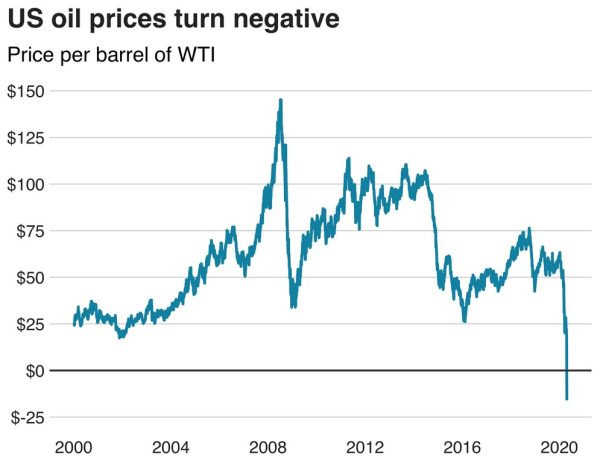
At the beginning of the COVID-19 pandemic, asset prices took a very sudden tumble as the world groped with the concept that a virus was running rampant, sending people to the hospital left and right. The health scare shook investors out of stocks and commodities suddenly and drastically. I remember oil prices getting slammed especially hard.
In fact, at one point oil supply was outweighing demand so much, that the price of certain oil futures contracts went negative. Think about what this means! People would have paidyou something like $20-$30 to take their barrels of oil off their hands! Seeing oil north of $100 a barrel now, it is hard to understand how something like negative oil prices can happen.
The simplified explanation someone gave me was that people were trading in these contracts to make a profit, but no one actually wanted the oil itself. When contract time was up, whoever was holding those contracts would suddenly be responsible for barrels of oil in Oklahoma (or whatever state they were in). I don’t know about you, but I don’t have a way to transport and store oil barrels, so to hold such expiring contracts would be… a problem. It was a problem for other traders, too, thus the very temporary negative price of oil. So what do oil prices have to do with Magic?
Back to Magic
The price situation we saw happen with oil can never happen in the world of Magic: The Gathering. Even in the most extreme case, where someone’s house is taken up by endless boxes of bulk, they could still find a buyer out there willing to come by with a U-haul and pick the collection up in order to pick through and sell it on the secondary market.
Of course, the biggest reason this can’t happen in Magic is that everyone is always dealing in physical assets. People aren’t buying and selling contracts that represent Magic cards—I think there are some services that offer investment in a fraction of a Black Lotus or some such, but I’m not sure these platforms are mainstream. Certainly, physical cards are trading hands far more often than digital representations of physical cards.
The other day I saw the above image on eBay’s homepage. I asked the Quiet Speculation Discord about it, but there wasn’t much chatter on the subject. A cursory glance suggests that eBay is offering to store high-end, graded cards for folks to enable “seamless transactions” for their owners. Does “seamless” mean that the cards won’t be physically exchanging hands if I make a purchase from their vault? How are taxes and fees handled? Is this the beginning of a new trend in Magic investing?
The eBay Vault Deep Dive
After talking with a friend who is an avid Magic collector, I learned a little more about this service and its implications. Before jumping to conclusions, however, I wanted to see for myself. So I did some digging.
First, I found some advertisement-like videos showcasing a few big-name card collectors utilizing the eBay vault service. There was a sports card collector from New Jersey, another CCG investor from North Carolina, and Daniel Chang. Does that name sound familiar?
Daniel Chang is the founder and CEO of Vintage Magic, a store specializing in the most valuable and high-end Magic cards. It appears Chang has partnered with eBay to test out their vault concept. This means there will be a nice population of high-value Magic cards within their vault right off the bat. It makes perfect sense for eBay to start big because they need to have some threshold of cards in their vault before it can really gain traction. Chang certainly has the collection to help eBay accomplish this.
Unlocking the Details of the Vault
After watching the videos, I read through the details on eBay’s website. Here are some noteworthy points:
It’s no surprise that eBay has professionals who secure and maintain the vault, including dedicated staff to handle the cards.
Eligible graded cards on eBay can be sent directly to the eBay vault at checkout—this means it’s easy to contribute cards to their vault directly from eBay listings.
Sales tax will not be charged for items sent to or traded within the eBay vault. (Important!)
eBay waives selling fees, including final value fees, for items that are stored in the eBay vault. (Game-changer!)
No instant transfer fees in 2022 (3% fee to transfer ownership of an item in the vault)
Suddenly, I understand why big collectors like Daniel Chang would be interested in this service. Not only does it get them out of having to store and insure 7 figures’ worth of cardboard in their home, but it also enables them to sell on eBay’s platform without paying any fees! That’s a game-changer. If I sell a $1,000 card on eBay and ship it to the buyer, as usual, I have to pay over $100 in fees plus $5-$10 in shipping (depending on the service). There’s also always the risk the buyer is illegitimate and tries to swindle me out of the money.
With the vault, one can avoid the fees, the shipping, and the hassle of dealing with suspicious buyers. That’s an attractive proposition. For folks like Daniel Chang who have sizable collections, dodging eBay fees means more money going straight to his bottom line.
If you’ve ever considered selling a sizable collection before, you can appreciate the potential value this service brings. To sell a collection all at once, you either have to endure the fees and hassle of listing individual cards yourself (on eBay or TCGplayer for example) or sell it to a shop at a significant discount to the collection’s market value. With eBay’s vault, you’re able to sell everything individually with eBay’s service, maximizing value, avoiding fees, and minimizing effort.
Worth a Shot?
I’m definitely intrigued by this service. Unfortunately, eBay’s vault is only accepting graded cards worth at least $500 at the moment. I don’t own many graded cards (currently there are three in my collection) because I like the option of playing with my cards. I’m also a collector at heart, so I like to browse my collection frequently to appreciate the nostalgic joy the cards bring me. Shipping my cards to a vault means I wouldn’t be able to play with or enjoy my cards—it would turn them into a pure investment via digital representation of an asset.
Because of this, I won’t be a customer of this service from day one. If they expand it to include non-graded cards, it would at least be an option for me to consider. Then again, I don’t own a collection that’s nearly as valuable as those who run card shops and clear $1,000s and $10,000s in sales each month. Even if the service expanded, I'd still balk at the idea of shipping a raw Mox Ruby to their vault, for example. Though I must admit the ability to sell the card on eBay's site without paying that steep 10+% fee is attractive.
The idea of the vault feels like I’d be converting physical cards into digital assets (even though it still has a 1:1 relationship with the physical card itself). These aren’t NFTs, but they would feel like them because I would be owning a one-of-a-kind digital representation of unique pieces of cardboard. This is not something I’m interested in at this time. I could see others being interested, however. Especially folks who see all this cardboard as an investment vehicle.
In a way, eBay’s vault service legitimizes further the concept of Magic investing. Since people have collections with value in the millions, maybe it’s about time the game gets the respect from the investment community that it deserves? If eBay’s vault service takes the game more mainstream, it could be a boon for the market. We may see an increase in high-dollar, graded cards hitting the market in order to leverage this eBay service. Time will tell.
In the meantime, I’m going to stand by and observe how this manifests itself in practice. It’ll take time for this to ramp up, I’m sure. Will tons of valuable, graded cards start to pop up for sale on eBay’s site with the little “vault” icon? That will definitely be the case when browsing Vintage Magic’s eBay shop, at least. It’ll be interesting to see if other stores follow suit. If I can find a good deal, maybe I’ll try making a purchase myself to see how the process goes.
Wrapping It Up
Magic has always been a game with tangible game pieces (ignoring MTGO and Arena for the moment). For nearly 30 years, you’ve been able to purchase physical cards to enhance gameplay, grow your collection, and build your investment portfolio all at once.
In 2022, eBay is changing this formula for the first time. With their vault, you can build your investment portfolio and grow your collection without the third component—no need for physical exchange of the cardboard. Some hard-core Old School players aren’t going to like this. Many entrenched players believe this hobby should still be a game much like it was back in the 1990s.
The reality is that this is no longer the case. The past decade has brought many advancements to the investment industry. EBay’s vault seems like the next step of the journey. I’m not sure yet if it’s going to be an evolution of what already exists or a total revolution in how these assets are managed.
The only thing I’m certain of is that change will continue. As long as the Magic investment space adapts to keep up with these changes, then I still have full confidence in the stability of these card values. Prices will ebb and flow along with the broader economy (right now things are definitely pulling back), but investing in valuable pieces of cardboard will likely endure for years to come. If this prediction holds, expect to see higher prices in the future. If you think finding a high-grade Alpha or Beta rare is difficult now, just imagine what the market will look like 10 or 20 years from now.
If not, now is a perfect time to join up! Our powerful tools, breaking-news analysis, and exclusive Discord channel will make sure you stay up to date and ahead of the curve.
In Arena's brief return to Theros Beyond Death (THB), I opened pack one, pick one Archon of Sun's Grace. It was an easy first pick. The Archon is one of the format's most powerful bombs. It demands an immediate answer. It's evasive, and difficult to race. If you're ever triggering its ability the value feels insurmountable. When pack two came around, I was offered the following selection:
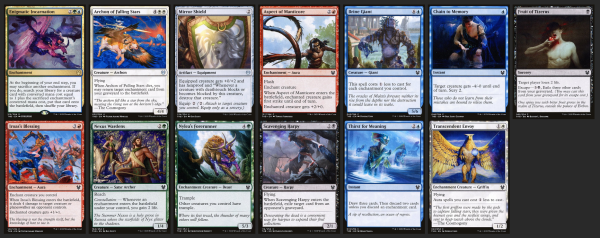
The best card here is Iroas's Blessing, a premium removal spell that can also trigger constellation. A case could be made for Thirst for Meaning as well. However, nothing in this pack matches the power of the first pick Archon. So I took the third best card in the pack, Transcendent Envoy, instead. Two drops are important, so having one in the color I'm committed to is nice. It's an enchantment and it has an ability that helps trigger constellation. I'm cutting white (although the Archon of Falling Stars is fine), which will theoretically help in pack two. In short, I first-picked a bomb and was going to do whatever I could to play it.
The World's Worst Motivational Speech
I was recently at a longevity celebration for a certain organization of which I'm a member. During that ceremony, the keynote speaker referenced a study that identified why people stay in their careers as long as they do. The number one reason, or so he said, is "inertia". This inertia keeps people on their various paths in a few ways. It's familiar, and there is comfort in familiarity. It's also easy to continue to do the thing(s) we do, we don't need to change or challenge ourselves. Change can also bring conflict, and people tend to avoid conflict. Personally, dear reader, I found the whole speech uninspiring.
At various points in our lives, we face forks in the road. Do we continue following the path we are on or do we change course? These can be some of the biggest decisions we ever face and they should not be taken lightly.
Although not quite as life-changing, we often face similar crossroads in a draft. We select a first pick we like, then we put the blinders on, following it up with cards that match its color, and hopefully align with its strategy. In his formative essay on Limited, Ben Stark calls this "Drafting the Easy Way". In general, we want to avoid this mindset. We want to stay open and continue collecting data with each pick because having access to an open color will be more valuable than the single bomb we started with.
Enter: The Variables
How powerful is our first pick?
Let's say the first pick of my draft wasn't quite as powerful as Archon. Imagine instead that I first picked Taranika, Akroan Veteran. They're both powerful rares capable of running away with the game. However, the legendary three-drop is not as dominant a card. It's a rare that I want in my white decks, but not a card I'm willing to draft a bad deck to accommodate. I'm less willing to chase the legendary three-drop than I am the Archon.
How desirable is the color/archetype we've started off in?
In THB the best color is black. If my first pick was a Mire's Grasp or Pharika's Spawn, I might consider fighting over the color even though neither of those cards is as strong as Archon. Being a black deck in THB has its own advantages. Similarly, when we first picked Inspiring Overseer in Streets of New Cappena (SNC), we were less likely to move off of it because of the overall power level of white cards in that format.
How convincing is the data I'm receiving?
For pick two, all I know is that an uncommon is missing. We have to assume the uncommon is more desirable than Iroas's Blessing, but that could be any number of cards, including cards that might be weaker but would put our opponent in a better archetype.
Fortunately for us, the data is not stagnant. Every selection provides more information. In this draft, my next two picks were red cards. Red was open, but I fought to play the bomb.
Archon and Friends
Archon vs Archon
In the previous Arena cube, I found that the Archon of Sun's Grace was nearly as strong as it was in THB. Whenever I saw it come down, it was often followed by multiple triggers, creating a board state I couldn't beat. Fortunately, I opened Archon there as well (must be nice). After taking the Archon in the cube I was faced with this selection.
Archon and "Friends"
Now, dear reader, we face a very different decision even though we're discussing the same first pick. Let's revisit those variables.
How powerful is our first pick?
It's still a very powerful card. However, constellation is a keyword that is more supported in THB than it is in the Arena Cube. Similarly, the power level of the format is extremely relevant. Compared to the uncommons and commons that make up the THB limited format, Cube is rich with bombs, removal, and high synergy plans. Archon of Sun's Grace might not be worth chasing here.
How desirable is the archetype/color?
There's no real reason to want to be an enchantment-heavy deck in the cube. In THB, there are tons of pay-offs and enablers. The cube holds some payoffs, but it's not a significant feature of the set. We can abandon our card, our color, or the strategy as a whole without a terrible feeling in our gut.
How convincing is the data?
That's less clear. However, it's clear that nothing here really helps our plan. We could take a land, or maybe the one drop. But there is far more value in taking a flyer on another archetype.
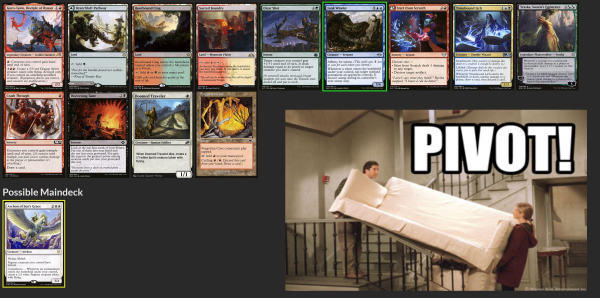
I selected Junk Winder with my second pick here. This gave me two viable pathways to move through the draft. This pick was far less of a declaration than taking the Transcendent Envoy in THB.
When Drafting the Hard Way Goes Wrong
Piloted this to a 5-3. It felt like landing a plane on the Hudson River
It's easy to end up with a bad deck and feel discouraged about staying flexible, but the surge of excitement we get from our first pick might not be worth pursuing. This deck was not great. Junk Winder impressed but in general, this midrange pile was pretty middling.
In THB, Archon almost guarantees a solid finish on its own. That's not the case here. I had to reach out and that ended up being a messy proposition. One might draw the following conclusion: When I stick with my first pick, I do better than when I pivot off of it. To which I would respond: that's probably true.
When we draft the easy way (namely, supporting your first pick with a well-built shell around it) it's because we can. We see cards that go with the first pick and so we take them. Things get more difficult when they must. When the options that go with our first pick aren't as powerful as those that diverge from them, we are forced to make difficult decisions. To be a good drafter, those decisions must be made.
The Limitations of Inertia
Here's a great example of needing to pivot: I first picked Concealing Curtains, which is a reasonably powerful rare. When I was passed the set's "mythic uncommon", Bloodtithe Harvester I was ready to settle into one of the format's premium archetypes, but the data changed.
Pack three offered me almost nothing in my colors. I rolled the dice on another gold uncommon, Brine Comber, because I was unwilling to lock myself in against this singular but concerning data point. Pack four provided a Traveling Minister to go with the spirit. Pack five made me reconsider the data.
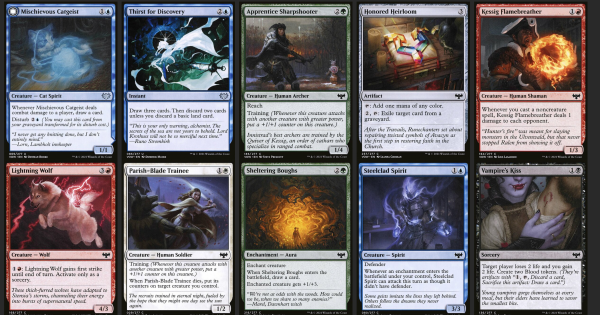
The best card in my pool is the Bloodtithe Harvester. The best card in this pack is probably Kessig Flamebreather. While it is a red card, it doesn't play particularly well with what I have, but I assume if I end up RB then I will want it. The blue uncommons here are fine. I picked the Thirst for Discovery to go with my UW cards. Why? Because of the data.
Not All Data Points Are Created Equally
The deeper we get into each pack, the more information we can glean from the table. In packs three and four, I was seeing strong blue and white cards. This means two and three players, respectively, were passing those cards. The only good red card I had seen so far was pack two and it was a gold card. My opponents were likely any other combination with red, leaving me no reason to stay in that color. Conversely, I kept getting information that blue was available, including two (maybe three) playable cards from this pack.
Drafting the easy way would have been just that, easy. As the expression goes, "easy come, easy go". While I could have committed to the RB cards I picked early, my overall deck would have not been nearly as good as the one I drafted. The draft provided a different opportunity, and I took that opportunity to a 7-2 finish.
Good deck > Great cards
Readers are Leaders
The lesson here is that draft offers us signs and signals. We don't want to overreact to a single data point. We want to make sure we're adapting to the information we receive. If we stubbornly commit to the person we are, we may never become the person we are destined to be. Similarly, if we commit to an exciting first pick, we might never know what the table will offer us. If we obstinately clutch our first pick rare and second pick Bloodtithe Harvester, we'd be kicking ourselves as we pass strong card after strong card, finally admitting to ourselves, "we should have been UW", as we struggle to make playables.
There are many roads to success and we need to know how to navigate all of them. I might be punished for diverging from a good start, but that realization should not be seen as a sign of defeat. You want to get in the habit of making picks that will optimize your results long-term, rather than desperately lunging towards the path of least resistance. Remember that even your best cards are going to be less effective if you're in a bad position. The open lane will provide more opportunities for you to be in a good situation.
No one wants to abandon their first pick because we can never truly know what the future holds. But there are clues! Read the draft. Ensure that you're measuring the likelihood of future outcomes based on new evidence. Sometimes we toss away a bomb in pack one only to be passed several more in packs two and three. You are more than a victim of inertia, and your drafts should be too.
If not, now is a perfect time to join up! Our powerful tools, breaking-news analysis, and exclusive Discord channel will make sure you stay up to date and ahead of the curve.
I Play a Game Called Magic: The Gathering... No, It's a Card Game
Sharing our Magic: the Gathering journey with each other is what makes this game more than just a game; it becomes a community. We create enjoyable moments with people who become friends and friends who become family. Here's a glimpse into someone's Magical life and how the game has influenced it.
Today we're meeting Johnny, a friend of mine and my youngest. He's a huge Modern aficionado from Illuminaudi. Join me as Johnny shares his Magic journey!
Help Me Welcome Our Next Contestant...
What's your name and how long have you played Magic: the Gathering? My name is Johnny Lin and the beginning of my Magic journey is in two parts. I initially learned how to play in 2010, while in high school. I slapped together the Zendikar and Worldwake Vampire intro decks and began occasionally gaming with my close friends. It wasn't until college with Journey into Nyx where a buddy of mine wanted to play and convinced me to split a box with him. I've been playing ever since and I really started to get into Magic.
Johnny
Who initially shared Magic with you? My friend Jake during orchestra in high school. There were a few others that joined in, but mostly him and I.
Can you recall one of your first experiences playing the game? One of my favorite early memories is when I was playing the above Vampire deck and Jake had pulled an Emrakul, the Aeons Torn sometime before that. He built a deck specifically made for it. During one of our games, he was able to cast Emrakul, attack, and annihilate my entire board. I survived with a few lands still in play. On my turn, I was able to play a kicked Gatekeeper of Malakir to make him sacrifice the big guy. The game continued on and I ended up winning. I'll never forget that one.
What format and types of deck do you enjoy? I enjoy Modern. I honestly cycle through decks quite a bit. I played Grixis Death's Shadow when Lurrus of the Dream-Den wasn't banned.
Since its banning, I've been having fun switching between UR Murktide and Burn. The decks I play usually have blue and red in them.
So, Modern is your favorite format, eh? Yea my first Modern deck was back around Khans of Tarkir was Ninja Bear Delver. From that, I eventually worked my way into Splinter Twin. I actually have more fun playing at the local level. I've been to a few big tournaments, but I find that I get too nervous and hyper-focused. I put way too much pressure on myself in the larger events. In a smaller setting, I'm more relaxed, enjoy the experience, and in turn, perform better.
Let me guess, you were disappointed when Splinter Twin was banned? Absolutely! I first heard about it an LGS and was really bummed.
Any cards that were better or worse than you expected? Nothing in particular. I watch a lot of streaming, especially Aspiring Spike. I really enjoy how he approaches the format. So with this and my normal testing, I keep on top of what's being played, and cards that may have some potential.
How did you adjust through the pandemic? I took a long break during this time. I didn't attend until recently when the restrictions were lifted and even then I was pretty careful attending. To keep up with the game, I played MTG: Arena all the time, watched more streamers, and learned way more about Standard than I expected to. It was very enjoyable, but I'm happy to be able to get out and play face-to-face again.
What's one of your favorite Magic cards? Definitely Snapcaster Mage. I enjoy it for its versatility. I remember throwing down the human wizard on turn two against Tron, and attacking for 20 with it over ten turns. I like Thing in the Ice as well, but of course it hasn't had as much impact in the format.
Who do you normally play with? Generally my local scene. Most of the time I'm with my friends at Illuminaudi, but I visit Mavericks from time to time.
Is there anyone else in your family that plays? No one in particular. I've tried to share it with a few of them on occasion, but it never really took. We each have our own hobbies and Magic is mine.
Is there anyone else you try to mentor or assist with the game? I haven't had a lot of opportunity to focus in this area, but I do try to help other players after our games when they have a play mistake or an odd interaction that they weren't aware of.
One example that comes to mind is around this little blighter...
I had a game where my opponent attacked me with two creatures; one a 2/2 and the other a 5/5. I let the 2/2 through and blocked the other with my 5/5 Death's Shadow. Since all damage is dealt at the same time, and my life total was lower due to that damage, the Death's Shadow became a 7/7 and wasn't destroyed. My opponent was somewhat confused about it, and with the help of a judge, we were able to nicely educate him.
Is there anything you'd like to share with people who might like to get into Modern? The land base can be expensive. It's helpful and important to have access to them. Shocklands, fetchlands, Triomes, Pathways, fastlands, and various others. The appropriate land base can open up your ability to play a variety of decks.
I highly recommend new players pick a deck, proxy it out, and run some playtest games with your friends or online. If you like it, then invest it in. I've heard many stories of people plunking down a lot of money on a deck, playing it a few times, and not enjoying the play pattern.
I knew one guy who put a Jund deck together a couple years ago. He bought Tarmogoyfs, Liliana of the Veils, the whole thing. He played 3 games, didn't like it, and sold it a week later for a different deck.
The Wrap-Up
I want to thank Johnny for sharing his story and how Magic has been a part of it. I hope you enjoyed our discussion and look forward to the next installment.
If not, now is a perfect time to join up! Our powerful tools, breaking-news analysis, and exclusive Discord channel will make sure you stay up to date and ahead of the curve.
More than ever Magic players have the opportunity to make decks really personal. This is a great thing not only for a casual setting but also for competitive analysis. One of the great joys in Commander is to take a deck idea and continually hone and refine this idea until you reach the perfected form of your deck... and then new cards are released and the process starts all over again! However, do not let the insidious nature of "optimization" undermine your ultimate goals.
An Example Now Including Deathtouch
I wrote briefly about my Atraxa, Praetors' Voice deathtouch deck and it has proven to be one of my more fun, casual and interactive decks—everything that Atraxa typically is *not*. As Wizards continues to release cards with deathtouch I continue to update and "optimize" the deck. However, this deck is definitely not about winning.
Early Optimization Looked Like This
Here you can see how we were optimizing based purely on a power metric. A 1/1 deathtoucher for one mana is not great but a 1/1 deathtoucher that sometimes grows to a 3/3 for the same one mana is definitely better. However, now the deck can shift to a 1/2 for one that sometimes gets a +1/+1 counter but is *always* a Warrior for the same one mana. This is not a strict upgrade. A fair amount of the time you could have gotten a 3/3 for one versus missing a +1/+1 counter and being stuck with a 1/2. The Party dynamic might not even come into play in that game.
Expanding on a party subtheme though adds character and replayability to the deck even if it's not necessarily a power increase. That is exactly what I feel many Commander players are missing. I'm going to get a better gameplay experience by choosing the much more interesting mix of interactive cards. This is true in any environment that is not a tournament scenario.
When Deathtouch Becomes Deathtouch/Multicolored Party/Assassin/+1/+1 Counters
When new cards are released if you are too single-minded you might judge them based on far too limited a metric. This metric is usually answering the question "will this make my deck win more games?" Instead, consider this: Evaluating Kathril, Aspect Warper, Endling, and Rayami, First of the Fallen against each other becomes an interesting balancing act that defines the deck. In one of my games, when I played four multi-colored deathtouch creatures in a row a player asked me what my deck was even trying to do. For me, that was the moment I knew I had a unique Atraxa deck.
Not only does the deck contain massive points for its theme but it also has multiple completely unified subthemes that are all interconnected. Rather than simply getting "more" for "less" I balance the different subthemes against each other and steer the deck towards my goal for it.
When Old Inspires New
As a young player, I was enthralled by Pestilence. Being able to wipe the board was always powerful. However, there was a built-in limitation to the card that was notable. No creatures in play meant that Pestilence went bye-bye at the end of the turn. Back then I ran a deck full of Pestilence, Withering Wisps(aka Snow-Covered Pestilence)and also Cemetery Gate and Order of Leitbur. Difficult to kill walls and the notorious "pump knights" with Protection from Black meant that these creatures could not die to Pestilence. In 2022, should a player even consider an old off-meta card while newer and more powerful cards are printed every month?
The What
When I built K'rrik, Son of Yawgmoth, I had certain goals. Sure I wanted to win but I also wanted to utilize as many cards with pure black mana casting costs as possible. I also wanted to keep the deck pivoted towards Two-Headed Giant. An Enchantment with an activation cost of one black mana seems like it fits within those goals neatly. Of course, the beauty of a card like Pestilence is that it is not just a board wipe but also a potential win condition. That makes it potentially way better than a straightforward board wipe.
The Why
Simply put, I've lost way too many games with my take on K'rrik. The deck is intended to be fairly competitive and seeks to win. I built it with Two-Headed Giant mostly in mind, but it's still a cEDH leaning deck for cEDH tables. I know I don't write about cEDH a lot, but I certainly play my fair share of games at competitive tables. I simply find them less interesting to write about most of the time. Let's talk about a cEDH game that was interesting, and reinforces the point I'm trying to make here.
The Competitive Disadvantages of Too Much Optimization
I sat down at this table for a game, and we had our pregame conversation. We talked about decks and decided to go competitive, no holds barred. The player across from me revealed Yasharn, Implacable Earth as their commander. At this point, I'd refined K'rrik to such a degree that I felt comfortable at the prospect of consistent turn three, turn four combos ending the game. I've surprised a few tables with the naked aggression and speed of my deck. I could lose 30 life but then combo out and win. This built my confidence in my design direction. I also felt good about my backup plan.
In cases where a game stalled out, I could turn to a slow draining strategy with extort. While I saw that Yasharn could potentially shut me down, I figured I could either race my commander out sooner and Yasharn would never be in play or I could answer it with "something" in my deck.
And Then Sol Ring Happened
Well, that player had a classic turn one Sol Ring, into turn two Yasharn and they went before me. I mentally went through my deck and determined my number of outs to Yasharn to be… zero. Yes, in the highly "optimized" version I had made that was all gas and no brakes, I had zero cards that dealt with Yasharn. Oh, I had cards that dealt with board situations. Extremely powerful cards like Toxic Deluge and Demonic Tutor and Yawgmoth's Will to replay powerful cards like… Toxic Deluge. Do you see the problem? I had optimized myself into a corner.
I have not played against another competitive Yasharn deck since that day. For those curious about what they were playing, it was mostly a value engine with a lot of hate bears and Stax effects. In that kind of environment, a 4/4 actually kills people pretty quickly. In any case, I drastically underestimated how vulnerable my strategy was in light of a handful of cards or a particularly fast start from another player. While I still want my K'rrik to be on the fast and all-in side, ultimately, I want the deck to win more games. The fact is I need more answers and fewer combo pieces. Even decks that are not built primarily for speedy starts can have quick openers and I need to have more answers because more decks are running Stax effects.
The Hybridized Approach
This is where evolution comes into play. I know there are generally accepted and powerful mono-black board wipes like Damnation and I could just slot one of those into K'rrik. However, I'm going to give Pestilence a whirl because I can see that it solves other problems and has additional synergies with my overall strategy. There is a diplomacy angle to Pestilence that is hard to quantify versus Damnation and I think playing something that stays around and continues to ruin hate bears and Stax's day is a huge plus. Furthermore, if I just put in Damnation which is a known "good card" I will lose out on the chance to test what could be a better card. Damnation is already in other decks I've run and I've cast the card many times, it's proven itself. But I have not seen another player cast Pestilence in years. I am genuinely curious if it's really unplayable or, secretly, powerful. Turning my life total into board-wide damage is just too tempting not to try.
The fact is cards change in relative power all the time based on what other cards are being played. This is the simplest expression of the metagame. Theorycrafting alone is not good enough to determine card strength. When cards have relative power, you must put in games to check. My deck must evolve with the current meta or I won't win many more games.
What Have We Learned Today?
Hopefully, how it is important not to get trapped within an eternal optimization loop. In an effort to further refine a deck it's easy to miss the forest for the trees, chipping away at a decent deck concept so much that it turns into a degenerate deck. Now, there is nothing wrong with the degenerate deck if that was your initial goal. But it seems like many players and deck builders get trapped into a reductionist mindset which can limit expression, fun, and even win rate. Rather than continue to find lower mana cost deathtouchers I've branched out into several subthemes to flesh out my deck concept. Now I am on the lookout for more interesting cards in the future. Instead of pushing the envelope for raw speed and combo potential, I'm looking for the most synergistic pieces of removal for K'rrik that can be part of my game plan rather than only a reaction to my opponents.
Did you ever have a deck evolve? Tell me about it in the comments!
If not, now is a perfect time to join up! Our powerful tools, breaking-news analysis, and exclusive Discord channel will make sure you stay up to date and ahead of the curve.
Reprints tend to mean price adjustments. And Double Masters 2022 is full of sweet reprints! The many spoilers for Double Masters 2022 we got this past week inspired me to dig into the cards' reprint history and provide some perspective on what one can expect with regards to shifting prices.
It's important to keep in mind that estimated future values are heavily dependent on any additional reprints, or on the flip side, no major product availability issues. Those might drive prices higher than expected.
As there are a ton of mythics in this set, I have sorted them into five sections from high-dollar to bulk. Let's dive right in!
High-Dollar Mythics ($50+)
There was an error retrieving a chart for Imperial Seal
This vintage staple has been in need of a true mass reprint for some time now (the judge promo doesn't count). Given its price at announcement was sitting around $700-$750 thanks to scarcity, I expect it will likely be the marquee mythic of the set, and a whole lot more Commander players will finally get a chance to run this worse Vampiric Tutor.
A fair number will realize that sorcery speed and putting the card on top of the library makes a card much worse than staples Vampiric and Demonic, but that doesn't mean it won't be in demand. I could see this card dropping into the $70-$90 range and to be the "chase" mythic of the set.
Five printings of this card cannot seem to keep its price down. It is fair to note that all but its The List reprints were upgraded to mythic, and given the size of The List options, it was essentially still mythic there, too. I expect we will see a price trend similar to the Ultimate Masters reprint with an initial price dip down to $50-$55 that eventually returns to around $60-$65.
There was an error retrieving a chart for Wrenn and Six
Wrenn and Six has seen a resurgence in demand in Modern thanks in large part to the powerful Kamigawa: Neon Destiny spell lands, especially Boseiju, Who Endures as a nigh-uncounterable answer to a lot of threats in Modern. I expect its price will dip below $50 as packs get cracked, but I imagine it will eventually break that $50 barrier.
The fact that this Commander bomb was not included in Streets of New Capenna (a crime-themed set) felt like a huge flavor miss. Though it makes more sense now as this much needed reprint will now help sell more expensive packs, and thanks to the upgrade to mythic rarity, the price won't tank as much. My estimate is it levels off in the $18-$25 range.
There was an error retrieving a chart for Mana Vault
Yet another mythic reprint of Mana Vault, this card's ubiquity means it will likely tank in value as supply hits the market and recover slowly after the big initial glut gets absorbed. I honestly expect this card to drop to around $20-$24 and bounce back to around $30.
While this is being reprinted at mythic, its price was heavily driven by scarcity. I expect this reprint will likely drive the price to under $15 if not $10. Shepard simply doesn't see much play outside of fringe Neoform strategies in Modern.
While it currently sits in the $40 range, after its first big reprint in Iconic Masters, copies dropped to under $15. I could easily see this card initially dropping to $15-$20 before eventually rising back to $25.
The powerful Eldrazi titans keep getting reprinted and keep returning to their original values. I do think that this printing will finally push Kozilek, Butcher of Truth below $50.
As mentioned above, the price on the original Eldrazi titans always bounces back. However, Ulamog, the Infinite Gyre got an additional printing in FTV: Legends which has always kep the price lower than Kozilek, Butcher of Truth
There was an error retrieving a chart for Mana Drain
I was surprised to see this included in the set given it was reprinted in Commander Legends just a couple years ago. The strictly-better Counterspell is sure to remain high value.
There was an error retrieving a chart for Food Chain
This is the first significant reprinting of this combo enabler, so while I expect the price to drop a lot initially, I expect it will recover to the $25-$30 range.
Medium-Value Mythics ($15-$24)
There was an error retrieving a chart for Bitterblossom
Admittedly, this was one of the harder cards to analyze. Its current price sits around $35, despite being both a judge promo and a secret lair drop. However, most of the demand is from Commander players, and even then it shows up in only 3% of decks on EDHREC.
A lot of this cards' value is based on its last major printing being in Chronicles, which was 27 years ago. Its price was in the $15-$20 range before the pandemic, which jacked up its price along with those of so many other older Commander cards.
I honestly had no idea this card was nearing $50 prior to it being spoiled in this set. However, its price is so heavily tied to the availability of Modern events that barring a big return to in person Modern GPs (or Magic Fests), I see this card sitting closer to $22 longer term.
This card is beloved by casual Angel players and token players alike, and despite seeing virtually no Standard play maintained a $7+ price tag for over a year before spiking up into the $10+ range where it has sat since.
This one is the card I think is most likely to jump up a level, should the Modern format get some major events in the next year or so. She is typically found in Modern's BGx Rock decks, including Jund, and in some Pioneer decks.
Vampires are a beloved tribe in Commander, and Elenda, the Dusk Rose is a powerful commander that allows players to make giant Vampire token armies when creatures die. This card managed to stay above $5 its entire life despite seeing almost no Standard play when released. It has since climbed into the low $20s. I expect this reprint will likely put it at around $8 long term.
There was an error retrieving a chart for As Foretold
The fact that this card had already plummeted from a $30 spike down to around $8 and sat there for 7 months makes me feel confidant that it will be at the low end of this range (if now fall into the bulk category below).
A solid Commander card whose value has mostly been driven by that format alone means it will likely remain above bulk status. I expect this one to be near the upper echelon of this stratus.
Being a recent judge promo from 2019, copies were already sitting at $15 before this card was spoiled. I expect the price to now drift down to $8-$10.
There was an error retrieving a chart for Warrior's Oath
I expect we will see this card's price trajectory mimic that of Imperial Recruiter, which was a $350 card prior to being reprinted in Masters 25, which has copies sitting at $8. This is too much of a niche card whose value is so heavily influenced due to extreme scarcity that any decent influx in supply tanks it.
This is definitely one of the bulk mythics of the set. While Mizzix was a popular Commander back in the day, with the continued power creep of creatures, it is getting harder and harder to justify choosing an older legendary creature as your Commander.
This card was sitting at under $7 prior to its spoiling, and just doesn't see enough play in any format to be above $3. It does too little for too much mana, and its plus ability is often useless the turn you cast him.
While it has finally recovered in price from it's Ultimate Masters reprint, another one will likely push it to the $3 range, given it sat around $5-6 for over a year post UMA.
Aminatou, the Fateshiftergraph name="Cavern" set=""]
Given preorders for copies moving at $7.75 and that Aminatou has been drifting downward on EDHREC.com's list of top Esper Commanders, it just doesn't seem likely that she stays above $3, especially given that the original C18 copies are already around $3.50.
With pre-sales at $6.50, there is virtually no chance this card maintains a price above $3. What surprises me most about this inclusion is that Ezuri, Claw of Progress was just released as a Judge Promo last year and that promo is already down 20% as of being spoiled. I expect it will drop to less than $20.
Back when the original Commander decks came out,Ghave, Guru of Spores was a very popular Commander for token and Aristocrats-style decks. Unfortunately those days seem to be long gone, making this a clearly sub-$2 mythic when supply hits the market.
While copies were sitting in the $20 range prior to being spoiled, the price is already down to $10. Being the 13th-most-played Naya commander doesn't bode well for its long-term price. I can see it easily hitting $3 as pack crackers flood the market with low-value mythics trying to recoup some cash.
On the day of being spoiled this card was $8 and was a mythic rare from Jumpstart. Despite the love Unicorns and Horses have from the casual community, this card will drop below $3 in no time.
I honestly have no idea why this card was reprinted at all, let alone at mythic. It was a bulk mythic basically its entire existence. Disciple is even worthy of falling as low as $0.25-$0.50.
Despite being the 12th most popular Commander on EDHREC.com, this reprint so recently followed the Commander Legends etched foil that it likely drops down to a $2 card.
Even considering the love for Dragons that so many casual players have, the fact that this card was already sitting at under $3 before being spoiled means it will definitely be one of the bulkiest of bulk mythics you can open in this set. I expect a price of $0.25-$0.50 long term.
Double Your Money
I expect that Double Masters 2022 will be a runaway success based on the choice of a lot of highly desirable mythic rares, not to mention the desirable rare reprints. However, I also predict that success will be a double-edged sword and many of the cards will lose a lot of their value.
It is important to note that WoTC has stated previously that Masters sets are one-and-done print runs; however, it would be foolish of WoTC to not print a ton of this set given that it will generate a massive windfall of cash for the company.
For those looking to buy singles, I would hold off for at least 3 weeks before buying up any speculation targets and I be cautious about what sorts of returns I would expect. The Secret Lair series from Wizards has shown that they aren't afraid of reprinting desirable cards in quick succession (see Bloom Tender). For people just looking to add some of these cards to their collection, though, Double Masters 2022 will be a smash success.
If not, now is a perfect time to join up! Our powerful tools, breaking-news analysis, and exclusive Discord channel will make sure you stay up to date and ahead of the curve.
In the last article, we introduced the matter of this new series, which is going to deal with those creature types that are unique to the Magic: The Gathering franchise. Today, we’ll really get into it! As this is meant as a journey throughout the history of Magic expansions, we’ll proceed in chronological order.
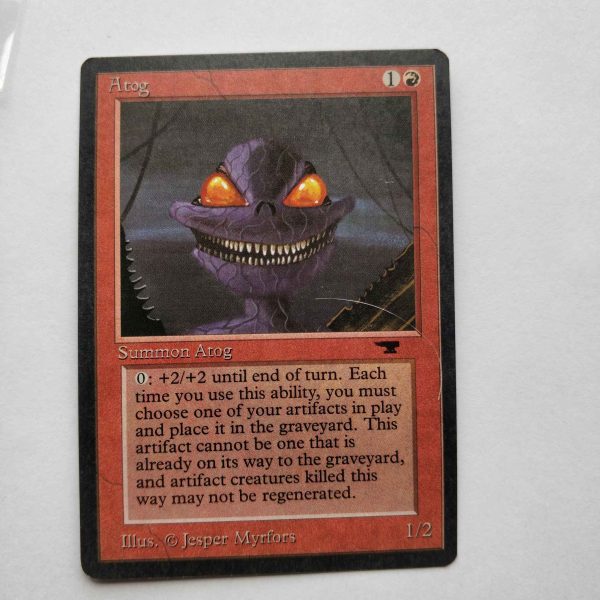
The first set introducing a creature type invented especially for Magic is Antiquities, which in fact introduced two. Let’s take a closer look at this set, just to have an overview of the context in which some unique creatures were born.
Antiquities
Released on March 4, 1994, Antiquities is among the first expansion sets of Magic, second only to Arabian Nights. It’s the first Magic set to put an emphasis on artifacts. This would happen several other times in the future, but none of the following sets would feature such a strong presence of artifacts. Think of Urza’s Saga (1998), Mirrodin (2003), Scars of Mirrodin (2010), and Kaladesh (2016). All of them gave importance to artifacts, but Antiquities was on another level entirely, as every single card either was an artifact or mentioned artifacts.
Considering that, it's unsurprising that both creature types invented for this set have something to do with artifacts. Those creatures are Atog and Tetravite. They are not the only two creature types that were added to the game with Antiquities, of course. In fact, half of the creature types present in this set were new at the time. For instance, we had the first example of Druid, and a few other types that would be changed later (Archaeologist, Gremlin and so on). However, only Atog and Tetravite are species unique to this game, and this is why we’ll dissect them as part of this series.
The Origins of Atogs
The first creature with the type Atog appeared in Antiquities, and it was then reprinted in a few core sets and in Mirrodin. It was simply called Atog, probably because at first, they weren’t planning to create more. Over the following years, however, additional flavors of Atog were printed, and today we have no less than twelve! So what exactly is an atog?
Four more atogs
Well, first of all, the story goes that the word “atog” was invented as an anagram of the word “goat”. The joke is that atogs, just as goats, would eat almost anything. Magic is no stranger to cracking these sorts of jokes: see Phelddagrif (Garfield PhD) and Pemmin's Aura (I am Superman).
Atogs' Shape and Habits
As for their appearance, atogs have humanoid shapes and reptilian vibes. They also have enormous mouths with scary teeth, signalling that insatiable hunger is their most peculiar trait. In fact, when you look at the text box, every Atog ever printed has an ability that demands some sort of feeding. And so does the flavor text, which always refers to meals and the action of eating.
After the original Atog from Antiquities, four more were added in the next couple of years. With Mirage came Foratog, with Visions came Chronatog, with Weatherlight came Necratog, and finally, with Tempest came Auratog. So, by the end of 1997, five Atogs existed, one for each color. They all shared some similarities: the mana value was always 2 or 3, their stats were all 1/2, and they each had an activated ability to pump themselves.
The Evolution of Atog
But that’s not all: remember, we have twelve Atogs. Odyssey (2001) contained no fewer than six new ones. And they were all multicolored! It looks like the original five Atogs have been breeding, as the new five resemble their parents… but what about the sixth?
That's the Atogatog, a very special sort of lord which feasts on its own kind. “It relishes old-fashioned family meals,” as the flavor text goes.
Atogs from Odyssey onwards
Last but not least, let’s fast-forward to Mirrodin (2003), where the final Atog was printed. The balance of colors was just perfect, until Megatog came out, shifting the balance toward red. After all, we are now on one of the most heavily artifact-based sets ever, so why not creating an evolved (and gigantic) relative of Atog?
Megatog also has the power to sacrifice artifacts for gaining pump, but in this case it gets +3/+3 and trample. To quote another great flavor text, "In an ironic bit of evolution, the megatog's dozens of teeth are mainly ornamental. It prefers swallowing things whole."
And don't forget of Chronatog Totem! It's not really an Atog (in fact, it's not even a creature), but an artifact whose ability allows it to turn into Chronatog until the end of turn. Ah, Time Spiral.
Tetravites and the Like
Enough with atogs: it's time to move to the second unique creature type that was introduced with Antiquities via Tetravite. This time, it's a weird type, as it only appears on tokens. Not only that, it also appears on token created by a very specific creature, called Tetravus. Tetravus was created a simple artifact creature, with no type, but later got the type construct. Nothing special here: as we saw in the last installment, Magic developers have been trying to streamline creature types for quite a while.
Tetravus and its cousins
There is not much to be said about Tetravus, except for the fact that it was called back to twice in the course of Magic's history. In 2003, with Mirrodin, a card called Pentavus was printed. Its name, which contains the number "five" just as Tetravus contained the number "four," is a clear reference to the construct from Antiquities. And so is its ability to create tokens, or Pentavites.
In 2006, with Time Spiral, a third construct with a similar ability arrived: Triskelavus and its own tokens, this time called Triskelavites. Again, there's a number in the name of the card (three), but this time the reference is double, as it also recalls Triskelion.
A Pattern of -Avus and -Avites
All of these three creatures are constructs which enter the battlefield with a number of +1/+1 counters. At the beginning of your upkeep, pilots may remove any number of counters and create that many 1/1 tokens. They may also exile any number of tokens created this way and put back that many counters on the original creature. Only Triskelavus is a bit different. It allows players to sacrifice the tokens and deal damage, but not to put counters back onto their construct.
None of these three creature types appear on any printed creature, then. They can only be created as tokens. However, they are still creature types, which means Mistform Ultimus, as well as any creature with the ability Changeling, will also be Tetravite, Pentavite, and Triskelavite.
Flavor and Rules
In the course of this installment, we began analyzing some creatures unique to the Magic franchise. As far as I'm concerned, they all show interesting designs, especially as they combine new concepts of creatures with sensible abilities. It's hard to say whether designers had the rules in mind and then created suitable concepts, or the other way around. Anyway, it worked very well, particularly with atogs!
Stay tuned for the next piece, where we'll move on to the third Magic expansion, Legends. What new creatures did this set offer? Did you know that it contains a creature that would only become famous thirteen years later? Let me know what you think in the comments. And while we're at it... team Atog, or team Tetravite?
If not, now is a perfect time to join up! Our powerful tools, breaking-news analysis, and exclusive Discord channel will make sure you stay up to date and ahead of the curve.
This week on Adam Plays Magic, we're diving into one of my favorite archetypes, UW Control. Between a plethora of counterspells, premium and versatile spot removal and board wipes, and plenty of card draw effects, control decks let you keep the board neat and tidy as you win at your own pace. There's something deeply satisfying in prolonging a sure-fire win over half a dozen turns, slowly encroaching upon a helpless opponent until it's finally lights out.
This particular build is courtesy of @GavinBennettMTG, a friend, phenomenal deck builder, and control superstar. Gavin is an excellent Magic player and if you're not following him, what are you waiting for? Now onto the breakdown:
What I Like
First and foremost, I love that this deck gets to take full advantage of Yorion, Sky Nomad as a companion. Control strategies are often able to stabilize, but run into the issue of being unable to find a win condition. Always having access to an evasive 4/5 creature guarantees a method of closing out the game.
Additionally, the extra slots afforded by an 80-card deck offer the opportunity to play Omen of the Sea. The option to hold up either Jwari Disruption or an instant-speed cantrip punishes any opponent that chooses to play on curve as well as those that doesn't. Omen even sticks around either to cantrip with Yorion, or utilize unspent mana in the opponent's end step.
Another key element that holds the deck together is The Wandering Emperor. Typically, control players need to weigh the cost of tapping out for a threat like Teferi, Hero of Dominaria or whether they should hold up disruption. Emperor is the best of both worlds. Flash lets this threat deploy on an opponent's turn as a removal spell, a combat trick, or a value engine. It singlehandedly revolutionized how control shells are structured, and lower-power formats are not especially well-equipped to handle it. Above all, when blinked with Yorion, Emperor gets an additional activation during the end step.
What I Don't Like
It's sometimes difficult for me to be objective while discussing the faults of a deck that I love as much as UW Control. However, there's the perennial issue of the curve being fairly high. Between high-cost planeswalkers, wrath effects like Depopulate, and clunky three-mana counters like Absorb, the deck is unlikely to be able to cast multiple spells in a turn. When the plan is to one-for-one answer opposing threats, opponents that deploy multiple low-cost game pieces in a single turn can get under control's defenses and snowball.
With a reactive deck, it's hard to be prepared for everything in the metagame. Deck configuration matters a ton, and can shift from week to week, and sometimes even day to day. Packing too many board wipes against a creature-light opponent is a disaster. Opposing planeswalkers laugh at March of Otherworldly Light, and heaven forbid something like Hullbreaker Horror or Chandra, Awakened Inferno come out to play.
The biggest take away is just to always come prepared, although that's easier said than done.
The Deck
Explorer UW Control (Yorion)
Companion
1 Yorion, Sky Nomad
Planeswalkers
2 Narset, Parter of Veils
4 The Wandering Emperor
4 Teferi, Hero of Dominaria
Spells
4 March of Otherworldly Light
3 Dovin's Veto
3 Jwari Disruption
3 Fateful Absence
4 Absorb
3 Memory Deluge
2 Shatter the Sky
1 Depopulate
1 Farewell
Artifacts
4 Portable Hole
Enchantments
4 Omen of the Sea
4 Shark Typhoon
Lands
3 Island
3 Plains
4 Glacial Fortress
2 Field of Ruin
1 Castle Ardenvale
1 Castle Vantress
4 Hengegate Pathway
2 Hall of Storm Giants
2 Deserted Beach
4 Hallowed Fountain
4 Irrigated Farmland
1 Eiganjo, Seat of the Empire
1 Otawara, Soaring City
1 Raugrin Triome
1 Spara's Headquarters
Sideboard
1 Hullbreaker Horror
1 Dovin's Veto
3 Aether Gust
2 Rest in Peace
2 Mystical Dispute
1 Narset's Reversal
1 Dream Trawler
2 Sunset Revelry
1 Depopulate
End Step
I'm thrilled to have the chance to showcase the strength of UW Control. This archetype has been a consistent player in non-rotating formats for well over a decade and the tools from the last few years have added a ton of firepower. This build from Gavin was able to decisively snag a 5-0 record in Mythic, which further underscores its potency.
If you're a fan of this week's video, make sure to like, comment, and subscribe via the QuietSpeculation Youtube page. For more content by me, you can find all of my previous work here, or head over to Twitter and shoot me a message @AdamECohen to let me know your thoughts, talk shop, or make suggestions for a future video. I'll see you all next time, and remember, kids: just say "no!"
If not, now is a perfect time to join up! Our powerful tools, breaking-news analysis, and exclusive Discord channel will make sure you stay up to date and ahead of the curve.
It's the final week of June and the end of this testing mini-series. Primarily because the event that enabled it to happen in the first place will end the day after this article is published. It's been fun and I do see why so many streamers are able to keep their sanity playing MTGO day after day. You never know what you'll hit and that keeps the experience engaging. It also makes me wish that the rental services were half as efficient as Mythic Event Tokens.
While I'm only going to discuss five decks total during this series, I did play a lot more. The ones I've left aside are either too mainstream for the premise of the article, sufficiently bad in a way that's neither surprising nor interesting to discuss, or I'm saving them. The Regional Qualifiers start in July and I've been working on decks for the Modern ones. I don't want to tip my hand too early.
Hollow One Won't Die
It seems like an impossibly distant time now, but there was a moment when Hollow One looked like it was going to take over Modern. The deck was everywhere for the first few months of 2018 before rapidly falling off.
Part of that was that players got used to the gameplay and were better prepared. Part was also that alternative decks emerged which did something similar but more reliably. First it was RB Vengevine, which exploded on PT 25th Anniversary before disappearing. Then came Arclight Phoenix. The nail in the coffin was Faithless Looting eating a well-deserved ban.
There was an error retrieving a chart for Hollow One
However, over the years, adherents have refused to give up on their beloved artifact monster. I watched as various players tried to make the deck continue to work with just Burning Inquiry in both Hollow One and Vengevine shells. There were plenty of players that gave up on Hollow One and went all-in on Vengevine alongside mill card to recapture the glory. And it never worked. However, I was curious about their persistence, and went looking for a deck to try out.
The Deck
A confession: Hollow One was one of the first decks I decided to test when I undertook this series. I just had a harder time finding a deck to actually test than I thought. I spot the odd Hollowvine or Millvine deck in the data every month, but they've been around long enough that there's nothing new there. Both just lose to graveyard hate and their own inconsistency. Yawn.
Fortunately, I got some help. Evart Moughon, better known as aspiringspike, had an idea for an updated version with his (then-) pet card Ledger Shredder. It looked sufficiently good, interesting, and not tried-and-failed to me to warrant a closer look.
Shreddervine, Evart Moughon (test deck)
Creatures
4 Asmoranomardicadaistinaculdacar
4 Blazing Rootwalla
4 Flameblade Adept
4 Hollow One
4 Insolent Neonate
4 Ledger Shredder
2 Ox of Agonas
4 Street Wraith
4 Vengevine
1 Wonder
Sorceries
4 Burning Inquiry
Artifact
4 The Underworld Cookbook
Land
4 Arid Mesa
3 Mountain
4 Scalding Tarn
4 Steam Vents
2 Stomping Ground
Sideboard
4 Ancient Grudge
4 Fury
4 Leyline of the Void
3 Magus of the Moon
It was such a beautiful mess that I played the unaltered 75.
Initial Impression
As I said in the previous line, this deck is a mess. But it is a beautiful one. It's trying to be Hollowvine and also Hell's Kitchen. It has Shredder because of course it does. With only 17 lands it will have to mulligan a lot but it would need to anyway to have a chance of doing anything. And I do love the singleton Wonder.
Whether it will actually work is another question. Between Inquiry, The Underworld Cookbook, and Insolent Neonate, there are plenty of ways to discard the Vengevines and make Hollow One a reasonable price. However, beyond that it doesn't look great. The old decks only worked thanks to their ability to vomit more power onto the board than removal could handle. With better removal available, I was skeptical that I'd get those good starts often and worried I'd have to rely on grinding out games with Shredder.
My Experience
This deck is a blast to play. It's not that good, but it is fun. You do have to get used to the chaos of it all, though. Over June, I've played 32 matches with this deck, far more than any other I've tried. Part of that is that matches with this deck tend to be over quickly, one way or another. The other is that I'm just having fun tooling around with it. My record stands at 13-19, so this deck is unlikely to take Modern by storm or have any measurable impact at all really.
There was an error retrieving a chart for Vengevine
There was no pattern to my wins or losses. I beat very good decks and lost to very bad ones. It all comes down to how the wheel spins.
Sometimes Inquiry is effectively Hymn to Tourach that enables Vengevine and Hollow One to start crushing on turn 1. Sometimes it makes the opponent's marginal hand amazing and ruins yours. Sometimes you cycle a lot of cards into nothing. Sometimes Asmoran... (I'm just leaving the name there from now on, thanks) is amazing and dominates the board; sometimes it just dies to Bolt. Games never feel similar, and past experience does not guarantee future payoff. It's all random.
What Happened?
This deck is an amalgamation of two plans which are similar , but do not synergize. There's the Hollow One plan and the Shredder plan. The former requires early Inquiry and/or dumping the hand in order to deploy as many 3+ power creatures as possible. The later requires holding cards to trigger Shredder repeatedly and make food for Asmoran to control the board and grow a massive threat. Trying to switch between plans doesn't work because if you start with the former you run out of fuel for the latter. Start with the latter and the former loses most of its punch. A 4/4 is phenomenal on turns 1-2 and pretty mediocre thereafter.
You have to choose one plan based on your opening hand. Then, it's just trusting to luck. Inquiry is the only way to disrupt the opponent's gameplan game 1 and, again, there's no way to know how that will go. Hollow One is easier to remove today than in 2018, and so you're really just hoping for the opponent to run poorly and/or exhaust their removal.
The only card advantage is Asmoran for her Cookbook and Ox of Agonas, so you can run out of fuel and struggle to trigger Vengevine late. It's very all-or-nothing. For the record, the all-in plan won me more games than the Shredder plan, but either way it's easy for the deck to fall apart.
Deck Observations
As always, here are the additional thoughts I've had while playing this deck:
I know that Evart designed the sideboard this way, but you almost never actually board anything in. I don't know if that's a good thing.
Shredder is definitely underpowered here. It's hard to trigger connive yourself more than twice in a game.
That 1-in-10 time you do trigger multiple Vengevines on turn one is the greatest feeling ever.
I'm mostly just watching my opponent do their thing and hoping it's not enough.
It's really lucky that Inquiry is sweet against combo; we could never race them otherwise.
I'm not favored or unfavored in any matchup. Every match feels decided more by chance than actual play.
I'm very soft to interaction. Doesn't matter what kind.
Flameblade Adept didn't do much. Not sure if that was thanks to how I played or if it's a feature of the deck, but I didn't swing with it for much very often.
Wonder is mostly useless, but wins the odd game here and there.
My Verdict
Don't play this deck if you're serious about winning. It definitely isn't serious about winning. However, if you're looking for a laugh and/or to be the center of attention at FNM, this is very much for you. Your fellow players may or may not appreciate the randomness element, but it will definitely turn heads and get people talking. If you can embrace the chaos and just want to have fun, this is a great deck and great experience. Just manage your expectations.
The Newcomer
For the final deck, I initially started testing this deck seriously as a possible Qualifier deck. I moved on, which is why I'm writing about it, though that fact makes me rather sad. I really like this deck, it's just not a deck I want to take a risk on due to metagame considerations.
I first learned of Mono-Blue Tempo while looking up the Dreamhack Dallas 10k and saw Jason Kenyon's deck getting attention despite his poor performance. I later learned that the deck came from MHayashi and he'd first posted about it a few days earlier. It started getting more attention on twitter and put up some more results, so I used that as an excuse to test it.
The Deck
I know that I got this specific maindeck from somewhere. I don't remember where and if I wrote it down, I've forgotten what became of it. If this is your deck, then give yourself a pat on the back. And definitely drop a comment!
Mono-Blue Tempo, test deck
Creatures
4 Brazen Borrower
4 Subtlety
4 Svyelun of Sea and Sky
4 Vendilion Clique
Instants
4 Counterspell
4 Dismember
4 Force of Negation
Artifacts
4 Chalice of the Void
Enchantments
4 Spreading Seas
Lands
4 Faerie Conclave
4 Blast Zone
3 Hall of the Storm Giants
1 Minamo, School at Water's Edge
1 Oboro, Palace in the Clouds
2 Otawara, Soaring City
9 Island
Sideboard
4 Tide Shaper
2 Hurkyl's Recall
2 Relic of Progenitus
2 Unlicensed Hearse
2 Torpor Orb
3 Ratchet Bomb
I did some work on the sideboard over the course of testing and this was my end point.
Initial Impression
I know that I said I had an excuse to test this deck, but that's not totally true. This deck is exactly my jam. Long-time readers know that I started off as a Merfolk stalwart and took Spirits to tournaments before it was cool. I've played blue tempo in every Standard I can and currently play Mono-Blue Spirits in Pioneer. If I could afford Volcanic Island, I'd be a full-time Delver player. I was all about this deck the moment I saw it.
Which is the problem. I've tried to make similar decks work in the past and gotten severely burned. I had to take a step back and stop getting my hopes too high on bad blue decks in Modern years ago and forced myself to be realistic about my decks. Which actually didn't bode well for this deck, as it ticked a lot of the boxes of my previous bad-deck obsession. Vendillion Clique, Faerie Conclave, and Spreading Seas have headlined so many terrible decks in my past that I didn't have high hopes this time. But other players having success outweighed my self-imposed limits and I got to playing.
My Experience
I love this deck. It is everything I hoped to achieve with my previous disaster decks and more. Even better, I did quite well. I ended testing at 13-7. In matchups against UR Murktide and 4-Color Blink the deck felt great, with the right disruption to really put the screws to the opponent.
Once it transitions to attacking, Svyelun of Sea and Sky is surprisingly hard to kill, and Clique lives up to its potential. Spreading Seas was a huge beating in many matchups and Chalice of the Void could be devastating.
There was an error retrieving a chart for Spreading Seas
This was balanced by the deck being very poor against faster decks. Ideally, this deck faces nothing but midrange or slower decks because Dismember is essential, but awful when under pressure. I was very dependent on the Chalices being good, and being on the draw against a fast deck could be a death sentence. Subtlety can buy time, but I end up throwing away a lot of cards to buy the time to get something going. This doesn't matter against slower decks but in fast matchups the deck can run out of gas.
What Happened?
In short: take everything I said about Wishshift, apply it here, and then amplify it. The deck is very strong against the slow decks at the top of Tier 1 but isn't built to have a good aggro matchup. The only time I beat Burn was thanks to Chalice on 1 and 2, plus they didn't have any creatures. In the match I lost, I got the lock one game but they had Monastery Swiftspear out and killed me with Rift Bolt and prowess triggers. And a full three of my losses were to decks that simply ran out creatures on turns 1-3.
There was an error retrieving a chart for Blast Zone
The worst part is that unlike with Wishshift, this isn't a choice. That deck had chosen to weaken its creature matchups to be better against midrange. With Tempo, I was playing almost as many anti-creature cards as I could and it didn't help.
There are only so many anti-creature cards that a mono-blue deck can play in the first place, and the ones I'm not playing like Vedalken Shackles or Witness Protection make Ratchet Bomb and Dismember look like speedy all-stars in comparison. I did try both at some point, by the way. It didn't go well.
Deck Observations
In addition to the above problems, here are some more niche observations.
Turn 1 Ragavan is really hard for this deck to beat.
I thought the Tron matchup would be bad game 1. It's not, and Tide Shaper almost makes it a bye post sideboard.
I definitely get some win percentage from players focusing on the wrong parts of this deck. The free spells are most common.
Chalice is a reason to keep a hand.
I run out of cards really easily. I feel like it needs Archmage's Charm, but that would throw off the threat/answer package too much.
Blast Zone doesn't kill everything I need it too often enough. For a tempo deck, I have to give a lot of tempo up to keep up sometimes.
Svyelun is really good and makes me want to pick up Merfolk again.
Ratchet Bomb is pretty bad, but there really aren't better options.
Final Verdict
If I knew that I'd face nothing but 4-Color and Murktide decks in a tournament, I'd heartily recommend this deck. However, random creatures in quantity appear to be this deck's Achillies Heel. Not even true Zoo decks but general creature decks. The more chance to hit those kinds of decks, the worse this deck gets.
Ending the Series
And with that, June comes to a close. Next week will be the metagame update and then it's time to look towards the next qualifying season. See everyone then!
If not, now is a perfect time to join up! Our powerful tools, breaking-news analysis, and exclusive Discord channel will make sure you stay up to date and ahead of the curve.
The release of a new Magic: the GatheringMasters set is always a reason for excitement. Sure, Wizards of the Coast reprints some of its most sought-after cards, but the draft formats are not to be overlooked. Sets like Modern Masters are frequently considered among the greatest of all time. We don't get many shots to play them, so this time around, if you have the opportunity, make sure you have a plan.
The gimmick with Double Masters sets like this is that each pack is seeded with a second rare or mythic slot. Double the rares! Double Masters sets also have a unique draft procedure. For the first pick of each pack in the draft, each player selects two cards for their first pick, not just one. The draft then proceeds normally from there. As we will see, this first-pick procedure changes our approach to the draft.
Pack 1 Pick 1 (2 Cards):
Double Masters 2022 has ten supported three-color archetypes. The five wedges and five shards are all bound by overlapping themes. Each archetype has cards that will elevate that specific deck in a big way. There are also individually strong cards like Path to Exile, Mulldrifter, and Lightning Bolt that are good options to start your draft. However, they're not the first cards I'll be looking for in each of my packs.
Pack One, Pick One: Sorry, Not Sorry
When cracking a premium set, don't be ashamed to recoup value when you see it. These sets are pricey and you're only going to get to see them for a limited time. These booster packs are designed like lottery tickets. Don't be afraid to cash in when you see the opportunity. With the ability to take two cards for our first pick, we have the opportunity to hedge when both rares in the pack are not valuable and take a solid Limited playable as well as the money. This allows players to grab something with real blue-book value, while still putting their flag in the sand when it comes to deck-building.
Post-Business Decision Drafting
Once I take a money card (if I'm lucky enough to see one), I need to return to the draft in earnest. Early on I'm looking for a card that is either:
Useful in any deck that can play it. These will be cards like Skinrender, Prophetic Bolt, Eternal Witness, or Mulldrifter. Some of these cards play stronger in certain archetypes, but all will play well in any deck that can reliably cast them.
Engine cards for a specific archetype. These are cards that optimize specific decks. Cards like Blood Artist in Mardu (BWR) Sacrifice or Travel Preparation in Abzan (GWB) +1/+1 Counters.
Single-colored cards are still going to be valuable as they keep you open to reading the table. However, we need to know which archetypes we actively want to be in. What are the critical cards to get there? With such a short lifespan, we won't have a chance to map out the landscape as carefully as we did in Streets of New Cappena (SNC) where we heavily hedged towards Brokers (GWU).
Abzan Counters (GWB)
We Want To Pump *Clap* You Up
The Magic homepage lists this as an Abzan (GWB) archetype, but the biggest inclusions all seem to fall inside of the Selesnya (GW) colors. If the wedge is open, I might try to streamline the mana and make this a two-color deck. Travel Preparations is a card I remember most fondly from Innistrad draft, as it was pure gas for any aggressive deck. Being able to strategically place two counters on two separate creatures, two times for two mana a pop was hard for opponents to play around.
Even though the flashback sorcery was up-shifted to uncommon, critical cards for the archetype have been down-shifted to common. Having access to multiple copies of Experiment One provides a legitimate early threat. This is especially important because cards like Chronicler of Heroes and Relief Captain want a big board presence.
The outlast cards, specifically Abzan Falconer and Ainok Bond-kin, should be priorities. Having a two-drop generate first strike for your team, or airlifting the squad for lethal with Falconer is devastating.
I will also prioritize cards like Mentor of the Meek and Militia Bugler in this archetype if my creature count is high enough. A board full of small creatures increases the flexibility of your +1/+1 counters, and effects like Thrive or Biogenic Upgrade become game-ending on a big board.
Mardu Aristocrats (RWB)
Sacrifice synergies are often present in draft formats, but in Masters sets, players get access to a larger range of possibilities.
All The Classics
There are no Act of Treason variants in this format. Generating sacrifice fodder might be a bottleneck for this deck. There are some rares that do this exceptionally well like Bitterblossom and Seasoned Pyromancer, but at lower rarities, you'll have to work harder. Doomed Traveler does work here, as will Call to the Feast. However, I am concerned about the lack of disposable creatures.
The good news is that all of the pay-offs are here. Blood Artist is the face of the franchise, and I would love to have multiple. Hissing Iguanar does a reasonable impression. Seeing these late will be a sign you're in the right archetype. The freshly down-shifted Dark-Dweller Oracle and the surprisingly powerful Cartel Aristocrat are also viable sacrifice outlets, as is Bloodflow Connoisseur.
Honestly, this is an archetype where I'd consider the possibility of splashing a Spider Spawning to generate bodies. Being able to send a fresh batch of reinforcements to extract value from your sacrifice engines and death synergies is what this deck is lacking. A slight green splash can fix that in a big way, providing instant kills and ending the game in a hurry.
Flicker (UWB)
The Flicker archetype in Esper (UWB) utilizes the "enters the battlefield" (ETB) abilities of creatures. It aims to play high-value creatures and reuse their ETB effects.
Entering and Reentering the Battlefield
This archetype has a high upside. Using an early Momentary Blink on a turn-five, evoked Mulldrifter or Aethersnipe will be game-breaking. However, those cards will be coveted by all players in your colors. There is a big difference between flickering Skeleton Archer and Skinrender. If the colors are open, this archetype should be extremely powerful, but even when contested the archetype presents opportunities.
Blue and Black offer control tools like Agony Warp and Deep Analysis. A signpost for this archetype is the common removal spell Settle Beyond Reality. Pairing these types of cards with high-end finishers like Psychic Symbiont or Vampire Sovereign can be a good way to finish your opponent.
While this sounds like a great archetype, my biggest concern with this deck is its early game plan. Once you start snowballing card advantage you should be fine, but the aggressive decks in this format look like they'll be able to get under you. Unsurprisingly, Wall of Omens looks like a crucial piece to the success of this deck.
Sidenote: Unburial Rites does a reasonable job reactivating potent ETBs. The flashback sorcery is a sneaky Flicker card.
Jeskai Prowess (URW)
Making Blocking A Nightmare Since 2014
Excited drafters will look for any excuse to splash an off-color bomb. Fortunately, we have the tools to punish that greed. The prowess deck looks to play aggressive low-costed creatures and leverage well-timed spells to finish them off.
This deck relies on tempo to win the game, so I think cutting a color is an option to streamline this deck. Often times when we build decks like this, we're looking for any cheap instant to activate prowess with flexibility. This set offers great options in Lightning Bolt, Lightning Helix, and Path to Exile for turns where removing a blocker while double-spelling will lead to a win. However, like the high-powered cards in the Flicker archetype, those cards will be high-picks for many players at the table.
When it comes to spells, efficiency is the name of the game. As I mentioned in a previous article though, expensive removal can be fine in aggressive shells. The top-end interaction for this deck is really exciting. Domestication and Prophetic Bolt are powerful ways to trigger prowess. These cards might not kill your opponent on the spot, but they set up multi-turn kills quite well.
Heroic "Aggro" (RGW)
I am far more excited about the Prowess version of the aggro deck than the Heroic one. The Jeskai (URW) version has better interaction and is harder to interact with. While some of the cards overlap, the Heroic archetypes often risk "putting all their eggs in one basket".
The Hero We Deserve?
If you're able to end up with multiple copies of Experiment One, Tenth District Legionnaire, or Monastery Swiftspear, I can see the aggressive plan working well. However, if your plan is to build a Wingsteed Rider into an Archangel, I'm far more skeptical. This deck wants to be explosive, so it needs to be pressuring opponents. I do see another option here though.
I'm curious about cards like Labyrinth Champion and Gnarlback Rhino. These cards generate more value when they are targeted than the other heroic cards. A Centaur Battlemaster can grow huge, but this set has removal to deal with a single big threat. If I find myself in this archetype, I'd like to try and use the blink spells to protect my value engines, rather than use pump spells to push through lethal. As a result, I'm prioritizing Hyena Umbra and Ambuscade over more traditional tricks like Might of Old Krosa and Battlefield Promotion.
The heroic mechanic is temperamental. You're not just collecting"good heroic cards". You need to build a deck with a plan. There are a lot of upsides here, but the pitfalls are also very real. Heroic is the last archetype with clear defining features. The remaining five archetypes feature more overlap and utilize less overt synergy.
Graveyard Value UBR and UBG
Graveyard Value Control Piles
There are opportunities to self-mill in Dimir (UB). Similarly, Dimir offers a few options as to how to use the graveyard. The blue zombies from Innistrad are undercosted but require some fodder in the graveyard. Thought Scour, Seekers' Squire, and Deranged Assistant can help you generate value from Advanced Stitchwing, Makeshift Mauler and the suite of Flashback spells the format offers. Spider Spawning is a major payoff for being green.
Wizards would have you believe that there are two fundamentally different archetypes here. I am skeptical. Both decks are Dimir-based and use the graveyard as a resource to grind out their opponents. In theory, Grixis (UBR) is more of a midrange approach and Sultai (UBG) is ramping into a bigger endgame. In actuality, Grixis seems to be an unsupported archetype. The Izzet components are very spell-heavy, but black does little to support that initiative.
It's difficult to identify exactly what red brings to the archetype. Pirate's Pillage, Living Lightning, and Surreal Memoir all seem fine, but I'd rather showcase those cards in one of the more spell-centric archetypes. Conversely, Unburial Rites can be a strong splash while you're filling your graveyard.
Still, this game plan is a reasonable one. Using the graveyard as a resource can help win longer games. Because it lacks synergy, you will need to rely on stronger cards. Thankfully, the format's removal and card advantage can make that possible.
Ramp (GWU and GRU)
The Green-Blue Identity Crisis Strikes Again
Both of these decks build off of the green tools for ramping. Rampant Growth and Elvish Rejuvenator do a lot of work for both of these decks. As a result, I imagine these decks will often just be piles of good cards. If you do get the ramp tools and the payoffs, leaning into this theme can be quite powerful. Webweaver Changeling and Eternal Witness both thrive in longer games, but I wonder how the flicker effects will spike in value once you're building in this direction.
Similarly, Bear's Companion looks the part of a good ramp card, but wouldn't you also just rather be flickering it? The only real payoffs for ramp at common are Annoyed Altisaur and maybe Dreamshaper Shaman. Both of these need more high-costed creatures waiting at the top of your deck.
If I see a bunch of threats at higher rarity then this shell could be an effective one. If I open a Hydroid Krasis and get passed a Ruric Thar, the Unbowed, I can imagine myself aggressively looking for the ramp pieces. In general, though, I'm going to be looking for powerful cards or inroads to another more synergistic archetype.
Jund 'Em Out (BRG)
So, Jund is... Jund?
Jund. Whatever you call it, this archetype is the least defined of the archetypes in Double Masters 2022. The deck is essentially just playing the good cards in these colors. Strong creatures backed by powerful removal spells. It's a simple recipe, although I do think the previous four archetypes use a similar blueprint.
Typically, Jund wants a lot of two-for-ones. Cards like Brindle Shoat, Seekers' Squire and Staggershock can provide that value. You don't need to be particularly aggressive if you have access to premium removal, which this set offers these colors.
Good creatures, good removal, and good card advantage make this deck tick. Jund is the epitome of overlooking synergy, though that isn't to say none exists. You can build sacrifice synergies with Brindle Shoat and Severed Strands. Furthermore, you can add ramp elements if you opened a payoff. Jund uses the best tools to make a solid deck and it usually works fine.
If the people want rankings without a single piece of data, that's exactly what I will give them!
My Archetype Rankings
Jeskai Prowess - Aggressive, with a ton of options at the top end. Proactive with great interaction. This is where I want to be.
Abzan Counters - This deck scales with the game and seems very well-supported at common. It may struggle with bombs.
Esper Flicker - This deck might just be Bant more often than not. If it can solve its late-game issues, I think this is the most dangerous deck in the format.
Jund - Good ol' rock. It probably has the best tools of the ramp decks and a deep arsenal of removal. I want high-quality threats in this deck, but if I have them, this becomes a great home.
Mardu Aristocrats - Though I'm not convinced this deck has all of the pieces to get there, I'm excited about the upside. If you can either snag aggressive early pressure or a reliable way to make more bodies, I think this can be powerful.
Graveyard Value Decks - I don't love the design space here, but playing a grindy control deck in a format where you have access to high-powered cards still is exciting to me.
Ramp Decks - Assuming we have something to ramp into? Otherwise, these colors just have reasonably strong cards to play a midrange game plan.
Heroic Decks - I want to like these, but I've been hurt before.
To paraphrase Jim Nance, the Masters are an experience unlike any other. Cracking these boxes is a ton of fun, but the draft format will likely be deep and challenging. Take your money cards, then put your game face on and win a few free packs. Let me know what has you most excited about in this draft format in the comments.
If not, now is a perfect time to join up! Our powerful tools, breaking-news analysis, and exclusive Discord channel will make sure you stay up to date and ahead of the curve.
A great deal of hype has accumulated over the past couple of weeks as Double Masters 2022 spoilers rolled in. When folks got their first glance at Imperial Seal, my Twitter erupted—I’m pretty sure that card single-handedly bolstered preorder prices for booster boxes. When chase cards like Cavern of Souls, Mana Vault, and Dockside Extortionist followed, it became readily apparent this set will be a hit.
Right now booster boxes are hovering in the $380 range. Is that a reasonable price? Is FOMO taking the Magic community by storm? Where will prices settle? Most importantly, what will the impact be on the broader secondary market?
These are some of the questions flying through my mind lately in anticipation of the July 8th release date. By no means do I claim to have all the answers, but this week I’m going to take a stab at making some predictions surrounding this hot-selling set.
First and Foremost: Preorders are a No-No
Pre-ordering singles from a new set is almost always the incorrect choice if you’re strictly playing by Magic finance rules. Rather than purchasing copies of a card when supply is artificially scarce (as it is during the pre-order season), you are far better off waiting for the set to be out for a few weeks to purchase the cards you need during peak supply.
As a most egregious example, consider Imperial Seal, a card that up until recently sold for over $1500 because it was a Commander playable card printed in just one set: Portal: Three Kingdoms.
There was an error retrieving a chart for Imperial Seal
When first spoiled, I saw people attempting to sell Double Masters 2022 non-foil copies on TCGplayer for nearly $1000. Fast forward a couple of weeks, and TCG low is $337.95, about one-third of its initial price. That number is likely to tumble even further once the set is released and readily available. The most valuable card in the original Double Masters is Mana Crypt, which sells for about $170.
There was an error retrieving a chart for Mana Crypt
Should Imperial Seal remain the most valuable card from Double Masters 2022, I have little reason to believe it would maintain a price point much higher than that of Mana Crypt as the dust settles. By the way, Card Kingdom’s preorder price for Imperial Seal is $299.99, already 10% below TCG low.
Imperial Seal is a bit of a unique case, though, since it’s a reprint of an extremely rare and valuable card. Let’s talk more broadly about the other hot spoilers from the set.
Here is a list of the other top five most expensive (non-foil, regular printing) reprints from Double Masters 2022 according to Card Kingdom’s site:
Warrior's Oath: $99.99
Cavern of Souls: $64.99
Wrenn and Six: $64.99
Mana Vault: $59.99
Honestly, I’m surprised these are as low as they are already—I hadn’t researched these numbers before I started this article, and the values I'm seeing now seem more reasonable than they must have been a week ago. Then again, Card Kingdom’s numbers seem consistently at parity with or lower than TCGplayer’s, which supports my theory that preorder prices were at one point a good bit higher.
Warrior's Oath is $144.99 on TCGplayer, for example. Maybe it’s just the novel reprints that started way too high during the preorder season? Cards that have been printed or reprinted more recently are closer to a reasonable price—this makes sense since there’s plenty of data out there to indicate around where these card prices will settle. Pricing a card that was printed only once over 20 years ago, however, can be difficult. Naturally, sellers are going to start high and then drop their prices as time goes forward.
My advice remains the same: hold off on pre-ordering singles unless you need them for some urgent event. If Imperial Seal is crucial to your 60-card deck for some reason, then thank your lucky stars there’s now an alternative out there that isn’t $1500. But if you can afford to wait a couple more weeks, I think you’ll find better prices.
What About Sealed Product?
This question is not as trivial. It’s well known at this point that pre-ordering singles can be a waste of money. And I want to say that preordering sealed booster boxes of Double Masters 2022 will yield the same consequence. As new cards have been spoiled, sealed boxes of this set have climbed in price.
According to eBay’s completed listings, the first boxes of Double Masters 2022 sold for around $250-$260 back in early June. From there, boxes actually dropped in price, selling for as low as $233 on June 16th. Since then boxes have rebounded to their current price point of around $375. That’s already a significant gain for folks who got in near the low!
It would be easy for me to declare that preordering boxes at this new, higher price point would be a waste of money much like the singles. That very well may still be the case. However, I looked up prices for booster boxes of the first Double Masters set, and found the below:
At $680 for a booster box, that leaves some significant upside for Double Masters 2022 boxes if we assume they follow the same trajectory. Of course, it’s not a foregone conclusion that these boxes will follow the same path that the original Double Masters boxes did. That being said, I wouldn’t be surprised to see these selling for north of $500 in a couple of years.
Long term, these seem like find products to hold. The big question is when to purchase them. I suppose if you bought boxes now for $375 and held for a few years and sold for $500-$600, you’d make some money. However, I wonder if box prices will drop between now and then before resuming their climb higher? It’s possible. One of my Magic finance Twitter friends seems confident that this will be the case, and that boxes will drop once the product is officially launched and more readily available in stores.
I’m inclined to agree, and this is why I recommend holding off on preordering booster boxes at this point. If you didn’t buy before spoiler season began, you missed the first chance at cheap boxes. But you should get another chance in the coming months—monitor the market closely, and you should find a better price point.
The Rest of the Secondary Market
One last thing I wanted to touch on is the boon this set may be for the rest of the secondary market. Every time people are opening $100+ cards from booster packs, it gives them an opportunity to trade their recent windfalls for other staples. Think about it: a playset of Imperial Seals could be used to trade for an Underground Sea. A smattering of mythic rares opened from a booster box could be used to trade for a Mox Diamond.
There was an error retrieving a chart for Mox Diamond
I think you get the point. Every time a new set comes out with a good deal of fanfare and hype, it infuses more cash into the Magic market. As the old adage goes, a rising tide lifts all ships. I wonder if this will transpire again with Double Masters 2022? If it does, it’ll probably take some number of months before we see the effects. With the backdrop of a contracting economy and rampant inflation, it may not happen at all. That said, the healthy pricing of this set so far gives me hope that the market remains healthy and robust despite a less-than-optimal economic backdrop.
What About The Reserved List?
Though this article is mostly about Double Masters 2022 cards and prices, I'd be remiss to not mention Reserved List cards when talking about the greater Magic market. Lately, I've been watching Reserved List prices fade.
A successful reprint set like Double Masters 2022 could be the ideal catalyst to rekindle interest in Magic’s oldest, most sought-after cards, and could propel prices to new highs in 2023. Some of the lesser Four Horsemen Reserved List cards have pulled back more significantly and may offer attractive entry price points if you’ve been holding out on purchasing them.
I’m not screaming to buy Dual Lands from the rooftops, mind you. I’m just speculating that, with Reserved List prices ebbing and flowing in waves, we could be due for another wave of buying sometime over the next twelve to eighteen months, and a successful reprint set like Double Masters 2022 could help provide the liquidity needed in the market to drive that wave of buying.
The key takeaway is that there’s no urgency here. I’m just mindful of this set’s success (so far) and it gives me optimism for a healthy secondary market.
Wrapping It Up
Reprint sets have historically been a huge success for Wizards of the Coast, so it’s no surprise to see yet another coming out this summer. Considering how expensive the first Double Masters set has become, combined with an impressive array of valuable reprints, it stands to reason that Double Masters 2022 will follow suit and be equally successful.
This makes me very happy—a successful premium set like Double Masters 2022 will be a boon for everyone involved with the Magic market. People will scoop up this product left and right, which bodes very well for retailers and brick-and-mortar stores selling the product. Naturally, this means heftier profits for Wizards of the Coast and their parent company, Hasbro.
Most importantly (from my vantage point), a healthy, successful set release means a cash infusion for the secondary market, bolstering confidence in the game’s health. As long as the game remains healthy and strong, singles will maintain their price points. This means older, more collectible cards will also have an opportunity for further growth. This last part doesn’t happen quickly, mind you, but I hope to see some effects by Spring 2023.
In the meantime, hold off on ordering any Double Masters 2022 product for now. Prices will come down a bit as we approach peak supply post-release. That’ll be your chance at acquiring Commander staples like Phyrexian Altar as well as booster boxes near their lows.
While you’re at it, have a shopping list ready for older, Reserved List cards you’ve been wanting. They’ve been dropping in price lately, and this may be a good chance to pick them up before the tide rises once again, sending prices of Dual Lands and the like even higher.
The cycle continues, and we rinse and repeat once more.
If not, now is a perfect time to join up! Our powerful tools, breaking-news analysis, and exclusive Discord channel will make sure you stay up to date and ahead of the curve.
There are many ways to introduce someone to Magic: the Gathering, but not all ways are beneficial or productive. How you approach or instruct someone can greatly influence their desire to join in the fun. I shared some tips on this prospect in a previous article. This week I want to share a few more that can help you help new players on their Magic journey.
1. Event Behavior
Is That a Lightning Bolt?
A player's behavior at an event is just as important as their preparation before the event. Try to enlighten your new player on the appropriate ground rules for behavior. Being respectful of others is always important. This is especially true in how one approaches other players, particularly while they are playing. If you want to hang around and watch a match, most players won’t mind. It still doesn’t hurt to ask them, especially if no one else is around, just to be sure.
Advise your new player when watching a match to not talk about the cards in the players’ hands or about plays they are making. Not only can it be rude and disruptive, but it could also provide outside information to those players and influence the match. If your new player has a question or wants to talk about the match, move out of earshot so they can talk to you without disrupting the players.
If you or your new player do notice something, like a rules issue, misplay, or (God forbid) cheating, you can locate the judge and let them know. You can ask the players to pause the game and then locate a judge If you feel comfortable doing so. Note in either case you aren’t required to, just so your new player understands.
No, You Shouldn’t Flip the Table
Along with respect for others is respect for oneself. Assist your new player to remember that if they start to have a bad game or a bad day, that there are right and wrong ways to express those feelings. Let them know before you head out what they should do if they start getting upset. We've all had our "bad beats" stories, and they might only need to get it out of their system. Other times it might be best to take them away from the situation and allow them to relax before heading into another game.
There may also be times you'll have to just leave the event. Be watchful of how your new player deals with stress and know beforehand how to work through it. They will also emulate your attitude. If you’re unhappy, that will affect the overall experience, so be aware of how you are coming across. How you and the new player approach each event will play a big part in the enjoyability of the event.
2. What Format to Start With?
So Many Formats...
As I mentioned in my previous tips article, there are a ton of different ways to play Magic. The Wizards of the Coast website has explanations for a few of the most popular formats, and there are even more that you can read about here. Overall, there are two general types: constructed and limited. Within each of these umbrellas reside a multitude of formats.
Constructed
Constructed is just that. You construct a deck from cards you have access to. Most constructed formats run 60 or 100 card decks. I don't have the numbers, but I believe the majority of players begin their Magic journey with a constructed deck of some kind, whether borrowed, preconstructed, or built by the player. Deckbuilding is only limited by your imagination and the rules of the format.
Limited
Limited formats only use cards provided to players at the start of the event to create their decks. No outside cards are permitted except for basic lands. These are typically provided by the event organizer but players are free to use their own basics if they've brought them. Limited formats include Sealed and Draft.
In Sealed, players receive a certain number of packs and build their decks from whatever they open in those packs. In a draft, players pass packs around a table, known as a draft pod, taking one card from each pack and passing the rest on to the other players. Sealed puts everyone on a similar footing and is a popular format for beginners and experts alike. Prerelease events are typically sealed for this reason. Draft, on the other hand, has a learning curve, and can be more skill-intensive.
Both are a lot of fun, but if you have a newer and younger player I’d suggest starting with sealed before draft. In most sealed events you play every round whether you win or lose, but many drafts are single-elimination, so novice players end up with less playtime.
Hybrid/Special Formats
There are even a few formats that combine elements of Constructed and Limited. Cube draft is one such format. In Cube, you construct a collection of cards (usually 360, but it can be more), randomize them, and then draft them. The creator of the Cube generally follows a specific theme or interest. A great example is the Invasion Set Cube built by my fellow QS creator Paul. Cube is excellent because you can repeatedly shuffle up and redraft it, and have a completely different experience each time.
3. Your Friendly Neighborhood LGS
My eldest's first experience with Magic was drafting, mainly because I enjoy drafting. He drafted, put a deck together, played two games, lost both, and his event was over. He was quite disappointed. Not so much with losing—he expected that—but with how fast event finished. The next time I took him to play Magic was to his first pre-release, which was Sealed. he still lost most of his games, but he had a full day of play, enjoying it the whole time. Make sure to think about what best fits everyone's play style, ability, and interests. Doing so may allow your new player to get all they can out of playing.
Speaking of your Local Game Store, the local community is what it's all about. Whether it’s a close group of friends, online groups, or an LGS, how a new player is supported can make or break any interest they have in the game. Getting used to a new environment isn’t easy for everyone, especially younger players.
When my boys started to attend local events, they were excited. They were also somewhat nervous around the different people they would encounter. Everyone was generally friendly, but it took time for the boys to get comfortable. My oldest, Chase, would always hang back from everyone and only socialize occasionally. My youngest, Jarod, was the opposite. He easily familiarized himself with the other players and wanted to interact more often.
When bringing someone new into the shop for an event, try talking to the owner and/or the event organizer ahead of time. This is especially important if you have someone with special needs or something specific to their situation. Ask if you can assist your new player. If it’s a limited format, you could request to assist them in deck building or being able to sit closer to them while they play. Of course, it would be at the discretion of the LGS, but it never hurts to ask. If you're familiar enough with the other players, you can ask them to help keep an eye out for your new player as well.
4. We All Make Mistakes
Reassure your player when they make a mistake and help them learn from those mistakes and improve. They’ll pick the wrong card in a draft, they’ll miss attacks, not understand timing, and so on. Magic can be a complicated game. When they do make mistakes, help them (and yourself) to channel the learning process appropriately. If necessary, take the extra time to step back, assess the situation, and rectify it.
When your new player makes mistakes and learns through them, be sure to keep yourself in the right attitude as well. It can be easy to get frustrated when you’re right in the middle of a tense game, your match is on the line, and your new player comes over and starts going on about whatever. Staying self-aware will help how you react in these situations, and prevent any potential complications from either of you. Allow both of you to learn from each other's mistakes or misunderstandings. Build the relationship and both of you will grow.
5. Have Fun!
Most of all, have fun! Yes, I know, it's a direct repeat of what I said in the first tip in my previous article, but it bears repeating At the beginning, middle, and end of the event, enjoy yourselves. While you and your new player are playing, remember that Magic: the Gathering is many things to many people, but at its heart, it's a game. Be serious enough to want things to go right, but not so serious that if they don't, you and your new player can't adjust and continue having a blast.
What Are You Waiting For?
Again, I hope these tips give you some food for thought and help you and your new player to have a great time. Don't let uncertainty dissuade you; if you're thinking of inviting someone new to the game or converting a friend who isn't sure, take the chance to share the joy of gaming. Look to have fun no matter where you've started from. What's one piece of advice you have for helping new players get into Magic? Share with us in the comments or on Twitter.
Want Prices?
Browse thousands of prices with the first and most comprehensive MTG Finance tool around.
Trader Tools lists both buylist and retail prices for every MTG card, going back a decade.