menu

MTGO’s Most Winning Deck: Infect

Are you a Quiet Speculation member?

If not, now is a perfect time to join up! Our powerful tools, breaking-news analysis, and exclusive Discord channel will make sure you stay up to date and ahead of the curve.

In last week's article on MTGO statistics, I took a deep dive into the numbers to see if Mono U Tron was really the "best" deck on Magic the Gathering: Online. There was a pretty strong case to be made for Mono U Tron's power, but we can go even deeper to see if we missed anything. That's the beauty of statistics: whenever you think you have figured something out, you can always add a new layer of complexity. It's also the beauty of the awesome MTGO data Wizards gives us. With so many numbers and so many events over time, you can run some pretty robust analyses to answer all kinds of questions. A big point of this article and the Mono U Tron article (not to mention the many more to come in this style) is that you too can pick apart the data like this. I want to make MTGO stats work for you, and these articles will help you brainstorm ways to parse the numbers and convert that into tournament success.
featured blighted agent

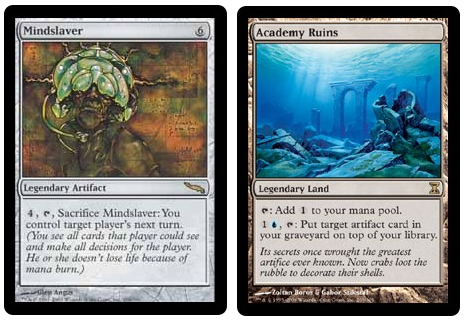
Today's article has two goals. First, I want to run a few more tests to check and make sure Mono U Tron really is the "best" deck with the highest GWP and the best 4-0 win rate. Second, I want to see if there are any other decks might contend with Mono U Tron for the title of "best" MTGO deck. Because although those Mindslaver/Academy Ruins players still have the highest GWP online, there are a few other decks neck-in-neck with Tron. One of those decks, which is incidentally one of the fastest decks in the format, looks like it might have what it takes to race ahead.

[wp_ad_camp_1]

Average GWP on MTGO

Whenever we analyze MTGO data, especially game win percentage (GWP), it helps to start with averages. This is where we started last week with Mono U Tron and it's where we are going to start again. But this time, we are going to use a different method to build our confidence interval. For reference, here is last week's interval:

Tier 1/Tier 2 Average GWP (old): 68.65%
Tier 1/Tier 2 95% Confidence Interval (old): 65.54% – 71.76%

One thing that's nice about this interval is it's fairly wide. If you recall from last week, only two decks had GWPs resting outside of that range (UWR Control at the bottom and Mono U Tron at the top). Wide intervals are nice when we don't know the distribution of our population, and that's definitely the case with MTGO GWPs. That said, there's a big thing that's not so nice about this interval: it it's almost too wide! The same width that makes it useful for comparing to discrete GWPs (like Mono U Tron's 72.89%), also makes it a lot less useful if we want to compare it to other intervals. Where do these other intervals come from? From the different decks. Mono U Tron might have an average GWP of 72.89%, but it has a huge range of GWPs on both sides of that average. To account for that variance, we will eventually need to create a GWP interval for Mono U Tron itself (and, by extension, for every other deck). But before we get there, we need to rebuild our metagame-wide interval.
mono u tron cards

This new interval uses a narrower range defined by the "T Distribution" (basically, a bell curve that gets steeper as your sample gets bigger). We use the T Distribution when we are looking at smaller samples, and in this case, we are only looking at the average GWP of 26 decks. Each of those individual decks may have as many as 200 representatives, but there are only 26 decks qualifying for tier 1 or tier 2 on MTGO. We are making our range around that average of the 26 deck's GWPs; not every deck as a pooled sample. So based on that, here's that new range:

Tier 1/Tier 2 Average GWP (NEW): 68.65%
Tier 1/Tier 2 95% Confidence Interval (NEW):
67.94% - 69.28%

Stated another way, we can be 95% sure the average GWP of the tier 1 and tier 2 MTGO decks is between 67.94% and 69.28%.

Remember our GWPs from last week (e.g. Mono U Tron at 72%, Affinity at 70%, Burn at 69.6%, etc.)? You will notice many of those average GWPs are outside of this interval. So does our new interval mean ALL of those decks are significantly better, because their GWPs are all bigger than our new interval?

Not so fast! Those deck GWPs were just average GWPs. But as we know, all of those decks have a range of values. Mono U Tron didn't have 20+ decks that all had a 72% win rate. The average of its variable GWPs was 72%, with some higher (100%) and some lower (53%). That variance means we shouldn't necessarily treat those GWPs as one single value, which is admittedly the approach I took last week. Instead, we need to create confidence intervals for each deck's GWP. 

Creating GWP intervals for all MTGO decks

Now let's build some intervals. The table below shows GWP confidence intervals for all the tier 1 and tier 2 decks. Intervals were calculated the same way as above, except for decks with 100+ showings. For those decks, I used the normal distribution (more or less a bell curve) instead of the more dynamic T Distribution. This just leads to small differences in the intervals, but they are important when dealing with numbers that are themselves very small (all <1). The margin of error in the last column is just the range of those high/low values relative to the average. Higher margins mean more variance in GWPs. Lower margins indicate more consistent GWPs.

Deck# of finishes
(1/28 - 3/19)
GWP interval:
Low
GWP interval:
Middle (avg GWP)
GWP interval:
High
Margin of
Error (+/-)
Burn19666.83%69.67%72.51%
2.84%
Abzan
188
66.16%
68.73%
71.30%
2.57%
UR Twin
160
66.53%
68.43%
70.32%
1.9%
Affinity
101
66.11%
70.05%
73.99%
3.94%
Infect
66
67.97%
70.67%
73.38%
2.71%
Amulet Bloom
53
63.49%
70.15%
76.82%
6.66%
Abzan Liege
51
65.15%
67.70%
70.25%
2.55%
Merfolk
51
62.80%
68.16%
73.53%
5.37%
RG Tron
49
61.32%
68.10%
74.88%
6.78%
Scapeshift
41
61.78%
68.54%
75.31%
6.76%
UWR Control
38
61.66%
65.58%
69.50%
3.92%
4C Gifts
36
64.37%
67.52%
70.67%
3.15%
Storm
28
59.64%
70.24%
80.84%
10.6%
Mono U Tron
26
63.31%
72.54%
81.77%
9.23%

Bogles
25
58.38%
68.65%
78.92%
10.27%
Ad Nauseam
23
62.68%
70.04%
77.39%
7.36%
UW Control
22
58.83%
65.60%
72.38%
6.77%
Grixis Delver
21
59.89%
67.70%
75.51%
7.81%
BW Tokens
21
59.30%
66.68%
74.06%
7.38%
Nykthos Green
21
58.69%
68.44%
78.20%
9.76%
RUG Twin
18
53.85%
68.12%
82.38%
14.26%
Jund
17
53.05%
69.04%
85.04%
15.99%
UWR Midrange
17
56.05%
70.28%
84.51%
14.23%
Living End
17
65.15%
69.96%
74.77%
4.81%
Gruul Zoo
16
62.16%
65.89%
69.63%
3.73%
Esper Midrange
15
54.52%
67.42%
80.32%
12.9%

The first thing I notice when I look at this table is the sheer range of the intervals. Just look at those margins of error! Some of them are absolutely huge. Yes, established decks like UR Twin, Abzan, Abzan Liege, etc. have pretty reasonable margins of error between 1-3%. But lots of decks have a GWP range of +/- 6 or 7%, and some have absolutely insane variance of 10%+! Of course, this is, partially to be expected. When you have a smaller N for any given deck, the margin of error is naturally going to be bigger. That's because any given GWPs will have a bigger effect on a smaller sample size. But even so, decks like Affinity, Merfolk, and Amulet Bloom have a sizable sample size for MTGO (all >40), but still have high variance. And other decks like Abzan Liege and 4C Gifts have similar Ns but much narrower intervals. So we can't just eyeball this data to figure out what's going on with those margins of error.
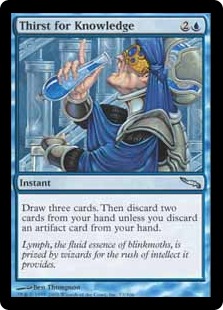
TfKHow is Mono U Tron holding up? Unfortunately, it's not looking great. Although the 72% GWP is still the topmost GWP in the group, the deck also has considerable range in its confidence interval. With a whopping 9.23% margin of error, all we know is that the Mono U Tron "true" GWP probably falls somewhere between 63.31% (solidly below average) and 81.77% (solidly above). Which is to say, we can't really conclude anything. This actually makes sense when we think of those reasons from last week about why Mono U Tron was a good deck. One of my theories was that Tron was successful because it was underplayed. People didn't know how to deal with it. But that might cut both ways and explain the variance. As a Mono U Tron pilot, you need to know what spells to counter, what threats to tutor up off your Treasure Mage, what cards to discard to Thirst for Knowledge, and what win route you should take at any time. If you are experienced with the deck (like shoktroopa of MTGO Mono U Tron fame), then those decisions are easier. If not, the game could be lost off of just one misplay. This might account for the wide range in Mono U Tron GWP.

That leads me into my other big takeaway from the table. Almost all of these deck intervals cross our MTGO-wide GWP range of 67.94% - 69.28%. This suggests every deck in the dataset might actually just be within the expected range! Remember, we don't really know the "true" GWP for our decks or for the metagame, but we do know their ranges. So if those ranges are overlapping, which they are, it is possible all our GWPs might be the same. This would obviously be bad news for our analysis (or, at least, boring news).

Thankfully, there is a way that we can test these confidence intervals against each other and figure out if a deck is really better or worse than the average, even if their ranges are overlapping.

T-Testing and MTGO decks

Time for more statistics! In this next section, we are going to use something called a two-sample T test to figure out if our deck GWP intervals are significantly different from the MTGO-wide GWP interval. In essence, this test compares two samples to see if their averages are significantly different from one another. We use a T test because our sample size is a bit small (as opposed to a Z test, which would be more appropriate for larger samples).

In each case, I am going to run the test between the GWP of one deck and the GWP average for all MTGO. Every time we run the test, we will get a P value. P ranges between 1 and 0. An easy way to think about P is that it gives you the probability that one average is actually the same as a second average, accounting for things like sample size, variance, etc. The higher the P, the more likely the averages could be the same. In statistics, we want to see a P value of < .05 or < .01. These values would mean there was a 95% or 99% chance respectively that a deck's average was outside of the MTGO-wide average. So we are looking for small P's. If P is small, then we can maybe conclude there is a real difference between the deck's GWP and the overall GWP.

(Remember that low P does not mean the GWP is necessarily more or less. It just means there is a significant difference between the GWP of the deck and the average GWP of MTGO).

Here are the results of those tests, organized from lowest P to highest P.

Deck# of finishes
(1/28 - 3/19)
GWP interval:
Low
GWP interval:
Middle (avg GWP)
GWP interval:
High
Margin of
Error (+/-)
P
(significance)
UWR Control
38
61.66%
65.58%
69.50%
3.92%
0.13
Infect
66
67.97%
70.67%
73.38%
2.71%
0.14

Gruul Zoo
16
62.16%
65.89%
69.63%
3.73%0.15
Affinity
101
66.11%
70.05%
73.99%
3.94%
0.31
Burn19666.83%69.67%72.51%
2.84%
0.31
UW Control
22
58.83%
65.60%
72.38%
6.77%
0.37
Mono U Tron
26
63.31%
72.54%
81.77%
9.23%

0.39
UR Twin
160
66.53%
68.43%
70.32%
1.9%0.39
Abzan
188
66.16%
68.73%
71.30%
2.57%
0.40
Abzan Liege
51
65.15%
67.70%
70.25%
2.55%
0.49
4C Gifts
36
64.37%
67.52%
70.67%
3.15%
0.50
Living End
17
65.15%
69.96%
74.77%
4.81%
0.56
BW Tokens
21
59.30%
66.68%
74.06%
7.38%
0.59
Amulet Bloom
53
63.49%
70.15%
76.82%
6.66%
0.65
Ad Nauseam
23
62.68%
70.04%
77.39%
7.36%
0.69
Storm
28
59.64%
70.24%
80.84%
10.6%
0.76
Grixis Delver
21
59.89%
67.70%
75.51%
7.81%
0.81
UWR Midrange
17
56.05%
70.28%
84.51%
14.23%
0.81
Esper Midrange
15
54.52%
67.42%
80.32%
12.9%0.85
Merfolk
51
62.80%
68.16%
73.53%
5.37%
0.87

RG Tron
49
61.32%
68.10%
74.88%
6.78%
0.88
RUG Twin
18
53.85%
68.12%
82.38%
14.26%
0.94
Jund
17
53.05%
69.04%
85.04%
15.99%
0.96
Nykthos Green
21
58.69%
68.44%
78.20%
9.76%
0.97
Scapeshift
41
61.78%
68.54%
75.31%
6.76%0.98
Bogles
25
58.38%
68.65%
78.92%
10.27%
0.99

Before I turn to those top decks (get 'em Infect!!), let's make a general observation and then look at Mono U Tron.

Overall, none of our P values are small enough to conclude statistical significance at the 95% or 99% levels. In fact, most decks aren't even close. Abzan and UR Twin are at .4, with Burn and Affinity just a little better at .31. This just means the overwhelming majority of these decks have a "true" GWP that may or may not fall within the MTGO-wide average. We just can't conclude much on these decks other than that they might be fairly average. Of course, this is complicated by all sorts of factors like who is piloting the deck, what list they are using, their matchups, etc. But overall, almost all of these decks have pretty insignificant P values.
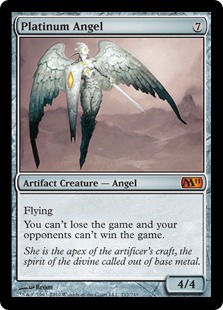
platinum angelMono U Tron is right there alongside Twin and Abzan. Even though its 72.54% GWP is the highest of the group, the range of values on both sides of this average is too wide. Because of this variance, the difference between the Tron GWP and the MTGO-wide GWP is not significant at any level. This definitely undercuts some of the arguments I made in my article last week. The deck might have some top finishes pushing up its average, but it also has some very low ones. Mono U Tron might still have the "platinum" standard for average GWP, but the variance of that average is just a little too high.

And now, the moment we have all been waiting for. This next deck's GWP is not just one of the highest in the dataset, but also one (almost) significantly higher than the MTGO average. It also has one of the smallest margins of error for any deck in our table. This deck, ladies and gentlemen, is Infect.

GWP, P Values, and Infect!

Mono U Tron might not have received a lot of love in this analysis, but Infect sure did. The results are in and have been tallied: Infect may very well be MTGO's best deck (sorry, Tron!).
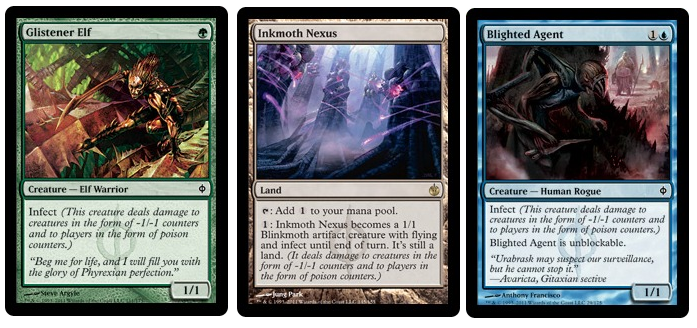
infect big three

Just to recap, here are the Infect numbers as compared with the MTGO-wide ones.

Tier 1/Tier 2 Average GWP (NEW): 68.65%
Tier 1/Tier 2 95% Confidence Interval (NEW):
67.94% - 69.28%

Infect average GWP: 70.67%
Number of Infect decks in sample: 66
Infect 95% Confidence Interval: 67.97% - 73.38%
P value for T Test: .13

And again, just to recap, here's how you should read these numbers. We know the Tier 1/Tier 2 MTGO metagame has an average GWP between 67.94% and 69.28%. But the Infect GWP is between 67.97% and 73.88%, with an average GWP of 70.67%. Because its GWP variance is so low relative to its sample size, a two sample T test reveals Infect's GWP is almost significantly different than the Tier 1/Tier 2 GWP. It's not quite significant because P is a little bigger than our targets of .05 or .01. But .13 is pretty darn close, and I am comfortable with highlighting it.
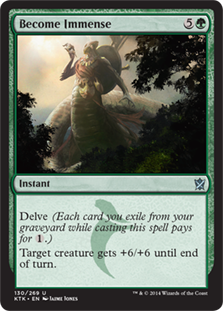
become immenseEver since PT Fate Reforged (and maybe before, for many players) we have known Infect was awesome. A big part of this was obviously the addition of Become Immense to the format, a card that played an important role in Infect's win rate at the PT. The deck won 61% of its games at that event, the third highest win rate of any deck at the event after only Abzan Liege (a deck even more custom-tailored to target the format's tier decks), and Amulet Bloom. A big part of this was Infect's win rate against Abzan itself (60%).
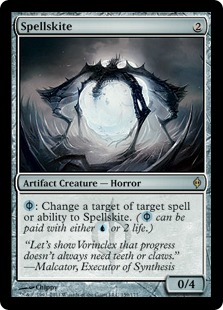
SpellskiteAs a deck, Infect attacks the metagame in a variety of interesting ways. It's fast and punishes decks that miss a disruption draw. It's resilient to decks that use too much one-for-one disruption. It's linear which means it doesn't care too much about what an opponent is playing in a diverse field. It has strong inevitability which means you can't durdle around too much against it. And it has maindeck strengths against some of the best decks in the format (Inkmoth Nexus against Abrupt Decay and Thoughtseize, Spellskite and Vines of Vastwood against Splinter Twin, etc.).

This is a great example of the quantitative statistics confirming our qualitative observations. We can develop numerous theories, like those I just mentioned, about why Infect is a great deck for this current Modern format. But the MTGO numbers really drive that point home. Despite having a very respectable 70.67% GWP, Infect doesn't have the same GWP variance we see in almost every other deck in the format. Its GWP range is super tight. Given that the deck was played by 47 unique players in its 66 appearances, this further suggests it is the deck itself (and its metagame interaction) driving the successes, not just a few players carrying it to victory.

All of this is to say that Infect is a really strong deck for MTGO. Its average GWP is one of the highest online, and it is the only GWP approaching a significant P value. So if you are looking for a "best" deck for your next Modern daily, this analysis suggests Infect is a very strong choice.

Next steps

In the end, my objective in this article isn't really to identify the best deck at all. It's mostly to give readers a new way to look at Modern data (MTGO in particular) and how you too can analyze and draw conclusions from that data. It also gives some sense of the almost endless ways you can process the data and subject it to every test and model you have probably dreaded (or missed) since college/high school.

There are lots of places we can go from here. Just looking at the data in this article and the last, here are some questions and ideas we might want to investigate.
uwr control three

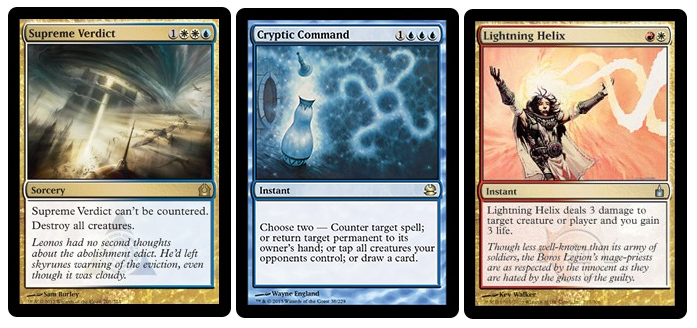
  • POOR UWR CONTROL! It's bad enough that this deck has the lowest average GWP on MTGO. It's even worse that the difference between its GWP and the Tier 1/Tier 2 GWP is almost statistically significant. This strongly suggests there is something wrong with this deck, and we might want to dig deeper into its challenges.
  • Controlling for deck pilot: In last week's article, I tried to control for the effect of individual players on their deck's performance. But that was only done for Mono U Tron alone, not for all the other decks. If we really want to complicate our understanding of GWP, we could break it down by player and see if there are significant differences between any given player's GWP and the overall populations'.
rogue three

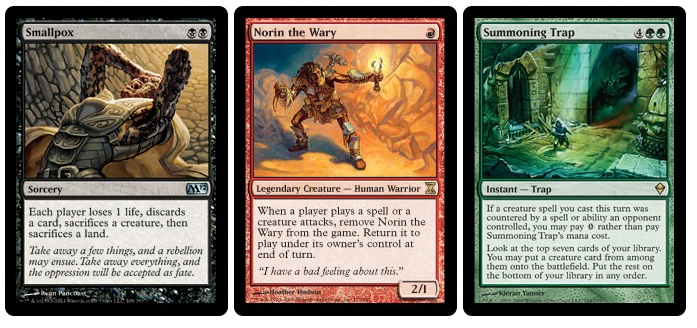
  • Analyzing rogue decks: Both this analysis and the Mono U Tron analysis only looked at Tier 1/Tier 2 GWPs. But there's nothing stopping us from adding in all the decks with fewer finishes to see how they rank. Smallpox Loam! Norin the Wary! Valakut Breach! 8Rack! Skred Red! Dredgevine! The MTGO world is our oyster. We could even re-run these analyses with the rogue decks in mind, adding them into our samples.

These are just a few of the many ways we can keep digging into the data to learn more about decks and the metagame.

So unearth those stats books from your storage rooms or bookshelves, open up some spreadsheets, and start your own deep dives into the MTGO statistics. I'm sure you will find all sorts of exciting treasures in the numbers.
Should employees/judges play in events they’re running?

Are you a Quiet Speculation member?

If not, now is a perfect time to join up! Our powerful tools, breaking-news analysis, and exclusive Discord channel will make sure you stay up to date and ahead of the curve.

There was an interesting discussion about this that spawned from this post, but there's a TL;DR version as well.

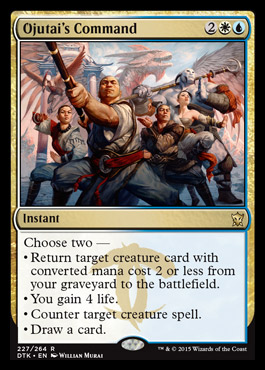
Ojutai's Command

Basically, it boils down to this question: should a store employee or judge working the event also be allowed to play in the event? The rules are that they can, so there's no issue there. The question is if they should.

Full disclosure: I work part-time at a LGS and I run the midnight prereleases for us, something I also compete in. We're casual enough that we've never had any situation arise where it could be a problem, but what if the store employee happened to be the person who got a bye? Would that look bad? On the one hand I can see that, but on the other there's the reality that a lot of events are run by players, and you don't want to punish players for helping prereleases and FNMs happen.

What do you think?

Avatar photo

Corbin Hosler

Corbin Hosler is a journalist living in Norman, Oklahoma (also known as the hotbed of Magic). He started playing in Shadowmoor and chased the Pro Tour dream for a few years, culminating in a Star City Games Legacy Open finals appearance in 2011 before deciding to turn to trading and speculation full-time. He writes weekly at QuietSpeculation.com and biweekly for LegitMTG. He also cohosts Brainstorm Brewery, the only financial podcast on the net. He can best be reached @Chosler88 on Twitter.

View More By Corbin Hosler

Posted in Feature, Free10 Comments on Should employees/judges play in events they’re running?

Have you joined the Quiet Speculation Discord?

If you haven't, you're leaving value on the table! Join our community of experts, enthusiasts, entertainers, and educators and enjoy exclusive podcasts, questions asked and answered, trades, sales, and everything else Discord has to offer.

Want to create content with Quiet Speculation?

All you need to succeed is a passion for Magic: The Gathering, and the ability to write coherently. Share your knowledge of MTG and how you leverage it to win games, get value from your cards – or even turn a profit.

Deck Overview: Modern Stompy

Are you a Quiet Speculation member?

If not, now is a perfect time to join up! Our powerful tools, breaking-news analysis, and exclusive Discord channel will make sure you stay up to date and ahead of the curve.

With the pre-release happening this weekend I wasn't sure that I would be able to find any interesting decks to talk about. Then I looked at exactly one deck from one daily event and was immediately proven wrong. If you're looking for a budget deck to get into Modern with, then this one might be about as cheap as they come. I don't know how good it is exactly, but it has 4-0'd at least one daily.

"_KG's Mono Green Stompy

creatures

4 Dryad Militant
4 Experiment One
4 Kalonian Tusker
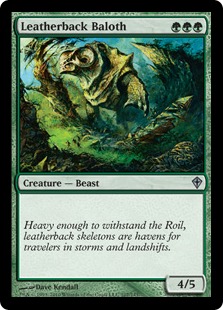
4 Leatherback Baloth
2 Obstinate Baloth
3 Scavenging Ooze
4 Strangleroot Geist

spells

1 Aspect of Hydra
3 Dismember
1 Gather Courage
4 Vines of Vastwood
4 Rancor

lands

22 Forest

sideboard

2 Choke
2 Deglamer
1 Natural End
1 Pithing Needle
1 Thrun, the Last Troll
1 Creeping Corrosion
2 Feed the Clan
1 Oxidize
2 Skylasher
2 Torpor Orb

Some of the slots are a bit strange to me. Aspect of Hydra looks a little cute and Gather Courage is possibly worse than Mutagenic Growth. I also don't know why Natural End is worth the slot, but the deck at least has a consistent plan and some strong features for the metagame.

Dryad Militant does some Snapcaster Mage and Pyrmancer Ascension hosing, and Dismember gives your Stompy deck outs to Splinter Twin combo. Scavenging Ooze and Obstinate Baloth are great against both burn and a few random things, those being graveyard decks and discard respectively.

This is the first time that I've seen this tried in Modern, and as such as far as I know the deck has never lost a match. Whether it's real or not I don't know, but it looks like a strong budget option and might actually just be great.

Insider: Are the Rares Enough to Save Tarkir?

Are you a Quiet Speculation member?

If not, now is a perfect time to join up! Our powerful tools, breaking-news analysis, and exclusive Discord channel will make sure you stay up to date and ahead of the curve.

Over the last two weeks, I've illustrated the incredible disappointment that is the mythics in Dragons of Tarkir.

While the set does have a couple of big mythics drawing a lot of water, I still feel that the prices attached to them are unjustifiable at best. I could be entirely mistaken in my read of Narset Transcendent, but I feel strongly that this card is closer to Chandra, the Firebrand than Jace, the Mind Sculptor or even Jace, Architect of Thought.

Supply

Dragons of Tarkir does have one interesting thing going for it: the set blows. There, I said it.

Wizards has traditionally relied on extremely heavy sales of their fall set to carry the year over year sales growth while the rest of the year brings in significantly less. Even mega-hits like Rise of the Eldrazi fail to reach the sales numbers of their fall counterparts. This is part of why Wizards is rolling out the new block structure of big/small with two sets leaving every six months. The problem is that Dragons is not part of a two set block and is paired up with the last iteration of another yearly failure - the Core Set.

Dragons is really a throw-away set in a sense. While I'm sure Dragons will be a financial success for Wizards, as dragon-filled packs are sure to fly off the shelves at the big-box retailers, it is not a hit for the local game stores that the Magic empire is built upon. With the aggregate price of the set being so low, we're likely to see retailers opening much less of it to sell as singles... much like we've seen with Core Sets over the past few years.

What's that mean? If a card like Narset has a breakout weekend, it's price is likely to stay high for a much longer time before creeping down, as stores will be relying on players to sell them inventory rather than just opening product. The other factor in this is the recently increased wholesale price of booster boxes, which makes that threshold for opening boxes to fill inventory even higher than in the past.

Historically, three great examples stand out as what we could see with Narset: Chandra, the Firebrand, Chandra, Pyromaster, and Nissa, Worldwaker.

NissaGraph

Nissa held a substantial premium for a card that appeared in decks as much in the sideboard as the main deck. Simply being mythic in a set that wasn't widely opened meant that it took substantially longer for her price to cool down. But once it did, things held a fairly steady downward course.

We don't have a lot of historical data for Firebrand, but I remember the card being $35 at GenCon a few weeks after release because I distinctly remember Medina tried telling me that the Korean Time Warp I offered for it was down to $10. After starting high, it slowly and surely inched downward at a steady clip. I like Chandra as a comparison because they both have a do-nothing +1 ability, a -2 copy a spell ability, and a arbitrarily large win-the-game ability that you're unlikely to ever use.

So with supply likely going to be lower than we've seen in a set this size for a while, we can expect some cards to behave weirdly like Narset has the potential too. Any rares that are long-term playable will likely inch upwards over time and experience some drastic spikes due to the inelasticity of supply. So what rares should we be looking at going forward?

The Rares

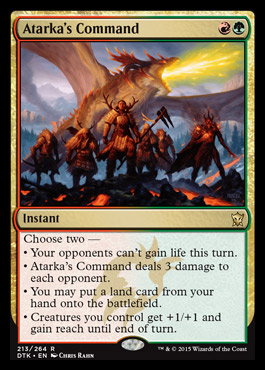
Atarka's Command

The obvious place to start is with the commands, and their #value is going to be tied very closely to how flexible they are.

One of the things that made Cryptic Command stand out above its peers was the "always on" ability to just draw a card. Countering a spell and tapping creatures is awesome when both are relevant, but for a command to be successful, there has to be an "always on" ability to attach to whatever relevant ability we're using.

Atarka's Command barely passes the test with the add-on of just throwing three at your opponent's face. The first and fourth abilities are going to be useful much less frequently, and the third ability is still fairly iffy. I just don't see this card being a staple, despite its low mana cost, because it does none of what we're seeing in the current R/G decks.

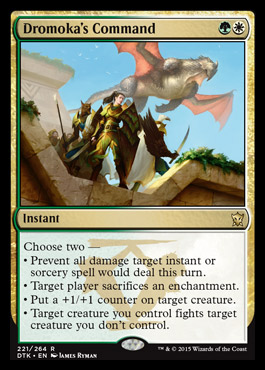
Dromoka's Command

Dromoka's Command appears to be in a very similar boat, but this card is probably playable in green/white decks simple off the +1/+1 counter and fight clauses. I'm doubtful that this becomes an eternal staple, but I can see it showing up in decks for the next 18 months. If these dip down below $2, I would have no problems picking up a grip of them.

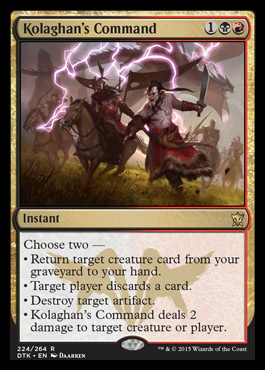
Kolaghan's Command

Kolaghan's Command offers us something we've never really had before--draw phase discard.

The ability to completely negate an opponent's draw step is something Wizards has been avoiding for a long time, coupling that with the "always on" of dealing two damage to something is solid enough to warrant  play for this card. Raise Dead and Shatter are definitely the less enticing aspects, but you can't pile too much #value onto INSTANT SPEED DISCARD.

I'll gladly pick up a play set of these once they dip below $2 with the hope that a good red/black shell presents itself (sorry Mardu).

Ojutai's Command

I am not very bullish on Ojutai's Command, as four mana for gain some life and draw a card is not very exciting. The first ability is pretty irrelevant without Wall of Omens in the format, and four mana to counter only creature spells is not very enticing.

This card might be playable as a 2-of in a control deck, but that doesn't justify the $6 preorder price SCG is asking. Gaining four life and drawing cards are both "always on" abilities, but the price tag on casting this spell feels like too much buck for the bang.

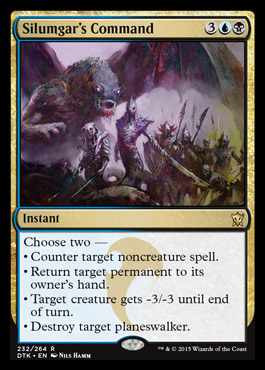
Silumgar's Command

Silumgar's Command reads: flexible five mana two-for-one. I don't particularly like the casting cost on this one, especially because it's so much more expensive than the rest of the cycle and I honestly don't really like blue/black control going forward. A deck that relies heavily on a five mana board wipe that forces a choice between dragon/non-dragon seems a lot less powerful in a world where the dragon half might actually be relevant again.

None of these even seem like they'll be relevant outside of their 18 month stint in Standard, so I wouldn't bother investing in foil copies.

So let's get down to brass tacks: is there anything that has the potential to see Modern play?

Collected Company

Collected Company is probably going to be cheaper than it is today. This is a card that doesn't have a clear home or use yet.

To me, this card is in the same vein as cards like Ranger of Eos or Stoneforge Mystic--cards that allow you to search or dig for things and/or play them for a reduced cost are almost certain to break over time.

There is not much exciting to do with this card in Standard right now, but there's another set coming in just a couple of months, and a couple months after that, and a couple months after that... you get the idea.

As this card dips down to $2-3, since there's no immediate home for it, grab as many copies as you can and throw them in the closet--especially foil.

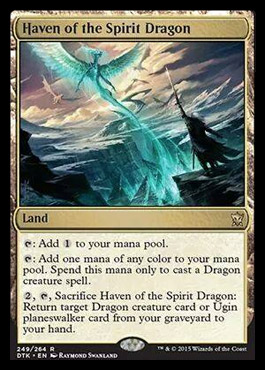
havenofthespiritdragon

While I doubt this is showing up in Modern any time soon, it's pretty much essential for Commander dragon decks and will be be a casual staple for years and years to come. I really like this card in foil and will have no problem picking up extra copies to throw into my compost box. This is the Sliver Hive for dragons, except it's significantly better because dragons are way cooler than insectoid spear-creatures.

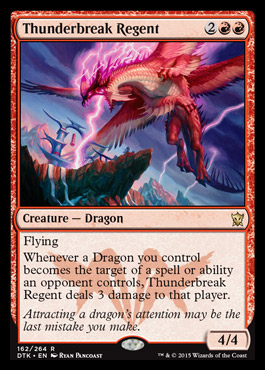
Thunderbreak Regent

Thunderbreak Regent seems to be priced pretty appropriately at $5. This card could easily jump to $10 as people clamor for copies if a mono-red deck puts up good results the first couple of weekends, but it "feels right" at $5-6.

Not Obvious Garbage

And to close, here are the cards that are not pure garbage. I don't have a whole lot to say about any of them because most require specific conditions to exist for them to be useful going forward. These are essentially the bulk rares that I wouldn't bulk out quite yet and the rares that have inflated preorder prices that are almost sure to go down. Wait and see.


Insider: Shifting Financial Focus for the Spring

Are you a Quiet Speculation member?

If not, now is a perfect time to join up! Our powerful tools, breaking-news analysis, and exclusive Discord channel will make sure you stay up to date and ahead of the curve.

I’ve noticed Standard and Tiny Leaders dominating my news feed these past few weeks. Financial opportunities seem to be driven by new Standard strategies, the printing of dragons, and lots of Tiny Leaders speculation.

This observation has merit and deserves further scrutiny. A couple months ago, Modern was all the rage while we got a glimpse of the new metagame during the last Pro Tour. Once the dust settled, everyone became very excited over the prospect of a new set full of dragons.

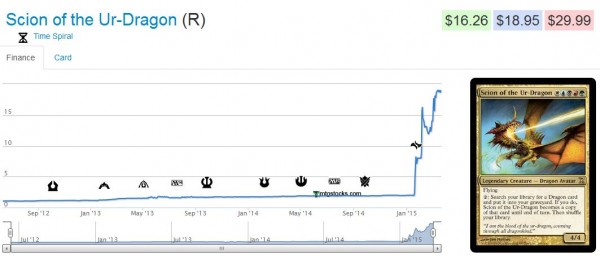
Now we have $20 Scion of the Ur-Dragon.

Scion

And, most recently, Tiny Leaders has been all the rage.

While I don’t necessarily agree with the buyout choices speculators have made (have you seen anyone play Order of Whiteclay yet?), the trend cannot be argued with. Of course, we have no idea whether or not this format will become a mainstay of Magic or if it’ll be the next flash in the pan.

What I want to focus on this week is the next 3-6 months. A lot of exciting things will happen in that time frame, and I want to make sure everyone is strategizing about the future rather than chasing bad ideas from the first quarter of 2015.

One of the greatest, most rewarding ways to make money in MTG Finance is to anticipate what’s to come and planning ahead, and this article will hopefully help you do just that.

Modern Masters 2015

By far the most exciting event on the horizon is the release of the second reprint-only Modern set, Modern Masters 2015.

Sure to delight, this release is going to drive massive shifts in the Modern market. Some cards will tank in value. Others, often the most desirable mythic rares, will increase in demand, overshadowing any possible price drop due to new supply.

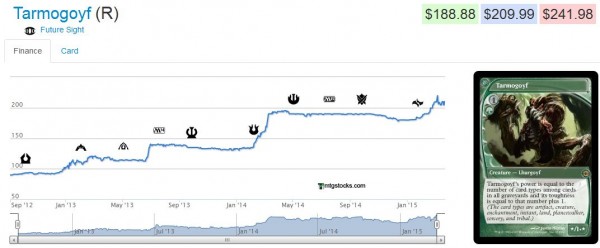
That’s exactly what happened to Tarmogoyf two years ago – the increase in supply was immediately matched with an even greater increase in demand, leading to a price increase.

Goyf

What’s the plan this time?

Well, I’m not going to pretend that I can predict what will be in the set and what won’t be. Nor can we anticipate how large the print run will be. Everyone has their theories, and adding my own right now wouldn’t add much value to this article.

Instead, I want to emphasize two points.

First – don’t underestimate the power that Innistrad block and later have by dodging this set. If Modern Masters 2015 achieves its desired goal, Modern should see another jump start in interest. And let’s face it – after the recent shakeup and considering the rather unimpressive metagame, the format definitely needs a kick.

A surge in interest means a surge in demand. Staples dodging reprint will surely see a jump in value. While the opportunity on Snapcaster Mage has passed, there’s a more straightforward option worth considering: Shock Lands!

There was an error retrieving a chart for Snapcaster Mage

If these aren’t reprinted again, they may finally have a chance to trend upward. Real Estate is always a good place to be, after all.

Steam Vents may already be a bit more expensive, but the other Shocks still have some rebound left in them. It’s a matter of when, not if. And I think it’s safe to say most of these have surely hit their bottom.

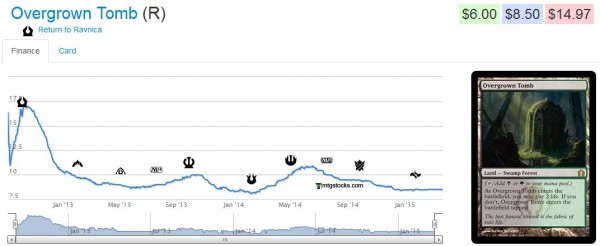
Tomb

Abrupt Decay is another mainstay worth grabbing now. Other great pickups will be Modern staples not reprinted, but it’s still a bit too early.

There was an error retrieving a chart for Abrupt Decay

The second point I want to make is more theoretical and relates to the real world.

A few years back, when the US economy was stagnating and needed a jumpstart, the Federal Reserve began printing more money to buy Bonds. This Quantitative Easing continued to inject cash into the US economy for years (yes, I’m oversimplifying a bit).

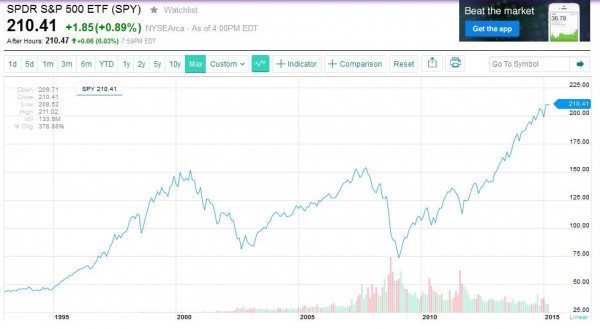
This, combined with a near-zero interest rate, has had the desired effect: the S&P 500 is near its all-time high!

SPY

I view the printing of Modern Masters 2015 as comparable action by Wizards of the Coast.

Think about it: they are essentially printing a ton of money in the form of highly desirable reprints and injecting them into the market.

Grand Prix Las Vegas, which will almost definitely break attendance records, will add tons of money into people’s trade binders as they crack open fresh, NM copies of Tarmogoyf, Emrakul, the Aeons Torn, and more. This means many players will suddenly have more value in their trade binder than they do currently.

You don’t have to be a Peter Lynch to know what this means. More cash in players’ binders means the cards they desire most will become within their reach. Thus, demand increases and price increases. And it’s not like having an extra Tarmogoyf makes people want a given Legacy staple less.

The trick, of course, is predicting what cards these players will demand.

I’ve placed my bet on Legacy – namely, Dual Lands. My hope is that players use their opened Tarmogoyfs to trade into Underground Seas and other Legacy staples. The older format is, after all, far superior, in the opinion of many. I don’t think that’s going to change anytime soon.

Therefore, I’ve concentrated around 25% of my MTG holdings into Duals for the time being. This was the safest bet I could make, and you know how I tend to be risk-averse!

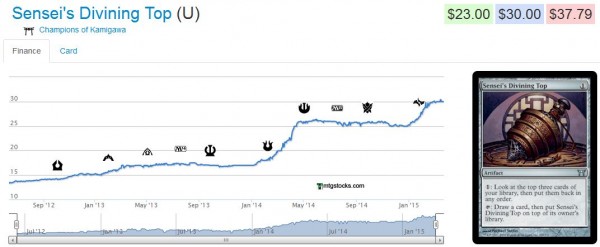
There are likely other options which will yield better returns. Wasteland has pulled back far from its high these past few months. Stoneforge Mystic continues to be a dominant card in Legacy. And as long as it dodges reprint, Sensei's Divining Top will likely continue its inevitable and unwavering rise in price. $30?! Are you kidding me?!

Top

I’ll probably watch trends closely and try to strategically jump in front of some budding price movement as soon as I notice it.

Standard Rotation

In the fall, we’ll face yet anther Standard rotation. This means we say farewell to Theros block from Standard while welcoming in the newest block, Battle for Zendikar. To me, this means two things.

Naturally, players will be looking to unload their Theros block staples into cards not rotating in order to maintain their collection’s value. In many cases, this simply means trading into newer Standard cards.

But trading out of Standard and into cards which will hold their value for a longer time period is also possible. In other words, players could use that opportunity to grab a few pieces for their Modern deck or perhaps their new Tiny Leaders deck.

The other implication of Battle for Zendikar? Fetch lands!!!!!

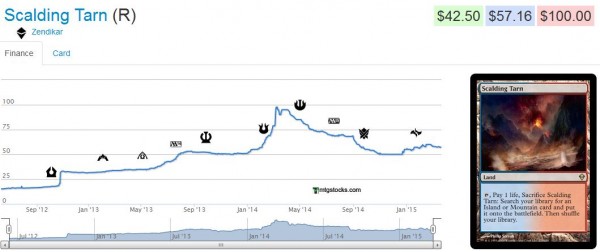
Dollar signs are appearing in my eyeballs as I type this. I love sets with fetches because it adds to the excitement of opening packs, knowing there are at least five rares worth cracking in addition to all the other value in the set. And who wouldn’t want to crack open a Scalding Tarn?

Tarn

Of course, there’s no guarantee of a fetch land reprint.

But my money is on a reprint… literally, I own zero Zendikar fetches right now. Holding them for much longer just seems reckless. Scalding Tarn is a $57 card now, but a reprinted copy would likely cost around $15. After seeing what the reprint did to Onslaught fetches, it’s fairly obvious that bailing on Zendikar fetches is the right play heading into a potential reprint.

Cheaper fetches means cheaper entry into Modern! Manabases will go from being $400 to $200. Therefore, money will be freed up for other pickups, buoying other prices higher. This is yet another tailwind for Modern and Legacy staples.

Wrapping It Up

The first quarter of 2015 has been all about Standard, Tiny Leaders, and casual formats. Dragons have surged in value thanks to the release of Dragons of Tarkir. New Standard sets have also kept the format fresh, creating new opportunities to profit on cards like Mastery of the Unseen. And the steady increase in demand for casual cards like Command Tower, Necrogen Mists, and Regal Force has never been stronger.

But if history is any indicator, I think the change of season will also mean a shift in financial opportunity. Casual staples will also be solid pick-ups, but I anticipate greater profits will be had in Modern and Legacy soon enough. Players are about to have a cash infusion into their trade binders – a stimulus of sorts, driven by Modern Masters 2015. And more fetch lands in Battle for Zendikar could mean a lower barrier to enter Modern and further increase in player base. Both would mean price increases for Eternal staples.

Based on all these upcoming events, my money continues to be on Legacy. Around this time last year we saw a sudden surge in the value of dual lands. Since then, much of that value has been given back. My hope is that we see yet another jump, this time catalyzed by the factors mentioned above.

What if I’m wrong? Well, it’s not like dual lands are going to drop in price any time soon. And judging by the games of Tiny Leaders that I’ve played, a new competitive format will just motivate players to pick up duals even more than before. After all, I call Commander and Tiny Leaders “casual” simply because there are no Grand Prix or SCG Opens showcasing these formats. But many players treat these formats as highly competitive – these players need their duals to optimize their decks.

And, of course, there’s that Reserved List in the background protecting this investment.

So, as we head into the Spring months and the weather heats up, keep an eye on MTG trends. We should see Modern and Legacy cards heating up as well, driven by a number of factors. The result will be another exciting opportunity to make some profits – stay tuned!

…

Sigbits

  • Star City Games currently has only one English nonfoil copy of Stoneforge Mystic in stock. Near Mint price is up to $34.75 now, but that’s not the ceiling. I expect this to trend higher as we head toward the summer.
  • Do you want to play Dimir in Tiny Leaders? Well, you’d better skip over SCG’s website then because you’ll need a copy of Sygg, River Cutthroat and they are fresh out. Their current price: $6.09, but I can see that going higher if the format continues to gain traction and grow.
  • Want to know my favorite target for Tiny Leaders speculation? Engineered Explosives. The card is amazing in a format with only 4 optional casting costs (0, 1, 2, 3) and recurring it with Academy Ruins is a sweet bonus. The card was just reprinted in the first Modern Masters, so a second reprint seems unlikely. And the card is also worthwhile in other formats, where it sees occasional play. Perhaps this is why the artifact is sold out at SCG for $8.95 (Fifth Dawn) and $9.39 (Modern Masters).

Dragons of Tarkir Price Cheatsheets

Are you a Quiet Speculation member?

If not, now is a perfect time to join up! Our powerful tools, breaking-news analysis, and exclusive Discord channel will make sure you stay up to date and ahead of the curve.

Hey! The DTK prerelease is this weekend and we've got easy, printable cheat sheets for the cards worth money. Print some off and bring to your prerelease and have fun this weekend!


Alphabetized List


Price-sorted List


What's your favorite card in the set? What's the most overrated? Personally, I think Ojutai's Command has people thinking fondly of Cryptic Command and not justifying how it'll actually show value on the board. Do you think the set has too many Dragons? Not enough? Are the Elder Dragons "elder" enough?


Douglas Linn

Doug Linn has been playing Magic since 1996 and has had a keen interest in Legacy and Modern. By keeping up closely with emerging trends in the field, Doug is able to predict what cards to buy and when to sell them for a substantial profit. Since the Eternal market follows a routine boom-bust cycle, the time to buy and sell short-term speculative investments is often a narrow window. Because Eternal cards often spike in value once people know why they are good, it is essential for a trader to be connected to the format to get great buys before anyone else. Outside of Magic, Doug is an attorney in the state of Ohio.  Doug is a founding member of Quiet Speculation, and brings with him a tremendous amount of business savvy.

View More By Douglas Linn

Posted in Dragons of Tarkir spoilers, Finance, FreeLeave a Comment on Dragons of Tarkir Price Cheatsheets

Have you joined the Quiet Speculation Discord?

If you haven't, you're leaving value on the table! Join our community of experts, enthusiasts, entertainers, and educators and enjoy exclusive podcasts, questions asked and answered, trades, sales, and everything else Discord has to offer.

Want to create content with Quiet Speculation?

All you need to succeed is a passion for Magic: The Gathering, and the ability to write coherently. Share your knowledge of MTG and how you leverage it to win games, get value from your cards – or even turn a profit.

Highlights from The Duelist #15

Are you a Quiet Speculation member?

If not, now is a perfect time to join up! Our powerful tools, breaking-news analysis, and exclusive Discord channel will make sure you stay up to date and ahead of the curve.

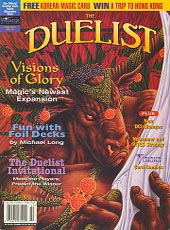
I'm back again with another set of highlights from a classic MTG magazine. This time, The Duelist #15, published in February 1997:

magazine-the-duelist-15

I'm relatively certain that I never read or even saw for sale a copy of The Duelist. The reason I bought Inquest and sometimes Scrye was primarily for the price guides to assist with trading—the actual articles were merely a bonus. Because The Duelist was produced by Wizards of the Coast, a company that has resolutely pretended to not recognize the secondary market, The Duelist (this issue anyway) merely contains checklists to help you complete your collection. No price guide to be found.

Here's another way you can tell this is a magazine produced by WOTC:

IMG_5388 (1)

I would say that only a Wizards employee could be so hopelessly optimistic in two bad cards, but then again, we just went through another spoiler season. We all should know how best-case-scenario mentality works by now.

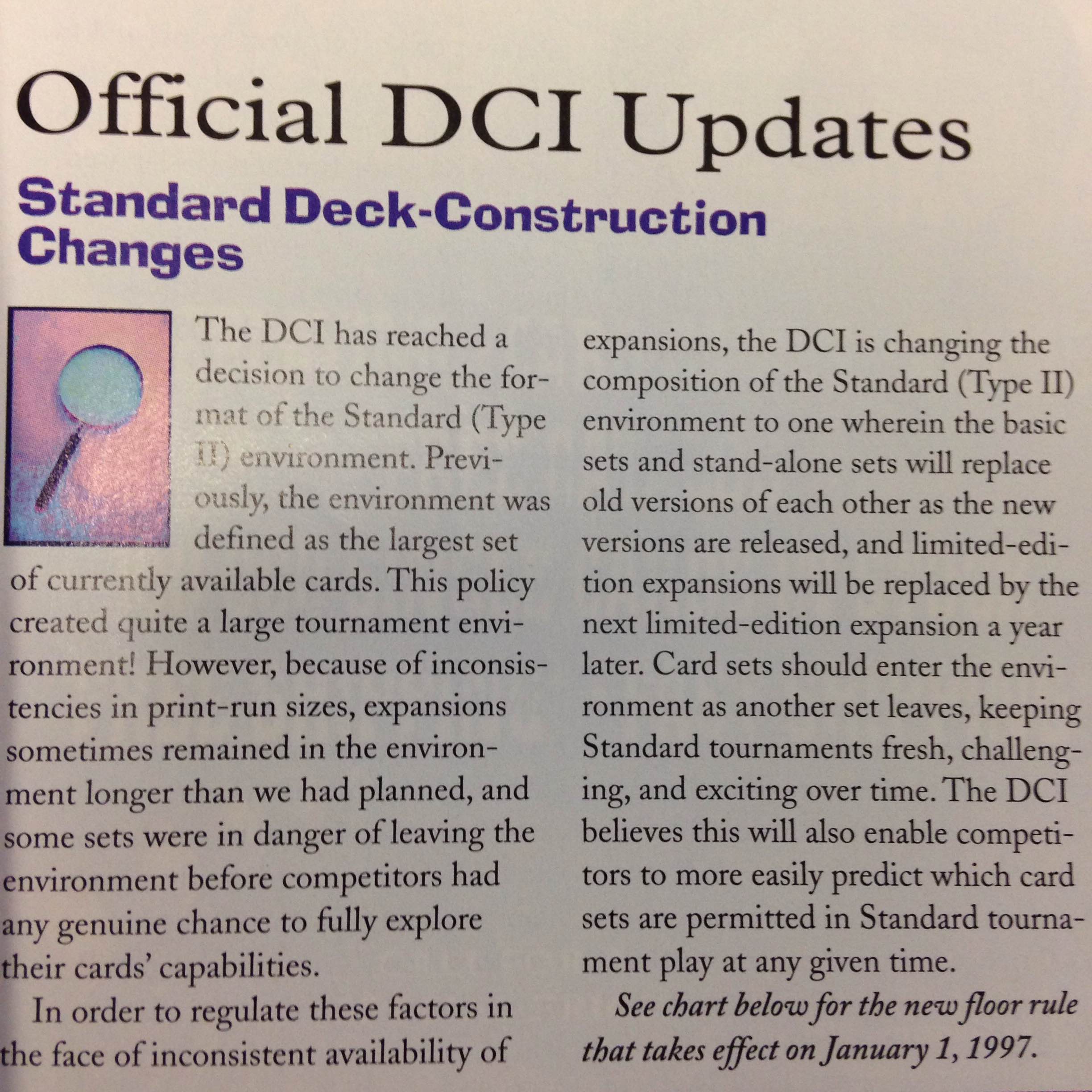
Back in the nineties, I was the most casual of casual players, and I was only vaguely aware of the tournament scene or official formats. I did know about Type II and played the format in a couple LGS tournaments, but I did not know that it was referred to as Standard as far back as 1997. Did you?

IMG_5389 (1)

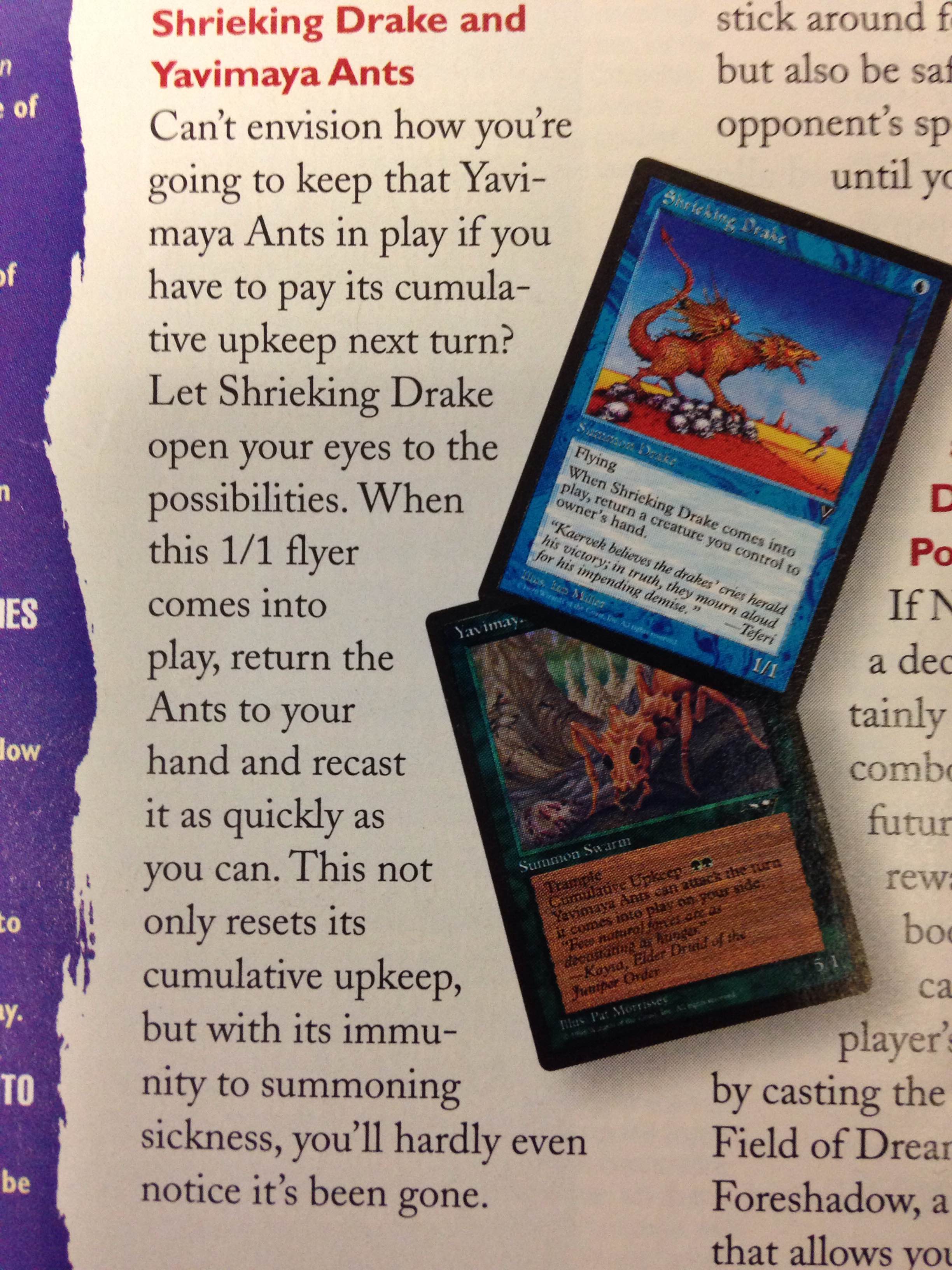
It's also pretty interesting how rotation used to work. How convoluted was it before they reached the current system?

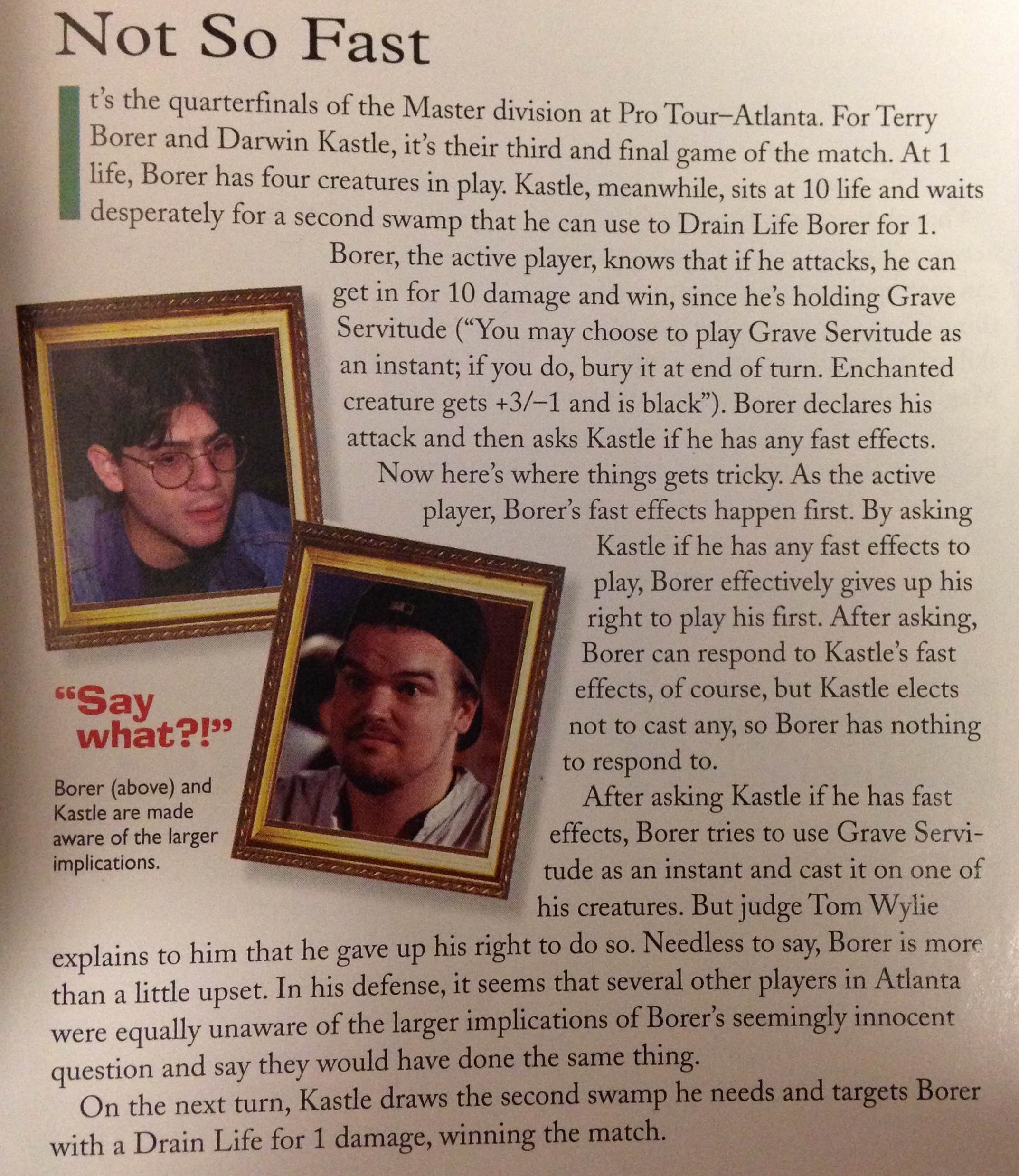
I have heard Mark Rosewater recount this story many times on the Drive to Work podcast, but here's when it was still fresh:

IMG_5390

I admit that the only reason I would know this was a correct ruling is because of the very clear priority passing on Magic Online. Considering this was years before MTGO was released, it's not surprising that Borer didn't understand. How does anybody learn how to play Magic properly without MTGO?

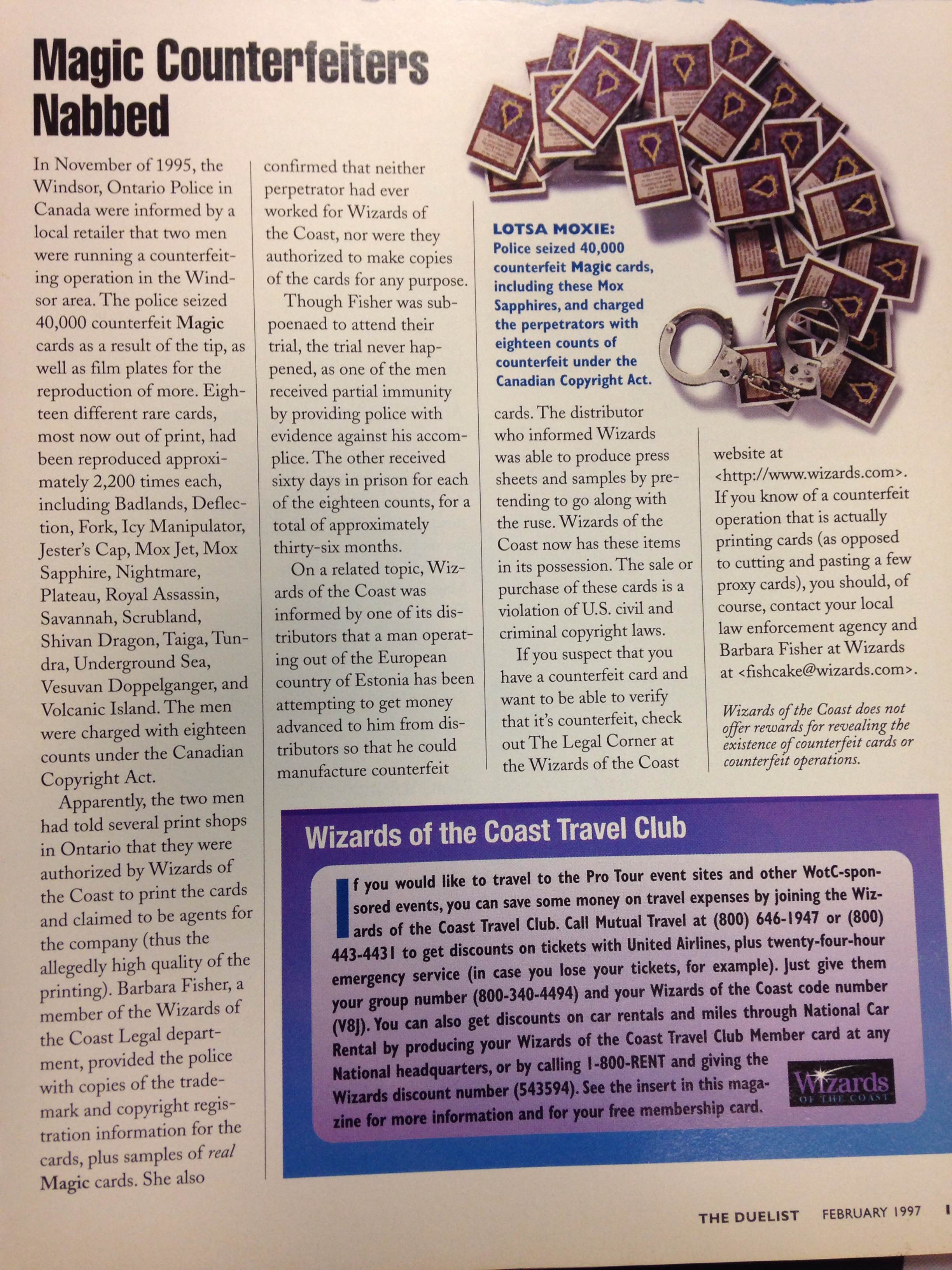
And if you thought counterfeiting of Magic cards was a new phenomenon that came about because of the Reserved List, here's some evidence to the contrary:

IMG_5102 (1)

There's some ammunition in your quest to educate the masses, Corbin.

And here's something to make damn sure you know this magazine was printed in the nineties:

IMG_5395

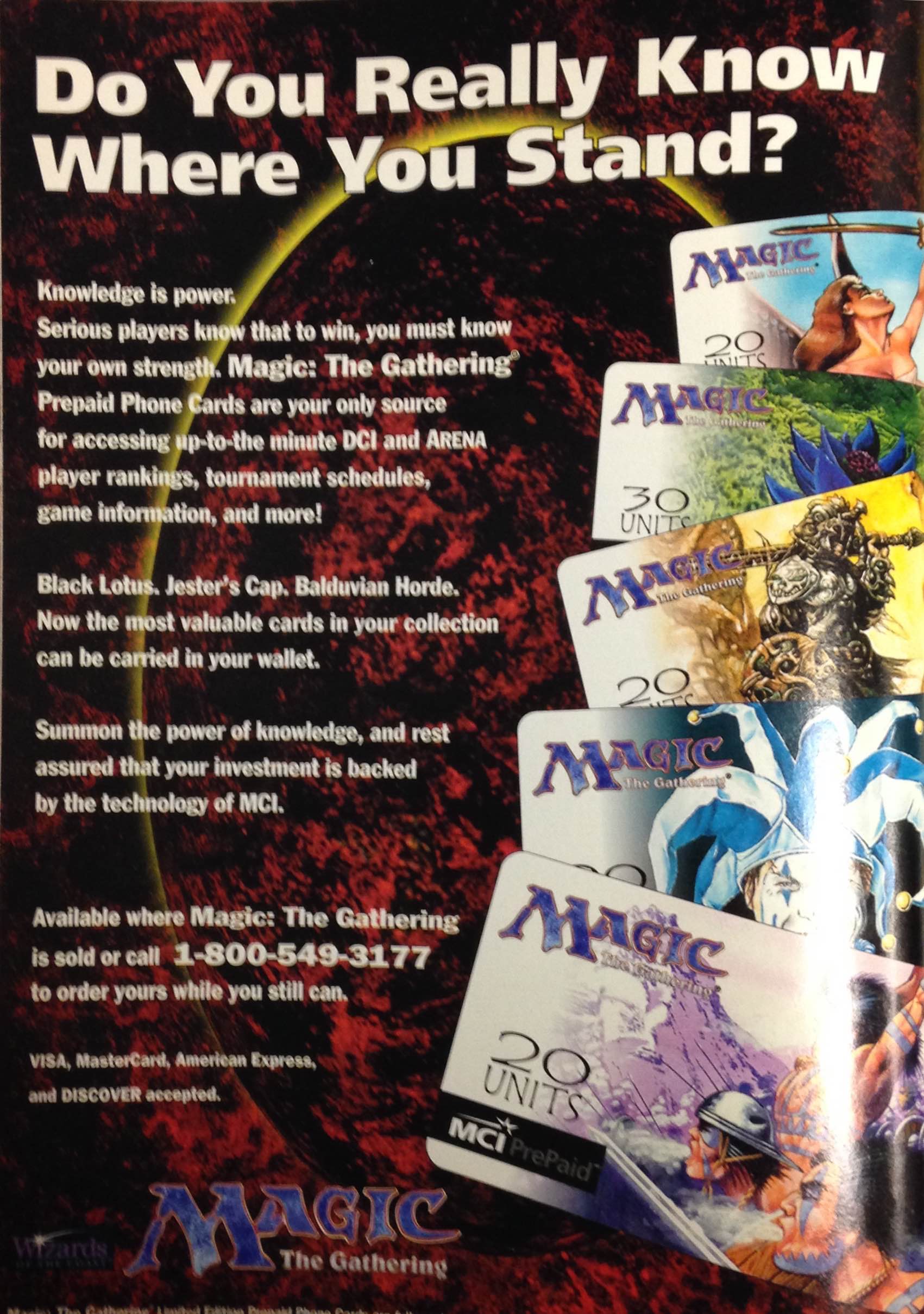
Magic-themed prepaid phone cards. You can't make this stuff up.

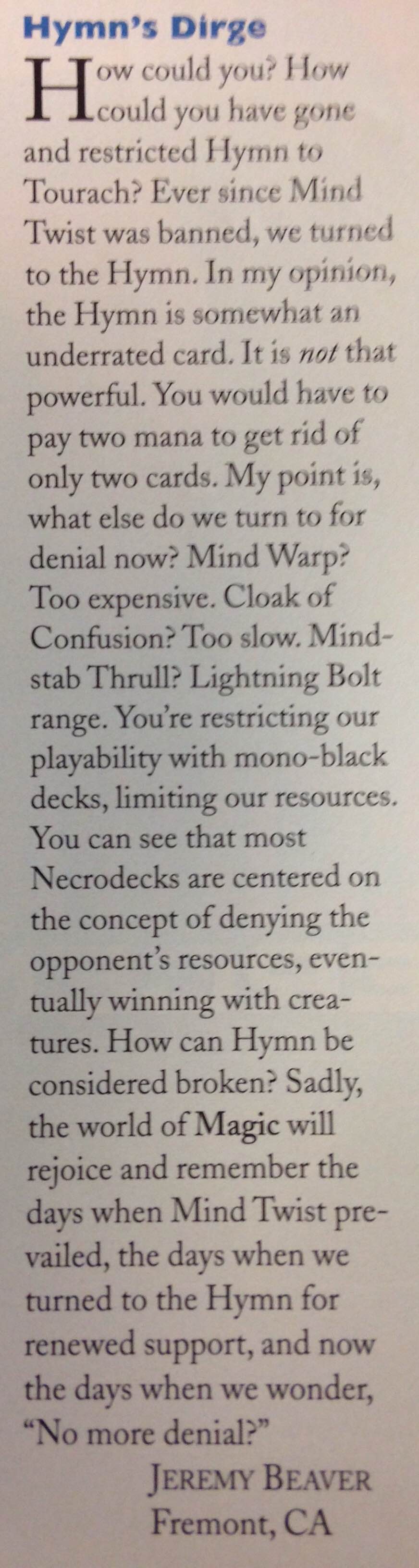
Here we have someone  who made a real-life argument asking, "How can Hymn be considered broken?"

IMG_5101

And here's a reminder that RDW has changed, man:

IMG_5391

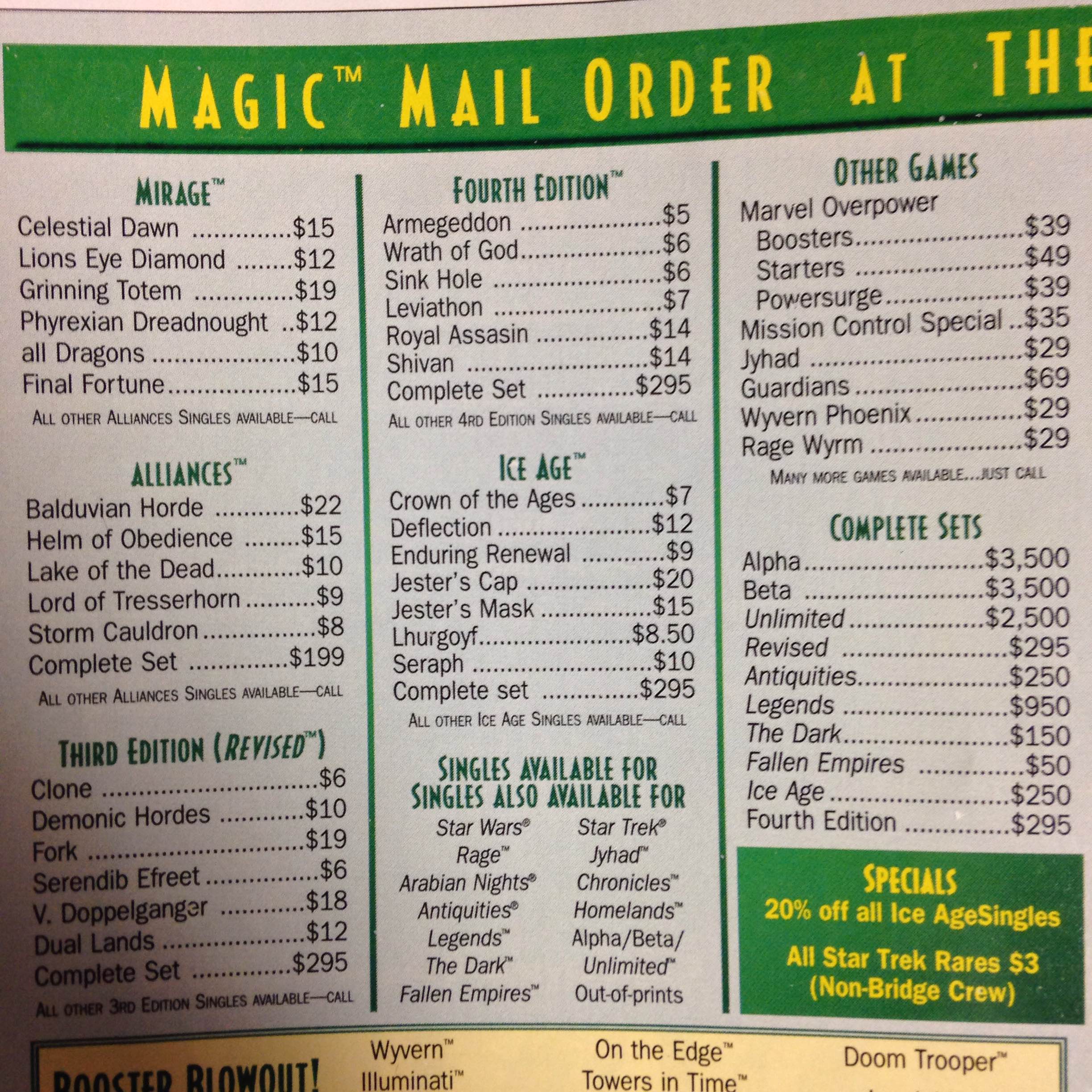
It wouldn't be a classic Magic magazine without some classic Magic prices, and even though there's no price guide, there are ads:

IMG_5394 (1)

I'm actually surprised Lion's Eye Diamond was at $12, given how bad everyone thought it was at the time. And how would you like to complete a 40-set of dual lands for less than $500? Ah, 1997.

Finally, let's close with a picture of a young Mark Rosewater in jester's garb:

IMG_5100

Gooooooooooood stuff. Have a great weekend, everyone!

Avatar photo

Danny Brown

Danny is a Cube enthusiast and the former Director of Content for Quiet Speculation.

View More By Danny Brown

Posted in FreeTagged 3 Comments on Highlights from The Duelist #15

Have you joined the Quiet Speculation Discord?

If you haven't, you're leaving value on the table! Join our community of experts, enthusiasts, entertainers, and educators and enjoy exclusive podcasts, questions asked and answered, trades, sales, and everything else Discord has to offer.

Want to create content with Quiet Speculation?

All you need to succeed is a passion for Magic: The Gathering, and the ability to write coherently. Share your knowledge of MTG and how you leverage it to win games, get value from your cards – or even turn a profit.

Dragons of Tarkir Limited Set Review – Gold and Artifacts

Are you a Quiet Speculation member?

If not, now is a perfect time to join up! Our powerful tools, breaking-news analysis, and exclusive Discord channel will make sure you stay up to date and ahead of the curve.

Boom. Midnight tonight is the first chance at a prerelease and I am stoked. I didn't even play in the last one so I am doubly stoked for this one. I plan to do a few events and I hope that if any of you have any stories about busted opens, sick plays or hot trades, you'll regale us all next week in the comments section or on the forums.

LSV finished the set off with the review of gold cards, lands and artifacts. He also picked the best rares and mythics in the set, which is cool, but most rares and mythics just go in the deck and then you win.

He also called Pacifism the best common in the set, which is hard to argue with. There were two green and two blue commons in the Top 5 which is also relevant. Black has decent removal, but blue's tricks are just as good as removal given their tempo swing and blue's superior creatures. Zephyr Scribe is just nutty and I can see that really swinging games in your favor to as great an extent as any looter in history. Do yourself a favor and read the important cards so you don't have to read them when you should be building. This format is not quite what we're used to and building could be tough especially if all of your rares are bad or in awkward colors.

He really hates every artifact in the set except the 6 mana 4/4 flier. I hope you caught that he hates Gate Smasher for example because that card is going to get played a lot tonight but it really shouldn't. Vial of Dragonfire is a bummer, but it may get there in draft if you get a bunch on top of getting a Renowned Weaponsmith. All in all, artifacts are super bad.

It wasn't just LSV reviewing stuff. The Brainstorm Brewery financial set review also came out, helping you figure out what to trade for. If I had to call the most underpriced card in the set, I'd say it's Thunderbreak Regent but the day after we all talked about how much we like the card, it was announced as a precon card. Oh well! Thunderbreak Regent may only work in red, but it's very saucy. There are a few other gems buried in this episode, so give it a listen before the prerelease tonight.

Good luck, and let us know how you did on Monday!

Avatar photo

Jason Alt

Jason Alt is a value trader and writer. He is Quiet Speculation's self-appointed web content archivist and co-captain of the interdepartmental dodgeball team. He enjoys craft microbrews and doing things ironically. You may have seen him at magic events; he wears black t-shirts and has a beard and a backpack so he's pretty easy to spot. You can hear him as co-host on the Brainstorm Brewery podcast or catch his articles on Gatheringmagic.com. He is also the Community Manager at BrainstormBrewery.com and writes the odd article there, too. Follow him on Twitter @JasonEAlt unless you don't like having your mind blown.

View More By Jason Alt

Posted in FreeTagged , , , , 1 Comment on Dragons of Tarkir Limited Set Review – Gold and Artifacts

Have you joined the Quiet Speculation Discord?

If you haven't, you're leaving value on the table! Join our community of experts, enthusiasts, entertainers, and educators and enjoy exclusive podcasts, questions asked and answered, trades, sales, and everything else Discord has to offer.

Want to create content with Quiet Speculation?

All you need to succeed is a passion for Magic: The Gathering, and the ability to write coherently. Share your knowledge of MTG and how you leverage it to win games, get value from your cards – or even turn a profit.

“Masters of Modern” is now “Modern Nexus”

Are you a Quiet Speculation member?

If not, now is a perfect time to join up! Our powerful tools, breaking-news analysis, and exclusive Discord channel will make sure you stay up to date and ahead of the curve.

modern_nexus_lg

If you came here looking for the exciting new Modern-only site, Masters of Modern, don’t worry! You are still in the right place. Modern Nexus is the same site with the same content, coverage, and quality that we promised in the original site. The only thing that we’ve changed is our name.

[wp_ad_camp_1]

 
When we started this project, we were very excited to find the mastersofmodern.com domain name was available. Between this discovery and all the other hard work that went into site launch, we made a mistake and didn’t check who else might be using that name, even if they didn’t have the domain. Shortly after launch, we learned about a podcast, The Masters of Modern, focused on Modern coverage. The podcast had been around for 6 months at the time of our launch.

In the interest of keeping both “brands” distinct, we switched our name over to Modern Nexus. We believe this will work out best for MMCast, for our site, and most importantly for the broader Modern community.

So switch over your bookmarks and update your Twitters because Modern Nexus is here to stay!

Ponder Shuffle Episode 6- Once More With Dargons

Are you a Quiet Speculation member?

If not, now is a perfect time to join up! Our powerful tools, breaking-news analysis, and exclusive Discord channel will make sure you stay up to date and ahead of the curve.

Jens and Ryan review the fully spoiled Dragons of Tarkir set just in time for this weekend's pre-release!

Avatar photo

Ryan Overturf

Ryan has been playing Magic since Legions and playing competitively since Lorwyn. While he fancies himself a Legacy specialist, you'll always find him with strong opinions on every constructed format.

View More By Ryan Overturf

Posted in FreeLeave a Comment on Ponder Shuffle Episode 6- Once More With Dargons

Have you joined the Quiet Speculation Discord?

If you haven't, you're leaving value on the table! Join our community of experts, enthusiasts, entertainers, and educators and enjoy exclusive podcasts, questions asked and answered, trades, sales, and everything else Discord has to offer.

Want to create content with Quiet Speculation?

All you need to succeed is a passion for Magic: The Gathering, and the ability to write coherently. Share your knowledge of MTG and how you leverage it to win games, get value from your cards – or even turn a profit.

Brainstorm Brewery Dragons of Tarkir Set Review

Are you a Quiet Speculation member?

If not, now is a perfect time to join up! Our powerful tools, breaking-news analysis, and exclusive Discord channel will make sure you stay up to date and ahead of the curve.

It's that time again, the time when everyone is going to look ahead to Dragons of Tarkir! Also, it's that time when we all do set reviews.

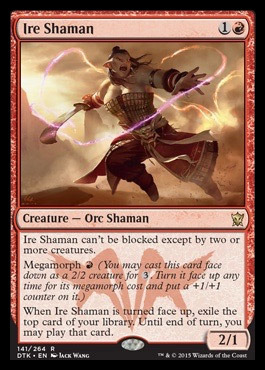
ireshaman

At Brainstorm Brewery we're no different, and we spent the week on the podcast turning in a two-hour review of every Rare and Mythic.

I'm sure we're right on some, wrong on plenty, but enjoy it regardless! You can find the full episode here. 

Avatar photo

Corbin Hosler

Corbin Hosler is a journalist living in Norman, Oklahoma (also known as the hotbed of Magic). He started playing in Shadowmoor and chased the Pro Tour dream for a few years, culminating in a Star City Games Legacy Open finals appearance in 2011 before deciding to turn to trading and speculation full-time. He writes weekly at QuietSpeculation.com and biweekly for LegitMTG. He also cohosts Brainstorm Brewery, the only financial podcast on the net. He can best be reached @Chosler88 on Twitter.

View More By Corbin Hosler

Posted in Feature, Finance, Free3 Comments on Brainstorm Brewery Dragons of Tarkir Set Review

Have you joined the Quiet Speculation Discord?

If you haven't, you're leaving value on the table! Join our community of experts, enthusiasts, entertainers, and educators and enjoy exclusive podcasts, questions asked and answered, trades, sales, and everything else Discord has to offer.

Want to create content with Quiet Speculation?

All you need to succeed is a passion for Magic: The Gathering, and the ability to write coherently. Share your knowledge of MTG and how you leverage it to win games, get value from your cards – or even turn a profit.

Insider: The Cheapskate’s Guide to Long-Term Pickups from THS and KTK Blocks

Are you a Quiet Speculation member?

If not, now is a perfect time to join up! Our powerful tools, breaking-news analysis, and exclusive Discord channel will make sure you stay up to date and ahead of the curve.

I'm a cheapskate. I don't like to pay full price for anything, and I'll happily wait for months or sometimes even years to pick up cards, videogames, or electronics for which I don't want to overpay.

To that end, I have very little in my collection that is currently in Standard. Sure, there are lots of cards I would like to add to my cube or various decks, but unless I need something for a tournament, I'd rather make my purchases at absolute floor prices and not feel like I paid extra money to own a card a little sooner.

Of course, different cards perform in vastly different ways, so you have to take each one as an individual case study to really know when is the best time to pick a card up. So if you have your eye on Standard cards for Cube, Commander, eternal formats, or any other reason, here's a breakdown of some of the priciest cards (more than $5 TCGplayer median) in the format.

Theros Block Pickups

Some cards have so much demand from outside of Standard that it is unlikely they will drop much, if at all, upon rotation. One of the best examples from Theros for this kind of card:

There was an error retrieving a chart for Thoughtseize

Thoughtseize is unlikely to ever be found under $20 again, unless it's reprinted in the next couple years. Given how much players generally hate it, it seems unlikely a mass reprinting is on the way anytime soon.

I think this is a perfectly fine pickup moving forward. Yes, it sees a ton of play in Standard, but given that this was a $70 card before Theros came along, I don't expect retailers to drop the price too much. Remember, players are getting more savvy about MTG finance in general, and there likely won't be a mass sell-off of Thoughtseize once it rotates.

There aren't many other cards in this boat. Xenagos, the Reveler is down to around $6, and I would be shocked if it ever dipped lower than $5. You can probably pick this one up with impunity. Additionally, Eidolon of the Great Revel has established itself as a Burn staple. There's a good chance this one is more expensive when it rotates, especially given the general lack of value in Journey into Nyx.

Finally, Nykthos, Shrine to Nyx may already be on its way up from its floor. Then again, if it doesn't see a lot of play in Modern, it could easily drop down below $4 after rotation. Keep an eye on the amount of Modern play this sees in the next six months.

Don't Pick These Theros Cards Up Yet

If you're the type to regret a purchase made before a price goes down, the following cards should be avoided like the plague until after rotation or some other factor causes their prices to dip significantly. Each of these cards derives most of its value from Standard play (competitive and casual), and rotation will have a devastating effect on all of them:

Theros Cards With Value Tied to Standard

Additionally, although not all the scrylands are over $5, none of them are good pickups right now. They see Standard play, but haven't proven themselves outside of that format. Each should be available from $1 to $3 after rotation.

Most of the gods are a higher price than I would think, too. I don't know if this is from casual Standard play (FNM and the like) or from straight-up casual format demand (read: Commander), but I would be shocked if any of the gods were at their floors right now, except for the ones already close to bulk mythic pricing.

Theros Block Question Marks

There's one exception to my statement about the Theros gods above: Keranos, God of Storms. This card has seen one-of play in Modern control sideboards, and given that it's a mythic from a small spring set, $10 may be the cheapest we see it from now on. It jumped to over $15 a few months back, so it could have more to fall, but price memory should keep it from falling too much.

There was an error retrieving a chart for Keranos, God of Storms

Brimaz, King of Oreskos should lose significant value at rotation, but I would not be surprised to see a Voice of Resurgence-effect happen in this case. What else from the set has value? If you're dying to pick up a Brimaz, it may not be as overpriced as it seems, despite lacking tons of Standard play. The same is true of Ajani, Mentor of Heroes, since Journey into Nyx was also mostly devoid of valuable cards.

Finally, Mana Confluence at $10 is a big question mark for me. This is the kind of card that is really needed when a deck needs it, but generally ignored when mana bases are okay. Its amount of play in Modern moving forward should dictate whether this goes down or up from here. Its $10 price tag might also just be the right long-term price tag for it.

Khans of Tarkir Buys

Discussing the more recent block in this capacity gives us some very different kinds of ifs and buts. Basically, there are only five cards that I think are clear buys at this point.

There was an error retrieving a chart for Polluted Delta

With the draft format moving away from Khans of Tarkir, only a tiny amount of fetchlands will be opened in Fate Reforged packs moving forward. We may not have hit the floor yet, but I imagine we will within the next four to six weeks. Everybody remembers what happens to the Zendikar fetchlands, and like I said above, players in general are more savvy about MTG finance these days. Don't expect fetches to drop much further.

Khans of Tarkir Is Different

Here's the thing: we have peak Khans supply at this time, and after Theros rotates, a lot of Khans cards will go up. In particular, I think these two cards are worth mentioning:

There was an error retrieving a chart for Sarkhan, the Dragonspeaker
There was an error retrieving a chart for Wingmate Roc

If you pushed me to name post-Khans-rotation prices on these cards, I'd say $6 and $3 respectively, which is lower in both cases. However, there's a very good chance that these cards see pronounced increases if they become major parts of the post-Theros metagame.

That said, I almost exclusively only speculate on Standard cards during the summer, when prices are historically at their lowest. Nonetheless, it could we worth keeping an eye out on good deals for these two cards.

Fate Reforged Is Expensive

In many cases, cards from Fate Reforged are way more expensive than I would expect based on the amount of play they see in various formats. It's especially weird because there are lots of pricey cards in this set—we're not looking at a Voice of Resurgence effect for one or two cards.

Ugin, the Spirit Dragon and Monastery Mentor both strike me as cards that are simply too expensive, and I'm keeping far away from both. Yes, they're powerful, but they started way too high and we're still seeing the effects from that.

Mid-value cards like Soulfire Grand Master, Whisperwood Elemental, Tasigur, the Golden Fang, Shaman of the Great Hunt, and Warden of the First Tree will all probably go down from here while still in Standard. They will almost certainly go down after they rotate.

Don't pick these up yet if you're just looking for your long-term copies. As for whether these are worth speculating on for Standard, let's revisit that this summer.

There was an error retrieving a chart for Tasigur, the Golden Fang

Khans of Tarkir Question Marks

Siege Rhino is an interesting card. It's a rare from a large fall set, and by being around $8 at this point in its life, it's already exceeded all expectations. Modern play, and lots of it, helps buoy Rhino's price, but it's also the card to beat in Standard.

All this means that the future of Rhino is hard to predict. On one hand, it requires a very specific deck to be able to play it, given that it's three colors. It's a rare from a hugely opened and very popular large set, meaning there are tons in existence. But it's also a four-of in the deck that had 30 percent of players running it at the last Pro Tour. I have to plead the fifth on this one—I just don't know what the financial future of this card is.

The same is true of Dig Through Time. Its price very much reflects Modern play that is now banned, and it hasn't been adopted to nearly the same extent in Legacy. Like Rhino, it's a rare from a large fall set. I'm a little more comfortable in saying that this will likely go up over time, but only just a little. The Modern banning makes things difficult.

For completion's sake, I have two more cards I haven't mentioned that are more than $5 according to TCGplayer's median price: Anafenza, the Foremost and Sorin, Solemn Visitor. In the right circumstances, these could go up next Standard season, but not before they lose more value this summer. In the long term, these are clear post-rotation buys. I'd keep away for now.

Cheapskates Unite

I hope I saved you money for this article. It can be hard to have the patience to wait to buy until just the right time, but if you're the type of person who kicks himself over spending too much on a card, that patience is exactly what you need to develop. Until next time!

Eric Froehlich Joins Constructed Resources

Are you a Quiet Speculation member?

If not, now is a perfect time to join up! Our powerful tools, breaking-news analysis, and exclusive Discord channel will make sure you stay up to date and ahead of the curve.

After losing Jon Loucks before the show barely had a chance to get started, it looked like Constructed Resources was dead. But that was not to be its fate! Today it was announced that Eric Froehlich, poker pro and four-time pro-top top-eight competitor, is joining the show.

220px-Eric_Froehlich

A couple years ago, I wouldn't have thought this was good news. Froehlich was prone to go on unproductive rants on Twitter pretty frequently, picking fights and generally causing commotion (I feel like a should add a "young whippersnapper" here or something, even though we're about the same age).

That said, Efro appears to have genuinely mellowed out since then, and I really enjoy hearing from him on podcasts and Vintage Super League matches. His guest spot on Limited Resources (immediately before Luis Scott-Vargas officially took over the cohost role) was excellent, and I half expected the announcement of him taking over to come shortly after. Instead we got LSV, which is awesome, and now Efro on Constructed Resources, which is also awesome.

My biggest hope is that this means lots of Vintage talk, and maybe Legacy and Modern, too. What do you hope to see from CR moving forward?

Avatar photo

Danny Brown

Danny is a Cube enthusiast and the former Director of Content for Quiet Speculation.

View More By Danny Brown

Posted in Free1 Comment on Eric Froehlich Joins Constructed Resources

Have you joined the Quiet Speculation Discord?

If you haven't, you're leaving value on the table! Join our community of experts, enthusiasts, entertainers, and educators and enjoy exclusive podcasts, questions asked and answered, trades, sales, and everything else Discord has to offer.

Want to create content with Quiet Speculation?

All you need to succeed is a passion for Magic: The Gathering, and the ability to write coherently. Share your knowledge of MTG and how you leverage it to win games, get value from your cards – or even turn a profit.

Want Prices?

Browse thousands of prices with the first and most comprehensive MTG Finance tool around.


Trader Tools lists both buylist and retail prices for every MTG card, going back a decade.

Quiet Speculation