menu

What Constitutes a Casual Magic Player?

Are you a Quiet Speculation member?

If not, now is a perfect time to join up! Our powerful tools, breaking-news analysis, and exclusive Discord channel will make sure you stay up to date and ahead of the curve.

The term "casual player" is a loaded term in our community. It definitely brings about a certain image in a Magic player's mind: a Commander or Cube enthusiast who loves durdly six-drops and other "bad" cards.

Outside of Magic, though, the term "casual gamer" means something entirely different. A casual gamer can be your grandma occasionally playing Wii Sports, or a middle-schooler playing Candy Crush, or a college student putting in an hour a week on his roommate's console. In each case, "casual" tends to denote a lack of time, commitment, and money to gaming as a hobby.

How does that apply to what Magic players usually termed casual players? The Commander crowd in my hometown is at the LGS almost every night. A bunch of them play with all-foil decks. They spend years upgrading and perfecting these decks. There's certainly no lack of time, money, or commitment.

Not only do these "casual players" commit more time and money to this hobby than one might expect someone who is casual to do, but "casual" formats like Commander single-handedly drive the prices of cards like Chromatic Lantern, which see no play in any other formats at all, but still fetch foil prices of nearly $20.

There was an error retrieving a chart for Chromatic Lantern

Especially considering the fact that many use the term disparagingly, it seems questionable to call these highly committed players "casual." I've been playing a lot of the Dark Souls series over the last few months and have recently started watching some streams. Streamers tend toward one of two styles: speed runs and challenge runs.

Speed runs are just what they sound like: an attempt to beat the game in as little time as possible. Challenge runs involve specific restrictions—keeping a torch burning throughout the entire game, using a specific (and often weak) weapon, or downloading a mod that adds some extra challenge.

We can draw a parallel to Magic from this. Speed runners are like tournament players: looking to optimize a strategy and use it to its best effect. Challenge runners are like Commander players: adding some additional rules and some extra challenges to make the game more involving and enjoyable. Although each group has its own set of goals, tendencies, and priorities, it's hard to say that one is more dedicated to the game than the other.

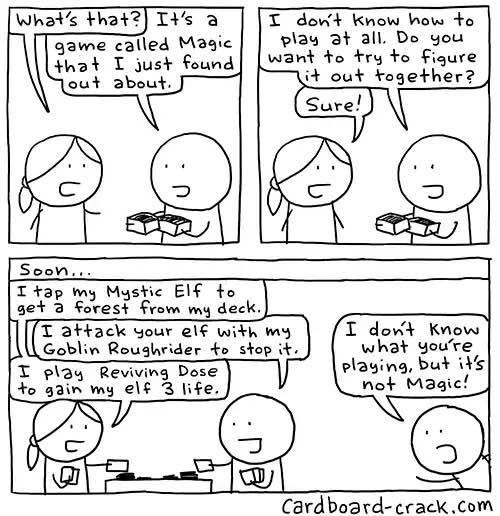
The true casual players in Magic are the ones you've never met. They're the ones who buy a precon and never update it. The ones who buy a pack every other time they go to Target but never trade, sell, or buy individual cards. They're the ones who play like this:

IMG_3626
Cardboard Crack

So be nice to Commander and Cube players. They're just as committed to this game as the tournament grinders—they just have different priorities. Maybe a term other that "casual" is in order.

Insider: The Three Pillars of Standard – Success in Today’s Format

Are you a Quiet Speculation member?

If not, now is a perfect time to join up! Our powerful tools, breaking-news analysis, and exclusive Discord channel will make sure you stay up to date and ahead of the curve.

Back in the days of Caw-Blade, it was commonly discussed whether or not cards failed the "Jace test".

If you're unfamiliar with this expression, it essentially measured the impact that a given card would have against an opponent controlling Jace, the Mind Sculptor.

There was an error retrieving a chart for Jace, the Mind Sculptor

An interesting card from this era was Hero of Bladehold, a card that would be excellent in most Standards. The fact that it would just get bounced and never do anything against Jace meant that it failed the Jace test and was not prime for Standard play.

While the Jace test itself is a rather antiquated piece of jargon, it does establish the way that we need to think if we are to solve a format.

Prior to Jace's dominance of Standard Jace, didn't see much of any play as it failed the Bloodbraid Elf test. Jund Standard and Caw-Blade Standard made it pretty easy to decide what was playable as the Jace and Bloodbraid Elf tests were really all that mattered given the relative dominance of both decks.

Solving the current Standard, however, involves passing multiple such tests.

For example, it's pretty tough to look at an individual card and say that it's good against Goblin Rabblemaster and Whip of Erebos. In formats as open as today's Standard, the question becomes more of whether your general strategy is positioned well against the gauntlet of the format's pillars.

That is, you'll need to have either diversified answers or a strategy that can beat some and ignore others. When preparing for a Theros-Khans Standard tournament, these are the important tests to put your deck to:

The Goblin Rabblemaster and Heroic Test

I lump the heroic deck and any Goblin Rabblemaster deck together because if you're unable to quickly and efficiently answer creatures, you'll fold to both.

The inclusion of protection spells in the heroic decks and the ability of Rabblemaster to win games by itself makes me weary of playing a deck without a very healthy number of removal spells. I like having eight maindeck with the ability to sideboard into more.

Notably, the Rabblemaster test is more easily passed with a handful of quality blockers, but that strategy proves much weaker against the God's Willings and Aqueous Forms of the Heroic decks.

To pass these tests, you need to be able to kill a lot of creatures dead or to win very quickly. Most of the very fast decks of the format are red decks, so they'll almost incidentally be able to accomplish both goals.

I've said it before and I'll likely say it many times--Searing Blood is a very underplayed card that helps both slow the fast decks down while also working to remove the opponent from the game.

There was an error retrieving a chart for Searing Blood

The Siege Rhino / Wingmate Roc Test

These two lump together more seamlessly than the above tests, as if you have trouble dealing with one of these cards, you're probably not positioned exceptionally against the other. And, you know, because they're both cornerstones of the PT winning Abzan deck.

There was an error retrieving a chart for Siege Rhino
There was an error retrieving a chart for Wingmate Roc

Five toughness or two bodies make life very challenging for red decks trying to win in combat. Goblin Rabblemaster can help overpower these monsters, but your Abzan opponents will assuredly have the Rabblemaster test in mind.

In order to beat these cards with faster decks, you'll have to bank on cards like the aforementioned Aqueous Form or just be really fast. Unrealistically fast.

More likely, a deck like Jeskai will need access to something like Nullify or Disdainful Stroke to stop these monsters from ever entering play. Alternatively, the various Jeskai Ascendancy combo decks can choose to ignore the creature part of the Abzan strategy by going infinite with their namesake card.

If you want to go over the top, Hornet Queen is really the way to go. If you get to the point where you're casting Hornet Queens against Abzan, it's going to be tough for them to break through.

Speaking of Hornet Queen...

The Hornet Queen Test

So, this card is real.

There was an error retrieving a chart for Hornet Queen

Now, this one is easily slower than the aggressive decks. The plan against Hornet Queen decks for beatdown decks is almost always going to be to just be faster.

Realistically, Hornet Queen is going to be the problem for the decks that dedicated too many slots passing the Goblin Rabblemaster test. End Hostilities is a great way to sweep one Hornet Queen, but it's rare that you'll see the Queen in a deck without Whip of Erebos.

All told, Queen + Whip might be as over the top as you can go. I fully recommend trying to go under Hornet Queen unless you're really into the Queen Whip decks. It's going to be very difficult to beat them in any long games.

The major exception to this is the Perilous Vault control decks, though they are held back mostly by their own inadequacies--that is, they play a lot of lands and don't generate much card advantage. If they stumble, they usually fall.

Putting it All Together

So, if we want to pass all three of the above tests, then it looks like we need to be low to the ground with our removal while either being faster than Siege Rhino or at least comparable to Siege Rhino without being cold to Hornet Queen.

If we believe this is a formula for success, then it's not surprising that Brad Nelson Top 8'd a recent Standard Open with the following list:

Four Color Midrange

spells

3 Butcher of the Horde
2 Satyr Wayfinder
4 Siege Rhino
4 Sylvan Caryatid
4 Courser of Kruphix
1 Ajani, Mentor of Heroes
2 Elspeth, Sun's Champion
2 Sarkhan, the Dragonspeaker
3 Chained to the Rocks
4 Crackling Doom
4 Lightning Strike
2 Murderous Cut

lands

2 Forest
3 Mountain
1 Swamp
2 Bloodstained Mire
1 Llanowar Wastes
2 Mana Confluence
2 Nomad Outpost
4 Sandsteppe Citadel
4 Temple of Plenty
4 Wooded Foothills

sideboard

2 Utter End
3 Xenagos, the Reveler
4 Anger of the Gods
2 End Hostilities
1 Glare of Heresy
3 Thoughtseize

How good is Chained to the Rocks? Any deck that can make this card work should be playing it. It passes the Rabblemaster and Siege Rhino test with flying colors and also helps us race Hornet Queen and makes it more difficult to raid a Wingmate Roc. I'm not in love with the mana here, but Chained to the Rocks is easily worth stretching for.

Anger of the Gods is an excellent sideboard option as it helps beat the aggressive decks as well as removing a Sidisi and/or Hornet Queen from the game along with all of their little tokens.

At a glance, this deck looks like it struggles the most with the Hornet Queen test, and this piece of sideboard technology definitely helps this while having high utility in other places.

There was an error retrieving a chart for Anger of the Gods

Earlier this week, Jacob Van Lunen posted a pretty crazy list that is very similar but poses a maindeck way to go over the top of Hornet Queen. One that probably isn't on many people's competitive radars:

Two Baneslayers

spells

4 Courser of Kruphix
4 Rattleclaw Mystic
4 Sylvan Caryatid
3 Chromanticore
4 Siege Rhino
1 Fleecemane Lion
4 Goblin Rabblemaster
4 Lightning Strike
4 Crackling Doom
2 Magma Jet
2 Mardu Charm

lands

4 Nomad Outpost
4 Sandsteppe Citadel
4 Mana Confluence
4 Wooded Foothills
3 Forest
2 Mountain
1 Windswept Heath
1 Plains
1 Llanowar Wastes

I think it's pretty clear which slots in this deck are arguably a little rough, but the real talker here is this gem:

There was an error retrieving a chart for Chromanticore

The lifelink definitely helps combat its troubles both with its own manabase and with aggressive decks, but its the first strike granted by Chromanticore that gives it the potential to be a real player. If you're crazy enough to try to go over the top of Hornet Queen, then I'd recommend jamming something similar to this.

I wouldn't go nuts speculating on Chromanticore just yet (though I'm sure many have), but this deck is not one that I would immediately disregard. I'd probably cut the Fleecemain Lion and turn the Mardu Charms into something more efficient, but the core (get it?!) of this deck looks real.

~

Whether your plan is to go way over the top with Chromanticore, be faster than everybody with a Heroic build or to try to be uninteractive with Jeskai Acendancy, it's crucial that you know what your answers are to these three pillars of the format. Failing any of these tests will greatly hinder your shot at success in today's Standard.

Thanks for reading.

-Ryan Overturf
@RyanOverdrive on Twitter

Which Cards in Cube Will You Just Not Pass?

Are you a Quiet Speculation member?

If not, now is a perfect time to join up! Our powerful tools, breaking-news analysis, and exclusive Discord channel will make sure you stay up to date and ahead of the curve.

As I dove headfirst into the Legacy Cube over the weekend, it made clear to me that I have some pretty specific preferences. This isn't all that unique—we all have them.

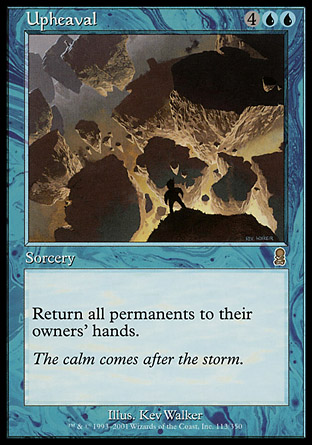
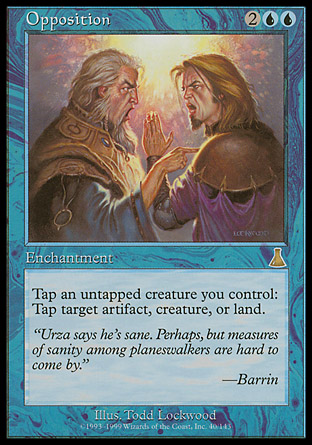
For example, there is nothing more painful to me than passing Upheaval. The level of disgust I feel for my fellow drafters when I see a late Upheaval going around the table is, to say the least, pronounced. The same goes for Opposition. If one of those rolls around in the middle of pack one, I'll happily abandon whatever else I was doing and get started on a new plan.

upheaval   opposition

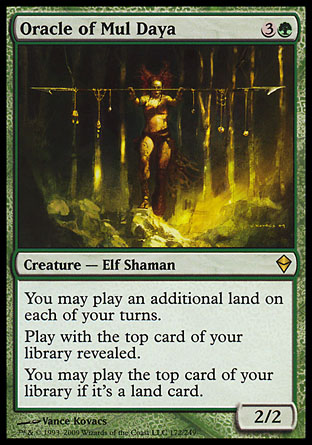
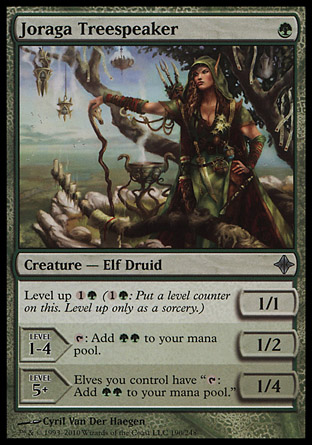
Maybe it's because I'm always hoping to get that late Upheaval, but I also really love ramp. Artifact ramp like Worn Powerstone and Thran Dynamo always catches my eye, but that can go in any (non-aggro) deck. What I hate passing are my two favorite green ramp cards in the cube:

oracleofmuldaya   joragatreespeaker

I'm also not a fan of passing Noble Hierarch if I can help it, but seeing either the Oracle or the Treespeaker early will push me into a green ramp plan pretty darn quick. There's just something that feels great about having access to twice as much mana as your opponent at all times.

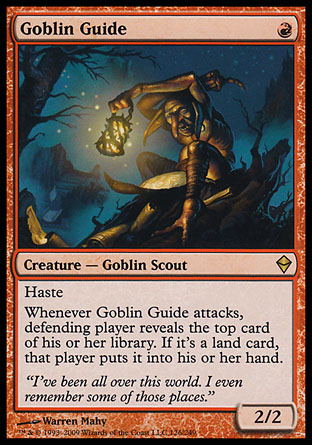
Although I consider myself a blue mage these days, my 1995 roots place me firmly in the red mage camp. I don't force mono-red the way I'll force an Upheaval strategy, but I'm all too happy to jump in if it's obviously open. The best cards for the red deck include Koth of the Hammer, Grim Lavamancer, Shrine of Burning Rage, and Sulfuric Vortex, but I would be hard-pressed to choose those over a good blue card in pack one. The only card I can open that will cause me to instantly jump onto the mono-red bandwagon is this quick little 2/2:

goblinguide

As perhaps the best aggressive one-drop ever printed, this isn't exactly a revolutionary stance, but at least I know what can sway me.

Interestingly, I have found that there isn't an individual card in black or white that will cause me to go into those colors. If I first pick a white or black card, it's almost certainly because there's nothing else good in the pack. Rarely will I choose a good white card over a good blue card, or a good black card over a good red card. If I end up with a black or white deck, it's because those colors were overwhelmingly open.

All of the cards above are very, very good, but are probably not the most objectively powerful cards in the cube. They just represent the strategies I prefer to play—ones where I am even willing to play a slightly weaker deck for a more fun experience.

What cards from the Legacy Cube are your unpassables? What card most sickens you to be forced to pass late? And what card will make you completely jump ship on your first several picks if you pick it up late in pack one? Sound off below.

Insider: Corrections – Using MTGO Prices as a Predictor of Paper Price Changes

Are you a Quiet Speculation member?

If not, now is a perfect time to join up! Our powerful tools, breaking-news analysis, and exclusive Discord channel will make sure you stay up to date and ahead of the curve.

Greetings, Confabulators!

In my quest to stop prefacing all of my articles that deal with MODO prices with, "I'm not the guy to ask about MODO Finance," I have looked into MODO a bit more.

Is it because I care about the MODO market? No, not really. The prices don't make any sense to me and I think the effort I expend would be better served elsewhere. Either I lose a bunch of money while I figure out an entirely new system or I learn without investing and waste time I could be making money at a system I understand. Both of those sound pretty lame.

Do I want to improve at speculating in a market where the client is buggy, it takes real effort to convert cards into real cards if I want to sit on them and where buying, selling and trading is a pain in the ass? Still, I think at least paying attention to price changes in MODO is a good idea because they can sometimes forecast price changes in paper prices, a market where prices are a bit more sticky.

So what are some things we should look for and some things we should avoid when we're trying to see if MODO is predicting an imminent price correction?

First, An Aside

I wanted to write about price corrections a bit more broadly, but I feel like you all know the non-MODO stuff well enough to teach it back to me, or at least you'll be able to grok it if you read it elsewhere or someone brings it up. It's not terribly counterintuitive for the most part and doesn't really bear going into a ton, but I think it's at least worth highlighting a topic you understand to establish it as the basis for a lot of the conjecture I did, as well as serving as a touchstone for what comes later.

Let's blow through this quickly. It's going to deal with spread.

There was an error retrieving a chart for Sidisi, Brood Tyrant

We all know what spread is, or, if we don't, we'll quietly nod our heads so everyone else doesn't see that we don't and remember to look it up later. It's the percentage difference between the best buylist price and the best sales price.

A large spread is bad because dealers are buying expensive cards for very little. A low spread is good because dealers are paying close to what they sell the cards for.

A negative spread is both possible and good because it does two things. First, it highlights an opportunity for arbitrage. We all know what arbitrage is, or, if we don't, we'll quietly nod our heads so everyone else doesn't see that we don't and remember to look it up later.

It's basically an opportunity to buy a card at retail for one price and buylist it for more, resulting in very little work on our behalf. It's somewhat misleading to call it "free money" if we don't understand all the factors involved, but it's not a bad way to think of it to point out that it's a good thing.

The second thing it can signal, where arbitrage is onerous or where we think it limits what could be significant upside, is an impending price correction. How do we get spread? Simple--there are two different numbers associated with a card, one influenced by what players are paying and the other by what dealers are paying.

When the dealers want a card in stock, they will raise their buy price. It takes a bit of time for the entire internet to get the message and if middlemen like us are slow or not completely thorough about ferreting hidden copies out, they can sit at the old retail price while the new buy price ratchets up higher than the old retail price. Dealers generally want a card in stock because they plan to sell a lot of them, are selling a lot of them already and need to restock, or because they think they will be able to charge a lot more money in the future.

Why else would they pay more than the card is available for some places at retail? They want the copies now and a strong buylist price increase gets them in. If you're not in a hurry to "arb" the copies off and you can get them, why not wait a minute to see where the new price ends up?

I didn't plan for this brief aside to be so substantial, but these things happen. What does this have to do with MODO?

A Different Kind of Spread

This isn't easy to calculate like the spread we commonly refer to, nor is it as easy to quantify. What I am noticing is that sometimes there is a spread between the prices of a card on MODO and in paper. As the difference between the prices shrinks (it's also possible for this to be negative, especially in wacky cases like random uncommons on MODO) the more it looks like a price correction due.

There's no arbitrage opportunity between paper and MODO, so that simplifies things quite a bit. Still, provided the MODO price started out lower, and it almost always will be at this point, as it approaches the paper price, it's worth noting. Not every "hit" is going to be a potential spec, but every instance is worth mulling over.
Untitled

Untitled

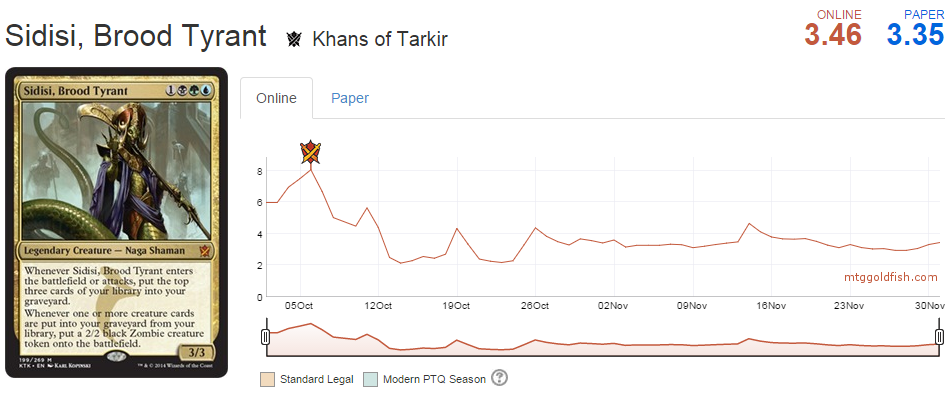
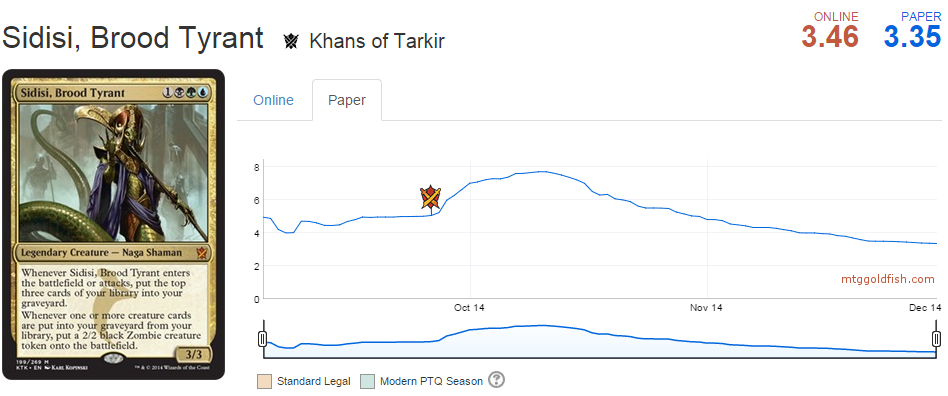
This was the first card I looked at. Now, Sidisi's price is all over the place and while the paper price is on a steady decline from a peak price right after release when it got an undue amount of credit for how good Treasure Cruise and Dig Through Time are, the MODO price has always been a bit too high. Up slightly from its historical low, and up 5% (not great, I know) in the last few days and down a bit today, I took note of the fact that it was on a perceived upward trajectory and decided to see if there was a reason it was up.

I don't think there is, and I certainly don't want to pay its paper price right now. MODO copies are poised to turn into paper copies with greater frequency, I really don't like Sidisi as an EDH general in a world where The Mimeoplasm exists and the card is seeing little play in all formats, so I am inclined to let this sink lower.

Could it hit bulk mythic status? That's the interesting thing--the MODO data paints a less clear picture than the paper data. There are mythics in the set that are already well on their way to junk status. Let's look at their graphs.
Untitled

Untitled

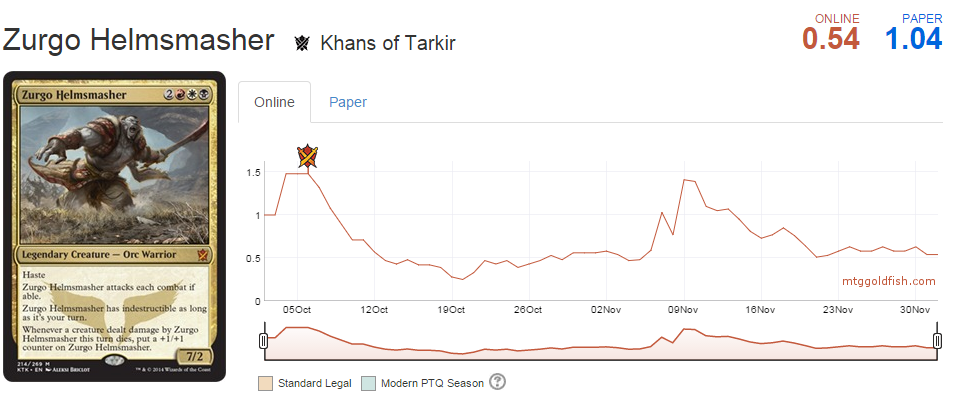
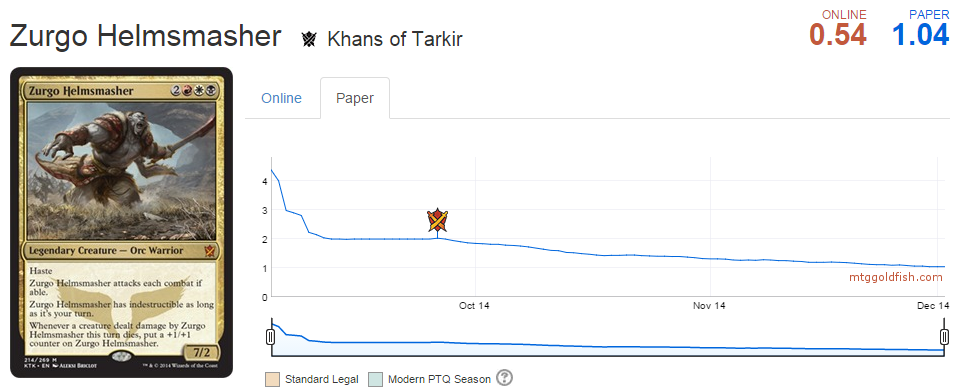
Less B.S. about potential playability coupled with the inclusion in the "Speed vs. Cunning" duel deck has shown us what a real trash mythic in Khans looks like. Again, the paper picture painted is much clearer, but MODO is still showing an overall downward trend, and that's without the interference of duel deck copies.

Sidisi looks as though it might rally. Interesting to note, Zurgo did quite a few fluctuations over the past few weeks, and those "peaks" mean nothing other than changes in supply, probably, and those are around the order of 5%. We're going to have to start demanding a little bit more out of of "rallies" before we can call the card a mover and/or shaker.

What should we do about Sidisi? I am not inclined to do anything right now, but since it isn't behaving like a "normal" trash mythic, it bears looking at. I think it's got a ways to fall yet, but if we see a jump of more than 10% on a daily update on MTGGoldfish, I would take another look. Significant play increases, significant upside in older formats or the peculiarities of MODO are all potential explanations, but the data should make it a little less murky if it starts to spike. I'm starting to think a >5% increase or decrease is attributable to noise more than a signal for cards under 5 tix.

What Looks Better?
Untitled

Untitled

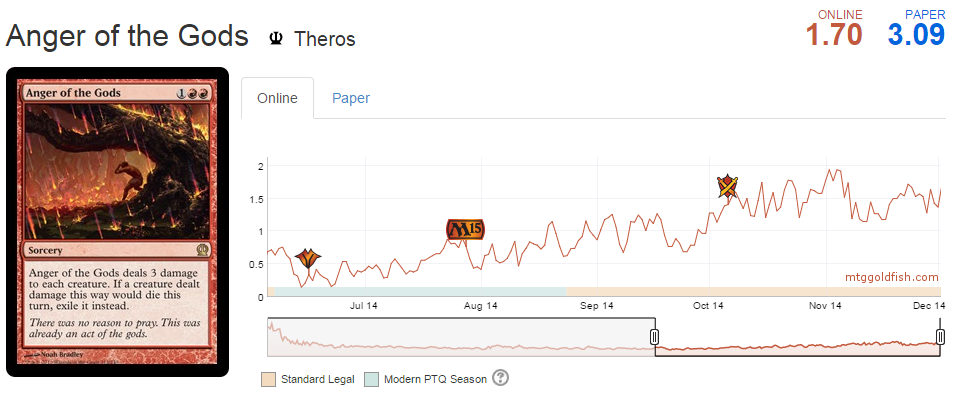
This is what we want to see! We have the MODO price on an upward track while the paper price is falling. The spike in paper is attributable to hype for other formats like Modern where it is dandy at dealing with all sorts of problematic creatures. But with the hype surrounding the card in paper dying down slightly, we're seeing the price attenuate.

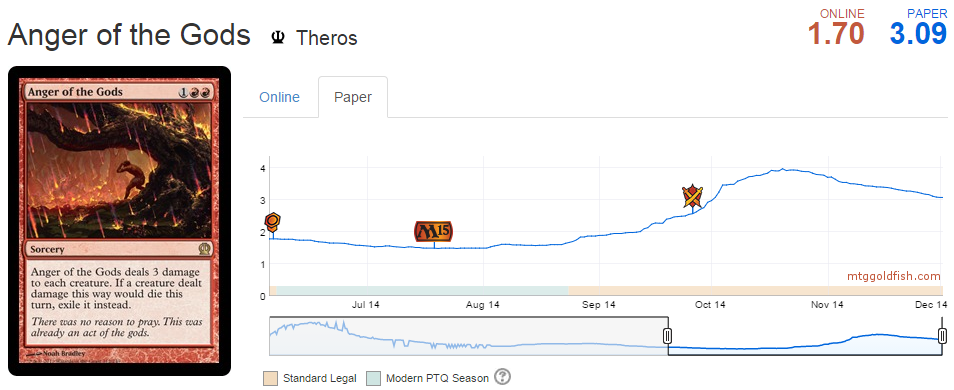
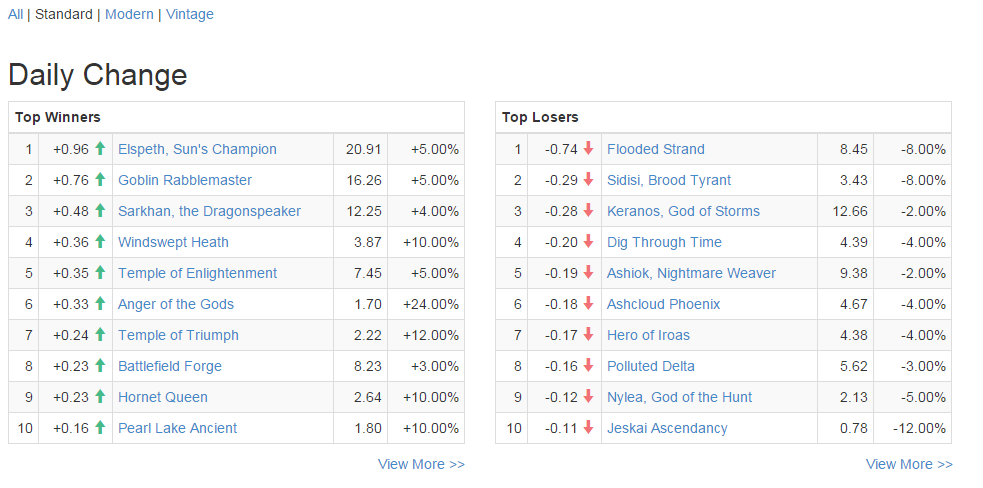
We're at peak supply for the card both in paper and on MODO. No one is drafting this set, no one is redeeming this set and no one is busting a ton of boosters. People who bought in big speculating and couldn't find any greater fools are undercutting each other on the race to the bottom to sell out. Meanwhile, MODO is showing us a rocky but overall steady increase. The card is up 24% just today. If it goes up tomorrow as well, we're looking at a real signal.

Also, while the price in paper is declining, the slope of the downward curve is changing. It fell more sharply initially than it is now. Could this also signal a plateau soon? I don't know, but I do know that no one is really watching this card right now, even me. Its paper price is trending downward so no one gave it a second thought. However, the MODO and paper price are converging slightly.

While I'm not prepared to call this a buy, this is the sort of thing you want to see. There is indeed a ton of noise in the price of Anger, and it could drop by more than 24% in the next day or week and bear that out. Still, this is significant and Anger is a card that is heavily touted somewhat frequently and it's worth paying attention.

Teach a Man to Goldfish

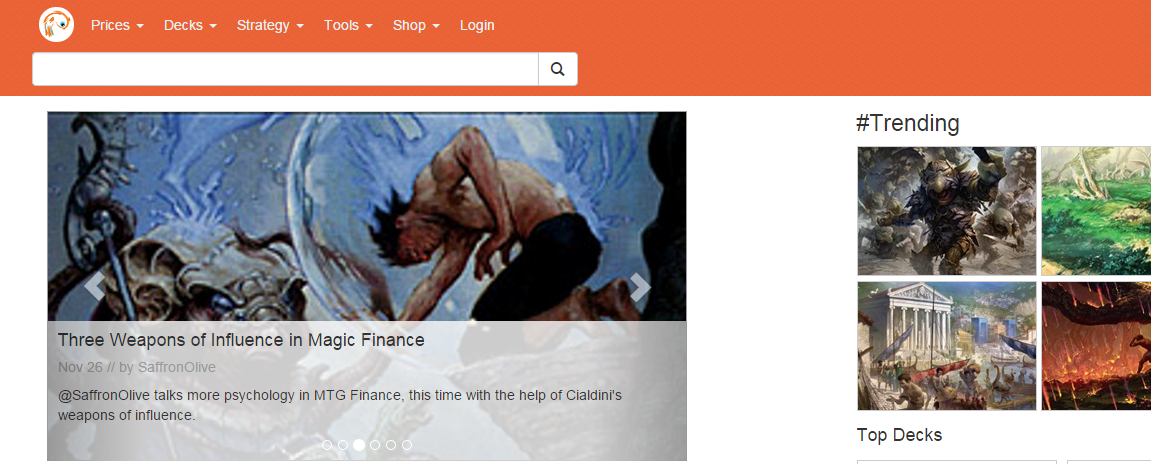
I use quite a few resources to check prices in paper, but for MODO, the best one I have found is MTGGoldfish. I see they're starting to offer articles, and while I am going to refrain from commenting on that, I will say that their pricing utilities for MODO have the kind of features I like to see and their "movers and shakers" page is worth checking out.

Here is how I would work this site into your routine and how you can check for these convergences like we're starting to see with Anger of the Gods in under five minutes a day.

Go to MtgGoldfish.com
Untitled

Click "Prices" in the Upper Left

Untitled

You can go to the "Movers and Shakers" page in the dropdown menu and check the daily and weekly changes lists. You can toggle between formats as well. I think any price increase below 10% is almost solely attributable to noise unless it's repeated over a few days. The Weekly change part is useful in this regard to see if a price change is a fluke or if it's a trend.

Is Temple of Triumph in a new deck? Check MODO dailies to see what's going on. Is Hornet Queen recovering price-wise in paper or is it still on a downward trajectory? Click on the name and check out both the MODO and paper prices. Do we want to start trading for Windswept Heath right now or wait for peak supply? Take about five minutes out of your day to check out this page as part of your routine.

Seeing Jeskai Ascendancy down could signal it's seeing less play in paper and it may be time to try and out it, or it could signal how difficult the deck is to play on MODO and peoples' frustration. Try to reconcile things you see here with trends on paper. A move on MODO could be due to an isolated incident, a MODO peculiarity or metagame preference, but any sign of concerted movement between the two formats can reinforce our inclinations.

As we get to understand the peculiarities of Magic Online a bit better, we will be able to explain a few of the quirks in the price movement moving forward. Other discrepancies are not as easy to explain and could signal an imminent price correction.

Is every card with neagative spread a good arbitrage opportunity or a signal of a price shift? No, of course not. We need to be judicious when we identify them. But we're not going to notice the real "hits" until we start looking, and with a five minute investment per day all that's necessary to discover cards that may start trending on MODO a week or so before paper, it's worth looking.


Insider: [MTGO] Selling and Buying Back – Exploiting Spikes on Cards Already Trending Upwards

Are you a Quiet Speculation member?

If not, now is a perfect time to join up! Our powerful tools, breaking-news analysis, and exclusive Discord channel will make sure you stay up to date and ahead of the curve.

Spikes have always been a part of the speculative landscape of Mtg finance, and on MTGO they are even more marked as buying and selling occur instantly. More than any time before, cards are subject to the wildest speculations and the highest spikes as soon as one ounce of potential has been spotted.

Hot cards rising sharply in a matter of hours is not a phenomenon exclusive to Pro Tour and Grand Prix results any more. New cards freshly spoiled, SCG tournament results, Travis Woo's brews and other social media buzzes now also contribute to send prices through the roof.

Dealing with traditional spikes is pretty straight forward--buy as many cards as possible before the price skyrockets, hold on a couple of days and sell after the price has tripled or more. Most of the time you didn't possess or care about that card before, and won't probably care afterward.

Now, one thing that definitely amplifies these trends is the presence of more and more speculators on MTGO contributing to spikes with higher peaks. With more speculators around it also seems to me that more and more regular cards experience spikes. These cards are on regular upward trends, experience a big bump and go back their upward trend. Could this be turned into additional profit?

I often advise that selling into the hype and moving on is a good move. Today I want to explore something slightly different. I'll review several cases where it was advantageous to sell a position you were probably already holding into hype, then buy it back when the dust settled down.

Traditional Spikes

With traditional spikes your only intention is to make money in the short term--the very short term. You want to get in early enough and out as close as possible to the summit. Usually, in a matter of two days or so the deal is sealed. Often enough you had no idea what the card was worth before. All you want is to make a profitable quick flip.

The Mono-Blue Ninja-Bear deck from T. Woo pushed Disrupting Shoal from 1 Tix to more than 10 Tix in two weeks.

Two months ago the newest Modern sensation featured Jeskai Ascendancy and Glittering Wish--the price of the wish multiplied by 15.

The effects of not being reprinted can also have a big impact on prices. With the full list of VMA spoiled, Wasteland gained 30 Tix overnight as a reward for not appearing on that list.

While clearly not on any Standard deck lists, Trostani, Selesnya's Voice and Ral Zarek got a bump that almost doubled their price in two or three days after cards counting green and white devotion were confirmed for Trostani, and cards with the inspired mechanic were spoiled for the blue-red planeswalker. These spikes didn't go anywhere but may have generated you extra Tix.

These are examples of traditional quick flip opportunities that happen frequently enough on MTGO. Significant profit can be made in only several days with pretty much no risk but you have to be there at the right time if you want your part of the cake.

Spikes in an Already Established Upward Trend

There's a trend I have been observing for several months that I think is likely to become more frequent on MTGO. Already-proven good cards on an upward trend are also the target of noticeable spikes--the price is going to rise and drop fairly quickly.

The concerned cards are mainly Standard-playable cards that you may have picked up this summer, when they were cheap and predicted to gain value after rotation. Typically, with such positions, you wait several months for them to reach maturity and sell them in the winter with a very decent profit.

If these spikes occur for the same reasons as the traditional spikes, I feel like they would have been unnoticed or would not have been as strong in the past. The reason? More speculators is the most likely answer to me. This trend led me to seriously consider selling my positions when they spike, with the intention to buy them back when prices come back to normal.

Let's see what I'm talking about with some concrete examples.

Courser of Kruphix

Pro Tour Journey into Nyx clearly established that Courser of Kruphix and Sylvan Caryatid would be format definers in the following Standard season. As it turned out, they weren't so much, but that's beside the point--it's not what everyone thought two months ago.

After its Pro Tour showing, Courser saw a price increase and finally settled down around 6 Tix during VMA realease events this summer--a perfect time to pick up as many playsets as needed of Courser of Kruphix. The speculative opportunity was pretty clear here. Until early September the price trend has been a perfect upward trend, reaching 12 Tix at that point in time.

On the weekend of the announcement of the reprint of the ONS Fetchlands in Khans of Tarkir, Courser jumped from 12 Tix to 17 Tix. The green centaur was promising but 17 Tix for a rare from a second set is definitely a high price--I pulled the trigger and sold all my copies in the hype. I was expecting Courser of Kruphix to maintain its price in the 15-18 price range and I was happy to sell my position three to six months earlier than originally thought.

However, when I saw the sharp decline in price two weeks later I looked at the Courser again as a potential buying position. If you look closer at the average trend you see that Courser of Kruphix was on an upward trend from mid-June (6 Tix) to early November (15 Tix). After the spike triggered by the reprint of the ONS fetchlands, its price when back to 11 Tix, on its previous price trend, still moving upward.

I decided to buy back my copies of Courser of Kruphix at 11.5 Tix since they went back to where they were before the spike. I was able to resume my plans for this card, with the price spike as a benefit in my pocket.

As you see on the graph above, 15 Tix was the top of this trend, hit twice, right after Pro Tour Khans of Tarkir and early last month. The trend has now clearly changed direction and is downward at the moment. For the record I haven't yet sold the copies I bought back in September; 15 Tix is a very decent price for a rare and I probably should have.

Without the spike we had in September I probably would have made the same mistake. But with this sell/buy back move on the spike I have set aside some additional profit for sure.

Courser of Kruphix is the only position I sold and bought back later on, but let's take a look at other recent examples where this strategy should have been applied.

Dack Fayden

Newly printed in Conspiracy and Vintage Masters, Dack Fayden dropped pretty quickly online to the 3-4 Tix range. As a new mythic from a large set and with some potential in Vintage and Legacy, Dack was a good opportunity for the long term. I bought many copies at around 4.5 Tix and I was ready to wait one or two years for this position to mature.

Since July, Dack Fayden was on a nice and slow upward trend. I'm not really sure what triggered it, but in September Dack received a lot of attention and spiked from 8 Tix to 18 Tix in less than a week. At this point in time I had tripled the value of my investment in merely two and a half months, rather than one or two years, and I was left with two options--selling Dack or holding Dack.

What I chose was option #2, holding Dack. I signed up for the long term and I didn't pay much more attention to this bump. I should have sold him, and this bump really was a good spike that I should have taken advantage of.

What if I had opted for option #1? I would have done what I recommend very often--selling into the hype. Even with a long-term investment this advice holds. If Dack Fayden had stayed up high, fine, I was out of this position in less than three months, with a 200% profit ready for rotating cards or Modern positions. Since it was a spike, what Dack Fayden did was to actually come back to the 8-10 Tix price range, back on its previous upward trend.

By selling Dack Fayden at 17-18 Tix I would have taken advantage of this extra profit and I would have given myself the opportunity to buy him back later if the price came back to its previous trend. Since I was ready to ride with Dack for a year or more, buying him back would have been a good move. Instead, I'm still holding my copies of Dack Fayden, without Tix in my pocket.

Battlefield Forge & Shivan Reef

M15 painlands probably were the surest bets last September when M15 rares prices were around their lowest. According to the metagame, all of them were expected to rise and gain value as we approach the winter when they are likely to be at their top.

Thanks to the success of Jeskai decks, Battlefield Forge and Shivan Reef were the first M15 painlands to experience a bump early in November. Because of the hype around these color combinations and also maybe because of the presence of more speculators nowadays, this bump was more like a spike. After this significant price raise (50% or more) the prices didn't maintain at all. Take a look.

Here again, selling your Forges and Reefs into the hype was probably the move. Here again too, these two lands were in an constant upward trend since the end of September and went back to their previous trend after their spike. Buying them back and waiting for this winter could have generated you double profit on one single spec.

Take-Home Message

Spikes are always an opportunity for speculators to generate a significant chunk of profit faster than expected. With spikes now occurring more frequently and more intensely than in the past on cards already on an upward trend, this new pattern of the MTGO economy may as well be an additional source of Tix for whoever pays enough attention to these trends.

The advice to sell into the hype is more than ever applicable, especially if a big drop is now expected after the spike with the opportunity to buy back and to return to the purpose of your initial investment. I'll definitely be paying more attention to spikes involving positions already moving upward.


Thanks for reading,

Sylvain Lehoux

They Call This the Legacy Cube?

Are you a Quiet Speculation member?

If not, now is a perfect time to join up! Our powerful tools, breaking-news analysis, and exclusive Discord channel will make sure you stay up to date and ahead of the curve.

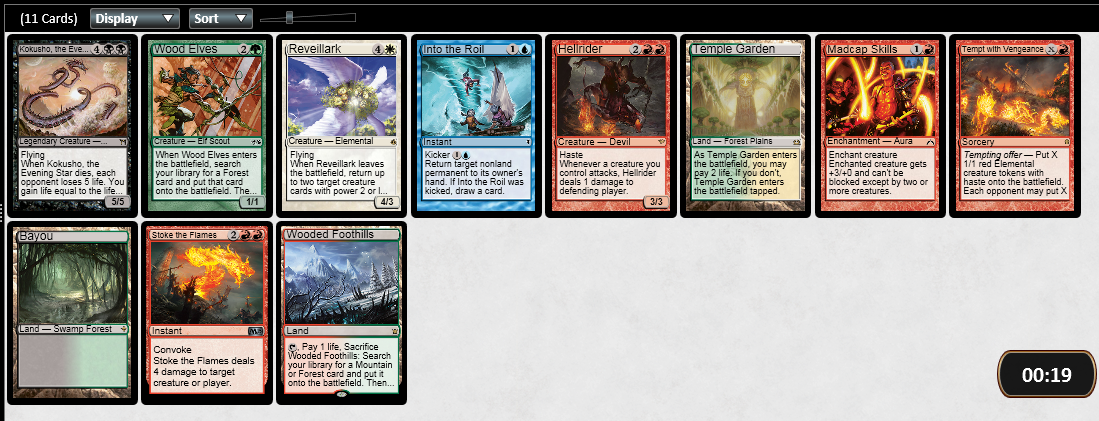
I did a whole bunch of MTGO Cube drafting over the holiday weekend. In general, the new Legacy Cube seems pretty solid. But in my drafts, I noticed a disturbing thing:

~nooldborderedcards (1)

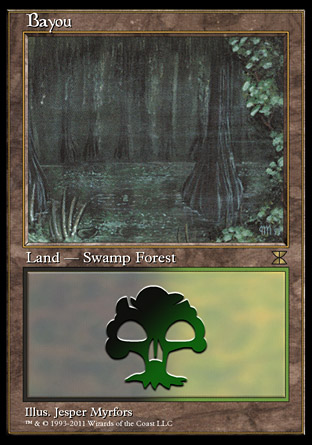
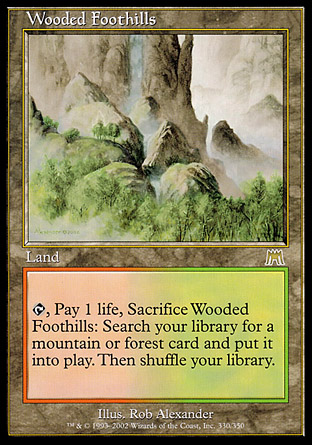
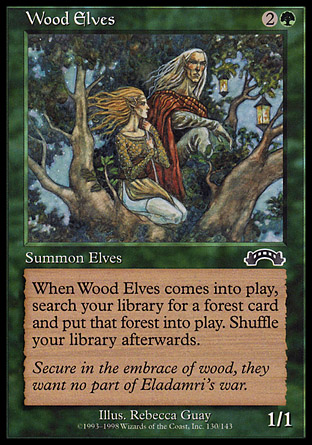
Despite this ostensibly being the Legacy Cube, which implies a strong commitment to the history of Magic—its legacy, if you will—there are exactly zero old-bordered cards in this pack, despite these versions existing:

bayoumtgo woodedfoothills woodelves

I realize that it is in WOTC's interest to plug its newest products, such as Vintage Masters and Khans of Tarkir, but to call this the Legacy Cube and then make decisions that basically minimize the actual legacy of this game seems questionable.

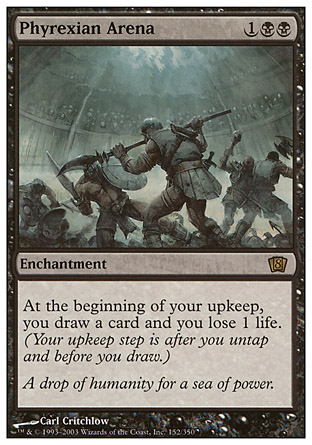
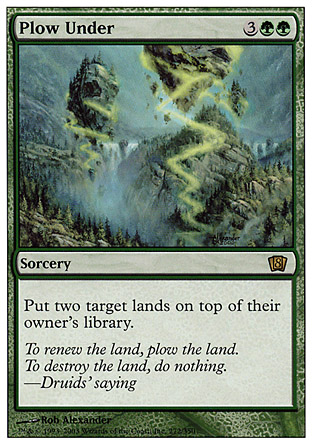
Of course, new-bordered cards feel less consequential when you see the worst shortcoming of the Legacy Cube's card choices:

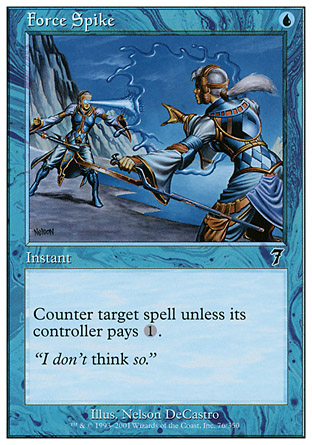
phyrexianarena forcespike plowunder

Including white-bordered cards in the Legacy Cube (or anywhere on MTGO, for that matter) is an insult to taste, art, and every faithful MTGO player who just wants to play with decent-looking cards.

Using new-bordered cards is defensible from a business standpoint, if not from an aesthetic standpoint. But there is no defense for these white-bordered cards in the cube. WOTC: You have it in your power to fix this travesty of taste. Please, do the right thing.

Avatar photo

Danny Brown

Danny is a Cube enthusiast and the former Director of Content for Quiet Speculation.

View More By Danny Brown

Posted in Cube, Free, MTGO2 Comments on They Call This the Legacy Cube?

Have you joined the Quiet Speculation Discord?

If you haven't, you're leaving value on the table! Join our community of experts, enthusiasts, entertainers, and educators and enjoy exclusive podcasts, questions asked and answered, trades, sales, and everything else Discord has to offer.

Want to create content with Quiet Speculation?

All you need to succeed is a passion for Magic: The Gathering, and the ability to write coherently. Share your knowledge of MTG and how you leverage it to win games, get value from your cards – or even turn a profit.

30 days of Magic

Are you a Quiet Speculation member?

If not, now is a perfect time to join up! Our powerful tools, breaking-news analysis, and exclusive Discord channel will make sure you stay up to date and ahead of the curve.

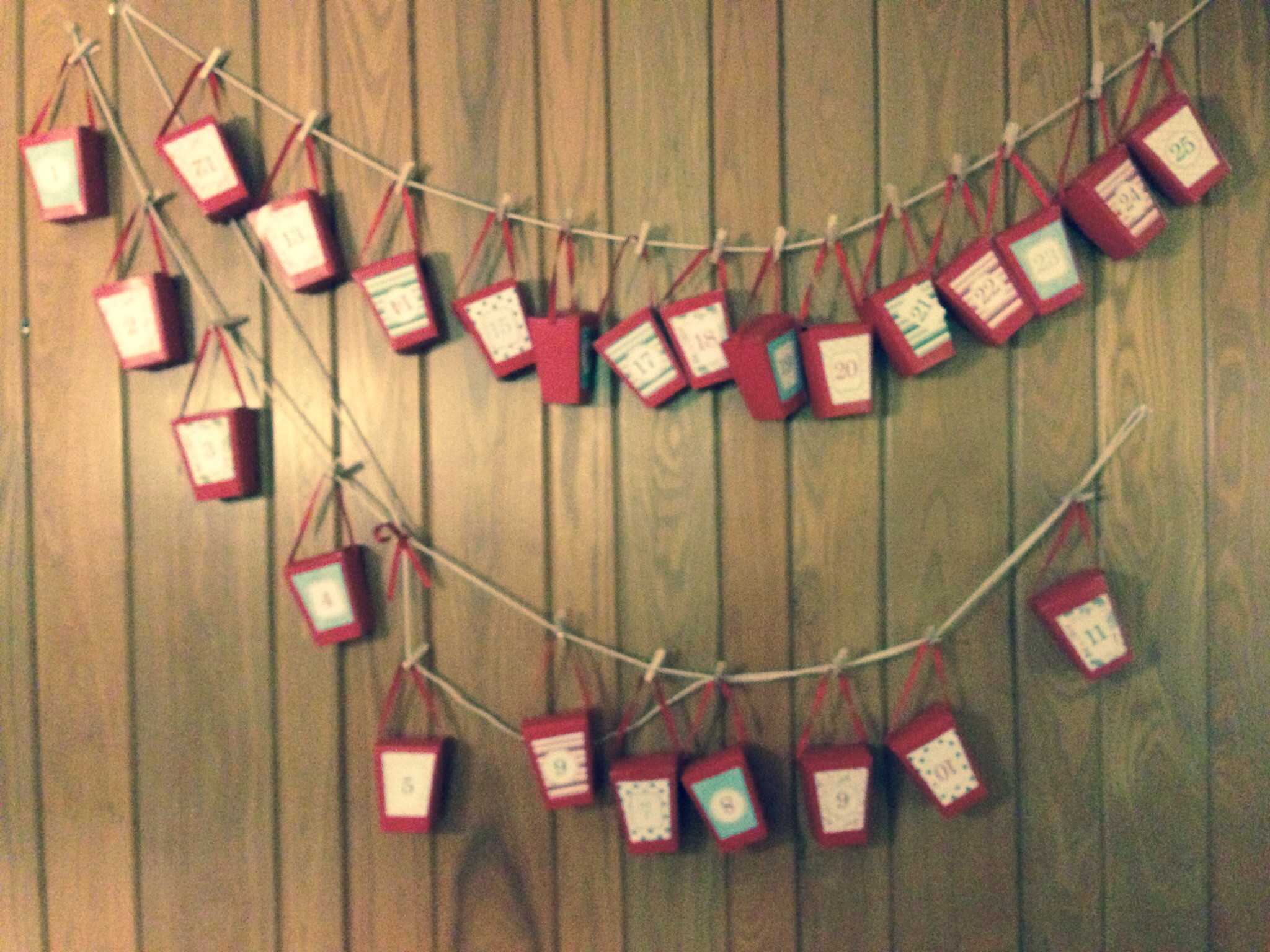
This weekend, a reddit user named /u/exarchtwin made this post about buying 26 boosters and making a Magic advent calendar.

Not a bad idea, what with Walgreen's having their "BOGO" sale right now. Buy one Get one free is pretty good on booster if you want to pay $2 per booster and not have to buy at case quantity to get that price. $52 buys a month of booster popping goodness. You don't have to be Catholic to want to get in on that!

Apparently exarch twin isn't the only one getting into the Holiday Spirit! /u/lokimorgan posted these pics

According to their post, these goods are for an Advent Calendar for their 9-year-old and most of these will end up in his cube. Their 9-year-old has a cube, and this stuff is going in it. No, they are not taking applications to be their kid, someone already asked.

I like the idea of a Magic Advent calendar. Maybe I will bust that box of Born of the Gods I've been sitting on. If you could put one together, how would you fill it up?

Avatar photo

Jason Alt

Jason Alt is a value trader and writer. He is Quiet Speculation's self-appointed web content archivist and co-captain of the interdepartmental dodgeball team. He enjoys craft microbrews and doing things ironically. You may have seen him at magic events; he wears black t-shirts and has a beard and a backpack so he's pretty easy to spot. You can hear him as co-host on the Brainstorm Brewery podcast or catch his articles on Gatheringmagic.com. He is also the Community Manager at BrainstormBrewery.com and writes the odd article there, too. Follow him on Twitter @JasonEAlt unless you don't like having your mind blown.

View More By Jason Alt

Posted in Free1 Comment on 30 days of Magic

Have you joined the Quiet Speculation Discord?

If you haven't, you're leaving value on the table! Join our community of experts, enthusiasts, entertainers, and educators and enjoy exclusive podcasts, questions asked and answered, trades, sales, and everything else Discord has to offer.

Want to create content with Quiet Speculation?

All you need to succeed is a passion for Magic: The Gathering, and the ability to write coherently. Share your knowledge of MTG and how you leverage it to win games, get value from your cards – or even turn a profit.

Take advantage of the season

Are you a Quiet Speculation member?

If not, now is a perfect time to join up! Our powerful tools, breaking-news analysis, and exclusive Discord channel will make sure you stay up to date and ahead of the curve.

It's officially "holiday time," and if you're savvy, that can mean some good deals.

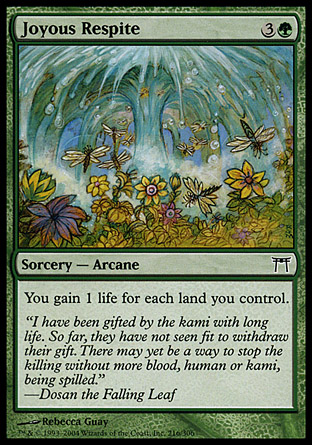
joyousrespite

Take this, for example. Walgreens is doing a buy one, get one free sale on Magic packs, and that sounds exactly like value to me. Maybe it's a gift or maybe it's just for you, but it's hard to pass up value if you're in the market for packs.

Another interested point raised here is the "price-match" guarantee. Wal-Mart, for instance, price-matches deals like this if there's a posted price. While the linked Walgreens ad doesn't show a listed price, it's possible you can find some better signage in-store and then get one of the big-box retailers to match.

Your mileage may vary. But there's always a chance! 'Tis the season of value.

Avatar photo

Corbin Hosler

Corbin Hosler is a journalist living in Norman, Oklahoma (also known as the hotbed of Magic). He started playing in Shadowmoor and chased the Pro Tour dream for a few years, culminating in a Star City Games Legacy Open finals appearance in 2011 before deciding to turn to trading and speculation full-time. He writes weekly at QuietSpeculation.com and biweekly for LegitMTG. He also cohosts Brainstorm Brewery, the only financial podcast on the net. He can best be reached @Chosler88 on Twitter.

View More By Corbin Hosler

Posted in Feature, FreeLeave a Comment on Take advantage of the season

Have you joined the Quiet Speculation Discord?

If you haven't, you're leaving value on the table! Join our community of experts, enthusiasts, entertainers, and educators and enjoy exclusive podcasts, questions asked and answered, trades, sales, and everything else Discord has to offer.

Want to create content with Quiet Speculation?

All you need to succeed is a passion for Magic: The Gathering, and the ability to write coherently. Share your knowledge of MTG and how you leverage it to win games, get value from your cards – or even turn a profit.

Insider: A World Without Treasure Cruise – What Does Modern Look Like After a Banning?

Are you a Quiet Speculation member?

If not, now is a perfect time to join up! Our powerful tools, breaking-news analysis, and exclusive Discord channel will make sure you stay up to date and ahead of the curve.

The writing is on the wall at this point: Treasure Cruise is wearing out it's welcome in Modern and the format as a whole is suffering because of it.

While some people like playing budget Vintage, the proliferation of U/R Delver in Modern has gone to the same precipice that we saw with Jund before the ban of Bloodbraid Elf and Deathrite Shaman.

Wizards really only has two options at this point: ban Treasure Cruise or decide that Modern doesn't really matter as a format. With rumors of Modern Masters 2 coming down the pipeline, it's doubtful they're willing to give up on Modern just yet, even if the new PTQ structure does very little to promote it.

A World Without Boats

So Modern pretty much just snaps right back to the way it was before Khans of Tarkir, right? Well, not exactly. There's a number of elements in play that can drastically effect the format and create opportunities for financial growth.

First of all, there's the obvious:

Each of these lands repositions various decks and strategies simply by existing. Many strategies were put into a position where by being the colors they were, they were basically forced to play with Vanguard cards that said -2 or -4 life with none of the upsides.

Just look at Wooded Foothills. It makes an immediate impact in a number of decks: Scapeshift and the Primeval Titan based Valakut, the Molten Pinnacle decks are both greatly aided by the existence of Wooded Foothills.

They were previously forced to use off color fetches like Misty Rainforest or Scalding Tarn to provide access to the mana they needed to operate. It easily allows you to go beyond 8 fetches in Temur decks without limiting your ability to get basic lands.

Windswept Heath easily slots into Birthing Pod decks, which were previously using the now defunct Marsh Flats--not an ideal situation when your deck consists of 7-8 mana dorks and a strong desire for a basic forest on turn one.

Simply by playing Windswept Heath, all Birthing Pod decks were more or less given +2 life every game. While this doesn't seem seem that dramatic, 2 life is often a mountain of opposition for fast decks. Just look at Burn or Zoo.

The combination of these two cards also creates something that didn't exist before: a mana base that you actually wouldn't mind playing in a Zoo deck.

Before Khans of Tarkir, it was a very painful prospect to be playing any Naya based aggro deck because you couldn't search for the lands you wanted when you wanted them.

By being forced to play with awkward fetch bases like Verdant Catacombs and Arid Mesa, you were often starting at a virtual 14 or 16 life. Wild Nacatl has very particular tastes when it comes to mana, and Verdant Catacombs was just not very accommodating.

And his doesn't take into account Nacatl's friends, Kird Ape and Loam Lion. Managing an opening hand that featured multiple copies of these guys along with a Lightning Helix made for some decisions.

Flooded Strand finally removes the pain of Arid Mesa from the Azorius or Jeskai decks that have been ever present since the format's inception. Searching out islands without paying a penalty makes playing additional copies of Cryptic Command a boon instead of a risk.

Blue/white Tron decks can rejoice in their ability to weather Blood Moon just a little bit better while still employing some form of virtual dual land.

Bloodstained Mire was the card I was most excited about initially, rounding out Jund's mana base with another black-based fetchland made those turn-one plays of Thoughtseize and Inquisition much more powerful because it became less critical to turn your Marsh Flats into a dual land.

Sometimes the necessity of casting a turn one Thoughtseize put your starting life total at 15--a prospect that was often met with horror when your opponent's hand revealed a grip full of burn spells.

Unfortunately, discard spells like Thoughtseize became significantly less powerful when your opponent followed up with a Treasure Cruise a few turns later. If I'm casting Treasure Cruises, I would love for every card in my deck to say "discard this to have opponent discard a card and lose two life."

There was an error retrieving a chart for Thoughtseize
There was an error retrieving a chart for Treasure Cruise

Ironically, Polluted Delta is the red-headed stepchild in Modern. The premiere blue/black deck, Faeries, basically wants nothing to do with it. And the non-premiere blue/black decks mostly don't exist (sorry, your Grixis control deck is still bad).

Cards on the Peripheral

Picking out which decks are immediately affected by the reprinting of allied fetches is easy: just find any deck playing an off-colored fetch and sub in the desired fix. But when you take a second look at these lands, they also have a tremendous impact on single card strategies.

There was an error retrieving a chart for Knight of the Reliquary

Knight of the Reliquary is one of those cards that plays great with a friend. A turn one fetchland into a Noble Hierarch followed by a turn two fetchland into KotR is an all-star classic play across a number of formats past and present. Guess who just got an upgrade?

By rounding out every three color combination with 4-8 new fetchlands, Knight of the Reliquary based strategies receive a huge shot in the arm. While this strategy might be a bit slow in the world of Delver of Secrets + Ancestral Recall Treasure Cruise, in a world where these decks are less omnipresent, Knight becomes significantly stronger.

There was an error retrieving a chart for Blood Moon

Just as much as the fetchlands givith, they taketh away.

Blood Moon has been Modern's Tier 1 "Hhaha got you" cards for a long time now.

Entire decks have thrived on the backbone of this card and his little brother, Magus of the Moon, screwing over greedy mana bases. Why would you want to play fair Magic when you can just cast one card and win the game for free?

Unfortunately, however, Blood Moon got a lot weaker with the release of Khans. Every deck has access to on-color fetchlands and the ability to search up the exact basic lands they need to feed whatever mana appetites their spells bring with them. Access to basics is enough to weaken Blood Moon from an "easy win" to "probably dead card" when your opponent's are savvy enough to play around it by searching up basics.

Heir to a Throne

As much of an oppressive dick Treasure Cruise has been in Modern, its step child Dig Through Time is heir to the throne of format warping cards.

If/when Treasure Cruise gets banned, if Dig isn't given the preemptive axe, we're poised to see a surge in blue-based combo decks, namely Scapeshift and Splinter Twin.

Blue/red Delver decks are the perfect foil for these combo decks as their steady clocks combined with a suite of countermagic and the ability to "reload" after a flurry of spells has been enough to keep this style of decks in check. But with no Treasure Cruise, the incentive to cast Gitaxian Probe and friends becomes much lower.

Prospects

There's a ton of room for financial shakeout if Treasure Cruise is banned. Given the fact that Wizard's hasn't acted yet gives me the impression that they are perfectly fine with a "wait and see" approach to Modern, delaying Banned List changes until set releases.

This opens up the possibility that Dig Through Time decks will have a couple months to take over before taking the brunt of the banhammer. This means cards like Valakut, Scapeshift, and Splinter Twin have some room to make a small run.

Cards like Blood Moon won't necessarily tank because of fetchlands existence, but they certainly become less exciting over time as their effectiveness diminishes.

I am bullish on Knight of the Reliquary. I really feel she is a great long term pickup, seeing as the price has already recovered from its double reprinting and has multi-format appeal, seeing play in Legacy, Modern and Commander.

There are very few three mana creatures that can hold a candle to Knight of the Reliquary in Modern, and bringing all fetchlands into the fold makes this card much more likely to start seeing significant amounts of play.

Additionally, the ability to search out lands means that with every new set there is a great chance for Knight to "break" the same way Stoneforge Mystic did with the printing of Sword of Feast and Famine and Batterskull.

Beyond that, Modern is an incredibly diverse and deep format that I've only glanced the surface of today. Khans wasn't given much of a chance to saturate the format because its existence has been punctuated with Jeskai Ascendancy and UR Delver, so many of the cards haven't yet had the an opportunity to make themselves contenders in the format.

What other decks or card strategies gained significantly from Khans that I missed? What's taken a hit?

Insider: MTG and Silver – How the Markets Parallel and What to Do About It

Are you a Quiet Speculation member?

If not, now is a perfect time to join up! Our powerful tools, breaking-news analysis, and exclusive Discord channel will make sure you stay up to date and ahead of the curve.

Although I have little time for them, I do actually have a few other hobbies outside of Magic: The Gathering.

Most know by now that I’m an avid trader on the stock market. I also enjoy reading fantasy and science fiction novels, along with the occasional book on finance. I even have a keen interest in the life of Marie Antoinette, of all people.

It turns out I also enjoy the financial aspect of another collectible: coins.

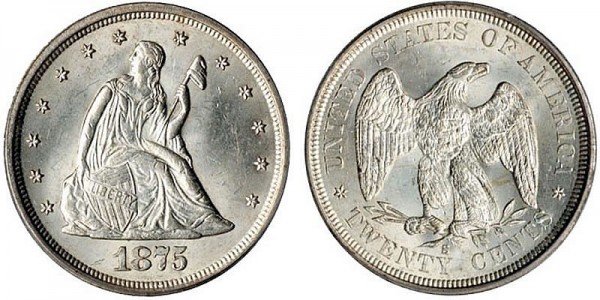
My interest in numismatics began over two decades ago when my father gifted me the penny collection from his childhood. While there wasn’t much value in the wheaties dating back to 1909, I still found fascination that older U.S. coinage could carry special value due to their rarity. The obsolete denominations such as the twenty cent piece and three cent nickel continue to spark my interest, although I’ve never owned either.

twenty

The twenty cent piece had another characteristic that caught my eye. It, along with many coins from the 1800’s and two-thirds of the 1900’s, is made up of 90% silver.

As you can imagine, the silver (and gold) markets can have a profound impact on old coin values. While many older and/or rarer coins can have special value due to their lower minting numbers or rarer mint marks, the majority in existence will rise and fall in value along with the price of silver.

As it turns out, this makes for a rather volatile market.

What Do Silver and MTG Finance Have In Common?

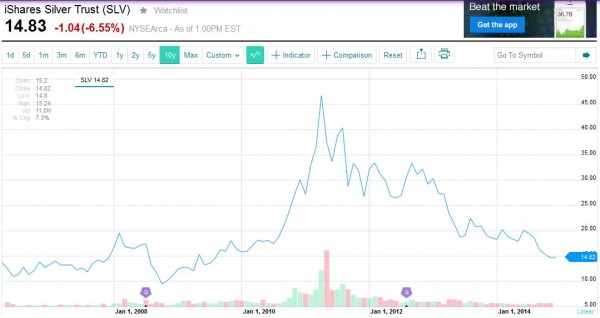
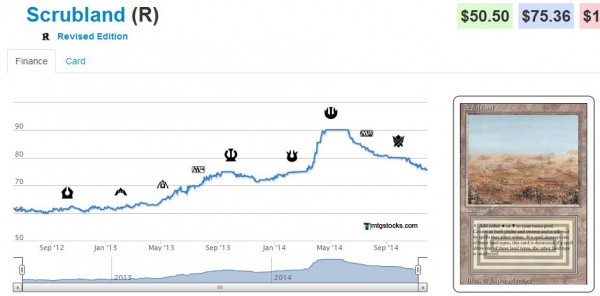
No, this isn’t the beginning of a riddle – it’s a legitimate question with an insightful answer. Allow me to reference a couple of price charts. After all, a picture speaks a thousand words.

SLV

Scrubland

I’ll admit these two charts don’t match up perfectly. On the Scrubland chart, x-axis is too narrow and the y-axis not steep enough to match the chart for silver (via the SLV externally traded fund) perfectly.

But the overall trend is very similar: gradual increase over time, followed by a sudden jump and ensuing drop-off. And while the Scrubland chart matched most closely to make my point, all of the dual lands and many other Legacy staples show similar behavior.

An Eerie Parallel

When I graduated high school and moved off to college, I was very light on funds. In a desperate attempt to raise cash, I made two very short-sighted decisions: I sold off my coin collection and almost every Magic card I owned worth over $3.

Yes, this meant my Force of Wills were shipped right along side my Flying Eagle Cent. The worst part of all was that I was so eager to make a buck that I sold these items very sub-optimally, leveraging garage sales and eBay auctions.

My stomach hurts even thinking about it.

Back in 2008, I had a lucky break--I regained interest in both MTG and coins. Fortunately for me, the Legacy boom was only starting and silver had plummeted to a major low.

My timing to get back into both of these hobbies could not have been much more perfect. But as dual land prices and silver prices started skyrocketing, I faced that same temptation all over again. It became difficult to justify holding so much money in cards and coins while pressures from raising a new child and buying a house loomed on the horizon.

Yet again I sold out. Only this time I did so in a much more informed way, leveraging multiple channels and doing thorough research to ensure I maxed out my value (while of course balancing the amount of time I would spend doing so).

Fast forward two years and we arrive in the present. Legacy prices have dropped and silver prices are approaching a five year low.

Here’s My Light Bulb

Over the past couple weeks I’ve bought a few incremental dual lands to increase my Legacy portfolio. I’ve illustrated my rationale in past articles, and the recent SCG announcement does not drastically impact my view. As duals drop in price, I am eager to acquire a few more to once again approach that lofty goal of owning the full set of 40.

This past Friday brought one of the largest single day drops in silver prices that I’ve seen in quite some time. It appears a pricing war between OPEC and US oil is underway, and this is applying tremendous pressure on commodities while buoying the strength of the US Dollar to new highs. On this news, I decided I’d once again dabble in the silver market by purchasing a few older silver coins. I love their historic look and feel, and with prices dropping so low, how could I resist?

When I got to the gold and coin shop I was disappointed to find that their stock in cull silver coins was near zero. In other words, their inventory was basically wiped out--either that or they aren’t interested in selling their inventory at such low prices.

In fact, this isn’t just an issue for local coin dealers. Even the U.S. Mint recently experienced a surge in demand for their Silver Eagles, causing temporary sell-outs: http://www.reuters.com/article/2014/11/05/usa-mint-silver-coins-idUSL1N0SV2RP20141105

The linked Reuters article is brief, but it highlights the main driver for this surge in demand: silver prices are tanking. In a standard supply and demand driven market, as prices drop, the supply also drops while demand rises.

Eventually stores will refuse to sell their inventory or they will sell out because prices will drop too low. The end result will see the “Invisible Hand” move the price to where it belongs, balancing out both supply and demand.

The sudden disappearance of silver coins from the market tells me we may be searching for a bottom. This is especially true for the coin market, where the currency carries slight premiums over their melt value simply due to their beauty and numismatic value.

The price of raw silver may drop further because of market shenanigans and hype, but I suspect that if the price goes down too much further, there will just be no one willing to sell their silver coins. To me, this is a sign that we are almost at the perfect time to start buying.

But in the case of dual lands and other Legacy staples, we simply aren’t there yet. Despite the lower prices, inventory of duals have soared. Star City Games, the world’s largest MTG retailer, has recently dropped their prices on duals., yet they have 77 Revised Scrublands in stock at the time of this writing. There are over 100 Tropical Islands! Even the most popular dual Land, Volcanic Island, is still plentiful (although still $299.99 for NM).

There was an error retrieving a chart for Tropical Island
There was an error retrieving a chart for Volcanic Island

Conclusions

It may be a stretch, but I think this divergence between silver coin and dual land inventory suggests the former is seeking a bottom while the latter is still facing significant headwinds. As a result, I think I’m going to hold off on acquiring more duals and other Legacy staples at this time. I have no regrets picking up what I’ve got right now--I just don’t want to add exposure here.

Here’s the good news: remember one of the largest differences between the two price charts I linked earlier? The timeline on the x-axis of the silver chart was much longer than on the Scrubland chart. So while silver may be closer to bottoming in comparison to Legacy staples, it also may move on a much slower time scale.

This could mean another year of downward movement on silver before we truly hit bottom. Meanwhile, one piece of news or move by Star City Games and the dual land market could rebound in a matter of days. In fact, I still fully expect we’ll see another bump in dual land prices next spring.

This faster timeline gives me hope, but it’s also a wake-up call to speculators. Be ready for any sudden market movements. I think we’ll see a continued drift downward in dual land prices until we start to see retailers “sold out” of them.

But on a moment’s notice we could see the turnaround. When that happens, it’s best if you’ve already got a small holding on hand to take advantage of the inevitable hype that will follow.

...

Sigbits

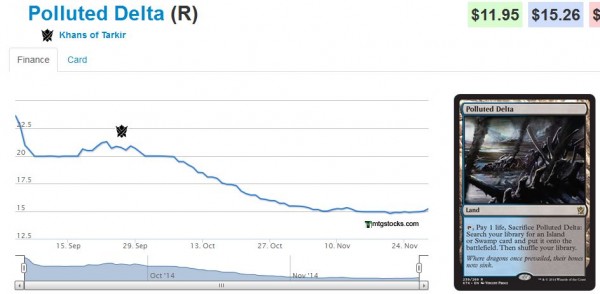
  • Looking at their charts on mtgstocks.com, I believe Khans fetches are finally stabilizing. They seem to be moving more rapidly on Star City Games, and foil copies sell out often. Currently SCG is sold out of foil Polluted Delta with a price tag of $99.99.

Delta

  • New Phyrexia common Gitaxian Probe is more popular than ever before thanks to synergies with Young Pyromancer and Monastery Swiftspear. As a result, SCG is sold out of nonfoil copies at $3.19. If you own many copies though, be careful. This is a prime prospect for reprint in Modern Masters 2.
  • Did anybody else notice that SCG is sold out of regular Force of Wills at $109.99? When did that happen? I guess not all Legacy staples are behaving like silver prices right now. Could this be a foreshadowing of a pending recovery in the Legacy market? If so, then Wasteland didn’t get the memo: SCG has well over 200 total copies in stock across its various printings.

GP organizer dropped

Are you a Quiet Speculation member?

If not, now is a perfect time to join up! Our powerful tools, breaking-news analysis, and exclusive Discord channel will make sure you stay up to date and ahead of the curve.

They're not often in the headlines, and outside of a great event by Star City or ChannelFireball you don't hear much about them. But they are a really important part of our community.

The tournament organizer.

These people exist largely in the background, but nearly every great (or less-than-great) Grand Prix experience you've had has a lot to do with these guys.

Today, you can knock one off that list.

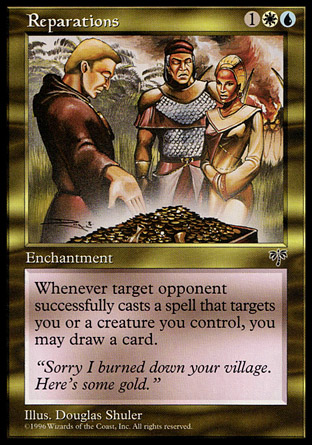
reparations(apologies)

Wizards announced that it's parting ways with Gordian Knot Games. We don't really know what led to this decision, nor do I know how this will play out in Europe since I'm not familiar with that scene. But it's worth noting at least, and I'm sure someone with more knowledge of the situation can chime in here.

Avatar photo

Corbin Hosler

Corbin Hosler is a journalist living in Norman, Oklahoma (also known as the hotbed of Magic). He started playing in Shadowmoor and chased the Pro Tour dream for a few years, culminating in a Star City Games Legacy Open finals appearance in 2011 before deciding to turn to trading and speculation full-time. He writes weekly at QuietSpeculation.com and biweekly for LegitMTG. He also cohosts Brainstorm Brewery, the only financial podcast on the net. He can best be reached @Chosler88 on Twitter.

View More By Corbin Hosler

Posted in Feature, Free2 Comments on GP organizer dropped

Have you joined the Quiet Speculation Discord?

If you haven't, you're leaving value on the table! Join our community of experts, enthusiasts, entertainers, and educators and enjoy exclusive podcasts, questions asked and answered, trades, sales, and everything else Discord has to offer.

Want to create content with Quiet Speculation?

All you need to succeed is a passion for Magic: The Gathering, and the ability to write coherently. Share your knowledge of MTG and how you leverage it to win games, get value from your cards – or even turn a profit.

A Beginner’s Guide to Magic Card Pricing

Are you a Quiet Speculation member?

If not, now is a perfect time to join up! Our powerful tools, breaking-news analysis, and exclusive Discord channel will make sure you stay up to date and ahead of the curve.

When I returned to Magic a few years ago, I had no idea how to price my cards for trades or sales. If you've been around the MTG community for long enough, everything below will be pretty basic info to you. But if you're new to the game or just returning after a long hiatus—first of all: welcome! You've made the right decision—then you're probably wondering how the heck to figure out how much these cards are worth. Read on, good sir or madam.

Trading Your Cards

If you're trading with someone, the two most common websites used to price cards are Star City Games and TCGplayer.

Star City Games is an industry leader, widely renowned for its customer service and excellent tournament organization, but also widely reviled because of its high prices and lack of transparency. Nonetheless, it's a big-name store, so many players will use it to price cards in trade. This is fine as long as every price in the trade comes from SCG.

TCGplayer is essentially a store aggregator, where small businesses and individuals can list cards for a fee and receive public feedback to build their brands. TCGplayer has much more competitive prices than Star City Games, and its median price for a card is preferred by many traders as representative of what the card is truly worth. One of Quiet Speculation's signature features, Trader Tools, uses TCGplayer median prices for its retail numbers.

There was an error retrieving a chart for Jace, the Mind Sculptor

Selling Your Cards

I can't stress this enough: if you want to sell your cards, you're not going to get what SCG has them listed for, or even the TCGplayer median. If you try to quote those prices to someone who is interested in buying your cards, you will be laughed at and refused. You are not a retail store and you cannot expect to get retail prices.

At best, you can sell your cards on eBay or TCGplayer. This will involve setting up an account and paying between 10 and 15 percent in fees, and if you want to sell your cards in a realistic time period, you will need to be among the lowest prices listed. Your online store won't have feedback or recommendations, so you'll have to compete on the basis of price. So go to eBay or TCGplayer, see what the lowest prices are on the cards you want to sell, then subtract 10 to 15 percent plus the cost of shipping. This is what your cards are worth in cash.

Selling locally, you may be able to find someone who is willing to pay TCGplayer or eBay low prices and save yourself the fees. This is hit or miss and requires at least some connection to the local community, but it is a possibility. Craigslist is also an option, but don't be surprised if people are offering less than TCGplayer or eBay lows—Craigslist is a place folks go to find a deal.

Finally, almost every store in existence has a buylist, or a list of cards the store is looking to buy and at what price. At first glance, buylists seem like horrible deals. On average, you get about half the retail value of your cards when selling to a retail outlet, be it an online one or your own local game store. But what you lose in cash value, you gain in convenience. Since you'll be selling your cards all in one transaction, you don't have to wait for a buyer and you don't have to go the post office.

There was an error retrieving a chart for Show and Tell

A Little Knowledge Goes A Long Way

I wish I'd had this info when I returned to Magic. I tried to delve into some online trading upon my return, and knowing only the prices at my LGS, I'm sure I offended some people with my seemingly random card values. Knowing how the larger community values its cards is crucial, so take the information above, apply it to your trades and sales, and go from beginner to veteran.

Insider: WoTC the Business – Making Sense of the Market Through the Lens of Wizards’ Bottom Line

Are you a Quiet Speculation member?

If not, now is a perfect time to join up! Our powerful tools, breaking-news analysis, and exclusive Discord channel will make sure you stay up to date and ahead of the curve.

Welcome back, readers! Today's article will focus on Wizards of the Coast as a company.

First off, I'd like to thank QS's own Charles Fey for the inspiration for this article. He wrote not one but two articles, which really made me think about the future of my MTG investing decisions. You can find them here and here.

In his articles Charles brings up the fact that above all, WoTC is a company owned by a publicly traded company (Hasbro). As such it is subject to the same sort of market demands as Microsoft or Apple (the often exceedingly high or unrealistic expectations of its shareholders).

By examining WoTC from an outsider's perspective, we will get a better grasp of how they will act and what it means to us as MTG speculators.

Secondary Market

The first major point to bring to light is that WoTC doesn't make any money on the secondary market. They don't sell singles, they sell sealed product. Their prime goal is to sell as much sealed product as possible.

What does this mean?

This means that WoTC would rather have a lot of cards in the set with medium price points than one or two with very large price points. Most players are smart enough to realize it's not economical to crack packs looking for that chase mythic. When WoTC has a set with one or two high-dollar cards, it's usually because the rest of the cards are really weak/cheap and is an indicator of a weak/bad set.

This directly correlates to lower sales numbers. If you want an example:

dgm box

You can currently buy an out-of-print set (Dragon's Maze) for less than most stores paid for it when the set was in Standard. The reason is that only one card (disregarding the shocklands that you could also pull) from the set is worth more than $10 (Voice of Resurgence) and many stores had a hard time selling the product. This means distributors didn't re-order it, which means WoTC didn't make as much money.

Now let's compare that to Innistrad. While it is a larger set and all, that also means that it had longer time for singles to be cracked. So in theory the average value of a rare/mythic should be lower:

innistrad box

Instead we see the price of the sealed box being worth three times a Dragon's Maze box. Granted, Innistrad is a bit older, and even Innistrad only has three cards valued above $10 currently, but the demand for the sealed product is much higher. In the end, Innistrad was a much more popular set than Dragon's Maze and likely made a lot more money its first three months (as we don't have exact numbers, I can only think anecdotally about how long sealed product sat on our LGS's shelf.)

The fact that all of WoTC's income comes from selling people sealed products is the driving factor behind the company trying to expand it's sealed product line.

Seven years ago WoTC introduced the first Duel Deck (Elves vs. Goblins). Prior to that, WoTC's foray into non-Standard sealed product was limited pretty much to the World Championship decks of old (which weren't tournament-legal and were more of a collectors item), Collector's Edition, Unhinged/Unglued, and a few other random runs. In the past seven years' time we're now up to a total of:

  • 13x Duel Decks (with another on the way)
  • 7x From the Vaults
  • 3x Premium Decks
  • 2x Planechase
  • 4x Commander
  • 1x Conspiracy
  • 1x Archenemy
  • 1x Modern Masters

That's a whole lot more additional sealed product and thus a lot more potential profit for WoTC. This trend has really grown the past few years.

The following chart shows the number of supplemental product releases by year. Note that 2011 through 2014 were the only years with a product that included Standard-legal cards. The last data point includes one product slated for release this year.

supplemental graph

This likely indicates that we will continue to see at least six (if not more) supplemental products released each year moving forward.

Reprints

As a company, WoTC clearly understands the value of reprinting valuable cards. It's shown time and time again that adding a few valuable reprints to a set can drastically increase overall demand (and thus sell more product). Khans of Tarkir is an excellent example--it is by no means a weak set as it has some excellent Eternal cards besides the fetchlands, but the inclusion of said fetchlands has everyone cracking packs left and right.

What does this mean?

Khans will likely prove to be one of WoTC's most profitable sets (even if you were to normalize the playerbase to compare older sets to the newer ones). This likely implies that we'll see an increasing number of reprints going forward.

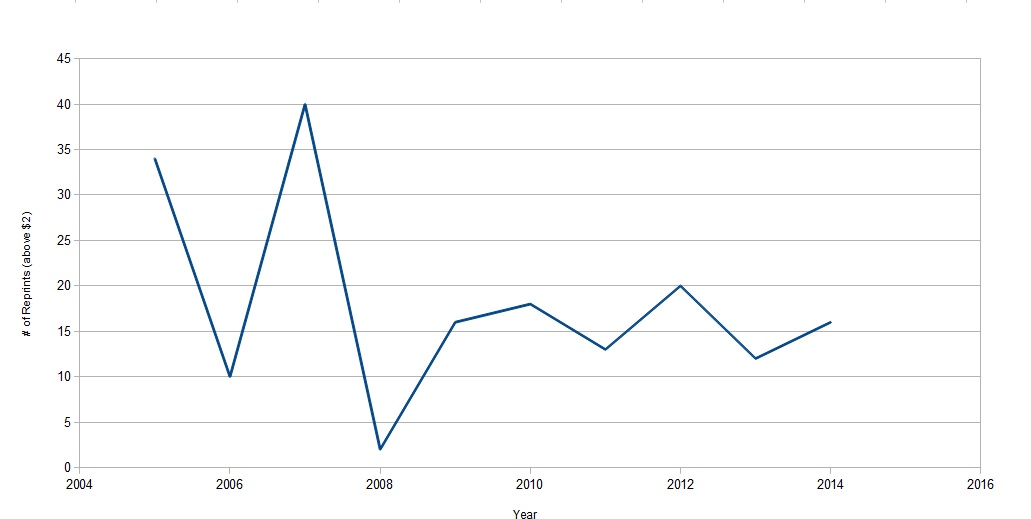
This chart shows the number of reprints worth $2 or more by year:

number of reprints

What we actually see is a lot of reprints in the mid to late 2000's followed by a massive drop (when there was no core set), followed by something along the lines of 15 reprints a year.

It's important to note that the two years with the most reprints (2005 and 2007), a large majority of those reprints occurred in the core set (of which there wasn't one in 2006 or 2008). There were core sets in 2009-14, but WoTC chose to limit the number of reprints in them. The fact that they recently announced that 2015 would be the last year with a core set implies that even with the reduction in reprints from previous core sets WoTC still wasn't happy with it.

This trend actually contradicts our original hypothesis and shows that WoTC has been limiting the amount of reprints it puts out per year. It's also important to note that a decent percentage of the reprints were planeswalkers and rare lands (fetches/shocks/painlands/buddy lands).

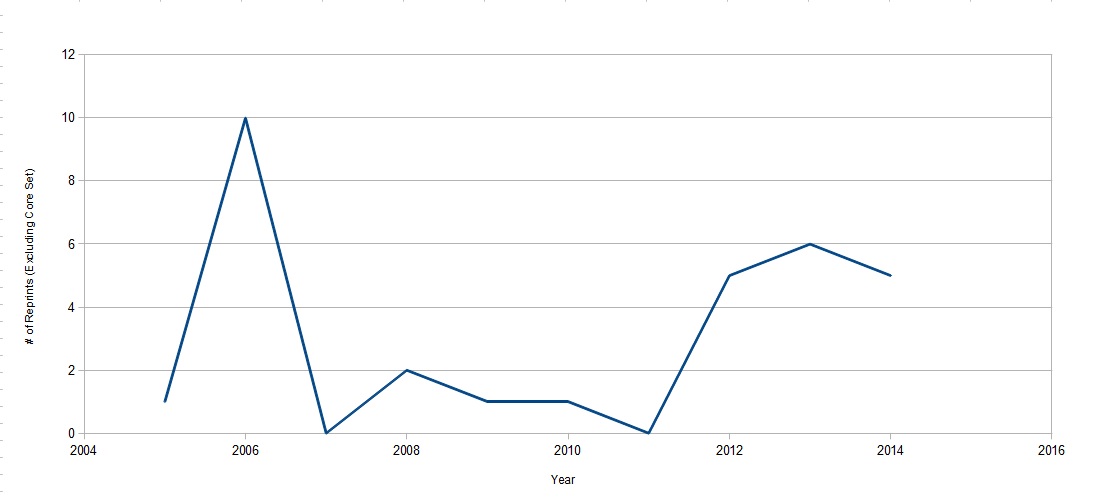
However, if we dig a little deeper and remove the core sets from the data we see a much more noticeable trend.

reprints excluding core set graph

Note that Time Spiral came out in 2006, which was the reason for the uncharacteristic spike that year--if you ignore Timeshifted cards then the number drops to 0. Up until 2011 we saw around 1-2 non-core set reprints per year. However, in 2012 and onward we're seeing 5.5 on average. While that might not seem like a lot, it represents a more than 300% increase in non-core set reprints.

It's important to note that all this data comes from Standard-legal sets only. I did not include reprint data for supplemental products, though they obviously will affect prices.

Format Focus

The last subject we'll go over today is WoTC's push to focus on the Standard format. WoTC clearly understands that Standard is its bread and butter, and the prime driving force behind product sales.

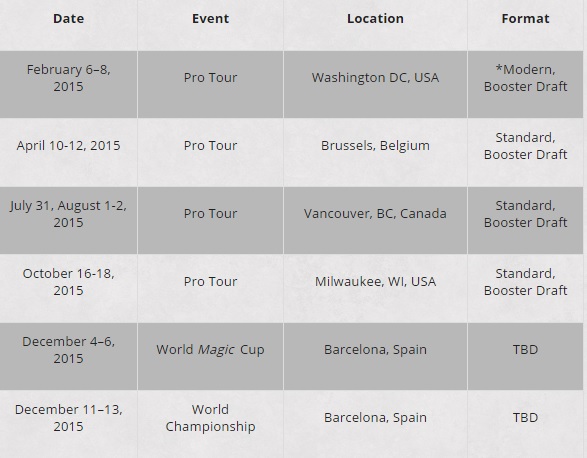
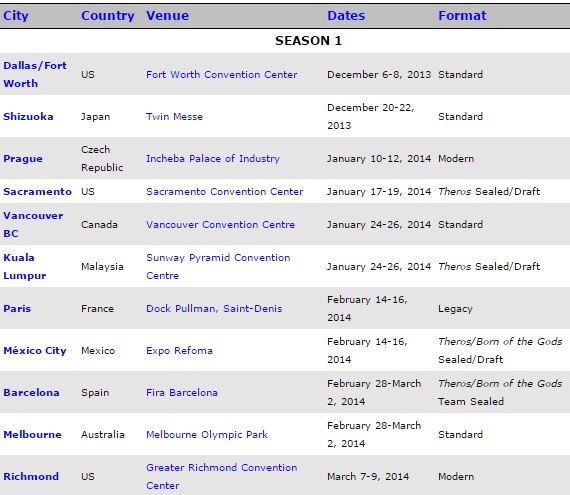
If we look at next year's PT and GP schedules we see a strong focus on Standard (especially if you include Limited, which also sells sealed product).

2015 PT schedule

2015 GP schedule

Looking at GPs, we have 3x Modern events, 4x Standard events, and 4x Limited events. Compare that to the same time last year:

2014 GP Schedule

We had; 4x Standard, 4x Limited, 2x Modern, 1x Legacy. In fact the only difference is that they eliminated the Legacy one and replaced it with a Modern event.

What does this mean?

Of all the formats, WoTC makes the least amount on Legacy/Vintage so it makes sense from a business perspective to focus on events that actively contribute to the bottom line. I don't expect WoTC to completely abandon the Legacy format, but in 2014 we only had two Legacy events; in 2013 and 2012 we had three each. It's very likely we'll see WoTC drop to just one event in the near future.

If so, we'll likely start to see demand for Legacy staples drop and prices will likely drop accordingly. The recent changes to the SCG Open series will also play a role in this likely decline.

Want Prices?

Browse thousands of prices with the first and most comprehensive MTG Finance tool around.


Trader Tools lists both buylist and retail prices for every MTG card, going back a decade.

Quiet Speculation