
menu

My Deck Choice for Eternal Weekend 2021: UR Delver

Are you a Quiet Speculation member?

If not, now is a perfect time to join up! Our powerful tools, breaking-news analysis, and exclusive Discord channel will make sure you stay up to date and ahead of the curve.

Eternal Weekend is this weekend, with Legacy events taking place Friday through Sunday. Like last year, the events will take place on Magic: Online. For those who aren't familiar with the tournament, Eternal Weekend takes place every fall and is the premier event for the Vintage and Legacy formats. The winner of each event walks away with a sweet painting of a classic Magic card. The paintings can be sold on the secondary market for large sums, making these events quite exciting to compete in. This year there are three Legacy events, with a unique painting going to each winner, and two Vintage events. Today I will discuss the UR Delver deck I plan to play for the Legacy events. Here's a breakdown of my list:

UR Delver

Main Deck

4 Dragon's Rage Channeler
4 Delver of Secrets // Insectile Aberration
4 Ragavan, Nimble Pilferer
4 Murktide Regent
2 Dead // Gone
4 Expressive Iteration
4 Lightning Bolt
4 Force of Will
4 Ponder
4 Daze
4 Brainstorm
4 Volcanic Island
4 Wasteland
2 Flooded Strand
2 Steam Vents
2 Polluted Delta
2 Misty Rainforest
2 Scalding Tarn

Sideboard

2 Force of Negation
2 Meltdown
2 Soul-Guide Lantern
2 Pyroblast
1 Court of Cunning
2 Hydroblast
2 Red Elemental Blast
2 Gut Shot

To Delver or Not to Delver?

The number of Delver of Secrets to play is currently a contested debate. Modern Horizons 2 introduced an interesting proposition: winning solely with Dragon Rage's Channeler or Murktide Regent. Rather than play Delver, you could just focus on these creatures carrying you across the finish line. 

It's a reasonable theory, and I subscribed to it for a while before changing my mind. I trimmed on Delvers because I wanted to make my Dragon Rage's Channeler better, but Delver is great with Channeler. Having both of them in your opening hand is super explosive. Delver is also a great way to pressure removal spells before sticking a Murktide Regent in the midgame. It also plays excellently with Daze, Lightning Bolt, Wasteland, and basically every other card in the deck.

My Mainboard Considerations

Most people play around six burn spells, generally complimenting Lightning Bolt with Gut Shot or Unholy Heat. I like Dead//Gone to beat a resolved Murktide Regent or Marit Lage, that are difficult to deal with otherwise. Dragon's Rage Channeler can help you dig for answers to these cards, but it is important to have cards to actually dig for. This is even more true when you take into account Murktide/Marit Lage are giant fliers that a delirious Channeler will be forced to attack into.

If you are lucky you will even be able to bounce a creature your opponent stole with a Ragavan, Nimble Pilferer for some crazy value, or maybe remove a creature when there is a Chalice of the Void or Sanctum Prelate out.

I have a strong guttural aversion to basic lands. I've found myself in bad situations too many games, stumbling due to basics. Too many headaches trying to decipher if I should fetch a dual or a basic (this second point is somewhat nonsensical since adding options is a pure upside, however, magic is pretty hard to play, and severely reducing the difficulty is a nice side effect). Now, I wouldn’t say I have the expertise to know what manabase will yield a higher win rate but figured the shock lands will look odd to some people so I figure it's worth mentioning.

Sideboard Selections

Meltdown is a premier answer to Urza's Saga. There are plenty of other artifact-centric decks around, which this is also good against. I feel pretty good about having two currently.

I currently have this piece of graveyard interaction over something like Surgical Extraction, as it’s a reliable way to interact with Uro, Titan of Nature's Wrath. With surgical, you will end up in situations your opponent will cast Uro and you won’t be able to use your graveyard interaction to stop it. Feel free to choose whichever graveyard interaction you feel is most suitable as any should be good.

The alternate threat. Versus those decks trying to remove all your threats, you should have plenty of time to find this. I love having one for that reason. Prismatic Ending made it so control decks can remove any threat you throw at them. Previous alt threats like Klothys, God of Destiny, and Sylvan Library ain’t as unbeatable as they once were. This however nicely gets around removal spells.

I wanted a couple of cards for Death and Taxes, so I could side out all my Ragavans for a couple of Meltdowns (many D&T players now run Urza’s Saga) and two other cards of choice. Ideally, it would work vs Elves too, as Dragon's Rage Channeler lets me dig for cards, but you need to have actual targets to find and many lists don’t have any bombs to find vs Elves. I also kind of wanted a card for Delver mirrors. I wanted to side out all my Force of Will and Wasteland in the mirror, as I don't feel either card is really that good in the matchup. That is a whopping eight cards to side out though, so I needed to find eight cards to side in.

Gut Shot is a reasonable card at filling this role. It's not an insane bomb to find vs Elves but you can’t go too wrong with it. It's not unbeatable vs D&T, but again a great spell nonetheless. It's also quite a nice way to not fall behind to Ragavan, Nimble Pilferer. I have it in my most recent list but feel free to change it around if you don’t like it. I am likely to register the list as I posted it above.

Final Thoughts

Cheers and good luck to those playing this weekend. I am excited to bring this ultra-powerful version of the classic archetype to the table. To me, it plays like RUG Delver did a decade ago, with Murktide Regent acting as the Tarmogoyf, Dragon's Rage Channeler as the Nimble Mongoose, and Ragavan, Nimble Pilferer as the Stifle.

Math Doesn’t Lie: The Yorion Dilemma

Are you a Quiet Speculation member?

If not, now is a perfect time to join up! Our powerful tools, breaking-news analysis, and exclusive Discord channel will make sure you stay up to date and ahead of the curve.

Those who don't learn from history are doomed to repeat it. So the old cliché goes, and frequently so it also goes in reality. Humanity has tread a lot of ground as a species, and a lot of situations repeat. Consequently, lessons from the past frequently apply to modern problems and should inform decision making. This goes for Magic too. The game is nearing 30 years old, and there have been thousands of tournaments and decks for players to learn from without having to build a deck and play it themselves. However, Magic's history is rather obscure. Almost all of it has been chronicled on the internet, and many of the websites from the early days are defunct. Even when that's not the case, it's hard for newer players to know if certain knowledge exists and look for it. That's where I come in.

In this case, I'm here to remind everyone that Yorion, Sky Nomad isn't doing anything new. I don't mean the creature itself, that's too obvious. Yorion's effect on Modern isn't really about his stats or ETB trigger. Yorion incentivizes players to play more than 60 cards in a way that nothing else has in a very long time. It's not the first time, but it is (as far as I could find) the first widespread implementation. This is not just in terms of decks where it's happening, but formats. However, there are problems emerging which the previous attempts had to deal with as well. And I don't think Yorion fixes all of them. Though it does fix some, kinda.

The Mathematical Basics

I'm no Frank Karsten; this article won't be a mathematical treatise. There are very good mathematical reasons to never play more than the minimum required given the rules of the game. There are many ways to get around the restrictions and beat the rules. So many that it would take an entire academic paper to accurately detail all of them and how they impact the real odds of a given outcome. I idly speculate that someone's done that already because grad students have paper quotas to meet. In any case, I have neither the knowledge nor inclination to write an article detailing all the math around deck size. Nor is it strictly necessary.
This is because regardless of the specifics of a deck's composition, the math will always begin the same way. Due to the restriction that in Constructed a deck may contain no more than four of any card (besides basic lands), the odds of seeing a given card start out as 4/x, where x is the number of cards in the deck at the start of the game. As a game progresses, cards are removed from the deck via drawing and tutor-type effects, meaning that the odds improve from there (and yes, hypergeometric calculations are necessary to actually determine those odds, but they're not necessary to understand my point). Therefore, all else equal, the best way to ensure that a specific card is drawn in a game of Magic is to start out with as small a deck as possible so that the odds of drawing it improve meaningfully faster. This means that as a rule, it is best to start out with a sixty-card deck in Constructed, with initial odds of 4/60=.0667 or 6.67% to pull a given card at random from the deck.

Consider an Extreme

Were deck minimums nonexistent, it would make no sense for any deck to play more than the bare minimum necessary to win the game. In such a world, a deck capable of winning on turn one only needs eight cards in total. It has a seven-card ideal hand and one more card so that it doesn't just deck on the draw. (Don't think about the setup too hard; this is a thought experiment.)

A deck playing more cards would always be at a disadvantage. More cards means that it doesn't always see its (nearly) ideal hand because the odds are less than the (7/8)=87.5% afforded by the eight-card deck. The certainty of an ideal start almost certainly trumps the larger deck's ability to recover if they're disrupted.

Improving the Odds

The same logic applies to all Magic formats. The decks that adhere closer to their minimum requirements are more likely to hit their ideal hands and are therefore more likely to achieve their ideal gameplans. However, as mentioned, there are many ways to improve those odds, regardless of deck size.

The first way is to break the Rule of Four. I don't mean doing that literally; that's how you get DQ'd and banned. Rather, play many cards that do the same thing. This was the biggest innovation of Extended Red Deck Wins way back in 2002. When every card does essentially the same thing, it doesn't matter what specific card is drawn, improving deck consistency.

The second option is the Turbo Xerox approach. Playing cards that draw cards force a deck to shrink and the odds of finding specific cards to increase. The stronger the cantrip, the greater the effect. Tutors take this principle and supercharge it, which is why so few are competitively priced anymore.

History Lesson

All that said, since the invention of Magic players have fought the basic math and have in fact put more than the minimum number of cards into their deck. In the earliest days it was because everyone was a scrub and deck optimization didn't exist. However, past that point decks quickly adopted the 60-card limit. But not all decks.

The first dedicated objection to the limit came from the Wakefield School. Jamie Wakefield and his disciples insisted on playing 26 lands in 62-card decks for several reasons. Ostensibly, it was so that they always had the mana to cast fatties (which was their entire purpose). The 26/62 ratio produced a solid 42% land deck where 26/60=~43% was prone to flooding. The more subtle reason was that it let the mana be more flexible to accommodate Wasteland and other mana denial cards. And in early competitive Magic, the strategy worked. However, as strategies evolved, the Wakefield school (and all the early schools, to be fair) became outdated and vanished.
Still, that wasn't the end of big decks. There have been many attempts to play more than 60 cards in Constructed for a great many reasons. Which Frank Karsten detailed here, so I won't go into it. What I will expand on is that the most common reasons to play more than 60 cards has been to avoid drawing certain cards or to make sure you have enough of a certain card in your deck. Which has led some to utilize that to hybridize decks in the past. However, they've never stuck.

What Yorion Changes

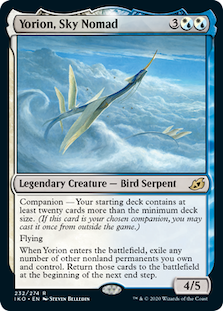
And yet, for the past year-and-a-half, 80-card decks have been a thing in Standard, Pioneer, Modern, and Legacy. This is the longest period with the highest number of non-60-card decks I was able to find in the history of competitive Magic. It has nothing to do with any shifts in thinking nor a specific change in the essential math. The only reason it's happened is the printing of Yorion, Sky Nomad. That companion changed the incentives enough for bigger decks to work.

Having a companion means having a specific card guaranteed in any matchup. This means that whatever else a deck might do in a game, there is a specific payoff waiting for them. This is incredibly valuable for larger decks because it ensures that they will always do something. One of the biggest problems with big deck has always been the risk that insufficient action, or the wrong type of action, is drawn. Yorion removes this concern, and that alone reduces the risk of the big deck.
Of course, if that was the only benefit from Yorion, I doubt that it would be enough. Fortunately, Yorion is a mass flicker card. This means that there is a ton of value to be extracted by casting it. Thus a deck that is already inclined to play lots of ETB creatures doesn't just have a payoff with Yorion, it has a huge one. Big decks get a big payoff, and they've stuck around and been successful in a big way.

Improving Piles

Well, one type has been successful. Check the decklist archives I linked in the previous section. Notice a pattern? The vast majority of the deck across formats which employ Yorion as a companion (and occasionally maindeck) are piles. That isn't me being disparaging. Pile is a technical name for a deck with minimal- to non-existent synergy which instead simply plays all the best cards in its color combinations. The plan is to out-power opponents with more of the best cards. This strategy benefits enormously from Yorion's existence. And not just because it's another fatty.
Rather, Yorion lets the piles become... piley-er? More pile like? A larger pile? Not sure of the proper terminology here and it may just be piling on [editor's note: readers, please don't go] but hopefully the point is coming across. Yorion just takes the pile and makes it more of a pile, increasing its piley power. Pile decks need lots of mana smoothing, cantrips, and other value to function. Yorion rewards the pile by letting it get another crack at all its cantrip permanents and value plays. The two synergize perfectly while not dramatically impacting consistency because in a pile every card is basically interchangeable.

The Unspoken Reason

As for the other decks, it's too broad a category to really get into. However, many of them are doing Yorion for the same reason that Death and Taxes frequently does: you can play with more of your cards. As a DnT player, there are a ton of cards that I really want to play but can't because there isn't space and/or they don't synergize with the specific attack strategy I'm using. Yorion's 80-card minimum means that now I can. And it's really fun. And sometimes, that's all the reason anyone needs.

Why Yorion Cascade Isn't Working

However, just because a deck is vaguely pileish and wants to manipulate its mana ratios and deck math doesn't mean that it will benefit from Yorion. Case in point: the Yorion version of Cascade Crashers is doing much worse than the 60-card version. At the end of October, Yorion Cascade was getting quite a bit of attention and seemed to be a solid deck. However, the data doesn't agree. As of writing this, 60-card Cascade Crashers is on pace for Tier 2 standing while I've recorded exactly one 80-card version. And it's happening for all the predictable reasons.

Math Strikes Back

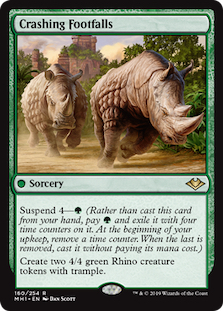
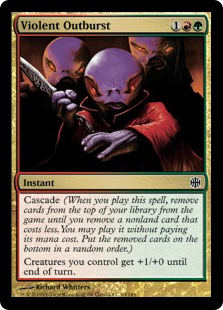
The stated reason for going for the 80-card version was to improve the odds of hitting the ideal curve for Cascade Crashers. I realize that sounds strange given everything I said at the top of this article, but it does make mathematical sense. See, the best thing that the deck can do (it is the namesake after all) is play a cascade spell into Crashing Footfalls on turn 3. The normal version plays 2 cascade spells for starting odds of 8/60=13.3% to draw the cascade spell. With 80 cards, they have the space for the mana to play another cascader (normally Ardent Plea) and the odds get better at 12/80=15%. More importantly, the risk of the worst outcome (drawing Footfalls) gets lower from 4/60=6.67% to 4/80=5%. That's not a small improvement all around.
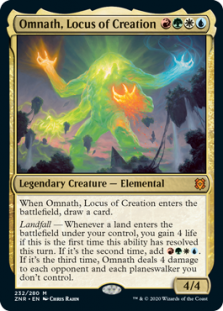
The problem is that the math for everything else has gotten worse. Yes, Yorion Cascade plays more good spells and Omnath, Locus of Creation is a very powerful and versatile card. However, it's far less likely that players will ever actually see said more powerful cards, and Cascade can't play all the cantrips to make up for this weakness. Piles work because they can play lots of cheap spells, particularly mana fixing, so that they can survive to cast the powerful spells. Because the whole point of the deck is ensuring a cascade into Footfalls, Crascade Crashers can't play cheap spells. It gets around that with free spells and Fire // Ice, but beyond that, really struggles with being clunky.

It Gets Worse

The problem gets worse after sideboard. Sideboard cards tend towards being critical after board and there really isn't a way to double up on them to improve the math. I've watched a lot of Yorion Cascade players at FNM and MTGO lose helplessly as they fail to draw the right spells at the right time and just die.

They had plenty of spells that were quite powerful in hand, but they were lacking either the mana to cast them or said spells didn't do anything. Lacking many ways to smooth their draws and cheap spells to catch up with, they were relegated to hoping that their individually powerful spells will be enough to pull them through. And unfortunately, raw power isn't good enough. Raw power with lots of support, on the other hand, works. In the pile decks.

The Inescapable Problem

Yorion Cascade is suffering from the exact same problem that all earlier attempts to use larger decks to improve the math of specific effects have throughout Magic's history. By increasing their deck size to improve specific math, they're making the rest of their math worse. Bigger decks work as Yorion piles, but not Yorion combos. And maybe that's good enough.

The Financial Depth of Revised

Are you a Quiet Speculation member?

If not, now is a perfect time to join up! Our powerful tools, breaking-news analysis, and exclusive Discord channel will make sure you stay up to date and ahead of the curve.

When people think of the valuable cards from Revised Edition, their minds most likely go directly toward either Dual Lands or Wheel of Fortune. This group of eleven cards makes up the upper echelon of valuable cards from the core set released in 1994. It has been this way for years now, and will likely continue this way for the foreseeable future.

There was an error retrieving a chart for Wheel of Fortune

Outside of these eleven cards, however, there are still a couple of tiers of noteworthy, valuable cards. These cards may be overlooked because they pale in comparison to Dual Lands, but are still worthy of attention. This week, I’m going to reference Card Kingdom’s and Star City Games’ buylist to highlight the second, third, and fourth tiers of notable cards from Revised Edition in the hopes of emphasizing just how deep this set has become.

I’ve written about Revised cards in the past but never structured in this way. Since my last Revised article, I’m sure many prices have adjusted (most higher) so it’s definitely worth touching on again.

The Second Tier

Besides Dual Lands and Wheel of Fortune, there are a couple of other Reserved List cards that show up in Revised. Unsurprisingly, a few of these show up in the second tier of Revised—cards worth more than $20 but less than Plateau.

The first one that comes to mind is Copy Artifact, with a $48 buy price at Card Kingdom. This Revised card has only become valuable recently, throughout the Reserved List craze of 2020 and 2021. Before then, you could find a ton of these, especially in played condition, for $20. Then the buyout ensued, the card received a bunch of attention, and now it’s difficult to find copies below $40.

There was an error retrieving a chart for Copy Artifact

Fork, Braingeyser, and Fastbond received the same buyout treatment. While their prices didn’t stick as highly as Copy Artifact (let’s face it, they aren’t quite as potent in Commander but still have utility), these Revised cards still maintained a higher price than they had prior to 2020 by a wide margin.

I remember when heavily played Revised Forks could be purchased by the handfuls for something like $7. Now non-damaged copies are hard to find under $20 and Card Kingdom’s buylist is $25. Braingeyser and Fastbond boast $18.50 and $16.50 buy prices, respectively.

Outside of Reserved List cards, there are a few heavily utilized cards with elevated power levels. These includes Commander staples Mana Vault and Demonic Tutor. The former has been reprinted a bunch but still carries a $46 buy price on Card Kingdom’s site! The latter has been reprinted some and isn’t even a rare! Despite being too powerful for Legacy and restricted in Vintage, this uncommon still maintains a buy price north of $20.

There was an error retrieving a chart for Demonic Tutor

In summary, the second tier of cards consists of powerful Commander staples and a few playable Reserved List cards.

The Third Tier

The second tier of valuable Revised cards probably didn’t surprise many people. But this next tier may reveal a hidden gem or two. These are the cards with buylist prices between $5 and $15, and there are many! First, I’ll present the list, and then I’ll offer some color commentary.

Birds of Paradise - $14
Sol Ring - $11
Zombie Master - $9.75
Shivan Dragon - $8.50
Winter Orb - $8.25
Wrath of God - $6.75
Howling Mine - $6.50
Mana Flare - $6.50
Armageddon - $6.50
Lord of Atlantis - $6.50

Some of these cards have utility in Commander, so their elevated buy price is less surprising. Sol Ring needs no explanation, and the fact that Revised copies are so valuable despite the existence of 1,000’s of $1 alternatives means players appreciate the nostalgia of the classic frame and art. Birds of Paradise is another popular card with play in more Modern formats. I’m surprised it’s become this valuable despite all its reprints, but the Revised printing of this card just relentlessly climbs higher.

There was an error retrieving a chart for Birds of Paradise

Howling Mine shows up in over 15,000 lists on EDHREC. While the number of appearances on lists on EDHREC is not the most reliable number, the order of magnitude should still be indicative of popularity and when the number of lists reaches five figures, we’re talking about a popular card.

What’s amazing to me, though, is how Revised Howling Mine remains valuable despite all its reprints. And we’re talking a lot of reprints! When I search for Howling Mine on TCGplayer I see 21 hits. Granted, this includes Alpha, Beta, Summer, and Foreign Black Border copies. Ignoring those, there are still easily over a dozen accessible printings of the card.

Winter Orb follows a similar pattern, showing up in five figures of lists on EDHREC. In contrast to Howling Mine, however, Winter Orb only has one printing (Eternal Masters) in a modern frame style. All other printings came out before 2000. In fact, this makes Winter Orb an interesting card to sit on for a while. As long as it dodges reprint, it should have upside. And even if it is reprinted, the downside isn’t huge if Howling Mine is any indication.

Then there are the decent, somewhat playable Revised cards that are just plain iconic. This includes Armageddon, Wrath of God, and Shivan Dragon. Collectibility and Old School may be driving these cards higher in price.

The two lords: Lord of Atlantis and Zombie Master likely also see Commander play, and the former also has utility in Modern. I don’t expect these to get very many reprints, since Wizards seems to have printed alternate versions like Master of the Pearl Trident and Cemetery Reaper.

Tier Four

Believe it or not, there are still a bunch of cards from Revised that would be worth digging out of old boxes and collections to ship to Card Kingdom’s buylist. Below is the list of cards that buylist for more than $2 and less than $5.

Serendib Efreet - $4.80
Stasis - $4.60
Mind Twist - $4.50
Demonic Hordes - $4
Savannah Lions - $3.70
Granite Gargoyle - $3.70
Nevinyrral's Disk - $3.60
Meekstone - $3.60
Contract from Below - $3.50
Goblin King - $3.25
Ivory Tower - $3.25
Counterspell - $3
Swords to Plowshares - $2.80
Rock Hydra - $2.75
Sedge Troll - $2.50
Ankh of Mishra - $2.05
Demonic Attorney - $2
Smoke - $2
Balance - $2

Wow, this is a long list of non-bulk cards from Revised! This is one very deep core set. I don’t even know where to begin.

Well, for starters, there are some Commander cards that show up in this tier as well: cards like Nevinyrral's Disk and Meekstone, with synergistic utility. Then you have the collection of more-iconic cards like Stasis, Rock Hydra, and Demonic Hordes.

There was an error retrieving a chart for Demonic Hordes

Also in this tier are Old School playable cards such as Granite Gargyole, Sedge Troll, and Savannah Lions. You’ve got another lord in the mix in Goblin King—another one that has since been obsoleted by more modern cards.

Then, surprisingly, you have a selection of cards that are banned in most formats: Mind Twist, Demonic Attorney, Balance, and Contract from Below. It’s interesting to see these cards carry decent value, and it just goes to show that even Revised cards are not as cheap and plentiful as they once were.

You even have a couple of uncommons showing up on this list in Swords to Plowshares and Counterspell.

There was an error retrieving a chart for Counterspell

Despite there being many, many copies of these two cards, as well as numerous reprints, they remain collectible enough to main decent value.

Wrapping It Up

Hopefully, there were at least a couple of cards discussed above that surprised you. I know I am just impressed that, overall, so many Revised cards are now worth at least a couple of bucks. If someone had asked me to guess how many non-Dual Land cards in Revised had a buylist over $2 I may have guessed 20 to 25. In reality, the number is approaching 40!

I drew the line arbitrarily, too. I could have extended the fourth tier down to cards worth at least a buck. Or I could have included a fifth tier to be more inclusive of such cards. There are another 17 Revised cards with a Card Kingdom buylist of at least $1.

It’s also worth noting that there may have been valuable cards from Revised that I missed because Card Kingdom doesn’t currently buy the card at all. Vesuvan Doppelganger comes to mind—Card Kingdom doesn’t have this one posted on their buylist, but Star City Games does at $15. Animate Dead, Bad Moon, Crusade, and Royal Assassin buylist to Star City Games for more than a dollar, but don’t show up at all on Card Kingdom’s buylist.

There was an error retrieving a chart for Royal Assassin

The bottom line: the age and collectability of this set is finally showing itself. For the longest time, Revised cards were kept out of the MTG finance conversation because quantities were so plentiful. I think it’s time to acknowledge formally that Revised cards are worth setting aside from the rest of your collection as “non-bulk”. Any card from the set—especially rares—should be kept separately for their upside potential and buylist value. I’ve been keeping my Revised cards separately for a couple of years now, but now I feel more motivated than ever to browse for Revised rares the next time I shop at a store to see if there are any underpriced cards with upside potential. Chances are good that, until everyone catches on, there will be some opportunities here.

Happy hunting!

A Brief History of Magic Design: FIRE

Are you a Quiet Speculation member?

If not, now is a perfect time to join up! Our powerful tools, breaking-news analysis, and exclusive Discord channel will make sure you stay up to date and ahead of the curve.

The process of designing Magic has evolved considerably over the game's nearly three-decade existence. Each part in this ongoing series will focus on a specific design era. The goal of the series is to understand the history of Magic design, so that we might better understand the present and future of the game, as well as the fundamentals of Magic design, and how those fundamentals have changed over the years. To do that, we will explore four questions:

  • What was this era of design seeking to accomplish?
  • How did they go about it?
  • How successful were they?
  • What design lessons can we learn?

FIRE Design

Powering Down Standard

Starting in Battle for Zendikar, and up through Core Set 2019, Wizards of the Coast R&D, made a conscious decision to power down the Standard format. Bryan Hawley, the Play Design Team Lead, said in a 2019 article that "our primary goal with that direction was to open up design space, mostly in higher-cost cards and in effects typically not impactful enough for competitive play."

While it sounds like a good idea, in theory, the problem with powering down Standard, Hawley was quick to admit, was twofold. First, it reduced interest in premiere sets for players who didn't play Standard. Second, it made Standard more sensitive to cards and mechanics that missed on power level. Hawley cites Smuggler's Copter, and Gideon, Ally of Zendikar as cards too strong for a powered-down format. He does not mention how the inclusion of a parasitic linear mechanic like Energy in a powered down Standard can go on to warp the format and lead to bans, as we saw in 2018.

Powering Standard Back Up

The lackluster Standard, and the response from the community, sparked a response from Wizards R&D. Vice President of Design Aaron Forsythe delivered a speech to the members of R&D on working to generate more excitement in the cards. What came out of that speech was the FIRE Philosophy. Not to be confused with the Philosophy of Fire, the FIRE Philosophy of design stands for Fun, Inviting, Replayable, Exciting. It's about having cards contribute to more exciting gameplay. Play Designer Andrew Brown elaborated on what FIRE means in the article Fire It Up noting that Vision Design, Play Design, and Creative all have their own versions of the FIRE Philosophy. So what does FIRE mean for Standard, and for Magic in general?

While Forsythe's speech occurred during the tail end of War of the Spark development, the real effects of the FIRE Philosophy were felt beginning with Guilds of Ravnica, through to Throne of Eldraine. One of the big pushes, Brown discusses in his article, is raising the quality and power level of commons. He cites Cloudkin Seer and Murder from Core Set 20 as examples of this improved power level.

Better Commons, Better Cards?

Improving the quality of commons overall is a great thing. It makes for better and more exciting games of limited, where commons and uncommons have the most opportunity to shine. It raises the floor of the power level of a set or of the Standard format in general, which is also good. If rares and mythics also increase in power level in relation to those common cards though, things can get problematic. We need to look no further for an example than with Throne of Eldraine.

Throne of Eldraine is the pinnacle of FIRE Philosophy. We can see it in the strength of all the commons, particularly in all the creatures with the adventure mechanic. Where Throne of Eldraine went wrong is in the pushed power level of its rares and mythics. This is true not just of actual mistakes like Oko, Thief of Crowns, and Once Upon a Time, but also in cards like Bonecrusher Giant // Stomp. Bonecrusher stifled format diversity in Standard to the extent that it is mindblowing it didn't wind up on the banned list with all the other Eldraine cards booted from Standard for their power level. If FIRE design doesn't make for good Standard sets, what is needed?

Design Lessons

Striking a Balance

FIRE design sought to make cards in premiere sets more exciting. Raising the power level of common cards certainly accomplished this for limited, making games much more interesting and dynamic. Overall though, the FIRE design era was just as problematic as the powered down era which proceeded it. In pushing up the power level of cards of all rarities, not just commons, we reached a point where a number of the rares and mythics were too powerful for Standard, and had to subsequently be banned as a result. Standard can really hum if Wizards can balance premiere sets so the floor of commons is high, but the power of rares and mythics isn't off the scale as to be format warping.

The Purpose of Premiere Sets

Premiere sets have been the flagship Magic products since the earliest eras of the game. Their primary purpose is introducing new cards and mechanics into Standard, and providing fresh limited experiences for players. A secondary aspect of premiere products is introducing new cards into Commander, Modern, and other constructed formats outside of Standard. When looking at FIRE design, and the powered down era preceding it, it's important to reexamine what a premiere set is, and what it should be doing. If a premiere set is full of higher-costed cards not meant for competitive play, is that a premiere set, or a Commander product? If a premiere set is full of under-costed threats and powerful effects, is that a premiere set, or a Horizons set in the making?

Premiere Sets Moving Forward

The advent of the Casual Play Design Team, focusing on Commander and other casual products, and the existence of Horizons sets as an outlet to introduce cards into constructed formats while bypassing Standard, are steps in the right direction. It is less necessary for premiere sets to include Commander, Modern, or even Pioneer-specific plants, when there are other outlets for printing those cards. Innistrad: Midnight Hunt is balanced in a way that makes for a fun limited environment, and adds interesting cards into Standard without warping the format. If Crimson Vow does the same, the future of Standard and premiere set design will be moving in a positive direction.

Closing Thoughts

Thirty years of Magic design is a lot of history to explore. I chose to start with FIRE design, because it was relatively recent for us to look back on, with resources written by members of R&D to refer to. Would you like to see more articles like this? What other eras or themes in Magic's design history would you like to see explored? Do you agree with my analysis? Why or why not? Let me know in the comments or on Twitter.

Avatar photo

Paul Comeau

Paul is Quiet Speculation's Director of Content. He first started playing Magic in 1994 when he cracked open his first Revised packs. He got interested in Magic Finance in 2000 after being swindled on a trade. As a budget-minded competitive player, he's always looking to improve his knowledge of the metagame and the market to stay competitive and to share that knowledge with those around him so we can all make better decisions. An avid Limited player, his favorite Cube card is Shahrazad. A freelance content creator by day, he is currently writing a book on the ‘90s TCG boom. You can find him on Twitter and LinkedIn.

View More By Paul Comeau

Posted in Design, FreeTagged , , , , Leave a Comment on A Brief History of Magic Design: FIRE

Have you joined the Quiet Speculation Discord?

If you haven't, you're leaving value on the table! Join our community of experts, enthusiasts, entertainers, and educators and enjoy exclusive podcasts, questions asked and answered, trades, sales, and everything else Discord has to offer.

Want to create content with Quiet Speculation?

All you need to succeed is a passion for Magic: The Gathering, and the ability to write coherently. Share your knowledge of MTG and how you leverage it to win games, get value from your cards – or even turn a profit.

Time Capsule: How to Start Growing Your Collection

Are you a Quiet Speculation member?

If not, now is a perfect time to join up! Our powerful tools, breaking-news analysis, and exclusive Discord channel will make sure you stay up to date and ahead of the curve.

One of our Quiet Speculation content leaders was cleaning through old drafts of articles in WordPress when he stumbled upon this unpublished article from January 2014. After re-reading the article, it looks like some of the content is timeless and could be helpful to readers even today. Other parts of the article make for a fun time capsule back nearly 8 years!

We hope you'll enjoy this preserved article from a very different Sig, with different goals, priorities, and quite frankly, far more time to play competitive Magic. Even his feature image depicts a much younger Sig (this was from his wedding back in 2009). -QS Staff

Entering The Arena

It’s Friday night, and once again you find yourself short a few valuable Standard cards for your deck. If only you could win a tournament or two, you could use the store credit to optimize your deck. But you consistently miss Top 8 in the final round because your deck is slightly less powerful without those critical mythic rares.

A classic catch-22.

A few years ago, I found myself in this exact situation. Although I knew the ins and outs of Magic through ten years of casual play, I was frequently intimidated by the FNM regulars at my local game store (LGS). I dabbled in drafts, but I struggled to justify paying $15 for a few bulk rares and a single-elimination tournament.

I tried to obtain cards I liked, but I just couldn’t get competitive in Standard. Trading was daunting, to say the least. Many players had pages and pages of hot rares across multiple formats. Rather than finding inspiration here, I was frequently overwhelmed and even baffled.

How did these spell-slingers obtain so many valuable cards? Were they guiltless sharks, taking advantage of every trade partner they could rope in? Perhaps their parents were rich, and they got any cards they asked for each week? Or maybe they were pros, and they had infinite store credit at the LGS?

As I was soon to learn, none of these were 100% true. Enter MTG finance.

Generating Value

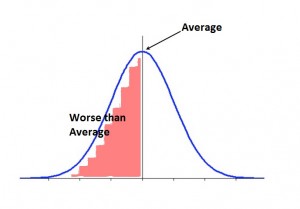
bell curveWinning tournaments is one way to add value to your collection. But let’s face it: while most players believe they are better than average, statistics cannot lie. Half of us are poorer than average, destined to a lifetime of FNM and PTQ grinding.

Once I realized I fell within this category, I knew I needed to find alternate ways of obtaining valuable cards I wanted to play with.

Then one day I gathered the courage to ask a local regular, “How did you get all those valuable cards? Did you open tons of boxes?”

“Through trades,” came the reply.

Inspiration hit me. By making wise investments and trading away cards near their peak for cards with more potential upside, one could slowly grind their way into a more complete collection.

All along I had been afraid to trade because I wasn’t familiar with all the trends and card values (this was before everyone had a smartphone). Rather than avoid this area of discomfort, I needed to educate myself.

Research Research Research

Enter the learning phase. Once I unlocked the knowledge that value could be obtained through MTG finance, I needed to do some major research.

The human brain is programmed to identify patterns and trends. The more I read about Magic, the more readily I could begin to formulate theories. Turns out the same few Standard decks win each month. I also discovered PTQ seasonality and the resulting price trends driven by predictable increases (and decreases) in demand.

Most importantly, I learned about one of the most significant factors that drive the giant MTG finance engine: Standard rotation.

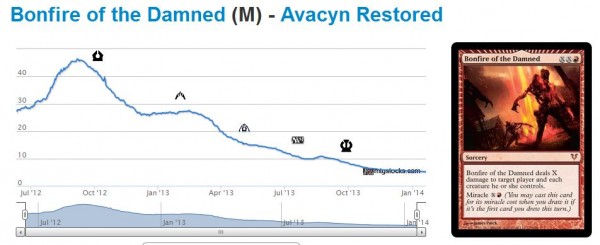
As it turns out, many of the most desirable Standard cards tank in value as they leave the most popular format in the game. Without playability in eternal formats or strong casual demand, these cards fade into the past (and the back of people's trade binders).

Bonfire

Still Unprepared…Mentally

With this new knowledge, I got to work. Armed with my newfound strategy I walked into FNM with a trade binder and a plan. I had done my research throughout the week and knew exactly which cards were hot and which ones weren’t. I would trade away the garbage that was fading in popularity and pick up the most popular cards in Standard.

That’s when I uncovered two problems I hadn’t anticipated.

First of all, everyone else was looking for the same exact cards! No one wanted my recently rotated staples, they wanted the same few $30-cards I did. How could I generate value by trading into hot staples if I had to fork over $30 in value for those same cards?

Second of all, no one seemed eager to trade with me when they found out my most desirable cards “weren’t for trade.” People would frustratingly ask why I even bothered to keep my precious few Legacy staples in my trade binder. I was creating artificial hope in my trade partners by showing them cards they needed, but couldn't obtain. This would turn them off, resulting in no transactions occurring.

Clearly, I needed to shift my paradigm. I was no longer a player first and trader second. If I truly wanted to grow value within my collection I needed to be an MTG investor (or trader, or speculator) first and foremost.

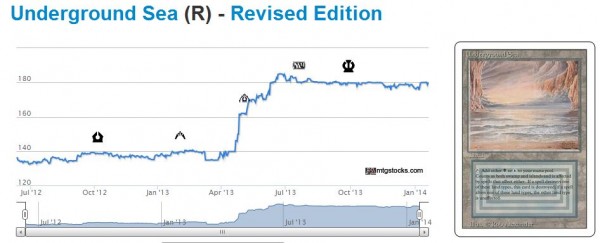
Take dual lands, for instance. They are extremely powerful, sometimes essential, in every format in which they're legal. They also can be an incredibly valuable asset to a collection.

Sea

If increasing collection value is your primary goal those duals need to be put to work in your trade binder. The less you keep sacred as “not for trade,” the more negotiating tools you’ll have at your disposal.

A Couple More Sacrifices and You’re Set

You need to take emotions out of the equation. Developing attachment to certain cards is a part of the game, and we are all susceptible to clinging to cards we treasure most in our collections. But these cards should be a significant minority, and they need to be left at home. Everything you bring to the LGS needs to be fair game. Everything.

This means even pieces of your Standard deck could be traded away if it means value creation for your collection. If someone desperately needs one more $25 mythic rare for their Standard deck and you’re the only one at the store willing to trade it away, you suddenly have significant leverage.

Unless you see that $25 card going significantly higher in value, you’re much better off trading it into cards with more upside potential--even if it means no Standard FNM for you that week.

In fact, once I decided that growing my collection’s value was priority number one, I largely gave up Standard. Standard is the most popular format in Magic. As such, it’s also rapidly fluctuating and evolving.

This means rapid card value swings, which in turn means opportunity. This is especially true as Standard rotation approaches--at these times you need to be especially astute and ahead of the curve.

Months before everyone starts thinking about dumping their rotating cards, you need to be doing just that. Many cards will near their peak and begin to decline during this window, and you do not want to be holding any cards that are leaving Standard.

The Rest Is Easier

Once you overcome the emotional challenges and break attachments to your cards, the rest is pretty straightforward. Of course, with speculation running rampant and buyouts occurring weekly, the Wild West that is MTG finance has become trickier. Stick to the basics and focus on winning strategies and you’ll be building your collection in no time.

So what are these winning strategies, you ask? Well, the obvious certainly applies here. As mentioned before you’ll want to sell or trade away rotating Standard cards well before everyone else. Focus instead on picking up powerful cards in the new block which should become relevant in a Standard format with a much smaller card pool.

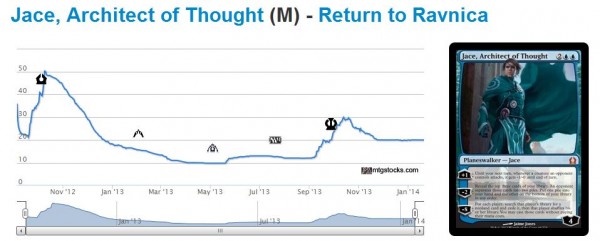
A good recent example of this would be Jace, Architect of Thought. While Innistrad block was around, this card was just a tad bit too weak.

Jace

After Innistrad block rotated out of Standard and the card pool shrank drastically, this planeswalker suddenly became relatively powerful. The result--a twofold increase in price and significant profits for those who were keen on the investment.

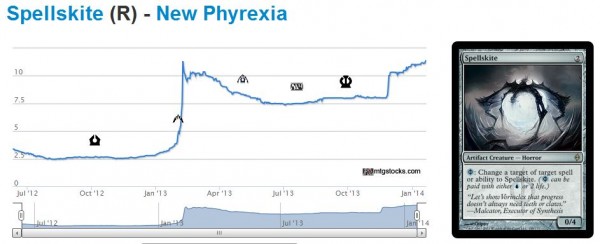
Seasonal investments are also straightforward. Some Modern cards will go up as Modern PTQ season approaches, and back down once it ends. Spellskite did just that last year, and I fully expect a repeat performance this summer with an even higher peak.

Spellskite

Sticking to macro trends like this will ensure you remain focused on your end goal of growing your collection’s value.

Benefits of a Financial Community

While macro trends do generally work out, today’s landscape is drastically different than it was even a few years ago when I began my endeavors in MTG finance. It seems everyone believes they can be a speculator, and with data instantaneously at people’s fingertips, the challenge of remaining ahead of the curve is greater than ever. With so many events both online and in real life, it’s become nearly impossible to stay on top of every slight shift in metagame.

Therefore to maximize the chance of success - without the pain of getting burned from rampant speculation and sudden buyouts - one needs to leverage as many resources as they have the capacity for. Whether it be Twitter, Reddit, or elsewhere, the more opinions you have access to the faster you'll learn and the fewer mistakes you'll make. As long as you develop your own opinion as well, even if it may seem counter to the general consensus.

To develop your own theses, the key is to look at macro trends and identify what specific cards are worthwhile investments and over what time horizon. Other general economic concepts ranging from basic supply and demand all the way up through Game Theory and Opportunity Cost are also sources of insight that can help guide you to the right investment decisions.

Five years ago when I entered the realm of MTG finance I relied on fervid dedication to research combined with the application of general trends. This was sufficient at the time, and it enabled me to embark on a long journey towards financial freedom in MTG.

Nowadays the number of people pursuing this same goal has increased in magnitude many times. Every trader is a shark it seems, and no one will give up value. Having a community to work with to stay ahead of the game can also provide crucial help as you get off the ground.

Whether you join the ranks of other dedicated MTG Speculators or go it alone, rest assured that with some work and ingenuity, you can fund most of your Magic exploits through trading and speculation. With enough dedication, you may even start to turn a real profit.

A Deeper look at “The Numbers”

Are you a Quiet Speculation member?

If not, now is a perfect time to join up! Our powerful tools, breaking-news analysis, and exclusive Discord channel will make sure you stay up to date and ahead of the curve.

Most readers might not know that for the past 10 months I've been working as a Value Engineer for a major company. In this role, my job is to look at the parts we currently use and find ways to reduce the cost without impacting the quality or functionality of the parts themselves. So far, I have found it to be an interesting crossover between my natural love of engineering and my acquired love of everything financial thanks to my past nine years in the Magic: The Gathering finance realm.

Calculating Profit

One of the big challenges I face at work every day is defining the true cost of a part. For us, the actual factors that go into that valuation can differ based on whether we purchase the part or make it ourselves. Lately, I have seen parallels between that work and my Magic finance life. It's made me wonder how we in the Magic Finance realm calculate our "true cost" of a card.

Profit = Final Sale Price - Total Cost to Sell a Card - Total Cost to Purchase a Card

Ironically, calculating the profit is easy if you have a good understanding of the two total costs listed above.

Total Costs To Selling a Card

Total Cost to Sell a Card might include factors like:

  • Final Sales Price
  • Selling fees
    • Marketplace fees
    • Transaction fees (like PayPal or credit card processing)
  • Shipping Costs
    • Envelope/Bubble Mailer
    • Stamp
    • Printer Ink
    • Paper
    • Tape
    • Shipping Fees
  • Taxes/Tariffs
    • Federal
    • State
    • Local
  • Labor Cost
    • Either the cost of your time or that of an employee to sort and list your inventory.
    • Either the cost of your time or that of an employee to collect the items in the order as well as pack said order.
    • Either the cost of your time or that of an employee to manage your inventory.
    • Either the cost of your time or that of an employee to deal with customer issues.

Total Cost to Purchase a Card

Total cost to Purchase a Card might include factors like:

  • Final Purchase Price
  • Transportation cost
    • Cost of getting the card to you.
      • Shipping costs
      • In person travel costs
  • Packaging costs (if these aren't baked into the final purchase agreement)
  • Labor Cost
    • Either the cost of your time or that of an employee to review potential buys
      • Either the cost of your time or that of an employee to grade cards before purchase
      • Either the cost of your time or that of an employee to price out each potential card
  • Taxes/Tariffs
    • Federal
    • State
    • Local
  • Warehousing/Storage cost associated with operating a business (this could fall under either category depending on your choices)

So Now What?

First, I want to make sure that everyone is aware that not all of the items listed in the section above may apply to you and your business. The main purpose is to highlight that they COULD be relevant.

The biggest issue I see a lot of small business owners making, especially those who operate a fully online business with no other employees, is that many of these factors get ignored. This causes many of these store owners to wonder where all their profit is, and many times, they operate in the belief that they will just need to raise their selling prices and lower their buying prices. While that may work in an environment with little competition, thanks to the world wide web, my little home-based TCGplayer store is directly competing with well-known stores with big names and lots of employees.

Death and Taxes, But Mainly Taxes

As I stated in my article back in April, while we at QS always advise everyone to operate above board, I know plenty of small-time sellers who do not report this additional income on their income taxes. At least here in the US, this is no longer an option as of 2022. The marketplaces you sell on are required by law to report any accounts in which the total sales exceed $600. This rule has been in effect for quite some time, though prior to the passage of the "American Rescue Plan Act of 2021" the limit was $20,000. I suggest you read over my previous article covering all this information as 2022 is almost upon us. For additional information regarding taxes on collectibles, I suggest at a bare minimum you read over this article from Investopedia. For many of the small-time sellers, this change is likely to mean that you will now have your profits reduced by 28%.

A True-Costed Example

As I like to teach by example let's look at Ydwen Efreet

There was an error retrieving a chart for Ydwen Efreet

Let's say you bought a copy back in early 2017 for around $28 from a friend. You looked it up the other day and saw it's now sitting at $151, so you listed it and sold it. You didn't get $151. You lost $23 to TCGPlayer fees + shipping it in a bubble mailer with a top loader. 

Profit = $151 (Final Sale Price) - $23 (Fees + Shipping costs) - Purchase Price ($28)

Going forward, in 2022 you will need to include the collectible income tax of 28% which gets taken out of the profit line. So what would have been your profit of $100 is actually $100-$28 0r $72. Arguably it was always $72, but there is a reason that the backpack traders are able to pay more than most store's buy lists and sell for near TCGPlayer low. In 2022 they will not be able to do that without a massive tax bill in 2023.

Knowing this information now, for those who plan on continuing operations next year, the 28% tax from your profits will need to be baked into your buy and/or sell prices.

Conclusion

While I didn't really want to harp too much on the change to the tax rule that I already covered back in April, the key takeaway from this article should be to encourage all sellers to review their costs and get a better understanding of all their business costs. Hopefully, some of you find new factors that you need to account for so that you can track your profits more accurately moving forward.

Avatar photo

David Schumann

David started playing Magic in the days of Fifth Edition, with a hiatus between Judgment to Shards. He's been playing Commander since 2009 and Legacy since 2010.

View More By David Schumann

Posted in FreeLeave a Comment on A Deeper look at “The Numbers”

Have you joined the Quiet Speculation Discord?

If you haven't, you're leaving value on the table! Join our community of experts, enthusiasts, entertainers, and educators and enjoy exclusive podcasts, questions asked and answered, trades, sales, and everything else Discord has to offer.

Want to create content with Quiet Speculation?

All you need to succeed is a passion for Magic: The Gathering, and the ability to write coherently. Share your knowledge of MTG and how you leverage it to win games, get value from your cards – or even turn a profit.

An Empty Promise: Crimson Vow Spoilers

Are you a Quiet Speculation member?

If not, now is a perfect time to join up! Our powerful tools, breaking-news analysis, and exclusive Discord channel will make sure you stay up to date and ahead of the curve.

I guess even Wizards is getting tired of constant spoilers. At least, that would validate Innistrad: Crimson Vow's really short reveal. Spoilers began on October 28 and were finished a week later. Not that I'm complaining. It means that I get to do this article with a full look at the spoiler for once. It also means that we got done with this fairly uninspiring set that much faster, and move on to other things. A win all around.

So, yeah, Crimson Vow doesn't have much for Modern. Not that it's unexpected given how Midnight Hunt went, but still. Modern got a lot of sideboard cards and three well-played cards from that one, at least. I'm not sure that anything from Vow will have much staying power in Modern. There are plenty of cards for which I can (and will in a few paragraphs) construct scenarios where they could be played. Some of these possibilities are solid engine cards and those are always worth keeping in mind whenever new cards are printed. You never know when an engine will be busted.

The Engines

I should specify: these are all card advantage engines. Urza, Lord High Artificer and Devoted Druid/Vizier of Remedies remain the only true mana engines in Modern. Wizards has learned, and we're unlikely to see anything like Krark-Clan Ironworks again. There are plenty of ways to draw lots of cards in Modern as it is, but in the right deck and/or under the right circumstances, these cards could enable some utterly degenerate streams of cards or permanents to just swamp an opponent. Or, more likely, they'll forever remain "cards with potential" whose value is just too much work to tease out.

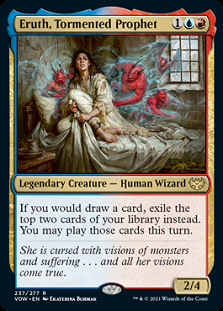
Eruth, Tormented Prophet

The first one is easily the most straightforward. Eruth, Tormented Prophet turns every draw into Harnfel, Horn of Bounty. Which is already a Modern-legal card, but Eruth costs less mana, and that does make a huge difference. Whether that's made up for by Eruth being a more vulnerable creature is hard to say. The bigger benefit to Eruth is that there's no need to get the ball rolling with a card to discard; every draw exiles two cards. Harnfel is an integral piece of Legacy Mono-Red Storm, and being cheaper and easier to get going could make Eruth work in Modern.
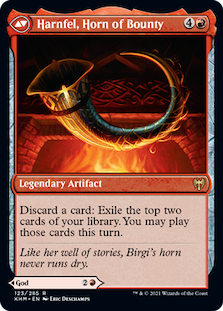
The question: why bother? Eruth's card advantage doesn't actually put cards into your hand for later. It's use it or lose it, and that really limits her home to combo. Storm isn't really viable anymore and even if it was, why would it bother with Eruth over Expressive Iteration? In fact, why would any deck bother with Eruth over Iteration? And that's ultimately the problem. Eruth has the potential to just snowball out of control in a single turn, but what is she building towards and how is that better than existing options? She feels like a card that could eventually find a home that doesn't yet exist.
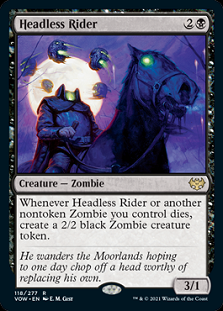
Headless Rider

Headless Rider is meant to be to Zombies what Xathrid Necromancer was to Humans. The problem is that the Rider is even less necessary in Zombies than Necromancer has been for Humans for years. Gravecrawler, Geralf's Messenger, Relentless Dead, Diregraf Colossus, the list goes on of Zombies that let Zombies shrug off mass removal. Rider does nothing new and isn't needed.
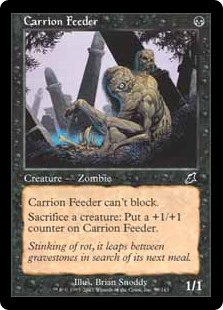
Still, Rider does have combo applications. Zombies often includes sacrifice combos, and Rider doubles the fodder for said triggers. Why Zombies needs to double its fodder isn't clear, but this could push the deck in a more directly combo direction. Which might help the deck actually see play because it has never had much traction in Modern. No matter how good the beaters have been, without disruption, it just can't keep up. Perhaps going more for sacrifice combos is what is needed and if so then Rider is a perfect Zombies card.
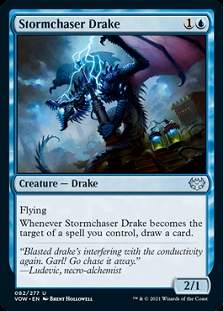
Stormchaser Drake

Wizards clearly intended for this Drake to be enchanted. However, it has flying instead of hexproof, so there's no chance of it being a big Bogles payoff. Kor Spiritdancer is better in that context. However, the potential for this card to draw your entire deck certainly exists. The problem is that it won't be easy. Given the name, the obvious pairing to make Stormchaser Drake absurd would be the storm mechanic. The problem is that there aren't many of those and only ones that target creatures are Grapeshot and Ground Rift. However, Wizards clearly thought of that, and since Drake has flying, Rift isn't an option. Which just leaves Grapeshot, and why would you target your own creature and not the opponent with that card? The same goes for replicate spells.
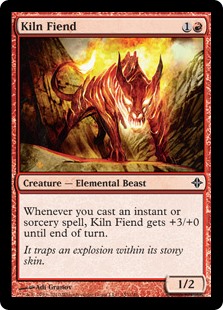
There is the option to just target Drake with lots of spells like Kiln Fiend-style decks. Chaining Mutagenic Growth and other pump spells could produce a self-sustaining chain that ends in a single lethal swing. However, Drake dies to a stiff wind and Modern is filled with removal, far more than in Kiln Fiend's... I guess it was a heyday? More importantly, how is targeting Drake better than the alternatives? Such a deck would be somewhere between Prowess and Infect, neither of which are doing well right now. Additionally, Drake is far more of a glass cannon than either of those decks. So I don't see it. That said, there is so much (potential) value to be wrung from that I wouldn't be surprised if I overlooked something. Or if a Ground Rift-esque new card comes along and busts Drake.
Torens, Fist of the Angels

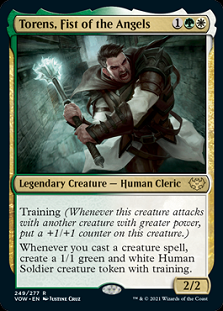
Just like with Headless Rider, Torens, Fist of the Angels has the potential to create utterly absurd boards. Unlike the Rider, Torens is a value play. Humans has been playing Adeline, Resplendent Cathar, and Torens can make far more tokens in a turn. However, I really don't think that such a fair use is Torens' destiny. Rather, Torens combos with Memnite and Ornithopter to just flood the board with dorks. I'm not sure how such a turn would be set up, but it wouldn't be unheard of for some Cheeri0s-style combo deck to utilize this engine.
But then what? I genuinely don't have anything beyond "Torens and 0-mana creatures makes huge board." It would generate a big storm count quickly, but how does that win the game? How do you keep the flow of dorks up? Or even get it going? And if you're not trying to win via Grapeshot, how does this win? Combo players: there may be something here. Have at it!

Homeless Value

There are also a staggering number of cards that provide cantrips or better with the stats to potentially make it in Modern. The problem is either that there isn't a deck which they fit into or the metagame isn't right for how the card wants to be used. Whether or not the right metagame is plausible is another matter, but all of these cards definitely could make it in the right home.

Cemetery Illuminator

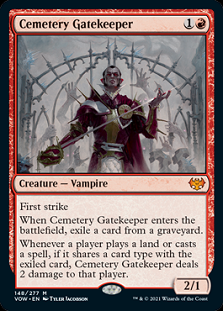
Vow has a cycle of cards that exile a graveyard card on entering the battlefield and then get some value from the card type. And for the most part they're mediocre at best. Yes, even Cemetery Gatekeeper. It's no Eidolon of the Great Revel; it's just too easy to play around. Remember how Harsh Mentor worked out?
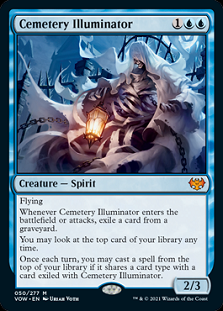
Cemetery Illuminator is the only one that could see extensive play. The reason is simple: Illuminator allows its controller up to two extra spells per turn cycle. Actually having it work out to exile the right card and then have two to play off the top of your library consistently is unlikely without a lot of setup, especially since nothing like Sensei's Diving Top is legal. But there's a chance for a lot of value.
Given the creature type, the first thought for making it work is Spirits, but that's unlikely to happen. Spirits doesn't have room at three mana as it stands. It will also be hard to set Illuminator up, though Vialing in Illuminator definitely reduces mana pressure. More likely I think some kind of midrange deck looking to exile instants wants Illuminator. That way they're guaranteed to be able to play the cards on the opponent's turn. The catch is that there isn't a deck that wants it and again, there aren't many efficient ways to set it up in Modern. If one does exist though...it's still a vulnerable creature. Maybe in Vintage?

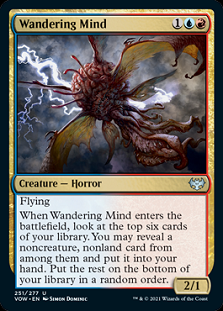
Wandering Mind

I'm staggered by the potential here, yet confounded by the actual utility. Wandering Mind is a very powerful Izzet effect at a reasonable price given the body. Anticipate and Peer Through Depths have seen Modern play before, and Mind digs much deeper. Being sorcery speed isn't really a problem given Izzet being quite proactive and the dig being a great way to set up a continuing value chain. Any Izzet deck looking for a dig spell would be well served.
But, what deck might that be? The current crop of tempo and Prowess decks don't need Mind, nor does it fit into their usual threat categories. It's too costly and doesn't grow, though flying is welcome. Also, those decks don't need to dig deep since they're cantripping though their deck too quickly. Mind needs a slower style deck that needs to find specific answers or maybe combo pieces to shine. Such a deck does not exist, and even if it did I'm not sure that Mind is better than extra cantrips. It feels like a good card that will never have a home.

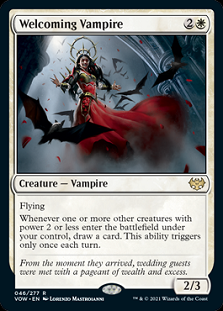
Welcoming Vampire

On a similar note, I really like Welcoming Vampire. It's a decent though not exceptional body that fits into white-based creature decks and fills a hole in many of them. Card draw has been getting increasingly easy to get and is necessary, after all. Thus, she's a very solid addition. But that's not enough. Despite being gracious to others, Welcoming Vampire doesn't do anything alone, and her stats aren't exceptional. The ability doesn't trigger on itself, only others, and that's a huge strike against playability. It also doesn't disrupt the opponent or have tribal synergy with anything. The deck that wants Welcoming Vampire is a grindy Wx Valuetown style deck, and that hasn't been viable in Modern in years. Thought it would be very strong in such a deck.
Good Cards for Bad Decks

And finally, there are a number of cards that are only potential additions for some mediocre to actually bad decks. These cards will be very good in said mediocre-at-best decks, but only realistically in those decks. Which probably means they won't see any real play, especially since none of these cards will fix what's wrong with their host decks. Thus, they're really just enthusiast-only cards.

So Many Zombies

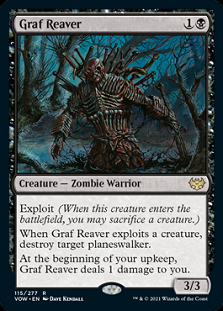
Appropriately enough, there are a number of Modern-viable Zombies for the tribal deck beyond the more combo-oriented Headless Rider. The headliner for all these cards, both in terms of power and why they won't see play, is Graf Reaver. A 3/3 for two with a drawback isn't Modern playable, but a 3/3 for two with a drawback that's also removal is. And Reaver killing planeswalkers is extremely relevant right now. Trading a Gravecrawler for Wrenn and Six or Teferi, Time Raveler and leaving behind a better body is pretty good value.
The catch is that Zombies already has spells to kill 'walkers and can just attack them. What it needs is either tribal pump effects or disruptive creatures à la Humans. As it's not getting any of those, just more beef, its viability won't be changing. It had all the beef it needed already.

Hullbreaker Horror

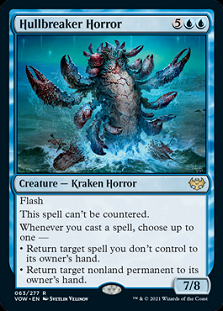
Any deck that untaps with Hullbreaker Horror, instants in hand, and a way to get more will win the game. Simply put, no relevant spell is going to resolve, and the board will soon be clear for good. Uncounterability doesn't impact this reality. The catch is that since Horror costs seven, it will be quite hard to meet those conditions the turn it comes down. Solitude being the most played removal for big creatures, Force of Negation is no help. UWx can do it, but why should they bother when what they're doing now is so successful?
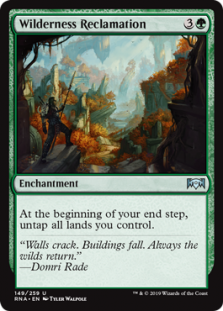
Wilderness Reclamation decks, on the other hand, often hit the needed mana early and then have plenty to spend protecting Horror and riding it to victory. It would be quite trivial for such a deck to float the needed mana, untap on end step, and then cast and protect Horror. However, Reclamation is not a good Modern deck. When everything comes together, it's very powerful right now, but the problem is actually getting everything to come together. The whole deck is built around resolving a four-mana enchantment and keeping it in play until end step. That's not easy as-is, and Horror does nothing to help. So I don't see it working out.
Kaya, Geist Hunter

Years ago, WB Tokens saw play because it had a decent Jund matchup. The deck based on 1-for-1 trades unsurprisingly has trouble with cards like Lingering Souls which skew the math. However, as Modern has evolved, the weaknesses of Tokens have become too exploitable, and the grindy rock gameplan it targets has fallen from favor. Thus, it doesn't see much play, and isn't really part of the metagame anymore.

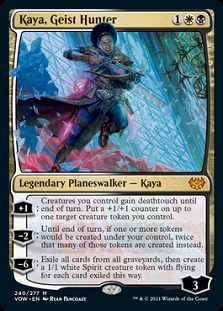
However, Kaya, Geist Hunter is a great card for that deck. The biggest problem for the deck is how dinky the creatures are, and being able to permanently pump them is pretty good. Additionally, the -2 ability is very strong when it's making 6+ Spirit tokens. Of course, the deck will still struggle for all the reasons it currently struggles, but at least when things are going well, they'll go much better.

It Can Still Work Out

And that's Crimson Vow. There are plenty of cards to try and brew around, but the power level is noticeably lower than even Midnight Hunt. That's not a bad thing, but it does meant that Modern is unlikely to change much for the foreseeable future. Whether that's a good thing or not depends on your perspective.

I Sold My Duals and Learned Lessons in the Process

Are you a Quiet Speculation member?

If not, now is a perfect time to join up! Our powerful tools, breaking-news analysis, and exclusive Discord channel will make sure you stay up to date and ahead of the curve.

I was scheduled to do a piece about misprints this week, but something big happened to me. Stay tuned for that piece in the future. Instead, I want to talk about what happened and share my thoughts and feelings, not only as a small private collector but also as a human being.

I was investing heavily in graded cards when I lost my job. I was investing not just in Magic: The Gathering, but Pokémon as well as a way to diversify. I was fortunate to end up with a bunch of nice slabs as a result, including finding a VG slabbed copy of Library of Alexandria in Europe, and some deals with local Pokémon collectors who have lots of graded material.

There was an error retrieving a chart for Library of Alexandria

If I could see the future, I'd have been far less aggressive in my diversification, knowing I'd be losing my job. Long story short, as a direct consequence of this I had to sell nine of my beloved dual lands. I needed liquidity fast and could not go through the hassle of selling more minor pieces of my collection. I had no time to think about it.

It was hard for me to let them go. When I bought those duals I thought I was going to hold them forever no matter what. Life proved, once more, that nothing lasts forever and the only constant is change. Here are some thoughts I learned from this experience, with the hopes that they will be valuable to others facing similar ordeals. This article is about acceptance, letting go, and doing the right thing.

You Should Never Feel Bad for Making Money

I bought my ten duals, one of each, for roughly $2000 in three monthly installments. I sold all but a Foreign Black Border (FBB) Plateau for $1300 cash, plus a trade of four beautiful Force of Wills signed by Terese Nielsen and a sealed Double Masters booster box. The trades were valued at roughly $900.

There was an error retrieving a chart for Force of Will

So, essentially for $700 I bought a Plateau in very nice condition, a signed playset of Forces, and the booster box. Sure, in the traditional sense, "I lost" $700 that I haven't seen a return on, but we all buy and sell cards and I honestly believe this is a fine purchase. Not to mention that the $1300 cash really helped around the house.

If You Are Going To Invest in Collectibles You Need To Leave Emotions Aside

One of the most valuable lessons I learned from reading articles and watching famous YouTubers talk about these issues is leaving your emotions aside. You need to dismiss feelings in order to do what needs doing. I could have tried to jump through a lot of hoops in order to keep my duals, but this was unnecessary. Incurring risk is far worse than losing precious items of your collection.

A friend of mine put it perfectly: "you need to put a roof over your head first." I need to continue to pay my bank loan on my property and pay all the bills. It is an obvious statement, but these are priorities. It is important to keep that in mind, and this situation was a wake-up call for me.

You Can Always Purchase What You Had To Sell at Another Time

The mindset that leads to comments like "it is too late for me to invest in..." needs to be broken. Many times I thought that this was my last chance to purchase duals. Get on the train or be left behind forever. But as Rudy from Alpha Investments put it bluntly, "It is not too late."

I used to have that mindset, but I do not any longer. Please don't get me wrong, I really think these items are special and I was sad when I had to part with them. But when looked at in perspective, it is not the end of the world. There are plenty of duals out there. With patience, another good opportunity will present itself.

I firmly believe I will be the owner of dual lands again in the future, and this time will not be Foreign White Border (FWB), but Revised. Sometimes you need to take one step back in order to take two steps forward. I really hope this is the case.

Letting Go Can Be Cathartic

While I was sad when the transaction occurred, part of me also felt accomplished. It was a weird sort of relief. I could isolate myself from the emotion and do what was needed to be done and that was surprisingly gratifying for me. I was truly not expecting it.

"Acceptance" was the word that was floating around my head the whole time. It is what it is. This is true for other aspects of life as well. Sometimes things aren't meant to be in the way they were expected or desired. I had to make terms with the idea that selling these cards was the best for my current situation. I did not hesitate to do it once I came to this conclusion.

In the end, we learn as we walk this path. "Investing in pandemic times," as it were, has certainly been rewarding for me. While I am patient, I am also excited to see what happens with the markets once the pandemic subsides and the world goes back to something semi-normal.

Your Collection Is Still a Beauty, My Friend, and the Grinding Must Not Stop!

We hold on to what we can, and that is fine. As Massive Attack sing, you have to be thankful for what you've got. Cards are like money: they come and they go. A less-attached approach to the hobby could be beneficial for you financially.

Again: the only permanent thing is change. I turn the four Force of Wills from selling my duals into a full Jon Finkel gold-bordered deck (hello Grim Monolith!) and some beautiful promotional cards that I believe will perform well in the future. Plus, I get to play a lot of Premodern, too. You have to keep going. There is no way back.

There was an error retrieving a chart for Grim Monolith

Conclusion

Have you ever been in a situation where you had to sell something precious to yourself? Do you think that attachment can be an issue when investing in collectibles? Let me hear your thoughts in the comments!

Avatar photo

Mauro Acerenza

Mauro started playing Magic in 1995; it all began with an Ice Age starter pack. After a long break from the game, he returned to the hobby in 2015, shortly after Khans of Tarkir was released, thanks to a friend in university that told him that Magic was still alive. His interest in Magic Finance started in 2019 when he found out about the concept of the Reserved List. A competitive Modern and Cube player, he nearly always plays aggro decks.

View More By Mauro Acerenza

Posted in Finance, Free, Free FinanceTagged , , 1 Comment on I Sold My Duals and Learned Lessons in the Process

Have you joined the Quiet Speculation Discord?

If you haven't, you're leaving value on the table! Join our community of experts, enthusiasts, entertainers, and educators and enjoy exclusive podcasts, questions asked and answered, trades, sales, and everything else Discord has to offer.

Want to create content with Quiet Speculation?

All you need to succeed is a passion for Magic: The Gathering, and the ability to write coherently. Share your knowledge of MTG and how you leverage it to win games, get value from your cards – or even turn a profit.

A Personal Reflection of Magic Apathy

Are you a Quiet Speculation member?

If not, now is a perfect time to join up! Our powerful tools, breaking-news analysis, and exclusive Discord channel will make sure you stay up to date and ahead of the curve.

This week I turn introspective as I consider my recent disengagement with Magic—both the game and the financial component. It’s been quite a few years since I began to feel increasingly disinterested in the game, and it makes me wonder, what’s to come? How can I get out of this funk? Is there a catalyst on the horizon that will re-inspire me?

Transparently, a small part of me is sitting here wondering if this is the beginning of the end for my involvement in the hobby. The temptation to sell my collection and move the money completely into a brokerage account to invest for my children’s college educations has never been stronger. I would be lying if I said otherwise. While I don't think Reserved List card prices have peaked, and expect them to remain a solid investment for years, I would be fairly content with the money I’d receive for the collection as of today.

As I ponder this significant decision, I’d like to share some personal experiences I’ve had walking away from the game and, inevitably, returning to it. Although there may be no direct actionable finance advice, I’m hoping the piece resonates with some and interests others as I attempt to weave in some personal anecdotes throughout the article.

Fall 1998: My First Hiatus

I began playing Magic back in 1997 and the first sealed products I opened were a Fifth Edition starter deck and a Visions booster pack. I still remember to this day the two highlights from these packs: a City of Brass and a Desertion.

There was an error retrieving a chart for City of Brass

There was an error retrieving a chart for Desertion

My life would never be the same again. Magic paved a road for me and gave me guidance on how to follow it—to new friends, new interests, and new communities. My life in middle school was largely shaped by this collectible card game. The tremendous flavor of Mirage block and Tempest block made continuous engagement in Magic very easy, and I loved saving money however I could in order to scrape up $3 for my next booster pack. To this day I remember opening a Mox Diamond in my (now out-of-business) local hobby shop and immediately selling it to another kid in the store for $20. I had just turned $3 into $20, and I was on top of the world.

As high school started, I slowly lost interest in the game as I struggled to find my identity. I also vividly remember being turned off by the power level of the new set, Urza’s Saga. My friend had a pre-constructed deck called The Plague, which combined Pestilence with Urza's Armor and creatures with protection from black. It was my first exposure to a sort of “combo deck” and I found it unbeatable. Wall of Junk was also a very obnoxious card.

There was an error retrieving a chart for Wall of Junk

I also heard rumors of how cards from the set were banned due to power level (“combo winter”). Then the second shoe dropped, and Wizards of the Coast announced they would begin printing premium foil variants and randomly inserting them in booster packs. I was not interested in these shiny cards, which I thought deviated from Magic’s original aesthetic.

With all these factors combined, I took a break from Magic.

What Brought Me Back

To be fair, I didn’t quit the game cold turkey. I never purchased a single booster pack from Urza’s block (nowadays I kick myself for this decision), but I probably opened a pack of Prophecy here or a pack of Seventh Edition there. The Fall of 2001 though, brought a new block that renewed me and my friends' interest in Magic. It was the Odyssey block!

Each of us found something of interest from these three sets. We all appreciated the threshold and flashback mechanics, as it was really cool that “spent cards” could still provide utility. I also remember reading about some powerful enchantments, such as Transcendence and Nefarious Lich, that looked really cool to build around. And who could forget the awe-inspiring power of Silver Seraph?

There was an error retrieving a chart for Transcendence

There was an error retrieving a chart for Silver Seraph

Yup, we were back with a vengeance spending money on Magic all over again. It helped that, by this age, I was slowly worrying less and less about what others in school thought about me. I felt more comfortable being myself, and that self needed to play Magic!

My excitement for the game continued right through Onslaught block (I remember hoping I would open fetch lands so that I could immediately trade them for “better cards”). The morph mechanic was a blast and I even had fun playing a casual Astral Slide deck. My friend could never beat it, but in hindsight, I did sort of “cheat” because the deck included Balance, which was the card that gave him issues. That’s why I emphasize the deck was strictly casual.

Eighth Edition gripped my interest because it brought back classic cards from all previous sets of Magic as a way of celebrating the game's 10th anniversary. But let's face it, I just wanted to open Birds of Paradise. Just once.

There was an error retrieving a chart for Birds of Paradise

I was thriving in college and loving life while also loving Magic.

Affinity, Another Departure, and Return

It was largely coincidental that I took another hiatus from Magic right about when it was destined for another string of overpowered cards and resultant bannings. I missed the whole Affinity hype cycle mostly because a) I didn’t really have an interest in artifacts and b) I was getting deeper into my university studies and shifted focus away from Magic again. I consider myself lucky for missing out on one of the worst Standard seasons of all time.

The Champions of Kamigawa block didn’t do much for me either. There were a number of reasons why this set struggled, but the primary reason for me personally was simply that I didn’t care for the cards. This was another time when I found other things in life to keep me busy.

With the launch of the Ravnica block, I had a bit of déjà vu. The cards were powerful and interesting, but the only reason I bought booster packs from the block was to open shock lands. Again, I didn’t want to open shock lands because I was playing them in competitive decks. I wanted to open them because I knew I could sell or trade them for other cards I wanted. Even as recently as 2007, I was a casual player through and through.

There was an error retrieving a chart for Overgrown Tomb

My perception of Magic changed forever with the release of Time Spiral. While many pan the set as overly complex and describe it as a list of inside jokes for the enfranchised player, I must confess I was the exact target audience for such a set. The reprints of older cards in the old frame, the references to old cards, and the color-shifted cards in Planar Chaos all brought a wave of nostalgia that stuck with me for many years.

It reignited a passion that lasted over a decade. In that time, I became more competitive⁠—drafting, playing at Grands Prix, PTQs, etc. It also started my foray into Magic finance. After my kids were born and my competitive play diminished, I continued to find enjoyment in Old School, Vintage, and in buying and selling some of Magic’s earliest most collectible cards. It was a high point for Magic in my life.

Another Hiatus: What’s Next?

That high point in my engagement with Magic peaked about a year ago, in late 2020. I was jamming games of Arena every day, consistently hitting mythic in constructed play, while also achieving numerous Old School deck upgrades. I was firing on all cylinders when it came to the hobby.

Then, out of nowhere, a switch flipped. Around the time Kaldheim launched I suddenly lost interest in Magic. I went from completing a couple dozen drafts of Zendikar Rising to zero drafts of Kaldheim. I have not drafted since, throughout pretty much all of 2021. I haven’t purchased any new product either. Before, I was at least picking up some boosters of the new sets to momentarily dive into their aesthetic.

Now I sit here pondering what might get me back into Magic again. Will it be the launch of a new set with interesting mechanics and powerful enchantments? Unlikely, since I find I’m disinterested in even reading spoilers of the new sets. Will it be a new throwback set like Time Spiral? Doubtful—we just had a Time Spiral Remastered set in March and it failed to rekindle my interest.

There was an error retrieving a chart for Magus of the Moon

Could it be the printing of cards using the classic Magic frame? Nope, Wizards did this but the nostalgia aesthetic isn’t pulling me back in.

I’m stumped. My return to Magic is likely going to have to stem from some unknown, novel catalyst on the horizon. Something unpredictable, such as meeting a new co-worker who is passionate about the game, or attending a [very] local post-COVID MagicFest and getting a rush from the crowd. Perhaps another bout of massive buyouts across the Reserved List market would at least whet my appetite for buying and selling cards again?

In absence of all of these, however, I’m stuck in this apathetic malaise.

There was an error retrieving a chart for Apathy

Wrapping It Up

Hopefully, this personal reflection was at least interesting to readers, allowing a slightly deeper understanding of my involvement in the game and current lack of interest. Each time I stepped away from the game, there wasn’t a singular event to blame. Instead, it was a combination of circumstances both within the game and in my personal life that pulled me away.

This current hiatus is no different—lack of in-person events, stagnant Reserved List prices, and a slew of sets that don’t resonate with me are all contributing factors. Perhaps all three of these obstacles will have to be broken down in order to reinvigorate my interest in Magic.

Until then, I’m not abandoning the game altogether. I'm not quitting writing for QS either. I'll still buy or sell the occasional card (I have an Unlimited Mox Sapphire for sale right now).

There was an error retrieving a chart for Mox Sapphire

Just don’t expect me to be tweeting nonstop about the hobby. Don’t expect to see me battling on Arena any time soon. And, most definitely, don’t expect to see me purchase any of the new products that Wizards constantly pumps out. I’d rather have that time and money to dedicate to other hobbies and interests right now. For Magic to win me back, it’s going to have to do something very special.

I’m not worried though. After all, it has succeeded multiple times in the past. I don’t know if my “hiatus of 2021-202X” will be any different.

Avatar photo

Sigmund Ausfresser

Sigmund first started playing Magic when Visions was the newest set, back in 1997. Things were simpler back then. After playing casual Magic for about ten years, he tried his hand at competitive play. It took about two years before Sigmund starting taking down drafts. Since then, he moved his focus towards Legacy and MTG finance. Now that he's married and works full-time, Sigmund enjoys the game by reading up on trends and using this knowledge in buying/selling cards.

View More By Sigmund Ausfresser

Posted in Casual, Finance, Finance History, OpinionTagged , , Leave a Comment on A Personal Reflection of Magic Apathy

Have you joined the Quiet Speculation Discord?

If you haven't, you're leaving value on the table! Join our community of experts, enthusiasts, entertainers, and educators and enjoy exclusive podcasts, questions asked and answered, trades, sales, and everything else Discord has to offer.

Want to create content with Quiet Speculation?

All you need to succeed is a passion for Magic: The Gathering, and the ability to write coherently. Share your knowledge of MTG and how you leverage it to win games, get value from your cards – or even turn a profit.

So You Want To Be a Magic: The Gathering Content Creator?

Are you a Quiet Speculation member?

If not, now is a perfect time to join up! Our powerful tools, breaking-news analysis, and exclusive Discord channel will make sure you stay up to date and ahead of the curve.

Being a Magic: The Gathering content creator is a lot of fun. Who doesn't want to talk, write, or record videos about their favorite game, and maybe get paid a little to do it? If you're lucky, you might make some friends in the process. If you're really lucky, you might even make a living doing content full-time. Making content isn't all fun and games though, it's also hard work, and you need to take it seriously if you want to be successful at it.

The Fun of Content Creation

The best part about being a content creator for Magic is you get to spend a bunch of time thinking about, talking about, writing about, and even playing Magic. You get to share the things about the game you're passionate about and spread your love of the game to a wide audience. You have a considerable amount of freedom as a content creator to cover just about any Magic topic you want. Love Commander? You can write all about your favorite Commanders, and the kind of cards you enjoy playing. Perhaps you're more of a Standard grinder? You can stream and record videos of your climb up the Arena ladder.

Whatever you decide to create, it's important to keep in mind your potential audience and give them reasons to engage with your content. The two most common reasons people engage with Magic content, in my experience, are entertainment and education.

Entertainment VS Education

Whatever you work on creating, it's important that you strike a balance throughout in being entertaining and informative. This is a scale that shifts greatly depending on the medium of your content. If you're streaming on Twitch, for example, you'll need to focus more on the entertainment end of the spectrum to not bore your audience. If you're writing articles or shooting videos for YouTube, you can lean towards entertainment or education as the topic dictates.

How you shape your identity as a content creator or the channel for which you create can also dictate where on the continuum your content falls. The best content creators strike a good balance between the two extremes of this spectrum.

You Are a Reflection of the Game

As a content creator for a game like Magic, you not only represent yourself, you also by extension represent the game you're playing. How you represent yourself is a reflection of how people outside the game perceive Magic, and the Magic community generally. It's important to try and put your best face forward, so that you represent not only the game, but yourself in a positive way. As a content creator, you're your own brand as much as the game you play. The product you're representing is you, so you need to represent yourself well.

You Are Your Own Brand

Being your own brand, means that everything you do as a content creator is marketing. Your social media presence, the things you say in chat or on stream, or the articles you write all represent you. Putting your best face forward in all of these situations is difficult. It means learning to lose gracefully and in front of an audience. It means being open to criticism, and willing to own your mistakes. They're challenging things to learn, and not the only challenges that face you as a content creator.

The Hard Work of Creation

Content creation is fun, but as some of my favorite content creators like @ghirapurigears and @CoL_Amazonian attest, it's also hard work, and very time consuming.

Just a few of the challenges that can face you include:

  • Needing To Come Up With New Content Ideas Regularly
  • Avoiding Doing Something Another Creator Has Done Recently
  • Firm Deadlines/Maintaining a Steady Publishing or Streaming Schedule
  • Juggling Your Schedule/Maintaining Work/Life Balance

Coping With the Challenges

Coming up with new ideas for content can be part of the fun, because you can often do whatever you want, but it can also be challenging. What if you've already done a bunch of things and don't have any fresh ideas? What if you had a great idea, but another content creator already did something similar? How you approach these challenges can often make or break you as a creator.

Firm deadlines or maintaining a steady schedule are either imposed by a publisher, or in the case of streaming and YouTubing, are self-imposed for the sake of growing your audience. You need to have a steady streaming or publishing schedule so that people can watch your content. That's how you build a following. Being able to stick to a publication schedule is another thing that can make or break a would-be creator.

Content creation is time consuming, and requires creative juggling of your schedule, especially if you are trying to fit it in between adult commitments like family and a day job. Maintaining a healthy work/life balance is important for everyone, not just content creators, but it's often one of the first things people sacrifice for the sake of their careers. Whether you're a creator or not, finding a proper work/life balance can be the difference in your life or your career.

Content creation isn't for everyone, but those that can make it happen can find it deeply rewarding. Is that you?

You Can Be a Content Creator

After reading this peek into content creation, are you thinking you'd like to try your hand at it? That's great! It just so happens that Quiet Speculation is currently seeking content creators for all kinds of roles. Why not check out some of the opportunities available and apply today? Who knows, you could soon be someone's favorite creator.

Your Favorite Content

What's your favorite Magic content to read & watch? Who are your favorite creators that you follow? What in your opinion makes good Magic content? Let me know your answers in the comments or on Twitter.

Avatar photo

Paul Comeau

Paul is Quiet Speculation's Director of Content. He first started playing Magic in 1994 when he cracked open his first Revised packs. He got interested in Magic Finance in 2000 after being swindled on a trade. As a budget-minded competitive player, he's always looking to improve his knowledge of the metagame and the market to stay competitive and to share that knowledge with those around him so we can all make better decisions. An avid Limited player, his favorite Cube card is Shahrazad. A freelance content creator by day, he is currently writing a book on the ‘90s TCG boom. You can find him on Twitter and LinkedIn.

View More By Paul Comeau

Posted in Free, OpinionTagged Leave a Comment on So You Want To Be a Magic: The Gathering Content Creator?

Have you joined the Quiet Speculation Discord?

If you haven't, you're leaving value on the table! Join our community of experts, enthusiasts, entertainers, and educators and enjoy exclusive podcasts, questions asked and answered, trades, sales, and everything else Discord has to offer.

Want to create content with Quiet Speculation?

All you need to succeed is a passion for Magic: The Gathering, and the ability to write coherently. Share your knowledge of MTG and how you leverage it to win games, get value from your cards – or even turn a profit.

Forking Temporal Trespass in Pioneer

Are you a Quiet Speculation member?

If not, now is a perfect time to join up! Our powerful tools, breaking-news analysis, and exclusive Discord channel will make sure you stay up to date and ahead of the curve.

Copying Time Walk has taken over Standard, and it seems to have emerged as a possibility in Pioneer as well.

I’ve written a couple of articles on here about Izzet Phoenix. Since then I've been slowly tuning the deck, and Temporal Trespass has really caught my eye. One issue the deck had was an inability to convert cards into winning the game. You could easily draw your entire deck, but turning the cards into something meaningful was a difficulty. 

Converting Card Advantage Into a Win

There are a few ways to convert those cards into an advantage. Jace, Wielder of Mysteries can give you a combo-esque finish. Some enjoy combining Crackling Drake with a Kazuul's Fury // Kazuul's Cliffs or Maximize Velocity. However, these permanent-based win conditions are easier to interact with via a counter or removal spell and can't be found off Pieces of the Puzzle.

The beauty of the Fork is in its compactness and elusive nature. The Fork finish exists more on the stack than the other two, requiring the opponent to have a counterspell for each Time Walk presented.

Potential Drawbacks

This sounds great, but there’s no such thing as a free lunch. “You can easily draw plenty of cards,” I said to myself... Well, this was true in part thanks to Treasure Cruise. Trimming some Cruises to fit Temporal Trespass means you might lose games you would otherwise win if you don’t have enough mana to get to the Trespass. A nice Cruise, on the other hand, could fill up your hand and help power out your Arclight Phoenix or Thing in the Ice // Awoken Horror. Thankfully, you are so good at filtering through your deck, so you can go to as low as even one Temporal Trespass and still be able to consistently use it as a finisher.

Despite the doom and gloom above, I think adding the Time Walk to the deck should improve the deck a lot. The ability to end the game has been a serious issue that this neatly solves. The question then will be how to split the number of Cruises/Time Walks/Forks in the list. Intuitively, two Cruises to one Temporal Trespass makes sense to me as a starting point. The Time Walk will be better later in the game but can cause you to stumble if you draw it in the early stages.

Additional Notes

The idea here is to have more ways to take advantage of taking extra turns/not have control decks run you out of threats as easily. Den of the Bugbear is a lot cheaper to activate, but I am gonna start by trying the blue land as Spikefield Hazard // Spikefield Cave already gives so many red sources. I am very unsure if this will end up causing more harm than good, especially as many control decks have access to Field of Ruin, but it definitely seems worth trying.

The copies this makes won’t count as “cast” triggers towards your Thing in the Ice/Arclight Phoenix, but copying a cheap cantrip will help you keep chaining spells.

I wanted to try this over Entrancing Melody as a way to deal with creatures that the burn spells can’t deal with. It seemed particularly interesting to side in against the mirror as an extra way to interact with their creatures. Melody can steal a Thing in the Ice but it’s a bit more vulnerable to Mystical Dispute and doesn’t work as well VS Arclight Phoenix.

Closing Thoughts

All in all, I am very excited to try this out. While I expect some awkwardness from time to time with the forks and time walks potentially causing you to stumble in the early game, I definitely think it's worth trying. I haven't seen such a compact win condition in the Phoenix deck that can be activated in the mid-game à la Splinter Twin style, as opposed to having to draw your entire deck to win via a Thassa's Oracle type.

Uncommon Report #8 – Odyssey Block

Are you a Quiet Speculation member?

If not, now is a perfect time to join up! Our powerful tools, breaking-news analysis, and exclusive Discord channel will make sure you stay up to date and ahead of the curve.

Odyssey block is one I can look back very fondly on. It came out the year after my parents had moved us down to South Carolina from our home state of Ohio. My brother and I had joined a small playgroup who had started playing before school started in the school's orchestra room, which thankfully, one of our players' moms taught in. Thus we were safe from the persecution that typically followed the nerdy crowd of the early 2000s. I mentioned in my last article how Invasion block was the first sanctioned release event I ever played in. Odyssey block was the first block that I actually began to try to build competitive decks to play in our local Friday Night Magic (FNM) and Saturday tournaments. While the internet was definitely around back then; Magic Online (MTGO) did not yet exist, buying cards online was virtually non-existent, and prices were defined in the latest copy of Scrye or InQuest magazines. Odyssey was the set that brought us the Psychatog decks that dominated standard. It was my first taste of control, and thanks in large part to the fact that most versions of the deck ran 10 rares main, it was very cheap to build. Imagine playing a World Champion caliber deck nowadays with only 10 rares total main deck and two in the board. As I was a Freshman/Sophomore in high school during this decks heyday, I had very little spending money so this deck was truly a godsend to anyone in my predicament. I was able to have a good bit of success at my local FNMs and those prize packs allowed me to build up my Magic collection when I had no other means of doing so. At this time, I started to really get into trading cards and got a few lucky breaks. Unfortunately, we had a thief in our community and my trade binder was stolen twice, once from behind the counter. So I rebuilt my binder twice and learned to be very cautious when dealing with people.

Value Targets When Picking Bulk

As I've mentioned in previous installments of this series, I go through a lot of bulk and it is very important when doing so to know which cards are worth picking out and setting aside.  I set my target on uncommons whose TCG Market price exceeds $1.49. Knowing that I'm not the only one in this position, this series allows me the opportunity to inform QS readers and refresh my own knowledge. So what does Odyssey block have to offer?

Odyssey

There are 9 uncommons in the set that meet my $1.49 requirements.

There was an error retrieving a chart for Buried Alive

This reprint from Weatherlight allowed one to play a Reanimator build in Standard during its heyday, as we got both this card and Entomb at rare in Odyssey. Its current value is entirely thanks to Commander play and the plethora of graveyard-based decks. The fact that there are six printings (one as recent as Ultimate Masters), and the fact this card still sits around $5, shows just how essential it is in any graveyard-based Commander deck.

There was an error retrieving a chart for Price of Glory

This is a pet favorite of mine. Way back in 2013, I built a Kaervek the Merciless punisher-based Commander deck and this card surprised a lot of people with how powerful it is. Thanks to having no reprints, and a mechanic (land destruction) that Wizards tends to shy away from, the chance of a reprint is somewhat lower than other single print older uncommons. That being said, any reprint would halve the value of this card at a minimum.

There was an error retrieving a chart for Cephalid Coliseum

While this card does see play in some cEDH decks, it was also a requirement for older Legacy Dredge decks, acting as one of the few lands in the deck, and a powerful (if not uncounterable) card draw dredge 18.

There was an error retrieving a chart for Dwarven Recruiter

Here we have a nice bulk uncommon that spiked hard thanks to the return of Dwarves in Kaldheim. I can happily say that I managed to sell 10x copies back when they hit $7+ each. I always sell into this type of hype and the majority of the time I make far more selling early than on waiting.

There was an error retrieving a chart for Diabolic Tutor

I'm honestly surprised this card meets my requirements; not because it isn't good, but because it's been reprinted into oblivion and numerous other versions are below the $1.49 threshold. It has 12 total printings, though to be fair, the Odyssey printing is the original. It just proves how powerful and important tutor effects are in the Commander format.

There was an error retrieving a chart for Standstill

Sadly, our Trader Tools price graphs don't go back past Return to Ravnica (2013), because this card is back to the price it used to be when Legacy Standstill decks were all the rage. For almost six years it languished at under $3 and has finally returned to near $10. This is another card like Price of Glory that would get crushed should it get reprinted.

There was an error retrieving a chart for Druid's Call

Casual players love them some Squirrel. Even I didn't realize this card was a $1 card for years before it spiked to its current $13 price tag. Its current price is heavily influenced by the return of the squirrel creature type with Modern Horizons 2. This is one of those cards where I would list every copy I could find that I owned, as its price is heavily influenced by scarcity.

There was an error retrieving a chart for Sadistic Hypnotist

Another Commander all-star. It serves as both a mana-free sacrifice outlet and a way to gain massive card advantage. It has only two other printings, Mystery Boosters, and Duel Decks: Izzet vs Golgari.

There was an error retrieving a chart for Squirrel Nest

One of the original "combos" with Earthcraft and a standard powerhouse when combined with Opposition. It has the benefit of creating Squirrels, which as we know is a casual fan favorite.

Odyssey- Watchlist

There was an error retrieving a chart for Beloved Chaplain

While this card might seem unassuming, it was actually a powerful card during it's time in Standard. It could be an unblockable threat OR hold off any creature without trample or evasion. It happens to have been updated to be both a human and a cleric, two creature types that have a lot of relevance throughout Magic's history. This is also its only printing.

There was an error retrieving a chart for Malevolent Awakening

While the ability on this card seems a bit over-priced to break out in most formats, Commander is a format where one's graveyard often acts as a second hand, and the ability to sacrifice creatures is often desired.

Torment

There was an error retrieving a chart for Cabal Coffers

A Commander staple in any deck that plays black. It combos with Urborg, Tomb of Yawgmoth to make large amounts of mana in a color that is often mana hungry. Since its original printing in Torment, it was reprinted as an uncommon in Planechase and upgraded to a mythic rare in Modern Horizons 2. It also has an FNM promo printing which is currently the most valuable.

There was an error retrieving a chart for Chainer's Edict

Powerful in Standard, this card fell by the wayside for the longest time. Its price resurgence is solely due to Wizard's claim to start including Pauper options at major events, and while this card has always been printed as an uncommon, it was printed as a common on MTGO, which is where Pauper's card legality comes from.

There was an error retrieving a chart for Cleansing Meditation

One reason that enchantments tend to be so desirable in commander games is that both red and black are tricky to get rid of, thus you have the potential of having something untouchable. Because of this reason, it can often be important to play mass enchantment removal to serve as a check against decks that play too many enchantments. Cleansing Meditation is a way to do that AND not hurt yourself, sometimes actually helping yourself in the process thanks to so many cards that have ETBs that trigger with enchantments.

There was an error retrieving a chart for Tainted Wood

There was an error retrieving a chart for Tainted Peak

There was an error retrieving a chart for Tainted Isle

The whole Tainted cycle of lands from Torment was included to help the black decks splash additional colors during their time in Standard. However, the fact that these often act as dual lands that enter untapped means that they are a good fit in any B/x Commander deck, and can even be slotted into tri-color decks that include black. These three are the ones most often paired with black in Commander.

Torment -Watchlist

Unfortunately, there aren't any cards I would consider "keeping an eye on" in this set.

Judgment

There was an error retrieving a chart for Filth

Thanks to the previously mentioned love for Cabal Coffers + Urborg, Tomb of Yawgmoth, this card in your graveyard often makes your creatures unblockable.

There was an error retrieving a chart for Stitch Together

A powerful reanimator spell that doesn't cost life, I actually don't see a lot of non-pre-built commander decks run this card, but it provides redundancy for reanimator-style Commander decks.

There was an error retrieving a chart for Planar Chaos

This card always jumps up whenever a new "coin flip" card is spoiled. It does admittedly add some "spice" to any given Commander game and certainly satiates anyone who likes randomness.

There was an error retrieving a chart for Cabal Therapy

Back in Legacy's heyday, this was a $15+ uncommon, serving as a sacrifice outlet that could be utilized from the graveyard in Dredge decks. It was often critical to wait until you could cast one or more copies of this card and then go off safely against blue-based decks; given that many Dredge builds ran only one or two Dread Returns. Thanks to Legacy's fading into obscurity and a few more recent reprints, this card's value has tanked to about 10% of that former value.

There was an error retrieving a chart for Anger

Haste is often an undervalued mechanic and tends to be found mainly in aggressive decks. However, the fact that this ability is granted from the graveyard and not by any permanent that can be destroyed by an opponent means it is a more reliable haste source than most others.

There was an error retrieving a chart for Dwarven Driller

This card went from obscure to over $1.49 thanks almost solely to the revival of the "dwarf" creature type in Kaldheim. I expect it will drift back down in price as that excitement continues to fade.

Judgment -Watchlist

There was an error retrieving a chart for Web of Inertia

I'll be the first to admit this is a pet card of mine. I actually ran a copy in my Legacy RIP Miracles build back in the day. My local metagame had a lot of aggro decks and the Rest in Peace + Energy Field lock ended a lot of games, however, it did nothing against the Sneak and Show decks running Emrakul, the Aeons Torn which would annihilate most if not all of my board. The only way to beat Sneak and Show was to prevent them from actually letting them resolve either of their namesake cards; given that the rest of their deck was based on finding those cards and counterspells, to help force them through was often difficult. Web of Inertia served as a powerful answer that you could put into play off of a Show and Tell. It helped because most Sneak and Show pilots knew that Rest in Peace did nothing to their deck if they never stopped it from resolving.

There was an error retrieving a chart for Valor

Easily the most ignored and obscure of the Incarnation block from this set, first strike is a powerful ability to grant all creatures. It has only the Judgment and a Timeshifted printing, so there is potential should we get any Commander players that really want first strike.

Previous Uncommon Reports

  1. Kaladesh Block
  2. Return to Ravnica Block
  3. Innistrad Block
  4. Shards of Alara Block
  5. Zendikar Block
  6. Theros Block
  7. Invasion Block

Hammer It In: October ’21 Metagame Update

Are you a Quiet Speculation member?

If not, now is a perfect time to join up! Our powerful tools, breaking-news analysis, and exclusive Discord channel will make sure you stay up to date and ahead of the curve.

It's metagame time again! And yet again, it's going up in the middle of yet another spoiler season. Which has happened a lot this year, Fortunately, the release schedule is going to be more reasonable next year. Supposedly, anyway. In any case, it's not particularly burdensome this time, as there isn't much to talk about from Innistrad: Crimson Vow. So far, anyway. It's always possible that there are Modern playables lurking in the later half of the spoilers, but that would be a huge change from the norm. They're usually out in the first wave to generate the most interest. Not that I'm complaining; it's nice these days when Modern gets a break and time to breathe before new cards arrive. After all, the format is already home to much upheaval.

October represented a huge change from September. The overall population was up significantly from 426 to 545. January is still the largest data set this year, but October is a close second. This is largely down to more events in October than September, however there were more large Preliminaries in October than September. I have no idea why, but I do often hear that players like this metagame. Such an affinity may be translating into more players logging into MTGO. That would be a little surprising since paper is returning, but I don't have a better explanation. Also, October's data includes a number of Preliminaries and one Challenge-like event from MTGMelee.

October Metagame

To make the tier list, a given deck has to beat the overall average population for the month. The average is my estimate for how many results a given deck “should” produce on MTGO. Being a tiered deck requires being better than “good enough;” in September the average population was 6.99, meaning a deck needed 7 results to beat the average and make Tier 3. This is the fourth month in a row that's been the case. There's nothing forcing this to be the case, it's just how it works out. Sometimes it's been down to the low population and sometimes it's happened due to a very open metagame producing lots of unique decks. September and July were the former, August and October are the latter. And if it weren't for some late rogue decks making the list, October would have broken the streak. We'll see what November brings.

Therefore, Tier 3 begins with decks posting 7 results. Then we go one standard deviation above average to set the limit of Tier 3 and cutoff for Tier 2. The STdev was 13.67, which means that means Tier 3 runs to 21. Again, it's the starting point to the cutoff, then one above for the next Tier. Therefore Tier 2 starts with 22 results and runs to 36. Subsequently, to make Tier 1, 37 decks are required. Which is high for recent months. The very high STdev is down to the sheer number of different decks making the tier list. This adds some additional separation to the data that it really didn't need, a statement that will be clarified shortly.

The Tier Data

As I've been alluding to, the total numbers of decks is considerably up from September. 78 decks placed in October compared to 65 in September. It's not quite August's mark of 80 but a very respectable collection nonetheless. A lot of this seems to be that there's a clear metagame established now and players are looking for edges and in some cases finding it. However, it looks to be more of a case-by-case sort of success because the top tiers are quite clearly pulling away from Tier 3. See, despite having one of the higher overall populations, October still has a low number of decks making the list with 15. It makes sense when you see the data.

Deck NameTotal #Total %
Tier 1
Hammer Time7413.58
UW Control6311.56
Cascade Crashers488.81
Burn397.15
Tier 2
UR Thresh346.24
Jund Saga336.05
4-Color Blink336.05
Tier 3
Blue Living End183.30
Yawgmoth183.30
Amulet Titan122.20
Mill122.20
Tribal Elementals91.65
Mono-Green Tron91.65
4-Color Bring to Light91.65
Belcher71.28

The bottom of Tier 2 and top of Tier 3 are separated by 15 results. That is an enormous gap, and something like that cannot be coincidence. I think that the regularly competitive MTGO crowd, which is a fairly small number of grinders and streamers, have decided on the best decks and are just playing them in the Premier events. This means that if you're intending to play online there are very clear decks to target. However, I must again stress that competitive MTGO is a fairly inbred metagame thanks to the low population, and it may have little bearing on what to expect for Not-GP Las Vegas.

It's Still Hammer Time

I'm a bit incredulous, but for the fourth month in a row, Hammer Time is the top deck. I understand the appeal of the deck, but I don't understand how it manages to hold onto the top slot so decisively month after month. Its main strategy is just Infect with new skin. The same things that beat Infect should work against Hammer Time. And in fairness, up until Lurrus of the Dream-Den came along, it did. I'd seen variants on the deck since 2019 but they weren't very good. Lurrus changed that by giving Hammer Time the long game Infect never had because it can buy back threats, and since the pump effects are permanent, the opponent is never truly out of danger.

And that's worked well for the past year. However, there's been a shift in deck composition. A new Hammer Time variant has started cropping up that's dropping Lurrus so it can run Nettlecyst and Sword of Fire and Ice maindeck, with more Swords sideboarded. The intention seems to be to move towards a Stoneforge Mystic value plan. This does make sense in light of UW Control's rise, making it hard to resolve Lurrus, which also loses value in the face of exile removal. However, I thought that was why Hammer Time was running Urza's Saga? It's a potent plan on its own and attacks UW's typical do-nothing plan. I suppose that Spreading Seas necessitates the change, but again I wonder if it's really a big enough threat to warrant the rebuild. I'll be watching this development.

Also, just for the record, yes, Hammer Time has a huge metagame share. It's not an outlier, I checked. It also isn't Tier 0. That doesn't mean it isn't potentially too good given its metagame position, either. It is what it is.

UW Rises

On that note, UW (frequently UW splashing Fire // Ice, but that's not a different archetype) is holding strong in the second position. And it's not merely acting as an also-ran but was a genuine threat to Hammer Time's position for most of October. As I mentioned last month, a number of metagame forces have come together to allow UW to potentially answer any deck in Modern. Coupled with its predators (namely Tron) being kept out by Burn and Hammer Time, it's been free to roam Modern. The only thing keeping it from the top slot is Hammer Time's curious stranglehold on the slot.

But then something weird happened. Towards the end of the month, UW began falling off, and Hammer Time was able to pull away. Given UW's performance up until that point it didn't make much sense. This was coupled with a resurgence of UR Thresh, but I think that UW's drop off led to Thresh's comeback, not resulted from it. I've been looking for some explanation to why this happened on MTGO and I got nothing. It may be that pilots got bored or there was a subtle sideboard tweak that changed everything.

This fall-off directly coincided with a shift in the paper market. October saw a rise in prices for certain Modern staples. Not all of them, nor was the increase consistent. However, on October 23 the prices of a number of UW staples suddenly spiked. Solitude was the biggest change, increasing by between $15-$30 over three days (the exact increase depends on where you looked). Spreading Seas's price doubled from around $2.20 to $4.50, and a lot of other UW specific cards saw additional price increases over the next few days. There's no reason that this paper change would have affected the online meta, but the timing is too close for me to dismiss it as a coincidence. More digging is needed, but it's a very odd occurrence.

Power Rankings

Tracking the metagame in terms of population is standard practice. But how do results actually factor in? Better decks should also have better results. In an effort to measure this, I use a power ranking system in addition to the prevalence list. By doing so, I measure the relative strengths of each deck within the metagame. The population method gives a decks that consistently just squeaks into Top 32 the same weight as one that Top 8’s. Using a power ranking rewards good results and moves the winningest decks to the top of the pile and better reflects its metagame potential.

Points are awarded based on the population of the event. Preliminaries award points for record (1 for 3 wins, 2 for 4 wins, 3 for 5) and Challenges are scored 3 points for Top 8, 2 for Top 16, 1 for Top 32. If I can find them, non-Wizards events will be awarded points the same as Challenges or Preliminaries are depending on what the event in question reports/behaves like. Super Qualifiers and similar higher-level events get an extra point if they’re over 200 players, and a fifth for over 400 players. There were three MTGO PTQ's in October, though Wizards is just reporting them as Premier events. These all award 4 points, but oddly only reported the Top 16. This has skewed the point totals upwards slightly though it is at least somewhat balanced by the lower number of decks.

The Power Tiers

Just like with population, the total points were up in October. September had 707 total points while October soared to 955, which again is the highest since January. This is on the higher end for the returned metagame updates, but still more in line with what I was seeing last year. I'm beginning to suspect that 2020 was simply a very good year for MTGO and the number's I'm getting this year are more in line with what MTGO data "should" look like. Pandemic lockdowns will do that.

The average points were 12.24, which means that 13 points makes Tier 3. Just like with the population, the numbers are up but not by much. The STDev was 24.25, which is pretty high. That makes sense as the data is so broad but it is atypical for recent months. Thus add 25 to the starting point and Tier 3 runs to 38 points. Tier 2 starts with 39 points and runs to 64. Tier 1 requires at least 65 points.

Deck NameTotal PointsTotal %
Tier 1
Hammer Time12613.19
UW Control10711.20
Cascade Crashers838.69
Burn707.33
4-Color Blink677.01
UR Thresh666.91
Tier 2
Jund Saga606.28
Tier 3
Blue Living End353.66
Yawgmoth353.66
Amulet Titan252.62
Mill242.51
Tribal Elementals151.57
4-Color Bring to Light151.57
Belcher141.47

Poor Jund Saga, all alone in Tier 2. Every other Tier 2 deck had the points to jump into Tier 1. Which some might see as an indictment of Saga's metagame position, but they're missing the why all the other decks escaped Tier 2. It comes down to a quirk in the points system. The PTQ's are to blame for this weird jump into Tier 1. Each one was dominated by a different deck, and with the boost of points those decks received they were able to make the jump. Jund Saga didn't really show up in the PTQ results, but it was a very consistent performer in Challenges and Preliminaries. Thus it stayed in Tier 2, alone and neglected. But it still outperformed Tier 3 by a very wide margin. As I said, the Top Tiers have been decided by the online crowd.

Average Power Rankings

Finally, we come to the average power rankings. These are found by taking total points earned and dividing it by total decks, which measures points per deck. I use this to measure strength vs. popularity. Measuring deck strength is hard. There is no Wins-Above-Replacement metric for Magic, and I'm not certain that one could be credibly devised. The game is too complex and power is very contextual. Using the power rankings certainly helps, and serves to show how justified a deck’s popularity is. However, more popular decks will still necessarily earn a lot of points. Which tracks, but also means that the top tier doesn't move much between population and power, and obscures whether they really earned their position.

This is where the averaging comes in. Decks that earn a lot of points because they get a lot of results will do worse than decks that win more events, indicating which deck actually performs better. A higher average indicates lots of high finishes, where low averages result from mediocre performances and high population. Lower-tier decks typically do very well here, likely due to their pilots being enthusiasts. So be careful about reading too much into the results.

The Real Story

Remember how I mentioned the PTQ's distorted the power tiers? That's also happening with the average power. Everything on the tier list beat the baseline this time. However, Hammer Time would have been just below baseline but for it's very impressive showing in the last PTQ. All the 4 point placings it got in that event saved it from the gutter it spend most of the month inhabiting. That's the power of individual events.

Deck NameAverage PointsPower Tier Ranking
Amulet Titan2.083
4-Color Blink2.031
Mill2.003
Belcher2.003
UR Thresh1.941
Blue Living End1.943
Yawgmoth1.943
Jund Saga1.822
Burn1.801
Cascade Crashers1.731
Hammer Time1.701
UW Control1.701
Tribal Elementals1.673
4-Color Bring to Light1.673
Baseline1.65

The highest placing high tier deck is 4-Color Blink, making it the actual deck of the month. And it's notably a deck I haven't mentioned before, because it really isn't new. The deck apparently grew from Tribal Elementals because that deck was too dependent on Risen Reef. Players then started cutting the tribal cards for independently good ones and ended with this Yorion, Sky Nomad pile of value. Which did very well, but a lot of that has been from kanister's results. I should note that Cascade Crashers has seen a number of players also going the Yorion route, and the two decks are starting to look very similar, although as of yet they remain distinct.

All For Now

And with that, I close the books on October. The online metagame has clearly stabilized, and now everyone's looking for a way to exploit the deck. We'll see next time if they were successful and if Crimson Vow has any impact on Modern. Until then!

Want Prices?

Browse thousands of prices with the first and most comprehensive MTG Finance tool around.


Trader Tools lists both buylist and retail prices for every MTG card, going back a decade.

Quiet Speculation