Are you a Quiet Speculation member?
If not, now is a perfect time to join up! Our powerful tools, breaking-news analysis, and exclusive Discord channel will make sure you stay up to date and ahead of the curve.
A Return to Competitive Play
The Store Championships at my Local Game Store (LGS) this past weekend was the first time I've played Modern competitively since before the pandemic. Going into the event, I was short Solitudes, or Ragavan, Nimble Pilferers to play either of my first two deck choices, Control or Grixis Death's Shadow. After an evening of testing to dust off the cobwebs, and with encouragement from friends, I opted to play Burn. I have past experience piloting the deck, and the full 75 sleeved and ready to go in my gauntlet of Modern decks.
I started 2-0 in the event, beating Hammertime and Temur Rhinos without dropping a game. Things fell apart the next two rounds though. With a quick loss to Grixis Death's Shadow in Round Three and an agonizing loss in Game Three of Round Four, I ended up 2-2 going into the last round of Swiss. The higher tables all intentionally drew, mathematically eliminating me from Top 8, so I didn't even stick around to play out the round.
At the casino with my wife that night, I quietly stewed in my anger and disappointment through a concert, and through dinner. It wasn't until watching her methodically crush the house at Caribbean stud poker, and cover a good portion of our expenses for the evening, that I realized my problem. It was not a single play mistake, though there were several, which I'll get to. Instead, it was my entire mental state going into, and throughout the event that sunk my tournament.
Stud Poker and Magic
Doing well at poker of any kind requires discipline and a solid mindset. Magic is no different in this regard. Caribbean stud takes a special kind of discipline, as you're not playing the others at the table. In Caribbean stud, you're only trying to beat the house. Players buy in with a minimum ante to see a five-card hand, with an option to buy into a progressive jackpot.
Each player and the dealer receive five cards, and the dealer turns one of their cards face up and reveals it to the table. After seeing the dealer's card, players have the option to raise or fold. To raise, a player bets twice their ante and loses their ante if they fold. After bets are made, the dealer reveals their cards. For players to play their hands, the dealer must make a minimum hand of Ace & King or better. Most of the strategy is determined by the card revealed by the dealer. You can read the complete rules and strategy of Caribbean stud here.
I've only ever played Texas hold'em. Watching my wife play Caribbean stud, and her approach to the game, made me realize some of the weaknesses in my approach to Magic that contributed to my losses.
Have Confidence in Your Game Plan
Because Caribbean stud is played against the house, the goal of the player is to assess their hand vs. the dealer's revealed card, and decide whether to play or not. With that in mind, my wife's game plan was relatively straightforward. Play the hands she thought the odds were good of beating the dealer and folding the rest.
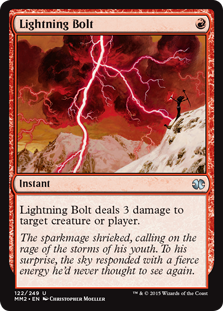
A game plan in Magic, on the other hand, varies widely depending on format, deck choice, and matchup. Let's look at playing Burn in Modern. The goal of Burn is to deal 20 points of damage to your opponent before they can execute their own game plan. With the exception of Skullcrack and Searing Blaze, there is very little in Burn's main deck that you'd consider interaction. If you're pointing Lightning Bolts at your opponent's creatures and not at their face, you're not sticking to your game plan.
I'm a control player at heart. Even when playing a more proactive deck, my confidence is boosted when I have ways to interact with my opponent and their threats. This preference for interaction, I realize in retrospect, caused me to lack faith in the game plan of my deck. To have a better chance of winning, I either needed the mental awareness to set aside my preferences or have played a deck that suited me better. Confidence in my game plan would have started me out on a better foot, which leads to my next realization.
Have Confidence in Your Abilities
Only one hand at the poker table caused my wife a moment of hesitation. It was an Ace-King hand, with a Jack or Queen as well. It would beat any hand the dealer made that wasn't a pair or better, but the odds were not good. She elected not to play the hand, which turned out to be the right call, as the dealer made a low pair. At the tournament, I lacked the confidence in my own ability that she displayed here at the poker table. This was especially true in Round Three.
My Round Three opponent was Jacob Bard. Jake and I have been friends for nearly 15 years. He's a great guy, and one of the toughest opponents you're likely to find facing you in a tournament. I don't know what my record is against him in constructed, but I know it's not close. Jake was on Grixis Death's Shadow. We knew each other's decks going into the match because he was one of the people I tested with.
I could be wrong, but I feel like Death's Shadow is an even match for Burn. It might even favor the Burn player. Death's Shadow has better interaction, but their game plan also involves getting to a low life total to power out their primary threats. This plays into Burn's plan of killing them through damage.
Knowing the matchup, you'd think I'd have felt good about my chances. Instead, I lost before I even sat down. Why? Because in my head I'd already chalked up the match as a loss. I lacked confidence in my ability to beat Jake in constructed. Would I have felt the same if I were playing a different deck, or if this were a Limited event? Unless my Limited deck was a trainwreck, probably not. I feel good about my Limited game most of the time, though that varies with the format. As for a different constructed deck, I can't say. Having already lost the match mentally though, it was easy for me to walk into the misplays that followed.
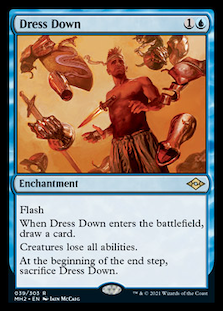
In Game One, I decided not to chump block a 4/4 Death's Shadow and a delirious Dragon's Rage Channeler while at 14 life. I died to a flashed in Dressed Down for exactly lethal. In Game Two I took a more reserved approach. I fired off an early spell or two but was top-decking nothing but land. I had four burn spells totaling 13 damage, and a Path to Exile in hand. Jake was at 14, as we played draw-go. I needed to either draw another burn spell or have him damage himself to have enough to burn him out. Instead, he played Kroxa, Titan of Death's Hunger. This leads us to my next breakthrough.
Stop and Assess the Situation Before Deviating From Your Plan
As we discussed, the point of Burn is to chain your cards together to deal lethal damage to your opponent before their game plan comes online. I was at 16 life. Did I care about that Kroxa? I shouldn't have. Sure, the Kroxa was going to take one of the five cards in my hand, but this was its first cast. It would still need to be escaped for me to worry about it on the battlefield.
I went into panic mode though. With Kroxa's enters the battlefield triggers on the stack, I Pathed it and pitched a Lightning Bolt to its discard effect. In retrospect, what I should have done was calmly pitch my Path, and take this as my cue to start pointing all my spells at his face. With five mana I could cast two spells on his end step, and two more on my next turn. Had I taken a deep breath and assessed the situation, I might not have panicked. I might not have won, but at least by executing my game plan I'd have put myself in a position to do so.
When The Dealin's Done
I used to think it was a cliche that attitude meant everything. I'm slowly realizing just how much the right mindset can steer one towards better decision making, and by extension better results. How has a change in mindset improved your game? What changed? What's the biggest obstacle to improving your mindset when it comes to Magic? Let me know in the comments.
Big shout out to my buddy Jake for going on to take down the whole event, and my wife for inspiring this article. If she ever decides to take up competitive Magic, we're all in trouble.

 pandemic Mythic had space for around 70, but they took away all the tables during lockdown and don't want to overcrowd the store now. Which again, makes perfect sense. We hit the cap, but only 47 actually showed up. I'm not sure why, but it might be a case of players double-booking stores to ensure they get a space. I say this because most of the players actually there were people I'd never seen before, not at Mythic Games nor pre-pandemic. I'm guessing that a general changing of the guard is happening. On that note, Wizards provided Arbor Elf promos for each store, but for some reason only sent Mythic 40. So to make up the deficit they handed out FNM foil promo packs because Mythic basically swims in the things. I got one of the packs and it more than paid for my entry. Thank you, Commander players and your love of foil mythics.
 turns after getting my opponent to 3 with no means to stop a burn spell. In my second and third matches I kept reasonable one-land hands that become phenomenal with a land. And I didn't draw one until far too late. It especially hurt in the match against Titanshift since I died with my opponent on 1 life.
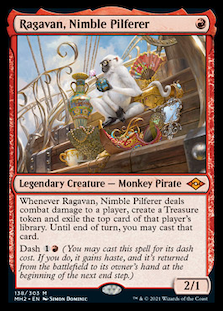 That's just how it is. However, for Ragavan decks and particularly Jund Saga to be so omnipresent is notable, particularly in light of what didn't show up.
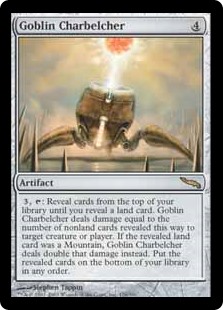 I don't know how the Top 8 shook out. Or who exactly made it. I didn't stick around to find out. However, thanks to the Companion app, I do know who the best-placed player was, and I know they were on Belcher. Well done to them! And given what I said above, it isn't surprising. The room was primed for exactly this to happen. The metagame was extremely
  it does become necessary, most decks just don't have much to fight combo. Even Jund Saga has been cutting targeted discard recently, and lacks Liliana of the Veil to maintain pressure on combo hands.

 way too nit-picky for my taste. Therefore, a deck needs 6 results to make Tier 3.
 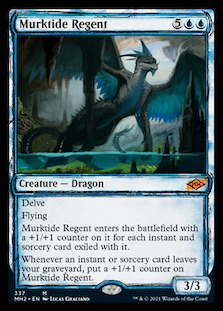 lone outlier last time but this time both UR Murktide and Hammer Time are being excluded. Every month I check for outliers and am sometimes surprised when I don't have any. I really thought Hammer Time and Murktide were outliers
 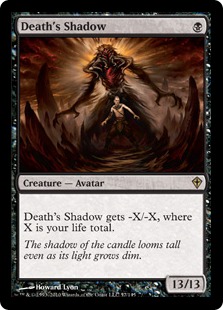 hasn't been a Tiered deck in months. There has always been a pilot or two sticking to the old warhorse, but even in good months GDS has been at the bottom Tier 3. And yet it's surged into Tier 1, apparently all thanks to Death's Shadow comboing with Dress Down. More surprisingly, it was a very sudden surge. GDS didn't cross the Tier 3 threshold until (roughly) November 19. And I don't know why.
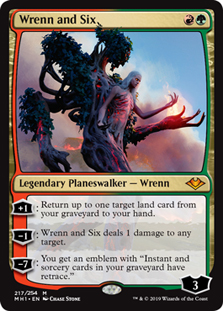
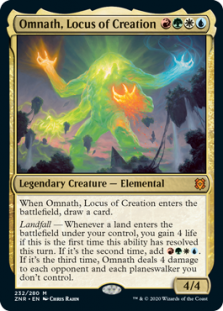 same core of Prismatic Ending, Wrenn and Six, Teferi, Time Raveler, Omnath, Locus of Creation, and Solitude. It's just a question of the support spells around the core, with Blink being more midrange. The
  that consistently just squeaks into Top 32 the same weight as one that Top 8’s. Using a power ranking rewards good results and moves the winningest decks to the top of the pile and better reflects its metagame potential.
 strength vs. popularity. Measuring deck strength is hard. There is no
  And there's the main reason that Hammer Time and UR Murktide shouldn't be considered Tier 0: they're both under the baseline stat. Murktide is just below, which means it's effectively tied and thus performing in accordance with what I'd expect from a popular deck. Hammer Time slightly underperformed. That's a sign that Hammer is very popular online, but also very beatable. More than it's given credit for. Meanwhile, the best performing high-tier deck and thus the deck of November is UW Control. Nobody tell

 I realize that everyone has complained about this already, but it's critical to keep up the pressure. There was no official coverage of MTG Las Vegas. At all. The closest thing was twitter updates from
  Now, I don't entirely blame ChannelFireball for the lack of coverage. Commentators everywhere were complaining that lack of streaming or video coverage is unacceptable in 2021. And I understand where that's coming from given how omnipresent cameras and YouTube are today. However, I know from friends in filmmaking that professional setups are ruinously expensive. The equipment to pull off the coverage Wizards used for Grand Prix and Pro Tours cost thousands to purchase, the bandwidth isn't free, and there's also paying the broadcasters. But the silent killer is that all of that also needs to be insured. No matter how thoroughly everything is secured after every shoot, how organized the crew is, how vigilant the producers are, or aggressively threatened the interns are, equipment disappears every time a film crew films. And what doesn't disappear eventually breaks. Filming just isn't profitable.
 And I'm not just annoyed about this in an "I want to know, feed my endless curiosity" way (though it certainly is a factor). From a data analytics perspective, a Top 8 means nothing in a vacuum. In Magic, any deck has the potential to win a given tournament. The odds depend heavily on the metagame and the deck's inherent strength, but luck and variance also play huge roles. Without additional data about the tournament, there's no way of knowing whether a player won because theirs was the best deck period, the best positioned, or the Random Number God simply chose them. This is annoying generally, but especially so in this case, as it was the first chance to see how paper Magic differs from MTGO in 18 months. But with only a Top 8, the whole event is a waste for research and analysis.
 Titan is technically off-meta, though it put the most decks into Top 8. Only Jund Saga and 4-Color Control are expected meta decks. It is interesting that Scales was able to Top 8 despite all the splash damage from Hammer Time sideboarding.
 Paper vs. Digital