menu

I Sold My Duals and Learned Lessons in the Process

Are you a Quiet Speculation member?

If not, now is a perfect time to join up! Our powerful tools, breaking-news analysis, and exclusive Discord channel will make sure you stay up to date and ahead of the curve.

I was scheduled to do a piece about misprints this week, but something big happened to me. Stay tuned for that piece in the future. Instead, I want to talk about what happened and share my thoughts and feelings, not only as a small private collector but also as a human being.

I was investing heavily in graded cards when I lost my job. I was investing not just in Magic: The Gathering, but Pokémon as well as a way to diversify. I was fortunate to end up with a bunch of nice slabs as a result, including finding a VG slabbed copy of Library of Alexandria in Europe, and some deals with local Pokémon collectors who have lots of graded material.

There was an error retrieving a chart for Library of Alexandria

If I could see the future, I'd have been far less aggressive in my diversification, knowing I'd be losing my job. Long story short, as a direct consequence of this I had to sell nine of my beloved dual lands. I needed liquidity fast and could not go through the hassle of selling more minor pieces of my collection. I had no time to think about it.

It was hard for me to let them go. When I bought those duals I thought I was going to hold them forever no matter what. Life proved, once more, that nothing lasts forever and the only constant is change. Here are some thoughts I learned from this experience, with the hopes that they will be valuable to others facing similar ordeals. This article is about acceptance, letting go, and doing the right thing.

You Should Never Feel Bad for Making Money

I bought my ten duals, one of each, for roughly $2000 in three monthly installments. I sold all but a Foreign Black Border (FBB) Plateau for $1300 cash, plus a trade of four beautiful Force of Wills signed by Terese Nielsen and a sealed Double Masters booster box. The trades were valued at roughly $900.

There was an error retrieving a chart for Force of Will

So, essentially for $700 I bought a Plateau in very nice condition, a signed playset of Forces, and the booster box. Sure, in the traditional sense, "I lost" $700 that I haven't seen a return on, but we all buy and sell cards and I honestly believe this is a fine purchase. Not to mention that the $1300 cash really helped around the house.

If You Are Going To Invest in Collectibles You Need To Leave Emotions Aside

One of the most valuable lessons I learned from reading articles and watching famous YouTubers talk about these issues is leaving your emotions aside. You need to dismiss feelings in order to do what needs doing. I could have tried to jump through a lot of hoops in order to keep my duals, but this was unnecessary. Incurring risk is far worse than losing precious items of your collection.

A friend of mine put it perfectly: "you need to put a roof over your head first." I need to continue to pay my bank loan on my property and pay all the bills. It is an obvious statement, but these are priorities. It is important to keep that in mind, and this situation was a wake-up call for me.

You Can Always Purchase What You Had To Sell at Another Time

The mindset that leads to comments like "it is too late for me to invest in..." needs to be broken. Many times I thought that this was my last chance to purchase duals. Get on the train or be left behind forever. But as Rudy from Alpha Investments put it bluntly, "It is not too late."

I used to have that mindset, but I do not any longer. Please don't get me wrong, I really think these items are special and I was sad when I had to part with them. But when looked at in perspective, it is not the end of the world. There are plenty of duals out there. With patience, another good opportunity will present itself.

I firmly believe I will be the owner of dual lands again in the future, and this time will not be Foreign White Border (FWB), but Revised. Sometimes you need to take one step back in order to take two steps forward. I really hope this is the case.

Letting Go Can Be Cathartic

While I was sad when the transaction occurred, part of me also felt accomplished. It was a weird sort of relief. I could isolate myself from the emotion and do what was needed to be done and that was surprisingly gratifying for me. I was truly not expecting it.

"Acceptance" was the word that was floating around my head the whole time. It is what it is. This is true for other aspects of life as well. Sometimes things aren't meant to be in the way they were expected or desired. I had to make terms with the idea that selling these cards was the best for my current situation. I did not hesitate to do it once I came to this conclusion.

In the end, we learn as we walk this path. "Investing in pandemic times," as it were, has certainly been rewarding for me. While I am patient, I am also excited to see what happens with the markets once the pandemic subsides and the world goes back to something semi-normal.

Your Collection Is Still a Beauty, My Friend, and the Grinding Must Not Stop!

We hold on to what we can, and that is fine. As Massive Attack sing, you have to be thankful for what you've got. Cards are like money: they come and they go. A less-attached approach to the hobby could be beneficial for you financially.

Again: the only permanent thing is change. I turn the four Force of Wills from selling my duals into a full Jon Finkel gold-bordered deck (hello Grim Monolith!) and some beautiful promotional cards that I believe will perform well in the future. Plus, I get to play a lot of Premodern, too. You have to keep going. There is no way back.

There was an error retrieving a chart for Grim Monolith

Conclusion

Have you ever been in a situation where you had to sell something precious to yourself? Do you think that attachment can be an issue when investing in collectibles? Let me hear your thoughts in the comments!

Avatar photo

Mauro Acerenza

Mauro started playing Magic in 1995; it all began with an Ice Age starter pack. After a long break from the game, he returned to the hobby in 2015, shortly after Khans of Tarkir was released, thanks to a friend in university that told him that Magic was still alive. His interest in Magic Finance started in 2019 when he found out about the concept of the Reserved List. A competitive Modern and Cube player, he nearly always plays aggro decks.

View More By Mauro Acerenza

Posted in Finance, Free, Free FinanceTagged , , 1 Comment on I Sold My Duals and Learned Lessons in the Process

Have you joined the Quiet Speculation Discord?

If you haven't, you're leaving value on the table! Join our community of experts, enthusiasts, entertainers, and educators and enjoy exclusive podcasts, questions asked and answered, trades, sales, and everything else Discord has to offer.

Want to create content with Quiet Speculation?

All you need to succeed is a passion for Magic: The Gathering, and the ability to write coherently. Share your knowledge of MTG and how you leverage it to win games, get value from your cards – or even turn a profit.

A Personal Reflection of Magic Apathy

Are you a Quiet Speculation member?

If not, now is a perfect time to join up! Our powerful tools, breaking-news analysis, and exclusive Discord channel will make sure you stay up to date and ahead of the curve.

This week I turn introspective as I consider my recent disengagement with Magic—both the game and the financial component. It’s been quite a few years since I began to feel increasingly disinterested in the game, and it makes me wonder, what’s to come? How can I get out of this funk? Is there a catalyst on the horizon that will re-inspire me?

Transparently, a small part of me is sitting here wondering if this is the beginning of the end for my involvement in the hobby. The temptation to sell my collection and move the money completely into a brokerage account to invest for my children’s college educations has never been stronger. I would be lying if I said otherwise. While I don't think Reserved List card prices have peaked, and expect them to remain a solid investment for years, I would be fairly content with the money I’d receive for the collection as of today.

As I ponder this significant decision, I’d like to share some personal experiences I’ve had walking away from the game and, inevitably, returning to it. Although there may be no direct actionable finance advice, I’m hoping the piece resonates with some and interests others as I attempt to weave in some personal anecdotes throughout the article.

Fall 1998: My First Hiatus

I began playing Magic back in 1997 and the first sealed products I opened were a Fifth Edition starter deck and a Visions booster pack. I still remember to this day the two highlights from these packs: a City of Brass and a Desertion.

There was an error retrieving a chart for City of Brass

There was an error retrieving a chart for Desertion

My life would never be the same again. Magic paved a road for me and gave me guidance on how to follow it—to new friends, new interests, and new communities. My life in middle school was largely shaped by this collectible card game. The tremendous flavor of Mirage block and Tempest block made continuous engagement in Magic very easy, and I loved saving money however I could in order to scrape up $3 for my next booster pack. To this day I remember opening a Mox Diamond in my (now out-of-business) local hobby shop and immediately selling it to another kid in the store for $20. I had just turned $3 into $20, and I was on top of the world.

As high school started, I slowly lost interest in the game as I struggled to find my identity. I also vividly remember being turned off by the power level of the new set, Urza’s Saga. My friend had a pre-constructed deck called The Plague, which combined Pestilence with Urza's Armor and creatures with protection from black. It was my first exposure to a sort of “combo deck” and I found it unbeatable. Wall of Junk was also a very obnoxious card.

There was an error retrieving a chart for Wall of Junk

I also heard rumors of how cards from the set were banned due to power level (“combo winter”). Then the second shoe dropped, and Wizards of the Coast announced they would begin printing premium foil variants and randomly inserting them in booster packs. I was not interested in these shiny cards, which I thought deviated from Magic’s original aesthetic.

With all these factors combined, I took a break from Magic.

What Brought Me Back

To be fair, I didn’t quit the game cold turkey. I never purchased a single booster pack from Urza’s block (nowadays I kick myself for this decision), but I probably opened a pack of Prophecy here or a pack of Seventh Edition there. The Fall of 2001 though, brought a new block that renewed me and my friends' interest in Magic. It was the Odyssey block!

Each of us found something of interest from these three sets. We all appreciated the threshold and flashback mechanics, as it was really cool that “spent cards” could still provide utility. I also remember reading about some powerful enchantments, such as Transcendence and Nefarious Lich, that looked really cool to build around. And who could forget the awe-inspiring power of Silver Seraph?

There was an error retrieving a chart for Transcendence

There was an error retrieving a chart for Silver Seraph

Yup, we were back with a vengeance spending money on Magic all over again. It helped that, by this age, I was slowly worrying less and less about what others in school thought about me. I felt more comfortable being myself, and that self needed to play Magic!

My excitement for the game continued right through Onslaught block (I remember hoping I would open fetch lands so that I could immediately trade them for “better cards”). The morph mechanic was a blast and I even had fun playing a casual Astral Slide deck. My friend could never beat it, but in hindsight, I did sort of “cheat” because the deck included Balance, which was the card that gave him issues. That’s why I emphasize the deck was strictly casual.

Eighth Edition gripped my interest because it brought back classic cards from all previous sets of Magic as a way of celebrating the game's 10th anniversary. But let's face it, I just wanted to open Birds of Paradise. Just once.

There was an error retrieving a chart for Birds of Paradise

I was thriving in college and loving life while also loving Magic.

Affinity, Another Departure, and Return

It was largely coincidental that I took another hiatus from Magic right about when it was destined for another string of overpowered cards and resultant bannings. I missed the whole Affinity hype cycle mostly because a) I didn’t really have an interest in artifacts and b) I was getting deeper into my university studies and shifted focus away from Magic again. I consider myself lucky for missing out on one of the worst Standard seasons of all time.

The Champions of Kamigawa block didn’t do much for me either. There were a number of reasons why this set struggled, but the primary reason for me personally was simply that I didn’t care for the cards. This was another time when I found other things in life to keep me busy.

With the launch of the Ravnica block, I had a bit of dĂ©jĂ  vu. The cards were powerful and interesting, but the only reason I bought booster packs from the block was to open shock lands. Again, I didn’t want to open shock lands because I was playing them in competitive decks. I wanted to open them because I knew I could sell or trade them for other cards I wanted. Even as recently as 2007, I was a casual player through and through.

There was an error retrieving a chart for Overgrown Tomb

My perception of Magic changed forever with the release of Time Spiral. While many pan the set as overly complex and describe it as a list of inside jokes for the enfranchised player, I must confess I was the exact target audience for such a set. The reprints of older cards in the old frame, the references to old cards, and the color-shifted cards in Planar Chaos all brought a wave of nostalgia that stuck with me for many years.

It reignited a passion that lasted over a decade. In that time, I became more competitive⁠—drafting, playing at Grands Prix, PTQs, etc. It also started my foray into Magic finance. After my kids were born and my competitive play diminished, I continued to find enjoyment in Old School, Vintage, and in buying and selling some of Magic’s earliest most collectible cards. It was a high point for Magic in my life.

Another Hiatus: What’s Next?

That high point in my engagement with Magic peaked about a year ago, in late 2020. I was jamming games of Arena every day, consistently hitting mythic in constructed play, while also achieving numerous Old School deck upgrades. I was firing on all cylinders when it came to the hobby.

Then, out of nowhere, a switch flipped. Around the time Kaldheim launched I suddenly lost interest in Magic. I went from completing a couple dozen drafts of Zendikar Rising to zero drafts of Kaldheim. I have not drafted since, throughout pretty much all of 2021. I haven’t purchased any new product either. Before, I was at least picking up some boosters of the new sets to momentarily dive into their aesthetic.

Now I sit here pondering what might get me back into Magic again. Will it be the launch of a new set with interesting mechanics and powerful enchantments? Unlikely, since I find I’m disinterested in even reading spoilers of the new sets. Will it be a new throwback set like Time Spiral? Doubtful—we just had a Time Spiral Remastered set in March and it failed to rekindle my interest.

There was an error retrieving a chart for Magus of the Moon

Could it be the printing of cards using the classic Magic frame? Nope, Wizards did this but the nostalgia aesthetic isn’t pulling me back in.

I’m stumped. My return to Magic is likely going to have to stem from some unknown, novel catalyst on the horizon. Something unpredictable, such as meeting a new co-worker who is passionate about the game, or attending a [very] local post-COVID MagicFest and getting a rush from the crowd. Perhaps another bout of massive buyouts across the Reserved List market would at least whet my appetite for buying and selling cards again?

In absence of all of these, however, I’m stuck in this apathetic malaise.

There was an error retrieving a chart for Apathy

Wrapping It Up

Hopefully, this personal reflection was at least interesting to readers, allowing a slightly deeper understanding of my involvement in the game and current lack of interest. Each time I stepped away from the game, there wasn’t a singular event to blame. Instead, it was a combination of circumstances both within the game and in my personal life that pulled me away.

This current hiatus is no different—lack of in-person events, stagnant Reserved List prices, and a slew of sets that don’t resonate with me are all contributing factors. Perhaps all three of these obstacles will have to be broken down in order to reinvigorate my interest in Magic.

Until then, I’m not abandoning the game altogether. I'm not quitting writing for QS either. I'll still buy or sell the occasional card (I have an Unlimited Mox Sapphire for sale right now).

There was an error retrieving a chart for Mox Sapphire

Just don’t expect me to be tweeting nonstop about the hobby. Don’t expect to see me battling on Arena any time soon. And, most definitely, don’t expect to see me purchase any of the new products that Wizards constantly pumps out. I’d rather have that time and money to dedicate to other hobbies and interests right now. For Magic to win me back, it’s going to have to do something very special.

I’m not worried though. After all, it has succeeded multiple times in the past. I don’t know if my “hiatus of 2021-202X” will be any different.

Avatar photo

Sigmund Ausfresser

Sigmund first started playing Magic when Visions was the newest set, back in 1997. Things were simpler back then. After playing casual Magic for about ten years, he tried his hand at competitive play. It took about two years before Sigmund starting taking down drafts. Since then, he moved his focus towards Legacy and MTG finance. Now that he's married and works full-time, Sigmund enjoys the game by reading up on trends and using this knowledge in buying/selling cards.

View More By Sigmund Ausfresser

Posted in Casual, Finance, Finance History, OpinionTagged , , Leave a Comment on A Personal Reflection of Magic Apathy

Have you joined the Quiet Speculation Discord?

If you haven't, you're leaving value on the table! Join our community of experts, enthusiasts, entertainers, and educators and enjoy exclusive podcasts, questions asked and answered, trades, sales, and everything else Discord has to offer.

Want to create content with Quiet Speculation?

All you need to succeed is a passion for Magic: The Gathering, and the ability to write coherently. Share your knowledge of MTG and how you leverage it to win games, get value from your cards – or even turn a profit.

So You Want To Be a Magic: The Gathering Content Creator?

Are you a Quiet Speculation member?

If not, now is a perfect time to join up! Our powerful tools, breaking-news analysis, and exclusive Discord channel will make sure you stay up to date and ahead of the curve.

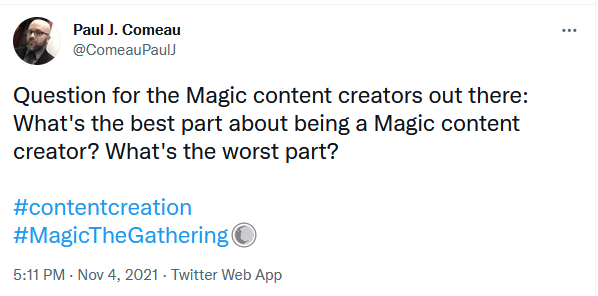
Being a Magic: The Gathering content creator is a lot of fun. Who doesn't want to talk, write, or record videos about their favorite game, and maybe get paid a little to do it? If you're lucky, you might make some friends in the process. If you're really lucky, you might even make a living doing content full-time. Making content isn't all fun and games though, it's also hard work, and you need to take it seriously if you want to be successful at it.

The Fun of Content Creation

The best part about being a content creator for Magic is you get to spend a bunch of time thinking about, talking about, writing about, and even playing Magic. You get to share the things about the game you're passionate about and spread your love of the game to a wide audience. You have a considerable amount of freedom as a content creator to cover just about any Magic topic you want. Love Commander? You can write all about your favorite Commanders, and the kind of cards you enjoy playing. Perhaps you're more of a Standard grinder? You can stream and record videos of your climb up the Arena ladder.

Whatever you decide to create, it's important to keep in mind your potential audience and give them reasons to engage with your content. The two most common reasons people engage with Magic content, in my experience, are entertainment and education.

Entertainment VS Education

Whatever you work on creating, it's important that you strike a balance throughout in being entertaining and informative. This is a scale that shifts greatly depending on the medium of your content. If you're streaming on Twitch, for example, you'll need to focus more on the entertainment end of the spectrum to not bore your audience. If you're writing articles or shooting videos for YouTube, you can lean towards entertainment or education as the topic dictates.

How you shape your identity as a content creator or the channel for which you create can also dictate where on the continuum your content falls. The best content creators strike a good balance between the two extremes of this spectrum.

You Are a Reflection of the Game

As a content creator for a game like Magic, you not only represent yourself, you also by extension represent the game you're playing. How you represent yourself is a reflection of how people outside the game perceive Magic, and the Magic community generally. It's important to try and put your best face forward, so that you represent not only the game, but yourself in a positive way. As a content creator, you're your own brand as much as the game you play. The product you're representing is you, so you need to represent yourself well.

You Are Your Own Brand

Being your own brand, means that everything you do as a content creator is marketing. Your social media presence, the things you say in chat or on stream, or the articles you write all represent you. Putting your best face forward in all of these situations is difficult. It means learning to lose gracefully and in front of an audience. It means being open to criticism, and willing to own your mistakes. They're challenging things to learn, and not the only challenges that face you as a content creator.

The Hard Work of Creation

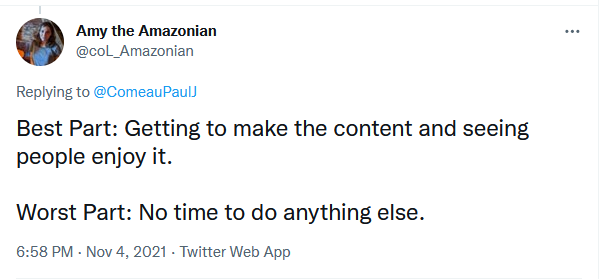
Content creation is fun, but as some of my favorite content creators like @ghirapurigears and @CoL_Amazonian attest, it's also hard work, and very time consuming.

Just a few of the challenges that can face you include:

  • Needing To Come Up With New Content Ideas Regularly
  • Avoiding Doing Something Another Creator Has Done Recently
  • Firm Deadlines/Maintaining a Steady Publishing or Streaming Schedule
  • Juggling Your Schedule/Maintaining Work/Life Balance

Coping With the Challenges

Coming up with new ideas for content can be part of the fun, because you can often do whatever you want, but it can also be challenging. What if you've already done a bunch of things and don't have any fresh ideas? What if you had a great idea, but another content creator already did something similar? How you approach these challenges can often make or break you as a creator.

Firm deadlines or maintaining a steady schedule are either imposed by a publisher, or in the case of streaming and YouTubing, are self-imposed for the sake of growing your audience. You need to have a steady streaming or publishing schedule so that people can watch your content. That's how you build a following. Being able to stick to a publication schedule is another thing that can make or break a would-be creator.

Content creation is time consuming, and requires creative juggling of your schedule, especially if you are trying to fit it in between adult commitments like family and a day job. Maintaining a healthy work/life balance is important for everyone, not just content creators, but it's often one of the first things people sacrifice for the sake of their careers. Whether you're a creator or not, finding a proper work/life balance can be the difference in your life or your career.

Content creation isn't for everyone, but those that can make it happen can find it deeply rewarding. Is that you?

You Can Be a Content Creator

After reading this peek into content creation, are you thinking you'd like to try your hand at it? That's great! It just so happens that Quiet Speculation is currently seeking content creators for all kinds of roles. Why not check out some of the opportunities available and apply today? Who knows, you could soon be someone's favorite creator.

Your Favorite Content

What's your favorite Magic content to read & watch? Who are your favorite creators that you follow? What in your opinion makes good Magic content? Let me know your answers in the comments or on Twitter.

Avatar photo

Paul Comeau

Paul is Quiet Speculation's Director of Content. He first started playing Magic in 1994 when he cracked open his first Revised packs. He got interested in Magic Finance in 2000 after being swindled on a trade. As a budget-minded competitive player, he's always looking to improve his knowledge of the metagame and the market to stay competitive and to share that knowledge with those around him so we can all make better decisions. An avid Limited player, his favorite Cube card is Shahrazad. A freelance content creator by day, he is currently writing a book on the ‘90s TCG boom. You can find him on Twitter and LinkedIn.

View More By Paul Comeau

Posted in Free, OpinionTagged Leave a Comment on So You Want To Be a Magic: The Gathering Content Creator?

Have you joined the Quiet Speculation Discord?

If you haven't, you're leaving value on the table! Join our community of experts, enthusiasts, entertainers, and educators and enjoy exclusive podcasts, questions asked and answered, trades, sales, and everything else Discord has to offer.

Want to create content with Quiet Speculation?

All you need to succeed is a passion for Magic: The Gathering, and the ability to write coherently. Share your knowledge of MTG and how you leverage it to win games, get value from your cards – or even turn a profit.

Forking Temporal Trespass in Pioneer

Are you a Quiet Speculation member?

If not, now is a perfect time to join up! Our powerful tools, breaking-news analysis, and exclusive Discord channel will make sure you stay up to date and ahead of the curve.

Copying Time Walk has taken over Standard, and it seems to have emerged as a possibility in Pioneer as well.

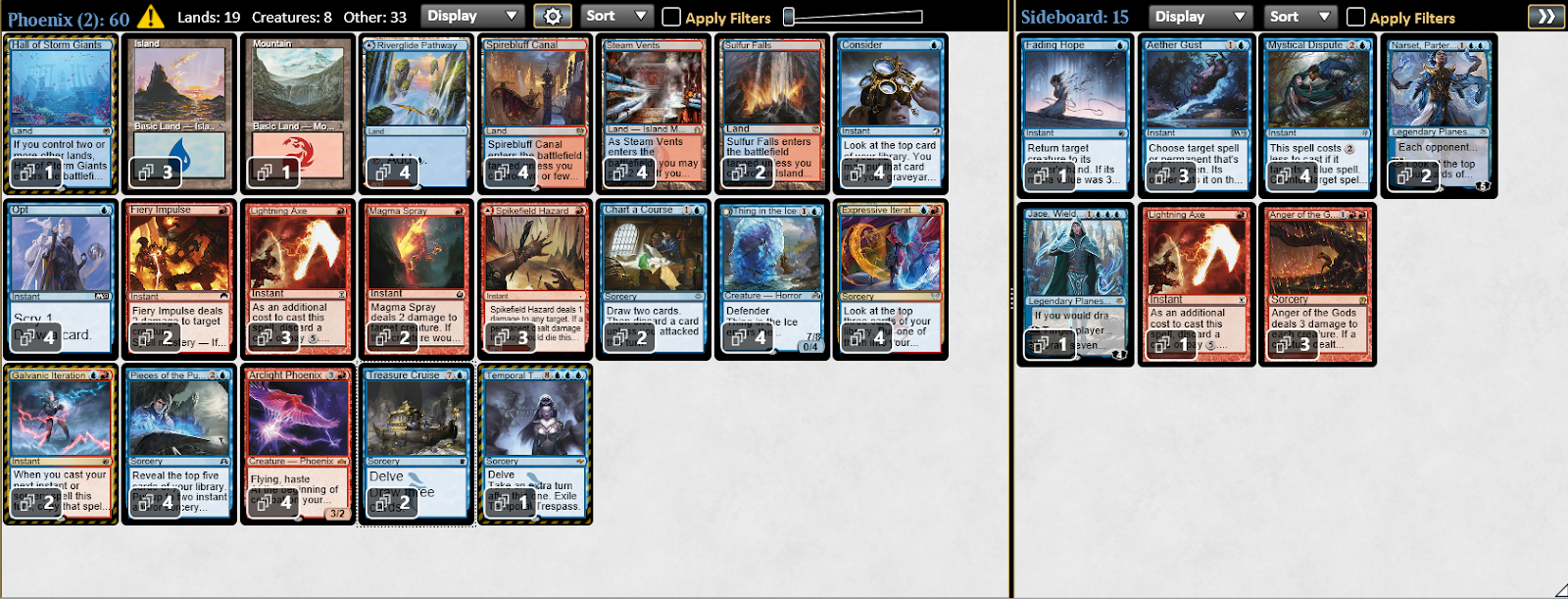
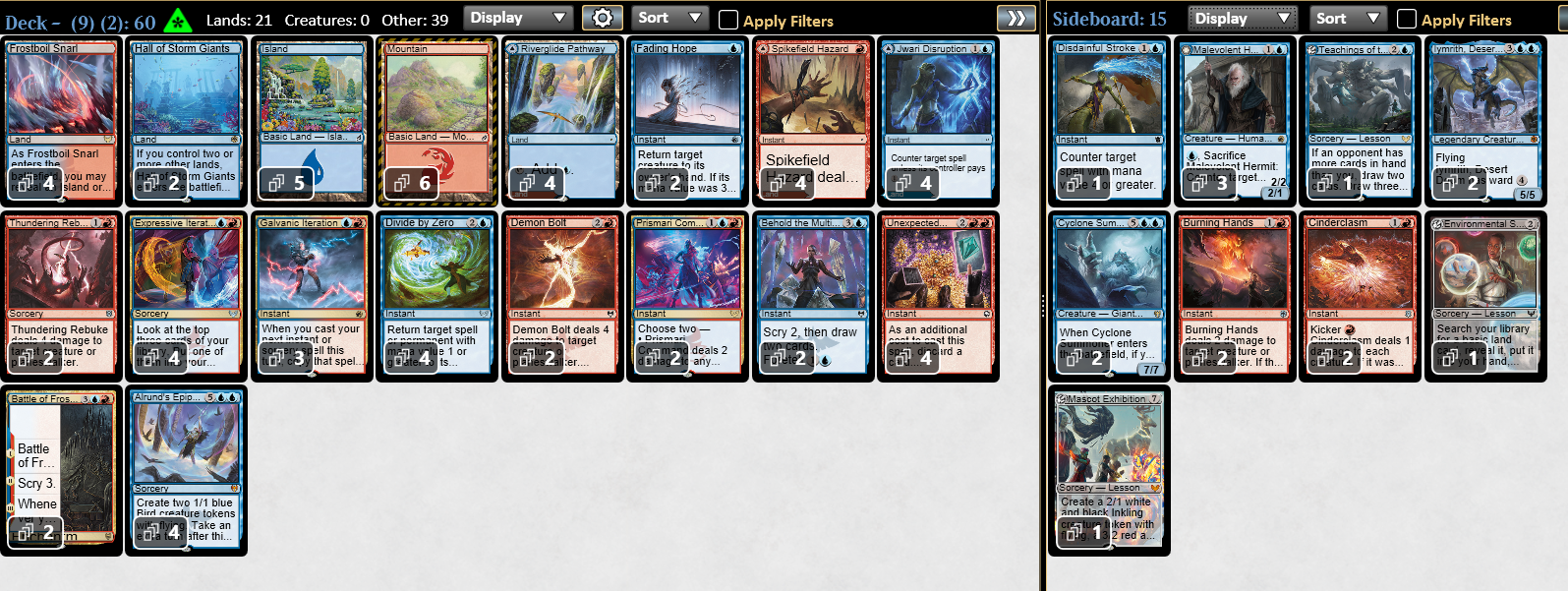
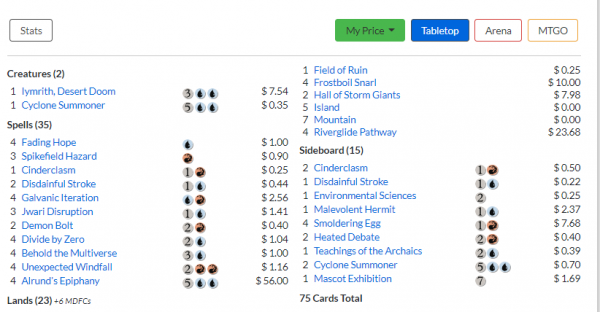
I’ve written a couple of articles on here about Izzet Phoenix. Since then I've been slowly tuning the deck, and Temporal Trespass has really caught my eye. One issue the deck had was an inability to convert cards into winning the game. You could easily draw your entire deck, but turning the cards into something meaningful was a difficulty. 

Converting Card Advantage Into a Win

There are a few ways to convert those cards into an advantage. Jace, Wielder of Mysteries can give you a combo-esque finish. Some enjoy combining Crackling Drake with a Kazuul's Fury // Kazuul's Cliffs or Maximize Velocity. However, these permanent-based win conditions are easier to interact with via a counter or removal spell and can't be found off Pieces of the Puzzle.

The beauty of the Fork is in its compactness and elusive nature. The Fork finish exists more on the stack than the other two, requiring the opponent to have a counterspell for each Time Walk presented.

Potential Drawbacks

This sounds great, but there’s no such thing as a free lunch. “You can easily draw plenty of cards,” I said to myself... Well, this was true in part thanks to Treasure Cruise. Trimming some Cruises to fit Temporal Trespass means you might lose games you would otherwise win if you don’t have enough mana to get to the Trespass. A nice Cruise, on the other hand, could fill up your hand and help power out your Arclight Phoenix or Thing in the Ice // Awoken Horror. Thankfully, you are so good at filtering through your deck, so you can go to as low as even one Temporal Trespass and still be able to consistently use it as a finisher.

Despite the doom and gloom above, I think adding the Time Walk to the deck should improve the deck a lot. The ability to end the game has been a serious issue that this neatly solves. The question then will be how to split the number of Cruises/Time Walks/Forks in the list. Intuitively, two Cruises to one Temporal Trespass makes sense to me as a starting point. The Time Walk will be better later in the game but can cause you to stumble if you draw it in the early stages.

Additional Notes

The idea here is to have more ways to take advantage of taking extra turns/not have control decks run you out of threats as easily. Den of the Bugbear is a lot cheaper to activate, but I am gonna start by trying the blue land as Spikefield Hazard // Spikefield Cave already gives so many red sources. I am very unsure if this will end up causing more harm than good, especially as many control decks have access to Field of Ruin, but it definitely seems worth trying.

The copies this makes won’t count as “cast” triggers towards your Thing in the Ice/Arclight Phoenix, but copying a cheap cantrip will help you keep chaining spells.

I wanted to try this over Entrancing Melody as a way to deal with creatures that the burn spells can’t deal with. It seemed particularly interesting to side in against the mirror as an extra way to interact with their creatures. Melody can steal a Thing in the Ice but it’s a bit more vulnerable to Mystical Dispute and doesn’t work as well VS Arclight Phoenix.

Closing Thoughts

All in all, I am very excited to try this out. While I expect some awkwardness from time to time with the forks and time walks potentially causing you to stumble in the early game, I definitely think it's worth trying. I haven't seen such a compact win condition in the Phoenix deck that can be activated in the mid-game Ă  la Splinter Twin style, as opposed to having to draw your entire deck to win via a Thassa's Oracle type.

Uncommon Report #8 – Odyssey Block

Are you a Quiet Speculation member?

If not, now is a perfect time to join up! Our powerful tools, breaking-news analysis, and exclusive Discord channel will make sure you stay up to date and ahead of the curve.

Odyssey block is one I can look back very fondly on. It came out the year after my parents had moved us down to South Carolina from our home state of Ohio. My brother and I had joined a small playgroup who had started playing before school started in the school's orchestra room, which thankfully, one of our players' moms taught in. Thus we were safe from the persecution that typically followed the nerdy crowd of the early 2000s. I mentioned in my last article how Invasion block was the first sanctioned release event I ever played in. Odyssey block was the first block that I actually began to try to build competitive decks to play in our local Friday Night Magic (FNM) and Saturday tournaments. While the internet was definitely around back then; Magic Online (MTGO) did not yet exist, buying cards online was virtually non-existent, and prices were defined in the latest copy of Scrye or InQuest magazines. Odyssey was the set that brought us the Psychatog decks that dominated standard. It was my first taste of control, and thanks in large part to the fact that most versions of the deck ran 10 rares main, it was very cheap to build. Imagine playing a World Champion caliber deck nowadays with only 10 rares total main deck and two in the board. As I was a Freshman/Sophomore in high school during this decks heyday, I had very little spending money so this deck was truly a godsend to anyone in my predicament. I was able to have a good bit of success at my local FNMs and those prize packs allowed me to build up my Magic collection when I had no other means of doing so. At this time, I started to really get into trading cards and got a few lucky breaks. Unfortunately, we had a thief in our community and my trade binder was stolen twice, once from behind the counter. So I rebuilt my binder twice and learned to be very cautious when dealing with people.

Value Targets When Picking Bulk

As I've mentioned in previous installments of this series, I go through a lot of bulk and it is very important when doing so to know which cards are worth picking out and setting aside.  I set my target on uncommons whose TCG Market price exceeds $1.49. Knowing that I'm not the only one in this position, this series allows me the opportunity to inform QS readers and refresh my own knowledge. So what does Odyssey block have to offer?

Odyssey

There are 9 uncommons in the set that meet my $1.49 requirements.

There was an error retrieving a chart for Buried Alive

This reprint from Weatherlight allowed one to play a Reanimator build in Standard during its heyday, as we got both this card and Entomb at rare in Odyssey. Its current value is entirely thanks to Commander play and the plethora of graveyard-based decks. The fact that there are six printings (one as recent as Ultimate Masters), and the fact this card still sits around $5, shows just how essential it is in any graveyard-based Commander deck.

There was an error retrieving a chart for Price of Glory

This is a pet favorite of mine. Way back in 2013, I built a Kaervek the Merciless punisher-based Commander deck and this card surprised a lot of people with how powerful it is. Thanks to having no reprints, and a mechanic (land destruction) that Wizards tends to shy away from, the chance of a reprint is somewhat lower than other single print older uncommons. That being said, any reprint would halve the value of this card at a minimum.

There was an error retrieving a chart for Cephalid Coliseum

While this card does see play in some cEDH decks, it was also a requirement for older Legacy Dredge decks, acting as one of the few lands in the deck, and a powerful (if not uncounterable) card draw dredge 18.

There was an error retrieving a chart for Dwarven Recruiter

Here we have a nice bulk uncommon that spiked hard thanks to the return of Dwarves in Kaldheim. I can happily say that I managed to sell 10x copies back when they hit $7+ each. I always sell into this type of hype and the majority of the time I make far more selling early than on waiting.

There was an error retrieving a chart for Diabolic Tutor

I'm honestly surprised this card meets my requirements; not because it isn't good, but because it's been reprinted into oblivion and numerous other versions are below the $1.49 threshold. It has 12 total printings, though to be fair, the Odyssey printing is the original. It just proves how powerful and important tutor effects are in the Commander format.

There was an error retrieving a chart for Standstill

Sadly, our Trader Tools price graphs don't go back past Return to Ravnica (2013), because this card is back to the price it used to be when Legacy Standstill decks were all the rage. For almost six years it languished at under $3 and has finally returned to near $10. This is another card like Price of Glory that would get crushed should it get reprinted.

There was an error retrieving a chart for Druid's Call

Casual players love them some Squirrel. Even I didn't realize this card was a $1 card for years before it spiked to its current $13 price tag. Its current price is heavily influenced by the return of the squirrel creature type with Modern Horizons 2. This is one of those cards where I would list every copy I could find that I owned, as its price is heavily influenced by scarcity.

There was an error retrieving a chart for Sadistic Hypnotist

Another Commander all-star. It serves as both a mana-free sacrifice outlet and a way to gain massive card advantage. It has only two other printings, Mystery Boosters, and Duel Decks: Izzet vs Golgari.

There was an error retrieving a chart for Squirrel Nest

One of the original "combos" with Earthcraft and a standard powerhouse when combined with Opposition. It has the benefit of creating Squirrels, which as we know is a casual fan favorite.

Odyssey- Watchlist

There was an error retrieving a chart for Beloved Chaplain

While this card might seem unassuming, it was actually a powerful card during it's time in Standard. It could be an unblockable threat OR hold off any creature without trample or evasion. It happens to have been updated to be both a human and a cleric, two creature types that have a lot of relevance throughout Magic's history. This is also its only printing.

There was an error retrieving a chart for Malevolent Awakening

While the ability on this card seems a bit over-priced to break out in most formats, Commander is a format where one's graveyard often acts as a second hand, and the ability to sacrifice creatures is often desired.

Torment

There was an error retrieving a chart for Cabal Coffers

A Commander staple in any deck that plays black. It combos with Urborg, Tomb of Yawgmoth to make large amounts of mana in a color that is often mana hungry. Since its original printing in Torment, it was reprinted as an uncommon in Planechase and upgraded to a mythic rare in Modern Horizons 2. It also has an FNM promo printing which is currently the most valuable.

There was an error retrieving a chart for Chainer's Edict

Powerful in Standard, this card fell by the wayside for the longest time. Its price resurgence is solely due to Wizard's claim to start including Pauper options at major events, and while this card has always been printed as an uncommon, it was printed as a common on MTGO, which is where Pauper's card legality comes from.

There was an error retrieving a chart for Cleansing Meditation

One reason that enchantments tend to be so desirable in commander games is that both red and black are tricky to get rid of, thus you have the potential of having something untouchable. Because of this reason, it can often be important to play mass enchantment removal to serve as a check against decks that play too many enchantments. Cleansing Meditation is a way to do that AND not hurt yourself, sometimes actually helping yourself in the process thanks to so many cards that have ETBs that trigger with enchantments.

There was an error retrieving a chart for Tainted Wood

There was an error retrieving a chart for Tainted Peak

There was an error retrieving a chart for Tainted Isle

The whole Tainted cycle of lands from Torment was included to help the black decks splash additional colors during their time in Standard. However, the fact that these often act as dual lands that enter untapped means that they are a good fit in any B/x Commander deck, and can even be slotted into tri-color decks that include black. These three are the ones most often paired with black in Commander.

Torment -Watchlist

Unfortunately, there aren't any cards I would consider "keeping an eye on" in this set.

Judgment

There was an error retrieving a chart for Filth

Thanks to the previously mentioned love for Cabal Coffers + Urborg, Tomb of Yawgmoth, this card in your graveyard often makes your creatures unblockable.

There was an error retrieving a chart for Stitch Together

A powerful reanimator spell that doesn't cost life, I actually don't see a lot of non-pre-built commander decks run this card, but it provides redundancy for reanimator-style Commander decks.

There was an error retrieving a chart for Planar Chaos

This card always jumps up whenever a new "coin flip" card is spoiled. It does admittedly add some "spice" to any given Commander game and certainly satiates anyone who likes randomness.

There was an error retrieving a chart for Cabal Therapy

Back in Legacy's heyday, this was a $15+ uncommon, serving as a sacrifice outlet that could be utilized from the graveyard in Dredge decks. It was often critical to wait until you could cast one or more copies of this card and then go off safely against blue-based decks; given that many Dredge builds ran only one or two Dread Returns. Thanks to Legacy's fading into obscurity and a few more recent reprints, this card's value has tanked to about 10% of that former value.

There was an error retrieving a chart for Anger

Haste is often an undervalued mechanic and tends to be found mainly in aggressive decks. However, the fact that this ability is granted from the graveyard and not by any permanent that can be destroyed by an opponent means it is a more reliable haste source than most others.

There was an error retrieving a chart for Dwarven Driller

This card went from obscure to over $1.49 thanks almost solely to the revival of the "dwarf" creature type in Kaldheim. I expect it will drift back down in price as that excitement continues to fade.

Judgment -Watchlist

There was an error retrieving a chart for Web of Inertia

I'll be the first to admit this is a pet card of mine. I actually ran a copy in my Legacy RIP Miracles build back in the day. My local metagame had a lot of aggro decks and the Rest in Peace + Energy Field lock ended a lot of games, however, it did nothing against the Sneak and Show decks running Emrakul, the Aeons Torn which would annihilate most if not all of my board. The only way to beat Sneak and Show was to prevent them from actually letting them resolve either of their namesake cards; given that the rest of their deck was based on finding those cards and counterspells, to help force them through was often difficult. Web of Inertia served as a powerful answer that you could put into play off of a Show and Tell. It helped because most Sneak and Show pilots knew that Rest in Peace did nothing to their deck if they never stopped it from resolving.

There was an error retrieving a chart for Valor

Easily the most ignored and obscure of the Incarnation block from this set, first strike is a powerful ability to grant all creatures. It has only the Judgment and a Timeshifted printing, so there is potential should we get any Commander players that really want first strike.

Previous Uncommon Reports

  1. Kaladesh Block
  2. Return to Ravnica Block
  3. Innistrad Block
  4. Shards of Alara Block
  5. Zendikar Block
  6. Theros Block
  7. Invasion Block

Hammer It In: October ’21 Metagame Update

Are you a Quiet Speculation member?

If not, now is a perfect time to join up! Our powerful tools, breaking-news analysis, and exclusive Discord channel will make sure you stay up to date and ahead of the curve.

It's metagame time again! And yet again, it's going up in the middle of yet another spoiler season. Which has happened a lot this year, Fortunately, the release schedule is going to be more reasonable next year. Supposedly, anyway. In any case, it's not particularly burdensome this time, as there isn't much to talk about from Innistrad: Crimson Vow. So far, anyway. It's always possible that there are Modern playables lurking in the later half of the spoilers, but that would be a huge change from the norm. They're usually out in the first wave to generate the most interest. Not that I'm complaining; it's nice these days when Modern gets a break and time to breathe before new cards arrive. After all, the format is already home to much upheaval.

October represented a huge change from September. The overall population was up significantly from 426 to 545. January is still the largest data set this year, but October is a close second. This is largely down to more events in October than September, however there were more large Preliminaries in October than September. I have no idea why, but I do often hear that players like this metagame. Such an affinity may be translating into more players logging into MTGO. That would be a little surprising since paper is returning, but I don't have a better explanation. Also, October's data includes a number of Preliminaries and one Challenge-like event from MTGMelee.

October Metagame

To make the tier list, a given deck has to beat the overall average population for the month. The average is my estimate for how many results a given deck “should” produce on MTGO. Being a tiered deck requires being better than “good enough;” in September the average population was 6.99, meaning a deck needed 7 results to beat the average and make Tier 3. This is the fourth month in a row that's been the case. There's nothing forcing this to be the case, it's just how it works out. Sometimes it's been down to the low population and sometimes it's happened due to a very open metagame producing lots of unique decks. September and July were the former, August and October are the latter. And if it weren't for some late rogue decks making the list, October would have broken the streak. We'll see what November brings.
Therefore, Tier 3 begins with decks posting 7 results. Then we go one standard deviation above average to set the limit of Tier 3 and cutoff for Tier 2. The STdev was 13.67, which means that means Tier 3 runs to 21. Again, it's the starting point to the cutoff, then one above for the next Tier. Therefore Tier 2 starts with 22 results and runs to 36. Subsequently, to make Tier 1, 37 decks are required. Which is high for recent months. The very high STdev is down to the sheer number of different decks making the tier list. This adds some additional separation to the data that it really didn't need, a statement that will be clarified shortly.

The Tier Data

As I've been alluding to, the total numbers of decks is considerably up from September. 78 decks placed in October compared to 65 in September. It's not quite August's mark of 80 but a very respectable collection nonetheless. A lot of this seems to be that there's a clear metagame established now and players are looking for edges and in some cases finding it. However, it looks to be more of a case-by-case sort of success because the top tiers are quite clearly pulling away from Tier 3. See, despite having one of the higher overall populations, October still has a low number of decks making the list with 15. It makes sense when you see the data.

Deck NameTotal #Total %
Tier 1
Hammer Time7413.58
UW Control6311.56
Cascade Crashers488.81
Burn397.15
Tier 2
UR Thresh346.24
Jund Saga336.05
4-Color Blink336.05
Tier 3
Blue Living End183.30
Yawgmoth183.30
Amulet Titan122.20
Mill122.20
Tribal Elementals91.65
Mono-Green Tron91.65
4-Color Bring to Light91.65
Belcher71.28

The bottom of Tier 2 and top of Tier 3 are separated by 15 results. That is an enormous gap, and something like that cannot be coincidence. I think that the regularly competitive MTGO crowd, which is a fairly small number of grinders and streamers, have decided on the best decks and are just playing them in the Premier events. This means that if you're intending to play online there are very clear decks to target. However, I must again stress that competitive MTGO is a fairly inbred metagame thanks to the low population, and it may have little bearing on what to expect for Not-GP Las Vegas.

It's Still Hammer Time
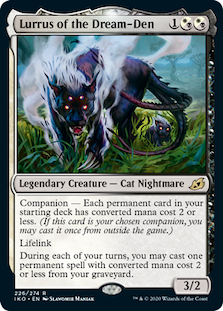
I'm a bit incredulous, but for the fourth month in a row, Hammer Time is the top deck. I understand the appeal of the deck, but I don't understand how it manages to hold onto the top slot so decisively month after month. Its main strategy is just Infect with new skin. The same things that beat Infect should work against Hammer Time. And in fairness, up until Lurrus of the Dream-Den came along, it did. I'd seen variants on the deck since 2019 but they weren't very good. Lurrus changed that by giving Hammer Time the long game Infect never had because it can buy back threats, and since the pump effects are permanent, the opponent is never truly out of danger.
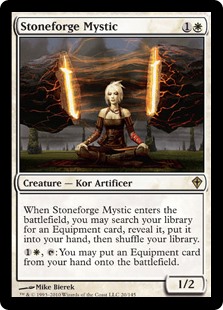
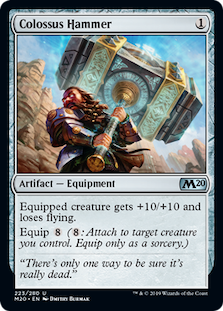
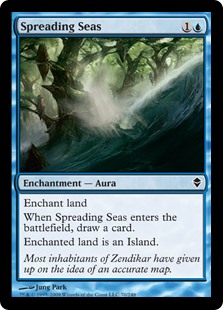
And that's worked well for the past year. However, there's been a shift in deck composition. A new Hammer Time variant has started cropping up that's dropping Lurrus so it can run Nettlecyst and Sword of Fire and Ice maindeck, with more Swords sideboarded. The intention seems to be to move towards a Stoneforge Mystic value plan. This does make sense in light of UW Control's rise, making it hard to resolve Lurrus, which also loses value in the face of exile removal. However, I thought that was why Hammer Time was running Urza's Saga? It's a potent plan on its own and attacks UW's typical do-nothing plan. I suppose that Spreading Seas necessitates the change, but again I wonder if it's really a big enough threat to warrant the rebuild. I'll be watching this development.

Also, just for the record, yes, Hammer Time has a huge metagame share. It's not an outlier, I checked. It also isn't Tier 0. That doesn't mean it isn't potentially too good given its metagame position, either. It is what it is.

UW Rises
On that note, UW (frequently UW splashing Fire // Ice, but that's not a different archetype) is holding strong in the second position. And it's not merely acting as an also-ran but was a genuine threat to Hammer Time's position for most of October. As I mentioned last month, a number of metagame forces have come together to allow UW to potentially answer any deck in Modern. Coupled with its predators (namely Tron) being kept out by Burn and Hammer Time, it's been free to roam Modern. The only thing keeping it from the top slot is Hammer Time's curious stranglehold on the slot.
But then something weird happened. Towards the end of the month, UW began falling off, and Hammer Time was able to pull away. Given UW's performance up until that point it didn't make much sense. This was coupled with a resurgence of UR Thresh, but I think that UW's drop off led to Thresh's comeback, not resulted from it. I've been looking for some explanation to why this happened on MTGO and I got nothing. It may be that pilots got bored or there was a subtle sideboard tweak that changed everything.

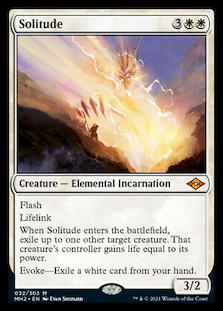
This fall-off directly coincided with a shift in the paper market. October saw a rise in prices for certain Modern staples. Not all of them, nor was the increase consistent. However, on October 23 the prices of a number of UW staples suddenly spiked. Solitude was the biggest change, increasing by between $15-$30 over three days (the exact increase depends on where you looked). Spreading Seas's price doubled from around $2.20 to $4.50, and a lot of other UW specific cards saw additional price increases over the next few days. There's no reason that this paper change would have affected the online meta, but the timing is too close for me to dismiss it as a coincidence. More digging is needed, but it's a very odd occurrence.

Power Rankings

Tracking the metagame in terms of population is standard practice. But how do results actually factor in? Better decks should also have better results. In an effort to measure this, I use a power ranking system in addition to the prevalence list. By doing so, I measure the relative strengths of each deck within the metagame. The population method gives a decks that consistently just squeaks into Top 32 the same weight as one that Top 8’s. Using a power ranking rewards good results and moves the winningest decks to the top of the pile and better reflects its metagame potential.
Points are awarded based on the population of the event. Preliminaries award points for record (1 for 3 wins, 2 for 4 wins, 3 for 5) and Challenges are scored 3 points for Top 8, 2 for Top 16, 1 for Top 32. If I can find them, non-Wizards events will be awarded points the same as Challenges or Preliminaries are depending on what the event in question reports/behaves like. Super Qualifiers and similar higher-level events get an extra point if they’re over 200 players, and a fifth for over 400 players. There were three MTGO PTQ's in October, though Wizards is just reporting them as Premier events. These all award 4 points, but oddly only reported the Top 16. This has skewed the point totals upwards slightly though it is at least somewhat balanced by the lower number of decks.

The Power Tiers

Just like with population, the total points were up in October. September had 707 total points while October soared to 955, which again is the highest since January. This is on the higher end for the returned metagame updates, but still more in line with what I was seeing last year. I'm beginning to suspect that 2020 was simply a very good year for MTGO and the number's I'm getting this year are more in line with what MTGO data "should" look like. Pandemic lockdowns will do that.

The average points were 12.24, which means that 13 points makes Tier 3. Just like with the population, the numbers are up but not by much. The STDev was 24.25, which is pretty high. That makes sense as the data is so broad but it is atypical for recent months. Thus add 25 to the starting point and Tier 3 runs to 38 points. Tier 2 starts with 39 points and runs to 64. Tier 1 requires at least 65 points.

Deck NameTotal PointsTotal %
Tier 1
Hammer Time12613.19
UW Control10711.20
Cascade Crashers838.69
Burn707.33
4-Color Blink677.01
UR Thresh666.91
Tier 2
Jund Saga606.28
Tier 3
Blue Living End353.66
Yawgmoth353.66
Amulet Titan252.62
Mill242.51
Tribal Elementals151.57
4-Color Bring to Light151.57
Belcher141.47

Poor Jund Saga, all alone in Tier 2. Every other Tier 2 deck had the points to jump into Tier 1. Which some might see as an indictment of Saga's metagame position, but they're missing the why all the other decks escaped Tier 2. It comes down to a quirk in the points system. The PTQ's are to blame for this weird jump into Tier 1. Each one was dominated by a different deck, and with the boost of points those decks received they were able to make the jump. Jund Saga didn't really show up in the PTQ results, but it was a very consistent performer in Challenges and Preliminaries. Thus it stayed in Tier 2, alone and neglected. But it still outperformed Tier 3 by a very wide margin. As I said, the Top Tiers have been decided by the online crowd.

Average Power Rankings

Finally, we come to the average power rankings. These are found by taking total points earned and dividing it by total decks, which measures points per deck. I use this to measure strength vs. popularity. Measuring deck strength is hard. There is no Wins-Above-Replacement metric for Magic, and I'm not certain that one could be credibly devised. The game is too complex and power is very contextual. Using the power rankings certainly helps, and serves to show how justified a deck’s popularity is. However, more popular decks will still necessarily earn a lot of points. Which tracks, but also means that the top tier doesn't move much between population and power, and obscures whether they really earned their position.
This is where the averaging comes in. Decks that earn a lot of points because they get a lot of results will do worse than decks that win more events, indicating which deck actually performs better. A higher average indicates lots of high finishes, where low averages result from mediocre performances and high population. Lower-tier decks typically do very well here, likely due to their pilots being enthusiasts. So be careful about reading too much into the results.

The Real Story

Remember how I mentioned the PTQ's distorted the power tiers? That's also happening with the average power. Everything on the tier list beat the baseline this time. However, Hammer Time would have been just below baseline but for it's very impressive showing in the last PTQ. All the 4 point placings it got in that event saved it from the gutter it spend most of the month inhabiting. That's the power of individual events.

Deck NameAverage PointsPower Tier Ranking
Amulet Titan2.083
4-Color Blink2.031
Mill2.003
Belcher2.003
UR Thresh1.941
Blue Living End1.943
Yawgmoth1.943
Jund Saga1.822
Burn1.801
Cascade Crashers1.731
Hammer Time1.701
UW Control1.701
Tribal Elementals1.673
4-Color Bring to Light1.673
Baseline1.65

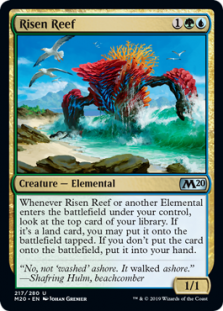
The highest placing high tier deck is 4-Color Blink, making it the actual deck of the month. And it's notably a deck I haven't mentioned before, because it really isn't new. The deck apparently grew from Tribal Elementals because that deck was too dependent on Risen Reef. Players then started cutting the tribal cards for independently good ones and ended with this Yorion, Sky Nomad pile of value. Which did very well, but a lot of that has been from kanister's results. I should note that Cascade Crashers has seen a number of players also going the Yorion route, and the two decks are starting to look very similar, although as of yet they remain distinct.

All For Now

And with that, I close the books on October. The online metagame has clearly stabilized, and now everyone's looking for a way to exploit the deck. We'll see next time if they were successful and if Crimson Vow has any impact on Modern. Until then!


Anticipating a December Selloff

Are you a Quiet Speculation member?

If not, now is a perfect time to join up! Our powerful tools, breaking-news analysis, and exclusive Discord channel will make sure you stay up to date and ahead of the curve.

I’ve been following @prfeudo (aka Ashiok Enthusiast) on Twitter for a long time now—they’re probably one of the MTG finance folks I started to follow shortly after I signed up for a Twitter account. Over the years, I’ve learned to trust their judgment and to listen when they make commentary on the MTG market. Ashiok Enthusiast is a mainstay at large Magic events, often buying for vendors. This experience has made them very well-versed in the dynamics of the Magic market.

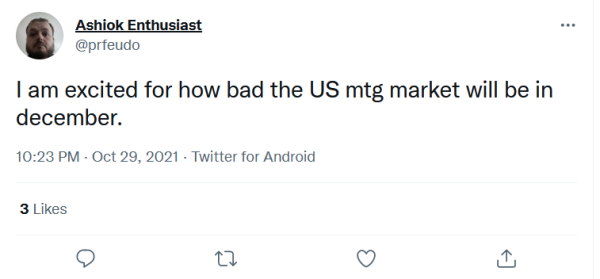
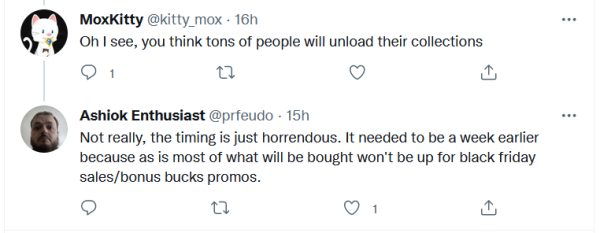
Back on October 29th, @prfeudo made a very brief but profound statement regarding the market and a prediction for the holiday season:

I’m surprised this tweet didn’t receive more attention. Perhaps it did, but people chose not to “like” it because they didn’t like the prediction. Whatever the reason, this week I’m going to explore this prediction a little further, provide some commentary around it, and share my own thoughts on the matter.

The Catalyst: Las Vegas Weekend

Last month, Channel Fireball announced a “$50,000 MTG Las Vegas Weekend”. As I read the description for this event, it’s clear to me this is akin to what used to be Grand Prixs and, more recently, Magic Fests. Two “main events” are the centerpieces of the event. Then there are the continuous drafts and side events that will inevitably happen throughout the weekend. There’s even a prize wall!

But the part that really stands out to me is this part of the event:

Since COVID-19 shut down major MTG events across the globe, many vendors have not been able to restock on cards in their traditional fashion—only a percentage of the player base is willing to package up buylist orders and ship them off to a vendor. But the temptation to sit down across from a vendor, hand over some cards, and walk away with a stack of cash is always tempting at these large events (and I would know since it’s the primary reason why I would still want to attend them).

You may think this opportunity to restock will be healthy for the market, and in a way, it is. Much of the pent-up demand vendors have will be fulfilled coming out of this event. They’ll likely be staffing their booths well, equipped with stacks of cash eager to buy.

What follows this weekend that will impact the market. After spending all their cash buying up collections from the endless rows of players itching to cash out, these vendors will have to list all their cards and then actually sell through their new inventory. If they are stuck sitting on their newly acquired cards, it will be bad for business. A backlog of players eager to sell cards means a potential overstocking of cards by vendors—especially if some vendors come in a little too hot on buy prices.

This will inevitably lead to a flood of supply on sites like TCGplayer after the event, leading to more competition and lower prices as vendors seek to recoup their investments from the event.

Added Complexity: Holiday Season and Timing

I have to give full credit to Ashiok Enthusiast here. When asked for more details in reply to this tweet, they summarized their rationale quite eloquently:

MoxKitty asked if the reason for this prediction was related to a large influx of players eager to cash out of their collections now that prices are elevated relative to 1-2 years ago. While this was not the primary factor in Ashiok Enthusiast’s opinion, I do suspect there will be more players than average looking to raise cash from their collection.

However, their subsequent explanation should not be ignored: the timing is very awkward. MTG: Las Vegas is scheduled for November 19th through the 21st, less than a week before Black Friday. What normally happens on Black Friday and Cyber Monday? Just as they mentioned, that’s often a time for bonus bucks promos from eBay and TCGplayer, as well as Black Friday specials at vendor sites in the form of discounts and store credit promotions, etc.

How likely is it that the vendors purchasing cards in Las Vegas the weekend before will have time to fly home with their product (likely Monday), organize and grade their purchases, and get that inventory onto eBay or TCGplayer before Thursday? Honestly, I don’t run an online shop so I can’t estimate what this timeline normally looks like, but @prfeudo can estimate the timeline because of their continuous involvement with major MTG sellers.

There was an error retrieving a chart for Stone Calendar

If they say cards purchased during MTG: Las Vegas won’t be fully listed in time for the Black Friday and Cyber Monday promotions, I would tend to believe them.

Why is this such a big deal? This ladders back to what I mentioned in the previous section: a spike of inventory can be expected coming out of this event. If vendors can’t capitalize on the bonus bucks deals of the holiday sale season, they’ll miss out on a spike in purchases made by players. This means their newly acquired inventory may be a little slower to sell, leading to a drop-off in prices.

Of course, prices sometimes cool off over the holiday season anyway as players shift focus towards family gatherings, holiday celebrations, etc. This could compound an already-weak demand for new cards.

How I’m Approaching The Holidays

With an anticipated cooling of the market and dropping of prices, I feel the need to pause and consider my strategy for the holiday season. Rather than purchasing in an ad hoc manner, I'm thinking in advance about which cards I’m willing to reach for if prices come in, and which ones I should resist the temptation to buy. After all, I’m primarily an Old School collector nowadays, so my buying power is somewhat limited and hinges upon what I can sell.

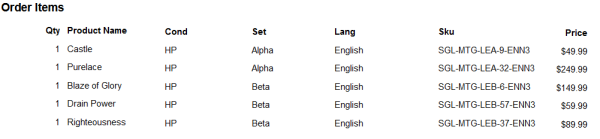
Speaking of which, that’s precisely what I’ve been doing over the past month or so—gradually letting go of a card here and a card there to build up my PayPal account and prepare for potential deals in November and a potential drop of prices come December and into January. I’ve seen a little bit of softening in the market already, and I couldn’t resist making this purchase from Star City Games recently:

Don’t forget that SCG Premium qualified me for 10% off each of these prices. While I try to stick to more playable cards, I just couldn’t say no to an Alpha rare—even a Purelace—for $225. I just don’t think Alpha rares sell for that cheaply anymore.

There was an error retrieving a chart for Purelace

The same goes for most Beta rares selling for $54. Drain Power may not be all that powerful, but the artwork is pretty neat, and the price was right. The Blaze of Glory and Righteousness are somewhat playable and have iconic artworks.

There was an error retrieving a chart for Blaze of Glory

These are the kinds of cards I’ll be watching out for during a late fall / early winter cool-down. I’ve grown my appreciation for the collectability and rarity of Alpha and Beta cards recently, and it always seems like one vendor or another is increasing their buy prices to restock these cards. These are also the kinds of cards you can sit on for three years and basically guarantee they’ll maintain or increase in value.

Of course, I’ll also be looking out for any arbitrage opportunities—sometimes one vendor or sale makes a card cheap enough to immediately flip to another vendor for profit. It isn’t a sure thing, but the more sales compound and store credit kickbacks grow, the more likely these opportunities will surface. My bias will be towards Old School cards, but this could also apply to any cards of value.

The bottom line is I am trying to raise cash now before Magic: Las Vegas, where vendors will most likely restock on cards and then have to drop prices in order to reduce their newfound inventory. Then I can try and buy cards as they cool off in December and January.

Wrapping It Up

When a popular, experienced buyer for major vendors speaks up about MTG finance, I listen. In this case, that person was @prfeudo (aka Ashiok Enthusiast). They made a bold prediction regarding prices in December, and I’m inclined to think they’re correct. Between vendors’ pent-up demand to restock inventories at the Channel Fireball Las Vegas event and the awkward timing around the holiday season, there could be an incoming set of price corrections downward.

I believe it’s worth planning for this potential (likely?) outcome. Personally, I’ve begun selling an extra card here and a card I’m less attached to there to raise funds. Then I will have some powder dry and ready to buy when sales and dropping prices begin (first the former, then the latter).

This had been proceeding smoothly until I got tempted by some well-priced Alpha and Beta cards. That’s OK though since those are precisely the kinds of cards I’m interested in picking up at lower prices. Maybe they’ll drop even further come December or January, but in general pricing on Alpha and Beta are stickier. So I’m not too worried. These are some of the cards I’m most confident in holding as Magic continues to evolve with each new set. It’s just hard to beat the rarity and collectability of Magic’s very first and second sets. If these go on sale this winter, you’d best believe I’ll be jumping in and buying hand over fist.

Avatar photo

Sigmund Ausfresser

Sigmund first started playing Magic when Visions was the newest set, back in 1997. Things were simpler back then. After playing casual Magic for about ten years, he tried his hand at competitive play. It took about two years before Sigmund starting taking down drafts. Since then, he moved his focus towards Legacy and MTG finance. Now that he's married and works full-time, Sigmund enjoys the game by reading up on trends and using this knowledge in buying/selling cards.

View More By Sigmund Ausfresser

Posted in Alpha, Analysis, Beta, Business, Cash Flow, Finance, MagicFest, PredictionsLeave a Comment on Anticipating a December Selloff

Have you joined the Quiet Speculation Discord?

If you haven't, you're leaving value on the table! Join our community of experts, enthusiasts, entertainers, and educators and enjoy exclusive podcasts, questions asked and answered, trades, sales, and everything else Discord has to offer.

Want to create content with Quiet Speculation?

All you need to succeed is a passion for Magic: The Gathering, and the ability to write coherently. Share your knowledge of MTG and how you leverage it to win games, get value from your cards – or even turn a profit.

Seven Burning Thoughts About the State of Modern

Are you a Quiet Speculation member?

If not, now is a perfect time to join up! Our powerful tools, breaking-news analysis, and exclusive Discord channel will make sure you stay up to date and ahead of the curve.

After several months without playing Magic Online, I logged onto my account last Thursday to see what was going on there. To my surprise, I found I had 39 Qualifier Points (QP), and to my delight, the Vintage Cube is back. I thought it was the perfect opportunity to earn the missing point while enjoying one of my favorite formats and qualify for the next big tournament with a QP entry available.

Events unfolded quickly. There was a Modern Qualifier on Sunday. After earning the missing QP, I unpaused my rental account, set the limit to $250, and borrowed my pet deck: Burn. I went straight for the Leagues, as I wanted to scout the digital meta before the big contest.

After several years playing Burn, I feel like I have mastered it. Sure, you can always learn something new, but I pretty much know the deck inside and out. My only contact with Modern these last months though was playing FNMs in paper, and my local meta has far fewer new cards (and hence, fewer new decks) than Magic Online, so picking up Modern was like starting all over again.

Here's a quick rundown of some of the things that struck me about the state of the format.

1) It Is Not Uncommon To Face an 80-Card Deck

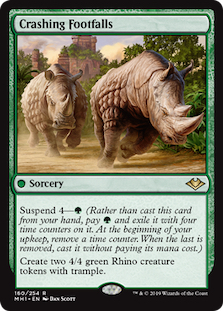
I faced a Yorion, Sky Nomad deck in three of the eight rounds of the tournament including two different Crashing Footfalls configurations and one pure UW Control deck. When Ikoria was released, I thought: "what a joke!" whenever I faced an 80-card deck. I do not feel that way anymore. Clearly, more players are finding this appealing. Personally I prefer not to dilute my deck like that, but the strategy seems to hold some promise.

2) Elementals Everywhere
 Except for You, Subtlety

The power level of cards like Urza's Saga, Ragavan, Nimble Pilferer, Murktide Regent, and Dragon's Rage Channeler is well renowned, so I knew about these cards beforehand. However, what I did not expect is that nearly every deck I faced featured at least one Elemental from the Modern Horizons 2 mythic cycle, either in the main deck in the sideboard.

The combination of Grief and Ephemerate is formidable. Fury and Solitude have proven to be great removal, and Endurance is a fantastic sideboard play against certain decks. Blinking a 3/4 with reach on turn one can be pretty solid, as my poor Goblin Guide and I quickly found out. The only Elemental that does not see play is Subtlety. I played several Leagues, two Modern Challenges, and the Qualifier and have not seen the card once. Clearly, it's the loser of the lot, at least in Modern!

3) Hammer Time Is the King of Modern

I think this is the strongest deck in the format right now. The addition of Urza's Saga added a lot of consistency, and the deck feels much less like a glass cannon now. Also, Esper Sentinel is a really strong Magic card. There was a game where I punted: I had to burn to the face to potentially win the next turn. Instead, I opted to kill his Puresteel Paladin in response to a Springleaf Drum that would have turned on Metalcraft. My opponent then proceeded to play a second Paladin and attach one Colossus Hammer to him and another to an Ornithopter. I lost that match, which pretty hurt badly considering I was 3-1 at the time.

4) BG Aristocrats Is a Thing!

This deck features Young Wolf, Strangleroot Geist, Chord of Calling, and Eldritch Evolution all tied together by the great Yawgmoth, Thran Physician. I faced this in the last round of my tournament. We were both 5-2, so finishing 6-2 would mean having a fair shot at making top 16. After I won the first game, my opponent ground me out with their legendary creature and multiple Geralf's Messengers in game two. Game three was much the same story, but with the addition of Blood Artist, a card that makes Burn players very miserable.

5) Sunset Revelry Is a Ridiculously Strong Magic Card

This new card, courtesy of Innistrad: Midnight Hunt, hits aggressive players where it hurts. It's like Timely Reinforcements on steroids. It even draws an extra card if, say, you as the aggro player are holding your spells to avoid countermagic. In multiples, it is truly lights out. In the second game of a match against 4-Color Omnath, my opponent played Sunset Revelry turns two and three. He even created two humans both times, as my opening hand involved Monastery Swiftspear, Goblin Guide, and Eidolon of the Great Revel. I lost that game, of course.

6) Burn Can Still Win Games, Thank God

After the addition of MH2, I was afraid that Burn could no longer compete in the Wild West that is Magic: Online. Fortunately, this is not the case. I managed to post a 5-3 record and felt like I could have won at least two of my three losses had I played better Magic. I took the Boros Ferrari for a spin in a League yesterday and posted a nice 5-0, showing that the deck still has legs.

7) Modern Is in a Sweet Spot!

I like the current state of the format. It is fun, several strategies are viable, and my pet deck can still compete. Some of the new cards are clearly pushed, but Modern feels healthy nevertheless. The same thing can't be said for Legacy, where UR Tempo decks dominate the format. There's no such dominance happening in Modern, by any deck. While I must say that Urza's Saga sometimes feels like too much to handle, I do not see any reason for bannings. It is not extremely oppressive. One great story: I got to fuse a Wear / Tear to destroy a tapped Saga and a Shadowspear and it felt so nice!

Conclusion

Overall, I am enjoying my return to Modern! How do you feel about the format? Are you enjoying it as it is now, or do you feel like some bans are needed? Let me know in the comments. I am really excited to follow how the format evolves, and I shall continue burning 'em out!

Don’t Level Yourself: Metagame Limitations

Are you a Quiet Speculation member?

If not, now is a perfect time to join up! Our powerful tools, breaking-news analysis, and exclusive Discord channel will make sure you stay up to date and ahead of the curve.

Every so often, it's important to reexamine previously learned ideas. Information changes over time and sometimes what was right at one point is now wrong. More often, however, it's simply been so long since the idea was first learned that it's no longer remembered correctly. It hasn't been forgotten, but the details are foggy. Sufficiently so that there's little practical difference between remembering and forgetting. Such that when you try to actually discuss the thing you fumble around like you made it up and are consequently ridiculed and dismissed. And then being incredibly frustrated because you know that you used to know the definitive answer but you just. Can't. Articulate it anymore. *This intro does in no way, shape, or form come from humiliating personal experience.

Anyway, it's time for me to remind all my readers not to read too far into the metagame data I'll be posting next week. While it is generally true, it's particularly important because next month is ChannelFireball's Not-GP Las Vegas, the first paper event of such a size in a year and a half. It will be the first chance to see what the "real" paper metagame is after not actually having one. And there will temptation to assume that the MTGO metagame will accurately reflect what's going to show up to Vegas. Worse, they may start down an assumption hole that will harm their chances of success. Today we'll discuss how to get the most out of the data that we have.

The Danger of Misapplication

It is generally true that an informed decision is superior to an uninformed one. However, that informed decision is only as good as the information that informs the decision. Information that is somehow lacking is very unlikely to produce a good final decision. That doesn't mean that poor information is useless or if data is thin guessing will produce better results. It does mean the less there is to go on, the more likely it is that an unknown variable will ruin everything. Less complete data provides a worse basis for decision-making than more complete data. And sometimes thin information is all that's available. In those cases it's better to use the data than not. However, it's critical to acknowledge the weakness and plan accordingly.
This is where the great danger of data analysis lies. Obviously, using false or misleading data is bad and can only lead to bad outcomes. Put bad in, get bad out, only yourself to blame for not doing the legwork. However, a far more subtle mistake is misapplying the data. Data has a source and the data only speaks to that source. Thus, any analysis done with that data will describe and interpret the data for that source. And only that source. To apply it to anything else requires more work and usually involves turning that data into a model or test case. Immediately applying one study to everything (which is what most people want to do because it's so much easier) is bad science but a great way to come to wrong conclusions and subsequently poor ends.

The Metagame Data Trap

Which is my long-winded way of cautioning against reading too much into my metagame updates, however thorough they may be. They are a very valuable resource, and I'm not just saying that because I make them. But I also know better than anyone their limitations. Taking my data and assuming that it accurately reflects the metagame of anything other than an MTGO Premier event is asking for heartbreak. The data I have to work with comes primarily, though not exclusively, from those events and so everything I do with that data reflects the Premier event metagame. If that's all you want then by all means use my data as a comprehensive guide to your advantage. However, everyone else needs to be careful. The MTGO metagame does not and has never reflected the paper metagame. And this is especially true as events get more local.

For example, my FNM metagame looks nothing like MTGO's. There's almost never any Hammer Time, UW Control does mediocrely, and nobody's playing Burn. Instead, it's very much anything goes. Last week there was a lot of 4-Color piles, Scourge Shadow, and off-meta rogue decks. The week before it was Amulet Titan and Mill. Going into that metagame with a deck or sideboard optimized against the MTGO metagame is guaranteed to end poorly. I know because I've been doing it. The Denver area has has a number of Modern $1-2K events recently and the metagame for those tends to be more similar to MTGO's metagame. I can't be bothered to rebuild my deck for FNM, so I just run the same UW Humans list I use at the bigger events. And I do average at best, but I expected that going in. I'm lazy and want to play my deck even if it's bad. Presumably, so do lots of other paper players.

Escaping the Trap

If the metagame data is only accurate to MTGO, then it would seem like it's fairly useless. But it holds that an informed decision is better than an uninformed one. When the data is lacking, you have to put additional work in to make it useful. In the case of the metagame data, it's critical to remember that while it doesn't directly apply to paper events, the MTGO metagame does inform paper's metagame. As I've said, the MTGO data is the only data anyone has to work with. Thus it's everyone's starting point. Everything else is based on how they react to that metagame. If they do at all.
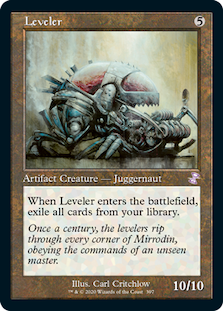
The key for players heading to Las Vegas is to recognize that the actual paper metagame is currently unknown. The only paper data (so far) comes from local events that usually only report the Top 8 (if anything). There's no sense of what to expect. On the other hand, everyone does know what's good online. That doesn't mean that it will be the same in paper, but it is good online. Thus everyone will be reacting to that metagame to the extent they're able. And that last part is critical, because the rental services make it far easier to adopt the best decks online than in paper. Subsequently, many players will end up playing whatever they have available. The savvy players will therefore look at next week's metagame update, remember the card availability and population differences between paper and online Magic, and make their decisions accordingly.

Leveling Yourself

Of course, there's a different danger to beware in being said savvy player. Be sure not to level yourself. The concept of leveled thinking originally came from poker, but it also applies to Magic. Which players noticed and started doing years ago. The basic idea is very simple: there's what you can see, what you can extrapolate, and then what you interpret based on those observations. From there you get into mind games based on what you think is going on and what your opponent thinks is going on. To put it another way, all thinking can be put onto a given level originally articulated thus:

Level 0: What Do I Have? This is the most basic level where you're only thinking in terms of what you actually observe. In other words, what do you know based on the things you can control?
Level 1: What Could My Opponent Have? Given what you can observe of your opponent, what do you think they have? This is where you're interpreting information that you don't actually control.

Level 2: What Does My Opponent Think I Have? What have I done to influence my opponent's thinking? How are they reacting to me and how can I use this? Why or do they believe something about me?

Level 3: What does my opponent think I think he has? The meta level. What does my opponent want me to think and why? Otherwise known as getting into the opponent's head.

Level 4: What does my opponent think that I think that he thinks that I have?-My opponent knows I'm in level 3 and is reacting, so how do I react to that reaction and stay one step ahead?

This can technically go on forever, but every discussion usually stops at level 4. The whole deal is to identify which level your and your opponent are thinking on and then try to be the level above your opponent. And only that level, because to be on the wrong level is to ensure disaster.

How to Wreck Yourself

The danger of leveled thinking is first and foremost being on the wrong level. If you were operating on level 3, but your opponent was only on level 1, you were thinking about things they weren't even considering and putting thoughts into their head that weren't there at all. Consequently, you drew conclusions based on incorrect assumptions and ended up playing a game that only existed in your own head. As a result, you're highly likely to play around cards that aren't even in the opponent's deck. And they didn't have to do anything; you just out-thought yourself. Therein lies the great danger in leveled thinking.
However, it's arguably worse to get lost in a leveling loop. Which it is far easier for Vizzini to demonstrate than for me to explain. In the clip, Vizzini just keeps going on and on without really considering the implications of each level he's thinking on. Had he done so, he might have realized that Westley was playing a different game entirely. Consequently he lost the game. The same thing will happen in Magic, though with less permanent consequences. Getting too far into thinking about what the opponent is doing just tangles you up in knots and will go on forever... cue the Star Trek clip again.

Check Yourself

From personal experience, I hypothesize that every competitive Magic player has leveled themselves at least once. The competitive crowd enjoys an intellectual card game to win, and subsequently show that they're intelligent and skilled. Thus all of us have wanted to demonstrate this to our opponents and went for some kind of non-obvious/flashy play that wins the game based on the read we have on our opponent. Only to fail when that read was wrong. And often lose because the flashy play required giving up a board state that was otherwise winning. We've all leveled ourselves because at some point we weren't as smart as we thought. I'm not excluded.
The catch is that each level of thinking requires additional information to reach a valid conclusion. And that information increase is not linear. I would posit that moving from level 0 to 1 is close to linear, but after that it gets increasingly exponential. And if the information requirements increase then the price for lacking that information also increases exponentially. Thus even minor mistakes are going to be amplified massively and will lead to disaster.

How to React

Given all that, how should players utilize the metagame data? As far as I'm concerned, players need to put the available data in the correct level and then recognize which levels other players are likely to be working on. I'll argue that, given that Not-GP Las Vegas is an open tournament and how actual Grand Prix used to be, the population will consist of an even mix of experienced, enfranchised, competitive players and casual players on Day One. The casuals are likely to be thinking about their deck selection on Level 0, which is what decks they actually have. The competitive players will be operating on at least Level 1, which is the known metagame. In other words, the more competitive players will be aware of the metagame data and making decisions from it. Whether they'll be operating on Level 2 or higher is impossible to say.

Therefore, there is an even chance of hitting Level 0 or Level 1 (or higher) players on Day One, with the odds of hitting Level 1 or higher increasing as the day goes on (assuming better players stay around and perform better). In that scenario, Level 2 decks would be favored if and only if they can still beat the Level 0 decks. Otherwise, they're putting all their hopes for success in the hands of the Pairings God. If the God is merciful, then it could be an easy day against matchups that have been metagamed against. If it isn't, you're going to be heading for the side events very quickly. As a result, I'd advise players who want to make Day Two to focus their thinking around Level 1. Use the metagame data to tell you what is good, but not what will actually show up.

Don't Overthink It

The main advice I have is simply don't overthink your deck for Vegas. It's really easy to get trapped in leveled thinking. Recognize the limitations of your knowledge and that everyone that's enfranchised will be operating from a similar level of uncertainty. It's great to outsmart the opponent, but don't let yourself be outsmarted.

The Return of Modern: How Competitive Play Is Good for All

Are you a Quiet Speculation member?

If not, now is a perfect time to join up! Our powerful tools, breaking-news analysis, and exclusive Discord channel will make sure you stay up to date and ahead of the curve.

A couple of months ago I wrote an article about the shift in interest of the market due to the incoming resurgence of in-store play. I wrote about the profound impact that the reappearance of in-person Modern formats would have, the new interests that might pop up, and the possible impact of the upcoming Modern Horizons 2 set that was about to be released. I made some predictions about certain Modern staples and some of the possible effects of Modern Horizons 2 on the format. Let's talk about the past few months, and examine the effects of these past few months on the Modern metagame.

The Metagame

The current Modern metagame is a very interesting phenomenon. The aggro decks are fast, the midrange is efficient, and the control is brutal. Some of the strongest aggressive decks include “Hammer Time”, which utilizes the once useless card Colossus Hammer, or "Rhinos", which is a cascade deck that uses the card Crashing Footfalls to go in for a quick win. There are the usual control lists, ramped up by a splattering of new value cards like Hall of Storm Giants, Shark Typhoon, and Memory Deluge. With these new additions, control decks are able to grind out value much more efficiently than previously possible. The midrange decks are efficient and powerful, packing just as much punch with high power, efficient creatures like Dragon's Rage Channeler, Ragavan, Nimble Pilferer, and powerful curve toppers with Murktide Regent. The overall power level of the format is very high, and the metagame changes constantly. A responsive player base adapts to new brews, and room for improvement is ever abundant.

There was an error retrieving a chart for Ragavan, Nimble Pilferer
There was an error retrieving a chart for Murktide Regent
There was an error retrieving a chart for Shark Typhoon
There was an error retrieving a chart for Memory Deluge

Some New Things

Some new cards have just been absolute home run hits. The ones everyone expected is easy, Ragavan, Nimble Pilferer, Murktide Regent, Urza's Saga, and the Evoke Elemental cycle from MH2 just to name a few. The less hyped ones are really exciting as well. Consider, Prismatic Ending, and Expressive Iteration are all cards that aren’t crazy out of the park value but are overall very powerful cards in the common and uncommon slot. It’s honestly great to see the value of these newer sets shift slightly to the common and uncommon slot, as it generally raises consistency on the expected value of sealed product, and tends to make sealed prospects quite better.

There was an error retrieving a chart for Expressive Iteration
There was an error retrieving a chart for Prismatic Ending

Some Old Things

There are some old cards that seem to have resurfaced or found a new home in a new deck, and it’s great seeing all of these old cards find homes in the format. The cards I’ve selected to take a look at are Sigarda's Aid, Crashing Footfalls, Flusterstorm, Torpor Orb, and Violent Outburst. These cards have all drastically climbed in price and demand recently, as they have discovered a place in some of the format’s most popular and powerful decks. Violent Outburst had seen play in the Living End combo deck but hadn’t seen any real financial value until the new Crashing Footfalls deck made waves. I remember picking up a few copies for my Greater Gargadon Restore Balance deck I had made a while back pennies on the dollar, and the next thing I knew they were sitting at almost $5 apiece. Same thing with Crashing Footfalls, which was a secondary threat in my Greater Gargadon brew, which is around $3-$5. Just goes to show that neither the payoff nor the enabler is always the most expensive one. Sigarda's Aid is the combo enabler for the popular Hammer Time deck. It allows you to cheat the equip cost for Colossus Hammer, while also allowing it to be cast at instant speed, making it perfect as a combat trick. Flusterstorm has always been a very powerful piece of countermagic, making it perfect for both mainboard and sideboard plans depending on the deck. Torpor Orb is a very effective sideboard card against some of the main plans of some of the best decks in the format like Yorion Control, Elementals, any deck using the Evoke Elementals from MH2, and some of the older decks in the format like one of the Primeval Titan. All of these cards are performing well in tournaments, and the price reflects that. There likely was lots of time for all these to be speculated on, as they all are pretty no-brainer moves when you looked at the developing meta just a couple of months ago.

There was an error retrieving a chart for Sigarda's Aid
There was an error retrieving a chart for Violent Outburst
There was an error retrieving a chart for Torpor Orb
There was an error retrieving a chart for Crashing Footfalls

Better Luck Next Time

My evergreen advice for finding new specs is simply to play more. Seeing more cards, understanding the metagames, and experiencing more card interactions is the best way to find cards with potential in a format. Analysis is no substitute for experience. Being ahead of the curve usually means you have to be the first one on the road. No amount of web surfing, charts, or forum exploration will yield quite the same results.

Avatar photo

Kai Haas

Kai has always had a profound connection to the game of MTG, and as time went on, the allure of the financial aspect took hold. They spend most of their spare time looking into the ins and outs of the bizarre and erratic world of MTG finance. When they aren't speculating, they mostly play Commander, CEDH, Draft, Cube, and more recently, Standard. The most important thing to Kai is the pursuit of knowledge, because it's not what you know, it's knowing where to find what you don't.

View More By Kai Haas

Posted in Free, Modern, Modern Horizons 2Tagged , , , , , , , , Leave a Comment on The Return of Modern: How Competitive Play Is Good for All

Have you joined the Quiet Speculation Discord?

If you haven't, you're leaving value on the table! Join our community of experts, enthusiasts, entertainers, and educators and enjoy exclusive podcasts, questions asked and answered, trades, sales, and everything else Discord has to offer.

Want to create content with Quiet Speculation?

All you need to succeed is a passion for Magic: The Gathering, and the ability to write coherently. Share your knowledge of MTG and how you leverage it to win games, get value from your cards – or even turn a profit.

When Can Dropping Prices Be Worthwhile

Are you a Quiet Speculation member?

If not, now is a perfect time to join up! Our powerful tools, breaking-news analysis, and exclusive Discord channel will make sure you stay up to date and ahead of the curve.

Prices climb and prices fall. It’s a fact of economics—supply and demand 101. Everyone knows what to do when buyouts ensue, prices are spiking, and cards are flying off the shelves. No one is too upset about having to raise prices on cardboard, increasing sales (and, often, profit margins) in step.

But what happens during a momentary bout of weakness in the Magic market? Dropping prices on cards feels so much worse than raising prices, especially if it means potential losses could be incurred. Because of this aversion to dropping prices, sales volume instead decreases and inventory sits around for longer than anticipated.

There was an error retrieving a chart for Infernal Medusa

I believe this is suboptimal. While no one likes dropping their prices, there are many significant benefits to doing so to encourage sales.

A Quick Caveat

Before I dive into why I am a proponent of price decreases, I need to clarify my perspective. I am not a store owner. I do not pay rent to sell Magic cards. I do not rely on this hobby to pay for anything other than the hobby itself and my kids’ college fund. Because of my casual engagement with the hobby, I can be much more agile when making decisions to slash prices.

I understand such a decision cannot always be taken as lightly when profits from Magic sales are required to keep one’s lights on. Dropping prices on a significant percentage of one’s inventory could mean the difference between a profit and a loss for the month. Too many months like that, and a business won’t stay in business for very long.

Despite this complexity, I’d still maintain that the practice of dropping prices can be positive. If nothing else, the considerations I’ll outline below should be relevant whether you sell ten cards a month or ten cards an hour.

Sometimes the Price Just Isn’t Right

No matter your motivation—whether to maintain liquidity, to make a profit, or to raise cash to purchase other cards—a decision to sell cards should be relatively fixed. You may decide that you’re willing to sell a card if it rises above a given price. This is akin to setting a limit sell order on the stock market. However at the end of the day, if you’re comfortable letting a card go, it’s probably because you don’t feel you need it any longer.

This is precisely the thought process I navigate when deciding what card to sell next. I’ll browse through my collection and identify the card I’m least attached to—preferably one that has appreciated since I purchased it, but not always. Once I find the card(s), I research prices and post them up for sale.

Sometimes I am lucky. I’ll post the card at a price point I’m happy with, usually around 10% below TCG low, and it’ll sell within minutes. This is exactly what happened when I posted a damaged Arabian Nights City of Brass and a Legends Hellfire for sale last week. They both sold right away without any need for negotiation.

There was an error retrieving a chart for City of Brass
There was an error retrieving a chart for Hellfire

Sometimes this doesn’t go exactly as planned, especially on a more obscure, less playable card. For example, a couple of weeks ago I decided I wanted to sell my BGS 8.5 Alpha[ Weakness. I forgot precisely what I paid for the card, but the bottom line was that I already had an ungraded copy in my collection and I had no need for this more expensive version. What’s more, 8.5 wasn’t high enough of a grade to really get me excited about its collectability.

After doing some research, I created an eBay listing for the card and set a price just shy of $100. This was still significantly cheaper than other graded copies on eBay (even copies with poorer grades were posted at prices north of $120 and beyond). After a day or two at that price, however, I quickly realized I was too high. No sold copies had gone for that much, and while the graded nature of the card added some value, I doubt it added more than $10-$20 of premium over a near-mint price point.

Because I had already decided I would sell the card, I began dropping its price. Every day or two I’d cut another $5 to $10 off the eBay price. I even submitted an offer to a watcher of my eBay listing for a lower price. Still, no one bought the card.

This is where things get interesting—I was committed to selling this card. It didn’t matter what I had paid for it because what is in the past is in the past. The only thing I could control is what I sell the card for. Of course, I wouldn’t drop my price so low that it wouldn’t make any sense—for example, to sell for less than a near mint copy sells for on Card Kingdom’s site would have been crazy. Likewise, ABUGames’ buy price for “mint” copies could have also acted as a price floor.

There was an error retrieving a chart for Weakness

Because I wanted the sale, I took the difficult decision to cut prices further. Eventually, a fellow Quiet Speculation member expressed interest in the card and I cut them a fair deal. Was it the amount I had hoped to get when I made the decision to sell the card? Not quite. But I wanted to make the sale to raise cash, and I adjusted the price in order to meet this objective.

Why I Forced the Sale

Why didn’t I just put the card back on my shelf and hold onto it for some more time? Won’t a BGS 8.5 Alpha card be worth more years from now than it’s worth today?

These are fair questions that I briefly considered while I was making this sale. But there are a couple of reasons I decided to move forward with selling.

First, I wanted liquidity. Whether you’re a small-time, casual player like me, a backpack grinder, or a major vendor, you’ll recognize the value of liquidity. I’d rather sell things quickly for a small profit than sell things slowly for a large profit. Having constant turnover in one’s inventory (or collection) keeps things fresh and ensures agility in a rapidly changing market environment. In my case, the sale gave me some more cash with which to buy other cards I wanted for the collection.

Second, there’s the opportunity cost of sitting on a card. If I am trying to sell the card for $100 and no one buys it, it effectively means I am continuing to “buy” the card myself at that price. Think about it. A decision not to sell an asset is akin to a decision to buy that asset at the end of each day. As long as I kept my price point so high, I was declaring that if the price was any less, I’d rather keep the card. This just wasn’t the case. I was motivated to sell, so I dropped the price
eventually, if it still hadn’t sold, I would have been OK with keeping it, but that price point would have been a good bit lower. By selling the card, I generate cash that can be used to buy something with better growth prospects, or at least something I’m more excited to own.

There was an error retrieving a chart for Illicit Auction

Lastly, and most psychologically, I had already made the decision to sell the card. Therefore, in my mind, it was already as good as sold. Once I accepted the fact the card would no longer be in my collection, I was eager to move it. This is a bit illogical, I’ll admit, and can lead to some suboptimal transactions. But the excitement of making a sale, followed by the thrill of hunting for another fun card and the MTG mail day that ensues, is enough to really push me. If I sit on the same cards endlessly, it makes it easy for me to lose interest in the hobby. Ensuring turnover in my collection keeps things fresh, helps me remain relevant as a writer, and helps me stay abreast of pricing trends. All are reasonable considerations to a somewhat unreasonable motivation.

Wrapping It Up

No one wants to lose money on their Magic cards. Sometimes, it’s an unnecessary evil of the hobby. To fully avoid this, you could just keep your prices elevated and wait for prices to come up to you. I wouldn’t recommend this plan though.

Instead, if you’re committed to selling cards, I’m a big fan of following market forces and selling them at prices where they’ll sell. It’s a lot of fun when these prices keep climbing. But sometimes prices move in the opposite direction and we are stuck with a difficult choice. Do we keep our prices stagnant and see a significant drop-off in sales? Or do we drop prices to make the sales and maintain sales volume?

Understanding I’m not running a business, I’m of the camp that prices should be dropped. It can be done gradually, and on just a few cards at a time. But any card that isn’t bulk can be sold if the price is right—sometimes it’s just a matter of finding that price point. I've done this multiple times throughout my career, most recently with my graded Alpha Weakness. In nearly every instance, I have not regretted the sale. The benefits of raising cash, improving liquidity, and avoiding unnecessary opportunity costs far outweigh the cost of a stagnant inventory and slowing of sales.

So as you examine your inventory and wonder at the recent slow-down in sales, ask yourself if perhaps a few small price adjustments lower would be helpful. If you’re not motivated to sell, you could wait and see if the holiday season brings a round of sales and a spike in buying. But if you’re like me and you want the cash now (perhaps to do buying during the holiday sales), there are some benefits to dropping prices. At least consider it.

Avatar photo

Sigmund Ausfresser

Sigmund first started playing Magic when Visions was the newest set, back in 1997. Things were simpler back then. After playing casual Magic for about ten years, he tried his hand at competitive play. It took about two years before Sigmund starting taking down drafts. Since then, he moved his focus towards Legacy and MTG finance. Now that he's married and works full-time, Sigmund enjoys the game by reading up on trends and using this knowledge in buying/selling cards.

View More By Sigmund Ausfresser

Posted in FreeLeave a Comment on When Can Dropping Prices Be Worthwhile

Have you joined the Quiet Speculation Discord?

If you haven't, you're leaving value on the table! Join our community of experts, enthusiasts, entertainers, and educators and enjoy exclusive podcasts, questions asked and answered, trades, sales, and everything else Discord has to offer.

Want to create content with Quiet Speculation?

All you need to succeed is a passion for Magic: The Gathering, and the ability to write coherently. Share your knowledge of MTG and how you leverage it to win games, get value from your cards – or even turn a profit.

The Problems With Project Booster Fun, and How It Could Be Better

Are you a Quiet Speculation member?

If not, now is a perfect time to join up! Our powerful tools, breaking-news analysis, and exclusive Discord channel will make sure you stay up to date and ahead of the curve.

Project Booster Fun

It sounds exciting. Dramatic even. Project Booster Fun. Making booster packs better. The reality of Project Booster Fun (PBF) is somewhat murkier when we break it down. According to Mark Rosewater in his article introducing Project Booster Fun (PBF), the inspiration for PBF came from a brainstorming session following the reorganization of Magic R&D into a studio model. The newly-organized studio for tabletop Magic sought to reinvigorate the tabletop Magic experience. Their goal, as Rosewater describes it, was to "improve the experience of opening a Magic booster pack." But what did this mean, and why did it need improving, to begin with?

The Problem With Booster Packs

Project Booster Fun attacked the same problem the FIRE Philosophy attempted to solve. Reduce the number of cards players opening packs not intended for Limited play deemed worthless. The FIRE Philosophy approach was to make common cards more powerful. PBF approached the problem from a different angle. "How do we make opening booster packs more exciting? Put more cool and beautiful versions of cards in them," Rosewater said in his article on Project Booster Fun.

PBF's solution was twofold. The first was to put more shiny things in packs in the form of foils and new treatments for cards not typically seen in premiere sets. The second was to introduce new types of booster packs that contained less common cards and more of these foils and special treatments. We'll get to those in a moment.

More Frequent Foils and New Card Treatments

As part of PBF, starting with Core Set 2020, Wizards increased the drop rate of foils from 1 in 67 cards to 1 in 45 cards. This increased the chance of getting a foil in booster packs from less than one in four booster packs to one in three booster packs. With Throne of Eldraine, they introduced new treatments of cards not usually done in premiere products, including Borderless Planeswalkers, Extended Art Frames, and Showcase Frames.

Showcase frames are treatments unique to the set in which they appear, and capture some of the aesthetic or vibe of the given set. These Showcase treatments can appear in regular booster packs, now called Draft Boosters, but appear at greater frequency and in greater numbers in Set Boosters and Collector Boosters. The more unique card treatments only appear in Set Boosters and Collector Boosters.

Collector and Set Boosters

Wizards introduced Collector Boosters with Throne of Eldraine, and Set Boosters starting with Zendikar Rising. With the stated goals of putting more of the cards players wanted in their hands, these products served as vehicles to sell the new card treatments Wizards was introducing and sounded like a win-win for all. But what exactly was inside the wrapper, and how much would it cost?

Collector Boosters come in 15-card packs with an elaborate breakdown of contents, which Rosewater goes into in his article, and a retail price around $20-$25 per booster pack, with 12 packs per Collector Booster Box. Set Boosters come in 12-card packs and 30 packs per Set Booster Box, and have their own elaborate breakdown of contents, outlined in this article, also by Rosewater.

The List

One of the selling points of Set Boosters, in addition to all the special card treatments, is the chance of opening cards from The List. Rosewater describes The List as "300 interesting cards from Magic's past." Not only did Wizards tout the list as a place where cards from throughout Magic's history would receive much-needed reprints, but The List would also serve as the only source for in-Magic versions of cards from Secret Lair Universes Beyond products, they wrote in this update.

The Takeaway

The first big takeaway from looking at these products is they are clearly more expensive than the normal Draft Booster Box, and with much fewer contents per box. Here are TCGPlayer listings of boxes from the most recent expansion Innistrad: Midnight Hunt:

The Collector Booster box is twice the price, for a third of the cards of a Draft Booster box. The Set Booster Box is about the same price as a Draft Booster box but has six fewer packs, 30 instead of 36, and three fewer cards per pack. This raises a few questions: Do the contents of these products justify the price? What does it mean when the more exciting product is more expensive? If these products are more expensive, does that mean their contents will in turn be more valuable? Does exciting equal valuable?

The Failure of Project Booster Fun

When everything is special, nothing is special. That is the essence of the issue with Project Booster Fun and with Collector and Set Boosters. Cramming more and more shiny, extended, alternate-whatever treatments of cards into packs only serves to devalue all but the rarest and most hard to come by versions of the cards. As for making opening packs more exciting, let's be real for a moment, anytime Wizards describes a product as exciting, that's really code for valuable. Are PBF foils more valuable?

Foils Are The New Draft Chaff

While the sample size of both of these polls is a bit small to make concrete declarations, the answers to each are overwhelmingly polarized. This tells us that the community sentiment regarding Project Booster Fun is the opposite of its intended goal. Are Project Booster Fun foils really worth less than older foils? Let's look at some QS Insider Price data of foil rares and mythics from four recent Magic sets and attempt to unpack it.

BFZEldraineAFRMidnight
Total Value of Foil Rares/Mythics$281.83$542.10$480.40$640.12
Average Value Per Card$4.14$3.76$3.10$3.72
Total Number of Cards68144155172

Looking at the data, community sentiment is correct that Project Booster Fun foils are worth less on average than sets before them. What has greatly increased though, is the volume of foils, including special treatments, from 68 with Battle For Zendikar, to 172 with Innistrad: Midnight Hunt. The special treatment foils are where most of the value of the set lies, accounting for $410.50 of the value of Midnight Hunt's $640.12 worth of rares and mythics. When you separate out the Showcase cards from the rest of the set, the average value of a Midnight Hunt foil rare or mythic is about $2.70.

Low Prices Can Be a Good Thing

Low prices for single cards are not all bad. The depressed prices of foils have also pushed down the prices of non-foils, making it easier than ever for players to acquire most of the cards they need for Standard short of the chasest of mythic rares. Even then though, cards like Alrund's Epiphany and Goldspan Dragon, two of the most played mythics in current Standard, are both under $40. This is something relatively unheard of in the era before Project Booster Fun.

There was an error retrieving a chart for Alrund's Epiphany
There was an error retrieving a chart for Goldspan Dragon

At the end of the day, it is important to remember that the end goal of Project Booster Fun is getting players to buy more packs. Despite the problems of PBF, Hasbro's 2021 earnings reports clearly indicate Wizards has succeeded in their goal. If improvements were made to PBF, what is the best way to approach them?

The Path Forward

Recognizing that the goals of Wizards are to sell packs and make a profit, but wanting to see players get the most of their experience and the best bang for their buck at the same time, these are the changes I'd propose to satisfy all concerned. Note, that I'm not a professional game designer, nor a Wizards employee, just a life-long Magic fan who spends a lot of time thinking about the craft of designing and marketing Magic, and wanting to see it continue to thrive. If any Wizards employees happen to be reading this, feel free to use these ideas as you see fit.

Merge Set Boosters and Draft Boosters

Collector Boosters, containing only the choicest and most blinged-out of foils and special card treatments, are an ideal product for collectors seeking just those things. Set Boosters and Draft Boosters, on the other hand, have so much in common that it makes little sense to maintain them as separate products. It would not be difficult to take the gameplay-oriented structure of draft boosters and increase the drop rates of blinged-out showcase cards, replacing either commons, like-rarities, or some combination of both. Not only would this make the pack opening experience more exciting, but it would make the draft experience exciting in a way akin to how the Mystical Archive in Strixhaven draft made that format thrilling every playthrough.

Have The List Appear in Draft Boosters, and Eliminate the Chaff From Its Rotation

With Set Boosters and Draft Boosters merged into Deluxe Draft Boosters, cards from The List would now appear in the draft. While the 25% drop-rate at which they appeared in Set boosters would be a little too frequent for draft, a rate somewhere in the middle between there, and the one-per-case or so drop-rate of the Inventions of Kaladesh would be ideal. If these cards are going to appear at a rate enough to make opening them something special, it also makes sense that the contents of The List feel better curated than 300 presses of the Scryfall Random button. Tolarian Community College did an excellent video on fixing The List, and his ideas could easily be incorporated into this change.

Raise the Price of Draft Boosters

While this might be the least popular of these suggestions, the price of Draft Booster boxes for premiere sets has been about the same for nearly 15 years, if not longer. If Draft Boosters are going to be juiced into Deluxe Draft Boosters, it makes sense that the price per booster should be about in line with the current prices of Set Boosters to reflect this premium, especially if they maintain the 36-packs per box quantity we've come to associate with Draft Booster boxes.

Convert Theme Boosters Into Jump-In Products.

One result of Project Booster fun which we've yet to discuss until now is Theme Boosters. Theme Boosters are oversized boosters of 35 cards, built around a specific theme from their respective set. This could be color, as was the case with Throne of Eldraine and Innistrad: Midnight Hunt, or some other theme entirely. These boosters are very close in kin to the Jumpstart mini-decks from 2020, and it doesn't seem too much of a stretch to convert Theme Boosters into Standard-only Jumpstart, or Jump-In products, as they referred to them in a recent Magic Arena event.

Continuous Improvement

Magic: the Gathering is one of the greatest games ever made, made by some of the smartest people in the world. Much of the history of Magic design is a history of iteration, with designers learning lessons from the failures and building on the successes that have come before. It's my hope that addressing the shortcomings of Project Booster Fun will help ensure that we continue experiencing the joys of cracking open fresh packs for years to come.

Some Thoughts On Standard After Playing for One Week

Are you a Quiet Speculation member?

If not, now is a perfect time to join up! Our powerful tools, breaking-news analysis, and exclusive Discord channel will make sure you stay up to date and ahead of the curve.

Lately, I've been enjoying the new Standard format, playing the popular deck built around forking Alrund's Epiphany with Galvanic Iteration. Currently, the lists are all over the place — I tried many, however, the following list was the first one that really started to hum for me.

This list is in essence what Seth Manfield tweeted during the arena open.

The archetype is still in its nascent stages, leading some to ask the following questions:

  • What should my interaction suite look like? (How many boardwipes and which ones, which spot removal spells to play and how many, what counters etc.)
  • What card draw should I run?
  • What should my sideboard plans be, which alternate threats should I use? (Smoldering Egg // Ashmouth Dragon etc.)

Among other questions.

When I say this list was humming, I don’t mean it's perfect, but all the previous lists felt rough around the edges by comparison. With this deck, I was finally starting to get good turns consistently, as the ratios are pretty well balanced.

So, let's discuss some of the cards in this list, and how it might evolve in the future.

Card Draw

Memory Deluge was consistently underperforming for me. Even in the mirror where it should theoretically shine, it still felt like too much mana for too little.

The foretell ability on Behold the Multiverse lets you split up your mana, helping smooth out your draws, especially when your deck has four Unexpected Windfall in it. The ability to fork it with Galvanic Iteration is huge.

Many times you cast Deluge your opponent either has a Malevolent Hermit // Benevolent Geist up or Test of Talents / Divide by Zero leaving you behind on mana technically.

Being two mana means you can fight over Behold on your opponent's end step. These small things add up a ton, so I am pretty happy with it now. I plan to explore lists running even higher numbers, potentially by trimming down on Expressive Iteration.

Cftsoc3 came second in the Standard Challenge with an interesting list running four Behold and zero Iteration, and I like the idea somewhat. So, let's compare Iteration to Behold.

cftsoc3 list

On the one hand, Iteration costs half as much mana. On the other hand, Behold is an instant (and therefore better to fork) and it's better for finding spells early game if your hand happens to be land heavy.

If you are purely drawing two, it’s a better deal to get it for two mana. Iteration is such a strong card it’s hard to shave any. However, by trimming some from the list, you may be able to spend your mana more smoothly each turn.

Also, it can feel kind of awkward to cast Iteration in the early game, as the deck also has plenty of instants. Therefore, you may find yourself in an awkward situation with Iteration: when you don’t want to tap out, but you also might fall behind if your opponent doesn’t play into your Instant.

Alternatively, you may end up with a land-heavy hand, where you can only pick one spell off of it. For now, the jury is out on the ideal Iteration/Behold split. Personally, I'm going to try two Iteration four Behold next, and time will tell what is best.

Removal spells

Thundering Rebuke is a sorcery, which is awful, but it's only two mana. This might make it useful in lists that lack things to do on the second turn.

In a heavier Behold list, I will try going up to four as Ctfsoc3 did.

I’ve been playing more Battle of Frost and Fire in my lists, though I still haven't determined which one is better. It will depend on how relevant the scry is of course — and in a four Behold list, having spells that are better at stabilizing might end up being the better play.

I like this in lists like Seth’s, as it's a good card for buying time against aggressive decks. Also, it lets you sculpt your plan in the mirror, which is appealing.

Counterspells

Divde by Zero has felt great for me and I wouldn’t go below 4 yet without good reason, due to the Remand / Cryptic Command vibes.

Between these three options, just play Disdainful Stroke or Negate, as hitting Esika's Chariot is huge. Many are still fans of Goldspan Dragon as well. 

Manabase

I play four Spikefield Hazard and four Jwari Disruption because I feel like I always want to draw them. Spikefield is a bit more volatile, but I would really love to have it, as it's brilliant against mono-white — and I like killing Malevolent Hermits, too.

While I don’t have Field of Ruin in the lists I’ve been playing, most people do. I might be off base here, but I didn’t feel like I would activate it enough to make it worthwhile.

Sideboard

Iymrith, Desert Doom seemed like a fun card to try. Compared to the red dragons, it protects itself from removal quite nicely.

Working that in, here's what I'll be trying next:

Something like this should be nicely balanced. However, the fatal flaw might be the lack of any creature plan sideboard, as this list won’t be able to punish opponents for tapping out as much or fight through Test of Talents. I mostly wanted to fit in a couple Demon Bolt so I had more answers to Smoldering Egg in the 75. With all this in mind, I will try to fit in some creature plan soon!

One card I have not mentioned yet, which is worth being aware of Lier, Disciple of the Drowned

Grixis Lier

Shota Yasooka posted this list last week, the black spells in the sideboard are Go Blank and Duress.

Image

I don't find it instinctually appealing, but I do think Lier is a very strong card that is worth considering.

Want Prices?

Browse thousands of prices with the first and most comprehensive MTG Finance tool around.


Trader Tools lists both buylist and retail prices for every MTG card, going back a decade.

Quiet Speculation