menu

Insider: Five Speculation Targets for Under $5

Are you a Quiet Speculation member?

If not, now is a perfect time to join up! Our powerful tools, breaking-news analysis, and exclusive Discord channel will make sure you stay up to date and ahead of the curve.

Today I'd like to create a sample $100 portfolio for sub $1 MtG targets. Looking to capture at least a 25% return on each play and spend $20 of each of five targets. Trying to fill some of these positions at $1 or less will be harder than getting others filled, and those positions are probably best filled through trading. I would also like to ask readers for their sub one dollar picks and encourage you to create your own $100 portfolio.

Everyone Needs Lands

My first target is Kessig Wolf Run. Buy listing at $.80 and with TCG mid at $1.55, Kessig will be harder to acquire than the rest of my picks. That said, smaller quantities are offered on TCG for under $1, giving me something to point to for trades and plenty of incentive to watch Ebay offerings going at a discount. Kessig already sees lots of play ahead of Gruul's Gatecrash debut. Acquire at $1 or less and sell the first playset at $1.25.

Angels and Humans

Angel of Glory's Rise is likely to get better when Boros guild arrives in Gatecrash. TCG mid lists just under $1.50 but copies can be had on Ebay and Amazon for less than $1. Another good trade target, I'll be  buying only when the card can be picked up for less than seventy-five cents. This card has some problematic interactions in a Standard environment with cheap and effective graveyard hate. That said, it is a great counter to aggressive Zombie decks, has a big enough butt to block Thragtusk and offers a way to play around Supreme Verdict.

Nothing's Free

Next target is a card that finds a home in combo and affinity. Although no longer available for standard play, Memnite can still be found in enough binders to make it a great trade target. TCG mid has Memnite at $1, but I only acquire at seventy-five cents or less. Acting as a middleman with Memnite can be done by playing into Modern's rise of popularity. Affinity and any deck looking to turn on metalcraft will want to add four copies of this zero cost drop. Depending on your ability to broker this exchange you can have a very liquid and profitable portion of to the $100 portfolio, allowing you to use profits to build up positions on the cheap. Average down your cost basis by subtracting cash generated. I have flipped this card to players looking forward to Modern season.

Flash Dance

Alchemist's Refuge looks like a decent long term spec to me. It enables combo by bending spell casting rules, has the benefit of being real estate and in the short term could easily find lines of play thanks to a new pool of on color Simic guild cards. TCG mid has Refuge priced at fifty-five cents. Buying playsets for $1-1.25 seems safe, especially with StrikeZone buylisting at $0.28. Selling half of the position as prices reach $0.60 would allow a speculator to hold the rest, having recouped initial investment costs, at no further price risk.

Taking a Trip to the Frownyard

Another similar play makes up the last of my five picks: Nephalia Drownyard. A fifty cent card as far as TCG mid is concerned, snatching up copies at twenty-five cents should offer little downside risk and give potential holders another interesting slice of real estate heading into Gatecrash. Mill remains a popular casual choice and Dimir is sure to give a boost to the strategy. Here, starting to flip at fifty cents makes sense. With both Alchemist's Refuge and Nephalia Drownyard unlikely to be 4 ofs in any deck, get to break even aggressively with these speculations and make sure your cost basis is low enough.

Very interested in what cards you'll put into your $100 spec portfolio. I seriously considered Increasing Devotion over Angel of Glory's Rise and any thoughts about that card are welcome.

Insider: Biggest Takeaways From 2012

Are you a Quiet Speculation member?

If not, now is a perfect time to join up! Our powerful tools, breaking-news analysis, and exclusive Discord channel will make sure you stay up to date and ahead of the curve.

2012 was certainly a wild year in the world of MTG Finance. We saw brand new booster boxes selling for $130 during the launch of the most successful set of all time. We saw an influx of players driving many card prices up significantly in a short period of time. And we saw the rise of the MTG speculator, shifting the dynamic of the game to a new level never before reached.

Phew, it was a tiring year and I learned a great deal. On the personal side, my wife and I had our first child, a baby boy. We also continued to wrestle with survival in the craziness that is downtown Boston, MA. At work my old manager changed rolls leading to appointment of a new boss. So many adjustments.

I’ve also learned I need to make some significant adjustments in Magic speculation as well. But unlike the personal items above, these insights could also be helpful to others as well. Below I attempt to summarize some of my most informative takeaways from a year of speculation and finance.

Amazon Is For REAL

Some stores choose to sell Magic: The Gathering singles on Amazon.com – this isn’t really a secret anymore. That being said, Amazon.com is still one of the last places people look when buying a card on hype. The result? While major retailers, Card Shark and TCG Player all sell out of a given card, I make my move on Amazon.com for some easy profit.

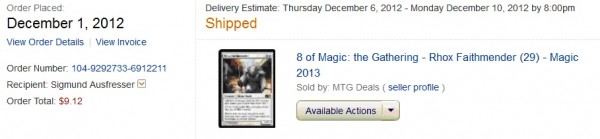
I repeated this strategy numerous occasions in 2012 and I look forward to implementing it more in 2013. Examples include Sphinxs Revelation, Rhox Faithmender and Terminus. Each of these buys led to significant profit. While Amazon.com may not boast the quantities available on TCG Player, they tend to sell out just a bit slower.

I must caution buyers that the risk of vendors cancelling orders on hyped cards is present on Amazon just like any other site. Amazon, however, has one point of differentiation here which I really like: Amazon is the only site I know of that doesn’t take your money until cards have shipped! They will put a hold on your credit card, but your card isn’t charged for the cards until sellers mark their items as shipped.

So if they cancel an order, there is no hassle trying to fight for a refund. And if they took your money and then cancelled the order, you’d better believe they’d get in trouble with the powers of Amazon. If I were a vendor on Amazon, I would not want to be cancelling too many orders. This is no Card Shark. Even eBay, which has a $66.5B market cap on Wall Street, is dwarfed by the massive $116.4B market cap of Amazon. This is not a company you want to disappoint frequently.

Go Big or Go Home

The old saying is one I understand in theory but have difficulty implementing in practice. Despite the numerous speculative purchases I’ve made in 2012, none truly qualify as “going big”. Sure, I bought a dozen Rhox Faithmenders from Amazon the day they hit everyone’s radar. I even had around twenty Terminus from Amazon when they dipped to $2.10, even though SCG was paying $3.00 at the time. But I have never had the courage to buy many more copies of a single card.

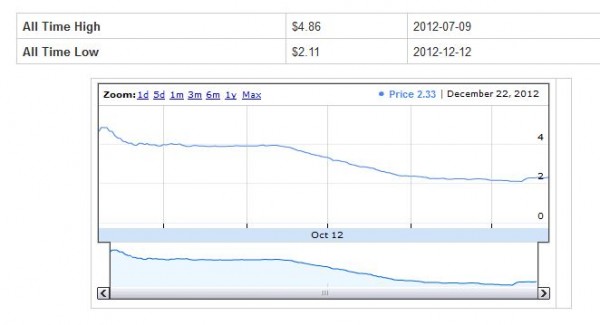
This needs to change. To make enough profits to justify time investments, I need to develop a level of confidence that enables me to buy at least a couple dozen of a speculative card. Sometimes a speculative buy is just that – we feel a card’s price may go up should the right conditions take place. For example, Master of the Pearl Trident is an excellent card to speculate on, but we have no guarantee it will spike (no offense Corbin) (chart from MTGStocks.com).

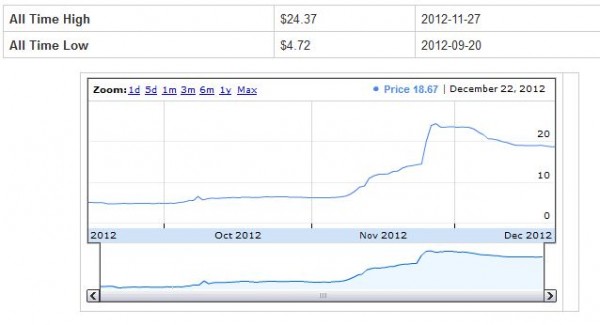
Other times we don’t have 100% confidence in a spike but we are fairly certain a card will rise in value. Innistrad Dual Lands were an excellent example – I felt confident these would jump. The same goes for something like Sphinxs Revelation, which was sure to spike once people noticed its power (chart from MTGStocks.com).

In theory, degree of speculation should be somewhat proportional to confidence in a card’s success. In other words, if I spend $50 on Master of the Pearl Trident because I am 50% confident it will spike, then I should spend much more on Innistrad Dual Lands if I am 95% confident they will spike. The logic is straight forward and seems obvious.

But the execution is daunting. Sinking $500 or even $200 into a single card intimidates me for fear of losses. Even if I am 95% confident now that something like Deathrite Shaman should go up in price, I struggle with tilting my Magic portfolio in this or any other direction. The inherent risk of losing may be small, but it only needs to be minute to be sufficient to scare me off. The psychology of loss is powerful.

In 2013 I will attempt to make adjustments here. I still may not be able to buy 100 copies of a single card, but I will make sure to go deeper on targets with more upside and higher likelihood of paying out.

Buy Lists Are Your Friend

I think I am speaking for everyone when I say eBay fees are obnoxious. They gouge you about 10% on your sales, plus they take a second dip when you get your PayPal payment. This doesn’t include the listing fee should you decide to sell your item with a fixed price in order to avoid some bad luck with an auction. The process is costly! Of course, selling on MOTL can be no better with all the sharks lurking the forums.

When MTG.GG went live, I discovered something – buy lists are awesome! Okay, most of you may have already known that, but I was shocked to see how many cards I could sell to buy lists for the same amount I’d get from eBay after fees. I used to only trust Star City Games with buy lists, but I’ve now expanded my customers to Card Kingdom, Troll and Toad, AdventuresON, ABU Games and Channel Fireball. There are so many options and so many cards with some demand that there are bound to be some items you’d be better off selling to dealers rather than eBay customers.

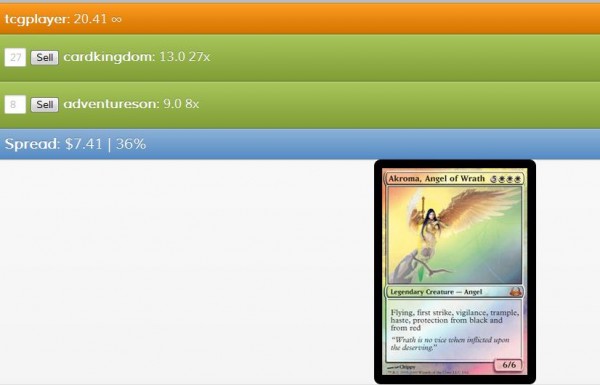
One recent example was a Divine vs. Demonic Akroma, Angel of Wrath. I picked one up cheaply in trade and listed it on eBay with an auction price of $16 and Buy-it-Now price around $17.89. After one week of being the cheapest copy of the card on eBay, the auction ended with no bidders. Such a nuisance.

But MTG.GG revealed to me that Card Kingdom is paying $13 on this card. Well, if my auction had sold for $16 I’d have to pay 9% ($1.44) in final value fees. Additionally, PayPal fees would have been $0.30 + 2.9% which equals $0.76. Finally, a simple plain white envelope shipping option would cost me an additional $0.65 for non-machinable postage. After all is said and done I net $13.15. So I can try to relist the item repeatedly until someone possibly bids $16 on it, thereby netting me $13.15, or I can sell the card right now to Card Kingdom for $13. Call me impatient, but I think I can eat the fifteen cents for some quick cash!

Even though I’d have to pay shipping to mail the Akroma to Card Kingdom, I can ship them some other cards in the process! I had a set of Hinterland Harbor listed on eBay for $33.19 + $1.64 for shipping. Repeating the same calculations, I would have netted $28.75 upon sale after fees and shipping. What’s more, I had to pay $0.50 to set this as a fixed price listing to avoid getting dinged with bad luck on an auction. So I net $28.25.

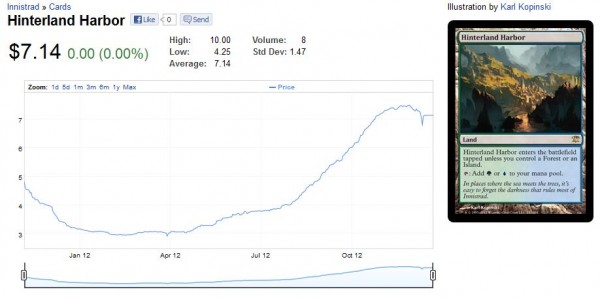
Turns out Card Kingdom pays $6.50 on Hinterland Harbor. Again, immediate sale of $26/4 copies to a dealer is preferable to me rather than waiting an indeterminate amount of time to make a couple bucks more (chart from blacklotusproject.com). And now I start to dilute shipping cost impact by expanding my sale!

This same practice can be applied repeatedly.

The key takeaway: always look at MTG.GG for buy list prices before listing cards for sale on a fee-based site. You just may be able to do better selling to a dealer, and with less wait.

Why Wait Until 2013?

The three major lessons I learned this year can be applied immediately. Just last week I saw sealed Chaos Reigns Planechase 2012 decks on Amazon.com for around $25. Again, some sellers may cancel their orders, but you don’t pay anything if this happens, plus it leaves a ding on the vendor. I wish I had bought these, but I was too fearful of going deep yet again.

No matter – I have gone deep on another speculative play I am confident in: Scars of Mirrodin Dual Lands. After buying eleven more copies of Razorverge Thicket from Channel Fireball for < $1.50 each, I have increased my total holding of the five Dual Lands to around 75. I’m taking this spec seriously.

Lastly, since MTG.GG was rolled out a couple weeks ago, I have already submitted five separate buy list orders. The process has been lightning fast and rewarding. As mentioned before, I will not list anything on eBay or MOTL again without first checking MTG.GG for the highest buy prices. Any opportunity to sell immediately to a dealer, even if it’s for a few percent less, is certainly worth considering.

Of course there are many other lessons learned from this past year. I learned not to go deep on a card before it’s proven out at least somewhat (thanks a lot, Nivmagus Elemental). I also learned how volatile the market can be with so many speculators and players wanting the hottest cards. Finally, I learned how easily the market can be manipulated via the recent Aluren phenomenon. All this information will help me become a better, more effective speculator next year.

…

Sigbits – Buy/Sell/Hold Lands

  • Buy: As I mentioned previously, I’m fairly bullish on Scars of Mirrodin Dual Lands. They have all bottomed for now, but they should rebound this Modern season and will definitely increase for the next one. Jund colors are most valuable now, but a metagame shift will eventually happen so do not ignore Seachrome Coast and Darkslick Shores. Remember: in eternal formats, blue is the best color. The blue Scars Duals will eventually shine (and Darkslick Shores already does).
  • Sell: Innistrad Dual Lands have peaked. You could make the argument that Clifftop Retreat and Hinterland Harbor may rise when Gatecrash is released. But the reality is, these cards are already seeing some play in Standard. The format would have to completely shift towards Boros/Simic strategies for these lands to see any notable bump. I’d say upside is small enough to justify liquidating these to speculate on the next big thing.
  • Hold: Zendikar Fetch Lands have all risen nicely. The non-blue versions have recently jumped and I've been able to sell a couple Arid Mesas at $14 and Verdant Catacombs at $15. They sell for even higher via Buy-it-Now listings on eBay. I’ll buy any Zendikar Fetch Land under $13 now, in anticipation of Modern season next month, but I’m not sure if I’d buy too much higher than that. They should see a short-term peak soon, and while they won’t be reprinted in Modern Masters I, they are at risk of reprinting if they become too expensive for Wizards’ liking.

-Sigmund Ausfresser
@sigfig8

Insider: Flying Under the Radar

Are you a Quiet Speculation member?

If not, now is a perfect time to join up! Our powerful tools, breaking-news analysis, and exclusive Discord channel will make sure you stay up to date and ahead of the curve.

Ask yourself the question, what is priced incorrectly in the market at the moment? If you can figure that out, you are on your way to profits. Return to Ravnica (RtR) is probably at or near it's price bottom as suggested in a previous article. But beyond understanding that RtR represents good value as a whole, delving a little deeper might shed some light on specific cards that hold good value.

Analyzing Block Constructed

Summarized here are the results of the two most recent Premier Events for Block Constructed which currently only consists of cards from RtR. In the most recent event, from December 17th, the top deck was a Bant deck which overcame the only Azorius deck in the finals. Rakdos decks finished 5th and 7th, and the rest of the decks were Bant lists. The December 14th event had a wider mix of decks, but Bant still did very well placing 2nd, 4th, 5th and 7th. Rakdos took the top spot in that event as well as the 8th. A Jund deck took 3rd, and an aggressive Golgari build with a very low curve (including Slitherhead) took 6th.

Presented below are the summed quantities of cards from the two events, separated into mythic rare, shockland and rare. These are the aggregated totals of each card found between the main deck and the sideboard of sixteen deck lists, the top eight from each Premier Event. For illustrative purposes, the current price as of Dec 19th, 2012 is included. All prices taken from supernovabots, except for the prices of Deadbridge Goliath and Temple Garden which were taken from Cardbot since supernova had no copies for sale and thus no sell price.

Card Quantity MTGO Price Card Quantity MTGO Price
Jace, Architect of Thought 39 $16.1 Supreme Verdict 38 $1.4
Sphinx's Revelation 33 $23.25 Loxodon Smiter 32 $0.94
Angel of Serenity 31 $12.5 Detention Sphere 31 $1.0
Armada Wurm 28 $4.05 Dreadbore 20 $0.88
Rakdos's Return 12 $8 Pack Rat 19 $0.105
Mizzium Mortars 17 $0.74
 Hallowed Fountain  40 $3.8 Ash Zealot 16 $0.76
 Temple Garden  36 $3.75 Deathrite Shaman 14 $3.7
 Blood Crypt  20 $3.25 Desecration Demon 13 $0.24
 Overgrown Tomb  8 $3.6 Slaughter Games 10 $0.21
 Steam Vents  0 $3.25 Abrupt Decay 8 $1.1
Underworld Connections 6 $0.195
Cyclonic Rift 2 $0.25
Pithing Needle 2 $0.06
Carnival Hellsteed 1 $0.018
Deadbridge Goliath 1 $0.30


The Rares

The shocklands see a high uniformity in price, despite a wide variety in numbers played. This doesn't tell us much as shocklands are very much known quantities, played in both Standard and Modern. With Gatecrash pending, all of these represent good value at around 3 tix or less. Prices on these have come up in the last week so it will be worth watching to see if they maintain prices closer to 4 tix. It's interesting to see that Steam Vents was not played at all in the top eight decks from these two events.

Among the most played rares is one of the best Wrath of God variants ever in Supreme Verdict as well as other top removal spells from RtR such as Detention Sphere and Dreadbore. Loxodon Smiter is the most played creature in the rare slot. All of these cards carry a price tag that is about what you would expect for cards showing up in Standard and currently being drafted. The best cards probably represent good value to the patient speculator, but none of the top rares stand out as being obviously good value over any other.

The Mythics

At the top the list of mythic rares we find Jace 4.0. Between the nine Bant decks and the lone Azorius deck, only one did not run the full 4-of package of Jace, Architect of Thought. That is quite the statistic for those considering speculating on Jace, as his price has dipped due to a recent downtrend in Standard play.

Sphinx's Revelation and Angel of Serenity are not far behind in ubiquity. All three of these cards have impacted Standard to varying degrees and seeing them dominate the played mythic list from Block Constructed is no surprise. They are also the priciest mythics from RtR on MTGO, which is consistent with the best cards in Standard commanding the highest prices.

The next card on the list presents something more striking. Armada Wurm was played almost as much as Angel of Serenity in the Bant decks, and it was played more than twice as much as Rakdos's Return. This suggest that the most-played colour combination (Bant) leans quite heavily on this card as one of its top end finishers. But due to its lack of play in Standard, its price is much lower relative to its use in Block Constructed.

All of this suggests that Armada Wurm is flying under the radar at the moment as a speculative opportunity. Block players need the card, but Standard players don't. But this year's best block decks are the foundation for next year's Standard metagame. Once you start imagining Standard with many more Armada Wurms running around, it's not hard to imagine a much higher price on this card in the future.

What's the Downside?

In attempting to quantify the downside of speculating on Armada Wurm, comparing it to older cards with similar characteristics is a good place to start. In this case we'll look to high-casting-cost fatties, with somewhat restrictive coloured-mana demands. The card should also be mythic, and coming from a 2nd set is preferred over a 1st or 3rd set mythic.

Although RtR is currently being opened as the 1st set, the fact that RRR drafting will dry up with the release of Gatecrash suggests that comparing Armada Wurm to a previous 1st set mythic might over estimate the downside. Likewise, using a 3rd set mythic, often the priciest set, might underestimate the downside.

Lastly, in order to judge the downside properly, the cards should not be widely played in Standard. If a card had been played widely, the price would not well reflect the risk of speculating on Armada Wurm.

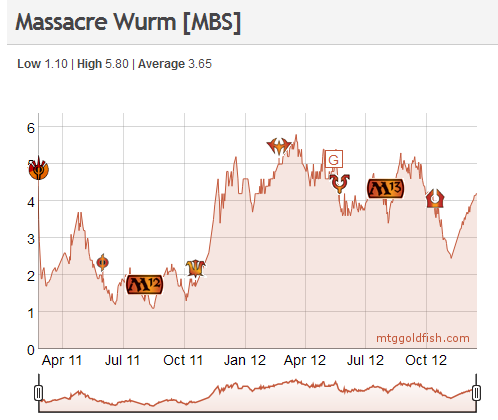
Massacre Wurm is a good comparison available to us from the recent past. It fits the bill as a high-casting-cost creature with restrictive coloured-mana costs. It's a mythic and comes from Mirrodin Besieged, a 2nd set. It also saw sporadic play in Standard.

While being actively opened in draft, Massacre Wurm saw a price floor of around 1 ticket, but after the release of Innistrad, a price floor of 3.5 tix is visible, with a brief dip to 2.5 tix after rotation and followed by a climb back up over 4 tix.

Abstracting away from specific uses in Block Constructed or Standard, the downside risk on Armada Wurm is probably reasonably set at around 1 ticket, i.e. it could see a fall to around 3 tix in price. In the absolute worst case scenario, it could fall much lower to a price of about 1 tix, but with redemption acting on the price of RtR cards in general, and the lack of RRR drafts post-Gatecrash release, the chances of Armada Wurm going to 1 tix seem very low.

Buy Buy Buy

To review, Armada Wurm is a mythic rare from a set with high redemption potential due to the presence of the shocklands. In terms of how the card plays, it's a resilient threat that spot removal is at an inherent disadvantage to. But most importantly, it sees a high amount of play as a critical part of the current "best deck" in Block Constructed, and if Block is a good predictor of the Standard metagame in the future, then Armada Wurm is priced at a low level and represents good value for the patient speculator.

The recommendation on Armada Wurm is to buy at 4 tix and be willing to hold for a period of twelve or more months. It's not a slam dunk, but the downside risk is low and the results from Block suggest this card is underplayed in current Standard. For those who want to try out this strategy with a few less tix, there is at least one other card (a rare) that shows up in high quantities but carries a low price due to not seeing play in Standard. Try to guess which card and good luck.

Insider: Just Around the Corner

Are you a Quiet Speculation member?

If not, now is a perfect time to join up! Our powerful tools, breaking-news analysis, and exclusive Discord channel will make sure you stay up to date and ahead of the curve.

The first Modern PTQs are three weeks away.

I know. It came as a surprise to me too. Under the “traditional” schedule PTQ season runs from February to March, but the change that allows more stores to run PTQs has made them anxious to do it as quickly as possible, since they only have one to plan.

This has moved the season up some, and I can tell you almost nobody has talked about it yet. The hype has been on Gatecrash since previews aren’t that far away, but I believe focusing on Modern right now will make you more money.

And importantly (something we’ll touch on later), Modern Masters is financially good for speculators right now.

Inquisition of Kozilek

But first, let’s talk about Inquisition of Kozilek. The staple uncommon has risen from $2-3 to nearly $6 on TCGPlayer recently, and I can’t say it’s a move we didn’t see coming. I’ve been advising readers to pick this up for a year now since they were easily available for $2 in trade, a price that's looking pretty good right now. I have a big stack myself, and considering SCG only has a handful in stock at $6, I think a spike to about $10 in the first few weeks of Modern season is likely.

Inquisition is representative of a larger trend, namely the burgeoning popularity of Modern which is causing a growing scarcity of cards that were easy to find just a few months ago.

Other staples could follow the same path. For instance, I expect fetches to hold steady in retail but creep up on eBay and the trade floor. I plan on unloading my bunches of them this season rather than risk waiting another year, provided I can get $22-23 a copy rather than the $20 being offered right now.

Only time will tell on the trajectory of Modern staples, but I can say with certainty that more people than ever will be playing the format this time around. The game has continued to grow since last year, and with new records being set all the time by Wizards we know tournament attendance is still trending up.

Modern has also proven itself as a format. It’s still got a long way to go, but people haven’t flat-out rejected it like they did with Extended. Attendance at Modern GPs has been healthy, and the format has shown a ton of diversity, even if Jund comprises most of the field and takes home the wins.

But another factor leads me to believe Modern will be bigger than ever, and that is Return to Ravnica. Specifically, the shocklands. A pile of $25-30 lands previously discouraged people from buying into Modern. With shocks now going for under $10, that’s not longer an issue.

On the other hand, you have $35 fetchlands filling the void. But I think there’s a key difference here. For starters, only two of the five usable fetches are reaching that price, as opposed to seven or eight of the shocklands, with the others priced more reasonably. Secondly, those eight fetches let you build any deck in the format. Before, a grinder who wanted access to any given deck on a particular weekend would need a playset of all ten shocks.

All this points to a big increase in attendance for the coming PTQ season and I think there’s still money to be made, with one caveat. You need to get in now. You have until January to get things at depressed prices. As soon as the calendar rolls over, people are going to forget about the holidays and start focusing on their PTQ deck. Get in on the format staples while you still can.

Modern Masters

But why buy in when reprints are right around the corner?

That’s an astute question, and a relevant one. And as far as medium- to long-term plays are concerned, the answer is you don’t. Modern Masters will come along next summer and while it’s not going to destroy the price of things like Goyfs, it will depress or stagnate prices on a ton of format staples, from Spell Snare to filter lands to [card Kiki-Jiki, Mirror Breaker]Kiki-Jiki[/card] and so on.

Of course, we don’t know exactly what will be in the set, but that doesn’t matter. It’s not worth your time figuring out what will or won’t be in the set. Treat all of these cards as if they will be reprinted, and move them before then.

But remember the beginning of this article. Modern PTQs are three weeks away. The PTQ season will also be over long before Modern Master previews even start. Sure, prices will go down in a year (and people know that), but it doesn’t change the fact that those same people need cards for this season. There’s a ton of time to get in and out of Modern staples before they start dropping in price.

I’ll go one step farther. Modern Masters presents an opportunity. Think of something like Kitchen Finks, which most people assume will be in Modern Masters. Because all reasonable people know the price of the card is headed down, surely they need to get rid of it as soon as possible, right?

Wrong. Use this to your advantage. Sure, you don’t want to be stuck with the Finks in a year, but PTQs are going to drive up demand long before then, and dealers are still going to need to offer good prices. That means you can make your money and be out of them long before you take a hit.

Lingering Souls

Now, this isn’t a full list of good pickup for the next few weeks (that’s coming in the next article), but there's another card that deserves mention. Lingering Souls is still insane in every format, and it’s still just $2.50 from an under-opened set in Dark Ascension. This isn’t going to last forever. Spectral Procession costs more than that, and sees way less play. Of course, there aren’t as many Processions on the market, but it’s also not Standard-legal nor a dominant card in both Modern and Legacy. Hoard the Lingering Souls now and it will pay off eventually.

Remember, as Warren Buffett advocates, “be aggressive when others are fearful.” It pays off in investing, and it pays off in Magic.

Thanks for reading,

Corbin Hosler

@Chosler88 on Twitter

Rats, I Need a Deck!

Are you a Quiet Speculation member?

If not, now is a perfect time to join up! Our powerful tools, breaking-news analysis, and exclusive Discord channel will make sure you stay up to date and ahead of the curve.

Building a deck is always a unique process. For example, maybe one of your friends sends you this text message.

"Please can you help me with a Junk Pack Rats build? Must have Drainpipe Vermin, Ravenous Rats, Pack Rat and Faiths Reward."

This doesn’t happen all the time, but I’d be lying if I said it was the first time. Creating new decks is always a fun process, even if it may not turn out to be the most competitive deck. As I saw it, this was my starting point.

4 Drainpipe Vermin
4 Ravenous Rats
4 Pack Rat
3 Faiths Reward

When building a deck for someone else, it is important to know what their goals are for the deck. I don’t think I would ever have started a deck with those cards no matter how long the format was legal so I need to make sure the deck list I end up with will be good for the intended person. With that in mind, I asked him the purpose of including Faith's Reward. He basically said it was to counteract wrath effects. Now, I’m not sure that instant is even playable right now in Standard so my objective changed a bit to include building a deck that was resilient to wrath effects and then we can include the additional help of Faith’s Reward in the sideboard if necessary.

The next step was determining the shell these twelve cards would fit into. If we can add the rats to a preexisting strategy, they would be more powerful than on their own. His idea was Junk (Green, Black, and White), but my first idea was to pair the rats with Rakdos cards. Here is an example of what I was thinking.

Untitled Deck

Creatures

4 Gravecrawler
4 Diregraf Ghoul
4 Drainpipe Vermin
4 Ravenous Rats
4 Pack Rat
4 Geralfs Messenger
4 Vampire Aristocrat

Spells

3 Pillar of Flame
3 Searing Spear
3 Brimstone Volley

Lands

4 Blood Crypt
4 Dragonskull Summit
2 Rakdos Guildgate
4 Cavern of Souls
9 Swamp

By adding the rats, you lower the curve of the Rakdos deck, something other players have done but with different cards. Also, you add a slightly disruptive element to the deck, which is never a bad thing. The resiliency he wanted was there because of normal Rakdos aggressive cards. This list seemed like it met most of the goals. I also liked the synergy of Vampire Aristocrat with Drainpipe Vermin. Pack Rat was on my list of good Standard cards that aren’t seeing play yet, so fitting him in this deck actually seems quite good. I don’t know whether the other rats would be good or not, but they're probably OK.

This did not suit his style though as he wanted to play green and white cards. He let me know this by telling me, “Oh, it needs Growing Ranks too.” With that wrench in my plans, I needed a new direction.

Thinking about Pack Rat in detail had previously led me to a deck that used it as a graveyard enabler. That is one way to make use of the card, but it’s a little slow. My thought process was, what strong cards go with the rat theme that can be discarded for value? Lingering Souls! That’s it. It’s a white card, everyone knows its one of the best cards in multiple formats, and it would be sick to discard it to a Pack Rat! And yes, it plays well with Growing Ranks. Now we have this base to work from.

4 Drainpipe Vermin
4 Ravenous Rats
4 Pack Rat
4 Lingering Souls
3 Growing Ranks
(3 Faith's Reward)

Once I arrived at these cards together, I knew we were pretty close to cutting the Faith's Reward. If many of my cards make creature tokens, there is no need for an instant that returns creatures from the graveyard to play. I think Pack Rat on its own is great against board sweepers anyway because you don’t ever have to play a threat and you can just grow your army at the end of their turn.

If you get stuck during the deck building process, it’s best to take a break and start again a while later. That’s basically what happened to me at this point. I had a couple breakthrough ideas, then I didn’t know what else to play with these cards. Obviously this is headed in the direction of a tokens deck, but something like Intangible Virtue probably won’t fit because we have actual creatures as well. If Virtue won’t work, we still need a way to make the rats better, preferably by doing more damage.

Then it hit me, we're already running black and white mana, and Sorin, Lord of Innistrad seems like a perfect fit. Even though there are no green cards yet, I knew I also wanted Gavony Township. Since I know there are all three colors of mana, are there any green cards that would help? We need something better to populate with Growing Ranks and it should be cheaply costed. That’s when I came up with Call of the Conclave. It costs two, is an aggressive creature, and fits in synergistically with the deck. Here’s where we are now.

4 Drainpipe Vermin
4 Ravenous Rats
4 Pack Rat
4 Call of the Conclave
4 Lingering Souls
3 Growing Ranks
3 Sorin, Lord of Innistrad

3 Gavony Township

Even once I added Sorin and Call of the Conclave though, I was still stuck trying to flesh out the rest of the deck. That’s when I did some research. Looking to see what other players have in their deck lists can be very helpful even when you are trying to be creative and build your own deck. By looking at other decks I remembered cards like Trostani, Selesnya's Voice and Selesnya Charm, and they both seem good for this deck. Finally, a catch-all removal spell seems necessary so let’s add in some Oblivion Rings.

This process took a couple days, but I had a lot of fun and my friend ended up with a fun but competitive deck using some unique cards. This is the final build.

Untitled Deck

Creatures

4 Drainpipe Vermin
4 Ravenous Rats
4 Pack Rat
3 Trostani, Selesnyas Voice

Spells

4 Selesnya Charm
4 Call of the Conclave
4 Lingering Souls
3 Oblivion Ring
3 Growing Ranks
3 Sorin, Lord of Innistrad

Lands

2 Gavony Township
3 Temple Garden
4 Overgrown Tomb
4 Woodland Cemetery
4 Isolated Chapel
7 Swamp

In the end, I actually think this deck turned out well. It looks solid but fun at the same time. The mana was tricky and I’m not sure it will ever be great. Needing black mana on turns one and two is tough with the lands we have available. It will be better once Godless Shrine is legal, which can replace Temple Garden. So there you have it. Some Pack Rat fun for your next FNM.

Until Next Time,

Have you Pack Ratted someone in Standard yet?

Mike Lanigan
MtgJedi on Twitter
Jedicouncilman23@gmail.com

P.S. If you have an idea for a deck you want me to build, please submit your ideas below in the comments. Thanks for reading.

Lessons Learned in L.A.

Are you a Quiet Speculation member?

If not, now is a perfect time to join up! Our powerful tools, breaking-news analysis, and exclusive Discord channel will make sure you stay up to date and ahead of the curve.

The Fact of the Matter

I wasn’t ready for Los Angeles. Neither to walk the streets lined with droves of homeless people nor to battle in the last SCG Invitational of 2012. My Legacy list is right where it needs to be and I think that all things considered my choice of Standard deck was fine, but my head just wasn’t in the game. Trying to balance work and last minute preparation left my sleep schedule in shambles and my mind in a very sordid state. Frequently I found myself in the tank without a thought in my head. Just staring at my cards, hoping that they would tell me what to do. This is Magic at its lowest level, and I needed to be battling near my peak.

I sideboarded incorrectly with my Standard deck every round, utilizing a sideboard that I should have built better in the first place. Worse yet, I went into the Legacy portion of the event not knowing the extent of the relevance of Deathrite Shaman. I knew that if I had a Bolt I was supposed to Bolt it, but I had no idea whether I was supposed to Force it when I didn’t have the Bolt. I don’t believe that I’m supposed to, and in one of my matches I did. These would have been simple things for me to figure out ahead of time by playing just a handful of more games.

I found myself going 2-0 then 0-2 in both formats. It’s true that I mulliganed a lot some of the matches that I lost, but my opponents also mulliganed plenty in some of the matches that I won. The single factor that influenced my performance the most was my attitude. I treated the Invitational like a free-roll, operating under the assumption that just by showing up I would be qualified for every Invitational next year. As things turned out, points from this weekend in the SCG player’s club apply to next year’s benefits, leaving me a sparse two points off two more qualifications. I felt really daggered when I discovered this, but in all honesty it serves me right. I haven’t been taking these events as seriously as I probably need to and my results have suffered for it. I know that I’m better than this, and I need to stop holding myself back.

Moving Forward

In light of my results last weekend, I’ve been drafting some ideas for how to approach competitive Magic in the future. At my low this weekend I was pretty seriously contemplating quitting altogether, but nobody actually does that. That said, many of the people that aren’t quitting who probably want to tend to slump into deeper and deeper states of loathing Magic, and that’s not where I want to be either. I want to keep battling, and I want to like it. It’s strictly coincidental that I’m thinking on these lines so close to a new year, but it seems appropriate to treat the following as my new year’s resolutions with regard to Magic:

Magic Can't Be a Second Job

The week leading up to L.A. I was working every day starting anywhere between 4 and 8 A.M. After work I would take a nap and then work on Magic. As it turns out my brain isn’t capable of functioning anywhere near max capacity after working an eight hour day, and a little nap in between doesn’t do a whole lot to help that. I was operating under the assumption that just playing more would be good for my game, but that’s just not true. Going into a playtest session with the mentality of having just woken up and “needing to grind” is the fast track to poor results. I need to play when I want to play and when I will enjoy playing if I’m going to produce anything of quality. Just battling to battle isn’t going to get me anywhere.

That said I don’t want to necessarily just throw away time close to an event because I have to work, because working a lot is just going to be a reality for me in the foreseeable future. On days when I’m not mentally prepared to battle myself, watching streams and discussing plays with other good players are fine ways to supplement testing. It also never hurts to just get to bed at a reasonable hour. I have to accept that I’m not in college anymore and that most of my problems can’t be solved just by pouring Red Bull on them.

MORE MTGO

This is somewhat contradictory with the section above as MTGO is responsible for the most miserable times that I have playing Magic, but its importance also can’t be understated in tournament preparation. MTGO is by its nature dramatically more efficient than paper Magic. When I play a lot of MTGO I get more information about more matchups faster and I end up playing a lot more sideboarded games.

Currently the computer that I’m using is getting pretty old and is really garbage at running MTGO, so for the immediate future I need to be spending less money traveling to tournaments that I’m underprepared for and putting more money aside for a new battle station.

No More Letting My Legacy Game Stagnate

Legacy is, and probably always will be, my best format. That said, I frequently don’t give it enough credit for its complexity. I really didn’t prepare at all for the Legacy portion in L.A., and while I did mulligan a lot and draw pretty poorly overall in the last two rounds, I can’t say that I played perfectly otherwise. In the past I’ve been able to play Legacy at a level where I would surprise myself with many of my wins, but my game just isn’t at that level right now. I made multiple goofball plays in Legacy this weekend only to see significantly better plays minutes later. I know that I’m better than this. In the future I will be better than this.
~
I’m still pretty deep in the tank reflecting on this weekend, and there’s still a lot that I have yet to grok, but I intend to follow these resolutions minimally. I’ve felt really burned out about Magic a few times recently and that’s not how I want to feel about what is possibly the greatest game ever. The game is going to have its swings no matter how well prepared I find myself, but I can’t continue to add more uncertainty to my results by underpreparing. Just showing up and hoping to get lucky is the plan of a gambler. I can do that at a casino. I cannot continue to do that at event halls.

On a completely unrelated note, I’ve made thirty or so changes to the Pauper Cube since I posted the list and am in the process of putting everything up on a Google doc (it’s a lot of work!). Come next week I intend to have this finished and everything will be a lot cleaner. I apologize for not having this up yet, but I just haven’t been able to make the time.

Thanks for reading everybody. Gl;hf!

-Ryan Overturf
@RyanOverdrive on Twitter

Avatar photo

Ryan Overturf

Ryan has been playing Magic since Legions and playing competitively since Lorwyn. While he fancies himself a Legacy specialist, you'll always find him with strong opinions on every constructed format.

View More By Ryan Overturf

Posted in FreeTagged 2 Comments on Lessons Learned in L.A.

Have you joined the Quiet Speculation Discord?

If you haven't, you're leaving value on the table! Join our community of experts, enthusiasts, entertainers, and educators and enjoy exclusive podcasts, questions asked and answered, trades, sales, and everything else Discord has to offer.

Want to create content with Quiet Speculation?

All you need to succeed is a passion for Magic: The Gathering, and the ability to write coherently. Share your knowledge of MTG and how you leverage it to win games, get value from your cards – or even turn a profit.

Insider: Early Moves on Power 9

Are you a Quiet Speculation member?

If not, now is a perfect time to join up! Our powerful tools, breaking-news analysis, and exclusive Discord channel will make sure you stay up to date and ahead of the curve.

The holiday season is here and only a couple of weeks remain before the end of this PTQ/GP season and the lull before the next one begins. This upcoming weekend is the SCG Invitational in LA, where I will be judging, and I’m hoping to get my eyes on some new Legacy tech. Beyond that, there isn’t a ton of big action between now and January, as many people will be occupied with holidays visiting families. MTGO does a good job of capturing additional demand while people may be away from home and still want to sneak in some Magic.

Matt Lewis did a great write-up last week about the holiday queues that MTGO is offering, this includes the return of the MTGO Cube including the Power 9, and both Urza’s Block and Mercadian Masques Block drafts. The other big part of this announcment is the fact that Power 9 will appear on MTGO at all. Eternal players have been clamouring for Power so they can replace the online-only format of Classic and play true Vintage. While the cards drafted in MTGO Cube are considered “Phantom” (which means after the draft ends your account will not keep the cards), there was an additional announcement from WotC that they are planning to release the Power 9 in the reasonably near future for players to use for Eternal. While we don’t know exactly the how they will be released, it appears the horizon is less than a year away.

What does the release of Power 9 on MTGO mean?

With Vintage as a format, there’s a whole new swath of cards that suddenly have increased value, assuming Vintage queues and Daily Events will subsequently exist. Most of the key Vintage cards already exist. Some have value because they are also Legacy staples, while others are only used for EDH and other casual variants, as well as the unpopular MTGO Classic format. Vintage on MTGO is an opportunity for many Magic enthusiasts to get their hands on a format that they are otherwise unable to afford the decks in paper. I expect it to be fairly popular, especially at the onset.

So if you expect Vintage on MTGO to become a thing, how soon do you make a move?

The WotC announcment didn’t give an exact date, and not even a promise, but they guardedly stated that they’d like to have it out before the end of 2013. Most speculators are going to wait until they see how and when the Power 9 will be released to make other speculations, but there is certainly a viable option to stay ahead of the game by moving in early. Keep in mind, if these cards aren’t released for a year, it may take some time to see an increase on some of these specualtions, but there are some targets that may be worth the wait.

Force of Will

This is an interesting card. Having only been printed in the first Masters Edition, it sits easily above $100, with a historic high over $140. Vintage will certainly increase the popularity of this card, but will Force of Will be the barrier to entry in the new online Vintage metagame like it is in MTGO Legacy? MTGO has said they do not plan to release Force of Will in another Masters Edition, which means that price is likely to stay high. What they didn’t say is that it could still be a promo or otherwise released. Maybe it will be included in the release with the Power 9? Maybe the Power 9 will be released similar to Modern Masters and they are waiting to see how that release goes. In either case, I think Force of Will is the exception to the rule, and is not likely a good spec target, at least not for purposes of the Vintage speculation. Many would argue that it’s a good target anyway because it’s fallen a bit since its peak at 140 tix, but it’s simply too expensive for me to risk so many tickets that could plummet with the release of a promo.

Bazaar of Baghdad


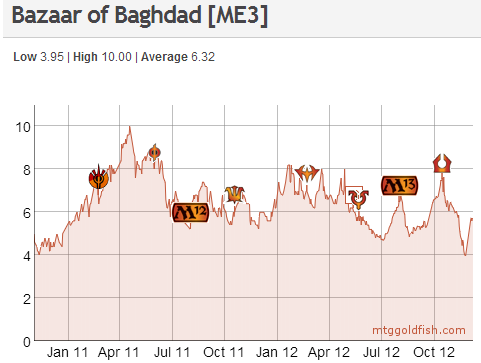
This land is one of the most powerful cards in Magic. It singlehandedly drives the Vintage dredge deck(s) and has some insanely busted applications. Bazaar was printed in Masters Edition 3, and can be found under 6 tickets. Because the dredge deck doesn’t play many Dual Lands nor Force of Will it will likely be one of the least expensive decks in the format. In paper Vintage, Bazaars are extremely expensive, and since they aren’t on MTGO, I think people will gravitate towards the deck. At 6 tix, and a fairly stable history, I like this card to show some serious gains if Vintage becomes a thing. While the downside here is only the time it takes for the gains to show, as there is little chance it falls from where it sits now.

Chalice of the Void and Mishra's Workshop

Chalice is under 4 tix on MTGO and is a crucial part of the Vintage metagame, falling automatically into Workshop decks. Workshop is closer to 20 tix so I”m less comfortable investing there even though I expect it to rise some. Workshop accellerates huge amounts of mana on the first two turns of the game and often can simply pose a threat that the opponent cannot answer so quickly, especially through the defense of a Chalice. Chalice also sees play in Legacy and less so in Modern, so it only has room to go up. These both fill unreplacable roles in Mono-Brown builds. Since there are two cards in this category I like, I want to distribute my investment evently over the two cards, but still have the total invested in this group equal to thsoe in the other groups.

Library of Alexandria

An uncounterable draw engine is obviously insane, but with no legal format on MTGO its under 10 tix. While it’s restricted in Vintage, a large number of decks in the format play one, and unless you plan to only play one Vintage deck you’ll likely need it. I could see this card doubling if its not printed again. It’s often featured in control decks that play Jace, the Mind Sculptor and Force of Will so they are already quite pricey decks to play. I like including this card in the speculation group, taken from Control builds.

Universal Tools

Other cards that are universal tools for Vintage are Fetchlands, Dual Lands, Sol Ring, Thoughtseize, Dark Confidant, Snapcaster Mage, and Tinker. While they are many others, these are some of the other options you could consider as targets. I didn’t elect any of those for various reasons. Either because I expect a reprint in Modern Masters or because their demand in other formats drives their price so high that I don’t expect the additional demand from Vintage to impact those cards as much as the cards I’ve chosen. Are there any I’ve overlooked? After adding these to my speculation pool in MTGO I’ll need to reevaluate my portfolio overall and make sure I still have the right amount invested in each position.

Jason’s Archives: The Walmart Effect, or Why It’s Everyone’s Fault Local Gaming Sucks

Are you a Quiet Speculation member?

If not, now is a perfect time to join up! Our powerful tools, breaking-news analysis, and exclusive Discord channel will make sure you stay up to date and ahead of the curve.

Greetings, Speculators!

A few years ago I saw a flyer lying around at work for something called the 3/50 project. Its tenets were simple: pick three local businesses, spend $50 there every month, save the economy. The idea is since a greater percentage of the money you spend in local businesses stays in your community, you're really investing in your community and spending about the same amount you would at Walmart anyway. You can read more about the project at their website since I don't want to spend too much time reiterating what they've already said better.

In practice, though, you'd be hard-pressed to find the kind of low prices and wide selection at any local Mom and Pop shop that you do at Walmart. The truth is, it's hard to go out of your way to patronize local stores. It's not back-breaking, but in our pampered lives of first world excess, we avoid anything that's even a mild irritant. That's mostly why big box stores can thrive.

You don't agree with how little they pay their workers, their aggressive union-busting tactics, their powerful lobby which gets them taxpayer money to build stores, or how they drove their competitors out of town leaving sometimes hundreds of smaller, local businessmen and -women out of a job -- but hey, you just want a 6-pack and a pair of headphones, not to save the world on every shopping trip. It's convenient, so screw it.

The people at the 3/50 project are trying to make the case that a real cost is associated with patronizing big box megastores, even if it isn't readily apparent at the cash register. Companies underpay workers, run other businesses out of town and secret their profits away in off-shore tax havens after they're diverted to the store's headquarters in another state. That money you give them doesn't stay in your community to benefit you and those around you.

The worst part is, even if you're conscious of these things and make an effort to contribute to three local businesses and avoid big box stores where you can, you're probably still doing it wrong.

I bet you buy over 95% of your cards online.

The LGS/50 Project

I bet you're already rationalizing this behavior to yourself right now. All the reasons why people buy stuff at big box stores apply here, and the argument for buying cards online is even more compelling. Your LGS won't have a millionth of the selection of an online retailer and store hours make it difficult to move on insider information like the tips we got on Wolfir Silverheart, Craterhoof Behemoth and the like. They're often closed for the night when you want to buy 100 copies of Angel of Glory's Rise and you're already in your computer chair, so why not just buy out Troll and Toad?

I'm here to tell you all of that is fine and I don't see a way around it.

Doing What You Can

I've gone on record saying my best trades happen with casual players, some of whom I meet at local community colleges and universities. The majority of Magic players don't play competitively. I know that's a mind-blowing prospect in an era of 2,000+ attendees at Grands Prix. But I'm telling you, you'll meet tons of people just plugging away casually who find FNM or a Prerelease a little too competitive for their taste.

While engaging this community in my local area (Kalamazoo, Michigan, home to Western Michigan University, Kalamazoo Valley Community College and Kalamazoo College) I learned that the small, local store next to campus was changing ownership. The old owner didn't like Magic so he'd only made a token effort to engage the community and when he grudgingly started running FNM it was unsanctioned and unadvertised.

New ownership meant a new opportunity to attract some new blood. Even casuals need a place to hang out. In a store setting, players contribute financially to the gaming community and are easier to engage once exposed to new formats like Commander and booster draft. Since the new owner planned to run sanctioned FNM he needed a case with actual cards in it.

The Opportunity

You may have heard horror stories from other speculators about trying to sell to an LGS and receiving insulting offers. If your LGS offers you $10 for a Snapcaster Mage and Strikezone is paying $16, it seems like a no-brainer. But what if you managed to talk to LGS owner up to $13? At that point, that extra $3 (minus what you pay to ship) can be considered an investment in your future. I'll explain.

Most stores are willing to sell for around TCG Medium, especially if they're competing with another store in town that charges more. In these cases, if you take less on a card, that money isn't just going to end up in the owner's pocket, it's going to keep the store open. More open LGS means more events at a local level, possibly even an event every night of the week.

If the store is sufficiently small, you may find yourself the only speculator in the customer base. A lot of you pay for Insider. Wouldn't you pay twice that to be the only person with a real binder at a store with a growing player base getting into tournaments? Would you pay a subscription fee for a community that ate up case cards at such a pace the owner constantly had to restock it? Would you take a small hit initially to forge a relationship with a store owner who may increasingly rely on you in the future?

The point is, the potential profit lost from selling to (and buying from) an LGS instead of an online buylist can be seen as an investment. If you have access to a small community like this, what could you do to improve it? Could you keep their case full? Could you buy a few singles at a price a little higher than online? Could you find the casuals and get them interested in hanging out at the store?

The store doesn't have to be your only out. But if you have 200 copies of Master of the Pearl Trident to sell, it won't kill you to take a hit on one or two playsets if it keeps the lights on at your LGS. Chances are, the investment you make in your LGS is going to keep that money in your community and provide a place to trade.

Battle for Los Angeles

Anyone else love how SCG decided to remove their event coverage from the top of the front page and totally botch how they list the decklists for Invitationals? It sure made my job harder. Thanks, guys!

SCG Invitational Decks

This is a mess. Since they listed the decks based on final finishes (in a dual-format tournament), it's really bad data about the strength of each deck. But you don't read this part of my article for data anyway, you just need something to read while you get paid to poop at work.

SCG starts my day off right, making me dig through their heap of disorganized decklists to see they're now calling Bant decks "4-Color Control" because as you know, adding Overgrown Tomb to activate your 1-of [card Nephalia Drownyard]Drownyard[/card] means 4-color control. Did they call mono-red decks with 4x Figure of Destiny "Boros Midrange?" Actually, that's bad joke because they would totally do that.

Anyway, Reid Duke played Bant in the Standard portion of the Invitational, which I still think is the deck to play after all this time. His BUG deck in the Legacy portion reflects the future of Legacy. Abrupt Decay and Deathrite Shaman were the two cards in Return to Ravnica I said would have a huge impact on Legacy (I also said they wouldn't impact Standard, which makes my overall score 75%, a C+ most places). Putting them both in the same deck seems like a no-brainer. The return of Team America makes Tarmogoyf a real contender in Legacy again, which is too bad since I thought its low level of play and imminent reprint might bring its price down to sane levels.

I like Wienburg's Naya Humans list a lot, and with Boros and Gruul about to be spoiled, expect this deck to get better. I am super bullish on Mayor of Avabruck right now, and decks like this are why. His RUG Delver deck is falling out of favor lately, but it still has the tools to compete. It does lose the long game against Deathrite Shaman, as your graveyard full of cantrips becomes a liability, your [card Nimble Mongoose]Mongoose[/card] becomes a 1/1 that can't even attack into their pesky squire, and your Tarmogoyf is likely to durdle around in the 0/1 range. The early game becomes important, and a flipped [card Delver of Secrets]Delver[/card] can seal the deal before Shaman even gets online.

Johnathon Job also played Naya, which I think is a pretty good choice. Honestly, Standard has turned into "What is the best Thragtusk + Restoration Angel deck?" and you get to pick between Huntmaster of the Fells or Sphinx's Revelation. U/W Miracles is another deck that's been performing well in Legacy, adding some beats since Abrupt Decay has ended the terrible reign of Counterbalance. You had a good run, cheaters.

I think Nicky Spags has the right idea. Esper Control in Standard may not run Thragtusk, but I would say it's the deck with the most inevitability, a concept all but abandoned in the era of insane lifegain and Nephalia Drownyard degeneracy. Running every good control cards in the game and a gamut of solid planeswalkers, this deck will get there if the game goes long enough. I'm not sure I prefer it to Bant, but it's a refreshing change of pace and Jace, Memory Adept is too good right now. Try it and you'll agree. The 4-color control deck he ran in Legacy is actually just amazing. This may be how the new Knight of the Reliquary decks are going to look. If you can't deal with Abrupt Decay, run a few. Yes, that is an actual Armageddon in his Sideboard. Yes, that gave me partial wood.

U/W/R Flash, blah, whatever. Meet the new Delver, same as the old Delver. His BUG deck is worth talking about, though. Instead of just running BUG goodstuff, Todd Anderson decided to use the Shardless Agents he had lying around from his Hypergenesis days to freeroll good spells at the cost of not knowing which he'd hit. At that point you're getting a free one-mana 2/2 and you have the chance to hit one of your four Ancestral Visions (known colloquially in the Legacy community as "cheating"). Shardless Agent into Hymn to Tourach is also a solid way to spend turn two.

Adam Prosak rounds out our list playing two unorthodox choices, but playing them well. I am not convinced his flash deck doesn't need red for things like [card Pillar of Flame]Pillar[/card] and Searing Spear, but jamming more [card Runechanters Pike]Pikes[/card] and more copies of your cards is never all that bad. I bet the deck is a bit more consistent in its bad matches than U/W/R, but I bet it has more of them. As for Legacy, if you like ANT and know how to run it, I'm not sure you ever have to build anything else if you really don't want to.

Standard Open Top 8

For everyone who didn't qualify for the Invitational or scrubbed out, there was an Open to play in as well. I didn't expect to see eight different decks in the top eight, but there we have it. I realize two of the decks are both named "4-Color Midrange" but that's not because they have any similarities at all. One is Staticaster Jund and the other is Naya with Sphinx's Revelation.

This reads like a list of all possible tier one decks in Standard right now, which is fine with me. A format this healthy before a new infusion of cards is exciting. As excited as aggro players are for the goodies they'll get in Boros and Gruul, control players can look forward to Dimir making U/B standalone a possibility with better mana. Orzhov will presumably get something to pair with Lingering Souls, possibly creating an Orzhov control deck or contributing to a better Esper build. Simic players can look forward to coal in their stocking. On a bright note, a legal Breeding Pool will improve Bant's mana base.

Legacy Open Top 8

I wish my enthusiasm for Sam Black's Zombardment deck translated at all into success playing it. It has a lot of built in synergy and semi-finite loops that add up to a lot of damage, and its ability to destroy hands makes it a force to be reckoned with. I just can't make it do what I want it to. It could be because I keep forgetting Bloodghast isn't a zombie.

Last time I played this deck I didn't have Deathrite Shaman. After splashing green for Vengevine, I think returning to the original build with Deathrite may be the way to go. I hope Sam continues to tune this deck and I will continue to jam it because I am a masochist and because losing with it all day long can also be considered "practice" by a more optimistic person and holy %*&$ it's a Dreadstill deck in the top eight!

Twelve-Twelving

Grim Lavamancer isn't just a poor man's Deathrite Shaman, he's a Deathrite Shaman-murdering machine. Stifle is good right now, as evidenced by how well it's doing in RUG Delver, so getting a [card Phyrexian Dreadnought]12/12[/card] for the cost of a [card Senseis Divining Top]Divining Top[/card] seems fine if you want Stifle in your grip anyhow.

I expected Stiflenought decks to get more popular when they printed Snapcaster Mage because that gave you way more opportunities to Stifle. Most players let the Dreadnought resolve and counter the Stifle, which you can just snap back if you have three mana free. Unfortunately, Snapcaster lets them just play another Force of Will and people had moved on from Dreadstill long before Innistrad came out anyway.

The "Pet Deck of the Week" slot is taken up by Lands this time around. I don't think Lands can beat a Jace, the Mind Sculptor but it runs roughshod over the aggro decks in the format, so I am a fan.

Aggro Loam is another deck that benefits from Deathrite Shaman and it's good to see it in the top eight.

Really, I don't see a lot of surprises, here. Legacy is a healthy format in the process of incorporating two new powerhouses -- Deathrite Shaman and Abrupt Decay. How people do it in the coming months may surprise us, and with two more Ravnica sets to come out, we may get a lot more to digest.

Another Two Articles for the Price of Zero

I have other stuff to do, so I'm taking my leave of you now, readership. Follow me on Twitter, listen to the podcast, friend me on facebook, buy me a present from my Amazon wishlist (if I ever make one) or very very very conspicuously ask me to sign your playmat in front of Kelly Reid because I know it will confuse the hell out of him. Hit me up in the comments section and I'll try to keep the insults to your mother to a minimum.


Insider: Modern Masters – Devaluing Old Cards, Selling Tarmogoyfs, and Just What Does “Limited Release” Mean?

Are you a Quiet Speculation member?

If not, now is a perfect time to join up! Our powerful tools, breaking-news analysis, and exclusive Discord channel will make sure you stay up to date and ahead of the curve.

Welcome to the first edition of Touch of the Eternal!

The focus of this series is with regard to speculation on the Eternal formats.

As many people know (or if they don't here's the first thing you'll want to remember), Eternal staples rarely lose value. The reason for this is that typically the Eternal "staples" are the cards that are the most efficient versions of what they do. For example, Swords to Plowshares is arguably the best removal spell in existence.

There are plenty of other removal spells (Path to Exile, Terror, Doomblade, Dismember, etc.), but the reason that Swords is the one used so much more in Legacy/Vintage is simply due to the fact that the collective conscious believes that trading 1 white mana and giving your opponent life is the best trade you can do for the permanent removal of one of their creatures (not named Misthollow Griffin).

Because the "staples" are the most efficient cards at what they do, Wizards tends to not reprint them or print things better as it would warp their Standard format (which is what makes them money), thus the staples are basically considered "too good to reprint" in mass form.

This knowledge is what allows them to hold their value. These cards really only take a hit when one of three things occurs:

  1. they get banned (check the Black Lotus Project on Surivival of the Fittest over the last two years),
  2. they get reprinted (see Lightning Bolt),
  3. or something better gets printed.

We as speculators and traders can take advantage of that. I will almost always trade Standard staples for Legacy/Modern staples when people offer them to me. I understand that in the short term the standard staples may go up a bit more, but in the long run, I'm buying "gold" in the fact that the cards I'm trading for have a "set" price.

Now Wizards goes and throws a wrench in that plan by announcing Modern Masters. Now those Tarmogoyfs, Dark Confidants and Vendilion Cliques we thought were safe are going to get reprinted. Looking at the Shocklands, this causes concerns regarding large price drops as demand typically remains the same or goes up slightly and supply increases drastically.

Good news on that front. Wizards has already stated that supply won't be increasing drastically. Modern Masters will be a limited print run, i.e. don't expect to be able to keep buying boxes three months after it's released (unless they are heavily marked up).

More good news! Due to the size of the set and the fact that it is very likely that the Legacy staples will be Mythics, meaning that even when people are cracking boxes hoping to get a new Tarmogoyf or whatnot, the probability does not favor them, nor will supply increase as much as in a typical set.

For those interested, here's the math to opening a Tarmogoyf (the only spoiled mythic we know for sure). Special thanks to my friend Stephen Dupal who did it for me:

Start by finding the odds of zero Goyfs in "n" packs:
(1 - 1/120)^n = 0.25
n = 166 packs --> 166/24 = 7 boxes

Thus one must open seven boxes in order to have a 75% chance of opening a Tarmogoyf.(Mr. Roulette dealer I'd like to throw it all on double 0's please.

This means that if you have Tarmogoyf's, don't just unload them shortly before Modern Masters' releases, as chances are pretty good that there may only be another 2-5,000 Goyfs added to the total supply. This same logic can go for any Mythic in Modern Masters. Given the fact that Modern Masters is Wizards' way to "re-invigorate" Modern, expect demand for all the Mythics in the set to go up, thus implying the price of the originals shouldn't feature much of a negative change.

While not directly related to Modern Masters, the fact that Wizards wants to push an Eternal format (though sadly, not Legacy) means that the mana base for the format will be lucrative in the long run. I'm looking at you reprinted Shocklands, as we've already seen Zendikar Fetchlands.

It's also a wise idea to look at any cards that create a potential "pillar" of the format: Second Sunrise, Pyromancer's Ascension, etc. These are the cards that will jump/drop the most due to each respective deck's current status. These are also the cards in which speculators tend to love, as careful analysis of a spoiler can often help pinpoint when these cards or others may become very valuable See Helm of Obedience shortly after RTR released, courtesy of Rest in Peace.

Sum it up!

It is important to stay informed on the spoiler for Modern Masters. I'm only going to call "hold" on Mythics, expecting limited price drops followed by gradual price increases as more players enter the Modern/Legacy formats. Uunless, of course, you can flip the cards quickly and easily, in which case it would be best to sell as they will have a price dip as more enter the supply.

Regular rares, however, I advocate a "sell" before Modern Masters is released and a buy after Modern Masters has been available for a couple months. This strategy should be the most lucrative.

Pure Speculation!!

Reading over one of Mark Rosewater's recent articles, he gives us the knowledge that Wizards R&D looks several years in advance. This implies that the Zendikar Fetchlands may have been a stepping stone for the Modern format.

If that is the case, it seems likely that they will reprint the original Onslaught Fetchlands to:

  1. telp offset the cost that the blue fetches have already spiked up, and
  2. sell more packs.

The next question would be which set do you reprint them in? My original thoughts were that they'd reprint Tarmogoyf in Dragon's Maze to help sell a set, given it's coming after RTR and GC, each including five Shocklands apiece.

But since Tarmogoyf is in Modern Masters, it's unlikely they will reprint him in a Standard set, thus Onslaught Fetchlands could sell the set themselves. It would also tie the "perfect mana" that Wizards has been pushing as of recently.

What’s going on with Aluren?

Are you a Quiet Speculation member?

If not, now is a perfect time to join up! Our powerful tools, breaking-news analysis, and exclusive Discord channel will make sure you stay up to date and ahead of the curve.

(Editor's note: we have moved this Insider article to the free side - it should serve as a good source for community discussion on what happened.)

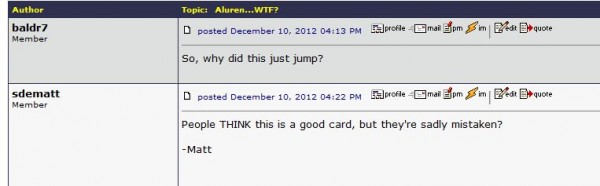
About eight days ago, strange things started happening with a Tempest rare. Aluren had jumped by $10 overnight. It's clear that someone was buying all of this card that they could. We didn't know why then and we still don't have many answers.

Several astute Insiders noticed the spike and we began discussing it on the forums. I sent out this email alert to our subscribers:

Hi Insiders,

Doug here.

Aluren has jumped $10 in price over the last day. We are not sure why. It's a niche deck that Imperial Recruiter's price holds back and nothing new has been printed for it to make it great. TCGPlayer has beat copies for $4-5 but everything mint there and elsewhere is $15 now. We think this might be the result of someone trying to corner a market, but who knows. Here's the discussion thread:

https://www.quietspeculation.com/forum/index.php/topic,1617

My advice: trade for some, get NM copies at $5 if you can, but be careful of this.

(also check out our Trader Tools at mtg.gg if you have not already)

-Doug


Within 24 hours, just about every cheap copy online was gone. Certainly, the market acted quickly on getting these.

So why Aluren, and why now?

The most simple theory is that someone got wind of an Imperial Recruiter reprint as a judge foil. This person then decided to buy up vast quantities of Aluren, since Imperial Recruiter is necessary in that deck and prohibitively expensive. A reprint would make the Recruiter cheaper and increase access to the deck, driving up the demand for the underlying enchantment. Aluren has a unique effect. We'll never see anything like it again, either. It's in a fringe deck that sustains minor demand for the card.

The more sinister theory is this: someone decided to corner the market on an old, playable Tempest rare and they got away with it.

Was it a store or an individual?

I have heard rumors that a major online store was doing the buying on this. That's plausible. The store in question (which is not SCG) has publicly denied it. I can either guess that they genuinely didn't do it or they don't want negative publicity for emptying the internet of a card. Either a store, with several employees buying cards, or a person with deep pockets, could have swept up as much of this as they could.

However, the methodology is strange. If you wanted to corner a market, you would want to get as many copies as possible, and you would not want to risk stores canceling your order. You would probably structure the whole thing so that you were only buying 8 copies per order, here and there. Doing this, you could amass hundreds of Alurens. However, this doesn't seem to be what happened. People quickly caught on that the internet was emptying out. I heard reports from Insiders of getting their orders canceled. The original buyer might have been caught in this, too. They also may have been slowly getting Alurens for several weeks and only now decided to spike the market. Unless they were super-next-level and did that last part, they just did a crummy job of buying out a card.

When large investors on Wall Street make a purchase, they run the risk of other people buying up the stock before them. They risk public knowledge making the investment costlier. Our speculator has done the same thing here. The solution in investing is to use a dark pool, which is a cloaked trading entity that matches stock buyers and sellers without identifying them. It lets someone buy a lot of stocks quietly. Our speculator didn't think things through or got impatient and they did not use techniques that would mimic a dark pool. That's what caused this run-up.

Should you get a playset of Alurens?

I don't think these are worth picking up for play. Imperial Recruiter, as a judge foil, will still be $100+. Aluren isn't this unbeatable strategy whose only flaw is needing a set of $300 uncommons. I also don't think there will be enough demand, post-reprint, for people who have Recruiters but lack Alurens. The original speculator on this might not have the demand for the card at $15. I predict that the price is going to drop down below $10 pretty soon.

Is this sinister? Is this an example of the evils of speculating?

I don't fault someone with deep pockets for trying to acquire a lot of a card. This is just fine, and it's a very risky move to begin with. If demand does not catch up, then our speculator is stuck with hundreds of cards and hundreds of dollars tied up in them. We hear about people making a mint off of buying hundreds of Wolfir Silverhearts, but we don't factor in that people lose money on other cards, too. Just like on Wall Street, a person making a risky move can make a lot or lose a lot.

Or to look at it another way, the genie is already out of the bottle and there's no putting him back in. Over the next few months, we may see people with deep pockets attempting to corner the market on other cards. This is problematic, since it takes a long time for Magic cards to settle back down in price. This underscores the need to think about what you're about to buy. Does it have a broad appeal or obvious application? Someone was buying up all of the copies of Cosmic Larva a few months ago and it was either a hoax or a guy who just wanted larvae. However, a lot of people bought in at a quarter apiece, just to see what happened. That's benign for a cheap card, but for something at $5 like Aluren, you could get burned by hype and rumor.

Did QS have anything to do with this?

The first time we became involved was when I sent out that email above. Before that, we were bewildered observers. Nobody on the staff takes part in attempts at market cornering, manipulating, or pump-n-dump strategies. People sometimes take big positions on cards (Corbin bought hundreds of Master of the Pearl Trident last week) but it's disclosed, explained and made obvious. Our trustworthiness as a news source for our Insiders is worth a lot more than conspiring to corner markets. We think that this sort of speculation is unreasonably risky, since it's not based on any real predictable rise in future prices.

What about price enforcement? Was SCG trying to corner Zendikar fetches?

Price enforcement is the concept of "punishing" someone for having underpriced cards by buying up all of their underpriced assets. I suppose that you could consider that the entire market misvalues a card and pay a premium for it, but that's really, really hard to do. I don't think it happens much in practice.

There is the question of why Starcitygames decided to pay far and above the rest of the market on blue fetches through its buylist. They have been unfortunately opaque about the whole thing, which is bad for everyone, but the word is that they were low on Onslaught blue fetches and felt that the Zendikar fetches would be a similar and suitable analog. We tried to get a comment from them awhile ago and heard nothing, so this is based on what we've heard. Prices have dropped about $8 from where they were at the height of this craze, but they are still a little inflated. I think what SCG was doing was just rapidly trying to acquire inventory to replenish stocks; they have deep pockets and they can do this at a premium. I don't believe that they were attempting to corner the markets on Misty Rainforest and Scalding Tarn.

When they issued $25 buy, $35 sell prices on the Zendikar fetches, the market almost instantly snapped to adjust. Every card under $20 was emptied out of stores and sellers on TCGPlayer upped their prices to match. However, this has all settled a bit - SCG's buy prices are down to $20. If you want to corner a market, you need to get as many copies of a card as you can below a certain price; that takes money and time. Either they lost their mettle or they never intended to price fix. The fact that they currently have only four Polluted Deltas and only two Flooded Strands available makes me think that they just needed replacements for Onslaught fetches.

In conclusion, I don't think that this Aluren buyup was anything sinister, just as I don't think SCG was trying to set higher prices on Zendikar fetches. The end result of both actions, though, is that prices have bounced up in the short term.


Takeaway lessons

  • Cornering markets is hard without everyone finding out
  • Be skeptical when you see cards jump up without a firm basis
  • Understand that this may be more common in the future as people test whether they can corner a card.
  • If you're going to buy up a market, it takes time and secrecy. And it's a super-risky idea that we don't suggest.
  • Ultimately, we don't think there's anything long-term in buying or keeping Alurens.


Until next time,

-Doug Linn


Douglas Linn

Doug Linn has been playing Magic since 1996 and has had a keen interest in Legacy and Modern. By keeping up closely with emerging trends in the field, Doug is able to predict what cards to buy and when to sell them for a substantial profit. Since the Eternal market follows a routine boom-bust cycle, the time to buy and sell short-term speculative investments is often a narrow window. Because Eternal cards often spike in value once people know why they are good, it is essential for a trader to be connected to the format to get great buys before anyone else. Outside of Magic, Doug is an attorney in the state of Ohio.  Doug is a founding member of Quiet Speculation, and brings with him a tremendous amount of business savvy.

View More By Douglas Linn

Posted in Finance, Free, Legacy, UnlockedTagged , , , , , , 1 Comment on What’s going on with Aluren?

Have you joined the Quiet Speculation Discord?

If you haven't, you're leaving value on the table! Join our community of experts, enthusiasts, entertainers, and educators and enjoy exclusive podcasts, questions asked and answered, trades, sales, and everything else Discord has to offer.

Want to create content with Quiet Speculation?

All you need to succeed is a passion for Magic: The Gathering, and the ability to write coherently. Share your knowledge of MTG and how you leverage it to win games, get value from your cards – or even turn a profit.

Insider: A Conservative Approach to Standard Speculation

Are you a Quiet Speculation member?

If not, now is a perfect time to join up! Our powerful tools, breaking-news analysis, and exclusive Discord channel will make sure you stay up to date and ahead of the curve.

With competitive Standard deck construction, large price swings are becoming common: Thundermaw Hellkite is soaring while Jace, Architect of Thought takes a dive and even well represented zombie staples aren't immune to Standard price volatility, declining in spite of continued play. Modern remains my favorite place for MtG speculation, at least until the season officially is underway. Thankfully for Standard investing die-hards, there are plenty of cards playable across both formats that still have some upside after seeing less play in Standard recently.

Some Safe Bets

Snapcaster Mage is still a 20$+ card on TCG, but ebay still has playsets ending under $80. I think this Mage is a decent speculation target under $20 if only because he'll stay in Standard through the Modern season. With his ability to turn a graveyard into card advantage, House Dimir is likely to increase his play while Modern finds a way to abuse him.

Cavern of Souls is another card to go after aggressively under $20. I'm sure Boros is going to love having W/R mana and uncounterable threats. Interestingly, the spread between buylist prices and TCGPlayer for Cavern is 23%. That is 10%+ better than other Standard staples (Thundermaw Hellkite 34%, Thragtusk 38%, Geist of Saint Traft 33%). Here we have a nice play into real estate that is going to see play in top decks in Modern and Standard.

Abrupt Decay is efficient removal that TCG has for 5.60$. Ebay is pricing near or slightly above that price, a bullish indicator in my book. Decay will likely see play in Modern Dredge to answer graveyard hate and is much more powerful in a format that is so much more under curve compared to today's Standard.

Restoration Angel has a home in Modern Pod decks and is perfect for a mid-range, Thragtusk heavy meta in Standard. Tcg lists just under $15 and here you could see a return to $20 with the kick in of Modern demand. Single W in the casting cost make Restoration Angel a potential star in any future Boros decks as well.

Steals

Steam Vents can be had for under $10. It is out of favor and with Modern Combo on the horizon, the chances it will stay unpopular seem low. In fact all the Pain Lands could reach Return to Ravnica hype levels depending on how popular Modern gets with a Masters release and full Wizards support.

Runechanter's Pike is a super efficient piece of equipment that will get stronger in standard as better instants are printed. With burn on the horizon in gatecrash and Dimir looking to fill up graveyards this sub $1 spec is looking like a potential double bagger even if it can't be abused in Modern, a somewhat difficult proposition considering most Swords earn a spot over the Pike.

Liliana of the Veil is listing on TCG for ~$24. A quick look at Ebay's completed listings shows she is pricing all over the place. Anytime you can pick up this mana efficient planeswalker for less than $20 you do yourself a favor. With Modern Jund looking to run four copies, and this Liliana showing up in Standard decklists she could test $30 before February.

In the world of commons and uncommons, Rancor and Tragic Slip will see play in Modern. I'd guess Tragic Slip is going to be a dollar common at some point into the Modern season 'cause no one wants to open Dark Ascension. Rancor is going to help speculators grind out profits much like Oblivion Ring has done in the past. Look to pick these up as throw-ins when possible or close deals yourself with them.

Guiding Philosophy

In general picking up cards that see play in multiple formats is always a good conservative approach to MtG speculation. Rarely do you have so many Modern-playable Standard staples ready to make a splash. This, with Wizards interest in the Modern format (see Modern Masters and FNM Modern support), could mean an unprecedented opportunity for speculators.

The positive catalysts should at least make grinding out 33% returns on quick flips easier.  Those that like to flip to dealers should pay attention to that return as it usually represents a leg up in a card's pricing. Presently most buylist prices are within 30-35% of the dealer's sell price. Use that percentage return when trading to find snap trades. When buying cards, paying more than 33% of a buylist price is going to make a quick flip that much harder.

Until next time, happy hunting!


Insider: The Aluren Phenomenon

Are you a Quiet Speculation member?

If not, now is a perfect time to join up! Our powerful tools, breaking-news analysis, and exclusive Discord channel will make sure you stay up to date and ahead of the curve.

Earlier this week, something strange and somewhat inexplicable happened – Aluren tripled in price. Everyone should be aware of this by now, but the event did trigger rather suddenly and without an obvious catalyst. I believe the MOTL thread on this phenomenal price hike accurately captures what ran through most players’ minds (thanks to Noah for summing it up so accurately and succinctly):

I included the second post (of about 34) in the picture above because it summarizes everyone’s secondary reaction. After the initial shock, everyone was left speculating on why the card would jump so suddenly. Did the deck win a major event? Did Imperial Recruiter get reprinted as a Judge Promo? Did a new card in Gatecrash that breaks Aluren just become spoiled? Or did someone decide Aluren is now going to be a $15 card and corner the market in all cheaper copies?

As of Sunday morning the answer still isn’t clear. What is clear, however, is the hindsight knowledge that Aluren meets some key criteria that would suggest it is an investment-worthy card. And it’s not the only one that meets this set of criteria. While I cannot condone buying such cards for market manipulation, picking up other cards that fall into the same camp as Aluren may help provide stability to your portfolio in the short term and some upside potential for the long term.

Why Aluren Made Sense

As the saying goes, hindsight is 20/20. Reflecting on Aluren for just a few minutes is enough to make it feel like a price hike was inevitable. I’ve drafted up a list of characteristics which made Aluren attractive for buying in hindsight:

  1. Aluren is an older card on the Reserved List.
  2. Aluren has seen competitive play in Legacy.
  3. Aluren could easily see more play should another card – in this case Imperial Recruiter – get reprinted.
  4. Aluren had little downside at its previous price of $4.
  5. Aluren is playable in a second format (EDH).

Any card that meets all five of above criteria seems like a solid investment. Such a card has almost no downside, long term upside due to casual play, and potential for a spike should certain events take place and the card becomes popular in Legacy. What’s more, that Reserved List once again rears its ugly head in the face of MTG Finance.

But my intent is not to get into a debate on the Reserved List. It has its pros and cons. Rather, my intent is to alert you to some cards that have some or all of these five characteristics in common with Aluren, and are thus worth consideration. I’m not saying buy hundreds of these now – I’m merely saying that these cards could have just as easily been interchanged with Aluren in another dimension.

Aluren-like Species

To identify the cards most like Aluren, the best starting place is a quick skim through the Reserved List. These are the older cards Wizards of the Coast has proclaimed they will never print again. Most of these cards are already in limited quantity and a guarantee from the Reserve List implies copies will only become scarcer over time. So without further adieu and starting with most recent…

Urza’s Block

Take a look at the blacklotusproject.com chart for Metalworker.

This creature has such potential in Legacy, being able to produce a broken quantity of mana with one activation. The robot has seen some Legacy play in the past and it’s currently a $10 card on the Reserved List. Seeing as it will likely never be reprinted, it could certainly break out should the right artifacts be printed. In the meantime, Metalworker remains on the fringe in Legacy and well off it’s highest price back in late 2011.

Another card worth keeping an eye on is Memory Jar. While it has seen a reprinting prior to the Reserve List announcement, quantities are still fixed going forward. The artifact already sees some play in EDH and, should it ever become unbanned in Legacy, the card could take off. This may seem unlikely, but at just a couple bucks each you could do worse for trade throw-ins.

Other noteworthy cards include Serras Sanctum and Replenish. Both have seen some Legacy play in the past and both certainly can be useful in EDH. And while the Sanctum is a bit on the pricey side when compared to Aluren, Replenish seems to fit the Aluren mold rather well. I’m surprised no one has tried to include Omniscience and Replenish into some sort of Enchantment Reanimator deck already. It may be too weak right now, but the potential to break a card like Replenish is certainly there.

Mirage – Exodus

These earlier expansion sets had less broken cards than did Urza’s Block. That being said, there are definitely a handful of Aluren-like cards worth considering.

My absolute favorite is Peacekeeper (chart from blacklotusproject.com).

This used to be a $1-$2 card before it saw a sudden spike in early 2011. After appearing in Legacy decks, the card approached the $10 mark very rapidly. Since then the card has pulled back dramatically falling to under $5. This is my top pick because it fits all five characteristics I listed earlier. The card is cheap, has little downside due to EDH play, and has potential to strike yet again in Legacy. Finally, being on the reserved list and from an older set (a 3rd set, in fact) means quantities are definitely limited.

From Exodus, Recurring Nightmare and Mind over Matter seem noteworthy. Both do some broken things and are legal in Legacy, though I don’t recall them making an appearance for a while. I’d keep these lower on the list but not off the list altogether.

I’d much prefer the Stronghold card Dream Halls (chart from blacklotusproject.com).

This card became $12 almost instantly once it was unbanned but has had little impact on Legacy since then. There is a fringe deck that runs this card alongside Conflux, though it hasn’t put up any results lately, especially in light of Omniscience. What I like about this card, however, is that it doesn’t rely so heavily on Show and Tell like Omniscience does. Getting to five mana is infinitely more doable than getting to ten mana in Legacy. At $10 per playset, grabbing a few copies of this broken enchantment seems right on par with an Aluren type play.

There are a ton of other cards from these sets on the Reserved List, but in the interest of article length I cannot touch on the relevant ones in depth. Other options include Meditate, Earthcraft for potential Legacy unbanning, Paradigm Shift as a throw-in target, and Tithe. There are likely other possible targets, but these are the ones that leap out to me the most.

Older Cards

As you go further back in time, cards become so polarized. Either they are exceptionally breakable, such as Helm of Obedience, or they are dead to the world of constructed play, such as Lord of Tresserhorn. I mean, I suppose Lodestone Bauble could force your opponent to draw basic lands for a few turns. But if you’ve killed their basic lands (assuming they are even playing basics), why would you want your opponent to draw them again? Seems counterproductive to me.

Going back even further, the cards get more ridiculous. Legends brings with it an array of underpowered and overcosted creature cards. But there may be some hope for something like Spinal Villain in Legacy (chart from blacklotusproject.com).

Though to be fair, any Legends card with Legacy and EDH potential on the Reserved List (or Arabian Nights or Antiquities card for that matter) could be worth considering. This is how we’ve gotten to silly legendary creatures like Gwendlyn Di Corci reaching $25 on Star City Games. If people want the card for their EDH decks, they will pay for them since they are so hard to find. And if you’ve got something great in Legacy as well, that is where prices really start to get out of hand. See The Abyss, Nether Void and Moat for some obvious examples. The trick is to identify what’s next.

Speculate for Good, not for Evil

As I mentioned before, these are some Reserved List cards with some potential much like Aluren. They have key characteristics which make them investment-worthy for both slow long term growth and potential short term spiking. But I want to emphasize again that being the cause of the spike through market antics is NOT advisable. The endeavor is risky and such trends really aren’t healthy for the game. If you dislike the Reserve List because of its impact on Legacy’s growth, then please don’t be the cause for more $20 cards in the format.

If, on the other hand, you want to pick up a playset or two of these cards at some point, you might as well make your move soon. Some cards, such as Peacekeeper and Dream Halls, are very affordable right now. But with one new card or one shift in the metagame, they could both obtain their previous highs again. I wouldn’t buy dozens of these now – that type of purchase is to be done in response to the catalyst. But acquiring a few here and there in advance of the catalyst likely will not hurt given the limited downside involved.

…

Sigbits – Holiday Edition

  • Some hoiday promos have grown in price substantially. Less than a year ago I found myself a couple clicks away from buying a Gifts Given from Star City Games for $49.99. I’ve completely blown my opportunity…

  • Candelabra of Tawnos has rebounded now that High Tide is performing well again. A quick look at the blacklotusproject.com charts provides clear indication of the card’s resurgence and resulting price increase. (Okay, so it’s not a holiday card, but it sort of looks like a Menorah that’s missing a couple candles).

  • Peacekeeper (peace is a holiday theme, right?) has absolutely tanked in value according to blacklotusproject.com. This card was trading in excess of ten dollars, but now the card has fallen far out of favor. Being on the reserve list, a price spike isn’t outside the realm of possibility. The recent Aluren phenomenon should be enough to convince anyone that a fringe-playable card like Peacekeeper could one day follow suit.

-Sigmund Ausfresser
@sigfig8

Insider: Timing the Market

Are you a Quiet Speculation member?

If not, now is a perfect time to join up! Our powerful tools, breaking-news analysis, and exclusive Discord channel will make sure you stay up to date and ahead of the curve.

Right now the best opportunity, from a top down perspective, is to buy up staples from Return to Ravnica (RtR) while that set is being actively drafted and opened. Once Gatecrash is released, the new draft format will grab people's attention, forcing RtR to the background. Also, unlike in previous years, there will not be a flood of RtR cards into the market during second set release events, as Gatecrash is a large set meant to be drafted alone.

Innistrad as a Guide

In comparison, a Dark Ascension (DKA) sealed deck release event included three packs of Innistrad (ISD). This time around there will be no similar supply bump of RtR during Gatecrash release events. The chart below, taken from mtggoldfish, tracks the price of Innistrad mythics from December 2011 to the release of RtR. It illustrates the effect of DKA release events on the price of the Fall expansion.

Right around the release of Dark Ascension, the Innistrad mythic index dropped to 5 tix. After release events finished, it recovered to around 5.5 tix before starting a steady decline until right before the release of Avacyn Restored (AVR). This chart is illustrative for our purposes in considering RtR cards as a speculative opportunity.

Return to Ravnica

Without a long period of drafting in the Spring, RtR is set to bottom and may have already seen it's lowest average prices. The period following the DKA release events saw a steady erosion in the price of Innistrad mythics, and that simply won't occur this year for RtR mythics. They will probably behave more like the ISD mythic index leading up to and around the release of AVR, i.e. a bottoming of prices followed by a bump up around the release of the new set, followed by another flat-to-down period.

Once Dragon's Maze completes the block in the late Spring, RtR will return to being opened as the draft queues switch to DGR. However, the effect on RtR prices will be small as the new supply should be mostly soaked up by demand from redeemers.

MTGO Market Report

Set MTGO to Paper Ratio (Aug 12th) MTGO to Paper Ratio (Nov 14th) MTGO to Paper Ratio (Nov 29th) MTGO to Paper Ratio (Dec 13th) Supernova SCG Trend
Scars of Mirrodin 0.38 0.45 0.5 0.52 $65 $125 Up
Mirrodin Besieged 0.4 0.39 0.49 0.52 $52 $100 Up
New Phyrexia 0.61 0.57 0.75 0.90 $99 $110 Up
Magic 2012 0.37 0.36 0.43 0.48 $72 $150 Up
Innistrad 0.54 0.51 0.49 0.55 $150 $275 Flat/Up
Dark Ascension 0.46 0.64 0.77 0.84 $126 $150 Up
Avacyn Restored 0.53 0.76 0.7 0.77 $192 $250 Flat/Up
Magic 2013 0.33 0.5 0.54 0.58 $145 $250 Up
Return to Ravnica N/A 0.39 0.34 0.33 $117 $350 Down


Looking at the market trends, Return to Ravnica appears to be close to a bottom, matching the low level the digital-to-paper ratio for Magic 2013 reached in the Summer. The evidence presented here suggests that the next 6 weeks is a good opportunity for picking up cards from RtR. As a side note, interest in New Phyrexia (NPH) cards played in Modern, such as Karn Liberated and Birthing Pod, has pushed that set's digital/paper ratio to a very high level. Further gains on junk mythics from NPH will be limited.

Targeting RtR Rares

The shocklands have all been hovering around 3 tix in recent weeks. These are the lowest risk of all the RtR rares as they should retain prices in the 2-5 tix range at the least. Anyone who is seriously speculating should be starting with shocklands and thinking about other opportunities later.

Removal in general should be a target for long term gains from RtR. Two of the most powerful cards in Standard right now, Thragtusk and Restoration Angel, make removal worse than it otherwise would be. Abrupt Decay, Detention Sphere, Dreadbore, and Supreme Verdict are all premium removal spells that will see play to some degree in the future. The first three can all be had for under 1 tix, and Supreme Verdict has been down to as low as 1.3 tix. These are fine prices to pick these cards up at. They are somewhat out of favor at the moment, but will be staples for the foreseeable future. It's not hard to imagine one of the four becoming a staple in a top deck and commanding 3 to 5 tix per copy in the future.

Counterflux is a great value pick as a junk rare. It's the only card from the "cannot be countered" cycle not seeing play currently. Counter spells have been going in and out of favor as the number of Cavern of Souls being played rises and falls, but Cavern of Souls will not be in the Standard environment forever. Down the road, the possibility of a deck needing a hard counter in the three-mana slot is a real one. Take a punt on these, pick up 20 for 1 ticket and see what happens. Paying 0.1 per copy is too much though, so if prices increase without any evidence of playability, steer clear.

Targeting RtR Mythics

Stay away from Sphinx's Revelation. This one is fully priced and too much can go wrong for it to maintain its status as the most expensive card from RtR. If Gatecrash speeds up the Standard environment, a three- or four-of mythic such as this might become a two-of or less. Things will have to work out perfectly for this card to see higher prices, and that is not the kind of bet a prudent speculator should be interested in making.

On the other hand, a card like Jace, Architect of Thought is about half the price of where it was six weeks ago. I have been happily buying this 4cc planeswalker at 15 tix. For more on my motivation for buying this card, please see the forum thread here.

Trostani, Selesnya's Voice has been in the 3 to 3.5 tix range lately, and this card screams casual appeal with some upside from potential competitive play. At that price range, with the underlying trends suggesting a bottom for RtR, this card represents a low-risk bet that will see gains in the future.

The top pick from my RtR mythic review, Vraska the Unseen, continues to see low prices. It's at 6 tix on Cardbot as of Dec 13th 2012. This card is seeing play in block constructed deck lists and I still feel that is good value.

Want Prices?

Browse thousands of prices with the first and most comprehensive MTG Finance tool around.


Trader Tools lists both buylist and retail prices for every MTG card, going back a decade.

Quiet Speculation