menu

Trades, Trades Everywhere!

Are you a Quiet Speculation member?

If not, now is a perfect time to join up! Our powerful tools, breaking-news analysis, and exclusive Discord channel will make sure you stay up to date and ahead of the curve.

Hey all, and welcome back to Whinston’s Whisdom on Quietspeculation.com. this week, we’ve got a bunch of from this week’s FNM. However, as I’m writing this article the day before States, I can’t give you any information on that unfortunately. But rest assured that next week’s article will be chock full of States goodness.

This week introduced a new development for me. Two other players, Hans and John, who are planning to open a store of their own as a hired trader took me on. They supply the cards, I supply the trading, and I get 30% commission of my profits. This is especially useful for me because I don’t need to invest a large amount of my own liquid assets in trading stocks, and while it does reduce my profits, it also drastically reduces my costs. So that’s what most of the trades in this article will be, me trading on behalf of these two players, though I will distinguish between ones where it’s my trade stock vs. theirs. Finally, we have our very first Pack to Power trade and the definition of the rules.

Trades for Hans and John:

Trade #1-

My:

3 Iona, Shield of Emeria (3x6=18)

$18 total
His:

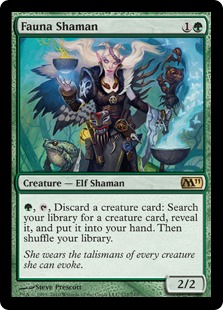
2 Fauna Shaman (2x10=20)

1 Inferno Titan (8)

1 Gigantomancer (1)

1 Leonin Arbiter (3)

1 Tunnel Ignus (1.5)

2 Obstinate Baloth (2x5=10)

$43.5 total

+$25.5

A nice way to start the night. I had thought this trade was much more even because I thought Iona was still at $10 apiece, but thankfully it’s dropped considerably. I essentially traded off Mythics with casual and Eternal appeal for some great Standard cards, which I should be able to move at States.

Trade #2-

My:

3 Eldrazi Monument (out of stock at 14, value at 15, 3x15=45)

$45 total

Her:

M11 Prerelease Sun Titan (6)

2 Razorvenge Thicket (2x3=6)

1 Mystifying Maze (1.5)

3 Stoneforge Mystic (out of stock at 6, value at 7, 3x7=21)

3 Timeshifted Lord of Atlantis (3x4=12)

2 Joraga Warcaller (2x2=4)

1 [cardPyromancer Ascension[/card] (2)

1 Kozilek, Butcher of Truth (10)

1 Genesis Wave (2.5)

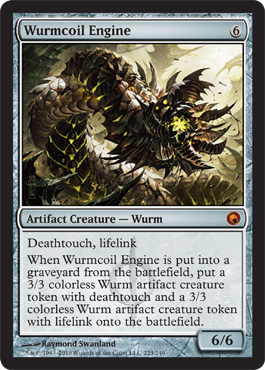
1 Wurmcoil Engine (20)

$85 total

+$40

Once again, I made a big trade with some mid price Mythics. While not as expensive as Planeswalkers, Eldrazi Monument is one of the more valuable Mythics in print, comparable to Lotus Cobra and Wurmcoil Engine. At the moment, it seems like everyone is trying to get their hands on Monuments, but nobody has any for trade, making them much more valuable. My big gains from this trade came from valuing Mystics at $3.5, Kozilek at $5 (another mid-range Mythic that is often under priced), the Lords at $2, and Wurmcoil at $15. I slightly overvalued the Sun Titan, trading for him at the regular price of $8 rather than the promo price of $6, but I still made a good chunk of change on this trade.

Trade #3-

My:

1 Elvish Archdruid (5)

$5 total

Her:

1 Textless MPR Harrow (2)

1 Gigantomancer (1)

$3 total

-$2

I really messed up here. Both of use valued the Archdruid at $2, and I had no idea it was worth so much. I suppose with Elf Combo in older formats and Monument Green in Standard, it might be getting a price boost, but I never expected anything this expensive. Hopefully I’ll be able to capitalize on this during States to find some others who undervalue it.

My Trades:

Trade #1-

My:

2 Grand Architect (2x5=10)

1 Talus Paladin (1.5)

$11.5 total

His:

1 Fauna Shaman ($10)

$10 total

-$1.5

I’m perfectly willing to take a slight loss here. 3 cards that see no play for one archetype staple? Sounds fair to me!

Trade #2-

My:

1 Verdant Catacombs (11)

4 Drowned Catacombs (4x5)

$31 total

His:

1 Stoneforge Mystic (7)

1 Chinese Stoneforge Mystic (6.5)

1 Leonin Arbiter (3)

1 Foil Ezuri, Renegade Leader (8)

$24.5 total

-$6.5
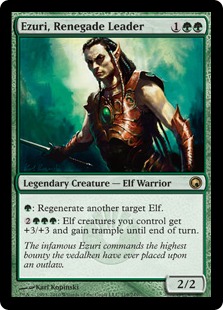
Another trade where the net loss doesn’t accurately reflect the value of a trade. Frankly, Drowned Catacombs sucks. Black is the worst color in Standard right now, and if it does see play, its’ certainly not getting paired with Blue. I valued the Catacombs at $2 during the trade, and I wouldn’t even change that now that I know differently. They are just not playable, and don’t trade for them at any more than $3.

Trade #3-

My:

1 Foil Ezuri, Renegade Leader (8)

1 Leatherback Baloth (.5)

2 Tajuru Preserver (out of stock at .75, estimate at 1, 2x1=2)

3 Sylvan Ranger (negligible value)

$10.5 total

Her:

1 Linvala, Keeper of Silence (out of stock at 8, estimate 10)

1 Terastodon (1)

$11 total

+$.5

Just an article full of textbook cases today! Here, we’re swapping some very narrow cards for ones that see significantly more play. While Foil Ezuri might be a casual player’s dream pull, you’re not going to get much from tournament players for it. As such, I was perfectly willing to value it at $6 in return for getting Linvala at $7. Linvala should be seeing universal sideboard play as an answer to mana accelerants, as well as techy guys like Cunning Sparkmage. Terastodon is also played in Eldrazi Ramp sideboards for the mirror.

And now, on to
Pack to Power

Rules:

1)   All trades must be personal trades, with other players, for cards. No trading for store credit or cash. No MOTL or Ebay. Just good old fashioned swapping of cards

2)   I will be attempting to go for the cheapest Mox, Mox Pearl

3)   Not setting a deadline at the moment, but I may later on depending on how the project goes.

4)   We’ll be using Starcitygames.com pricing for all the cards

And with that, my very first Pack to Power Trade (you can see the contents of the pack in last week’s article)

My:

Ratchet Bomb (10)

His:

Stoneforge Mystic (sold out at 6, estimate 7)

Celestial Colonnade (5)

Lux Cannon (sold out at 5, estimate 6)

+$8

Not a bad start at all! Ratchet Bomb is seeing a decent amount of play in UW Control and Eldrazi Ramp decks, and should be holding a steady price. But a steady price is not what we want for our Pack to Power binder. Instead, we picked up a different U/W card, Celestial Colonnade, as well as a Stoneforge Mystic, which is seeing a ton of action in White based aggro decks. Finally, we got a Lux Cannon. While not immediately appearing very playable, there have been multiple control decklists floating around, both mono Red and UW, using Proliferate alongside Lux Cannon and Voltaic Key. Lux Cannon also gains value from being a casual favorite. Because it has a lot of potential to skyrocket, Lux Cannon was a good pick for me, as I’ll be able to trade it off for 50+% profit to someone who really needs it.

I should have plenty more of these for you next week after I’ve been able to play and trade at some bigger events, but meanwhile, I hope you all enjoyed your States tournaments, and check back again next week for more trading goodness.

Running out of envelopes to ship cards in,

--Noah Whinston

mtgplayer@sbcglobal.net

Arcadefire on MTGO

NWhinston on Twitter

Baldr7mtgstore on Ebay
#followfriday: Dealing in Digital

Are you a Quiet Speculation member?

If not, now is a perfect time to join up! Our powerful tools, breaking-news analysis, and exclusive Discord channel will make sure you stay up to date and ahead of the curve.

By: Mick Podruch

The Beginning of Your Online Trading Experience

Unless you are attending large events on a regular basis, you may find yourself in a lull at your local card shop. By a lull I mean there are very few new cards entering your local trading market and most of the cards being traded are only traveling as far as the regulars in the shop. This stagnant period can develop into a poor trading environment meaning cards you expected to be able to move are still sitting in your binder. During these times it is easy to lose judgment, encouraging ill-minded trading practices, simply because there is no “excitement” and cards aren’t leaving and entering the market. What can you do? Obviously Ebay is still an option, but perhaps you aren’t looking to sell and wish to grow your collection through trading. Getting experienced in online trading can bring vast opportunities you otherwise wouldn’t have to expand your portfolio. Different Magic the Gathering forums from different sites allow trading, but to minimize risk, I’d suggest www.magictraders.com (MOTL). This is a dedicated trading community that brings you in contact with all sorts of traders ranging from casual to experienced, standard to vintage. MOTL also provides the most secure process of making a transaction between traders. From this point on, I’ll be following MOTL’s forum standards, so you might want to spend a few minutes checking it out. I’m going to supply you with information regarding the online trading experience and how to get started. In future articles I hope to guide you through international trading, as well as doing high value trades, and take a deeper look into the online trading process.

Rules vary between trading websites, but mostly, they all follow a general theme. First and foremost, be honest. If you plan on ripping people off (like not sending all or some of your end of the deal or poor card conditions), plan on dealing with the law since that is mail fraud. This leads right into the next rule; conditions of cards need to be agreed upon before either party confirms the deal. A deal is confirmed once both parties have agreed on a trade, on packaging, on order of sending, and addresses have been exchanged. Once both parties have received cards, each trader will fill out the “reference check” for the other. For the not so internet savvy readers, references are a way of determining your and other trader’s honesty by the sheer number of successful transactions. In all honesty, I’ve been trading for well over three years via the internet and I have once experienced getting ripped. Luckily, it wasn’t a high value trade (rippers usually target low value trades), but it could have been easily avoided had I taken the proper precautions. In the three years since that experience, I haven’t dealt with a ripper. That isn’t to say it doesn’t still happen, but if you too take the correct steps in the trading process, your chances of dealing with rippers drops dramatically. I’ll highlight these precautions as I take you through the process of beginning your own trading post.

Upon signing up for an account on MOTL (its free), I actually suggest reading through the terms and agreements. I know, I know, our internet instinct is to scroll to the bottom check the “I agree” box, click continue, and forget about. You should at least glance through it to make sure your privacy is protected (it is a good habit to get into anyways). Now you have your account and are ready to begin trading, but how can people see your cards? Well, they can’t. The best you can do is post your own “have/want list” in the forums for other traders to visit. Your list is going to be a virtual copy of your binder, like an online trading booth. It takes a catchy title, creativity, and some marketing to attract grazing traders to take a peek. A catchy title can simply be listing a really hot card. An example would be “H: (hot standard staple(s)) W:(name cards you want).” Creatively set up lists use bolding, font size, organization, and a brief introduction to encourage surfing traders to stop by. One thing I suggest, don’t bold all of your expensive cards or put them all in the same category. Make the viewer search a little bit in case something else might catch their eye. Finally, marketing means sometimes you need to go post something on someone else’s list, maybe about a card you are interested in, asking conditions of cards, or even making an offer. By getting your name out there, you’ll have more visitors resulting in amplified trade action. Make sure to bump your list daily so it goes to the top of the thread.

If you are like me, then trading is like a business. Businesses thrive on organization and fail to the opposite. It is extremely important you keep both the online list and your binder organized the same way. If you sort your binder by color, your online list should follow the same suit. The same goes for type of card, function of the card, and rarity if you choose to organize by those characteristics. Organization will prevent situations where you confirm an online trade with a card you don’t have, because you forgot to remove it from your list. This is especially true if you have a large collection of cards, keep your list updated. Speaking of large collections, one of the things I believe turns people away is listing too many cards. If I have to “control F” to check for a card on your list, I’m much less likely to post. Listing bulk rares by name is a waste of time for you and other traders. Simply post on your list “many bulk rares from sets A, B, C, and D, if you are looking for specifics please ask.” Another big turn off for people is not listing anything in the “wants” section of your list. Don’t only type “I check lists.” That is a fine phrase to start or end your want section, but traders need to know the value of cards you are looking for. Common sense here, don’t list cards you don’t own or wish to trade. The last basic guideline for your “have/want” list is sharing card conditions if the card is NOT near mint or in English. Most websites assume cards without any condition description are in English, unaltered, and in excellent condition or better. Don’t ever make that assumption and always ask about card conditions and languages. To protect yourself, cards on the borderline between two conditions should be noted as the lower of the two. Many websites offer card condition descriptions and you should note which site you are using in your introduction. Along with listing condition and language (if necessary), the set the card is from is also important. Most disputes between parties have to do with card conditions more than anything else. Here is an example of how to list cards:
2x Baneslayer Angel (somewhat played condition, Japanese, M10)
1x Baneslayer Angel (Mint, Eng, M11)
4x Battlegrace Angel (NM)

Since you have Baneslayer Angels of different languages, it is best to list even the English ones with “Eng” to prevent confusion. On a side note, have scans available for valuable cards (mainly legacy/vintage staples over $50).

After drudging through your collection and typing everything up, you submit your topic and are ready to wheel and deal. Handle your trading like a business. As businesses thrive on organization, they also demand clear communication. Conducting a trade online requires lucid communication to avert future issues. Searching through other people’s threads, you come across some cards you are interested in and reply to their list. A couple hours later you find some replies and other interests on your own list, time to trade. My suggestion is have people contact you through the private messaging system the site offers. This was how I got ripped. I received an email from a guy who claimed to be someone in the forums (a.k.a. imposters). Imposters are not easily tracked and in order to prevent them taking advantage of you, have the members private message you when performing a trade. Imposters won’t be able to do this. Save all emails and private messages (PMs) as they are proof in case something would happen. Until you build up a solid number of references, keep trades at around $50 or less and make trades only with people who’ve collected 25+ references. Don’t trade internationally until you are experienced in online trading. Bartering for about ten minutes, you and your trade partner reach agreement on the following trade:
Your
1x Baneslayer (somewhat played condition, Japanese, M10)

For his
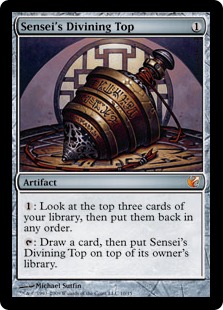
1x Sensei’s Divining Top
4x Spell Snare
2x Foil Mana Leak
1x Foil Unhinged Island

Before you confirm, you ask him the condition of his cards and the sets his Mana Leaks and Sensei’s Diving Top are from. You remind him on the condition and language of the Baneslayer Angel. Replying that all his cards are near mint or better and are from the sets you wished, he proceeds to tell you to send first since he has more references. Until you have acquired an adequate amount of references you’ll be sending first quite a bit in the beginning. Once you’ve established yourself as an honest trader, simultaneous sending will become an option. Sending order is always determined by the person with more references. References outside of that particular website (like Ebay) don’t count. Agreeing to send first, you explain to him that you’ll be using delivery confirmation and sending the cards in hard cases (no more than 2 cards sleeved per case) in a bubble mailer and he approves. You can buy bubble mailers at the post office or reuse ones sent to you. For those who don’t know, delivery confirmation provides you with a tracking number. This is proof that you sent the package and it reached its location, further protection from rippers. Deals under 20$ don’t necessitate delivery confirmation, but for your first trades it’s the safer option to choose. Since the trade is under $100, insurance is unnecessary. Telling him that you’ll be sending the next day, addresses are exchanged and the deal is confirmed, but you’re not done yet. Safety first, check to make sure the given name and address pass the confirmed bad traders list. There are three other things you need to do at this point to stay organized. First, write down the persons address, the cards being exchanged, and the date (protection against website crashes). Second, remove the cards traded from your have/want list. Third, take the cards out of your binder and set them with the piece of paper you did in step one. On the next day, you march on down to the post office, package in hand (write DO NOT BEND on it), and ask the postman for a delivery confirmation slip and pay the required fees.

The next step is to private message the delivery confirmation (DC) number to the other party and play the waiting game. About five days later, you get a new pm from the trader saying he received your package and subsequently sent out his end of the deal, providing you with a DC number. Roughly five more days pass and some treasure is found in your mailbox. Before you can enjoy your new cards, you must message him that you received the cards. Lastly, send him a reference check, he will do the same. Fill out the small survey (it will be via email) and congratulations you completed your first online trade!
My online trading brought me many opportunities to expand my collection. I’ve acquired and traded somewhere around 30 duals, power, fetches, foreign foils, EDH staples, standard staples, vintage staples, alpha/beta cards you name it. The possibilities are endless with online trading since you literally have access to every mainstream card ever printed from thousands of traders. If you are looking to build your MTG portfolio, online trading will help you achieve your goals faster by offering more resources. If there is enough interest, I hope to write an article about building your portfolio through online trading next. Please leave comments or questions about this article since this is my first and I’d be welcoming to feedback!


I've been collecting Magic Cards since the Mercadian Masques block. Mostly I played casual games and took a break from the game around Mirrodin and returned for Ravnica. At that point, I started attending FNMs regularly. Around the release of Lorwyn, I tested the waters of competitive play at a few local tournies and States. It was a Lorwyn Block PTQ that marked the beginning of my interest in the financial side of Magic. There I had a Kithkin deck built and ready to play, mid tournament, I sold my deck to a guy for $300 (which I had built for about $150) and proceded to drop. I thought, "this is a lot more fun and easier then winning a PTQ." Since then I don't play much competitive magic other then FNMs and my focus has been on making money with Magic. Trading online became a regualry hobby for me, and a good friend of mine taught me the ins and outs of making good deals. I follow all formats to stay up-to-date with card prices, and around the Lorwyn/Time Spiral block, I stumbled across EDH and it has become my favorite format. EDH lets me continue to play Magic, and at the same time build my collection since I'm not always looking for cards to complete a deck. If I had to choose a favorite deck, it would have to be some variation of a Mystical Teachings deck. My favorite card is by far Masticore, and my foily Japanese one speaks to that. I'm also an avid NHL fan.

The Nutt Draw: Analyzing Booster Pack Values

Are you a Quiet Speculation member?

If not, now is a perfect time to join up! Our powerful tools, breaking-news analysis, and exclusive Discord channel will make sure you stay up to date and ahead of the curve.

Welcome to another action packed edition of The Nutt Draw!* This week we will be checking in with the relative booster pack values and taking a look at the amount of expected cash we can hope to pull out of those packs.

If something you read here looks confusing you may wish to check out some of my processes and explanations here. The Nutt Draw: Primers and Glossary

The last time we looked at these values I had explained that I had put together all new calculations which were a lot more in depth then they had been before. For this article I have recreated the spreadsheets I use for the calculations and completely revamped the way it’s being presented. That last article was essentially just throwing a ton of data at you. I tried to pretty it up, but ultimately I think that most readers would have to really study the numbers to understand what the messages and core information was. This time around it’s all still there but I’ve broken it all apart into different groups of relevant data.

The first data grouping looks at the values of each edition and how it related to cracking packs.

[iframe https://spreadsheets.google.com/pub?key=0AukC5EWiTvOpdEFHeTFFNEN5OGpfcC1pNk5abFYzckE&hl=en&single=true&gid=13&range=B2%3AO10&output=html&widget=false 100% 265]

As you can see Scars of Mirrodin has the largest total set price for all the sets back to Shards of Alara. It’s a large set so at full retail it would statistically cost $477.95 to make one complete set of cards. Purchasing a set that way would leave a lot of extra card since the Mythics show up so infrequently in the packs. If you were to crack 121 packs to chase down one set of Scars the approximate total value (by eBay card value standards) would be $394.98. This gives us a likely per booster value of $3.26. When comparing that value to the other sets on this list we can see that the best overall value per pack is actually Worldwake. However, I would argue that since Jace, the Mind Sculptor makes up such a large amount of the value of Worldwake the best bang for the buck is actually Zendikar. The reason why is in the next section.

[iframe https://spreadsheets.google.com/pub?key=0AukC5EWiTvOpdEFHeTFFNEN5OGpfcC1pNk5abFYzckE&hl=en&single=true&gid=12&range=B2%3AO34&output=html&widget=false 100% 305]

The above numbers compare what happens to our chances of opening gold when we take out the highest priced card in each set. Some sets like Worldwake plummet in value when their number one cards are removed. Scars of Mirrodin stays deceptively high. The value you see there has to be mitigated by the fact that there are four cards that right now hover around $40 each. Looking at this list we would still probably pick Scars to crack for money cards, but I’d like to draw your attention to the figure in the middle of the chart labeled “Set EV w/o Mythics w/o Commons.” When you pull Mythics out of the equation the best valued packs are clearly Zendikar, with Scars coming in dead last for sets legal in Standard. This is mostly because most of the cards of value in ZEN are rare not Mythic. I think this is a valid measurement since the chase Mythics being generally so illusory.

[iframe https://spreadsheets.google.com/pub?key=0AukC5EWiTvOpdEFHeTFFNEN5OGpfcC1pNk5abFYzckE&hl=en&single=true&gid=11&range=B2%3AO34&output=html&widget=false 100% 305]

The above chart is a look at some of the notable singles each set has to offer, and is pretty self-explanatory.

The following chart is a look at EV results which vary depending on what is being calculated. For example, some people don’t like to calculate the Uncommons and Commons when looking at the value to expect from a pack.

[iframe https://spreadsheets.google.com/pub?key=0AukC5EWiTvOpdEFHeTFFNEN5OGpfcC1pNk5abFYzckE&hl=en&single=true&gid=10&range=B2%3AO34&output=html&widget=false 100% 300]

Percentages are something that resonate very well with me. Whether it’s what an additional land can do for the average number in an opening hand or how to balance three of vs. four of in a deck depending on when you want to draw it during a game. This next chart will tell you what the chances are of pulling nearly any range of value of singles from the packs you’re opening.

[iframe https://spreadsheets.google.com/pub?key=0AukC5EWiTvOpdEFHeTFFNEN5OGpfcC1pNk5abFYzckE&hl=en&single=true&gid=9&range=B2%3AO34&output=html&widget=false 100% 235]

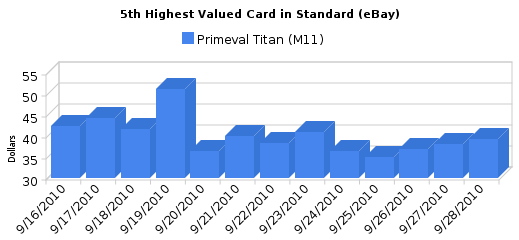
For all you dreamers out there who grab that one pack of Worldwake “just in case” you might get a Jace, the Mind Sculptor you now know that you have a 1.25% chance of it being in a random pack. This chance however can change a great deal depending on what has been opened in that same box or the same case. I would have to say that if you’re chasing planeswalkers and one has already been opened in the box you’re buying from there is a vanishingly small chance that there will be another. It happens of course and it’s different for every set due to the collation order but that Primeval Titan or Gideon Jura might be a little further out of reach then it feels.

[iframe https://spreadsheets.google.com/pub?key=0AukC5EWiTvOpdEFHeTFFNEN5OGpfcC1pNk5abFYzckE&hl=en&single=true&gid=8&range=B2%3AO34&output=html&widget=false 100% 305]

This final grouping of information is meant to suggest what the best random pack to buy is based on a ranked set of criteria. Some of the ranking is based on my own notions of what is most important, but if this list doesn’t suit you I’m certain there is a lot of information above that can help you decide the best booster pack based on what’s important to you.

Chris McNutt
Magic Analyst
Level 1 Judge
@fatecreatr on twitter

*Not guaranteed to be action packed

Chris McNutt

Born in Seattle, Washington, Chris McNutt has been playing and collecting Magic: The Gathering since Unlimited Edition. As an active player, tournament organizer and judge he regularly scrubs out of Pro Tour Qualifiers but inexplicably cleans up at the local draft tables. When not net decking Chris is either busy working as an Information Technology Sales Rep or spending time with his family. Other non-magical pastimes include playing guitar and an unhealthy number of video games. Cursed with an undying love of generating spreadsheets purely for ñ€Ɠfunñ€, heñ€ℱll be crunching the numbers each week in order to serve up delicious data burritos to the salivating, hungry readers of Quiet Speculation.

View More By Chris McNutt

Posted in Feature, FinanceTagged , , 1 Comment on The Nutt Draw: Analyzing Booster Pack Values

Have you joined the Quiet Speculation Discord?

If you haven't, you're leaving value on the table! Join our community of experts, enthusiasts, entertainers, and educators and enjoy exclusive podcasts, questions asked and answered, trades, sales, and everything else Discord has to offer.

Want to create content with Quiet Speculation?

All you need to succeed is a passion for Magic: The Gathering, and the ability to write coherently. Share your knowledge of MTG and how you leverage it to win games, get value from your cards – or even turn a profit.

The Revenue Review – Opportunities in Innovation

Are you a Quiet Speculation member?

If not, now is a perfect time to join up! Our powerful tools, breaking-news analysis, and exclusive Discord channel will make sure you stay up to date and ahead of the curve.

Welcome back to the Revenue Review! After my horrendous (hilarious) accident last week, I’m finally getting back on my feet and ready to take a look at what you can expect this weekend at States, errr, The 2010s.
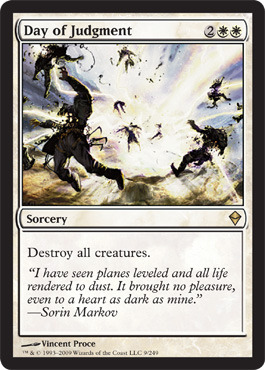
This week I’m going to examine some of the more popular decks you’ll likely see this weekend and where your opportunities lie in relation to each. To be specific, we’ll be looking at cards that are going to command a higher trade value than price value. For example, I don’t expect Day of Judgment to appreciate much in value in the next few weeks, but as more people move toward playing U/W control,  there will be an increase is those looking to trade for it.

The first reported results of this brave new post-Alara world can be seen here, though this tournament looks fairly weak. Nonetheless, it’s a place to begin. Let’s start with some of the known decks before we venture a little farther off road.

U/W Control
Opportunities:

Day of Judgment

The day has finally come

As I alluded to above, I see the demand for this card increasing, even if the price doesn’t move much. With Bloodbraid Elf and friends gone, this becomes more important to control players. Cascade as an (unfair) mechanic may be gone, but Fauna Shaman and Vengevine strategies will show up still. Raining judgment on these decks means more than it used to, since they can’t immediately reload with one Bloodbraid Elf.
There’s another factor here, and that is what I see as a migration to U/W control. There are a myriad of ways to customize this deck, and even acceptable options to “budgetize” it provided you have at least 2 Jace, the Mind Sculptor. Players who six months ago may have already assembled a Jund deck and didn’t buy Jaces have now picked up a few and need a new deck to play. Add in the fact that Baneslayer Angel has come way down in price and that Jace Beleren effectively counters his big brother and you have a recipe for an increase in U/W players.

Ratchet Bomb

This bomb is the real deal, and has a ton of utility, even if it’s not being run in all builds of the deck. It’s an important tool for control players to fight the “new Affinity” decks, which we’ll get to later. I don’t think this card has peaked in price, either. It could see play in older formats and has some room to grow, in my opinion. With two more sets of possible proliferate shenanigans, this is only going to get better.

Volition Reins

I’ve seen a couple of decks running this card now, and it certainly answers Titans and Planeswalkers. In case you haven’t noticed, answers to Planeswalkers are at an all-time low, so even a high-casting cost card like this has potential. The fact that it’s an uncommon can actually work in your favor, because players probably won’t want to dig through their boxes, if they even have any, and most people don’t like to buy uncommons online, especially when you don’t need a full playset.

Abyssal Persecutor

I wanted to give this its own section. It shows up in what SCG dubbed a U/B control list, but the Persecutor has a variety of decks it could start showing up in. Remember this card does tangle with Titans and is a $12 Mythic from a small set that was underdrafted. You can look at Jace, the Mind Sculptor to see how those circumstances affected a popular card’s price. If you can pick these up in trades right now, there is a huge opportunity if it starts to show up in some winning lists.

Ramp

I’m going to lump Eldrazi Green and Valakut ramp into one category, even if not all the cards are represented in both decks. There’s not really any new news here, but both these decks are going to see a heavy increase in play because they are very strong at the beginning of this new format.

Opportunities:

Inferno Titan

Depending on circumstances, this could be a big player. It mows down the weenie decks pretty well, and in those cases is actually better than a Primeval Titan. These were pretty overlooked throughout the course of M11, but they could be making a push into Standard, especially since there are plenty of players trying to make “big red” again.

Comet Storm

This was played in a large number of decks at Pro Tour: San Juan, and could start showing up in Standard in ramp decks. This is a Mythic, and even though it was a promo card, it has potential in ramp decks to help the fight against aggro/midrange strategies.

Dredgevine
Opportunities:

This card has its Oozes

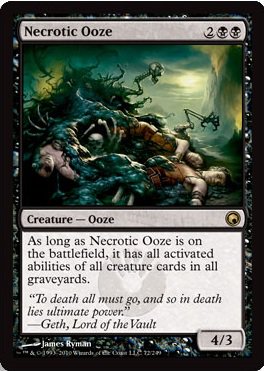
Necrotic Ooze
In my initial testing Dredgevine had a really hard time beating Valakut, but that doesn’t mean the deck can’t be tuned. The Ooze does some really powerful things in this deck, especially in conjunction with the next card on our list.

Gigantomancer

Done reading it yet? It’s actually pretty absurd with Necrotic Ooze and helps turn new Dredgevine (which, ironically, is more like the original Dredgevine incarnations) into a powerful (at least) Tier 2 deck. These are obviously bulk right now, but they could see some movement if people are looking for a new home for their Vengevines.

Renegade Doppleganger

If you’re a loyal reader of QS, you know we’ve been on this card for awhile. It’s seen a little movement since Dredgevine broke, but it still has some potential if it begins to find its way into any more decks. While you certainly shouldn’t go all-in on this, it doesn’t hurt to keep it in mind either.

Elves
Opportunities:

Ezuri, Renegade Leader

Elves is poised to make a comeback to Standard, and this guy is the reason why. Remember how I talked about how Day of Judgment is better in the new Standard? That all goes out the window if this guy is in play, since he’ll just regenerate all your other Elves. And if you don’t have the Day, he’s just going to Overrun your team next turn. And he has casual appeal. Did I mention he’s an Elf?

Eldrazi Monument

The best home for the Monument may turn out to be its original (it first burst onto the tournament scene in the Nissa Revane Eldrazi Monument deck). If you haven’t heard my spiel about this card, you can do so here.

Elvish Archdruid

Look for this guy to be in demand again once Elves starts to show up at tournaments. He also fuels all sorts of big-mana strategies, such as Genesis Wave.

Joraga Warcaller

The Elves have all the lords these days. This guy happens to combo pretty well with the Archdruid and Oran-Rief, the Vastwood. All these good Elf cards are going to gain value/tradability with Ezuri around to tie the deck together.

Affinity

If you haven’t seen this deck yet, here’s the best version I’ve found so far. You can also find it in the Top 8 of your local States tournament this weekend. By all accounts, it’s for real.

Opportunities:

Tempered Steel

Now I have something to hold against Noah Whinston forever (in his defense, I did agree with him at the time). But it’s a really important card in this deck, and has a lot of appeal to Timmies everywhere. Plenty of people are already building this deck on the advice of people like Patrick Chapin, and it will pay to be aware of this deck moving forward through the block.

Chimeric Mass

The best thing about this card is it has value in a number of decks. It can fill literally any spot on the curve, even zero, and will be used to fuel Metalcraft strategies in the next two years. These shouldn’t be hard to pick up now and trade at a premium to the players who need them.

Seachrome Coast

Like most people, I saw this as being the worst in the cycle, since blue and white are normally control colors and therefore the least likely to be played. Apparently blue and white now have the most explosive aggro deck as well as the most controlling control deck. Either way, if you find someone still of the opinion that no U/W deck would want these, take them off his hands.

Turbo Poison

There’s not really anything to see here, since this deck is pretty obvious and straightforward in what it wants, I don’t feel like I have much to add.

I originally planned on doing a Trade of the Week this week, but I’m already out of space! I figure this information will serve you better this weekend than reviewing a trade would, so I think I’ll bump that to next week.
I hope you get out and attend States this weekend, it’s always a hotbed of innovation. I won’t be bringing any sick homebrews myself, since I’ll be judging, but I’m looking forward to seeing what everyone has.

Thanks for reading,
Corbin Hosler
@Chosler88 on Twitter

Endless Horizons – Public Relations

Are you a Quiet Speculation member?

If not, now is a perfect time to join up! Our powerful tools, breaking-news analysis, and exclusive Discord channel will make sure you stay up to date and ahead of the curve.

As traders looking to expand our bargaining turf, we have to worry about Public Relations a bit more than the usual person who looks to trade at his or her convenience. Were trying to build our own little empire of cardboard, people, and trading. I would even say that we are the step between trade table grinder and shop owner.

Most of us don’t have the capital or stock to open up our own shop, our very own Kelly Reid notwithstanding, but we are looking to be more than another fish in the pond, or shark in the ocean as the case may be. Because of this, we need to express concern about the character we portray just as much as the shopkeeper; after all, we have our reputation as well.

Things to do

  • Care about personal appearance. Every time I walk into a shop for the first time, the first thing I do is look for binders that are out and open for business. After that, I see the person associated with the binder. If they look like someone respectable, generally friendly, and have an open demeanor, I will probably go and introduce myself to them before most others in the shop, and see if there is business to be done.
Smile! It's good to do.
  • Take care of yourself. Before you enter a new trade area, make sure you’re smelling as good as you look. We all know that it’s no secret that large magic events are known for their “Nerd Funk”, or other colorful words. Don’t be a contributing factor to it! Smell is a very big factor of first impressions, and is one of the longest lasting pieces in a person’s memory.
  • Smile Discretely. This is a simple one that most people forget about. It’s a common sales tactic to be sure your smiling when you start your conversation. Don’t force it. If all you can do is manage a friendly looking grin or smirk, that’s better than being a stone faced or unhappy looking new guy. There is a time and a place for the stone face, but this isn’t it.
  • Talk about other things. Make yourself seem like a regular person. Many players who play Magic also enjoy computer or console games. Enjoy playing Starcraft 2? Someone else in that shop probably does as well. Perhaps you’re amazing at fighting games, or first person shooters. Don’t be afraid to branch out from Magic, it puts people at ease, and will help open up doors to other trades that might not have otherwise been there.
  • Be Energetic. I think we would all like to trade with someone who is excited about the cards, right? Well, be excited about your trades, and it will transfer over to your trading partner. We’re not saying so be bouncing off the walls and annoying, just be happy to be making a deal. After all, were here to make money, and who doesn’t like doing that?

If you manage to pick up a bad reputation in the areas you’re attempting to expand into, even the most casual player will scoff at your attempts to make a deal. Your time and energy is just as important as the next player, so how do traders ensure a good image? It’s easy enough to start off in the right direction, but it’s even easier for you to tarnish your image before you even make your first trade in a new area. We have you covered.

Things to not do

  • Don’t be that guy who shows up, talks to no one except to trade, and then leaves suddenly. You’re looking to expand your market, and doing a “hit and run” like that will only build yourself a bad reputation. Act shady and people will think you are.
  • Don’t brag about the trades you made and how high you came up on it in a new shop. This was a lesson I taught myself the hard way. It discourages repeat business, and you have to really work hard to put yourself back in the good graces of people. You’re a new person at this shop, just trying to establish yourself. Learn from my mistake!
  • Don’t disrespect the shop. Your LGS may be nicer, bigger, have more people, buy cards at a higher price, and just be 100% more awesome, but that doesn’t give you the right to badmouth the shop you’re in. Many players feel a sense of loyalty to the shop they play at week after week, and you will lose out on trading if people catch you saying something bad about their home turf.
  • Don’t selective trade. The kid sitting in the corner with his brother may not know exactly how to play; they may not have legal decks, or even sleeves. That doesn’t mean there isn’t opportunity there for you. Introduce yourself, ask if they want any help, and maybe even toss them each a couple of bulk rares that you haven’t been able to move. I promise you that you will be the hero for these kids and someone else probably with at least some kind of binder, will notice. Maybe it was one of the local better player’s siblings. Random acts of kindness pay off.

For some of us this list may seem like common sense, but sometimes people forget how to behave socially in their own atmosphere. With that in mind, I will continue to touch on the philosophy of expanding your trading region, building your reputation, and hopefully helping some people develop into stronger traders, and better people.

Feedback encouraged, if I need to go into more detail in some areas, or you have a specific question, let me know!

Remember, karma comes around, do something nice this week at your LGS,

Stephen Moss

MTGstephenmoss on twitter

mtgstephenmoss@gmail.com

Stephen Moss

Stephen Moss currently lives in Lancaster, CA, is a usual PTQ grinder in the southwest region and working on his Masters in Business Administration. He has an obsession with playing League of Legends when not working on articles or school work. His articles often take on a business minded tone, and usually contain information applicable to magic trading as well as real world business.

View More By Stephen Moss

Posted in Finance11 Comments on Endless Horizons – Public Relations

Have you joined the Quiet Speculation Discord?

If you haven't, you're leaving value on the table! Join our community of experts, enthusiasts, entertainers, and educators and enjoy exclusive podcasts, questions asked and answered, trades, sales, and everything else Discord has to offer.

Want to create content with Quiet Speculation?

All you need to succeed is a passion for Magic: The Gathering, and the ability to write coherently. Share your knowledge of MTG and how you leverage it to win games, get value from your cards – or even turn a profit.

Two’fer Tuesday: E-valuations – Balking at Bulk

Are you a Quiet Speculation member?

If not, now is a perfect time to join up! Our powerful tools, breaking-news analysis, and exclusive Discord channel will make sure you stay up to date and ahead of the curve.

MTGO expansion set release, the bulk way.

I love online set releases, don’t you? Of course you do. So does everyone else on MTGO. I think the feelings we get from the anticipation of a new set are one of the greatest aspects of our beloved game, both as a player and someone who likes to sell cards for a profit. Today let’s learn how to capitalize on this mindset by utilizing time.

Why time you ask? Because time is money. When a set is released online, everyone wants to play it. The best way some folks see to get acquainted with all the fancy new cards is Limited Release Events – Draft & Sealed. This is great for those of us that will kindly take cards off the hands of limited players for a few tickets so they can make some cash to jump in their next event. It’s a win-win for everyone. What you must understand is that for some period of time, Release Events are what a good amount of people on MTGO live for. In the next few steps I will show you the best way to purchase bulk cards from said players and turn them over for a profit.

  • Planning & Time Management

    Time is on your side.

The first thing you need to do for your plan to work is know when sets are going to be released. You can find this information all over the web, but your two solid sources are the Wizard’s website, and the MTGO client itself. Let's say, for instance, that you were going to try and purchase some Scars of Mirrodin bulk when the set is launched online. The only information we have now is that the set will be released October 18th, 2010. That is, packs will go on sale on the scheduled date - a Monday. We can use the schedule from M11 to get a ballpark structure of how Scars release events will be set up. Casual drafting began on the Monday of release, with Booster Draft Queues and Swiss Sealed Flights firing after the next scheduled downtime (Wednesday). The release events were scheduled to run for approximately two weeks. This is our bread and butter, the time where we want to reach out and grab as many bulk cards as possible.

  • Target Sellers

In the aforementioned timeframe limited players seem to get addicted to a new set. All they want to do is finish their tournament and head directly into the next, if money permits. After spending their original budget on entry fees and packs they end up with an excess of cards and not a lot of cash. The best way for them to continue to play is to dump their cards for enough tickets to try and get their "fix". You, my friend, will be able to necessitate their needs. Most players of this type will be ready to wheel and deal with you so they can offload the cards they cracked in draft or sealed. I'm not talking sought after Mythics or Rares, unless you are willing to shell out the extra dough, but you will definitely be able to pick up entire playsets of Commons, Uncommons, and a good amount of Rares.

  • Setting Up Your Classified Add & Acquiring Cards

Now you want to buy cards, a lot of them. Any of them. If they’re in your target set then you need them. Having friends that are heavily into limited formats is great, but I’m going to assume you don’t. Fear not, as a carefully placed classified ad will net you plenty of interest. First off, you want to portray yourself in the classifieds as what you really are
Human! I know there are a plethora of automated online stores these days but you’re going to use this to your advantage. Just about everyone knows they can offload their bulk to bots, but I guarantee there are a ton of players that would prefer selling to a human. This is you! You are living, breathing, and able to communicate. These characteristics are going to allow a broad range of clients, some that would probably not be willing to trust "some guy's" bot.

That being said, let's go over what an effective classified ad could look like. Keep in mind; you want to put the point across in a simple fashion, one that will capture an eye but be straight to the point. You can insert a little "flash" at the beginning of your ad by simply entering a mana symbol. To do this you can use the keyboard shortcuts by pressing Control > Q > U, R, W, G, or B. Whichever suites your style. So hit "CONTROL" and "Q" at the same time, then let off and press the letter that corresponds to the mana symbol you wish to create. If you're jotting down your classified ad in notepad so you can copy and paste later, create mana symbols by typing [sX] - where X is your symbol of choice. So [sR] will get you a red mana symbol. I told you earlier that we wanted to portray that you are human so emphasize this with caps. An add I would submit without hesitation if I was trying to pick up some M11 bulk would go something like this: [sR] HUMAN Buying Bulk M11 Commons, Uncommons, Rares. Pm me what you have! [sR]

Leaving price out of your add will let you have some flexibility in your buying. It’ll also get you a little more interest as some players just want to know what your bulk rate is. You're going to want to feel out potential sellers after they've contacted you to see what they intend. When someone PM’s you and asks how much you are buying bulk cards for, this is a big step. A friendly greeting will go a long way, so make sure to do this! Also, ensure you know how much your competition is buying cards for. You'll need to be cautious about which lots to purchase as some players may have either sold off the speculated staples or made them untradeable. Don't be afraid to ask someone if they have sold their bulk off before, and for how much. This can get you in the right ballpark for a trade. Sometimes giving someone a deal at a slightly higher rate than bots will work wonders, and you may get added to the "buddy" list for when they need to sell more cards. I'm not going to delve into actual prices in which you should be buying. Every set is different and this article is meant as an overview for the future. I can't stress enough how important it is to know what your competition is buying for, as well as how many cards are in a set, color, and rarity. Quickness is something that people appreciate, so if you can promptly and effectively scan over someone's tradable collection and give them an offer, you're winning their business over already.

  • Speculation
    Decisions, decisions...

What to do with your newly acquired cards is going to be a matter of personal preference, but in the end you want to make some cash. Speculating what cards are going to rise in value significantly can be a double edged sword. On one hand, if you are knowledgeable about the market you can make some big gains here, but it's going to require a good amount of time for your investments to mature. I would suggest if at all possible keeping a playset of each card locked away for future trading. You never know what will be hot two weeks from now. Although this will depend how many of each rarity you purchase. You may be interested in only dealing with bulk commons, and the next guy may have the budget to pick up large amounts of more expensive rarities. Either way, you can make some money by tucking away a few cards; it just depends on your game plan and how long you want to be in this investment.

  • Target Buyers

Now the fun part. Turning the bulk you bought into event tickets. More than you started with. Concerning time, you've probably been picking up cards for a week or so, deciding what you want to keep, and now you're ready to start selling. After release events start to wane there’s generally a large influx of a new set's cards to the market. Right before this is when we want to jump in. More than likely it will be the beginning to end of week two.

Fortunately for us, large online stores are going to be selling their cards for top dollar. Because of this, there’s a small window in which you can make some nice gains from the stuff you picked up. "The Big Guys" as I like to call them, the large MTGO stores, are going to be in need of your cards. Sure, they may have cracked hundreds of digital packs to try and acquire as much as possible, but with the magnitude of constructed players, they will be in need. Use your judgment when selling cards to "the big guy." It's a great way to make some quick cash. You can normally dump 5-10 of each card for far more to them now than you could later. Some of the biggest gains I've made selling to stores have come in the form of Uncommons & Commons. There always seems to be 4-5 of each that take on early price points, so I suggest you keep on the lookout for these, and if you can push them out and turn over your purchases early you’ll be in good shape. There's been numerous times when I buy a bulk lot using the exact tips I gave above, and turn around and sell less than half of the cards to a dealer for more than I paid for the whole lot.

Another avenue to sell cards is one I touched on briefly in the last paragraph, and that is Constructed players. The constructed player doesn't necessarily need to Draft or play Sealed to get their kicks out of a new set. They simply want to either add new cards to their existing decks or try and build around them. I also mentioned how the big guy is going to be selling these new cards for some pretty hefty prices. Since we've managed to pick up product for significantly less, we can afford to sell for lower than they are. This is again where classifieds will come in handy. Constructed players often need their cards in playsets, so make sure you let them know you have them. Advertise a certain card or two in your title to spark some interest. Tell them you have playsets of cards in the new set for cheap. When trading, never be afraid to sell a group of cards without making a set price for each. Tell your customer to go ahead and pick out a few playsets of what they need and you’ll work out a deal when they’re done. Remember, you bought these cards at bulk prices, and you can afford to give away some throw-ins here and there. Either way, you’re going to be selling cards for more than what you paid for them. You can easily get networked with buyers when they tell their buddy how great of a deal they got from you on some new cards. More sales = more profit!

  • What To Do With The Rest

Inevitably you’ll be left over with some amount of cards that you are not going to be able to get rid of right away. In this section I will cover what you can do to push the rest of your stock out. The easy way out of this predicament would be for me to tell you:

"Just get yourself a bot and throw everything on there. It'll sell eventually!"

I wouldn't do that to you. Of course, if this is a possibility, take advantage of it. But managing your own bot is a subject for another place and time so I won’t get into it. By now I'll assume you’ve been able to make a profit selling the majority of your stock. The rest is icing on the cake. One of the most important things to realize here is that there are always going to be junk cards. Cards that you don't have the time to get absolute 100% value out of. Since we've already made a profit, we can afford to dump these cards off. Bulk buying bots, the ones you see advertised as "Buying Rares X for X tickets, Uncommons X for X, and Commons X for X” will be the final step. These bots are set up by individuals that have the resources to take in cards for cheap and spread out their sales indefinitely. Something I'm assuming you don't have. If you don't want to sit on 30 copies of Goblin Piker, there's no shame in offloading them to a bulk bot. If you can do this with all the left over stock you have, it will add up and help you squeeze out those last few tickets. Now you can focus on using your profits to start the cycle all over again, or use other techniques in between set release.

-Conclusion-

Today we’ve been facilitators. We’ve assisted the progress of three unique groups of people on the MTGO client. We’ve made it possible for the strictly limited release event player to continue doing what he loves. We’ve necessitated the needs of card stores searching for new product, and we made sure the constructed guys can build around their new favorite mechanic. What’s this all mean for you? You’ve made a profit, and you’re likely set up for even more gains in the future. I hope you enjoyed this journey as much as I did and good luck Balking at Bulk!

-Rusty Young

(Follow me: @Skeletoy on Twitter!)

The State of Your Wallet

Are you a Quiet Speculation member?

If not, now is a perfect time to join up! Our powerful tools, breaking-news analysis, and exclusive Discord channel will make sure you stay up to date and ahead of the curve.

Hey everyone, and welcome to another edition of Whinston’s Whisdom on Quietspeculation.com. Today, I’m going to look ahead to the States and Champs tournaments on September 9th, and what cards you should be looking for. Also, we have the first installment of Pack to Power. No trades yet, but I’ll list out the pack and start planning for a few weekends of trading at Illinois States, and then the Pastimes PTQ the next week.

So thankfully, this year’s State tournament series is very close to the release of Scars of Mirrodin (unlike last year’s travesty of a gap), meaning this format is completely new. Other than the TCGPlayer Champs in New York this weekend (which given the results at previous TCGPlayer tournaments, will not be an accurate depiction of the metagame), States will be the first major opportunity to explore this virgin format. While this is important for players looking to get a jump up on their FNM competition, it is as, if not more, critical for speculators. The results from these tournaments will set the baseline price of staple cards through the Standard format. While there’s not really a way to gather all the tournament results faster than anyone else, predicting the most heavily played decks and the key cards in them will go a long way towards helping you turn a profit. In this article, I’m going to focus primarily on cards NOT in Scars of Mirrodin, because these have the highest potential for a jump, due to the reduced spotlight on them with a new set on the shelves.

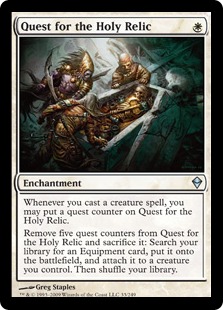
The first archetype we have to look at is White Weenie. While not a previously good archetype, Scars has done much to boost Cedric Phillips’ and Wizened Cenn’s love child back into contention. Chief among these additions is the Quest for the Holy Relic+Argentum Armor combo. Essentially, the deck plays eight 0 mana artifact creatures, along with ways to bounce them, such as Glint Hawk and Kor Skyfisher. With Quest for the Holy Relic, you can easily activate it by turn 3 or 4 at the latest, and sacrifice to tutor and equip an Argentum Armor, attack for an extra 6 damage and Vindicate something, something very reminiscent of a certain Eldrazi Enchantment we’ve seen before. The cards for this deck are the aforementioned Argentum Armor and Stoneforge Mystic.

A slight variation on this is G/W, still playing the Argentum Armor package, but also supporting Vengevine with Fauna Shaman and Squadron Hawk, making for a stronger and more resilient deck, if slightly slower.

Then we have the favorite of the unprepared: the Red decks. But in this format, will Red decks occupy the same stereotypical role? At the moment, there are 3 different kinds of Red that I’m a’lookin at.

The first is the typical and well-loved RDW. Nothing complicated, just a bunch of dudes and burn. While most of the Ball Lightning type creatures are rotating out, this simply means the deck must transform to a different type of aggressive deck, focusing more either on creatures that stick around (Kiln Fiend, Kargan Dragonlord, etc.) or burn spells (Staggershock, Galvanic Blast, etc.) personally, the creature plan seems better to me because of its increased consistency, but it remains to be seen what will be more successful.

Next up we have Goblins. At the moment, I would highly recommend GerryT’s build of this deck to those wanting to experiment with it. It is essentially Mono-red, splashing Blue for Trinket Mage. You play 4 Memnites, and 4-6 other atifacts that cost 1 or less, to combo with Kuldotha Rebirth. Pumping out 3 goblins on turn 1 and then following that up with a kicked Goblin Bushwhacker for 8 damage is a very good start, and not an uncommon one for this deck. Throw in some Goblin Chieftains, and Goblin Guides for when you don’t have the Rebirth to start, and you have one of the fastest goldfishes in the format. Unfortunately, the deck is a little inconsistent, but if you’re willing to place your fate in the shuffler’s hands, then this is the deck for you. Look to pick Brittle Effigys.

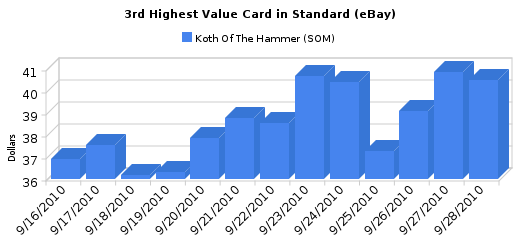
Finally, we have Big Red, or Red Control. This deck is probably the best use of a card that goes into all of these decks, Koth of the Hammer. In the more aggressive Red strategies, Koth’s second ability is usually irrelevant, but in big Red, you can use Koth to power out a turn 4 Destructive Force, Inferno Titan, or Wurmcoil Engine. While I think the right list is still undiscovered, keep an eye on this archetype, and Koth, as States approaches.

The final deck for today is U/W Control.

Playing goblins at FNM this last week, I tested beforehand against a friend with U/W Control. He demolished me. I think I won maybe 20% of game 1s, and those involved multiple Kuldotha Rebirths and Goblin Bushwhackers in my first 3 turns. U/W Control is a great choice for States, because it has good matchups against the Red aggro decks, which will be great in a field full of, what else, aggro. 2 cards in UW that have a high potential to go up are Ratchet Bomb and Wurmcoil Engine. The Ratchet Bomb gives UW 2 more mass removal spells that can also deal with random equipment or enchantments sitting on the battlefield. While right now at $10, I could see the bomb going up $15 if it continues to see play in UW and Ramp decks. Wurmcoil Engine, on the other hand, is being criminally underrated. This guy is the 6th Titan! To be honest, he’s probably better than Frost Titan. There’s no reason this guy should be worth anything under $15. While the Prerelease copies increased the supply enough to depress the price, that hasn’t held back cards like Figure of Destiny overly much. Some of you may be wondering why I’m not talking about Elspeth Tirel here. Basically, I believe that Elspeth is absolutely amazing in UW, and should be at least a 3-of. However, she is way overvalued at her current $45 price tag. She is worse than her previous incarnation, and that did not have the same price that the new one has. Sell as many as you can at $45 or $50 before they come down to a more reasonable price.

That’ll be all the decks I cover for today. While Ramp variations are also popular, they don’t use much from Scars other than Ratchet Bomb, and I cant cover EVERY deck here.

Just some quick things before I sign off. First, I happily picked up my first box of Scars on Friday, and proceeded to open up one of the most ridiculous boxes I’ve ever seen. I opened 3 Mythics, and they were Elspeth, Koth, and Mox Opal. These, along side Ratchet Bomb (more on this one later), and 3 Scars duals, brought me a nice 50% profit on the box. While my 2nd has not been as promising (18 packs in and I’ve gotten a foil Precursor Golem, with Platinum Emperion and Skithiryx, the Unspellable as my Mythics, I could always just pull some more cash out of what’s left.

And now, the moment you've all been waiting for
.

Pack to Poooooooooweeeeer (dum de de dum dum dum duuuuuuum)

My first question before starting the Pack to Power, was what set should I use. Scars was obviously the newest set, but the variance in the value of the packs was so high that I could be left out in the rain. “Heck”, I thought, “if Jon Medina can do it with a Bear Umbra, I can do it with a Scars dual.

The contents of my 1 Scars of Mirrodin pack:

1 Galvanic Blast

1 Chrome Steed

1 Tel-Jilad Defiance

1 Golem Foundry

1 Golden Urn

1 Oxidda Daredevil

1 Gold Myr

1 Plated Seastrider

1 Iron Myr

1 Carrion Call

1 Trigon of Rage

1 Lifesmith

1 FOIL Darkslick Drake

and


1 Ratchet Bomb

Not bad, but obviously I opened a Koth in my next pack. Such is life.

Wish me luck,

--Noah Whinston

Dream Cache – Speculation Risk Thresholds and Portfolio Theory

Are you a Quiet Speculation member?

If not, now is a perfect time to join up! Our powerful tools, breaking-news analysis, and exclusive Discord channel will make sure you stay up to date and ahead of the curve.

The iron law of investment is that the greatest rewards come from taking the greatest risks.

The science behind this is that if something is low-risk, more people will want it; they are unlikely to lose their money, and they stand to gain a little bit in the process. When you talk about loaning $10,000 to your cousin who says he can make auto engines run on water, though, people aren't exactly lining up at the door to throw money at his invention. If it works (big if there), then you change the way humanity approaches energy. If it fails, you're out $10k.

Knowing this, you can create your spectrum of risk that shows how interested you are in giving that pile of Franklins to your cousin instead of investing in toothpaste manufacturers. Much like stocks, there are Magic cards that are low-risk and high-risk, and luckily, our risks are much lower because, apart from bannings, our market does not crater card prices all that often.

The "Blue Chip" Stocks of Magic
The phrase "blue chip stock" traces back to the 1920s, when a stock trader noticed several stocks coming over the ticker that fetched prices of $200 or more. Thinking of these as the high-value chips in poker, he referred to them as "blue chip stocks" to his superior, and a robust market term was coined. Though the phrase originally meant high-dollar stocks, it now has come to mean high-quality stocks. These are the gainers, the market titans that make you more money year after year and, based on their size and bankroll, are less subject to negative fluctuations than other stocks are.

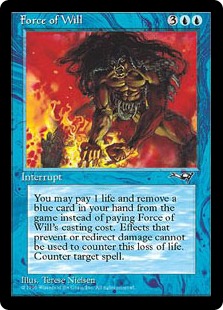
Pitch a Blue card, pay one life, counter your spell?

We have blue chip cards in Magic, too. The best example is dual lands, and the next is Force of Will. These two jockey next to each other because they have a huge appeal and they will never be reprinted. If you pull up the data, you will see that duals and Force of Will have both consistently gained over the past year, especially with the reprinting loophole closed that extinguished hope for more of these cards hitting the market. If I had to name a third, Wasteland is probably it. It's a card that always gets play as a 4-of and sees use in both Eternal formats. Wasteland has gained at least $10 over the last year and it will not drop below that, barring reprinting in significant quantities.

You can make blue chips work for your portfolio because they will retain a lot of value for the collection. Even if you chose some clunkers to speculate on, the slow gains of your dual lands, Force of Wills and Wastelands will iron out those errors eventually. We'll talk more about portfolio assembly later in the article.

Some iconic, role-playing cards demonstrate few gains. Demonic Tutor costs about the same for a Revised copy as it did when I was saving up my allowance money for one. Sol Ring, despite being the iconic card of EDH, is still very reasonably priced. When you are looking for blue chip cards, think of ones that you need four copies of to work well. If that card performs in both Eternal formats, all the better! The second-tier blue chip level definitely includes blue fetchlands, for example. The Holy Grail would be a card that was both played in Eternal and Extended, but with Extended getting chopped down, I doubt we'll see something that fits that role; one requirement of the blue chip cards is that they are sufficiently out of print to be valuable without the threat of new printings.

The Junk Bonds

On the other end of the spectrum, we have the penny stocks and junk bonds. In the financial world, these represent companies so saddled with debt that it is unlikely that they will ever pay you off on your investment. However, if they do develop, they promise great returns. Many pharmaceutical companies, small-time ones founded by a chemist and her partner and relying on a single patent, operate this way. They may never get FDA approval for their patent, but if they do, man oh man do you have a payday if you hold their stock! These assets tend to be inexpensive to buy, as well.

Look at that smile. He knew all along.

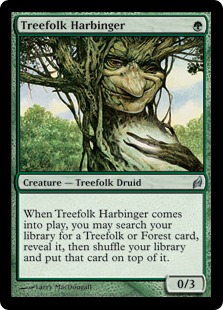
In Magic, any card that does not see play, but could potentially really take off, could be considered a junk bond card. Think about old, rare cards that do not command much of a premium. Grove of the Burnwillows is the A+ amazing example of this. You had a card that was worth fifty cents jump up to five dollars in the span of a weekend! The downside, though, is how many junkers do you have to have before you have a Grove scenario? When you are considering collecting, I definitely think it's worthwhile to pick up some of these cards that have potential, especially since you can find them in Constructed formats all over. They are some of the hardest-to-call cards there are; if you didn't get the line on Doran at Amsterdam, you didn't know that Treefolk Harbingers would reach four euro at the event site!

The Big  Investment, Big Gain Cards

There is a third category of cards that comprises those cards that are worth a few dollars now, but can pick up a lot of steam if they get popular. Think of Knight of the Reliquary and Stoneforge Mystic, for example. They went from three dollars to over eight in short spans, due to being very popular at the time. Another example - Grim Monolith. It's gone from $4 to over $25 (though few people are jumping at that price), and Power Artifact has flirted with $40, from $11 before.

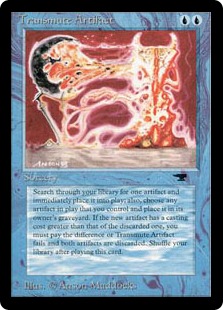
These are all great to talk about in hindsight, but that does no good for our future. The big problem with buying up these cards is that they tie up a lot of your money in cards that may never take off. For example, I am keeping an eye on Transmute Artifact, but I've been doing that for five years now and there has never been a great time to jump on it. I don't know if there ever will be, for that matter. But, if Transmute Artifact takes off, you could see it pushing $50! That's a big "if," and I don't think many of our readers can stand to put much of their bankroll into these cards unless they have a good hunch.

That said, these cards consistently give you the greatest return on your investment. You need to put some money behind it, so as Biggie Smalls says, this is strictly for live men, not for freshmen. If your cards are not improving by an amount you are happy with in the timeframe you want them to, fire them and buy more instead. There's no use clinging to some cards for hope when you could turn that stack of cash into something else that might actually move!

Hey, it could happen.

Blending Cards Into Portfolio Theory

An interesting quirk about investment portfolios, or card collections, is that you can reduce the risk on your portfolio by diversifying it. For example, if Fur Coats Unlimited does great in boom times but plummets during recessions, I might want to balance it with stocks in Colbert Bootstraps Inc., which does the opposite. If they are perfectly correlated, I will get the same return no matter what the market is doing. The more stocks you add, the lower your risk becomes in proportion to the same amount of return. The optimal number usually works out to about thirty stocks before you plateau on the advantages of diversification in the stock market.

It's mathematically simple to set up portfolios on the stock market and people spend their entire lives guessing the risk of a stock and then trying to balance it out. There are efficient frontiers on curves and calculus to wrangle with, but for now, just know that you can stand to do better with your collection if you snag some blue chips, some junk bonds and some big gainers. It's up to you to set the proportions on this, but I personally wouldn't put more than 10% of my bankroll into highly volatile picks. You can balance out that 10% loss, if it happens, with your blue chip gainers.

You can fold this theory into your trading as well, and you probably already do it to an extent. People value their Wastelands and Aether Vials more than they value the same amount of money represented in bulk rares, because those cards have a steady value and good liquidity. People undervalue bulk because they don't realize that some cards can really take off. To that end, try for the bulk trash throw-in every time. Making a diversified collection means your bankroll gets a higher reward for less risk, and it is really the only way that we can try to buck that iron law of investment that we read at the beginning.

Happy returns!

-Doug Linn

twitter.com/legacysallure

#followfriday: Read Into It

Are you a Quiet Speculation member?

If not, now is a perfect time to join up! Our powerful tools, breaking-news analysis, and exclusive Discord channel will make sure you stay up to date and ahead of the curve.

Quiet Speculation Submission  (Matthew Sedlak)

I was excited when I first discovered Quiet Speculation. A website devoted just to trading strategies was very exciting and a nice change of pace from the usual articles on the deck of the week, M11 limited, etc. Of course, I wasn't the only person reading all these new articles devoted to trading. Fortunately I was able to observe something about a lot of these traders. While it was obvious that they had read the same articles I had it was also just as obvious that they didn't read anything into those articles. In a way they were 'netdecking' their trade strategies.

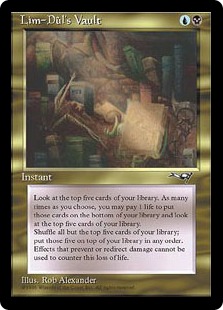
As most of you can probably recall, Mind Over Matter and Lim-Dul's Vault were two suggested cards to pick up. The main problem that I had with these two cards is that there aren't very many local Legacy events that the people I trade with attend and I wasn't planning on going to any big events in the near future. At the same time I really wasn't convinced that Mind Over Matter was going to make much noise so for me they were pretty much trade fodder for EDH players. However now I had a situation where people were looking for Mind Over Matter in an area without a lot of legacy players, meaning supply was low, so I was able to trade them away to the speculators for a decent gain.

The situation with Lim-Dul's Vault was slightly different. The price on those had already risen from about $1 to the $3-4 range on eBay by the time the article was published and some were trading for upwards of $7. The decision I had to make on those cards was whether or not they were going to continue to go up in price and if so by how much. They definitely have a strong effect but they are harder to cast than Mystical Tutor. On the other hand they are also rarer since they have only seen one printing. My guess was that it had already peaked or at the very least were close to peaking. I was able to pick these up at about $3-4 and trade them to the speculators for about $7. The nice thing about those trades is that I was able to trade casual and bulk cards for them then turn around and flip them for standard playables and staples.

The most recent card that I've noticed caught people's attention was Armament Master, almost definitely inspired by David Heilker's article. The spoiling of Sword of Body and Mind and the expectation that we will get a ton of good equipment in Scars block has caused everyone to think about which artifact-themed cards will get better post-rotation. Armament Master has already seen some play in block constructed in Kor decks but from my, admittedly limited, testing with that deck the Armament Masters generally were unimpressive. Now to be fair, David admitted that they were speculative and the fact they are so cheap now is what makes them a low-risk investment. I generally don't like to invest in things I don't know are going to succeed but fortunately this new rush of speculation gives me an easy outlet for those cards. I'm getting them now at about $0.5 and trading them away for anywhere between $1-2. While there is the chance that these will go up, I'm not worried about that since I am already at least doubling my value on each of these already. On the other hand, if they never see play then I'll be forced to bulk them to a dealer.

So what cards do I think may gain value with Scars? In that mono-white Kor deck I tested the real surprise was Kor Duelist. That combined with an Adventuring Gear and a fetchland, or even just a basic land drop, lead to some very explosive turns. A Sword of Body and Mind on a Kor Duelist could be disgusting. The protection from blue and green could be very relevant as those seem to be the most powerful colors coming out of Zendikar block. While only an uncommon it could still end up hitting $2. It was also given out as a Gateway promo so you might want to pick some of those up now if you can get them as throw-ins.

There are some obvious cards to pick up right now. Steel Overseer and Stoneforge Mystic are probably the best things to pick up now and Stoneforge Mystic is about at the lowest price it has been since Pro Tour San Diego. Lodestone Golem is also another cheap pickup and since it seems some Eternal play it should at least hold its value. People have already begun to play around with mono-artifact decks at the FNM level and these are quite good in that deck. One card that people have told me they are speculating on is Thada Adel, Acquisitor. I happen to collect that card so often when I'm looking to get it as a throw-in people will tell me they are speculating on it. I don't think it has much potential although I'd be extremely happy if it did since I have close to one hundred of them already. A legendary 2/2 for 3 is pretty unexciting. Islandwalk makes it slightly more appealing but I just don't feel that this card will do enough. Thada Adel seems like it would be at its best in a U/x mirror match as a way to generate some card advantage and proactively remove threats from their library and turn those against them. I think the best strategy for this card is to wait until spoiler season starts and hopefully a few powerful artifacts are revealed early on so you can generate some hype about how powerful Thada Adel's ability would be and how great it would be to steal that from your opponent. My guess is that you could talk it up to $2-3 if the spoilers work out in your favor. With Alara block rotating out soon the prices on those cards are set to drop. While many of us see this as a bad thing there are quite a few players that look forward to the price drops so they can pick up cards for their casual decks. Take a card like Broodmate Dragon for example. While it isn't an expensive card to begin with, and while it has lost some value because it has been cut from many Jund lists it still has one thing going for it. It is a dragon. Casual players love tribes and dragons are certainly one of the most popular. If you have a store that has an open play day stop by and throw some in your binder. I can't count the number of times I've asked a casual player if they had trade stuff and been asked, "Do you have any <insert tribe>?" Go through any sets that are about to rotate out and look at cards that would fit well in casual decks but may have been priced too high for those players to acquire them. Even if all you can get for these are some playable uncommons you will still probably make out better than if you held onto them.

Another place you can take advantage of this kind of trading is online. So far the only site I have traded on has been mtgsalvation and I can tell you now that it is hard to get value out of your cards online. Everyone has instant access to all the pricing information they could want. The good news is that you can still easily trade up if you know what you are doing. Unless you live in a huge magic community you may have a hard time finding people who want your Dark Tutelage, Summoning Trap or foil Sphinx-Bone Wand. The internet is a great place to dump those cards. I was initially surprised at just how many bulk cards could be traded but it really is all about finding the right person. I don't really know anyone locally who goes crazy for foils or promos. I've met a few people trading online that really go nuts for these. I can generally get these for cheap in person then come home and offer them up for a substantial gain.

Before I finish I want to talk about two strategies I use. One has to deal with trading and the other with acquiring cards. First, when haggling over values I see a lot of people play the "let's meet in the middle" game. If a card is valued around $1-2 this is how it will go. You will ask, "How much do you value this at?" If it is a card they want they may say "A dollar?" to which you respond, "How about two?" and finally they say "$1.50?." Now they feel subconsciously as though they talked you down and they might not want to give up that ground later on. If you respond to their "A dollar?" by saying, "How about 1.50?" it is pretty rare that they will try to haggle you down to one and a quarter. I'm not really sure what the reason is for this but I see it happen all the time. Now later on if you are looking to get something thrown in you can mention that the haggled-over card "does go for $2" on whatever website you can quote from and in that way get more value out of something. I wouldn't use this often but sometimes it can go a little way to making a trade look a lot nicer for you.

The second strategy I use is one way I build up my collection. While I love to trade I also have this obsessive need to get four of every card no matter what it is. I don't always want to spend a ton of time trading for cards I can easily crack from packs; I prefer to trade for older cards that I need and that are harder to find. However we know that unless you open a ridiculous number of boxes it will be hard to get good value from it. Here is one strategy I use from time to time to help lower my cost. Generally I like to open a case of a new set for myself. That will generally give me most of everything that I need and I can pick up the few remaining cards from drafts or trading. I'm fortunate to be a grad student right now so I spend a lot of time on a college campus with a good number of magic players. What I do is this: I purchase two cases, open one for myself and use the other to sell for drafts or as single packs. I can sell the draft sets at a pretty good discount but still make enough to cover the box and give me a little extra. When all is said and done I'll usually end up with a playset of an entire set for about $250. If you are a player and a collector this is a great way to get everything quick and fairly cheap.

Finally I would like to recommend some reading for anyone who wants to be able to get better at trading. Dale Carnegie wrote a famous book entitled, "How to Win Friends and Influence People" that I think should be required reading for pretty much anyone who ever wants to interact with someone else. I hope you enjoyed reading this and you got some new ideas on how to approach trading.

The Nutt Draw: The Demand Matrix

Are you a Quiet Speculation member?

If not, now is a perfect time to join up! Our powerful tools, breaking-news analysis, and exclusive Discord channel will make sure you stay up to date and ahead of the curve.

It’s that time again for another update to the Demand Matrix. What is the Demand Matrix you ask? Simply put it’s a way to mathematically define the relative popularity of the cards we know and love. I have however written a primer for reference purposes so if you’d like to know more, cast your doe eyes yonder. Primers and Glossary

This time around I’ve actually gone to quite a bit of behind the scenes work in order to recreate all the spreadsheets from the ground up. I’ve finished off the Demand Matrix calculations just in time for this week’s article and (as you might notice from some of the sheets below) I am still working on the primary outputs for both the Set EV and Buy Lists. I hope to have around 15 Buy Lists aggregated into the end results and of course there are some other ideas kicking around the lab. I have also added the relevant results from my Scars of Mirrodin prerelease research to give us a few days jump on the set before it enters Standard.

[iframe https://spreadsheets.google.com/pub?key=0AukC5EWiTvOpdEFHeTFFNEN5OGpfcC1pNk5abFYzckE&hl=en&single=true&gid=1&output=html&widget=false 100% 635px]

There is a lot to scroll through on this one. Jace, the Mind Sculptor is still on top, but the last weeks prerelease prices on eBay have shoved Primeval Titan down to 5th from its customary place of 2nd. This gap is filled with the likes of the Mox Opal, Koth, of the Hammer, and Venser, the Sojourner. Though three of the top four spots going to Planeswalkers is hardly surprising, I would say that they probably won’t all be there or in this order in a couple week. Scars of Mirrodin is trending very high right now in overall value and it can’t keep it up due to some of the more basic tenants of supply and demand. As you can see if you scroll far enough, along with what you have already come to know (and love) in the Demand Matrix covering Standard I’ve gone ahead and added in a Matrix for both the Extended format and for the combined Legacy and Vintage formats (renamed “Eternal” based on comment feedback). Immediately following the writing of that last sentence I became curious and created a list of all the Magic card as well to show how the cards in every format compare against each other. That list is embedded a little lower on the page but before we get to that I’d like to draw your attention to the extended list. Baneslayer Angel tops it out (the M10 version) and although I could spend some time to filter cards printed in Standard out, I decided to leave them in. The M10 version has been trending below that of the M11 version for months now anyway, and it is a valid card for Extended. You might also have noticed that I rotated the sets a few days ahead of their actual rotation. With Elspeth, Knight-Errant taking the number two slot, Noble Hierarch in third, and on down to the M10 version of Garruk Wildspeaker in 10th, there are only two cards in the top ten of the Extended list that are of older cardboard. Mutavault and Damnation appear to be the most in demand cards in Extended that don’t rotate on October 1st. I don’t have a historical chart to display this information but I can tell you that from the data I had saved a month ago, the Mutavault is up in demand, and Maelstrom Pulse along with Vampire Nocturnus has fallen a few places. Due to the large amount of cards nearly exclusively included in the Eternal formats I’ve expanded the list to the top 200 from the 100 which was already expanded on the other lists. Only the recently purchased Black Lotus cards from Beta and Unlimited beat out Underground Sea, Force of Will and Mishras Workshop which then beat out the rest of the Power 9 in demand which, all-in-all, isn’t very surprising. Time will tell but I think that the movement of the top 30-50 cards on the Eternal list are going to be the most interesting to watch.

Below is the list of all the Magic cards I mentioned above.

[iframe https://spreadsheets.google.com/pub?key=0AukC5EWiTvOpdEFHeTFFNEN5OGpfcC1pNk5abFYzckE&hl=en&single=true&gid=5&output=html&widget=false 100% 635px]

As in articles past I’ve also assembled a list that displays the largest in Demand Index changes from the monthly averages compared to the weekly. I’ve worked out a new way to record the historical data so over time this will become more accurate and interesting.

[iframe https://spreadsheets.google.com/pub?key=0AukC5EWiTvOpdEFHeTFFNEN5OGpfcC1pNk5abFYzckE&hl=en&single=true&gid=2&output=html&widget=false 100% 635px]

For technical reasons this list doesn’t include Scars of Mirrodin cards but it will once they are in the main data stream. Vengevine and Gideon Jura fell a bit in the last week which was balanced out by Primeval Titan and Grave Titan both gaining in popularity. For the most part the cards seem to be pretty stable as we move into the Limited season with few outlets for tier one deck lists.

For the last list this week we have the application of the Demand Index values to the Buy Lists. I’ve sorted the list according to those cards which are of the least interest to consumers but still being bought up by online stores. We could all make some cash by delving into the dust covered storage boxes that our significant others complain about.

[iframe https://spreadsheets.google.com/pub?key=0AukC5EWiTvOpdEFHeTFFNEN5OGpfcC1pNk5abFYzckE&hl=en&single=true&gid=3&output=html&widget=false 100% 635px]

There is a lot of potential scrolling on this one. Over the next few weeks I’ll be filling it out with more and more buy lists, but I wanted to have the template and structure in place. As indicated by the titles above empty columns, I’m going to have Starcity Games and Strike Zone on soon. Starcity’s list is still offline right now, but I have Strike Zones downloaded. I have some more tweaking to get the data formatted into the main spread sheets but its coming.

If you have any ideas for how I might associate or use the information I’ve collected but that I haven’t thought of or perhaps presented poorly, let me know. I want to make this all as relevant as possible, and that is going to take a discussion to create, not just an idea.

I’ll leave you with a fancy little motion chart I’ve been playing with. It’s more amusing then useful, but I can see some potential for illustration of concepts within it. It should work with any browser, but some security settings may prevent its display.

[iframe https://spreadsheets.google.com/pub?key=0AukC5EWiTvOpdHdoLThnRWcwWnZVdlQtZjhhZkEzWGc&hl=en&single=true&gid=14&range=E1%3AG3&output=html&widget=false 100% 500px]

Chris McNutt
Magic Analyst
Level 1 Judge
@fatecreatr on twitter

The Revenue Review – Overcoming Obstacles

Are you a Quiet Speculation member?

If not, now is a perfect time to join up! Our powerful tools, breaking-news analysis, and exclusive Discord channel will make sure you stay up to date and ahead of the curve.

Last week I had one of those weeks where you look back and wonder how you survived it. But they say what doesn’t kill you makes you stronger, and I find it to be true in both life and Magic. Learning to overcome obstacles in critical in your quest to be the best trader you can.

Oh yeah, I’m also offering you what could be the best six seconds of your life in this column.

Turning negatives into positives

Everyone has encountered setbacks, whether that’s in your schooling, dating lives or Magic careers. I’ve gone through some rough times in my playing and trading endeavors, and with hindsight, I’ve tried to learn from them.

For instance, after getting a flat tire the morning of Grand Prix Houston and playing myself out of Day 2, and subsequently trying to find a place to repair tires on Easter, I was pretty upset. It was difficult to do at the time, but looking back I can see what lessons I learned from the experience.

First, don’t leave for 8-hour trips at midnight with the idea that you’ll just sleep in the car. Secondly, I should stop myself when I see mistakes beginning to snowball. I knew I was on tilt after a particular misplay, but I berated myself in between rounds and subsequently mis-boarded a card, leading to a game loss in the last round of the day that led to my elimination from Day 2. Focusing my energy to check and shuffle my deck would have been much more productive than bashing myself.

So how can I apply these principles to my trading? The “not-going-on-tilt” lesson actually applies quite a bit to the trading game. Just a few weeks ago I made a trade where I incorrectly told a trader his card was worth much less than it actually was. While the trade turned out great for me, I felt bad because I misrepresented a card’s price, which is against my personal ethics.

I let that trade affect my next one. I preceded to trade away a number of Sunken Ruins at much lower than their actual value. I knew the card’s price, but my mind was still on the last trade.

I don’t think I’m the only one who’s had this experience. Maybe you traded away Jace, the Mind Sculptor at $25. Perhaps you bought Sarkhan Vols at $20. You thought Mind Over Matter was going to hit it big and then it flamed out. We all make mistakes. The important thing is to clear your mind before moving on to the next trade. Take a smoke break, go grab a bite to eat, play a game of EDH. It’s better to sit out a trade than go into it without having your mind right.

You knew better than to buy in the hype... right?

Applying the principle

Last week I got the chance to put a number of these lessons to work, which culminated in me salvaging a weekend of trading that could have otherwise been lost. If you want to skip the (potentially) funny story you can skip down to the trades. Let’s start at the beginning.

I spent a small fortune to replace the transmission in my car just a few months ago. The transmission went out again on Sept. 18, leading to a $75 tow bill to the transmission shop.

Fast forward to last Thursday. It’s been a busy week at work, and my editor (I work at a college newspaper) challenges me to a foot race outside the building to blow off some steam. I win the first race and she (yes, she, I know agreeing to race a girl was my first error) demands a rematch and to switch “lanes” with me. I agree to her terms (my second mistake). In front of me there are a few obstacles – a tree on my left, some light poles on my right, and a grate somewhere in the middle. I line up to the right of the tree so I won’t have to duck under it. This was my third and ultimately fatal mistake, because the grass was significantly longer (and more slippery) there.

My trifecta of mistakes leads to this. I’ve been told it will be the best six seconds of your day. Viewer discretion advised.

Using the life lessons I’ve learned from Magic (never let your girlfriend tell you the game is a waste of time), I’ve decided to turn this experience into a positive. Sure, I ended up with a dozen stitches, a puncture down to the bone, a weekend on crutches, and a potentially scary emergency room bill, but I’m angling for a Tosh.0 Web Redemption! Seriously, show the video to your friends, I’m going viral.

Friday, the day before I’m scheduled to attend the Scars of Mirrodin prerelease, the mechanic calls me and tells me they can’t find anything wrong with my car. So after driving an hour to pick it up on a Friday afternoon and then attempting to drive my car with my busted-up right leg, it only makes sense it would break down again five miles down the road. To make matters worse, I had to have my mother (thank God for parents who are willing to help out their twenty-something children) drive me to a local football game that I’m covering as part of a freelance gig for another newspaper. Going up and down bleachers is not fun with a wounded knee, a laptop bag and crutches made for someone five inches shorter than you.

If you’ve stuck with me up until this point, I hope it’s been an entertaining read. We’re now venturing back into the realm of Magic.

The worse part of the entire debacle is that my trade binder has been left in my broken-down car in the confusion. This means when I finally make it to the prerelease on Saturday I’m without a single card to trade. Quite the conundrum for someone who trades more often than Craig Wescoe performs #Wescoechecks.

At this point, I had to laugh at my own luck. Sitting there Saturday morning, barely able to get out of bed, my inner optimism (or maybe the painkillers) led me to make a resolution – I was going to make something positive out of the weekend.

Putting the plan into motion

I write all the time about trading up, so now was my chance to prove myself. I pulled some decent rares on Saturday, but I knew beforehand I was going to have to leave the tournament early due to a prior obligation, so I was really just increasing my stock for the Sunday prerelease I planned on attending. So I opened my packs, built my deck, scrubbed out of the tournament at 3-0, and got ready for Sunday.

I had another decent pull on Sunday, finished the tournament 4-1, good enough for second place and $32 store credit (net $7 after the entry fee), then I went to work on some trades based on what I had.

His:

Myr Reservoir ($2)

Mine:

Vensers Journal ($1)

Net: $1

Obviously nothing huge here, but the Journal worked well for a deck of his, and I convinced him it was a Myr Reservoir (see what I did there? Okay, no more puns).

His:

Sun Titan ($9)

Mine:

2x Myr Reservoir ($2)

Nim Deathmantle ($1)

Quicksilver Gargantuan ($2)

Total: $7

Net: $2

I tried to capitalize on some of the newness of the cards here. I didn’t trade away anything here I’ll have a hard time picking up again if I need it, but picking up the Sun Titan is something I’m comfortable with since it’s a heavy player in U/W control, which I still think is going to be the premiere deck heading into next season.

His:

Argentum Armor ($2)

Mine:

Dissipation Field ($1)

Net: $1

I’m trading one EDH-type card for another here, but the Armor is a bit more flashy. I might bank this one for my personal decks if I get around to building the Kor casual deck. Alternatively, I’m sure I can trade this thing off rather easily.

What makes for good trade fodder? The word "infect"

His:

Chimeric Mass ($2)

Putrefax ($2.50)

Total: $4.50

Mine:

True Conviction ($1.50)

Trinket Mage  ($.50)

Total: $2

Net: $2.50

Typical EDH player here, looking for cards to round out decks and happy to trade away stuff not slotting into his deck. I think the Mass is a great card that will find its way into a few decks, especially once more of the block is released. It fills any spot on your curve, and plays nicely with most of the set’s mechanics. Putrefax says “infect” on it, so it will move quickly.

The store closed before I could really accomplish much more, but I was still reasonably happy with the fact that I was able to even accomplish what I did. I missed out on a ton of potential trades by not having my collection with me, but after the preceding week, it was an accomplishment to just be on the floor trading rather than laying in bed watching reruns of Jersey Shore.

I know this week was more story than it was trade analysis, but I thought it was entertaining enough to relay. I’ll be back next week with more trades and another Reader Trade of the Week! I’m really enjoying the discussion the last one prompted in the comments, and I appreciate everyone’s views on the matter.

Thanks,

Corbin Hosler

@Chosler88 on Twitter

Two’fer Tuesday: Value vs Price

Are you a Quiet Speculation member?

If not, now is a perfect time to join up! Our powerful tools, breaking-news analysis, and exclusive Discord channel will make sure you stay up to date and ahead of the curve.

Greetings! My name is Jeff Corder and this is my first Magic related article.

Value is a very broad topic. My intention here isn’t to cover everything (which would be impossible, even for me!) but rather to cover some of the personal situations that I feel are worthy of your attention and consideration.

What is value? How should a person go about valuing an object? Is that different than when valuing a Magic card?

The value of any object is relative and subjective. A seasoned economist can likely talk at length about how the price of iron in South America is fluctuating and why that affects everything you buy. Those examples are not what I would consider beneficial for us: people who play, and trade, Magic cards.

Milk, on the other hand is a great example for us to examine fluctuating values. (I’ll come back to Magic in a second. Stay with me!) So, let’s talk about milk. Milk is an item in constant demand, as it is a consumable item with a limited shelf life (and totally delicious!).

In fact, yesterday I realized I didn't have any milk in my refrigerator. I had a coupon for milk that gave me a $.35 discount. When I got to the store I found that the milk I wanted was on sale.

Normally the milk I buy is $3.80 for one gallon. Yesterday it was on sale for $3.34. With my coupon the price I paid was $2.99, plus tax.

What is the value of this milk?

Clearly I'm willing to pay $3.80, as that's normally how much I buy milk at. But is that the value of the milk?

The store is willing to sell me the milk at $.35 less than the normal price in exchange for a coupon. So is the value of the milk $3.45?

Then they reduce the price by an additional $.45.

Got Milk?

Does that mean the value of the milk is only $2.99? If so, why would I ever buy milk at a higher price? Clearly, if milk is only worth $2.99 then I should never have to buy it at a higher price. That should be the price I always pay for it.

That isn’t the case, though. Value and price are separate things. Even if the price of milk stays consistent, my value of milk changes all the time. Maybe I really want some chocolate milk, or perhaps I want to use the milk to cook something, so my value goes up. Or maybe I have two full gallons of milk at home and the value of more milk is close to zero.

That’s also a good clue to help us realize that just because sometimes I can get milk for 2.99 doesn’t lower the value of the milk. The value I give to the milk didn’t change yesterday as I bought milk, only the price I paid changed.

Value is always relative.

We can also see these forces of fluctuating value at work when we look at prices of Magic cards.

We have access to websites like Star City Games and Channel Fireball who sell massive amounts of cards to end users.

These stores set prices based on speculation and knowledge of the current formats and pure guesses at what other people value cards at.

Just because some website says a card is worth $20 today, that doesn't mean that the value of the card for all people is $20. If Star City Games or Channel Fireball decides they aren't selling enough of that card they will decrease the price until it matches the value given to it by end users. That $20 card could drop to $10 the next day, then $5 the day after that.

Is the card really worth only one fourth what it was two days ago?

No!

The value of the card didn’t change for the majority of customers. Star City simply lowered the price until they found a sell price. This illustrates a very useful point:

Card sellers are not value setters.

Let me say that again.

Card sellers are not value setters.

You, as an individual, are a value setter for any cards that you may be interested in.

Don’t get me wrong. Knowing what the big online card sellers value cards at is very good information to have, as it helps you value cards you don’t have any experience with. Just don’t let it run your trades for you!

The main problem with any one person assigning value to an object is that value is subjective. Hunches, emotional attachment, top 8 deck lists, pro level player recommendation, usefulness in your local metagame, the list goes on. All of these factors play a role in determining the value of a card for a single person.

Take the following situation:

My friend Wes was trading with one of the kids (we’ll call him Jim) at our local store. Jim is about 15 years old and has been playing at the store for several months at this point.

Wes found a foil Vengevine in the kid’s binder and asked if it was for trade.

Jim said yes so Wes pulled it out and asked Jim to find some stuff to trade for it.

Jim pulled out a promo Emrakul, the Aeons Torn and asked “Is this OK?”

I remember Wes looking at Jim for a moment, and saying “Sure.” Jim closed the binder, thinking the deal was done.

Let’s pause here for a moment. Wes could have completed the trade and both parties would have been perfectly happy.

Why?

From Jim’s perspective he got this big flashy card that if he casts it he’s almost sure to win the game. Vengevine doesn’t do that. For Jim, Vengevine isn’t useful.

Instead, Wes says, “You can have more than just that, man. The Vengevine is worth like 70 bucks.”

Jim agreed to take some more and went back to Wes’s binder looking for other cards.

Jim felt bad for taking more cards, though. Even after Wes explained that a foil Vengevine was worth more than $70 online the kid was still hesitant to take more because he felt guilty. Jim felt he had already received equal value with the Emrakul, why would he need more? Eventually Jim said that was enough and he was happy with what Wes had pulled out for him.

Price doesn't always equal value.

When all was said and done the pile that Wes was trading to Jim was worth about $30 on eBay, with the foil Vengevine being worth about $70.

Yet Jim still felt guilty about taking so many cards.

Wes also felt guilty for making so much profit off of Jim. He felt more like he was a dealer during the trade, rather than trading value for value. Jim didn’t see it that way. It may seem strange, but they both felt like they were ripping the other one off.

Why does the general Magic population assume that everyone should always place the same value on a card? Cards are worth different amounts to different people at different times.

I have a friend that loves foil cards. If you were to see him trying to trade it's obvious that, for him, the value of any foil card is greater than the value of any card you might trade him. He'll often make trades that are lopsided just to get the foil card he wants. Trying to get foil cards away from him is even worse. He always expects more value out of a foil card than other people do.

This friend once traded away a normal Elspeth, Knight Errant and $40 for a foil version. He could have waited and bought one online at the time for about $60. When he saw that foil Elspeth, though, his personal value for the card jumped high enough to offer cash and a normal one on the spot.

The zinger is that he was as happy as could be with the new card, and his trading partner, who didn't care about foils, was just as happy.

We have to start educating people about the economics of trading. We can’t stop there, though, we also have to educate about the psychological aspects of trading. We have to make a very conscious effort to help people understand that the value and price of cards fluctuate. Not just from time passing, but also from the person you’re trading with.

Emotions can certainly run high when trading. It’s not all just about the money!

Take me, for example. The very first pack of Magic I ever opened was a 7th Edition booster. The last card in that booster was a foil Birds of Paradise. For those that didn’t play at the time, Birds of Paradise was quite the money card. A foil one could eBay for more than $100.

I put this card in a special case and usually left it at home. This card colored my first several months of playing Magic. Being younger, and stupider, I would sometimes bring it with me to my play group as sort of an ego boost. I’m not proud to say it, but I used that card to gain respect and awe from the other players. One of these other players was trying to collect every version of Birds of Paradise. He wanted my bird. Bad.

For many months I refused to trade with him. Finally, I broke down and let him make me an offer.

He put about $150 in cards on the table before I finally relented and traded the Birds of Paradise.

I traded that card, not because of the trade value, but because my trading partner really wanted the Birds. He continued to push me until I just gave up my hold on it, rather than continuing to feel pressured.

I still regret that trade to this day.

The reason I regret the trade is not because I felt ripped off on a price scale, but because I held a great deal of sentimental value in that card. To me, that card started me on my journey, and I just gave it away. If you had watched Duck Tales you’ll understand when I say it was my “Number One Dime.”

No amount of cards, nor any monetary value, could replace that card for me.

Value is always relative.

Luckily for the savvy trader, there are ways to modify value, too. One, very effective way, is a limited time offer. We see this constantly in marketing. “Limited time only, order now!” This works amazingly well with everything from cars to pizza to Magic cards.

Recently I was at one of my local card shops and noticed that he had three Inferno Titans in the case.

“How much?”

“They’re $5 each, if you buy them now. I was about to raise the price, though.”

Let’s just say he got my $15.

The value of those Inferno Titans went up for me because of the time limit. I only needed one to complete my set. But then the need for these Titans jumped, and thus, so did the value.

Hopfully these examples will give you something to think about the next time you’re cruising the trading tables!

Thanks for reading!

Shark Infested Waters

Are you a Quiet Speculation member?

If not, now is a perfect time to join up! Our powerful tools, breaking-news analysis, and exclusive Discord channel will make sure you stay up to date and ahead of the curve.

By Stu Somers

Recently, a reader wrote in and asked a question to Kelly that involved this sentence: “I am not the best person at ‘trading for profit’ mostly because most of the players in my community are stone cold sharks.”
A fish, which is someone that knows nothing about values and you can easily expect to make value off of them. A shark is someone that will always trade for a profit. They usually know the values of cards and are extremely difficult to trade with, especially if you yourself are trying to trade for profit. You will more times than not just sit there, butting heads with each other and rarely work out a trade.  This will usually occur at larger events: GPs, PTs, Nationals, GenCon, etc. Needless to say, this is a good way to waste valuable trading time and lose value, but you inevitably run into them at one point or another and need to be prepared when you do.

However, as I have gotten more experience at trading, I have changed my strategy when it comes to trading at these events. I have gone from avoiding them all together to having close to a 50-50 split when it comes trading with sharks or fish. In my mind, sharks are just as easy to trade with, and they have the added benefit of gathering up all the cards you want already. They will almost never have cards that you don’t want. I am going to lay out some ground rules and tips and tricks in dealing with Sharks.

Rule #1: Do your research. The best way to be ahead of these sharks is to know more than them. This is the biggest rule when it comes to trading/dealing in general. A couple recent examples I have experienced will help illustrate this.

...what's the catch?

Example 1: A friend of mine recently wanted to start buying and selling cards like myself.  He found a collection to buy and offered $60 for it; there was a foil Daze, Aether Vial and some other random, smaller EDH type cards. He was very excited about it, however he also started listing off more cards he thought were good and I had to keep telling him they have basically no value or worth and he quickly got upset that he was only going to break-even or even lose money on his venture. If he had taken some time and just done some research he could have avoided this situation all together.

Example 2: This occurred at a Mid-west Masters event. I decided to do some light trading and see if I could pick up some random cards. The end of the day was coming around and there was one kid left, we shall call him Trader Joe. Trader Joe had been asking everyone in sight if they wanted to trade and was clearly a shark. He sits down with me and I let him pull out what he wanted and state his values. I proceeded to point to things and ask him what he valued his cards at. Things were going slow till I hit the foil binder. There I was greeted with $20 foil Daze, $15 foil Unmask, and $15 foil Russian Spell Snares. Unfortunately, other than a pair of Daze’s, the foils were pretty beat and nothing moves worse than played foils (he actually seemed confused that I didn’t want the played foils which got pretty annoying, go figure). So I ended up trading some chaff like Painter’s Servants and some lower end rares for highly sought after foils. There is always something these sharks will miss and undervalue and that is where you can pounce.

Rule #2: Let him lead himself into a mistake. I almost always let the other person tell me their values first because it usually makes the trade faster and much easier. I can’t count the number of times someone will be well overvaluing their cards only to hit a string of smaller, EDH-valuable cards and value them at like $1 or $2 when they are actually $4-5 each. It also lets you know what kind of pricing they are using. There are people that will use the dealers on site prices as a baseline or something closer to eBay or MOTL. This will keep you from losing in the trade as well as making it 100x easier to win the trade.

Hopefully your trades aren't this painful.

Rule #3: Be in control of the trade. Now, this might sound like it will contradict the previous rule, but in fact if supplements it. Once values have been assigned and you both know what cards interest you, it is time for you figure out what you are willing to part with and what interests you the most. Now, the sharks will want to not waste their time and not doing a trade after 5-10 minutes of posturing will severely put a damper on his day, so he will more eager to finish the trade, and this gives you a powerful advantage. This advantage is the word “no.” If the shark pulls a card from your want pile that makes the dealing less appealing, just say ‘no’ and threaten to end the deal. More times than not, they will reconsider it and a trade can still be had in your favor.

Rule #4: Number 1 way to come out ahead dealing with sharks is cash money. This is the reason that they are floor dealing: So they can cash out what they have gotten on the floor and claim their profit. Here is a warning though: some locations will not allow cash transactions at their tournaments and have strict policies regarding this, so use caution. I am going to assume you are in a situation where you can use money to close a deal. This will also establish you as someone they should consider coming to see again especially if your buy prices are reasonable and it might even attract other business as word of mouth spreads. I will easily take volume over per-card profit-margin any day, especially if it means repeat customers. This ensures future business and inventory, as well as making sure I always have the cards to provide to my network that I can also profit off of.

Rule #5: If you feel overwhelmed, just avoid the sharks. The best way to avoid getting run over by the sharks in the room is to just not trade with them. They might get upset with you or try to talk you back into the trade, but at the end of the day, if you do not feel comfortable making a trade do not do it. That goes for both with sharks and fish as well.

I am going to end this section of the article with that. It is easier to deal with sharks once you know what you are doing. Like I said, I have been doing it for some time and I am easily profiting. Now I want to do a quick paragraph on the tax implications of dealing cards.

There is a way for you to write-off expenses incurred while making money with Magic. However, there is a very strict way in which it must be done. The activity in question needs to be determined if it is a business or a hobby; in this case you want to be declared a business so as to reap the full benefits and tax breaks. There is a test in the Rules and Regs book that will help determine whether you are a business or not. A short list that pertains to Magic includes, but is not limited to:

  1. Whether the tax payer conducts the activity in a businesslike manner
  2. The expertise of the taxpayer or the taxpayer’s advisors
  3. The time and effort expended by the taxpayer in carrying on the activity
  4. Whether the assets used in the activity are expected to appreciate in value
  5. The taxpayer’s success in carrying on other similar activities.
  6. The taxpayer’s history of income or losses with respect to the activity.
  7. The amount of occasional profits earned, if any.
  8. The taxpayer’s financial status.
  9. Any elements of personal pleasure or recreation the activity might involve.

Now, if the examination of said factors leads to a determination that you conduct yourself like a business, then you can deduct all qualified business expenses from your gross income, even if there is a net loss. If you are determined to be a hobby, you can still deduct under itemized deductions, however you can only do this up to the gross income from the activity and a net loss may not be reported. You should be keeping track of profits dealing anyway, but now take care to track your expenses so you do not fall into any trouble with the IRS.

Store in the Spotlight- Empiregamessonline.net. Quick payments and very reasonably priced on singles
Player in the Spotlight- David Ochoa (that dredgevine deck is amazing)
Card Watch:
Non-green or black titans. By the time things finish, we might be saying these are the better ones in the format. While might dip in real life or plateau, online should see them rise.
Rishadan Port. The rumor of a new extended with Masques and up is gaining speed.

Buying High:
NL Wild-card and AL East Races- Things are getting pretty interesting all around.
Carniege Mellon University- Where I draft, 5pm on Tuesdays. Many WoTC employees are from here!
Pittsburgh Pirates Draft- One of the best overall in a long time by anyone.
Clique Vodka- Man, this stuff is everywhere and tastes great, could be the next big thing.

Selling Low:
Brett Favre- Just doesn’t seem to have it this preseason so far.
Soda Pop- Way too many calories, drink water.
Overcharging on From the Vault: Relics- Come on people, reward your customers for still coming to your store.
Yellow Light of Death- My PS3 died, $150 to get it @#*$@#$ fixed 

Want Prices?

Browse thousands of prices with the first and most comprehensive MTG Finance tool around.


Trader Tools lists both buylist and retail prices for every MTG card, going back a decade.

Quiet Speculation