
Are you a Quiet Speculation member?
If not, now is a perfect time to join up! Our powerful tools, breaking-news analysis, and exclusive Discord channel will make sure you stay up to date and ahead of the curve.
I may sound like a broken record by beginning this article with yet another comment about how the Reserved List market remains hot. But prices are so dynamic, and numbers are so high, that I can’t help but pay exclusive attention to these trends.
The attention paid off—I’ve noticed a couple subtle shifts, primarily in Card Kingdom’s buy prices and inventory. After steady, non-stop price increases on both the buy and sell side, I have observed a few cards that Card Kingdom managed to restock, dropping their buy prices.
I don’t believe for a second this means the entire market has peaked. Rather, I believe it’s an indication that Card Kingdom overextended a bit on their buylist with the intent of restoring some inventory. But how quickly are some of these cards going to move at these newly inflated, retail prices? Should we be trying to take advantage when we see a seemingly aggressive buy price as an opportunity to cash out?
Many people, including myself, are itching to take some profits and perhaps Card Kingdom is giving us a nice opportunity to do so. This week I’m going to dive into some specifics on Card Kingdom’s pricing, summarizing the cards I am looking to sell to them and which I am holding in anticipation of further price appreciation. Most importantly, I’ll share the how: I’ll explain the calculations I’m making when determining if a buy price is perhaps overextended or not.
A Very Recent Card Kingdom Buylist Order
“Be fearful when others are greedy and greedy when others are fearful.”
The classic Warren Buffett quote resonates now more than ever as I sit here examining the wild prices on some of my cards. Of course, I had hoped for further price appreciation over time, but I could never have predicted that a year-long pandemic would create a massive acceleration in asset appreciation.
Day in and day out I’m browsing Card Kingdom’s buylist—one I consider to be a gold standard in keeping up with market trends—and marveling at the numbers offered on Reserved List cards. As prices climb, the temptation to trim my collection grows. Finally, after noticing a few particularly attractive numbers, I decided to make a first move.
I buylisted a smattering of cards to Card Kingdom this past weekend, with three primary highlights in the mix (numbers are before condition downgrading):
1x Ifh-Bíff Efreet - $195
1x Khabál Ghoul - $100
1x Alchor's Tomb - $22
Now the key question that may come to the reader’s mind is, “Why these cards in particular?” The thought process was nontrivial, and consisted of four steps.
Step 1: Observing a sudden increase in buy price. This means that in my daily checking of the buylist, I saw a time when Card Kingdom’s increase to a buy price was significant. The amount offered seemed very aggressive relative to its “old price”, giving me reason to investigate further.
Step 2: Double checking condition of the card to get the best guess at how much I will actually receive from Card Kingdom.
Step 3: Calculating the amount I’d actually get after condition downgrade, and comparing against what I paid. Granted what I paid should be irrelevant when determining whether or not I should sell a card. But there’s an additional motivation to cash out if I’ve profited on a card knowing I can put the proceeds to work elsewhere in the market.
Step 4: Comparing the amount I’d get against the amount I would net if I sold the card on TCGplayer or eBay. This is the most important step—if I’m getting close to the same amount by buylisting to Card Kingdom as I would selling it myself on eBay, then shipping to the vendor is very attractive. There’s no wait time, no negotiations (as there would be on Facebook, Discord, or eBay), and no risk of negative feedback.
As a corollary to Step 4, comparing buylist price to TCG low is a way of determining if I can actually sell my copy of a card and re-buy one for less money. Given how aggressive Card Kingdom has been lately, this is not so far-fetched an idea!
A Short Case Study
Let’s use Ifh-Bíff Efreet as a case study. When I shipped my [likely VG condition] copy to Card Kingdom, they were paying $195 on NM. This means the amount I expect to receive for my copy is 80% of that, or $156.
This card was worth well under $100 just a couple months ago, so an offer of $156 is very difficult to resist. Then I checked TCGplayer and I made up my mind. There are a smattering of HP and one MP copy of the card under $156. Granted, there aren’t many, but that’s not the point. The point is, I don’t think I’d be able to sell my copy for $156 in a private sale. A prospective buyer would correctly point out they could just buy one for less elsewhere.
Seeing that, I made the difficult decision to cut ties with the card. I say “difficult” because I know it’s highly unlikely I’ll own another copy for quite some time. I am a bit of a collector, so this is always a struggle of mine, but I’m not a completionist. At the end of the day, I can be happy with my collection despite not owning an Ifh-Bíff Efreet.
The other card I want to touch on is Khabál Ghoul.
My copy was probably heavily played, and I expect to get 70% of Card Kingdom’s buylist, or $70. While that is a little more than TCG low (ignoring the damaged copies), the difference was very small. Again, it would have been very difficult to sell my copy for $70 on a different platform. Additionally, I may be able to rebuy the copy from eBay, where I see some recently completed listings in that $70 price range.
Finally, there’s the third card I mentioned, Alchor's Tomb.
This is a pretty goofy card. Historically, cards that change the color of another card have been largely irrelevant, with few exceptions (Celestial Dawn comes to mind). The only funny application I could think of is using this artifact to put a counter on a creature in response to someone’s Heartless Act…pretty random, I know. There’s also a story about the artist thinking the card was Alchor's Tomb instead of Alchor’s Tome, permanently changing Magic lore.
Otherwise, the card is useless. I bought a copy opportunistically not long ago in order to mitigate shipping costs. Seeing the reasonable buy price, I decided it was a fine time to cash out.
Other Cards for Consideration
Now, onto the most actionable part: I’m going to identify a list of cards that I believe Card Kingdom has overextended a bit on, at least in the short term. I’ll also highlight a few cards that I’m not shipping them because I think they may be increasing their number at least once more.
Cards I’d Consider Shipping Soon:
- Tolarian Academy: Buy price is $140 and this is a card that sees very little play given it’s banned in nearly everything.
- Low-end, non-Reserved List, not-really-playable Arabian Nights cards: Ebony Horse, Mijae Djinn, Jandor's Saddlebags, Sindbad.
- Low-end The Dark cards: Grave Robbers, Sorrow's Path, Elves of Deep Shadow, Cleansing.
- Any garbage Reserved List rare that sees a buylist bump after being bought out. I’m not sure if buylists have actually reacted on all of these or not, but it’s definitely worth checking. Cards such as Aku Djinn, Catacomb Dragon, Anaba Spirit Crafter, and Serra Aviary.
- Mid-tier and low-tier Revised and Unlimited rares/uncommons: cards like Blaze of Glory, Force of Nature, Copper Tablet, Kudzu. Exception: If you have a truly near mint Unlimited copy, you may be better served keeping it or selling to a collector.
Cards I’d Hold In Anticipation of Higher Buy Prices:
- The high-end Legends cards: The Abyss, Chains of Mephistopheles, Moat, Nether Void, Eureka
- The high-end Arabian Nights cards: Bazaar of Baghdad, Library of Alexandria, Juzam Djinn, Drop of Honey, Guardian Beast
- Power, Alpha and Beta
Wrapping It Up
It’s possible that we’re in for yet another round of buyouts and price increases. Between tax refunds and government stimulus, many players may suddenly have another cash infusion. At least some folks will surely put that money into the collectibles market. With a pandemic, what else is there really?
As this trend continues, I’m paying very close attention to buylists. I am not advocating complete liquidation—far from it. But some buy prices are just getting too attractive to ignore. Some cards with very limited playability are suddenly selling for triple their previous price. When such greed enters the market, I look for opportunities to trim back a bit.
That’s precisely what I’ve begun last weekend by completing a buylist to Card Kingdom. I started relatively modest, shipping them just a handful of mid-tier Reserved List cards. As numbers climb, I’ll be forced to scrutinize my collection even more closely to identify other areas I could trim. We’re not quite there yet, but when I can sell Card Kingdom a card for the same amount as I’d get selling on eBay or Facebook, it becomes very tempting.
It is especially tempting when the card in question is not in a deck, isn’t very useful, and isn’t all that special (to me). These are the perfect candidates to sell, raising some cash for alternate endeavors. After all, at some point as these prices climb, the opportunity cost to holding them becomes steeper and steeper!
Imagine selling some cards to fund a significant upgrade to your home. Or using the proceeds in pursuit of another passion area (e.g. buying a high-end DSLR camera, a nice set of golf clubs, etc.). At some point, these comparisons become a reality. And while Magic cards have historically been attractive because they carried a prospect of price appreciation, at some point you’ve realized that expected appreciation and it’s time to consider selling.
Yes, I think prices five years from now will be higher than they are today, but not without some bumps along the way. I fully expect a cool-down period, and it would be a true surprise if I never had the chance to rebuy the cards I buylisted last weekend for less than I’ll receive for them. The long-term prospect for Magic is rosy, so I’m definitely not advocating complete liquidation. But if people and vendors are willing to pay so much more for cards now, I can’t resist obliging them…at least a little bit.

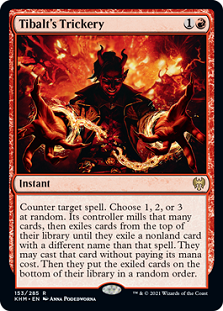 To start, Tibalt's Trickery has been blowing up recently. This isn't totally surprising, since in my
 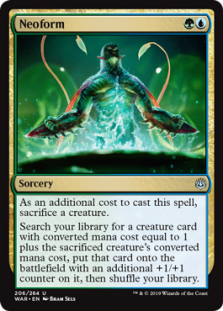 Kaldheim has been legal online for about a week and a half now, and opinions are already
 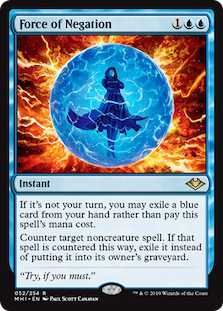 theoretically keep making land drops and cast the big bombs, but no opponent who
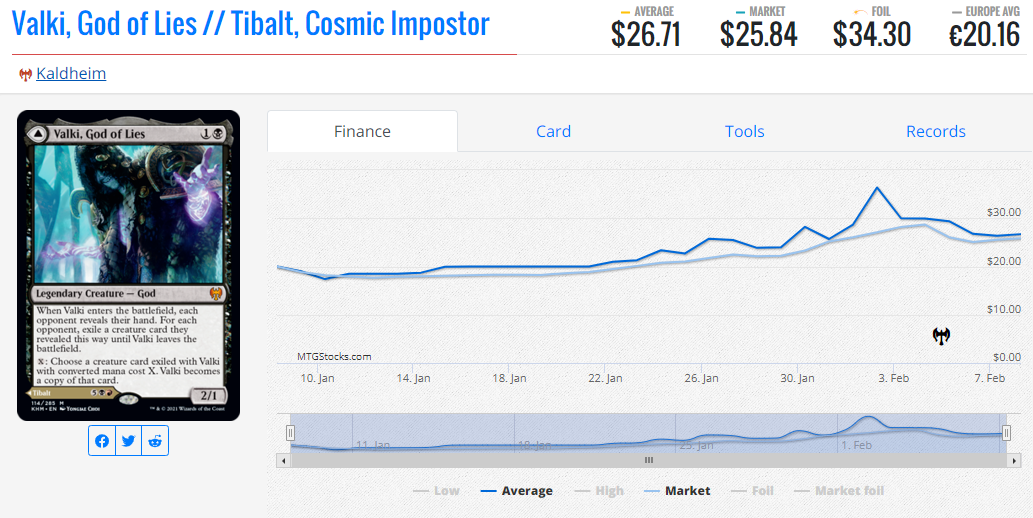
 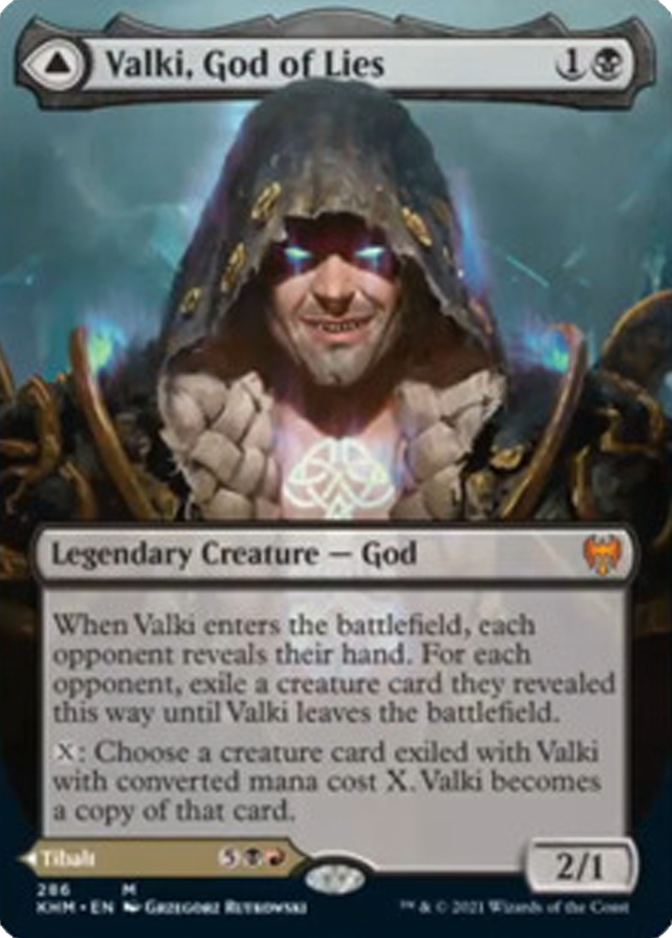 It looked initially like Valki was another Jund card which may or may not pan out. Traditionally, Jund relied on Dark Confidant for card advantage. However, the rise of Wrenn and Six has made Bob too vulnerable. Valki looked like a potential replacement. For the same stats, Valki nets at least some value by looking at opposing hands before getting removed. If Valki takes a creature and isn't killed, best-case scenario is Valki becomes a turn 3 Uro. Which is a huge upside when it happens, though mostly it's just a Peek.
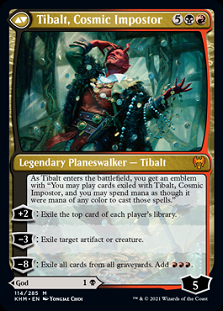 draws two cards a turn and the emblem never leaves. However, that alone isn't good enough to make it in Modern. Just like Karn, Tibalt's cost is prohibitive and abilities are weak unless accelerated out.
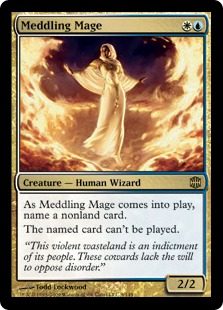 The advice I'm giving then is to target Tibalt. Particularly, don't let Tibalt resolve, as the value it might (some hits may be worthless) generate from one activation goes a very long way. Given the number of free counters this deck runs and the trend towards a full set of Teferi, I don't think counters are the way to go. Permanent-based answers are a little risky as they can be bounced, but a diverse suite of answers is very effective. They can't answer everything. For example, going Pithing Needle into Damping Sphere followed by Teferi will completely stop the combo and lead to a lengthy fight to keep all the hate safe from bounce effects.
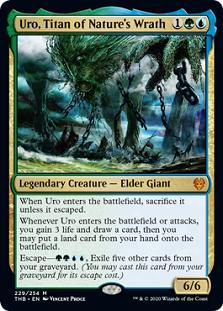 The deck pulls in two directions that require very different answers. If you go after the cascade combo, Uro will just ignore all that, do its thing and get all the value for the win. Targeting Uro hasn't proven to be too effective
 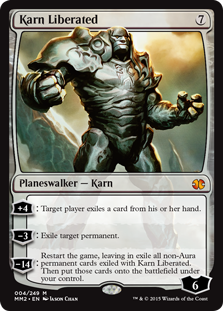 The cheap value engine is another story. If Tibalt's emblem came from his ultimate, then there wouldn't be a problem. Then he'd just be a color-shifted Karn Liberated. However, that isn't how it works, and as a result Tibalt, Cosmic Imposter draws two cards a turn from the moment he hits the board. We've already had this problem with Oko and Uro; adding another ridiculous cheap engine is not okay.
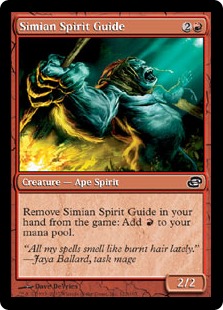 I've also heard rumblings of banning Simian Spirit Guide. The logic is that the real problem is that the decks are too fast rather than too powerful, and SSG is the culprit. And they're not wrong; turn 1 kills in Modern aren't really possible without SSG. However, in my opinion, banning SSG is just putting a band-aid on the problem. Cascading into Valki is the problem, and SSG only amplifies that slightly. The number of answers doesn't increase dramatically when the combo turn moves from two to three. As the second deck I mentioned showed, these decks would function the same with or without SSG. At best I see a Bridge from Below situation, so if the decks require bannings, better to just ban the problem cards and be done.




 I'll note that this is the lowest threshold I've had so far. Then we go one standard deviation above average to set the limit of Tier 3 and cutoff to Tier 2. The STdev was 11.21, so that means Tier 3 runs to 18, and Tier 2 starts with 19 results and runs to 30. Subsequently, to make Tier 1, 31 decks are required.
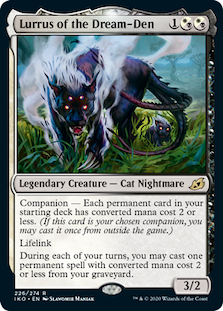
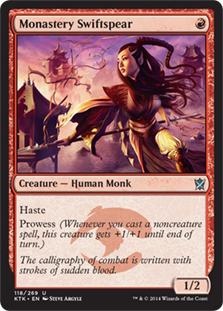 However, there is one thread that I haven't discussed much, and really need to. Only one deck has been Tier 1 in every full-month update: Rakdos Monastery Swiftspear.
  What Rakdos' quiet dominance means for Modern is unclear. This is an
  On that note, January also saw a lot of decks return. And for no perceivable reason. Izzet Prowess had fallen off massively, going from the top deck of
  Saying that Challenges are worth the same as a Super Qualifier is facetious, and I had that driven home by participating in one. So, I've revised the power system.
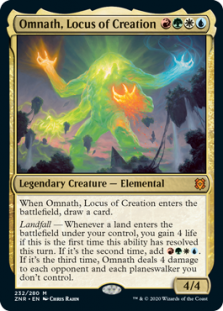
 Baseline was pretty low this time, but that's again a function of the huge number of singleton decks that only showed up as Prelim 3-1s. The addition of extra points pulled everyone up as well. But on that note, Jund and UW Spirits did better than everyone else! And then there's 4-C Omnath hitting a very high mark, thanks to very good results in the Super Qualifiers. Much higher than Tier 1 decks usually do on this chart. And that's troubling.

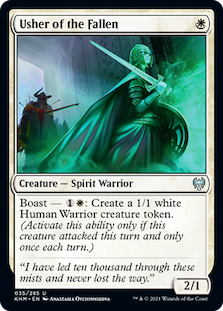 Let me just say: we've come a long way from the days of Savannah Lions. White weenies are more pushed than ever, with today's marquee example being Usher of the Fallen, a W-costed 2/1 with relevant typing and a token-generating effect that's sure to come up over the course of a tournament.
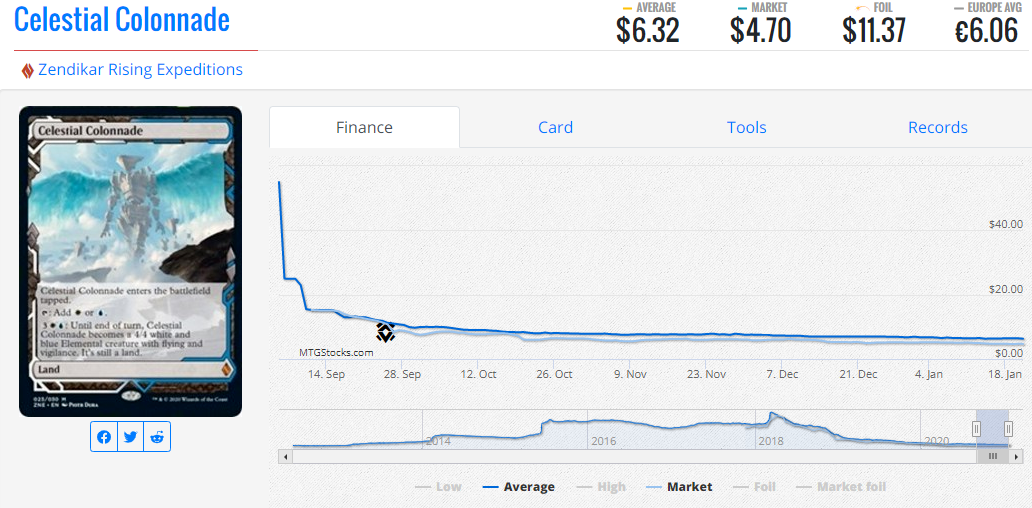
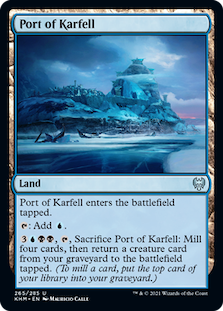 First up is Port of Karfell, a tapland which produces blue mana. Later in the game, so long as players have black mana kicking around, it sacrifices itself to reanimate a creature. Reanimate a creature! On a color-producing land!
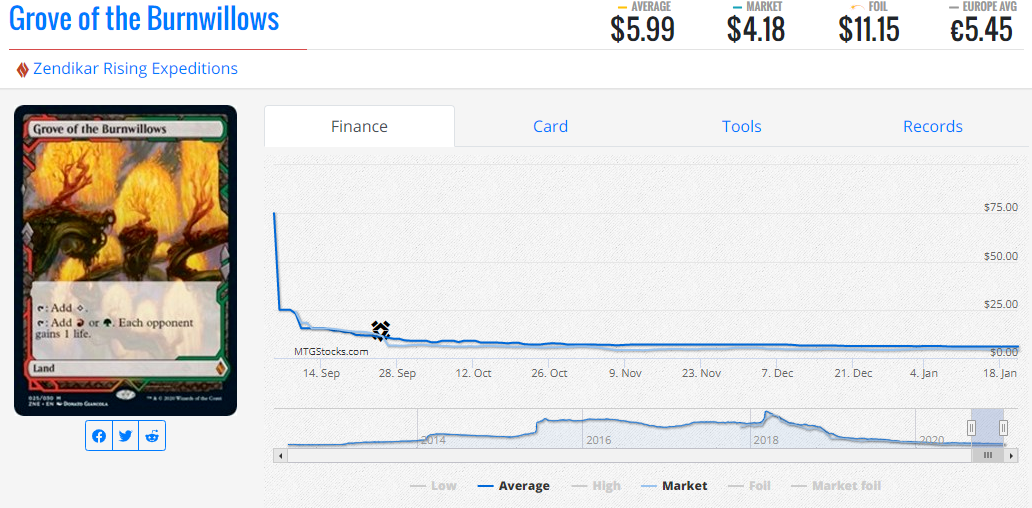
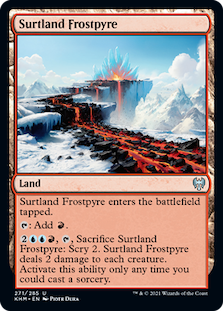 Like Port of Karfell, Surtland Frostpyre seems most at home in combo-control decks, but it has a much more forgiving color requirement. 2 damage to each creature is often enough to dismantle a board out of creature combo decks, so once Frostpyre hits the battlefield, opponents are likely to be wary of how they deploy threats. In this way, the land generates a tempo advantage without necessarily being sacrificed, which can compensate for entering tapped.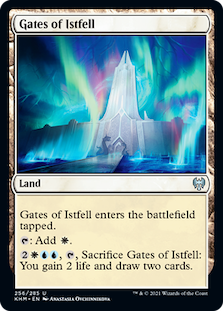
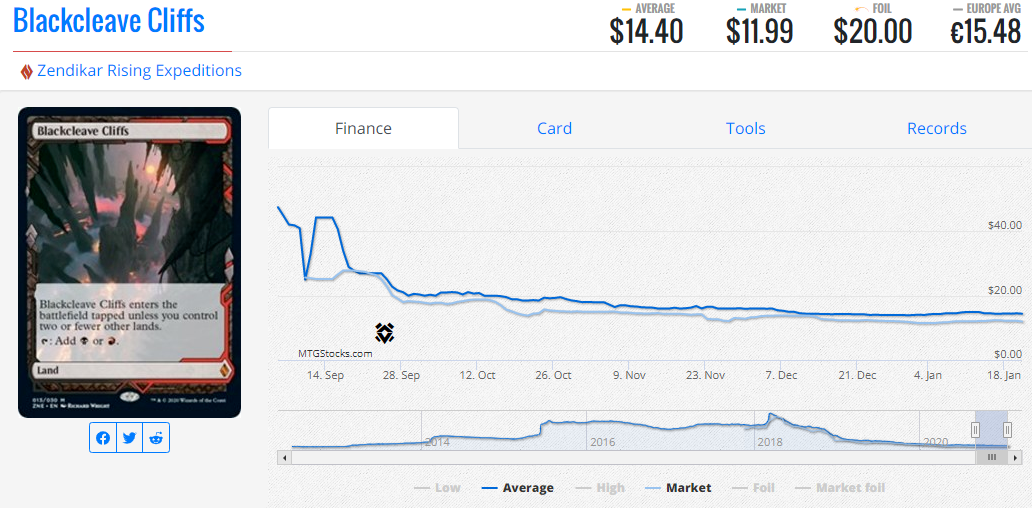
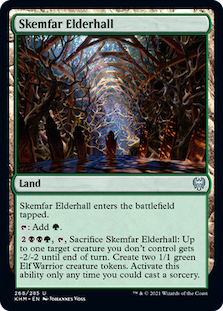 Skemfar Elderhall has got to be a consideration for Elves going forward. A tapland in Elves? You betcha! The deck certainly floods if its lords are removed, so having lands around to channel into board presence will be greatly appreciated. And it also mulligans into dorks, making Skemfar a good way to claw back into the game.
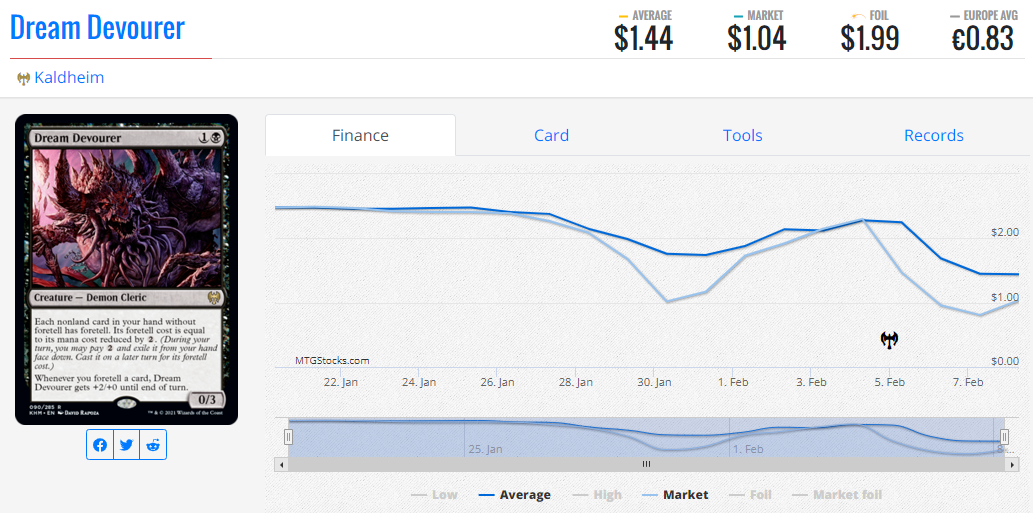
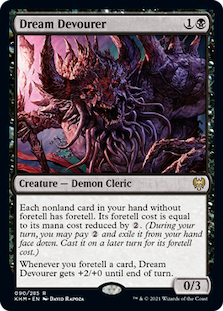 The flagship new mechanic in Kaldheim, and mostly serves as a layaway-plan service for pricey spells. At least, given Dream Devourer and the large amount of unexciting three- and four-drops, it seems like that's how Wizards intended it: players can pay 2 mana when they have it, and then "complete" casting the spell at a later date. In some cases, the process leads to landing your four-drop a turn early, but it was still overpaid for in terms of mana (none of these cards have a very impressive rate).
 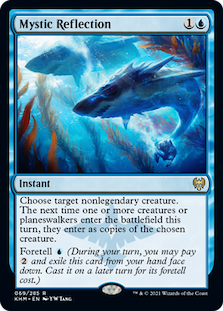 Right Back Atcha
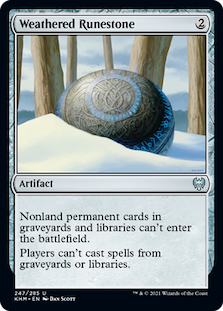 Weathered Runestone does come off as a Cage retrain; it costs an extra mana, which given Damping Sphere seems like the price point Wizards is comfortable with for colorless lock pieces. Still, it's not necessarily strictly worse than grandaddy Cage. While Cage only prevents creature permanents from entering the battlefield from graveyards and libraries, Runestone prevents all nonland permanents, which extends to planeswalkers, artifacts, and enchantments.
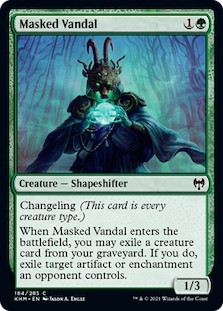 Up next is Masked Vandal, a standard two-drop that pops an artifact or enchantment when it enters the fray. Also worth noting is that Vandal exiles the target, which in this day and age is a big upgrade over destroy.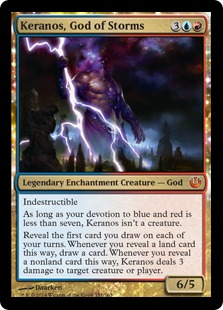
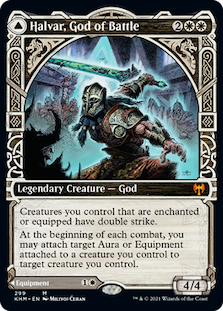 Halvar is a four-mana 4/4 that grants double strike to the pilot's equipped or enchanted creatures. As a bonus, it attaches one of those already-attached cards to another creature at the beginning of combat, should players want. While that second ability's nothing to write home about, the first one definitely is, especially considering the equipment that's currently played in Modern.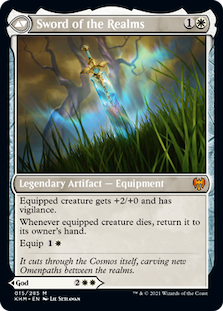
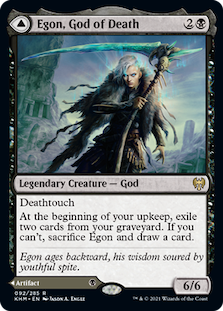 Egon is a three-mana 6/6 with the drawback of taxing players to self-exiles from the grave each upkeep. By itself, Egon would be severely outclassed by Rotting Regisaur, which
 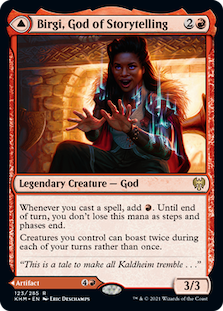 Birgi, God of Storytelling is the most combo-slanted of the Gods, and both sides seem tailor-made for a deck
 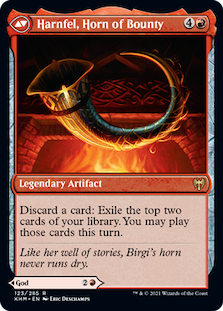 On the literal flip side, the five-mana Harnfel, Horn of Bounty gives the card some extra utility where a mana creature would be redundant or less useful. The Horn lets players discard a card to essentially draw 2 on a combo turn; in other words, it greatly reduces chances of fizzling. Having this kind of haymaking back-end may well make Birgi an attractive option over Electromancer and Baral.

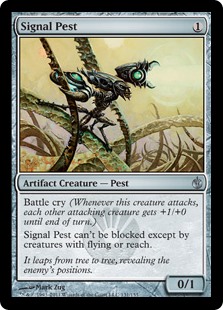 First up is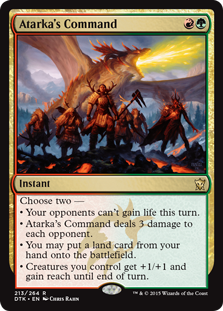
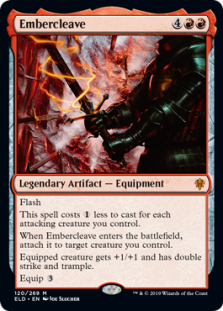 Jund never really goes away, even though we've heard about the tried-and-true Rock strategy recently
 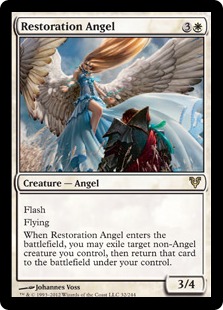 Deploying at instant speed so players can keep up mana for countermagic
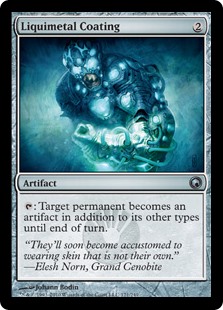 Way back when, before Modern was even announced, I was just dabbling in Magic and aimlessly picking up cards I thought looked cool. Among them was a brand-new playset of Liquimetal Coating. There are tons of efficient artifact removal cards, after all, and what a trip it would be to gun down enemy lands with them!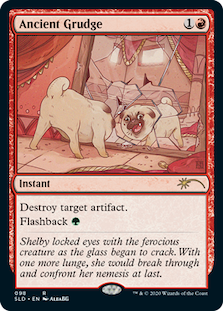
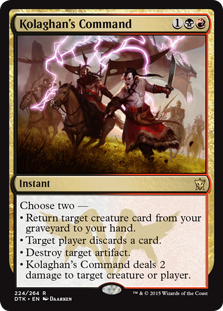 Look, Ma! No Uro! And no Ancient Grudge, either.


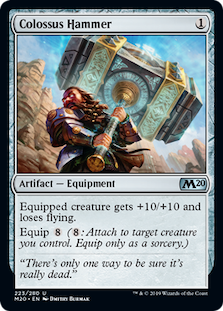 Hammer Time is basically Infect: they have the exact same gameplan. Sometimes, it's literally Infect thanks to Inkmoth Nexus. Unlike Infect, it's actually having metagame impact right now. Also unlike Infect, I'm skeptical that it will maintain much of a presence in Modern. I was underwhelmed by Hammer Time and moved on pretty quickly.
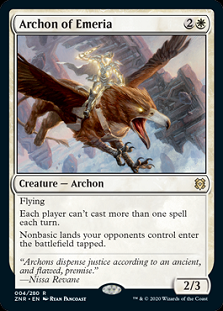 capable of beating combo decks (that's exactly what my Legacy version was doing all week), but to be good against the overall Modern metagame, I can't play all the anti-combo cards. They take too many sideboard slots and are too narrow in Modern's context. I was debating just pushing forward and hope to dodge combo after a few 4-1 results.
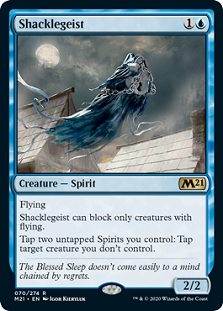 an issue, of course I was going to play Spirits. I didn't know how to build Spirits for the current metagame, so I just copied MTGO Trophy grinder and Spirits specialist
 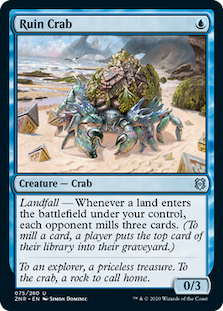 First round was a loss to 8-Crab Mill. In game 1, my opponent has three crabs on turn three, and that's not really raceable. Game 2 I'm 1 damage short, and I feel like I missed it somewhere. Alternatively, one more counterspell wins the game. Also, I was very annoyed because I'd been playing a single Gaea's Blessing in DnT for this very deck, but hadn't seen Mill in the Leagues and didn't bother with Spirits. Huge tilt there.