menu

On the Hunt for Deals

Are you a Quiet Speculation member?

If not, now is a perfect time to join up! Our powerful tools, breaking-news analysis, and exclusive Discord channel will make sure you stay up to date and ahead of the curve.

Those who engage in the Old School Discord may have recently seen some doom-and-gloom rhetoric regarding the market for old cards. I noticed the use of specific phrases such as “the bubble has burst”, “prices are dropping hard”, and “prices crashing”. Rudy of Alpha Investments is referenced, and he doesn’t exactly instill confidence in this market.

While it’s true prices have been correcting, I don’t think we’re going to see the bottom fall out from under this market. Demand is far too robust, and I see Old School cards priced fairly sell on a daily basis. I believe this sell-off is disciplined and merited, indicating prices will eventually stabilize and rebound.

There was an error retrieving a chart for The Tabernacle at Pendrell Vale

Of course…try telling that to major online vendors. While major retailers haven’t dropped their Old School prices across the board, they have each adjusted their sell prices to reflect a stagnant market in their own way. The result: there are amazing deals to be had at each vendor. That is, if you can snag copies as they’re restocked.

You see, the demand is there, and that is reflected in the fact that any underpriced card vendors restock will immediately sell. There are great deals to be had out there, but you have to be quick enough. What cards am I referring to? This week I’ll share where I’ve got my restock alerts set to take advantage of the unwarranted doom-and-gloom attitude of the broader market.

The Kingdom of Good Cards

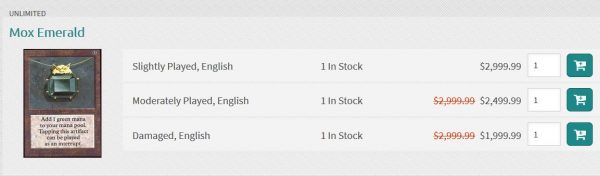
It’s true that condition is critical when it comes to Magic’s oldest cards—especially those from Alpha, Beta, and Unlimited. Some vendors adjust their downgrade percentages to be most severe for these older sets. Card Kingdom is no exception.

However, just because an Unlimited card is Heavily Played, doesn’t mean there is no demand. In fact, the Old School community often prefers HP cards because they’re affordable, while still being sleeve playable. Sure, a heavily played useless rare such as Deathlace or Aspect of Wolf has very little demand. But sometimes an HP piece of Power or Dual Land sells faster than its near mint counterpart because the card is more affordable.

There was an error retrieving a chart for Mox Ruby

Card Kingdom does not distinguish playability when pricing Unlimited cards. They pay 40% of their posted buy price for “Good” copies no matter the card. In some cases, this downgrade still isn’t enticing enough. Card Kingdom charges $28 for Good copies of Unlimited Vesuvan Doppelganger, and this is consistent with the broader market. No steal of a price there, and this is reflected in the fact that Card Kingdom has a few copies for sale on their site…not to mention this is more a collector’s card. Therefore, demand would be more in the NM/EX grading range (where CK is in fact sold out).

Good condition Power, however, is priced very well on Card Kingdom’s site. This is especially true for Timetwister and Time Walk—both are listed at $1400. A sleeve playable piece of Power, sold from a trustworthy vendor, typically merits at least $1400. Imagine acquiring one of these from Card Kingdom with store credit. The equivalent cash price paid would be even better!

But the best deals worth monitoring for a restock are Good copies of Chaos Orb, Time Vault, Forcefield, and Dual Lands. Here are some Good prices compared with TCG Low:
Chaos Orb: $380 vs. $550
Time Vault: $340 vs. $500
Forcefield: $132 vs $165
Underground Sea: $380 vs. $450
Bayou: $220 vs. $310
Scrubland: $152 vs. $190

There was an error retrieving a chart for Scrubland

Notice how, for each of these cards (and more), Card Kingdom’s Good price is significantly discounted vs. HP/Damaged copies on the market. The result: Card Kingdom is perpetually out of stock on these cards in Good condition. This reflects the reality that player demand is still there. If you can catch a restock of these Good Unlimited cards, as well as some similarly attractive Beta and Alpha cards, you could make a decent profit.

Channel Fireball’s Undamaged Reputation

Channel Fireball adheres to the same pricing strategy as Card Kingdom, severely downgrading prices on heavily played, Old School cards. But Channel Fireball uses the strategy more broadly, adjusting not only A/B/U cards but all pre-Modern cards.
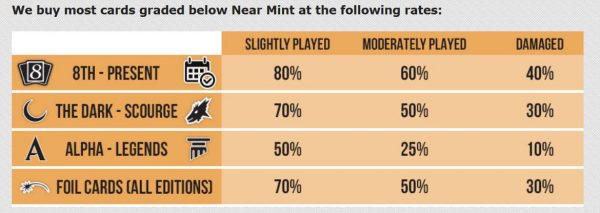
Alpha through Legends cards are downgraded most aggressively, whereas The Dark through Scourge merit less severe price decreases. Therefore, I recommend focusing on Alpha through Legends when hunting for underpriced “Damaged” cards.

Unfortunately, Channel Fireball doesn’t post their sell prices on Damaged cards for which there is no stock. This makes identifying the best deals a bit difficult, and it means I can’t readily rattle off a list of examples. I can mention a Damaged Thunder Spirit I recently bought from Channel Fireball for $49.99. TCG Low for and English copy is $76.

There was an error retrieving a chart for Thunder Spirit

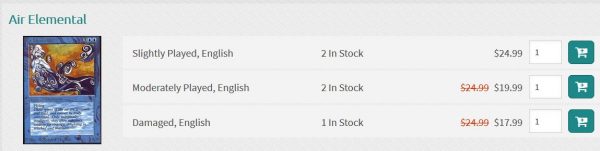
But there is good news! Since Channel Fireball sells on TCGPlayer, we can run an advanced search and browse Channel Fireball’s Damaged stock by set. I ran a quick search on Legends, sorted by price (high to low), checked “English” and “Damaged”, and shopped from Channel Fireball’s store specifically. Sure, most cards show as “out of stock” for Damaged condition, but check out one thing I found with this strategy:
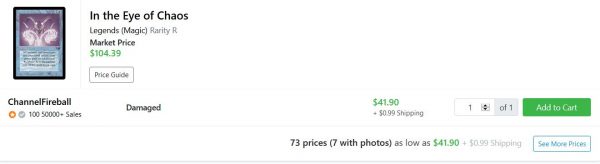
That’s a great deal considering Channel Fireball’s “Damaged” is often HP and almost always sleeve playable. Don’t forget you can navigate to Channel Fireball’s site and purchase the card there to get free shipping and use a coupon code (they always have some special going on).

Here’s one more find using this strategy, this time browsing Antiquities:
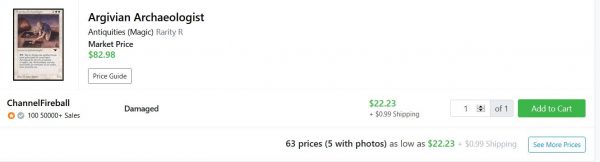
This is another steal if you’re looking for a sleeve playable copy of Argivian Archaeologist. It’s not a copy that’ll likely get a collector’s interest, but it could be the perfect copy to jam in an Old School deck! It could also be used to flip to ABUGames for trade credit—they offer $40.46 in trade credit for HP copies of this card.

HP Cards: The Star at Star City Games

Star City Games also has significant mark-downs on Heavily Played Old School cards, for all the reasons discussed above. Rather than rehash the same rationale, I’ll share some examples of underpriced HP cards listed at Star City Games. They’re always going to be out of stock on these, but if you can catch a restock by using their restock alert system, you can nab a great deal!

Don’t forget, Star City Games’ “HP” often corresponds to moderately played using other stores’ grading guides. Here are some comparisons against TCG Low.

Thunder Spirit: $54.99 vs $76
All Hallow's Eve: $129.99 vs. $150
Chains of Mephistopheles: $349.99 vs. $450
Field of Dreams: $29.99 vs. $45
Moat: $299.99 vs. $400

There was an error retrieving a chart for Field of Dreams

The list goes on and on. I’d focus on the higher-end playable cards. It seems Star City Games marks these down such a high percentage that their price is well below TCG Low. I browsed Legends cards to find examples, but I’m sure you can find similar deals from other early expansions such as Antiquities and Arabian Nights.

Limited Possibilities at ABUGames

The last vendor I want to touch on is ABUGames. As you know, ABUGames’ prices are all inflated due to their inflated trade credit. They’ve been making significant progress in curtailing the rampant credit inflation they experienced over the past couple years. This is reflected by some markdowns in pricing and significant cuts to trade credit numbers on Old School cards.

In a few cases, the price decreases were relatively overdone. The result: there are a few played/HP cards worth grabbing with trade credit (never cash). The way I see it, any card that can be acquired and sold for at least 70% of ABU’s price is a worthwhile consideration because it represents a profitable out for trade credit.

Here are a few cards I’m perpetually searching for in the hopes of a restock, along with TCG low pricing. The ABUGames prices sited below are for Played copies because they only list HP prices when they have HP copies in stock. It’s safe to assume picking up HP copies of these cards would be even more attractive.

Power Artifact: $107.55 vs. $81.71 (75%)
Thunder Spirit: $98.19 vs. $76 (77%)
Serra's Sanctum: $100.69 vs. $75 (74%)
Icy Manipulator: $119.99 (HP) vs. $95 (79%)
Revised Savannah: $131.19 (HP) vs. $89 (68%)

There was an error retrieving a chart for Power Artifact

I’m sure there are other examples out there, but these are some of the cards I browse most often when looking to convert trade credit into profit. They have OK prices on any HP Revised Dual Lands, by the way, so if you’re looking for some sleeve playable copies but don’t want to outlay a bunch of cash, ABUGames may be a good source.

Wrapping It Up

Old School cards are definitely in a correction as prices pull back significantly from their highs. But we’re nowhere near a “market crash”. This is evidenced by the robust demand from the Old School community, particularly for popular cards in heavily played condition. How do I know demand for this class of cards is robust?

There are two reasons for this conclusion. First is the fact that any well-priced (TCG low -10%) Old School card posted on the Old School Discord is promptly purchased. And second is the fact that vendors, who have dropped their prices too far, are perpetually out of stock on some popular cards.

My strategy varies for each major vendor, but ABUGames, Card Kingdom, Channel Fireball, and Star City Games all have cards worth monitoring for a restock. If you’re able to grab copies of underpriced cards such as the ones mentioned in this article, there is some profit to be made. Or, better yet, you can acquire cards for decks, cubes, Commander, etc. on the cheap. Just be aware that you’re not the only one refreshing these sites in the search for deals.

Happy hunting!

Sigbits

  • After dropping their sell price on Unlimited Underground Sea, Card Kingdom quickly sold out of their stock. Now they have zero copies in stock and only $570 posted on their hotlist. They must not realize ABUGames offers $936, cash! They also offer $1,140 in trade credit for NM copies. With this differential, Card Kingdom is going to have to offer more if they’re hoping to restock copies of this card.
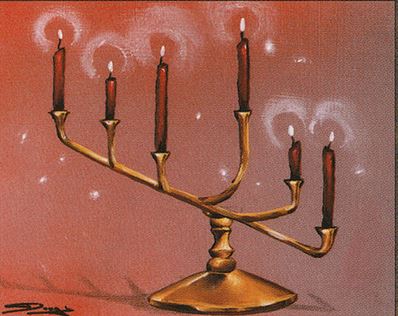
  • Card Kingdom has upped their buy price on Candelabra of Tawnos to $455, where the number has stuck for a full week. Unlike Unlimited Underground Sea, Card Kingdom’s buy price on Candelabra is best in class. But TCG low is around $420 for heavily played copies, so I suspect there’s still a gap here and Card Kingdom may have to increase this number as well.
  • Card Kingdom now has two Guru basic lands on their hotlist: Swamp and Forest, both posted with a $235 buy price. These must be selling well for Card Kingdom because there always appears to be some combination of Guru basics on their hotlist.
Modern Top 5 (Christmas Edition): Green Cards

Are you a Quiet Speculation member?

If not, now is a perfect time to join up! Our powerful tools, breaking-news analysis, and exclusive Discord channel will make sure you stay up to date and ahead of the curve.

Ho, ho, ho! Welcome to another edition of Modern Top 5, this one held together by tinsel-thin Christmas allusions. Although it's no "illusion" which color's on top at this year's end! Today, we'll break down the format's piniest players.

Trimming the Tree

Our first gift is actually a hand-me-down: an older Modern Top 5 metric explanation! We'll be using the same set of rules for green cards as we did for black, so feel free to skip this section if you're familiar with power, flexiblity, and splashability.

No Modern Top 5 would be complete without a metric. Since the top cards in a given color can include any type of spell—planeswalkerhatebeater—we’ll aim to use the most general metrics possible. I think those happen to be the ones established in the series’s first entry, Modern Top 5: Utility Cards. Here they are again.

  • Power: The degree of impact the card tends to have for its cost.
  • Flexibility: The card’s usefulness across diverse situations and game states.
  • Splashability: The ease with which Modern decks can accommodate the card.

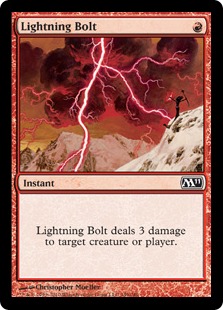
Power and flexibility will be rated by considering both a card’s floor (the least it will do) and its ceiling (its best-case scenario). For example, Lightning Bolt‘s power floor is higher than Fatal Push‘s, as Push is dead when opponents have no creatures while Bolt can go to the face.
Splashability will be rated by considering how many existing Modern decks can accommodate the card and whether they’ll want it. For example, despite its lack of a color identity, Ghost Quarter doesn’t fit into BGx midrange decks. These decks can easily run Fulminator Mage as mana disruption instead, and prefer not to miss a land drop if they don’t have to.

Each metric will be rated out of 5, giving cards a total rating out of 15. As ever, the usual disclaimer stands: just because a card scores low or doesn’t make the list means little in terms of its overall playability. After all, splashability is a metric. Some of the strongest cards in the format in terms of raw tournament wins are themselves rather limited in terms of which decks can employ them.

Now that the chimney's swept and the cookies are by the tree, let's skip ahead to 6:00 AM and check out the greatest green's got to offer!

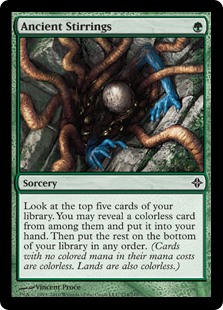
#5: Ancient Stirrings

Overall: 9/15

Power: 5

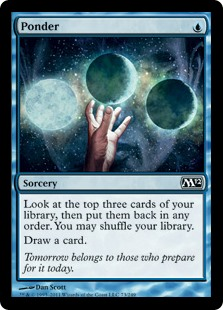
"Not a creature was stirring, not even a mouse," the poem goes. But despite Modern's ever-shifting focus this year, Tron and Eldrazi players have indeed been Stirring up a storm, and they won't stop anytime soon. Stirrings is indeed an absurd card in its right decks, trumping the banned Ponder and Preordain by digging a whopping five cards deep for one mana.

Flexibility: 3

That cheapness keeps Stirrings relevant the entire game, giving it a high flexibility score. Only its necessary colorless limitation knocks it down from 5; sometimes, players really need to grab that Primeval Titan or Thragtusk.

Splashability: 1

Splashability is where Stirrings really takes a hit. Last time I graded it on this metric, the sorcery scored a 2. I then wrote that decks using Stirrings must fulfill the following conditions:
- Have colorless cards they benefit greatly from finding at certain points in a game

- Be composed primarily of colorless cards

- Be able to utilize available colorless disruption from the sideboard (i.e. Relic of ProgenitusEngineered Explosives)

All of that is still true. What's changed is Modern. As David wrote last week, 2019 saw a huge influx of spells into the cardpool, and some of them have straight-up power-crept Ancient Stirrings (keep reading!). In other news, every artifact deck no longer necessarily wants the cantrip; Oko Urza, the format's supposed top deck and certainly its best artifact one, forgoes it entirely, as its payoffs are largely colored. Stirrings still does a lot, but for a more specific niche of decks than ever.

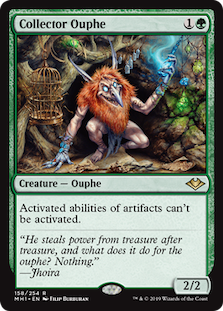
#4: Collector Ouphe

Overall: 10/15

Power: 4

There are two kinds of gift-givers: those who look for the hottest new trinkets to bestow upon friends and family, and those who furnish whatever's on sale so they can horde the real deals themselves. Ouphe falls into the latter category.

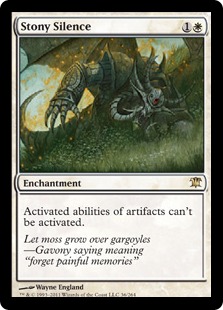
Stony Silence on legs is both better and worse than the enchantment; Collector Ouphe can tap to beat up on floodgated opponents, but it's also susceptible to a larger swath of removal, e.g. Galvanic Blast. In any case, two mana for this effect is a bargain in Modern, and one that once earned Stony itself the #1 spot in "Modern Top 5: Hosers," a piece about the effective disruption of metagames past.

Flexibility: 2

The only thing saving Ouphe from a 1 in this category is the fact that it can turn sideways for some damage or block a creature. Therein lies the inherent flexibility of the card type. But yeah, its effect, however superb in the right scenario, is quite narrow, mostly dooming Ouphe to sideboards.
Splashability: 4

Just like Stony, Ouphe is quite lax with its requirements: pilots just need tangential access to the right color of mana and not to be on the decks they plan to hate out, standard fare for most hosers. But I do think Ouphe is a bit more splashable thanks to its typing—getting scooped by Collected Company, Chord of Calling and the like makes it especially appealing for decks running similar cards.

#3: Veil of Summer

Overall: 11/15

Power: 5

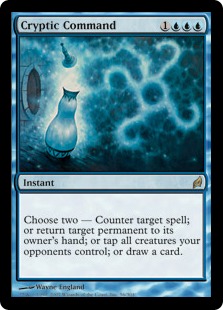
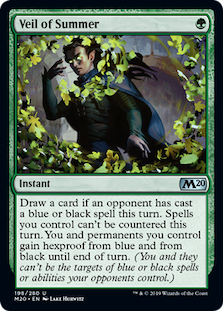
I've made no secret my love of one-mana Cryptic Commands over the last five years, and Veil of Summer is by far the best one-mana Cryptic Modern (Magic?) has ever seen. It's no wonder Wizards has banned it from both Standard and Pioneer at this point.

Flexibility: 2

One-mana Cryptic is always incredibly powerful, but it tends to lose out on these next two metrics. Veil is still more flexible than many of its forebears: it hits blue and black spells, tagging permission, removal, and targeting effects like those of Thoughtseize and Surgical Extraction. But it still only works on the stack, and when opponents bring those kinds of effects to the table. This sort of card is inherently narrow in its applications.
Splashability: 4

At last, the turnaround! At a measly one green mana, Veil proves eminently splashable. Best of all are the many roles it plays in different decks. Fair strategies use it to bolster their gameplan in midrange mirrors or against control, but aggro-combo and pure combination decks wield Veil as insurance against opponents trying to slow their gameplan. That versatility makes Veil strategically splashable as well as color-wise.

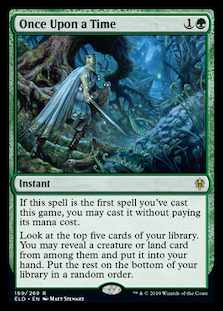
#2: Once Upon a Time

Overall: 12/15

Power: 5

If we're power-creeping Ancient Stirrings, we're certainly scoring perfect marks on this metric. You thought Stirrings was cheap at one mana? Once is as free as a Christmas carol! Okay, so it's only free on turn one (good luck finding carolers about on the 26th), but that's for the other metrics to worry about. This card is so played because it's free when it counts the most: at the stage of the game where neither player has any mana.

Flexibility: 3

Just as free is infinitely better than one mana, two mana is much steeper. That's where Once takes a hit relative to Stirrings. But grabbing creatures tends to trump grabbing lands and artifacts, especially since many payoffs these days, even for artifact decks, fall into the former category. And Once is an instant, so players don't even have to fork over mana on their own turn.

Splashability: 4

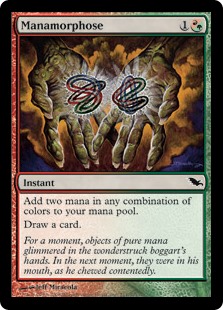
Early access to green mana isn't even a requirement for this card to see play. So long as a given deck can eventually produce green, Once is a supportable inclusion; after all, it's to be cast right away for zero mana, and then again much later, after players have exhausted their hands of board-impacting plays and are searching out more gas. To me, the biggest showcase of this card's splashability was its inclusion in Traverse Shadow, where it supplants Manamorphose as a quick instant for the graveyard while also often acting as a delirium-ready Traverse the Ulvenwald out of the gate.

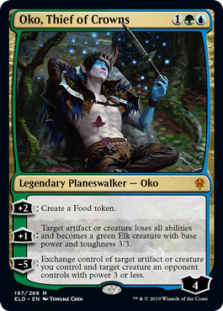
#1: Oko, Thief of Crowns

Overall: 13/15

Power: 5

Two weeks. Two Modern Top 5s. Two 1st-place finishes. But Santa's baddest little elf (er, Faerie) really is that good, leading the charge of cheap, warping walkers.

Flexibility: 5

To be fair, there are more impactful spells at this price point. Oko's real draw is the sheer amount of options he affords pilots. Players give themselves total autonomy when casting the planeswalker, at once an effective disrupter and army-in-a-can win-button. In other words, Oko's commanders enjoy a sizable boost in reversibility once the walker resolves: they suddenly get to choose when to interact and when to proact, all while drawing enemy resources onto one card that may or may not distract from other plans.

Splashability: 3

Oko's been popping up everywhere, sure, but not literally everywhere. While his effects are desirable enough to merit consideration in most types of decks, only those capable of producing blue and green mana can actually afford to run Oko as an engine or tech.

More to Unwrap

The year isn't over just yet. In the coming weeks, we'll see how the Festive Five fare in online dumps as we examine the last brews of 2019, and whether a certain grinch has it in for them after not making my "nice" list!

Three Lessons Learned from 2019

Are you a Quiet Speculation member?

If not, now is a perfect time to join up! Our powerful tools, breaking-news analysis, and exclusive Discord channel will make sure you stay up to date and ahead of the curve.

2019 has been a fantastic year for me MTG Finance-wise. I've sold more this year than in any previous years, and I have been steadily growing my inventory while downsizing some of my bloated personal collection. Every year, I like to take some time to reflect on some lessons I have learned over the previous year and I felt that being transparent with my readers on those lessons would make for a good article. Here's what I learned:

1. Organization is Huge

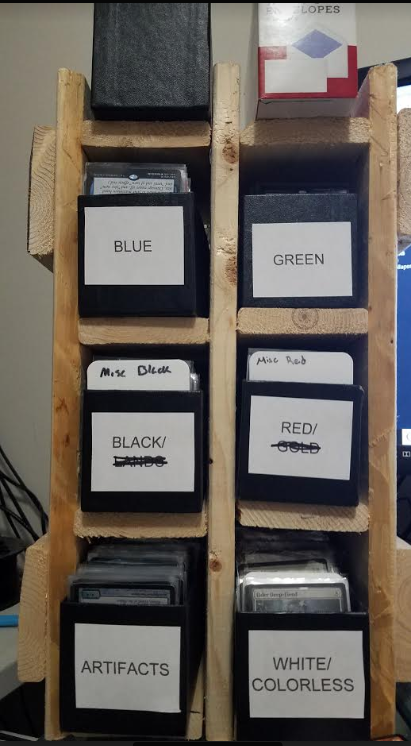
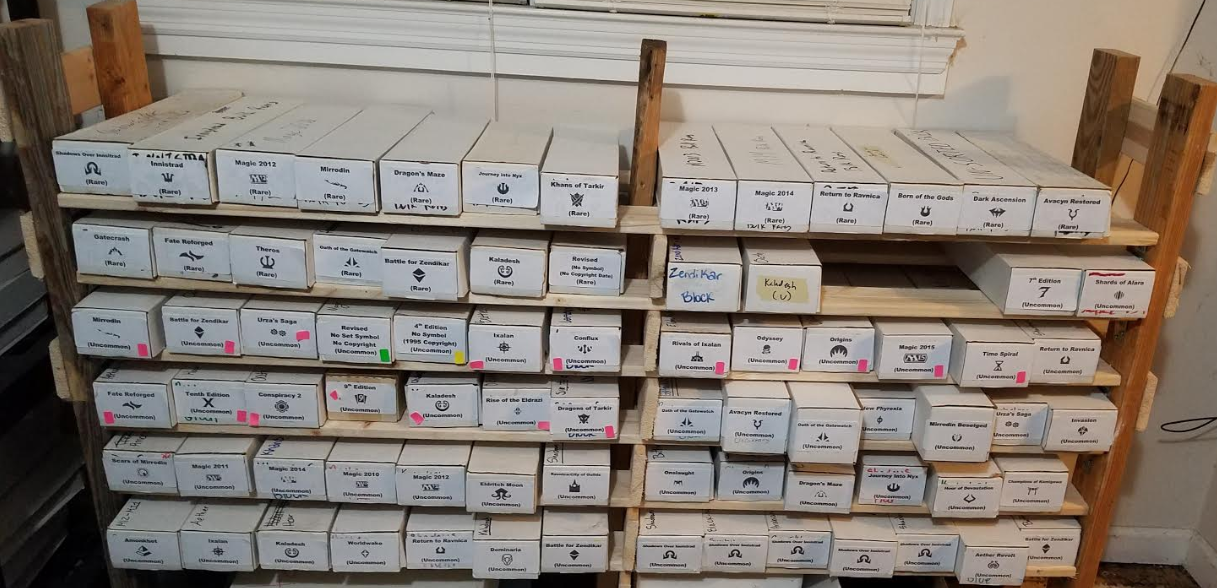
This year, I built two wooden frame systems for card storage. The large rack I made to hold my bulk rares and uncommons that are sorted by set, and a smaller card hotel I used to hold my current store inventory. These two additions to my office have made finding cards a whole lot easier which in turn means I can fulfill orders that much faster. For those interested, they look like this:

Card Hotel

The black boxes holding the cards are just the bottoms of fat pack boxes, which if you buy a fair number of collections, you end up accumulating. Some stores will buy them, as they are perfect for this. I also keep my shipping envelopes on the top shelf of the hotel which I pre-stamp with a custom stamp I also bought online as I wasted a lot of time writing the return address on every envelope going out.

An additional benefit is that because the stamp has my store name on it, I've also been able to stop including packing slips. I found that they tend to waste a lot of paper and printer ink. As a customer myself, I never care for them unless I order a large quantity of cards. I've decided that should someone order 10+ different cards, I will print out the packing slip to go along with the order, but I rarely sell more than three different cards on any given order.

Card Box Rack

I also purchased some standard 2x4-inch labels online and made all the labels you see on the ends of each box. I had previously used just some masking tape and wrote the set name and rarity on it, but I found the labels help me remember set symbols and look cleaner. The colored stickers on the uncommon boxes are to let me know they aren't full as I found I wasted a fair amount of time opening up full boxes when I was trying to add handfuls of cards to them and I'd have to keep closing them and looking for the next option.

2. Strike While the Iron is Hot

My morning routine includes checking the Interests pages on MTGStocks to see what cards have moved in price since the previous day. Whenever I see a card spike, I try to ascertain whether or not it was for a legitimate reason. If so, I quickly dig through my boxes/binders and list those cards, either at the new price or (if I think there is still more room to grow) at a price I hope they'll hit in the very near future. However, there is an obvious danger to doing this.

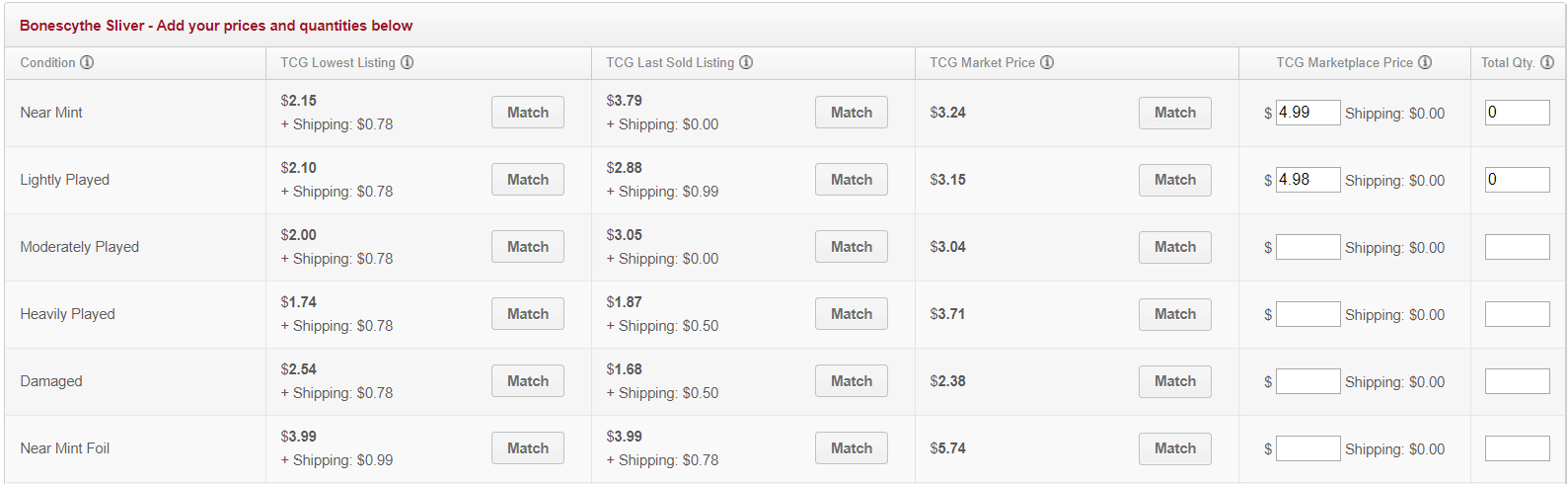
I'm not the only person who runs this routine. If I price too high, it's easy to get undercut by the next person and you can easily miss out on sales. Remember, the ideal time to sell is when a card's price peaks before it starts to drop and everyone races back to the bottom. Here's an example: while digging through my foil rare binder, I came across a copy of Bonescythe Sliver I didn't realize I owned. I immediately went to list it and noticed that the foil price is now lower than previous sales prices; far lower than I'd had back when Modern Horizons came out and new slivers were added to the Magic library.

I remember when this card first showed up on MTG Stocks interest page. I combed through my M14 rare binders and dumped all copies but one on TCGPlayer. Now, they have rapidly cooled off and lost 1/2 their value.

There was an error retrieving a chart for Bonescythe Sliver

As I recently purchased a decently large collection, I've come across this same issue repeatedly as I have been adding new inventory. I missed the rise on many cards because I got a bit too greedy, or was a bit too slow to list them. I am feeling this the most on all my extra dual lands which I sat on during last year's meteoric price rises. I believed that primarily because they were on the Reserved List and would be immune to the same kinds of pullbacks we see on many other cards. This leads me into my next lesson of 2019.

3. Current Real Profits are Better than Future Hypothetical Profits

If even you have a passing interest, you'll remember times when you sold out of a spec "too early" in fact every speculator I know has at least one of these stories. We suffer a different version of FOMO (Fear of Missing Out) than those who just buy cards. While they fear buying too late, we fear selling too early. However, if you made a decent profit on a sale then you still made money. We can't control what a card's price will do tomorrow, a week from now, or a month from now. We can control what we sell a card at.

My best example was two years ago when I purchased 2x played Gaea's Cradles from the Troll and Toad cash only case at a GP for $150 each, which at the time was a great price. I listed them on a local Facebook page and within a week I had a local player who needed one.

He offered me $200 in person which was about $25 less than the cheapest on TCGPlayer. I took it. Within two months, the cheapest copy on TCGPlayer was $300. Now they are right back down to the $240 price. The key takeaway was not that I missed the opportunity to potentially make more money several months later, but that I made $50 for almost no effort within a week.

The reason so many people on our site repeat the idiom "Cash is King" is because it has the highest liquidity of any asset you can have. If you can walk away from a speculation target and make a decent profit now that's better than any hypothetical greater future profit. You can use the money from the sale to buy other targets or pay for other living expenses.

A Year in Modern: 2019 Metagame Review

Are you a Quiet Speculation member?

If not, now is a perfect time to join up! Our powerful tools, breaking-news analysis, and exclusive Discord channel will make sure you stay up to date and ahead of the curve.

The saying goes that those who fail to learn from history are doomed to repeat it. In Modern, those who do not observe the metagame are doomed to be passed by. Applied to Magic, such proverbs encourage every player to duly note how the metagame evolves and develops over a competitive year. Having spent the year tracking those twists and turns, it's now time to recap and learn from them.

Just like last year, today I'll be looking back on 2019's metagame. Part of the process involves charting the ups and downs of a wild year in Modern. Another part consists of identifying trends that may influence the 2020 metagame. The future is impossible to predict, but can be guessed at given current trends; today, we'll search for those that appear to persist despite the metagame's churn.

From the Scrapheap

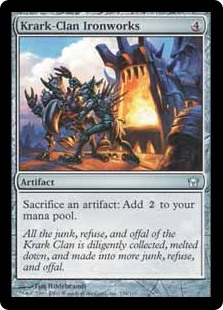
2019 kicked off with the metagame being disrupted by an unexpected banning. Krark-Clan Ironworks had tremendous success in the hands of Matt Nass early in 2018, and Wizards was concerned about its non-interactivity and resilience eventually taking over Modern. The deck had started showing up in quantity at events despite a relative drought, and was beating hate despite its weaknesses being known. There was also the problem of Ironworks being really boring to watch. Therefore, they decided to preemptively nuke Ironworks, the presumptive best deck; the metagame then largely reverted to its 2018 state.
Firebird's Ascent

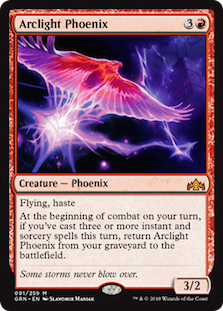
With Ironworks gone, the metagame began to coalesce around Arclight Phoenix. Izzet Phoenix's high velocity let it play a very consistent gameplan while Manamorphose and Faithless Looting allowed it to blitz any deck that couldn't disrupt its engine. Thing in the Ice proved to be a house against creature decks and a surprisingly robust threat in its own rite. Phoenix took over as Modern's most successful deck judging by Top 8s and Day 2 presence during March 2019.

However, in April, the tide began to turn. Players had caught on that the key to fighting Phoenix wasn't actually going after Phoenix itself, but the cantrips that fueled the engine. By the end of the month, Humans had situated itself as a clear challenger to Phoenix. Of the options, Humans made the most sense in that role, since Thalia, Guardian of Thraben, the natural enemy of velocity, was an integral piece of the deck. Reflector Mage is also very strong in a matchup where opponents rely on the bounce-able Thing in the Ice as board interaction. At the start of May, it looked like Phoenix's reign was coming to an end, as predation had kicked in and the metagame was adapting.

Outside Phoenix, the metagame looked rather unremarkable. The usual players from 2018 continued to put up numbers and see success, none more than Dredge. Ironically for a graveyard deck, Dredge was able to piggyback off Phoenix's success thanks to Phoenix diluting anti-grave sideboard cards. Dredge is very resilient to one-shot hate, but struggles against persistent hate. The only reason to attack Phoenix's graveyard is Phoenix itself, and so players relied on Surgical Extraction, to my consternation. Dredge was able to sneak through the cracks and continue to find success until the end of the month.

The Great Churn

Beginning in May, the middle of the year saw what I'm going to call the Great Churn. Three sets were released in three months, which is an absurd influx of cards. This was exacerbated by one being Modern Horizons, a set with exceptionally high power compared to Standard-ready expansions. Naturally, this threw Modern's metagame into a chaotic state of flux all summer. Even when it appeared to have stabilized, there would be constant churn beneath the surface. In many ways, this churn is ongoing; many promising cards that failed to gain traction during the summer are gradually being rediscovered. Meanwhile, the churn has been added to thanks to Throne of Eldraine.

War of the Spark

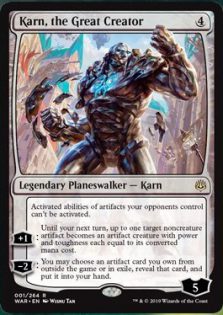
May opened with the release of War of the Spark, and Magic was flooded with cheap planeswalkers. While Narset, Parter of Veils and Teferi, Time Raveler gave control players dreams of Modern dominance, the reality was that Karn, the Great Creator has been the standout planeswalker from War.While initially just seen as a Tron card (being colorless), Karn has found homes in every artifact deck imaginable.
The initial excitement centered on Karn locking out opponents by wishing for Mycosynth Lattice, which gave the plodding ramp deck its first I Win button since Emrakul, the Aeons Torn. However, it has since become clear that Lattice is the most optimistic target, and the real value is that repeatable wishes are very good. This has allowed Karn to remain a relevant force in the metagame as it continues shifting and the Lattice lock becomes less needed. There were few events during this period, so players were still experimenting when Wizards dropped a bomb on Modern.

Modern Horizons

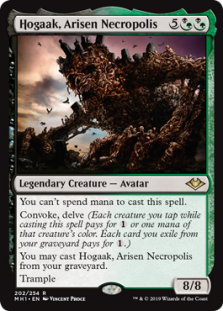
The much anticipated Modern Horizons released in June. How Hogaak, Arisen Necropolis slipped through Wizards' net I cannot understand, but it was bad news from the get-go. Modern was already flush with graveyard enablers, and Hogaak proved to be the ultimate payoff. It took the dangerously explosive but inconsistent BridgeVine deck and supercharged it, combining with Altar of Dementia to infinitely mill out first itself, then the opponent. The deck was so ridiculous that it shunted aside all the other interesting cards in Horizons, and after less than a month, Wizards decided to nerf Hogaakvine ahead of the next set release and a string of Modern GPs.

Core 2020

For a short period, it looked like the nerf worked. July saw Core 2020 released, and during the early weeks, Hogaak was a non-issue in the metagame. Core 2020 contained plenty of interesting cards, including one now banned in multiple formats, but its low power compared to Horizons has rendered Core relatively unimpressive for Modern. The cooldown gave Modern the opportunity to finally try to understand just what had happened with Horizons. However, this grace period was not to last. It turned out that Hogaak had merely been metamorphosing. Like a caterpillar turning into a butterfly, Hogaak was about to find its final form.
August was Modern season on the competitive circuit, and it was dominated by this new wave of Hogaak decks. July ended with Hogaak dominating at the Mythic Championship weekend and the concurrent SCG open. Hogaak then continued to crush events despite every deck piling on the graveyard hate. The deck was too powerful, too consistent, and too hard to fight for any other deck to reliably beat. In the end, Wizards was forced to kill Hogaak for good. However, they also went a step further. Graveyard decks had defined Modern for years, and despite a previous banning, Dredge was still a force in Modern. The time had come to end an era, and to keep the graveyard decks down, Faithless Looting was axed too.

A Whole New World

The best graveyard enabler was gone, the obviously-broken deck was dead, and the format still didn't know what to do with all the cards that had flooded in. However, despite some continuing Dredge presence, Phoenix had died and nothing similar has emerged. September was spent brewing and experimenting as Throne of Eldraine also brought new cards into Modern. The metagame began to take actual shape in October, as Modern returned to the competitive calendar.
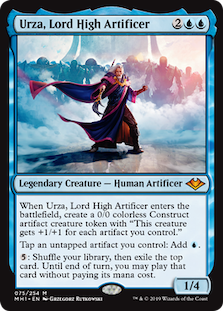
It quickly became clear that Urza, Lord High Artificer was the new Next Thing, but what that thing actually is remains elusive; over the past few months, Urza decks have taken numerous forms. The deck is built around a solid core of free-to-cheap artifacts, but the payoffs have swung between combo, prison, or value. The most recent events indicate that riding the value engine of Oko, Thief of Crowns is winning the popularity contest... at least, for the time being.

Metagame Trends

It is strange to think that 2019 has ended much as it began. The year started with Ironworks, a deck built around free-to-cheap artifacts, being the apparent deck to beat. And it's ending with Simic Urza, another such deck, in that same role. The more things change, as the saying goes. However, it is critical to look deeper, as the truth is that beyond the "best deck," the metagame continues to display remarkable diversity: Tron is consistently showing up to punish the ponderous decks; Humans is beating up on the cheap-spell decks; Grixis Death's Shadow is returning to take on Urza. Modern continues to be a play-what-you-want format despite the apparent domination of certain decks.

Gravely Departing

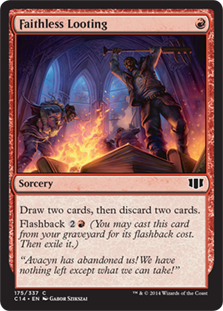
Decks that synergize with the graveyard will always be in Modern. There are too many synergies and powerful graveyard cards for that not to be the case. However, it is probable that the era of graveyard dominance is over. Faithless Looting made it extremely easy for decks to make controlled dumps into their graveyard while simultaneously improving their hands. Thus Looting turned graveyards into an extension of the hand for one mana. And could do so again thanks to flashback. Without a clear replacement, few decks will effectively utilize their graveyards effectively anymore.
There are plenty of spells that dump cards en masse like Stitcher's Supplier, but they're random, and thus inconsistent. No fine tuning, just brute force. Haggle is as close as Modern is likely to get for the foreseeable future, and it is a hollow shadow of Looting. Whatever becomes of Modern moving forward, it is likely to be tangential to the graveyard, rather than utilize it intrinsically.

Laying Eggs

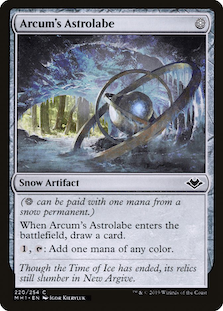
Similarly, the cheap artifact shell will remain relevant. The combination of Arcum's Astrolabe, Mox Opal, Mishra's Bauble, and Engineered Explosives first (mostly) wielded by Ironworks has proven itself adaptable enough to anchor multiple strategies. It's unlikely that anything from that core itself will ever be banned.

Its main draw is that it's cheap as free. Other options like Everflowing Chalice or Witching Well aren't as individually powerful as Explosives or Astrolabe, but they don't need to be. The shell's purpose is to be free more than anything, and free is a very powerful enabler. Therefore, the shell will be with Modern for some time.
Which payoffs use this shell is not clear. Right now Oko, Thief of Crowns and Urza, Lord High Artificer hold the title, but they're both on my banning watchlist for good reason. Outside of Oko and Urza, the proven artifact payoff is Arcbound Ravager, but I doubt Affinity is the right home. Affinity does play a lot of free-to-cheap artifacts, but those must contribute to an aggro plan; that deck wants Memnite and Signal Pest, not Bauble and Astrolabe. The alternative shell would need to be more midrange- or combo-focused to turn the durdly artifacts into something useful. So long as Oko and Urza survive, they're better than the other options, so there's little reason to scope out alternatives. Regardless, much like this year did, 2020 will begin with an artifact deck looming over Modern.

Look to the Future

With the start of a new competitive cycle and more sets for Modern to struggle to absorb, 2020 looks to be a dynamic year. Hopefully not as extreme as 2019, though; I don't know if I'm ready for another Eldrazi Winter or Hogaak Summer. The original Theros block didn't do much for Modern, so perhaps the trend will continue when we return to Theros in January. Only time will tell.

The Guide to Selling Foreign Cards on TCGPlayer

Are you a Quiet Speculation member?

If not, now is a perfect time to join up! Our powerful tools, breaking-news analysis, and exclusive Discord channel will make sure you stay up to date and ahead of the curve.

I would like to start this article off by dispelling a commonly repeated myth. “EDH players don’t buy foreign cards”. While often EDH players want to be able to read their cards, they also want cheap cards. As long as your card is in a desirable rare language or cheap enough, it will sell given enough time. Often when people complain about not being able to make money off foreign cards, they are trying to treat them the same as English cards in how they buy and price them.

Most people make this mistake early in their MTG finance career and then they completely write off foreign cards as a fool's errand, refusing to ever buy them. If you understand the risks and shift your expectations, foreign cards can be just as lucrative as their English counterparts.

Pricing Non-Foils

When you are pricing foreign cards you need to consider a lot more factors than when you are pricing English cards. The most glaring factor is what language the cards are; most people generally associate Japanese, Korean and Russian to be the most desirable languages because of their appearance and rarity. Generally speaking, this is a good rule of thumb when considering if you want to price a card above its English counterparts.

The next factor that I look at is other listings. When I am looking to price a card above an English version, I only look at listings for that language as the premium price assumes that the buyer wants that specific version. When there are many other vendors for that language, I try to be very competitive with my pricing even when I price cards at a premium. I do this because vendors on this platform primarily compete for sales by price. Another important thing to analyze when looking at other vendors is the quantity they have in stock. Buyers generally gravitate to vendors that have the full quantity they want rather than ordering from several vendors to save a little bit.

While I am looking at other vendor’s pricing, I also look at the last sold listing that can be viewed from the TCGPlayer seller portal. This can add some important context to how you should price your card if no vendors have any copies in stock. This factor does need to be considered carefully as it does not give a date to when the sale happened, so if a card has been reprinted recently, it may not be a very good indicator of price.

A factor that is deceptively important is the edition of a card. Some sets have a lot more desirability because of their appearance and their rarity in a foreign language. For example, it's much harder to find foreign cards from older sets like Future Sight and Mirrodin when compared to more modern sets like Fate Reforged or Dominaria. Another factor to consider when looking at the set of a card is if the set is the original printing of a card. These can be more desirable to a buyer as they may want their whole deck in original printings.

One more important element to pricing foreign cards is what format the card is played in. Often Legacy and Modern cards will be much more desirable as they are non-rotating formats where players are more incentivized to play a deck for longer and pimp it out. Often the last factor I consider for a foreign card is its condition. As long as your card is at least Lightly Played, there are few instances where the price will be radically different than Near Mint.

For Example

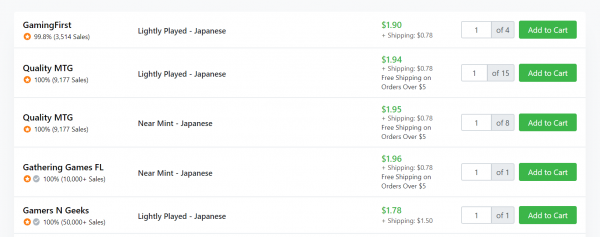
Now let’s look at an example of pricing a foreign card for a premium. For this example, I will be analyzing how you should price a playset of non-foil Japanese Fate Reforged Gurmag Angler. To start off, we want to price these for more than their English version, as Japanese is generally considered to be a premium language. Next, let’s look at other vendors who have this card in stock:

This card is stocked by several vendors with at least a playset in stock, which means we need to undercut them by a good chunk. Now let’s look at the last sold listing within the seller portal:

The previous sales show that the listings by other vendors sell relatively often which means we probably want to be in between $1-2 to make sure these sell relatively quickly. Since we have good context for this sale, we don’t need to worry about what format this card is played in or how rare it is, as it is clear that people buy these for more than their English counterparts. The last thing we need to consider is the condition of our card. Since the price difference between Near Mint and Lightly Played is negligible, it won’t impact how we price ours. For these Gurmag Anglers, I would list them at $1.67 per card to have three or four copies sell for above the $5 mark

Most of what has been discussed so far mainly centers around cards that are expected to sell for a premium. Now I want to show some important pricing rules for selling cards that may sell for less than their English counterparts. The main factor in determining this is if a card isn’t one of the premium languages like Russian, Japanese or Korean. While language is the main determining factor for the price of a card, the format becomes even more important when considering the price of a non-premium language card. Even though I did say that foreign EDH cards do sell on TCGPlayer, they usually sell at a discount to English versions, even if they are premium language.

To determine if a premium language card will sell at a discount, you generally want to look at the number of foreign versions listed on TCGPlayer. For example, a card like Maelstrom Archangel has many listings for foreign copies at significantly less than its English counterpart. The card is also mainly played in EDH. This means that when you go to price that card, you will need to significantly undercut the market to have a solid chance of a sale. This includes versions from all languages; not just the language you are listing. You may even have to reprice the card as other vendors drop their prices in order to compete with yours.

Even when there are few vendors for foreign versions of a card, you still need to consider who is looking for that card. For example, who is actively looking for a Japanese copy of Seahunter for their tribal merfolk EDH deck? The amount of people who want to pay double the English price for that card is probably very small, while there are probably quite a few more people who will buy it just because it is the cheapest version.

Pricing Foils

When looking at pricing foils for foreign cards the differences can be very stark between premium and non-premium languages. Fortunately, much of the same rules apply from non-foils, you still want to consider rarity and playability but you need to do more research to find proper pricing data.

When looking at premium language foils, I generally use MKM and Hareruya to get pricing references outside of TCGPlayer listings. While Hareruya only has Japanese cards they are often the best baseline for pricing cards, as they are very strict on grading. Generally, you should be undercutting their prices because they do ship directly to the United States. MKM usually covers all languages and almost always has decent pricing info. They don’t ship to the United States but they still are important to understanding what a realistic price is for a premium foreign foil.

The format concern also comes back to haunt us a little bit when considering how to price these cards. Unlike before where most foreign EDH non-foil cards needed to be listed for less than English, some EDH foreign foils can sell for more than English if you are patient and there is little competition for the language you are listing. Patience is really important when you are listing foils. Often it can take months just to move a single Japanese Foil EDH card, this is something you need to take into account when trying to acquire these cards.

Outside of premium languages, foreign foils can be a little tricky. Few people want a pimp version of a card that is in a less desirable language. These can often be the most difficult foreign cards to sell. You will usually need to heavily undercut the competition from foreign and English competitors. I have had some success selling these but they require frequent repricing and patience. Overall foils can be very tricky so be cautious when purchasing them.

Wrap Up

One of the systemic risks that foreign cards have unlike English versions is the fact that almost no buylists take them. Once you buy foreign cards you almost certainly have to move them yourself. This is especially important when looking at your cash flow and how long you want to tie up your money. While I think that foreign cards present interesting opportunities for sellers to branch out, they can also entrap speculators in stock that is difficult to sell even when a card spikes.

Another minor observation that I had during Black Friday was the impact of the promotion on the sale of my foreign stock. I saw massive increases in sales and I think this could be attributed to people being attracted to TCGPlayer that don’t usually shop there, this new customer may be ultra price-sensitive and foreign cards may be very attractive during these sales. While this is just speculation, it could be something to consider when looking at inventory to list before a major sale. I hope this article helps you better understand what factors need to be considered when trying to sell foreign cards.

Mystery Booster Playtest Cards: A Deep Dive

Are you a Quiet Speculation member?

If not, now is a perfect time to join up! Our powerful tools, breaking-news analysis, and exclusive Discord channel will make sure you stay up to date and ahead of the curve.

Here’s a riddle for you: what cards can be obtained from tournaments but aren’t tournament legal, and are still in print yet are rarer than an Alpha rare?

Despite its paradoxical nature, the answer is probably obvious to most: Mystery Edition Test Print cards, of course!

I’m not sure how closely the community is tracking these cards, but their prices are a bit all over the place. Many of these cards have both limited supply as well as limited demand—some are not all that interesting, while others are a casual player’s dream.

This week I’m doing a deep dive into these interesting cards, explaining my current approach and dwelling on their potential trajectory.

Trying to Estimate Market Supply

Let’s track some assumptions and try to ballpark total market supply on these cards.

These playtest cards can only be obtained, one at a time, from special convention Mystery Booster packs. The packs are handed out during side events at MagicFests. A conservative estimate would be that 500 players, on average, participate in a Mystery Booster side event. At six packs per player in a sealed event, that equates to 3,000 boosters opened. Accounting for drafts and prize packs (are those a thing?) we can bump this to 4,000 boosters in total.

Each booster contains one playtest card. There are 121 unique playtest cards—assuming they all have the same rarity, that means each MagicFest event would introduce 33 complete sets of playtest cards. If we multiply this across 50 events over the year+ these will be in print, we get to around 1,700 copies of each playtest card entering the market. 1,700! Since these have only been out for a month now, the actual market supply today is a small fraction of that. Hence why these are far rarer than an Alpha rare at the moment.

After these boosters are done entering the market, I still estimate that each individual playtest card will be rarer than a Beta rare (~3,200 of each). Those are some rare cards! Don't forget even the most useless of Beta rares still sells for a pretty penny.

There was an error retrieving a chart for Lifelace

Pricing is All Over the Place

How does one go about pricing cards that are so rare, yet have such variable demand? To parallel the stock market, these playtest cards are almost trading like OTC (“over the counter”) stocks. OTC Stocks are only traded directly through a network of brokers and dealers; they aren’t traded on an exchange (e.g. New York Stock Exchange). Similarly, these cards are currently traded via peer-to-peer sites such as TCGPlayer and eBay. Card Kingdom is currently the only vendor that currently offers playtest cards for sale, and they’re out of stock on many of them.

Because these aren’t well-stocked at major vendors, it’s difficult to identify an appropriate price for most of these cards. In true form, the right price for any given playtest card is simply “whatever someone is willing to pay for it.” Judging by eBay listings, that price is anything but consistent.

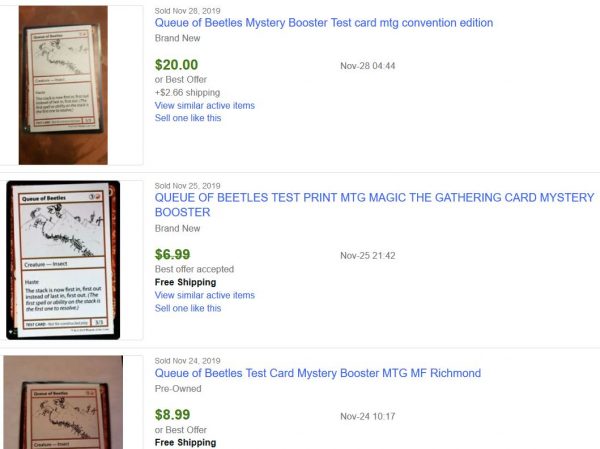
For example, how would you price a copy of Queue of Beetles to sell? Card Kingdom is currently sold out at (of course) with a $5.99 price tag. Their buylist is $4, so that’s the floor. How about the ceiling? Looking at eBay completed listings doesn’t help all that much:

It seems a $7-$9 price point was appropriate, but what person was willing to pay $20 for this card back in late November? Is this really a $20 card?

Probably not, seeing as there’s a copy on TCGPlayer currently listed at $9.49. I am one of the few trying to sell a copy. At first, I priced my copy in the $20 range because of that completed listing and the fact that the cheapest available copy on eBay was listed at $37. Since then, I’ve dropped my price all the way down to $8.49 and I still haven’t made the sale.

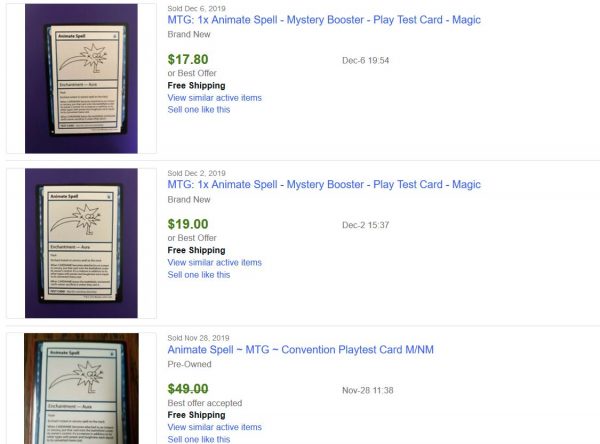
On the other hand, you have a card like Animate Spell. So far I have purchased a few copies from Card Kingdom at their $5.99 price point. These have sold decently for me on eBay at a price around 3x that of Card Kingdom’s.

Those top two sales are mine. And while the price is on a downward trajectory, I’m optimistic that I’ll be able to sell another copy or two well north of $5.99 (my current listing is set at $15, TCG low is $17). But again, the key point is that these are priced all over the place depending on where you look.

Card Kingdom Pricing: Too High and Too Low

Since Card Kingdom is currently the only major online vendor with playtest cards for sale, it makes sense to spend some additional time examining their prices. (I see that Channel Fireball has prices for these cards but are currently 100% out of stock).

In keeping with a paradoxical theme this article, I consider Card Kingdom’s prices on playtest cards to be both too high and too low. Of course this doesn’t apply to a single card; instead, I’m describing the inconsistent nature of their pricing.

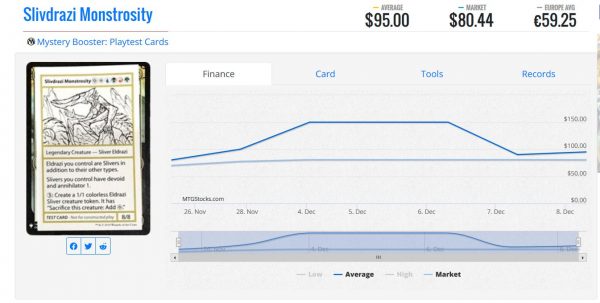
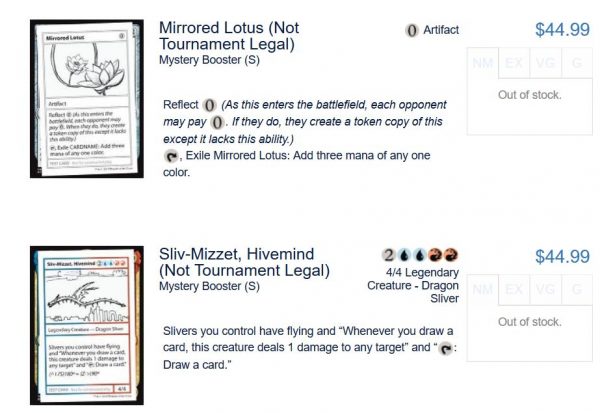
For the more desirable cards, their prices are well below eBay completed listings and TCGPlayer market price. They’re perpetually sold out of such cards. Examples include Mirrored Lotus, Slivdrazi Monstrosity, and Generated Horizons. In my opinion, any playtest that Card Kingdom has for sale above $20 is priced too low relative to what the market will currently bear.

However, that doesn’t mean only their high-end playtests are underpriced. Card Kingdom remains perpetually sold out of casual favorites such as Banding Sliver and Animate Spell, priced at $7.99 and $5.99 respectively, because these sell for far more on eBay. Any time a copy comes up for sale, it gets purchased right away due to the low price point.

As you get to the less desirable playtest cards, Card Kingdom’s pricing suddenly becomes less attractive. One example is Siege Elemental, which is currently priced at $7.99. Recently sold copies on eBay have sold for between $5 and $10. So while $7.99 isn’t an offensively high price, it’s not one players are eager to buy.

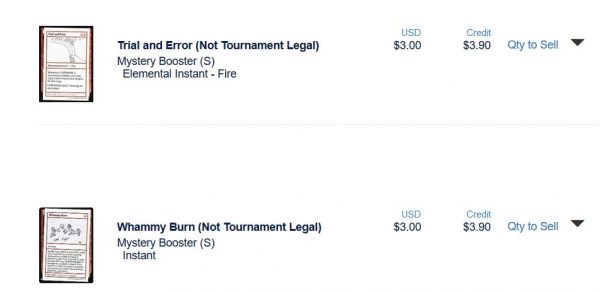
Card Kingdom also has a floor on playtest prices right now—they won’t sell any playtest for less than $5.99. Therefore, they have a bunch of $5.99 playtests in stock. Until they drop the price, it may be tough for them to move certain cards. This includes Biting Remark, Enroll in the Coalition, and Memory Bank. On the other hand, they offer no less than $3 for a given playtest card on their buylist.

Eventually, they may get enough copies of the least interesting playtest cards that they’ll have to drop that floor. Until then, any playtest card can be considered worth at least a few bucks even if no player wants it.

Looking Ahead

Given the unique nature of these playtest cards and how they’re entering the market, there’s little to use as precedent in predicting their trajectory. A handful of copies of each playtest will gradually enter the market after each MagicFest, to either add to the market’s supply or else be absorbed by player demand.

As this unfolds, I predict two trends. First, the less desirable playtest cards will gradually accumulate on the open market. Supply will climb until there are dozens of copies for sale. The price point on the less interesting cards will fall towards a buck or two, but probably not drop much below that. I don’t expect any playtest card will become true “bulk”.

As for the more desirable playtest cards, these will probably be picked up by casual players as they become opened. Thus, their price will remain more stable. It seems like an eternity from now, but after 2020’s completion these will no longer be opened at events. Once that happens, they drumbeat of supply entering the market will cease, and that is when prices on the select few with the largest impact can truly rise. The group of playtest cards that can truly withstand a $100 price point will be tiny, but I expect there will be at least a couple.

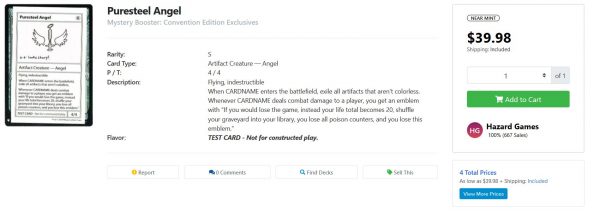
Specifically, keep an eye on Slivdrazi Monstrosity, Mirrored Lotus, any of the Planeswalkers, Puresteel Angel, and Sliv-Mizzet, Hivemind. These strike me as the most desirable from a casual player standpoint, and should, therefore, be the most attractive acquisitions as supply inevitably dries up next year.

Until then, I don’t advocate speculating on these at this stage. If there are certain copies you want to own—especially the casual favorites—then there’s no harm in grabbing them sooner rather than later. But until the faucet of supply is turned off late next year, there will always be new copies entering the market.

Wrapping It Up

Recently I have shifted some focus away from Old School cards (not completely) towards the Mystery Booster playtest cards. With Card Kingdom’s early pricing, I’ve been able to buy and sell different cards profitably while slowly accumulating a few cards for my own personal collection. I’m not breaking the bank with this approach, but it has worked out favorably so far.

Whether enough supply enters to quench demand—or whether players will actually wait for more supply to enter the market before buying—is yet to be seen. As long as players are impatient to acquire cards, though, the buying-to-flip strategy will work. I have to imagine Card Kingdom will gradually shift their buy and sell prices to reflect the market’s movement. Cards that are perpetually out of stock will increase in price, while cards that don’t move will decrease in price. Until then, the best approach is to frequently refresh Card Kingdom’s stock of playtest cards in the hopes of grabbing some underpriced copies.

It may seem like a waste of time, but if you enjoy these casual gems anyway it won’t feel so much like work. Any time I can put effort into Magic finance without feeling like I’m working is a win in my book!

Sigbits

  • Is it just me or has the Old School market tightened up a bit lately? Card Kingdom seems to be noticing. They have a number of Old School and Reserved List cards on their hotlist this week. This includes Unlimited Underground Sea at $570, Serendib Efreet at $230, and Power Artifact at $85.
  • Of all Revised Dual Lands, which do you think is on Card Kingdom’s hotlist? If you answered Scrubland (I sure wouldn’t have guessed that one), then you’d be correct! They are currently offering an impressive $100 on near mint copies of the black and white dual. However, according to Trader Tolls, Channel Fireball is offering $125 so perhaps Card Kingdom will up their number even further.
  • Another Reserved List card on the climb is Serra's Sanctum. It seems like every time an enchantment theme is spoiled in an upcoming set, this card gets a boost (don’t forget the Gods from Theros are enchantments). This may explain Card Kingdom’s current $70 buy price on the card. I think there’s more upside from here, and wouldn’t be surprised to see a brief $100 buy price as we enter the heart of Theros Beyond Death spoiler season.

Modern Top 5: Best of 2019

Are you a Quiet Speculation member?

If not, now is a perfect time to join up! Our powerful tools, breaking-news analysis, and exclusive Discord channel will make sure you stay up to date and ahead of the curve.

With the new year fast approaching, I figured I'd follow in Spotify's footsteps and call out the biggest cards of 2019. We've got many possible entrants between Throne of Eldraine and Modern Horizons. Read on for hot takes on the year's greatest and how they might fare in 2020!

You Are Now Rocking With the Best

The Modern Top 5 series aims to establish a set of three metrics and apply them to individual cards, yielding a ranking with selections and placements somewhat less arbitrary than your average Buzzfeed collection. Subjectivity nonetheless plays a role—the chosen metrics, as well as the ascribing of values to each metric, are based on my personal impression. That's where the article format comes into play: I have space to defend my decisions, and readers have the comments to dispute them!
Each metric will be rated out of 5, giving cards a total rating out of 15. The three metrics are as follows:

Meta Relevance

In my eyes, a card's power is closely tied to how "best" it is. Meta relevance refers to its standing in the metagame: copies logged, tournaments won, etc. Since such data often proves elusive, these numbers may not perfectly mirror the objective reality.

Iconicity

When players thought "Modern" in August, they thought "Hogaak." "Modern" back in March? "Phoenix." Whether or not those cards were the format's most-played at that time, they're certainly the ones that stuck in players' minds, and the ones that dictated Modern's identity. Thus, we'll consider how iconic each card is.

Staying Power

It wouldn't be an end-of-the-year list without some looking into the future. Staying power gives my take on how well the card will fare in 2020, based on recent results and trends. If you're sick of seeing one card or another on this list, hope for a low score in this category!

#5: Ranger-Captain of Eos

Overall: 8/15

Meta Relevance: 3

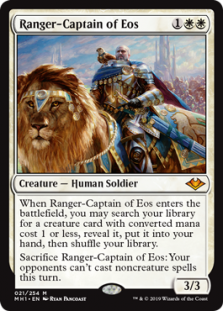
Ranger-Captain of Eos, a value-loaded three-drop from Modern Horizons, found its way into multiple Modern decks this year, including different builds of Zoo and wacky brews like Esper Shadow. But Mardu Shadow was its true forever home, and it brought that strategy to the forefront of the Shadow movement for a time.
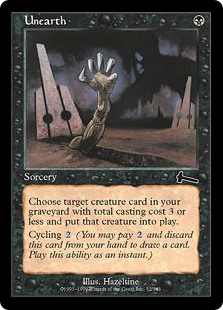
Having enough key threats has always been a problem for Shadow decks, and one they've tried to remedy with the likes of cantrips, Traverse the Ulvenwald, and lesser beaters such as Tarmogoyf. Ranger-Captain is among the archetype's most graceful options, yanking a namesake Avatar directly from the deck and providing an impressive body to boot. Best of all is Ranger's synergy with Unearth, turning the black sorcery into an incredible one-mana play.

Iconicity: 1

Of course, Unearth got all the credit. After Horizons dropped, plenty of giddy players tried their hands at breaking the sorcery, and not all builds featured Ranger-Captain: many preferred flashy Elemental creatures or members of the Pyromancer family. Which leaves us with a 3/3 whose name I had to double-check before typing it.

Staying Power: 4

Unearth, by now, has all but gone the way of the Dodo. Mardu Shadow still plays it, but without the splashable Faithless Looting engine, almost nobody else can make it work. On the other hand, Ranger-Captain seems exceptionally promising for the new year, as it tutors for any one-drop. That list includes ranges from lowly mana dorks to protection like Giver of Runes to closers such as Serra Ascendent. I think plenty of strategies can make use of Ranger-Captain and we'll see its shares rise in 2020.

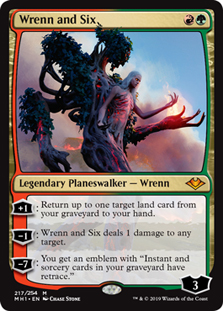
#4: Wrenn and Six

Overall: 11/15

Meta Relevance: 3

While Wrenn and Six warped Legacy enough to merit a ban in the high-powered format, its reception was mostly lukewarm in Modern. Sure, it put Jund back on the map, but nobody else really played it. With that said, heavily leaning on 1/1s became a lot scarier this year.

Iconicity: 3

Wrenn seemed to turn heads among Modernites mostly for how expensive it is, or for how many Jund players were suddenly flooding their LGS. Once the hype had died down, I barely heard the walker's name mentioned; there were simply flashier cards to discuss.

Staying Power: 5

Here's where Wrenn catches up. I think the card is utterly crazy, and building with it (and the London mulligan) has totally changed the way I approach deck design. In a fetch-heavy deck, it's perfectly reasonable to keep a one- or two-land hand that can nonetheless generate Wrenn as fast as possible, letting land counts in non-blue decks run as low as 16. I think more players will catch on to this in 2020, and we'll start to see Wrenn pop up in a variety of archetypes.

#3: Once Upon a Time

Overall: 12/15

Meta Relevance: 4

Once Upon a Time has had a larger effect on Modern than Wrenn so far. The card has been everywhere: Infect; Devoted Combo; Simic Eldrazi; Neobrand; Death's Shadow; Amulet Titan. In many of those decks, it plugs crucial holes; in others still, it simply props up an already competent gameplan.

Iconicity: 4

The buzz from Once still hasn't entirely died down, in no small part due to its nature as a free spell. Being banned from Standard and Pioneer has also upped its pedigree. But mostly, interacting with mulligans is not an especially prevalent mechanic in Magic. A card that does so well, in this case better than the Leylines or even Serum Powder, is bound to attract attention.

Staying Power: 4

As I was building the above list of Once decks, I noticed plenty I'd never seen: Green Devotion; Affinity; GR Prowess; Sultai Delirium. If these new converts are any indication, Once has plenty of life in it yet, and we'll continue to see it support and enable new decks down the road.

#2: Urza, Lord High Artificer

Overall: 13/15

Meta Relevance: 5

Different flavors of Urza decks gave Modern its first dominant-looking archetype since Hogaak's demise. In the end, Urza wasn't quite as broken as the 8/8, finding a natural foil in Grixis Shadow. The arrival on the scene of such a predator caused Urza to abandon its combo origins and cross over into midrange using Oko, Thief of Crowns.

Iconicity: 5

From the Hogaak ban to now, most of what I've heard regarding Modern has to do with Urza. Heck, David even penned a piece on how to beat the darn thing! If Modern had a face this winter, Urza was it.

Staying Power: 3

I'm with David in thinking the deck won't necessarily last, at least not at its current representation levels. Sure, Urza will continue to exist in Modern. But without the combo element so present, its namesake card is just another value bomb. This value bomb happens to cost one more mana than Oko, Thief of Crowns, which is proving itself to be the true MVP of the Simic builds. It's very possible that 2020 sees a form less invested in artifacts that abandons Urza, Lord High Artificer entirely.

#1: Oko, Thief of Crowns

Overall: 14/15

Meta Relevance: 5

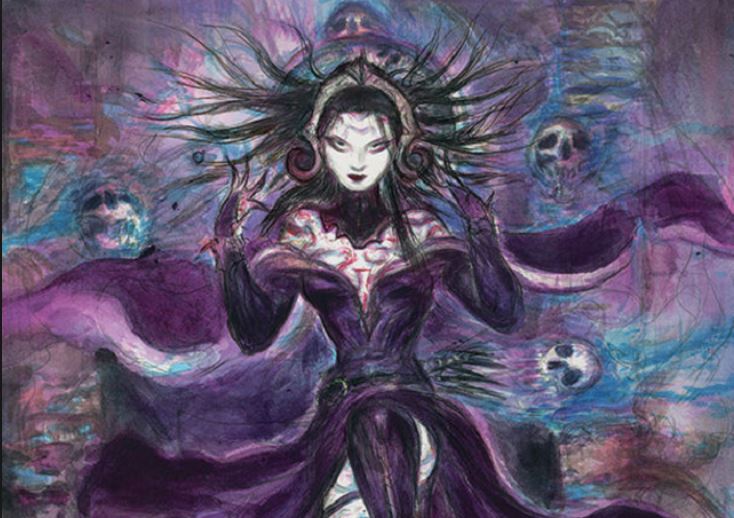
Which brings us to Oko, Thief of Crowns himself. Oko scores a 5 here just as Urza did; while he's been around for less time, he's been in more decks, including Urza's. I'd peg Oko as spearheading Modern's recent shift towards cheap planeswalkers, and believe his power level trumps even that of Liliana of the Veil. While Liliana plays multiple roles, she only really fits into decks playing toward attrition; Oko has made his mark on aggro, combo, and control by offering many gameplans and synergies.

Iconicity: 5

It feels impossible to wander into just about any online Magic discussion group and not be inundated by Elk memes. However many of their posters are Standard or Pioneer players, the fact remains that the community at large has Oko on the brain. I'm for him (pro-ko?), but understand that many consider the gameplay of smashing 3/3s against each other less interesting. Which side of the fence do you fall on?

Staying Power: 4

Oko should maintain traction as a solid Plan B for decks all over the archetype spectrum. We may also have a new Oko-focused deck emerged to replace Simic Urza. But I doubt we'll get more than one of those, meaning Oko's status will mirror that of Tarmogoyf, Thing in the Ice, and the like as a fair Plan B.

Dropping the Ball

And that wraps up this year's review of the top cards in Modern. Any I missed or mixed up? Let me know your thoughts below and we can hash it out over bubbly!

Modern Banlist Watchlist: 2020 Edition

Are you a Quiet Speculation member?

If not, now is a perfect time to join up! Our powerful tools, breaking-news analysis, and exclusive Discord channel will make sure you stay up to date and ahead of the curve.

The competitive year has come to a close for Modern, and now it's time to look ahead. This means it's time once more to informedly speculate on the future of Modern's banlist. It's been a wild year for the list, and while I always hope that the metagame can adapt to new decks, I don't have illusions that new bans are always possible. There is no official watchlist, so I'll be making my own speculative list... with some additional considerations.

To be perfectly clear, I'm not saying with certainty that any card on this list will be banned nor that it will happen anytime soon. This is the list of cards that I think could be banned if the stars align correctly. It will take a combination of the right pervasiveness tipping point, metagame shifts, or new decks emerging to make it happen.

Prediction Recap

I was surprised when I went back and reviewed last year's list. I was 3/3 for cards getting banned. I was even right about why Bridge from Below would get axed. I didn't know that Hogaak, Arisen Necropolis was coming, but I did call that all Bridgevine needed was a consistency boost, and it definitely got one. I'm taking full points on Bridge.

Wizards pulled the trigger on Ironworks before it could become a problem. They were worried that it would be adopted in the numbers I thought it needed before Ironworks actually had them. As it seemed like a preemptive ban for fear of reasons in my prediction, so I'm claiming partial credit.

I thought it would take an actual broken deck built around Looting to get it banned. Technically, that was true, but the announcement made it clear that Hogaak was just the final straw. Wizards wanted Modern to move away from being the graveyard format, and Looting was the reason it trended that way in the first place. So I was right about the card, wrong about the reason.

I stand by what I said about Mox Opal and Ancient Stirrings in that article. Mox is never the best card in any deck it sees play in, nor is it the problem. Stirrings decks haven't done anything meaningful this year, so there's no need for action. This list will be about new cards.

The Ban Watchlist

My criteria from last year still holds:

When considering what could or should be banned in Modern, it's important to remember Wizards' goals. They want a fun and diverse format to provide long-term value for Standard collections. As far as metagame speculation and competitive players are concerned, the important goals are diversity and speed. Wizards wants as many decks to be competitive as possible, and doesn't like non-interactive, consistent kills before turn four.

It is also important to note that Wizards tends to focus bans on enablers and engine cards rather than on payoffs. I don't think this has ever been explicitly stated, but a look through the history of bannings certainly lends credence. They also appear to prefer targeted bans against specific problem decks whenever possible, though that frequently isn't possible, as many problem cards happen to be splashed into multiple decks.

The only thing I'd add is that on the basis of the Faithless Looting ban, format ubiquity should also be considered. From that announcement:

By our data gathered from Magic Online and tabletop tournament results, over the past year the winningest Modern deck at any given point in time has usually been a Faithless Looting deck.

As new card designs are released that deal with the graveyard, discarding cards, and casting cheap spells, the power of Faithless Looting's efficient hand and graveyard manipulation continues to scale upward.

In other words, even if a card is arguably promoting deck diversity, it can't represent so much of the meta that it excludes other strategies. Looting made Modern a graveyard-centric format, and Wizards had had enough. So deck diversity isn't enough; Modern also needs strategic diversity. If a card is inhibiting that, it's potentially on the chopping block.

Urza, Lord High Artificer

The past few months have seen Urza, Lord High Artificer become the most talked about deck in Modern. Urza has an insane amount of text, and he is a mana engine dangerously close to the now banned Krark-Clan Ironworks. The deck offers numerous angles of attack, from card advantage engines to midrange beatdown to infinite combos, and can be tricky to fight. Such are hallmarks of a format-defining deck like Splinter Twin, which was banned to promote strategic diversity. Given the problems of cards that do too much while making mana, Urza can look like a mistake that needs to be expunged.

Why it Won't be Banned

Right now, Urza has won exactly GP Columbus. It is putting up decent Day 2 and Top 8 numbers, but so did Izzet Phoenix. Furthermore, Urza wasn't the best card in the GP-winning deck. With the list still in such a state of flux, it may come to pass that Urza is completely unnecessary in the Simic shell. The heart of the deck are the 0-1 CMC artifacts, and not the combos and tutoring engines that Urza uniquely supercharges. It is possible that Urza won't even be played in his namesake deck in 2020.

How it Could be Banned

On the other hand, it is possible that the Simic Urza decks are an aberration. There is considerable dissent about the right build of Urza decks, with Team Lotus Box being the primary proponents of the Simic verison. Their being SCG mainstays gives their decisions a strong influence on my data. The Simic list is very good at dodging common hate targeting Whirza lists, namely graveyard hate and Stony Silence. However, it did so by going into full grind mode and foreswearing any ability to win from nowhere. This may have been a good move in context, but once Modern moves back onto the GP circuit, it may prove poor.

Likelihood: Medium

If you'd asked me a month ago about Urza's chances, I'd have said there's no way he'd survive the year. I'm not so sure anymore given the Simic Urza lists, so I'll give him an average chance of surviving.

Oko, Thief of Crowns

Fresh off the heel of getting banned in Standard, Oko is slowing making himself known in Modern. The ability to turn threatening creatures into Elk or make an army is incredibly powerful. He's primarily been played in the Urza shell where he turns all the air into Elks, but is also cropping up everywhere. Decks with lots of small creatures like improving them; ones with bigger creatures like shrinking anything that can trade. Oko's even making a splash in Legacy. Given his history and Legacy-level power, Oko may prove too oppressive and homogenizing for Modern. Who wants to play the Elk grind round after round?

Why it Won't be Banned

Outside of Urza lists, Oko shows up in very low numbers, and typically out of the sideboard as a backup plan—not the hallmark of an oppressive card. The Urza decks are set up to maximize Oko in ways the rest of Modern isn't. Additionally, Modern has a lot of answers to cheap planeswalkers and even more decks that can just ignore him (Tron and Storm, anyone?). Oko needs a huge boost in adoption to actually threaten Modern.

How it Could be Banned

Said adoption is possible, but I think it more likely that Oko gets banned for being boring. Wizards and players like it when many different creatures of many different sizes see play. The same is true of artifacts. Oko makes them all irrelevant, which is why he was banned. Oko may or may not be too powerful for any format, but it's now a demonstrable fact that he kills fun.

Likelihood: Medium

A week ago, I would have said Oko had a low risk. However, given GP Bologna, I think the risk of Oko being too powerful and too widespread is very real.

Once Upon a Time

Here we have another Eldraine card. And one that's banned in multiple formats. Free spells can be absurdly powerful, especially when they're cantrips. Once Upon a Time is particularly egregious since it looks five cards deep. It is tempered by only being free once, but that is apparently enough. The card was initially only seen in Amulet Titan decks and speculated on for Neobrand, but it is expanding its territory.

Infect adopting Once is particularly concerning, as Gotcha! decks are frustrating to play against, and not entirely healthy format-wise. Infect threatens turn-two kills, an ability tempered by its low number of critical creatures. Gitaxian Probe was banned primarily to slow down Infect and make it less consistent. If the deck is overcoming that limitation, then the consistency tool should again be the thing to go.

Why it Won't be Banned

The Amulet decks have been a disappointment, and Infect hasn't actually done anything. If being a cantrip in a lot of decks was all it took to get banned, then Opt would be axed.

How it Could get Banned

Aaron Forsythe has acknowledged that Once was a mistake. Wizards wanted a card that would be the first spell in the game, and apparently ran out of time to get it right. Thus, they made a free spell. The appeal of Once being free is apparently enough to overcome the poor odds of it actually happening, and when deck consistency gets too high, then power problems arrive alongside redundant games.

Likelihood: Low

There is no evidence right now that Once is a problem. However, if it successfully boosts Infect-like decks, then it may become one. Given that it's easy to see that future, I consider Once a potential ban candidate.

The Unban Watchlist

Bans are not the only thing to watch out for. Unbans are also possible, particularly considering Stoneforge Mystic being unbanned earlier than expected: given Wizards' history, the unbanning was due in 2020. However, Wizards pulled the trigger early as an apology over the whole Hogaak affair, which indicates that the two-year gap isn't a hard rule. It is therefore reasonable to look at potential unban candidates, although I don't expect anything to actually be unbanned this time around. The metagame is still churning, and Wizards tends to unban to shake things up. There's no need right now.

To be honest, there's not much left to consider. Almost everything has demonstratively earned its place. The remainder of the original banned list are too ridiculous to consider (*cough* Chrome Mox). However, this year's events have made one surprising candidate more plausible.

Artifact Lands

When the original Modern banned list was conceived, Ravager Affinity's Standard dominance was still on Wizards' mind. Fearing a repeat of those days, the artifact lands were preemptively banned. Wizards didn't want to risk full-powered Affinity rendering Modern dead-on-arrival. They wanted to keep Arcbound Ravager quiet. Nerfing other artifact synergy decks was a bonus.

Reason to Unban

However, Wizards failed. Affinity was a powerhouse Modern deck for years. Rather than actually use the namesake mechanic and function as a synergistic aggro-combo deck, it embraced Inkmoth and Blinkmoth Nexus, becoming a power card aggro deck.

It is unlikely that Affinity would abandon this strategy if the artifact lands were unbanned. The creature-lands provide a considerable amount of resilience, and Inkmoth yields a shorter path to victory. Going back to classic Ravager Affinity allows for more combo potential and explosiveness, but it also means being more vulnerable to Stony Silence, Collector Ouphe, and Shatterstorm.
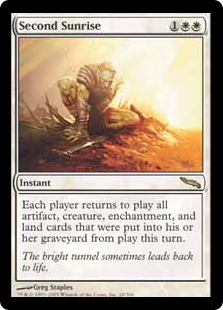
Also of note: Krark-Clan Ironworks is now banned. Ironworks was the other obvious home for the lands, and probably the more dangerous of the two. The deck proved pretty impressive with only Darksteel Citadel around. With Ironworks gone and there being no similar mana engine to really take advantage, the risk of Seat of the Synod boosting combo is severely reduced. Seat and company technically synergize with Urza, but not by much, since they already make mana.

The Risk

I've tried to find an artifact engine that can replace Ironworks and failed. However, that doesn't mean one doesn't exist, nor that Wizards won't creating another one. They may be leery of artifact sets, having been burned so many times now, but they're not going to give up. When another one comes around, if there's some artifacts-matter engine, the lands may push it towards brokenness.

Verdict: Plausible

The banning of Ironworks and the fact that Affinity could use some help being relevant in Modern again make the artifact lands more plausible to unban now than any other time in Modern's history. There's not insignificant risk involved, but for the moment, nothing on the horizon makes me too concerned.

Second Sunrise

Another victim of Ironworks, Second Sunrise was banned thanks to Eggs. Brian Kibler F6ed on camera while Eggs was trying to go off (at one point leaving the table for several minutes) and Stanislav Cifka took too long to win PT Return to Ravnica. Wizards needed to make the durdly and non-deterministic deck go away, but they didn't want to kill artifact combo. Thus, Sunrise was axed in hopes of making the combo more expensive to pull off.

Reason to Unban

With Ironworks banned, one reason that Sunrise was banned is gone. While it is possible to build a deck that continuously cracks various eggs to draw cards, that deck lacks a mana engine. Constantly cycling Terarrions, Chromatic Stars, and Golden Egg can dig through a deck to find a win condition, but without a constant source of mana, there's no way to actually build toward an end, and the risk of choking on mana is very real. The best way to gain mana I can think of is by looping Moxen, but that's already in Modern via Emry, Lurker of the Loch and Jeskai Ascendancy.

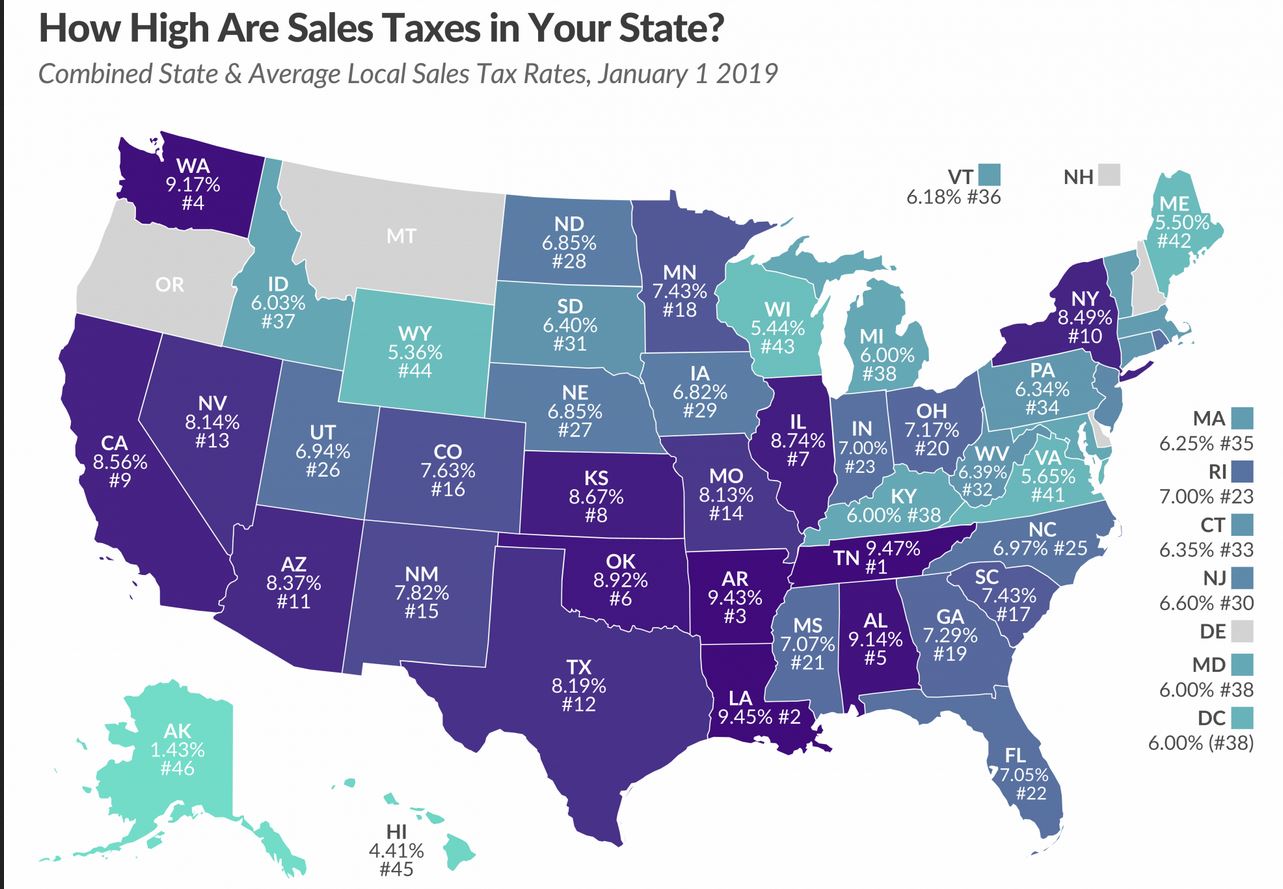
Rather, Sunrise opens the door for Aristocrats-style combo decks. Instead of artifacts it can return creatures, which should kill faster and more deterministically (thanks to Eternal Witness looping Sunrise) than the old Eggs deck. Modern has no shortage of graveyard hate to keep such a deck in check, and given how much effort Wizards has made to push Aristocrats cards recently, Sunrise's return seems like a net win.

The Risk

That being said, the gameplay of Sunrise combo may not be desirable. Constantly looping cards is fairly boring to watch, no matter how fast it is. Wizards made as much clear in their reasoning for banning Ironworks. Also, just like the artifact lands, there's a risk of another artifact deck emerging just as boring as Eggs was.

Verdict: Plausible

Similar to the artifact lands, the banning of Ironworks removes the reason to keep Sunrise banned. However, I'm unaware of any calls to do so, and there's risk of it enabling an equally torturous combo deck.

Lower Expectations

After 2019's ups and downs, I'm hoping for a less eventful 2020. Perpetual churn, new cards, and lots of banning has been very dynamic, but didn't make for great metagaming or format stability. Overall, I'm not expecting action from Wizards anytime soon, but it's probably best to keep an eye on the cards mentioned here.

A Guide to Renting on MTGO: Part I

Are you a Quiet Speculation member?

If not, now is a perfect time to join up! Our powerful tools, breaking-news analysis, and exclusive Discord channel will make sure you stay up to date and ahead of the curve.

Welcome back folks.

This week I'd like to introduce the MTG community to renting on Magic Online. Increasingly there has been talk about renting on Twitter and elsewhere; in part this is due to the renting companies becoming more reputable, trusted, and established; in part this is due to an influx of players coming to MTGO this Fall, many of whom are f2p veterans and aren't used to a trading card game economy.

Today in Part I, I'll cover the basics of what renting on MTGO is, how to do it, and whether it is a generally good option for MTGO players new and old to consider. In Part II, I'll compare the various companies you can rent from, and go over other less elementary aspects of renting on MTGO and address specific questions that members of the QS community have had about it.

I. What is Renting?

Historically, MTGO has operated exactly like paper Magic. Within a TCG economy, players own the cards they play with and collect, and they are free to buy and sell them at will. On MTGO, you buy and sell your cards in its marketplace (generally to bots owned and operated by companies, but sometimes to individuals as well).

Renting is an alternate method for accessing cards. Renting on MTGO is fundamentally a subscription-based service. You pay a company to let you borrow their cards for a certain amount of time.

Let's say that you want to play Modern, and that you want to play with Grixis Death's Shadow, which right now is valued at $408.93 on MTGGoldfish. You have two options: owning and renting. The first option is to put $409 onto your MTGO account in the form of event tickets (tix) and buy the cards for the deck from a botchain company in the MTGO marketplace. You can always buy tix from the Wizards' Store, but I recommend buying them from a reputable botchain company (Cardhoarder, Goatbots, Manatraders, Dojobots, etc) to avoid state sales tax.


Courtesy of the Tax Foundation.

After buying these cards, you own them, and they become part of your collection; you can hold them forever, or sell them at some point in the future.

Renting operates differently. To rent on MTGO, you first must setup an account with Cardhoarder or Manatraders. To do that, go here:

1) Cardhoarder
2) Manatraders

You will be asked to create an account and choose a subscription option that will allow you to borrow cards from these companies worth a specified amount of money. Per our Grixis Death Shadow example, for Cardhoarder you would set your card value limit to about $415, and for Manatraders you would choose either their Premium plan ($350 card value limit) or their Gold plan ($750 card value limit).  The next step would be to choose the Grixis Death Shadow cards you need on the company's website, and then a bot from that company would open a trade with you on MTGO and allow you to take possession of those cards.

When you are done with the cards, you return them to the company. To return to Cardhoarder, you would go to your account page on their website and request to return cards. A bot would then open a trade with you, allowing you to return the cards. To return to Manatraders, you would go to the MTGO marketplace, open a trade with a ManaTraders_Return bot, and give them the cards you want to return.

II. Important Minutiae

Renting cards is still relatively new. ManaTraders has been doing this for quite some time, and Cardhoarder is new to the game. Demand for these services has been going up as more players come to MTGO. I suspect that other big bot chain companies like MTGOTraders, Dojobots, and Goatbots might begin introducing card renting programs. But right now, since it is still relatively new, the entire process is a bit cumbersome and complicated. In some ways, it requires less hassle and maintenance than choosing to buy, sell, and own your own cards. In other ways, it is far more involved.

(A) First, be aware that both Cardhoarder and ManaTraders require that you be a part of their loan programs to rent cards. Consider them to be like your gym or country club -- you have to apply to join, it might take a while for a spot to open up for you in their program, and once you are part of their programs you will pay a weekly or monthly fee based upon the card value limit you choose. Right now the waitlist for Cardhoarder is about 30 days; ManaTraders has no waitlist.

(B) Both Cardhoarder and ManaTraders allow you to pause your subscription. With ManaTraders you accrue loyalty over time as you use their service, and this loyalty allows you to pause your subscription. Cardhoarder has no loyalty program and allows you to pause your subscription at any time. Without getting too bogged down in details, both companies offer some billing flexibility and don't require that you pay every week/month if you aren't using cards, but you might lose some benefits if you pause your subscription for a long time; Cardhoarder reserves the right to put you at the back of the waitlist line, and ManaTraders will charge a small monthly fee if you want to maintain your loyalty status.

Overall, if you are playing Constructed fairly regularly, then you will be able to be efficient with your money using either loan program. For more details on pricing, see section (III) of this article further down. At any time you can cancel your subscription, so you aren't locked in should life get in the way and force you away from Magic for a while.

(C) Third, be aware that renting will not shield you from, or allow you to bypass, the MTGO economy. You will still have to have some general knowledge of the costs of cards because each subscription plan has a max limit on the value of the cards you are allowed to rent. The best way to handle this is to look at the Goldfish Metagame page and look at how much decks of your preferred format cost on average, and set your rental limit accordingly.

In general, you should expect decks of each format to cost roughly:
Standard: $50-$325
Pioneer: $250-$400
Modern: $250-$400
Legacy: $250-$400
Pauper: $15-$30

With that said, choosing to rent will reduce your exposure to trading directly with bots. As I outlined above, you generally make loan requests on Cardhoarder and Manatraders' websites and their bots will automatically open a trade with you. The MTGO marketplace can be intimidating at first, and renting is a nice way to ease you into the MTGO economy. Not all of us jump in headfirst.

(D) Cardhoarder and ManaTraders are both reputable companies. For those new to MTGO, a good general rule of thumb is to google the bot chain you are considering doing business with. If they have a website, a social media presence (twitter), and an email address you can use to contact them, then they are likely reputable and legit and you should feel comfortable doing business with them.

III. How Much Does It Cost? Should I do It?

Cardhoarder and ManaTraders have slightly different service and fee structures. Cardhoarder bills weekly and charges you 3% of your rate limit each week. ManaTraders bills monthly and offers different tiers that have different rate limits. The two are roughly comparable to each other, as each will offer slightly better or worse value depending on what deck you're using.

Overall, though, you can pay $8/week and play with any Standard deck. You can play with any Pauper deck for $1/week. You can play with any Pioneer, Legacy, or Modern deck for $14/week (and many decks for cheaper).

If you own some of the cards already, then you can select lower rate limits and save money. But for those without collections looking to rent whole Constructed decks, you should be expecting to pay about $8 to $12/week for competitive Eternal decks, $4 to $8/week for competitive Standard decks, and $1/week for competitive Pauper decks.

It's important to note, too, that you don't need to pay extra to play multiple formats. If you want to play with a Standard deck after playing with a Modern deck, simply return the Modern cards and pick up the Standard cards. All of the costs listed above relate to the total amount of value you want to have rent out at any given time.

In my view, renting serves two types of people very well:

Competitive Grinders Prepping for and Competing in a Major Tournament

Competitive grinders often play paper and MTGO, and they use MTGO primarily to prep for tournaments and play in major MTGO tournaments and weekend challenges. These are people who change decks in and out with frequency and who might play MTGO a ton one week and none the next. Renting allows these people the ability to bypass buying and selling their cards over and over (which bleeds money). And the ability to take a week off of your subscription lets you save money.

Players and Prospective Players Who Don't Want to Make a Large Down Payment

Many people aren't in the financial position to buy a deck for $300 right now but still want to play Magic on MTGO. Many players coming from a Hearthstone or Magic Arena background are likely more used to making smaller purchases and are uncomfortable buying a deck for $300 all at once. Still, others who have never used MTGO before might want to try it out before committing to the platform and buying a new deck for $300. Renting offers these players a really great way to get their feet wet, test and get used to the client, and play with a wide variety of decks, all for an affordable price with no strings attached. Owning your own cards is better in the long run, but renting is a great tool to have access to, and the value you get overall is very good and makes this a solid option for many people.

IV. Signing Off

In Part II, I will compare the value and features of the loan programs ManaTraders and Cardhoarder offer so that you can make a more informed decision about which program you would like to sign up for. I will also go over some more advanced strategies about how players can use these loan programs to maximize their time as players and investors on Magic Online. I hope today's article provided a good preliminary overview. Please leave your comments and questions down below and I will try to answer them in my next article. Thanks for reading!

Avatar photo

Kyle Rusciano

Kyle started playing Magic with his little brother when they saw some other kids at a baseball camp playing. His grandma bought them some Portal: Second Age decks, and a hobby was born. Kyle played from Weatherlight through Invasion, then took a lengthy break until 2013. Now a PhD student in the humanities, the Greek mythology component of Theros compelled Kyle to return to the game. He enjoys playing Pauper and Limited as well as focusing on MTGO finance and card design. Follow him on Twitter at @KangaMage!

View More By Kyle Rusciano

Posted in Finance, Free, MTGOTagged , , , 6 Comments on A Guide to Renting on MTGO: Part I

Have you joined the Quiet Speculation Discord?

If you haven't, you're leaving value on the table! Join our community of experts, enthusiasts, entertainers, and educators and enjoy exclusive podcasts, questions asked and answered, trades, sales, and everything else Discord has to offer.

Want to create content with Quiet Speculation?

All you need to succeed is a passion for Magic: The Gathering, and the ability to write coherently. Share your knowledge of MTG and how you leverage it to win games, get value from your cards – or even turn a profit.

Ho-Hum Black Friday Sales

Are you a Quiet Speculation member?

If not, now is a perfect time to join up! Our powerful tools, breaking-news analysis, and exclusive Discord channel will make sure you stay up to date and ahead of the curve.

It’s official—as of last Friday, the holiday shopping season has begun. Retailers far and wide are offering deep discounts to entice shoppers to stop by and spend their hard-earned cash. Doorbusters provide the initial motivation, and once shoppers are inside they are bombarded with irresistible deals on goods they didn’t even realize they needed.

Above all stores, there are two, in particular, I despise shopping at, especially this time of year: Ikea and Kohl's. The former drives me crazy because it’s virtually impossible to get in and out of an Ikea in under ninety minutes. The labyrinth-like layout ensures you walk past a maximum number of wares; some are bound to catch your eye.

The latter frustrates me to no end because of the pricing mechanism they employ: mark everything up and then offer “discounts” to help the buyer feel they’re getting a great deal. Every time I walk out of Kohl's, the cashier will say, “Thank you for shopping at Kohl's. You saved $82 on your order!” As if anyone in the history of the store ever paid full price on the goods I just purchased. The strategy is effective, but the deception drives me insane—if the prices were marked down fairly to begin with, I wouldn’t need to constantly hunt through my email and snail mail for coupons. It’s all so tedious.

It seems this Kohl's pricing strategy has begun to spread to the Magic market. In honor of Black Friday and Cyber Monday, this week I’m going to share a numbers-based analysis of some of the game’s largest online vendors to really dig into what’s a true “deal” and what is the Kohl’s effect.

Just a heads up: this article will be data-based and helpful, but it will be riddled with a cynicism that cannot be avoided.

Blanket Discounts

This past Black Friday, multiple vendors opted to offer a blanket discount or cashback reward for any purchase made on their website. Channel Fireball opted for 12%, Star City Games went with 15% off, and Card Kingdom incentivized via 10% in-store credit back (matching TCGPlayer).

These offers seem generous in their global applicability until you scrutinize prices more closely. After all, these major vendors often demand a modest premium above the rest of the market due to their top-notch customer service. So while these discounts certainly make shopping more favorable to the buyer, they aren’t exactly the doorbuster markdowns common this time of year.

Let’s choose a mainstream example: Oko, Thief of Crowns, one of the most dominant cards in tournament Magic right now. Channel Fireball lists the card at $50. I subtracted 12% for their discount and then added 7% for sales tax. Shipping would be free, so the total is $47.08. In similar fashion, I can calculate the out-the-door price from other online vendors using their Black Friday discounts:

  • Channel Fireball: $47.08
  • Card Kingdom: $48.50 ($49.99 + 7% tax, plus $5 back in store credit)
  • Star City Games: $45.67
There was an error retrieving a chart for Oko, Thief of Crowns

It’s true that all three online vendors above are offering a discounted price, even after taking tax and shipping into consideration. However, a comparison with TCGPlayer quickly reveals the above prices still aren’t that great. TCG Low for Near Mint copies is $43.40. Applying the same 7% sales tax assumption and you’re at $46.44. It’s true that Star City Games’ deal gives you a better price, but you have to remember TCGPlayer also offered 10% back in credit. Subtracting that 10% off the price nets $42.10, more than $3.50 below the best Black Friday deal.

While there are surely cases where these blanket discounts make for a compelling purchase, more often than not these discounts don’t really give you a deal worth writing home about.

Marking Down Old School Cards Doesn’t Count

The other deep discounts I’m seeing recently are on Old School cards. As an Old School player and collector, this should be exciting, right? Here’s the problem: the rest of the market has already adjusted prices downward to reflect the softening market. Larger vendors have been reluctant to adjust their pricing. But listing an Old School card at its peak-hype price, and then boasting a 40% discount doesn’t make the deal any more compelling.

Then you have markdowns like these, on Channel Fireball’s site. See if you can figure out what’s wrong with this picture:

So we have Slightly Played Beta Air Elemental listed at $24.99, that’s not too bad. Moderately played copies are marked down $5 to $19.99. Wait a second… shouldn’t MP copies be cheaper than SP copies? How is that a markdown? It looks like they’re just using the SP price over and over again, and then crossing it out and putting the actual price. No one would pay $24.99 for a damaged copy, so that $7 discount isn’t really a discount.

By the way, HP copies of Beta Air Elemental are listed at $10 on eBay. That $7 markdown, combined with a 12% coupon code still doesn’t make for an attractive price.

While this is mostly tedious on cards like Beta Air Elemental, it becomes egregious when looking at high-end cards, such as a piece of Power.

Look at that $1000 markdown on damaged copies of Unlimited Mox Emerald! It looks like a deal. However, I've seen these sell for $1400-$1500 on social media recently.

I’ve seen similar discount techniques applied by Star City Games during weekly specials. Their discounts can sometimes be very compelling; other times, their markdowns still don't enable a competitive price relative to the rest of the market.

Beta Kormus Bell: A Case Study

I purchased one card on Black Friday—a Beta Kormus Bell. I wanted a copy to try in my Mono Black Old School deck. It looks like it’d be a fun card and a decent finisher.

Obviously, demand for this card is low. Not many people are actively looking for a played Beta Kormus Bell. I was hoping to leverage one of the Black Friday deals to pick up a cheap copy.

Channel Fireball had SP copies listed at $89.99 and Star City Games had Played copies at the same price. Card Kingdom was sold out completely, and I didn’t have any trade credit immediately available for ABUGames. After applying their respective discounts, my total price was about $84.75 and $79.67, respectively at Channel Fireball and Star City Games respectively. That’s not too bad considering TCG Low is $81 plus tax for a heavily played copy.

There was an error retrieving a chart for Kormus Bell

I had my cart ready, the coupon code applied, and I was just about to check out at Star City Games to make the purchase. Before I did, I decided to check eBay one last time to see what was listed there. It turned out ABUGames had a heavily played copy listed at auction with a $48.75 starting bid (no bidders). I submitted an offer of $48 and they accepted. After shipping and tax, my total cost was $51.90, or $51.42 if I subtract the 1% eBay bucks earned for the purchase.

Sure, this was a heavily played copy and not slightly played like Channel Fireball’s. But $51 is a much more compelling price point for a card I intended to shuffle in a deck. As a result, I didn’t take advantage of any Black Friday special this past weekend—the discounts just didn’t create a compelling enough proposition.

Wrapping It Up

In years past, stores offered compelling discounts on specific cards. I remember shopping around and purchasing singles priced below TCG Low pricing. Those discounts are exciting, and make browsing Black Friday specials worthwhile.

This year, I didn’t see as much of that. Instead, major vendors applied a blanket discount or store credit back to try and entice buyers. This works well on peer-to-peer sites like TCGPlayer and eBay, but I have to wonder how much of a bump in sales major vendors like Channel Fireball and Star City Games saw. Discounting retail prices tends to fall short because the starting prices were a little high to begin. It’s the Kohls effect applied to cardboard.

Because the math didn’t work out, I failed to take advantage of any store's Black Friday special. The discounts just couldn’t make prices competitive enough. The deals that did catch my eye were discounts on sealed product. Troll and Toad had Rivals of Ixalan bundles for $17.95, for example. Magic 2020 bundles were discounted to $22.95. These are both cheaper than what you’d pay buying from TCGPlayer.

Cool Stuff Inc had Ravnica Allegiance and Magic Origins Bundles marked down to $26.99 and $27.99, respectively. Those prices are pretty solid as well.

There was an error retrieving a chart for Jace, Vryn's Prodigy

Net, the best deals of the weekend may have been in sealed product rather than singles. Now my question becomes, what does this all mean? Do vendors refuse to take losses on singles? Are they anticipating a rebound in Old School prices? Is there latent demand for singles, precluding vendors from marking prices down too aggressively? It’s tough to say.

All I know is that sales this year looked quite different from last year, and it left me shrugging my shoulders. Sure, a blanket discount is nice, but it doesn’t make for the exciting “doorbuster deals” Black Friday is known for. Channel Fireball offers blanket discounts on their site almost weekly anyway, and there’s a perpetual 5% off coupon. That means the incremental discount last weekend was really only 7%, which is pretty much eaten up by sales tax.

Card Kingdom never offers blanket credit back, so that was admittedly special. But I shop from Card Kingdom regularly as it is—if there was something I wanted from Card Kingdom, I would have already purchased it. The 10% back wasn’t enough to motivate me to open my wallet again.

Hopefully, we haven’t seen the last of the deep discounts and individual card markdowns. Those tend to yield better opportunities. In the meantime, I’ll stick to shopping eBay and TCGPlayer while leveraging the store credit arbitrage that has worked so well for me over the past couple years.

Sigbits

  • I’ve noticed Card Kingdom’s buy price on a couple Old School cards have recently shot higher. Mishra's Workshop and Candelabra of Tawnos are two examples, and they both top Card Kingdom’s hotlist today. They pay $980 and $420 for the two Antiquities Reserved List cards, respectively.
  • Card Kingdom has also been upping their buy price on Gaea's Cradle lately. Last week they were offering $200 on their hotlist. Clearly they aren’t getting enough copies in at that buy price, because they upped their number to $225 over the weekend. Could this be another signal of a recovering Reserved List market?
  • One card that hopped onto Card Kingdom’s hotlist recently is the Mythic Edition Jace, the Mind Sculptor. Their buy price is currently $130. That may seem interesting at first glance, but TCG low is $205 so I suspect Card Kingdom will have to bump that buy price further if they want to take in a few copies.


Insider: Pioneer Trends This Week

Are you a Quiet Speculation member?

If not, now is a perfect time to join up! Our powerful tools, breaking-news analysis, and exclusive Discord channel will make sure you stay up to date and ahead of the curve.

This week, Wizards of the Coast further upped the ante on their new Pioneer format by featuring an entire week of Player’s Tour Qualifier (PTQ) events on Magic Online, with an event every day of the week. It has brought a ton of attention and players to the format, with events routinely drawing over 300 players, and has driven the market into a complete frenzy. Hot cards have been seeing incredibly price increases - while falling out of favor can drive the price of card down quickly.

This accelerated rate of metagame and finance development on Magic Online provides some great insight into the paper market, which inevitably will follow suit at its own slower pace. 

The story of the week has been written by Mono Black, which won the Challenge event on Sunday followed by the PTQ's on Monday and TuesdayThe biggest breakout card of the week has been Spawn of Mayhem, which appeared in the Challenge-winning list as maindeck and sideboard one-ofs, before showing up as a maindeck four-of in Tuesday’s winning decklist. At that point, the price completely blew up; at one point it reached over 11 tickets, while it was sitting at under 1.5 tickets a week ago. 

There was an error retrieving a chart for Spawn of Mayhem

Spawn of Mayhem's paper price has started to move in turn, now up to nearly $8 from $7 a week ago. With it proving itself in Pioneer and its Standard prospects improved from bans there, it has a bright future. The downside is that the utter dominance of black decks this week means that there could very well be a ban this week to balance it out. Smuggler's Copter is the most likely candidate, and would certainly be a major blow to the deck and its financial future. I’m confident it could live on, but at this point buying-in on a card in the deck is risky.

That said, one card that doesn’t have much downside is Blood Baron of Vizkopa, which people are now trying as a way to break the Mono-Black mirror, just as it successfully did during its time in Standard. It has a few printings now, but they’ve all tripled on MTGO, from around 0.4 tix to around 1.2, while the paper printings sitting steady around $0.50 to $0.75.

There was an error retrieving a chart for Blood Baron of Vizkopa

The most promising specs this week will be the stars of next week, and among the Mono-Black decks there are some promising strategies breaking out. One of the biggest Pioneer gainers this week was Goblin Rabblemaster, which more than doubled to over 16 tickets from around 7. This highlights the rise of red decks in the format, which are theoretically well-suited for beating the black decks, while still having a great proactive strategy against the rest of the field.

There was an error retrieving a chart for Goblin Rabblemaster

There are decks similar to those of last season, both aggressive and more midrange versions, but the most successful has been Red-Green decks. These use green mana acceleration to ramp into Goblin Rabblemaster along with Legion Warboss, which has seen its online price increase by over 50% this week, now around 2.5 tickets. It’s also seeing play in the sideboard of the Standard Jeskai Fires deck, and is even counted as a Legacy staple, so at around $3 it could offer some gains in 2020. At under $4 Goblin Rabblemaster looks like an even better spec considering it once demand over $15, though keep in mind it has seen some reprints since. 

There was an error retrieving a chart for Legion Warboss

A notable spec from the Red-Green deck is Game Trail, which spike this week from under a ticket to over 2. Its paper price shows a perfectly 45-degree line from the $1.3 price point it at at the announcement of the format to over $2.6 now, and showing no signs of changing trajectory. It highlights that any of the lands in this cycle could be great specs, and could only require a metagame shift to drastically increase demand. As a staple of the rising Red-Black decks, Foreboding Ruins may the biggest bargain of them all at just $2, the cheapest in the cycle.

There was an error retrieving a chart for Foreboding Ruins

The other major trend developing this week is the evolution of Hour of Promise decks, which has been rising as a promising and powerful alternative to Mono-Black. They come in a few major forms, a ramp-focused deck with Ugin, the Spirit Dragon, a Bant Control deck with Supreme Verdict and Sphinx's Revelation or Hydroid Krasis, and a Golgari-based version with a Jund-like gameplan.

A common theme between them is the rise of Oblivion Soweras a huge haymaker in the Hour of Promise mirror match, where it’s likely to generate massive value against a deck that’s nearly half lands. It’s another card that has seen massive growth online this week, nearly tripling from 1.7 tix to 4.5 on the back of sideboard play as up to a 4-of.

There was an error retrieving a chart for Oblivion Sower

I’ve always been amazed that Eldrazi have never really appreciated in price, I guess they are just too recent and too high in print relative to demand, but Pioneer is a game-changer, so as a Mythic Rare I could see Oblivion Sower spiking from its price under $2, which feels like a steal. There is certainly some risk of a Field of the Dead ban, which could happen at some point, so tread with caution, but it seems safe for the time being.

There was an error retrieving a chart for World Breaker

While not used in every deck, World Breaker is another common presence in Field of the Deadstrategies, where it can be used to exile an opposing copy, so it’s showing up in maindecks and sideboards. It grew by about 50% this week, up to 6 tix from 4. It’s under $4 in paper on the back of Commander and a bit of Modern play, but this development is likely to send it higher. 

-Adam

November Brew Report: Icy-Fresh Brews

Are you a Quiet Speculation member?

If not, now is a perfect time to join up! Our powerful tools, breaking-news analysis, and exclusive Discord channel will make sure you stay up to date and ahead of the curve.

The metagame is settling down, and players are learning how to attack the top dogs. So November was a slower month for brews. It still possessed Modern's telltale spark of ingenuity, though. Today, we'll look at the most exciting online winners from this month.

New Takes on Aggro Standbys

Playing Ol' Faithful's all well and good, but sometimes, life needs a spice-up. Luckily, we've got these lists to check out for novel tweaks on regular decks.

One-Delver Burn, JUSTBURN420 (5-0)

Creatures

1 Delver of Secrets
4 Goblin Guide
4 Monastery Swiftspear

Instants

4 Atarka's Command
4 Boros Charm
4 Lightning Bolt
3 Searing Blaze

Sorceries

4 Bump in the Night
4 Lava Spike
4 Rift Bolt
4 Skewer the Critics

Lands

1 Blood Crypt
1 Bloodstained Mire
4 City of Brass
4 Gemstone Mine
4 Mana Confluence
1 Sacred Foundry
1 Scalding Tarn
2 Snow-Covered Mountain
1 Stomping Ground
1 Wooded Foothills

Sideboard

1 Searing Blaze
1 Cindervines
3 Deflecting Palm
2 Destructive Revelry
4 Eidolon of the Great Revel
2 Path to Exile
2 Searing Blood

One Delver? I'll show you One Delver! Hence One-Delver Burn, a pile I initially dismissed as a joke or lost bet. But it boasts some key differences over more stock Burn lists. It's got Atarka's Command despite only playing nine creatures, reasoning that often getting four damage for two mana is good enough. That makes Boros Charm a no-brainer, too. And then there's Bump in the Night, bringing the list to five colors and maximizing the number of impactful burn spells: all 12 sorceries deal three for one.
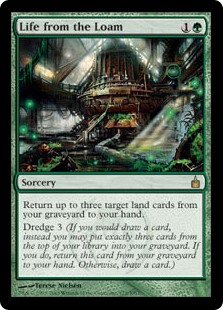
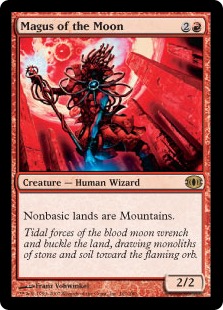
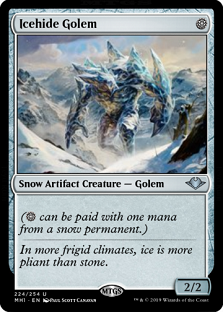
The catch is the rainbow manabase, which also eliminates Grim Lavamancer as a sideboard option. But that's where Eidolon goes anyway (less efficient than the sorceries, it's been relegated to hoser status), as well as some of Burn's best sideboard options (Revelry and Path).

Bringing us to the one Delver: since our lands make any color mana, why not run a single copy? If it gets removed, so would our more reliable damage creatures. And if not, it's a chance at a one-mana, freely-casting Isochron Scepter with Lightning Bolt. Multiple Delvers could prove clunky, but keeping the number low prevents any clog. The future of Burn? Maybe not, but I wouldn't call this build unplayable.

OUAT Merfolk, BERNARDODG (5-0)

Creatures

4 Kumena's Speaker
4 Lord of Atlantis
4 Master of the Pearl Trident
4 Merfolk Mistbinder
4 Merfolk Trickster
4 Silvergill Adept

Planeswalkers

2 Oko, Thief of Crowns

Artifacts

4 Aether Vial

Enchantments

4 Spreading Seas

Instants

4 Force of Negation
4 Once Upon a Time

Lands

4 Botanical Sanctum
2 Breeding Pool
4 Island
2 Misty Rainforest
2 Mutavault
4 Waterlogged Grove

Sideboard

4 Chalice of the Void
4 Collector Ouphe
3 Grafdigger's Cage
4 Veil of Summer

My favorite list from today jams all the busted green cards recently gutted from Standard into Merfolk, a deck that otherwise accesses some green support, but previously had little reason to want it. All it takes is a handful of great cards to reverse such a stance, and OUAT Merfolk packs those in spades.

Oko, Thief of Crowns: Oko lowers the need for Dismember and Vapor Snag by handling large creatures; Merfolk grows far bigger than 3/3, and often have islandwalk to boot, making the chump irrelevant. It's also a plan in itself, and can turn Aether Vial into Wild Nacatl. Plus, Oko's blue for Force pitching.

Once Upon a Time: Gets the party started right, finding a one-drop, lord, or land as needed. Once joins Vial as a card that makes a hand keepable, and is also awesome in a hand already featuring Vial: I imagine this deck keeps plenty of no-landers thanks to their interaction, and should a hand be heavy on mana, Once serves as another creature to flash in.

Veil of Summer: Maxed at 4 in the side, Veil is a one-mana Cryptic Command against Modern's blue- and black-based interactive decks. With Fatal Push overshadowing Lightning Bolt and Merfolk struggling to beat a critical mass of cheap removal, the Veil package seems like an elegant answer to midrange.

Collector Ouphe: Okay, so this one wasn't banned from Standard. But it's great against artifact decks, and those are the talk of the town in Modern. All in all, Ouphe's another giant gain for Merfolk, especially with Once to find it.

Combo Wackiness

While Urza decks transition away from combo elements in favor of a value-based midrange plan, these players are brewing up combo decks of their own. Got 'em?

Gruul Loam, HJEDMONDSON (5-0)

Creatures

4 Bloodbraid Elf
4 Countryside Crusher
3 Merchant of the Vale
4 Tarmogoyf

Enchantments

3 Seismic Assault

Instants

4 Lightning Bolt
2 Magmatic Sinkhole

Sorceries

3 Flame Jab
4 Life from the Loam
2 Pillage

Lands

4 Copperline Gorge
2 Fire-Lit Thicket
2 Forest
2 Forgotten Cave
4 Ghost Quarter
2 Mountain
2 Raging Ravine
2 Stomping Ground
2 Tranquil Thicket
1 Treetop Village
4 Wooded Foothills

Sideboard

3 Ancient Grudge
3 Anger of the Gods
1 Crumble to Dust
3 Nature's Claim
2 Obstinate Baloth
3 Shatterstorm

David tested out Life from the Loam-fueled value decks way back when the two-mana cycling lands were spoiled, to middling results; he concluded the deck needed one-mana cyclers to make it. Later, Wizards blessed us with just that, but the deck still seemed a bit soft to hate for Modern. Such decks still have success occasionally, and this Gruul Loam posting marks the first bit of luck it's sign in quite a while.

Of note are the removal of Wrenn & Six, a grindy card in a grindy deck, and the addition of Tarmogoyf as a way to quickly close the game against opponents building into something urestrainable. Merchant of the Veil also joins the fun to replace Faithless Looting.

Torbran Red, XENOWAN (5-0)

Creatures

4 Torbran, Thane of Red Fell
4 Bonecrusher Giant
4 Eidolon of the Great Revel
4 Goblin Rabblemaster
4 Legion Warboss
4 Simian Spirit Guide
3 Harsh Mentor
2 Magus of the Moon

Enchantments

1 Seal of Fire

Instants

2 Abrade
2 Lava Dart
4 Lightning Bolt

Lands

2 Castle Embereth
3 Gemstone Caverns
15 Mountain
2 Ramunap Ruins

Sideboard

2 Magus of the Moon
1 Blood Moon
1 Goblin Chainwhirler
2 Hazoret the Fervent
3 Leyline of Combustion
4 Leyline of the Void
2 Smash to Smithereens

Last week, I mentioned the relative lack of Lightning Bolts in Modern's current metagame. As that trend continues, we inch closer to prison plans like Torbran's: Simian Spirit Guide accelerating into Magus of the Moon, without a similar enchantment anywhere in sight. Bolt-weary creatures such as Harsh Mentor and Goblin Rabblemaster also get a chance to shine within that environment, with the latter fronting plenty of combat damage and the former piling on the reach against certain strategies, Oko Urza included.

Which brings us to Torbran, Thane of Red Fell himself. With the Dwarf in the picture, Mentor and Rabblemaster go from understandable metagame techs to absurd damagers; every Mentor ping, and each 1/1 Goblin hit, is multiplied two- or three-fold. Torbran might cost a lot for a Modern creature, but since the early turns are spent setting up red damage sources, it's more of a win condition than a threat, cf. Urza, Lord High Artificer in the Urza deck's earlier, more combo-oriented stages.

Rakdos Engineer, MELTIIN (5-0)

Creatures

4 Goblin Engineer

Planeswalkers

4 Karn, the Great Creator
4 Liliana of the Veil
1 Liliana, the Last Hope

Artifacts

4 Arcum's Astrolabe
3 Ensnaring Bridge
3 Nihil Spellbomb
2 Pithing Needle
1 Wishclaw Talisman

Sorceries

4 Collective Brutality
2 Damnation
4 Inquisition of Kozilek

Lands

4 Blast Zone
1 Blood Crypt
4 Bloodstained Mire
2 Dragonskull Summit
3 Field of Ruin
2 Prismatic Vista
1 Snow-Covered Mountain
7 Snow-Covered Swamp

Sideboard

1 Ensnaring Bridge
1 Pithing Needle
1 Alpine Moon
1 Ashiok, Dream Render
1 Damping Sphere
1 Grafdigger's Cage
1 Hex Parasite
1 Mycosynth Lattice
1 Night of Souls' Betrayal
1 Shatter Assumptions
1 Snare Thopter
1 Spellskite
1 Torpor Orb
1 Welding Jar
1 Witchbane Orb

Rakdos Engineer goes all-in on the Engineer plan popping up in certain strands of red stompy decks. Given enough time, the deck is set up to tutor anything it needs out of the 75: Engineer can dump and revive Wishclaw Talisman, which in turn finds even Karn to grab a sideboard bullet. Of course, time is of the essence in Modern, so the deck runs plenty of hyper-efficient ways to interact: one-mana discard, a-lot-for-two-mana Collective Brutality, and Blast Zone all make the cut at four copies apiece. Holding it all together is Arcum's Astrolabe, which makes Engineer a value engine at worst and filters colorless mana to hit double-black.

Midrange Meddlers

Last on the agenda are a group of midrange decks showcasing that playing fair ain't dead... and that it doesn't even have to be playing Jund!

Temur Snow, LYNNCHALICE (5-0)

Creatures

4 Ice-Fang Coatl
4 Tarmogoyf
2 Snapcaster Mage
1 Tireless Tracker
1 Vendilion Clique

Planeswalkers

1 Jace, the Mind Sculptor
3 Oko, Thief of Crowns
1 The Royal Scions

Artifacts

4 Arcum's Astrolabe

Instants

1 Force of Negation
4 Lightning Bolt
4 Remand
4 Skred
1 Spell Snare

Sorceries

4 Serum Visions

Lands

1 Breeding Pool
2 Misty Rainforest
3 Prismatic Vista
3 Scalding Tarn
3 Snow-Covered Forest
3 Snow-Covered Island
2 Snow-Covered Mountain
2 Steam Vents
2 Wooded Foothills

Sideboard

1 Tireless Tracker
2 Ancient Grudge
2 Anger of the Gods
2 Blood Moon
2 Ceremonious Rejection
1 Disdainful Stroke
1 Mystical Dispute
1 Negate
2 Veil of Summer
1 Weather the Storm

First up is Temur Snow, a mostly Temur midrange shell (to the extent that those can be). The twist: Skred, which compliments Ice-Fang to plug the wedge's hole in viable removal options. Midrange decks were already interested in splashing a snow package for Fang, so it makes sense that red ones might want to go the extra mile for Skred. It makes equal sense to reach for Oko, as many in Modern seem to be doing these days. LYNNCHALICE posted multiple 5-0s with this build in November.

Temur Cascade, ROFELOS (5-0)

Creatures

4 Gilded Goose
4 Ice-Fang Coatl
4 Tarmogoyf
4 Bloodbraid Elf

Planeswalkers

4 Oko, Thief of Crowns
1 The Royal Scions
3 Wrenn and Six

Artifacts

4 Arcum's Astrolabe

Enchantments

2 Blood Moon

Instants

4 Lightning Bolt
1 Magmatic Sinkhole
1 Skred

Sorceries

3 Serum Visions

Lands

1 Breeding Pool
1 Lonely Sandbar
4 Misty Rainforest
4 Prismatic Vista
2 Scalding Tarn
3 Snow-Covered Forest
3 Snow-Covered Island
1 Snow-Covered Mountain
1 Steam Vents
1 Stomping Ground

Sideboard

2 Ancient Grudge
2 Ashiok, Dream Render
2 Collector Ouphe
2 Disdainful Stroke
2 Force of Negation
1 Huntmaster of the Fells
1 Mystical Dispute
1 Vendilion Clique
2 Weather the Storm

In keeping with the RUG theme, here's Temur Cascade, a deck that ramps into Bloodbraid Elf with Gilded Goose and then rolls Oko for the win. If Goose dies, there's Goyf to follow up. And while Astrolabe is a less-than-exciting cascade hit, ROFELOS was able to ride the wave to a couple 5-0s with this build.

I like that Goose is catching on as the best mana dork this side of Noble Hierarch. When it immediately gets shot, it still leaves behind a little value; in this fast format, that perk seems mostly preferable to having reliable mana tapping each turn it's alive. There's also the bonus that in a mana-heavy gamestate, Goose can just lay some eggs and maybe swing a damage race.

Sultai Snow, GABBAGANDALF (5-0)

Creatures

4 Ice-Fang Coatl
4 Tarmogoyf

Planeswalkers

4 Karn, the Great Creator
4 Liliana of the Veil
3 Oko, Thief of Crowns

Artifacts

3 Arcum's Astrolabe

Enchantments

4 Utopia Sprawl

Instants

2 Abrupt Decay
4 Fatal Push

Sorceries

3 Inquisition of Kozilek
3 Thoughtseize

Lands

3 Field of Ruin
4 Misty Rainforest
2 Overgrown Tomb
3 Snow-Covered Forest
1 Snow-Covered Island
3 Snow-Covered Swamp
4 Verdant Catacombs
2 Watery Grave

Sideboard

2 Ashiok, Dream Render
1 Damping Sphere
2 Dead of Winter
2 Disdainful Stroke
1 Ensnaring Bridge
1 Grafdigger's Cage
1 Jace, the Mind Sculptor
1 Liquimetal Coating
1 Mycosynth Lattice
1 Pithing Needle
1 Tormod's Crypt
1 Wurmcoil Engine

Sultai Snow leans more heavily on planeswalkers than the last couple decks, but it nonetheless relies on Tarmogoyf to close out many games. Combined with the Loam finish above, these results indicate a return to using Goyf as an self-sufficient Plan B, a trend that fell way off with the introduction of Fatal Push. It's been two years since that happened, and I, of course, hope Goyf continues to climb back up through the Modern ranks!

Blue Jund, ALTNICCOLO (3rd, Modern Challenge #12021807)

Creatures

4 Bloodbraid Elf
4 Tarmogoyf

Planeswalkers

4 Liliana of the Veil
3 Oko, Thief of Crowns
3 Wrenn and Six

Instants

4 Assassin's Trophy
3 Kolaghan's Command
4 Lightning Bolt

Sorceries

4 Inquisition of Kozilek
4 Thoughtseize

Lands

3 Blackcleave Cliffs
1 Blood Crypt
4 Bloodstained Mire
2 Nurturing Peatland
2 Overgrown Tomb
2 Raging Ravine
1 Snow-Covered Forest
1 Snow-Covered Mountain
1 Snow-Covered Swamp
1 Stomping Ground
4 Verdant Catacombs
1 Watery Grave
60 Cards

Sideboard

3 Ashiok, Dream Render
3 Collector Ouphe
3 Damping Sphere
3 Leyline of the Void
3 Plague Engineer

Jund=good, right? Oko=good? Well, GG Modern!

Seriously though, I think the principles at work in this list are similar to the ones I employed last week for Six Shadow. There are very few beaters present because the planeswalkers are also threats. Elf gets the nod over Shadow for its high roll potential with Oko in the picture, not to mention the many juicy hits in the sideboard. Congrats to ALTNICCOLO for topping the challenge with this spicy deck after 5-0ing in the leagues!

Freezing Cold

As the temperatures drop, so too has Modern's frantic summer pace relaxed---November didn't reveal the sheer amount of league brews that less recent months have. In any case, I hope there's no correlation, and we end up with a frenetic winter!

Insider: Speculating on Theros Beyond Death

Are you a Quiet Speculation member?

If not, now is a perfect time to join up! Our powerful tools, breaking-news analysis, and exclusive Discord channel will make sure you stay up to date and ahead of the curve.

A few weeks ago we got some unofficial spoilers on Theros Beyond Death. Normally, we avoid digging too much into anything that is unsubstantiated given that we have seen plenty of fake spoilers. However, the cards shown appear to be more than just an image but the actual picture of the card which gives some credibility to their spoiling. It also helps that they aren't outrageous and seem viable.

I bring all this up only because we have seen multiple times that cards that appear to be plants for upcoming sets or that work very well with a new set/blocks mechanics often spike in price. The mechanics we see on the spoiled cards are;

Devotion

For those who didn't play during the last Theros Standard, the devotion mechanic proved extremely powerful. So powerful, in fact, that there was little reason to play more than one color for a significant amount of time in Standard. Admittedly, a fair amount of that power came from the fact that each color had access to Nykthos, Shrine to Nyx which helped generate massive amounts of mana for any color. This mechanic was also the reason that a card like Nightveil Specter went from bulk to big money.

There was an error retrieving a chart for Nightveil Specter

It is because of this card specifically that I'm writing this article, as I was lucky enough to have upwards of 20+ copies when the spoilers started rolling in, thanks in large part to my actively acquiring bulk rares at the time. The beauty of this mechanic is that many of the cards that directly benefit it are set/block specific; it can be assisted by cards from any set or block which allows for a lot of opportunity for speculative gains. A word of caution though, because this mechanic cares solely about the mana costs of cards it means there are plenty of options in each color. That wide openness means that there will be a lot of cards that could fit into a devotion deck, but likely far fewer that should. So cards that I do find as interesting speculative options are;

There was an error retrieving a chart for Cavalier of Gales
There was an error retrieving a chart for Cavalier of Thorns
There was an error retrieving a chart for Cavalier of Flame
There was an error retrieving a chart for Cavalier of Dawn
There was an error retrieving a chart for Cavalier of Night

The fact that these are mythic rares means there is a higher potential price ceiling and the fact that they are from a core set means there are likely fewer in supply thanks to the general lack of desire to draft core sets by most players. They all add three to their given devotion color and all have enters the battlefield abilities and leaves the battlefield abilities. There are currently only four cards in the set whose market price exceeds $9 so the RoI of a pack is extremely low; which means that we aren't likely to see a lot of people cracking packs. These cards are powerful enough that they could see play in non-devotion strategies, though arguably their mana cost then becomes a bane rather than a boon.

Throne of Eldraine Cards

There are currently two Throne of Eldraine cards I would consider as decent speculation targets for the devotion mechanic.

There was an error retrieving a chart for Murderous Rider

Murderous Rider is already a very playable card without the devotion mechanic. It is very similar to Hero's Downfall way back from Mono Black Devotion's dominance in the first Theros block, except it also has a lifelinking body attached as well. Rider is seeing significant play in various Pioneer builds and should we see a mono-black devotion develop in Standard this is definitely a four-of card. This card has remained relatively stable the past few weeks and there is likely to be a lot of ToE opened thanks to having so many high dollar cards so supply will likely continue to flood into the market.

There was an error retrieving a chart for Brazen Borrower

Brazen Borrower is also a card we are already seeing play in multiple formats and similar to Murderous Rider both halves are good spells on their own. Unfortunately, the current buy-in price on this card is already above $16, which is pretty steep for a Standard-legal mythic. We know that the price ceiling on standard mythic rares these days is around $50 and that requires utter dominance of the card. However, given the current demand is propping the price of this one up there is less risk of loss should Mono Blue devotion not pan out. If it does, then this could easily be a $30 card.

Leylines

There was an error retrieving a chart for Leyline of the Void
There was an error retrieving a chart for Leyline of Sanctity
There was an error retrieving a chart for Leyline of Anticipation
There was an error retrieving a chart for Leyline of Abundance
There was an error retrieving a chart for Leyline of Combustion

The leyline cycle is an interesting speculation target because it falls between two different known Theros Beyond Death archetypes; Devotion and Constellation. We have seen how powerful the Core Set 2020 leylines are in devotion builds courtesy of the mono-green devotion deck that got banned into oblivion in Pioneer. The ability to have two+ free devotion on turn 0 is huge with the devotion mechanic. One important thing to keep in mind though is obviously that you need a payoff card or cards to justify maindecking some of these leylines.

We haven't seen anything like Nykthos, Shrine to Nyx spoiled yet, so I don't know if I'd go too deep on any specific leyline, however, it's important to keep in mind that 3 of them (Leyline of the Void, Leyline of Anticipation, and Leyline of Sanctity) have been worth far more than their current price so even if no standard deck were to develop your risk on them isn't all that high. I'm not a big fan of Leyline of Combustion as it's ability seems the least powerful in our current environment, however, should we get some form of aggro red devotion deck it would likely be a 4 of.

Constellation

There was an error retrieving a chart for Starfield Mystic

Currently, we actually don't have a ton of rare or mythic enchantments in standard at the moment. I have already covered the Leyline cycle which aren't actually all that good in Constellation builds; the ability triggers on enchantments entering the battlefield, so you don't gain anything from them starting the game in play, but at least they would trigger if you drew them outside of your opening hand. The only card that seems like a plant for Theros Beyond Death in the current Standard is Starfield Mystic, which might see a price jump should a strong white constellation enchantment be spoiled, but it currently seems underpowered.

Escape

The Escape mechanic is new to this set and it doesn't seem to play all that well with any existing Standard-legal cards so I don't see any major potential speculation targets due to this mechanic.


Want Prices?

Browse thousands of prices with the first and most comprehensive MTG Finance tool around.


Trader Tools lists both buylist and retail prices for every MTG card, going back a decade.

Quiet Speculation