

Are you a Quiet Speculation member?
If not, now is a perfect time to join up! Our powerful tools, breaking-news analysis, and exclusive Discord channel will make sure you stay up to date and ahead of the curve.
Tournaments are overrated. Or perhaps, better put, participating in large-scale tournaments can be a suboptimal experience. I don’t attend large Magic events all that often, but it has been years since I participated in a legitimate tournament. Drafts and Vintage side events aside, I can’t remember the last time I battled in a tournament setting.
By eschewing these large-scale events, a world of cards is opened to me as a player. Cards that would otherwise be considered illegal in a tournament setting. If I was the only one who preferred casual, non-sanctioned play, then the most desirable tournament-illegal cards would be cheap and plentiful. As it turns out, that’s far from the case.
In fact, there are many cards that are not tournament legal, but still carry a hefty price tag. This week I’m going to dive into the world of casual play, highlighting some of the most interesting targets. In some cases, these non-legal cards are essentially not reprintable, sparse in supply, and provide long-term upside.
Collectors’ Edition
The Collectors’ Edition sets are the first non-tournament legal Magic cards printed. Released in December 1993, 14,000 sets of this product (9,000 CE and 5,000 ICE) were printed as a chance to own Magic’s most iconic cards. Their square corners and golden back borders ensured their illegal nature in tournament settings. Remember, this was from a time when sleeves weren’t used in gameplay—these cards would stick out like a sore thumb.
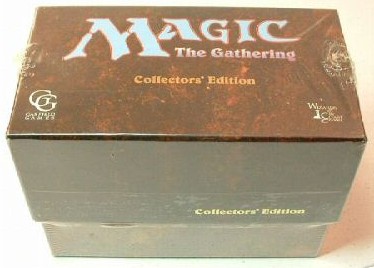
Fast forward 26 years and the landscape is completely different. Casual play is rampant, and almost everyone uses sleeves. As long as sleeves are opaque, no one cares if a player uses square cornered cards in their kitchen table games. Thus the demand for these non-legal cards has spiked while supply remains the same. After all, 14,000 copies of each card is not a lot to go around.
The result: some of these square-cornered cards have become extremely valuable. The International Edition Black Lotus has become the most valuable card not legal in tournaments. These now retail for around $2500 if in near mint condition!
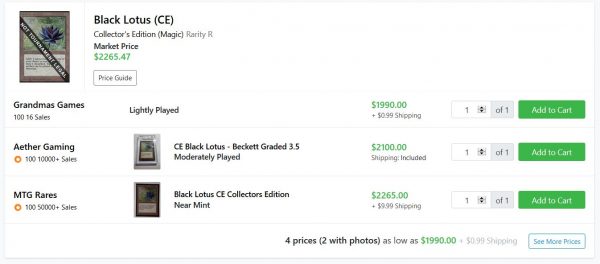
The entire Power Nine, Dual Lands, Gauntlet of Might, Wheel of Fortune, Time Vault, and Chaos Orb all can sell in excess of $100. There’s a fairly steep drop-off in value from there, but any Old School playable card carries with it reasonable value ($10-$30) thanks to the rarity of these sets. If you’re going to proxy a high-dollar card for Cube or Old School play, nothing competes with the black-bordered, original artwork Collectors’ Edition cards.
World Championship Decks
From 1997 to 2004, Wizards of the Coast printed gold-bordered versions of the top World Championship decks. This was a low-cost way for everyday players to re-live battles that took place at the top level of Magic competition. While their print run is unknown, it’s safe to say that these didn’t exactly receive the demand as your everyday Standard set.
As far as proxies go, if you want to battle with a card that has similar cardstock to a real Magic card, plus the original artwork, these get the job done. Like CE cards, these won’t work in unsleeved Magic; but given the prevalence of sleeves nowadays, you’d never know the difference.
Some of these cards have become quite valuable as a result. It helps that various Reserved List cards appear in these sets. Here’s a list of the most valuable, along with Card Kingdom’s price tag.
Gaea's Cradle: $64.99
Vampiric Tutor (not RL): $59.99
Yawgmoth's Will: $32.99
Scroll Rack: $26.99
Force of Will (not RL): $22.99
Clearly the community has caught on—these gold-bordered, non-tournament legal cards have sufficient demand to see their prices soar. I don’t expect Wizards will be printing any more sets like this in the future. Given this likelihood, I see little reason for these to do anything but slowly climb in price—especially the Reserved List cards in the set! At $300, Gaea's Cradle is a very expensive card, and $65 is a significant discount for a casual-playable copy!
Mystery Booster Packs
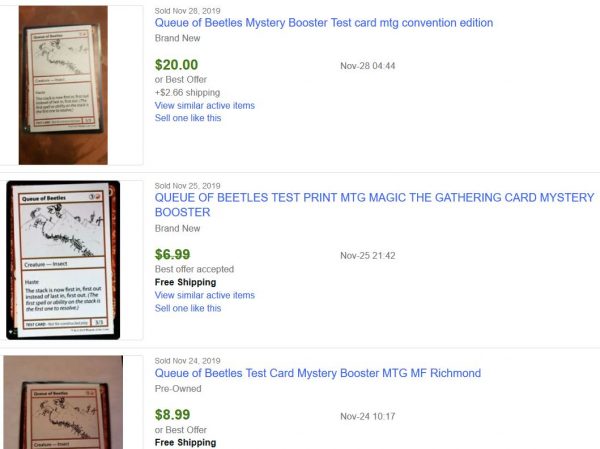
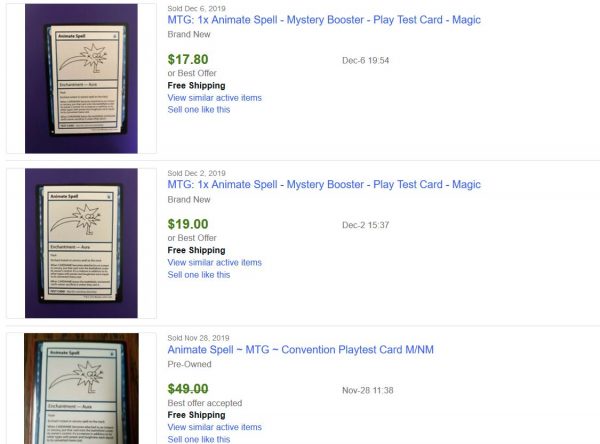
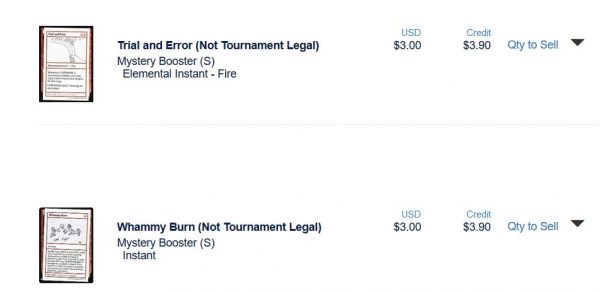
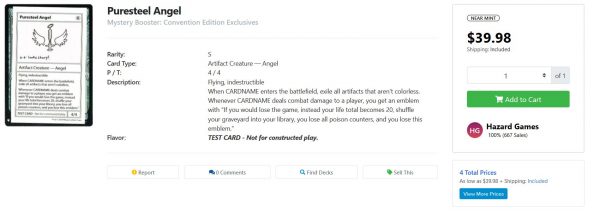
The newest tournament-illegal cards on my radar are the Mystery Booster Test Print cards. These are still being opened at MagicFests, so new supply is continually entering the market. This is reflecting in their gradual price-decay; even the more desirable cards are slowly dropping in price as the market absorbs new supply weekly.
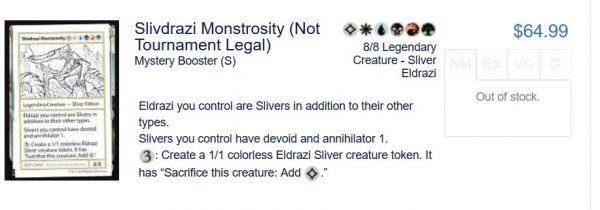
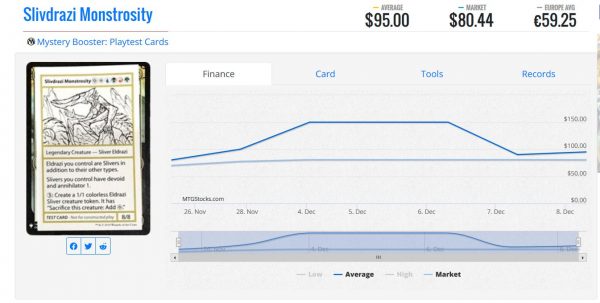
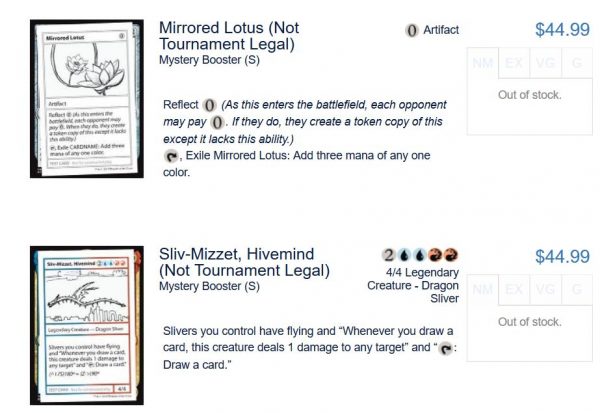
Despite this, I believe their long-term prospects are interesting. Their supply will be fairly sparse, and after these are no longer opened from packs at large events, supply on the more desirable cards could dry up. I recently wrote a lengthy article detailing my interest in these cards, so I won’t dwell on them here. I’ll merely mention that these offer some long-term upside from casual demand; especially cards like Slivdrazi Monstrosity, which Card Kingdom is still out of stock of at $64.99!
Foil Un-Set Cards
Unglued was the first non-tournament legal set of new cards to be printed. While it was successful enough to merit the rounding out of the three-set block, I’d argue that the foil Unhinged and Unstable cards offer the most long-term upside.
For reference, the most valuable Unglued card on Card Kingdom’s site is Forest, retailing for $8.99. The most valuable Unhinged card is foil Richard Garfield, Ph.D., which retails for $299.99! Foil City of Ass and Mox Lotus also retail for north of $100. These outdo the most valuable Unstable cards by a fair margin—foil Island ($89.99) and Steamflogger Boss ($64.99).
When dealing in Un-set cards, we need to be careful. There’s a major divide between the desirable cards and the undesirable ones—Un-set bulk cards are worth more as wallpaper than they are as Magic cards. But if you stick to the most desirable (and casual-playable) cards, you could see modest returns on these silver-bordered cards. If these are allowable in Commander as part of another promotional launch, you’d have a ripe opportunity to cash in on such a spec.
Promo Cards
Pop Quiz: What’s the most valuable promo card not legal in tournament Magic?
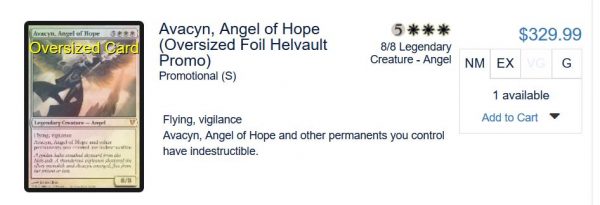
Ok, maybe this was a bit of a trick question. Oversized cards are not tournament legal for obvious reasons—what’s more, they’re not even legal in casual Magic. It’s impossible to shuffle an oversized foil Avacyn, Angel of Hope in your deck, after all! Does anyone else remember when these Helvaults were opened, and some random stores opened foils in theirs? The hype was huge, and it looks like it never really died down given these price tags!
I’ll ask the pop quiz question again, this time with a clarifier: What’s the most valuable, casual-playable but tournament-illegal card? The answer is one of my favorites:
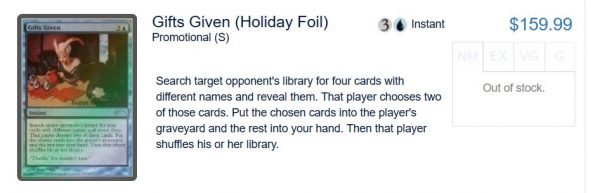
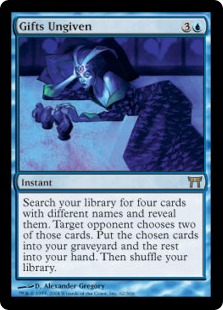
I’m not sure what exactly drives this card’s price tag. There are multiple holiday foil promotional cards, but this one is the most valuable (it’s also the only one I own). I can say that I acquired a copy years ago simply because I thought the artwork was cool—it is a nice play on Gifts Ungiven and ties in seamlessly with the holidays. But are copies of this card being shuffled up in casual and Commander games of Magic? I honestly don’t know.
As I scroll through Card Kingdom’s promotional prices, I see a couple other noteworthy silver-bordered cards. Grimlock, Dinobot Leader (the Hascon Promo) retails for $129.99 and is a casual favorite. Fruitcake Elemental, another holiday promo, shows up next at $89.99. Another holiday promo is next, Evil Presents at $74.99. Snow Mercy is another noteworthy holiday promo, at $59.99.
All the other holiday promos are also noteworthy, but I want to skip down the list for an honorable mention: the Ponies: The Galloping set. These are the newest on the list of non-tournament legal cards, and they have characteristics that set them apart from others. They reference another Hasbro franchise—something done only once before (2017 Hascon promos). But with the 2017 Hascon set, only Grimlock really went anywhere price-wise. Nerf War seems underappreciated at $11.99 and Sword of Dungeons and Dragons’ price tag ($24.99) is dwarfed by Grimlock’s.
The Ponies, on the other hand, are more consistently priced for now. Card Kingdom is currently sold out of all three with identical $34.99 price tags. TCG low for Nightmare Moon // Princess Luna, Rarity, and Princess Twilight Sparkle are $32, $30, and $35, respectively. It’ll be interesting to see how their prices unfold going forward. But one thing is for certain, the box sets will gradually climb in price as long as the three singles can be sold individually for more than the set as a whole (currently at $79).
Wrapping It Up
Casual, kitchen table Magic is where the majority of spell-slinging takes place. So it makes sense that cards specifically designed to be illegal in tournaments still carry hefty price tags.
This week I explored some of the more noteworthy tournament-illegal sets. Collectors’ Edition is the first, and also perhaps the rarest. But there’s still plenty of demand for more recent sets, even including cards that came out as recently as 2019. Just wait a couple years—I bet Ponies: The Galloping sells for more than it sells for today.
Wizards of the Coast has clearly caught on, that there is such demand for tournament-illegal cards. This is evidenced by the inclusion of Test Print cards in the Mystery Booster packs. The question now isn’t whether or not Wizards will print more non-tournament legal cards. Instead, I only wonder what they will have in store for us casual players in 2020!
…
Sigbits
- It may be slightly premature to call a bottom, but I’m seeing signs of a recovering Old School market. Just look at Card Kingdom’s hotlist, and you’ll see an array of cards made popular by the format. Serendib Efreet’s buy price has been on the rebound lately, with CK currently offering $240 per copy. They offer $135 on All Hallow's Eve and $110 on Winter Mishra's Factory, as two other examples.
- A couple of Dual Lands have recently appeared on Card Kingdom’s hotlist. Currently they offer $195 on Tropical Island and $110 on [card] Savannah. While these buy numbers aren’t the most inspiring, they’re not terrible if shipping played copies for store credit. Just a few months ago, the market on HP Revised Duals was quite soft, so this could offer a last-resort out for players eager to liquidate.
- Here’s a random shout-out to a card I’ve never mentioned before: FNM Promo Swords to Plowshares. The original art promo currently carries a $70 buy price. I haven’t tracked this card’s value closely, so I can’t directly comment on how that compares with history. It looks like TCG low is $110.58, so that $70 buy price isn’t quite high enough. Then again, I doubt these sell frequently so if you’re desperate to sell a copy, perhaps buylisting is the way to go.

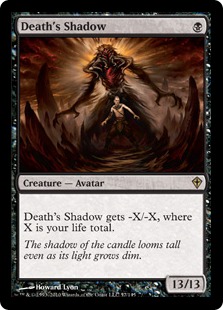
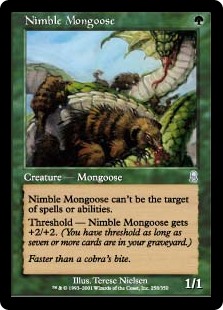 Magic is a game of resources, of which boundary-pushing card design ensures there are plenty of. Mana is but one such resource, if the most obvious; others include cards in the graveyard (Nimble Mongoose), land types in play (Wild Nacatl), life not had below a certain number (Death's Shadow), or number of cards discarded this turn (Hollow One).
 Casting Time
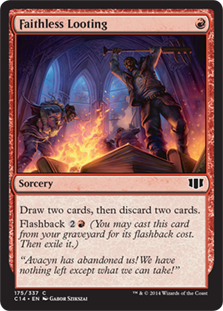
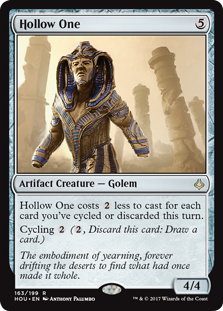 Similarly, Hollow One prices players into spending mana on the Golem during turns they discard spells, even if they've drawn another juicy castable off their Goblin Lore (say, Fatal Push). In lieu of another looting spell, they may otherwise miss out on the chance to cast their creature at all.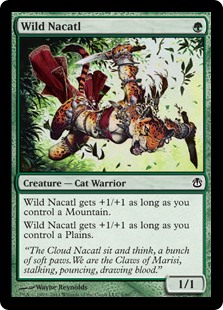
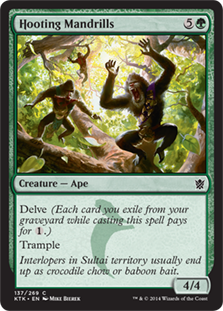
 Evasion keywords are becoming increasingly common on cheap combat creatures, but they often replace raw stats, a bad trade for our purposes. Hooting Mandrills and Delver of Secrets are the only one-drops in Modern with 3 or more power and an evasion ability.
 Of course, some removal spells slaughter beaters regardless of toughness, which is where converted mana cost enters the equation. Fatal Push may have
 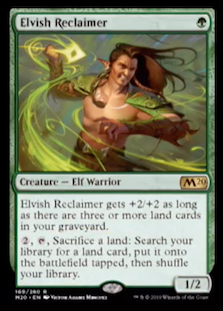 With the metrics for playability among one-mana beaters clearly outlined, we can apply this theory to existing creatures in Modern. In terms of cost, Nimble Mongoose is potentially a 3/3 with shroud that leaves used resources intact and can be played at any time. So why doesn't it see any action? Because of its low reward: Mongoose is slower than Mandrills or Angler at getting in for full damage, always soft to the common practice of graveyard nuking, vulnerable to popular sweepers despite the shroud, and with no evasion, outclassed by many of Modern's creatures. Let's apply these same principles to newcomer Elvish Reclaimer and see how the Warrior ranks.
 Resources used: None. Flying colors on this one.
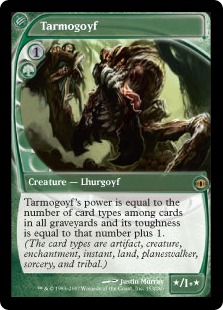 As is a common theme of my writing, I find myself sizing up Elvish Reclaimer against Tarmogoyf,
 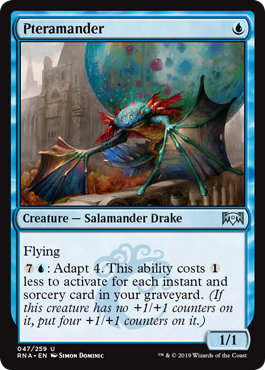 I have yet to be blown away by Reclaimer in Temur Delver, the shell I spent yesterday testing it in. But the Elf did have its moments. I'm up to 4 Scour, 4 Looting now in a bid to accelerate its development; so far, the additional cogs smooth things out considerably. They've also left me wondering if there's not a better creature to spend all that effort enabling; Pteramander
 Longtime readers may remember that I played a
  I arrived on site, made sure the staff knew I was there so they didn't forget to put me in, and then got to scouting. The Denver competitive crowd tends to favor Burn and Jund, with whatever flavor of the month deck is visibly winning being third. I was therefore surprised to see tons of Eldrazi Temples being registered. Eldrazi Tron was the most common configuration, but not by much. I've heard of GW and GU Eldrazi seeing play online, but never in person before Saturday. There were also a number of players on the
 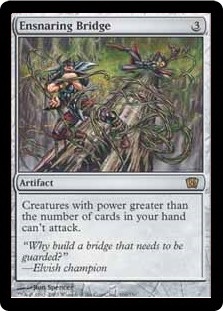 For Round 1, I'm on the play against Mono-Red Prison. I have him dead on the next attack when he topdecks Ensnaring Bridge, Anger of the Gods, and Karn, the Great Creator in that order to shut me down. In Game 2, I mulligan for Aether Vial and am rewarded when he dumps his resources into an early Blood Moon. I draw my Plains so my development is unaffected and win easily.
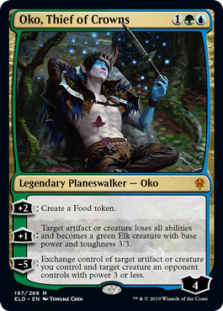 Round 2, I'm on the draw against turn one Gilded Goose, turn two Oko, Thief of Crowns. However, my opponent doesn't do anything else, so I'm free to kill Oko and then my opponent. Given that he seemed very concerned about my Meddling Mage naming Urza, I assume he's Simic Urza and sideboard accordingly. So I was surprised to lose Game 2 to Blood Moon. Hes got me: my opponent's actually Temur Snoko. With no Vial I'm trapped. I fix my sideboarding for Game 3, and win after grinding my way through Oko, Wrenn and Six, and Jace the Mind Sculptor.
 My opponent still had two Paths in hand when he died to my massive board.
 Green Devotion, Crabvine, Affinity, Mono-Red Prowess, and Sultai Midrange. The decklists are
  Merfolk, GW Hatebears, and a number of brews vying for the last Top 8 slots in round 6.
 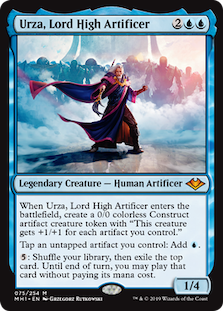 Most decks in Modern don't give opponents the time to durdle around turning food into elk. Lacking anything approaching Whirza's I Win combos or prison plans, Simic has to grind, and that's not where Modern



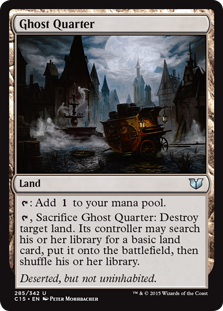 Power and flexibility will be rated by considering both a card’s floor (the least it will do) and its ceiling (its best-case scenario). For example,
 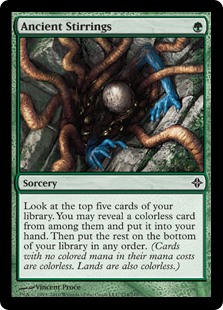 #5: Ancient Stirrings
 Splashability is where Stirrings really takes a hit.
 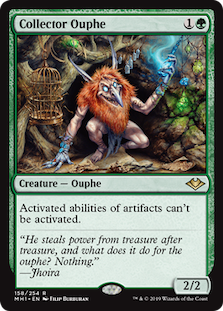 #4: Collector Ouphe
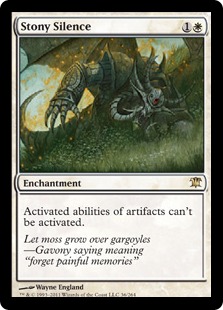 But yeah, its effect, however superb in the right scenario, is quite narrow, mostly dooming Ouphe to sideboards.
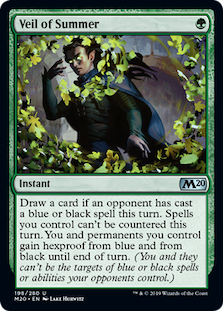 #3: Veil of Summer
 But it still only works on the stack, and when opponents bring those kinds of effects to the table. This sort of card is inherently narrow in its applications.
 Splashability: 4
 Splashability: 3

 2019 kicked off with the metagame being disrupted by an
  However, in April, the
 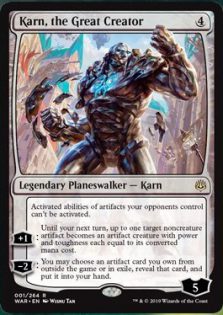 May opened with the release of War of the Spark, and
 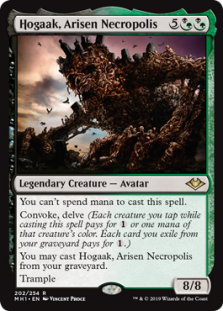 Modern the opportunity to finally try to understand just what had happened with Horizons. However, this grace period was not to last. It turned out that Hogaak had merely been metamorphosing. Like a caterpillar turning into a butterfly, Hogaak was about to find its final form.
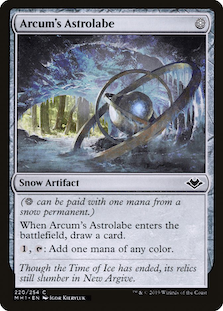 Its main draw is that it's cheap as free. Other options like Everflowing Chalice or Witching Well aren't as individually powerful as Explosives or Astrolabe, but they don't need to be. The shell's


 The Modern Top 5 series aims to establish a set of three metrics and apply them to individual cards, yielding a ranking with selections and placements somewhat less arbitrary than your average Buzzfeed collection. Subjectivity nonetheless plays a role—the chosen metrics, as well as the ascribing of values to each metric, are based on my personal impression. That's where the article format comes into play: I have space to defend my decisions, and readers have the comments to dispute them!
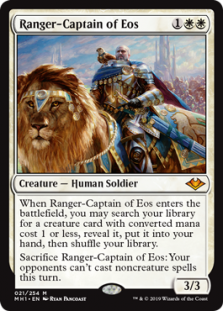 Ranger-Captain of Eos, a value-loaded three-drop from Modern Horizons, found its way into multiple Modern decks this year, including
 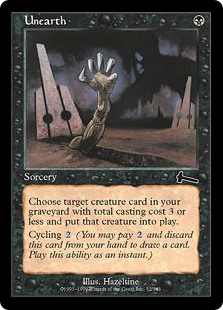 Iconicity: 1
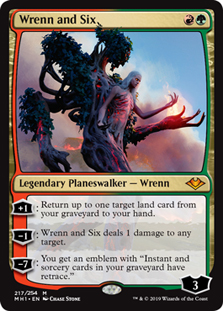 #4: Wrenn and Six
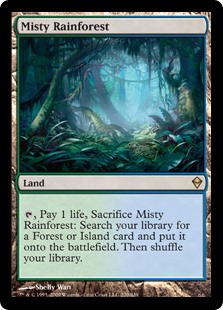 Iconicity: 3
 Staying Power: 4