menu

Insider: Modern Tradebook

Are you a Quiet Speculation member?

If not, now is a perfect time to join up! Our powerful tools, breaking-news analysis, and exclusive Discord channel will make sure you stay up to date and ahead of the curve.

For this week's column, I felt it would be appropriate to check in on my Modern tradebook. The Modern PTQ Season officially begins in January, but with the recent Pro Tour Return to Ravnica kicking things off and a few Modern GPs approaching, it's not unrealistic to expect interest in Modern to ramp up over the coming weeks. The book is largely established at this point, with only a few other potential moves to make depending on how prices fluctuate over the coming weeks.

Real Estate

If you are a regular reader of this column, it should come as no surprise that Gatecrash shocklands make up a significant portion of my Modern tradebook. Charts are courtesy of mtggoldfish.com, which takes pricing data from Supernovabots.com. All other prices are taken from MTGOtraders.com and are current as of November 8th, 2012.
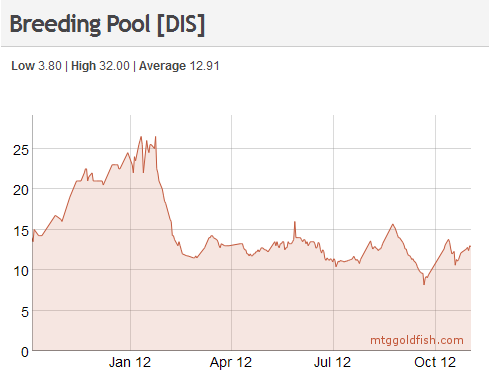
 

Breeding Pool (15.80 tix): 22 copies bought for an average of 9.72 tix in September. Ravnica-Guildpact-Dissension (RGD) made a cameo appearance in the draft queues in early September and prices on all RGD cards fell as a result. This was a great time to pick up shocklands of all types. Breeding Pool is most prominently appearing in the BUG Infect lists which should appeal to players on a budget. It's also quite the ruthless deck and will punish slow or unfocused builds. This one is looking good for a solid profit.
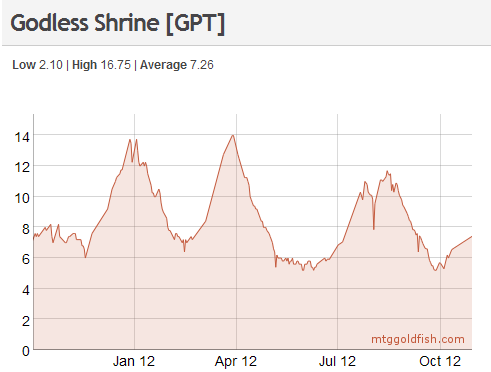
 

Godless Shrine (9.55 tix): Bought 38 copies at an average of 5.73 tix in September. In this article I made a guarantee on this card for people who were looking to try their hand at speculating on MTGO. If anyone wants to get out of their position on this card right now, I am willing to honor the guarantee today and pay 6 tix per copy ;-).
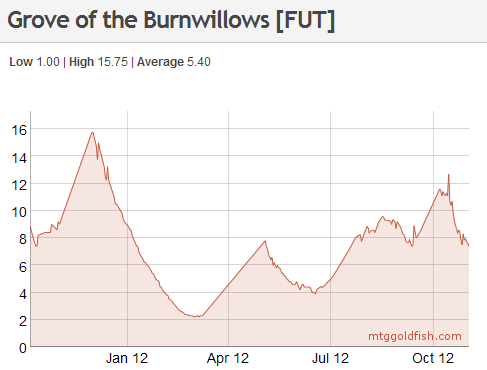
 

Grove of the Burnwillows (8.74 tix): Bought 18 copies at an average of 9.58 tix, with most copies purchased during October. This position is currently underwater but more so due to the poor timing of purchase than for any fundamental reason. Speculating on lightly printed sets like Future Sight is one of my favorite angles and I still expect this position to be profitable.
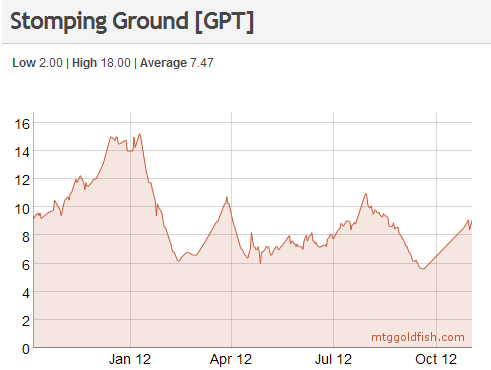
 

Stomping Ground (11.59 tix): Bought 37 copies at an average price of 6.11 tix in September, and sold all of them at an average price of 13.5 tix in the weeks after the unbanning of Valakut, the Molten Pinnacle. Although it was a bit of luck catching an unbanning that affected the price of this card, half of the purchases were made in the 24 hours after the B/R announcement. Total profit: 273.67 tix, ROI: 121%.

Man Lands

Although not as ubiquitous as fetch- and shocklands, various archetypes make use of utility lands that regularly fluctuate in price.
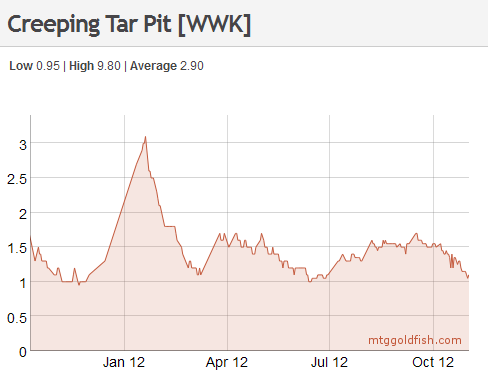
 

Creeping Tar Pit (2.80 tix): Most of my purchases on this card were made back in early Summer, although I did pick up 18 copies last week at an average price of 0.86 tix. Its appearance in the Top 8 of GP Lyon is the big reason this one is already in the money. Selling and taking profits today is not incorrect but holding for PTQ season is also fine.
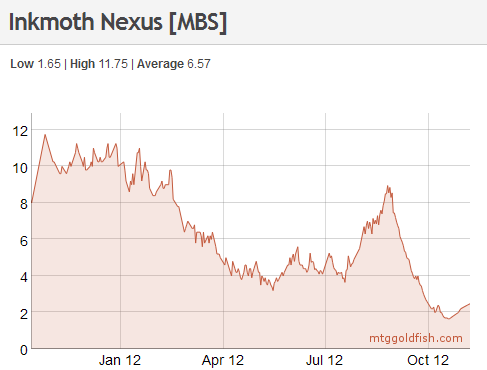
 

Inkmoth Nexus (2.96 tix): Bought 50 copies at an average price of 1.75 tix in October. This was a Scars block rotation pick up and it appears in both Affinity and Infect decks. If this reaches 4.5 tix, selling would not be incorrect, though I am fine with holding this Modern staple beyond the upcoming season. The potential in-season price peak on this card is not yet clear as this card has just rotated out of Standard.

Staples

Once you've got your fill of real estate (the backbone of any portfolio), looking towards format staples for potential investments is a good idea. The best staples come from the smaller print run sets and are not easily replaceable. Avoid current Standard cards as the prices on these will fluctuate too much to be of much use in speculating on Modern.
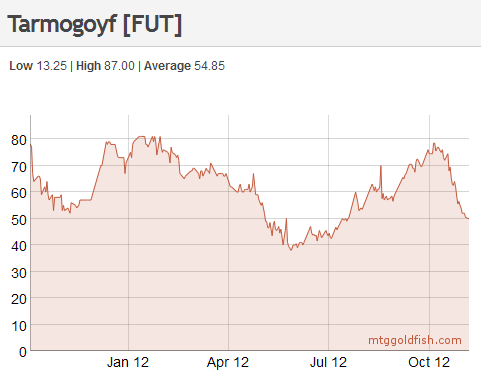
 

Tarmogoyf (53.22 tix): Bought 19 copies at an average of 50.32 tix in the last week. After dropping by 20+ tix in the last month, the price on this card has possibly found it's footing. If it drops into the 40-45 tix range, I'll start buying again. Alternatively, if it bumps up in price into the 55-57 tix range, this would indicate to me that demand for this card has rebounded and that in-season prices are not far away.
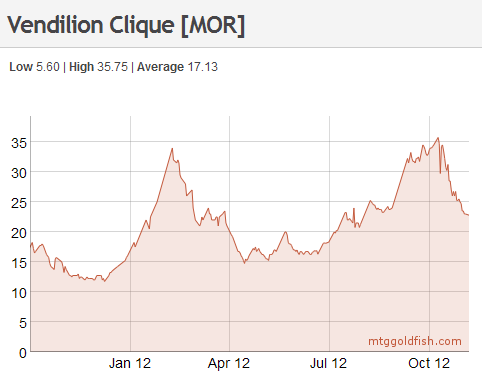
 

Vendilion Clique (23.75 tix): Bought 18 copies at an average of 22.62 tix in the last week. Similar to Tarmogoyf, this card also saw a recent slide coinciding with the announcement of Modern Masters and RtR release events. It looks like the slide has stopped and at the current price it's still a buy.
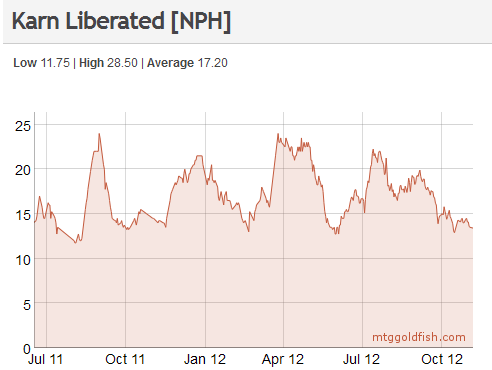
 

Karn Liberated (14.40 tix): Bought 40 copies at an average of 13.1 tix in the past month. In addition to the analysis offered on this card last week, this card has shown over time to have a firm floor of 12-13 tix. As of today, it looks like the prices on the Scars block sets have bottomed so prices on Scars block mythic rares should creep up over time as redemption eats up available supply. This further supports the price of Scars block mythics such as Karn.
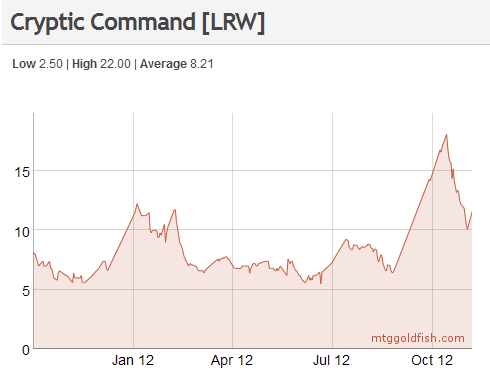
 

Cryptic Command (12.05 tix): Bought 15 copies at an average of 8.10 tix. Similar to Creeping Tar Pit, the results of GP Lyon reminded players that Modern is not all Jund, all the time. At it's current price buying more feels a little risky, especially keeping in mind last year's in-season price peak of around 15 tix. Note that the mtggoldfish charts are produced using data from the Supernova bots price list. Occasionally there are gaps in the data when the bots are out of stock and the charts start using buy prices instead of sell prices. This is why last year's in-season price peak of 15 tix does not appear on the chart; the price peak occurred while Supernova was out of stock.
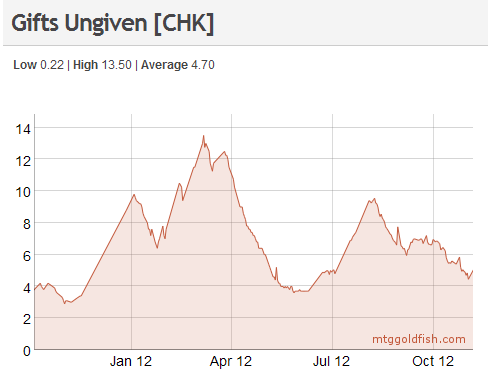
 

Gifts Ungiven (5.89 tix): Bought 15 copies at an average of 5.03 tix. This one is still a buy as it remains somewhat under the radar.

This look into my Modern tradebook should give you confidence that speculating on MTGO can be profitable. Most of these positions are low risk because they take advantage of the underlying structure of the MTGO economy and the seasonal nature of the Modern Constructed format. What is not needed is special knowledge of the Modern format.

Good Luck, High Five! Episode 10: Knowledge Bomb

Are you a Quiet Speculation member?

If not, now is a perfect time to join up! Our powerful tools, breaking-news analysis, and exclusive Discord channel will make sure you stay up to date and ahead of the curve.

Banner

Mike, Forrest and Ryan get together to answer pressing questions. Which cards can safely be unbanned in Modern? How many boomerangs are in a didgeridoo? Do wizards take credit cards? What time does the gas station close? Is Lady Gaga hot? What week is it? Discover the answers to all of these pressing questions and hear about A+ card Slaughter Games on this week's episode!

Show notes:
German Commander's Aresenal Opening
Herberholz Cloudthresher Story
Cloudthresher: :)(())(()===>

(The views expressed in "Good Luck, High Five!" are those of the personalities featured and do not necessarily represent the views of and should not be attributed to our host.)

Parental Advisory: May Contain Mild Obscene Language

Insider: Casual Hits from M13 & Return to Ravnica

Are you a Quiet Speculation member?

If not, now is a perfect time to join up! Our powerful tools, breaking-news analysis, and exclusive Discord channel will make sure you stay up to date and ahead of the curve.

Quick question. How much is Parallel Lives worth? How about Adaptive Automaton? Asceticism?

Chances are, the prices might surprise you. But they shouldn’t. As any trader worth their salt knows, these cards are all $2 or above, even though you frequently get them in bulk rare piles or find them in collections, or even as leftovers at the draft tables. And you do want to earn your salt, right?

The “Casual Hits” series is one I like to revisit from time to time because sometimes knowing what to target for those “throw-ins” to complete a trade can pay off big time. While it’s nice to pick up the above cards as throw-ins so you can later sell them off for a buck or two to a dealer, there’s even more opportunity than this.

You should definitely not be scared to hoard these cards to sell to dealers later (along with all the Darksteel Plates you can find), but I find the most profitable reason to pick these cards up is at the trading tables. Now, while you’re at a big event like an SCG Open or a Grand Prix, you’re likely to be trading with tournament players who aren’t interested in your Primordial Hydra ($4), I think it’s safe to say many of my readers do more than that.

As with anything, the saying “everything is local” rings true with trading. The PTQ grinders don’t want these cards, but they will trade like crazy back at FNM. Cards like this are easy, in my experience, to make money “on both the ins and the outs.”

What this means is that when trading for something like a Primordial Hydra at a big event, you’re likely to get it for a dollar or so in trade from a tournament player who writes it off, netting you some value “on the ins.” On the flip side, when you take that card home and find the EDH player who wants one to fill out a deck, you’re likely to end up getting a $5-7 card for it without much work. Not a bad deal for what’s likely to be filler in a larger trade, especially when you consider how fast this sort of thing adds up.

Of course a major lesson here is understanding that you have to be able to appeal to many different interest groups, from the hardcore grinders to the kitchen-table wizards. This means developing relationships with as many people and/or groups as possible to increase the amount of outs you have for any given card.

With all of that in mind, let’s take to M13 and Return to Ravnica to see if we can’t find some good trade bait or a few legitimate medium-to-long-term sleepers.

Akromas Memorial

This crazy-powerful artifact used to command a much more hefty pricetag than the $3.50 SCG sells them for now. M13 had a lot of casual reprints that dinged the value of the originals, but it also means there’s some more on the market to stock up for the future. For this and other EDH cards, foils are especially good as pickups, and are likewise more likely to be undervalued on the trade floor.

Jace, Memory Adept

Another card whose price was on the way up before the reprint. Players are in love with milling, so the Glimpse the Unthinkable part of Jace is going to keep him popular for years to come. That said, there’s no telling how much they’ll reprint him in the core sets to come.

Primordial Hydra

As I touched on above, this guy is insane in those Mono-Green big mana decks that everyone loves to play. $4 now, though you’ll likely pick these up much cheaper than that.

Nicol Bolas, Planeswalker

This guy seems criminally underpriced to me at $5. There was a day not that long ago when the Conflux version of this easily fetched $20. I don’t think those days are coming back any time soon, but he’s also going to have a hard time going lower than this.

Gilded Lotus

Another card I really like the foil play on, since it goes into many Cubes and just about every EDH deck ever that wants mana.

Reliquary Tower

Another big EDH card that took a huge dive with M13. It’s going to take a little while for it to climb back up in price, but I suspect it will at some point, and you could scoop these up off draft tables just a few months ago. These days, you’ll probably be able to get them as free throw-ins in trades.

Chromatic Lantern

Now that we’re getting into the Ravnica stuff, I want to say that prices on these aren’t bottomed-out yet. So I’m not suggesting pay “full retail” on these in trades, but be on the lookout for these if the deal is right.

As for Lantern, not only is it fringe-Constructed playable, it’s mostly certainly a winner in EDH, providing another “cheap” way for people to mana-fix and providing a boost in mana along the way.

Collective Blessing

This still hasn’t taken off like I thought it might in Standard, but Anthem effects are always popular casually and this should trade well to that crowd. I’m not suggesting going super-deep on these, but again, it’s hard to lose if you’re just filling out a trade with one or two of these.

Pack Rat

People play Relentless Rats decks. It happens. While this doesn’t necessarily fit into that mold, this is essentially a do-it-yourself Rats and slots into Rat EDH decks. While this is a small niche, it’s something that will trade when you find the person who wants it. Not to mention that this stupid thing wrecks just about any Limited game it’s played in.

Slaughter Games

This card is better than you gave it credit for, I promise. One of the major reasons against bringing cards like this in from the sideboard is that the decks you want to resolve it against will usually just counter it and then win while you’re tapped out.

Not a problem any longer. This card already pops up in Standard (where it’s very good), to Modern (where it’s insane in the matchups you want it), and I expect it to start showing up in some Legacy sideboards too. Seems good for $1.50. Don’t expect too much, since sideboard cards rarely see huge spikes, but I don’t think it’s going to stay under $2 forever.

Keyrunes

Okay, so you’re never going to score huge with these. I get that. But once these stop being opened supply will diminish, and there will still be some people who need them. These could easily be the Tezzerets Gambit of the set, and Gambit hit buylist prices of up to a dollar last year.


That’s everything that caught my eye as I perused the spoiler for this article. This type of analysis leads me to picking better “throw-ins” when I’m trading, and I’ve made a not-insignificant amount of money over the last few years by stocking up on some stuff like this.

Thanks for reading,

Corbin Hosler

@Chosler88

Hidden Standard Gems

Are you a Quiet Speculation member?

If not, now is a perfect time to join up! Our powerful tools, breaking-news analysis, and exclusive Discord channel will make sure you stay up to date and ahead of the curve.

If you have been reading this column for a while, you already know my love for rogue decks. There is a lot of potential gain to be made from bringing a rogue deck to a large tournament. With players utilizing online resources so much these days, they rely heavily on data about existing matchups in their preparation. The same goes for testing. Players are going to prepare and test games against the biggest decks in the format. While Standard is a brewers' paradise most of the time, it is becoming harder and harder for rogue decks to be successful due to the high power level of the new cards that continue to see print.

I don’t just love any rogue deck though. They have to be solid choices for competitive play. When you are working on a rogue deck, don’t forget to take the format's major players into consideration. The point of rogue decks in competitive play is not only to win games due to your opponents’ lack of understanding of your cards but also to position yourself to beat the existing tier one decks.

Today, I want to take a look at some successful decks that you may not have heard of. All of these decks have done well at relatively large events, proving to be successful. Take a look at the Top 8 Standard Hidden Gems.

8. R/G Aggro

Untitled Deck

Creatures

4 Arbor Elf
2 Champion of Lambholt
2 Flinthoof Boar
4 Huntmaster of the Fells
2 Pyreheart Wolf
4 Strangleroot Geist
1 Thragtusk
2 Wolfir Avenger
2 Wolfir Silverheart
1 Zealous Conscripts

Spells

2 Garruk Relentless
4 Brimstone Volley
2 Mizzium Mortars
4 Rancor

Lands

11 Forest
2 Kessig Wolf Run
7 Mountain
4 Rootbound Crag

Sideboard

1 Bonfire of the Damned
2 Flames of the Firebrand
2 Garruk, Primal Hunter
2 Ground Seal
2 Mizzium Mortars
2 Pillar of Flame
2 Thragtusk
1 Thundermaw Hellkite
1 Zealous Conscripts

7. R/G Aggro

Untitled Deck

Creatures

4 Arbor Elf
4 Avacyns Pilgrim
3 Borderland Ranger
1 Druids Familiar
4 Huntmaster of the Fells
4 Strangleroot Geist
4 Thragtusk
2 Zealous Conscripts

Spells

2 Garruk Relentless
4 Bonfire of the Damned
4 Pillar of Flame

Lands

10 Forest
4 Kessig Wolf Run
6 Mountain
4 Rootbound Crag

Sideboard

2 Brimstone Volley
1 Daybreak Ranger
2 Devils Play
2 Revenge of the Hunted
2 Sundering Growth
2 Thundermaw Hellkite
3 Triumph of Ferocity
1 Zealous Conscripts

Number seven and eight are two different takes on R/G Aggro. Both of these aggressive decks aim to be able to beat their opponent even after they cast a Thragtusk. Each of these decks has their own way to fight through whatever their opponent is doing.

With less Pillar of Flames in the format, it might be time to update this deck. Cards like Pyreheart Wolf and Wolfir Silverheart seem well positioned in the metagame. I would like to see more Hellriders and Thundermaw Hellkites in this style of deck to further abuse the mana accelerants.

One definite perk of playing a red and green deck right now is the addition of Kessig Wolf Run. We have not heard much about this card since the format rotated, but it still makes all of your creatures into threats. This land is exactly what a midrange deck is looking for in order to punch through the last bit of damage.

6. Curses!

Untitled Deck

Creatures

3 Olivia Voldaren

Spells

4 Annihilating Fire
3 Barter in Blood
1 Curse of Bloodletting
1 Curse of Deaths Hold
4 Curse of Misfortunes
1 Curse of Thirst
4 Dreadbore
4 Mizzium Mortars
4 Pillar of Flame
3 Sever the Bloodline
3 Tribute to Hunger

Lands

4 Blood Crypt
4 Dragonskull Summit
7 Mountain
2 Stensia Bloodhall
8 Swamp

Sideboard

4 Desecration Demon
3 Manor Gargoyle
4 Slaughter Games
4 Vampire Nighthawk

What’s that? That’s right, seven main deck curses! Talk about a win condition. You only need cast Curse of Misfortunes and then play your normal game of killing everything while your curse finds more curses. Because you are only playing red and black, there is room for a lot of amazing removal spells.

Normally this type of deck has a terrible time beating opposing planeswalkers, but with Dreadbore that is no longer the case. Barter in Blood along with Mizzium Mortars do a decent Day of Judgment impersonation and the other removal spells mop up the rest. You even have the vastly overcosted Stensia Bloodhall for when you face another control deck.

This deck is not for everyone, but don’t underestimate the power of the curses just because you have never heard them mentioned as viable Constructed cards. They are a realistic win condition that's hard to deal with in the current metagame. You also have Olivia Voldaren to steal all the Thragtusks and Angel of Serenitys. You gain some virtual card advantage as well because removal spells from your opponents are blanks most of the time.

5. U/R Delver

Untitled Deck

Creatures

2 Augur of Bolas
4 Delver of Secrets
1 Dungeon Geists
4 Snapcaster Mage
3 Thundermaw Hellkite

Spells

3 Bonfire of the Damned
1 Cyclonic Rift
1 Desperate Ravings
2 Dissipate
1 Mizzium Mortars
4 Pillar of Flame
2 Runechanters Pike
2 Searing Spear
2 Think Twice
4 Thought Scour
1 Unsummon

Lands

1 Desolate Lighthouse
8 Island
1 Izzet Guildgate
5 Mountain
4 Steam Vents
4 Sulfur Falls

Sideboard

1 Annihilating Fire
1 Augur of Bolas
1 Cavern of Souls
3 Clone
1 Devils Play
2 Dispel
1 Dissipate
1 Mizzium Mortars
2 Negate
1 Redirect
1 Smelt

This deck looks pretty similar to the UWR Midrange deck many players are picking up but there are some major differences. This list still plays Delver of Secrets as an early drop. It's certainly not as good as it was before, but if it flips on turn two or three your opponent is in for a quick game.

There was an alternate version floating around somewhere that played Goblin Electromancer to cast powerful spells like Talrand's Invocation a turn early. That type of strategy could be viable in this style deck as well. The Dungeon Geists also seems great to me right now because it is a removal spell that actually deals with almost any creature in Standard. Many decks have no way to remove it either.

4. U/W Midrange

Untitled Deck

Creatures

4 Augur of Bolas
4 Restoration Angel
4 Snapcaster Mage

Spells

4 Azorius Charm
2 Dissipate
2 Essence Scatter
1 Rewind
1 Sphinxs Revelation
2 Syncopate
3 Think Twice
4 Thought Scour
4 Unsummon
2 Runechanters Pike

Lands

4 Glacial Fortress
4 Hallowed Fountain
2 Moorland Haunt
9 Island
4 Plains

Sideboard

3 Detention Sphere
1 Erase
2 Faiths Shield
1 Negate
2 Purify the Grave
1 Rewind
3 Geist of Saint Traft
2 Supreme Verdict

This is one of the decks you may have seen already. Star City grinder Adam Prosak used this list to Top 8 the latest Star City Open in St. Louis. Removing the red mana from the UWR Midrange deck allowed Adam to play more counters and card draw, in addition to making the mana base more stable. Considering how quickly he fills his graveyard, Runechanter's Pike becomes a viable win condition and not just a couple extra damage. In many games, Pike dealt the final blow to unsuspecting opponents.

I’m not sure I agree with cutting Geist of Saint Traft, but this deck is more like a control deck that also happens to play a powerful equipment. Since he is less focused on beating his opponent quickly, that makes no Geists more appealing. He did include them in the sideboard to kill opposing Geists and also against other control decks.

3. Seance

Untitled Deck

Creatures

3 Angel of Serenity
4 Armada Wurm
3 Centaur Healer
1 Disciple of Bolas
3 Lotleth Troll
4 Thragtusk
3 Trostani, Selesnyas Voice

Spells

4 Farseek
4 Grisly Salvage
4 Mulch
4 Seance
3 Unburial Rites

Lands

3 Forest
2 Isolated Chapel
4 Overgrown Tomb
4 Sunpetal Grove
4 Temple Garden
4 Woodland Cemetery

Sideboard

1 Craterhoof Behemoth
1 Disciple of Bolas
3 Garruk, Primal Hunter
1 Griselbrand
2 Loxodon Smiter
4 Nevermore
2 Rhox Faithmender
1 Tree of Redemption

The ability to do anything repeatedly is powerful, and Seance fits the bill. Remember, not only do you get to bring something back on your turn, you also get to use that effect on your opponent's turn. Grisly Salvage and Mulch combined with Lotleth Troll as a discard outlet allow you to fill your graveyard quickly and take advantage of the reanimation each turn. Once you have Trostani, Selesnya's Voice in play, you can make a copy of your token which stays in play. That interaction is one of the best reasons to be playing this deck. Free Thragtusk in addition to the 3/3 and the five life you gained from the Seance token! Sign me up!

2. RUG Deadeye

Untitled Deck

Creatures

3 Acidic Slime
2 Borderland Ranger
4 Deadeye Navigator
4 Elvish Visionary
4 Huntmaster of the Fells
4 Restoration Angel
4 Thragtusk

Spells

4 Farseek
3 Izzet Charm
4 Pillar of Flame

Lands

3 Forest
1 Glacial Fortress
1 Hallowed Fountain
4 Hinterland Harbor
1 Island
2 Mountain
1 Plains
4 Rootbound Crag
4 Steam Vents
1 Sulfur Falls
1 Sunpetal Grove
1 Temple Garden

Sideboard

3 Centaur Healer
2 Clone
1 Cyclonic Rift
4 Negate
3 Rest in Peace
2 Zealous Conscripts

Now we are getting into some really fun decks. What do all these creatures have in common? They all have sweet enters the battlefield abilities! What better to do with that than blink them and reuse the abilities over and over again. Have you ever had your opponent blow up a land with Acidic Slime, then blink it or simply play another one? It’s devastating. This midrange deck goes very light in the early game with ways to interact with your opponent, instead focusing on destroying players with virtual card advantage. Both Restoration Angel and Deadeye Navigator allow you to reuse the abilities of all the rest of your creatures.

1. RUG Combo

Untitled Deck

Creatures

2 Deadeye Navigator
3 Huntmaster of the Fells
3 Izzet Staticaster
3 Nightshade Peddler
2 Snapcaster Mage
2 Zealous Conscripts
1 Niv-Mizzet, Dracogenius

Spells

2 Dissipate
3 Forbidden Alchemy
2 Izzet Charm
2 Syncopate
2 Gilded Lotus
2 Jace, Architect of Thought
1 Tamiyo, the Moon Sage
3 Farseek
2 Mizzium Mortars
1 Pillar of Flame

Lands

1 Blood Crypt
4 Hinterland Harbor
1 Kessig Wolf Run
1 Overgrown Tomb
4 Rootbound Crag
4 Steam Vents
4 Sulfur Falls
3 Forest
1 Island
1 Mountain

Sideboard

1 Clone
2 Deathrite Shaman
3 Thragtusk
2 Thundermaw Hellkite
2 Negate
3 Pillar of Flame
2 Slaughter Games

Though this deck is similar to the last one, you can see about half the deck is different. There are two important combos in this deck that make it so good.

The first is the reimagining of Basilisk Collar plus Cunning Sparkmage with newcomers Izzet Staticaster and Nightshade Peddler. Neither of these cards are good on their own, but together you can build your own Visara, the Dreadful. Izzet Staticaster not being able to hit players is a definite drawback but having flash makes up for it a little bit. It does have a Maelstrom Pulse type effect also which is nice if your opponent plays multiple mana accelerants or casts Lingering Souls, so don’t forget it hits all creatures with the same name.

The other combo is harder to pull off. If you combine Deadeye Navigator, Zealous Conscripts, and Gilded Lotus you have infinite mana. Here’s how it works:

  1. Use the mana from Gilded Lotus to activate Deadeye’s ability and blink Zealous Conscripts.
  2. Use Zealous Conscripts's trigger to untap Gilded Lotus, netting you a mana.
  3. By alternating the mana you choose to produce with Gilded Lotus, you can produce infinte mana of any color.

You can then use that mana to blink Zealous Conscripts some more and steal all your opponents permenants. If you happen to have a Huntmaster of the Fells, you can also blink it over and over to gain infinite life and infinite 2/2 wolf tokens. In case you don’t have Huntmaster, you can always blink your Snapcaster Mage to reuse a bunch of cards in your graveyard.

Overall, this deck seems like a ton of fun. There are some powerful cards coupled with some combos that you can assemble. The numbers on some of the cards seems a bit off but maybe that’s only because I have never played the deck.

All of these decks seem comptitive and enjoyable to play. If you think one of them suits your play style, give it a shot.

Until Next Time,

Unleash the Rogue Force!

Mike Lanigan
MtgJedi on Twitter
(I'm active on twitter again, so send me a message sometime.)
Jedicouncilman23@gmail.com

The Underappreciated Art of Deck Tuning

Are you a Quiet Speculation member?

If not, now is a perfect time to join up! Our powerful tools, breaking-news analysis, and exclusive Discord channel will make sure you stay up to date and ahead of the curve.

If you missed the memo, all of the articles, the press conference and the staggering amount of data supporting the fact, then somebody should tell you that Standard is very, very open right now. While this is in many respects a very good and interesting thing for Standard, it does imply that seeing consistent success will require a bit more work than more closed formats. When you’re not exactly sure what you’ll play against in a given tournament, then it becomes important to constantly tune your deck to be able to beat the widest range of opposing decks.

Being able to beat everything is a very tall order. From my exploits on Magic Online I’ve played against dozens of decks. Jund midrange, Bant Planeswalkers, Esper Planeswalkers, Esper Tokens, Monored, GW Humans, UW Humans, UWR Geist, UWR Séance, Junk Tokens, Junk Rites, Four Color Rites, Angel of Glory’s Rise Combo, BR Zombies, GB Zombies, Epic Experiment, Burn at the Stake Combo, UW Draw-Go, GW Chalice of Life… just a whole lot of decks. So how does one go about battling such a gauntlet?

Step One: Pick Your Pony

With such a wide range of viable decks it’s very likely that you’ll like at least one of them. And that’s an important starting point- if you’re playing a deck that you enjoy playing, then you’ll be more passionate about tuning it. A lot of players recommend starting with the stock list and making changes after you get a few matches in, but I usually make some changes before I start battling. If I see a deck that I will like playing, I don't hesitate to cut a card that I don’t think is good. When doing so it is important to keep the card in mind during testing just to make sure that cutting it wasn’t a mistake, but more on that later.

I find that I see the most success with a variation of a popular deck rather than a straight brew of my own. This is partly because discovering undiscovered strategies isn’t one of my strong suits, but I also think that there is a good amount of advantage to playing something slightly different from something that people are used to. By playing an established archetype you will cause your opponent to make some basic assumptions about what your deck does- most generally players will assume you are close to the stock list. You can usually gain a lot of advantage by exploiting such assumptions. How many players do you think were ready for Crippling Blight out of Zombies in week one of this format? How many people played with it in mind? The card isn’t unbeatable by any stretch of the imagination, but it’s a lot tougher to beat when your opponent doesn’t see it coming, and tougher still when they were expecting something else.

Step Two: Battle!

When a format is small it’s pretty good practice to grab a deck and a friend and hash out how particular matchups play out. This is still fine practice in a very open format, as you’ll become more familiar with your own deck, but you’ll learn less about the format at large. It’s quite a lot of work to put together all of the potential Standard decks and more work still to find somebody to pilot them well. It’s a lot easier to just run a deck through two-mans on MTGO. Sadly this is a rather expensive practice, but I’m not going to pretend like I don’t believe it to be the best practice. You’ll generally play against people playing what they want to play and playing it with something (money) on the line. It’s very close to actual tournament Magic, outside of the obvious differences between live Magic and MTGO.

Personally I like to maintain a spreadsheet of my win/loss record against various decks as I battle, but this is hardly necessary. It’s more important to keep track of how many outs you had in games that you lost, how individual cards in your deck are performing and which cards/strategies from your opponents are causing you the most problems.

Step Three: Adapt

Sometimes I wish that I kept track of each individual change that I made to a deck as I edited them. But for the most part I think that such a document would be longer than it would be useful. I guess what I’m trying to say is that I make A LOT of minor edits to my decks as I battle with them. While making such changes I try to keep the following principles in mind:

No Sacred Cows

A lot of player’s have tendencies to adopt certain pet cards that they refuse to not play. This results in a lot of suboptimal decklists. No matter how much you like a card nothing should ever be uncuttable. Unless I’m really slacking off, I don’t include cards in my deck without having a very good answer to the question, “Why are you playing that?” There is no worse answer to this question then shrugging and asking, “Why not?” Reasons not to do anything only matter when sufficient reasons to do that thing have been presented.

Keep track of how all of the cards in your deck are performing and if they’re not doing their job, cut them or add something that you believe will sufficiently supplement your desired ends.

Maintain a List of Potential Cards You’re Not Playing

While playtesting I like to think about which cards I’m not playing would be good in every situation that I encounter. If I find myself wishing that I had a specific card frequently then I make room for that card in my deck. Seeing as I tend to make changes to stock lists from the get-go, my list of potentials always starts with whatever cards the stock lists are playing that I am not and just sort of grows from there as I think more about the deck.

Avoid Labels

I see a lot of meaningless discourse occur in the discussion of particular decks. For whatever reason labels like “aggro-control” and “midrange” are thrown around all the time. They’re not entirely useless terms, but they are too general to really offer very much information. If I’m seriously discussing a deck with somebody I definitely don’t waste time with these labels. If I were talking about my Bant list from last week's article, I wouldn’t just say that it’s a mirangey control deck if I wanted to tell somebody about the deck. I would take the time to explain that it’s a deck that exploits Thragtusk and Sphinx's Revelation to grind out the long game.

Not only does this tell other people more about my deck, but it also gets me thinking more about the deck myself. If my lens is “this is a midrange deck” then I’ll look to adapt it in ways to conform to being midrange… whatever that even means. Once I identify it as a Sphinx's Revelation deck I start asking what it means to be a Revelation deck and how I can build the best version of such a deck.

Specialized vocabulary is useful in terms of relaying information quickly, but a more general knowledge of concepts is infinitely more valuable than knowing what the cool kids are calling something.

Step Four: Keep Adapting

Metagames never stop shifting, and for this reason a deck tuner’s work is never done. Let go of any delusions of finished products. Everything is a work in progress. It’s true that you can win tomorrow’s tournament with yesterday’s technology, but that route absolutely has worse odds than putting in the work to keep an up to date list.

Don’t Forget to Have Fun!

I firmly believe that this is the best Standard format that I have ever played. I don’t see eye to eye with players that claim that Thragtusk is a plague, but rather I see it as just another very good card in a sea of very good cards. No matter what you like playing there is a deck for you in Standard. Find it. Embrace it. Enjoy it.

Until next week, good luck; high five!

-Ryan Overturf
@RyanOverdrive on Twitter

Insider: Discussing Cognitive Dissonance

Are you a Quiet Speculation member?

If not, now is a perfect time to join up! Our powerful tools, breaking-news analysis, and exclusive Discord channel will make sure you stay up to date and ahead of the curve.

After writing my last article, I have been discussing the topic with my Psychology teacher and she was very interested in the subject. I have picked her brain on it and I appreciate the time she is glad to spend discussing topics like these.

PTQs And The Live Trading Floor

I have been trading a lot during the PTQ's and GPT's here in Ireland which connects me with many players from far away since the PTQ was at the other side of the country. I finished 14th (4-2) getting my losses early in the PTQ. In the mean time, I hit the trading floor as well. I managed to sell my Time Spiral Boosters, obtained from a Gift Box I bought in Estonia, for a decent margin.

Recently I have been noticing that shock duals are still a fast moving item among traders here, and their price memory is way above the real value. I also noticed that the use of smartphones is at an all time low here, making it possible for me to utilize my price knowledge edge, especially when wanting to trade away RtR cards for Modern and Commander cards.

For instance, the blue Zendikar fetchlands have recently doubled in price across all European markets. Even MagicCardMarket raised their prices to 19/20 respectively for an English, NM Scalding Tarn or Misty Rainforest. Some months ago when it was off-season I hope everyone picked these up for 50-60% of their current prices.

Cognitive Dissonance

I made a trade with a fellow EDH player who is an exchange student here in Ireland. He spices up the EDH games a lot as several decks in our small group keep each other in check. He got his binders from his parents and he wanted to initiate a trade with me after the Commander games. After pulling some cards we were using price memories more than pinpoint ratings. We agreed on rating his Tamiyo at 15. He picked some EDH cards from my binder and we tried to work out the prices. In the end we made the trade, both expecting it was more or less equal value.  Now, I always evaluate my trades later on to double-check if the ratings I cited with my trading partner were accurate.
So in this case Tamiyo is now $27 on TCGplayer Mid average index. BlackLotusProject is currently down for me while writing this article so I have no information from there.

I have to note that I agreed on a rating of 15 for a single Tamiyo copy because I simply saw them priced this way before Return to Ravnica made them popular among Standard players. I wound up around $20 up in the end by doing this trade, but knowing he offered the trade, I made sure he was satisfied with it as I was seeking no profit from him, just exchanging cards that move relatively more easily than the cards he picked.

Some days later he sent me a private message on Facebook saying the following: ‘’Just noticed Tamiyo is actually like $27. Wanna cut me a deal next time we trade?’’. In 1957, Leon Festinger wrote the theory of cognitive dissonance in which he states that ‘a powerful motive to maintain cognitive consistency can give rise to irrational and sometimes maladaptive behavior’.  Furthermore he argues that as soon as we experience an unpleasant dissonance, we are extremely motivated to reduce or eliminate it. Relating back to the trade, my trading partner found out that certain cards were actually higher than he thought, evoking a sense of dissatisfaction that led him to messaging me on Facebook.  We as traders mostly rely on repeat trade partners when at a local game store. We do not have infinite people to trade with. We can trade by post, having access to the international market but it comes with lag, a shipping cost burden and so on. You also tend to play against the same players in the local game store, you interact with them and with some you also playtest.

It is vital to have a healthy environment to trade in. I feel like a salesperson where I have to keep my trading partners satisfied that the cards they traded for from me are in good condition (near mint), are useful for them (not only trading for its own sake, or only trading for value), and also give them a feeling that they did not get sharked out. One way people try to guard themselves is by using smartphones when trading. This is far from ideal and I could devote a whole article to this particular topic. I am sure that other authors already have expressed their views on this phenomenon.

The reason I am writing about Cognitive Dissonance in relationship with Magic is that we as speculators can fill both roles. We are both the demand and the supply. We trade or sell cards for profit to other Magic players. We want them to be satisfied with the purchase as much as possible to prevent ourselves from hurting long-term profits as a result of dissatisfaction. This can be a full refund or simply an exchange of cards (additional shipping cost). We are also buying cards mainly from stores in relatively big quantities to acquire underappreciated cards. So we can experience something that creates dissonance. For example, in a big order I made with one of the smaller (and cheaper) UK stores, certain cards were stamped or not in near mint condition. I emailed the owner, citing the state of those cards and my reason for dissatisfaction. I did not even have to send the cards back to get a full refund, but one can see where I am going in terms of unnecessarily losing profits.

I am sure we are on the other side as well where, for example, I forgot to include a card in a relatively big trade. Aside from slightly damaging my reputation, I also had to pay extra for the shipping cost and devote time to make sure my trading partner didn't feel ripped off despite my many references.

I am not going to write about the possible solutions one can employ to deal with this kind of situation. I feel there is no "best way" as Frederick Winslow Taylor put it back in the days when he wanted to optimize industrial efficiency. I think that there are several best ways and through interaction we can be better aware of the situation. I am quite interested to hear your opinion, as this article is just one view on the matter.

Thanks for reading and as always, if there is anything you would like to discuss, please reply!


Gervaise

Avatar photo

Gervaise Pechler

My name is Gervaise Pechler, a 22 year old Business & Psychology student, avid trader & I love playing Magic. I like to combine Psychological, Business & Economical aspects in my writings

View More By Gervaise Pechler

Posted in Finance, Free InsiderTagged , 14 Comments on Insider: Discussing Cognitive Dissonance

Have you joined the Quiet Speculation Discord?

If you haven't, you're leaving value on the table! Join our community of experts, enthusiasts, entertainers, and educators and enjoy exclusive podcasts, questions asked and answered, trades, sales, and everything else Discord has to offer.

Want to create content with Quiet Speculation?

All you need to succeed is a passion for Magic: The Gathering, and the ability to write coherently. Share your knowledge of MTG and how you leverage it to win games, get value from your cards – or even turn a profit.

Insider: Making New Calls

Are you a Quiet Speculation member?

If not, now is a perfect time to join up! Our powerful tools, breaking-news analysis, and exclusive Discord channel will make sure you stay up to date and ahead of the curve.

So over the last couple weeks I’ve been waist deep in Return to Ravnica limited on MTGO. I’ve slowly been collecting more and more Nephalia Drownyards to add to my speculation portfolio, but I really want to find another target from Innistrad Block to pick up on. I’ve also started organizing old bulk stuff on my account and finding the best bots to dump it to. I’ve started compiling a list, and when it I’ve finished with it I’ll share it here. As previously noted, dealing with Bulk on MTGO is extremely time consuming, so once it’s all finished, having the short-cut list of bots to deal with should be helpful.

PTQ Season

We’re also in the midst of Limited PTQ season. I’ve already had my first PTQ on MTGO and my first paper PTQ will be just around the corner. Limited PTQ’s often bring more trading opportunities than one might expect. Given that PTQs are now held at store level, and this season is Limited, you’ll be seeing a lot of fresh faces at your local PTQ, even if competing isn’t important to you. Often times there will be dealers available, but even if the store isn’t hosting other dealers, trading runs rampant between rounds and as people drop. What I’ve been hearing from others who have already started their local PTQ cycles, is that M13 and Innistrad cards are in demand and people are overly willing to trade away their RTR cards they obtained during sealed.

It is similar to what we experience during the Pre-Release but the cards values aren’t so inflated. This means rather than dumping RTR cards you can be unloading Innistrad and M13 cards for RTR staples now that the prices have stabilized a bit. Shocklands should be fairly easy to trade for, and that’s something that I’m happy to pick up. Further, you get to interact with new trade binders and meet new people. Also, remember that prizes are usually given out as packs. Often times the PTQ grinder types are looking to cash out these packs, and often there’s a decent opportunity there. Be respectful of store policy if they don’t allow transactions with cash in their store, but most players are happy getting a cash equivalent around $2.50 for their booster.

MTGO Specs

On the MTGO front, I’ve noticed even over this last week that RTR boosters are starting to fall in price. This could be because people are selling off prize packs for tickets which slowly brings down the value. This could either be from the MTGO PTQ’s giving out large prizes, or even from the constructed queues. This is my first season tracking the MTGO pricing closely, so it’s hard for me to say for sure. Another thing I’m reminded of regularly drafting on MTGO, is while popular Rares are often significantly less expensive than they are in paper, even the junk Mythics tend to hold decent value because they are needed to complete sets. I have been keeping www.mtggoldfish.com handy while I draft to keep tabs on cards that might be worth more (or even less) than what I expect based on their paper value. This adjustment to my valuation has been very unintuitive for me and will take some time.

Given that this is the pattern, finding another Rare that sits around $0.25 like Nephalia Drownyard is important. I don’t want all of my eggs in one basket. While Drownyard could easily quadruple (or more) in value if it picks up more play, I think that could be said for many rares that sit just above bulk value. One card I’m considering, but haven’t pulled the trigger on yet is Undead Alchemist. He’s a good counter to the reanimator strategies in Standard, and he’s a huge fan favorite.

Part of the reason I’m hesitant is that I’m worried my memory from paper pricing is clouding my judgement. He’s always remained above bulk value on buy lists because casual players love him. I fear the casual player’s impact on the MTGO side isn’t enough to make much of a difference. Based on only narrow sideboard usage in standard, I don’t think it’s enough to warrant speculation on, but if any other Self-Mill strategy pops up, then there might be something to consider.

I’ve also been looking at Mirror-Mad Phantasm. It’s well under a dollar and a Mythic from a redeemable and popular set is always going to hold some value. It also sees play in some of these fringe Seance decks that have been popping up. If any of the Seance decks start popping up in the Daily Events on MTGO this card could skyrocket. If it doesn’t? Mirror mad won’t move and you don’t stand to lose much. In either case, it’s Mythic status will hold it afloat for people redeeming sets. I am going to try and keep my amount invested in Drownyard even with Mirror Mads. Not in quantity but in cost. So for every $5 I stash in Drownyards (which is about what I have now) I’ll buy 6-7 Mirror Mads.

Lastly, I am liking Stony Silence in paper. It’s a true bulk status around $0.10 and it’s a great answer for Second Sunrise decks. The problem is, Second Sunrise decks might see bannings, and there isn’t really an opportunity on MTGO because the deck doesn’t operate well under the chess-clock style time constraint present online. I don't know if this application is enough, but in Modern it shuts down Second Sunrise decks, Affinity/Robots and even Vedalken Shackles. If it can cover enough spread of decks in the format, its likely to be included in any decks that can cast it. This could end up seeing a decent return on investment. Since I’m not putting additional money into my paper collection at the moment, I’m going to be trying to trade for them whenever possible.

What other Innistrad block Rares are good targets right now? We know what color-pairs (guilds) will be featured next set, does that tell us anything else about the future of Standard?

Insider: How to Make Money From Your Cube, Part 2

Are you a Quiet Speculation member?

If not, now is a perfect time to join up! Our powerful tools, breaking-news analysis, and exclusive Discord channel will make sure you stay up to date and ahead of the curve.

So you decided to come back. That is great news. You are well on your way through Cube detox. Last time I went through Step 1: Defoilize where I talked about taking foils out of your Cube. In Step 2a: Bring on the ICE, I detailed the savings of replacing expensive Dual lands and/or Power 9 with ICE cards. Today we are going to dig down and get ourselves a little dirtier. Warning, the suggestions I am putting forth today are pretty drastic.

Boxed sets in the old days of Magic are much different than what we get today. Almost any prepackaged deck that WotC makes for us has a specific market or decent monetary value to back it up. In the old days of Magic, this was definitely not the case. Boxed products were pushed out randomly with little hype and not much reasoning behind them. Some products had very small target markets so they were doomed to fail. This brings us to the other boxed set(s) that can now save us money, the World Chamipionship Deck series.

Step 2b: WWCD (What Would a Cheapo Do)?

The World Championship Deck (WCD) series was a great idea but in the real world it was basically doomed from the start. From 1998-2004, decks from the World Championship tournament, usually picked from the top 16, were reproduced as single deck products. They were basically commemorative decks to celebrate the World Championships. Because reprinting a Constructed deck will ultimately either destroy the value of the secondary market or be to expensive to purchase at a retail price, WotC ended up creating cards that are visually distinct from regular cards.

They have gold borders instead of the regular black borders and the card back has an entirely different back from a regular Magic card. This created a product that no one actually wanted. Tournament players didn't want cards they couldn’t play with in a DCI sanctioned environment. Casual players didn’t find ultra competitive tournament winning decks something they wanted to play. They also were not able to tweak the decks very much because they couldn’t easily integrate them into decks with other cards of theirs.

Luckily for us many things have changed since the early years of Magic. Sleeves for one have come a long way. I remember penny sleeves were the only product other than top loaders that you could buy to protect your cards. Now we have sleeves of all kinds. Pictures, holograms, reflective and even the horrible concept of round cornered sleeves. In the early years of Magic, the WCD cards could not be played with regular cards but all we have to do now is put them into opaque sleeves and you can use them in any setting except for Constructed. From there all you have to do is get past the gold border and the almost always ugly signature plastered on the front of the card. If you do get past it, there are some big discounts on extremely playable Cube cards.

The most expensive cards you can replace with WCDs are Force of Will, Gaea’s Cradle and Wasteland. If you switch only these three out for their World Championship counterparts you are saving $140 retail as well as taking out some key cards that are easy for thieves to spot. Imagine what you could do with that $140 knowing what you know finance wise.

I rarely see these in trade binders and that is most likely not a regional oddity. They are actually somewhat hard to find even on the web. It is probably a combination of low print runs and a very low demand for these that stores and players a like don’t even bother paying attention to them. I personally have two decks that have been sitting in my CCG graveyard box and I never even thought that they could be worth some money over the years.

Aside from lowering the attraction thieves have to your Cube, there is an actual investment opportunity with gold border cards. The smartphone era of trading has taken the art out of trading. Finding out what someone wanted and getting value out of that need was really what separated a good trader from a great trader. Nowadays you can still do that but it is much harder to come out ahead if every trade is just equalized using SCG’s retail prices.

Prices for these cards cannot be found easily through regular means like SCG or TCG player. They currently do not have listings for them on either site and I am not even sure if they have ever had them listed in their inventory. They are basically impossible to find on MOTL because using their search tool will bring up everyone asking to not trade for Gold Border cards. Most websites don’t list them either or don’t have stock. The only store that I have found that has a surplus of singles in stock is ABUgames. They are even hard to find on eBay. So in the end WCDs will save you money but being a savvy trader can turn them into assets that you ultimately control the price of.

Gaea’s Cradle goes for around $15-$20 on eBay, but I don’t think it is out of the question to ask for $25-$30 when the original is pushing $80. Wasteland is around $5 but could easily be traded for $10 - $20, especially for a Commander player who has too many decks and not enough Wastelands. I personally don’t consider this sharking or lying to your trade partner because these cards are really niche and rare enough that the average trader will probably never see one of these again, at least in a trade binder. I would imagine you could make a killing at a GP if you had good stock on these and you knew how to sell them properly to people. It all comes down to understanding the people around you on the trade tables.

Selling someone on why and how they can use the WCD cards is great but it does highlight that there really isn’t an actual demand for them. You have to create the demand. This may mean you can get stuck with some of these if you are not careful. The profit opportunities on some of the higher end cards is high enough that it is pretty easy to cover your initial costs with one or two trades

To me the Cube community seems like it is where the Commander community was before the Commander sets were released. I do believe Cubes are getting more and more popular so I am optimistic that the demand is actually growing enough for there to even be some increases to the value of some of these cards, most likely in the lower priced cards because I do think there is a pretty solid ceiling to cards you can’t actually play in Constructed formats. MTGO Cube has helped bring focus to the format and now that we have Modern Masters coming next year which sort of acts like a Modern Cube the focus will hopefully grow even more.

Step 3: Did you say Heavenly Played?

The last step to devaluing your Cube is a doozy. I warn you, it may not be for the faint of heart. Actively seeking out heavily played or worse cards. I’m not talking about your run of the mill slightly played cards. Shuffle creases, white nicks on borders and even slight creases are not what I am looking for. I’m talking full on holes that you can see through, Cards that look like they were put through the washing machine, ripped cards and my favorite, cards that have been bitten, human or animal, it doesn’t matter as long as there are bite marks. These are cards that are so badly damaged that you may get them as throw ins or at worst you are getting them for 50% of their retail value.

As long as the cards are not marked in sleeves I think a heavily played Cube is actually an interesting feat to achieve. Every card becomes a conversation piece. It almost becomes like that car crash that you can’t help watch while you are driving down the highway. It will make your Cube ugly yet loveable because everyone loves an underdog. People may even ruin cards for you just for the sake of a good laugh. Just talking about a Cube full of horribly damaged cards is currently putting a smile on face. If you think of it, a heavy played Cube is really one of the most memorable Cubes anyone will ever see.

The funny thing is, it actually may be hard to find a lot of cards in this condition. People who trade don’t usually take bad care of their own cards. You can sometimes find a real winner on eBay but they sometimes still sell for amounts I personally would not be willing to pay. The key here is to get big discounts on a significant portion of your Cube. Mixing this step with one of the previous steps could save you even more money. Just imagine how much a heavily played ICE Black Lotus could potentially end up saving you.

It may have started out as a defensive move vs the growing problem of thieves in our community, but like most things in life it really turns into something else by the end of it. I have a very foiled Commander deck that is very dear to my heart but the more I think of it I can see the adventure of searching for a Heavily Played Umezawa's Jitte may be just as rewarding as any foil I got for my good friend Wort. Its all about the journey at this point. So even though the value you'll get by devaluing your Cube is a great reason to do it if you take it as a challenge to hunt down all your replacement cards it will be an entirely different and fulfilling experience.

Insider: Being a Cowboy Aint All It’s Cracked Up to Be.

Are you a Quiet Speculation member?

If not, now is a perfect time to join up! Our powerful tools, breaking-news analysis, and exclusive Discord channel will make sure you stay up to date and ahead of the curve.

During Return to Ravnica preorder season, my friend made a call on Sigarda, Host of Herons, buying 93 at $5 shipped.

A lot of finance people in articles and tweets, as well as myself in private Skype conversations with him, had been singing the praises of the card. I hadn't even seen a dissenting opinion at the time, credible or otherwise, though I'm sure one existed.

He expected to sell copies for between $8-10 during the RTR Standard season after the zombie hype subsided, netting a tidy profit for himself.

Sigarda seemed poised to dominate the new Standard format. Nothing could kill her! She blanked Liliana of the Veil, crushed Tamiyo the Moon Sage, and even blocked zombies with the best of them. The knowledge that Temple Garden would be in the coming set only made the case stronger that Sigarda was a surefire bomb, an obvious buy.

His play looks pretty good right now. Sigarda has been steadily rising since hitting her floor in September and she is buylisting for $8 on Channel Fireball.

What if I told you most of those 93 copies were already gone?

~

GP San Jose was a pretty insane weekend. I might have slept 7 hours over 3 days and was having trouble adding when I finally got home Sunday night. The most interesting thing that happened that weekend (from a financial perspective) was Entreat the Angels appearing on buylists at $15 when the card was moving at 15-18 in trade.

Overall, a much less relevant thing happened when HotSauce Games gave my friend $7 each on 20 Sigardas.

He was looking to become more liquid by the end of the GP, and throughout the rest of the weekend he flipped another 50 Sigardas for between $6-7 each along with a bunch of other Standard stock, getting his money back on the Sigarda play itself while keeping the 20 that were 'free'.

~

GP San Jose was held from October 12th – 14th, and the Sigardas were purchased during the middle of September. The $465 spent on the initial purchase was between 15-18% of his liquid bankroll at the time.

When my friend left the convention hall that Sunday, he had netted $0 on his initial investment and 20 pieces of capital that were worth between $6-7 each, and in the 3 weeks since then have grown to $8 each (CFB's buylist). Is a potential $160 or 34% return on a $465 investment acceptable?

Of course it is. My problem is the time involved. He took almost 1/5 of his liquid capital and let it sit for a month. The passive growth he gained is very good by most financial market standards, but Magic is not like most financial markets.

Information is the most valuable commodity available. In most markets, the majority of goods bought and sold are done so by people whose job it is to be informed about said goods and the myriad other things that pertain to them. This is not the case for nearly all of the Magic related transactions that take place on a given day, and for good reason - Magic is a hobby.

People have jobs, school, etc, and, as such, most Magic players/collectors are not able to stay on top of Standard prices, much less Commander/casual or even the eternal formats. The popularity of smart phones has changed this somewhat, and your average FNM player can become partially informed in a minute or two, but nearly all of them never go beyond checking retail prices on a single website.

To be fair, why would they need to know more? This is a trade or maybe a  free draft, so why does eBay, MOTL or some store's buylist that's across the country matter? The incremental gains you get because you are informed compound over time the more transactions you make. Every time you sit down with someone else's binder, every time you're around other magic players, its an opportunity.

How many Snapcaster Mages could he have bought and resold, or traded away for value during the month those Sigardas sat? How many $1 rares that he could have bought for quarters did that stagnant capital cost him? I want turnover. I want liquidity and the flexibility it brings. It isn't sexy, you don't get to brag to your friends about your sick picks and complain to them about how you have 100 Havoc Festivals. If you can get even a consistent 10% gain on each trade or transaction, the incentive is to make as many of them as you can.

I think my friend's speculation was fine, and while he sold early, his profits look to be pretty good on the investment as a whole. My dissatisfaction with it came from an evolving mindset about the entire idea of speculation. Being a 'cowboy' as Medina called it on Brainstorm Brewery is fun as hell, but I don't think it's the best way for me to spend my money.

Avatar photo

Paul Feudo

Paul Feudo started playing Magic in 1999 and became fascinated by the financial aspect of the game a few years later. He recently gave up the competitive dream and became focused solely on trends in the Magic economy. Follow him on twitter @plfeudo.

View More By Paul Feudo

Posted in Finance, Free Insider18 Comments on Insider: Being a Cowboy Aint All It’s Cracked Up to Be.

Have you joined the Quiet Speculation Discord?

If you haven't, you're leaving value on the table! Join our community of experts, enthusiasts, entertainers, and educators and enjoy exclusive podcasts, questions asked and answered, trades, sales, and everything else Discord has to offer.

Want to create content with Quiet Speculation?

All you need to succeed is a passion for Magic: The Gathering, and the ability to write coherently. Share your knowledge of MTG and how you leverage it to win games, get value from your cards – or even turn a profit.

Jason’s Archives: The Cousin of the Potato

Are you a Quiet Speculation member?

If not, now is a perfect time to join up! Our powerful tools, breaking-news analysis, and exclusive Discord channel will make sure you stay up to date and ahead of the curve.

Greetings, Speculators!

I probably sound like a curmudgeon when I say this, but...

Magic Players Lack Imagination

Let's face it, speculators do, too. Since I don't really learn anything if I ignore all the times I was wrong, I like to postgame every little prediction I make about the game. At the Avacyn Restored prerelease I was picking up as many copies of Cavern of Souls as I could, going so far as to pay $20 cash for one. This was by far the most exciting card in the set to me (all anyone wanted to talk about was Temporal Mastery) and I saw it hitting Mutavault money due to its Legacy playability coupled with its Standard appeal. Who doesn't want to fix mana in tribal decks and ward off Mana Leak? I watched Caverns hit $32 on a popular retail website.

And held.

I saw a few [card Azorius Guildgate]guildgates[/card] at a TCGPlayer Platinum event in Grand Rapids on Sunday (not as many as I used to see) and was reminded of an argument I saw taking place on Reddit where someone said the guildgates could be playable and a lot of people laughed at him.

I won't pretend I didn't side with the naysayers. With the M10 duals, the shocklands and Cavern of Souls, why would G/B Zombies want Golgari Guildgate? What's so great about a land that always comes into play tapped? Well, after testing it, Gerry T said he'd rather play Golgari Guildgate in zombies than Cavern. I got to be wrong twice.

...But Not All of Them

Usually it takes tech a bit of time to trickle over from Limited to Standard. If you assembled Cunning Sparkmage plus Basilisk Collar in Limited, you were obviously good to go, but that combo was too janky for Standard. Until it wasn't. The community is gradually learning lessons from Limited quicker, accepting them with fewer arguments and applying more due diligence in the form of testing. As slow as the format is to abandon old, outdated tech --as slow as it ever was-- it's become much quicker at accepting new tech.

Some day in the not too distant past someone said, "I think Izzet Staticaster with Nightshade Peddler is powerful," and kept sleeving the deck while his friends laughed at him. But unlike in the days of Cunning Sparkmage and Basilisk Collar, when people saw the deck online many of them shrugged and say "yeah, that's probably a thing." My buddy Matt Hetzner for one, who saw the deck on Saturday, tested it and took it to Grand Rapids on Sunday.

My first thought was not "what jank," but rather "I see so many [card Angel of Serenity]Angels[/card] here today, Peddler seems nuts with Thundermaw Hellkite1." However, that's also incorrect. My first thought should have been "Let me check that decklist online to see if it already runs Hellkite so I don't look like a doofus for suggesting the card on Twitter."

The point is, my heart got in front of my head and I looked like a doofus. But I don't care! People blurt stuff out like that all the time, but Twitter managed to immortalize my blunder and save it for posterity. I was so excited that I wanted to talk about card interactions before even looking at the entire decklist, and I don't even play Magic.

1 To be fair, Thundermaw doesn't need much help. I still see a ton of Angels, and I think Hellkite is nuts right now.

Managing Expectations

Matt did... OK with the deck. He ruined Team Dreamcrush member Kyle English's day, which is just as important as a Top 8.

With fewer than 24 hours to test, I am not sure what anyone expected other than to troll people and have fun. When you're not pinging dudes, you're a four-card combo deck, the cheapest component of which costs five mana. As much fun as it is to turn every 1U into two life and a wolf or five life and a beast using Deadeye Navigator (all of the fun obviously), the deck probably needs work. Even StaticPeddler is a two card combo that combines to become a bad Sever the Bloodline (albeit reusable and instant-speed). At least Collarmage had Fauna Shaman and Stoneforge Mystic.

I don't care about the deck specifically. The lesson here is that the community may have laughed at a silly interaction between two cards that only saw Limited play before, but people were playing this one 24 hours after the tech was discovered. Not bad for a community that didn't think Rakdos Keyrune would ever see constructed play. We compared it to Rakdos Signet when we should have been comparing it to Chimeric Idol. As bad as it feels to be wrong, the community is getting much better at shrugging and saying, "that's a thing."

Let's face it. The format is like two weeks old. A lot of things are "a thing" so go find them. If someone can pair Izzet Staticaster and Nightshade Peddler and have people copy that tech, your idea can only be slightly less cartoony by comparison.

More Decks than Tony Stark's House

I can't dwell on anything too long since there was an SCG Open, a Modern GP and a Standard GP. Too much to get through!

GP Auckland Top 8

Half of the Top 8 were Reanimator Decks. This is good news for someone like me who was banking on this trend and has socked away plenty of cards that play well with this strategy. Craterhoof Behemoth can still be found for around $2, so you should get a bunch of those. Check the four lists carefully, one of them looks a bit different.

R/U/W and U/W made up three of the other Top 8 decks. I like Bant right now, but if angels continue to menace the game, the U/W shell with Thundermaw Hellkite over Thragtusk may be the way to go. Or, screw it. Play four-color. This is a Ravnica set after all.

Did you get a bunch of Sphinx's Revelation at $3 like I did? Don't go up for a high five yet. I got sick of waiting and dumped mine for $4 each. D'oh! I felt like a horse's ass buying them back for $4 and $5, but this card is the real deal, and since $10 seems reasonable for it, a $4 buy-in certainly is.

As a sidebar, a card that I hated (listen to the Brainstorm Brewery episode for the proof) is making waves in Jund: Rakdos's Return. When your opponent casts [card Sphinxs Revelation]Revelation[/card] for four you start to worry about him grinding out a win and undoing your previous work with the life gain. Bummer. When an opponent casts Rakdos's Return for four, it may be time to sideboard for game two.

Redirect is a good answer to both, and two blue left up isn't anything people play around anymore. With Mana Leak gone and Syncopate for one being weak, people play headlong into Redirect. You have room in your board. What? You'll get with me on Nightshade Peddler but not a card that makes people [card Bonfire of the Damned]Bonfire[/card] themselves?

Ninja Edit- There's a reason no one is playing Redirect. The language on Sphinx's Revelation says only the caster can benefit from it and Rakdos' Return can only be Redirected in multiplayer games, and if you're playing multiplayer you should just let the Rakdos' Return hit you because you should learn that you shouldn't be playing multiplayer. Why did I write bad information in my article? That's a good question. I didn't read either card, clearly. As was the case with the Thundermaw decklist, I got excited about potential card interactions. I will take as much grief as anyone wants to give me, but only from people who have never suggested a card interaction that doesn't quite work and been corrected by someone more astute.

One Naya deck rounded out the Top 8 and made me wonder what will happen once Boros and Gruul both show up. Naya being a deck without those guilds' contributions makes me excited for the future.

GP Lyon Top 8

There was a Modern GP in Lyon and I clearly haven't been following this format much.

If you'd asked me what I thought the top Modern decks were, I would have said Jund, Pod, and Tron. The actual Top 8 was 2x Affinity, 2x Pod, a Bug deck, only one Jund and some manner of U/W deck with Baneslayer Angel! (People may have forgotten she's the most oppressive angel ever printed; Sorry [card Restoration Angel]Resto[/card], but you don't make games unwinnable on your own.)

Rounding out the Top 8 was a Pyro Ascension list that clearly benefits from Goblin Electromancer. Paying R for Manamorphose seriously feels like cheating.

Jund was the winner, but that BUG list might bear a closer look. It looks so much like a Legacy deck it can't possibly not continue to crush.

SCG Open St. Louis Top 16 Standard Decks

My buddy Ryan Forsberg won this event, which isn't all that surprising to me since I've followed his progress over the last 12 months. Anyone who can bear a 45-minute conversation with me about the merits of Gut Shot in the sideboard of Maverick (it was a long 24 hour drive from GP Orlando back to the Midwest) is clearly someone who spends a lot of time thinking about the game. Of the three blue-based midrange decks in the Top 8, his was the only that included red for [card Bonfire of the Damned]Bonfire[/card], [card Pillar of Flame]Pillar[/card] and Thundermaw Hellkite. Suck it, mirror match!

Jund Midrange was also present, but it finished lower than the two Bant Control decks (very different lists) and G/W Humans. G/W Humans seems capable of racing Thragtusk decks, but only barely. But having watched turn one pilgrim, turn two Loxodon Smiter, turn three Rancor on Smiter, bond with Silverblade Paladin, swing for 39, I think it's a good choice. Especially against a bunch of durdly midrange decks that may keep a three-land, two-planeswalker, 2X hand not knowing what to put you on. If you can kill them before 5 mana, their life total is 20. After that, their life total is 40. Thragtusk does work.

All the Craterhoof Behemoths I keep seeing make me think it may be time to put it back in the Reanimator deck I have been championing. That means putting Avacyn's Pilgrim back in, too, but Craterhoof is silly and it's rare to swing with it and not at least threaten lethal. Don't cut your graveyard hate, folks.

SCG Open St. Louis Top 16 Legacy Decks

RUG Delver made a big comeback finishing both first and second. Six other decks made up the Top 8, including a recurrence of the Deadguy Ale deck I liked last time around.

In a RUG Delver-infested format, I think Bant Maverick is the way to go. Geist of Saint Traft is safer with exalted triggers which give him a nice shield (despite his not truly attacking alone) and let him live to swing again. And Rhox War Monk is a lovely impediment to Nimble Mongoose, a card that's otherwise tough to deal with. Or you could be like this guy and not run any of that stuff and just crush your way into Top 8. I hear counterspells are good against Show and Tell.

Apparently a lot is good against it. There were zero in the Top 16.

U/W, on the other hand, put three in the Top 16. It's also good to see another Top 16 finish from Death and Taxes. Phyrexian Revoker seems to be a mainstay. But no repeat performance from the Tezzerator deck from a few weeks ago.

With so many decks in the Top 16, Legacy continues to be the healthiest format. Pick a deck you like, learn it, and learn to sideboard. That's the secret to Legacy. The Legacy metagame basically consists of one or two decks that seem to top eight every event for about a year, then are replaced, and a bunch of other decks that are all a one-of in the Top 16 of almost every event because Legacy is a format where pet decks are competitive.

That Does It for Me

I'm out. Join me next week when I'll hopefully have found something worth looking at on Reddit. Remember when I still did that?

Insider: The Value Barrier of Standard

Are you a Quiet Speculation member?

If not, now is a perfect time to join up! Our powerful tools, breaking-news analysis, and exclusive Discord channel will make sure you stay up to date and ahead of the curve.

Around three years ago I made the realization that being a strategic Magic Card trader, buyer and seller could help me grow my collection and support my hobby. I've gone from someone who didn’t understand how a player could accumulate wealth through trading to someone who writes for a major Magic website that focuses on finance.

Through this transformation, I’ve made a few sacrifices. One of the toughest sacrifices has been my inability to justify playing Standard competitively. Often times Standard can be a fun format and, for me, being able to play with so many new cards can help to reinvigorate the game. When Legacy is stagnant and Modern is trying to find itself, Standard remains as exciting as ever with Return to Ravnica hitting the metagame.

But as a speculator first and player second, I struggle with playing Standard because of the negative impact holding Standard cards has on my portfolio. Everyone knows how Standard cards drop in value significantly as rotation approaches. Often times, the cards that face the largest price drop are also the cards that are “necessary” to own. But because they are so ubiquitous in the format, they are also often overpriced.

I haven’t played Standard in a few months and am especially regretful since I haven’t had a chance to play the new cards Return to Ravnica brought. This week I will try to assess when and how to break into Standard while minimizing the psychological barrier to entry caused by the knowledge that I may be losing value.

The Problem

Thragtusk is so powerful in Standard. It combines very well with Restoration Angel and helps beat out all the removal spells available in the format. For all these benefits, the creature has a relatively aggressive mana cost. As a result, this M13 rare has reached a price that rivals even Snapcaster Mage.

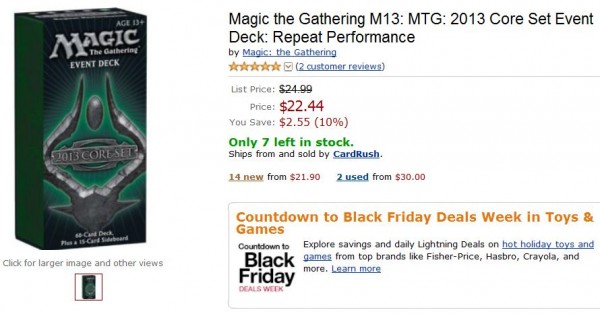
In fact, currently on SCG the price of Thragtusk is $24.99, while Snapcaster Mage is also $24.99. One major difference: Thragtusk is sold out while there are 47 copies of Snapcaster Mage in stock.

I am somewhat baffled by this pricing. Thragtusk is only a rare, it only sees play in Standard, and it was printed in an Event Deck! And this Event Deck can be had for less than $24.99 at other sites like Amazon.com.

Because I focus on maintaining the value of my collection, I struggle to overcome this discrepancy in order to play Standard. I simply do not agree with the current price of Thragtusk and I personally feel the card will drop in price from here. Why anyone would buy a single copy of the card for $24.99 when they could buy the Event Deck (which also includes 1 Green Suns Zenith, 2 Razorverge Thicket and 2 Dismember) for $22.44 is beyond me.

While Thragtusk is perhaps an extreme example, many hyped Standard cards experience similar price inflation. It can even be more extreme with Mythic Rares. For example, I found it difficult to stomach paying $20 for Geist of Saint Traft. The price is even higher now, and I just know it will drop in value significantly once it rotates out of Standard (chart from blacklotusproject.com).

Don’t even get me started on Bonfire of the Damned, which peaked at the ridiculous price of $49.99 only to come back down to reality once Return to Ravnica shook up Standard.

Possible Solutions

I’ve tested two different approaches to enjoying Standard while not risking hundreds of dollars. A while back I read about the discard deck that combined Megrim and Lilianas Caress.

The deck seemed incredibly fun and somewhat viable. But the best part was the deck was exceptionally cheap! Building a super-budget Standard deck can be rewarding. Stomping over your opponent’s $50 cards with commons and uncommons is a ton of fun. But this deck had two major problems associated with it.

First, it wasn’t close to Tier 1. Punishing an opponent for a sub-optimal draw was doable and did happen on occasion, but the deck wasn’t competitive enough to win tournaments. The second problem was that the deck relied on cards in two different Core Sets. As a result, while the deck cost me less than $20 to build, it was also only legal in Standard for three months.

Budget decks are great because they enable you to play in Standard events cheaply, but it’s very difficult to beat all these overpriced cards. Building a better budget deck right before the format rotates can help you improve win percentages, but only for a couple months. There must be a better way.

Perhaps the only answer is to eat the potential loss in value and acquire the overpriced cards. This approach certainly overcomes the issue of not having a Tier 1 deck. And I suppose if you jump into Standard early enough, your cards will remain Standard legal for at least a year and this can justify the higher cost of entry.

But I must point out one potential downfall with this approach. Currently there are five sets legal in Standard – every time a format rotates, the card pool to build from becomes it’s smallest for a few months. When Gatecrash is released, the card pool will increase dramatically and the number of sets legal in Standard increases by 20%.

With this impactful release, the metagame is sure to shift.

So while getting in early ensures my cards are playable in Standard for the most amount of time, this also sets me up to have cards that become irrelevant in a shifting metagame. If Wizards makes a new guild such as Boros or Simic overly powerful in Gatecrash, some strategies may become obsolete. Even without Gatecrash’s release, we’ve seen the rapid rise and decline of Zombie decks simply due to evolution of the metagame. Had I bought into Zombies early on, I could be sitting on a mound of expensive, undesirable cards destined to drop in price right now (chart from blacklotusproject.com).

It’s a Delicate Balance

Thus, we have a delicate balance in the making.

  1. Build a deck later and on a budget and you may not have a Tier 1 strategy to play with, full of cards that are destined for rotation, making your deck viable for just a small window.
  2. Or build a deck earlier to maximize the time you can use your cards, risking succumbing to an evolving metagame that obsoletes your deck.

Perhaps the best time to get in is right now. While Gatecrash hasn’t been released yet, at least the metagame has started to stabilize. Decks like Bant control, Jund midrange, U/W/R midrange, Frites and an array of UW strategies all seem to have established a level of success. And while new strategies may surface when new sets are released, these decks may be robust enough to remain relevant with just a few small tweaks.

At the end of the day the cost of Standard seems so prohibitive. I joke with other players that Legacy and Modern are significantly cheaper to get into because once you own a core group of cards you are able to play a relevant deck for years. Meanwhile, with Standard, you have to constantly acquire new cards to keep your deck fresh and viable in the current metagame. So while I spent more to enter Legacy to start with, I definitely need to spend more cash to maintain a viable Standard deck than a viable Legacy deck.

As an MTG Speculator first and player second, this has been tough for me to stomach. How do you manage?

Sigbits – Standard Edition

  • Jace, Architect of Thought has finally begun dropping to reasonable prices. This should come as no surprise. Star City Games currently has 40 copies in stock at $39.99 and I’ve been seeing auctions on eBay end in the low $30’s. If Jace remains very strong in Standard, I expect his value shouldn’t drop too much further.
  • Since I made the call on Angel of Serenity, I feel obligated to mention that I’ve sold my extra copies. Star City Games has had dozens in stock at $24.99 for a while now, and I could see her price stabilizing or even dropping back down to $19.99. It was a good run nonetheless.
  • I’ve slowly begun trading into Shock Lands. It seems Standard players have the copies they need and all extras go right into the trade binder. At the last FNM, players were eager to trade me their Hallowed Fountains and Steam Vents at around $12.50. Not bad considering SCG sells them at $17.99 and $14.99, respectively. Shock Lands may see a little bit more of a price drop, but once Innistrad Block rotates and Return to Ravnica becomes the oldest set in the format, supply will dry up quickly and prices will rebound.

-Sigmund Ausfresser
@sigfig8

Insider: Managing MTG Speculation Risk With Asset Allocation Models

Are you a Quiet Speculation member?

If not, now is a perfect time to join up! Our powerful tools, breaking-news analysis, and exclusive Discord channel will make sure you stay up to date and ahead of the curve.

Magic: The Gathering allows for speculation because it creates a market that is both inefficient and volatile.

I suspect most of us realize we can make money with Magic cards because of predictable fluctuations in individual card pricing and inefficient pricing. In this article I am going to describe an asset allocation model that will allow MTG speculators to take advantage of pricing inefficiencies and predictable fluctuations while protecting against total loss.

Inventory & Cash

The first thing any speculator must do is determine the value of their MTG assets. I am conservative and use dealer buylist pricing when valuing my own cards. While conservative, this helps me approach a real liquidation value for my inventory as well as allowing me to meet my own minimum cash requirements with ease.

Managing risk in MTG means maintaining a healthy cash position. The most practical use of cash when increasing the value of your Magic inventory will be the direct purchase of cards from distressed sellers. Cash will also allow you to take large positions on spec targets quickly compared with trading into a new position.

By maintaining a cash position that is a percentage of your MTG inventory value, you will be actively managing the risks of maintaining your card inventory. Selling cards as they increase in value to maintain a 30% cash total portfolio value will ensure you don't grow inventory too quickly while taking on too much risk.

Segmentation & Allocation

Take a similar percentage of assets approach to further segment your Magic collection. This segmentation should be used to reduce risk by either spreading exposure to multiple Magic markets OR insuring that you make similar smaller sized spec bets versus one large speculation bet.

I maintain an inventory made up of 30% cash, 5% MTGO, 40% Standard, and 25% Legacy. My small MTGO position is the result of my inexperience in the market and the forced currency conversion. While I do not maintain a Modern inventory presently, that market seems the most likely to grow.

Considering growth upcoming in Modern, I plan to reallocate my investments such that I maintain the following asset allocation model: 30% Standard, 30% Modern, 20% Cash, 15% Legacy, 5% MTGO.

Develop an asset allocation model that most efficiently hedges your risks. Allow it to be informed by your assumptions about a particular market. These models are best used as quarterly rebalancing guidelines for your inventory.

Your local market should obviously inform your allocations. While Modern play is already as popular as Legacy in my area, trading Standard cards is where I extract the most value from my inventory.

I am hedging away from Legacy because it seems fully priced. While that means I'll continue to trade for Legacy staples, they will quickly be converted to cash or their Modern equivalents. I am going to try and fund any future MTGO speculation with sales out of Legacy and Standard but will cap future investment to 10% of total returns.

Betting

If you prefer to make big bets on single cards, you can create allocations specifically for such speculation. I would encourage you to consider how much of your total investments any particular card represents and make sure it never exceeds 5% of your total assets. Alternatively you could allocate 30% to Heavy Speculation and break that 30% up into individual card specs.

~

Applying asset allocation models will not only help you manage the risks you assume, but also make it easier to track your profits and break those profits down by sector. Come rebalancing time, you can actively invest more into higher return markets and reconsider allocation percentages based on past performance and future expectations.

Avatar photo

mathieu malecot

Mathieu is a daily trader of options/stocks, selling both bearish and bullish options. Lead wrangler of "The Kitten Ranch", as in lives and works at home with two annoying and cute (annoyingly cute?) cats. Ranch motto: "Always Feline Awesome". Playing magic since beta/ high school. Casual player and regular participant in FNM drafts.

View More By mathieu malecot

Posted in Free Insider5 Comments on Insider: Managing MTG Speculation Risk With Asset Allocation Models

Have you joined the Quiet Speculation Discord?

If you haven't, you're leaving value on the table! Join our community of experts, enthusiasts, entertainers, and educators and enjoy exclusive podcasts, questions asked and answered, trades, sales, and everything else Discord has to offer.

Want to create content with Quiet Speculation?

All you need to succeed is a passion for Magic: The Gathering, and the ability to write coherently. Share your knowledge of MTG and how you leverage it to win games, get value from your cards – or even turn a profit.

Good Luck, High Five! Episode 9: Give Up Yet?

Are you a Quiet Speculation member?

If not, now is a perfect time to join up! Our powerful tools, breaking-news analysis, and exclusive Discord channel will make sure you stay up to date and ahead of the curve.

Banner

Mike, Forrest and Ryan are joined by legal expert Dana Kinsella to discuss this week in Magic. Topics covered include WotC's decision to publish fewer Magic Online decklists, thoughts on Grand Prix prizes by attendance, A+ card Pillar of Flame as well as a tirade of tantalizing tangents that regular listeners have come to expect- maybe even like. If you like Lego capes, you'll love this episode!

(The views expressed in "Good Luck, High Five!" are those of the personalities featured and do not necessarily represent the views of and should not be attributed to our host.)

Parental Advisory: May Contain Mild Obscene Language

Want Prices?

Browse thousands of prices with the first and most comprehensive MTG Finance tool around.


Trader Tools lists both buylist and retail prices for every MTG card, going back a decade.

Quiet Speculation