menu

Tournament Report: SCGCON NJ

Are you a Quiet Speculation member?

If not, now is a perfect time to join up! Our powerful tools, breaking-news analysis, and exclusive Discord channel will make sure you stay up to date and ahead of the curve.

This weekend I made it down to the Meadowlands Convention Center to compete in the Modern $20k RCQ at SCGCON New Jersey. I played Five-Color Creativity, a deck I've had a fair amount of success with over the last few months and felt was well-positioned for the weekend.

As not to bury the lede, I went 5-3, losing my win-and-in for Day Two during my last match of Day One. While it's not necessarily the result I was hoping for, my losses were extremely close and I believe my hypothesis on deck selection was correct. Let's get into the breakdown:

The Deck

The Indomitable Creativity deck utilizes an all-Mountain mana base to turn on Dwarven Mine as early as turn four. This creates a 1/1 Dwarf token that can be targeted with Creativity to polymorph into a game-winning threat like Archon of Cruelty. As Creativity is an X spell, multiple tokens can be targeted to put multiple Archons into play, or to play around targeted removal from the opponent as a means of disrupting the combo. In the face of heavy creature removal, Prismari Command can make a treasure token that can also work with the combo as well as loot to put drawn Archons into the graveyard. From there, Persist gets its time to shine.

This build of Creativity includes a few key changes to adjust to the current metagame, namely a full four copies of Spell Pierce and two copies of Prismatic Ending. Spell Pierce acts as protection against opposing countermagic and combo decks while Ending acts as additional answers to early threats from Ragavan, Nimble Pilferer and Colossus Hammer decks.

Five-Color Creativity

Creatures

4 Archon of Cruelty

Spells

4 Indomitable Creativity
4 Spell Pierce
4 Lightning Bolt
2 Prismari Command
2 Prismatic Ending
2 Persist

Planeswalkers

4 Wrenn and Six
2 Teferi, Time Raveler

Enchantments

4 Fable of the Mirror-Breaker // Reflection of Kiki-Jiki
4 Leyline Binding

Lands

4 Dwarven Mine
1 Ziatora's Proving Ground
1 Raugrin Triome
1 Ketria Triome
2 Steam Vents
1 Stomping Ground
1 Mountain
1 Blood Crypt
1 Sacred Foundry
3 Scalding Tarn
3 Arid Mesa
3 Bloodstained Mire
2 Wooded Foothills

Sideboard

2 Hallowed Moonlight
2 Wear // Tear
1 Flusterstorm
2 Brotherhood's End
1 Teferi, Time Raveler
3 Veil of Summer
2 Boseiju, Who Endures
1 Emrakul, the Aeons Torn
1 Sundering Titan

Round One: RW Burn WW

My first-round opponent was a fairly new player and this was his first big tournament so there were a couple of questionable play decisions from him. To his benefit, he was playing one of my worst matchups, RW Burn. Creativity plays 11 fetch lands and five shock lands, so the mana base is already doing a lot of the work for the opponent. On top of that, Burn plays so many Lightning Bolt variants that it almost always will be able to clear out Dwarf tokens before the Creativity combo can resolve.

There was an error retrieving a chart for Archon of Cruelty

Fortunately for me, my opponent kept a slower hand in game one and was unfamiliar with the Creativity combo. He fired off burn spells ahead of resolving an Eidolon of the Great Revel, which tapped him out, enabling a Creativity to resolve. In game two, he kept removal up to stop the combo but was stymied by a few well-timed Spell Pierces.

Round Two: BG Yawgmoth WW

Another tough matchup for me. The Yawgmoth, Thran Physician combo deck makes use of Young Wolf and other undying creatures which shake off my Archon triggers. Fortunately for me, my opponent kept two land-light draws with multiple mana dorks that were swiftly answered by Lightning Bolt and Wrenn and Six. Wrenn is an all-star in this matchup, taking out Birds of Paradise and Ignoble Hierarch. Prismatic Ending was also very effective at clearing out Wall of Roots.

There was an error retrieving a chart for Necromentia

A big concern in this matchup is Necromentia out of my opponent's sideboard, which is where Veil of Summer comes into play. Ultimately, my opponent didn't find their hate cards and kept another dork-heavy hand, which was overrun by the combo. Grist the Hunger Tide was able to take out an Archon, but Persist brought it right on back.

Round 3: GW Vizier Druid LWL

I played next to this opponent in a previous round and knew what they were on going into the match. GW Devoted Druid and Vizier of Remedies combo was a blast from the past. I kept a hand in game one with Bolt, Fable of the Mirror-Breaker // Reflection of Kiki-Jiki, Creativity, and lands, which seemed like a solid keep, especially with my opponent on a mulligan. Unfortunately, my opponent led with a Giver of Runes which needed to eat the Bolt. I didn't have an answer for the turn two Druid, and they had the full combo on turn three including payoff.

For game two I prioritized a heavier removal draw and we played a much slower game. Leyline Binding removed an indestructible Kaldra Compleat token and my opponent's multiple copies of Burrenton Forge-Tender weren't able to protect against Prismatic Ending.

There was an error retrieving a chart for Orvar, the All-Form

Our third game played similarly to our second. I had a sequence where I had two Dwarves and a Wrenn on board with Creativity, Persist, and Hallowed Moonlight in hand and six lands available. I had the choice between Creativity for two to play around Solitude, or for one to hold up Moonlight to stop either their combo or Orvar, the All-Form if they had it in their hand. I opted to play around the more likely Solitude. My combo resolved, putting two Archons into play. My opponent Eladamri's Called for Orvar, which was discarded to copy Archon, causing me to sacrifice Wrenn and Six, leaving two of my own Archons in play. Their next turn, they Postmortem Lunged a Stoneforge Mystic back from their graveyard to find Kaldra Compleat and immediately put it into play. When they went to combat, their Orvar token made me sacrifice one of my blockers, putting me to five life with two lethal attackers coming in. It was a very close match that could've gone either way.

Round 4: UR Murktide LL

This was the only match that felt like my deck failed to function. In game one my opponent landed an uncontested Ragavan on the play and Spell Pierced my Wrenn and Six. They snowballed and countered each of my spells while I stumbled on mana.

Game two my lands developed oddly with Ketria Triome into Sacred Foundry to unlock Wrenn and Six, which was countered by a Spell Pierce. I followed up with Teferi, Time Raveler, and bounced their Ledger Shredder. My opponent took this opportunity to resolve Blood Moon. With no castable cards in my hand, after ticking up to three on Teferi, I down-ticked to bounce the Moon before my opponent could find a Bolt or Unholy Heat.

There was an error retrieving a chart for Ketria Triome

By the time I needed to go for the combo, I still only had Ketria Triome as my only blue or green source in play, preventing me from playing Veil of Summer and Spell Pierce in the same turn. My opponent had double Counterspell to stop me.

Round 5: UR Murktide WLW

A near-immediate redemption! In game one my opponent stumbled on mana and threats. I reached a point where I was able to assemble the combo for x=2 while holding up double Spell Pierce. My opponent was only able to cast a single piece of countermagic, which wasn't enough.

However, in game two my opponent started with a Ragavan on the play. They had Spell Pierce for my removal and used the treasure tokens generated to play a Blood Moon with Pierce backup. I had no outs and scooped to save time.

There was an error retrieving a chart for Emrakul, the Aeons Torn

Game three had us trading off play after play for some time. I had Creativity, Fable, and Teferi in hand and baited with Fable. My opponent let it resolve, but I couldn't tell whether it was to conserve their counter for a better spell or if they didn't have it. The following turn I led on Teferi with four mana up. It managed to land and cleared the way for Creativity into Emrakul, the Aeons Torn.

Round Six: Four-Color Elementals WW

This was perhaps one of my strongest hands of the day. I was able to land a Teferi to lock my opponent out of disrupting me, which I followed up with Prismari Command looting and creating a treasure on turn four, discarding two Archons. Persist brought back the first one, which was swiftly dealt with by Solitude. My second Persist brought back the other Archon, to which my opponent very angrily scooped.

There was an error retrieving a chart for Sundering Titan

In game two my opponent kept a one-land hand in favor of what I expected was Orvar and Solitude. I used the lack of pressure to deploy a Fable of the Mirror-Breaker and discard Sundering Titan. By this point, I already had Persist in my hand, but with my opponent only on one land, it would've been detrimental for me to bring it back at that time. After they hit their 3rd land, I finally Persisted the Titan and took out all of their mana sources. A few Mirror-Breaker beats later and they relented.

Round 7: GR Hardened Scales WW

I used to live in New Jersey and this opponent was a regular at my old LGS. They were an Affinity connoisseur then and continue to be to this day. Unfortunately, this is possibly their worst matchup and it's not especially close. Creativity plays a whopping twelve removal spells, including a clean two-for-one in Prismari Command in the main deck and the sideboard features multiple copies of Boseiju, Who Endures, Wear // Tear, and Brotherhood's End.

Scales doesn't have much in the way of interaction, so I was able to assemble the combo mostly uncontested and at my leisure in game one.

There was an error retrieving a chart for Brotherhood's End

An interesting sequence happened in game two that I wanted to speak with him about. My hand included Wear // Tear, two Boseiju, and a Brotherhood's End. It was really a pick-your-poison situation for the opponent. Notably, they had an Urza's Saga and Welding Jar in play alongside Walking Ballista and Arcbound Ravager. I opted to use Boseiju on Welding Jar and follow up with Brotherhood's End to destroy all artifacts. My struggle was with whether or not to prioritize using Wear // Tear to get rid of the Saga and Jar first to prevent the tutor effect, but in doing so I'd be risking excessive damage from the combination of Ravager and Ballista. The safest line seemed to be the one I took and my opponent agreed after the match, but it was certainly a difficult decision.

Round 8: Jeskai Grinding Breach WLL

Of course, my final round would be a win-and-in against a friend and former teammate! We discussed his deck before the tournament so I knew what he was playing, a luxury he didn't have going in. This led him to mulligan a hand that might've been keepable with prior knowledge.

He ultimately kept a two-land hand dependent on Urza's Saga, Ragavan, and Springleaf Drum. Unfortunately, Ragavan was removed immediately. I kept him off of doing much thanks to removal and countermagic the entire game and comboed with disruption up.

Unfortunately for me, in our second game, I kept a hand that was heavier on stopping a Grinding Station and Underworld Breach draw than a creature one. I was swiftly dispatched by Saga tokens and Ragavan.

There was an error retrieving a chart for Underworld Breach

For our last game, I started off from behind with a mulligan to five. We traded off back and forth for a long while and went to time. In turns, I was able to stick an Archon and put my opponent to six life with a Lightning Bolt in hand. On his final turn, his hand was empty and his board was just an Aether Spellbomb with an unhelpful Grinding Station. I had my final turn lined up after his. I expected him to draw an irrelevant card, then bounce Archon back to my hand to force the draw. He didn't know about my Bolt which would put him to exactly zero life and I had the mana to recast Archon. His top card? Underworld Breach. Breach gave him all he needed to combo kill me by looping a zero-mana artifact with Grinding Station until he had no cards left in his deck for him to then cast Thassa's Oracle.

A bit devastating considering I was already planning my victory speech, but at least one of us made it to Day Two.

End Step

Not quite the result I wanted, but I had a great time nonetheless. Going forward, I think I'd update my tri lands to Xander's Lounge, Jetmir's Garden, and Ketria Triome. Prioritizing early red and white removal spells alongside Spell Pierce while also having access to green for Wrenn and Six by turn two is a tall order that the current mana base can't easily accomplish. Fetching Jetmir's Garden first, then Steam Vents would alleviate this tension.

I'd also swap out a Veil of Summer and Hallowed Moonlight from my sideboard in favor of Leyline of the Void to combat the rise in graveyard decks. RB Scam has been putting up consistent results across the board, including two top eight slots from this event. That, along with the steady rise of both "fair" and "unfair" Underworld Breach decks and GB Yawgmoth, having a turn zero answer to the graveyard is becoming more appealing.

I'd also like to commend the tournament staff for a great job running such a tight ship and for the implementation of MtgMelee. Sending push notifications for pairings to my phone was a quality-of-life improvement I didn't know I needed. I'm definitely looking forward to the next one.

Let me know if event breakdowns like this are something you're interested in seeing more of! As always, you can keep up with me on Twitter and Twitch. See you all next time.

Determining Reprint Price Trajectories

Are you a Quiet Speculation member?

If not, now is a perfect time to join up! Our powerful tools, breaking-news analysis, and exclusive Discord channel will make sure you stay up to date and ahead of the curve.

Reprints: they’re the new normal. I remember a time post-Chronicles when your average card was practically never reprinted. To show up as a reprint in a core set or a subsequent expansion was a big deal. I vividly remember visiting a local hobby shop with friends every weekend to buy booster packs (2006-2007). I would pick up a couple of booster packs of Ravnica, Dissension, and Saviors of Kamigawa because these boosters were slightly cheaper than those of the most recently released sets.

I knew that Shock Lands were valuable pulls from Ravnica block, and was always happy to pull one from a booster pack—not because I would play it, but because I knew I could trade it for other cards I really wanted. There was one card, in particular, I hoped to see in every Ravnica booster I opened: Birds of Paradise.

There was an error retrieving a chart for Birds of Paradise

After being reprinted time and again in core sets up to Eighth Edition, the card disappeared in Ninth Edition. When it showed up in Ravnica, Birds of Paradise quickly became a chase rare from the set despite all of its previous reprints.

In other words, reprints were exciting and welcomed with open arms.

Fast Forward to 2023

Here we are in 2023, and we just saw the launch of the umpteenth set specifically designed to introduce reprints into the market: Dominaria Remastered.

Wait for a second, isn’t this supposed to be a specially crafted draft experience to help players re-live memories from the plane of Dominaria? I suppose so; that’s how it’s branded, after all. But the reality is this is really an excuse for Wizards of the Coast to reprint many high-dollar, chase cards to supply the community (and therefore increase revenues).

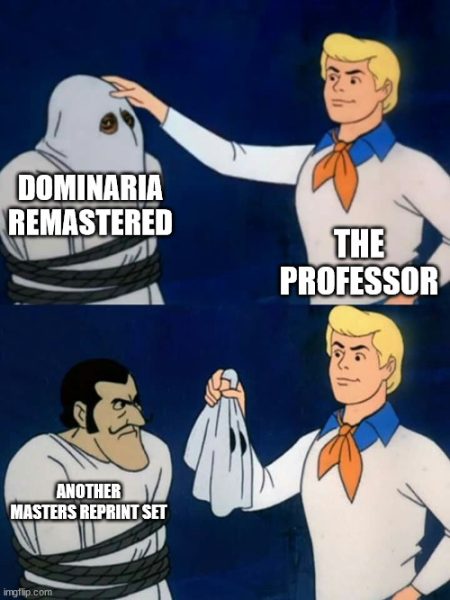
Don’t take my word for it, however. The Professor did a fantastic job on his YouTube channel explaining this in much greater detail.

Popular reprints include Vampiric Tutor, Urza, Lord High Artificer, Sylvan Library, No Mercy, and even Birds of Paradise! The chase card from the set, however, has to be Force of Will—the card (with new art by Donato Giancola) currently retails for $89.99. That’s even more than other, earlier printings of the card!

Wait a Second

Force of Will has been reprinted numerous times, yet the card still fetches nearly $100?! How could that possibly be? You would think the card would have seen some pricing pressure by now, especially when you compare it to other reprinted cards that saw price points plummet post-reprint.

There was an error retrieving a chart for Force of Will

Even Birds of Paradise, a perennial $10 card, is retailing for around $7 on Card Kingdom’s site. Remember when Sneak Attack was $70? Now you can order Dominaria Remastered copied for under $10. Have you always wanted a copy of Last Chance, but couldn’t justify the $50 or $100 price point (depending on when you were shopping)? Now you can have a copy for around $5!

Something strange is going on here. We can see that some prices seem to withstand the (re)printing press time and again, while others are far more fragile. What’s more, it seems to also depend on when/where the card was initially printed. A card like Last Chance, initially printed in Portal, seems more vulnerable, though the original printing maintains a significant premium over reprinted versions.

There was an error retrieving a chart for Last Chance

Another interesting example is Diaochan, Artful Beauty: the reprinted version is worth around $17. The original Portal: Three Kingdoms printing fetches over $100 despite there being a much cheaper reprint also available. Then there are cards like Mana Drain and Force of Will. These cards' prices barely seem to dip despite multiple reprints. Original Legends copies of Mana Drain still fetch around $130.

So what is going on? Why all these discrepancies?

Three Factors

To help simplify my thought process, I’ve boiled down the observations into three key factors. These factors are not necessarily all-inclusive but should give you a sense of whether or not a reprint will take a significant toll on a card’s price (especially the original printing) or if the impact will remain relatively muted.

Factor #1: The Set In Which The Original Appeared

Some cards only appeared in a single set printed decades ago. The print runs of some of these sets were tiny (e.g. Four Horsemen sets, Portal sets). Meanwhile, other cards appeared over a dozen times across Magic’s history. The impact of a new reprint will vary tremendously based on this variable.

To explore this further, let’s compare Imperial Recruiter and Rishadan Port. Both cards are from roughly the same era of Magic, but the first was printed in the extremely-rare Portal: Three Kingdoms set while the second was printed in a large set, Mercadian Masques. Both see (saw?) steady Legacy play, back when the format was in its heyday.

The newest printing of Imperial Recruiter, from Modern Horizons 2, is dirt cheap—copies retail for around $7. Meanwhile, the original printing of the card still retails for $160… and it’s sold out!

There was an error retrieving a chart for Imperial Recruiter

Once upon a time, before the era of reprints, Rishadan Port was a $100 card. Then the card saw a judge promo printing and a reprint in Masters 25.  Now the original printing has fallen by two-thirds. It retails for around $30.

There was an error retrieving a chart for Rishadan Port

The card is old and quite rare, but not as rare as a card from Portal: Three Kingdoms. Because of this factor (amongst others), Rishadan Port from Mercadian Masques saw a much larger sell-off from reprint than did the original Imperial Recruiter despite the fact that Recruiter has seen more and more recent reprints!

Factor #2: Is the Card a Commander Staple?

If Wizards of the Coast only reprinted cards with relevance in the Magic game of today (i.e. playable in Commander), it would be fantastic. Commander drives a significant amount of demand for cards nowadays. Since the format is usually about community and fun play, it would be ideal if it remained affordable to the majority of players.

Here’s a small case study to highlight the importance of this factor. Consider Commander staple (and occasional Legacy card) Sylvan Library, originally printed in Legends.

There was an error retrieving a chart for Sylvan Library

Because the card shows up in Legends, it’s also Old School legal. This card has been reprinted at least six times already, including in Dominaria Remastered. New printings of this card can be found for under $30, while original Legends copies retail for over $100 more. There are many reasons why the original printing has held its value, including the card’s age, rarity, and Old School legality.

The biggest reason, however, is the card’s popularity in Commander. This is a great card to reprint because it doesn’t damage original card printing very much (if at all) while also introducing new, cheaper copies to the market for Commander players.

Let’s contrast this with another card from the same set: Nicol Bolas.

There was an error retrieving a chart for Nicol Bolas

This is another card that was originally printed in Legends. The Elder Dragon Legend also saw a white-bordered reprint back in the day, but Legends copies maintained their steeper price point of around $100. What is a newly-reprinted version of this card worth? About a buck.

There was an error retrieving a chart for Nicol Bolas

The key difference between Sylvan Library and Nicol Bolas: the former still sees a ton of play while the latter is more an icon of the game than a key player. The former should see occasional reprints to keep the card affordable for players. The latter should not.

This theory is supported by many examples. Vampiric Tutor has been reprinted again and again and is still worth a good bit because it sees significant play. Sneak Attack isn’t the chase card it once was back during its Legacy heyday, so it logically has a lower price point.

Factor #3: The Effect of Power Creep

This factor is related to the previous one, but carries an additional, important component. Power creep has obsoleted many older cards. Even if an old card is in short supply and carries a steep price tag, it’s probably best off not being reprinted because new copies of the card won’t carry much demand.  

Remember Legacy and Modern all-star Tarmogoyf? When the first Modern Masters was announced, I promptly sold my playset of Future Sight copies for around $400 on eBay because I feared a significant price drop. Awkwardly, the release of Modern Masters in 2013 did not drive the precipitous price drop I had predicted—the card actually climbed further in price!

There was an error retrieving a chart for Tarmogoyf

What did ultimately drive the price drop isn’t that the card had been reprinted a few times, though that certainly didn’t help. What drove the drop was the fact that the card stopped seeing as much play in competitive formats. In fact, if I navigate to MTG Stocks’ webpage with the most played cards, Tarmogoyf doesn’t crack the top 50 in any format.

You also can’t find Jace, the Mind Sculptor, Vendilion Clique, or Dark Confidant. These all used to be major Modern staples. I distinctly remember when Jace, the Mind Sculptor was unbanned in Modern and the price spiked due to the surge in demand. That didn’t last long when players realized the four-mana Planeswalker simply didn’t hold water in Modern.

There was an error retrieving a chart for Jace, the Mind Sculptor

Nowadays, you have cards like Ragavan, Nimble Pilferer and Urza's Saga as Modern staples. These are the cards that can be reprinted a few times now, and their values should hold up quite well. Force of Will remains the number one most played card in both Legacy and Vintage; hopefully, the counterspell variant will never be outclassed. It’s no wonder the card remains so expensive despite its numerous reprints! One-time Legacy staple Maze of Ith, on the other hand… not so much.

There was an error retrieving a chart for Maze of Ith

Wrapping It Up

I’m sure there are other factors at play that I didn’t get a chance to discuss, but I firmly believe these three are some of the most important when determining the impact of a reprint on a card’s price (both the new version’s and the original's).

As long as reprints remain a core part of Wizards of the Coast’s business strategy, then we as collectors will need to remain vigilant about each of these factors: the card’s original printing, its playability in Commander, its overall utility in the 2023 version of Magic, power creep and all. To look at reprint prices in a vacuum without considering these factors will lead to missed predictions and lost money.

As a once-collector, but now play-focused individual, I welcome these reprints with open arms. Where before I used to dread seeing my card prices drop, now I'm excited to be able to pick up cards for my Commander deck at a steep discount. I’m still delighted I was able to get a Liliana of the Veil for just $25 in store credit! I just need to be careful that the card isn’t power crept… I hope it’ll see enough Commander play to also buoy its price. Either way, it’s much better than having to pay $70 for the card!

Reprints really can be a good thing, but only when done deliberately and with care. Do Wizards of the Coast put the right amount of care into choosing what to reprint in sets like Dominaria Remastered? I can’t say. Reprints like Force of Will and the cycle of Mirage tutors are very welcome. Others, like Nantuko Shade (hasn’t been relevant in years) and Lieutenant Kirtar (in only 18 decks on EDH REC), not so much.

We can only hope they print more winners than losers going forward. With careful planning and proper management, reprints can be a huge boon for the game. If things get out of hand and reprints are chosen without care, it could continue to damage the game’s integrity from a collectability standpoint. Let’s hope for the former.

Super Glue: The Failed-Archetype Reality of BRO

Are you a Quiet Speculation member?

If not, now is a perfect time to join up! Our powerful tools, breaking-news analysis, and exclusive Discord channel will make sure you stay up to date and ahead of the curve.

Each Limited format in the modern era is guided by a series of signpost uncommons. Theoretically these cards outline a plan for each color combination and point to synergies we should aspire to assemble. In our preview article for The Brothers' War (BRO), we recognized that these archetypes were poorly supported at common.

You Call This Support?

These cards are playable in the right deck, and sometimes they might even do the thing they're supposed to do. However, they mostly represent their stats, with slight upside. Even in a supported archetype, they rarely outperform their status as filler.

Compare this to Dominaria United (DMU), where the commons elevated their respective archetype with far greater impact.

The Art of the Archetype

DMU's archetypes are well-supported at common. The cards are powerful and coveted. BRO's archetypes are mostly unsupported at common. These are cards we hope to leave out of our decks. This dichotomy creates two very different formats and dictates the way we should be drafting and building our decks.

The Exception to the Rule

BR Sacrifice is the biggest exception. It has plenty of cards that contribute to its theme. As a result, this color combination is the most drafted in the format by a wide margin. Furthermore, this phenomenon occurs despite a pretty mediocre win percentage.

When it comes to BR Sacrifice, we can choose between Goblin Blast-Runner aggro, or something more attrition based, the grindiest of which utilizes Clay Revenant. All of these decks want Penregon Strongbull and will probably make good use of Powerstone Fracture.

Nevertheless, they all prioritize various cards differently. How important is Bitter Reunion compared to Sibling Rivalry? When will they select Roc Hunter over Emergency Weld? Is Thraxodemon good here? Deviation in these answers reveals the wide range of decks that fall under the label of BR Sacrifice.

BR Sacrifice is so supported at common, it actually represents multiple archetypes. This, however, is the exception.

Living Outside of the Archetypes

We were told the format would be driven by UR Spells, GW Artifact-Fall, and BG Graveyard decks. This was never the reality of the format. While UW Soldiers, for example, can come together, there is very little incentive to prioritize the namesake tribal cards. We can count the "soldier" payoffs that exist outside of rare or mythic on one hand.

  1. Air Marshal
  2. Aeronaut Cavalry
  3. Yotian Tactician
  4. Zephyr Sentinel

That's it for the entire format. Similarly, Spells gets a couple prowess dorks. Graveyard gets some unplayable mill cards and Emergency Weld. Ironically, green, one of the "graveyard matters" colors, is the only color in the format to not have access to unearth at common.

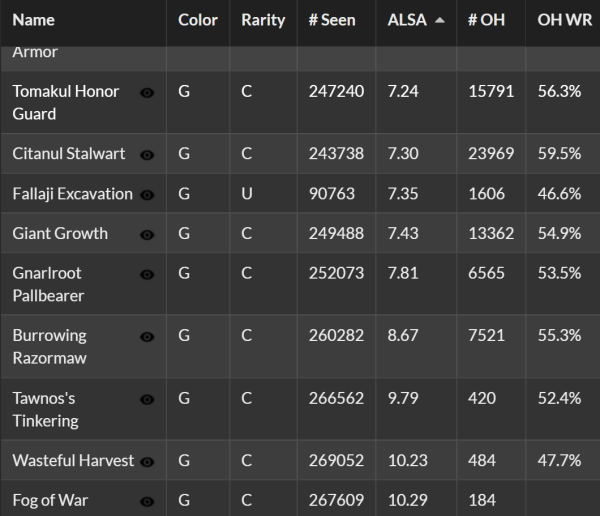
As a result, the format spiraled away from these archetypes over the first weeks. The signpost uncommons are good; we just don't want to focus on building around them. Instead, our focus should be to build functional decks around macroarchetypes. In this format, the most relevant macroarchetypes are aggro, midrange, and splashy ramp decks typically built around Citanul Stalwart.

Aggro Preys on Clunky Strategies

Just because the format didn't utilize the scripted archetypes for each color combination does not mean it was without synergy. Collecting all of the artifacts for a GW deck is not nearly as important as building a plan and getting the powerful cards to execute it.

The first narrative to emerge from the format was that this was an aggressive format. Red and white decks, the most aggressive in BRO, were able to beat down while their opponents fumbled around with retro artifacts, desperate to enable draw-two synergies. Fallaji Vanguard triggers stacked, and unearth creatures sprinted from the graveyard as the fragile combinations of focused archetypes failed to matter.

The aggressive decks took round one, and considering their outstanding win rate, have held on to be the dominant presence in the format. Currently red and white are the two winning colors in mono-colored decks, and their combination is the best in the format, with or without a splash. While these decks don't look for a particular build-around, maximizing the aggressive cards is a winning strategy in most formats. Because draft has a self-correcting nature, red dried up especially quickly.

What Is a Glue Card?

A glue card is a card that can enable multiple different plans, but especially slower midrange strategies. The more ambitious our game plan, the more essential the glue cards will be. Because the default strategies in this format are aggressive ones, midrange and slower decks are, in turn, more ambitious and more difficult to build. It does not mean, however, that they are less powerful.

These should be cards that are easily cast and provide value. They enable options. The Mutt's ability to rummage helps us get to the cards we need. Boulderbranch Golem buys us time through gaining life. Energy Refractor is another example, as it helps solidify otherwise dubious mana bases.

There was an error retrieving a chart for Energy Refractor

The best versions of these cards prevent us from falling behind on the battlefield, which is essential against aggressive decks. We can't rely on glue cards if they're going to put us too far behind on any one particular access. Energy Refractor replaces itself in a card in your hand, but because it can cause us to fall behind on the battlefield, it's less valuable than some other options.

The unearth cards often represent great glue cards. Being colorless makes them easy to cast. They are aggressive by nature of the mechanic. However, in slower decks, they give us value with multiple cracks at their ETB or activated abilities. Many of these cards help us survive and can work in any number of decks. They are valuable when playing a long game.

The Power of Glue

While some of the smaller archetypes failed to come together, the use of the format's many glue cards generated enough value to allow some opposition to thrive as the aggressive colors became overdrafted.

Hold It Together

These cards emerged as essential pieces to fighting aggressive decks. While they still might see play in such decks, having access to them allows us to buy time without sacrificing power. These cards trade with aggressive decks and leave some value in their wake. As we use these glue cards, more options materialize in deck construction. They fit into almost any deck, and with minor access to their splash, we can access their full value. These cards should be early picks because of their strength and flexibility.

UB Draw 2 might not be a real option, but these glue cards allow midrange to thrive, as long as they're supporting powerful cards. We can access some minor support from the archetype while relying on more consistent commons.

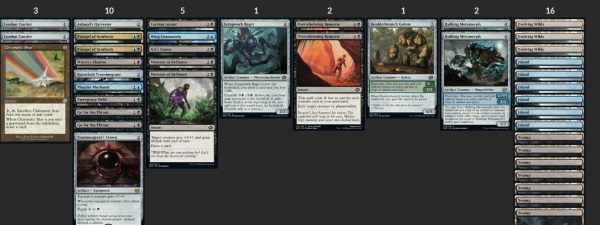
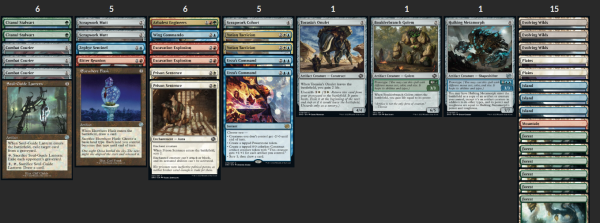
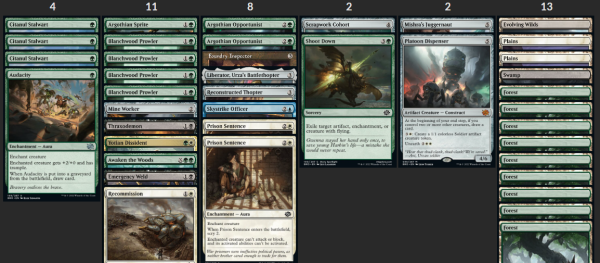
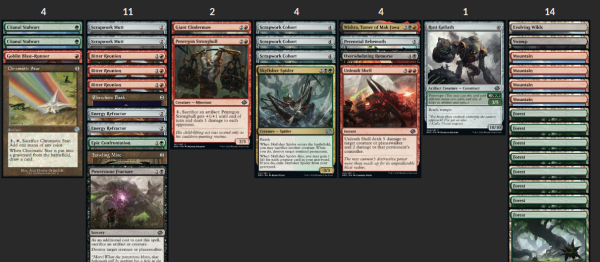
7-1 UB Good Stuff

Creatures

2 Combat Courier
1 Ashnod's Harvester
1 Misery's Shadow
2 Evangel of Synthesis
1 Razorlash Transmogrant
1 Thopter Mechanic
1 Carrion Locust
1 Wing Commando
1 Scrapwork Rager
1 Boulderbranch Golem
2 Hulking Metamorph

Instant

2 Go for the Throat
2 Moment of Defiance
2 Overwhelming Remorse

Sorcery

1 Emergency Weld
1 Gix's Caress

Artifact

1 Chromatic Star
1 Transmogrant's Crown

Land

3 Evolving Wilds
7 Swamp
6 Island

This is hardly a Draw 2 deck, though clearly it incorporates strong uncommons from the archetype. Rather, this is simply a streamlined collection of cards that utilizes glue pieces to make the most of the open colors in the draft.

Last week, we discussed the power of Multi-Colored Stalwart, a deck that uses Citanul Stalwart to splash powerful cards. However, this deck can't get to its robust late game if it can't resist aggo. The glue cards are essential pieces to allowing this strategy to flourish.

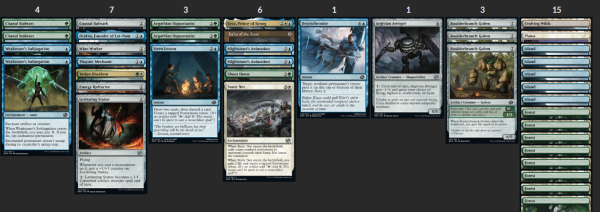
7-2 Double Command Stalwart

Creatures

2 Citanul Stalwart
3 Combat Courier
1 Zephyr Sentinel
2 Scrapwork Mutt
1 Arbalest Engineers
1 Wing Commando
2 Yotian Tactician
1 Scrapwork Cohort
1 Tocasia's Onulet
1 Boulderbranch Golem
1 Hulking Metamorph

Instant

2 Urza's Command
2 Excavation Explosion

Artifact

1 Soul-Guide Lantern
1 Elsewhere Flask

Enchantment

1 Bitter Reunion
2 Prison Sentence

Land

3 Evolving Wilds
1 Mountain
2 Plains
3 Island
6 Forest

This deck uses some of the format's glue cards to get to the late game. At that point, the powerful uncommons and double Urza's Command can overpower opponents. Hulking Metamorph acting as a third Yotian Tactician was pretty nice too.

Glue Cards vs. Archetypes

The glue cards in this format are archetype agnostic. They also represent the best commons in the format. Back in DMU, the best commons were mostly at home in specific archetypes. As a result, the formats play out differently.

When we are more incentivized to play glue cards than archetype-defining commons, we are more likely to want to build towards macroarchetypes than towards traditional signpost uncommons. Aggressive decks, followed by splashy ramp decks, followed by slower midrange decks represent the pecking order in BRO, though some tastes may vary. The pecking order in DMU was tied to the specific archetypes, such as Spell-Based Aggro, Big Domain, or Go Wide White Decks (my official ranking is listed here).

Shine a Little Light

Recently, I've been drafting a ton of blue, and I'm doing it for the uncommons. This week, I want to talk about a first amongst equals, Zephyr Sentinel.

There was an error retrieving a chart for Zephyr Sentinel

This card and Thopter Mechanic are two great reasons to be blue. The color is the weakest in the format, but is drafted like it's unplayable. Getting one of these premium uncommons early lets us speculate on a color that might well be wide open. Zephyr Sentinel can be a great source of pressure or an incredible trick. Saving a valuable creature in a crucial moment or flashing in two or three points of evasive power during our opponent's end step can swing a game.

I hadn't explored blue much until the last two weeks. My white decks sometimes leaned into it, but I never really pursued it. As the format is winding down, take a shot at its most under-drafted color. But don't be afraid to get off it if you're not seeing the good stuff.

The Ramifications of Wizards of the Coast’s “Fireside Chat”

Are you a Quiet Speculation member?

If not, now is a perfect time to join up! Our powerful tools, breaking-news analysis, and exclusive Discord channel will make sure you stay up to date and ahead of the curve.

At the end of 2022, Wizards held a "Fireside Chat" to answer pressing questions in a climate of growing unease about the future of Magic. The data and viewpoints expressed during the segment are of particular interest to us as we head into what already looks to be another product-packed year.

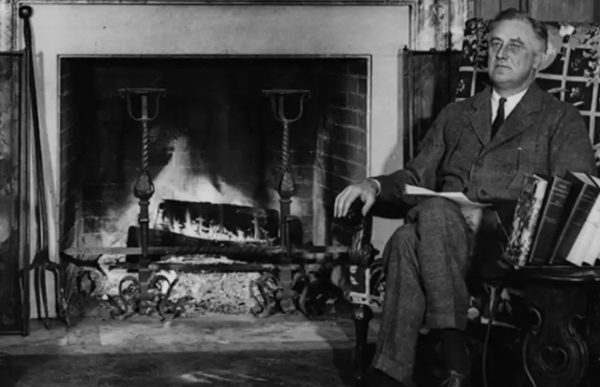
For those who aren't versed in US history, the "Fireside Chat" was pioneered by President Franklin Delano Roosevelt (FDR) shortly after he entered office. The world was in a very precarious place. WWI had ended, but there remained plenty of bad blood in Europe between the victors and the vanquished. Then, in 1929, the Great Depression occurred after the stock market collapsed. Thus, FDR began a series of radio speeches dubbed "Fireside Chats" which were meant to calm people down and provide some sense of hope in desperate times.

President Franklin Delano Roosevelt

While Wizards of the Coast is far from presidential, I understand the reasoning behind their decision to address shareholders and the public in general after being downgraded by a Bank of America analyst in November. Hasbro, the parent company of Wizards of the Coast, stock saw a significant dip after the downgrade. Given that most of the analysts concerns were with Magic the Gathering specifically, these concerns needed to be addressed. I do applaud Wizards of the Coast for addressing these concerns in a timely manner and in a way that the general public was able to access.

Facts from Wizards of the Coast Employees

We don't often get to see behind the curtain with regards to a lot of the data that Wizards of the Coast collects, so this was a nice opportunity to hear straight from them. What follows is a list of key facts shared during the chat and some analysis of each.

  • There are 60 million players worldwide.
  • 50 million players are estimated to be currently playing.

  • Magic is on pace to be Hasbro's first billion-dollar brand.

Given these numbers, I am actually surprised Magic hasn't already reached the billion-brand mark, as doing so would only require those 50 million players to spend an average of $20 a year each.

  • The average Magic player is 30 years old.
  • The casual player base makes up an estimated 80% of the total playerbase.
  • Over 50% of players identify as "social players."
  • Around 50% of players are also collectors of some kind.

Wizards of the Coast claims about 80% of the playerbase is casual, which means 40 million of those players are casual. I do find this number a bit suspect though, as casual players would be very difficult to track. Competitive players register for events and thus are easy to quantify.

But what makes a player casual? I am curious what metrics are used to create this estimation. I know that most of my playgroup hasn't played in any sanctioned event since pre-Covid, and doesn't tend to buy any sealed product; in our own eyes, we have gone from competitive to casual players during the past few years.

  • 33% of players have less than three years experience.
  • 33% of players have ten or more years experience.

If 33% of players have played for 3 years or less, Magic must have grown a great deal during the pandemic, which makes sense as most other forms of entertainment were unavailable. However, given that during that same pandemic a lot of game stores were closed, I question if a lot of that growth is specifically on Arena. If it is, that makes the brand growth for Magic even more impressive, as one doesn't need to spend any real money on Arena to develop a decent collection thanks to all the rewards.

  • There are 10 million registered digital players on Arena.
  • "Hybrid players" (those who play both digitally and tabletop) spend 40% more money than other players.

In fact, I would argue that in regards to Arena, you can choose to sacrifice either money or time in order to build your digital collection. Given many had a lot more free time for the past few years, that is likely the most common route taken. I do wonder if some of these numbers are taken from actual surveys sent out by Wizards of the Coast. If so, there can be inherent flaws in the data collection, as many businesses that specialize in that sort of data collection will tell you.

  • Magic saw 350-400 million dollars in sales in 2016. They have tripled this business since then by producing casual/collectors products.
  • Wizards of the Coast has a goal to generate 250-300 million in cost savings and are currently on pace to meet or exceed this goal.

I spent 9 months working as a value engineer, and I have a good understanding of some basic material costs; cardboard is an extremely cheap material. Cost-cutting is typically divided into two realms: material costs and manufacturing costs.

There was an error retrieving a chart for Costly Plunder

When your material costs are trivial, you are forced to look mainly at manufacturing costs. If we look at the dirge of defects we have seen from recent product lines, it isn't surprising to learn that Wizards if the Coast has been cutting costs by drastically reducing quality.

Some More Comments from Wizards of the Coast

In-store play is trending upward and is currently at 75% of pre-pandemic numbers.

While this certainly sounds good and shows a positive outlook on the future, I think it's important to keep in mind that when this statement was made, no states had lock downs and all businesses that wanted to be open were able to be. This is an important point to make as it actually implies that while in-store play may be trending back to the status quo, it is still down 25% despite all the growth Wizards of the Coast is seeing. This means that there is still a significant lack of in-store play, indicating that competitive staples are likely going to remain depressed for some time.

The core sales channel for business is through LGSs.

This statement, which was given alongside a rough 70% estimate for said sales, implies that Wizards of the Coast still relies heavily on local game stores for their sales and thus profits. This is especially interesting given that there are numerous reports of LGSs going out of business or being first to diversify their offerings in order to remain open. While anecdotal, my own favorite LGS went from being almost exclusively Magic to now being maybe 25% Magic. According to the owner, the change was due to Magic profits drying up.

There was an error retrieving a chart for Giant Growth

More than 80% of stores claim they are growing or equal to last year.

The way this is worded is a little open-ended, and I don't know if that's on purpose or accidental. Are LGSs growing because of Magic, or in spite of it? The reason this is so important is that as previously mentioned, Wizards relies on LGSs for 70% of their business. If those same LGSs believe their money is better spent on other games, then Wizards could be in a lot of trouble.

We don't participate in the secondary market for products.

There was an error retrieving a chart for Bitterblossom

This is obviously not true. It was true, until the Secret Lair product line began. I am sure that their belief is that because you aren't buying a single card in any given Secret Lair, but a small number of cards, they aren't "singles," but that seems disingenuous at best. The Bitterblossom Dreams release literally included one copy of Bitterblossom and 4x Faerie Rogue tokens.

Dowsing the Fire

I appreciate Wizards providing us with some great information and their desire to help calm concerns from many players. Unfortunately, after listening to the whole chat, I received little comfort from Wizards as both a player and an online store. They continue to believe that their deluge of new products has no ramifications for the game and simply provides a nice boost to their profit numbers.

I happen to disagree; two notable effects of their current strategy seem to be the erosion of local game support and the weakening of collector confidence. These factors could lead to Magic being less played over other games, and less product being purchased overall.

I will likely delve more into these effects in a future article, but until then, I hope everyone had a wonderful holiday break and I look forward to seeing what 2023 has in store for us.

The Value in Building a “Bad” Deck

Are you a Quiet Speculation member?

If not, now is a perfect time to join up! Our powerful tools, breaking-news analysis, and exclusive Discord channel will make sure you stay up to date and ahead of the curve.

Oh no, not another article about playing casually, for fun! Please, spare us! Trust me, it's not exactly that kind of article. No, this is completely different. Now, to rope you in...

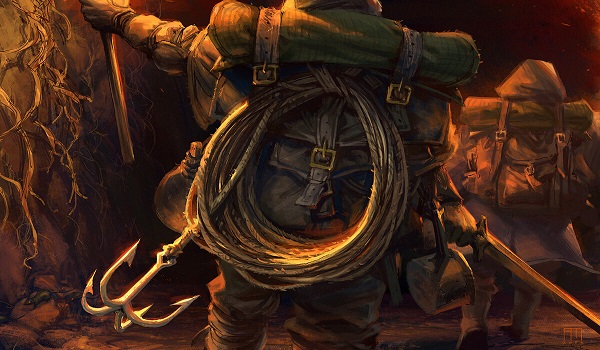
I want to tell a short story about a Dungeons and Dragons group I ran many years. The low-level adventurers had to go find some goblins and mercilessly butcher them, as is fairly commonplace. However, the party's attempt to do so was thwarted by the most unlikely of adversaries. They were all killed by a rope. A magical, enchanted, evil rope? No, a completely mundane, ordinary-in-every-way rope, along with a horrendous amount of bad luck and several rolls of "natural 1."

Ever since that day, I have joked about making a Commander deck with a rope win-con, but there really was not much to work with. Of course, this was just a meme until many years later.

Yes, this might be a sign that Magic has jumped the shark. After many years of nothing, in just a one-year span, they released not one but two rope cards. Speaking of Sharks, you might not believe me, but many years ago we joked about them one day printing a "sky shark" card because of the flavor text on Fighting Drake. Then they printed Shabraz, the Skyshark, who somehow is not a Drake. Flavor fail, but given enough time, they will print anything!

I digress. With twice as much material to work with, I figured it was time to build theRopes. This is the step where focusing the deck to do a thing can be the most difficult part.

Too Many Cooks

Combo deck or aggro? How much value is too much? Which Commander? Luckily, I've built a lot of decks, and have a lot of tricks up my sleeve to make this easier. Obviously, I could lean into the dungeon mechanic of Fifty Feet of Rope to win. However, I was seeing a lot of blue and white cards that just did not have any other appreciable synergy. First and foremost, I do want to win with this deck, because that is the reason it's being built. So while the ropes themselves are very sub-optimal, the rest of the deck is not going to be. What can turn Fifty Feet of Rope into a win?

There was an error retrieving a chart for Mechanized Production

With a pile of artifact search and copying in blue, it would be fairly trivial to make a bunch of copies of a rope. Certainly Mechanized Production is not an uncommon win-con. Alright, perfect, we have a primary way to win. However, few plans survive contact with a Commander table. What about a back-up plan?

Here's where the choice of commander will define the deck. Luckily, I had both the Saheeli, The Gifted and Mishra, Eminent One pre-cons sitting around, and gee, they had a pile of cards I could run. Furthermore, Mishra turning a rope into an attacking 4/4 with haste opened up another door. Between any of the Saheelis, Polymorphous Rush, Cyberdrive Awakener, Masterful Replication, and Brudiclad, Telchor Engineer, we could make a lot of attacking ropes in any given turn.

With copy cards, mana rocks, tutors, and win-cons all added, I still had plenty of space. You know what that means.

High-Powered Cards, Low-Powered Deck

There was an error retrieving a chart for Dockside Extortionist

The biggest reason Dockside Extortionist is crazy powerful is the absurd ramp. It's common to go from two mana to six, seven, or eight on turn two! That can have game-ending consequences. Furthermore, copying Dockside can easily go infinite. But here, because of the deck's plan, I am going to turn my Treasure into ropes.

A bunch of Treasure sitting around for several turns while I search up combo pieces is not strong at all. While it is true that Mechanized Production on Treasure could potentially end games quicker, I'm simply never going to do that because the purpose of this deck is to rope people. That leads me to another extremely powerful and potentially unfair card.

There was an error retrieving a chart for Karn, The Great Creator

This card is pretty busted. Most Commander decks run a large number of artifacts so the stax element of Karn, The Great Creator is fairly powerful. However, I need a way to recover ropes from exile, particularly Frayling Line which self-exiles. A repeatable board wipe is definitely an alternate way to win by, effectively, tying up the table.

I'm alright with Karn's inclusion because it's on point for maximizing the effect of my cards and not just shutting down other players. Furthermore, you can just pay two mana to keep Fraying Rope going, so it does encourage table interaction, much like Jinxed Choker (a card I had recently seen in play that greatly "encouraged" interaction).

0% of Decks Run These Cards

According to EDREC, incredibly few decks are running any rope card. It's clear that they are bad. However, the exercise of building a deck around particular cards is valuable. It got me thinking about maximizing my thematic interactions, a back up plan, and, still features a straightforward win-con. Simultaneously, it gave me real-world value by finding a use for decks I had lying around.

But there's still another reason I want to try this out. I'll get to build a Rograkh, Son of Rohgahh plus Silas Renn, Seeker Adept version of "bad" cEDH deck if Mishra can't grind out a win.

There was an error retrieving a chart for Storm Crow

Storm Crow can be a win-con in strong decks and has been talked about a lot over the years. The idea behind the bird is that a sufficiently powerful deck can win with just about anything. So if at first I cannot win with a deck built to utilize the ropes, I'll do it the other way. Namely, taking a cEDH deck and then jamming the ropes and win-cons into that shell. Either way I've got an interesting deck to bring with me come Commander game night.

This deck is also part of my 2023 resolutions to sleeve up more powerful decks and also to bring "playable, not perfect" decks each week. Utilizing many cards from a couple of pre-cons generates significant time savings.

But How Bad Is It?

I can't imagine Ropes will be anywhere near the bottom of the barrel of Commander decks I have ever tried. In fact, it has more total win-cons and more powerful ones than a lot of the decks I made throughout 2022. The objective would be to get it to be the highest seven or eight in terms of power level that it could achieve. It would be music to my ears if players told me that the Ropes deck is too competitive for the table.

There was an error retrieving a chart for Jedit Ojanen

If you want to see a truly "bad" deck, let me direct you to my take on Jedit Ojanen, which utilized the lowest-community-rated cards on Gatherer. It's absolutely terrible, with every effort made to be completely sub-optimal, but playable at every point. My opponent even manages to get Stuffy Doll with Pariah's Shield attached. Here, I'm not trying to optimize for bad; I'm most certainly trying to take these bad cards, but optimize for winning, as many Commander decks try to do. I think my results will far exceed my expectations, but you never know, maybe Ropes just won't cut it. And you thought that was going to be a rope pun? I'm a frayed knot!

Have you ever tried building around a card you knew to be terrible? Or maybe just a personal favorite that left something to be desired on the raw power front? What were your motivations, and how did things work out for you? I'd love to hear your experiences in the comments.

Oil Leak: The Riskiest Card in Phyrexia: All Will Be One

Are you a Quiet Speculation member?

If not, now is a perfect time to join up! Our powerful tools, breaking-news analysis, and exclusive Discord channel will make sure you stay up to date and ahead of the curve.

There's been a trend every time Magic goes to Mirrodin/New Phyrexia. I'm not referring to anything in the set, but the circumstances of spoiler season. Specifically, the set being leaked. There were significant leaks surrounding the release of Scars of Mirrodin, or so I'm told. I wasn't as plugged into the Magic ecosystem in 2010 as I am now. I've been told that it happened with the original Mirrodin set too, but I don't remember that either. Phyrexia, All Will Be One is no exception, and there's been a substantial leak revealing a card that could potentially be dangerous in Modern. Today, I'll explain why.

The Leak's Story

QS Insiders will remember that in my Insiders-only metagame analysis article, I mentioned that we didn't know enough about One to make any financial decisions in the immediate future. Shortly after I finished writing that article, that statement was rendered false by a massive leak of One rares. I feel like the universe is conspiring to make me look silly, especially since I wrote in the metagame data article that the missing data hadn't been released and then it was released the same day... I will not win the Mega Millions drawing. Come on universe, come through one time! One time!

There was an error retrieving a chart for Rain of Riches

The story goes that there was some mistake at the printer and some boxes of Dominaria Remastered had their rares replaced by the ones from One. If true, that's a huge screw-up, but hopefully humiliating enough for Wizards to do something about the poor quality control of recent sets. It's also the perfect story for a leaker as if the story isn't true, there's no way to prove it. Take that, Wizards' lawyers! Also, Pioneer players rejoice; the allied fastlands are being reprinted.

There was an error retrieving a chart for Seachrome Coast

I'm bringing this up because there is a chance the card I'm discussing isn't real. As there's been no comment from Wizards over the situation, this leak could still be an elaborate hoax. Admittedly, it is most likely genuine, as there are now multiple videos and posts showing the same cards, but in this day and age, I accept nothing even minimally dubious from the internet as absolute truth. I just want to cover myself, just in case.

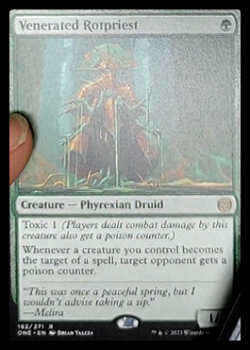
Venerated Rotpriest

There are a number of interesting and powerful looking rares in the One leak. However, one stands out as potentially too powerful. That card is Venerated Rotpriest, and fair warning, the only currently available image is potato quality.

And that's being generous.

For one green mana, Rotpriest is a 1/2 (according to the sources) with toxic 1. Wizards actually did learn from their last trip to Mirrodin, and went back to the original way poison worked (i.e. the Pit Scorpion way). So far, so mediocre. What drew my eye is that second ability. I hope it's misprinted, because there seems to be the phrase "target of a spell" where "target of a spell an opponent controls" really should be. See, the former is terrifyingly abuseable, where the latter is nice and balanced.

There was an error retrieving a chart for Pit Scorpion

If the ability only triggered off opponent's spells, then it's just another form of ward, albeit a nice one that Infect decks may well enjoy. However, as written, there's the opportunity to use this to quickly kill the opponent. This has naturally led to wild speculation about how to best abuse Rotpriest. After some investigation on my own, I think that the best way to abuse Rotpriest is to not abuse it at all. That doesn't mean that it isn't insanely powerful, just that its power is a little deceptive.

The Combo Method

From the minute Rotpriest was leaked, the speculation has been focused on using it as a combo piece. The initial reactions were how to maximize the chances of killing on turn two via Ground Rift and/or Show of Confidence by quickly targeting it many times. I largely dismissed this particular line and feel vindicated doing so as chatter on the subject has rapidly dwindled over the weekend. There was also some proliferate talk, but there aren't Modern-playable proliferate cards, so I didn't bother.

There was an error retrieving a chart for Nivmagus Elemental

I've been down this road before, but last time it was called Nivmagus Elemental. While there have been many attempts to make the potential turn two combo work, it has never made a mark in Modern. The problem is that Ground Rift is a bad card and the effort needed to make it work would be better spent on Grapeshot. Don't be a gimmick for the sake of being gimmicky. So, I cut to the chase and started by incorporating Rotpriest into a Storm shell.

Toxic Storm

As usually happens, Aspiringspike has been working on GR Storm, so I borrowed his shell. After some preliminary testing, I was reminded that Spike is quite aggressive with his mana bases and frequently leans on the best-case scenarios in his deck designs. I cut the Experimental Frenzy for a Forest and Ragavan, Nimble Pilferer for the Rotpriest. As powerful as Rags is, it's also the card least necessary for the combo, and this is a proof-of-concept deck anyway.

Toxic Storm, Test deck

Creatures

4 Dragon's Rage Channeler
4 Venerated Rotpriest
4 Goblin Anarchomancer

Artifacts

4 Mishra's Bauble

Enchantments

4 Underworld Breach

Sorceries

4 Abundant Harvest
4 Grapeshot
2 Empty the Warrens

Instants

4 Lightning Bolt
4 Desperate Ritual
4 Manamorphose
2 Pyretic Ritual

Lands

4 Stomping Ground
2 Bloodstained Mire
3 Scalding Tarn
4 Wooded Foothills
2 Mountain
1 Forest

My idea with this list is that Rotpriest serves as a different kind of Underworld Breach in that it enables kills with fewer in-hand resources. It is possible to get chip poison by attacking, but the intention was that if generating enough storm count to outright win with [card]Grapeshot[card] was impossible, then Rotpriest would provide a way to kill with storm of 10 (or sometimes less). That's fully half of what's usually necessary.

There was an error retrieving a chart for Grapeshot

In this role, Rotpriest wasn't terrible. Of course, that same faint praise could be applied to the whole deck. Playing the deck made me think that it's all very close, but either there have been some corners cut or it's missing something because it all felt oddly anemic. It's also possible that Storm in any form is just outdated.

Lessons Learned

Rotpriest didn't shine because the circumstances where I needed it to rarely came up. There weren't a lot of situations I couldn't just win with damage, but I could with Rotpriest. Either I had enough storm to kill outright, or I just couldn't get off the ground and was nowhere close to 10 storm to kill with Rotpriest.

There was an error retrieving a chart for Underworld Breach

However, there was an interesting trend. If the storm count was six or lower, it was always better to go for the face as low amounts of poison are irrelevant. However, at higher storm counts it was always better to target Rotpriest as subsequent Rotpriests were a huge threat to just kill with Bolt.

Consequently, I'm not sold on Rotpriest as a combo piece. It can do the work of one, certainly. However, the effort to make it uniquely good seems too high. In most cases, it's just easier to kill with damage than Rotpriest in a deck otherwise without poison. So, I decided to change track and move to Infect.

Rotpriest Infect

I remember a time when Infect was the boogeyman of Modern. Getting rid of Gitaxian Probe knocked it down, and Fatal Push buried it, but that hasn't stopped enthusiasts from keeping the deck alive. Thus, I looked to their wisdom for how to build an Infect deck in the modern Modern. The old Infect decks were all blue and green, but most today are green and black. Based on what I saw, I tested with this deck:

Rotpriest Infect, Test Deck

Creatures

4 Glistener Elf
4 Ignoble Hierarch
4 Venerated Rotpriest
4 Plague Stinger
4 Phyrexian Crusader

Sorceries

3 Thoughtseize
4 Scale Up

Instants

2 Fatal Push
4 Might of Old Korsa
4 Vines of Vastwood
2 Snakeskin Veil

Lands

4 Inkmoth Nexus
4 Verdant Catacombs
3 Overgrown Tomb
2 Blooming Marsh
2 Forest
2 Nuturing Peatland
1 Boseiju, Who Endures
1 Pendlehaven
1 Urborg, Tomb of Yawgmoth
1 Yavimaya, Cradle of Growth

Again, the idea was that because Rotpriest triggers off any spell, it would reduce the number of pump effects needed to kill on turn two. That proved to be irrelevant. I was used to Infect playing cards like Groundswell and Mutagenic Growth, and having to play a lot of them to kill. That is no longer the case, and if Infect intends to kill with pump spells, it only needs two. Rotpriest didn't change the math of doing that turn two, and so failed in its intended task.

In fact, it proved to be a terrible early play. Infect as a mechanic was so much more powerful than toxic that Rotpriest would never be played on turns one or two if there was any other option in my testing, which wasn't a great sign.

Paradigm Shift

However, as I shifted from goldfishing to some actual test games, my thinking shifted. Rotpriest still wasn't an optimal play in the early game. Instead, it was the best thing to play in the late game. Infect has always had the problem of struggling to sneak through damage once the opponent has the mana to play multiple removal spells, and that problem hasn't gone away. The shift to Phyrexian Crusader helps but doesn't remove, that weakness.

There was an error retrieving a chart for Phyrexian Crusader

However, in those situations, Rotpriest shines because it doesn't have to attack. In the late game, I just had to sit on pump spells, wait for an opening, and then cast Rotpriest and dump all the spells I'd been holding onto it and kill via triggers. The best part was that there was no need to give the opponent a chance to respond. Announce that you're holding priority, cast a sorcery and as many instants as you want to the stack, and then allow them to make a move. At that point, even Sudden Shock or Sudden Spoiling couldn't stop the kill. Not that anyone was playing either card, but it is a relevant observation.

The Opposing Experience

What really sold me on Rotpriest was the feedback from my testing partners. While initially unconcerned, by the end of my fairly short testing period, they were terrified of the card because they were never safe. With the infect cards themselves, there was always the risk of early death and of something slipping through later, but after a while, the pressure isn't felt anymore. The control decks were in control and the likelihood of instant death was basically gone.

There was an error retrieving a chart for Dress Down

It was therefore ok to let a nonlethal early infect hit through in order to safeguard against the later actually lethal hit. It's not like there's incidental poison to worry about, unlike incidental life loss. Rotpriest flipped the script, and now every Infect attack had to be neutralized lest they lose to a small number of unavoidable triggers down the line. With Rotpriest, no deck is ever truly out of the woods against Infect, and barring Dress Down in response to it being cast (or counters, I guess) there's no answer. The only way to survive is to have out Leyline of Sanctity or Melira, Sylvok Outcast.

Sickening Implications

Does this mean that Rotpriest is dangerous? I don't know, but the early testing at least hints at it. The problem with poison is that it halves players' life totals, and because only one way to remove poison counters has ever been printed (Leeches 28 years ago), that loss is permanent. Mark Rosewater has previously said that is the defining characteristic of poison and he doesn't want to change it, despite player objections. Thus, there will soon be a situation in Modern and Legacy where poison suddenly has burn-like reach. That implication is alarming.

There was an error retrieving a chart for Melira, Sylvok Outcast

My testing decks were unrefined, proof-of-concept experiments, and they were still decent. While I'm skeptical of the pure-combo approach with Rotpriest, I will acknowledge that it wasn't central to my deck. Had I focused on killing just with Rotpriest I might have had different results. On the flip side, Rotpriest slotted into Infect effortlessly and proved to be quite strong. That leads me to believe that if I specifically built around Rotpriest the threat would be larger. That is also an alarming implication.

Prepare for Pandemic

I don't know if there's a long-term threat from Rotpriest. I am certain that for the first week or two following its release Modern and maybe Legacy too will be overrun with Infect decks looking to Rotpriest opponents out. I can't even speculate what will happen in Standard and Pioneer. Consequently, I've preemptively bought up Infect staples as well as a set of Melira. I expect there's going to be a surge of demand soon if it hasn't already started by the time this article comes out. Be prepared.

Adam Plays Magic: Explorer RG Vehicles

Are you a Quiet Speculation member?

If not, now is a perfect time to join up! Our powerful tools, breaking-news analysis, and exclusive Discord channel will make sure you stay up to date and ahead of the curve.

This week on Adam Plays Magic, we're putting the pedal to the metal with RG Vehicles. This deck utilizes over-statted behemoths like Lovestruck Beast // Heart's Desire and Werewolf Pack Leader to crew powerful vehicles like Skysovereign, Consul Flagship to hit hard and fast. With eight mana dorks in the form of Llanowar Elves and Elvish Mystic as well as Reckless Stormseeker // Storm-Charged Slasher as a haste enabler, these massive threats come out swinging ahead of schedule.

What I Like

This may be a conversation for another day, but the definitive two best things to do on turn one in this format are playing Thoughtseize or a mana dork like Llanowar Elves. If a deck isn't doing one or the other, it's at a distinct disadvantage compared to the decks that do. Fortunately, the Vehicles deck passes this test with flying colors.

Compared to the ramp decks playing Nykthos, Shrine to Nyx for multiple high-mana value haymakers like planeswalkers, RG Vehicles' goal is to consistently ramp into powerful three-drops on turn two. It wants to get the opponent on the back foot and attack before they can stabilize. The pressure continues to mount as subsequent threats like Esika's Chariot are deployed. With threat after threat hitting the board, the opponent has to answer what the player is doing rather than develop their own board state. With the redundancy and consistency that this deck offers, no individual piece is essential to the game plan, so the opponent's removal is largely inconsequential.

Every deck seems to have a sequence where the player feels like they're unbeatable. If a certain set of card line up just right, the plays the deck makes are just unfair to the opponent. RG Vehicles is no exception. Reckless Stormseeker curving into Esika's Chariot and Skysovereign can give the vehicles haste, meaning their triggered abilities to make tokens or burn down creatures triggers twice in one turn. If an opponent manages to deal four damage while putting 10 power on the board, or they hit me for six and kill two medium-sized creatures out of nowhere, I would not know a way to come back from that kind of massive swing.

What I Dislike

With a full set of Bonecrusher Giant // Stomp and three Obliterating Bolt in the main deck, there is plenty of interaction to choose from when it's needed. However, nearly every deck is playing a full playset of mana dorks. Spending two mana to remove one-drop accelerants is a losing proposition as the opponent is not only mana-positive in the trade-off, if the opponent is on the play, they've already gotten a chance to deploy a three-drop.

While The Akroan War is a powerful card that can turn the tide in the mirror and other aggressive decks, GW Angels, which I wrote about last week, is both popular and nearly immune to the spell. The third chapter deals damage to all tapped creatures equal to their power, but cards like Bishop of Wings and Righteous Valkyrie have more toughness than power, allowing them to survive what should be a pseudo-wrath effect.

There was an error retrieving a chart for Skysovereign, Consul Flagship

Speaking of Angels, the matchup is extremely difficult as the early spells can block favorably against chip damage from Pack Leader and Reckless Stormseeker. Angels also has the potential to gain large swaths of life, undoing an entire game's worth of damage.

RG Vehicles also has very few ways of generating card advantage. If it stumbles on mana, be it too many or too few sources, it can fall behind. It's unstoppable when everything is going right, but that's not how every game will play out.

What's in the Box

RG Vehicles

Creatures

4 Elvish Mystic
4 Werewolf Pack Leader
4 Lovestruck Beast // Heart's Desire
4 Bonecrusher Giant // Stomp
4 Reckless Stormseeker // Storm-Charged Slasher
4 Llanowar Elves

Artifacts

4 Esika's Chariot
3 Skysovereign, Consul Flagship

Enchantments

2 The Akroan War

Spells

3 Obliterating Bolt

Lands

1 Mountain
3 Forest
4 Stomping Ground
2 Boseiju, Who Endures
1 Sokenzan, Crucible of Defiance
4 Cragcrown Pathway // Timbercrown Pathway
3 Lair of the Hydra
4 Karplusan Forest
2 Mutavault

Sideboard

3 Rending Volley
2 Hazoret the Fervent
2 Klothys, God of Destiny
2 Unlicensed Hearse
2 Damping Sphere
1 Arlinn, the Pack's Hope // Arlinn, the Moon's Fury
1 Fry
2 Embercleave

End Step

Overall, RG Vehicles is a very strong deck that I'd feel comfortable bringing to any tournament in Explorer or Pioneer. Its ability to capitalize upon aggressive three-drops is second to none, and access to Skysovereign breaks midrange matchups like the ever-popular RB deck.

While the deck does have some bad matchups, there are flex slots that can mitigate the most disastrous of lineups. It's hard to go too wrong with a deck as proactive as this.

As always, if you'd like to suggest a deck for next week or have any questions about the decks I play, shoot me a message on Twitch or Twitter or leave a comment below. Catch you all next time!

On Unhealthy Price Declines

Are you a Quiet Speculation member?

If not, now is a perfect time to join up! Our powerful tools, breaking-news analysis, and exclusive Discord channel will make sure you stay up to date and ahead of the curve.

Rewinding to a decade ago, I vividly remember a clamor from players and vendors alike for cheaper Magic singles. All these exciting, fun-to-play formats were getting “too expensive”.

Legacy had taken off, making Dual Lands and other format staples prohibitive to format entry. Modern was a huge hit after its launch in May 2011, but it was driving up prices of some important cards such as Shock Lands, Thoughtseize, and Tarmogoyf (despite a recent reprint in Modern Masters). Even Standard was contentiously costly, and players were unhappy with the format’s cost of entry because there were $50 cards (e.g. Bonfire of the Damned).

There was an error retrieving a chart for Bonfire of the Damned

Acknowledging the outcry, Wizards responded. Reprints started pouring out in the form of Modern Masters, bringing much-needed supply to the market. Only the reprints did not consistently have the desired effect—in some cases, reprinted cards increased in price instead of decreasing!

Something had to be done! Magic was too expensive! Even vendors, whose livelihood depended on selling singles, were advocating reprints and price decreases. The overarching sentiment driving this desire: “I’d rather sell ten copies of a $10 card than 1 copy of a $100 card.”

“It’s Broken. Are You Happy Now?”

When I was growing up, my siblings and I had this strange novelty toy. Funnily enough, I don’t remember what it looked like, but I sure remember what it sounded like! The device would make sounds when activated, and those sounds were a selection of phrases an overbearing mother may say to her child after they misbehaved.

One of the phrases I distinctly remember was, “You’re going to poke somebody’s eye out with that thing!” This one inevitably got a laugh from family members seeing the device for the first time. The phrase that comes to mind when I think about Magic finance, however, is “It’s broken. Are you happy now?”

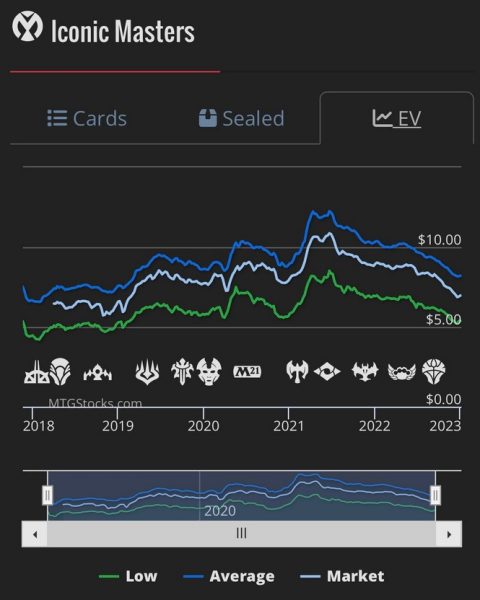
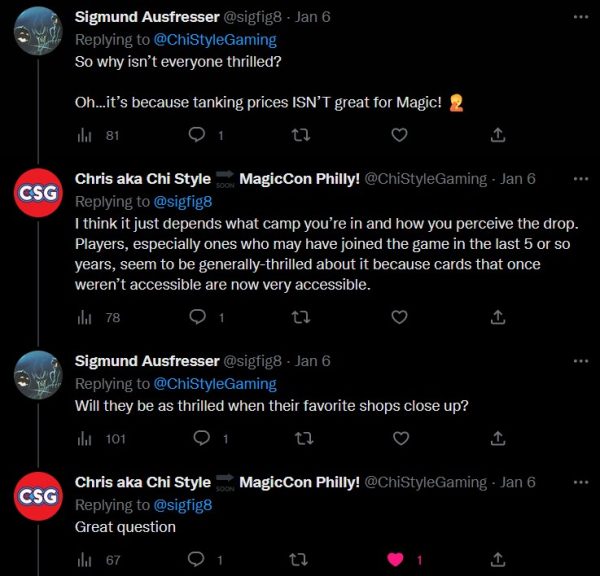
That is precisely what it feels like when I look at reprint volume and resulting pricing trends over the past year. Chris aka Chi Style (@ChiStyleGaming) created a thread on Twitter depicting set value trends using MTG Stocks data. The thread goes on and on, showcasing expected value (EV) charts from over two dozen sets. The trend in each one is the same (I chose Iconic Masters as an example):

It looks like card prices were on the rise throughout the pandemic, but as 2021 matured, that trend reversed. Then they continued, and prices are now below their pre-pandemic levels.

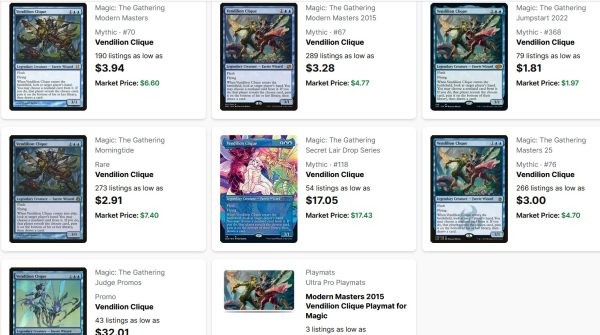
A single card that epitomizes this move for me is Vendilion Clique. I used to play this creature in a Commander deck many years ago. When I decided to budgetize my Commander decks, Vendilion Clique was cut—I couldn’t justify a $50 card in my deck simply because I didn’t play often enough.

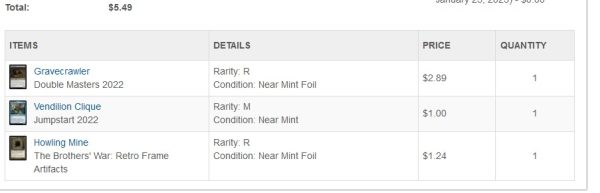
Last week I saw someone tweet an article on Twitter that I had to retweet. It was a discourse by Michael Bahr, and he went on to explain some of what is happening in the collectible market regarding prices. He specifically called out Vendilion Clique as being reprinted so much that it’s now a $1 card. He wasn’t wrong—here’s the copy I ordered as part of a $5 purchase (so I could earn free shipping).

There was an error retrieving a chart for Vendilion Clique

From over $50 to $1, if players wanted lower prices then they should be thrilled with this development. Are they, though? I’m not so sure—I see a lot of upset people on social media declaiming the lack of value of Magic cards. The magnitude of price decreases appears to be larger than people wanted. Now if you open a booster pack of the latest set, your odds of opening at least $4 back are longer than ever. Even if you open shiny foils and alternate art variants, you’re still looking at many bulk rares and mythic rares in a Standard-era set.

Valuable older cards are tumbling equally fast, not because of Standard but because of the proliferation of reprints upon reprints. It is endless, and it’s driving many perennial staples to all-time lows. Can this possibly be what everyone wanted?

In other words, “It’s broken. Are you happy now?”

Three Reasons This Isn’t a Good Thing

In reality, there are more than three reasons. This week, I want to touch on those that come to mind most readily.

Reason #1: Lack of Control

I suspect if we polled a group of TCGplayer vendors, they would still rather have higher liquidity and deal more in cards that have two-digit values than three- or four-digit values. I can certainly see how it’s easier to sell 50 $20 fetch lands than 1 $1000 Moat, for example.

There was an error retrieving a chart for Moat

Margins would also likely be better on a percentage basis, so as long as the volume remains sufficient, the proposition is attractive. The problem is, Wizards of the Coast has made it clear that they’re in charge when it comes to a) what gets reprinted, and b) how much a card gets reprinted.

Thanks to the Reserved List, we’ll never see Moat sell for $50 as many vendors appear to want. Instead, we’re seeing Vendilion Clique sell for $1. Another example is Tarmogoyf, which used to be over $100 and now can be purchased for $10. Is that what vendors wanted? Maybe that wouldn’t be so bad if demand increased in step, but I’m not so sure that’s the case.

How about Jace, the Mind Sculptor, which went from $150 to $30 thanks to all its reprints? Is that the right price point for vendors to be happy?

There was an error retrieving a chart for Jace, the Mind Sculptor

To be fair, Big Jace, Vendilion Clique, and Tarmogoyf were once Modern and/or Legacy powerhouses. You couldn't go to a large event without seeing these cards show up time and again. Thanks to continuous power creep in the game, however, these have seen a diminishing demand. The combination of reprints plus power creep making these cards obsolete has really punished their prices the most. It's no wonder Clique, once a $50 card, can now be found in the dollar bin!

Older cards aren't immune either. Remember when Mana Drain was an amazing pull worth $150 from a booster pack of Iconic Masters? Now it’s $30. Don’t even get me started on Sol Ring, which is becoming virtual bulk because of its infinite reprints. There are more expensive copies to be found, sure, but this is about finding the cheapest copies of a card for play purposes.

Then there's Rishadan Port, Imperial Recruiter, Temporal Manipulation... the list goes on and on. My point here isn’t that one price reduction is better than another. My point is just that we have no control over what drops and by how much. Only Wizards of the Coast has the keys to that car, and I’m not sure they’re licensed to drive. This lack of control makes the prospect of reprint-driven price reductions a dicey proposition in my mind, and one I would not opt into given the choice.

Reason #2: Margin Erosion

I stated above my hypothesis that margins improve on a $20 card relative to a $1000 card—a vendor may pay $12 for the former and $750 on the latter, meaning the percentage profit is greater on the cheaper card. There is a point of diminishing returns in this calculation, however, as average prices (and therefore, average baskets) drop further and further.

Consider the Vendilion Clique purchase I made recently—here’s the snapshot of the full order:

What do you think the profit margin was for this vendor? I earned free shipping, so the vendor had to spend their time picking out these cards and packaging them, and then $0.50 on a stamp just to ship them to me. Then TCGplayer took their cut. When the dust settles, they’d be lucky to net $3 from this sale.

Was this worth their while? I suppose it's because prices were so low that I made this purchase—had Vendilion Clique still been $50 and Gravecrawler $10, I wouldn’t have made this purchase. It’s true, this seller is likely seeing more volume thanks to reprints.

At what cost, though? I’d argue it’s at the cost of margins, and I’m just not sure if all the proliferated vendors out there can survive a world where this is the average shopping basket they have to fulfill. Cards going from $100 to $30 may be fine, but cards going from $50 to $1 likely aren’t. Where’s the line?

Reason #3: SKU Proliferation

Another downside to dropping prices is how the price reductions are achieved: through massive reprints. Not just Standard reprints, mind you. That could be a more direct, less complicated way of achieving the goal. Unfortunately, you just can’t put every card that needs a reprint into Standard.

Instead, we’re getting set after set of reprints—I can’t even keep track of them all! There are Commander sets, Secret Lairs, Masters sets, The List, Promos, and the list goes on. What does this mean for vendors? It means they have to physically keep track of every single variation that’s printed!

No longer is there just one or two versions of Vendilion Clique. Now there are seven, not counting foil versions from each set. Including those brings the total number up to over a dozen!

That’s not even an extreme example! Certain reprints include alternative arts and alternative foil treatments. Don’t even get me started on Sol Ring.

I can’t imagine all this SKU proliferation is easy for vendors to deal with. The problem is only getting worse with every single set release.

Wrapping It Up

I barely scratched the surface of some of the issues I see with the new world of cheaper card prices. For example, I didn’t even paint the external context surrounding this macro-trend in Magic. Namely, the current economic weakness we’re seeing and the spike in inflation. Not only are card prices decreasing in absolute, but also their values are decreasing because the purchasing power of the U.S. dollar is falling.

Factoring in inflation from the past year, a $100 card that dropped to $30 is really only “worth” $25 (numbers are arbitrary to illustrate the trend). In the meantime, high inflation means vendor overhead costs are rising, including rent, utilities, employee pay, etc.

This is precisely why I responded to Chris the way I did on Twitter. It seems he is in agreement.

In the case of declining prices, there is definitely too much of a good thing. I’m thrilled that I can once again play Vendilion Clique cheaply in Commander, but at what cost? Would I rather vendors feel tremendous economic pressure, causing many LGSs across the country to fold so that I can have a $1 Vendilion Clique? Certainly not.

It’s definitely possible to overdo price declines, and I for one say it’s time for Wizards to halt with reprints and let the market stabilize, even if it means price increases in the short term. The reprieve would be healthy for the game, and I think even some vendors may come to appreciate that move in the long run.

December ’22 Metagame Analysis: A Warp Has Formed

Are you a Quiet Speculation member?

If not, now is a perfect time to join up! Our powerful tools, breaking-news analysis, and exclusive Discord channel will make sure you stay up to date and ahead of the curve.

Happy New Year, Insiders! It's time to put the final nail in 2022's coffin with my metagame analysis article. December is always a strange month for data collection. It's the holiday season in much of the world, and this means a general downtick in Magic events. However, many years, there are a lot of large tournaments as players have time off to actually attend events and organizers thrown end of the year celebrations. This can cause some oddities outside of metagame trends, which I'll discuss. That doesn't mean that the metagame doesn't also have intrinsic oddities, and Modern appears to be warping in a less than ideal direction.

The Impact of Big Events

As previously mentioned, I didn't get all the Magic Online (MTGO) data for December. The updater broke, Daybreak went on Christmas Break, it was a whole thing. However, thanks to the efforts of Magic social media, I was able to include the Modern Super Qualifier, which was a 5-point event. While this normally isn't much of a problem as there's plenty of data to balance out the big event, the fact that it was the last event I added to the incomplete paper data meant that it radically changed certain stats that in turn changed the conclusions the data suggests.

There was an error retrieving a chart for Murktide Regent

UR Murktide was the big beneficiary because it was the big winner of said Super Qualifier. Half the Top 8 was Murktide, which translates into 20 points. That's not even considering the points from the rest of the Top 32. This dramatically pushed Murktide up the points standings.

Murktide had seven more appearances in December than Hammer Time, a gap of ~1.5%. Prior to the Super Qualifier the point gap was similar. Thanks to the Super Qualifier, the point gap jumped to ~4.5%. Simultaneously, Murktide's average was at or slightly below Baseline for most of December. Its final position was determined by that Super Qualifier spike.

There was an error retrieving a chart for Stoneforge Mystic

Had all of the data from December been available before the update went to print, the effect would have been muted and moderated. As a result, Murktide looks like it performed above expectations, but it really didn't in the wider monthly context. Keep that fact in mind while making deck decisions in January.

Meanwhile, In Paper

Paper's data is also distorted, but in a completely different way. I get data from all over the world, but for the last week of December, eight of nine events came from Japanese megastore Hareruya. Again, normally this isn't a problem; over a month, even if one source puts out a lot of data, there's enough from other sources to correct any oddities and it all balances out overall. However, if that single source is concentrated at a given time, it pulls the data away from the previous trend line towards its proclivities.

There was an error retrieving a chart for Indomitable Creativity

Which is a long-winded way of explaining that Hareruya is the reason that paper has two outliers, but could have had four. Up until Christmas, Murktide and Hammer Time were very clearly statistical outliers, with Rakdos Scam being on the line for consideration. I was prepared to go either way with Scam, and the data was pointing towards making it an outlier.

There was an error retrieving a chart for Grief

However, Hareruya's players love janky combo decks generally, and have a particular love of Indomitable Creativity. 4-Color Creativity was so overrepresented in the year-end events that it nearly caught Scam. This pulled down the outlier indications on Scam itself, but it also made the overall gaps in the data worse. Thus, I could have made an argument for Creativity and everything above it being statistical outliers. I didn't do that because this isn't academia, but it goes to show how tenuous and complicated the stats actually are.

Creative Differences

Speaking of Creativity, there's a huge divide between Creativity players in paper vs MTGO. 4-Color Creativity was Tier 1 across the board in November but it completely collapsed online in December. It didn't make the population list and just sneaked onto the power rankings.

That deviation would be news enough, but what makes it stranger is that MTGO players have not simply abandoned Creativity, but instead moved onto a different variant: Jund Creativity. That's a fairly extreme change to happen in a month, and requires further investigation.

So Many Colors

The first reason for this divergence may be the nature of 4-Color Creativity itself. It is a deck with an identity crisis. As long as it has four colors with actual support, it gets classified as 4-Color, but that encompasses a huge range of decks. Archon of Cruelty doesn't count towards the color identity because the intention isn't to cast it, but there are plenty of decks that are solidly black, blue, and red with green for Wrenn and Six and Veil of Summer. There are other decks with white instead of black. There are many that play the fifth color as a splash. In short, if a combination could exist, it does.

There was an error retrieving a chart for Wrenn and Six

This may be the problem, and the explanation for the deviation. There is so much dissent over the optimal list (it's increasingly rare to see two decks in different events with the same 75 cards, or even starting 60), players have given up trying to balance their multicolor decks and have opted to simplify. Balancing the mana and spells in a three-color deck is significantly easier than in four-color decks. Online players tend to be more flexible with their decks than paper, so they could easily have switched to something easier to build.

Blood Moon Rising

A benefit, or another completely unrelated reason for the switch, is that Jund Creativity is far less vulnerable to Blood Moon. All Creativity variants are hurt losing Dwarven Mine, but fewer colors necessary means that more cards work while under Moon. Some Jund variants are even built like they were considering running Moon themselves. I haven't seen it happen yet, but it also wouldn't surprise me.

There was an error retrieving a chart for Blood Moon

This isn't an incidental benefit, either. More decks are playing Blood Moon these days, particularly online.

2 Moon has been common in Murktide for some time, whether in the sideboard or maindeck. It seems to shift monthly on whether they're mained or sided. Scam has increasingly been joining Murktide, with 2 Moon main being common and three seeing play too. Meanwhile, Cascade Crashers often has Moon as well as Magus of the Moon either maindeck or sideboard. Even the 4-Color versions are getting in on the action.

There was an error retrieving a chart for Primeval Titan

I'm not sure if there's a specific metagame pressure causing this uptick in Moon, but I do know that it's limited to MTGO. I'm not seeing Moon effects in the paper results more often than in October, so the cause is currently limited to online play.

It might be metagame pressure, specifically a fear of Tron or Amulet Titan. There could also be more need to answer Urza's Saga. It could also be just a random whim that's gotten pervasive. MTGO do be like that sometimes. I'll be watching to see if this trend persists and/or migrates into paper.

The Simple Answer

Of course, it is also possible that I'm reading in. Perhaps Jund Creativity is better than the alternatives. Certainly, it yields tighter and more focused lists. Where most Creativity lists are slightly schizophrenic piles of good cards featuring the Creativity package, the Jund lists are just focused on getting out Archon by any means necessary. Which is a pretty strong strategy in today's Modern.

All Creativity lists run full sets of Fable of the Mirror Breaker and a couple additional looting effects to find Creativity. The Jund lists have Fable plus sets of Bitter Reunion and often Collective Brutality. This doesn't just find Creativity, but it also sets them up for the full set of Persist they all run. Drawing Archon can be a disaster for other decks, but Jund is set up to make it work. Perhaps that's been the right move all along.

There was an error retrieving a chart for Archon of Cruelty

Or maybe this was just a flavor of the week or a response to a specific metagame challenge. I don't know. I will be watching to see what conclusions the Magic hive mind comes to.

Red-Shifting

On the other hand, all mediums have seen a noticeable shift towards red decks over the past few months. December is when it finally became noticeable, but this has been happening for some time. It's tempting to blame Yorion, Sky Nomad getting banned, but I suspect that the process had started before then.

There was an error retrieving a chart for Soul-Scar Mage

The bellwether for this is Izzet Prowess. Prowess excels in formats teaming with toughness-based removal and stumbles against unequivocal removal. It fell off dramatically after Modern Horizons 2 brought in Solitude and Prismatic Ending, but both cards are seeing much less play. That might be because control decks have fallen off without Yorion, but it might be for metagame reasons (more on that next).

With more players relying on red removal now than in the past year, the time has come for Prowess to shine again, going from untiered to Tier 2 in a single month.

I Blame Ragavan

Yorion's banning may play a part, but the expansion of Ragavan, Nimble Pilferer decks is also to blame. The monkey pushes decks to be low-to-the-ground and tempo-centric, which is a playstyle red excels at. Red removal is also better in the proactive role that Ragavan needs, keeping the road clear. This has incentivized players to play more red removal.

There was an error retrieving a chart for Ragavan, Nimble Pilferer

All that amounts to an increase in Ragavan decks. Rags has always slotted into any deck with red, but its main home was Murktide. Now, Scam and Jeskai Breach Combo are dedicated Ragavan decks in the top tiers. This further pressures decks to have removal turn one, and the best spell for that is Lightning Bolt. Thus, there's a self-perpetuating cycle.

There was an error retrieving a chart for Solitude

I don't know if this is going to last. In theory, UW Control should dominate Prowess and have game against the Ragavan decks. The fact that it isn't happening means I'm missing something. We'll all have to wait and see how this shakes out.

Plan Ahead

As always, I finish these analyses with a glimpse into the financial crystal ball. First of all, and to reiterate a point from two weeks ago, I don't foresee this current metagame being sustainable. I can't imagine a 2024 with Ragavan in it. Thus, I'd advise moving out of Ragavan (if you haven't already) while the price is still high. I certainly have. The current metagame is steadily warping around Ragavan, and that's a strong sign that Wizards is coming. Understand the risk and plan accordingly.

There was an error retrieving a chart for Blighted Agent

As for what to move towards, I'd hold off on that until we know more about the next set. All I know about Phyrexia: All Will Be One is that we're back on New Phyrexia and poison is making a return. Not infect, just poison. If infect were returning, I'd advise speculating on all the infect cards for the new Infect surge. As is, the new mechanic might be good enough for Modern, but might also be terrible. Speculating on infect cards might therefore be a bit premature.

To A New Year

And with that, I formally close the books on 2022. I hope that I can finally move past the statistical problems and the metagame starts to correct itself. I will see everyone next month to see if my faith is rewarded. Until then, invest with caution; there are turbulent times ahead.

BRO Draft Deck Primer: Multi-Color Stalwart

Are you a Quiet Speculation member?

If not, now is a perfect time to join up! Our powerful tools, breaking-news analysis, and exclusive Discord channel will make sure you stay up to date and ahead of the curve.

Citanul Stalwart has completely warped my experience in The Brothers' War Limited, earning me many trophies in the process. It goes disproportionately late, and as a result I find myself in this deck a disproportionate amount of the time. Players are not evaluating this card correctly, so even when a clear lane presents itself, a late Stalwart can present interesting deck building opportunities, which can allow us to draft more consistently and provide access to more powerful tools. This week I want to discuss how to properly draft and build Citanul Stalwart decks, as well as explain why this card must be on our radar.

Warping the Draft, Warping the Format

GIH WR% doesn't tell the whole story with this turn one enabler. In decks that can utilize Stalwart, it can feel like having access to multiple Birds of Paradise. This isn't a luxury many limited decks enjoy, but it could be.

In the above table, ALSA is a stat that tracks, on average, when a card is last seen in a pack. OH WR tells us the win rate of a card when it is in our opening hand. Citanul Stalwart is seen about as late as green's least playable cards, but it boasts a high win rate when it is in our opening hand (it has the highest OH WR amongst all green commons, and the fourth highest OH WR amongst all green cards). Yet on average, we can have this card towards the end of a pack. Speculating on late Citanul Stalwarts is essential to maximizing wins in this format.

Taking this card late allows us to gamble low-equity picks on high-equity upside. What upside is that? Having access to the highest-power cards available, in all five colors.

As we navigate the draft, there's strong reason to select Citanul Stalwart early; however, if we're seeing it late, we need to at least be considering the option.

Building Birds

Comparing Citanul Stalwart to the most Bolt-able creature in MTG history might be a slight stretch. The biggest difference is that we need to build around our favorite Elf Druid Soldier with permanents that allow it to generate mana early and often. We're willing to spend a little bit of mana now to ramp and fix for later, and these cards all do that without requiring a second color of mana.

On Color Enablers

These cards do a nice job replacing themselves with value while still being early enablers for our Stalwart. We're not willing to use two cards to build a mana source, but if we can be reimbursed for our troubles, the payoff gets a lot closer to being free.

There was an error retrieving a chart for Howling Mine

Tapping Howling Mine deactivates it for our opponent's turn. With Citanul Stalwart, we can deny our opponent a card every turn and generate mana when we need it. This felt like a pretty powerful turn two:

You've heard of Bolt the Bird; now it's time to Disfigure this figure.

Building Manabases

While Stalwart has an enormous impact on what our deck can do, it represents very little impact as a game piece on the board. Its 1/1 stature means it won't impact racing or combat in a significant way, and as a result, we can't really count it as an action spell. We should count it as a land when analyzing our land-spell ratio.

However, we can't rely on it if we can't cast it. As a result, my mana bases always have nine or ten green sources. Because it helps support our low land count, Evolving Wilds is something we should prioritize. It boosts low counts of other sources that, in conjunction with the Citanul Stalwart itself, will help smooth over our ambitious, multi-color agenda. Remember that our cantrip artifacts and Blanchwood Prowler also fortify our land count.

Because we have access to multiple five-color sources, we can afford to be judicious when including basic lands to accommodate smaller splashes. This list only has thirteen lands, but uses all five colors.

Even with an Evolving Wilds, we don't want to sacrifice card slots to random basics. Because we're not playing multiple basics, the color of our splashes are irrelevant. We might have three cards that need a black splash or three cards splashing into three separate colors. When this is the case, Three-Color Stalwart decks are just as splashy as Five-Color Stalwart decks.

5 Color Stalwart (7-2)

Creatures

3 Citanul Stalwart
1 Argothian Sprite
1 Mine Worker
4 Blanchwood Prowler
1 Thraxodemon
1 Yotian Dissident
2 Argothian Opportunist
1 Foundry Inspector
1 Liberator, Urza's Battlethopter
1 Reconstructed Thopter
1 Skystrike Officer
1 Scrapwork Cohort
1 Mishra's Juggernaut
1 Platoon Dispenser

Sorceries

1 Awaken the Woods
1 Emergency Weld
1 Recommission
1 Shoot Down

Enchantments

1 Audacity
2 Prison Sentence

Land

1 Evolving Wilds
2 Plains
1 Swamp
9 Forest

While we have access to all colors, it makes sense to prioritize green cards, and a secondary color respectively. Just because we can splash five colors doesn't mean we should ignore the tenets of good deck-building.

The Cards We Want

As to be expected, we want copies of Citanul Stalwart in our Multi-Color Stalwart decks. In personal experience, three copies feels reliable, but the more the merrier is a sound policy. Remember, the 1/1s shouldn't water down our decks, because we evaporate a land from our base with each addition. (Staying around 9-10 green sources remains crucial for this math to work.)

Energy Refractor is a reasonable stand-in for the third, but we'd rather pair it with our three Stalwarts, giving us four multi-colored sources (Stalwart is far better). Springleaf Drum is an option, but we need to be cognizant of the cards we're using to activate it.

Once this mana base is unlocked, we want strong cards that can help us recover. This deck is a great home for all of the best commons in the format. The unearth creatures, especially Scrapwork Cohort, are all excellent here. They are easy to cast because of their colorless frontside, and Stalwart unlocks the backside. Cohort helps stabilize our boards or help pressure opponents. Argothian Opportunist is another premium common for this deck. It's a good resource for combat and a free permanent for Stalwart.

Additionally, we are usually looking to gum up the board, and Boulderbranch Golem is a flexible tool that helps us get to our late-game while still being a potential win condition on its own. The good removal spells are also good here. We have access to splash the more expensive ones, as well. While those are some of the most desired ingredients, the recipe is always going to be a brew.

Unlocking Every Possibility

We want cards to help activate our Citanul Stalwart, and we want the good commons that are in our base color. After that, it gets more interesting.

A Citanul Stalwart manabase can account for whatever the draft is providing, as well as splash for other strong cards. This deck looked to be an UB Control pile. When Citanul Stalwart showed up, our plan became a lot more dangerous. It easily splashed an Urza, Prince of Kroog, and as the black cards dried up, the Stalwart enabled a better plan.

Citanul Urza 7-2

Creatures

2 Citanul Stalwart
1 Coastal Bulwark
1 Drafna, Founder of Lat-Nam
1 Mine Worker
1 Thopter Mechanic
1 Yotian Dissident
2 Argothian Opportunist
1 Argivian Avenger
3 Boulderbranch Golem

Artifacts

1 Energy Refractor
1 Levitating Statue
1 Helm of the Host

Sorceries

1 Shoot Down

Instants

1 Stern Lesson
1 Desynchronize

Enchantment

2 Weakstone's Subjugation
2 Mightstone's Animation
1 Static Net

Land

5 Island
1 Evolving Wilds
1 Plains
8 Forest

In another draft, the BR Sacrifice deck looked like a real option. However, an early Howling Mine and a pick eight Citanul Stalwart offered another path. Two Stalwarts, two Energy Refractors, and a single Evolving Wilds made reusable by Perennial Behemoth facilitated a crazy concoction that used Mishra, Tamer of Mak Fawa to launch an unearthed Rust Goliath at opponents. Three copies of Scrapwork Cohort and a lot of Penregon Strongbull activations proved to be a capable endgame.

Rusty Slingshot 6-3

Creatures

1 Goblin Blast-Runner
2 Citanul Stalwart
2 Scrapwork Mutt
1 Giant Cindermaw
1 Penregon Strongbull
3 Scrapwork Cohort
1 Skyfisher Spider
1 Perennial Behemoth
1 Mishra, Tamer of Mak Fawa
1 Rust Goliath

Artifacts

1 Chromatic Star
1 Elsewhere Flask
2 Energy Refractor
1 Howling Mine

Sorceries

1 Epic Confrontation
1 Powerstone Fracture

Instants

1 Overwhelming Remorse
1 Unleash Shell

Enchantments

3 Bitter Reunion

Lands

1 Evolving Wilds
1 Swamp
4 Mountain
8 Forest

In short, Stalwart decks can absorb almost any archetype. However, the extra colors allow access to unique and powerful variations of those archetypes. We should be on the lookout for signpost uncommons and off-color rares. This flexibility can lead to extremely powerful decks, regardless of what the draft sends our way.

To Stalwart or Not to Stalwart

Stalwart decks are not without drawbacks. They take on additional risk because they can be overly reliant on their namesake common. Assembling the requisite enablers can also reduce your aggression.

While drafting, when a deck is presenting itself to us, we can follow the clear path for as long as it is available. When we take a Citanul Stalwart, we're inevitably passing other cards that might be a better fit. The grass is not always greener on the other side. However, if it feels like a color is drying up, a late Stalwart offers us a second path. We don't have to take that path, but it can be a nice option.

Additionally, this deck needs multiple Stalwarts. We can't build around a one-of one-drop. If we first see the Stalwart in pack three, it's probably too late for us to realistically consider that option. If we see it late in pack two, the chances are also slim. Weighing the expected value of a speculative Stalwart is something we have to do on a pick-by-pick basis.

Citanul Stalwart is a huge piece of the format and it helps teach us a lot about deck building. Because the draft can enchant us with twists and break our hearts with turns, we need to think on our feet. Stalwart intensifies this. Between splashes, enablers, and powerful effects, we're hardly drafting on rails. We need to navigate our deck towards a plan, and while enough Stalwarts can facilitate anything, we want to make sure there's a coherent strategy on the other end of all their fixing.

When we draft BRO, we should keep our eyes open for this little soldier. It lets us do a lot of crazy things and if we build around him effectively, anything is possible. There will be times when a late Stalwart Citanul package doesn't come together. If we don't have a reason to want the extra colors than don't bother playing them. However, even if you leave them out of your deck, the pick provides you more autonomy in the draft itself.

Shine a Little Light

I've had the chance to build around this rare enchantment twice. I remember having the option between this and Obliterating Bolt. 17lands informed me that the red removal spell had a far better win rate. For science, I decided to test the build around.

There was an error retrieving a chart for Tocasia's Welcome

While Tocasia's Welcome might not have a stellar GIH WR, when built around, it is extremely powerful. Commit to the power this card offers. In the two decks I used it in, it was a cantrip on a combined 87.5% of creatures. Both of those decks trophied.

Don't forget that this card triggers off the 1/1 that Scrapwork Cohort brings with it. It can also trigger on your opponent's turn with Ambush Paratrooper or the death of a Thopter Mechanic. One of my decks had five copies of Airlift Chaplain. They felt like Mulldrifters. Recommission, Emergency Weld, and unearth creatures generate absurd value with this enchantment in play.

I've seen opponents play this card against me and draw one or two cards over a long game. I thought I was dead when it hit the table. Turns out it didn't do anything. This is a card that has a way lower win rate than it deserves because people are not using it correctly. Welcome can go from unbeatable to unplayable. If we have the opportunity to commit to this card, we can make it a bomb. The instructions for this card are pretty clear. Get the cheap creatures, play the enchantment, and profit. Happy drafting!

The New Elesh Norn And Commander

Are you a Quiet Speculation member?

If not, now is a perfect time to join up! Our powerful tools, breaking-news analysis, and exclusive Discord channel will make sure you stay up to date and ahead of the curve.

We're a month away from Phyrexia: All Will Be One, and one of the very first cards spoiled is confirmed crazy. Elesh Norn, Mother of Machines is so obviously powerful that it prompted an article from the Commander RC head Sheldon Menery. When the Rules Committee speaks, I listen. Is Elesh Norn, Mother of Machines a step in the wrong direction for Commander, or could we be having a knee-jerk reaction to a powerful, but not overpowered, card?

But First... the Apocalypse

There was an error retrieving a chart for Sheoldred, The Apocalypse

Sheoldred, The Apocalypse is bad for Commander. Wizards of the Coast essentially forced a high-rarity, super-powerful chase card onto Standard, Pioneer, and Commander simultaneously. The price of the card will remain sky-high for the foreseeable future. Maybe that's why I do not see a lot of Sheoldred either locally or on SpellTable.

Furthermore, EDREC shows Sheoldred as a distant fifth for mono-black commander. It even appears in the middle of the pack as far as mono-black staples are concerned. However, if this card were not so pricey, I feel it would certainly be jammed into many more decks, because it just does too much for too little.

There are several ways to determine a fair mana cost for a card, but comparing existing effects is a good baseline. What is the least expensive 4/5 creature? There are several 4/5s at three mana, but they generally have a drawback; the same is true at four mana. So the most common mana value for a 4/5 body is five.

Given that deathtouch is free, and lifegain on draw is free, we only have to check the cost for two damage per card drawn for opponents. Six black mana, the cost of two Underworld Dreams. So yes, you're getting a good 11 or 12 mana in value from this (checks card) four mana creature. Yeah, Sheoldred is absurd! Seriously, who would print such a thing?

The Same Team That Printed THIS Thing

Let's see here. Vigilance, sure, we'll call that "free." A 4/7 body is uncommon, but I'm sure six mana covers it, so let's just talk about abilities. Torpor Orb, Hushbringer, Tocatli Honor Guard, and Hushwing Gryff (flash costs one here) all shut down creature ETB effects for two mana. Yes, there are a few cases where turning off ETB effects could help an opponent, but stopping all enemy ETBs has got to be worth two at least. But wait... Mother also gets Panharmonicon, which is solid at four mana, and normally that only works on artifacts and creatures. This one works on everything! Bringing us up to what, 12, 13, up to 14 points of mana in abilities on a five mana creature? I'm noticing a disturbing trend and I am not alone.

Enter the Sheldon

I agree with nearly everything Mr. Menery mentioned in their article, but I want to quote what I feel is the single highest-impact statement.

"Once we get to the point of, 'If you’re playing white, there’s no reason to avoid playing Elesh Norn, Mother of Machines' (or insert card name), we’ve reduced our effective deck size by one more card.  When twenty or more of our cards have been decided before we actually start building the deck, we’ve headed in a dangerous direction. We’ve sacrificed creativity on the altar of efficiency."

This is already the case for many cards that are simply too good. Wizards clearly has data. Mark Rosewater mentions that "White has had more gains in the color pie than green in the last year and more is coming." The reason? It is commonly believed that white is the weakest color in Commander.

What is the plan to make white stronger? Elesh Norn is part of that plan. I would not mind if the mana cost were, say, five white mana, reinforcing this card as mono-white. But at only one white and four generic, this card is far too easily splashed, so is it even "white?" Costing just one more than Panharmonicon, Elesh Norn is an obvious auto-include in many decks.

Is This the Future of Commander?

Hopefully not. The Wizards creative team has been able to make cards like Winding Constrictor that saw lots of Standard play and then were incorporated into the few Commander decks where it fit. But lately, every card is more like Vorinclex, Monstrous Raider, a generically strong creature that also shuts down your opponents. New Vorinclex, however, looks downright tame compared to new Sheoldred and Elesh Norn!

Where I disagree with Sheldon is that we are already sacrificing creativity for efficiency. Why pay five when you could pay four? It's a simple question with a simple answer: we wouldn't! So outside of having a really great local group, you're going to run into problems with power level as power creep rises. While I have a lot of advice to give on the subject, it gets progressively harder when Wizards is cranking out bigger and bigger nuclear warheads every set. And to be clear, powerful effects are not the issue; it's under-costing them that is.

The Past

Seven-plus mana. Battlecruiser Magic. This is where crazy powerful creatures are appropriate. It has almost always been so. If we take a look at the Commander ban list, something stands out. Absurd creatures that cost a ton of mana! It's safe to make big creatures powerful. But at six mana? Five? Four? There are also low-mana creatures on the banned list.

There was an error retrieving a chart for Elesh Norn, Grand Cenobite

Elesh Norn, Grand Cenobite is and was a powerful card. But even though it gives a lot for seven, it cannot go into every deck. Some just can't afford its mana cost. Furthermore, say you have Loran's Escape to protect your play. Having up eight total mana, with triple white at that, is tough. New Elesh Norn? Easy to save. Old Elesh Norn dies to Ravenous Chupacabra; new Elesh Norn is naturally immune. Both are 4/7. How? This is the textbook definition of power creep.

Back to the RC

Sheldon has explicitly said that Elesh Norn is likely too good for Commander and will be a detriment to the format. They seem firmly in the camp that evidence will prove this to be true. I agree. However, I myself would already have a much larger ban list for Commander that would look an awful lot like the ban list for Conquest format, which I think delivers a superior "Commander experience." The RC has a great track record keeping Commander mostly fair and mostly fun so I will wait and see.

Surely we cannot unban very many cards on the Commander ban list. Cards like Tinker and Flash are just purely degenerate and never need to be re-examined. Is Elesh Norn on that level? No, obviously not. But it is a dangerous card because it's just too generically good and can go into too many decks, you know, like Dockside Extortionist.

There was an error retrieving a chart for Dockside Extortionist

When I look at EDREC one thing has been jumping out at me lately. New cards are at the top of most lists, whether it's for a commander or cards to add to any deck. Now, normally, I can ascribe this to the "new hotness" factor. Sure, new cards tend to be popular when they first come out, and then slowly cool down. In most cases, there were already cards that functioned the same, but were potentially better or worse circumstantially. That's what used to happen. Now? Almost every new card is either a strict upgrade of an existing card or eerily recalls the original white baddie, Baneslayer Angel. A 5/5 with five abilities for five mana, Baneslayer was incredible when it debuted, and dropped alongside other powerful white cards like Stoneforge Mystic.

The Solution?

Mass bans! Ban early and ban often! While I'm not completely serious, I'm also not joking either. If I were on the RC I would have already pushed for Dockside Extortionist and Thassa's Oracle bans. I disagree that those cards generate a positive game play experience for anyone.

Elesh Norn won't be banned directly out the gate. At least she does directly counter both of those other cards! So we will all wait and see. But it does not take an oracle to see how busted Elesh Norn, Mother of Machines is. How many games do players need to sit in where a turn-three Norn turns off their entire deck while also doubling future gains for their opponent? Of course, you could always run more removal. The simple fact is that if cards keep getting pushed to this level, you won't have much choice not to.

What do you think? Is Elesh Norn, Mother of Machines overpowered, or just very powerful? Will it get banned? Would you ban it? Let me know in the comments.

December ’22 Metagame Update: Concerning Continuity

Are you a Quiet Speculation member?

If not, now is a perfect time to join up! Our powerful tools, breaking-news analysis, and exclusive Discord channel will make sure you stay up to date and ahead of the curve.

Welcome to 2023! Hopefully, this year will be less 2020-esque than the previous... three. That's an unpleasant realization to have, right there... give me a minute. This new decade has sure been fun, hasn't it? At least things are looking up in general, so here's to hope.

On that high note, I must now transition into an ambiguous one: it's time for the Modern metagame update, whose data contains unpleasant news. Happy New Year? Today we'll review the data and methods, and on Friday, all these numbers will be analyzed for QS Insiders.

Outliers Remain the Norm

As has been the case for every month since March '22, there are outliers in the data. A lot of outliers, frankly. When the outlier was just UR Murktide it was anomalous and inconvenient, but ultimately explainable and ignorable. Players just like playing Izzet colors and velocity decks. However, such a persistent outlier signals a metagame warp. The fact that it's being joined again by Hammer Time and Rakdos Scam is a very strong confirmation of the warp's resilience.

There was an error retrieving a chart for Murktide Regent

Meanwhile, paper has unfortunately backslid. After two months without outliers, it now has two of them in Hammer Time and UR Murktide. I thought the warp was unraveling and would be limited to Magic Online (MTGO), but that is no longer the case. In turn, this raises the question of why the warp didn't manifest in October and November, with the likely answer being lack of data.

Also, there's an argument for excluding the third- and fourth-place decks as outliers. It's the kind of argument that my statistics professor would have required many pages of calculations to explain why I did or didn't exclude them. This isn't academia, so I included them, but know that I didn't have to. It will make sense when we get to the data.

There was an error retrieving a chart for Colossus Hammer

As always, outliers are in their correct place on the metagame chart, but are excluded from the actual calculations, resulting in an adjusted average and standard deviation. Which means that more decks are on the tier list than would be otherwise.

December Population Metagame

To make the tier list, a given deck has to beat the overall average population for the month. The average is my estimate for how many results a given deck "should” produce in a given month. Being a tiered deck requires being better than “good enough.” Every deck that posts at least the average number of results is "good enough" and makes the tier list.

Then we go one standard deviation (STdev) above average to set the limit of Tier 3 and the cutoff for Tier 2. This mathematically defines Tier 3 as those decks clustered near the average. Tier 2 goes from the cutoff to the next standard deviation. These are decks that perform well above average. Tier 1 consists of those decks at least two standard deviations above the mean result, encompassing the truly exceptional performing decks. 

The MTGO Population Data

In December the adjusted average population for MTGO was 5.52, setting the Tier 3 cutoff at six decks. This is a low average but up from the last two months even with three excluded outliers. Tier 3, therefore, begins with decks posting six results. The STdev was 6.49, which means that Tier 3 runs to 13 results. Again, it's the starting point to the cutoff, then the next whole number for the next Tier. Therefore Tier 2 starts with 14 results and runs to 21. Subsequently, to make Tier 1, 22 decks are required. As with the STdev, these numbers are slightly up from previous months.

There was an error retrieving a chart for Grief

As a final recap of 2022, January had 502 decks, February had 436 decks, March only hit 356, April was up to 437, May had 419, June had 481, July was 478, August was 507, September had 404, and October fell to 340 decks. November had the highest population in 2022 with 569 decks.

December has crashed to 460 decks, but that's not December's fault. The updater for the MTGO broke on December 20 and Daybreak didn't get it fixed before their holiday break, and so there's 11 days of MTGO results missing. I did get some events that non-Wizards sources put out, but this is a technical fault and shouldn't be read into. As of writing this sentence, the problem hasn't been fixed and I don't know when it will be, so I have to move ahead without that data. Deadlines and all that.

There was an error retrieving a chart for Primeval Titan

The number of individual decks fell back to 57 from November's 74. Given the actual spread in the data, I won't blame the technical fault for that. December was going to be less diverse than November even with the missing data. Of those 57 decks, 19 made the population tier. Which is relatively low, but had I left in the outliers only 13 would have made the list.

Deck NameTotal #Total %
Tier 1
UR Murktide6113.26
Hammer Time5411.74
Rakdos Scam4710.22
Burn286.09
Jeskai Breach265.65
Tier 2
Izzet Prowess204.35
Amulet Titan204.35
4-Color Rhinos183.91
Yawgmoth173.70
Tier 3
Jund Creativity122.61
Counter Cat112.39
Cascade Crashers102.17
Living End91.96
UW Control71.52
Eldrazi Tron71.52
Hardened Scales71.52
Mono-Green Tron71.52
Merfolk61.30
Jund Saga61.30
Slight improvement in Tier 1's percent, but don't forget there are only five Tier 1 decks.

Again, the three outliers account for more than one-third of the total results. There have been warped months, but I haven't seen anything this persistent since the high of the companion era. Worth noting as a callback to last week's article: 60% of Tier 1 is Ragavan decks, accounting for ~29% of Modern. That doesn't feel healthy. The return of Izzet Prowess to the upper tiers is something to keep an eye on. White removal is being pushed out, and that's letting the old menace back in to the metagame.

The Paper Population Data

The paper tiers are calculated the same way as the MTGO tiers, just with different data. In most months there are far more reported paper events than online, but paper also tends to report fewer results per event. July had 783 decks, June had 640, and August recorded 594. September saw a surge up to 748 decks. The partial data for October had 467 decks, and November only saw 468. December saw an upswing to 594, which is impressive since events always petter out thanks to the holidays.

With significantly more decks recorded come more distinct decks. November had while December has 84. 22 of those decks made the tier list, just like November oddly enough. The adjusted average population was 5.58, so six decks make Tier 3. The STDev was 7.85, so the increment is eight, slightly down from November. Therefore, Tier 3 runs from 6 to 14, Tier 2 is 15 to 23, and Tier 1 is 24 and over.

Deck NameTotal #Total %
Tier 1
UR Murktide8414.14
Hammer Time528.75
Rakdos Scam406.73
4-Color Creativity366.06
Merfolk274.54
Tier 2
Amulet Titan203.37
Burn203.37
Cascade Crashers203.37
Izzet Prowess193.20
Counter Cat183.03
Mono-Green Tron183.03
4-Color Rhinos162.69
Living End162.69
Tier 3
Affinity122.02
Jeskai Breach Combo122.02
Yawgmoth111.85
Jund Saga101.68
UW Control101.68
Jund Creativity101.68
4-Color Control101.68
Mill71.18
Ponza61.01
Even with outliers, paper looks more acceptable than online, proportion-wise.

I don't know why, but Murktide has surged back to the top of Tier 1. I've never known why that deck is so popular other than Izzet colors are always popular, but here we are. It's a significant outlier over Hammer Time, which is in turn a comfortable outlier over Rakdos Scam. Scam and 4-Color Creativity aren't outliers thanks to Merfolk anchoring them, but it is very close, and the overall gap definitely makes a case for all Tier 1 being statistical outliers. That is concerning.

There was an error retrieving a chart for Vodalian Hexcatcher

On an unrelated note, 4-Color Creativity was Tier 1 in paper while being untiered online. In fact, only one Creativity variant made the population list online. I don't know why the disparity exists, as the online lists don't look more prepared than paper lists. It could be the whims of MTGO again, or it could be the Creativity players can't agree on the optimal list and are spreading themselves too much. The paper 4-Color deck is an amalgamation of many different variants, so it could be that the online dissent is just more obvious.

December Power Metagame

Tracking the metagame in terms of population is standard practice. But how do results actually factor in? Better decks should also have better results. In an effort to measure this, I use a power ranking system in addition to the prevalence list. By doing so, I measure the relative strengths of each deck within the metagame. The population method gives a deck that consistently just squeaks into the Top 32 the same weight as one that Top 8's. Using a power ranking rewards good results and moves the winningest decks to the top of the pile and better reflects their metagame potential. 

The MTGO Power Tiers

For the MTGO data, points are awarded based on the population of the event. Preliminaries award points based on record (1 for 3 wins, 2 for 4 wins, 3 for 5), and Challenges are scored 3 points for the Top 8, 2 for Top 16, and 1 for Top 32. If I can find them, non-Wizards events will be awarded points the same as Challenges or Preliminaries depending on what the event in question reports/behaves like. Super Qualifiers and similar higher-level events get an extra point and so do other events if they’re over 200 players, with a fifth point for going over 400 players. There were a few 4-point events and one 5 pointer that drastically increased the points for certain decks.

There was an error retrieving a chart for Puresteel Paladin

Total points fell just like the population, from 890 to 754. The adjusted average points were 9.11, therefore nine points made Tier 3. I round down for decimals under .20. The STDev was 10.52, which is average. Thus add 11 to the starting point and Tier 3 runs to 20 points. Tier 2 starts with 21 points and runs to 32. Tier 1 requires at least 33 points.

Total decks are the same in paper as on MTGO. However, Merfolk failed to make the power tier. Shed a tear. In its place Temur Saga, 4-Color Creativity, and true 5-Color Creativity made Tier 3. Creativity wins events, it just doesn't place in many, apparently.

Deck NameTotal PointsTotal %
Tier 1
UR Murktide10814.32
Hammer Time8110.74
Rakdos Scam739.68
Burn455.97
Jeskai Breach374.91
Yawgmoth344.51
Amulet Titan334.38
Tier 2
Izzet Prowess314.11
4-Color Rhinos273.58
Tier 3
Jund Creativity202.65
Counter Cat202.65
Cascade Crashers202.65
Living End192.52
Jund Saga121.59
UW Control111.46
5-Color Creativity111.46
Mono-Green Tron101.33
Eldrazi Tron91.19
Hardened Scales91.19
4-Color Creativity91.19
Temur Saga91.19
Okay, that percentage is really bad.

Tier 2 has almost disappeared as half the decks made Tier 1. As I said, the Super Qualifier had a huge effect. Tier 3 as massively shaken up as a result, but not enough to overcome the huge gap between it and Tier 2. This is a highly polarized metagame.

The Paper Power Tiers

Unlike with population, the paper power data works differently than the equivalent MTGO data. The data reported is usually limited to the Top 8 lists, even for big events. Not that I know how big most events are, as that number doesn't always get reported.

In other cases, decks are missing. Applying the MTGO point system just doesn't work when I don't know how many points to award and there are data gaps. Thus, I award points based on the size of the tournament rather than placement. That way I'm being internally consistent with the paper results.

There was an error retrieving a chart for Expressive Iteration

The current system is that for events that don't report their starting populations or are under 50 players, I'm giving out 1 point. 51-300 players get 2 points. 301 and above get 3 points. I chose these levels based on the rarity of events over 300 compared to 100-200 and the fact that events under 300 tend to be local events in large cities. I will be changing how the points are allocated next year, starting with the January metagame update.

There were a huge number of events awarding 2 points in July and several 3-point events as well. Altogether December awarded 817 points, up from November's 660 points. The average points were 7.55. This sets the cutoff at eight decks. The STDev was 10.81, thus adding 11 to the starting point and Tier 3 runs to 19 points. Tier 2 starts with 20 points and runs to 31. Tier 1 requires at least 32 points. The total decks fell from 22 to 21. Ponza just didn't appear in larger events.

Deck NameTotal PointsTotal %
Tier 1
UR Murktide11914.56
Hammer Time799.67
Rakdos Scam536.49
4-Color Creativity496.00
Merfolk374.53
Tier 2
Izzet Prowess293.55
Counter Cat293.55
Amulet Titan283.43
Cascade Crashers283.43
Mono-Green Tron253.06
Burn242.94
4-Color Rhinos212.57
Living End202.45
Tier 3
Jeskai Breach Combo182.20
4-Color Control172.08
Yawgmoth151.84
UW Control151.84
Jund Creativity151.84
Affinity131.59
Jund Saga121.47
Mill91.10
Quite similar to the population spread, for better or worse.

Now shout in triumph as Merfolk is solidly Tier 1 in paper Magic! This is most likely just a function of having a solid Murktide matchup and players metagaming, but I don't care. I've flown Merfolk's battered flag for a long time.

Average Power Rankings

Finally, we come to the average power rankings. These are found by taking the total points earned and dividing them by total decks, to measure points per deck. I use this to measure strength vs. popularity. Measuring deck strength is hard. There is no Wins-Above-Replacement metric for Magic, and I'm not certain that one could be credibly devised. The game is too complex, and even then, power is very contextual.

Using the power rankings certainly helps and serves to show how justified a deck’s popularity is. However, more popular decks will still necessarily earn a lot of points. Which tracks, but also means that the top tier doesn't move much between population and power, and obscures whether they really earned their position. 

There was an error retrieving a chart for Yawgmoth, Thran Physician

This is where the averaging comes in. Decks that earn a lot of points because they get a lot of results will do worse than decks that win more events, indicating which deck actually performs better. A higher average indicates lots of high finishes, whereas low averages result from mediocre performances and a high population. Lower-tier decks typically do very well here, likely due to their pilots being enthusiasts. Bear this in mind, and be careful about reading too much into these results. However, as a general rule, decks which place above the baseline average are overperforming and vice versa.

How far above or below that average determines how "justified" a deck's position is on the power tiers. Decks well above baseline are therefore undervalued while decks well below baseline are very popular but aren't necessarily good. 

The Real Story

When considering the average points, the key is looking at how far-off a deck is from the Baseline stat (the overall average of points/population). The closer a deck’s performance to the Baseline, the more likely it is to be performing close to its “true” potential. A deck that is exactly average would therefore perform exactly as well as expected. The greater the deviation from the average, the more a deck under or over-performs. On the low end, a deck’s placing was mainly due to population rather than power, which suggests it’s overrated. A high-scoring deck is the opposite of this. 

I'll begin with the averages for MTGO

Deck NameAverage PointsPower Tier
5-Color Creativity2.753
Temur Saga2.253
Living End2.113
Yawgmoth2.001
Cascade Crashers2.003
Jund Saga2.003
Counter Cat1.823
4-Color Creativity1.803
UR Murktide1.771
4-Color Rhinos1.722
Baseline1.69
Jund Creativity1.673
Amulet Titan1.651
Burn1.611
UW Control1.573
Rakdos Scam1.551
Hammer Time1.501
Mono-Green Tron1.433
Jeskai Breach Combo1.421
Izzet Prowess1.352
Eldrazi Tron1.283
Hardened Scales1.283

Well done, Yawgmoth. You got enough points to be Tier 1 on power and that propelled you to Deck of the Month status. The great showing at the Super Qualifier really paid off.

Next up are the paper averages:

Deck NameAverage PointsPower Tier
4-Color Control1.703
Counter Cat1.612
Izzet Prowess1.532
Hammer Time1.521
Jeskai Breach Combo1.503
UW Control1.503
Jund Creativity1.503
UR Murktide1.421
Amulet Titan1.402
Cascade Crashers1.402
Mono-Green Tron1.392
Merfolk1.371
4-Color Creativity1.361
Yawgmoth1.363
Rakdos Scam1.321
Baseline1.31
4-Color Rhinos1.312
Mill1.293
Living End1.252
Burn1.202
Jund Saga1.203
Affinity1.083

Hammer Time is not only an outlier, but also the best averaging deck in paper. That's enough accolades, please leave some for other decks.

Composite Metagame

That's a lot of data, but what does it all mean? When Modern Nexus first started, we had a statistical method to combine the MTGO and paper data, but the math of that system doesn't work without big paper events. I tried. Instead, I'm using an averaging system to combine the data. I take the MTGO results and average the tier, then separately average the paper results, then average the paper and MTGO results together for final tier placement. 

There was an error retrieving a chart for Ragavan, Nimble Pilferer

This generates a lot of partial Tiers. That's not a bug, but a feature. The nuance separates the solidly Tiered decks from the more flexible ones and shows the true relative power differences between the decks. Every deck in the paper and MTGO results is on the table, and when they don't appear in a given category, they're marked N/A. This is treated as a 4 for averaging purposes.

Deck NameMTGO Pop TierMTGO Power TierMTGO Average TierPaper Pop TierPaper Power TierPaper Average TierComposite Tier
Hammer Time111.00111.001.00
UR Murktide111.00111.001.00
Rakdos Scam111.00111.001.00
Burn111.00222.001.50
Amulet Titan211.50222.001.75
Jeskai Breach111.00333.002.00
Izzet Prowess222.00222.002.00
4-Color Rhinos222.00222.002.00
Yawgmoth211.50333,002.25
Merfolk3N/A3.50111.002.25
4-Color CreativityN/A33.50111.002.25
Counter Cat333.00222.002.50
Cascade Crashers333.00222.002.50
Living End333.00222.002.50
Mono-Green Tron333.00222.002.50
Jund Creativity333.00333.003.00
UW Control333.00333.003.00
Jund Saga333.00333.003.00
Eldrazi Tron333.00N/AN/AN/A3.50
Hardened Scales333.00N/AN/AN/A3.50
AffinityN/AN/AN/A333.003.50
4-Color ControlN/AN/AN/A333.003.50
MillN/AN/AN/A333.003.50
5-Color CreativityN/A33.50N/AN/AN/A3.75
Temur SagaN/A33.50N/AN/AN/A3.75
PonzaN/AN/AN/A3N/A3.503.75
Overall, Modern is very top-heavy.

Tier 1 has increased its share of the overall metagame by 4.5% in December. That's not worrying at all. /s

To the New Year Anyway

And that concludes the metagame for 2022. I won't be doing a full retrospective on it because it's just been Murktide, Murktide, Hammer Time, and more Murktide all year. That said, I am changing how the points for paper work, and the January update will be the first time to showcase them. This time last year I had no idea what to expect from paper events, and just guessed at how to distribute points. Now that I have a clue, I'm adjusting accordingly.

Insiders, join us Friday as we parse the deeper meanings of the December data, including how a rising Tier deck excelled in paper but totally fell off online after some risky metagame calls.

Adam Plays Magic: GW Kayla’s Reconstruction Angels

Are you a Quiet Speculation member?

If not, now is a perfect time to join up! Our powerful tools, breaking-news analysis, and exclusive Discord channel will make sure you stay up to date and ahead of the curve.

Welcome back to another Adam Plays Magic! This week, we're covering @MTGMilan's version of GW Angels which won a 400-person Pioneer RCQ last week. The deck focuses on the typical angel midrange shell with cards like Giada, Font of Hope and Righteous Valkyrie with card advantage generated through Collected Company. What separates this build from the pack is the inclusion of Kayla's Reconstruction, a new addition from The Brother's War which acts as additional copies of Collected Company, and a great mana sink.

There was an error retrieving a chart for Kayla's Reconstruction

Kayla's Reconstruction digs seven cards deep (compared to Company's six) and pulls X creatures or artifacts with mana value of three or less. At four mana, it's a weaker Company, but at five or more it has the potential to find multiple powerful game pieces and put them directly into play. This helps with finding sideboard cards like Pithing Needle or the deck's heavy hitters like Resplendent Angel.

Milan's build is focused on the Pioneer metagame, which differs from Explorer in a few respects. Unlike Pioneer, UR Arclight Phoenix and the Lotus Field combo decks aren't present due to missing some key cards in Explorer. As such, I've made a few tweaks to the sideboard to answer more popular decks in Explorer. For example, I've cut Deafening Silence in favor of Unlicensed Hearse to target Greasefang, Okiba Boss decks. The sideboard is ultimately flexible and should be modified based on the anticipated metagame. Don't take this exact configuration as gospel.

What I Like

GW Angels has a ton of incidental life gain from Bishop of Wings and Righteous Valkyrie allowing the player to reach the mid-to-late game consistently. By that point, each copy of Reconstruction is backbreaking for the opponent as it threatens to put two, three, and up to seven bodies into play.

There is a constant threat of the angels deck's board state exploding in size with each passing turn. Decks that win via damage will find it difficult to race against it as well. In fact, anything outside of combo will struggle to beat evasive threats and the large swaths of incidental life gain each turn. Even control will have trouble as GW Angels can rebuild quickly after a board wipe.

There was an error retrieving a chart for Resplendent Angel

I really like the singleton copy of Nykthos, Shrine to Nyx in this list as well. Every permanent in the main deck is white and several of them like Skyclave Apparition and Bishop of Wings add two devotion. Nykthos can use this to power out large Reconstructions ahead of schedule and overwhelm the opponent.

What I Don't Like

It comes with the territory of being a Company deck, but GW Angels has a large focus on three-drops. This makes it difficult to double-spell on any given turn. Also, while most of the cards synergize well with each other, individually they can be relatively anemic. A late-game Youthful Valkyrie doesn't have the time to build up into a reasonable threat. The same can be said for Giada and Bishop.

To make room for the Reconstructions, a few of the support cards from GW Angels needed to be cut like Lunarch Veteran // Luminous Phantom. Losing Veteran makes for unfortunate situations where life gain from Bishop or Righteous Valkyrie won't reach the critical mass needed for Resplendent Angel to make a token. The deck also no longer plays the various Ajani's Pridemate variants like Voice of the Blessed, which significantly cuts down on the number of game-ending threats at the deck's disposal.

The Deck

Explorer GW Angels

Creatures

4 Giada, Font of Hope
1 Skyclave Cleric // Skyclave Basilica
4 Skyclave Apparition
4 Youthful Valkyrie
4 Bishop of Wings
2 Inspiring Overseer
4 Righteous Valkyrie
4 Resplendent Angel

Spells

4 Collected Company
4 Kayla's Reconstruction

Lands

1 Boseiju, Who Endures
4 Branchloft Pathway // Boulderloft Pathway
3 Brushland
1 Cave of the Frost Dragon
1 Eiganjo, Seat of the Empire
1 Nykthos, Shrine to Nyx
4 Overgrown Farmland
6 Plains
4 Temple Garden

Sideboard

4 Shapers' Sanctuary
2 Portable Hole
2 Pithing Needle
1 Phyrexian Revoker
2 Reidane, God of the Worthy // Valkmira, Protector's Shield
1 Ajani, Strength of the Pride
1 Archon of Emeria
2 Unlicensed Hearse

End Step

Overall I really like this deck and I think it's well-positioned in the current Explorer metagame. It can struggle against Mono-Green Ramp with a fast draw, but it stabilizes well against its creature-heavy draws. Karn, the Great Creator and Cavalier of Thorns are the only permanents that offer any cause for concern. Phyexian Revoker and Pithing Needle in the sideboard do a great job of staving off the Karn lines and a wide enough board can safely ignore Cavalier's reach.

I'm interested to see where else the Company-Reconstruction shell can go. It seems powerful in a deck trying to land Knight of Autumn, Glasspool Mimic, and other strong toolbox/value threats. As the mana for Explorer continues to improve, this may be a real possibility going forward.

While I'm busy brewing Value Company, be sure to follow me on Twitch and Twitter for all the updates. Happy 2023, and I'll catch you all next week.

Want Prices?

Browse thousands of prices with the first and most comprehensive MTG Finance tool around.


Trader Tools lists both buylist and retail prices for every MTG card, going back a decade.

Quiet Speculation