menu

Insider: Magic Finance Trends

Are you a Quiet Speculation member?

If not, now is a perfect time to join up! Our powerful tools, breaking-news analysis, and exclusive Discord channel will make sure you stay up to date and ahead of the curve.

The flow of Standard pricing is about to change drastically. Pro Tour Amonkhet is upon us and we’re about to see what the format really looks like with this new set in the mix. So far, the tournament results have seemed innocent and not much innovation has developed in the format. Hopefully the Pros will change all that and throw the format in a brand new direction. Will Zombies really be a competitive deck? Is Red-Green Gods actually viable? What other new strategies will emerge? All these questions and more will be answered this weekend.

Here’s what’s happened so far in anticipation of this event.

There are some basic things that I’ve noticed, like the Gods trending upward a little and Zombies jumping in price. Relentless Dead has gone up since Amonkhet’s release, but in this past week, it jumped again for a total increase of quadruple its pre-Amonkhet price! There's plenty more value bumps, though. All of the following cards have doubled in price recently.

There was an error retrieving a chart for Dread Wanderer

Dread Wanderer seems like an obvious candidate for a price increase, but it is surprising that it went up from its preorder price. This seems to indicate that Zombies might have some traction in the format. It could be casual players buying in on the tribe, but with Masterpieces, I think they wouldn’t be able to have this much impact to bring the price up to $4.

There was an error retrieving a chart for Pull from Tomorrow

Are we looking at another Sphinx's Revelation here with Pull from Tomorrow? I doubt it, but this seems like a misevaluated card that got a price correction once competitive players got their hand on it. A $5 pricetag seems more reasonable than basically bulk for a playable draw-X spell in Standard. I expect the pros to be all over this one. Testing with my playgroup has indicated this draw spell is the real deal too. Finally, my last piece of evidence this price is legit is that this is a card I identified as a potential gainer from this set.

There was an error retrieving a chart for Fatal Push

Fatal Push already had a strong price at $5, and I’m wondering what pushed this to jump again. My guess is that more players are leaning on black thanks to Zombies, plus there should be more control players thanks to Pull from Tomorrow as well. Is there another catalyst that I’m missing here? Where do you guys think this price will go? I think we’re heading back downward, but let me know your opinion in the comments below.

There was an error retrieving a chart for Torrential Gearhulk

Jumping back up to its previous heights, Torrential Gearhulk is back up over $25 once more. My assumption is that control payers are relying more on this guy to win games. I’m skeptical of this price bump, though, because this Gearhulk doesn’t pair well with Pull from Tomorrow. So if Pull is the future, Gearhulk should be the past. We’ll see if there’s room for both in controlling strategies or if it comes down to one or the other.

There was an error retrieving a chart for Anointed Procession

I’m feeling really good about Anointed Procession, and after a little post-release dip in price, we’re back to increasing once more. Maybe I should be a little less excited about this fun token doubler getting back over $3, but I love this card in the long term. Remember, Doubling Season started off as a bulk rare before the Commander community formed. Pick these up at every opportunity possible.

There was an error retrieving a chart for Smuggler's Copter

Okay, I’ll be honest, there aren’t a lot of good reasons why I included Smuggler's Copter in this section. This was the template I saved and I wanted to see what’s happened since its banning. Unsurprisingly, this vehicle has dropped under $2. I wondered if it would hold around $4, but it kept dropping below even that. Recently, though, I’ve been tinkering with it in Modern, so if you can pick up cheap copies like this will little risk, I think it would be a solid investment. If vehicles start seeing play in Modern, the price will explode.

MMA17

Lastly today, I want to mention a little about what’s happening with Modern Masters 2017. Overall, most of the cards from this set seem stable, and I haven’t changed any prices for most of the cards in weeks. This past week, though, I noted that the fetches are increasing a little. Not by a ton, but a couple bucks here and there. They certainly didn’t crash as much as some anticipated. Since they are on their way back up, it may be too late to get them at their lowest, so if you’re still interested, I’d start looking for the best deal you can find.

Here are the other cards from the top end of the set that have really been impacted by the reprint.

There was an error retrieving a chart for Tarmogoyf

Tarmogoyf seems to have stabilized around its current price. These Modern Masters sets have really made a dent in the enormous price tag of the best creature in multiple formats. Another reprint, presumably in 2019, will likely bring it down to an even more manageable $50. I’m not sure how Wizards could structure Modern Masters 2019 so that it has enough value to be worth $10 a pack, but we’ll have to wait and see.

There was an error retrieving a chart for Liliana of the Veil

Liliana of the Veil is hanging right there with Tarmogoyf in terms of price. Her value hasn’t really changed much, especially now with this jump back up over $70 again. She’s still under three digits, but holding value well. In my opinion, she should definitely be included in Modern Masters 2019.

There was an error retrieving a chart for Snapcaster Mage

Honestly, of these three MMA17 reprints, Snapcaster Mage surprised me the most. I figured that good old Snappy would be stable around $30 or $35, but he’s picked right back up where he left off. Maybe the new artwork helped generate some buying hype, but personally I don’t think it gets better than the original art for this staple.


With the Pro Tour being this weekend, we should have a lot to discuss next week, so check back for all the sweet decks and info on them. Don’t forget to check out my YouTube channel too and pass the link along to someone you think would like it.

Until next time,
Unleash the Force!

Mike Lanigan
MtgJedi on Twitter
MtgJedi on YouTube

Financial Set Review: Modern Masters 2017

Are you a Quiet Speculation member?

If not, now is a perfect time to join up! Our powerful tools, breaking-news analysis, and exclusive Discord channel will make sure you stay up to date and ahead of the curve.

Hey guys, I'm here this week to give you my set review of the critically acclaimed Modern Masters 2017! It might seem a little weird reviewing a set so far after release, but I have found many people asking the same questions over and over about the cards contained within. I wanted to take the time to explain my thoughts about how the set has shaken out so far, where it's trending, and what this means historically for the future.

In today's article I'm going to talk about the mythics. Join me next week for the rares. I'll cover all the cards that I think are interesting from the financial perspective, and along the way offer my thoughts on broader trends in general. For each card I'll provide a short-, mid-, and long-term prediction of its retail price.

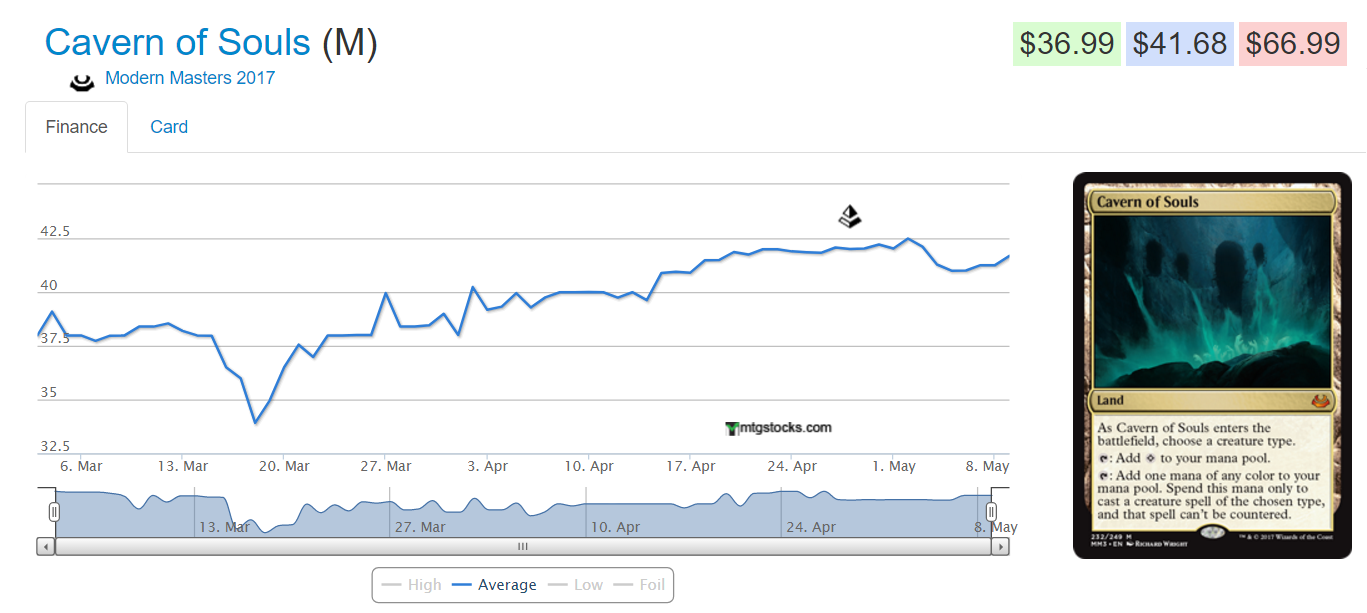
Cavern of Souls

(Click to expand.)

Cavern of Souls is a highly anticipated reprint that was originally a rare but upgraded to mythic in this set. Avacyn Restored copies of the card peaked at about $62 before the reprint. The Modern Masters 2017 pre-order price started conservatively around $35 and saw a brief dip on release weekend as all cards did. Right now it's trending up and I don't expect that to change for the short term.

I predict the future of this card to look a lot like Mox Opal from Modern Masters 2015. It will stay around $40 for the rest of the year before the year-end sell off. In early January, when people are ready to get back into Magic and looking to spend their holiday cash, it's likely to go up. The card is pretty important as a mana-fixer and provides a lot of utility against counter spells—that may be obvious, but unlike other dual lands its effect is not easily replaceable. If we get significant tribal support in Modern the rest of the year, we could see it pick up in price quicker and threaten to regain its former $60 price tag. The price tag next year will look pretty cheap for this card as its demand is unlikely to be satisfied by the supply brought by MM3.

Short-Term Price (next 3 months): $45
Mid-Term Price (next 6 months): $35
Long-Term Price (next 12 months): $60

Snapcaster Mage

(Click to expand.)

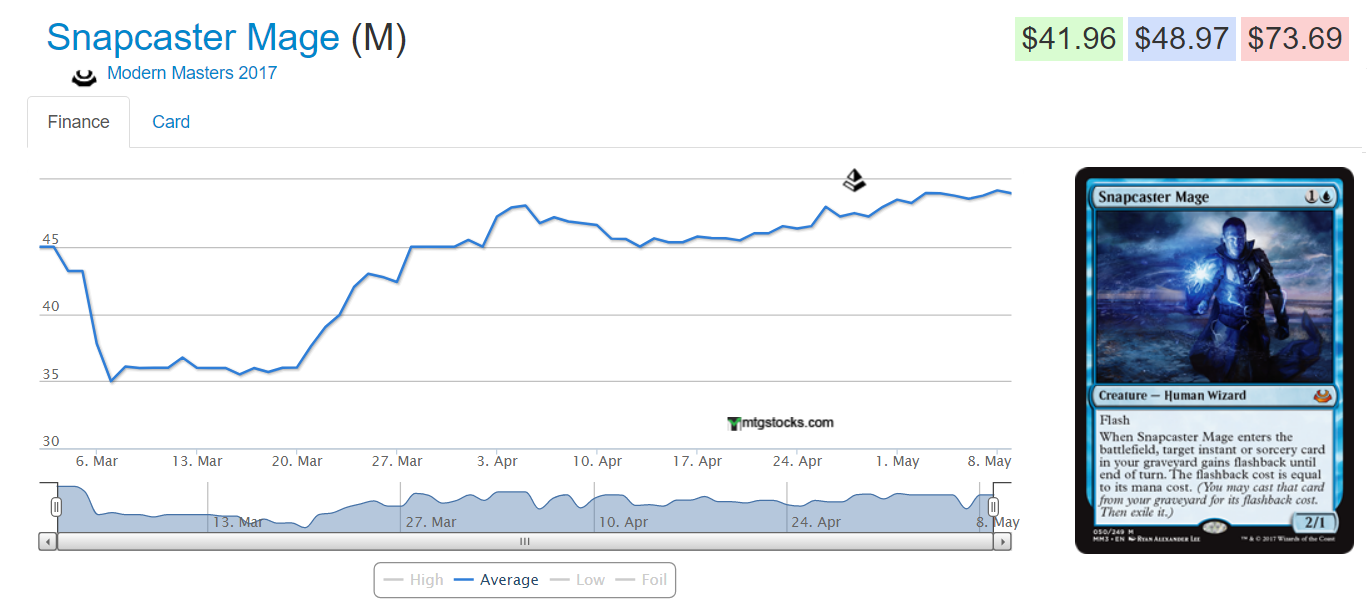
Snapcaster Mage is a quintessential blue-mage card in Modern and was one of the first cards people pegged as being an easy inclusion in Modern Masters 2017. What most people didn't expect was that it would appear at mythic. Obviously it would have been a ton cheaper if that wasn't the case, but the number of people who put off buying Snapcaster Mage really hurt its price pre-reprint. The Innistrad version peaked at $80 during the weeks following Modern Masters 2015 and had lost about half of its value by the time it was reprinted in Modern Masters 2017. All of that demand isn't being satisfied by Snapcaster Mage at mythic. It's clear from the recent RPTQ promo printing and subsequent MM17 reprinting that players think we're done getting more Snapcaster Mage for the near future.

The pre-order price went from $45 down to $35 on release weekend as people tried to break even. Now that people are drafting Amonkhet and not really busting boxes of MM3, the price is actually higher before the reprint (and higher than its pre-order price). According to MTGGoldfish's play data, Snapcaster Mage is in 11% of Modern decks with an average of three copies per deck. One of the few creatures played more than that is Noble Hierarch which is a whopping $70 now, despite being reprinted as a rare in MM2. I would not be surprised to see $100 Snapcaster Mage sometime next year.

The slight light at the end of this tunnel may be Iconic Masters. Now I'm not going to say to put all of your eggs in this basket, but as far as blue cards that are iconic and reprintable go, Snapcaster Mage is high on that list. I'd say there is a small chance that all of the Invitational cards get reprinted (maybe with their original art?). If you're unfamiliar with them you can find them here, but the most Modern-relevant ones are Ranger of Eos, Dark Confidant, and Snapcaster Mage.

Short-Term Price (next 3 months): $50
Mid-Term Price (next 6 months): $55
Long-Term Price (next 12 months): $75+

Liliana of the Veil

(Click to expand.)

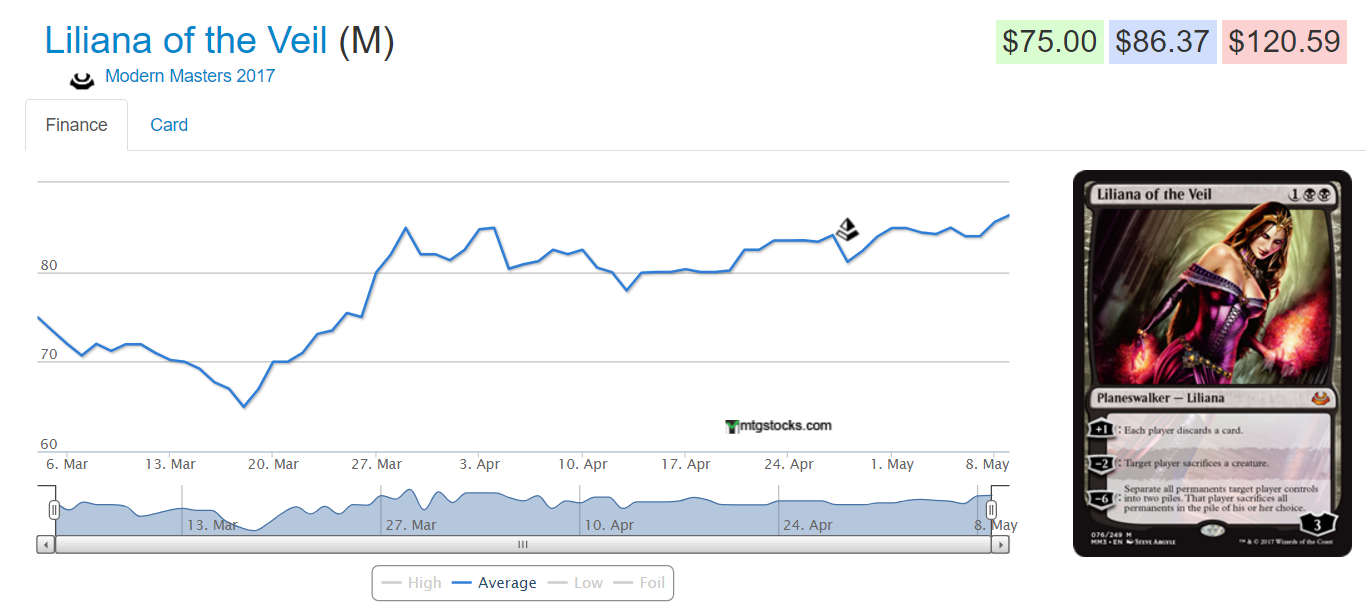
Liliana is an odd case. A lot of players (despite being misguided) thought that returning to Innistrad meant we were going to get a standard-legal reprint of Liliana of the Veil. Obviously that did not come to fruition (although the Liliana we did get was pretty great)—that caused a big spike as people had been putting off buying her for a while. Since her reprint her price movement has been a little rocky, but I'll try to explain what's going on.

Liliana is a key part of a very expensive set of decks. The Liliana/Dark Confidant/Tarmogoyf line-up has been rock solid for years—because of this, Lilianas themselves are not terribly valuable to the average player. Release weekend has its usual price crashes as people rush to sell. Now it has crept back up as players who were waiting for the reprint start to buy in.

The future of the card likely relies on how the most recent ban announcement affects the other formats she is legal in. At this point it stands to reason that her popularity in Legacy could be greatly affected by the banning of Sensei's Divining Top. I am not knowledgeable enough about Legacy to make a prediction as to how players will respond, but I think it is important to consider the worst-case scenario for players that need her. If the decks that play Liliana start to make up a larger share of the playing field in Legacy, we may see her increase in value. If the cards she is naturally good against (like True-Name Nemesis) increase in popularity, she may also increase in price.

That being said, she is also what I would consider an iconic planeswalker. I think if they are to include any planeswalkers in Iconic Masters, Liliana of the Veil is on the shortlist with Nicol Bolas, Planeswalker, Jace, the Mind Sculptor, and Karn Liberated. Honestly, it's hard to tell what's going to happen in her future until we get spoilers for Iconic Masters.

Short-Term Price (next 3 months): $85
Mid-Term Price (next 6 months - no reprint): $80
Long-Term Price (next 12 months - no reprint): $100

Linvala, Keeper of Silence

(Click to expand.)

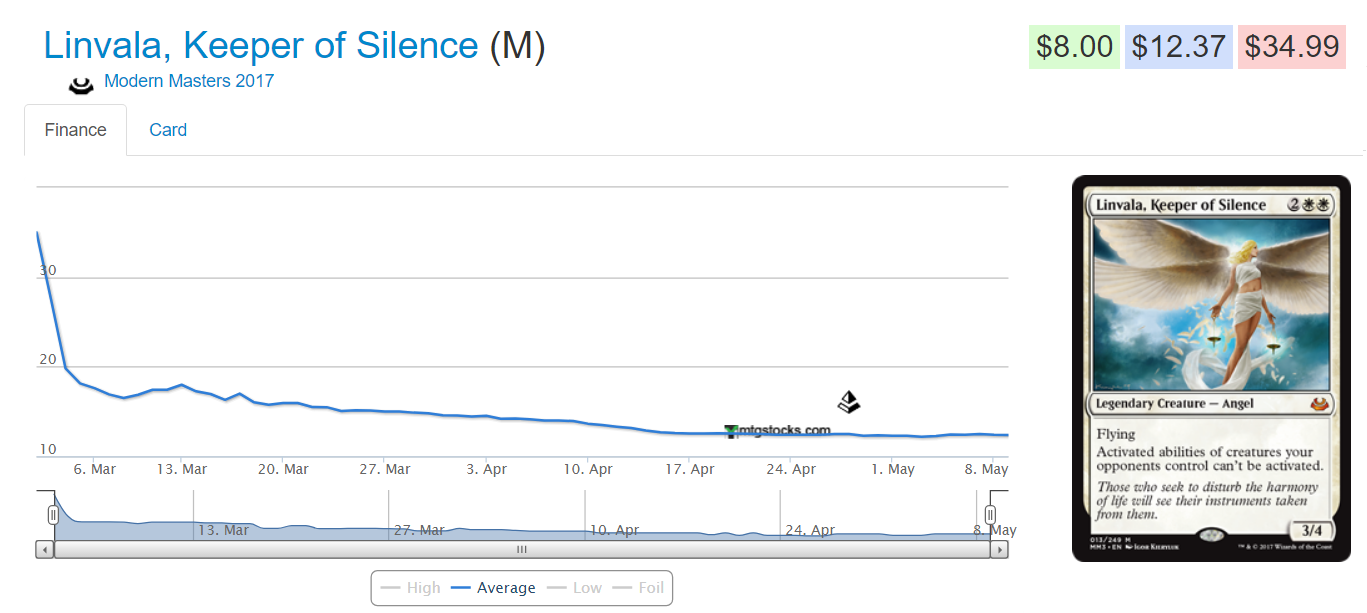
Hey, you didn't think it would be all bad news in this article, right? Linvala, Keeper of Silence is largely a success story due to the fact that its price was entirely hinged on rarity and not the play it sees. Linvala is a rare and very powerful Angel for casual decks as well as competitive decks. Due to the fact that most decks that play her only play one (as a Chord of Calling target), I don't expect any rebound anytime soon.

A close analogue you can use is Elesh Norn, Grand Cenobite. While the white Praetor has more in common with Craterhoof Behemoth, both it and Linvala are singleton competitive cards with some casual backing. I wouldn't be surprised to see Linvala back around $12 in a year.

Short-Term Price (next 3 months): $8
Mid-Term Price (next 6 months): $6
Long-Term Price (next 12 months): $12

Tarmogoyf

(Click to expand.)

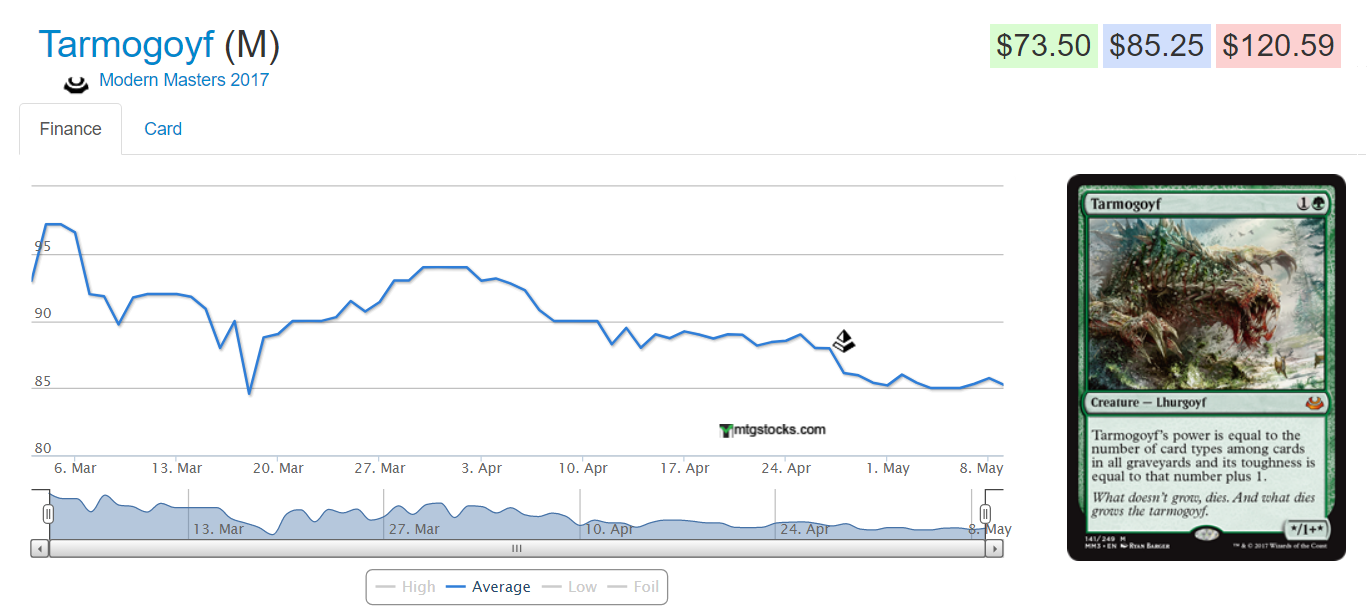
Tarmogoyf had an unusual price history so far. It actually went up in pre-order pricing briefly due to a Crystal Commerce error that caused stores to be de-listed from TCGPlayer (which is where MTGStocks data is gathered from). So its spike is actually a result of some very odd technical glitches and not actual demand.

Since then it has been steadily trending downward, despite being the 2nd most popular creature in Modern after Noble Hierarch. I want to take a minute to point out the success of Modern Masters sets bringing the cost of Tarmogoyf from its peak at $209 down to $85 over the course of two years. This gradual decrease finds a happy medium between satisfying new players and pre-existing owners. That being said, this is the third time we've seen Tarmogoyf get reprinted, so I'm not sure that it will be able to climb back over $100 even in a year. Most people that want them have them at this point. You can also make the argument that it's a very iconic card—keep Iconic Masters in mind if you're not in a rush.

Short-Term Price (next 3 months): $85
Mid-Term Price (next 6 months): $75
Long-Term Price (next 12 months): $85

Voice of Resurgence

(Click to expand.)

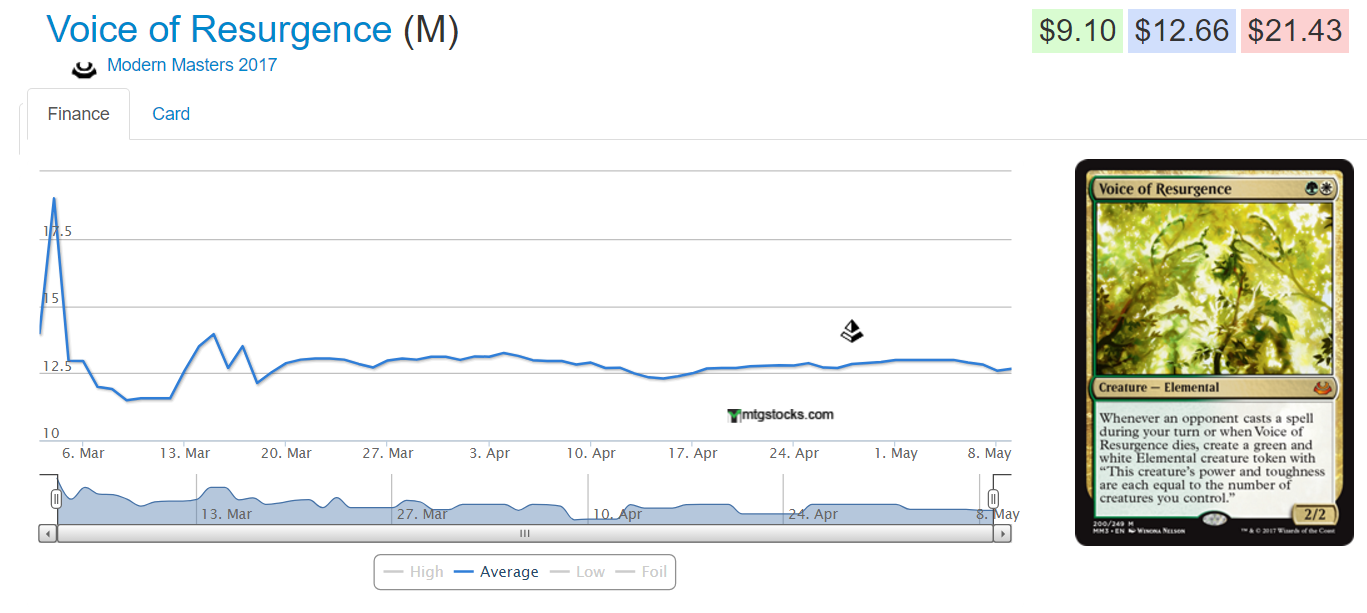
The last card on my list is Voice of Resurgence. It's the lone card worth mentioning in Dragon's Maze now that Beck // Call and Breaking // Entering don't work anymore. This is a staple of decks that are just not very popular. It's not a popular casual card and I'm hard pressed to find any reason it would really increase in price. This will probably bottom out at $8-10 and then slowly creep up year over year as supply dries up. This will be the quintessential card in 2019 whose price people will be surprised by.

Short-Term Price (next 3 months): $9
Mid-Term Price (next 6 months): $8
Long-Term Price (next 12 months): $12

The Rest

The remaining mythics are trivially expensive (Past in Flames) or not applicable in most Modern decks (Craterhoof Behemoth), and thus don't need to be covered in great detail. They will likely continue to fall in price throughout the year until December, and then make the slow creep back up to their original price over a number of years. If these are cards you're looking to acquire, I wouldn't put a terrible amount of thinking into the timing.

I hope you enjoyed this new take on a set review. Whether you enjoyed it or not, I'd appreciate some feedback in the comments below. I plan to do another article to cover the important rares in the set. I would like to know what you found useful, or any questions that I didn't answer so I can include them next time. Thanks for joining me!

Insider: Fighting Complacency in Magic Finance

Are you a Quiet Speculation member?

If not, now is a perfect time to join up! Our powerful tools, breaking-news analysis, and exclusive Discord channel will make sure you stay up to date and ahead of the curve.

Welcome back, readers! Today's article is on a subject that extends far beyond just Magic speculation, but is certainly something that we need to watch out for. In the interest of making sure everyone is one the same page, we'll start the article with the cliche definition of a key word.

Complacency: a feeling of quiet pleasure or security, often while unaware of some potential danger, defect, or the like.

complacency

I found several definitions for complacency, but the one above sets the tone for this article best. The reason I'm writing this article is because I believe many of us (myself included) have become complacent when it comes to certain areas of Magic finance.

The day before Smuggler's Copter was banned, its buy price was $7.75. And why wouldn't it be? Wizards hadn't banned anything in Standard since Jace, the Mind Sculptor and Stoneforge Mystic more than five years ago, and both of those were already near rotation when they got banned. People got complacent. Many of us neglected the danger of a banning because it hadn't happened in a while. I imagine the people of Pompeii thought the same thing regarding their volcano.

There was an error retrieving a chart for Smuggler's Copter

There is a lot more risk with Magic finance then many of us would like to admit. The cards we invest in are made of cardboard, the ability to counterfeit them is getting better and better, and their true value stems only from people's desires to collect and play with them. They don't represent ownership in anything (like a stock) nor do they have guaranteed rates of return (like a bond). Worse yet, the entire supply is controlled by one entity, Wizards of the Coast, so decisions they make can drastically affect the value of the cards. That is a whole lot of risk.

Many people (including myself) often advocate for focusing on Reserved List cards as supposedly stable investments that mitigate risk. But even that position still shows complacency. Wizards isn't legally bound to the Reserved List. Sure, if they abolished it and began reprinting cards currently on it they could very well face a lawsuit, but it's unknown how that would transpire in court. They could also conclude that the profits generated from sales would overcome any litigation losses and move forward with it anyways.

I realize that's a whole lot of "doom and gloom" right there. But before you run to your local game store to dump your whole collection, remember that every type of investment carries risk.

Do you think all the people who were seeing their investment portfolios "rise" under Bernie Madoff expected to see him escorted out of his home in handcuffs? Or the people who bought a second home back in 2003 because real estate was such a "sure thing" anticipated the 2008 housing crash? All investment carries risk, but the biggest dangers come when we forget or ignore that fact.

10madoff.480

Fighting Complacency

How do we shake off that complacency that has set in? I have two suggestions for practical steps to take in your Magic speculating activity towards this end.

Inventory Your Speculations

Do you know everything you're speculated on that's currently in your possession? How many have bought cards they thought were good speculation targets and then just thrown them into a box/binder and forgotten about them? I'll raise my hand on that last one.

When I first started out speculating, I was big into buying cards at retail prices if I thought they would go up. I bought about 20 Abrupt Decay when it was $5 or less. I got home with my newly purchased copies and stuck them into my personal collection binder, thinking I'd pull them out when they jumped to $10.

Then I forgot about those particular ones because I'd switched to a speculation box that I kept an Excel spreadsheet on. Between June and October of 2015 Abrupt Decay was worth more than $15. I sold zero copies in that time frame. Then it started to drop. By August of 2016 it was down to $10. Want to guess how many copies I sold then? Zero. Now it's been reprinted in Modern Masters 2017 and the original Return to Ravnica printing is right back down around $5.

There was an error retrieving a chart for Abrupt Decay

So I invested $100 back in late 2012/early 2013, and four years later my gains are 0% (if I sold right now). I became complacent and ignored the risk of reprinting or changes in the metagame.

But I've learned my lesson from that. I now put all speculation targets into one "speculation box" and keep a running Excel spreadsheet of what I have in it. When I remove cards (whether to sell or trade), I make a note in the Excel sheet with the price I traded/sold them at. Hopefully many of you Insiders have already been doing that—if not, I suggest you take the time to inventory your investments properly before purchasing any more.

The other major lesson I learned from the Abrupt Decay debacle was to remind myself that all cards carry a risk of reprint (granted, Reserved List cards are much lower, but again, don't think it's 0%). That means selling with a good profit now ("locking in your profits") is better than maybe selling for a greater profit later.

Tracking Gains/Losses

Along with tracking your speculation targets, it's a good idea to track your gains and losses as well. It might seem time-consuming (and it can be initially), but you're putting your money into these cards, and you want to get more out than you put in. If you don't track it, how will you know if you've been successful? Even as I write this, I realize I could be doing a better job myself.

The other key advantage of this tracking is it could lead you toward or away from future speculation targets. Say you can look back and see that you've made a good bit of money on big Standard-legal dragons like Thundermaw Hellkite and Stormbreath Dragon. Based on that, you might have looked at Glorybringer's pre-order price and thought that $2 seems way too low for a card that powerful.

That example might seem obvious and making this connection might not require a detailed spreadsheet. But you might also find macro-level trends. Maybe you've had terrible luck speculating on control cards in general, and decide your intuition on those cards is less than reliable. Sure, you might feel bad if a card you thought would do well ends up doing spiking, but given the track record it's far more likely you'd have picked duds.

There's a reason that Google and Facebook are worth so much money and yet free to use. Data is valuable. More data is more valuable. So gathering as much data about your own investments seems like a no-brainer.

On the practical level, Trader Tools can be a helpful tool in this regard. Data collection can be time-consuming, so we want to automate as much as possible. It would be wise to first put your speculation targets into a Trader Tools list (which will update prices in real time). Once you have your specs entered you can export the list periodically and reformat it however you like in a spreadsheet application.

Then you have daily/weekly/monthly price tracking on your specs (depending how often you want to export). The beauty of using Trader Tools specifically is that it also includes buylist prices, so you could track both retail and buylist prices for the list and make decisions based on this.

Conclusion

Complacency is a danger to us all in many aspects of our life. However, one of the most dangerous subjects to become complacent on is our finances (and in this case our investments). The point of this article was not to scare people away from MTG finance, but to remind them of the dangers inherent in it and to suggest tools to help eliminate complacency when it comes to speculation.

Insider: MTGO Market Report for May 10th, 2017

Are you a Quiet Speculation member?

If not, now is a perfect time to join up! Our powerful tools, breaking-news analysis, and exclusive Discord channel will make sure you stay up to date and ahead of the curve.

Welcome to the MTGO Market Report as compiled by Matthew Lewis. The report will cover a range of topics, including a summary of set prices and price changes for redeemable sets, a look at the major trends in various Constructed formats and a "Trade of the Week" section that highlights a particular speculative strategy with an example and accompanying explanation.

As always, speculators should take into account their own budgets, risk tolerance and current portfolios before buying or selling any digital objects. Please send questions via private message or post below in the article comments.

Redemption

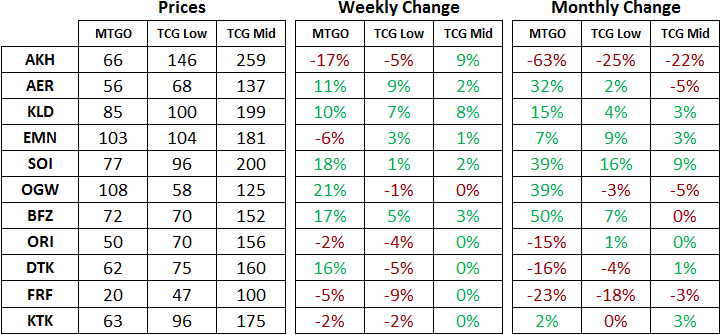
Below are the total set prices for all redeemable sets on MTGO. All prices are current as of May 10, 2017. The TCGplayer low and TCGplayer mid prices are the sum of each set's individual card prices on TCGplayer, either the low price or the mid price respectively.

All MTGO set prices this week are taken from GoatBot's website, and all weekly changes are now calculated relative to GoatBot's "full set" prices from the previous week. All monthly changes are also relative to the previous month's prices, taken from GoatBot's website at that time. Occasionally, full set prices are not available, and so estimated set prices are used instead.

may10

Standard

All eyes are on Standard in the lead up to Pro Tour Amonkhet (AKH) in Nashville this weekend. In the past, set releases on MTGO were close enough to the Pro Tour weekend that I had experimented with buying cards from the latest set. The strategy was to try and pick Standard-playable cards that would get highlighted by coverage. Once that happened, a demand-driven price spike would occur, and with the new set being supply-constrained, the price spike could be dramatic.

I had mixed results with this strategy when I employed it for Kaladesh (KLD) and then for Aether Revolt (AER). It could definitely use some refinement, but for this set I have decided to avoid speculating on cards from AKH. The reason is that WoTC has been able to advance the online release of AKH to the Monday after the paper prerelease.

This is a substantial change as the extra days of being able to draft this set will mean AKH is less supply-constrained for the Pro Tour weekend than any other set ever released on MTGO. With this as a big unknown factor, I think it's best for speculators to sit this one out and to see how prices respond to coverage over the weekend.

Elsewhere, there has been lots of movement in cards from the older sets in Standard. Ulamog, the Ceaseless Hunger has seen an incredible run from 6 tix to over 24 tix in the past few weeks. This spectacular price ascent appears to have crested, so if you are holding these and not using them at the moment, take advantage of this price spike and sell now.

There was an error retrieving a chart for Ulamog, the Ceaseless Hunger

Zombie tribal decks have started popping up on a regular basis and the components of this deck are seeing the benefits. Cards like Dark Salvation and Diregraf Colossus were routinely priced below 0.1 tix a month ago and are now attempting to breach 1 tix. I expect these two rares will peak somewhere closer to 2 tix eventually. It's been a while since a tribal deck has seen success in Standard and so I think this deck will see widespread adoption with middling success over the summer.

There was an error retrieving a chart for Dark Salvation

Modern

Modern prices have largely recovered from their set release dip, although if you are going to be speculating in this space, you have to be a little choosy. On the downside, keep in mind that there will be a week of flashback drafts at the end of the month. From May 24 to May 31, triple Mirrodin will be available to draft for 12 tix. If you've been eyeing Chalice of the Void, it will be a fresh bump in supply that will knock a few tix off its price.

Other Modern-playable cards to keep in mind are Oblivion Stone and Glimmervoid. And although they are not Modern-legal, the artifact lands are legal in Pauper Constructed. Players who have been thinking about building Affinity in Pauper should definitely be targeting the artifact lands while they are being opened.

There was an error retrieving a chart for Seat of the Synod

Standard Boosters

AER and KLD boosters have recovered from their price lows observed after the release of AKH. KLD block drafts are regularly firing and the price of a draft set has increased from below 7 tix to over 8 tix in the past two weeks. There's still room for these to move higher and I anticipate prices will be over 9 tix for a draft set in the next two months.

Trade of the Week

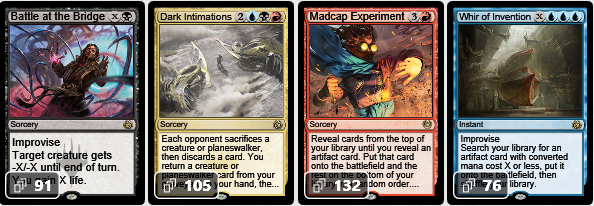
For a complete look at my recent purchases, please check out the portfolio. This week I took a deep dive on a number of penny rares. When you are speculating at the junk end of the spectrum, it's important to line your advantages in order to increase your chances of hitting a home run. Check them out in the image below and the explanation about each will follow.

pennyspec

First off, each of these is from KLD block, which means the heavy influx of supply from drafters is now over. It's a great time to be targeting cards from these two sets that are seeing next to zero play in competitive formats.

To start things off, Dark Intimations is nearly certain to see higher prices once the next iteration of Bolas is previewed from Hour of Devastation. There is no absolute certainty that this will happen, but there's no secret that Bolas is a key player on Amonkhet, and so it would only make sense for him to make an appearance at some point. I think this card is a role player at best, but if Bolas is a great card and this fits into a deck, then it will see higher prices.

Next, Battle at the Bridge and Whir of Invention are two cards from AER with the improvise mechanic. The sorcery is priced at junk or around 0.01 tix, while the instant has been priced at 0.2 tix or so (although it's crept up in the last week). While Battle at the Bridge is most likely a Standard-only card, Whir of Invention has Modern-playable written all over it.

There was an error retrieving a chart for Whir of Invention

Both will benefit if a deck focused around improvise makes a dent in Standard. While I am doubtful this will happen anytime soon, it's not too soon to think about Fall rotation, especially for speculative targets this cheap.

As long as artifacts continue to be printed, the space where Whir of Invention could be broken gets bigger. Sooner or later, this card could easily cause a problem in Modern.

Madcap Experiment is seeing play in Modern alongside Platinum Emperion. This is the kind of card that will take a long time to see prices higher than 1 tix. It's been opened heavily from a Fall set, it's just a rare, and it's not a format staple by any stretch. It's very likely this will take more than two years to see any substantial price increase, a long-term hold to be certain.

All Is Glass: Modern’s Fragility

Are you a Quiet Speculation member?

If not, now is a perfect time to join up! Our powerful tools, breaking-news analysis, and exclusive Discord channel will make sure you stay up to date and ahead of the curve.

The line between genius and madness is indistinct. The line between epiphany and world-class tilting-off is blurry. I'm in something of a fugue, and uncertain of where I stand anymore. While I am personally certain of the veracity of my forthcoming statement describing the Modern metagame, my ability to perceive normal reality is compromised. I'll have to let you be the judge of my conclusion's validity. Though my overly complicated yet erudite vocabulary appears unaffected—nay—enhanced. Exceptional.

Allow me to explain how it came to this. I am grinding Modern Grand Prix Trials, trying either to find the last 150 planeswalker points I need or to win byes outright for Grand Prix Las Vegas. The demise of SCG IQ's in the western states and my early PPTQ win means that I will be short two GP byes for the first time in years. Curse you, good fortune! And the end of Star City's secondary market monopoly! Thus, I have sought out as many opportunities as are logistically practicable to correct this problem. And failed.

Getting to the Top 8 is not a problem. Closing the deal has been another matter. All this frustration has not been for naught, however. I have noticed a trend in the decks that I am losing to, one that may apply to the metagame overall. Robustness has fallen by the wayside. I have seen the traditional deckbuilding constraints of this format disregarded and pilots rewarded for their blatant disrespect for established wisdom. It has gotten to the point that I am a fraction of a degree of tilt away from maindecking a playset of Surgical Extraction in UW Control. Surgical Extraction!

What Does It Mean to be Robust?

I'm certain that the topic of robustness in Magic has been covered before. It may even have been by me. I'm not going to look (if it was, indulge me with a link). Not everyone, to their shame, has read my entire back catalogue of exquisitely insightful articles. If you haven't, then pay attention—this section is crucial to understanding my delirious epiphany. They who write the dictionary define robust as strongly formed or constructed, among other things that don't apply to inanimate objects. In Magic, robust describes decks that are not easily disrupted. A robust deck has many cards that do similar things, so that if one is removed, another easily takes its place. On the other hand, fragile decks depend on certain specialized cards that are irreplaceable. If those are lost, the deck falls apart.

Consider Merfolk and Ad Nauseam. The former is built to take advantage of tribal synergy while the later exploits the interaction between Angel's Grace and Ad Nauseam to claim victory. Merfolk is a very robust deck because, while many of its cards are specialized, they are still creatures that can attack for damage. In an attrition fight, each card is effectively a copy of every other card. The removal of one card from the deck does not greatly impair Merfolk. I have been Surgically Extracted several times playing the deck and won for this very reason.

Compare this to Ad Naus. Failure to resolve the namesake card is a failure to win. Such is the nature of linear combo: live by the exploit, die by the failure to execute the exploit. Slaughter Games on Ad Nauseam utterly cripples the deck, virtually winning the game by itself. Therefore, Merfolk is a robust deck, while Ad Naus is fragile. With these definitions out of the way, let me get to the point.

Modern's Defining Characteristic

Traditionally, Modern was known for robust deck construction. Lacking the card selection of Legacy, players had no choice. In Legacy, players can Ponder and Brainstorm to find the cards they need. Serum Visions is a poor replacement. Jund's targeted discard and Liliana of the Veil make it even worse. When you expect to have your hand shredded before you can meaningfully play, lost cards must be easily replaceable.

Like Jund, Infect also reinforced the importance of robust deckbuilding in Modern. If players did not meaningfully interact with Infect before turn three, they would certainly lose. Oftentimes, it took multiple interactions to not die. Therefore, Modern decks could not rely on a single playset of cards, and necessarily diversified their answers. (Or killed faster, but those decks are irrelevant to this discussion.) The point is that for most of the format's history, Modern decks were case studies in robust construction. But no more.

Consider our data on the March metagame. Now look to MTGGoldfish and MTGTop8. I see Death's Shadow Jund, Dredge, Storm, and Ad Nauseam. Eldrazi Tron is dethroning traditional Tron. Burn, Abzan, and Bant Eldrazi remain, but they are declining relative to the top decks. I also see the walls of reality crumbling and breaking as I delve further than Man was ever meant to, but that's likely unrelated. Overall, decks that I consider fragile are eating at the metagame stock of robust decks.

To be clear, I do consider Eldrazi Tron the more fragile deck. True, it has even more unfair land redundancy, and can theoretically accelerate through disruption, but its gameplan is comparatively unfocused. The preponderance of cantrips ensures that Gx Tron actually sees threats beyond the initial hand and that the lands will flow. Eldrazi Tron is always at the mercy of the top of its deck. Similarly, every threat from Gx is potentially backbreaking; the same cannot be said of Matter Reshaper or even of Thought-Knot Seer. Blood Moon is also more effective against Eldrazi Tron, which require colorless mana to function, than against Tron.

Regardless, more and more fragile decks are doing well in Modern now than they have in the past. After observing the phenomenon for weeks, I have an idea why.

The Shadow's Deviation

The demise of Infect is undoubtedly a significant factor. It is no longer so punishing to miss on certain effects in your opening hand. Decks can then allow themselves to be less robust in exchange for card flexibility and explosive power. You don't need as much early creature removal, so you can afford to focus more on advancing your own gameplan. This is the advantage of a more fragile deck—in place of redundancy, you can live in Christmasland. There is now less punishment for being fragile. Decks that were weak to Infect, or simply worse at being linear than Infect, like Storm, are returning to prominence. (Additional printings are also a factor in Storm's resurrection.)

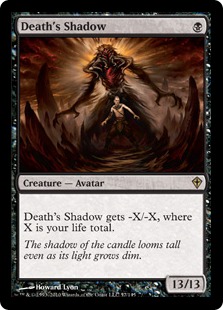
Normally, one would expect Jund to police these fragile decks and reward the robust ones, but this doesn't appear to be happening. The traditional "fun police" deck has nearly vanished. Its cousin Abzan remains, but not to the same degree as traditional Jund. Instead, Jund has been replaced, subsumed even, by Death's Shadow. The unusual creature has proven to be remarkably powerful. Enough to bend decks around its constraints. As a result, we are seeing decks reveling in nihilistic disregard for their lifetotal and playing functionally fewer than 60 cards. Burn has risen again to contain the new menace, but Shadow still sits atop the format. And grappling with why is pushing my sanity to the brink. The deck should not work as well as it clearly does!

Death's Shadow wields many of Jund's tools. In fact, it plays more of those key disruptive cards than Jund did. In many ways, it is grindier than midrange Jund. I would argue that DSJ is simply Jund pushed to the extreme. However, by radicalizing itself, it has deeply changed. It wears the skin of Jund, it shares its mannerisms and values of Jund, but something is off. Despite appearances, DSJ is not a robust deck. It is one of the most fragile decks in the format. And Modern is following its lead.

Examining the Deviant

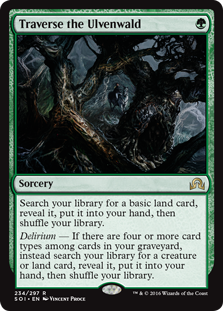
I hear the wails about how all the various Death's Shadow decks pack numerous ways to recur and tutor up their threats. But that's consistency, not robustness. DSJ has to run those cards. Death's Shadow is their gameplan and must be found and defended. Tarmogoyf, and occasionally Liliana, the Last Hope, are backups to that plan. These decks are playing Mishra's Bauble and Street Wraith not because they are powerful, but because of how they enable Death's Shadow. They play the maximum amount of discard to ensure Death's Shadow will survive to attack. They play Traverse the Ulvenwald to find Shadows and Kolaghan's Command to recur Shadows. It's all about the Shadow.

A cheap fatty is very good. The shell around that fatty has proven itself. The problem is that without that fatty, the whole thing crumbles. Most of the deck just doesn't do anything. After a certain point, even the cantrips aren't good. Jund was always a force to be reckoned with because you could guarantee that every card in the deck was a live and potent draw. That isn't quite true about DSJ. Without its namesake card, the deck is really unimpressive. This leads me to believe that the deck is far more fragile than players give it credit for. I think of midrange Jund like a square of bricks. Not impressive by itself, but solidly built no matter how you look at it. DSJ is more like a steel beam. It can survive massive compressive forces, but it fears sheering forces and sideways hits.

This is not a unique feature of the constellation of Death's Shadow decks. Combo decks and many others are trading resilience for power, growing more fragile than before. Abzan CoCo decks are becoming increasingly combo-centric and abandoning any pretense of the fair plan. Doing so gives them more free wins, but also increases the risk of clunky draws that require Collected Company or Chord of Calling to fix. Eldrazi Tron is replacing Gx Tron, enjoying more power at the expense of consistency. I could go on. Whether directly because the rock-solid decks have themselves gone for more power and fragility, or because decks are simply free to push themselves without the threat of Infect, I find the trend to be clear. Robustness is now less important than power.

Implications

This brings me to my impulse to start maindecking Surgical Extraction. It is looking increasingly as though Extraction cards are actually as potent as we all thought when we first learned about them. Ever since Cranial Extraction was unveiled, players have dreamed dark fantasies about neutering their opponent's deck for nothing. Those dreams died when they discovered how easy it actually was for most decks to survive such attacks. Assuming you even got the opportunity to do so against aggressive decks. Even Surgical being free didn't solve this problem. Against non-combo decks, Extraction effects just aren't effective.

With the increasing specialization and fragility of deck design in Modern, this dream is being revived. It is becoming increasingly plausible that Extracting something will actually cripple decks as intended. If you Surgical Death's Shadow, the deck loses half of its win conditions (excluding Street Wraith). Not only that, but unlike most decks of the past, it makes the deck noticeably worse. So much of any Death's Shadow deck is built specifically around that card that losing the threat is actually debilitating, a first for fair decks. This is weird, and assuming it is not just me manically searching for meaning where there is none for my constant disappointment, it suggests a new angle of attack against the metagame.

Control Boost?

For these reasons, I am  considering playing Surgical as an actual plan in control decks. I have had little trouble overcoming the initial wave from my non-control opponents, but over time, I just start falling behind as recursion and value begin to pile up. That doesn't even count the times that actual graveyard shenanigans broke my defenses. Between crippling my opponent's deck and traditional graveyard hate, my frustration and tilt are pushing me toward that unthinkable void.

And yet, I do not commit. Whether it be from fear of crossing that yawning chasm or some lingering rationality holding me back, I know not. So I ask you, the readers, to judge my question: Is this finally the time of the Extractors? I may be mad, but Grafdigger's Cage has been on the edge of maindeckability for some time now. And indeed, with creature tutoring and graveyard recursion on the rise, perhaps its time, too, has come.

Insider: Statistical Analysis of Commander Decks

Are you a Quiet Speculation member?

If not, now is a perfect time to join up! Our powerful tools, breaking-news analysis, and exclusive Discord channel will make sure you stay up to date and ahead of the curve.

Every weekend I visit the local Meijer to shop for groceries. For those unfamiliar, Meijer is akin to a Super Walmart in that they have groceries alongside an array of other goods such as clothes, electronics, and toys. Sometimes when I’m shopping there I make a point to venture down the aisle that contains the CCGs. I don’t check every time, primarily because they charge roughly 5 to 10 percent above MSRP relative to stores like Walmart and Target. But once in a while you can find something special.

A couple months ago, I came upon a Commander 2016: Breed Lethality deck. This is the famously expensive one, featuring the hottest general in the format, Atraxa, Praetors' Voice.

There was an error retrieving a chart for Atraxa, Praetors' Voice

At the time, these were selling for in the $70s, so the purchase at MSRP could be flipped on eBay for a modest profit with virtually no risk.

One week later, I was at that same Meijer and they had another Breed Lethality deck in stock! I proceeded to flip that one as well. I was loving the free money, and I made a mental note that I needed to walk down this aisle every single time I was in the store.

All Good Things…

After hits two weeks in a row, I must have exhausted my big-box-store karma. Every week since for the past six or so, there have been the same exact three Commander decks on Meijer’s shelf. It came to the point that I had them committed to memory because I saw them so many times. The three decks are listed below along with their TCGplayer market price:

  • Commander 2016: Open Hostility ($29.04)
  • Commander 2015: Seize Control ($29.26)
  • Commander 2015: Plunder the Graves ($41.42)

This past weekend I had a few spare minutes, so I decided to look these up online to see what they sold for while I was standing in the aisle. As it turns out, Plunder the Graves sold for above Meijer’s price. While this was no Breed Lethality situation where I could flip the deck for profit immediately, I was intrigued by a favorable price ($38.99…sadly, $4 more than MSRP).

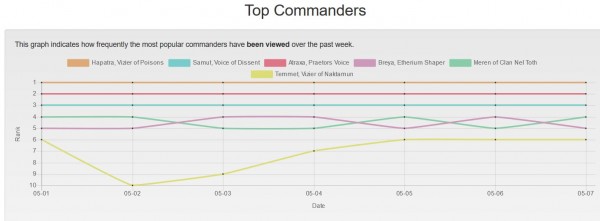
It was at this point that the lightbulb turned on. I double checked EDH REC’s list of most popular commanders when I saw a familiar face: Meren of Clan Nel Toth.

There was an error retrieving a chart for Meren of Clan Nel Toth

The card itself won’t break the bank, but Meren has been the fourth or fifth most popular commanders on EDH REC consistently now for quite some time.

EDH REC

In fact, when I view the most popular commanders of all time on EDH REC, I see that Meren is number three, behind only Atraxa and Breya. I hadn’t realized this was such a popular general! The deciding factor for me became the low stock on TCGplayer. Across the 14 sellers, there are only 23 Plunder the Graves decks for sale. The low inventory, high popularity and favorable price were enough to push me over the edge: I threw the deck in my cart and was on my way.

Valuable Insights

This shopping experience got me thinking…are there other decks from the Commander series that I should be keeping an eye out for? Are there possibly any opportunities online to pick up a popular deck with low stock as an investment? How could I determine the decks that may have upside, such as the one containing Meren? I had to investigate this further. Perhaps by breaking down the numbers, I could uncover some sort of opportunity to profit.

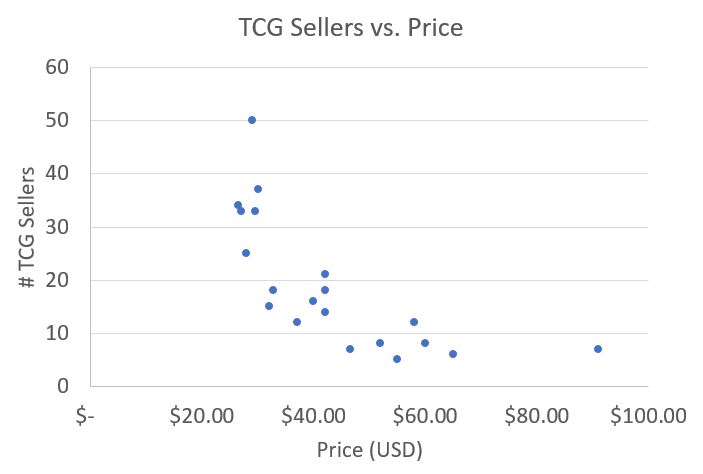
To start, I created a graph relating the number of TCGplayer sellers (should be roughly proportional to the amount in stock) against the TCG low price for each Commander deck dating back to 2013. (I left the first set of decks out due to their rarity from being the first ones printed). The result is a pretty compelling curve. I tried an exponential fit using Excel, but in reality the curve should be hyperbolic. There is an unofficial “minimum price” that sellers would be willing to sell a deck at, and there’s limitless price on the upside.

Sellers vs. Price

Now we’ve established the relationship between price and supply. None of this is news, but it’s still good to double check that looking at stock on TCG Player can indicate price/demand for a product.

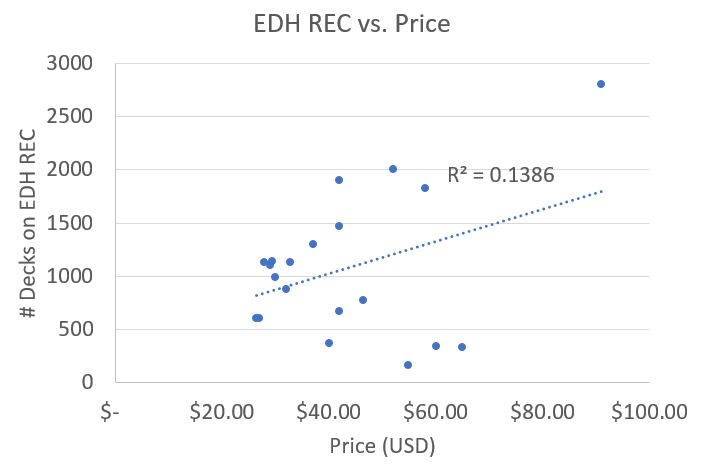
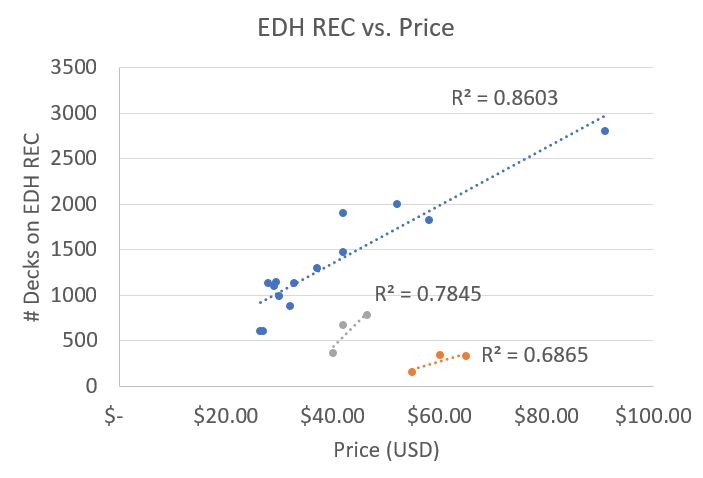
Next, I wanted to see if there was a relationship between the popularity of a general and the price of the preconstructed deck they came from. We already know Atraxa is the most popular general and comes from the most expensive Commander deck since 2013. Breya is also up there on both measures. So is there a trend?

EDH Rec vs. Price

Not exactly. The plot looks a bit scattered and the statistical relevance of this relationship is virtually absent. But hold on a second. While the set of data above doesn’t follow a singular trend, doesn’t it look like there are possibly three separate trends here?  Let’s try looking at this graph a little differently.

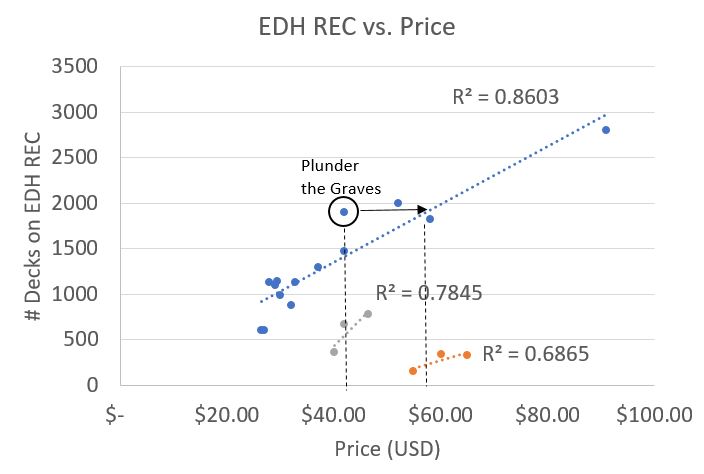
EDH Rec vs. Price 2

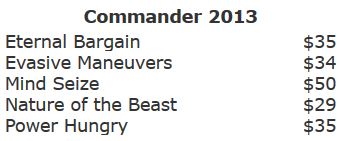
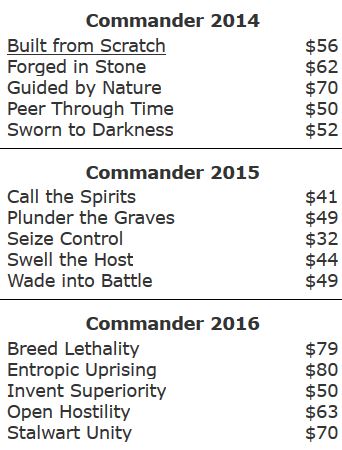
When we pull out the outliers as separate data sets, there suddenly becomes a very strong statistical correlation between commander popularity and price! Of the 20 decks studied, 14 follow a fairly linear trend (blue data points). What are the six outliers? All five of the mono-colored EDH decks from 2014 were outliers because they were more expensive than their popularity would indicate. But this makes sense because single-colored commanders aren’t that popular. The reason these are more expensive than the norm is due to the fact they contain so many EDH-playable cards. In fact, when I look at the EV of the decks’ contents, Commander 2014 decks are higher than Commander 2013 and Commander 2015 decks!

C13

C141516

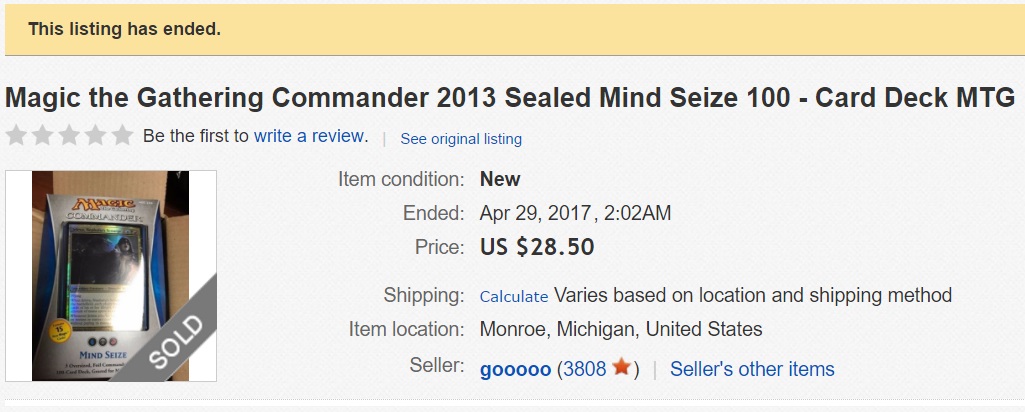
No wonder the Commander 2014 decks sell for more! The above data also reveals the sixth and final outlier: the Mind Seize deck from Commander 2013. Why is this one an outlier? One reason:

There was an error retrieving a chart for True-Name Nemesis

There’s a huge Legacy staple in the set! That’s why the deck is not so popular amongst Commander players while the deck itself is expensive!

Thus, we can conclude that popularity of a commander does have a direct impact on the cost of that commander’s preconstructed deck. Outliers do exist, and they are driven by utility of the individual singles within the deck. These standouts have a tendency to make a deck more expensive, not less. There were no outliers where a deck was cheaper.

What does it all mean? It means we can speculate on different Commander decks by purchasing those with low stock and high EDH REC popularity. This data strongly supports my purchase of the Meren deck: it’s an extremely popular general and stock is relatively low. To me, this screams long-term upside.

Wrapping It Up

I want to conclude this week’s article by looking at the graph above and flagging decks that are below trend: that is, the decks that are cheaper than what their popularity would indicate. Perhaps these offer the best upside for long-term speculation.

The number one outlier is indeed Plunder the Graves, Meren’s deck. If I shift the deck’s price to the right to make it line up with the linear trend, its price should be roughly $60 versus the $41 price tag it currently has.

Last plot

The next best opportunities are admittedly far less exciting. The Breya deck,Invent Superiority, will probably increase in price by a few bucks, but this doesn’t really present much chance for profit. A lower-cost option may be Swell the Host. The Ezuri deck is fairly popular on EDH REC and can still be purchased for under $30. Perhaps as the deck ages, it will gradually climb in price toward the mid-$30s.

Other than that, I think the only way these decks will move in price is if: a) the headlining general increases in popularity, b) their contents increase in value, or c) they become naturally more expensive due to passing of time. This starts to get into the Commander metagame, which is beyond my areas of expertise – there are others in the MTG finance community who would be far more adept at predicting such trends. For me, I’ll stick to the numbers.

And the numbers do indeed point out a couple compelling trends! The supply / price curve is fairly compelling, indicating a deck with low stock will trend towards higher prices. And we see that once outliers are removed, there’s also a strong relationship between commander popularity and deck price. With this trend established, we can start to parse out some opportunities. In this case, the Meren deck was coincidentally the most compelling. This is certainly the low hanging fruit of the bunch. But EDH REC can be used as a guide in helping determine the trend.

This trend can also be applied going forward. When a new set of Commander decks come out, we can look to EDH REC to help us pinpoint the ones to purchase most aggressively. We can also use the data to examine other preconstructed products with legendary creatures inside. Perhaps there are some Archenemy or Planechase generals popular in Commander – this would drive up prices of those particular products.

All in all, this data-based approach can be a useful way of studying market trends with emotions completely removed. I almost didn’t purchase that Meren Commander deck because it had some cosmetic damage on the box. I also wasn’t thrilled with committing $40 to more sealed product. But with looking strictly at the data, I see that the investment was a great one that offered plenty of upside with virtually no downside. These are my favorite types of investments to make, and I hope to leverage data to find more opportunities like these in the future!

…

Sigbits

  • One of the reasons Commander 2014: Sworn to Darkness is a pricing outlier is the attractive list of singles within. Ghoulcaller Gisa is probably the most interesting, and it is sold out at Star City Games with a price tag of $11.99. The resurgence of Zombies interest from recent sets is likely a catalyst.
  • With the banning of Sensei's Divining Top in Legacy, True-Name Nemesis got a significant bump. Star City is sold out of these too at $37.99. Considering Mind Seize, the deck that contains True-Name Nemesis, can be bought for just $41.99, the deck may be an interesting pick-up. You basically get 99 cards for a few bucks after selling the one card.
  • By the way, the Mind Seize deck also has Baleful Strix (sold out at $2.99), Propaganda (modest stock at $3.99) and, of course, Sol Ring. I’m almost convincing myself to buy a few of these! If you’re willing to put in some work selling singles, it’s definitely an opportunity to acquire a nearly-complete Commander deck for next-to nothing.

Insider: Top 20 Masterpieces to Collect

Are you a Quiet Speculation member?

If not, now is a perfect time to join up! Our powerful tools, breaking-news analysis, and exclusive Discord channel will make sure you stay up to date and ahead of the curve.

Amonkhet is finally here, which means I've been cracking product for RIW Hobbies, my local game store (LGS). One thing I immediately noticed was that the Amonkhet Invocations looked way, way cooler than I anticipated.

I wrote an article for both Channel Fireball and QS right after the Invocation design was spoiled, defending the frame on these premium cards. It appeared as though the internet chatter surrounding them was fairly negative. My response was that it isn't as bad as everyone was saying, and that I like that Wizards is willing to take some chances.

However, once I opened a few of these it was pretty clear that they look amazing. I think they'll be very popular with players moving forward. We now have roughly three blocks worth of Masterpieces. As a shout-out to these cool new cards, today I'm going to rank my top 20 Masterpieces, with regard to expected long-term value and gain.

There are a couple of factors weighing into my decisions.

  1. Current price - Does the price seem low with room to grow, or really high and due for a correction?
  2. Constructed playability - Is the card likely to see a lot of constructed play? The better the card, the greater the demand.
  3. Cool card - Is this the type of card people want to acquire premium copies of? Is it in Commander?

And with that being said, let's get to this list!

20. Kor Haven

There was an error retrieving a chart for Kor Haven

The main reason that I've placed Kor Haven on the list is that it meets the first criteria of having a relatively low price point at the moment. This is a card that goes into a lot of Commander decks and sees some fringe Legacy play.

I really like snagging some of these low-priced Masterpieces because I think there is a strong chance they will rebound in the future, when they become more difficult to acquire and the majority of copies are in the hands of collectors. Cheap Masterpieces feel like a good investment.

19. Arcbound Ravager

There was an error retrieving a chart for Arcbound Ravager

Arcbound Ravager is one of the most iconic Masterpieces ever created. It is a highly playable card across every format where it is legal, from Vintage to Modern. The price is already quite high on this card (to meet the high demand)—nonetheless I anticipate the price on this card is sustainable and could rise in the future.

Great card. Great art. Great investment.

18. Worship

There was an error retrieving a chart for Worship

Worship is a decent Magic card that sees a fair amount of sideboard play in Modern, as an option for decks like Bant Eldrazi and Bogles against various aggressive decks.

While Worship isn't one of the most played cards of all time, the price on these cards is super, duper cheap at the moment. I feel like there aren't many Masterpieces that I wouldn't want to stash away if I could pick them up cheap. I also think that demand for the Invocations might rise (despite the set being opened), at least in the long run, based upon how awesome they look.

17. Ancient Tomb

There was an error retrieving a chart for Ancient Tomb

Ancient Tomb is another hallmark card that is going to get played forever, and this is the best version that you can own. I like the Masterpieces as investments for Legacy and Vintage decks because we know these cards will have a home forever.

Ancient Tomb also has the Commander appeal. Its simply one of the most powerful cards to have been made into a Masterpiece so far. It obviously suffers from not being Modern playable—but still a great card with great art.

16. Hangarback Walker

There was an error retrieving a chart for Hangarback Walker

Hangarback is kind of a weird pick, but I think the card is really cool, the price is reasonable, and this is a card that people will want to own. In particular, this is a great Cube/Battle Box card. I also think this is a card that has a lot of Modern potential even if it only sees some play at the moment. It can go into Affinity as well as Winding Constrictor decks. I've also been a big fan of sideboarding this card in grindy mirrors with various BG decks. I would rather play this than a Huntmaster of the Fells.

One of my favorite cards of all time. I may be biased but it makes my list.

15. Mind Twist

There was an error retrieving a chart for Mind Twist

The card looks gorgeous. It's a nice bling option for Mind Twist in a Commander deck that isn't an Alpha or Beta, which are basically a zillion dollars now.

I also like this pick because it feels like a foregone conclusion that Mind Twist will eventually be unbanned in Legacy. When that happens there will be a significant spike in the price on both regular and premium copies.

14. Duplicant

There was an error retrieving a chart for Duplicant

Duplicant makes my list because it is one of the cheaper Masterpiece cards but still a very playable one. The card sees Vintage play, but is really a kitchen table all-star.

I love this card in various Cubes and Battle Boxes which is a great place to show off some flashy Inventions! Especially, a flashy Invention that has a low starting price point at the moment.

13. Fetchlands

There was an error retrieving a chart for Scalding Tarn

I'm pretty medium on the fetches because they are already really expensive and not the flashiest cards in one's deck. I feel like the opportunity for growth is limited, and yet the price should stay fairly fixed. Ultimately, I think these are same pick-up-to-hold cards with upside.

12. Mana Vault

There was an error retrieving a chart for Mana Vault

I really like the Invention Mana Vault. It's obviously a busted-in-half Magic card that goes into ever Commander deck and a lot of various Vintage decks.

As far as cards go, I think that regular copies of Mana Vault are currently underpriced at the moment and I expect them to make a leap at some point—which means that Invention Mana Vault shouldn't be far behind. I like this as a spec target even if the starting price seems a little on the high side.

11. Daze

There was an error retrieving a chart for Daze

The new Daze is one of the coolest looking Invocations, period. It is a card that is played of a four-of across a wide range of Legacy decks and I think these are going to be a popular choice. Personally, I love the Nemesis foil ones as a premium copy—but I think players will be drawn to the wild card face and shiny foil.

There is no way that a Masterpiece Ornithopter should be more than an Invocation Daze...

10. Shocklands

There was an error retrieving a chart for Sacred Foundry

I think there is some really great value built into the shocks. I like them better as an investment card than the fetches because they sit in play. I'd rather foil out my cards that stay in play than my "one-and-dones." Also, if I had the choice, I'd rather foil out shocks because it makes them easier to find in my deck quickly while fetching.

The significantly lower starting point leads me to believe these have more room for growth than fetches. Only time will tell.

9. Engineered Explosives

There was an error retrieving a chart for Engineered Explosives

Engineered Explosives is a very good Modern, Vintage, and Legacy card that has seen seen some pretty large gains in the past six months. However, the difference between a regular copy and a Masterpiece copy seems comparatively small.

It leads me to believe that either regular copies are too expensive (which I don't believe) or that Masterpiece copies are underpriced (ding, ding!). I love these as an investment right now. Also worth noting, these go into Cubes and Commander decks. I have an Invention copy in my Battle Box.

8. Strip Mine

There was an error retrieving a chart for Strip Mine

Strip Mine is one of the most busted lands ever printed. I played back in the four Strip Mine days and it was pretty messed up...

With that being said, this is an auto-include in most Vintage and Commander decks which makes it is a desirable card. It also feels like the kind of card that one would want to bling out. Strip Mine also benefits from not having another competing "great bling copy" that exists at the moment. If you want a cool Strip Mine, this is what you get.

7. Oblivion Stone

There was an error retrieving a chart for Oblivion Stone

Oblivion Stone is another Invention where the difference between the price of a regular copy and the Masterpiece feels too low. Oblivion Stone is a pretty great Modern card and an even better Commander card.

I like these as something to pick up now and wait for the price to rise a little bit later when copies become more difficult to come by.

6. Spell Pierce

There was an error retrieving a chart for Spell Pierce

Invocation Spell Pierce is by far the blingiest version of Spell Pierce to exist. Unlike Daze, Spell Pierce is a card that sees a lot of play in every format where it is currently legal: Vintage, Legacy, and Modern. I really enjoy the new card frame as well as the artwork on this card. I think these will have a lot of demand and won't see much problem going up in the future.

5. Trinisphere

There was an error retrieving a chart for Trinisphere

Trinisphere is another Invention whose price tag feels too high. I think that the banning of Miracles in Legacy also makes Trinisphere decks a little better positioned moving forward, since they are great against Delver and combo but fairly weak against Miracles.

It's also a restricted Workshop and Eldrazi staple in Vintage. "Threeball" is another example of a card where the Masterpiece version is not enough more than the regular copy for me to ever invest in regular copies. For the extra $12 why not just get a Masterpiece?

4. Sol Ring

There was an error retrieving a chart for Sol Ring

Sol Ring is Sol Ring. One of the most powerful cards ever printed, and somehow still legal in Commander...

It's a sharp-looking and desirable card. I wouldn't want one of these over a Beta, but who am I to judge? It is likely a great investment card for the future.

3. Containment Priest

There was an error retrieving a chart for Containment Priest

Containment Priest is probably my most controversial pick of the group but I really feel good about this one. First of all, this is the only premium version of this card currently available, which makes it desirable right off the bat.

Second of all, this is kind of a tough card to acquire all on its own. It was only in a Commander deck. It's a great card that sees a ton of Vintage and Legacy play, and the only bling copy to exist. A lot of players are going to covet this card highly, and they are the type of players who are willing to spend significant money.

2. Mana Crypt

There was an error retrieving a chart for Mana Crypt

The only really cool premium version of a card that is already really expensive for a regular copy. If there is a such thing as "too big to fail," I think it can be applied here.

Vintage all-star and Commander bomb. There is a big market for this particular card and the price will only go up as supply gets more difficult to track down.

1. Force of Will

There was an error retrieving a chart for Force of Will

You guessed it: Force of Will!

Force is what every player hopes to see shining back at them when they pull away the wrapper of an Amonkhet pack. With good reason too, because the card is really expensive and will only go up as the weeks, months, and years go by.

First of all, the card face and art are super unique and interesting. It is a great-looking Magic card and it looks flashy, which is what Vintage and Legacy players want when they drop big bucks on cards.

Second of all, this card goes into everything: Vintage, Legacy, and Commander. There is widespread demand for this card. It also is more distinct than the other foil versions out there. I'd much rather have one of these than the promo or Eternal Masters versions.

Cracking Masterpieces

And that is my list! I hope you ladies and gentleman enjoyed it. Every time you crack a Masterpiece it feels great. However, not all Masterpieces are created equal...

Feel free to let me know in the comments how you all feel about my picks. I would also be interested to see your pick orders for the best value Masterpieces to hold onto.

Insider: QS Cast #62: Many Topics, Many Cards!

Are you a Quiet Speculation member?

If not, now is a perfect time to join up! Our powerful tools, breaking-news analysis, and exclusive Discord channel will make sure you stay up to date and ahead of the curve.

Play

The QS Cast has returned: Chaz Volpe, and Tarkan Dospil continue on with where the cast left off and in this episode they discuss the following:

  • Banlist Updates, AKH Release, Standard, Commander
  • We discuss a ton of cards on this cast to watch, acquire, and document moving forward.
  • Allude to some new QS Announcements!

We discussed the following: Certain cards we mention foil versions.


As always, please comment and leave questions for us to address on the next cast! We will be making QS Insider questions a priority, and we want to know what you want covered.

Enjoy! We’re glad to be back.

Find us on Twitter: @ChazVMTG  @the_tark

Modern Top 5: Utility Cards

Are you a Quiet Speculation member?

If not, now is a perfect time to join up! Our powerful tools, breaking-news analysis, and exclusive Discord channel will make sure you stay up to date and ahead of the curve.

For all their clickbait connotations, "best of" lists have always resonated with the Magic community. Something about us—perhaps as spell-slingers, or maybe just as humans—simply adores scrolling through a list... whether that scrolling induces nods of agreement, disapproving tsk-tsks, or furious keyboard mashing. Modern Top 5 is a series I'm starting today in honor of that infatuation. It will cover staples, decks, and anything else that inspires another edition of Buzzfeed's oldest trick in the book.

This first edition focuses on the format's best utility spells. As with any "best of" list, my choices are sure to be controversial to some degree, but the value quantification system introduced in this article will hopefully help justify my choices. Let's hop to it!

What's in a Word?

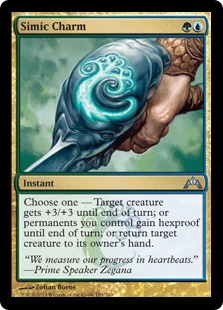
Well, before we do any proper hopping, we should flesh out the term at hand. Mark Rosewater has defined utility cards as those "that serve singular, basic, evergreen functions." While I understand the appeal of this definition from the designer standpoint, where the term "utility" compares to, say, "build-around," I think it holds little merit for the competitive player. We already classify the sundry spells Rosewater considers "utility" such as Murder, Counterspell, etc. as "removal," "permission," and the like. "Utility" becomes more useful to us when it comes to classifying a trickier card like Simic Charm, which sometimes doubles as either.

As I define it, utility describes a card's ability to play different roles. Simic Charm, then, is a quintessential utility card—not only can it serve as removal with bounce mode, permission with hexproof mode, or pump with +3/+3 mode, it does cool stuff like stop triggers from Ulamog, the Ceaseless Hunger or provide reach during combat.

Since utility cards do so many different things, they're frequently metagame-dependent. As such, the utility cards played in Modern decks generally occupy flex slots in the main or address strategic weaknesses in the sideboard.

Measuring Utility
Most of the "best of" articles I've read list a series of cards or decks and provide a couple of thoughtful paragraphs on each, doing little to justify the list's order, or to quantify the value of each pick. I think it's crucial we approach our lists in Modern Top 5 with a few parameters in mind. We'll rate each of the five utility cards in this article on a scale of 1-5 for power, flexibility, and splashability, with 1 being the worst and 5 being the best. That way, we can establish a hierarchy at a glance and come out with a clear winner.

Back to Simic Charm. Given its admirable flexibility, why doesn't it see play in more decks? Flexibility may be a key aspect of the utility card, but it's not all one needs to make waves in Modern. The other two parameters we'll judge utility cards by are power and splashability. Cue glossary:

  • Power: The degree of impact the card tends to have for its cost.
  • Flexibility: The card's usefulness across diverse situations and game states.
  • Splashability: The ease with which Modern decks can accommodate the card.

Power and flexibility will be rated by considering both a card's floor (the least it will do) and its ceiling (its best-case scenario). For example, Lightning Bolt's power floor is higher than Fatal Push's, as Push is dead when opponents have no creatures while Bolt can go to the face.

Splashability will be rated by considering how many existing Modern decks can accommodate the card and whether they'll want it. For example, despite its lack of a color identity, Ghost Quarter doesn't fit into BGx midrange decks. These decks can easily run Fulminator Mage as mana disruption instead, and prefer not to miss a land drop if they don't have to.

Applying the Parameters

Outlining these three parameters solves for Simic Charm's elusiveness. Unsummon, Giant Growth, and Mizzium Skin are all one-mana effects in Modern, but Simic Charm costs two mana. As such, it leaves much to be desired in terms of power; the format's other two-drops far exceed the power level of each of these effects. Despite Charm's flexibility, it does next to nothing when pilots lack a clock, robbing the card of some points on this metric. And in terms of splashability, Charm's appeal is limited by its UG cost, and by its strategic restriction to creature-based decks in need of flexible utility spells.

Temur Delver happens to make great use of Simic Charm, but it's no wonder we don't see it elsewhere in Modern. I would rate Charm 1-3-1 on this scale, giving it an unfortunate overall rating of 5 out of 15.

With the method out of the way, let's hop to it for real!

#5: Ghost Quarter

Power: 2

In terms of effect, Ghost Quarter is essentially Sea's Claim. Sea's Claim is no Modern all-star (it's only seen in Merfolk sideboards, where it gains extra utility by granting creatures evasion). But in some scenarios, Ghost Quarter far outdoes Sea's Claim.
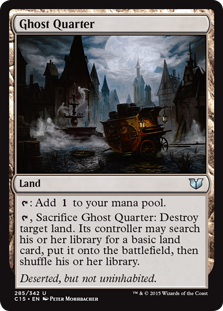
Quarter can go off at instant speed and doesn't have a color requirement, making it something of a colorless-costed "Seal of Sea's Claim" (using Quarter right away costs a functional mana, since it uses the turn's land drop). Threatening to pop activated creature lands or to disrupt colors can force opponents to expend valuable resources getting it off the table. Against decks with few basics, including Death's Shadow variants, it quickly turns into a free Stone Rain.

Combining it with Leonin Arbiter or Aven Mindcensor yields the same result. And combining it with Surgical Extraction instead can devastate big-mana strategies.

Flexibility: 4

Ghost Quarter's aforementioned benefits over Sea's Claim make the land much more flexible than its enchantment counterpart. But Quarter's most flexible quality is its ability to just tap for mana each turn. That Quarter does something so universal and crucial, in addition to offering a unique disruptive effect, secures its status as the only land-destruction card to earn mainboard slots in competitive Modern decks.

Splashability: 3

Any deck can theoretically play Ghost Quarter, a colorless land. But decks with color-intensive mana costs like Burn or Death's Shadow, which have little use for generic mana, should avoid Quarter like the plague. Decks that require a critical mass of a certain kind of land, like Scapeshift, also lose out on Ghost Quarter, as do ones that need their lands for other purposes, like Affinity. Anyone else can play it, though; I've even seen Quarter in some sideboards, and it's a strong tech choice in decks with ways to search it out (Ancient Stirrings, Expedition Map, Knight of the Reliquary).

Overall: 9/15

#4: Engineered Explosives

Power: 3
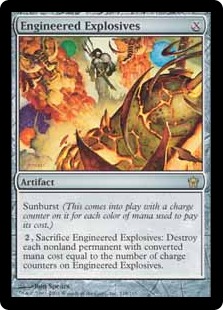
Playable Vindicate effects are rare in Modern, and limited mostly to Maelstrom Pulse and Abrupt Decay. The former is so gently played because of its prohibitive cost, and the latter because of its Inquisition of Kozilek clause. Engineered Explosives kind of suffers from both of these drawbacks at once.

Casting and cracking Engineered Explosives is almost always a tempo-negative play—when it can't remove a swarm of tokens, or multiple cards with the same converted mana cost, pilots are all but guaranteed to lose some mana on the exchange. It's also quite rare to encounter Modern decks that reliably produce four distinct colors of mana and play Engineered Explosives.

With all that being said, Explosives is one of the format's few true catch-alls, and it occasionally enables blowouts. Pulse might kill two Goyfs, but it won't kill a Goyf and a Scavenging Ooze. And EE's effect doesn't target, which lets it handle boards full of beefy Bogles.

Flexibility: 4

The main reason to play Engineered Explosives is its flexibility. Here's a mainboard-worthy card that ensures players can answer anything. Liliana of the Veil with six counters? No problem. Ensnaring Bridge? Still in the game. Souls flashback Souls? Let me just Snapchat my buddy this board. Explosives might be costly, but it really does it all.

Splashability: 3

Color-light decks like Tron and Skred, as well as mana-light decks like Burn and Death's Shadow, can't splash Engineered Explosives. The artifact limits itself mostly to three-color midrange decks (although some two-color decks can also play it profitably). In those, it's a staple. It even gives certain wedges and shards the ability to destroy permanents they would normally squirm against, like Tarmogoyf against Temur or Rest in Peace against Grixis. Thanks to the card's high flexibility, even decks with in-color removal for everything, like Abzan, are liable to run a copy or two.

Overall: 10/15

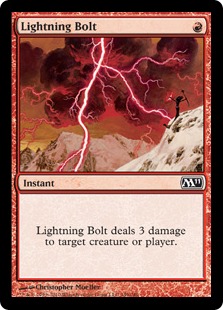
#3: Lightning Bolt

Power: 4

Lightning Bolt is Magic's original utility staple, and that's largely due to its absurd power level. One mana, one card, three damage. At any other point in Modern's history, I would have given this card a 5 for power, but Bolt really ain't what it used to be. One of the best cards in the format? Sure. But the iconic spell's main task in the decks that play it is to remove cheap creatures, and Fatal Push straight-up outclasses it there.
Flexibility: 4

Bolt owes its flexibility to the pliable nature of damage-based removal. Consider the other forms of removal: exile, which is dead in creatureless matchups; destroy, a strictly worse exile; and bounce, a strictly worse destroy. Damage-based removal can also slay planeswalkers, and goes straight to the dome against Ad Nauseam, Scapeshift, and other linear combo decks, making it hugely valuable for any kind of fair strategy. Even Scapeshift itself makes great use of Bolt in combo mirrors, where it shaves a turn off the clock by allowing for lethal Scapeshifts at seven lands.

Splashability: 4

Red decks with low curves and high curves alike love Lightning Bolt, so long as they can do something with Lava Spike mode. Otherwise, they're usually better off playing Fatal Push or other more reliable kill spells, if any—these decks generally employ a highly proactive gameplan and only run interaction in the sideboard (UR Storm, Grishoalbrand). Modern also houses a few interactive red decks that don't play Bolt for other reasons, including Death's Shadow Jund (which prefers Tarfire for its added utility dimensions) and RW Prison (which omits one-drops in favor of Chalice of the Void).

It should be noted that one- or two-color decks in the market for cheap removal/utility spells can splash red guilt-free. Since Lightning Bolt is red, the risks of being shut out by Blood Moon are mitigated by splashing the color Moon forces us to produce. Consider UG, and how easily Temur operates under a Moon compared with Sultai—while Fatal Push is better at killing creatures, Bolt's flexibility can't be understated, and the Temur deck can even sleeve Moon up itself!

Overall: 12/15

#2: Collective Brutality

Power: 4
Give -2/-2? Disfigure. Discard a card? Duress. Drain two life? Erm... well, that one also seems overpriced. Indeed, (nearly) each mode on Collective Brutality has a cheaper analog. So why is this card's power level so much higher than Simic Charm's? Because we can choose multiple modes? Specifically, because we can choose multiple modes at no additional mana cost. No other Modern two-drop has an effect as impactful as "kill a creature and Duress you."

As for the drawback of discarding cards... who cares? Card advantage is way overrated in this format, and Brutality decks are likely to have extra cards to throw around most of the time. When staying alive against aggressive opponents is a priority, it dumps clunky spells like Gurmag Angler or Ancestral Vision. In grindy games, it recycles sandbagged fetchlands. And in decks with graveyard synergies, Brutality's escalate cost can even create an advantage.

At the end of the day, every deck has extra cards sometimes. Brutality turns them into relevant effects without guaranteeing card disadvantage just for sleeving it up, unlike, say, Faithless Looting.

Flexibility: 4

Collective Brutality shines at all stages of the game. Over the first few turns, it kills attackers and strips an opponent's hand of relevant cards. Discard mode is even valuable against creature-heavy decks like Company and Eldrazi; early on, they're likely to have targets. Later, it helps close out games with reach, clears the way of permission for crucial spells, and breaks board stalls. The sorcery also kills weaker utility creatures like Grim Lavamancer and Thalia, Guardian of Thraben at any point in the game.

The mere presence of Brutality in Modern changes the way games are played. It does for black decks what Kolaghan's Command did for BRx decks by giving them a mainboard-worthy hate card for one of Modern's premier aggro-combo strategies. Throwing Bolts at a Grixis opponent isn't as reliable now that the shard can gain life out of nowhere.

Splashability: 4

Since Brutality is so brutally productive, it's a natural fit in any deck looking to get to the mid-game. It's also an obvious shoe-in for graveyard synergy decks like Dredge. Thanks to its cheap cost and lenient color requirement, any deck with black mana or a highly stable manabase can run Brutality. Just last month, Cory Gorman splashed black for three copies in his Classic-winning RG Scapeshift deck.

Overall: 12/15

#1: Surgical Extraction

Power: 4

While Surgical Extraction reads like a -1, it often trades for an opponent's card. And it does so for no mana, something very few Modern one-for-one cards can lay claim to (actually, just Gut Shot, which is significantly narrower). Only blind (and bad) Surgicals really whiff. Surgical Extraction is one of Modern's most skill-intensive cards, and experience directly translates to Surgical strength.
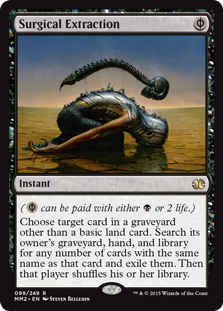
Like Engineered Explosives, Surgical Extraction possesses an extremely high ceiling. Even during one-for-one trades, Surgical sometimes nabs an extra card, like when it exiles Griselbrand in response to Goryo's Vengeance, or incidentally hits a second copy of a target in an opponent's hand.

The truly devastating Surgicals are those that hit Past in Flames after a Gifts Ungiven from Storm. Or Manamorphose in response to a mid-combo Past in Flames to deny the Storm player any more blue mana for the turn. Or Finks after Abzan Company expends resources Chording for their combo pieces to turn off the deck's infinite life dimension altogether. Or Ad Nauseam after nabbing a copy with Thoughtseize. In this last instance, Surgical actually has the four-mana effect of Cranial Extraction; in the others, it stops game-winning plays cold, sets back an opponent's development, and steals tempo.

The primary aspect that gives Surgical so much power is its mana cost. Meaningfully interacting with key plays from across the table while tapped out is big game—it basically translates to having Grafdigger's Cage in play against Abzan Company, except the Company player can't remove it and doesn't even know you have it until your eyebrows raise in preparation for the you-just-activated-my-trap-card face.

Last but not least, Surgical's granting of perfect information makes siding for game three a cakewalk. And seeing an opponent's hand reveals when to go for it with Temur Battle Rage.

Flexibility: 4

In Modern's Twin days, Surgical Extraction was a fringe sideboard option for combating combo plays. Today, the card also boasts applications against most fair decks in the format—Kolaghan's Command, Snapcaster Mage, Traverse the Ulvenwald, Liliana of the Last Hope, Renegade Rallier, and Kitchen Finks all give the card something of value to do when it isn't totally neutering opponents.

Surgical's relevance against fair and unfair decks alike give it extra play in matchups that can go either way. Take Company, where it either blows out the combo or exiles all copies of Collected Company to insist opponents play a boring creature deck (well, more boring). Or Dredge, where it either eats all the Prized Amalgams or just keeps a stumbling opponent off dredgers. Or Death's Shadow Jund, where it either soft-counters Traverse the Ulvenwald by removing a card type or exiles 50% of the deck's threats in one fell swoop. Or Ad Naseaum, where it removes all copies of the deck's namesake spell or just messes up the scry from a Serum Visions.
You can even pay B for Surgical if you want to. Talk about options!

Splashability: 5

Literally any deck can play Surgical Extraction. Eldrazi Tron plays it, and that's a deck with Chalice of the Void. Utility cards don't get more splashable than this one.

Overall: 13/15

A Collective Effort

In Monopoly, utilities were often the least exciting properties to own. But in Modern, utility cards give lists their personality, lovingly hogging the flex spots in Tier 1 and Tier 3 decks alike. Hopefully, this article provides you with a useful metric by which to analyze utility cards for competitive play.

What did you think of Modern Top 5? Which categories would you like to see me dip into next? Let me know in the comments.


Insider: What’s Happening in Standard

Are you a Quiet Speculation member?

If not, now is a perfect time to join up! Our powerful tools, breaking-news analysis, and exclusive Discord channel will make sure you stay up to date and ahead of the curve.

The emergency banning of Felidar Guardian put the Standard metagame, and in turn the market, into disarray right before SCG Atlanta, the first major tournament after the release of Amonkhet.

There was an error retrieving a chart for Saheeli Rai

This event, like all the SCG events that occur the first weekend a new set is legal, is looked at by players around the world for the first indication of what the new metagame will look like. The upcoming Pro Tour will further define the metagame, but even the pros are using the SCG data, so it’s important to understand what happened last weekend to have an idea of what the demand for Standard cards is going to look like over the next few months and beyond.

Magic Online also provides a wealth of decklists for players to copy, and the savvy pros know it stays a step ahead of the paper metagame, so it’s also important to pay attention to what’s occurring there. There are a few major storylines that occurred last weekend in the SCG events and some that are unfolding now online, so today I’ll shed light on what’s happening in Standard.

Zombies Rising

Amonkhet looked like it had the tools to bring Zombies into the top tier, and initial results are very promising that the deck indeed has broke through, putting a White-Black version into the top 16 of the Open and with a mono-black version having great results in online leagues.

There was an error retrieving a chart for Cryptbreaker

Cryptbreaker has seen major gains this week, but could continue to grow if the deck truly reaches the top tier – like after a big performance at the Pro Tour. Cryptbreaker also has a lot of eternal and casual appeal, so there’s a lot to like here.

There was an error retrieving a chart for Dark Salvation

Dark Salvation can be had extremely cheaply but is on the rise as a very effective removal spell and source of value in Zombie decks.

There was an error retrieving a chart for Diregraf Colossus

Zombies has brought Diregraf Colossus into Standard playability and has sent its price upwards.

There was an error retrieving a chart for Metallic Mimic

Metallic Mimic is used in mono-black Zombie decks, and it’s also seeing renewed demand from the resurgence in Red-White Humans.

Aetherworks Marvel Returns

Aetherworks Marvel was the centerpiece of the best deck in Standard before Emrakul, the Promised End was banned, but it never had the chance to prove it could survive without the 13/13 once the subsequent printing of Felidar Guardian put a more powerful combo deck into the format. Now Aetherworks Marvel can reassume the role of the most powerful deck in the format, and early results show that it’s a very real contender in the new metagame. A Temur Marvel deck won the MTGO PTQ, and has been very popular in leagues since. Bant Marvel won the SCG Classic, which is a major victory for the deck and gives it a lot of exposure.

There was an error retrieving a chart for Ulamog, the Ceaseless Hunger

The key card to pair with Aetherworks Marvel is Ulamog, the Ceaseless Hunger, which has seen its price online triple in the last week. The paper price fell flat but looks like it is starting to move up, so now might be the time to move. There’s also a lot of casual and eternal appeal for the card in the long term, so there’s a lot to like about it and the potential for it to keep rising through rotation.

There was an error retrieving a chart for Sphinx of the Final Word

Sphinx of the Final Word has seen a major spike online with the price more than quadrupling. It’s seeing play in various places, both in the sideboards of all variety of Marvel decks, and in new blue control decks.

Black-Green is Back

Black-Green decks struggled against the combo format, but now the colors that were once best in Standard have a chance to shine again. The aggressive energy version of the deck with Winding Constrictor has been popular, but what might be more exciting is the return of the delirium build, which reached the top eights of both the Open and the MTGO PTQ.

There was an error retrieving a chart for Fatal Push

The return of Black-Green has helped sustain demand for Fatal Push, which has now seen its price driven over $8. (!)

There was an error retrieving a chart for Never

The various Black-Green decks have replaced Ruinous Path with Never // Return, so along with demand from Zombie decks, the price has doubled online in the past week, and in paper is up to $2.

Mardu Wins Again

Mardu Vehicles won the SCG Open and put four more copies in the top eight, so it’s the clear deck-to-beat in the new metagame. It’s not surprising, seeing as it was the other top deck in Standard besides Four-Color Saheeli, but it is indication that new Amonkhet cards haven’t unseated it. The deck has even gained new cards of its own, including the powerful Glorybringer. It has also adopted Cut // Ribbons as a removal spell and finisher, which had done great things for its price.

There was an error retrieving a chart for Gideon, Ally of Zendikar

Gideon, Ally of Zendikar has seen its price bounce back up this week. Part of this is because of the success of Mardu, but it’s also due to the price being deflated because of the potential for a ban. It’s on the shortlist for cards to be banned during the next announcement after the Pro Tour, but I suspect that after the Felidar Guardian fiasco, we won’t see them make another ban, but rather ride out any storm until it rotates out of Standard.

Control’s Comeback

Amonkhet has put all the pieces in place for a comeback from blue control strategies.

There was an error retrieving a chart for Pull from Tomorrow

The most important of these new tools is Pull from Tomorrow, which provides a massive dose of card advantage and may supplant Torrential Gearhulk as control’s expensive finisher of choice. It will change the way these decks are built, with less focus on instants and more focus on various forms of cheap interaction. Its price has doubled in the last week.

There was an error retrieving a chart for Commit

Another new control tool is Commit // Memory which is being played in higher and higher numbers as players realize just how flexible and powerful it is. Its price doubled in the past week.

--Adam

Insider: Second-Level Sealed Product

Are you a Quiet Speculation member?

If not, now is a perfect time to join up! Our powerful tools, breaking-news analysis, and exclusive Discord channel will make sure you stay up to date and ahead of the curve.

Hey there, you. In case you forgot, your Insider subscription gets you access to every single one of my articles. I want to make sure you maximize that value, so I'm going to post the link to last week's article just in case you forgot, or were busy, or whatever. I'm pretty proud of it, and I think it'll be really useful to you if you have more bulk than time to sort it all.

Now that the blatant self-promotion is out of the way, I've got another pretty spicy topic for you this week, regarding the Protean Hulk unban in Commander. Now I know Jason Alt wrote about it a bit and we talked about hulk on the Brainstorm Brewery cast, but I want to take it in a different direction entirely.

There was an error retrieving a chart for Protean Hulk

When you first heard Hulk was unbanned, what did you do? Most reasonable people probably went to TCGplayer and several other online retailers to check the stock available, and see if they could snag a multitude of copies on the cheap. TCG sold out almost immediately, so you were probably out of luck unless you ordered within the first 15 or so minutes of the announcement. Websites like SCG, CFB and ABU follow suit, as copies of the Dissension rare evaporate from the internet. Even being an hour or two late to the party can leave the hole-in-the-wall websites exhausted of copies, and you have to start hunting down copies at your LGS or suck up the new card price.

I'm here to present an alternative method that could have given you an advantage over all the scrabbling financiers looking to make a buck, especially if you're just using your Insider sub to pay for itself while making the game a bit cheaper for yourself. Let's start off with a simple question: did you know that there was another product you could open to obtain Protean Hulks without opening booster packs of Dissension?

They have the same set symbol, came from the same printing sheets and are virtually identical to their Dissension booster pack counterparts. Protean Hulk was actually in one of the theme decks from back in 2006. Some of you whohave been playing for less than a decade have no idea what I'm talking about, or you clicked on this link from Twitter and didn't see the featured image. So back in the day, intro decks didn't look like this:

en_DV1lHwgSGS

They looked like this:

simic

They didn't come with booster packs or planeswalkers (which didn't exist yet). They were an alright starting point to get into Magic; I personally started with the Selesnya one from Ravnica over a decade ago, with a few touch-ups from a friend who taught me the basics of the game. Anyway, the point is that these are relatively difficult to find nowadays, and most people probably don't know what's in each deck when asked. That's usually irrelevant because they're introductory decks, and therefore don't come with incredibly powerful or chase rares. Once in a while, though, something shifts in a metagame to cause a card inside to spike in price. Whether that's a new combo piece being printed, an unbanning, or a spicy new brew being developed, these older sealed products can end up being under-the radar-targets during a frenzied buyout.

simic m

These are completed eBay listings from the day after the Hulk unbanning. While 98 percent of the deck is worthless commons (RIP Coiling Oracle, a card that used to be pickable), you also get a complimentary $3 Experiment Kraj with your Hulk. If you were aware of and bought the "Simic Mutology" theme deck, you could have bought $20 hulks for your EDH deck while getting a free $3 card and some bulk, versus paying $25 for just the hulk on TCGplayer.

There was an error retrieving a chart for Experiment Kraj

trav

Now, obviously there isn't really room for profit here. Buying a $20 theme deck with the hope of selling your Hulk for $25 a week later when your cards come in the mail is both unrealistic and improbable. Even today as I'm writing this article, the market price of hulk is around $18. The important thing here is more the theory than the practice. This is just the most recent example of a phenomenon that has existed for several years, where the sealed product containing spiking singles will lag behind, providing opportunities to buy in and ease the cost of cards.

The most widely known example of this phenomenon is probably the Stoneforge Mystic event deck released in 2011. The War of Attrition deck infamously came with two copies of SFM, which was swifly banned after New Phyrexia wreaked havoc on the Standard format. In a public relations travesty almost on par with addendum-banning a 1/4 cat, WotC allowed you to continue using Stoneforge Mystic in Standard: but only if you used the exact 75 cards that came in the NPH event deck. Anecdotes aside, the event deck was left upon the shelves of LGSs everywhere, and there was always a nice chance to pick them up from delayed eBay sellers each time Stoneforge did its yearly jump.

These event decks were famous for containing powerful cards in a package ready for FNM, but several of them also offered a financial opportunity or two throughout their lifetimes. Let's take a look at one of my favorite decks from that time period.

event deck

event deck2

This deck started with so many four-ofs, and it only took four Mox Opals and another couple Goblin Guides to be competitive. I miss this Standard format so much.... Anyway, I'm curious to know if there were any of these decks on eBay for $65 prior to the MM17 of Goblin Guide. If someone was looking to complete Modern Burn a few months prior to the reprint without incinerating their money, they could have looked into picking up a couple of these decks instead, filling a cart with a playset of  Goblin Guides in addition to playsets of Lightning Bolt, Memnite, Signal Pest, and a couple Goblin Bushwhackers. That's like $25 in common/uncommon picks alone! The Searing Blazes and Leyline of Punishment are the cherry on top of the Memnite icing on top of the Goblin Guide cake at that point.

Thankfully, we don't always have to look back at products from seven years ago to find sealed products worth pouncing on.

There was an error retrieving a chart for True-Name Nemesis

TNN was down in the dumps prior to Aether Revolt recently, and many locals had given up on their Mind Seize investments from a couple years prior. It was getting to the point where you could pick up this once impossible-to-find deck at close to MSRP. Then, everything changed when Sensei's Divining Top was banned. Suddenly, Terminus is significantly weaker and TNN can come out to play. While everyone else bought out True-Name, you could have been on the hunt for Mind Seize decks at closer to MSRP, while getting 99 other cards that buylist to make up for the difference in price and then some.

mindseize

This is the part of the article where I would normally give you advice on a specific target based on the information presented. Unfortunately, the list of "single cards that could spike extremely hard but are also in sealed product from up to or over a decade ago" is kind of short. If you look at the current banned lists across Modern, Legacy and Commander, it's really difficult to pick a card and think, "Hmm, yeah I can totally see them unbanning that relatively soon, and it's also in this Event Deck over here...."

I know you'll be upset at me if I don't provide at least one, "Well, maybe this thing..." so here we go. Let me preface this statement with multiple instances of the same disclaimer:

I do not expect them to unban Jace, the Mind Sculptor in Modern in the next two years.

I do not expect them to unban Jace, the Mind Sculptor in Modern in the next two years.

I do not expect them to unban Jace, the Mind Sculptor in Modern in the next two years.

I do not expect them to unban Jace, the Mind Sculptor in Modern in the next two years.

Okay, so yeah. My pick is Jace, the Mind Sculptor. He's currently banned in Modern, and Aaron Forsythe has at least entertained the possibility of maybe possibly talking about setting him free eventually. There's a lot of maybes there. I know the community is split pretty decisively on this, but I think Jace is an abstract possibility for an unbanning down the road; maybe once they get another printing or two under his belt to keep the price under control if he does get unbanned.

There was an error retrieving a chart for Jace, the Mind Sculptor

So. If (if) Jace gets unbanned, we all know that every single copy on the internet will immediately be purchased from TCGplayer, SCG, CFB, eBay, Cardshark, etc. However, we know that sealed product tends to lag behind. Simic Mutology lagged behind the Hulk spike, and FTV: Realms lagged behind the Grove of the Burnwillows spike. It's just not the first thing people search for when a card gets unbanned.

So what should you be searching for when the apocalypse hits? Instead of frantically typing Jace, the Mind Sculptor into TCGplayer and watching copies disappear in your cart, I recommend targeting From the Vault: Twenty.

FTV20 2

There are a couple outliers on eBay at $100ish, and you can see by my "review offer" image, I'm fishing for a decent deal on this. Even without Jace being unbanned, the price of a sealed FTV: 20 is reasonably close to the full value of the quality cards on the inside. These are all EDH all-stars that sell reguarly at my shop, so I might have just ended up finding an arbitrage opportunity instead of a spec. Hmm.

FTV20

End Step

I'm not really a fan of holding sealed product for the long term; I think a lot of us learned that lesson back during Return to Ravnica and Conspiracy boxes. The explosion in the playerbase was finally met with an increase in print run to match, and we haven't seen the long-term gains on those types of products that at one time we might have expected. However, I think there can be exceptions to the "stay away from sealed product" rule. This article demonstrates several examples where frenzied players are slower to react to recently spiking cards when they're hidden among the different names of sealed product. If you see a card spike hard or a card get unbanned, try searching "Simic Mutology" instead of "Protean Hulk" when you're racing to get your one-of for your Selvala, Heart of the Wilds Commander deck.

Three Archetypes to Attack the MTGO Metagame

Are you a Quiet Speculation member?

If not, now is a perfect time to join up! Our powerful tools, breaking-news analysis, and exclusive Discord channel will make sure you stay up to date and ahead of the curve.

I’m not one to play the “best deck." Usually, that’s because I’m packing some form of control, tempted by the cruel mistress that is card advantage. Oftentimes, this obsession translates directly into uphill battles and short Saturdays, but that’s neither here nor there. Still, my time spent attacking the format from the outside has given me a fairly unique perspective regarding the “less popular” members of society. While others are listening to Drake, I’m rocking some Stray From the Path. You get the picture.

That being said, I’m getting pretty tired of seeing Affinity, Eldrazi Tron, and Dredge on the top of the MTGGoldfish metagame chart. We're only a couple days into Amonkhet’s potential Modern shakeup, but I’m not one to wait and see what developments are down the pike. While others join them, I plan to beat 'em.

With that said, today I'm going to discuss some archetypes on the edge that I believe are well positioned to take down those three decks. Keep in mind, we're talking about the MTGO metagame exclusively—in paper we tend see a higher diversity of archetypes, so this kind of pinpoint targeting may have less mileage there.

Metagame Context

As always, to know what we’re looking to beat, we should understand what we’re after, and the best ways to fight it. As a visual learner, I’ve found that writing down, reading, or talking about accepted concepts in list form helps give me a clearer picture of the issue at hand. To keep things fresh, I’ll be adding in some hot takes on how lists are positioned this week. Our targets:

Affinity

Affinity is still Affinity, but I have noticed more Master of Etherium and Blood Moon than normal in the lists. Master of Etherium has always been great as a way to add some bulk to boards and to present a large target in one card, but sleeving it up over Etched Champion, which is usually swapped out in some number for the three-drop, says something about how you expect the field to be on game day. It’s clear that Affinity these days is worried less about dodging removal-heavy decks like Jund and control, and more about quickly producing lots of damage. While I don’t normally like Blood Moon out of Affinity, as most players will fetch basics post-board anyways, it's hard to argue that dropping it on turn two on the play isn’t powerful, especially against Eldrazi Tron and Death’s Shadow (two of the other top five decks).
Stony Silence remains the best way to fight Affinity. Beyond that, there's always removal and artifact hate. Lingering Souls is still great, and I like Liliana, the Last Hope and lifelink as well. Why am I telling you what you already know? Because the community knows all this, and yet refuses to play enough artifact hate to keep Affinity out of the most represented column. Until another deck occupies that top slot, expect a weekly PSA.

Eldrazi Tron

Walking Ballista really pushed this deck to the next level. Early, it’s a thing to put on the board. Late, it’s a mana sink. At worst, it has haste and eats a removal spell, like pricier Reality Smasher. At best, it does some damage, trades with a card, and does some more damage on the way out. It’s insane that on top of all the incidental text that Eldrazi Tron gets on its threats, it now gets a threat and a removal spell on the same card. Eldrazi Tron has just enough undercosted, overpowered threats to keep it from being one-dimensional, and still retains a top-end package that can put any game away if opponents dilly-daddle. I have to say, that’s the first time I’ve heard that word in ten years, and the first time I’ve ever seen it put to writing. We’re forging new territory here at Modern Nexus.
To fight Eldrazi Tron, you have to play combo, discard, or not care about a 4/4 that steals cards on turn three. That a tall order, but definitely doable, as long as you can execute your gameplan quickly. Eldrazi Tron is the lone stalwart lurking in the room, ready to pounce on whatever metagame deck you’ve concocted that combines the perfect answers to the top three victims of choice. Attacking the deck's manabase is fine, but be aware that Eldrazi Tron sees it coming, and has the ability to board out of its top end completely. If you’re holding Spreading Seas while they're dropping Eldrazi Mimic, you’ve already lost.

Dredge

And then there’s Dredge. We all know what Dredge does at this point, and it’s clear that Rest in Peace alone won't keep it down. If you’re not playing white, be sure to bring along Leyline of the Void, whether you can cast it or not. You can try and race, but Gnaw to the Bone is tough to beat if you’re one-dimensional, and Dredge can easily assemble a strong board with Conflagrate on deck by turn three. If you ask me, Golgari Grave-Troll should still be here and Cathartic Reunion should be gone. For now it appears we're all stuck with the graveyard menace as a major archetype.
The Players

Grixis Death’s Shadow

Normally I’m not a fan of Delver strategies, but when you trade out the 1/1 and situational tempo spells for Death's Shadow and individually powerful cards, something strange happens: you miraculously turn a bad deck into a good one! Grixis Death’s Shadow is a better version of Grixis Control right now. It's a reactive, disruptive strategy with a built-in card advantage engine and the ability to turn the corner and quickly close out the game.

Death’s Shadow Grixis trades in the Mishra's Bauble and Traverse the Ulvenwald package for Snapcaster Mage, Kolaghan's Command, and more removal. Street Wraith is still in place, because we can actually cast it if necessary. This leads to a threat-dense, mana-efficient deck that plays out lots of creatures when it needs to, but otherwise spends the early turns reacting, disrupting, dropping a large, undercosted threat, and bringing the beats when given an opening.

Against most of the top decks, Grixis Death’s Shadow finds itself well-positioned to handle what’s thrown at it. Affinity has a difficult time fighting through Kolaghan's Command and a ton of removal; Dredge has to contend with Nihil Spellbomb and Surgical Extraction; and Eldrazi Tron has to hope Grixis stumbles, or find a Chalice of the Void. A quick threat backed up by disruption is the best solution to the wide range of combo decks available to Modern, and the ability to play both Thoughtseize and Negate is excellent, especially when Negate costs one mana (in the form of Stubborn Denial).

Burn

As long as you can dodge Gnaw to the Bone out of Dredge, Burn is set against most of the top decks in the field. It’s faster than Affinity (well, than just about anything), goes under Eldrazi Tron’s tremendous value, and puts a quick clock on all of the combo decks running around. While everyone else is busy packing narrow answers like Rest in Peace and Stony Silence to fight the unfair decks, Burn can just cast seven spells and win the game.
Beyond the obvious, some subtler shifts in the format, along with the spells people are playing, all line up to make Burn a strong option. Besides Death’s Shadow damaging Burn’s credibility, the fact that it rarely casts a creature on turn one makes it difficult for the deck to race. While others play Tasigur, the Golden Fang to dodge Fatal Push, by doing so they remove a potential blocker for our cheap threats on the early turns. It doesn’t really matter that Tasigur, the Golden Fang costs one mana if we took four damage from Goblin Guide before he comes down.

It’s clear that Burn is affecting the format already, with Basililk Collar showing up in Eldrazi Tron. Basilisk Collar’s primary purpose is to suit up Walking Ballista and gun down the board, but regardless, maindeck lifegain in a deck full of fatties is never a good sight for Burn. Regardless, the Burn hate is currently pretty low, so if you want to watch the world burn, now’s the time!

UW Control

I hate to be that guy and advocate yet again for my preferred archetype, and trust me, I looked everywhere for a third option that I could claim at least equal in strength to UW against these opponents. I don’t want to sound like a broken record, but the deck is very strongly positioned right now. It can afford to play both Rest in Peace and Stony Silence in multiples, as well as the cantrips to help find them quickly. It can also easily tool its maindeck to fight the field while using its sideboard to shore up holes. Wall of Omens covers bases against most of the aggressive decks, and we can play Spreading Seas in the maindeck to help against Eldrazi Tron and other big mana decks.


As always, Control isn’t the perfect solution. Its losses are often credited to great draws from opponents or pilot stumbles. In addition, the field is always a little too large to handle everything, and it can be difficult to line up answers versus a myriad of threats correctly. Finally, there isn’t as much midrange around to beat up on, although Jund and Abzan are still lurking in the middle of the pack. Still, UW can claim strong matchups against the top decks, while still having game against Modern's lower tiers. I would consider any archetype that satisfies that requirement a fine option, whether it falls within my wheelhouse or not.

Conclusion

Outside the three options I listed, a few other decks showed promise, but had one or two glaring issues that needed addressing. Elves is too easily disrupted and runs into some issues against each of the top three, not to mention its clear uphill battles against other decks in the field. That is true for some of the decks I discussed above as well, but each of those options could claim a position of power against the big targets in the format. Storm is the clear “best positioned” of those outside the top three, but since it’s the fourth most-represented deck on MTGGoldfish, it's hard to call it fringe. Finally, GR Breach is a strong deck as well, but can stumble against disruption and lose to itself on occasion. Still, if you’re looking for a non-Storm fourth option to the three I mentioned, GR Breach is probably where you want to be. Good luck!

Thanks for reading,

Trevor Holmes

Want Prices?

Browse thousands of prices with the first and most comprehensive MTG Finance tool around.


Trader Tools lists both buylist and retail prices for every MTG card, going back a decade.

Quiet Speculation