menu

Insider: QS Cast #43: The Magic.Cards Special

Are you a Quiet Speculation member?

If not, now is a perfect time to join up! Our powerful tools, breaking-news analysis, and exclusive Discord channel will make sure you stay up to date and ahead of the curve.

Play

The QS Cast has returned and has now shuffled once again: Chaz Volpe, and Tarkan Dospil continue on with where the cast left off and in this episode they discuss the following:

  • Micheal Angelo Russo joins QS Cast! Owner of Magic.Cards and Universe Games
  • Magic.Cards Operational Structure - Policies and Procedures, Grading, Buylist, etc.
  • Micheal discusses his views on the current MTG market landscape—how rapidly it changes, and how they constantly work to stay relevant and successful.
  • What is WOTC doing well? What isn't working so well?
  • Interests of the week
  • Apparently Micheal prefers Angelo - Thanks Twitter.


Turns out Angelo and Chaz like long-term real estate! We also discuss additional Commander reactionary considerations. Foil/non-foil versions of Commandeer. Foil version of Sigil Tracer. We've also seen small movement on Mana Confluence and Joiner Adept from previous casts.


Despite what Tarkan says we still managed to talk about a Reserved List card.

As always, please comment and leave questions for us to address on the next cast! We will be making QS Insider questions a priority, and we want to know what you want covered.

Enjoy! We’re glad to be back.

Find us on Twitter: @ChazVMTG  @the_tark

Insider: Expectations vs. Reality in Pricing

Are you a Quiet Speculation member?

If not, now is a perfect time to join up! Our powerful tools, breaking-news analysis, and exclusive Discord channel will make sure you stay up to date and ahead of the curve.

Welcome back, readers!

Today's article will focus on the difference between our expectations for a given card and the reality of that card's success. Being able to determine whether a card is actually all it's thought up to be, or just a bunch of hype, can be a very valuable skill set. We often focus on trying to identify the under-appreciated cards when they're at their lowest, but we rarely devote nearly as much time to calling out the over-hyped cards.

big-mac-reality
Your mileage may vary...

Part of this is because we typically view financial growth as more impressive than simple money-saving. For example, if I were to tell you I bought 10 cards for $1 that are now worth $5, you would likely see that as a strong speculation investment that paid off. On the other hand, if I told you that I sold 10 cards in my possession for $5 each, which then fell to $1, you'd likely be less impressed.

Assuming I could sell the cards that are now worth $5, I would have made $40 in profit either way. But our perception is that the first is more impressive than the latter, because humans tend to value growth over decline. Of course, a savvy investor knows one can maximize their portfolio by utilizing both.

Expectations & Price

This cognitive bias ends up getting reflected in the actual price of cards, too. For an example, let's look at the new Kaladesh fastlands. Based on MTG Goldfish's chart of the most-played Standard cards, we would expect the prices to fall in this order:

  1. Blooming Marsh
  2. Inspiring Vantage
  3. Spirebluff Canal
  4. Concealed Courtyard
  5. Botanical Sanctum

But in reality they are as follows (prices are TCG Player Market Price):

  1. Spirebluff Canal - $7.45
  2. Inspiring Vantage - $4.72
  3. Blooming Marsh - $3.35
  4. Concealed Courtyard - $3.2
  5. Botanical Sanctum - $3.02

So the most played of the five is valued at the #3 spot, and the third most played is valued at the #1 spot. Looking at the most played Modern lands doesn't conform to expectations any better:

  1. Blooming Marsh (#21)
  2. Spirebluff Canal (#31)

There are two things we can glean from this. One is that Blooming Marsh may be currently undervalued, given that it's the #1 most played of the five over both major formats. The other is that Spirebluff Canal may be currently overvalued due to being #3 and #2 in Standard and Modern respectfully.

There was an error retrieving a chart for Spirebluff Canal

So the takeaway here would be to trade any Spirebluff Canals you aren't using for copies of Blooming Marsh, as demand should eventually catch up.

Looking at Shocks and Fetches

If I were to ask you what are the most expensive (non-foil) shockland and fetchland, I imagine many of you would guess Steam Vents and Scalding Tarn.

There was an error retrieving a chart for Scalding Tarn

And why would most of us guess that? Historically a lot of combo decks in Modern tended to be blue-and-red-based (Modern Storm and Splinter Twin come most recently to mind). So it's not surprising that these two would lead the pack back when those decks dominated the format.

But if we look at the Modern metagame, again we see a different picture:

  1. Infect
  2. Dredge
  3. Jund
  4. Bant Eldrazi
  5. Naya Burn
  6. Lantern Control
  7. Affinity
  8. G/W Tron
  9. Death's Shadow Zoo
  10. Abzan

Of the top 10 decks (making up about 47% of the metagame), Dredge is the only one to include a Steam Vents, and none play Scalding Tarn.

If we look at the most played shocklands in Modern, we see both Stomping Ground ($11.07) and Sacred Foundry ($11.85) above Steam Vents ($9.99). So in the case of shocklands, the prices more closely mirror the amount of play each sees. It is fair to mention, however, that both Sacred Foundry and Stomping Ground were in Gatecrash (GTC), the less printed set, whereas Steam Vents was from Return to Ravnica (RTR). Thus there are likely considerably more RTR Steam Vents than GTC shocklands.

Looking at the most played fetchlands in Modern, we see Wooded Foothills, Windswept Heath, Bloodstained Mire, and Verdant Catacombs all sitting above Scalding Tarn.

The first three were obviously printed more recently in Khans of Tarkir, and thus the total supply is considerably higher than the Zendikar fetchlands (which have only the one mass printing). But Verdant Catacombs and Scalding Tarn have a similar supply (Catacombs's is slightly higher due to its inclusion in an Event Deck). Yet, despite seeing less play than Catacombs, Scalding Tarn is still 13% more valuable.

There was an error retrieving a chart for Verdant Catacombs

We saw this same phenomenon back before the original Onslaught (ONS) fetchlands were reprinted. Legacy was the only major format where the ONS fetches were legal, and back then the most dominant decks (Sneak and Show, Maverick, Miracles, RUG Delver, Death and Taxes) didn't include black at all. Despite this, Polluted Delta was the most valuable of these original fetchlands.

The reason was that in Vintage black was considered second to blue in power level (a fact also reflected in Underground Sea's price), and people expected the color to catch up in Legacy. Eventually we did see Esper Stoneblade, BUG, and Storm decks rise to tier 1 status, but Underground Sea had been king of the dual land hill for quite some time.

Identifying Overvalued Cards

Spirebluff Canal isn't the only card whose current value seems to be propped up due more to expectation than to reality. Here are some other cards whose prices may be due for a correction soon:

  • Torrential Gearhulk - This card is sitting at a market price of $12.95. While it did break out a few weeks ago at the Pro Tour, it's not even in the top 50 most played cards in Standard anymore. It also doesn't show up in any significant numbers in Modern.
  • Verdurous Gearhulk - This was the second most expensive card in Kaladesh when it first came out (preordering for $25-plus for a while). I know my local game store couldn't keep them in stock originally, and I was able to trade my playset straight across for four Noxious Gearhulks. Like Torrential above it started out showing up in several decks in the new Standard, but has failed to pan out.
  • Nissa, Vital Force - Nissa started out in the same decks as Verdurous Gearhulk, except typically only as a one- or two-of. She was cut entirely pretty quickly, and now appears mostly in a sideboard capacity.
  • Tamiyo, Field Researcher - The new Tamiyo is currently sitting at $10.33 market price. Yet she isn't in the top 50 most played cards in Standard—in fact there aren't any tier 1 archetypes that play the Bant shard at all. Planeswalkers are more iconic than a lot of other cards, so along with Nissa above, there's definitely some casual demand here.

Conclusion

One major takeaway here is that Magic players often associate a card's potential with what they think it should be, rather than what it proves itself to be. This is very evident in our Spirebluff Canal example.

It's not surprising that this phenomenon is far more typical with new cards—the more time that elapses as a card remains out of the spotlight, the more people move away from it.

I'm not saying it's unwise to make comparisons to past cards, archetypes, or just general history to make an assumption about a card's potential. However, we must remember to re-evaluate this assumption as time progresses and we see the card in action.

Insider: The Collector’s Mindset

Are you a Quiet Speculation member?

If not, now is a perfect time to join up! Our powerful tools, breaking-news analysis, and exclusive Discord channel will make sure you stay up to date and ahead of the curve.

Welcome back, dear reader!

I consider myself a bit schizophrenic when it comes to my Magic habits. So far in my articles, the player and trader have had a lot of opportunity to speak; however, I also consider myself a collector.

Usually my three "personalities" are in sync and work together to improve my collection. The trader supplies the cards and makes sure we get a deal. The player ensures we can have fun with the game and identifies cards to pick up for play purposes, giving the trader input on what is good to play. Meanwhile, the collector ensures we also pick up other cards, so that the player has them available for future deck building, and the trader has long-term investments that grow steadily.

I wouldn't call this perfect synergy—the collector and player at times want to hold cards that the trader would prefer to move—but it works for me. Today I am going to try to give you some insight into the collector's mindset so that you have some idea of what to expect when you come across one of them.

There are basically two things I collect in Magic:

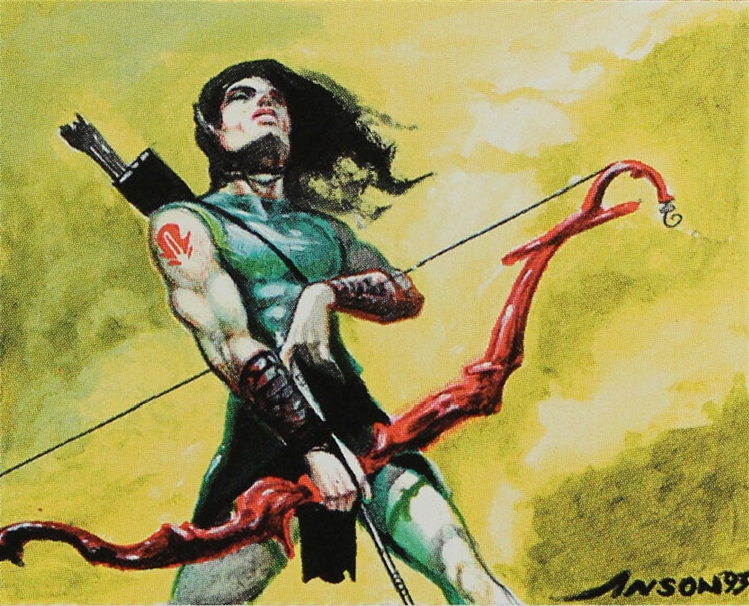
  • Any and all Elvish Archers with the older art.
  • A playset of all unique cards in Magic from their first non-foil English printing with normal borders (and one copy of expensive restricted cards).

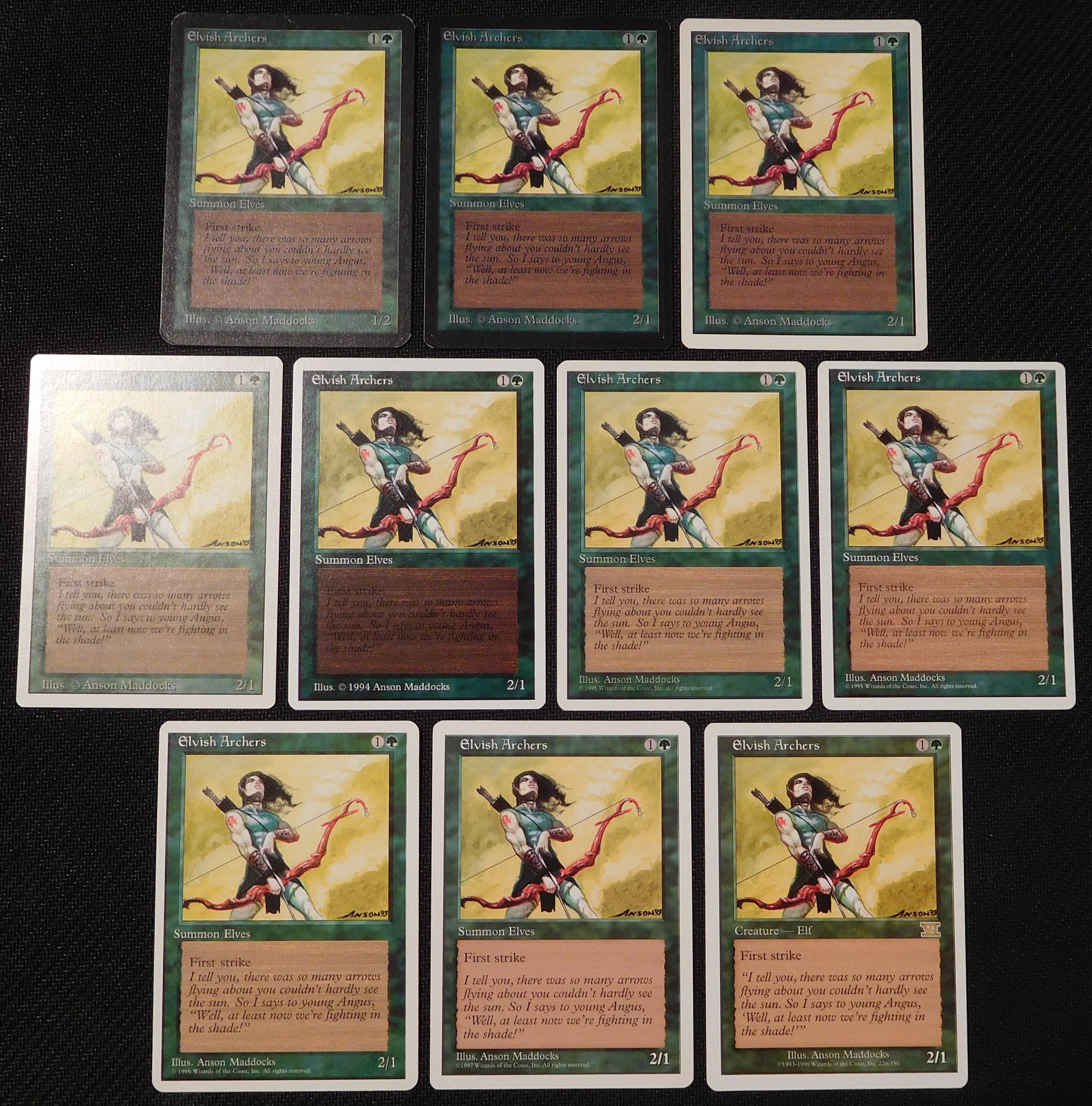
As the former is much easier to show off than the latter, I will focus on that. I have taken a picture of every tournament-legal English Elvish Archers with the right art to give a bit of an idea of what such a collection would entail.

Alpha, Beta, Unlimited, Revised, Summer Edition, 4th Edition, Alternate 4th Edition, Rivals, 5th Edition and 6th Edition Elvish Archers
From left to right: Alpha, Beta, Unlimited, Revised, Summer Edition, 4th Edition, Alternate 4th Edition, Introductory Two-Player Set, 5th Edition, and 6th Edition Elvish Archers. Rivals is missing because I was not aware of it being different from the Introductory Two-Player Set at the time I wrote this, I do have a copy.

Would you have guessed that there are ten eleven different versions of Elvish Archers that meet my criteria for collecting? I forgot the Rivals one myself!

I also own Collectors Edition, International Collectors Edition, World Championship Deck and Beta/Collectors Edition artist proof Elvish Archers, which are not tournament-legal but might be considered part of the English set (I'm missing other artist proofs though). I own many duplicates, a bunch of foreign ones, and even a Reaper Miniature (sealed in box). I would guess I own roughly 200 in total and I am always looking to pick up more of them (if the price is right).

Until recently, taking this picture would have been impossible, as the Summer Edition copy recently arrived at my place. I'd been looking for one for at least a decade without ever seeing one for sale, and it's been a highlight in an otherwise fairly dark period of my life (I have recently lost my job among other things).

What made it even better is that I was able to trade for the card too (keeping the trader happy, as he certainly wouldn't have wanted to spend the $2000 ABU asked for it). In my excitement about receiving it, I posted a picture on the Magic: The Gathering Misprints and Oddities Facebook group with the text, "I collect Elvish Archers, so imagine how happy I am that this came in today." To date, 173 people have liked or otherwise reacted to the picture.

Now that the Summer Edition version is in my possession, I feel ready to start on a global set of Archers, extending my quest. This has been my plan for several years, presuming I could ever locate a Summer copy as that would be the hardest by far.

Why?!?

The picture above shows about as much value as a (beat-up) Black Lotus. I'm sure you must be wondering why anyone would want to spend those resources just to collect a usually near-bulk rare. The trader in me definitely agrees with you—it's madness! Yet the collector can't be happier. Let me try to explain why I feel drawn to the Elvish Archers.

  • I got the Two-Player Introductory Set decks when celebrating the birthday of Sinterklaas (somewhat like Santa Claus) back in the first month that I started playing Magic. I had barely purchased any other packs before that so it constituted a pretty significant part of my early collection.
  • The card seemed pretty good to me and I absolutely loved the flavor text. I think the art is pretty cool too, though why a card called Elvish Archers would have only a single Archer in the art confused me.
  • In the very next set, Stronghold, a common was printed that was pretty much exactly the same card (Youthful Knight—I didn't think a color shift mattered much at the time). I felt sorry for the Archers.
  • The card was a staple of my first somewhat good deck, Mono-Green Stompy. I loved playing Giant Growth on an Archers to have it take down something much bigger and live to tell the tale.
  • I learned that it was misprinted in Alpha, which added some mystique to the card for me.

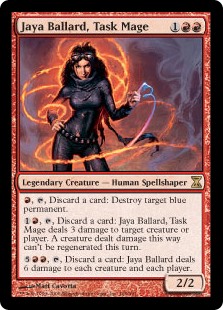
My history with the card makes it important to me. I'm sure that if we ask Sig about his Jaya Ballard, Task Mage collection we'll get a similar answer. In fact, I have asked him exactly that. Here was his response:

I wanted to have something to collect—something that transcended finance and could get me excited about MTG. I chose Jaya because I always loved her quotes on some of the older cards. I also read the Ice Age set of books by Jeff Grubb and Jaya was a character in the story that had such a fun personality. Lastly, no one can argue with the sweet art.

If you know a collector like myself or Sig, and know what they are after, you can trade for it knowing you'll be able to move the card. This means that you can pick up cards that others would pass on. Your trading partner is likely to value these cards low, while your collector is likely to value them higher as they are special to them. A quick flip can be very profitable.

jaya-ballardThere are many variants of collectors. Sig and I just both happen to have a card we collect (similarly I know a retired player who still wants each and every Ball Lightning I can find for him). I also know people who collect foils, white cards, one copy of every card, Alpha, and more.

Knowing that the Alpha collector was still missing a Chaos Orb allowed me to make a very beneficial deal with him after picking one up when I was in Germany. The set collector would always overtrade for missing pieces for his collection. I haven't been able to trade with the white cards guy just yet, but if we ever do, I know which pages of my binder to point him towards.

The foil guy has gone through my foil bulk several times. He was always happy to give me double the amount in bulk for anything he picked out, letting me double up with little work. I also picked up a couple of foil Swords of X and Y that he gave me about 1.5 times my cost for, because they had been so difficult for him to find.

All this was possible because I knew these collectors' particular preferences. It's hard to predict what a particular collector will like, and it's impossible to predict what the next collector you meet will be after. But you better make sure to pay attention when he tells you—you will want to start picking it up, whatever it is!

Mana Monkey vs. Mechanical Moxen: Understanding Fast Mana

Are you a Quiet Speculation member?

If not, now is a perfect time to join up! Our powerful tools, breaking-news analysis, and exclusive Discord channel will make sure you stay up to date and ahead of the curve.

Last week I went against my better judgment and wrote about the Modern banlist. The piece seemed to be generally well received, though as one would expect, there were disagreements. Most seemed to be with regard to levels of understanding or differences of philosophy, though there was one commonly expressed sentiment that I felt deserved its own response. I completely disagree with the notion that Mox Opal and Simian Spirit Guide should necessarily be of the same legality in the Modern format. Today I'll lay out my case for why.

lotus-petal-banner

In my article I made comparisons to both Lotus Petal and Chrome Mox—both cards that are illegal in Modern. I haven't seen anybody arguing that Chrome Mox should be unbanned, nor that Lotus Petal should be reprinted in a Modern-legal capacity. We all understand the dangers of fast and free mana, though there seems to be a breakdown when it comes to understanding exactly what should and should not be Modern-legal.

Chrome Mox and Lotus Petal are easily identifiable as particularly egregious due to their ability to generate mana of any color and to enable storm decks, though clearly we allow some amount of fast mana to be Modern-legal. Tron and Eldrazi Temple get to continue to exist in no small part because they heavily restrict the sorts of spells that the fast mana enables. Birds of Paradise is way too powerful of a mana accelerator for current design philosophy, though once again, Birds really only plays well in creature-centric decks. In each of these cases, the legal fast mana card imposes deck-building restrictions that are totally fine within the context of Modern.

[wp_ad_camp_1]

Mox Opal: Faster But Vulnerable

This is where the difference between Mox Opal and Simian Spirit Guide becomes pronounced, and where I think some players seem to ignore or be unaware of some very pertinent data. A big part of my argument last week lied in the fact that Mox Opal doesn't enable anything especially degenerate at this point in time. Technically there is an Open the Vaults combo deck that's fringe-playable, though when it comes to popular and powerful Mox Opal decks, we are referring to Affinity and Lantern Control.

Lantern Control, by Carter Newman (10th, SCG Columbus Open)

Creatures

2 Glint-Nest Crane

Instants

2 Abrupt Decay
2 Surgical Extraction

Sorceries

4 Ancient Stirrings
2 Collective Brutality
1 Infernal Tutor
4 Inquisition of Kozilek
2 Thoughtseize

Artifacts

4 Codex Shredder
4 Ensnaring Bridge
3 Ghoulcaller's Bell
4 Lantern Of Insight
3 Pithing Needle
1 Pyxis of Pandemonium
4 Mox Opal

Lands

1 Forest
4 Blooming Marsh
1 Botanical Sanctum
2 Darkslick Shores
1 Ghost Quarter
4 Glimmervoid
1 Tendo Ice Bridge
2 Academy Ruins
2 Inventors' Fair

Sideboard

2 Grafdigger's Cage
2 Welding Jar
1 Witchbane Orb
2 Spellskite
2 Leyline of Sanctity
1 Seal of Primordium
2 Abrupt Decay
2 Surgical Extraction
1 Duress

Affinity, by Robert Cucunato (3rd, SCG Columbus Open)

Creatures

4 Arcbound Ravager
2 Etched Champion
2 Master of Etherium
2 Memnite
4 Ornithopter
4 Signal Pest
1 Spellskite
4 Steel Overseer
4 Vault Skirge

Instants

3 Galvanic Blast

Sorceries

1 Thoughtcast

Artifacts

4 Cranial Plating
4 Springleaf Drum
4 Mox Opal

Lands

4 Darksteel Citadel
1 Island
1 Mountain
4 Blinkmoth Nexus
3 Glimmervoid
4 Inkmoth Nexus

Sideboard

2 Grafdigger's Cage
1 Tormod's Crypt
1 Etched Champion
1 Spellskite
1 Blood Moon
2 Ghirapur Aether Grid
2 Ancient Grudge
1 Dismember
2 Spell Pierce
1 Whipflare
1 Bitterblossom

The common link here is that both of these decks utilize the fast mana available to win the game with permanents. Lantern Control technically closes the game before it actually wins, though the fast mana in both of these decks merely enable the pilot to commit permanents that hopefully close the game. Ensnaring Bridge isn't exactly a fun card to play against, but the deckbuilding restriction that Mox Opal imposes makes it so that these decks are still vulnerable to artifact hate. The practical application of the card makes it so that Mox Opal is specifically a shot in the arm for artifact-heavy decks, which are vulnerable to the wealth of powerful artifact hate in the format.

Spirit Guide: Defying Interaction

The danger of fast mana is that it can enable a player to actually win the game before the other player gets to take relevant game actions. Mox Opal doesn't really facilitate that in Modern. If Ad Nauseam was the only Simian Spirit Guide deck, then you would have reason to believe the same of that card. However, that's not even the most recent Spirit Guide deck to place well in a Modern event.

Dredge, by Matt Ayers (2nd, SCG Columbus Open)

Creatures

4 Bloodghast
4 Golgari Grave-Troll
4 Insolent Neonate
4 Narcomoeba
4 Prized Amalgam
4 Simian Spirit Guide
4 Stinkweed Imp

Instants

1 Rally the Peasants

Sorceries

4 Cathartic Reunion
2 Conflagrate
4 Faithless Looting
2 Life from the Loam

Lands

2 Mountain
4 Blackcleave Cliffs
4 Copperline Gorge
2 Dakmor Salvage
4 Gemstone Mine
3 Mana Confluence

Sideboard

1 Vengeful Pharaoh
4 Leyline of the Void
1 Ancient Grudge
1 Darkblast
1 Gnaw to the Bone
1 Lightning Axe
4 Nature's Claim
2 Collective Brutality

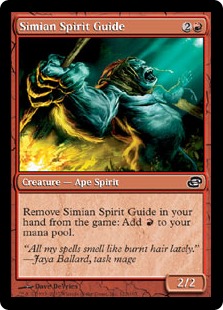
The sole purpose of Simian Spirit Guide here is to cast Cathartic Reunion on turn one, to cast two of the one-mana looting spells on turn one, or to flashback Faithless Looting on turn two—all in the hopes of killing your opponent on turn three. Unlike Mox Opal, adding Simian Spirit Guide to Dredge didn't require changing any other slots, with the fact that it only makes red mana only mattering occasionally.

This list is still pretty fresh, and you can make the argument that this isn't the best build of Dredge, but that argument doesn't really promote the position that Simian Spirit Guide is a positive feature of Modern. It is true that this is just one data point, so let's take a look at what else Simian Spirit Guide is up to. The finals of the most recent SCG Classic is a good place to look—both sides of the finals at that.

Sun and Moon, by Todd Stevens (1st, SCG Knoxville Classic)

Creatures

1 Emrakul, the Aeons Torn
4 Simian Spirit Guide

Instants

1 Blessed Alliance
4 Lightning Helix

Sorceries

3 Anger of the Gods
2 Wrath of God

Artifacts

4 Chalice of the Void

Enchantments

1 Banishing Light
4 Blood Moon
2 Journey to Nowhere

Planeswalkers

1 Ajani Vengeant
2 Chandra, Torch of Defiance
2 Gideon Jura
4 Nahiri, the Harbinger

Lands

1 Mountain
9 Plains
4 Arid Mesa
1 Needle Spires
3 Rugged Prairie
2 Sacred Foundry
4 Temple of Triumph
1 Gemstone Caverns

Sideboard

3 Leyline of Sanctity
3 Rest in Peace
3 Stony Silence
2 Blessed Alliance
1 Ravenous Trap
1 Elspeth, Sun's Champion
1 Anger of the Gods
1 Wrath of God

Titan Breach, by Clayton Vogelgesang (2nd, SCG Knoxville Classic)

Creatures

4 Primeval Titan
4 Sakura-Tribe Elder
4 Simian Spirit Guide
1 Obstinate Baloth

Instants

4 Lightning Bolt
4 Summoner's Pact
4 Through the Breach

Sorceries

3 Anger of the Gods
3 Farseek
4 Search for Tomorrow

Lands

2 Forest
6 Mountain
1 Blood Crypt
3 Bloodstained Mire
2 Cinder Glade
4 Stomping Ground
3 Valakut, the Molten Pinnacle
4 Wooded Foothills

Sideboard

2 Relic of Progenitus
2 Obstinate Baloth
2 Reclamation Sage
2 Ancient Grudge
2 Pulse of Murasa
3 Sudden Shock
2 Slaughter Games

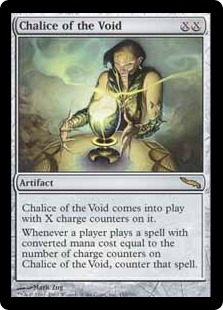
It's easy to mistake Sun and Moon for something it's not. Sure, it has midrange planeswalker elements, but fundamentally it's a turn-one or -two Chalice of the Void/Blood Moon prison deck. Technically it gets wins in other ways, though the deck is only competitive because of the ability to power out oppressive permanents that prevent opponents from playing Magic.

Chalice of the VoidUnlike Lantern Control, artifact hate won't really help you here, as you'll only have one target for it. The impact of Simian Spirit Guide is that it takes this slower prison deck, and gives it the potential to functionally win the game on turn one. Chalice of the Void is a pretty heinous card, but if you can play your one-mana spell, say a Thoughtseize, on turn one, its presence is totally fine. It's the fast mana that is the deal breaker.

In Valakut decks, Simian Spirit Guide is just there to enable more turn-three Through the Breaches. Search for Tomorrow is a staple of ramp decks, letting you ramp your mana on turn one and get to five mana on turn three, and Simian Spirit Guide supplements these fast kills. It takes away some consistency from the deck, but it enables difficult-to-interact-with fast kills. It does give you fewer topdecked Mountains once you have an active Valakut, the Molten Pinnacle, though this is a minor deckbuilding cost to be more competitive with the fastest decks in the format, which are generally the Valakut decks' worst matchups.

Costs and Benefits

Ultimately, the costs of putting Mox Opal and Simian Spirit Guide in your deck are very different, with SSG being much less demanding. The current payoffs are similarly unequal. Opal lets your deck play the game faster, but only by interacting or presenting strategies that can be interacted with. Simian Spirit GuideSpirit Guide speeds up wins that defy interaction. Yes, they're both fast mana, but not all fast mana is equally degenerate.

An argument I'm more sympathetic to is that Simian Spirit Guide[mtg_card] really only rears its ugly head when the rest of the format is oppressively fast. It was a tool available to Valakut decks previously, though the hit in consistency was generally considered too steep of a cost. It's entirely possible that if you ban something out of Dredge and/or [mtg_card]Mutagenic Growth, you might see the Simian Spirit Guides disappear from the format. But the fact remains that the card can slot in to most any strategy that's just looking to kill a little faster at a very low cost. Minimally, this is something to monitor.

Blanket categories tend to hurt more than they help when it comes to high-level discussion of a topic, and I hope I've done a good job of illustrating why Simian Spirit Guide is more problematic than Mox Opal. I will reiterate that I don't expect a Spirit Guide ban with the Aether Revolt update. But the argument for one is sound, and should be an independent discussion from that of Mox Opal.

Thanks for reading.

-Ryan Overturf
@RyanOverdrive on Twitter

Early Aether Revolt Spoilers

Are you a Quiet Speculation member?

If not, now is a perfect time to join up! Our powerful tools, breaking-news analysis, and exclusive Discord channel will make sure you stay up to date and ahead of the curve.

Promotional materials for Aether Revolt Game Day have popped up on the internet, featuring a couple spoiled cards. A Reddit thread for the discussion thereof can be found here. The biggest reveal from this poster is Yahenni's Expertise, which reads as follows:

Yahenni's Expertise
2BB Sorcery (Rare)
All creatures get -3/-3 until end of turn.
You may cast a card with converted mana cost 3 or less from your hand without paying its mana cost.

It's unclear if this will be the only card with this type of effect or if there will be other spells that enable you to cast other spells, though this one has definitely caught plenty of attention. People are talking about using this to cast suspend spells and split cards in Modern. A four mana soft sweeper doesn't excite me for Modern play, but speculation is often based on hype rather than results.

If there are other cards with this ability to cast other spells, we could end up seeing something that is great in Modern, though one way or another people are talking about Boom // Bust and Ancestral Vision right now. Beck // Call and Restore Balance are also getting some attention. This looks like a great opportunity to pick up some copies of these cards to flip back into the hype and/or to watch out for a more playable card with this mechanic.

Avatar photo

Ryan Overturf

Ryan has been playing Magic since Legions and playing competitively since Lorwyn. While he fancies himself a Legacy specialist, you'll always find him with strong opinions on every constructed format.

View More By Ryan Overturf

Posted in FreeTagged , , , 1 Comment on Early Aether Revolt Spoilers

Have you joined the Quiet Speculation Discord?

If you haven't, you're leaving value on the table! Join our community of experts, enthusiasts, entertainers, and educators and enjoy exclusive podcasts, questions asked and answered, trades, sales, and everything else Discord has to offer.

Want to create content with Quiet Speculation?

All you need to succeed is a passion for Magic: The Gathering, and the ability to write coherently. Share your knowledge of MTG and how you leverage it to win games, get value from your cards – or even turn a profit.

Infographic – The Value of Standard Sets

Are you a Quiet Speculation member?

If not, now is a perfect time to join up! Our powerful tools, breaking-news analysis, and exclusive Discord channel will make sure you stay up to date and ahead of the curve.

qs_201607_last-sets-value-01

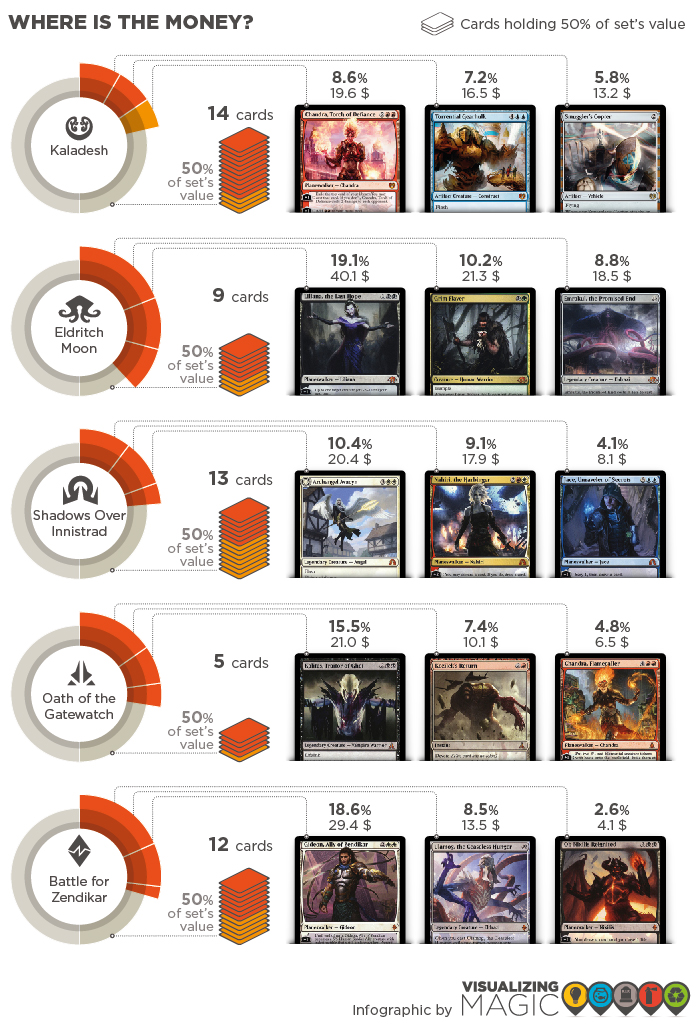
Where is the Money?

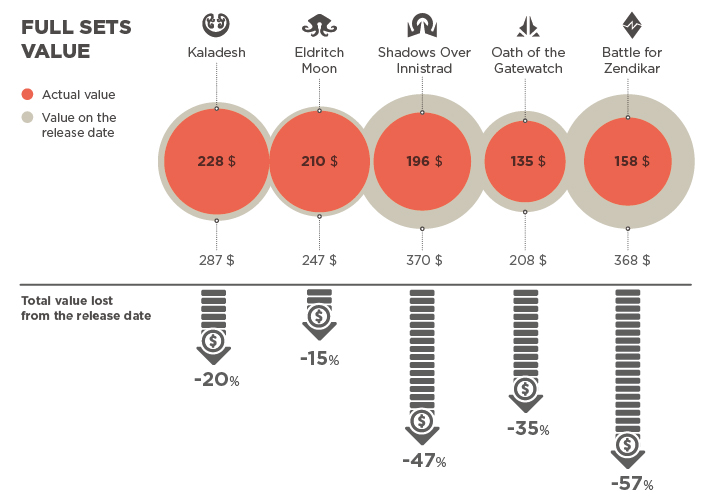
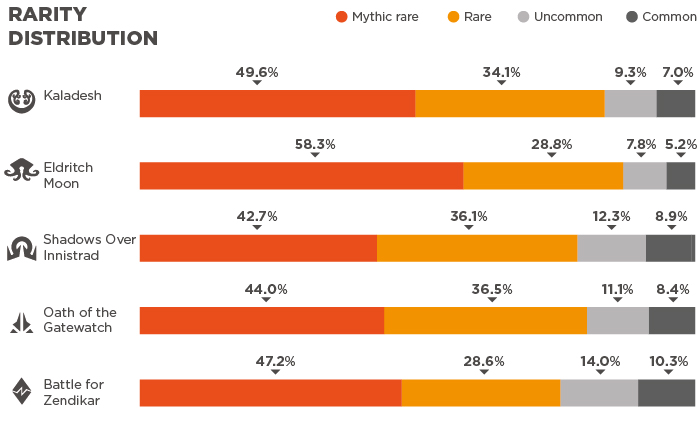
We all know every set loses most of its value a few weeks after release, but it is worth knowing what happens to the value of older sets. Below is a comparison between the value of a complete collection of all Standard-legal sets today and their value at the time of release, along with some other interesting details such as value by rarity and the percentage of the set's average value by rarity.

qs_201607_last-sets-value-03

Predictably, the more time passes the more sets tend to lose most of their value. It’s especially interesting to note that sets with great expectations from players – namely SOI and BFZ – dropped in value significantly more than the others.

I decided to compare full-set values instead of a box's expected value in order to avoid variations from Wizards's latest marketing choices (Masterpieces, Expeditions). While it's true that this has led us to compare sets made of different quantities of cards, this doesn't matter a lot since most of the value is held by just a few rares and mythics.

qs_201607_last-sets-value-02

The vast majority of the value of every single set is held by rare and mythics, leaving only 20 percent of a set's value to the lower rarities.

But we can dig deeper – and we will! – to discover where the real value of any set is held: here's how many cards per set hold half of the total value, plus each set's three most valuable cards.

qs_201611_last-sets-value-04

As always, let me know if you have any comments or suggestions for future infographics!

Insider: MTGO Market Report for November 30th, 2016

Are you a Quiet Speculation member?

If not, now is a perfect time to join up! Our powerful tools, breaking-news analysis, and exclusive Discord channel will make sure you stay up to date and ahead of the curve.

Welcome to the MTGO Market Report as compiled by Matthew Lewis. The report will cover a range of topics, including a summary of set prices and price changes for redeemable sets, a look at the major trends in various Constructed formats and a "Trade of the Week" section that highlights a particular speculative strategy with an example and accompanying explanation.

As always, speculators should take into account their own budgets, risk tolerance and current portfolios before buying or selling any digital objects. Please send questions via private message or post below in the article comments.

Redemption

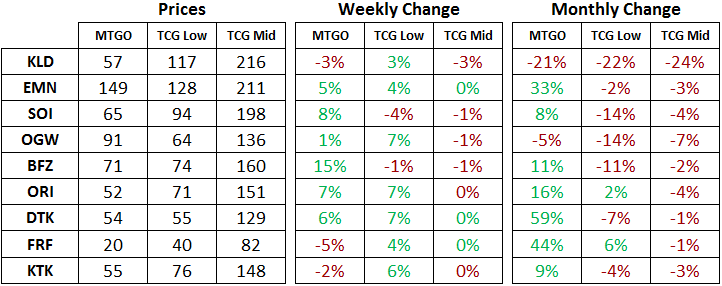
Below are the total set prices for all redeemable sets on MTGO. All prices are current as of November 28, 2016. The TCGplayer low and TCGplayer mid prices are the sum of each set's individual card prices on TCGplayer, either the low price or the mid price respectively.

All MTGO set prices this week are taken from GoatBot's website, and all weekly changes are now calculated relative to GoatBot's "full set" prices from the previous week. All monthly changes are also relative to the previous month's prices, taken from GoatBot's website at that time. Occasionally, full set prices are not available, and so estimated set prices are used instead.

nov28

Outside of Kaladesh (KLD), prices continue to rise on MTGO this week, with Eldritch Moon (EMN) leading the way as the most expensive set in Standard. It's now up 80 percent from its low of 83 tix in September. Shadows over Innistrad (SOI) is also finally getting in on the act with an 8-percent increase this week. SOI is still cheap relative to its paper price, and it compares well with other redeemable large sets, so I am anticipating further price gains over the next month.

Battle for Zendikar (BFZ) jumped 15 percent largely on the back of Gideon, Ally of Zendikar, which set a new all-time high of close to 37 tix. Oath of the Gatewatch (OGW) has languished in comparison, with that set's top card, Kalitas, Traitor of Ghet, dropping below the 20-tix mark for the first time in two months.

There was an error retrieving a chart for Kalitas, Traitor of Ghet

For the recently rotated sets, both Magic Origins (ORI) and Dragons of Tarkir (DTK) rose this week on MTGO. It looks like interest in Modern and the relative price differential with paper is driving their digital prices higher. Paper prices on these two sets are stabilizing and this will be constructive for digital prices going forward.

Flashback Draft of the Week

The second visit to the plane of Ravnica is the setting for this week's flashback draft. Triple Return to Ravnica (RTR) draft features the reprinted shocklands and the old Standard powerhouse Sphinx's Revelation. There is also Rest in Peace in the rare slot, a powerful sideboard card in Modern and the highest priced rare in the set at 6 tix. Another card to watch out for is Jace, Architect of Thought. It hasn't shown any utility in the current Modern format, but it has popped up in the past and has been as high as 10 tix in the past twelve months.

There was an error retrieving a chart for Sphinx's Revelation

The draft format focuses on five of the ten guilds, with the other five guilds covered next week with triple Gatecrash (GTC) draft. If you are into podcasts, Limited Resources is excellent and does an overview of each of the guilds and how to draft them in this episode. Trying to figure out which cards are important for a particular guild and which guild is open in the draft will carry you to success for triple RTR draft.

The Future of Standard Speculation on MTGO

With the shortening of the redemption window for Kaladesh (KLD) and all future sets on MTGO, speculators will have to make adjustments to their strategies. No longer will redemption provide a price floor on Standard sets; the price of KLD cards will fluctuate with the vagaries of supply and demand. As a result, we'll have to put aside all strategies related to redemption. This means that buying full sets at the end of a set's draft period will no longer work, nor will targeting full sets as they rotate out of Standard. Junk mythic rares will end up being pure junk as soon as redemption closes.

There was an error retrieving a chart for Blood Moon

Fortunately, we already have ample evidence there there are successful speculative strategies for non-redeemable objects. Most Modern-legal cards are digital objects that cannot be translated into paper. Take for instance, Blood Moon. The last time this card was redeemable was about ten years ago, since Modern Masters (MMA) was not redeemable. It has regularly fluctuated between 20 and 40 tix in the last two years and is now at an all-time high of almost 50 tix. Buying this card when interest in Modern is on a downswing and then patiently holding for a number of months has proven to be a profitable strategy. And Blood Moon is not an exceptional card. There are many Modern staples that regularly cycle up and down in an almost predictable way.

Having such a clear example to guide us, it's safe to say that cards from KLD and Aether Revolt (AER) will also experience their own price swings up and down, depending on rising and falling interest in Standard and Modern. Once redemption on these two sets ends in May, supply and demand from within the MTGO economy alone will dictate the price of cards like Smuggler's Copter and Chandra, Torch of Defiance.

There was an error retrieving a chart for Smuggler's Copter

Previously the prices of cards being drafted would generally bottom out just prior to the release of the newest set and draft format. The two lowest-risk moves you could have made in the last year would have been to buy OGW sets in April and EMN sets in September. These two expansions both saw price increases of 50 percent or more in the weeks after they stopped being heavily drafted. Redemption provided the trust that that total set price would be relatively stable, so there was no need to try and pick out which cards would be the most valuable. Just buy them all!

If KLD and AER would have been redeemable like every other past set, then buying complete sets sets in April would have been a fine strategy. As it stands, though, the end of redemption means that the price of these sets could bottom after the close of redemption. Redemption will be closing in the month after the introduction of Amonkhet into Standard, so there will be competing forces acting on prices. Demand could be up due to renewed interest in Standard, while supply could be high due to redemption closing. Speculators will have to be more cautious on timing their buys as a result.

I suspect there will be a spike in demand just prior to the end of redemption. Anyone who had been thinking about redeeming a set will have to complete their sets by the redemption deadline. The marginal cost of completing the set will be small relative to the sunk cost of the rest of the set already in their collections, so they will be looking to complete their sets and they won't be as picky in terms of price.

Once the window to redeem these sets closes, then any bag holders will be looking to sell their cards. As a result, prices will decline as these stranded assets hit the market. Junk mythic rares in particular will find new all-time lows; I would expect some KLD mythic rares to sell for less than 0.01 tix by June.

There was an error retrieving a chart for Deploy the Gatewatch

Part of the challenge for speculators will be to avoid buying the cards that are pure junk since these will no longer have a price floor provided by redemption. This is the easy part, as most rares priced in the 0.05 to 0.50 tix range are closer to junk than not. Mythic rares in the 0.2 to 1.00 tix range are the same. If you are buying cards in these price ranges, then you are targeting very marginal cards that will lose almost certainly lose value after redemption closes.

If you are buying rares for 0.01 tix or mythic rares for 0.05 tix or less, then you are in the pure junk category already and the loss of value from redemption closing will be small. Buying cards at these prices will be a gamble based on their take up in Standard or Modern. Essentially you would be betting that these cards are not, in fact, pure junk and that they will be played at some point. I think it's a fine gamble if you have a knack for identifying cards that are underappreciated.

The rest of the challenge will be for speculators to be brave and to buy cards that are no longer tied to anything with physical value. If you are comfortable doing that, then buying Standard and Modern staples and playables from KLD and AER in the late spring will be a profitable strategy. Patience will be required as usual, but I have no doubt that the changes to redemption will not impact the speculative potential for these sets. The end of redemption means that speculators will have to be more careful about managing their downside risk, but the upside will still be dictated by supply and demand in the MTGO market, which is still dominated by players and the in-game value of the cards.

Trade of the Week

As usual, the portfolio is available at this link. This week I bought a few copies of Cavern of Souls at the conclusion of the triple Avacyn Restored flashback draft queue. An all-format staple in multiple archetypes is about as much of a no-brainer speculation target as you can get. All you have to do is poke around for the lowest priced playsets near the end of the flashback queue and throw them into your portfolio. Typically the prices rebound in the following month to a break-even level, with further gains entirely possible. This one is no different and it is already at a price where I could sell my copies at no loss, if I had to get liquid for some reason.

There was an error retrieving a chart for Cavern of Souls

Modern prices are currently in an uptrend and I will look to sell this position before the end of February. I'm not too concerned about what price it reaches, but if it gets into the 35 to 40 tix range, I would consider that a good selling price. The bigger concern is the threat of this card being reprinted. Holding Modern staples into the late winter will have rising reprint risk as we get closer to the release of Modern Masters 2017 (MM3) and its attendant spoiler season. The release date for MM3 is set for March 17, 2017.

Anticipating the RPTQ Metagame

Are you a Quiet Speculation member?

If not, now is a perfect time to join up! Our powerful tools, breaking-news analysis, and exclusive Discord channel will make sure you stay up to date and ahead of the curve.

I just remembered something: the RPTQ I qualified for is next week. For some of you, it's this weekend but for me, that's GP Denver. As a result, Standard has unfortunately taken up almost all of my Magic time recently. I know many people think that Modern is broken and unhealthy, but I assure you: Standard is far worse. Modern at least has considerable deck diversity and the potential for any deck to win. There are two decks with reasonable expectations of success in Standard. Everyone else is hoping to get lucky.

time-walk-banner-cropped

But this is Modern, not Standard, Nexus so enough complaining about that. Instead, lets focus on what being distracted by the inferior Magic format means for my RPTQ chances and what I'm doing to correct for that oversight. At this point, extensive testing is impossible. The GP is my focus this week by necessity. Once that is over I will have less than a week to prepare for the RPTQ. That's not enough time for my usual extensive testing method. I need an alternative, and this means trying to metagame the tournament. The question is where to start.

[wp_ad_camp_1]

A Problem of Scale

The obvious place is the tournament itself. This will be an RPTQ, one of a number held in the second week of RPTQ competition. Obviously I can expect that this will be larger than your become immensetypical PPTQ or IQ but not as large as an Open. The initial assumption therefore is that it will be roughly States-sized or smaller. This is complicated by a few factors that I will discuss shortly. On its face therefore, I would expect an RPTQ to have attendance around 50 players. This is backed up from what I've seen of RPTQs held locally before.

As a result I don't expect the actual attendance to reflect the overall metagame. The larger your sample size, the more likely it is to accurately reflect reality. This is basic statistics. The smaller the sample size, the more likely it is for outliers to dramatically influence the result. As a result I cannot expect any of the overall metagame breakdowns available to be accurate to the metagame I will actually face at the RPTQ. Individual preference and local warps will have far more impact and higher population than what you'd see at an Open. This limits the usefulness of the available data to my quest.

A Question of Timing

The other main problem is when this RPTQ is being held. The first week is concurrent with GP Denver. This will have an impact on attendance at the RPTQ the weekend afterwards. In a "normal" RPTQ period you would expect the out-of-state players to fairly even distribute themselves between the available RPTQs. In Colorado's case this means that you would expect them to spread out between Nebraska and Utah relatively evenly. I expect this on the basis that players will independently determine which weekend works best for their own schedule and travel with those similarly inclined rather than a team dictating the location of travel. This comes from discussions in the community and experience with arranging such travel.

However, there is a GP in Denver. reflector-magePlayers who grind PPTQs are likely to also play a GP, especially when it is held locally. As a result, I anticipate that most of Colorado's RPTQ-qualified players will be at the GP instead this weekend. Additionally, it is not unreasonable to expect that players from surrounding states who would have normally attended the Lincoln RPTQ will instead go to the GP.

As a result I expect that the Utah RPTQ I will be attending will also be attended by a higher-than-normal number of grinders from the mountain region. Higher attendance would push the metagame towards the national average, but not by enough to change things significantly. What I'm certain it will do is make the quality of the competition much higher than expected. If those qualified players who think they can place at a GP actually attend the RPTQ, then I'm looking at a real shark tank. Were it not for the GP, a number of those players would have gone to a different RPTQ and the total competition would be lower.

Putting It Together

Therefore, I am expecting a higher-than-average turnout of very good players for my RPTQ in two weeks. I cannot rely on metagame data to help inform my decision and I know that the turnout will be warped due to other tournaments. On the face of it, I don't have a hope of making an informed decision of the metagame.

Were I trying to approach things as a true outsider I might give up at this point and just try to make my deck fit the national trends. However, I'm not an outsider. I've been part of the grinder community in this region for so long I have additional knowledge that I can pull in to assist me in building an expected metagame. It won't be perfect—and it has been a while since I played in Utah—but if I couple this information with additional analysis I can at least make an educated guess.

The Player Factor

Some states have a reputation about their Magic communities. I don't know what yours is, but Colorado is a red state. As long as I have been playing competitively, we have been known for Burn and red aggro decks. And it tends to play out in practice as I saw back in February. This would lead me to expect a red-centric metagame, but that's not really good enough. Utah Magic is different and I can't imagine that all of their qualified players won't be there. Utah has at various times been in step with Colorado but frequently it wildly deviates. I need to do better.

If you grind a lot, you end up playing against the same group of players pretty consistently. Thing in the IceAs a result, you get to know their tendencies and deck preferences. As a result, when I search for players qualified for this RPTQ from Colorado, I know which decks won without actually having to ask them. And what I see suggests a very diverse collection. There are a lot of control players present, in addition to a strong showing from Gruul aggro players. More surprising to me are the number of combo players, many of whom are known for oddball brews. On balance it appears that blue and red will be strongly represented while Jund and Infect will be rare. This suggests that Colorado's delegation at least will tend towards less played archetypes. I also know that most of them will definitely play the GP, so if they play the RPTQ, it will be in Utah with me.

Of course this will account for less than half of total attendance assuming something weird doesn't happen, so is there anything else I can deduce? Not directly. I don't know the other potential participants well enough to make any guess. But I can look elsewhere for guidance.

Deck Selection Bias

I realize that this is well beyond broken-record territory at this point, but playing what you know is the key to success in Modern. I'm confident in my read of the Colorado delegation because I've seen them play these decks at multiple events over many months. The players that win are very good at playing their decks because they put the time in to master them. It is unlikely that they will throw all that away, especially if they don't have unlimited time to learn a new deck.

It is reasonable to assume that this will also be true for the non-Colorado players. They are more likely to play a deck they know. I may not know what they actually play from experience (and trying to tease it out by searching tournament results is time-consuming), but there is a way I can make an educated guess about their decks. The qualifier season ran from the end of July until the beginning of October. Most of the PPTQs were held in August and September, and the July and October results were close enough that they probably included the same trends as we saw then. Thus the decks that were winning in those months are more likely to be decks that I will see in Utah.

The August Metagame

August was an unusual month in that it was really a continuation of trends from July. There wasn't much movement in the top-tier decks and it looked like the metagame had settled. For reference, this is what Tier 1 looked like:

Tier 1: 8/1/16 - 8/31/16

DeckOverall
Metagame %
Paper %MTGO %
Jund10.2%8.7%9.3%
Burn6.6%8.0%3.7%
Affinity6.5%6.5%7.8%
Eldrazi6.3%4.4%11.5%
Infect5.9%6.6%4.3%
Merfolk4.9%4.4%7.1%
Dredge4.4%3.7%7.1%
Jeskai Control4.2%3.9%2.2%
Death's Shadow Zoo3.8%2.6%7.5%

Linear aggro decks dominated the tier, but Jund sat comfortably on top. This makes sense; the best interactive deck preyed on all the uninteractive decks. The fact that it was doing this for the second month in a row is a testament to its power and consistency. It's why Jund has always been a very solid choice regardless of the rest of the metagame. If you were playing Jund back then, you'll probably be playing Jund now. The rest of upper Tier 1 was made up of the usual suspects of Burn, Infect, Affinity and Eldrazi. You always see these decks, and as a result I would reason that players who qualified this month were primarily linear aggro players with Jund being a strong addition.

The September Metagame

September was a weird month. The membership of the metagame pinnacle didn't change, but their order and representation did. What appeared to happen was players reacted to the trend from July and August and as a result Jund was dethroned.

Tier 1: 9/1/16 - 9/30/16

DeckOverall
Metagame %
Paper %MTGO %
Bant Eldrazi9.2%6.4%5.1%
Burn8.1%8.1%6.1%
Infect7.6%6.5%3.4%
Affinity7.5%6.0%8.4%
Jund6.5%7.7%4.1%
Dredge4.2%2.8%6.8%
Abzan4.0%4.7%4.4%

As Jason explained in the article, it appeared that Bant Eldrazi took advantage of Jund's dominance and fed on those decks to rise to the top of the metagame. With less Jund around, the decks that Jund was holding down like Infect and Affinity were able to rise. Burn's rise is less explicable, but the end result of all of this is that the population of the top of Tier 1 is effectively equal. Average the population between the two months and you'll see that they're very close. Dredge also had a very consistent performance. This backs up their perceived strength and makes it highly likely that more players qualified using these decks than any others. Not all the PPTQ wins were these decks of course, but it is more likely that these decks did well than any other.

The Likely RPTQ Metagame

This leads me to an interesting conclusion. On the one hand, there was a very consistent trend from the months of the PPTQ season, and thus a reasonable likelihood of Jund, Affinity, Infect, Eldrazi, Burn, and Dredge being highly represented. On the other, I have predicative knowledge about a significant portion of the likely deck population thanks to experience. The Colorado delegation will not be representative of the metagame trend and will feature far more fair and unfair decks than the metagame would predict. The question that leaves is how to reconcile this information and form a useful conclusion.

Lightning BoltI think in this case it will be useful to group results and focus on the broad archetypes rather than look at specific decks. I know there will be a lot of linear aggro decks of varying types. Against linear aggro you either want to be consistently faster than they are (no mean feat in Modern), or more interactive. I don't play any of the decks I identified as probable competitors, and there really aren't decks faster than those, so I need to be more interactive.

The second category will be fair decks, with Jund being most popular, followed by blue control. To beat these decks you either deny them the ability to interact or win the attrition war. They have enough cheap interaction to make the first option spotty, but I have a number of ways at my disposal to win an attrition fight.

The final category are the unfair decks: Dredge mostly, followed by unusual combo decks. These can be beaten by a combination of fast clocks and powerful hate cards. I prefer decks like this, so this will mostly be a side note. As a result, you can probably guess I will be focusing on finding the right Merfolk configuration based on my analysis here.

Is this a perfect system? Not in the slightest. But if you're like me and facing a major time crunch right before a major tournament, this is a good method for focusing your testing. It cannot replace the months of tuning and refining that you really should favor, but it is much more valid than guessing and hoping for the best.

Infographic – Standard’s Most-Played Cards

Are you a Quiet Speculation member?

If not, now is a perfect time to join up! Our powerful tools, breaking-news analysis, and exclusive Discord channel will make sure you stay up to date and ahead of the curve.

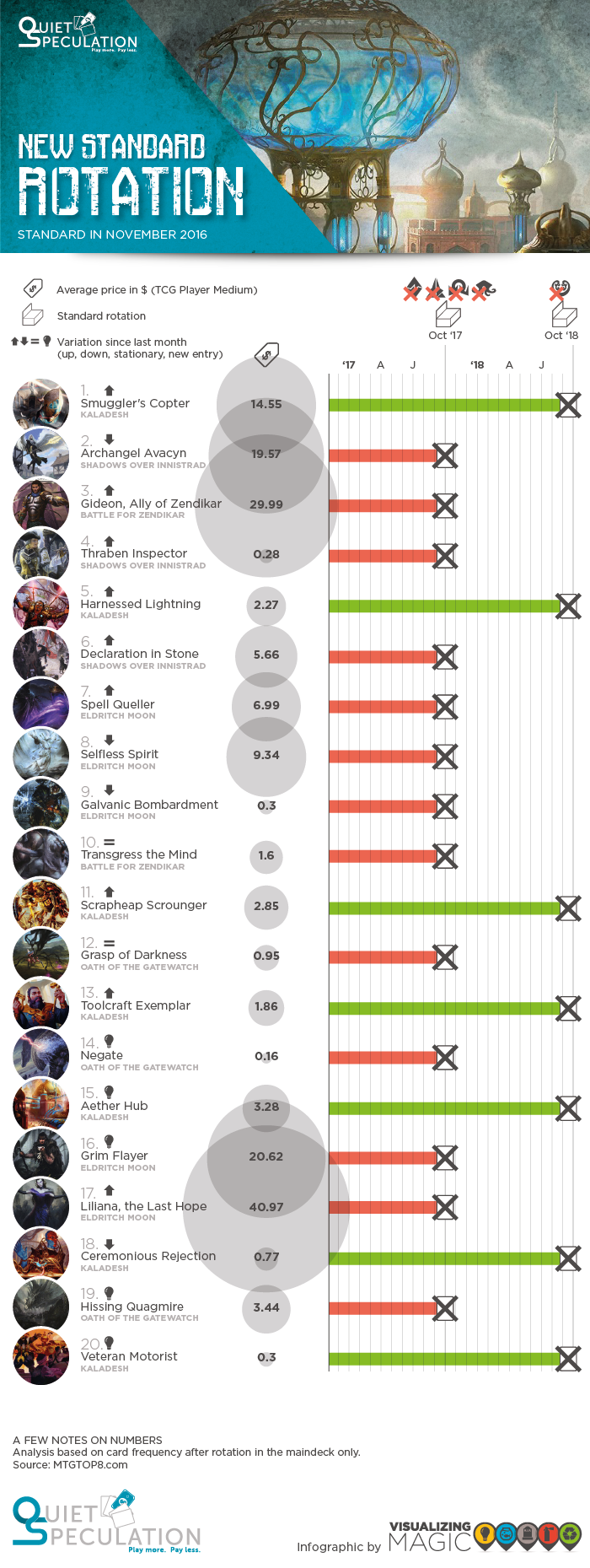
[Editor's note: We had some technical difficulties with this one, so the prices below reflect information from about two weeks ago. However, we decided this graphic was still valuable, as each and every card on the list is within about 10 percent of its value at the time this was made – we individually double-checked each card to be sure. The moral of this story: when the Standard metagame is extremely stable, prices are too. Enjoy!]

qs_201611_a-most-played-cards-in-standard-01

Avatar photo

Diego Fumagalli

I have played Magic since Revised edition, a hobby that has followed me my entire life. I recently started creating infographics and using data visualization--a great game deserves a great communication tool!

View More By Diego Fumagalli

Posted in Free, StandardLeave a Comment on Infographic – Standard’s Most-Played Cards

Have you joined the Quiet Speculation Discord?

If you haven't, you're leaving value on the table! Join our community of experts, enthusiasts, entertainers, and educators and enjoy exclusive podcasts, questions asked and answered, trades, sales, and everything else Discord has to offer.

Want to create content with Quiet Speculation?

All you need to succeed is a passion for Magic: The Gathering, and the ability to write coherently. Share your knowledge of MTG and how you leverage it to win games, get value from your cards – or even turn a profit.

Insider: The Black-Green Menace and Its Blue-White Nemesis

Are you a Quiet Speculation member?

If not, now is a perfect time to join up! Our powerful tools, breaking-news analysis, and exclusive Discord channel will make sure you stay up to date and ahead of the curve.

A couple weekends ago, I watched most of the Star City Open in Knoxville. If you caught any coverage of this event or looked over the top 32 deck lists, then you know that Black-Green Delirium is seriously dominating in Standard right now. I knew a lot of players were rocking this deck, but I had no idea the format was skewed this far. The top 32 was littered with copies of this deck. I was astonished that there were 15 copies in the top standings of this event. Fifteen copies! That’s nearly half of the top 32. Here’s the complete archetype breakdown.

15 BG Delirium
10 UW Flash
1 Jeskai Control
1 WR Midrange
1 WR Vehicles
1 WR Humans
1 Mardu Vehicles
1 BG Aetherworks
1 BR Zombies

So our metagame right now is basically two decks and some other archetypes trying to regain a foothold. Before actually breaking down the numbers for each deck, it appeared there were more Delirium decks and fewer Flash decks, but both seem to be out of hand. There are similarities in the decks trying to pilot vehicles as well, so we could maybe add that as a third archetype to the meta, but it seems to have been sufficiently hated out at this point. These two decks that have found success are the decks that had positive matchups with the vehicles decks that drove circles around us at the beginning of the format, but I don’t think we’ve adjusted past that point yet.

BG Delirium

To start off today, we need to dissect this deck wreaking havoc on the meta. Take a look at the version that won the tournament.

BG Delirium by Brad Nelson

Creatures

4 Grim Flayer
1 Tireless Tracker
2 Pilgrim's Eye
3 Mindwrack Demon
3 Ishkanah, Grafwidow
1 Noxious Gearhulk
1 Emrakul, the Promised End

Spells

4 Traverse the Ulvenwald
1 Transgress the Mind
3 Grapple with the Past
3 Vessel of Nascency
4 Grasp of Darkness
1 Ruinous Path
2 Murder
4 Liliana, the Last Hope

Lands

1 Evolving Wilds
4 Blooming Marsh
4 Hissing Quagmire
7 Forest
7 Swamp

Sideboard

2 Pick the Brain
1 Ob Nixilis Reignited
1 Kalitas, Traitor of Ghet
2 To the Slaughter
3 Natural State
2 Dead Weight
2 Transgress the Mind
1 Emrakul, the Promised End
1 Tireless Tracker

I can’t stop thinking about this deck. I keep thinking: what makes this deck so good? When I look over this deck list and inspect it card by card, none of the components seem too powerful that they should be taking over a format like this. There are some cards that stand out in power level though.

There was an error retrieving a chart for Grim Flayer

One reason why this Delirium deck is consistently powerful is because of Grim Flayer. Once I made the connection that Grim Flayer is Standard’s Tarmogoyf, the pieces of the puzzled started clicking in place. This happened in conjunction with a conversation my friends and I were having about how this deck was basically the same as Jund. It’s a midrange deck with removal spells and a little bit of built-in virtual card advantage. Grim Flayer is the set up for all these pieces to fall into place as well.

One of the best advantages of Grim Flayer so far has been its consistent price. Despite most of the other Standard cards dipping value, Flayer has had a steady price. Not only has it seen some modest amounts of Modern play, but as a Staple of Standard, I expect it to continue to hold strong.

There was an error retrieving a chart for Liliana, the Last Hope

Liliana, the Last Hope is the main reason that aggressive strategies have trouble against BG Delirium. Not only does this deck provide big bodies to clog the ground with, but it also shrinks or kills the little dudes that try to swarm the board. That’s why UW Flash has a decent matchup against the deck – not many of its creatures are effected by the shrinking ability as they would be in another deck.

I feel like I’ve adjusted the price on Liliana so many times since her release but I think she’s stabilized now at just under $40. This Liliana is also following the same pattern as Grim Flayer, with some play in Modern and as a mainstay in Standard so I’d expect their price models to flow similarly.

There was an error retrieving a chart for Mindwrack Demon

For some reason, Mindwrack Demon flew under the radar for a long time. When it first came out, I couldn’t keep them in stock, but yet no one seemed to be playing them competitively. Yet I had to buy them very aggressively just to keep them in stock. When Kaladesh was released, one of the decks I worked a ton on looked a lot like this Delirium deck, except I tried to squeeze in some of the emerge dudes too. Now we have a streamlined version of the deck with Mindwrack as a big part of the strategy.

One of the best aspects of this flyer is that it can block the other flyers in the meta like Smuggler's Copter or Spell Queller. Flying is super important right now, as it’s really the flyers fighting against the flyers. All other creature decks are at a disadvantage because they cannot block any of the flyers from the two dominant decks.

Even as an essential part of the Delirium puzzle, Mindwrack still is not very valuable. The main factor to remember here is that this mythic was released as a Dual Deck foil, so the market has many more copies than it otherwise would. Without this promo holding the price down, I think we’d be seeing a $10 or more price tag on this one.

There was an error retrieving a chart for Ishkanah, Grafwidow

Finally, the true powerhouse of Standard’s number-one menace is Ishkanah, Grafwidow. Iskhanah is the Broodmate Dragon or Wingmate Roc of this archetype. She’s the windmill slam that stabilizes the board or halts the attacks of your opponents so that you can take the winning position. Without this legendary spider, the best deck in Standard likely wouldn’t be the best deck at all. It would still have Mindwrack to help with opposing flyers, but I don’t think that would be enough in the current meta.

With how impactful this creature is, I was surprised the price came in under $10. I think the comparison to Wingmate Roc is a great one, because their prices seem to be following the same patterns. I think it would take a lot for the Grafwidow to bump up above her current price point.

UW Flash

The other deck wrecking tournaments lately has been UW Flash. This deck should surprise no one because it was a solid contender last season and it lost very few cards in the transition to this season. Let’s take a look at what this deck is doing.

UW Flash by Chris Johnson

Creatures

4 Thraben Inspector
4 Selfless Spirit
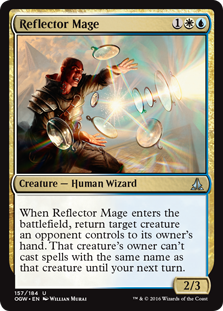
4 Reflector Mage
4 Spell Queller
4 Archangel Avacyn

Spells

4 Smuggler's Copter
4 Stasis Snare
2 Revolutionary Rebuff
1 Declaration in Stone
4 Gideon, Ally of Zendikar

Lands

4 Port Town
4 Prairie Stream
1 Westvale Abbey
10 Plains
6 Island

Sideboard

1 Bruna, the Fading Light
2 Negate
1 Quarantine Field
2 Blessed Alliance
2 Immolating Glare
2 Gisela, the Broken Blade
1 Linvala, the Preserver
2 Jace, Unraveler of Secrets
2 Fragmentize

UW Flash is a great tempo deck that takes advantage of setting back the opponent and uses that time to build their board position. Many of the spells can be played on the opponent’s turn, hence the Flash name. I mentioned a couple weeks ago that players would be drawn to this strategy simply because it plays similarly to previous strategies like this. As it turns out, many players adopted this deck.

Some have put their own mark on the deck by changing up a couple cards in it, but for the most part, the strategy has stayed the same. Some cards you might see are Always Watching, Elder Deep-Fiend or a couple extra aggressive creatures. Other than that, you know what you’re getting into when you sit down across from this deck.

There was an error retrieving a chart for Smuggler's Copter

I know this may seem obvious, but Smuggler's Copter is a really good Magic card. We were all threatened by the blistering speed of WR Vehicles at the beginning of the format, but there turned out to be a strong counter to that strategy. The real home for this vehicle is UW Flash.

It still surprises me that a deck geared towards playing spells on the opponent’s turn would tap mana on its own turn for a card like this, but there's a reason it makes sense. Whenever I’m playing a deck like this, I always want strong threats to play on my turn after playing something on my opponent’s. This way if they deal with my flash threat, my follow-up play will stick. UW Flash does this extremely well with Gideon, Ally of Zendikar, but I think Copter fills this role as well. Usually you want your more expensive spells as a follow-up play, but although it costs two mana, Copter impacts the game like a four-drop.

Additionally, there are some threats like Thraben Inspector and Spell Queller that sometimes sit around unable to attack. We can utilize these cards to pilot the vehicle and still protect whatever spell is locked under Queller.

There was an error retrieving a chart for Spell Queller

Speaking of Spell Queller, one of the best tempo plays you can make in this deck is disrupting your opponent by stealing their play. Spell Queller is a more versatile version of Banisher Priest, except this time you can nab planeswalkers or powerful spells and not just creatures. I don’t think Queller can ever really be impactful in a Lightning Bolt format, and I’m surprised the two-mana answers we do have in Standard, like Harnessed Lightning or Grasp of Darkness, aren’t good enough.

Basically any card you can lock down is a card your opponent doesn’t have access to, and the fewer resources they can utilize, the better. The best play is hitting their most powerful spell, but sometimes it’s good enough to just hit their removal spell. Some decks only run a few removal spells, so if you hide it with Queller, they may not be able get their card back.

I don’t anticipate much growth or decay in the price of Spell Queller any time soon. The current price already seems like a steal to me, but it’s looking quite stable.

There was an error retrieving a chart for Selfless Spirit

Let me shed a little finance perspective on Selfless Spirit for you. Certainly a protection creature like this efficient flyer is a great addition to any deck, and we’ve seen its inclusion in a variety of strategies. We’ve also seen it become yet another card porting over to Modern.

One of the problems with all of these great cards being in the same set is that their prices balance out with the other cards in the set. The total amount a set can be worth has a ceiling, and once the value of a set breaches that peak, dealers will just start opening more product to sell the singles.

Selfless Spirit falls into the category of being impacted by this truth. There are better cards than it in the set, and even though it’s an amazing card, those other cards are still worth more money. So, unless something happens to open up a higher value slot in the set, this spirit will be held in check by the other more valuable cards.

I love the idea of this flyer in Modern though, especially when you can cast Chord of Calling to find it. Hard casting it is fine as well since it provides a relevant clock and prevents your opponent from killing your creatures (other than with Path to Exile).

There was an error retrieving a chart for Archangel Avacyn

Archangel Avacyn is one of the most busted creatures I’ve seen in a long time. At this point, we’ve all been blown out by her flashing in during combat to ruin our attack. If your goal is to flip her, though, that can be a harder job to accomplish than it seems at first glance. This may be a long shot, but I think she might be good enough for Modern since you can hold up counter magic – and then when the coast is clear, flash her in instead.

Financially speaking, she’s been holding steady between $15 and $20 for a while now. When I saw her printed, I knew she would be a format all-star for her duration in Standard. I expect that to stay true as her price should stay stable. She’s a casual favorite, although many casuals think her price is too high and would rather jump on Gisela, the Broken Blade or Sigarda, Heron's Grace.

Where the Meta is Headed

Alright, so we know what the best two decks are – what are we going to do about it? We still have some time until Aether Revolt is released towards the end of January. Will that set shake things up in the metagame? More than likely we will be getting some other artifact tools to work with. Maybe that will help out some preexisting strategies or enable others to emerge.

I don’t think we’re done with this format yet, though. What about the emerge decks? Where have they been lately? I know some players are working on this type of strategy, so maybe it will be the next one to pop back into the meta. There are lots of other decks, like Tokens or Eldrazi, that should have a place but aren’t anywhere to be seen as of yet.

We need to get brewing and stir this Standard pot a bit. A two-deck format is just not acceptable anymore and definitely not what I’m used to. What have you guys been playing? If you’ve been having success with other strategies, please post them in the comments. If I get enough responses, I’ll have a holiday treat for you next week filled with some sweet brews and their spicy financial targets.

Until next time,
Unleash the Force!

Mike Lanigan
MtgJedi on Twitter

Stock Watch- Spike Weaver

Are you a Quiet Speculation member?

If not, now is a perfect time to join up! Our powerful tools, breaking-news analysis, and exclusive Discord channel will make sure you stay up to date and ahead of the curve.

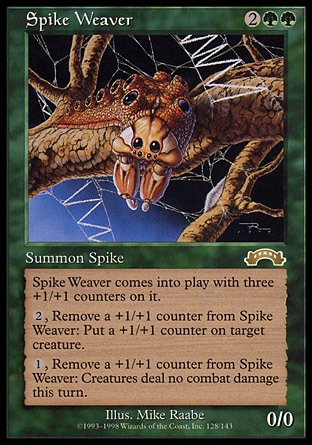
I had my eyes on Contagion Engine as a card that was spiking in price, though Spike Weaver decided to spike harder and disappear off of the internet this week.

There was an error retrieving a chart for Spike Weaver

I would imagine that new demand is due to the same cause as the Contagion Engine spike- Atraxa, Praetor's Voice. The Commander spikes are showing no sign of stopping, and I expect to see more and more throughout the week. I'll admit to not being the most knowledgable on the Commander format, though as we see more and more proliferate-based buyouts, I believe that Inexorable Tide is looking like a great penny stock.

There was an error retrieving a chart for Inexorable Tide

The Modern Masters reprint definitely increased the quantity of these that there are in the wild, though there aren't a ton of listings as of now, and it plays great in a deck focused on proliferating counters, for obvious reasons. The card has seen some small growth, and I expect this to continue.

Insider: Not All Long-Term Specs Are Great

Are you a Quiet Speculation member?

If not, now is a perfect time to join up! Our powerful tools, breaking-news analysis, and exclusive Discord channel will make sure you stay up to date and ahead of the curve.

So a few weeks ago, we had a discussion on the viability of long-term specs in this "new world order" of en masse reprints. The conclusion that I came to is that long-term specs are still a viable strategy, but you have to pick cards with less versatility that were more problematic in development. Stuff like infect, Eldrazi, and suspend have all caused major headaches for Wizards in the past, and they're not exactly chomping at the bit to return to those less-than-beloved mechanics.

We can also use the public announcement schedule provided by Wizards months in advance to plan and deduce where cards are more or less likely to end up. This week, I'm looking to provide the counter argument to my previous article on long-term specs. I don't want that article to be misinterpreted to imply that every long-term spec target is still as easily viable or free from reprints. So with Commander 2016 fresh in our minds, I figured now would be a good time to go over some cards that would have been excellent long-term holds in 2013, but aren't as failsafe anymore.

There was an error retrieving a chart for Deepglow Skate

Deepglow Skate is the big one that gave me the idea for this article. While the card was obviously incorrectly priced at $2 on presales on its first preview day, I've seen some murmurings in my social networks asking if this is the next card to hit big in a couple of years. You can pick them up for $8 right now, but is this something to keep your finger on as more "counters matter" stuff continues to be released? If it dives down to $5 at all, do we want to be stockpiling these for the long-term slope we all like to see on graphs? The five-mana casting cost and "doubling stuff" words make it look similar to Doubling Season, but more than a cursory glance makes it an apples and oranges comparison.

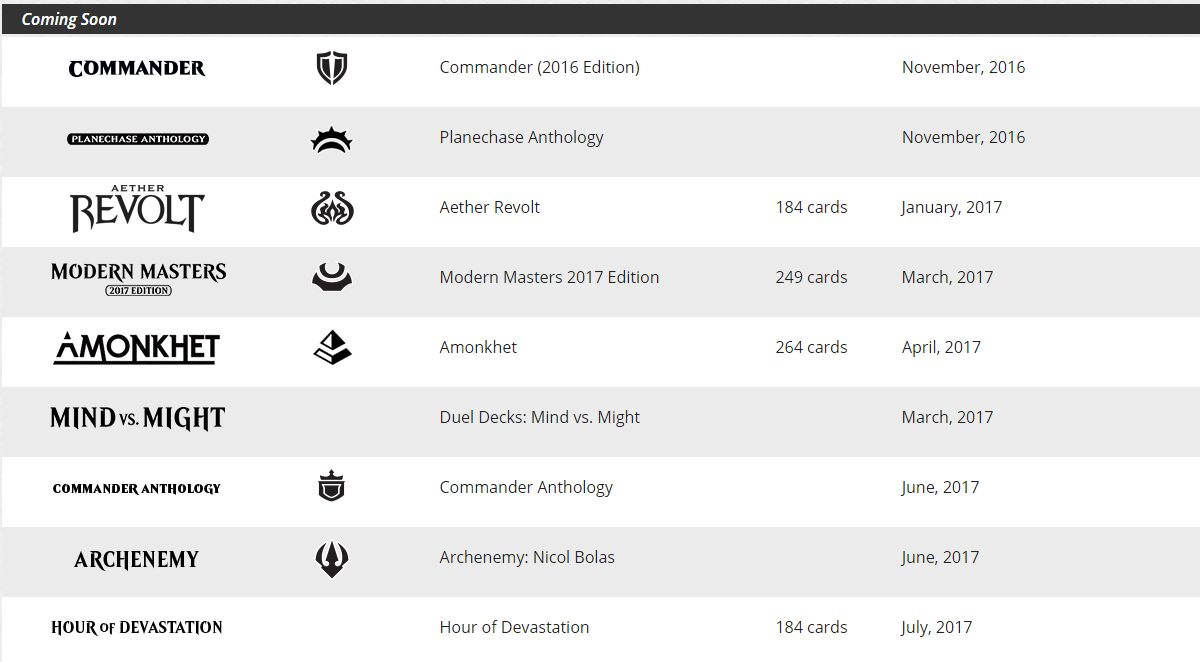
We can use the same announcement data that we've used before to determine that it's unlikely to get a reprint in the next nine months, but this card is absolutely generic enough to get thrown into any number of supplemental products next year.

upcoming-sets

The most important thing here to me is the giant $8 buy-in price tag. We all know I love bulk because of the extraordinary multipliers that stuff can end up seeing with very little effort (Chancellor of the Annex anyone?), but an $8 buy-in?

There's a serious possibility this gets blindsided next year by a Commander 2017 printing, or that it goes in one of the Archenemy printings. The option of "any counter anywhere" leaves it wide open to reprint from a multitude of angles, and I'd much rather just move these with a "buy at $5, sell at $8" strategy instead of gambling a huge margin away on a card that doesn't have any distinguishing features to protect itself from a second printing.

There was an error retrieving a chart for Boundless Realms

I'm in a similar position with Boundless Realms. Riding the 3000-percent multiplier from $.10 to $3.00 was fun and all, but I'm happy to cash out of all of these and not hide them away hoping for a jump to $6 based on slow and steady dwindling supply. Is the card fantastic in a lot of different Commander decks? Absolutely – that's why it spiked and has maintained its post-spike price without dropping a beat.

I still don't want to be hoarding these on a long-term basis.  It could be in one of the Archenemy decks without much difficulty, or in the March Duel Decks product. There's nothing stopping "generic rare ramp spell" from randomly getting slapped by a reprint in the next year, so I want to sell these to all of my customers at $3, then buy in again once the reprint powders it into bulk status. As long as Boundless Realms continues to see play on EDHrec in the big green decks like both Omnath, Locus of Mana, Kruphix, God of Horizons, and Maelstrom Wanderer, then I'll continue to love buying and selling the card. I just don't want to be blindsided by ignoring the fact that this isn't a great long-term spec at $3.

There was an error retrieving a chart for Maelstrom Wanderer

There's a whole pile of casual, mechanic-free, generalized theme cards that fit into this category that I simply don't want to hold onto. It's easy to look at these reprinted cards in particular and say that long-term speculating is dead as a whole, but you just have to pick and choose your battles now instead of casting a blanket net over half the cards in a set.

I'm glad I was able to buy Chasm Skulkers at buylist and sell between $2 to $3 during the past couple of years, and even happier now that it's been reprinted. I know that there will be a whole bunch of Atraxa, Praetors' Voice players in my local group who crack the deck, upgrade it to Infect or Superfriends, and sell me their Skulkers for $.25, while I throw them into the dollar box.

I didn't even want to hold Blade of the Bloodchief once Atraxa was spoiled, because I assumed it would be a shoo-in for the deck. On the other hand, I'm happy to scoop up all of the $3 Laboratory Maniacs because I really don't see a slot for it in the next 12 months that would make any sense. As long as casual players continue to build Leveler/Inverter of Truth decks, Lab Maniac will eventually be $6 and everyone will wonder why.

End Step

Black Friday and Cyber Monday are passed, but that doesn't mean the deals aren't still there. Some stores get really aggressive with their end of the year sales because they have to pay an inventory tax on everything they have left. Combine that with the fact that Craigslist will be a bit more interesting in the coming months, and you've got a month full of easy buys. Whether its' for speculating or deckbuilding, December is always an easy month to make money in Magic thanks to the holidays. Until next week!

Insider: High Stakes MTGO – Nov 20th to Nov 26th

Are you a Quiet Speculation member?

If not, now is a perfect time to join up! Our powerful tools, breaking-news analysis, and exclusive Discord channel will make sure you stay up to date and ahead of the curve.

Hello, and welcome back for another High Stakes MTGO!

This past week was quite a special one for my portfolio—not a single purchase! This is a very rare event but it might actually happen more frequently in a near furture. One reason for this was a very busy week for me—partially due to my job and partially due to Thanksgiving here in the US. Another reason was the incoming release of Modern Masters 2017.

Nothing is yet known about what could possibly be in MM3, which means that at this point everything can potentially be in MM3. With less than three months before the major themes and early spoilers of MM3 are known, there's a short time to secure profitable Modern specs. Flashback drafts are still creating a few decent buying opportunities, but outside of slam-dunk picks, the time period for cards to cycle up again before a potential reprint is extremely short.

The Modern Masters series can have dramatic consequences on prices. We've seen quite a few cards on MTGO go from double-digit prices to less than a ticket, and this will happen again with MM3. We also know that Modern staples of all ranks can be reprinted multiple times in the Modern Masters series. With so many possibilities I'm just not willing to take unecessary risks with Modern at the moment.

On the other hand, Standard is currently cruising. While full sets of Battle for Zendikar and Shadows over Innistrad rebounded markedly from a little price drop encounter about two weeks ago, the value of Eldritch Moon full sets kept climbing, now well over 150 tix per set. I was pretty happy with my EMN full set spec, but I have to admit that I didn't expect it to go so high. It's crazy to think that EMN has almost doubled since last September when the set hit 81.6 tix. Only Innistrad could brag about having done better.

With Standard as well, the context is not very favorable for buying positions. There will certainly be some cards to take a chance on as Aether Revolt approaches. But I probably won't be buying anything until mid-December, to ensure I get the best prices on the positions I decide to go with.

Let's see how my selling-only week went. The link to the live portfolio hasn't changed and can be found here.

Buys This Week

None.

Sales This Week

Since the beginning of this month the MMA version of Path to Exile has been oscillating between 3.5 and 4 tix, and that's actually the best it has been for more than a year now. I was expecting a rebound in the 5-6 tix range at some point but it never happened.

Despite a spread frequently over 20%, I managed to sell all of my 91 copies of this white removal spell with an honorable 36% profit. I'm not sure it would have been reasonable to wait for more considering that Path to Exile could easily be in MM3.

I wasn't holding out for new record highs on Cryptic Command, and I close this position very satisfied after all. Two and a half months after I bought this position, the price finally took off recently. I didn't want to let this opportunity go and sold my blue command with a nice 58%. I wish more of my Modern specs would just do that.

Probably a victim of its own success as a card and a spec target, Abrupt Decay never did anything price-wise in the same way the shocklands did. Less obvious choices such as Rest in Peace, Jace, Architect of Thought, and Supreme Verdict did much better, speculatively speaking, in Return to Ravnica.

RTR is actually next in line for the Modern flashback series, and with Abrupt Decay jumping from 3 tix to 5 tix this past week I thought now was my chance to exit this spec with only marginal losses. I can't say the same for the other RTR positions I'm still holding—I'm ready to swallow the pill.

Simply an awesome random Modern spec and another success provided by the flashback drafts. Phyrexian Metamorph was never close to being a Modern staples and is only played in some variants of Shop decks in Vintage. Nonetheless this card have shown a nice cyclical pattern, roughly fluctuating between 2 tix and 6 tix for the past four years.

It made sense to buy this guy right after New Phyrexia flashback drafts and it made sense to sell it now. One could say I'm selling too early, but I learned that 150% profit in six weeks is not something I should pass on easily, especially when a massive reprint is a possibility in the near future.

bfzlog

BFZ full sets are back above 70 tix—I wasn't asking for so much. I was still planning on liquidating my BFZ full set position and if I can grab a couple more tix per set in the process then let's take them. I'll be done with these sets by the end of this week. In the end, besides that initial fifteen sets sold at 46 tix to get liquid, I pretty much broke even with the rest of my BFZ sets—something I wouldn't have thought possible two months ago.

soilog

SOI full sets also rebounded this past week. That all I needed to sell the six sets I was still holding. Unlike with BFZ full sets, these guys netted me a little bit over 15% in profit and in less than ten weeks.

mtgbfz_en_bstr_01_01

My weekly unloading of BFZ boosters. 50% loss and 48 more to go.

On My Radar

Nothing has changed from the previous week and Modern is virtually the only format I'm paying attention speculative-wise nowadays.

Thank you for reading,

Sylvain

Want Prices?

Browse thousands of prices with the first and most comprehensive MTG Finance tool around.


Trader Tools lists both buylist and retail prices for every MTG card, going back a decade.

Quiet Speculation