menu

Insider: Introductions and Buylisting Bulk

Are you a Quiet Speculation member?

If not, now is a perfect time to join up! Our powerful tools, breaking-news analysis, and exclusive Discord channel will make sure you stay up to date and ahead of the curve.

Hey there! Wow, I never really expected to be writing here. As someone who only four years ago was reading these exact same articles and learning to trade up at FNM to afford a deck, it's kind of surreal that I'm on the other side of that and teaching the things I've learned to other Insider subscribers. On one hand I'm really sad to see my articles go behind a paywall, but I'm honored that Kelly and Doug believe in me enough to value my content that highly.

Let me back up a bit and introduce myself, before we get into any actual Magic finance content. My name is Douglas Johnson, but everyone calls me DJ. I started playing Magic in middle school, when I taught a friend how to play Yu-Gi-Oh! and built him a deck in exchange for him doing the same for me with Magic. I still think I got the better end of that deal.

DJ

I played exclusively casually from 2006-2007 until the Rise of the Eldrazi prerelease, when I became aware of actual competitive events and tournaments where you could win prizes and such. By Scars of Mirrodin, I was hooked and became an FNM grinder.

As a high school kid with very little money, I realized I had to get the most out of my cards. I started value trading, rare drafting, reading articles, picking what little bulk I had, and generally trying to afford the next budget Standard deck I could throw together for FNM. Eventually, that turned into buying collections, bulk rares, commons/uncommons and anything else I could get my hands on. If you're interested in the rest of that story, here's the link.

Niche Magic

Earlier this week, Doug introduced me as someone who helps you make money off of Magic in "unusual" ways. I suppose that's true. I really couldn't care less about the financial state of Standard, Modern, or Old School MTG (Is that how you folks type and space it out? I'm not too familiar with your format).

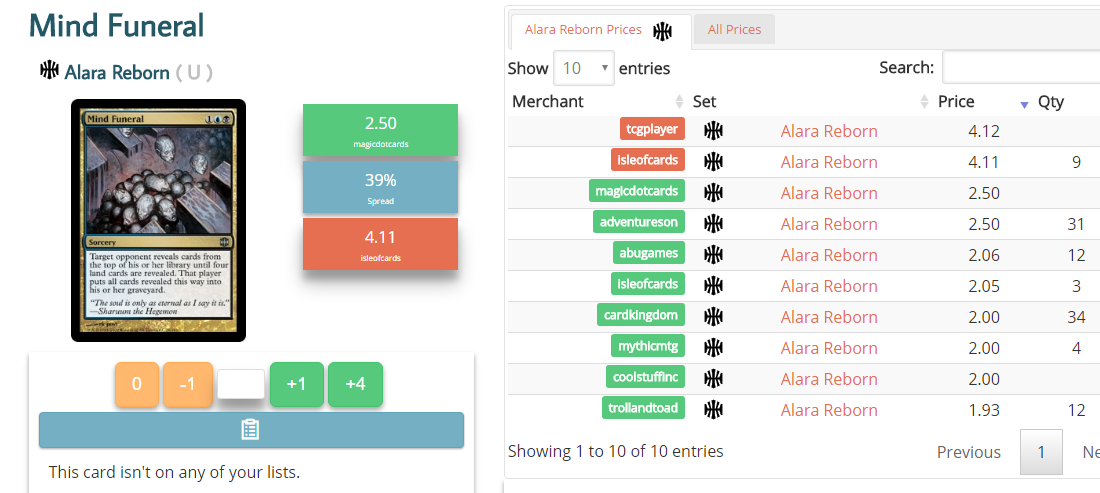
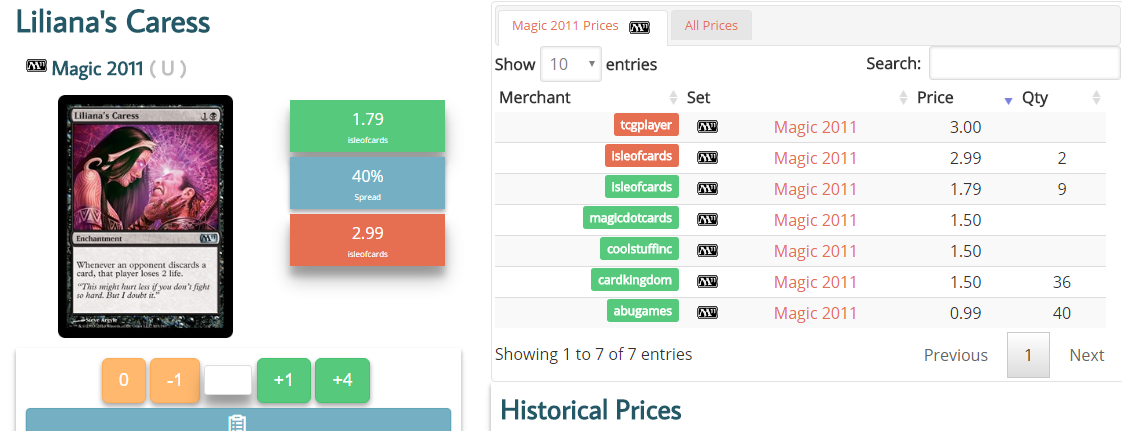
I still enjoy sorting bulk, picking out the gems, and trying to find the niches of #mtgfinance that few others are willing to delve into. Instead of trying to chase the next Traverse the Ulvenwald, I'm setting aside Geth's Grimoires for when they finally show up to the "casual kitchen-table spells worth money" party, hosted by Mind Funeral and Liliana's Caress.

mindfuneral
Click to expand
caress
Click to expand

But you all know about these cards already. You're paying for a subscription to read about #mtgfinance from those of us who would sell kidneys for bulk rares. You know that Jace's Phantasm is a bulk pick that competitive players don't touch (well, they didn't until that mill deck popped up at GP Los Angeles), and you know that Bloodline Keeper was an easy way to make money off casual vampires.

But what about the real near-bulk, that's a lot harder to pick and buylist? Let's look at Trader Tools real quick again, and admire how far it has come in the several years since I've last used it.

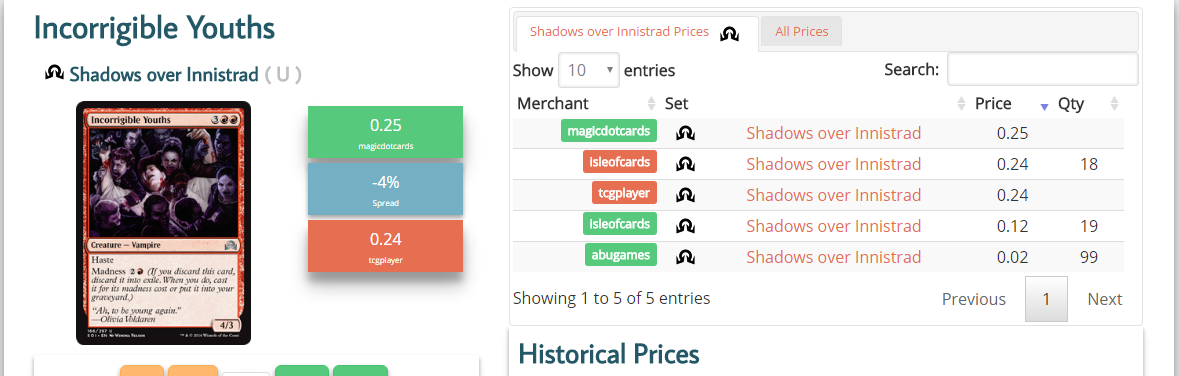
incorrigable youths

Okay, so I did not expect the first random SOI uncommon I thought of to be on the list. But that's kind of my point, isn't it? That shouldn't have been a question. It is my point. There's very little to be lost when trading for bulk commons and uncommons, even from the most recent sets.

Sure, Future Sight and Fifth Dawn bulk makes my mouth water, but bulk is bulk is bulk in the endgame. And I'm not just talking about Duskwatch Recruiter...

Blueprint vs. Isle of Cards

SOI Blueprint

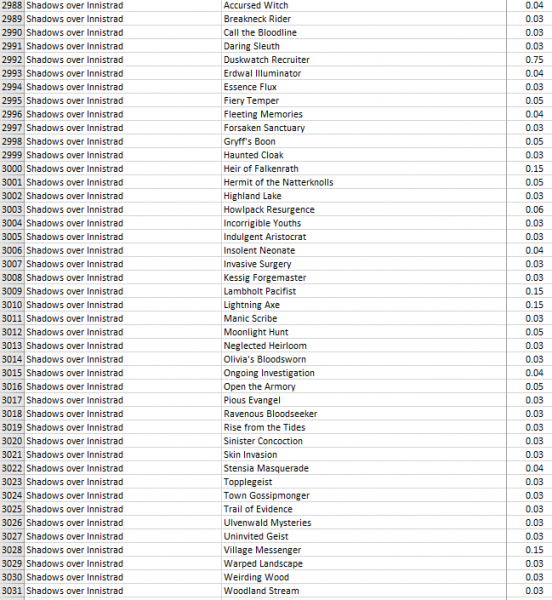
What is this spreadsheet and what are these numbers? Well If you followed any of my work, you might recognize this buylist format. It's called "The Blueprint," and is arguably the most comprehensive single-store micro buylist in existence. I only say that because I haven't really tested the TCG Player buylist yet, but that's an article for another week.

In summary, go to mtgblueprint.com and click both of the buttons that appear. One downloads a huge spreadsheet file; the other adds you to the mailing list so you get the next update a month from now on the hottest cards that Card Advantage is buying.

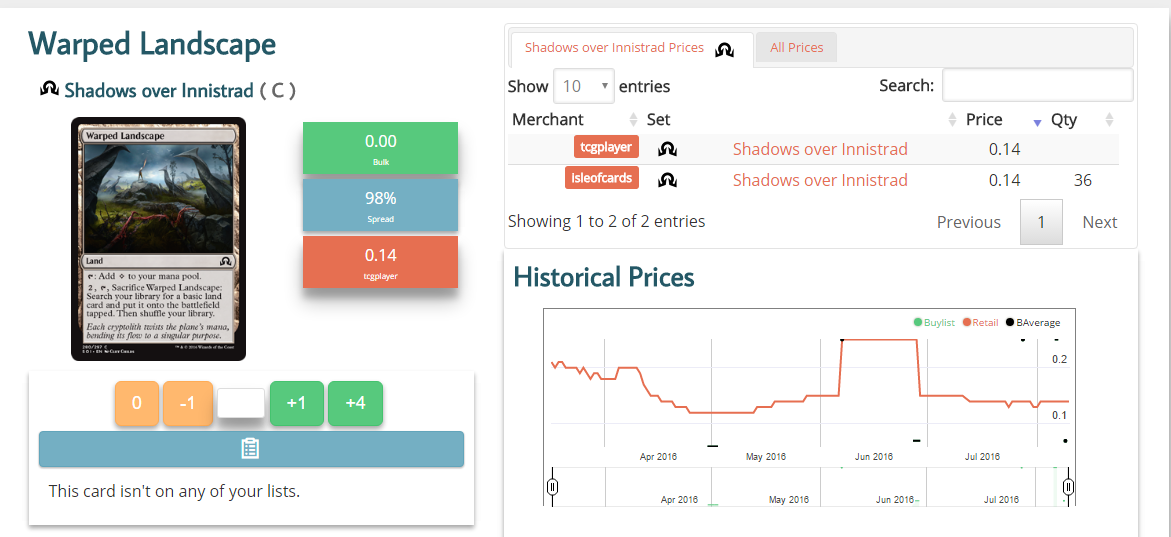
Some of these cards might be obvious (Duskwatch Recruiter and Lambholt Pacifist come to mind), but you can really get 15 cents each for all of your Village Messengers, and $3.00 for 100 copies of Warped Landscape---a card not even Isle of Cards is buying. Isle will give you 0.12 each for two playsets of Gryff's Boon, and then Card Advantage will take the rest at a nickel a piece.

warped

I did notice that store, Isle of Cards, also has a pretty extensive micro buylist based on my first examination of Trader Tools in a while. 25 cents on Incorrigible Youths is insane, and even half of that at 12 cents a piece for 19 copies is hard to pass up on if you're shipping a mass order.

I'm not a corporate shrill trying to sell you on a hip new homeopathic drug called Ard Cadvantage. However, I will point out that one of the advantages of shipping a mass order to Card Advantage is their willingness to accept up to a hundred of a single card, something that Isle is unable to offer.

At this point, you have to pick your buyer based on the amount of bulk you'll be picking. If you're picking through 200,000 bulk commons and uncommons that you traded off a few Legacy staples for, you'll probably end up with more than 19 copies of Incorrigible Youths. You might even end up with more than 100, but then you can send an order to both stores and everyone wins.

End Step

Remember that Conspiracy 2 spoilers are starting. Conspiracy drafts will cut into Eldritch Moon drafts, thereby reducing the overall amount of opened product. Combine this with the possibility for some booster boxes to be mapped out for all of the non-flip mythics, and it's signaling that there will be less Eldritch Moon product opened than otherwise expected from a normal set released around this time.

That $40 price tag on planeswalkers normally seems irrational a month after the set's release, but Liliana could very easily stand above the rest of the pack and hold her own thanks to the reduced product opened.

What's Up Next Week?

Well, I originally planned to do an extensive article involving TCG Player Market Price this week, but that got pushed back because of the maintenance their site was going through for most of today. I can address that article next week, or I can continue to talk about the 500,000 commons and uncommons that I currently am in the process of sorting through myself.

This one's up to you guys and girls---I'm new here, and I want to write what you want to read. Let me know in the comments below what you're looking from me, now that I've tested the waters!

Insider: The Financial State of Modern Manabases

Are you a Quiet Speculation member?

If not, now is a perfect time to join up! Our powerful tools, breaking-news analysis, and exclusive Discord channel will make sure you stay up to date and ahead of the curve.

There’s a lot going on these days in Modern. Wizards has started gifting us playable new cards with each set release. Standard cards like Nahiri, the Harbinger and Eldritch Evolution can shake up the format a bit and give it a fresh new twist. For an eternal format, this is a great direction for the creators to take the game.

One thing that remains constant though is the mana. The pricing of the format's staple mana sources has constantly surprised me. The typically climbing prices of the lands have not risen to their projected heights. Or have they? Today we will take a look at what’s going on with Modern mana and what you can look for in the future of the format.

Shocklands

First up we have the Ravnica shocklands. These Return to Ravnica and Gatecrash reprints have astoundingly stayed on a plateau. Even the highest of the group, Sacred Foundry, Breeding Pool and Steam Vents, have only bumped up to $12---no higher than their Standard-era price tags were.

I believe one of the main reasons these lands have not started their incline yet is due to their limited play. To elaborate, you do not need four copies of these lands in order to compete in the format. Players can easily utilize one or two copies of these shocklands and many successful decks only call for those numbers anyway. Fetchlands provide more flexibility in many archetypes, especially the multicolor ones.

Delving a little deeper, many players have been playing at least as long as when these staple lands were in Standard and never had to acquire them to build a Modern deck. With nearly four years since their printing, we are reaching a time in which more new players will be building Modern decks. The more new entrants we have into the format the quicker these lands will start increasing in value.

There was an error retrieving a chart for Sacred Foundry

The only thing we need to consider with the shocklands is if there will be a reprint anytime soon. Answering that is a tricky question but I’m doubtful we will see these lands again for quite some time. A return to the plane of Ravnica itself isn't necessary for a reprint (Wizards deliberately chose names without a flavor connection to a specific plane for the cycle of "fixed" duals). But they've been done and redone before, and Wizards is likely to turn to others lands while they let excitement build for shocks before bringing them back.

If we don’t see a reprint of the shocklands then we should start seeing some growth in the next year or two. I know from my perspective running a store that my stock is depleted and we don’t get these traded in often, if at all. Most of us have been on these long-term specs for a while but I think we will start reaping the rewards soon.

Fetchlands

To start off, there is an obvious chasm in the pricing of the Zendikar fetchlands and the reprinted Onslaught lands in Khans of Tarkir. One has just barely rotated out of Standard while the other was printed back in 2009. With such a gap between these groups, we will break them down separately.

Let’s start with the newest and freshest on our minds. One of the aspects I have been considering is comparing the Khans fetches to the reprinted shocks. If we look at the observed trends from the shocklands, the Khans fetchlands should follow a similar trend. They are also a long-term speculation but a solid investment for that long-term. That means we likely have at least a couple years ahead of us until the stock on these lands dries up.

One thing to consider about fetchlands, however, is that players need more of them for decks. This may seem like an unnecessary statement to make but the demand from needing four copies is much higher than if you need less than the full playset. With added demand comes quicker price increases. Even if the demand does prove to be higher, it seems likely that it will be a year or two before growth shows on these cards.

The Zendikar fetchlands, on the other hand, have grown in spurts over the past couple years. They did dip a bit when Khans hit the market but they rebounded. Scalding Tarn is up to nearly $90 once again and the others are trending upward as well. It seems likely that these lands will get a reprint in the next year or two so my stance is still to unload your extras while they are this high.

There was an error retrieving a chart for Scalding Tarn

Creature Lands

Lands that turn into creatures have always been a favorite of mine. Players like getting value out of their lands and having an extra creature is a great way to do just that.

Undoubtedly the flagship card in this category is Celestial Colonnade. Its $30 price tag shows us what’s possible for lands like this. In the past year the other two heavily-played lands from the same cycle, Raging Ravine and Creeping Tar Pit, both bumped up to double digits as well.

There was an error retrieving a chart for Celestial Colonnade

I currently have a small stack of Stirring Wildwood and Lavaclaw Reaches because if a deck with them breaks out, their price will jump immediately. Remember, this cycle is almost as old as the enemy fetches, and if they're not as ubiquitous they're still very powerful.

Some lands are just better than others and that goes for the awoken lands from our return to Zendikar as well. Of the newest additions I like Wandering Fumarole the most. Red-blue is one of the most prevalent combinations in Modern and there are a variety of strategies that employ these two colors. The others could see play as well, and the Abzan-colored ones have already seen limited adoption in the eternal format.

Lastly, we have the colorless creature lands. Both Nexuses see play in Affinity and Inkmoth does double duty in Infect. Meanwhile Mutavault is mainly seen in Merfolk but also in several fringe tribal strategies hovering around the lower tiers like Slivers.

There was an error retrieving a chart for Inkmoth Nexus

These staples have all risen a bit over the past year and I expect them to continue to grow. I don’t think they will double overnight like some of the colored ones might, but I do expect consistent growth from year to year. They are relatively safe investments, but fair warning on Inkmoth---it was one of the conspicuous absences from last year's Modern Masters 2015 set, and it might be slated for inclusion in the next one.

Fast Lands

It takes a lot for lands to be viable in Modern. The new lands from Battle for Zendikar and Shadows over Innistrad haven't broken through beyond a few sporadic places, and they are each reasonable in their own ways.

What’s holding the Scars of Mirrodin fast lands back from higher price tiers is their limited playability. As good as this group is, most of the time it’s just better to play shocks and fetches so your lands come into play untapped. Sure you don’t take damage from fast lands, but that doesn’t make up for the tempo loss when they are forced to start out tapped. While good, I think these lands will be on their plateau for a while.

There was an error retrieving a chart for Seachrome Coast

Miscellaneous


The final section of discussion is a variety of other lands that show up frequently. This section is mainly comprised of lands that spawned archetypes around them. Tron, Scapeshift and Affinity are all archetypes that couldn't exist without their signature lands.

As much as I would like to advise purchasing this group of cards, I think it contains the most likely reprints for Modern Masters 3 next summer. The Urza Lands and Cavern of Souls seem like obvious candidates for the set.

Lands that I want to be tracking down are Valakut and Eldrazi Temple. Both of these archetypes are established staples of the format and the better they get, the more their lands will grow.

Eldrazi Temple survived a ban and now is back on its slow climb back up. Valakut seems hard to reprint which makes it a great investment. If Scapeshift gets another powerful card to boost its power level similar to how Dig Through Time helped, we could definitely see a double-up on the deck’s win condition.

There was an error retrieving a chart for Valakut, the Molten Pinnacle

~

There are many other lands available in the Modern format. Which of them seem most likely to make us some money? If you have data about any of the lands in this article, please share in the comments and we’ll continue the discussion.

Until next time,
Unleash the Force of Lore!

Mike Lanigan
MtgJedi on Twitter

Visualizing PT Eldritch Moon

Are you a Quiet Speculation member?

If not, now is a perfect time to join up! Our powerful tools, breaking-news analysis, and exclusive Discord channel will make sure you stay up to date and ahead of the curve.

01 02 03

Modern Metagame Breakdown: 7/1/16 – 7/31/16

Are you a Quiet Speculation member?

If not, now is a perfect time to join up! Our powerful tools, breaking-news analysis, and exclusive Discord channel will make sure you stay up to date and ahead of the curve.

Well, you know what they say: the more things change, the more they stay the same. The month of July saw some metagame shifts portended the month before take concrete form, as the paper shares adjusted to more closely resemble MTGO results. Death's Shadow Zoo, Dredge, and Eldrazi ascended to Tier 1, replacing Abzan Company and RG Tron. We're still seeing a pretty large discrepancy between the online and paper metagames, however, with Death's Shadow and Dredge hovering around the 10% posted last month.

Riding atop it all is none other than the glorious Jund---the only archetype to rival Death's Shadow and Dredge's dominance on MTGO, while also boasting the clear "best deck" status with a full 3 percentage points above Affinity in the overall metagame share. As I said, some things never change, and the sun never sets on certain empires---all hail King Jund.

Abrupt-Decay-cropped

The metagame overall seems to be in flux as the major events available to inform players' deck choices are getting increasingly older. Some uncertainty exists surrounding the upcoming August Grand Prix weekend when Modern will come to the big stage in Lille, Indianapolis, and Guangzhou.

Deaths ShadowThe MTGO data are showing a pretty ossified environment, which leads me to believe the grinders and pros have successfully iterated the format to a stable place. As a result, I still think we'll see the paper metagame shift more towards Jund, Death's Shadow, and Dredge, which are all posting commanding shares on MTGO. But there are enough random elements in Modern to throw some of that homogeneity out once we get to the Grand Prix circuit, where people will inevitably pick up whatever they fancy and/or own. With Dredge specifically, there's also a chance that everyone gets the memo in time and comes packing ample hate to keep it down.

It's important to remember that while MTGO is hyper-efficient at solving metagames and generating consistent competitive finishes, it can also be something of a self-fulfilling prophecy as it becomes inbred and self-referential. I'll be listening, reading, and watching the pros in the coming weeks to see if they're favoring anything in particular, or if the consensus seems to be to play what you know. My guess is the truth lies somewhere in between the two extremes.

[wp_ad_camp_1]

Data Collection Methods

Editor's note: Due to an error in the spreadsheet reporting GR Tron decks incorrectly on MTGO, some initial numbers in this article were wrong. They have subsequently been corrected, along with updates to the discussion. This did not affect broad conclusions about the metagame.

The month of July was a relatively quiet one for Modern events---our only major paper events for this period consist of three Star City Games Classics, in Worcester, Columbus, and Baltimore. In light of this we elected to use the Major Paper Event Day 2 data from June, weighted at one third the normal amount to reflect a decaying influence. Undoubtedly many players are still turning to the SCG Dallas Open for their metagame information and deck choices, but they also may be defaulting to the smaller, more recent Classics or simply their own local scenes. To account for the relative instability in the metagame data, we've set the cutoff for Tier 1 somewhat lower this month, which helps account for the uncharacteristic Tier 1 lineup.

In total there were 117 paper events to draw from, representing 894 decks. MTGO events were more exciting in comparison, featuring both a PTQ and a MOCS besides the usual rash of daily League finishes. In total MTGO contributes 351 decks over 32 events to this month's data set. That's a total of 1245 decks that inform our metagame breakdown today.

As per usual, more detailed information about the methodology and algorithms behind the tiering system can be found on the Top Decks page.

Tier 1

Tier 1 decks are the ones you should expect to face at every Modern tournament. Make sure you show up to your local events and Grand Prix alike with a well thought-out plan to beat these decks---you're going to face them often, and each one is resilient enough to fight through a lackluster counterplan. Of course another avenue is to pick one of these up yourself, which I generally suggest for anyone not well-versed in a lower-tier deck. Whether you know one of these archetypes inside-out and can tune a killer sideboard for the field, or you want to pick up something new and wing it, these decks certainly have the chops to get the job done.

Tier 1: 7/1/16 - 7/31/16

DeckOverall
Metagame %
Paper %MTGO %
Jund9.8%9.7%9.2%
Affinity6.2%6.2%6.7%
Infect5.7%5.8%3.4%
Burn5.5%5.2%6.7%
Jeskai Control5.2%5.4%4.5%
Dredge4.7%2.6%10.9%
Eldrazi4.5%4.7%6.2%
Death's Shadow Zoo4.3%2.5%10.4%
Merfolk4.2%4.5%3.4%

The metagame percentage shares across Tier 1 form a gradient without any sharp drops, which continues into the first few Tier 2 decks. We set the boundary around 4%, which corresponds roughly to the 6+ point cutoff. This makes sense to my eye especially given the MTGO data. Besides Jund, Dredge and Death's Shadow are the only Tier 1 decks on MTGO, and here the dropoff to Tier 2 is pretty marked, from 9.2% (Jund) to 6.7% (Affinity). TarmogoyfThe paper metagame is much more varied. In any case, depending on definitions the bottom half of these decks could be considered Tier 2, and we should expect some upsets as the Grand Prix weekend establishes more firmly what's top dog.

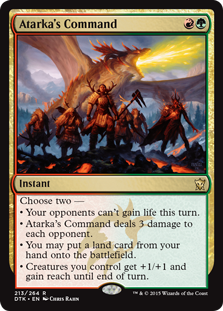
Last month, I predicted that controlling decks would fall prey to the highly linear metagame we're in the midst of right now. Jeskai and Jund are still doing their thing (although Jeskai has dropped a bit), but the slow and durdly Tron looks to be the first real casualty. I'm not sure I relish trying to fight through infinite Become Immenses and Atarka's Commands from the Tron side of things, to say nothing of the explosive Dredge deck. Building Tron to combat one or two or these decks isn't hard, with access to Anger of the Gods, Ancient Grudge, Fog, Spellskite, or Grafdigger's Cage. But Tron doesn't have a lot of wiggle room in its maindeck configuration, and trying to play sideboard roulette in this meta doesn't seem like a good idea.

Atarkas CommandJund and Jeskai, however, get to enact the "kill every last one of your nonsenses" plan against these aggressive decks, without drastically altering their card choices. They can also present a fast clock (whether in the form of Tarmogoyf or Nahiri ultimate) to avoid dying to top-decks. Both seem well positioned in a field full of aggro and creature-based combo.

Something I didn't discuss in the last update, but which remains true this month, is that we're seeing a relatively fair top-tier metagame. Dredge is on the rise, certainly, and Infect is still kicking around, but neither of these are decks that "do unfair things unfairly." Their combo elements are still highly interactive and tend to make use of the combat step, unlike something like Ad Nauseam or Storm. In any case, the rest of the field is a bunch of aggro, midrange, and control decks that try to play "normal" Magic. Whether you're longing for diversity or interesting back-and-forth games, it looks to be a great time to play Modern.

Tier 1 Changes: June to July

Deck% Change
June to July
Overall Meta %
7/1 - 7/31
Overall Meta %
6/1 - 6/30
Jund+0.6%9.8%9.2%
Affinity+0.5%6.2%5.7%
Burn+0.7%5.5%4.8%
Jeskai Control-0.3%5.2%5.5%
Infect-2.8%5.7%8.5%
Dredge+2.3%4.7%2.4%
Merfolk-4.2%4.2%
Eldrazi+1.7%4.5%2.8%
Death's Shadow Zoo+1.2%4.3%3.1%

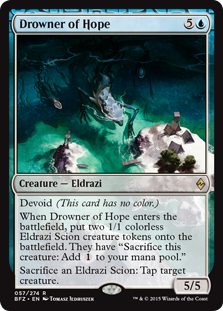
We've already discussed the rise in Death's Shadow and Dredge. The other big gainer here was Eldrazi, mostly in its by-now de facto standard version, Bant. As a fair deck that goes slightly bigger, Bant Eldrazi seems well suited to a field of aggro decks and creature combo. It's capable of presenting a fast clock to pressure controlling decks, while giant bruisers like Thought-Knot Seer and Reality Smasher combine with Drowner of Hope and Eldrazi Displacer to control the aggressive decks' board states.

Drowner of HopeInfect, on the other hand, loses a significant chunk of share to the rising archetypes, falling almost a full 3 percentage points. This effect is even more pronounced if you discount the Day 2 data from June that's still forming a portion of our data set. I'm not entirely sure why Infect wouldn't be performing in the developing environment, but I can say it struggles against Dredge and Jund. And it probably hasn't helped that Tron is on the way down, removing one of Infect's favorite and most vulnerable sources of prey.

Dredge becoming such a prominent part of the metagame throws a wrench into sideboard plans, and people are probably going to start dedicating more of that coveted space to Grafdigger's Cage and friends. If they overcompensate by cutting their Affinity hate (which is also appealing in a metagame where Tron is declining) the robots could be ready to take over. Of course by overall metagame share they're already in the second spot behind Jund---I wouldn't advise skimping on the artifact hate.

Tier 2

Tier 2 decks are not as omnipresent as the Tier 1 crop, but they still show up in hearty numbers at the typical tournament. In many ways this tier is the lifeblood of Modern, whence its diversity and "play anything" reputation stems. If these decks aren't dominating at the moment, they're still capable of crushing a tournament on any given day---and most of them have been Tier 1 at some point in the past or will in the future. The better acquainted you are with any one of these archetypes, the better choice it represents, and if one of them is your specialty there's a strong argument to stay the course and keep sleeving it up.

As for preparing to beat Tier 2 decks, you don't need to dedicate specific sideboard space or do backflips to make your matchups favorable, but at minimum have a plan. You won't face all of these decks in a tournament, but you're all but certain to face at least some of them. Welcome to Modern!

Tier 2: 7/1/16 - 7/31/16

DeckOverall
Metagame %
Paper %MTGO %
RG Tron3.8%3.4%3.1%
Abzan Company3.5%4.1%0.8%
Ad Nauseam3.1%3.5%2.5%
Scapeshift2.4%2.3%2.8%
Abzan2.2%2.4%1.7%
Living End2.2%2.1%2.8%
Gruul Zoo2.1%2.2%0.6%
Death and Taxes1.9%1.8%2.5%
Grixis Delver1.7%1.7%1.4%
Kiki Chord1.4%1.4%0.3%

As I explained above, the first couple archetypes here segue more or less smoothly from the Tier 1 decks. This represents a diverse but ill-defined metagame, where Tier 1 and Tier 2 bleed into each other. It's no coincidence that two of the three 3%+ archetypes were Tier 1 last month, and they could easily be slated for a rebound.

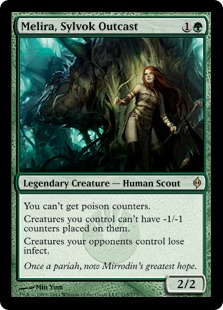
MeliraAbzan Company joins Tron in falling back to Tier 2, continuing its gradual decline since Eldrazi Winter. Company continues to post poor to abysmal MTGO numbers (0.8%), suggesting the Dredge/Death's Shadow/Jund trifecta metagame may be hostile to them. However, I'm assured that Abzan Company should have reasonable matchups in this environment, which lines up with my intuitive understanding of the archetype. It seems likely that the difficulty of executing the combo on MTGO is a significant factor in the disparity between its online and paper shares.

For its part, Tron obviously loves to beat up on Jund. But it has a pretty grueling gauntlet to get through in the rest of its matchups, where the two Tier 1 newcomers are joined by traditional problem matchups like Infect and Burn. As for the rest, Ad Nauseam has gained a bit since June (from 2.4% to 3.1%) while Grixis Delver and Kiki Chord have dropped; other than that things haven't changed much.

Tier 3

Tier 3 in Modern houses the decks with fringe potential, or those which are simply in a poor position in the current metagame. These decks range from relatively strong decks with scant adoption in the player base, to fragile decks that crumble to variance while mainstays like Burn or Jund draw consistently round after round. That said, Modern draws from an absurd well of card power, and each of these decks can give you a run for your money. You don't need perfect knowledge of everything they're doing, but the difference between familiarity and complete ignorance can definitely determine the outcome of a match.

Playing these decks isn't advised, unless you know them inside-out or have some specific reason why you think they're underrepresented. Of course, they are also worth a look as fun decks to battle if you're less concerned about winning and want to delve into the deeper end of the Modern pool.

Tier 3: 7/1/16 - 7/31/16

DeckOverall
Metagame %
Paper %MTGO %
Grixis Control/Midrange1.6%1.7%0.8%
Bogles1.5%0.8%2.8%
Elves1.4%2.0%0.6%
Jeskai Midrange1.3%1.6%0.8%
Through the Breach1.2%0.9%1.1%
Esper Control1.0%0.7%2.2%
Blue Moon0.9%1.0%0.0%
Soul Sisters0.6%0.3%1.7%
UW Control0.6%0.7%0.6%
Faeries0.4%0.3%0.8%
Knightfall0.3%0.5%0.0%
Pyromancer Ascension0.3%0.0%1.1%
5C Aggro0.1%0.2%0.0%

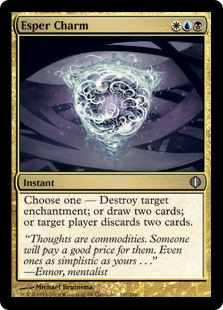
Largely this is the typical smattering of Tier 3 archetypes we see month to month. A few bear mentioning because they're relatively novel, and one because its share is dictated almost exclusively by one person. Esper_CharmTrevor wrote recently about the Esper Control deck that Guillaume Wafo-Tapa has been developing---the hall-of-famer has been crushing people pretty roundly in the daily League results, posting multiple finishes with his beloved durdle control deck (yep---that's the full four Think Twice in Modern, you better believe it).

It's hard to see these results and avoid concluding that Wafo-Tapa's exceptional play skill is allowing him to overcome an archetype disadvantage. After all, this is a man who has regularly chosen to draw first in Constructed and still beaten the crap out of everybody, and his unorthodox theory and choices obviously work well for him. We'll see if this draw-go version of Esper Control picks up, but for now I'm chalking it up to the Frenchman's mad genius.

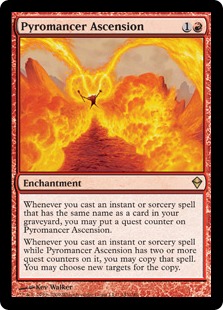
Another strange deck has been popping up in the League results: a combo deck in Jeskai colors built around Pyromancer Ascension and Thing in the Ice. A few other players have adopted Thing in the Ice in their UR Pyromancer Ascension Storm decks, but what's strange about this newest version is the complete removal of the storm cards themselves. Pyromancer AscensionThere's no Past in Flames or Grapeshot to go completely nuts with---the deck looks to win more honestly by flipping a Thing, or doubling up on Lightning Bolts and Helixes like the old Ascension deck from Standard past.

With things like Remand, Visions of Beyond, and more interactive spells in the sideboard, this deck plays like a control deck. In the vein of old Jeskai, its goal is to delay opponents long enough to string together the right number of Bolts to face.

Finally, Soul Sisters looks to be on an uptick. Most of the versions comprising its 1.7% MTGO shares are mono-white, but one or two are splashing black. The deck has a pretty wide variety of different builds, some focusing more on the Martyr of Sands-Proclamation of Rebirth interaction, some more on token production via Spectral Procession or Lingering Souls. There appears to be little consensus on the best build of the deck, but for whatever reason it's working out for some people in the MTGO queues.

Predictions

My predictions from the June breakdown centered around Dredge's and Death's Shadow's ascent look to be at least partially true. The MTGO results haven't really migrated to paper, but the archetypes' dominance online continues unabated. We also saw GR Tron fall in the wake of all the linear aggro decks' rise. Scapeshift, however, failed to materialize as a major player as I thought it would.

I'm pretty hesitant to make predictions for the coming Grand Prix weekend. Partly because the gradual sliding scale of metagame shares shows a format that's unsure of itself, and partly because we've had several months of reduced activity in the Modern tournament scene. I trust the pros will come up with one or two archetypes whose positioning the community at large has misevaluated, but this really doesn't look like a broken metagame where one thing will dominate. I expect archetype specialists to stand by their favorite weapon, and I expect the three Grand Prix Top 8s to exhibit a diverse range. We'll see exactly how it shakes out soon.

Naming Convention & Archetype Primers

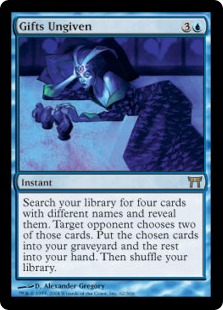
One thing I've noticed as I've learned more about the metagame breakdown is an inconsistency in labeling conventions, which I hope to resolve for next month. The major archetypes are pretty much represented the same way each time, but there's some work to do on the rarer and harder-to-classify decks. Gifts UngivenThis is especially noticeable in the archetypes that form a continuum from one type of build to the next. I mentioned Scapeshift and Valakut decks as one culprit last month. Some other ones are Gifts Ungiven decks (ranging across many colors and omitting or including Thopter Foundry), Death and Taxes (which forms a gradient with Hatebears of creature-prison decks), and four-color control decks, which are represented by a mess of different labels right now.

Sheridan and I are looking to standardize some of these naming conventions in the near future. This will coincide with the development of the major archetype primers in the works. As I find authors with specific archetype knowledge to help us fill out the Primers page, we'll consult with them on what they consider to be that family of deck's closest cousins, how the different variants play out, which card choices are indicative of them, and so on. There will obviously be some disagreement on the classification scheme as things get ironed out, but I hope you'll join us the lively debate that will no doubt ensue.

On that note, we're still looking for folks to help write archetype primers---that could be you! This is a great opportunity to get your name out there, contribute your unique understanding of a niche Modern deck, or just try your hand at strategic writing. The process of selecting each author may take a few weeks, but we'd love to hear from you! Send any offers/requests/questions my way at jason@quietspeculation.com.

Stock Watch- Greater Gargadon

Are you a Quiet Speculation member?

If not, now is a perfect time to join up! Our powerful tools, breaking-news analysis, and exclusive Discord channel will make sure you stay up to date and ahead of the curve.

Dredge has become increasingly more popular in Modern since the release of Shadows Over Innistrad, with Prized Amalgam breathing new life into the archetype as it were. Various builds of the deck have shown up in Modern Leagues with few results in live events, though that's starting to change. With a win in the Baltimore Classic, this build has been generating a lot of hype:

Dredge

Creatures

4 Bloodghast
4 Golgari Grave-Troll
2 Golgari Thug
4 Greater Gargadon
4 Insolent Neonate
4 Narcomoeba
4 Prized Amalgam
2 Stinkweed Imp

Spells

4 Shriekhorn
4 Bridge from Below
1 Rally the Peasants
1 Conflagrate
4 Faithless Looting

Lands

2 Mountain
2 Blood Crypt
2 Dakmor Salvage
2 Mana Confluence
1 Sacred Foundry
4 Scalding Tarn
1 Steam Vents
2 Stomping Ground
2 Wooded Foothills

Sideboard

4 Leyline of the Void
2 Ancient Grudge
2 Darkblast
2 Gnaw to the Bone
4 Nature's Claim
1 Conflagrate

Justin O'Keefe may not be the person who innovated this list, though his finish is certainly getting the deck more attention. Prices in dredge cards have been creeping up in value, and supply of cards for Modern Dredge has been declining online. Greater Gargadon in particular has doubled up recently, and with the consensus list being the Gargadon list at this point I expect this growth to continue. It's a $5-6 card right now, and I expect it won't take too long before it's a $10.

There was an error retrieving a chart for Greater Gargadon

Big Gargs is a Cube card too, and foil copies are also quite attractive. As for the ceiling of the card, it's hard to say without being able to predict the deck's future tournament results. A strong showing on camera is all it will take for the deck to really take off though.

Insider: MTGO Market Report for August 10th, 2016

Are you a Quiet Speculation member?

If not, now is a perfect time to join up! Our powerful tools, breaking-news analysis, and exclusive Discord channel will make sure you stay up to date and ahead of the curve.

Welcome to the MTGO Market Report as compiled by Matthew Lewis. The report will cover a range of topics, including a summary of set prices and price changes for redeemable sets, a look at the major trends in various constructed formats, and a "Trade of the Week" section that highlights a particular speculative strategy with an example and accompanying explanation.

As always, speculators should take into account their own budget, risk tolerance and current portfolio before buying or selling any digital objects. Questions will be answered and can be sent via private message or posted in the article comments.

Redemption

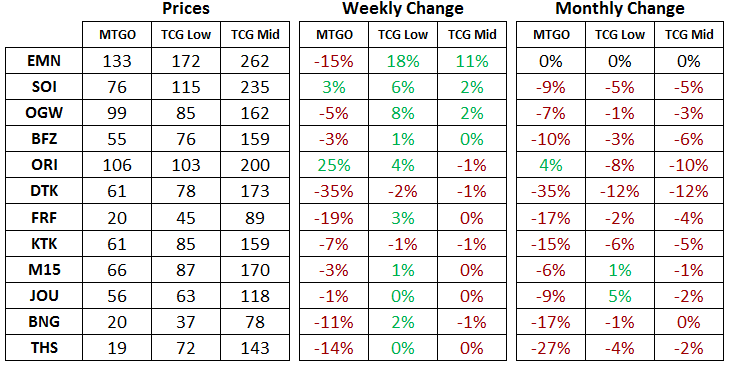
Below are the total set prices for all redeemable sets on MTGO. All prices are current as of August 8th, 2016. The TCG Low and TCG Mid prices are the sum of each set’s individual card prices on TCG Player, either the low price or the mid price respectively. Note that sets of Theros (THS) are out of stock in the store, so this set is no longer redeemable.

All MTGO set prices this week are taken from Goatbot’s website, and all weekly changes are now calculated relative to Goatbot’s ‘Full Set’ prices from the previous week. All monthly changes are also relative to the previous month prices, taken from Goatbot’s website at that time. Occasionally ‘Full Set’ prices are not available, and so estimated set prices are used instead.

Aug8

Flashback Draft of the Week

Flashback drafts are on hiatus for the next week as the focus shifts to the new Limited environment with the introduction of Eldritch Moon (EMN) to Shadows over Innistrad (SOI) draft and sealed deck. Flashback drafts will return with triple Zendikar (ZEN) draft on August 17th.

Standard

The results of Pro Tour Eldritch Moon are in and it has ushered in a new Standard format where Bant Company and G/W Tokens decks have been relegated from their previous perches. The dip in the price of Collected Company from Dragons of Tarkir (DTK) corresponds both to this change and to the pending rotation of DTK and Magic Origins (ORI) out of Standard.

While mostly above 20 tix in recent months, this card dipped as low as 12 tix over the weekend. Collected Company is a Modern staple, but it's got further to fall as Standard trends away from it and rotation looms. Speculators and players alike should keep an eye on this card and look for a price bottom in October for a good opportunity to pick it up.

Elsewhere, Jace, Vryn's Prodigy from ORI has seen a resurgence in the past week, adding about 20 tix to its price in that time frame. Nissa, Vastwood Seer has also moved up sharply. The jump in the set price for ORI this past week is directly attributable to the price changes on these two flip planeswalkers.

Although we might not be at a near-term peak on these cards, players with playsets and speculators with a stash of these cards should strongly consider selling their copies in response to this price activity. Although both have seen play in Modern, neither is a staple and it's difficult to see these two cards holding their prices as they rotate out of Standard.

Elsewhere, there are lots of deals cropping up in Battle for Zendikar (BFZ) and Oath of the Gatewatch (OGW) as the results from the Pro Tour reweave the fabric of Standard. The big losers from this change include the top card from BFZ, Gideon, Ally of Zendikar and his running mate in G/W Tokens, Nissa, Voice of Zendikar.

Both of these cards are at or near their all-time lows which is typically a good buying opportunity for a card that has had success in Standard. Although a card like Drana, Liberator of Malakir might be attractive due to its low price, having shown zero Standard playability up to this point makes it far riskier than either of these two planeswalkers in my opinion.

For the newest cards in Standard out of Eldritch Moon (EMN), the time for players and speculators to be targeting this set is a number of weeks away yet. OGW got as low as 66 tix, so it's safe to say that EMN will be heading down over the coming weeks as drafters open the new set. Look to the end of September as a window to acquire cards from this set at more reasonable prices.

For Shadows over Innistrad (SOI), it's likely to see a similar price bottom, but for speculators looking to acquire large positions in cards from this set, it's a perfectly reasonable time to start accumulating. The cycle of rare dual lands from this set represent good value at current prices, and staple cards like Tireless Tracker and Declaration in Stone also look quite attractive. Patient speculators will be rewarded with higher prices on many cards from this set over the winter.

Modern

Although the next two cards are Standard-legal, it's their Modern usage I want to hone in on. The cards in question are Thought-Knot Seer and Reality Smasher from OGW. It looks like the Eldrazi have settled on the best shell post-Eye of Ugin ban, and it is in the Bant shard. Check out the most recent 5-0 build from Modern leagues.

Both of these creatures typically show up as four-ofs, and this deck is no different. It has very efficient search in Ancient Stirrings and enough disruption for a midrange deck to go the distance. EMN cards are even making an appearance now with Elder Deep-Fiend showing up as a singleton.

While everyone is focused in on Standard, it's a good time to be considering where Modern might be headed. This deck looks like a contender so far with efficient threats and a flexible sideboard. If the Eldrazi were running rampant in Standard, then these OGW rares might be priced too high for Modern speculation. But when they are out of favor in Standard and still played in Modern, then these are a low-risk pick-up looking out to the winter.

Standard Boosters

BFZ boosters continue to bleed value over time and have drifted below 1.5 tix, coincident with the 10% lower set price over the last month. The link between the set price and the price of a booster is loose, but they are related. OGW boosters dipped briefly to 3 tix before rebounding closer to 3.2 tix.

It looks like these will not be returning to 4 tix in the near-term, which makes one of my past predictions a failed one. It will be interesting to see where the price of these two boosters ends up over the winter, and this will help guide our speculative strategy down the road.

SOI boosters have jumped to 3.3 tix this week, but the long-term outlook remains unchanged. For the moment, the novelty of the new draft format is supporting the price of SOI boosters. When drafters get their fill of SOI-EMN draft, prices will fall on lower demand. We got a brief taste of where these are headed during the prerelease weekend for EMN when these hit 2.5 tix. When Kaladesh is released in the fall, I anticipate a price move back to 2.5 tix and lower.

EMN boosters are sitting at 4 tix, near to being equal to the store price in dollars. If the historical price of OGW boosters is a good guide, these will stay close to 4 tix until just prior to the release of Kaladesh. If you manage to build up a supply of these, be sure to sell them before the end of September.

Trade of the Week

As usual, the portfolio is available at this link. As I alluded to above, there are good buying opportunities in OGW right now. I favor this set over BFZ for a number of reasons.

Typically fall sets are opened the most and have a much harder time generating large, sustained price increases. The presence of the Expeditions in BFZ are also contributing to lower upside on cards from that set. This is because these special inserts are absorbing some of the value on the paper side, but are not contributing as much value on the MTGO side. The demonstrated power level of BFZ cards in Standard also appears to be lower. Add it all up, and 1 tix invested in OGW will be a better decision than 1 tix in BFZ at this time.

Not messing around with speculative picks, I have focused on cards with strong pedigree that have a good chance to see higher prices in the winter. Nissa, Voice of Zendikar, Thought-Knot Seer, Reality Smasher and Sylvan Advocate all fit the bill. I put a playset of each into the portfolio and I will continue to monitor their prices over the coming weeks with an eye to expanding my position in these cards.

The Decks of Modern: A Beginner’s Guide

Are you a Quiet Speculation member?

If not, now is a perfect time to join up! Our powerful tools, breaking-news analysis, and exclusive Discord channel will make sure you stay up to date and ahead of the curve.

Welcome back to the Beginner's Guide to Modern, the article series where we help Standard players make the transition to Modern. It's been a while since my last entry in this series (far longer than intended), but now I'm back to deal with what I hear is the most interesting, frustrating, and intimidating aspect of Modern compared to Standard: deck diversity.
Mystical-Teachings-banner-cropped

This is not just about the number of playable decks, though that is a factor. It's also about the variety of different playstyles and strategies. Standard decks, especially recently, tend to be creature-centric (and in my opinion kind of homogenized in general, outside of GW Token's dominance). If you play a lot of cheap creatures, you're an aggro deck. Fewer and larger creatures, midrange. Very few, very large creatures equals control. Yes I realize this is an overgeneralization and misses a lot of nuance, but my point is that if you're trying to classify and prepare against decks in Standard it's fairly easy.
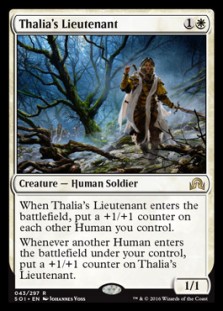
thaliaslieutenantNot so much Modern. Yes, you can broadly classify Modern decks based on creature density but that misses the very distinct types of decks that are present in Modern and the very different ways they play.

Let's use aggressive decks as an example. Standard's Wr Humans has a lot of similarities to Merfolk, in that both are very aggressive linear tribal strategies that seek to swarm the opponent with small creatures that grow each other. Merfolk differs in its disruptive elements and evasion which demand different answers. This is completely different from Infect, which is arguably still an aggro deck but instead seeks to "get there" in a single attack. Elves is also a linear tribal strategy, but it plays more like a combo deck. Elves and Infect have strong combo elements but are still in the aggro deck family despite behaving nothing like Wr Humans. A deck could fall neatly into the aggro/control/combo brackets in Standard and that would be the end of it, but Modern decks rarely do that cleanly.
sphinx's revelationAs a result, I've seen Standard players adopt strategies to counter deck types that work well on paper but in reality accomplish little to nothing. Adding more removal to a deck and trying to grind out advantage works well to beat Standard aggro and can work in Modern but it can also leave you vulnerable to certain angles of attack that one-for-ones don't sufficiently cover. This is one reason that Modern has few reactive decks.

Therefore today I am going to broadly lay out the types of decks that you commonly see in Modern, categorized by how they win. This is not about the overall archetypes but rather a general examination of Modern gameplans and strategies. Along with this I should add that this is intended as an introduction, so any missing detail is intended to go in follow-up articles later on. For today, I'll just be laying out the strategies, providing some examples, and giving advice on how to approach the matchups.

[wp_ad_camp_1]

Aggressive Decks

By far the largest category of Modern decks, aggressive decks all share a love of creatures and winning as uninteractively as possible. Where they differ is in how they approach that uninteractive kill.

Linear Aggro

Examples: Merfolk, Zoo, Burn
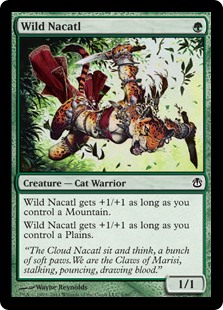
Wild NacatlThese are decks that play creatures and attack. No frills, no tricks. Deal 20 damage as quickly as possible. How they go about it may differ greatly (Merfolk turns small creatures into big evasive ones, Zoo just plays a ton of very efficient creatures backed by burn) but at their core they're just trying to kill the opponent before they're overwhelmed by card power or synergy. When you think of aggro most players think of these decks and they're the most recognizable and understandable to the Standard player.

Efficiency and low mana-curves are the tools of linear aggro. All these decks rely on high creature density backed with some support cards and a low land count. In Burn's case the support spells are arguably the most important part of the deck, but it operates on the same principles as the other decks if from a different angle. Some will have synergistic elements (Merfolk particularly) but they're compliments to the simple, old-school beatdown.
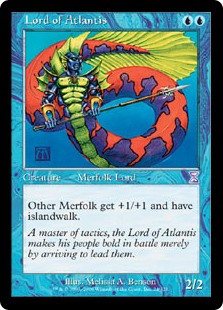
Lord of AtlantisAs the inheritors of the old-school strategy they also tend to suffer from the same weaknesses, to varying extents. Their high creature counts mean sweepers tend to be very effective, though many decks have learned to mitigate or counter sweepers. Generally, playing the classic game of one-for-one answers works as long as you don't fall behind or run out of answers before they run out of threats. Lifegain can buy time but should not be relied on. With the exception of Burn, linear aggro decks are able to take very large chunks off your life total with each attack and unless you have your own clock gaining life each turn will not outpace their damage output.

Racing is an effective and often under-used tactic against linear aggro. They are very fair decks and if you can do a fair thing faster or do something unfair linear aggro lacks the disruption or interaction to stop you.

Power-Card Decks

Examples: Elves, Affinity
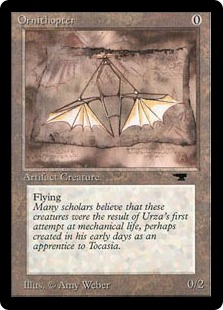
OrnithopterThese decks look terrible on paper. They are filled with weak cards that don't do much on their own, and can make you wonder why anyone though the deck was viable. Then they drop a power card that supercharges those weak cards and simply wrecks you. Memnite, Ornithopter, and Signal Pest are pretty unimpressive on their own, but throw a Cranial Plating into the mix and suddenly you have one of the best decks of all time in Modern.

Power-card decks rely on a small number of cards that are extremely powerful when surrounded by the right cards, and are worthless otherwise. Heritage Druid and Nettle Sentinel are a terrifyingly powerful mana engine, but need Elvish Archdruid and/or Ezuri, Renegade Leader to have a real impact. The payoff cards conversely have no impact without a lot of their support cards on the field. The decks tend to be made of the power cards and their enablers and ways to find the power cards. When the whole system is meshing together and running well they're the most terrifyingly powerful decks around. When something breaks down they can't work at all.
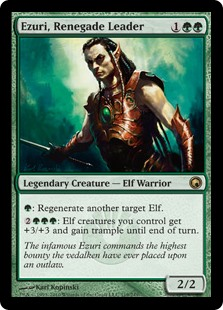
Ezuri, Renegade LeaderThe most common way to fight decks like this are to target the power cards. If a deck is built around it, it's pretty important, and if it's pretty important then it should be a high priority. Moreso than many other deck types, if you take out even a few payoff cards then these decks are anemic beatdown decks at best. Sweepers are also a potent tool, even more than other decks, since these tend to be critical mass decks beyond what linear aggro demands. Elves in particular needs to play into sweepers for its payoff cards to actually win the game.

You are unlikely to win a pure race against these decks. Power-card decks tend to poses powerful mana engines so that they can turn on the payoff cards quickly and win immediately thereafter. You need to disrupt their engines or payoffs to buy yourself time to win. That said, these are not very robust decks and a little disruption goes much further than you think.

Gotcha! Decks

Examples: Death's Shadow, Bogles, Infect

I dislike these decks. I have to respect their power but I don't think they're good for Magic. Gotcha decks ask if you have the right interaction at the right time. If you do, they lose. If you don't, you lose.
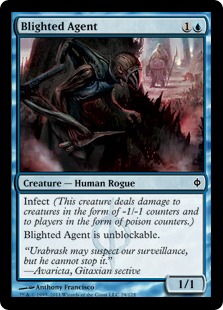
Blighted AgentEach deck is designed to either win in a single turn using pump spells or simply play threats that cannot be removed. They tend to have relatively low creature counts and are focused on leveraging some unfair mechanic to devastate unprepared opponents before their own weaknesses doom them. The rest of the deck are pump spells to maximize the impact of their unfair mechanic and protection to protect their fragile and scarce threats.

As such these are incredibly powerful and explosive decks that have been steadily climbing the tiering charts since Twin was banned. Their speed is frequently enough to simply slip past every other decks defenses without issue.

It is hard to recommend a playstyle against these decks because of variance. These decks will lose to certain cards (Bogles to Cruel Edict, Infect to Night of Souls' Betrayal), but you have to draw them or draw enough of them. On the other side sometimes they just have broken hands that you cannot beat, such as Infect's turn two win. They can also fail to open a keepable hand and mulligan to death. Variance is their greatest weapon and weakness. Death's Shadow runs a lot of cantrips to minimize this problem, but it's still very much at the mercy of the Random Number God.
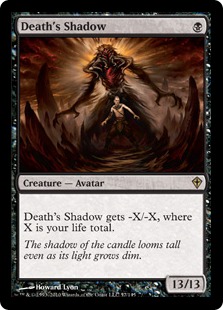
Deaths ShadowGotcha! decks have some of the highest positive variance and the highest negative variance of any Modern deck type. They're trying to maximize their explosive potential and so have to play for the big wins rather than a lower variance, more robust plan. As such I recommend using a solid average variance against them. To put it mathematically, if they swing wildly between +10 and -10, you want to be above zero as much as possible. You won't match their best hands, but your hands should be at par or better than theirs more of the time which should translate into more wins.

Actually racing these decks is very hard because of their speed (unless you are Burn against Death's Shadow) and the risk that you will simply die to Become Immense and Temur Battle Rage. That said, if you don't present your own clock these decks will eventually put together their unfair clock, so you need to kill them before they get the chance.

Fair Decks

Examples: Jund, Grixis, Jeskai

These are the police decks. The interactive decks that keep the linear aggro and combo decks in check. Full of removal, card advantage, and mid-level threats Modern's fair decks seek to bury their opponents in card power and quality. They want to kill your creatures, play their own, and disrupt your gameplan long enough to win.
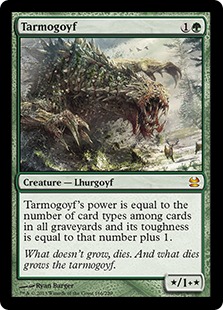
TarmogoyfThe typical fair deck plays a lot of very good cards that each stand on their own but get better when paired together, like Thoughtseize and Tarmogoyf or Snapcaster Mage and Lightning Bolt. They play similarly to Standard midrange decks in that their plan to kill anything threatening, disrupt the opponent's gameplan and win through value and powerful creatures. However, in Modern they often take the role of control decks and a check on the speed of the format.

These decks play individually strong cards that compliment each other, but there's no true synergy like a combo or aggro deck. As such these decks live or die on whether their answers match up against the opponents threats and their ability to draw enough of them.
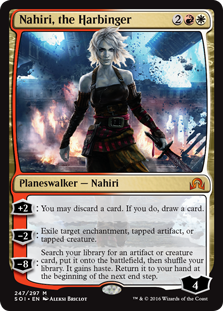
1_nahiriTo beat these decks you need to overwhelm their answers and race their clock. Synergy can overpower them but it is also vulnerable to their disruption. I've found it more effective to try and win the attrition game and simply emerge with the last threat standing once both decks go hellbent. Card drawing and two-for-ones are extremely effective.

Degenerate decks will frequently be able to deploy too quickly for the fair decks to effectively counter, but can also more readily fall prey to a well timed Thoughtseize or Mana Leak.

Combo Decks

Decks that kill from pure card synergy. These are decks that assemble certain cards to produce an instant, or effectively instant, win. For some this is all that they do. Others have backup plans.

Unfair Combo

Examples: Ad Nauseam, Storm
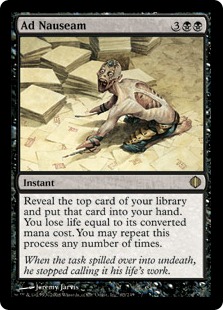
Ad NauseamThese are the decks that everyone thinks of when they think of combo decks, the true inheritors of Prosbloom. Decks that play a lot of cards that do nothing on their own but together create a critical mass of card advantage and mana that the deck funnels into a single win condition to instantly kill the opponent. Which often entails the pilot playing a lot of Magic by themselves while their opponent counts tiles on the ceiling, waiting to find out if they're dead or if their opponent fizzles.

What defines the truly unfair combo decks from others is that they are all-in on their combo. It is impossible, or at best extremely implausible, for them to win any way but by comboing off. Ad Nauseam cannot win without resolving the namesake card and drawing their deck, Grishoalbrand struggles if it cannot cheat Griselbrand into play.

As such beating these decks comes down to preventing them from going off. Slaughter GamesSlaughter Games for their Ad Nauseam is the most extreme example, but the right spirit. Discard can prevent the combo chain from beginning and counter-magic can break it up. There exist powerful sideboard cards against decks like this like Games, Rest in Peace, and Meddling Mage which completely invalidate the combo engines.
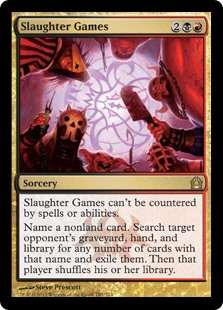
You're unlikely to race an unmolested combo deck unless you're one of the Gotcha! decks or another unfair combo, but it is imperative that you present your own clock against these decks. Given enough time, combo decks will be able to sculpt the perfect hand to fight through even the toughest defenses. Combo players are aware of their weaknesses and will counter-sideboard against hosers, so you cannot just rely on them conceding to a hate card. You have to pressure them.

Fair Combo

Examples: Abzan Company, RUG Scapeshift

Conversely, these are decks that can combo off in some fashion but don't have to in order to win. They have a backup plan as a fair deck. Whether this involves playing a midlevel creature beatdown or control game, these decks are built to have several different avenues to victory if one plan is not viable.
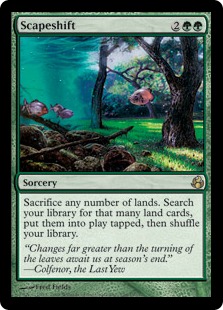
ScapeshiftSome of these decks, like RUG Scapeshift, are primarily combo decks that use control elements to buy them time to combo off. Their Plan A is the combo, but they have a Plan B that wins via card advantage and a control game when the combo doesn't come together. Decks like Abzan Company have a fair Plan A, in this case creature beatdown, but have an incidental combo Plan B, infinite life and damage, that they can assemble in the right circumstances. These decks possess flexibility that few can match, which makes them far more dangerous than they look. Over-prepare for one part of the deck and you will die to the other. Opponents are forced to split their focus between the two different victory paths which allows clever players the chance to out-strategize and out-play their opponents.

Trying to directly attack these decks is dicey. The two halves may have many elements in common but you're not likely to be able to effectively disrupt both. Sweepers are very effective against Company, but only when they preempt the combo and are committing cards to their board at sorcery speed instead of trying to assemble their combo on your end step. You might be able to out attrition Scapeshift but you'll still be at risk of losing to Valakut, the Molten Pinnacle.
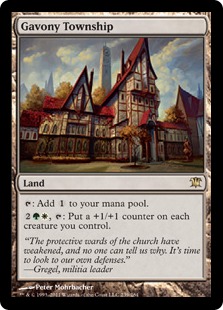
Gavony TownshipIt is far more effective to leverage your specialty against them. These decks are jacks of many trades but masters of none. Company's Gavony Township beatdown plan is worse than a more dedicated deck like GW Hatebears' and its combo is harder to assemble than Storm's. Scapeshift has a worse control game than Grixis or Jeskai and cannot hope to combo faster than Ad Nauseam or Eggs.

I recommend that you try to keep your superior specialization intact, leverage it against their corresponding plan and invalidate it, then protect yourself from other part of the deck. If you're an aggro deck then try to win as fast as possible and pack graveyard hate to not lose to Company's infinite life combo. Control should maximize its counters and card advantage while keeping its life up against Scapeshift. These decks are powerful thanks to their flexibility, but weak from compromises from deck space. Exploit this weakness to win.

Ramp

Examples: GR Tron, Titan Shift

Another easily recognizable archetype is ramp. Just like in Standard, these are decks that are looking to generate a huge amount of mana from lands to start dropping bombs. The difference is that this can start happening on turn three thanks to the Urza lands.
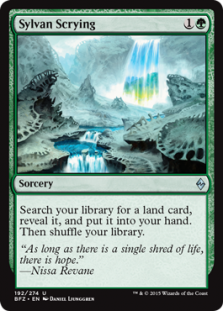
Sylvan ScryingWhile there are decks that follow the traditional ramp methods involving playing, you know, ramp spells like Explore and Sakura-Tribe Elder to accelerate into Primeval Titan by far the most common ramp deck is GR Tron. Tron uses land search like Sylvan Scrying and artifact cantrips like Chromatic Star to assemble Urza's Mine, Tower, and Power Plant and start dropping seven mana threats on turn three, just like Richard Garfield intended. This mana advantage and the quality of colorless bombs makes Tron a nightmare for slower decks.

Ramp and especially Tron pack very little interaction, so aggro decks that can ignore a Karn Liberated or Wurmcoil Engine can easily race. While it's not impossible to attrition Tron out of bombs, the high number of cantrips and Sanctum of Ugin make that unlikely, though it is a viable strategy against other ramp decks.

The best strategy is to attack ramp decks at their lands. Put them off their mana, which is easier against Tron than Titan Shift, and the deck won't do anything. Once again, you do need to present a clock to actually win. It's all well and good to Crumble to Dust two Tron pieces, but if you don't kill them eventually they will play out seven lands and begin dropping bombs until one sticks and you die.

Prison

Examples: Lantern Control, Enduring Ideal

Prison is the most unusal archetype, and it's very unlikely that most players, particularly Standard players, will not immediately recognize it. Prison decks do not like the fact that their opponent gets to play Magic. Where unfair combo decks correct this mistake by having long turns where only they get to play Magic, Prison actively prevents the opponent from making meaningful plays.
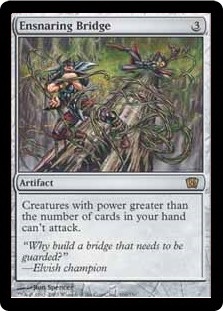
Ensnaring BridgeLantern Control is the most extreme example, but dedicated land destruction decks and Enduring Ideal also fall into this category. Lantern seeks to control its opponent's draw step and hard lock them out of making a relevant play until Lantern wins the game. LD decks do as their name implies and cut their opponent off of lands to make plays. Again, they're preventing you from playing the game through resource denial.

The easiest way to counter these decks is simply to win with your opening hand. LD and Lantern struggle against aggressive decks because they cannot attack their chosen resource quickly enough to keep an aggressive deck off the board. Lantern cannot beat any aggressive start without Ensnaring Bridge, and even with it is soft to Burn. Enduring Ideal decks can get around this through redundant anti-creature lock pieces, which makes the deck far more vulnerable to counterspell decks than the other prison decks.

The other way to fight against Prison is to break their lock by overwhelming their lock pieces. If you play more lands than LD can destroy and they don't establish a clock quickly enough, which is a weakness of the deck, you will win. Living End has a very good Lantern Matchup because it has more draw steps than Lantern can control thanks to cycling. Prison decks are very dangerous to the unprepared, but can be beaten through preparation.

Knowledge is a Good Start

And those are the very broad types of decks that you see in Modern. To summarize, many decks fall under a number of traditional archetype headings and can deceive newer players into misunderstanding matchups. Hopefully this guide to the types of win conditions and strategies helps clear up these misconceptions and make Modern a little more comprehensible and approachable.

I feel that I need to stress once again that this is a very general guide. I've glossed over a lot of important details in order to deliver a more digestible introduction. It is critical that new players research these decks and get some experience against them to really understand their matchups. Or just wait for me to work my way through the more detailed discussions of each deck type. Whatever works for you.


Pro Tour Eldritch Moon and Modern Prices

Are you a Quiet Speculation member?

If not, now is a perfect time to join up! Our powerful tools, breaking-news analysis, and exclusive Discord channel will make sure you stay up to date and ahead of the curve.

Hey guys! You might have noticed that I’m new here. As outlined here, I've been brought onto Modern Nexus to write a weekly column, and I want to take a little of your time to introduce myself. My name is Jim and although I’m originally from New York City, I live in Orlando, Florida. I play a lot of Magic but when I’m not slinging spells I'm working as a software developer. If you’d like to chat more the best way to contact me is @Phrost_ on Twitter! While most people on this site write about Modern strategy, my focus is going to be on the financial side from the player’s point of view. My aim is to provide Modern enthusiasts and players the information they need to know to play their favorite format at the cheapest cost possible.

Atarkas-Command-cropped

Pro Tour Eldritch Moon

So yeah there was just a Pro Tour. I’m sure all of the Modern players are excited, right? Eh, maybe not. But let’s be clear here. Standard is a huge reason that cards are worth money (or not) so it is important to look at Standard trends to see how they affect your Modern prices. Emrakul the Promised EndLike we’ve seen before (with Nahiri, the Harbinger for instance), Modern can also have a pretty big impact on the price of Standard-legal cards. Let’s break down what happened at the Pro Tour.
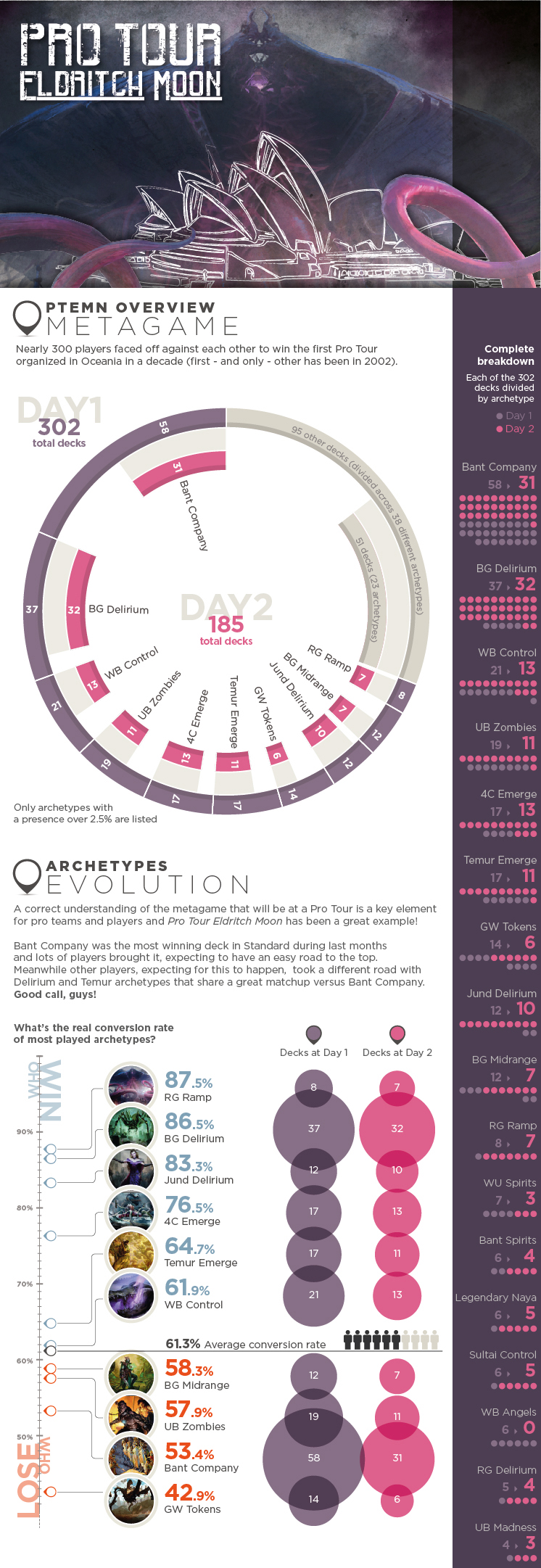
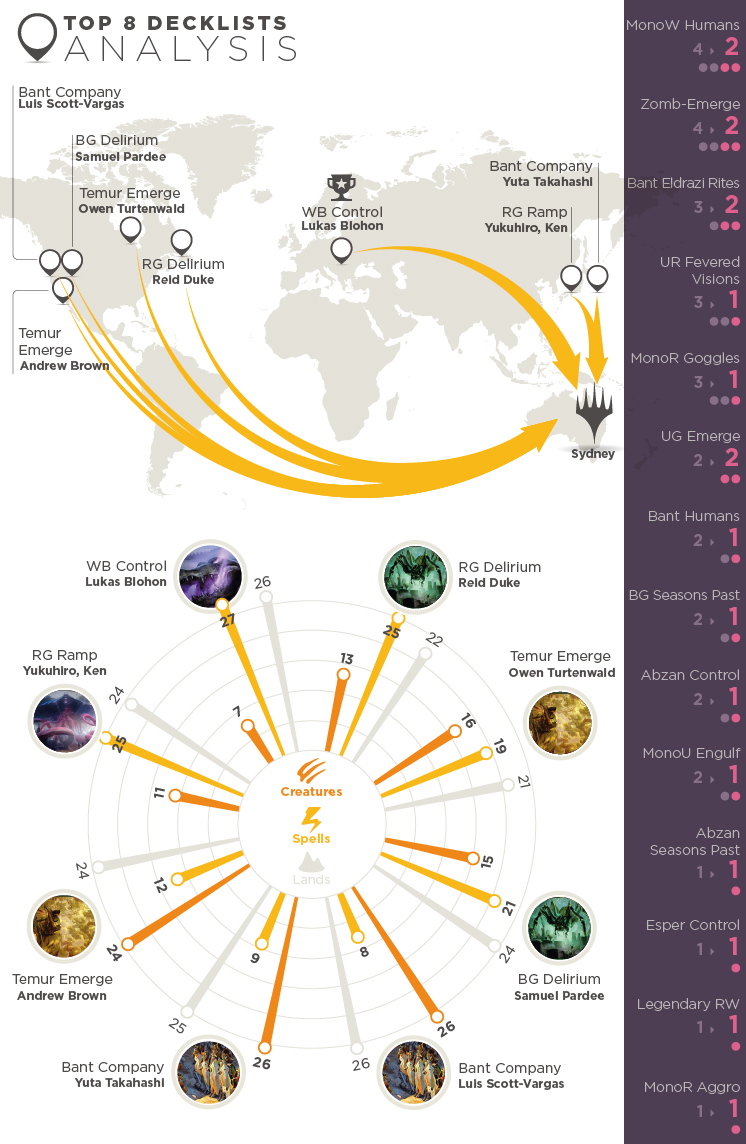
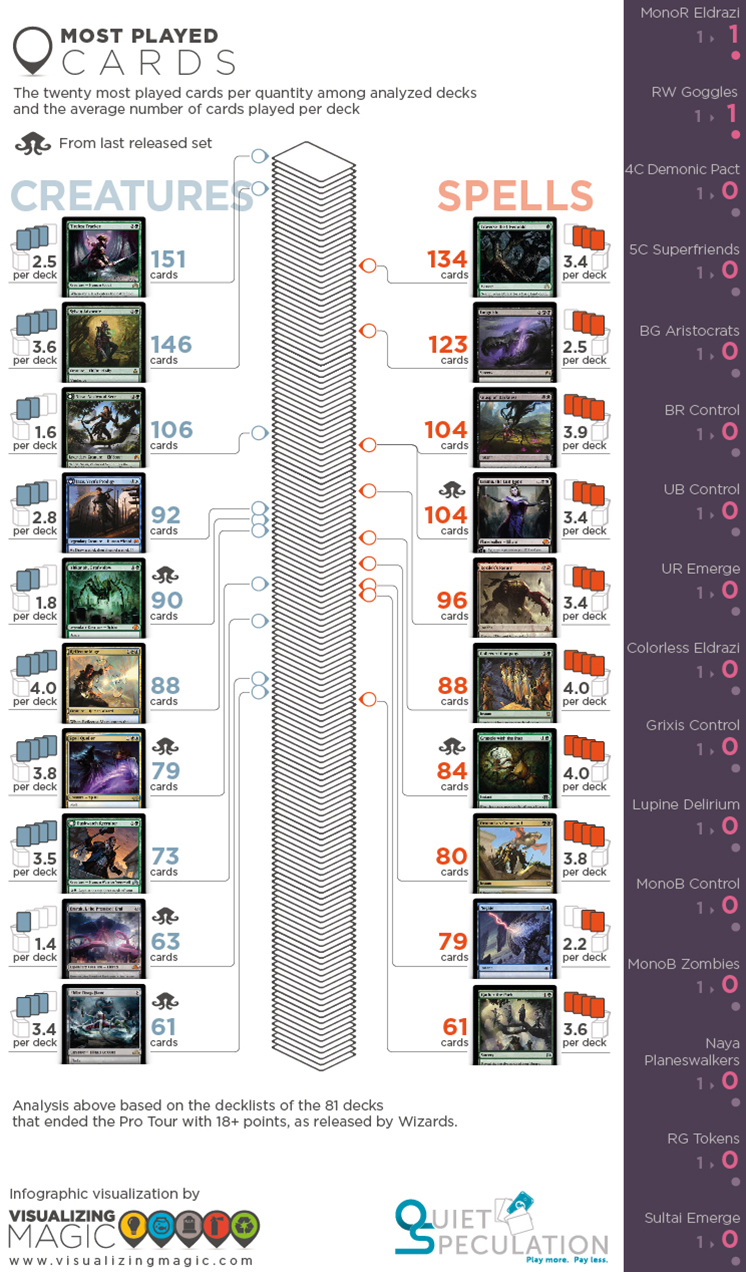
There were theoretically five different deck types that made the Top 8 of Pro Tour Eldritch Moon but I really count four of them as “Emrakul” decks. Temur Emerge and R/G Ramp are basically trying to do the same thing, which is play big things capped off by Emrakul, the Promised End herself. As you might have expected, Emrakul has seen big gains this past weekend. Most of Emrakul’s in-game value comes from her cast trigger which is great if you’re not sneaking it into play.

In Modern, it’s likely to become adopted by R/G Tron lists as a way to beat combo decks (like Ad Nauseum) that aren’t that negatively affected by the Ulamog, the Ceaseless Hunger cast trigger. If you don’t play Tron, however, I think this is a great time to get out of any copies of Emrakul you may have. Her price will flatten out in the coming months as the hype train comes to a close.

[wp_ad_camp_1]

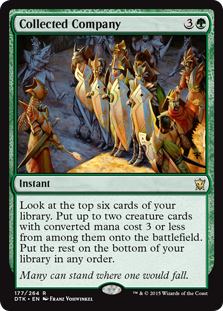
Bant Company came in second in the Top 8 with a pair of copies, neither making the finals. That’s a sharp decrease in dominance from the previous week’s SCG Open in Baltimore where 17 of the Top 32 finishers were playing Bant Company. collected companyNow that the sky is no longer falling I feel like we will finally see the price on Collected Company start to dip. If you’re interested in getting them for Modern, I think the best time will be the week of Kaladesh spoilers but you may also be able to find Standard players looking to move out now at a good rate for you.

On the other hand, if you already own Collected Company I think we’re just past the point where it’s not worth selling them to rebuy them later. The best buylist prices have slipped to just 66% of the best sell prices. At this point Collected Company would have to go under $9 for you to break even. That’s fairly unlikely at this point.

The last two decks in the Top 8 are functionally very different but share the same high-priced planeswalker, Liliana, the Last Hope. She is definitely no Liliana of the Veil and my expectations for her in Modern are slim to none. If you don’t play Standard, now will probably be the best time you can cash out your Lilianas. Buylists across the board are pretty high so you can easily turn your Lilianas into some great cash or store credit---but the real pro play is to trade them into Modern staples.

Atarkas CommandWhile Liliana might be “worth” $40 right now you’ll probably be hard-pressed to find someone with a Tarmogoyf that wants to trade it for three Lilianas. What you won’t have trouble finding is someone looking to trade their soon-rotating staples. Try to trade your Lilianas for Kolaghan's Command, Collected Company, Atarka's Command, or Anafenza, Kin-Tree Spirit.
You might be lucky and find an overjoyed Standard player happily unloading their old cards for new ones. It's likely cards on both sides of that trade will fall in the coming weeks but you will end up with the cards that are proven players in Modern and will likely retain more of their current value.

Final Thoughts

  • I think the most impactful card in Modern from Eldritch Moon is going to be Eldritch Evolution. It has decreased in price since its pre-order hype pricing and I think now is the time to get in. Jeff Hoogland’s Kiki Chord list that made Top 8 in the last SCG Modern Classic plays four copies. Jeff is definitely a brewing barometer I use to predict price increases in Modern. The SCG Open in Syracuse next weekend is Modern and the triple GP weekend in three weeks is also Modern so there is a limited amount of time you will have to get these before we see another Nahiri spike. Coincidentally, Jeff was also the first one to be playing Nahiri, the Harbinger before she saw widespread adoption.
  • Stupid price spikes like Mishra's Bauble are going to keep happening and, sadly, it’s mostly unavoidable. It will take a whole article to explain the cause of this problem.
  • I plan to write some articles about getting into Modern from the base of a Standard collection. If this is relevant to you, let me know!

I always encourage comments in the section below or on Twitter. I’m new here and I want to know what you like to read!

Insider: Virtually Infinite – Lessons from Eternal Masters

Are you a Quiet Speculation member?

If not, now is a perfect time to join up! Our powerful tools, breaking-news analysis, and exclusive Discord channel will make sure you stay up to date and ahead of the curve.

A few months ago I started a series of articles focused on the opportunities presented by Eternal Masters (EMA) on Magic Online (MTGO). I hoped you enjoyed, and profited from, these pieces. Today is the final article in that series---we’ll boil down the lessons we learned and keep an eye out for future opportunities. I will continue to contribute occasional pieces to Quiet Speculation as opportunities emerge, but this is my last regular article for a while.

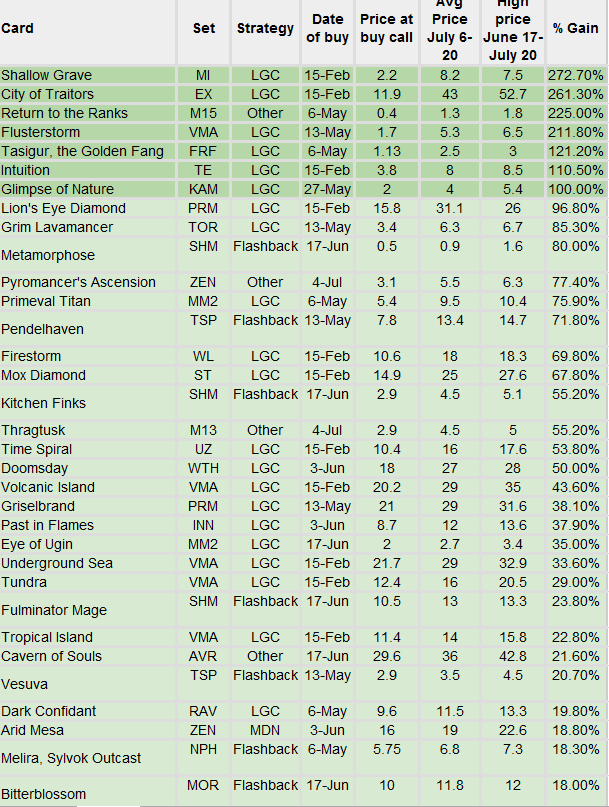
Before we dive into lessons learned, I wanted to take stock of my picks over the past few months. Not all these were hits, but overall the portfolio did quite nicely. Most of these were driven by Legacy though others were driven by price weakness caused by flashbacks.

As discussed in my article series and forum posts, we were targeting the window from July 6-20 to sell most of our EMA-driven specs, so I used the average price during that window for our sell price. I’ve also indicated the “high” price for these cards from the moment of EMA release, though it’s unreasonable to expect you can time the market on most cards. However, this provides a "best case scenario" if you were following the market day by day:

Winners EMA
Click to expand

The cards above increased enough to more than cover the spread on MTGO and yield a profit. Some of our top picks were very profitable indeed.

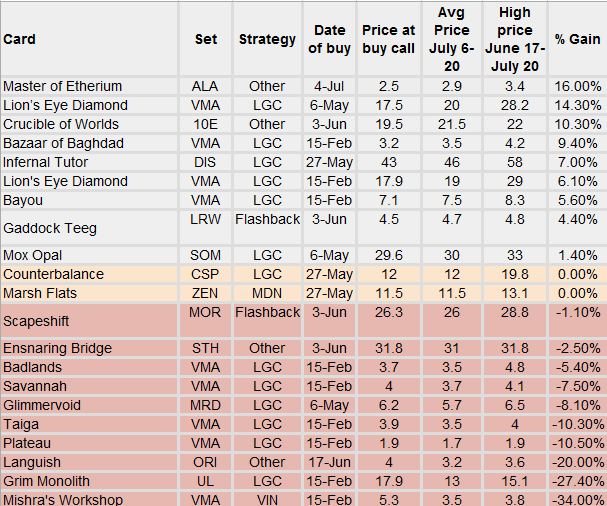
Losers EMA
Click to expand

These specs were less successful. Those that yielded a gain of 16% or less I put in grey. If you bought these cards for playsets you were happy, but as a velocity-generating spec their performance was poor. Finally, the red cards were our misses.

It's worth noting that some of these were big winners if you caught them at their peak---I sold a half dozen copies of Infernal Tutor over 50 tix and liquidated about half of my Lion's Eye Diamonds near their peak.

I am a fan of taking profits with your specs in stages, rather than always waiting for your target sell window, and that approach was largely validated here. Counterbalance and the Vintage Masters dual lands would have also yielded strong returns if you sold them at the right moment, but timing the market is not a winning long-term strategy.

Lessons from EMA Speculation

1. Eternal Masters was a well-designed set for Limited and paper but seems to have entirely ignored MTGO economic considerations. Wizards could easily have corrected the expected value (EV) for online play, but failed to do so, either from lack of attention or desire. The result was a set that was fun to draft but unsustainable unless you played phantom.

We should not assume that future EMA sets will take MTGO equities into account, though perhaps they will learn from their failures. In addition, we may see more gains from EMA cards in the future because the set was not heavily opened.

2. Legacy never broke through on MTGO. Even at the height of competitive leagues there were barely 500 players (compared to two or three times that for Modern and Standard).

There are many reasons why Legacy is an attractive format online and why we’d expect players to migrate there and build up their Legacy collections. That’s what I predicted would occur, but it never really happened. Why not? Several possible explanations, which are not mutually exclusive:

  • Interest in MTGO is closely tied to sanctioned formats and paper Legacy is a dying format. While many pros prefer Legacy to Modern, there is a rising group of players that just won’t touch it because they are priced out in paper and don’t see a future that justifies buying in. Why invest in a digital version of a deck if you’ll never play it in paper? Why invest the time mastering Legacy when it is in decline?
  • Wizards never really promoted Legacy during the release of Eternal Masters. In fact, by offering Vintage Cube drafts they cannibalized the very audience that would be interested in Festival qualifiers. This is consistent with WOTC’s incentive structure---they want folks to play just enough Constructed so cards retain value but don’t want folks to substitute it for Limited, which brings in most of their revenue.
  • The assumption has been that more people would play Legacy as the barriers to entry fell. But perhaps Legacy is so beloved in paper not despite its massive price tag but because of it. The very fact that players traded and scraped for their Legacy deck creates a loyalty to the format which does not exist online.

3. As a result of the weak interest in Legacy, most of the gains in Legacy prices were speculation-driven. The speculator community on MTGO includes a portion of QS readers, but a much larger community of investors and botters that are trying to beat the market. Once these investors saw the low interest for Legacy the market corrected---not back to where it was before, but lower than during the bubble.

The best time to sell depended card by card, but was often not the July 6-20 window. (You'll recall that I debated whether it was better to sell before EMA release or during that window---the answer ultimately varied card by card.)

4. Modern remains a powerhouse format for MTGO speculators. Most of the Legacy-relevant cards I am still holding are also relevant in Modern, and will see gains in the future. Flashback drafts are the gift that keeps on giving.

I hope you enjoyed this series and made some nice profits off of it, like I did. EMA was a great set to draft---hopefully we'll see it return in the future.

Best,

-Alexander Carl

@thoughtlaced

Insider: Understanding Standard Demand

Are you a Quiet Speculation member?

If not, now is a perfect time to join up! Our powerful tools, breaking-news analysis, and exclusive Discord channel will make sure you stay up to date and ahead of the curve.

Let's start with a hard and fast rule:

Standard cards are always trending down in value, except when they spike and then continue trending downward again.

First, I must clarify a little bit. When I say "Standard cards" I specifically mean cards that have value derived from their playability and demand in Standard. The reason Standard cards always trend down is that Standard rotates and at the point when they leave, their "Standard appeal/demand" becomes zero. The demand of cards for Standard is always approaching the eventuality of no demand whatsoever.

Cards with cross-format appeal are different. If a card has demand beyond Standard its life and demand are extended. Demand from Modern, Legacy, or even Commander players extends a card's life beyond its time in Standard. The eternal and casual formats create demand for cards so long as the cards continue to remain playable, and thus desirable, in their respective formats.

I've attempted to lay out the concepts in today's article as basically as I can so they are accessible to everybody. Some of these concepts may feel a little bit obvious to the more experienced trader or seller but I think they are still good concepts to always keep in mind. I've also got a few interesting twists on the basics mixed in at the end.

Theros, Then and Now

Let's take a quick look at the current value of the mythic rares from Theros. I think Theros is still close enough in the memory of most that it will make a relatable example of what I'm trying to get at.

  • Ashen Rider - $0.75
  • Ashiok, Nightmare Weaver - $4
  • Elspeth, Sun's Champion - $5
  • Erebos, God of the Dead - $6
  • Heliod, God of the Sun - $6
  • Hythonia the Cruel - $0.50
  • Master of Waves - $3.00
  • Medomai the Ageless - $0.50
  • Nylea, God of the Hunt - $4.00
  • Polukranos, World Eater - $1.00
  • Purphoros, God of the Forge - $7.00
  • Stormbreath Dragon - $1.50
  • Thassa, God of the Sea - $5.00
  • Underworld Cerberus - $0.50
  • Xenagos, the Reveler - $4.00

So, Theros mythic rares are not exactly lighting the world on fire in terms of being Modern- or eternal-playable. It is noteworthy that many of these cards held price tags of $20+ while they were Standard-legal. These include Elspeth, Sun's Champion ($30+), Stormbreath Dragon ($25+) and Xenagos, the Reveler ($20+).

There was an error retrieving a chart for Elspeth, Sun's Champion
There was an error retrieving a chart for Stormbreath Dragon

The higher prices were a direct result of lots of people needing these cards to play in Standard tournaments. These cards are perfect examples of cards that have an extremely high ratio of Standard demand compared to demand from other players or formats. When these cards were $20+ what percentage of people were buying them for the purpose of using them in Standard-legal decks? I think the answer is clearly a very, very high percentage.

Which is why after they rotated out of Standard they tanked in value in a very significant way. Most of the demand was coming from Standard and not from casual or eternal.

It is interesting that currently the highest-priced mythic is Purphoros, God of the Forge which was not a highly desirable staple in Standard. While the card presold for outrageous prices like $30+, it eventually bottomed out around $3-$4 when it became clear the card was not a major Standard player.

There was an error retrieving a chart for Purphoros, God of the Forge

As rotation approaches Standard cards begin to creep down in price. It's only natural, since players and financiers alike both know that when the Standard demand hits zero, that window for getting value from Standard players will be completely gone.

Selling into Spikes

Just because Standard demand is always trending toward zero doesn't mean that betting on the format can't make you significant gains. As demand for a new card is created (typically from a card suddenly becoming popular in Standard) cards frequently shoot up in value.

In my Eldritch Moon set review I suggested that Ishkanah, Grafwidow was a card that felt very underpriced to me and that I thought would be a considerable player in Standard. It was $3 at the time and is now selling for $15.

There was an error retrieving a chart for Ishkanah, Grafwidow

The key to investing in Standard cards is to anticipate where demand for a card will be increasing in the future and move in with the plan of getting out when the spike occurs. The demand generated by a card suddenly becoming "good" is real. People are going to want to acquire the new hot card so they can play with it.

But remember that demand is fleeting. Once the people get the card they no longer want to acquire more copies. Also, strategies turn over quickly in Standard and it is very possible for a card to be good for a week and then fade out of popularity.

Standard Cards with Cross-Format Appeal

The key to dealing in Standard cards is and always has been selling or trading away your cards into price spikes and surges, and trading for cards in anticipation of possible gains. It is a textbook case of "buy low and sell high."

The problem with this approach to dealing in Standard cards is that it takes a very expert knowledge of the Standard metagame to accurately predict where things are heading and anticipate which cards players will need in the future. The approach is further complicated because the window to sell or trade away cards for peak value is very narrow.

The fact of the matter is that trying to anticipate future demand for Standard cards and supply those cards to buyers is difficult, and often not worth the risk and effort. I say if you have a hot lead, then act on it, but for the most part it isn't where I focus my investing attention.

At the beginning of my article when you thought I was being boring and obvious by stating my rule that all Standard cards are always trending downward I was doing so to set up this end portion of my article.

The majority of people who own Magic cards have some degree of awareness about Standard rotation negatively affecting the value of their cards. Thus there is always a motivation to move Standard cards when there is still some value to be had. There is a tension between having cards to play with but not wanting to get stuck with them when they become worthless post-rotation.

The key is that while all cards from a set are "in Standard together," not all cards have equal proportions of their value derived from Standard demand.

When we look at the most expensive mythics from Theros it should be somewhat obvious that their value comes from either Commander (in the case of the gods) or Modern (in the case of Master of Waves and Elspeth, Sun's Champion).

One of the best times to find value in trades is when people are trying to get out from under cards people feel are losing Standard appeal. At that moment when people start to realize that a certain card is never going to have a home in Standard, they always want to get rid of it before its Standard value reaches zero. The key is to recognize that some of these cards will have value in other places and get in on them when the price is very low.

For instance, recognizing that the Theros gods (even the ones that were not good in Standard) would forever have a home in Commander, or that Master of Waves is a very legit card in Modern or Legacy. On these cards and others you would have had the opportunity to pick up all the copies as Standard players literally lined up to sell them off for whatever small value they could get at rotation time.

When I trade for Standard cards I'm always thinking about which ones have abnormally high amounts of demand from outside of Standard. The key is that the supply of Standard cards is always very high while a card is in Standard because packs of the current sets are being opened and players readily have the cards. However, after a year or two these cards end up in the hands of dealers, sellers and investors, and are not so easy to acquire without having to pay a premium.

You really want to be the individual who stocked up on these cards when everybody else was rushing to sell cheap.

Summary

Most people know that Standard cards are always trending down because when Standard rotates much of the demand will evaporate. We can use this inherent fear of price decreases because of rotation to our advantage by targeting Standard-legal cards that have demand outside of Standard.

Not all Standard money cards are created equally because some cards actually see play in other formats as well!

Insider: Post-Rotation Picks from DTK & ORI

Are you a Quiet Speculation member?

If not, now is a perfect time to join up! Our powerful tools, breaking-news analysis, and exclusive Discord channel will make sure you stay up to date and ahead of the curve.

Welcome back, readers!

Preface

Rotation is still almost two months away, so you might think it's not time to start thinking about it. However, we've seen a pretty consistent cyclical trend of the cards closest to rotation slowly dropping in price as we near it. We can see this with Fleecemane Lion below.

fleecemane

Now the beauty of rotation is that it's a known entity. Everyone can look up online and find out which sets will rotate out of Standard and when. I can't really think of another investment opportunity in life where there is a known and expected sudden drop in demand cyclically. Rotation offers a lot of opportunity for the savvy investor.

The biggest challenges is picking the right cards.

It used to be that you'd typically see everything drop across the board. Thanks to WoTC's support and growth of the Modern format, Modern staples tend to dip very little when they rotate. Here's the chart for Stomping Ground.

stomping ground

Here we see a pretty sudden drop of about $1, then it holds steady through rotation and finally drops slightly post-rotation. While we still see the price decline, compared to Fleecemane Lion the percentage reduction is markedly different. In the three-month period before rotation you see that Fleecemane saw a loss in value of ($3.8 - $1.5) / $3.8 = 60%. Stomping Ground saw a reduction of ($9.5 - $9) / $9.5 = 5.3%.

That's a dramatic difference, but one a lot of people would have expected. The reason is because people now know that there will still be demand for Modern-playable cards post-rotation.

Rotational Picks

Now I bring all this up because we know that Magic Origins and Dragons of Tarkir rotate out of Standard on September 30th, 2016. So we have already entered the time frame where we expect to see the majority of the cards from these sets start declining. The time to pick them up is now; the question is which ones are worth it.

1. Kolaghan's Command

kcommand

This Modern all-star has heavily declined in the past few months (dropping by over 50% from its previous high). It's seen some play in Standard, but the current value is heavily driven by Modern.

Though Grixis Delver and Grixis Control decks seem to be in decline currently, the archetypes are powerful and when they do see a surge again, this card will surely rise in value. It also slots perfectly into the value-oriented Jund, a popular archetype that puts up pretty consistent results.

I don't expect any of those archetypes to suddenly increase their share of the metagame before Kaladesh comes out, so it will likely continue to drift downward, but it's not a bad target currently.

2. Jace, Vryn's Prodigy

jvp

This once-proud pillar of Standard has dropped dramatically with the loss of the fetchlands on the last rotation. Flipping Jace now takes a bit more work and he's fallen out of favor in the Bant Company decks which have reared their ugly heads yet again. However, he's also a very decent pseudo-Snapcaster Mage in Modern and also found a home in the old Grixis Control lists from months back.

I still very rarely see copies of Jace in trade binders and I've had it up on my PucaTrade want list for over a month with no bites. The buy-in is still very high for a card about to rotate out of Standard---but that high price, despite its lack of play, is an indicator that many players/speculators expect him to return to previous heights.

I personally don't know if I agree with that, but he could easily jump back to $45-$50 should Grixis Control decks experience a resurgence in Modern.

3. Atarka's Command

acommand

We're seeing a resurgence in Zoo decks in Modern. The Naya variants typically run Atarka's Command as it often equates to 6+ damage for two mana. It also serves as a Skullcrack which helps these decks prevent opponents from stabilizing. Similar to Kolaghan's Command above, we see that in the past few months it's already dropped by over 50% of its value. To be fair, we've seen the aggro red decks of last year get pushed out by the white Human decks in Standard this year, so it really doesn't have much of a home in Standard at this time.

Similar to Kolaghan's Command, I expect this will continue to trend downward as we get closer to rotation, but I don't think it will stay down for too long. We have a good number of local players on the Naya Zoo plan, and it's a very fast and consistent deck (and thanks to having white has some solid sideboard options to fight the format).

4. Den Protector

Denprotector

Another former Standard all-star that's fallen on hard times, Den Protector is the first card on our list I like for Commander (rather than Modern playability). I know it's basically a more mana-intensive Eternal Witness and it can't be abused with blink effects, but it's still a very powerful Regrowth effect in a format that likes to re-use its powerful cards whenever it can.

If this card ever hits $1.50 I'll likely pick up quite a few, as come rotation I'll simply be moving my copies out of Standard decks and straight into Commander decks. It also helps that it's mono-green, meaning 1) it's in the most powerful color in Commander, and 2) it can go into a large variety of color combinations.

5. Liliana, Heretical Healer

lhh

This is another of my Commander picks. The double black in Liliana, Heretical Healer's mana cost does make her a little trickier to cast. But in Commander sacrificing creatures is a pretty natural occurrence (let alone chump-blocking) and her ability to return non-legendary creatures from the graveyard to the battlefield is extremely powerful. As with Den Protector she's mono-colored which allows her to fit into a lot of decks (or be the commander of one).

6. Dragonlord Dromoka

dromoka

Dromoka has typically been a sideboard card in a few Standard decks last year, but for the most part hasn't really made any big waves in the format. She provides a decent body with lifelink and flying for six mana, but her most important ability is her last one. Preventing your opponents from casting spells during your turn is a very powerful ability in Commander.

For those unaware, City of Solitude recently spiked in price. This card sees very little play in tournament formats, and if players are excited by the enchantment version, you can bet they'll like it when a dragon comes tacked on.

city of solitude

Now Dromoka does have her downsides. She's dual color, so the decks that can play her are more limited, she costs six for this effect, and unlike City of Solitude she doesn't stop abilities. The upside is she is legendary so she can be a commander and she doesn't stop the owner from casting spells on opponents' turns. I can definitely remember a few games in which my own City came back to bite me when an opponent combo'd off on their turn free from the rest of us interfering.

7. Sphinx's Tutelage

tutelageTutelage may be one of the more controversial picks on my list, not because it doesn't have a lot of potential, but because it has already spiked from $1 to $3.5 relatively recently and is only now starting to drop in value. This is the type of uncommon I love. Mill players love to mill people and they will continue to do it as long as this game we love exists.

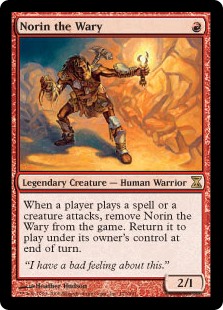
I can honestly see this being a $5 uncommon (barring any reprints) in the next two years. The ability is tournament-worthy (there was a decent U/R Tutelage deck in Standard for a brief period of time) and the fact that it triggers from you drawing a card (which is something you want to do anyways) really makes it a promising spec long-term.

Deck Overview- Standard Izzet Burn

Are you a Quiet Speculation member?

If not, now is a perfect time to join up! Our powerful tools, breaking-news analysis, and exclusive Discord channel will make sure you stay up to date and ahead of the curve.

There were some awesome decks in the Top 8 of PT Eldritch Moon, though plenty of innovative and powerful decks posted great records without making the elimination rounds. The one that speaks most to me is the Thermo-Alchemist deck that Pedro Carvalho piloted to a 9-1 record. There are some... interesting elements, though it's hard to argue with a 9-1 record at the Pro Tour.

Izzet Burn

Creatures

3 Thing in the Ice
4 Thermo-Alchemist
2 Jace, Vryn's Prodigy

Spells

2 Tormenting Voice
4 Incendiary Flow
4 Collective Defiance
2 Dispel
2 Unsubstantiate
3 Fiery Impulse
2 Lightning Axe
4 Fiery Temper
4 Fevered Visions

Lands

4 Wandering Fumarole
4 Shivan Reef
3 Highland Lake
9 Mountain
3 Island
1 Geier Reach Sanitarium

Sideboard

1 Dispel
1 Fiery Impulse
3 Goldnight Castigator
2 Weaver of Lightning
1 Rending Volley
2 Negate
1 Spell Shrivel
2 Bedlam Reveler
2 Nahiri's Wrath

A lot of players are pretty excited about Unsubstantiate, though I am skeptical of the card in the abstract. It looks like it plays very well with Fevered Visions though, and really Fevered Visions seems to be the most important card for this strategy. The damage output is of course important, but the Howling Mine effect is paramount to enable red removal to keep up with the threats of the format. Given this importance, the maindeck Dispels seem quite important for countering Dromoka's Commands. Should this deck see success going forward, I would expect to see Visions increase in price.

There was an error retrieving a chart for Fevered Visions

Collective Defiance is a really interesting card, and I have to imagine that this deck tries to go out of its way to make sure the Lava Spike mode is activated even when hitting a creature is important. For the purpose of going upstairs, it does less damage than Exquisite Firecraft, though when cast for four it is dealing seven total. I am curious about the Wheel of Fortune ability, which is clearly good when you have a bunch of mana and some Fiery Temper in hand, though the card is plenty playable without this mode.

I played a build of Goggles control at SCG Regionals that was wholly unimpressive, though there were elements that I liked. Losing to Bant Company felt impossible, and I was really happy playing the full set of Take Inventory. The first thing I would do with this deck is work that card in. I don't know if or when I'll be playing this Standard format again given that it's Modern PPTQ season, though one way or the other I imagine that I'll be trying this deck out on MTGO.

Deck of the Week: Norin Soul Sisters

Are you a Quiet Speculation member?

If not, now is a perfect time to join up! Our powerful tools, breaking-news analysis, and exclusive Discord channel will make sure you stay up to date and ahead of the curve.

Soul Sisters has long been one of those established, lower-tier decks in Modern that attracts its share of fans and die-hard pilots who take it to battle regardless of the metagame prognosis. The fact that a deck built around lifegain exists in Modern should remove any doubts you had about the format's capacity to support the bizarre and discarded strategies of Magic's storied history. A few weeks ago the archetype took one of the Top 16 slots in the Baltimore Classic. Soul Sisters may look a bit wonky, but once you've had to fight through that fifth or sixth Squadron Hawk recycled via Mistveil Plains, you know the deck is capable of some powerful lines.

Purphoros, God of the Forge-cropped

While Soul Sisters is a pretty well-known archetype by this point, its rarer cousin/variant, Norin the Wary combo, will certainly be a novel sight to many eyes. In the recent bout of WMCQs, one intrepid player in Chile brought the infamous Dominarian coward to a Top 8 finish with his take on the archetype.

[wp_ad_camp_1]

Norin Soul Sisters, by Joaquin Ossandon (Top 8, WMCQ Chile)

Creatures

4 Ajani's Pridemate
2 Auriok Champion
4 Champion of the Parish
1 Legion Loyalist
4 Norin the Wary
2 Purphoros, God of the Forge
3 Ranger of Eos
3 Soul Warden
3 Soul's Attendant

Artifacts

4 Genesis Chamber

Enchantments

2 Spirit Bonds

Instants

4 Lightning Bolt
1 Path to Exile

Lands

4 Cavern of Souls
4 Clifftop Retreat
4 Flooded Strand
1 Mountain
4 Plains
4 Sacred Foundry
2 Windswept Heath

Sideboard

2 Blood Moon
2 Deflecting Palm
1 Ethersworn Canonist
2 Grafdigger's Cage
1 Grim Lavamancer
1 Spirit Bonds
4 Stony Silence
2 Wear // Tear

To start, we see the typical Soul Sisters package of lifegain dorks that give the deck its name (Soul Warden, Soul's Attendant, Auriok Champion). Like in the traditional mono-white version, these are paired with Ajani's Pridemate to make for a two-drop that easily outclasses a fully-fueled Tarmogoyf. Norin the WaryThe other major payoff for gaining a billion life, however, is suspiciously absent. In place of Serra Ascendant, the red-white version runs a combo-esque package built around Norin the Wary as an additional kill condition.
Let's unpack how this all fits together. Obviously a perpetually blinking Norin will stack up a formidable pile of lifegain triggers, but it's not as if Soul Sisters ever had much difficulty padding its life total before. The more interesting interaction, and what adds a new dimension to this version of the deck, is how it works alongside Genesis Chamber and Purphoros, God of the Forge.

Genesis Chamber has been a darling of Johnnies the world over since, as far as I can tell, the dawn of time itself, and here it finds particularly sharp application. I've seen various attempts to break open the symmetrical effect in different ways, but Norin is by far the most reliable I've witnessed. First of all, assuming whatever creatures the opponent summons require the casting of spells, the first one will always net you a Norin trigger as well. Genesis ChamberOnce you add in combat on both players' turns and casting of your own spells, it's safe to say Norin will likely be triggering every single turn for an additional two free Myr tokens. Build your own Verdant Force, anyone?
Multiples of Genesis Chamber are sure to end games in a hurry, to say nothing of the introduction of Purphoros to the equation. Assuming Norin does his thing every turn, that's a five-turn clock that's effectively unblockable and near impossible to kill (good luck with those spot removal spells---would you like to target Norin or my indestructible creature?) Purphoros will incidentally give the Norin pilot an efficient way to kill pesky planeswalkers like Nahiri, the Harbinger or Liliana of the Veil, and give you another way to leverage your Myr army with the pump ability. Finally, Spirit Bonds provides additional utility and allows your token production to take to the skies.

Human Tribal?

Norin also enables the addition of Champion of the Parish to the strategy, without necessitating a complete rewriting of the creature base. Champion of the Parish is clearly an absurd card in a tribal Human deck, easily outclassing beaters like Wild Nacatl in the average draw. Cavern of SoulsHumans as a deck hasn't made it in Modern (yet), but it's hard to deny the power of Champion specifically. A big part of the Soul Sisters core is already comprised of Humans to begin with (the "sisters" themselves, Ranger of Eos, Serra Ascendant) and once you add in Norin, you can expect the parish to be well and truly championed.
Cavern of Souls makes an appearance too, to fix mana and guarantee your "combo" pieces resolve. Note that a Cavern on Soldier will give you uncounterable Ajani's Pridemates, while still casting two other key business creatures, Ranger of Eos and Champion of the Parish.

That Legion Loyalist (and the Grim Lavamancer from the board) look like sweet tutor targets for Ranger of Eos. Loyalist is a natural solution to the problem of opposing Myr tokens from Genesis Chamber, while Grim Lavamancer is of course excellent at putting the screws to aggro (or the mirror!). These tutor targets do draw more attention to the lack of Serra Ascendant, and my gut feeling is that it belongs in this deck in some number. Serra AscendantMy thinking at this point is you'll be hard pressed not to hit 30 life just like in the original archetype---and cutting your effective 6/6 flying lifelink seems dubious at best.


The other major concession this list makes compared to traditional Soul Sisters is in the mana base. While the addition of Cavern is nice, there was nothing preventing Soul Sisters from doing that per se. In exchange for the second color, you sacrifice the powerful utility lands like Mistveil Plains, Windbrisk Heights, and Ghost Quarter. The former two serve to provide card advantage and inevitability, respectively, and are perhaps less necessary as Norin Soul Sisters is much better at ending games with damage than the tedious grindfest that is recurring Martyr of Sands and Squadron Hawks infinitely. I suppose there's nothing preventing you from relegating the splash to a smaller role, but it does seem that casting Norin the Wary consistently is pretty important. In any case, you also get access to Lightning Bolt.

Playing the Unplayable

I don't think Norin the Wary combo (or Soul Sisters, for that matter) is likely to tear up the fast-approaching Grand Prix weekend or anything, but this looks like a fun deck to bring to FNM or a local PPTQ. How often do you get the opportunity to sleeve up a full playset of a truly terrible card like Norin the Wary, anyway? When Norin was released he was compared to the likes of One With Nothing and hailed as completely unplayable garbage---yet here he is 10 years later making a name for himself in Modern!

Jason Schousboe

Jason was introduced to Magic in 1994, and began playing competitively during Time Spiral block. He has enjoyed a few high finishes on the professional scene, including Top 16 at Grand Prix Denver and Top 25 at Pro Tour Honolulu 2012. He specializes in draft formats of all stripes, from Masters Edition to the modern age.

View More By Jason Schousboe

Posted in Brewing, Metagame, ModernTagged , , , 8 Comments on Deck of the Week: Norin Soul Sisters

Have you joined the Quiet Speculation Discord?

If you haven't, you're leaving value on the table! Join our community of experts, enthusiasts, entertainers, and educators and enjoy exclusive podcasts, questions asked and answered, trades, sales, and everything else Discord has to offer.

Want to create content with Quiet Speculation?

All you need to succeed is a passion for Magic: The Gathering, and the ability to write coherently. Share your knowledge of MTG and how you leverage it to win games, get value from your cards – or even turn a profit.

Want Prices?

Browse thousands of prices with the first and most comprehensive MTG Finance tool around.


Trader Tools lists both buylist and retail prices for every MTG card, going back a decade.

Quiet Speculation