menu

Goyfing and Cruising: Grim Flayer and Chaos Reveler in Modern

Are you a Quiet Speculation member?

If not, now is a perfect time to join up! Our powerful tools, breaking-news analysis, and exclusive Discord channel will make sure you stay up to date and ahead of the curve.

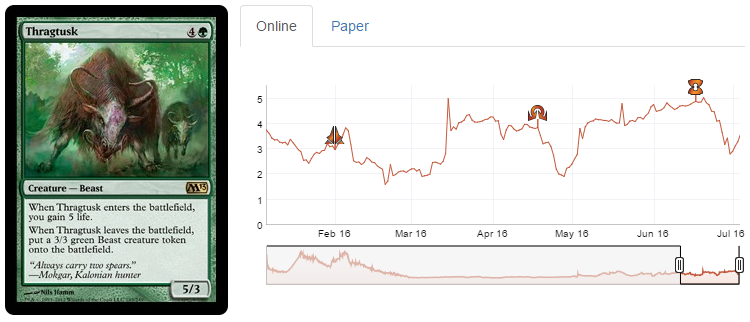
I'm big on card efficiency and resource management. Cards that reward players for interacting with opponents, and ones that rely on stocked graveyards, are among my favorites. So I've savored this new Innistrad spoiler season more than any since delve was announced in Khans of Tarkir. Traverse the Ulvenwald is my favorite card this side of Treasure Cruise, and with Eldritch Moon, the infamous blue sorcery gets a reboot on legs. As if that weren't enough, Tuesday's Moon even shined its light on a delirium-reliant Tarmogoyf.
gitaxian probe art crop

This week, I spent an inordinate amount of time testing [tippy title="Grim Flayer" width="330" height="330"]
grim flayer
[/tippy] and [tippy title="Chaos Reveler" width="330" height="330"]
chaos reveler[/tippy] in Tarmogoyf/Stubborn Denial decks. Both cards impressed me, but I have a feeling one will make more of an impact in Modern than the other.

[wp_ad_camp_1]

German Thresh

German Threshold is a BURG Delver deck with Legacy origins. In 2013, a team of German deckbuilders splashed Deathrite Shaman into their Canadian Threshold decks for GP Strasbourg. None of them made Top 8, but the greedy tempo deck never totally left the format. Noah Walker first introduced me to the archetype at GP New Jersey a year later, where he played a Cruise-powered German Thresh deck with Young Pyromancer over Tarmogoyf (the spiritual predecessor to Grixis Delver, a deck he debuted in the same room as my own Monkey Grow last summer).

Until now, black hasn't had much to offer Modern grow strategies, as Tasigur, the Golden Fang already has a functional analog in Hooting Mandrills. But the spoiling of [tippy title="Grim Flayer" width="330" height="330"]

grim flayer[/tippy] inspired me to port the deck to Modern.

German Thresh, by Jordan Boisvert

Creatures

4 Delver of Secrets
4 Tarmogoyf
4 Grim Flayer
1 Snapcaster Mage
1 Tasigur, the Golden Fang

Artifacts

4 Mishra's Bauble

Instants

4 Thought Scour
4 Lightning Bolt
3 Stubborn Denial
2 Spell Snare
2 Abrupt Decay
3 Mana Leak

Sorceries

4 Serum Visions
2 Gitaxian Probe

Lands

4 Polluted Delta
4 Verdant Catacombs
2 Misty Rainforest
1 Watery Grave
1 Stomping Ground
1 Blood Crypt
1 Breeding Pool
2 Island
1 Swamp
1 Forest

Sideboard

2 Huntmaster of the Fells
2 Snapcaster Mage
2 Terminate
1 Abrupt Decay
2 Pyroclasm
1 Darkblast
2 Disdainful Stroke
2 Ancient Grudge
1 Natural State

Flaying the Field

In practice, German Thresh plays similarly to Monkey Grow, but sits closer to midrange on the archetype spectrum. The deck’s many colors force us to abandon Disrupting Shoal, whose functions are fulfilled to some degree by Spell Snare and Abrupt Decay. It picks up hard creature removal, Tasigur, the Golden Fang, and [tippy title="Grim Flayer" width="330" height="330"]grim flayer[/tippy].

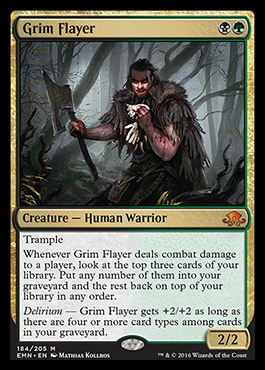
grim flayer[tippy title="Grim Flayer" width="330" height="330"]grim flayer[/tippy] fills out the strategy as Goyfs 5-8: Bolt-proof, ferocious-enabling two-drops that pressure opponents or wall their attackers as needed. Granted, Hooting Mandrills does something similar, but Flayer's extra ability is the real reason to splash black. This filtering effect allows us to stabilize or end games that much quicker, stacking Stubborn Denials and Lightning Bolts to the top of the deck while tossing excess lands in the trash. Gitaxian Probe and Serum Visions let us immediately draw a card left on top when cast post-combat, helping us always have a counterspell at the ready once Flayer gets swinging.

Mishra's Bauble plays a key role in quickly activating delirium. Against red decks, we never want to slam [tippy title="Grim Flayer" width="330" height="330"]grim flayer[/tippy] as a 2/2, so stocking the grave with a fourth card type is crucial to the human newcomer’s effectiveness. Bauble also interacts passably with Delver of Secrets despite its artifact type, activating on an opponent’s end step to give pilots two tries at transforming the 1/1 into Insectile Aberration.

German Thresh’s manabase follows the same rules as Counter-Cat’s. The deck wants to assemble two core shocks (Crypt + Pool or Grave + Ground) as early as possible, allowing it to cast any spell in the deck. Island is our preferred third land, as we rarely want to take more than 7 damage from our manabase. Polluted Delta fetches every land but basic Forest, making it our most valuable fetchland; Verdant Catacombs only misses Island, and Misty Rainforest fails to find Blood Crypt and Swamp. When expecting a Blood Moon from across the table, pilots should prioritize fetching Island, Swamp, and Forest, leaving the red source for last.

Why Not Sultai?
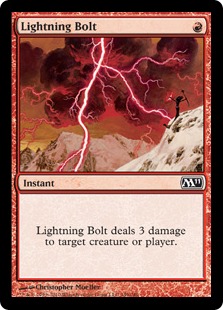
Lightning BoltWe already know the answer to this question: Sultai doesn't have Lightning Bolt. Bolt is integral to goodstuff interactive decks in Modern, especially ones that live and die by card efficiency and flexibility. "Bigger" interactive decks like UW Control might get by without Bolt, but tempo and midrange decks lean heavily on the card to get them through the initial rush from Infect, Burn, and Affinity, or to burn out stabilizing Tron players.

I've tried bypassing the Bolt-block in Sultai before by running Disrupting Shoal. While Shoal won't reach out decks that go over fair strategies, it covers the red instant's tracks against linear aggro. But running [tippy title="Grim Flayer" width="330" height="330"]grim flayer[/tippy], Abrupt Decay, and Mishra's Bauble bars us from supporting that card, which demands at least 22 blue cards to function optimally. If we want to stay in Sultai, our only feasible option is to add red.

The Price of Greed

Splashing a fourth color brings its own set of problems to the table. As I see it, red generally brings four invaluable elements to Modern grow decks:

  • The format's strongest card (Lightning Bolt)
  • Sweeper effects (Pyroclasm)
  • Mana denial (Blood Moon)
  • A one-card midrange plan (Huntmaster of the Fells)
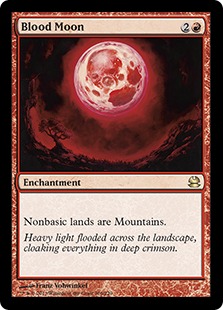
Blood MoonThe first two aid Sultai tremendously, but the last two fall flat in German Thresh. We lose out on including Blood Moon with so many colors. German can never resolve a safe Moon until turn four (one turn each to fetch our basics, plus a turn to make a red land drop), making the card significantly worse. As for Huntmaster, he adds to our arsenal, but I wouldn't call him integral to German Thresh the way he is to Monkey Grow. Sultai colors give deckbuilders plenty of other midrange options, including Traverse the Ulvenwald and Kalitas, Traitor of Ghet. We may only reap the bare benefits of playing red in German Thresh, but I still don't think the deck can work without Bolts.

[tippy title="Grim Flayer" width="330" height="330"]grim flayer[/tippy] is a superb card, but playing him in a competent Modern deck requires deckbuilders to jump through quite a few hoops. After a full day of tuning and online grinding, I missed Blood Moon too much to want to turn the ugly little guy sideways anymore. I had twiddled my thumbs for less than a day when [tippy title="Chaos Reveler" width="330" height="330"]chaos reveler[/tippy] was spoiled, launching me back into brew mode.

Tweaking Temur Traverse

Like Traverse the Ulvenwald before it, [tippy title="Chaos Reveler" width="330" height="330"]chaos reveler[/tippy] is poised to redefine the way I brew in Modern. Spell-based combat decks everywhere will want this card, and Temur Traverse is no exception. My latest build abandons some of the mainboard toolbox elements for more blanket interaction and a synergistic shell that maximizes the power of this 3/4 Treasure Cruise.

Temur Traverse, by Jordan Boisvert

Creatures

4 Tarmogoyf
4 Gnarlwood Dryad
4 Snapcaster Mage
2 Chaos Reveler
1 Huntmaster of the Fells

Instants

4 Thought Scour
4 Lightning Bolt
2 Tarfire
2 Stubborn Denial
2 Mana Leak

Sorceries

4 Serum Visions
4 Gitaxian Probe
4 Traverse the Ulvenwald

Lands

4 Scalding Tarn
4 Misty Rainforest
1 Wooded Foothills
2 Steam Vents
1 Stomping Ground
1 Breeding Pool
1 Sulfur Falls
3 Island
1 Forest
1 Mountain

Sideboard

2 Ancient Grudge
2 Pyroclasm
1 Feed the Clan
1 Pithing Needle
2 Blood Moon
1 Magus of the Moon
1 Huntmaster of the Fells
1 Chaos Reveler
1 Glen Elendra Archmage
1 Stormbreath Dragon
1 Reclamation Sage
1 Spellskite

Causing Chaos

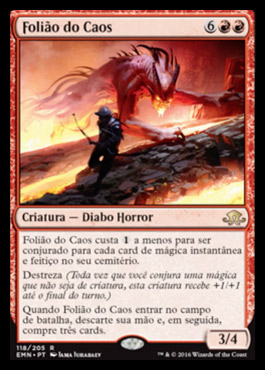
Compared with previous iterations of Temur Traverse, this build adopts more of a jack-of-all-trades approach, combining efficient creatures, hard removal, countermagic, and tutoring to play a competent midrange game. It trades away some toolbox targets to ramp up the spell count and enable [tippy title="Chaos Reveler" width="330" height="330"]chaos reveler[/tippy], who handsomely earns his inclusion.

chaos revelerPart of making Reveler work involves ensuring the graveyard approaches six instants and sorceries by the midgame. I started with a set of Thought Scour, but still found the creature lacking. The solution was to cut Mishra's Bauble to zero and max out on Gitaxian Probe, which casts multiple Lotus Petals in this deck when it comes to chaining Revelers. Probe also ensures Goyf resists Lightning Bolt by turn two, improving our early game against aggro and midrange.

And once Reveler works, boy, does he work. I play the card differently depending on the matchup. Against decks like Tron or Ad Nauseam, he comes down as early as possible, usually causing me to lose a land or a cantrip but making up for it with his aggression. He can still be a bit slow in these matchups, and I prefer Goyf or Dryad to pressure opponents.

Reveler's at his best in midrange mirrors. Anyone trying to win via attrition, including Jund, Grixis, and Jeskai, has a very hard time beating "draw three cards" on a Bolt-proof, Decay-proof body. For perspective, that's a four-for-one, except the fourth card isn't another random draw, but a respectable threat. Since Reveler frequently costs two mana, he's even tough to Mana Leak. I save Reveler in hand against these decks until I've exhausted all my other cards. Testing against Jeskai Control, a fairly tight matchup for my other editions of Temur Traverse, has yielded overwhelmingly positive results. After Jeskai spends its resources dealing with Tarmogoyf, Gnarlwood, and Snapcaster Mage value plays, Reveler comes out of our empty hand to pull way ahead on cards.

Like Treasure Cruise, Reveler even brings his buddies. Those dark, delicious days favored the blue mage able to resolve the first Cruise, which would start a card advantage snowball; that lucky early bird always seemed to have Remand ready for his opponent's tardy delve spell, and another Cruise at the ready once he exhausted his cheaply acquired fuel. Similarly, the three cards we draw off Reveler are likely to feature either Traverse the Ulvenwald, Snapcaster Mage, or [tippy title="Chaos Reveler" width="330" height="330"]chaos reveler[/tippy], all of which translate into, well, another [tippy title="Chaos Reveler" width="330" height="330"]chaos reveler[/tippy]. A Traverse or Snapcaster peeled with the Reveler can also give flashback to a Scoured-away Stubborn Denial, which triggers prowess on the stack and turns on ferocious with Reveler still in play. This interaction can prove very difficult for grinded-out opponents to overcome.
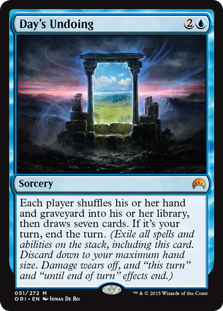
Day's Undoing 223x310Reveler's wording also evokes a card that famously failed to live up to my great expectations: Day's Undoing. Since his 187 ability forces us to discard our hands before drawing three cards, we can't stockpile advantage in hand and pull even further ahead with the Reveler, like we could with Treasure Cruise. Instead, Reveler asks us to spend our cards before casting a "pure" Ancestral Recall. I'm not too worried about this drawback. If we can build decks designed to quickly run out of cards to abuse Day's Undoing, we can build decks that do the same to abuse [tippy title="Chaos Reveler" width="330" height="330"]chaos reveler[/tippy]. The key difference between Reveler and Undoing: Reveler's advantage is one-sided. Undoing's big downfall ended up being its unfortunate tendency to inadvertently benefit opponents, making it terrible with opponents ahead in the game. Reveler gives us a huge advantage whenever we don't have a swath of cards in hand, and when we do, we can simply cast those instead and reap his advantage later.

The Delver/Dryad Debate

An interesting question with this deck is whether to include Delver of Secrets. With 26 instants and sorceries, including Serum Visions, the deck easily has enough juice to transform the creature reliably. But in this list, I've foregone Delver in favor of [tippy title="Gnarlwood Dryad" width="330" height="330"]gnarlroot dryad[/tippy]. Both creatures are Bolt magnets whose corpses contribute to delirium against interactive strategies, but they truly shine against Modern's linear decks---and each option in its own way.
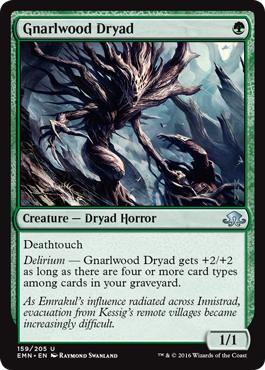
Dryad does a couple of novel things in this shell. For one, he shores up aggressive matchups. Temur Traverse is a much more midrange-focused deck than Temur Delver, meaning its late-game dwarfs that of many aggro decks. When you've got Goyfs, Snapcasters, and walking Cruises, you tend to wish your Delvers were removal spells against decks like Zoo and Burn. Gnarlwood at least trades with a creature, and he outright walls others, like Kird Ape and Goblin Guide.

He can also buy time versus midrange by deterring Tarmogoyf or a souped-up Scavenging Ooze from invading our personal space. In a deck that can draw Snapcaster Mage, Traverse the Ulvenwald, or [tippy title="Chaos Reveler" width="330" height="330"]chaos reveler[/tippy] himself and immediately refill against these creature-based attrition strategies, buying time often ends up buying the game. Against interactive decks, Dryad outshines Delver of Secrets.
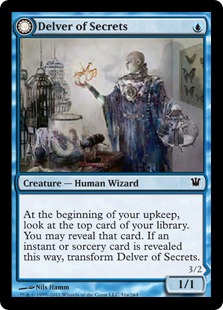
DelverMakes sense, since nobody would purposefully play Delver against those decks. I agree with Grixis Delver aficionado Ryan Overturf's analysis of the big reasons to play Delver in a URx Snapcaster Mage strategy: the creature puts enormous pressure on degenerate decks that either get under or go over the top of midrange strategies. The "go under" decks include Burn, Zoo, Affinity, and Infect; the "go over" decks mostly just include Tron. Against big mana, Dryad and Delver size up pretty evenly, except Delver flies over a late-game Wurmcoil Engine and Dryad resists Pyroclasm. Dryad holds some points over Delver against Burn and Zoo, as explained above, while slowing down strategies like Infect and Bogles by incentivizing them not to attack---even a swinging Glistener Elf backed up with a pump spell dies to a blocking Dryad, while Delver would suffer the full Might of Old Krosa in the same situation. The one deck Delver exceeds against is Affinity, since it plays better defense there than Gnarlwood can.

Of course, all these examples assume Temur Traverse wants to play a midrange game, every game. Delver of Secrets gives his summoner the unique opportunity to steal a win in the air from creature-casting opponents whose awkward hands don't come together, punishing stumbles like no other creature in Modern. Another massive strike against Dryad is that Delver becomes a three-power creature much earlier than his green counterpart against decks that refuse to interact with us, and therefore make it difficult to turn on delirium barring a Tarfire opener or a lucky Thought Scour. Some of these decks, including Tron and Ad Nauseam, will demolish Temur Traverse if it fails to pressure early. For these two reasons, Delver also merits testing in this shell. I just haven't gotten around to trying him yet.

Delirium in Modern

Traverse the Ulvenwald, [tippy title="Grim Flayer" width="330" height="330"]grim flayer[/tippy], and [tippy title="Chaos Reveler" width="330" height="330"]chaos reveler[/tippy] have a lot in common. Besides playing nice with Tarmogoyf and hitting most of my personal oracle text soft spots, they all share a crucial dimension in relation to the Modern metagame: each card is clearly powerful in its own right, yet neither fit naturally into existing top tier archetypes. Jund has too much trouble reliably turning on delirium to make great use of Flayer, and most URx decks will prefer Ancestral Vision packages to Reveler's drop-and-go. (As long as Reveler doesn't find its way into hilarious UR Burn shells, we're safely out of the woods. Actually, let me go brew that real quick.)

Whether this elegant design characteristic was purposefully met by Wizards of the Coast or not, I'm sure we can agree that the result stands to benefit the format greatly by offering players even more deckbuilding possibilities without turning any of Modern's usual suspects oppressive.

Bonus Deck: UR Delver

I'm adding this section 90 minutes before publication because the just-mentioned UR Burn deck has tested so phenomenally in the last few hours. Nothing beats casting Vapor Snag on your own Reveler in response to a Terminate. Check it out!

UR Delver, by Jordan Boisvert

Creatures

4 Goblin Guide
4 Monastery Swiftspear
4 Delver of Secrets
4 Chaos Reveler

Instants

4 Thought Scour
4 Lightning Bolt
4 Vapor Snag
2 Mutagenic Growth

Sorceries

4 Serum Visions
4 Gitaxian Probe
4 Lava Spike

Lands

4 Scalding Tarn
2 Wooded Foothills
3 Misty Rainforest
3 Steam Vents
1 Stomping Ground
2 Sulfur Falls
2 Mountain
1 Island

Sideboard

2 Negate
2 Dispel
2 Forked Bolt
2 Ancient Grudge
2 Blood Moon
2 Disdainful Stroke
2 Invasive Surgery
1 Natural State

Insider: Early Picks Relative to Eldritch Moon

Are you a Quiet Speculation member?

If not, now is a perfect time to join up! Our powerful tools, breaking-news analysis, and exclusive Discord channel will make sure you stay up to date and ahead of the curve.

In a lot of ways, Eldritch Moon reminds me of New Phyrexia. Shadows over Innistrad was a neat set with pretty normal mechanics, and now EMN looks kind of nuts. I suppose it makes sense that the Eldrazi invasion is somewhat like the Phyrexian invasion with regard to telling a story with a block. There's even a nutty cost reduction mechanic!

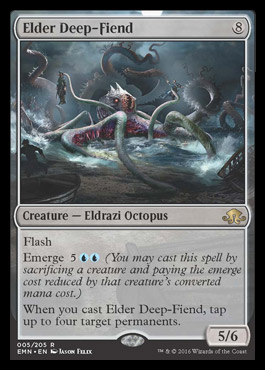
decimatoroftheprovinces elderdeepfiend

If you don't read Michael Majors, you're missing out. I recommend checking out his article about these wonky new monsters. I don't know how serviceable his lists are, but I agree with him about the potential for these cards. Elder Deep-Fiend is going to feel very close to Time Warp that trades up one of your creatures in a lot of situations, and that power is worth exploring.

Matter Reshaper is a card that I haven't been especially pleased with in the past, but I agree that it is a strong role-player in decks trying to cast these new monsters. Reshapers are pretty cheap right now with some copies available for under $2, and I could easily see them doubling or more as they start to fill an actual role instead of mostly being value/filler.

There was an error retrieving a chart for Matter Reshaper

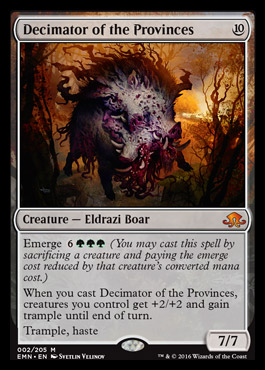
With Deep-Fiend being a regular rare, speculation is going to be more about finding the support cards that already exist that could spike due to its printing, though I do think that Decimator of the Provinces is actually worth looking at as a spec itself. A good mix of tokens and some four- or five-mana creatures to sacrifice to the Decimator will lead to some very fast games. Not only is the overrun effect very powerful, but leaving a 7/7 with trample behind is also nothing to scoff at.

It's true that Decimator doesn't really have appeal in non-Standard competitive formats, but with pre-orders being $5-6 a competitive Standard Decimator deck would certainly lead to a price increase.

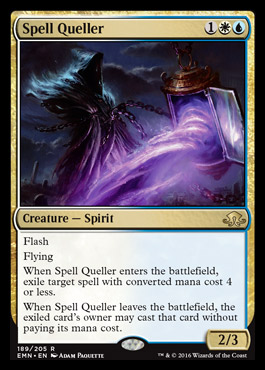
Another soon-to-be format-defining card is Spell Queller.

Spell

This card is stupid. I'd be very interested in reading the design file here, and don't see how this wouldn't be a widely played Standard staple. The initial tempo gain from a flash threat that exiles a spell, especially one with such a solid body, is huge. Even when this creature dies, it will still often have a significant impact on the game.

Further, a second copy will do a good job at preventing the first from dying, and Rattlechains compounds this issue. I fully expect to see an uptick in Rattlechains in competitive Standard decks, and as such I like buying in right now with the price being about a buck.

There was an error retrieving a chart for Rattlechains

Rattlechains is already seeing some movement and the best prices have already passed, but even as high as $2 will end up saving you money if you're just looking for a set to play with. This card will easily be $3-5 in short order, and could theoretically go higher. The one barrier is that it's totally justifiable that there will be Spell Queller decks that don't feature Rattlechains, though at least for now there is hype building as we approach the set's release.

If Spirits ends up being the way to go, then a card I really like is Bygone Bishop. Spell Queller enables a more creature-heavy, efficient tempo deck that Bishop would serve as the Tireless Tracker for. It doesn't quite beat down the way that Tracker does, but it keeps the value coming and is a nice evasive threat for attacking planeswalkers and opponents alike. Bishops are currently sub-$1, and it's not hard to see them becoming a $3-5 card as well.

There was an error retrieving a chart for Bygone Bishop

If you've been paying attention, you noticed that Relentless Dead has spiked in a big way. There is some potential heavy-black and graveyard stuff on the way from Eldritch Moon, and people are willing to gamble on it. With Relentless Dead back around $13, I don't think that's a great place to park your money, though there is a related position that I am interested in.

There was an error retrieving a chart for

Whether it's Relentless Dead or Gisa and Geralf, it's looking like there could be an uptick in creatures returning to the battlefield from the graveyard. Relentless Dead is a shoe-in for a deck trying to play out of the graveyard, and has already established itself as a staple in any Modern Dredge deck.

Prized Amalgam has already gained a small amount of value, though with the card still being sub-$2 I believe there is room to grow. The card is unique/quirky and a role-player in Modern, and as such it's a solid position. It's a better trade target than a buy at its current price, though I'd want to own at least a set.

Another card to pay attention to along these lines is Diregraf Colossus. Zombie cards have a large casual following, and while a buck is steep for a long-term casual position, there is a chance that Eldritch Moon offers more zombie tools to make the Colossus a Standard hit. The card offers grindy value, which is a very important thing in Standard, and it belongs to a tribe with some solid grindy-value support that is just missing one or two pieces. The problem is that the deck has too many threes and fours and not enough ones and twos.

There was an error retrieving a chart for Diregraf Colossus

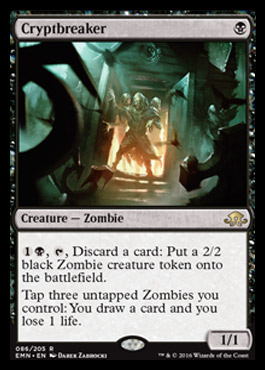
Gisa and Geralf are cool and all, but the deck simply needs more efficient stuff. The strongest glimmer of hope for the deck is Cryptbreaker.

cryptbreaker

It's a mana sink and a discard outlet for excess lands or Prized Amalgam, and it brings the curve down for the deck. Being a madness enabler is pretty interesting as well. While madness has been more geared towards vampires to this point, there are still a few synergies worth exploring.

I'm not especially enticed by the $3 pre-order for Cryptbreaker, but it's a potentially notable card, and more cheap zombies or good madness spells will start to make buying into zombies be less of a hype thing and more of a real deal.

~

Eldritch Moon is really delivering to this point, both on potentially budding strategies and abstractly good cards. Assuming there are any playables left in the set, it's looking like Standard should see some good shake-ups, and hopefully at the end of it Bant Company and Tokens aren't just the best decks. Let's get some more zombies and Emrakul synergies!

Thanks for reading.

-Ryan Overturf
@RyanOverdrive on Twitter

High Stakes MTGO – June 26th to July 2nd

Are you a Quiet Speculation member?

If not, now is a perfect time to join up! Our powerful tools, breaking-news analysis, and exclusive Discord channel will make sure you stay up to date and ahead of the curve.

Hi everyone and welcome back to High Stakes MTGO!

If this past week again not much happened in the buying department, things have started to move regarding the positions on my "to sell" list. I'm still very hesitant to commit to Eternal Masters singles and my only purchase this past week was what I actually suggested: Fire-Lit Thicket. I haven't bought any EMA yet but I tell you what I consider being my best picks in the "Questions & Answers" section below.

The Legacy Leagues start this Wednesday and if there's any more room to grow for Legacy staples it's now or never. As mentioned many times before, it's also probably time to find a sweet selling price spot and move on.

Personally I'm going to be looking to sell any positions that see some play in Legacy and whose price is up these days. This includes cards such as Eye of Ugin, Dismember (sold this past week), the Zendikar fetchlands, Lord of Atlantis and Thought-Knot Seer.

The latest snapshot of the account is here.

Buys This Week

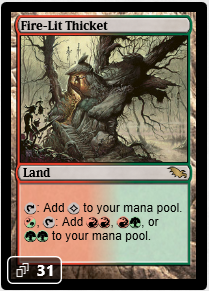
FLT

I mentioned this in my last week’s article and I went for a modest 31 copies last Tuesday. This filter land has gone several times over 5 tix in the past few years and now that Shadwomoor flashback drafts are behind us I hope it will soon reach 5 tix again. Because the margin in not extraordinary I didn’t want to buy Fire-Lit Thicket over 2.8 tix, hence only 31 copies.

Sales This Week

These three painlands reached reasonable selling ranges so I unloaded a few more playsets. That's my first wave of sales with Battlefield Forge. The profit is rather small but I'll take it, not knowing what happens next except that the painlands rotate out of Standard in about three months.

Although these specs were not as great as anticipated ten months ago, I'm nonetheless satisfied with them considering the large volume of tix locked with these five lands.

The price was stagnating around 13 tix for several days and was just below my target selling price. Bloodghast is not a superstar in Legacy and I’m not sure there’s much more to gain between now and the release of Eldritch Moon online. I was looking for that kind of profit when I bought in at ~8.7 tix, so when in doubt, and close enough to what I wanted, selling appeared to be the best option.

I thought I would be stranded with Snap for a while as its price didn’t seem to break over the 4 tix bar. With the big spreads we observe with Pauper prices, even at a 2.4 tix buying price it's not easy to make a profit over 30 copies.

Thanks to the reprint of Peregrine Drake as a common in EMA, Snap made in it all the way to 6.5 tix. At this point it would not have been very reasonable to wait for more. I sold my copies for 5.5 tix on average. Now I’m waiting on Sunscape Familiar to follow the same path.

I had bought a lot of these back in April when the price suddenly fell to ~2 tix. With a price back in the 4.5-5 tix range, its record high since the Modern Masters 2015 release, I decided to sell all my copies of Dismember. With about 20% I found that the spread was unusually high for a decently played Modern staple, but I managed to get out with a good 60% profit overall, pretty much what I was looking for.

When I bought Nexus back in March at ~20 tix I knew I was in for a moderate profit as I was targeting a 30 tix selling price. It took a little bit longer than I expected---and I could have probably sold them a month ago---but that's the price I finally hit. They may go a little bit higher in the two weeks to come but I'm not interested in betting for more.

On My Radar

Clearly selling my Legacy stuff is what I''l be trying to do for this coming week. Another thing everyone will be doing these days is trying to connect Eldritch Moon spoilers with anything in Standard and buy whatever could be remotely relevant. This "game" of predicting what will hit is quite exiting and can be rewarding.

While I'll be also trying to spot what could spike next in Standard, I'll be more inclined to wait for EMN release events on MTGO to maximize the price dip and get the potential spikers as low as possible. The window is small but the price drop is real during release events so don't forget to keep some tix for the very beginning of August too.

Questions & Answers

Q

That's a good question! First, and full disclaimer, I'm not a huge fan of Legacy/Vintage specs as they can be really slow to pay off, if they do at all. Sure there's always a few exceptions and big winners here and there, but you could be stuck for months and months with any significant changes. Modern Masters sets were great for speculators because of the demand surrounding Modern. The demand for Legacy is still very small on MTGO in comparison.

We have two reprint sets to look back at for reference for Legacy. Vintage Masters was a near fiasco in terms of investment but Tempest Remastered was not too bad, almost great actually if you were patient enough.

TPR Wasteland rose from 30 tix to 80 tix in less than two months but nothing else happened next. TPR City of Traitors and Mox Diamond merely doubled in ten months but then got much better, especially after it was confirmed they could not be in EMA. Other cards such as Volrath's Stronghold, Time Warp, Grindstone, Intuition and Aluren gained some value and have nearly doubled or tripled after more than a year now---not too bad after all.

The big winners from TPR were actually the commons and uncommons. Evincar's Justice, Diabolic Edict, Lotus Petal, Mogg Conscripts, Capsize and several others went from 0 (with the exception of Petal) to 1, 2 or even 5 tix for Evincar's Justice. How about x5000? Good commons/uncommons played in Legacy, Vintage, Pauper or Modern have a great potential but it may take more than a year to explode.

So if you're looking for profits with EMA your best long-term bet may actually be among the uncommons and commons not printed in Modern sets, and not so much with Force of Will, Wasteland, Chrome Mox, Jace, the Mind Sculptor or Dack Fayden.

Good uncommons, including Daze, Cabal Therapy, Hydroblast, Pyroblast, Ancestral Mask and Price of Progress should do wonders if you are okay to wait six to twelve months. Similarly great commons such as Nimble Mongoose, Night's Whisper and Kird Ape could be awesome gainers in several months. These are great targets for small bankrolls.


Thank for reading,

Sylvain

Primers – Nahiri Jeskai Control

Are you a Quiet Speculation member?

If not, now is a perfect time to join up! Our powerful tools, breaking-news analysis, and exclusive Discord channel will make sure you stay up to date and ahead of the curve.

Enough theory, enough lists. I’m back from Rome, (and back to streaming!!), which means I’m back to playing a whole lot of Magic. Today we’ll be talking about Jeskai Control with Nahiri, the Harbinger, breaking down the decklist, exploring variations, and discussing its strengths and weaknesses in Modern. Let’s get to it!

Nahiri-the-Harbringer-cropped

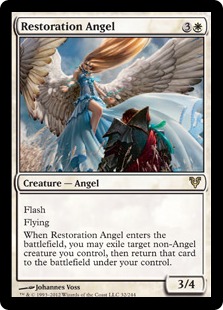
Jeskai Control in Modern has been played to varying degrees of success for a few years now. As far as I can tell, the origins of Jeskai Control began when UR Splinter Twin players branched out in an attempt to incorporate white sideboard spells, Path to Exile, and to a lesser extent Restoration Angel and Celestial Colonnade, into the classic two-color combo-control shell. Restoration AngelThese lists were still heavy blue-red, but trimmed some of the narrower spells Classic Twin would play like Spell Pierce and Flame Slash.
The inclusion of white in the archetype provided significant value, and for a time before the printing of Kolaghan's Command it was common to see Twin in three flavors; Classic UR, Temur (with Tarmogoyf) and Jeskai (with Restoration Angel and Path to Exile). With access to Kiki-Jiki, Mirror Breaker as yet another combo piece, Jeskai Control had the unique ability to be multi-dimensional in a highly linear format, shifting between control and combo and tempo on a dime.

In Valencia, Spain, at Pro Tour Born of the Gods, the format was primarily composed of Melira Pod, Twin variants, and Affinity. Shaun McLaren, the Lone Wolf, came out of the woodwork with this masterpiece, laying the groundwork and setting the stage for Modern’s revival.

[wp_ad_camp_1]

UWr Control, by Shaun McLaren (1st, Pro Tour Born of the Gods)

Creatures

4 Snapcaster Mage
1 Vendilion Clique

Instants

3 Cryptic Command
3 Electrolyze
4 Lightning Bolt
4 Lightning Helix
4 Mana Leak
3 Path to Exile
2 Remand
1 Spell Snare
2 Sphinx's Revelation

Planeswalkers

2 Ajani Vengeant

Sorceries

1 Anger of the Gods

Lands

3 Arid Mesa
4 Celestial Colonnade
2 Hallowed Fountain
2 Island
1 Mountain
1 Plains
1 Sacred Foundry
4 Scalding Tarn
2 Steam Vents
2 Sulfur Falls
4 Tectonic Edge

Sideboard

1 Anger of the Gods
1 Celestial Purge
1 Counterflux
1 Crucible of Worlds
1 Izzet Staticaster
1 Logic Knot
2 Porphyry Nodes
2 Relic of Progenitus
2 Stony Silence
1 Threads of Disloyalty
1 Timely Reinforcements
1 Wear // Tear

In a field characterized by aggro (Affinity), grindy midrange (Pod) and tempo control (Twin), Shaun McLaren unleashed a pure control archetype and devastated the opposition. Birthing Pod couldn’t handle Anger of the Gods and Porphyry Nodes. Affinity couldn’t fight Lightning Bolt, Path to Exile and Lightning Helix. Splinter Twin couldn’t go over Sphinx's Revelation and had trouble fighting through Shaun’s interaction. Besides two Ajani Vengeant and a single sweeper, Shaun could play entirely at instant speed, and (true to form) his entire Plan A was “Land, Go.” With access to 26 lands, 10 counterspells, and only two win conditions, Shaun’s take on UWr in Modern was truly a clinic in pure control.

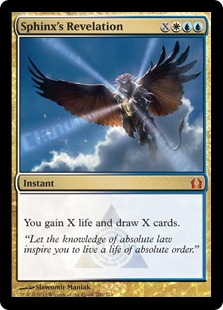
sphinx's revelationAfter Pro Tour Born of the Gods the metagame adjusted, and Shaun’s control masterpiece fell to the annals of history, only remembered in dark FNM corners by middle-aged control diehards holding onto the glory days (looking at you, Dad). Jund became playable once more, Burn made playing to turn 20 highly suspect, and overall most decks in the format adjusted to packing some true control hate. UWr (now called Jeskai) dropped to Tier 2, and then quickly disappeared from the top tables entirely.

Then Shadows Over Innistrad released, bringing with it Nahiri, the Harbinger. Before we talk about how exactly Nahiri is revitalizing Jeskai Control, I must first eat some crow. This is what I said about Nahiri, the Harbinger in my set review:

If her -2 was just Lightning Helix, I’d be happier, but we already have that with Ajani Vengeant and he sees barely any play. The fact that she not only doesn’t do anything to protect herself AND doesn’t really do anything to get us ahead without jumping through hoops is not good news. Better cards have seen *no play* in Modern (again, looking at Ajani Vengeant) that I’m not positive about Nahiri’s chances here. Still, the +2 discards stranded Blightsteel Colossus‘ that the -8 can then go fetch, so maybe some Mardu control deck uses this as a value card to find more answers, handle some problematic permanents, and kill the opponent eventually? A deck like that doesn’t really exist, unless you count the Mardu Control deck floating around since the last Pro Tour. A strong metagame shift would have to happen to make Mardu playable, and THEN we would need a reason to play this over Ajani Vengeant. Pass.

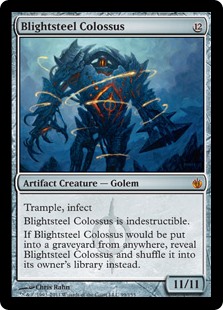
Blightsteel ColossusWhile commenters on my article either agreed with me or failed to contend with my evaluation of Nahiri, the Harbinger, the fact remains that I completely missed the boat on this one. Why play Blightsteel Colossus when you can just Emrakul their board? Nahiri is great, and until Modern makes some significant adaptations, she will continue to run over the format as she has these past few weeks. While I definitely flunked on my evaluation of Nahiri pre-release, I was, fortunately, not stubborn enough to discount her abilities when Peter Ingram kindly showed me the error of my ways with his victory at SCG Indianapolis:
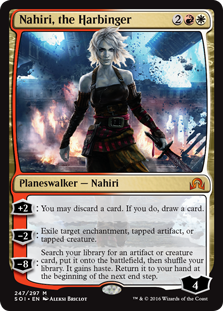
Nahiri, the Harbinger, while still a slightly clunky, expensive four-drop, nevertheless solves multiple problems for the control archetypes that are currently employing her. Reactive strategies in Modern face the awkward issue of employing high-impact, relatively narrow answers to powerful threats. Think Stony Silence against artifacts, Izzet Staticaster against X/1’s, and so on. A certain love-hate relationship exists with these spells, as their value can vary wildly from life-saving to life-taking based on various in-game conditions. Stony Silence does nothing against a triple Signal Pest draw, Izzet Staticaster is worthless against a unchecked Steel Overseer, etc.

In this context, Nahiri’s loot ability simultaneously helps her owner dig to specific answers while discarding under-performing spells and extra lands. Her +2 rewards the current high-impact, narrow-application style of Modern sideboarding, as well as working to overcome the inherent disadvantage control decks suffer with their comparatively high land count.

Her -2 is functional, and her ultimate wins games, but above all else is actually reachable. Unlike Liliana of the Veil (the other planeswalker that sees play in Modern), Nahiri, the Harbinger starts at 6 loyalty more often than not, and is threatening ultimate two turns later.

In a format that contains no Hero's Downfall type effect, opponents are forced to answer the Abrupt Decay-immune in-play Nahiri with either attacking creatures or damage-based removal. Her starting 6 loyalty requires two Lightning Bolts immediately to remove, and attacking with creatures against an archetype with eight one-drop removal spells and Snapcaster Mage is suspect at best. While her two active main abilities are functional, her best “ability” is the fact that her +2 is a +2, and not a +1. When paired with a high starting loyalty, Nahiri can even sit on board looting against a 4/5 Tarmogoyf for multiple turns with no protection.

I’m including this second self-quote not to “make up” for my first blunder, but rather because I think I said it the best I could after Ingram’s win. Nahiri’s ability to sit at 6 loyalty immediately is a game-changer for Modern and is already starting to make waves in the metagame, like an increase in Dreadbore and Maelstrom Pulse.

For now, this is where I’m at with Nahiri Jeskai Control in Modern:

Nahiri Jeskai, by Trevor Holmes

Creatures

1 Emrakul, the Aeons Torn
4 Snapcaster Mage
1 Vendilion Clique

Instants

4 Lightning Bolt
2 Lightning Helix
2 Spell Snare
4 Path to Exile
2 Mana Leak
2 Remand
1 Electrolyze

Planeswalkers

4 Nahiri, the Harbinger

Sorceries

4 Serum Visions
3 Ancestral Vision
1 Timely Reinforcements
1 Supreme Verdict
1 Anger of the Gods

Lands

2 Island
1 Arid Mesa
3 Celestial Colonnade
4 Flooded Strand
1 Ghost Quarter
1 Hallowed Fountain
1 Mountain
1 Plains
1 Sacred Foundry
4 Scalding Tarn
2 Steam Vents
2 Sulfur Falls

Sideboard

1 Celestial Purge
2 Crumble to Dust
2 Dispel
2 Geist of Saint Traft
1 Vendilion Clique
2 Spreading Seas
1 Stony Silence
1 Timely Reinforcements
1 Wear // Tear
2 Negate

This is my current list, based very heavily on Peter Ingram’s update from SCG Dallas. Initiate Primer Mode now.

Core Cards

Nahiri, the Harbinger

At the center of this strategy lies Nahiri. Seductive, dangerous, vicious Nahiri. Nahiri, the Harbinger does hundreds of things for this archetype, 1_nahiribut predominantly among them she allows us to cut down to one dedicated win-condition spell while simultaneously helping us turn the corner.
Her deceptive power comes in her unique ability to increase the consistency and strength of our draws with her +2, buy us time and protect herself with her -2, while also winning the game on the spot if we can just protect her for two turns. Nahiri protects us from flood, digs us out of screw, finds sideboard spells and narrow answers, makes good draws better, generates value on her own and even gains us life (when creatures attack her instead of us). We are playing four and would play more if we could. Only Liliana of the Veil out of Jund is better, and that is just because she costs three and is mono-color and thus easier to play.

Ancestral Vision/Serum Visions

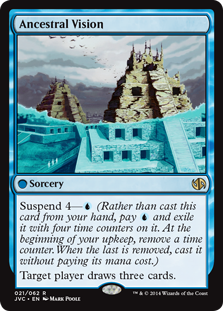
Seven to eight one-mana cantrip spells is about the norm for control decks right now, Ancestral Visionand Ancestral Vision has taken the title of “second best” from Thought Scour in most archetypes. My Grixis Control list with Tasigur, the Golden Fang and Gurmag Angler circa 2015 plays Thought Scour instead, and Delver lists will often opt for Thought Scour for the immediate impact, but almost every other blue archetype is choosing Ancestral Vision instead.
Currently, some viewers of my stream still think Ancestral Vision isn’t “good enough”, but they also think Jace, Vryn's Prodigy is bad so it’s hard to tell. What I do know is that Ancestral Vision is currently spiking on MTGO and selling for around 55 tickets, and that you should play it.

Lightning Bolt/Path to Exile/Lightning Helix

The first two need no explanation, but Lightning Helix I’ve found to be an interesting spell. From the outside, as a Grixis Control player I often find myself begging for a way to gain a bit more life, but as a Jeskai Control player I find myself trimming Lightning Helix often in post-board games. Lightning BoltI’ve found that it’s excellent as a Game 1 card in the most aggressive matchups, but everywhere else it’s just an expensive Lightning Bolt, or worse, a semi-dead card. You can’t fling a Helix on turn one or two and then flash it back with a turn three Snapcaster Mage like you can a Lightning Bolt, and it often gets replaced by better options for the matchup when I go to sideboard.

Now, just because we find ourselves cutting the same card in multiple matchups in post-board games doesn’t mean it is poor. Oftentimes Game 1’s come down to our life total being the deciding factor, and three to six extra life can be the difference. In post-board games it’s often other factors that determine victory (did they find Thrun, the Last Troll, did they kill our Nahiri, etc.) and the extra life doesn’t matter as much. I started with one, went to three, am back to two and liking how that feels right now.

Mana Leak/Remand/Spell Snare

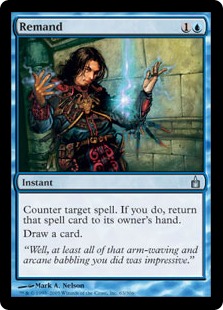
RemandA month ago, Remand was excellent and I played four a few times. Now I’m playing two, mainly because I enjoy playing with the card and don’t like losing blue matchups ever.

The number of archetypes just mising Ancestral Vision has gone down considerably, replaced with Infect, Affinity, Suicide Zoo and the like. In those matchups, Lightning Helix is better, and I’ve found that their values are often inversely related depending on the matchup. If we’re playing three Remand/one Helix or vice versa, that should give us a hint as to the current state of the metagame and how we’re hedging our maindeck to fight the metagame.

Flex Slots

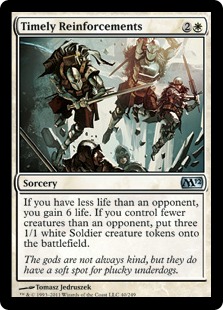
Timely Reinforcements

Another solid Game 1 card similar to Lightning Helix, Timely Reinforcements can get us out of some tight spots and buy time against Tarmogoyf and the like, as well as just clogging the board to let Nahiri +2 twice to victory. timely reinforcementsIt’s an A+ in the matchups where we want it and the card I’m most excited to play white for, besides Stony Silence and Path to Exile.
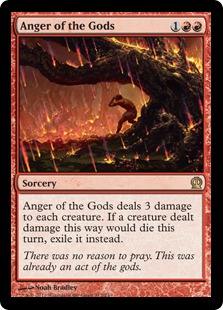
Anger of the Gods

Fast enough to matter against Affinity, Infect, and Suicide Zoo, Anger of the Gods also does great work against Abzan Company and can help us out against Lingering Souls in a pinch. I’ve ran into Dredge decks often enough online to want this card there as well. But that matchup is poor enough that multiple copies (or Rest in Peace) are needed to have a chance. Currently I’m not playing Rest In Peace as I’m stubborn, but that would be the first card I would add to the board. Anger of the GodsAs the format adjusts more to Nahiri, the Harbinger and aggressive decks move "lower" to fight the inherent inefficiencies present in spells like Dreadbore and Maelstrom Pulse, Anger of the Gods will only get better. Pay attention and be ready to load up on these when the time is inevitably right!
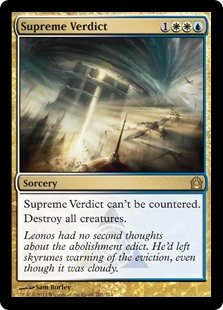
Supreme Verdict

My time with Grixis Control has seen me grow familiar with a singleton Damnation in the maindeck, and Supreme Verdict fulfills a similar role here. While we have a lot more removal than Grixis Control has access to, I still like a sweeper to clean up tokens or a flooded board. Sweepers and planeswalkers are a recipe for success as well, and Nahiri can often force an opponent to play full to the board to take it down.

Supreme VerdictIn addition, Grixis Delver’s increasing popularity makes access to a “can’t be countered” clause extremely valuable. While Jeskai Control has an easier time with that matchup than Grixis Control, normal matchup gameflow has the Delver player landing a second threat with counterspell backing in the midgame, and a Supreme Verdict can often be game-swinging at that point.
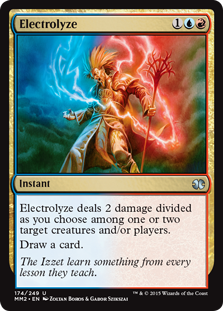
This is to say nothing of other matchups, where we’re often looking for a big effect to pull us back into the game against Jund, or needing to nab an Etched Champion against Affinity. I’ve been seeing an increase in Thrun, the Last Troll and Kitchen Finks to combat Jeskai’s redundant-removal gameplan, so keep in mind that every sweeper brings with it a disadvantage.

Electrolyze

ElectrolyzeIf we can fit it, a singleton Electrolyze is good in almost any blue archetype with counterspells. It can kill a creature or even just cycle and let us use some unspent resources when opponents refuse to cast spells into our open counterspell mana. Grixis Control often can’t afford to play this as Kolaghan's Command is just better, but Jeskai can and will use the help against Lingering Souls and the like.

Electrolyze isn't essential, and could be replaced with just about anything else, but I’ve been liking the extra help against Lingering Souls and a better Snapcaster Mage target than Lightning Bolt in blue matchups.

Vendilion Clique

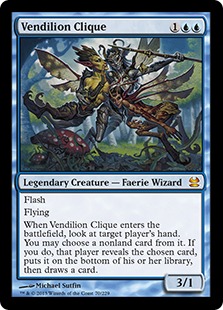
I initially cut Clique due to card availability when I picked up this list, but after playing a few matches with Nahiri I knew I wanted it back. My opinion on Vendilion Clique has always been slightly cooler than the norm---I just haven’t found myself drawn to the card in control decks. Game 1 sees Clique eat removal that would otherwise be stranded and in true control decks I’ve found the temptation to devote resources to a tempo line ill-suited to my list a recipe for disaster.

Vendilion CliqueHowever, Vendilion Clique is excellent when our strategy forces our opponent to have narrow answers. In the Splinter Twin deck I mentioned at the beginning of the article, Vendilion Clique served as a tempo-threat, but also as a way to achieve information about the opponent’s hand and preemptively remove pieces of interaction that could disrupt its gameplan.
This characteristic contributes to our Nahiri gameplan tremendously. On curve, we can counter a threat on turn two, and then end of turn three cast Vendilion Clique to remove a potential Dreadbore or Maelstrom Pulse ahead of our turn four Nahiri, the Harbinger. Vendilion Clique even provides a body to trade (or just chump) an attacker, giving us time to untap again and deploy removal or a sweeper to further protect our Nahiri ticking towards ultimate.

While control players should hesitate to use Vendilion Clique as “training wheels” to figure out which spell to counter, etc., the information it provides is helpful there as well, along with just generally disrupting opposing strategies. Taking Tron’s only fatty in the nightmare scenarios where they achieve Tron can often be enough to secure victory, or buy us time to find our Crumble to Dust. I’m sold on Vendilion Clique, at least in this list.

Sideboard

As for the sideboard, I’m currently using a basic package similar to what a bunch of other lists are employing. Most of the cards here are self-explanatory, so I’ll only speak on a few fine points.

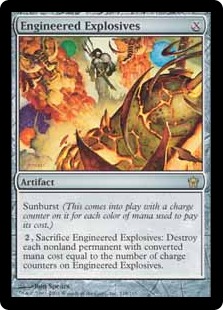
Engineered Explosives

  • Engineered Explosives is rarely worth it. I’ve never found myself interested in casting this card, or at any point of the game wishing I had one to play, except perhaps against Infect or Merfolk. Against Infect we are more than fine, and against Merfolk we can just play another Anger of the Gods and it won’t change the matchup too much. I don’t mind the “catch-all” sideboard slot, but Engineered Explosives is not on Spellskite level for me. With the new rules changes dictating that a flipped Delver of Secrets has a CMC of one, not zero, I'm convinced Engineered Explosives should pull a Bieber, and disappear quickly and quietly.
  • Celestial Purge is getting better. Lots better. It hits Blood Moon, it hits the red deck, it hits Liliana of the Veil, and it hits opposing Nahiri, the Harbinger. Celestial Purge is actually the best answer to Nahiri in Modern, as it is both cheap, instant-speed and Snapcaster-targetable. As if white needed its sideboard options to get any better.
  • Geist of Saint Traft is interesting, but a little underwhelming in my opinion. It’s more of a mirror-breaker than anything at this point, and feels disjointed to our strategy when we’re boarding out Lightning Bolt and Lightning Helix. If we were a little more creature-focused and had Restoration Angel to get tricky I might feel stronger about this spell, but I haven’t found myself going to it often except in blue matchups. If that is the case we could look elsewhere, like to more counterspells. Though we already have a bunch, which makes me feel like we could use these slots for other matchups.
  • Cards on the fringe that I’m looking to include in board: Rest in Peace, Wrath of God, Izzet Staticaster.

Conclusion

Jeskai Control in Modern exists in equal parts thanks to two powerful planeswalkers: Nahiri, the Harbinger and Shaun McLaren. While the maindeck is relatively tight at this point (roughly 4-5 flex slots) the core can actually shift a bit based on the context of the format. More than anything this indicates the healthy state of Modern. When we can easily shift from instant-speed general answers to sorcery-speed bombs and our deck strategy remains the same, it shows that Modern is at a point where you truly can play anything. While I won’t go so far as to put Chandra, Flamecaller or Goblin Dark-Dwellers in my deck just yet, other players have and that type of experimentation always improves archetypes in the long run.

If you’ve been playing with Jeskai, let me know in the comments below, or stop by my stream and say hello! I’m streaming about every weekday now (starting around 10 or noon EST), so I hope to see you there!

Thanks for reading,

Trevor Holmes

The_Architect on MTGO

Twitch.tv/Architect_Gaming

Twitter.com/7he4rchitect

Insider: Talking EMN Spoilers

Are you a Quiet Speculation member?

If not, now is a perfect time to join up! Our powerful tools, breaking-news analysis, and exclusive Discord channel will make sure you stay up to date and ahead of the curve.

To (only) my surprise, Emrakul is back and she’s trying to impose her domination on another plane in the multiverse. While she may not be bringing with her an army of colorless Eldrazi, she is transforming the Gothic horror of Innistrad into a Lovecraftian dreamworld.

Werewolves are sprouting tentacles and multiple heads, while angels are bonding together to form nightmares with celebrity supercouple nicknames. Brisela is the first all-angel power couple and they don’t disappoint. Emrakul has made her mark and it’s up to the Gatewatch to stop her from turning the whole plane into her Eldrazi minions.

So, let’s talk spoilers!

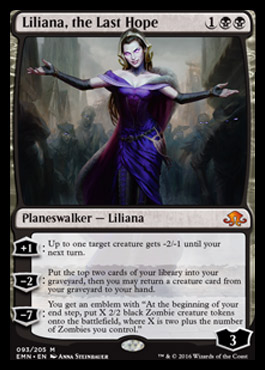
Liliana, the Last Hope

lilianathelasthope

Speaking of the Gatewatch, Liliana has joined the team with her second three-mana planeswalker. As the only planeswalker with two three-mana versions, Lilly has to be feeling pretty good about herself. I was tempted to do a fake interview with her, but I think today we’ll stick to just talking about the cards.

Liliana is unleashing her zombie army on Innistrad but it’s okay, she’s helping. The first way she’s helping is by killing or shrinking your opponents’ creatures.

I’m not sure how many creatures -2/-1 will actually kill. It does kill the fast human creatures as well as Nissa plant tokens, but most creatures in this format have two or more toughness. This ability still has merit though. This shrinking ability has been proven relevant from Jace, Vryn's Prodigy. Lilly does the same thing except also lowers the toughness by one, making blocking better for you. We may wish her ability dealt out -2/-2 waves of destruction, but -2/-1 is still alright.

The second way Liliana, the Last Hope is saving the day is with her mad action Raise Dead skills. Whether your creatures have died already or you mill them with the first part of her ability, this avenue to card advantage is a great way to grind through your games.

These two abilities may seem minor but the fact that they’re tacked onto a three-mana planeswalker makes a huge difference in how good they will be. Initially, my primary concern with new Lilly was that her +1 and -2 didn’t seem to synergize well with each other. Weakness is great and Raise Dead is great, but one of those cards goes into a control deck and one goes into a creature-based deck.

After further consideration though, I think Weakness could help you set up good attacks with your aggressive deck. This +1 will make it much less appealing for your opponent to block and it stops them from being able to kill Lilly on the back swing too!

When evaluating a planeswalker, it’s helpful to focus on the abilities you will be using the most often, but the ultimate can vary in importance based on what it does and how long it takes to get there. Take Nahiri, the Harbinger for example; we all thought she was decent but when someone showed how quickly you could ultimate her, that was what pushed her over the top in multiple formats. This may be the exception rather than the rule with planeswalkers, but it reminds us not to forget about the ultimate.

Liliana, the Last Hope has an ultimate that costs seven loyalty counters and she only starts with three. That’s not a great setup. What you get when you finally wait all those turns is some zombie tokens!?

Depending on whether or not you have included a lot of zombies in your deck or not will determine if her ultimate is good or not. If you can’t really make zombies, you’ll only be getting a couple of zombie body guards. If you already have a zombie army though, you will double its size. This leads me to believe that most of the time alternating between the +1 and -2 abilities will be the best sequence.

At the end of the day I think Liliana, the Last Hope is comparable to Nissa, Voice of Zendikar. Most of the time these planeswalkers will be reasonably good. The days of Liliana of the Veil are long gone and now we have three-mana walkers with much milder abilities but ones that still impact the course of the game the longer they’re in play. For the record, these two cards have the same setup with +1, -2, and -7 as well.

Financial Implications: Starting between $23-$25 preorder price on TCG Player is no surprise to me, but don’t buy in right away unless you need her for an event in the first couple weeks of Standard. She should drop to $15 like her counterpart Nissa, so wait a bit and then get in at the lower price.

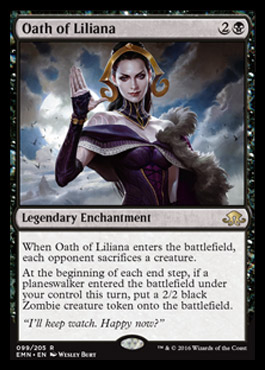
Oath of Liliana

oathofliliana

Even if you aren’t playing Liliana, the Last Hope in a super aggressive black deck, cards like Oath of Liliana can help you execute the same game plan. Lilly’s Oath starts with a commitment to killing creatures, but most of the creatures in Standard are so good that making them sacrifice one is great. Then, once you start playing planeswalkers, you begin to generate your zombie army.

There are a couple of limiting factors with this new enchantment. First of all, if you are looking to have Lilly give her oath and then ask her to help out on the battlefield, you'll have to give up one mana, playing a three-drop on turn four.

In addition, although this removal spell might be playable in any deck with black mana, the planeswalker decks have been rocking the Naya colors. So, will this card shift their direction? If not, is it good enough to bring B/W Midrange back into the format? There are definitely a lot of questions about where the format is headed once Eldritch Moon releases. What I do know is that this card is quite good. If you have a bunch of planeswalkers, Oath of Lilly will start to feel like an extra Gideon, Ally of Zendikar. This is one card I’m extremely excited to tinker with.

Financial Implications: If the other Oaths are any indication, and despite being from a different block they should be, the presale price of basically $3 should be fairly accurate. I wouldn’t be surprised to see this rare drop a little, but I think it should trend more like Oath of Nissa than Oath of Chandra.

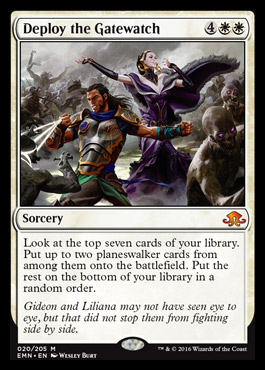
Deploy the Gatewatch

deploythegatewatch

If we’re interested in triggering Oath of Liliana as well as other Oaths in the cycle, what better way is there than playing a ton of planeswalkers in your deck? Luckily, Wizards knew we would love playing a deck built around the concept of the Gatewatch. After all, the Gatewatch is the Avengers or the Justice League of Magic, so who wouldn’t love that idea?

I’m on board and Deploy the Gatewatch will help me fulfill this dream of guarding every tournament with a deck based on Magic’s super team. Six mana is a lot but getting eight to twelve mana worth of planeswalkers seems like winning the game to me. The fact that you can’t double up on the same planeswalker like you can with creatures from Collected Company is a drawback but you can always activate your current walkers before you Deploy and then you’ll get a double activation.

Financial Implications: When I’m writing about these financial implications of new cards, I think about each card before I check what price it’s preordering for. Typically I am in the right range with the price and that was the case for the first two cards in the article. Sometimes my price point is too low because preorder season can get out of control sometimes. It’s rare for me to be too high on a card though, and those are typically the situations where preordering becomes a time to make some money.

My first thought about Deploy the Gatewatch was at mythic this semi-tutor should be in the $10 to $15 range. Needless to say I was eye-poppingly surprised that it was sitting at only $5. As I’m writing this, I’m trying to determine whether or not to buy into this card.

In order to make this sorcery your deck’s goal, you will need a lot of planeswalkers. That fact makes it much less inclusive than just needing creatures like with Company. Maybe $5 is the right price point for this card, but no matter the future price trend, I’ll be working with it in Standard for sure.

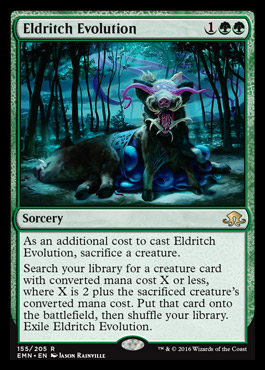
Eldrich Evolution

eldritchevolution

There must be some sort of mistake. That was my first thought upon seeing Eldritch Evolution spoiled. Would Wizards really print a Natural Order/Birthing Pod hybrid? I still can’t believe this card exists. It’s going to be a multi-format all-star.

Due to the Allosaurus Rider spike, which is already trending down, I think it’s safe to say that Modern players are excited to cast this powerful green spell, and rightly so. Cheating Iona, Shield of Emeria, Griselbrand, or Elesh Norn, Grand Cenobite into play is some hard-to-beat sequencing. There are plenty of other combo opportunities as well. In addition to Allosaurus Rider, we also have delve creatures and Melira Combo pieces to consider. This card should see tons of play in Modern.

One thing I don’t see players talking about is what it will be like for Standard with this card. I think sacrificing your Matter Reshaper to get Archangel Avacyn sounds great. You could even use this card to set up Brisela, Voice of Nightmares but you will need a five-drop creature to sacrifice first. There are many possibilities with this green tutor. We’ve only scratched the surface of what’s possible.

Financial Implications: Starting out in double digits is exactly what I expected for a rare of this caliber. It’s hard for a rare to push a higher price point than where it’s at right now. If it sees major play in Standard, we will see the price go up, but without that push, I doubt the card will escalate quickly.

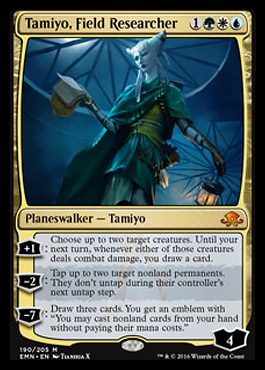
Tamiyo, Field Researcher

tamiyofieldresearcher

Tamiyo, Field Researcher has one huge thing going for her. The mana cost of this four-mana planeswalker is already in the best color combination. There is no delving deep for the secrets of her future because she is primed and ready to jump into the best archetype.

With there being multiple great Bant Company combinations to choose from, it’s easy to see right where Tamiyo will fit in. Although she probably won’t be a four-of, she will easily replace those Ojutai's Commands that the list has been sporting. Tamiyo takes care of both roles that Company decks are looking for.

First of all, her +1 will give you more card advantage to bury your opponent with. Drawing an extra card or two per turn will help you find the Collected Companys in your deck or just give you more resources to work with.

Her -2 will further frustrate every opponent as well. Now, not only will they be able to Reflector Mage your creatures, but they will be able to follow up that busted creature by tapping down whatever other blocker you manage to bring to the battlefield.

Following the same loyalty pattern as Lilly and Nissa, Tamiyo definitely has an ultimate worth building towards. It may be -7, but Ancestral Recall for free plus Omniscience is one heck of an ultimate. If that doesn’t win the game soon, then you didn’t draw any spells to cast for free. Don’t forget to include some creature lands in your list again so that you can use your mana once you ultimate.

Financial Implications: Tamiyo may be an obvious hit in Standard right now, but what’s not obvious is where her price will be heading. I would put my eggs in the downward trend basket. $25+ seems like a lot to ask of a card that most likely won’t see play as a four-of.

Because she is going to fit right in though, I think it’s likely that lots of players will need copies of her. So I could definitely see her heading toward $30 before she settles downward. If you need her I’d get in sooner rather than later because the initial supply should be relatively low. If you don’t need her immediately though, wait about a week and you should be able to sell Bant Tamiyo at her peak.

Until next time,
Unleash the Force!

Mike Lanigan
MtgJedi on Twitter

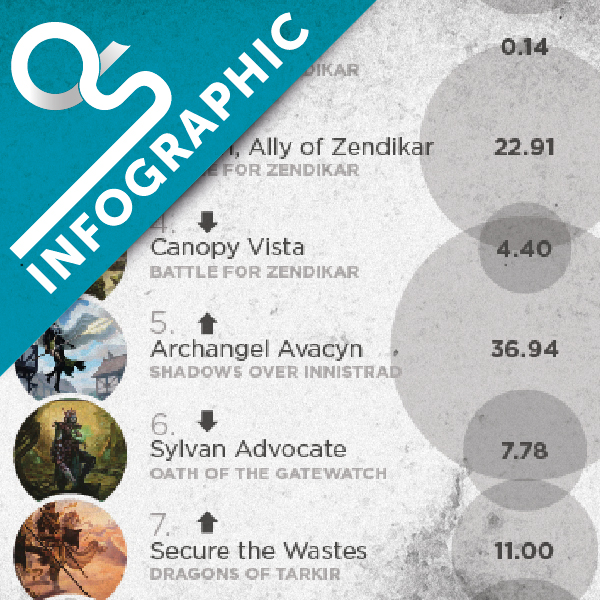
Infographic – Standard Most-Played Cards

Are you a Quiet Speculation member?

If not, now is a perfect time to join up! Our powerful tools, breaking-news analysis, and exclusive Discord channel will make sure you stay up to date and ahead of the curve.

QS_201606_A Most played cards in Standard-01

Evaluating Allosurus Evolution in Modern

Are you a Quiet Speculation member?

If not, now is a perfect time to join up! Our powerful tools, breaking-news analysis, and exclusive Discord channel will make sure you stay up to date and ahead of the curve.

Last Friday morning, Allosaurus Rider went from a $.50 bulk-binder warmer to the next $20 buyout. The Coldsnap and Duel Deck throwback has since stabilized in the $5-$7 range with most major retailers, but dino hype hasn't had this much bite since Jurassic World trailers started appearing in late 2014. You can thank Gavin Verhey for the buyout; his Eldritch Moon preview last Thursday threw Modern speculators into a panic as they raced to find the best combo with Magic's newest Birthing Pod and Natural Order effect. Now that the hype has (somewhat) subsided, it's time to see if the Allosaurus Evolution combo has the fangs its buyout suggested, or if it's a bust like 90% of scenes in Jurassic World.

Allosaurus-Evolution-art

My minimal contribution to the Allosaurus Rider buyout was a four-copy purchase for MTGO. What can I say? I was already snagging cards to try and improve the abysmal RG Tron vs. Ad Nauseam matchup (with me on Urzatron this time), and decided it couldn't hurt to throw a few Riders in the cart. As for [tippy title="Eldritch Evolution" width="330" height="330"]
Eldritch Evolution[/tippy] itself, I'm staying away until the pre-order price drops. Although the card is likely to succeed in at least one format, its current price-tag is a bit steep for a rare in a set that is sure to benefit from metric tons of cracked packs. That drop is even more inevitable for paper copies of Rider, which are already falling as mania wanes and more rational card evaluation eyes take over.
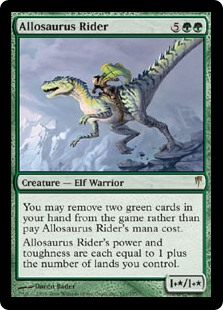
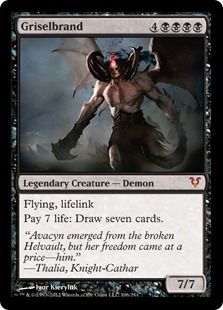
In preparation for today's article, I conducted a number of tests with a few different [tippy title="Eldritch Evolution" width="330" height="330"]
Eldritch Evolution[/tippy] and Allosaurus Rider brews, tweaking ratios and singletons to get a sense of Allosaurus Evolution's feasibility in Modern. Today, we'll go over the general results and high-level findings, which will come as good news to people who both stayed away from the Rider buyout peaks, but also to those who got in early and picked up Riders for mere quarters.

[wp_ad_camp_1]

The Allosaurus Evolution Combo

Most Moderners with an Internet connection have either seen the combo on social media or looked it up themselves. In case you haven't, or in case you've forgotten the origin of this particular buyout like most people tend to forget all the rest, here's a quick summary.

Like Birthing Pod before it, [tippy title="Eldritch Evolution" width="330" height="330"]
Eldritch Evolution[/tippy] is limited by the casting-cost of sacrificed creatures. In most cases, this means a gradual, although still powerful, jump up the curve. Birds of Paradise becomes Kitchen Finks. Voice of Resurgence becomes Siege Rhino. Kitchen Finks becomes Sigarda, Host of Herons. You don't need to Evolve two mana up the curve if you don't want to: Birds is happy to become Voice just as Voice is happy to become Finks. Or Finks into your hater of choice, whether two-drop Spellskite or three-drop Aven Mindcensor. Indeed, these are the small, toolbox synergies where Evolution is most likely to excel in Modern, but I'm getting ahead of myself. The dinosaur in the room is growling at me to go bigger. Much bigger.

Unlike puny Voice or Finks, an evolved Allosaurus jumps the chain up to a whopping nine mana. That's Elesh Norn, Grand Cenobite big. Griselbrand big. Iona, Shield of Emeria big. Rider also does it for free, as early as turn two if you have the Evolution in hand, Rider at the ready, a dork and mana in play, and green cards to pitch. No one wants to wait until turns 6-7 to organically power out a seven-drop, or even 4-5 to do so off an acceleration package. We want to attain the turn 2-3 knockout that is the gold standard of Modern combo, and the free Allosaurus is just the evolutionary trampoline to help us make the leap.

Here's the dinosaur dream we're all trying to live (especially if you want your overpriced Riders to hold value):

  • GriselbrandOpen with land and Birds of Paradise.
  • Draw a card and play a second land.
  • Pitch two green cards (more Birds, a redundant Rider, Finks/Voice, Abrupt Decay) to cast Allosaurus Rider.
  • Rider hits the battlefield. You have priority before an opponent can Lightning Bolt the dino, so cast [tippy title="Eldritch Evolution" width="330" height="330"]
    Eldritch Evolution[/tippy].
  • If Evolution resolves, fetch your choice of turn two Griselbrand, Elesh Norn, Iona, or another monster of your choice.

You can also postpone the combo until turn three, eliminating the opening Birds from the chain to totally insulate yourself from removal. Because you have priority when Rider himself resolves, there's no window for an opponent to slay the Allosaurus before you morph it into something far scarier. As an added bonus, the combo doesn't use the graveyard, offering an edge over the heavily graveyard-dependent (but faster) Goryo's Vengeance strategies.

Although I highlight Elesh Norn, Yawgmoth's Bargain with wings, and Iona, the Modern cardpool offers plenty of other nightmares to close the game off an evolved Rider. Here's a brief list of interesting options:

  • Sigarda, Host of Herons: BGx can kill Ionas. Innistrad's leading angel, however, is largely untouchable.
  • Sundering Titan: send their mana back to turn 0.
  • Sire of Insanity: game-over against slow control decks if resolved on turn two. Jeskai better have Path because Bolt doesn't cut it against the 6/4 Sire.
  • Keranos, God of Storms: Gods are creatures too! Another BGx knockout from the Twin days. Also, like Sigarda, much more attainable even without Rider.
  • Blazing Archon: There are aggro decks that can't win through this effect in Game 1. Be careful of double Bolt/Galvanic Blast or Path.
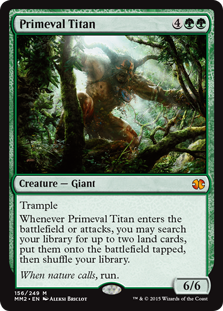
  • Primeval Titan: Prime Time can't win on the spot as in Amulet Bloom, but the mana advantage generated should be decisive.

Been playing around with other Evolution targets? Share your tech in the comments!

Brewing Allosaurus Evolution

When I tested Emrakul a few weeks back, I used a single decklist with a consistent one-for-one trade between an old card and a new one. This method is effective when you know a card slots into an existing strategy, but useless when you're not even sure the best way to build around a card in the first place. That's precisely the problem I faced with [tippy title="Eldritch Evolution" width="330" height="330"]
Eldritch Evolution[/tippy].

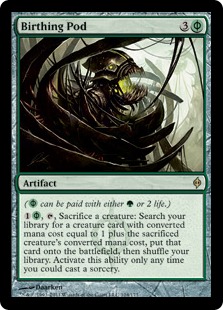
Birthing PodFrom my first test through my last, I couldn't decide the best way to build the Allosaurus Evolution list. What was the framework? Was it contemporary Abzan Company or Kiki Chord? Was it old-school Siege Rhino Pod? Was it something entirely new? Even deciding on a general template, I struggled with adjusting the relative number of Birds and Noble Hierarchs against toolbox creatures, combo pieces, supporting cards, and interactive bullets.
Ultimately, I tested not one, not two, but literally six different builds of the strategy against a variety of top-tier exemplars. Rather than list out sub-optimal decklists in various states of development disrepair, I'm going to present just a single decklist that combines all the ideas from the six feeder builds. This brew is still a disaster, but it accurately captures most of the technology I experimented with over the course of my tests.

Allosaurus Evolution Experiment, by Sheridan Lardner

Creatures

4 Allosaurus Rider
4 Birds of Paradise
3 Noble Hierarch
3 Voice of Resurgence
3 Kitchen Finks
2 Elvish Visionary
1 Eternal Witness
1 Iona, Shield of Emeria
1 Griselbrand
1 Elesh Norn, Grand Cenobite
1 Aven Mindcensor
1 Gaddock Teeg
1 Spellskite
1 Scavenging Ooze
1 Fulminator Mage
1 Siege Rhino

Instants

3 Abrupt Decay
1 Summoner's Pact

Sorceries

4 Eldritch Evolution

Lands

4 Razorverge Thicket
4 Windswept Heath
4 Verdant Catacombs
2 Temple Garden
1 Overgrown Tomb
2 Gavony Township
1 Horizon Canopy
1 Godless Shrine
2 Forest
1 Swamp
1 Plains

Sideboard

1 Maelstrom Pulse
3 Path to Exile
1 Qasali Pridemage
1 Kor Firewalker
1 Kataki, War's Wage
1 Eidolon of Rhetoric
1 Sigarda, Host of Herons
1 Kitchen Finks
1 Thalia, Guardian of Thraben
1 Phyrexian Revoker
2 Stony Silence
1 Sin Collector

As promised, it's a real circus of a list. In Game 1, you're playing a toolbox deck with a combo Plan A and a value Plan B. This means we make concessions to Rider. Kiki Chord's Wall of Omens becomes the worse Rider-bait Elvish Visionary. White Path to Exile switches to green Abrupt Decay. We even include a Summoner's Pact pair as Rider #5 if you're comboing on turn four or later. The three creatures are knockouts against most decks in the format, with Elesh Norn sweeping away low-to-the-ground critters, Griselbrand pulling you too far ahead in cards and value, and Iona shutting down most strategies in between.

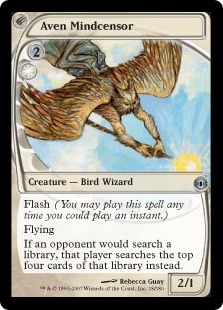
aven mindcensorKeeping with the combo theme, the deck's singleton creatures (both in the main 60 and the sideboard) all act as mini haymakers in certain matchups. Turn two Spellskite or Gaddock Teeg is lights-out against many unfair strategies. Aven Mindcensor shores up the Company/Chord/Pod historic weakness to big-mana decks relying on search effects, and the sideboard offers a host of options for sniping matchups in open metagames. As a final note, the lone Eternal Witness can't return exiled [tippy title="Eldritch Evolution" width="330" height="330"]
Eldritch Evolution[/tippy]s (read the card's final clause), but does recur sacrificed Voices and Ouphes in grindier matchups.

Again, I'm deliberately presenting this list as a happy mess to showcase the wide range of options available to Evolution brewers. It gives you a sense of how old synergies (Gavony Township plus one-drops and persist) can combine with Rider combo requirements (Voice, a historic roleplayer in these toolbox decks, finds new purpose as turn three Evolution fodder). Here are other interactions I tinkered with before omitting them from the list above---they had steeper deckbuilding requirements and would have required their own builds.

  • Primeval titanPrimeval Titan and Summoner's Pact
    Relive the Amulet Bloom glory days with an inconsistent turn 2-3 Titan off Pact. Titan triggers ensure you can pay the Pact upkeep cost.
  • Magus of the Moon in RG Evolution
    Tutorable Blood Moon on command is powerful if it doesn't shut down your whole deck. A straight Gruul build limits these risks while also preserving many of the green Evolution synergies (notably Finks).
  • Kiki-Jiki, Mirror Breaker Evolution
    Take one part Kiki Chord and add 3-4 Evolutions. Top marks for redundancy on our combo evaluation scale.
  • Eldritch delving with Hooting Mandrills
    Any delve creature will do to accelerate you up to Griselbrand or Elesh Norn (Iona is sitting that one out unless it's Angler).

Regardless of your take on Allosaurus Evolution, most builds are going to share three components: the Allosaurus combo itself, a hateful toolbox package, and a midrange backup plan. Don't downplay the second route in your testing! Evolution is the only Modern tutor capable of putting haters like Aven Mindcensor or even Thalia, Guardian of Thraben directly into play from your library as early as turn two. That's a decisive edge over Company and Chord decks which can't do that at absolute earliest until turn three.

Evaluating a Combo

Whenever I come across a new combo and my Johnny sense start tingling, I take a deep breath, sit down, and ask myself three questions before I start buying cards and brewing decks:

  1. Is it consistent? How reliably can you draw and cast/execute the combo?
  2. Is it resilient? How does the combo resist interaction?
  3. Is it powerful? How decisively and regularly does the combo close the game?

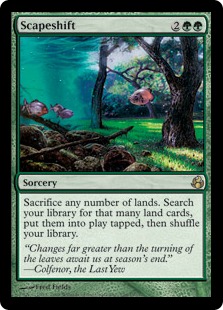
ScapeshiftDecks like Scapeshift and Ad Nauseam are high on all three counts. These strategies use multiple copies of one- or two-card combos (Scapeshift/Bring to Light for one, Angel's Grace/Phyrexian Unlife for the other). They are also highly resilient to interaction. Ad Nauseam can win at instant speed and half of its combo is uncounterable. Scapeshift wins at sorcery speed but, as a one-card combo, allows you to hold up mana for interaction. Of course, both combos are also instant K.Os if they resolve, at least in most game states.
You can map other Modern strategies in the combo family along these standards. Infect and Abzan Company (to the extent they are more "combo" than "aggro" and "midrange," respectively) are at the top of their class. Storm and Grishoalbrand are barely getting by on even a single benchmark, and sometimes go a flat 0 for 3 in certain metagames.

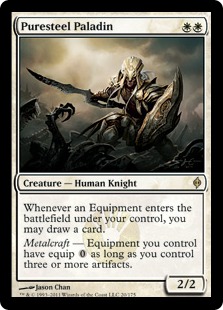
Puresteel PaladinDeck tiering and prevalence is often a good indicator of a combo's success, even if the Goblin Electromancer diehards will maintain their deck is just "under the radar." That may be so, but for every Amulet Bloom that is legitimately overlooked, there are dozens of fun but probably bad combo decks masquerading as the next turn four rule violator. Take that from a Puresteel Paladin Cheerios player who loves turn two Retract kills.
As Modern combo players, it's our job to assess any new combo using these three questions, which should be done both theoretically and through testing. This was certainly my objective in sleeving up some Forests with bad dinosaur drawings penned across the image.

Allosaurus Evolution Test Results

As mentioned earlier, I tested a variety of Allosaurus Evolution builds against a handful of top-tier decks. These included Infect, Burn, RG Tron, Jund, and Jeskai Control. If you read my QuietSpeculation Insider pieces, this was Birds of Paradisea continuation and expansion of my initial test results done for my recent Monday article.
In each game, I used a variation on the list posted above, making small adjustments in between games. This isn't a very scientific testing method if you're trying to calculate exact match-win-percentages, but it's significantly more useful if you're just trying to assess general viability. The Rider core remained largely unchanged, which allowed me to see how it worked in each matchup without worrying about if I got the number of Hierarchs vs. Birds right.

Here's a quick match and game breakdown of my results.

  • Infect: 2-3 (3-6 in games)
  • Burn: 3-2 (6-2 in games)
  • RG Tron: 3-2 (6-3 in games)
  • Jund: 1-4 (2-8 in games)
  • Jeskai Control: 1-4 (1-8 in games)

Not the best showing for a new deck, but also not the worst. Honestly, I expected Allosaurus Evolution to bomb worse than Jurassic Park III, so positive records in at least a few of these top-tier matches were heartening on their own. Rather than discuss each match as a whole, I'll discuss each of the three combo benchmarks from the previous section through the lens of my different rounds.

1. Is the Rider/Evolution combo consistent? Not really.

On paper, the deck appears to be built around a two-card combo: Rider plus Evolution. But once you add the three lands (or two lands plus one dork) and the two green Rider pitches, the probabilities start to fall, and your chance of executing this combo by turn three starts to hover around the 15% range. Unlike other two-card combos in Modern, you also don't have any redundancy outside of a wildly unreliable Summoner's Pact.

Fulminator MageThe combo gets much more consistent when you're not under pressure and can organically draw into it by turns 4-5. This happened in the Tron matchup, especially when you can fire off a timely turn two Voice into turn three Evolution/Fulminator to jam up their mana. Indeed, that Mindcensor and Fulminator combo was much better in this deck against Tron than in other Company or Chord strategies: Evolution lets you tutor it directly from your deck so you're effectively playing five copies.

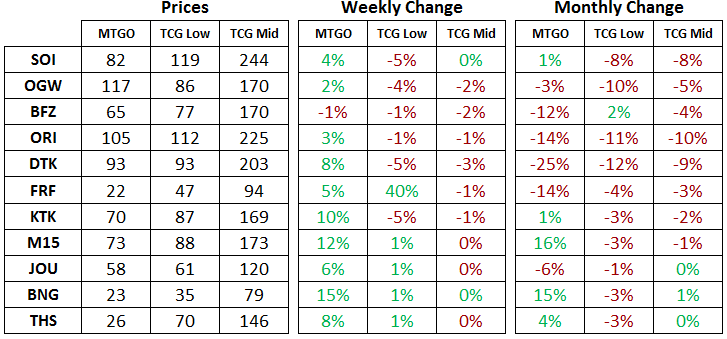
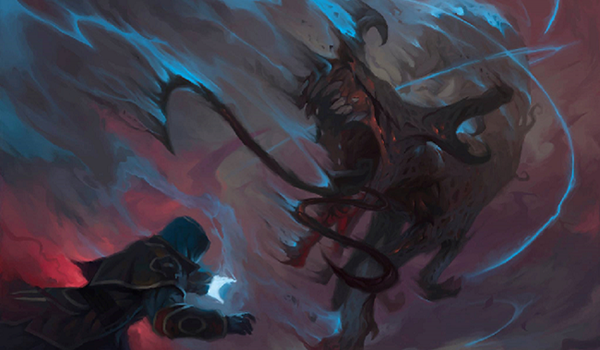
That said, if you were under pressure from Infect and didn't have the combo, you weren't going to have time or selection spells (Serum Visions) to assemble it.

2. Is the Rider/Evolution combo resilient? Definitely not.

Jund and Jeskai Control were major problems for Allosaurus Evolution specifically because of their disruption. I was nervous about Remand before I started testing, and Jeskai matchups only confirmed my fears. Getting an Evolution countered in any way, particularly off a cantripped counter like Remand, ranges between a two-for-one or a five-for-one. The virtual five happens when you're losing Rider, the two Remandexiled cards, Evolution, and your entire turn while your opponent didn't even lose a card off the Remand draw. Disgusting. Jund also caused problems with its discard spells, stranding useless Riders in the hand or forcing us to play them as the world's most expensive Tarmogoyf chumps.

If I played [tippy title="Eldritch Evolution" width="330" height="330"]
Eldritch Evolution[/tippy] tomorrow, I'd probably ditch or trim the Riders in favor of more toolbox options. The deck was significantly more resilient when it was playing a toolbox and midrange plan with an Evolution Plan B; an opponent couldn't just hold up Remand mana every turn if they were getting smashed by a Voice and a Finks. I noticed this in some tight Jund games where the basic toolbox worked very well (turn four Sigarda, Host of Herons is terrifying for BGx when you effectively run five copies), but where bad Rider topdecks pulled games out of reach.

3. Is the Rider/Evolution combo powerful? Absolutely.

I lived the Evolution dream in three games, going turn one dork into turn two haymaker on separate occasions against Infect, Tron, and Jund. I also executed the combo on turn three in another six games against each deck in the gauntlet. I won seven of those nine games, losing one against Jeskai when the Griselbrand was stuck in my hand and I had to fetch Iona instead (she took a Cryptic Command next turn, and losing another to RG Tron's Ulamog, the Ceaseless Hunger. That means my win-rate in games with the turn 2-3 combo was 78%. Time to take down a Grand Prix?

Sadly, it also means my win-rate when I didn't have the combo was a hilarious 29%. Although I went 7/9 in combo games, I was only 11/38 in the non-combo games. Guess Allosaurus Rider might not be making any Grand Prix victory laps anytime soon. This ties back with the combo's consistency issues, particularly in games where you don't have the fast combo (which will be at least 70%-80% of matches). If enterprising brewers can improve those comboless games, or the games where you can't combo until later, the deck may be more viable. But with so much of its power bundled in the glass-cannon opener, there's little incentive to play Allosaurus Evolution over other fragile decks.

Eldritch Evolution's Future

Despite some lackluster performances by Allosaurus Rider, Evolution itself was a great card. I fully expect to see its toolbox and midrange elements once Eldritch Moon becomes Modern-legal, chiefly on the power of a turn two tutor up the curve. This was the major competitive edge Evolution maintained over Chord and Company decks, and in a format that rewards speed as much as Modern, this dual function as a fast tutor or a mid-game value generator (in tandem with Finks/Voice) is invaluable.

How have you been testing Modern's very own Natural Order? Any brews or builds to report? Let me know in the comments and stay tuned next week as we keep reviewing the exciting Eldritch Moon action. As for Allosaurus Rider, he might not be the competitive workhorsedino we were hoping for, but he'll always have one of the best illustrations in Modern.

Insider: MTGO Market Report for July 6th, 2016

Are you a Quiet Speculation member?

If not, now is a perfect time to join up! Our powerful tools, breaking-news analysis, and exclusive Discord channel will make sure you stay up to date and ahead of the curve.

Welcome to the MTGO Market Report as compiled by Matthew Lewis. The report will cover a range of topics, including a summary of set prices and price changes for redeemable sets, a look at the major trends in various constructed formats, and a "Trade of the Week" section that highlights a particular speculative strategy with an example and accompanying explanation.

As always, speculators should take into account their own budget, risk tolerance and current portfolio before buying or selling any digital objects. Questions will be answered and can be sent via private message or posted in the article comments.

Redemption

Below are the total set prices for all redeemable sets on MTGO. All prices are current as of July 4th, 2016. The TCG Low and TCG Mid prices are the sum of each set’s individual card prices on TCG Player, either the low price or the mid price respectively. Note that sets of Theros (THS) are out of stock in the store, so this set is no longer redeemable.

All MTGO set prices this week are taken from Goatbot’s website, and all weekly changes are now calculated relative to Goatbot’s ‘Full Set’ prices from the previous week. All monthly changes are also relative to the previous month prices, taken from Goatbot’s website at that time. Occasionally ‘Full Set’ prices are not available, and so estimated set prices are used instead.

July4


Flashback Draft of the Week

Shards of Alara (ALA) block draft continues with the addition of a booster of Conflux (CON). Be sure to check out Oraymw's triple ALA draft primer for insights into the format. This block introduced mythic rares and the three-colour mana alignments known as the shards (Naya, Grixis, Bant, Jund and Esper). Take the draft primer advice and target the high-quality mana fixing cards.

In terms of value, Path to Exile in the uncommon slot and Noble Hierarch as a rare anchor things out of CON, but ALA is not so lucky. Its most expensive card is Ajani Vengeant, a mythic rare, and it tips the scales at under 9 tix. There are a couple of Modern playables to watch out for in the rare slot though, namely Ranger of Eos and Master of Etherium.

Modern

A new entrant in the 50+ tix category is Ancestral Vision from Time Spiral (TSP). The combination of being unbanned in Modern and the upcoming Legacy festival has driven this card to its current level. Although there are no potential reprints nor TSB flashback draft queues on the horizon, this price move is excessive in the short term.

The upcoming Eldritch Moon (EMN) set release will drive interest in Standard and in the new draft format, and players and bots alike will consider selling this card for tix in order to play with the new cards. If you are holding copies and can put up with not playing with the card for a while, consider selling into this market surge.

On the other end of the spectrum, Voice of Resurgence from Dragon's Maze (DGM) has fallen down to 30 tix. This is definitely an intriguing price level as it has mostly bounced between 30 and 40 tix during 2016. Although the 30 tix level looks "safe," the timing is not good as we get closer to the release of EMN.

Also, the previous price floor was around 20 tix, so we should be on the lookout for further price declines on this card. Players and speculators alike should not hesitate to buy this Modern-playable mythic rare if it goes to 20 tix.

Standard

Most of the Standard set prices rebounded this week, coincident with the start of EMN spoilers. There's nothing like new cards to get the brewer's juices flowing, triggering buying interest in pet cards and former all-stars. An excellent example is Jace, Vryn's Prodigy from Magic Origins (ORI). This formerly 80+ tix card recently dipped below 20 tix before rebounding this past week.

The spoiling of the new versions of Accumulated Knowledge and Kindle (Take Inventory and Galvanic Bombardment respectively), combined with a "spells matter" creature like Niblis of Frost, was enough for the market to buy back into Jace on the potential of a resurgence in Standard. Although the rotation of ORI and Dragons of Tarkir (DTK) out of Standard looms in the distance, there's still a few months of Magic to be played. Speculators will have to be nimble speculating on cards like this, but I like the pedigree on Jace as the average price has been well over 30 tix while it has been in Standard.

Although it is tempting to speculate on cards from Shadows over Innistrad (SOI) in light of the new spoilers, this is more akin to gambling than investing. A card like Mindwrack Demon or Relentless Dead can look very appealing in light of the new delirium cards and zombie creature cards. These cards might work out and become staples in new Standard archetypes. But it's very difficult to predict how a new format will unfold.

Past speculative activity in advance of the SOI release drove Drana, Liberator of Malakir from 4 to 7+ tix. With Vampires being a no show in Standard, this card now sits below 4 tix. If you timed it perfectly, you could have made a couple of tix per copy speculating on this card. But if you didn't it's possible that this card would be dead money languishing in your portfolio.

I would steer clear from speculating on any cards from SOI at this time. The time to be buying cards from the newest sets will be in August when the supply from drafters will be at a peak.

Standard Boosters

Battle for Zendikar (BFZ) and Oath of the Gatewatch (OGW) boosters both dropped with the release of Eternal Masters (EMA). OGW boosters have rebounded to the 3.5 tix level while BFZ boosters continue to languish at around 2 tix. Look for another bout of price weakness in these two boosters with the release of EMN on MTGO by the end of July.

Trade of the Week

As usual, the portfolio is available at this link. Dromoka's Command from DTK saw a substantial price decline in the past month, peaking at over 15 tix before recently coming back down to earth at 6 tix. G/W Tokens has proven to be a key pillar of the Standard format and it's probable that some form of the deck will continue to show up in numbers after the release of EMN. Buying this card now is a bet that renewed interest in the Standard format will drive it back over 10 tix.

If you are going to follow this rebound strategy, it's important to acknowledge that there is a risk in the G/W Tokens archetype falling out of favor. Combined with the pending rotation of DTK, events could conspire to drive the price of this down below 2 tix in short order.

I'll be paying attention to results from the Pro Tour and other top-level events to figure out if a tokens strategy is still viable in Standard. I'll also be paying attention to the price. A dip below 4 tix would be a negative signal that would force me to look very carefully at selling this position at a loss.

There’s a Bad Moon on the Rise: EMN Spoilers

Are you a Quiet Speculation member?

If not, now is a perfect time to join up! Our powerful tools, breaking-news analysis, and exclusive Discord channel will make sure you stay up to date and ahead of the curve.

I have a difficult relationship with spoiler season. On the one hand I really like it. It's a lot of fun to see the next set emerge. I love the anticipation, the discovery, and the discussion that inevitably follows. On the other since I write early in the week I never have the full spoiler to work with. And I can't very well wait until I do, because by the time I get the chance everything that could be said already has! #Magicwritersproblems

Unsubstantiate-banner-cropped

That said, I enjoy talking about the new cards too much to let not having the full spoiler stop me! Sheridan and Jordan kicked us off already with [tippy title="Emrakul, the Promised End" width="330" height="330]Emrakul the Promised End[/tippy], [tippy title="Thalia, Heretic Cathar" width="330" height="330"]Thalia Heretich Cathar[/tippy], and [tippy title="Gnarlwood Dryad" width="330" height="330"]gnarlroot dryad[/tippy]. Today I'll be talking about a wide variety of new spoilers and some other cards that I find particularly interesting. Some are definitely Modern playables (and one has the potential to be format-redefining) while others are simply interesting and thought-provoking cards to keep in mind when you are brewing and refining decks.
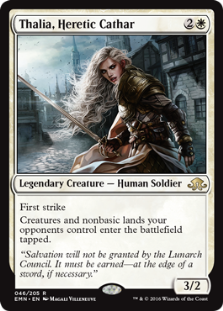
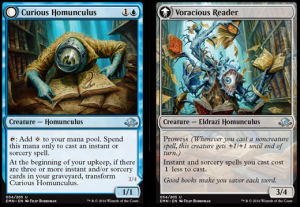
[wp_ad_camp_1]

Curious Homunculus // Voracious Reader

Screen Shot 2016-06-30 at 10.20.08 PMOf all the cards spoiled so far, this is the most Modern-playable card I've seen, to the point that I suspect that it's a Modern plant. I mean, look at it! It's a turn three 3/4 with prowess!
I'm actually really surprised by this Homunculus because I can't see it getting flipped early very often in Standard, nor am I certain that any deck is willing to put the effort into the feat. Enabling delirium or filling the graveyard haven't been playable strategies so far. While just playing Magic normally will flip the Homunculus, I'm not certain that by the time you could do so a 3/4 with prowess will be that good, even if it has another ability (more on that shortly).

Modern is another beast entirely. Gitaxian Probe and Thought Scour make flipping into Voracious Reader on curve remarkably easy. The much higher concentration of cantrips make fueling prowess over several turns relatively easy. The Goblin Electromancer ability makes it much easier to get a lot of prowess triggers and there are plenty of instants and sorceries that benefit from it. This is a Modern card.

The question is where does it belong, which I think is a deceptively complicated question. My first reaction is in Delver, but after some thought I'm less certain. The problem is that supporting Homunculus is at odds curvewise with the established Delver formula. The general plan of a UR Delver deck is to play Delver of Secrets on turn one, (hopefully) flip it on turn two, attack, and play Young Pyromancer, with the intention of hemorrhaging tokens onto the board and winning before the opponent can effectively respond. Homunculus doesn't fit into that plan. To make it into an effective early beater you need to spend a turn setting it up. Yes, you could play it after Pyromancer but a 3/4 on turn four or five isn't that appealing, especially since you've almost certainly emptied your hand by then.

Goblin ElectromancerI could see an argument for having Homunculus as a late-game card, but in Delver if you're getting to that point you've lost. Using the Reader as a beatstick starting turn three requires work on turn one that precludes anything else and makes fueling Pyromancer later tricky. I'm not saying that Curious Homunculus doesn't have a home in Delver. I am saying that it requires a retooling of the deck to accommodate, and it isn't yet clear whether that's worth it. Then again, I'm not a Delver player so maybe someone who is can chime in about its actual playability.
Where I think Homunculus belongs is in Storm. Voracious Reader is Goblin Electromancer with better stats and cannot be Celestial Purged. Storm also already intends to stock its graveyard with instants and sorceries quickly for Past in Flames and Pyromancer Ascension. Since Electromancer generally needs to spend a turn exposed to enemy fire before he's used then this isn't much of a change, and is arguably an upgrade. On top of that, Reader is a much better backup plan than Electromancer if you cannot combo off. A 3/4 with prowess is just better than a 2/2 vanilla.

The other thing to consider are the fail states. Dredge is becoming a deck and graveyard hate is getting more popular (like I said it should be). If you cannot fill your graveyard, then as far as Delver is concerned a 1/1 for two is unplayable. Yes, it makes colorless but most Delver spells are one mana and don't need the acceleration. In this scenario Storm would much rather have Electromancer, but it can still make use of the extra colorless mana. Curious Homunculus is a Storm card.

Will it make Storm a tiered deck again? I don't know. I do know that Homunculus will entice more players to pick it up, and that might increase its win rates enough without actually changing the matchups. We'll have to wait and see, but I wouldn't sit on this one.

Eldritch Evolution

Eldritch EvolutionFirst off, I have bad news for whoever was behind the Allosaurus Rider buyout; that "combo" isn't playable. I know that when you saw it spoiled you thought it was Natural Order for three mana. It isn't. Not even close.

Natural Order is good because it turns Dryad Arbor into Craterhoof Behemoth. You can't sacrifice a worthless creature to Evolution and have it be good. For Evolution to be worth it, the sacrifice must be a good creature itself. Therefore unless you win on the spot it really isn't worth it. Elves can already tutor for Ezuri, Renegade Leader so I don't think it needs this.

Besides, Modern Elves hemorrhages its hand onto the board which makes it hard to cheat out Rider and it really isn't worth it to spend all your mana from Elvish Archdruid just to play Rider so you can evolve it into a Behemoth. It's just not going to work out.

Allosaurus RiderThere are other possible uses for Evolution and Rider but I don't think they're as good. Yes, you can get any nine-or-less cost creature but what do you want besides Craterhoof to end the game? Akroma, Angel of Wrath? Iona, Shield of Emeria? If that's what you're doing isn't Gifts Ungiven a better tutor? You could get Griselbrand I guess, but there's already a deck built around doing that where it's much easier to achieve. And that's not even getting into the issue of what you do if Evolution gets Remanded.

That said I do think this card has a place in a Toolbox deck as a compliment to Chord of Calling. The ability is close enough to Birthing Pod's that I suspect it is good enough for at least a little play, helping you tutor up the chain when Chord isn't available. Just don't think that it's a combo card and you should get plenty of mileage.

Eternal Scourge

Eternal ScourgeIs there a way to abuse this card? It seems like there should be. Being effectively immune to removal and replayable from exile seems like it could be abused in some way. Combo players, get working. I want to find out if my instincts were right and I need you to do it because I cannot figure out how to. I'm sure it will be wonky and weird but that's okay---I just want to know if it can be broken.
As a fair card it's hard to evaluate. A 3/3 for three isn't that special even if it is playable in any deck. The only way to get rid of it (other than countering) is sacrifice, sweepers, and combat, so it might have a home in control sideboards, though I suspect Geist of Saint Traft is just better in all cases there.

I suspect that this is a card you use against control to run them out of answers, especially when paired with Rest in Peace. If there's no graveyard, then there's nothing to stop you from endlessly replaying Scourge and hoping that's good enough. A little optimistic put that way, but it might work.

I could also see this as a Dredge card. The deck normally folds to graveyard hate, particularly Rest in Peace. Scourge actually wants you to exile it, so it provides a way to keep the threats coming even when your deck has stopped working. Is that good enough? Probably not, but certainly worth exploring.

Nephalia Academy

Nephalia AcademyI don't know of any deck that actually wants a colorless land, but the effect is so unique that I had to bring it up. Academy ensures that you can redraw any card that Thoughtseize, Inquisition of Kozilek, or Liliana of the Veil strips from your hand, which might be worthwhile.
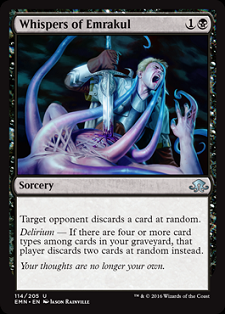
The effect is so unique that I'm not sure what to think. Wheel of Sun and Moon is the only thing I can think of that's similar and that's not really an accurate comparison. In any case that card never saw play. The "opponent controls" clause prevents you from directly abusing this card, but as a counter to Jund's disruption I'm intrigued. This might be playable.

Unsubstantiate

Unsubstantiate

I've spent an inordinate amount of time thinking about this card. It looks really good. Then you think about it and it stops being good. Then you remember the value of flexibility. Then you wonder if the flexibility makes either effect worth it. If you don't draw a line somewhere you'll never stop speculating and give yourself a migraine.

The problem is that flexibility is really good and worth quite a bit on a card. None of the individual modes of Azorius Charm are good enough at two mana for Constructed, but put them together and you have a format staple. Dismiss was a good card but Cryptic Command is better. So the question is are the "modes" of [tippy title="Unsubstantiate" width="330" height="330"]Unsubstantiate[/tippy] worth two mana?

I don't think so. I think this will be a heavily discussed dud in Modern. The problem is that you have a worse Remand stapled to a worse Unsummon, but the Remand effect is actually Venser, Shaper Savant's ability which we don't see very often and therefore struggle to evaluate. I know that it gets around uncounterability and that tempo is good. The problem is that this card isn't good enough.

Supreme VerdictIf you are using the first ability against anything that isn't Supreme Verdict or a creature played with Cavern of Souls then it was Remand but worse because it didn't cantrip. If it's the second ability you're after, then Echoing Truth is better at two mana and Vapor Snag is much better at one. Flexibility adds some value, but I don't think it's enough in this case.

If Unsubstantiate had another mode then it would be playable. Consider Azorius Charm again---restrict the card to any two modes and it likely becomes unplayable, but at three it's fine. Buying a turn against Verdict is nice, but Verdict doesn't see enough play for that to be a reason to sleeve up this card. The abilities aren't powerful enough and there is not enough flexibility to justify playing this card over more powerful, specialized versions.

Whispers of Emrakul

Whispers of EmrakulHymn to Tourach is an insane card. Whispers is Hymn plus setup. Therefore, I expect many players will use this thinking it is as powerful as Hymn.


And I don't think it is. In fact, I'm certain it's worse because you have to set it up instead of just jamming it into Force of Will.

Which does not make it bad because, as previously mentioned, Hymn is insane. The problem is that you can (mana providing) always play Hymn on two for two cards and that is unlikely to happen with Whispers. You have to get quite a good draw and hit well with Thought Scour to make that happen. Delirium has proven more difficult to achieve than expected, which has led to the consensus opinion that it isn't worth the effort (Traverse the Ulvenwald players notwithstanding). If you find a way to consistently hit delirium without harming your own deck then Whispers might be the most powerful card you can play. If you aren't then it isn't playable.

The biggest strike might be the fact that it's black. Yes it's not as black as Hymn but that's not the point (also it's worth it for Hymn because insane, etc.). Most Traverse decks are RUG and stretching for black would be asking a lot. It's possible that a BUG deck will finally emerge to take advantage of Traverse and Whispers, in which case its stock will rise enormously. But as things stand I don't see this getting much play. Two mana to discard a random card is just not worth it.

By the Light of the Silver Moon

We've still got a week before the full spoiler is out and Emrakul gets sealed in the moon (look Wizards, we all know that's where you're going with this. Don't be coy, just admit it). There are still a lot of cards to be spoiled, and plenty of new cards to discuss next week. And seriously, if you can figure out how to abuse [tippy title="Eternal Scourge" width="330" height="330]
Eternal Scourge[/tippy], let me know.


Avatar photo

David Ernenwein

David has been playing Magic since Odyssey block. A dedicated Spike, he's been grinding tournaments for over a decade, including a Pro Tour appearance. A Modern specialist who dabbles in Legacy, his writing is focused on metagame analysis and deck evolution.

View More By David Ernenwein

Posted in Modern, SpoilersTagged , , 15 Comments on There’s a Bad Moon on the Rise: EMN Spoilers

Have you joined the Quiet Speculation Discord?

If you haven't, you're leaving value on the table! Join our community of experts, enthusiasts, entertainers, and educators and enjoy exclusive podcasts, questions asked and answered, trades, sales, and everything else Discord has to offer.

Want to create content with Quiet Speculation?

All you need to succeed is a passion for Magic: The Gathering, and the ability to write coherently. Share your knowledge of MTG and how you leverage it to win games, get value from your cards – or even turn a profit.

Insider: Organizing Your Trade Stock

Are you a Quiet Speculation member?

If not, now is a perfect time to join up! Our powerful tools, breaking-news analysis, and exclusive Discord channel will make sure you stay up to date and ahead of the curve.

I'm guessing that if you have a subscription here on QS that you have a trade binder and to some extent enjoy the buying, selling, and trading aspect of our shared collectible hobby. Me too.

I've been into Magic: The Gathering since I was in sixth grade back in 1995. I was into collecting then and here I am over 20 years later and still interested in the same hobby! However, things sure have changed in the past 20 years.

The Evolution of MTG Trading

When I first got started playing Magic I remember trading cards with friends at school at lunch or on the bus to and from school. The preferred method of trading was to check the price guide in Scrye Magazine to make sure the deal was "fair." Obviously, this was exploitable because Scrye overvalued terrible rares.

I remember before the smart phone boom the way that people traded was to go through each others' binders and ask, "What do you value that at?" Each person would find cards and haggle over prices.

Honestly, better access to information makes trading a much more reasonable endeavor for everybody involved. In the olden days trading was kind of stressful because it was always a game of who knows more and who is going to haggle the better deal. At least now pretty much everybody will always get a reasonably fair deal because information about prices is so easily accessible.

Now trading is pretty easy. You and I both have smart phones, we look up the prices on TCG Player, and make a deal that is even. Most of the value in trading comes from:

1. Not having to trade your cards to a store at a discounted rate in order to acquire cards to play with.

2. Trading for cards with a "speculative mindset" where you think the card you are getting has a better opportunity to gain and maintain value into the future.

There has always been an angle in MTG trading. In 1995 it was trying to pawn off all of your $2.00 Revised Aladdin's Lamps for $6.00 dual lands. In 2005 it was asking "how much do you value this Tarmogoyf at?" and hoping they hadn't heard it spiked to $50.00 from $8.00. (I traded a Goyf for two Graven Cairns to finish a buddy's deck not realizing that Tarmogoyf had more than quadrupled in value that day!)

And now in 2016 we just try to trade for cards that are more likely to gain or retain value in the future based on what we know about MTG finance trends.

How I Organize My Collection

My collection is organized into the following categories:

1. The cards that I actually play with.

I own a lot of cards that are for my personal use. I don't trade or sell these cards because, well, I use them a lot. If I've ever needed a card for a deck I've played at some point, chances are that I still own it in my personal deckbuilder's stash.

2. The "Investment Binder."

The "investment binder" is full of goodies that I've traded for with the mindset of holding on for future gains. Extra dual lands, shock lands, fetch lands, Reserved List cards, and sweet foils. These are the cards that I'm speculating on. I generally bring it with me but don't show it to people when I trade with them unless they have something uber spicy that I really want.

3. The "For Trade Binder."

This is the binder full of goodies that I actually show people when we trade.

Get the Junk Out of the Trade Binder

The way that people trade has changed. For the most part, information is more accessible and potential trade partners are better informed than in the past. As a result I've noticed a few things and made adjustments to how I organize and approach potential trades.

First of all, nobody wants garbage cards anymore. There is a roughly 0% chance that anybody is ever going to trade for bulk rares. Back in the day, I loved putting my junk rares on display because people actually wanted these cards for some reason.

It is also worth noting that more casual crowd people actually attended Magic tournaments five years ago. People still showed up to FNM with their kitchen table zombie and burn decks. Not so much anymore. People who actually spend their time going to even local tournaments are much more savvy than they used to be. They know the difference between "real" cards and "nonsense" cards. Nobody wants your nonsense anymore.

The same goes for your bulk foils.

The key is that I don't even include non-Constructed-caliber cards in my trade binders anymore. If it's truly a junk rare or bulk foil, I set it aside in a box for future use. Whenever a random junk card suddenly becomes good you can always go back and pluck it out to load it into the trade binder.

If the card is inexpensive, but even niche-playable in Constructed, it can go into the binder, because there is a reasonable chance somebody could need one for an event.

The reason I don't put junk into my trade binder is that it just looks bad and nobody ever wants it. There is a pretty tested and true trading strategy where you have multiple trade binders and give a trading partner the binder with the least impressive stuff to look at first. The key is that if they pull out anything from your "junk" binder you are happy to find something in their binder to trade your lesser cards for.

While I'm still going to advocate for a two binder system, I'm very keen on keeping my "junk" binder looking pretty nice and not cluttering it up with garbage. You've seen the garbage trade binder before, right? It's when you go to trade with somebody and they have 50 nine-pocket pages front and back (all rares) and not a single card worth trading for.

Every single time I encounter this individual with the "hoarder" junk trade binder it makes me not want to trade with this individual in the slightest. Like, are you seriously expecting me to spend five minutes pawing through your bulk rare binder hoping that I'm in the market for Otarian Juggernaut? Give me a break. It comes across as slimy and disingenuous. We both know that you have more for trade than this crap, so why are you wasting my time?

There was an error retrieving a chart for Otarian Juggernaut

My thought process is:

Nobody wants it.

Even if they did, it's not worth anything anyway.

Showing it to people makes them distrustful of you, annoyed with you, and unlikely to want to deal with you. Why am I carrying around a 25-pound binder that nobody wants to look through again?

The "For Trade" Binder

So, I've told you what I don't put in my trade binder---let's talk about what I've actually got in there. While I bring two binders with me I'm primarily only interested in trading out of my "for-trade" binder.

I would consider everything that I put into this binder to be "real cards" but cards that I'm interested in trying to trade for more lucrative or conservative investments.

Things ranging from Always Watching to Gideon, Ally of Zendikar. If the card is playable and I'm not extremely sure the card is a great "hold for more value spec," I'm looking to trade it for better speculation targets. My goal is to put as many attractive cards as possible into my trade binder, because I actively want people to pull out cards so I can trade for cards that I think have a higher upside.

There was an error retrieving a chart for Always Watching

If you're confident that you're trading for the right stuff, you really want to make as many trades as possible!

Another solid trick is to keep a playset or two of every good constructed uncommon in your binder as well. Cards like Duskwatch Recruiter, Silkwrap, and Lambholt Pacifist are among the easiest cards to find suitors for! Don't be shy about trading to refill these cards because they tend to go in and out of your stock a lot.

There was an error retrieving a chart for Duskwatch Recruiter

The Investments Binder

My investments binder is basically where I keep all of the cards that I don't need for my "player's collection" but that I'm holding onto for future gains.

I love trying to trade things from my for-trade binder for cards to add to my investments binder. Obviously, Modern lands, Reserved List cards and desirable foils tend to keep going up in value over time!

I'm willing to trade out of this binder but generally only for cards that I really, really want. For instance, I need a foil Baleful Strix for my Battle Box and a City of Traitors for my Legacy Eldrazi deck right now. I'd be more than happy to pull out my investment binder in order to trade for cards that I personally would like to own.

There was an error retrieving a chart for Baleful Strix

What to Do With My Junk Cards?

I've already advocated that the junky cards shouldn't come with you to the trading floor. It is a waste of space and doesn't generate a lot of positive value for the cost that it requires.

So, I basically have two four-column boxes that I keep tucked away under my bed. The first four-column box is for playable commons and uncommons. If the card is Constructed-playable I save it and when random commons and uncommons spike I go back and pluck them out. I can't even tell you how many Serum Visions, Mishra's Baubles, and Simian Spirit Guides I've found!

There was an error retrieving a chart for Mishra's Bauble

I do the exact same thing for bulk foils and bulk rares. I just stash them away and go back for cards that magically become valuable later on. When my bulk rares and foils start to get too full I go through and I sift out the absolute worst bulk and sell it off with my bulk commons. I typically cull my bulk once every year or so when there is a local GP or Open. The longer you hold onto the bulky stuff the better the chance that some of the cards will suddenly become money!

~

Well, that is kind of how I organize my collection. My biggest innovation has been to stash the bulk away and keep it out of sight, out of mind until it is actually worth something. Then, if it isn't worth something I get rid of it later down the line.

It's a good and proven system that I have adapted and evolved over the years. Always speculate. Always trade for better prospects. And, always be organized!

No July 4th Article

Are you a Quiet Speculation member?

If not, now is a perfect time to join up! Our powerful tools, breaking-news analysis, and exclusive Discord channel will make sure you stay up to date and ahead of the curve.

Modern Nexus is taking a day off for the Fourth of July holiday here in America (and to let your humble editor recover from a long week). We'll be back in full force tomorrow with David's article, so be sure to come back then.

modern_nexus_lg

Jason Schousboe

Jason was introduced to Magic in 1994, and began playing competitively during Time Spiral block. He has enjoyed a few high finishes on the professional scene, including Top 16 at Grand Prix Denver and Top 25 at Pro Tour Honolulu 2012. He specializes in draft formats of all stripes, from Masters Edition to the modern age.

View More By Jason Schousboe

Posted in Announcement, Modern, OpinionTagged , , Leave a Comment on No July 4th Article

Have you joined the Quiet Speculation Discord?

If you haven't, you're leaving value on the table! Join our community of experts, enthusiasts, entertainers, and educators and enjoy exclusive podcasts, questions asked and answered, trades, sales, and everything else Discord has to offer.

Want to create content with Quiet Speculation?

All you need to succeed is a passion for Magic: The Gathering, and the ability to write coherently. Share your knowledge of MTG and how you leverage it to win games, get value from your cards – or even turn a profit.

Insider: Virtually Infinite – Nothing is Eternal

Are you a Quiet Speculation member?

If not, now is a perfect time to join up! Our powerful tools, breaking-news analysis, and exclusive Discord channel will make sure you stay up to date and ahead of the curve.

This series is dedicated to helping you play Magic Online for free through playing and speculating better.

Our main focus remains Eternal Masters, which is two-thirds of the way through its run on MTGO. It is an incredible format---one of the top limited formats of all time, I would say. It is deep and complex, with multiple hidden archetypes and interactions, and no draft feels quite the same. The game play is also super interesting. You can win with aggro, midrange, control, or combo. It's pretty remarkable that they manage to continually deliver on these "masters" sets, which don't receive the same development resources as standard sets.

That said, it is super easy to bleed value on this format as the ratio of card prices to entry fee ratio remains abysmal. Drafting is always "consumption," but that's especially true with EMA. In our last article, we discussed the Eternal Masters draft format and how to minimize your losses by playing smarter queues (phantoms and Swiss) and by value drafting whenever possible.

The good news is that we have some profits on the horizon. Eldritch Moon does not come online until July 29, which means there will be a three week window between the end of EMA queues and the start of EMN release queues. Standard will be a lame-duck format, and I expect a lot of attention to turn to the Legacy queues.

Spotlight on Legacy

Once EMA drafts are over, the Competitive Legacy Leagues between July 6-20 will offer qualifications to the Legacy Festival Championship on July 24. I expect this to be a time of heightened interest in Legacy that will provide an ideal window to sell our Legacy specs. I expect streamers and web content will turn to Legacy, and we'll see another wave of price increases.

Our non-EMA Legacy specs have done nicely, and should see one final boost over the next three weeks. The magnitude will depend on how popular Legacy on MTGO turns out to be, but we will have done nicely by the time all is said and done.

We will want to unload most of our Legacy by the Eldritch Moon release. Once Emrakul makes her return, players will quickly turn their attention to the new limited format and the new Standard. It's wise to sell those you don't plan to play with, since EMN release events will put pressure on prices---with high-value cards suffering the most.

How should we handle EMA prices? First, I would expect an increase during the final days of drafting in the price of the marquee cards, Wasteland and Force of Will. Same goes for other staples like Sneak Attack, Daze, Pyroblast, Hydroblast, Sensei's Divining Top, etc. If you've been waiting to buy or rebuy, the next couple days will be a good and safe time to grab your playsets. While waiting a few weeks for EMN release events might bring lower prices, I think there's a good chance we'll see a speculative rise in the most sought-after cards as Eternal Masters drafting comes to a close.

This set has not been heavily drafted so no flood of supply to crash prices. The phantom option is very attractive, which means players can enjoy the set without introducing new supply. The aggregate set price dropped from 183 tix at release to 129 tix after one week of drafting---nearly a 30% drop---but has now increased back up to 152 tix. This seems to be a plateau. Wasteland is actually higher now than it was at release. On the other hand, some fringe cards that were expensive only because of low supply---such as Maze of Ith---have plummeted. There are now only four cards worth more than a booster pack.

In terms of precedent, both Modern Masters and Modern Masters 2015 hit a plateau roughly two weeks after the start of drafting before embarking on a long ascent. I don't expect EMA prices to drop much lower, though I also don't expect a rapid ascent.

In sum, if purchased over the next week or so, EMA cards make fine spec targets. However, we will also be entering in some potentially more lucrative opportunities. Release events always reward those with liquidity. Plus original Zendikar flashbacks will arrive on August 17.

Zendikar flashbacks will be very popular since the EV will be excellent. Pre-emptive selloffs will offer us an opportunity to acquire fetchlands at a discount. The number of fetchlands actually entering circulation is low, and prices should quickly correct. This is true for Mindbreak Trap, Goblin Guide, Lotus Cobra, Eldrazi Monument, and other high-value ZEN cards.  I plan to hold a bunch of tix for mid August, which means I won't go in as deep on EMA as I normally would.

To recap:

  • This week I will be buying EMA playsets and doing some modest EMA speculating. I'll hold all Legacy specs.
  • Next week I'll keep a close watch over my Legacy specs, including our Reserved List basket and our "Gatekeeper card" basket from the spring. I will be selling these positions over the next three weeks or so in advance of Eldritch Moon. This should be a period of volatility, so keep an eye out for cards/decks that might spike as a result of good press or popular streamers.
  • I will stash these tickets with an eye toward picking up depressed staples during EMN release.
  • In particular, I will be looking to snap up ZEN fetches and other staple rares from the set.

Pickups

Before I leave you for the week, here are a couple cards that are cheaper than they ought to be. I'm targeting them with the following exit points in mind:

Editor's note: The current prices listed below are from Friday, and may have changed since.

Thragtusk

Thragtusk

Current: 2.9

Target: 4

Bitterblossom

Bitterblossom 6

Current: 8.3

Target: 12

Pyromancer Ascension

Pyromancer Ascension

Current: 3.1

Target: 5

Master of Etherium

Master of Etherium

Current: 2.5

Target: 4.5

Insider: High Stakes MTGO – June 26th to July 2nd

Are you a Quiet Speculation member?

If not, now is a perfect time to join up! Our powerful tools, breaking-news analysis, and exclusive Discord channel will make sure you stay up to date and ahead of the curve.

Hi everyone and welcome back to High Stakes MTGO!

If this past week again not much happened in the buying department, things have started to move regarding the positions on my "to sell" list. I'm still very hesitant to commit to Eternal Masters singles and my only purchase this past week was what I actually suggested: Fire-Lit Thicket. I haven't bought any EMA yet but I tell you what I consider being my best picks in the "Questions & Answers" section below.

The Legacy Leagues start this Wednesday and if there's any more room to grow for Legacy staples it's now or never. As mentioned many times before, it's also probably time to find a sweet selling price spot and move on.

Personally I'm going to be looking to sell any positions that see some play in Legacy and whose price is up these days. This includes cards such as Eye of Ugin, Dismember (sold this past week), the Zendikar fetchlands, Lord of Atlantis and Thought-Knot Seer.

The link to the live portfolio hasn't changed and is here.

Buys This Week

FLT

I mentioned this in my last week’s article and I went for a modest 31 copies last Tuesday. This filter land has gone several times over 5 tix in the past few years and now that Shadwomoor flashback drafts are behind us I hope it will soon reach 5 tix again. Because the margin in not extraordinary I didn’t want to buy Fire-Lit Thicket over 2.8 tix, hence only 31 copies.

Sales This Week

These three painlands reached reasonable selling ranges so I unloaded a few more playsets. That's my first wave of sales with Battlefield Forge. The profit is rather small but I'll take it, not knowing what happens next except that the painlands rotate out of Standard in about three months.

Although these specs were not as great as anticipated ten months ago, I'm nonetheless satisfied with them considering the large volume of tix locked with these five lands.

The price was stagnating around 13 tix for several days and was just below my target selling price. Bloodghast is not a superstar in Legacy and I’m not sure there’s much more to gain between now and the release of Eldritch Moon online. I was looking for that kind of profit when I bought in at ~8.7 tix, so when in doubt, and close enough to what I wanted, selling appeared to be the best option.

I thought I would be stranded with Snap for a while as its price didn’t seem to break over the 4 tix bar. With the big spreads we observe with Pauper prices, even at a 2.4 tix buying price it's not easy to make a profit over 30 copies.

Thanks to the reprint of Peregrine Drake as a common in EMA, Snap made in it all the way to 6.5 tix. At this point it would not have been very reasonable to wait for more. I sold my copies for 5.5 tix on average. Now I’m waiting on Sunscape Familiar to follow the same path.

I had bought a lot of these back in April when the price suddenly fell to ~2 tix. With a price back in the 4.5-5 tix range, its record high since the Modern Masters 2015 release, I decided to sell all my copies of Dismember. With about 20% I found that the spread was unusually high for a decently played Modern staple, but I managed to get out with a good 60% profit overall, pretty much what I was looking for.

When I bought Nexus back in March at ~20 tix I knew I was in for a moderate profit as I was targeting a 30 tix selling price. It took a little bit longer than I expected---and I could have probably sold them a month ago---but that's the price I finally hit. They may go a little bit higher in the two weeks to come but I'm not interested in betting for more.

On My Radar

Clearly selling my Legacy stuff is what I''l be trying to do for this coming week. Another thing everyone will be doing these days is trying to connect Eldritch Moon spoilers with anything in Standard and buy whatever could be remotely relevant. This "game" of predicting what will hit is quite exiting and can be rewarding.

While I'll be also trying to spot what could spike next in Standard, I'll be more inclined to wait for EMN release events on MTGO to maximize the price dip and get the potential spikers as low as possible. The window is small but the price drop is real during release events so don't forget to keep some tix for the very beginning of August too.

Questions & Answers

Q

That's a good question! First, and full disclaimer, I'm not a huge fan of Legacy/Vintage specs as they can be really slow to pay off, if they do at all. Sure there's always a few exceptions and big winners here and there, but you could be stuck for months and months with any significant changes. Modern Masters sets were great for speculators because of the demand surrounding Modern. The demand for Legacy is still very small on MTGO in comparison.

We have two reprint sets to look back at for reference for Legacy. Vintage Masters was a near fiasco in terms of investment but Tempest Remastered was not too bad, almost great actually if you were patient enough.

TPR Wasteland rose from 30 tix to 80 tix in less than two months but nothing else happened next. TPR City of Traitors and Mox Diamond merely doubled in ten months but then got much better, especially after it was confirmed they could not be in EMA. Other cards such as Volrath's Stronghold, Time Warp, Grindstone, Intuition and Aluren gained some value and have nearly doubled or tripled after more than a year now---not too bad after all.

The big winners from TPR were actually the commons and uncommons. Evincar's Justice, Diabolic Edict, Lotus Petal, Mogg Conscripts, Capsize and several others went from 0 (with the exception of Petal) to 1, 2 or even 5 tix for Evincar's Justice. How about x5000? Good commons/uncommons played in Legacy, Vintage, Pauper or Modern have a great potential but it may take more than a year to explode.

So if you're looking for profits with EMA your best long-term bet may actually be among the uncommons and commons not printed in Modern sets, and not so much with Force of Will, Wasteland, Chrome Mox, Jace, the Mind Sculptor or Dack Fayden.

Good uncommons, including Daze, Cabal Therapy, Hydroblast, Pyroblast, Ancestral Mask and Price of Progress should do wonders if you are okay to wait six to twelve months. Similarly great commons such as Nimble Mongoose, Night's Whisper and Kird Ape could be awesome gainers in several months. These are great targets for small bankrolls.


Thank for reading,

Sylvain

Want Prices?

Browse thousands of prices with the first and most comprehensive MTG Finance tool around.


Trader Tools lists both buylist and retail prices for every MTG card, going back a decade.

Quiet Speculation