
menu

Insider: MTGO Market Report for June 8th, 2016

Are you a Quiet Speculation member?

If not, now is a perfect time to join up! Our powerful tools, breaking-news analysis, and exclusive Discord channel will make sure you stay up to date and ahead of the curve.

Welcome to the MTGO Market Report as compiled by Matthew Lewis. The report will cover a range of topics, including a summary of set prices and price changes for redeemable sets, a look at the major trends in various constructed formats, and a "Trade of the Week" section that highlights a particular speculative strategy with an example and accompanying explanation.

As always, speculators should take into account their own budget, risk tolerance and current portfolio before buying or selling any digital objects. Questions will be answered and can be sent via private message or posted in the article comments.

Redemption

Below are the total set prices for all redeemable sets on MTGO. All prices are current as of June 6th, 2016. The TCG Low and TCG Mid prices are the sum of each set’s individual card prices on TCG Player, either the low price or the mid price respectively. Note that sets of Theros (THS) are out of stock in the store, so this set is no longer redeemable.

All MTGO set prices this week are taken from Goatbot’s website, and all weekly changes are now calculated relative to Goatbot’s ‘Full Set’ prices from the previous week. All monthly changes are also relative to the previous month prices, taken from Goatbot’s website at that time. Occasionally ‘Full Set’ prices are not available, and so estimated set prices are used instead.
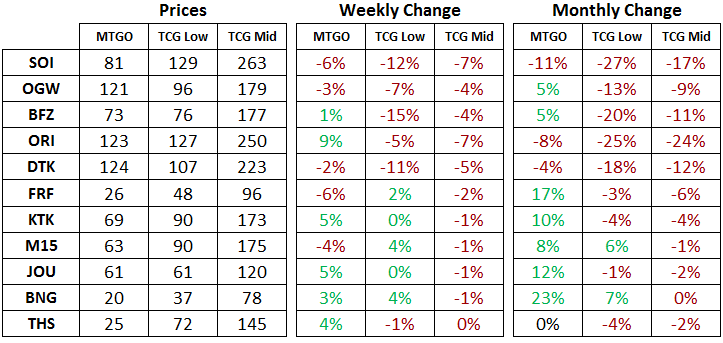
June6

Flashback Draft of the Week

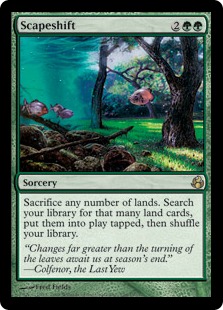
This week drafters get to add a booster pack of Morningtide to their Lorwyn drafts. Scapeshift, Vendilion Clique, Bitterblossom and Mutavault all show up in the new booster. This makes the Morningtide booster relatively high value compared to Lorwyn, so we should see continued drafts firing and a steady supply of singles entering the market.

Modern

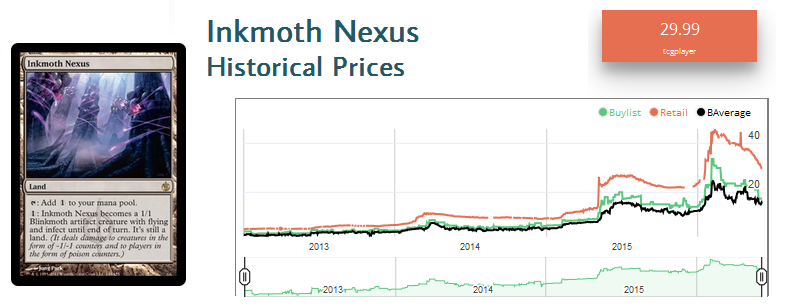
The fallout from the full set spoiler of Eternal Masters (EMA) is still being felt, although the shock waves are dissipating. Many staples are near their long-term price ceilings, including Infernal Tutor, Inkmoth Nexus, Cavern of Souls and the recently unbanned Ancestral Vision. Now is the time to be reducing your holdings of these cards, in advance of EMA release events and the attendant liquidity crunch.

Standard

Let's take a close look at the price charts on a few Standard cards. I am not going to reveal the names of these three cards, but you'll notice they are all from Shadows over Innistrad (SOI). They also all have something in common.
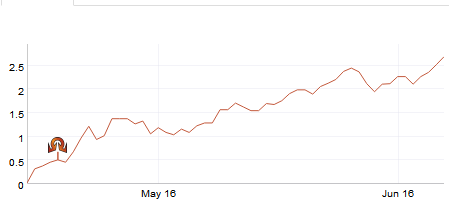
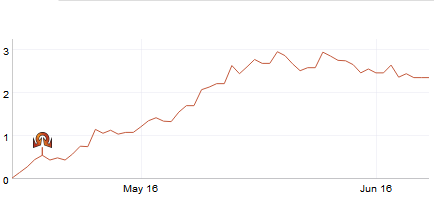
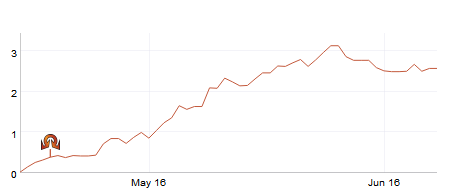
humblethebrute nearhearth recklessEach of these cards started below 0.5 tix, and by the time SOI was released on MTGO on April 18th, they were all roughly 0.5 tix. Over the course of the past six weeks, they have all climbed to over 2 tix. Any guesses as to the name of these three cards? Well, the first is Humble the Brute, the second is Nearheath Chaplain and the third is Reckless Scholar. The trick is that these are the foil versions.

Once again, relative scarcity leaves its mark on the price of digital objects in the MTGO economy. In this case the prerelease events for SOI are the culprit. These events awarded a bonus foil rare or foil mythic rare which means that these cards are relatively abundant compared to the foil uncommons.

In the past, this hasn't mattered much since prereleases had poor prize support relative to normal release events. Players just waited to play the events with better prize support. With the release of SOI, release events were eliminated and prereleases now carry improved prize support. This meant that many players chose to enter these events, which generated a flood of foil rares and foil mythic rares.

This is great news for speculators as it provides another strategy on foil cards to employ during set releases. Unlike foil mythic rares, which appear to be a profitable long-term strategy, this strategy should be profitable in the short term as long as the trade doesn't get too crowded. It's also helpful that the buy-in price on foil uncommons should be low, so novice speculators will get a chance to test out the strategy without investing too many tix. Players who want to try out the new cards should also feel confident in buying into foil uncommons during set releases.

To outline the strategy in detail,

1. During the first two weeks of a set release, buy a basket of foil uncommons. It is very important to buy a variety of uncommons since it's unpredictable which ones will rise the most.

2. Hold for one to three months.

3. Sell the foil uncommons as their relative scarcity drives up their price.

In the case of the three cards chosen above, I cherry-picked the three most expensive foil uncommons. To illustrate the risk of choosing the wrong ones, let's look at the lowest-priced foil uncommons to make sure this strategy won't be a disaster in the making.

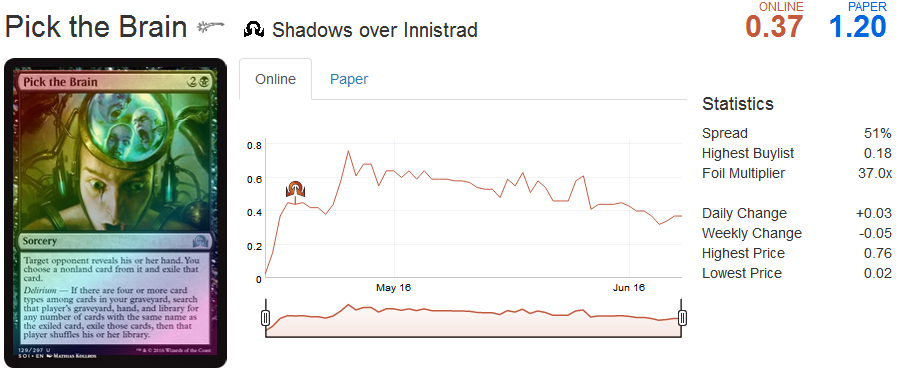
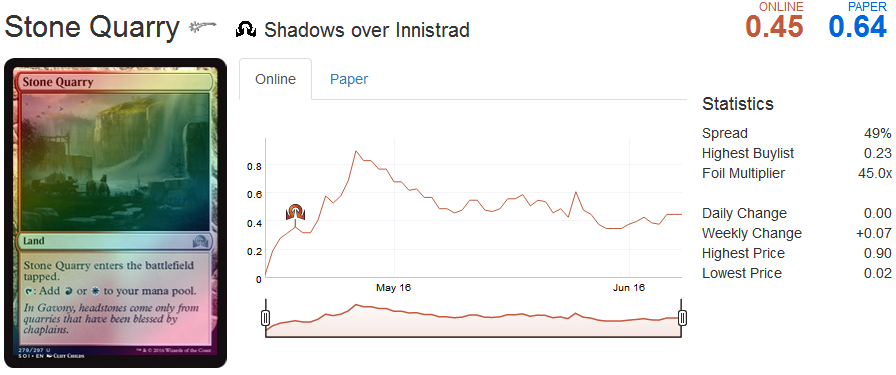
There are six different foil uncommons listed for sale at Goatbots and they have buy/sell prices in tix of 0.31/0.54. Murderer's Axe, Stone Quarry and Pick the Brain are the three at the bottom. Here are their respective price graphs from MTGGoldfish.
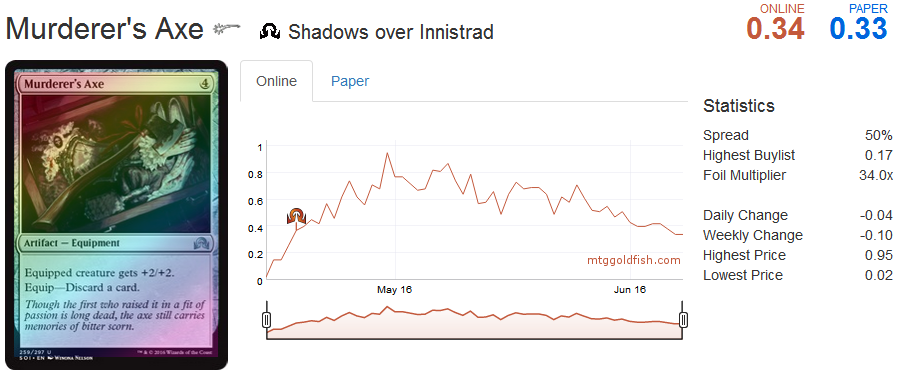
murderers stoneQ pick

What we learn from looking at the worst three performers is that you don't want to overpay as you could be saddled with cards that don't appreciate in price. So, let's add another step to the strategy.

4. Do not pay more than 0.4 tix for any particular uncommon.

This strategy depends on the entry fees and prize structure of prerelease events. If prerelease events are the same for Eldritch Moon (EMN) as they were for SOI, then the strategy will be successful.

Longer-term, the foil mythic rare strategy will have to be reappraised in light of these changes. I suspect that foil mythic rares will still be a good store of value over the long term, but we'll have to see how prices develop on foils from SOI in the fall before I can confidently recommend foil mythic rares as a speculative strategy. Players will still be well served by purchasing a complete playset of foil mythics, but speculators would be better served in the short term by looking to foil uncommons.

Standard Boosters

Oath of the Gatewatch (OGW) boosters have seen a significant price jump this week and now sit above 3.6 tix. The outlook for these is to hit 4 tix sometime this summer. Though with the pending release of Eternal Masters (EMA) next week, interest in Battle for Zendikar (BFZ) block draft will tail off and players will be selling anything they're not using for tix in order to draft the new set.

As a result, prices are expected to be flat or falling in the next few weeks. Once EMA drafts wind down in early July, the uptrend should resume as players look to formats other than SOI to draft while they wait for the release of Eldritch Moon (EMN).

BFZ boosters have not appreciated at the same rate due to the noted disparity in the ratio of OGW and BFZ boosters awarded in prizes (7:5) versus the ratio of boosters needed to enter a draft (8:4). This ratio favors the price of OGW boosters over the long term as they are awarded in prizes less frequently than they are needed for draft entry. Tix flow towards scarcity and that is why we are seeing prices of OGW boosters rise so aggressively.

It's not clear when or even if BFZ boosters will ever rise to a similar level. I expect them to be higher in a month and then to reach a medium-term peak at the end of August, but how high they ultimately rise is just a guess.

Trade of the Week

As usual, the portfolio is available at this link. This week I put a playset of Thoughtseize and Cryptic Command into the portfolio. Flashback drafts should be the bread and butter for any speculator interested in Modern that wants to expand their portfolio. With triple Lorwyn draft on the go, you don't have to look very far to find a couple of Modern staples in these two cards.

Timing the purchase of cards from flashback drafts is more of an art than a science at this point. When I perused the prices on these cards this week, I noticed that both were near their long-term price floor. At 4.79 tix a piece, I felt it prudent to start buying.

It's possible that a flood of supply from the drafts would make this early purchase look foolish. But it's also possible that that the fear of reprints had driven players to sell their extra copies, driving down the price too far. In either scenario, if a speculator holds a long-term perspective, then buying near the price floor will yield good results. I anticipate holding these cards for 6+ months or until they get back into the 8 to 10 tix range, whichever comes first.

Lastly, there are other Modern-playable cards in Lorwyn, but a card like Doran, the Siege Tower is much more fringe than the two cards I bought. The legendary treefolk might eventually yield a good return. Maybe there will be a new Tier 1 deck using Doran that catapults its price well over 10 tix. However, the weight of the historical evidence is that Doran will continue to only be fringe-playable and that a speculator is better off allocating tix towards cards that are played more frequently.
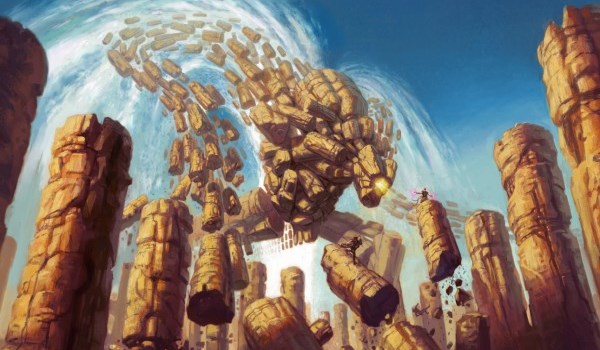
Modern Metagame Breakdown: 5/1/16 – 5/31/16

Are you a Quiet Speculation member?

If not, now is a perfect time to join up! Our powerful tools, breaking-news analysis, and exclusive Discord channel will make sure you stay up to date and ahead of the curve.

I've always been more of a paper player than an online one, but that changed a few weeks ago when I bought myself an MTGO deck as an early birthday present. Can you guess my purchase? Hint: if you've seen "ktkenshinx" around the tournament practice tables, chances are you've been eating Lightning Storms with Pact backup. Or you're one of the Eldrazi and Taxes or Merfolk players dropping Chalice of the Void at X=1 in Games 2 and 3 to ruin my evening. Jerks. Thalias and Tidehollows aside, I've loved playing more Modern than I usually get to enjoy, and it's been a treat experiencing Modern's unparalleled diversity firsthand. Whether you're playing a pet strategy too, re-watching Grand Prix coverage from a few weekends back, or just consuming Modern content across the community, it's been impossible to ignore just how fun Modern has become.

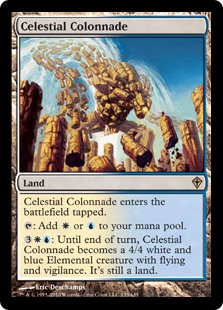
Celestial Colonnade art

When we last checked in for our April metagame update, Modern was in a great place heading into May's Grand Prix weekend. This diversity had even increased on the eve of the tournaments. Fast forward to the Monday after Los Angeles and Charlotte, and it became clear this wasn't the Modern we'd come to expect from 2015 and earlier. Modern's post-Grand Prix prognosis couldn't have looked better. Merfolk won Los Angeles. Ad Nauseam (woo!) won Charlotte. Jund and Affinity defied naysayers and solidified format holds, and blue-based upstart Jeskai Control powered into Tier 1. Between these major finishes and all the Tier 2 and lower performances behind them, Modern has rarely been better. Today, we'll break the May standings down to give a picture of the format heading into the summer.

[wp_ad_camp_1]

Data Collection Methods

If you're just joining us for the first time, check out our Top Decks page for an in-depth explanation of our collection sources and classification sources. Our main Modern Nexus claim to fame is the comprehensive monthly metagame update, bringing together tournament data from more sites and sources than any other content provider on the web. Between the leadup to Grand Prix weekend, events surrounding the early May Star City Games Opens, and the TCG Player States circuit, May was a bountiful harvest for Modern data collectors.

For today's 5/1 through 5/31 breakdown, we're tracking 119 paper events covering 967 individual decklists, typically from tournament Top 8s. Online Leagues and other events add another 32 tournaments to the analysis, making up 326 lists. Our weighted metagame shares account for the relative difference in our paper and MTGO n's, with online events accounting for only about one-third as much as paper ones. In addition to these over 1,200 decks, we also add in the Day 2 standings from both SCG Opens and Grand Prix, as well as Top 16 standings from all four major paper venues.

Using these datapoints, we calculate weighted metagame shares and award decks points based on their shares in different categories. We bring those percentages and points together to construct our Tier 1, Tier 2, and Tier 3 listings.

Tier 1 Decks

Most players have some concept of what "Tier 1" means, but it often varies wildly from gaming group to gaming group. Such tiering definition inconsistencies were unusually present in May. The month saw some Modern community members describing Abzan Company and Jeskai Control as "Tier 0," while others classified RG Tron and Jund as Tier 2 or lower. Both groups were ultimately proven wrong in different ways, but this underscores the need for consistent and transparent tier definitions, not just hyperbolic descriptors based on gut feeling and proving a point.

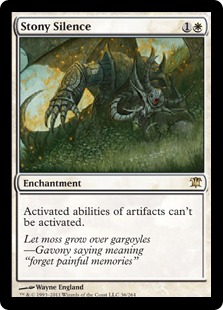
Stony SilenceWe define Tier 1 as those decks which you are likely to encounter in a major tournament. Your testing gauntlet should always include these strategies, and you should have specific sideboard plans for dealing with each of them. (Read: don't forget those Stony Silences!) Tier 1 decks also have a track record of competitive success, so they make strong choices for any upcoming tournaments. You can learn more about the Tier 1 classification, and its underlying statistics, on our Top Decks page.
Here are the Modern Tier 1 standings for the 5/1 through 5/31 period.

Tier 1: 5/1/16 - 5/31/16

DeckOverall
Metagame %
Paper %MTGO %Major Event
Day 2%
Jund8.8%8.2%6.7%10.3%
RG Tron7.6%7.0%4.0%9.7%
Infect6.3%5.7%6.7%7.4%
Jeskai Control6.0%7.3%4.6%4.4%
Burn5.9%5.9%5.5%6.2%
Abzan Company5.5%5.7%1.5%6.5%
Affinity4.7%6.0%5.8%2.2%

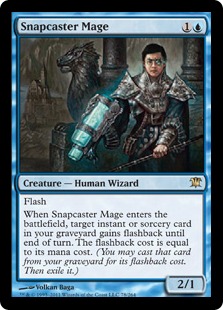
Snapcaster MageMay's Tier 1 listings include seven total decks with six of those carrying over from April. Our one newcomer? Say hello to Jeskai Control, the blue-based, Snapcaster Mage deck we've been waiting for since Twin's departure in January. We'll break down each of these strategies shortly, but looking at Tier 1 collectively, we see about 45% of the format represented in this uppermost echelon of familiar faces. We also see no single deck touting a share higher than 10%, not just in the overall metagame standings but even in each individual column (Jund is the sole exception, a hair over at 10.3% for the Major Event Day 2 numbers). This suggests a powerful and format-defining Tier 1, but also a Tier 1 where no single strategy is dominant.
Although all of April's Tier 1 strategies made the May cut, we still saw considerable internal movement within the tier itself. The table below tracks those metagame share changes from the April period into May, sorted from the gainers (RG Tron at 4%) to the losers (Affinity at -1.1%).

Tier 1 Changes: April to May

Deck% Change
April to May
Overall Meta %
5/1 - 5/31
Overall Meta %
4/8 - 5/1
RG Tron+4.0%7.6%3.6%
Jeskai Control+2.2%6.0%3.8%
Infect+0.7%6.3%5.6%
Abzan Company-0.3%5.5%5.8%
Jund-0.6%8.8%9.4%
Burn-1.0%5.9%6.9%
Affinity-1.1%4.7%5.8%

It's noteworthy that despite significant jumps and dips within Tier 1, the overall listing remained intact from April to May. This means we shouldn't read too much into the individual numbers, other than as general indicators of relative popularity. For instance, Tron and Jeskai benefited from extensive publicity and hype, pushing their way up the charts. Affinity and Burn, although still very viable, did not get that same kind of profile. In both cases, the percentage changes aren't necessarily indicative of viability, but rather of how players adopted or avoided certain strategies.

In keeping with our in-depth Tier 1 format from April, here's a deck-by-deck breakdown of Modern's most popular (and generally most successful) decks.

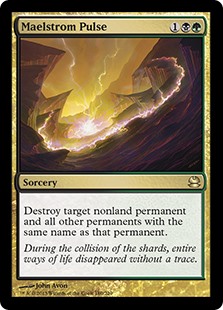
  • Maelstrom PulseUnstoppable Jund (8.8%)
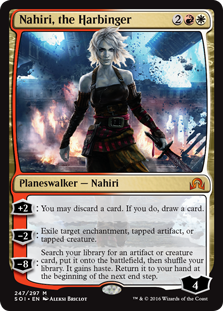
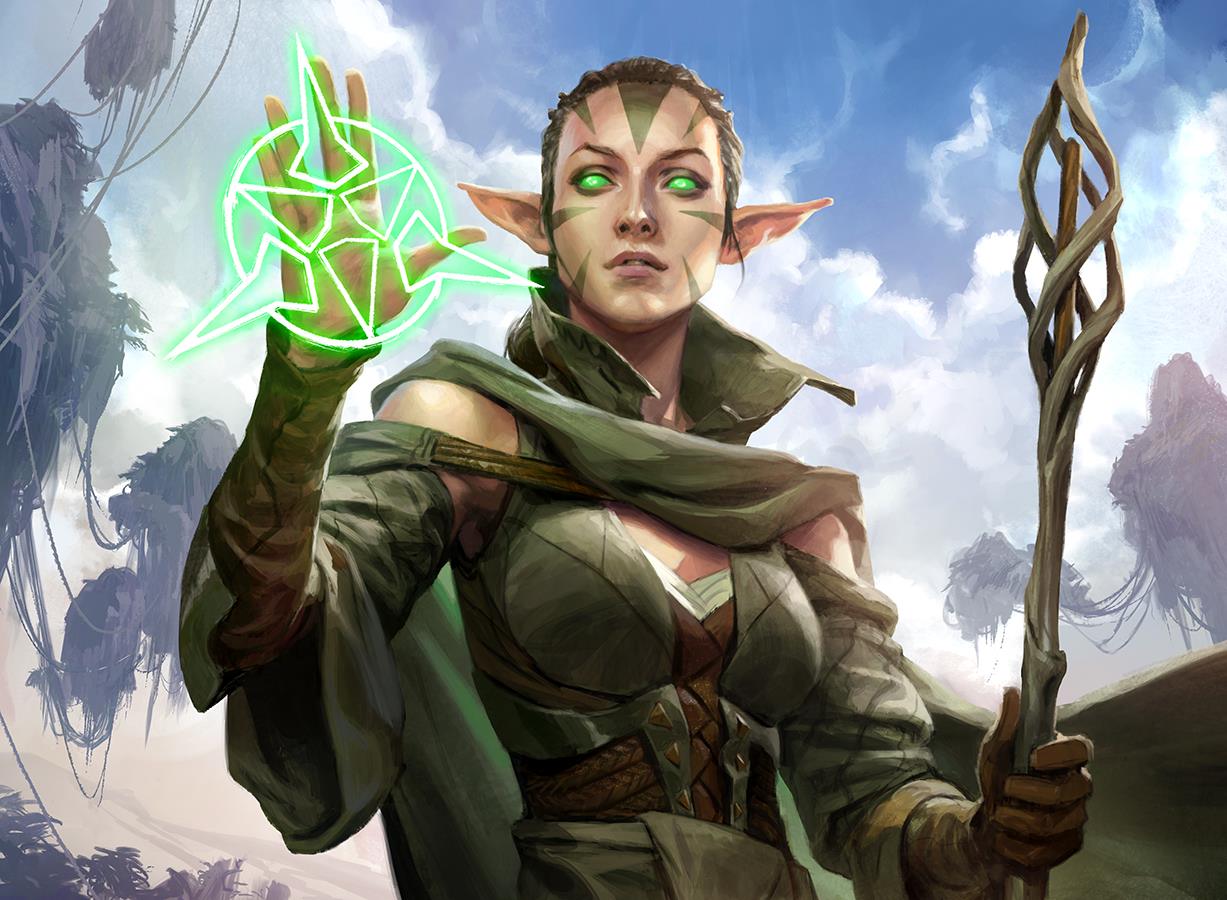
    Tron spikes from April into May and Jund is still on top? Whether in April or May, Jund has repeatedly defended its format throne. It was the most-played Day 2 deck all month, the most-played in paper and MTGO, and sent the most pilots to Grand Prix Top 8s: Mike Sigrist and Adonnys Medrano at Charlotte and Javier Dominguez at Los Angeles. As I wrote about last week, Jund has evolved to handle new threats like Nahiri, the Harbinger while maintaining top-dog status. BGx friends and foes: stop saying Jund is dead because all its Tier 1 matchups aren't 51% or better. Tron, a decidedly unfavorable Jund matchup, is May's second-most played deck and Jund is still king, losing only .6% to Tron's +4%. If that's not a sign of resilience, I don't know what is.
  • Ulamog the ceaseless hungerRG Tron (7.6%) silences doubters
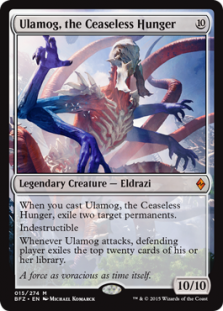
    Coming off Eye of Ugin's righteous banning, skeptics doubted Tron could hang in the big leagues without its inevitability. Some World Breakers, Sanctum of Ugins, and big tournament finishes later, the only thing to be skeptical about is the decision to remove Crumble to Dust from your sideboard. Despite only sending one pilot to the Grand Prix Top 8s, and despite a middling conversion rate from Day 2 into the Top 32, Tron nonetheless rocketed up the Tier 1 charts by 4% off widespread adoption at the local and regional level. This context suggests the deck is totally viable despite its Grand Prix shortcomings, and that players will need to keep their hate for at least another few months.
  • Glistener ElfMore Tron, more Infect (6.3%)
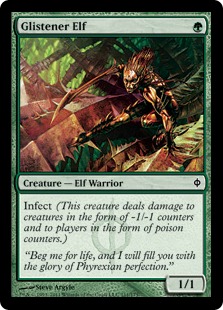
    Last month, I noted Infect would likely stay in Tier 1 until a Snapcaster/Lightning Bolt deck climbed the charts to overthrow Blighted Agent's top-tier foothold. Jeskai Control, a mere .3% under Infect, fits that bill perfectly, and yet Infect is up .6% into May. The reason? Just look up one bullet point. RG Tron's +4% surge neither dethroned Jund nor prevented Jeskai decks from their own +2.2% jump, but it definitely created a favorable climate for Infect players. I expect this uptick would have been higher without Jeskai keeping the Elves and Agents at bay. Infect remains a strong deck, as evidenced by its solidly average Grand Prix conversion rates, but it also remains a metagame call. Got Tron? Bring out the Inkmoths. Got Jeskai and Jund? Either gamble on speed or stay away.
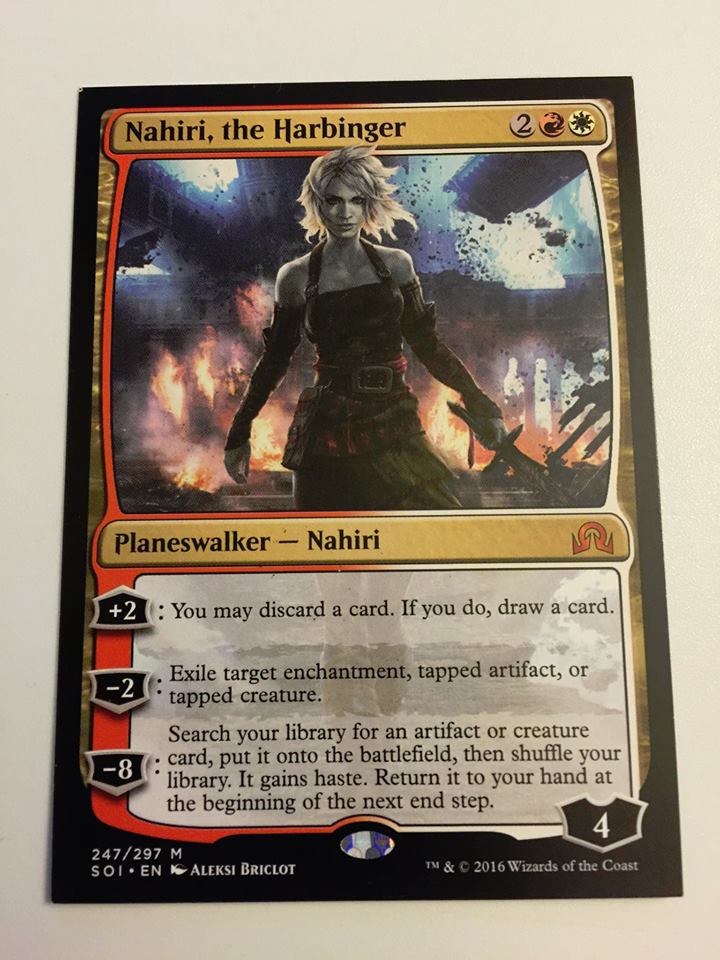
  • 1_nahiriBlue's back with Jeskai Control (6%)
    Tier 1 Snapcaster returns! We've seen both sides of the Jeskai hype train, with some suggesting Nahiri's banning six months out and others claiming the deck is not viable. The numbers are in and Jeskai Control has more overall success than Burn, Abzan Company, and even Affinity. Get 'em Tiago! Paper events were particularly favorable to Jeskai, where it was the second most-played strategy after Jund, and where Jeskai's Grand Prix performance matched or exceeded all but five decks in Modern. Nahiri, the Harbinger was integral to this success, with 3-4 appearing in 64% of Jeskai Control builds, followed by Kiki-Jiki at 15%, and no-frills Snap/Bolt/Colonnade at 21%. Nahiri was also Francis Cellona's win condition of choice en route to missing the Los Angeles Top 8 by .018 on tiebreakers. Without Nahiri, Jeskai would likely be stuck in Tier 2 around 2%-2.5%. Believe in Nahiri, believe in Jeskai, and get ready for a blue Tier 1 deck.
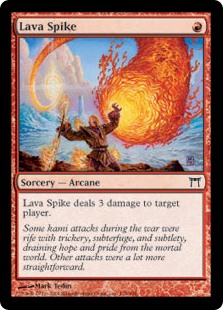
  • Lava SpikeCan't go wrong with Burn (5.9%)
    There isn't a more average Tier 1 deck than Burn and its May standings in all metagame categories reflect this positioning. Burn is the third least-played Tier 1 deck in the overall shares, in paper, and in Day 2, creeping up a slot in MTGO alone. It dropped 1% from April to May, had the second-worst Grand Prix performance of any Tier 1 deck, and yet, the deck still remains a consistent Tier 1 mainstay. Can't beat counting to 20! As long as Abzan Company and Jeskai Control are Tier 1, and as long as Tier 2 Gruul Zoo keeps munching on Burn's share, Goblin Guide's merry band won't get much higher than the 5%-7% range, but they sure will stick around. Don't bail from Burn based on this mediocre month, and don't ditch your anti-Burn bullets---this is still a Tier 1 regular.
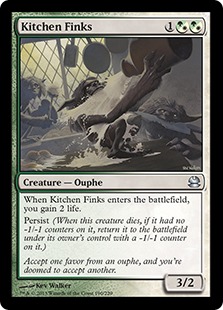
  • Kitchen FinksAbzan Company (5.5%): just another Tier 1 deck
    In a month of Modern misclassifications, the cries about Tier 0 Abzan Company were some of the worst. They were particularly offensive given our emergence from a real period of Tier 0 dominance, when Eldrazi was 35% of the overall format. Abzan Company might as well be a Standard deck compared to old Eldrazi, and the May metagame update shows this is just another strong Tier 1 contender. It was solid across all metagame categories and right up there with Jeskai Control, Burn, and Infect in Grand Prix performance metrics. RG Tron definitely kept Abzan Company at bay, although the deck stayed flat at 5.5% despite Tron's +4% jump. If you're battling Abzan Company, Grafdigger's Cage is looking more exciting than usual between Company decks, an uptick in Tier 2 Kiki Chord, and Nahiri in Tier 1.
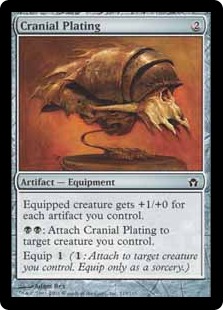
  • Cranial PlatingUps and downs with Affinity (4.7%)
    In a departure from Affinity's traditional placing, the robots fell to the bottom of Tier 1 for our May update. This represents a strange case where the overall numbers are likely under-estimating Affinity's real potential. On the one hand, Affinity was pre-trending down as we got closer to Grand Prix weekend, falling from 5.8% to 4.6% just a week before Los Angeles and Charlotte. Then came the Grand Prix, which saw Affinity snag second at one and overall put up the best conversion rates and performance behind only Jund. This reflects a contrasting perception of Affinity's weaknesses and reality of Affinity's strengths. Although Affinity is undoubtedly down the charts, it's far from out so do not cut your hate unless you're confident a local metagame lacks artifacts. Affinity should be back up the standings by the next Grand Prix in August.

Because we're heading into a quiet period for Modern events, with just a pair of SCG Opens to satisfy us until the August Grand Prix, the May Tier 1 listings should prove more influential than those in other months. When in doubt, players tend to take cues from the biggest and most current events. Look no further than Grand Prix Charlotte and Los Angeles, which were critical drivers in this update. Percentage-wise, about 33% of the "Overall Metagame Share" calculations come directly from Grand Prix numbers, with another 25% being directly influenced by the post-Grand Prix wake.

Overall, this ensures May's update gives extra weight to the high-profile Grand Prix while also accounting for those smaller and regional events which make up the brunt of worldwide Modern gameplay. Expect these Tier 1 standings to stay relatively stable through August.

Tier 2 Decks

Taking a step down to Tier 2, we find competitive decks with tournament potential. Each of these strategies have the results and stats to suggest a record of success, and you could sleeve up any of them and have a solid shot at an event Top 8. Although you don't need to outfit your sideboard for all of these strategies, you should at least understand how they work and how your deck plays out its varied Tier 2 matchups. You won't see Tier 2 decks at every single event (not even the largest ones), but don't be surprised to encounter them in either Round 1 or a tournament finals.

Tier 2: 5/1/16 - 5/31/16

DeckOverall
Metagame %
Paper %MTGO %Major Event
Day 2%
Scapeshift3.7%2.3%3.4%6.3%
Merfolk3.4%4.3%0.9%2.5%
Gruul Zoo2.9%3.1%6.1%1.5%
Eldrazi2.8%2.0%3.4%4.0%
Titan Shift2.8%3.0%1.5%2.8%
Grixis Control/Midrange2.7%2.7%3.0%2.7%
Elves2.5%2.0%2.7%3.3%
Death and Taxes2.5%2.1%4.3%2.6%
Ad Nauseam2.2%2.6%2.7%1.3%
Kiki Chord2.2%1.9%1.8%2.9%
Abzan2.1%1.4%1.5%3.5%

Between Tier 1's collective 45% and Tier 2's net 30%, we're accounting for about 75% of the format in its uppermost standings. In Tier 2 alone, that 30% is spread across 11 distinct strategies running the range from control (blue-based Scapeshift) to midrange (Abzan and Grixis), with aggro (Merfolk and Gruul Zoo), combo (Ad Nauseam), ramp (Titan Shift), and various hybrids (Kiki Chord, Elves, Eldrazi) in between. This archetypal diversity is a Modern hallmark, and it's always refreshing to see it expressed numerically in both Tier 1 and Tier 2.

ScapeshiftMay sees one of the most noticeable gaps between the bottom-most Tier 1 strategy (Affinity at 4.7%) and the highest in Tier 2 (Scapeshift at 3.7%). In many previous updates, April's most recently and December's before that with .2% and .4% respectively, we've seen much smaller differences between the Tier 1 bottom and the Tier 2 top. Those past disparities suggested a less settled metagame, where Tier 2 could easily bleed into Tier 1. By contrast, May's full 1% difference could point to a more established and mature format, despite it being less than two months past the Eldrazi ban. Given how many Tier 1 and Tier 2 decks are Modern oldies, with Eldrazi and Kiki Chord being the only real exceptions, it seems likely the format is increasingly moving towards a stable core of decks with a few metagame "flex slots." We'll have to see if this trend holds in upcoming breakdowns.
Because this month's Tier 2 shares so many decks with last month's, many need no introduction. Except, of course, Ad Nauseam, which won Charlotte and remains the well-positioned "true combo deck" of Modern, as long as your metagame isn't too packed with unwinnable Infect and uphill Eldrazi and Taxes matches. Outside of personal decks, here are a few observations on Tier 2 strategies:

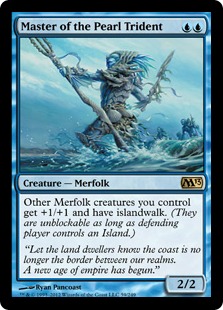
  • Master of the Pearl TridentMerfolk vs. Gruul Zoo
    When selecting between Tier 2's premier aggro decks, Gruul Zoo keeps the excitement factor off its techy adoption of Reckless Bushwhacker and explosive Burning-Tree Emissary starts, whereas Merfolk can feel like a safe and dull holdover from 2011 Modern. Merfolk is still where you want to be, with the fish boasting a much more commanding record of success including a Grand Prix win, a strong conversion rate from Day 2 into the Top 32 (beating out four Tier 1 decks in those metrics!), and a more impressive paper share. Merfolk's low MTGO numbers are likely due to a Kira, Great Glass-Spinner bug more than viability, further pushing Merfolk above Gruul Zoo. There's nothing wrong with Guides and Emissaries in smaller venues (they clearly excel in five-round Leagues), but paper has been overall much more welcoming to Master of the Pearl Trident's school than to the Gruul horde.
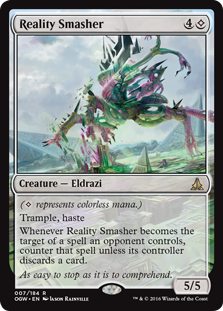
  • Reality SmasherEldrazi's back!
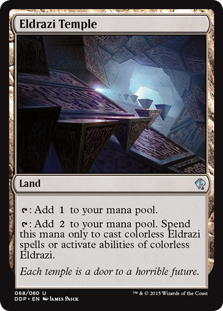
    Between Thought-Knot Seer and Wasteland Strangler in Death and Taxes, and Ancient Stirrings plus the entire Eldrazi crew in Bant and RG Eldrazi builds, our resident format nightmare is proving its relevance even after Eye of Ugin's incarceration. Pascal Mayndard's Bant Eldrazi list earned 4th place at Los Angeles, renewing interest in Modern's old menace but in a much fairer form. Eldrazi Temple keeps the deck viable, but without Eye, it looks like Eldrazi is relegated to a safe Tier 2 slot for now. Maynard's Eldrazi run came at the end of the month, so don't be surprised if more players pick up the deck in June and beyond now that they've seen it in action.
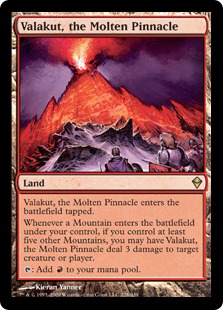
  • ValakutA tale of two Valakuts
    RG Titan Shift, powered by Primeval Titan with no blue nonsense to get in the way, got all the attention going into May. Traditional Temur and more innovative Bring to Light builds got pushed off the Valakut, the Molten Pinnacle hype train, but still managed to put up more results all month long. These numbers suggest Titan Shift remains a strong deck, but that blue-based Scapeshift has slight edges in this format. That's vindicating for blue players who want their Snapcasters and Cryptic Commands, and for format optimists who want to see more interaction and non-linear strategies in Modern's top-tiers. Given just how well blue-based Scapeshift did over the Grand Prix (the overall third-best performer after only Affinity and Jund), don't expect this to change any time soon.

The important thing to remember in Tier 2 is that all these decks are about equally viable, with only blue-based Scapeshift and Merfolk decks picking up serious percentage points over the rest of Tier 2. This lets you select any Tier 2 build and be reasonably assured of success, and ensures the metagame stays open as we head into summer. Personally, I'd be happy if Eldrazi-powered Death and Taxes saw a dip in its MTGO share of 4.3% down to its paper numbers in the low 2% range, but that's just the Ad Nauseam talking.

Tier 3 Decks

Our metagame tour ends in Tier 3, the niche strategies which have tournament potential but only in specific metagames. Tier 3 decks are generally worse than a competing Tier 1 or 2 option, but depending on your level of experience and identification of metagame trends, they could be appropriate for a certain event. When reading through the Tier 3 numbers, pay close attention to their performance in individual columns, not just in the overall standings. Some Tier 3 decks may have virtually zero paper and Day 2 presence despite exceeding 1% on MTGO. Such strategies might be poor choices for a local SCG Invitational Qualifier, but great in an upcoming MTGO League; plan accordingly.

As a final note on Tier 3 strategies, many of these options have Tier 2 potential but just aren't quite there yet. Don't discount them entirely just because May was not their month to shine, especially if the Tier 3 deck in question has been in Tier 2 or higher before.

Tier 3: 5/1/16 - 5/31/16

DeckOverall
Metagame %
Paper %MTGO %Major Event
Day 2%
Bogles1.3%1.8%1.2%0.7%
Naya Company1.3%1.5%1.2%0.9%
Storm1.1%1.2%0.3%1.1%
Suicide Zoo1.0%0.5%4.3%0.7%
Hatebears1.0%0.7%0.6%1.5%
Living End1.0%1.4%0.0%0.7%
Griselbrand1.0%0.6%0.6%1.7%
Grixis Delver0.9%0.9%1.2%0.8%
Mono U Tron0.5%0.5%1.5%0.0%
Dredgevine0.5%0.7%1.2%0.0%
Dredge0.5%0.3%1.8%0.5%
Summoning Trap0.4%0.4%1.5%0.0%
Mill0.3%0.1%1.2%0.3%
RW Lockdown0.3%0.1%0.6%0.6%
Tooth and Nail0.3%0.3%1.2%0.0%
Knightfall0.3%0.4%0.0%0.3%
Shotgun0.1%0.0%1.2%0.0%

I always group Tier 3 decks into two categories. First, you have the former Tier 2 (or higher) dropouts who have fallen into the Tier 3 fringe based on unfavorable metagame positioning. This includes Bogles, Naya Company, Suicide Zoo, Living End, Griselbrand, Grixis Delver, and even Knightfall down at the very bottom. Because these strategies have hit Tier 2 before, I'm more optimistic about their chances of returning in the right metagame context.

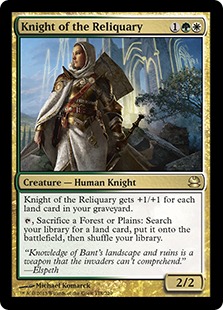
Knight of the ReliquaryWhen decks like Bogles and Suicide Zoo plunge to Tier 3 this suggests one of two factors. First, it's possible there is some fundamental incompatibility between what these decks are are doing and the influence top-tier strategies are exerting on the metagame. A great example is powerful but unremarkable Naya Company, which lacks the combo finish of Abzan Company, plays second fiddle to toolbox strategy Kiki Chord, sees its creatures outgunned by bigshot Eldrazi, and gets raced by Zoo players rocking the Gruul style. This kind of deck (and others like Grixis Delver, Bogles, Knightfall, etc.) may yet return to Tier 2, but it's not the best choice today and I'd avoid these kinds of strategies in summer tournaments.

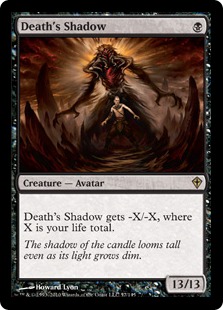
Deaths ShadowThe second factor influencing Tier 2 expatriates is popularity, or rather, lack of popularity for a deck that might otherwise be a decent choice. Suicide Zoo is the current posterchild of this effect, sending Sam Black to Charlotte's Top 8 and rocking an impressive 4.3% on MTGO. The only thing keeping Suicide Zoo out of Tier 2 is its widespread absence from paper events, where players either haven't realized its strengths or have ignored them in favor of similar strategies like Infect and Gruul Zoo. If you think a Tier 3 strategy fits in the Suicide Zoo pattern (Griselbrand with its decent Day 2 showings is another example), then feel free to sleeve it up. Although popularity is certainly one indicator of deck strength, you can't innovate the next big thing from popularity benchmarks alone.
Of course, the second category of Tier 3 strategies are flash-in-the-pan, flavor-of-the-month transients which could be here in May and gone in June. See RW Lockdown, the Assault Strobe and Nivmagus Elemental "Shotgun" deck, UBx Mill, and others. These decks are in a similar category to the Tier 3 regulars which occasionally slide out of Tier 3 entirely but are often hanging out here waiting for their pet pilots to bring them to the tournament floor: see Storm, Dredgevine, Mono U Tron, and related builds.

All of these are the kinds of Tier 3 representatives I would avoid unless you've expertly identified the metagame, especially at a more predictable local level, or you've been playing the deck since Modern's birth and can compensate for sub-optimal metagame positioning on experience and knowledge. Maybe these Tier 3 stragglers climb higher as the year progresses, but if history is any indicator, they are likely to be Modern's perennial fringe for some time to come.

Metagame Predictions for 6/1 - 6/30

Forecast time! Before we get to predictions for June, let's revisit those we made in April. We don't always get metagame projections right, but with a track record of success in 2015 (68%, a.k.a. much better than a coin toss!), these articles show that metagames can be predicted by paying careful attention to pre-trends and existing standings. April was no exception.

  • Jund and others stay Tier 1? Yes!
    In an evolving metagame, there was no guarantee that Jund, Abzan Company, Infect, Affinity, and Burn would all stay Tier 1. That was especially true for Jund and Abzan Company, the former of which many believed was on its way out, and the latter of which fell victim to an RG Tron uptick. Small shifts aside, all of these decks remained in Tier 1, suggesting a stable top-tier core which is likely to hold through August.
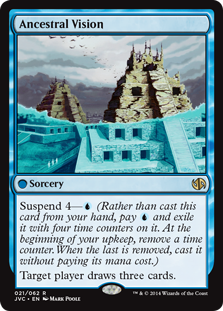
  • Ancestral VisionOne Ancestral Vision deck hits Tier 1? Yes.
    This one was a mixed bag. On the one hand, Jeskai Control did hit Tier 1, fulfilling the prediction of a top-tier blue deck. On the other hand, this was largely due to Nahiri and much less due to Vision. On the other hand again, about 50% of the Jeskai decks did use Vision in some form, with about 30% of the total Jeskai decks using 3-4 in the maindeck and the other 20% shipping 2-3 to the sideboard. That said, Nahiri was the all-star, not Vision, even if the end result is still a Tier 1 blue-based control deck. Given both Jeskai's rise to Tier 1 and Vision's contributions to that, I'm giving this prediction a qualified "Yes" where the intent was still fulfilled. Blue mages get their day in the sun!

June is an off-season month with only a single SCG Open to keep the Moderners satisfied, so there's unlikely to be too much movement around the tiers. This makes it harder to make bold predictions, but I'll make two smaller ones based on trends I'm noticing now and in response to some buzz I've heard around the community.

  • Celestial ColonnadeJeskai Control stays Tier 1
    I've heard a lot of undue Jeskai Control criticism in the past weeks. "Nahiri is bad." "Jeskai isn't a real deck." "Control still sucks." Let's call these naysayers for what they are: haters. Thankfully for Jeskai fans and proponents of a healthy Modern metagame, the numbers point to Jeskai Control's legitimate strengths and this shouldn't change in June. This deck has real staying power, both due to Nahiri (she's the real deal) and its robust mix of removal and countermagic. These tools should be more than enough to keep Jeskai Control in Tier 1 for another month, hopefully silencing many of the haters and doubters who maintain blue-based control is untenable in Modern. May proved them wrong once and June should do it again.
  • Eldrazi TempleEldrazi climbs the Tier 2 standings
    Bant Eldrazi was a latecomer to the May party, and I expect we would have seen more widespread Eldrazi adoption if Maynard had made his Grand Prix run earlier in the month. As it stands, Eldrazi Temple is still an excellent Modern staple and I will be surprised if we don't see more Eldrazi as tournaments unfold throughout June. Pre-trends support this prediction, with most of May's Eldrazi falling in the RG category and not Bant. When it was time for the Grand Prix, it was Noble Hierarch and Drowner of Hope that carried the Eldrazi torch, which should shift focus to Bant colors building from Maynard's impressive 4th place finish. Expect Eldrazi to exceed 3% when we return in early July.

Thanks for joining me today in this comprehensive and exciting metagame breakdown. Head down to the comments with any questions about numbers, decks, card choices, or any and all things related to the Modern metagame. I'll be enjoying this diverse and open format on MTGO in the coming weeks and I encourage you to get out there and enjoy it as well. With so many enticing options in Tier 1 and Tier 2, there's a Modern strategy for basically every type of player, so get yourself a nice birthday or summer kickoff present and play some Modern!

The Best Deck in Standard

Are you a Quiet Speculation member?

If not, now is a perfect time to join up! Our powerful tools, breaking-news analysis, and exclusive Discord channel will make sure you stay up to date and ahead of the curve.

Oftentimes, I find myself working on a particular deck that I like while a different deck rises as the deck to beat in a Standard. I played red decks while Black Devotion was the deck to beat, I avoided Caw-Blade because I didn't have time to hone my skills in the mirror, and I only ever sleeved up Abzan after it was good. I like my Azorius Eldrazi deck though now we have more than enough data to stop pretending like there's a good reason to play other decks. I was right all along about Nissa, and there's nothing in Standard that is providing more free wins that Nissa into Gideon.

There was an error retrieving a chart for Nissa, Voice of Zendikar

Tokens is taking the lion's share of both Grand Prix winning decks as well as slots in the money of major events. The current number one ranked player in the world in Seth Manfield won a GP with the deck, and somebody you've never heard of in Alex Johnson won a GP with the deck. Gerry Thompson won 16 straight matches with the deck at the Atlanta Open! The format looked to be pretty wide open for a while, though now if you're not playing Tokens and you want to spike a tournament, you should pretty seriously be asking yourself why.

It's true that Tom Ross won the the Open in Atlanta in what was a pretty diverse Top 8 with Humans, but there's just no way he was about to play anything else. You'd also better believe that he wins games that nobody else could win with aggressive decks. Once you get past the Top 8 of Atlanta only having one tokens deck, you'll notice that 9th, 10th, and 11th were all tokens. The deck's consistency is absurd. Mike Sigrist led his article on SCG this week with the words, "G/W Tokens is the best deck in Standard. Don't argue. It just is."

I knew Tokens was a stupid deck going into GP Minneapolis, though I stuck to my guns because I knew my deck could realistically win any matchup, and that my Tokens matchup was generally positive. What I didn't account for, was the fact that even if I can beat Tokens, my deck doesn't get nearly the number of free wins that Tokens gets. I convinced myself to play The Rock when I had access to Jund- Bloodbraid Elf Jund. If you're planning on spending money on Standard entry fees in the near future, then consider it sound financial advice to register Tokens.

Avatar photo

Ryan Overturf

Ryan has been playing Magic since Legions and playing competitively since Lorwyn. While he fancies himself a Legacy specialist, you'll always find him with strong opinions on every constructed format.

View More By Ryan Overturf

Posted in FreeTagged , , 3 Comments on The Best Deck in Standard

Have you joined the Quiet Speculation Discord?

If you haven't, you're leaving value on the table! Join our community of experts, enthusiasts, entertainers, and educators and enjoy exclusive podcasts, questions asked and answered, trades, sales, and everything else Discord has to offer.

Want to create content with Quiet Speculation?

All you need to succeed is a passion for Magic: The Gathering, and the ability to write coherently. Share your knowledge of MTG and how you leverage it to win games, get value from your cards – or even turn a profit.

Transform and Preboard: Advanced Sideboarding

Are you a Quiet Speculation member?

If not, now is a perfect time to join up! Our powerful tools, breaking-news analysis, and exclusive Discord channel will make sure you stay up to date and ahead of the curve.

Sideboarding is a skill-intensive and essential component of competitive Magic. While it isn't an "Easy to learn, hard to master" skill, it feels very close. Sideboarding guides can be useful to overcome this learning curve, but they can also become a crutch and actively harmful to your chances of improving. Last week I went over the basics of the Modern sideboard. This week I'm going to follow up with more advanced strategies.

tooth-and-nail-banner-cropped

The strategy I advocated last week involved packing your sideboard with "silver bullets," cards that win the game unaided against certain decks. As a competitive player I cannot fathom why you wouldn't use as many as you can since they're free wins, but it isn't always possible. Some decks have no bullets for you to use or the colors you're playing don't support effective ones. There really isn't a silver bullet to beat Jund, for example (though Blood Moon comes close). This normally means that your only option is the Standard-style adjustment, bringing in cards that adjust the matchup rather than win it or dramatically alter things. While it might feel like this is the only option, that isn't true. If you're willing to commit to it, you can dramatically alter post-board games with a transformational sideboard, or try to pre-board against certain matchups.

[wp_ad_camp_1]

Transform and Dodge Hate

The idea of the transformational sideboard has been around for quite some time, but it isn't very popular. Sheridan mentioned it a few months ago in regards to Affinity bringing in Ghirapur Aether Grid and Ensnaring Bridge against Eldrazi, and also gave some pretty good reasons why you should stay away. However, while for many decks there isn't any point, there are other times when this strategy works. Let's investigate the latter.

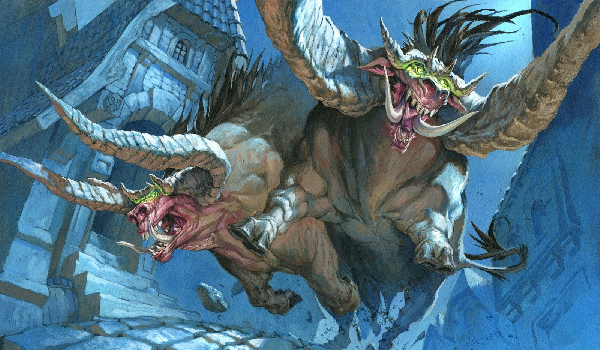
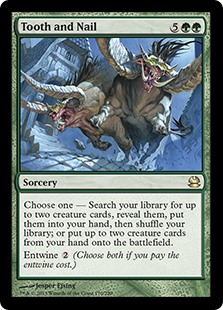
When most players think of transformational sideboards I suspect that they are thinking of Terry Soh's Tooth and Nail deck from his Invitational win. For reference:

"Tooth and Nail, Terry Soh (2005 Invitational)"

Creatures

2 Duplicant
4 Eternal Witness
4 Sakura-Tribe Elder
2 Sundering Titan
1 Kiki-Jiki, Mirror Breaker

Artifacts

4 Sensei's Divining Top
3 Mindslaver
3 Oblivion Stone

Sorceries

4 Sylvan Scrying
4 Kodama's Reach
3 Reap and Sow
3 Tooth and Nail
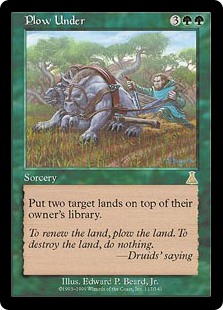
1 Plow Under

Lands

4 Urza's Mine
4 Urza's Power Plan
4 Urza's Tower
10 Forest

Sideboard

3 Plow Under
4 Troll Ascetic
2 Molder Slug
2 Iwamori of the Open Fist
2 Razormane Masticore
2 Vine Trellis

Tooth and Nail was an incredibly powerful deck, but it was quite vulnerable to hate such as Sowing Salt, Bribery, and Cranial Extraction. The typical plan for the deck was to ramp up to an entwined Tooth and Nail, for Darksteel Colossus and Kiki-Jiki, Mirror Breaker to Tooth and Nail mastersjust win or Mephidross Vampire and Triskelion to clear the board of creatures. Removing a key creature or the namesake sorcery from the deck often left TnN unable to win.
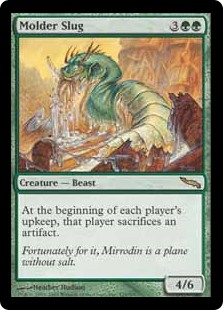
Prior to Soh's Invitational win the trend had been to replace the combo pieces with more easily castable creatures that didn't immediately kill you if they got stolen. Soh took it to the logical limit by removing the TnN package entirely in games 2-3, turning his deck into a midrange beatdown deck in the style of Jamie Wakefield. The advantage was that he was now effectively invulnerable to the common TnN hate and the opponent was suddenly left with dead cards in their deck. This repositioning won Soh the Invitational and subsequently became the norm for TnN players for the remainder of its Standard life.

This is ultimately the problem with transformational sideboards and why you don't see them very often. Players were adopting the sideboard plan without really thinking about why and as a result TnN's power and metagame position began to decline. The transformation Molder Slugworked for Terry Soh because he was going to a relatively small tournament and he could metagame against the other players, most of whom had slower control decks, and take them by surprise. Once the strategy was known it was far less effective---the common sideboard cards were abandoned for more general answers to creatures, and the TnN players often hurt themselves by adopting the plan.
At 2005 Regionals I played White Weenie and I knew going in that TnN was a really bad matchup. I had to race their mana ramp or I just lost to the Mephitrike combo, with my only out being triple Awe Strike. Thanks to Terry Soh I didn't end up dropping a match to TnN because his strategy had been so widely adopted that players didn't have Mephitrike anymore and those who did sided it out against me for the transformation. Transforming works when you dodge crippling hate, but if you do it for no reason then you weaken your deck.

When to Transform

plow underIf you are going to have a transformational sideboard you need to commit to it. Twelve of Soh's sideboard cards are directly part of his plan, and Plow Under arguably qualifies as well. Even later in the season when the strategy fell out of favor, Soh was still playing seven beatsticks in his board. What this means is that you need to be certain that you will need to transform almost every game and that the opponent will fall for the change. It's very much a glass cannon strategy since it relies on your opponent dancing to your tune games 2-3. If they don't fall for it, you've made your deck worse for no reason and will lose.
Following the Invitational many control players adjusted to Soh's plan by keeping their sweepers post-board, where normally they were useless against Darksteel Colossus, and turning the matchup around completely. To avoid this type of pitfall, I have some rules for transforming:

1. Only transform your win condition.

If sideboard hate cards beat your specific win condition but not your strategy on the whole then a transformation is appropriate. In the Soh example Sowing Salt stalled the fast-ramp-into-fatties plan that made TnN a powerhouse but does nothing when you're just fetching basics to power out big beaters. The underlying ramp plan was still good even if it wasn't doing the most powerful thing possible anymore. Bribery was great against a small number of win conditions but worthless when you play many. You don't have enough space to completely change your deck, but you can change how it wins.

2. Only transform if you're not conceding other matchups.

Again from the Soh example, the transformation was great against Big Red, Mono-U Control, and Gifts Control, but worthless against White Weenie, a deck which saw a lot of play that Regionals. If you're certain that you'll be seeing a relatively small number of decks that attack your deck in a similar way then transforming is very effective. If it's more open then you need to be certain that your maindeck can carry you through the whole match since you won't have sideboard slots available to prepare for other decks.

3. Only transform if it complements your core.

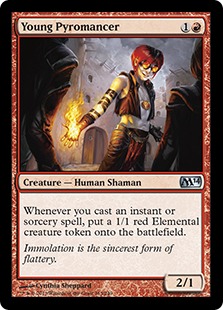
If you're trying to completely reposition your deck through a transformation then you're likely to fail. The decks that can transform cleanly from combo to aggro or control are rare. You Young Pyromancerhave to dedicate too much space to your core strategy to make it work and frequently that means that you don't have enough room to take out all these core elements for another style's core. It's possible to assume a controlling role in a matchup, but what I'm referring to is actually changing your deck entirely.
For example, I've seen Storm decks with transformations into Blue Moon fail because Storm's low land count and high fluff content doesn't play well with Blue Moon's answer-heavy plan and higher average mana cost. There just isn't enough space to bring in the answer density of Blue Moon and its win conditions. Conversely those decks that turn into UR Delver are far more successful because Delver of Secrets and Young Pyromancer like low land counts and lots of cantrips. Your maindeck plan was good, so you really don't want to completely abandon it.

Transforming Modern

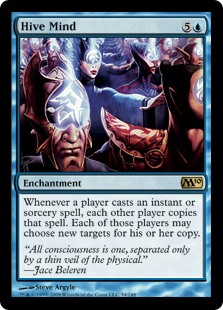
The most successful transformation plan in Modern has been Amulet Bloom removing Hive Mind and some of its engine pieces for green creatures. The general plan of ramping your Hive Mindmana and tutoring for bombs stayed intact but didn't fail to Ghost Quarter or Slaughter Games. Combo decks in general have an easier time going for the transformation and more reason to do so. There's no reason to dramatically change Infect or Burn, nor is there enough space to do so. But Scapeshift is already pretty controlling and can take out the namesake combo for more control cards to make itself less vulnerable to Crumble to Dust and Aven Mindcensor.
On the other hand, Modern is so diverse that the actual utility of transforming may be quite low since the actual likelihood of hitting the hate you're trying to dodge is low. In other words, don't transform unless you must.

Preboarding

Preboarding is just what it sounds like, coming into a matchup with the sideboard cards you want for that matchup maindecked. I'm not talking about having some common sideboard cards in your starting 60---that's something else. I'm talking about having your starting configuration look exactly like how you would want your deck in games 2-3 against a specific matchup.

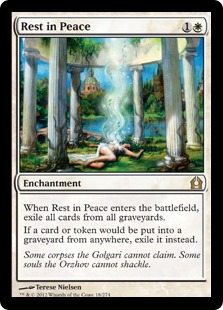
It's not just that you wouldn't change your maindeck, it's that you specifically included cards that beat a certain deck and not others. This would be Jund packing rest in peaceAncient Grudge and Shatterstorm maindeck for Lantern Control and Affinity, or Death and Taxes with Rest in Peace and Spirit of the Labyrinth against UR Treasure Cruise Delver (which I'm guilty of). You almost never see this happen because players understand the rule regarding preboarding: Don't!
In normal Magic you never hit a given deck enough to justify playing cards specifically for that deck. You need to play less specialized cards so that your deck isn't full of dead cards in every matchup. However, sometimes when things go wrong in the format it is appropriate.

Metagaming and preboarding against Cruising Delver and Pod during winter 2014 was acceptable, as was preboarding against Eldrazi earlier this year (not that it did much good). You have to be reasonably certain you will hit your preboarded deck 50% of the time or more for it to be worth the percentages you're giving up against other decks. However, there are times when playing sideboard cards in your maindeck is a good call.

Maindeck Sideboard Cards

While you never want to game your maindeck against another deck, you can hedge your bets and sideboard cards that are more general in scope in your maindeck. You have to be careful about this because it's easy to dilute your maindeck too much by trying this strategy. Never take out core cards in order to do this. But if there's a deck you're struggling with, it may be appropriate to use flex slots to beat that deck or at least improve your matchup, as long as they're not completely dead elsewhere. Rest in Peace is exceptional against Grixis, but you'd only maindeck it as long as you're not hurt by it and it impacts a wide range of other decks enough to justify the inclusion maindeck (which it's right on the cusp of doing, by the way).

These cards need to hit a wide range of decks, compliment or at least not harm you maindeck strategy, and actually impact the deck you're targeting. Rather than just theorize about them, lets go through some examples.

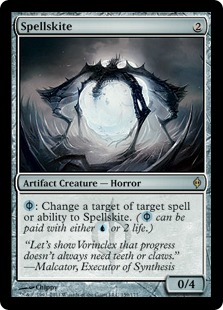
SpellskiteSpellskite

I think this is understood but I want to be clear, there is no deck that plays Spellskite in the sideboard that doesn't also want a copy or two maindeck. If Spellskite is good in your deck, that shouldn't be dependent on your opponent's archetype.

Control and combo decks will sometimes bring Spellskite in against Infect or some combo decks but I maintain that this is wrong. Those archetypes have access to much more powerful and harder-to-answer cards than Spellskite that also can't be played around. Infect knows to play around the card using Wild Defiance, which against control and combo they'd be bringing in anyway either to speed up their clock or protect themselves from Lightning Bolt. Infect also boards in Nature's Claim to force their way through. What's the point of bringing in Spellskite in that scenario? The combo or control deck would be better off with a removal spell that gets around the counter-sideboard cards like Pyroclasm.

If combo decks like Ad Nauseam are your worry then Leyline of Sanctity is not only more powerful but also harder to answer. They tend to play more ways to answer a creature as opposed to other permanents. Players have used Skite against Scapeshift as well, but it's not that burdensome for that deck to simply overwhelm the Skite, which you can't do with Leyline.

As a dedicated hoser, Spellskite is pretty mediocre and easily answered, but as a maindeck card with added benefits it is exceptionally strong. Maindeck it to protect your creatures, and then play an extra copy or two for extra utility in the board.

Pithing Needle

This card does not see enough play. There is not a deck that it doesn't hit and there are many that it cripples. Naming fetchlands is not the worst and sometimes it's absolutely crippling, especially turn one with Gitaxian Probe. It also hits planeswalkers, manlands, Tron, Affinity, Lightning Storm, and Grim Lavamancer. The sheer utility of the card and its potential to be devastatingly effective against so many decks make it a safe and powerful maindeck inclusion if you have space. Not every deck will have the space for it, but any deck can run it and have it be effective. If you're looking to maindeck a hate card, I'd start with this one.

Relic of Progenitus

If you're going to maindeck graveyard hate this is the piece to use (I wouldn't consider Scavenging Ooze a sideboard card per se). Graveyard hate is rarely dead in Modern and is very good against many decks. Even when it isn't very effective it does cantrip, and while I don't think that's a reason to play a card by itself, it does make targeted hate more playable.

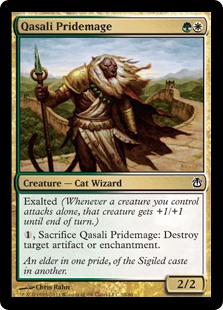
Qasali PridemageQasali Pridemage
This is another card that sits in a lot of sideboards when it should be maindeck. There are much more powerful options for the board, but the flexibility and the fact that it attacks for three make it worthy of maindeck inclusion. Pridemage doesn't shine against any deck or accomplish anything very efficiently compared to other options, which is not what you want from your sideboard cards.

However its flexibility makes it an exceptional maindeck inclusion that also reduces the pressure on your sideboard to answer problematic artifacts or enchantments. If you have it in your board it should only be to bring in extra copies. Having a maindeck out to Worship and Ensnaring Bridge is powerful and not something you want to be without. The same goes for Reclamation Sage and Echoing Truth.

Worship

If you have creatures and are playing a removal-light deck, this card will win you the game. Even against control decks this can threaten to keep them from winning, especially combined with hexproof or indestructible. If you think you'll want it, you'll get quite a few free wins by building around it.

There's Always More to Learn

My list is not even close to exhaustive, but it should give you a jumping off point for considering other cards that currently sit in your sideboards but should be maindeck. Determining what cards you should use and whether a sideboard card should be maindeck is something else entirely, which I won't get into today. Rather, it's going to be included in next week's article, where I'll discuss the strategy known as The Elephant. Until then, if you have questions or other topics you want to discuss, you can always find me in the comments.

Stock Watch- Rattlechains

Are you a Quiet Speculation member?

If not, now is a perfect time to join up! Our powerful tools, breaking-news analysis, and exclusive Discord channel will make sure you stay up to date and ahead of the curve.

When Rattlechains was spoiled, I thought that given proper support the card looked excellent. As things turned out, spirits weren't well supported in Shadows Over Innistrad, and there was no obvious home for the card. In Minneapolis Saito went 12-3 with a deck happily featuring the full four copies, and last weekend in Atlanta Hugo Terra made the Top 8 of the Open with this list:

Azorius Aggro

Creatures

2 Bygone Bishop
4 Dimensional Infiltrator
4 Rattlechains
4 Reflector Mage
3 Stratus Dancer

Spells

4 Gideon, Ally of Zendikar
2 Invocation of Saint Traft
3 Clash of Wills
2 Essence Flux
4 Spell Shrivel
4 Declaration in Stone

Lands

6 Island
6 Plains
3 Evolving Wilds
4 Port Town
4 Prairie Stream
1 Westvale Abbey

Sideboard

4 Silkwrap
2 Stasis Snare
1 Dispel
2 Hallowed Moonlight
1 Invasive Surgery
3 Negate
2 Secure the Wastes

While this deck has some ability to utilized the enter the battlefield ability on Rattlechains, the idea is mostly that cheap fliers are just good right now. In particular, having early evasive pressure for Nissa, Voice of Zendikar can matter a ton against tokens, and flash threats are great against sweepers like Languish.

There was an error retrieving a chart for Rattlechains

The exposure that Rattlechains has gotten recently has caused the card to jump from bulk to about half a ticket on MTGO, and I have feeling that we'll be seeing more Rattlechains in the future. In particular, if spirits are supported in Eldritch Moon, Rattlechains could stop being merely a card taking advantage of the metagame and could be part of a deck that is more abstractly powerful. Paper copies of the card are currently about half a buck, and this could easily be a $5 card at some point in its Standard legality.

Insider: Outside the Norm – Misprints & Oddities

Are you a Quiet Speculation member?

If not, now is a perfect time to join up! Our powerful tools, breaking-news analysis, and exclusive Discord channel will make sure you stay up to date and ahead of the curve.

Welcome back, readers!

Today's article will focus on the "rarer" Magic cards. Not due to age, but instead other characteristics about the cards that make them rarer than the typical cards you pull out of a pack. A lot of today's data will be pulled from the Magic Librarities, Squt's Misprints, and from TheJGit's Beginner's Guide, which have a plethora of interesting and useful information for anyone who buys, sells or collects Magic cards. With that let's get started.

Foils

We all know that pack foil versions of cards are pretty much always worth more than regular copies. The current rarity of a pack foil common is 1 in 12 packs (except the Modern Masters/Eternal Masters packs with a foil in every pack) with uncommons 1:18, rares 1:36, and mythics 1:216

Foils were added to Magic as the collectible aspect of the game was becoming too easy, so to speak. With the huge print runs store didn't run out of product until demand had been met, so collectors could easily assemble a set if they so chose. By adding "premium" cards to the packs, WoTC essentially gave collectors something to chase down, without alienating players by making ultra-rare tournament staples they would have to shell out for.

These types of cards are found in games like Dragonball Z and Yu-Gi-Oh, which may be good for sales but is often upsetting to players. In order to appease these players a lot of other TCGs now guarantee one of these chase cards in each box---unfortunately for store owners, when that card is pulled players often no longer want to purchase packs from the same box.

Going back to Magic specifically, foils tend to be the most common "non-normal" Magic card, and they have a pretty stable known rarity. Fortunately (or unfortunately, depending on your point of view), Wizards of the Coast allows players to redeem foil sets from MTGO, and thus a complete foil set is no longer that difficult to acquire if you really want it.

Without this redemption it would be much harder to complete foil sets. For a non-premium set of most Standard-legal sets it takes perfect luck and opening approximately 121 packs. This number is based solely on the probability stack-up and obviously can't account for getting the same mythic twice (hence why you need perfect luck).

If the foils are distributed in a similar fashion, you would need to have perfect luck (again) and open 15*216 = 3240 packs to get a full foil set (this is calculated because of foil mythics having the highest rarity and there being typically 15 (not counting DFC) they set the probability)---or 90 boxes. Knowing that you'd think all foils would be worth at least six times the regular version, but the demand for foils is nowhere near that high.

Still, the going rate for bulk foils (ones that aren't even remotely playable) is $0.05 each and playable ones can easily hit two to twenty times the going rate. The wide range is attributed to older eternal foils, which have a much higher multiplier due to higher demand and a comparatively rarer foiling process. Most Standard foils tend to fall right around the 2x to 3x multiplier range.

Misprints

To begin with, "misprint" can refer to a lot of different types of cards. They're usually broken down into the following main categories:

  1. Wrong Basic Information (picture, casting cost, expansion symbol, etc.)
  2. Inking errors (wrong power/toughness, numbering errors, artist name errors, etc.)
  3. Text Errors (errors that occur in the text box section)
  4. Incorrect name/language (cards where the errors likely occurred in translation)

It's also critical to keep in mind that misprints are often a way to "pimp" one's deck to the fullest (many misprints are considerably rarer than foil versions, and misprint foils are rarest of all). So a misprint's value will depend heavily on a) the type of misprint and how visible it is, and b) the card's playability.

Wrong Basic Information

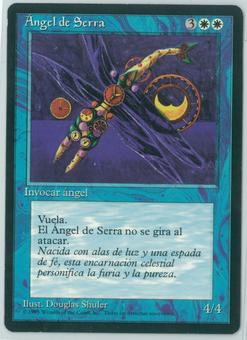
The best example of a misprint with the wrong basic information is the Spanish Serra Angel/Time Elemental misprint shown below.

serra_elemental_raw

The card has all of the stats of Serra Angel (including casting cost, power and toughness, flying and vigilance), but it has the artwork and blue frame of Time Elemental. One recently sold on eBay for around $95, whereas any other foreign BB Serra Angel goes for around $4-$8.

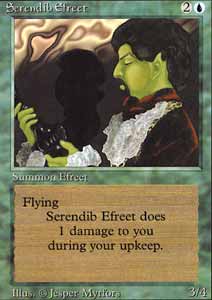
Another well known one is the Serendib Efreet with the artwork (and border) from Ifh-Biff Efreet.

serenib efreet misprint

However, this error was present across all Revised copies so they can be had for under $1 each.

Inking Errors

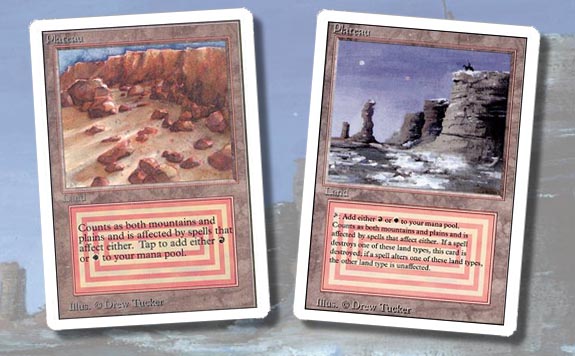
The most famous of these is likely the Revised Plateau, where the artist credit is given to Drew Tucker (who did the original Alpha Plateau) when the actual artist was Cornelius Brudi.

plateau

As the Revised Plateau is the most common version of the card and it occurred on all copies, it's not really more desirable.

Text Errors

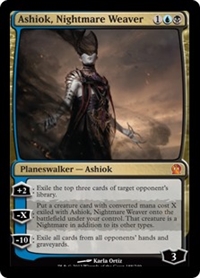
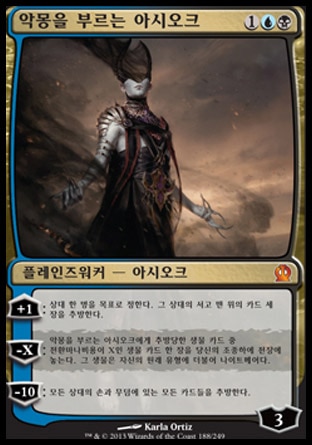
One of the more recent text errors occurred with the Korean version of Ashiok, Nightmare Weaver. The Korean version only added 1 loyalty for the first ability, while all other versions added 2.

english ashiokashiok

The Korean version goes for about three times that of a normal Ashiok (as of me writing this article).

Incorrect Name/Language

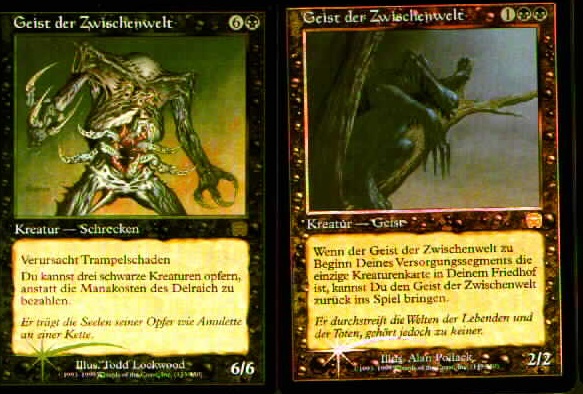
These don't seem to occur all that often but apparently there was a big issue with German Mercadian Masques foils where several cards had the same name (but only on the foil version).

germanfoilscropped

The biggest problem with a lot of these types of misprints is that they are quite rare and thus finding prices is difficult.

Printing Errors

Anyone who has worked in a manufacturing environment can tell you that while the goal of mass manufacturing is to make a uniform product, the faster your system goes the easier it is for something to go wrong.

Given the sheer size of print runs these days, Magic cards are probably printed at very fast rates, and there's a good chance something will go wrong during printing. Now, most of the time these types of errors should be captured by the printer Cartamundi's quality control system. However, given the sheer volume of product things will slip by.

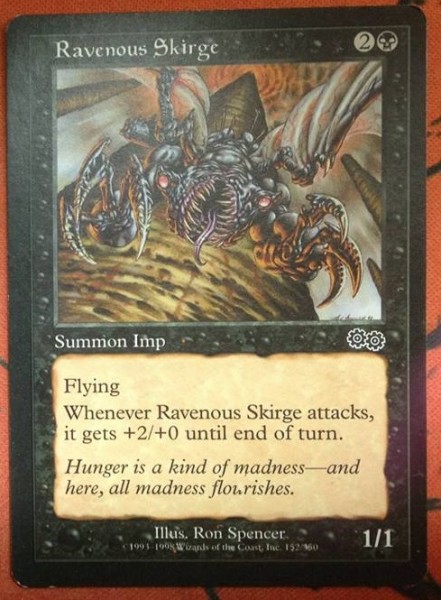
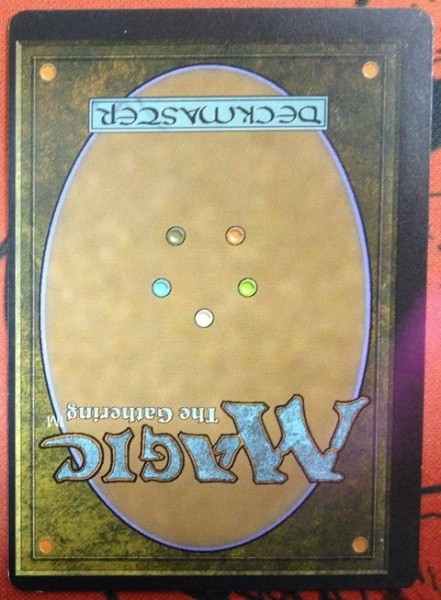
Flipped Backs

This occurs when one of the sheets is accidentally flipped around as the front and back of the cards are printed separately and then glued together.

skirgefront skirgeback

These types of cards have additional value to some collectors and even bulk commons like this will sell for a several dollars (or more) to the right collector.

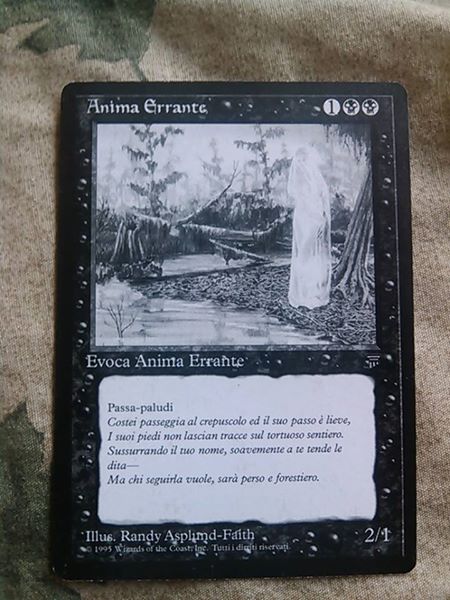
"Albino" or "Dark" Cards

These typically occur either when some ink is missing in the printing process (albino) or too much ink is on the rollers (dark).

One of the biggest challenges with "albino" cards is that some people who like the look but don't want to try and find real versions will simply leave cards they want lightened out in the sun. This does create a faded look, but on true albino cards the other colors appear crisp and clear. See the black border and frame in the Italian Lost Soul below for an example.

albino card

Below is a "dark" printing in which the actual character in the art himself is darker than usual. These can often be difficult to catch without having a side-by-side comparison, and again, as with all misprints the level of being "off" plays a big role in any additional value.

dark card

 Misplaced Stamp

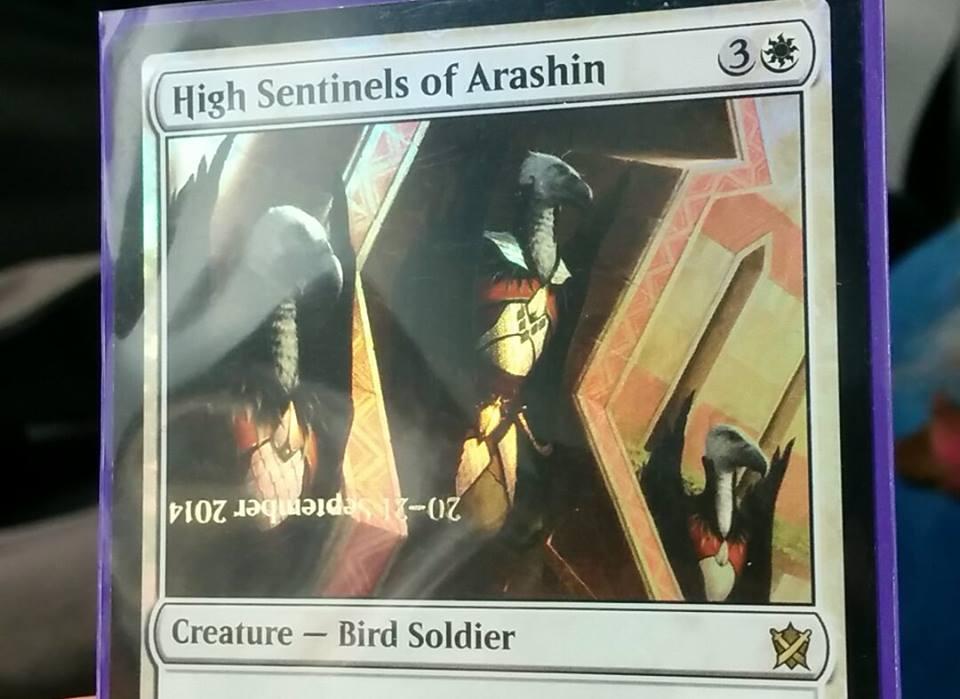
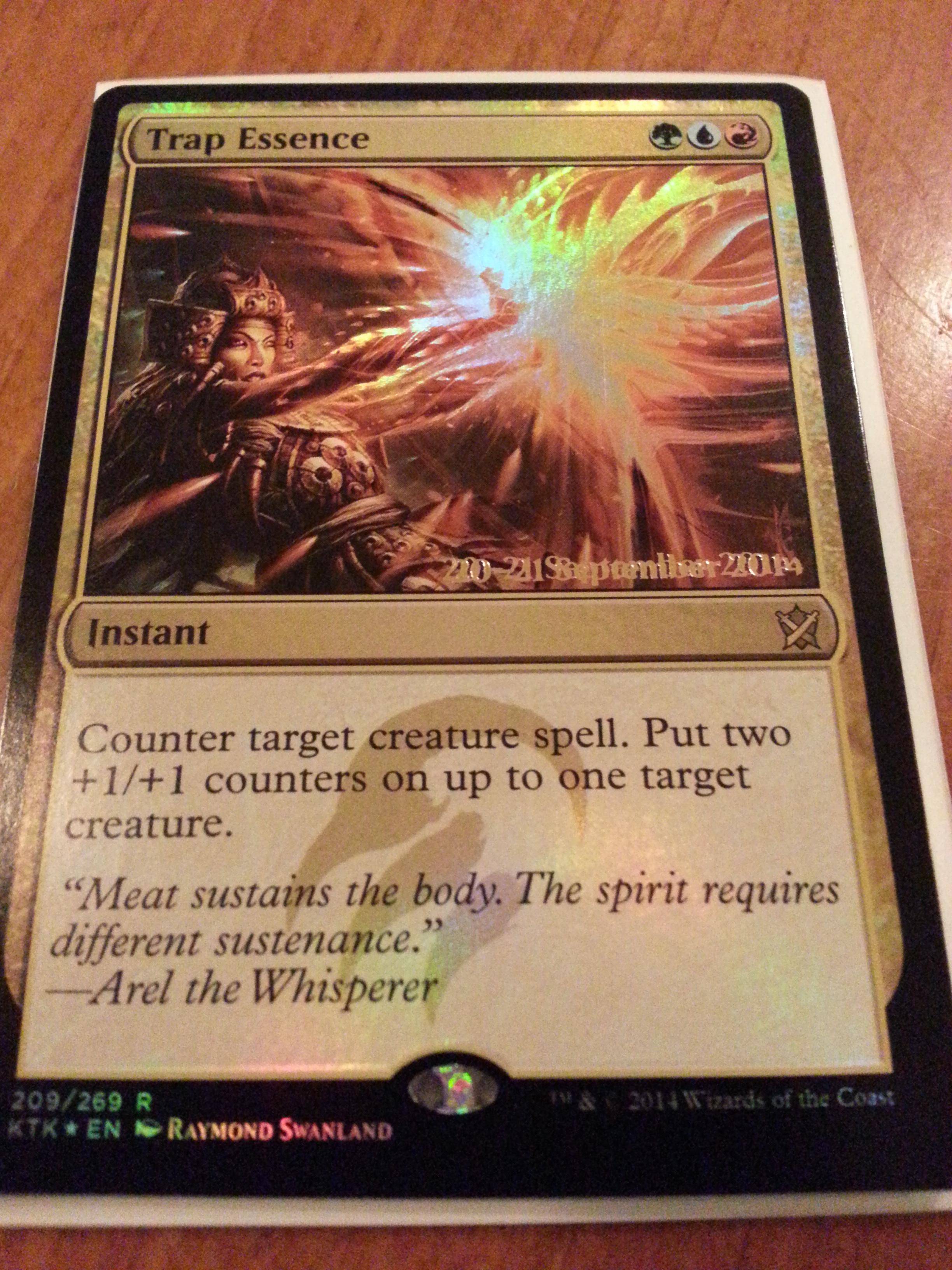
One last misprint that typically occurs with pre-release cards is that while the card itself is fine, the pre-release date is misplaced on the card. This stamp can occur all over, forward, backward, double-stamped, or even not at all.

shifted promo stamp mislocated release card doubleprinted release card

This particular misprint can also occur on regular cards (though obviously not the date stamp) now that rares have the secondary "foil" stamp in the border. A lot of these have popped up with the stamps missing or being "semi-stamped." These errors do seem to occur more often than some of the other errors, most likely because this stamp was a later addition to the manufacturing process so it may not be as well-vetted in the process as a whole.

Inking Errors

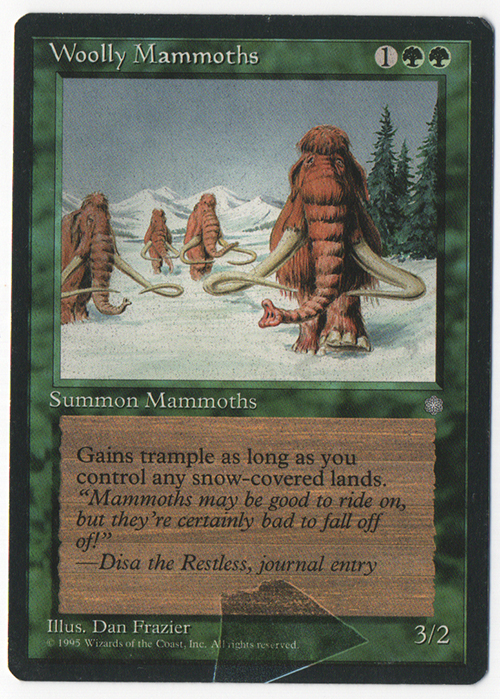
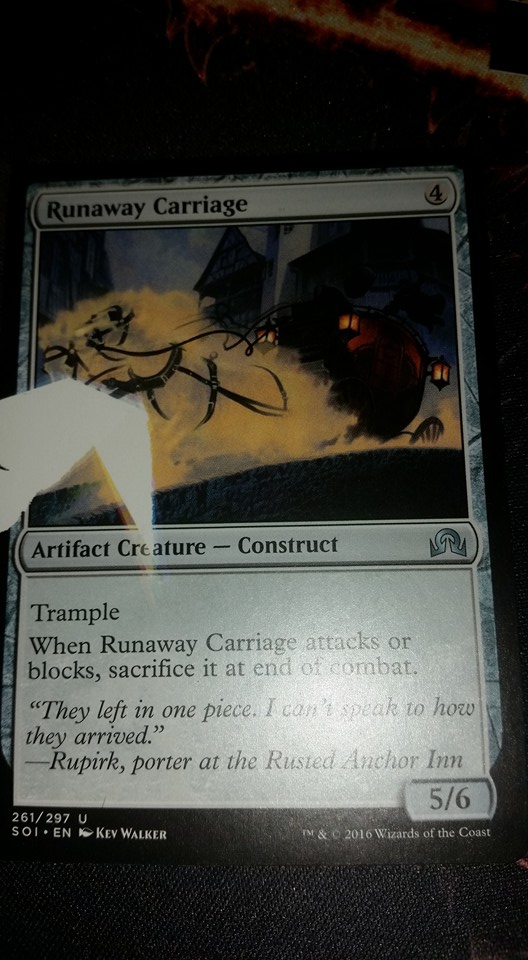
These types of errors occur when something goes wrong with the inking process. The more pronounced the error, the more desirable and valuable it is to a collector. There are all manner of things that can go wrong in this inking process so typically they aren't classified any deeper than just "inking errors."

wolly mamoth inking errorinkingerror2

Miscuts

These tend to fall into several categories and the prices can vary rather wildly. The key thing to remember is that miscut cards are very desirable to a small subsection of Magic players. The best place to find them is in the Misprints and Oddities facebook group.

The two main categories of miscuts are shifted image and square corners. The shifted image miscut has the whole card cut incorrectly.

Shifted Image

miscut shifted

There are some collectors who try to get as much of the miscut sheet as possible and may pay a great deal to get the few pieces they are missing. Other times you may only find a few people even remotely interested and the value will be nominal. It's important to note that there are a ton of Magic cards in which the frame is slightly shifted or askew. Most collectors don't count these---in fact, many don't count it unless you can see part of another card, or even better, the edge of the print sheet itself.

It's also important to note that NFC (or Not Factory Cut) cards can often look like shifted images too. Uncut sheets have been given out as prizes for a long time and there were people who got these sheets and cut them themselves (often skewed) to then resell the cards at a premium.

This has happened a lot with Revised cards and many collectors will assume most Revised miscuts are in fact NFC. However, if the other face of the card looks normal, that's an obvious way to show it is in fact a true factory miscut and not an NFC.

Square Corners

This type of miscut is a card with pointed or square corners. Sometimes it's one corner and sometimes multiple corners.

square cornerssquarecorner lands

Again the value on these tends to vary a great deal with the card itself.

Crimps

Crimps occur when a card is shifted during the packing process. For most crimp collectors the bigger the crimp the better.

crimped beta taiga

Crimps can occur in any direction, though as far as I'm aware of no card has been crimped twice (mainly because the reason it's crimped is because it became askew during the packing process and wasn't seated in the pack properly).

Most crimps occur on the bottom or top of the card as that's where the pack crimping takes place. However, there are some vertical or corner crimps (see below).

vertical crimpcorner crimp

Conclusion

Hopefully you learned something new about all the types of Magic abnormalities and now have some additional resources when you come across something different.

I really can't stress enough that many of these oddities are extremely rare and pricing them is difficult (especially when it's possible no two are alike). If you happen to find any of these, please consider getting opinions on prices before unloading them to the first bidder.

Any truly one-of-a-kind item can potentially be worth a lot, though conversely every minor misprint/oddities isn't necessarily super valuable. So when it comes to this type of thing research and knowledge is very important.


***EDITS: The foil rarity was incorrect, upon further investigation the actual foil rarity was found and the # of boxes for a foil set was recalculated***

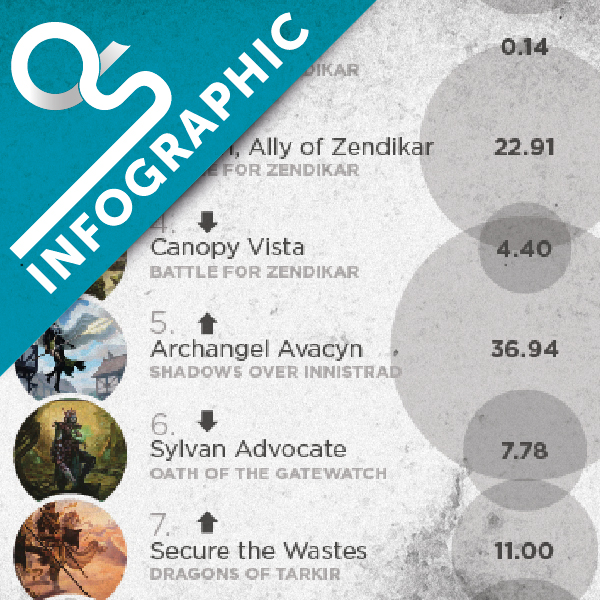
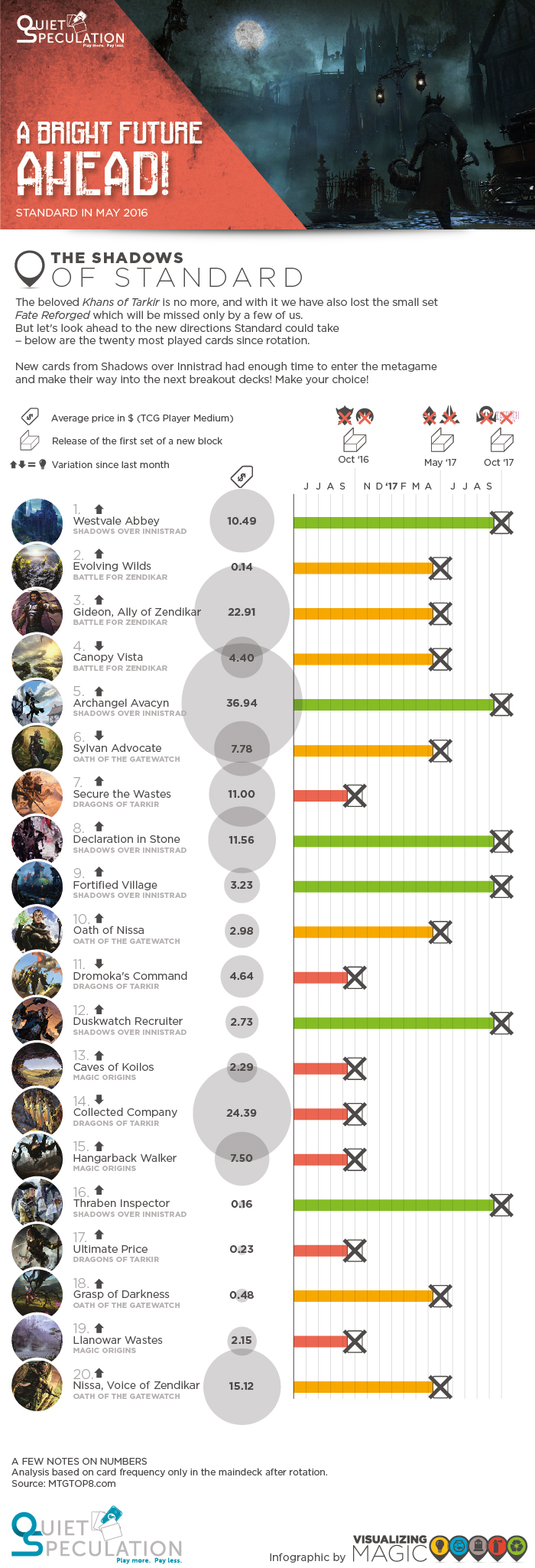
Infographic – Standard Most-Played Cards

Are you a Quiet Speculation member?

If not, now is a perfect time to join up! Our powerful tools, breaking-news analysis, and exclusive Discord channel will make sure you stay up to date and ahead of the curve.

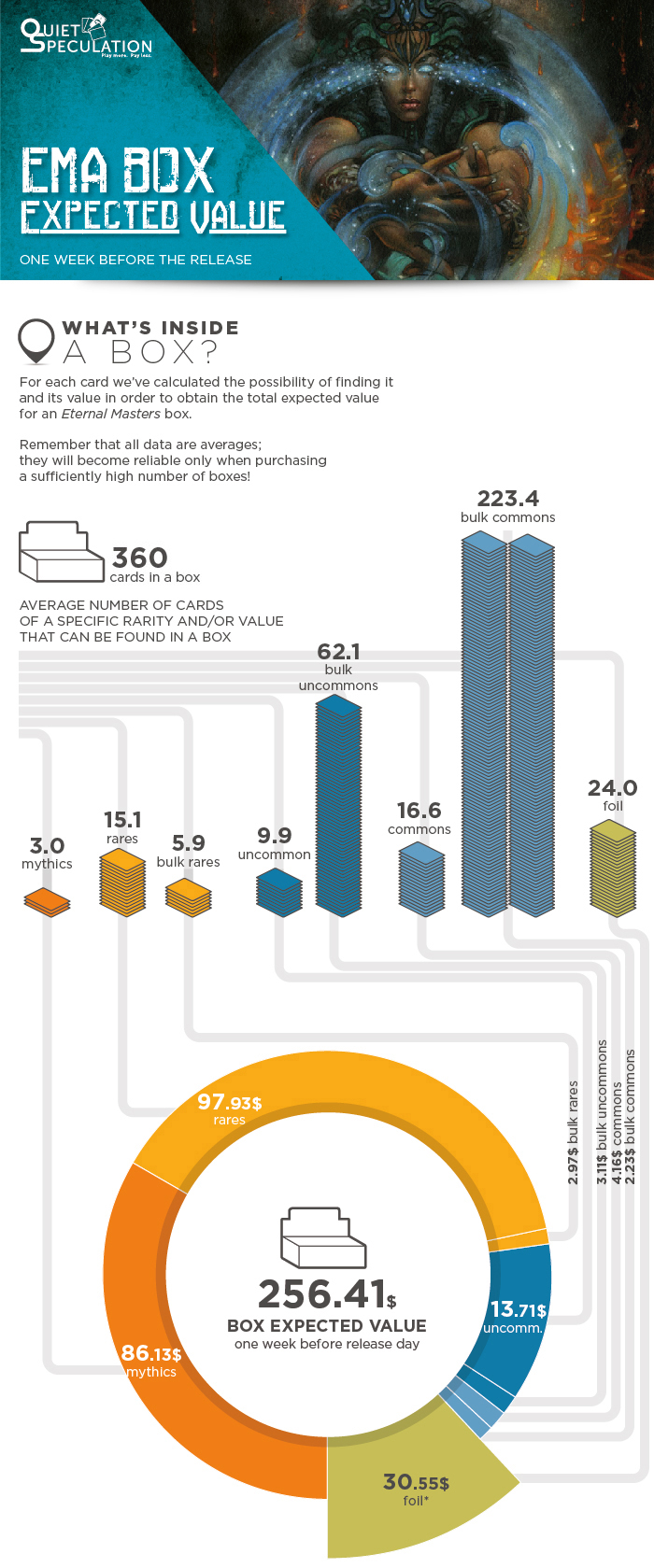
QS_201605_A Most played cards in Standard-01

Insider: In-Demand Legacy Cards Before GP Columbus

Are you a Quiet Speculation member?

If not, now is a perfect time to join up! Our powerful tools, breaking-news analysis, and exclusive Discord channel will make sure you stay up to date and ahead of the curve.

It should be no surprise to anybody that there is a lot of hype going on right now surrounding Eternal Masters, Legacy GP Columbus, and eternal Magic in general. It seems unlikely that demand and interest in eternal cards will get any higher this year (with the lone exception being maybe Eternal Weekend) than it is going to be right now.

Assuming my assertion is indeed true what do we do with this information? As investors, collectors, and financiers how do we make a few bucks?

The majority of the action is going to surround fluctuations in Legacy prices that arise as a result of metagame changes from Grand Prix Columbus. So, I'd say the best way to make money on Legacy cards is to predict what will be hot at the Grand Prix.

I've been testing Legacy for the past two weeks and I'm just going to assume that the decks I think are good are, in fact, good.

The other criterion that I'm going to use to predict Legacy winners is more out there but I think it may be useful. I have affiliations with RIW Hobbies and I'm also known to have a rather large eternal collection. As a result of both of these factors a lot of people have been asking me to borrow Legacy cards to play in the Grand Prix. It seems fairly accurate that if a lot of people want to play with cards they don't have, those cards are in demand.

I guess the question is, "Are these cards that people want to play but don't bother to own?" Or, are these cards that people are going to borrow, enjoy playing with, and eventually invest in? Maybe a little from column A, a little from column B.

Far and away the cards that I'm getting asked for the most are Eldrazi cards. I've already written that I think the Standard-legal Eldrazi are underpriced at the moment because the demand is suppressed and the supply is kind of infinite. Reality Smashers and Thought-Knot Seers won't litter the trade binders of the random FNM kids forever. You can take that little ditty to the bank.

5. Ancient Tomb

There was an error retrieving a chart for Ancient Tomb

Ancient Tomb is a busted Magic card. After Mishra's Workshop, Ancient Tomb is the heir to the throne. It is one of the most powerful land cards legal in Legacy. The other thing is that Ancient Tomb will never get worse and can only get better. They will never make another one like Ancient Tomb, but they will continue to make cards that go into Ancient Tomb decks!

For example, we didn't even know that we wanted to make Eldrazi-based Tomb decks six months ago but here we are two sets later being bombarded for requests to borrow Tomb. The joke is that the card is absurd in a way that Wizards knows is unacceptable for new cards.

Kai Budde won a World Championship with Ancient Tomb. Just saying. He knew...

Anyways, I think Ancient Tomb is the kind of card that I'd like to have some extra copies of laying around in the future. If only so that I can loan them to more of my friends so that they can enjoy a Legacy Grand Prix or Eternal Weekend! All joking aside, I think that Tomb is a really hot card right now.

I also think that the Expedition Ancient Tomb is one of the most underpriced Expeditions. It is the most impressive premium version of a card that doesn't have many foil versions. I think we'll see increasing demand for this card in the months and years to come.

4. Eternal Masters Foils

Star City Games isn't even offering these cards for preorder...? I'll take that as a sign that these cards are preordained to be $$$. In particular, eternal staples that don't have prior foil printings are going to be absolute madness!

There was an error retrieving a chart for Pyroblast

I mean, even I want to pick up one of these for my personal collection and I typically don't care about this kind of stuff. The Danger Room needs one... However, that should show you the kind of demand that these types of cards are going to have. We already know the print run for Eternal Masters is on the low side. I don't think the supply is going to meet the demand on these cards.

The price on unique Conspiracy foils are an indicator that this low-print, eternal foil stuff can reach great heights.

It also helps that the release will coincide with a Legacy Grand Prix, which means that lots of people are going to be converging on a very small supply of these cards at the same time before a tournament. The initial price is going to be outrageous! In fact, I believe the foils are the biggest reason to be buying and opening the set.

3. Miracles Staples

Miracles is the best deck in Legacy going into Columbus. It may not be coming out (in part due to people metagaming against the known top dog) but as of right now that's the consensus opinion.

Eldrazi is a great deck as well. It may be the case that Eldrazi is broken in Legacy and there is nothing Brainstorm and company can do about it. Personally, I never bet against Brainstorm and Sensei's Divining Top.

I will be playing Miracles and not Eldrazi.

There was an error retrieving a chart for Counterbalance

I also think that Sensei's Divining Top being reprinted in Eternal Masters is a show of good faith that Top won't be getting banned in Legacy. It probably should be banned... But it is starting to feel like it won't be.

With that being said I think that buying in on some of the lower-priced Miracle roleplayers could be a smart move. Counterbalance is only $15 which seems low considering it has only been printed in bizarro-world expansion Coldsnap. Sometimes I wonder how any card in Coldsnap that sees constructed play isn't like ten times more expensive...

The other card I really like is one of the miracles themselves:

There was an error retrieving a chart for Terminus

Terminus is a very impressive Magic card for a sub-$4 price tag. I get that it got a random reprinting in FTV: Irrelevant but the card is still gas. It is also reasonable to assume that at some point a library manipulation card will be allowed in Modern that will open the door for Terminus to a whole new generation of control mages.

The card is too good. I choose to be on it. IMO.

2. City of Traitors

Every card-slinger I know and all of their friends and their random uncle want to borrow City of Traitors for GP Columbus.

There was an error retrieving a chart for City of Traitors

The reason is pretty simple: the card is great in Eldrazi-style decks and is really hard to find! Not to mention, it is on the Reserved List. Bonus.

Personally, I think the Eldrazi deck will be the new Mishra's Workshop deck of Legacy. It is up for grabs whether Eldrazi is the new Mishra's Workshop deck of Vintage at this point! I'm going to take the smart money and say Workshop is still the jam, but the Eldrazi are getting some serious work done in Vintage.

Nonetheless, Eldrazi are a big game in eternal and everything that falls in line with their plan for planar conquest is subject to gain some value in the short and long term. Based on the requests to borrow City of Traitors alone I think we are going to see some gains on this single in the next week. The Reserved List aspect makes it all but a done deal.

1. Dual Lands

Give me land, lots of land, lots of land.

There was an error retrieving a chart for Scrubland

Magic collecting starts and ends with dual lands. If you want to play eternal; If you want to play Commander; If you want to collect Magic, you need dual lands to play the game.

Dual lands are and always will be on the Reserved List, and so what is out there is all there is.

I don't know how much room there is to expand on $300+ Underground Sea and Volcanic Island but I think the lesser duals are great investments. If you think about it, most of the powerful new cards that see print don't fit into the mold of "Legacy blue cards." Meaning it's likely the best new cards will create or fit into archetypes outside the established norms of the format. Look at Eldrazi! The archetype has nothing to do with Brainstorm and Ponder.

I wouldn't be surprised to see new Legacy printings in an upcoming Conspiracy or Commander product that make non-blue strategies better in the future. Thus the random duals with their significantly lower price tags could be very nice investments.

~

Speculating is always fun. What's more fun is actually getting to play some eternal MTG!

I'll be in Columbus this weekend jamming my Miracles against the field and enjoying every second of it. Be sure to say "hello" if you see me around. In any event, Legacy looks like a great place to be investing capital right now---especially with all of the interest that the GP and Eternal Masters look to bring in the coming weeks!

See you in Columbus!

The Importance of Options & Card Evaluation

Are you a Quiet Speculation member?

If not, now is a perfect time to join up! Our powerful tools, breaking-news analysis, and exclusive Discord channel will make sure you stay up to date and ahead of the curve.

It's become a perennial fixture of spoiler season. Some card with a variant of the "punisher" mechanic (the classic example being Browbeat) is spoiled and the collective Magic community flips their lid. Forum posts are awash in bold claims about its greatness, labyrinthine explanations of how "both sides are good," and wild overestimations of the card's playability. These arguments are not unique to a particular format, but they certainly have centered around Modern before, and are sure to in the future. A recent example would be the excitement surrounding Sin Prodder.

Sin-Prodder-cropped

That isn't to say these cards are unplayable, or that they can't serve a significant purpose, whether in Standard, Modern, Limited or anywhere else. Sin Prodder, for example, has shown up here and there in a couple Modern decks---but it hasn't turned into the format-defining staple some thought it would. What I want to focus on today is the fallacy that's at the heart of these mis-evaluations, and examine how it can guide our hand in understanding card selection more broadly. What it all boils down to is a related underestimation of the importance of something very fundamental to Magic---choice.

[wp_ad_camp_1]

Why Choice Matters

As a variance-based game, Magic presents lots of unexpected situations that a deckbuilder can't account for ahead of time. Role assignment, one of the single-most important strategic considerations in the game, may shift based on matchup, particular draws, mana screw, or even the presence/absence of a single card in a deck. Steam AuguryYou don't know before beginning a game if you'll draw 10 lands or 2. You don't know what your opponent will be playing. You won't know how they've chosen to fill whatever flex slots are offered by their archetype.
If misassignment of role equates to game loss, that must necessarily be mediated through our in-game decisions. We attack when we should be blocking, value card advantage when we should value board presence, waste a kill spell on their threat that we should ignore, etc. Implied in all this is that our cards offer us these choices. If we imagine a hypothetical deck where every card functions the exact same way every time, we can easily see how this strategy will be unlikely to take down tournaments. Of course normal Magic decks, and cards, are nowhere near this polarized, but we can see the principle in action in a few places. A classic example would be the creature that can't block. If we correctly identify our role in the matchup as the control, it doesn't matter much to this card---you still have to turn it sideways.

As a highly-linear format with powerful internal synergies, Modern presents many decks that make use of these more narrow cards. Lava SpikeAlmost every archetype outside of midrange and control plays something in this vein, from Lava Spike in Burn to Distortion Strike in Infect, to Fulminator Mage in Living End. In fact, if your deck doesn't operate on a highly specialized axis (again assuming you're aiming to beat down in most matchups), there's a fair chance it's just not good enough.

But all of these linear decks pack a significant number of more flexible cards which offer many choices to their pilots. When Burn faces another aggressive deck, Eidolon of the Great Revel becomes one of the most skill-intensive cards to play correctly. Sometimes you attack with it and offer the trade before casting spells; sometimes you leave it back to block; sometimes you choose to neither attack nor block. Similarly, Atarka's Command presents a myriad of crucial decisions that can make the difference between winning and losing---do you fire it off when they're tapped out? Wait until you can deploy an additional creature? Or leave it up for when they try to Obstinate Baloth or Siege Rhino you?

Atarkas CommandIt's no coincidence that these cards are among the most powerful in Burn's arsenal. Certainly their raw rate is relevant to their power level. But the options inherent in them are a fundamental aspect as well, allowing the pilot to adapt to situations, outplay opponents, and respond to unexpected card choices or unlikely scenarios that may arise. Consider the example of something like Flame Rift in comparison to Atarka's Command. The rates are pretty close. While Command can at times hit for 5+, Rift is never dependent on a creature in the red zone for its 4 damage. But it should be painfully obvious which of these cards is better---the flexibility of Command just blows Flame Rift's rigid single-mindedness out of the water.
Assessing Power Level

If we can see how options on a card tend to push up its utility and playability, it's way easier to see why the punisher mechanic is so poor in competitive play. If options are good for us, they're good for our opponent as well! Putting a punisher card in your deck actively increases the number of opportunities your opponent has to adapt to whatever form the game takes on. And if every match is a zero sum game, that means it's almost like you gave yourself a negative choice.

Deathrite ShamanWhen building decks, selecting specific sideboard cards, or evaluating new cards for constructed playability, these inherent options in the cards should be at the forefront of our minds. Again, that doesn't mean a punisher card can't be good, nor that a card with numerous options is necessarily great. But it can help contextualize our card evaluation, as a sort of "modifier" to whatever value we assign to the card's baseline. This can help us understand and predict better how a given card will perform.
Take Deathrite Shaman, for instance. This card would go on to utterly dominate Modern, eventually meriting a ban, but it was sluggish to catch on. People paid it little notice during spoiler season until Pro Tour Return to Ravnica proved the card's pedigree. Even then, not every team had found the card and some ran it as a two-of. Even BGx mastermind Wily Edel, who top-eighted the event, did so without any copies. How did the community at large (the pro community, no less) miss the unbelievable power level of Deathrite Shaman?

I think it's because it was initially regarded as a "bad Birds of Paradise." This certainly is an apt description---Birds makes mana every turn, no matter what, while Deathrite requires a steady stream of fetchlands to serve its primary purpose. As a gloss for understanding the card, the "bad Birds" narrative de-emphasized the truly broken aspect of the card---this is a one-drop mana accelerant that can easily win the game by itself. Noble HierarchEven multi-format all-star Noble Hierarch contributes a mere 1 point of damage to your clock each turn---Deathrite doubles up on that output, all while serving as life gain when you've fallen behind and randomly hosing graveyard strategies! You can see why it ended up earning the cheeky reputation of "one-mana planeswalker"---it was nearly impossible to construct a scenario or board-state where Deathrite wasn't excellent. It just did too much, too easily.
Another more recent example that can be instructive is Nahiri, the Harbinger. Modern players weren't clamoring for a four-mana Disenchant before, and Through the Breach for Emrakul, the Aeons Torn has been an available line for some time which has seen only limited adoption. It's true that Nahiri's most unique contribution, the ability to tutor up Emmy so we don't have to clog our deck with four copies, is also her most powerful. But the additional utility provided by the looting ability and the Disenchant effect is what makes her playable.

If her text was merely "Suspend 2 -- Fetch up Emrakul," she would be unlikely to see any play at all. As it stands she grants her pilot ample options depending what stage the game is in. Need to kill fast to race their combo or topdecks? Plus into Emmy. Need to find specific answers? Loot away garbage. 1_nahiriNoncreature permanent or tapped Tarmogoyf cramping your style? Get it out of there.

So on both Nahiri and Deathrite, any one of the abilities is anemic by itself. The would-be evaluator of these cards who got it right at the outset needed to recognize how the combination of their abilities constituted a strategic advantage in itself. Applying these lessons to future card evaluations shouldn't be hard. Adjust down for severely restricted options, or for options granted to the opponent; adjust up for flexibility and options granted to us.

Finding the "Secret" Mode

Sometimes the options granted by a specific card are less obvious than they appear at first glance. Understanding all of the different, sometimes counterintuitive ways to play a card can confer a distinct advantage on a player. Some obvious examples would be using removal to kill your own Dark Confidant, lest Mr. Maher nugs you for lethal on upkeep, or Bolting a planeswalker, or saccing your Ravager to fizzle an effect. These are all well-documented and understood plays in Modern, and need no introduction. Arcbound RavagerWhat I want to look at is something that's simultaneously much more omnipresent and much less understood. I speak, of course, of the fetchland.
At first glance, it might appear that fetchlands are merely tri- or quad-color mana fixers, depending on the deck they appear in. But fetchlands are way, way better than that. To begin with, they fetch up basic lands to play around Ghost Quarter, Blood Moon or Choke. They allow canny pilots to carefully manage their draw step (or alternately bungle it up) depending on how they're sequenced alongside cantrips. They find Dryad Arbor for anti-Liliana technology or regular-damage kills in Infect. They shrink our life total if we're so inclined to make for massive Death's Shadows.

Learning how to fetch correctly is one of the first bars a new Modern player has to clear to become competent in the format. But even for seasoned veterans it can be one of the more challenging aspects of tight play. Polluted DeltajpgThese seemingly innocuous and obvious cards actually present a whole litany of opportunities for both misplay and genius alike, and your familiarity with the marginal lines can be the difference between a match win or loss.
If something as simple as a fetchland can present these decision points, you better believe other cards in your favorite deck or archetype do too. These hidden modes on cards (especially in a format as deep and varied as Modern) are one of the main reasons that archetype familiarity is so important. You can certainly take the tack of playing a given deck into the ground, to force yourself to be confronted with all the different scenarios. But you can also take a more active approach---look at the board state and ask, "Is there another way I can use this card?" You may be surprised what you come up with.

The Sideboard Bullet vs. Generic Card

Finally, we get to another point I've found contentious in Modern theorizing. Personally I love the generic sideboard card with wide applications; others have explained the importance of the more narrow cards. There are times when these silver bullets are the only option available, either to combat a highly linear deck, or to turn a bad matchup winnable. Maelstrom PulseThis aspect of Modern is unlikely to change anytime soon, as long as diversity remains high and the format remains linear.

But I look at them more as a necessary evil than a tool I'm happy to spend a sideboard slot on. Certainly if you're trying to Jund people you may want to jam some Fulminator Mages or Crumble to Dusts (maybe even Blood Moons if you're ambitious) into the sideboard to combat one of your worst matchups (Tron). But don't leave those more generic sideboard cards at home. The Negates and Maelstrom Pulses of the world can buy you lots of percentage points simply by being so flexible, and allowing you to out-decision opponents who have chosen to show up with fewer options available.

In my mind, the importance of having options lies at the heart of competitive Magic, but I run across people who value it lower than me all the time. What are your thoughts? Have I overstated the importance of flexibility in a format so characterized by single-minded strategies as Modern? What cards do you think may be under- or overrated for their flexibility or lack thereof? I look forward to your comments below.

Thanks for reading,

Jason Schousboe

Jason Schousboe

Jason was introduced to Magic in 1994, and began playing competitively during Time Spiral block. He has enjoyed a few high finishes on the professional scene, including Top 16 at Grand Prix Denver and Top 25 at Pro Tour Honolulu 2012. He specializes in draft formats of all stripes, from Masters Edition to the modern age.

View More By Jason Schousboe

Posted in Modern, Strategy, TheoryTagged , , 6 Comments on The Importance of Options & Card Evaluation

Have you joined the Quiet Speculation Discord?

If you haven't, you're leaving value on the table! Join our community of experts, enthusiasts, entertainers, and educators and enjoy exclusive podcasts, questions asked and answered, trades, sales, and everything else Discord has to offer.

Want to create content with Quiet Speculation?

All you need to succeed is a passion for Magic: The Gathering, and the ability to write coherently. Share your knowledge of MTG and how you leverage it to win games, get value from your cards – or even turn a profit.

Deck Overview- Legacy Eldrazi and Taxes

Are you a Quiet Speculation member?

If not, now is a perfect time to join up! Our powerful tools, breaking-news analysis, and exclusive Discord channel will make sure you stay up to date and ahead of the curve.

Eldrazi Displacer has had a dramatic impact on Standard and has demonstrated a surprising amount of playability in Modern, so I supposed it was only a matter of time before the card showed up in Legacy. And by "showed up", I mean was featured as a four-of in the deck that Adrian Throop won last weekend's Legacy Classic with in Atlanta.

Eldrazi and Taxes by Adrian Throop

Creatures

4 Phyrexian Revoker
4 Eldrazi Displacer
3 Flickerwisp
4 Mother of Runes
4 Stoneforge Mystic
1 Vryn Wingmare
2 Mangara of Corondor
4 Thalia, Guardian of Thraben

Spells

4 Aether Vial
1 Batterskull
1 Sword of Fire and Ice
4 Swords to Plowshares
1 Umezawa's Jitte

Lands

11 Plains
2 Mishra's Factory
4 Rishadan Port
4 Wasteland
2 Karakas

Sideboard

1 Grafdigger's Cage
1 Pithing Needle
2 Ethersworn Canonist
2 Containment Priest
2 Veteran Armorer
1 Leyline of Sanctity
1 Rest in Peace
1 Warmth
2 Path to Exile
1 Gideon, Ally of Zendikar
1 Cataclysm

Where Oath of the Gatewatch led to a pretty large overhaul of the Modern archetype, the changes to the Legacy deck add up to fewer than ten cards of difference. The full set of Displacers are the most dramatic change, and some copies of Mishra's Factory have shown up help with the colorless requirement.

Most of the creatures featured in the deck aren't incredible to displace, with Stoneforge Mystic basically being the highlight and things like resetting Phyrexian Revoker and blinking a Flickerwisp to blink a non-creature permanent also being useful. Where the value really comes from is in the reintroduction of Mangara of Corondor to the deck.

There was an error retrieving a chart for Mangara of Corondor

Mangara was a fixture of this deck for a long time, with the primary combination being to activate your Mangara and then to Karakas it back to your hand with the ability on the stack to exile your opponent's thing and recur your Mangara. Displacer adds more cards that combine in this manner to the deck, and only requires three mana where Karakas technically required four.

Thirteen white sources is pretty light, and it's probably ambitious for me to want to see Eldrazi Temple and Thought-Knot Seer show up in this deck, but a man can dream. Wining one tournament doesn't necessarily mean that this is a straight improvement to the archetype, but I believe that this build is definitely worth exploring. Displacer may look like a clunky card at first blush, but it has continuously surprised me and others in both Standard and Modern.

If Mangara ticks up in popularity then it might be a bit under-priced in the $3-4 range, though the real buy from this list is foil Displacers. I see no reason for the card to stop being played in Modern in both Eldrazi and Taxes and Bant Eldrazi, and it's entirely possible that this Legacy deck is the real deal.

Insider: Five Cheap Top-Tier Modern Pickups

Are you a Quiet Speculation member?

If not, now is a perfect time to join up! Our powerful tools, breaking-news analysis, and exclusive Discord channel will make sure you stay up to date and ahead of the curve.

Last week, I bit the bullet and finally bought the Ad Nauseam deck that had been staring at me from my Cardhoarder cart since April. I'm a June birthday, so I justified it as a happy birthday present to me, from me. Aren't those the best kinds anyway?

About twenty Eldrazi Death and Taxes matches later, I'm not sure if this was a $200 well-spent, but I'm at least having fun and putting that Leyline of Sanctity playset to good use. Thalia, Guardian of Thrabens and Thought-Knot Seers aside, I'm enjoying an unusually open field of control, aggro, combo, midrange, and everything in between. My Modern Nexus metagame update goes live on Wednesday, and the numbers certainly fit what most everyone is feeling: Modern is in a great place right now.

Tier 1 Modern in June 2016

We're hot off a pair of format-defining Grand Prix, but at the start of a three-month stretch without serious Modern action. Of course, with Modern such a popular format these days, it's never truly an off-season. Star City Games will be hosting two Modern Opens in the interim, with the second World Magic Cup Qualifier going Modern in early July.

Modern interludes aside, the content mill is focused squarely on Legacy and Standard for the next months. That makes it a desolate time for Modern articles and coverage, but an opportune time for snagging format staples.

In today's article, we'll look at five such staples from Modern's top-tier strategies. Between less Modern attention, player movement to and from certain strategies, and the general market cycle, these five cards are at their most inviting price points in a while. They might even keep dropping!

Whether you're looking to get into a top-tier strategy, want some cards to pick up now, or are keeping your eye on major Modern players, these five cards are ready and waiting for sharp investors.

Kolaghan's Command

Back when Dragons of Tarkir previews were in full swing, all eyes were on Ojutai's Command as Cryptic Command 2.0 and Atarka's Command as the card that would break Burn in half.

The Ojutai side of those predictions couldn't have fallen much flatter. The Atarka's one didn't exactly "break" Burn, but it was good enough to guarantee Tier 1 status for every month to come (and guarantee Atarka's a spot in this article). Kolaghan's Command, however, was far from most players' minds.

Many Grixis Delver, Grixis Control, and Jund finishes later, all eyes had turned to Kolaghan's Command as the real Modern winner in the set, along with the iconic Pod replacement Collected Company. By the end of June, the metagame stats were in and Command had situated itself as a lasting BRx staple, where it would remain in basically all other months to come.

There was an error retrieving a chart for Kolaghan's Command

If you want to play Jund or Grixis in Modern, you will also be playing Command. In Jund, its a maindeck anti-Affinity measure, a way to out-grind opposing decks, and a general security measure for your frontline Tarmogoyfs. In Grixis, it's pure value with Snapcaster Mage.

Although Grixis Delver is scrounging in the Tier 3 dregs, Grixis Control/Midrange is solidly Tier 2 and Jund remains the most-played deck in Modern. Command is non-negotiable in these strategies.

At just under $14, Command is at its lowest point since January 1, 2016. It's also pre-trending down with no sign of stopping, which could result in Command dipping below $10 in the next few months. Standard has not been kind to this card recently, which bodes well for those trying to get a Kolaghan's bargain.

June 5 Kolaghans Command Graph

Kolaghan's will hit rock-bottom just before the August Grand Prix, when the Standard rotation is right around the corner and no Grixis or Jund decks have put up numbers to spark Kolaghan's hype. Because the pre-trend has shown no indication of reversal, I wouldn't buy right away. Keep waiting until you see any shift in the other direction and then buy immediately.

Abrupt Decay

Speaking of the BGx Midrange king, you can't expect to Jund 'em out without Jund's (and, perhaps, Modern's generally) best catchall removal spell. Lightning Bolt is still Modern's best removal spell overall, but for sheer versatility, Jund players have historically accepted no Decay substitutes.

There was an error retrieving a chart for Abrupt Decay

Despite Decay's staple status in Jund (not to mention Abzan, the Abzan Company sideboard, and other homes), recent Modern events have challenged Decay's status as a non-negotiable slot. Both Mike Sigrist and Adonnys Medrano cut their Decay count to just two copies at Grand Prix Charlotte.

Delve creatures like Tasigur, the Golden Fang were the first blow against Decay's reign, followed by ramp monsters (Wurmcoil Engine in R/G Tron and Primeval Titan first in Amulet Bloom and now in Titan Shift), and now four-mana Nahiri. Swarm aggro hasn't helped either.

Decay-proof foes in Modern

All of this has increased Jund's stock in cards like Maelstrom Pulse and Dreadbore, a phenomenon I discussed last week on the Nexus, but hasn't entirely diminished Decay's importance. The card remains a Legacy all-star and a Modern mainstay, and its mere $12 - $13 price-tag does not reflect its potential.

Decay is the lowest it's been since April 2015, riding a downtick that started in July 2015 and hasn't abated since. Tarmogoyf ain't getting much cheaper anytime soon, but Decay's drop is good news for anyone who wants to shave some dollars off the BGx Midrange admission cost.

June 5 Abrupt Decay Graph

Between these metagame influences and market ones like the upcoming WMCQ Decay reprint, Decay is likely to keep dropping over the subsequent months. As with Kolaghan's Command, look to buy this at the first sign of an uptick, or at the first whiff of a major BGx finish.

Atarka's Command

If Kolaghan's Command slipped under the Dragons spoiler radar, Atarka's Command practically broke that radar. It was impossible to evaluate Atarka's as anything other than a huge Skullcrack upgrade, with the potential for even turn-three wins off certain Goblin Guide and Wild Nacatl draws.

Burn never broke Modern but did remain a Tier 1 player in every single month following Dragons' release. Atarka's was a huge factor in this hegemony and remains relevant to this day. Metagame standings are still getting finalized for that Wednesday article, but Burn is looking like the fifth most-played deck in Modern with Naya being its most popular (and most successful) configuration.

There was an error retrieving a chart for Atarka's Command

For some, "Burn" suggests the cheapest Tier 1 option in Modern. Fetchlands and reprintless Goblin Guides work against that, but the deck is still one of the cheaper options in Modern's upper echelons.

You can get it for less than $300 on MTGO, or about $650 - $700 in paper. That's not as cheap as Tier 2 Merfolk or Ad Nauseam, but it is the cheapest you can get in Tier 1 without compromising card quality. Check out Kevin Phillips' 21st place Burn list from Grand Prix Los Angeles for an example.

Given Burn's ratio of cost to competitive success, and adding in Atarka's initial hype, it might seem odd that the red-green Command is trending downward. But trending downward it is, hitting $8 recently, the cheapest the card has ever been since its initial spike in October 2015. This downward trend shows no sign of slowing, which might mean Command still hasn't bottomed out.

June 5 Atarkas Command Graph

It's rare you see a hyped rare hit Tier 1 status and then slump down so dramatically, but that's exactly what we see with Atarka's. I can't imagine this goes lower than $5 even after the Standard rotation. But even if it gets lower, it's a buyers market for those who want to play Burn or make money from it.

Tasigur, the Golden Fang

There was a time when Tarmogoyf was the uncontested champion of Modern ground combat. Then came Fate Reforged and two delve creatures which could toe-to-toe or even beat the lhurygoyf outright: the less-played but still strong Gurmag Angler, and the black staple Tasigur, the Golden Fang. Overnight, and with help from the first Command on our list, Grixis went from a Cruel Ultimatum novelty to a regular Tier 2 and occasional Tier 1 staple.

Without Modern's cantrips and regular fetchland stream, Tasigur was a bust in Standard; if Treasure Cruise couldn't cut it there, Tasigur never had a chance. Tasigur has also lost some relevance in recent months, with Grixis struggling to retake Tier 1 status after last summer and the format shifting more linear.

That said, with Jeskai Control on the rise, Jund maintaining its top position, and Corey Burkhart making a strong Grixis Tasigur case with his sixth place Grand Prix Los Angeles run, it looks like Tasigur is poised to make a comeback.

There was an error retrieving a chart for Tasigur, the Golden Fang

For the most part, Tasigur is as low today as he was during the Fate Reforged pre-sale season. Although Patrick Chapin's Grixis deck at Grand Prix Charlotte buoyed Tasigur's price in early June 2015, Mr. Banana Shaman couldn't sustain even an $8 price-tag and has been dropping ever since.

June 5 Tasigur the Golden Fang Graph

Fate Reforged is already out of Standard and a card with such potential as Tasigur can't stay at a measly $3 forever. This is a great time to pick up copies, whether you're a Grixis player looking to build from Burkhart's Los Angeles success or an investor who thinks Grixis has summer potential.

If Abzan ever makes a comeback over Jund, expect Tasigur to climb back up the charts---doubly so if Grixis can replicate Burkhart's performance at the coming Grand Prix.

Inkmoth Nexus

Our previous four buylist targets were all under $10 or, in the case of Kolaghan's Command, rapidly closing in on that sub-$10 mark. This last target is well over that price-point but also has the biggest potential for immediate profit.

I've harped on it before, I'll harp on it again, but until Wizards reprints this card or it hits unreasonable prices, Inkmoth Nexus should be at the top of your watch list.

There was an error retrieving a chart for Inkmoth Nexus

I'm still puzzled about this dual Modern and Legacy staple being stuck at $30. Legacy Infect plays it. Modern Affinity plays it. Modern Infect plays it. All three of those decks are Tier 1 in their respective formats, with Affinity even pulling ahead during Grand Prix weekend as one of the best overall performers.

Nexus has never been reprinted even as a promotional product, and was a rare from an older, Scars of Mirrodin block set. How is this card not $40-$50 again?

June 5 Inkmoth Nexus Graph

The graph above gives us some critical context for Nexus's history and future prospects. A few months ago in February 2016, Nexus hit its current peak at around $45, which I had been warning about for weeks in various Quiet Speculation articles. Then came Eldrazi Winter, which incidentally featured an Affinity uptick to combat the Eldrazi menace, and a precipitous Nexus decline back to $30.

What happened and should past or present Nexus speculators be worried?

There are a few possible theories to explain the Inkmoth Nexus downturn, none of which should worry anyone greedily eyeing Nexus' $30 price-tag.

First, between the Eldrazi takeover, the Twin ban, and more banlist speculations during this erratic metagame period, Modern probably didn't look like a very safe place to invest dollars. The April removal of the Pro Tour, although likely good for Modern's long-term health, may have exacerbated these fears and further driven people away from risky Affinity and Infect staples like Nexus.

Modern banlist uncertainty in April 2016

Another possible factor could have been fears around an Eternal Masters reprint. Although few Modern staples ended up making the EMA cut, the fear may have been real enough to keep investors away. Now, with the focus on Legacy and Standard, those same investors may not have registered Nexus' relative safety and are still staying away.

A final explanation for Nexus' fall could be shifted focus away from boring old Infect and Affinity to more exciting Modern movers like Jeskai Nahiri, Gruul Zoo, Eldrazi Death and Taxes, Bant Eldrazi, etc. Even Abzan Company was getting more attention for a time. Infect and Affinity are no less viable (in fact, they are more viable than many of those decks), but they have a lower profile in the hype-sphere.

All of this points to a temporary Nexus decline that won't stay down for long. Expect this card to rebound over the summer, especially if either Infect or Affinity remain strong contenders going into the Grand Prix. It's still a buyers market for Inkmoth latecomers!

Let me know in the comments if you've scoped out any other exciting and undervalued top-tier pickups. I've got my eye on some of the R/G Tron staples, such as Oblivion Stone and Wurmcoil Engine, that are reaching new lows after historic highs, but there are surely others to discover.

There was an error retrieving a chart for Oblivion Stone

Thanks for reading and I'll see you all next week! Depending on how the metagame calculations pan out for Wednesday, we might have some new top-tier decks to spotlight. Even if not, expect some discussion of new Tier 1 player Jeskai Control and its many financial upsides.


Insider: Expected Value of an EMA Box

Are you a Quiet Speculation member?

If not, now is a perfect time to join up! Our powerful tools, breaking-news analysis, and exclusive Discord channel will make sure you stay up to date and ahead of the curve.

Should I buy a box?

This is one of the first questions most players ask themselves when a new set comes out. Many buy boxes to draft with friends or for the sake of opening boosters---and that's totally fine!

But what about those of us evaluating the purchase from a financial perspective? The common wisdom here on QS is that a box should be bought, opened and all cards sold within the first days after the release, otherwise you'll start losing your money.

But Eternal Masters is something totally new. While we have the previous experience of Modern Masters and Modern Masters 2015, this time the reprints center around a format with a narrower playerbase. How will the market react?

In the future I plan to release one of these infographics for each set release, breaking down the expected value contained within. Hopefully you'll find them as useful as I do, so keep an eye out for the next one on Eldritch Moon!

QS_model01

QS_model01

Insider: High Stakes MTGO – May 29th to June 4th

Are you a Quiet Speculation member?

If not, now is a perfect time to join up! Our powerful tools, breaking-news analysis, and exclusive Discord channel will make sure you stay up to date and ahead of the curve.

Welcome back to another High Stakes MTGO article!

This week again saw a decent amount of movement on my account, with about a dozen positions bought and sold. The upward momentum on prices consecutive to the release of the full list of Eternal Masters is still on this week.

After a little expected price weakness, Infernal Tutor and Counterbalance seem to be back up as I'm writing this article. Even Chrome Mox, a reprint-to-be card, is almost back to its pre-spoiler price.

At the other end of the format spectrum, my beloved Magic Origins painlands, especially Caves of Koilos and Llanowar Wastes, took a little hit this past week.

Nonetheless I was still able to sell several playsets of Shivan Reef following the hype around Saito's UR deck. Whether everyone wants to draft Lorwyn or save for EMA, I'll have to be more patient for the rest of my painland collection.

Buys This Weeks

GV

Goryo's Vengeance seemed to be on a soft baseline between 15 tix and 19 tix since this past Fall. A peak at 35 tix in February showed us the potential of this card before Betrayers of Kamigawa flashback drafts hit and sent the price back to its baseline for the past 2-3 months.

I decided to take my chance on this one as the price was getting into the 14-15 tix range. Hopefully this floor holds and we are only looking up from now on.

BFZ boosters

Since last April the price of Battle for Zendikar packs has been declining, looking for a solid floor. By the end of May it seemed that the floor may been reached.

I therefore decided to add more boosters to the pile of BFZ packs that, as it seems, I had started a little bit too early. Both BFZ and OGW boosters went up recently. We'll see if the trend is real or if it's only a speculator movement.

FM

Another Modern Masters 2015 pick I clearly held for too long and was probably too greedy with. A proper selling window would have been sometime this past January.

The price of Fulminator Mage went back to 10 tix last week, its floor since the MM2 reprint, and I decided to consolidate my position. Let's try not to miss the next good selling window.

Vesuva

A timely article from Alexander is all it took to put Vesuva back on my buying bucket list. I was okay with grabbing this land at 4 tix a few weeks ago---I'm even happier to complete my stock here with 33 additional copies under 3 tix each on average.

WH

A first target from Lorwyn flashback drafts. I'm looking to acquire more copies, so this is a first round of purchase. My target for these lands was 3 tix or less. We'll see in the coming days if 3 tix was a good price or if it can go lower with a second week of flashback drafts in the world of Lorwyn.

There are obviously other great targets in Lorwyn that I haven't had a chance to get on yet (Thorn of Amethyst, Cryptic Command and Thoughtseize to name a few). Maybe this week I'll get to them.

CC

Brian DeMars made a great point about Corrupted Crossroads in his last article. This land is able to produce any color of mana and colorless, which could come in handy with the Eldrazis still around after the next Standard rotation.

At this point this is nothing more than a bulk spec with virtually zero risk, and great potential upside if things line up perfectly next September. The price of Corrupted Crossroads may go a little bit higher as other speculators catch up. But without a real demand from players, I would expect the price to drop back below 0.1 tix soon and it will be time to restock again.

Sales This Week

Two cards from sets next on the Standard rotation chop block. These specs didn't match my hopes so I was looking for any good window to sell them, which is what happened last week. Exquisite Firecraft could get better if Saito's deck gets more popular but rather than betting on that I decided to sell my copies now with only minimal losses.

Omniscience was one of the biggest winners following the EMA hype---jumping from 7 tix to 15 tix in just a week. I was holding 25 copies for a while now and the recent price bump is exactly what I was hoping for. Having almost doubled here I thought it was a great time to sell the blue enchantment.

Am I potentially leaving some money on the table by selling even before the release of EMA and before Legacy Festival events start? Possibly. However turning down more than 80% profit now and crossing my fingers for more in the coming month is not something I'm inclined to do.

The only painland I sold this past week. Saito's UR deck most likely helped sustain the price growth of Reef while other painlands plunged. Still more than 300 copies to sell with the red-blue painland.

Since last April this powerful mythic from Khans of Tarkir was on a slow but fairly consistent upward trend. Although a great Modern card, Anafenza is not heavily played these days so I don't know how long that upward trend can keep up.

With a price reaching 4.5 tix, I felt it was time to take my profit on that spec and move on.

Soon after Chrome Mox was spoiled in EMA its price dropped below 3 tix. A week later the price bounced back to 4 tix.

I saw an opportunity to exit this position with minimal losses and I'm ready now to rebuy the Mox during EMA release events. I would expect the price to drop again below 3 tix.

On My Radar

What I'm expecting from the next few weeks is pretty much the same as last week. All my positions susceptible to benefit from the hype around EMA did so; Infernal Tutor is currently topping its record high for instance. Odds are it might climb much higher.

One category of specs I have been paying more attention to recently is my BFZ foil mythics. Many of them have been on the rise for about a month now, and as it stands these positions are starting to pay off.

On average all of my BFZ foil mythics are currently up by about 25%. That doesn't seem like much but I was expecting these guys to yield a return similar to full set specs, and they are finally entering that range of returns.

This is also a significant number because, as with full sets, I was able to sink a lot of tix in a small number of cards---more than 2500 tix in only about 200 cards. Now that my BFZ foil mythics are getting profitable I'll be monitoring their prices more closely.

Not all foil mythics behave the same and not all sets have the same distribution of foil mythics. The only thing that seems consistent between the most recent sets when it comes to foil mythics is that their prices appear to sustain for as long as the set is redeemable.

So I'm not in a rush to sell my BFZ foil mythics, but for now on that's something I'm going to keep an eye on. I haven't bought any OGW or SOI foil mythics yet but I might review the data we have available and reconsider foil mythics in these two sets.


Thank you for reading,

Sylvain

Want Prices?

Browse thousands of prices with the first and most comprehensive MTG Finance tool around.


Trader Tools lists both buylist and retail prices for every MTG card, going back a decade.

Quiet Speculation