menu

Happy Thanksgiving from Modern Nexus!

Are you a Quiet Speculation member?

If not, now is a perfect time to join up! Our powerful tools, breaking-news analysis, and exclusive Discord channel will make sure you stay up to date and ahead of the curve.

modern_nexus_lg

Hello Nexus readers!

Due to all the holiday travel and plans, particularly among our North American staff and audience, we'll be taking the rest of the week off. Here's wishing everyone a happy and safe Thanksgiving. If you're not celebrating, here's a video of all the holiday-week fun you're missing out on.

[wp_ad_camp_1]

Also, as a bonus, something I'm thankful for: Dario Soto's 8th place Temur Polymorph (!?) from an SCG IQ in Granite Falls.

Temur Polymorph, by Dario Soto (8th, SCG IQ Granite Falls 11/2015)

Sorceries

4 Polymorph
3 Brood Birthing
2 Gitaxian Probe
4 See Beyond
4 Serum Visions

Creatures

1 Emrakul, the Aeons Torn

Instants

4 Cloudform
3 Dispel
2 Essence Scatter
1 Mana Leak
3 Negate
4 Spawning Breath
3 Spell Pierce

Lands

5 Island
2 Mountain
2 Halimar Depths
2 Khalni Garden
4 Mutavault
4 Scalding Tarn
2 Shivan Reef
1 Sulfur Falls

Sideboard

1 Essence Scatter
2 Into the Roil
4 Lightning Bolt
2 Mana Leak
2 Rending Volley
1 Spell Pierce
3 Anger of the Gods

Mmmmm. Thanksgiving Emrakul...

See you all soon!

-Sheridan
Modern Nexus Editor in Chief


Full Spectral Chaos “Spoiler”

Are you a Quiet Speculation member?

If not, now is a perfect time to join up! Our powerful tools, breaking-news analysis, and exclusive Discord channel will make sure you stay up to date and ahead of the curve.

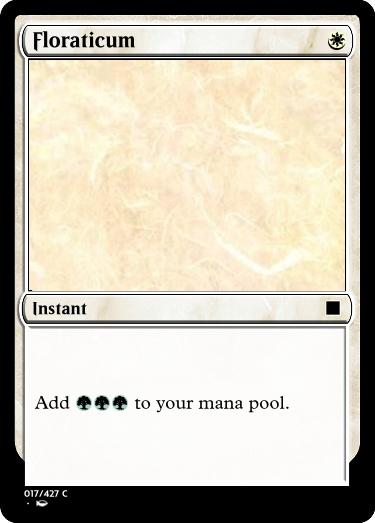
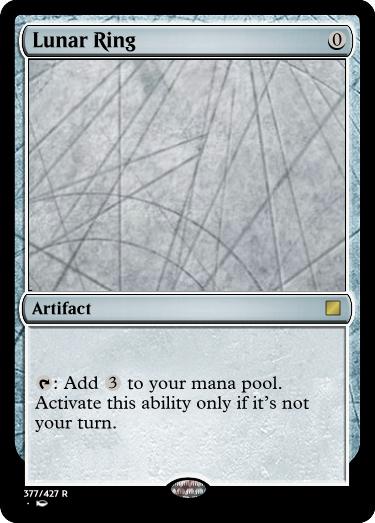
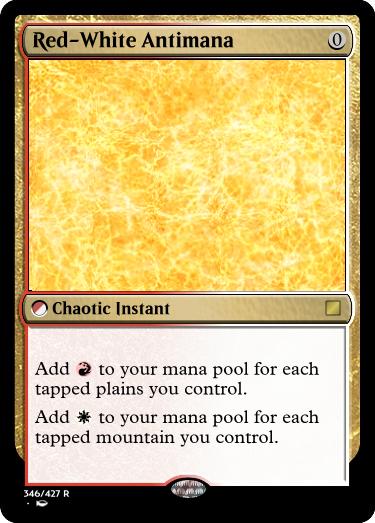
Last week I made a post about Spectral Chaos, the set that never was, and now the full set has been published online. Reddit user Hypolast has presented the set with the Modern card template on Imgur. As one would expect, there's some landhome garbage and Ice Cauldron-esque text-boxes, though there is some cool design. There's also some completely busted cards.

Floraticum
Lunar Ring
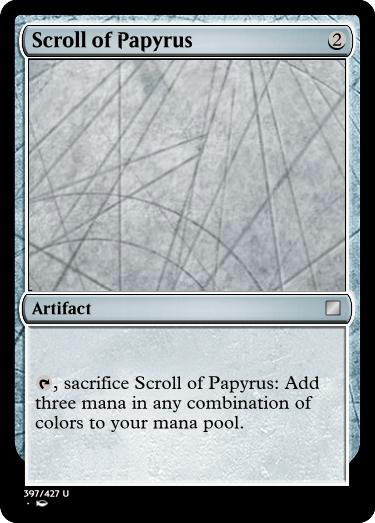
Red-White AntimanaScroll of Papyrus
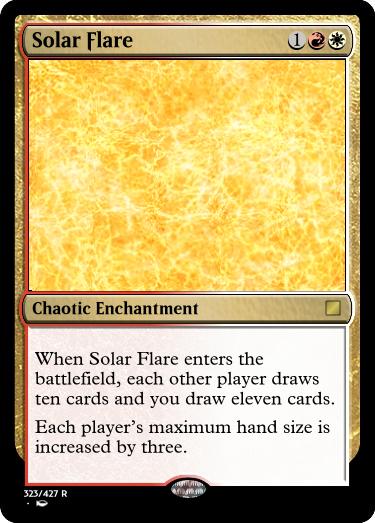
solar flare

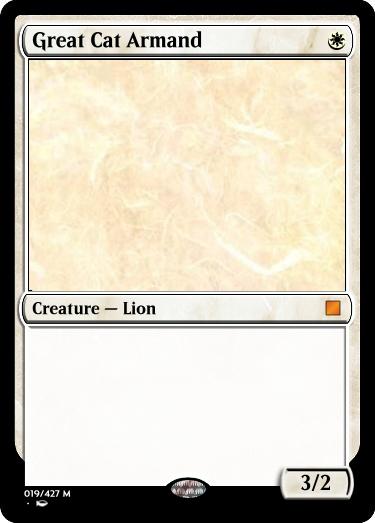
A dash of cards that while not broken, wouldn't be reasonable to print:

Great Cat

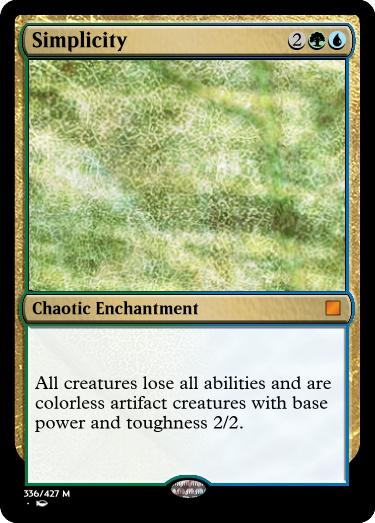
And a few goodies that made their way in some form into the game of Magic, for better or for worse.

Simplicity

The design for this set started immediately after Alpha launched, so we have to cut the designers some slack. I can't help but wonder how an actual release of Spectral Chaos would have impacted the course of Magic history.

Avatar photo

Ryan Overturf

Ryan has been playing Magic since Legions and playing competitively since Lorwyn. While he fancies himself a Legacy specialist, you'll always find him with strong opinions on every constructed format.

View More By Ryan Overturf

Posted in FreeTagged Leave a Comment on Full Spectral Chaos “Spoiler”

Have you joined the Quiet Speculation Discord?

If you haven't, you're leaving value on the table! Join our community of experts, enthusiasts, entertainers, and educators and enjoy exclusive podcasts, questions asked and answered, trades, sales, and everything else Discord has to offer.

Want to create content with Quiet Speculation?

All you need to succeed is a passion for Magic: The Gathering, and the ability to write coherently. Share your knowledge of MTG and how you leverage it to win games, get value from your cards – or even turn a profit.

Insider: MTGO Market Report for November 25th, 2015

Are you a Quiet Speculation member?

If not, now is a perfect time to join up! Our powerful tools, breaking-news analysis, and exclusive Discord channel will make sure you stay up to date and ahead of the curve.

Welcome to the MTGO Market Report as compiled by Sylvain Lehoux and Matthew Lewis. The report is loosely broken down into two perspectives.

A broader perspective will be written by Matthew and will focus on recent trends in set prices, taking into account how paper prices and MTGO prices interact. Sylvain will take a closer look at particular opportunities based on various factors such as (but not limited to) set releases, flashback drafts and banned/restricted announcements.

There will be some overlap between the two sections. As always, speculators should take into account their own budget, risk tolerance and current portfolio before taking on any recommended positions.

Redemption

Below are the total set prices for all redeemable sets on MTGO. All prices are current as of November 23rd, 2015. The TCG Low and TCG Mid prices are the sum of each set’s individual card prices on TCG Player, either the low price or the mid price respectively.

All MTGO set prices this week are taken from Goatbot’s website, and all weekly changes are now calculated relative to Goatbot’s ‘Full Set’ prices from the previous week. All monthly changes are also relative to the previous month prices, taken from Goatbot’s website at that time. Occasionally ‘Full Set’ prices are not available, and so estimated set prices are used instead.

Nov23

Theros Block & M15

The most recently rotated sets fall into two camps. Theros (THS) and Magic 2015 (M15) are not far off from their October bottoms on MTGO, but the continuing weakness in paper prices means demand from redeemers can't be counted on to support the digital set price.

When paper prices stabilize, this will set the table for gains on MTGO. Typically paper sets that have just rotated out of Standard bottom between November and December.

On the other hand, redemption is not expected to be a factor at all for Born of the Gods (BNG) and Journey Into Nyx (JOU).

On the singles front, Keranos, God of Storms from JOU continues to feature in Modern and the card is now at an all-time high of over 30 tix. With Modern season just starting to ramp up, this card looks set for further gains.

Brimaz, King of Oreskos from BNG recently appeared as a singleton in Craig Wescoe's deck at GP Pittsburgh. That was enough to push this card back above 5 tix.

Tarkir Block & Magic Origins

The Tarkir block sets all stumbled this week, with Khans of Tarkir (KTK) falling the most, by over 10%.

It's impossible to perfectly attribute the nature of this particular price move, but the sudden and broad-based decline suggests speculative selling. A card like Wingmate Roc looks to be oversold in the 6 to 7 tix range, as it is still routinely played in Standard.

Monastery Mentor has taken off this past week, vaulting past Ugin, the Spirit Dragon to become the most expensive card in Fate Reforged (FRF). Although the white three-drop is not a big player in Standard, this card shines in Legacy and Vintage, and has shown some promise in Modern. With the Legacy MOCS nearing, it is time to start selling this one.

[tt n="Monastery Mentor" a=5]

With a pending rotation in the Spring of 2016, it's not too late to speculate on cards from KTK or FRF, but the risk level grows week by week. At some point, these sets will start a steep decline that will only finish bottoming after they rotate from Standard.

Before the decline begins, it should be the speculator's goal to avoid holding onto any cards from these two sets. The first two weeks of March should be considered the drop dead period for closing any positions in Standard-only cards from KTK and FRF.

Dragons of Tarkir (DTK) and Magic Origins (ORI) were both more stable in price, sticking close to their price from last week.

Deathmist Raptor from DTK has fallen to an all-time low of 11 tix this week as it is out of favor in the Standard metagame at the moment. Although not a bargain-basement price, with 10 months left in Standard, there's still plenty of time for this card to find its footing and return to the 15-20 tix range.

Battle for Zendikar

Last year, KTK bottomed in price during the release events for DTK. Using this as a rough guide for estimating when the bottom for Battle for Zendikar (BFZ) will occur points to the release of Shadows Over Innistrad (SOI) in April 2016.

However, BFZ will go from being opened three boosters at a time in draft to only one as the format incorporates Oath of the Gatewach (OAG). This is a change from last year when FRF replaced only one booster of KTK. Thus, the bottom for BFZ could occur sooner than it did for KTK.

Right now it's unclear what the ideal window will be to stock up on BFZ cards. It's safe to say that January is too soon as that would be in advance of OAG release events. Likewise, May will be too late as that would be after SOI release events.

The Market Report will be on the lookout for signs of a bottom, but for now keep this somewhat large window in mind for speculating on BFZ singles and sets.

Standard Boosters

The introduction of Legendary Cube draft has put a crimp in most Standard booster prices as players seek to sell excess boosters in order to play the new draft format. As a result, BFZ boosters, which were hovering near 4 tix, have dipped down to 3.7 tix.

Elsewhere, both DTK and ORI appear to be completely constrained by supply---their prices have held firm at close to 4 tix despite the temporary availability of a popular alternative draft format.

As for KTK and FRF, these boosters posted a big run-up in price since October, but the trend has been interrupted. Instead of drafting with them, players would rather sell their excess KTK and FRF boosters to play Cube.

Once this iteration of Cube draft is retired on December 9th, look for the price of these two boosters to resume their upward trend. Typically there's another round of Cube and flashback drafts around Christmas, which would be another period of reduced demand for KTK and FRF boosters.

Speculators should never try to sell their positions into a period of weak demand, so those holding KTK and FRF boosters should look to the middle of December or the middle of January as the next two selling windows.

Beyond that, the end of February and early March will be the last window to sell before the looming Spring Standard rotation starts to erode demand for all things related to the first two Tarkir block sets.

Modern

Modern prices continue to cruise higher this week. Following a six-week-long price hike, the Modern Total Format Price index reached its pre-BFZ level this week and is up by more than 10% since mid-October.

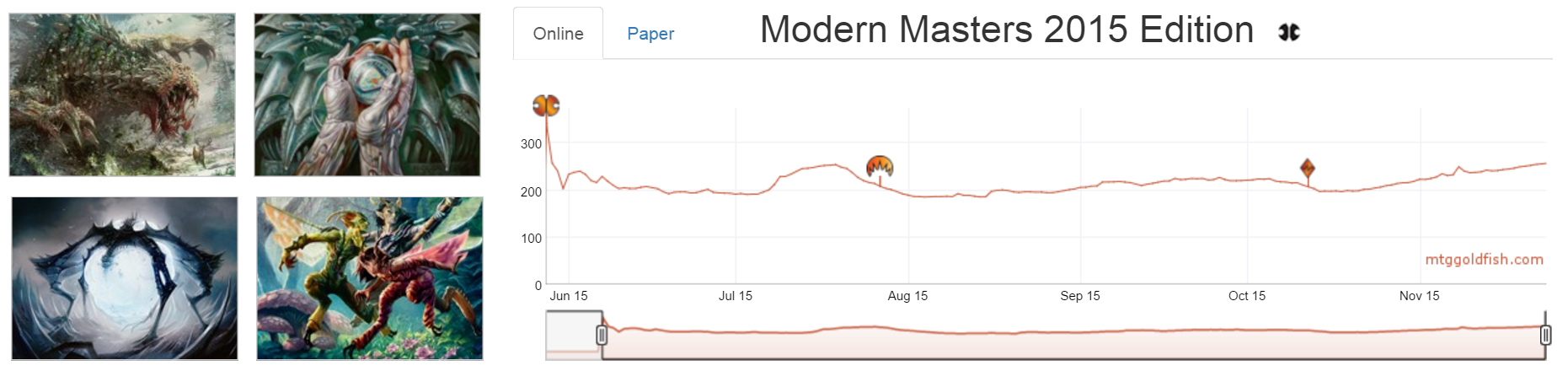
On an even more impressive trend, and also illustrating the strength of Modern prices, the Modern Masters 2015 price index put up a near perfect linear upward trend since mid-October to top its record high established earlier in July. The MM2 price index is up by almost 30% since October 15th, with almost all of the top 20 most valuable MM2 cards up compared to last week.

MM2

This past weekend Pittsburgh hosted a GP featuring Modern Constructed. More than 2,600 players showed up to compete in this very diverse and popular format. More than 14 major archetypes were represented in Day 2 of the GP; the five most-played decks were Twin variants, Affinity, Jund, Zoo and Tron.

Most Modern GPs spotlight some kind of breakthrough deck. This time around it was Hulk Combo, a reanimation/combo deck relying on Protean Hulk, and Mono-U Extra Turns, a deck that wins with multiple Time Warp effects.

Although these decks aren’t exactly pure novelties in Modern, they got more attention this weekend as both made Day 2 after being featured in Deck Techs.

Key cards from these decks unsurprisingly underwent price spikes over the weekend. But what probably was a flash in the pan can nonetheless be turned into profitable speculative targets down the road, if these decks were to repeat such performances.

The diversity on Day 2 gave way to a less varied Top 8: three Twin variants, two Affinity, and one each of Grixis Control, R/G Titan Scapeshift and G/W Hate Bears. In the end, Alex Bianchi's UWR Twin deck won it all and put Restoration Angel and Kiki-Jiki, Mirror Breaker back on the Modern map.

Legacy & Vintage

Although this may be discussed further on a case-by-case basis, we consider now the optimum selling window for most Legacy staples. Most players looking to participate in the Legacy portion of this MOCS season have likely already acquired their decks. Therefore, we believe the bulk of the demand is behind us.

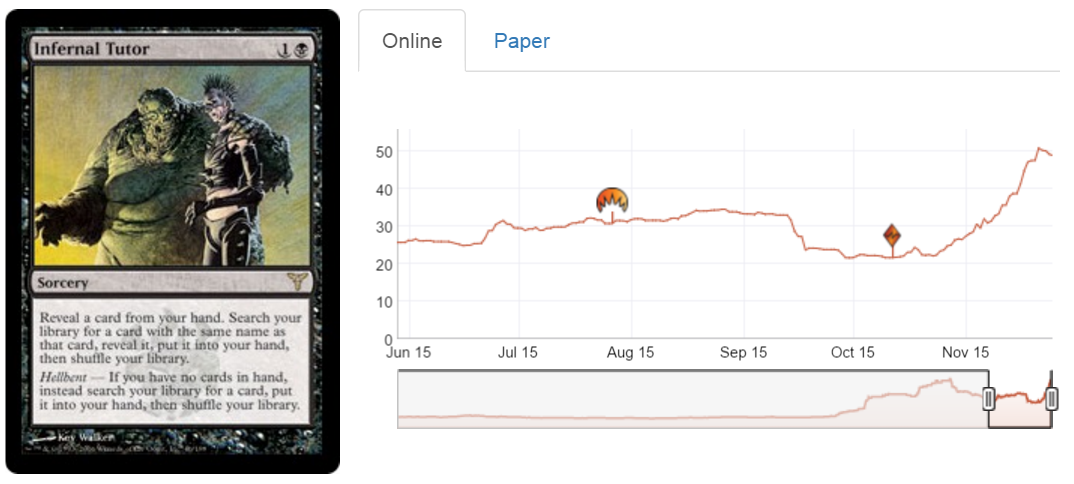
Infernal Tutor, for instance, hit 50 Tix again this past weekend, reaching previous heights established last February. Despite seeing no play in Modern, the tutor from Dissension doubled in price in less than a month. At this point we strongly recommend selling any copies.

IT

Counterbalance is another great example of a Legacy staple worth selling these days. The decision, however, is more delicate when it comes to Legacy staples such as Glimpse of Nature, Natural Order, Stoneforge Mystic, Sneak Attack and Show and Tell, which are performing poorly at the moment.

Even with potential small losses, we still recommend selling now, mostly to avoid exposure to uncertainty after the Legacy MOCS. Variations in Legacy prices remain fairly unpredictable, and it may take several months for the cards mentioned above to return to higher prices.

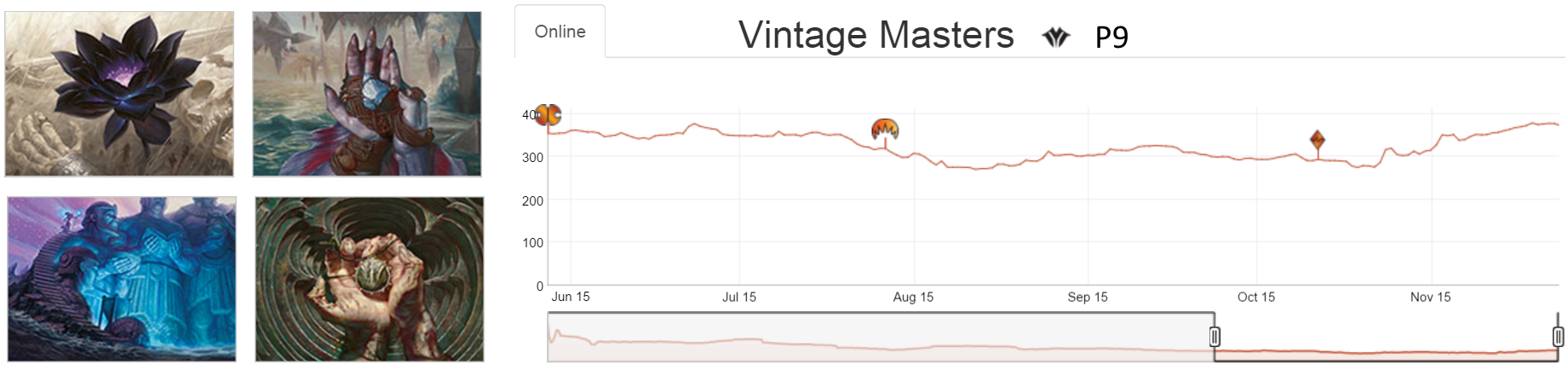
Vintage continues its slow but steady recovery although prices seem to have plateaued over the past week. Black Lotus is now priced around 130 Tix, a level it hadn’t seen since last February. Similarly, the price of the other P9 pieces is flattening these days after a month of growth.

P9

This may not be the end of the story for Vintage in the near term, with the second Power Nine Challenge tournament scheduled this Saturday. If this event attracts higher attendance than the hundred players seen during the first Power Nine Challenge, we'll very likely see another boost in Vintage prices.

Pauper

Various versions of Delver decks (Mono-U, Angler or Fiend) are monopolizing the top positions of the most-played decks in Pauper this week. With this, many Delver staples such as Cloud of Faeries, Snap, Spire Golem, Preordain, Kiln Fiend and Mental Note have risen in price since mid-October.

Other Pauper staples, including Chittering Rats, Unearth, Moment's Peace and Firebolt, are also experiencing a nice rebound since the release of BFZ last month.

[tt n="Mental Note" a=5]

This distinct raise in price was probably strengthened by the announcement of Pauper Leagues on MTGO last week. Because of its very low entry price, Pauper is a format of choice for players looking for competitive play at a minimal cost, especially as Standard decks reach prices over 1000 Tix.

For speculators this means that prices across the board will probably reach the next level. Pauper staples can be found by browsing the Pauper Metagame section on Mtggoldfish.com or the Legacy Movers & Shakers. Identifying the Pauper staples that are still languishing right now is more likely than ever to yield profits in the short term.

Some examples of Pauper staples that haven't participated in the global upward trend of the past few weeks include Sunscape Familiar, Seat of the Synod, Ancient Den, Daze and Standard Bearer.

Targeted Speculative Buying Opportunities

Standard

Wingmate Roc

Targeted Speculative Selling Opportunities

Standard

Monastery Mentor

Legacy

Deathrite Shaman
Infernal Tutor
Stoneforge Mystic
Glimpse of Nature
Show and Tell

Twins and Trends at GP Pittsburgh

Are you a Quiet Speculation member?

If not, now is a perfect time to join up! Our powerful tools, breaking-news analysis, and exclusive Discord channel will make sure you stay up to date and ahead of the curve.

On Monday morning, one of my Magic friends asked me to share my favorite moment from Grand Prix Pittsburgh. That was like asking ten-year-old me what I wanted for my birthday. Was it Craig Wescoe finally doing justice to the obscure albeit awesome GW Hatebears? A Jeskai Twin deck (yep, Jeskai) not just making Top 8 but winning the entire event? Maybe it was the Day 2 metagame showing the healthiest Modern since Charlotte. Or the fact that Wizards gave us the full Top 32 decks instead of a skimpy Top 8!

I couldn't decide, so I just settled on Wescoe slamming that disgusting Choke against poor Corey Burkhart. What can I say: I'm a martial artist and a sucker for all things grappling.

GP-Pittsburgh-Twin-Banner

Grand Prix Pittsburgh was easily one of my favorite Modern events of 2015, and potentially its best. Within the tournament's context, it showcased a diverse field with ample innovation (the continued rise of Grixis Midrange) and plenty of old favorites (Twin: the hero Modern deserves). Even outside of Pittsburgh, the Grand Prix showcased Modern's self-regulating nature as the linear nightmare of StarCityGames' Dallas and Grand Prix Porto Alegre crumbled under the Modern mainstays of Jund, Affinity, and Twin. Trevor Holmes already recapped the event in his Monday article, and Pat Chapin did a solid metagame breakdown (premium) over on SCG. For today, instead of reinventing their hard work, I'm going to look at a few higher-level narratives out of Pittsburgh these authors didn't touch on. I'll also revisit my predictions from last week's piece. This is a great setup for all the Modern action coming in December and January, and hopefully a valuable contextualization for the tournament.

[wp_ad_camp_1]

Predictions Hits and Misses

If Pittsburgh was the highlight of my weekend, the dismal Bears vs. Broncos game was rock bottom. You thought Wescoe made some questionable game three plays in his semi-final match against Affinity? Be glad you didn't see some of the player and coaching decisions in our home-field loss to a quarterback on his second game ever in the NFL (and his first starting). I had linked the Bears' fortunes to GP Pittsburgh's in my article last week, and I've never been happier a prediction never came true.

On its own terms, Pittsburgh shook out almost exactly like I predicted in the article. That's great news for me because it suggests I wasn't making catastrophic metagame misreadings going into the event. It's also great news for you readers because it means you weren't listening to catostrophic metagame misreadings.

Prediction #1: Jund will keep the peace - Yes!

"Overall, I’m banking on Jund fulfilling its role as format policeman, and betting that players see it this way too. Jund might not win the event (might not even Top 8 it!), but it will be there to hold the line and keep the peace."

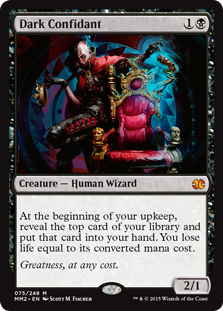
Dark Confidant MM2015With an 8% metagame share on Day 2 and three copies in the Top 32, Jund made a strong showing as a format regulator. To be very clear, I don't think this is the best deck in the format. Its relative representations on Day 2 and in the Top 32 suggest this too: 8.8% down to 5%. I also don't think that Jund alone is the policeman and peacekeeper Modern needs (more on its partner, Twin, later). All that said, I firmly believe Jund is an integral policing force in Modern and Pittsburgh reflected this importance. I do want to offer one critical observation for Jund players: don't rely on Kolaghan's Command for beating Affinity. Pack Ancient Grudge or pay the price. I don't think it's a coincidence that all the Top 32 Jund lists used 1-2 Grudge (two used a pair), and I suspect lower-placing lists weren't as cautious.

Prediction #2: Amulet Bloom will beat the hate - Yes!

"Expect to see a respectable Bloom showing in Day 2 and, if Twin doesn’t do its part, at least one copy in the Top 8/16."

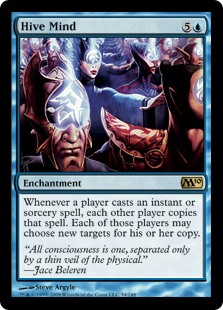
Hive MindI'd bet my Thanksgiving turkey that someone in the comments is going to argue that Bloom had a poor showing at the Grand Prix and really isn't as top-tier as people make it out to be. Don't listen to them. Mike Sigrist barely missed the Top 8 on breakers (he got 9th, with his .6944 losing out to Nicolich's .7054), and he was joined in the Top 32 by two other Bloom players. Bloom also made up 5.5% of the Day 2 metagame, overperforming into the Top 32 (where it had a 6.3% share). Add to that its Regional Pro Tour Qualifer share of 7.3% and its Tier 1 status in October and you have a deck that is unquestionably a major player. In the Pittsburgh context alone, Bloom did all this despite a field saturated with Twin players (12.1% on Day 2) and Blood Moon. Five of the Top 8 decks ran Moons in the board, with eight more in the Top 32. Given all those hurdles, it's significant that Bloom sent players to the Top 32 and almost to the Top 8. As you go into December Modern events, prepare for this deck like you would prepare for any other top-tier player. Is the deck beatable? Absolutely, and don't let the ban maniacs or the Bloom-hypers tell you otherwise. Can you coast through this matchup without practice and the right cards? Don't even try it. Treat the deck as a top-tier contender or get ready for a rough couple of games.

Prediction #3: Scapeshift will Top 8 - Yes! ...sort of

"Scapeshift is that rare combo deck which can play a very solid anti-aggro game, perform a serviceable control imitation, and rock the proactive, out-of-nowhere combo win."

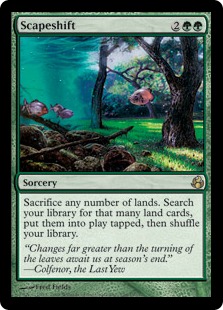
ScapeshiftOn the one hand, four copies of Scapeshift showed up in Pittsburgh's Top 8, as part of Thien Nguyen's RG ramp strategy. On the other hand, this was a much more proactive Scapeshift than the "serviceable control imitat[or]" I banked on in my prediction article. I'm still chalking this one up as a hit because Scapeshifting for Valakuts is still Scapeshifting for Valakuts, but you'll want to treat Nguyen's build differently than you would treat Hoogland's. This finish will also reinvigorate interest in the lagging Scapeshift decks, so expect to see more of these in the future. Scapeshift made up 2.9% of the Day 2 metagame in its many shapes and sizes, and I would bet these shares will only go up as more players take a hard look at the underappreciated Scapeshift synergies.

Twin and BGx: Modern's Buddy Cops

Don't be surprised if this section header gets turned into an article title one day. I can already envision the graphic (think Shanghai Knights but with more Exarchs and Goyfs)! No matter how you feel about the BGx grindfest or living in fear in the URx Twin contest, it's hard to deny the importance of these decks in Modern. We've seen this all year, notably at Charlotte in June, and Pittsburgh was an important next chapter in the buddy cop narrative.

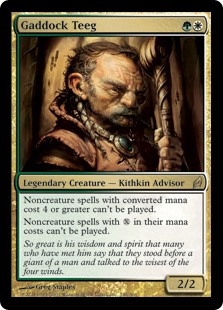
Gaddock TeegIt's easy to look at Pittsburgh and get too excited about finishes that aren't necessarily meanngful. Don't get me wrong: it didn't get much more awesome than watching Wescoe drop a Gaddock Teeg like it was 2008. And I love me some Footsteps of the Goryo as much as the next combo player. As wonderful as these Pittsburgh moments were, they also aren't necessarily meaningful for the larger Modern narrative. There are a lot of Pittsburgh features that will try and make something out of every single finish, and it's up to you to separate the real mountains from the sea of molehills.

Twin and BGx? It doesn't get more mountainous than these two.

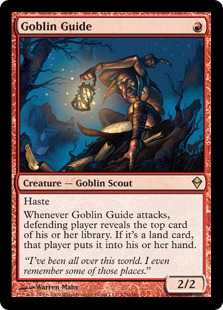
Goblin GuideDue to its massive card pool and relative lack of generic answers, Modern is always going to have a lot of random linear decks floating around. These lists take many forms. There are the "pure" combo builds like Ad Nauseam, Hulk Combo, and Storm. There are the old-school aggro decks such as Burn, Merfolk, and more Zoos than we can name. We see ramp (Tron, Amulet Bloom), we see aggro with combo-esque elements (Affinity, Bogles, Infect, Suicide Zoo, Elves), and we see decks that are just plain weird (Time Warp). All of these strategies share an almost single-minded devotion to goldfish games. If I wanted to operationalize a definition for a "linear deck", it would be by counting the number of maindeck cards that are at their best when used non-interactively. I'm not doing that now, but we can all see the common goldfishing thread between these kinds of decks. Also, just to be clear, these decks are not low-skill despite their linear nature. "Linear" isn't an insult. It's a gameplay description.

Given all these linear options, why are most Modern events like Pittsburgh or Charlotte and not like Porto Alegre or Dallas? Thank URx Twin and BGx Midrange. That's not "URx Twin or BGx Midrange". It's "and" because healthy metagames need both decks.

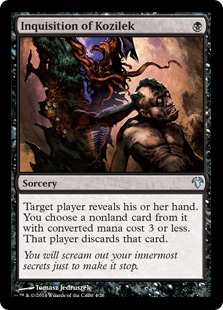
Inquisition of KozilekIt's almost impossible for the assorted linear decks to punch through a metagame with both Twin and BGx. If you're too deep on synergy, Thoughtseize and Inquisition of Kozilek will rip you apart. If you're too light on interaction, an early Remand is guaranteed to keep the Twin player alive until the turn 4-5 combo. And if you're too reliant on cheap creatures, there's nothing like a Lightning Bolt to set you back, and there's nothing like Twin and Jund when it comes to wielding Bolt efficiently. Linear decks can't deal with these different policing angles and typically crumble over long tournaments. Pittsburgh showcased this effect throughout the weekend, especially in the finals where Jeskai Twin made textbook work of Affinity.

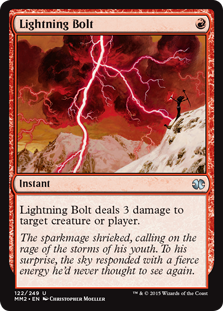
Lightning BoltModern breaks down in two scenarios. The first is where tournaments are too small for the metagame to arc towards Twin and BGx justice. Linear decks can dodge these policemen in smaller events, and then hope to get lucky in the single game where they get jammed up. This doesn't work at a Grand Prix, which is exactly what Chapin talked about in his Monday article with respect to Bloom's finishes. If you just look at small-event data, you tend to see more of the goldfish decks bullying their way to the finals. That's not going to happen at a tournament where both Twin and Jund show up in force (or Abzan, depending on the BGx police flavor of the month). Of course, the second breakdown scenario is where one (or both) of the decks are absent. No Twin? Get ready for Affinity and Amulet to run over everything in sight. No BGx? Honesty, i can't think of a time when there was no BGx at all, but I know that an absence of Jund sees big increases in Infect and other small-critter-based aggro.

At Pittsburgh, we saw both decks which is why the event was so healthy and such a return to old-school Modern. This is a critical observation because it shows us situations where the metagame can be broken (relatively speaking) and then self-correct just a month later. That's important if you are playing (prepare for the correction or jump on board a policing deck), speculating (don't play the long-game on spending on linear decks that might be here today and gone tomorrow), investing (Twin and BGx only go up because they are always here), or just trying to understand the format (we'll always come back to these two decks no matter where the format is at any given moment). Pittsburgh should have been a faith-restoring event for all Moern players, and I am optimistic that we can keep seeing these forces in more events to come.

Post-GP Pittsburgh Modern?

We have some SCG Opens in January and a number of mid-sized Modern events in the interim. Expect to see Twin and BGx keeping order at all those events, because it will take another major shift to lower either deck prevalence form where they are now. For example, a big part of Twin's summer decline was likely a transition by Twin players to Grixis decks, particularly Grixis Control. With these decks floundering today, the Return of the Twin was an inevitability.

Any other takeaways you got from Pittsburgh? Decks or cards you found interesting? Or are you just excited for the grandeur that will be Bears vs. Packers on Thanksgiving night?? Let me know in the comments and I'll see you all after the holiday week!

Insider: Best Business Practices (Part 1)

Are you a Quiet Speculation member?

If not, now is a perfect time to join up! Our powerful tools, breaking-news analysis, and exclusive Discord channel will make sure you stay up to date and ahead of the curve.

Welcome back, readers!

The most successful business owners are always looking for ways to improve how they do things. However, there's no need to reinvent the wheel, and there are plenty of good core practices that are universal. Today's article will discuss these "best business practices."

You can learn these practices from your competitors, from similar businesses, or even from businesses in entirely different markets. Applying the basics is key to strengthening and growing your business.

In Part 1 today, I'll discuss some tried-and-tested practices employed by several notable large companies. These practices aren't limited to any specific market, and they can be adopted by any business, including a hobby or gaming store.

Customer Focus

Greeting Customers

moes

Moe's is a fast food restaurant that builds various southwestern dishes (namely burritos) to order. The food is delicious, but the real reason they're on here is their practice of greeting every single customer by yelling out, "Welcome to Moe's!"

Every staff member is expected to do this. It makes the customers feel appreciated and lets them know they aren't "just another person."

For a business, every single customer is important. Competition is fierce and each person who walks into your store is actively choosing you over one of your competitors. Show them appreciation for doing so, and you encourage them to return.

Prioritizing Customer Assistance

old navy

Old Navy is a huge chain of low-priced clothing. My girlfriend used to work there, and she informed me their company policy is if you see a customer who needs help, you stop what you're doing immediately to assist them. (Although I'm 99% sure that doesn't apply if you're already assisting a different customer.)

The point is that while the employees have a lot of other jobs (folding clothes, organizing clothes, setting up displays, etc.), the company acknowledges that assisting customers is their number one priority. They actively make sure their employees are aware of this fact and follow through on its application.

The Customer Is Always Right

apple logo

I realize this idiom is repeated so often it might seem almost meaningless, but it's only repeated because making the customer feel wrong or dumb is one of the easiest ways to guarantee they won't be returning.

While the previous two companies may be more known in the U.S., Apple is a worldwide entity known by most of the Earth's population. What people may not know is that employees are strictly directed not to correct customers on the little stuff.

There's no product called the "iTouch," but if a customer refers to their iPod Touch as an "iTouch," the Apple Genius (what their employees are called) is specifically directed not to correct them.

While this may seem minor, just imagine what it feels like from the customer's side. If you've been referring to your iPod Touch as an iTouch to all your friends and family, learning you've been wrong the whole time will leave you feeling dumb---and likely trying to make your way to the exit as quickly as possible.

Customer Appreciation Events

belk-logo

Belk is a clothing store found predominantly in southern U.S. shopping malls. They are known for having great customer appreciation sales. They definitely didn't pioneer this idea (you can find these types of sales across retail, automotive, and many other industries), but what sets Belk's apart is its fundamental simplicity.

Their customer appreciation sale doesn't set limits on how much or what you can buy. If you pay with your Belk credit card, you get a blanket discount across the board. This approach eliminates the confusion customers can face when trying to decipher the often cryptic limitations posted in the fine print of sales advertisements.

It also makes it easier for sales associates. They don't have to worry about informing a customer that the particular item they were searching for all morning, which they finally found in their size on a different rack, is in fact not included on the sale---and watching the excitement recede from their face.

Dependability

Product Dependability

200px-McDonalds_Golden_Arches

McDonald's is known for the dependability of their product. I've had a Big Mac in Ohio, in New York, in South Carolina, and in Changzhou (China). They all tasted exactly the same.

The quality of that taste itself may be up for debate, but the point is they have mastered the art of dependability when it comes to their food. This is a huge factor behind their success.

When a potential customer has a hankering for one of their items, they don't want to drive to a specific store to get it, they want to drive to the nearest one. When your customers can depend on you to have (or get them) something, they are more likely to return over and over again.

Service Dependability

0106_starbucks-logo_400x400

Starbucks is known for incredible service. I'm not even a coffee drinker and I'm aware of it. When you go to Starbucks to get your coffee, the barista will say hello, ask you about your day, and/or make small talk to make you feel welcome. This is the case whether you go to a Starbucks in Seattle, London, Paris, Budapest, Istanbul, New Delhi or Hong Kong.

Dependable service is a huge boon for a business and it's what keeps many customers coming back. After all, you can get a good cup of coffee at numerous places---what you're really paying for at Starbucks is the dependability (both in service and in product.)

Competitiveness

Price Matching

2000px-Best_Buy_Logo.svg

Best Buy is one of the U.S.'s largest retailers of consumer electronics. They have a "Price Match Guarantee," which states they will not be beat on price by key local and online competitors, including Amazon, Newegg, and Tigerdirect.com.

This means if Best Buy has something I really want, but it's cheaper on Amazon, they'll give me the same price (and thus I can get it immediately without paying for shipping). This is obviously awesome for customers.

This may take away some profit margin, and a key aspect for Best Buy is how their buying power lets them get the best rate possible on all their wares.

Small game stores may not have this luxury, but that doesn't mean they shouldn't try. If you read Best Buy's Price Match Guarantee carefully, you'll notice they don't promise to match any price from anywhere, only from the places they deem as true competition. A similarly limited approach could be of service to a smaller outlet.

In this day and age, every Magic store is in direct competition with every other one. Many players have limited incomes, and a love for a game that seems to get more expensive by the day, so price is a huge factor in their decision making.

This is compounded by a highly-standardized, non-unique product. To many players a card is a card, whether they get it from their favorite LGS, eBay or TCG Player. And the simplicity of Magic cards means there's little concern about warranty or life cycle.

Online retailers don't have the same costs associated with running a brick-and-mortar store, but this doesn't mean you can ignore the market willy-nilly just because of your overhead. You're better off charging competitive prices and focusing on what you can offer that online competition can't---tournaments and a place to play.

The key to price matching is to ensure each transaction still nets a profit. You obviously don't want to price match a store that's selling cards for less than you paid (although this might represent an opportunity to just buy out their copies). But in the end, selling a card at a $1 profit is preferable to not selling at a $4 profit.

Conclusions

Magic: The Gathering continues to grow, both in the playerbase and in profits for WoTC, which inevitably leads to tougher competition in the secondary market. Businesses that rely on the game as a major portion of their profits will need to keep up.

The stores that adapt will survive and thrive; the ones that don't will go under. Applying some of the basic principles covered in this article may indeed be the difference between continued success and disaster.

Avatar photo

David Schumann

David started playing Magic in the days of Fifth Edition, with a hiatus between Judgment to Shards. He's been playing Commander since 2009 and Legacy since 2010.

View More By David Schumann

Posted in Business, Finance, Free Insider4 Comments on Insider: Best Business Practices (Part 1)

Have you joined the Quiet Speculation Discord?

If you haven't, you're leaving value on the table! Join our community of experts, enthusiasts, entertainers, and educators and enjoy exclusive podcasts, questions asked and answered, trades, sales, and everything else Discord has to offer.

Want to create content with Quiet Speculation?

All you need to succeed is a passion for Magic: The Gathering, and the ability to write coherently. Share your knowledge of MTG and how you leverage it to win games, get value from your cards – or even turn a profit.

Insider: Modern Winners & Sleepers from Pittsburgh

Are you a Quiet Speculation member?

If not, now is a perfect time to join up! Our powerful tools, breaking-news analysis, and exclusive Discord channel will make sure you stay up to date and ahead of the curve.

After the linear madness of Grand Prix Porto Alegre and Star City Games' Dallas Open, I didn't have the highest expectations for Pittsburgh.

Players often criticize Modern for having too many linear decks, and although those criticisms are often baseless and ungrounded in actual metagame numbers, they were much more on point in October and early November. The Regional PTQ numbers weren't too much better, especially with decks like Amulet Bloom at 7%+ of the metagame.

Then came Grand Prix Pittsburgh.

A Diverse Field at Pittsburgh

Although Pittsburgh wasn't quite the hyper-balanced metagame we saw at Grand Prix Charlotte in June, it largely restored order to Modern. With a diverse Day 2 field and a decent showing of different archetypes across the Top 8, Pittsburgh showcased the format at its finest. We saw archetype diversity across every level of the event.

Given how much linear decks defined the last big events, this outcome was by no means a sure thing, and it speaks highly of Modern's self-regulating nature. Twin, in all its forms, is the hero and policeman this format both deserves and needs.

This naturally has big implications for cards to buy in the wake of Pittsburgh.

Today's article will do a quick round-up of the more obvious winners from the event, decks like G/W Hatebears, R/G Titan Scapeshift, and various bullets from the top finishers. After that, I want to focus on two cards you might have missed while looking over the Pittsburgh data.

These sleepers cropped up across the Top 8, Day 2, the undefeated Day 1's, and even the GP Trial winners; read on to see where you should put your money as the year starts to close out.

The Obvious Winners

By the time you read this article, a lot of the more obvious investment targets will be gone. Some will get bought out. Others will suffer price adjustments as sellers realize their new value.

In the unlikely event you can get in on these cards, here are some quick notes on the higher-profile winners from the weekend.

All Things Scapeshift


There was an error retrieving a chart for Scapeshift

I predicted Scapeshift breakouts in both my QS article and my Modern Nexus article in the leadup to Pittsburgh. Thien Nguyen's red-green build was more proactive than the Temur and Bring to Light versions we saw earlier, but the investment advice and underlying metagame predictions still hold.

Any and all of the Scapeshift staples are good buys, including the deck's namesake, Nguyen's tech in foil Khalni Heart Expeditions, and some super sexy Commune with Lavas. If you can snipe anything from this deck on the cheap, do so.

All Things Bloom

There was an error retrieving a chart for Amulet of Vigor

Here's another deck I had on my radar before Pittsburgh. Bloom exceeded expectations and beat a lot of hate en route to a Top 16 performance courtesy of Mike Sigrist.

Foil Amulets remain good buys as do all the staples that are already valuable (Ancient Stirrings, Azusa, Lost but Seeking, etc.). Be very careful about buying into this for the long-term. The deck is rapidly proving it's a true top-tier contender, which puts it even more in Wizards' ban crosshairs.

G/W Hatebears Staples

There was an error retrieving a chart for Leonin Arbiter

Craig Wescoe rampaged his way into the Top 8 with a super old-school Modern Hatebears deck. (Note: it's "Hatebears" and not "Death and Taxes", because D&T runs Flickerwisp.)

Cards like Arbiter, Aven Mindcensor, Aether Vial, and even throwback big-shot Gaddock Teeg put in serious work for Wescoe's run---all of these cards are heading up after this weekend.

Jace, Vryn's Prodigy

There was an error retrieving a chart for Jace, Vryn's Prodigy

Grixis decks have struggled mightily since their emergence over the summer, and the combination of Jace, Inquisition of Kozilek, and Rise // Fall have turned the deck's prospects around. Although the new versions are much more "Grixis Midrange" than "Grixis Control," the Grixis core remains a serious force in Modern.

From a finance perspective, this only underscores Jace's rising value across the format, and confirms a prediction I made on Rise // Fall a few weeks ago (this one is probably too late to get in on).

Protean Hulk & Footsteps of the Goryo

There was an error retrieving a chart for Footsteps of the Goryo

Zal Elsik, the "Lantern Guy" as affectionately dubbed by announcers at Pittsburgh, rolled in with a Protean Hulk Combo deck instead of his Oklahoma City-winning list.

Elsik won a last-minute Trial before Pittsburgh proper even started, and within about six hours you couldn't find a single Footsteps of the Goryo online. Hulk had already spiked the previous week, and Elsik's Trial win only pushed it further.

The deck didn't do great in the main event, and I am pessimistic about its long-term prospects: if you buy in on this, get out earlier rather than later.

Random Combo Speculation

There was an error retrieving a chart for Walk the Aeons

Here's a good rule for short-term speculation: if Wizards features an offbeat deck (usually a linear and/or combo deck), you can't go wrong buying in.

Eli Kassis piloted a Time Warp deck to a Day 2 finish. Wizards did a deck spotlight and by the time the Top 8 got posted, there wasn't a foil Walk the Aeons available through any major seller.

If you're willing to do the legwork to turn these around quickly, short-term specs like this can pay off. If not, stay away from these kinds of decks and be able to identify them as the short-term blip they are.

The Sleepers

As a general rule, anything that reaches Top 8 at a Grand Prix will command a higher price tag sooner rather than later. The same goes for offbeat decks earning deck spotlights. All of this is doubly true if the deck enjoys a breakout performance (e.g. Wescoe's G/W Hatebears), because it reinvigorates interest in a deck many people might want to try.

Most Modern players probably noticed the winners in this section, as well as similar ones I haven't bothered to mention explicitly (Cinder Glade in Scapeshift, Horizon Canopy in Hatebears, Jeskai Twin staples, etc.). These next sections focus on a pair of cards you might otherwise miss when you're deciding what to buy.

Sleeper #1: Stony Silence

It's somewhat unfair to call this a sleeper because Stony Silence has been on Modern players' radars since it was printed. Affinity bringing you down? Pack the Silences and call it a day.

While this plan didn't work out for Craig Wescoe in Game 3 of the Top 4 (although honestly, sub-optimal play was involved here), Silence is still the best thing you can do against Affinity.

With the robot horde making yet another big showing at this event (two representatives in the Top 8 and the most played deck on Day 2), I expect to see more players shifting back to those sideboarded Silences and relying less on the deceptively ineffective Kolaghan's Command.

There was an error retrieving a chart for Kolaghan's Command

Affinity has had a huge run this year, putting up major metagame numbers ever since its breakout 2015 performance at Worlds in August. An over-reliance on Kolaghan's Command played a big part in this ascent. Command is often too-little, too-late against a wide Affinity board position. It doesn't do anything against Etched Champion and is completely nullified by Arcbound Ravager.

All of this makes Command a suboptimal answer to competent Affinity pilots, and those players have capitalized on this metagame vulnerability all summer.

There was an error retrieving a chart for Stony Silence

Stony Silence is the true Affinity hoser. And with foil copies just under $10, it makes for a great investment. Even the nonfoil versions are worth a look; Silence hasn't been reprinted even once since Innistrad, and it's rapidly proving its worth as a Modern mandatory.

Jeskai Twin took down Pittsburgh, further proving that white might merit a second look in Modern. If Jeskai Twin can do it, maybe Jeskai Control, Midrange or Delver can do it too.

This will further shift players back into white, and back to Stony Silence. The card will only go up from here (until a possible Modern Masters 2017 reprint), so get them cheap while you can.

Sleeper #2: Inquisition of Kozilek

Modern investors have been carefully eyeing Inquisition of Kozilek since we learned it wouldn't be part of Modern Masters 2015. It's not a matter of "if" this card will be reprinted. It's a matter of "when."

Even with a single Modern Event Deck printing, the card is still around $10, and I expect that to go up in the wake of Pittsburgh.

There was an error retrieving a chart for Inquisition of Kozilek

Following Pittsburgh and the linear metagames of Dallas and Porto Alegre before that, Inquisition has continued to emerge as a critical police card in Modern.

We saw this throughout Pittsburgh, with decks running it across all levels of the tournament. Grixis Midrange rocked a playset in the Top 8, BGx, Grixis and Faeries (!) ran it to undefeated Day 1 finishes, and BGx decks ran it again throughout the Grand Prix Trials.

This card has almost singlehandedly put Grixis back on the map---Grixis players have increasingly turned to Inquisition as a catch-all answer to Modern's linear decks.

Jund decks are cutting back to two or even a single Thoughtseize in favor of the almighty Inquisition, and it's very possible this adoption will catch on with other black-based decks (Grixis Twin and Delver? Deadguy Ale and Mardu?).

Wielding Inquisition in Modern

As players start getting into Modern this season, they are going to realize they need Inquisitions for their decks. That $10 pricetag will look quite sweet by the end of December, by which time this card will be much more expensive, in the leadup to the Modern-centric Star City Games tournaments in 2016.

You'll want to adhere to a quick turnaround schedule if you're interested in an Inquisition investment. I can't see this card dodging reprints through both the new Zendikar block and supplemental Event and Duel products.

That said, I can also see the Modern community getting no news of its reprint through January. If that happens, the card will be pricey by the time the Pro Tour rolls around in February.

To be clear, Inquisiton isn't a sleeper because people don't know about it. It's a sleeper because the pricetag doesn't reflect its newfound importance in Modern. As long as you monitor the reprint dangers, you can invest accordingly and make it big on this discard staple.

What's Next for Modern?

We have two more big Modern events, both SCG Opens, before the Janaury banlist update. I fully expect we'll see at least one change in that update (a Sword of the Meek unban), and perhaps more.

Going into January and the February Pro Tour, you'll want to monitor the balance between the linear decks and the interactive ones---that dynamic is the format-shaping narrative and it will determine both deck and investment choices.

Looking back over the Grand Prix, what other cards do you have on your radar? Any exciting performances that coverage missed? I'll be checking out the comments over this vacation week, and I'll look forward to talking some more Modern then!

Deck Overview- Gruul Scapeshift

Are you a Quiet Speculation member?

If not, now is a perfect time to join up! Our powerful tools, breaking-news analysis, and exclusive Discord channel will make sure you stay up to date and ahead of the curve.

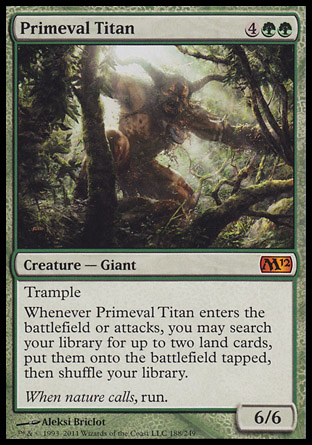
Today's list is oddly reminiscent of the standard version of Valakut decks. Decks like this have historically existed in modern, though over time the builds with access to blue mana took over as the best build of Scapeshift. Thien Nguyen would have you believe that Cinder Glade changes this paradigm, and a Grand Prix Top 8 is a solid argument.

Gruul Scapeshift

Creatures

4 Sakura-Tribe Elder
4 Primeval Titan

Spells

4 Search for Tomorrow
2 Farseek
4 Explore
4 Scapeshift
1 Primal Command
4 Khalni Heart Expedition
2 Commune with Lava
4 Relic of Progenitus

Lands

1 Stomping Ground
3 Windswept Heath
4 Wooded Foothills
4 Cinder Glade
4 Valakut, the Molten Pinnacle
4 Forest
7 Mountain

Sideboard

3 Obstinate Baloth
3 Crumble to Dust
3 Nature's Claim
3 Rending Volley
3 Anger of the Gods

Four maindeck Relic of Progenitus is certainly a concession to the power of Snapcaster Mage, with some added utility against the delve spells that are still Modern legal. Cantripping to find more lands isn't bad either. The 4-2 split in favor of Explore over Farseek is another nod to this deck's want for cantrips in the absence of blue mana. It's a less consistent way to make mana, but it's consistent enough at 27 lands.

There was an error retrieving a chart for Explore

The miser's Primal Command is a nice way to make turn five Primeval Titan more consistent in addition to adding some strong utility. I'm less in love with the Commune with Lavas, though ultimately if your goal is just to resolve one specific spell it's reasonable card selection in a color pair that doesn't get a lot of options.

It's very interesting to see Scapeshift decks being pulled from a Temur base to either four-color Bring to Light builds and a straight red/green version. I'm excited to see how the strategy evolves from here.

GP Pittsburgh Recap and Analysis!

Are you a Quiet Speculation member?

If not, now is a perfect time to join up! Our powerful tools, breaking-news analysis, and exclusive Discord channel will make sure you stay up to date and ahead of the curve.

*Normally I post my Video Series on Monday, with my text article on Thursday, but with Thanksgiving this week we’re bumping my text piece to today and postponing the Video Series until next Monday. If this tortures your soul let my boss know so I can make more videos!

This past weekend, Modern players worldwide were given a rare treat; an actual high-level Modern event to watch and play! I’ve been struggling my way through this Modern offseason, and while I should have been working this weekend I was glued to my TV screen watching 2,679 players fight for Modern dominance! Today, I’ll be breaking down the results from the event, covering the Day Two Metagame, Top 8, and some list-specific technology. Let’s get started!

Explore banner

GP Pittsburgh in Context

Leading up to the event, the general consensus had Jund and Affinity at the forefront of everyone’s minds. Grixis Control in the hands of Danny Jessup had breathed some new life into the archetype and it seemed like the stage was set for GP Pittsburgh to become a midrange grindfest as Jund and Grixis fought to out-value each other. On the fringes were creature decks like Naya Company and combo like Scapeshift. Amulet Bloom seemed like a fine choice for the weekend, as it had fallen almost completely off the radar and should be a good matchup if everyone is gunning for Jund (an unfavorable matchup for Amulet). With this information in mind I suggested two decks for GP Pittsburgh in my last article; Amulet Bloom for those looking to “metagame”, and Grixis Control as my go-to choice in Modern. Were these good choices for GP Pittsburgh?

[wp_ad_camp_1]

Day Two Metagame Information

Archetype Total % Field
Twin (All Types) 37 12.1%
Affinity 32 10.4%
Jund 27 8.8%
Zoo (All Types) 23 7.5%
Tron (All Types) 20 6.5%
Abzan 18 5.9%
Company (All Decks) 18 5.9%
Amulet Bloom 17 5.5%
Burn (All Types) 12 3.9%
Infect 11 3.6%
Merfolk 10 3.3%
Grixis Control 9 2.9%
Scapeshift (All Types) 9 2.9%
Living End 7 2.3%
All Other 57 18.6%
TOTAL 307 100.0%

The Day Two Metagame information paints a picture that is surprisingly unsurprising. Everyone knew Jund and Affinity were the decks to beat going in to the event, and there they sit at the top of the hill, joined as always by Splinter Twin! With 30% of the field on one of these three decks, and no other single archetype coming close to their representation numbers, we see a clear division between the Top Tier and everything else in the format.

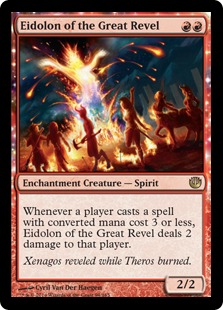
There are some interesting pieces of information we can pull from this, however.Eidolon of the Great Revel First and probably the most important is Burn’s abysmal conversion rate to Day Two. While Burn is slightly overrepresented online compared to real-life events due to its cheap cost, the fact remains that it is cheap in real life as well and always puts up a strong showing at events. 3.9% on Day Two is a clear sign that player were prepared for Burn this weekend (we’ll get to this more in the list discussion section). The most-represented combo deck was Amulet Bloom, which validates my stance pre-event and is encouraging to see. The fact that zero Amulet Bloom decks were able to punch into Top 8 suggests to me that they were able to carve up the Day One field but ran into some combination of bad matchups and prepared opponents on Day Two.

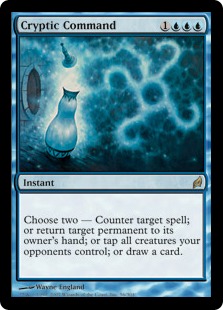
Grixis Control put up unimpressive numbers again, grabbing 9 slots out of 307 to make Day Two. My explanation for this is the same I’ve had for a while;Cryptic Command Modern is a format that punishes reactive strategies, and the vast array of things to do in the format make it extremely difficult for decks like Grixis and Jeskai to truly “control” the game. Grixis’ best draws are its proactive ones, which is why we’ve seen that archetype shift away from Cryptic Command and Mana Leak towards Jace, Vryn's Prodigy and Pia and Kiran Nalaar. Unfortunately, this just makes the deck weaker vs. those random combo decks and strengthens an already solid matchup vs. midrange and creature decks. I still think a list similar to Jessup’s is the best one we’ve seen so far. That said, I’m afraid that without some significant metagame shifts Grixis will always be an archetype that’s good enough for Day Two, maybe Top 8, but will remain a long shot to win an event.

Other points of note are Living End’s minor resurgence, due to a reduction in graveyard hate as people shift towards help for other matchups. Naya Zoo is here to stay, and I expect these numbers to increase. The deck has a solid matchup against almost everything, and while Jund is tough and some fast combo can be difficult the archetype can build its sideboard to pick on anybody (usually Affinity and Twin).

Before talking about Top 8 I want to touch on the Day One Undefeated decklists.

1 Abzan
2 Jund
2 Elves (with Lead the Stampede)
1 RG Tron
1 Grixis Control (the Midrange version!)
1 Amulet Bloom
1 Affinity
1 U/B Faeries!?

Woah, hold it right there.

"U/B Faeries, Anthony Huynh, 13th – GP Pittsburgh"

Creatures

3 Spellstutter Sprite
3 Snapcaster Mage
3 Vendilion Clique
2 Mistbind Clique
1 Tasigur, the Golden Fang

Enchantments

4 Bitterblossom

Instants

3 Cryptic Command
2 Mana Leak
1 Remand
2 Go for the Throat
1 Murderous Cut
1 Slaughter Pact
1 Disfigure
1 Dismember

Sorceries

3 Thoughtseize
3 Inquisition of Kozilek

Lands

4 Polluted Delta
3 Watery Grave
3 Drowned Catacomb
4 Creeping Tar Pit
4 Mutavault
2 Ghost Quarter
5 Island
1 Swamp

Sideboard

1 Slaughter Pact
2 Countersquall
2 Damnation
2 Hurkyl's Recall
2 Engineered Explosives
1 Sower of Temptation
1 Dispel
1 Go for the Throat
1 Ætherling
1 Duress
1 Sword of Light and Shadow

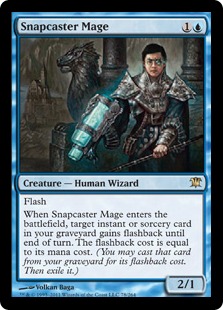
Now, the first thing I thought when I saw this at the bottom of the Day One Undefeated page wasSnapcaster Mage “yeah, sure, it can beat a Day One field but can’t hold its own against the real decks”. Then I took a peek at the standings, and Huynh grabbed 39 match points (13-2 for those counting at home) missing Top 8 on breakers. For reference, 10 players earned 39 points, and 4 of them made Top 8 (including eventual winner Alex Bianchi). We were very close to witnessing a U/B Faeries list Top 8. Just saying. This list eschews Scion of Oona for Snapcaster Mage, which I’ve seen enough to recognize that its not revolutionary, but still worth pointing out. That Aetherling in the sideboard though… I will be transparent and say I have not played a match with this deck, but I have played against it numerous times and I’m struggling to argue against swapping out Aetherling for Teferi, Mage of Zhalfir, or at least Jace, Architect of Thought a la U/R Twin. Maybe I’ve found my next Modern Video Series deck?

The Top Eight

It’s interesting to note that only one Day One Undefeated pilot managed to convert to Top 8 (Aaron Webster piloting Affinity). Neal Oliver’s Amulet Bloom was only able to scrape together one win on Day Two after a 9-0 Day One performance to finish with 30 points. Matthew Rayes’ Grixis Control only fared slightly better, picking up two wins on Day Two to finish at 33. Besides the Abzan list, every other Undefeated Day One deck finished relatively strong.

Top 8
2 Affinity*
2 U/R Twin
1 Jeskai Twin*
1 G/W Aggro*
1 Titan Scapeshift
1 Grixis Control

*denotes Top 4 performance

Before diving into some lists, a full 62.5% of the Top 8 slots were gobbled up by Tier 1 decks, in this case Affinity and Twin. While Twin had higher Top 8 representation, Affinity had a better T8 performance, but this is due to some of the Twin decks knocking each other out in the quarterfinals. First up, the winner:

"Jeskai Twin, Alex Bianchi, 1st – GP Pittsburgh"

Creatures

1 Wall of Omens
4 Snapcaster Mage
4 Deceiver Exarch
1 Pestermite
1 Vendilion Clique
2 Restoration Angel
1 Kiki-Jiki, Mirror Breaker

Sorceries

4 Serum Visions

Instants

4 Lightning Bolt
4 Path to Exile
2 Spell Snare
1 Dispel
3 Remand
1 Electrolyze
1 Cryptic Command

Enchantments

3 Splinter Twin

Lands

4 Scalding Tarn
4 Flooded Strand
3 Steam Vents
1 Hallowed Fountain
1 Sacred Foundry
3 Island
1 Mountain
1 Plains
1 Sulfur Falls
1 Cascade Bluffs
3 Celestial Colonnade

Sideboard

2 Dispel
1 Wear // Tear
1 Stony Silence
1 Pia and Kiran Nalaar
1 Engineered Explosives
1 Celestial Purge
1 Keranos, God of Storms
1 Elspeth, Sun's Champion
2 Blood Moon
1 Flashfreeze
1 Negate
2 Timely Reinforcements

The main draw to Jeskai Twin has always been better removal in the form of Path to Exile, some great beaters in the form of Restoration Angel, and a wider array of strong sideboard cards. Here we see a list that is built with Jund in mind, with a maindeck full of value and a sideboard with access to Keranos, God of Storms, Pia and Kiran Nalaar, and even an Elspeth, Sun's Champion! I really like Bianchi’s choice for this weekend, as he picked a powerful archetype with subtle shifts that paid dividends against a field full of Jund and aggro. Those Timely Reinforcements definitely did great work for him this weekend, and the ability to blink Wall of Omens or Pia and Kiran Nalaar with Restoration Angel or Kiki Jiki, Mirror Breaker sounds awesome.

"GW Hatebears, Craig Wescoe, 4th - GP Pittsburgh"

Creatures

4 Noble Hierarch
4 Voice of Resurgence
2 Qasali Pridemage
3 Scavenging Ooze
4 Leonin Arbiter
2 Thalia, Guardian of Thraben
4 Loxodon Smiter
2 Aven Mindcensor
1 Linvala, Keeper of Silence
3 Wilt-Leaf Liege
1 Brimaz, King of Oreskos

Artifacts

4 Æther Vial

Instants

4 Path to Exile

Lands

2 Stirring Wildwood
1 Plains
1 Forest
2 Tectonic Edge
4 Ghost Quarter
4 Horizon Canopy
4 Temple Garden
4 Razorverge Thicket

Sideboard

4 Stony Silence
1 Sigarda, Host of Herons
2 Dismember
2 Spellskite
1 Gaddock Teeg
2 Burrenton Forge-Tender
2 Kor Firewalker
1 Choke

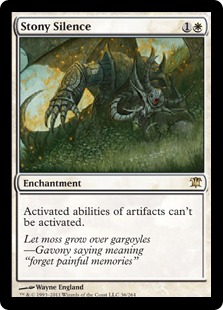
So, first of all, Craig Wescoe brought a Pro Tour deck to a Grand Prix. Stony SilenceYou don’t put 4 Stony Silence in your board unless you want to send a message. Craig carefully constructed his deck to prey on the expected combo decks this weekend, while relying on his maindeck discard hate in the form of Loxodon Smiter and Wilt-Leaf Liege to help in the Jund Midrange matchup. While not necessarily unfavorable, Jund exists to beat creature decks like this to a pulp, and Craig took advantage of the perceived Jund hate this weekend and was able to slip through into the Top 8. His sideboard, tuned to fight Burn, Affinity, and Twin, looks almost like he knew exactly what the Top 8 composition would be. It’s like Craig is a super genius or something...

Watching him dispatch Corey Burkhart with his singleton Choke in the quarterfinals was painful to watch, but there’s no denying the power of that card in the Grixis and Twin matchups. I’m really in love with this list (as I am with most Pro Tour lists) but I don’t expect it to be sustainable post-event (as with most Pro Tour lists). Craig’s deck is awesome, but is a slightly underpowered list carefully constructed for an accurately predicted metagame.

"Titan Scapeshift, Thien Nguyen, 7th - GP Pittsburgh"

Creatures

4 Primeval Titan
4 Sakura-Tribe Elder

Sorceries

4 Search for Tomorrow
2 Farseek
4 Explore
4 Scapeshift
1 Primal Command

Artifacts

4 Relic of Progenitus

Enchantments

4 Khalni Heart Expedition

Instants

2 Commune with Lava

Land

1 Stomping Ground
3 Windswept Heath
4 Wooded Foothills
4 Cinder Glade
4 Valakut, the Molten Pinnacle
4 Forest
7 Mountain

Sideboard

3 Obstinate Baloth
3 Crumble to Dust
3 Nature's Claim
3 Rending Volley
3 Anger of the Gods

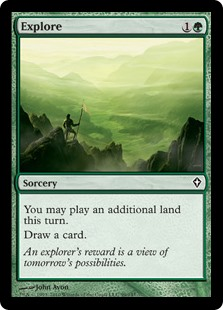
No frills. No counterspells. Just ramp. This deck is an awesome throwback to the old R/G Valakut Ramp decks, all the way down to the Explore and Khalni Heart Expedition.Explore The thing that strikes me about this deck is how great it plays against both Blood Moon and Thoughtseize; unlike Tron or Amulet, the built-in redundancy can just position Nguyen to draw into another threat if he loses one (as he plays nine). Under a Blood Moon, he can still ramp like normal, and casting a huge Commune with Lava can find him a Nature's Claim should he need it. Turn 3 Crumble to Dust in the ramp semi-mirrors seems sweet also, and I’m really liking the simplicity of his list, all the way down to the 3-3-3-3-3 sideboard. Nguyen was dispatched by Aaron Webster piloting Affinity in the quarterfinals, even though he has a full nine cards to bring in for the matchup. Webster even beat Wescoe and his 4 Stony Silence in the semis, talk about fighting through hate! I think this deck is solid, though maybe a little underpowered/one dimensional, but I’m going to hold any significant judgement until I play it for myself.

Conclusion

GP Pittsburgh was a blast to watch and I can’t wait to try out some of these decks for myself. While I heard the coverage and organization wasn’t the smoothest, I’m ecstatic at the turnout numbers and the viewership on Twitch all weekend (15,000 viewers at one point, and I doubt that was the all-time high!). If viewers and players keep turning out in such great numbers for these events that’s great news for those of us who love Modern (read: all of us). What do you think? Any information about the weekend that I missed? Let me know in the comments! Thanks for reading, and I’ll see you next week!

Trevor Holmes
The_Architect on MTGO
Twitch.tv/Architect_Gaming
Twitter.com/7he4rchitect


Insider: A Well-Positioned Format – Why to Spec on Modern

Are you a Quiet Speculation member?

If not, now is a perfect time to join up! Our powerful tools, breaking-news analysis, and exclusive Discord channel will make sure you stay up to date and ahead of the curve.

Modern is in a weird place right now. The format feels pretty thoroughly solved and yet it never fails to surprise. People complain endlessly about it and yet it pulls monster numbers of participants to Grand Prix and Opens.

One of the funny things about Magic is that everybody has very strong feelings about things that, ultimately, just don't matter. We may kvetch and carry on about any number of perceived problems, but at the end of the day we still show up to battle.

The fact of the matter is that Modern has taken off in a big way over the past year, and it has become a wildly popular and successful format. I don’t see any reason why this trend shouldn’t continue in the future.

In today's article I'll talk about the fundamental appeal Modern holds for speculators and players alike. I'll also touch on some ways investors can take advantage of its projected growth as a format.

The Appeal of Modern

One of the great aspects of Modern is the huge quantity and variety of viable decks. I think this is really important for a non-rotating format---in order to feel "big enough," there should be space for all the different kinds of decks people like to play.

One of the big problems with Standard as a format is that there are often just a few truly good decks. Do you like Jeskai or Abzan, and playing them against each other? No? Well, maybe Standard isn’t the format for you right now…

The cool thing about Modern is that a million decks are viable: Affinity, Zoo, Twin, Grixis Control, Jund, Junk, Amulet Bloom, Lantern Control, Reanimator, Merfolk, Elves, Co-Co, Dredge, Death and Taxes, and so many more.

One of the reasons Modern has been so successful is everyone has a deck to champion. Whatever type of strategy you're drawn to---it's all but guaranteed to be a thing! I can't stress enough how important this element is to the health and popularity of a format.

I love Legacy, but the problem with the format is that while you technically can play a wide variety of decks, only a select few are truly competitive. The good decks are insanely powerful, and there's very little incentive to operate outside the box of blue-based Brainstorm decks and broken combos.

Legacy also has the problem of the Reserved List, which has caused format staples to become increasingly expensive with no hope of a respite. Modern is the exact opposite because of the Modern Masters series which essentially guarantees that anything can and will be reprinted.

Last week I talked about some of these issues in my article about Star City Games's shift to focus more on Modern events.

One of the trends I predicted was a significant surge in Modern prices as the Open series continues to promote and feature the format. SCG has supported other formats with its tournament circuit in the past, notably Vintage and Legacy, and both formats saw tremendous price increases during those times.

I predict the same thing will happen with Modern. The wild card, of course, is the lack of Reserved List cards in the format.

Modern Masters is Wizards of the Coast's direct attempt to eliminate the Reserved List problem in Modern. Whereas staples in the "true" eternal formats can command absurd highs, anything that gets prohibitively expensive in Modern can simply be reprinted. This is of course a major factor in the format's popularity.

Looking at Targets

So, those caveats aside, here are a couple of my Modern picks right now. As SCG moves deeper into Modern, we can expect the overall playerbase to grow. This means staples from established archetypes will be more fruitful bets than trying to predict the next big strategy. Newcomers will want to play the best archetypes, and they're going to need cards.

Singling out cards in high demand is important, but we also want to consider supply. Thus we want to find cards in the best decks which have seen recent reprintings, or are low for some other reason.

Steel Overseer

There was an error retrieving a chart for Steel Overseer

Steel Overseer is a key card in Affinity and I fully expect it to go up at some point in the near future. It's a rare from an old M-set that saw a reprint in the Tezzeret vs. Elspeth Duel Deck several years ago, but it has dodged a Modern Masters reprint so far.

Affinity had a great showing at GP Pittsburgh last weekend and it's certainly a deck many players will gravitate toward. This card's price seems on the low end, so I'm looking to scoop them up.

Splinter Twin

There was an error retrieving a chart for Splinter Twin

Splinter Twin dropped significantly in price as a result of its Modern Masters reprinting over the summer. Twin is a format-defining deck, and easily one of the best. In fact, "blue deck" is practically synonymous in the format with "Twin deck!"

A two-card combo that outright wins the game is pretty powerful. If Twin continues to be the blue deck of choice I expect this card to see significant gains over the next six months.

The price has been suppressed already because of the recent reprinting. I expect it to slowly creep back up as more players make the switch from Legacy to Modern to play in SCG Open Series events.

Scavenging Ooze

There was an error retrieving a chart for Scavenging Ooze

If there's one card I feel confident will gain value in the coming months it's this one. Ooze is an amazing card and a mainstay in every single green-based midrange deck. It provides tons of utility in the form of life gain and graveyard hate.

The card has already seen the bottom and edged up a little, but I fully expect it will continue to rise. It has seen two printings, one in a Commander deck and the other in an M-set. Neither were heavily printed.

Also worth noting is its applications in Eternal and Casual play. I’ve got a big stack of these set aside for when the right moment comes.

Shocklands

There was an error retrieving a chart for Temple Garden

A nice bump in the price of shocklands is quite due. It's been several years since they were reprinted, and alongside fetchlands they're the defining lands of Modern.

They're also the kind of card a lot of players want to own a full playset of, just in case. It stands to reason they'll continue to gain in price until their next reprinting. That's probably a ways off, since they just recently rotated from Standard.

I would fully expect to see the original Zendikar fetchlands reprinted before the Ravnica lands, and I'm not sure we'll even see a fetchland reprint in the next year.

~

The key to investing in Modern cards is finding that crossroads between format staple and suppressed price. Realistically we're still almost two years away from another Modern Masters release, so there's a lot of time before Wizards really shakes things up again.

In the meantime, I'm personally trying to stock up on solid popular Modern staples, because I think with the SCG Opens moving primarily into Modern we should see cards start to move. Good luck and good picks!

Insider: Pittsburgh and the Healthy State of Modern

Are you a Quiet Speculation member?

If not, now is a perfect time to join up! Our powerful tools, breaking-news analysis, and exclusive Discord channel will make sure you stay up to date and ahead of the curve.

The Top 8 from GP Pittsburgh is in; no busted combos, no punishing locks and no Burn! This week, we'll take a look at the Grand Prix and compare it to the RPTQ winners from two weeks ago.

A Trio of Twins

First, let's take a look at the two U/R Twin decks, which are standard builds (that's not a bad thing). They run a combination of small efficient counterspells and lots of draw. These are fair decks that provide a foil to the more broken strategies in Modern. Bloom Titan, for example, has a very tough matchup against this deck.

I'm more interested in the white Splinter Twin deck that won the event. While past lists ran a set of Wall of Omens, this one cut the Wall down to a single copy. Instead, it makes full use of Path to Exile. Path is one of the strongest removal spells in Modern right now, taking out big threats like Primeval Titan with no hesitation.

White also provides a few interesting sideboard options. Here, that means an Elspeth, Sun's Champion and some Timely Reinforcements.

I have felt recently that Twin would benefit greatly from the inclusion of Path. This deck skips the more conventional white cards and pares down its choices to what really matters.

Affinity Crushes Again

Affinity placed two decks in the Top 8. This matches up with my assay of the metagame earlier--Affinity was also the most common deck to appear in the Top 8 of an RPTQ.

If you compare Affinity lists from last year to these decks, you might find a lot of cards are just plain gone.

  • No Ensoul Artifact in either deck. For that matter, no Thoughtcast either!
  • 3-4 Etched Champion in the maindeck.
  • Two Spellskites in each maindeck.
  • Two Ghirapur Aether Grid on the sideboard.

This is the new face of Affinity, a form that can edge past the blowouts of Vandalblast and the power-downs of Stony Silence. Affinity can win right through a Stony Silence if it gets Etched Champion out early enough. The deck has shed its blue components, since they're mediocre against Jund and Junk decks.

There was an error retrieving a chart for Etched Champion

It's hard to find something worth speculating on in Affinity. The prices are all pretty well set. That said, you can go in on staples like Etched Champion and Steel Overseer, both key pieces in the archetype that remain reasonably priced.

Grixis Control Continues to Evolve

Corey Burkhart's Grixis list is something of beauty. With four Snapcaster and four Jace, Vryn's Prodigy, he'll rebuy just about every spell he casts.

I think his inclusion of Thought Scour is a little loose, but it does tend to fuel those aforementioned creatures. And I've recently rediscovered how powerful Inquisition of Kozilek is in a base-blue deck, letting you really plan for what needs to be answered.

Speaking of answers, Corey's list has a lot of removal, but interestingly, no counterspells in the main deck. Sure, his sideboard has three Dispel and a Spell Snare, but preboard it looks like a straight attrition game.

One of the prime engines of attrition here is Kolaghan's Command. Corey has four in his maindeck, more than I've seen just about anywhere. On top of that, he has a miser's Rise // Fall as well! The idea seems to be to grind an opponent's hand down and use the Command to rebuy your high-impact creatures.

Pia and Kiran Nalaar (aka Key & Peele) make an appearance here (as well as on a Twin board). I hesitantly like them over Siege-Gang Commander or Inferno Titan because the tokens have flying and act as a Lingering Souls against both Junk and Affinity.

In both Modern and Standard this card has been eager for its time in the sun. We've seen one copy here; how many more will make their way into decks?

There was an error retrieving a chart for Pia and Kiran Nalaar

Grixis did well in this event to make it this far, fighting off popular decks like Jund and Junk. Those matchups matter because they can easily out-grind you, and Tarmogoyf is a real pain to stop. On the plus side, you can bring in four Fulminator Mages and combine those with Commands to shred their manabase.

Corey was wise to run three Terminates and a Dismember as answers to the infamous lhurgoyf; I'd go so far as to drop the Dismember and go up to four Terminate.

Craig Wescoe Gins up Another G/W Deck

Craig did his signature move by bringing G/W Hatebears to another Top 8. With Aven Mindcensor and Leonin Arbiter, Craig didn't want his opponents to ever benefit from Path to Exile, much less stuff like Scapeshift and Primeval Titan.

There was an error retrieving a chart for Leonin Arbiter

I was surprised to see how well Craig handled his Burn match against Ari Lax, as well as the way he out-valued Jund using Voice of Resurgence.

This deck is a pain in the ass to play against. You think you're all set and they're just soft to Tasigur, the Golden Fang, but then bit by bit, the deck slows you down, removes your creatures, then beats you to death with 2/x dudes. I am not looking forward to playing against it in the next few weeks.

When these hate decks are good, it's a symptom of broken things going on. The Aven and Arbiter are both there to stop deck searching, which is abundant and deadly in Modern.

If the only thing they hosed were fetchlands, this deck would be a lot worse. However, those cards singlehandedly wreck Bloom Titan and can spell trouble for other decks too. Thalia compounds the pressure on mana bases and punishes "unfair" decks too reliant on spells.

If we see a banning from something like Bloom Titan (oh please please please), I expect this deck to lose power. It has a challenging time chasing down an Affinity deck in a race, for example. That's why Craig has four Stony Silence on his board.

There's no Tarmogoyf here, but some stupidly expensive cards like Noble Hierarch and Horizon Canopy (a staggering $57) will keep this deck out of the hands of budget players. This is the kind of deck a pro pilots because they have a read on a metagame. I don't expect to see much of an uptick on the deck's price in general.

The one attractive target here is Leonin Arbiter. Hovering around just $1.90 on TCGPlayer, it's a great pickup with plenty of room to grow.

Titan Scapeshift Makes a Appearance

Finally, we saw a Scapeshift deck show up in the Top 8. Scapeshift has been floating around the edges of Modern for a while, and we've been talking about it consistently on QS Cast.

This deck is unusual in the fact that it skips out on blue entirely! No Izzet Charm, no Remand. Instead, it just runs very consistent mana ramp to power out one of its two namesake spells. From there, a bunch of Valakut, the Molten Pinnacles come out and burn you up.

The reason for running blue before was simply because you didn't have better options. The red mana in the deck didn't really accomplish anything in and of itself, so it was easy to jam some Steam Vents both to up the mountain count and support a few worthwhile spells.

Cinder Glade makes this deck much more consistent and provides an incentive to return to the straight red-green Valakut builds from Standard past. The card must have a pretty meaningful impact, as Thien Nguyen chose to cut down to a single Stomping Ground!

This is about as budget as a deck can get in Modern. Scapeshift is $20 and Titan is $10, but Valakut is a meager $3.50. I've got to imagine that Twin just crushes this deck (hence the Rending Volleys) but if you're playing a "fair" game this style of deck will run right past you.

If Blood Moon gets too popular, the deck can also run Rude Awakening as a work-around. Players did this in the past, and it still feels like a fine strategy.

~

What a great Top 8! It was a little disappointing to see no Jund or Junk (no Tarmogoyfs at all, in fact!), but the Top 8 was a diverse mix of interactive strategies. The only super linear deck to appear was Affinity, and while it's still powerful everyone also knows how to beat it.

This is the sign of a healthy Modern environment. I hope to see that continue through to Pro Tour Atlanta.

-Doug

[Modern] GP Pittsburgh Coverage – Resources & Live Updates from the Floor

Are you a Quiet Speculation member?

If not, now is a perfect time to join up! Our powerful tools, breaking-news analysis, and exclusive Discord channel will make sure you stay up to date and ahead of the curve.

 Screen Shot 2015-11-21 at 8.40.21 AM

(Insider Only) Live Updates by ChazV, Mike Lanigan and the crew

Official WOTC #GPPitt Fact Sheet

Tournament Organizer: Professional Event Services GP Pittsburgh Website


Not an Insider yet? Come see what you're missing!


Live Twitch.TV Stream


#GPPitt Twitter Stream

Not an Insider yet? Come see what you're missing!

Scrap Savant: Results for Deck #1

Are you a Quiet Speculation member?

If not, now is a perfect time to join up! Our powerful tools, breaking-news analysis, and exclusive Discord channel will make sure you stay up to date and ahead of the curve.

Hello everyone, and welcome back to Scrap Savant!

As I explained in the introduction to this series, we're going to poll readers on several options to determine what to build with. The results for the first deck are in!

I'm so excited, and want to extend a huge thank you to everyone who responded. I'm glad you all want to be a part of this project, and it's amazing to see such a high level of participation right at the beginning of the series. So, without further ado:

Results for card selection:

Results for color(s):

Almost 200 votes! That's seriously awesome, and hopefully as the series develops there will be even more participation in the future.

Let's discuss the winning votes and look at what I threw together as a preliminary decklist. If there are any revisions to make, they'll be taken care of before filming. Then it's off to put the deck to the test on MTGO.

Building with Bulk

Unfortunately we can't make a two-color deck with these two cards, so it looks like our color combination is Jeskai (UWR). Obviously some of the stronger cards won't be available to us, and I think this a great challenge to start off the series.

I wanted to incorporate both cards in a meaningful way. Felidar Sovereign will be the focal point of the deck, and we'll try to make use of it's alternate "win the game" ability. Some of our card selection will be based on that, and at the same time provide something useful to the deck.

Brutal Expulsion will serve primarily as a way to protect our Sovereign, but also provide some all-around utility this deck will desperately need.

I started brainstorming cards that compliment either of these main build-around cards. Here are some of the ones I wrote down:

Yeah, that's Arcbond alright. Most people wouldn't look twice at this bulk rare in a Constructed setting. Outside of the context of this project, I wouldn't have either.

In this deck, however, Arcbond is a brilliant way to gain a major amount of life in one fell swoop. This is what this series is all about, and had we not been looking specifically for interactions like these, we might have not found this fantastic synergy.

On to some of the cards that will aid Brutal Expulsion in protecting Sovereign:

I feel all these cards fall under our building parameters. There are a few notable omissions, which may or may not appear in the final draft.

Silkwrap, for instance, could be used over Singing Bell Strike, but I felt Bell Strike was better for our purposes. Unlike Silkwrap, it can target any creature, which will be important since we don't know what we'll play against.

We don't have a lot of traditional removal at our disposal, and some of the good options (Draconic Roar for example) are based on other cards we can't run. Without cards like Soulfire Grand Master we can't utilize certain spells like we would normally. (Soulfire Grand Master seems like it would be really awesome in this deck, but alas.)

After looking through Gatherer and tinkering with some numbers, I've come up with an initial decklist:

Untitled Deck

Creatures

4 Arashin Cleric
3 Felidar Sovereign
4 Seeker of the Way
4 Watcher of the Roost

Spells

3 Singing Bell Strike
4 Brutal Expulsion
2 Arcbond
3 Jeskai Charm
3 Valorous Stance
3 Fiery Impulse
1 Stasis Snare
2 Anticipate
1 Treasure Cruise

Lands

1 Blighted Steppe
3 Mountain
3 Island
4 Plains
4 Mystic Monastery
2 Swiftwater Cliffs
2 Tranquil Cove
4 Wind-Scarred Crag

Again, this is preliminary and I want everyone who participated to weigh in again with any suggestions. We'll basically play our games like a somewhat typical Jeskai list, except without access to the premier cards. We'll have to lean mostly on Felidar Sovereign to win our games.

I think we have a solid supporting cast for this strategy. There's a good amount of removal in the form of Singing Bell Strike and the like, and we've maximized the strength of Seeker of the Way, one of the few true Constructed staples we get to run. To top it off we have Arcbond to gain a huge amount of life out of nowhere.

I'm really excited to hear what everyone thinks, as well as your suggestions on what could be revised.

I also want to thank everyone again for opening the series with a fantastic turnout in the polling. It was awesome to see so many of you vote, and I have high hopes for the series moving forward.

See you all soon with the play footage! We'll see how our brew fares on MTGO.

-Chaz @ChazVMTG

Sowing Salt: Eliminating Toxic Attitudes

Are you a Quiet Speculation member?

If not, now is a perfect time to join up! Our powerful tools, breaking-news analysis, and exclusive Discord channel will make sure you stay up to date and ahead of the curve.

Two weeks ago, a Christ Kallas article from The Meadery showed up in my newsfeed. "The Complete(ly Serious) Guide to Pre, Post, and Mid Game Social Interactions" lampoons awkward interactions between players by blowing negative stereotypes out of proportion. The article had me laughing out loud, and not because its jokes are funny - they aren't - but because the "exaggerated" depictions of socially inept players accurately resemble many Magic players I meet.

Sowing-Salt-art

An infinitely more readable (if as flowery) article from Christopher Morris-Lent, titled "The Magic: The Gathering Pro Tour Sucks," struck a chord with me on a similar level. Every step I've taken in my Magic career has brought me to higher levels of competition, and in each setting I've perceived toxic behavior. With GP Pittsburgh one day away, I've elected to spend my column tackling a little-discussed aspect of Magic theory crucial to optimal tournament performance: productive attitudes.

[wp_ad_camp_1]

Productive vs. Toxic Attitudes

Productivity implies working towards a certain goal. I'll assume that your goals as a Magic player are to have fun and improve. For many, including myself, "fun" includes winning; I'll have a bad time going 0-9 on Day 1. I've heard players complain about peers trying to win at the cost of fun, but one doesn't obstruct the other. The sense of security provided by friendly competition helps me focus on the game instead of worrying about my opponent trying to screw me, and ultimately generates more wins.

For nonproductive attitudes, I favor the word toxic. This more aggressive term underlines how these temperaments disadvantage the perpetrator, but also spread malaise to others and weaken the community as a whole.

The following five in- and out-of-game areas ask you to choose between a productive and a toxic attitude.

1. Friendliness and Respect

Someone other than Gandhi once said, "Be the change you wish to see in the world." I urge you to be the change you wish to see in the Magic community, or even in your local playgroup. If you've never played with someone exceptionally unpleasant, this section may not apply to you. Otherwise, here are some ways you can cultivate a milieu with less of "that guy."

Be Courteous

Magic's very name conveys a convivial gathering of like-minded individuals, despite its themes of otherworldly conflict. During a match, help newer opponents remember their triggers,Mind Games and if they don't get why your Huntmaster of the Fells keeps flipping back and forth, stop steamrolling them for a minute and explain. Encouraging opponents to play Magic with you, and not some weird, insecure mind game, forges an addictive sense of camaraderie. When players have fun, they play more, they improve, the scene expands, your store gets better, Wizards jacks up its Modern support, and new decks show up. Being courteous even has strategic applications. After an opponent resolves Inquisition of Kozilek, I always leave my hand open for reference. Then, when I retaliate with Gitaxian Probe, my opponents invariably do the same.
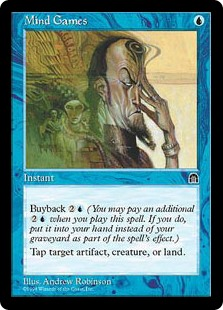
I don't mean to denigrate mind games. Still, if you rely on them as part of your Magic arsenal, it's vital to understand their implications. Getting paired with an ostensibly nasty opponent can scare players away from competitive events, which should embrace everybody from jet-setting pros to curious newbies. Play the game how you like, but if that entails employing a belligerent persona, you can counteract this side effect with affability after the match. Since mind games are a part of Magic, judges can't punish players for engaging in rudeness that evades the sensibly tiny umbrella of unsporting conduct. We players have to take it upon ourselves to recognize and purge antagonism from the community by calling it out.

Courtesy also extends to an opponent's intent. If he topdecks a bomb and giddily mis-taps, you could hurriedly say "resolves" and call a judge as he recalibrates, or you could cede a couple of dick points and figure out your recovery plan. An opponent forgetting to flip his Delver, but immediately showing you a fresh Mana Leak after saying "draw," greets you with similar choices. With a lot at stake, empathizing with an opponent's intent might not prove appropriate - at a GP, for instance, the high stakes don't allow players small mistakes, and many players attend premier events for their hyper-competitive spirit. At lower levels of play, however, considering intent deeply impacts the atmosphere and whether people will want to play with you again.

Give Your Opponents Credit

I spend a lot of time perfecting decks. Consequently, it doesn't discourage me when salty opponents blame losses on my lucky draws or their crummy ones.Saltblast It's still frustrating; part of the joy of deckbuilding is showing cool builds to other players, and impressing friends with wacky ideas. It disheartens players to have their carefully crafted 75 dismissed as garbage by someone who can't name half its cards.
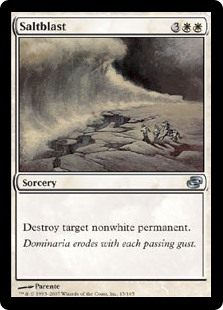
Grumbling, "of course you won with $200 cards in your deck..." after losing to Tarmogoyf ensures a surly vibe. So does insulting an opponent's brew at all, let alone after it crushes you. After all, your own deck exists because somebody brewed it up (possibly even you). Section 3 covers some boundlessly more productive post-defeat rituals, like analyzing the loss.

If an opponent builds a competent deck, plays tightly, or wins, earnestly congratulate him. To beat you, he must have done something right!

Practice Respectful Attitudes

Respecting other players ranges from not ripping people off in trades to meeting an opponent's comfort needs; if he asks you twice to stop flicking your cards, you're probably annoying him quite a bit. It also extends to an awareness of acceptable demeanors.
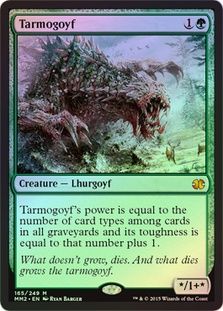
Tarmogoyf FOIL MM15Pretentiousness doesn't qualify as "acceptable." In the Top 8 draft of GP Las Vegas, Pascal Maynard first-picked a foil Tarmogoyf over the "correct" Burst Lightning. The ensuing outrage of fellow pro players, dubbed #GoyfGate, succinctly illustrates the dangers of impudent elitism in Magic. I've observed similar strains of superiority among amateurs, when people sneer at those that pimp their decks, or have the means to purchase expensive cards. We don't know if those pimps spent daddy's money on foil Jund or worked their asses off to save up for the Lilianas, and it's not anyone's place to pass judgment either way. Whoever the miscreant, snobbiness is always toxic. Pascal was able to good-heartedly laugh off his detractors, but their comments breed hostility regardless.

If I were an aspiring Magic player, nervous and excited about going to my first GP, I'd like to believe that should some fantastic luck whisk me into the Top 8, I won't have to fear being publicly ridiculed by people I admire for drafting such an iconic and valuable card. Moreover, if I were struggling to pay for time off work, a hotel, and a flight to Las Vegas, I wouldn't appreciate other players taking veiled stabs at my financial situation. Pascal Maynard had trouble affording other GPs that season, so criticizing him for not passing $400 exhibits prickly entitlement.

Such overtly exclusionary behavior hurts event attendance and makes Magic players seem ignorant, which brings us to the natural extreme: our responsibility to disparage racist and sexist conduct. If an opponent cracks off-color jokes about Invoke Prejudice or Disruptive Student, or uses sleeves showcasing half-naked anime babes, politely let him know how his actions injure the community. If you're not sure how they do, or if you're at all committed to making every player feel safe in your presence, check out these articles. Their authors aren't well-known players, but an individual's competitive record should have little bearing on that person's concerns about community dynamics.

2. Studying

Magic, like all hobbies, demands some level of commitment.Careful Study Actively studying helps players reach their goals. Better yet, well-informed players infrequently take part in toxic blaming wars with their decks or other people.
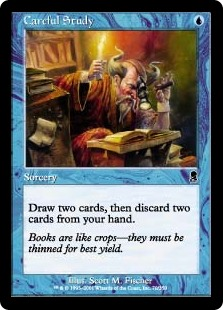
Read Up

Whether you have a pet deck, a favorite writer, or a soft spot for Blood Moon, there's plenty of Magic writing out there relevant to your interests. Reading articles by pros or format analysts keeps your mind on Magic while you aren't playing. Plus, there's always the chance you stumble across something really enlightening.

Learn Your Deck

Mastering your deck keeps you from getting discouraged after a loss by guiding you in analyzing your games. Articles can teach you plenty, but the best way to learn a deck is to use it. We don't always have opportunities to play Magic. Fortunately, even goldfishing a bunch of games should reveal its basic lines. In lieu of a flesh-and-blood opponent, free programs like Magic Workstation and Cockatrice let you test online at your convenience.

Share With Your Opponents

Make a habit of discussing strategy with your adversaries (but wait until the match ends!). Fearfully "hiding" sideboard tech after a match won't do you any favors, as the odds are pretty low your opponent will copy the tech and win the next GP with it (worst-case scenario). It engenders distrust and suspicion while discouraging intelligent discourse. On the other hand, I've gleaned invaluable information from sharing my board plan. If I'm bringing in something questionable, opponents won't hesitate to offer, "that's not so good against me. Here's what you should run instead...." Thanks to the contagious spirit of sharing, it's also common for opponents to disclose their own plans, giving you insights into the matchup for the next few rounds.

Aside: Sharing with opponents also improves your odds. In larger events like GPs, many players with similar records find themselves helplessly waiting for the standings sheet while their breakers compete for Top 8 spots. If you give your opponent a key insight into beating your deck, and he goes on to face it twice more and win with this new information, your breakers ameliorate, no matter whether you lost or won your match against him.

3. Taking Responsibility

Humans have a tendency to point fingers when things go wrong. Blaming outside factors does little for personal development, while looking inwards fosters growth. The overwhelming majority of toxic behaviors I notice in competitive Magic involves players not taking responsibility for their actions.

Own Up To Your Mistakes

Imagine losing a match. You mulliganed to four, or kept a promising two-lander with Serum Visions and somehow never found land number three. Instead of pleading "bad luck," focus on the areas you did have control over. Did you mulligan too aggressively? Could you have played differently at any time? What might have happened?

Even in no-control scenarios,Serum Visions we can think of a few productive questions about the deck. Does it mulligan too much for your liking? Do you often fail to find that third land? Can you squeeze one more into the list? Asking these kinds of questions is integral to refining builds.
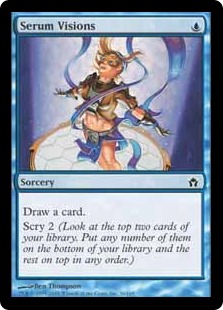
Another usual mistake is overlooking a certain matchup. If you lose to Infect three times at the GP, but went 3-0 against it in testing the night before, maybe you didn't grind enough to properly comprehend your role. Perhaps you tested against an inexperienced player, or need need to dedicate more sideboard slots to beating Infect. All three scenarios provide tangible tasks that will help you improve (test more, play with better pilots, and tweak your sideboard). One thing's for sure: blaming sacky opponents for your losses won't help you beat Infect next time.

Take Your Losses In Stride

I can't count the number of times I've seen players furiously walk away from losses and loudly blame everyone but themselves to anyone who will listen (often friends, or the regretful guy who split gas for a ride to New Jersey). Ironically, these players are often even more at fault for their losses than others are for theirs. Consider this tweet from Paulo Vitor Damo da Rosa:
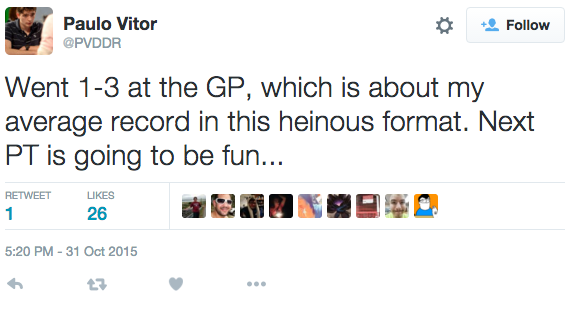
whiny pauloPaulo's petulance lands him firmly in the "toxic" camp. At GP Porto Alegre, he played Jeskai Twin, arguably the worst Twin variant in Modern. Instead of owning up to a poor decision, Paulo lashed out on Twitter, learned nothing, and continued to hate Modern. His unwillingness to learn how Modern works guarantees more failures. If he takes responsibility for his losses, he may come to enjoy this incredibly rich format.

Aside: I find this sort of saltiness especially destructive when it comes from hugely talented players like Paulo. Pros don't have an explicit obligation to promote good sportsmanship, but many players look up to them, and they do the community a great disservice by setting such an example.

Don't Get Tilted

Mark Nestico defines tilt as "what occurs after you experience something that jars you during or after a game and completely alters your state of mind, causing your thoughts to jumble, your attitude to change, and your emotions to do their best Hulkamania impression: they run wild, brother." In light of this definition, my suggestion not to get tilted might sound a little presumptuous. What authority do I have over your visceral emotions? What if you can't even stop yourself from descending into a fit of rage when you lose to Slivers?
Infectious RageOne painless way to not get tilted after losing is to analyze your games. The more you blame outside variables, the more upset you get and the worse you play over the course of an event (and a Magic career; old habits die hard!). Taking responsibility for mistakes opens the door to improvement, and discovering even part of why you lost will calm your nerves. You can at least have some confidence you won't repeat the same mistakes again.

Constantly analyzing the current game state can also prevent in-game tilting. Let's say you're flooding out as an opponent beats you with a flipped Delver. Chances are you have no control over your draws, so don't get upset about them - variance is a part of Magic, and one of the reasons we even play it over something like chess. It's far more productive to examine the game state each turn. When you pray for Lightning Bolt but topdeck land number six, instead of cursing and slamming your fist on the table, re-examine things. Try to think of all the cards in your deck that can save you. That sixth land opens up new outs for the future; Serum Visions into Snapcaster Mage targeting Electrolyze costs exactly six mana. The game state has also changed - now, you have one less turn to find an out, because Delver will attack for three more damage before your next draw step. This example is fairly straightforward, but when you have multiple lines available, continually appraising the game state often translates to the difference between winning and losing. Keeping you from psychotic fury is icing.

As Nestico describes, the tilt is governed by irrational emotions. Not getting tilted doesn't come naturally. Luckily, the work players put into overcoming this inclination pays them back tenfold.

4. Goals and Time Investment

Every Magic player has different goals. Each goal requires a certain amount of time and energy to attain, which varies between players. Establishing and meeting feasible goals sharpens your discipline while providing measurable ways to track improvements. Conversely, not having specific goals leads to unjustified disappointment.

Understand Your Goals and Budget Your Time

Do you want to stomp your longtime rival? Finally win an FNM? Cash a GP? Break into the pro circuit? Or become a renowned deckbuilder?

Misevaluating goals yields a wealth of misery, as players condemn themselves for Magic shortcomings. Truthfully, if you join ten dailies and lose them all, it's likely you just haven't played enough to realistically meet the goal of winning one. The same goes for more illustrious goals. In this game, time investment - whether spent reading, playing, discussing, or deckbuilding - directly equates to success. Sure, variance exists. But we see the same pro players doing well in so many events because they all sink enormous chunks of time into Magic.

Be Realistic About Your Priorities

Just as it's easy to attribute losses to bad draws, some players fall into the trap of blaming their schedules for an inability to meet Magic goals. Modern boasts a particularly diverse set of viable decks, and at a nine-round event like GP Pittsburgh, you could encounter any one of them. Nonetheless, "I don't have time to test all those matchups!" simply indicates that you're not prioritizing Magic. Not that there's anything wrong with that, but it's still toxic not to take responsibility for the way you spend your time. To remedy this issue, brainstorm how much time you have, the amount you're willing or able to allocate to Magic, and what goals you can reasonably achieve with that investment.

5. Money and Expected Value

Money's a touchy subject for everybody, not just for Magic players. It represents a fundamental dilemma: Wizards is a business that can't continue cranking out new expansions without moving product, but Magic is a game that would potentially evolve faster if players had unrestricted access to the extensive, expensive cardpool.

EV, or expected value, denotes the prospective monetary benefit of participating in a given event. Playing Magic does cost money, and I can understand a drive to hunt down events with high EV. Unfortunately, I think such efforts are misguided, and that the notion of EV does Magic players more harm than good.

Don't Quit Your Day Job

Magic is not a career. It's a hobby. Relative to other adult hobbies (golfing, playing poker, working out), it's not even an expensive hobby - if you don't believe me, Google the monthly fees at health clubs or rock-climbing gyms. Add up a few of those bills and you can buy yourself a top-tier Modern deck. Plus, players can use eBay to cash out at any time, and their collections and Modern staples steadily rise in price even while not in use. I'd like to see a rock-climbing gym that refunds all your money when you give it up.

Since Magic isn't a job, it's entirely unrealistic to expect the game to sustain you financially. Even "professional players" secure most of their Magic money writing for websites and wearing Face to Face t-shirts, and many return to 9-to-5s after a weekend GP. Winning first place at the Pro Tour, a seriously laudable accomplishment, pays a measly $40,000, the same as many entry-level salaried jobs. (For some loose context, first place at the International DOTA 2 Championships pays over five million dollars.)
Avarice TotemIt subsequently bewilders me when people stop playing at FNMs or going to qualifier tournaments because of "poor EV." Two weeks ago, a friend told me he was out. "It's five dollars entry, and they give you a pack. Then if you go 3-0, you win three more packs, or ten dollars in credit. So best-case scenario, I'm paying for packs, or just buying myself more FNM entries!" What did you expect, a check? Do you receive promo cleats every time you play in your soccer league? Or a rebate on your gym membership for breaking a deadlift PR? Of course not! We only earn packs for entering tournaments because stores need to compete with each other for our precious patronage, and it works in a store's favor to preoccupy us with EV.

Stop Dropping

Online retailers that also host events and publish articles, like StarCityGames and TCGPlayer, contribute to this unhealthy obsession with value. This obsession leads players to drop from events early and miss out on the game they came to play in the first place.
Dead DropI've had friends who look forward to playing Magic all week, then drop from FNM after losing the first round. Why did they come? To win three booster packs? There have got to be better ways to do that, like working minimum wage for one hour. Even stranger to me is when people drive five hours to a more competitive tournament, lose the first two rounds, and then drop. In doing so, these players deny themselves a golden opportunity to test their decks and skills against competent opponents in the highly competitive environment they enjoy enough to drive five hours for.

Coalition Victory

Crumble to Dust has all but replaced Sowing Salt in Modern sideboards, and it's time Magic players stopped sowing salt themselves. As toxic attitudes wane, the community becomes more accessible, causing an increase in players and heightened support for Modern. It's also important to me personally that everyone feels welcome. Hopefully, other players share that view, and we can work together to rid the game we love of negativity.


Jordan Boisvert

Jordan is Assistant Director of Content at Quiet Speculation and a longtime contributor to Modern Nexus. Best known for his innovations in Temur Delver and Colorless Eldrazi, Jordan favors highly reversible aggro-control decks and is always striving to embrace his biases when playing or brewing.

View More By Jordan Boisvert

Posted in Modern, Theory, TournamentsTagged , , , 15 Comments on Sowing Salt: Eliminating Toxic Attitudes

Have you joined the Quiet Speculation Discord?

If you haven't, you're leaving value on the table! Join our community of experts, enthusiasts, entertainers, and educators and enjoy exclusive podcasts, questions asked and answered, trades, sales, and everything else Discord has to offer.

Want to create content with Quiet Speculation?

All you need to succeed is a passion for Magic: The Gathering, and the ability to write coherently. Share your knowledge of MTG and how you leverage it to win games, get value from your cards – or even turn a profit.

Want Prices?

Browse thousands of prices with the first and most comprehensive MTG Finance tool around.


Trader Tools lists both buylist and retail prices for every MTG card, going back a decade.

Quiet Speculation