menu

September ’23 Modern Metagame Update: Getting Cheated

Are you a Quiet Speculation member?

If not, now is a perfect time to join up! Our powerful tools, breaking-news analysis, and exclusive Discord channel will make sure you stay up to date and ahead of the curve.

September marks the start of the first Modern qualifier season in a long time. In the Denver area, Modern RCQs are selling to store capacity and highly competitive, and it looks like we're not an exception. As such, there's a lot more data to pour through than normal. Not that it dramatically changed the outcome. Yes, that is extremely unsubtle foreshadowing.

Painfully Obvious

That Rakdos Scam was a statistical outlier was so painfully obvious that I didn't need to do any tests. It will make sense when you see the data. I did the tests anyway, to make sure that there weren't others. Not that I was actually expecting any others given the data. Having done this kind of thing for a long time, my intuition on outliers is pretty solid, but you can't ever skip on due diligence. Surprises happen.

As always, outliers are reported in their correct place on the metagame charts but were not included in the statistical analysis.

September Population Metagame

To make the tier list, a given deck has to beat the overall average population for the month. The average is my estimate for how many results a given deck "should" produce in a given month. Being a tiered deck requires being better than "good enough". Every deck that posts at least the average number of results is "good enough" and makes the tier list.

There was an error retrieving a chart for Grief

Then we go one standard deviation (STdev) above average to set the limit of Tier 3 and the cutoff for Tier 2. This mathematically defines Tier 3 as those decks clustered near the average. Tier 2 goes from the cutoff to the next standard deviation. These are decks that perform well above average. Tier 1 consists of those decks at least two standard deviations above the mean result, encompassing the truly exceptional performing decks.

The MTGO data nearly exclusively comes from official Preliminary and Challenge results. Leagues are excluded, as they are curated lists and thus invalid. The paper data comes from any source I can find, with all reported events being counted.

While the MTGO events report predictable numbers, paper events can report anything from only the winner to all the results. In the latter case, if match results aren't included, I'll take as much of the Top 32 as possible. If match results are reported, I'll take winning record up to Top 32, and then any additional decks tied with 32nd place, as tiebreakers are a magic most foul and black.

The MTGO Population Data

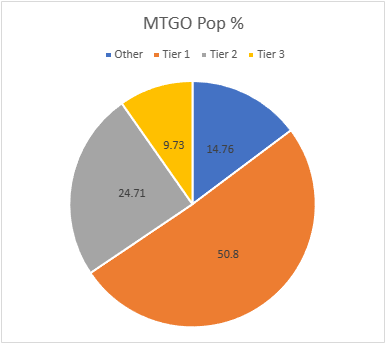
September's adjusted average population for MTGO was 9.24, setting the Tier 3 cutoff at 10 decks. I always round down if the decimal is less than .20. Tier 3, therefore, begins with decks posting 10 results. The adjusted STdev was 13.73, so add 14 and that means Tier 3 runs to 24 results. Again, it's the starting point to the cutoff, then the next whole number for the next Tier. Therefore Tier 2 starts with 25 results and runs to 39. Subsequently, to make Tier 1, 40 decks are required.

There was an error retrieving a chart for Orcish Bowmasters

September was a good month for data. January 2023 had 840 decks, February had 876, and March had a staggering 1,003 decks. April fell to 949 decks, May plummeted to 770 decks, and June surged to 918, while July topped out at 1086, while August fell to 724 decks. September made it back to 837 decks, Daybreak having added more events and changed prizes to attract more players.

The larger population didn't translate to more diversity, however. January had 74 unique decks, February had 84, and March mustered 88. April, May, June had 82 decks, July had 87 decks, while August had just 71. September is up to 75, which is bad given how high the population is. Worse, only 20 decks made population tier, less than in August. It actually makes sense given the data.

Deck Name Total #Total %
Tier 1
Rakdos Scam15318.28
4-Color Control546.45
Yawgmoth526.21
UR Murktide485.73
Living End445.26
Tier 2
Bring to Light384.54
Hardened Scales384.54
Hammer Time333.94
Temur Rhinos333.94
Amulet Titan313.70
Coffers303.58
Burn273.22
Tier 3
4-Color Rhinos232.75
Mono-Green Tron192.27
Wishshift172.03
4-Color Creativity161.91
Counter Cat141.67
UB Murktide121.43
Heliod Company111.31
UW Bean Control101.19
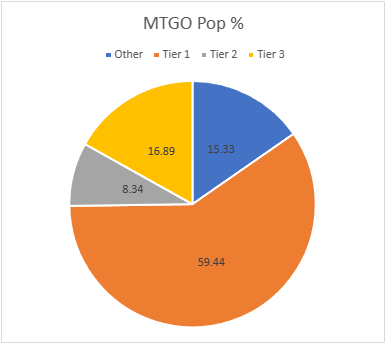
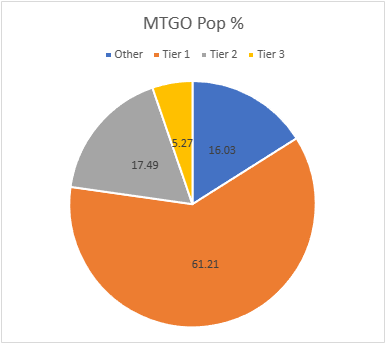
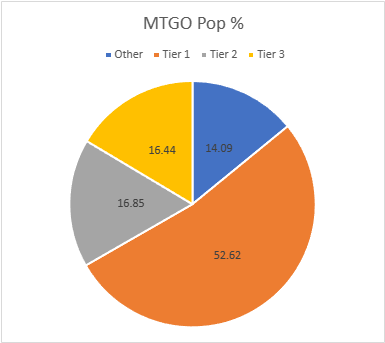
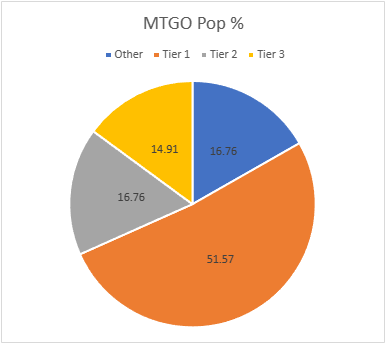
The Tier distribution is actually better than normal on MTGO.

I'm not really sure what to say. Scam being 18% of the online metagame, almost three times as much as its next nearest competitor is absurd. UR Murktide had its moments, but it never stood alone to such a degree. At minimum, Hammer Time was within range. This is a severe beating.
The Paper Population Data

Meanwhile in paper the population is up considerably. January saw 667 decks, February up to 807, March hit 962, April plunged to 551, May was up to 581, June was down 547, July surged to 671 decks, and August fell to 558. Thanks to the RCQ season, paper is up to 775 decks. There were fewer big events this month, but that was more than made up for by all the RCQs. Which was actually quite annoying for me, as most of them only reported their Top 8, and frequently much less. A lot of extra work for little gain.

There was an error retrieving a chart for Murktide Regent

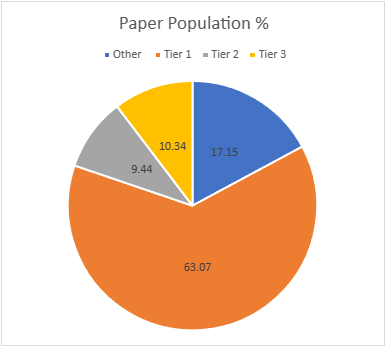
As with online, more decks meant more diversity, but not much more. January had 101 decks, February 108, March just 103, April down to 89, May was up to 102, June and July sat at 79, August made 77, and September is at 82. 19 decks made the tier list, the same as in August. It makes sense given the spread, but it's not a good look in any case. The adjusted average population was exactly 8, oddly enough. The adjusted STDev was 13.08, so the increment is 13. Therefore, Tier 3 runs from 8 to 21, Tier 2 is 22 to 35, and Tier 1 is 36 and over.

Deck Name Total #Total %
Tier 1
Rakdos Scam12716.39
UR Murktide506.45
4-Color Control496.32
Temur Rhinos476.07
Amulet Titan465.94
Yawgmoth445.68
Hammer Time415.29
Tier 2
Burn354.52
Mono-Green Tron314.00
Living End314.00
Jund Saga243.10
UB Murktide222.84
Tier 3
Bring to Light172.19
Coffers162.06
Counter Cat162.06
Hardened Scales141.81
4-Color Creativity131.68
Merfolk111.42
4-Color Rhinos81.03
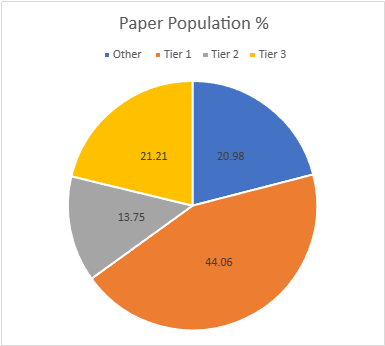
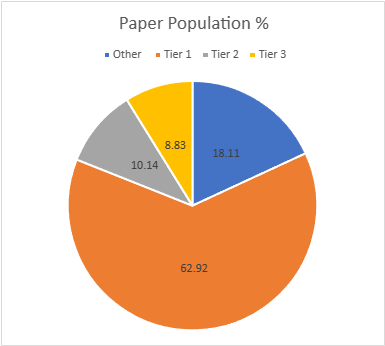
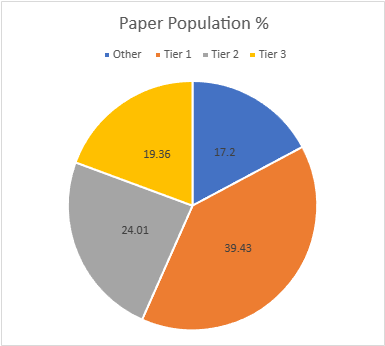
I think this is the first time that paper's Tier distribution is worse than MTGO's.

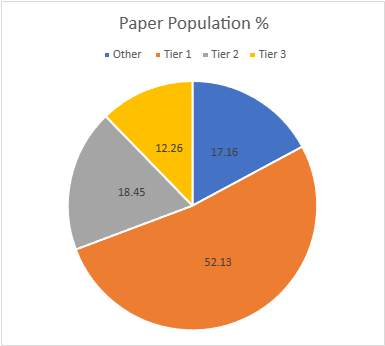
While Scam's domination of paper isn't quite as bad as it was online, it's very far removed from being good. Interestingly, paper isn't seeing the surge of Hardened Scales that MTGO did. I suspect that online's surge is a direct result of the consistently Scam dominated Challenges where paper is far more variable.

September Power Metagame

Tracking the metagame in terms of population is standard practice. But how do results actually factor in? Better decks should also have better results. In an effort to measure this, I use a power ranking system in addition to the prevalence list. By doing so, I measure the relative strengths of each deck within the metagame so that a deck that just squeaks into Top 32 isn't valued the same as one that Top 8's. This better reflects metagame potential.

There was an error retrieving a chart for Crashing Footfalls

For the MTGO data, points are awarded based on the population of the event. Preliminaries award points based on record (1 for 3 wins, 2 for 4 wins, 3 for 5), and Challenges are scored 3 points for the Top 8, 2 for Top 16, and 1 for Top 32. If I can find them, non-Wizards events will be awarded points the same as Challenges or Preliminaries depending on what the event in question reports/behaves like. Super Qualifiers and similar higher-level events get an extra point and so do other events if they’re over 200 players, with a fifth point for going over 400 players.

Due to paper reporting being inconsistent and frequently full of data gaps compared to MTGO, its points work differently. I award points based on the size of the tournament rather than placement. For events with no reported starting population or up to 32 players, one point is awarded to every deck. Events with 33 players up to 128 players get two points. From 129 players up to 512 players get three. Above 512 is four points, and five points will be reserved for Modern Pro Tours.

The MTGO Power Tiers

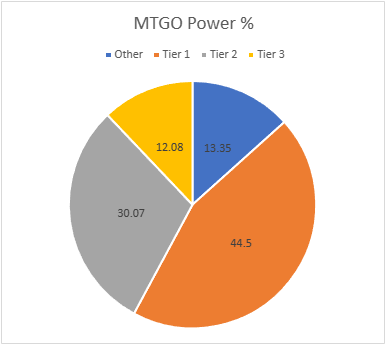
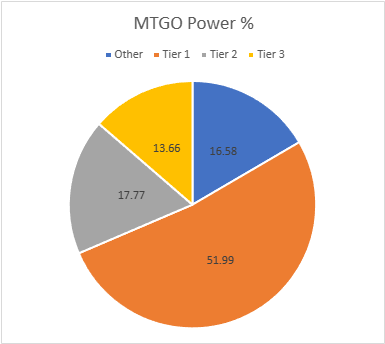
The higher population did yield more total points, though not as many more as I thought. Total points rose from 1116 to 1404 in September. The adjusted average points were 15.27, therefore 16 points made Tier 3. The adjusted STDev was 23.42, so add 24 to the starting point, and Tier 3 runs to 40 points. Tier 2 starts with 41 points and runs to 65. Tier 1 requires at least 66 points.

4-Color Rhinos just managed to jump up a tier. Meanwhile, UW Bean Control fell from the power tier, replaced by Twiddle Breach Combo and Jeskai Combo Breach.

Deck Name Total PointsTotal %
Tier 1
Rakdos Scam27419.52
4-Color Control986.98
Yawgmoth916.48
UR Murktide765.41
Living End725.12
Tier 2
Hardened Scales644.56
Amulet Titan594.20
Coffers584.13
Bring to Light574.06
Hammer Time523.70
Temur Rhinos453.20
Burn453.20
4-Color Rhinos422.99
Tier 3
Wishshift322.28
Mono-Green Tron312.21
Counter Cat261.85
4-Color Creativity231.64
UB Murktide201.42
Twiddle Breach Combo181.28
Heliod Company171.21
Jeskai Combo Breach171.21
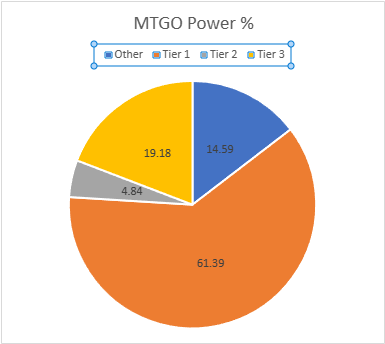
With Scam taking up so much Challenge space, it was inevitable that the low tiers be squeezed further.

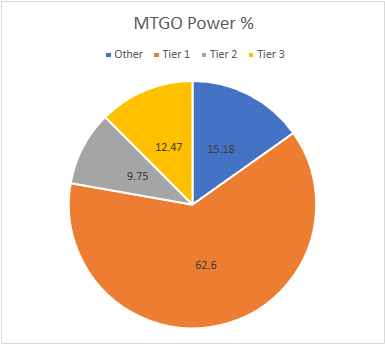
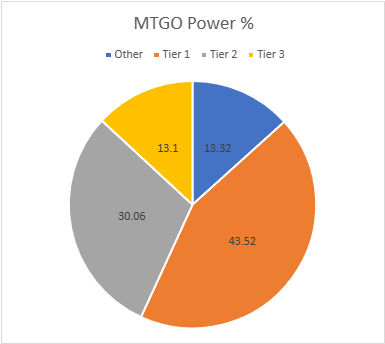
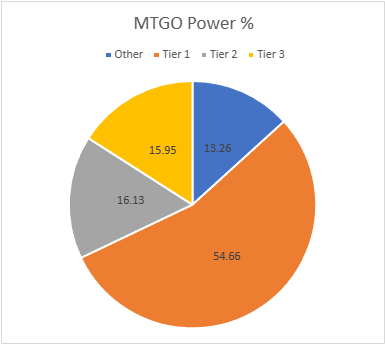
If 18% of the population is bad, almost 20% of the points is worse. I'm slightly encouraged by the size of Tier 2, but this being the third month of Scam being such an outlier isn't instilling confidence.

The Paper Power Tiers

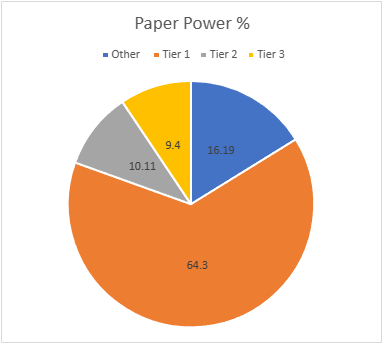
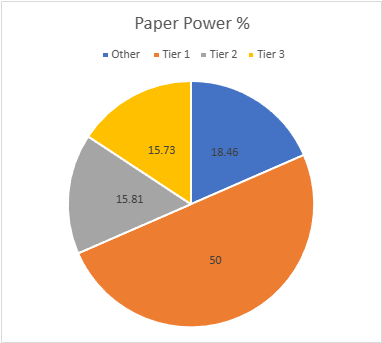
As with MTGO, paper's points are up, and this time it's considerably higher. August only managed 931 points but September sees 1412, more than MTGO for the first time ever. The decently sized RCQs earning 2 points are the cause. The adjusted average points were 14.36, setting the cutoff at 15 points. The STDev was 23.96, thus adding 24 to the starting point and Tier 3 runs to 39 points. Tier 2 starts with 40 points and runs to 64. Tier 1 requires at least 65 points. 4-Color Rhinos fell off and wasn't replaced by anything.

Deck Name Total PointsTotal %
Tier 1
Rakdos Scam24917.63
4-Color Control916.44
Amulet Titan896.30
UR Murktide856.02
Hammer Time845.95
Temur Rhinos795.59
Yawgmoth795.59
Burn694.89
Tier 2
Mono-Green Tron553.90
Living End533.75
Jund Saga453.19
UB Murktide402.83
Tier 3
Counter Cat292.05
Bring to Light261.84
Coffers261.84
Hardened Scales251.77
4-Color Creativity241.70
Merfolk201.42
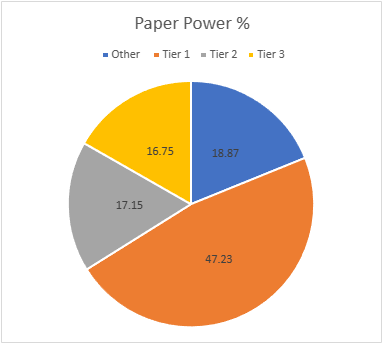
This metagame is not well.

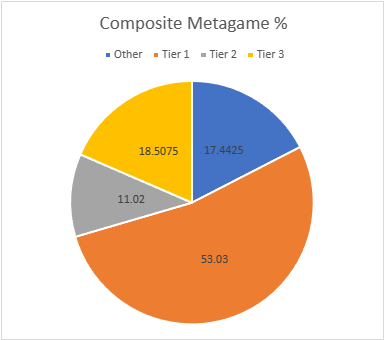
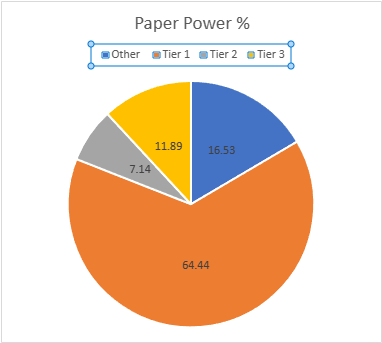
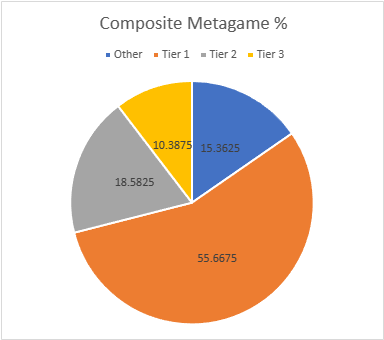
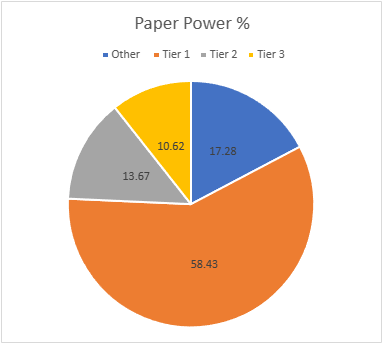
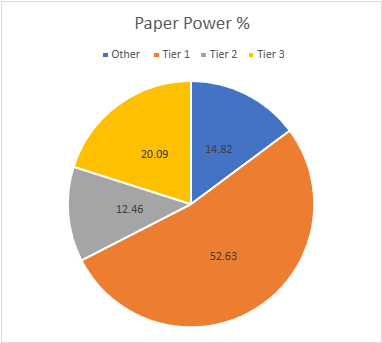
Between Scam's higher percentage and Burn jumping up a tier, Tier 1 accounted for almost 60% of the total results. That's never happened before, and paper is normally the more equitable play medium.

Composite Metagame

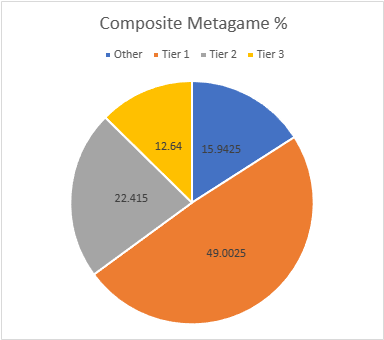
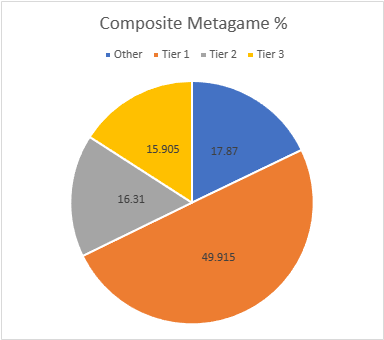
That's a lot of data, but what does it all mean? When Modern Nexus was first started, we had a statistical method to combine the MTGO and paper data, but the math of that system doesn't work without big paper events. I tried. Instead, I'm using an averaging system to combine the data. I take the MTGO results and average the tier, then separately average the paper results, then average the paper and MTGO results together for final tier placement.

This generates a lot of partial Tiers. That's not a bug, but a feature. The nuance separates the solidly Tiered decks from the more flexible ones and shows the true relative power differences between the decks. Every deck in the paper and MTGO results is on the table, and when they don't appear in a given category, they're marked N/A. This is treated as a 4 for averaging purposes.

Deck Name MTGO Pop TierMTGO Power TierMTGO Average TierPaper Pop TierPaper Power TierPaper Average Tier Composite Tier
Rakdos Scam1111111.00
4-Color Control1111111.00
Yawgmoth1111111.00
UR Murktide1111111.00
Living End1112221.50
Hammer Time2221111.50
Temur Rhinos2221111.50
Amulet Titan2221111.50
Burn222211.51.75
Bring to Light2223332.50
Hardened Scales2223332.50
Coffers2223332.50
Mono-Green Tron3332222.50
UB Murktide3332222.50
4-Color Rhinos322.53N/A3.53.00
4-Color Creativity3333333.00
Counter Cat3333333.00
Jund SagaN/AN/AN/A2223.00
Wishshift333N/AN/AN/A3.50
Heliod Company333N/AN/AN/A3.50
MerfolkN/AN/AN/A3333.50
UW Bean Control3N/A3.5N/AN/AN/A3.75
Twiddle Breach ComboN/A33.5N/AN/AN/A3.75
Jeskai Combo BreachN/A33.5N/AN/AN/A3.75

Average Power Rankings

Finally, we come to the average power rankings. These are found by taking the total points earned and dividing them by total decks, to measure points per deck. I use this to measure strength vs. popularity. Measuring deck strength is hard. There is no Wins-Above-Replacement metric for Magic, and I'm not certain that one could be credibly devised. The game is too complex, and even then, power is very contextual.

Using the power rankings certainly helps and serves to show how justified a deck’s popularity is. However, more popular decks will still necessarily earn a lot of points. Therefore, the top tier doesn't move much between population and power and obscures whether its decks really earned their position. 

There was an error retrieving a chart for Ragavan, Nimble Pilferer

This is where the averaging comes in. Decks that earn a lot of points because they get a lot of results will do worse than decks that win more events, indicating which deck actually performs better.

A higher average indicates lots of high finishes, whereas low averages result from mediocre performances and a high population. Lower-tier decks typically do very well here, likely due to their pilots being enthusiasts. Bear this in mind and be careful about reading too much into these results. However, as a general rule, decks that place above the baseline average are over-performing, and vice versa.

How far above or below that average a deck sits justifies its position on the power tiers. Decks well above baseline are undervalued, while decks well below baseline are very popular, but aren't necessarily good.

The Real Story

When considering the average points, the key is looking at how far off a deck is from the Baseline stat (the overall average of points/population). The closer a deck’s performance to the Baseline, the more likely it is to be performing close to its "true" potential.

A deck that is exactly average would therefore perform exactly as well as expected. The greater the deviation from the average, the more a deck under or over-performs. On the low end, a deck’s placing was mainly due to population rather than power, which suggests it’s overrated. A high-scoring deck is the opposite of this.

I'll begin with the averages for MTGO

Deck Name Average PointsPower Tier
Jeskai Combo Breach2.433
Twiddle Breach Combo2.003
Coffers1.932
Amulet Titan1.902
Wishshift1.883
Counter Cat1.863
4-Color Rhinos1.832
4-Color Control1.811
Rakdos Scam1.791
Yawgmoth1.751
Hardened Scales1.682
Burn1.672
UB Murktide1.673
Living End1.641
Mono-Green Tron1.633
UR Murktide1.581
Hammer Time1.572
Heliod Company1.553
Baseline1.50
Bring to Light1.502
4-Color Creativity1.443
Temur Rhinos1.362

As the highest placing Tier 1 deck, 4-Color Control is officially the MTGO Deck of September. I hope its players actually know how to win within time limits.

Now the paper averages:

Deck Name Total PointsPower Tier
Hammer Time2.051
Burn1.971
Rakdos Scam1.961
Amulet Titan1.931
Jund Saga1.882
4-Color Control1.861
4-Color Creativity1.853
UB Murktide1.822
Merfolk1.823
Counter Cat1.813
Yawgmoth1.801
Hardened Scales1.793
Mono-Green Tron1.772
Baseline1.75
Living End1.712
UR Murktide1.701
Temur Rhinos1.681
Coffers1.633
Bring to Light1.533

In a surprise, Hammer Time takes the crown for paper. I'll need to start packing Deflecting Palm again.

Analysis

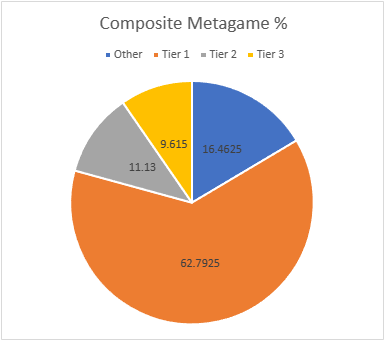
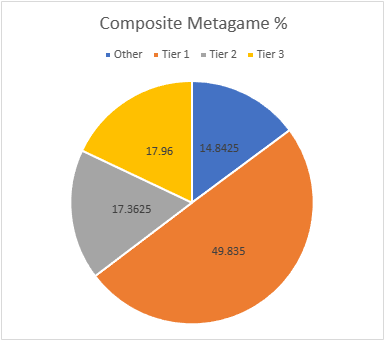
No matter how it's sliced, the metagame pie is horribly distributed towards Rakdos Scam. The number of The One Ring decks at the top of the standings is notable, but it's incredibly small potatoes compared to what Scam is doing. The metagame is pretty clearly Scam's plaything in a way that it really wasn't for Murktide. It's outperforming everything else at every stage of the game.

There was an error retrieving a chart for Dauthi Voidwalker

The question for me is why this didn't happen sooner. Scam has always had "oops, I win" appeal, similar to Hammer Time. However, its namesake combo was never as consistent has Hammer's, and so it didn't take off until relatively recently. It had a very strong grind plan thanks to Seasoned Pyromancer and/or Fable of the Mirror-Breaker // Reflection of Kiki-Jiki. The addition of Orcish Bowmasters saw the deck skyrocket, but I don't think that's the whole story.

Bridging the Gap

Prior to Bowmasters Scam was a deck, but it was quite inconsistent. I'd be high Tier 1 one-month, mid-Tier 2 the next, then back to low Tier 1 ad nauseam. The deck had two solid plans, but they weren't connected by anything. The Scam plan all cost one mana or less, the grind plan was all three mana or more. There was no bridge connecting the two plans besides Dauthi Voidwalker, and the deck was strongly boom or bust. Bowmasters extended the grind plan down the curve and smoothed the deck.

There was an error retrieving a chart for The One Ring

However, even with that, it's likely that Scam would have remained just a player rather than dominating force except for the wider metagame context. Bowmasters is one of the few ways to punish The One Ring and Up the Beanstalk in Modern, and the only one that players are willing to widely play. The proliferation of card draw has pushed Scam as the answer to the 4-Color grindy decks, and so long as that remains the case, this metagame warp is likely to continue.

Market Movements

Wizards said in the August Ban Announcement that they knew that Bowmasters and Ring were problem cards. They just didn't want to take action one month after they released, almost certainly because they'd already ordered several more print runs of Tales of Middle Earth. They also said that they'd be more amenable to making changes to non-Standard formats in their post-release windows, with the next one being October 16.

I can't imagine Wizards not taking action in Modern on the 16th. Then again, I've been saying that the absurd outliers I've catalogued for the past two years need addressing and Wizards has proved stubbornly aloof. The only thing that will substantially shake the markets in October will be a ban announcement.

In the event of a ban, Rakdos Scam and Ring decks will be the most likely targets. Bowmasters itself is likely safe, but The One Ring definitely isn't. I'd peg Ring, Ragavan, Nimble Pilferer, and Fury as the most likely targets. Winners of a likely ban are one-toughness creatures, Urza's Saga, and Indomitable Creativity. Plan accordingly.

August ’23 Modern Metagame Update: The Unban’s Effect

Are you a Quiet Speculation member?

If not, now is a perfect time to join up! Our powerful tools, breaking-news analysis, and exclusive Discord channel will make sure you stay up to date and ahead of the curve.

August was... unexpected. Wizards threw everyone off with their Ban Day decisions. Bans were expected in Standard (based on Wizards' own statements) and hoped for in multiple other formats. Instead, Modern and Legacy saw unbans. The impact this has had will be on display in this metagame update.

Continuing Outliers

Rakdos Scam remains a clear and unequivocal outlier on Magic Online (MTGO). It is joined there by UR Murktide, which apparently didn't take kindly to being knocked down to the bottom of Tier 1 last month. As you'll see in the data, there was never really any doubt.

In paper, Scam remains an outlier, but just barely. It just crossed the statistical line to qualify, which is a bit odd as paper has a ridiculously long tail in August. Singleton deck always make up the largest chunk of the population, usually up to a third of results. 48% of paper's entries were singletons in August, which is incredibly high. It was only 29% on MTGO.

As always, outliers are reported in their correct place on the metagame charts but were not included in the statistical analysis.

August Population Metagame

To make the tier list, a given deck has to beat the overall average population for the month. The average is my estimate for how many results a given deck "should" produce in a given month. Being a tiered deck requires being better than "good enough". Every deck that posts at least the average number of results is "good enough" and makes the tier list.

There was an error retrieving a chart for The One Ring

Then we go one standard deviation (STdev) above average to set the limit of Tier 3 and the cutoff for Tier 2. This mathematically defines Tier 3 as those decks clustered near the average. Tier 2 goes from the cutoff to the next standard deviation. These are decks that perform well above average. Tier 1 consists of those decks at least two standard deviations above the mean result, encompassing the truly exceptional performing decks.

The MTGO data nearly exclusively comes from official Preliminary and Challenge results. Leagues are excluded, as they are curated lists and thus invalid. The paper data comes from any source I can find, with all reported events being counted.

While the MTGO events report predictable numbers, paper events can report anything from only the winner to all the results. In the latter case, if match results aren't included, I'll take as much of the Top 32 as possible. If match results are reported, I'll take winning record up to Top 32, and then any additional decks tied with 32nd place, as tiebreakers are a magic most foul and black.

The MTGO Population Data

In August, the adjusted average population for MTGO was 7.59, setting the Tier 3 cutoff at 8 decks. I always round down if the decimal is less than .20. Tier 3, therefore, begins with decks posting 8 results. The adjusted STdev was 10.65, so add 11 and that means Tier 3 runs to 19 results. Again, it's the starting point to the cutoff, then the next whole number for the next Tier. Therefore Tier 2 starts with 20 results and runs to 31. Subsequently, to make Tier 1, 32 decks are required.

There was an error retrieving a chart for Orcish Bowmasters

August reversed the upward trend in the population. January 2023 had 840 decks, February had 876, and March had a staggering 1,003 decks. April fell to 949 decks, May plummeted to 770 decks, and June surged to 918, while July toped them all with 1086 decks. August fell to 724 decks, the lowest mark this year.

The cause was fewer extra events and smaller Preliminaries, but the unbanning was also a factor. I decided to treat the unban the same as I would a banning and threw out the pre-August 7th data. That said, even if I hadn't, the population numbers would still be down considerably.

A smaller population means less diversity. January had 74 unique decks, February had 84, and March mustered 88. April, May, and June had 82 decks. July it 87 decks, while August had just 71. Of the 71 decks, 21 still made the population tier, same as July. Whether this is a sign of evolution or just how restricted the July metagame was is up for debate.

Deck NameTotal #Total %
Tier 1
Rakdos Scam11215.47
UR Murktide8812.15
Temur Rhinos466.35
Burn395.39
Hammer Time324.42
Yawgmoth324.42
Amulet Titan324.42
Tier 2
Jund Saga304.14
4-Color Control253.45
UB Murktide243.31
Mono-Green Tron223.04
Living End222.90
Tier 3
4-Color Rhinos172.35
Counter Cat162.21
4-Color Creativity152.07
UW Control152.07
Grixis Shadow141.93
Izzet Prowess121.66
Mill111.52
Coffers101.38
UW Urzablade91.24
Thanks to Rakdos and Murktide, Tier 1's concentration increased in August.

The Paper Population Data

Meanwhile in paper, January saw 667 decks, February up to 807, March hit 962, April plunged to 551, May was up to 581, June was down 547, July surged to 671 decks, and August fell considerably to 558. No Pro Tour or Star City Games events were contributing factors, but I saw very few events reporting more than the Top 8 in August. That's just how it is with the paper data.

There was an error retrieving a chart for Murktide Regent

Lower population equals lower deck diversity, but not much lower. January had 101 decks, February 108, March just 103, April down to 89, May was up to 102, June and July sat at 79, while August made 77. Only 19 decks made the tier list, down slightly just like the diversity. The adjusted average population was 6.55, so seven decks make Tier 3. The adjusted STDev was 10.69, so the increment is 11. Therefore, Tier 3 runs from 7 to 18, Tier 2 is 19 to 30, and Tier 1 is 31 and over.

Deck NameTotal #Total %
Tier 1
Rakdos Scam6010.75
Temur Rhinos519.14
Mono-Green Tron417.35
Burn376.63
4-Color Control315.56
Tier 2
Hammer Time305.38
Living End285.02
Amulet Titan285.02
UR Murktide244.30
Jund Saga244.30
Tier 3
Yawgmoth173.05
Grixis Shadow142.51
UB Murktide142.51
4-Color Creativity132.33
Merfolk132.33
UW Control111.97
Hardened Scales111.97
Coffers81.43
Jeskai Combo Breach71.25
Population concentration is much lower thanks to the data's very long tail.

August Power Metagame

Tracking the metagame in terms of population is standard practice. But how do results actually factor in? Better decks should also have better results. In an effort to measure this, I use a power ranking system in addition to the prevalence list. By doing so, I measure the relative strengths of each deck within the metagame so that a deck that just squeaks into Top 32 isn't valued the same as one that Top 8's. This better reflects metagame potential.

There was an error retrieving a chart for Crashing Footfalls

For the MTGO data, points are awarded based on the population of the event. Preliminaries award points based on record (1 for 3 wins, 2 for 4 wins, 3 for 5), and Challenges are scored 3 points for the Top 8, 2 for Top 16, and 1 for Top 32. If I can find them, non-Wizards events will be awarded points the same as Challenges or Preliminaries depending on what the event in question reports/behaves like. Super Qualifiers and similar higher-level events get an extra point and so do other events if they’re over 200 players, with a fifth point for going over 400 players.

Due to paper reporting being inconsistent and frequently full of data gaps compared to MTGO, its points work differently. I award points based on the size of the tournament rather than placement. For events with no reported starting population or up to 32 players, one point is awarded to every deck. Events with 33 players up to 128 players get two points. From 129 players up to 512 players get three. Above 512 is four points, and five points will be reserved for Modern Pro Tours.

The MTGO Power Tiers

A lower population necessarily means lower points. Total points fell from 1767 to 1116 in August. The adjusted average points were 11.48, therefore 12 points made Tier 3. The adjusted STDev was 16.61, so add 17 to the starting point, and Tier 3 runs to 29 points. Tier 2 starts with 30 points and runs to 47. Tier 1 requires at least 48 points.

While there was some movement inside the tiers, no deck fell out or moved tier. It would seem that the MTGO players have made up their minds about the viable decks.

Deck NameTotal PointsTotal %
Tier 1
Rakdos Scam17916.04
UR Murktide14512.99
Temur Rhinos766.81
Burn575.11
Amulet Titan544.84
Yawgmoth514.57
Hammer Time484.30
Tier 2
Jund Saga454.03
UB Murktide363.23
4-Color Control353.14
Mono-Green Tron343.05
Living End302.69
Tier 3
4-Color Rhinos282.51
Counter Cat242.15
4-Color Creativity221.97
UW Control221.97
Grixis Shadow191.70
Mill181.61
Izzet Prowess161.43
Coffers151.34
UW Urzablade141.25
As usual, the power rankings are even more concentrated, and 2.41% higher than in July.

The Paper Power Tiers

As with MTGO, paper's points are down considerably. January had 1178 points, February hit 1316, March shot to 1890, April fell to 964, May hit 1098, June reached 1208, July hit 1428, but August only managed 931. It could never match July's total, but to be the lowest of the year is shocking. The adjusted average points were 10.84, setting the cutoff at 11 points. The STDev was 18.74, thus adding 19 to the starting point and Tier 3 runs to 30 points. Tier 2 starts with 31 points and runs to 50. Tier 1 requires at least 51 points. The number of decks stayed the same, but two decks just jumped from Tier 2 to Tier 1.

Deck NameTotal PointsTotal %
Tier 1
Rakdos Scam10711.49
Temur Rhinos9810.53
Mono-Green Tron687.30
4-Color Control596.34
Burn566.01
Hammer Time515.48
Amulet Titan525.48
Tier 2
Living End424.51
UR Murktide384.08
Jund Saga363.87
Tier 3
Yawgmoth303.22
Grixis Shadow283.01
UB Murktide232.47
Merfolk222.36
4-Color Creativity212.26
Hardened Scales192.04
Jeskai Combo Breach161.72
UW Control141.50
Coffers141.50
The concentration is much worse when power is considered, but it's down 12.85% points from July.

Composite Metagame

That's a lot of data, but what does it all mean? When Modern Nexus was first started, we had a statistical method to combine the MTGO and paper data, but the math of that system doesn't work without big paper events. I tried. Instead, I'm using an averaging system to combine the data. I take the MTGO results and average the tier, then separately average the paper results, then average the paper and MTGO results together for final tier placement.

This generates a lot of partial Tiers. That's not a bug, but a feature. The nuance separates the solidly Tiered decks from the more flexible ones and shows the true relative power differences between the decks. Every deck in the paper and MTGO results is on the table, and when they don't appear in a given category, they're marked N/A. This is treated as a 4 for averaging purposes.

Deck NameMTGO Pop TierMTGO Power TierMTGO Average TierPaper Pop TierPaper Power TierPaper Average TierComposite Tier
Rakdos Scam1111111.00
Temur Rhinos1111111.00
Burn1111111.00
Hammer Time111211.51.25
Amulet Titan111211.51.25
UR Murktide1112221.50
4-Color Control2221111.50
Mono-Green Tron2221111.50
Yawgmoth1113332.00
Jund Saga2222222.00
Living End2222222.00
UB Murktide2223332.50
4-Color Creativity3333333.00
UW Control3333333.00
Grixis Shadow3333333.00
Coffers3333333.00
4-Color Rhinos333N/AN/AN/A3.50
Counter Cat333N/AN/AN/A3.50
Izzet Prowess333N/AN/AN/A3.50
Mill333N/AN/AN/A3.50
UW Urzablade333N/AN/AN/A3.50
MerfolkN/AN/AN/A3333.50
Hardened ScalesN/AN/AN/A3333.50
Jeskai Combo BreachN/AN/AN/A3333.50
The overall picture is better than the individual ones, but it's not what I'd consider good, either.

It's strange to consider, but the number of Tier 1 decks fell in August. There were seven pure Tier 1's in July plus two in partial tiers compared to August's three pure Tier 1's and five partials. Whether this is an anomaly or represents a narrowing of the metagame is too early to say.

Average Power Rankings

Finally, we come to the average power rankings. These are found by taking the total points earned and dividing them by total decks, to measure points per deck. I use this to measure strength vs. popularity. Measuring deck strength is hard. There is no Wins-Above-Replacement metric for Magic, and I'm not certain that one could be credibly devised. The game is too complex, and even then, power is very contextual.

Using the power rankings certainly helps and serves to show how justified a deck’s popularity is. However, more popular decks will still necessarily earn a lot of points. Therefore, the top tier doesn't move much between population and power and obscures whether its decks really earned their position. 

There was an error retrieving a chart for Goblin Guide

This is where the averaging comes in. Decks that earn a lot of points because they get a lot of results will do worse than decks that win more events, indicating which deck actually performs better.

A higher average indicates lots of high finishes, whereas low averages result from mediocre performances and a high population. Lower-tier decks typically do very well here, likely due to their pilots being enthusiasts. Bear this in mind and be careful about reading too much into these results. However, as a general rule, decks that place above the baseline average are over-performing, and vice versa.

How far above or below that average a deck sits justifies its position on the power tiers. Decks well above baseline are undervalued, while decks well below baseline are very popular, but aren't necessarily good.

The Real Story

When considering the average points, the key is looking at how far off a deck is from the Baseline stat (the overall average of points/population). The closer a deck’s performance to the Baseline, the more likely it is to be performing close to its "true" potential.

A deck that is exactly average would therefore perform exactly as well as expected. The greater the deviation from the average, the more a deck under or over-performs. On the low end, a deck’s placing was mainly due to population rather than power, which suggests it’s overrated. A high-scoring deck is the opposite of this.

I'll begin with the averages for MTGO

Deck NameAverage PointsPower Tier
Amulet Titan1.691
UR Murktide1.651
Temur Rhinos1.651
4-Color Rhinos1.653
Mill1.643
Rakdos Scam1.601
Yawgmoth1.591
UW Urzablade1.563
Mono-Green Tron1.542
Hammer Time1.501
Jund Saga1.502
UB Murktide1.502
Counter Cat1.503
Coffers1.503
Baseline1.49
4-Color Creativity1.473
UW Control1.473
Burn1.461
Living End1.432
4-Color Control1.402
Grixis Shadow1.363
Izzet Prowess1.333

In an unexpected move, as the top placing Tier 1 deck, Amulet Titan is the MTGO Deck of August. It's also the best overall performer which has never happened before. It's usually a Tier 3 on top.

Now the paper averages:

Deck NameAverage PointsPower Tier
Jeskai Combo Breach2.283
Grixis Shadow2.003
Temur Rhinos1.921
4-Color Control1.901
Amulet Titan1.821
Rakdos Scam1.781
Yawgmoth1.763
Coffers1.753
Hardened Scales1.723
Hammer Time1.701
Merfolk1.693
Mono-Green Tron1.661
UB Murktide1.643
4-Color Creativity1.613
UR Murktide1.582
Burn1.511
Living End1.502
Jund Saga1.502
Baseline1.41
UW Control1.273

Meanwhile in paper, Temur Rhinos is Deck of <Month> for the second time in a row. This might be hangover from July, or it could be indicative of the upcoming RCQ season.

Analysis

The first month post-Preordain unban gives a mixed review on its impact. Wizards specifically mentioned wanting to boost UR Murktide after it fell off thanks to Orcish Bowmasters. That's worked on MTGO, where it moved from the bottom of Tier 1 to being an outlier. Again. However, it did nothing for UB Murktide online, and both Murktide decks continue to fall in paper.

Indeed, across the board the impact of Preordain is quite muted. Many decks have adopted Preordain, and players are quite thrilled to have it available. However, Preordain decks aren't doing measurably better in August than in July, according to my data. This isn't entirely surprising, as when I tested Preordain years ago I concluded that it was fine for Modern and not much better than Sleight of Hand.

It is possible that this will change in September. The Modern RCQ season may drive innovation and discovery, which could in turn cause a shakeup. There will be some impact from Wilds of Eldraine (WOE) to consider as well. However, it is equally possible that players just play established decks rather than take the risk with something new. We have to wait and see.

Market Movements

The headline card in WOE is Beseech the Mirror, which should actually be Beseech The One Ring. A tutor that casts cards for the incredibly small price of a food or treasure token is going to see lots of play on the assumption it's busted. I don't know if it actually is or not, but I expect Coffers to see an uptick regardless. Scam is also boosted by Not Dead After All, but that's a comparative drop in the bucket.

There was an error retrieving a chart for Beseech the Mirror

The other impact from WOE will be on Urza, Lord High Artificer. Candy Trail is exactly the sort of card that Urza loves, and that fact that it's findable off Urza's Saga is a huge plus. Urza has strongly missed Arcum's Astrolabe, and Candy Trail is as close a replacement as we're ever likely to get. I'd expect an uptick, possibly a strong one.

Other than that, September is the start of Modern RCQ season. Smart investors have already filled their stocks of Modern staples, but there will be opportunities to profit as decks rise and fall in popularity over the next few months. Keep your eyes open.

July ’23 Metagame Update: The Pro Tour Effect

Are you a Quiet Speculation member?

If not, now is a perfect time to join up! Our powerful tools, breaking-news analysis, and exclusive Discord channel will make sure you stay up to date and ahead of the curve.

Well, that was quite a weekend. After the first Modern Pro Tour in a while, opinions are flying fast and furiously over the state of the format. Which means that it's time for me to quench and/or throw gas on the fire with the Modern Metagame Update.

The Obvious Outlier

To the surprise of no one mildly aware of Modern right now, Rakdos Scam is a statistical outlier in both paper and Magic Online (MTGO). By a very wide margin. In paper it is joined by 4-Color Control, but no other deck hit the thresholds online. It won't be very surprising upon seeing the data. As always, outliers are reported in their correct place on the metagame charts but were not included in the statistical analysis.

June Population Metagame

To make the tier list, a given deck has to beat the overall average population for the month. The average is my estimate for how many results a given deck "should" produce in a given month. Being a tiered deck requires being better than "good enough". Every deck that posts at least the average number of results is "good enough" and makes the tier list.

There was an error retrieving a chart for Ragavan, Nimble Pilferer

Then we go one standard deviation (STdev) above average to set the limit of Tier 3 and the cutoff for Tier 2. This mathematically defines Tier 3 as those decks clustered near the average. Tier 2 goes from the cutoff to the next standard deviation. These are decks that perform well above average. Tier 1 consists of those decks at least two standard deviations above the mean result, encompassing the truly exceptional performing decks.

The MTGO data nearly exclusively comes from official Preliminary and Challenge results. Leagues are excluded, as they are curated lists and thus invalid. The paper data comes from any source I can find, with all reported events being counted. While the MTGO events report predictable numbers, paper events can report anything from only the winner to all the results. In the latter case, if match results aren't included, I'll take as much of the Top 32 as possible. If match results are reported, I'll take winning record up to Top 32, and then any additional decks tied with 32nd place, as tiebreakers are a magic most foul and black.

The MTGO Population Data

In July, the adjusted average population for MTGO was 10.77, setting the Tier 3 cutoff at 11 decks. I always round down if the decimal is less than .20. Tier 3, therefore, begins with decks posting 11 results. The adjusted STdev was 18.07, so add 18 and that means Tier 3 runs to 29 results. Again, it's the starting point to the cutoff, then the next whole number for the next Tier. Therefore Tier 2 starts with 30 results and runs to 48. Subsequently, to make Tier 1, 49 decks are required.

There was an error retrieving a chart for Fury

June represents a turnaround for the data. January 2023 had 840 decks, February had 876, and March had a staggering 1,003 decks. April fell to 949 decks, May plummeted to 770 decks, and June surged to 918. July tops them all with 1086 decks. The extended All-Access Pass (intended to help with Pro Tour testing) is almost certainly behind this surge.

However, the extra population doesn't mean more diversity. January had 74 unique decks, February had 84, and March mustered 88. April, May, and June had 82 decks. July just passed June's mark with 87 decks, despite a much higher population. Of the 87 decks, only 21 made the population tier, which is up from June but down from the yearly average.

Deck NameTotal #Total %
Tier 1
Rakdos Scam16014.73
Burn756.91
Mono-Green Tron746.81
4-Color Control696.35
Yawgmoth686.26
Living End605.52
UR Murktide544.97
Tier 2
UB Murktide433.96
4-Color Creativity383.50
Temur Rhinos343.13
Amulet Titan343.13
Hammer Time333.04
Tier 3
Grixis Shadow292.67
UW Control272.49
Coffers191.75
Jeskai Combo Breach181.66
Counter Cat181.66
Sam Combo131.20
Wrenn White and Blue131.20
Jund Saga131.20
Hardened Scales121.10
Not much room for anything but Tier 1 anymore.

The Paper Population Data

January saw 667 decks, February is up to 807, March hit 962, April plunged to 551, May was up to 581, and June was down 547. Thanks to Pro Tour Barcelona, July is up to 671 decks. As I said, paper data is highly variable.

There was an error retrieving a chart for Sigarda's Aid

However, that increased population didn't equate to greater deck diversity. Quite the opposite, actually. January had 101 decks, February 108, March just 103, April down to 89, May was up to 102, and June fell to 79, a mark matched by July. Only 20 decks made the tier list, which is down just like the diversity. The adjusted average population was 6.79, so seven decks make Tier 3. The adjusted STDev was 10.34, so the increment is 11. Therefore, Tier 3 runs from 7 to 18, Tier 2 is 19 to 30, and Tier 1 is 31 and over.

Deck Name Total #Total %
Tier 1
Rakdos Scam9213.71
4-Color Control568.35
Living End436.41
Mono-Green Tron405.96
Hammer Time375.51
Yawgmoth375.51
Burn324.77
UR Murktide314.62
Tier 2
4-Color Creativity284.17
Temur Rhinos263.87
Amulet Titan243.58
Tier 3
Grixis Shadow182.68
Jeskai Combo Breach131.94
Coffers111.64
UW Control111.64
Merfolk91.34
UB Murktide81.19
Rakdos Rock71.04
Counter Cat71.04
Hardened Scales71.04
That's worse. Usually, paper is more egalitarian.

March Power Metagame

Tracking the metagame in terms of population is standard practice. But how do results actually factor in? Better decks should also have better results. In an effort to measure this, I use a power ranking system in addition to the prevalence list. By doing so, I measure the relative strengths of each deck within the metagame so that a deck that just squeaks into Top 32 isn't valued the same as one that Top 8's. This better reflects metagame potential.

There was an error retrieving a chart for Living End

For the MTGO data, points are awarded based on the population of the event. Preliminaries award points based on record (1 for 3 wins, 2 for 4 wins, 3 for 5), and Challenges are scored 3 points for the Top 8, 2 for Top 16, and 1 for Top 32. If I can find them, non-Wizards events will be awarded points the same as Challenges or Preliminaries depending on what the event in question reports/behaves like. Super Qualifiers and similar higher-level events get an extra point and so do other events if they’re over 200 players, with a fifth point for going over 400 players.

Due to paper reporting being inconsistent and frequently full of data gaps compared to MTGO, its points work differently. I award points based on the size of the tournament rather than placement. For events with no reported starting population or up to 32 players, one point is awarded to every deck. Events with 33 players up to 128 players get two points. From 129 players up to 512 players get three. Above 512 is four points, and five points will be reserved for Modern Pro Tours.

The MTGO Power Tiers

Thanks to high population, total points are massively up from 1508 to 1767. The adjusted average points were 17.39, therefore 18 points made Tier 3. The adjusted STDev was 29.63, so add 30 to the starting point, and Tier 3 runs to 48 points. Tier 2 starts with 49 points and runs to 79. Tier 1 requires at least 80 points.

Jund Saga fell off the tier list and was not replaced. The MTGO metagame is a narrow and unforgiving place.

Deck NameTotal PointsTotal %
Tier 1
Rakdos Scam27115.34
4-Color Control1257.07
Burn1206.79
Yawgmoth1156.51
Mono-Green Tron1136.40
Living End965.43
UR Murktide854.81
Tier 2
UB Murktide703.96
Temur Rhinos613.45
4-Color Creativity573.23
Hammer Time563.17
Amulet Titan543.06
Tier 3
Grixis Shadow442.49
UW Control422.38
Coffers301.70
Jeskai Combo Breach301.70
Counter Cat281.58
Sam Combo281.58
Hardened Scales221.25
Wrenn White and Blue181.02
That's a better look than paper's population but still worse than MTGO's population. More is getting very concentrated.

The Paper Power Tiers

The Pro Tour and a number of other four-point events shot July's points through the roof. January had 1178 points, February hit 1316, March shot to 1890, April fell to 964, May hit 1098, June reached 1208, and July hit 1428. All the points from the Pro Tour have had a strong warping effect on the data, and decks that weren't played there really suffered. The adjusted average points were 13.80, setting the cutoff at 14 points. The STDev was 23.90, thus adding 24 to the starting point and Tier 3 runs to 38 points. Tier 2 starts with 39 points and runs to 63. Tier 1 requires at least 64 points. The total decks fell to 17, as the bottom three decks didn't have the chops for the Pro Tour.

Deck Name Total PointsTotal %
Tier 1
Rakdos Scam24817.37
4-Color Control1178.19
Mono-Green Tron1168.12
Temur Rhinos906.30
Living End825.74
Yawgmoth775.39
Hammer Time735.11
UR Murktide674.69
Burn654.55
Tier 2
4-Color Creativity553.85
Amulet Titan433.01
Tier 3
Grixis Shadow261.82
Jeskai Combo Breach251.75
UB Murktide251.75
UW Control221.54
Coffers211.47
Merfolk161.12
That is a really bad look but keep the Pro Tour in mind. Pro Players only picking existing good decks really warped the data.

Composite Metagame

That's a lot of data, but what does it all mean? When Modern Nexus was first started, we had a statistical method to combine the MTGO and paper data, but the math of that system doesn't work without big paper events. I tried. Instead, I'm using an averaging system to combine the data. I take the MTGO results and average the tier, then separately average the paper results, then average the paper and MTGO results together for final tier placement.

This generates a lot of partial Tiers. That's not a bug, but a feature. The nuance separates the solidly Tiered decks from the more flexible ones and shows the true relative power differences between the decks. Every deck in the paper and MTGO results is on the table, and when they don't appear in a given category, they're marked N/A. This is treated as a 4 for averaging purposes.

Deck NameMTGO Pop TierMTGO Power TierMTGO Average TierPaper Pop TierPaper Power TierPaper Average TierComposite Tier
Rakdos Scam1111111.00
Burn1111111.00
Mono-Green Tron1111111.00
4-Color Control1111111.00
Yawgmoth1111111.00
Living End1111111.00
UR Murktide1111111.00
Hammer Time2221111.50
Temur Rhinos222211.51.75
4-Color Creativity2222222.00
Amulet Titan2222222.00
UB Murktide2223332.50
Grixis Shadow3333333.00
UW Control3333333.00
Coffers3333333.00
Jeskai Combo Breach3333333.00
Counter Cat3333N/A3.53.25
Hardened Scales3333N/A3.53.25
Sam Combo333N/AN/AN/A3.50
Wrenn White and Blue333N/AN/AN/A3.50
Jund Saga3N/A3.5N/AN/AN/A3.50
MerfolkN/AN/AN/A3333.50
Rakdos RockN/AN/AN/A3N/A3.53.75
This is not the spread that I want to see in the metagame. Tier 1 will necessarily be largest, but it shouldn't be this extreme.

Average Power Rankings

Finally, we come to the average power rankings. These are found by taking the total points earned and dividing them by total decks, to measure points per deck. I use this to measure strength vs. popularity. Measuring deck strength is hard. There is no Wins-Above-Replacement metric for Magic, and I'm not certain that one could be credibly devised. The game is too complex, and even then, power is very contextual.

Using the power rankings certainly helps and serves to show how justified a deck’s popularity is. However, more popular decks will still necessarily earn a lot of points. Therefore, the top tier doesn't move much between population and power and obscures whether its decks really earned their position. 

There was an error retrieving a chart for Omnath, Locus of Creation

This is where the averaging comes in. Decks that earn a lot of points because they get a lot of results will do worse than decks that win more events, indicating which deck actually performs better.

A higher average indicates lots of high finishes, whereas low averages result from mediocre performances and a high population. Lower-tier decks typically do very well here, likely due to their pilots being enthusiasts. Bear this in mind and be careful about reading too much into these results. However, as a general rule, decks that place above the baseline average are over-performing, and vice versa.

How far above or below that average a deck sits justifies its position on the power tiers. Decks well above baseline are undervalued, while decks well below baseline are very popular, but aren't necessarily good.

The Real Story

When considering the average points, the key is looking at how far off a deck is from the Baseline stat (the overall average of points/population). The closer a deck’s performance to the Baseline, the more likely it is to be performing close to its "true" potential.

A deck that is exactly average would therefore perform exactly as well as expected. The greater the deviation from the average, the more a deck under or over-performs. On the low end, a deck’s placing was mainly due to population rather than power, which suggests it’s overrated. A high-scoring deck is the opposite of this.

I'll begin with the averages for MTGO

Deck NameAverage PointsPower Tier
Sam Combo2.153
Hardened Scales1.833
4-Color Control1.811
Temur Rhinos1.792
Hammer Time1.702
Rakdos Scam1.691
Yawgmoth1.691
Jeskai Combo Breach1.673
UB Murktide1.632
Burn1.601
Living End1.601
Amulet Titan1.592
Coffers1.583
UR Murktide1.571
Baseline1.56
UW Control1.553
Counter Cat1.553
Mono-Green Tron1.531
Grixis Shadow1.523
4-Color Creativity1.502
Wrenn White and Blue1.383

Well done, 4-Color Control, you're the MTGO Deck of July. The obvious home for The One Ring was a solid choice.

Now the paper averages:

Deck Name Average PointsPower Tier
Temur Rhinos3.461
UB Murktide3.123
Mono-Green Tron2.901
Rakdos Scam2.701
UR Murktide2.161
4-Color Control2.091
Yawgmoth2.081
Burn2.031
UW Control2.003
Hammer Time1.971
4-Color Creativity1.962
Jeskai Combo Breach1.923
Living End1.911
Coffers1.913
Baseline1.79
Amulet Titan1.792
Merfolk1.783
Grixis Shadow1.443

Thanks to its massive showing at the Pro Tour (and literally no other reason) Temur Rhinos is the paper Deck of July. Apparently, Kai Budde's touch really is magic.

Analysis

While it might be tempting to dismiss Rakdos Scam as a metagame choice given how the Pro Tour played out, the fact that MTGO didn't have a Pro Tour and largely corroborated paper's results strongly indicates that there's something real to this warp. Given time, it might prove to be akin to UR Murktide's long run, but I don't think that Scam will have the opportunity.

There was an error retrieving a chart for Lorien Revealed

Remember, next Monday (August 7th, 2023) is Wizards' Ban Day. If there's any concern over any card, they'll either have to ban it then or wait an entire year. Players are complaining rather loudly about Scam in general and The One Ring specifically, and given the weird concentrations, warps, and general disquiet over the past year, I have to believe that Wizards is going to do something to Modern on Monday.

I have no idea what that something is, as I don't understand how Wizards thinks. If there's a sweeping, shakeup-style ban coming, then no deck except for Burn is safe. If Wizards is looking at something more targeted, then Ring players need to worry. In the event that Wizards does want to nerf Scam, Orcish Bowmasters is an unlikely target. Fury or Ragavan, Nimbler Pilferer are more likely.

Market Movements

There have been movements in the card market in anticipation of Ban Day, though they've been primarily Standard cards that players are dumping before expected bans. The Modern market seems to be holding its breath, though the usual speculation is running rampant.

There was an error retrieving a chart for Sheoldred, the Apocalypse

I would advise against taking any action before the formal announcement. The cost of selling or buying the wrong card is likely to be quite high. The hours following the announcement, if history is any indication, will be a time of market flux and an opportunity to find deals. Following that, the card market will settle down and players can plan to play their cards for at least another year. Plan accordingly.

I Put All Modern’s Best Cards into One Deck and It’s Sick

Are you a Quiet Speculation member?

If not, now is a perfect time to join up! Our powerful tools, breaking-news analysis, and exclusive Discord channel will make sure you stay up to date and ahead of the curve.

Grinding Modern post-MH2 made me realize something. The format is crawling with engines, single cards that generate value on a turn-by-turn basis. These range from planeswalkers like Wrenn and Six to creatures like Ragavan, Nimble Pilferer and other permanents such as Urza's Saga. Leave these cards unchecked and they will snowball value, be it in the form of damage, cards, mana advantages, bodies or otherwise, until opponents simply cannot keep up.

The deck I'll unveil today is one I've been working on for months: a five-color pile that only plays 14 color-producing lands. Read on for the theory that informed my deckbuilding process, the deck itself and a bit of its history, and a mini-primer for Amber Domain.

The Engine War...

Engines snowball value. How does that scenario play out in practice? The simplest case is when one player has an active engine and the other doesn't. Think being stuck on one color as opponents beat you down with their Ragavan, amassing treasures and maybe even casting a spell off the top of your deck. Enough turns of this and the game is functionally over, meaning no card you could rip off the top could offset the advantage accrued across the table.

There was an error retrieving a chart for Ragavan, Nimble Pilferer

Then there's the trade-off scenario, where players stay afloat by removing opposing engines before they get out of hand. It's easy enough to absorb one or two hits from a Ragavan, even if it can feel miserable. Peel that Fatal Push and despite being at a disadvantage, you're still in the game. Much of my interactive Modern gameplay of late has revolved around engines, with players deploying one, only to have it removed, and then removing their opponent's engine, and then plopping down another. This common gameplay leads to a "last man standing" effect where whoever has the engine on board at the end of such exchanges wins the ensuing "topdeck war..." without having to topdeck anything.

There was an error retrieving a chart for Wrenn and Six

The final case occurs when both players have active engines, and neither removal for their opponent's. Sometimes the engines are the same card; both party ticks up their Wrenn and Six during a stalemate, which the player with the smaller Wrenn is forced to break lest their opponent ultimate and reclaims access to their grave full of Lightning Bolts. Other times, they're different; one player ticks up that same Wrenn while their opponent uses Urza's Saga to craft an army of Construct tokens, hoping to go over the top of whatever board's in front of them and take out the planeswalker.

...And How to Win It

These types of "engine duels" force players to critically assess the value offered by each piece, determining which is more valuable than the other at that stage in the game. The player with the least valuable engine may not lose as fast as the one with no engine in the first scenario, but is under pressure in a similar way to deal with the spiralling board state.

The key to winning an engine war? Play more engines. Also, play more answers to your opponent's engines. Fatal Push has experienced a steep drop-off in popularity because it doesn't answer Wrenn and Six. For years the format's worst color, white has now secured a role as the color best equipped to stick spokes in enemy gears.

Planeswalker, recursive creature, indestructible artifact... Binding answers them all, often for a single mana. The downsides? It can be faded by enchantment hate, and it doesn't hit a popular engine in Urza's Saga. That's where March comes in; no other mainboard card is better against the land. And for everything in between, there's Ending.

Engines vs. Bursts

Modern's best engines generate at least one card's worth of value per turn. Some of them need a turn to get going, like Emry, Lurker of the Loch; others hit the ground running, like Omnath, Locus of Creation. I've found that as a general rule, engines should provide an immediate burst of value if they cost two mana or more. As another, engines should not demand mana in return for advantage. You won't find Spectral Sailor mentioned in this article! (Oh, crap.)

Things weren't always like this. Perhaps it was the advent of planeswalkers that normalized one-card value engines, though the first batch printed was hardly phenomenal. But engines haven't always existed neatly packed into a single card. There was a time before powercreep where players had to assemble combinations of specific cards to lock in recurring value. Indeed, one of the earliest aggressively-costed single-card engines broke the competitive circuit wide open.

There was an error retrieving a chart for Necropotence

Other such one-card engines could appear innocuous and nonetheless wind up tournament powerhouses.

There was an error retrieving a chart for Ophidian

Of course, value has always been an integral part of winning at Magic. It's just that for much of the game's history, game-winning value was commonly accrued by single spells in bursts.

The above cards provide a one-time burst of value. But precious few of today's burst spells find themselves capable enough to tangle with Modern's best engines. Of the Top 50 over on MTGGoldfish, only Expressive Iteration and sideboard card Veil of Summer qualify. Both cards have been banned from multiple formats, demonstrating the high power level required of burst spells in this climate.

One Deck to Run Them All

So I set out to create a deck applying these strategic principles top-down. Resolve engines; remove engines; win. You know, like Omnath, but trimming all the mana dorks and three-drops for more engines and cards that beat them.

The deck's first draft came about when a buddy played against me with a UW Artifacts build making great use of Emry, Lurker of the Loch. The card could come down as early as turn one and begin snowballing advantage with the likes of Mishra's Bauble, and piqued my interest as another potential one-mana engine. I paired it with Ragavan, as does UR Breach, and Skrelv, Defector Mite, from my friend's UW deck. The high legend density locked me into Mox Amber, which between ramping and buffing Constructs plays great with Urza's Saga. And I couldn't help but splash Wrenn and Six, a bomb alongside Saga and another legend for Amber.

My precious engines

Skrelv quickly wore out its welcome. It was gravy alongside Amber and Emry, but realistically only performed against slower interactive decks with plentiful spot removal. Even there, it was often better to have another engine card than Skrelv to protect it. So I went hunting for replacements. It wasn't long before a promising option emerged:

There was an error retrieving a chart for Samwise the Stouthearted

Sam, too, protects engines, by recurring them. And he can create bursts of value by looping a fetchland or a Bauble during otherwise slow games, or coming down to block and trade with an opponent's attacking creature. Looting via The Ring is also potent in a deck with multiple four-of legends and the land-hoarding Wrenn and Six (a splash I simply couldn't resist).

Eventually, though, I removed Sam from the list. Not being much of an engine himself was the Halfling's downfall. Another two-drop swooped in to claim his place:

There was an error retrieving a chart for Orcish Bowmasters

Bowmasters is a very interesting card in that it's part engine, part burst. Against cycling decks like Living End or deep-draw strategies utilizing The One Ring, it's more akin to Tarmogoyf with flash and sometimes haste (players seem quite comfortable going to 5 life on upkeep and then tapping The One Ring in their main phase.) And then versus small creature decks like Yawgmoth and even Rakdos, it's more like a cantripping Forked Bolt. The Orc's value is way less locked-in the way Emry's is, so it tends to play differently depending on the matchup (it definitely gets boarded out in some).

Finally, the engine currently taking over Modern:

There was an error retrieving a chart for The One Ring

Believe the hype, this card is that good. Especially a turn early off Mox Amber. Or on turn two proper thanks to another Amber or just a Treasure token. (I did try Delighted Halfling in this deck, but was unimpressed by the card in any scenario that didn't involve an early Ring.)

Amber Domain, by Jordan Boisvert

Threats (16)

4 Ragavan, Nimble Pilferer
4 Emry, Lurker of the Loch
4 Wrenn and Six
4 Orcish Bowmasters

Engine Hate (6)

4 Leyline Binding
2 Unholy Heat

Draw (12)

4 Mishra's Bauble
4 Expressive Iteration
4 The One Ring

Saga Bullets (4)

1 Chromatic Star
1 Shadowspear
1 Springleaf Drum
1 Pyrite Spellbomb

Mana (22)

4 Mox Amber
4 Urza's Saga
4 Scalding Tarn
4 Wooded Foothills
1 Sacred Foundry
1 Steam Vents
1 Breeding Pool
1 Blood Crypt
1 Zagoth Triome
1 Mountain

Sideboard (15)

1 Jegantha, the Wellspring
1 Soul-Guide Lantern
1 Hex Parasite
1 Haywire Mite
1 Boseiju, Who Endures
3 Veil of Summer
3 Spell Pierce
2 Blossoming Calm
2 Pyroclasm

A few technical tips about this deck:

  • If they kill your engine, play another one. If they play theirs, kill it, then play yours. This tactic maximizes the turns we have an engine in play that they don't.
  • Our fetchlands find everything. It's good to start by searching up Crypt (if no second fetch) or Foundry (to supplement with Triome). Pool is a good second land that unlocks our gold two-drops.
  • Blood Moon ain't so scary. Jegantha can power through it, Chromatic Star and Springleaf and Amber can ignore it, and Ragavan makes Treasures. I have won more games against a resolved Moon with this deck than I've lost.
  • Don't be afraid to go minus if it means a faster Ring. Extra Ambers aren't that useful otherwise, and we recoup the advantage by having engines out earlier.
  • If we aren't under pressure, it's best to prioritize establishing our different engines before generating our own pressure, e.g. Wrenn over Bowmasters.
  • Feel free to crack Bauble aggressively if there's no Emry in sight to ramp into. Otherwise, it's best to wait to play Emry for a single mana when we have other options that let us spend all our mana.
  • Pyroclasm is still the sleeperest sideboard card in Modern.

Breaking of the Fellowship

The above deck would truly present as a spooky future artifact if you showed it to the me of 2016. But Modern has changed, and it's not alone.

Memory lane

Today's is likely to be my last written piece for Quiet Speculation, closing out a writing partnership with Modern Nexus that lasted close to a decade. Thank you so much to all you readers for following along on this journey. The engagement especially has meant a lot. It has been awesome to meet some of you stateside and overseas, and to share our love for this exciting and dynamic format.

If you'd like to stay in touch, find me on the Quiet Speculation discord or over at my totally unrelated Twitch channel. Adios for now!

A Beginner’s Guide to Looping: The Bath Song in LTR

Are you a Quiet Speculation member?

If not, now is a perfect time to join up! Our powerful tools, breaking-news analysis, and exclusive Discord channel will make sure you stay up to date and ahead of the curve.

Looping is a fascinating strategy that refers to shuffling one's graveyard back into their deck through two or more mechanisms. Each time this happens, the deck's spell density improves. Our lands stay in play, but all those spent spells go back into the deck to be drawn again. The second instance of this effect shuffles all those spells in, but also shuffles in the card that did it the first time. This allows us to see our deck again, and again, and again, looping our cards from graveyard to library.

There was an error retrieving a chart for Clear the Mind

Clear the Mind, Witness the Future, and Primal Command are examples of this effect from previous sets. Essentially, over an infinite number of turns, our draws gradually become better than our opponent's. Of note, our opponent's deck is unlikely to have cards to continue playing for an infinite number of turns, and this can be a win condition onto itself. The longer the game goes, the more likely we are to win. Our victory becomes inevitability.

Dramatic as it sounds, this effect is generally minor. Our deck is better, but we still have to draw a number of cards to get a sizeable advantage off of that. We still have to cast those spells. Often a looping effect will not affect the board, and throughout this entire process, our opponent is trying to kill us.

Often times these cards do not affect the board. Sometimes they don't even cantrip. However, every draw step, we extract a little more value. By the time we loop a second time, our advantage becomes overwhelming.

Looping in LTR

Lord of the Rings Tales in Middle Earth (LTR) offers an opportunity to loop via the third chapter of The Bath Song.

There was an error retrieving a chart for The Bath Song

This card allows us to loop our decks and get back some of our valuable spells. If we have a second The Bath Song or a Revive the Shire, we can theoretically cast it infinite times. Important: The Bath Song and our natural draw step will cause us to draw six total cards after resolution and before the shuffle effect. We can mill ourselves out with poor timing.

The slower our deck is, the more important the Regrowth effect becomes. That being said, you do not need to hyper-focus on the idea of win conditions. If your spells do things, you will be able to do more of those things than your opponent, and you will win through sheer attrition. Worst case scenario, because our deck can go infinite, we can win through decking. Rather, our focus should be on survival.

Building to Loop

This strategy wins at a glacial pace. We need cards that will help us survive, and ideally, cards that generate value. Cheap interaction and card advantage are great in decks like this. It also wants to have powerful effects if they're available. Because we want to play a slower deck, there's value in considering splashes to enhance our overall power level. Our goal is to see every card in our deck at least once.

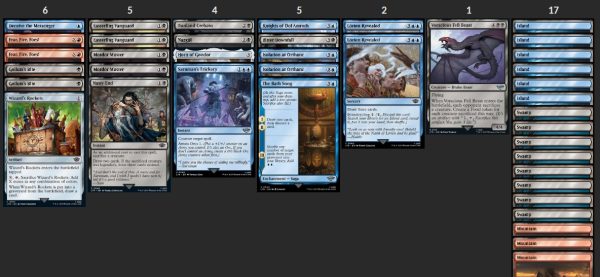
UBr Bath Song (7-1)

Creatures

2 Easterling Vanguard
1 Dunland Crebain
1 Nazgûl
1 Knights of Dol Amroth
1 Voracious Fell Beast

Sorceries

2 Fear, Fire, Foes!
2 Mordor Muster
2 Lórien Revealed

Instants

1 Deceive the Messenger
2 Gollum's Bite
1 Nasty End
1 Saruman's Trickery
1 Bitter Downfall
2 Isolation at Orthanc

Artifact

1 Wizard's Rockets
1 Horn of Gondor

Enchantment

1 The Bath Song

Land

6 Island
8 Swamp
3 Mountain

This deck has everything except for a way to loop The Bath Song. It has cheap interaction and value creatures, a powerful splash in two copies of Fear, Fire, Foes!, and powerful effects, primarily Horn of Gondor, but also Voracious Fell Beast.

Horn of Gondor is a humongous bomb, and a deck like this is going to play in such a way that we always have access to it. We'll draw, slow down the game, trade things off, and play our bomb. If it gets answered, we loop our graveyard and send them through our house of horrors again.

While this deck wasn't able to truly loop The Bath Song, it exacted a game plan that was able to survive a four-mana Catalog, and then take advantage of the card advantage and spell-density.

Situational Cards

Because these games go long, having access to silver bullets can be worthwhile. Westfold Rider, Cast into the Fire, and Shower of Arrows can answer difficult permanents.

Cool removal, bro

Cards like these can invalidate our strategy by sidestepping the more commonly targeted permanent types. A hand full of Claim the Precious and Glorious Gale do little against a Andúril, Flame of the West. While we might slow these cards down, we're unlikely to be able to ignore them.

Another situational card for this deck might be Nasty End. We typically make tokens or chump block, so it gets some value that way, but it's also a hard counterspell for Fear, Fire, Foes! and Gandalf's Sanction. Those cards can be outs for our opponents even when we think we're safe.

The Bath Song and Splashes

Splashes can enable more removal or powerful effects and this is a deck that likes both. I have found this to be especially true in LTR, where the landcyclers play really well with looping.

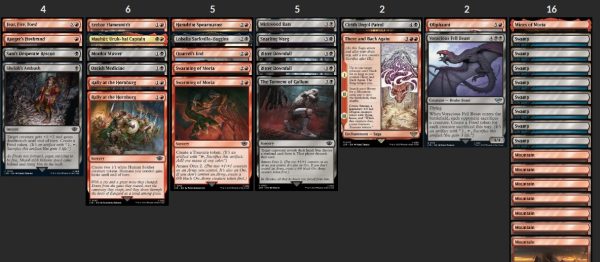
URBw True Loops (7-1)

Creatures

1 Pelargir Survivor
1 Shire Scarecrow
1 Ioreth of the Healing House
1 Gothmog, Morgul Lieutenant
1 Cirith Ungol Patrol
1 Warbeast of Gorgoroth
1 Eagles of the North
1 Oliphaunt

Sorceries

1 Fear, Fire, Foes!
1 Lash of the Balrog
1 Rally at the Hornburg
1 Foray of Orcs
1 Banish from Edoras
1 Lórien Revealed

Instants

2 Shelob's Ambush
1 Glorious Gale
2 Smite the Deathless

Artifact

1 Lembas
1 Palantir of Orthanc

Enchantment

2 The Bath Song

Land

6 Island
6 Swamp
4 Mountain
1 Plains

This deck is a mess, but still has pieces to slow the game down and take over with card advantage. Of note, I typically cut lands for landcyclers, but because this deck can't afford to miss a land drop, I was happy to play seventeen lands with three cyclers. Throw these away early and loop them back later. I'm not planning on playing them on turn six or seven; I'm planning on playing them on turn eleven or twelve.

Rally at the Hornburg may seem out of place here, but the bodies exemplify how important survival is. Additionally, they turn on Shelob's Ambush, discount Lash of the Balrog, and later on can be great with both Cirith Ungol Patrol and Gothmog, Morgul Lieutenant.

We don't mind trading off at a slight loss in the early game, because we really only care about survival, and in the late game, our card advantage (both virtual and actual) is so overwhelming that the trades still made sense.

Grocery List for The Bath Song

Once I've secured a copy of The Bath Song, I'm likely to build around it. A strong The Bath Song deck is a really good approach to the format. It can muscle past many of the Tempt decks, and because cards trade pretty evenly in the format, the card advantage goes a long way.

The most essential component is cheap interaction. I want to make sure that I have early answers in my base colors. Smite the Deathless, Gollum's Bite, Glorious Gale, and Ranger's Firebrand are excellent in this deck. I also want a couple of point-and-click "kill anything" effects. I might be willing to splash for these depending on the makeup of my deck. Once the card is turned on, it's often good for the game, so an off-color Banish from Edoras or Bitter Downfall can be cast multiple times.

I want creatures that generate value and trade off at an advantage. If our opponent trades with our Eastfarthing Farmer or Protector of Gondor, then the cards have done their job. Those little pieces of value they leave behind generate value, slowly and steadily, just like we've planned. After that, we're pretty happy with playing the good cards that are passed to us. At some point, I will try to find a Revive the Shire and probably a Generous Ent to support it.

This has been one of the many build-arounds in the format to get my attention. I think it's one of the strongest, and I know it's one of the most fun. If you're looking for a new way to approach the format, and you see this four-mana blue saga, wash up and give it a shot.

June ’23 Metagame Analysis: Ringing In

Are you a Quiet Speculation member?

If not, now is a perfect time to join up! Our powerful tools, breaking-news analysis, and exclusive Discord channel will make sure you stay up to date and ahead of the curve.

Lord of the Rings: Tales of Middle Earth has been more impactful than I expected. Of course, my expectations were set low enough that it isn't a low bar. Still, the metagame is certainly changed as a result of LTR. How much and for how long is up for debate, and that will the focus of this article. Modern's metagame is at a crossroads between a major improvement or heavy bannings. The fallout from LTR will be the deciding factor.

The Big Story

As mentioned in the data article, the big story is the rise of 4-Color Control alongside Rakdos Scam and Living End. These events are actually just one event, as they're result of LTR becoming legal. The new set directly impacted Control and Living End, and the influence of those two are the main driving force behind Scam's rise. I'll discuss what happened on MTGO to each deck before putting it all together. Paper is still mostly unchanged, though that's likely due to lack of data. The events that did happen followed MTGO's pattern.

4-Color Control

The apparent biggest winner is of course 4-Color Control, since it jumped from Tier 3 to Tier 1. Every reader is saying that it is entirely thanks to The One Ring. That's not entirely true. It is certainly true that Ring is right at home in 4-Color and it's even on-theme for the "money pile" deck, but that's missing some very important nuance and jumbles the order of events.

There was an error retrieving a chart for Delighted Halfling

The card that initially drove 4-Color's rise is actually Delighted Halfling. The first lists I saw after LTR became legal had didn't always have Ring, and if they did, it was not a mainboard four-of. However, they were all running a full set of Halflings. 4-Color has always been mana hungry and clunky, so a mana dork that makes all the legendries uncounterable and doesn't die to Wrenn is exactly what that deck has always wanted.

Halfling smoothes the curve better than other options for 4-Color specifically. Its most important spells are all legendary, and except for Wrenn and Six are all fairly expensive. It has desperately needed Utopia Sprawl and/or Abundant Growth from the beginning, but without Yorion, Sky Nomad there wasn't room. Now it can run Halfling, and as a bonus, an uncounterable draw engine in Ring.

Living End

I missed Living End getting any cards from LTR. I knew the land cyclers existed, sure, but somehow not that they cost one. In fairness, landcyclers are nothing new, and they haven't been relevant to Living End in years. It's an easy thing to overlook.

Oliphaunt and Generous Ent specifically have been effortlessly incorporated into Living End. It makes sense that the on-color creatures would be, in retrospect. They've allowed Living End to get aggressive about cutting lands, with some running as few as 14. 16 is far more common from my observations.

There was an error retrieving a chart for Generous Ent

This has stirred a lot of new interest in Living End, especially since the new cards are otherwise draft chaff. Whether Living End's recent success is down to the influx of new players or the landcyclers have made the deck better is not currently known. The Living End player at my LGS says that when the deck is running well it feels better, but I've watched him flame out more than pre-LTR, and he's on 16 lands.

Rakdos Scam

Scam's direct boost from LTR is of course Orcish Bowmasters, but I'm not certain how much of a boost it actually was by itself. Immediately after LTR became legal, Bowmasters was everywhere. It was the chase non-mythic, after all. However, it fell off sharply after a few days because it just wasn't getting many triggers. Outside of Living End, no deck drew a continuous stream of cards.

There was an error retrieving a chart for Orcish Bowmasters

That changed once Ring started seeing more play (more on this in a bit). Once nearly every slower deck started jamming full sets of The Ring, Bowmasters made a resurgence, but not a full one. It's not actually punishing enough to really counter Ring, but it is decent value. For that first week, Bowmasters was in almost every deck, but now it's limited to just Scam and some rogue decks.

However, the surge in Scam started before Bowmasters started to actually be decent. Scam is one of very few decks with maindeck graveyard hate these days, and when Living End started picking up, Scam benefitted greatly. Between Bowmasters and Dauthi Voidwalker, Scam was best positioned to fight Living End and did. Now it's hitting both that and Ring decks.

How It Unfolded

Immediately after LTR released, there was a surge of 4-Color decks powered by Halfling. Living End wasn't doing anything new, and the slew of other decks playing Bowmasters obscured its impact on Scam. After a couple of days, the excitement wore off, and the number of 4-Color decks fell. They didn't stop playing Halfling, but there were fewer showing up in the results.

After about a week, things started changing. Ring had been seeing play up until that point, but it was fairly limited. I don't know if MTGO had supply issues because the few paper results I had to work with showed plenty of Rings, but I wasn't seeing online Rings until June 23 when it more or less just exploded. Every slow deck was suddenly running Ring. 4-Color was the big one, but everybody was doing it.

There was an error retrieving a chart for Living End

Concurrent with that surge, Scam really took off. It had been on the lower end of Tier 1 for most of June, and as a result of the surge in Rings, it just exploded. Murktide still had a solid lead going into the last week of June, but Scam had an amazing final weekend. Living End was in the middle of Tier 1 and the increased interest let it gain distance from competitors, but it didn't really change position. 4-Color just made Tier 1 the last weekend.

About That Ring of Yours...

At time of writing, Ring hasn't really changed either medium's metagame. The top few decks from May are still the top decks in June. True, 4-Color is a real deck for the first time since Yorion, Sky Nomad was banned, but that hasn't affected the overall metagame. Paper's metagame looks entirely unaffected, though that might just be down to lack of data.

There was an error retrieving a chart for The One Ring

Assuming that this is a real effect (rather than caused by card shortages), I believe that the apparent lack of impact is deceptive. As a colorless artifact, it can go in any deck that doesn't mind casting four-drops, and so it has been. I'm not kidding: I haven't seen a non-aggro deck that hasn't at least tried to make Ring work for them. It hasn't stuck in all cases, but that hasn't stopped players from trying.

Thus, the impact of Ring is being spread out over the whole metagame, and is consequently very hard to see. When every deck is playing a card, it's almost the same as if no deck was playing that card. If it's good in every slow deck and every slow deck is running it, none of them have any real advantage over the others. Thus, the card is omnipresent without being impactful.

Does It Change Games?

Speaking as a Burn player, I think Ring is a trap. Players think that getting protection for a turn and drawing cards will save them against Burn. It doesn't, unless paired with Sheoldred, the Apocalypse. Ring fogs for a turn, but then on upkeep Roiling Vortex and Ring's damage triggers happen and I throw a lot of burn into their face for the win.

There was an error retrieving a chart for Roiling Vortex

Against Burn, Ring just prolongs the game. Unless the opponent was ahead on the board prior to playing Ring, it doesn't actually change what happens, just how long it takes. The exceptions have been when Sheoldred or Omnath, Locus of Creation are on board and I don't have Vortex, so I was going to lose anyway. In all other cases I just had to be patient and win anyway.

While Ring's damage trigger is a problem for many of my opponents, a bigger one has simply been that they're leaning way too heavily on the protection trigger. Frequently, they act like they're getting a four-mana Time Walk, which isn't the case. It's just better Fog. I'm still able to untap, kill creatures/planeswalkers, and add to my board. It's a speed bump that didn't change the board state.

On Omnipresence

Of course, not being good against Burn isn't a reason not to run a card. Every deck is trying it out, and it's even sticking in some unexpected places. In fact, the only decks where I've never seen a Ring are Burn, Hammer Time, and Creativity decks. Given that there really aren't deckbuilding restrictions, players are getting shades of Oko, Thief of Crowns, and the ban calls have started.

There was an error retrieving a chart for Oko, Thief of Crowns

Some of this is obvious hyperbole. Ring does not take over games by itself as effectively as Oko did. It's a decent draw engine, but it is more expensive and doesn't affect the board. To really take over games, it needs help. Lots of help. However, a card like Ring getting played everywhere is something to watch. It falls into the Once Upon a Time camp of maybe not too powerful, but definitely quite prevalent.

Ban Risk

It is far too early to say if Ring is an actual threat and needs to be banned. It's only been fully available for about two weeks at time of writing. There's so much excitement over Ring (which is rather ironic given the story) that everyone wants to play it everywhere, even if their deck doesn't actually use it well. Right now, the omnipresence can be chalked up to New Card Excitement more easily than being too good.

If this continues for several more weeks, then there's something to said for a Ring ban. The New Card Sheen will have worn off, and players will know if Ring actually belongs in their deck or not. If I'm still seeing Ring everywhere by then, I'll be more amenable to the ban crowd's arguments. Right now, I'm insufficiently impressed by the card to think it's too good.

Financial Corner

And now it's time for a gaze in the Financial Crystal Ball. The market is currently dealing with the massive influx of LTR Collectors cards opened as a result of trying to find the serialized Ring. There's considerable downward pressure on a lot of card prices, and that's unlikely to subside. There's high demand for Ring, which is keeping its price up, but also indications that the demand is slackening. Prepare accordingly.
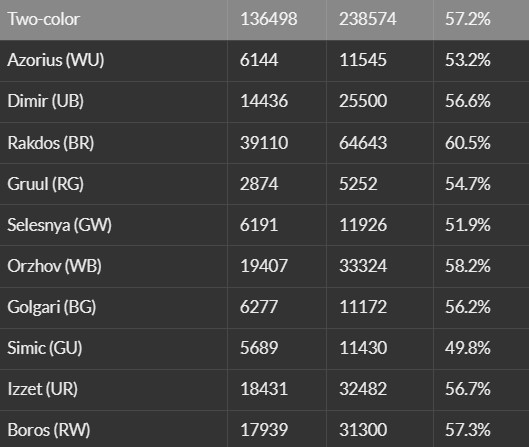
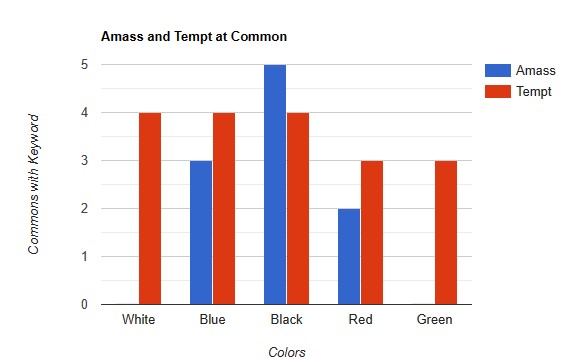
There was an error retrieving a chart for Nazgul

Outside of the highly-played Modern cards, there are unexpected cards doing well. Nazgul is the big one, with the price for even the non-foil version being quite high. I'm guessing that Commander is to blame, because I haven't seen them in Modern at all. At this point, I think any opportunity for gain with the mainstream cards is over, and it's time to look for opportunity in the more obscure cards.

Closing the Book

June's big story is now over; it's time to see what July holds. While there's no way to say for sure, it will certainly turn into a referendum on Ring. We'll see how it holds up once the excitement is over.
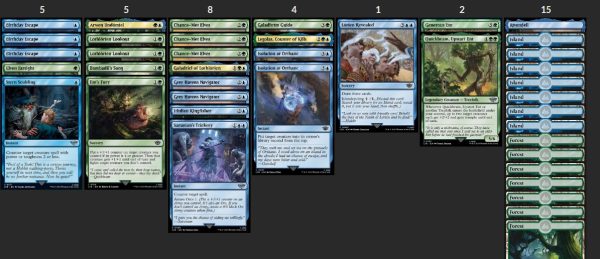
The Best Color, the Worst Color and Having a Plan in LTR Limited

Are you a Quiet Speculation member?

If not, now is a perfect time to join up! Our powerful tools, breaking-news analysis, and exclusive Discord channel will make sure you stay up to date and ahead of the curve.

The biggest criticism of Lord of the Rings Tales in Middle Earth (LTR) Limited is a lack of balance between colors. Black is clearly the strongest color, while green is the weakest. If we're taking the best card out of every pack, we're likely drawn to black more often than not. That's okay. In fact, some people advise forcing or "soft-forcing" black. Again, I think that's reasonable.

If I have one bad habit, and it's very possible that I have more than one bad habit, it is that I'm an optimist. When people complain about a format, I lean towards devil's advocate, perhaps a hair too much. But while I incessantly bring up the contrary opinion, I'm not aloof to the reality that every format has its issues. That said, I typically don't think they're as terrible as others often do.

Black is the best color in this format. Green is the worst color in this format. You won't hear any disagreement here. However, I would suggest that what's more important than this distinction, is how this information helps us approach our picks with a plan.

Unlocking Keywords

Black is deep at common, and the color has the tools to support just about every plan. The most significant keywords in the format are amass and tempt and black has both stapled onto powerful cards. While it may seem like these keywords are everywhere, they're actually more sparse than you might think.

Whether we're looking to take advantage of tempt, amass, or a little bit of both, black provides the most access to those keywords. But it's not just the quantity of the keywords. Cards like Claim the Precious, Dunland Crebain, and Uruk-hai Berserker are very powerful cards, regardless of how much we care about the keywords. These cards can help us push our aggro plan, or support a slower grindier plan without much issue. Generally speaking, you just play them and good things happen.

One Color to Rule Them All

Conversely, cards like Bombadil's Song and Mirrormere Guardian are more situational. Not all decks, nor all board states call for a 4/2. A hexproof trick is nice, but when I'm trying to develop my Ring, I don't want to have to wait to play a protection spell. Black lets you tempt proactively or develop your amass cards with flexible high-powered cards. Black is good. You should lean into black in drafts. No one will fault you for doing so.

It’s Not Easy Being Green…

Green is not the color I want to be in this format. It's not deep, it's not generally powerful, but it does have tools. I present to you now, the good green commons:

The Good Green Commons

These cards are all great at helping us develop the various plans we may want to establish in the format. The other green commons might be decent pieces but aren't particularly valuable. This describes cards like Bag End Porter and Galadhrim Guide. They're fine, but they're filler. A lot of the cards are just not that good, especially when compared to what black gets to do with no work at all.

Individually, green cards are underpowered. The food synergies and scry synergies aren't strong enough to get there at the common level. In short, green needs a hero. Fortunately, there are quite a few in the format.

…But It’s Not Impossible

The cards that make me want to be green are uncommon and rare. When we talk about "having a plan" in LTR, we're often talking about build-arounds. If we first pick a card like Frodo Baggins or Elrond, Master of Healing we can build around their abilities and end up with something quite powerful.

GU Scry (3-0)

Creatures

1 Arwen Undómiel
2 Lothlórien Lookout
3 Chance-Met Elves
1 Galadriel of Lothlórien
2 Grey Havens Navigator
1 Ithilien Kingfisher
1 Galadhrim Guide
1 Legolas, Counter of Kills
1 Generous Ent
1 Quickbeam, Upstart Ent

Sorceries

3 Birthday Escape
1 Elven Farsight
1 Ent's Fury
1 Lórien Revealed

Instants

1 Stern Scolding
1 Bombadil's Song
1 Saruman's Trickery
2 Isolation at Orthanc

Lands

7 Island
7 Forest
1 Rivendell

In this draft, I gambled on a first-pick Galadriel of Lothlórien. Galadriel's best advantage was providing a clear direction from the first pick in the draft. Instead of just "selecting cards", we were on a clear path, building a streamlined deck, that netted advantages through scry and tempt while having engines that lead to wins.

Cards like Galadriel, Chance-Met Elves, and Arwen Undómiel created enough pressure to allow us to leverage our interaction. Our engine was powerful and difficult to match up with, and even though our interaction wasn't incredible, it was good enough to give us the edge we needed.

Disclaimer: Even in a deck like this Legolas, Counter of Kills was terrible. I thought it was bad, but wanted to try it. I'm honestly not sure what it's even supposed to do. GU is comically bad at actually killing creatures that it rarely gets the counter. I think it's probably correct to never play this card.

Plan vs Power

A lot of the gold cards in this format give us a pretty clear direction. Personally, that's how I want to start a draft.

On the other hand, if we're in the format's strongest archetype, RB, we're going to be fighting over our picks. This makes the power level closer, but it does not erase it. Often times the second or third black common will be as good as the top green common. So, we should be black more often than green. However, what we should not do is just collect black cards and hope a plan emerges.

RB "Power over Plan" 1-2

Creatures

1 Erebor Flamesmith
1 Mauhúr, Uruk-hai Captain
1 Haradrim Spearmaster
1 Lobelia Sackville-Baggins
1 Mirkwood Bats
1 Snarling Warg
1 Cirith Ungol Patrol
1 Oliphaunt
1 Voracious Fell Beast

Sorceries

1 Fear, Fire, Foes!
1 Ranger's Firebrand
1 Sam's Desperate Rescue
1 Mordor Muster
2 Rally at the Hornburg
1 Quarrel's End
2 Swarming of Moria
1 The Torment of Gollum

Instant

1 Shelob's Ambush
1 Orcish Medicine
2 Bitter Downfall

Enchantment

1 There and Back Again

Lands

1 Mines of Moria
8 Swamp
7 Mountain

Not really proud of this one. I started off by taking the extremely powerful Fear, Fire, Foes!, and continued taking red and black cards out of the sheer power level and a general sense of inertia. I'm sure in retrospect I could have navigated the draft better.

All the cards were exactly as good as the words printed on them. There's no synergy, but there's also no clear plan. Is this deck aggressive or grindy? Spell-based? Maybe it just needed more Mirkwood Bats, though that doesn't seem great.

Directions to Mordor

We always want to have a plan while deckbuilding and LTR offers multiple approaches. My inclination is to take a powerful synergistic gold card when they're available. I've had a lot of luck gambling on the upside of gold cards. Because a lot of the commons play towards these various synergies, be it scry, tempt, amass, humans, spell-based, token-based, etc. we can upgrade so much of our filler by snagging one of those build-arounds, and then trying to find a few more.

From there, it becomes something of a self-fulfilling prophecy. We build to support that card, and while our pod mates are searching for a plan, we're cutting them off from the cards that support ours. This doesn't mean we should ignore signs or cease to read the table. It does, however, offer a starting point besides forcing black. It's also the best possible way to get into green.

That said, we can always take a more flexible card that will fit well in almost any deck. More often than not, these cards are going to be black. So, if you need a tiebreaker, let that be it. However, don't be afraid to commit early to something that seems narrow. So many people are just collecting the black cards that you'd be surprised what you might find with a more explorative approach.

The New RingPin of Modern

Are you a Quiet Speculation member?

If not, now is a perfect time to join up! Our powerful tools, breaking-news analysis, and exclusive Discord channel will make sure you stay up to date and ahead of the curve.

There was a lot of apprehension as we approached spoiler season for Tales of Middle Earth. A lot of people feared the set was really Modern Horizons 3. Wizards of the Coast assured us this wasn’t the case, but I’m not sure how many were convinced. Our own David Ernenwein approached the topic of whether the set was the third in an overpowered trilogy. When I looked through the set, I originally didn’t think it was, but it’s starting to appear that like many others, I might have been fooled. After just a week past its official release, the set is having a major impact on the Modern format.

One Ring to Rule Them All

Even people who have never seen or read Lord of the Rings are familiar with “The One Ring.” Being the single most important artifact in one of the most important media pieces of all time, it was crucial that Wizards get this card right. Unfortunately, I’ve seen people saying this is among their least favorite cards of all time. I’ve also seen people saying it’s among their favorites. All I know is they definitely got it right from a power (and flavor) perspective.

There was an error retrieving a chart for The One Ring

People often scoff at four-mana cards that don’t affect the board, but this one is different. Gaining protection from everything means you can pretty freely tap out for this card. When you untap with it, it quickly becomes one of the most busted draw engines to ever exist. Yes, the life can become a real burden, but in the words of a great Magic card: “Greatness at any cost.”

So what’s the home for this powerful card? Well, that’s the thing. Being a not-too-over-costed colorless artifact, it can slot into a variety of homes. I want to start with my personal favorite home for this card so far.

Jeskai Breach

Jeskai Breach, Corey Baumeister

Creatures (10)

1 Haywire Mite
4 Ragavan, Nimble Pilferer
1 Thassa's Oracle
4 Emry, Lurker of the Loch

Planeswalkers (2)

2 Teferi, Time Raveler

Spells (9)

1 Lightning Bolt
1 Spell Pierce
4 Unholy Heat
3 Expressive Iteration

Artifacts (14)

4 Mishra's Bauble
3 Mox Amber
1 Springleaf Drum
2 Grinding Station
4 The One Ring

Enchantments (4)

4 Underworld Breach

Lands (21)

1 Breeding Pool
4 Flooded Strand
1 Hallowed Fountain
1 Island
1 Sacred Foundry
4 Scalding Tarn
2 Spirebluff Canal
3 Steam Vents
4 Urza's Saga

Sideboard (15)

1 Engineered Explosives
1 Tormod's Crypt
1 Pithing Needle
2 Prismatic Ending
3 Spell Pierce
2 Force of Negation
1 Teferi, Time Raveler
2 Wear // Tear
2 Fury

Corey Baumeister was recently able to take down the Magic Online Modern Challenge and a Last Chance Qualifier with this archetype. The One Ring slots right into flex slots we usually see filled by copies of Ledger Shredder, Urza's Saga targets, or additional combo pieces. The card has a lot of really strong synergy in this deck.

So Why Breach?

Let’s start with the obvious: drawing cards in your combo deck is good. Being able to dig a few cards deeper sometimes just leads to drawing the last piece needed for the combo. The slightly less obvious part is that the protection is also useful for combo-ing. If you have the mana to play Ring on your critical Breach turn, it protects against certain cards that can shut down the combo such as Endurance or Tormod's Crypt.

There are also a few tricksy things you can do to take full advantage of Ring. If you have two copies of the card and an Emry, Lurker of the Loch, you can cast a copy every turn and let them "legend rule" each other out. Not only does this let you get the enters the battlefield trigger every turn, but it also lets you reset the burden counters if you’re low on life. If you only have one Ring and a Grinding Station, you can pull off a similar trick. You can sacrifice Ring to mill your opponent three cards each turn while staying untouchable yourself.

What Had to Change?

One last interesting thing to note is the return of Thassa's Oracle. Lately, we have been seeing Grapeshot in that slot, but Grapeshot can’t win if opponents have protection from everything. Despite still having very solid stats, Grinding Breach has been on a downswing in popularity. I’m hopeful that Ring can bring some life back to my favorite archetype. I got the chance to play it some over the weekend and it was a lot of fun.

One Ring, Two Towers, Seven Mana

Tron is, in my opinion, the most obvious home for Ring. The deck does two things: make a lot of mana and play colorless spells. I’m not a Tron player, but was able to get some insight from my Tron-loving friends.

Traditional Tron, SanPop

Creatures (5)

2 Wurmcoil Engine
1 Cityscape Leveler
2 Ulamog, the Ceaseless Hunger

Planeswalkers (6)

4 Karn, the Great Creator
2 Ugin, the Spirit Dragon

Spells (8)

4 Ancient Stirrings
4 Sylvan Scrying

Artifacts (23)

4 Chromatic Sphere
4 Chromatic Star
4 Expedition Map
4 Relic of Progenitus
3 Oblivion Stone
4 The One Ring

Lands (18)

2 Boseiju, Who Endures
3 Forest
1 Sanctum of Ugin
4 Urza's Mine
4 Urza's Power Plant
4 Urza's Tower

Sideboard (15)

1 Jegantha, the Wellspring
1 Chalice of the Void
1 Tormod's Crypt
1 Walking Ballista
2 Haywire Mite
1 Liquimetal Coating
1 Soulless Jailer
1 The Filigree Sylex
1 The Stone Brain
2 Warping Wail
1 Ensnaring Bridge
1 Oblivion Stone
1 Sundering Titan

One of the weaknesses with traditional Tron decks is occasionally they don’t assemble Tron and get stuck with unuseable expensive spells. Another issue, particularly with traditional Tron, is that decks can be full of air. Sometimes you resolve your first threat, it’s not enough, and then you don’t draw into anything that matters.

Ring is such a perfect card for this deck because it helps to plug all these holes. It offers something to do when you can’t produce Tron and will very quickly draw into other threats.

While the traditional lists are likely the Tron variant best suited to use the Ring, it is seeing play in Eldrazi Tron as well.

E-Tron, Krista Oscapinski

Creatures (12)

4 Matter Reshaper
4 Thought-Knot Seer
2 Reality Smasher
2 Walking Ballista

Sorceries (4)

3 Dismember
1 All is Dust

Artifacts (18)

4 Expedition Map
2 Inscribed Tablet
1 The Stone Brain
3 Dismember
2 Karn's Sylex
2 The One Ring
4 Chalice of the Void

Planeswalkers (6)

4 Karn, the Great Creator
1 Ugin, the Ineffable
1 Ugin, the Spirit Dragon

Sideboard (15)

1 Tormod's Crypt
2 Relic of Progenitus
1 Liquimetal Coating
1 Sorcerous Spyglass
1 The Filigree Sylex
2 The Stone Brain
1 Ensnaring Bridge
1 The One Ring
1 Cityscape Leveler
1 Wurmcoil Engine
1 Sundering Titan
1 Emrakul, the Promised End
1 Walking Ballista

As if we weren't sick of Tron, I do want to touch on Prison Tron before getting out of here. SCG Colombus winner Brady Munroe was kind enough to fill me in on his thoughts. Brady has been playing the deck for a long time and even he is having a hard time evaluating this card. It's similar in the deck to Mystic Forge. The ceiling is much higher, but there are also plenty of times it's worse. He's still got more testing to do, but it's interesting that we may have at least one Tron variant where Ring doesn't belong.

Amu-Lit

While we’re on the subject of big mana, I have to touch on a deck I’m known for. It seems like Amulet Titan is constantly doing something new with its flex slots. With that in mind, it’s not surprising to see Amulet aficionados Jack Potter, aka HouseOfManaMTG, and Mistakenn putting up strong results with the card.

Amulet Titan, Mistakenn

Creatures (14)

4 Arboreal Grazer
1 Azusa, Lost but Seeking
4 Dryad of the Ilysian Grove
4 Primeval Titan
1 Cultivator Colossus

Spells (4)

4 Summoner's Pact

Artifacts (9)

4 Amulet of Vigor
1 Expedition Map
4 The One Ring

Lands (33)

1 Bojuka Bog
1 Boros Garrison
2 Boseiju, Who Endures
2 Cavern of Souls
5 Forest
1 Gruul Turf
4 Selesnya Sanctuary
4 Simic Growth Chamber
1 Slayers' Stronghold
1 Sunhome, Fortress of the Legion
2 The Mycosynth Gardens
2 Tolaria West
4 Urza's Saga
2 Valakut, the Molten Pinnacle
1 Vesuva

Sideboard (15)

1 Boseiju, Who Endures
2 Engineered Explosives
2 Stone of Erech
1 Hydroid Krasis
2 Dismember
3 Endurance
2 Oblivion Stone
1 Force of Vigor

This card feels perfect for the archetype. Amulet needs ways to bridge from the early game to its Primeval Titans. We often see Explore fill this role, but it’s no secret that it's one of the weakest cards in the deck. Ring being a card with text relevant against aggressive strategies that also digs deeper toward an end game is incredibly potent here. Also, the fact that it’s easy to play under a Blood Moon is a huge perk, as it can dig into answers to the enchantment.

Four-Color Omnath

Ever since the printing of Ring, Omnath, Locus of Creation has been putting up a ton of results. This was a bit surprising to me. Omnath decks have never struggled in the card advantage department.

4c Omnath, kyon1024

Creatures (16)

4 Delighted Halfling
1 Endurance
1 Nissa, Resurgent Animist
3 Omnath, Locus of Creation
1 Elesh Norn, Mother of Machines
2 Fury
4 Solitude

Planeswalkers (8)

4 Wrenn and Six
4 Teferi, Time Raveler

Spells (6)

2 Lightning Bolt
2 Prismatic Ending
2 Eladamri's Call

Artifacts (3)

3 The One Ring

Enchantments (4)

4 Leyline Binding

Lands (24)

1 Boseiju, Who Endures
1 Breeding Pool
4 Flooded Strand
1 Forest
1 Hallowed Fountain
1 Island
4 Misty Rainforest
1 Plains
1 Raugrin Triome
1 Sacred Foundry
1 Steam Vents
1 Stomping Ground
1 Temple Garden
4 Windswept Heath
1 Zagoth Triome

After thinking about the deck some, it's actually a great home for our favorite piece of jewelry. Omnath's landfall trigger ensures a nice life cushion to pay the Rings upkeep cost. The pitch Elementals combined with plenty of one-mana interaction means the deck can actually cast the extra spells drawn. Looking through the results, there is no consensus on how to build the deck. I know some might see that as a negative, but the fact that this deck is doing so well and might not even be optimized makes Omnath a deck I'm very interested in.

The Rest

The above four decks are far from the only places Ring has seen play, but are just the ones most likely to see widespread play. The card has been propping up tons of strategies though. As we’ve established, the card is incredibly powerful. Lots of people will see it as the card their brew was missing. Some decks that have seen play before but have never been format mainstays will look to adopt this card. Mono Black Coffers, Mono Blue Svyelun, Dice Factory, Ponza, and many others all seem like decent homes for the card.

How to Fight Back

If Ring continues to be as prevalent as it seems, it’s going to warp things around it. Players need to come prepared to beat this powerful card advantage spell.

The best way to fight this card is by not letting it come down. If you have to remove Ring from an opponent’s board, they are achieving a two-for-one at worst. If the enemy untaps with their Ring, it's even worse news, as it's now drawn three cards.

Cards that attack Ring before it resolves are the best solution. Cards such as Spell Pierce and Counterspell go up in stock. If your deck can support it, Stubborn Denial is another solid option.

While only a few decks want them, the new card Reprieve and its older brother Remand are also solid options. (Notably, Reprieve can stop Ring even through protection from Delighted Halfling.)

Lastly, Thoughtseize backed up by a quick clock can stop it from resolving. The major concern, of course, is that resolving Ring is insanely good versus the card Thoughtseize. That being said, maybe Dimir is well situated to beat the hot new thing.

Dimir Shadow, TSPJendrek

Creatures (14)

4 Death's Shadow
4 Street Wraith
2 Tasigur, the Golden Fang
4 Murktide Regent

Spells (25)

4 Consider
4 Fatal Push
3 Stubborn Denial
4 Thoughtseize
3 Counterspell
3 Drown in the Loch
3 Archmage's Charm
1 Dismember

Artifacts (3)

3 Mishra's Bauble

Lands (18)

4 Flooded Strand
3 Island
1 Otawara, Soaring City
3 Polluted Delta
3 Scalding Tarn
4 Watery Grave

Sideboard (15)

2 Engineered Explosives
1 Flusterstorm
1 Stubborn Denial
2 Call of the Ring
3 Dress Down
2 Orcish Bowmasters
2 Brazen Borrower // Petty Theft
1 Dismember
1 Jace, the Mind Sculptor

So, The One Ring Resolved?

Let’s face it, life’s not perfect. Sometimes, Ring gets cast and we can’t stop it. Even though it’s indestructible, there are still answers. Multi-color decks that happen to play white get two excellent answers in Prismatic Ending or Leyline Binding. If those won’t work for your deck, Haywire Mite and Cast into the Fire are both very playable cards that will also permanently deal with the problem. A slightly more fragile answer is playing Pithing Needle. The downside to running Needle is you shut off your own Ring.

There is another option to beating a resolved Ring that will likely fly under most people’s radars. There are multiple ways to ignore the protection clause, which guards by preventing damage.

Okay, so some of these might be a stretch, but they work. It’s not hard to imagine a world where your opponent taps out for The One Ring and then dies to Stomp and an attack from two Rhinos, or a flurry of Skullcrack and other burn spells.

If It's So Good, Why Isn't There A Two Ring?

There will never be a sequel to The One Ring. It doesn’t evolve throughout the source material. If you're playing it in Modern, though, you'll likely be playing four copies in your deck. It will be precious to whatever strategy it's included in.

Avatar photo

Michael Mapson

Mapson is a constructed specialist and Level 2 judge. While he has a strong preference for Modern and Legacy, he is happy to play any form of Magic. He enjoys most decks, but can most often be found playing various land-based strategies such as Amulet Titan, Scapeshift or Naya Depths. His most notable finishes include a Modern Grand Prix Finals appearance, a team SCG Open top 4, and some 5k wins. You can also catch his thoughts each week on the Dark Depths Podcast where he and his cohost, Billy Mitchell, talk about Modern and Legacy.

View More By Michael Mapson

Posted in Free, ModernTagged , , Leave a Comment on The New RingPin of Modern

Have you joined the Quiet Speculation Discord?

If you haven't, you're leaving value on the table! Join our community of experts, enthusiasts, entertainers, and educators and enjoy exclusive podcasts, questions asked and answered, trades, sales, and everything else Discord has to offer.

Want to create content with Quiet Speculation?

All you need to succeed is a passion for Magic: The Gathering, and the ability to write coherently. Share your knowledge of MTG and how you leverage it to win games, get value from your cards – or even turn a profit.

Reserved Judgement: Some Thoughts on the Reserved List

Are you a Quiet Speculation member?

If not, now is a perfect time to join up! Our powerful tools, breaking-news analysis, and exclusive Discord channel will make sure you stay up to date and ahead of the curve.

If you've played Magic for any length of time, you likely have an opinion on the Reserved List. Even Wizards eventually realized that binding their own hands and restricting their ability to reprint their own cards was a bad call.

Today, we'll explore this age-old topic and float a solution that could keep everyone happy... without much deviating from what Wizards is already doing.

Reserved, Revised

Wizards has at some points revised the Reserved List, once in 2002 and again in 2010. The 2002 revision removed numerous cards from the list. Since then, they've reprinted many of the cards highlighted in the 2002 article, including Demonic Tutor, Sol Ring, Psionic Blast, and Sinkhole, among others.

The 2010 revision closed the premium exception clause, which allowed foil versions of cards on the Reserved List to be printed, and remains unchanged to this day, but continues to draw the ire of the community.

This brings us to the three key questions: If Wizards themselves admit the Reserved List was a bad idea, and they can change it at will, why can't they do away with it? If they are going to do away with the Reserved List, what is the best way to do so? If not, what is the best way to keep the Reserved List while addressing the largest complaint against it?

Doing Away With the Reserved List

Ben Bleiweiss, the General Manager of Star City Games and one of the most brilliant minds on the business side of Magic: the Gathering, laid out all the issues surrounding the Reserved List and his ideas for how to retire it in the 2020 article Why It’s Time To Remove The Reserved List And How I’d Do It. His solution of an exchange program is a pragmatic one, and with the Secret Lair system already in place, wouldn't be hard to implement.

I'd argue that there is another solution that would not only leave the Reserved List in place for the cards on it that collectors most care about, but that would also benefit the majority of players.

Remove Cards Printed in Revised From the Reserved List

There are 27 cards from Revised on the Reserved List. If we count Limited Edition Alpha and Beta as two separate printings, Revised marks the fourth printing of these cards, and the second in white border after Unlimited. With the exception of cards printed in ABU, the majority of cards on the Reserved List only have one printing, ever. It makes sense that these cards that have never been reprinted stay on the list. I'd even go so far as to say that cards from Alpha reprinted up to Unlimited, before changes to the makeup of the core set were implemented, should remain on the Reserved List.

Cards from Revised, the first Core Set which transformed the idea of Core Set into a home for reprinted cards from past expansion sets, do not make sense in this context and should therefore be removed.

Revised Cards on the Reserved List

  • Farmstead
  • Veteran Bodyguard
  • Braingeyser
  • Copy Artifact
  • Vesuvan Doppelganger
  • Contract from Below
  • Darkpact
  • Demonic Attorney
  • Demonic Hordes
  • Fork
  • Granite Gargoyle
  • Roc of Kher Ridges
  • Rock Hydra
  • Sedge Troll
  • Wheel of Fortune
  • Fastbond
  • Kudzu
  • Badlands
  • Bayou
  • Plateau
  • Savannah
  • Scrubland
  • Taiga
  • Tropical Island
  • Tundra
  • Underground Sea
  • Volcanic Island

Removing cards printed in Revised from the Reserved List and leaving the rest of the list otherwise intact is a solution likely to appeal to the broadest swath of collectors and players. It answers the main gripe I see players having with the list, namely the issue of dual lands. Removing Revised from the list opens up the possibility of reprinting dual lands for Legacy and for Magic's most popular format, Commander. This will quell a major point of opposition to the list.

There was an error retrieving a chart for Sol Ring

It's also not too dissimilar from the 2002 change, which opened the door for a number of cards from Revised and even Unlimited to be reprinted. As mentioned previously, Commander staples like Sol Ring, Demonic Tutor, and others were all opened up to reprinting under this change, arguably enabling the growth of the format.

Can, But Doesn't Have To

Those clamoring for the removal of the list should remember that just because Wizards can reprint something, it doesn't mean they have to, nor that they should. Of the 27 Revised cards on the Reserved List, three of them mention the old ante rules, and will never be reprinted because of this. Others likely won't be reprinted because of power-level concerns or being outside of modern design sensibilities. Even if they were not on the Reserved List, the chances of them being reprinted at all remain slim.

Cards Wizards Will Not Reprint:

Ante Cards

The last card to mention ante Wizards ever printed was Timmerian Fiends from Homelands back in 1995. Ante cards and the ante rules were already banned from tournament play by this time.

There was an error retrieving a chart for Contract from Below

Even in the early days, most casual players refused to play with these optional rules. They were removed from the official rules of the game in 1997, with the release of Fifth Edition. Contract from Below and these other cards are interesting curiosities from the game's earliest years but have no place in modern Magic.

Cards With Power Level Concerns

Fastbond is banned in both Commander and Legacy because of its insane power level, so that one is a no-go. Demonic Hordes and Kudzu are both repeatable land destruction, something Wizards actively discourages. It's in line with the same reasoning we don't see Armageddon reprinted anymore.

Farmstead on the other hand is so low-powered it's almost not worth a card. It's unlikely any of these would see a reprint, even if Wizards had the power to do so.

Cards Wizards Could Potentially Reprint

In addition to the Dual Lands, there are 10 cards from Revised that Wizards could reprint in a Masters or Commander-type product, assuming no Reserved List restrictions. Five are popular Commander cards. The other five are cards that could find a home in a Masters-type set for the sake of Limited play (if reprinted at all), though a few would likely be downshifted to uncommon.

Popular Commander Cards

Possible Reprints For the Sake of Limited

Even if Wizards had the power to reprint these cards, there's no guarantee that they will—especially not all at once. More likely, the dual lands, and separately the five popular Commander cards, would be reprinted across several years of Masters or Commander sets. Even without a 1/1 The One Ring level of chase card hype, I imagine that any product offering a chance to open duals for the first time since 1994 will sell well if it's accessible to the majority of the fanbase, and not an overpriced money grab.

The Argument Against This Strategy

The main complaint against doing away with the Reserved List is that it would damage the value of Magic's oldest and until recently most valuable cards. What was important about Reserved List cards, from a collecting standpoint, was the perceived price security attached to them. The existence of the Reserved List kept these cards free from reprints—which proponents of the list argue is what helps them maintain their prices.

Countering the Price Security Argument

Ben Bleiweiss rightly pointed out in his article that the price of original printings of many early Magic cards stays high because of their collectibility and scarcity, not because they are artificially shielded from reprinting. He cites Serra Angel, and several cards from Arabian Nights including City of Brass and Serendib Efreet, which have all already received multiple printings over the years, as examples.

There was an error retrieving a chart for Serra Angel

Even in a world without the Reserved List, we could expect the early printings of many cards on the list to follow a similar pattern and maintain a significant premium.

The Fate of Revised

If cards printed in Revised were removed from the Reserved List, the Limited Edition Alpha, Beta, and to some extent Unlimited versions of these cards will be insulated from price drops. However, the Revised printings themselves will likely take a hit. Even if this hit is as high as 50-60% of their current pricing, I see it acting as a healthy short-term price correction.

There was an error retrieving a chart for Underground Sea

In the long-term, as the newest printing of these cards acts as the de facto choice for players, the conditions of Revised copies will become more relevant. Mint copies would naturally hold more value, and command a significant premium for collectors over played versions. On the other hand, I imagine the prices of played Revised copies will settle somewhere in the ballpark just above whatever exclusive showcase treatment Wizards cooks up.

Magic: 30 Already Broke The Reserved List

Let's set aside the discussion of Revised prices for a moment. The argument in favor of updating the Reserved List to not include cards printed in Revised gets added weight when you consider the $1,000 elephant in the room: The Reserved List is meaningless and has already been broken. I give you Exhibit A:

There was an error retrieving a chart for Underground Sea

I'm sure the Timmies, Kimmies, and Poindexters out there will be quick to tell me that Magic: 30 doesn't violate the Reserved List because the cards have different backs and aren't legal for sanctioned play. "All policies described in this document apply only to tournament-legal Magic cards" is the official wording in the document.

What does "tournament-legal" even mean in 2023? Last time I checked, the Eternal Weekend Vintage Championship, and a small handful of scattered tournaments around the world, were the only events that didn't allow Collector's Edition or Magic: 30 cards in Vintage—if not having wholesale allowances for some number of proxies of Reserved List cards in each players' decks. In a world where Commander and kitchen table Magic reigns supreme, are your friends really going to complain about which printing of Underground Sea you have in your Satoru Umezawa deck? If that's the case, I'd say you need different friends, not different cards.

It sounds like a tin foil hat theory on the surface, but I'm not alone in thinking Magic: 30 violated the Reserved List, and that its printing made the reprint policy meaningless. Wall Street agreed. One of the factors cited in the downgrading of Hasbro's stock in 2022 was the printing of Magic: 30, damaging consumer confidence in the brand. What does it matter changing the Reserved List to allow reprinting cards from Revised in a world where we've already seen new copies of Black Lotus printed in 2022?

There was an error retrieving a chart for Black Lotus

The End Step

Slightly sarcastic comments about Magic: 30 aside, is a Secret Lair: Reserved List exchange program in our future? Will dual lands ever be reprinted? Only time will tell. I know I wouldn't bet against it.

June ’23 Metagame Update: Churn Returns

Are you a Quiet Speculation member?

If not, now is a perfect time to join up! Our powerful tools, breaking-news analysis, and exclusive Discord channel will make sure you stay up to date and ahead of the curve.

We're halfway through the year, and it's a month until Wizards' new Ban Day. In a welcome twist, Lord of the Rings: Tales of Middle Earth has managed to give Modern's metagame a shake. It's not enough to disturb the built-up crust at the top of the rankings, but the waters are at least stirring. Whether this is a temporary change or represents a real shift remains to be seen.

An Unusual Month

June's data is odd by the standards Modern has set for itself. Specifically, Magic Online (MTGO) has no outliers. When looking at the data it looks like it should, but no. All the tests came back saying no. The spread in the data is on curve and normal. It's a bit extreme certainly, but once the statistical noise is accounted for, there are no outliers. I was quite surprised.

Paper is another matter. The top two results are outliers, and as always were excluded from the calculations. I think that this has only happened once in the year and a half since Modern started consistently exhibiting outliers. I chalk up this disparity to paper having fewer results. The more data that's available, the more that outliers are drawn into the fold.

June Population Metagame

To make the tier list, a given deck has to beat the overall average population for the month. The average is my estimate for how many results a given deck "should” produce in a given month. Being a tiered deck requires being better than “good enough.” Every deck that posts at least the average number of results is "good enough" and makes the tier list.

There was an error retrieving a chart for Ragavan, Nimble Pilferer

Then we go one standard deviation (STdev) above average to set the limit of Tier 3 and the cutoff for Tier 2. This mathematically defines Tier 3 as those decks clustered near the average. Tier 2 goes from the cutoff to the next standard deviation. These are decks that perform well above average. Tier 1 consists of those decks at least two standard deviations above the mean result, encompassing the truly exceptional performing decks. 

The MTGO data nearly exclusively comes from official Preliminary and Challenge results. Leagues are excluded, as they are curated lists and thus invalid. The paper data comes from any source I can find, with all reported events being counted.

The MTGO Population Data

In June, the unadjusted average population for MTGO was 11.19, setting the Tier 3 cutoff at seven decks. I always round down if the decimal is less than .20. Tier 3, therefore, begins with decks posting 11 results. The unadjusted STdev was 21.33, so add 22 and that means Tier 3 runs to 33 results. Again, it's the starting point to the cutoff, then the next whole number for the next Tier. Therefore Tier 2 starts with 34 results and runs to 56. Subsequently, to make Tier 1, 57 decks are required.

There was an error retrieving a chart for Fury

June represents a turnaround for the data. January 2023 had 840 decks, February had 876, and March had a staggering 1,003 decks, April fell to 949 decks, May plummeted to 770 decks, but June surged to 918. June had a number of extra events and large Preliminaries to boost its numbers. There's another All-Access event starting today, so I'd expect July to continue the trend.

However, the extra population doesn't mean more diversity. January had 74 unique decks, February had 84, and March mustered 88. April, May, and now June had 82 decks. This seems like it means something, but I have no way to prove anything. Of the 82 decks, only 17 made the population tier, down from April's 29 and even May's 22. This is entirely down to the unadjusted stats.

Deck Name Total #Total %
Tier 1
UR Murktide919.91
Rakdos Scam919.91
Living End849.15
4-Color Creativity717.73
Hammer Time717.73
4-Color Control596.42
Tier 2
Temur Rhinos475.12
Burn404.36
Yawgmoth384.14
Mono-Green Tron384.14
Tier 3
Jeskai Value Breach293.16
UW Control272.94
Amulet Titan192.07
Counter Cat161.74
Jund141.53
Hardened Scales121.31
Jund Creativity111.20

The headline stories here are Rakdos Scam tied with UR Murktide for first place, Living End in third, and 4-Color Control jumping from mid-Tier 3 to the bottom of Tier 1 in a month. These stories are actually one story, it's all linked. I'm not going to discuss it today as it's too long a story. Instead, it will be a big focus of Friday's article.

Another big story is Temur Rhinos falling into Tier 2. I don't think there's anything to read into here, as Tier 1 has usually only had room for one cascade deck. Whenever Rhinos has been ascendant, Living End has been down, and vice-versa. I understand that the decks were relatively evenly matched back when Rhinos ran Endurance maindeck. Endurance being moved to the sideboard might be explanatory.

The Paper Population Data

The paper tiers are calculated the same way as the MTGO tiers, just with different data. In most months there are far more reported paper events than online, but paper also tends to report fewer results per event. It's quite annoying, but paper events rarely report more than the Top 8, and far too often for my purposes, only the Top 4. This makes the paper data far more variable than MTGO.

January saw 667 decks, February is up to 807, March hit 962, April plunged to 551, May was up to 581, and now June is down slightly to 547. As I said, paper data is highly variable. It felt like the total number of events were down, but I don't write down the number of events I record.

There was an error retrieving a chart for Sigarda's Aid

Paper events often report the actual records alongside decklists. Thus, I've decided to change how I record decks when win rates are available. For smaller events, I take any winning record which sometimes means I don't include the full Top 8. For larger events, I'm taking the Top 32 and all the decks with the same record as 32nd place. Tiebreakers are a strange and mysterious alchemy, after all, and may benefit or screw players on a whim.

The total number of decks fell considerably in June. January had 101 decks, February 108, March just 103, April down to 89, May was up to 102 and June fell to 79. 23 decks made the tier list, which is down just like the population. The adjusted average population was 5.86, so five decks make Tier 3. The adjusted STDev was 8.37, so the increment is 9. Therefore, Tier 3 runs from 6 to 15, Tier 2 is 16 to 25, and Tier 1 is 26 and over.

Deck NameTotal #Total %
Tier 1
4-Color Creativity539.69
UR Murktide437.86
Temur Rhinos386.95
Rakdos Scam336.03
Hammer Time325.85
Living End305.48
Burn274.94
Tier 2
4-Color Control244.39
Yawgmoth193.47
Amulet Titan173.11
Mono-Green Tron162.93
Tier 3
Merfolk142.56
4-Color Elementals101.83
UW Control101.83
Affinity101.83
Humans101.83
Mill91.65
Counter Cat91.65
Coffers91.65
Jund81.46
Grixis Shadow81.46
Hardened Scales81.46
Bring to Light61.10

Living End, 4-Color Control, and Scam are all up in paper, but not to the extent of MTGO. This might be thanks to fewer events obscuring the same effect as on MTGO, but it's also possible that the change is just MTGO being MTGO. That program loves to convince itself things are certain ways and create self-fulfilling prophecies. It's impossible to say.

March Power Metagame

Tracking the metagame in terms of population is standard practice. But how do results actually factor in? Better decks should also have better results. In an effort to measure this, I use a power ranking system in addition to the prevalence list. By doing so, I measure the relative strengths of each deck within the metagame.

There was an error retrieving a chart for Living End

The population method gives a deck that consistently just squeaks into the Top 32 the same weight as one that Top 8's. Using a power ranking rewards good results and moves the winningest decks to the top of the pile and better reflects their metagame potential.

The MTGO Power Tiers

For the MTGO data, points are awarded based on the population of the event. Preliminaries award points based on record (1 for 3 wins, 2 for 4 wins, 3 for 5), and Challenges are scored 3 points for the Top 8, 2 for Top 16, and 1 for Top 32. If I can find them, non-Wizards events will be awarded points the same as Challenges or Preliminaries depending on what the event in question reports/behaves like. Super Qualifiers and similar higher-level events get an extra point and so do other events if they’re over 200 players, with a fifth point for going over 400 players. The enormous Showcase Qualifier was the first online event to award five points in nearly a year, and there were several four-point events too.

Consequently, total points are massively up from 1189 to 1508. The unadjusted average points were 18.39, therefore 19 points made Tier 3. The adjusted STDev was 36.30, so add 37 to the starting point, and Tier 3 runs to 56 points. Tier 2 starts with 57 points and runs to 94. Tier 1 requires at least 95 points.

Jund Creativity fell off the tier list and was not replaced. The MTGO metagame is a narrow and unforgiving place.

Deck Name Total PointsTotal %
Tier 1
Rakdos Scam16510.94
UR Murktide15710.41
Living End1499.88
4-Color Creativity1177.76
Hammer Time1016.70
4-Color Control956.30
Tier 2
Temur Rhinos724.77
Yawgmoth684.51
Burn644.24
Mono-Green Tron644.24
Tier 3
Jeskai Value Breach503.32
UW Control473.12
Amulet Titan362.39
Counter Cat291.92
Jund241.59
Hardened Scales201.33

There's been almost no movement inside the tiers and no decks moved tier. This is pretty standard for MTGO.

The Paper Power Tiers

Due to paper reporting being inconsistent compared to MTGO, I have to adapt how the points work. Applying the MTGO point system just doesn't work when I don't know how many points to award and there are data gaps. Thus, I award points based on the size of the tournament rather than placement. That way, I'm being internally consistent with the paper results.

For events with no reported starting population and those up to 32 players, one point is awarded. Events with 33 players up to 128 players get two points. From 129 players up to 512 players get three. Above 512 is four points, and five points will be reserved for Modern Pro Tours if/when they ever happen again.

There were a lot of four-point events in June, so total points are up. January had 1178 points, February hit 1316, and March shot to 1890, April fell to 964, May hit 1098, and June up to 1208. The adjusted average points were 12.79, setting the cutoff at 13 points. The STDev was 20.23, thus adding 21 to the starting point and Tier 3 runs to 34 points. Tier 2 starts with 35 points and runs to 56. Tier 1 requires at least 57 points. The total decks fell to 21, as neither Bring to Light nor Jund mustered enough points.

Deck NameTotal PointsTotal %
Tier 1
4-Color Creativity12510.35
UR Murktide988.11
Temur Rhinos907.45
Rakdos Scam796.54
Hammer Time796.54
4-Color Control675.55
Living End665.46
Tier 2
Burn494.06
Yawgmoth494.06
Mono-Green Tron473.89
Amulet Titan463.81
Tier 3
Merfolk292.40
UW Control241.99
Grixis Shadow201.66
4-Color Elementals191.57
Hardened Scales191.57
Humans191.57
Counter Cat181.49
Coffers171.41
Affinity161.32
Mill131.08

As usual, paper shows some dynamism with decks changing tiers and a lot of movement inside the tiers themselves. The effect of all the high point events was quite profound and many decks that didn't show up in them fell a lot.

Average Power Rankings

Finally, we come to the average power rankings. These are found by taking the total points earned and dividing them by total decks, to measure points per deck. I use this to measure strength vs. popularity. Measuring deck strength is hard. There is no Wins-Above-Replacement metric for Magic, and I'm not certain that one could be credibly devised. The game is too complex, and even then, power is very contextual.

Using the power rankings certainly helps and serves to show how justified a deck’s popularity is. However, more popular decks will still necessarily earn a lot of points. Therefore, the top tier doesn't move much between population and power and obscures whether its decks really earned their position. 

There was an error retrieving a chart for Omnath, Locus of Creation

This is where the averaging comes in. Decks that earn a lot of points because they get a lot of results will do worse than decks that win more events, indicating which deck actually performs better.

A higher average indicates lots of high finishes, whereas low averages result from mediocre performances and a high population. Lower-tier decks typically do very well here, likely due to their pilots being enthusiasts. Bear this in mind and be careful about reading too much into these results. However, as a general rule, decks that place above the baseline average are over-performing, and vice versa.

How far above or below that average a deck sits justifies its position on the power tiers. Decks well above baseline are undervalued, while decks well below baseline are very popular, but aren't necessarily good.

The Real Story

When considering the average points, the key is looking at how far off a deck is from the Baseline stat (the overall average of points/population). The closer a deck’s performance to the Baseline, the more likely it is to be performing close to its “true” potential.

A deck that is exactly average would therefore perform exactly as well as expected. The greater the deviation from the average, the more a deck under or over-performs. On the low end, a deck’s placing was mainly due to population rather than power, which suggests it’s overrated. A high-scoring deck is the opposite of this.

I'll begin with the averages for MTGO

Deck Name Average PointsPower Tier
Amulet Titan1.893
Rakdos Scam1.811
Counter Cat1.813
Yawgmoth1.792
Living End1.771
UW Control1.743
UR Murktide1.721
Jeskai Value Breach1.723
Jund1.713
Mono-Green Tron1.682
Hardened Scales1.673
4-Color Creativity1.651
4-Color Control1.611
Burn1.602
Temur Rhinos1.532
Baseline1.50
Hammer Time1.421

As the highest-placing Tier 1 deck, Rakdos Scam is the MTGO Deck of June. Great showings in late Challenges will do that.

Now the paper averages:

Deck NameAverage PointsPower Tier
Mono-Green Tron2.942
4-Color Control2.791
Amulet Titan2.712
Yawgmoth2.582
Grixis Shadow2.503
Hammer Time2.471
UW Control2.403
Rakdos Scam2.391
Temur Rhinos2.371
Hardened Scales2.373
4-Color Creativity2.361
UR Murktide2.281
Living End2.201
Merfolk2.073
Baseline1.96
4-Color Elementals1.903
Counter Cat1.893
Burn1.822
Humans1.803
Coffers1.783
Affinity1.503
Mill1.443

Meanwhile, 4-Color Control blew every other Tier 1 deck away to be paper's Deck of June. The big events right after LoTR was released are responsible for this.

Composite Metagame

That's a lot of data, but what does it all mean? When Modern Nexus was first started, we had a statistical method to combine the MTGO and paper data, but the math of that system doesn't work without big paper events. I tried. Instead, I'm using an averaging system to combine the data. I take the MTGO results and average the tier, then separately average the paper results, then average the paper and MTGO results together for final tier placement.

This generates a lot of partial Tiers. That's not a bug, but a feature. The nuance separates the solidly Tiered decks from the more flexible ones and shows the true relative power differences between the decks. Every deck in the paper and MTGO results is on the table, and when they don't appear in a given category, they're marked N/A. This is treated as a 4 for averaging purposes.

Deck Name MTGO Pop TierMTGO Power TierMTGO Average TierPaper Pop TierPaper Power TierPaper Average TierComposite Tier
UR Murktide1111111.00
Rakdos Scam1111111.00
Living End1111111.00
4-Color Creativity1111111.00
Hammer Time1111111.00
4-Color Control111211.51.25
Temur Rhinos2221111.50
Burn222121.51.75
Yawgmoth2222222.00
Mono-Green Tron2222222.00
Amulet Titan3332222.50
UW Control3333333.00
Counter Cat3333333.00
Hardened Scales3333333.00
Jund3333N/A3.53.25
Jeskai Value Breach333N/AN/AN/A3.50
MerfolkN/AN/AN/A3333.50
Grixis ShadowN/AN/AN/A3333.50
AffinityN/AN/AN/A3333.50
HumansN/AN/AN/A3333.50
MillN/AN/AN/A3333.50
CoffersN/AN/AN/A3333.50
Jund Creativity3N/A3.5N/AN/AN/A3.75
Bring to LightN/AN/AN/A3N/A3.53.75

Again, there's not much that's surprising here as long as you read everything that came before it.

Best Not to Disturb the Water

There's been a disturbance to Modern's status quo. It is not a large disturbance, and it might not last, but it is a disturbance, nonetheless. However, it's primarily down to a new set with an exciting card. Whether that can be sustained is something I'll be discussing on Friday. Join me then!

Faces of Aggro: Boros Pia Aggro in Pioneer

Are you a Quiet Speculation member?

If not, now is a perfect time to join up! Our powerful tools, breaking-news analysis, and exclusive Discord channel will make sure you stay up to date and ahead of the curve.

Pia's Revolution

In this week's video, I play a brand new Aggro deck that's sweeping the Pioneer format: Boros Pia Aggro! This is a brand new deck that utilizes a new card from March of the Machine: the Aftermath Pia Nalaar, Consul of Revival. This card has proved to be a surprisingly powerful lynchpin card that has spawned a brand new archetype in Pioneer. It, combined with Reckless Impulse and another newcomer Wrenn's Resolve, generates a ton of card advantage.

There was an error retrieving a chart for Pia Nalaar, Consul of Revival

The Rule of Eight

If you've been playing Magic for a long time you have probably heard of "The Rule of Eight" when it comes to having eight copies of the same card to make a specific strategy. But for those who haven't been playing long or maybe you just haven't come across the phrase before, "The Rule of Eight" is a term that refers to the idea that if you are going to build a deck around a card you need to have "eight" copies of it.

For example, Modern Living End is a combo deck that relies on Living End to bring back a ton of creatures that you cycle to the graveyard, but instead of Suspending it and casting it fairly you can cast a card with Cascade like Violent Outburst or Shardless Agent to ensure you always hit and cast your Living End as early as turn three. You get to play four copies of both Violent Outburst and Shardless Agent making your deck extremely consistent.

There was an error retrieving a chart for Living End

The way this relates to our deck is that we finally have access to eight copies of Reckless Impulse by way of Wrenn's Resolve. This helps fuel our Pia Nalaar, Consul of Revival making hasty flying thopters every time we play a card that was exiled by them. Not only do these fuel our Pia Nalaar, Consul of Revivals they also make things like flooding and running out of steam difficult to do because they both essentially draw us cards even if Pia isn't on the battlefield. They can both stand on their own as cards that are not only playable but quite good in an aggressive strategy like ours.

Of course, when Pia Nalaar, Consul of Revival is on the battlefield we just get to go wild with all the thopters each time we cast our Reckless Impulse and Wrenn's Resolves.

Prowess is Powerful

The other creatures in this deck all have prowess. They work in beautiful harmony with Pia Nalaar, Consul of Revival, Reckless Impulse, and Wrenn's Resolve.

Abbot of Keral Keep, Soul-Scar Mage, and Monastery Swiftspear are all excellent at getting aggressive and Abbot of Keral Keep even has great synergy with Pia Nalaar, Consul of Revival. By exiling the top card of our library we can trigger Pia's ability while also triggering all of the prowess creatures we may have on the battlefield.

Soul-Scar Mage can be combined with our burn spells to take down big creatures that get in our way, or at the very least make it so that we can swing past opposing Bonecrusher Giant // Stomps and Graveyard Trespasser // Graveyard Gluttons. This makes Soul-Scar Mage an auto-include in this deck.

Lastly, Monastery Swiftspear is the best red aggro creature in Pioneer, and where you start building red aggro decks in this format. The fact that she works so well with our game plan due to having prowess is the cherry on the beatdown cake here.

Dies to Removal

Play with Fire, Skewer the Critics, and Chained to the Rocks are our three premier ways to deal with pesky creatures that get in the way of us attacking. Both Play with Fire and Skewer the Critics can be combined with Soul-Scar Mage to deal with higher toughness creatures so we can just swing past them and force our opponents to chump block. Chained to the Rocks on the other hand outright deals with pretty much everything on its own, assuming you have a white mana source and a Mountain in play.

There was an error retrieving a chart for Chained to the Rocks

The Decklist

Boros Pia Aggro, Pioneer

Creatures

2 Abbot of Keral Keep
4 Monastery Swiftspear
4 Pia Nalaar, Consul of Revival
4 Soul-Scar Mage

Sorceries

4 Light Up the Stage
4 Reckless Impulse
4 Skewer the Critics
4 Wrenn's Resolve

Instants

4 Play with Fire

Enchantments

3 Chained to the Rocks
4 Kumano Faces Kakkazan // Etching of Kumano

Lands

4 Battlefield Forge
1 Den of the Bugbear
2 Inspiring Vantage
6 Mountain
2 Needleverge Pathway // Pillarverge Pathway
4 Sacred Foundry

Sideboard

3 Alpine Moon
1 Chained to the Rocks
2 End the Festivities
1 Jegantha, the Wellspring
2 Reidane, God of the Worthy // Valkmira, Protector's Shield
4 Rending Volley
2 Showdown of the Skalds

Wrapping it Up

Is this the next top-tier deck in the Pioneer meta? Maybe. Is it an insanely fun deck that can kill out of nowhere? Absolutely. I really enjoy high synergy decks like this. If you also dig decks whose cards are greater than the sum of their parts, definitely give Boros Pia Aggro a spin because it could just be the next big thing in Pioneer!

Now that you've read the article go watch the companion video over on YouTube. Make sure to Like, Comment, and Subscribe so you don't miss a single video!

Avatar photo

LessAlex

LessAlex, AKA Alex Blackard, is a Magic: The Gathering content creator who is passionate about playing Control decks in Constructed, particularly in the Pioneer, Modern, Explorer, and Historic formats. He also enjoys experimenting with combo decks and brewing up new and exciting strategies to stay ahead of the competition. With a focus on in-depth strategy breakdowns and gameplay, LessAlex offers a unique perspective on the game that is both entertaining and informative. His competitive resume includes a Top 4 at an SCG Open in 2014, splitting an NRG Trial in 2017, as well as countless SCG IQ Top 8s and Game Day wins. He hosts The Control Freak Podcast where he discusses playing Control decks in Constructed, and brings on guests including prominent players and creators to share their expertise. You can catch him streaming on Twitch weekdays at 9 am, and on his YouTube Channel for even more content.

View More By LessAlex

Posted in Deck Building, Deck Overview, Pioneer, Video, VideosTagged , , , , , , , , Leave a Comment on Faces of Aggro: Boros Pia Aggro in Pioneer

Have you joined the Quiet Speculation Discord?

If you haven't, you're leaving value on the table! Join our community of experts, enthusiasts, entertainers, and educators and enjoy exclusive podcasts, questions asked and answered, trades, sales, and everything else Discord has to offer.

Want to create content with Quiet Speculation?

All you need to succeed is a passion for Magic: The Gathering, and the ability to write coherently. Share your knowledge of MTG and how you leverage it to win games, get value from your cards – or even turn a profit.

Prospects for Tales of Middle Earth Collector Boosters

Are you a Quiet Speculation member?

If not, now is a perfect time to join up! Our powerful tools, breaking-news analysis, and exclusive Discord channel will make sure you stay up to date and ahead of the curve.

The quest is over. After about two weeks, the The One Ring has been found and graded. The news hit my Twitter feed last Friday, capped off with a tweet from PSA themselves.

Personally, I would hold out for a PSA 10 copy, but that’s neither here nor there.

With the exciting (admittedly successful) promotion ending, it begs a few questions regarding the financial implications for Tales of Middle Earth product. I just wrote a piece about draft booster boxes last week, but I feel like this set needs to be revisited given this development.

First and Foremost: Collector Boosters

Many factors influence the price of sealed product. In the case of Tales of Middle Earth collector boosters, the most significant factor was arguably the mystique of The One Ring, valued at upwards of $2,000,000. Never mind the odds of opening this card were one in three million. Never mind these odds meant this card contributed less than $0.50 to a collector booster’s expected value (EV). Never mind that there was a greater chance of becoming a movie star than opening this card.

People chased the gamble and it led to a significant premium on these packs.

Now that the chase has concluded, what is next for this premium sealed product? Many members of the Magic finance community predicted a sharp decline. Chris aka Chi Style is financially savvy and a trusted friend, and his tweet summed up a popular opinion:

I believe “balloon pop” paints a nice picture, don’t you?

Sure enough, just hours after PSA’s announcement, collector booster boxes dropped from about $480 to $380—Chris’s 20% prediction was spot on.

Fellow Quiet Speculation writer David Schumann captured the action in a precise way, grabbing a screen capture of recent sales on TCGplayer as the news unfolded.

Balloon popping indeed!

More to the Story

It’s true that the average sale price of a Tales of Middle Earth collector booster box dropped significantly since The One Ring was found. However, the price action since June 30th hasn’t been as dire. After bottoming under $350, prices rebounded unexpectedly the following two days. Check out the market price chart for the past month:

While it’s no surprise the price is still well off its high, those $350 boxes didn’t stick around for very long, and now boxes are selling for north of $400 once again.

Part of this rebound could be driven by TCGplayer’s recent kickback deal on sealed product. Even I took the bait and picked up a cheap draft booster box of Crimson Vow to save for a rainy day. Perhaps the incentive was enough to catalyze buying, despite the fact that The One Ring was already opened.

Additionally, there are still a bunch of valuable and coveted serialized and non-serialized rings to be found in collector booster packs.  In total, the Sol Rings to be found include:

  • Human: 9,000 copies
  • Dwarven: 7.000 copies
  • Elven: 3,000 copies
  • Foil, Serialized Human: 900 copies
  • Foil, Serialized Dwarven: 700 copies
  • Foil, Serialized Elven: 300 copies

These are all expensive and will handsomely reward those individuals lucky enough to open one. Currently, the market price of the human, dwarven, and elven non-foil Sol Rings are about $182, $215, and $690, respectively. Serialized copies sell for well over $1,000.

Just because the “one ring to rule them all” was found doesn’t mean there are no more incentives to open collector boosters. Let’s not forget the surge foils that can also be found in collector boosters—some of these can be quite valuable!

As much as I would have liked to have opened a $2,000,000 card from a booster pack, I don’t think a single player (no matter how entitled) would complain about opening a beautifully illustrated, $200 surge foil Deserted Temple from their $40 collector booster pack.

Nope. I’d say that mathematically speaking the locating of The One Ring should have virtually no impact on collector booster prices. A $0.33 reduction in EV is not enough to move the needle. While psychologically this will definitely reduce demand, the numbers suggest that these are still nice lottery tickets, albeit without a grand prize.

Meanwhile, the Rest of the Set…

Last week I talked about the underwhelming power level of The Lord of the Rings: Tales of Middle Earth singles. The set is legal in Modern, but not Standard, and as such a little underpowered for this context. I used this as a rationale to predict a softening in prices on singles from this set.

It’s only been a week since I wrote that, but thus far the trend feels contrary to my prediction. Each day I check MTG Stocks’ Interests page, and each day I see more price increases from this set. I wasn’t surprised to see The One Ring climb as it broke into eternal formats. Some other cards, such as There and Back Again and Delighted Halfling, I did not expect to show up.

Sometimes TCGplayer market pricing isn’t reliable as they can be manipulated by sellers with artificially high price points. However, I’m also noticing that some of Card Kingdom’s buy prices are also climbing relative to where they were just a week ago.

Nazgul’s buy price has rebounded over the past week. Delighted Halfing has followed suit, bouncing from an $8 buy price to $9.75.

There was an error retrieving a chart for Delighted Halfling

In fact, not counting foils and alternate printings, I count over 20 cards (including each different instance of Nazgul) that buylist for more than TCGplayer’s market price on a Tales of Middle Earth draft booster. If I stretch down to cards that buylist over $2, that count reaches about 30. While the set still has its share of bulk rares, I’m surprised to see demand remain resilient thus far.

Give It Time

This is not a declaration that all Tales of Middle Earth cards are a screaming buy. Far from it. I still anticipate that prices on singles will see downward pressure in the coming weeks, as more product is opened. I do feel a little more optimistic, however, compared to last week.

Perhaps there is enough demand from the Lord of the Rings crowd to keep prices elevated relative to a Standard Premier set. Draft booster boxes are still hovering in the $170 range. I’m starting to develop optimism that these boxes will hold that price point, buoyed by a surprising array of valuable singles in the set.

If sealed product is opened a bit less now that The One Ring has been found, perhaps that provides another reason for singles prices to hold up better than expected. Before, people were cracking collector boosters left and right in the chase for the coveted card. If the pace of pack opening diminishes going forward, we could see single prices hold up better than I anticipated.

There was an error retrieving a chart for Orcish Bowmasters

Either way, I maintain that predicting price action on this set remains challenging given its novelty. I thought an underpowered Modern set would hold up poorly. Commander demand, alongside nostalgia for the franchise, could be enough to overcome the lack of power level in sixty-card eternal formats. If that’s the case, then there’s no telling what the ceiling on these cards could be years from now, especially if reprints are absent.

Wrapping It Up

There’s no arguing the demand for collector boosters will decline dramatically now that the The One Ring has been found. These lottery tickets lost their luster now that the grand prize has been claimed.

Despite this, I’m seeing some promising price action in collector boosters over the past couple of days. Could it be that these won’t tank as badly as the most pessimistic predictions suggested? Are there enough other incentives—consolation prizes, if you will—to help sustain demand for these valuable booster packs?

I think this is possible. I don’t expect collector booster prices to reach a new high soon. I would predict these will hit a new low well before they reach a new high. These may not be the “popping balloon” the finance community quickly predicted once the coveted ring was found. Prices may hold up a bit better than that given the other worthwhile pulls from these packs.

Add in the fact that other singles from the set are performing better than I anticipated, and it could bode well for this product over the coming months. Demand will ebb as the summer wraps up and new Standard sets are hyped, but there may be an underlying appreciation for Tales of Middle Earth that lasts over time. If this happens, prices may hold up better than even Wizards of the Coast could have hoped.

The Ring’s True Power: Sequence Better in LTR Draft

Are you a Quiet Speculation member?

If not, now is a perfect time to join up! Our powerful tools, breaking-news analysis, and exclusive Discord channel will make sure you stay up to date and ahead of the curve.

In a grindy BETW mirror-match, I had fallen to a precipitous life total. Fortunately, I had the tools to stabilize. Lotho, Corrupt Shirriff would trade on the ground with my opponent's Orc Army, and my freshly played Voracious Fell Beast would defend my life against the three Spirit tokens. I would untap, crack the Food, and the board would be in my favor with a grip of cards. Unfortunately, that's not what happened.

Because of poor sequencing, Lotho triggered, drawing me a card, creating me a Treasure and, most importantly, inflicting the loss of a single life. Next turn, I died to two of the three attacking spirits for exactly lethal.

Lord of the Rings: Tales in Middle Earth (LTR) is a format of small edges and costly mistakes. After the hyper-aggressive ONE and the princely MOM, LTR feels like a return to the basic fundamentals of Magic. Of all those fundamentals, sequencing is particularly important in the format. Today, we'll look at LTR's sequencing challenges and how they prove especially pertinent with two new mechanics, The Ring and amass.

What Is Sequencing?

Sequencing refers to the order in which we perform our game actions. In life, this could be as simple as putting the butter on the pancake before you pour the syrup on it. The syrup traps the butter to the warm, fluffy pancakes, thus making it easier to spread. If we put the syrup on the pancake first, the butter slips around, and we've got a whole situation on our hands.

There was an error retrieving a chart for Second Breakfast

In Magic, sequencing helps us optimize our gameplay. Some of it is simple: we want to put our equipment on a creature before it attacks, we want to cast our combat tricks after blocks are declared, etc. However, different circumstances call for different sequences.

In LTR the most common sequencing decisions involve the two keywords, amass and tempt. For both abilities, we need to consider whether to invest more into our current attack, or to prepare to rebuild should things go wrong.

A World of Sorceries

Instants let us sequence with flexibility. We can wait for an opponent to take a game action or to be at their most vulnerable before utilizing an instant-speed effect. LTR downgrades some familiar effects from instant to sorcery, typically offering tempt or amass as a payoff.

Slow it down

Because of this limitation, we want to be very careful as to how we plan our turns. Thoughtful sequencing is necessary for maximizing Orc Armies and Ring-bearers, as these game pieces are amongst the most important in the limited landscape.

Ring-bearer 101: Eggs vs. Basket

The default decision for both amass and tempt is to do it before combat. We want our attackers to be large, so we want to amass. The Ring's second level triggers when declaring attacks, while the first and third happen before blockers are declared. That value is all sequence-dependent, and we miss opportunities when we do this post combat.

We always have to ask how The Ring is contributing to our gameplan. The Ring makes small creatures evasive and eventually punishing to block. This should push decks in a more aggressive direction; however, the most significant ability is granted at level two. Looting every turn helps smooth out hands regardless of position.

If we can reliably attack with a level two Ring-bearer, we have an enormous advantage over opponents who can't. Level three can punish blockers, especially the 1/3s and 1/4s in the format, but what do we lose if we can't re-equip The Ring? Often times it is better to lose a looter in combat, and then tempt again to set up more looting for the future. This is especially true if we can generate value from the bearer on the way out.

For value's sake

Losing the Ring-bearer can mean our engine no longer functions. When deciding between the first three levels on the ring, we need to consider what we stand to lose if we can't tempt a new creature. The longer we anticipate the game going, the more valuable an active Ring-bearer will be.

BYOB: Build Your Own Bolt

Looting accrues advantage. We want to tap that advantage every turn if we can. An active Ring-bearer develops our hand and battlefield. But when we get to step four, the Ring's evasion becomes even more punishing, and the mechanic shifts to be even more aggressive.

Because it triggers after the other three, level four makes the best use of the instant-speed effects. The fourth level triggers when our creature does damage. So, in an ideal scenario, we can get the sacrifice trigger off a level three Ring when opponents declare blocks, and then move The Ring at instant speed to also get the level four trigger on an unblocked creature.

When we're playing a tempt-heavy deck, cards like Slip On the Ring and Dreadful as the Storm can overperform. They facilitate difficult attacks while passing the ring to an unblocked attacker. Sneaking in a Ring-bearer this way can earn us three damage. Whether we use The Ring's evasion or instant-speed tricks to supplement our pressure, free Lava Spikes should end the game quickly.

There was an error retrieving a chart for Lava Spike

Sequencing with Ring-bearers often asks us to evaluate the current attack versus the possibility of future attacks. My heuristic is that I want to set up as many turns where I'm attacking with a Ring-bearer as possible.

Ring-bearers, landcycling, and scry

It's a basic virtue of sequencing that we want to do things as late as possible, as long we still reap the desired effect. Basically, the idea is that we get maximum information before committing to an action. So why would we ever landcycle before our looting trigger?

If we're digging for outs, it might make sense to thin our deck first. The landcycler can only fetch its corresponding basic. Getting that land out of the deck before looting raises our chances of drawing the card we need. Affecting the deck size after drawing may not do anything at all. And the land may be a good card to discard regardless.

Similarly, we usually want to sequence scry triggers before looting trigger. This will allow us to put the desired card in hand rather than draw randomly and set up the following turn. If we're hellbent and know this card will be tossed away, it makes more sense to scry after looting, so that we control a future card in hand rather than one milled to the graveyard.

When to Pass on Amass

An oversized Army token has ended many a game in LTR limited. It's very easy to get them to four power, and after that, they become a huge issue. Because bigger attackers hit harder, it often makes sense to play out amass pre-combat. However, caution has some value here.

Isolation at Orthanc matches up really well against Orc Armies. While I will routinely Torment of Gollum into an open four mana, I don't want to load up on amass if I'm staring down a potential Isolation. Again, we have to ask ourselves: how many eggs are we willing to put in one basket? Unlike The Ring's levels, when we lose our Orc Army, we have to start from scratch.

My goal with tempt is usually to attack with a level two or higher Ring-bearer as many times as possible. My goal with amass is to have the most +1/+1 counters left for the following turn. Both of these approaches need to take the game's pace into account, but provide a good place to start.

Both amass and tempt look to build out a single threat, but once that threat is neutralized, we are forced to regroup. When it comes to both effects, we want to think about what the value and goal of this combat compared to how we envision the rest of the game developing. With amass, my heuristic is more about removal. I want my creature to be big enough to demand removal, without being so big that I'm overcommitted. Once my opponent shows they can't interact with it, I'm more confident going all-in.

Thinking of Amasster Plan

When are small Armies better than large ones? If our plan is to convert tokens for value, it might make more sense to squeeze value from a token before amassing again. While red and blue often want to build a massive Orc Army and use it to pressure opponent life totals, BW cares more about the cardboard than the dice placed on it.

Make objects, make profit

To be fair, black has plenty of ways to use smaller amass tokens without white's support. Gollum, Patient Plotter, Gothmog, Morgul Lieutenant, and Cirith Ungol Patrol all like smaller tokens. Black's flexibility makes it the best color in the format.

There's some tension between these cards, though, and sorcery-speed effects like The Torment of Gollum or Dunland Crebain. Once we grow an amass token to 3/3 or 4/4, we're probably looking to do more with it than sacrifice it for value. Maximizing these resources over a series of turns can be complicated, and our decision is game-state dependent. Usually I'm asking myself, "am I ready to pressure their life total, or am I trying to grind value?"

All-In on LTR

I'm not one for Core Sets. I've heard them described as a pallet cleanser for the super complicated formats that cycle through the rest of the year. They've been explained to me as a soft reset to slow power creep. Sure. If you say so.

Furthermore, I'm not a huge fan of the Universe Beyond content. Worst of all, I have concerns about the pricing of this set and what it means for general product distribution.

Still, I have to admit, I'm completely smitten by this limited format. The power level rewards tight gameplay. Uncommon build-arounds really shine, and with a second "signpost uncommon," archetypes have more variation. Something about it reminds me of an older brand of Magic.

While that may just be the nostalgia of a 25-year veteran of the game, I've really enjoyed it so far. It rewards doing the small things right, and sequencing is a big part of that. So let me know what sequencing situations you've come across in your journeys of LTR.

Want Prices?

Browse thousands of prices with the first and most comprehensive MTG Finance tool around.


Trader Tools lists both buylist and retail prices for every MTG card, going back a decade.

Quiet Speculation