menu

Insider: Preparing for Battle

Are you a Quiet Speculation member?

If not, now is a perfect time to join up! Our powerful tools, breaking-news analysis, and exclusive Discord channel will make sure you stay up to date and ahead of the curve.

Pax Prime is closing in on us and that means we’re about to start the Battle for Zendikar! Like most players, I am extremely excited for some Magic Christmas presents. Spoiler season is among my favorite times of the year and the return to Zendikar has the community buzzing in anticipation.

Pax Prime is always when Wizards begins giving out real gifts from their hyped fall set and this year should be epic. Eldrazi, landfall, and a host of planeswalkers traveling to the plane to win this war makes for an Emrakul-sized hyped machine. That’s a unit of measurement right? One Emrakul. You think that will catch on with the rest of the world? Doubtful, but in the Magic community we know Eldrazi-sized hype when we see it.

Reexamining Preorders

Although I am stoked for preview season to begin and for rotation to throw us back to the drawing board for Standard, I’m trying to focus my attention on the financial implications and opportunities the new sets are generating. Today I want to take a look back at some trends I’ve noticed in the preorder process and prepare you for the possibilities to make a boatload of money in a month or so.

Let’s start by heading back five months or so to the time leading up to the release of Dragons of Tarkir. The most memorable card that surged in value during preorder season had to be Narset Transcendent. This second coming of Jace, the Mind Sculptor, or so we thought, started out at a whopping $40. Most among the financial community told you to avoid the card completely because no planeswalker is Jace.

I think we will see another potent planeswalker that makes an impact in eternal formats, but that’s the type of thing that only comes around once in a blue moon. The blue moon phenomenon happens once every 2-3 years and that seems about right in my approximation of likely events. Jace, the Mind Sculptor came out near the end of 2009 and then we had Liliana of the Veil near the close of 2011. So, we’re about due for another high voltage planeswalker.

Getting back on track, Narset was certainly not worth the $40 that she started at and neither were the other cards in the set that started out valuable like Sarkhan Unbroken. It took several weeks for us to see the real value of the Dragons of Tarkir card pool. Here’s a short list of cards that changed dramatically in value after the set released.

These eight cards, which constitute most of the high value cards in the set, doubled or more in value. I’ve been noticing this trend more and more over the past year or two; we see cards fluctuate drastically in value from their preorder price to their true market economy price.

Now, you may be saying, obviously cards will fluctuate in cost from preorders to release. But let's focus on a different aspect of the situation. Eight cards in the set increased their value by tremendous percentages in a short amount of time. We are talking about unbanning-type percentage increases.

This is not a situation we’ve been able to take advantage of in a number of years. Around the time of the original Zendikar block and before, I dipped my toes into the preorder lottery with repeated success. After a while, those opportunities dried up and the preorder prices became a somewhat stable representation of the financial layout of each set. As we’ve progressed in time, the designers of the game have been pushing the envelope with their design process. When we see drastically different types of cards being printed, some of them become hard to assess because they are so unique.

Use both Den Protector and Deathmist Raptor as prime examples of this concept. We last saw the morph mechanic a decade ago, and then a decade before that, and of those two instances a total of one card with the mechanic (Exalted Angel) saw significant play. Because of this, the community at large disregarded nearly every morph in the set as unplayable. So Raptor went from a preorder price of $8 down to $6 and then skyrocketed to $20+ within a month. Den Protector began his humble life as barely above bulk before progressing to the price point where he now sits.

We can look back at the newest addition to Magic history, Magic Origins, from the same vantage point as well. We didn’t see quite the same flipping-on-its-head that Dragons gave us financially, but there were many cards that followed this progression.

Liliana, Heretical Healer was one of the first cards we saw from the set. The legendary creature that flips into a planeswalker got us all pumped up so much that preorders started around $20, and then she made her way up to $25 before starting her descent back down.

She is still one of the most valuable cards in the set but that may change over time. There were lots of cards that started out rated highly, by myself and others on this site, that proved their financial worth by radically shifting in value.

Much of these shifts in value happened after the Pro Tour, but regardless of what events are lining up near the release, cards are changing in value and we should be capitalizing on these opportunities. What these past two sets have highlighted for me is that preordering isn’t the monster we’ve grown to think it is. Rather, the process is a treasure trove of prospective investments.

Indentifying Potential Gainers

What factors do these cards have in common that can help us identify the right course of action? I’ve narrowed them down to two key components.

The first is timing. So far in this article, each section has started with the mythic rare that was spoiled first for each set. In both cases, these were not good investments. Narset decimated peoples’ wallets with her price taking such a huge dive and Liliana’s price surprisingly stayed relatively stable. With each of these cards, waiting to purchase them would have served you well.

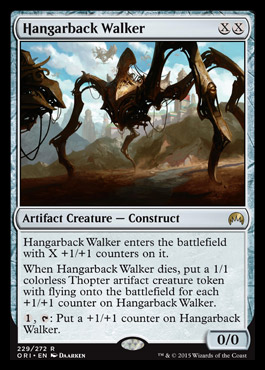
With preorder prices on the early spoiled mythics trending towards the top end of each set, we need to time our purchases accordingly. The better investments tend to get spoiled toward the end of spoiler season. In addition to popping up at the end of the spoiler, these cards have shown a trend of new mechanics. They are typically new designs or strangely difficult to analyze. Hangarback Walker for instance is a unique card whose power level is hard to pin down, hence its price fluctuating significantly.

Secondly, I need to highlight the most important factor: price. The starting price of the card is the part you need to pay the most attention to. If the card is starting over twenty dollars, chances are that you are not going to make money on that one. The Demonic Pacts and Kolaghan's Commands of the world are where we want to shine the spotlight.

To wrap up, as we are filled with joy from the Battle for Zendikar spoilers, focus your attention on rares and mythics spoiled late that are preordering for cheap. Sometimes a Jace, Vryn's Prodigy will surprise you and make you money, but the trend lies with the cheap cards.

Cards to Watch Leading up to BFZ

There may be some great opportunities from this highly anticipated fall set, but there are also some great ones in the here and now. On top of that, I’ve noted some upward trending cards that you may be aware of but are still worth mentioning.

Evolutionary Leap

There was an error retrieving a chart for Evolutionary Leap

Initially, I thought this card was headed for the bulk bins, or close to it. Certainly it has applications in Commander and for the casual crowd, but my opinion has grown beyond that narrow scope.

At Pro Tour Origins, Brian Kibler utilized this interesting reimagining of Birthing Pod and Survival of the Fittest in his sideboard to great effect. The Hall of Famer combined this new enchantment with Hangarback Walker to provide him with a constant stream of threats to fight against controlling strategies.

When I heard about this sequencing, I was blown away at the possibilities. Not only is it an underused sacrifice engine, but it also allows you to blank your opponent's removal spells by replacing every threat with another as long as you have mana available to activate it. This card has potential and could be the centerpiece of a strategy moving forward.

Shaman of Forgotten Ways

There was an error retrieving a chart for Shaman of Forgotten Ways

Many local players that work with Magic finance have brought this to my attention because if I try to lower the price on it, they buy me out. Their reasoning seems obvious when you put the pieces together. We are entering a block with gigantic monstrosities that cost a billion mana and we’re losing our best mana producers from Theros block.

Shaman of Forgotten Ways seems poised to jump in and not only help with mana ramping fun but also with winning the game. That ferocious ability doesn’t take much to turn on when you have Eldrazi charging into the format. With this card bottoming out, now is the time to get in before we start the Battle.

Descent of the Dragons & Risen Executioner

There was an error retrieving a chart for Descent of the Dragons
There was an error retrieving a chart for Risen Executioner

Both Descent of the Dragons and Risen Executioner are good Magic cards that don’t have any friend to help them succeed. Returning to Zendikar could change that completely. I would say these are soft buys. Isolate these cards in trades and try to get a playset or two because their potential is tremendous. These are more risky than the cards I’ve identified above, but they seem like plants to me for archetypes that could pop up in the new set.

What’s going to help Descent of the Dragons succeed? How about eldrazi spawn tokens. If we see that mechanic return on some new cards, you wouldn’t be able to use them for mana and to make dragons, but playing these types of cards alongside this powerful mythic could end well for players brewing the sweetness.

What about zombies though? This creature type was basically nonexistent on Zendikar the last time we were there, but anytime you’re talking about annihilating armies of monsters and large-scale battles, there might also be some necromancer trying to take advantage of the situation by bringing back some of the fallen. If this happens, the Risen Executioner is looming in the shadows waiting to lead them to victory.

Sarkhan

There was an error retrieving a chart for Sarkhan Unbroken
There was an error retrieving a chart for Sarkhan, the Dragonspeaker

As one of my favorite characters in the Magic universe, I may be a little biased on this one, but I think both versions of Sarkhan that have been released in Khans block could see significant gains in their future. Both of these adaptations cost five mana, which holds back their value, but they are both incredible planeswalkers. One of them basically turns into Stormbreath Dragon while also being able to kill a guy, and the other draws cards while accelerating your mana and also makes dragon tokens to protect himself.

Both of these cards have the makings of greatness within them. All they need is the right home to truly make them shine. They’re not getting any cheaper so if you like this investment, grab them while you can.

Dragonlords

There was an error retrieving a chart for Dragonlord Kolaghan

In my store, all Dragonlords have been selling consistently higher than TCG Player prices. I’ve sold out of every one of these epic dragons including the massively underplayed Dragonlord Kolaghan. They are intensely cool characters in the most popular race in the game.

Whenever you have a chance to obtain copies of this cycle, do so. They make great generals in Commander, every kitchen table is filled with them, and they’re good enough to see play in Standard. That makes them a prime buy.

Temple of Epiphany

There was an error retrieving a chart for Temple of Epiphany

Due to the creation of U/R Artifacts and the resurgence of Jeskai Aggro, one temple stands above the rest scoffing at their falling prices. Temple of Epiphany has surged up in value and now is the time to take advantage of that fact. If you have extra copies, unload them now while you still can.

The others are already near their post rotation bottom, but with the blue-red one, you still have time to extract some value. If you aren’t using them right now, move them or you will regret it later.

Fetchlands

There was an error retrieving a chart for Polluted Delta
There was an error retrieving a chart for Flooded Strand

I’m sure by now you’re aware of the price jump the Khans block fetchlands have seen lately. We’re not done yet. These lands are going to continue to increase as time goes on. Basically every Magic finance writer and dealer could tell you the same exact thing, but it bears repeating. These two blue ones, Polluted Delta and Flooded Strand, are the obvious winners simply because they obtain blue mana.

Just like their Zendikar versions, unless some wonky reprint happens with one of them, they should always be at the top of the heap. Don’t be surprised to see them continue to go up a bit more while they’re in Standard. There will be opportunities to make money on these cards at each plateau so stand firm in your continued acquisition of this real estate.

There was an error retrieving a chart for Wooded Foothills
There was an error retrieving a chart for Bloodstained Mire

What did surprise me was the increase in Wooded Foothills and Bloodstained Mire. These two Jund fetches are usually the cheaper ones, yet they have jumped alongside their blue counterparts. Certainly I expected this as well, but not so soon.

Wooded Foothills in particular jumping up close to Flooded Strand left me wondering what was going on. G/R Devotion coming back into the meta may have had something to do with this, but I think the more important aspect is the rising Zendikar lands brought this one along with them. Again, they’re not done. They will rise more still and have lots of room to grow.

There was an error retrieving a chart for Windswept Heath

Windswept Heath is the popular kid who broke up with his girlfriend and then all his friends rejected him. Now he’s relegated to the bottom of the list because he was slapped in the face with a random clash pack reprint. This event shows us that Wizards is willing to put fetches in random products like this, which is something to take note of.

Yet again, its price will still rise from its current value. Don’t lose faith in the lonely bottom dweller because his time will come again and I wouldn’t be surprised to see this card's value overtake Bloodstained Mire in 2016.

Well, I hope you’ve enjoyed this article about what’s happening in finance right now and the opportunities that are coming your way in the near future. Post your thoughts in the comments and let’s gear up for a great time in Magic finance.

Until next time,
Unleash the Force!

Mike Lanigan
MtgJedi on Twitter
Jedicouncilman23@gmail.com
Primers: Modern Merfolk

Are you a Quiet Speculation member?

If not, now is a perfect time to join up! Our powerful tools, breaking-news analysis, and exclusive Discord channel will make sure you stay up to date and ahead of the curve.

Merfolk is a relatively upstart archetype in the modern metagame. Relegated to tier 2 for almost its entire life in Modern, it only recently has had notable showings and started to command a respectable share of the field.

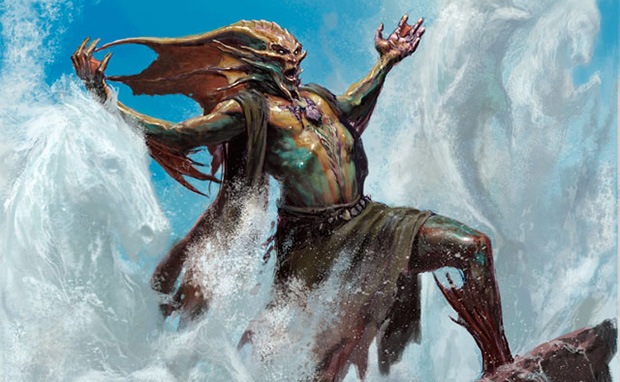
Master of Waves Art

So why should you play Merfolk in Modern? It’s not as fast as Affinity, consistent as Burn, or as streamlined as Zoo. What it does have going for it is dodging the majority of the hate that the format brings for these decks. No catch-all disruption exists for beating Merfolk, apart from removal, which can itself easily be beaten by solid sideboarding and redundancy in our creature base. Combined with cheap spells and interaction that provides large tempo swings, the deck has more to it than just its tribal synergy.

[wp_ad_camp_1]

Examining the List

Merfolk's recent appearance is somewhat out of the blue – the core of the deck has remained relatively the same, outside of a few recent additions. So what has caused this fish resurgence? Merfolk’s sudden appearance started right after its placing at GP Copenhagen. Not one, but two Merfolk decks appeared in the Top 8 and ended up taking the whole thing down. What is interesting is how wildly different these two lists were outside of the “core” and just how many flex spots this supposedly crammed deck actually allows.

The eventual winner had a more typical build – that is to say along the lines of the previous norms for the deck, with a few changes. The deck had no splash (apart from non-island lands to beat Choke) and did not deviate far from the common build. Outside of Dismember and main deck Relic of Progenitus, the list was mostly stock.

Here’s the list I’m currently running:

Merfolk, by Will Archer

Creatures

4 Lord of Atlantis
4 Cursecatcher
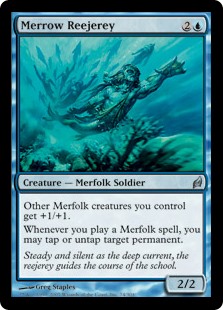
3 Merrow Reejerey
4 Master of Waves
4 Master of the Pearl Trident
4 Silvergill Adept
2 Harbinger of the Tides
2 Phantasmal Image

Artifacts

4 Aether Vial

Enchantments

4 Spreading Seas

Instants

3 Vapor Snag
2 Spell Pierce

Lands

4 Mutavault
1 Ghost Quarter
1 Cavern of Souls
1 Minamo, School at Water's Edge
1 Oboro, Palace in the Clouds
12 Island

Sideboard

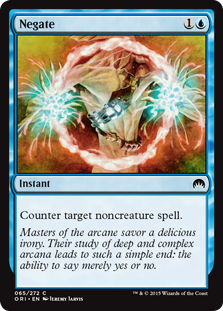
2 Negate
4 Hurkyl's Recall
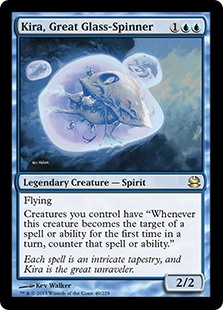
1 Kira, Great Glass-Spinner
2 Thassa, God of the Sea
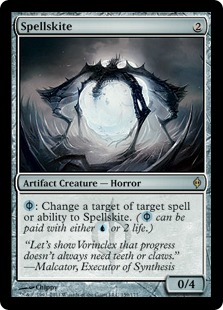
2 Spellskite
2 Hibernation
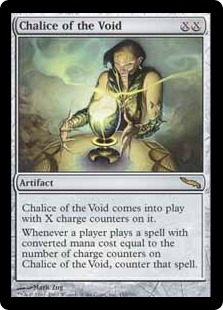
2 Chalice of the Void

After testing against the majority of the field, I can finally say I’m happy with where my current list is. Let’s touch on the card choices.

Card Choices: Maindeck

Merrow ReejereyThe core of the deck is the creature base, which is somewhat stock and unchangeable. Full playsets of the Merfolk lords is where you want to start - Merrow Reejerey is the lesser of the three (outside of specific instances, but is somewhat of a win more card) and at three CMC is the first one I’d trim down to three copies. Silvergill Adept is solid – drawing a card on a body is great when it’s of the relevant tribe - little more can be said other than you want four.
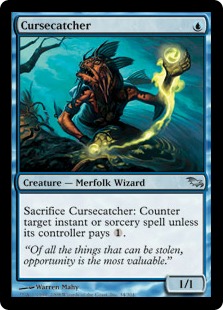
The remaining creatures are all somewhat stock, but hotly contested by some players. Cursecatcher, for starters, is seen as low impact and occasionally is dropped all-together, but I’d caution against this route. While a poor top deck late game and really then only having its creature type going for it, turns one through four is where it shines. Its ability to slow the opposing player and gain tempo while just sitting on the board is hard to account for, or even see for a new pilot of the deck, and only noticed over a high number of games. Be it making them fetch poorly, shock themselves, or wait a turn to cast that Kolaghan's Command, Cursecatcher more than makes up for its poor late game usage.

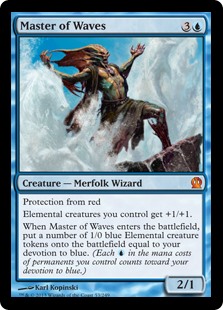
Master of WavesMaster of Waves has appeared in lists anywhere from one to four copies, but I chose to run the whole playset. It breaks board stalls, is near irremovable against a large part of the field, and can sometimes win the game when Vialed in EOT against an unsuspecting opponent. As the curve topper, I would be hesitant to reduce this to less than three copies in the current meta.
Harbinger of the Tides is a very recent addition from Origins, but immediately has been slotted into the deck. Its uses are numerous and is easily one of the best cards in the list and occasionally a huge tempo swing. I like two, but three would be easily defensible, as it is an all-star outside of a few matches.

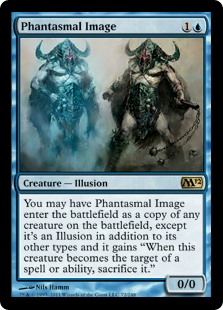
Phantasmal ImagePhantasmal Image is a great catchall creature. Be it lords 12 through 14, copying an Adept to draw a card, Harbinger to bounce, or copying your opponents best creature, it is an extremely good card that promotes knowing the format, when to use it, and just what you can do with it.
The interaction in Merfolk has to do a few things. One is be cheap. Outside of the Aether Vial on turn one draw, you will be using your mana every turn and rarely will have more than one or two open on your opponents turn. Two: be as high-impact as possible. You win games because of how consistent and streamlined the deck is, being tribal, and you want the interaction to also be as streamlined.

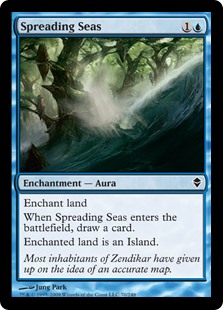
Spreading SeasSpreading Seas is a great card. Enabling islandwalk can turn a stalled board into the signing of a match slip in one turn. It doubles as splash over Tron hate – keeping them off Urzatron for even a few turns can be enough to win the game before Karn and friends show up. It also punishes greedy three color mana bases like Grixis and Jund, and turns off annoying manlands. Oh, and it also draws you a card. I like four, but have tested three and am comfortable at that number.
Vapor Snag is great and sometimes game-winning. Cheap, effective, occasionally a huge tempo swing as well as helping push through attacks or stymie them, the card does a ton of heavy lifting in Merfolk. Bouncing a delved out creature is a huge play, and with the rise of Grixis Control, a play that happens quite often.

Spell Pierce does a lot of the same thing. Cheap, effective, and occasionally a huge tempo swing. It’s highly underused in Modern and very rarely respected. Easy to hold up, it's great against many of the greedy decks.

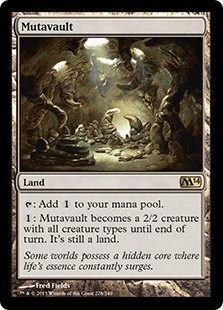
MutavaultThe land base is fairly straight forward. Mutavault is great, doubling as a Merfolk (and Elemental!) that beats sorcery speed removal. Ghost Quarter is currently at its all-time high in playability and the deck can handle one more colorless land outside of the worst of draws. Islands fill up the rest, as well as any non- basic blue providing lands you want to run if Choke is a concern. While it seems like you can skip on them, they are actually more important then they appear. Dodging Choke is critical, as that is the only real “hate” card floating around in sideboards. Minamo, School at Water's Edge is sometimes relevant, being able to untap a Kira or Thassa, and Oboro can provide fuel for Liliana's discard ability in a pinch.
Card Choices: Sideboard

The sideboard, in my opinion, is the biggest contributing factor to winning with Merfolk. We have a lot of great matchups but a few very, very bad ones. I personally do not believe you can play Merfolk and be okay with sacrificing the bad matchups, so the sideboard will have to make up for this.

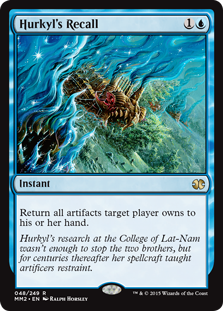
Hurkyls RecallHurkyl's Recall and Chalice of the Void are nods to the worst match-up for the deck: Affinity. Chalice on zero or even one, if you can wait that long, are game breaking. I’d still consider it tough after board but dedicating 6 slots makes it a lot better. Chalice is also near unbeatable for Bogles as well as Burn, so it isn’t a narrow inclusion.
The Negates provide further interaction against decks we need to have answers for. Scapeshift, Tron, and Grixis are all decks I’m happy to bring these in against to provide tempo swings when countering high costed spells like Karn or Cryptic Command.

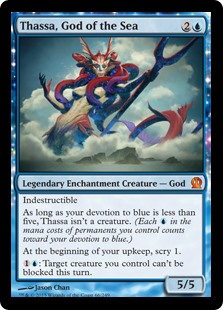
ThassaKira, Thassa, and Spellskite are all nods to the high amount of removal some decks bring to the table. Kira, Great Glass-Spinner stops the spot removal that can be the bane of the deck. Thassa, God of the Sea is indestructible card selection that is easily turned on and creates more ways to make your team unblockable Spellskite is a catch-all answer to the formats most maddening decks and cards. All of these are very broad answers to a lot of decks and provide consistent answers to the most troublesome problems the deck can face.
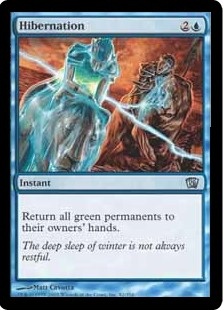
We round out the sideboard with two Hibernation. Hibernation is a concession to the newly popular (but still mostly tier 2) Elves deck, which is a horrendous matchup, as well as doubling as an answer to the other Collected Company decks. An aptly timed Hibernation sometimes just reads “win the game”, so while a narrow answer, it's a sad necessity.

Cards That Didn't Make the Cut

  • Splashing a second color
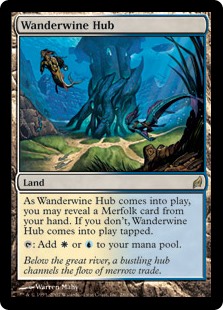
    Wanderwine HubAdding white is usually the way you can go if you want to add a second color, due to the lands (Wanderwine Hub and Seachrome Coast) being easily added. The most common cards added with white are Path to Exile and more/better Affinity sideboard hate in the form of Kataki, War's Wage or Stony Silence. Personally, I feel this is not needed and we do not gain enough from it. Path is great removal but not where the decks wants to be. Spreading Seas becomes a lot worse at cutting off mana sources, and the tempo generating cards we run become less effective when you are ramping your opponent.
  • Dismember
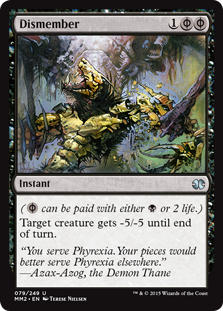
    DismemberWhile great removal and a perfectly fine inclusion, Merfolk has a lot of added bonus in the fact it takes zero damage from its manabase/cards. Not taking 1-3 damage against the other aggressive decks in the format automatically make our match ups much better. Continuing with this, playing a card that you will automatically take 4 from just to cast doesn’t seem like where the deck wants to be. I feel Vapor Snag does (mostly) what you are looking for out of that slot.
  • Further permission
    I can absolutely get on board with more permission in the side, but be careful. Without cheating on mana with Aether Vial, we routinely tap out turn after turn. One-mana answers are where we want to be (Spell Pierce, Swan Song, Dispel, etc.). I would be hesitant to run more then a few two mana answers (Negate, Remand, etc.).
  • Grafdigger's Cage
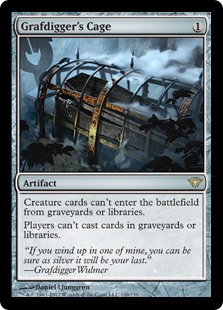
    Grafdiggers CageA perfectly fine sideboard card against Snapcaster Mage, random graveyard strategies, Collected Company decks, and more. I find these matchups to already be somewhat good for Merfolk, but if you are having trouble this is a great card to add to the board.
  • Tidebinder Mage
    Great at locking down any annoying green creatures, this is another card you can easily put in the board if you are concerned about it. I believe our natural evasion via Seas can somewhat make this card redundant, but nevertheless is perfectly fine if that is a match up you are concerned with.
  • Pithing Needle
    Merely good in a large number of matchups, it is a good catch all answer, if a tad unimpressive at times. Great against Affinity and sometimes Tron, it's susceptible to splash-over Vial hate/bounce which can lead to blow outs. Use with that in mind.

Next Level Playing TIps

General Deck Tips

  • Use your mana efficiently
    While ideally you will always have a turn one Aether Vial, reality is different. The deck is smashed full of two drops that all want to be played as soon as possible for the tribal bonuses. Sequencing is extremely important: think ahead multiple turns to when you want to use your low-costed interaction, and play out your creatures accordingly.
  • Aether Vial counters are important
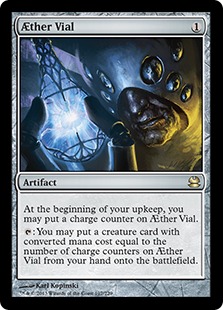
    Aether VialKnowing when to go from two to three, or even to four, is an acquired skill that has huge ramifications. Think of all the possible draws and how exactly you’d want to sequence them, and plan out the ticking up or holding of the counters. You will quite often keep it at two as most of our creatures as well as creature based interaction comes from that CMC.
  • Think before you tap your mana
    The deck has a glut of double blue cards. Think about how you tap your mana and what you need to leave up. Don’t accidentally tap double blue for the Silvergill Adept and face palm when you draw into the Lord of Atlantis you would have been able to play.
  • Don’t Vial creatures in with no purpose
    When used well, Vial is easily one of the best cards in the format. Not only does it let you cheat on mana, and avoid counterspells it lets you play creatures at instant speed.
  • Become skilled at doing combat math
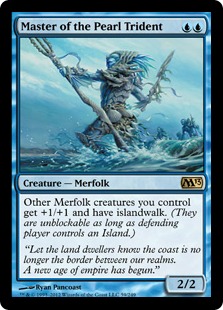
    Master of the Pearl TridentWith all the lords in the deck, damage can easily be missed, or the clock you have miss-read. Double check your power and toughness (as you are responsible for doing that checking).
  • Watch your devotion!
    When playing with Master of Waves, I notice people missing Spreading Seas. You control the enchantment and thus it counts as another pip for devotion. Easily missed and sometimes beneficial if you have a Thassa and your opponent doesn’t realize.
  • Play around sweepers
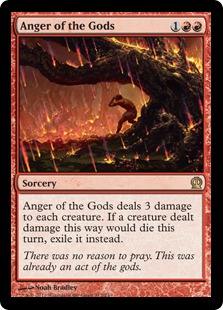
    While the Modern format is relatively devoid of them, they still float around. Of note are Anger of the Gods in the majority of Grixis and Twin boards, and the occasional Damnation out of Jund. Don’t forget they exist in Modern by walking into them!

Single Card Tips

  • Phantasmal Image versatility
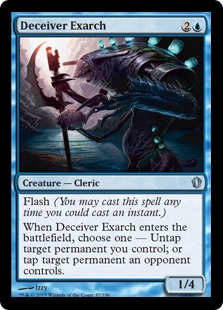
    Deceiver ExarchThis card has a plethora of uses and can do many interesting things. When Vialed in against Twin, you can copy the Deceiver Exarch or Pestermite in response to Splinter Twin and tap it down, giving you an extra turn to draw an answer or swing in for lethal. Watch out for them end of turn tapping your Vial though!
  • Phantasmal Image triggers
    Remember: Image gets any ETB trigger from the creature it copies! Some notable creatures to copy are Snapcaster Mage, Restoration Angel, Eternal Witness, Master of Waves, Siege Rhino, and Vendilion Clique to name a few!
  • Harbinger of the Tides flash
    Harbinger of the TidesThe flash is very relevant. While it’s best to just Vial it in, don’t forget about it also has flash itself. Watch your mana – always remember against Twin they can tap one down before they go off. Harbinger is great interaction that gets around the commonly-held Dispel.
  • Harbinger of the Tides and tempo
    Against aggressive decks don’t be afraid to run it out as soon as possible for any tempo gain. It doesn’t always have to be a “gotcha” card. Sometimes returning the Birds of Paradise is all you need to get value out of it.
  • Spreading Seas targets
    Play these smart. Not only do they enable islandwalk but they can really mess up people’s mana base. If possible cut them off a colored source. Failing that, hit a manland or other relevant land.
  • Spreading Seas and devotion
    Don’t forget you control it! Relevant with both Thassa and Master of Waves for devotion.
  • Spreading Seas against Tron
    Against Tron, don’t run them all out. Play as many as have to that can keep them off assembling Tron, as Oblivion Stone only costs three to cast then five to activate and sweep them away.
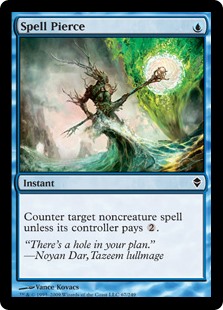
  • Spell PierceSpell Pierce
    The longer you hold it, the worse it gets. Don’t be afraid to use it early against something somewhat relevant. It eventually becomes near useless, but is huge in the early game.
  • Merrow Reejerey
    His tap/untap ability only triggers on casting, not Vial-ing in Merfolk. You can occasionally go “off” and spill your hand with enough Merfolk. Remember, its tap or untap any permanent. Blockers, lands, Aether Vial, all great targets for its ability. Combined with an instant-speed Harbinger can really catch people off-guard.

Sideboarding Guide

Affinity

Chalice of the VoidOUT
Cursecatcher
Merrow Reejerey

IN
Hurkyl's Recall
Chalice of the Void

Affinity is easily the decks worst match-up, and if anything is the only strike against the deck. Game one is extremely hard – winning the die roll is almost necessary to have a chance, as is seeing most of your interaction and curving out extremely well. Vault Skirge, Inkmoth Nexus, Cranial Plating, and Arcbound Ravager all spell doom for the Fish player, and putting any of these together without relevant interaction is almost impossible to beat. Because of this, the sideboard needs to be extremely slanted due to Affinity’s large share of the metagame. Chalice of the Void on zero is extremely hard to beat, (even on the draw, as Chalice on zero followed by a Recall is just as good) and Hurkyl's Recall can enable an alpha strike or give you enough time to get ahead.

Twin (UR, Temur, Grixis) / Grixis Delver

SpellskiteOUT
Spreading Seas or Merrow Reejerey
Phantasmal Image

IN
Negate
Thassa, God of the Sea
Kira, Great Glass-Spinner
Spellskite

I lump these together as they seem to blend together lately, and the sideboarding strategy is nearly the same. You want to bring in counterspells, Kira to dodge the targeted removal, Spellskite for the same reason as well as stopping the Twin combo, and Thassa as a hard to remove threat that improves your card selection to find relevant interaction. I sometimes leave a few Spreading Seas in if playing Grixis as you can occasionally take them off a color early. Overall, this matchup feels very good, and outside of them drawing extremely well, is one of our best matchups. Watch out for Anger of the Gods post-board.

Jund / Abzan

KiraOUT
Aether Vial
Phantasmal Image

IN
Spellskite
Kira, Great Glass-Spinner
Thassa, God of the Sea

An average matchup, that gets much better after board. Watch out for Anger of the Gods in Jund. This match often comes down to how well you draw: it's hard to beat removal-heavy hands pre-board. Thankfully our sideboard is tuned well to beat these style of decks. Aether Vial comes out to increase our deck's threat density. Spell Pierce is okay here as it can often counter a Liliana or early removal spell.

Burn

NegateOUT
Merrow Reejerey
Harbinger of the Tides
Phantasmal Image

IN
Negate
Spellskite
Kira, Great Glass-Spinner
Chalice of the Void

A fairly decent matchup overall. Our creatures outclass them once we land a few lords, and we have cheap permission that is highly effective. Spreading Seas does a very good Stone Rain impression, and can lock them out of the game or off a splashed color in land light hands. Aether Vial helps you dodge damage from Eidolon of the Great Revel, so don't be quick to cut it when boarding.

Infect

CursecatcherOUT
Phantasmal Image
Merrow Reejerey

IN
Chalice of the Void
Negate
Spellskite

They are faster but outside of Blighted Agent we can block most of the threats. Spreading Sea hits the annoying Inkmoth Nexus while Cursecatcher and Spell Pierce can keep them off over-commitment into pump. Chalice on one can turn off half of the deck. Just be mindful of how you sideboard when you bring in Chalice as you do have a fair amount of one CMC spells as well.

Amulet Bloom

OUT
Merrow Reejerey

IN
Negate
Chalice of the Void

An average matchup. Spreading Seas is merely okay against the bounce lands. We have to rely on drawing our permission and having a fast clock with this matachup. Chalice on zero can swing the game in your favor.

Tron

OUT
Merrow Reejerey
Harbinger of the Tides

IN
Thassa, God of the Sea
Negate

Blue Tron is the much easier of the two, but GR Tron isn't the worst. Spreading Seas and permission coupled with a clock win this match up. Be careful not to play out all your Seas only to watch them get swept away by Oblivion Stone. If you have a lot of Tron in your area, Pithing Needle can be added to name Karn Liberated or Oblivion Stone.

Abzan Company / Elves

HibernationOUT
Spreading Seas

IN
Hibernation

I lump these together as the sideboarding is somewhat the same. Unfortunately we do not have much we can do against these decks other then bring in Hibernation (which is often a ridiculous blow out). Watch out for Choke. Spell Pierce is merely okay, but catching a Collected Company/Chord of Calling is great.

Conclusion

Overall, Merfolk is in a pretty good place at the moment: it has great match ups against most of the format, is full of cheap tempo plays, and dodges specific hate that plagues the majority of the other aggressive Modern decks after board. These factors finally enable Merfolk to be considered a tier 1 deck. It absolutely rewards the experienced pilot, and gets to play one of the formats most underused and overpowered cards in Aether Vial.

I hope this primer was helpful, and as always let me know in the comments if you think I missed something!

Insider: MTGO Market Report for August 19th, 2015

Are you a Quiet Speculation member?

If not, now is a perfect time to join up! Our powerful tools, breaking-news analysis, and exclusive Discord channel will make sure you stay up to date and ahead of the curve.

Welcome to the MTGO Market Report as compiled by Sylvain Lehoux and Matthew Lewis. The report is loosely broken down into two perspectives. A broader perspective will be written by Matthew and will focus on recent trends in set prices, taking into account how paper prices and MTGO prices interact. Sylvain will take a closer look at particular opportunities based on various factors such as (but not limited to) set releases, flashback drafts and banned/restricted announcements.

There will be some overlap between the two sections. As always, speculators should take into account their own budget, risk tolerance and current portfolio before taking on any recommended positions.

Redemption

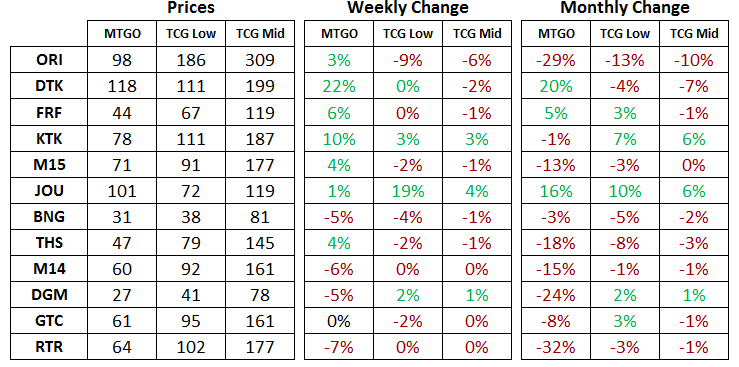
Below are the total set prices for all redeemable sets on MTGO. All prices are current as of August 17th, 2015. The TCG Low and TCG Mid prices are the sum of each set’s individual card prices on TCG Player, either the low price or the mid-price respectively.

All MTGO set prices this week are taken from Goatbot’s website, and all weekly changes are now calculated relative to Goatbot’s ‘Full Set’ prices from the previous week. All monthly changes are also relative to the previous month prices, taken from Goatbot’s website at that time. Occasionally ‘Full Set’ prices are not available, and so estimated set prices are used instead.

Aug17

Return to Ravnica Block & M14

With RTR continuing to fall in price, it won't be long before a set of GTC is worth more than a set of RTR. This is a perfect example of how much redemption matters to the price of a digital set. Without the ability to redeem a set of RTR, the price has been falling steadily. After redemption went offline, everyone who sold their RTR cards immediately fared well compared to those who held onto their cards.

Even those just holding a playset could have benefited by selling their Modern-playable cards (like Jace, Architect of Thought) with an eye to buying them back after the price had come down. If you are not currently using a card, and it's going to drop in price, take the prudent course of action and sell the card. The drop in price for the cards from RTR was predictable as soon as it became clear that redemption had closed.

Voice of Resurgence has fallen back below 20 tix on Goatbot, which is very near the previous price floor of 17 tix. This is a good price for players to grab a playset, but speculators will want to wait until BFZ release events fire up and start draining tix from the MTGO economy. Although it's a playable card in Modern, there's not much time between now and the release of BFZ. When the window to see gains is short, only speculate on format staples that have a good chance of going higher. At current prices and at its current level of play in Modern, this mythic two-drop is risky.

Theros Block & M15

Summer Standard keeps throwing out surprises that interrupt the downtrends in these sets. However, once the official spoiler season for BFZ begins in September, Standard will be very much a lame duck format. It's just time to watch out for cheap junk mythic rares and to keep tabs on the Modern-playable cards from these sets that are getting cheap.

Both THS and BNG are dropping rapidly in paper and so redemption can provide no support to the digital prices of these sets. Look for paper prices to stabilize before any support from redemption can reassert itself.

From JOU, Keranos, God of Storms and Eidolon of the Great Revel have both fallen below 20 tix. It's not time to buy these yet, but they are on the list of targets. JOU is not a candidate for redemption, but both of these cards see play in Modern.

Jace, the Living Guildpact from M15 is approaching a level that is rarely breached by Standard-legal planeswalkers. If this card falls below that threshold of 1 tix, don't hesitate to start buying. M15 will be redeemed at average numbers for a core set so there will be price support down the road for all mythic rares from this set.

Tarkir Block & Magic Origins

Dragonlord Ojutai went back up to 14 tix and Den Protector is getting closer to 10 tix, a high but attainable price for a non-mythic rare. These two cards contributed to DTK seeing a whopping 22% increase over last week. With the end of heavy drafting of this set, the supply of new cards has slowed to a trickle and we are seeing prices find a new equilibrium.

DTK is quite an interesting case as it was only opened heavily for a couple of months, and unlike a normal large set it was only opened two boosters per drafter. Combined with the extended release of MM2, there is the potential for this set to power much higher in the coming months. At current prices, redeemers will not be clamoring to convert digital DTK to paper, but we only have to look at JOU to see how the MTGO price of a lightly opened third set can diverge wildly from the paper price.

The other two Tarkir block sets also saw price increases this week. With KTK still being priced at a discount to paper, and paper prices showing strength heading into September, it's expected that KTK will continue to appreciate in price. The market is adjusting to the reality of there being no imminent reprint of the Zendikar fetchlands and the price of a set of KTK is getting the benefit as a result.

The middle set of the block has a slightly worse outlook than the other two sets at the moment, despite the price rebound coming out of ORI release events. Much less redemption occurs for small sets due to having to spread the costs of redemption over a smaller card pool. Until paper prices completely stabilize, gains for FRF are expected to be muted.

The spoiling of the colourless Eldrazi mechanic this week, the keyword devoid, makes Ghostfire Blade and Ugin, the Spirit Dragon look like Tarkir block plants for BFZ. This piece of equipment has been seeing recent success in Standard so it's not a buy low candidate. Just one to hold onto in the Fall if you've already got a stash of them. Ugin has been very stable in the 8 to 9 tix range and so buying at current prices won't incur much risk.

The two set prices for ORI are converging, but it's the paper prices coming down to meet the digital. This is a normal progression but it will end soon with the release of BFZ. With a short drafting window, a number of novel cards and the opposing-colour pain lands, ORI is a set you can sink tix into.

Modern

This week was the tipping point for Modern positions. As underlined by the three majors Modern indices (Total Modern Format, MMA and MM2) and after bottoming this past week, prices rebounded this past weekend and earlier this week. Some positions rebounded moderately but others doubled in less than a week.

The MM2 full set value increased by about 10% since last Friday and, as of Monday, less than fifteen MM2 cards were losing value compared to the previous week--a clear indicator of the new trend. On average, the trend should be upward until the end of September. Among the rare MM2 Modern staples that haven’t really recovered from this month-long price drop are Spellskite, Splinter Twin, Karn Liberated, Noble Hierarch and Primeval Titan. Speculators who hadn’t bought these positions earlier in July or more recently in August may want to acquire some of these Modern staples now.

Other Modern staples, including Snapcaster Mage, Stony Silence, Aether Vial, Rest in Peace and Slippery Bogle, have also seen a nice price hike over the past few days. Attentive speculators who bought some of these positions during the big price drop recorded late July/early August may have already doubled their investment here.

Buying prices should soon follow this rise and generate comfortable profit by the end of the month or early this September. At this point, it will be up to each speculator to decide to hold for potential higher profit or to sell, perhaps redirecting the Tix generated to other speculations such as ORI rares.

Following the initial spike that occurred two weeks ago, the five ZEN fetchlands, with the exception of Marsh Flats, are keeping the trend up. Expect these lands to follow the general Modern price trend for the next four to six weeks too.

Legacy & Vintage

Legacy prices were mostly unaffected by the release of Magic Origins and they didn’t react much to the termination of ORI release events. A noticeable price rebound can be observed only for the Total VMA set price and the P9 index. If historically prices across all formats have always increased in between the release of the core set and the following Fall set, speculators should not expect all Legacy and Vintage positions to be as dynamic as Modern ones.

Of note this week, despite seeing play in several deck archetypes in Legacy, Deathrite Shaman has slipped under 1.3 Tix, its all-time lowest price on MTGO. Three months before the Legacy MOCS the black-green elf looks like a solid speculative target.

Pauper

One week after the introduction of Play Points, Pauper seems rather unaffected by the change and price fluctuations remain normal. Snap hit a one-year high, Sunscape Familiar keeps cruising to higher prices and Innocent Blood, Lava Spike and Chittering Rats have all rebounded from their low point, hit around the release of ORI.

Pauper staples are unlikely to keep rising until the end of September though. Instead, they're most likely to follow their own up and down cycles and Pauper speculators should consider selling their positions when they double in price, whether it took two days or two weeks to meet this profit.

Mono-Green Stompy is one of the cheapest Pauper decks. With Nettle Sentinel as the most valuable card and a lot of bulk commons in the deck, Stompy put itself as the second most represented deck in the Pauper metagame these days. If the popularity of Stompy sustains, cards to watch include Mutagenic Growth, Rancor and Quirion Ranger, the three other cards in addition to Nettle Sentinel that hold significant value above bulk.

Targeted Speculative Buying Opportunities

Legacy

Deathrite Shaman

We have recommended buying this card some time ago and after the dip experienced these past weeks we strongly feel this is a good buying opportunity at this point again with the Legacy MOCS three months ahead.

Targeted Speculative Selling Opportunities

None

Super League Patreon

Are you a Quiet Speculation member?

If not, now is a perfect time to join up! Our powerful tools, breaking-news analysis, and exclusive Discord channel will make sure you stay up to date and ahead of the curve.

As I've made clear, if somewhat indirectly, I'm a pretty big fan of Vintage and Standard Super League. In their early seasons the broadcasts were funded by WotC, which seemed like a good thing for the company to do to generate more exposure to the game. For whatever reason, WotC has ceased this sponsorship, but as they say, the show must go on.

SSL

Randy Buehler launched a Patreon campaign to secure some funding to pay the players and to increase the production quality of the various Super Leagues this week, and I really hope to see these shows continue. If you're interested in funding these projects, you can find the Patreon here.

Avatar photo

Ryan Overturf

Ryan has been playing Magic since Legions and playing competitively since Lorwyn. While he fancies himself a Legacy specialist, you'll always find him with strong opinions on every constructed format.

View More By Ryan Overturf

Posted in Free1 Comment on Super League Patreon

Have you joined the Quiet Speculation Discord?

If you haven't, you're leaving value on the table! Join our community of experts, enthusiasts, entertainers, and educators and enjoy exclusive podcasts, questions asked and answered, trades, sales, and everything else Discord has to offer.

Want to create content with Quiet Speculation?

All you need to succeed is a passion for Magic: The Gathering, and the ability to write coherently. Share your knowledge of MTG and how you leverage it to win games, get value from your cards – or even turn a profit.

Modern White Weenie: White Goyfs

Are you a Quiet Speculation member?

If not, now is a perfect time to join up! Our powerful tools, breaking-news analysis, and exclusive Discord channel will make sure you stay up to date and ahead of the curve.

Editor's note: John recently placed 14th at the SCG Premier IQ in Washington, D.C. with his White Weenie list. In this spotlight article for the Nexus, he discusses the deck itself, his tournament experience, and ways to improve White Weenie for the future. 

White Weenie is at its best when it’s at its worst. For those unfamiliar with the archetype, White Weenie often refers to an aggressive white deck. It is a deck that often swarms the opponent with efficient but inherently “fair” white creatures, usually with the ability to make those creatures into bigger threats. Typically this is done with anthem effects such as Honor of the Pure, but equipment has also served this role in the past. White Weenie decks tend to be fairly fast aggro decks, but are usually slower than the red aggro decks of the format.

Kytheon Art

Of course, reasonable minds can differ, and there are those in the Magic community who believe that White Weenie decks are piles of unplayable garbage with no card advantage that roll over and die when the opponent manages the extraordinary feat of playing literally any creature or removal spell. Admittedly, there is a nugget of truth to this viewpoint, but the graveyards of Magic tournaments are littered with the bodies of those who overestimated their chances against a well-tuned aggro list. When the format reflects the belief that aggro decks are inherently inferior strategies, it’s White Weenie’s time to shine.

Are you interested in exploiting a gaping hole in the Modern metagame? Are you interested in an aggro deck that puts Burn and Affinity on the defensive? Are you interested in playing 16 copies of the best two-drop in the format for a single white mana (no, blue mages, I’m talking about Tarmogoyf and not Mr. Tiago)? Then maybe White Weenie, aka White Goyfs, is for you.

[wp_ad_camp_1]

The Road to White Weenie

Contrary to popular belief, there have been a number of White Weenie decks that experienced success at the highest levels. For Modern, Paul Rietzl’s 2010 Extended deck for PT Amsterdam stands out as especially relevant:

Extended White Weenie, by Paul Rietzl (1st, PT Amsterdam 2010)

Creatures

4 Knight of the White Orchid
4 Ethersworn Canonist
4 Figure of Destiny
2 Ranger of Eos
4 Steppe Lynx
4 Student of Warfare

Enchantments

4 Honor of the Pure

Instants

4 Brave the Elements
2 Mana Tithe
1 Path to Exile

Sorceries

4 Spectral Procession

Lands

4 Arid Mesa
4 Flagstones of Trokair
1 Horizon Canopy
4 Marsh Flats
10 Plains

Sideboard

1 Angel's Grace
3 Burrenton Forge-Tender
1 Celestial Purge
1 Lapse of Certainty
3 Path to Exile
4 Relic of Progenitus
2 Rule of Law

I could point to a number of other successful White Weenie decks in years past (Craig Wescoe decks in particular naturally spring to mind), but one common theme is that they took advantage of a metagame that didn’t show them enough respect. I have always had the most success with White Weenie when it was a complete non-entity, or presumed to be strategically ineffective.

For example, if you played Standard in the fall of 2012, you might remember that Thragtusk was running rampant; UW control decks had access to both Supreme Verdict and Sphinx's Revelation; Reanimator combo was putting turn four Angel of Serenity into play and BR Zombies was taking down GPs.  Opposing sideboards began to reflect the belief that BR Zombies was the only viable aggro choice, so naturally I sleeved up this beautiful disaster at GP Charleston:

Boros Weenie, by John Gniadek (30th, GP Charleston 2012)

Creatures

4 Doomed Traveler
4 Champion of the Parish
4 Thalia, Guardian of Thraben
4 Precinct Captain
4 Fencing Ace
4 Elite Inquisitor
4 Silverblade Paladin
3 Fiend Hunter

Artifacts

3 Silver-Inlaid Dagger

Instants

2 Rally the Peasants

Planeswalkers

2 Ajani, Caller of the Pride

Lands

4 Cavern of Souls
4 Clifftop Retreat
2 Slayers' Stronghold
10 Plains
2 Mountain

Sideboard

4 Nearheath Pilgrim
3 Odric, Master Tactician
2 Zealous Conscripts
2 Purify the Grave
2 Intrepid Hero
1 Slayers' Stronghold
1 Bonfire of the Damned

In today’s Modern, there is a massive hole White Weenie is naturally built to exploit. There are essentially no decks playing sweepers (the natural predator of White Weenie decks since the beginning of time) in Game 1, and very few that run them in their board. Of the few that do, most of them are red damage-based sweepers such as Anger of the Gods or Pyroclasm, which are completely negated by Brave the Elements. The relative lack of sweepers means that overextending can’t be punished as badly as it needs to be. Additionally, rather than running cards that are generally strong against aggro decks, many sideboards have very specific slots dedicated to specific matchups: those Ancient Grudges, Stony Silences, and Kor Firewalkers accomplish virtually nothing against White Weenie.

Anger of the GodsDue to the lack of sweepers, playing your first one-drop on turn one and two more of those one-drops on turn two leads to more free wins than you might expect. A timely spell on turn three can be backbreaking. I ran the numbers, and concluded that 29 creatures, 20 lands, and 11 spells is the optimal mix if you want at least three creatures, two lands, and one spell in your opener. For the mathematically inclined, this entailed running some multivariate hypergeometric distribution calculations. I worked backwards through trial and error to find the number of creatures, lands, and spells most likely to yield at least three creatures, at least two lands, and at least one spell in your opening hand.
In Modern, white has an embarrassment of riches at the one-drop slot. In addition to roughly a dozen or so Savannah Lions variants, there are a surprising number of one-drops that get gigantic. Now, some of them simply don't have the support to consistently get there (Hada Freeblade), some require prohibitively too much mana to be remotely playable (Caravan Escort), and some require the deck to be warped around them for not enough payoff (Ardent Recruit). That still leaves nearly a deck’s worth of one-drop Goyfs to work with, which led me to the following decklist that I played at the Washington, D.C. Premier IQ:

Modern White ‘Goyfs, by John Gniadek (14th, SCG Premier IQ D.C., 2015)

Creatures

4 Steppe Lynx
4 Champion of the Parish
4 Boros Elite
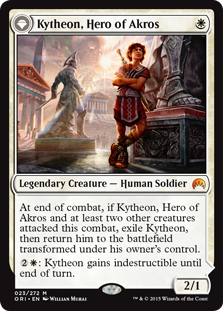
3 Kytheon, Hero of Akros
4 Student of Warfare
4 Figure of Destiny
4 Soldier of the Pantheon
2 Mardu Woe-Reaper

Instants

4 Brave the Elements
4 Path to Exile
3 Mana Tithe

Lands

4 Arid Mesa
4 Marsh Flats
4 Windswept Heath
8 Plains

Sideboard

4 Sunlance
3 Dismember
3 Angel's Grace
2 Grafdigger's Cage
2 Mardu Woe-Reaper
1 Kytheon, Hero of Akros

There are a number of inclusions that will surely raise a few eyebrows, so in the next two sections, I wanted to offer my thought process on including each of them.

White Weenie: Maindeck

Kytheon CardKytheon, Hero of Akros: As it turns out, he’s the real deal and I would recommend playing the full four now. What people often overlook about cards like this is that, while perhaps unimpressive in a vacuum, they create increasingly complex decision trees that provide the opponent more opportunities to stumble. Imagine that you played a Lynx turn one followed by a Champion and Kytheon turn two. If your opponent only has one removal spell for their second turn, what are they supposed to do? Killing Kytheon runs the risk of taking a potential nine damage just from the Lynx and Champion on the next turn, but not killing the Kytheon runs the risk of you deploying additional threats with the ability to leave Brave the Elements mana open. A deck like this really maximizes Kytheon's potential since he threatens to become a 4/4 indestructible attacker as a natural consequence of the deck's primary gameplan.
Steppe Lynx: Lynx requires the manabase to be built around him, but that doesn't cost you anything in this deck. Sometimes you don’t make land drops and the Cat just stands around not doing anything, but the ability to drop this on turn one and deal eight damage by turn three is nearly unmatched.

Champion of the Parish: He gives Steppe Lynx a run for its money as with some luck he can be a 6/6 on turn three. Once this becomes a 4/4 or bigger, many decks have major problems getting rid of it.

Boros Elite: I admit this card isn't very good, but it serves a purpose. Most opponents can’t keep you off of three attackers for as long as they’d like to believe they can.

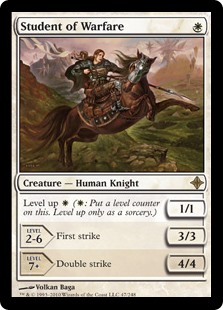
Student of WarfareStudent of Warfare: You usually don’t want to invest mana in this guy early; he's more of a mana sink/late game threat. While the leveling mechanic has traditionally been seen as unplayable due to the fact that you are often forced to choose between leveling or developing your board, this deck doesn't present the same issues. Due to the sometimes all-in nature of the deck, you will often find yourself hellbent by turn four with nothing else to use your mana on, and the inevitability of turning Student of Warfare into a 4/4 double striker means that opponents have to choose their removal targets wisely
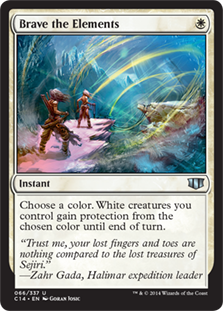
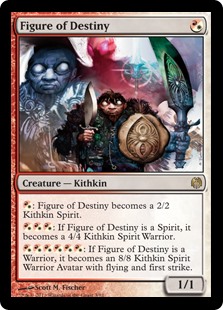
Figure of Destiny: I was originally skeptical, but this guy puts in a ton of work. Not being a Human hurts, however.

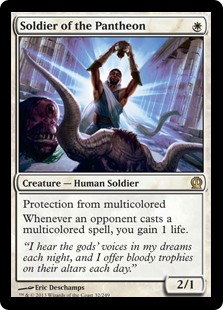
Soldier of the Pantheon: Both this and the next card are really only there as extra Humans to help reach a critical mass of creatures, but his protection from multi-colored can be relevant in many matchups (e.g. against Abrupt Decay, Electrolyze, Terminate, Siege Rhino).

Mardu Woe-Reaper: Again, just adds another Human body. The ability is sometimes relevant for shrinking opposing Goyfs or removing Scavenging Ooze fuel.

Brave the ElementsBrave the Elements: My vote for best card in the deck. Four may seem like overkill, but it enables you to go for broke with landfall or leveling and can be the topdeck you need to break a stalemate.
Path to Exile: While it’s the best removal spell in white (and possibly the format), giving them the extra land can be problematic.

Mana Tithe: While not a good card, it is a great play. Once your opponent knows it’s in your deck, you can side it out and they still have to play around it.

Arid Mesa, Marsh Flats, Windswept Heath:  These could be any 12 fetchlands, as they are here purely to pump Lynx.

Plains: Eight is enough and possibly too many. Games in which you somehow run out of Plains are not games where you had a realistic shot at winning anyway.

White Weenie: Sideboard

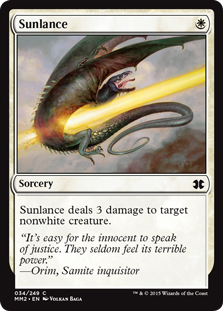
Sunlance: In aggro mirrors, Sunlance is often just as effective at killing the creatures you care about as Path.

DismemberDismember: Paths 5-7 against decks such as Splinter Twin and Infect. Sometimes you also need the extra removal against Grixis Control or Jund.

Angel's Grace: Originally the idea was to bring these in against Burn and Affinity. I seriously misevaluated the way the Affinity matchup plays out, but they still offer great insurance against Burn.

Grafdigger's Cage: These are solely to shut down decks that would otherwise win on the spot, like Collected Company combo. You wouldn’t bring them in against Snapcaster decks, for example.

Mardu Woe-Reaper and Kytheon, Hero of Akros: These provide a higher density of creatures against removal heavy decks.

White Weenie: Gameplay

In theory, the deck looks easy to play: play a creature turn one, then two more creatures on turn two, then as many creatures as you have left on turn three. Then win. While this deck is capable of generating easy free wins that way, you will lose a lot of games that you should have won if that’s the only approach you take. In most cases, you should be looking to keep an open mana up at all times from turn three on, and possibly even starting turn two, even as a bluff. If you are going to run a straight bluff, however, make sure that the opponent can actually afford to play around what you’re representing. If the opponent would just be dead if you have it, then do something else with your mana if possible.

Soldier of the PantheonYou should always keep track of when you can afford to throw creatures away in a chump attack, and when you need to stop attacking and play for a topdecked Brave. Generally speaking, if you stop attacking you lose, so it can often be correct to trade a Soldier of the Pantheon for a Lingering Souls token if it means getting in for five damage and flipping Kytheon.
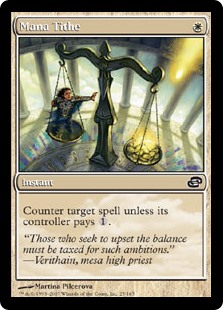
The decision whether to let one of your creatures get Bolted or save it with Brave the Elements always depends on the context of the game. For example, if you are attacking for lethal and the opponent is otherwise tapped out, of course you should play Brave, but if you still have an attack step or two to go and you have more threats in hand, it’s probably best to keep the Brave in hand.

Sideboarding should be kept to a minimum, and you should never be looking to side out creatures. For the most part you only want to side in cards that either win you the game on the spot or stop you from losing on the spot.

14th Place at the Premier IQ

After sleeving up the decklist, I took it to the SCG DC Modern Premier IQ with few expectations. I had a decent amount of experience with previous variations of the deck so I felt that I would pilot it well, but I had my doubts that a deck full of Boros Elites and Mardu Woe-Reapers could compete.

Mana TitheRound 1: U/B Faeries (2-1)
Game 1 was interesting as it took several turns to figure out what he was on. He was able to kill a few things and trade with flashed-in Faeries, but the game ended when he tapped out for Cryptic Command to fog me and I had the Mana Tithe. Game 2 I got him down to 3 before he stabilized, and I just couldn't muster enough pressure. Game 3 went about as well as I could hope: he got stuck on two lands early and I was able to dump my hand and crush him.

Round 2: Grixis Control (2-1)
Game 1 I rolled him over. He simply wasn't prepared to deal with aggro swarm, which is what I was counting on. Game 2 he ended up taking after drawing infinite removal and enough big creatures that I couldn't maintain any pressure. Game 3 I was able to draw just enough creatures that I was able to get there: he didn't realize that his sideboarded Vampiric Link was a triggered ability, so he died before gaining the life he needed.

Round 3: Grixis Control (2-0)
This match isn’t worth discussing. My opponent got a deck reg error game loss, and then mulled to five in Game 2 where I crushed him.

Round 4: Jund (1-2)
Game 1 my opponent stripped my hand of anything useful and cruised to an easy win. Game 2 I rebounded, drawing just the right mix of creatures and tricks to kill him on turn four. Game 3 was a bit closer than Game 1, but I wasn't able to find enough removal in time to get through the clogged board. My opponent ended up making Top 8.

SunlanceRound 5: Burn (2-1)
Game 1 was extremely close, but my opponent was able to draw enough spells to deal with some of my bigger threats while still pointing lethal burn at my face. Game 2 I was able to Sunlance every creature he ran out and eventually started deploying more threats than he had answers for. Game 3 was also extremely close, and we ended up in a situation where we were both topdecking, but my opponent knew I had an Angel's Grace thanks to a Goblin Guide reveal. Eventually I drew one more creature than he had burn for.

Round 6: Grixis Twin (2-0)
Game 1 I had Paths for both of his Exarchs, and I was able to play enough threats that he couldn’t deal with them all. He died with two Twins in hand. Game 2 was basically more of the same: he couldn’t afford to side out the combo because I was too fast, but that also meant he couldn’t bring in as much removal as he needed, and I overwhelmed him.

Round 7: Affinity (0-2)
This was by far the most interesting match of the day. Game 1 I had a gigantic board but he had too many blockers for me to push through. I made a strategic mistake and wound up getting punished for it: Figure of DEstinyI failed to appreciate that the Affinity deck had a far superior late game, and was therefore uninterested in racing me. This miscalculation caused me to believe that trades were good for me, so I continued attacking rather than patiently pumping mana into Student of Warfare and Figure of Destiny with the plan of flipping an indestructible Kytheon in another turn or two. After several trades left his board decimated but me without my Figure of Destiny or Kytheon, a top-decked Etched Champion from my opponent left me with no realistic way of breaking through, and he was able to stay alive long enough to eventually put the game out of reach. Game 2 ended up being worse for me, as I didn't have removal for his Steel Overseer, and that in conjunction with Etched Champion and three or four Nexuses (both Blinkmoth and Inkmoth) spelled game over. This opponent also made Top 8, meaning both of my losses were to top 8-ers.
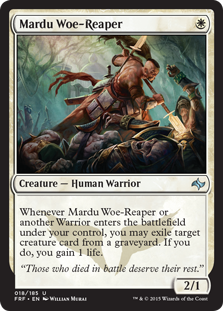
Round 8: Jund (2-1)
Game 1 I got out to an exceptionally fast start, and I had Brave for his last-gasp removal spell to win. Game 2 was a bit back and forth, but he was able to get two Goyfs up to 5/6 and I didn't draw enough gas to compete. Game 3 was similar to Game 1 in that I snap-kept something very close to a god hand, and had enough Braves to take it down.

It's worth noting that I won only one dice roll out of seven matches (I'm not counting Round 3, even though I lost that dice roll too). I probably won more games on the draw than on the play, which was unexpected.

White Weenie's Modern Future

While I was pleased with the way my tournament went, there are a number of changes I’ve already made to the deck. First, the deck needed more creatures and fewer spells. There were too many games Mardu Woe Reaperwhere I would run out of gas, or my hand would be Thoughtseized into oblivion, and I couldn’t generate enough pressure to stay in the game. As much as I love Mana Tithe, it needed to go to make room for more threats. I’ve since made the following changes to the main:
-4 Path to Exile
-3 Mana Tithe
-1 Plains

+1 Kytheon, Hero of Akros
+2 Mardu Woe-Reaper
+2 Dragon Hunter
+2 Dismember
+1 Flooded Strand

I also retooled the sideboard, mostly to adjust for my misreading of the Affinity matchup:

-3 Dismember
-2 Mardu Woe-Reaper
-1 Kytheon, Hero of Akros
-1 Angel's Grace

+ 4 Path to Exile
+2 Stony Silence
+1 Rest in Peace

In conclusion, the deck is very well-positioned in the current metagame. There aren’t enough sweepers seeing play to keep the deck in check, and the sweepers that do see play tend to fold to Brave the Elements. As an additional plus, if you already own the fetches and Kytheons, it's budget friendly. If you enjoy attacking for 10+ damage on turn three, like when your opponents have to stop to read the cards that are killing them, or if you love watching people’s faces twitch as you declare “I cast Modern-playable Mardu Woe-Reaper”, I highly recommend giving White Goyfs a go!

Editor's Note: Corrected a sentence in the introduction referring to Snapcaster Mage and Tarmogoyf.

Duel Decks Zendikar Vs. Eldrazi Spoiled

Are you a Quiet Speculation member?

If not, now is a perfect time to join up! Our powerful tools, breaking-news analysis, and exclusive Discord channel will make sure you stay up to date and ahead of the curve.

We're starting to get some real information on Battle for Zendikar, which is pretty exciting. We got our hands on a couple keywords from the spoiler for Duel Decks: Zendikar Vs. Eldrazi, which gives us some idea what we'll be working with.

Dominator Drone

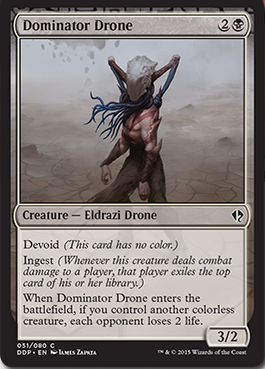
Ingest is kind of a lame mechanic, but it suggests to me that we'll see more "big" Eldrazi with abilities like Oblivion Sower's that are based on cards in Exile. At the end of the day I would imagine that delve will matter more than ingest in this regard, but it's hard to say at this point.

Devoid isn't the most exciting mechanic, but it does open up some interesting design space. I don't much care about a Ghostfire reprint, but a non-colored one or two mana spell that kills Kor Firewalker would be a neat addition to Modern. I do think that the other devoid creature from the spoiler has a lot of constructed potential.

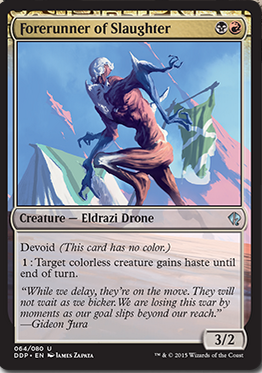
Forerunner

The haste ability is going to be strong if there are a couple more bodies this efficiently costed for a Rakdos beatdown deck. It won't take too many devoid creatures to make Ghostfire Blade into a Standard powerhouse with this and Hangarback Walker as shoe-ins for such a deck. Devoider Drone is even within the realm of playability here with its life-draining 187.

The unfortunate news with this printing is that there are a few cards that are about to see a pretty serious drop in value. It That Betrays being a $10 card was pretty silly, but these other positions really weren't asking for this.

Insider: Rotational Pick-ups at BFZ for Standard

Are you a Quiet Speculation member?

If not, now is a perfect time to join up! Our powerful tools, breaking-news analysis, and exclusive Discord channel will make sure you stay up to date and ahead of the curve.

Welcome back, readers and fellow speculators!

While I know that the Battle for Zendikar (BFZ) release is still a ways away, anticipation is already starting to rise. Nothing shows this more than the deflation of soon-to-be-rotating cards. We see previously $20+ staples plummeting to under $5 and staying there for months before rotation. While it's plausible that some of these cards get a minor bump should their respective decks have a big showing one weekend, these prices are likely to stay or continue to drop a bit as we near rotation.

So while it hurts to look over your binder of the previous block's staples and see that they are much lower than just six months ago, it's important not to let this get you too down...it means all the staples are much cheaper and you can begin to target your longer-term speculation targets.

One mistake a lot of people make is assuming that as we near rotation prices will continue to drop and waiting until right before or after rotation to start picking up speculation targets. If you have a very large playerbase around you, this may work fine and allow you to maximize potential future profits. However, if you're like me and your playerbase isn't as big, you need to start targeting your cards a bit earlier.

Many players ship them off to buylists to recoup whatever they can before rotation, and your competitors are also working off a smaller pond (where there are only so many fish). This style of speculation may also limit your "future Standard" speculation targets because once spoilers start hitting any new synergies can cause major price changes in Khans block cards.

What Rotates

First let's make sure everyone knows exactly what all is rotating out of Standard when Battle for Zendikar hits.

  • Theros
  • Born of the Gods
  • Journey into Nyx
  • Magic 2015

Dead Archetypes

That's four sets and a good amount of the card pool. This means Standard will likely see a pretty big shakeup. It's important to review what archetypes die at rotation so we can get a feel for which Standard-legal cards may drop when they lose their home in decklists.

  • Devotion decks - With the loss of Nykthos and the other cards that relied on devotion strategies we'll likely see a major shift away from this type of deck.
  • Constellation decks - With Theros, the designated enchantment block, rotating out, Constellation loses its entire core. The minor enchantment theme in Magic Origins is likely too weak to support this deck moving forward.
  • Heroic decks - This Tier 1 archetype was the latest iteration of the hexproof decks of old (though instead of the creatures having built in protection and the player playing spells to make them bigger, they grow bigger simply by playing protection spells). Like Constellation it was heavily reliant on a block mechanic that disappears entirely.

Surviving Archetypes That Take a Hit

  • Abzan Control - The loss of Elspeth, Sun's Champion, Thoughtseize, and Hero's Downfall means that any future variants of this deck will have to rely on very different means of control. The biggest loss at this point is likely Elspeth, who provided a strong controlling presence (the ability to board-wipe or make chump blockers for days) and win condition (her ultimate typically ended the game). None of the planeswalkers that will remain at rotation can fill this void currently, so the archetype will likely revert back to more of a midrange deck.
  • G/R Ramp decks - While Stormbreath Dragon has fallen in and out of favor, it was still one of the big components of this archetype. With the printing of Dragonlord Atarka, Stormbreath lost some of its luster; however, haste is one of the most relevant abilities in racing situations and he's one of the few cost-efficient dragons as of late to have it. Another major component to lose is Sylvan Caryatid, which acted as a virtually untouchable mana rock that could block small creatures if needed. The loss of Elvish Mystic is another huge loss for this archetype as having 2-3 mana dorks in the first few turns allowed for quick Atarka's.
  • Sultai Control - While the deck still maintains all its delve spells, similar to Abzan Control it's losing a lot of early game interaction (Thoughtseize, Hero's Downfall, and Bile Blight). It also loses Satyr Wayfinder which was a huge boon in fueling fast delve spells and hitting necessary land drops.
  • Blue-based Control - The blue-based control variants (Esper and U/W mainly) lose both Dissipate and Dissolve and are left with Clash of Wills as their only real viable "counter everything" spell--which is a huge problem for the archetype. Control decks in the new format will likely have to be built around Silumgar's Scorn, which carries heavy deckbuilding restrictions.

What This Means

Obviously cards that are still legal but heavily support these archetypes will drop in value and demand (unless BFZ re-introduces the archetype).

Dig Through Time (as powerful and awesome as it is) may see a bit of a drop as many of the cheap efficient spells leave the format (and we have the highest amount of options when the card pool is biggest). It may be more difficult to run the full playset in a deck and I see many control decks cutting them down by one or two.

We will likely also see a drop in Ugin, the Spirit Dragon usage, as control decks often take a back seat at the beginning of any new format. We are also losing both of the three-mana sweepers (Drown in Sorrow and Anger of the Gods), so aggro decks will likely flourish at the start of the format. The best sweeper (as it stands) sits at the four-drop slot. We're losing both Scouring Sands and Circle of Flame, which were efficient answers to weenies and tokens.

Surviving Archetypes That Gain

  • Mono-Red loses a lot of its burn spells (Stoke the Flames, Searing Blood, and Lightning Strike), but it also loses some of its biggest challengers (the three-mana sweepers and Courser of Kruphix).
  • Jeskai Tokens - Tokens decks lose Raise the Alarm, but keep Hordeling Outburst, Secure the Wastes, Dragon Fodder, and Hangarback Walker. Like with Mono-Red, they benefit from the rotation of Scouring Sands, Circle of Flame, Anger of the Gods, and Drown in Sorrow. The fact that Secure the Wastes is an instant and allows the token players to recover immediately after a big expensive sweeper implies it might be a solid choice moving forward. The biggest challenge for this deck may be the loss of the scrylands (which helped secure its manabase), though I can easily see this moving to R/W Tokens, with or without a blue splash for the Jeskai Ascendancy/Treasure Cruise package.

Cards I Like Moving Forward

  • Sorin, Solemn Visitor - When in doubt, bet on planeswalkers, especially with Hero's Downfall rotating. Sorin can provide a steady (albeit slow) stream of threats against control decks, but most importantly he provides a repeated source of "mass" lifelink, which can completely turn around a game in which players are racing.
  • Sarkhan, the Dragonspeaker - Again, cheap (sub $5) planeswalkers are usually a pretty safe bet. The fact that we lose Stormbreath Dragon also opens up the five-drop slot for the G/R ramp decks and the fact that Sarkhan himself turns into a dragon means he can turn on the powerful "dragon matters" cards from DTK.
  • Zurgo Bellstriker - Barring a reprint of Goblin Guide in BFZ, this will likely remain one of red's best one-drops (sharing that honor with Monastery Swiftspear and to some extent Lightning Berserker). Coming from the third set in Khans block means there are likely fewer of them in circulation than any Khans rares. At $2.5 there's still plenty of upside, though I doubt he's more than a $5 card.
  • Secure the Wastes - As mentioned above, I see token decks making a big resurgence come rotation and this is the type of card that fits well in a token shell and doubles as a control finisher. Another $2.50 card, there's plenty of upside and it too is a third set rare.
  • Monastery Mentor - Another card that could easily fit in multiple archetypes, the card has proven itself in every major format all the way to Vintage. It's currently sitting near its all-time low (around $14) and likely has the most upside of any card on this list (coming from a second set that was quickly overshadowed by its predecessor).

The Gambles

These are cards that I consider more of a gamble (i.e. they have proven themselves yet, but have potential.)

  • Sarkhan Unbroken - As I said, planeswalkers are often a good bet. While this is only the second tri-color planeswalker (the first being Nicol Bolas), his plus ability is very strong, his minus ability is strong and can protect him, his ultimate can either be irrelevant or very powerful depending on the deck he's played in. The biggest question mark is whether a Temur deck that can use him materializes in Standard.
  • Orbs of Warding - First, I'll preface this one with an acknowledgement that I'm already 60+ deep on this card. The hexproof is very powerful against burn, discard spells, some planeswalkers' abilities (Ashiok comes to mind, though she rotates with BFZ) and Sphinx's Tutelage. The damage reduction ability is hugely relevant against token and thopter decks, as well as rush decks like Mono-Red. They are not legendary and stacking the creature damage reduction can often lock opponents out of the game.

Insider: Eternal Weekend Speculation

Are you a Quiet Speculation member?

If not, now is a perfect time to join up! Our powerful tools, breaking-news analysis, and exclusive Discord channel will make sure you stay up to date and ahead of the curve.

This upcoming weekend is Eternal Weekend in Philadelphia. For those of you who don't know, this is a special weekend for North American fans of eternal formats because it hosts two of the most prestigious Eternal tournaments of the year: The Vintage Championship and the Legacy Championship.

These events are unique because the winner receives a painting with re-imagined artwork for the cards Tundra and Mox Emerald. Any way you slice it these are pretty amazing trophies for any Eternal Champion to hang on their wall!

I will be at both of these events doing my best to hoist one of these trophies and would strongly encourage any fan of Eternal Magic to consider taking a road trip to play some Legacy and Vintage in the same weekend.

Eternal Finance

Getting to play in back to back Legacy and Vintage events may be great, but what does this weekend mean for the individuals who love the "game within the game" of trading and financing?

Let's examine the facts:

  1. Eternal Weekend generates a lot of hype for Vintage and Legacy due to the coverage and the buzz it generates. In particular, the Vintage Championship is easily the highest-profile Vintage event each year in North America (arguably, the world) and generates more exposure for the event than any other singular thing.
  2. Not only is the event a ton of fun for the people playing in it but more importantly for "professional traders" it looks like a ton of fun to people who are watching the stream from home. The best these formats have to offer is on full display, and people tuning in from home may be pushed over the edge to finally make the leap from Modern to Legacy or Legacy to Vintage. "Format looks awesome! I've wanted to play for a while... I'm going to jump in and next year I'll be at Eternal Weekend too!"
  3. No matter what happens, eternal cards are significantly scarcer compared to demand and will always tend to be fairly safe investments. There are far worse things a trader can do than invest their trade stock or capital into Eternal staples.

Eternal staples always tend to be solid investments in the long term. They rarely go down unless they become obsolete, banned, or reprinted. And because the major decks tend to stay fairly consistent over time, these cards usually hit a slow boil where they consistently grow to maturity.

Five Specific Picks for Eternal Weekend

My strategy for MTG investing has and always will be to pick out cards that are undervalued at the moment. If you invest your resources into the cards that are too low to go down, in a worst case scenario you break even but far more often than not you will be making bank.

Let's start with a few spicy Vintage gems.

1. Kuldotha Forgemaster

There was an error retrieving a chart for Kuldotha Forgemaster

Most people don't actually know this but the Kuldotha Forgemaster version of Mishra's Workshop decks far outperforms all other versions with regard to making Top 8s, and especially with regard to converting Top 8s into first place finishes. It is by far the most successful version of Mishra's Workshop in the past two years and is arguably the best deck in all of Vintage.

However, its flagship card is fairly inexpensive and hovers around a few dollars.

It is also significant that the card is quite good in the Legacy Metalworker MUD deck and a staple of every artifact-based Commander deck ever made. Both of these qualifications are very good for Forgemaster as a long-term speculation target. I also love the fact that the card sees no Modern play because it makes it unlikely to ever be reprinted in the Modern Masters series!

I also think that foil copies of this card are an easy pick-up in the $10-$15 range as they will clearly go up, likely significantly in the near future.

2. Oath of Druids

There was an error retrieving a chart for Oath of Druids

The next card I'd like to discuss is the flagship card of the second best, and second most popular, deck in all of Vintage, Oath of Druids. It turns out that paying two mana to make a Griselbrand on turn two is extremely powerful, even in a format where anything is possible...

The $5 price tag on this card is pretty much laughable, as the card is A) completely, absurdly overpowered, and B) old.

Another big selling point of this card is that it goes into the biggest "gateway" Vintage deck. What I mean by this is that people who are just starting out into Vintage have a very high probability of latching onto this deck because it is fairly cheap to assemble with proxies and is a busted combo deck. Considering that most Vintage tournaments allow 10-15 proxies it makes sense that Oath of Druids is one of the cards these players will definitely want to buy.

Also, the card is from a pretty bad set, which helps.

The big downside of the card is that it is banned in Legacy, but it does see a fair amount of play in Commander. It can't go less than $5 and I'm more than happy betting it goes up.

3. Terminus

There was an error retrieving a chart for Terminus

Don't you love when the namesake card of the best deck in the format is just a tic away from being a bulk rare? Well, that is the case with this card.

Miracles is far and away the best deck in Legacy with regard to Top 8 performance and wins. It is plain and simple an awesome deck and one of the main reasons is the synergy between Sensei's Divining Top, Brainstorm and Terminus.

For everybody who didn't already know: one-mana instant speed Wrath of God is pretty good in any format. Basically, casting this card for its miracle cost is like playing a Yu-Gi-Oh! deck.

Once again, we have a card that is Eternal format defining as well as a staple card in every U/W Control Commander deck. The reprint did hold the value back a little bit but I think that trend will be bucked.

Another thing to consider is what happens to the price of Terminus if this card ever gets unbanned in Modern:

There was an error retrieving a chart for Jace, the Mind Sculptor

Not only would the price of Jace go completely berserk but Terminus would likely become an excellent card in Modern as well. While I'm not sure if I'd want to speculate on Jace, as it seems too high from the get go, I'm more willing to risk on Terminus.

I don't actually think that it would be unreasonable for Jace, the Mind Sculptor to be unbanned in Modern. For starters, I think the format is borderline too fast for him. Tapping out for a Jace against Affinity, Twin, or any other combo deck seems like suicide. The bigger problem is more likely the combo decks playing Jace themselves as a way to leverage card advantage against midrange black decks.

Nonetheless, I don't think it is out of the question that Jace could one day make a return to Modern. I have a few extra copies in addition to my playset tucked away just in case.

4. Young Pyromancer

There was an error retrieving a chart for Young Pyromancer

I've written about this card as a speculation target before and it still hasn't moved on its four-dollar price tag, but I'm still resolute. The card is completely insane in Vintage, Legacy, and Modern and was only printed one time in a lame M-set.

There are other Modern-legal uncommons that are more expensive that this card and very few that see more play across other formats. The fact that this card didn't see a Modern Masters reprint is huge. I can very easily see it hitting Remand, Spell Snare or Might of Old Krosa status.

5. Dig Through Time

There was an error retrieving a chart for Dig Through Time

I think there is a realistic chance that Dig Through Time will win both the Vintage and Legacy Championship this year. The card has pretty clearly separated itself as the premier blue card draw/selection engine in every single format where it remains legal.

Overall, it is the best rare card in all of Khans block. Aside from this card getting banned in Legacy (and I think they would ban Sensei's Divining Top first) I think this card is a lock to continue to earn value as time goes on.

The Standard demand in the next year will grow this card in the short term but the long demand from Vintage and Legacy will keep the card afloat even after rotation.

It's also telling that the card never lost value (and actually went up) on TCG and SCG during the summer lull, in the same manner as fetchlands. Sellers were willing to lower prices on nearly every other Standard-legal card in order to continue doing high volume sales amid dwindling interest--but they were not willing to reduce their prices on fetches and Digs. This should tell you something as an investor.

~

I've given some specific examples and discussed the basic ways that I arrive at my conclusions, but investing in eternal cards isn't limited to just a few shiny specs. There are literally hundreds of solid eternal pick-up cards at the moment.

The key is that if you are trading away cards that are trending down for cards that are trending up you will always be in good shape. Any card that is old, does something awesome, and has a price tag that seems too low probably is too low and is worth trading for right now.

To all who are making the trip down to Eternal Weekend I wish you good luck in all of your Vintage and Legacy battles. If you see me down there, be sure to say "hi." And, to those of you hitting the trade tables this weekend you would be wise to keep Eternal on the brain and in your deals!

Deck Overview- Hangarback Abzan

Are you a Quiet Speculation member?

If not, now is a perfect time to join up! Our powerful tools, breaking-news analysis, and exclusive Discord channel will make sure you stay up to date and ahead of the curve.

There was a lot of excitement around GP Detroit this weekend, and rightfully so! The Top 4 was insane! Meanwhile, there was a pretty good show happening in London, too. A lot of players have started jamming Hangarback Walker in their Abzan deck, and four of them made Top 8, with a fifth player playing Hangarback Walker in the Top 8 as well. It's rare that you see a deck completely dominate a GP like this and put two copies in the finals, and winner Fabrizio Anteri's list is worth paying attention to:

Hangarback Abzan

creatures

1 Warden of the First Tree
4 Hangarback Walker
4 Fleecemane Lion
4 Den Protector
4 Anafenza, the Foremost
4 Siege Rhino

spells

1 Sorin, Solemn Visitor
1 Ajani, Mentor of Heroes
4 Dromoka's Command
2 Ultimate Price
4 Abzan Charm
1 Hero's Downfall

lands

4 Sandsteppe Citadel
4 Temple of Malady
1 Temple of Silence
4 Windswept Heath
3 Llanowar Wastes
3 Caves of Koilos
1 Mana Confluence
1 Urborg, Tomb of Yawgmoth
3 Forest
2 Plains

sideboard

1 Ultimate Price
4 Thoughtseize
2 Self-Inflicted Wound
2 Tragic Arrogance
2 Elspeth, Sun's Champion
1 Arashin Cleric
1 Surge of Righteousness
1 Glare of Heresy
1 Tasigur, the Golden Fang

With Hangarback Walker proving itself as a very powerful card in recent weeks, it was only a matter of time before it was absorbed by the good cards deck. Abzan Charm and Dromoka's Command even synergize with Hangarback by putting counters on it, with Command even making you able to fight it and kill it for when you want thopters and Charm doubling as a great answer to opposing Walkers. Anafenza generates good value with Hangarback as well.

With only one Hero's Downfall in the list and Fleecemain lion being the only creature from Theros, it's entirely possible that a deck very similar to this will continue to be a presence in Standard even after the launch of Battle for Zendikar.

Four Cards Wizards Should Reprint for Modern

Are you a Quiet Speculation member?

If not, now is a perfect time to join up! Our powerful tools, breaking-news analysis, and exclusive Discord channel will make sure you stay up to date and ahead of the curve.

Everyone has a pet card (or three) they want reprinted in a Modern legal set. For me, that card is Goblin Bombardment. Combo power? Check: who didn't love Enduring Renewal and Shield Sphere (except your opponent). Value power? Check again: Gravecrawler must have been a Goblin in a previous life, because he was made for bombarding. Flavor? Let's just say I want the original Brian Snoddy art and will be accepting no substitutes. Everyone has their own Bombardment they want reprinted in Modern, whether an old-school staple like Masticore or a new all-star like Baleful Strix. Today, with a new set coming in September, we are going to talk reprints.

Baleful Strix

A reader emailed me last week asking why we didn't do more "fun" articles. As "fun" as I think metagame statistics and analysis is, I hear the underlying desire in this comment and today's article aims to fill that gap: reprint speculation is as fun as it gets! Modern is a great format with a lot of diversity (especially these days), but it's hard not to wonder about cards that could improve lower tier decks, reign in scary ones, or fulfill personal wishlists. Today, I'm going to look at a handful of awesome cards which deserve a new home in Modern. Big shoutout to the MTGSalvation "Modern Reprint" thread for all the discussion opportunities on this exciting and enjoyable topic.


Reprint Parameters

Did you think we would get through an entire article without some kind of "parameters" and "context" discussion? What "fun" would that be! Jokes aside, the reprint topic can be as contentious as other more Psychatogcommon Modern discussion points like the banlist and card prices. Everyone has their own definitions of both the cards themselves and the purpose of reprints in Modern. Some players think Modern should be Legacy but without the duals, Brainstorm, and some of the format's more powerful effects like Show and Tell or Lion's Eye Diamond (i.e. the "Legacy Lite" crowd). Others think Modern should be a home for extinct strategies: Psychatog, Phyrexian Negator, and Blastoderm unite! And others still want to improve their own pet deck without any regard for how it would affect the rest of the format (e.g. Chain Lightning to help out those poor, outmatched Burn players with their 8%+ metagame share...).
At the risk of offending all the players who want nothing more than to play Force of Will in Modern, I see reprints as having a more limited goal. Reprints Force of Willshould serve one of two goals (or both). First, they should improve tier 2 or lower strategies without significantly improving tier 1 ones. Second, they should create new strategies in space that was previously unfilled. Additionally, reprints should not violate other rules of the format, especially surrounding the turn four rule (sorry, Dark Ritual and company). Although some players are critical of too much format diversity, largely due to sideboarding difficulties and the "matchup lottery", a greater range of viable strategies is important for metagame regulation. It's hard to reach a Caw Blade or Mirrodin Affinity situation in a metagame with lots of powerful decks to regulate the others, and reprints can be very valuable in that respect. Also, in the spirit of that email I received last week, reprints are just plain fun. People want to play cool new cards and even if they aren't seeing a lot of play (I'm still rooting for you, Goblin Piledriver!), their presence is good for longterm format health. The following reprint suggestions live in these categories, either improving existing decks, making new ones, or just being awesome.
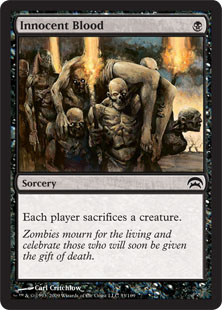
The Reprint List

Important disclaimer before we start: if your card didn't make this list, it doesn't mean I don't think it's a good reprint. This article could easily have been a "One Hundred and One Cards Wizards Should Reprint for Modern", but then where's the room for a fun part two or part three? There's a lot of room for reprints in Modern (more than a lot of players acknowledge), and these cards are only scratching the surface.

1. Innocent Blood

It's always seemed unfair to me that black mages have bad removal in Modern. Red gets Lightning Bolt, white gets Path to Exile, and BGx mages EN MTGHOP Cards V3.inddget Abrupt Decay and/or Terminate. Meanwhile, if you're playing black you're struggling whether to run Doom Blade and lose to a turn two Dark Confidant, Go For The Throat and lose to Affinity and Tron, or Dismember and lose to Burn. Innocent Blood would change that in a big way. Right now, control in Modern is heavily reliant on a red splash to keep the board under control. How else are you supposed to answer those turn one or turn two creatures at parity? A white splash gives you Path, but Path isn't where you want to be against turn one Birds and Goblin Guides. As a result, Esper Control is basically nonexistent and cool ideas like UB Control, Mono Black Control, 8Rack, and others are relegated to the "maybe next year" pile. Blood gives those decks early removal in the critical turns one through three window, which is the exact test a lot of these decks fail.
The best part about Blood is that it doesn't break top-tier decks. The current versions of Abzan and Jund have far too many cheap creatures to safely run Blood. You don't want to get into situations where you went turn two or turn three Confidant/Goyf and then had to Blood to remove an opposing threat. It's a great turn one play for the BGx player, but the antisynergy is too steep beyond that first turn to run safely. I'm not sure how Blood would play in the Grixis Twin or Grixis Control shells, but my suspicion is "not well". It's really lame with Snapcaster Mage and just terrible with your Delvers. You really want to play Blood in a deck where it's a safe play on turn one as much as on turn four, and/or with redundant creatures you don't mind losing. The only thing cooler than playing Lingering Souls and Blood is the flavor of that combo. In case you needed more arguments in favor of Blood, it's a great maindeck card against both Burn and Affinity, especially Burn which gets a lot of mileage out of those early creatures.

2. Baleful Strix

if you want to play blue-based control in Modern, you've probably looked at Thirst for Knowledge and sent Wizards a dozen letters pleading them to unban Seat of the Synod. Baleful Strix card Thirst is an excellent spell in the abstract but Modern doesn't have the tools Thirst needs to succeed. Blue-based Tron decks use the card, but we don't see a lot of these outside of random PPTQs and local events. Unfortunately, the Thirst engine doesn't have enough fuel to work in "better" decks. Making matters worse, control decks also struggle with early Tarmogoyf, Tasigur, and Angler beatdown, something Thirst couldn't even address on its own. Baleful Strix addresses both of these problems. The world's scariest owl activates a powerful Modern card-advantage engine while also providing control decks an early Fog/removal hybrid to get them into the mid-game. We won't see spells like Preordain unbanned anytime soon, which means blue players will always have to look elsewhere for good card draw. Thirst isn't quite in the same cantripping category as Preordain, but the combination of Strix and Thirst is a powerful tool these decks could leverage.
There's a potential danger with Strix in the Grixis shell, whether Twin or Control. On the one hand, these are slot-tight decks without too much room for new cards. On the other hand, these decks don't need that much help (as evidenced in the Grixis metagame share today), and Strix could push them into a higher share. I think the potential benefits of Strix are worth the costs, especially as it gives control players a way to better react to aggressive posturing by either fast decks like Burn and Merfolk or slower ones with beatdown roles like Jund and Abzan. I also think the Thirst/Strix deck is very different from the conventional delve-based Grixis Control we see today, which would be a net positive for format diversity. Grixis Delver could also benefit here. Beyond Grixis, Strix could also enable a host of Sultai strategies like the underappreciated Sultai Delver or the out-of-fashion Sultai Control, not to mention indirectly improving cards like Disrupting Shoal. This improves the quality of policing decks in the format, both increasing deck diversity overall and also giving our format safety measures against less fair decks.

3. Cycling lands (Tranquil Thicket and co.)

Speaking of card advantage engines, blue isn't the only color with an underused but powerful card lurking on the sidelines. Life from the Loam deserves better than tier 3 status Tranquil Thicketalongside Smallpox and Seismic Assault. What better way to bring this grindy engine back to Modern than the Onslaught cycling lands? Tranquil Thicket and its four friends don't look like the most exciting reprints on paper, but they would have a considerable effect on Modern. Aggro Loam decks fill a BGx-esque space in Modern, adding a fair deck to the format that also polices less fair ones. A turn three Seismic Assault is one of the most abstractly powerful drops in Modern, but it is blunted by the weakness of the Aggro Loam shell. Cycling lands let Assault shine, whether clearing the board of opposing threats or pinging an opponent down to zero in a few turns. The cycling mechanic is also perfectly suited for a diverse format that rewards diverse answers. Thicket-powered Loam decks are incredibly consistent, digging through their deck for answers in only a few turns, which is the sort of policing force Modern can use.
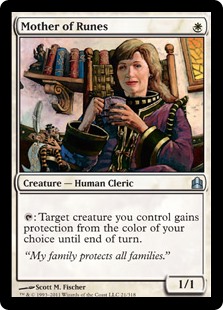
Modern doesn't have Punishing Fire, which means Loam decks need to look a little different from their Legacy counterparts. We're also missing the iconic Green Sun's Zenith. Despite these shortcomings, and other differences with the absence of Mox Diamond and Wasteland, there's still a lot of room for Loam decks in Modern to succeed. A version of Raphael Levy's Smallpox Loam deck recently got fourth at an SCG IQ, and although Shakopee, Minnesota might not have the largest Modern scene in the States, it's a promising finish that shows the core strategy has legs. This kind of Molten Vortex/Seismic Assault/Smallpox-powered shell is very powerful in Modern's midrange matchups, and the cycling lands would definitely elevate the strategy to at least the fringe of tier 2.

4. Mother of Runes

No reprint discussion would be complete without a controversial proposal. I'm not going to tackle the big dogs like Counterspell and Daze in this article, but I'm Mother of Runesgoing to borrow a mainstay from the Legacy playbook and see how she does in Modern. Mother of Runes is one of the best one-drops in Magic, and the workhorse of Legacy's Death and Taxes deck. She protects your creatures from removal, stalls big attackers, and lets you swing in for lethal through even the most stalled boardstates. She's also white (and I don't just mean the woman depicted in the art). White mages don't get a lot of love in Modern: it was pretty much all downhill since Path to Exile. It's the least-played color in the format, shows up in the fewest top-tier decks, and is often regarded as a sideboard or removal color if anything at all. Many players, however, don't just want to play Stony Silence and Leyline of Sanctity. They want to play white creatures. They want their Thalia, Guardian of Thraben to put in work in a removal-clogged format. No one enables this more than Mama Runes herself.


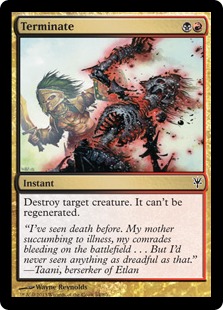
Of all the reprints discussed today, Mother of Runes is by far the most potentially dangerous. She's incredibly powerful and there are lots of white strategies that might want her. Abzan plus Mother could be very scary, and even if the midrange version didn't want her, Abzan Liege almost certainly would. Death and Taxes and Hatebears (you can tell the difference by the Flickerwisps) would certainly benefit from Mother, but maybe by too much: maybe Modern doesn't need all those land-destruction and taxing effects. There are two reasons I don't think these fears are founded. First, I am generally of the opinion that Modern needs more policing decks and cards. Mother of Runes would definitely make Death and Taxes and/or Hatebears a tier 2 deck, and these strategies are the fairest of the fair in Modern. They are also almost explicitly designed to beat up on unfair strategies, which is what Modern needs if we want to avoid future bans, encourage future unbans, and preserve format diversity. Second, Modern is a powerful format already, and that baseline power level can almost certainly accommodate more powerful cards. Players underestimate Modern's ability to incorporate powerful effects into the existing metagame structure, and I suspect Mother would be "good" but not "broken" in this format.

More Reprints?

I've avoided some of the hot-button issues in reprints like Counterspell and Pernicious Deed to test the waters for this kind of article. If people like it and want to see more, you can expect to see more fun speculation (potentially even test results!) of these cards in Modern. Goblin Bombardment will make an appearance. Cards like Opt, Soothsaying, Prohibit, and others could too. Otherwise, there's always more metagame analysis to discuss.

What cards do you want to see reprinted? Any cards you think are particularly dangerous and should be avoided? How do you feel about this list above and its potential impact on Modern? Take your ideas to the comments and I'm excited to think more about reprints as we get into BFZ in the fall! Also, speaking of more metagame analysis, our Top Decks page has been updated to reflect the mid-August metagame (you can see these changes on the Top Decks sidebar too).

Editor's note (8/18): Changed a sentence in the Innocent Blood paragraph to better explain Blood's importance in black-based control. 

Pigeonholing Prevails: Modern Archetypes

Are you a Quiet Speculation member?

If not, now is a perfect time to join up! Our powerful tools, breaking-news analysis, and exclusive Discord channel will make sure you stay up to date and ahead of the curve.

A few days ago, my buddy commented on Jeskai Control's baby-renaissance. "Why are people hopping back on UWR?" he wondered. "It looks worse than Grixis. It seems slower, too." I dropped some serious knowledge on him: "It's not a question of 'worse' or 'slower.' UWR Control has a great Grixis Control matchup, since Grixis Control is really a midrange deck. Midrange decks lose to control decks, which have a stronger late game." His eyes sparkled, and roaring applause shook the stadium. "You should write an article on that!"

splinter twin

My buddy suffers from a common problem: he doesn't understand deck archetypes. Many articles already exist on this subject: most are dated, none specifically address this format, and I disagree with the lines some draw to divide the archetypes. Today's article describes classic and hybrid archetypes as I see them in relation to Modern. Understanding the interactions between Magic archetypes helps players build better decks, play better games, and ultimately, win more.

[wp_ad_camp_1]

Characterizing Decks

Before getting into the archetypes, we'll look at other ways to characterize decks. Breaking decks into categories helps us understand how different archetypes evolve and interact with each other. I judge decks by three separate metrics.

Proactive vs. Reactive: Proactive decks consistently impact the game zones (hands, boards, and life). Reactive decks stop opponents from impacting these zones. Every deck must take a proactive role eventually, or it will never win.

TerminateFor example, Grixis Control is very reactive, walking opponents into Remand, Spell Snare, and Terminate before taking over with a Tasigur. But against Burn, a deck with more speed and inevitability than Grixis, it's forced into a proactive role, trying to land a delve creature and attack for lethal before getting toasted by Lava Spikes.
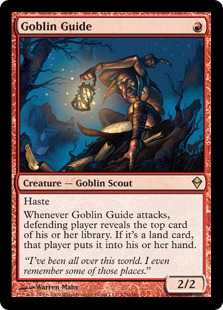
Based on the amount of time a deck plays the proactive or reactive role in most metagames, we can assign one role or the other. For more on identifying in-game roles, see the Mike Flores classic, "Who's the Beatdown?"

Interactive vs. Linear: The interactive deck addresses an opponent’s plays throughout the game. Linear decks ignore opponents to further their own gameplans, but can pack some interaction (Pact of Negation in Amulet Bloom; Pyroclasm in Tron).

Fair vs. Unfair: A fair deck wins by attacking with creatures, which it does over the course of a game, and not only on the final one or two turns (as a Reanimator deck might). Unfair decks win in nontraditional ways, usually by violating fundamental game rules.

Classic Archetypes: Aggro, Control, Combo

Of Aggro, Control, and Combo, only Combo enjoys heavy representation in Modern. Hybrids that blend one or more of these three classic archetypes make up most of the format.

Aggro

Aggro decks wage all-out assault on an opponent's life total with creatures and without much disruption of their own. Aggro decks hope to race opponents, who either try to race back or to disrupt them beyond functionality. Most Aggro decks in Modern utilize combo elements and don't fall into this section. Some consider Burn, which usually wins with reach, an unfair Aggro-Combo deck; since it leans so heavily on creatures, I've included it here. Aggro decks are proactive, linear, and fair.

Goblin GuideStrong against: Tempo and some Combo. Historically, Combo beats Aggro, as it's a turn or more faster. But the turn-four rule keeps Combo decks no faster than Aggro, meaning Aggro decks sometimes race Combo in Modern. Aggro decks containing reach also do well against reactive Control decks, as reach gives Aggro inevitability: eventually, they will draw more Lightning Bolts than opponents have Negates.
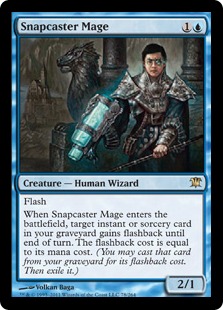
Soft to: Proactive Midrange decks, which can stabilize relevant game zones before Aggro delivers the killing blow, and faster Combo decks.

Example decks: BurnMono-Green Stompy5-Color Humans

Control

Control decks answer an opponent's cards one-for-one, making "value trades" along the way to gradually accumulate card advantage. Once it's assembled enough card advantage, Control wins with a big threat, a manland, or a planeswalker's ultimate. These decks are reactive, interactive, and unfair.

Strong againstAggro, Midrange, and Combo. Control's sweeper effects, supplemented with one-for-one removal, puts Aggro decks in a tough spot - they can over-commit to deal more damage, opening themselves up to Wrath of God, or try to get by on single threats at a time, handing Control decks enough turns to stabilize. Midrange decks weaken their aggro plan to devastate fair decks, making them easy prey for the unfair Control decks that want to "go longer." Counterspells, hand disruption, and hate cards easily break up Combo's synergies.
Soft to: Decks built to do more more in a late game (i.e. Tron) and Tempo. Tempo decks complicate Control's plan of accruing value with expensive spells; Sphinx's Revelation and Cryptic Command rarely resolve against cheap, soft permission. Aggro-Combo decks sometimes play the tempo role well enough to beat Control. Burn, which doesn't rely on creatures to deal the finishing blow, also beats it.

Example decks: UWR Control, Esper Teachings, Lantern Control

Combo

Combo decks focus on assembling a combination of cards that offers the pilot an immediate victory, or at least a very high chances of one. Ad NauseamCombo decks rarely care about opponents and epitomize the term "unfair." Every Magic player ruefully remembers the first time they lost to a Combo deck. These decks are proactive, linear, and unfair.
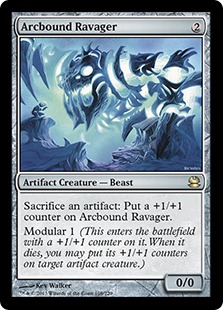
Strong against
:
 Most Aggro decks and Midrange lacking adequate disruption for unfair decks.

Soft to: Control and Tempo, the former of which prevents combos from resolving and the latter of which does so while cheap bodies force Combo decks to go off early.

Example decks: Ad Nauseam, Grishoalbrand, Amulet Bloom

Combo-Paired Hybrids

Aggro-Combo

Along with Midrange, Aggro-Combo takes up one of the largest Modern metagame shares. Arcbound RavagerEach strategy attacks from such a unique angle that it becomes difficult to metagame against Aggro-Combo decks as a whole: enchantment hate and Spellskite do wonders against Bogles, but nothing against Elves; Pyroclasm hoses Elves, but Affinity and Bogles frequently ignore it. These blazing-fast decks possess some of the most streamlined cores in the format. Aggro-Combo is proactive, linear, and unfair.
Strong against
:
 A lot, but nothing specific. Aggro-Combo decks decimate Midrange decks that don't pack the right hate and are quick enough to keep a host of slower strategies from ever entering the format. They can sometimes out-aggro Tempo decks or race other Combo decks.

Soft to: Anyone who came prepared, as Modern's hate cards take no prisoners. Aggro-Combo decks also lose to Tempo decks with Disrupting Shoal.

Example decksAffinity, ElvesInfect

Control-Combo

Control-Combo uses tempo to control the pace of a game until it wins in one fell swoop. (Many of Modern's "Control" decks win by attacking, and begin attacking as early as the third turn, which actually categorizes them as Midrange.) ScapeshiftControl decks want to win in some unstoppable way after grinding games to a halt, but Control-Combo doesn't mind only temporarily delaying opponents to fire off wins in a small window. For Scapeshift, the only real Control-Combo deck in Modern, that window resides between assembling seven lands and losing to a Siege Rhino opponents finally resolve through four Remands. Control-Combo is reactive, interactive, and unfair.
Strong against
:
 Aggro, Combo, and Midrange. Scapeshift has enough removal for Aggro decks, enough permission for Combo, and enough inevitability to beat permission-light decks looking to go long.

Soft to: Control and Tempo, which prevent the namesake sorcery from ever resolving.

Example decks: Scapeshift

Aggro-Control Hybrids: Tempo and Midrange

Aggro-Control decks are Aggro decks slowed down with specific disruptive elements (removal, countermagic, discard, etc.) to improve matchups against either unfair or fair strategies.

IsamaruConsider a White Weenie deck that wins by going wide with undercosted 2/x's beefed up by Glorious Anthem. A Control player will happily watch the Weenie deck slam creatures every turn and shut him out of the game with an on-curve Wrath of God. If White Weenie splashes blue to address this weakness by way of, say, Spell Pierce, it becomes a Tempo Deck, sacrificing some speed for points against unfair decks.
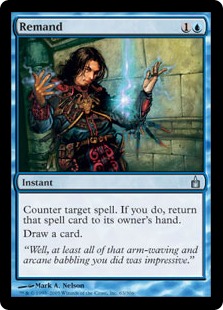
Consider the same Weenie deck at a different LGS, where it loses to “bigger” aggressive decks that don’t care about Spell Pierce. Isamaru, Hound of Konda matches up poorly against Watchwolf, even if the green creature comes down a turn later. Our Weenie hero compensates by splashing black instead of blue, giving himself bigger creatures that wall the aggro decks and removal to kill efficient attackers. The deck now interacts enough early on to swap its Savannah Lions for costlier, value-generating creatures like Kitchen Finks. White Weenie has become a Midrange Deck: it still attacks to win, but it sacrifices some speed for an edge against fair decks.

Aggro-Control decks are interactive and fair. Tempo decks are proactive early and reactive later, while Midrange decks are reactive first and proactive later.

RemandBoth Tempo and Midrange use the in-game mechanic of tempo* – or, of buying time – more than any other Magic archetypes. The Tempo deck uses tempo to preserve a favorable board presence, with the goal of killing opponents before they start resolving their ostensibly “better” cards (compare Insectile Aberration to Baneslayer Angel). This deck casts Remand to buy itself another attack step while denying opponents a chance to summon a blocker with the Finks. Midrange uses tempo to find itself in a game state (i.e., the mid- or late-game) where its spells affect the game zones more than its opponent’s. It casts Remand on a turn-three Kitchen Finks to Time Walk itself into the next turn, where it can resolve a threat that will outclass the Finks.
*Tempo here refers to a time advantage. This in-game mechanic functions similarly to card advantage, but cannot be accounted for tangibly and as a result is notoriously misunderstood. Unfortunately, we lack a separate term for Tempo decks, Aggro-Control hybrids that commit threats early, then disrupt opponents long enough to win. I’ll count on my readers to distinguish, based on context, between tempo the mechanic and Tempo the archetype. [Editor's Note: The names of the deck types are capitalized in this article to help you out.]

Aggro-Control Hybrid: Tempo

Aggro decks watered down to have an edge against unfair strategies, Tempo decks establish board presence quickly, then disrupt opponents long enough to win with that board presence. They require highly efficient threats. As a result, medium-costed creatures outclass the threats in the Tempo deck, which loses to other fair strategies.

Modern is home to two types of Tempo decks: Fish and Grow.

Fish

Named for the antheming Atlanteans that debuted the strategy, Fish decks play a large number of synergistic or disruptive creatures and some light permission. Master of the Pearl TridentMerfolk obviously falls into this category, as does the less obvious GW Hatebears. Fish decks are mostly comprised of creatures, a few non-creature disruptive elements, and sometimes include mana dorks. About the name: I'm aware that some players exclusively call Merfolk decks "Fish." Here, I'm referring to the Fish archetype as it's historically been cited in Magic writing, and not specifically to Merfolk tribal.

Strong against
: Midrange and Control, matchups helped by mana denial. Fish also out-aggresses Grow decks.

Soft to: Aggro and Combo. Aggro breaks up Fish's synergies with removal while summoning bigger beaters. Fish has better Combo matchups than Aggro, but as a less interactive deck, it leaves much to be desired here compared with Grow.

Example Fish decks: Merfolk, GW Hatebears, Slivers

Grow

Grow decks, too, are named for their creatures, which come from a variety of tribes but all get larger as the game progresses. Notable Grow threats include Quirion Dryad, Nimble Mongoose, and Tarmogoyf. Since Innistrad, Grow decks in all formats have played Delver of Secrets, a card tailor-made for the archetype. The main difference between Fish and Grow lies with threat density. Grow employs fewer threats, but expects each of them to get the job done by itself: a transformed Delver of Secrets will end games a lone Silvergill Adept could never hope to. Grow decks offset this low threat density with cantrips to find the right combination of creatures and answers at the right times. They play flexible, efficient spells, among which Lightning Bolt reigns as king in Modern. Compared with Fish, Grow gives up some game against Aggro for improved Combo and Control matchups.
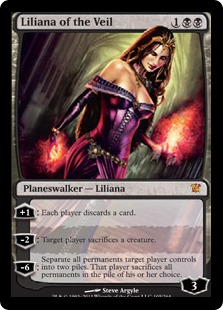
Strong against
: Control and Combo. Cheap threats and soft permission are nightmares for these decks.

Soft to: Aggro, which outnumbers and outclasses most Tempo creature suites, and Midrange, Tempo's natural predator in Modern thanks to the following sentence: "Abrupt Decay can't be countered by spells or abilities."

Example Grow decksMonkey Grow, iGrow, UR Delver

Aggro-Control Hybrid: Midrange

Aggro decks watered down to have an edge against fair strategies. Midrange either drags the game out to a certain stage in which it consistently casts high-powered spells, or accelerates itself into that stage. Its threats usually follow disruption, so they can afford to cost a little more. As such, midrange is often referred to as "goodstuff," and packs the format's most impactful (and expensive) cards. Like Tempo decks, Midrange decks can be split into two categories.

Rock

These decks get their name from the apparent resemblance of Phyrexian Plaguelord, once a mainstay in BGx attrition decks, to Dwayne Johnson. Liliana of the VeilRock exemplifies the midrange credo, dismantling an opponent’s hand and board and chasing the carnage with a huge threat. Modern’s Rock decks favor Tasigur, the Golden Fang and Tarmogoyf for the role of attacking funeral procession. Compared with pure Control, Rock can use its creatures to pressure Combo opponents early, effectively becoming Tempo decks for those matchups. On the name: while “Rock” has traditionally referred to black and green decks, I’ll use it here (and in the future) to refer to any deck with a similar midrange gameplan, regardless of color.
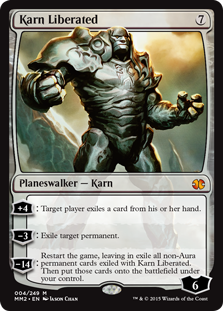
Strong against
: Aggro, fair decks, and the linear decks Rock prepares for.

Soft to: Control, which owns the late game Rock aspires to while blanking archetype staples like Abrupt Decay and Lightning Bolt. Combo decks also trump Midrange, which doesn't always draw its relevant disruption.

Example Rock decks: Jund, UWR Flash, Grixis Control

Ramp

Karn LiberatedRamp strategies occupy a strange place among Midrange decks, as it trades interaction for mana acceleration and expensive bombs. It ends up losing to Tempo, but beating other Midrange decks, as well as many Control strategies. Unlike other Midrange decks, Ramp strategies are unfair.
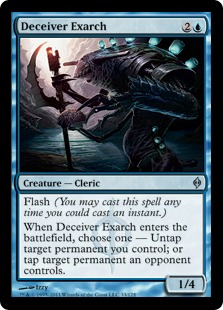
Strong against: Non-Tempo fair decks, Aggro, Midrange, and Control. Ramp stabilizes against Aggro, and against Midrange and Control, whoever goes "bigger" takes the trophy. Spoiler alert: nobody goes "big" like Tron.

Soft to: Combo, Aggro-Combo, and Tempo. The first two simply race the Ramp deck, and Tempo chips away at its life while preventing it from doing anything gamebreaking.

Example Ramp decks: GR Tron, Devotion to Green, Death Cloud

Aggro-Control-Combo Hybrids

The G-Class of all deck archetypes. Aggro-Control-Combo buys tempo by threatening a combo finish, which improves its midrange or tempo plan. Splinter Twin combo is Modern's resident Aggro-Control-Combo deck; it changes roles seamlessly depending on the matchup. Evidently, slapping a four-mana aura on a three-mana creature isn't a great strategy on its own, but Twin gets its power from its unmatched adaptability. Aggro-Control-Combo is proactive or reactive depending on the deck, and fair or unfair depending on the matchup. It's always interactive.

While some Abzan Company decks run both disruptive elements (Abrupt Decay) and an "Oops-I-Win" (Redcap/Melira/Seer), the deck seems too linear, and scattered, to make it as an Aggro-Control-Combo deck as of this write-up. But, its late grandaddy, Birthing Pod, much like Twin, typified the archetype. The Angel Pod variant played a superb midrange game with Decay, Thoughtseize, Shriekmaw, and Siege Rhino, but could also combo into a million life/damage with Spike Feeder and Archangel of Thune.

Deceiver ExarchStrong against: The field. Aggro-Control-Combo doesn't "crush" any one strategy, instead boasting game against everyone. This versatility explains Twin's continued relevance in Modern (since the format's inaugural Pro Tour!).

Soft to: Tempo. Grow decks especially can pose problems for Aggro-Control-Combo, which dons the Aggro-Control cap here and struggles to play a tempo game against decks designed for that purpose. Delver of Secrets gets in under counterspells, and soft permission proves especially potent against haymakers like Batterskull.

Example decks: Twin, Birthing Pod (RIP)

Pigeonholing and You

The most important thing a tournament-bound Magic player can do in the preparation stage is categorize decks and recognize archetypes. Armed with an understanding of Modern's classic and hybrid archetypes, strategic tweaking becomes a breeze. Everyone playing Midrange? Add some late-game control elements to your Abzan deck. Everyone playing Control? Break out those Delvers. Heading into an unknown environment? Sleeve up your favorite deck and pigeonhole opponents on the fly to improve your sideboarding.

This article dealt mostly with Modern, but the principles discussed apply to most formats. Demand depending, I'll cover Modern's mini-archetypes, such as Burn, in another article. Until then, happy metagaming!

Jordan Boisvert

Jordan is Assistant Director of Content at Quiet Speculation and a longtime contributor to Modern Nexus. Best known for his innovations in Temur Delver and Colorless Eldrazi, Jordan favors highly reversible aggro-control decks and is always striving to embrace his biases when playing or brewing.

View More By Jordan Boisvert

Posted in Modern, StrategyTagged , , 29 Comments on Pigeonholing Prevails: Modern Archetypes

Have you joined the Quiet Speculation Discord?

If you haven't, you're leaving value on the table! Join our community of experts, enthusiasts, entertainers, and educators and enjoy exclusive podcasts, questions asked and answered, trades, sales, and everything else Discord has to offer.

Want to create content with Quiet Speculation?

All you need to succeed is a passion for Magic: The Gathering, and the ability to write coherently. Share your knowledge of MTG and how you leverage it to win games, get value from your cards – or even turn a profit.

Do We Still Hate Play Points

Are you a Quiet Speculation member?

If not, now is a perfect time to join up! Our powerful tools, breaking-news analysis, and exclusive Discord channel will make sure you stay up to date and ahead of the curve.

Today was the first time that I've played with Play Points, and I've gotta say, I'm really in favor of them. I had some Phantom Points on my account from Cubing, and seeing as I'm kind of over MTGO Cube I really wasn't ever going to spend them. In that sense, WotC converted my nothing into "tickets" that I could use for constructed queues. Seeing as I tend to burn tickets testing any possible configuration of a deck, I appreciate this.

Goggles

Saving the time to trade packs that I won into tickets is also a nice boon that I hadn't considered.

Corbin Groothius wrote a short and sweet piece over on Channel Fireball comparing payouts under the old system to the new system, and for the most part everything but Daily Events have improved. If you play Daily Events, this is obviously bad. I recommend contacting the people who make MTGO if this is a concern of yours, but as somebody who wants to be able to log in for an 8-person and then logout, I'm really liking the changes.

One of the comments on Corbin's article posits that a downside of the new system is that the payouts don't matter if nobody plays, but that hasn't been my experience. I've been able to jump into Standard queues, both 8 and 2-person, and have them fire within minutes all day. I'd say I'm not the only one who likes the new system.

How does everybody else feel?

Avatar photo

Ryan Overturf

Ryan has been playing Magic since Legions and playing competitively since Lorwyn. While he fancies himself a Legacy specialist, you'll always find him with strong opinions on every constructed format.

View More By Ryan Overturf

Posted in Free3 Comments on Do We Still Hate Play Points

Have you joined the Quiet Speculation Discord?

If you haven't, you're leaving value on the table! Join our community of experts, enthusiasts, entertainers, and educators and enjoy exclusive podcasts, questions asked and answered, trades, sales, and everything else Discord has to offer.

Want to create content with Quiet Speculation?

All you need to succeed is a passion for Magic: The Gathering, and the ability to write coherently. Share your knowledge of MTG and how you leverage it to win games, get value from your cards – or even turn a profit.

Insider: Replacing Theros

Are you a Quiet Speculation member?

If not, now is a perfect time to join up! Our powerful tools, breaking-news analysis, and exclusive Discord channel will make sure you stay up to date and ahead of the curve.

It's kind of a dark time to be interested in Magic finance and actually playing Standard. The reason being that we might be in the deepest lame duck format of all time. There are so many sweet things to be doing in Standard, and all of them require playing cards that you sold months ago.

There was an error retrieving a chart for Courser of Kruphix

While the player in me doesn't ever want Battle for Zendikar to come out, the financier is looking forward. What we know about BFZ is that there will be fatties, a set of enemy-color lands, and no fetchlands. Beyond that, we're just speculating blindly. This does tell us at least that once BFZ launches it is likely that playing wedge decks will still be viable.

The main reason that wedge decks are likely to still be good though, is that Khans of Tarkir is a very powerful block. The idea of invalidating Siege Rhino and Dig Through Time in Standard is ludicrous. BFZ will certainly shake things up, but there's already quite the B-squad in Khans as it is, and there are a lot of cards just waiting to be in more Standard decks once Theros's powerhouses rotate.

Let's talk about what we're losing, and what the likely replacements are.

Planeswalkers

Obviously BFZ is poised to give us some great curve toppers, but these cards leaving Standard is huge. Elspeth, Sun's Champion has been the de-facto "big thing" to do in Standard for as long as it has been legal. Control and midrange decks simply require cards of this nature to compete, and there are some very powerful cards already legal that are poised to show up more with this powerful lot of 'walkers rotating.

I stand by what I've said about Demonic Pact in that the community hasn't really solved the card yet, and I could see it being a big player in Standard. Pact is tanking pretty hard right now, and when it hits the $2-3 range I'll be going deep on this one. Mythics in that range, in particular from a core set, are very low-risk investments, and this one has a high potential to hit.

We will still have great cards to pair with Pact in Dromoka's Command and Sultai Charm in addition to having some fringe options as well--not to mention the notion of popping our packs to the Ugins that will slot naturally into the type of deck that wants Pact.

Speaking of Ugin, that card is just a great target all around. It hasn't ever gone below $20, and there is demand for Ugin in multiple formats in addition to it being a sweet casual card. You might need these while they are Standard-legal, and I don't expect a large drop even when they rotate.

There was an error retrieving a chart for Ugin, the Spirit Dragon

Sorin is a card that has seen some love, but is likely more powerful than it has gotten credit for. Sorin is reminiscent of Xenagos and Ashiok to me. You can buy them for just over $5 right now, and it's very likely that we'll see Sorin triple up at one or more points over the course of the next Standard season. This card is great, and will be seeing play.

Sarkhan Unbroken is a bit more speculative on my part, but the power is there and the buy-in is low. There just hasn't been much reason to play Temur in Standard, but with Hero's Downfall on the out I could see Sarkhan being enough to put Temur on the map. It's also worth noting that with Rattleclaw Mystic being the primary mana dork in the format, a card like Sarkhan becomes the natural thing to ramp into. Sarkhan also generates some mana himself, making him a great fit to curve into Ugin or really any kind of fatties that BFZ delivers.

Whisperwood Elemental is just one of those really good cards that is hard to push out of a small Standard. It's strange that Whisperwood is in the $5 range with G/r Devotion being such a prominent deck right now, but it makes sense considering that the card only has Standard appeal and that much of what makes that deck good is rotating. Regardless, Whisperwood is better than a $5 card, and will be seeing play post-rotation.

Green Dudes

These creatures don't all go in the same deck all the time, but their rotation affects the same types of decks. Abzan is losing many of the tools that have allowed it to exist as a midrange deck, and also one of its primary aggressive creatures. That said, there are some great aggressive options for the deck that will be sticking around.

Warden and Anafenza are tried and true elements of aggressive Abzan decks, and I fully expect them to appear in more lists post-rotation. I've been calling them great pickups for a while now, and I stand by this.

Hangarback Walker is another card that I've already sang the praises of, and have most recently become interested in putting it in an Abzan shell. There have already been some successful lists of Heroic and Abzan decks featuring Walker alongside Dromoka's Command, and that interaction seems very powerful. I also really like the idea of using Anafenza to pump Walker. When powerful cards interact well together, you can rest assured that they'll make their way into a deck.

As for Caryatid leaving, the obvious replacement is the aforementioned Rattleclaw Mystic. Rattleclaw is already above its all-time low, and even if you don't think it can go much higher than $5, you should still get your set now.

There was an error retrieving a chart for Rattleclaw Mystic

Control Spells

Control decks have stooped as low as playing Cancel in the past, and while Clash of Wills is very awkward, it's passable. The best counterspell available barring a sweet one in BFZ is going to be Silumgar's Scorn, and that contest isn't particularly close.

There was an error retrieving a chart for Silumgar's Scorn

It wasn't that long ago that Scorn was the most traded card on Pucatrade, and I see it as the most likely direction for blue decks to move post-rotation. Languish is annoying, but you don't have to just jam Dragonlord Ojutai on five and pray. Your deck will be built to play the long game.

Speaking of Ojutai, both he and Dragonlord Silumgar are very cheap right now compared to their peak prices. Ojutai certainly benefits from Elspeth rotating as well, and I won't be surprised when an Esper Dragons variant is playable post-rotation. Both of these dragonlords strike me as great pickups right now.

There was an error retrieving a chart for Dragonlord Ojutai
There was an error retrieving a chart for Dragonlord Silumgar

There really isn't a suitable replacement for the cheap sweepers leaving the format, so hopefully BFZ gives us something cheaper than Languish to keep low-to-the-ground aggressive decks in place.

Red Cards

So, this actually looks pretty bad for red decks. Abbot of Keral Keep and Monastery Swiftspear are very powerful cards, but red is going to be hurting. At least the green decks are losing Caryatid and Courser?

It seems likely that red aggressive decks are going to look to be two or more colors immediately out of the gates. The most abstractly powerful card for a deck of this nature is Mantis Rider, and it's a good one.

There was an error retrieving a chart for Mantis Rider

Jeskai Ascendancy alongside tokens is another tried and true method to beating down, and I could definitely see both of these three-color cards being very powerful in post-rotation Standard. It won't be easy to make money on regular rares from Khans, but I recommend having at least a set of each of these, and more if you're looking for some cheap acquisitions that will be good for your trade binder down the road.

There was an error retrieving a chart for Jeskai Ascendancy

Temples

Temples are rotating, and as far as we know there won't be rare allied lands in BFZ. With Khans fetches being the only strong allied fixing in Standard and them being obvious specs anyway, their price trajectories will continue to be positive, with Windswept Heath being stymied by the clash pack.

More interstingly, painlands are super cheap right now. If I had to wager, I'd say that BFZ's land cycle probably comes into play tapped, and I expect that we'll be playing painlands for as long as they're in Standard. They were quite expensive after Magic 2015, and the $2 price tag on them right now is quite low. Just last year there were $8 Battlefield Forges on the market, and while they won't go that high, there will be significant demand for painlands considering that most players sold out of the ones acquired previously for Standard.

~

If I had to pick just three cards from those listed above to spec on, it would be Sorin, Warden of the First Tree, and Dragonlord Ojutai. There are clear voids that all of these cards easily fill, and Ojutai and Warden are both small set mythics with proven Constructed applications. These positions will need to be reevaluated as BFZ is spoiled, but these cards as so obviously powerful that they'll be hard to miss on.

I would move in on Sorin and Warden sooner than later, and wait a little bit on Ojutai to see if it drops another buck or two considering that it has had a negative price trajectory for a while.

My list is far from exhaustive, but it consists of what I believe to be the safest picks, with only a couple curve-balls thrown in. I wish you the very best of luck on these positions and any other Khans cards that you decide to move in on.

Thanks for reading.

-Ryan Overturf
@RyanOverdrive on Twitter

Want Prices?

Browse thousands of prices with the first and most comprehensive MTG Finance tool around.


Trader Tools lists both buylist and retail prices for every MTG card, going back a decade.

Quiet Speculation