menu

What’s the Best Magic Drinking Game

Are you a Quiet Speculation member?

If not, now is a perfect time to join up! Our powerful tools, breaking-news analysis, and exclusive Discord channel will make sure you stay up to date and ahead of the curve.
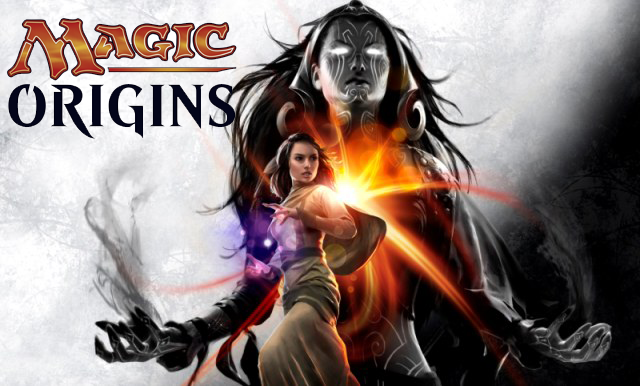
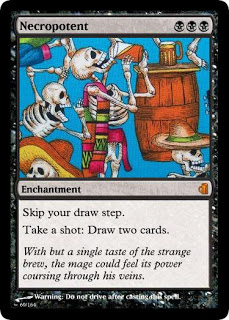
I came across a post on Reddit today linking to a Magic drinking game. Now, I like me a good drinking game, but this one has just too much going on in the rules department. It's inelegant, and would take a while to memorize the whole list. Not to mention that I'd probably just forget them as I played anyway.

A sweet way to drink and game that has been posted on QuietSpeculation before is the Booze Cube. The design is fun, even if the power level isn't super consistent. The set is definitely good for a few laughs, at the very least.

A friend of mine told me that back when he played they used to play where you could shotgun a beer to generate three mana. Beer Lotus as I'm sure they called it. It's a testament to the type of person I am that my first thought was to play Storm in that format, but I digress. This is a great way to get drunk, but probably not the best activity to engage in with expensive Magic cards.

While researching this topic, I came across a neat variant that is relatively lean on rules and sounds like a pretty good time.

-Decide on a prize that everyone chips in for. (Bragging rights included.)
-Everyone starts at 0 life, whenever a player takes damage that would put their life total below 0, instead of losing the game, they drink once for each damage. (You can gain life, effectively defending you from drinking that many times)
-Drink once during your upkeep for every 2 poison counters on you.
-Drink a full bottle whenever you run out of cards in you library, then reshuffle your graveyard into your library.
-Even if all of your cards are exiled, you may still "play" as long as you like.
-You may forfeit at any time.
-You are eliminated if you vomit or pass out.

What I really like about this game is that you're not just playing Magic and drinking, you're actually just playing a sweet drining game with Magic cards. I think the rules read better as you being at one life, and you can choose to drink instead of dying, but that's a pretty minor nitpick.

Then there is, of course, the old regular cube while enjoying a beer or two. Does anybody else know of any sweet Magic drinking games? Please share them in the comments!

Avatar photo

Ryan Overturf

Ryan has been playing Magic since Legions and playing competitively since Lorwyn. While he fancies himself a Legacy specialist, you'll always find him with strong opinions on every constructed format.

View More By Ryan Overturf

Posted in Free10 Comments on What’s the Best Magic Drinking Game

Have you joined the Quiet Speculation Discord?

If you haven't, you're leaving value on the table! Join our community of experts, enthusiasts, entertainers, and educators and enjoy exclusive podcasts, questions asked and answered, trades, sales, and everything else Discord has to offer.

Want to create content with Quiet Speculation?

All you need to succeed is a passion for Magic: The Gathering, and the ability to write coherently. Share your knowledge of MTG and how you leverage it to win games, get value from your cards – or even turn a profit.

Insider: MTGO Market Report for July 8th, 2015

Are you a Quiet Speculation member?

If not, now is a perfect time to join up! Our powerful tools, breaking-news analysis, and exclusive Discord channel will make sure you stay up to date and ahead of the curve.

Welcome to the MTGO Market Report as compiled by Sylvain Lehoux and Matthew Lewis. The report is loosely broken down into two perspectives. A broader perspective will be written by Matthew and will focus on recent trends in set prices, taking into account how paper prices and MTGO prices interact. Sylvain will take a closer look at particular opportunities based on various factors such as (but not limited to) set releases, flashback drafts and banned/restricted announcements.

There will be some overlap between the two sections. As always, speculators should take into account their own budget, risk tolerance and current portfolio before taking on any recommended positions.

Redemption

Below are the total set prices for all redeemable sets on MTGO. All prices are current as of July 6th, 2015. The TCG Low and TCG Mid prices are the sum of each set’s individual card prices on TCG Player, either the low price or the mid-price respectively.

All MTGO set prices this week are taken from Goatbot’s website, and all weekly changes are now calculated relative to Goatbot’s ‘Full Set’ prices from the previous week. All monthly changes are also relative to the previous month prices, taken from Goatbot’s website at that time. Occasionally ‘Full Set’ prices are not available, and so estimated set prices are used instead.

Return to Ravnica Block & M14

The price of a set of RTR is drifting down with the end of redemption, with the most expensive mythic rares of the set all seeing their price peaks in the past. Interest in Modern continues to run high though, as the price of shocklands like Steam Vents stays elevated.

Anticipate lower prices with the release of Magic Origins (ORI) and a shift in focus to the new draft format and a shaken up Standard. The lure of one more (tix-entry only) release event will tempt some players to sell their Modern decks.

With continued price support from redemption, both GTC and M14 saw price increases this week. Domri Rade is slowly heading back to 5 tix, even though this card is seldom played in Modern these days.

Mutavault has plateaued after the initial price increase due to the reprint of Goblin Piledriver. More increases may come but we'll have to wait for Goblin Piledriver to be released and see if its addition to Modern will make Goblins a serious contender in that format. A lot of cards are missing compared to Legacy Goblins, including Wasteland and Rishadan Port, two key cards that help disrupt the opposing deck's mana and development.

Theros Block & M15

Keranos, God of Storms of JOU continues to hit new highs, having run up from around 10 tix to now sit at 25 tix. With this and Eidolon of the Great Revel both sitting at 20+ tix and both seeing countercyclical strength due to interest from Modern and Legacy players, it's possible that rotation will not deliver a significant price decrease to these cards.

With so much value tied up in two cards from JOU, there is no doubt that junk mythic rares from this set will continue to drift lower in price over the coming months. Typically they are never played in competitive constructed formats, so junk mythic rares only get their value from being the bottleneck to redemption.

With redeemers looking at more expensive sets online than in paper, the incentive to redeem is nonexistent. Only players looking for sets to play with will be redeeming JOU. BNG will be in a similar situation, albeit with higher online supply and fewer constructed staples.

The two large sets, M15 and THS, are both good candidates for future demand from redeemers. Currently though, the trend is for lower prices. At the moment, look to junk mythic rares below 0.4 tix to hold good long-term value. Otherwise prices will not bottom until rotation, so don't be too quick to target seemingly cheap cards from these sets.

Tarkir Block

The value of Khans of Tarkir keeps increasing and has almost added up 10% over the past week. The reason is simple; the preferred draft format on MTGO is DDF which doesn't include the first set of the Tarkir block.

On the other hand, and despite a price raise recorded after the release of Modern Masters 2015, Dragons of Tarkir and Fate Reforged's value remain mostly flat for the past two to three weeks. Another small price drop is however to expect when ORI hits MTGO. This mean a new opportunity to buy into these two sets.

Monastery Mentor and Dig Through Time greatly benefit after Legacy GP Lille and another Miracles-only finale. The mentor jumped by about 3 Tix over the weekend while the delve instant got back to the 3-4 Tix price range. We mentioned and recommended Mentor a month ago. This creature is not a powerhouse yet in Standard and is barely played in Modern. However it would only take a Standard rotation and a novel deck tech in Modern to push a guy playable in all formats of Magic way over 15 Tix.

Lastly, KTK boosters have gained an additional 0.30 Tix since last week. 2.5 Tix would be a great selling price in advance of ORI, but a price dip is expected during that set's release events. After release events wind down in August, prices will resume their uptrend into September. A price peak in the 2.6 to 2.8 tix range would be a reasonable target at this point, and would represent a great return on the recommended buy-in price of 1.4 to 1.5 tix from two months ago.

Magic Origins

The Magic Origins list is now entirely up. Unlike paper Magic with pre-sales and pre-orders, no early speculation is possible on MTGO. At best, speculators can place their bets on Standard or Modern cards that potentially benefit from new and reprinted ORI cards. The action in the MTGO market will take place in the month following the online release of the set while release events pour a large quantity of supply into the market.

Modern

Modern Masters 2015 draft events and the availability of MM2 boosters through the official MTGO store end this Wednesday. With these the bulk of supply from MM2 comes to an end. The overall MM2 set value has been remarkably stable over the past four weeks and merely fluctuated around a 200 Tix total set value. With the exception of Fulminator Mage, which nearly doubled in price since the end of May, all of the top mythics and rares have mirrored the whole set trend and have been fairly stable so far.

We recommended acquiring several MM2 positions in previous MTGO Market Reports and if you haven't done it yet now is probably the right time to buy discounted Modern staples. Without a continuing supply from drafters and even without Redemption to act as a floor for prices, the natural and cyclical demand from Modern players and/or speculators will start pulling prices up.

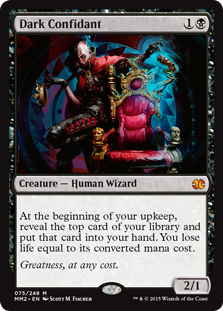
Based on MMA price history, most prices are likely to trend up, at least until October and the release of Battle for Zendikar. The most demanded mythics and rares such as Mox Opal, Tarmogoyf, Karn Liberated, Dark Confidant, Fulminator Mage, Cryptic Command, Noble Hierarch and Spellskite for instance have a good chance to double in price in the following three and half months.

However this trend may not be as marked, or simply not present at all, for more marginal MM2 Modern staples. Gifts Ungiven, Pact of Negation and Summoner's Pact for instance had a flatter price fluctuation after the release of MMA and really took off only months later. Speculators should be ready to be more patient with MM2 cards such as Daybreak Coronet, Surgical Extraction and Wilt-Leaf Liege for examples.

On a different topic, Modern price hikes may come to an halt as the Modern Festival and the Modern MOCS season came to an end, and as there's one more week (from July 15th to July 18th) of MTGO Modern PTQs. With Modern prices probably coming to a local high before ORI release events, speculators should consider selling the Modern positions that have seen a decent increase over the past few months.

Modern positions that haven't moved much since April or May are probably worth holding though--they are unlikely to lose significant value over the summer. Nonetheless, after some price drops due to the release Magic Origins, Modern prices are likely to rebound until the release of BFZ.

Legacy & Vintage

GP Lille featuring Legacy Constructed was held this weekend. Mirroring GP Kyoto last April, two Miracles decks battled for the title in the finale again last weekend.

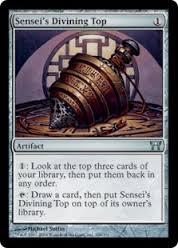
On the one hand, Sensei's Divining Top was on many people’s mind as the next card to ban in Legacy. On the other hand, six Monastery Mentors were in the Top 8 decklists, all of them in the decks of the two finalists.

Concerns about the Top were not related to power level but rather the boring effect for the audience and lengthy games. Counterbalance would probably be directly affected by a ban of Top. Although chances of a ban of Sensei's Divining Top are not high, the Coldsnap blue enchantment is currently in the neighborhood of 17 Tix and speculators or players holding some copies of Counterbalance may want to consider selling it before the next B&R list announcement, this Monday.

Monastery Mentor jumped by 15-20% over the weekend and confirmed its strong potential. The card is very special as it shined in Legacy and Vintage and not so much in Standard and Modern, yet.

Its price is likely to deflate in the coming days as a performance in Legacy is not enough to support the price of a currently drafted mythic. However, the online release Magic Origins might be the last occasion to grab copies of this monk under 9 Tix, whether it is for Legacy, Vintage, Modern or Standard purposes, as FRF supply will start drying up passed July.

Pauper

The Pauper format continues to show signs of a fairly dynamic format, which is good both for players and speculators. Top decks vary frequently and with this prices fluctuate up and down constantly. New cards emerge regularly as new potential targets for Pauper speculations.

As an example, Searing Blaze, a long-time bulk-priced common from Worldwake, spiked over 0.5 Tix three times since May. Such a card could now be considered a very decent speculative target for speculators with a small bankroll when its price drops again to 0.1 Tix , likely in the next few days.

With a rise in popularity of common delve creatures, including frontrunner Gurmag Angler, Mental Note has definitely entered the world of pricey commons and has recently hit 2 Tix. Considering supply of Mental Note, printed in Judgment only, is probably very low this card may rapidly grow to even higher prices. A comeback around 1 Tix would certainly represent a great buying opportunity.

Targeted Speculative Buying Opportunities

None

Targeted Speculative Selling Opportunities

None

Insider: Analyzing Buyouts

Are you a Quiet Speculation member?

If not, now is a perfect time to join up! Our powerful tools, breaking-news analysis, and exclusive Discord channel will make sure you stay up to date and ahead of the curve.

Welcome back, readers! I realize this week is typically an MTG Stockwatch week and while I still have every intention of continuing that series, I thought that analyzing some buyouts might prove really useful, especially with quite a few having occurred relatively recently.

Here's how Wikipedia defines buyout:

Buyout - an investment transaction by which the ownership equity of a company, or a majority share of the stock of the company is acquired.

Okay, so technically that's not the ideal definition for what's happening with certain Magic cards, given that no one person can likely purchase the actual majority of the total stock of a given card (given the massive print runs of every set from Revised onward).

WoTC disclosed the print runs of earlier sets. There were 289,000 of every Revised rare printed (so there are almost 300k of each Revised dual land). Granted some of those have likely been destroyed, lost, or forgotten about--but it's unlikely that even the largest MTG store has even 1% of any given rare, especially newer ones.

It's very likely that recent print runs (and probably some pretty old ones too) were far, far larger, as the player base has grown exponentially since the first few sets were printed.

For argument's sake, let's say print runs have only increased tenfold (I'd imagine this is an extremely conservative estimation). This would mean that there would be 2,890,000 of any given rare. So in order to get 0.1% of the total number in the market you'd need to purchase 2890 of any given rare. Unless you're collecting some oddball card, this is highly unlikely without an exceptional amount of effort and cost on your part.

But, someone can purchase all the "stock" available on the market, which typically is a much smaller amount. For example, if someone were to buyout Boon Satyr on TCG Player alone, they'd need to buy over 1000 copies. This does not include many major retailers who don't sell on TCG Player. However, if this same person instead wanted to purchase all the copies of Argothian Enchantress they'd only have to buy about 200 copies. So we can see that some cards are scarcer than others, and those are the ones that tend to get "bought out." Of course, the challenge is that rarer cards also tend to be more expensive and buying even 60 copies of a $20 card ties up a considerable amount of money.

Recently we've seen the following cards skyrocket in value (a few of many):

Heritage Druid

heritage druid prices

Horizon Canopy

Horizon canopy prices

Grove of the Burnwillows

grove of the burnwillows prices

Goryo's Vengeance

goryos vengeance prices

Nourishing Shoal

nourishing shoal prices

Olivia Voldaren

olivia voldaren prices

Huntmaster of the Fells

huntmaster of the fells prices

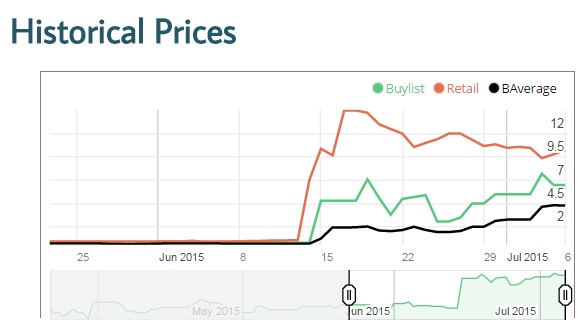
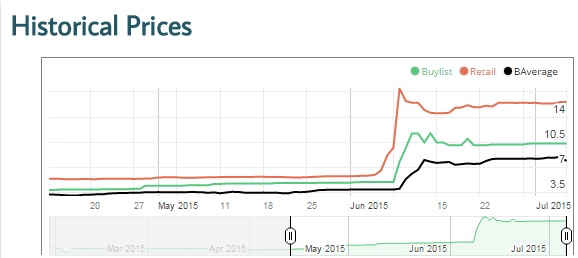
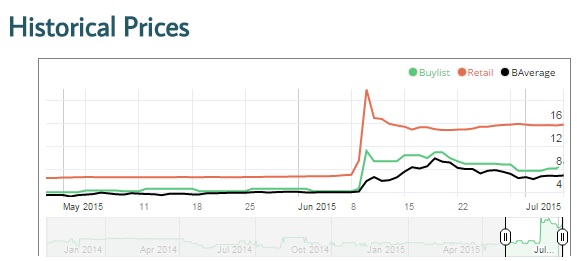
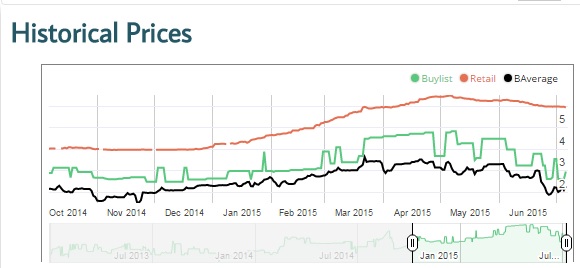
The biggest thing you'll notice is the sudden and sharp incline on the graphs. This is usually the strongest indicator of a buyout, as compared to something like Chromatic Lantern, which shows a nice gradual increase over time.

Chromatic Lantern

chromatic lantern prices

The other major differences you'll notice is that every card that spiked had an immediate drop from its high as retailers overpriced a card, noticed nobody was buying and then dropped the price back down. You'll also notice that the buylist prices of spiking cards is delayed by a little bit (sometimes as short as a day, other times by as much as a week). This is because the dealers know that spikes are often indicators of artificial demand.

Again, Wikipedia:

Artificial Demand constitutes demand for something that, in the absence of exposure to the vehicle of creating demand, would not exist.

This basically means that dealers are cautious of raising their buy prices in the case of a suspected buyout. If one person was simply manipulating prices in order to sell cards back to dealers at a profit, the dealers could be left with a card that nobody else wants to pay the "new" price on.

Nourishing Shoal and Heritage Druid show the fastest buylist price increases above, as they (and Goryo's Vengeance) spiked because of GP Charlotte. We can also look at their current spreads as indicators of how confident dealers are in their current price sticking. Both have spreads in the 30% to 45% range. Compare that with Horizon Canopy which has a 51% spread, meaning that dealers are only willing to pay half of what they'd sell it for, indicating a lack of confidence in the new price (though Heritage Druid's 44% spread indicates they aren't too confident on that one either).

The other big challenge with orchestrating buyouts is that once someone has managed to get a card's price to jump, they have to unload the copies they picked up, and as you'd expect the more copies they picked up (and the more likely the price jump was greater) the harder they are to unload.

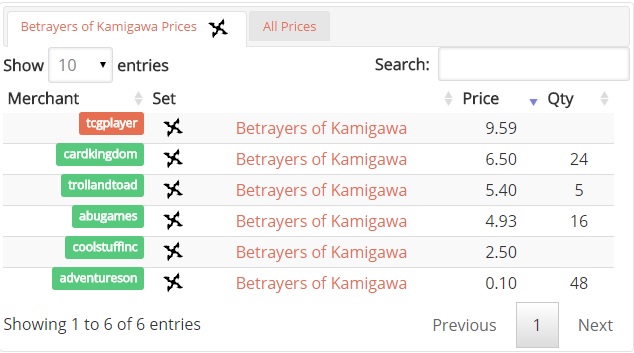
Below are the buylist options for Nourishing Shoal:

nourishing shoal buylist

This basically shows that you can make $6.5 on your first 24 copies, $5.40 on your next 5, $4.93 on your next 16, and $2.50 on the rest. So you can make $261.88 on your first 45 copies. Not bad, if you got them when they were $0.3 each, but if you bought any when they were above $5 you lose money on all but the first 29.

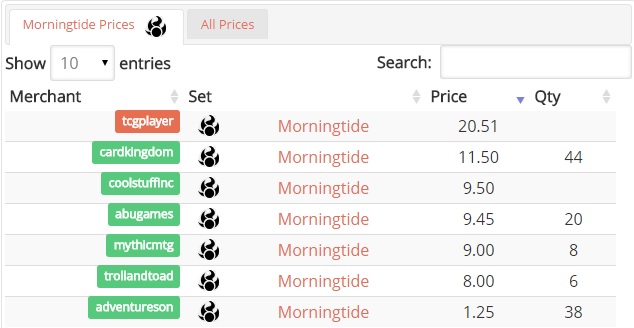
Let's look at another example. Here are the buylist options for Heritage Druid:

heritage druid buylist

Looking at the retail/buylist chart on this card, any copies you purchased after May 18th (assuming retail prices) would have lost you money, despite the fact that the card almost doubled in value.

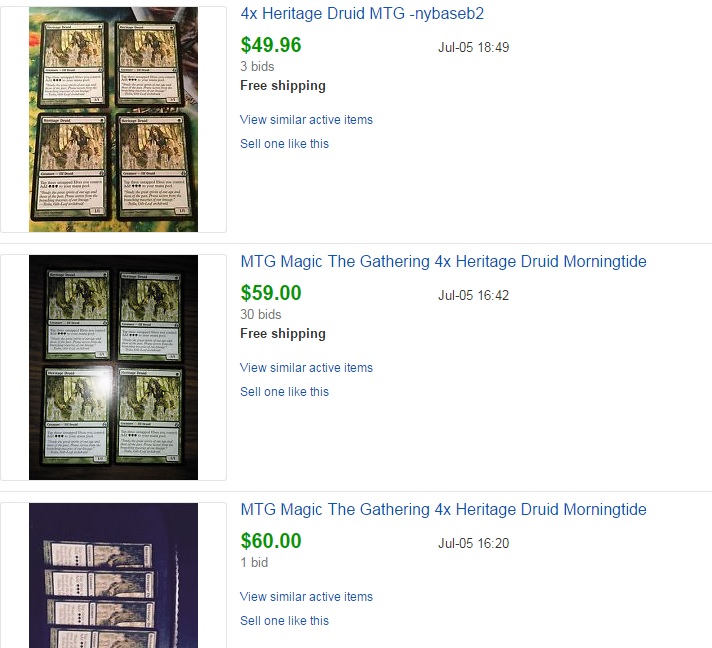
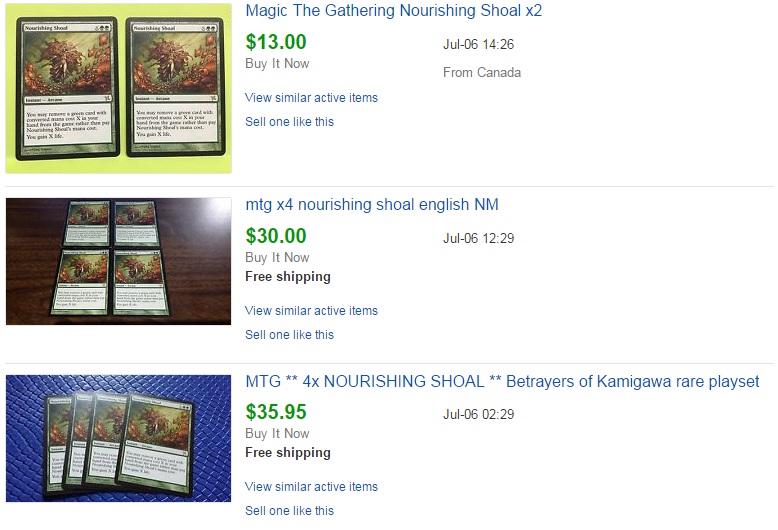
So if these spikes aren't that profitable by reselling to dealers, than one would have to find an alternate out. If we look at eBay listings for Heritage Druid and Nourishing Shoal we see them only really selling a good bit below the TCG average price.

heritage druid ebaynourishing shoal ebay

So with eBay sales only going for around 75% of the TCG Mid price and only a small number of sales per day (around 2-6), it would take a good bit of time to unload a large quantity, all the while the price was likely trending downward.

The other option is of course trading them off. I tried posting both in my "Haves" list on Pucatrade and got zero hits (although my trading is limited to the US). If that's not a reliable option, you're limited to trading them off locally or at major events. Your local trade base is likely limited in size and major events only occur on weekends, thus you're subject to a (likely) falling price as the week progresses.

In Conclusion

The MTG finance realm is not regulated, and in some cases buyouts occur because some new combo or deck comes out that sparks interest. However, in many cases they are simply attempts by one or a few to manipulate the market--it turns out that is not actually a good investment strategy.

Modern Metagame Breakdown: 6/1 – 7/1

Are you a Quiet Speculation member?

If not, now is a perfect time to join up! Our powerful tools, breaking-news analysis, and exclusive Discord channel will make sure you stay up to date and ahead of the curve.

The last time I had such an exciting month of Modern was March 2014, back during GP Richmond. And that was just a single GP without any major set releases co-occurring. June saw not one, not two, but three Grand Prix tournaments, along with the Magic Origins spoiler, the MTGO Modern Festival, an SCG Modern Open, and more smaller Modern events in the entire month than 2014 saw in the first part of the year. Naturally, all of this had a huge effect on the Modern metagame, and the format today has a lot of interesting differences and new decks since last we checked in back on June 1.

Dispel Art

Data for this article comes from the Nexus Top Decks page and reflects events that took place between 6/1 and 7/1. Our Modern metagame breakdown will give you all the information and data you need to be prepared for the rest of the summer Modern season!

[wp_ad_camp_1]

Tier 1 Decks

As in past Modern metagame updates, we are starting with the tier 1 decks of the format. These decks represent the most-played decks in Modern and the decks you are most likely to face at an event. Tier 1 decks might not have the highest win-rate or be the best decks in the entire format, but because of their popularity, profile, and some degree of power, they remain the decks with the highest metagame shares. The table below shows the tier 1 decks from the 6/1 - 7/1 period, and as regular readers will see right away there are some big changes to what we saw from 5/1 - 6/1.

Deck nameOverall
Metagame %
MTGO %Paper %Major Event
Day 2 %
Jund8.8%7.6%10.3%8.4%
Affinity8.5%8.8%7.9%8.8%
Burn8.5%9.2%7.8%8.3%
Grixis Twin5.5%4.9%4.6%7%
RG Tron5.3%6%5%4.9%
UR Twin5.1%4%5.9%5.4%
Grixis Control4.7%5.5%3.8%4.7%

Before we dive into these exciting changes, here are the same decks tracked over the past four metagame update periods. In the interest of space, this table only tracks their metagame-wide prevalence and not the individual paper, MTGO, or major paper event shares. The first column indicates the change in each deck's prevalence between this current period and the previous one.

Deck nameMeta% change
(May to June)
Meta%
(6/1-7/1)
Meta%
(5/1-6/1)
Meta%
(4/1-5/1)
Meta%
(3/1-4/1)
Jund+3.4%8.8%5.4%4.1%4.2%
Affinity+2.7%8.5%5.8%7.1%7%
Burn+.6%8.5%7.9%9.2%10.2%
Grixis Twin+2.5%5.5%3%1.7%1.4%
RG Tron+1.6%5.3%3.7%3.1%3%
UR Twin-3.4%5.1%8.5%9.2%11.8%
Grixis Control+3.9%4.7%.8%.6%.3%

Dark Confidant MM2015There's a lot to talk about in this dataset, both with respect to what's here (Jund on top! Grixis Control!) and what's not (Oh Abzan, where art thou?). Let's start with the most obvious winner in June even if I don't believe it's the biggest winner of the month. Jund finished our GP extravaganza with the second-highest GP metagame share and the highest paper metagame share of all the other tier 1 decks. It also had the most Top 8 showings in both GPs and the major SCG events that kicked off the month. Although Jund never converted those performances into a GP win (so close, Reid Duke!), the deck solidified its status as the best BGx deck in the format for June. This is significant for three reasons. For one, Jund is the rare case of a deck that has a ton of hype and actually lives up to it. Numerous articles, both on this site and authors, extolled Jund as either the best BGx deck in Modern or even the best deck period. That was a high bar to set and many decks don't live up to that kind of hype. For example, Amulet Bloom and Grishoalbrand couldn't have been more hyped going into the summer events, but that hype either put huge target signs on those decks or just overstated the decks' strengths. Either way, those decks floundered (more on that later) while Jund excelled. Other hyped decks include Elves and Abzan Company, both of which had tons of coverage but never converted that hype into big metagame-wide results. Jund succeeded on all those counts, suggesting this deck is as much the real deal as the initial hype suggested.

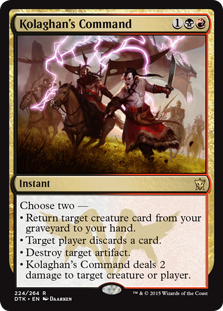
Kolaghans CommandThe second reason Jund's success is so significant is because the format had a lot of linear combo or combo-esque decks added to the format during June. This also relates to Abzan's failure. Historically, Abzan struggled against these linear decks, as we've seen in every event since (and including) PT Fate Reforged. By contrast, Jund seems to thrive in such a metagame, despite its staple removal spell of Lightning Bolt not interacting favorably with some of the scarier linear threats like Deceiver Exarch, Primeval Titan, Griselbrand, and Death's Shadow. That said, it is the combination of Bolt along with Terminate and Kolaghan's Command which allowed Jund to succeed. Abzan was stuck on Path to Exile and Abrupt Decay. Jund got to diversify its removal profile while Abzan lacked the removal/card advantage engine of Kolaghan's and the early interaction of Bolt. This served Jund well in the highly diverse (or, if you prefer, too diverse) June metagame. As I said in an article on GP Kobe last week, I don't think we've seen the end of Abzan as we know it. But I do think that Jund is a better choice when there is a wild mix of fair and unfair decks and you want options in all those matchups. Abzan is geared more heavily to a fair metagame, and our current metagame is just too diverse to be classifiable as "fair".

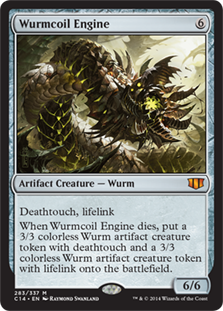
Wurmcoil EngineJune's next winner (still not the big winner though) is RG Tron. If this surprises you, then I suggest you revisit your Jund vs. RG Tron matchup: anytime Jund is the most-played deck in Modern, RG Tron will likely be tier 1 right behind it. To some extent, this was reflected, and even addressed, by Jund's inclusion of maindeck Fulminator Mage in lists throughout the month. But Mage can only do so much, and Tron is still successful when facing that kind of removal.Kolaghan's Command also plays a part in the Tron/Jund story, although Commanding away a Wurmcoil Engine isn't nearly as effective as Pathing one. One reason we actually saw a little less Tron than we probably would have otherwise was the timing of Ali Aintrazi's RG Tron win at SCG Columbus back in early June. Between Tron's success at Columbus and Amulet Bloom's success everywhere, Modern players were extremely well-prepared for both ramp decks for the rest of the month. It is a testament to Tron's power that, despite things like maindeck Fulminator Mage, the deck was still able to enjoy such success. But it probably would have been more successful if its pilots had taken GP Charlotte by surprise, something Aintrazi (and Clair Bigelow on the Open side of that same event) prevented them from doing.

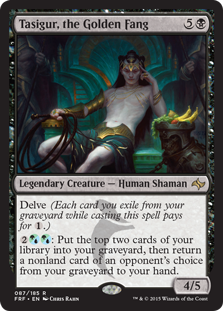
TasigurFinally, we get to the big winners we've all been waiting for. Or should I say big winner singular: Grixis. Not just Grixis Twin or Grixis Control as distinct decks, although we'll give both those builds their due in a moment. I mean Grixis as a color pairing. I remember the days where Modern players were happy to have tier 3 wins with Cruel Ultimatum, and we have come a long way since then. Before Fate Reforged, if you wanted to play Snapcaster Mage and friends like Cryptic Command, then you had to play UR or UWR. Fate Reforged changed that forever with a shirtless dude and his bananas (keep it PG, everyone) and an unassuming common fish. Tasigur, the Golden Fang gets my award for most-impactful Modern card of 2015 (so far, at least...), and he is likely to remain one of the most format-defining cards for years to come. Kolaghan's Command is really just gravy when you already have Tasigur and his friend Gurmag Angler in the mix, and even there, it's mostly the Human Shaman who's putting in the work. June was Tasigur's best month yet, with the delve creature and his fishy friend catapulting two new decks into tier 1 status. These Grixis variants have both impressive metagame numbers from a raw perspective, but also demonstrate exceptional growth in the past few months.

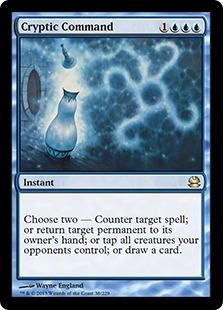
Cryptic CommandNow let's look at the individual decks and address the giant Zombie Fish in the room: is Grixis Control really a control deck? Yes. Grixis Control is still fundamentally a control deck that looks to answer opposing threats and stop an opponent's gameplan. The moment these Grixis decks start cutting their Cryptic Commands and other countermagic, then we can revisit this and start calling it Grixis Midrange. But until then, we need to start acknowledging Tasigur and Angler as the new faces of control, much like how UWR used Restoration Angel and/or Vendilion Clique as both control elements and offensive/defensive ones. Grixis Control's rise to the top is huge for Modern because it puts another fair, interactive, nonlinear deck at the upper echelons of our format. This is excellent from a self-regulation perspective, because Grixis Control is capable of running some major police cards like Spell Snare, Dispel, Terminate, Blood Moon, and a variety of other answers/threats to keep other decks honest. On the other side of the Grixis coin, I'm less excited about Grixis Twin. In fact, I'd be willing to guess that most people are less excited about Grixis Twin. "Oh how exciting, another Twin deck!"... said no Modern player ever. Twin is not really a problem in any metagame-wide sense (just look at the stats on the table above), but we also aren't advancing format diversity by adding a Tempo Twin archetype into tier 1. But if that's the price we have to pay to get Grixis Control into tier 1, then it's well worth it. I welcome our new Grixis masters and am eager to see how they play a role in format regulation and diversity.

Tier 2 Decks

Modern's tier 2 decks represent the tournament-viable decks in Modern, strategies you might run into at a large enough event and can reasonably expect to succeed with if you bring them yourself. Unlike the tier 1 decks, you don't need to have sideboard cards and strategies against every tier 2 deck in Modern. You don't even need to have good matchups against most of them. Whenever Wizards talks about Modern's diversity, they are likely referring to the tier 2 decks that branch out from all the tier 1 format pillars. The table below shows all the tier 2 decks from the 6/1 - 7/1 period. We are down to 12 tier 2 decks from 13 in the previous breakdown, with some new entrants on the list and some new exits to lower tiers.

Deck nameOverall
Metagame %
MTGO %Paper %Major Event
Day 2 %
Amulet Bloom4.1%4.5%3.5%2.8%
Abzan3.6%2.4%3.3%5%
Grixis Delver3.5%4.8%3.3%2.5%
Infect3.5%1.8%4.4%4.1%
Abzan Company3.4%2%4.5%3.8%
Merfolk3.3%3.6%3.5%2.8%
Naya Zoo3.1%2%2.4%4.8%
Elves2.4%2.9%3%1.4%
Temur Twin1.9%1.4%1.9%2.3%
Grishoalbrand1.8%1.7%.9%2.8%
Scapeshift1.6%1.2%1.8%1.7%
Ad Nauseam1.2%1.3%.9%1.2%

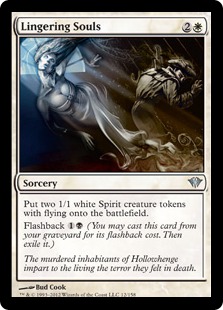
Lingering SoulsAbzan came up in the Jund discussion above, but I want to say a few more words on the deck just to emphasize some points. Was Jund the better BGx deck for June? Absolutely! We could confirm this theoretically (Bolt was better than Path in metagames clogged with 1-2 CMC creatures), qualitatively (we had tons of anecdotal evidence from pro authors about how good the deck was), and quantitatively (Jund crushed Abzan on the metagame charts). Does this mean that Jund will always be better than Abzan? Or even that Abzan's 3.6% metagame share will stay that low all summer? Not necessarily on both of those counts. Abzan is a highly contextual deck, perhaps moreso than Jund. Lingering Souls and Siege Rhino thrive in a certain kind of metagame, one full of fair decks trying to play the one-for-one removal game, and one full of tempo or midrangey decks trying to win games with creatures. We aren't in that metagame now, but we could definitely go back to that metagame if the policing forces of Jund and Grixis Control are strong enough to rein in some of the less fair decks floating around Modern right now. I expect Abzan to shift back to around a 5%-6% share by September, although Jund will still probably remain on top for a bit longer.

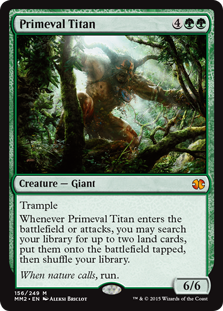
Primeval titanEnough talk about fair decks. Let's go to the unfair ones. The really, really unfair ones of Amulet Bloom and Grishoalbrand. Earlier this month and at the end of May, we had a lot of datapoints to suggest that Amulet Bloom was easily the best deck in the format. This included two internal analyses of MTGO matchup data, matchup results from PT Fate Reforged, and countless articles and stories from the community about the deck's strengths. By basically every quantitative and qualitative metric, the deck was looking pretty busted. Indeed, the only people who were defending it appeared to be Amulet Bloom players, but every busted deck in Modern has historically been defended by its pilots and investors, so this was a datapoint we couldn't give much weight. Then came GP Charlotte. Or should I say, then came Blood Moon. As I discussed in my GP Charlotte retrospective, this was event proved to the Modern community that the format can self-police if given sufficient warning about a deck. Amulet Bloom may currently be the most-played tier 2 deck in Modern, but that's only in the aggregate and not universal across all three categories (it's much more middling with respect to GP Day 2 performance). This is because Modern was able to regulate the deck through sideboard and maindeck choices. Does that mean other players were wrong in describing Amulet Bloom as broken? Absolutely not: all available data pointed so strongly towards the deck's strength. But the datapoint we lacked was what would happen if the metagame was ready for the deck, and GP Charlotte showed Modern is capable of handling this threat.

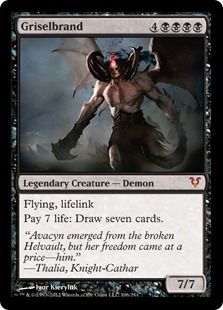
GriselbrandAnd then there was Grishoalbrand. It felt like everyone who was on the Amulet Bloom ban-train immediately jumped cars over to the Grishoalbrand ban-train, practically in mid-transit. But unlike the fear around Amulet Bloom, which was amply justifiable in the data, the Grishoalbrand hype was much less grounded. Nourishing Shoal certainly made the deck better, but Griselbrand and friends just didn't up results for the entire month. I'm not even talking about GP T8s either, which are not good indicators of deck success. I'm talking about Grishoalbrand's appearances (or lack thereof) in MTGO dailies, SCG IQs, and other smaller events across the Modern scene. This deck had an unbelievable amount of hype and profile after GP Charlotte, so it's not like players weren't bringing the deck for lack of knowledge. Rather, the deck was seeing play but wasn't putting up results. The Modern Festival results are particularly telling in that regard. Grishoalbrand was surprisingly absent in both the Preliminaries and the Finals. The deck didn't even place anyone into the Top 32 at the MOCS Finals. All of this suggests that Grishoalbrand is just another combo deck in Modern. There is some combination of maindeck and sideboard hatred keeping this deck down, and that is likely going to be true for the foreseeable future.

There were other small fluctuations in Modern's tier 2, including an uptick in Naya Zoo/Company, some renewed Ad Nauseam viability, and the continued relevance of Company decks like Abzan Company and Elves. Meanwhile, both UWR Control and UWR Midrange fell out of tier 2, likely as a result of all the control players switching to Grixis options. We also saw a drop in Bogles (lots of Twin and BGx tends to do that) and a similar drop in Abzan Liege (less Abzan will lead to less Abzan Liege). Tier 2 mainstays like Infect, Merfolk, Scapeshift, and Temur Twin stuck around for another update, although Grixis Delver has seen falling popularity as players shift more deeply into Grixis Control.

Modern Metagame Predictions

In my last metagame breakdown, I made two bolder predictions about some big changes that June could see for Modern. I'm a big fan of reviewing past predictions, both to improve our understanding of making future predictions, and to be transparent about the way we analyze data. It's not fair to our readers to just highlight the hits and ignore the misses, so here's a quick checkin on the predictions from last time.

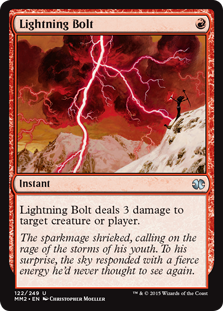
  • Lightning BoltJund will surpass Abzan? YES!
    Although there was a lot of hype around Jund at the end of May, there were also many players denouncing that hype and claiming Abzan was still where you wanted to be. Some datapoints even supported this, with cards like Bolt appearing to lose relevance in metagames packed with Twin combo and delve-powered creatures. This was not an open-and-shut prediction, and it definitely looked like Abzan could stay relevant, or at least keep pace with Jund. With June over, we can safely say that Jund is the clear winner of the BGx contest. Although I expect Abzan to make a resurgence by the end of the year, Jund will remain the frontrunner for at least the rest of the summer.
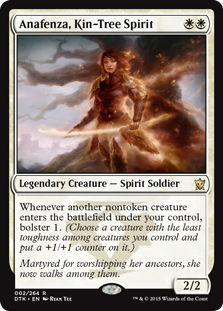
  • Anafenza, Kin-Tree SpiritAbzan Company will become tier 1? NOPE!
    We might have knocked the ball out of the park with Jund, but we totally struck out on the Abzan Company prediction. Despite some promising T16 performances at GP Charlotte, Abzan Company never really took off throughout the summer. Elves even won Charlotte and is now the least-played Company list across the metagame. If anything, the big Collected Company winner was Naya Zoo, which enjoyed a big boost in popularity following Paul Rietzl's 10th place GP Charlotte finish with his own Naya Company list. All of this just underscores the point that Company is a good card but we still haven't figured out  the best way to use it. Company decks now make up about 9% of the format, all within tier 2. But no single deck exceeds a 4% share. We need more time to understand this card and build around it, and maybe the rest of the summer will see it start to shine.

Time for some new predictions to get us through July. Although we won't have any more GP/MOCS/Festival extravaganzas, we will still have lots of PPTQs and other events to keep us engaged with Modern. We also have a ban announcement coming up next Monday (7/13), and even if nothing happens, this will convince some players to invest in decks they may have avoided (potentially Bloom or Grishoalbrand, although I doubt this effect is a real one), and generally signal the format's health to others who are just interest in buying into Modern. Based on the current metagame trends and what we are seeing in reports across the Modern community, here are two predictions for July.

  • Affinity and Burn will become the most-played decks
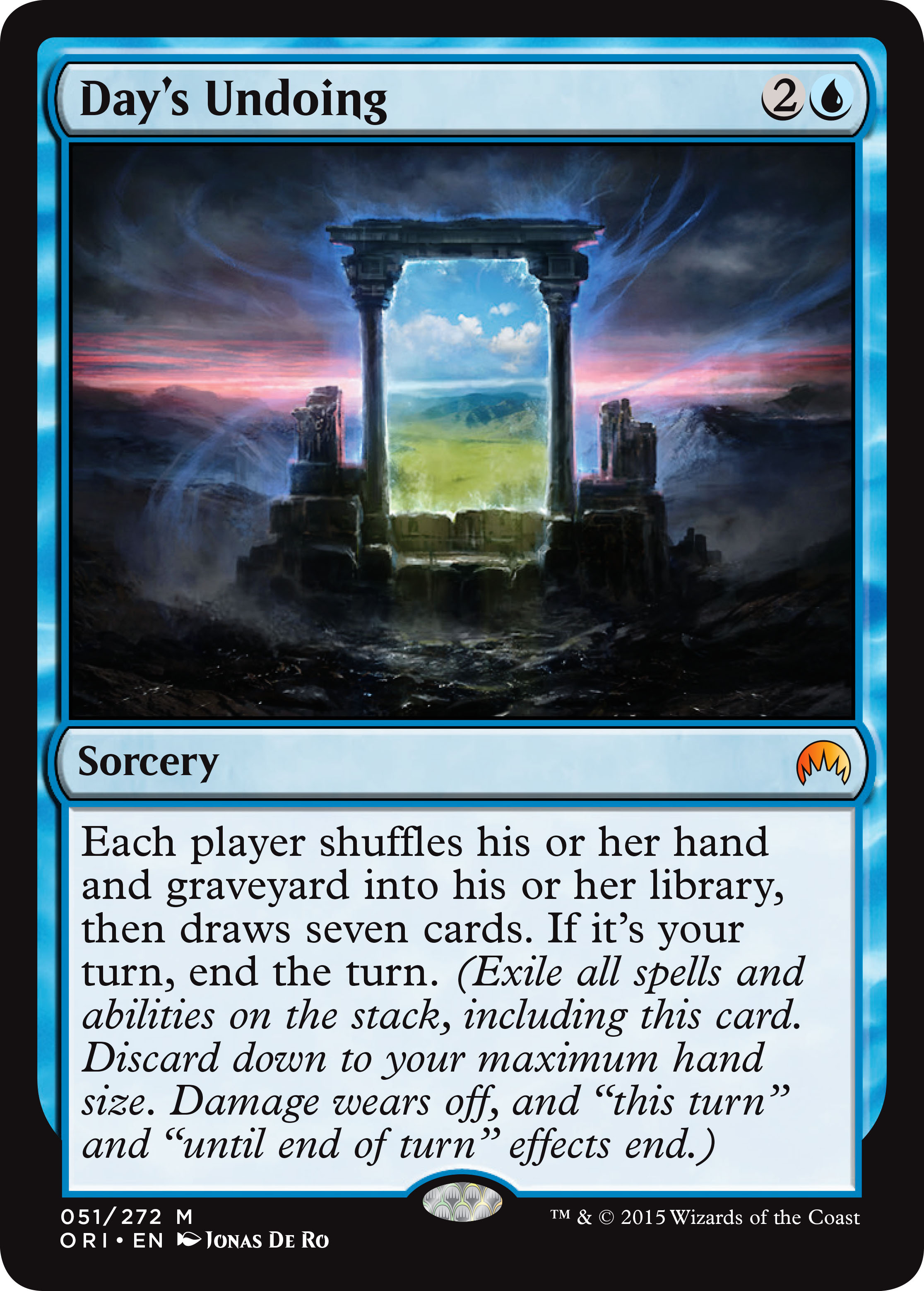
    Day's UndoingWhich is also to say, people are going to lose their mind over Day's Undoing and jam it into the two tier 1 decks that best fit the card. I do not think Undoing is a broken Magic card and I do not think its effect on Burn and Affinity will last longer than 1-2 months. But I do think people are going to flock to this card and try to make it work, and other players are going to be ill-prepared to handle this new style of Affinity and Burn gameplay. Eventually, the metagame will adjust, and we will see a little less Jund and a little more Twin to take charge of the Undoing-powered lists. Until that time, however, there is going to be a lot of hype around Undoing and hype tends to drive increased metagame shares. In many respects, this is a tricky prediction to make because I'm not making it solely on the strength of the card or its decks. I'm making it based on the hype mechanism and how that affects deck-decisions in Modern. Although I do believe Burn and Affinity gain something from Undoing, I also don't think this is so format-warping as to be a problem. It will just be a short-term gain.
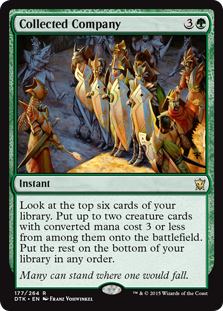
  • Collected Company will remain a tier 2 player
    collected companyThe only thing that will create consensus around a Company list is a major event. And, as we saw in June, it really needs to be a string of major events and not just one. We aren't going to have this kind of exposure next month, so there is no way all the Company players are suddenly going to figure out where their card has a home. If anything, the question will only be more muddled as July unfolds. We'll see more Elves variants as the Gilt-Leaf Palace speculators drum up their BG Elves lists in Modern (and, to be honest, there are legitimate reasons to run it). We'll see Company Goblins with Goblin Piledriver, and more Hatebears variants in the tradition of Bozhi White's list from GP Singapore. Company will remain a big player in Modern, but there should be no clear victor between the different Company decks.
  • BONUS: There will be "No Changes" in next Monday's banlist announcement
    I'm going to go into more depth on this in tomorrow's article, but just to get people thinking about the announcement, I'm going on record here saying that Monday will see "No Changes". The format is healthy enough that no bans are needed, and diverse/stable enough that no unbans are needed either. Tune in tomorrow for more details.

What do you all think about the metagame changes? How is Modern looking in your local area compared to the overall scene? Any predictions you would make? Things you agree/disagree with? Let me know in the comments as we reflect on this awesome month of Modern and look forward to the rest of the summer.

Ban Top!

Are you a Quiet Speculation member?

If not, now is a perfect time to join up! Our powerful tools, breaking-news analysis, and exclusive Discord channel will make sure you stay up to date and ahead of the curve.

I used to really like Legacy, but I've become rather ambivalent over the past year. When Vintage Masters launched, I gave playing Legacy on MTGO a try and quickly came to the realization that playing online just wasn't as good as paper Legacy. A large part of the problem for me was the prevalence of Miracles online.

There was an error retrieving a chart for Terminus

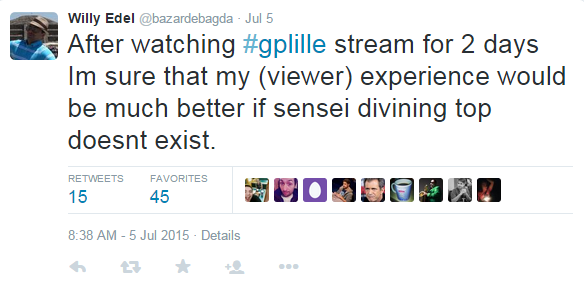
I've always hated playing against Miracles. There are interesting decisions in the matchup, but usually only for the first couple of turns, after which point you have probably already won or lost and then you have to wait an hour and a half to find out which is the case. I didn't mind playing against it once or twice in a nine round tournament, but playing against it 2-3 times in a four round event is just miserable. This weekend Willy Edel tweeted this in response to the Grand Prix Lille coverage:

Ban Top

Once upon a time, Sensei's Divining Top was banned in Extended. I was not a fan of that ban at the time, but I dug up the reasoning from that announcement and it seems to play with regard to Legacy.

Ultimately Top 8s throughout the season were littered with the one-cost artifact either in conjunction with Counterbalance to lock opponents out of games, Trinket Mage to be found reliably, or (and usually in addition to) Onslaught’s sac-lands to allow players to shuffle away cards they didn’t wish to draw while peeking at a fresh set of three cards. Such a pervasive performance during a single season created a different problem as well: it made tournaments take too much time.

The constant activating of Divining Top bogs games down, which ultimately leads to an increase in the number of matches that go to time and beyond, which in turn leads to tournaments running much longer than they have historically. Furthermore, the Top encourages players to maximize the number of shuffle effects they play in a deck and the constant shuffling, cutting, presenting to an opponent to repeat the process, and then continuation of a turn exacerbated the situation. In the past the DCI has banned such cards on those grounds alone (Shahrazad is a good example of this, with Land Tax and Thawing Glaciers also having been banned for similar reasons) but in conjunction with the Top’s popularity during the last Extended PTQ season, the decision was to ban the card from the format it was harming.

I'd miss Top a lot more than I'd miss Counterbalance, but either way you'd have a hard time convincing me that banning Top wouldn't make Legacy more enjoyable to play and to watch. Of course, one should always tread lightly with a ban, and there are definitely Miracles fans that this would isolate. I personal believe that the benefits outweigh the harm.

Avatar photo

Ryan Overturf

Ryan has been playing Magic since Legions and playing competitively since Lorwyn. While he fancies himself a Legacy specialist, you'll always find him with strong opinions on every constructed format.

View More By Ryan Overturf

Posted in FreeTagged , , 12 Comments on Ban Top!

Have you joined the Quiet Speculation Discord?

If you haven't, you're leaving value on the table! Join our community of experts, enthusiasts, entertainers, and educators and enjoy exclusive podcasts, questions asked and answered, trades, sales, and everything else Discord has to offer.

Want to create content with Quiet Speculation?

All you need to succeed is a passion for Magic: The Gathering, and the ability to write coherently. Share your knowledge of MTG and how you leverage it to win games, get value from your cards – or even turn a profit.

Modern Playables – Magic Origins Edition

Are you a Quiet Speculation member?

If not, now is a perfect time to join up! Our powerful tools, breaking-news analysis, and exclusive Discord channel will make sure you stay up to date and ahead of the curve.

Liliana-Origins-Art

Magic Origins has arrived! Origins is the last of the Core sets (6th Edition, 10th Edition, M15, etc.), which marks the end of an era for how sets are released. It's fitting that a set like this will have some high-impact Modern playables, but the bar was already set high in Khans block. Maybe a bit too high in some cases... We had a lot of hits in our last set review during Dragons of Tarkir, and I'm excited to see what Origins has to offer our format. I won't touch on every card in the set, but we'll take a look at all the cards that have had a lot of buzz and some cards that remain underappreciated. Instead of using a 0.0 - 5.0 rating scale like so many other articles, I'm just going to put the cards into general playability categories to give a broader sense of what is good and what is not.

[wp_ad_camp_1]

Origins Staples

Cards in this category fit directly into tier 1 or tier 2 strategies (Atarka's Command in Burn), are so powerful as to create new archetypes altogether (Collected Company and its many homes), or shape the format around all the decks and playstyles they enable (Kolaghan's Command in Grixis). Expect to see these cards in Top 8s across the format.

Day's Undoing
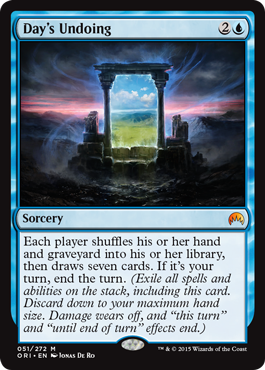
Day's UndoingWhen it comes to Day's Undoing, Modern players generally fall into two camps. One group is convinced this is the second coming of Treasure Cruise and will lead to format instability, dominance by a few decks, and an eventual banning. Others believe this is just as overrated as Time Reversal, and will be forgotten just as quickly. There are some in the middle, although even there they are often leaning towards one end of the spectrum or the other. Our very own Jordan Boisvert wrote two articles on Day's Undoing over the past few weeks, and he's leaning much more towards the "broken" side of things. That's also where I am right now, although I think the card is much more policeable than many acknowledge.
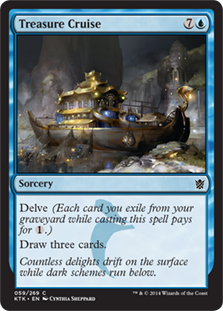
Treasure CruiseLet's not mince words here: Day's Undoing is a fantastic card. It is not, as many naysayers are claiming, Time Reversal 2.0. But it's also not quite Treasure Cruise 2.0. Like Cruise, Undoing gives certain linear decks a way to refuel and rearm after either a slow start or after expending early resources. That's huge for decks like Burn or Affinity, especially Affinity which can easily dump their hand on turn 1-2 and then cast Undoing to get more threats next turn. This makes the card scary in such decks. But unlike Cruise, Undoing doesn't punish opponents for wasting resources on disruption early. One of the most insane parts of Cruise was that it totally invalidated BGx strategies, punishing those one-for-one discard exchanges with a free reload on turn 3-4. Undoing, by contrast, reloads the opponent as well. Although some players will argue the effect isn't truly symmetrical (few "symmetrical" effects ever are: see Second Sunrise or even just Damnation), there are tons of decks that can definitely capitalize on those seven cards before the Undoing player can. Most problematically, you can't use this in a linear mirror: an opponent is almost guaranteed to get more mileage out of the Timetwister than you are.

For me, the scariest thing about the card isn't just the draw seven. It's also the graveyard shuffle clause, which screws with the premier fair decks of the format. Both Jund and Grixis rely on the graveyard for Goyfs, delves, and Snapcasters, which makes the card much more asymmetrical here than it is in the linear matchups. This in turn threatens to decrease the fair-deck metagame share, warping the format. But I also think the solution to this lies in the tempo decks (get 'em Delver!) that can both prevent Undoing from resolving and capitalize from it with their own cards. So although I don't see this card breaking the format, I do see it changing the format landscape.

Harbinger of the Tides

Harbinger of the TidesA few weeks ago at GP Copenhagen, Przemek Knocinski reminded all of us that True-Name Nemesis isn't the only competitive Merfolk in top-level Magic. Knocinski's army of lords and Cursecatchers swam to victory against a field filled with shiny new Grixis and Grishoalbrand decks, along with Modern staples like Jund and Twin. Maindecked Tidebinder Mage was integral to his success, and the new Harbinger of the Tides looks to replace the Tidebinder in many future Merfolk strategies. Harbinger is the best thing to happen to Merfolk since Master of the Pearl Trident, even surpassing Master of Waves and Tidebinder as one of the best creatures in the deck. As I discussed in my GP Copenhagen retrospective article, Merfolk owes its success to some outstanding catchall disruption like Cursecatcher, Spreading Seas, and Vapor Snag. This is what allows a giant pile of dumb aggro creatures to succeed in a format where most other decks are doing something unfair. Harbinger fits perfectly into this strategy, giving Merfolk a huge edge against a number of key Modern strategies.
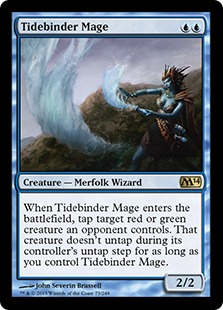
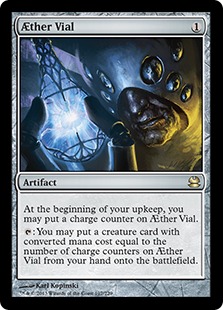
Tidebinder MageHarbinger is a maindecked answer to Twin's Deceiver Exarch and Pestermite (also killing the enchantment itself). It stops Primeval Titan from swinging for lethal. It bounces Affinity's Inkmoth Nexus and removes Ravager counters from it, and blows out Infect swings with Agent/Elf backed by spells like Become Immense. Worldspine Wurm gets shipped back to the opponent's hand, as does Death's Shadow in the Suicide Zoo lists. And of course, that's on top of all the random Goyfs, Tasigurs, Anglers, and other more generic creatures Harbinger ships out of play. Plus you can cheat this in off Aether Vial around countermagic? Or just hardcast it with no Vial in play at all? Tidebinder was maindeckable in a GP-winning list and it only did a fraction of this. Harbinger promises to make Merfolk a much more competitive deck, addressing bad matchups and giving the Merfolk player a lot more range and versatility in a format that rewards flexible answers. Note that Tidebinder won't disappear entirely: just expect to see more maindecked Harbinger than Tidebinder in most metagames.

Pia and Kiran Nalaar

Pia and Kiran NalaarI talked about mama and papa Chandra in my Origins article last week and my opinions haven't changed at all. Pia and Kiran are Huntmaster of the Fells when you want something more aggressive in that Huntmaster slot. Huntmaster is a great card but it isn't very fast. It's great to stall an aggressive opponent and good when you are trying to go wide over a few turns, but it's not as strong when you just want to punch through an opponent's defenses and life total. Huntmaster is also really underwhelming when Huntmaster himself gets killed, leaving you up just two life and with a ridiculous little 2/2 Wolf. This is where Pia and Kiran shine. Even if the legend is killed, the two 1/1 Thopters are just as potent here as they are off the almighty Lingering Souls. They either stall Goyfs, Tasigurs, and Anglers for two turns (as opposed to the Wolf's single turn stalling), or they swing for two damage every turn (as opposed to the Wolf who probably can't survive a single combat phase). So in the event your Huntmaster/Pia and Kiran are killed, the red legend is the better of the two.
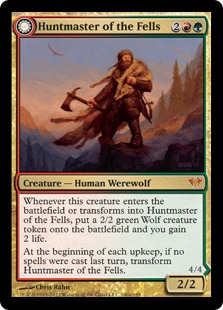
Huntmaster of the FellsAssuming neither card immediately dies, Mr. and Mrs. Nalaar become much more aggressive right after you untap. They are an easy four damage to the dome on the next turn, a possible six damage if you have lots of mana, and even eight damage if you have a clear board ahead of you. This makes them a much more aggressive topdeck in the mid or lategame than Huntmaster, which plays into Jund's aggressive pacing. The Nalaars are also much more interactive, directly threatening problematic creatures like Melira/Anafenza in Company decks, as well as dangerous creatures in Infect, Affinity, and Elves. There will definitely be metagames where Huntmaster gets the nod over Pia and Kiran, but there will also be metagames where the Nalaars is what you want to do with your four-mana investment. I expect to see this card in Jund sideboards and maindecks for a while, although the exact Huntmaster-Pia and Kiran ratio will vary with the format.

Sideboard and Fringe Playables

These cards are likely to see Modern play, but only as sideboard bullets in certain decks and matchups (Rending Volley in many sideboards), upgrades for niche cards (Roast replacing Flame Slash), and new threats for tier 3, or even tier 2, strategies (Avatar of the Resolute in Stompy). We'll see these cards pop up in events, but they won't be redefining Modern as we know it.

Dwynen's Elite
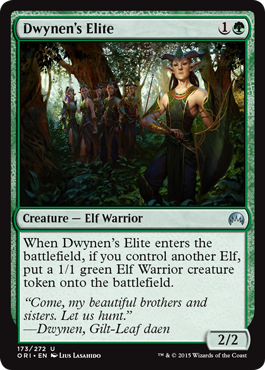
Dwynens EliteElves wants to make lots of Elves, and just as Mogg War Marshal is a go-wide staple of Goblins, so too will the Elite become a regular in Elves lists. One reason this card is so good is that it's relevant at all points in the game and in all boardstates. Early on, it walls enemy beatsticks and builds your board presence for larger Elvish Archdruid activations. Later, it give you more power for Ezuri, Renegade Leader to power through for a win. And at all points, it's a single-card investment that enables your Heritage Druid activations on its own. Elite is a great game one card for Elves when your main objective is to put bodies on the board and win as quickly as possible, and as Elves players fit their deck into the post-Origins world, Elite is sure to find a foothold there.

Exquisite Firecraft

Whenever a burn spell gets printed in a Modern-legal set, we always want to evaluate it for inclusion in Burn itself. Because Burn is already so efficient, it's rare for a card to meet that bar, but we are already seeing 1-2 copies of cards like Flame Javelin pop up in Burn decks across the format. We are also seeing a lot of players, notably Grixis mages, rely on cards like Dispel, Negate, and Flashfreeze to beat Burn instead of the much more Revelry-vulnerable Dragon's Claw. Firecraft gets around this gameplan, giving Burn some added punch to close out a match. I expect to see 1-2 of these in Burn maindecks in different metagames, with the possibility of 1-2 in sideboards for those control-heavy matchups.

Goblin Piledriver
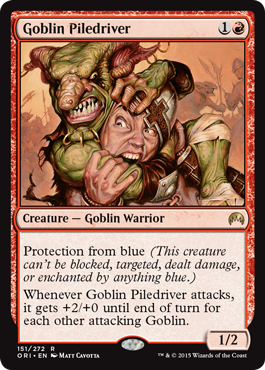
Goblin PiledriverPraise Wizards. Modern players have been dreaming of Goblins and a Piledriver reprint since September 2011. It took Wizards four years but they finally delivered. Later in the month, I'm going to write an entire article on Goblin Piledriver in Modern and the different ways we can build Goblins around it. So for now, this is just going to be a top-level view of Piledriver and its effect on Modern. The good news is, as expected, Piledriver makes Goblins better. The bad news is, as shouldn't surprise anyone, Goblins was never very good to begin with, and Piledriver doesn't really shore up those weaknesses. Modern Goblins has problems with refueling after the early game and differentiating itself from other faster aggro decks (Affinity and Burn) or more consistent aggro decks with alternate gameplans (Merfolk and Elves). Piledriver makes Goblins a little faster, but doesn't do anything to solve the problem of recovering after a boardwipe or distinguishing the deck from better options. You can't even go the Legacy Goblins route because we lack elements like Goblin Lackey and Rishadan Port.

So why does Piledriver make the playable list if Goblins can't cut it as a deck? For one, it signals Wizards' willingness to keep pushing this archetype, and I expect to see more Goblins in the future. Ringleader or Matron are looking much more likely with Piledriver in the mix. Two, between Collected Company, Kolaghan's Command, and Origins' very own Day's Undoing, I feel like Goblins has options to fill that much-needed refill spell, which means Piledriver can really shine as a finisher and damage-dealer. Goblins is one card away from tier 2 status, and Piledriver is the Warrior that puts it in this position. As a final note, Piledriver will renew interest in Goblins across Modern, so expect to see more people trying to tune the archetype and make it work.

Languish

Abzan has fallen behind Jund in almost every metric in the format. Languish isn't going to solve that problem, but it is going to narrow the gap: what Abzan lacks in sweepers like Anger of the Gods it can now make up with Languish. I discussed this card in an article last week, and the key points from then are still true today. Unlike Damnation, Languish doesn't it Goyf, Tasigur, or Rhino, but this is exactly why you want to be playing this sweeper in some matchups. Clearing away Abzan Company's, Elves', Merfolk's, Abzan Liege's, or Zoo's creatures without hurting your own is huge. It gets even better if you can drop the turn three Goyf/Tasigur and follow it up with Languish. Utopia Sprawl can accelerate into this if you need it earlier, which might help Languish find a home in the BG Rock and Death Cloud decks we occasionally see across the format.

Liliana, Heretical Healer / Liliana, Defiant Necromancer
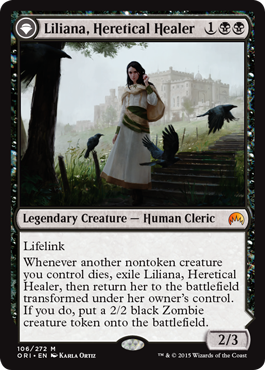
Liliana Heretical HealerPlaneswalkers are already probably the hardest cards to evaluate for any new format. See Narset Transcendent to see that challenge in action. Flipwalkers take that to a whole new level by forcing us to evaluate the creature side, the planeswalker side, and the interaction between those two cards. Lily is our first entry on the planeswalker list and the only one that I view as Modern playable in any serious capacity. The biggest thing going for Lily is that she already has a home in Abzan Company. Whenever someone sees a new card, especially a planeswalker, and claims it will create a deck all unto itself, we should immediately be skeptical. It's hard enough for new decks to enter Modern even when packed with synergies, let alone when it's just based on one card. Lily is a great fit into Abzan Company lists, especially those focused on a more midrangey, value-oriented gameplan. She flips off Company, recurs all of your best creatures, plays a control role in a deck that can't always play that role, and has an easy flip condition that any of your sac outlets can fulfill. A 2/3 lifelink is also quite relevant when facing down cards like Swiftspear and Goblin Guide, and if your opponent threatens the burn spell, you can always Chord in a Viscera Seer in response to flip your Lily. She even "defends" herself after she flips, both with the 2/2 Zombie left behind and with a recurred creature!
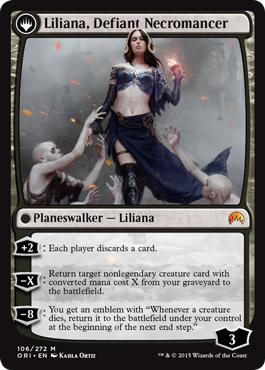
Liliana Defiant NecromancerAbzan Company may be Lily's most obvious home, but she might see play in other decks across the format. Death Cloud style deck have a strong synergy between Liliana and Sakura-Tribe Elder, even if that synergy isn't quite as strong as the synergy with Collected Company. Aristocrats decks, those packing sac outlets like Bloodthrone Vampire and company, might also want Lily to round out their gameplan, but those decks are so solidly untiered that she is unlikely to make a big difference there. Abzan Company really is the best home for Lily because of all the tricks already built into that deck and how well they synergize with the new walker. In addition to those mentioned above, you can also Chord in a Lily in response to another creature getting killed. This gets you the Lily, the Zombie token after she flips, and probably gets you the creature right back if you recur it next turn with her -X. Those kinds of playlines are exactly what we want to be doing with a new planeswalker, which suggests Lily is going to find an immediate 1-2 copy home in Abzan Company after Origins' legalization.

Not Quite There

Here we'll find cards that just aren't quite there, either because they are a little too weak (Sarkhan Unbroken), are worse than existing competitors (Thunderbreak Regent vs. Thundermaw Hellkite), or don't pass a lot of Modern tests for playability (Surrak, the Hunt Caller). People will try these cards and many sites will overvalue them, but in the end they just aren't going to cut it in Modern. Because these cards aren't quite as strong as those in the previous sections, I'll only give a few sentences on each.
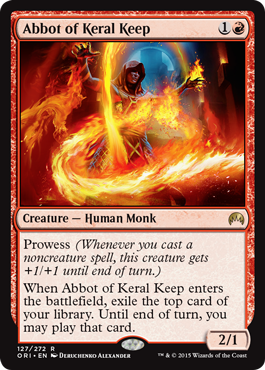
Abbot of Keral KeepAbbot of Keral Keep: Prowess is a pretty broken mechanic, but Abbot is a bit too safe to really get me excited. He lacks haste to hit hard and evasion to hit reliably, and for two mana we really want to get an effect like Young Pyromancer instead. You also can't really cast Abbot before turn four in most decks, unless you want to risk not casting the top card of your library for lack of mana. Delver decks can cast this as early as turn three, but even there, wouldn't you rather be casting Pyromancer? Jund and other red-based midrange decks can use Abbot too, but their higher curve makes Abbot much worse before turn four.

Kytheon, Hero of Akros / Gideon, Battle-Forged: Jace and Lily pass the flipwalker tests. Kytheon does not. He's deceptively hard to flip in Modern, either dying before turn three or forcing you to hold up mana on turn four to maybe keep him alive. That's a lot of mana and boardstate investment, and the payoff isn't even that great. Unlike big Gideon Jura, little Gideon can't kill creatures and can't even keep you alive for a turn. His clock isn't even that scary, getting stonewalled by Goyf, Tasigur, and Angler on every swing. Overall, his stats are just too underwhelming for this format.
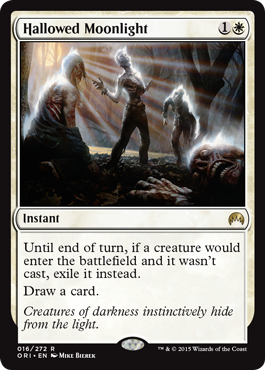
Hallowed MoonlightHallowed Moonlight: Shadow of Doubt is playable in Modern because basically every deck uses shuffle effects and a cantriping, instead-speed Sinkhole is pretty nuts. Moonlight is much narrower. It stalls Twin for a turn, but that's not even guaranteed if they waited until they got up countermagic backup. It screws with decks like Grishoalbrand, Living End, UW Tron, and other fringe strategies, but so do more versatile cards like Relic of Progenitus, or even just Negate. Making matters worse, this card isn't even in the right colors: Grixis is where control mages want to be, not UWR control or something similar.

Jace, Vryn's Prodigy / Jace, Telepath Unbound: Jace is probably the easiest planeswalker to flip, requiring just an untap step and you playing Magic cards in the previous turns. In that sense, he's very similar to the delve mechanic, which rewarded you for doing what you were doing anyway. Jace's biggest problem is not his creature side, his flippability, or even most of his planeswalker side. His problem is that +1 ability, which is way too underwhelming in far too many matchups. Jace, Architect of Thought got an edge for stopping Deceiver Exarch swings and stalling aggro decks. New Jace does not because his +1 just feels like overly-safe design. Jace is the likeliest walker to break out of the unplayable category and rise into a tiered control deck, but I feel like most control players would rather commit two mana to a Gurmag Angler these days anyway.
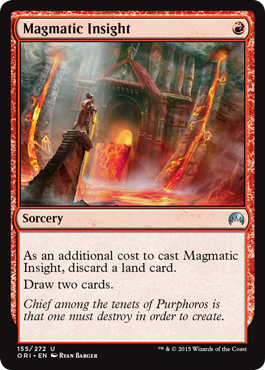
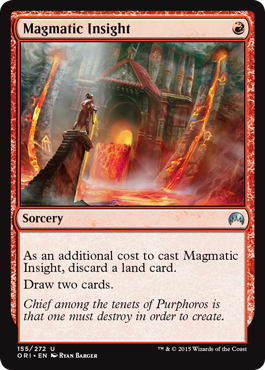
Magmatic InsightMagmatic Insight: Low land-count decks that want this, such as Delver, are going to struggle to support Insight and also cast spells. Higher land-count decks that want this don't really want to cast sorcery speed draw spells. This isn't really a mini-Treasure Cruise either because for Insight to work, you need to have a good enough boardstate where that extra land doesn't matter. That doesn't quite make Insight a "win-more" card, but it has enough trappings of one that I'm skeptical. The card does help Aggro Loam as a deck, but if I've learned anything from card evaluation over the years, it's to never bet on a card that only helps one fringe, tier three or lower deck.

Molten Vortex: Upgraded Seismic Assault? Or a repeat of the Barrage of Expendables failure? i'm leaning towards the latter because this doesn't really address the core problem of Aggro Loam, which is its lack of a reliable card advantage engine in the cycling lands. Vortex does land before countermagic can stop it, and Abrupt Decay on a Vortex is way less gamebreaking than Decaying an Assault. But I struggle to think of any cards that became more playable by making the card a little cheaper and then adding a manacost to its ability. Indeed, I struggle to think of a lot of Modern cards with activated abilities requiring mana investments that are playable. Modern is a format where you need to be efficient with your mana, and spending that to fire off a few Shocks means you can't spend it to recur Life from the Loam. That's not what Aggro Loam wants to be doing to get into the higher tiers.
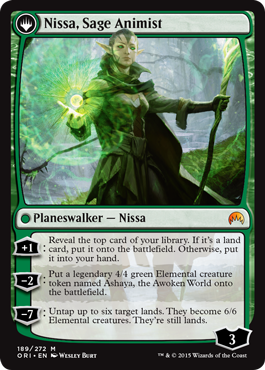
Nissa Sage AnimistNissa, Vastwood Seer / Nissa, Sage Animist: Better than Kytheon but worse than Jace and Liliana. Both of Nissa's sides are actually pretty decent, although that 4/4 token is really not what you want to be putting into play in a field packed with Goyf, Tasigur, and Angler. As many authors have pointed out, Civic Wayfinder was playable in some formats, and Nissa's +1 is really just "Draw a card" in a way that Narset's +1 was not. But unlike Jace and Liliana, Nissa has a serious speed problem. The earliest you can realistically flip her is turn five, and that's in a dedicated ramp deck like Scapeshift. Even in decks like Scapeshift, which can definitely push the game past turn five, Nissa isn't exactly filling some unment need in Scapeshift the same way something like Dig Through Time was. We might see her as a bullet in Scapeshift, but she's unlikely to appear elsewhere.

Thopter Spy Network: Bitterblossom is an excellent card... but it still sees next to zero play in Modern. Spy Network doubles the price tag and only tacks on a limited Ophidian effect. And boy is it limited. It doesn't trigger for other creatures and doesn't even trigger for each Thopter. People will try to make this work in blue-based control, and they will either return to Bitterblossom or stay away from both.

Vryn Wingmare: It's a strictly better Glowrider in a format where even Thalia, Guardian of Thraben only sees play in a handful of tier 3 decks. As an upside over Thalia, you can have multiple Wingmares in play to really rack up the spell-tax effects. As a big downside, it's three mana instead of two in a format where you really need Thalia to get to work right away. Maybe some Death and Taxes/Hatebears decks want Thalias 5-6, but I don't think that's the effect which pushes this deck into higher tiers.

Traps

The most dangerous cards in the set, especially for investors and brewers. These cards might look good on paper but rarely pan out in practice. They are often accompanied by high price tags and lots of theory-driven hype, but have some huge issues that many card evaluators have missed. See Narset Transcendent, Ojutai's Command, and Soulfire Grand Master. Steer clear of these cards.
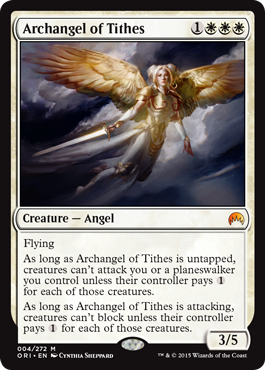
Archangel of TithesArchangel of Tithes: The moment you realize this doesn't stop the Exarch/Mite combo is the moment you see this is unplayable in Modern. Linvala, Keeper of Silence is a much higher-impact four-drop, and that card barely sees play as it is. Bolt-proof status doesn't save this glorified Windborn Muse from junk status.

Artificer's Epiphany: Just play Thirst for Knowledge. Even with the artifact lands legal in this format, this card would still be worse than Thirst. It's much easier to keep artifacts in your hand and bin them as a cost than it is to keep one in play. This is especially true in the age of Kolaghan's Command.
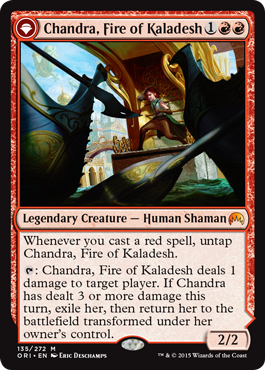
Chandra Fire of KaladeshChandra, Fire of Kaladesh / Chandra, Roaring Flame: Chandra's problem is more one of context than innate power. All the Modern decks that can use her definitely don't want her. Why are you tapping out for turn three Chandra when you can be tapping out for turn three Day's Undoing? How are you flipping Chandra but not already winning anyway? This is the classic win-more card who appears to give reach but actually only works when you are already far ahead.

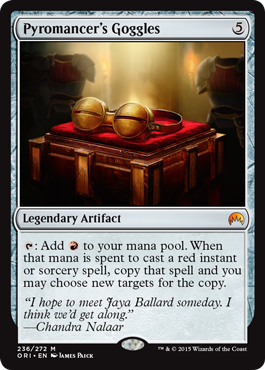
Pyromancer's Goggles: I'm consistently surprised that this makes the cut in some Modern reviews I've been seeing. If this copied non-red spells, then we might, maybe be talking about a niche card. But going turn five Goggles into a doubled Lightning Bolt is about as underwhelming as it gets. Copying a Kolaghan's Command is much better, but why not just spend that five mana to Snapcaster the Command instead?

Shaman of the Pack: BG Elves isn't necessarily worse than Mono Green Elves. Both decks support Company and black gives you some added interaction with cards like Thoughtseize and Abrupt Decay. But even the hypothetical BG Elves doesn't want a glorified Fanatic of Mogis, especially when Elves tends to win in big swoops and not small chisels at a life total. Maybe some BG Stompy Elves wants this with Sylvan Messenger, but that's a huge stretch when Company Combo Elves just won a GP.

Brewing Bonus Section!

I'll end with the cards that probably belong in the "Not Quite There" or "Traps" category, but also the cards I like so much that I don't want to write off completely. These cards want to be built around, and they should inspire brewers and deckbuilders across the format.
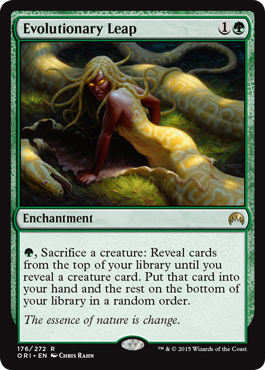
Evolutionary LeapEvolutionary Leap: I desperately want this card to be better than it probably is. The "fixed" Survival of the Fittest/Birthing Pod is not nearly as broken as its predecessors, but that won't stop us from brewing up a storm with the card. I really want to try this with cards like Young Wolf or Doomed Traveler, or take a more combo-oriented approach with Tangleroot or Burning-Tree Emissary.

Starfield of Nyx: Enchantment-based Prison decks have always been a thing in Modern, and Starfield gives them a dual win condition and resiliency mechanism. I talked more about Starfield in my Origins article last week, and I'm liking this card in testing as much as in theory. I also like the card in the RW Lockdown style decks, especially in tandem with Faithless Looting. Find some early brewing inspiration in cards like Cover of Winter, Omniscience, Font of Fortunes, and the Leylines.

Tainted Remedy: Okay, so I actually just want to cast Beacon of Immortality on my opponent with a Remedy up. That doesn't make this a good combo or deck, but it should excite even the most jaded brewer, especially those who prefer combo finishes. Rest for the Weary wants to play too. Now if only they'd give us Life Burst...

Modern after Magic Origins

I have mixed feelings about Magic Origins as a Modern set. On the one hand, we get some sweet reprints like Piledriver, some pushed effects like Day's, and some clear nods to our format like Moonlight and Firecraft.  But we also have a lot of missed opportunities, both in the form of cards that needed a bit more to be good in our format (why can't Herald have some form of protection, even if just four toughness?), and cards that should have been reprinted but weren't (where are you, Goblin Ringleader or Goblin Matron?). Overall, this is a slightly above-average Modern set, with the potential to be really strong off a few key staples. From a design perspective, Modern players should be very happy with the set because it suggests Wizards is paying closer attention to our format and trying to make an impact. We can hope this continues into the fall with the eagerly anticipated Battle For Zendikar.


Deck Overview- Modern Noxious Storm

Are you a Quiet Speculation member?

If not, now is a perfect time to join up! Our powerful tools, breaking-news analysis, and exclusive Discord channel will make sure you stay up to date and ahead of the curve.

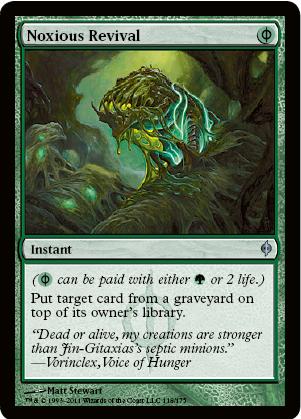
Sometimes a deck catches my eye because of some subtle deviation from an established archetype, and others I see a card that I don't normally see, or in an unusual quantity. My eyes definitely stopped on the 9th place list from the MOCS qualifier when I saw 4 Noxious Revival.

There was an error retrieving a chart for Noxious Revival

The four Visions of Beyond struck me, too, but I still haven't entirely figured out those ones.

Noxious Storm

spells

4 Gitaxian Probe
4 Serum Visions
4 Sleight of Hand
2 Cryptic Command
4 Lightning Bolt
4 Manamorphose
4 Noxious Revival
4 Remand
4 Thought Scour
4 Visions of Beyond
4 Pyromancer Ascension

lands

1 Breeding Pool
1 Hallowed Fountain
3 Island
1 Minamo, School at Water's Edge
1 Mountain
1 Oboro, Palace in the Clouds
2 Polluted Delta
4 Scalding Tarn
3 Steam Vents
1 Sulfur Falls

sideboard

2 Lightning Helix
2 Pyroclasm
3 Swan Song
2 Timely Reinforcements
2 Wear // Tear
4 Young Pyromancer

Noxious Revival does a couple cool things in this deck. For starters, it's like having extra copies of your most important card in Pyromancer Ascension. If your opponent can't stop you from setting up Ascension, then winning is pretty easy. If they can stop you, then Noxious Revival gives you another go. It's also decent when you have Ascension in play, as you can rebuy a card that you have multiple copies of in your graveyard to turn the Ascension on. Manamorphose and twoNoxious Revivals can also go infinite under active Ascension with some cantrips.

There was an error retrieving a chart for Pyromancer Ascension

Lastly, Noxious Revival buys you time in tandem with Cryptic Command. If you're able to tap your opponents creatures and draw a card, then you'll still be getting a card deeper in your deck despite fixing your draw step. I also imagine that you end up in some situations where you can even counter + draw and then just get your Cryptic back.

I'm clueless on the Visions of Beyond, the Minamo, and the Oboro. Two of those are probably just to give you some action against Choke. I really like the Noxious Revival tech though.

Insider: 13 Origems

Are you a Quiet Speculation member?

If not, now is a perfect time to join up! Our powerful tools, breaking-news analysis, and exclusive Discord channel will make sure you stay up to date and ahead of the curve.

The bad news is that Magic Origins is a core set, but the great news is that Magic Origins is the last core set ever.

Core sets get a pretty bad wrap for a number of reasons. First, they come out during the summer which is the least exciting time for a Magic release. Second, they are not attached to a block so they lack lots of really cool mechanic-driven cards. Third and most importantly, they have a reputation for being filled with reprints and boring vanilla cards.

All these things considered--Origins isn't actually a terrible set. In fact, as far as core sets with new cards go it ranks pretty high up there on my list. At least they didn't reprint the "Soul of ____" cycle at mythic again, right?

My methodology for speculating is to look for cards I think are being undervalued and thus have room to rise in value over time. I'm not one to turn away good value, but generally speaking I'm not specifically looking for cards that are "quick flips" unless they are really obvious to me. In most cases, I'm looking for cards that I believe are genuinely "good" and "unique" Magic cards that there will be a high desire for over time.

Magic cards don't just get magically assigned dollar values. Context is always the driving force behind supply and demand. The context is always "decks." In order for cards to be desirable they need to have decks to go into. It doesn't matter what kind of deck, it doesn't matter what format, it doesn't even matter if it is a tournament format. In order for cards to rise or sustain a value there have to be decks that want to use them.

Keep in mind that "casual" decks are still decks. If a card is good or desirable in kitchen table decks or Commander decks it still counts.

As I said before, I'm not all about the quick flips. I'm not looking to buy $25 Liliana, hoping that it jumps to $30 for a week so that I can dump it before it drops to $20. The "quick flip" is an art-form and can be profitable if it is done correctly.

Sure, I'll be down to trade for any copy of the new Nissa from anybody at the prerelease who wants to get rid of it but what I'm really looking to do is get my hands on as many copies as the undervalued cards as possible. I assess how good I think a card is and then bet on whether or not that card will go into a popular deck at some point in the next year.
Animist's Awakening

$5 - SCG: July, 5

I think this card is an absolute slam dunk in every way possible. First of all, I'd bet on it solely as a Standard card. It is a great ramp spell that can allow a player to get multiple lands ahead for limited cost. It also ramps nonbasics which is great. In addition, it has a kicker clause which allows those lands to conditionally enter the battlefield untapped so that we can use them right away.

If there is a ramp deck in the next year it will almost assuredly play this card.

Not only that, but I would 100% play this card in any green Commander deck that I built from now until the end of time. Why wouldn't you play it? It's a ramp spell that is going to net you card advantage when you do it correctly and make mana the turn you play it. Also, don't forget that this card is tailor made for Tiny Leaders as well. Its CMC is only one, but the X allows it to be an expensive spell.

I also can't rule this card out as a possible Modern staple. I wouldn't mind playing something like this in some sort of Valakut deck or possibly a Scapeshift deck.

The other thing that I've been thinking about is pairing this card with Amulet of Vigor. Obviously, Amulet Bloom is a better deck that is already good but what if, for the sake of argument, Summer Bloom got banned? Playing this spell and getting to double untap all of the lands that just got ramped into play is pretty wild.
It's a powerful card and I can see playing it in a ton of different decks. I think this is a solid pickup.

Gilt-Leaf Winnower

$2 SCG: July, 5

Gilt-Leaf Winnower has the look of a mediocre bulk rare but I think that it will be a solid player in Standard moving forward. Particularly in Abzan mirror matches, this card seems like it could really shine. It actually Shriekmaws a lot more creatures than you would think: Siege Rhino, most of the Dragonlords, Courser of Kruphix, Master of Waves, and tons of other stuff.

The 4/3 body hits really hard and also has pseudo-evasion which requires a double block. I think that once people start playing with the new set there will be quite a bit of this creature getting cast by black decks.

I think there's a good chance it will overcome its $2 starting price and gain value at some point in the near future. Remember, it is also a core set card so even if it doesn't pick up right away, if at any point it gets "good" and demand spikes it will have a decent price tag.

Hallowed Moonlight

Hallowed Moonlight has Eternal Staple Card written all over it. The card is immediately portable into Vintage and Legacy where it has awesome applications as a cantripping hoser against anybody trying to put a creature into play unfairly. Dredge zombie tokens, Oath of Druids, Show and Tell, Reanimate, and the list goes on and on.

It draws a card which keeps it flexible. I also like the fact that the creature gets exiled when you cast the spell. So, if they put their Reanimate on the stack targeting their Griselbrand you can respond with Hallowed Moonlight and exile the Griselbrand to preempt further shenanigans.

I think that this card is the real deal as far as eternal niche sideboard cards go. It is also possible that the card is absolutely stone cold great in Modern. It stops Goryo's Vengeance cold and I hear it isn't bad against Collected Company either...

$5 is a lot for a sideboard hoser but if it ends up being a Standard card against Collected Company decks it could hold that tag. Likely it will follow a path like other eternal mainstay sideboard cards like Grafdigger's Cage and Rest in Peace, where they start high, get cheap, and steadily grow over the top again.

I really like getting in early on foil copies of this card. I think they have a lot of room to grow as this card has the potential to be a very popular and heavily played eternal card for a long time to come.

Harbinger of the Tides

$5 SCG, July 5

Once again we are presented with a card that will immediately see Modern, Legacy, and Vintage play because it already has a deck tailor-made to go into: Merfolk.

I'm aware that going into Merfolk decks won't catapult this card into the stratosphere or anything but it is a pretty good card, generally speaking. It offers an effect that those decks want and is going to be an auto-include in some quantity.

I also think there is a good chance that Mono-U Devotion could see some serious play over the summer. The deck has been missing a solid two-drop since RTR rotated and this card is very solid to pair up with Thassa, God of the Sea, Shorecrasher Elemental and Master of Waves.

It also seems like a great foil to pick up and hold onto. Eternal cards tend to have this quality.

Herald of the Pantheon

$3 SCG July 5

Herald is likely a quick flip type of card as it is going to be made or unmade based on how it plays in Standard. The downside is that Theros block is going to rotate in the fall and that set is full of the enchantments that I'd want to play this card with.

I could see a G/B Devotion deck with Doomwake Giant being a great foil to all of the people who are eager beaver to play with their Goblin Piledrivers. Herald is so good against these aggressive decks. It is a mana dork that triggers constellation later in the game, that also just so happens to arbitrarily gain you a bunch of life for doing what you were doing already.

Eidolon of Blossoms is still a thing in Standard as well and I can't imagine a better card to pair it up with than Herald. There was already a deck (granted it has fallen out of favor) but that isn't to say that it couldn't make a comeback in the short term.

At $3 it seems hard to go wrong trading for this card in the short term. Somebody is going to want it from you at some point. It also has casual appeal which is nice. The kitchen table is a great place for enchantments and life gain.

Jace's Sanctum

$1 SCG July 5

Jace's Sanctum has Johnny Combo Player written all over it. It makes all my spells cheaper and lets me do a bunch of scrying. It has basically gotten lumped into the bulk rares but I would never bulk a card like this off. In fact, I'd be happy to trade for this card all day long and just hold onto it.

Since there are no more core sets it is very unlikely that we'll ever see this card again in print. It is the kind of card that people love to put in their Commander decks. It makes mana, looks at cards, and doesn't die to a Wrath. I like the prospect of getting foil ones as well.

The other thing that is cool about this card is that it could very easily go into Commander style decks that are actually full of broken cards. We all know the individual who has the super busted combo Commander deck. The people who build those decks actively like to foil them out and this foil could have some real value at some point.

It is for sure a long-term spec but I'd keep an eye out for Jace's Sanctum as a throw-in in a close trade.

Kothophed, Soul Hoarder

$1 SCG July 5

Kothophed is clearly better than a bulk rare in my estimation. First of all the card is actually crazy powerful. It is a 6/6 flying for six mana with an ability that just randomly draws you free cards.

If it never sees play in Standard (and that is a very big "if" for me) it will be an awesome mono-black Commander card that will see tons of play.

I think there is a very real chance that this card could see some Standard play as well. It is bigger than everything without Dragonlord in the title and is great in a deck that is packing lots of removal. It's also kind of cute that fetch lands trigger the draw from him. He also blocks Dragonlord Ojutai, which is pretty awesome.

All of these considered I'm actively going to be picking this card up.

EDIT: I preordered the card. It is just too good to pass up. At a buck I don't think it is possible to not make money.

Nissa, Vastwood Seer

$20 SCG July 5

I don't typically like buying into $20 mythic rares right off the bat but I'm fairly certain this is the best card in the set. I've played with Civic Wayfinder a ton in Standard and this card is about a million times better.

I'm going to guess that it will be $30 by the time that the prerelease rolls around which makes it a much less enticing pick-up. It is certainly a great card and people are going to need it for their decks. I'm basically just rubber-stamping that this card is very good.

It also has the Commander and Tiny Leader angle working for it. So, foil copies are going to be a solid thing to hold onto as well.

Pia and Kiran Nalaar

$3 SCG July 5

I might just be blinded by the fact that I think this card is sweet but I think it is legitimately a good Magic card. Last week I mentioned that I'm very excited to pick one up for my Danger Room stack.

I'm going to pick this card up but I'm also ready to be wrong about it. I just can't shake the feeling that this card is really good. Two fliers and a 2/2 with the ability to cast two shocks for 2RR? How is the card not insane?

Yeah, yeah. Siege Rhino. I know.

But there will be a time when Siege Rhino is out and this card is in Standard. So, maybe it'll get a chance to shine.

Starfield of Nyx

$5 SCG July 5

I think this is a slam dunk at $5. It's a mythic, has potential for constructed play in Standard, and it will see tons of casual play.

In short, Starfield of Nyx is the kind of card that a lot of people actively want to play with.

It doesn't hurt that it also gets Hearld of the Pantheon that I discussed earlier in my review. I'd have no problem trading for this card and sitting back and waiting. It could easily be a short-term winner but when you are in it for the long haul it's hard to lose on cards like this. Five years from now it'll be $10.

These are exactly the kind of cards that go up long-term. True, it may well go down in the short term and settle in at $3 when the new set comes out if it gets no help in Standard. The thing is, I'll still be picking them up at $3 to hold onto six months from now. I'll trade for them at $5 and I'll trade for them at $3.

A good card is a good card. However, if there is actually a Junk Constellation deck and it does well out of the gate this card will easily double in price. So, there is also some short-term incentive to buy in as well.

The Great Aurora

$3 SCG July 5

It's mythic and it is the dream of every Timmy on the face of the planet. It also has a fantastic name. I mean, who doesn't want to cast "THE GREAT AURORA!"

It is a casual build-around-me card that real people would actually want to build a deck around.

This card is going to have value because game stores and websites are going to sell the hell out of it and actually have to pay for it on their buylists eventually. Stay ahead of the pack and pick them up when you can from anybody who doesn't appreciate a good casual spec and is willing to flip it for a Silumgar's Scorn to finish off their Standard deck.

This is a very solid pick-up at $3 for the long haul.

Willbreaker

$1 SCG July 5

I think this card is pretty sweet. It is extremely powerful and capable of just taking over a game all by itself. It has kitchen table hero written all over it.

Once again this is the kind of card tournament grinders think has no value, but which actually has quite a lot to the right people.

Willbreaker + Opposition?

It's just a good Magic card in the abstract. I mean, would you ever want to play against this card in Limited? I should think not. Generally speaking, whenever a card is something that I'd never want to play against in Draft I can be fairly certain that it isn't a junk rare to be cast off for a dime.

Woodland Bellower

$5 SCG July 5

Just in case Polukranos, Whisperwood, and Deathmist Raptor have taught you nothing: Good mythic rare green creatures are not $5 cards in the short-term.

Woodland is a very good Magic card in the abstract. It let's you tutor through your deck and get something and play it for free. It is going to be a slam dunk for Commander and likely will have its moment in the sun before it rotates out of Standard.

At that price it would be very hard to go wrong and very easily to get paid off yet again on a green mythic creature.

All things considered Magic Origins looks pretty decent for good cards--well for a core set anyway... It's no Khans of Tarkir. With that being said we have to do the best we can with what they give us. It's possible that the set isn't going to get opened in earth-shattering numbers, which will insulate the prices on some of the cards a little bit and makes buying in a little less risky.

It's the last core set ever so enjoy it!

P.S. The Goblin Piledriver reprint makes picking up goblins for Modern a pretty enticing prospect. Goblin Chieftain is pretty much sold out and I still like Krenko, Mob Boss.

Modern Festival Preliminaries Metagame

Are you a Quiet Speculation member?

If not, now is a perfect time to join up! Our powerful tools, breaking-news analysis, and exclusive Discord channel will make sure you stay up to date and ahead of the curve.

We've seen some interest in Saturday articles for a while now, and with the MTGO Modern Festival Finals coming up on Sunday, July 5, there hasn't been a better time to fire off a pre-event article to prepare players for Sunday's showdown. The tournament winner goes home with one copy of every single Modern-legal set, so the stakes are high for the Modern MTGO community. And if you go into an event this big without understanding the metagame, don't be surprised to end up like this guy below.

Terminate Art

In the week leading up to the Festival Finals, we saw five-round Festival Preliminaries replace the usual MTGO Modern Daily schedule. This gives players a wealth of information about the pre-Finals metagame. There are lots of ways to slice and dice metagame information, and these Modern Festival Preliminaries are no exception. This article is going to break things down in two ways. First, we're going to take a high-level look at the decks that showed up at the Preliminaries. This doesn't necessarily give us the best sense of how the Finals will look, but it does help us understand how the wider Modern community is playing the format. Then we are going to look at the Preliminary players who qualified for the finals, seeing if this sub-metagame is a better predictor of the upcoming Finals.

[wp_ad_camp_1]

Describing the Preliminary Metagame

We can't do a metagame breakdown without some simple, descriptive statistics of different deck prevalences, but I actually don't think this is the best way to analyze the Preliminaries. At least, not the only way we should do it. The Preliminaries have a unique structure and format we need our analysis to reflect. The big issue here is that these events have lots of repeat players. Fully 31% of Preliminary players were in 2+ events. Just under 10% were in 3+. This puts our metagame a little too much at the mercy of player deck preference, so we need to account for this in our breakdown. A second issue is one of population size. We have just over twenty events in our dataset, only reporting on players with 9+ points. All the players with less than 6 points (hundreds and hundreds of them) aren't included here. That's less of an issue when we analyze MTGO data on a monthly basis because our N is so much bigger. It might be a bigger problem here.

The table below gives the metagame shares for all decks with above-average prevalence. These decks makes up about 78% of all decks in the Preliminaries, which is also roughly what we see in the tier 1 and tier 2 of metagame breakdowns. In addition to their basic prevalence, I'm going to give two other stats. One is their share only among unique player/deck pairings. This will help us account for the effects of player preference. I'm also going to give the margin of error for each deck's metagame-wide share. This gives us some sense for the variance in each deck's observed share.

DeckPreliminary
Meta%
Margin
of Error
Meta% Unique
Player/Decks
Burn10.5%2%9.8%
Affinity8.9%1.8%7.5%
Grixis Control8.1%1.8%7.9%
Jund7%1.6%7.4%
Grixis Delver4.8%1.4%4.6%
RG Tron4.6%1.4%4.1%
Grixis Twin4.5%1.3%5%
UR Twin4%1.3%4.4%
Merfolk3.5%1.2%3.6%
Amulet Bloom3.4%1.2%3.8%
Elves2.9%1.1%3.4%
Naya Zoo2.8%1.1%3%
Living End2.5%1%2.5%
Grishoalbrand2.1%.9%2.2%
Temur Twin1.9%.9%2%
Abzan1.7%.8%1.7%
Infect1.7%.8%2.1%
Scapeshift1.4%.8%1.5%
Abzan Company1.3%.8%1.3%

I initially did this table as a Top 10 list, but there were just too many cool decks underneath the Top 10 to leave them out. So the table's a little longer than I would like, but I think it's important to have all that information in one place for sorting.

The biggest takeaway for me is that the overall metagame % is basically identical to the unique player/deck adjusted metagame %. Sorting on that first column, we see Burn, Affinity, Grixis Control, Jund, Grixis Delver, and RG Tron. Sorting on that last column, the decks are identical except for UR Twin replacing RG Tron, and small variations in the order. This is also true even further down the list. All of this suggests a fairly stable metagame. Players may have participated in numerous Preliminary events this past week (remember: 31% of them did 2+), but they didn't have some bizarre deck preferences that were different from the overall metagame.

Kolaghans CommandThe second biggest takeaway is the success of Grixis. We see the usual suspects like Burn, Jund, and Affinity, but Grixis Control is a huge addition to the list. We even see Grixis Delver and Grixis Twin up there in the Top 10, which is one reason I give credit to the color pairing and not just Grixis Control as a standalone deck. No one should be too surprised at all the Grixis running around, especially if you've been following articles here on Delver, Twin, and Control. We've also seen a lot of Grixis in the metagame updates, including both the May update and the GP Copenhagen retrospective. This is important for a few reasons. First, it means you can expect a lot of Grixis both in the Finals and in the overall metagame. Prepare for lots of Kolaghan's Command, Tasigur, the Golden Fang, and Terminate. Second, it means Modern has an important fair, nonlinear, highly-interactive deck we can count on. Grixis Twin isn't quite in this category, but Grixis Control definitely is and that deck is currently leading the Grixis pack. It's healthy for the format to have these decks at the top, even if they are accompanied by the usual linear suspects of Burn and Affinity. Finally, the margin of error and deck prevalences suggest that we won't always know which Grixis deck is seeing the most play. The lower end of Grixis Control is about 6.3% (8.1% minus the margin of error of 1.8%), which is actually about equal to the higher end of Grixis Delver with 6.2%. So expect to see lots of Grixis generally, but don't bank too heavily on one particular Grixis decktype.

The last aspect of the Preliminary metagame I want to discuss is the bottom of the table. It would be one thing if we had some oddball tier 2/tier 3 decks down there like Bogles, Living End, Ad Nauseam, etc. Instead, we have Abzan, Grishoalbrand, and Abzan Company, big format names that we probably expected to do better. Before we turn to the Finals predictions, here are some notes on each of these decks.

  • siege rhinoAbzan: Siege Rhino, we hardly knew ye. I don't think we've seen the end of Abzan, and I don't even think the metagame-wide Abzan share is quite as low as it is in the Festival Preliminaries. But there's something about the current metagame that is highly hostile to Abzan, and it's reflected here as much as it was at the previous three GPs. To some extent, we would think Abzan's resilience to Lightning Bolt would make it pretty good in this Jund and Grixis-packed metagame. But losing access to Bolt, Kolaghan's Command, Terminate, and other RBx cards is apparently much worse than being Bolt-resilient yourself. Abzan may come back, but it's unlikely to come back this weekend.
  • GriselbrandGrishoalbrand: I've played a lot of Griselbrand and Grishoalbrand in Modern, and I can safely say this is a very strong deck. But it's not quite as strong as the hype-train and ban-maniacs would have us believe, and nothing quite proves that like the Preliminaries. If this deck was truly some unbeatable, turn 2-3 monster, we would expect to see a lot more of it. But the deck just isn't putting up numbers right now, which is happening both on MTGO and across the wider Modern metagame (the deck has yet to get above 3% even for the Grand Prix metagames). Given how strong the deck is in a vacuum, my guess is that its mediocre performances are related to sideboard cards and other maindeck answers (Scavenging Ooze and Dispel are huge here).
  • collected companyAbzan Company: Not a great week for those BGW mages... Collected Company remains a strong card, and we are seeing it across the metagame in big decks like Elves and Naya Company, as well as less common ones like Bant Company and some splashed Merfolk lists. Unfortunately for Melira and Finks players everywhere, Abzan Company as a specific deck does not seem to be the optimal Company list for now. From what I've seen of the metagame, it just seems a little too fair for the current metagame, without any of the interactive pieces that help fair decks like Jund and Grixis Control cut it in today's format. It's tempting to say that Company as a card isn't viable, but we've seen enough performance from this card in the past month to know that's not true. This card was all over the GPs and the broader metagame, so we know the card is fine itself. But Abzan Company might not be the best home for the card right now.

Predicting the Final Metagame

These Preliminary-wide metagame shares are important for Modern as a whole because they give us a sense of the overall metagame. But I also think they aren't the best predictors for the Finals metagame on Sunday. If nothing else, we know that those numbers include players with only 9 points when the cutoff for Finals qualification was 12 or more. The Sunday metagame will also include people metagaming against the known metagame, so they will be one step ahead of the descriptive stats above. But the good news here is that we actually have all those 12+ points lists, which means we know a huge chunk of the players who will show up on Sunday. Because we have those players' names and decks, we can also make educated guesses about what decks those players might bring to Sunday, especially if they played those decks repeatedly throughout the week.

Given those factors, the table below attempts to predict what Sunday will look like. This includes the metagame shares for decks that earned 12+ points, which is just the share of all decks that qualified for Sunday. The table also includes a third column, which represents an adjustment to the 12+ point percentage column based on what decks had repeat pilots. Decks with more repeat pilots get greater weight in their numbers. I'll also give the Preliminary metagame percentage, just as a reference point.

This time, let's just stick with a Top 10 list.

DeckPredicted Finals
Meta%
Preliminary
Meta%
Adjusted Finals
Meta%
Burn9.3%10.5%10.2%
Affinity8.1%8.9%10.9%
Grixis Control9.3%8.1%9.7%
Jund7.3%7%6.7%
Grixis Delver3.8%4.8%3.8%
RG Tron5.3%4.6%5.8%
Grixis Twin4.5%4.5%3.4%
UR Twin4.9%4%4.3%
Merfolk3.8%3.5%3.4%
Amulet Bloom3.4%3.4%2.7%

DelverThe predicted Finals metagame is fairly similar to the Preliminary metagame in the section above, but with a few key differences that will matter on Sunday. First, Grixis Delver drops off considerably between the purely descriptive Preliminary metagame percentages and the predictive numbers in this table. In the Preliminaries, this was the 5th most-played deck, and it might have been even higher given its margin of error. But here, Grixis Delver has fallen down to 8th, with RG Tron taking its place and the UR/Grixis Twin decks rising instead. This suggests that Delver of Secrets is not the best backbone for a Grixis deck (the Grixis Control decks without Delver did great in the 12+ points metagame). At least, Delver might not be popular at the Modern Festival Finals this Sunday. It looks like Grixis mages are going to stick with their trusty Grixis Control lists, and it's possible that Grixis Delver players will ditch the tempo all-star just to reflect what everyone else is probably doing. Be ready for this on Sunday.

Arcbound RavagerAnother important conclusion is the relative success of Affinity and Burn, the tier 1 linear decks that continue to define Modern. Both of these decks go through upticks and downticks in popularity and success, an this weekend looks like it will be an uptick for both. Affinity was an incredibly successful deck throughout the week: although it was only in third for its 12+ points metagame share (8.1%), it had tons of successful, repeat players. When we sort on the adjusted metagame percent column, Affinity shoots up to 10.9%, making it our frontrunner for Sunday's most popular deck. Burn has similar success, with its baseline share of 9.3% in the 12+ points category increasing to 10.2% in the adjusted column. Players committed to these decks all week and were rewarded for it, and Sunday might tell a similar story. Of course, Burn and Affinity are also some of the easier decks to metagame against. Pack in your sideboard (and maindeck!) hatred if you want to have a successful Finals event: Kolaghan's Command, Dispel, Kitchen Finks, Feed the Clan and others all come to mind. If players are smart and read into these metagame stats, they can get ahead of the Burn and Affinity players and crush them on Sunday. If not, expect to see lots of Eidolons and Ravagers all day.

Preparing for the Modern Festival Finals

I'm excited to see how the Sunday Finals compare to both the Preliminary metagames and the predicted Finals metagames described above. But remember when going into Sunday's event that quantitative metagame analysis is only one tool we can use to sharpen our understanding of the format. We need to combine that with both our personal experience and the overall context across all Modern events. For instance, Grishoalbrand may have been a major underperformer during the week, but we know this deck can catapult a few players to the top tables (as it did at every previous GP in June). That means you would be foolish either to dismiss the deck as a potential contender, and to ignore the deck in your sideboarding strategies.

What do you expect to see on Sunday? What's your preparation strategy if you are playing in the event? How do you like these Saturday articles? Let me know in the comments and, if you one of those silly U.S. of A. people like me, enjoy your Fourth of July weekend!

Tempo After Day’s Undoing and Magic Origins

Are you a Quiet Speculation member?

If not, now is a perfect time to join up! Our powerful tools, breaking-news analysis, and exclusive Discord channel will make sure you stay up to date and ahead of the curve.

Thank God it’s Friday. In other words, time for another article about everyone’s favorite transforming bug. I’ve dabbled in midrange, combo, aggro, and control, but only tempo consistently stimulates me to learn everything I can about Magic. As such, most of my Magic knowledge is tempo-based, and you can always expect me to write articles focused on tempo, both the archetype and the in-game mechanic of time and mana advantage.

insectile aberration art

A full week of testing with Day’s Undoing has led me to a few conclusions:

[wp_ad_camp_1]

Day's Undoing is still broken

I'm standing by my boldest claim from last week. Underestimate Day’s Undoing at your own peril. Not life-threatening peril; at best, you’ll be unprepared for the coming meta, and at worst, you’ll be forced to shell out much more than $60 for a playset (current preorder prices are seriously low). “Broken” means nothing without context, so I’ll provide some datapoints. At its highest representation, Treasure Cruise Delver comprised 15%-20% of the Modern metagame. Jeskai Ascendency Combo also relied on Cruise, but Wizards blamed Delver for the ban. For the purpose of this article, we’ll deem “broken” any one card that pushes a deck or archetype into representation numbers as consistently high as Treasure Cruise Delver’s.

Treasure CruiseModern is already home to an astounding number of linear strategies. That’s all that unites Lantern Control, Burn, Infect, Tron, Affinity, Elves, Storm, Bogles, Grishoalbrand, Mill, and Amulet Bloom. Beyond their linearity, these decks have little in common, respectively attacking opponents from different angles and requiring specific cards to hate out. After Day’s Undoing becomes legal in Modern, I predict one of two potential outcomes for the format:

  • One of these linear decks could rise above the others as the shell that best abuses Day’s Undoing. We saw this with Treasure Cruise – it seemed like the card was designed for Delver decks. Other strategies benefited from its inclusion, including Storm, Burn, and Willy Edel’s Siege Rhino deck, but nothing could cast Treasure Cruise and keep opponents from casting Cruise as effectively as UR Delver. By GP Omaha, Delver was practically the only deck playing Cruise, but the format felt the card’s presence strongly enough for Wizards to step in anyway.
  • Undoing’s second possible fate is one already enjoyed by Collected Company. Steven Borakove won a StarCityGames 5K with Naya Company last weekend, Collected Elves won GP Charlotte, and Abzan Company decks have done well in Modern since the green Dig Through Time was printed. Undoing could follow suit, finding a home in multiple linear decks instead of skyrocketing the metagame shares of just one.

Whether one or a few decks end up abusing Day’s Undoing in Modern, the card stands to impact the format less like Company and more like Cruise. Undoing gives linear strategies an unfair layer of resilience, scarily comparable to Cruise’s, that should push most midrange and control decks deep into the realm of fringe playable for three reasons.

Snapcaster MageFirst, these slower decks exist because of splashy X-for-1s like Snapcaster Mage and Kolaghan's Command. Day’s Undoing deletes any incremental advantage gained by players casting these spells by restocking both players to seven cards, however lopsided their hand size discrepancy. Second, as the format speeds up, the answers become more efficient. Undoing will certainly speed up Modern, and options like Electrolyze lose a lot of attractiveness in the face of Spell Pierce and Dispel. Third, and most importantly, none of Modern’s playable X-for-1s succeed in their ultimate goal of generating card advantage like Day’s Undoing. Three mana for seven cards is so much better than three mana for two cards that faster decks, directly affecting the board with their resources, will simply out-card decks leaning on Cryptic Command.

Big disclaimer before we continue: if the paragraphs you just read, my article from last week, and your knowledge of Modern and Magic don’t combine in some way to sell you on Day’s Undoing, we’ll have to agree to disagree for now. From this point on, the article assumes you’re with me on card evaluation. Otherwise, let’s wait until Origins hits Modern and see who eats his hat (or his Jace). I’ve been wowed enough in testing that I won’t be swayed by any theoretical arguments until we see some real results indicating the card’s shortcomings.

You Can Beat Day's Undoing...


and you don’t even need it yourself. In testing, I split games 60-40 in my favor against a UR Undoing Delver deck with good ol’ Monkey Grow (my GP Charlotte list, -1 Tarfire and +1 Stubborn Denial). Disrupting Shoal and Denial did tons of work in this matchup, though my Goyf did die to Forked Bolt plus Undoing a couple times. I also tried Jund and Twin against the deck and fell short. Here are some deckbuilding guidelines to help you survive the new meta:

  • Play a deck that can reliably empty its hand by the time opponents reach three mana. Otherwise, the Undoing deck will drown you in card advantage. If you do play a deck like this, have a good reason not to play your own Day’s Undoings. As a general rule, Undoing decks should side the sorcery out against anyone faster than them and try to profit from their opponents casting it. Similarly, if your deck is slower than 50% of an anticipated meta, don’t play Undoings.
  • Day's Undoing LargePlay a deck that can reliably counter Day’s Undoing by the time opponents reach three mana. Compare this plan with playing around Blood Moon. Interacting with Undoing on the stack is especially potent, since to take full advantage of the card, its caster first empties his hand. Post-counterspell, he’s left with nothing and you’re free to play spells at your leisure, but watch out for extra copies. I can see good players scrying extra Undoings to the top before casting one, since they only stay on top if Undoing fails to resolve. French-language card aficionados, rejoice: Delay has never seen Modern play, but it’s definitely the funniest answer to Day’s Undoing, since it gives you three turns to prepare for resolution and then literally Time Walks opponents.
  • Attrition is a losing plan here. You don’t Thoughtseize the Treasure Cruise deck, either. If you do manage to nab an Undoing, you’ve postponed the inevitable; opponents will Serum Visions into another one and shuffle that Undoing right back into the deck to draw it again. And if you don’t, you’ve spent a turn helping Undoing players empty their hands instead of actually impacting the board.

The Best Delver: Back to Basics

Last week I suggested an untested Counter-Cat port with Silence and Day’s Undoing. In testing I found it too suicidal, so I tried progressively more straightforward approaches. Not surprisingly, the most successful Undoing Delver list I came up with is also the most linear.

UR Undoing Delver, by Jordan Boisvert

Creatures

4 Delver of Secrets
4 Monastery Swiftspear
4 Young Pyromancer

Sorceries

4 Serum Visions
4 Gitaxian Probe
2 Faithless Looting
4 Day's Undoing

Instants

4 Lightning Bolt
4 Vapor Snag
4 Disrupting Shoal
4 Remand

Lands

4 Misty Rainforest
4 Scalding Tarn
2 Steam Vents
2 Sulfur Falls
5 Island
1 Mountain

Sideboard

2 Blood Moon
3 Mutagenic Growth
3 Spell Snare
1 Dispel
2 Forked Bolt
2 Pillar of Flame
2 Shatterstorm

Disrupting ShoalThe deck’s best spell, bar none, is Disrupting Shoal. Delver’s ability to counter one- and two-drops forzero mana gives me enormous confidence that this deck will prove a real contender in a linear meta. Shoal is even huge in the mirror. I’ve long nursed a love affair with this card, playing it in Modern since the Cruise ban and eventually “breaking” it with Monkey Grow. Day’s Undoing should make Disrupting Shoal as feared in Modern as Force of Will is in Legacy, forever ending the format’s days of opponents not following their turn 1 plays with, “Okay?”

During spoiler season, Legacy players often evaluate blue cards more leniently, claiming, “You can always pitch it to Force of Will if it’s dead in hand!” This decidedly lazy line of thought has always peeved me, but the best thing about Day’s Undoing in this deck is, ironically, its blueness. When Undoing is bad for you, it’s good for them; and when it’s good for them, Disrupting Shoal trades your bad Undoing for their good one. Let me flesh that out: Undoing will only rot in hand if its owner is ahead on cards, behind on the board, or both. Casting Day’s Undoing in these predicaments is tantamount to suicide. Naturally, opponents down on cards and ahead on the board will profit enormously from a resolved Day’s Undoing. If the Delver pilot’s opponent goes for such a backbreaking play, Shoal can indeed eat the “dead” Timetwister – and, in the process, counter the Undoing that would undo him (I really like this pun), setting him up to stabilize with his hand full of Forked Bolts (or whatever). As illustrated above, countering Day’s Undoing can often prove game-winning, since it leaves card-exhausted opponents wide open for bombs.

Vapor SnagI touched on Vapor Snag’s relevance in Undoing games last week, and Remand does something similar. I’ve advocated against non-Undoing card advantage engines since they’re just not efficient enough for the coming meta. Remand does replace itself, but in a deck as speedy as this one, it doesn’t provide anything like “card advantage;” the card it draws is spent almost immediately. Opponents rarely have moments to cast their spell again. Complimented by Day’s Undoing, Remand is essentially just a cantripping Counterspell.

Lightning Bolt combines with Swiftspear to give the deck enough “reach” for instant kills after Undoing resolutions. Forked Bolt and Pillar of Flame are sideboard answers to other linear creature decks, especially Elves and Affinity, that can easily fit into the mainboard depending on the meta. Undoing or no, I would never play Magma Spray over Pillar of Flame; reach is worth so much more than even instant-speed in a tempo deck.

Young PyromancerSnapcaster Mage doesn’t make the cut in such a compact threat suite. Monastery Swiftspear is easily the best attacker in the deck since it comes out swinging every time, and often for 3+ damage. Young Pyromancer never sold me in the Treasure Cruise era. I wouldn’t have trouble tapping out for a Goyf since he at least resists Lightning Bolt, but I couldn’t bring myself to play a two-drop that 45% of the format could answer for one mana. But Disrupting Shoal brings Pyromancer over the top. Shoaling the Bolt sets us up to untap with him and promptly take the game. The board advantage he creates after sticking around for one turn is extremely difficult for even other dump-your-hand decks to overcome, especially as they battle with Remand and Vapor Snag, which generate even more tokens.

Sometimes, Undoing “bricks,” drawing us 6 lands and a Remand. Faithless Looting shines in these situations, fixing bad draws while growing our threats. Magmatic Insight might be better here (more on this card below), but I like that Looting can dig for lands in a pinch, throw away extra copies of Undoing, and grow Swiftspear/make an Elemental token from the Graveyard.

18 lands is plenty for this curve, but we want a healthy amount. Lands are cards we can play for free, and making our drops up to the third or fourth turn maximizes Day’s Undoing. We also want to commit to the board as quickly as possible, which means spending early mana on threats, and not on cantrips. Undoing gets much better when we’ve established a positive board presence, and having a team of beaters also prevents opponents from casting their own Undoing. I’m counting on Looting to dump lands after Undoing resolves. It flashbacks easily in these cases, since we’ve made over 4 land drops by then.

Sideboarding UR Undoing Delver

Mutagenic GrowthMutagenic Growth: I could see this card mainboard if the faster metagame begins to rely on Forked Bolt to deal with efficient creatures. Sweet as reach against linear decks that don’t cast blockers.

Spell Snare and Dispel: Tempo-positive hard answers to problem spells like Pyroclasm and Electrickery. No Spell Pierce here; decks tend to make their land drops when they draw seven cards all game.

Shatterstorm: Better than Vandalblast since it can remove a Chalice, though I’ll admit it doesn’t answer that permanent very elegantly. There’s always Shoal and Snare. But Shatterstorm does seem like the best Affinity hoser, forcing that deck to recreate most of its board instead of developing it further with every Undoing.

Other Magic Origins Playables

Day’s Undoing takes the cake as the best card in Origins, but the set offers plenty more to Modern players. Many of these cards won’t see play in an Undoing meta, but assuming an incoming ban, I bet each could find a place in the format. Nothing wrong with a little optimism.

The Playables

Magmatic InsightMagmatic Insight: The second-best card in Origins. I’m a big Faithless Looting proponent. Without Ponder and Preordain, the best way to achieve consistency in Modern is through redundancy. But nobody wants to draw three Blood Moons. Or a bunch of extra lands. Unlike blue cantrips, Insight specifically caters to decks with higher land counts. This card may make a splash even in Legacy and should become a defining fixing tool in Modern.

Thopter Spy Network: A hard-to-remove late-game engine Ă  la Outpost Siege or Keranos, God of Storms. Putting Bitterblossom and Coastal Piracy on one card probably justifies the steep cost, at least as a sideboard plan for blue midrange decks. Especially interesting in grindy decks without red.

Hangarback WalkerHangerback Walker: Underwhelming at first glance, but the Walker “stores” Arcbound Ravager counters and even spreads them across the board as bodies for Signal Pest and artifacts for Cranial Plating. A fine topdeck for Affinity decks with four lands in play, especially against attrition decks which can’t profitably remove it.

Hallowed Moonlight: Since everyone hates Surgical Extraction so much, Moonlight might see play as an answer to Goryo's Vengeance. It also denies Collected Company, Through the Breach, Rally the Ancestors, and persist creatures. A body might be better, but cantripping never hurts.

Harbinger of Tides: Merfolk staple that punishes anyone trying to race, i.e. everyone, since the Folk have islandwalk. Playable even without the Flash clause.

Goblin PiledriverGoblin Piledriver: Modern Goblins lacks the mana-denial package of Wasteland and Rishadan Port, but Origins at least releases the Legacy deck’s toughest beater into the card pool. More on Goblins below.

Shaman of the Pack: A very aggressively costed body that lets Collected Elves win instantly. Shaman even comes into play off Collected Company, and is worlds easier to Chord for than Craterhoof Behemoth.

Bounding Krasis: Compliments Pestermite and Tarmogoyf in RUG Twin decks that would rather apply pressure than Bolt-proof the combo.

Send to Sleep: An efficient card for low-to-the-ground tempo decks Nissa Sage Animistwithout hard removal. Probably sideboard material for UR/RUG Delver decks against aggro fields.

Nissa, Vastwood Seeker / Nissa, Sage Animist: Nissa offers Scapeshift the same “Does he have it?” sideboard-guessing-game plan that’s served so many Modern strategies. Batterskull, Baneslayer Angel, and Blood Moon have all posed these questions before in control and midrange decks. Nobody wants to keep their Bolts in against Scapeshift
 but they do now.

Languish: Sheridan wrote about this card earlier in the week. Strong sideboard option for Abzan Midrange.

The Traps

Pyromancers GogglesPyromancer’s Goggles: What exactly does this copy? Even in Skred Red, Modern’s only Big Red deck? A Lightning Bolt? On the off chance that Goggles casts something cool, like a Magmatic Insight, I’d still rather it just be another high-impact threat (e.g. Koth of the Hammer) than a usually-does-nothing mana rock.

Molten Vortex: This is no one-mana Seismic Assault for the same reason that Barrage of Expendibles is no one-mana Goblin Bombardment.

Sylvan Messenger: A worse Collected Company that can’t come into play off Collected Company.

Tainted Remedy: Between Skullcrack and Atarka's Command, Burn already has plenty of versatile answers to lifegain.

Artificer’s Inginuity: “Pure control” players have always clamored for an Instant-speed Divination (Esper Charm in non-Esper colors). Here it is, but with a bit of a hoop. In decks that can meet the requirement, Thirst for Knowledge is just better.

Brew of the Week: Undoing Goblins

I brew about 40 decks a month, and one that looks interesting is a UR Goblins deck running on Aether Vial and Day’s Undoing. The Day’s Undoing strategies I think will do best in Aether Vialthe coming meta have some way to immediately win the game after drawing seven cards, and burning opponents out is as reasonable a proposition as it is traditional. Giving haste to your sizeable team work too, and UR Goblins does both. This shell also gives us a way to dump our hands quickly via Vial and an optimized creature curve (eight one-drops, eight two-drops, eight three-drops), synergistic lords like Goblin Piledriver, Bushwhacker, and Chieftain, a threat that wins games on his own, a creature that sets the bar for aggressive one-drops, and two sets of high-power burn spells, including the devastating Goblin Grenade. Goblins has historically run out of steam in Modern before it kills its opponent, and Day’s Undoing might be the shot in the arm the archetype needs to reach competitive status. Blue also shores up the strategy’s weaknesses with sideboard countermagic to hose its natural predators: combo decks that ignore an onslaught of little red monsters and fire off a kill just a turn shy of losing themselves.

UR Undoing Goblins, by Jordan Boisvert

Creatures

4 Goblin Guide
4 Goblin Bushwhacker
4 Mogg War Marshall
4 Goblin Piledriver
4 Goblin Chieftain
4 Goblin Rabblemaster

Sorceries

4 Goblin Grenade
4 Day' Undoing

Instants

4 Lightning Bolt

Artifacts

4 Aether Vial

Lands

4 Misty Rainforest
4 Scalding Tarn
4 Steam Vents
2 Sulfur Falls
5 Mountain
1 Island

Sideboard

3 Blood Moon
2 Rending Volley
4 Searing Blaze
2 Forked Bolt
3 Unified Will
1 Dispel

Wizards has done a fantastic job breathing life into Modern with its past few expansions. Here’s to hoping our format retains some semblance of diversity under the glare of Day’s Undoing.

Jordan Boisvert

Jordan is Assistant Director of Content at Quiet Speculation and a longtime contributor to Modern Nexus. Best known for his innovations in Temur Delver and Colorless Eldrazi, Jordan favors highly reversible aggro-control decks and is always striving to embrace his biases when playing or brewing.

View More By Jordan Boisvert

Posted in Modern, StrategyTagged , , 26 Comments on Tempo After Day’s Undoing and Magic Origins

Have you joined the Quiet Speculation Discord?

If you haven't, you're leaving value on the table! Join our community of experts, enthusiasts, entertainers, and educators and enjoy exclusive podcasts, questions asked and answered, trades, sales, and everything else Discord has to offer.

Want to create content with Quiet Speculation?

All you need to succeed is a passion for Magic: The Gathering, and the ability to write coherently. Share your knowledge of MTG and how you leverage it to win games, get value from your cards – or even turn a profit.

Pauper Cube Updates

Are you a Quiet Speculation member?

If not, now is a perfect time to join up! Our powerful tools, breaking-news analysis, and exclusive Discord channel will make sure you stay up to date and ahead of the curve.

A couple years ago I put together a Pauper Cube that I was pretty excited about. Playing with and tuning the cube has served as an invaluable learning experience. Chief among the mistakes I made when compiling my list was trying to make poison a thing and trying to make creatures vulnerable to red removal. I was concerned with green being too powerful, and red not being powerful enough. I was so, so wrong on both fronts.

There was an error retrieving a chart for Blightwidow

The more that I played, the more that I realized that watering down any element of the cube detracted from the whole more than it helped. Banning and removing elements is the easy way out. Trying to make things work without just nerfing parts is both more fun and more interesting. When I built the cube, I hated the idea of including hexproof creatures, but with green perpetually being the worst color, I recently decided to give them a try, with the restriction that I'd only include hexproof creatures with one toughness so as to make cards like Nausea and Electrickery live against them. So far I've been happy with the change, and I'm considering adding some of the bigger hexproof creatures in the future.

There was an error retrieving a chart for Gladecover Scout

Another great learning experience from the cube was with the inclusion of the metalcraft deck. Initially, I wanted a good amount of artifact hate so that a turn two Carapace Forger wouldn't just dominate games, but over time it was clear that including Ancient Grudge was just a bizarre choice both in that it was too good against decks that wanted to achieve metalcraft and too often a last pick. Not to mention that the metalcraft decks weren't oppressive to being with.

There was an error retrieving a chart for Ancient Grudge

There have been a lot of great updates to the cube since I originally published it, including the prowess mechanic, the cycle of wedge morphs, and bestow creatures. So far there's nothing especially exciting from Origins, though there are a couple things on my radar. This is my pre-Origins list. Some things are a little screwy with phyrexian mana cards counting in their respective colors while I consider them colored, and Steamcore Weird showing up in blue while I consider it Izzet, but other than that it's pretty easy to read.

Insider: Selling on TCGPlayer

Are you a Quiet Speculation member?

If not, now is a perfect time to join up! Our powerful tools, breaking-news analysis, and exclusive Discord channel will make sure you stay up to date and ahead of the curve.

Last week I wrote up my introduction to vending, and this week I'm going to break down the process of an essential element of my business--selling on TCGPlayer.com. Other ways to move inventory include eBay and building your own website, and TCGPlayer is a U.S.-only website, but I can only speak to what I know.

The process on other continents, or even in Canada and Mexico, is definitely going to be different, and I'd make sure to be aware of this case if you're operating in Europe. If you're in the U.S. and you're looking for an efficient way to move medium-dollar cards though, this guide will be very helpful.

Why TCGPlayer?

The efficiency of TCGPlayer's established marketplace is why I love using this medium. All I need to do is type in a card's name and I get to select which edition I have, what condition the card is in, and see the lowest list price so that I can post competitively. Posting on eBay involves writing up your own item descriptions, tracking down photos, and often being at the mercy of the auction system.

At the booth, we have no trouble moving cards like Kolaghan's Command that are of medium-high value and see regular competitive play. Cards like Dragonlord Ojutai and Deathmist Raptor will sit in our case a little longer, but we know they'll sell eventually. Darksteel Colossus, on the other hand, we are never asked for. They sell immediately on TCGPlayer though.

There was an error retrieving a chart for Darksteel Colossus

The more buying and selling that you do, the more medium-value and obscure cards you encounter. TCGPlayer gives you an easy way to sell them quickly, which is invaluable when you want to make a lot of quick flips.

Getting Started and Fees

There are no start-up fees for selling on TCGPlayer, but at the starting seller tiers you have to charge shipping fees. Until you've made enough sales to stop charging shipping, there are going to be some difficulties for your storefront, so you'll want to tread cautiously in the early stages of selling on TCGPlayer.

When you start out, you need to charge for shipping, but you still list in a market full of vendors offering free shipping. That being the case, you need to charge less for individual cards in order to move them, because nobody is going to buy cards for more than they have to. The consequence of listing cards at lower prices is that if somebody buys you out you're then giving them a discount but are only correcting this with a shipping fee once.

By putting this all together, you can conclude that until you can move cards with free shipping, you're going to want to only list one or two items at a time. I recommend finding a $5-8 card that you know you can sell quickly and listing and selling them one at a time. We used Siege Rhino in the early stages of our TCGPlayer store, but something with a healthy amount of demand like Kolaghan's Command or Bloodghast would be great for this purpose.

There was an error retrieving a chart for Kolaghan's Command

And now for the actual fees. TCGPlayer and PayPal charge you 8.5% and 2.5% + $0.50 respectively. That is, they charge you 11% and an additional $0.50. That guaranteed $0.50 charge is the reason that you'll want to be selling medium-high priced cards on TCGPlayer. It just cuts too far into your margin on low-end cards, especially when you consider that your end goal is to ship for free and you still need to pay $0.49 on a stamp.

The reason that this startup process is preferable to eBay is that when you start selling on eBay your lack of feedback will discourage people from bidding on your items, whereas it's something of a non-factor on TCGPlayer. It is worth noting that eBay's fees are slightly lower, so it's still an avenue worth exploring if you want to pursue a less-efficient marketplace.

Pricing Cards

When it comes to selling on TCGPlayer, unless a card is being bought out, you're basically only going to be moving product listed at or barely above TCG low, with shipping factored in. A lot of people trade at TCG mid, but that's a pretty goofy metric. TCG mid exists above TCG low because there are sellers with cards listed too high. As a buyer, you're only ever going to buy the cheapest listings barring getting the best overall deal with shipping factored in.

As such, it only makes sense to buy things you don't believe you'll be able to sell live based on the TCG low price, and then to post them at TCG low or slightly lower in order to increase your odds of a sale.

Knowing What to List

With TCGPlayer fees and the fact that people will pay more for a card to have it now, knowing your local customer base is essential to maximizing your profits. I know that I'll sell a lot of medium-expensive Standard and Modern rares in my booth. I know that I'll generate some interest in high-end foils. More importantly, I know that medium-expensive to expensive EDH and casual cards don't budge from my case.

As such, I can offer a higher relative buylist price for Collected Company than I can for Vigor. Both of these cards are of relatively similar values, and are cards that people won't always be excited about the buylist price for. When it comes to Collected Company, I'll be a little more aggressive trying to buy them as the price trajectory is positive on the card and odds are somebody will buy it for a tournament. When it comes to Vigor, I won't be nearly as aggressive, because it's going right on TCGPlayer.

There was an error retrieving a chart for Collected Company

Supplies

The last thing that you need to factor into selling on TCGPlayer are shipping supplies. As mentioned above, stamps run $0.49, and you'll want sleeves, envelopes and toploaders on top of that. As a Magic player, you should have plenty of sleeves lying around, and toploaders and envelopes are very low-cost. If you don't ship with toploaders, then you are scum.

The last thing that I recommend acquiring is a "do not bend" stamp. Machine sorters can wreck up envelopes, and if you write "do not bend" or "not machinable" on your packages then you won't be liable for such eventualities. A stamp or labels with your return address is also highly recommended, as hand-writing all that stuff every time is tiresome and not a great use of time.

~

If you have any questions about operating on TCGPlayer, I would be more than happy to help. They have a very useful FAQ that I recommend looking over if you want to go this route. I hope that this write-up prove helpful as well.

Thanks for reading.

-Ryan Overturf
@RyanOverdrive on Twitter

Suicide Zoo in Modern: Video Tech

Are you a Quiet Speculation member?

If not, now is a perfect time to join up! Our powerful tools, breaking-news analysis, and exclusive Discord channel will make sure you stay up to date and ahead of the curve.

Hey guys! In response to my article about Suicide Zoo last week, I asked my readers which they would rather see: a video about Grixis Control, or one with Suicide Zoo. You guys voted Suicide Zoo, so I did a short Video Tech and then ran the list through an 8-man event to try it out.

Temur Battle Rage art

As this is my first run at producing content in this format, I would appreciate all feedback regarding video quality, presentation, etc., in addition to the usual comments about the deck and gameplay. I feel that an alternating video/written notes structure is best as well, as it can be used either to elaborate on a point mentioned during the video and passed over or highlight a topic I forgot to mention. Let’s begin!

[wp_ad_camp_1]

Suicide Zoo Deck Tech

There's one more concept I would like to mention but didn’t feel like I’d be able to clearly express it in the video: our role in matchups. Due to the explosive nature of our deck we are almost always the beatdown, even in matchups against Burn and Affinity. Not only do we have few (if any) ways to interact with our opponent, every card in our deck is working towards our goal of winning the race. Our opponent is often incentivized into racing us, as our creatures are difficult to block profitably due to our abundant tricks and we often deal 8-12 damage to ourselves anyways. Keep this in mind when boarding, I often leave Dismember in the sideboard even when it has targets, depending on what else I’m boarding in/out. Every cantrip removed from the deck decreases our virtual creature count and makes opening hands slightly worse. Don’t overboard!

Suicide Zoo, by Trevor Holmes

Creatures

4 Death's Shadow
4 Wild Nacatl
4 Kird Ape
4 Monastery Swiftspear
4 Street Wraith

Sorceries

4 Thoughtseize
4 Gitaxian Probe

Instants

4 Become Immense
3 Temur Battle Rage
3 Mutagenic Growth
2 Vines of Vastwood

Artifacts

4 Mishra's Bauble

Lands

3 Bloodstained Mire
2 Wooded Foothills
4 Windswept Heath
1 Stomping Ground
1 Godless Shrine
1 Overgrown Tomb
1 Blood Crypt
1 Temple Garden
2 Marsh Flats

Sideboard

2 Nihil Spellbomb
2 Ancient Grudge
2 Dismember
3 Stony Silence
4 Leyline of Sanctity
2 Spellskite

Round 1: Grixis Control

The only thing I would say about this matchup is that Gitaxian Probe and Thoughtseize make it abundantly clear how our deck capitalizes on hyper-efficiency and using life as a resource to keep our opponent on the back foot. At 15:54 we Probe our opponent, revealing his keep of three land, Dispel, Snapcaster Mage, Spellskite, and Cryptic Command. While this hand has some glaring issues (mainly, the lack of removal) it’s still a strong hand for our opponent’s deck, but easily invalidated by a lot of what we are doing in the matchup. After a Thoughtseize taking Spellskite, we easily played around our opponent’s Dispel and just clocked him with cheap creatures while threatening our all-in combo. One of the things I love most about this deck is how horrible it makes opposing “fine draws” look.

Round 2: Storm

The Storm matchup is one that I’m not very familiar with, but it seems to be about as non-interactive as any matchup could probably be. There’s not much that can be said about our strategy besides just attempting to kill our opponent as fast as possible, but we were doing that anyways. Because this matchup comes down to killing our opponent before he can “go off”, post board we should make sure not to overboard and possibly be a little aggressive concerning our mulligan decisions, as slow hands might look fine on the surface but probably aren’t good enough to “get there”. One of the best lessons I’ve learned concerning mulligans went something along the lines of “don’t evaluate hands based on land/spell ratio, but rather look at hands and ask can I win the game with this?”

Round 3: Burn

Burn can be such a swingy matchup, depending largely on the makeup of our hand. Boarding out eight cantrips means that we are doing less damage to ourselves at the cost of decreased consistency. Leyline of Sanctity is not an “auto-win”, as our opponent can still find ways to use his burn spells advantageously. More than anything, the matchup really comes down to how quickly can we find and cast Death's Shadow. Sometimes, we drop an early Shadow and our opponent is dead the next turn. Other times we can’t seem to get anything going and we’re dead on turn four while our opponent still has multiple cards in hand. I would call the matchup close, probably slightly in Burn’s favor, but I think it’s closer than most people believe. I would have loved to win one on camera to show the naysayers, but we can’t win em’ all. If anyone has Burn online, stop by the stream and let’s play a set!

Conclusion

All in all, Suicide Zoo is an incredibly fun deck capable of some insane draws. The deck has a surprising amount of play to it, and there are many intricacies and complicated lines of play to be explored that aren’t found in some of the other linear strategies. Suicide Zoo is first and foremost a fun deck to play, but I’ve found that the deck presents a unique puzzle that the pilot and the opponent have to get used to solving, and it’s a great exercise and example of one of Magic’s fundamental principles in action. Give the deck a try: I think you’ll like it!

Trevor Holmes
The_Architect on MTGO
Twitch.tv/Architect_Gaming

Want Prices?

Browse thousands of prices with the first and most comprehensive MTG Finance tool around.


Trader Tools lists both buylist and retail prices for every MTG card, going back a decade.

Quiet Speculation