menu

Real-world Flavor: Red’s Philosophy in Citations

Are you a Quiet Speculation member?

If not, now is a perfect time to join up! Our powerful tools, breaking-news analysis, and exclusive Discord channel will make sure you stay up to date and ahead of the curve.

The purest ore is produced from the hottest furnace, and the brightest thunder-bolt is elicited from the darkest storm.

Charles Colton

The quote above is full of semantic references to what the color Red represents in Magic: The Gathering. It mentions pure minerals and hot furnaces, as well as bolts and storms. This kind of stuff is the Mountains' domain, and Mountains are what produce red mana.

While Black is the most represented color when it comes to real-world quotations, Red is by far the least inclusive of the five. How come? Are the values typical of Red's philosophy less easily found in literature? Or are they just less immediate? We'll try answering this question at the end of this installment. For the moment, let's have a look at what Red is about.

Red's Color Philosophy

Action, recklessness, and chaos are the first characteristics coming to mind when you try and define Red. The color's first necessity is to enjoy life as an adventure, which translates both into seizing opportunities and taking chances. Unlike blue mages, calculation is not a strong point of red.

The drive towards risk and carelessness often produce, in gameplay terms, creatures that sacrifice themselves at the end of the turn, or spells that deal damage both to your opponents and to you. Let's try and discuss a few cards we haven't touched yet. All of them will present a flavor text from a real-world quotation.

This time, we are not going to split the analysis into macro themes. Instead, we'll divide it into a part dealing with creatures and one dealing with spells, since they show similar characteristics.

Creatures

Red's most famous creatures are typically dragons or goblins. However, a couple of elementals with real-world flavor are just what we need in order to discuss Red's values. Both from the perspective of flavor text and from that of abilities.

Lightning Elemental

There was an error retrieving a chart for Lightning Elemental

A flash of the lightning, a break of the wave,
He passes from life to his rest in the grave.

William Knox, Mortality

While certainly not a staple, Lightning Elemental is a decent card for Limited, just like any creature with haste. It can help spoil the opponent's calculations when it comes to damage racing. A 4/1 with haste for four mana, Lightning Elemental is a typical red creature. Its flavor text is also not that different.

All Magic cards that reference lightning call to mind the classic card Lightning Bolt. It's a staple in every format in which it's legal thanks to its efficiency. One mana for three damage is a great rate and the litmus test against which all other damage spells are judged. The fragile Lightning Elemental isn't as good a rate, but has the potential to deal much more than three damage should it survive combat.

Its flavor text comes from William Knox's Mortality, a poem of roughly 60 lines dealing with the nature of human mortality. The concept of quickly passing from life to death is perfect for a fast and fragile creature like this one. In the previous verse, before the printed quote, the human being is compared to "a fast flitting meteor." The next card in our discussion is even faster than that.

Ball Lightning

There was an error retrieving a chart for Ball Lightning

Life, struck sharp on death,
Makes awful lightning.

Elizabeth Barrett Browning, Aurora Leigh

Ball Lightning is a much more playable card, as it costs less, has higher power, and has trample. This increases the chance of it connecting with the opponent's face. Sure, it has the drawback of being sacrificed at the end of the turn, but that's a small price to pay. Trample and haste are a particularly strong couple, and they often appear together on red creatures.

The flavor text quotes Elizabeth Barrett Browning's Aurora Leigh, an epic poem in nine books. It's a very short citation, but you can spot the same characteristic we saw on the other elemental. It mentions life and death, and the abrupt passage between the two states.

Spells

Now, let's move on to discuss some spells. When it comes to spells, Red is famously concerned with damage, as we've seen, and is by far the best color in dealing direct damage to both creatures and players. It's also the color of fast mana production, which we will also explore.

Pyrotechnics

There was an error retrieving a chart for Pyrotechnics

Hi! ni! ya! Behold the man of flint, that’s me!
Four lightnings zigzag from me, strike and return.

Navajo War Chant

This sorcery originally from Legends is a strong Limited card, but seldom sees constructed play. It's a fine example though of Red's ability in dealing direct damage to one or more targets. Red is not famous for its cleverness or its ability in making plans. It's the best in the business though at dealing a lot of damage to a lot of things. Pyrotechnics deals four damage divided as you choose, making it a versatile card when you need to light some things on fire.

The choice of this Navajo chant for the flavor text goes well with the effect of the spell. It mentions four flashes of lightning, just as the spell deals four damage.

Firebreathing

There was an error retrieving a chart for Firebreathing

And topples round the dreary west
A looming bastion fringed with fire.

Lord Alfred Tennyson, In Memoriam

Firebreathing showcases another typical feature of red, the ability to pump the power of creatures. Green, and to a lesser extent white, typically increase both power and toughness. Red, on the other hand, is usually limited to the former. Of course, this is coherent with it being the color of aggression and rage. You're not worried about your safety when you're trying to get your opponent dead. In gameplay terms, this translates to red's strategy of aggression and its focus on winning the game as quickly as possible.

From a lore perspective, this card is a direct reference to Shivan Dragon, a rare card with this ability built-in. This fact is almost more important than the Tennyson quote printed here. Both cards were originally printed in Limited Edition Alpha. Many similar cards have been printed in the almost 30 years of Magic, but this is the original Aura with the power of Shivan Dragon.

Seething Song

There was an error retrieving a chart for Seething Song

The purest ore is produced from the hottest furnace, and the brightest thunder-bolt is elicited from the darkest storm.

Charles Colton, Lacon

Let's finish this piece on Red's philosophy with another sorcery, Seething Song. As we mentioned earlier, another common trait of red spells is explosively producing mana. This sorcery is very good at that. We discussed the flavor text in the introduction, so let's focus here on the in-game strength of the card.

Seething Song is so good that it's banned from Modern tournaments. The reason is that these kinds of spells tend to add up quickly, generating tons of mana. Explosive mana like this can snowball into game-ending plays where the opponent has no chance to respond. Look no further for an example than Modern Storm decks. The Storm deck turns all its explosive mana into casting a flurry of spells before casting a lethal Grapeshot a spell with the storm ability, which gives the deck its name.

Conclusions

As we've seen, Red is the king of damage, and its spells and creatures are a testament to that. It's also the color of aggression, rage, and passion. Green is a strong rival in the damage race, but as we'll see in the next installment, Green relies on permanents for its damage, with only rare exceptions.

What red cards did we not mention that you'd like to have seen? Next week we wrap up with our discussion of the color Green. What green cards should we discuss? Let me know in the comments section or on Twitter!

Historic UR Phoenix | Adam Plays Magic

Are you a Quiet Speculation member?

If not, now is a perfect time to join up! Our powerful tools, breaking-news analysis, and exclusive Discord channel will make sure you stay up to date and ahead of the curve.

Have you ever had the best meal of your life, then have the waiter bring out dessert? Fortunately, we're dining at Chez Streets of New Capenna and we've just been served Ledger Shredder, a perfect complement to our Arclight Phoenix deck.

Ledger Shredder has been making waves in every format it's legal, and it's easy to see why. It offers a decent 1/3 flying body that often becomes a 2/4 before your opponent gets to untap. Shredder comes with built-in card selection, a discard outlet for your Phoenix, and a stocked graveyard to enable Delirium. Above all, it plays well with the UR spells archetype without overcommitting to the graveyard, making typical Phoenix hate pieces like Lantern of Insight less backbreaking. Just existing on the battlefield acts as a quasi-Rule of Law because it gets to Connive off your opponent's spells too! A two-mana threat that fixes your draws and messes with your opponent's gameplay is -chef's kiss-.

Mind you, Phoenix didn't need the help. It's been a dominating deck in Historic for years now, and it keeps getting excellent additions. It takes full advantage of some of the best card draw spells in the game: Expressive Iteration, Consider, and Faithless Looting, all of which also play well with Ledger Shredder.

As you can probably tell, I'm a big fan. But what about the rest of the deck?

What I Like

Phoenix is a deck with a lot of consistency. Half the deck is made up of cantrips and ways to improve your draws, then you have a handful of hard-to-answer threats and solid removal options. It's a perfect recipe. It's often trivial to string together three instants or sorceries in the same turn to return Phoenix, even if you only start with one in hand. Your graveyard is often stocked well enough to escape Ox of Agonas for a free draw three multiple times in a game.

Thanks to all of your card selection, you're more likely to find your key pieces as well as your sideboard cards. You're rarely ever with a lack of options and the deck scales well with player skill.

Notably, your opponents will often over-prioritize answers to Phoenix like Rest in Peace, which are both bad in multiples and leave them soft to your less graveyard-dependent threats.

If you like taking game actions and drawing cards, this is the deck for you.

What I Don't Like

Due to all of the card selection, Phoenix has a lot of decisions, and making a wrong one can be catastrophic and cascading. I know I put this in the plus column, but it's equally deserving of a minus. It's pretty common for you to keep a hand with mostly cantrips and see how it develops. Sometimes those cantrips draw into too many lands, too many creatures, or into too much air in general. This runs the risk of not developing your board state in a reasonable amount of time.

As I discuss in the video, this particular list was developed by Team ChannelFireball for the New Capenna Championship. The sideboard is focused on tackling a very small and predicted field. As a result, there are a lot of cards for the mirror, but not many general answers like Anger of the Gods. If you take this list for a spin on the Arena ladder, I recommend revisiting your sideboard and adjusting based on a more generalized metagame.

The Deck

Historic UR Phoenix

Creatures

3 A-Symmetry Sage
4 Ledger Shredder
4 Arclight Phoenix
2 Ox of Agonas
4 Dragon's Rage Channeler

Spells

4 Consider
4 Opt
1 Spell Pierce
4 Faithless Looting
1 Pillar of Flame
4 Unholy Heat
4 Expressive Iteration

Lands

2 Island
1 Otawara, Soaring City
1 Den of the Bugbear
1 Sokenzan, Crucible of Defiance
4 Riverglide Pathway
4 Spirebluff Canal
4 Steam Vents
4 Stormcarved Coast

Sideboard

2 Brazen Borrower
1 Mystical Dispute
2 Unlicensed Hearse
2 Abrade
1 Negate
1 Soul-Guide Lantern
3 Narset, Parter of Veils
1 Chandra, Torch of Defiance
1 By Force
1 Fry

End Step

And another one is in the books! UR Phoenix is exactly my kind of deck and it's always a pleasure when I get the chance to sling spells. Another special milestone--during the recording for this week, I hit 100 followers on Twitch! If you're not keeping up with me there, you're definitely missing out. As always, feel free to leave a comment or shoot me a message on Twitter at @AdamECohen if you want to talk shop about the deck or have a suggestion for what you'd like to see me play in a future installment.

Get Ripped: Will Ledger Shredder Last in Modern?

Are you a Quiet Speculation member?

If not, now is a perfect time to join up! Our powerful tools, breaking-news analysis, and exclusive Discord channel will make sure you stay up to date and ahead of the curve.

It's hard to know what will stick and what won't when new cards release. But it seems no matter how similar newcomers are to previous cards or their apparent strength, there's always something that sneaks through. Sometimes it's a complete oversight, sometimes there's a specific niche or interaction that makes a card good, and sometimes it's because of something difficult to predict. Typically, that thing is someone's dogged determination to make a card good guaranteeing that it sees play in spite of everything pushing against it. Today is an examination of such a card.

An Unexpected Audit

Ledger Shredder has been the card of May so far. It is seeing play in every format and in a wide variety of deck types within said formats. The price shot up following release and has been sustained so far. An extremely solid debut.

There was an error retrieving a chart for Ledger Shredder

And yet it really didn't make waves during spoiler season. There was some chatter and it was rated well for Standard play but didn't seem to be a marquee card. At least not in the way that would indicate how much play it is actually seeing. So what happened?

First Impression

I can't speak for anyone else, but while writing my preview articles, I spent longer thinking about Shredder than any other card. Ultimately, I decided that I just wasn't sure enough to make a statement. The problem was that a 1/3 flier for 2 needs a really good ability to be constructed playable. And there was no way to know if connive was actually constructed playable just by looking. It looked (and is) extremely powerful in limited, but constructed? I just didn't know.

There was an error retrieving a chart for Faithless Looting

The issue is that connive is looting plus a cookie. It's a tasty cookie, and looting effects are absolutely playable in Modern, particularly repeatable ones. However, this effect was conditional and constrained. Looting multiple times a turn is extremely strong, as Faithless Looting will attest. The only way Shredder can do that is with the opponent's help. How often would that happen, and how often would you get to cast multiple spells with Shredder out? Especially with only three toughness.

There was an error retrieving a chart for Mishra's Bauble

On the other hand, Modern has Mishra's Bauble to trigger Shredder the turn it's played. And there are lots of decks that play lots of cheap spells. However, those decks that might want to loot for value are getting Tainted Indulgence. With so many unknowns, I didn't feel like I could make an informed statement beyond "Maybe?" and there were more interesting cards to hand that label.

Current Impression

Which is where I still am. I'm gathering the data and Shredder is putting up decent numbers in Modern. It's concentrated in one deck and isn't exactly consistent, but Shredder does appear to be a Modern card. However, I'm still really flat on Shredder. The problems with Shredder that had me spinning in circles haven't actually been solved, just sidestepped. And while it's had a decent run, the momentum appears to be faltering. Shredder is a good card. I'm skeptical that it is a good enough card.

Shredder's Place

Based on what I've seen both playing against the card and watching streams, I'd classify Shredder as a niche role-player. Think of a cog wheel rather than power plant or output. It's not directly an enabler nor an engine because it requires a constant stream of other cards to make it do anything. Can it enable graveyard synergies, yes. Will it do so reliably and especially powerfully, no. It can only put one card in the graveyard per turn, and only if you've played two spells already. Which probably grew the 'yard decntly as it is.

There was an error retrieving a chart for Sprite Dragon

That also limits how fast Shredder can grow. Unlike Sprite Dragon, Shredder can get at most +2/+2 a turn. And most likely won't because the opponent has to help. Shredder may not even get +1/+1 per turn because Shredder only gets the counter if a nonland card is discarded. Which is fine in matchups where certain cards are bricks, but in pure attrition matchups, that's not optimal.

Greasing the Wheel

Consequently, Shredder has not had much success as a stand-alone threat or deck centerpiece. It's just too limited and conditional. Instead, it's seeing considerable play in decks that were already doing the things that Shredder needs to happen as a prize for durdling and to facilitate more durdling. Turns out that a card that rewardsd burning through cards and helps make it happen is pretty good in decks that like to burn through cards.

Plenty of players have tried to make Shredder work in their deck. However, the only deck that has consistently continued to do so is UR Murktide. That deck loves to cast multiple cards a turn. It kind of has to thanks to Expressive Iteration. However, often it was durdling for its own sake. Murktide doesn't play many catch-alls or come-from-behind spells. It's all about incremental advantage, having the right answer at the right time, and massive Murktide Regents. Shredder is all about helping with all those things and needs no special accommodation.

There was an error retrieving a chart for Murktide Regent

More importantly, it does so while being able to attack and block, which Murktide actually really needs. The deck has a core of 12 creatures and rarely plays more than 14. It wants to either ride an early Ragavan or slam and protect a beastly Murktide, without much in between. When the opponent successfully answers said plans, Murktide often struggles to actually do anything to advance the game. Shredder being a way to win that fits into the existing gameplan is invaluable.

What Is Shredder Doing?

How effective is Shredder in UR Murktide depends on who you ask. There are certainly those being hyperbolic about its impact. There are also those taking a more level-headed approach. It's a good card in Modern's most popular deck that performs a useful function making the deck better. There are also plenty of examples of Shredder being mediocre to essential to the deck. I've never seen it be actually bad in games which were plausibly winnable. It is amazingly bad as a late game topdeck, it has to be said.

There was an error retrieving a chart for Dragon's Rage Channeler

Subsequently, this has meant that Shredder is also seeing wild swings in maindeck numbers. Some are running full sets, others only two. When Shredder started making itself felt in Modern, four was the most common number. That's fallen down to two as of last week. Drawing them late with an empty hand is a big problem, as is them taking up slots for non-creature spells.

Is Shredder Good?

As for the impact of playing Shredder... it depends. UR Murktide's numbers are relatively down compared to last month. It's still on track to be the no. 1 deck online by a decent margin, but it isn't currently in outlier territory. Events are down in May and Murktide had some bad Challenges, keeping it from pulling away. It had already started happening this time in April, so Murktide's momentum may have finally broken.

There was an error retrieving a chart for Expressive Iteration

As for observed win rates, the story's the same. Murktide continues to put up decent numbers but doesn't win events with any regularity. It's a great deck for placing highly but not really for taking down the event. That was true in April and it will most likely be true for May as well. So no measurable impact there.

There was an error retrieving a chart for Ragavan, Nimble Pilferer

There are still Murktide decks that don't play Shredder, providing a control group. And said control group is substantially larger than the experimental group. I'm unsure of the exact numbers but Murktide players choose not to run Shredder at a rate at least 2:1. And their performance is not sufficiently worse than the Shredder players to say it's wrong not to play Shredder. 3/5 of the Murktide players in the last Challenge had Shredder, and they did better than the non-Shredder players. However, in Preliminaries and older Challenges, there was no correlation between Shredder and final placement. Meaning, the best answer I can give is that Shredder is okay? I guess?

What Does It Mean?

I think that Ledger Shredder will be a part of Modern for the foreseeable future. It's a new card in a good deck that's doing well. In the longer term, that's harder to say. All role-players rise and fall over time as competition in their niche changes and/or metagame pressures change and evolve. Given that the only proven home for Shredder is a single deck, I'd be stunned if Shredder maintains its place over the long haul.

There was an error retrieving a chart for Unholy Heat

This has little to do with the power of Shredder itself. As noted, it's a fine but not spectacular card. The problem is that it is entirely dependent on the Turbo-Xerox style games that Murktide plays to be good. Should anything happen to UR Murktide, be that a fall in popularity/viability or banning, Shredder will certainly fall right with it. There's no other deck that incorporates it so well, and if Murktide goes away I struggle to believe that its style of gameplay would survive.

Financial Implications

QS having been started as a finance site, I feel that it is logical to end on some financial advice. So here it is: Shredder is a solid investment so long as it remains in Standard. It sees a decent amount of play in Standard decks and demand will keep the price up. Pioneer is where Shredder sees the most play thanks to Izzet Phoenix, and that's unlikely to change. However, Pioneer isn't popular enough on its own to maintain the prices I'm seeing for Shredder. Once the pressure from Standard is gone, the price will certainly fall.

There was an error retrieving a chart for Delver of Secrets

Modern and Legacy won't be enough to make up for falling out of Standard. Shredder may not be viable in Modern by that time and Shredder isn't really catching on in Legacy. That might change over the next two years, but I wouldn't count on it. If you're planning on making a profit on Shredder, do so quickly. However, there's always the chance for it to get support down the line making speculation plausible.

Taking the Long View

It's dangerous for a card to hitch all its horses to one wagon. Through no fault of its own, that's exactly what's happened to Ledger Shredder and it will ride or die with UR Murktide. Which way that will go depends on currently unforeseeable changes in Modern, but if you're on the train I'd advise you to enjoy the ride while you can.

Cannonballs and Pencil Dives: Splashing in New Capenna Limited

Are you a Quiet Speculation member?

If not, now is a perfect time to join up! Our powerful tools, breaking-news analysis, and exclusive Discord channel will make sure you stay up to date and ahead of the curve.

Noble-Prize-winning economist Milton Friedman once said, "there is no such thing as a free lunch." The implication of his statement is that there is a cost for anything that you do, be it financial, opportunistic, or otherwise. My brother Andrew has a similar quote that applies to Magic: "there is no such thing as a free splash." What this means is that, in Magic, there's always a cost to jeopardizing the speed or consistency of one's mana base. Even when we have fixing, or have a strong pull into a third color, there will always be some drawbacks. Considering these drawbacks is an essential component of optimizing deck-building. Splashing comes with risks. There is no such thing as a free splash. So when is it correct to splash, and when is it correct not to?

Some Basic Rules on Splashing in Draft

Splashing is always a risk/reward proposition. It provides access to more powerful cards than a two-color deck would normally allow, but facilitating an extra color means risking speed and/or consistency (usually both) in your mana base. In my first article, I expounded on the opinion that Streets of New Capenna (SNC) is a racing format. It is extremely punishing to stumble or fall behind. That risk is the primary cost you pay when splashing. Some of the best cards in the format, however, are gold. And the bountiful fixing offered in this format gives you access to many options.

A Quick Fix

The best decks in the format are two-colored decks that have a consistent and proactive game plan. Technically, mono-colored decks with no splash have a better overall winning percentage, though being one color implies that the color was very open. If we are going to deviate from the two-color plan, we need a good reason.

In short, we must evaluate the value added to our deck from the splash against the inevitable cost that goes with it. This looks different in every deck.

The Tier Zero Splash:

The Pencil Dive

The smallest splash you can make in this format might look like no splash at all. Sometimes when we limit our options to two colors the overall power level of the deck might be lacking. However, even with minimal fixing, you can create options. Being able to activate Maestros Initiate in a Black-White deck to grind a little better in the late game isn't exactly free, but it's as close as you can get. Similarly, Paragon of Modernity can be cast with mana of any color, but a couple of fetches can unlock the upgraded activated ability, enhancing it into a late-game threat. Fixing creatures like Glamorous Outlaw can splash themselves, though the power level of this cycle makes for a dubious inclusion.

Having one off-color basic and two fetches to find it or playing a couple of tapped-draw lands to activate the third color is a very low opportunity cost. It's not free, but it's cheap. Unfortunately, this kind of splash only gives you what you pay for and is relatively low impact. You might draw an untimely tapped land, but the drawbacks of this splash are relatively minor. Unfortunately so are the upsides. What you really want to be splashing for is something powerful.

Diving Practice

The Cannonballs

These are the real reasons to splash. Sometimes you see a card that is just too good to pass. Maybe you first picked it and those colors weren't open. Either way, there will be games decided by the power level of this singular card. In SNC this often means that we're splashing the second or third color of a gold card. The mono-colored Fight Rigging or Rabble Rousing also fit this description. There is a very simple reason to play these cards. They win games.

A touch of power put this one over the top.

While building a strong, stream-lined blue-white deck, I opened a Raffine, Scheming Seer. It can be beneficial to speculate on fixing even before you open or are passed a bomb and here I was rewarded. Playing two swamps is a real cost, as are the tapped lands, but when my final match ended from an opponent scooping to a turn-five Raffine, it was clear it was worth it.

You should always try to include a Soul of Emancipation or a Lord Xander, the Collector when it is feasible. The more reliable your mana is, the wider the range of cards you can justify including. Here, I didn't love playing the two swamps but Raffine was worth it. However, I did not feel that my Nimble Larcenist was worth either a.) increasing the black mana in my deck or b.) the risk of it being a dead card in my hand. As a result, that Obscura three drop stayed in the sideboard.

Call the Lifeguard

First picked a Falco and figured it out from there

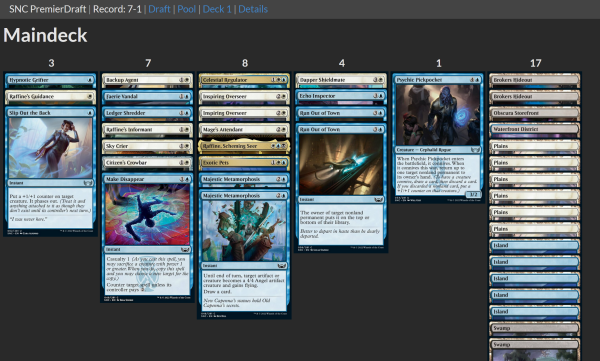
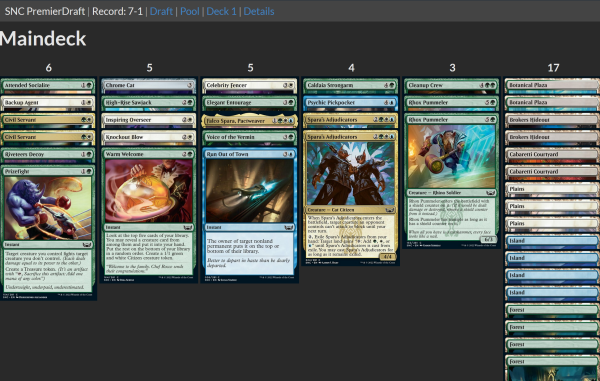
This deck doesn't have the power level of the Raffine deck in its base colors. This deck contains a lot of middling cards. Civil Servants and Elegant Entourage, though good, didn't feel as though they were strong enough to consistently win. I needed to expand my options to build a formidable game plan. This deck is splashing two powerful threats, a removal spell, and a pair of Spara's Adjudicators. Falco Spara, Pactweaver and Psychic Pickpocket are difference makers and this deck needed exactly that. To execute this game plan, I needed more fixing than the UW deck listed above. The six non-basics and the two Spara's Adjudicators help reliably cast the off-colored cards.

Sidenote: The Adjudicator is a surprisingly powerful card. It has the fourth-highest winning percentage amongst multicolored commons. Though that data might be clouded by the winning percentage within those colors. In my experience, blanking both halves of combat for a single creature can be very potent in a format defined by racing.

Golgari: officially a supported archetype

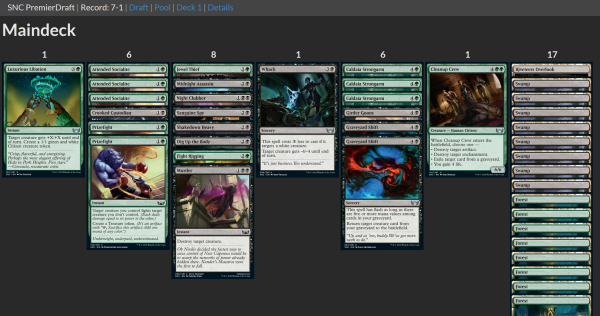
When building this Green-Black deck, I speculated on some Riveteers dual-lands. I anticipated a need for the gold cards split between these two colors. They were left in the sideboard because the card quality was so high. I didn't want or need to dilute my mana. Forge Boss and Riveteers Charm are fine cards, but I decided they weren't worth it. Fumbling with tapped lands or unnecessary red sources are unnecessary risks in this deck. My plan was powerful and consistent. A third color may have raised the power level of the deck, but the reward was too low to justify the risk.

Belly Flops

Bless this mess.

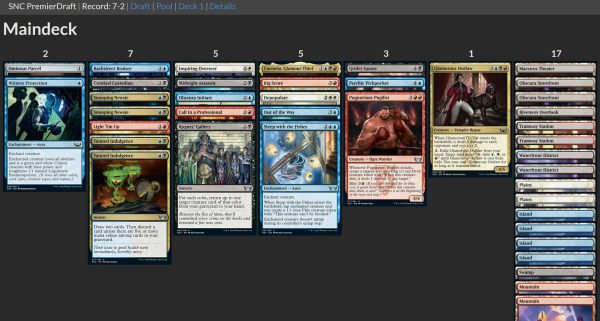
Multi-colored piles can thrive despite the hostility of the format. This deck looks to play a long game that leverages powerful cards. The slower the game you want to play, the more colors you can get away with. This deck is base-Maestros (URB) but splashing a double white spell in addition to the Inspiring Overseer. It looks to win with massive Rogues' Gallery and Cormela, Glamour Thief card advantage plays.

This deck is running eight non-basics, as well as a Glamorous Outlaw, an Ominous Parcel, and a Big Score to facilitate the messy mana base. Depopulate immediately catches you up when behind, making it a great splash despite requiring double white. However, the deck's infrastructure allows for more ambitious splashes. Beyond the great fixing, this deck has two-drops that specialize in trading off and card advantage to help break stalemates. Sam Black often comments that card draw is the best form of fixing and that proved to be the case here. In most games, I drew nearly all of the deck because of the card advantage.

We shouldn't aspire to build decks like this (as the unshared portion of my 17lands data would indicate). But sometimes it is correct. When we prioritize fixing we open ourselves up to opportunities. I still want to be in a two-color, proactive deck, but we don't get to cherry-pick our decks. We build them, somewhat in the dark, one piece at a time. The messier the splash, the more we need to consider our ability to play from behind. Wraths like Depopulate, Hostile Takeover, and Incandescent Aria are all ideal splashes. Decks that are built to splash want to interact early before taking over. They are usually controlling and powerful.

No Running on Deck

Another reason we might splash, despite fielding a powerful and consistent pool of cards, is that we need access to a specific effect. If you built an aggressive BR deck that lacks removal it's possible you end up stone-walled by some sequences of plays. A light green splash could enable Bouncer's Beatdown or Prizefight. A blue splash could enable Tainted Indulgence. And, while in a vacuum, I would prefer not to make those splashes, there are times when access to those effects can warp the trajectory of a deck in a positive way. Similarly, if I have a couple of game-breaking creatures, I'm more inclined to consider Dig up the Body as a potential splash.

The other half of this equation is identifying what our deck doesn't want. An aggressive deck is less inclined to splash because slowing down a proactive assault is rarely worth the uptick in power.

Pool Rules

This format pulls us in two very different directions. It's a tempo-driven format where many games end in a race. Therefore, we shouldn't want to splash. Conversely, the format is also built around three color families and there is a ton of common fixing. Fixing and powerful gold cards encourage splashing. So when is it worth it?

I ask myself the following questions when considering a splash:

1.) Am I happy playing this spell late in the game? An off-color card can't realistically be expected to come down on curve. If I unlock this card in the late game, the payoff needs to be worth it.

2.) What does inconsistent mana do to my deck? I have very little interest in splashing if my game plan is built around aggression and curving out. In situations like these, even a game-breaking bomb might be left on the cutting room floor.

3.) What kind of fixing do I have? Fixing reduces the risk of playing a splash. If I'm just jamming three islands in a deck and hoping to get lucky, the value of the splash is probably irrelevant. Conversely, if I have the fixing I may splash less powerful cards.

Like all things in Magic, there aren't hard and fast rules when it comes to splashing. I generally advise caution when splashing, especially in an aggressive format. Fortunately, the fixing in SNC is great, and it's easy to speculate on a few nonbasics. Your rewards will be greater if you're actively reducing your risks and this format gives you plenty of opportunities to do that.

Three Signals of Market Weakness

Are you a Quiet Speculation member?

If not, now is a perfect time to join up! Our powerful tools, breaking-news analysis, and exclusive Discord channel will make sure you stay up to date and ahead of the curve.

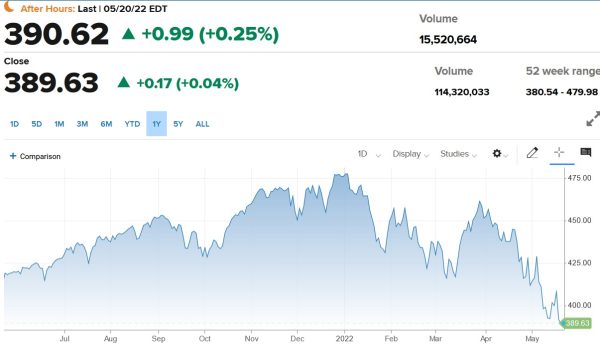
It should not seem too farfetched for me to claim that the global economy is not exactly at its strongest right now. In the U.S. specifically, the S&P 500 briefly touched into bear market territory last Friday (20% drop from highs). Cryptocurrency has also pulled back dramatically, and with rising rates on the horizon it doesn’t even feel like holding bonds would be too wise.

This magnitude of weakness has ripple effects across nontraditional investments as well, including Magic. In fact, I’ve been observing a few signs of market weakness recently. I don’t foresee the Magic economy collapsing or anything nearly so dire. Rather, I’m just anticipating some more weakness to come as prices come in and demand softens. It may even be a decent buying opportunity, if timed correctly.

Until then, I want to highlight some of the signals I’m seeing that indicate the market is still weakening—when these turn around, I will be much more confident that we’re finding a bottom. Keep an eye on these signals as your indicator of market strength.

Signal 1: The Large Bid/Ask Spread

What do I mean by a large bid/ask spread? I define “bid” as the price someone a buyer is willing to pay for a given card. The “ask” is the price a seller is willing to sell that same card. In a healthy, consistent economy, the bid and ask prices are close to each other, enabling the flow of goods and money. When they drift apart, however, something bizarre happens: transactions come to a crawl, and it becomes difficult to determine a fair market value for cards.

I have a personal example I want to share. Most readers know that I enjoy collecting the occasional low-end Beta rare for its rarity, collectability, and nostalgic appeal. I was looking at Beta Clockwork Beast as a somewhat playable, sub-$100 rare (if in played condition).

There was an error retrieving a chart for Clockwork Beast

The cheapest on TCGplayer right now is a moderately played copy for $133.88 plus shipping. There are a baker’s dozen listings currently, and prices only go up from there. I was watching an eBay auction a couple months ago for a played copy, and decided I’d place a bid. I figured if I could get the card for 20% off TCGlow, I’d be in pretty decent shape, and anything under $100 would be gravy.

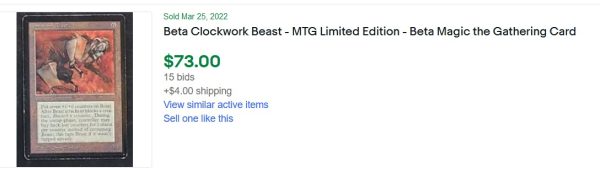
Here’s how the auction ended:

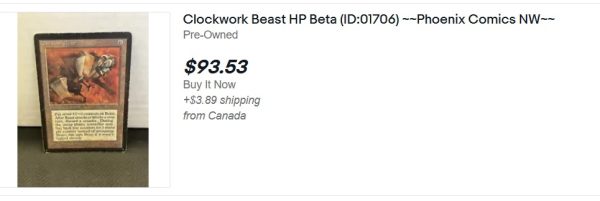
I paid $77 plus tax for this decent condition Beta Clockwork Beast! Card Kingdom pays more than that in store credit for HP copies! What happened? Why did this card sell so cheaply? The number of buyers of these cards has decreased recently, so at auction they’re selling for much less than expected. Had the seller listed their copy with a $100 buy-it-now price tag, there’s a great chance it would have just sat there rotting. In fact, there is a copy that’s around that price on eBay right now!

Even this price is about $20 more than what I paid, indicating the bid/ask spread has widened.

Another quick example is Beta Zombie Master. This rare is a little more playable, and demands a higher price as a result. TCGlow has a heavily played copy for $350 plus shipping.

There was an error retrieving a chart for Zombie Master

However, there are no recently sold listings on TCGplayer, so exactly what is this card truly worth? Well, the last copy to sell on eBay went for just over $300, so that already indicates a gap between bid and ask. Here’s the kicker, though: I mentioned this card specifically because I have a heavily played copy listed on eBay for sale myself. I’ve dropped the buy it now price all the way down to $242 and still I can’t make the sale. That’s 30% below TCGlow! I had no luck selling the card on the Old School Discord either.

This example goes to show you that just because a card is posted for sale at a given price point doesn’t mean that price point is merited. As the bid and ask spread widens, it becomes even more difficult to sell cards at their previous “market” price.

Signal 2: No One Beats Buylists

I want to dwell on Beta Zombie Master a little longer. Up until last week, Card Kingdom was paying $480 on near mint copies of this card. That means they were offering 40% of that, or $192 for HP copies. Compare that with what I’ll get if I ever end up selling my copy on eBay for $242—after fees it won’t be so far apart. If I am OK with store credit, then trading to Card Kingdom would definitely have been the route to go.

Unfortunately, that buy price didn’t stick, but this was because of my own actions. You see, I had a second Beta Zombie Master that I shipped to CK, and it triggered them to drop their buy price of the card from $480 to $400. The card I shipped was more in the LP range (it hasn’t been graded yet). Shipping that copy to Card Kingdom was a no-brainer because I was fairly confident I wouldn’t have been able to earn more by selling privately or on eBay. The other copy I had posted, which wasn’t selling, was solid proof.

When Card Kingdom is offering more on some cards than the player base, something is definitely not right.

Another recent firsthand example is Beta Mind Twist.

There was an error retrieving a chart for Mind Twist

Card Kingdom’s buy price was peaking at around $1740 for near mint copies of the card. I had a moderately played copy I was thinking of selling. Once again, TCGplayer’s listings didn’t provide an accurate reflection of the market. The lowest price posted there is heavily played for $1688.40 plus shipping. I thought I would surely be able to sell my copy for $1400—it was in better condition and $250+ cheaper than the next cheapest listing.

It didn’t sell. Nor did it sell at $1350, $1300, $1200, or $1100. I had to drop my price all the way down to $1050 in order to find an overseas buyer. Had I shipped the copy to Card Kingdom while they were offering $1740 for near mint copies, I would have likely received $1044 (assuming my copy was graded VG). Granted, Card Kingdom dropped their buy price a little, but the fact of the matter is that I couldn’t really sell this card for more than buylist.

Signal 3: Retailers Charge Less than TCGplayer and eBay

While Card Kingdom was paying so well on older cards, they had plenty of opportunity to restock their inventory. Now those cards are sitting on their website and not moving so quickly. This is likely why we’re seeing buy prices drop steadily. This trend extends beyond Beta, where I have been focusing my attention thus far.

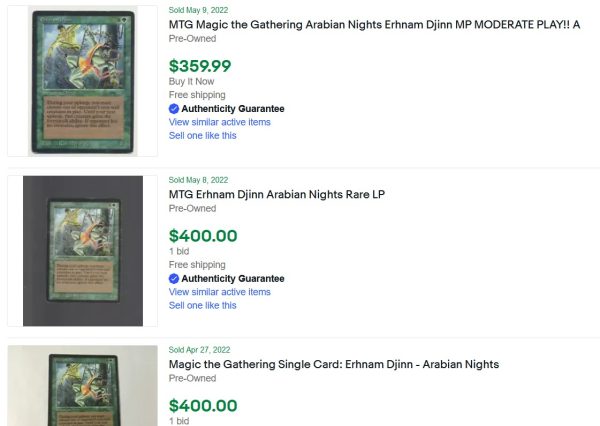
As an example, consider Arabian Nights Erhnam Djinn—I’ve seen Card Kingdom steadily drop their buy price on this card over the past couple weeks. Currently they have three G copies in stock with $314.99 price tags.

There was an error retrieving a chart for Erhnam Djinn

The cheapest copy on TCGplayer is $323.99 and in damaged condition. Thus, Card Kingdom is selling copies for less than any seller on TCGplayer. Normally a premier retailer merits a small premium relative to the market, not a small discount. Imagine if you had store credit—you’d be able to nab a copy of this card for well below what it would cost you to acquire it anywhere else. You’d also be paying less than the last three listings that sold on eBay.

Before you rush out and pick up those copies from CK though, be forewarned. Just because you can acquire copies below TCGplayer doesn’t mean you’re getting a steal. Refer back to the above signals: cards are not selling at their posted prices. In the current market environment, you need to beat the TCG low significantly to get a quick sale. This is an indicator of market weakness.

I am confident that other examples like Erhnam Djinn can be found readily by simply browsing Old School cards.

Wrapping It Up

The current market for older Magic cards is fairly weak relative to 2021. There’s no need to panic and cash out of everything. I truly believe we’re just seeing some of the fluff come out of the market, and prices are heading back towards where they belong. And of course, global economic weakness is also reflected in the Old School Magic market as well.

We need to see a few signals reverse themselves before I’m confident in a market bottom. When copies start selling on TCGplayer, and Card Kingdom starts selling through their inventory, and cards are selling privately for more than buylist, I’ll become more optimistic.

Until then, this is definitely a buyers’ market. My advice to folks who are looking to acquire cards right now is to wait for your price. Be patient. Just because a card is listed for sale 10% below TCGlow doesn’t mean it’s a snap buy, especially in this current market environment. When you see a posting for a card that looks like a steal, make sure you check vendor inventory in addition to TCGplayer and eBay listings. Some vendors just may have copies in stock for less than the rest of the web.

When this is no longer the case, we’ll see a rebound. Given inflationary pressures, rising interest rates, and struggling supply chains, this may take a little while. Be prepared to wait.

Generational Magic: Coming of Age

Are you a Quiet Speculation member?

If not, now is a perfect time to join up! Our powerful tools, breaking-news analysis, and exclusive Discord channel will make sure you stay up to date and ahead of the curve.

Has it really been that long?

Back in 2014, I published an article on CoolStuffInc.com called Generational Magic. I spoke about my early years of playing Magic: the Gathering and focused the article on how my boys learned the game. Of course, a lot has happened to my family in the eight years since then. We've had three graduations, one relocation, and me aging like an Alpha Timetwister. We continued to play, but understandably, our involvement in Magic and gaming generally has evolved.

Easy Come, Easy Gone... to Play Something Else

Chase in 2019

My oldest, Chase, graduated from high school in 2015 and began his collegiate studies at Bowling Green State University. Before he left, he still attended pre-releases, joined a few Commander games, and would crack the occasional pack. His last pre-release was Dragons of Tarkir, when he used his promo card to great effect:

There was an error retrieving a chart for Dragonlord Dromoka

Note: he was pretty pleased when I told him the current price of the promo version.

Once Chase was away from home and no longer under the caring and watchful eyes of his parents, his focus changed. Naturally, his attention was mostly on finishing his degree in four years. Majoring in Chemistry with a minor in Astronomy did not afford him much free time. I did build him a GW Commander Squirrel deck headlining Trostani, Selesnya's Voice as the Commander, but he only played it when he came home for the holidays.

Chase is the quieter, more reserved one of the two, so between that and his intense studies, it was pretty natural that he delved more into online gaming. Finally, in 2019, through hard work and long nights, which were a requirement for astronomy, he graduated. He came back home and crashed for a few months, but didn't stay long. I didn't blame him; once you've tasted the freedom of living on your own, you're ready to spread your wings. So, in 2020 he landed a good job and found himself an apartment. I would still invite him to join his brother and I to attend a Magic event or a family Commander game, but he generally declined. He just prefers to improve his progress in Dark Souls, Team Fortress 2, Final Fantasy 14, or Warframe.

And I Thought I Liked the Game…

Jarod in 2019

Chase and Jarod are four years apart in age, so 2019 was a big year. The week after Chase's graduation from college was Jarod's graduation from high school. During this time, Jarod went in the opposite direction of his brother, and his desire to play increased sevenfold. He wanted to experience every format. From Standard to Legacy, Jarod was game to sling paper. The thing is, he was still dependent on dear ol' Dad. Any decks he wanted to build or events he wanted to attend were at my discretion. Normally, we both wanted to go and do the same things, so it was generally easy... generally.

One uneasy incident occurred when he was involved in the school gaming club. Jarod wanted to show off the Legacy deck that I had built for him to his club friends (it was a version of this Grixis Delver deck). I normally didn't let him take the more expensive decks out by himself, so my reply was naturally no.

One day, without my knowledge, he took it to school anyway. Sometime during the day, he went to leave for his next class, and left the deck on his desk! A scary moment. Fortunately, he remembered before he got too far, and the deck made it home safe. Of course, he didn't tell me about this incident until months afterward so I wouldn't explode, but suffice to say it provided a learning point for both of us.

Jarod decides which of his opponents' permanents he'll take control of and avoids the camera

Jarod went into overdrive once he graduated and started working full-time. Money in hand and a vehicle made the difference for him. We would still attend events and buy a box or two of the latest product together. The difference was now he had more freedom to go by himself and make his own purchases.

This paradigm shift proved a blessing and a curse. It was a blessing since if I didn't want to drive 40 minutes right after work to play a couple of Commander games, he still could. It was a curse because he didn't always make the best choices when buying cards, and spent way too much money relative to what he could afford.

One example I'm sure some can relate to was a few months after Commander Legends was released. He was on a mission to get a Mana Drain for his latest Commander deck. Nothing special, just one regular Mana Drain from that set. He was so focused on it that he ended up spending close to $300 on loose packs over the course of three weeks.

Yes, I thought the same thing after I heard about it.

The sad thing was in all those packs he still didn't get the card, so we traded for one a couple of weeks later. Lesson learned?

What Have You Done for Me Lately?

These days, Chase is still gaming online and has signed off from Magic. He's currently working on buying his first home, and yes, it's been difficult. Because of his redirection into non-Magic interests, he doesn't have any favorite cards or decks. Still, when my wife and I recently finalized our estate planning (i.e. living will), he expressed interest in keeping my Odyssey Battle of Wits playset.

In 2019 Jarod and I created Twitter & YouTube channels called Generational Magic. We uploaded the first video and prepared more to continue, but Covid happened shortly after that and we decided to put it on hold, at least until things get back to a semblance of normality. Like these articles, the intent is to highlight the familial and relational aspect of the game. How we grow closer and enjoy each other's company through Magic. That isn't always easy when you're keeping yourself socially distant!

Jarod has been comboing off with his new love, Canadian Highlander. He built a deck utilizing his favorite color combination Grixis (UBR), but recently updated it to Bant (WBG):

Jarod’s Canlander Deck

Enchantments

1 Future Sight

Planeswalkers

1 Tezzeret the Seeker
1 Oko, Thief of Crowns
1 Narset, Parter of Veils
1 Saheeli, Sublime Artificer
1 Teferi, Time Raveler

Creatures

1 Hullbreacher
1 Trinket Mage
1 Urza, Lord High Artificer
1 Emry, Lurker of the Loch
1 Uro, Titan of Nature's Wrath
1 Golos, Tireless Pilgrim

Instants

1 Crop Rotation
1 Capsize
1 Frantic Search
1 Brainstorm
1 Whir of Invention

Sorceries

1 Reap and Sow
1 Tinker
1 Sylvan Scrying
1 Fabricate
1 Search for Glory
1 Wargate
1 Time Spiral
1 Time Reversal
1 Wheel of Fortune
1 Windfall
1 Echo of Eons

Artifacts

1 Paradox Engine
1 Worn Powerstone
1 Voltaic Key
1 Expedition Map
1 Khalni Gem
1 Candelabra of Tawnos
1 Basalt Monolith
1 Mana Crypt
1 Talisman of Creativity
1 Liquimetal Torque
1 Walking Ballista
1 Mana Vault
1 Simic Signet
1 Talisman of Curiosity
1 Gilded Lotus
1 Ensnaring Bridge
1 Mind Stone
1 Izzet Signet
1 Brainstone
1 Talisman of Unity
1 Grim Monolith
1 Everflowing Chalice
1 Aetherflux Reservoir
1 Rings of Brighthearth
1 Fellwar Stone
1 Thran Dynamo
1 Mystic Forge
1 Mox Diamond
1 Sensei's Divining Top
1 Lotus Petal
1 Talisman of Progress
1 Prismatic Lens
1 Defense Grid
1 Sculpting Steel
1 Chrome Mox
1 Memory Jar
1 Manifold Key
1 Mox Opal
1 Azorius Signet
1 Manascape Refractor
1 Talisman of Dominance

Lands

1 Academy Ruins
1 Inventors' Fair
1 Darksteel Citadel
1 City of Traitors
1 Ancient Tomb
1 Spire of Industry
1 Buried Ruin
1 Deserted Temple
1 Treasure Vault
1 Urza's Saga
1 Otawara, Soaring City
1 Tolarian Academy
1 Tolaria West
1 Karakas
1 Boseiju, Who Endures
1 Minamo, School at Water's Edge
1 Vault of Whispers
1 Great Furnace
1 Ancient Den
1 Seat of the Synod
1 Tree of Tales
1 Tundra
1 Tropical Island
1 Volcanic Island
1 Breeding Pool
1 Snow-Covered Island
1 Misty Rainforest
1 Flooded Strand
1 Polluted Delta
1 Windswept Heath
1 Scalding Tarn

The deck is headlined by his now favorite card:

There was an error retrieving a chart for Tolarian Academy

Before playing the deck, he had never tapped a Tolarian Academy. He knew it was a decent card, but wanted to know if it was really that good. I laughed and told him he'll find out. Boy, did he...

Enjoying the Ride

I hope you enjoyed this continuation of a family learning and growing with Magic: the Gathering at their side. I'm looking forward to sharing more interesting topics along these same lines and will also be highlighting some of the local game stores and the various people that enjoy this game.

If you've got any Magic-related family tales to share, post them in the comments or tag me on our Insider Discord! Until then, you be able to share in the joy and growth of those around you.

Spells, Casts, And Copies, Oh My!

Are you a Quiet Speculation member?

If not, now is a perfect time to join up! Our powerful tools, breaking-news analysis, and exclusive Discord channel will make sure you stay up to date and ahead of the curve.

As I sat here brainstorming topics for this article, I saw about a dozen questions in the span of fifteen minutes all about casting or copying spells. I took that as a sign.

This week, let's talk about what actually lets us cast spells. Then we can look at some stuff related to copying spells and what copying a spell actually means.

Spell "Permissions" vs "Restrictions"

Then, You Have My Permission to Cast

People often come through the rules chat with a question like "does Reiterate ignore timing restrictions?" This roughly translates to "Can I cast a creature or sorcery or whatever for free, or does it have to be an instant?" Of course, we understand what they're asking, and of course, they can do what they're trying to do. But the question they originally asked is totally different from what they meant.

See, if the Magic rules had to cover every situation that couldn't happen, they'd be even denser than they already are. Instead, they're generally permissive; they tell us what we can do. We have permission to cast an instant spell any time we have priority. We have permission to cast a sorcery spell any time we have priority during our main phase and the stack is empty. So on.

These spells that tell us to cast something without paying its mana cost grant us a new permission to cast a spell. By default, nobody can cast anything in the middle of another spell or ability resolving. But spells like Reiterate, Kari Zev's Expertise, or Electrodominance add to the regular permissions. This is why we can cast a Grizzly Bears with these effects—because the game lets us.

Okay, So What's a Restriction?

A restriction on when we can cast something, by comparison, cannot be broken. Even if I were to cast Reiterate in my second main phase, I won't be able to cast Berserk with it, because Berserk is restricted to being cast before the combat damage step. Similarly, if my opponent controls Teferi, Time Raveler, I won't be able to cast anything via Electrodominance. The restriction from Teferi's static ability trumps any other permissions I might have.

Permissions: Now or Later

While spells like Electrodominance grant permission to cast something during their resolution, other spells or effects tell us we can do something "this turn" or for some other duration. In these cases, we still have to follow normal timing permissions; these spells or effects usually just let us cast things from unusual places.

Mission Briefing, for example, lets us cast a chosen instant or sorcery card from our graveyard "this turn." If I cast Mission Briefing in my end step, I won't be able to cast Ponder. Since Briefing gives us a window of time to cast something, it doesn't create any new timing permissions. I won't be able to cast Ponder or any other sorcery spell during my end step unless I control something silly like Vedalken Orrery.

Magecraft!

Magecraft (and Ral, Storm Conduit's totally-not-magecraft ability) trigger whenever we cast or copy a spell. For a refresher on what it means to cast a spell, check out this article. Generally, it's obviously what copying a spell is. Storm spells like Grapeshot make copies; other spells like Narset's Reversal specifically tell us to create a copy of target instant or sorcery spell. Easy enough, right?

Some effects, however, need a bit more explanation. Take something like Isochron Scepter, for instance. It says "cast" and "copy" on it, so does it trigger magecraft abilities twice? Nope!
The Scepter instructs us to copy the exiled card, and then cast the copy. Since we're copying a card, not a spell, the copy part of magecraft doesn't see it. However, we do cast the copy, so magecraft triggers from us casting a spell.

Effects like Arcane Artisan are extra sneaky. It says "cast" and "copy" on it, so it might show up in a cursory Scryfall search. But don't be fooled! Artisan tells us to create a token copy of an exiled card. No spells are being cast or copied, so Arcane Artisan doesn't interact with magecraft at all.

Copy That

What does a copied spell actually look like? Thankfully, it looks a lot like the original! The nuts and bolts can be found in CR 707.2, but in short, a copy of a spell remembers all of the choices made for that spell. It has the same value for X, the same modes and targets, it knows if any of its additional costs were paid, etc.

Perhaps most importantly, copies of spells are not typically cast. They won't trigger things like cascade or enchantments like Swarm Intelligence. They also won't get the "bonus" effects on spells like Apex of Power or Approach of the Second Sun.

Similarly, since a copy isn't cast, no mana was spent to cast it. This most recently matters for spells like the Mythos of Illuna cycle. A copied Mythos of Illuna won't create a token with the fight ability.

However, a copy of a spell knows if any additional or alternative costs were paid. For instance, a copy of From Under the Floorboards knows its madness cost was paid, so it'll make X tokens and gain X life. A copy of a kicked Goblin Bushwhacker spell will resolve as a token Goblin Bushwhacker that was kicked, so its trigger will give your creatures +1/+0 and haste until end of turn. (Note that the Bushwhacker spell has to be copied for this to work. A Clone copy of Bushwhacker won't have its kicker cost paid, even if the original Bushwhacker's was.)

Cleanup

That's it for this week. Go forth and copy a bunch of ridiculous spells. Do that Professor Onyx and Chain of Smog thing. Any questions, comments, criticisms, random strings of profanity? Find me on Twitter or our Insider Discord.

Question of the Week: How many copies of a spell have you had on the stack at once?

Stax, The Most Hated Savior of Commander

Are you a Quiet Speculation member?

If not, now is a perfect time to join up! Our powerful tools, breaking-news analysis, and exclusive Discord channel will make sure you stay up to date and ahead of the curve.

A Shifting Definition

Originally a Stax deck featured resource removal and denial through the namesake card Smokestack. However, over time, many other cards have been added into the fold and the very idea of Stax has begun to change, noticeably, as all of the cards that were typically labelled as "hate bears" are more often being considered as Stax effects.

The main point, though, is that playing Magic gets considerably more difficult and oftentimes frustrating because of Stax. Decks full of cards that stop you from playing the game sounds like a bad thing for Commander, right? Maybe, maybe not. I've suggested that you should not play Stax without a Rule 0 Conversation about it. But as I've played a whole lot more with many varied groups through the power of SpellTable I've changed my mind; Stax is the Savior of Commander.

Spot The "Problem" Card

"All of them!" Good on you, I'd like to play in your Commander pods. But more than any other I believe Sol Ring is the problem card here. It's ubiqitous, has very little drawback, and it ends the game sooner for everyone. Consider all of the other cards here and you will see that they actually make the game last longer and all fold to simple removal. This is a very important point as it is, in fact, the entire point. I'm on record with saying Commander players commonly do not run enough removal and that interaction is not just important for deck strength, it's important for the entire Commander experience.

No Interaction Is The Problem

Many players appear to be making a lot of the same build decisions. In the last month I've played on SpellTable about 30 hours per week. At 30 minutes per game that comes out to roughly 60 games over the past month. Was there a single Terminate or Nature's Claim cast in any of those games? No. Why? Single target removal is a lot less attractive in terms of value and obviously is not part of a combo win.

However, in the vast majority of these games one player got off to a huge lead with an early Sol Ring or some other removable acceleration. One game, in particular, was a turn one Orcish Lumberjack into a turn two Pako, Arcane Retriever, which hit an immediate Sol Ring. While two of us had creatures that could kill Pako, the third player did not so the Pako triggers added up. None of us had removal in the first four turns and we ended up losing. The experience was highly frustrating for all involved.

A Tragedy Of The Common Prisoner's Dilemma

Keeping the game state even and fun is up to the entire table. If everyone played a few more removal spells, games wouldn't end early because greed would be punished. When all decks lack removal the greediest plays become the most rewarded. This creates a situation where you are forced to make greedier and greedier decisions to keep up with the greed of the table and this makes the quality of games go down, considerably.

Playing single target removal is fairly bad from a mathematical standard; you actually help two other players at the table with your card. Mass board wipes are also less likely to be the answer every time because if you are ahead they become dead draws. Gee, if only there were some kind of archetype that universally and broadly punished greedy players yet did not particularly hamper "fair" players at all? If. Only.

Stax To The Rescue

What makes a card like Lavinia, Azorius Renegade unfair? From the point of view of a fair deck, it does absolutely nothing. What about Lavinia of the Tenth? I played this card in my Brago, King Eternal deck with the ability to repeatedly blink it. Well if you play spells, it does nothing. If you play permanents that cost five or more it also does nothing. In the particular pod I was in one player was playing The Ur-Dragon and had absolutely zero problem with either of the Lavinias, but the other two players hated both. Why?

The other two players were playing tribal decks that had likely morphed from thematic tribal decks into combo decks as they continued to "optimize" their decks by making them "stronger"... likely by replacing removal with value and combo pieces. The color combinations of these other two decks? Golgari and Rakdos. Yes, a Golgari deck without removal and a Rakdos deck without removal.

Now, I don't know if these players were extremely unlucky, but, I was not stopping them from drawing cards and taking their turns and neither of them could kill a vanilla 2/2. Sure they were stopped from casting "free" spells or doing anything that cost four or less, eventually. With a little boost, Brago killed each of them with 21 points of commander damage as they also had no way to block a single flyer.

The-Ur Dragon player had no problems, at all, and we dueled back and forth.

The Holy Grail Of Commander

While my deck did not have piles of Stax features, it had enough to make the game keep going and it did not completely shut out players from playing. Many effects like Rule of Law are symmetrical, and, I can build in such a way as to avoid more one-sided effects.

Should I Play Stax?

Playing an *entire deck* of Stax effects is definitely a frustrating experience and it really should not be done at any table that ever considers itself or labels itself "casual" or "low powered". Play more removal. Definitely Rule Zero these types of decks.

At a high powered, cEDH table? Absolutely, yes you get to play full on Prison decks. But what about the in between Stax deck and mid-power tables? This is a tricky line to walk but I think the argument for Stax is better than against. The more you can say that your cards promote continuing to play the game and less about grinding the game to an absolute halt the better.

A good example of this is the difference between Stasis and Winter Orb. Untapping all your creatures, mana rocks and one land is still playable vs untapping nothing.

But My Table Hates Stax!

Well, don't bring something to the table that everyone hates. But do people really enjoy non-interactive value engines racing to end the game as soon as possible? Every game where I have forced interaction on a table has been more enjoyable for all those involved—take it from the last player who said "I don't know what your deck is trying to do, but I love it!" Strangling a table is bad. Forcing a table to interact? That's Commander! Also, play more removal.

Avatar photo

Joe Mauri

Joe has been an avid MTG player and collector since the summer of 1994 when he started his collection with a booster box of Revised. Millions of cards later he still enjoys tapping lands and slinging spells at the kitchen table, LGS, or digital Arena. Commander followed by Draft are his favorite formats, but, he absolutely loves tournaments with unique build restrictions and alternate rules. A lover of all things feline, he currently resides with no less than five majestic creatures who are never allowed anywhere near his cards. When not Gathering the Magic, Joe loves streaming a variety of games on Twitch(https://www.twitch.tv/beardymagics) both card and other.

View More By Joe Mauri

Posted in Commander, Deck Building, Deck Primers, Free, OpinionTagged , , , , , , , , , Leave a Comment on Stax, The Most Hated Savior of Commander

Have you joined the Quiet Speculation Discord?

If you haven't, you're leaving value on the table! Join our community of experts, enthusiasts, entertainers, and educators and enjoy exclusive podcasts, questions asked and answered, trades, sales, and everything else Discord has to offer.

Want to create content with Quiet Speculation?

All you need to succeed is a passion for Magic: The Gathering, and the ability to write coherently. Share your knowledge of MTG and how you leverage it to win games, get value from your cards – or even turn a profit.

My First Time Vending Pt. 1

Are you a Quiet Speculation member?

If not, now is a perfect time to join up! Our powerful tools, breaking-news analysis, and exclusive Discord channel will make sure you stay up to date and ahead of the curve.

An Opportunity Presents Itself

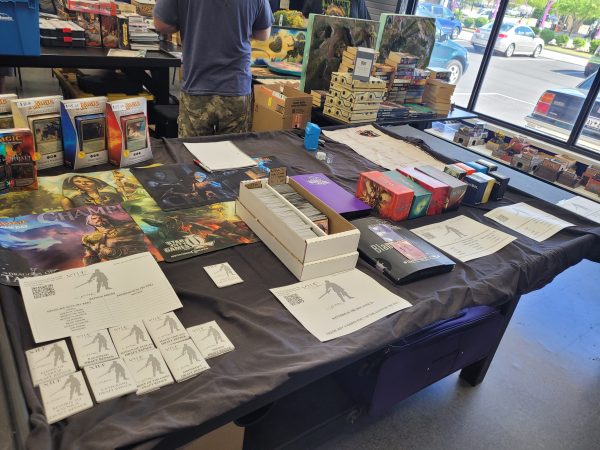
One of my local game stores announced they were doing a Buy/Sell/Trade event where anyone could rent a table for either $20 or $30 (with the $30 tables being 4'x8') so I decided I would try to try to vend it given the buy-in price was so low. 

Research

Unfortunately, the game store running the event is one that I haven't been to a whole lot so I didn't know their client base well enough to know what types of cards to bring when I first saw them post the event on Facebook. However, they did have a Discord channel and were happy to let me join it. There, I was able to see what people were looking for and alert potential customers I would have cards they were looking for available to them and to come visit my table. This allowed me to set up three potential transactions before the event even began. Reading through the requested cards on their trade channel it seemed they were very much a casual-oriented venue. This meant that I should tailor my inventory to that crowd, which was an important consideration given the limited table space.

Layout of Table(s)

As I was preparing for this event I measured the binders and boxes I planned on bringing and drew up the table to scale. This allowed me to get a good feel for how I would lay out my table as well as an idea of how much space I might have available. This is important because when vending you typically pay for space, so any wasted space is wasted money. By laying out your area, you can also get a good feel for what signage you will need in order to properly display your wares. I printed off multiple signs that provided pricing information.

Display

Binder Pics

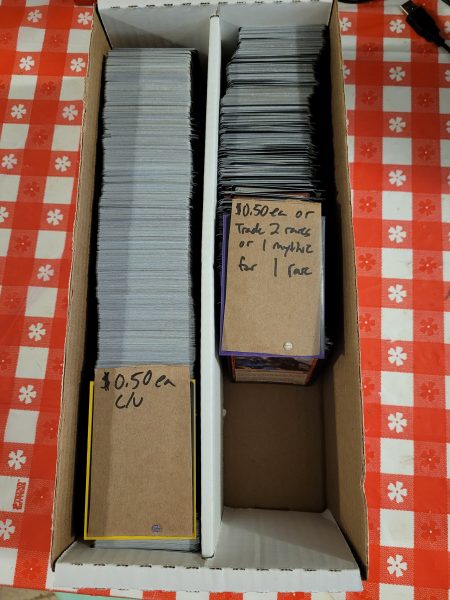
One important consideration is how you will display your wares. At most GPs vendors have nice glass display cases which allow people to see what is available, while the seller still remains the only one with access to the cards. I didn't have this luxury as those cases are quite expensive and I don't know how many opportunities I will have to vend. I choose to put all my $1+ cards in sleeves and then into some Monster Binders I owned. I also put bulk rares and good commons and uncommons in a $0.5 per card box for people to leaf through.

$0.5 Box

Pricing

It seems there are two main camps to pricing cards. Some stores prefer to not price any cards until purchase. This prevents them from missing out on price spikes as well as requires no upfront work. However, the work is always there, so by not pricing cards one slows down checkout and forces customers to "guess" what things cost. Personally, I don't buy cards that aren't priced in front of me and I know a fair number of other people who feel the same way, so keep that in mind when choosing which route to take. I decided to round my price to the nearest dollar.

Staffing

After talking with a fellow QS member, I decided that it would be wise to have an extra set of hands to help me run my table. I was worried that should I need any sort of break—be it restroom, drink, or food—my table would be unattended, and while I know that 99% of Magic players are good honest people, there are some that have no issue stealing when the opportunity arises (I had a Jace, the Mind Sculptor and foil Elesh Norn, Grand Cenobite stolen out of my trade Binders at a Grand Prix awhile back). I also know that buying cards can take up a fair amount of time and attention, so I wanted to make sure I could do that without ignoring my own customers. Luckily, one of my best friends who plays a lot of Magic was available and was happy to help me out.

There was an error retrieving a chart for Jace, the Mind Sculptor

Transportation

The last bit of preparation I did was to figure out how I wanted to transport my inventory. I was able to fit everything I wanted to bring in a large suitcase with wheels, and my backpack. This allowed me to make just one trip from my vehicle to my table, which came in handy given that I didn't know how far from the entrance I would have to park.

Last, but Not Least

I spent a fair amount of time pre-pricing my cards and planning for my first time vending. My parting advice is to come well prepared, so you can make the most of your vending opportunity! Do you have any experience as a vendor at live events? If so, share your tips in the comments. In my next article, I will reflect in more detail on my experience and share my overall thoughts about it.

Real-World Flavor: Black’s Philosophy in Citations

Are you a Quiet Speculation member?

If not, now is a perfect time to join up! Our powerful tools, breaking-news analysis, and exclusive Discord channel will make sure you stay up to date and ahead of the curve.

Expect my visit when the darkness comes.
The night I think is best for hiding all.

Today, we are precisely halfway through out journey around the color pie. After dealing with the color philosophy of White (split into Part 1 and Part 2) and Blue, it's now time for Black. The color of swamps, zombies, and rats is possibly the most misunderstood, since it's often considered the color of pure evil. In fact, as we'll see in the course of this installment there is more to it than just that, although Black certainly presents its share of wickedness.

In the course of this series of articles, based on flavor texts coming from real-world literature, we have already made our acquaintance with a considerable number of Black cards—more than any other color, in fact. The reason? It just turns out that Black has a strong presence among this specific set of cards. This allowed us to dedicate it a couple of articles: one centered on quotations from Dante, Stoker and Conrad, and one about horror-themed cards from the set Legends.

Anyway, we should still have enough cards to show what Black is really all about. Let's start with a quick overview on this color's philosophy, and then move to a card-by-card analysis.

Black Color Philosophy

Black is generally associated with selfishness, ambition, amorality and parasitism. Black wizards seek power above everything and don't care how they are going to reach it. On the other hand, they show quite an overt style: seldom are they ambiguous as other colors do. With such macabre themes it's particularly easy to tell a black card apart on the art alone, and that was true even at the earliest stage of this game.

Greatness, at any cost

One of the main characteristics of Black is the will of domination, no matter the price. Or, to borrow Dark Confidant's words: "Greatness, at any cost". The price to be paid is both moral and practical in nature: many black cards come with strong effects, but the strongest ones frequently demand creature sacrifices in the form of activation costs or upkeep.

Juzam Djinn

There was an error retrieving a chart for Juzam Djinn

Expect my visit when the darkness comes.
The night I think is best for hiding all.

Wallada bint al-Mustakfi, Darkness

Let's start off with a bang, as Juzam Djinn is among the most celebrated black cards ever. Particularly beloved by old-school card connoisseurs—as you can see from the price tag—it has an established reputation as a collector's piece. And in the early days, it was also extremely powerful.

From a color-philosophy perspective, it's one of the most iconic early examples of Black's defining traits. Its stats were way above average back in 1993, but this came at the price of losing life every turn. We have seen a similar mechanic in plenty other Black cards since then, such as Dark Tutelage, or Carnophage, which we discussed for its quote from Dante.

The Djin's flavor text comes from Darkness, a poem by Andalusian poet Wallada bint al-Mustakfi, who lived in Cordova during the eleventh century. As is often the case, the use of hendecasyllablic meter gives the text a grandiose musical quality, which works marvelously here to amplify the sinister aura of the beautiful yet terrifying Djinn.

Creature Destruction (and Sacrifice)

Another typical feature of Black is its proficiency in all manners of assassination. As we have noted in the introduction, dark wizards stop at nothing to achieve their ends. We have already seen cards such as Dark Banishing, so let's take a look at a couple more of variations on this theme.

Royal Assassin

There was an error retrieving a chart for Royal Assassin

Say, did an angel at thy cradle side, beloved prince!
Against thy murderers defend thee with his care?

Racine, Athalie

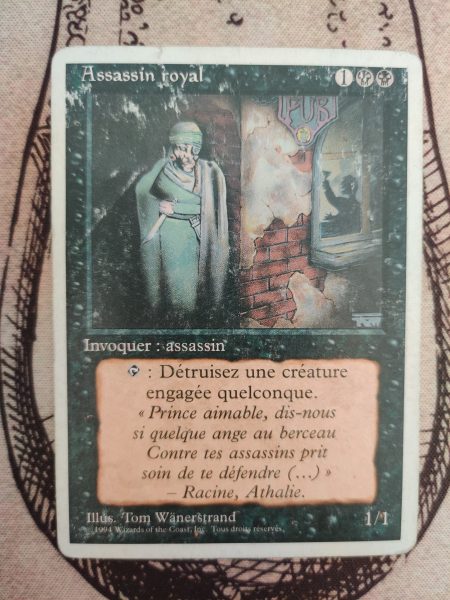
This is a special case, since the quotation above is only present in the French version of FWB (Foreign White Bordered). And in fact, it's a citation from French poet Racine, from his last tragedy titled Athalie. This choice is quite rare in Magic, as it's one of the few cards with a flavor text using this particular meter. Instead of the popular hendecasyllablic this quote is in iambic meter—a style originally used in Greek tragedy and comedy, which later became popular among English and French poets writing on tragic subjects. If you are curious about the original, you can find the French text in the photo below.

Back to color philosophy: I regard Royal Assassin as a card similar to Archivist, which we touched upon in a previous article. Both cards are expensive and puny in terms of strength and toughness; three to four mana is a lot to pay for a 1/1. However, they possess abilities that make them more than worthwhile, and transform them from mediocre fighters to prized creatures. Not to mention their extreme fidelity to their respective colors. One lets you draw cards, the other lets you kill creatures. What could be more Blue or more Black than that?

Cruel Edict

There was an error retrieving a chart for Cruel Edict

No mockeries now for them; no prayers nor bells,
Nor any voice of mourning save the choirs,—
The shrill, demented choirs of wailing shells.

Wilfred Owen, Anthem for Doomed Youth

Cruel Edict might be the darkest of all these cards, at least when it comes to its flavor text. Not from a purely horrific point of view, but rather because of its heartbreaking antiwar message. Wilfred Owen, mostly known for his poem Dulce et Decorum est, was an English poet and soldier. He fought in the Great War and was killed in action at the age of 25, but he left behind some celebrated war poems reflecting upon his experience and the horror of trenches.

As for the card itself, Cruel Edict is a sorcery that forces your opponent to sacrifice a creature. As is always the case when it comes to sacrifices, the player doing the sacrificing gets to choose which creature to axe, but it still stings. This is particularly useful for overcoming keywords such as "indestructible," "hexproof," "shroud," "protection," and so on. Not bad for just two mana!

Life-Steal and The Like

Black is good at making the opponent lose life, but also sometimes at gaining life as well: often you can see both mechanics within the same Black card. If Red is more about dealing damage (as we'll see in the next installment), Black is more about losing and gaining life. Let's see a few examples.

Dakmor Ghoul

There was an error retrieving a chart for Dakmor Ghoul

Cursed be the sickly forms that err from honest Nature’s rule!

Alfred, Lord Tennyson, Locksley Hall

This creature is quite unimpressive on its own, and in fact it has been relegated to the set Starter 1999, dedicated to beginners. It's just a 2/2 Zombie for four mana, and when it enters the battlefield you gain 2 life and your opponent loses 2. The only reason why I'm mentioning it is that it's double effect is a regular feature of many black cards.

Just to see another example, look at Syphon Soul. This time, the card is a sorcery, but the function remains the same: you gain life, your opponent loses life. It's as simple as that, and black surely makes it look simple!

Underworld Dreams

There was an error retrieving a chart for Underworld Dreams

In the drowsy dark cave of the mind, dreams build their nest with fragments dropped from day’s caravan.

As for Underworld Dreams, it mixes up two skills typical of Black. On one hand, we have an ability to make your enemies lose life (though here it's actually direct damage). On the other hand, we also have Black's obsession with hand manipulation, be it drawing or discarding. Normally, Black makes the opponent discard cards, or make them suffer when they do so, or both. In this case however, it takes the opposite path, and punishes them for drawing cards.

This dual approach to the matter reminds me of the couple The Rack and Black Vise. Both were illustrated by Richard Thomas, which made them one of the most famous couples in Magic history. Yes, they are both artifacts, but they are also very black from a color philosophy perspective!

Conclusions

We have now seen a bunch more black cards. Even though we had already covered most of them when focusing on the horror-side of the color Black, we have now focused more on this color's philosophy. Black is interested in acquiring power, at any cost.

As for the means, these are usually either stealing life, or sacrificing creatures. Through such sinister methods you can acquire some of the most powerful cards in this game, although the price can be quite steep...

What do you think of the color Black and its philosophy? Can you think of any notable cards, perhaps outside the realm of real-world quotations? If so, let us know in the comments! We are going to finish this series soon, so make the most of it while you can, and stay tuned for the last two colors: Red and Green.

Adam Plays Magic: Jeskai Fires

Are you a Quiet Speculation member?

If not, now is a perfect time to join up! Our powerful tools, breaking-news analysis, and exclusive Discord channel will make sure you stay up to date and ahead of the curve.

This week on Adam Plays Magic, we revisit the Jeskai Fires archetype I wrote about in my Decks to Expect article last month. This particular build, courtesy of Martin Juza, swaps Transmogrify for Lukka, Coppercoat Outcast as the primary method of tutoring out [card[Agent of Treachery[/card]. Lukka's minus ability threatens to find two potential Agents, making it more resilient to targeted removal as a way to disrupt the combo.

What I Like

Fires of Invention was the centerpiece of the best deck in Standard until its banning. It even earned a ban in Historic with much of the same shell and still puts up periodic results in Pioneer. This high praise (or infamy) suggests it's a strong contender for Explorer. Unfortunately, Fires initially struggled against the Winota, Joiner of Forces deck, which required interaction on your opponents turn. But now that Winota has been banned, Fires gets its time to shine!

Jeskai Fires is proactive with a ton of haymakers. While under normal circumstances, packing your deck to the brim with high-cost spells come with downsides, Fires circumvents this by acting as a quasi-mana doubler, allowing you to double-spell each turn and utilize more mana than you should have access to. The end result is that you can cast multiple planeswalkers, wrath effects, and draw spells each turn (to a maximum of two per turn).

Fires doesn't limit your access to activated abilities either, so cycling lands and Shark Typhoons can push your game actions even further over the edge of acceptability. I'm also a big fan of Yorion, Sky Nomad as an ever-present threat that gets to reset your enchantments and planeswalkers for additional value.

The deck shines against midrange and control where your spells simply out-value theirs or your threats overload their permission. It's difficult for a control deck to counter an end-step The Wandering Emperor then also have an answer for the subsequent Fires into additional threat. Your Agent of Treachery combo is also at its strongest when it's stealing an opposing Teferi, Hero of Dominaria or Lolth, Spider Queen. You're often pretty happy with taking a creature land like Hall of Storm Giants. It'll even give you something to do with your mana while Fires is out.

What I Don't Like

This deck really hits its stride at four mana, and needs five mana to operate fully. To guarantee you hit these numbers, and by the sheer fact that you're a Yorion companion deck, you're going to need a substantial number of lands to minimize the risk of missing land drops. This runs the risk of flooding out. While you don't quite need Fires to do the cool things the deck wants to do, you're at a significant disadvantage if you don't have it.

Another issue is that, despite having Anger of the Gods or Doomskar, you can just get run over by aggressive decks with an above-average draw. Fortunately, there aren't many of these running around at the moment, but when you don't start playing the game until turn four, decks that kill by that point are going to cause issues.

On that note, Mardu Greasefang decks like the one I played earlier this month prey on decks like Fires that can't interact on their combo turn. For this matchup, you need to lean heavily on Rest in Peace from the sideboard and hope their draw is slow. It's not a great position to be in, and with Winota gone, Greasefang decks are going to continue to grow in popularity.

The Deck

Jeskai Fires

Companion

1 Yorion, Sky Nomad

Creatures

4 Agent of Treachery

Spells

3 Anger of the Gods
3 Doomskar
2 Fateful Absence
4 Jwari Disruption

Enchantments

4 Fable of the Mirror-Breaker
4 Fires of Invention
2 Omen of the Sea
4 Omen of the Sun
4 Shark Typhoon

Planeswalkers

4 Narset, Parter of Veils
1 Teferi, Hero of Dominaria
3 The Wandering Emperor
4 Lukka, Coppercoat Outcast

Lands

1 Castle Ardenvale
3 Deserted Beach
1 Hall of Storm Giants
4 Hallowed Fountain
1 Island
1 Mountain
1 Plains
4 Raugrin Triome
4 Sacred Foundry
2 Sokenzan, Crucible of Defiance
4 Steam Vents
4 Stormcarved Coast
4 Sundown Pass

Sideboard

1 Anger of the Gods
4 Dovin's Veto
1 Elspeth Conquers Death
4 Redcap Melee
4 Rest in Peace

End Step

I think the Fires deck is a ton of fun and when it works, it works. As I discuss in the gameplay video, I'm not sure the sideboard is at its best. Four copies of Redcap Melee may be too much now that Winota is gone. I'm also interested in exploring potential builds focused around Mirrorshell Crab and Colossal Skyturtle instead of the Agent of Treachery combo. These creatures both function as game-ending bombs and midgame interaction. Being able to play value creatures again like Kenrith, the Returned King seems like a very big incentive.

As always, you can keep up with me as I tinker with the deck on Twitter at @AdamECohen. See you all next week!

Another Alternative: 4-Color Omnath Evolves

Are you a Quiet Speculation member?

If not, now is a perfect time to join up! Our powerful tools, breaking-news analysis, and exclusive Discord channel will make sure you stay up to date and ahead of the curve.

It's hard being the Modern data guy. There's a ton of data entry every week and there really aren't shortcuts available. At least there aren't when I want to actually track how decks evolve. Which is essential to actually telling the story of the metagame. Decks diverge, merge, and reinvent themselves over time. If I didn't watch it all happen every week, I'd miss the actual metagame shifts I'm tracking.

The Analyst's Lament

As the desired granularity of data increases linearly, the difficulty of automation increases exponentially. It is relatively easy to get a scraper to collect data from various sources and collect it into a single document. Programming the scraper (or a separate program) to then automatically sort and categorize the data is very hard. If you're looking for something very specific, it's not difficult to tell the program "Exactly This or Nothing." You do have to know exactly what that thing is to begin with and not care about anything else, though.

There was an error retrieving a chart for Careful Study

In all other cases, having collected the data, you have to program in how the data is to be sorted and categorized, and this is where the problems begin. You have to set limits on the acceptable variation within the data. If the variation is known, that's no problem. When it's unknown, you need to set it yourself. Set it too low and exclude data you don't want. Set it too high and there's no point in sorting it in the first place. It gets to the point where the effort needed to automate the process is greater than doing it manually.

As Pertains to Magic

Which is the problem I have every month. When I first started doing this, I did try to use bots and scrapers to ease the workload. It backfired. I always ended up with so many decks marked "Other" that needed to be sorted into their correct archetypes that I wasn't really saving myself any work. I didn't have to do all the data entry, but I did have to spend so much time auditing the bots work that it wasn't worthwhile.

Consider the problem with contemporary decks. UR Murktide has a very recognizable deck design. Any reasonably informed player can look at any decklist in that MTGGoldfish link and agree that the decks are undeniably UR Murktide. But how would I program a bot to do that? The decklists have a fairly standardized list of cards in them, but there are plenty of flex slots. And the land base is all over the place.

There was an error retrieving a chart for Murktide Regent

If I set the heuristic at 10% variation, that's a 6 card difference from some standardized list. That will get many of the right decks, but decks that shave on numbers to add more cards will get left out. So will the player who cheaped-out on the lands. Setting higher risks getting the wrong deck, like this UR Prowess/Blue Moon hybrid instead, which is 10 cards off from standard Murktide. I'm going to end up looking at almost every deck anyway, I might as well embrace it.

The Benefit

Because I'm looking at all the decklists as I enter them, I see how decks change and evolve. And sometimes that throws me for a loop and highlights how the metagame is changing. I'm seeing that happen right now in a particular archetype that is already a problem to classify. And its getting worse carries some worrisome implications.

Case in Point

There are 3 different decks that can be classified as 4-Color Omnath. They all play the MH2 pitch-elementals, are 4-Color decks, and are held together by Omnath, Locus of Creation. However, simply lumping them together is incorrect. There is a tribal version defined by Flamekin Harbinger and Risen Reef that is clearly unique. Distinguishing the Control vs Blink versions proves more difficult. The only consistent difference is the latter has Ephemerate, so that's the bright line. And it's worked perfectly.

A New Wrinkle

Until now, that is. Here are three recent Omnath decks. They are indicative of what I'm seeing in the data. What is the real difference between them?

Tribal Elementals, Jordi Gea Cabrero (Modern Regional Barcelona 4th Place)

Creatures

1 Flamekin Harbinger
4 Unsettled Mariner
4 Voice of Resurgence
1 Endurance
4 Risen Reef
4 Omnath, Locus of Creation
3 Fury
4 Solitude

Planeswalkers

3 Teferi, Time Raveler

Instants

4 Ephemerate
3 Lightning Bolt

Sorceries

2 Prismatic Ending

Lands

1 Breeding Pool
3 Cavern of Souls
2 Flooded Strand
1 Forest
1 Hallowed Fountain
1 Island
3 Misty Rainforest
1 Plains
1 Raugrin Triome
1 Reflecting Pool
1 Sacred Foundry
1 Steam Vents
1 Stomping Ground
1 Temple Garden
3 Windswept Heath
1 Wooded Foothills

Sideboard

1 Kaheera, the Orphanguard
2 Chalice of the Void
2 Engineered Explosives
1 Endurance
3 Force of Negation
2 Force of Vigor
2 Foundation Breaker
2 Obsidian Charmaw

4-Color Blink, Tacosalad (Modern Challenge 13th Place)

Creatures

4 Ragavan, Nimble Pilferer
2 Endurance
1 Magus of the Moon
4 Risen Reef
4 Omnath, Locus of Creation
4 Fury
4 Solitude

Planeswalker

4 Wrenn and Six
4 Teferi, Time Raveler

Instants

3 Ephemerate
2 Unholy Heat
4 Eladamri's Call

Sorceries

3 Prismatic Ending

Enchantments

4 Abundant Growth
2 Oath of Nissa

Lands

2 Boseiju, Who Endures
1 Breeding Pool
2 Cavern of Souls
4 Flooded Strand
2 Forest
1 Hallowed Fountain
1 Island
1 Ketria Triome
4 Misty Rainforest
2 Plains
1 Sacred Foundry
1 Spara's Headquarters
1 Steam Vents
1 Stomping Ground
1 Temple Garden
4 Windswept Heath
2 Wooded Foothills

Sideboard

1 Yorion, Sky Nomad
2 Chalice of the Void
1 Prismatic Ending
2 Veil of Summer
2 Dovin's Veto
1 Meddling Mage
2 Endurance
1 Memory Deluge
1 Supreme Verdict
1 Titania, Protector of Argoth
1 Emrakul, the Promised End

4-Color Control, Gerardo94 (Modern Challenge 11th Place)

Creatures

4 Ragavan, Nimble Pilferer
2 Ice-Fang Coatl
1 Endurance
4 Omnath, Locus of Creation
2 Fury
4 Solitude
1 Emrakul, the Promised End

Planeswalkers

4 Wrenn and Six
4 Teferi, Time Raveler

Instants

1 March of Otherworldly Light
3 Unholy Heat
4 Counterspell
3 Eladamri's Call

Sorceries

4 Prismatic Ending
4 Expressive Iteration

Enchantments

4 Abundant Growth
2 Spreading Seas

Lands

1 Boseiju, Who Endures
1 Breeding Pool
4 Flooded Strand
1 Hallowed Fountain
1 Ketria Triome
4 Misty Rainforest
1 Otawara, Soaring City
1 Raugrin Triome
1 Sacred Foundry
1 Snow-Covered Forest
1 Snow-Covered Island
1 Snow-Covered Mountain
1 Snow-Covered Plains
1 Spara's Headquarters
1 Steam Vents
1 Stomping Ground
1 Temple Garden
4 Windswept Heath
3 Wooded Foothills

Sideboard

1 Yorion, the Sky Nomad
2 Boseiju, Who Endures
2 Engineered Explosives
1 Alpine Moon
2 Relic of Progenitus
3 Veil of Summer
2 Endurance
1 Magus of the Moon
1 Force of Vigor

There are continuities here. Every deck runs Omanth, Fury, Solitude, Endurance, and Teferi, Time Raveler. The main difference between Control and Blink continues to be Ephemerate. However, the distinction between Tribal Elementals and Blink is now also getting blurry, and that's something to watch.

A Sudden Shift...

I only noticed this change in the past couple weeks. Risen Reef has been in Blink lists before, but never consistently, nor was it as strategically integrated as it is now. The reference list features 18 elementals to trigger Reef, which is pushing it toward being a tribal deck. In fact, I may have classified it as Tribal Elementals in previous months and only noticed it being new in May.

There was an error retrieving a chart for Risen Reef

The decision to embrace Reef does make sense. On its own, it fills a niche very similar to Ice-Fang Coatl, which is a staple in Control and had been for Blink. As 1/1 cantrip creatures, both are mainly there to bridge the midrange gap to the real spells and chump block. Both can be actual cards with some support, but Reef synergizes with the cards already played in the deck, while Coatl further strains the manabase. In exchange for costing more, Reef has the potential to get completely out of hand, while Coatl will just trade up at best.

...That's Inexplicable, But Scary

While older-style Blink does still make the data, its numbers are paltry compared to the Reef version so far. I don't know why this is happening, but it does appear that this Tribal Blink version is outcompeting the other Omnath variants across the board. I can't explain this development with certainty. I didn't notice this shift until May, but this configuration first put up results in April, so a shift in the metagame is not the cause. It might be that players just now remembered that such a move was possible.

There was an error retrieving a chart for Omnath, Locus of Creation

More troublingly, it may be that there's no longer reason to distinguish between Omnath versions. The Tribal variant was primarily synergy- and tempo-based, while Blink and Control are about card advantage and power. Why not have it all? Is there an actual need to bother with control cards like Expressive Iteration or Counterspell when you're already playing Fury and Solitude? Better, use Reef to make up the card advantage from pitching the elementals. Then use Ephemerate to just roll in the value. Players already complain that Omnath is too hard for other fair decks to compete against. How can normal control or midrange decks hope to keep up with the flood of value this new variant generates?

More Literal Evolution

And then there's the fact that the Omnath decks are branching out. As far as I remember, they've always been midrangey value decks, but since Streets of New Capenna, they're moving into the combo space. And it's all thanks to Vivien on the Hunt

4-Color Vivien, Kurusu (Modern League 5-0)

Creatures

3 Ice-Fang Coatl
1 Sanctifier en-Vec
1 Planebound Accomplice
2 Renegade Rallier
2 Seasoned Pyromancer
2 Felidar Guardian
4 Omnath, Locus of Creation
1 Fury
1 Karmic Guide
1 Kiki-Jiki, Mirror Breaker
4 Solitude

Planeswalkers

3 Wrenn and Six
4 Teferi, Time Raveler
4 Vivien on the Hunt

Spells

2 Lightning Bolt
4 Prismatic Ending
3 Eladamri's Call
3 Expressive Iteration

Enchantments

2 Oath of Nissa
4 Utopia Sprawl

Lands

2 Arid Mesa
1 Breeding Pool
1 Fiery Islet
2 Flooded Strand
1 Ketria Triome
4 Misty Rainforest
1 Raugrin Triome
1 Sacred Foundry
2 Snow-Covered Forest
1 Snow-Covered Island
1 Snow-Covered Mountain
1 Snow-Covered Plains
1 Steam Vents
1 Stomping Ground
1 Temple Garden
4 Windswept Heath
4 Wooded Foothills

Sideboard

1 Yorion, the Sky Nomad
2 Ephemerate
2 Miscast
3 Veil of Summer
1 Mana Leak
1 Endurance
1 Magus of the Moon
2 Mystical Dispute
1 Force of Vigor

As I've mentioned before, Vivien and a three-drop translates into a combo kill. Some Omnath players have decided to embrace this fact and integrated Vivien into their deck. It does have the advantage of being in an 80-card deck, so the odds of drawing the combo pieces that need to be fetched are lower. However, again, I have to ask: is this actually a new deck? The noncreature spells look amazingly similar to the mix from the above control list.

There was an error retrieving a chart for Vivien on the Hunt

And that's even more concerning than the move towards Tribal Blink. If 4-Color Omnath really can just do everything, is there any point in other decks trying to compete? To be clear, 4-Color Vivien is not a true combo deck like Tameshi Bloom. This is a Splinter Twin midrange/combo hybrid. I also haven't seen much evidence to say that the combo is actually good. Yet. However, the threat is definitely there.

Trouble Brewing

There is nothing inherently wrong with 4- or even 5-color decks in Modern. If the decks required hoops to jump through or were doing something unique like Niv-Mizzet Reborn, there'd be no issue. However, once they start being piles of everything and anything good, they start pushing out alternatives and homogenizing. The evolutions in 4-Color Omnath I'm watching have the potential to do exactly that. I'm hoping that this is just the latest fad and isn't actually good. Because if they are actually good, I can't see it ending well.

New Capenna’s Streets Are Made for Racing

Are you a Quiet Speculation member?

If not, now is a perfect time to join up! Our powerful tools, breaking-news analysis, and exclusive Discord channel will make sure you stay up to date and ahead of the curve.

In a scene from The Office, Jim Halpert asks Pam Beasley about her strategy for an upcoming 5k. Amidst the electric hum of the break room, Pam claims, “well I’m gonna start fast, then I’m gonna run fast in the middle, then I’m gonna end fast.” Jim wonders aloud why more people don’t try this strategy, to which Pam casually quips “Cause they’re stupid.” While experienced distance runners may scoff at Pam’s approach, Streets of New Capenna (SNC) draft proves she was right.


The Rules of Engagement

SNC draft is driven by tempo. The best decks in the format pressure the opponent's life total early and often. Menace and flying make blocking difficult, but many of the threats provide value in the form of additional resources. This allows you to make tempo-oriented plays that build through the mid and late-game. This is especially true of the format's two most important mechanics: connive & haste.

Loot Like a Champion, Today!

The Obscura guild is built around the format's strongest keyword: connive. The connive ability allows you to discard one card and draw a new one, enabling you to secure lands early on, or ditch the ones you don't need in exchange for threats in the mid to late game. Additionally, if you discard a non-land card the creature using connive gets a +1/+1 token. The upsides you get from connive are well-suited to a format where so many games end via racing. Additionally, Obscura's flyers evade creature combat, inherently building towards racing scenarios. Besides Psionic Snoop all of the blue and white creatures with connive should be early picks. The black commons are generally less impressive.

Two beneficiaries of connive are Expendable Lackey (6th best blue common by 17 Lands GIH WR%) and Raffine's Guidance (59.1% GH WR in UW decks). Pitching these cards to connive increases the value an aggressive game plan can generate. Because this color pair will be rightfully over-drafted, knowing how to get value from your later picks is essential. My experience matches the 17Lands data, that the UW (Azorious) decks have the highest winning percentage. The meta will likely adapt, but it’s hard to deny that Azorious is currently an excellent way to get a lead and keep it.

These Cantrips Have Haste

Pressure Points


There are surprising similarities between connive and the Brokers' blitz mechanic. Turning top-decked dorks into cycling burn spells is another avenue for sustainable pressure. Playing around a haste creature after you stabilize becomes mandatory when it’s a guild mechanic, but the fact that these blitzers leave +1/+1 counters, treasure, and tokens in their wake feels like a lot of value for essentially top-decking Durkwood Boars. Similar to the connive mechanic, blitz encourages aggression at all stages in the game. Blitz is much stronger when ahead, but it's not as narrow as that would usually imply. A well-timed blitz can steal back the board-state or swing a race.

These mechanics do what the format wants you to do: attack and accrue value so you can keep attacking. When playing against the Brokers, it’s essential that you’re making prudent attacks and not missing out on damage. Being stable is not a long-term possibility in this format. You won’t brick-wall an army of blitzers being added to a growing board. You absorb them like brutal right hooks to the ribs. So make sure your counterattacks are working to close out the game before your opponent can.

No Shortage of Three Drops

A Glut of Threes

A deep arsenal of powerful three-drops will define the battlefield early in most games. The keyword-laden Jewel Thief and Inspiring Overseer are premium commons. I’d happily first pick either of these, though it's hard to draft this set and not end up with a stack of playables at three. Even later in the pack, the Maestro or Obscura Initiates both attach options and flexibility to reasonable stats. As you climb in rarity more options present themselves, including a pushed cycle of tri-color cards for each of the five families. I'm reluctant to select a three-color card early, but gambling on the upside is tempting with all the fixing present. But do so judiciously, as slow starts are often punished in SNC.

One shocking over-performer drives home the importance of tempo in this format. Having access to a Make Disappear to back up aggression, or stave off an early threat, has proven to be a reliable strategy. With the aforementioned glut at three, being able to take back the play by countering an Overseer or Corpse Appraiser is an absolute blowout. I initially disregarded this card as fringe-playable, but it is currently the top-performing blue common. While I’m somewhat dubious of that distinction, making space for this card in your forty can provide a meaningful edge. Getting out of the blocks a step faster than your opponent can be leveraged to great effect.

Draft a Curve

The strictly-better-Quench isn't the only two-drop you should prioritize. Because the options at three mana are so deep, it puts a premium on the two-drops. Raffine's Informant holds the Gust Walker trophy for SNC (awarded, by me, to the best common two-drop). Additionally, all four of the common gold two drops are strong in their respective decks. The best two-drops are in white with Backup Agent, Sky Crier, and uncommons like Citizen's Crowbar and Illuminator Virtuoso.

Though this format is aggressive, the one-drops are mostly a trap. Based on the recent trajectory of powerful one-drops in limited, I had high hopes for Goldhound. Unfortunately, the living treasure is very low impact, as is the problem with Cuthroat Contender. Brokers Initiate is a reasonable partner to facilitate a sky attack and being able to threaten five power late in the game isn't nothing, but there is no Traveling Minister or Okiba Reckoner Raid in this format. Often, the best you can do with a one drop is pitch an Expendable Lackey to connive and get yourself a counter, a card, and a fish token on layaway.

Rough Draft

Auxiliary Life Gain: A Candle In The Wind

Even though the pressure-value relationship defines SNC gameplay, the format provides a couple of tools to fight against the early rush on your life total. Both Dimir (UB) and Selesnya (GW) provide three-power, lifelinking two drops at common, though they do encourage a greater commitment to the pair’s theme. Once online, the mid-game can revolve around them (17Lands has Civil Servant boasting a solid 60% win rate. Still, in personal experience, the ability to Dig up the Body of the Snooping Newsie has felt stronger than the numbers imply). These cards don’t neutralize the effects of blitz and connive, but they’re still useful tools.

Shields Are Down!

Shield counters, in theory, provide value in the form of an "extra life" for your creature. Unfortunately, they have numerous blind spots to the format's removal. Cards like Deal Gone Bad, Run out of Town and even Hold for Ransom ignore the Shield counter (and if you’ve ever had an opponent Call in a Professional on your Rhox Pummeler, you already know). Shield counters are a little finicky when compared with the way the previously mentioned keywords dig you deeper into your deck as they hammer the board. Nevertheless, a single point of damage trades with a shield token, and obviously that's still going to come in handy sometimes.

The Finish Line

If you’re taking a lot of damage early, you can't rely on your opponent running out of gas. While you should be making trades early, you must be able to fight back. There are a lot of cards that can open up attacks and change the board state. Managing your attacks each turn is the most skill-testing element of this format and it’s easier to do this when you’re ahead. So remember that the answer to “who’s getting the beatdown” in this format may very well be both players. Build your decks prioritizing aggressive play, and you should be able to get ahead and stay ahead in Streets of New Capenna.

Want Prices?

Browse thousands of prices with the first and most comprehensive MTG Finance tool around.


Trader Tools lists both buylist and retail prices for every MTG card, going back a decade.

Quiet Speculation