menu

Red Cards to Pull from Bulk

Are you a Quiet Speculation member?

If not, now is a perfect time to join up! Our powerful tools, breaking-news analysis, and exclusive Discord channel will make sure you stay up to date and ahead of the curve.

Introduction

The intention of this series is to highlight cards one may find while digging through bulk. Each installment focuses on a different color of bulk cards. I covered gold, colorless, white, and black cards previously. Red is particularly interesting because the Burn archetype has been around for a long time and most burn spells tend to be printed as common or uncommon. Unsurprisingly, several will make today's list.

Pricing Standards

To keep our list manageable, I'm restricting it to some of the best sub-$5 finds in each color according to TCGPlayer mid price. I have found that understanding the reason for a card's value is extremely beneficial in evaluating other cards and their potential, and have included a bit about each card.

Note: As in previous installments, this list isn't in any particular order, though it was suggested to me that I add sub-sections and group the cards in a useful and functional way, which is something I can get behind.

The List

Modern Demand

1. Dragon's Rage Channeler

This is our most recently printed card on the list. Its current price honestly seems below what it should be given how prevalent it is in the modern format. According to MTGGoldfish's modern staples lists it is the #23 most played card in Modern and the #5 most played creature. I think the only thing holding this back from being a $3 staple is the fact that Modern Horizons 2 is still readily available and in print.

There was an error retrieving a chart for Dragon's Rage Channeler

2. Pyretic Ritual

Ritual effects have been used since Magic's very beginning to play powerful spells ahead of schedule. While this effect used to belong to black, since Kamigawa block it has shifted towards a "red" thing. Pyretic Ritual is most often played in modern Storm or Belcher decks. While it was reprinted in the Mystery Boosters, that sets extremely large size means fewer were printed than in a typical set.

There was an error retrieving a chart for Pyretic Ritual

3. Burning Inquiry

I remember back when drafting Magic 2010, this was easily a card you got last pick. Thanks to modern Hollow One decks, it has become a very valuable common. I have found plenty of copies of this card sifting through bulk thanks in large part to everyone who opened them back in 2009, dumped them into the draft "chaff" pile, and forgot about them.

There was an error retrieving a chart for Burning Inquiry

4. Goblin Lore

This card's value skyrocketed around the same time Burning Inquiry became valuable, and for the same reason. Its reprinting in Jumpstart and its addition to The List recently cratered its value. However, other than those recent reprints, the card has only otherwise appeared in Portal Second Age, Starter 1999, and 10th Edition. This means any real uptick in demand, and this card goes from its currently $1.50 to $7+ quite easily. Note that only the Portal Second Age and Starter 1999 versions actually meet the $1.50+ TCGMarket price criteria for this list. The other printings are near bulk price. I pull any version of this card out of bulk and set it aside when I find them, as I made a good bit of money from them when the Hollow One decks first made a big splash in Modern.

There was an error retrieving a chart for Goblin Lore

5. Gut Shot

Phyrexian mana is listed as a 9 on MaRo's "Storm Scale," which when asking how likely a given mechanic is to return is " Level 9: I never say never, but this would require a minor miracle." It is at its worst on one-mana spells, essentially making them free spells. We have seen this effect powerful enough that not one but two one-Phyrexian-mana spells are banned in multiple formats (Mental Misstep and Gitaxian Probe). I say all that to emphasize just how powerful it is to pay 2 life to cast a spell instead of paying mana. Gut Shot's heyday was back when Izzet Phoenix decks dominated Modern and Gut Shot was used as an enabler for the three spell count needed to bring the Phoenix back from the graveyard. While no longer as played, should Izzet Phoenix decks rise from the ashes Gut Shot could easily be a $4 card again.

There was an error retrieving a chart for Gut Shot

6. Shattering Spree

Shattering Spree has been a $20+ dollar uncommon and Modern sideboard staple for a while. The replicated copies get around cards like Chalice of the Void on one, which can easily lockout burn decks. Honestly, this feels a bit underpriced currently, given that its "reprints" were in a Guild Kit and Mystery Boosters. Any substantial reprint would likely tank its price to sub $2, so there is a decent amount of risk with the card.

There was an error retrieving a chart for Shattering Spree

7. Searing Blaze

This is exactly the type of spell that Burn decks need in creature-heavy metagames. Every Lightning Bolt you have to throw at an opponent's creature is three damage missed on that all-important count to 20. That said, it is a dead draw when your opponents have no creatures and it relies heavily on triggering landfall to be good. For these reasons the card tends to ebb and flow in Burn decklists based heavily on the current metagame.

There was an error retrieving a chart for Searing Blaze

Commander Demand

8. Impact Tremors

This hidden gem has made me a fair amount of money over the years. It's been a Commander staple, showing up in 8% of the 500k decks on EDHRec. For a non-artifact that's an impressive percentage. The fact that it is a common means it's often passed over when picking as most commons tend to be worth little, especially those printed after the original Zendikar block.

There was an error retrieving a chart for Impact Tremors

9. Vandalblast

Overload was an interesting mechanic from Return to Ravnica. While most cards with the mechanic didn't tend to see much competitive play, they proved to be very good in Commander. We don't often see cards that destroy all of something and only affect opponents. Unsurprisingly, Vandalblast tends to make the cut in most Commander decks playing red that need answers to lots of artifacts. It's included in 17% of the 500k decks on EDHrec.

There was an error retrieving a chart for Vandalblast

10. By Force

Similar to Vandalblast, By Force is another mass artifact removal spell. It's usually a worse version of Vandalblast. However, in Hinata, Dawn-Crowned it acts as a one-mana destroy any number of artifacts of your choice spell. This allows you to keep beneficial artifacts your opponents may control on the table while destroying all the troublesome ones. This gives the card more play in the realm of table politics.

There was an error retrieving a chart for By Force

11. Honden of Infinite Rage

I can honestly copy and paste here what I said about Honden of Night's Reach in my article on black cards: "Many may not realize that the printing of Go-Shintai of Life's Origin caused all the Hondens to spike. Unlike with Sanctum of All, the prices so far have stuck." This is the same reason for Honden of Infinite Rage's current value. So far those prices are holding firm. I am a big fan of selling all the Hondens now. Another decent reprint will destroy the prices on all of them as they are so niche in the decks that would want to play them.

There was an error retrieving a chart for Honden of Infinite Rage

12. Crimson Wisps

A common from Shadowmoor is more akin to a "rare" uncommon in today's print runs. Thus, it isn't surprising to find a common from this block on our list. This card first came to prominence with the rise of Jeskai Ascendancy decks in Modern, though that deck has fallen out of favor. Even in that deck, this card seems to have been replaced, but it looks like the current demand for the card is now from Birgi, God of Storytelling, and other red spell-based Commander decks.

There was an error retrieving a chart for Crimson Wisps

13. Goblin Bombardment

Of all the cards on this list, this is the one I am most surprised to see. Within the last 12 months I sold played copies above the $5 threshold I placed on this list. I can't believe its current price is so low. Goblin Bombardment's biggest "mass reprint" was as a rare in Modern Horizons 2. Looking at the graph of its price, this reprint does appear to be the one that killed its value. The current price mirrors that of its pre-2018 price, at right under $2, where it sat for years. If you find these in bulk, set them aside. The current price is unlikely to remain low indefinitely. On a similar note, I actually like the idea of snagging the foil etched version from Modern Horizons 2 given its price is still under $2.

There was an error retrieving a chart for Goblin Bombardment

14. Boggart Shenanigans

This is one of the few cards we see on these lists that is extremely limited in demand. Thankfully, goblins are a beloved tribe, and Krenko, Mob Boss is one of the cheaper competitive Commander decks to build. Lorwyn seems to have been forever ago and was several years prior to the explosive playerbase growth Magic has seen over the past decade.

There was an error retrieving a chart for Boggart Shenanigans

15. Bloodmark Mentor

While this may be another goblin card, it actually fits well in any aggressive red Commander deck. First strike is a keyword that dominates combat math and can easily swing a game. While this card technically has three printings, only the original Shadowmoor is really a "mass printing." Because of that, its price remains above $1.50. This is a card that I have found in bulk I previously "picked" due to me being ignorant of its value; don't make my mistake.

There was an error retrieving a chart for Bloodmark Mentor

Bottom Of The Box

That's all for this installment. Are there any cards you think I missed? If so comment below or reach out to me on the QS Discord. Happy picking!

Real-world Flavor: Old and New Humorous Quotations

Are you a Quiet Speculation member?

If not, now is a perfect time to join up! Our powerful tools, breaking-news analysis, and exclusive Discord channel will make sure you stay up to date and ahead of the curve.

For something is amiss or out of place
When mice with wings can wear a human face.

If you ever came across this quotation, perhaps as the flavor text of Vampire Bats, you might have wondered what the tone was meant to be. It certainly sounds like a couple of light, humorous lines, right? On the other side, it still conveys some sort of creepy vibes, those coming from anything which is "out of place."

That's the reason why Bats is the best card to kick off this new instalment, after the last dealt with horror-themed cards from the expansion Legends. In fact, half of the cards we are going to analyze today come straight from just that same set. What do they have in common?

In this new piece, we are going to tackle a theme we have left alone so far: that of humor and comedy. As you'll see, the very conception of what is funny has changed a lot through time. To better appreciate such shift, we are going to analyze three cards from the older days of Magic, and three cards from later times. Let's start with some cards out of Legends!

Giant Strength

There was an error retrieving a chart for Giant Strength

O! it is excellent
To have a giant’s strength, but it is tyrannous
To use it like a giant.

William Shakespeare, Measure for Measure (1603)

Giant Strength might be among the first examples of this kind of humor. It's not entirely based on the flavor text; on the contrary, the image plays the major role. We have several other cases, even if we want to stick to Legends. Think of Gaseous Form and Greed: what do they have in common?

It's the approach the artist took when creating the illustration, of course. In this particular case, it's also the same artist who did both cards: Phil Foglio. He's a renowned artist who created many great pieces during the early years of Magic, and is especially famous for his cartoonish, humorous style. Among these three cards, I chose to focus on Giant Strength just because it leaves a bit more room for the flavor text. Besides, we've already mentioned Greed in a previous instalment.

The quote comes from one of Shakespeare's less famous (and less frequently performed) plays: Measure for Measure. This time, we don't really care for context, so let's just say one of the protagonists, Isabella, confronts another character, Angelo, accusing him of corruption. The funny thing is that the illustration by Justin Hampton shows an actual giant, intent on dragging some sort of war chariot, which is obviously not the situation Shakespeare had in mind. Also, the giant seems vaguely annoyed with his task, and there is no indication that he is corrupt.

Giant Turtle

There was an error retrieving a chart for Giant Turtle

The turtle lives ā€˜twixt plated decks
Which practically conceal its sex.
I think it clever of the turtle
In such a fix to be so fertile.

Ogden Nash, The Turtle (1945)

Giant Turtle is a bit different from Giant Strength, as the very quotation is already willingly comic, even in the original context. This turtle is a 2/4 for three mana, with the downside of only being able to attack if it didn't attack during your last turn. Given its sizing, this ability is not that bad a downgrade, as it will likely be used as a blocker.

The citation comes from "The Turtle," a poem published in 1945 by Ogden Nash, among the most popular American writers of humorous verse. The joke is just a paradox based on animal life's oddity. Most of the charm of this short poem comes from its musicality and witty choice of terms.

Of course, the poem is 80 years old; this is not the kind of comedy you might laugh at nowadays. I find it a good choice on this card, though, as the illustration of the turtle and the general layout of cards from Legends also share an aura of ancientness.

Vampire Bats

There was an error retrieving a chart for Vampire Bats

For something is amiss or out of place
When mice with wings can wear a human face.

Theodore Roethke, The Bat (1941)

First printed in Legends, Vampire Bats also kept the same flavor text in Fourth Edition and Fifth Edition. It's a small black creature, just a 0/1 for one mana. Its ability, however, allows you to spend a maximum of two mana every turn to give it +1/+0 each time. It's not that bad, especially in limited formats, but we haven't seen it since Tenth Edition.

The flavor text again comes from a poem, although this time it's a bit longer at ten lines. "The Bat" was written by Theodore Roethke in 1941, and deals with the repulsion caused by bats. It starts with a funny couple of hendecasyllables (By day the bat is cousin to the mouse. / He likes the attic of an aging house), but when it gets close to the end, it gets a bit darker.

The two lines quoted on the card are the ones that close the poem, signalling how there is definitely something wrong with this weird animal. All the horror and disgust felt by the persona speaking is finally revealed, and attributed to the fact that "a mice with wings can wear a human face." The illustration is actually not that scary, and this makes the choice even funnier.

Enrage

There was an error retrieving a chart for Enrage

You wouldn’t like me when I’m angry.

David Banner, The Incredible Hulk (1978)

Let's move away from Legends and into Scourge, which saw light almost ten years later. Enrage is an exception in this list: as you all probably know, the quotation is actually the most famous catchphrase of the Hulk, from Marvel Comics. As such, it appears in a regular set, even though in 2003 only core sets were getting real-world quotations.

This is again some different kind of "funny," as the sentence itself has humor in it. The point is just that players would be surprised to find a quote from the Hulk on a Magic card, as this had no precedents. There is not a particular link between the character of the Hulk and the man illustrated by Justin Sweet. We just see him breaking free from his armor, perhaps because he is increasing his size, as does the Hulk. Which is totally reasonable, since Enrage's effect is precisely to give +X/+0 to a target creature, in keeping with the Hulk's telltale rage.

Solidarity

There was an error retrieving a chart for Solidarity

We must all hang together, or assuredly we shall all hang separately.

Benjamin Franklin, Life of Franklin (1776)

With Solidarity we move to a core set, namely Eighth Edition. The first printing of this card, which is mostly famous for giving the name to the deck Solidarity, was in Urza's Legacy, but since it was an expansion set it couldn't use any real-world flavor text. Solidarity gives your creatures +0/+5 for four mana, at instant speed. Not that impressive, unless you are called David Gearhardt and play Limited.

The citation is by Benjamin Franklin, who apparently pronunced it in 1776. We don't really know if he did, but it probably was what he and the other delegates were thinking when signing the Declaration of Independence. The point of the joke lies in the double meaning of the verb "hang." Despite the distance between a serious, historical moment such as the signing of the Declaration of Independence and a Magic card, this quote actually doesn't sound bad on Solidarity. After all, it promotes the typical values of the color white in Magic.

Unsummon

There was an error retrieving a chart for Unsummon

Not to be. That is the answer.

Let's close this instalment with another card from a core set: Unsummon, from Magic 2013. This cheap blue instant is pretty famous, as it was reprinted almost thirty times after its first appearence in Limited Edition Alpha. Anyway, it was only in Magic 2013 that it got this quote, which then disappeared again.

This time, the humorous part is that the flavor text sounds like an arrogant answer to what is probably the most famous line in English literature (Hamlet's "To be or not to be"). The speaking voice is simply stating that the right answer is "not to be," and in fact the effect of Unsummon is to return target creature to its owner's hand.

Different Kinds of Comedy

We have seen six different cards, coming from two different periods of Magic. The first three cards, all from Legends (1994), come off as a tad misguided in their attempts to sound funny. It might be the old layout, or the fact that the quotations themselves come from old literary works. Or even that most of the fun comes from the illustrations, while the flavor text only adds some nuance.

On the contrary, the more recent cards demonstrate a wider variety of devices to reach the same goal. Printed in the years between 2003 and 2012, they don't make use of actual quotations. One of them contains a catchphrase from a comic; one quotes Benjamin Franklin; and one goes so far as to cut off Hamlet's soliloquy.

What do you think of these different approaches? Which one do you prefer? Let us know in the comments or on Twitter, and don't forget to mention other cards we might have missed!

Modern Deck Spotlight: Tameshi Bloom

Are you a Quiet Speculation member?

If not, now is a perfect time to join up! Our powerful tools, breaking-news analysis, and exclusive Discord channel will make sure you stay up to date and ahead of the curve.

Now...Reality Can Be Whatever I Want

There's a new combo deck on the block in Modern that's been turning heads. Of course, I'm referring to Tameshi Bloom, featuring Kamigawa: Neon Dynasty's newest legendary moonfolk, Tameshi, Reality Architect, and the perennial combo enabler, Lotus Bloom. This deck utilizes Tameshi to replay Lotus Bloom from the graveyard over and over, then uses the excess mana to win with a supercharged Finale of Devastation.

Key Pieces

Tameshi, Reality Architect is the centerpiece of your deck. It lets you return artifacts and enchantments from your graveyard to the battlefield for a single white mana plus the mana value of the returned card. Of course, you also need to bounce a land to your hand, but you get to draw an extra card for your troubles. While this can let you return something cheap like a Portable Hole to interact with your opponent, it lets you spend just one mana to get back Lotus Bloom for a net positive of two mana. The ultimate result is you return all of your lands to your hand and generate a ridiculous sum of mana.

Lotus Bloom comes from a long line of Black Lotus variants with extra steps, and the more of those steps you get to avoid, the stronger it is. Lotus Bloom is not castable under normal means. Normally, You need to suspend it and wait for three turns to get access to it. This deck, however, includes a ton of ways to speed up this process, including tutoring Bloom into your graveyard with Goblin Engineer or directly into play with Wargate. Eladamri's Call and Finale of Devastation can also be used to find Goblin Engineer as well, so there's no shortage of ways to dig out Lotus Bloom.

If Tameshi and Bloom are the engine, Cultivator Colossus is the oil that keeps the whole thing running smoothly. After generating your obscene amount of mana, you get to play your big chonky plant beast, which replays all of your lands and replaces them with spells. If any of those spells are a second copy of Colossus or one of your tutor effects, you just get to do it all again.

I'm not a big fan of letting my opponent take a full turn between the time I combo off and when I deal the finishing blow. While a massive trampling Colossus may be likely to win the game in a turn, why wait? Finale of Devastation jumps up the clock by tutoring out a creature (most often Colossus), then gives your team haste and +X/+X where X is upwards of 10. While hitting for exactly lethal nets the same match points as hitting for a thousand, there's something deeply satisfying about the overkill, and oh boy, is it overkill.

What I Like

On the surface, Tameshi Bloom is similar to other graveyard-adjacent combos like the Underworld Breach and Grinding Station deck. However, that deck utilizes Emry, Lurker of the Loch to enable its combo. Unlike Emry, Tameshi doesn't need to tap, which is a huge upside. Another notable difference is that the Breach deck requires you to cast Mox Amber over and over to generate its mana. You aren't casting Lotus Bloom when you use Tameshi's ability and as a result, common combo-breakers like Chalice of the Void and Roiling Vortex don't stop you.

Tameshi Bloom has more consistency than Breach thanks to its tutor packages. They not only help find missing combo pieces, but also high-value sideboard cards like Sanctifier En-Vec, Burrenton Forge-Tender, and Meddling Mage. This sideboard strategy lets you run a wider assortment of hate pieces without meaningfully lowering your chances of finding them. It also provides room to adjust to developments in the metagame.

For decks of this nature, Teferi, Time Raveler is essential and Tameshi Bloom sports a full playset. You need to make sure Tameshi lives to activate his abilities multiple times at sorcery speed. Teferi puts a hard stop to counterspells and removal, giving you the freedom to combo off without the threat of interaction.

Finally, a lot of the pieces outside of the combo are flexible in this deck. Instead of Arboreal Grazer, you can use Ragavan, Nimble Pilferer or Birds of Paradise. You could cut the mana accelerants altogether for a slow and steady approach with main deck Spellskite and Giver of Runes. There are many directions to take the archetype which offers a level of customization not commonly seen in Modern.

What I Don't Like

This is a combo deck reliant on a three-mana 2/3 creature. It's susceptible to all of the most common removal spells in the format--Lightning Bolt, Fatal Push, Solitude, March of Otherworldly Light, a gentle breeze, the list goes on. If it's trading with your opponent, it's likely trading down on mana.

You're mostly all-in on the combo. This isn't necessarily a bad thing, but when compared to Grinding Breach, Tameshi Bloom only has a single way to win whereas the Breach deck has Urza's Saga and Dragon's Rage Channeler to fall back on.

Since you need the graveyard to initiate the combo, You run the risk of cards like Leyline of the Void, Rest in Peace, Endurance, and Nihil Spellbomb ruining your day. You need to clear these out of the way with Boseiju, Who Endures and Otawara, Soaring City before advancing any meaningful board state. Graveyard hate cards have started to see more play to counteract Living End strategies in the current meta, so be mindful of potential splash damage.

The Deck

Here is the current iteration of the deck that I'm trying out. In my flex slots, I've added Mishra's Bauble to utilize Tameshi's ability when Lotus Bloom isn't available. I'm also trying out Renegade Rallier, which acts as another way to buy back Bloom. This gives me the potential to cast a turn-four Cultivator Colossus and generate a ton of value. Thanks to the 12 fetches along with Sakura-Tribe Elder and the aforementioned Baubles, it's very likely I'll have Rallier's revolt ability active whenever I need it.

Tameshi Bloom

Creatures

4 Arboreal Grazer
3 Cultivator Colossus
1 Goblin Engineer
4 Tameshi, Reality Architect
1 Sakura-Tribe Elder
1 Renegade Rallier

Spells

4 Eladamri's Call
2 Finale of Devastation
4 Wargate

Artifacts

2 Mishra's Bauble
1 Portable Hole
4 Lotus Bloom

Planeswalkers

4 Teferi, Time Raveler

Lands

2 Boseiju, Who Endures
4 Flooded Strand
1 Forest
1 Hallowed Fountain
1 Island
1 Ketria Triome
4 Misty Rainforest
1 Otawara, Soaring City
1 Plains
1 Raugrin Triome
1 Sacred Foundry
1 Stomping Ground
1 Temple Garden
4 Windswept Heath
1 Crumbling Vestige

Sideboard

1 Lavinia, Azorius Renegade
1 Meddling Mage
1 Omnath, Locus of Creation
1 Sanctifier en-Vec
1 Skyclave Apparition
1 Portable Hole
2 Burrenton Forge-Tender
1 Alpine Moon
1 Tormod's Crypt
3 Spell Pierce
1 Aether Spellbomb
1 Spellskite

End Step

That's a wrap, folks! My hope is to put out these deck highlights on a more regular basis and showcase some of the weirder new archetypes as they emerge in Modern and Pioneer. With the revival of the Pro Tour and paper Magic returning in a big way, I'm looking forward to jumping back into the grind. I'll be painstakingly testing and scrutinizing every slot in my decks to see what works and sharing my findings with you, the reader. Keep an eye out for updates by following me on Twitter @AdamECohen. Until next time, I'll catch you later.

Word on the Street: New Capenna Spoilers

Are you a Quiet Speculation member?

If not, now is a perfect time to join up! Our powerful tools, breaking-news analysis, and exclusive Discord channel will make sure you stay up to date and ahead of the curve.

The seasons are changing and my allergies are flaring up, so it must be time for set spoilers! Once again, we'll look into the new set and see what (if anything) is good enough for Modern. The past few sets have seen plenty of role players make it, but it's quite hard for anything to compete with Modern Horizons 2 and so their impact has been limited. Nothing I've seen so far in Streets of New Capenna will change that trend. That doesn't mean that they won't see play.

First things first: Streets is phenomenal from a world-building and visual design perspective. Just like Kamigawa: Neon Dynasty. If this is going to be the Wizards standard going forward, I'm all for it. I have no idea if the set will be as good mechanically or as a draft format yet, but the art deco is really working for me. And I'm not even that much of an art guy.

Allied Triomes

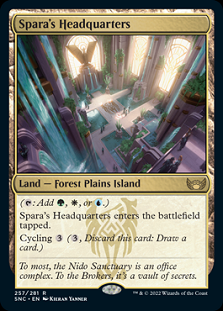
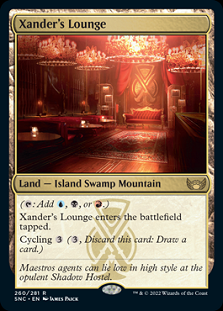
Let's start off easy. New Capenna is completing the cycle of triomes started in Ikoria with the enemy shards. The new triomes are not actually called trimoes, though, which feels like a mistake. We're all already calling them allied triomes and no other option was ever possible. I realize that such names don't fit into the overall set aesthetic, but they're already mechanical anomalies. Shards may be the theme, but there's no other cycling in the set. Just embrace the awkwardness and move on.

In any case, the new triomes are guaranteed to see Modern play. Because they're basically free with fetchlands and have proven to be essential for 3+ color decks. However, I wouldn't call them Modern staples. Every deck that needs a triome can really only afford to one run of each type, as aptly demonstrated by 4-Color Blink. That said, the impact on the 4+ color decks will be minor. Their mana is already basically perfect. Additional fixing is an incremental improvement at best.

The key members of this cycle are Spara's Headquarters and Xander's Lounge. Slow Bant and Grixis decks are always popular (especially in a churning format) but rarely stick. Card power is rarely the problem, but somehow both shards always seem to have mana trouble. Which is especially weird for Bant when Noble Hierarch exists, but that's my experience. The smoothing will assuredly reignite the hopes of all the Bant and Grixis Control players. Which will be crushed because both decks are still worse than 4-Color and Grixis Shadow respectively.

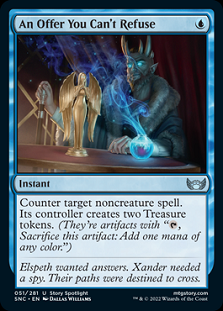
An Offer You Can't Refuse

There was no way Wizards could make a gangster themed set and not include the most iconic line from the most iconic gangster movie of all time. There would have been riots. I preorganized one as a precaution. Thankfully, Wizards saw reason and there can be peace between us. For now.

While the card doesn't quite live up to its namesake, it's still very compelling. Countering any noncreature spell for one mana is an insane rate. It makes multiformat role-player Spell Pierce look silly in comparison. Which is certainly why Wizards slapped a fairly steep drawback onto Offer. Severe enough to undermine playability substantially, in fact.

Ramping the opponent is not good. It's why Path to Exile rarely sees maindeck play now that an alternative cheap white removal spell exists. Offer doesn't provide permanent ramp like Path does and makes two treasures instead. Which is in some ways much stronger. Decks don't always have basics for Path, but as Ragavan, Nimble Pilferer has shown, any deck can use Lotus Petals to facilitate a big turn. Or just keep mana open.

Used As Intended

Consequently, Offer's utility is quite limited. But it is far from zero. There are plenty of times against combo decks that having a one-mana hard counter is invaluable, nay, essential. And late game against a control deck the treasures are unlikely to matter as mana isn't an issue in the late game. However, in either case, Offer would have to be countering 3+ mana spells to be worthwhile in terms of mana efficiency.

There was an error retrieving a chart for Ad Nauseam

Thus, despite what I implied earlier, Offer won't be replacing Pierce. They fulfill very different roles. Pierce is a tempo card, perfect for decks that need early counters to get ahead or protect a narrow lead. Offer is only viable in the late game or against combo decks. Whether this will come up enough to really matter I can't say. But having the option is very welcome.

An Interesting Alternative

However, what if instead, Offer was a ramp spell? A lot of the buzz I've seen around Offer has focused on countering Mishra's Bauble turn 1 and then playing Urza, Lord High Artificer turn 2. Or any other four mana spell, really. The potential is fairly staggering, as the only other way of getting to four mana on turn 2 is Arbor Elf into Utopia Sprawl. Which locks such a deck in to being heavily green-based. Offer does that for blue decks. And acceleration is always powerful.

There was an error retrieving a chart for Mishra's Bauble

In this case, I don't think the power is justified by the investment. For that to work requires both Bauble (or another 0-mana noncreature spell, technically) and Offer on turn one. The odds of that are roughly 16% on the play, 20% on the draw. Meaning such a combo is an incidental advantage rather than something to build a deck around. At least with Elf and Sprawl, the cards still ramp on their own.

Even if the combo is pulled off, that four-drop had better be pretty backbreaking, because a lot of resources just got dumped into it. Offer isn't really a ramp spell; it takes two actual cards and turns them into treasures. Treasures that won't be on the field to power up Urza's construct token or whatever else is the payoff afterward. Furthermore, how is ramping with Offer better than using Emry, Lurker of the Loch and Mox Amber? At least Emry digs for Amber, making the combo more consistent. Although I suppose this hypothetical deck would be running both engines.

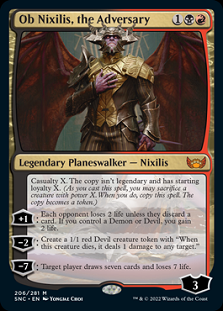
Ob Nixilis, the Adversary

The other heavily discussed card is the new Ob Nixilis. Three mana planeswalkers are always worth considering for pure value for mana. And on face, Ob stumbles. A Griselbrand activation is a Griselbrand activation, but the other two abilities are quite weak. The plus is technically disruptive but will always yield the least destructive outcome. Devil tokens are fine, but not impressive on their own. Thus, Ob just doesn't do very much and probably isn't a Modern card.

The reason to consider Ob is the casualty ability. For the cost of a creature with power, Ob copies himself. A three mana walker with mediocre abilities is not Modern playable. Two mediocre walkers for three mana just might be. The best part is that the abilities synergize: -2 the higher loyalty Ob first, then +1 the other to maximize value. However, the intention is clearly to sacrifice a 7+ power creature so that the copy can immediately be ultimated. And drawing 7 for three mana (and 7 life) is extremely good value.

The Catch

The question must be asked: are those 7 cards going to end the game faster than a 7-power creature? While that's not impossible, I have a hard time believing that 7 new cards will win the game where a giant Murktide Regent wouldn't. The board would have to be completely stalemated, where losing the 7 life can't put you at risk of immediate death. And worth remembering: the other consistently played high power creature in Modern is Death's Shadow. When Shadow has 7 power, ultimating Ob is literal suicide.

There was an error retrieving a chart for Murktide Regent

It's also worth remembering that sacrificing a big creature is taking a huge risk. If the copy gets countered, the original Ob isn't much of threat, but you lost a big threat for no gain. I don't see many situations were going all-in like that is optimal or even necessary.

Think Smaller

That doesn't mean that Ob can't be good. Just set ambitions lower. Sacrificing a 1/1 token is far less burdensome, and there's already a decent deck in Modern that wants to be doing that for value: RB Sacrifice. While I have no idea what to cut to make Ob fit, he does fit the gameplan. Making 1/1s that sac for value and incrementally chipping away at the opponent are already things the deck wants to do. Seems plausible.

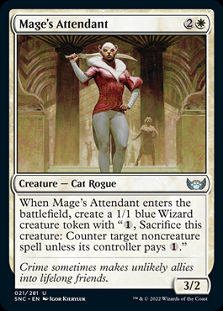
Mage's Attendant

Here's a card that I really like, but I don't think the metagame's right for it. Mage's Attendant is a lot of card at a good rate. Four power in two bodies for three mana is decent in Modern, and I've played Blade Splicer to great effect here. However, that's not enough for Attendant to see play. Rather, it's the token that's intriguing.

Despite being a blue wizard, the token is the first mono-white countermagic in years. While it may not fly, the ability hitting any noncreature spell pushes it beyond Judge's Familiar in power and utility. Of course, costing a mana to activate is quite the burden, but were the metagame filled with combo decks or Izzet Phoenix-style velocity decks, Attendant combined with Ephemerate could prove a nightmare.

Of course, that's not the metagame we have right now. Attendant might be an absolute beating against UR Murktide, but most of the other decks are so creature-based that the token would struggle to be relevant. I really want this to be good in Death and Taxes, but I don't think this is the time. That time may yet come so I'll definitely be picking up a set.

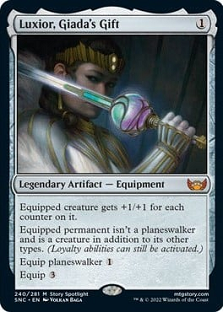
Luxior, Giada's Gift

I'd planned to end the article there, but while I was writing, Luxior was spoiled. And players went a little nuts over it. For one thing, it's a 1 colorless mana artifact and findable with Urza's Saga. That makes anything playable. For another, it allows controlling Stoneblade decks to turn their planeswalkers into threats and bodies to hold other equipment. Bodies that are no longer attackable. And damage doesn't reduce loyalty counters since they aren't planeswalkers anymore. Players immediately had visions of UW Sagablade winning by swinging with Jace, the Mind Sculptor.

And that is a very attractive vision. However, reality check: Luxior is exchanging vulnerability to attack with vulnerability to creature removal. All creature removal. Which I'd say is far more relevant than the combat step for a strategy with Wrath effects. Now, the possibility exists to drop Luxior on a high-loyalty walker and attack for lethal, and in some situations that won't be bad. However, a high-loyalty walker is almost certainly within range of its ultimate, and those usually win the game. Why bother turning on an otherwise dead Terminate? Except to win the game before time expires, I don't think that's worth it.

A Better Alternative

On the other hand, I do think Luxior will see a lot of Modern play. It just won't be attached to planeswalkers a lot of the time. For starters, Luxior combines with Devoted Druid to produce infinite mana. While more expensive than Vizier of Remedies and not findable with Collected Company or Chord of Calling, it is less vulnerable to removal and the combo fits into any deck with green mana.

There was an error retrieving a chart for Devoted Druid

While there really aren't green Saga decks right now, players will absolutely try to fit this combo into any deck alongside a combo payoff card. Will it be good? I don't know. Druid combo doesn't see much play as it is, but perhaps that was down to relying on a 2/1 to work. Perhaps Luxior and Saga will turn things around.

Wisdom From the Gutter

Spoiler season is less than a week old but Modern has got a slew of interesting cards to consider. And it isn't often that a printing potentially revives an entire archetype. We might be looking at quite the set here.

An Ode to Enchant Worlds

Are you a Quiet Speculation member?

If not, now is a perfect time to join up! Our powerful tools, breaking-news analysis, and exclusive Discord channel will make sure you stay up to date and ahead of the curve.

I don’t always keep up with all the new reprints and set releases that Wizards of the Coast puts out each and every week. There are simply too many to keep track of, so I try to prioritize my focus on the newest Standard set so I can familiarize myself with the Limited environment.

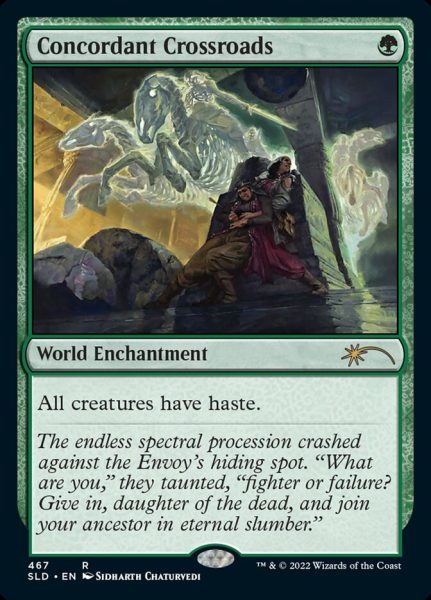
But last week, something stood out that grabbed my attention for longer than the typical three seconds I spend on each MTG spoiler. Behold, the Secret Lair reprint of Concordant Crossroads:

Why did this card catch my interest? Because it is a reprint of an Enchant World—which is like an enchantment, except that only one can exist in play, so if any player plays a different Enchant World, the first one is buried. You can read about the official rules of the Enchant World here.

It’s a fairly outdated ability, and you don’t see it on card text anymore these days (kind of like banding or flanking) with few exceptions.

You may have even thought that Concordant Crossroads was on the Reserved List if you didn’t see this reprint. I wouldn’t blame you—many Enchant Worlds are. But this one last got printed in Chronicles, making it ineligible for Reserved List status.

This week, I want to examine some of the best, worst, and craziest Enchant Worlds in Magic’s history—some are worth grabbing, others could potentially get a reprint treatment, and others still are so bizarre they merit their paragraph of fame just to bring them to light.

The Good (and Valuable)

Let’s begin with the strongest, most impactful World Enchantments. Concordant Crossroads surely belongs on this list, as it likely has popularity in some Commander decks. But because of its reprint in Chronicles, this Enchant World is far from the most valuable out there.

That title belongs to The Abyss.

There was an error retrieving a chart for The Abyss

This Legends Enchant World will cost you about $1,000, and that’s just for a heavily played copy! Nicer copies go up from there, making this the king of all Enchant Worlds. Honestly, I can’t remember ever seeing this card in play in a game of Magic, but it must have some niche following, possibly in Old School. It is a Legends rare on the Reserved List so that could be enough.

The other very pricy Enchant World is also from Legends: Nether Void.

There was an error retrieving a chart for Nether Void

This one I have seen cast once before, in a Legacy match about a decade ago. Still, it shares many common characteristics with The Abyss that make it so valuable. It’s a Legends Reserved List rare, has a powerful effect that likely draws attention from Old School players and collectors, and it even shares the same casting cost!

A couple other Reserved List Legends Enchant Worlds round out the most valuable in existence: Living Plane, In the Eye of Chaos, and Field of Dreams. Each of these are significantly less powerful than the big two black Enchant Worlds mentioned above, but they have relevant effects and are Reserved List rares from Legends. That’s definitely enough to make them stand out value-wise. Field of Dreams is a favorite of mine simply due to its art—one of these days I’m going to combine it with Ghoulcaller's Bell in Commander.

Outside of Legends, the Enchant Worlds are far less impressive (and valuable). In fact I suspect the next tier of Enchant Worlds from a value standpoint are also from Legends: Storm World, Gravity Sphere, and Chronicles Reprint Revelation. But I want to at least give honorable mention to one playable Enchant World that wasn’t in Legends.

Check out Tombstone Stairwell:

There was an error retrieving a chart for Tombstone Stairwell

This Enchant World from Mirage actually sees a scant bit of Commander play, and plays nicely into a Zombie theme or a ā€œcreatures in the graveyardā€ theme. Is it the most powerful thing you can do in Commander? I highly doubt it. But it’s a neat card with an interesting effect, and its status as Reserved List rare is enough to make this a solid $20 card.

The Bad

The Legends Enchant Worlds really stand out as being the most impactful in a game of Magic. But Enchant Worlds were printed across a few other early expansions, and some of them are not nearly as relevant when cast in a game of Magic. Let’s examine a couple of the most clunky, worst Enchant Worlds out there.

For instance, Forsaken Wastes strikes me as a rather unimpressive card.

There was an error retrieving a chart for Forsaken Wastes

Let’s see, for three mana you have an Enchant World that stops players from gaining life. Ok, that is pretty decent in certain aggressive decks (though life gain is a little less relevant in formats where you start with 40 rather than 20). Each player loses a life during their upkeep—we’ve seen effects like this before as well, usually in red. That last ability—the one where Forsaken Wastes causes any opponent who targets it with a spell to lose 5 life—makes it a little bit better, but it's still not very desirable in my opinion.

Another underwhelming card is Null Chamber. In a world with effects such as Meddling Mage, Council of the Absolute, Gideon's Intervention, Nevermore, and Voidstone Gargoyle, I don’t see how the symmetric effect of Null Chamber is worthwhile. If it was a four mana Enchant World that let only its caster name a card it would be far more interesting. But you and an opponent each name a card that then can’t be cast. I suppose in a multiplayer game of Commander, you could team up with an ally to gang up on a third player, so it’s not a completely useless effect. But there’s a reason Tombstone Stairwell, also from Mirage, is $20 whereas Null Chamber is $1.

Even worse than Forsaken Wastes and Null Chamber are two others I want to mention: Pillar Tombs of Aku from Visions and Winter's Night out of Alliances.

The former gives way too much flexibility to opponents—either they sacrifice a creature (Diabolic Edict) or they pay five life. That alone would be decent, except if they pay the five life then you have to sacrifice Pillar Tombs of Aku! A four mana, sorcery-speed Diabolic Edict that gives your opponent options is not what I consider a strong card. Don’t forget that if they do sacrifice a creature then this card becomes a terrible Innocent Blood, because you also have to sacrifice a creature or else pay five life and sacrifice Pillar Tombs of Aku. Just awful.

Winter's Night is one of those ā€œsnow mattersā€ cards. Even if you’re playing Ice Age and Alliances Limited, this card is far too narrow to be relevant. Its casting cost is also awfully prohibitive—this may go down as the worst Enchant World ever printed.

There was an error retrieving a chart for Winter's Night

The Obscure (and Underutilized)

Lastly, I want to touch briefly upon a couple Enchant Worlds that I feel don’t get enough love.

I used to love Chaosphere as a kid. It has limited utility, but can wreak havoc on a game of Commander—suddenly it’s like flying creatures don’t fly and non-flying creatures do. That’s not the literal text, but that’s kind of what the card achieves in terms of blocking. I always found that a neat effect.

There was an error retrieving a chart for Chaosphere

If you don’t like Chaosphere, you could always just jam Mystic Decree to simply shut down flying (and islandwalk while you’re at it) altogether.

Elkin Lair is one of my favorites, and I actually do play a copy in my casual red Commander deck. It basically forces action, or else players will have to slowly discard cards from their hand until there are none left. I don’t think it’s all that inspiring, but it is pretty decent at hosing counterspell effects.

One of the most underplayed Enchant Worlds has got to be Homelands Reserved List card Koskun Falls. I’ve written about this one before—if Propaganda and Ghostly Prison are so popular in Commander, then a black version should be equally in-demand. Granted, with Koskun Falls you have an upkeep cost whereas you don’t with Ghostly Prison effects. However, the upkeep cost is relatively small in the grand scheme of things. Besides, it combos beautifully with King Macar, the Gold-Cursed so what is there not to like?

There was an error retrieving a chart for King Macar, the Gold-Cursed

The last one I’ll mention this week is Teferi's Realm, a bizarre, symmetric Enchant World that gives players an opportunity to phase out all cards of a given type during their turn. While the card takes some work to exploit, I feel like there are some cases where ensuring your opponents have no creatures, artifacts, lands, or enchantments during your turn would have payoffs. The card becomes even more interesting in multi-player games, where you may have more than one card type phased out over the course of your opponents’ turns. Just be careful choosing creatures, as your opponents’ creatures will phase back in before yours do!

Wrapping It Up

Enchant Worlds were not all that complicated—I’m disappointed Wizards of the Coast moved away from the card type after the first few early expansions. Maybe with the Secret Lair printing of Concordant Crossroads, Wizards of the Coast is hinting that they may print new ā€œWorld Enchantmentsā€ (as they’re called in modern-day Magic) in an upcoming set.

In the meantime, I’ve enjoyed this walk down memory lane into some of the game’s best, worst, and most interesting Enchant Worlds of the past. Some are extremely valuable, some are largely useless, and there are a few in between that have some corner-case utility in the right deck. Hopefully this article highlighted a few interesting Enchant Worlds you weren’t aware of, that struck your fancy.

In the end, if I can convince just one more player to sleeve up an Enchant World in their Commander Deck to try, I’d consider this article a success.

Adjusting Downward: March ’22 Metagame Analysis

Are you a Quiet Speculation member?

If not, now is a perfect time to join up! Our powerful tools, breaking-news analysis, and exclusive Discord channel will make sure you stay up to date and ahead of the curve.

Welcome to a new series of articles for Insiders here on Quiet Speculation. This will be the companion article to my Modern Metagame Updates where I do the non-statistical analysis of the data that there's no room for in the data article. I'll be looking at what happened in March, why I think it happened, and then extrapolating on where the metagame is going. Hopefully this will help those looking to buy into Modern or simply provide context for where the card market is heading.

Eventually I intend to include graphs to help track the trends I'll be discussing. It won't be happening right away as this is monthly data, and a single data point is not a trend. We need at least three for that to be relevant and more to be valid. So for this month it'll just be March in a vacuum.

The Outlier's Story

The first subject is that outlier result. For UR Murktide to do well is not remotely surprising. It's never been below Tier 2 since arriving with Modern Horizons 2. However, this is the second time that it's been an outlier, which has never happened since I started keeping track of outliers. And frankly, if it had happened back-to-back, I'd be quite concerned. Given that the first time was in November and that in the intervening months Murktide's been Tier 2 a decent amount of the time, I'm confident saying that this is just a flux in the data.

There was an error retrieving a chart for Murktide Regent

Keep in mind that the previous two best decks (Hammer Time and Grixis Shadow) were both impacted by the Lurrus ban. Murktide was not, which would lead to an increased metagame share. With them down, their old rivals can rise. Couple that with both Hammer and Shadow being two harder matchups and seeing less play and Murktide should have done better this month. However, I'd only expect that to push it to the top of Tier 1, not over it. This plus Murktide's history suggest something else is to blame here.

Popularity Contest

Ultimately, the answer is that UR Murktide is a very popular deck. However, leaving it at that is incorrect. If Murktide was merely a popular deck boosted by the nerfing of its peers, it would not have been an outlier 5 months ago. The fact of the matter is that there are two largely unrelated factors that played into March's anomaly.

There was an error retrieving a chart for Dragon's Rage Channeler

The first is that the Lurrus ban put many players off non-Murktide Ragavan, Nimble Pilferer decks. Murktide was the only deck which consistently played Ragavan and didn't play Lurrus. Yes, Ragavan does show up in any deck that plays red, but not consistently. Both Jund Saga and Grixis Shadow leaned on Lurrus for their late game, and without Lurrus, players have lost confidence in the decks. Which is absurd; Jund Saga has been falling off for months, while Shadow is doing perfectly fine in paper. The lists may not be optimized anymore, but the strategy itself is still strong.

However, players feel like they're weak enough to abandon. They're not just going to abandon Ragavan as a strategy. They've shelled out too much cash for that. Instead, they're shifting to the remaining Ragavan deck. Grixis Shadow's stock list did significantly overlap with Murktide's. The Jund players have it harder, so I'd expect fewer took this route. Consequently, Murktide ending up getting extra shares from disaffected Grixis players.

There was an error retrieving a chart for Delver of Secrets

The other factor is that Murktide is a tempo deck of the thresh variety, and those are generally very popular. See also Standard mono-Blue Tempo and Delver of Secrets in Legacy. However, these decks are deceptively hard to play. Players like winning with cheap threats, drawing cards, and countering spells. Few appreciate how hard it is to navigate a deck with a low threat count that never wants to play from behind. Consequently, many players will rush to said tempo decks without understanding how to play them.

Looking Ahead

Consequently, UR Murktide will fall off in April. It did last time and there's no indication that anything's changed. Indeed, there are already indications that it is overplayed and suffering. Last weekend, ManaTraders held a Modern tournament, and the most popular deck by far was UR Murktide. However, that didn't translate into a tournament win, and Murktide's conversion rate was quite poor. Meanwhile, at the NRG series 20K, Murktide barely showed up and those that did failed to perform. This will put players off the deck.

The lack of tournament results will likely be compounded by players returning to their old decks, particularly Grixis Shadow. There's nothing inherently wrong with the deck, it just took a hit and needs some rebuilding. That process is starting to bear fruit and I suspect many players will have their faith restored. There will also be those that just get frustrated and put the deck down for being too hard to play.

Opportunity Falters

However, I don't believe that downswing will translate into a noticeable price change. At least, that's how I'm reading the tea leaves. Murktide Regent has shown remarkable price stability since August, which I doubt will change. It's been hovering around $20 for most of its life with a recent spike into the mid-20's reflecting increased popularity. I'd anticipate a fall back toward old levels if everything plays out as expected. It's too useful in too many decks in Modern and Legacy for players to sell them off. The same goes for the other deck staples.

Ragavan, on the other hand, is a possibility, but it comes with caveats. Rags has shown a high degree of price instability since it was printed, and that's unlikely to stop. Depending on month and store, Rags can be anywhere between $70-$90. I don't know why this is happening, but I suspect that banning fears are playing a factor. Rags in banned in Legacy, it could happen in Modern. Thus, I've observed a lot of players buying Ragavan, playing for a while until Ragavan decks (the whole group) start doing well, and then selling them off in fear of an incoming ban.

There was an error retrieving a chart for Deathrite Shaman

I don't think that is likely to happen in the near future. However, Ragavan's power is close enough to Deathrite Shaman's that it's plausible. Players may panic-sell their Ragavans during April; they may not. What will happen is that the price will continue fluctuating regardless of the interpretation of the data. There's certainly on opportunity for arbitrage and profit playing the Ragavan market. But I'd be incredibly careful.

A Cascade of Value

The other headline for March was that both cascade decks (Cascade Crashers and Living End) were Tier 1 decks. This is significant as it's never happened before. However, it's also hardly surprising. Both were affected by the recent ban the same as Murktide, only more so. Grixis Shadow's combination of counterspells, discards, and a fast clock is the classic anti-combo recipe, giving it a decent matchup against both cascade decks. Shadow's displacement, even if it's temporary, was an opportunity for them to make a run.

There was an error retrieving a chart for Shardless Agent

Living End has the additional advantage of being well positioned at the moment. It's a true combo deck, where Crashers is mostly fair. Crashers's biggest advantage is its consistency, which lets it reliably out-tempo and/or overwhelm less consistent decks. Living End actively disrupts opposing creature decks with its combo. And looking at the current tier list, the field is ripe for just that. UR Murktide is the only true counterspell deck in Composite Tier 1. Crashers as well as 4-Color Blink tend to only have Force of Negation maindeck. Additionally, graveyard hate is limited to what can be found off Urza's Saga. It was the right time for both decks.

The Unseen Giant

There is sometime deceptive about the data in this update. Taking each deck on its own gives the impression that Murktide is standing on its own as the clear best deck. In fact, the top decks for the past few months seem to stand alone above the rest of the metagame. Which is only partially true. It's not that any individual deck is misrepresented, but rather that my naming practices have separated out a deck that perhaps shouldn't be.

There was an error retrieving a chart for Omnath, Locus of Creation

The primary difference between 4-Color Blink and 4-Color Control is that the former runs Ephemerate and the latter doesn't. The lists tend to be otherwise indistinguishable. Playing Ephemerate does alter gameplay sufficiently to justify the distinction in my mind, but I get challenged on this decision constantly. And the challengers have a point, because if Blink and Control's shares were merged, then Blink would be the second-ranking deck online and would have made Tier 1 in paper.

If I were to then add in Tribal Elementals (a far more distinct deck that is nevertheless based on the same core of Omnath, Locus of Creation, Solitude, and Fury), then the archetype of Omnath moneypile suddenly outstrips nearly every other deck. This month it would rival Murktide's overall share and substantially changes the outlier tests. Consequently, Omnath is both the card and the deck to watch in the upcoming months.

The Market Checks

Having the mana to play all the best cards means that these decks have few weaknesses. Normally, that would lead to a deck seeing increasing metagame share and moving decisively up the tier list. That isn't happening with Omnath pile for two reasons.

The first is cost. The moniker "money pile" is well-deserved. A cheap 4-Color Blink deck costs $1500 in paper and $1100 online. Most hover around $2000. Elementals is in the same boat. Getting a good 4C Control list for $2000 would be quite a bargain, most are around $2500. That is far beyond the average player's budget and also far beyond the rental limits online. A deck can't put up numbers without players and a prohibitive cost prevents a deck attaining its potential metagame share in an open field. Though cost tends to be a non-issue for the best players. Part of what allows them to be "the best" is that Magic is quite high on their priorities list, yielding not just more practice time but a bigger TCG budget.

There was an error retrieving a chart for Solitude

Speaking of the Omnath players, they're the second problem. They cannot decide on which configuration they want for their deck. Some deviation is to be expected for any deck and that will be worse for a multi-colored pile that can play anything. Why not run every pet card?

However, in this case, they can't decide whether Control or Blink is better. Every month, one of them does better than the other. In January, Blink outpaced Control online. In February, Control beat Blink. It's reversed again in March. This seesawing is probably necessary as the metagame changes, but it definitely puts players off and inhibits deck mastery.

Opportunity Persists

That being said, Omnath pile is the deck that I believe has the most growth potential within the metagame and consequently the most investment potential in Modern. Other decks have certain cards with growth potential should the deck take off, but Blink and Control are just piles of staples. Even should Omnath get banned (unlikely, but not impossible) all the rest will hold their prices. Should the deck start to take off, demand will push the prices of the key card (the elementals, namely) significantly higher.

Change in Coming

That said, there is a new set release at the end of the month and there are early indications of Modern staples. The allied shard Tri-lands are already confirmed, and that will improve the 4-Color decks by a measurable amount. Whether there will be any more impact is currently unknown, but it needs to be kept in mind.

Hocus Pocus: How to Cast a Spell

Are you a Quiet Speculation member?

If not, now is a perfect time to join up! Our powerful tools, breaking-news analysis, and exclusive Discord channel will make sure you stay up to date and ahead of the curve.

Magic would be pretty boring if nobody ever did anything but play lands. Luckily, lands often make mana, and mana lets us do one of the best things in Magic: cast spells! This is a pretty bulky subject, so this week I'll cover the basic steps of casting a spell. Next week I'll dive into some of the clever, weird, or downright bad things we can do with these rules.

For an extra look at the nitty-gritty of these rules, check out CR 601.

Step 1: Cut a Hole Put the Spell on the Stack

Players usually cast spells from their hands. However, several effects let us cast things from other zones. Haakon, Stromgald Scourge lets us cast Knight spells from the graveyard; Garruk's Horde lets us cast creature spells from the top of the library. Luckily, it doesn't matter where we want to cast the spell from. Step one is always moving it from wherever it is to the stack.

Step 2: Choices For the Spell - Modes, Alternate Costs, Etc.

This rule covers basically anything the game considers a "choice" (except targets; that's the next step). This is where we have to choose relevant modes for Cryptic Command. Want to cast Capsize with its additional buyback cost or evoke a Solitude? That also happens here!

We'll also choose any relevant values for {X} in this step. If we're casting a spell that has Phyrexian mana in its mana cost, this is where we determine if we want to pay with mana or life.

Step 3: Targetting Systems Engaged

Modes and alternative costs coming before targets makes a lot of sense. After all, if I cast a Cryptic Command, the chosen modes determine what can be targeted, or if anything must be targeted at all.

Critically, an object can only be the target of an object once for each instead of the word "target." For example, Dual Shot can't kill Grizzly Bears, since Shot can only target the Bears once. On the other hand, if I want to cast Decimate targeting my opponent's Myr Enforcer as the target creature and target artifact, I can do that. The ensuing double-destruction becomes relevant (and useful) if it's been, say, regenerated by a Welding Jar. Regeneration only saves permanents "the next time" they would be destroyed, not the next two times!

Step 4: Divide and Conquer

Short and to the point: this rule is the point of casting a spell where we divide things as we choose. Usually, this means distributing damage or counters amongst a spell's targets.

Of note, spells that let a player change targets don't let them change the distribution of the effect. Let's say I cast Magma Opus assigning 3 damage to Nessian Courser and 1 to Eager Cadet. My opponent Deflecting Swats the Opus. While they can change both targets of the Opus, they can't redistribute the damage - one target must take 3, and one target must take 1.

Step 5: Final Legality Check

After we've done everything above, the game checks one more time and asks, "Can you really cast this spell?" Sometimes, a proposed spell becomes illegal because of choices we've made during its announcement. For instance, everybody's favorite cat Lurrus of the Dream Den lets us cast a spell with mana value 2 or less from the graveyard. I can start to cast Stonecoil Serpent, but if I try to make {X} 3 or greater, this rule steps in and stops the cast. Since my Serpent's mana value is larger than 2, Lurrus no longer grants me permission to cast it.

If it turns out that a spell's proposal is illegal, the game rewinds to just before the announcement started. Any mana abilities are undone, and the spell goes back to the zone it was in before.

Step 6: It's Almost Time to Pay the Piper

If the spell survived the legality check, it's time to tally up our debts. This can include mana costs or alternate costs like pitching cards (March of Otherworldly Light) or sacrificing creatures (Village Rites). This step is also where cost increasing or decreasing effects come in. As I mentioned a few weeks ago, keep in mind that any of these increases or decreases don't actually affect the spell's mana value. That is, Colossus Hammer cast into an opponent's Thalia, Guardian of Thraben still has a mana value of 1.

When totaling up the spell's mana cost, apply any cost increases first, then any cost reductions. After that's done, Trinisphere steps in if it needs to. Even with Thalia in play, you still won't be paying more than 3 for that Hammer; Thalia bumps it up to 2, then Sphere to 3.

Importantly, once we're done figuring out the spell's cost in this step, it's "locked in." Nothing we do in the next two steps can affect what was determined here.

Step 7: Activating Mana Abilities

This is the last chance to activate mana abilities before we start making payments. Notably, the total cost must actually include a mana payment in order to activate mana abilities here. For instance, casting a Mishra's Bauble doesn't let you activate any mana abilities, because it doesn't require a mana payment.

Step 8: Actually Paying!

Finally, we get to wrap things up! We pay the total cost of the spell, which we determined in step 6. We can pay the total cost in any order - sacrifice the creature first, or pay the mana first. Unpayable costs can't be paid, which, yeah. Obviously. That's the first and second rule of tautology club.

Step 9: The Grand Finale

Once we've made it through all the other steps, effects that modify the spell as it is being cast (such as that of Yidris, Maelstrom Wielder) are applied, then the spell is at last cast. At this point, any abilities that trigger when a player casts a spell trigger and are put onto the stack.

Cleanup

Understanding the steps of casting a spell can be pretty important. While we didn't get to dive into too much "why" this time, join me next week for a look at some of the weird and wild predicaments we can encounter during the many steps of casting a spell.

If you have any specific situations you want to be explained (that don't involve Panglacial Wurm), feel free to find me on Twitter or our Insider Discord.

Until next time.

Question of the week: What's the cleverest thing you've ever done casting a spell?

The Best Thing To Ever Happen To Digital Magic: SpellTable

Are you a Quiet Speculation member?

If not, now is a perfect time to join up! Our powerful tools, breaking-news analysis, and exclusive Discord channel will make sure you stay up to date and ahead of the curve.

"Digital" Magic: The Gathering

When I first heard about SpellTable I thought "Oh this sounds great, I can't wait to play Magic remotely!" But then life happened. Throughout the last couple of years, I have had to move several times, switch jobs, and restructure my entire life. Finally, after what I hope is my final move for several years I have been able to partake in many hours of SpellTable. Was it worth the wait?

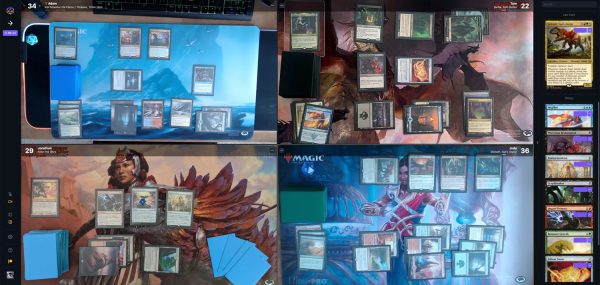
SpellTable In Action

What Exactly Is SpellTable?

Well if you believe the headlines it's "Remote Magic Made Easy!" Using a webcam or smartphone SpellTable can recognize real paper cards played on your tabletop which you can click. Once selected a card appears in the right-hand margin for easier reading. There's also audio built-in but I have played with someone who used an index card and the camera to indicate choices made on their turn! Originally a fan project appealing to players unable to enjoy Magic during Covid quarantine, SpellTable was subsequently purchased by Wizards of the Coast.

What Does SpellTable Cost?

SpellTable is available to play for the astonishingly low price of FREE. Yes, you heard that right: really, truly, free. It is my opinion, among others, that Arena is one of the LEAST GENEROUS free-to-play digital card games, ever. With SpellTable, a better free Magic experience is now available. You can even use Moxfield and OBS to play without any physical cards. Yes, read that AGAIN. For absolutely ZERO DOLLARS you can play digital Magic with paper Magic players over the internet. Amazing!

What Can You Play On SpellTable?

Every. Format. Ever. Mic drop. Yes, because SpellTable is physical Magic: the Gathering, you can play pretty much every format. Want to play Archenemy or Planechase? You can do that! Want to play with any of the Un- sets? You can do that! Two-Headed Giant? Yep! Standard? Easily! Want to test Modern decks? No problem!

By and large, Commander is the vastly most popular format on SpellTable. There are about a dozen games up almost 24 hours a day. The number of players for all formats tends to swell during the weekend but I am pleasantly surprised with just how many people are playing even at crazy hours. Also, there are a lot of players from all over the world which I think is awesome.

What Is The Experience Like?

Let me blow your mind. It's great! You are basically playing paper Magic. Tables tend to be very social and there is a lot of latitude when playing anything not labeled as "competitive." Even in competitive games, there is a certain amount of leeway required for playing remotely. Most game lobbies suggest a numeric range for the approximate power level of your deck but many also include stipulations such as "no infinite combos," "no extra turns," or "no holds barred." If there are elements you don't want to see in your games simply add that fact to your game description.

Power Level? What The Heck?

The power level range is, theoretically, one through ten. The scale does a very poor job of approximating what decks should or should not be played at any given table though. I've never seen any tables that use decks at the one through three ratings or the ten rating. I've only seen the four rating used a few times. How powerful are decks at these levels? I generally assume decks are either merely stacks of cards and not much of a deck at the low levels, or a cEDH tuned ten out of ten. While there are plenty of games marked as competitive/cEDH, if you are not using 50% of the numbers on a scale, to me, that's a flawed scale. My advice is to play what you believe are your weaker decks unless the games are labeled as competitive. In that case, you should play your best deck. Gradually, you will get a very rough approximate feel for the power level of decks others are bringing to the table.

Still Confused On Power Level?

Essentially, the scale boils down to, I would say, three actual ratings. The first is decks with no real "wincon" or end game. Here, players just want to tap lands and cast spells. Most of the pre-con decks also fit here. These decks are a five or six on the typical SpellTable scale. Next up, are decks that have wincons and are trying to win, but are not completely competitive decks. They are either deliberately de-powered, or competitive decks in the making waiting to upgrade cards. These two decks typically fill the seven or eight spots on the scale. That leaves nine as cEDH or tournament experience decks.

To say that most players have very subjective ideas of deck power is one thing but to experience it is another. However, by and large, most tables are very friendly and will discuss power level pre-game to make sure everyone is approximately on the same page. It really is that simple. If you think your deck might be too powerful or too weak then ask the table if you can switch or if others would be willing. Most players are very accomodating on non-competitive tables. If you need a little more about having a Rule Zero conversation at a table, take a look at my article here.

This All Sounds Great! Are There Any Downsides?

Unfortunately, there are a couple of issues that SpellTable cannot overcome in the near term.

Space The Final Frontier

Number one, it requires a LOT of playing space. Some players may disagree with me on this and suggest that you can play on your normal desktop surface. While I've seen pictures of SpellTable setups that look compact, for me that's not nearly enough room and I cannot imagine I would be alone in this need.

My current setup is far from ideal, but the fact that I must have a camera suspended over a medium-sized table requires a fairly large footprint. Further, while you could theoretically have a wireless mouse, wireless keyboard, and wireless headset, a PC monitor likely needs to be nearby. That means your PC needs to be nearby. Remember that footprint I talked about? Don't forget any other accessories you may want within easy reach like decks, dice, tokens, and so on.

Lighting is also tremendously important. Too much light reflecting on cards can result in them being impossible to see both by your eyes and by SpellTable. Not enough light can cause the same. Again, without a dedicated space for this kind of thing, I'd say your results may vary considerably.

While it is unfortunate, I cannot imagine this kind of setup would be very accessible to absolutely everyone. The barriers to entry are not high, which is great. However, I cannot think everyone that plays Magic is enough of an enthusiast that they can devote so much space to a single hobby.

Theft Effects

Number two, while most cards work the same in person as remotely there are a significant number of cards that work quite a bit less well. I'm talking about cards that reveal information only to you such as Duress and cards that reveal AND steal like Villainous Wealth or Gonti Lord of Luxury.

Physically you can just pick the cards up and look at them, being careful not to show anyone else at the table. Remotely? It's not super practical. The one upside of this is that you are sure to get table talk for these types of decisions. Since Commander is intended to be a social game this can be a lot less of a drawback than suggested but for ultra purists or competitive players seeking practice, these issues could be deal-breakers.

For me, I compare this to the downsides of playing on Arena or MTGO. Both of those games approximate paper Magic but fail in many ways. The interfaces for both are lacking. The timer systems for both are not accurate to paper play as you can execute many things in real paper games flawlessly that you can't easily accomplish in digital, like infinite loops. Playing digitally offers no shortcuts for such situations. Add awkward priority systems to multiplayer for Commander and you have a less than stellar gameplay experience. That is on MTGO. There is no multiplayer on Arena and no Commander as we usually think of it. There is 1v1 Brawl if you count that experience, but it's lacking, to say the least. In my opinion, SpellTable easily trumps both of the current digital offerings by a wide margin, with many more upsides, and just a couple of corner cases where it's a little awkward to play.

Should I Try SpellTable?

Absolutely without any hesitation, yes. Do your best with whatever setup you can manage. If you have not played paper Magic in ages and you enjoy Commander do yourself a favor and try SpellTable out! It's the freest of free! And who knows, maybe I will bump into you in a game?

Have you tried SpellTable? How did you like it? Let me know your experience with it in the comments.
Avatar photo

Joe Mauri

Joe has been an avid MTG player and collector since the summer of 1994 when he started his collection with a booster box of Revised. Millions of cards later he still enjoys tapping lands and slinging spells at the kitchen table, LGS, or digital Arena. Commander followed by Draft are his favorite formats, but, he absolutely loves tournaments with unique build restrictions and alternate rules. A lover of all things feline, he currently resides with no less than five majestic creatures who are never allowed anywhere near his cards. When not Gathering the Magic, Joe loves streaming a variety of games on Twitch(https://www.twitch.tv/beardymagics) both card and other.

View More By Joe Mauri

Posted in Arena, Commander, Free, Magic Digital Next, Magic: The Gathering Arena, MTGOTagged , , Leave a Comment on The Best Thing To Ever Happen To Digital Magic: SpellTable

Have you joined the Quiet Speculation Discord?

If you haven't, you're leaving value on the table! Join our community of experts, enthusiasts, entertainers, and educators and enjoy exclusive podcasts, questions asked and answered, trades, sales, and everything else Discord has to offer.

Want to create content with Quiet Speculation?

All you need to succeed is a passion for Magic: The Gathering, and the ability to write coherently. Share your knowledge of MTG and how you leverage it to win games, get value from your cards – or even turn a profit.

Real-world Flavor: Horror-Themed Quotes From the Legends Expansion

Are you a Quiet Speculation member?

If not, now is a perfect time to join up! Our powerful tools, breaking-news analysis, and exclusive Discord channel will make sure you stay up to date and ahead of the curve.

Then flashed the living lightning from her eyes,

And screams of horror rend th’ affrighted skies.

Alexander Pope

When we consider cards with real-world flavor, Legends is by far the most represented set, containing 41 unique cards with flavor texts from real-world authors. We've dealt with a good number of them so far in this series, but not with all of them. Legends took inspiration from a multitude of different genres, so it's not easy to find a common flavor theme connecting all the cards.

Horror is an easy theme to pick up on if you study the cards in the set with real-world inspired flavor. 14 of the 41 cards with real-world flavor quotes in Legends are black cards. It's natural that those cards would feature frightening illustrations and flavor texts as a consequence. Today we'll take a look at some of those cards and their flavor choices.

Cosmic Horror

There was an error retrieving a chart for Cosmic Horror

Then flashed the living lightning from her eyes,

And screams of horror rend th’ affrighted skies.

Alexander Pope, The Rape of the Lock, 1702

In the early years of the game's development, many Magic cards were given generic names. Cosmic Horror is a prime example of this. The expression "cosmic horror" is so generic that it now refers to a whole subgenre of horror, both in literature and other media. It is often used as a synonym for "Lovecraftian horror,", both of which rely on the power of the unmentionable and the incomprehensible. Interestingly, there is no direct quotation from Lovecraft, neither here nor on other Magic cards.

Cosmic Horror is a beautiful card, and it lives up to its name. It was not easy to create art for a card with such an important name, but the illustration by Jesper Myrfors is appropriately horrific. As for the flavor text, it quotes a poem by Alexander Pope, The Rape of the Lock, a celebrated example of the mock-epic genre. The scene is that where the curl of the title is trimmed, and the "screams of horror" are the immediate reaction to such villainy. If you know the poem, this card gets really funny, as you can appreciate the distance between the tremendous image and the parodic text.

Headless Horseman

There was an error retrieving a chart for Headless Horseman

… The ghost rides forth to the scene of battle in nightly quest of his head …

he sometimes passes along the Hollow, like a midnight blast …

Washington Irving, The Legend of Sleepy Hollow, 1820

Where Cosmic Horror tapped into the essence of its namesake genre, Headless Horseman, on the other hand, makes use of a much more traditional kind of horror. It also continues the trend of cards with generic names. Some find this to be part of the charm of the old-school sets such as Legends. Wizards use generic names for cards very sparingly these days. Seeing it so prevalent here only adds to the nostalgic feelings of these cards.

First printed with the subtype Horsemen, it was later errated to be a Zombie Knight. Regardless of its creature type, it's still a mediocre card. As a 2/2 for three mana, it's almost a copy of Scathe Zombies, especially after the creature type changed. As we mentioned in the first article of this series, it's usually the most useless and unimpressive cards that receive the best flavor text. Headless Horseman is no exception.

the quotation comes from The Legend of Sleepy Hollow, the most famous gothic tale in English to feature such a monster. The original short story by American author Washington Irving has been retold and reimagined numerous times over the years. Even Disney made an appropriately creepy version of the story in 1949.

Hellfire

There was an error retrieving a chart for Hellfire

High on a throne of royal state …

insatiate to pursue vain war with heav'n.

John Milton, Paradise Lost, 1667

Paradise Lost by John Milton is one of the most renowned works ever quoted on a Magic card. Hellfire, a black mass creature removal sorcery feels like an appropriate home for the text. In the right deck, it can often work as a one-sided Wrath of God, though with a high price in damage dealt to the caster. Power with a price is what we've come to expect from black cards, and this is one of the earliest examples.

The quote here comes from the very beginning of Book 2. The subject of the sentence is no less than Satan himself. His name is omitted with an ellipsis, but the art by Pete Venters doesn't fail to give some clues about the identity of the figure. After all, who else might sit on a throne and be insatiable to pursue a war with heaven?

Horror of Horrors

There was an error retrieving a chart for Horror of Horrors

And a horror of outer darkness after,

And dust returneth to dust again.

Adam Lindsay Gordon, The Swimmer, 1870

Horror of Horrors, is another oddly generic name. This time, it does not refer to any famous creature. Instead, it's a weird enchantment that costs five mana and lets you regenerate black creatures by sacrificing Swamps. It was reprinted in Ninth Edition and has never seen much play.

The quote, is a couple of lines from The Swimmer, a poem by Australian poet Adam Lindsay Gordon. It's totally out of context and doesn't really make sense on the card. The only link I could see is between the concept of "dust to dust" and the ability to regenerate creatures in exchange for Swamps.

Shimian Night Stalker

There was an error retrieving a chart for Shimian Night Stalker

'Tis now the very witching time of night,

When churchyards yawn and hell itself breathes out

Contagion to this world.

William Shakespeare, Hamlet, 1603

Of the cards we are analyzing today, Shimian Night Stalker is one of my personal favorites. From the memorable art (once more by Jesper Myrfors) to the exceptional quote by Shakespeare, it's one of Legends' little flavor gems. Of course, from a gameplay perspective, the card is a failure. A costly 4/4 creature, its damage redirection ability has niche use at best. It's also oddly out of place on a black card. Damage prevention is typically a white ability.

The quote is from Hamlet's Act 3, Scene 2. It is among the most gothic speeches in the play. Hamlet himself is the speaker, reflecting on the lateness of the night. It's the time when "churchyards yawn and hell itself breathes out", i.e. midnight. The imagery is very suggestive and goes well with the weird creature illustrated by Jesper Myrfors.

The Abyss

There was an error retrieving a chart for The Abyss

An immense river of oblivion is sweeping us away into a nameless abyss.

Ernest Renan, Souvenirs d'Enfance et de Jeunesse, 1883

Let's close this installment with the famous card The Abyss. By far the most expensive card of this series, The Abyss is on the reserved list and has always maintained a high price tag. It's a four mana enchantment which destroys a creature at the beginning of each player's upkeep. The card is at its best when played in a creature-less deck, or one with animable lands such as Mishra's Factory. Pox decks are a great example.

The flavor text is an excerpt from one of French philosopher Ernest Renan's last works. In the English-speaking world, it's known as Recollections of My Youth. The sentence quoted is a little vague, but interesting. It nicely complements the illustration by Pete Venters.

Conclusion

Legends contains many cards with real-world flavor texts. today we looked at a subset of them sharing a horror theme. What do you think of these quotes compared to similar quotes we saw in the Poe and Coleridge articles? Looking at the subset of these cards which share a horror theme is just one of the many possible approaches to analyzing all the real-world flavor texts in the set. In the next installments, we will analyze more cards from the set. What other common threads or patterns do you think we will find? Let me know in the comments or on Twitter!

The Post-Lurrus World: March ’22 Metagame Update

Are you a Quiet Speculation member?

If not, now is a perfect time to join up! Our powerful tools, breaking-news analysis, and exclusive Discord channel will make sure you stay up to date and ahead of the curve.

While banning Lurrus wasn't exactly burdensome for any deck, the rules of engagement in Modern have been changed sufficiently that it still represents a clean break from the old metagame. No infinite grinding with Mishra's Bauble means decks have to compete on more traditional card advantage axes. For better or worse, depending on the deck.

The ban also means that I had to throw out the first week of data. Again, the pre-ban metagame is an entirely different reality to the current one and isn't comparable. Thus, the data set is smaller than February's, and rather significantly so; consequently, there are some oddities that might not have made it through otherwise.

Outlier Alert!

March's data is further affected by an outlier. UR Murktide outstripped the rest of the field by a significant margin. It was larger online than in paper, but not by much. When I did my statistical tests, online was very clearly over the line in outlier territory. Paper Murktide was closer to the line thanks to the spread of the paper data. Regardless, both results were not used when I was making the tiers. Their data is still reported and they're in their correct place on the tiers but didn't impact the overall analysis.

There was an error retrieving a chart for Murktide Regent

I also feel compelled to remind everyone that this is not a Tier 0 situation. Outliers never qualify for that distinction just for being statistical outliers. True Tier 0 decks like Hogaak or Eldrazi Winter blow the rest of the competition by far wider margins and do so month after month. March 2022 is just a blip that will most likely subside. Remain calm!

March Population Metagame

To make the tier list, a given deck has to beat the overall average population for the month. The average is my estimate for how many results a given deck ā€œshouldā€ produce on MTGO. Being a tiered deck requires being better than ā€œgood enough.ā€ In March the average population was 4.63 setting the Tier 3 cutoff at 5 decks, which is well below the yearly average but makes sense given the short month and the outlier.

There was an error retrieving a chart for Lurrus of the Dream-Den

Tier 3 begins with decks posting 5 results. Then we go one standard deviation above average to set the limit of Tier 3 and cutoff for Tier 2. The STdev was 6.40, which means that means Tier 3 runs to 12 results. Again, it's the starting point to the cutoff, then one above for the next Tier. Therefore Tier 2 starts with 13 results and runs to 20. Subsequently, to make Tier 1, 21 decks are required. This, again, is quite low for post-MH2 Modern, but given the everything about March it's nothing to read into.

The MTGO Tier Data

I mentioned that March's data was down significantly thanks to all the data that got thrown out. January had 502 decks, February had 436 decks, and March only hit 356. But for the ban, March would have at least surpassed February between the Wizards and independent events that closed on or before March 7. I had to throw out a few more league-type events because they began before the ban and didn't change their decks before finishing.

Despite that, there was still a high amount of diversity present. The overall amount of unique decks were down to 68, February's 82 but that's not too shabby under the circumstances. Normally, a banning will bring out the brews and Modern will get pretty wild the following month. It's a little subdued this time since Lurrus wasn't as fundamentally integral as Uro, Titan of Nature's Wrath was. That said, more decks made the tier list this time, 16 compared to February's 15, which is good given the low population.

Deck NameTotal # Total %
Tier 1
UR Murktide4612.92
Cascade Crashers277.58
Hammer Time246.74
4-Color Blink236.46
Living End226.18
Tier 2
Amulet Titan174.78
Yawgmoth154.21
UW Control133.65
Tier 3
Burn123.37
MG Tron123.37
Grixis Shadow123.37
Dredge113.09
4-Color Control113.09
Tribal Elementals82.25
Titanshift51.40
Goblins51.40

Despite taking a hit, Hammer Time is still a Tier 1 deck. Just not format-definingly so, and I think that's good. Hopefully it lasts. What's particularly interesting this month is both cascade decks making Tier 1. Living End and Cascade Crashers have not been in the same tier since...(checks through the archive)...I don't think ever. Odd that they suddenly would right after Lurrus is banned.

The Paper Tier Data

The paper tiers are calculated the same way as the MTGO tier, just with different data. While more paper events are represented in the data, they rarely report more than the Top 8 (sometimes less). However, that doesn't mean that the population is lower. Thanks to a deluge of events in March, the paper population is much higher than online with 506 recorded decks, beating January's online numbers. Paper really is back. The number of unique decks is also much higher with 83. I don't have many months of data to draw from, but I hypothesize that paper should always be more diverse than online.

Paper's average decks were 5.55, meaning the starting point is 6 decks. The STDev is 7.81, so Tier 3 runs from 6 to 14 decks. Tier 2 begins with 15 decks and runs to 23, and Tier 1 requires 24 decks. I still have no idea how representative of "normal" paper Magic these stats are.

Deck NameTotal # Total %
Tier 1
UR Murktide5110.08
UW Control346.72
Cascade Crashers336.52
Amulet Titan326.32
Burn295.73
Grixis Shadow244.74
Tier 2
Hammer Time214.15
Living End203.95
4-Color Control193.75
Yawgmoth173.36
Tier 3
Tribal Elementals132.57
8-Cast112.17
Ponza101.98
MG Tron91.78
Esper Reanimator91.78
Jund81.58
4-Color Creativity81.58
Merfolk81.58
Mono-Red Moon71.38
Hardened Scales71.38
Goblins61.19
Hollowvine61.19
Izzet Prowess61.19
Eldrazi Tron61.19

It continues to perplex me how different the paper results are from MTGO. The difference in playerbase size as well the regional effect certainly play in, but I'd expect that any regional inclinations would balance out and produce a result more similar to MTGO. That has consistently not happened so far. I have some theories, but they're just theories. I'll be investigating this difference further.

March Power Rankings

Tracking the metagame in terms of population is standard practice. But how do results actually factor in? Better decks should also have better results. In an effort to measure this, I use a power ranking system in addition to the prevalence list. By doing so, I measure the relative strengths of each deck within the metagame. The population method gives a deck that consistently just squeaks into Top 32 the same weight as one that Top 8’s. Using a power ranking rewards good results and moves the winningest decks to the top of the pile and better reflects their metagame potential.

There was an error retrieving a chart for Crashing Footfalls

For the MTGO data, points are awarded based on the population of the event. Preliminaries award points for record (1 for 3 wins, 2 for 4 wins, 3 for 5) and Challenges are scored 3 points for Top 8, 2 for Top 16, 1 for Top 32. If I can find them, non-Wizards events will be awarded points the same as Challenges or Preliminaries depending on what the event in question reports/behaves like. Super Qualifiers and similar higher-level events get an extra point and so do other events if they’re over 200 players, with a fifth point for going over 400 players. There were three 4 points events in February and no 5 pointers.

The MTGO Power Tier

As with the population numbers, points in March were down from February, from 779 to 668. Fewer events, fewer points. The points drop-off follows the population decrease well enough that it is explanatory. Despite some very large Preliminaries trying to make up the differential

The average points were 8.66. Therefore 9 points makes Tier 3. The STDev was 12.46, which again is on the lower end of normal. Thus add 13 to the starting point and Tier 3 runs to 22 points. Tier 2 starts with 23 points and runs to 36. Tier 1 requires at least 37 points. There was a lot of adjustment from population inside the tiers this month. Also, Goblins fell off the power charts, replaced with Mono-Red Prowess and Eldrazi Tron.

Deck NameTotal # Total %
Tier 1
UR Murktide8813.17
Cascade Crashers588.68
4-Color Blink487.19
Hammer Time446.59
Living End446.59
Tier 2
Amulet Titan324.79
Yawgmoth253.74
Grixis Shadow243.59
UW Control233.65
Tier 3
Burn213.14
MG Tron213.14
Tribal Elementals213.14
Dredge192.84
4-Color Control182.69
Titanshift101.50
Mono-Red Prowess101.50
Eldrazi Tron91.35

In an unusual move, no tier shrunk this month. Usually Tier 2 gets squeezed by the brackets, but not this time. There's no explanation.

The Paper Power Tiers

Unlike with population, the paper power data works differently than the equivalent MTGO data. Again, the data is usually limited to Top 8 lists, even for big events. Not that I know how big most events are, that doesn't always get reported. In other cases, decks are missing. SCG Con Indianapolis had a Modern 5ks and numerous smaller events, but decks were missing from the Top 32 and the smaller events reported anywhere from 5 to 21 decks for no obvious reason. Applying the MTGO point system just doesn't work when I don't know how many points to award.

Thus, I award points based on the size of the tournament rather than placement. That way I'm being internally consistent with the paper results. When there's a Modern Pro Tour again (THEY'RE BACK!!!) it would qualify for 3 points, as would Grand Prix or whatever the GP equivalent will be. The calculations are the same as with online results. The SCG 5k and one of the side events awarded 2 points. The Hunter Burton Memorial Open was this month, and it has always been treated like an SCG Open or GP, so it awarded 3 points. A side event from the HBMO awarded 2.

The average points were 7.41. Therefore 8 points makes Tier 3. The STDev was 10.62, thus add 11 to the starting point and Tier 3 runs to 19 points. Tier 2 starts with 20 points and runs to 31. Tier 1 requires at least 32 points. There was actually quite a bit of movement in and out of Tier 2 with paper.

Deck NameTotal # Total %
Tier 1
UR Murktide679.93
Amulet Titan507.41
UW Control436.37
Burn416.07
Cascade Crashers405.93
Living End324.74
Tier 2
Grixis Shadow314.59
Hammer Time263.85
4-Color Control263.85
Yawgmoth263.85
Tier 3
Tribal Elementals152.22
8-Cast152.22
Ponza121.63
Esper Reanimator121.78
4-Color Creativity101.48
Goblins101.48
MG Tron91.33
Jund91.33
Merfolk91.33
Izzet Breach Combo81.19
Hardened Scales81.19
UW Urzablade81.19
Eldrazi Tron81.19

Average Power Rankings

Finally, we come to the average power rankings. These are found by taking total points earned and dividing it by total decks, which measures points per deck. I use this to measure strength vs. popularity. Measuring deck strength is hard. There is no Wins-Above-Replacement metric for Magic, and I'm not certain that one could be credibly devised. The game is too complex, and even then, power is very contextual. Using the power rankings certainly helps and serves to show how justified a deck’s popularity is. However, more popular decks will still necessarily earn a lot of points. Which tracks, but also means that the top tier doesn't move much between population and power, and obscures whether they really earned their position.

There was an error retrieving a chart for Ragavan, Nimble Pilferer

This is where the averaging comes in. Decks that earn a lot of points because they get a lot of results will do worse than decks that win more events, indicating which deck actually performs better. A higher average indicates lots of high finishes, where low averages result from mediocre performances and high population. Lower-tier decks typically do very well here, likely due to their pilots being enthusiasts. So be careful about reading too much into the results. However, as a general rule decks which place above the baseline average are overperforming and vice versa. How far above or below that average determines how "justified" a decks position on the power tiers are. Decks well above baseline are therefore undervalued while decks well below baseline are very popular but aren't necessarily good.

The Real Story

When considering the average points, the key is looking at how far-off a deck is from the Baseline stat (the overall average of points/population). The closer a deck’s performance to the Baseline, the more likely it is to be performing close to its ā€œtrueā€ potential. A deck that is exactly average would therefore perform exactly as well as expected. The greater the deviation from average, the more a deck under- or over-performs. On the low end, a deck’s placing was mainly due to population rather than power, which suggests it’s overrated. A high-scoring deck is the opposite.

I'll begin with the average for MTGO:

Deck NameAverage PointsPower Tier
Tribal Elementals2.633
Mono-Red Prowess2.503
Eldrazi Tron2.503
Cascade Crashers2.151
4-Color Blink2.091
Living End2.001
Grixis Shadow2.002
Titanshift2.003
UR Murktide1.911
Amulet Titan1.882
Hammer Time1.831
UW Control1.772
Burn1.753
MG Tron1.753
Baseline1.74
Dredge1.733
Yawgmoth1.672
4-Color Control1.643

Cascade Crashers is the highest performing Tier 1 deck and therefore the March 2022 MTGO deck of the month. The averages are extremely high thanks to the effect of the big events. Most of the decks at the top of the chart only appeared in the Challenges, Super Qualifiers, and Showcase Challenge. They didn't have many Preliminary results to temper their numbers.

Onto the paper averages:

Deck NameAverage PowerPower Tier
Goblins1.673
Living End1.601
Izzet Breach Combo1.603
UW Urzablade1.603
Amulet Titan1.561
Yawgmoth1.532
Baseline1.41
Burn1.411
4-Color Control1.372
8-Cast1.363
Esper Reanimator1.333
Eldrazi Tron1.333
UR Murktide1.311
Grixis Shadow1.292
UW Control1.261
4-Color Creativity1.253
Hammer Time1.242
Cascade Crashers1.211
Tribal Elementals1.153
Hardened Scales1.143
Jund1.133
Merfolk1.133
Ponza1.103
MG Tron1.003

I think it's significant that both the paper and online metagames have a cascade deck as the best performer. The fact that Living End beat Cascade Crashers in paper is surprising. The metagame doesn't look more favorable on its face, suggesting that this preferences at work. That Crashers didn't perform well in paper may be instructive, but it's worth saying that it didn't show up at SCG Indianapolis.

Composite Metagame

That's a lot of data, but what does it all mean? When Modern Nexus first started, we had a statistical method to combine the MTGO and paper data, but the math of that system doesn't work without the big paper events. I tried. So, I'm using an averaging system to combine the data. I take the MTGO results and average the tier, then separately average the paper results, then average the paper and MTGO results for the final placement.

This generates a lot of partial Tiers. That's not a bug; it's a feature. The nuance separates the solidly Tiered decks from the more flexible ones and shows the true relative power differences between the decks. Every deck in the paper and MTGO results is on the table, and when they don't appear in a given category they're marked N/A. This is treated as a 4 for averaging purposes.

Deck NamePaper Population TierPaper Power TierAverage Paper TierMTGO Population TierMTGO Power TierAverage MTGO TierOverall Tier
UR Murktide1111111
Cascade Crashers1111111
Hammer Time2221111.5
Amulet Titan1112221.5
UW Control1112221.5
Living End2221111.5
Grixis Shadow121.5322.52
Burn1113332
Yawgmoth2222222
4-Color BlinkN/AN/AN/A1112.5
4-Color Control2223332.5
Tribal Elementals3333333
Mono-Green Tron3333333
Jund3333333
Goblins3333N/A3.53.25
Eldrazi Tron333N/A33.53.25
Mono-Red Moon3N/A3.53333.25
4-Color Creativity333N/AN/AN/A3.5
Ponza333N/AN/AN/A3.5
Esper Reanimator333N/AN/AN/A3.5
Hardened Scales333N/AN/AN/A3.5
8-Cast333N/AN/AN/A3.5
Merfolk333N/AN/AN/A3.5
DredgeN/AN/AN/A3333.5
TitanshiftN/AN/AN/A3333.5
UW UrzabladeN/A33.5N/AN/AN/A3.75
Izzet Prowess3N/A3.5N/AN/AN/A3.75
Mono-Red ProwessN/AN/AN/AN/A33.53.75
Izzet Breach ComboN/A33.5N/AN/AN/A3.75

Murktide and Crashers are the only fully Tier 1 decks in March to the surprise of no-one who's been paying attention so far. 4-Color Blink not appearing at all on the paper standings drops its aggregate place significantly, but that happened Online last month, so maybe it's just lagging behind. We'll see.

An Evolving Modern

The format's composition looks broadly similar to the old one. It doesn't appear that Lurrus decks were uniquely keeping any decks out, though it was unequivocally key to many decks' strategies. Grixis Shadow will attest to that. However, the question of what it all means and where this is heading is a question for another time. Specifically, this Friday when I'll do exactly that for all Quiet Speculation Insiders. Stay tuned!

Adam Plays Magic: Esper Control Alt Delete!

Are you a Quiet Speculation member?

If not, now is a perfect time to join up! Our powerful tools, breaking-news analysis, and exclusive Discord channel will make sure you stay up to date and ahead of the curve.

This week on Adam Plays Magic, we're diving into Standard with Esper Control. With Standard having a relatively small card pool, the goal for this build is simply to "play the good cards". No fancy aristocrat synergies, tribal mechanics, or frills here. Just pure, unadulterated rate on rares and mythics.

"Esper" might also be a bit of a misnomer, considering the core of the deck is very WB. In fact, the only blue spell in your main deck is Kaito Shizuki and the only blue card in your sideboard is a single Disdainful Stroke. Thanks to the Pathways and Slowlands, it's extremely easy to afford a splash color without hampering your ability to cast your other spells.

Under the Hood

Esper's primary game plan is to resolve The Wandering Emperor, Lolth, Spider Queen, other planeswalkers to ride their card advantage to victory. It is supported by various wrath effects and spot removal like Doomskar and March of Otherworldly Light to keep its planeswalkers alive and well.

The objective is fairly straight forward, although control strategies like this are only as good as they are well-prepared. For example, this build is tuned with the mirror in mind, which is why there are multiple copies of Duress in the main deck. If I end up playing against mostly creature decks, that call will backfire. Similarly, I have multiple Portable Holes in the main deck, which line up poorly against decks playing Abrade and Prismari Command, but are phenomenal against Mono-White Aggro.

I don't believe the build I played was well-positioned against the five random decks we played against on the Arena Ladder, but that may not be representative of a tournament setting. My recommendation is not to play this exact 75. Instead, look at the playable spells you have access to and the decks seeing upticks in play at the time of your event, then modify your mainboard and sideboard accordingly.

What I'd Change

As mentioned above, I'd reconsider the number of Holes and Duresses. I'm also not sold on Reckoner Bankbuster in the main deck, or at least not at 3 copies. Standard is full of card advantage spells like Memory Deluge and Behold the Multiverse. If the goal is to keep something lower on the curve, Siphon Insight slots in well too. These may be better options for the main deck while reserving some sideboard space for Bankbuster.

Speaking of the sideboard, I think I'd prefer cards that are more targeted for specific matchups, rather than doubling down on general-use cards from the main deck. More counterspells like Negate or additional copies of Disdainful Stroke may be helpful in control and midrange matchups. Check for Traps may be pricier, but does cast a wider net than Duress. [card[Fracture[/card] can pinpoint the Runes deck and planeswalker-heavy strategies. If I'm concerned about opposing Wandering Emperors, Graveyard Tresspasser lines up very well and ward punishes opponents for looking at it crooked.

Another direction the deck can go is with a slight red splash to allow for Valki, God of Lies and Fable of the Mirror-Breaker. These cards are flexible and hit well above their weight class. We could also double down on the heavy black game plan for Invoke Despair. These high-powered haymakers grant the ability stabilize and turn the corner in ways the base-Esper deck struggles to.

The Deck

Esper Control

Spells

3 Doomskar
2 Duress
1 Emeria's Call
1 Infernal Grasp
1 Soul Shatter
3 March of Otherworldly Light
4 Vanishing Verse

Planeswalkers

1 Sorin the Mirthless
4 Kaito Shizuki
4 The Wandering Emperor
2 Lolth, Spider Queen

Creatures

1 Henrika Domnathi

Enchantments

2 The Meathook Massacre

Artifacts

3 Portable Hole
3 Reckoner Bankbuster

Lands

4 Brightclimb Pathway
4 Clearwater Pathway
3 Deserted Beach
1 Eiganjo, Seat of the Empire
2 Hengegate Pathway
2 Hive of the Eye Tyrant
4 Shattered Sanctum
2 Shipwreck Marsh
1 Plains
1 Swamp
1 Takenuma, Abandoned Mire

Sideboard

3 Archon of Emeria
1 Check for Traps
1 Disdainful Stroke
1 Doomskar
1 Duress
2 Farewell
1 Henrika Domnathi
1 Lolth, Spider Queen
3 Ray of Enfeeblement
1 Reckoner Bankbuster

End Step

And just like that, we've wrapped up another week! If you have any questions, comments, or deck suggestions, feel free to leave a comment here or tweet me at @AdamECohen. Don't forget to like the video and subscribe to the YouTube channel. As always, thanks for watching!

Driving Focus on New OP Speculation

Are you a Quiet Speculation member?

If not, now is a perfect time to join up! Our powerful tools, breaking-news analysis, and exclusive Discord channel will make sure you stay up to date and ahead of the curve.

After a couple years of floundering, uncertainty, and general discontent, high level paper Magic play is returning with a flourish! You can check out the announcement on WOTC’s site, here.

With multiple levels of competitive play, there’s a spot for all players to test their skills at Magic—from the regional championship qualifiers at their local game shops, all the way up to the World Championship event. It’s reminiscent of the old system in multiple ways, and that is very much a good thing.

Naturally, this is very exciting news for players. I suspect many preliminary events will evolve around Standard, Pioneer, and possibly Modern. There is once again a reason to actually build and maintain an arsenal of recently printed Magic cards! That means there’s once again hope that a little speculation on certain cards could lead to profits and an overall cost reduction for the game as a whole.

However, before you go rushing around to various online retailers speculating that every card that shows up in a Pioneer decklist will increase in price, take a moment to read through these three important reminders to help guide your buying.

Tip #1: Prioritize the Staples & Multi-format Allstars

I have not read up on the Modern or Legacy metagames lately, so I can’t describe any decklists or strategies that sreally stand out. What I can do, however, is check out data from MTG Stocks to investigate the most played cards in each of those formats. The most popular cards should also see the largest bump in demand and cards that show up on both lists are even more likely to climb due to a sudden surge in demand.

Interestingly enough, there aren’t many cards that appear on both Pioneer’s and Modern’s top 20 list. Without researching anything else, I can tell the two formats must provide very different experiences when playing. That said, there are a couple of key cards I want to hone in on.

First and foremost: lands. Lands lands lands. Namely, mana-fixing, two-colored lands are primary themes across both formats. Fetch Lands dominate in Modern, but in Pioneer you don’t have that option. Shock Lands are available in both formats and show up on both Top 20 lists. Pathways are also viable options, more so in Pioneer than Modern. There are also an array of Fast Lands that may be worth closer examination.

If you want to target some specific cards, I’d keep an eye on Steam Vents, Blood Crypt, Branchloft Pathway, and Botanical Sanctum.

There was an error retrieving a chart for Branchloft Pathway

Another card that caught my eye was Thoughtseize, which shows up in the Top 20 of both Modern and Pioneer lists. (It’s also the number 25 most played card in Legacy, though I don’t think Legacy demand is going to move the needle here).

There was an error retrieving a chart for Thoughtseize

This card has always been a staple no matter what format it’s legal in, so demand for the one mana discard spell is sure to increase as more players get back into paper Magic.

The last thing I’ll highlight is that some of these popular cards have fewer and/or older printings. These in particular may provide greater price upside, even if they aren’t the most played cards in a format. For example, Ragavan, Nimble Pilferer was printed relatively recently but only once at mythic rare, and its Modern demand has driven its price up toward $80. I see Fury is from the same set, also one of the most played Modern cards, yet sells for $27.

There was an error retrieving a chart for Fury

Granted, Fury may not be as versatile as Ragavan, but that is a large price differential for two similarly played cards.

A cheaper consideration may be Bonecrusher Giant:

There was an error retrieving a chart for Bonecrusher Giant

Other than appearing on The List, Throne of Eldraine is this card’s only printing. While it may be just a buck right now, this card proved to be dominant during its time in Standard and it could see a wave of new demand in Pioneer. Throne of Eldraine isn’t that old, but give it a couple years. If this one dodges reprint, it could climb steadily over that time.

Tip #2: Reprint Risk

Speaking of reprints, I was trying to browse the 50 most played Modern cards to find older cards that have never been reprinted. Guess what? There really aren’t any.

Sure, you could argue Teferi, Time Raveler has virtually never been reprinted because the Secret Lair version does little to add to supply. You could also argue that Fury and Ragavan, Nimble Pilferer were never reprinted. I suppose this is true. But Ragavan and Fury were just printed last year, in Modern Horizons 2, so it’s too soon for there to have been a reprint yet. Teferi was printed in War of the Spark, which is a little bit older (released May 2019), but that still not a ton of elapsed time.

There was an error retrieving a chart for Teferi, Time Raveler

The reality is, most format staples are getting the reprint treatment nowadays. That brings me to my second tip: when speculating on staples, be aware of the reprint risk. I’d highly recommend keeping a very narrow horizon on any cards you are buying for potential financial gain. There are frankly a ton of reprint avenues that Wizards has been tapping into in recent years, effectively taking some of that lucrative secondary market for themselves.

Of course that’s their right—it’s their game, after all. I’m not complaining about the reprints, and it does really make the game less expensive for players. It just means the traditional method of speculation on Modern staples is no longer so foolproof.

I’m not saying that Teferi, Time Raveler is a poor speculative target. It’s probably one of my favorites. But it is highly vulnerable to a reprint. As the card ages, it will see an increase in price as more players sleeve up copies for competitive paper Magic. And then one day it’ll show up in some sort of Masters set, or Commander product, or something else, and it’ll halve in price.

Until then, though, I think there’s some money to be made here. Just don’t buy a stack of cards and throw them in a shoebox for a few years—that strategy may not be nearly as lucrative as it once was.

Tip #3: A Rising Tide Lifts All Ships

I’ve discussed this concept multiple times in the past, so I’ll keep this section relatively brief. The basic concept is that, as card prices climb, it inflates the market capitalization of the Magic secondary market. This means player collections naturally rise in price, giving them more purchasing power (i.e. more value for trading).

While many will use this newfound value to trade into tournament staples for the new organized play system, others will instead trade their cards in for Commander staples, Old School favorites, or even Legacy cards. For example, imagine if Teferi, Time Raveler appreciated from $20 to $50 over the next couple years. A playset could suddenly be traded toward a heavily played, Revised Plateau. That could be tempting.

There was an error retrieving a chart for Plateau

Players who are still cracking booster packs of Modern Horizons 2 may be delighted to open a Ragavan, nearing $100 in price. They may choose to trade it in for Commander cards they’ve been wanting. Remember, the Reserved List is still a thing, and the idea of converting value from modern-day cards into collectibles that can never be reprinted is an attractive notion to some.

Then you can factor in the fact that large, in-person Magic events are probably making a comeback. That gives players a convenient opportunity to cash in some of their cards. If card prices climb due to newfound demand—as many are predicting—then in person events will enable players to trade up for the more expensive staples they’ve been eyeing. While the days of trading in a playset of a Standard staple for a piece of Power are long gone (years ago, a set of Jace, the Mind Sculptors could be traded in for a piece of HP Unlimited Power), one could imagine a world where a Pioneer card set could get you a Dual Land. Or maybe even a Mox Diamond or a Gaea's Cradle. To some, this may be a very attractive proposition.

There was an error retrieving a chart for Gaea's Cradle

For this reason, even if you don’t care at all about Pioneer or Modern, you should still be excited for the new Organized Play announcement. Whenever there’s more interest and demand for paper cards, it bodes well for the secondary market as a whole. It may take longer for the effect to trickle up toward Reserved List staples, but it is likely to happen eventually. Unlike newer, reprintable cards, Reserved List cards can be thrown in a closet for a few years for financial reward (it’s one of the things I like most about collecting older cards!). If you’re a passive collector like myself, this could be the best of both worlds.

Wrapping It Up

I’m very excited about the new Organized Play announcement from Wizards of the Coast. The opportunity for players all around the world to compete in person for real cash prizes is very healthy for Magic because it drives up demand for singles. When singles are worth more, then booster packs are more desirable to open. When people open more booster packs, it sells more product for Wizards. In the end, everyone wins.

This is why I expect card prices to climb in the coming months, especially on Pioneer and Modern staples that see the most play. I leveraged MTG Stocks for my list of hot cards, but there are probably other sources with some valuable data. I’d encourage you to tap into those other resources and develop your own strategy for cards to acquire.

My advice is to focus on cards with multi-format demand, and if possible, find cards that haven’t been reprinted a ton. Staples from Modern Horizons and Modern Horizons 2 may be worth focus. Teferi, Time Raveler seems well-positioned. Thoughtseize is a permanent staple in every format. And, of course, lands are always great pickups—especially Shock Lands, Pathways, and Fast Lands.

My only caution is that a narrow time horizon may be required for some of these plays to dodge reprint. Granted, some cards are more likely to avoid near-term reprint than others, and that should be taken into consideration. But Wizards has shown their proclivity for reprinting cards these days, so you can’t just throw cards in a shoebox for a few years and expect every staple to make you money. Diversification can help reduce risk.

Lastly, don’t forget that the rising tide will eventually lift all ships. If you prefer to deal in longer time horizons and don’t want to bother following metagame evolution, you could do a lot worse than to trade your tournament staples into Reserved List Commander cards. Chances are, others will be doing the same thing, meaning prices are likely to continue climbing over time.

No matter how you play the recent news, times should be bright for Magic in the near future. I look forward to a new wave of interest, new players, and new demand as the greatest game ever approaches its third decade of existence!

Playing Tempo: Hacking Into Pauper Faeries

Are you a Quiet Speculation member?

If not, now is a perfect time to join up! Our powerful tools, breaking-news analysis, and exclusive Discord channel will make sure you stay up to date and ahead of the curve.

When my local game store announced they were starting monthly Pauper events, I quickly dove into metagame reports and my commons box to figure out what I wanted to play. No other deck in the format appealed to me quite as much as Dimir Faeries. Tempo has long been my favorite archetype in any format, and Faeries has traditionally been one of the best decks of the archetype, if not the best deck in various formats over the years.

From dominating its era of Standard to being a mainstay of the old Extended format, Faeries has made a name for itself. Even without signature rare cards like Bitterblossom and Mutavault allowed in the mix, Faeries is still a heavy hitter in Pauper thanks to its workhorse:

The power of Spellstutter Sprite is its versatility. A cheap counterspell, an evasive threat, or a surprise blocker, Spellstutter can shape or turn the tide of any game. The one-drop Faerie Seer teams up well with Spellstutter, allowing it to level up what it can counter. Seer also sets up your draws and provides an early clock. While these are the two cards giving the deck its name, the rest of the creatures typically found in the deck are notable partly because they aren't Faeries.

Non-Faerie Creatures in Dimir Faeries

The Faeries list typically plays around 18 creatures. In addition to Sprites and Seers, that includes:

  • 3 Ninja of the Deep Hours
  • 2-3 Thorn of the Black Rose
  • 2 Gurmag Angler
  • 4 Augur of Bolas

Ninja of the Deep Hours: Early Clock and Card Advantage

Ninja of the Deep Hours plays great with a team of faeries. It represents a source of card advantage and a better clock than either Spellstutter or Seer. Returning either of those cards to hand via ninjutsu, and allowing them to be played again, makes their value go that much further.

Faeries is a mana-hungry deck. It doesn't just want to play threats on its own turn. It also wants to hold up mana to react with countermagic and removal spells on its opponent's turn. The weakness of Ninja is when it gets stranded in your hand. Casting it for its full cost, and not its ninjutsu cost, runs cross-purpose to what the deck is trying to accomplish.

Thorn of the Black Rose: Mid- to Late-Game Card Advantage

Where Ninja always feels bad to cast for four mana, sinking that amount into Thorn of the Black Rose has an opposite effect.

Thorn, like the Ninja, is a repeated source of card advantage, if you're The Monarch. Where you want to be ninjutsu-ing in your Ninjas in the early game, Thorn ideally comes down in the mid- to late-game, when you've run your opponent low on cards in hand that could potentially answer it. It also blocks very well on the ground, allowing you to hold down the fort while your faeries attack in the air.

Gurmag Angler: The Finisher

With all the cheap creatures and interaction in the faeries deck, the graveyard gets filled quickly. And such a stocked graveyard in turn enables cheap Gurmag Anglers. The dream is to back the big fish with countermagic until it's able to enter the red zone. It's not hard to close out a game with Gurmag once ahead.

Augur of Bolas: The Odd One Out

A non-faerie that doesn't attack well feels like a weird include for this deck. Add that it can miss on netting a card some percentage of the time, and I'm not a huge fan. But is there something better? To me, one of the strengths of the Faeries deck is playing the tempo strategy. If we lean into that, a card I've had great success with in Kamigawa: Neon Dynasty Limited quickly springs to mind:

Moon-Circuit Hacker plays well into the Faeries tempo plan. It ninjutsus for only one mana, letting pilots connect on turn two and immediately replay their one-drop post-combat. In later turns, Hacker can be cheated in while sparing precious interaction mana for the opponent's next turn. Its hardcast mana value of two also makes it less likely to get stuck in hand the way Ninja of the Deep Hours can in lieu of an attacker.

Incorporating Moon-Circuit Hacker into Faeries

If we're going to play Moon-Circuit Hacker alongside Deep Hours, it means we're planning on ninjutsu-ing as early as possible. It feels natural to add more one-drops to the deck and ensure we're able to enact our game plan. With that in mind, I included a full four Faerie Seers in my list, as well as another one-drop that supports the strategy:

Assuming it doesn't immediately die to removal, Changeling Outcast being an unblockable creature guarantees getting through to activate our ninjas on turn two. It also has added value in stealthily being a faerie, improving our Spellstutter Sprites. This is the list I played at my local game store's Monthly Pauper event:

Dimir Faeries - Tabletop Gaming Center Monthly Pauper: 8th Place

Creatures

4 Faerie Seer
1 Changeling Outcast
4 Spellstutter Sprite
3 Moon-Circuit Hacker
3 Ninja of the Deep Hours
2 Thorn of the Black Rose
2 Gurmag Angler

Spells

4 Preordain
3 Brainstorm
4 Counterspell
4 Cast Down
1 Devour Flesh
1 Suffocating Fumes
4 Snuff Out

Lands

4 Ice Tunnel
2 Ash Barrens
2 Evolving Wilds
10 Island
2 Swamp

Sideboard

2 Annul
2 Dispel
3 Hydroblast
2 Sea Sprite
2 Chainer's Edict
2 Suffocating Fumes
2 Relic of Progenitus

What Went Right

Going for a more tempo-oriented approach led to some very explosive draws. Hacker plus one-drop in the opening forced opponents into interacting early lest I get ahead on cards. Being able to cast Hacker for two in a pinch was also good.

What Went Wrong

Out of a field of 22 players, I scraped together a 3-2 record. My last round opponent generously conceded game three in the face of my board position when we went to time. Games where I didn't draw or play my early-game threats on time were uphill battles. That's certainly one of the advantages of Augur over Hacker. Augur can come down in the mid to late game and still try to help you dig for answers or card selection spells. Hacker is a little less exciting played to an empty board when you and the opponent are in topdeck mode.

Playing extra x/1's also made the deck soft to Electrickery and Suffocating Fumes. It was important to hold up countermagic to hedge against those or risk getting blown out. Makeshift Munitions from the Affinity and Boros decks was another must-counter that could not be interacted with once it resolved.

The biggest mistakes in this build felt like the absence of Echoing Decay and other interaction to generate value. Pauper is a very value-oriented format. Every card needs to either generate card advantage or add some other incremental value to the board (treasure, clues, etc.). The lack of Decay in the 75, or Echoing Truth and Reaping the Graves in the sideboard, made it difficult to fight the value plays other decks brought to the table.

Changes Going Forward

I want to continue experimenting with this list for a little longer before reverting to the stock build. I definitely need Decay and the other cards mentioned above somewhere in the list. Six Ninjas feel like a good number, but I might opt for a four-two split favoring Hacker over Deep Hours. As I explained, the drawbacks of Hacker are very real. Still, there are fewer chances of it getting stuck in your hand, and it contributes to some of the best openings the deck can produce, so it feels worth the risk.

I had Sea Sprites in my sideboard for the red matchups, but they proved more cute than practical. Those will likely get cut for Reaping and Truth. I've seen a few lists with Okiba-Gang Shinobi in the sideboard and might try one of those as well.

Pauper Is Great Right Now

If you enjoy competitive constructed Magic, I think Pauper is the best constructed format to play right now. Post-bans, there are a number of viable decks, and a ton of interaction available, making every game exciting. The gameplay feels like the best parts of Vintage, Legacy, and Modern, without the price tags involved in those formats.

What do you think? Are you enjoying Pauper? What changes would you make to this list to keep playing ninjas? I would love to hear from fellow Pauper fans in the comments or on Twitter.

Want Prices?

Browse thousands of prices with the first and most comprehensive MTG Finance tool around.


Trader Tools lists both buylist and retail prices for every MTG card, going back a decade.

Latest Magic Sets

Quiet Speculation