
menu

The Cycle Continues: February `22 Metagame Update

Are you a Quiet Speculation member?

If not, now is a perfect time to join up! Our powerful tools, breaking-news analysis, and exclusive Discord channel will make sure you stay up to date and ahead of the curve.

Here's something I haven't done in a long time: the February metagame update! Given that I do one of these articles every month, that statement might seem disingenuous, but it's true. Last February there was no metagame update because Valki, God of Lies and Tibalt's Trickery were so egregious it was obvious that a ban was incoming. Which ultimately rendered the data meaningless. Here we are a year later with no new bans, and that calls for a new metagame article!

And as part of the celebration, the scope of the update is expanding. Last month, I brought in paper results for the first time since 2020. However, it was only population data. There weren't big events for me to award extra points for anything. There have been bigger events in February, and they even reported enough data so that I can do a points system! It's not quite the same as the MTGO system, but I'll get to that. For now though, simply rejoice that I can fully report on the overall metagame rather than a slice.

February Population Metagame

To make the tier list, a given deck has to beat the overall average population for the month. The average is my estimate for how many results a given deck “should” produce on MTGO. Being a tiered deck requires being better than “good enough.” In February the average population was 5.32 setting the Tier 3 cutoff at 6 decks, which is lower than typical but does make sense in context.

There was an error retrieving a chart for Urza's Saga

Tier 3 begins with decks posting 6 results. Then we go one standard deviation above average to set the limit of Tier 3 and cutoff for Tier 2. The STdev was 9.78, which means that means Tier 3 runs to 16 results. Again, it's the starting point to the cutoff, then one above for the next Tier. The STdev was much lower this month, and is one of the lower ones I've ever had. There were fewer singleton decks proportionately than most months, which shrunk the range and lowered the deviation. Therefore Tier 2 starts with 17 results and runs to 27. Subsequently, to make Tier 1, 28 decks are required. This, again, is quite low for post-MH2 Modern, however it didn't substantially alter the usual outcome.

The MTGO Tier Data

February being a short month, one would expect that the population represented would be lower. Fewer days means fewer posted events to include. And one would be right. January had 502 decks, which is slightly below average. February only musters 436 decks, which is low for typical months but again, February is a shorter month. For all I know, this is high for a normal February.

However, beyond that the data is highly unusual. Total decks were down, but unique decks were up, with 82 compared to January's 73. That isn't unexpected as Kamigawa: Neon Dynasty did come out with lots of Modern playables. Players were quite eager to brew as a result. However, less than a quarter of those decks were singletons. That's very low and helps explain why the STDev was so low. What it doesn't explain is why the Tiered decks are down to 15 from January's 18.

Deck NameTotal #Total %
Tier 1
Hammer Time5412.39
Grixis Shadow4710.78
UR Murktide409.17
Amulet Titan327.34
Tier 2
4-Color Control214.82
Blue Living End204.58
Burn184.13
Tier 3
UW Control153.44
Cascade Crashers122.75
4-Color Blink112.52
Belcher92.06
Yawgmoth92.06
Jund Saga81.83
Mono-Red Prowess71.60
4-Color Creativity71.60

Hammer Time is back on top of the metagame after taking a month off. Interestingly, the margin between Hammer and Grixis Shadow is the same this month as it was in January, just reversed. Just odd how that worked out. Amulet Titan also shot up the standings, but I'm guessing that was player enthusiasm after it got Boseiju, Who Endures. We'll see if that enthusiasm sustains it.

There was an error retrieving a chart for Boseiju, Who Endures

4-Color Blink cratered out of Tier 1, and that might surprise players. However, it doesn't surprise me because, for some reason, the Omnath players decided to branch out this month. There was far more variation in Omnath, Locus of Creation decks this month that were sufficiently different to be listed separately. As such, if I were to lump all the variations together they'd be Tier 1 with 39 results. Most of that is from the Control and Blink variations which made the tier list, but there was also a Bring to Light version which put up numbers early then disappeared.

The Paper Tier Data

The paper tiers are calculated the same way as the MTGO tier, just with different data. While more paper events are represented in the data, they rarely report more than the Top 8 (sometimes less). Consequently, the population is much lower at 363 recorded decks, which is still significantly higher than January's 293. Meanwhile, the number of unique decks is lower than MTGO's with 79, but far more decks made the Tier list (22 vs 15). I have no idea why this is the case except that the data says that it is so.

Paper's average decks were 4.59, meaning the starting point is 5 decks. The STDev is 6.41, so Tier 3 runs from 5 to 12 decks. Tier 2 begins with 13 decks and runs to 20, and Tier 1 requires 21 decks. I have no idea how representative of "normal" paper Magic these stats are.

Deck NameTotal #Total %
Tier 1
Grixis Shadow339.09
Hammer Time287.71
Burn226.06
Cascade Crashers215.78
Tier 2
UR Murktide195.23
Amulet Titan195.23
UW Control143.85
4-Color Control133.58
Tier 3
4-Color Blink123.31
Rakdos Rock113.03
Yawgmoth92.48
Mono-Green Tron82.20
4-Color Creativity71.93
Goblins71.93
Mill71.93
Heliod Company71.93
Blue Living End61.65
UW Urzablade61.65
Affinity61.65
Izzet Prowess51.38
Hardened Scales51.38
Eldrazi Tron51.38

I do know that the paper data is a little behind the MTGO results as Grixis Shadow performed better than Hammer Time this month. Burn continues to be a Tier 1 deck in paper despite not doing as well online. I suspect that both Burn and Shadow are doing so well in paper because players have owned these decks for years. Since the cost of switching decks is greater in paper than online, there's a bias against buying the deck of the month, with players more often sticking with the old standby. Hammer Time is not a cheap deck anymore, so it makes sense for the older but updated decks to outperform newcomers in paper.

February Power Rankings

Tracking the metagame in terms of population is standard practice. But how do results actually factor in? Better decks should also have better results. In an effort to measure this, I use a power ranking system in addition to the prevalence list. By doing so, I measure the relative strengths of each deck within the metagame. The population method gives a deck that consistently just squeaks into Top 32 the same weight as one that Top 8’s. Using a power ranking rewards good results and moves the winningest decks to the top of the pile and better reflects their metagame potential.

There was an error retrieving a chart for Omnath, Locus of Creation

For the MTGO data, points are awarded based on the population of the event. Preliminaries award points for record (1 for 3 wins, 2 for 4 wins, 3 for 5) and Challenges are scored 3 points for Top 8, 2 for Top 16, 1 for Top 32. If I can find them, non-Wizards events will be awarded points the same as Challenges or Preliminaries depending on what the event in question reports/behaves like. Super Qualifiers and similar higher-level events get an extra point and so do other events if they’re over 200 players, with a fifth point for going over 400 players. There were three 4 points events in February and no 5 pointers.

The MTGO Power Tier

As with the population numbers, points in February were down from January, from 872 to 779. Fewer events, fewer points. The only reason the drop off wasn't more dramatic was that there were more extra point events in February. The Preliminaries were also smaller on average.

The average points were 9.50. Therefore 10 points makes Tier 3. The STDev was 17.65, which again is on the lower end of normal. Thus add 18 to the starting point and Tier 3 runs to 28 points. Tier 2 starts with 29 points and runs to 47. Tier 1 requires at least 48 points. The composition of the Tier list did not change, though the position of a number of decks did.

Deck NameTotal #Total %
Tier 1
Hammer Time9712.45
Grixis Shadow8911.42
UR Murktide658.34
Amulet Titan567.19
Tier 2
4-Color Control435.52
Blue Living End415.26
Tier 3
Burn273.46
UW Control232.95
Cascade Crashers222.82
4-Color Blink222.82
Belcher182.31
Yawgmoth151.93
Jund Saga151.93
4-Color Creativity141.80
Mono-Red Prowess131.67

As is typical, Tier 2 shrunk as Burn didn't get enough points to stay. That was the only movement between tiers, thought there was some reshuffling in Tier 3. Not much though.

The Paper Power Tiers

Unlike with population, the paper power data works differently than the equivalent MTGO data. Again, the data is usually limited to Top 8 lists, even for big events. Not that I know how big most events are, that doesn't always get reported. In other cases, decks are missing. SCG Con Philidelphia had two Modern 10ks, but neither event reported a full Top 32. And other similar (though smaller) events had similar problems. Applying the MTGO point system just doesn't work when I don't know how many points to award.

Thus, I went back to the older system of just awarding an extra point for placement in a bigger tournament. That way I'm being internally consistent with the paper results. If we ever get Grand Prix and Pro Tours back, they (and any similar event) would get another point but for now, most events only award one point per result and a few give two. However, the calculations are the same.

The average points were 5.67. Therefore 6 points makes Tier 3. The STDev was 8.70, thus add 9 to the starting point and Tier 3 runs to 15 points. Tier 2 starts with 16 points and runs to 25. Tier 1 requires at least 26 points. The upper Tiers didn't change but Izzet Prowess fell out of Tier 3. It was replaced by Jund Shadow, which didn't put up results outside of big events.

Deck NameTotal #Total %
Tier 1
Grixis Shadow4810.71
Hammer Time398.70
Cascade Crashers296.47
Burn286.25
Tier 2
UR Murktide245.35
Amulet Titan224.91
4-Color Control184.02
UW Control163.85
Tier 3
4-Color Blink143.13
Rakdos Rock122.68
Yawgmoth112.46
Heliod Company92.01
Mono-Green Tron81.79
Mill81.79
Blue Living End81.79
Hardened Scales81.79
4-Color Creativity71.56
Goblins71.56
UW Urzablade61.34
Affinity61.34
Jund Shadow61.34
Eldrazi Tron61.34

Average Power Rankings

Finally, we come to the average power rankings. These are found by taking total points earned and dividing it by total decks, which measures points per deck. I use this to measure strength vs. popularity. Measuring deck strength is hard. There is no Wins-Above-Replacement metric for Magic, and I'm not certain that one could be credibly devised. The game is too complex, and even then, power is very contextual. Using the power rankings certainly helps and serves to show how justified a deck’s popularity is. However, more popular decks will still necessarily earn a lot of points. Which tracks, but also means that the top tier doesn't move much between population and power, and obscures whether they really earned their position.

There was an error retrieving a chart for Solitude

This is where the averaging comes in. Decks that earn a lot of points because they get a lot of results will do worse than decks that win more events, indicating which deck actually performs better. A higher average indicates lots of high finishes, where low averages result from mediocre performances and high population. Lower-tier decks typically do very well here, likely due to their pilots being enthusiasts. So be careful about reading too much into the results. However, as a general rule decks which place above the baseline average are overperforming and vice versa. How far above or below that average determines how "justified" a decks position on the power tiers are. Decks well above baseline are therefore undervalued while decks well below baseline are very popular but aren't necessarily good.

The Real Story

When considering the average points, the key is looking at how far-off a deck is from the Baseline stat (the overall average of points/population). The closer a deck’s performance to the Baseline, the more likely it is to be performing close to its “true” potential. A deck that is exactly average would therefore perform exactly as well as expected. The greater the deviation from average, the more a deck under- or over-performs. On the low end, a deck’s placing was mainly due to population rather than power, which suggests it’s overrated. A high-scoring deck is the opposite.

I'll begin with the average for MTGO:

Deck NameTotal #Power Tier
4-Color Control2.052
Blue Living End2.052
4-Color Blink2.003
Belcher2.003
4-Color Creativity2.003
Grixis Shadow1.891
Jund Saga1.883
Mono-Red Prowess1.863
Cascade Crashers1.833
Hammer Time1.801
Baseline1.77
Amulet Titan1.751
Yawgmoth1.673
UR Murktide1.631
UW Control1.533
Burn1.503

Grixis Shadow is the highest placing Tier 1 deck, and therefore February's MTGO deck of the month. However, both Tier 2 decks outperformed everyone, which strongly suggests that they were far better positioned than players thought. The baseline stat was fairly high but there were a lot of high point earning non-Tiered decks thanks to rogues performing well in Super Qualifiers and PTQs.

Onto the paper averages:

Deck NameAverage PointsPower Tier
Jund Shadow2.003
Hardened Scales1.603
Grixis Shadow1.451
Hammer Time1.401
Cascade Crashers1.391
4-Color Control1.382
Blue Living End1.333
Heliod Company1.293
Burn1.271
UR Murktide1.262
Yawgmoth1.223
Eldrazi Tron1.203
4-Color Blink1.173
Baseline1.16
Amulet Titan1.162
UW Control1.142
Mill1.143
Rakdos Rock1.093
Mono-Green Tron1.003
4-Color Creativity1.003
Goblins1.003
UW Urzablade1.003
Affinity1.003

Again, Grixis Shadow is the best performing Tier 1 deck, but it's by a smaller margin than for MTGO. What's interesting is how many decks made the Power Tier with the same points as their population. That's impossible in the MTGO data.

Composite Metagame

That's a lot of data, but what does it all mean? When Modern Nexus first started, we had a statistical method to combine the MTGO and paper data, but the math of that system doesn't work without the big paper events. I tried. So, I'm using an averaging system to combine the data. I take the MTGO results and average the tier, then separately average the paper results, then average the paper and MTGO results for the final placement.

This generates a lot of partial Tiers. That's not a bug; it's a feature. The nuance separates the solidly Tiered decks from the more flexible ones and shows the true relative power differences between the decks. Every deck in the paper and MTGO results is on the table, and when they don't appear in a given category they're marked N/A. This is treated as a 4 for averaging purposes.

Deck NamePaper Population TierPaper Power TierAverage Paper TierMTGO Population TierMTGO Power TierAverage MTGO TierOverall Tier
Grixis Shadow1111111
Hammer Time1111111
UR Murktide2221111.5
Amulet Titan2221111.5
Burn111232.51.75
Cascade Crashers1113332
4-Color Control2222222
UW Control2223332.5
Blue Living End3332222.5
4-Color Blink3333333
Yawgmoth3333333
4-Color Creativity3333333
Rakdos Rock333N/AN/AN/A3.5
Heliod Company333N/AN/AN/A3.5
Mono-Green Tron333N/AN/AN/A3.5
Mill333N/AN/AN/A3.5
Hardened Scales333N/AN/AN/A3.5
Goblins333N/AN/AN/A3.5
UW Urzablade333N/AN/AN/A3.5
Affinity333N/AN/AN/A3.5
Eldrazi Tron333N/AN/AN/A3.5
BelcherN/AN/AN/A3333.5
Jund SagaN/AN/AN/A3333.5
Mono-Red ProwessN/AN/AN/A3333.5
Jund ShadowN/A33.5N/AN/AN/A3.75
Izzet Prowess3N/A3.5N/AN/AN/A3.75

To the surprise of nobody, Hammer Time and Grixis Shadow are the only purely Tier 1 decks in Modern for February. There are a number of partial Tier 1 decks as well, but the strongest have definitely been separated. The huge number of paper decks compared to MTGO decks means that most decks are considered Tier 3.5 or lower, but that does makes logical sense. If a deck can't get traction in all forms of Modern, how good is it really?

A More Complete Picture

So that was February's metagame. Now, if everyone could completely forget about all that data, it is utterly irrelevant. I wrote this article on Sunday, and then on Monday Wizards made the surprise announcement that Lurrus of the Dream-Den is banned. Which means that March's metagame will look nothing like February's. But, such is Magic. Now we wait and see how this plays out.

Taxing and Attacking with Standard MonoW Aggro | Adam Plays Magic

Are you a Quiet Speculation member?

If not, now is a perfect time to join up! Our powerful tools, breaking-news analysis, and exclusive Discord channel will make sure you stay up to date and ahead of the curve.

Tax Day Came Early This Year

This week on Adam Plays Magic, we're sleeving up some good ol' fashioned Standard. After some time playing in Arena's digital-only formats, boy, does it feel good to play Luminarch Aspirant the way Richard Garfield intended.

The Mono-White Aggro deck has been a mainstay in Standard for the last year or so. Along the way, it's picked up key upgrades like Thalia, Guardian of Thraben, and most recently, The Wandering Emperor. The addition of Eiganjo, Seat of the Empire was also incredibly helpful. It functions as both a land and a spell in the deck, giving you ways to mitigate mana flood.

Notably, Faceless Haven was a four-of in the deck but recently received a ban alongside Alrund's Epiphany and Divide By Zero. Despite the nerf, Mono-White (MonoW) walked away ahead, simply replacing Haven with Cave of the Frost Dragon and Crawling Barrens. Meanwhile, blue-based decks had their engines wiped from the format.

As Kamigawa: Neon Dynasty cards have worked their way into Standard and the metagame has coalesced, more specific, targeted hate-pieces can better be utilized in MonoW. Specifically, Archon of Emeria stops the Runes deck (which we played an Alchemy version of last week) dead in its tracks. The front side of Reidane, God of the Worthy // Valkmira, Protector's Shield is brutal against the Blood on the Snow-based black decks, while the back is a beating against Oni-Cult Anvil aristocrats decks.

All in all, MonoW is very well positioned and continues to appear at the top of the Magic Online Standard Challenges. Without further ado, let's get to the deck.

The Deck

MonoW Aggro

Creatures

2 Usher of the Fallen
4 Hopeful Initiate
4 Intrepid Adversary
4 Luminarch Aspirant
4 Thalia, Guardian of Thraben
4 Archon of Emeria
3 Reidane, God of the Worthy // Valkmira, Protector's Shield
4 Skyclave Apparition
1 Legion Angel

Planeswalker

4 The Wandering Emperor

Lands

3 Cave of the Frost Dragon
3 Eiganjo, Seat of the Empire
16 Plains
4 Crawling Barrens

Sideboard

1 Eiganjo, Seat of the Empire
1 Reidane, God of the Worthy // Valkmira, Protector's Shield
3 Legion Angel
2 Valorous Stance
4 Brutal Cathar
4 Guardian of Faith

End Step

Don't forget to drop a like on the video and subscribe to the Quiet Speculation YouTube channel. Every little bit helps us grow and lets us do more content like this more often. As always, if you have any questions, reach out to me on Twitter at @AdamECohen. I'll catch you all next week.

The Top Ten Valuable, Terrible Cards

Are you a Quiet Speculation member?

If not, now is a perfect time to join up! Our powerful tools, breaking-news analysis, and exclusive Discord channel will make sure you stay up to date and ahead of the curve.

I have a soft spot in my heart for terrible Magic cards. I don’t know if it’s because I was a terrible, casual player for over a decade before I became serious about the game, or if it is the fact that I appreciate a challenge and making an awful card perform functionally is a fun challenge. But there’s something about a card that’s so bad, it almost never sees play.

Every card deserves a time to shine!

That’s why my friend and I once made up a format where we each had to build the worst one colored deck we possibly could, then exchange decks, and see who’s was worse. It’s also why we made up alternate win conditions using whacky cards (for example, you must attack with Ayumi, the Last Visitor and have her get through thanks to her legendary landwalking ability).

There was an error retrieving a chart for Ayumi, the Last Visitor

For this reason, I thoroughly enjoyed Ben Bleiweiss’ recent series detailing the 100 worst Magic cards of all time. It’s an entertaining read, and I’ll admit there were at least a couple cards on the list that I have played in a 60-card deck before.

But just because a card is absolutely terrible doesn’t mean it’s worthless. While much of Ben’s list was an array of horrible commons and bulk rares, there were a few worth collecting, even if they’ll never help you win a game of Magic. As inspired by Ben’s column, I bring to you


The Ten Most Valuable Worst Cards

Before I jump in, a quick disclaimer: there were a few cards on Ben’s list that were originally printed in Alpha. Cards like Thoughtlace, Gray Ogre, and one or two others. I didn’t include these cards in my top ten because, frankly, every Alpha card is worth money nowadays. It would skew the results too much. That said, I did use first printings of cards (i.e. no Chronicles) and you’ll see the result of this deliberate decision in my list.

One last disclaimer: I used TCGplayer market pricing to sort card values. While some of these cards may have inflated market prices after buyouts last year, I believe the relative ranking is still appropriate. Consider the prices I cite as the value of the card in mint condition, but played copies probably retail for 50-60% of the market price.

10. Armageddon Clock - $13.42

There was an error retrieving a chart for Armageddon Clock

This was ranked as Ben’s 4th worst card in Magic. Apparently, Wizards of the Coast didn’t have enough of this card with its Antiquities printing, so they printed it again in Revised and again in Fourth Edition. I’m fairly confident it didn’t see much play regardless of its printing. That said, Antiquities uncommons are fairly rare, and there is an iconic nature to this one. I really like Amy Weber’s artwork—it’s worth owning a copy for this reason alone. If you ever stumble across this card in bulk, don’t be fooled by its terrible rules text. This card is worth holding onto!

9. Sorrow’s Path - $16.98

There was an error retrieving a chart for Sorrow's Path

I personally would rank this card higher (i.e. it is worse than Ben’s 11th rank), but I understand his argument that it can create fun interactions in multiplayer Commander games. I’ve talked about this Reserved List card from The Dark multiple times in the past, so I won’t dwell on it too long here. The card is terrible, but the art is entertaining and the card is 28 years old, rare, and on the Reserved List. Need I say more? Five years from now it will be worth more, despite not seeing any increase in play.

8. Bronze Horse - $17.24

There was an error retrieving a chart for Bronze Horse

This is the lowest ranking card on Ben’s list, making the cut at number 82. Unlike Sorrow's Path, this one isn’t on the Reserved List—it originally appeared in Antiquities as a rare, but was reprinted in Chronicles, and I’m pretty sure this card was respected in my play group back in 1998. I don’t think its second ability was ever relevant in our games, but a 4/4 trample was respectable back in the day. Also I once had a dream of collecting trampling creatures with power/toughness 1/1, 2/2, 3/3, etc. up to 12/12. This was the 4/4 candidate for that collection, which sadly never came to be.

7. Cathedral of Serra - $18.52

There was an error retrieving a chart for Cathedral of Serra

Ben lumped this cycle of lands at number 57, but I personally think these also deserve a higher rank for being absolutely unplayable. They’re also not on the Reserved List, since they’re only uncommons from Legends. Then again, do we think Wizards of the Coast will ever reprint this cycle of lands again? I sure hope not! They were unplayable the first time around! The other four in the cycle are less valuable, but for some reason Cathedral of Serra maintains a premium price tag. At least they all have sweet artwork.

6. Rapid Fire - $24.53

There was an error retrieving a chart for Rapid Fire

We’re back to the Reserved List again for Rapid Fire, which showed up in the number 15 spot on Ben’s worst card ranking. Without looking at the card, I can picture its artwork, I know it’s on the Reserved List and worth money, but I couldn’t tell you anything about the rules text. Even an aficionado of terrible cards like me wouldn’t find a reason to sleeve up this card. This just goes to show you the rarity and influence of the Reserved List. I’m sure it’ll be worth more in a few years, but played copies are admittedly far less expensive.

5. Wood Elemental - $35.29

There was an error retrieving a chart for Wood Elemental

Ahhhh, my good friend Wood Elemental, a card I always believed to be the worst creature of all time. It’s number 7 on Ben’s list, and I think that ranking is well deserved given how awkward this creature was. Even if you could sacrifice tapped forests to power up the creature, I still think the card would be largely unplayable. When people clamor for the abolishment of the Reserved List, Wood Elemental is not on their mind. If Wizards of the Coast wanted to pull the most troll-like move in the history of Magic, they could create a temporary abolishment of the Reserved List and reprint this card at mythic rare in a set. That’ll show ‘em!

4. Jandor’s Ring - $80.50

There was an error retrieving a chart for Jandor's Ring

There were multiple rings printed in Magic’s first few years, but poor Jandor drew the short straw and was stuck with the least powerful. Aladdin's Ring and Ring of Renewal were both also pretty uninspiring, but they didn’t make Ben’s list, whereas Jandor's Ring clocked in at number 72. This is the first card from Arabian Nights to show up on the list. It’s no surprise this card is so valuable despite being reprinted in Revised—Arabian Nights rares are all worth a decent amount simply due to their age and rarity. That’s why Arabian Nights claims three of the four most valuable cards on this list.

3. Merchant Ship - $106.33

There was an error retrieving a chart for Merchant Ship

Believe me. This card isn’t worth $106. It probably was for a hot second, though, and price stickiness is a thing to be reckoned with. I’m pretty sure you can find near mint copies for well under $100, and played copies are probably half the market price. Price momentum aside, this Reserved List card from Arabian Nights still deserves to be on this list and on Ben’s. I once fantasized about building a tribal Ships deck, filled with Merchant Ships, Pirate Ships, and Skeleton Ships. Then I realized the deck would be horrendous, and the dream was promptly snuffed. I still own a copy for kicks though.

2. North Star - $118.72

There was an error retrieving a chart for North Star

This rare, Reserved List artifact from Legends hit number 32 on Ben’s top 100 list. It really is terrible. While it peaked at $118 once upon a time, you can find played copies for half that price nowadays. Still, it’s worth a great deal considering how unplayable it is. Personally, it’s one of my favorite cards from Legends simply because it’s by my favorite artist, Kaja Foglio. One of these days I’ll find a signed copy for my collection, but at this price point, it’s painful to shell out $60 for a card I know I’ll never sleeve up in a deck. That is, not until I have another “worst deck” competition with my friend. Then all bets are off!

1. Aladdin’s Lamp - $155.47

There was an error retrieving a chart for Aladdin's Lamp

It may not surprise folks that the number one most valuable terrible card is originally from Arabian Nights. What could be surprising, however, is the fact that the card isn’t on the Reserved List. This artifact was reprinted in both Revised and Fourth Edition. In my book, the Arabian Nights printing of Aladdin's Lamp has one of the weirdest looking casting costs in the game. Back in 1993, Wizards of the Coast didn’t have a way of putting a “10” in one casting cost circle, so they used two 5’s instead. This may be rivaled only by the notoriously famous XY Fireball of Beatdown Box Set fame (seriously, if you haven’t seen that version of Fireball before you should check it out).

Like the other top cards in this list, this one spiked to $150 for a brief period of time—I remember being able to do a little arbitrage buying played copies on TCGplayer and shipping them to Card Kingdom back when they were paying nearly $100 on their buylist. Now the price has come way back down, and you can find played copies for one-third this market price. Still, rules are rules and this card landed in the top spot as a result!

Wrapping It Up

The results are in, and surprise surprise: all ten cards were printed in the Four Horsemen sets of Magic: The Dark, Legends, Arabian Nights, and Antiquities. This goes to show you the power of Old School and collector demand. Even unplayable cards, cards that many feel are some of the worst ever printed, can be worth tens of dollars simply due to rarity and age.

By the way, the most valuable cards not from Magic’s first four expansion sets included Blood Funnel from Ravnica ($3.68), Nantuko Shrine from Odyssey ($2.57), and Sporogenesis from Urza’s Saga ($2.20). While these are far from “bulk rare” prices, you can see how newer cards aren’t even the same order of magnitude as compared to the Four Horsemen of sets. It just shows you how much print run and age factor into a card’s price.

I hope you enjoyed this alternate take of Ben’s list as I examined those cards which are absolutely terrible in a deck, but worth picking up for a collection. I wouldn’t prioritize picking up cards from this top ten list too aggressively as you’re more likely to use (and make money from) contemporaneous cards from Magic’s history. But it’s still fun to own one of the worst cards of all time—especially if you plan on trying out my “worst deck” competition one day.

Streets of New Capenna: Facts and Predictions

Are you a Quiet Speculation member?

If not, now is a perfect time to join up! Our powerful tools, breaking-news analysis, and exclusive Discord channel will make sure you stay up to date and ahead of the curve.

First Look at Streets of New Capenna Has Much To Reveal

On Thursday, Weekly MTG over on Magic's Twitch channel gave us our first look at the setting and some big-picture elements of the next premiere Magic release. Let's explore what was revealed, and extrapolate from there to make some predictions about the set.

Set Symbol

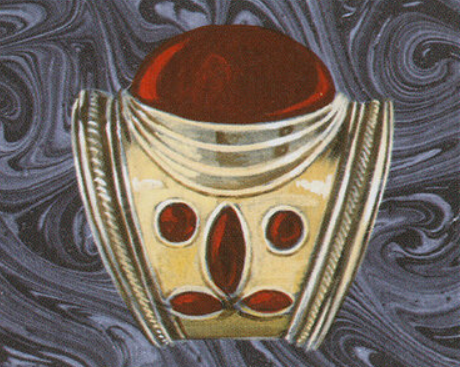
The set symbol for Streets of New Capenna (SNC) is a set of brass knuckles with what looks like angels' wings. We know a couple of important things about the setting of SNC from the Magic Showcase 2021. One is that the city has special significance to Elspeth. Two, that the city was built by angels, but is now run by three-color demon crime families. In that context, the set symbol makes sense. (More on Elspeth later). What happened to the angels, and how the demons came to control the city will likely play a huge part in the forthcoming story beats revealing the world to us. What do we know about these demon crime families?

Demonic Mafioso

There are five three-color crime families in SNC. The crime families are allied colors, creating factions similar to what we saw back in Shards of Alara.

  • Obscura - Black, Blue, White
  • Maestros - Blue, Black, Red
  • Riveteers - Black, Red, Green
  • Cabaretti - Red, Green, White
  • Brokers - Green, White, Blue

Card Reveals

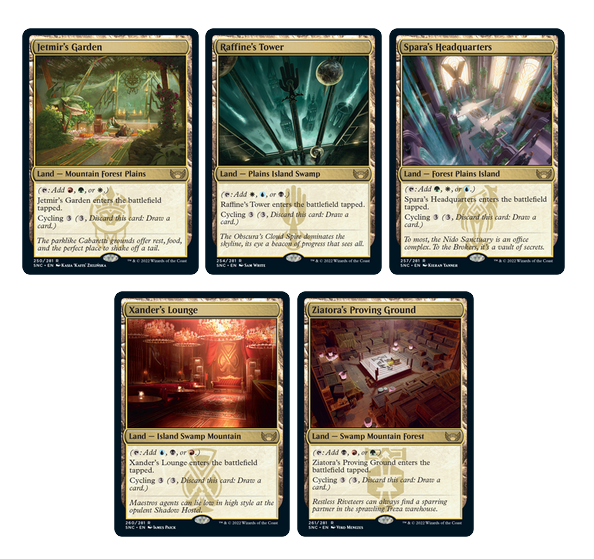
In the process of unveiling these crime family factions, several cycles of cards from the upcoming set were revealed, partially revealed, or strongly hinted at. The first is that each faction will receive a Triome-esque land corresponding to its colors.

These long-awaited allied-color lands not only complete the cycle, but they also hint at other possibilities for SNC. First, each land is named after an individual we can only assume to be the leader of their respective faction. We learned today that each crime family is led by a demon that is also another creature type, and demons will appear in the set in colors other than black and red. It's safe to assume that each of these lands will have a correspondingly named legendary creature to go with them.

The appearance of these cards also gives us a hint that cycling may be one of the returning mechanics in the set. While it is possible that the lands would be the only ones in the set with the ability, I find that extremely unlikely to be the case in a premiere set. I'm betting on cycling. The triome-lands were not the only cards revealed today though.

Ascendancies

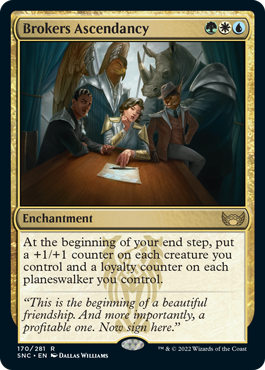
It was revealed that each faction will be getting its own Ascendancy card, riffing on the Ascendancy cycle from Khans of Tarkir. If we learned anything from that cycle, it's that each of the Ascendancy cards will lean in heavily to the theme of their related faction. For example, the above spoiler is a strong indicator that the Brokers faction will likely be counters-based.

More Details

Further details about the set can be found either by watching the Weekly MTG video on Twitch or by reading the intro article over on Daily MTG. This includes the complete schedule of previews and releases for the set, art previews including the fabulous Art Deco basic lands, and more.

Gangster Elspeth?

Back in August when the 2022 release schedule for Magic was revealed, the only info we had about Streets of New Capenna was the following description from Magic Showcase 2021:

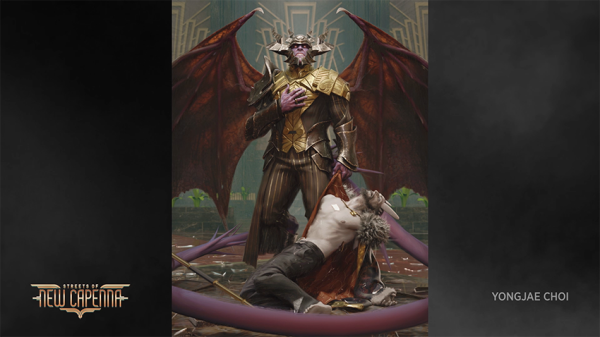
"Streets of New Capenna—a city with special significance to Elspeth, built by angels now run by three-color demon crime families," and this picture:

I could be wrong, but that looks a lot like Ob Nixilis in some swaggy suit/armor combo. Based on these pieces, I'm confident in assuming both Ob Nix and Elspeth will appear as Planeswalkers in the set. Perhaps Elspeth will come in spells blazing like Kevin Costner in The Untouchables?

Other Predictions and Speculations

I Tweeted this tongue-in-cheek list of things I wanted to see from SNC shortly after seeing the Showcase:

Now that we've seen Kamigawa Neon Dynasty, and have our first hints of what's in store in SNC, I don't think we will see a gangster creature type in the set. We will likely see plenty of rogues, and possibly a ninja or two, though without the ninjutsu mechanic.

My first thoughts when envisioning SNC were that it would be akin to a crime/gangster film like The Godfather meets The Untouchables or The Italian Job. With that in mind, I was hoping for the set to have a heist mechanic. With the Art Deco style we've seen, I think it's more likely the set will have a noir vibe.

It's far more likely we will see a mechanic like Investigate make a return if the set is noir-flavored. We might not get a heist mechanic, but I'm still holding out for an Act of Treason-style card named An Offer You Can't Refuse. Even a Sign in Blood effect would suit the flavor, though that too could see a reprint here on its own.

Those Pesky Praetors

We've seen Phyrexian praetors Vorinclex and Jin Gitaxias lurking on other planes in recent Magic sets. It wouldn't be inconceivable to see Elesh Norn or one of the other Praetors we haven't seen recently making an appearance in New Capenna. Perhaps it would help explain where the city's angel-founders went?

Conclusions

Here's a rundown of my predictions for Streets of New Capenna:

  • Potential returing mechanics: Cycling, Investigate
  • Elspeth and Ob Nixilis planeswalkers (EDIT: this has pretty much been confirmed here and here).
  • Creature types: lots of rogues, possibly a ninja or two. Possibly some angels?
  • Ascendancy cards leaning into the mechanics of their related factions
  • Brokers faction likely to have a counters-based mechanic
  • The appearance of another Phyrexian Praetor
  • An Act of Treason-style card named An Offer You Can't Refuse

Do you agree with my predictions? What else do you think we will see in the set. Let me know in the comments or on Twitter. After the set is revealed, I'll likely do a follow-up article checking in on what I got right and wrong.

Layers, Part Four: Color-Changing, Ability-Altering, And P/T-Changing Effects

Are you a Quiet Speculation member?

If not, now is a perfect time to join up! Our powerful tools, breaking-news analysis, and exclusive Discord channel will make sure you stay up to date and ahead of the curve.

This week is my last week focusing on specific layers. In a few weeks, we'll tie everything together and get into some extra crunchy interactions. For now, we're looking at these beauties:

613.1e Layer 5: Color-changing effects are applied.

613.1f Layer 6: Ability-adding effects, keyword counters, ability-removing effects, and effects that say an object can't have an ability are applied.

613.1e Layer 7: Power- and/or toughness-changing effects are applied.

Magic Comprehensive Rules

Ready? Then let's get started the way all good articles start: with a reference to Culture Club's "Karma Chameleon."

Colors Were Like My Dreams

Much like text-changing effects, color-changing effects are obvious in that they tell you exactly what they are. Does an effect say something "becomes the color of your choice"? If so, bingo! That's a color-changing effect.

Making something become a color replaces all of its previous colors. For example, resolving Eight-and-a-Half-Tails's ability on Niv-Mizzet Reborn means Niv-Mizzet is only white until end of turn. Of course, if that effect makes something a color "in addition to" its other colors, it's additive. If I equip my Grizzly Bears with Blade of the Oni, my Bears will be green and black.

When deciding what color to make something, remember that Magic only has five colors: white, blue, black, red, and green. You can't choose "gold" or "pink" despite what certain Un-cards might suggest. "Colorless" is also not a color, in much the same way "barefoot" is not a type of shoe.

Abilities

Behold, layer 6, truly one of the layers-iest layers.

613.1f Layer 6: Ability-adding effects, keyword counters, ability-removing effects, and effects that say an object can’t have an ability are applied.

Magic Comprehensive Rules

So... yeah. There's a lot of stuff going on.

We generally apply all of these effects in timestamp order. For example, if Nancy casts Jump on her Grizzly Bears, then Anthony Canopy Claws, on that same creature, the Bears won't have flying.

Count On It

First introduced in Ikoria: Lair of Behemoths, keyword counters function as one would expect most of the time. The one thing to watch out for here is that the timestamp of abilities granted by keyword counters is when an object most recently got that type of counter. For instance, if a creature has a flying counter on it, then gets another flying counter two turns later, the timestamp of the counter granting that creature flying is when the most recent counter was put on it. The creature still has two flying counters on it, but the first one isn't really doing anything.

Of course, the corollary here is that if a creature has a flying counter, then I add another flying counter to it, both flying counters update to the newest timestamp. This probably sounds a little weird, but consider if we didn't do that. We'd have to distinguish between different flying counters.

The D-Word

On rare occasions, we can have dependencies in this layer; I believe that Kwende, Pride of Femeref is the first card to create one. Because Kwende cares about creatures you control with first strike, any effect granting a creature first strike has to be applied first. That is, it doesn't matter if Kwende is already in play and then I cast Fervent Strike on one of my creatures. Because giving a creature I control first strike changes the set of objects Kwende's ability would apply to, I have to apply the effect from Fervent Strike first.

You Shall Not Have Abilities

Some cards, like the Archetype of Endurance cycle from Born of the Gods, prevent other objects from getting certain abilities. As always, if one effect says to do something, and another says it can't happen, the "can't" effect wins.

Notably, this means that if I control Archetype of Endurance and an opponent casts Heroic Intervention, their creatures will have indestructible but not hexproof. Even if my Archetype leaves the battlefield later that turn, they still won't have hexproof. The effect that would have granted them that ability simply did nothing.

Conversely, any Auras attached to an opponent's creature will function as expected. If my opponent's creature is enchanted with Alpha Authority, that creature will once again have hexproof if my Archetype of Endurance goes away.

Gotta Get Up to Dress Down

After my event this past weekend, I'm reminded just how frequently Dress Down pops up in Modern. It's likely the most important ability-removing card in the game right now (sorry, Humility fans). Since it shows no signs of going away any time soon, let's look at some common interactions.

If I dash in Ragavan, Nimble Pilferer and an opponent responds with Dress Down, two important things happen. First, Ragavan does not have haste. Second, the delayed trigger to return Ragavan still happens (last I heard, Magic: the Gathering Online gets this interaction wrong).

On the other hand, if I try to evoke Solitude and an opponent responds with Dress Down, we both get something out of it. I won't get to exile anything, but I also don't have to sacrifice my Solitude.

Dress Down hits Murktide Regent especially hard. Since delving is part of casting a spell and paying its costs, the Regent can exile instant and sorcery cards to help pay for it. However, I can respond with a Dress Down and make the Regent enter with no counters anyway.

I Have the Power (And Toughness)

While layer 7 is broken up into four subrules, the majority of the time, these effects work exactly how one would expect (we had some weird interactions with Skullbriar but those got patched out a couple years ago). Just remember that effects that switch power and toughness come last, and everything else pretty much falls into play.

Sublayer a

613.4a Layer 7a: Effects from characteristic-defining abilities that define power and/or toughness are applied. See rule 604.3.

Magic Comprehensive Rules

Simple enough. The first sublayer covers stuff like our old friend Tarmogoyf.

Sublayer b

613.4b Layer 7b: Effects that set power and/or toughness to a specific number or value are applied. Effects that refer to the base power and/or toughness of a creature apply in this layer.

Magic Comprehensive Rules

Here we handle things like Scale Up. As far as I know, the only effects that fit here that don't talk about "base" power and toughness are animation effects like those on Blinkmoth Nexus or Jade Golem.

Sublayer c

613.4c Layer 7c: Effects and counters that modify power and/or toughness (but don’t set power and/or toughness to a specific number or value) are applied.

Magic Comprehensive Rules

This sublayer covers the vast majority of power/toughness changing effects. This is where we take care of everybody's favorite 13/13 1-drop, Death's Shadow. This also handles any counters that modify power and toughness like Decimator Beetle, or effects like Dead Weight that change power and/or toughness without using counters or setting them to a specific value.

Sublayer d

613.4d Layer 7d: Effects that switch a creature’s power and toughness are applied. Such effects take the value of power and apply it to the creature’s toughness, and take the value of toughness and apply it to the creature’s power.

Magic Comprehensive Rules

This covers the rare effect that switches a creature's power and toughness, like Wandering Fumarole or Twisted Image.

Putting It All Together

Let's tie things up with a convoluted example.

I control an Alpine Grizzly. I equip it with Greataxe. My opponent casts an entwined Twisted Reflection on it. After that resolves, I cast Scale Up on my Grizzly, then equip a second Greataxe to it. What are its power and toughness?

Right off the bat, we can see we have nothing in sublayer a. Alpine Grizzly doesn't have any characteristic-defining abilities.

Scale Up applies in sublayer b, setting base power and toughness. Note that even if we used a creature that had a characteristic-defining ability, Scale Up would override it anyway. After applying the effect from Scale Up, we have a 6/4 Alpine Grizzly.

Moving on to sublayer c, we have a few effects: +4/+0 from each Greataxe, and -6/-0 from Twisted Reflection. Taken together, they give us +2/+0 for an 8/4 Alpine Grizzly.

Finally, we switch power and toughness in sublayer d thanks to the second effect from Twisted Reflection. Our end result, then, is a 4/8 Alpine Grizzly.

Notice that we applied these effects out of strictly timestamp order. Since they apply in different sublayers, we have to apply effects in that order. This means effects like Scale Up's will always apply before any counters or other effects, and as mentioned earlier, switching power and toughness always happens last.

Cleanup

That's it for this week. Hopefully, this has been insightful or useful, if only so that there's less confusion about Dress Down at the next local Modern events. Seriously, like, half my calls all day Saturday were related to that or Urza's Saga.

As always, find me on Twitter or our Insider Discord for any questions, comments, criticism, etc.

Question of the Week: What's the largest you've seen a creature's power/toughness get?

Mastering the Art of the Steal

Are you a Quiet Speculation member?

If not, now is a perfect time to join up! Our powerful tools, breaking-news analysis, and exclusive Discord channel will make sure you stay up to date and ahead of the curve.

In just the last few years Magic has printed a large number of cards that allow you to steal and play your opponent's cards. There are some tremendous advantages to this theme! Whether you're a player on a budget or just love the experience of total deck building freedom, pilfering may be a good theme for your next Commander deck.

But First A Little Magic History

Stealing your opponent's permanents, or stealing and playing your opponent's cards, is buried deep in Magic's DNA and has been part of the game since way back when. How way back?

Literally Alpha Edition

These cards are iconic and part of Magic's history. There are other iconic and spicy examples like Helm of Obedience, Spelljack, Geth, Lord of the Vault and Commandeer. Red deserves a special mention for the tremendous variety of Disharmony effects printed.

So You Can Steal Things, Big Deal

Using other people's cards is very fun. It's so fun I've written about it here. However, Act of Treason is a very different type of theft than we will be discussing here. If Act of Treason is cheating on a test by peeking at your neighbor's test, Praetor's Grasp is hacking into a corporate server to commit industrial espionage. Both are theft but one is a much bigger deal. Praetor's takes away an opponent's threat, answer, combo piece, or favorite card but it's a one-off effect. So how can we steal the maximum amount of value from our opponents? First off, what we take needs to be ours forever with no strings attached. None of this "until end of turn".

All About Xanathar

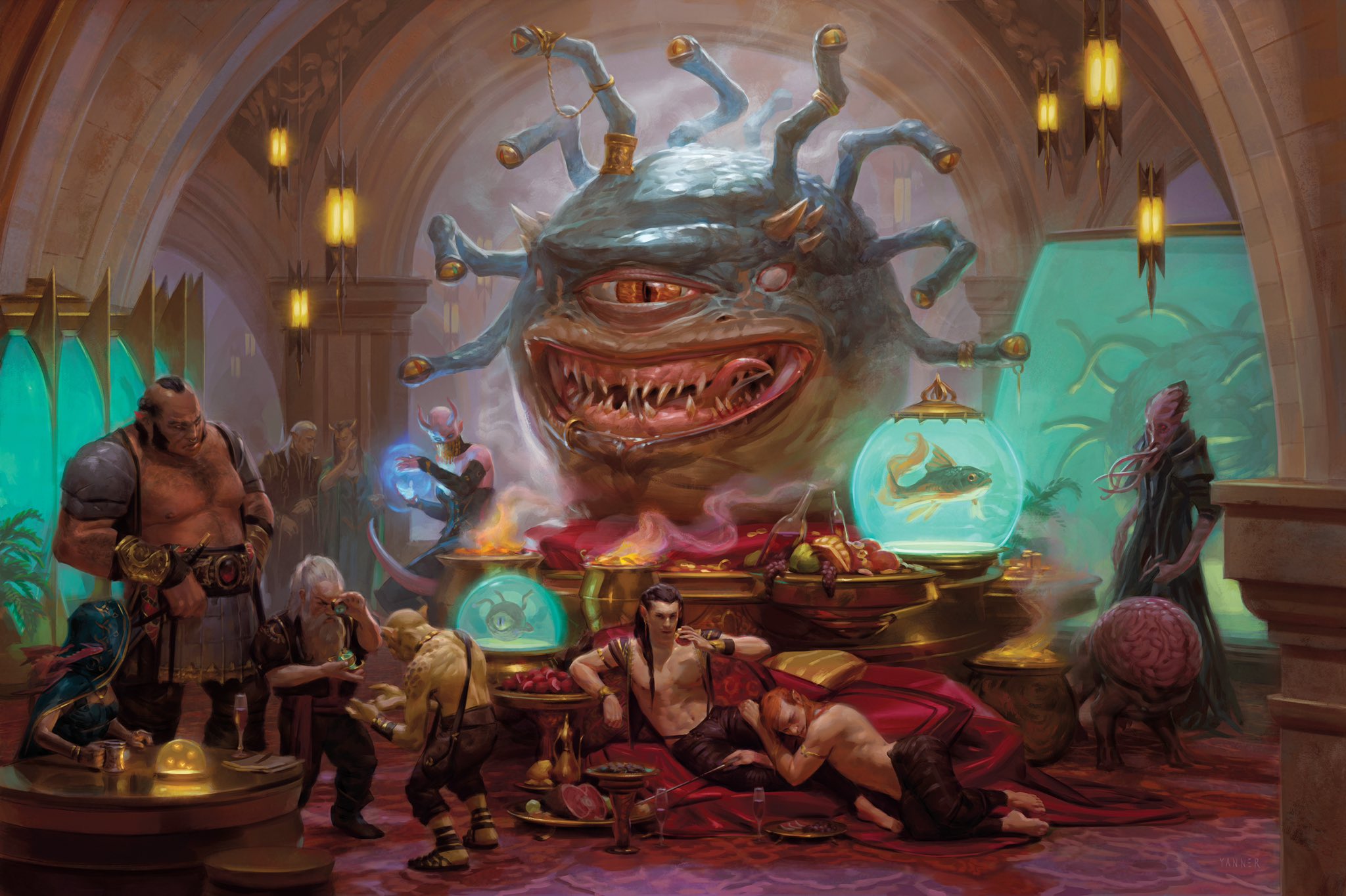
Your favorite Beholder and mine, Xanathar takes theft up to 11. Initially, when I saw this card I thought it would be a gimmick, cute but not really that effective. I was wrong. Xanathar is the perfect card for Commander and a great card to talk about for this theme. Having played against it in paper and online in Brawl I've seen so many different build variations that I am truly impressed.

While there are many other similar effects, Xanathar seems to be the best of the bunch all told. Let's talk about basic deck composition and ideas for Xanathar and Xanathar-like decks.

Swamps AND Islands for The Budget King

Wow a revolutionary idea, right? I joke but at the same time, it's criminal how decent a deck Xanathar is with just Islands and Swamps. When I say just Islands and Swamps, I don't mean the degenerate level. But if you want a highly playable Commander deck at the table for the *least* amount of time, money, and effort? Full-on degenerate Xanathar, 50 Island, 49 Swamp. Remember you are not playing one deck, you're playing up to four! Talk about variety.

What if they kill Xanathar? Replay in two turns. What if they kill Xanathar *again*? See you in two turns. I'm not advocating for you to play this commander at pauper level with only Basic Lands, however, it's an exercise to see just how little this deck truly needs to operate.

There are few true staple cards for Xanathar. Strionic Resonator and Lithoform Engine both come to mind. They're not required, but the deck is certainly a lot more fun with them than without. I think it's a huge budget advantage unique to these types of commanders. You can play a "complete deck" without investing significantly in many new cards or needing duplicates of cards you already own but don't wish to purchase again. In terms of bang for your buck you can fill these decks in with mana rocks and maybe a couple of inexpensive protection spells for your Xanathar and then bring it to play.

A King And A Diplomat

Who are you going to attack? The players committing things to the board or the guy playing Islands and Swamps and maybe a mana rock before passing? "Do nothing" decks have a tendency to sneak under the radar a fair amount of the time. Once Xanathar hits the table, choose the player who is most obviously in the lead to draw the least amount of hate. Or, alternatively, ask the table who needs help? Maybe someone wants to draw a land and you can help them dig to the draw they need! As mentioned before this card has demonstrated a contortionist-level of flexibility in multiplayer that is virtually unparalleled. It's impossible NOT to have a potential play or a potential out if Xanathar is doing his thing and remember to play the table! While you won't always know your opponent's deck, they do and sometimes they can tell you the card you need to hit to stop another player.

A Multiplayer Boss, A 1v1 God

In the early and mid-game it's generally the right move to use every single card you can from your opponents. Decks these days tend to have either very tight builds that struggle if just a few key cards are missing or are a little more flexible and feature many functionally similar copies of effects. This means that when you play their deck your version will be just as strong and have just as much access to their deck synergies. However, the most brutal thing you can do with Xanathar late game is to strand a player by leaving an unplayable card, often a land, on top of their deck. Yes, late-game Xanathar turns every opponent's land into a potential Time Walk effect. Talk about god mode!

Is This Deck Casual Or Competitive? It's Both And Neither

The power level of Xanathar-style decks is inherently elastic. Are opponents playing the most powerful and expensive cards possible? So are you. Do opponents have casual, low-powered decks? So do you! This is the best part about theft decks in my opinion. It's also a test for your Commander group as your deck becomes as powerful, fun, or oppressive as your group's build environment. Just like there's always room for Jell-O, there should always be room for a Xanathar deck at the table.

And What About The Inevitable Mirror Match?

Here is where Magic theory goes sideways. I'm pretty sure the Xanathar deck with lots of Islands and Swamps will have an easier time fighting the Xanathar deck with live cards because your opponent can't steal what you don't have. If that isn't an example of "live by the sword, die by the sword" I don't know what is. I've never gotten to experience this match first or second hand so if you have an account please let me know in the comments!

The Fuzzy Math of Steal Effects

Follow me here because this is my own personal Magic math theory. If you use one of your cards to stop one card from your opponent that's a one-for-one trade. If you use only one card and take out two it's a two for one. But when you steal it's a three for one or better. Why? First, if you have a threat that does not belong to you, it needs to be dealt with. If you take away that threat from an opponent now they are down a threat and then down their own answer to remove it. Their deck does not get back a threat or an answer when they do this, at least typically, so that's the fuzzy math making it a virtual three for one. Of course to make it even fuzzier, if you did this with just mana and your commander it's a virtual three for zero. The short of it is that stealing is extremely efficient. Steal early, steal often.

Any Other Criminals Out There?

Yes! Mind Flayer, The Shadow is at the top of my list for new cards to try for this theme either as a commander on its own or as an addition to Xanathar. While you do give up blue for protection, Mind Flayer is a bit hard to remove as it starts out as an Enchantment. A double activation of its trigger would give you six potential cards to play, but the restrictions of permanent spells only, the inability to play lands, and no top-of-deck shenanigans, make me think this will end up being just a less fun Xanathar. It remains to be seen!

Streets of New Capenna Is Coming!

I'm assuming that theft will be taken to a whole new level in Streets and am looking forward to some interesting new mechanics for playing cards that are not mine! What's the biggest Magic "heist" you've ever pulled off?

Find Your Golden Egg: Speculating on Oddities

Are you a Quiet Speculation member?

If not, now is a perfect time to join up! Our powerful tools, breaking-news analysis, and exclusive Discord channel will make sure you stay up to date and ahead of the curve.

With Easter around the corner, it's time to crack open one of my favorite speculation tricks. But first, a question: when you hear the word "egg," what do you think of?

Easter eggs
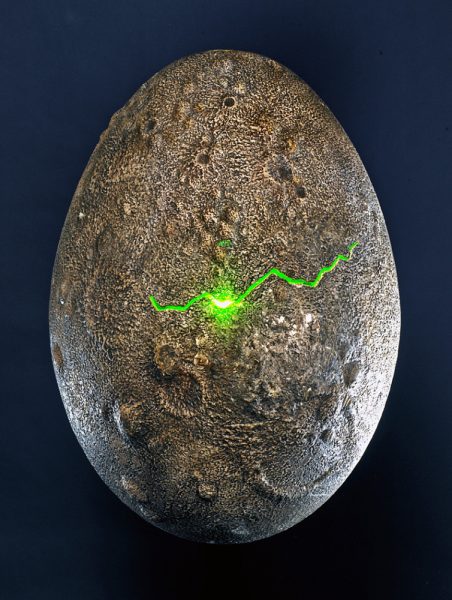
Egg prop from the film Alien
Chicken eggs

You may have heard of "easter eggs;" you see them at the end of almost every Marvel movie. The infamous "shawarma" scene and the "collector" scene are my personal favorites. Eggs, in this instance, are cards or mechanics that are included in one set that may hint at something in a future set. Identifying "egg" cards can lead to high-value speculations, as cards tend to shoot up in value when their niche at last finds itself adequately supported.

Howard the Duck shown in Guardians of the Galaxy End Credits

I do think it is important to differentiate eggs from synergies between blocks. A good example would be the hybrid mana symbols in Return to Ravnica block and the synergies with the devotion mechanic in Theros block. While they played well together, that is not what we are looking at today. The reason for this is that it would have been very difficult to target any cards from RtR block for speculation without having prior knowledge of the devotion mechanic.

There was an error retrieving a chart for Sanctum of All

Finding eggs, then, means looking for cards that seem out of place in a set for one reason or another. Sometimes they are ubiquitous and only seem obvious after a future set is released; sometimes, as with Sanctum for All, they stand out from the set in a big enough way that one questions their inclusion immediately.

Count the Chickens First

Why do we care about eggs? For the answer, look no further than the price graph for Sanctum of All, a bulk rare that has jumped to around $4. These are my favorite specs because they have such a low buy-in that one can make a good bit of money for very little up-front investment.

We do not get these cards in every set, so we need to be good about spotting them. They can often blend in with the chaff. After all, Sanctum did not start out at bulk; it slowly drifted there as players failed to find it worth building around and demand dropped off.

Some other good examples of eggs that ended up as solid gainers:

There was an error retrieving a chart for Crucible of Fire

Crucible of Fire - Included in Magic 2015, this card spiked with the release of Dragons of Tarkir (it gained over 200%), though even with this spike it was a $2 card, so one would have had to sold a lot of copies to make any significant profits.

There was an error retrieving a chart for Stoneforge Mystic

Stoneforge Mystic - Believe it or not, this card was near bulk before Scars of Mirrodin was released. The only decent equipment to fetch in standard prior to Scars Block was Basilisk Collar, leading Mystic to be picked up for very cheap. One could argue that this card may or may not count as an egg, but given just how few targets it had when initially released, I feel it is valid to count.

Not All Eggs Are Laid Equal

There was an error retrieving a chart for Dark Intimations

Magic isn't a grocery store. Not all the eggs are fresh.

Sometimes we get a card like Dark Intimations that ends up a dud. One look at that card, though, should have raised red flags immediately, based on how over costed it is as a whole. The only reason I could have seen this card being worth anything would have been if a Planeswalker - Nicol Bolas were spoiled that needed 1 additional loyalty to ultimate.

I wanted to point this out because thanks to success in the past finding these types of cards, some might buy in regardless of how playable the card is. A rotten strategy, indeed!

The Road to the Golden Egg

"How do I spot these eggs?" That is the million dollar question! Speculation being what it is, unfortunately, there is no tried-and-true formula, which makes identifying eggs all the more rewarding. However, there are some things I look for when trying to determine if a card could potentially prove a sleeper hit. I ask myself these questions:

  • Does this card work well with the current mechanics of either this or previous sets?
  • Does this card reference anything in either this or previous sets?
  • If the card is a creature, is its type currently relevant, or does it stick out?
  • Are there any upcoming sets with known themes, archetypes, or creature types that may be relevant to this card?
  • Does Wizards putting this card at this rarity make sense? (This point is more often relevant to the first set in a block that is intended to be drafted with a future set.)

Raise Your Eggspectations

Hopefully, this article can serve as a small guide to help you find the eggs that we know WoTC likes to hide in some sets. Whether this means that you pick up your personal copies of a card that becomes extremely relevant in the future for pennies or that you get speculation targets that you can flip once the rest of the world realizes the value, always remember to keep an open mind when evaluating cards... and notice the little differences that make some more unique than the rest!

Real-world Flavor. Clover, Bee, And Reverie: Fantasy As The Faculty Of Imagination

Are you a Quiet Speculation member?

If not, now is a perfect time to join up! Our powerful tools, breaking-news analysis, and exclusive Discord channel will make sure you stay up to date and ahead of the curve.

To make a prairie it takes a clover and one bee,

One clover, and a bee,

And revery.

Emily Dickinson, To Make a Prairie

In the last article, we dealt with a bunch of magical creatures whose flavor text quoted literary sources from the real world. This week we'll expand on the topic, this time moving into the realm of another sort of fantasy, namely reverie. The distinction is based on the difference between fantasy meant as the physical creatures from a fantasy world, and the imaginative process itself.

Dragon Whelp (Limited Edition Alpha, 1993)

O to be a dragon 
 of silkworm size or immense 


Marianne Moore, O to Be a Dragon

Dragon Whelp is a creature, yes, but I’m including it in this second part because the text is not really about dragons. It’s rather about the idea of being a dragon, and therefore it’s a perfect reverie, an act of imagination. The card is a 2/3 flying creature for the cost of four mana. It gets +1/+0 for each red mana you spend (though it's better not exceeding three). It's a decent creature, actually, at least in limited formats.

There was an error retrieving a chart for Dragon Whelp

While playability is certainly a plus, The price of the Alpha version is driven by the low print run of Alpha, combined with collectors' demand. Collectors really love dragons.

The flavor text is simple, a small bit from Marianne Moore's 1959 poem. The art by Amy Weber represents a cute puppy-like dragon. It's an almost humorous choice for the subject matter. Many cards in Magic's history have either the illustration or the flavor text intentionally designed to be comical. In this case, the coupling is a bit risky, since the art is entirely cartoonish, whereas the quote evokes a much more grand concept.

Karakas (Legends, 1994)

To make a prairie it takes a clover and one bee,

One clover, and a bee,

And revery.

Emily Dickinson, To Make a Prairie

This one is my all-time favorite Magic flavor quote. It's from the poem To Make a Prairie, by Emily Dickinson. It’s a very short piece composed in free verses. From the artistic point of view, the illustration by Nicola Leonard shows a flatland with a sort of building towering up. It’s actually a real-world building, as the art depicts the Shwedagon Pagoda, a Buddhist monument located in Myanmar. It doesn’t really resemble a prairie, but it doesn’t matter when both the art and the flavor text are such gems. In Magic’s world, Karakas is a city on the plane of Dominaria, and that’s why the illustration doesn’t only show the tower, but a whole town.

Shwedagon Pagoda

Karakas is an auto-include for decks such as Death and Taxes, in Legacy, and one of the most famous lands of this game. It’s extremely versatile, as you can use it both to protect your own creatures from removal and to bounce opponents’ threats. Not to mention all the dirty tricks with enter-the-battlefield abilities on your legendary creatures. It also has advantages in being a land, in that it cannot be countered, and as a colorless card, it’s even more resistant to interaction.

Sacred Nectar (Eighth Edition, 2003)

Over the silver mountains,

Where spring the nectar fountains,

There will I kiss

The bowl of bliss;

And drink my everlasting fill


Sir Walter Raleigh, The Pilgrimage

Let’s conclude this section with a typical white sorcery. Sacred Nectar gains you four life for two mana. We looked at a different printing of this card in a previous installment. That was the Portal version, quoting Coleridge. The quotation from Coleridge was used on the card again in Starter 1999, and again in Seventh Edition. It was reprinted in Eighth Edition, and again in Ninth Edition with this flavor text. It’s common to see cards receive different flavor texts in different editions. It's less common when they stay real-world quotations. In fact, this is one of the few occurrences of that phenomenon. We might see this again in one of the next pieces.

There was an error retrieving a chart for Sacred Nectar

Let’s keep focused on this specific version of Sacred Nectar. Sir Walter Raleigh, the author of The Pilgrimage, was an English soldier and explorer under Elizabeth I. His poem is supposed to be written from the point of view of a man at the point of death. The pilgrimage of the title is that of his soul ascending to heaven. There are very few cards in this game with such an on-theme flavor text, at least from a color perspective. As with the Portal version, the concept of purity (proper of the color white) is clearly expressed. Any player is sure to pick up the meaning, even if they don’t know the poem.

The quote starts with a couple of lines loosely evoking some very distant place. It mentions silver mountains and "nectar fountains." This also works as a reference to the name of the card. As for the "sacred" part, it's described through the usage of the expression "bowl of bliss". The art and the text both represent the same idea expressed on the card. This unity of flavor and expression is what should ideally happen with every card design.

What Kind of Fantasy?

So, what kind of fantasy works better on a Magic card? Fantasy grounded in a physical world, even if made up, or that of pure imagination? Well, truthfully, there is no correct answer. It depends on many factors and overall on personal preferences. From my perspective, I'd say this second type of fantasy is the most effective. Instead of slavishly describing a particular magical creature, such as a zombie or a goblin, it relies on more generic and abstract concepts. It leaves the reader (or in the case of Magic, the player) with more freedom to invent in their own mind.

I find the cards we have just analyzed to be truly majestic in their delicate and suggestive nature. Since Magic cards often suffer from over-precision, both in their names and their arts, a bit of uncertainty in flavor texts sounds appealing to me. What do you think?

Sorry to “Rune” Your Day | Adam Plays Magic

Are you a Quiet Speculation member?

If not, now is a perfect time to join up! Our powerful tools, breaking-news analysis, and exclusive Discord channel will make sure you stay up to date and ahead of the curve.

Enchanté

Welcome back friends and family! This week I'm diving into the digital-only Alchemy format with Naya Runes. My list is hot off the presses from the phenomenal @urlichmtg, albeit with a few small sideboard changes. The deck plays similarly to the Bogles archetype from Modern, jamming a handful of auras onto creature payoffs to make massive threats with keyword soup.

I'm a big fan of this deck in Standard, but the meta has some hostility thanks to the success of Hinata, Dawn-Crowned, which makes all of your auras cost more and slows your engine to a crawl. Alchemy seems to be slightly safer and has far fewer copies of Hinata running around. This lets you take full advantage of an unprepared metagame. Fortunately for those tight on wildcards, porting the deck over from Standard only uses one playset of unique-to-digital cards, Forsaken Crossroads. While these lands are strong, they're ultimately non-essential. Feel free to swap them out for another GW dual land if needed.

In a Given Space, Only the Witch who Cast the Runes Can Use Her Magic.

Now let's actually take a look under the hood. The core of the deck centers around Jukai Naturalist, which makes your enchantments cost one generic mana less, and Runeforge Champion, which not only tutors for a rune aura, but makes them cost a single generic instead of their normal mana cost. With both of these creatures in play, your runes become free to cast.

Between Generous Visitor, Kami of Transience, and Showdown of the Skalds, each of these now-free (or heavily discounted) enchantments puts at least one +1/+1 counter onto the board in addition to its other abilities. These effects stack very quickly. It's not uncommon to cast a creature, then make it the largest body on board with haste, trample, and lifelink in a single turn.

Cleaning up the long game is Hallowed Haunting, which lets you go both wide and tall, often closing out the game with a horde of flying, vigilant spirits. Thanks to Showdown and your 14 cantrips, the deck has a remarkable amount of consistency in achieving its game plan.

We Were Rune-ing for You. We Were ALL Rune-ing for You!

I really just wanted to use another rune pun for this section's header to make my editor groan. Anyway, onto the decklist and video!

Alchemy Naya Runes

Creatures

4 Runeforge Champion
4 Generous Visitor
3 Kami of Transience
4 Jukai Naturalist

Enchantments

4 Rune of Sustenance
2 Rune of Speed
4 Rune of Might
4 Showdown of the Skalds
2 Circle of Confinement
2 Hallowed Haunting

Spells

4 Commune with Spirits

Lands

1 Forest
1 Plains
4 Branchloft Pathway
4 Cragcrown Pathway
1 Needleverge Pathway
4 Overgrown Farmland
2 Sundown Pass
1 Boseiju, Who Endures
1 Eiganjo, Seat of the Empire
4 Forsaken Crossroads

Sideboard

1 Valorous Stance
1 Yasharn, Implacable Earth
2 Circle of Confinement
2 Tamiyo's Safekeeping
1 Boseiju, Who Endures
1 Valorous Stance
1 Rune of Speed
3 Rip Apart
1 Borrowed Time
1 Hallowed Haunting
1 Katilda, Dawnhart Martyr

In Punclusion

The Naya Runes deck is a ton of fun and can lead to some incredible sequences and wild board states. I expect it to be a mainstay with only room to improve as Standard and Alchemy add more powerful enchantments. If you have any questions, comments, or declarations of love and affection, feel free leave a comment below or tweet me at @AdamECohen. I'll catch you all next week.

Not Quite There: A Tameshi Testing Tale

Are you a Quiet Speculation member?

If not, now is a perfect time to join up! Our powerful tools, breaking-news analysis, and exclusive Discord channel will make sure you stay up to date and ahead of the curve.

Every player has a specialty. Jordan is a tempo zealot. It's disconcerting to see Gabriel Nassif playing anything other than a slow control deck. And I am an Aether Vial enthusiast. I love Vial decks and have spent most of my career forcing them in every format. I know what I like, what can I say. However, I have aspirations to be a combo deck designer. Not a combo player; I can do that well enough when I set my mind to it. I want to be able to actually make decent Modern combo decks.

The problem is that I'm terrible at it. I can identify powerful combo interactions well enough and build decks to support them. But they're always missing that certain something that makes a combo deck tick. I'd have never seen how important the now-resurgent Engineered Explosives was to Krark-Clan Ironworks, for example. However, that has never stopped me from trying. Tameshi, Reality Architect really caught my eye this time, and I've been trying to make it work. The title of this article is a spoiler for how that went, but the why was instructive, and hopefully a better combo builder than I can crack the code. Here is my story.

There was an error retrieving a chart for Tameshi, Reality Architect

So Much Potential

I mean, just look at Tameshi's text box. He's a value machine. The triggered ability seems like irrelevant text until you realize that the second ability triggers it. This means that the first activation draws a card and retrieves whichever artifact needed. Or an enchantment, which means that it synergizes with Urza's Saga. For one mana, I can break even on lands, draw a card, and set up for a steady stream of constructs. And if I haven't made a land drop yet, I just replay the land and am likely ahead on mana now. Tameshi's an awesome card just begging to be built around!

Long Time Coming

And it actually starts back in 2019. I didn't like Emry, Lurker of the Loch when she was spoiled, and I still don't. Part of that is pure pettiness: Why is she the "Luker of the Loch" rather than the "Luker in the Loch?!" I constantly want to call her that despite the years, and it makes writing these articles a nightmare when it breaks the card tags. I vaguely remember Mark Rosewater being called out on this on his blog and wish it were easier to search for that post.

There was an error retrieving a chart for Emry, Lurker of the Loch

Spite aside, I dislike Emry as a value engine, despite being decisively on the losing side of the argument. She's been an intrinsic piece of so many grindy value decks at this point that questioning her inclusion feels a bit silly. But I do because she's so linear that she's easy to blank or even make a liability. Emry is only valuable when you have A) a graveyard and B) castable artifacts in said graveyard that do something when cast. This is just increasing vulnerabilities to graveyard hate and Stony Silence, and since she self-mills, when A) isn't true it's actively bad to cast her.

Head to Head

When I saw Tameshi, I was impressed. So impressed I speculated on the card and bought a bunch of copies. If I could see the value, certainly others would too, decks would get made, the price would rise, and I could profit. Which hasn't happened yet (as the above graph should make clear). However, rather than lament, I am trying to find a use for my investment. And I was really hoping that use would be replacing Emry.

Tameshi has a number of pluses over Emry. He has a few big minuses too. To summarize the pros:

  • Additional point of power and toughness
  • Ability can be used immediately on resolution
  • Works with enchantments too, most notably Urza's Saga
  • Gains additional value from bounce effects
  • Ability is a direct return rather than option to cast

The last point was a really big one since Chalice of the Void is quite the card. The cons are fewer, but they are significant:

  • No cost reduction
  • Ability costs mana to activate
  • Tempo-negative in the long run

The first point is significant, since cost is everything for card power. The last one is a problem, but is mitigated by artifact mana and by artifact decks tending to have both cheap targets and surplus mana. It's certainly close, but my read on the possibilities offered and personal biases pointed toward Tameshi being what I'd hoped for.

An Obvious Start

The obvious way to test my theory was to replace Emry with Tameshi in existing decks. Fortunately for me, Emry is only played in a few decks. The most prominent fair deck is 8-Cast, which uses Thought Monitor and Thoughtcast to continuouly dump artifacts into play and then win via massive Constructs. As it's a Saga deck and the interaction between Saga and Tameshi was where my mind went initially, I thought it the perfect place to start.

Tameshi 8-Cast, test deck

Creatures

4 Memnite

4 Ornithopter

4 Tameshi, Reality Architect

4 Urza, Lord High Artificer

4 Thought Monitor

Sorceries

4 Thoughtcast

Artifacts

4 Mishra's Bauble

4 Moonsnare Prototype

4 Springleaf Drum

1 Aether Spellbomb

1 Relic of Progenitus

1 Shadowspear

3 Nettlecyst

Lands

4 Darksteel Citadel

4 Urza's Saga

2 Otawara, Soaring City

8 Island

I went for a version of the deck that was more Emry-focused than traditional Affinity. And I was confused by the results.

Cue the Questions

The deck was very different from the original version. Not good-different nor bad-different. Just different-different. Without Emry, the deck did a lot less in the early turns. However, this didn't affect the way games played out very much, as Emry was just durdling in the first place. This is a function of the list's design rather than an indictment of Tameshi.

There was an error retrieving a chart for Urza's Saga

As the game went long, Tameshi became quite good. Recurring Saga's was as awesome as advertised. So long as I had Tameshi, it was impossible to run out of Constructs, eventually overwhelming any opponent. I never ran out of cards either, but again, that was something this deck never did in the first place. Bouncing a land was surprisingly not a problem. Replacing an in-play Saga with one from the yard negated the normal tempo-loss of the third chapter quite effectively. However, even when bouncing a real land, I usually just played it as the land for the turn since the deck was so land-light, effectively mitigating the drawback.

However, that didn't change the overall feeling that this deck was a compromise. And a clunky one. I didn't feel like I was maximizing Tameshi's potential, nor was he fully contributing to the decks strategy. So I went tinkering.

Tuned It to Death

I didn't have a specific end-goal in mind other than trying to make Tameshi as integral to the deck as possible without compromising the essential artifact-hemorrhage which defines 8-Cast and Affinity more generally. And that snowballed out of control until this monstrosity emerged:

Tameshi Overtuned, test deck

Companion

1 Yorion, Sky Nomad

Creatures

4 Memnite

4 Ornithopter

4 Tameshi, Reality Architect

2 Sai, Master Thopterist

3 Azusa, Lost but Seeking

4 Urza, Lord High Artificer

4 Thought Monitor

1 Meloku, the Clouded Mirror

Sorceries

4 Thoughtcast

Artifacts

4 Mox Amber

4 Mishra's Bauble

4 Moonsnare Prototype

4 Springleaf Drum

3 Portable Hole

1 Aether Spellbomb

1 Relic of Progenitus

1 Shadowspear

1 Pithing Needle

3 Nettlecyst

Lands

4 Darksteel Citadel

4 Urza's Saga

4 Razortide Bridge

4 Thornglint Bridge

4 Tanglepool Bridge

4 Glimmervoid

I had just enough self-awareness left to realize that I'd turned 8-Cast into a Yorion deck with Meloku, the Clouded Mirror in Modern and that brought me to a jarring halt. I've put the deck down as I don't think my trajectory was healthy.

Mea Culpa

My thinking had been that the deck is dependent on the Constructs to win, and could use an alternative, which led me to Sai. I also wanted interaction, which logically pointed to Portable Hole. The problem was that I didn't want to cut anything, so I just made it a Yorion deck and tweaked the mana. Noticing that the deck was slow with the tap lands and that she combos with Tameshi to remove his drawback, I added Azusa. Since I had so many legends I could play Mox Amber as fixing, and to get more milage from Tameshi's first ability I could pull out another alternative win in Meloku!

All of which left me with an amazingly clunky pile that struggled to actually do anything. The density of impactful plays to draw spells is significantly lower, the synergies aren't as potent as expected, and the deck is way too slow in general. There may be something here, but it's not this deck.

An Ulterior Motive

So I changed gears. If Tameshi was surprisingly decent to use in fair decks despite feeling underutilized, perhaps combo applications would make more sense. Tameshi returning Lotus Bloom was potentially more powerful than recurring Saga if I could figure out a decent payoff. Which wasn't coming to mind, as the combo isn't infinite. It's more akin to Rain of Filth than Ironworks, and so I needed to figure out something else.

There was an error retrieving a chart for Underworld Breach

While I was pondering my options, I did try out Tameshi as an Emry replacement in Grinding Breach. It was close, but Emry was definitely better for setting up the combo, primarily due to the self-mill. Getting all the pieces at the right time and in the right zones has been a failing of the deck and Tameshi didn't help. He was closer in the aggro-control versions pioneered by Jiggywiggy, but still felt worse. It may be plausible with a redesign, but I don't know that it would actually be worthwhile.

Seeking the Answer

Using what I learned about Tameshi's place in combo following the Breach test, I started assembling cards to make comboing off with Tameshi plausible. Since the combo is neither infinite nor generating Storm count, it would have to facilitate some other cards winning the game. And do so in a way that was actually worth pursuing rather than being a worse version of another deck.

There was an error retrieving a chart for Life From the Loam

My thinking began with Tameshi returning lands to my hand. I could throw them at my opponent in some fashion. However, Life from the Loam and Seismic Assault already do that much cheaper. Conflagrate could use all the mana generated to get the opponent most of the way there then finish them with flashback. However, Dredge already functionally does that, and more cheaply. Also faster, because Bloom comes off suspend on turn 4 at earliest and Tameshi's combo potential is limited by the number of lands in play so the later the better.

Acceleration is the answer to comboing faster, but I'd have to rely on land search exclusively for the acceleration to be usable. And if I'm planning to drop lots of lands into play, Valakut, the Molten Pinnacle suddenly looks like a strong win condition. And that got the ball rolling.

Seems Plausible

I needed protection for the combo, as it happens at sorcery speed and can be disrupted by Lightning Bolt. The best at that is Teferi, Time Raveler. If I'm going Bant colors, then I could use Wargate as a Bloom tutor. If I'm using Valakut as a kill condition, I need Dryad of the Ilysian Grove. I also need a way to immediately combo into Valakut after turning all my lands into Bloom activations. Which brought to mind Cultivator Colossus. All that eventually yielded the following deck:

Tameshi Combo, test deck

Creatures

4 Sakura-Tribe Elder

4 Dryad of the Ilysian Grove

4 Tameshi, Reality Architect

4 Cultivator Colossus

Planeswalkers

4 Teferi, Time Raveler

Instants

4 Growth Spiral

3 Summoner's Pact

4 Wargate

Artifacts

4 Lotus Bloom

Lands

4 Valakut, the Molten Pinnacle

4 Flooded Strand

4 Misty Rainforest

4 Breeding Pool

2 Temple Garden

4 Forest

2 Island

1 Plains

And you know? This deck is surprisingly not bad. You can accelerate into a big turn on turn 4 quite consistently, sometimes sufficiently to drop a huge Colossus without Tameshi. Unless Dryad is out, that won't win the game with Valakut and then you're on the Tinker gameplan, but that is sometimes good enough.

The mana base is still quite rough because Valakut is basically wasted mana. I'm not sure how to fix that without compromising something else, however. Perhaps I should forgo the fetchlands for an Amulet-style manabase.

Reality Check

I was actually prepared to go ahead with article thinking I'd really found something here, but thinking on the mana base problem brought me to a halt. Again. There's a huge flaw with this deck. What I've made here is a more elaborate, slower, and therefore worse version of Amulet Titan. Same general accelerate into lands for the win plan, many similar cards, but without the speed and streamlining which makes Amulet good. And that's enormously frustrating as it feels like this deck feels So Freaking Close to being real but I just can't get around it being worse Amulet. And that really sucks.

Always a Catch

The problem with brewing any new deck is the risk of unconsciously treading old ground. A new deck needs to be better than an existing one to get traction. Why bother making a switch to something equally good that you don't know as well? Right now it seems that Tameshi is stuck in that void. It's so close to being great, but actually unlocking that potential is proving beyond me. Hopefully, the answer is out there and some more creative minds will deduce the answer. And maybe even let me move my extra copies.

Kamigawa Card Prices: Champions vs. Neon Dynasties

Are you a Quiet Speculation member?

If not, now is a perfect time to join up! Our powerful tools, breaking-news analysis, and exclusive Discord channel will make sure you stay up to date and ahead of the curve.

Kamigawa: Neon Dyansty is upon us! Players are activating ninjutsu, checking for modified creatures, and flipping enchantments into creatures left and right. Thus far, it appears the set is going to be another success for Wizards of the Coast.

True to my New Years’ Resolution, I have once again picked up drafting on Arena with the release of this new set. I’ve got a half dozen drafts under my belt thus far, and while my beginning was a bit on the rocky side, I’ve slowly developed some confidence in my picks and deck building. My biggest success has come when including red in my draft deck, as my two trophies so far were a B/R deck and a W/R deck.

Or maybe I just win trophies when I can draft Atsushi, the Blazing Sky because this mythic has shown up in both decks.

There was an error retrieving a chart for Atsushi, the Blazing Sky

This dragon, however, isn’t the most valuable card in the set (ignoring alternate arts, foils, etc.). It’s not a planeswalker, nor is it any mythic rare for that matter. What is the most valuable card so far, and how does it compare to the most valuable card from the original Champions of Kamigawa? Read on to find out!

Champions of Kamigawa: A Brief History Lesson

The original Champions of Kamigawa was released back in September 2004. Times were quite different in the world of MTG back then—there was no Arena, there were no mythic rares, and there definitely weren’t planeswalkers.

I thought this would be a fun chance to dust off my InQuest magazine collection to research what Champions of Kamigawa prices were like when the set first released. Technically this information would have been in the October 2004 issue. But I glanced at those prices and it looks like they were fairly inaccurate, having not reflected more than a couple weeks being on the market. Remember, the market evolved a lot more slowly back then, in a time when winning decklists were readily available prior to the set’s paper printing!

So I turned to the December 2004 issue, number 116, for a more accurate reflection of Champions of Kamigawa prices shortly after release. It helps that this issue boasts 50,000 card prices and how to dominate tournaments with Magic’s “Secret Weapon.”

Without looking, I tried to recall nearly 18 years ago to when the set was relatively new. I brainstormed the cards I remember from the set that dominated tournament tables in an attempt to guess the most valuable. From memory, these would be Cranial Extraction, Gifts Ungiven, and Boseiju, Who Shelters All. How did I do? Let’s take a look inside!

The most valuable card from the set as of December 2004 was indeed Cranial Extraction!

There was an error retrieving a chart for Cranial Extraction

I remembered this one distinctly as being the card to open for maximum value. I didn’t play competitive Magic back in 2004, and I never once cast this card in a game of Magic. Nowadays, I don’t even think it’s particularly strong. But back then, the ability to completely annihilate an opponent’s key combo piece or win condition must have been pretty powerful. InQuest prices the card at $10-$15 but I distinctly remember it peaking in the $20 range back in the day.

Next is a four-way tie, with each card worth $8-$12 (thereby rounding out the top 5):

Boseiju, Who Shelters All (nailed it!)
Gifts Ungiven (nailed this one, too!)
Time Stop (I completely forgot about this one!)
Yosei, the Morning Star (OK, I didn’t think of this cycle of creatures, but I guess they were powerful)

That’s five rares worth roughly $10-$15 from the set, not to mention an array of cards in the $5 range (meaning it would have been worth opening one of these in your booster pack, financially speaking). Over time I’m sure these values evolved as well. I know Isamaru, Hound of Konda made waves in competitive Magic. Kokusho, the Evening Star was also very powerful. And who could forget the original printing of Kiki-Jiki, Mirror Breaker?

There was an error retrieving a chart for Kiki-Jiki, Mirror Breaker

In summary, the most valuable card in the set was a powerful, black sorcery that exiled an opponent’s most important deck piece. Following that was a land that enabled your spells to be uncounterable, a timeless card tutoring engine, a novel (at the time) ability to abruptly end a turn, and a sweet, legendary creature. Not bad for top five.

Back to the Future with Kamigawa: Neon Dynasty

Let’s fast forward back to today, where players are getting their hands on Kamigawa: Neon Dynasty cards for the first time. I fully expect prices to evolve more over the next month, but as I mentioned before, with the advent of Arena and widespread adoption of TCGplayer, prices tend to stabilize much more quickly when a new set is released. We can see which cards are dominant via Arena before the paper cards are even available in stores!

So what are the top five most valuable (non-foil, non-promo, non-alternate art) cards from Magic’s newest set?

According to Card Kingdom, the leader is a rare land, which coincidentally also contains the name “Boseiju!” It looks like Boseiju has gone from “sheltering all” to “enduring” in a very productive way, because the most valuable card in the set is currently Boseiju, Who Endures.

There was an error retrieving a chart for Boseiju, Who Endures

Rather than making spells uncounterable, Boseiju has taken on a more aggressive stance, granting the ability to channel it to destroy an artifact, enchantment, or nonbasic land. While the land itself is legendary, I can definitely see the merits of loading up on a few of these in your tournament deck—its versatility is unbound, and in today’s competitive play, it’s virtually guaranteed you’ll have multiple targets to destroy. This card is basically like the double-faced cards from Zendikar Rising, except there’s no life to pay to have this land come into play untapped.

Currently its retail price is $30—at rare, I’m not sure it will hold this value for the duration of its time in Standard. Once supply saturates the market, it should be closer to $20.

The next four most valuable cards are all mythic rares from the set:

Jin-Gitaxias, Progress Tyrant - $21.99 (you pay for the mouthful)
The Wandering Emperor - $15.99 (The Wanderer’s face, at last)
Kaito Shizuki - $10.99 (I opened this in pack two of a draft and passed it because I had drafted 0 blue or black cards
 oops?)
Kodama of the West Tree - $7.99 (finally completing the Kodama Tree cycle)

It's interesting to see how dramatically the prices fall for the most valuable cards in the set. There's a lone $30 rare, a $20-ish creature, two planeswalkers in the $10-$15 range, and then number five is already down to $8. It shakes out such that if you open a rare from your booster pack and it’s not Boseiju, you have a pretty low chance of breaking even on the booster. You could pull Otawara, Soaring City and get your money back—it currently retails for around $7. Eiganjo, Seat of the Empire ($5.99) or Farewell ($5) could also work.

Basically, if you open a rare from Kamigawa: Neon Dynasty, you are hoping it’s a land, Farewell, or Mirror Box.

It’s interesting to see how much of the set’s value is concentrated in the top couple cards. It felt like values were distributed a little more evenly back in Champions of Kamigawa, at least around the set’s initial release. I suspect this is driven by the advent of the mythic rare, the foil, the alternate art, the etched, and all the other alternate printings Wizards of the Coast has created. No longer do you want to simply open a specific rare. Now you’re effectively purchasing a scratch-off ticket where you lose most often, but have a chance of winning big with a special pull.

Kind of sounds like PokĂ©mon, doesn’t it?

The More Kamigawa Changes...

I had fun comparing and contrasting the most valuable cards of Champions of Kamigawa circa December 2004 with the most valuable cards of Kamigawa: Neon Dynasty of today. I hope you enjoyed the trip back in time with me.

We uncovered a couple noteworthy trends. First, it’s funny how Boseiju’s facelift was strong enough to keep it in the top five most valuable cards of the set, just like it was back in 2004. In 2004, the other valuable cards were strong spells or iconic, lengedary creatures. Nowadays, we still have iconic, legendary creatures in the top five, but the sorceries and instants were replaced by planeswalkers, which of course didn’t exist back in 2004.

Mythic rares also didn’t exist back in 2004, and I believe that also has a hand in stacking most value of the set in the top couple of cards of Neon Dynasty, whereas it was a flatter field of rares back in the day. It reinforces my belief that Magic has gone the way of PokĂ©mon when it comes to value and collectability. Opening a non-foil, non-etched, non-alternate art rare means you probably don’t get much value anymore. Now you need to hit the “EX”, “rainbow rare”, “GX”, etc. of Magic to really pull something valuable.

There was an error retrieving a chart for Meloku the Clouded Mirror

I suppose this helps make the game less expensive for those just wanting to jam together a competitive pile of sixty cards to battle at a tournament. That’s not necessarily a bad thing, however who is playing in tournaments these days? With the recent, major changes to organized play, it doesn’t seem like the tournament scene is as robust as it once was
 at least, not on paper. And if you’re jamming tournaments on Arena, you don’t have to spend a dime on a single card.

In fact, that’s my favorite aspect of Arena. I don’t like spending money on new cards for reasons detailed above, but I do appreciate the occasional draft. Arena lets me enjoy a few drafts (or more) to appreciate a new set’s flavor and mechanics without sinking a dime into the hobby—and without stepping foot inside a store. Good for me, but probably not ideal for local game shops. It’ll be interesting to see how the hobby continues to evolve going forward in the world’s “new normal.” I won’t try to predict the future—only time will tell!

The Cycles of Magic: The Gathering

Are you a Quiet Speculation member?

If not, now is a perfect time to join up! Our powerful tools, breaking-news analysis, and exclusive Discord channel will make sure you stay up to date and ahead of the curve.

What Cycles Teach Us About Magic Design

Cycles have been an important part of the game of Magic since the very first set, Limited Edition Alpha. What exactly is a cycle? Mark Rosewater defined a cycle in the article Zen and the Art of Cycle Maintenance as "a series of cards that are tied together mechanically." Cycles can also be tied together by flavor, though Rosewater notes that isn't always required. Perhaps the most famous cycle in Magic are the five boons from Alpha:

Over time, cycles have evolved and gotten more complex and more nuanced, but they still have the same goals:

  • Provide mechanical identity for the cards in the set
  • Add an aesthetic element to the set
  • Allow space for something not normally done
  • Establish signposts for archetypes and deck construction (mostly in Limited, but occasionally in Constructed)
  • Create expectations for the players

How do cycles accomplish these goals? Let's look at the different types of cycles to try and answer this.

The Different Types of Cycles

Normally, cycles exist in the same rarity. We can think of these as horizontal cycles. Sometimes there are cycles that climb the chain in rarity. These are vertical cycles. One of the reasons the Invasion Block is one of my favorites is because it makes excellent use of cycles to convey the themes of the block. The theme of Invasion was multicolor, with an emphasis on allied color pairs and allied color shards in the first two sets. As we will see, the third set, Apocalypse mixed this up a bit.

The themes in the first set, Invasion, were expressed at common rarity in several ways. Most obviously, they were seen through two horizontal cycles. The first was a cycle of two-mana-value allied color 2/2 Knight creatures. The second was a cycle of mono-colored one-drop 1/1s with activated abilities in their allied colors.

Allied Color Knight Cycle

Each of the Knights has protection from their colors' mutual enemy. Galina's Knight for example has protection from red. This provides a mechanical identity, cluing us in that we want to be looking at allied color pairs. It adds an aesthetic element in that it is reinforcing Magic's color pie, one of the defining characteristics of the game. It allows space for something not normally done in that each color pair is getting a Knight with protection from its enemy color. At the time, protection was an ability used sparingly, most frequently appearing in white. The mechanical identity and focus on allied color pairs provides direction for deckbuilding, and created expectations for players for future sets in the block.

Apprentice Cycle

The Apprentice cycle are mono-colored 1/1 wizard creatures with two activated abilities, one in each of their allied colors. The cycle is unique in that it is a horizontal cycle, but each Apprentice is also part of a vertical cycle as well. The vertical cycle includes the Apprentices at common and Masters at rare. In addition to the in-set cycle, the Apprentices are part of not one, but two megacycles—cycles spread across more than one set. The first megacycle is a vertical cycle spread between Invasion and Planeshift. Planeshift introduces Battlemages at uncommon rarity. The megacycle shows the progression that an apprentice of each wizard order takes on their way up to master.

Sunscape Megacycle

This provides an interesting and flavorful mechanical identity and helps tie together the first two sets of the block. The Apprentices are also part of a second megacycle, which will tie the first set in with the third set, Apocalypse.

Apprentice/Disciple Megacycle

Where Invasion established caring about allied-color pairs and shards, Apocalypse was all about enemy color pairs and wedges. To tie the two ideas together, The cycle of Apprentices from Invasion was tied together in a megacycle with a cycle of wizards called Disciples from Apocalypse.

Disciple Cycle

Like the Apprentices, the Disciples are a horizontal cycle of mono-colored one-drop 1/1 Wizards with two activated abilities. Where the Apprentices have allied-color activated abilities, the Disciples have enemy-color activated abilities. Each group acts as a horizontal cycle in their respective sets but comes together to form a megacycle bridging the block together.

So far, we've looked at horizontal, vertical, and megacycles, but what other kinds of cycles are there?

Other Types of Cycles

In addition to the boon cycle, Limited Edition Alpha introduced a number of other cycles in the very first Magic set. A two-card cycle is typically done in mirror fashion, with each card mirroring the other in some way. The two most iconic mirrored cycles in Alpha are White Knight and Black Knight, and Earthquake and Hurricane.

Alpha Mirrored Cycles


Where White Knight and Black Knight are almost identical in terms of function, Earthquake and Hurricane have slight mechanical differences while still being a mirrored cycle. Earthquake does damage to non-flying creatures and Hurricane does damage to flying creatures, (both also hit players).

Alpha also introduced two other kinds of cycles, one which we see quite often, and one which is a little more unique. The first is colorless or artifact cycles. We see these most commonly in land cycles, like in the first dual lands, and in the recent cycle of legendary lands in Kamigawa Neon Dynasty.

Neon Dynasty Legendary Lands

These lands check off all the boxes in terms of flavor, mechanical identity, and new design space that you could want in a cycle like this. They've generated much hype, particularly Boseiju, Who Endures, which is probably the most desirable card in the set.

Mono-Colored Cycles

More unique than colorless or artifact cycles, which we see in nearly every set in some way, are mono-color cycles. A mono-color cycle is typically a horizontal cycle of cards all of the same color, which each have an effect on a different color. There's no better example of this than Alpha's Circles of Protection.

Circles of Protection

This cycle has been riffed on in various ways over the years but remains the defining example of a mono-colored cycle.

Three and four-color cycles share much in common with the cycles we've already discussed. For excellent examples of three-color cycles, I'd check out the Shards of Alara and Khans of Tarkir sets for examples. There's one last type of cycle for us to discuss, and it's the largest of them all.

Mega-Mega Cycles

As silly as the name may sound, Mega-mega cycles refer to cycles spread across numerous sets. The best example of a cycle of this kind is the mythic swords.

Mythic Swords

Stretching across dozens of sets, and nearly two decades of time, the sword cycle began with Sword of Fire and Ice and Sword of Light and Shadow both first introduced in Darksteel. The swords all share common attributes of mana value, equip costs, and granting protection from two different colors. Now printed in a horizontal cycle at mythic rare, the cycle is so old that the original printings of the first two actually preceded the existence of the mythic rarity by several years, (Darksteel came out in 2004, and mythic rarity wasn't introduced until Shards of Alara four years later).

Where each sword is unique, is that they have special abilities when the creature equipped with them deals damage to a player. The abilities are tied mechanically to the colors from which the swords grant protection. Sword of Fire and Ice, for example, grants protection from red and blue. When it connects, it allows you to shock something, and draw a card. Both abilities are right at home in the wheelhouses of their respective related colors.

The swords are resonant and flavorful, and each does something quite unique. What's more, since the first two were released, they have created an overwhelming expectation among players to see the cycle of them completed (There are eight at the time of this writing).

Approaching the End of the Cycle

So far, we've seen that cycles matter for creating mechanical identity, adding aesthetic elements, and providing shape to the sets they're in. We've also seen how they can shape the identity of Magic itself. Part of that is because cycles allow space to do things not normally done. Cycles can also lead to sometimes overwhelming expectations on the part of the players. The only piece which we have yet to discuss is how cycles help establish archetypes and impact deck construction.

How Cycles Matter In Limited

For Limited, the most important cycle in any Magic set of modern design is the uncommon Limited signposts. This cycle, typically of 5-10 cards, identifies the possible Limited archetypes available to draft or assemble in the set. I discussed the 10 Kamigawa Neon Dynasty Limited signposts in my article on Limited Preparation. As I said there, Limited signposts do a great job representing what a color or color pair cares about strategically. This can help guide you during a draft or during deckbuilding.

Do Cycles Matter in Constructed?

In my experience, cycles matter a great deal less in Constructed than they do in Limited. There are exceptions to this though. For example, in tribal sets, where the signposts will often be tied to a particular tribe or class, cycles can have a great deal of impact on Standard. One example of this was Dark Ascension-era Standard. The two-color lords introduced in the set all beefed up the decks of their respective tribes. While certain tribes were a good deal more competitive than others, mostly due to other cards of those tribes, the Dark Ascension lords all quickly slotted into their respective decks.

Cycling Down

We've looked at a number of different types of cycles, what they are, and how those cycles shape the look and feel of the sets they're in. In some cases, we've looked at how those cycles helped shape the mechanics and aesthetics of Magic generally. Of all the types of cycles we've looked at, what was your favorite? What are your favorite cycles of cards from throughout Magic's history? What incomplete cycles would you like to see finished? Let me know in the comments or on Twitter.

Tips For the Tournament-Goer

Are you a Quiet Speculation member?

If not, now is a perfect time to join up! Our powerful tools, breaking-news analysis, and exclusive Discord channel will make sure you stay up to date and ahead of the curve.

Since I have an event coming up this weekend, I thought I'd cover some common tournament situations and easy ways to avoid having a bad day. These are all drawn from my experience judging events and having conversations with players and other judges. This isn't meant to be a be-all guide to maximizing EV. Rather, my goal is to help players achieve a generally enjoyable tournament experience.

Finish the Decklist Before the Tournament

One of the most common problems I see at events is a player rushing to finish their decklist. I cannot stress this enough: get it done beforehand. Not only does working on the decklist at the event potentially leak information, rushing through the process can lead to silly errors. I've seen a fair number of Decklist Problems awarded Game Losses because a player was in a rush and wrote the wrong card name or quantity. The vast majority of the time, players have their decks figured out at least the night before, so knock out that decklist before bedtime! Decklist.org is a great resource for this if the tournament uses paper decklists.

Take a Look, It's in a Book

I know the Magic Tournament Rules aren't exactly light reading. However, I'd recommend looking over at least Sections 4.1-4.8, which cover most of how players interact with one another. I talked some about 4.2 Shortcuts a few weeks ago.

Section 4.5 Triggered Abilities is also very important:

Players are expected to remember their own triggered abilities; intentionally ignoring one is Cheating. Players are not required to point out the existence of triggered abilities that they do not control, though they may do so if they wish.

Magic Tournament Rules

First, this means "Chalice checking" an opponent's Chalice of the Void in hopes that they miss the trigger is 100% legal. There's an entire article about whether or not that's "sporting," but I'll leave that one to someone else.

Second, this means that letting an opponent miss triggers is the only lapse a player can intentionally make. Otherwise, all players should do their best to maintain an accurate game state. Knowingly breaking a rule, or letting an opponent break a rule, to gain an advantage is capital-C Cheating and earns a Disqualification.

Tools of the Trade

Any responsible player has the right accessories for whatever deck they're playing. Make sure to bring dice for those Hardened Scales counters or any necessary tokens for Urza, Lord High Artificer decks. This helps everybody maintain a clear board state, which prevents all kinds of errors. Similarly, every deck cares about life totals, so be sure to have pen and paper (or a Boogie Board or something). If I'm called as a judge to resolve a life total dispute, I'm likely to agree with the person who has things written down over the person using a spindown. Note that at Competitive or Professional Rules Enforcement Level, tracking life with pen and paper is not optional.

Self-Care Is Important

Tournament days sometimes go long. Even smooth events can run 10+ hours a day before the cut to Top 8. Get breakfast on the way in. Bring snacks. Drink water. Fit in a dinner break if at all possible.

Getting enough sleep the night before an event is also hugely important. I'm guilty of not following this advice. It turns out that staying up till 3:00 AM playing Commander with friends I haven't seen in months is very fun. But it will hammer your tournament performance.

Deck-Care Is Important, Too

Like Decklist Problems mentioned earlier, Deck Problems are both common and avoidable. Keep any cards that aren't specifically part of the main deck and sideboard in another deckbox. Promos handed out as part of the event, double-faced cards (DFCs) of cards in your deck, or damaged cards that were proxied are the only other cards that can be in the deckbox. Also, keep track of cards! Make sure to collect any auras enchanting opponents' permanents or that they gained control of. Check the area before leaving a table to ensure all cards are accounted for.

Marked Cards penalties start as a Warning but can upgrade to a Game Loss. Luckily, most problems leading to a Marked Cards penalty can be avoided by having good sleeves. Even the best brands still suffer regular wear and tear, so it's generally a good idea to check everything out before leaving the house. Replace any torn or otherwise damage sleeves ahead of time and skip the headache later. Bring extra sleeves, ideally from the same box. Dragon Shields come in boxes of 100 with a few extras, enough for your main deck, sideboard, and several accidents. Sleeves' corners bend unevenly depending on shuffling technique, and sufficiently bad bends can render cards marked.

For decks with any double-faced cards like Delver of Secrets, pick up some checklist cards. While sleeves might look opaque at home, they may be a bit translucent under different lights. If I can see the back of a double-faced card through sleeves, I'll almost always upgrade to Game Loss.

On Alters

Ask the head judge to approve any altered cards before the event starts. I know, I know - with all the Secret Lairs and weird card treatments, defining what "looks like" a real Magic card gets harder and harder. Still, until the altered card policy changes, we have a few points to abide by. The art can't obscure the card's name or mana cost, the card still has to be recognizable as itself, and the art can't contain any strategic advice.

For example, I wouldn't allow this Blood Moon alter from Reddit user /u/bufonia1 because it's not immediately identifiable from across the table. This Mayael the Anima alter from /u/lemondrop_4 is fine, though, since the card is definitely still Mayael.

Cleanup

With these handy dandy tips, have fun cruising to the next GP Top 8!*
*This is not a guarantee. I am not legally responsible for tournament results.

Next week, we'll wrap up the layers series, covering color-changing, ability-altering, and power- and/or toughness-changing effects. In the meantime, feel free to reach out on Twitter or our Insider Discord with any questions.

Question of the week: What's the pack 1 pick 1 breakfast for the morning of a tournament?

Want Prices?

Browse thousands of prices with the first and most comprehensive MTG Finance tool around.


Trader Tools lists both buylist and retail prices for every MTG card, going back a decade.

Latest Magic Sets

Quiet Speculation