menu

Modern Top 5: Underplayed Cards

Are you a Quiet Speculation member?

If not, now is a perfect time to join up! Our powerful tools, breaking-news analysis, and exclusive Discord channel will make sure you stay up to date and ahead of the curve.

It's summer. There's not much happening on the Magic front. And I've got summer things to do. So I'm giving in and doing a list article. At least the algorithm will be satisfied. And I still have my professional pride preventing me from doing it in a nonanalytical way.

The Online Metagame

An explainer/disclaimer before I start: everything I'm going to say about metagame position applies to the MTGO metagame and only the MTGO metagame. This is mainly because MTGO is almost my only source of data right now. MTGMelee generates a usable result or two monthly, and while I know there are paper Modern events happening, the ones I can use don't seem to get posted anywhere. Thus I am only ever really addressing that metagame, and your experiences will vary wildly if you play in paper or in non-MTGO premier events.

MTGO in Crisis

The secondary reason is that it's MTGO with the problem I need to address. If you aren't MTGO itself or a dedicated MTGO player, skip this section, I'm not talking to you. Everyone else gone? Good.

MTGO, you have a problem. You have no demonstrated ability to focus. You just swing wildly and alarmingly between whichever deck strikes your fancy, use it up, and immediately discard it in favor of the Hot New Thing. It's happened three times this year so far, and is happening again. In the beginning, everything looked fine. The metagame was evolving along an understandable trajectory based on what had happened before and the card pool. However, you've simply gone nuts since the February bannings. The top deck of one month suddenly crashes into irrelevance as another deck rises to take its place. In March it was Jund Shadow, which was replaced by Heliod Company, which was completely dethroned by UR Prowess, then Amulet Titan. I don't know what deck will win for July, but at the current rate, Amulet Titan won't even make July's tier list. This isn't metagame shifts, this is harmful behavior.
MTGO, you need help. Your behavior is akin to ADHD or bipolar disorder. I'm not qualified to provide the help you need, but it is available. Go and find it so that I don't have to comment on your violent swings and inconsistencies every. Single. Month. Some stability and discipline will be good for you and better for all your players. Get help!

Standards

Alright, with that off my chest, it's time to actually focus on the title topic. The metagame has shifted a lot recently and subsequently some cards are seeing more or less play than at the start of the year. This is perfectly natural and to be expected. Especially when a set as consequential as Modern Horizons 2 is released. And in normal circumstances, established staples being replaced by new cards or older ones that are better in context isn't worth discussing.

However, these aren't normal circumstances. A new and very Legacy-lite deck is all the rage, which in turn has the community in a bit of a rage. Calls for a ban right after a metagame shift are nothing new and generally worth ignoring. However, this time around, I'm a bit triggered because a lot of what's being complained about is perfectly answerable by existing cards that for some reason aren't seeing play. And a few that have actually dropped off concurrent with the spike in decks said cards are primed to answer. And therefore today's list is those underplayed cards that are strong answers against the top decks in Modern, but for whatever reason don't get the love they deserve.

Of course, to do this properly I need a rating system. Jordan's done a lot of these articles over the years, and his template is solid. Take three criteria, rate each card out of five, order the list based on their score. I'm going to use different  criteria than him to more accurately make my point. Do note that all this is fairly subjective and I'm always open to debating the points.

Efficacy

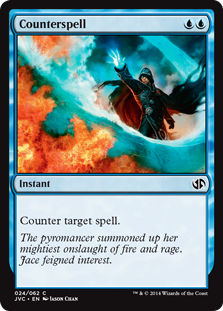
How easily does the card achieve a desired end? Not every card is equally effective at all tasks. If there's ever a card that actually does everything at a good price it will hopefully be banned. What I'm looking at is how well the card does whatever it's meant to do. For example, Counterspell rates very high as a general-purpose answer (the point of Counterspell), but very low as a win condition (it's just not a win condition).

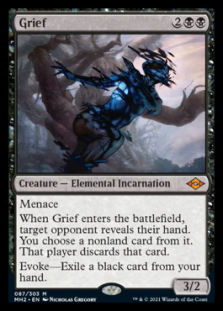
Mana cost is an amplifying consideration for this category. Being cheap doesn't automatically make a card effective, but a cheap and effective card will rate higher than an equally effective one that's more expensive. Thoughtseize would score higher than Grief for that reason.

Meta Versatility

How useful is this answer card in the current metagame? Maindeck and sideboard space are valuable commodities. Running narrow answers is a calculated risk when specific decks are highly represented, but in general it's better to run cards that are useful against a wide range of decks. The more decks a card would be useful against (for maindeck cards) or brought in (for sideboard cards) the more versatile it is given what is actually seeing play right now.

Splashability

How easily can decks run this card? Jordan's used this one a lot, and I'll let him speak for it himself:

Splashability will be rated by considering how many existing Modern decks can accommodate the card and whether they’ll want it. For example, despite its lack of a color identity, Ghost Quarter doesn’t fit into BGx midrange decks. These decks can easily run Fulminator Mage as mana disruption instead, and prefer not to miss a land drop if they don’t have to.

#5: Shatterstorm: 9/15

First up is the earliest and most definitive Go-Away-Artifacts card in Magic, Shatterstorm. Both Affinity and Urza, Lord High Artificer decks are making a resurgence, with the latter associated with the various Underworld Cookbook Food synergy decks. These decks and to a lesser extent Hammer Time are flooding boards with random artifacts and Affinity and Food have Welding Jar, so a card that kills every artifact and foils Jar is essential to keep from being swamped.
Efficacy: 5

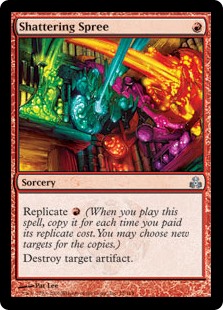
The only artifact that actually sees regular play in Modern which Shatterstorm doesn't kill is Darksteel Citadel. Nothing will save an artifact board from the storm. More importantly, four mana is a great rate for sweeping a board. A lot of decks are running Shattering Spree instead because it can be cast for less and many red decks are very low to the ground. The catch is that in exchange for that cost reduction, Spree kill far fewer artifacts and potentially be answered by Welding Jar. There is no way to immediately and completely ruin an artifact deck's day than slamming Shatterstorm.

Meta Versatility: 2

Shatterstorm does exactly one thing: sweep the board of artifacts. This is only relevant against decks that flood the board with artifacts. There are quite a few of them right now, but it's not universal. Against many deck with few artifacts, such as Eldrazi Tron, decks are better off with Spree since it's far cheaper.
Splashability: 2

Decks need to be less committed to red for Shatterstorm than Spree, which is a huge bonus. However, only slower decks can afford to cast a four mana answer. The former makes Shatterstorm more splashable, the latter makes it less, and cost is a much bigger concern than color dependency.

#4: Alpine Moon: 11/15

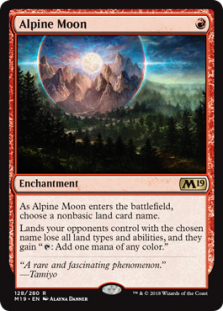
There are a lot of decks running Urza's Saga. There are a lot of decks running Valakut, the Molten Pinnacle. And also Tron's always hanging around. These are all decks that Blood Moon is very strong against. The problem is that a lot of decks that want to answer Valakut, Saga, and Tron are also very badly hurt by Blood Moon. The solution that is not seeing enough play is Alpine Moon. It's a one-sided effect that surgically removes the problem land from consideration.

Efficacy: 3

Moon straight-up kills Urza's Saga upon resolution. It merely nerfs any other land it targets. This is usually worthwhile since preventing fast Valakut kills or Tron is critical for many decks. The problem is that Moon is quite vulnerable to removal. I'd rate Pithing Needle similarly: It's very good at what it does for it's price, but should not be the sole solution to a problem because it can't remove the problem from play.

Meta Versatility: 5

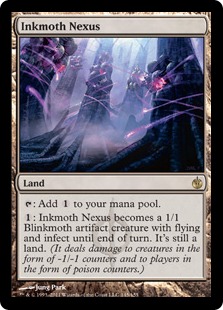
The cards a specifically mentioned see play in many decks. However, almost every deck has some land that's worth naming with Moon: Inkmoth Nexus, Fiery Islet, manlands, and utility lands are everywhere. It's not always necessary to Moon every deck to win, but the fact that Moon has value against the vast majority of decks gives it huge versatility points.
Splashability: 3

Being one mana is a huge plus. Being red is another huge plus, especially when a very large part of the metagame is running red. The problem is that there is also a significant part of the metagame running the targeted lands. Those decks that want Moon can pack it readily, but it shakes out such that there aren't too many that do. More should, but not every deck.

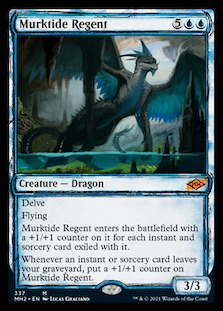
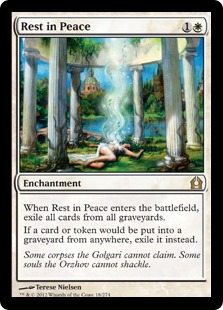
#3: Rest in Peace: 11/15

This is Modern. The graveyard is an essential resource. Has been for years, and continues to be so right now. The difference: at the moment, the main use is Dragon Rage Channeler's delirium and delve for Murktide Regent, with Cookbook/Ovalchase Daredevil synergy thrown in for good measure. Which makes it so weird to me that decks are running one-shot disruption rather than continuous hate. Even those without any graveyard cards themselves. I suspect that desire to play with Endurance is driving the decision, but the ease with which Food decks in particular play around such hate makes me seriously question the decision.

Efficacy: 5

There is no better piece of graveyard hate in Magic than Rest in Peace. For a paltry two mana, there are no more graveyards for as long as Rest stays on the battlefield. No additional mana required. What sets Rest apart from Leyline of the Void is that it also removes the cards already in the graveyard, which ensures that any value stops immediately upon resolution. No. More. Graveyard value. Nothing else says it better.

Meta Versatility: 3

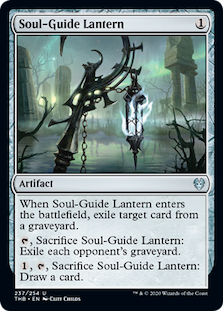
There are a lot of decks which Rest is very important against. However, there are plenty of others against which Rest has no utility. Not every deck has graveyard synergy, and some that do have so little that Rest is overkill and Soul-Guide Lantern is more appropriate.
Splashability: 3

Rest is cheap in absolute and color-requirement terms, meaning that any deck that can make white mana can play it. However, many decks want to use their own graveyards, too. Rest is a blunt tool while many decks might prefer a surgical one. Just like Alpine Moon, every deck that wants Rest can easily splash it, but not every deck that can wants to.

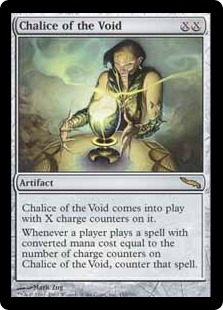
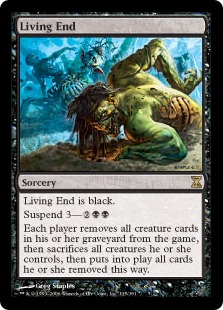
#2: Chalice of the Void: 13/15

For a very long time, the only real use of Chalice of the Void was to lock out one-drops. Thus, it was only useful in very specific matchups by very specific decks, by which I mainly mean Eldrazi Tron. This is no longer the case. The proliferation of cascade decks has changed everything, and far more decks should be running Chalice.

Efficacy: 5

In terms of cheaply answering cascade decks, nothing is better than Chalice. It literally costs nothing to lock all the cascade decks out of their signature spells. Against Living End or Glimpse of Tomorrow, Chalice is a death sentence and must be removed. The Crashing Footfalls deck is severely hampered, but can win without free rhinos. Chalice is also legendary against Prowess and similar decks in Modern, just as it is against Delver in Legacy, and this is more relevant now than ever before.

Meta Versatility: 4

As mentioned, it is very strong against the cascade decks. They see a lot of play and there are a wide variety of them. It is also very effective against the numerous UR Channeler decks that have been the everywhere. It's even strong in multiples, as a Chalice on zero stops cascade spells and Mishra's Bauble and another Chalice on two stops all the maindeck answers to Chalice in those decks.
Splashability: 4

Besides cascade decks themselves and Affinity, every deck can cast Chalice for 0. That part is eminently splashable, and even for those decks with Bauble it's better to shut down your long-game value engine than lose to Living End. However, outside that use, Chalice gets trickier. Few decks won't be hit by their own Chalice on one or higher. Also, as a practical matter, Chalice is quite expensive to acquire. I don't begrudge Modern players for not running Chalice, even if it is underplayed.

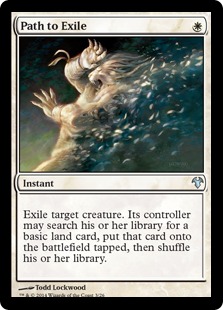
#1: Path to Exile: 14/15

Why is it that Path is seeing less play now than it did a month ago when the number of targets it has is increasing? Especially targets that only it can answer for one mana? Prismatic Ending and Solitude are the answer. Which I find infuriating when so many players are complaining about Murktide Regent or getting killed at instant speed by Hammer Time. Ending is a very versatile card and answers a lot of the same things Path does, but at sorcery speed. And it can't hit the costly threats that are starting to pop up everywhere. Solitude doesn't ramp opponents, but this is balanced by it costing another white card. Players seem to prefer playing the more contextual answers and complaining about unkillable threats than just running more Paths right now.

Efficacy: 5

One mana, exile target creature. It doesn't get more efficient or permanent than that. And considering that removing large creatures at instant speed is especially important right now, Path is particularly potent.

Meta Versatility: 4

The only decks that don't have creatures that you want to Path are some control lists and Ad Nauseam. That's not enough to worry about, but the bigger concern is that Path does ramp opponents. This is a large part of its drop off since one mana creatures are seeing more play now than before. However, this is balanced for me by instant speed, equivocality, and price.
Splashability: 5

Any deck that's white that wants to kill creatures can run Path. The fact that more don't is mystifying to me, given delve creatures, construct tokens, and Primeval Titan being very popular.

Right Card for the Job

There are reasons that all of these cards aren't seeing much play at the moment. However, I don't think they outweigh the positives of running them, and that's why they are underplayed. Before players complain about broken cards, I wished they'd reexamine and adjust their own card choices.

Clipped Beta vs. Alpha: A Cautionary Tale

Are you a Quiet Speculation member?

If not, now is a perfect time to join up! Our powerful tools, breaking-news analysis, and exclusive Discord channel will make sure you stay up to date and ahead of the curve.

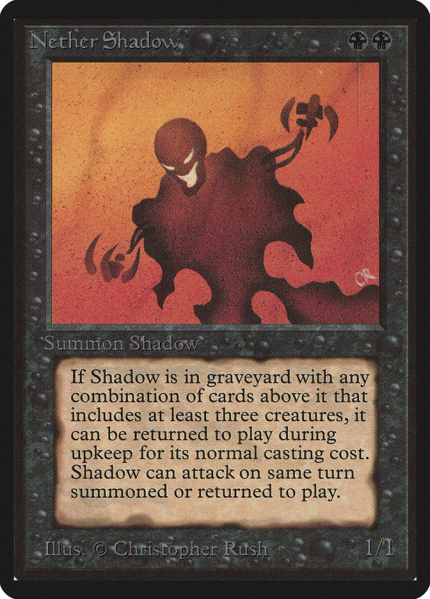
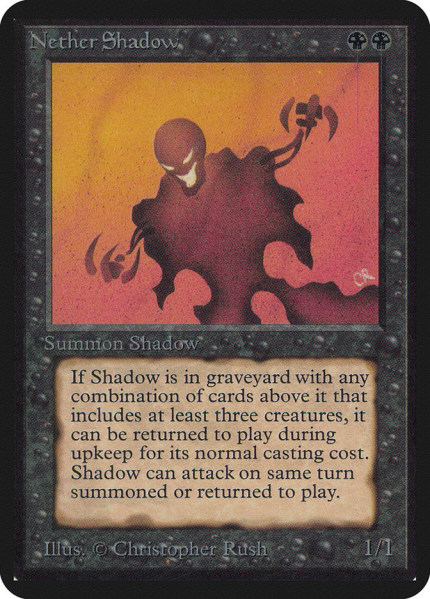
Last weekend I received some unfortunate news. I had sold a moderately played Alpha Nether Shadow on eBay, and the card arrived safely at the buyer’s home. But upon close inspection, the buyer observed something “off” about the card.

It turns out the corners appear clipped and uneven, and the buyer deemed the card a clipped Beta copy rather than a genuine Alpha copy. Now I’m not only out the sale price, but the card I bought is likely worth well below what I paid rather than well above. At least I’ll get the card back via return—maybe I just need to play it in a deck. Though, every time I see it I’ll have a sour taste in my mouth so I will probably just fire sell it as damaged Beta and see if I can get a taker.

There was an error retrieving a chart for Nether Shadow

In an attempt to make lemonade from the lemons this situation just brought me, I’m going to touch upon a few watch-outs when dealing in Alpha cards, along with the necessary measures one should follow when dealing in these rare, high-end, and sometimes-counterfeited cards.

Two Cautionary Tales

Learn from my painful experiences--they can be helpful cautionary tales with valuable insights to reapply. Clipped Beta cards exist and they’re more common than you may believe. In fact, this is now the second time I have ever been told a card I sold is clipped Beta and not Alpha. I’ve probably sold / buylisted a couple hundred Alpha cards, but even a counterfeit rate of 1 out of 200 feels extremely high. I’m not saying that 0.5% of every Alpha card that exists is clipped Beta—rather, I’m describing the frequency with which these show up.

What’s more, the two experiences I’ve had with clipped Beta were both purchases I made from major online sellers—not random individuals or TCGplayer. These are large-scale sellers who sent me the cards that were later identified (unfortunately not by me, but by prospective buyers) as clipped Beta. It’s not just the novice who falls for the trap.

The first time was a card I tried buylisting to ABUGames, and the store's buyer informed me of the questionable nature of the card. The second time was an eBay sale I made (the Nether Shadow). The buyer had a couple hundred feedback and appeared to deal in cards quite a bit, so I felt comfortable shipping them the card. But they immediately flagged the fact that the card was likely clipped Beta and not truly Alpha.

Detecting Clipped Beta

I’m not claiming to be an expert in this field. There are others who are die-hard Alpha collectors and have dedicated many hours of their life towards detecting fake Alpha cards from a field of real ones. I’m not here to educate you on every detail that differentiates Beta and Alpha nor do I have all the pictures (or cards) necessary to showcase all the differences.

But after my personal experiences dealing in these counterfeits, I have some ideas to share.

In some cases it’s easy to decipher the difference between Alpha and clipped Beta because the Alpha card is printed with different wording vs. the Beta counterpart. For example, Alpha Unsummon had a weird typo in the card’s text box that was corrected in Beta. So if you have an “Alpha” copy that doesn’t contain the typo, you can be absolutely sure it’s a fake.

There was an error retrieving a chart for Unsummon

Another example (my favorite) is Cyclopean Tomb. The Alpha version contains a notorious misprint: no casting cost! This was of course fixed in time for the Beta printing.

There was an error retrieving a chart for Cyclopean Tomb

Unfortunately, a lot of the cards in Alpha and Beta have identical text. This means an alternative method needs to be identified in order to detect if a card is Alpha or clipped Beta.

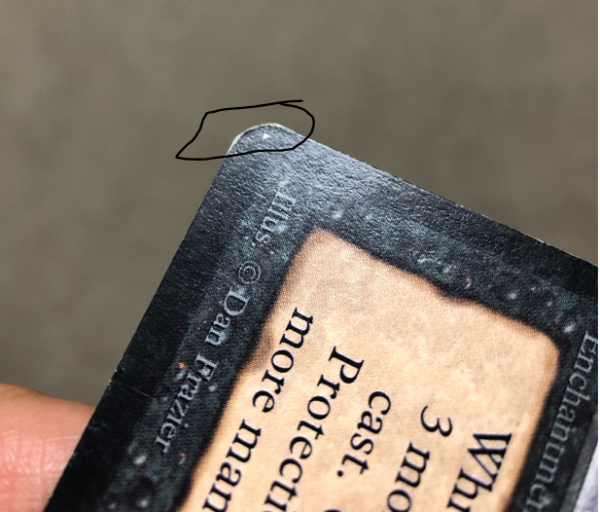
At this point, it really comes down to scrutinizing the corners and looking for one of two distinct features. A genuine Alpha card’s corners will have a very tiny “lip” to them. Of course, it can be tricky to detect these corner features when a card has significant play wear on it. I did my best to capture the feature on an Alpha Gloom, below. You don’t need a loupe to see the feature I’m describing—the right reflection of light is sufficient.

Notice how the corners come out of the plane just a tiny bit? This is one indication that a card is genuinely Alpha and not clipped Beta. One of the times I was bit by a clipped Beta was when I buylisted some Alpha cards to ABUGames, and the buyer there pointed out that one of the cards I sent them didn’t have these distinguishing features. That wasn’t enough to definitely claim the card as fake, but it was enough of a yellow flag that the buyer at ABUGames sent me the card back. That’s how I learned about this feature.

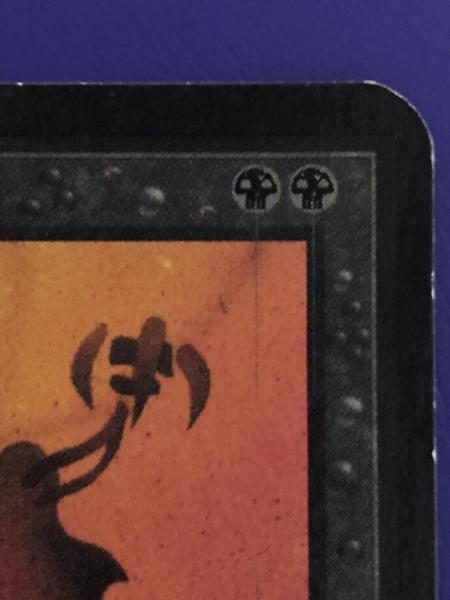
Now take a look at the corners of the Nether Shadow that is being returned to me. Observe how the corner looks jagged/damaged, and there is no lip feature.

I would have liked a picture of the corner with reflected light as I took of my Gloom above. But I can understand why the buyer is asking to return this card. The corner is indeed suspicious—this is the first time someone returned a card to me for appearing to have clipped corners, and it likely means I’m going to be out $100’s on the failed sale. Not only that, but now I’ll have to sell the card as damaged Beta, plummeting its value dramatically. I’ll still probably sell it because I’d rather have whatever I can get for the than the card itself.

Other Detection Ideas

When it comes to identifying clipped Beta cards, the corners are really the easiest method for detection. But if the clipping is done professionally, that may not be enough to provide definitive proof that a card is genuinely Alpha or clipped Beta.

You could try weighing the card, but I don’t think the removal of the very tips of each corner would be easy to detect on a scale. The signal may be too small relative to the variation in card weights. The difference is likely going to be too small to really provide useful data.

Another strategy I’ve read about in the past is looking at the registration of the mana symbols in the card’s casting cost. Apparently where the symbol appears within its circle could be an indicator of the card’s true set. I’ve seen this strategy applied when trying to decipher whether a card is truly Alpha/Beta or if it’s a rebacked Collectors’ Edition card. But I remember reading somewhere that there may be differences between Alpha and Beta registrations as well. Granted, I’m more likely to drive myself crazy scrutinizing the mana costs than I am actually detecting definitive differences. Talk about subtle!

You could also try placing the questionable card within a stack of genuine Alpha cards, to see if it stands out. Try rubbing your finger along the corners, up and down the stack, and see if you can feel any card being “different”. If you can stare at a bunch of Alpha card corners/backs, and pick the questionable card out of the bunch every time for looking slightly off, then you may have cause for suspicion. This gets harder when cards are heavily played, but it could be a valuable approach when dealing in lightly played or near mint Alpha cards.

Of course, to do this you actually need to be lucky enough to own a stack of Alpha cards—this isn’t an inexpensive strategy to say the least.

There may be other ideas, but those are the only ones I’m aware of. I tried running a Google search for “Alpha vs. Beta” but all the top hits talk about the rounded corners of Alpha. Well, duh! Finding the difference between a legitimate Alpha card and a legitimate Beta card is trivial. Determining if a Beta card is clipped to look like Alpha is much harder.

Wrapping It Up

With two negative experiences now dealing in Alpha cards that may be clipped Beta, I’m left wondering if it’s “worth it”. What I mean to say is, is it worth my dealing in Alpha cards if 1% of the time I receive a clipped Beta instead. What can be done to avoid losing money by purchasing an Alpha card only to find out months or years later that the card is in fact clipped Beta?

Well, first and foremost you could purchase your Alpha cards only from large-scale vendors. But even this strategy isn’t fool-proof, as both times I’ve gotten burned were cards I purchased from seasoned sellers. This may help reduce rate of receiving bogus Alpha cards, but it won’t bring the failure rate down to absolute zero.

As a second step, you really need to scrutinize the card’s corners very closely immediately upon receipt. It’s not enough to simply trust that the seller would have caught a questionable Alpha card before shipping it to you. You need to look closely at the corners for signs of damage/clipping yourself—a jeweler’s loupe could help, but it’s probably not required. You can see the distinctive “lip” of a genuine Alpha card with the naked eye as long as you reflect the light upon it just right. I am going to start doing this from now on—it’s a practice I should have started years ago.

Lastly, if there’s any doubt and you’re purchasing the cards from a major retailer, you should return the card for a refund. It can be annoying to deal with returns, I get it. Also, some Alpha cards are so rare that you may not be able to find another copy at a reasonable price for some time. But given how prevalent clipped Beta can be, it’s just not worth the risk. The price differential between Alpha and Beta is huge, and it is not fun being the one holding the bag finding out a card you thought was Alpha was in fact Beta.

As Alpha cards become rarer and more valuable, they remain one of the best investments one can make in MTG finance. But they also bring some unique risk due to the popularity of clipping Beta cards “back in the day”. Proceeding with caution, scrutinizing corners closely, and not taking for granted a large seller is shipping you a genuine Alpha card is the best bit of advice I can provide—this is advice I will be following from now on to avoid getting burned again!

Worldwide Shortages and You

Are you a Quiet Speculation member?

If not, now is a perfect time to join up! Our powerful tools, breaking-news analysis, and exclusive Discord channel will make sure you stay up to date and ahead of the curve.

It isn't often that my real-world job and MTG finance side job share anything in common, however, they do occasionally cross paths. My current role is that of a Value Engineer, which is quite different from my previous role(s) as that of a Design Engineer. In my current role, I work in the purchasing realm and deal with cost reductions of parts and assemblies.

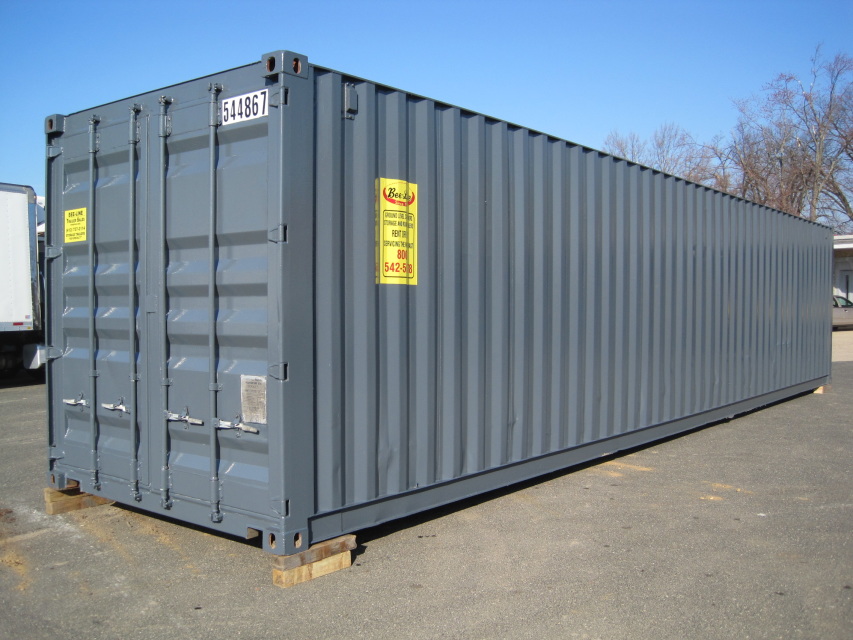
The relevant takeaway from this information is that I work closely with our purchasing team and listen to the issues they are facing currently. One of these issues is a worldwide shortage in shipping containers. I know you are probably thinking, what possible relevance does that have to MTG finance? After all, most of the items we ship are very small and likely never go into a shipping container.

However, this shortage is definitely affecting anyone with an online business. A large number of raw materials used to make most products are at some point shipped via container, as air freighting heavy goods is extremely cost-prohibitive. The lack of available shipping containers means that shipping costs go up and shipments get delayed waiting for containers to become available.

Top Loaders

The most obvious effect is the shortage of top loaders that we are seeing. For a reference point, in early March of 2020, I was able to purchase 1000 top loaders for $45 which is $0.045 each, by September I had to pay $50 for just 600 which is $0.0833 each. Now, the going rate for used top loaders on eBay is around $100 for 500 or $0.20 each. This particular shortage actually has at least two root causes that I can think of.

  1. Most top loaders are manufactured in China, and most Chinese goods travel by large shipping vessels which, as you might guess, are filled with shipping containers. Thus, when shipping containers are in short supply, the cost of shipping goes up and that cost increase tends to travel through the system until it eventually lands on the customer. This is especially apparent on cheaper items that take up a fair amount of space. While individual top loaders are small, they are typically purchased in bulk amounts which can take up a fair amount of space.
  2. The plastic top loaders are made of is acrylic, which also happens to be the same material used in face shields and one that many businesses purchased sheets of to make clear dividers. Thus the price of acrylic itself has gone up considerably over the past 16 months.

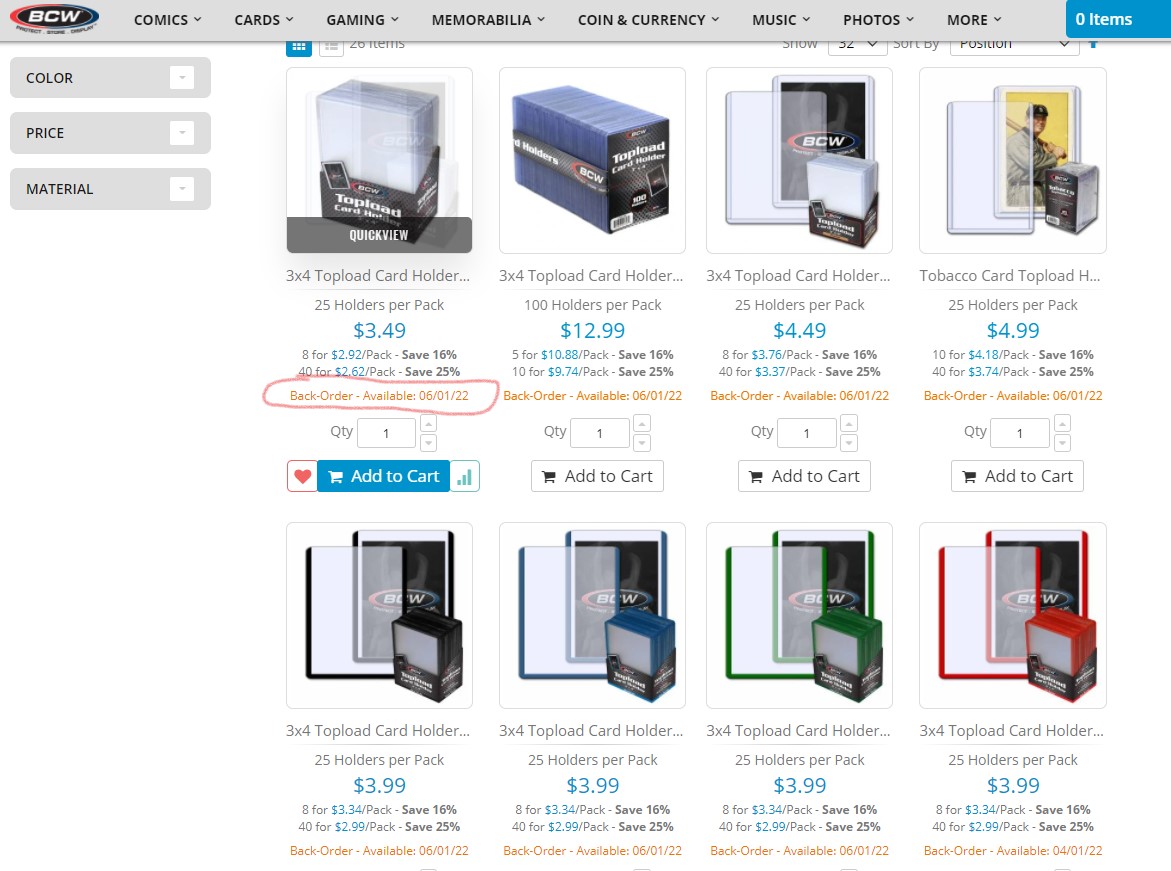
If we look at the BCW website, we can see that the cheapest new top loaders can be bought for is around $0.0974 each, but they won't be available for a year.

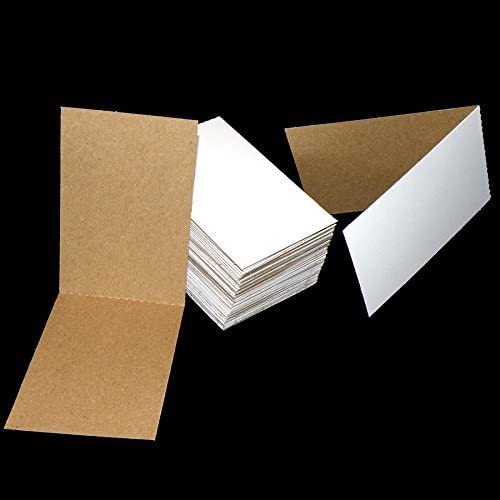
This shortage has led to a shift to cardboard sleeves by many stores, mine included, that are actually cheaper than the top loaders though they look to provide less overall protection for the cards being shipped. I also had to raise my overall shipping rates to account for the cost increase of shipping each order. Even these cardboard sleeves are considerably more expensive than top loaders used to be, with a cost of around $0.136 each.

But these aren't the only shortages affecting MTG finance.

There are numerous stories here in the US of big-box retailers like Target and Walmart suspending or greatly limiting sales of Magic, Pokémon, and sports cards. This has gotten big enough that it has made the news and I still see many people posting in various MTG groups when they actually find products available at one of these stores. I do not doubt that some of these shortages are at least in part due to the aforementioned shipping container shortage given that Carta Mundi, the main company that prints Magic, is based in Belgium.

It is important to note that when shortages are only a short-term problem, many larger companies absorb any cost increases as opposed to alienating consumers by raising prices. However, that can't last forever, and eventually, it cascades down through the system and causes retail prices to rise.

What can I do in the meantime?

While it seems shortages for various goods may remain for the foreseeable future, there are steps we can take to alleviate some of the pain caused by them.

I actually ran out of top loaders back at the end of April and have been making my own cardboard sleeves using boxes I have from my normal everyday purchases. I have found I can make 8 sleeves from each cereal box and, depending on what my wife orders from Amazon, some number of sleeves from those boxes. One additional benefit is fewer trips to our local recycling center. I have shipped over 100 orders with these homemade sleeves and have had 0 complaints. I make them by making cardboard strips that are 3" by 8" and folding them down the middle and then taping up the sides. This creates a decent cardboard envelope for me to put the cards in and then tape up the top. I put my cards in a penny sleeve and have it face downward, towards the fold so that there is no chance the card slips out and touches any tape.

Another strategy for avoiding the pain of shortages is planning ahead far enough in advance to eliminate any "convenience" costs. A good example is bubble mailers, which I buy in bulk off of Amazon where a pack of 50 is $5.99 as opposed to buying a pack of 12 from Walmart is $4.97. I have to keep stock of my inventory and reorder when I get down to my last 5, but it means $0.12 per mailer instead of $0.41.

An Adventure to Remember: AFR Spoilers

Are you a Quiet Speculation member?

If not, now is a perfect time to join up! Our powerful tools, breaking-news analysis, and exclusive Discord channel will make sure you stay up to date and ahead of the curve.

I'm in an unusual position this spoiler season. Two weeks ago, barely anything had been spoiled; today, the whole set is not only spoiled, but available online. Such are the breaks when spoiler season happens over the first week of a new month. As such, this will be a different kind of spoiler article. I won't just be baselessly speculating on cards after consulting my crystal ball and past experience. No, I can add in the miniscule amounts of data now available! So much more accurate.

Dungeons & Dragons: Adventures in the Forgotten Realms is a strange set. It has a unique mechanical feel and is the first set to use flavor from an entirely different IP. Though considering how many elements of D&D have permeated everything fantasy, it's almost surprising Wizards hasn't been more blatant sooner. They do own both games, and create D&D modules for Magic sets. All that is probably why the set has an uncanny valley feel to me: at once very familiar and deeply strange.

However, it's also a weird set power-wise. There are some potentially very strong cards and interactions, but nothing on Throne of Eldraine's level. Which also makes sense; Wizards did get burned badly on that one, and has been consciously nerfing sets since then. Also, AFR was initially designed as a D&D flavored Core Set, and those aren't so great. UsuallyAFR is also following on MH2's heels, so even if it had been on the higher end for a Standard set, it would look weak by comparison. Not that I'm complaining. It's nice to see Wizards demonstrating some discipline after years of just going for broke every set.
Downgrading the Dungeons

When I first looked at AFR two weeks ago, it was pure speculation on whether the Dungeons could be Modern playable. With the set now fully spoiled, I can confidently say that they aren't. There simply are no Modern-caliber cards that venture into the dungeon. I'd go so far to say that Dungeons may not see Standard play. It turns out that Ellywick Tumblestrum is the only easily repeatable venturer in the set. Meanwhile, Nadaar, Selfless Paladin was indicative of how venturing creatures would work, meaning they're tied to combat and meant to trigger once a turn. That's... okay-ish for Standard if multiple creatures attack in a turn, but won't fly in Modern. It looks like Wizards was afraid of Dungeons and intends for them to be a limited-only mechanic.

What Could Have Been

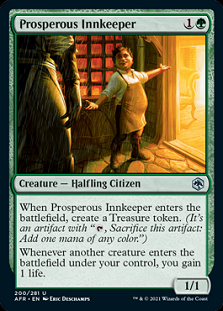
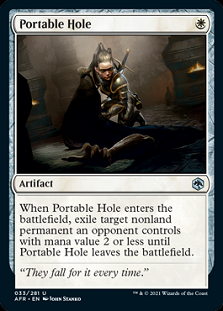
Before getting to the actual Modern-playable cards, I'd be remiss not to mention the card that is good enough for Modern, but will never see play. Portable Hole was one of the first AFR cards spoiled in the announcement of this whole extended summer spoiler-a-thon. And it is totally Modern-worthy. In fact, all three non-Tiamat cards in that announcement are potentially playable. Hole fills a huge, um, hole in white's removal options, and dealing with 1-drop creatures has never been more important. It also deals with Wrenn and Six, which has become critical for all the 4-color piles hanging around. Power Word Kill hits every commonly-played Modern creature for a decent price and Prosperous Innkeeper is a Soul Sister that accelerates. All at cheap enough costs to be Modern staples.

However, they were spoiled before MH2 was. And that set killed their playability. There is no reason for 99% of decks to run Hole over Prismatic Ending. Ending is forever, but a hole is escapable. It's just a cheap Banishing Light in a format where Assassin's Trophy and Abrade saw considerable play and now Ending is everywhere. Ending also scales to hit more things than Hole. Hole will see play in artifact synergy decks, but nowhere else. Urza has a way of making artifacts playable. Similarly, Power Word was superseded by Damn. The latter is more flexible and more importantly a wrath too. Innkeeper wasn't actual made obsolete before it was released, but I can't see why a deck would actually run it, especially right now. What might have been....
Speaking of Artifacts

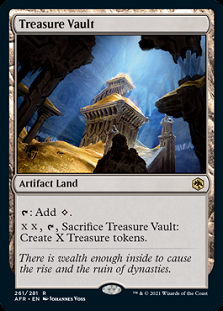
The biggest potential winner form AFR are artifact decks. I'm sure exactly which artifact decks, but the highest concentration of playable cards are all artifact synergies. I've already mentioned Portable Hole, but the card that I think will see more adoption is Treasure Vault. Between the ETB tapped artifact lands in MH2 and now the untapped Vault, I'm suspicious of Wizards testing the waters ahead of unbanning the original artifact lands. I've never been clear why they needed to stay banned once Krark-Clan Ironworks was banned, but we'll see. Vault is an upgrade on the MH2 artifact duals only because it enters play untapped. Power Depot is seeing play in the new Hardened Scales  Affinity decks as another modular card to feed Arcbound Ravager. Vault doesn't provide fixing or extra value, but being untapped allows for more explosive turns. That should be worth at least a slot or two.
Outside of Affinity, I'm not certain of Vault's fate. The Urza decks need colored mana, already play Urza's Saga, and can't really make use of a random artifact land. However, they often have lots of extra mana and like having lots of artifacts to fuel their engines/synergies. This suggests using Vault for its treasure generation rather than as an actual land. Which begs the further question: how is that better than Thopter Foundry? And I'm not sure. The only reason to turn a lot of mana into half as many treasures is to save it for later and... why not use it to win on the spot? Treasure Vault has a lot of potential, but I'm struggling to see why any deck would bother except that it wants an untapped artifact land.

Artifice for Value

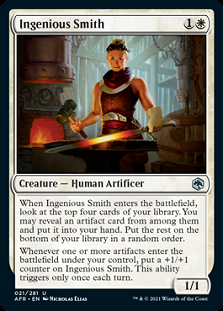
However, Wizards didn't just print artifacts. They also printed some new artifact-finding white creatures which are potentially playable if the right deck emerges. The first, Ingenious Smith, is not really a new effect. Glint-Nest Crane has seen scattered play for years, and a 1/3 with flying is better than a 1/1 without flying. However, Crane being blue is actually a strike against it since Urza, Lord High Artificer is also blue and competing for space. Also, Smith grows. It only grows by +1/+1 per turn, but artifact decks tend to be on the patient side and might be willing to dig for an artifact then sit back and build massive creatures. Wizards actually included the "triggers only once per turn" on a lot of AFR cards, so it looks like they've finally started taking the potential for abuse seriously.
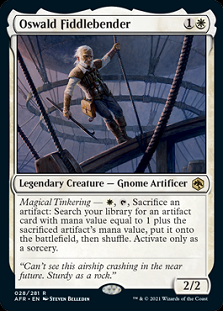
There's also Oswald Fiddlebender. Birthing Pod on legs is nothing new and has proved to be too vulnerable for Modern, as Prime Speaker Vannifar can attest to. However, we've never had one for artifacts before, and Oswald costs half as much as Vannifar. I have no idea how, but cheap engines are abusable and with the affinity mechanic being played again, there's huge potential for Oswald getting absurd in a hurry. Turn three Myr Enforcer into Sundering Titan into Inkwell Leviathan or The Great Henge the next turn seems pretty nuts. Whether this is a combo play or simply for value, it sounds like a Modern-worthy strategy.

The Stumbling Block

The only question is why to bother with these white value creatures when Urza's still legal. He does everything artifact decks could ever want and more. And honestly, I don't think there is any reason. The Whirza decks rarely bother with non-Urza creatures anymore, and I don't see that changing. However, I also don't see Urza sticking around forever. Should something new be printed that benefits Oswald and Smith but not Urza (which is very unlikely), then they'd both headline a new deck. Alternatively, if Urza gets banned (which it looks like Wizards wants to avoid, based on their nerfing of artifacts recently) I'd expect Oswald to headline a new Whirza variant. However, until this happens, their use will be pretty niche.

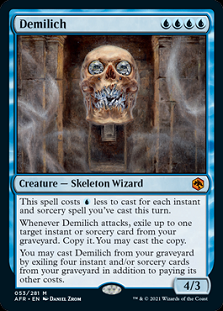
Demilich

This card actually worries me. On face, a four mana 4/3 that has to attack to mimic Snapcaster Mage is not Modern-playable. However, the same could be said of a 3/2 flyer with haste for four, and Arclight Phoenix was the It card of 2019 until Faithless Looting was banned. The main draw in both cases is that they jump back from the graveyard for free. Well, not exactly free: Arclight needed specific conditions to be met to trigger its return. Demilich has escape (functionally) and needs four instants and sorceries in the graveyard to exile. And while that is more flexible, it's also not free.
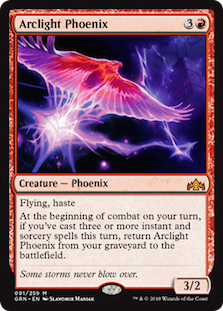
It's the first clause of text that makes Demilich Modern playable. In a typical Prowess or Storm turn, Demilich is actually free to cast, even from the hand. Casting Arclight always costs 3R. And free is always dangerous. The question is whether this danger is theoretical or real. Best-case scenario: a turn 2 'lich off two Manamorphoses. That's harder and less aggressive than casting Stormwing Entity, which tells me that Demilich isn't a Prowess card. Storm is a possibility, but attacking really isn't Storm's thing except in emergencies. Which suggests that Demilich could be a sideboard card for when the combo fails.
However, I ultimately think that Demilich needs to be in an Arclight Phoenix deck. Those haven't existed since Looting was banned because it's too hard to get multiple early Phoenixes into the graveyard. That's still the case, but instead of being all-in on dumping Arclight off Chart a Course or similar, Phoenix decks could drop free Demilichs. Thus, they'd present reasonable threats earlier and more often, increasing their viability.

Positive Evidence

I'm not the only one thinking this, and it's already starting to happen. Aspiring Spike has been working on the list and has inspired others to take up the mantel. It is far too early to tell, but in a meta filled with grindy UR decks, the one with recurring threats seems well positioned. I doubt that Phoenix will reclaim its old glory, but it may be viable once again. Keep a close eye on this one.

Tasha's Hideous Laughter

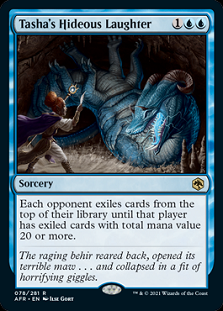
On the subject of AFR cards already seeing play, Tasha's Hideous Laughter has replaced Mesmeric Orb in Mill. It makes sense as exiling defeats the main counter to mill strategies (namely Eldrazi Titans and Gaea's Blessing) and with MH2 pushing down mana costs, the potential to mill a lot of cards is real. With the average mana cost of Tier 1 decks being around 1.5, a single Laughter will exile 13 cards plus or minus a few to reflect variance. That's on par with existing staples Archieve Trap and Fractured Sanity. The only worry is that it's another three-mana spell. Mill's biggest problem has always been clunky hands, and Laughter doesn't help. Plus, if counters become more common, it will prove harder to slip a three mana spell past counters than a two mana spell. I suspect this is a metagame call, but we'll see.
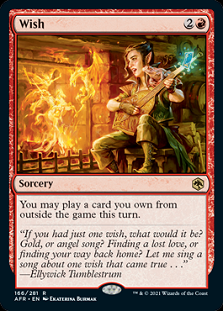
Wish

The last card is also the most speculative. There's never been a wish this broad before. Appropriate really, since Wish is as definitively and broadly named as possible. Which again makes sense since it's from D&D and predates the Magic wishes. While normally this would open a wide range of possibilities for almost every deck to exploit, Wizards seems to have considered that and Wish works differently from other wishes. All the other options place the wished-for card into the hand to be used whenever. With Wish, the card must be cast in the same turn. No sandbagging, no stockpiling value; just get a sideboard card and cast it the same turn. This is balanced somewhat by Wish never specifying the card that must be played, so the caster can revaluate their choice if something happens after Wish resolves.
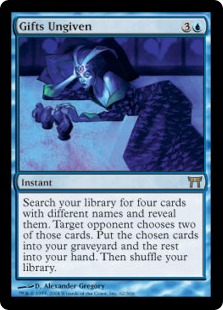
However, the requirement of casting the card in the same turn puts a lot of strain on the manabase for most decks. Especially since Wish costs three. That's a huge burden for aggressive decks and is no small problem for control. Combo, particularly Storm, is the only strategy that may want to Wish and will have the mana left over to cast the card and likely follow up to win. Wish also has an advantage since it costs less than current staple Gifts Ungiven. Still, I'm not a combo player, so we'll have to wait and see how this plays out.

Wandering Near to Home

After the banquet that was MH2Adventures in the Forgotten Realms is positively a famine. However, that's no bad thing. Modern is already going to be settling for some time and dumping more cards into the mix will only increase the churn. All that's left is to wait and see how MTGO shifts before AFR is available in paper.

My 500th (ish) MTG Finance Article: A Self-Reflection

Are you a Quiet Speculation member?

If not, now is a perfect time to join up! Our powerful tools, breaking-news analysis, and exclusive Discord channel will make sure you stay up to date and ahead of the curve.

I’ve been writing about Magic finance for quite a while now—it’ll be ten years this fall. Throughout that time, I’ve been saving the vast majority of my articles on my local hard drive. My typical approach each weekend is to write up the article in Microsoft Word, then copy/paste the text into WordPress. From there, I add the pictures and card graphs as needed.

Throughout this entire time, I’ve been numbering my articles every time I save a new one. As it turns out, last week’s article was number 500. Of course, I had promised an article on Portal: Three Kingdoms for last week so I had to deliver on that promise. But for this week, I decided to do something a little different in honor of article number 500.

I’m going to touch upon the evolution of my engagement with the hobby. MTG finance ten years ago did not mean the same thing to me as it does now, and I think there’s value in explaining why I made the shifts I have over the past years. Not surprisingly, some of my decisions paid off nicely while others were terrible decisions. But they all had motivations, and it’s these driving forces that I would like to reflect upon this week.

I think some of this information will be new to readers; despite having done this for so long, I haven’t really revealed all the big-picture decisions I made and their motivations over the years.

Phase 0 and Phase 1: Early Days (2011 and earlier)

When I first started engaging in Magic finance, I was focused on the local scene, leveraging the trade as much as possible. From 1997, when I started playing Magic, to about 2009 I really didn’t pay attention to the fluctuations in card values. I liked that some of my cards were worth a little bit, of course, but I never had a self-assigned objective of making money from the hobby.

Under the influence of local player Jonathan Medina, I started observing the benefits of following the financial aspect of the game. This manifested itself in two ways.

First, I was following Standard card prices very closely. I remember one of the first speculative bets I made that paid off was the jump between Frost Titan and Grave Titan. The former was a $20 card for a hot minute, and then the latter became the hotter creature in Standard (after Primeval Titan, of course).

There was an error retrieving a chart for Grave Titan
There was an error retrieving a chart for Frost Titan

These profits were converted into other cards, and I slowly ground out a modest collection from well-timed trades (this was before I spent a lot of money on singles).

The second decision I made when it came to Magic was to buy into Legacy—not for financial reasons, mind you, but because I loved the format. I remember reading the card Ad Nauseam and I made a mental brew of lots of zero mana artifacts so I could draw nearly my entire deck. After doing some light research, I quickly realized a deck already existed that utilized this card. I was sold. I promptly dropped a couple hundred bucks to buy the Dual Lands I needed, Lion's Eye Diamonds, Mox Diamonds, etc.

There was an error retrieving a chart for Lion's Eye Diamond

From here, I decided to gradually purchase as many Legacy playsets as possible so that I could try other decks in the format as well. This may sound crazy now, but keep in mind this was a time when Underground Seas were $30-$40 and other Duals were less. It wasn’t so crazy to gradually trade and buy into Legacy. And I remember at one point acquiring a couple heavily played pieces of Power—a Timetwister on eBay for $125, an inked Mox Emerald from my LGS for around $300, and a couple others in the same price range. I ended up trading all the Power to Jonathan Medina himself in one of the most epic trades of my lifetime.

Thanks to the internet, I still have the trade saved in my inbox. This email dates back to April 27, 2011:

Medina's:

4 Mutavault
2 Noble Hierarch
4 Thoughtseize
1 Tropical Island
1 Bayou
2 Taiga
1 Scrubland
1 Volcanic Island
4 Mox Diamond
4 Metalworker
1 Sword of Feast and Famine
2 Underground Sea
4 Badlands
2 Tundra
1 Plateau
2 Force of Will
2 Mana Drain
1 Karakas (Italian)
1 Mox Opal
1 Windswept Heath
2 Flooded Strand
1 Shahrazad
1 Nether Void

My:

1 Mox Ruby
1 Mox Emerald
1 Mox Sapphire
1 Time Walk
1 Timetwister
1 Library of Alexandria

It’s readily apparent that I was doing my best to leverage the Power I had purchased in order to round out my Legacy collection (plus add a couple other fun goodies to my collection). I haven’t bothered tracking whether or not this trade would stand up as well in 2021—I suspect I would have been better off holding the Power—but this really launched me into the next phase of my MTG finance career.

Phase 2: Starting the College Fund (2011-2013)

Over the next couple years, I leaned heavily on the Magic Online Trading League (MOTL) to execute trades and attempt to grind value out of Magic. In 2011 I moved from Cincinnati to Boston for work, so I didn’t really have the local scene to rely upon anymore. It was nice that I could continue my endeavors seamlessly by using online trading platforms like MOTL.

Then in 2012 a major life event happened: my son was born. Suddenly the prospect of spending hours every weekend at the local game shop was second in priority. I still went to FNM’s when I could, but I was always eager to get home—both to be with my family and also to catch up on sleep! What’s more, the Legacy scene at the local game shop I found in Boston was nonexistent, and I found myself using my cards less and less.

Then one day I made the momentous decision: it was time to sell out of Legacy. Buy prices on Dual Lands, Rishadan Port, and Jace, the Mind Sculptor were hitting all-time highs.

There was an error retrieving a chart for Jace, the Mind Sculptor

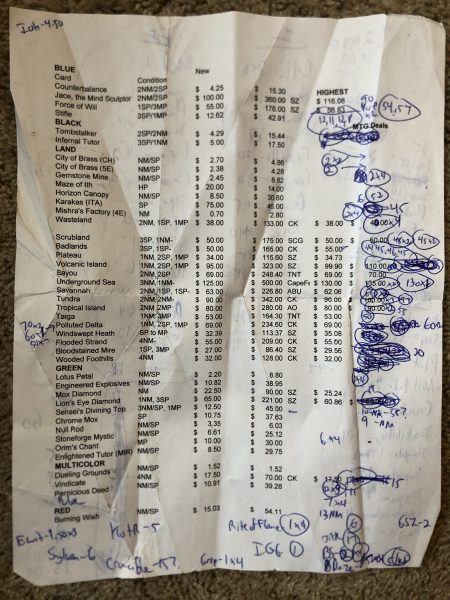
I started weighing the value of my collection against a different idea: saving money for my son’s college education. By 2013, my Legacy collection had accumulated enough value to be the seed for such a fund. I did the math, looked up buy prices across the internet, and decided it was time to sell out of Legacy. Just like with the Jonathan Medina trade, I still have the cards and their values documented from when I made the big sale—GP Providence in June 2013 was the date and place.

The spreadsheet printout became quite messy as I went from vendor to vendor, adjusting my expectations and tailoring prices accordingly (the sheet of paper also sat in the bottom of my backpack for years). But at the end of the day I accomplished my goal—my Legacy collection was gone and in its place, I had the start of a college fund.

Of course, fast-forwarding eight years it’s obvious this was not the right call from a financial standpoint. While the stocks I purchased in the college account have performed exceptionally well (mainly Visa and PayPal), even those 200%-300% gains pale in comparison to the gains I would have seen on all the Reserved List Legacy cards sold. I try to make myself feel better by looking at the non-Reserved List cards, which in many cases have dropped in price from 2013 to 2021. But at the end of the day, keeping all the cards would have been the better play.

I don’t have regrets, though, because this represented the next major shift in my mindset: focus on playing only for fun (no more major competitions/tournaments) and leveraging MTG finance to fund the college account.

Phase 3: Building Upon the College Fund & Old School (2014-2017)

While I’m disappointed that my Legacy collection is gone after seeing how prices climbed over the years, I can readily look at the bright side: the decision to leave Legacy inspired me to focus on casual play and finance, solely. At Grand Prix Las Vegas in 2015, I made the decision to shift focus to a strictly casual format: ‘93/’94 (aka “Old School MTG”).

The more I researched this format, the more I realized it was the perfect fit for me. Instead of constantly refreshing my collection to keep up with Standard and Modern, I could build a couple decks and confidently know they would remain relevant indefinitely. What’s more, the cards in the format are all old and rare—many of them are on the Reserved List—so I wouldn’t be at risk to fluctuating prices and reprints. In my mind, it was akin to having my cake and eating it too. It was a format I could play and enjoy and know that at the end, if I wanted to cash out, I’d get my money back and then some.

So at GP Vegas I started shopping for Old School cards. Unfortunately, most vendors didn’t bother bringing their fringe Arabian Nights and Legends cards to the event. I asked every vendor I spoke to if they had a Juzam Djinn for sale, and I was only able to find one heavily played copy—sold to me by Tales of Adventure for $70. I couldn’t track down any of the Beta cards I wanted, and I also only managed to track down a single Unlimited Chaos Orb. The event wasn’t a huge success from this standpoint, but it did motivate me to shop around more.

There was an error retrieving a chart for Chaos Orb

So over the next couple years, I focused almost exclusively on filling out my Old School collection. It was reminiscent of when I dove into Legacy. I wanted the flexibility of playing multiple decks, so I picked up cards strategically to enable this. Over these couple years, I wasn’t the only one exploring Old School—the format was going through a period of growth, as evidenced by the explosion in prices. As much as I regret selling my Dual Lands, I am thankful that I pursued Old School when I did. Getting into the format early has been one of the largest boons of my MTG career.

As card prices grew, I optimized my collection, selling extras that I wasn’t using so that I could continuously fund the college account..

Phase 4: The Reserved List Explosion (2018-Present)

Nowadays I don’t really tweak my Old School decks much; I like them the way they are. My buying and selling came to a peak while Reserved List cards were exploding, but once they settled down a couple months ago my transaction volume dropped to near-zero.

Nowadays I enjoy browsing my Old School collection and decks, but I don’t really aspire to purchase much for the collection. I’m rather content sitting on what I have as I wait for prices to settle a bit further. After the crazy explosion in Reserved List prices, my motivation to acquire cards dropped simply because I couldn’t justify paying the new prices.

There was an error retrieving a chart for Library of Alexandria

While I don’t think the bottom will fall out from under these highly collectible cards, I do think we’re going to go through a 12 month period of consolidation. When large-scale events resume, it could lead to another small infusion of supply into the market, putting even greater downward pressure on prices. The softness in prices won’t last forever, of course, and I wouldn’t be surprised if there was another round of Reserved List speculation/buying at some point in 2022.

In the meantime, however, I’m content to sit on the sidelines and wait. I’ll take advantage of the deals that cross my path, and I’ll look to sell a card here or there. But for the most part, the past couple months have been some of the quietest I have had over the past decade.

Wrapping It Up

Hopefully, this walk down memory lane was insightful, or at least entertaining. I enjoyed re-living these memories and digging up the deals I made years ago. It can be baffling to see what prices were like years ago. The returns on Reserved List cards in particular have been stronger than almost any other investment I could have made. For this reason, selling out of Legacy was probably a mistake, but at least I converted some of the proceeds into Old School, which was one of the greatest financial decisions I made in Magic.

Since I started MTG finance in 2011, there are a couple common themes. First, as I get older and raise my children (two kids now), I have gradually moved from active involvement to a more passive one. This manifests itself in my moving away from Standard and Modern speculation and toward Reserved List and Old School investment. Second, I am consistently moving funds out of Magic and into the college fund as prices continue to climb. In this way, I moderate my exposure to MTG and keep risk at a level I’m comfortable with.

Lastly, and most importantly, no matter what stage of life I’ve been in, I have found ways to engage with my favorite game: Magic: the Gathering. I could have easily decided to abandon the hobby altogether when my son was born. Then when the Legacy scene died down and I lost interest in Standard, I could have cashed out and jumped to a different hobby. When my daughter was born in 2017, I had yet another reason to ignore Magic. But as my personal needs evolved, so has my engagement with Magic. The game is so versatile that it fits any lifestyle no matter how much time and energy you’re able to dedicate to it.

It is this last factor that keeps me engaged and writing about Magic finance. Even though my involvement with the pastime looks very different now than it did when I started writing almost ten years ago, I have always found things to get energized about with this hobby. As long as that remains the case, I hope to be writing about Magic finance for years to come.

Un-Covering the History of Silver-Border Cards and Their Value

Are you a Quiet Speculation member?

If not, now is a perfect time to join up! Our powerful tools, breaking-news analysis, and exclusive Discord channel will make sure you stay up to date and ahead of the curve.

Silver-bordered cards have been a part of Magic for nearly twenty-five years. In this deep dive into these non-tournament-legal cards, we'll explore their origins, some of the most valuable cards from the Un- sets, as well as some cost-effective pick-ups for Cube, Commander, and speculation.

The Un-Usual History Of Silver-Bordered Cards

In August 1998 Wizards of the Coast released Unglued, the first Magic: the Gathering set meant strictly for casual play. To distinguish these cards from otherwise tournament-legal black and white border cards, Wizards came up with a silver border to identify them. The set was designed and developed entirely by Magic's head designer, Mark Rosewater. Rosewater, a former television comedy writer for shows like Roseanne, used the opportunity to pour as many puns, one-liners, and in-jokes at the time as he could into every card in the set, as well as introducing new ideas into Magic that are now a frequent part of the game's design toolbox like full-art basic lands, and token cards.

There was an error retrieving a chart for B.F.M. (Big Furry Monster)

Excluding the five full-art basic lands and six tokens, Unglued contained 83 cards. Some cards like Look at Me, I'm the DCI, Infernal Spawn of Evil, and B.F.M. (Big Furry Monster), became fan favorites. Cards like The Cheese Stands Alone and Spatula of the Ages would go on to inspire black-border equivalents like Barren Glory and Quicksilver Amulet. For all the good, there were a few cards that fell flat, like Bronze Calendar whose joke involves a matter of pronunciation, Sex Appeal a card in poor taste, and Ghazban Ogress, a card which called back to Ghazban Ogre from Arabian Nights the very first Magic expansion, but was offensive when you understood the context behind it.

While much of the bad of Unglued is only really identifiable in hindsight, the set was popular at its debut, and Rosewater immediately started work on a follow-up. The only bad move on Wizard's part according to Rosewater from a 2017 article "The Un-ending Saga, Part 1," was that Wizards had little experience at that point with printing supplemental sets and massively overprinted the product. The glut on the market forced Wizards to destroy large quantities of the product that went unsold, and as a result, they shelved Rosewater's plans for Unglued 2: The Obligatory Sequel.

Flash forward six years, and Wizards had finally come around again to the idea of doing another silver-border set. This time, the set was larger, more in line with the size of small sets under the Block design model of the time. The set featured 136 silver-border cards, including Super Secret Tech, a card which only existed in foil, and a new cycle of five full-art basic lands, this time with art so big there was no text box on the cards. Unhinged debuted in November 2004, and again the set was immediately popular at release.

There was an error retrieving a chart for Super Secret Tech

Players loved the continuation of jokes from the previous Un-set, like Infernal Spawn of Infernal Spawn of Evil, and Johnny, Combo Player, as well as new jokes like Who // What // When // Where // Why, a super-split card, Blast From The Past, and Magic creator Richard Garfield being immortalized in cardboard form in Richard Garfield, Ph.D.. Despite arguably even more interest than the first Un- set, a similar pattern played out. There was "High interest out of the gate, but we didn't end up selling all the product we'd printed, and in the end, we had to again destroy product," Rosewater wrote. "The prevailing wisdom at the company was that the sets were failures and there was no reason to ever print another."

"The prevailing wisdom at the company was that the sets were failures and there was no reason to ever print another." - Mark Rosewater "The Un-ending Saga Part 1"

Years went by, and slowly things began to change, both at Wizards, and with the Magic player base at large. Wizards began to produce short runs of supplemental products. Duel Decks, Masters sets, and other short print run products and boxed sets like Archenemy and Planechase became a regular part of the Magic product line. The interests of the player base also shifted, as many players embraced the player-driven format Elder Dragon Highlander, with its emphasis on social and casual play over competitive play. The company took note of the explosive growth of EDH into the most popular constructed format in Magic and worked with the EDH rules committee to launch the format as an official format in 2011, rebranded for commercial purposes as Commander. With casual play now at the forefront of the interests of the player base, and continued interest in silver border cards, both from influential folks inside Wizards and from the community, the stage was set for a new limited printing silver-border set, which after years in development became 2017's Unstable.

Aimed at a casual audience, and with an emphasis on draft, Unstable was a home run both for players and Wizards, with Gavin Verhey from Wizards in an article "Know Your Audience" calling it "one of the smash hits of the year." The set again included full-art lands, this time making them entirely borderless, and full-art and foil tokens. In a first for the game, Unstable also featured a series of same-named, but functionally different cards, like Very Cryptic Command, of which there were six versions.

The set also featured numerous legendary creatures and other cards designed specifically with Commander and Cube aficionados in mind. These included Spike, Tournament Grinder, Rules Lawyer, Urza, Academy Headmaster, and two-color legendary creatures for four of the five guilds of mad scientists represented in the set (the fifth is represented by a legendary artifact The Grand Calcutron).

In 2020, Wizards returned to the world of silver-border cards with the Unsanctioned box set. Unsanctioned featured reprints of popular cards from the previous Un-sets (and one HASCON promo), as well as 16 brand new cards, divided up into five 30-card decks. Unsanctioned righted a perceived wrong by the community, printing the third card for the Infernal Spawn cycle, Infernius Spawnington III, Esq., left out of Unstable. It also updated wording on the older cards reprinted, giving them modern templating, and satisfied the needs of an established segment of the market looking for something a little more off-beat than the seriousness of Magic's black-bordered offerings.

The Value of Un- Cards

The value of Un- cards is top-heavy and located primarily in foils. This makes sense as the cards only hold casual appeal, and thus players who want them are going to want the most blinged-out versions of them where possible. If we're buying silver-bordered cards, why not have those silver borders shine? Here's the five most expensive Un- cards and their pricing:

  1. Richard Garfield, Ph.D., Unhinged (Foil), $850.00 TCG Mid
  2. Mox Lotus, Unhinged (Foil), $394.92 TCG Market
  3. City of Ass, Unhinged (Foil), $119.46 TCG Market
  4. Blast From The Past, Unhinged (Foil), $78.28 TCG Market
  5. Aesthetic Consultation, Unhinged (Foil), $62.34 TCG Mid

Prices from this list are for Near Mint cards using our QS Insider tools, cross-checked with TCG sales results, and citing TCG Market Price where there have been any sales of the card since the beginning of the year. Where no sales were present, TCG Mid was used to show the current asking prices of cards. We can see sharp drops in price between these cards, and the price differences between these and their non-foil counterparts are even greater. Note that this list is exclusively Unhinged foils. The highest-priced Unstable foil is Steamflogger Boss, whose market price is $49.99. There were no foils in Unglued because the set predated the appearance of foil cards, which began with the Urza's Legacy expansion. The most expensive Unglued card is Blacker Lotus, which at a market price of around $30 feels high for a card you're required to tear into pieces as part of its activation cost, but the forced scarcity this created has undoubtedly affected the price over the last 20-something years. With art by the original Black Lotus artist, Christopher Rush, it's an interesting showpiece as part of any collection.

If looking to pick these cards up for personal use, to bling out a cube, or play some wacky Commander, these are cards to certainly have on your radar. But what if you're looking for some silver-bordered bling, but don't want to break the bank? What about a possible investment spec?

Cost-Effective Un- Cards For Cube and Commander

Adding fun silver-border foils to Commander and Cube doesn't need to break the bank. Here are five to have on your radar to spice up your next game night, all under $20.

As Luck Would Have It, Unstable, $1.02


Some players just love to roll dice. This card not only rewards you for rolling dice, potentially winning the game, but hexproof protects it from being nuked by most things your opponents can throw at it. With a new Standard set looming that's all about rolling d20s, winning the game with this gets even easier. At only $1 for the foil, it feels worth picking up a few of these on the off chance dice fever gets rolling. Combine it with the next card on this list for even better odds.

Krarks Other Thumb, Unstable, $13.96


This one seems to already be picking up speed, so there's not as good a chance to profit, but if you're looking to roll some dice, take the initiative now before this gets to $20 later this summer.

Enter The Dungeon, Unhinged, $16.99


While not as direct as Demonic Tutor, the stories you'll tell about playing this card will be epic, and it gets you twice as many cards when you win the subgame! Add in Once More With Feeling, and The Countdown Is At One for more wackiness.

Animate Library, Unstable, $1.03


Another card sure to create some epic game night stories, there are few things more satisfying than turning your entire library sideways and shoving it into the red zone. While this isn't likely to generate you a bunch of profit, picking up the foil for a buck is sure to be worth it for the fun factor alone.

Spike, Tournament Grinder, Unstable, $3.85


For the Cube filled with all of the most broken things in Magic, Spike, Tournament Grinder feels like a necessary inclusion among a shortlist of silver-border Cube favorites. While the power level and potential swinginess may be offputting to some, if your Cube is already running haymakers like Jace, The Mind Sculptor, and Umezawa's Jitte, this card will be right at home. For ultimate style points not on a budget, tutor up Shahrazad for more subgame fun.

So far, most of the cards we've been discussing have been foil. If you're not looking for your cards to shine, the vast majority of Un- cards, regardless of the set can be picked up for less than a dollar. Shiny or not, these cards are sure to put a smile on your face the moment you slam them on the table.

A Quick Note On Holiday Cards, Specialty Promos, and Playtest Cards

The first holiday thank you card, Fruitcake Elemental was given to Wizards' employees and business partners in 2006 and started an ongoing annual tradition. Due to their scarcity and unique nature, many of these cards have climbed in price considerably over the years, so they were deliberately excluded from this discussion. Stay tuned for future article(s) exploring holiday cards, specialty promos, and Mystery Booster Playtest Cards, the honorary silver-border cards.

What are some of your favorite Un- cards? Do you have a good Enter The Dungeon story? What Un- card do you think is criminally underpriced that should have made the cost-effective list? Share your answers in the comments.

A Format Reborn: June ’21 Metagame Update

Are you a Quiet Speculation member?

If not, now is a perfect time to join up! Our powerful tools, breaking-news analysis, and exclusive Discord channel will make sure you stay up to date and ahead of the curve.

It's the first Tuesday of the month, so it's time for the metagame update. Yes, even in the middle of spoiler season. Because, serious question, when aren't we in spoiler season? This year's release schedule is ridiculous; I could spend all my time just discussing cards and never run out of gas. I've got to draw a line and set some standards. And, more importantly, Adventures in the Forgotten Realms is so overshadowed by Modern Horizons 2 that it makes more sense to hold off on talking about that until the whole set is revealed.

Every metagame update has its own weirdness. June's is high volatility. Again, Modern Horizons 2 released and with it came a flood of cards that are shaking up existing decks and making new ones. Players really like MH2 and brewed up a storm. As a result, the total number of distinct decks was up. Way up. The most decks ever since I restarted the monthly metagame updates. May saw 65 distinct decks place on MTGO. I recorded 87 individual decks in June. And that was with a fair amount of aggregation as decks evolved and new ones emerged. Plenty of decks changed dramatically from their first emergence to their final forms this month, but I kept them together because the central premise and strategy stayed the same despite numerous card changes. Had I not done so, the total decks would be close to 100.
And this is despite the total decks being a fairly modest 457. Limited release events precluded any special or extra constructed events. In fact, I included several non-Wizards events just to fill out the data. These were two Preliminary-like and one Challenge-like event I found on MTGMelee. They had similar populations and record reporting as the official MTGO events which is good enough for me. Hopefully there are more non-Wizards events soon, the metagames these events suggested looked very different to MTGO's.

June Metagame

To make the tier list, a given deck has to beat the overall average population for the month. The average is my estimate for how many results a given deck “should” produce on MTGO. Being a tiered deck requires being better than “good enough;” in June the average population was 5.25, meaning a deck needed 6 results to beat the average and make Tier 3. This lower than any other month as these go. Which makes sense, given the breadth of the data. Then we go one standard deviation above average to set the limit of Tier 3 and cutoff for Tier 2. The STdev was 6.78, so that means Tier 3 runs to 13, and Tier 2 starts with 14 results and runs to 21. Subsequently, to make Tier 1, 22 decks are required. This is a very low threshold compared to previous months and a low STdev.

The Tier Data

All of which, again, makes sense when June produced 87 unique decks, the highest number ever. This is despite being on the low end of total decks, just 457 to May's 488. A very active brewing period will do that, and the months with set releases tend to have higher deck counts. Just not this high. The explosion of placing decks, low threshold, and narrow STdev means that more decks made the tier list than Ever. 20 decks total has been the average so far. June has 28 tiered decks. I'd like this to continue. Most months the same names are in every Challenge, which means I'm measuring the same players constantly, which tends to lead to an inbred metagame. This time there were players I'd never heard of before, and that's really important for format health. It will get better once paper events are back.

Deck NameTotal PopulationTotal %
Tier 1
Amulet Titan408.75
Izzet Prowess275.91
Blue Living End224.81
Tier 2
Izzet Tempo214.59
Rakdos Midrange204.38
Urza's Kitchen194.16
Cascade Crashers163.50
Yawgmoth163.50
Tier 3
Humans132.84
Burn132.84
Crab Mill112.41
Hammer Time112.41
Jeskai Stoneblade112.41
Hell's Kitchen102.19
Niv 2 Light91.97
Ponza91.97
Eldrazi Tron91.97
Enchantress91.97
Esper Control81.75
UW Control71.53
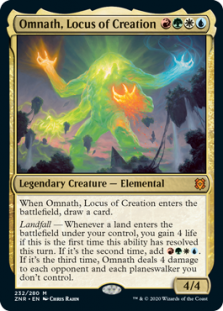
4-C Omnath71.53
Jund71.53
Death and Taxes71.53
Heliod Company61.31
Lantern Control61.31
Ad Nauseam61.31
Hardened Scales61.31
Lorehold Turn61.31

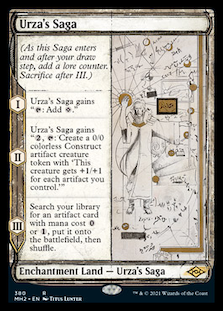
Amulet Titan was the top deck this month by a lot. I told you UR Prowess's performance last month was an outlier. Amulet has been a solid Tier 2 deck for months, so to see it as the top of Tier 1 might be surprising. However, context is important. Amulet Titan earned roughly two-thirds of its slots in the first two weeks after MH2 released. The main reason was that it was easier to incorporate Urza's Saga, the card most players speculated would be broken, in that deck than anywhere else. It took a while to work out the Food and Ragavan decks that would dominate the later weeks. Thus, Amulet got a pass as a known good deck until the rest of the format caught up.
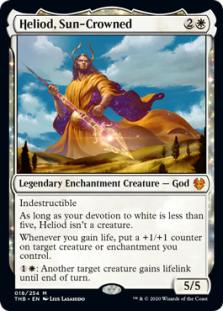
June also highlights a minor problem with how I do the statistics. If I used the 95% confidence interval as my starting point instead of the average, more decks would be included and the tier threshold's lowered which would have grown Tier 1 by two, possibly three decks and two would have grown on net by up to three. UR Tempo, the blanket term for the non-Prowess UR aggro-control decks which sometimes feature Delver of Secrets, Dreadhorde Arcanist, or Murktide Regent was right at the cutoff to Tier 1, with Humans and Burn just missing Tier 2. However, the order still wouldn't have changed, so everyone is free to make up their own minds on the "real" tiers, and I think that including the decks below the current cutoff is giving them credit they don't deserve. Especially when they wouldn't make the power tiers regardless.

New Decks Rise

There a ton of totally new decks in this update. There are also a number of decks that have been substantially changed as the result of MH2. Trying to go into all the changes would take the entire article (and is Jordan's thing anyway) so I'm just going to do a quick rundown of the big ones:

  • Blue Living End: Shardless Agent pushes Living End away from Jund into UB splashing red and green for Violent Outburst. Also allows more interaction than old lists
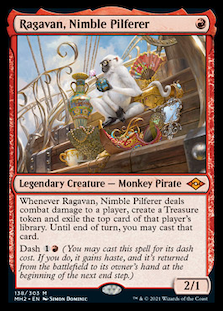
  • UR Tempo: As mentioned, a blanket term for non-Prowess Izzet decks. Their unifying theme is cantrips, Dragon's Rage Channeler, and Ragavan, Nimble Pilferer
  • BR Midrange: Essentially, Jund Rock without Tarmogoyf. Has become more aggressive to include Ragavan
  • Jeskai Stoneblade: Take Jeskai Tempo from years ago, and remove Geist of Saint Traft and Spell Queller for Stoneforge Mystic and Ragavan
  • Urza's Kitchen: Urza, Lord High Artificer partners with Asmoranomardicadaistinaculdacar and his Saga to produce lots of gigantic constructs that are buffed by making lots of food tokens
  • Cascade Crashers: Take the cascade decks from February, add Shardless Agent, and replace Valki, God of Lies with Crashing Footfalls.
  • Hell's Kitchen: Instead of Urza, Witch's Oven and Cauldron Familiar combine with Asmor to make food for early Feasting Troll Kings.
  • Enchantress: Play lots of enchantments. Use Enchantress's Presence to draw all the cards to hide behind Solitary Confinement

That's not all that's changed, but these are the most dramatic additions to the tier list.

Old Decks Fall

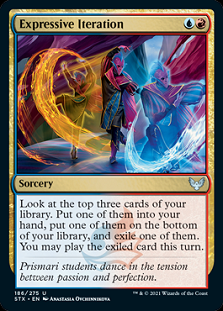
Meanwhile, a lot of previously established decks have fallen off. UR Prowess fell dramatically, but that's probably just a normal adjustment. It was severely overplayed last month. Similarly, previous boogeyman Heliod Company fell all the way into tier 3. Control decks are just hanging on, too. More shocking is Mono-Green Tron disappearing from the tier charts. Some of this is certainly a change in viability as the metagame shifts. Tron isn't great against fast aggro, Company doesn't like lots of removal, control doesn't work well in unpredictable metagames. However, some of this is also the allure of new cards. Players want to play with new things and since it's cheap to switch decks online, they're moving away from old standbys to try the new sauce. Don't write the old decks off yet. Let the meta settle for a few months.
Power Rankings

Tracking the metagame in terms of population is standard practice. However, how do results actually factor in? Better decks should also have better results. In an effort to measure this, I use a power ranking system in addition to the prevalence list. By doing so I measure the relative strengths of each deck within the metagame. The population method gives a decks that consistently just squeaks into Top 32 the same weight as one that Top 8’s. Using a power ranking rewards good results and moves the winningest decks to the top of the pile and better reflects its metagame potential.
Points are awarded based on the population of the event. Preliminaries award points for record (1 for 3 wins, 2 for 4 wins) and Challenges are scored 3 points for Top 8, 2 for Top 16, 1 for Top 32. If I can find them, non-Wizards events will be awarded points according to how similar they are to Challenges or Preliminaries. Super Qualifiers and similar level events get an extra point if they’re over 200 players, and a fifth for over 400 players. No events awarded more than 3 points in June. There weren't any Super Qualifiers or higher events. Partially this was because of the new set release and partially this was for the MOCS final, which isn't counted because it consisted of 8 players.

The Power Tiers

The total points in June were down from May. This tracks with the smaller and fewer events. May had 790 total points while June has 706. It's the lowest point total this year for a full month, and one of the lowest ever. That's what happens with fewer Premier events. And remember, I found some non-Wizards events to include. The average points were 8.11, so 9 makes Tier 3. The STDev was 11.31, again down considerably from usual, so add 12 and Tier 3 runs to 21 points. Tier 2 starts with 22 points and runs to 34. Tier 1 requires at least 35 points.

There are only 26 decks in the power tiers, and for once it wasn't just the lowest placing decks from the population tier falling off. 4-Color Omnath had 7 decks, but only 8 points to miss the cut. Lantern Control made Tier 3 with 6 decks, but misses on power with 7 points. Both had decks with similar populations do much better on power, but Lantern and Omnath clearly only made Tier 3 because players will not give up on these decks. They're not performing anymore, but that doesn't seem to bother their pilots.

Deck NameTotal PointsTotal %
Tier 1
Amulet Titan689.63
Izzet Prowess395.52
Blue Living End375.24
Rakdos Midrange365.10
Tier 2
Izzet Tempo344.81
Urza's Kitchen324.53
Cascade Crashers263.68
Yawgmoth243.40
Tier 3
Hammer Time212.97
Jeskai Stoneblade202.83
Eldrazi Tron192.69
Humans182.55
Crab Mill182.55
Hell's Kitchen182.55
Burn152.12
Enchantress141.98
Death and Taxes141.98
Niv 2 Light131.84
Esper Control131.84
Ponza121.70
Hardened Scales111.56
Lorehold Turns111.56
UW Control101.42
Ad Nauseam101.42
Jund91.27
Heliod Company91.27

When one deck is far more popular than other options, it earns far more points. Amulet Titan is no exception and continues the trend of the past few months. Nothing else to see here.

Meanwhile, the movement in the rest of the tiers is substantial. BR Midrange jumped UR Tempo to make Tier 1 while Hammer Time and Jeskai Stoneblade shoot from the middle of the pack to just miss Tier 2. As previously mentioned, a lot of the decks that only had 6 results in the population did very well on points. The value of metagaming and brewing was well demonstrated this month.

Average Power Rankings

Finally, we come to the average power rankings. These are found by taking total points earned and dividing it by total decks, which measures points per deck. I use this to measure strength vs. popularity. Measuring deck strength is hard. There is no Wins-Above-Replacement metric for Magic, and I'm not certain that one could be credibly devised. The game is too complex and power is very contextual. Using the power rankings certainly helps, and serves to show how justified a deck’s popularity is. However, more popular decks will still necessarily earn a lot of points. Which tracks, but also means that the top tier doesn't move much between population and power, and obscures whether they really earned their position.

This is where the averaging comes in. Decks that earn a lot of points because they get a lot of results will do worse than decks that win more events, indicating which deck actually performs better. A higher average indicates lots of high finishes, where low averages result from mediocre performances and high population. Lower-tier decks typically do very well here, likely due to their pilots being enthusiasts. So be careful about reading too much into the results.

The Real Story

When considering the average points, the key is to look at how far-off a deck is from the baseline stat (the overall average of points/population). The closer a deck’s performance to the baseline, the more likely it is to be performing close to its “true” potential. A deck that is exactly average would therefore perform exactly as well as expected. The further away the greater the deviation from average, the more a deck under- or over-performs. On the low end, the deck’s placing was mainly due to population rather than power, which suggests it’s overrated. A high-scoring deck is the opposite.

Deck NameAverage PointsPower Tier
Eldrazi Tron2.113
Death and Taxes2.003
Hammer Time1.913
Hardened Scales1.833
Lorehold Turns1.833
Jeskai Stoneblade1.823
Rakdos Midrange1.801
Hell's Kitchen1.803
Amulet Titan1.701
Blue Living End1.681
Urza's Kitchen1.682
Ad Nauseam1.673
Crab Mill1.643
Cascade Crashers1.632
Esper Control1.633
Izzet Tempo1.622
Enchantress1.563
Yawgmoth1.502
Heliod Company1.503
Izzet Prowess1.441
Niv 2 Light1.443
Baseline1.43
UW Control1.433
Humans1.383
Ponza1.333
Jund1.293
Burn1.153

This is one of the lowest baselines ever at 1.43. Which makes sense given how many decks were in the overall sample. When most decks only earn one point, the average will be very low. Keep that in mind when considering how many decks are above the baseline this month.

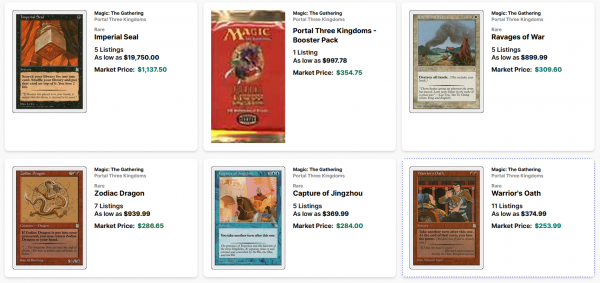
On the subject of the most popular deck, Amulet Titan has a very favorable average point total. However, it's a little deceptive. Amulet Titan has always been above baseline since I introduced this stat. And it's usually in the upper third, exactly where it is this month. This reads as a good deck that just keeps on keeping on while the format is moving around it. Eldrazi Tron being the highest average earner was surprising until I reminded myself that maindeck Chalice of the Void is really good when lots of decks are running mostly 1-mana cantrips and/or 0-mana artifacts.

A Transitory Phenomenon

And that is the June metagame. It will be very different come July's update. The impact of AFR's arrival will certainly be a factor, but a bigger one will be refinement. The new decks and everyone's sideboards are still quite rough. Another month of refinement and testing will tease out the better deck configurations and therefore I expect a huge shift over the next month. And now to wait and see if I'm right.

A Deep Dive into Portal: Three Kingdoms

Are you a Quiet Speculation member?

If not, now is a perfect time to join up! Our powerful tools, breaking-news analysis, and exclusive Discord channel will make sure you stay up to date and ahead of the curve.

If you missed last week’s article, I covered the prizes and pitfalls of two Magic sets from the late 1990’s: Portal and Portal: Second Age. Both were designed with beginners in mind, leaving out instants, enchantments, and artifacts and used different verbiage in an attempt to make the game more approachable to newcomers. Because the set wasn’t tournament legal when it was printed, it put a damper on demand.

When Portal sets were made legal, it opened up opportunities. These Portal sets contained functional reprints or near-reprints, meaning increased redundancy for certain effects (e.g. tutoring) in games of Commander. The set suddenly went from being useless with little value, to containing various gems with rising value.

But there’s another Portal set I didn’t cover last week, which I intend to cover this week. It’s the most exciting of the three Portal sets, containing some extremely rare and valuable cards. Of course, I’m talking about none other than Portal: Three Kingdoms.

A Little Background

Before diving into the financial component, I want to touch on a bit of history. According to MTG Wiki, Portal: Three Kingdoms was designed for the Asian market and was not sold in North America and released in May 1999. The set was mostly printed in Japanese, Simplified Chinese, and Traditional Chinese; only a tiny amount of product was printed in English, to be sold in Australia and New Zealand. This makes the English printings of these cards some of the rarest in the entire game!

To make things even more interesting, the set was based in flavor from the Three Kingdoms time period in Chinese history. The real-life references made the set very special, as it was the first one to reference real-life people and places since Legends (and it’s something Wizards hasn’t really done much of since). The artwork for the entire set was produced by Chinese artists to provide a more authentic feel, and the idea really worked well. I personally love the art and flavor of the set.

There was an error retrieving a chart for Warrior's Oath

Taking everything together, you have an older set, initially not legal for tournaments, never released in North America, with unique flavor and feel—this makes for one of the rarest, most collectible, and most valuable sets in the history of Magic!

So Much Value

I don’t think it’s far-fetched to assume that most players in North America prefer English cards, especially in casual circles. Portal: Three Kingdoms would be no exception. Given the fact that the English printing was the smallest, it makes for some very hard-to-find and valuable cards in the set.

Let’s touch on a few examples.

The most valuable card in the set is Imperial Seal, which retails for $1599.99.

There was an error retrieving a chart for Imperial Seal

This near-functional reprint of Vampiric Tutor has only been reprinted once, as a judge promo, and is extremely hard to find in English. Cheaper copies exist in Chinese and Japanese, but acquiring a playset of English copies of this card years ago would have yielded jaw-dropping returns.

The next most valuable card is far less powerful: Zodiac Dragon.

There was an error retrieving a chart for Zodiac Dragon

A nine mana 8/8 is a fairly unimpressive stat, and the card’s rules text isn’t all that impressive. I don’t think being able to play this card again and again after it dies is enough to make it a strong contender. The only thing going for this card is its creature type: it’s a dragon. Any dragon collectors looking to buy one copy of every dragon ever printed will have to pay up for this never-before-reprinted card. As a result, it retails for $999.99!

Rounding out the top five most valuable cards in the set, you have Warrior's Oath (a functional reprint of Final Fortune) for $599.99, Ravages of War (functional reprint of Armageddon) for $549.99, and Capture of Jingzhou (functional reprint of Time Warp for $499.99. Warrior's Oath has never been reprinted and the other two have both been judge promos.

Did you notice how many of the valuable cards in the set are functional reprints or near-reprints of other cards? This is a major theme in Portal: Three Kingdoms—there are dozens of functional reprints, ranging from Ambition's Cost (Ancient Craving) to Zodiac Tiger (Heartwood Treefolk).

There was an error retrieving a chart for Ambition's Cost

As I discussed last week, functional reprints of Commander-playable cards can be extremely useful as they offer redundancy in a deck. When you can only play one copy of any card in a deck, having multiple cards with different names that do the same thing can add much-needed consistency. What’s better than playing one Time Warp in a commander deck? Playing two Time Warps! (or, thanks to Portal’s Temporal Manipulation, three!)

A functional reprint doesn’t have to be all-powerful to be valuable, either. Three Visits is a functional reprint of Nature's Lore. The card is useful, for sure, especially because it lets you search up a Dual Land with multiple basic land types. But players want to play a second copy of this card in their deck enough to bolster the functional reprint’s price up to about $40! Did I mention this is a common?! The card would be even more valuable if it wasn’t recently reprinted in Commander Legends, by the way.

All Those Legends

Another value-driving component of Portal: Three Kingdoms is the long list of legendary creatures in the set. I don’t necessarily think many of these are commander all-stars, mind you, but it only takes a handful of players demanding the cards to drive up their prices.

The most valuable legendary creature in the set is Yuan Shao, the Indecisive, which retails for $279.99

There was an error retrieving a chart for Yuan Shao, the Indecisive

I’m not sure how powerful its ability is, but it seems like a commander that comes with a free Familiar Ground is pretty solid. As a bonus, the creature is red so you can play Goblin War Drums in your 99 and make all your creatures unblockable! Not that you need that anyways…Yuan Shao, the Indecisive has horsemanship, which virtually means its unblockable anyway.

While we’re on the subject, let’s talk briefly about horsemanship. The ability is the set’s parallel to flying, in that a creature with horsemanship can only be blocked by other creatures with horsemanship. Flavor-wise, it’s a really cool bit of flavor for this set, when considered in a vacuum. When taken as an ability in the broader game of Magic, however, it virtually means your creature is unblockable. Unless you have a certain local metagame focused around Portal: Three Kingdoms, you won’t be running into many opponents with creatures that have horsemanship.

Many of the legendary creatures in this set have the ability, and it could be an additional factor driving up their prices.

Zhang Fei, Fierce Warrior is a six mana 4/4 with vigilance and horsemanship, for example, and it retails for $229.99 (and Card Kingdom is sold out at that price!). Other examples of expensive legendary creatures with horsemanship include Cao Ren, Wei Commander and Xiahou Dun, the One-Eyed. The list is quite lengthy, and any legendary creature from the set will be worth a pretty decent amount. The cheapest rare of the set is Lu Bu, Master-At-Arms and even that card still retails for $16.99, and I suspect this is the cheapest because it was the set’s prerelease card.

The next cheapest rare, by the way, is Ambition's Cost, a card that has been reprinted a half dozen times, including in Eighth Edition as an uncommon, and the Portal: Three Kingdoms printing still retails for $29.99.

Weighing Upside and Downside Risk

I could go on and on listing the valuable cards of this set. But the reality is, you really need to browse through it yourself to find all the gems—there are just so many! I liken this set to Legends in a way, because they both contain so many unique legendary creatures with a surprising amount of value. But I would be remiss if I didn’t touch upon the upside and downside potential of the set before wrapping up the article.

The upside is pretty obvious. English printings of any and all of the cards in the set have some value, including the basic lands. Any rare is going to be especially valuable, especially if the card hasn’t been reprinted and has utility in a game of commander. As I browse some of the more popular cards in the set on TCGplayer, I’m seeing an extremely small amount of copies in stock—it kind of reminds me of Alpha in how sparse the inventory is.

You can see the drastic difference between the lowest listing and the market price—sellers are already anticipating a much higher price on these cards. Either that, or they have no desire to sell until the price is significantly higher.

Card Kingdom prides itself on its large inventory, but even they are out of stock or low in stock of many of the set’s cards. To me, this indicates potential for upside—they will keep increasing their buy prices until they restock the card. But since these cards are so rare, it may take a while before anyone comes forward with copies they’re willing to sell. English copies in particular have very high ceilings because of this.

But there is a trap with these cards that any prospective investor/speculator needs to consider before diving in. None of this set’s cards are on the Reserved List. They are all vulnerable to reprint in a big way. I have a personal experience with this.

About a decade ago, I picked up a nice English copy of Diaochan, Artful Beauty.

There was an error retrieving a chart for Diaochan, Artful Beauty

Beyond the beautiful artwork, I also thought the card would make an interesting commander from a political standpoint. I don’t remember precisely what the card cost me, but I want to say it was in the $30’s or $40’s. It had a steady, upward trajectory as the card aged, and I liked its upside potential; its buylist price was rapidly climbing, and I remember the temptation of cashing out at around $60 or $70.

Then in 2012 it was reprinted in Commander’s Arsenal. Suddenly there were copies that could be bought for less than $10, and it used the exact same artwork as the original (with updated, easier-to-understand rules text to boot)!

“But Sig, the original printing of the card still maintains its value despite the reprint. We see this all the time.”

That’s a valid point, but misses an important detail: the potential price of the card if it wasn’t reprinted. This is impossible to determine absolutely, but it’s very safe to say that original Portal: Three Kingdoms copies of Diaochan, Artful Beauty would be much more valuable if it hadn’t been reprinted.

Because cards from Portal: Three Kingdoms are so rare, their value is buoyed significantly by their rarity. As a result, they are very vulnerable to significant price declines should they be reprinted. While Wizards of the Coast has been careful with how they reprint cards from this set (often as judge promos with limited distribution), there’s always that risk lingering in the background. As a result, while I think these are brilliant long-term investments, I advocate diversifying and buying only one or two copies of multiple cards rather than going deep on a single one.

Wrapping It Up

I could have gone on for another two thousand words, this set is so fascinating from a flavor and a value standpoint. But I think you get the point. English Portal: Three Kingdoms is one of the rarest sets in the game, contains unique cards with unique abilities, and can offer redundancy in the form of many functional reprints.

This is a recipe for an extremely valuable set.

As such, I highly recommend including a few cards from the set in your Magic collection / investment. Even if money isn’t your primary motivator, the response on your opponents’ faces when you slam a creature with horsemanship on the table is well worth it. Better yet, playing Riding the Dilu Horse on your commander, granting it horsemanship, would be an even greater surprise. Be prepared to ask, “How much commander damage do you have?” over and over again.

There was an error retrieving a chart for Riding the Dilu Horse

Just be careful when buying cards from this set, as they are highly vulnerable to reprints from a value standpoint. These cards derive much of their value from their rarity, and a reprint could have a profound, negative impact on their price. Of course, over the long haul, the original Portal: Three Kingdoms printing will maintain value even in the face of a reprint. But the upside potential can be severely capped should a reprint be too large. Despite this, I am going to do some shopping for a couple Portal: Three Kingdoms cards myself so I can appreciate this rare gem from Magic’s history.

June ’21 Brew Report, Pt. 1: Rags to Riches

Are you a Quiet Speculation member?

If not, now is a perfect time to join up! Our powerful tools, breaking-news analysis, and exclusive Discord channel will make sure you stay up to date and ahead of the curve.

Modern Horizons 2 has been around for a month, and the format has adjusted thoroughly. That's not to say the dust has settled; just that the world is very different now. Today, we'll take a look at the directions fair decks are headed, featuring a pair of red one-drops that have already begun to redefine nonrotating formats.

Fair aggro-control decks seem to be coalescing around two poles, both wielding and maximizing Ragavan, Nimble Pilferer. On the tempo side of things, we've got UR Thresh; on the midrange end, BR Rock. Let's delve into both as we explore archetype homogenization, alternatives, and tech.

Fast & Furious

UR Thresh, MZBLAZER (4-0, Preliminary #12312060)

Creatures

4 Murktide Regent
4 Dragon's Rage Channeler
4 Ragavan, Nimble Pilferer
2 Dreadhorde Arcanist

Sorceries

4 Expressive Iteration
4 Serum Visions
2 Sleight of Hand

Instants

2 Counterspell
4 Lightning Bolt
4 Thought Scour
4 Unholy Heat

Artifacts

4 Mishra's Bauble

Lands

2 Fiery Islet
1 Flooded Strand
2 Island
1 Misty Rainforest
1 Mountain
4 Scalding Tarn
4 Spirebluff Canal
3 Steam Vents

Sideboard

2 Abrade
2 Aether Gust
2 Blood Moon
1 Chalice of the Void
2 Engineered Explosives
1 Force of Negation
1 Mystical Dispute
1 Spell Pierce
3 Spreading Seas

UR Thresh is Modern's answer to UR Delver, the top Legacy deck that's become downright scary (yet again) with Ragavan in the picture. The titular threat, Delver of Secrets, isn't quite where players want to be in Modern; this removal-heavy format dictates extra removal, making the Insect more of a liability here than creatures which provide some sort of value failsafe. The related need for more creatures overall makes the 1/1 worse at blind-flipping, and the lack of Ponder and Brainstorm means no great tools for setting up a flip. So instead, UR Thresh packs extra copies of Murktide Regent alongside a full set of Thought Scour, as well as up to a couple copies of the banned-in-Legacy value engine Dreadhorde Arcanist.
The rest is par for the course: there's the cheapest, most flexible removal available, including newcomer Unholy Heat, a low land count, and a set of Expressive Iteration. (That funky-looking Chalice of the Void in the sideboard is more for locking out 0-drops like suspend spells than trolling the mirror.)

I did say that UR Thresh was a premier interactive strategy fronting Ragavan, but I don't mean to say it's the best deck in Modern, or even the best UR deck. From here, it looks like that honor goes to UR Prowess, which is alive and well post-MH2 (similarly benefitting from Dragon's Rage Channeler) and doesn't even play Ragavan, preferring threats that front-load as much damage as able. Take this recent preliminary, where UR Prowess made up four of the seven decks scoring 3-1 or better (the four best-ranked, too). The two decks share many cards, but UR Prowess is decidedly more aggressive on the spectrum, and therefore gets less use out of the 2/1 Monkey.

UR Prowess, S063 (4-0, Preliminary #12312060)

Creatures

4 Stormwing Entity
4 Dragon's Rage Channeler
4 Monastery Swiftspear
4 Soul-Scar Mage

Sorceries

4 Expressive Iteration

Instants

4 Lava Dart
4 Lightning Bolt
4 Manamorphose
3 Mutagenic Growth
2 Unholy Heat

Artifacts

4 Mishra's Bauble

Lands

2 Bloodstained Mire
4 Fiery Islet
4 Mountain
3 Scalding Tarn
4 Spirebluff Canal
2 Steam Vents

Sideboard

2 Abrade
2 Blood Moon
2 Kozilek's Return
1 Seasoned Pyromancer
3 Spell Pierce
2 Threads of Disloyalty
3 Tormod's Crypt

Then there's Mono-Red Prowess, certainly an underdog but absolutely not out of the picture. Mono-Red uses Light Up the Stage to recoup on card advantage rather than Expressive Iteration, and was known pre-MH2 to go a bit bigger than UR, packing three-drops like Bonecrusher Giant and Blood Moon. In other words, it's more interactive, making it a better fit for Ragavan than its two-color cousin.

Mono-Red Prowess, JESSY_SAMEK (3-1, Preliminary #12309201)

Creatures

4 Soul-Scar Mage
4 Monastery Swiftspear
4 Dragon's Rage Channeler
4 Ragavan, Nimble Pilferer

Sorceries

3 Light Up the Stage

Instants

1 Gut Shot
4 Lava Dart
4 Lightning Bolt
4 Manamorphose
3 Mutagenic Growth
2 Unholy Heat

Artifacts

4 Mishra's Bauble

Lands

4 Arid Mesa
1 Bloodstained Mire
4 Inspiring Vantage
4 Mountain
2 Sacred Foundry
4 Sunbaked Canyon

Sideboard

2 Unholy Heat
3 Kor Firewalker
1 Kozilek's Return
1 Lurrus of the Dream-Den
3 Prismatic Ending
2 Rip Apart
3 Tormod's Crypt

Mono-Red is very handsome on paper if just for its bare-bones creature suite, which now comprises precisely the four most aggressively-costed red one-drops of all time. The above build splashes white for Rip Apart, Kor Firewalker, and of course Lurrus of the Dream-Den, giving it a big boost in mid-game power that aims to make up for the lack of Iteration for the mostly-free price of running some fast and Horizon lands.
Joining the Dark Side

As mentioned, leaning blue is but one of the paths available to would-be Ragavan casters. Modern's premier interactive color has always been that shared by Thoughtseize, so it's no big surprise to see the Monkey make headway in rock strategies, which protect it proactively.

BR Rock, MORENOTHINGS (3-1, Preliminary #12312060)

Creatures

4 Dauthi Voidwalker
4 Dragon's Rage Channeler
4 Ragavan, Nimble Pilferer
3 Kroxa, Titan of Death's Hunger
2 Dark Confidant

Sorceries

4 Inquisition of Kozilek
1 Prismatic Ending
3 Thoughtseize

Instants

2 Kolaghan's Command
4 Lightning Bolt
1 Terminate
3 Unholy Heat

Artifacts

4 Mishra's Bauble

Lands

4 Blackcleave Cliffs
2 Blood Crypt
4 Bloodstained Mire
1 Castle Locthwain
1 Godless Shrine
2 Graven Cairns
1 Mountain
1 Sacred Foundry
1 Scalding Tarn
2 Swamp
2 Verdant Catacombs

Sideboard

2 Prismatic Ending
1 Terminate
1 Thoughtseize
2 Alpine Moon
1 Collective Brutality
2 Engineered Explosives
1 Lurrus of the Dream-Den
3 Shattering Spree
2 Void Mirror

BR Rock (featuring a baby white splash for Prismatic Ending, Modern's latest premier removal spell) has all but subsumed Jund and other rock decks of late—it seems we may well have reached critical mass for powerful cards that play to rock's strip-em-n-beat-em bottom line. And as with Mono-Red Prowess, the Dream-Den's allure is a bit much to ignore, especially given that rock as an archetype lives and dies on value, incremental card advantage, and sticking a game-winning threat once opponents have run out of resources. Previously, Lurrus's companion condition was enough to keep it out of most rock decks (Shadow being the exception), but the fact is there's little need for three-drops like Liliana of the Veil or Bloodbraid Elf when the cheaper cards are this good (as of MH2, they are).
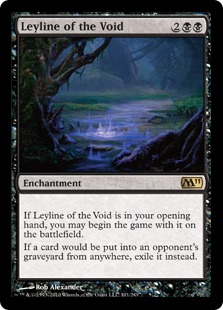
Here's Ragavan, of course, but also Dragon's Rage Channeler, which essentially just pressures the opponent while sifting through the deck and setting up delirium. That's a big difference from Tarmogoyf, Death's Shadow, and Scourge of the Skyclaves, the threats this kind of deck has traditionally favored; those creatures have to their benefit that they win combat on defense, too, meaning they apply pressure but also lend reversibility to midrange decks by stalling aggro. Channeler can pretty much never block profitably; not only is 3/3 a good deal smaller than 5/6 or however big Goyf happened to be at a given time, the creature attacks each turn if able when delirium is active. How much blocking did you want to be doing with your Goyf, anyway? The deck has plenty of removal for aggro opponents, as well as a secret weapon in Dauthi Voidwalker.

Voidwalker fundamentally alters the way rock plays by giving it access to a dimension previously claimed only by fish decks like Death and Taxes. It's an evasive threat that also functions as a one-sided hoser, in this case Leyline of the Void. While Leyline itself wasn't sided that often because of its strictness—there were better or less-risky alternatives against all but the fastest decks, and in most colors, and requiring sideboard slots was a big ask—having incidental copies stapled to a fast clock in the mainboard does indeed seem bonkers, especially considering that rock is so good at attacking opponents from the remaining game angles already. It's got targeted discard, creature kill, planeswalker kill, permanent removal, and now blue-chip grave interaction. It's also worth remembering that some of the decks that used to hassle rock the most, such as Dredge, see their recursive engines neutered by the Voidwalker.
Seeing Red

Okay, okay, so the red one-drops are fantastic. But there's more to Modern Horizons 2 than just that one story! Join me next time for the scoop on some of the brand-new archetypes emerging with the set... and on some Modern stalwarts excited to have found a few new toys.

Collecting Magic: the Gathering Novels

Are you a Quiet Speculation member?

If not, now is a perfect time to join up! Our powerful tools, breaking-news analysis, and exclusive Discord channel will make sure you stay up to date and ahead of the curve.

With the printing of Garth One-Eye and Asmoranomardicadaistinaculdacar in Modern Horizons 2, there has been a surge of interest in the early Magic licensed novels and stories. The character Garth made his appearance back in 1994 in William R. Forstchen's Arena, the first licensed novel for Magic: the Gathering. Asmoranomardicadaistinaculdacar, or Asmor for short, appeared originally in flavor text for the Alpha card Granite Gargoyle, and later in the Magic story "Chef's Surprise," by Sonia Orin Lyris, as part of the anthology Distant Planes. Further appearances in the flavor text of cards over the years have made her a popular figure in Magic lore, and along with Garth, their appearance in card form has driven interest in the source materials of their origins. With many of these source materials out of print for decades, collecting early Magic novels and stories like these on a budget is an interesting but not insurmountable challenge.

The Early Magic Novels

Both Arena and the Distant Planes anthology were part of the first batch of licensed Magic books, published by Harper Prism, an imprint of Harper Collins. The first book, Arena, hit shelves in the Fall of 1994, launching readers into the multiverse. A trilogy written by Clayton Emery followed, introducing readers to the wizard Greensleeves who appears in the flavor of the MH2 card Blessed Respite, and her brother Gull.

Greensleeves Trilogy

The early Magic novels bore little direct connection to the stories and characters depicted in the flavor text of the cards themselves, partly because the earliest novels were commissioned before the game itself had even released. Though the books did reference certain cards, tying in the books and the flavor text of the cards directly for regular Magic sets would not happen for a few years. But Wizards had a plan to bridge the gap, and drive book sales.

Book Promo Cards

To drive interest in purchasing the early books, Wizards collaborated with Harper Prism on a series of mail-in promotional cards. Book purchasers could mail in a coupon from the back of the book, and receive free promo cards in return. Wizards created a small run of functionally unique cards, with art, names, and flavor tied to the books. While most of these cards today aren't worth more than about $10, one of them, Mana Crypt goes for several hundred dollars, despite multiple reprints over the years.

There was an error retrieving a chart for Mana Crypt

The promos succeeded in driving early sales, and HarperPrism ultimately released 12 books between 1994-1996 when Wizards ended their license and began publishing books in-house.

Revising Magic Canon

The last Harper Prism Magic novel, Dark Legacy appeared in December 1996. For nearly two years no new books appeared until Wizards began publishing their own fiction, with direct tie-ins to the stories depicted in cards beginning with the Tempest block, and the story anthology Rath and Storm in July 1998. This caused a continuity split in the Magic canon, with Wizards declaring that the previous HarperPrism released works were only canon so long as they didn't contradict with new material moving forward. With Modern Horizons 2 bringing some of these characters into the cards for the first time, we can see Wizards making an effort to tie these older novels back into Magic canon.

Where To Start Collecting

Let's assume at this point that we're collecting Magic novels with an interest in reading them, not purely from a collecting standpoint. Let's also assume that we want to start with the origin of everyone's favorite five-color mage, Garth One-Eye, in Arena. We can begin by using eBay completed listings to see the going prices for copies of the book. Prior to Garth's preview on the Wizards site, we can see prices for Arena ranging from about $8-$25 depending on condition, with most in the $20 range. The first sale on eBay after the preview was of a new copy on June 5th for $49.99. The listing shows having two left, and 48 previously sold. A used copy of the book sold on June 14th for $21.08 with shipping, putting it towards the top end of previous prices. Amazon pricing is wilder, with a check on June 13th showing used copies starting at $39.86, and one new copy listed at $381.66.

Arena by William R. Forstchen

eBay sold listings for the Distant Planes anthology featuring Asmor's story show similar trends, with a new copy selling on June 11th for $53.99, and an active listing asking $89.99 or best offer. eBay and Amazon don't appear to be sources for deals, so where to turn?

Check Out Your Friendly Local Used Book Store

Much the same way your Friendly Local Game Store is a great place to get deals and personalized service while shopping, your Friendly Local Used Bookstore is a great spot to find hidden gems at a great value, especially for mass-market paperback fiction for which we're looking. My go-to used bookstore is Book Barn in Niantic, CT, which sells most of their mass-market-sized paperbacks for only $1 each, and has a massive series of rooms for fantasy and science fiction. A quick Google search for "used bookstore near me" should turn up some good options if you don't have one in mind already. I actually discovered two new ones in the process of researching this article which I'll be exploring soon.

Collecting Magic Novels For Value

If you're collecting Magic: the Gathering novels strictly for value or flipping, a word of caution: While asking prices on Amazon and eBay might sound high enough to cause dollar signs to flash before your eyes, with only a few exceptions most of the prices appear artificially inflated and not entirely tied to demand. That said, if you are collecting with the goal of flipping, here are a couple of targets to have your sights set on when hunting shelves and online listings beyond the two we've already discussed:

The Artifacts Cycle

The Brothers' War between Urza and Mishra is one of the most well-known and followed story arcs in the Magic universe. The four books in the Artifacts Cycle (The Brothers' War by Jeff Grubb, Planeswalker by Lynn Abbey, Time Streams by J. Robert King, and Bloodlines by Loren L. Coleman,) and their pseudo-prequel The Thran, also by J. Robert King, are among the most sought-after of the Magic novels, and the easiest to flip, especially if you can find the complete series in first edition, or the two omnibus editions.

Artifacts Cycle

Beyond the Artifacts Cycle, most of the books by Jeff Grubb and J. Robert King appear to be more in-demand than ones by other authors, regardless of what characters or story arc they depict. When collecting for value, bear in mind that most of the novels and story collections published by Wizards appear to be readily available on Kindle and Nook, and they could also be reprinted at any time, making long-term gains uncertain. If you are going to pick up any of the novels purely on spec, The Harper Prism novels haven't been reprinted since the '90s, and likely won't ever be again, making them better options than Wizards-published material, especially if they surprise us with new character cards in Modern Horizons 3 or a similar product.

The Last Page

As with collecting the cards themselves, collecting Magic novels is largely a matter of individual interest and taste. Has Modern Horizons 2 gotten you interested in collecting Magic novels, or dusting off your favorite from your bookshelf? What character from the Magic storyline would you most love to see in card form? Let me know in the comments.

Avatar photo

Paul Comeau

Paul is Quiet Speculation's Director of Content. He first started playing Magic in 1994 when he cracked open his first Revised packs. He got interested in Magic Finance in 2000 after being swindled on a trade. As a budget-minded competitive player, he's always looking to improve his knowledge of the metagame and the market to stay competitive and to share that knowledge with those around him so we can all make better decisions. An avid Limited player, his favorite Cube card is Shahrazad. A freelance content creator by day, he is currently writing a book on the ‘90s TCG boom. You can find him on Twitter and LinkedIn.

View More By Paul Comeau

Posted in Amazon, Buying, Collecting, eBay, FreeTagged , , , , Leave a Comment on Collecting Magic: the Gathering Novels

Have you joined the Quiet Speculation Discord?

If you haven't, you're leaving value on the table! Join our community of experts, enthusiasts, entertainers, and educators and enjoy exclusive podcasts, questions asked and answered, trades, sales, and everything else Discord has to offer.

Want to create content with Quiet Speculation?

All you need to succeed is a passion for Magic: The Gathering, and the ability to write coherently. Share your knowledge of MTG and how you leverage it to win games, get value from your cards – or even turn a profit.

Tempering Expectations Revisited

Are you a Quiet Speculation member?

If not, now is a perfect time to join up! Our powerful tools, breaking-news analysis, and exclusive Discord channel will make sure you stay up to date and ahead of the curve.

Today's article is one that's been brewing in my mind for over a month. Back on May 6th, 2021, Dogecoin hit an all-time high of 0.68 per coin. My two co-workers were both invested in it and were extremely bullish on it. All I would hear is that "it's going to the moon" all during its incredible rise that began on May 2nd. For those four days, it seemed like their willingness to hold onto it made them geniuses, as its meteoric rise continued. They kept saying that if it dropped, they would just buy more "into the dip," and then make even more money when it inevitably rose again.

While it certainly has risen a few times from lows it's currently sitting at $0.29 per coin as of me writing this. The days of my starry-eyed co-workers claiming it would hit $1 are gone. One of them sold it when it dropped down to $0.5, but the other is still holding. His buy-in was $0.29, so he is exactly where he started and has made $0 profit. Of course, I told him to sell when it was near $0.7. Doubling your money in less than two weeks was incredible in and of itself, and he should enjoy his profits. Unfortunately, he didn't. This isn't to say I have some supernatural predictive abilities; it's pure luck that I happened to emphasize how rare doubling up is on the same day that an asset hits its all-time high.

Why bring this up you might ask? All too often, I see the same overly optimistic bullish beliefs in the Magic finance world as well. I may be bursting some bubbles with this article, but in the long run, you will thank me.

Supply and Demand

Pretty much every economist agrees that the concept of supply and demand is what drives any business and the economy overall. If you make something nobody wants, then there is no demand. Thus, it doesn't matter how much supply you create if you don't make any money. If there is no supply of raw materials to make your product, it doesn't matter how badly people want it because you can't produce it. The latter is something we are starting to see a lot in the world today, as many businesses struggle to get the resources necessary to produce goods.

You can think of a card's current price as a reflection of both the supply in the marketplace and the demand for the card. If there were more demand for the card, the cheap copies would be purchased and the price would rise. If WotC reprints the card, then there is an increase in supply. We as MTG financiers are always hoping for the former with our cards and fear the latter.

I can tell you firsthand, thanks to the new Secret Lair Phyrexian Praetors: Compleat Edition that the small stack of Elesh Norn, Grand Cenobite's that I've been sitting on as a speculation target will not be bearing any fruit. There are two additional factors to supply and demand that are relatively new to Magic finance, especially given that its oldest possible existence is only 28 years.

There was an error retrieving a chart for Elesh Norn, Grand Cenobite

Covid-19 Continual Effects

While COVID-19 is starting to get under control and vaccination levels continue to rise; it is still very much affecting demand for physical cardboard. While many local game stores have started hosting events with or without occupancy restrictions, WotC's current policy is not to hold any major events like MagicFests until the 2022-2023 season which is still 6 months away. We are starting to see a lot of movement on Modern staples as players build new decks with all the goodies from Modern Horizons 2. However, part of me strongly believes that without the ability to play those new decks in larger events the excitement will wane.

There was an error retrieving a chart for Scalding Tarn

It's also important to keep in mind that a lot of card price increases over the past 12 months have been tied to stimulus spending. Many people got what they viewed as "free money" and those who were Magic players bought cards they typically might not have. If we get more stimulus money, we may see additional price increases. If we don't, then anyone expecting the overall price trend to keep going up will be sorely disappointed.

Inflation

Another concern that is still flying relatively low under most people's radar, at least here in the US, is general inflation which has reached a high not seen in over a decade. While experts are split on how long it will last, the fact that it's possible to last a while may end up cutting into card demands in the coming months. The price of many goods increases during times of inflation and that includes essential items like food. While Magic is often called "cardboard crack", most would prefer to eat and have a roof over their heads than have a new Modern deck. If tough decisions have to be made, we could easily see staple supply rise and prices drop back down.

Conclusion

For those wondering why I had to title this article "Tempering Expectations Revisited" it's because way back in 2016 I used the same title to go over the same subject. But it's always good to get a refresher every once in a while. A lot has changed since I wrote that article, the woman I went to McAdenville with is now my wife and mother of our child and I've started a new career, but the article still remains true as ever. Were you a very bullish speculator when you began this article? Are you still one now? If so, I'd love to hear your reasoning in the comments below.

The Not-Companions: Examining Dungeons

Are you a Quiet Speculation member?

If not, now is a perfect time to join up! Our powerful tools, breaking-news analysis, and exclusive Discord channel will make sure you stay up to date and ahead of the curve.

This summer is absurd. Modern Horizons 2 has just hit the street, and Wizards is already previewing Adventures in the Forgotten Realms. Or technically, this is Wizards continuing to preview Adventures in the Forgotten Realms because there were initial teasers alongside the first MH2 spoilers. It's way too much, way too fast, and is deeply unfair to my wallet. And that's not to mention how all this coincides with the Steam Summer Sale.

The other annoying part is that many AFR cards are already obsolete and haven't even been released. Several cards from the initial teaser are Modern playable. However, MH2 featured better versions of said cards. While interesting for their Standard implications, it does mean that they're unlikely to make it in Modern except as budget options. Which is odd considering how they did look targeted at Modern, and it makes me wonder how well Wizards actually coordinates their card designs. But the most recently spoiled cards (at time of writing, anyway) make up for AFR being superseded by MH2. The dungeons have interesting play implications and could potentially make it in Modern. The catch is that they'll need help from the rest of the set.

Venturing Into the Dungeon

The dungeons were revealed last Thursday. They are three not-exactly cards, not-exactly tokens representing very famous dungeon crawls from Dungeons and Dragons. Which will mean something for some people and nothing to others. I'm somewhere in between as a general-purpose nerd that doesn't play D&D but knows people who do. What matters to me is that every player has access to the dungeons at all times because dungeons don't go into decks or sideboards. Instead, they're to be treated like tokens in that they just sit alongside your sideboard until needed. When a dungeon is played, it moves from outside the game into the command zone, which to my knowledge has never happened before outside of Commander.

Once there is a dungeon in the command zone, the goal is to venture through that same dungeon until the end. To do that, players have to venture into the dungeon, an action triggered by certain AFR cards. Based on the cards revealed so far, venture into the dungeon appears to be like scry in normal sets: something tacked onto a normal card as an extra effect. Importantly, the player venturing chooses which dungeon to venture into, and which adjacent room of that dungeon to move into if at a crossroads. Once you reach the end, the dungeon is considered complete and exits the command zone.

The Fear

Currently, we know next to nothing about how venture will play out. A few enablers and one non-dungeon payoff are all that's been spoiled as I'm writing this sentence. However, that hasn't stopped players from declaring that the sky is falling. Because nothing ever does. I was prepared to just dismiss these concerns until a player at last week's FNM started arguing that dungeons are the companions all over again. His argument is that dungeons are another set of cards that take up no deck space and are always "in hand" but are actually impossible to interact with and provide constant value. Which requires players to have dungeons or die. Plus, who knows what other dungeons are lurking and how busted they'll be. While said player is prone to trollish outbursts, there have been some expressing similar concerns in a more sane fashion. Thus, it is a concern worth addressing.

The Reality

In my view, though, there is little reason to believe that dungeons will be at all dangerous. They may not even see Modern play. I'll start with the easiest concern to address: there are no more dungeons. Period. The three Wizards revealed are all that were made. Mark Rosewater confirmed this, and added that initially there was only one dungeon. For once, it seems Wizards didn't want to go HAM on their first attempt at a mechanic, and deliberately restrained themselves. Which doesn't preclude more in the future, but it will be a distant one.

Secondly, while it's true that dungeons are available at all times just like pre-nerf companions, the comparison ends there. The fact that every player always has access to the dungeons at all times is irrelevant: they don't do anything on their own. The only way to get anything from them is another card's venture trigger. The companions were useful because they were functionally like an eighth card in every opener. But dungeons are just an incidental payoff for other cards that generate small but increasing effects the further into the dungeon you venture, which may indeed be worse than a scry in many scenarios. It might even prove weaker than learn.

Seeking Treasure in Darkness

That doesn't mean that dungeons are unplayable. Incremental but building advantage is definitely playable; just look at Search for Azcanta or most planeswalkers. The key question is whether there are venture cards that fit into Modern. Just being a decent venture enabler is not enough; the card needs to be Modern playable in a vacuum. Learn is the latest example of this truism, but far from the only one. Only four venture cards have been spoiled so far, and two are clearly meant for Limited only. Of the remaining two, Nadaar, Selfless Paladin is borderline, leaning toward unplayable. A 3/3 for three with vigilance is not Modern playable. One that has an enters the battlefield/attacks trigger might be in the right deck and/or metagame. I can't guess which.

Ellywick Tumblestrum, on the other hand, has potential. And a very silly name. Which D&D bards are legendary for, so at least it's a lore win. More importantly, her -2 loyalty ability is just right for Modern: digging for creatures sees play in plenty of contexts. For four mana, Collected Company finds two (smallish) creatures and puts them into play, which is much better than just finding one. However, Ellywick can find any creature, with a bonus for legendary ones. And will do so twice on her own. The first and third abilities combine nicely, and venturing through the dungeon while getting a new effect each turn is not the worst. So it could happen.

The Key

More importantly, Ellywick and Nadaar say a lot about how venturing is meant to play out. Both of them are only capable of venturing once per turn, meaning on their own they're not really going to get through a single dungeon in a typical game. They're similar to Sagas in that respect. Most games aren't going to last past turn 6, which is within the minimum time for both enablers to run the Lost Mine or Tomb, but not the Dungeon of the Mad Mage. And that also assumes that neither card has died and there was no reason to do something else with Ellywick.

However, that also tracks with the lore. Entering a dungeon on your own is suicide; that's why parties exist. Venture does stack, so if multiple enablers are playable in the same deck, it may be possible to blitz the dungeons. Which begs the question whether it's worthwhile to actually delve any of them.

Since I have no idea how quickly it will be possible to venture through the dungeons, I'll discuss the two extremes. The slowest will be a single room per turn; the fastest is blazing through in one turn. The low end is absolutely plausible while the upper end is pretty unlikely, but not impossible. It's far more likely that a deck that wants to venture as a game plan or even as incidental value will be inconsistent about the speed, but I can't know that while I can know the extreme cases.

Lost Mine of Phandelver

Of the dungeons, the Lost Mine of Phandelver is the best for starting out. Scry 1 is much better more of the time than losing or gaining a single point of life. This indicates that this dungeon is designed with incidental value in mind and that Wizards expects players to stroll rather than barrel through. And for the strolling player, there's some decent value to be had. Scry 1 is decent, though not especially powerful, as shown by Opt. From there the path really depends. The drain in the Dark Pool is a good failsafe condition with the +1/+1 counter option being the most powerful. The main problem is that the big payoff is a cantrip. Not horrible, but it really makes me wonder if this dungeon was worthwhile.

Conversely, speed-running the Lost Mine in a single turn is much better. The main reason is that the first and final ability aggregate into Opt, a very Modern-worthy card. The question is which middle path to take. The best value in a vacuum is to take the left path, which would result in a 2/2 goblin with Opt. That's not a bad outcome assuming that not a lot of mana was spent achieving said outcome. This is definitely what aggro wants to do, though they'd probably put the counter on anything other than the token given a choice. Slower decks could potentially benefit more from the treasure and nerfing an attacker. Outside of a close race, the Pool's drain is unlikely to be relevant except when there aren't creatures on board. All in all, not a bad dungeon, but it's not particularly inspiring either. A nice, functional 5/10 type dungeon.

Tomb of Annihilation

This is the dungeon that I expect most players are going to try and blitz. Which makes perfect sense; it's the Tomb of AnnihilationEntering the dungeon hurts all players and continuing on will also hurt, but the harm may be limited to the one doing the venturing. The left path is a decent taxing system for aggro decks, asking the opponent if their precious life points are worth losing cards for. Getting another threat of decent size at the end is quite good too. It's therefore the route I expect most incidental adventurers to take.

The right path is very high risk, but potentially rewarding. What's up for debate is whether it's rewarding enough. It yields the shortest dungeon path of all, but requires Smallpoxing yourself and only yourself. That's a huge ask when the payoff is just a 4/4 deathtouch. Could be worse; it could be the Tomb of Horrors. However, this is also the kind of ability that can be built around. Flagstones of Trokair is a card, and self discard an enabler, as (okay Ernenwein, steel yourself. Ready? *deep breath*) Asmoranomardicadaistinaculdacar (*gasp, pant*) will attest. In a deck that wants to discard its own cards and/or sacrifice its own permanents, Tomb could be an integral strategic option. The horror would just be a bonus in that case. Of all the dungeons, this strikes me as the most constructed-aimed.

Dungeon of the Mad Mage

I will be stunned beyond words if it is actually possible to blitz Dungeon of the Mad Mage in normal Modern games. It takes seven venture triggers to get to the end! That would require either a huge number of enablers or one that can be activated multiple times a turn. The former would probably win the game on their own while the latter is likely to be targeted at Commander rather than Modern, but we'll see.

Should players make it though, this is by far the most profitable dungeon, which makes perfect sense: higher investment, higher reward. However, until level five, all the rewards are mediocre at best. Gaining a life, making a treasure, and scry 1 then scry 2 aren't terrible, but you'd expect so much more for the effort needed to venture that far into the dungeon. At level 5, getting a Light Up the Stage or Raise the Alarm is pretty good, and should the final room be reached, the Dungeon is just absurd. However, seven rooms is a huge investment and unless the enablers are really good and there are a lot of them, I don't see anyone actually making it to the end in a normal Modern game.

Caution Is Rewarded

The dungeons are interesting and are potentially Modern playable, the Tomb of Annihilation in particular. However, it will take aggressively-costed or already playable enablers to make it happen. For which we just have to wait and see. Nonetheless, I feel very confidant saying that the odds of another companion situation are basically nil.

The Potential of Portal and Portal II

Are you a Quiet Speculation member?

If not, now is a perfect time to join up! Our powerful tools, breaking-news analysis, and exclusive Discord channel will make sure you stay up to date and ahead of the curve.

I started playing Magic back in 1997—it was a banner year for the game, celebrating brilliant new releases such as the largest core set to date, Fifth Edition, as well as expansion sets Visions, Weatherlight, and Tempest. These are some of my favorite sets for their flavor and storyline.

My friends and I did not celebrate all the set releases in 1997, however. There was one that we frowned upon and even mocked (we were 13, give me a break). That set was the beginner-focused Portal.

My friends and I avoided this set like the plague. First of all, there were no instants or interrupts in the set…all spells were playable at sorcery speed (unless the card indicated otherwise). There were no enchantments or artifacts in the set, either. The set used different vocabulary, which we found unnecessarily odd. Instead of a graveyard, you had a “discard pile”? Unacceptable. Cards included reminder text that felt excessive for us “seasoned players” (I say this with sarcasm).

But the worst problem of all: Portal cards weren’t tournament legal when they were released. Granted, my friends and I never actually played in any tournaments back then so it really didn’t matter. But the decree made the cards feel “lesser” as a result, and they were relegated to our bulk boxes or, worst yet, used for proxies (the picture below are actual proxies from my friend’s Slivers deck, made about 15 years ago).

Fast Forward to 2021

Nowadays, Portal cards still look a little different, but in an era of alternate frames, promotional artwork, and all sorts of card variations, Portal cards look relatively tame. Beyond just the normalization of the aesthetic, Portal cards’ relevancy was cemented on October 20, 2005 when they became tournament legal in Legacy and Vintage events. Their legality in Commander likely bolstered their collectability and legitimized them as collection-worthy cards.

What did this mean from an MTG finance standpoint? Suddenly, these cards had utility beyond just beginner-level kitchen table Magic. Because the set was already fairly old, and didn’t likely sell all that spectacularly, the cards may have suddenly become a bit of a collector’s item. At least, the powerful and unique cards from Portal were.

Now in 2021, the most playable cards from Portal are quite expensive! Sylvan Tutor and Personal Tutor take the number one and number two spots retailing for $109.99 and $94.99, respectively. You see, Portal contained some functional reprints or adjusted reprints (made into sorceries instead of instants), and this led to useful, redundant effects for games of Commander. Sylvan Tutor is a redundant Worldly Tutor and Personal Tutor functions as a duplicate Mystical Tutor, providing more consistency and tutor effects for Commander players.

There was an error retrieving a chart for Sylvan Tutor

The number three card exploded only recently thanks to the printing of Obeka, Brute Chronologist: Last Chance.

There was an error retrieving a chart for Last Chance

This card is modeled off of Mirage favorite, Final Fortune. But Final Fortune was reprinted in Seventh Edition while Last Chance was only reprinted in Starter, another relatively under-opened set. And again, since Portal was relatively unpopular, cards from that set tend to be on the rarer side.

Another tutor takes the number four spot in Portal, Cruel Tutor. This was a toned-down, significantly worse version of Vampiric Tutor. But in the world of Commander and redundancy, a tutor is a tutor!

Lastly, I want to make an honorable mention to Endless Cockroaches, a Portal card that just reached an all-time high according to MTG Stocks. The card’s flavor is spot-on—no matter what you do to kill them, the cockroaches always come back. This ability can be a source of repeated triggers, such as for Endrek Sahr, Master Breeder. But in all honesty, the card has been reprinted in a Commander product so I’m not sure why the Portal version is hitting new highs. It’s worth noting that Card Kingdom has copies in stock at $3.99, so this could be a case of price manipulation on TCGplayer.

This could be a testament to the rarity and novelty of the Portal printing. Something to keep in mind, and could mean other Portal rares may continue to be subject to price manipulation over time.

Portal II

Portal must not have been a complete bust, because Wizards of the Coast released two additional Portal sets.

Portal: Second Age was another non-tournament legal set released in June 1998. Again, there were no artifacts, enchantments, instants, or interrupts in the set. Two upgrades for the second Portal set were a) the use of standard terminology (no more “discard pile” verbiage, thank goodness) and b) the use of creature types. These were welcome updates.

However, there was a controversial aspect to the set in its flavor. The set has multiple cards that depict firearms, something that has been relatively absent from the multiverse of Magic. This was seen as a bit too real-world, and upset the traditional fantasy aficionados who prefer a world of swords, dragons, and magic.

There was an error retrieving a chart for Alaborn Zealot

Regardless of this small controversy, the set likely sold on par with the first Portal. This means these cards are probably quite rare, and again include some unique cards and functional reprints for use in Commander.

For example, the most valuable card from the set is Norwood Priestess, which retails for $109.99.

There was an error retrieving a chart for Norwood Priestess

One read of the card, and you can quickly determine how powerful it can be if it’s allowed to survive on the battlefield for a turn. The second most valuable card from the set is a bit of a head-scratcher, and is a testament to the player base who collects bears, apparently: Razorclaw Bear.

There was an error retrieving a chart for Razorclaw Bear

This card isn’t particularly good, but Card Kingdom is sold out with a $64.99 price tag. I guess it can slot in with Ayula, Queen Among Bears for Commander, so that must be what catalyzed the card’s explosive growth. Rounding out the top five you have Temporal Manipulation (which used to be more expensive before its reprint) for $57.99, Piracy for $22.99, and Deathcoil Wurm for $17.99.

A Brief Note on Portal III

There’s a third set in the series of beginner, Portal sets: Portal: Three Kingdoms. This set is the rarest, most unique, and most financially exciting of the three sets. In fact, it’s so special, that it merits its own, separate article. For that reason, this article is going to be broken down into two parts so that the right amount of space can be dedicated to this one-of-a-kind set.

The Double-Edged Sword of Portal Sets

Because Portal sets are already very old (23-24 years), rare, and contain many unique cards, you may come to the conclusion that they offer up some of the best investment opportunities in the game. To an extent, you’d be right. Anyone who speculated on the tutors, for example, when Commander was ramping up in popularity would have done quite well for themselves.

However, there’s a downside to speculating on these cards as well. Many of them have value and utility in Commander, where players need just a single copy for certain decks. Because these cards are so rare, a lot of their value is derived from their scarcity and this player demand. Any sort of sizable reprint could significantly hamper the card’s price.

For example, Temporal Manipulation is a Time Walk effect, so you know it’ll always have demand. A few years ago, this was a $100 card and was on track to climb even higher. Then it was reprinted in Ultimate Masters, and the card’s price dropped in half, to about $50. Ultimate Masters and Judge Promo copies are even cheaper, and the card also shows up on The List. Today, the Portal: Second Age printing still hasn’t recovered much of its loss and hovers around $60.

There was an error retrieving a chart for Temporal Manipulation

None of these cards are on the Reserved List, and this is an inherent risk to them. Any sizable reprint could absolutely crush their value. Granted, these novel printings from 1997-1998 are likely to maintain their value and carry a premium over the reprinted versions, but their upside potential would be severely stunted. Imagine if Norwood Priestess were to be reprinted in a future masters set—the implications for the card’s price would be dire. I can only imagine how far Razorclaw Bear could fall if it showed up in some future Commander product.

Wrapping It Up

Once unexciting and unallowed, Portal and Portal: Second Age cards are some very interesting investment ideas for MTG finance. The cards are rare, old, and some have unique effects that have not been seen in subsequent sets. Others are toned-down reprints, offering redundancy for Commander players.

While this presents some upside potential—especially if a new Commander card is printed that drives sudden demand (a la Razorclaw Bear)—there’s also some inherent risk. None of these cards are on the Reserved List, and because their value is somewhat tied to their rarity, a sudden surge in new copies entering the market could bode very poorly for their price. For this reason, it’s important not to go too deep with a single card from the set.

If you are interested in speculating on these sets, I’d recommend diversification. Picking up a smattering of interesting rares would limit your downside risk should a card or two get reprinted, while also increasing your chances of scoring a “hit”.

What’s the next hit going to be? I can’t pretend to predict. My advice would be to browse inventory on TCGplayer and Card Kingdom of the rares from the set and make note of any that seem to have low stock. If the card hasn’t been reprinted before, it is an even better idea. One that catches my eye by using this approach is Harsh Justice. It’s sold out on Card Kingdom, there are just a smattering of copies on TCGplayer, and the card has never been reprinted. I like this one so much, in fact, that I grabbed a playset while writing this article!

There was an error retrieving a chart for Harsh Justice

I’m sure there are others that can be found applying a similar approach. Perhaps the most enticing ideas are from Portal: Three Kingdoms. In that case, stay tuned for next week, when I dive deeper into this extremely rare, valuable set!

Want Prices?

Browse thousands of prices with the first and most comprehensive MTG Finance tool around.


Trader Tools lists both buylist and retail prices for every MTG card, going back a decade.

Quiet Speculation