menu

When the Going Gets Tough

Are you a Quiet Speculation member?

If not, now is a perfect time to join up! Our powerful tools, breaking-news analysis, and exclusive Discord channel will make sure you stay up to date and ahead of the curve.

So I’m a dumbass. What else is new? For a financial website, my last article included far too little actual financial advice! I got very caught up in my own personal views on card alters and entirely skipped over the impact that an alteration has on a card’s value. I offered to redo the alter section with more financial advice, but the commenters largely said that they would prefer that someone less biased covered the topic, and I can’t say I disagree. My deepest apologies, and I will insure that nothing like that ever happens again?

With that said, let’s move on to the body of this article. Today, I want to cover ways to make profit during a Limited PTQ season. While Constructed PTQ seasons are field days for dealers and speculators, it’s much harder to make money during the Limited season.

Tip #1: Buy, buy, buy

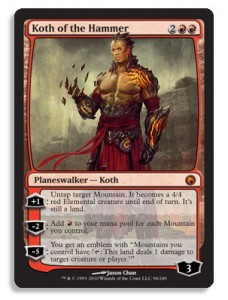
Sealed PTQ seasons are the best place to pick up new Rares and Mythics in anticipation for both FNM and the upcoming Constructed seasons. Card prices fall during Limited season both because of the huge amount of product being opened and also because Limited PTQers who drop early are looking for cash both to recoup their losses and to do side drafts. And guess what happens when they open a Koth in their side draft? They go right over to sell it and hop in another event. However buying cards at events can be difficult. Depending on a TO’s rules, non-dealers might not be allowed to buy or sell cards on site. Trying to do so could easily get you booted or banned from the site, so I wouldn’t recommend being too risky. But buying dealer space at PTQs can also be expensive, so it is a difficult situation all around.

Tip #2: Sleeves

Limited PTQ seasons also generate a huge demand for new card sleeves. While speculators usually don’t carry sleeves, carrying around a good supply of different types, especially the perennial favorite Ultrapro, and you could easily swap some packs for in demand cards with those players less willing to drop cash at the dealer booths.

Tip #3: Sealed product

Again, this is more of an issue for dealers or store owners, who have the capability to keep large quantities of sealed product while still maintaining a good stock of singles, as well as those who can get sealed product at discount prices from distributors, but those of you who win/buy large numbers of prize packs could be served well by holding onto them until Limited PTQ season rather than cracking them or selling them later. Most serious PTQ grinders will want to be able to test out the new Limited format, and especially because of the delay in new set releases on MTGO, the only way to practice is to get on down to the local store, and open some old fashioned packs. There should be a higher demand for them during the Limited season than at any other time during the year.

Unfortunately, as you can see, this list is quite short, but hopefully this will help those among you desperately trying to preserve a profit margin during an unfavorable period.

Thankfully, the Limited PTQ season will be coming to a close soon, but right on its heels is the Extended season. So what are the underrated and overlooked cards that you should be looking to speculate on prior to an established metagame?

There have been a few cards that have seen rapid increases in price due to speculation (I’m looking at you Antoine Ruel), but there are still several undiscovered stars that I would recommend picking up.

Chief among these are the top uncommons from the Alara-Zendikar Standard format. Path, Bloodbraid Elf, Sprouting Thrinax and other staples saw a drop in their pricing when they rotated out of the format, but expect to see them hop right back up once they are in demand for Extended. Bloodbraid Elf, in particular sees to make large gains with Jund being one of the most hyped decks going into the season.

Another card that is much more off the beaten path is Master Transmuter. In his column for the Mothership, Jake van Lunen continually produces casual yet somewhat competitive decks for those of us on a stricter budget. Yet every so often, he creates a masterpiece that becomes a large part of the established metagame, such as the Standard version of Pyromancer Ascension. Recently, he posted an article with an Extended Master Transmuter deck, and though I think there are certainly improvements to be made, I wouldn’t think it impossible for the deck to be competitive, especially if the field becomes full of Faeries, White Weenie, or Green based Aggro decks with little or no removal. Because the price is so low currently, there is almost no downside to buying up your local supply, and then turn them around for a killing later on.

The last area to watch out for going into the Extended season is the Merfolk archetype. Merfolk catapulted Marijn Lybaert into the top 4 of PT Amsterdam , and is a strong choice when control is popular in the metagame. While it is fairly cheap, with many of its staple cards being uncommon, there are several cards that you can speculate on, such as Wanderwine Hub, Sygg, River Guide, Cryptic Command, and Ranger of Eos will all make showings if the deck becomes more popular.

Well, that’s all for this week. Again, a bit of a shorter article, but we’re at a bit of a dead zone for financial writes, because we’ve had the new set out for a while, are waiting for the next release, and we’re not in a Constructed PTQ season. I’ll try and do a theory based article next week for a bit of a change.

Until then,

--Noah Whinston

mtgplayer@sbcglobal.net

nwhinston on Twitter

Arcadefire on MTGO

Baldr7mtgstore on ebay

Why We Fall – Scars of Mirrodin Draft 1

Are you a Quiet Speculation member?

If not, now is a perfect time to join up! Our powerful tools, breaking-news analysis, and exclusive Discord channel will make sure you stay up to date and ahead of the curve.

[Note: This will be among the longest articles published on Quiet Speculation. Rather than split this up into two smaller pieces, it's published here in its entirety. Block out as much time as you need to read it start to finish: This article is a must-read if you intend to improve your drafting. -Dylan]

Mistakes are the portals of discovery.
- James Joyce

Welcome to the new Quiet Speculation.

I’ll skip the personal introductions – they’re boring and, really, you’re here for the content and not my magical life history. The one important piece of preface is the primary premise of this column – we make mistakes, and one of the best ways to improve as magicians is to catalog and understand our missteps. This column is a place for me to talk about the mistakes I make in draft, deck construction, and play, so I can figure out what the correct lines are and avoid those mistakes in the future. I want to help you analyze your own play and weaknesses as well as avoid the pitfalls I've run into.

For the next month Scars of Mirrodin Limited is the most important format for competitive players as we wind down the Paris PTQ season, so my first couple of columns will focus on SOM draft and sealed. Let’s start off with a draft:

Scars of Mirrodin 8-4 draft

Pack 1 pick 1:

The opening pack is pretty weak, with a number of unplayables and many cards that are OK to good in their particular archetypes but not really playable in any other archetypes. Ezuri, Renegade Leader, Painsmith, and Trigon of Rage are the most powerful cards in the pack, but they all require a real commitment to a specific archetype – Painsmith and the Trigon only really shine in Infect decks while Ezuri is only going to be good in a deck with a bunch of Carapace Forgers. Sylvok Lifestaff is less powerful that the other options, but it’s a flexible card that will almost always make my maindeck and is good, if not excellent, in many archetypes. When I open a pack that doesn’t offer a clear direction I like staying open and picking a flexible card, so I take the Lifestaff.

My pick:

Pack 1 pick 2:

And already I’m on to my first mistake. Looking at this pack I see that the rare is missing which means that I can’t really deduce anything about what my neighbor is drafting. I decided to “stay open” with this pick and draft the Perilous Myr, which is quite a good card in Metalcraft decks, is playable if not super exciting in Infect decks, and is always playable and sometimes incredible in other archetypes (e.g. it’s good in control decks and dinosaur decks where it helps stall the ground until your late game takes over, it’s great in Furnace Celebration decks, and it’s OK in non-Infect Aggro decks). Attempting to “stay open” is quite clearly wrong here though – Arrest is a significantly better card than Perilous Myr and is the superior choice. Picking Arrest puts us in a color, but it’s a very light commitment since splashing is fairly easy in SOM, so really the only commitment I’m making is to not play an Infect deck. But Perilous Myr isn’t a great card for an Infect deck either. I’m practically as “open” to drafting Infect as I would be taking the Arrest, so I really should just pick the better card.

My (incorrect) pick:

Pack 1 pick 3:

In this pack I can reasonably consider the Chrome Steed, Turn to Slag, Sunspear Shikari, Ichorclaw Myr, Origin Spellbomb, and Corpse Cur. Origin Spellbomb and Chrome Steed are both cards that want to be in a Metalcraft deck, in which the Chrome Steed is going to have a higher impact, so I can eliminate the Spellbomb. In most drafts you end up having more opportunities to pick up more expensive cards than you do to pick up the requisite earlier drops, both because good early drops are usually less common and because you want more early drops than late drops for curve purposes. This is even more true for aggressive decks, so Ichorclaw Myr is a superior choice to Corpse Cur. The aggressive equipment deck can be good, but you need at least two powerful equipments like Darksteel Axe, Barbed Battlegear, or one of the rare equipments to make it work properly. While I’ll happily pick up a Sunspear Shikari or Goblin Gaveleer late in a pack even if I don’t have the right equipment yet, I don’t want to make a speculative pick over a consistently better card and hope to find two uncommon/rare equipments later in the draft.

Choosing between Chrome Steed, Turn to Slag, and Ichorclaw Myr is mostly an issue of archetype preference at this stage. My first two picks lend themselves best to an aggressive Metalcraft deck, which is a deck I’m happy drafting, so I take the Chrome Steed.

My pick:

Pack 1 pick 4:

This is a pretty dry pack. Ghalma’s Warden and Flight Spellbomb are playable cards in my deck. When drafting a Metalcraft deck I prefer to pick artifacts over colored spells, ceterus paribus, as you want 15+ artifacts in your deck and only 8 or so colored spells. Ghalma’s Warden isn’t particularly powerful, and I like cheap artifacts to get my Chrome Steeds and (hopefully) Rusted Relics online as soon as possible.

My pick:

Pack 1 pick 5:

I like Accorder’s Shield a lot in Metalcraft decks – having cheap non-creature artifacts is important for activating your Metalcraft cards without getting blown out by removal and it’s difficult for most non-Infect decks to race you if you equip it to a decently sized creature. I’ve never gotten a chance to play with Prototype Portal though, and while I suspect it’s not great, I’d like to see how well it works. Let’s not forget that there’s a late Untamed Might getting passed around 


My pick:

Pack 1 pick 6:

Snapsail Glider is the pick here – it keeps my options open for a second color (and a first, I suppose), it keeps upping my artifact count, and get me an evasive creature.

My pick:

Pack 1 pick 7:

I’m probably not playing any of these cards. Neurok Invisimancer is playable but I’ll probably have better options for colored cards. I might need an additional artifact if the second and third packs are really dry, and Infiltration Lens is a good card in another archetype (Infect) while none of the other cards will be good in anyone else’s deck, so it’s also a reasonable hate card.

My pick:

Pack 1 pick 8:

Kemba’s Skyguard, Auriok Replica, and Blade-Tribe Berserkers are all reasonable cards. I’m happy to keep on picking artifacts here – getting a critical mass of playable artifacts early lets us be flexible in the second and third packs, giving me room to pick the most powerful colored cards I get access to. Also, there’s a second Untamed Might. And another Tainted Strike. It’s likely that there’s only one or two Infect drafters at the table, which means they probably will have quite good decks and I should value cards that are good against Infect decks slightly higher than normal.

My pick:

Pack 1 pick 9:

Panic Spellbomb is the only playable here. I could hate the Tel-Jilad Defiance, but hating a card over a playable is seldom correct unless you’re in a team draft. Of course it’s cool to hate cards if there’s no maindeck or sideboard cards available, as I’ll do in a few picks.

My pick:

Pack 1 pick 10:

Scrapdiver Serpent is a fine finisher and I won’t play any of the rest of these cards. I shouldn’t feel any commitment to Blue as a result of this pick.

My pick:

Pack 1 pick 11:

I might end up in an equipment deck if I open a Darksteel Axe or something. Plated Seastrider is also a potential pick as an anti-Infect sideboard card.

My pick:

Pack 1 pick 12:

Ferrovore is somewhat playable in the Furnace Celebration deck, the rest of these cards aren’t playable anywhere.

My pick:

Pack 1 pick 13:

Seize is moderately more playable than the Heartstoker, but I don’t expect to play either.

My pick:

Pack 1 pick 14:

My pick:

Pack 1 pick 15:

My pick:

After the first pack I’ve got the following cards as potential maindeck cards:

Untitled Deck

*1 Perilous Myr

*1 Sunspear Shikari

*1 Auriok Replica

*1 Snapsail Glider

*1 Chrome Steed

*1 Scrapdiver Serpent

*1 Sylvok Lifestaff

*1 Flight Spellbomb

*1 Panic Spellbomb

*1 Prototype Portal

Unless I get a great card like Ezuri’s Brigade or Skinrender I won’t be playing Black or Green. Of the cards I have I’ll end up playing seven artifacts, and I’m not tied to any of the colored cards. Since I’m ahead of the curve in getting to fifteen artifacts I can be a little more liberal in drafting colored spells. At this point I’d really like to pick up a removal spell, another Chrome Steed/Rusted Relic, and two or more Myr, probably in that order.

Pack 2 pick 1:

Myr Battlesphere is a bomb, it fits in my deck, and it’s much better than the rest of these cards. If the Battlesphere weren’t in this pack I’d take either the Darksteel Axe or the Iron Myr; probably the Darksteel Axe as I’ll have more opportunities to pick Myr but probably no more chances to pick up premium equipment. I’ll want to prioritize Myr going forward, as I want to be able to cast the Battlesphere on or ahead of time if at all possible.

My pick:

Pack 2 pick 2:

Arc Trail is one of the premier removal spells in the format and is a pretty easy pick. In Sealed deck I’m usually happier to have Arrest or Turn to Slag than Arc Trail, as Sealed tends to be slower and more bomb-driven, but Arc Trail is preferable in Draft as the card advantage is more important, and it has a greater impact on the more focused Metalcraft and Infect archetypes. This pick establishes me in Red, it means that at least two of my current twelve playables won’t make the maindeck, and my artifact count is now eight.

My pick:

Pack 2 pick 3:

If I already had a Darksteel Axe or some other way to pump Bloodshot Trainee’s power I would consider it, but it’s not worth a pick given my current pool. Generally I want a minimum of two ways to make the Trainee active, and preferably three, before I’ll consider him for a deck. This is a tall order given that all of the ways to accomplish this are uncommon or rare, and so I rarely want to make a speculative pick of the Trainee. I’m not going to make such a heavy commitment to Green that I’d be willing to take the Genesis Wave, and I’ll have a high enough artifact count that I won’t need Liquimetal Coating, so I’m left with Panic Spellbomb, Dispense Justice, Disperse, and Bonds of Quicksilver as playable options. I think a lot of people overvalue Dispense Justice – while it is definitely playable it’s one of the worst removal spells in the format, and it’s easy enough to play around. Panic Spellbomb isn’t particularly powerful, but I know it will make the deck and cheap artifacts are important to the Metalcraft deck, so it’s the pick here. If I were established in White or Blue, one of the colored spells would be the pick.

My pick:

Pack 2 pick 4:

Tower of Calamities is actually pretty good in sealed, especially if you have three or more Myr. It’s playable in draft, but it’s not a good fit for the deck as I don’t really have a lot of stall cards nor do I have any Myr yet. I’m more likely to be an aggressive Metalcraft deck so the on-color Vulshok Replica is the choice here. If I had picked up that Darksteel Axe in pick 1 of this pack, Sunspear Shikari would be a reasonable pick at this point.

My pick:

Pack 2 pick 5:

None of these are great options. If I end up in Blue there’s about an equal chance that I would play Disperse or the Strider Harness, so given that I may not play Blue I’m happy taking the Harness here.

My pick:

Pack 2 pick 6:

Shatter is a very nice late gift. I would have been happy taking the Accorder’s Shield here if I didn’t get the Shatter.

My pick:

Pack 2 pick 7:

I’ll play Glint Hawk or Lumengrid Drake and whichever I choose will probably cement me into a color (you know, unless I open an off color bomb). I don’t have any Trigons or Tumble Magnets or other cards to reset with the Glint Hawk, so its “drawback” is actually a drawback in my deck. I’ve got a pretty fair chance of triggering the Lumengrid Drake, so it’s going to end up being better in my deck. Gaveleer is a fine card in the equipment deck, but my deck isn’t going to get into that archetype. Loxodon Wayfarer and Halt Order are both fine sideboard cards, but I’d rather have a maindeck card.

My pick:

Pack 2 pick 8:

Another Lumengrid Drake is the pick here, as there aren’t any other maindeckable cards in this pack. Soul Parry is a fine sideboard card against Infect decks but unless I pick up something awesome I won’t be playing White.

My pick:

Pack 2 pick 9:

Another definite mistake here. I picked the Halt Order here thinking that I was definitely UR and that I’d like it for my sideboard, but I’m so tenuously established in Blue that it would be better to pick up a solid maindeckable White card in case I open up something like Arrest or Sunblast Angel and want to move into RW instead. Glint Hawk was the correct pick here.

My (incorrect) pick:

Pack 2 pick 10:

Stoic Rebuttal is the pick here as it is potentially maindeckable. Bonds of Quicksilver is also an option, but the Rebuttal is going to be a better answer to many bombs, even though it requires proactive play instead of reactive play.

My pick:

Pack 2 pick 11:

And I get the Bonds as well!

My pick:

Pack 2 pick 12:

I took the Withstand Death as a hate draft against the Infect deck, where it’s a pretty good card, but this is probably a mispick, since it’s very unlikely that the Infect deck is in the two seats to the right. Scoria Elemental has potential sideboard applications versus the Dinosaur deck.

My (incorrect) pick:

Pack 2 pick 13:

My pick:

Pack 2 pick 14:

My pick:

Pack 2 pick 15:

My pick:

Going into the third pack my deck looks like this:

Untitled Deck

*1 Perilous Myr

*1 Snapsail Glider

*1 Vulshok Replica

*1 Chrome Steed

*2 Lumengrid Drake

*1 Scrapdiver Serpent

*1 Myr Battlesphere

*1 Sylvok Lifestaff

*1 Flight Spellbomb

*1 Panic Spellbomb

*1 Panic Spellbomb

*1 Arc Trail

*1 Shatter

*1 Stoic Rebuttal

*1 Strider Harness

*1 Prototype Portal

I have eight creatures, eleven artifacts, and seventeen playables. Ideally I’d like to pick up at least four more creatures, two or more Myr, four or five artifacts, and some more removal. I’d like to not play the Stoic Rebuttal, the Scrapdiver Serpent, and the Strider Harness. I’ll see how the last pack works out, but I’ll have a playable deck even if the last pack is dry.

Pack 3 pick 1:

As much as I would love to have a Myr Reservoir to recur the Battlesphere and Perilous Myr, I really need some mana Myrs to accelerate to my big guys, establish early Metalcraft, etc.

My pick:

Pack 3 pick 2:

I’d love to have the Turn to Slag or the Embersmith, but Oxidda Scrapmelter is just much better than both of them.

My pick:

Pack 3 pick 3:

I came into the pack looking for removal and I’m getting it. Turn to Slag is the pick here, although I would have also been happy with a Saberclaw Golem.

My pick:

Pack 3 pick 4:

Kuldotha Phoenix is a bomb if you can support its casting cost, and is absolutely ridiculous if you can recur it. I can likely do both. If the Phoenix wasn’t in the pack I would be interested in the Copper Myr, Wall of Tanglecord, Vedalken Certarch, or Revoke Existence. Vedalken Certarch is one of the swingiest Metalcraft cards, doing nothing when you aren’t Metalcrafted, but being awesome when it’s turned on. In the first couple of packs you shouldn’t pick it highly because you may not get enough artifacts (I think it’s unplayable with less than 13 artifacts), but if it’s pretty clear you’ll hit 15 or 16 artifacts in Blue it can actually be a very high pick.

My pick:

Pack 3 pick 5:

The choice here is between Barbed Battlegear and Vulshok Replica. Battlegear will be good in my deck with the Lumengrid Drakes, but I really want creatures more than I want more non-creature cards, given that I only have 11 creatures at this point. Also, the Battlegear is worse the fewer creatures I have, so the Vulshok Replica is actually pretty clearly the pick here. Unfortunately I’m a huge fan of the Battlegear and that kind of clouded my judgment here. If I already had 13 or 14 creatures I think Battlegear would be the correct pick here.

My (incorrect) pick:

Pack 3 pick 6:

Iron Myr is quite a gift here. I’d be happy picking up a third Myr if I could, although I’d pick up a removal spell or solid creature over a third Myr. Anyway, yay for gifts.

My pick:

Pack 3 pick 7:

Again, I’m happy to try a rare that I haven’t drafted before (Myr Propagator) over a solid card that is probably better (Gold Myr). If I had properly picked the Glint Hawk last pick as a Backup for my blue cards I could move into White here and take the Revoke Existence, which is going around criminally late.

My pick:

Pack 3 pick 8:

Big flyers are big.

My pick:

Pack 3 pick 9:

I won’t play any of these cards. I don’t care about the Lifesmith and I’m happy to pass the Soul Parry in case it helps someone beat the Infect deck, so I hate the Blackcleave Goblin.

My pick:

Pack 3 pick 10:

My pick:

Pack 3 pick 11:

Dross Hopper is playable in the Furnace Celebration deck, Gaveleer is playable in the equipment deck. Given that I’ve seen zero Furnace Celebrations and I have passed a Darksteel Axe I should be hating the Goblin here.

My (incorrect) pick:

Pack 3 pick 12:

Turn Aside is a playable sideboard card against removal-heavy decks.

My pick:

Pack 3 pick 13:

My pick:

Pack 3 pick 14:

My pick:

Pack 3 pick 15:

My pick:

Here’s the deck I built:

*1 Iron Myr

*1 Leaden Myr

*1 Perilous Myr

*1 Auriok Replica

*1 Myr Propagator

*1 Snapsail Glider

*1 Vulshok Replica

*1 Chrome Steed

*2 Lumengrid Drake

*1 Oxidda Scrapmelter

*1 Kuldotha Phoenix

*1 Sky-Eel School

*1 Myr Battlesphere

*1 Scrapdiver Serpent

*1 Flight Spellbomb

*1 Panic Spellbomb

*1 Sylvok Lifestaff

*1 Arc Trail

*1 Shatter

*1 Barbed Battlegear

*1 Strider Harness

*1 Prototype Portal

*1 Turn to Slag

*8 Mountain

*8 Island

Relevant sideboard cards:

*2 Bonds of Quicksilver

*1 Halt Order

*1 Panic Spellbomb

*1 Scoria Elemental

*1 Scrapdiver Serpent

*1 Stoic Rebuttal

*1 Turn Aside

I’m fairly pleased with how the deck turned out. I ended up playing the Auriok Replica, Scrapdiver Serpent, and Strider Harness to up the creature and artifact counts and to make sure I would have enough ways to finish out games. Ideally I’d have a Neurok Replica instead of the Auriok Replica, another Chrome Steed or a Rusted Relic to replace a Lumengrid Drake, a better finisher than Scrapdiver Serpent, and a removal spell like Galvanic Blast or Contagion Clasp to replace the Strider Harness, but this is a pretty reasonable deck.

I would have been able to get a slightly better RW deck if I had picked up the Arrestin the first pack, which would have let me pick up some Glint Hawks and at least one Revoke Existence to replace my blue cards. The power-level wouldn’t be dramatically higher, but it would have improved my deck. Let’s go through the games:

Round 1

Game 1:
My opponent wins the die roll and chooses to go first. As my deck isn’t very aggressive and I have a good late game, I should actually be happy to be on the draw.
I keep an opening hand of:

This hand risks being a bit mana flooded, but I have some card draw and a mana sink, and the deck is able to capitalize on having a lot of mana, so this is a reasonable, if not great opener.

Turn 1:
My opponent plays Island and passes, I draw Oxidda Scrapmelter, play a Mountain and cast Panic Spellbomb.

Turn 2:
My opponent plays a Plains and a Gold Myr. I draw Mountain, play an Island and pass the turn.

Turn 3:
My opponent plays an Island, plays a Glint Hawk and, with the Hawk’s trigger on the stack taps his Gold Myr for mana before returning it to his hand. He then plays Etched Champion and passes the turn. This sequence of plays left my opponent open to getting unnecessarily two-for-oned by a Galvanic Blast, Disperse, or Shatter, which seems poor. Etched Champion isn’t good enough that you would want to bait out a removal spell to land it at the cost of two cards, so this sequence doesn’t make sense. I draw an Island, play a Mountain, and cast Myr Propagator.

Turn 4:
My opponent plays an Island, attacks for four with his Etched Champion and Glint Hawk putting me to 16, and then casts a Gold Myr and an Auriok Sunchaser. I draw a Snapsail Glider, play an Island, and Scrapmelt his Champion. I could have chosen to play the Snapsail Glider instead with the plan of trading it for his Glint Hawk, but doing that leaves me open to him casting another artifact, getting his Auriok Sunchaser online, and getting in for more damage. Casting the Scrapmelter saves us more damage and keeps my opponent off Metalcraft.

Turn 5:
My opponent plays an Island and attacks with his Glint Hawk for two, putting me at 14, then passes the turn with two cards in hand. I draw a Lumengrid Drake and play an Island. I attack with the Oxidda Scrapmelter and my opponent casts Dispense Justice. I then play Snapsail Glider and pass the turn. I could have played around Dispense Justice here by not attacking, but I’m actually OK with him using it here, as the board is still stable and I’d rather have him use it on a creature that wasn’t particularly impactful.

Turn 6:
My opponent plays an Island then casts Contagion Engine, killing Myr Propagator, taking me off Metalcraft, and shrinking my Snapsail Glider. He then bashes for two with the Glint Hawk, putting me at 12 life. I draw Shatterand have this board state:
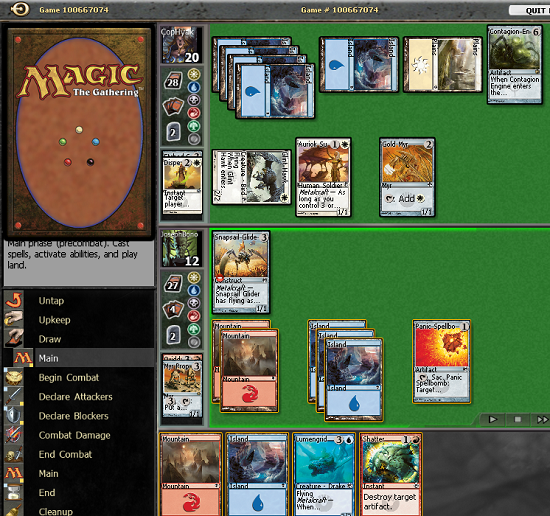
The right play here is to attack with the Snapsail Glider, cast the Lumengrid Drake, play a Mountain, and pass the turn, intending on trading the drake for his Glint Hawk, breaking the Panic Spellbomb at the end of his turn (I haven’t broken it before this because I wanted to hit metalcraft, but the extra card is more relevant given that I won’t hit metalcraft anytime soon), and having him proliferate away my Snapsail Glider during my turn. Doing this wastes his mana, gets the biggest threat off the table, and gives me two draw steps to find a creature to hold the ground.

Instead I shattered the Contagion Engine and cast the Lumengrid Drake. This play is pretty bad, as the Contagion Engine is almost useless at this point. My opponent probably doesn’t have anything that he can profitably proliferate, so the only thing shattering it accomplishes is saving the Snapsail Glider, which isn’t worth wasting a removal spell.

Turn 7:
My opponent attacks with Glint Hawk and I trade the Lumengrid Drake for it. He casts a Vedalken Certarch and passes the turn. I draw Prototype Portal here. The correct play is to cycle the Panic Spellbomb and see what I draw, but instead I play an Island and pass the turn.

Turn 8:
My opponent attacks with his Vedalken Certarch, Gold Myr, and Auriok Sunchaser, and I trade the Snapsail Glider for the Certarch, going to 10 life. He passes the turn and I cycle the Panic Spellbomb at end of turn drawing Flight Spellbomb. On my turn I draw a Mountain, cast the Portal, imprinting the Flight Spellbomb, and play a Mountain. I should immediately use the Portal to make a Spellbomb and cycle it in case I draw a two drop, but instead I pass the turn.

Turn 9:
My opponent casts Golem Artisan, plays a Plains, gives haste to the Artisan, and bashes for four with his team, putting me to 5. I make a Spellbomb with the portal, cycle it, and draw a Mountain at the end of his turn. On my turn I draw Turn to Slag, play the Mountain, turn the Artisan to slag, make a Spellbomb and cycle into another Mountain.

Turn 10:
My opponent plays a Darksteel Axe, equips it to the Myr and attacks for four, putting me to 1 life. My opponent probably should have equipped the Axe to the Sunchaser, as there are more removal spells that kill the Myr than the Sunchaser. I draw a Mountain, create and cycle a Spellbomb drawing an Island. I pass the turn. On his turn my opponent plays a Darksteel Myr precombat for no particular reason, then attacks with his team to kill me.

Even with perfect play this game isn’t necessarily winnable, seeing as I drew 12 of my 16 lands compared to my opponents 7, but I definitely could have played it better and given myself a chance to stabilize and win. By spending my mana correctly and cycling at the right time I could have dug a card deeper to try to find something to stabilize with. By playing the Shatter correctly I would have taken two more damage from the Certarch but I would have taken three less from the Golem Artisan, potentially giving a little more room to stabilize.

Game 2:
I sideboard out the Scrapdiver Serpent and bring in a Halt Order to answer his Contagion Engine. From the first game it seems like my opponent has an unfocused UW metalcraft deck that probably does not have enough artifacts to support his colored metalcraft cards. I have enough late game power to have inevitability without the Scrapdiver Serpent, and having the Halt Order to get up in an attrition war, keep him off metalcraft in the late game, and deal with the one bomb I have seen seems reasonable. I elect to play first, reasoning that I probably only lose to a fast start from him and that my card quality and two for ones will make up for the extra card.

I keep an opening hand of:

This hand has reasonable early plays, a Spellbomb to dig for land if I fail to draw one in the first two draw steps, and a removal spell.

Turn 1:
I play Mountain and cast Panic Spellbomb. My opponent plays Plains, casts Memnite, casts Glint Hawk, returning Memnite, the re-casts Memnite.

Turn 2:
I draw Lumengrid Drake, play an Island, and pass, intending to cycle the Panic Spellbomb at the end of my opponent’s turn. My opponent plays an Island, attacks for 3 and casts Glint Hawk. I shatter the Memnite in response killing the Glint Hawk as well. Even though he got two-for-oned this is a fine play for my opponent as long as he doesn’t have another artifact that costs two or less in his hand.

Turn 3:
I draw an Island, play the Snapsail Glider, and pass the turn. My opponent attacks for rwo, putting me at 15, plays an Island, and passes the turn.

Turn 4:
I draw a Mountain and ponder my options:
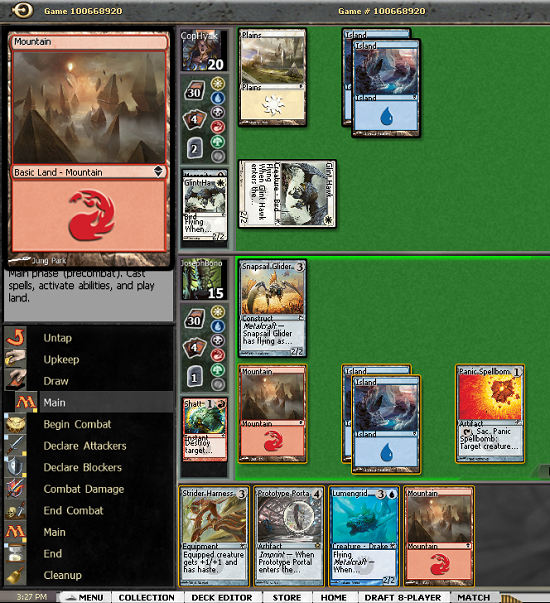
Even though we’re behind in the damage race 15 to 20, I like attacking here, as we’re going to tempo our opponent out next turn with a Metalcrafted Lumengrid Drake, particularly if we draw another land. I cast the Strider Harness, equip it to the Snapsail Glider, and attack for three, putting my opponent to 17.

My opponent plays a plains, attacks for 2, then plays a Trigon of Corruption and passes the turn.

Turn 5:
I draw an Island and reconsider my play:
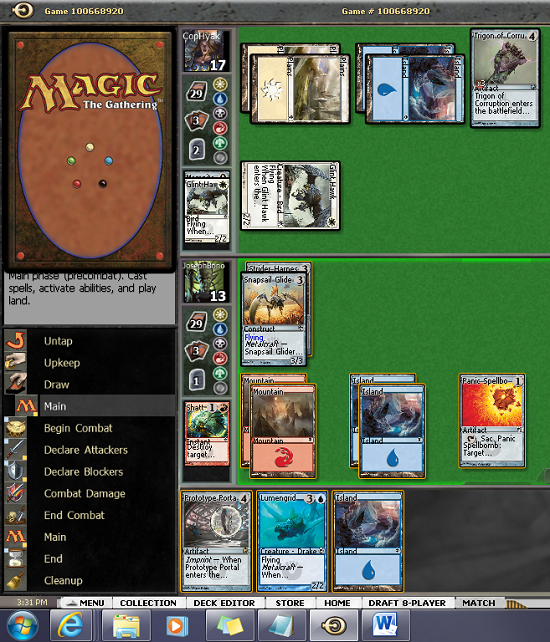
Bouncing the Glint Hawk lets my opponent reset the Trigon of Corruption at some point, but given the pressure we’re putting on him our opponent probably won’t be able to take advantage of the extra activations. I play the Island, cast the Lumengrid Drake bouncing the Glint Hawk, equip the Strider Harness to the Lumengrid Drake and attack for five, putting my opponent to 12. He untaps, plays another Island and casts a Golem Artisan.

Turn 6:
I draw Turn to Slag:

I turn the Golem to slag and attack for 5, putting my opponent to 7. This is actually an overly hasty play. My opponent is likely to cast his Glint Hawk, bouncing the Trigon, and pass the turn with four mana up to jump and pump his Artisan when I attack. If we hold off on turning his Golem to slag he’ll have essentially wasted any mana he leaves up instead of making a productive play.

My opponent plays a Plains, casts Accorders Shield then the Glint Hawk then re-casts the Shield and equips it to the Glint Hawk.

Turn 7:
I draw a Mountain, use Panic Spellbomb on his Glint Hawk, drawing Halt Order, and attack. He Trigons the Snapsail Glider and takes four going to 3 life.
My opponent attacks with the vigilant Glint Hawk then plays an Island and attempts to cast Myr Battlesphere. Obviously I Halt Order it drawing Myr Propagator.
Turn 8:
I draw Sylvok Lifestaff and cast it, then cast the Myr Propagator, equip it with the Strider Harness, equip the Snapsail with Lifestaff, and attack for 6, killing my opponent. Since my opponent was tapped out and at 3 life I actually shouldn’t play the Sylvok Lifestaff here as it unnecessarily shows him a card.

Game 3:
I don’t change my sideboarding plan and my opponent chooses to play first. I keep a hand of:

Turn 1:
He plays a Plains, casts Accorders Shield into Glint Hawk and then re-casts the Shield. I draw Lumengrid Drake, play a mountain and pass.

Turn 2:
He attacks for two, putting me to 18, plays a Plains and casts a Gold Myr. I draw Mountain, play an Island, cast Leaden Myr, and pass the turn.

Turn 3:
My opponent plays a Plains, equips the Myr with the Shield, and attacks for three, putting me to 15 life. I draw an Island and cast the Lumengrid Drake.

Turn 4:
He equips the Shield to the Glint Hawk, attacks for two, putting me to 13, then plays a Plains and casts a Necropede. I draw an Iron Myr and contemplate my play:

At this point I can choose to either trade off my Shatter, Myr, and Drake for his Shield, Hawk, and Necropede. Or I can choose to Shatterhis Shield before he attacks, go to 11, then swing back for six. I’ll win the damage race, but the problem with this plan is that my opponent can prevent me from racing by simply keeping his Hawk back and blocking. Choosing to “race,” however, has the advantage of letting me draw a removal spell to race him out and dropping my opponent to 14 in exchange for taking only two damage. I decide to race, and play out a Mountain and the Iron Myr, keeping up mana to Shatterhis Shield before he attacks.

Turn 5:
I Shatterthe Shield before combat and take two damage and a poison when my opponent attacks with the Glint Hawk and Necropede, going to 11 life. On my turn I draw an Auriok Replica, cast and equip the Barbed Battlegear, and attack for eight with the Drake and the two Myr. He declines to block with his Gold Myr and goes to 12 life.

Turn 6:
He casts a Darksteel Axe and equips it to his Glint Hawk, then attacks with his Myr and Hawk for 5 damage, putting me to 6 life. This seems like a less than ideal play as it lets me hit him back to 6 and then opens him up to an immediate loss if I draw a Panic Spellbomb or a removal spell for his Glint Hawk. I draw an Oxidda Scrapmelter, play out my sixth land, attack for six in the air, putting him to 6 life, then cast my Auriok Replica.

Turn 7:
My opponent equips his Darksteel Axe to his Gold Myr and attacks. I trade my Leaden Myr for it, and post combat he casts a Vedalken Certarch and equips the Axe to the Necropede. On my turn I draw Turn to Slag, kill his Hawk, and kill him.

Round 2:

Game 1:
I win the die roll and incorrectly choose to play first. I mulligan a hand of:

And keep a six-card hand of:

Turn 1:
I play a Mountain and pass, my opponent plays a Forest, casts a Sylvok Lifestaff, and passes.

Turn 2:
I draw Strider Harness, play an Island, and pass. My opponent plays a Swamp and passes the turn.

Turn 3:
I draw an Island and think about my game plan:
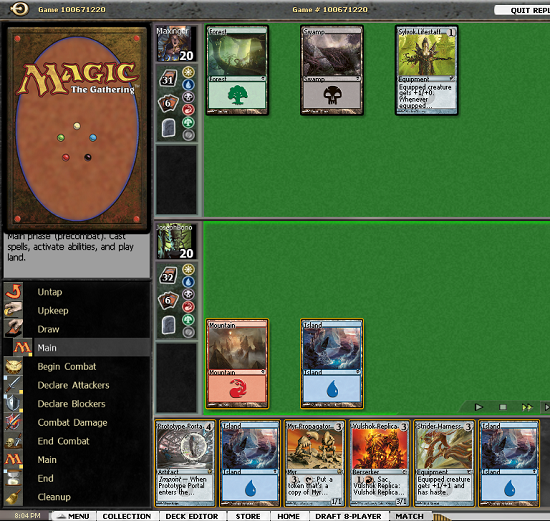
My opponent is probably playing Infect – both Myr Propagator and Prototype Portal are going to be pretty useful in this matchup, as long as I get enough time to activate them. I play an Island, cast the Myr Propagator, and pass the turn, planning on imprinting the Vulshok Replica on the Prototype Portal next turn. He plays a Forest and casts a Cystbearer, which is what I would expect given that he didn’t have a two drop.

Turn 4:
I draw an Island, play an Island, cast the Portal, and imprint the Replica. My opponent attacks with the Cystbearer to put us to 2 poison, then plays a Swamp and casts a Tangle Angler.

Turn 5:
I draw a Leaden Myr. What’s the play here?
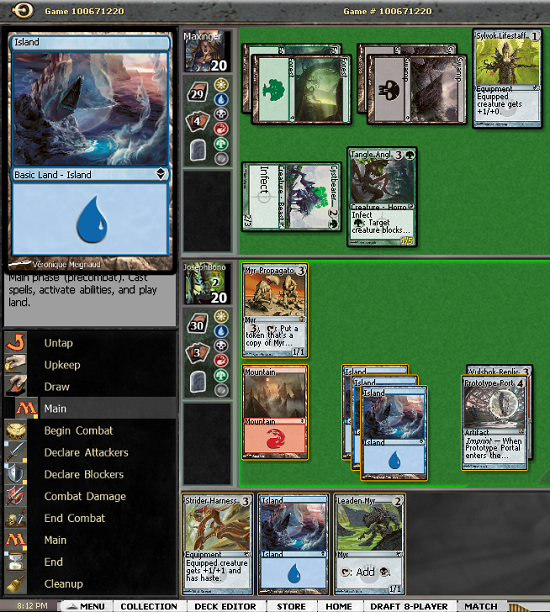
Tangle Angler puts a huge kink in my plan. If I try to make a Replica on his turn and block his Cystbearer he’ll lure it with his Tangle Angler. He’s also probably going to lure the Propagator as well. I think the correct play here is to cast the Leaden Myr with the intention of triple blocking his Angler with the two Myr and a Replica copy. I go ahead and play my Island and cast the Leaden Myr, then pass the turn. Unfortunately when my opponent makes his attack, after equipping his Tangle Angler with the Lifestaff, I foolishly decide that saving my Myr Propagator is more important than trying to kill the Tangle Angler. So I make a copy of the Propagator and the Angler lures the Leaden Myrand the Propagator copy. I go to 4 poison and get the turn back.

Turn 6:
I draw a Lumengrid Drake, attack with the Propagator to avoid it getting lured, then pass the turn. He attacks with his Cystbearerand his Tangle Angler and I take 4 more poison to go to 8 poison. I make a Replica at the end of his turn.

Turn 7:
I draw a Perilous Myrand try to figure out how to survive:
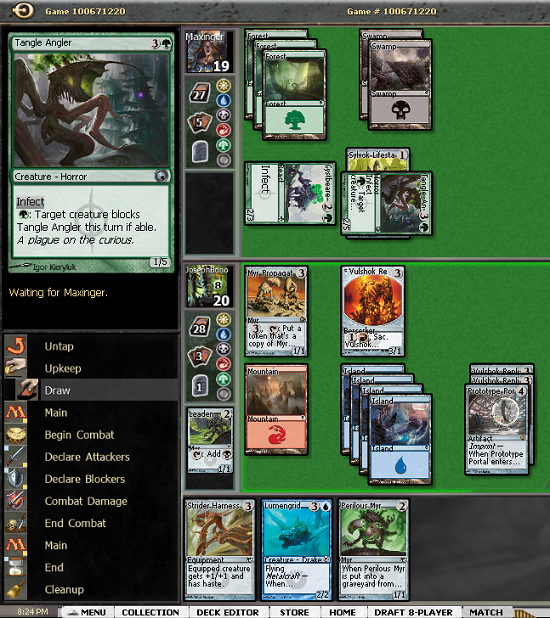
My choices are to use Lumengrid Drake to bounce his Tangle Angler or to play the Perilous Myr and make a Vulshok Replica with the Portal. Bouncing the Tangle Angler is a much better play, since the other plan loses to any removal spell or to my opponent ripping a fourth Forest. I cast the Drake and bounce the Angler, but then I inexplicably attack with the Propagator. At the end of my turn my opponent casts Carrion Call to get two more Infect creatures then untaps, casts Skinrenderto kill one of my blockers, and attacks for lethal.

I should be playing much more conservatively throughout this game. Having an active Prototype Portal gives me late game inevitability, which means I should be doing everything in my power to keep my poison count down and keep him from killing me before my inevitability kicks in.

Game 2:
I sideboard out a Shatterand a Scrapdiver Serpent for a Stoic Rebuttal and a Bonds of Quicksilver and choose to play first. Unfortunately MTGO did not save the replay for this game, but I eventually pull it out despite his second turn Plague Stinger, using a Stoic Rebuttal to stop a Tainted Strike on a potentially lethal Painsmithand playing around Untamed Might from the moment it would be lethal.

Game 3:
I mulligan a hand of:

Which is does absolutely nothing. This would be a fine hand against another Metalcraft deck, but against an Infect deck it’s a snap mulligan. I keep a six-card hand of:

Turn 1:
He plays a Swamp and casts Fume Spitter. I draw Iron Myr, play the Island, and cast a Flight Spellbomb.

Turn 2:
He plays a Forest, attacks for 1, and plays a second Fume Spitter. I draw Bonds of Quicksilver and have to decide what I want to do:

I can either Arc Trail his two Fume Spitters or I can play the Iron Myr. Killing the Fume Spitters means that I can play my Myr next turn and turn on the rest of my hand if I draw a third land. If I play the Iron Myr he’s almost certainly going to Fume Spitter it, but that will allow me to Arc Trail his remaining Fume Spitter and his turn 3 play, as long as it isn’t a Cystbearer, next turn. Arc Trailing his Fume Spitters gives me a better chance of getting to play my four drops, but it’s also very slow and will probably let him get in for at least 4 poison. If I let him kill my Iron Myr, however, I just lose if I don’t start ripping lands or if his 3-drop is a Cystbearer. As such, I think it’s right to cast Arc Trail now.

In game I mistakenly decide to get more “value” out of him and cast the Iron Myr, expecting to two for one him next turn and hoping to draw lands.

Turn 3:
As expected he Fume Spitters my Myr, but then he plays a swamp and casts and equips a Sylvok Lifestaff to attack for 2. On my turn I draw an Island, play it, cast the Barbed Battlegear, and ship the turn. I don’t crack the Spellbomb here as I would like to give myself the chance to eventually get a Metalcrafted Chrome Steed, and I don’t intend on casting either of my four drops next turn.

Turn 4:
My opponent casts a Blackcleave Goblin, attacks for 2 damage and 2 poison, then passes the turn. I draw a Mountain (yes, it is nice), play it, and Arc Trail his team.

Turn 5:
My opponent plays a Plague Stinger, equips it with the Lifestaff, and passes. I draw a Mountain, play it, and Cast the Chrome Steed, leaving an Island up for the Flight Spellbomb.

Turn 6:
My opponent plays a Painsmithand passes the turn. This seems like a missed opportunity on his part. If he attacks with the Plague Stinger I will have to trade my Chrome Steed to block it, since I’ll lose Metalcraft if I use the Flight Spellbomb. Unless he already has an answer to the Spellbomb or the Chrome Steed this seems like a fine trade for him. Additionally, I might choose not to block at all, which gets him two free poison counters. Regardless, I take the turn back, draw a Strider Harness, and try to figure out my game plan:
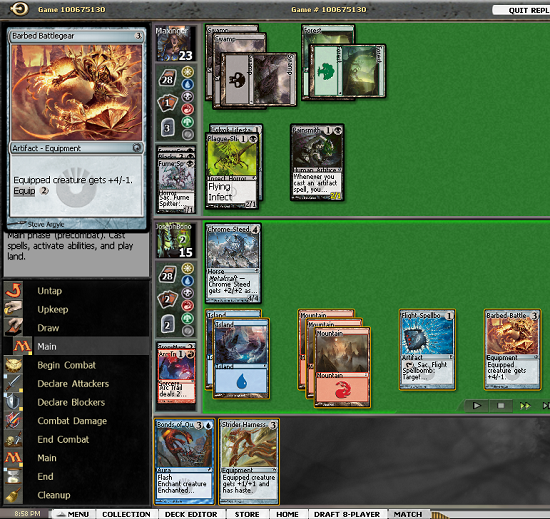
One option is to equip the Battlegear and start racing. He probably won’t trade both of his creatures with the Chrome Steed, given that he didn’t want to trade during his turn. This would let us hit him to 12, play the Strider Harness, then Bonds his Plague Stinger when he attacks next turn. It’s almost impossible for him to kill us on the backswing (he could do it with an Untamed Might and a zero CMC artifact), and next turn he would end up having to chump with the Painsmithand then probably lose the turn after. Playing more conservatively actually increases the chances that we lose, as he can rip another Infect creature or a removal spell to quickly put him in a winning position.

I follow through with this plan, suiting up the Chrome Steed with the Battlegear, bashing him to 12, then casting the Strider Harness in my second main.

Turn 7:
My opponent attacks with the team to put me at 4 poison and 13 life, then casts a Tel-Jilad Fallen post combat to muck up our plan. I draw a Stoic Rebuttal and readjust:
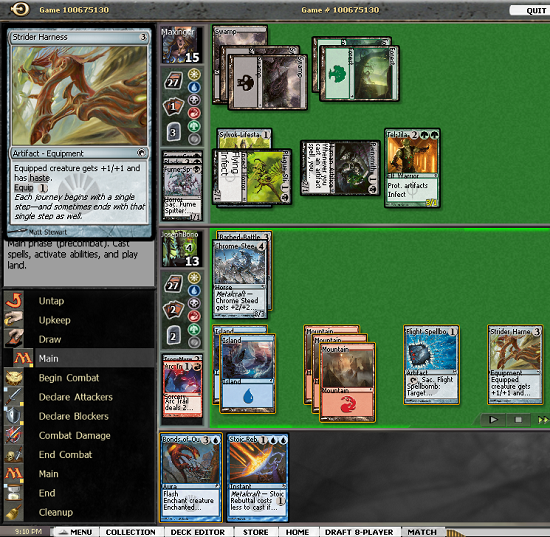
While the Fallen is bad news, having the Stoic Rebuttal gives us a little room to maneuver. We can’t attack into his pro-artifacts guy, so I simply equip the Harness and pass the turn, planning on blocking the Plague Stinger if he attack with it and casting Bonds on his Fallen if he attacks with it and doesn’t do anything else threatening.

Turn 8:
My opponent attacks with the Fallen, putting me to 7 poison, then passes, so I Bonds his Fallen in his end step. I untap and draw an Island. I’m in a precarious position where I can’t attack and let him get me to 9 poison, so I pass the turn after playing my Island.

Turn 9:
My opponent thinks about attacking for a bit on his turn but then simply passes. I draw a Leaden Myr, which lets me attack into him with the Chrome Steed. This takes him down to 6 life, making my Steed lethal if it gets in again.

Turn 10:
He casts Relic Putrescence on my Chrome Steed in his main phase, then attacks with the Plague Stinger and the Painsmith. I jump my Myr with the Flight Spellbomb to block his Plague Stinger. In response to the draw trigger he tries to Tainted Strike the Painsmith, but I have the Stoic Rebuttal to counter it. He loses the Plague Stinger, the Painsmithtakes me to 11 life, and he has no follow up play in his second main. I untap and attack with the Chrome Steed for the win.

In round 3 my opponent offers a draw and I accept as I thought there was a problem with the draft capture and that this draft wouldn’t be one I would end up writing up. It turns out I was looking for the draft capture in the wrong folder, thanks to the MTGO help files, so you end up getting a writeup without the third match. Sorry about that!

Regards,
Joe

A Force (Spike) To Be Reckoned With

Are you a Quiet Speculation member?

If not, now is a perfect time to join up! Our powerful tools, breaking-news analysis, and exclusive Discord channel will make sure you stay up to date and ahead of the curve.

Hello! I'm pleased to be able to announce the team of writers that will be making up the bulk of your Spike content here at the new-look Quiet Speculation. But first, what is Spike content? Hopefully, you're familiar by now with the classic gameplay psychographs: Spike, Timmy, and Johnny. For our purposes, Spike content is about gaming to win. Whether you're playing Standard or Extended, Draft or Sealed, Two-Headed Giant or EDH, or any other format you can think of, Spike players are the ones that play to win. Do you battle the PTQ circuit for Pro Tour invitations? Do you have more than a passing interest in Grand Prix? Do you consider your Friday Night Magic tournaments as an opportunity to crush souls? Ever wish it was you holding one of those giant trophies at the end of the weekend? If so, this is probably the section for you! 🙂

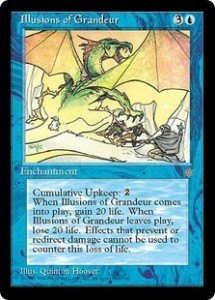
Illusions of Grandeur
No illusion here: 1/2 of a format-defining combo

The truth is, those of you who would be most interested in reading the "Spike" content day after day here already identify yourselves as Spikes. You've got your RSS feeds beaming tech to you 24/7, you actually know what MODO stands for, and you don't need any reminders for when your next PTQ is or of how good Jace, the Mind Sculptor really is.

But you know what? There's going to be something here for everyone! To make a (strained) analogy, let's say you have a passing interest in soccer. You play in the park with your buddies on the weekend or after class, but it's just for fun more than anything. I guarantee you though that at least some guys in your group would get a kick out of watching the Champion's League final play out! Sure, you could trek out to your local high school and watch some decent young athletes try their best, but without a rooting interest, how much more fun would it be to see some of the best athletes in the world play their hearts out to be the champions of the world?

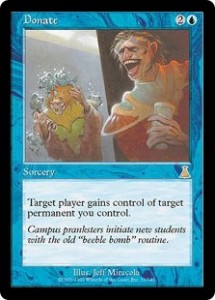
Donate
Okay, I suppose you can have it now.

Do you want to see the most powerful things you can do with Magic: the Gathering? Do you want to see the most broken combos, the strongest Control decks, the quickest and most resilient Aggro decks, or drafting tips from the best-of-the-best? Pushing the limits of card interactions is what Spike play is all about. Reaping the biggest rewards for the lowest costs, all on the earliest turn possible... What could be more fun? Even if it's not your main draw for playing Magic, you can surely see the merits in reading about it every once in a while! While you may not want to bring a Spike deck to your kitchen table battles, it may inspire you to broaden your enjoyment of the game. That was my path to competitive gaming; what will be yours?

So, I do believe that's enough stalling. Here's the Opening Week Lineup that will be putting up the most competitively-bent articles I can find for you guys.

Joe Bono - Why We Fall Rated in the Top 50 in the entire universe (okay, the world), qualified for PT Paris and Worlds, former Washington State Champion... His credentials are obviously stacked, and I think you'll be seeing a lot more of Joe at upcoming top tier competitions. He's a level 2 judge as well as if that all weren't enough!
Kellen Huber - On The Hunt Hand-picked for his home-brewed deckbuilding strategies, a lost art in our time of The Internet and netdecking.

Josh Lalo - Untapping With Jace Multiple PTQ top 8s and an expert on almost every format. Counts Patrick Chapin as an influence to give you an idea of what he's capable of here.

Dylan Lerch - The Brewery Managing editor of Spike content and maintainer of The Brewery, with 1 Pro Tour money finish.

Gregory Marques - Present-Present League A former Wizards of the Coast R&D member and one-time participant in the Future Future League.

Greg Peloquin - The 23rd Card In his own words, "an ardent PTQ warrior and level 1 judge." Greg has found himself in multiple PTQ top 8s and has found success at the Grand Prix level as well.

Joining them this week (and unfortunately introducing themselves more properly in their own articles!) will be the following:

Alex Ruggeri

James Madonna

I'll be on a constant lookout for additions to the team. I'm a firm believer that some of the best Magic: the Gathering content on the internet in the last few years has come from PTQ-level players looking to make it to the next level. Does that sound like you? Well, then what are you waiting for? 🙂

And to everyone out there in the Magic world: I have every intention of making Quiet Speculation your premiere source for the most competitive of Magic: the Gathering content on the web. Don't get left behind! Please, enjoy the new Quiet Speculation.

From the bottom of my heart, thank you so much for reading!

Dylan Lerch

Dylan Lerch is a professional poker player currently living in Houston, TX. After discovering Magic: the Gathering in 1995, it's been the only hobby that's stuck with him from grade school through post-college adulthood. Notable Magical achievements include a top 8 at the Stronghold prerelease, Notable qualities include a second-degree black belt, sporting a permanent beard, and living in the suburbs with his best friend Valeri and a giant pack of dogs. Finally graduating beyond filling stacks of spiral-bound notebooks full of partial decklists, he started writing The Brewery in October, 2010, eventually landing him his spot on the Quiet Speculation team.

View More By Dylan Lerch

Posted in Feature, Free, StrategyTagged 1 Comment on A Force (Spike) To Be Reckoned With

Have you joined the Quiet Speculation Discord?

If you haven't, you're leaving value on the table! Join our community of experts, enthusiasts, entertainers, and educators and enjoy exclusive podcasts, questions asked and answered, trades, sales, and everything else Discord has to offer.

Want to create content with Quiet Speculation?

All you need to succeed is a passion for Magic: The Gathering, and the ability to write coherently. Share your knowledge of MTG and how you leverage it to win games, get value from your cards – or even turn a profit.

Introducing The New Quiet Speculation

Are you a Quiet Speculation member?

If not, now is a perfect time to join up! Our powerful tools, breaking-news analysis, and exclusive Discord channel will make sure you stay up to date and ahead of the curve.

Hi there. My name is Chris McNutt and you might remember me from such articles as The Nutt Draw, My First Parakeet, and Boils: Your Shameful Secret. Some time ago I had a small idea. I called up Kelly Reid (founder of Quiet Speculation) and pitched it to him. His response? “Sounds good, go do it.”

We’ve been quietly speculating away behind the curtain for a few weeks now brewing up something new for all of you and today is the day of its unveiling. You’ve come to know and trust us for everything financial, from trading, to prices, to organization, to spreadsheets. Starting today you’ll also begin to know and trust us as your source for casual and competitive commentary as well! EDH, Cube, Drafts, Deck Evaluations etc.

We’re going about this a little differently than some of the other sites you and I visit and we hope you’ll appreciate the difference.

Everything we did to bring you the best Magic financial commentary on the web won’t change. It will always be a major focus for us, and we will remain the best source for financial information around. Instead of diluting our editors and staff into other areas we’ve brought on two entirely new teams of writers. We’re calling these teams and the content under them by the names Timmy and Spike. Timmy will be your source for the topics that are generally considered to be of a more casual nature (EDH, Cube etc). Spike will be your source for the more competitive content (Pro, Standard, Extended, Draft etc).

I’d like to introduce you to Adam Styborski, our new Managing Editor for Timmy. Most of you may know him from his already prolific presence online for sites such as mananation.com and wizards.com. He’s already a pillar of the Magic community and we’re happy and proud to have him aboard. Adam will be directing and contributing to his Timmy team.

I would also like to introduce Dylan Lerch, our Managing Editor for Spike. I’m sure that most of you have visited his home site The Brewery. I still don’t know how he can come up with so much content, but we’re happy and proud to have him directing and contributing to his Spike team.

The Managing Editor for Finance has been and will continue to be is David Conrad. Kelly Reid oversees all the teams, but will continue to hold finance close to his heart.

As you can see, across the top of all our pages is a simple way to navigate through all the content. By default www.QuietSpeculation.com will contain all the articles and will be a great way to see all the articles in one place. If you click on the Finance, Spike, or Timmy links you'll filter into that specific content.

Because we have three different editors, one for each major type of content (Finance, Spike and Timmy) none of them will have to be sacrificed to build up the others. We believe that www.QuietSpeculation.com will become the first place you’ll turn to for anything and everything that is related to Magic: the Gathering. There might be a few unexpected bugs here and there, but we'll get them all smoothed out.

So come with us as we venture into new territories (for us) and don’t be shy about letting us know what you think. This is all for you, and we want to be everything you’re looking for.

Chris McNutt

Chris McNutt

Born in Seattle, Washington, Chris McNutt has been playing and collecting Magic: The Gathering since Unlimited Edition. As an active player, tournament organizer and judge he regularly scrubs out of Pro Tour Qualifiers but inexplicably cleans up at the local draft tables. When not net decking Chris is either busy working as an Information Technology Sales Rep or spending time with his family. Other non-magical pastimes include playing guitar and an unhealthy number of video games. Cursed with an undying love of generating spreadsheets purely for ñ€Ɠfunñ€, heñ€ℱll be crunching the numbers each week in order to serve up delicious data burritos to the salivating, hungry readers of Quiet Speculation.

View More By Chris McNutt

Posted in Feature, Finance, Free, Strategy, Timmy5 Comments on Introducing The New Quiet Speculation

Have you joined the Quiet Speculation Discord?

If you haven't, you're leaving value on the table! Join our community of experts, enthusiasts, entertainers, and educators and enjoy exclusive podcasts, questions asked and answered, trades, sales, and everything else Discord has to offer.

Want to create content with Quiet Speculation?

All you need to succeed is a passion for Magic: The Gathering, and the ability to write coherently. Share your knowledge of MTG and how you leverage it to win games, get value from your cards – or even turn a profit.

Taking the Portal

Are you a Quiet Speculation member?

If not, now is a perfect time to join up! Our powerful tools, breaking-news analysis, and exclusive Discord channel will make sure you stay up to date and ahead of the curve.

Delving Deep

Many of the financial advice columns that I’ve read on different sites over the years start strong, but disappear or go downhill very quickly. There is only so much that can be said about trading ethics, standard sleepers, or ways to get someone to trade you their better card for your worse card before it all starts to blend together.

Thus, in an attempt to push myself toward analyzing territory that no one else is touching, I am going to start a small series of articles focusing on analyzing the financial value of cards that no one else has really approached.

I bet you know how much an Eldrazi Monument is worth, but what about Endless Cockroaches? What about Sun Quan, Lord of Wu? What about a foil Japanese Preordain?

Starting this week with Portal, we will be looking at the value of cards from some of Wizards’ weird old sets.

You’d be surprised how much value there is to be found looking at cards from 14 years ago.

Taking the Portal

On May 1st, 1997, Wizards of the Coast released a set called Portal.

Portal was designed to provide a simple entry point to the game for new players. This was before the Sixth Edition rules change that added the stack, so rules complexity was something that Wizards was struggling with at the time.

There were many major differences between “Portal Magic” and “real Magic”, and Portal cards weren't tournament legal when they were released. About five years ago, Wizards made all the Portal sets tournament legal overnight, causing a scramble as tournament players began to re-consider a series of sets that they hadn't given a moment's notice before.

In Portal, for example, creatures have no creature type. There were no instants in the entire set, though some sorceries could be played at specific times when they otherwise couldn’t be played, like the ‘declare attackers’ step. There are no tap abilities, but there are activated abilities that you can use during weird times.

They also replaced ‘Block’ with “Intercept’, because for some reason they felt that a confusing, three-syllable word was easier to understand than an elegant one-syllable word. ‘Library’ and ‘Graveyard’ were also replaced with ‘Deck’ and ‘Discard Pile,’ heightening everyone’s confusion about what went where.

Today, Portal is mostly considered an unfortunate misstep in the otherwise glowing history of Magic. That isn’t to say that all Portal cards are useless, though – far from it!

Many Portal cards provided funky alternate art for cards that still see tons of tournament play. Still others were printed only in Portal and are in demand by collectors and players alike. Add to that the fact that Portal was printed in black border during a time when all base sets were white border, and you have a set of cards well worth exploring.

I often see weird portal cards in other people’s binders, and while I think they’re cool I often don’t know their true values. This week, I decided to take the plunge into Portal and examine the cards that still hold value today.

Sample in a Jar

Normally, Magic Traders represents the best possible price because it is the aggregate of eBay auctions. However, Magic Traders falls a little flat when looking into odd and unique cards.

Statisticians and scientists understand the importance of sample size, which basically means that the more data you have the more accurate your result will be. If I run an experiment once, my results don’t mean very much because any random factor could have contributed to the data I collected. If I run it a hundred times, my results will be much less tainted by randomness.

Similarly, if 300 auctions for Vengevine have sold in the past three months, I can average out their sale prices and get a reasonable figure for what Vengevine is worth. If, however, two copies of a Portal card sold in the past three months, one for $0.99 and one for $10.99, I have very little idea what that card is worth, even though Magic Traders will tell me it is worth around $5.

When doing pricing research for this article, I found that prices were all over the place. The most striking thing to me was that the Magic Traders price was often HIGHER than the card price on Channel Fireball and Star City – something you would never see on a popular card!

This is usually the result of one of two factors. Either the card is so rare that the mainstream dealers haven’t had one in stock for many months, or someone put the card up on eBay with a high “Buy it Now,” and since it was the only copy up for weeks at a time, it sold to someone who didn’t check to see if a dealer had the card cheaper.

Because of this, I am including Star City and Channel Fireball prices along with Magic Traders prices for all possible cards. At the end of the article, I will attempt to create a rough price guide for the set using a reasonable aggregate of all known prices.

Poor Velocity

Unlike trading for a Frost Titan or a Vengevine, trading for Portal cards is a risky proposition. I am writing this article in part to show you that no one really has any idea what some of these cards are worth! This is good for you, because it means that by reading this article you will have an advantage over almost anyone else, but it is also bad because you’ll be hard up finding takers who want to trade for these cards at their true value.

Normally this is ok, because worst case you can sell your stock to a dealer or on eBay, but as you’ll soon see even the big boys haven’t a clue when it comes to many Portal cards.

Whether or not you can sell/trade your cards is usually more important than the price of a card, so be acutely aware of how hard these are going to be to move when you deal for them. Expect to have them sit in your binder for months or years at a time. If you aren’t making a trade with that expectation, then don’t make the trade.

At any rate, we’ll first look at alternate art cards, then cards unique to Portal, and lastly we’ll examine a few misprints and rarities.

Alternate Art

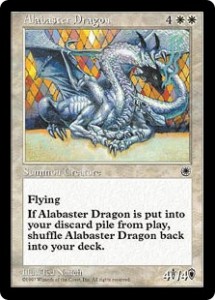
Alabaster Dragon


This is an alternate-art version of one of the most unplayable, terrible dragons of all time.

Luckily for you, this version holds a slight value upgrade on the original. You’ll be lucky to get a buck for the Weatherlight version, but the Portal goes for $2.75 on Channel Fireball and Star City. Magic Traders clocks it in at over $4.

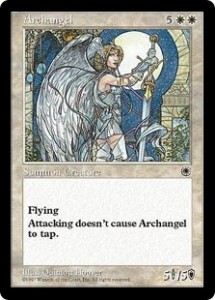
Archangel


The Portal version Archangel goes for $5ish on Magic Traders compared to $4 for the Visions version. Of course, the Portal version sells for under $3 on Channel Fireball, so your mileage may vary in getting full value out of this unplayable card.

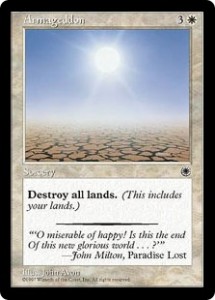
Armageddon


The Portal Armageddon sells for a similar price on eBay to the regular Revised/4th Armageddon, which is around $3.50. Star City, by stark contrast, sells the Portal ‘geddon for $7 while you can pick up a Revised one for just $4.

This is a strong buy if you can get it for the Magic Traders price, because you’ll probably be able to trade it for the Star City price or higher due to how cool it looks and how iconic the card is. Everyone needs a ‘geddon for their cube, and this is one of the best.

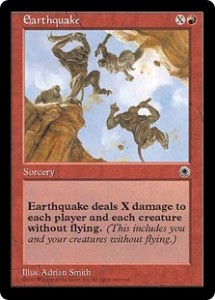
Earthquake


The Portal art actually did get reprinted 13 years later, in M10! Thus, this version isn’t really sought-after much anymore – certainly not as much as the alt-art one from Portal II. You can pick these up on Channel Fireball for $2, they are on Magic Traders for $3.75, and they sell on Star City for $4.

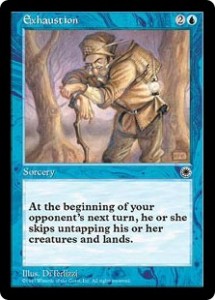
Exhaustion

An alt-art of the Saga favorite, the Portal Exhaustion goes for a little under a buck on Star City, two bucks on Channel Fireball, and, uh, one sold on eBay for like $7.50 for some reason.

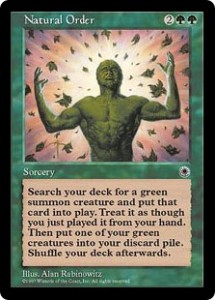
Natural Order


Finally, a truly great card! Natural Order, of course, is not on here because of its alt-art-ness, but because of its playability in excellent Legacy decks. These go for right around $20 on Magic Traders and book for just over $30 on Channel Fireball and Star City.

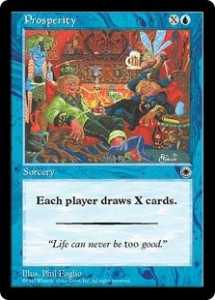
Prosperity


If you’re going to build a classic Pros-bloom deck, make sure you do it in style. Phil Foglio’s art oozes style, so you’re going to want the Portal version of your combo piece.

If you want these, pick ‘em up for $1.50 on Channel Fireball or Star City because Magic Traders shows an average of $2 for eBay sales.

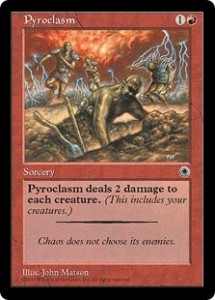
Pyroclasm


Portalclasm is $2.50 on Star City, $4 on Channel Fireball, and a hilarious $8 on Magic Traders. No matter what, it’s cool sleeving this version up in your RUG deck, no?

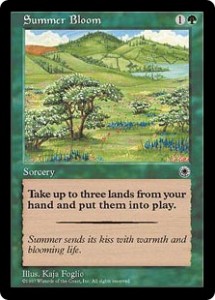
Summer Bloom


For some reason, this alt-art Summer Bloom goes for $1 on Channel Fireball, $1.50 on Star City, and $1.75 on Magic Traders. I don’t know why. I’ve never seen anyone play this anywhere.

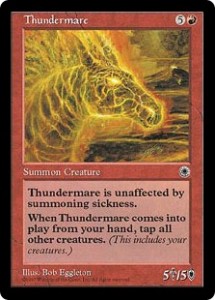
Thundermare


Man, this guy was A BEATING back in high school! It’s been a while since I’ve seen him, though.

Regardless, you can find the Portal Thundermare for under a buck on Star City, and $2 on Channel Fireball. He goes for almost $4 on Magic Traders.

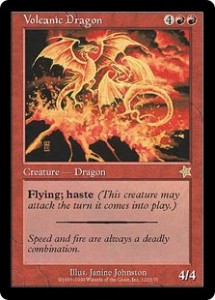
Volcanic Dragon


Yes, Volcanic Dragon sucks. But I do have him in one of my cubes, and when I found a German Portal version of this guy last weekend, I couldn’t have been more excited.

Regardless, this guy goes for $3.50 on Channel Fireball, $2.50 on Magic Traders, and $1.50 at Star City.

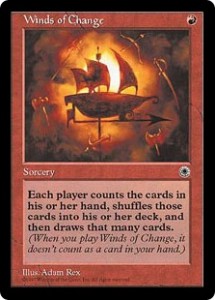
Winds of Change


Thank goodness this unplayable card got an ugly art upgrade that includes an actual weathervane in order to drive home the point about changing winds. Find it for $0.75 on Magic traders, a buck at Star City, and $1.50 at Channel Fireball.

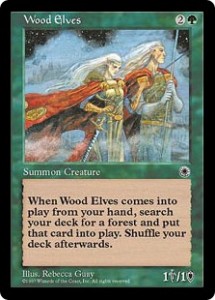
Wood Elves

If you only retain the information about one card from this article, make it this one.

I have probably bulked out a dozen Portal Wood Elves, but you shouldn’t do that. People love the Rebecca Guay art on a playable elf deck/EDH/cube card. Normal Wood Elves are worth next to nothing, but this version sells for about $3.50 on Channel Fireball, Star City, and Magic Traders.

There was a reasonably high volume of sales on this one too, so it’s probably a higher-velocity pickup than most on this list.

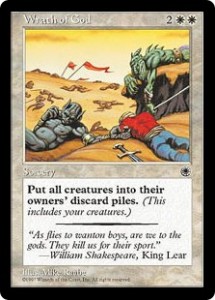
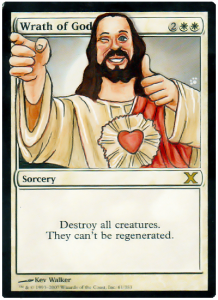
Wrath of God


Presumably, God is angry at the fact that the portal-verse is pretty much entirely made up of cartoons.

Still, this is probably the most interesting Wrath other than Beta or the 7th edition foil. It’s still worth over $10 on Magic Traders, a good upgrade over the $4 you can get a 4th edition Wrath for these days. Channel Fireball has it at $12-$13, while Star City has it for only $9.

Unique Cards

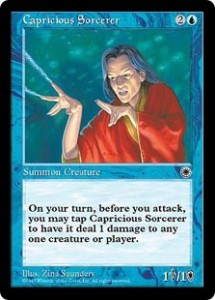
Capricious Sorcerer


An odd reprint of Prodigal Sorcerer that can only ping in your pre-combat main phase, Capricious Sorcerer is around $2.50 on Magic Traders and can be had for between $1 and $1.50 on Channel Fireball and Star City.

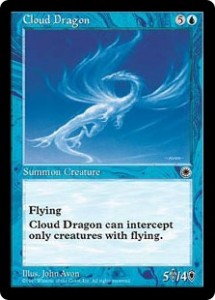
Cloud Dragon


This is the first in a cycle of horrible, terrible Portal dragons. It’s a good thing for Cloud Dragon’s value that he was only released in Portal, because he sure is janky. For six mana, you get
.a 5/4 flyer with a drawback. In blue. Not exactly Argent Sphinx, is he?

Of course, dragons are dragons, so he’s worth $6.50 on Magic Traders and goes for a whopping $7-$8 on Star City. You’d be better off picking him up for $4.99 on Channel Fireball, though.

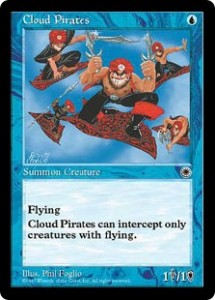
Cloud Pirates


They’re only a quarter on Channel Fireball ($1.50 on Magic Traders!) but they’re one of the funniest cards you’ll see anywhere. Pick them up for a quarter. They make fun throw-ins on trades.

Cruel Bargain


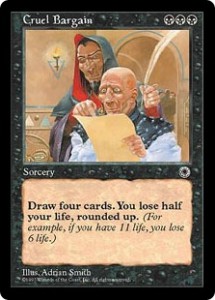
One of the best cards only to be printed in this accursed set, Cruel Bargain is worth just over $9 on Magic Traders. This is with a large standard deviation, though, which leads me to believe that its trade value is actually higher. It sells for $13.50 on Channel Fireball, and close to $20 on Star City.

Cruel Tutor


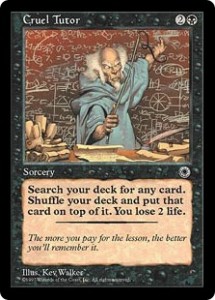
Portal sure does seem to want to push the fact that black is cruel, no? Anyway, Cruel Tutor goes for $7 on Magic Traders, $9 on Channel Fireball, and $12 on Star City despite being a pretty crummy tutor effect overall.

Of course, it could be worse. [See: Tutor, Grim]

Devastation


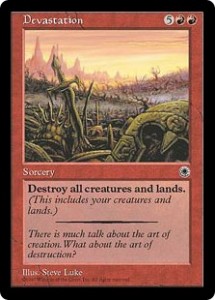
Devastation is a really fun Obliterate-esque card that I’ve used in more than one EDH deck. These book for$3 at Channel Fireball, $3.50 on Magic Traders, and $5 on Star City.

Dread Charge


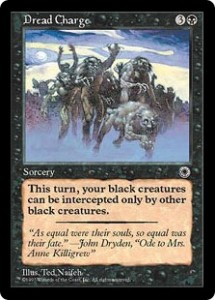
It’s fear! For your whole team!

I guess this isn’t the worst falter ever, and its price reflects its fringe playability. It goes for right around $1 on Magic Traders and Star City and $1.50 on Channel Fireball.

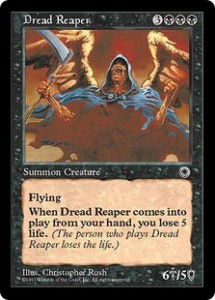
Dread Reaper


I guess if black cards aren’t cruel, they’re full of dread! A card more for set completists than players, Dread Reaper is $2.75 on Magic Traders, $1.75 on Channel Fireball, and uh, $0.99 on Star City.

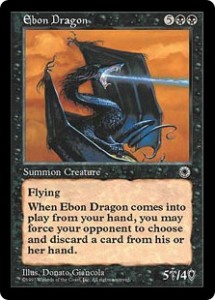
Ebon Dragon


The best of the laughable Portal dragons, the 7 mana Ebon Dragon gives you conditional card advantage. The price on this came down when FTV: Dragons was printed, since a ton of foil copies entered the market and no one has ever REALLY wanted to put this guy in a deck, but he still goes for $6.50 on Magic Traders, $7 at Star City, and is up near $10 on Channel Fireball.

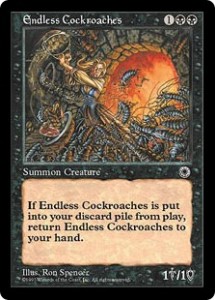
Endless Cockroaches


Sometimes you don’t have enough cockroaches. For those times, check out Endless Cockroaches[car.

This is actually kind of a useful card, and I can see why people might want a copy or two even today. They’re sold out on Channel Fireball at $3, go for $4 on Magic Traders, and you can pay Star City Games $6 for all the cockroaches you need.

(As an aside, when looking at the card Endless Wurm, does anyone else think about that political bumper sticker that says “Endless War” only someone fake crossed it out to read “End this war?” I always imagine a protester looking at Endless Wurm and shouting “END THIS WURM!”)

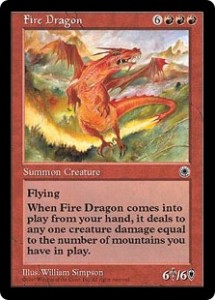
Fire Dragon


A horrible dragon, Fire Dragon is still essential to anyone collecting all the dragons. And since this was his only printing, he goes for $7 on Star City, almost $9 on Magic Traders, and almost $10 on Channel Fireball. Also he’s red, so I guess you could put him in an actual dragon deck.

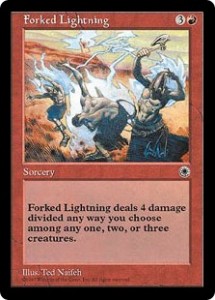
Forked Lightning


If you really, REALLY want to kill a pile of little dorks, your 18th or 19th choice MIGHT be Forked Lightning.

Regardless, it’s kind of a cool spell, and this was its only printing. You can get ‘em for about a buck on Star City, which is also what they go for on Magic Traders. They’re a little over $1.25 on Channel Fireball.

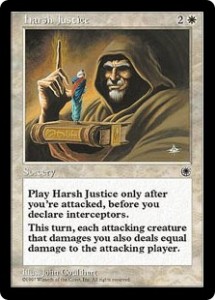
Harsh Justice


“I have a great idea for a new punishment, your honor!”

“What is it, Thorgg?”

“If someone hires a thug to beat up their enemies, we’ll force the thug to beat up the guy that hired him just as badly!”

“That justice is so harsh that it just might work!”

Harsh Justice is a buck fifty on Magic Traders and Star City. $2 on Channel Fireball.

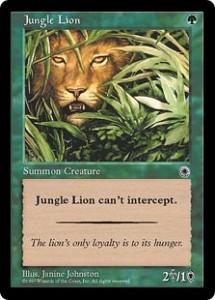
Jungle Lion


If you block with this guy, you’re doing it wrong anyway.

Jungle Lion was a much more exciting card back when Savannah Lions was a sweet constructed playable, but it’s still reasonable for green. Expect this card to shine if all the dual lands are banned in Legacy but Portal is still somehow allowed.

Jungle Lion is about $2 on Magic Traders, and about $3 on Star City and Channel Fireball.

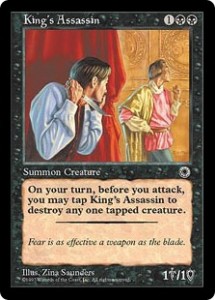
King's Assassin


Was the ‘tap’ symbol really so hard for new players to figure out? Did they really need to put a limited clause on the card instead? I feel like I’m reading some horrible bootleg Royal Assassin. Even the picture is similar, except this time it appears that Peter Davidson is getting assassin’d.

The card goes for right around $4 on Channel Fireball and Star City but only books for $1.75 on Magic Traders, which seems like a much more reasonable price.

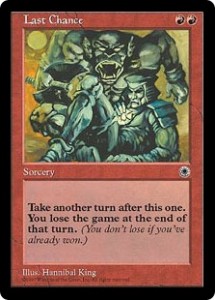
Last Chance


This is your last chance to play with copies 5-8 of Final Fortune!

Find this for a buck on Channel Fireball, $1.50 on Magic Traders, or $2 on Star City.

Mercenary Knight


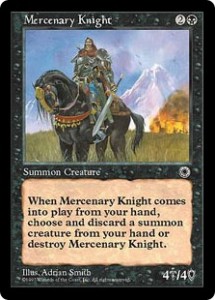
Raise your hand if you knew this card was worth more than $10! Actually, raise your hand if you knew this card existed at all. Regardless, now you know, and you can find it for $10 on Magic Traders, $11 on Star City, and $12 on Channel Fireball.

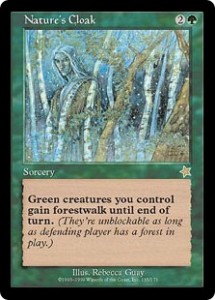
Nature's Cloak


Granting forestwalk to all your creatures for a turn at sorcery speed might not be the strongest ability, but I’ve certainly seen worse. This card goes for a buck fifty on Channel Fireball, and $2 on Magic Traders and Star City.

Nature's Ruin


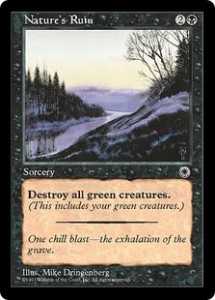
This is actually kind of a cool card I had never heard of, and seems useful against, uh, decks with green creatures that are also running Memoricide so you need a Perish off the sideboard with a name other than Perish. Or your EDH deck that always gets crushed by little Alvie’s Terra Stomper special.

Regardless, it’s worth $4 on Magic Traders and $5 on Channel Fireball and Star City.

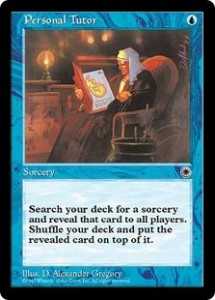
Personal Tutor


While Personal Tutor fails at being a Mystical Tutor by virtue of being limited to sorcery speed, its usage has picked up in Legacy due to the Mystical ban a few months ago.

Channel Fireball lists this card at $9.99, but it’s sold out at that price. It’s over $14 on Magic Traders, and listed close to $20 on Star City. It might be worth picking this one up if you can find it for $15 or less in someone’s binder – definitely a card to watch.

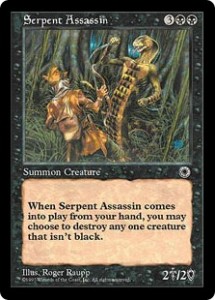
Serpent Assassin


I would die too if I were attacked by A SNAKE WITH A SHIV IN EACH HAND!

Seriously. A snake with a shiv. In each hand.

Look at that art.

Then look at ANY OTHER SNAKE EVER.

Then look back at that art.

There’s no wonder it’s sold out at $2 on Channel Fireball and $3 on Star City. It goes for just $2 on Magic Traders, so copies of this must come on the market once in a while.

Hint: Christmas is coming up, readers. This is what I want.

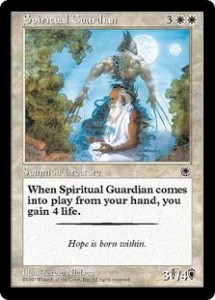
Spiritual Guardian


This guy is not a snake with a shiv in each hand. That is why he’s under a buck on Star City and Magic Traders, and just $1.50 on Channel Fireball.

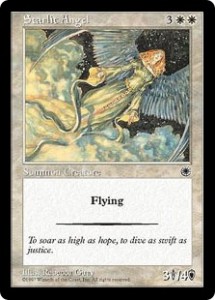
Starlit Angel


Terrible angels are still sought after, especially when illustrated by beloved artists. Starlit Angel is sold out for $1 at Channel Fireball AND for $2.50 at Star City. She sells for around $2 on eBay according to Magic Traders.

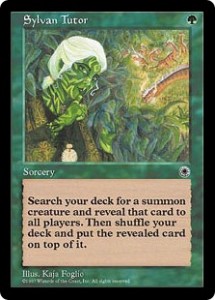
Sylvan Tutor


Having a second Worldly Tutor for your green EDH deck seems like a great thing. It’s out of stock at Channel Fireball for $5.50 and Star City for $9, and is on Magic Traders at $8. I would bet you’d have no trouble moving this card to a dedicated EDH player if you acquired a few copies of this at market value or less.

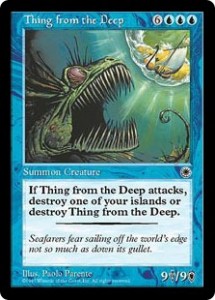
Thing from the Deep


No completist sea monster deck is complete without this guy, I suppose. He sells for about $1.25 everywhere.

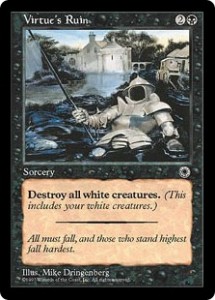
Virtue's Ruin


Out of stock at $1 on Channel Fireball and $3 on Star City, this card runs for about $2 on Magic Traders. As a semi-powerful color hoser, I can see the casual appeal in this card.

Rarities: Flying Reminder Text

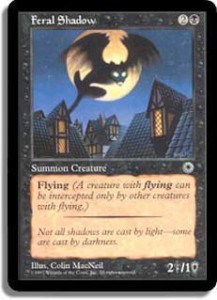
Armored Pegasus, Cloud Pirates, Feral Shadow, Snapping Drake, Storm Crow.


These are the five commons in Portal that have flying, and each of them were printed in two separate versions– one with reminder text for flying and one without. The versions without reminder text are common version and worthless. Copies with the text, however, sell for about $3 on Star City.

I want to know more about this. Was flying given reminder text in the early printings and then not in later ones? Why? How many of these are there? Why is there no information about this anywhere else?

If you know, please share in the forums! Otherwise, time to scour the bulk bins at your local store, since I guarantee you no one else knows these cards are worth more than a nickel.

Rarities: Flavor Text

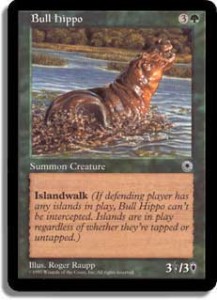
Bull Hippo (No Flavor Text)


The rarest of all hippos is perhaps the Portal Bull Hippo with no flavor text. I don’t know the details of this, either. Perhaps the hippo ate all the flavorful text? Regardless, this version is sold out at $3 on Star City.

Non-Rarities: Common Alternate Printings

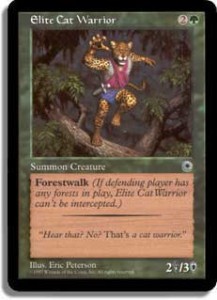
Elite Cat Warrior (Flavor Text? No Flavor Text?)


There appears to be an equal amount of Elite Cat Warriors in the world with and without flavor text. Is one of them rarer and worth more? No.

But, uh, keep it in mind?

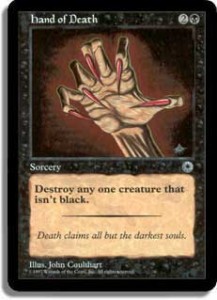
Hand of Death (Reminder Text? No Reminder Text?)


Both version are equally un-rare. On the plus side, either version of this kills either version of Elite Cat Warrior!

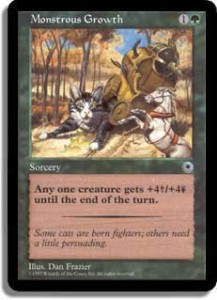
Monstrous Growth (Flavor Text? No Flavor Text?)


The cat is in the picture is equally confused in both. Thus, both are equally common.

Raging Goblin (Flavor Text? No Flavor Text?)


He rages on to mediocrity regardless.

Warrior's Charge (Flavor Text? No Flavor Text?)


Doesn’t matter, awful anyway.

Kind of a Portal Price Guide

Based on my best guess at the value of each card in Portal.

Twenty Five Dollars

Natural Order

Fifteen Dollars

Personal Tutor

Ten Dollars

Cruel Bargain

Mercenary Knight

Wrath of God

Eight Dollars

Cruel Tutor

Fire dragon

Sylvan tutor

Seven Dollars

Ebon Dragon

Five Dollars

Armageddon

Cloud Dragon

Four Dollars

Archangel

Endless Cockroaches

Nature's Ruin

Three Fifty

Wood Elves

Three Dollars

Armored Pegasus (with flying reminder text)

Bull Hippo (without flavor text)

Cloud Pirates (with flying reminder text)

Devastation

Earthquake

Feral Shadow (with flying reminder text)

King's Assassin

Pyroclasm

Snapping Drake (with flying reminder text)

Storm Crow (with flying reminder text)

Two Dollars

Alabaster Dragon

Jungle Lion

Serpent Assassin

Starlit Angel

Virtue's Ruin

Volcanic Dragon

One Fifty

Capricious Sorcerer

Harsh Justice

Nature's Cloak

Prosperity

Thundermare

One Dollar

Cloud Pirates

Dread Charge

Dread Reaper

Exhaustion

Forked Lightning

Last Chance

Spiritual Guardian

Summer Bloom

Thing from the Deep

Winds of Change

Not bad for an older set no one spends a lot of time thinking about! There’s certainly more value here than Scourge, Visions, Nemesis, and many other expansions.

Conclusions

Despite what I said earlier about Portal’s poor velocity, there are still several cards here that I believe will trade well, including the Natural Order, Personal Tutor, and alt-art Wood Elves.

I also think that there are plenty of cards here that you will be able to trade for more than my recommended trade price to collectors who like cool, rare things (Maggie, if you will) as well as cube builders.

Portal may not be the sexiest set, and it may not be as profitable to trade for as the latest staples, but now you know the values of cards for next time you see that Ebon Dragon sitting in the back of someone’s binder at the Prerelease.

Join me next week when we will explore the wilds of Portal: Second Age!

The Nutt Draw – Set EV and Booster Pack Values

Are you a Quiet Speculation member?

If not, now is a perfect time to join up! Our powerful tools, breaking-news analysis, and exclusive Discord channel will make sure you stay up to date and ahead of the curve.

This week as you are chomping down on some turkey and fixin’s (Pack 1 Pick 1 or leftover) grab a slice of the latest Set EV data in this article.

The format this time around is the same as it was last time, though the all the backend data has been updated and redone. All primary calculations are now based on the middle prices from TCGPlayer.com which is probably closer to the trading values you’re used to seeing then the previous eBay data was. I’ve reintegrated some of the eBay sales information that was incomplete for so many weeks though so I should be able to offer up some more comparisons later and redo the Womby List featured in the Buy List articles.

Speaking of which, I have continued to update the backend data for both the Buy List tool and the Card Values tool featured in my article two weeks ago. The Nutt Draw: Buy Lists and More

If something you read in this article looks confusing you may wish to check out some of my processes and explanations here. The Nutt Draw: Primers and Glossary

First we’ll take a look at some standard EV values.

[iframe https://spreadsheets.google.com/pub?key=0AukC5EWiTvOpdGozMmRmZzE1cGJNSEJPWmQ3eHlCRVE&hl=en&single=true&gid=1&range=A2%3AJ10&output=html&widget=false 567px 260px]

As of the time of writing, the most valuable set in Standard is Scars of Mirrodin by a pretty good margin. This is aided by being top heavy with several high value cards. Koth of the Hammer, Venser the Sojourner, Mox Opal, Molten-tail Masticore, and Elspeth Tirel still hold an online median of over $20 each. Don’t let the Worldwake EV fool you. Jace the Mind Sculptor just keeps going up and up and it’s skewing the whole set. As you will see below you only have a 1.25% change of opening one out of a pack but a decent 45% chance of getting one out of a box. Due to the bulk of the money being in Rare cards instead of Mythics, Zendikar is the best overall choice for pack value (unless you want to gamble on getting a Jace the Mind Sculptor) if you’re only picking up a few packs, though Scars is a pretty close second.

[iframe https://spreadsheets.google.com/pub?key=0AukC5EWiTvOpdGozMmRmZzE1cGJNSEJPWmQ3eHlCRVE&hl=en&single=true&gid=2&range=A2%3AJ10&output=html&widget=false 567px 260px]

When we pull out the highest valued cards we get a better picture of what Worldwake is really worth when not buying cases. Since it’s a small set it’s still not terrible (thanks also to Abyssal Persecutor, Avenger of Zendikar, and Stoneforge Mystic. Even when you take the highest card out of Zendikar though (Eldrazi Monument) it’s still the best value pack for pack.

[iframe https://spreadsheets.google.com/pub?key=0AukC5EWiTvOpdGozMmRmZzE1cGJNSEJPWmQ3eHlCRVE&hl=en&single=true&gid=3&range=A2%3AJ14&output=html&widget=false 567px 300px]

Here we can see the highest priced Mythics, Rares, Uncommons, and some Buy List values. All the cards on this list are not too surprising, and most of us probably have, or at least want to have playsets of all of them to toss into decks.

[iframe https://spreadsheets.google.com/pub?key=0AukC5EWiTvOpdGozMmRmZzE1cGJNSEJPWmQ3eHlCRVE&hl=en&single=true&gid=4&range=A2%3AJ10&output=html&widget=false 567px 210px]

Here we can see alternate ways to look at the Set EV including some interesting trivia like how much you would need to buy booster boxes for if you wanted to make 50% profit and were able to sell every card you open.

[iframe https://spreadsheets.google.com/pub?key=0AukC5EWiTvOpdGozMmRmZzE1cGJNSEJPWmQ3eHlCRVE&hl=en&single=true&gid=5&range=A2%3AJ13&output=html&widget=false 567px 230px]

The numbers guy in my loves this chart. Here we get to see the odds in opening gold. Even though you have more than 100% chance of opening a pack with one $1 card, Zendikar remains to have the best odds of the more moderately prices cardboard.

[iframe https://spreadsheets.google.com/pub?key=0AukC5EWiTvOpdGozMmRmZzE1cGJNSEJPWmQ3eHlCRVE&hl=en&single=true&gid=6&range=A2%3AM10&output=html&widget=false 567px 230px]

The final chart for this week shows us that the price of Jace the Mind Sculptor still skews the value of Worldwake even when other factors are taken into account. These are mostly impartially weighted numbers, and a suggestion on what packs to grab if you want to spin the wheel.

I’m sorry for the short article this week. As you will see on Monday, I’ve been a very busy bee indeed.

Chris McNutt
Magic Analyst
Level 1 Judge
@fatecreatr on Twitter

Organizing Your Binder

Are you a Quiet Speculation member?

If not, now is a perfect time to join up! Our powerful tools, breaking-news analysis, and exclusive Discord channel will make sure you stay up to date and ahead of the curve.

This week at the Revenue Review we’re looking at different ways of organizing your binder and the pros and cons of each. This is Part Two of a three-part series. Last week I explored how to build a binder from the ground up, and next week I’ll walk you through the process of selling off most (or all) of your binder to turn a profit.

Let’s start with some common ways to organize trade binders.

Not using a binder

Don’t do this. Ever. Even if your options are to use a card box or watch the entire Twilight saga with your little sister. Suck it up and pretend you’re watching Blade.

I’ve seen a lot of newer players carrying around boxes that they keep their rares (and a mess of other random cards) in. It’s exciting for me because you never know what you’re going to find, and you know not many people will have taken the time to look through it. But 99 percent of the time you won’t find anything worth getting, and you’ll have wasted infinitely more time than you would have if they had just used a binder.

Organizing by color

This is what I do with my binder, and it works especially well with smaller collections. With each color (and Gold/Hybrid, Promo, Colorless, and Land cards) separated, it’s very easy to find any particular card my partner is looking for. Since I have a small collection, about 4 pages of front and back cardholders per color, it’s not very time-consuming to sort through.

I also leave two blank pages of cardholder in between each section so I can stock new cards in. This allows you to quickly and easily slot cards into where they belong amidst a night of trades. This isn’t the flashiest method of storing cards, but it gets the job done, especially on the lower end.

Pros:

-       Easy to organize and update

-       Easy to find particular sections and cards in small collections

Cons:

-       Doesn’t work well with larger collections

-       Requires you to leave blank pages in your binder

Organizing by price

This method is very hard work to keep up with and is really only recommended if you expect to deal with a room full of sharks who are spending minimal time on each trade. While it’s certainly useful to open someone’s binder and see their best cards up front, I think the risks far outweigh the benefits on organizing your own binder like this.

For instance, if you open up a binder organized like this and find their Murmuring Bosks all the way with the junk lands, then you are going to jump all over that if you know beforehand they’re valuing them at a low price, rather than the $4 it’s currently fetching on Ebay.

There also is a ton of upkeep associated with this, which is the biggest reason why I don’t recommend it. It’s one thing to keep track of prices in order to be a good trader, but it’s another entirely to spend hours meticulously rearranging your binder.

Pros:

-       Presents a very focused and professional-looking binder

-       Is very easy to navigate when dealing with serious traders

Cons:

-       Difficult to manage and keep updated

-       Presents high risk if not properly maintained.

Organizing by format

This method works very well when you have a lot of older cards, regardless of how many you have. Most traders are looking for Type 2 (Standard) cards, and can just be completely turned off if you show them a bunch of rares from 2004. Splitting your stuff up by time period can really make it easy to distinguish what you have the most of.

The drawback to this is that casual traders looking for cards can be a little intimidated by your binder. Of course this depends on your audience, but some of the guys I trade with wouldn’t even know what I meant if I told them, “here are my Type 2 cards, here’s the Extended section, and behind that is Legacy, and if I have any Vintage-only stuff, it’s in the back.”

If they want some random Green fatty they might not have seen before to fill out their casual or EDH deck, then you create some extra work when they have to search through three sections of Green cards, or more if you don’t have it organized by color.

Pros:

-       Works well with large collections

-       Speeds up trades with focused partners

Cons:

-       Can intimidate casual players

-       Divides colors more than once, increasing possible search times

Other concerns

Stacking cards:

Some traders have asked me if I stack cards behind one another in my binder. There’s two sides to this argument, and both have valid points.

Obviously stacking your four Baneslayer Angels on top of each other in a single holder will save space in your binder, but it comes with the increased risk of damaging the cards when taking them out.

Personally, I stack my cards on top of each other. I don’t want to have a binder that is too huge to carry around because I was worried about slightly bending the corner of my fourth Gideon Jura. Taking care when removing cards and not pulling them out willy-nilly goes a long way. Just be careful with your collection, and you should be able to keep your cards in good condition without too much trouble.

Putting cards in outside sleeves:

To clarify what I mean by this, think of the typical nine-space binder page with another possible nine spots on the back if you put cards back-to-back. I have a friend who only uses the six innermost spaces on each page because the ones on the outside are more likely to slide out when flipping through pages.

I understand the concern, but I don’t think it’s worth running at 66 percent capacity to minimize an already-small risk. The fatter your binder gets, the more logistical issues you have carrying it around and navigating through it. Just be careful when carrying and turning through your binder and you should be fine.

Another trick I use is to put a card I have multiple copies of at the top outside edge of the page. It’s a lot less likely that your cards will accidentally fly out when you have three Cryptic Commands with two Coralhelm Commanders sitting behind them. Using the combined weight of the cards will keep them from sliding out of your binder, and is safer than putting your only [/card]Jace, the Mind Sculptor[/card] by itself on the top and outside of your binder.

Differences between large and small collections:

As I’ve said, I have a pretty small collection, so everything I’ve discussed comes from that paradigm. Stacking your Fauna Shamans on top of each other doesn’t work when you have 15 of them. In order to give you another perspective on this, QS’s James Trentini wrote a bit on how he handles his collection, which is much more sizable than mine.

"When carrying a large amount of stock with you it can be hard to sometimes organize it in a way that makes the trades simple and easy to complete. I've looked through some binders and it's hard to find the things you want in them because they are so disorganized and scattered, you don't want that to be you.

The way to save space and make things simple with large amounts of cards is to only have a singleton of any given card in the binder page. Any multiples of the cards in your binder should be kept in penny sleeves and left in a box in your backpack. What this does is allows more cards to be displayed while giving you a secure way to carry multiples of what you need. When you have 12 copies of a card you don't need to show them all off, simply state that you have multiples of most of the cards in your binder and that if they want more than one to let you know. As far as organizing a large collection I go by tabbing out my binder into multiple sections in the following order:

  • Lands
  • Colorless/Artifacts
  • Blue
  • White
  • Red
  • Green
  • Black
  • Foil/Foreign/Promo/Alternate Art in same order: L/A/U/W/R/G/B.

Keep in mind that the color order is all dependent on what is popular at your local area, blue is very popular here and so that is first in color order for me. The first half of your binder should be Type 2 with Legacy/Extended after. What this does is allows your trade partner to jump straight to the cards they are looking for and don't have to scan each and every page for a card they want. Now I have tabs labeled so as to make their decision making easier for them, the faster a trade ends the sooner the next one starts. Hope this helps those of you who like to carry a large amount of staple cards with you, now go out there and trade!

- James Trentini

@jtrentini on Twitter"

That’s it for this week, I hope you enjoyed the column this week and find it helpful. Let me know in the comments if there’s anything I missed or you want to see next week.

Thanks,

Corbin Hosler

@Chosler88 on Twitter

Avatar photo

Corbin Hosler

Corbin Hosler is a journalist living in Norman, Oklahoma (also known as the hotbed of Magic). He started playing in Shadowmoor and chased the Pro Tour dream for a few years, culminating in a Star City Games Legacy Open finals appearance in 2011 before deciding to turn to trading and speculation full-time. He writes weekly at QuietSpeculation.com and biweekly for LegitMTG. He also cohosts Brainstorm Brewery, the only financial podcast on the net. He can best be reached @Chosler88 on Twitter.

View More By Corbin Hosler

Posted in Feature, FreeTagged , , , , , 14 Comments on Organizing Your Binder

Have you joined the Quiet Speculation Discord?

If you haven't, you're leaving value on the table! Join our community of experts, enthusiasts, entertainers, and educators and enjoy exclusive podcasts, questions asked and answered, trades, sales, and everything else Discord has to offer.

Want to create content with Quiet Speculation?

All you need to succeed is a passion for Magic: The Gathering, and the ability to write coherently. Share your knowledge of MTG and how you leverage it to win games, get value from your cards – or even turn a profit.

Endless Horizons – Jumping Into the Field

Are you a Quiet Speculation member?

If not, now is a perfect time to join up! Our powerful tools, breaking-news analysis, and exclusive Discord channel will make sure you stay up to date and ahead of the curve.

Many people missed the boat on this one. Twitter feeds can help avoid that.

Last week I said we would go more in depth with the upcoming extended metagame and the cards you should be on the lookout for. That’s been pushed back a week so I can give you a more in depth report, hopefully one that will make you a lot of money as we approach seasonal rotations. This week we are going to focus on the technologies that we have at our disposal and how to make the most of them.

This article may not contain new information for some of you, but I feel this is a necessary article for the people that have recently come to the site and might want some help getting a jump start.

In the age we live in a good number of us all have access to the latest updates in pricing data. Because of the possibilities of instant communication, as traders we have to be able to keep up with the others in our field, and ahead of others who are lagging behind. When the first Eldrazi spell was spoiled, the difference between $3 Eye of Ugin and $10+ Eye of Ugin was all of about 2 hours for the online retailers that kept themselves updated. Yes, there were still those retailers that had them mispriced a full 24 hours after the buying frenzy started, but much like Black Friday deals, if you want the best you have to be fast and on top of your game.

Twitter and you

One of the greatest tools you can use is Twitter. There are a host of people that are worth following, but for those of you that are just getting started, or that need to expand your follow list a bit, I’ve provided a short list of people worth following. This is not to say that only the people below are worth it, but it’s a good start.

Bmkibler – Pro player Biran Kibler

Chosler88 – QS writer Corbin Hosler

Conley81 – Pro player Conley Woods

Fatecreatr – QS writer Chris McNutt

Fivewithflores – All around awesome dude Michael Flores

G3RRYT – Pro player and recent GP Nashville winner Gerry Thompson

Jtrentini – QS writer James Trentini

Legacysallure – QS writer Doug Linn

LuisScottVargas – Pro player LSV

Magicprotour – Official twitter feed of the pro tour

Mananation – Official twitter feed of Mananation.com

Mtgaaron – MTG developer Aaron Forsythe

Mtgmetagame – BAMF Jonathan Medina

Mtgsalvation – Feed for Mtgsalvation.com, useful for spoilers as they come out.

Mtgstephenmoss – That’s me!

MtgVeteran – Fellow financial personality Brian Doran

This is a great podcast to listen to.

Mulldrifting – Awesome lady Lauren Lee

Nwhinston – QS Writer Noah Whinston

QuietSpec – This sites twitter feed

SMenendian – Wall of text creator Stephen Menendian

Thepchapin – Pro player Patrick Chapin

TheZvi – Pro player Zvi Mowshowitz

YoMTGTaps - Yo! MTG Taps! twitter feed.

Websites to use to your advantage

While not all websites are worth attention, the few that are can be very important to your success as a trader. Keeping an eye on average prices, knowing the cards that are most in demand, and having access to multiple pricing sources and stores when a card jumps in price can help you to catch the next Eye of Ugin before it explodes.

Find Magic Cards – This site has multiple connections to sellers, a top 5 current in demand cards, a price history graph per card, and an easy to use search option. Highly recommended for people looking to find the best deal across multiple vendors.

Apathy House – This site is used mostly for its trade evaluator. While not always accurate, you will often find close to current prices to see how much you gained or lost at the end of the nights trades. I use the prices here to show the gain/loss value of my trading journals, unless the price is obviously wrong.

TCG player store - Another site with a number of vendors for you to browse, much like findmagiccards.com

MTG Salvation – Primary site for set spoilers, and also has an extensive constructed segment for those of you interested in that. There is also the market community where you can trade, buy, or sell your own cards.

MOTL –The home of Magic Online Trading League, or MOTL. It’s primarily used for trading, buying, and selling your cards to other users, and is an excellent way to unload extra cards for cash.

All Magic Cards - Reader suggested site from Samgc3 in the comments below, Allmagiccards.com is much like findmagiccards.com with more options and more things to the site. Thank you Samgc3 for showing this to me, I think its going to become a new usual stop for me.

How to tie it together

Excellent tool if you don't have Office.

Using these tools is great, but unless you use them in conjunction with each other then you’re missing out on a huge amount of profit potential. Keeping good records can mean the difference of hundreds of dollars over the year, so it’s imperative that you are able to keep track of your traded inventory. I’ve often lost small trade journals because I’m rather forgetful, and since then I just take a quick note of what I’ve traded and then enter it into an Excel spreadsheet at the end of the night. Excel is a powerful tool that can be used to track your progress in a multitude of ways, and as our own Chris McNutt has shown us it can be used for more than just work related data. If you don’t have access to Office and Excel, there are options available for you. You can download the Open office software or you can use Google Doc’s which has a spreadsheet program and a word processor. I suggest learning these programs, as they can lead to a much higher level of productivity which will turn into higher profits for you.

While I know that a portion of you already know some of this, I felt that it was time to bring it all together for the readers of Quiet Speculation. Twitter is an amazing real time resource and I recommend that anyone who seriously wants to stay on top of current price trends to sign up for an account. The websites listed will help you quickly find the cards that are suggested, and the usage of Excel and other data management software will help you keep track of your inventory and progress overall.

The research for next week’s article is eye opening so far, and I think that many of you will find it useful when looking through binders of older cards. With no defined metagame there are massive opportunities to pick things up cheap right now that can see a sharp rise within the first couple of weeks of the PTQ Nagoya season. Thats all for now. Thanks for reading, and have an awesome Thanksgiving. I know I'm thankful for the opportunity to write here, and for those who take the time to read these articles and comment, they help make the content better.

Until next week,

Stephen Moss

MTGstephenmoss on twitter

stephen.moss@ymail.com

Stephen Moss

Stephen Moss currently lives in Lancaster, CA, is a usual PTQ grinder in the southwest region and working on his Masters in Business Administration. He has an obsession with playing League of Legends when not working on articles or school work. His articles often take on a business minded tone, and usually contain information applicable to magic trading as well as real world business.

View More By Stephen Moss

Posted in Finance, FreeTagged 15 Comments on Endless Horizons – Jumping Into the Field

Have you joined the Quiet Speculation Discord?

If you haven't, you're leaving value on the table! Join our community of experts, enthusiasts, entertainers, and educators and enjoy exclusive podcasts, questions asked and answered, trades, sales, and everything else Discord has to offer.

Want to create content with Quiet Speculation?

All you need to succeed is a passion for Magic: The Gathering, and the ability to write coherently. Share your knowledge of MTG and how you leverage it to win games, get value from your cards – or even turn a profit.

Negotiating With Dealers

Are you a Quiet Speculation member?

If not, now is a perfect time to join up! Our powerful tools, breaking-news analysis, and exclusive Discord channel will make sure you stay up to date and ahead of the curve.

Quite often I've seen writers, myself included, talk about how buyers determine the price of cards. In our everyday experience this relationship seems to go the other way around. Price is rarely negotiable. When we say that if a price of a card is x dollars and buyers are willing to pay x dollars for it this means very little if you are only willing to spend y dollars.

Perhaps you are interested in purchasing a Jace, the Mind Sculptor that your LGS has for sale. Unfortunately they want $85 for it but you only have $70. It is unlikely that you will be able to get the Jace off them for that price because of the high demand for Jaces. Pretty much every store, however, has some cards that have been sitting in their case gathering dust for some time. These cards may have some wiggle room with regard to price.

Before Scars was released I traded away most of my Alara block cards before they dropped in value. Normally I would have already had a playset of the entire block but I was taking a break during its heyday so I only picked up the cards I needed as I was busy acquiring Zendikar block cards. Now I want to complete my collection.

Alara Reborn cards are pretty cheap across the board with the exceptions of Maelstrom Pulse and Sphinx of the Steel Wind. I went down to one of the stores in my area and looked through their ARB binder. They had about 60 rares and mythics including full playsets of a bunch of them.

The first thing you should know about any store you regularly shop at is where they get their prices from and how often they update. In this case I knew they generally used Starcity prices. They don't have spectacular prices for their ARB stuff but I wanted to see what kind of a deal I could get. I told them I would be interested in buying all of their cards if they would be willing to give me a discount.

In my opinion a store would be pretty insane to not give a discount on a purchase like this. First of all there were no high value cards in the lot. There were a couple of $1-3 cards but most were bulk. As a collector I'm still interested in at least a playset of bulk so I'm happy to get them if I don't have to pay much (or anything) for them.

Since the set is no longer Standard legal and Extended season is still some time away (and not very popular) these cards are probably not going to sell anytime soon. At best they would probably sell a couple of them to casual or EDH players. By selling the whole lot of them, even at a discount, they are coming out ahead.

So now the big question came down to how much of a discount they would give me. The quoted price was $28 which wasn't a terrible price but definitely more than I was willing to pay. At this point I had two options. The first was to see about talking them down on the price but I didn't think I would be able to get the price down to what I was comfortable paying so I decided to go with a second option.

This store is trying to improve their selection of Standard singles so they are buying cards in limited quantities. Another good thing to know about a store is how they price cards they are buying. In this case they look at the sell price on Starcity and discount it. They generally end up giving a price much better than the buylist price. I sold them a Goblin Guide, Basilisk Collar and an Inferno Titan for $16 which brought the price of the lot down to $12 which was fine with me. Generally I don't like to spend cash on cards but being able to get a lot of the bulk easily makes it easier for me to trade for the remaining cards in the future. The higher value cards will be easier to find and it will reduce the need to trade down.

The point of all this is that sometimes you can get a lower price if you just ask. The worst than can happen is that they say no. Another situation I have found where negotiating is possible occurs in stores that generally don't cater to a large Magic crowd.

There are three stores that sell singles at the local mall, and one has a huge variety of singles. They keep the singles in binders labeled by set but these binders are on the floor behind the counter and not easily visible to customers. I've spent some time looking through them and found some goodies. The store is mainly a sports collectibles store but it has a comic store next to it. They seem to draw most of the admittedly small Magic crowd so these singles are just sitting there waiting to be snatched up. Unfortunately every time I am up there the owner or manager is never around and the associate doesn't have the authority to give me a discount.

Keep an eye out for opportunities like these. Even if you aren't a collector you can still use this technique to make a profit. Right now the Alara Reborn cards are low but when Extended season hits some of these might jump up again. I was able to pick up some cards like Finest Hour and Sovereigns which might find a home in decks again. When the new Extended tech rolls in, some of those bulk rares could skyrocket if they combine with cards in other sets. If nothing else you can always bulk them out. You would have to get a much better deal than I did if that was your end goal but by keeping an open mind to negotiating you will be able to make a profit where you otherwise wouldn't.

Next week I will discuss some methods I use for organizing my collection and talk about some methods for obtaining harder to find pieces. Now for what seems to have become my weekly moral dilemma: the following trade was offered to me. Someone I know was trying to complete a Standard Elf deck. They offered me a Koth and a Kargan Dragonlord (they were taking apart an RDW deck) for 2 Nissa Revane. The deal is fantastic for me, unless Nissa's blow up which I don't really expect especially since you can buy the DotP promo for next to nothing. I told him this was a terrible deal for him but that I would definitely do it if he really wanted to. He said he had no problem with it and I asked him if he was sure and reiterated that it was a bad deal and even told him how off the prices were. He didn't care and we made the trade.

In this case I don't have a problem with the trade because he offered it, knowing the loss he was taking and I made every effort to make him aware of how one-sided the trade was. The question I have is this. There were quite a few people sitting around us when the trade happened. They saw everything that happened and although they saw me inform him multiple times of how bad the trade was for him, in the end they all saw me make a very lopsided trade. Do you guys think this has the potential to hurt my reputation and if so how much? I hope everyone enjoys their Thanksgiving weekend be sure to stay safe the night before!

A Tale of Card Alters

Are you a Quiet Speculation member?

If not, now is a perfect time to join up! Our powerful tools, breaking-news analysis, and exclusive Discord channel will make sure you stay up to date and ahead of the curve.

Whinston’s Whisdom returns with another installment for your every financial need! This week, I’ll do a quick rundown of some hot cards, as well as talk about pricing altered art cards.

(In my best newscaster voice)

While there aren’t too many cards to discuss today, the most important is Ranger of Eos. With every financial writer in existence recommending that their readers pick him up on MTGO, the price has more than double to 1.7 tickets apiece on MTGO. The train is well past on this, and I wouldn’t recommend buying into the hype. Other extended staples also saw similar gains, with Knight of the Reliquary jumping by about 30%, yet other cards in this category, such as Noble Hierarch and Path to Exile haven’t seen the same amount of increase, so that’s an option that is left to the reader to fully explore.

In other news, the complete spoiler of Masters Edition 4 was released, showing that the duallands are being reprinted. As such, sell yours now if you can still get a good price for them, but if not, hold onto them. Some other legacy and vintage staples are also present in the set, such as Sinkhole, Manabond, Channel, and others. Though Null Rod did spike before the full spoiler, most likely fueled by those speculating that the power 9 would be included in the set, I don’t see that price jump lasting for too long.

Looking into the world of Standard, Sword of Body and Mind has been rising, in response to GerryT’s article about Boros with Squadron Hawks. Having played Boros online, with a list very close to Gerry’s for over a month, I can tell you that the deck is quite good, especially for those unable to afford big papa Jace. Sword of Body and Mind plays a key role in the deck, allowing you to swing past Avenger of Zendikar and Friends, Primeval Titan, Sea Gate Oracle, Frost Titan, and Llanowar Elves, generating additional creatures in the process. The only time the milling has ever been relevant for me was against Dredgevine, where I was able to deck him in 3 hits. Other Scars of Mirrodin cards have not been so fortunate, with the majority of them slipping over the past week. Tunnel Ignus lost a third of its value, Darkslick Shores and Mimic Vat both fell by about 22% and the mythics Koth and Molten-Tail Masticore both continued their downward trajectory.

(end broadcast)

with the preliminaries taken care of, let’s move on to talking about a topic that’s relatively new for me: card alters.

Card alters consist of ordinary players, and sometimes official Magic artists, painting over cards to change their art, in several different ways. This, obviously, affects the card’s value. In today’s article, I’ll break down card alters into some distinct categories, and attempt to define the influence each category has on price.

Basic alters:

These alters are minimal. Often doing nothing more than expanding the card’s art over the card’s borders, they don’t interfere at all with the original work. I personally enjoy these simple alters, because of the way they remain true to the artist’s original vision, and don’t try and shift the focus in another way entirely. As a rule, these basic card alters will increase the price of a card, while not being too hard to trade away. Though most competitive players won’t have a use for them, serious Eternal and EDH players always want more. The only caveat is to insure that the alter is of a good quality, which is especially difficult when buying over Ebay. I bought around 5 alters on Ebay recently for my own personal decks, but unfortunately one was of such poor craftsmanship and artistic skill that I was forced to trade away. (Editor's note: Card Kitty, the website that provided the pics, was not the one who sold the cards to Noah) Just because it’s different, doesn’t mean it’s better. Learn to look at alters with a critical eye.

Shifted alters:

I define shifted alters as alters that take the focus of the piece in an entirely new direction. Whether it’s an overabundance of flowers on a Birds of Paradise or a shield-wall on a Wrath of God, these alters stem from a player trying to create their own work of art in place of that of the artist. Again, from my own personal opinion, I am very against these. If you want to paint Magic cards, get yourself some blank cardstock and paint, but don’t corrupt an artist’s produced image just because you want to express your own creativity. If your reasons are less noble than that, than it only goes for you more strongly.

Celebrity alters:

Alterations to a card done by Magic celebrities, be they pros, designers or artists. Here, the quality of the alter is less important than ever. As long as there is a notable difference on the card and it is signed by the celebrity, this should trade higher than normal card, not only because it appeals to the collector, but the Pro Tour fanboy as well.

Parody alters:

My least favorite type of alter, these alters take an existing work and turn it into a parody, painting it over with a culture symbol. I’ve seen Darth Vader Vampiric Tutors, and I’ve seen Superman Force of Wills. Each and every one of them is a travesty. Magic cards are works of art, not jokes. Ordinary men and women slave over these paintings to make the game more enjoyable for YOU. Even with shifted alters, at least part of the original work remains. But with parody alters, the author’s work can’t even be seen anymore, and while the pose or placement of the figures may be iconic, the work is no longer representative of the original artist, and instead mocks the hard work the artist put into it. Because of this personal feeling, I will never buy, trade, sell, or pick up a parody proxy, but others certainly see this issue in a more moderate light. While I don’t intend to force my views upon you, I just felt that it was important to share how I felt about these alters, and the practice of altering as a whole.

And that just about wraps up alters and their many variations. Whether buying, selling, or just enjoying some beautiful artistic work, alters are great for everyone. I’ll be back next week with some more financial knowledge, but don’t have a specific topic planned, so if you’d like me to cover anything, let me know in the comments.

Signing off,

Noah Whinston

mtgplayer@sbcglobal.net

Arcadefire on mtgo

Nwhinston on twitter

Baldr7mtgstore on ebay

(Editor's Note: All altered card art taken from Card Kitty.)

Should You Sell Your Survival of the Fittest?

Are you a Quiet Speculation member?

If not, now is a perfect time to join up! Our powerful tools, breaking-news analysis, and exclusive Discord channel will make sure you stay up to date and ahead of the curve.

Survival of the Fittest?

More like Survival of the Fifty-Dollar Bill. (Editor's note: This all feels very familiar. -D.C.)

The Exodus enchantment has shot up in price in a dramatic way. A year ago, you could get them for $9. Now, no dealer will sell below $50. Thanks to incredible demand in Legacy, Survival is just about the hottest card to trade for, since you can still snag them from people who value them at $20.

But you know to pick up those Survivals, you know what they're worth and why they're good. The one thing that nobody is sure of is whether we'll have them to play with, come December. The only real “Act of God” event that happens in Legacy is the Banned List announcement. Survival's days may be numbered.

Today, we're going to talk about whether you should dump your copies of Survival and cash out now, or whether you should hold onto them through the banning period. The DCI is notoriously cagey about how they actually decide what to axe. In previous seasons, they have looked at tournament impact, inherent power, and MTGO tournament results. Their decisions can be honestly characterized as capricious. For example, Mystical Tutor went when Reanimator started winning too much, where Entomb was the lynchpin of the deck.

This makes me worried. I have five copies of Survival of the Fittest. Naturally, I'll be clearing one of them out, but what about those other four? They could represent over $160, or with a banning, their value could evaporate and I would be looking at roughly $10 each (due to casual appeal). Survival is a scary card to look at, and its transition to the new Legacy format was troubling from the start. It has this inherent instability and power, being absurdly undercosted at every step of the way. This makes me really unsure of whether it will make the cut in December (though, with Lion's Eye Diamond being totally egregious and legal, maybe I shouldn't worry...).

Factors in favor of its banning include some stellar tournament results, both with the Vengevine version and the Necrotic Ooze hybrids. On top of that, people like Patrick Chapin and Mike Flores have been talking about how good it is and maybe, just, maybe, that it needs to go. The DCI does check tournament results and occasionally reads articles, so they may actually see Survival as a problem. That said, we have not seen many events that exhibit other decks taking Survival decks seriously. A host of answers, from Leyline of the Void to Pithing Needle, can slow or stop Survival's plans, and we are just beginning to see people pick them up. The DCI does adopt a “wait and see” attitude a lot of time, so there is hope for those who hold Survivals that they will retain their value.

The card will either be banned or legal- Schroedinger's cat is safe. However, the market might respond in different ways. If players are emboldened that Survival is legal, the value could go up a bit. I don't think this would be a big bump or be very likely, since Magic players have only historically responded like this to the closed loophole preventing reprints, which drove up the price of dual lands. Ultimately, I made a few wide-ass guesses and made some predictions to forecast the value of the card. These figures are just my best hunch.

Market Result Probability End Price
No Banning, Strong Reaction 20.00% $60.00
No Banning, Weak Reaction 40.00% $50.00
Banning, Weak Reaction 10.00% $25.00
Banning, Strong Reaction 30.00% $10.00

With this kind of prediction, we rate out what the end price is by discounting each price by the likelihood that it will happen. So, a weak reaction to banning is worth $2.50 ($25 x 10%), since it is unlikely to happen – if Survival goes, I think its value will eventually end up at about that of Recurring Nightmare, which also currently only has casual appeal. This chart reflects a 40% chance that Survival will get banned; you can adjust it up or down, based on what you believe is correct.

The math works out that my predicted, current, realistic value of Survival is (12+20+2.5+3) or $37.50. This is well below what the card retails for these days, even below what you could sell them for on buylists. Since the price of Survival of the Fittest is a little over what we think it's worth, it is what the market called an “overpriced asset.” If we could effectively “short” the market, this would be an excellent opportunity. If you have ethical ideas on how to do this, respond in the comments!

If we sell our set, we make $160. If Survival is banned, then we're looking at a loss of probably over $100 that we can avoid by selling. If, however, it is still legal and we want to play with our Survivals, we'll have to rebuy them, potentially at $60 apiece! We would essentially be paying an extra $20 for the privilege of speculating on our cards- though this will only happen the 60% of the time (when it's still legal) so you're only really exposed to a $12 risk.

Armed with this, we can investigate our buy price on the card. Selling the card with the intent to rebuy if it remains legal will mean we make $32.00 (40 – 8 (which comes from .2 x 20 + .4 x 10)), or buylist price minus cost of rebuy). Simply subtract what you paid for yours to determine whether you should dump them. If you bought them back in July when I said to pick them up for $20, you stand to make a lot of money on this, especially if you have no intention of rebuying.

When you think about whether it would be banned, think in the language of what the explanation article would read. “We have always paid attention to repeatable tutors,” they would say, “and Survival of the Fittest is the most egregious offender.” Easy language to write. “Survival can be used to preemptively find answers to cards that would stop it,” you will read, and echo back to the same reasoning you read in their announcement banning Mystical Tutor. I reckon the DCI won't do anything, because whether Survival should go or not, they are not known for getting things right when it comes to banning things that are degenerate in Legacy. When you decide to sell, you must think about all of the factors going into this and rework the chart above to reflect your thoughts – it is always risky to do these kind of things, and it's best that you get the horror and pleasure of bearing the risk based on your rational market analysis.

-Doug Linn

www.twitter.com/legacysallure

Douglas Linn

Doug Linn has been playing Magic since 1996 and has had a keen interest in Legacy and Modern. By keeping up closely with emerging trends in the field, Doug is able to predict what cards to buy and when to sell them for a substantial profit. Since the Eternal market follows a routine boom-bust cycle, the time to buy and sell short-term speculative investments is often a narrow window. Because Eternal cards often spike in value once people know why they are good, it is essential for a trader to be connected to the format to get great buys before anyone else. Outside of Magic, Doug is an attorney in the state of Ohio.  Doug is a founding member of Quiet Speculation, and brings with him a tremendous amount of business savvy.

View More By Douglas Linn

Posted in Feature, Finance, FreeTagged , , , , , 12 Comments on Should You Sell Your Survival of the Fittest?

Have you joined the Quiet Speculation Discord?

If you haven't, you're leaving value on the table! Join our community of experts, enthusiasts, entertainers, and educators and enjoy exclusive podcasts, questions asked and answered, trades, sales, and everything else Discord has to offer.

Want to create content with Quiet Speculation?

All you need to succeed is a passion for Magic: The Gathering, and the ability to write coherently. Share your knowledge of MTG and how you leverage it to win games, get value from your cards – or even turn a profit.

The Psychographics of Trading

Are you a Quiet Speculation member?

If not, now is a perfect time to join up! Our powerful tools, breaking-news analysis, and exclusive Discord channel will make sure you stay up to date and ahead of the curve.

Trader Psychographics

Timmy. Johnny. Spike. Vorthos. Melvin.

The player psychographics represent an interesting way to think about how different people approach Magic. We’ve all lost to Spike, had an epic game with Timmy, and been in awe of Johnny’s combo. Many players I know have embraced their psychographic, using their identity as a way to narrow in on what they enjoy most about the game.

But while knowing someone’s player psychographic is somewhat helpful during a trading session, I believe that each player has something even more valuable to think about: a trading psychographic.

While your trading psychographic is related to your player psychographic, it can often be quite different. And identifying each trader by their psychographic will give you an edge in knowing how to best make a deal with them.

Let’s spend this week exploring the different trader psychographics that I’ve identified. How many more can you think of?

Gordon

I’m sure you’ve seen plenty of Gordons at GPs and prereleases over the years, sporting multiple tiered binders and boxes full of juicy staples. He’s the first one to pull out his cards, and the last one to put them away.

Gordon has little to no attachment to his cards. To him, they are all a means to an end. All are expendable for the right price
oh, and there’s always a right price. Why?

Gordon trades in order to gain value.

If you’re reading this article, you’re probably a Gordon, too.

The Two Gordons

Uber Gordon will always seek out the highest value trade he can without thought of consequence. If a ten-year-old opens a foil Koth, Uber Gordon will have no qualms giving him a playset of Orggs for it. After all, four-for-one is always a good deal, right?

Moderate Gordon is always on the lookout for value, but tends to be more fair and ethical about his trades. This is the guy who is most likely to attempt to use their trading partner’s values as a way to find cards they undervalue and grind for profit.

Moderate Gordon will often see the value in taking the occasional loss and sometimes throwing in more than he has to, but that doesn’t mean he won’t lie in bed that night and wonder if he couldn’t have gotten a little more out of that one deal right before round three.

How to Trade with Gordon

First off, do not attempt to trade with Uber Gordon. He’s the jerk that gives our community a bad name, and once he realizes that he can’t fleece you, he isn’t likely to give you a fair deal anyway.

Moderate Gordon, on the other hand, is one of the best people to trade with. All you have to do is let him gain value!

The best way to win a trade with Moderate Gordon is to make sure he ends up on top financially while you gain value in other ways. Often, this gives you an excellent chance to “cash in” some of your money rares that have been sitting in your book for months with no takers. When I trade with fellow Gordons, I often look to snag interesting foils, low-end standard staples, and EDH cards at MagicTraders (or less) prices. By giving him a healthy 10%-20% gain in value, I can turn a pile of snoozer cards into liquidity and everyone ends up a winner.

Trading with multiple Moderate Gordons from other stores is one of the best reasons to attend a large event. This allows you to make huge deals where both parties end up getting cards that trade at a premium in their own stores.

Sheldon

Sheldon is primarily a constructed player. He is either constantly building decks or tweaking his favorite brew.

He has a trade binder, but it either contains a couple thousand random, unplayable rares or the twenty-five high value standard staples he’s currently not using. No matter how big your trade stock is, chances are you’ve only got a couple cards he wants. Why?

Sheldon trades to get cards that he has a specific need for.

Sheldon is the most common psychographic among competitive and semi-competitive players. Sheldon’s approach to trading is the same as a kid’s approach to eating her vegetables: it’s a necessary evil. Unless Sheldon calls out, “does anyone have a Mimic Vat?” at the beginning of FNM and you’ve got one, you may not see his binder for months.

The Two Sheldons

Standard Sheldon wants your hot tech. Frost Titan? Abyssal Persecutor? Gaea’s Revenge? If it’s causing a stir at the top tables, he wants in. Chances are his trade binder is quite small and filled with yesterday’s hot cards; stuff like Gideon and Sun Titan that he traded for over the summer but have since fallen out of favor.

Casual Sheldon is building a new EDH deck. Or maybe he’s got a cube going, and he specifically needs three more oddball rares from Urza’s Legacy to finish off the blue cards. Casual Sheldon probably has a giant binder full of junk, but since his mouth is watering over your Azami, you’re probably in good shape.

How to Trade with Sheldon

Standard Sheldon know exactly what he needs, and he’s willing to pay a bit of a premium for it. It’s best to seek him out right when a set is released, as he’ll be very interested in trading his older stuff for your brand new rares.

Standard Sheldon is a good person to get casual cards from at reasonable prices, as well as speculating on staples that have recently fallen out of favor but you think have a chance to go back up. If you hear enough people saying Gideon Jura or Grave Titan are the next big thing, go ask standard Sheldon about them first.

Casual Sheldon is really fun to trade with, and often you can help him with 10-20 pieces of a deck. Even though Sheldon usually knows exactly what he wants from you, that doesn’t mean there aren’t opportunities to trade him cards he’s never heard of. If you know a card that fills the same role as the one he is looking for, throw it out there! The worst answer you can get is ‘no.’

Casual Sheldon is a good person to pick up value and higher-velocity cards from, because he’ll be happy getting whatever obscure card he needs from you without having to go to an online dealer. To him, there is usually a lot more value in not having to purchase a card than there is in the playables they’re giving up.

Maggie

Maggie’s binder changes a lot. Sometimes it gets better and sometimes it gets worse. The one thing you know is that if you want one of her cards, you better trade for it now.

Maggie is often drawn to foils, but that is not all she desires. What she really wants is something new and different. Is it a Portal Three Kingdoms card? A mis-cut Brainstorm? Seventeen copies of Sorrow’s Path? A full set of white uncommons from Ninth Edition?

Maggie trades for the joy of collecting new things.

While there aren’t a ton of pure Maggies out there, every store usually has one or two. Many Gordons are actually just Maggies that learned they could make a profit while doing their thing. Maggie enjoys trading for the sake of it, and is even more likely than Gordon to end up with dozens of trades at the end of the prerelease. Be aware that Maggie may also have a bit of a Sheldon streak in her from time to time when it comes to completing collections.

How to Trade with Maggie

The bigger your binder is, the better your chance of making an awesome deal with Maggie. You’ll never be able to predict what she wants, and a card she pooh-poohed last week might be on the top of her wish list next time you see her. The more you rotate your stock, the better chance you’ll have of being her go-to trader. And believe me, this is where you want to be. Most Maggies have someone they go to when they open a new money card that they don’t really want, and if you become that person than you’ll get the inside track to her entire standard collection.

If you have a local Maggie you like dealing with, make sure you pick up some funky stuff for her at large events. She will likely be so thrilled with you getting her something cool that you’ll get an awesome trade in return.

Maggie is also a great person to recommend obscure cards that you haven’t been able to move to someone else. That playset of Bloom Tenders you have sitting around might be just the push she needs to build a cool new extended brew that she would have otherwise never thought of.

Sméagol

SmĂ©agol’s binder never changes. The front page has the Floral Spuzzem that he opened in his very first pack of cards in 1994. He loves the Spuzzem. You can’t have the Spuzzem. He needs the Spuzzem. He needs the
the
precious.

SmĂ©agol is very attached to his cards. He does not like to trade, because each of his cards represents a lifetime of awesome memories as well as countless untapped possibilities. Unlike value traders, who are taught to think of every card as a commodity that can be re-acquired, SmĂ©agol believes that once the cards are traded, they’re probably gone for good. Since he rarely ever trades, he’s probably right.

SmĂ©agol doesn’t trade if he can help it. He is very attached to the cards he already has.

Incidentally, I believe that all SmĂ©agols have a little bit of another trading psychographic buried underneath their SmĂ©agol-ness. Gordon SmĂ©agol never quite feels like the value he’s gaining is worth giving up a card he might want to use in the future. Sheldon SmĂ©agol might be afraid of losing value, and knows he can just buy the cards he needs. Maggie SmĂ©agol likes novelty, but not at the cost of familiarity.

How to Trade with Sméagol

SmĂ©agol is a tricksy guy to trade with. He won’t pull out his binder (or often box) without provocation, and he’ll often eye you suspiciously after asking him if he wants to trade.

If you are at a large event, it is probably best not to waste your time trying to work out a deal with Sméagol. Life is too short, and there are probably tons of others who will be more than happy to trade with you.

If SmĂ©agol is at your local store and you want to develop a relationship with him over time, you might find that your effort will eventually pay off. Make sure that you don’t gain any value in your first few trades with him, and certainly don’t try to pressure him into making any deal he isn’t comfortable making. I’m not going to lie to you, chances are you will never develop a fruitful trading partnership with SmĂ©agol, but if you want to try your best bet is to approach him cautiously and don’t make any sudden moves.

Think back to the last few trades you’ve tried to make that fell through. How many were with a SmĂ©agol?

Alignment

As you can see, the trader psychographics don’t match up 100% with the player psychographics. While most tournament Spikes are going to be some breed of Sheldon, there are also plenty of pros who are Gordons – Tomoharu Saito, for example. While some Timmies are also Maggies, most of them have a big Sheldon streak as well.

Conclusions

The human element of trading is absolutely crucial to get right. It is always important to know how to present yourself in order to give you the best chance of making an effective deal. While these psychographics may be broad, they are very useful as ways to quickly identify who you are trading with. You don’t want to find yourself trying to grind value out of Gordon, presenting Sheldon with too many options, showing Maggie another boring book of standard staples, or wasting time with SmĂ©agol.

Next time you’re trading, think about these psychographics. I am curious if they hold true for everyone!

Join me next week as we, uh, take a Portal somewhere.

Chas Andres

Once upon a time, there was a little Thraximundar. He ate, and ate, and ate, and one day he grew up to be a very large Thraximundar that played the bass for Grixis' second best metal band. Oh, you wanted something about me? My name is Chas. I'm 25 years old, unless you're reading this after September 22nd, 2011, in which case I am 26 or more years old. I live in Studio City, California with my girlfriend, our two cats, and a few hundred thousand Magic cards. I am trying to become a television writer, but instead of working on my pilot I am writing this bio and/or an article for this site. I mostly draft, and I am generally pretty good at it. I tend to 3-0 most weeks at FNM for the first month or so of a new set. Then everyone else learns how to draft it and I tend to start to lose. I like foils. Even the bendy ones. I put them in perfect fit sleeves inside other sleeves and pretend they aren't bendy. My favorite animal is Robot. My favorite color is Simic. Read my articles and comment about them. I like the attention.

View More By Chas Andres

Posted in Feature, Finance10 Comments on The Psychographics of Trading

Have you joined the Quiet Speculation Discord?

If you haven't, you're leaving value on the table! Join our community of experts, enthusiasts, entertainers, and educators and enjoy exclusive podcasts, questions asked and answered, trades, sales, and everything else Discord has to offer.

Want to create content with Quiet Speculation?

All you need to succeed is a passion for Magic: The Gathering, and the ability to write coherently. Share your knowledge of MTG and how you leverage it to win games, get value from your cards – or even turn a profit.

Building Your Binder

Are you a Quiet Speculation member?

If not, now is a perfect time to join up! Our powerful tools, breaking-news analysis, and exclusive Discord channel will make sure you stay up to date and ahead of the curve.

Welcome back to the Revenue Review, where this week I’m starting a three-part series that aims to help you build the most efficient trade binder possible.

I introduced the concept last week, and this week we’ll look at the first step – building your binder from the ground up. Next week we’ll look at the best methods of organizing it and after that I’ll go through a criminally underused tool – cleaning out your binder and selling the excess.

Today we’re going to start from the beginning of your binder. This applies to both long-term traders and first-timers getting started. If you’re a player who just recently realized consolidating into a binder would be a good idea or a seasoned trader who just sold/traded off a lot of stock, knowing how to build back up is a vital talent to have.

Trading Down

I wanted to address this first because I’ve railed against it so many times in this column, with the caveat that there are a few exceptions. This is one of them.

If you’re new to the trading game, chances are you have a few good rares from drafting or a deck that just rotated. The problem with having something like Gideon Jura at this point is that it doesn’t do much for you, even if you were able to trade it up at a slight premium. A much better use of the card is to trade it down for five or six medium-priced cards, and with some toss-in rares as well.

You should still aim to make a profit on paper, but in terms of strict resell value, you will probably lose out. That’s okay. The goal is to put some volume into your binder, because a 10-card trade binder doesn’t do much for you even if they are 10 $15 cards. Putting some mid-level stuff like Stoneforge Mystic into your binder gives you a much better ground to start building your collection.

For those of you who are trying to restock a binder after you unload a good deal of it to a dealer, in what should be regular “cash-ins” of your binder, you also need to reload. The principle of trading down applies here as well. I suggest choosing a few items that more in demand in your particular area than they are nationally and holding onto them. For instance, there is very little Legacy game in my state, so I’m more than happy to cash out my Survival of the Fittests, but I might want to hold on to a few expensive-ish Standard staples like Scalding Tarn.

What this allows me to do is start the process of trading back up without having to Pack To Power it and start from a Bear Umbra. Having medium-priced, high demand cards like fetchlands or casual favorites like Hand of the Praetors gives you a better place to start from.

Once you’ve built (or rebuilt) some volume in your binder, you move on to the next step, which most readers of this site are already familiar with.

Trading up

The backbone of trading for value. I’m going to gloss over this section since I assume most of my readers know how to do this. But I will hit a few points that I think are germane to building (or rebuilding) a good trade binder.

The first thing you should do is be open to more mid-level trades that work to increase your volume while having comparable value. This doesn’t mean trading down (though in the early stages you should be open to that). Think more like trading a fetchland for two $5 cards. While this is a pretty “meh” trade in the abstract, it has more value to you while rebuilding your binder. Since it’s not a one card for five type of trade, you aren’t strictly losing value even if your partner ends up with the highest-priced card in the deal.

Make these type of trades for a few weeks, and you’ll find yourself with some cards that are very easy to trade up for truly valuable cards. Taking these steps puts you in the position to be selective and find the trader who is willing to unload a Frost Titan for that last fetch they need.

The question of bulk

This is an issue that’s going to crop up quite a bit more throughout this series, so I'll address it now.

Opinions regarding bulk vary. Personally, I like bulk rares more than most, but that is because I deal mostly with casual players who don’t mind giving me very nice deals on these cards, since they don’t care much about the price. The argument can also be made for selling it all off. I like to keep a number on hand, but there are dangers to carrying thousands of bulk rares around, which I’ll elaborate on next week.

I suggest keeping a decent number of bulk or near-bulk rares in your binder because they do open up a number of opportunities to trade up. The important thing here is to know what type of cards are in demand in your area and if the traders you deal with most are interested in these or just want your Standard staples. The same goes for EDH cards. If you have a crowd you know will give you a good trade for your Mind's Eye, then you should keep it in your binder. If not, you’re probably better selling it on Ebay or to a dealer.

Know your trading partners

I’ve written about this before, but I wanted to mention it again because it’s very important when starting out. With a smaller inventory each trade matters more, and one bad trade can really set you back. What this mean is really taking the time to work out each trade you make and working with your partners to work a deal out that gives you the most upside. Knowing why they are trading with you can help you work out their value system and make each trade the most profitable (in terms of value) it can be.

It also is advisable to avoid trading with other sharks while you’re trying to build a binder. It’s unlikely you’ll make a huge profit off trades with them, and they will use your small inventory against you in order to pad their margins. Remember that you can always say no. It’s difficult, but it’s infinitely better than being raked over the coals because the shark trading you convinced you he’s doing you a favor.

Just because you’ve invested time and energy into a trade does not mean you have to make it. If the trade doesn’t actively make your binder more attractive (and more profitable) then politely apologize to your trading partner and walk away. It sucks, but it’s better than shipping off your Primeval Titan in a subpar trade because you really wanted to make a deal.

I hope you enjoyed this piece and find it useful. Come back next week when I’ll talk about different methods for organizing your binder and how to best present it to your trade partners.

Until then,

Corbin Hosler

@Chosler88 on Twitter

Avatar photo

Corbin Hosler

Corbin Hosler is a journalist living in Norman, Oklahoma (also known as the hotbed of Magic). He started playing in Shadowmoor and chased the Pro Tour dream for a few years, culminating in a Star City Games Legacy Open finals appearance in 2011 before deciding to turn to trading and speculation full-time. He writes weekly at QuietSpeculation.com and biweekly for LegitMTG. He also cohosts Brainstorm Brewery, the only financial podcast on the net. He can best be reached @Chosler88 on Twitter.

View More By Corbin Hosler

Posted in Feature, FinanceTagged , , , , , , , , 6 Comments on Building Your Binder

Have you joined the Quiet Speculation Discord?

If you haven't, you're leaving value on the table! Join our community of experts, enthusiasts, entertainers, and educators and enjoy exclusive podcasts, questions asked and answered, trades, sales, and everything else Discord has to offer.

Want to create content with Quiet Speculation?

All you need to succeed is a passion for Magic: The Gathering, and the ability to write coherently. Share your knowledge of MTG and how you leverage it to win games, get value from your cards – or even turn a profit.

Want Prices?

Browse thousands of prices with the first and most comprehensive MTG Finance tool around.


Trader Tools lists both buylist and retail prices for every MTG card, going back a decade.

Quiet Speculation