menu

Insider: Seasonality and MTGO

Are you a Quiet Speculation member?

If not, now is a perfect time to join up! Our powerful tools, breaking-news analysis, and exclusive Discord channel will make sure you stay up to date and ahead of the curve.

Recently, a poster in the QS forums asked about the 'seasons' of Magic. This is short-hand among Magic players for talking about when a particular format is in vogue, stemming from the way Pro Tour Qualifiers (PTQs) are organized. For example, the next Pro Tour is PT Gatecrash in Montreal, Feb 15th to 17th. The current qualifiers are Return to Ravnica (RtR) Sealed Deck with top eight booster draft, winner takes the invite. So the current season would be called "Limited Season" and it runs into December.

Limited season is of little interest to the MTGO speculator, as any bump in supply from PTQs will be a drop in the bucket compared to how limited play normally impacts the market. The 24/7 drafting that occurs online overwhelms the supply injected by PTQs, so don't waste any time thinking about how limited season affects prices on MTGO.

Standard

Going slightly out of order, the final season of the year is Standard, running from the spring to the early summer. Constructed seasons are generally good for speculation in the world of MTG finance, but MTGO is a different beast and I have never found it profitable to speculate on the Standard season.

Standard is the dominant constructed format online. It attracts more players and fires more tournaments than any other format. Any additional interest in Standard during the season will simply be drowned out by the ongoing, sustained level of interest it always enjoys. In other words, the player base is already invested in Standard, so there is no premium to be gained due to Standard season. Price fluctuations will merely be a result of shifts in the metagame. This translates to little extra benefit from stocking up on Standard staples prior to the season.

Modern

The winter Modern season is the important one for MTGO speculators. The next round of PTQs feeding PT Dragon's Maze, will be Modern Constructed. It follows that during the period of January through April there will be extra demand for Modern staples as players practice and compete for PT invites. The resulting in-season premium is the main reason it is worthwhile to speculate on Modern staples, especially the out-of-print ones.

Mid-season shifts in the metagame also drive prices as strategies come in and out of favor. A staple that doesn't see a price bump at the season's outset could very well end up spiking later as the metagame develops. There are usually a few cards that see price gains later in the season, and Gatecrash is bound to impact the Modern metagame.

Modern, unlike Standard, sees fluctuating interest. These fluctuations drive prices up and down, giving speculators the opportunity to buy low and sell high. It's good to be aware of the way interest in different formats is driven, but for the MTGO speculator, the most important season is Modern as it offers the best speculative opportunities.

Modern Buys

Here are a few cards worth buying in the coming weeks with an eye to selling during Modern season. All prices from MTGOtraders.com and current as of October 31st, 2012.

Karn Liberated (12.93 tix): This mythic rare recently rotated out of Standard and appears as a four-of in R/G Tron. Although that deck didn't make much of a splash at PT RtR, I expect it to be played in greater numbers online. It beats Affinity and other non-interactive aggro decks quite handily, and those decks are typically over-represented online relative to IRL. Karn is also a 3rd set mythic and has found a price floor of 12-13 tix. It could see a price closer to 20 tix mid-season. Further, people love RG Tron - it's cheap to build and the dream scenario is really fun.

Grove of the Burnwillows (7.74 tix): Another four-of from R/G Tron, this is again a 3rd set rare that will see higher in-season prices. Expect it to reach 10+ tix.

Vendilion Clique (23.41) and Tarmogoyf (53.22 tix): Both of these saw a recent fall in price due to the announcement of the Modern Masters set. Both will still be pillars of the Modern format in January, so be sure to load up on these in the near term if you've got the tix. In-season prices of 30 and 70 tix respectively is not unreasonable, with higher prices possible. Remember that Modern Masters comes out after the PTQ season, so these cards will not be affected by reprints during peak play.

Creeping Tar Pit (0.83 tix): This U/B manland might not produce the best combination of colours for the current Modern format, but the Dimir guild (and the rest of Gatecrash) will arrive mid-season with lots of new multicoloured goodies to shake things up. This card saw peak prices over 3 tix last year and is an easy buy right now.

Cryptic Command (8.78) and Gifts Ungiven (4.57 tix): These two blue instants have seen quite a bit of play in the format. They are also from older sets and in-season prices have peaked at 15 tix and 13 tix. Real estate is often the best investment in Magic, but blue instants are not far behind.

Damping Matrix (0.12 tix): Modern sideboards sometimes cry out for this card's effect, and so for the speculator on a budget this is a cheap one to buy into at the current price of 0.12 tix. This occasionally went for 1.5 tix last year mid-season, and hails from the original Mirrodin, a set with a relatively low print run.

Breeding Pool (13.58 tix): It produces blue mana, is another 3rd set rare and it saw play in the BUG poison builds, which will be a good alternate deck choice for aggro players if Affinity gets hated out. This one should get to 20 tix, but don't get caught holding these after Gatecrash is released.

Wrapping Up

There are lots of other cards I expect to see play in Modern, but due to current high prices they are hard to recommend as buys. Scalding Tarn is one of the most used fetch lands in the format, but at close to 9 tix it's already well above in-season prices from last year. Twilight Mire is likewise a must-play in current Jund builds and quite a scarce card. It's also carrying an in-season price. Godless Shrine and Stomping Ground are both close to being good buys; 1 to 2 tix cheaper and they'd be on my list of recommendations.

Thragtusk: Beat ‘Em or Join ‘Em?

Are you a Quiet Speculation member?

If not, now is a perfect time to join up! Our powerful tools, breaking-news analysis, and exclusive Discord channel will make sure you stay up to date and ahead of the curve.

Last night, I was talking to a friend on Facebook about the Standard metagame. Our discussion was primarily about what deck to play right now. My first point was that more players should be on board with a counterspell-based aggro deck like the one I talked about last week. As our conversation progressed I realized that all the decks we were talking about fell into two categories: decks that play Thragtusk and decks that try to beat those decks. At this point, we all know how powerful and frustrating playing against Thragtusk can be. Its mere existence causes the metagame to develop around it. Though it would never happen, I would not be upset to see the card banned in Standard because I think a format without him would prove a lot more fun and interesting. Since that is not really a possibility, we need to find ways to deal with it. Here are your choices as I see them.

1. Play a Thragtusk deck

There are many options in this category. The card is so good that he has made a few strategies viable. The best option in my opinion would be Bant Control. What’s better than playing Thragtusk? Drawing them more often with Jace, Architect of Thought. In this deck, not only do you get to play Thragtusk, but you get additional value from Restoration Angel. Here’s an example list for reference.

Bant Midrange by Reed Hartman
14th at SCG Indianapolis

Untitled Deck

Creatures

2 Angel of Serenity
3 Centaur Healer
4 Restoration Angel
4 Thragtusk

Spells

2 Detention Sphere
1 Sphinxs Revelation
4 Jace, Architect of Thought
2 Tamiyo, the Moon Sage
4 Call of the Conclave
4 Farseek
1 Supreme Verdict
3 Terminus

Lands

2 Clifftop Retreat
2 Evolving Wilds
1 Glacial Fortress
3 Hallowed Fountain
3 Hinterland Harbor
2 Kessig Wolf Run
1 Rootbound Crag
1 Steam Vents
2 Sunpetal Grove
4 Temple Garden
3 Forest
1 Island
1 Plains

The only part I don’t like about this deck is the way Call of the Conclave clashes with your control-the-board strategy. It may be better to play something like Azorius Charm in that spot or remove Terminus and Supreme Verdict for something more aggressive. Overall, I like this deck and what it is trying to do. It may be the best Thragtusk deck right now.

If you want to play a deck from this category, some other options include Jund Midrange/Control, Reanimator or straight GW Midrange. Each of these decks is a viable option with powerful support suites.

2. Play a deck that tries to beat Thragtusk

Initially, everyone thought that Zombies was the deck to beat and Thragtusk was a way to do that. Now, I think it is the opposite. Zombies is one way to try to beat the Thragtusk decks. After being hated out of the metagame, Zombie decks adapted by including Crippling Blight but that did not last long. With Restoration Angel making a comeback, that strategy is no longer as good.

The problem with Thragtusk is that it is difficult to interact with it. It honestly reminds me of Bloodbraid Elf. Both of those cards are difficult to play against because they have so much built-in value that they are worth much more than the one card you used to play them. For a control deck, trying to match a Thragtusk strategy with removal spells is nearly impossible. There are options, but they are slim.

Most Thragtusk decks can be fought with Tamiyo, the Moon Sage. Her ability to keep a permanent locked down will allow the control deck to put up a good fight. Then when they play another threat, Supreme Verdict can clear the board and let [card Tamiyo, the Moon Sage]Tamiyo[/card] lock down the 3/3 left behind. It’s possible that control decks want to explore Martial Law in addition to Tamiyo for more of this effect. The planeswalker plan does not always work because if you play against Jund, they typically have Dreadbore to clear the way.

My strategy is to play counterspells. They are basically the only removal spell that can answer Thragtusk, as well as many other threats, one-for-one.

In addition to racing with Zombies and countering all of their spells with UWR Midrange, there are other ways to combat this menace. Take a look.

G/W Humans by Brad Le Boeuf
1st place at SCG New Orleans

Untitled Deck

Creatures

4 Avacyns Pilgrim
4 Champion of the Parish
1 Fiend Hunter
3 Mayor of Avabruck
1 Riders of Gavony
4 Silverblade Paladin
1 Sublime Archangel
2 Wolfir Silverheart
1 Odric, Master Tactician
1 Sigarda, Host of Herons

Spells

4 Oblivion Ring
4 Rancor
1 Faiths Shield
2 Garruk Relentless
1 Garruk, Primal Hunter
2 Gather the Townsfolk

Lands

3 Cavern of Souls
2 Gavony Township
4 Sunpetal Grove
4 Temple Garden
5 Forest
6 Plains

Sideboard

1 Angel of Glorys Rise
1 Armada Wurm
2 Knight of Glory
1 Riders of Gavony
2 Nevermore
1 Druids Deliverance
1 Faiths Shield
2 Purify the Grave
1 Ray of Revelation
1 Rootborn Defenses
1 Sigarda, Host of Herons
1 Garruk, Primal Hunter

This G/W Humans deck does a great job of beating your opponent before they cast Thragtusk. Even though this strategy is similar to that of Zombies, being in green and white gives you more options right now to fight the metagame. One definite strength of this deck is Oblivion Ring. This removal spell will help in a lot of matchups but is especially good at removing planeswalkers.

I am not fond of the strange numbers for the cards included in the deck and I would work to minimize that. Champion of the Parish is great in this deck because most of the time it will be a one mana 3/3 due to Mayor of Avabruck and Gather the Townsfolk. More of both of those cards seems good to me as well. I really like the inclusion of Cavern of Souls for multiple reasons. Counters are are a real thing in the metagame and the additional fixing for your mana base is always helpful.

G/W Humans seems like a great way to attack the metagame right now but I think it could be even better than this version. The two cards I am working with offer similar effects. Both Wild Beastmaster and Champion of Lambholt punish an opponent who is relying on blocking to stabilize. I think both of these creatures do this much better than Riders of Gavony. Wild Beastmaster makes it so your opponent will have no profitable blocks while Champion of Lambholt just doesn’t allow your opponent to block at all. Either way, when you combine these creatures with the explosive power of Champion of the Parish and Silverblade Paladin, you get a very fast clock.

I will be working on the G/W Humans deck myself and trying to incorporate the two powerful three-drops. When you combine either of them with Wolfir Silverheart, your opponent is in for some bad beats.

Until Next Time,

Unleash whatever force will beat Thragtusk!

Mike Lanigan
MtgJedi on Twitter
(I'm active on twitter again, so send me a message sometime.)
Jedicouncilman23@gmail.com

Insider: Draftcycling Reboot – Setting Up for Success

Are you a Quiet Speculation member?

If not, now is a perfect time to join up! Our powerful tools, breaking-news analysis, and exclusive Discord channel will make sure you stay up to date and ahead of the curve.

So last week I introduced you all to my new goals for speculating in MTGO, and talked a bit about how to formulate goals. This week I begin my dive headfirst into my new focus, and there are a number of items to put in place before I hit the water. If my goal is to be drafting week in and week out and speculating to make that more affordable, I need each step of the way carefully planned so that I can do things as efficiently as possible.

Tickets, Please!

The economy of MTGO revolves around Event Tickets. These quasi-dollars function similarly to actual dollar bills on MTGO except they can’t be divided into pennies. Anyone who has dealt with bulk before in cardboard cards knows how quickly dimes and nickles add up. That being said, there isn’t really a mechanism to fill that void built into MTGO, but the users themselves have solved this problem over the years by employing Bots.

Tickets can be bought directly from the MTGO store, at $1 each, but for many foreign players, they are imposed an additional tax (as discussed in the comments last week). Further, players (and bots) also must find a way to convert excess tickets they’ve earned into cash. As a result, you can often buy tickets directly from other players in the vicinity of $0.95 each.

Finding a trade partner for this is not always easy. I often use twitter to poke my head around for people selling tickets. This is fairly safe because I can usually track that person down, at least if they are well connected on Twitter. Twitter can be my credit check, in those cases. Of course the fear is sending someone money on PayPal and then they just disappear on you. In theory, filing a claim on PayPal should resolve that.

A bot is simply a piece of software that controls an MTGO account and will trade products for tickets and vice-versa with customers. They are your ‘dealers’ of the MTGO community, making a small profit on each trade. These bots will hold credit for you if any fractional tickets are owed back to you as change, and you can use them at a later date. I’m sure there are some bad bots out there, but I’ve used tons of different bots over the years and I’ve never had a problem. As of now, my interaction with bots will be to obtain at least one draft set of RTR so I can start drafting.

Further, I’ve got to get some cards into my speculation portfolio, but I also have a smattering of essentially worthless unplayable cards (also some good ones I’d like to keep) sitting in my collection online that I’d like to clear out so that I can more efficiently manage my portfolio. To do this, I’ll want to scour for any cards that have value above bulk level, and then start bulking out the rest. The other important thing about Bots is because you slowly stash up pennies worth of "bot credit" its wise to re-use the same bot (as long as their pricing is consistent) so you're always able to use up that credit on the next sale. The buddylist feature is a good way to keep track of them.

Bulking out on MTGO is the only aspect of trading, buying or selling that is actually much more difficult on MTGO than it is in paper. The issue here is bulk commons/uncommons sell for tiny fractions of a ticket, so you’ll have to sell tons to get any actual value out of them. Further, trades on MTGO are limited to 75 cards at a time, and each trade does eat up a bit of time. So each time they’re only paying you a fraction of a ticket, and until you give them enough cards to make up the entire ticket you get nothing.

It’s hard to find good bulk buyers on MTGO, but they do exist. Often times they’ll advertise in the classifieds that they buy all commons, but once you enter the trade you find out that they only cherry pick decent Pauper playables. If you use search terms like “Bulk” or “All Cards” you can likely find something that will work. The rest is just time consuming. Be sure to make all the cards you want to dump tradable (and the ones you don’t untradable).

So Away we go!


This week I’ve just scratched the surface with my speculation, I bought 6 copies of Deathrite Shaman, and 8 copies of Nephalia Drownyard. In total, this cost me about $12. Deathrite Shaman I bought because I may try to build the Reanimator deck on line, and I thought at just over $2 was it a great price to get in.

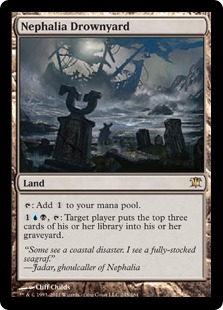
Drownyard on the other hand I plan to take a little bit deeper. As it appears Jace-centric control decks are likely here to stay, I think the Drownyard could be a great tool to fight the mirror. On MTGO it’s under a nickle, and in paper they sit around a quarter. When Dimir comes around in Gatecrash we can expect mill to have some additional support as well, and a U/B control deck could be feasible in its own right.

Further, I’ll be firing off my first drafts of RTR and start coming up with a way to track what cards I have and need to build a Standard collection and set up a spreadsheet to track speculations. By this time next week I hope to have a handful of drafts under my belt as well as my portfolio organized and active.

A Very Revealing Bant List

Are you a Quiet Speculation member?

If not, now is a perfect time to join up! Our powerful tools, breaking-news analysis, and exclusive Discord channel will make sure you stay up to date and ahead of the curve.

We’re a full month out and this Standard format still feels wide open. As I’ve stated a thousand times, the mana is very good and the spells are very powerful. No matter how you want to battle, there are tools for you to battle with. There’s even a somewhat-legitimate combo deck in the form of Epic Experiment ramp!

When the format dictates that players can play whatever they want, I want to play the deck that draws the most cards. In this format, I want to play the Sphinx's Revelation deck. If all of the spells are good, then it stands to reason that you want to draw more of them, right? What’s better than playing Thragtusk? Playing Thragtusk, drawing three cards and gaining three life the next turn, playing another Thragtusk the turn after, then drawing five cards and gaining five life the turn after that. That’s what’s better than playing a Thragtusk.

This is what I have been battling in Standard lately:

Steve

spells

4 Thragtusk
4 Centaur Healer
4 Sphinxs Revelation
3 Detention Sphere
2 Cyclonic Rift
2 Angel of Serenity
1 Selesnya Charm
1 Snapcaster Mage
3 Dissipate
4 Restoration Angel
1 Negate
3 Think Twice
1 Supreme Verdict

lands

4 Hinterland Harbor
4 Temple Garden
4 Sunpetal Grove
4 Glacial Fortress
4 Hallowed Fountain
3 Forest
4 Island

This looks pretty different from the typical Bant lists out there. Where most Bant players opt to build Jace decks, I’ve instead elected to build a Thragtusk deck. In my mind there is no question that Thragtusk is the best card in Standard. It gives you exactly what you want against aggro (life and bodies) and exactly what you want against control (multiple bodies). Not to mention how insanely above curve it is…

But why no Jaces?

The newest version of Jace is a very peculiar card. When I first saw the spoiler I assumed that it would be good against slower decks and bad against aggressive decks. After seeing it in action a few times against Zombies it was clear that Jace was the real deal against aggressive decks. After seeing it in action against Thragtusk it was clear that Jace could not compete with the beastliest beast that ever did beast. Sure, a resolved Jace will generally at least replace himself, and that’s pretty okay, but we can do much better than pretty okay.

The first problem with Jace is that his ultimate might as well be blank. Even against decks where the +1 ability is good, it is unreasonable to sit around activating it for turns on end only to ultimate Jace and make… Diregraf Ghoul. Against decks where the +1 isn’t good, Jace only has one ability. The question then is how good is it to play a sorcery speed card that is worse than Concentrate some percentage of the time and better some other percentage?

If Thragtusk is as good as I say it is, which is obviously what I believe, then such a sorcery is going to be much worse than leaving up mana for Dissipate going into turn five. Additionally, as a draw spell this Concentrate-esque card pales in comparison to Sphinx's Revelation. As I said, Jace is strong against the aggressive decks, but the matchups where he’s weaker tend to go long. When games go long Sphinx's Revelations get bigger. In slow matchups card advantage is king. For these reasons I wouldn’t play the first Jace before I had the fourth Revelation, and at that point I don’t see much need for Jace.

Centaur Healer and Restoration Angel

I said a couple weeks ago that I was pretty down on Restoration Angel, and that was a foolish thing for me to say. While it’s true that the card isn’t close to as good as it once was, it is still a far cry from unplayable. It has a body that blocks extremely well against most of the aggressive decks (basically all of the non GW-smashy-smash aggressive decks), all the while blinking a creature that gains life. Additionally, flash threats are nothing to scoff at in control mirrors.

Centaur Healer is a card that has performed considerably above my expectations. The idea behind playing them is clearly to beat up on aggressive decks, but they carry themselves pretty well against slower decks as well. Having a high density of creatures which attack for three or more damage makes combatting opposing Planeswalkers a joke. Tamiyo can be a problem if all you have is a lone Thragtusk, but adding another monster to the mix makes racing a Tamiyo ultimate a pretty easy game.

The Counter Suite

There are quite a few options for counters in Standard right now. I’ve seen Syncopate getting a lot of love, and I think that it’s the exact wrong card for the job. Two weeks ago I wrote about the importance of cards that scale well, and Syncopate just gets worse and worse as games progress. This is particularly true in decks like this that are trying to cast large Sphinx's Revelations. Sometimes you need to leave up mana for a counterspell or two while doing so and it is borderline impossible to fight a counterwar with Syncopate. Further, there is basically nothing on turn two that is so important that it must be countered, so why does having a two mana catch-all counterspell matter at all?

The absence of Essence Scatter, especially considering the presence of one Negate is probably more notable than the absence of Syncopate, especially operating under the assumption that Thragtusk is strongest there is. The reason for this is that Thragtusk and spells that cost more than Thragtusk are the only creatures that a deck full of life gain actually needs to counter. Additionally, I'm already playing the best answer to Thragtusk- my own Thragtusks.

Alternatively, there are a few very strong non-creature spells that often must be countered. Off the top of my head Rakdos's Return, opposing Sphinx's Revelations and Epic Experiment are pretty tough to beat when resolved. There are also some situations where your creatures don’t quite cut it against Planeswalkers, so having counters for them is nice. Sorin in particular can be pretty tough to attack into.

The misers Negate over the fourth Dissipate is mostly a concession to control mirrors. In a counterwar mana-efficiency, particularly costing less blue mana, is often important. So there’s that. It’s not a very dramatic difference and either card is probably fine, but I’ve been happy with the maindeck Negate. Sometimes it even catches a Rancor.

Where are all the Azorius Charms?

I’ve already discussed my qualms with Azorius Charm on “Good Luck; High Five!” and for the most part I believe that Think Twice is just better. That said, I’ve lost a couple matches to Loxodon Smiter decks recently, and having a card like this to buy time against them is probably pretty good. Against literally any other deck though I don’t want to be anywhere near Azorius Charm. Mostly it just replaces itself, which is by no means what I look for in a card. If Green/White Big Dumb Elephants is popular in your area then I would begrudgingly play some Charms. For the most part I’d just hope that my opponents are playing cooler decks.

Not a lot of Wraths in this pile. What’s the deal?

I’ll start by saying that having Terminus in my deck has only ever made me miserable. At six mana, having it in your opener is very close to a mulligan. Once you have access to that much mana you’re probably beating aggressive decks with any of your spells. When it’s not in your opener you’re hoping to peel it exactly when you need it. I’m much more interested in consistency than raw power.

The number of Supreme Verdict is, perhaps, one or two off. Against decks like mono-red and Zombies the creature-base does a great deal of work at stopping them, but as I said above Loxodon Smiter is a big game. Having an extra Wrath or two might just be necessary to hedge against Little Kid Stompy. I definitely like that call more than having Azorius Charm. I’m not entirely certain what I’d cut for them, but one of the counterspells or even moving the second Angel of Serenity to the sideboard wouldn’t be the worst.

So why should I play this deck?

Thragtusk and Sphinx's Revelation are the most powerful cards in the format. In terms of actual individual impact they don’t hit as hard as Angel of Serenity or Griselbrand, but building a deck around them to play into the long game allows you to beat the Griselbrand/Angel decks.

This deck matches up very favorably against Jund and the other Bant lists out there. Epic Experiment decks are practically a bye. Monored and Zombies are very beatable, though I recommend having a good amount of cards in your sideboard dedicated to beating them. While your spells all are bigger than theirs and your cards just invalidate theirs as you enter the late game you do still need to stop them from killing you before that happens.

The only especially bad matchup that I’ve run into has been Green/White aggro. A three mana 4/4 hitting you with a Rancor on turn three or four is pretty impressive. Silverblade Paladin is also a hell of a card. If this deck becomes especially popular, then this list will need to change to combat it, but with just the one bad matchup I’m very happy with where the deck is right now.

Questions? Comments? Complaints? Hit me up in the comment section!

Until next time, good luck, high five!

-Ryan Overturf
@RyanOverdrive on Twitter

Insider: Masters of Modern (and Nivmagus Elementals)

Are you a Quiet Speculation member?

If not, now is a perfect time to join up! Our powerful tools, breaking-news analysis, and exclusive Discord channel will make sure you stay up to date and ahead of the curve.

Let me guess how you checked in coverage from the Pro Tour last weekend, which featured the Modern format.


Right?

While the Top 8 certainly matters, you have to remember that Pro Tours are a split format, so the Top 8 is sometimes a reflection of a person’s draft skills as much or moreso than their Modern skills.

Instead of focusing on just the Top 8, this page is what you need to pay attention to, along with this one. These pages give you the best picture of what performed well at the event, and figuring out which decks are primed to do well moving forward because how they performed as a whole is much more important than focusing on the one deck at the top. Especially, in this case, when that deck (Eggs) is a one-tournament deck that is very susceptible to hate. It’s also noteworthy that only three of the eight players playing the deck made it to Day 2.

Now let’s talk about Nivamagus Elemental, the other big “mover” of the weekend. As I talked about on the podcast this week (Brainstorm Brewery), hype does not equal investment. A few big name players were on the deck, and it looked fun and created cool stories by killing on Turn 2.

But Round 2 is not the time to buy in for a card that’s anything other than a bulk rare. You’re exposing yourself to a lot of risk jumping the Nivmagus bandwagon in Round 2 as the price is already going up. Sure, it’s possible the card hits and you did great, but as we saw this weekend you can also get screwed. As GerryT said, the deck lost to “hand disruption plus removal.” In other words, Jund, the most-played deck at the tournament.

Like I suggested with Huntmaster when I called it a few Pro Tours back, I did so with inside information from the PT (like Nivmagus), but we also didn’t advise you to go hard on it until we had 4-6 rounds of results from the Pro Tour from the group playing it. That was a move based on results, not hype. Remember the difference, even if it means your margins could be lower.

So what decks did well as a whole in Modern? Obviously, you should all just play Merfolk, but provided that’s not your style, here’s what we know.

This is a really interesting chart. Here, we see that Affinity actually had the best showing, despite the fact that it’s certainly not what you would guess. That said, nothing is going to move here (at least not from this event). In all honestly, there’s not a lot of surprises here, though we do see that Scapeshift made a pretty decent showing. Prismatic Omen, however, did not. If you haven’t already gotten out of it by selling into the hype (as I’ve always advised), then you should try to move it immediately.

But Scapeshift itself is probably pretty steady, so if you invested in that (or just Valakut), then you’re probably doing all right.

The big winner, financially, of the weekend is probably Jund. It only lost a few percentage points from Day 1 to Day 2, and it put several copies into the Top 8. That means the deck is primed to go up in price, right? Well, yes, in the short-to-medium term, something we’ll get into soon with Modern Masters, but you all know that. Instead, I want to highlight a few cards in Jund that aren’t quite as obvious but should make for good trade targets before Modern season rolls around.

Inquisition of Kozilek

This has to be one of the biggest. You can still occasionally get it for $2-3 in trade, and I have a huge pile that I’ve gotten at that price over the last year. This will likely be $5+ during the height of the PTQ season since so many non-Jund decks also play it.

Remember, with Shocklands coming to Standard the barrier of entry for the format is lower than ever, so medium-tier cards like these should see a nice spike.

Deathrite Shaman

We all said this was better in older formats than it was in Standard due to the fetchlands, and that appears to hold true. This Shaman does a ton of work. That said, I don’t love it at $10 since it’s going to be opened more and more in the next two months. Instead, the opportunity will come when people have forgotten to an extent about Modern as Gatecrash previews start rolling in. That also coincides with the start of Modern PTQ season and peak RtR supply, so it should create an opportunity.

Fulminator Mage

This has started to pop up more and more, and it’s the real deal (albeit usually out of the sideboard). While a deck like Living End uses it mostly for a full-out LD plan, it’s a sweet value card in Jund that hoses Tron and Valakut while also occasionally providing just some nice value along the way.

Raging Ravine

This is one of those cards that slips into the background, but it’s actually being played all over the place, and is occasionally even a 4-of in Jund builds. As I predicted a few weeks back, Scars lands, particularly Blackcleave Cliffs have taken off, so I’m not sure why Ravine is still $1.50 out of Worldwake. SCG has a ton in stock at that price, so I’m not ready to go deep on these or anything, but it’s probably not the worst card to target to close out a trade.

Mastering Modern

Okay, time to address the 800-pound Lhurgoyf in the room.

Modern Masters series.

This is a dead horse being beaten everywhere already, and I just wanted to throw my two cents into the ring (all the metaphors, right there). Mr. Forsythe (as @JasonEAlt tells me I must call him) went to great lengths to point out this was not the second coming of Chronicles, where Wizards reprinted basically everything worth any money. It led to the Reserve List, the root of all evil, and we know the rest of the story from there.

This is not Chronicles. This is a good thing. The print run on this is going to be so limited I don’t think it’s going to have a drastic effect, especially at higher rarities. I don’t have any hard numbers to back this up yet since we don’t know what the print run will be, but I imagine when it’s all said and done (accounting for new players entering the format), we’re going to see about a 20-25% drop for the Mythics, and probably a 30-35% drop for the good Rares. The Uncommons and commons will be closer to 40-50%, and I think this is perfect.

Yes, $100 Tarmogoyfs suck, but that’s not all the cost of the deck. Jund, in particular, is incredibly expensive, but Wizards can’t just blow up the secondary market. That means you can’t flood the market with Goyfs, but people aren’t going to be as upset if their Kitchen Finks halve in price. This keeps things reasonable as far as drop-offs in price are concerned, but a few dollars here and there on every card adds up very quickly when considering the full 75 in a deck.

In other words, I think Wizards has handled this perfectly. Yay! I also think it creates an opportunity. You can probably pick up Modern cards at a discount in the next month or two as people overestimate the impact on the set. This means you can likely score some great deals on Modern staples, and since the set doesn’t come out until next year you’re still going to be able to flip these at max value during the PTQ season.

And, most importantly, Zendikar isn’t included in Modern Masters! That means my gigantic stash of Misty Rainforests and Scalding Tarns are safe, so my new car fund is too 🙂

Thanks for reading,

Corbin Hosler

@Chosler88 on Twitter

Return to Ravnica Draft #2

Are you a Quiet Speculation member?

If not, now is a perfect time to join up! Our powerful tools, breaking-news analysis, and exclusive Discord channel will make sure you stay up to date and ahead of the curve.

Zach Mcnair sits in on a skype call as David Conrad plays through another RTR 8-4

Avatar photo

Conrad

David Conrad has been playing magic since the "Modern"era began in Mirrodin. Graduating from Indiana University Bloomington with a bachelor's of Journalism, he plays regularly and devours as much Magic media as possible.

View More By Conrad

Posted in Free, Return to RavnicaLeave a Comment on Return to Ravnica Draft #2

Have you joined the Quiet Speculation Discord?

If you haven't, you're leaving value on the table! Join our community of experts, enthusiasts, entertainers, and educators and enjoy exclusive podcasts, questions asked and answered, trades, sales, and everything else Discord has to offer.

Want to create content with Quiet Speculation?

All you need to succeed is a passion for Magic: The Gathering, and the ability to write coherently. Share your knowledge of MTG and how you leverage it to win games, get value from your cards – or even turn a profit.

Jason’s Archives: Escape from Philadelphia

Are you a Quiet Speculation member?

If not, now is a perfect time to join up! Our powerful tools, breaking-news analysis, and exclusive Discord channel will make sure you stay up to date and ahead of the curve.

Greetings, Speculators!

In true dramatic fashion, we drove across the bridge out of Philadelphia less than an hour before it was closed due to winds from Hurricane Sandy.

This is the Story of the Hurricane

The aforementioned windstorm has the Eastern coast of the United States in its sights and appears capable of dealing some damage even to lands and non-fliers. Unfortunately for all in attendance, Philadelphia is also on the Eastern coast of the United States and Sandy showed up a day early. Monday flights cleverly changed to Sunday flights weren't safe from her wrath and high winds shut down automobile traffic.

On Sunday afternoon it appeared we faced a clear choice; get out of dodge or spend up to a week in the city of brotherly love. For us this decision would be determined by the only player in our group, who was a lock for day two unless he lost both of the next two rounds. "Challenge accepted!" he shouted, charging into battle with a sealed deck that contained Sphinx of the Chimes, Armada Wurm and Angel of Serenity. Naturally, he lost both of his win-and-in rounds, bubbled out and just like that we could leave whenever we wanted.

Sunday afternoon at around 3:00 we loaded the car and bid adieu to the city where they shot that one movie with Tom Hanks. You know, the one where he's the Philadelphia lawyer and the law firm fires him so he searches all over Philadelphia for an ambulance chaser who will represent him and then he dies... Johnathan Demme won a best director Oscar... it will come to me.

Left Behind

The twitterverse was excited by how stacked the Top 8 ended up.

If it looks nuts, it's only because it is. So much Platinum! However, not to diminish the accomplishments of these fine gentlemen, the storm was a factor. Many players who were locks for Day 2 opted to bail on the event citing concern with flights or driving arrangements in anticipation of Sandy. After all, if you have to be at work on Monday, you might not want to be trapped in Philadelphia, the home alike of the Liberty Bell and the developed world's most urine-stenched subway system (seriously, what is up with their subway cars? I actually hope Sandy floods those tunnels just to give those roving urinals a flush).

Do you know who doesn't care about all that so much? That's right, a Magic pro. They were likely already planning to stay on a few days or fly off somewhere to prepare for the next event, so the prospect of being trapped in Philly with all of their Magic pro friends wasn't the scariest. It's possible that a few of the pros who top-eighted beat out someone else with better tiebreakers at their respective records and 9-to-5 jobs out of Sandy's disaster radius.

Of course any one of those players could have easily top-eighted on any given Sunday. But there may have been some mitigating factors involved in all of them hitting on the same weekend, something to note before we all take to the internet raving about the "most stacked Top 8 in the history of ever."

The Two Possibilities for Pack Rat

Either Pack Rat has to be playable in Standard or this is the biggest differential between a card's Limited and Standard playability in the history of the game. I kid not, some joker opened a pool with three copies of Pack Rat and his instinct was to add two Stab Wound, thirty-five swamps and jimmy jam a deck with more Pack Rat than the original cast of Ocean's 11. Rumor has it that he went 10-0 day one.

Pack Rat has always looked nuts and super playable with a ton of casual appeal. Brainstorm Brewery called this a pickup recently (to the best I can recollect without re-listening to an hour-long podcast I participated in), and I have fond memories of attacking for 64 in a game of 2HG in which I went "turn 2 Pack Rat" and then turned the rest of my hand into beatings.

One thing that may affect the ability to port these voracious vermin directly to constructed formats is the sheer volume of removal that can deal with them easily. In Limited, an opponent may get a Detention Sphere, Supreme Verdict or Cyclonic Rift if they are lucky. In Constructed, they could potentially run four of each. Rat is much more of a beating when 90% of the removal is unreliable and 1-for-1.

Some have had success with a build that runs Rat alongside Parallel Lives, which I find hilarious. An object lesson in exponents, this deck can easily overwhelm an underprepared opponent much quicker than they'd imagined. It's also fun to play and isn't stupid #$%^ing Jund, which really appeals to me.

When a card is oppressive enough in Limited to be serviceable alongside 39 swamps, my instinct says it can't be totally unplayable in Constructed and its low price tag makes it a decent spec opportunity. Would you trust me more or less if I told you how many copies I picked up this week? Well, tough, I'm not gonna. I can't predict where this card will go pricewise. All I know is that this was by far the defining card of GP Philly and you can draw your own conclusions. I'm not a finance writer anyway; what the hell do I know?

Irony Time

Nothing is funnier to me than the fact that the Magic Players who opted not to go to Philadelphia and instead went to New Orleans were the ones who managed to escape the flooding this weekend.

Top 16 SCG 'Nawlins Decks

Blame Kibler, I say. The word "midrange" gets tossed around here like the word "epic" on the internet. These days everything is "midrange," defined as "a deck with Thragtusk and no planeswalkers." Three Jund decks cracked the Top 8, although they finished worse than the one Bant Control deck. But with such a small sample size, I'd be silly to draw any immediate conclusions.

Alex Park jammed Thundermaw Hellkite in his U/W/R deck which opts to play creatures over fickle miracles. While I dismissed the original U/W/R deck of the season as a flash-in-the-pan metagame deck for a metagame that doesn't exist anymore (ctrl+F for "zombies" if you don't believe me), the shell was solid and players are beginning to adjust the numbers for the right mix. I was happy to get real money for Gravecrawler and Lotleth Troll this weekened. I kept enough of them to play in Legacy and Modern and outed the rest, operating under the pretense that I'll play constructed some day (I'm not even sure this facade is fooling me anymore). I don't know if they'll tank, but I know they're not likely to go up. I bought low, so it's time to sell high.

You know what else is low? Mayor of Avabruck. The Mayor is getting no love lately, but that may change after Brad LeBoeuf and his G/W Humans deck stomped the competition in Nouvelle Orleans. I like the Nevermore in his board as that card is a house in a format where the control decks don't run counterspells. I recommend naming "Detention Sphere" if they have them lest you lose a lot of Nevermores in one fell swoop.

Chris Harris' Mono Red was clearly the most interesting deck of the event and his list merits scrutiny. Mostly comprised of creatures, none of which are Vexing Devil, this list looks hilarious to play. Archwing Dragon seems great in this format, and with a low number of burn spells, you'll likely not miss the mana you spend re-upping every turn.

Great job, Top 16.

Legacy Top 16, Same Location

Would it seem odd if I skipped the top three decks and talked about Zombardment right away? Deathrite Shaman was made for this deck, and it's so good here that you can rationalize the green splash by running an Abrupt Decay. I love how this deck continues to evolve. Nothing is dirtier to me than turn one Faithless Looting dumping two Bloodghasts and/or Gravecrawlers to set up a very nice turn two. This may replace Nic Fit as the best Cabal Therapy deck in Legacy. Great job, Scott Tompkins.

Chi Hoi Yim laughs at your pathetic Abrupt Decay and wins the event with Counterbalance anyway. Apparently this is still a deck. Adding Detention Sphere seems like a good update to the deck. Rest in Peace also seems fine.

Tyler Arceneaux keeps the dream alive with another Top 8 from Angel Stompy, which I like. This list is very similar to the last one to Top 8, but that's fine with me. This deck will continue to evolve a bit and I love watching a new archetype emerge.

The most interesting deck besides that is Dustin Buckingham's decision to solve the question of "When should U/R Delver board in the StifleNought package?" by maindecking it. Stifle is a good enough utility card not to feel like a narrow combo piece, and you're liable to steal games from opponents who didn't expect a [card Phyrexian Dreadnought]12/12[/card] out of Delver.

Two RUG Delver decks and two U/W Control decks made up half of a Top 8 with six unique archetypes. Legacy continues to evolve new decks, including one I'm working on myself. Here's a hint -- it beats Zombardment because it maindecks a card Counterbalance ran in the board.

Stay Dry Out There

That does it for me, gang. Tune in next week!

Insider: Betting on the Armies of Man

Are you a Quiet Speculation member?

If not, now is a perfect time to join up! Our powerful tools, breaking-news analysis, and exclusive Discord channel will make sure you stay up to date and ahead of the curve.

The big talk of the SCG Open in New Orleans this past weekend was the winning deck, a G/W aggro list that leans heavily on Humans. This week, we are going to look at the deck's performance, why it worked, and pick out some juicy speculation targets.

First though, I'd like to bring up a disconcerting decision from WOTC. Apparently, they think Magic Online Daily Events cause the metagame to be "solved" too quickly, so they have stopped posting the decklists of players who do well in them. Even more problematic is that they decided to tell people through a forum reply on the Wizards website, not even deigning to explain the decision or ask the players what they thought in an article. It's easy to dismiss this as irrelevant to us, but the Dailies are a superb way of figuring out what cards to keep an eye on in an early metagame. This decision will reward people with complex networks of friends who can collaborate and report what was doing well that day, and it will punish the semi-casual players who want to get their deck ready for a Daily event. This is not a good thing and the medium in which it was communicated tells us that WOTC still has a long way to go before they perfect public communication.

Back to that G/W deck. Here's the link for it.

Initial thoughts:

-Those are some weird 1-ofs

-This runs a lot of cards that are still pretty cheap

-This is probably misbuilt and it still did really well

-Technical problems prevented this tournament from being broadcast, meaning that fewer people know the results right now.

-There were no Zombies in the t16.

The problem with G/W decks, their major downfall, is that they lack enough card advantage to pull them out of a blowout. Brad, our heroic pilot, narrowly avoided a lot of blowouts in the T8 in the face of Supreme Verdict and the like. Time is not on the side of the G/W pilot because an Angel of Serenity can and will end the game on the spot - there's no coming back from losing your three guys and facing down a stern woman with wings. In the time before the opponent can get their game online, you've got to kill them while avoiding losing to the inevitable removal. Two cards distinctly help here.

Rancor is no surprise, returning to jump onto whatever is handy. Because Rancor is so easy to cash in with again, you can throw it around with impunity, enchanting tokens and small men that would normally not be worth the card. The other thing at work is Gavony Township, which can (slowly) rebuild your team, even if it's just 1/1s from a Gather the Townsfolk. Brad used Township several times to pump up his squad and you've got to have something like this on board to get more virtual card advantage rolling.

G/W is soft to every card, but it is strong versus a lot of decks. Let's unpack that. G/W cannot interact in really any interesting ways, so it's stuck using things like Oblivion Ring to kill stuff. If you've got Essence Scatter, it's going to hit. However, G/W decks can keep things coming, and while your Scatter might take out a monster, there are plenty sitting behind it. Brad's deck is full of cards that can become obscene when left unchecked and hey, Rancor makes even one monster coming through into a dangerous proposition. In one game, he threw two Rancors onto two tokens and crashed right on through.

Mayor of Avabruck and Cavern of Souls add a lot of latitude to the deck. Mayor is the pump spell, the Intangible Virtue that also attacks. Sure, there's plenty of removal for him, but aren't the other guys you're playing going to soak that up? Also, Mayor provides a crucial rebuilding role when your board has been wiped. If he flips, the game gets a lot more interesting. Cavern pushes the guys through; in the finals match, Caverns were essential in getting monsters on the board through Essence Scatters.

Finally, this deck can just unload man after man. I think Adrian Sullivan put it well in the Facebook comments of the semifinals when he noted that Brad beat a turn 3 Thragtusk from an opponent. How much more work do you need to do if you're the G/W deck? It wasn't even a sweetheart, out-of-nowhere golden combo. It was just the parts of the deck doing what they should do.

Breakout Cards and Known Hits

First, let's talk about Sigarda, Host of Herons. Sigarda is a 1-1 split here and an absolute monster. How does UWR deal with her? People have Supreme Verdicts but they only get four of them. In a weird way, Sigarda is costed so that you don't accidentally over-extend her into a Wrath effect. Sigarda is trending upward, now at $8 on CFB's buylist. I know a lot of QS Insiders are sitting on a lot of copies of this lady and she could hit double digits soon. Sell some if you need to make a profit, but the charts show her steadily ticking upward over time.

Next, how about Riders of Gavony? This reminds me of Dungeon Geists in a way because it packs the same power to cost and has a lockout effect. Name "Beast" and Thragtusk becomes much worse. Name "Vampire" and Olivia Voldaren has to sit on the sidelines. A Rider can swing a game quickly because an opponent isn't figuring that their blocker will get blown out by a 3/3. Again, we see a 1-1 split and I have to think that there's more room for these in the maindeck. Garruks  can kill guys or spawn more Beast tokens, but this card can serve as functional removal. At fifty cents, they are a tempting target to jump on.

Silverblade Paladin is very exciting because she makes Rancor pull even more. You can deploy this on turn 2 with Avacyn's Pilgrim and a Rancor on either card (or a Mayor) on the next turn makes for an absurd amount of damage. Without these,  it'd be hard to beat Thragtusks, that's for sure. The Paladin is as close as you'll find to a burn spell in the G/W deck and it gives incredible reach. Consider that an opponent has to rework all of their math to accommodate these; if they guess wrong and that Rancored Soldier token gets some soul, the game is over. These clock in at $4.25 right now and that's not cheap, but they are easily gotten in trades. I like it a lot. If G/W Humans is a deck, it needs four of these to get rolling.

I was surprised that Odric, Master Tactician actually had enough buddies to trigger now and then. Brad used it to bypass some big blockers. I presumed that this is a win-more card; if you're attacking with four guys, you should be profiting anyway. Turns out, Odric allows for attacks that might not otherwise occur. You wouldn't ram a Pilgrim into a bigger blocker, but it makes the human worth a lot more when Odric shows him the way around the defenders. This also shrugs off Rakdos Keyrune, which I presume would cause a lot of heartache in the midgame. Odric is just north of a dollar right now and he's unlikely to climb much beyond that. I say that because he's not critical to the deck and it's a spot you might be inclined to just cut out.

Note that only one Armada Wurm shows up, and that's in the sideboard. There are zero copies of Thalia, too. This is telling; you don't need either of these to do well, apparently. I'd mark those two mentally as "non-essential" and devalue them accordingly. I'm not sure that Wolfir Silverhearts or all those Garruks are the right call - don't you want Sigardas more? One cannot argue with results, though.

It remains to be seen whether this deck actually goes anywhere. If you see it doing well this week, the right calls are certainly Silverblade Paladin, Mayor and Champion of the Parish. For more gutsy callers, a deep investment in Riders of Gavony could pay off if they see more play. This is not a good time to jump into those cards, though! The metagame is still developing. I'd trade for just about all of the rares in this deck, but paying cash is a little too speculative at this point. Keep an eye on this deck, though. This is the thing that makes casual players come out of the woodwork to buy in for FNM. If you see more attention on it from big-name writers on SCG or CFB, you can count on a modest price bump. This may also be the thing that people with 120 Mayors in their MTGO account need to clear some inventory!

This is a deck that was able to shrug off multiple board-wipes, over and over. That's hard to do and it merits further attention. Aggro decks in general are less likely to make people speculate early, since smart people want to call a dumb aggro list winning a fluke. This means that there's still going to be a lot of time to get into position for G/W Humans if and when it heats up further.

Until next week,

-Doug Linn

Insider: Keep Timmy, Johnny and Spike in Your Binder

Are you a Quiet Speculation member?

If not, now is a perfect time to join up! Our powerful tools, breaking-news analysis, and exclusive Discord channel will make sure you stay up to date and ahead of the curve.

Salesmanship has it's place in Friday Night Magic.Your ability to identify what kind of player is looking at your binder will go a long way in making sure you get maximum value from your trades.

I've previously described how to treat a binder like a retail space. Using simple concepts like maintaining full binders and spreading out value to encourage trade partners to stay in a binder will go along way in making trades more likely. Arranging your cards so they look good in your binder (color patterns, striping) and doing your best to break up trades into more transactions will make trading with you a more pleasurable experience.

But there is much more you can do with your binder that will result in easier, more profitable trades.

Identifying the kind of Magic player you are dealing with will make it easier for you to make offers. Instead of asking "Do you have anything in particular you are looking for?", you can make specific card recommendations. You can lean on your binder as a valuable source of player information simply by putting the right cards next to each other.

Before I describe this process in detail, on the off chance you don't know who Timmy, Johnny and Spike are, feel free to go to the source of these descriptors for reference.

The following is the 9 card layout from a page in my binder:


Spike wants my Abrupt Decay and Lotleth Troll. I suggest Slitherhead.

Timmy wants Ghoultree and Splinterfright. I suggest Revenge of the Hunted.

Johnny wants Jarad's Orders. I suggest Jarad, Golgari Lich Lord.

Now I will describe the page opposite the one above (so that both are displayed at the same time):


This two page layout maintains a "Magic order" as the cards are both the same colors and complimentary. Observing my trade partners gives me almost all I need to know about them to start trading. A quick psychology lesson: Spike wants suggestions that give them an edge, Timmy just wants something cool, while Johnny probably doesn't want you to suggest anything. That is why you let the layout guide them to their next idea.

Thankfully the suggestive layout of cards works on every kind of Magic player. This allows you the chance to try and move specific cards out of your binder by putting them in the right place.

See the following: A foil Talrand center page with a playset of foil Think Twice at the corners of the same page. I currently have foil Desperate Ravings in the spaces left over. Foil Think Twice is a cheap foil that can get great trade value, especially when someone decides it's a good fit in a Talrand deck.

If my trade partner is more interested in the Ravings they are probably more Johnny and maybe a Spike. So I can tell the difference, I have four Snapcaster Mage on the opposite page (right and left over and below Niv - Mizzet Johnny/Timmy identifier). The last four slots are filled with Izzet Charms.

I am careful to make each turn of the page a draw for the three archetypal Magic players. I also do my best to represent playable uncommons and commons on every turn.

If I want to trade out of a particular product, I make sure it sits next to more desirable cards.  To encourage spontaneous trades, I try and put cards that play well together near each other and make targeted recommendations  I make this seem normal by getting trades done quickly in small blocks. You can quickly build a great relationship with a variety of different players with trading frequency and on the mark assumptions about their card desires.

So, you think you've picked out your local Spikes, Johnnys and Timmys - now what?

You want to be Spike's go to guy for the latest tournament winning cards. Spike trades you value as cards leave their preferred area of competitive play. Spike also buys and sells to dollar cost ravage. They need cards at peak demand and sell when cards are out of favor regardless of that cards playability.

Timmy collects Dragons and Angels. Take a personal interest in their favorite "golden-beater" archetype. Timmy will trade value for pretty unplayable Demons. Timmy can turn a playset of Baleful Dragons into a playset of fastlands.

Johnny will take Commander cards. They love that Blood Clock and Umbilicus do the same thing. If they aren't interested in a particular competitive format, you can get a lot of value for random bulk buying into staples they aren't playing at the moment. If you need hot cards, Johnny is a good resource. He's the easiest guy to trade up with because he'll start moving away from cards as they get picked up by Spike.

If you feel adventurous, check out this research paper from the Graduate Business School of the University of Chicago. In it you'll see how retailers apply similar techniques to their shelf space as well as some interesting facts that likely apply to card trades, like how only 1/3 of purchases being planned.

Make your suggestions and trade frequently to make sure you get your piece of the remaining 2/3 this Friday.


Insider: The Value of Lands

Are you a Quiet Speculation member?

If not, now is a perfect time to join up! Our powerful tools, breaking-news analysis, and exclusive Discord channel will make sure you stay up to date and ahead of the curve.

The market is on the move once again. Most of you probably saw Star City Games’ most recent stunt – they increased their buy price on Scalding Tarn and Misty Rainforest to $20. Their sell price similarly increased to $35 for NM copies. Incredible.

This simple change suggests so many underlying implications. We’ve already ruled out the biggest potential implication as false thanks to a timely tweet from Ben Bleiweiss:

The sigh of relief could be heard around the country.

But there are still other reasons Star City Games would want to artificially inflate the price of Zendikar Fetch Lands. For one, Modern season is around the corner and they will want to be well stocked. Additionally, Real Estate has always been one of the safest investments in Magic Cards. While supplies are considerably less, a quick check on blue Onslaught Fetch Lands prices suggests how high the Zendikar counterparts could go.

This recent movement in the market is a perfect time to revisit the importance of Land cards in MTG Finance. The more ubiquitous the lands, the safer the investment.

Double the Colors, Double the Price

I cannot even name all the Nonbasic lands in Magic. While all ten Dual Lands and Fetch Lands can be readily recalled by the savvy MTG speculator, most people can’t name the five Legendary Champions of Kamigawa lands so easily. When was the last time you’ve seen Eiganjo Castle legitimately played? (Although I see no reason not to play this cycle of lands in EDH.)

The inevitable truth is that color-fixing rare lands are disproportionately more financially relevant than those lands that produce one or zero colors of mana. And while cards like Karakas have earned recognizable spots atop the Nonbasic land food chain, the reality is that color fixing is so often needed that rare versions of “Dual Lands” are so often good investments.

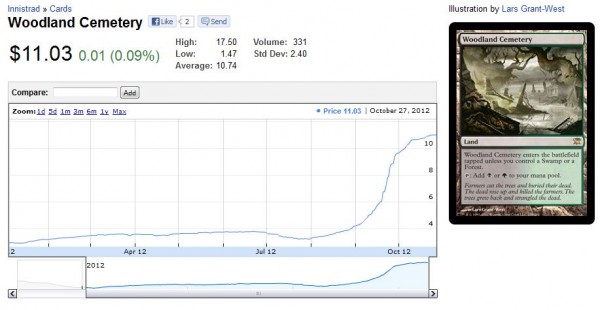
The most recent case is of course the recent jump in Innistrad Dual Lands (chart from blacklotusproject.com).

I sure hope you were acquiring all five versions of these mana-fixers as I wrote avidly about them a few months ago. Most of these have neared their peak, with Woodland Cemetery winning the reward for most overpriced.

By the way, the only Innistrad Duals I haven’t sold yet are half my Hinterland Harbors and all of my Clifftop Retreats. I am hoping for a metagame shift with the release of Gatecrash, and this should give these two a chance to inch higher.

Pseudo-Dual Lands don’t have to be in Standard and Legacy to be financially relevant. Thanks to the advent of Modern there are so many lands that have value beyond EDH appeal. If it’s a rare land that produces two colors of mana reliably, and if it’s Modern legal, then it has value.

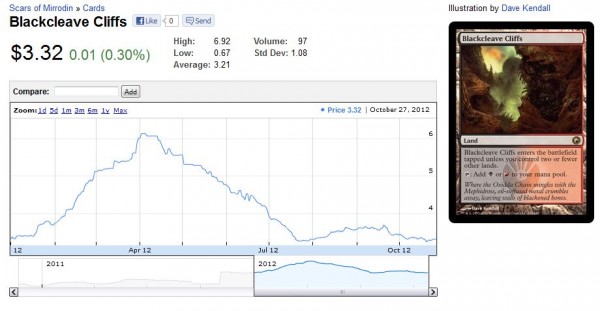
Filter Lands have rebounded significantly since their post-Standard rotation drop. Their pattern will likely be followed by Scars of Mirrodin Dual Lands, which are just starting to rebound from their bottom (chart from blacklotusproject.com). If Filter Lands are any indication, these “Fast Lands” are destined for a rebound, and they don’t face possible reprint in Modern Masters. Acquire accordingly.

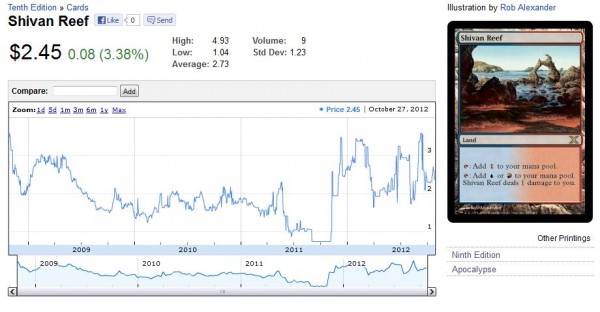
Even going old school with Pain Lands can merit some value. Despite being reprinted many times in Core Sets, Pain Lands haven’t seen print since Tenth Edition. Not all of them are financially relevant, but the enemy colored versions haven’t been printed quite as much and may have some potential. Especially Shivan Reef, which sees Modern play and is a fun casual color combination (chart from blacklotusproject.com).

Because of the consistent playability of Pseudo-Dual Lands, I will always view these as solid investments. Reprints are always possible and even likely, and this does have an impact. Many Shock Lands will never be the same again because of their massive reprinting in Return to Ravnica. But as far as stable long term investments go, you could do much worse.

And for those who care, I did check – even the Unhinged card City of Ass is financially relevant. Foil copies are SOLD OUT at Star City games at $14.99. In this case, I think this is a legitimate “sold out” too. After all, now that mana burn is gone, City of Ass is strictly better than City of Brass.

Basic Lands Have Feelings Too

For stable long term investments, you could do even one better. There are five cards that are legal in every format and are always relevant in every metagame. I am, of course, talking about Basic Lands – the only cards that never rotate.

Yes these have been printed a zillion times. Yes Basic Lands are boring. But this does not preclude the fact that Basic Lands can be financially relevant. You just need to know where to look.

For starters, any full art basic land is noteworthy. Zendikar copies are the most common and they still buylist at $0.10, the same buylist price as regular foil lands. Foil Zendikar Lands are even more desirable, already buylisting up to $6. It may take a long time for these to reach $30 like foil Unhinged Basics, but I can Foresee no reason for foil Zendikar Basics to drop in the next few years. These are pretty safe to invest in.

I suppose it would be possible and even likely that Wizards once again prints a new set of full-frame basics. Players love them and their presence in a set helps to sell packs. If for some reason Wizards was lazy and reused the Zendikar art, or if they printed even sweeter artwork, then I could see Zendikar Basic Lands diminishing in popularity. The good news is there is something even safer.

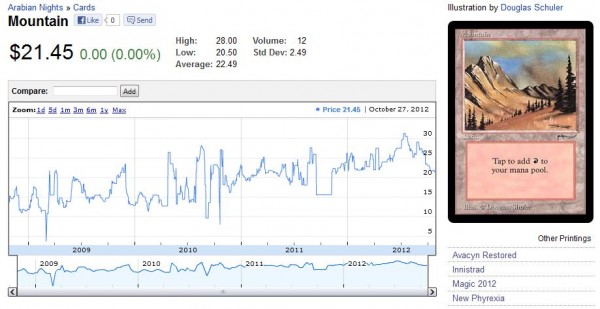
No matter how many reprints Wizards may do, I will go out on a limb and suggest there are a few Basic Lands that will never be printed in a comparable form again. One of my favorites is the number one most frequently reprinted card ever – Mountain. The reason Mountain wins this prize is because it appeared alone in the Arabian Nights expansion.

As time passed, this unintended blip has created a rare, highly sought after Basic Land. How’s this for a stable price chart (from blacklotusproject.com):

Some wild fluctuations did take place but they were short lived and the general trend has been upwards. In fact, since early 2009 it looks like the card has nearly doubled in price. I wish all of my assets would double after 3 years. And since Wizards will never reprint or ban Arabian Nights Mountains, this is hands down one of the safest investments in the game. Just don’t expect a lot of daily discussion on it.

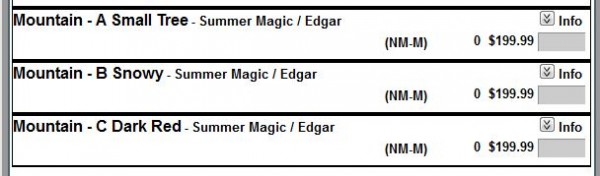
But if you thought Arabian Nights Mountain was the most valuable Mountain, you’d be dearly mistaken. Know which Basic Lands are even more valuable? How about these:

Those eBay listings are for one Mountain. Now over ten years old, Guru Promos are exceptionally rare and valuable. Guru Islands are the most expensive, hovering in the $120 range!!

But I wouldn’t do justice to the most valuable basics I’m aware of if I concluded my article here. Off the top of my head, there are one more set of five Basic Lands that are more expensive. They are so rare, in fact, that I couldn’t even find any listed for sale.

They are, of course, the Summer Magic Basics.

This image is from ABUGames’ website – it’s no surprise they have little Summer Magic in stock. But at least they had a price to reference. Star City Games didn’t even bother having a subpage available for Summer cards since they have 0 in stock! I would wager my life’s savings that Summer Magic Basic Lands will never get reprinted in any way.

So if you can find them, these must truly be one of the safest investments in the game of Magic – just be careful acquiring since finding an outlet to sell may be tough (think rare pieces of artwork).

Back to the Future

All of these Basic Lands are fascinating to the right buyer. I didn’t even mention some of the really obscure Basics, such as APAC lands, the Wald misprint, or my personal favorite, the Drudge Skeletons misprint.

Approaching Basic Lands and Pseudo-Dual Lands as key conservative investments for a diversified MTG portfolio is a solid strategy. They are always legal, they are unlikely to become obsolete, and they are always in demand. The less likely to be reprinted, the better. And in the extreme cases, Star City Games may take notice of their popularity and suddenly increase their price drastically, creating easy profit for you. This is why I loved Innistrad Dual Lands so much and it’s also why I’m acquiring Scars of Mirrodin Lands now even as we speak.

Sigbits – The Buylist Edition

  • After a short stint at a higher price, Star City Games has finally reduced their buy prices on Unhinged/Unglued Basic Lands. I’m not sure why, given that they will never drop in price. But I suppose they tried to force the price increase a little too prematurely.
  • Channel Fireball is buying Sigarda, Host of Herons at $8, a decent price vs. SCG’s buy price of $6. This was a great target going into Standard rotation, but I wouldn’t acquire too fervently at this price.
  • An even greater discrepancy lies in Terminus. Star City Games is buying this card at $5, which isn’t bad if you got in at $3 a while ago. However, you could do MUCH better selling to Channel Fireball, who is currently paying $8! I’m inclined to pull the trigger on my last extra copy and skip the eBay fees altogether.

-Sigmund Ausfresser
@sigfig8

Insider: Finding Value in RtR Mythics

Are you a Quiet Speculation member?

If not, now is a perfect time to join up! Our powerful tools, breaking-news analysis, and exclusive Discord channel will make sure you stay up to date and ahead of the curve.

This weekend will be the last big push for release events, after which player demand for tix will drop off. Instead of dumping any and all mythics and rares to the bots, drafters will start holding onto the odd card. They might even start thinking about playing Constructed as the high payout release events finish. On top of this, redemption for RtR is expected to start, which will upwardly bias the price of mythic rares. For more info on MTGO redemption and its impact on the digital Magic economy, see my previous article.

The novel block structure of the new Ravnica will impact availability of cards. In an ordinary block year, say with a large-small-small set structure, the first set is opened throughout the year in limited play. This would lead to the bottoming of junk mythic prices around third set release events, as that is the last big supply push from the Fall set.

This year there is an unprecedented new block structure of large-large-small, meaning a gap in opening RtR after the release of Gatecrash but before the release of 'Sinker', the as-of-yet unnamed third set. RtR junk mythics will be less available during this gap, so they should support higher price floors than past blocks' junk mythics.

On top of this, the presence of the shocklands means that demand from redeemers should be high. This presents a good motivation for buying RtR junk mythics while they are cheap, which generally coincides with release events. (Below are also presented my thoughts on purchasing the other mythic rares.)

If you are curious as to why I'm not considering any of the normal rares such as Lotleth Troll or Steam Vents, it is because the economics of MTGO do not favor buying these right now. There will be good opportunities to speculate on these down the road, but for now the mythic rares are the place to park your speculative capital.

The Rating System

Each mythic is followed by the current price and a rating, either Good Value, Fully Priced or Borderline. There are also two top picks presented, one for Top Junk Mythic Pick and another for Top Overall Pick.

  • Good Value -- At current prices or in the given price range, this card is a buy and I expect it to see higher prices in the medium- to long-term. These cards are the best speculative targets from a value perspective. They might never make a splash in competitive constructed formats, but the risk of loss, if bought at the suggested prices, is very low.
  • Fully Priced -- This is the other end of the spectrum, where downside risks are high. Fully Priced cards might maintain a high price, but further gains are doubtful. Do not buy these to speculate on at current prices.
  • Borderline -- This is somewhere in the middle of the other two, with some possibility of moving up or down in price. For cards with this rating, further scrutiny is required beyond just the price. If you have a large amount of capital, buy some amount of these cards and scoop up more if the price falls.

All prices are taken from cardbotmtgo.com and are current as of October 25th, 2012.

The Guild Leaders

All the guild leaders have playable stats and abilities for their casting cost. Most are good buy opportunities as they will probably not get any cheaper. None of them have made a dent in Constructed yet, meaning they still have potential for large price increases from current levels.

Isperia, Supreme Judge: The Azorius guild leader has fallen close to junk levels but a 6/4 flier for six mana should not be discounted from Standard play. This is a buy at 1 ticket or less. 1.00 tix and Good Value.

Jarad, Golgari Lich Lord: I've been buying this one at 1.3 to 1.8 tix and will gladly keep doing so. The possibility of a 'graveyard matters' deck emerging can't be ignored. 1.64 tix and Good Value.

Niv-Mizzet, Dracogenius: This dragon has hovered around 2.5 tix during release events. It's a buy for 3 tix or less. 3.00 tix and Good Value.

Rakdos, Lord of Riots: This one has dipped below 2 tix. It has the most impressive natural stats compared to casting cost of any of the guild leaders and it's my best guess for the one most likely to impact Standard in the near future. 1.95 tix and Good Value.

Trostani, Selesnya's Voice: Among the guild leaders, this card has held the highest price, probably due to the appeal of the populate mechanic. Buy this one in the 2 to 3 tix range, but steer clear at higher prices. 3.82 tix and Borderline.

The Fatties

Angel of Serenity: One of the breakout mythics from RtR. Buy this one if you are looking to play Standard but otherwise look elsewhere for value. 16.86 tix and Fully Priced.

Armada Wurm: This card's restrictive casting cost limits what decks it can be played in. On top of that, it's not clear you even want this effect in Standard at the 6+cc slot. 8.08 tix and Fully Priced.

Necropolis Regent: I am a big advocate of this card as a speculative target. It's from a popular tribe, has stats and casting cost close to a titan, and can affect the board the turn it comes into play. Its current price indicates the market is treating it as a junk mythic with no other potential. This is incorrect as the card does have some small potential for constructed play. If you had to buy one junk mythic, but this one at prices up to 0.8 tix. 0.71 tix, Good Value and Top Junk Mythic Pick.

Utvara Hellkite: Large red dragons at the mythic rarity have a long history of ending up as junk mythics with value only to redeemers. It's worthwhile getting this at 0.4 tix and paying up to 0.6 tix is OK. 0.64 tix and Good Value.

Worldspine Wurm: The fact that this card cannot be reanimated removes one of the only ways it might have seen constructed play. This is a junk mythic with value only to redeemers. Worth getting at 0.4 tix, paying up to 0.6 tix is OK. 0.65 tix and Good Value.

X-Spells

Epic Experiment: Recent buzz on this card has driven up the price. I really liked this one at 2 tix or less, but at 3-5 tix, I'd be hesitant to buy without further evidence of it spawning a successful archetype. If it drops down to 1.5-3 tix over the coming months, put this back on the buy list. 3.38 tix and Borderline.

Rakdos's Return: At 6.5 tix it's not clear whether this card matters enough to Standard to hold its price. 6.98 tix and Borderline.

Sphinx's Revelation: This card looks like it will be a staple in control decks as a one- or two-of. This suggests it will carry a higher price floor than the other two x-spells. Buy this one in the 4-6 tix range. 6.48 tix and Good Value.

Planeswalkers

Jace, Architect of Thought: Buy this one if you are interested in playing it in Standard as it appears to be one of the top cards from RtR and should remain a part of the metagame for the next two years. In terms of value, look elsewhere. 28.86 tix and Fully Priced.

Vraska the Unseen: This planeswalker has seen little play in Standard as of yet but looks powerful in the abstract. A somewhat reasonable comparison could be made to Venser, the Sojourner as another 5cc, multi-coloured planeswalker whose name starts with the letter 'v'. Venser's floor, shown in this chart, suggests that Vraska will have a difficult time going below 6 tix. Based on this analysis, paying 6 to 7 tix for this card is a good bet with little downside risk. If I had to pick one card to speculate on out of all the RtR mythics, this would be it. 8.03 tix, Good Value and Top Overall Pick.

Outlook

Avoid buying the Fully Priced mythics as speculative targets but keep your eyes on the Borderline ones. For any of the Good Value mythics presented here, one should be willing to buy and hold these cards for 12+ months. It's possible that they never break out in Constructed, but purchasing at current low prices ensures that risk is kept to a minimum. Any price spikes due to an uptick in Standard play should be taken as opportunities to sell. Otherwise, redemption will support the price of all junk or near-junk mythics moving forward.

Insider: How to Make Money From Your Cube, Part 1

Are you a Quiet Speculation member?

If not, now is a perfect time to join up! Our powerful tools, breaking-news analysis, and exclusive Discord channel will make sure you stay up to date and ahead of the curve.

Picture the following…

You are hanging around with a couple of friends at a GP having a great time. The trading tables have pretty much dried up. Most of you scrubbed out of the event hours ago but are still up to game. Someone suggests a Cube draft. You smile.

In the world of Cubes, your Cube is your favorite. It is your fingerprint on the Magic community. It acts as an extension of your personality and highlights everything you love about Magic. So you happily bust out your pimped Cube, the pride and joy of your collection. You’ve had your Cube for several years now. You’ve watched it grow and mature just as much as you have over the years. It started out as a simple spreadsheet of cards delicately pieced together by you over days of pouring over the entire Magic card pool. It was so long ago you can’t remember what it looked like then. You can still remember some of the trades that lead up to your current masterpiece. Some involved groups of cards worth more than the car you drove to the GP in.

After the packs are made, the draft is done and you start to battle you look around to find your cube so you can put away some of your cards. It isn’t where you thought you placed it last.

No worries, one of you friends probably pushed it to the side, or put their jacket on top of it. You ask around the table, no one says they remember moving it. Everyone was too busy having a great time.

You feel the world slowly blurring around you.

You look under the table. Nothing. You check your backpack. Nothing.

You ask your friends if you can check their bags just in case someone, anyone, put it into their bag by mistake to get it out of the way in the minutes before everyone started to draft and have a great time. One by one you open their bags. You see binders, boxes, bottles of water and heck even Crown Royale dice bags but not your Cube.

Your head feels like it is on fire, your heart feels like it is in your feet. The life of your cube flashes before your eyes in an instant. Is this really happening?

Reality starts to sink in. Your Cube is gone.

Stories like this are sadly a reality that we have to live with in today’s world of Magic. With the rising cost of cards and the trend towards pimping out Cubes and Commander decks you can easily have over several thousand dollars worth of cards sitting in a simple, portable cardboard box. Vintage decks can be worth more than some cubes and can fit in a jacket pocket!

Thieves really understand this and are targeting Magic players and their cards at large events. These are not scummy players who would steal someone’s cards here or there if the opportunity came up. They are professional thieves with a plan. They are organized and experienced. They know what they want and know how to get it. Simply watching your stuff better is not a foolproof way to stop your things from being stolen by these professionals.

The only real defense against them is to not take expensive things like your Cube of Commander decks to a big event. Submitting to the enemy and letting them effect how we enjoy Magic is a solution but I don’t think anyone wants to actually do that. In the end we all want to play Magic and the only way to do this is to swallow the risk and bring our cards to events.

There is however a compromise which I am more than ok with because it has some pleasant benefits. In our current culture of ultimate pimping, what I am about to say may be blasphemous to some but in the end it is a choice we all have to make on our own. Depowering, Depimping, Cheaping out or whatever you like to call it should be the new trend. It is a great way to lower the cost of your Cube without lowering the play value you get out of it; however, I wouldn’t go as far as proxying an entire cube unless it is high end proxys like this guy makes. At that point the cards stop being proxies and become labors of love and no one can look down at someone’s Cube for that.

There are a few steps to depimp any Cube. You can take any or all of these steps. Whatever you are comfortable with. Be warned though, once you depimp in one aspect you will probably start to realize that how much value is actually sitting in your Cube that can easily be used elsewhere in a much more efficient manner. Depimping could end up growing your collection and taking it to places you never dreamed of. It could also get you a new computer/laptop/tablet or heck even a car depending on how much you actually pimped out your Cube.

Step 1: Defoilize

We’ll start off with the easiest way to significantly cut the value of your Cube, cutting out the foils. You will never foil out an entire cube without making some sort of sacrifices to card quality so instead of looking at your Cube as half foiled, look at it as half non foiled. This makes it easier mentally to accept the depimping.

Foils on average are worth close to double what their normal non-foil versions are; however, this is only a rough general rule. Most foils actually break this generalization, or at least Cube playable foils usually do. Older foils can be worth three to four times more than their counterparts. It really depends on the card, the set, the era of Magic it came from and definitely if it is playable in Legacy. With all that extra value sitting in a shiny metallic layer of the card, it is pretty much a no brainer: stop foiling your Cubes people! If you are still hesitant, just calculate how much value is sitting in the foil portion of your Cube. I am sure the number will be over what you thought it was.

Step 2a: Bring on the ICE

Stopping at foils may be enough for some people but there are definitely more ways to lower the value of your Cube. Using the lowest versions of specific cards in your Cube can drastically decrease the value sitting in your Cube. It really depends on what cards are in your cube to begin with. Changing from a Revised Sol Ring to a Commander Sol Ring won’t really do anything so keep those as they are. But changing from a Beta Sol Ring to a Commander Sol Ring is exactly what you should be doing. Pretty much anything from Mercandian Masques going forward should be fine to use any version. The differences in price between something like 8th edition (white border) Bribery and a Mercadian Masques (black border) Bribery is zero or close to zero depending on what price scale you are using. The real opportunity is to use International/Collector’s Edition cards as well as World Championship deck cards.

Collector’s Edition and International Edition, or more commonly known as ICE, were produced as boxed set versions of the original Core set: Alpha, Beta, and Unlimited. There were over 9000 Collector's Edition printed and 5000 International sets printed. They have square borders but other than that they look like Alpha/Beta cards from the front. On the card back they have either International Edition or Collector’s Edition printed on them as well as a gold border instead of a black border. At a glance if they are in a black sleeve it is very hard to tell the difference between ICE cards and Alpha/Beta cards because the only real visual cue is the squared borders. These cards are not worthless but they are the cheapest option of the most expensive cards in the game.

The main cards people turn to ICE for are Dual lands. They are generally half the price of Revised Dual lands and significantly less than the price of any Alpha/Beta Dual. The bonus is they look just as good as any Beta with their black borders. Plateau has its original artwork, which is also a plus in my books. Most ICE cards you find are pretty mint because for the most part these cards have never been played with. If you have a powered Cube, ICE Power 9 offers significant discounts as well.

Here is a price comparison between ICE cards and their counterparts. ICE cards move in price a lot slower than the regular playable versions but, in the end, they pretty much operate as a percentage of the Revised versions. This means there are similar opportunities to invest in them as there are in constructed playable Duals, but the market is much smaller.

  Revised ICE  Beta
Bayou $80 $50 $600
Badlands $60 $40 $600
Plateau $45 $35 $600
Savannah $100 $40 $700
Scrubland $70 $40 $600
Taiga $60 $40 $600
Tropical Island $110 $60 $1300
Tundra $120 $60 $1100
Underground Sea $150 $70 $1500
Volcanic Island $130 $50 $1300

They still do put a dent in your wallet but if you want something cheaper than Revised Duals but something that looks as good as a Beta card these are the cheapest options you have.

Other than Duals and Power 9, I would only downgrade cards like Berserk that are in Beta but not in Revised. The majority of ICE cards that are available in Revised are actually more expensive than their revised counterparts. Not by much but if you really want to get every penny out of your Cube I wouldn’t go changing from a Revised Sol Ring to a CE Sol Ring.

There is also a far-fetched, yet plausible factor that comes into play. Conveniently, Ben Bleiweiss wrote an article on the matter a while back. In it he detailed the “what if” scenario of allowing ICE cards into the constructed card pool. With the provisions in the rules regarding Dual Faced Cards now in place, the ability for WotC to change their take on the legality of ICE cards in tournament play could actually change. I have my doubts that it will ever happen, but if it does ICE cards will all skyrocket above their Unlimited cousins but somewhere below their Beta brothers.

Join me tomorrow when I dissect the other end of Gold cards and ask the age-old question, What Would a Cheapo Do?

Q:

- from

Kelly: Response

Where have all the Delvers gone?

Are you a Quiet Speculation member?

If not, now is a perfect time to join up! Our powerful tools, breaking-news analysis, and exclusive Discord channel will make sure you stay up to date and ahead of the curve.

Over the past few weeks, I have written about a lot of cool decks. The one I'm still playing I shared in this column. It's basically the shell from last season's blue-white Delver of Secrets deck with red mana added. Usually when I create a new deck I have to put up a big finish with it before I feel vindicated. As it turns out, I still feel satisfied when other players prove the deck’s worth.

What I mean is that the Japanese recently showed this archetype is viable in the current Standard. Their innovation was the addition of Thundermaw Hellkite. I was moving towards Talrand, Sky Summoner, but Hellkite is even better. The other major change I had already adopted, which is cutting the Delver of Secrets altogether.

Here's the Japanese version:

Untitled Deck

Creatures

4 Geist of Saint Traft
4 Snapcaster Mage
4 Restoration Angel
2 Thundermaw Hellkite

Spells

3 Detention Sphere
2 Azorius Charm
4 Dissipate
2 Essence Scatter
2 Izzet Charm
3 Searing Spear
2 Unsummon
4 Pillar of Flame

Lands

4 Clifftop Retreat
4 Glacial Fortress
4 Hallowed Fountain
2 Moorland Haunt
4 Steam Vents
4 Sulfur Falls
1 Island
1 Mountain

Sideboard

3 Dungeon Geists
2 Negate
2 Purify the Grave
4 Thalia, Guardian of Thraben
2 Chandra, the Firebrand
1 Jace, Memory Adept
1 Tamiyo, the Moon Sage

Obviously this version is geared toward the midgame unlike the previous hyper-aggressive versions of Delver, but in this metagame that is not a problem. I have been saying since the start of the format that counters are a real thing and everyone should be playing them or playing around them. Hopefully now some players will start to listen. I have been continuously impressed by every counter available, including Syncopate, Dissipate and Essence Scatter. They are all good and you should consider them during deck construction.

This past weekend, two players at the Star City Indy tournament also showed us that the deck is real. Todd Anderson was the big name who did well with the deck, and basically he said that Syncopate was the card that makes the deck work. Being able to counter something on turn two is very important. If the game goes into double-digit turns, the card becomes worse but overall Syncopate is one of the lynch pins of the deck. Take a look at his list:

Untitled Deck

Creatures

4 Geist of Saint Traft
4 Snapcaster Mage
4 Restoration Angel
2 Thundermaw Hellkite

Spells

2 Detention Sphere
4 Azorius Charm
1 Dissipate
2 Essence Scatter
3 Searing Spear
4 Syncopate
2 Unsummon
4 Pillar of Flame

Lands

4 Clifftop Retreat
4 Glacial Fortress
4 Hallowed Fountain
1 Moorland Haunt
4 Steam Vents
4 Sulfur Falls
1 Island
1 Mountain
1 Plains

Sideboard

3 Dungeon Geists
2 Dissipate
2 Negate
2 Purify the Grave
2 Sundering Growth
1 Tamiyo, the Moon Sage
3 Supreme Verdict

The two decks are quite similar, but Todd did make some important changes. The most notable change was to up the number of counters to a total of seven. Honestly, I think that is one too few. This is unconventional wisdom for current Magic, but I have been jamming more and more counters into my list as well so I am definitely on board with this "new" way of thinking. Also keep in mind that Snapcaster Mage essentially counts as a counter himself.

The reason counters are so good in this format is because the threats are so amazing. That seems counter-intuitive, but it is actually true. What removal spell can you play that will deal with the diverse threats in Standard? You need to be able to answer Geralfs Messenger, Thragtusk, Jace, Architect of Thought, Entreat the Angels and Silverblade Paladin just to name a few. Even if we were limiting the discussion to creatures alone, most removal spells can't measure up. That’s what makes a catch-all counterspell so amazing.

Another reason this deck is so powerful is because Geist of Saint Traft did not suddenly get worse when the format rotated. He is still one of the best aggressive creatures ever printed and players still have a hard time dealing with him. Clone effects are no longer a legitimate way to kill Geist and you make blocking difficult because of cards like Restoration Angel and Unsummon.

The rest of the threats in this deck are hard to deal with as well. Between your two flash creatures and tokens from Moorland Haunt, there is very little you do on your turn. The one card that breaks this rule is Thundermaw Hellkite, which until recently was missing a home in the metagame. He is so good that I am testing out a third copy main deck. Often over the course of the game you drop your opponent to a low life total and struggle to deal the final blow. Just like in baseball, Hellkite is your closer. You bring him in at the end of the game and he finishes your opponent off.

My list is constantly changing as I make adjustments to the metagame each week. Here's the current iteration:

Untitled Deck

Creatures

4 Geist of Saint Traft
4 Snapcaster Mage
3 Restoration Angel
3 Thundermaw Hellkite

Spells

3 Pillar of Flame
3 Searing Spear
1 Mizzium Mortars
2 Essence Scatter
4 Syncopate
2 Dissipate
2 Detention Sphere
2 Azorius Charm
2 Unsummon
1 Cyclonic Rift

Lands

4 Clifftop Retreat
4 Glacial Fortress
4 Hallowed Fountain
2 Moorland Haunt
4 Steam Vents
4 Sulfur Falls
1 Island
1 Mountain

Sideboard

3 Dungeon Geists
2 Dissipate
2 Negate
3 Purify the Grave
1 Sundering Growth
1 Tamiyo, the Moon Sage
3 Supreme Verdict

One important change I want to discuss is the cut down to two copies of Azorius Charm. Recently, I have been unimpressed with this card and I keep removing more copies of it from my deck. I am not too far off from cutting it altogether. Against any aggressive deck like Zombies or Humans, the card does some major work by slowing your opponent down, but in every other match you almost always use the draw a card option. Cycling a card can be helpful, but I would rather play a spell that's relevant.

The one copy each of Mizzium Mortars and Cyclonic Rift is a recent change for me that came from cutting Izzet Charm. Once I cut Izzet Charm, I wanted a third Unsummon but the overload card seemed better in many situations. The same thing goes for Mizzium Mortars. I was going to play a fourth Searing Spear, but instead added the sorcery version because of the overload option. Once you take these things into account, the numbers in the deck start making sense. The spells basically break down as follows:

  • 8 counterspells
  • 3 bounce spells
  • 9-11 removal spells (depending on modes for the charm)

This is the type of thinking I use when I am making a deck. How many of each type of effect do I want? Playing less than four copies does make you draw them less frequently, but it also allows you to play a more diverse set of answers. If the two overload cards work out as well as I think they will, I could definitely see replacing the Azorius Charms with another copy of each. I am very happy with my current list and it's a solid choice for the metagame.

Until Next Time,

Unleash the…the…something about American, or colors, or temp…hmm…

Let’s change it up.

Until Next Time,

Don’t forget to have fun playing this awesome game of Magic!

Mike Lanigan
MtgJedi on Twitter
(I'm active on twitter again, so send me a message sometime.)
Jedicouncilman23@gmail.com

Want Prices?

Browse thousands of prices with the first and most comprehensive MTG Finance tool around.


Trader Tools lists both buylist and retail prices for every MTG card, going back a decade.

Quiet Speculation