
menu

Kill or Be Killed: The ONE Draft Mythic Roadmap

Are you a Quiet Speculation member?

If not, now is a perfect time to join up! Our powerful tools, breaking-news analysis, and exclusive Discord channel will make sure you stay up to date and ahead of the curve.

While Phyrexia: All Will Be One (ONE) might not be history's most popular format, it's got depth and complexity, and over the last week, it has won me over. The rules of engagement are punishing if ignored, but once we learn them, it is extremely rewarding. After hammering the format last weekend, I easily waltzed into Mythic with a win percentage north of 67%. I don't make these claims to brag, but to clarify that this is a place where we can not only succeed, but dominate.

This is a downhill format. In ONE, we want to be on the board and pressuring our opponents. It's nice to have cards in our hand, but the battle is on the board, and that's where we want our resources. I've won plenty of games stranding a grip of cards in my opponent's hand. To win here, our curve should be low, and we should be looking to get the most out of our combat steps.

One Is the New Two

One of Limited's sacred truths is that two-drops are the most important part of your curve. While the twos are important in ONE, the ones might be even more vital. Playing a turn one Sawblade Scamp or Rustvine Cultivator in Oil, or a Bilious Skulldweller or Crawling Chorus in Toxic, puts us far ahead. These creatures jumpstart our gameplan and help us develop critical synergies early.

There was an error retrieving a chart for Bilious Skulldweller

In the Toxic deck, we want to be attacking with mana open. If we can threaten Compleat Devotion as early as turn two, our opponent will rarely have good blocks.

Similarly, getting oil on the table fast accelerates the oil payoffs. A turn one Sawblade Scamp can get in easy damage before accruing oil counters, and can output a surprising amount of damage over the course of a short game. Rustvine Cultivator lets us get on board with an early blocker and helps to ramp while promoting oil synergies.

Porous Defenses

When we set up to block in this format, it feels like we're setting up to lose. The defensive role can often feel like our gameplan is scripted, so we want to make sure our curve is low enough that we're giving ourselves the early plays necessary to maneuver.

Even if we stabilize, we're not safe for long. This format has a number of ways to set up lethal.

Turn the corner or get stuck in one

Similar to Streets of New Capenna (SNC), it's hard to hold attackers at bay. So when we stabilize, we need to make sure we're pressuring our opponents fast. This format has a lot of reach, in the form of Sawblade Scamp and burn that goes to the face like Volt Charge and Urabrask's Anointer. Against Toxic, proliferate triggers can be lethal through any number of blockers. Haste creatures like Chimney Rabble and Furnace Strider, as well as cards that allow attackers to manipulate power every turn like the for Mirrodin! equipment Flensing Raptor and Porcelain Zealot, make it very hard to protect our life total.

The most devastating effect is Falter-Tremor hybrid Hazardous Blast. This card is playable in a lot of different red decks, and if the game starts aggressively, it does a really nice job of ending it on the spot.

There was an error retrieving a chart for Hazardous Blast

This environment is one of the reasons why Cinderslash Ravager is so powerful. Vigilance is incredible in a format where a 1/1 toxic Mite can represent lethal, but we need to pressure opponents too. This card can come down quick, take out some small creatures on ETB, and play great offense and defense every turn.

Preferred Lanes: Base White and Base Red

The best two colors in the format are red and white, and it isn't particularly close. When we're drafting, we should be actively trying to find a home in one of these two colors. Red Oil decks and white Toxic decks are ideal, but these colors are strong even outside of those archetypes. They can both access artifact synergies with cards like Barbed Batterfist and Mandible Justiciar. And both offer high card quality at common, helping them be fine without any hyper-specific synergies.

White is the most aggressive color in the format and, ideally, one that capitalizes on toxic. That being said, the white aggressive decks are not limited to Wx Toxic. Cards like Mandible Justiciar, Bladed Ambassador, and Basilica Shepherd are dangerous threats in any brand of white deck. Dipping our toes in toxic let us enable corrupted payoffs, turning Incisor Glider and Zealot's Conviction into massive beatings.

Red is probably less powerful, but it's much easier to build. Almost any handful of red commons can be used in any color combination, making it a desirable place to start the draft. Red has great removal in Volt Charge and Hexgold Slash, solid two-drops, and excellent haste threats.

Right now, we should consider every other color to be a support color in the format. Which isn't to say they aren't good, but they don't hold a candle to red and white.

Green Is Good, but Missing Pieces

Green has some good commons and plays well with red and white. It offers great gold cards, but it's not deep enough, and more problematically, it's too slow to hang with the elite red and white.

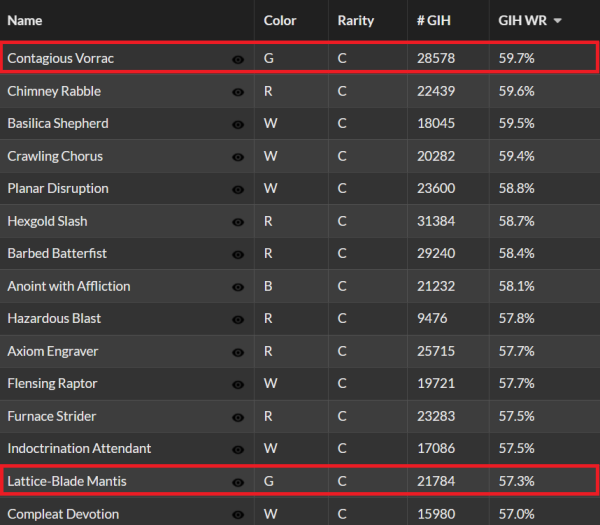
Green currently boasts the top common in the format, but it only has one other common with a GIH WR of over 57%. Comparatively, red and white have six each. This mirrors my experience drafting green. Cards like Rustvine Cultivator and Ruthless Predation are fine, but don't stack up to red and white's bevy of options.

At uncommon, green gets the duo of Cankerbloom and Evolving Adaptive. These two are not only excellent cards, but they provide much-needed support for the early game. Green has two obscene gold uncommons in Slaughter Singer and Cinderslash Ravager. Those cards are all good reasons to get into green, especially if paired with red or white. We shouldn't be excited with green outside of those color pairs.

The Problem with Blue and Black

It's a tough time to be a Dimir mage. With a lack of strong commons, and generally inflexible game plans, these colors are far less appealing than the representatives of the Naya shard.

Last week we talked about the shortage of potent two-drops in blue and black. Strictly from an identity standpoint, these colors pine for a slower, grindier format. While both colors can support other strategies, the ones they propose on their own are inherently flawed in a format so hostile to slower decks.

Even worse, these colors don't do a great job of turning the corner once we stabilize. Often times, these decks will get down to eight or nine life, begin to turn the corner, and inevitably lose to a Hazardous Blast.

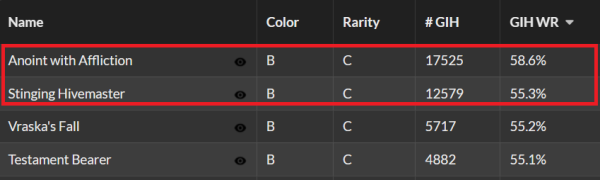
It's frequently optimal to pass a superior blue or black card for a red or white one. There are certainly powerful rares and uncommons in this pair, but we should never be in these colors for their commons. Even Anoint with Affliction is something I no longer consider first-pickable. The decline in black commons is a huge warning sign, and while some of them may be intrinsically powerful, the card quality is generally low.

Drown in Ichor and Bilious Skulldweller are the only cards short of a rare I'd be satisfied taking pack one, pick one. Mainly because they play so well in BW Toxic, which is the only black deck I'm interested in. Even then, we should be cautious.

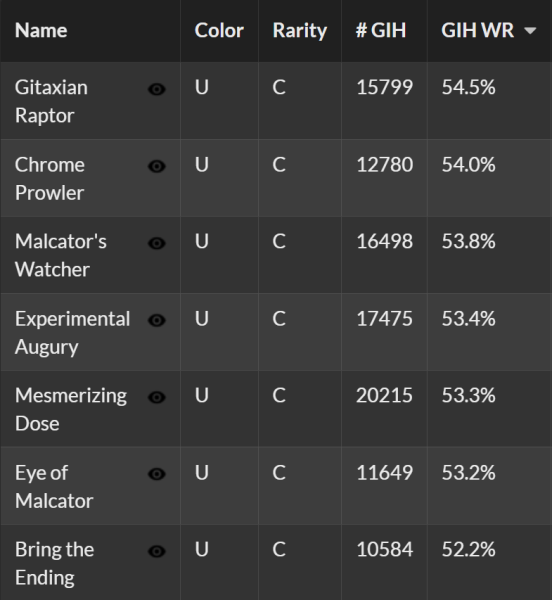
The blue commons are simply laughable.

Yikes. The commons are so bad that even powerful uncommons like Unctus's Retrofitter and Tamiyo's Immobilizer perform at a mediocre rate.

Self-Correcting?

We can exploit some of these truths as they become ubiquitously accepted. Players will adjust, and the format will evolve. However, to paraphrase the Declaration of Independence, these truths are lookin' pretty self-evident. Red and white are great, we need to get on board early, and we desperately want to be the beat down. The cards that can create those game states, and the cards that can swing the tempo in our favor, should be the highest picks.

While blue and black are bottom-feeders, they still have powerful cards at higher rarities. A deck like this offers a potential glimpse into the future of the format. Once players start adjusting their pick orders to adapt to ONE's rules of engagement, the format should theoretically become less aggressive.

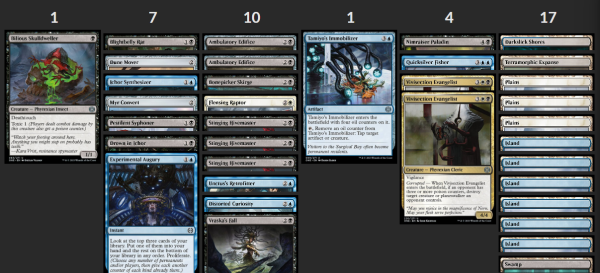
7-2 UBw Toxic Control

Creatures

1 Bilious Skulldweller
1 Blightbelly Rat
1 Dune Mover
1 Ichor Synthesizer
1 Myr Convert
1 Pestilent Syphoner
2 Ambulatory Edifice
1 Bonepicker Skirge
1 Flensing Raptor
3 Stinging Hivemaster
1 Unctus's Retrofitter
1 Nimraiser Paladin
1 Quicksilver Fisher
2 Vivisection Evangelist

Instant

1 Experimental Augury
1 Vraska's Fall

Sorcery

1 Drown in Ichor
1 Distorted Curiosity

Artifact

1 Tamiyo's Immobilizer

Land

1 Terramorphic Expanse
1 Darkslick Shores
3 Plains
6 Island
6 Swamp

This deck is playing a mere three blue commons. It's the vision of a UB Toxic Control deck, but to come together needs the colors to be open and a high card quality within those colors to be opened at the table. While this is rightfully the road less travelled, we should keep an eye on these types of decks.

Revisiting Last Week's Two-Drop Tiers

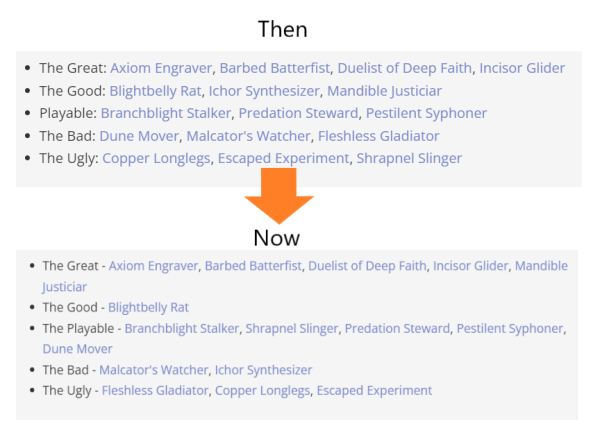
Last week, we created a tiered list of two-drops. While a linear layout of card quality is rarely as valuable as it is consumable, the list sparked some conversation. As a result, I've submitted a revision.

Mandible Justiciar is a valuable card for a number of reasons. It helps white decks race, which is essential to their strategy across all archetypes. This is especially true in Toxic and UW Artifacts, which are especially bad on defense.

The flexibility offered by Dune Mover and Shrapnel Slinger went undervalued in the initial list. Often these cards are, respectively, Goblin Piker and Grizzly Bears. The versatility is valuable, and the base rate of simply being a two-drop is something every deck needs.

Fleshless Gladiator has been terrible, and was downgraded as such. Ichor Synthesizer is still exciting, but struggles to deliver. While these cards might see more play as the format develops, they're currently bad. To be ready for the future, we need to understand the present, and come to grips with that reality.

None of the two-drops, however, are unplayable. Because the format demands early interaction, all of these cards can be used if needed. When we're selecting our two-drops, we want to ensure that we're developing our plan. Sometimes, in this format, that means trading off early to survive.

CABS in a Bucket

While the public disdain for the format is understandable, it is also short-sighted. The bombs are mostly kept in check by the aggression, and the aggression is something we can prepare for. By keeping our curve low, we give ourselves more options. By staying in proactive colors, we can control the tempo.

This is a CABS format, or one that greatly favors Cards (that) Affect the Board State. as such, we need to make sure we can play to the board. Losing a game with five cards in hand is still losing. When a card is in our hand, we can do one thing: play it. When a card is in play, our options multiply dramatically.

Often times CABS formats are written off as "basic" and abandoned. In my humble opinion, they're actually more skill-testing than slower, midrange formats. Constantly managing the race can be challenging, but that's the game.

Make no mistake: ONE Draft is a complex format. For many of us, this will be a format that makes us better at the game. When we face difficult challenges, and we adapt, we learn. Losing can be frustrating, but hopefully studying the above rules of engagement will help. Next week, I'll be switching gears to focus on the Sealed side of this Limited environment. Wish me luck as I prepare for the upcoming Arena Qualifier, and look to adapting my understanding to a different environment.

ONE Commander Decks: Buy One, Ditch the Other

Are you a Quiet Speculation member?

If not, now is a perfect time to join up! Our powerful tools, breaking-news analysis, and exclusive Discord channel will make sure you stay up to date and ahead of the curve.

It's that time again! A new set means new Commander precons. Are Corrupting Influence and Rebellion Rising worth the money, or should you hold off until they are in the bargain bin? Let's find out!

Token Decks Rejoice, More Options!

I have a long love/disappointed relationship with Boros decks. Overall, they tend to do a great job of really killing one player super dead, but have a harder time winning the game. The biggest struggle? Consistency. Whether you are using creatures and buffs or tricks and spells, the RW formula seems to be about the same: one-third mechanic, one-third payoff, one-third lands. Anytime you do not draw the exact right ratio, you tend to have a bad time, and while red has good card filtering options, white significantly lacks there. However, both commanders for Rebellion Rising give you a win condition on top of a scaling mechanic, two things that a RW deck typically lacks.

Who's the Better Commander?

The beauty here is that each is better at different things, and it depends on where you want to take the deck in the future. Out of the box I definitely tip my hat to the Phoenix. However, with its more powerful and lower-mana cards, Neyali is far better.

Keep in mind while the attack trigger is "one or more tokens," it's for each player. That means you can regularly get three free cards per attack step. With extra attack steps, you can continue to get more cards, and potentially more attack steps. The deck definitely can end the game, easily, on turn six or seven with cards like Hexplate Wallbreaker that have perfect synergy.

How Does It Play?

Newer precons are very decent right out of the box, and Rebellion Rising is no exception. One of the most frustrating aspects of playing a RW token deck is running into board wipes. Both Clever Concealment and Flawless Maneuver allow you to fully commit your resources to generating a board state while simultaneously having access to multiple free spells to save your army. Because of experience counters stacking up, replaying the Phoenix will give you several tokens even after a successful wipe. Neyali does not have that claim to fame, and is hurt much more by wipes, so beware and play accordingly.

Every enchantment in the deck is incredibly powerful, whether it's giving your tokens haste, as does Roar of Resistance, or enabling scaling, e.g. Assemble the Legion. On top of that, there are only five, so it's unlikely you draw too many of them. However, even if you do, each of them is useful in more ways than one. Take Felidar Retreat, which can either give you tokens if you have none or power up your already-established board state to end the game.

Another interesting aspect of the deck is the massive amounts of card draw, with options. Consider Court of Grace, Glimmer Lens, Staff of the Storyteller, and Idol of Oblivion. All of these cards both give you card draw and build a board, so they solve the typical problems a RW tokens deck will face.

With 14 two-drops and 17 three-drops, the deck really wants to get established by turn five. That's where you begin to go off, bigger and bigger each turn until you either win or are dead. Not a bad play experience at all, especially if you enjoy Boros.

How Would I Mod it?

More one-drops! Definitely remove Myr Battlesphere because it's just too much mana and probably Jor Kadeen, The Prevailer because it's not a Rebel and costs five. The deck has plenty of activated abilities and X-cost spells, but you want to save mana for Neyali triggers to get more advantage.

Also, lands that enter tapped should be avoided if Neyali is your commander. Normally it's not that much of a disadvantage, but here, you're really losing a lot of value. Depending on your group, I'd add in more extra attack step and/or extra turn cards. Of course, the red extra turn cards make you lose the game, so be careful!

Overall, Rebellion Rising was fun to play, and I can see a case for modding it going forward. If you like being aggressive in Commander and want a new deck, this is one to check out.

Now Let's Get Toxic

Unlike the first deck, Corrupting Influence really wants you to play Vishgraz, the Doomhive as your commander with Ixhel, Scion of Atraxa as a value generator. Corrupted is an interesting mechanic, but it is well balanced, perhaps to a fault.

Follow this chain of thought. Cards like Ichor Rats affect everyone. That means you are hurting your "allies" as well as your "enemies." In a political game like Commander, it's important that the entire table not be against you. Passing out poison counters is an easy way to make enemies. Furthermore, even if you attack someone only once to give them one poison counter, with every proliferate, you remind them "I'm killing you, too."

A (Mostly) Hated Mechanic

Many Magic players have strong feelings about poison counters, and infect in particular. It's very possible to kill a single player by attacking a couple of times and casting a Giant Growth effect. Lots of players remember being taken out by Skithiryx, the Blight Dragon or anything with Tainted Strike, and those feelings have returned in force.

There was an error retrieving a chart for glistener elf

While I do not believe that ten poison counters needs to go up to 15 for Commander, I can see both sides. The fact of the matter is, compared to other alternate win conditions, poisoning someone out is trivially easy. Of course, running more removal stops out-of-nowhere one-shots, but poison counters with proliferate is another story entirely.

A Tale of Two Decks

This is where Corrupting Influence goes off the rails. It has Ghostly Prison, Norn's Annex, Windborn Muse and Norn's Decree because it knows the entire table is going to be unhappy with poison. So what is the idea behind the deck?

What's included is part of a slow deck of spells and control effects, and then a bunch of cheap creatures that make poison counters. Because of that, the deck succeeds at neither dimension. With a dozen cards that threaten a poison counter on turn two or three, are you going to poison someone early? Of course you are! But once you do, you've earned an enemy, probably for the rest of the game. Since you are running proliferate, it benefits you to spread the sickness, giving each opponent at least one poison counter. The reaction from the table should be what, exactly? "Gang up and kill you" is the answer.

One saving grace is if you happen to play in a pod with a fellow poison/proliferate deck. In that case, you are practically partners by design. However, that can also get pretty stale, since you're basically forced partners, and unofficial ones.

Who's the Better Commander?

In any case, it's Vishgraz. A slow and plodding deck loves a value-based commander that gets arbitrarily large and is hard to block. If the shields are ever down, you can smash in for a huge amount of damage and also at least four poison counters, so it's a much bigger threat.

Ixhel, Scion of Atraxa is a completely different card for a completely different deck. If you gut Corrupting Influence and make it much more "pillow fort" style, then Ixhel makes a lot more sense. That deck seems incredibly boring, however.

How Does It Play?

My games were not fun. Putting a two-mana poison creature into play yielded immediate table aggro. A lot of tables frowned on poison just as a general rule. While I did play a bit more passively for diplomatic reasons, the only game I won was by mercilessly poisoning and proliferating the table every single chance I had an opening.

I certainly did not feel the deck was ever unfair, and it seemed like a good amount of work to get ten poison counters just to eliminate one player, let alone the entire table (30 counters). In that case, that's quite a bit harder than going infinite with a variety of combos.

In most games, I have a pretty good sense of when I have to go all-in on or hold back. Poison turns that on its head because you are very obviously killing everyone, at the same time, and no one is happy about it.

How Would I Mod it?

Tainted Strike, Tainted Strike, Tainted Strike... but I digress. I'm not sure why this card was not included in this deck considering they reprint everything. The deck even has Tainted Field and Tainted Wood! Of course, if you've played a lot of Commander games, you may have already been killing players with Tainted Strike and Triumph of the Hordes forever, and might be looking for something different.

There was an error retrieving a chart for tainted strike

The real question: keep it as an aggressive creature deck, or make it a defensive proliferate deck? As it stands now, it's split almost equally, so this is entirely up to preference. I think an aggressive poison deck would use a different commander entirely, so I'd make it a more passive proliferate based deck taking out the cheap poison creatures in favor of bigger spells and effects like Contagion Engine, Plaguemaw Beast, Spread the Sickness, and of course White Sun's Twilight. From a clear board, Vishgraz comes out as a finisher when I'm ready to start winning.

Worth It or Not?

Surprisingly, Rebellion Rising was worth it, and I had more fun with that deck than several other precons. But Corrupting Influence was a definite no for me. On a fundamental level, the deck does not do what it wants to do. Are you attacking with creatures to poison out every opponent? Good luck with that. Are you using spells to control the board and accrue incremental advantage? Not when you draw a 1/1 for two mana every other turn, and some of those 1/1s for two mana are rocks, so you sort of cannot swing with them anyways. To me, that's lose/lose. I'd recommend skipping the poison but enjoying the tokens.

What do you think? Have you played either deck? Am I criticizing Corrupting Influence too much? Let me know in the comments!

Checking on Pioneer: Post-One Changes

Are you a Quiet Speculation member?

If not, now is a perfect time to join up! Our powerful tools, breaking-news analysis, and exclusive Discord channel will make sure you stay up to date and ahead of the curve.

Pioneer is going to be the competitive format for the immediate future. Which, to be fair, is what I believe Wizards intended back in 2019, but never had the opportunity to follow through with. With the threat subsiding and competitive play getting more support in 2023, Pioneer is regaining the attention it was denied. Which means I have to figure out whether I like it or not.

Recent Shifts

In the time I haven't covered Pioneer, not much has changed. Mono-Green Devotion is still the boogeyman, though its specific combos have changed slightly. Rakdos Rock is still probably the best overall deck, and there is a plethora of beatdown decks making up the lower tiers. Players continue to play Abzan Greasefang despite itself, cementing Pioneer as a format of pet decks.

There was an error retrieving a chart for Greasefang, Okiba Boss

The biggest shift (as far as I can tell) is that GW Angels has gone from a fringe deck to an actual part of the metagame. Which was really bad news for me. If Mono-Blue Spirits struggles against Humans it's hopeless against Angels. I was already thinking I had to give up due to all the Humans, and Angels suddenly becoming a tier deck was the nail in the coffin.

There was an error retrieving a chart for Resplendent Angel

I was surprised by this development initially, but it makes sense. If Devotion is rock, then fast aggro is paper. Devotion is overwhelming in the mid- to late-game, but can be overrun early. Angels is scissors: fast aggro cannot keep up with high-toughness threats that grow, fly, and gain big chunks of life. I was dreading the implications of this prior to Phyrexia: All Will Be One. The release has muddied the waters a lot.

Brewers' Lag

The impact of any set after release day is inconsistent. Players are incredibly excited to play with The Hot New Things but don't actually know how they're supposed to be playing them. Thus, I always see a flurry of activity during the first week after release as everyone tries to figure out what's good. After a lot of early builds fail, that effort goes more underground, as the streamers move on and the actual dedicated brewers move into the hard work. It will be another week or two before the actually refined lists emerge, assuming they actually exist.

There was an error retrieving a chart for Venerated Rotpriest

I'm bringing this up to soften the blow I'm going to deal to the decks I'm discussing today. I know they're new and haven't quite finished baking. However, there's an ongoing RCQ season featuring Pioneer, and the next season is just Pioneer and Limited. I've been doing a lot of preparation for RCQs in the next few weeks and so are many players, so we need to see the decks as they already exist. There may be more potential down the line, but at the moment, this is what I've seen and what to expect.

The MTGO Effect

Of course, a lot of this is also a function of the Magic Online (MTGO) ecosystem. Streamers bring a lot of players to the platform and to decks, and when they switch off, many players follow. Similarly, players can easily switch and so aren't as focused perfecting one deck as having many interesting ones to play. I bring this up because almost all the Pioneer I've played recently has been online, so that's where my opinions are being formed. It may be very different in paper, I don't know.

There was an error retrieving a chart for Nykthos, Shrine to Nyx

Also, because I have nowhere else to complain, the Pioneer queues on MTGO are weirdly long. Modern always has the shortest waits and Standard's are basically nonexistent, but I never know what to expect with Pioneer. Sometimes it's constantly churning, sometimes it's a 20-minute wait between matches. I don't get it and consequently find it frustrating.

Pioneer Elves

No matter the format, players are always trying to make Elves work. I understand; I'm a Modern Merfolk player. However, outside of Legacy it's just never worked out. There are plenty of reasons/excuses for this across formats, but the bottom line is that Elves makes lots of mana and doesn't have much to do with it when it can't easily tutor for Craterhoof Behemoth or combo off some other way. Which makes it really confusing that I've seen more Pioneer Elves decks in the past week than in the past three years.

There was an error retrieving a chart for Craterhoof Behemoth

Seriously, since last Thursday I've played against GB Elves at least six times after having not seen the deck or anything similar at all since 2020, which was in paper. I never even saw it online. To see any deck suddenly spring to life is weird, especially for the (apparent) reason that it's happening now.

Tyvar in Charge

Tyvar, Jubilant Brawler has a lot of potential in many different decks. Elves players have apparently adopted him (primarily) to accelerate their mana engine. Which is a strong move in theory. Reality seems to disagree, as I've not lost a match to Elves so far despite Tyvar making them more broken. The fact that I'm playing Mono-White Humans and winning with Brave the Elements is certainly a factor, but I'm not sure what Tyvar does that Elves couldn't already do.

There was an error retrieving a chart for Tyvar, Jubilant Brawler

Tyvar allows Elves to make absurd amounts of mana with the untap ability, but Elves could already do that various ways. The second ability isn't terrible in attrition matches but that's what all the token makers and Collected Company already do. A deck that makes more mana than it can use doesn't need to make more mana; it needs payoffs.

There was an error retrieving a chart for Circle of Dreams Druid

Theoretically, Leaf-Crowned Visionary fixes the problem, enabling Elves to dig through the deck and build an enormous board. However, unless the deck hits a lethal Shaman of the Pack, the opponent will have a turn to answer the big turn. If Craterhoof was legal, that'd be a different story, but as-is, Tyvar isn't fixing the fundamental problem with Elves so I can't imagine the deck working out. Tyvar should probably be rehomed.

Pioneer Hammer Time

The big winner from One was Pioneer Hammer Time. While it had the core interaction of Sigarda's Aid and Colossus Hammer, there wasn't much else to recommend the deck. Open the Armory isn't Stoneforge Mystic and Resolute Strike isn't Puresteel Paladin. Prior to One, I hadn't seen the deck in paper or online in at least a year.

There was an error retrieving a chart for Kemba, Kha Enduring

That is no longer the case and, for the moment anyway, there's a decent chance of running into a Hammer Time player online. The key pickup across versions is Kemba, Kha Enduring. The second clause is mostly irrelevant, but the first is making the deck plausible. It's the best way to scoop up loose Hammers and can even immediately attack with a Rabbit Battery. One Fatal Push can't completely derail the attack.

There was an error retrieving a chart for Cacophony Scamp

Similarly, Cacophony Scamp has given the deck a way to steal wins. Turn one Scamp, turn two Aid and Hammer is 20 damage. Older versions didn't have a turn-two kill since Springleaf Drum and Ornithopter saw no play. Not many decks have one-mana removal, so this combo should improve the win rate.

A Catch

You know the meme about having something at home? Pioneer Hammer is Modern Hammer at home. Admittedly, previously it was far worse, and improvement is improvement, but this deck is a pale shadow of its Modern cousin. One might say that about Pioneer in general, but even accounting for the lower power level, Hammer Time isn't likely to make a dent in Pioneer.

There was an error retrieving a chart for Puresteel Paladin

The problem isn't that Pioneer lacks Modern's cardpool. Missing Stoneforge is a big deal, but Open is acceptable in Pioneer's context. Missing Saga is also a huge hit, but again that's made up for by the overall power level of the format being low enough that it isn't necessary. No, the problem is that there's no Puresteel Paladin analogue. All the ways to actually equip Hammer are one-shot effects, making removal fairly devastating. Fighter Class helps, but it's not enough.

There was an error retrieving a chart for Fighter Class

So far, I've never lost a match to Hammer Time, be it mono-white or Boros. All of said matches were won 2-1, so there's definitely potential for the deck. With the right addition it might be a huge threat. However, the deck just lacks a decent fallback for removal in response to equipping creatures. Some have tried out Skrelv, Defector Mite, but the fact that no recent list is playing him says he doesn't work.

The Artifacts Deck

The last new deck I've seen is harder to discuss, but it's also the only one I've been impressed by. The difficulty is that I don't have a list to link to. Nobody seems to be talking, posting about, or streaming this deck, but I've lost to it both times I've played it, and the games weren't close. The best way I can describe it is the Pioneer port of Modern Urza. It's the same premise and many of the cards are the same, but instead of Urza, Lord High Artificer as the payoff, it's using Malcator, Purity Overseer.

There was an error retrieving a chart for Malcator, Purity Overseer

The premise appears to be the same as the Modern deck, with lots of cheap artifacts powering various effects including Emry, Lurker of the Loch to dig for Malcator and protect it with Metallic Rebuke. The key is keeping back enough cheap artifacts to trigger Malcator twice the turn he comes in and then each turn thereafter. Against me, that happened, and I was buried by golems.

That's not much of a plus, I'll admit, but it is worth remembering that most of the enabling artifacts of Modern Urza decks are also Pioneer-legal. Not many decks are truly prepared for dedicated artifact decks in Pioneer, so this deck could easily be real.

Is Pioneer Shifting?

This begs the question of where Pioneer is headed. Based on what I've seen online, I'd say that for the immediate future, Pioneer will continue on its previous course.

There was an error retrieving a chart for Thoughtseize

While I have played a number of decks with One cards, most decks have been pre-One stock, and mostly the usual suspects. It might be that card availability is an issue or that the previously mentioned difficulty refining decks is at play. It could also simply be that there isn't enough reason for players to dramatically change their decks yet, so they're simply keeping on keeping on. I certainly haven't seen anything that makes me think I need to dramatically alter my sideboard or maindeck. Pioneer appears extremely stable.

There was an error retrieving a chart for Portable Hole

Therefore, my advice ahead of the weekend RCQs is to not panic. No lurking monster has emerged from One, and that's not likely to change in the next three days. Someone might have unusual tech at your RCQ, but it can be dealt with via ordinary means. There's definitely the chance that one of the new decks (most likely Hammer Time) will just get you. That doesn't mean anything; take it on the chin and get ready to win the sideboard games.

Slow Ride

I know that Modern has a reputation for moving slowly, but Pioneer seems to move even slower. The metagame has been overall quite stable and the format pillars are mostly unchanged since last season. There are new decks in the works but as of writing, they've not had enough time in the oven to truly compete. Don't dismiss the new decks, but don't panic over them either. Just execute the gameplan and win. Good luck to all RCQ players this weekend!

Adam Plays Magic: Explorer Mindsplice Turns

Are you a Quiet Speculation member?

If not, now is a perfect time to join up! Our powerful tools, breaking-news analysis, and exclusive Discord channel will make sure you stay up to date and ahead of the curve.

This week on Adam Plays Magic, we've got a spicy one brewed up for you. Mindsplice Apparatus is a brand new addition from Phyrexia: All Will Be One that has echoes of the banned-in-multiple-formats Wilderness Reclamation.

Both Wilderness Reclamation and Mindsplice Apparatus are four-mana nonland permanents that functionally reduce the cost of spells, allowing the player to generate a massive advantage by drawing cards and taking extra turns.

What I Like

We've seen cards like Mindsplice Apparatus before and most haven't been particularly playable. Jace's Sanctum for example saw no competitive play. Flash separates Mindsplice from the pack, meaning the player's shields never go down for the opponent's turn.

Thanks to counterspells like Jwari Disruption // Jwari Ruins and a plethora of removal like Fiery Impulse, the player can fend off aggressive decks and stabilize enough to resolve Apparatus. From there, The Monumental Facade adds on oil counters to supercharge Apparatus making the majority of cards in the deck cost only one or two mana, turning on Chemister's Insight and Big Score.

The deck ultimately wins by chaining Alrund's Epiphany, preferably with the assistance of Galvanic Iteration.

There was an error retrieving a chart for Mindsplice Apparatus

I love a dedicated control deck with combo potential. It has game against just about everything. The deck excels at beating small and medium creatures with Fires of Victory and Brotherhood's End. Meanwhile, it gets to power through opposing control decks both by constricting their mana and putting multiple game-winning spells on the stack on the same turn thanks to Galvanic Iteration. UW Control, for example, will likely only have the mana to cast one or two Absorbs during a combo turn. Even if they have Dovin's Veto, Divide by Zero can either bounce it back to their hand or return the player's own spell so Veto fizzles. More often than not, there's still enough mana to recast the initial spell again in the same turn.

What I Dislike

The downside of the deck is that it doesn't exist in a vacuum. Just because you have resolved a Mindsplice doesn't mean the game is over. The opponent could have Leyline Binding to remove it, which at one mana and instant speed laughs at Divide By Zero. Boseiju, Who Endures is an free inclusion in every green deck. Meanwhile, red decks have Abrade and Kolaghan's Command intended to answer the many vehicle decks in the format and Mindsplice gets caught in the crossfire.

There was an error retrieving a chart for Alrund's Epiphany

With half the deck as cheap interaction and the other half as expensive spells, it's common to draw too much of the wrong half and fizzle. Sheoldred, the Apocalypse can also be very punishing as its toughness outsizes most of the deck's removal options. Narset, Parter of Veils is similar in this regard. The card advantage spells in this deck all explicitly "draw a card" as opposed to something like Memory Deluge. Notably, Firey Impulse can't hit planeswalkers, so Narset is likely to stick around.

Above all, the main sticking point in the deck is that sometimes, even with everything going perfectly, it's not enough to close out a game. The main win condition is Alrund's Epiphany with Hall of Storm Giants and Mascot Exhibition as backups. Decks like Angels that gain massive swaths of life and whose flying x/4 creatures don't die to Brotherhood's End are nearly impossible to beat. It's possible Burn Down the House or Shark Typhoon might be the extra reach the deck is looking for.

The Deck

UR Mindsplice Turns

Artifacts

4 Mindsplice Apparatus

Spells

1 Abrade
4 Alrund's Epiphany
4 Big Score
1 Brotherhood's End
2 Commit // Memory
4 Divide by Zero
1 Fading Hope
4 Fiery Impulse
2 Fires of Victory
2 Galvanic Iteration
2 Jwari Disruption // Jwari Ruins
1 Shatterskull Smashing // Shatterskull, the Hammer Pass
2 Valakut Awakening // Valakut Stoneforge
2 Chemister's Insight
1 Supreme Will

Lands

2 Hall of Storm Giants
1 Island
1 Mountain
1 Otawara, Soaring City
4 Riverglide Pathway // Lavaglide Pathway
1 Shivan Reef
1 Sokenzan, Crucible of Defiance
4 Steam Vents
4 Stormcarved Coast
4 The Monumental Facade

Sideboard

3 Aether Gust
2 Brotherhood's End
2 Commence the Endgame
2 Disdainful Stroke
1 Environmental Sciences
1 Mascot Exhibition
3 Mystical Dispute
1 Teachings of the Archaics

End Step

Overall, this deck was a blast to play and I think there's a lot of potential. I've tested UB and UR builds, with UR being the top performer so far. UW with Approach of the Second Sun is also an option and combos well with Divide by Zero. Access to more robust removal in the form of Depopulate and Shatter the Sky is also very appealing.

There are so many options to choose from and I can't wait to try them out. Keep up with me on Twitch and Twitter for the latest developments! Catch you all next time as we dive even deeper into the new cards from ONE.

Adequate Training for Running and Magic

Are you a Quiet Speculation member?

If not, now is a perfect time to join up! Our powerful tools, breaking-news analysis, and exclusive Discord channel will make sure you stay up to date and ahead of the curve.

One of my favorite parts about running races is the words of encouragement I receive from friends and family before and after the event. The dopamine hit I receive from each little like, tweet, or comment encouraging my dedication and performance really makes the pastime worthwhile. Honestly, if I ran races and no one was ever allowed to see my results except me, I’d probably lose motivation to improve.

In order to build up this endurance and speed (please don’t mind the prideful moment), it took me many years of practice. I began running in college—in the summer of 2007. Up until that point, I had never purposefully exercised outside of gym class and parent-driven mandatory sports participation in my youth. Running that summer was different. I wanted to do it.

While I took breaks here and there, consistent cardio exercise over the past 16 years prepared me for the races I’ve run over those years. This includes two full marathons, around eight half marathons, and a smattering of 5Ks and 10Ks.  

There was an error retrieving a chart for Practiced Tactics

The Importance of Training

To be completely honest, I know I don’t train optimally for every race I sign up to run. This will have to be one of those, “Do as I say, not as I do” articles. One must tailor their exercise routine in order to maximize performance in a race, and that routine looks different depending on whether the goal is a 5K sprint or a 26.2-mile journey.

There are very few things I’ve been practicing longer than running. Magic is one of those rare exceptions (since 1997). When I really think about it critically, I can apply the same approach I use when training to run to Magic finance.

Wait a second. Am I seriously going to draw yet more parallels between running and Magic? You bet! Not only was this a suggestion from my editor, but I think it’s a brilliant idea because of the overlap in strategy that could be applied. Buckle in and allow me some leeway as I explain…

Shorter Races and Quick Flips

On the one hand, we have our sprints: these are shorter races where the name of the game is maintaining elevated speed for just long enough. In my running experience, I have raced both 1 mile and 5K distances with the aim of being completely out of gas as I cross the finish line. This requires a consistent push through the pain and discomfort of a fast race, but you can’t drain yourself of energy prematurely or you’ll be left with a suboptimal time.

It takes practice to master the appropriate pacing and to strengthen the proper muscles to succeed in these short races.

Magic finance sprints can be thought of in the same way. For example, if your goal is to speculate on a card that you believe is about to break out in Standard, you need to exercise speed and discipline when it comes to card acquisition. If you purchase cards too slowly, you’ll miss out on the full financial potential of your spec. Purchase too many cards too quickly, and you’ll likely overpay on some copies and carry an extra risk that the price falls a little further still. The name of the game here is pacing and reacting to the rapidly evolving situation.

Here's a tangible example I’ve referenced in older articles. I remember when Scavenging Ooze was first reprinted in Magic 2014, and the card’s price plummeted in response.

There was an error retrieving a chart for Scavenging Ooze

I was so confident that the card would rebound in price that I “sprinted” by buying a couple dozen copies all at once. I remember thinking, “Star City Games pays $6 on their buylist so if I am buying 30 copies at $6, I can’t lose!”

I lost. I didn’t pace my buying sufficiently. As copies started arriving in the mail, I noticed SCG’s buylist slowly declined. I could never exit my copies for profit, and this left me with a disappointing result. I should have taken a step back and paced myself in buying this card. Instead, I went out too aggressively in a race that required more patience and was left with a loss.

Let’s fast forward to 2022 when my speculation training readied me for a more positive result. This time, I’m talking about my recent foray into speculation on Raffine, Scheming Seer.

There was an error retrieving a chart for Raffine, Scheming Seer

This was a similar situation—I noticed Card Kingdom’s buy price was a hair above TCGplayer pricing. I started buying up copies, this time shopping around more carefully to ensure I was paying the best price (not just buying up any copy I could find under a given threshold). As I observed more copies being listed, I realized that I could not maintain this sprint for long enough. Instead, I started selling my copies immediately to Card Kingdom, even as more were still arriving in the mail.

The result: I successfully exited all copies to secure a modest store credit profit. The speculative play didn’t pan out how I wanted, but I managed to dodge significant losses because I had “run this race” before and knew how to approach this scenario. It was through practice and adequate training that I managed to turn a potential failure into a minor success.

The Marathons

On the other hand, we have our marathons: these are the 13.1- or 26.2-mile races that require a more rigorous training regiment and precise pacing. In my first marathon, I paced myself with extreme care, and it led to a solid performance. I managed to run the entire distance, but I also felt like I could have pushed a little harder at times. My second marathon yielded the opposite result—I went out faster with my sights on an aggressive goal, but ran out of gas and had to run/walk the final few miles.

In Magic finance, it’s really important to have your goals set clearly in mind for longer-term specs. If you don’t plan adequately, you could end up buying too many copies or not enough copies at the onset, leading to gaps as you approach the finish line. The name of the game here is deliberate goal setting.

Here are two examples to illustrate my point:

First, let me share a long-term mistake I made in Magic finance. It was around 2013. I ha a few years experience in Magic finance at this point. My son had just been born, and with this event, I decided to leverage Magic to help me pay for my son’s (now two kids’) college educations.

The Legacy format was overheated and I anticipated a fade in popularity. Dual Land prices were jumping constantly. I remember looking in awe at Star City Games’ buy prices on the cycle of ten lands. Underground Sea was buylisting for $100! At the time, I was seeing dollar signs.

There was an error retrieving a chart for Underground Sea

With this backdrop, I went to a Grand Prix in Providence, where I decided to completely sell out of Legacy. Every single card had to go, including my Dual Lands, Mox Diamonds, Lion's Eye Diamonds, and dozens of other cards (some on the Reserved List, others not).

There was an error retrieving a chart for Mox Diamond

The proceeds were enough to help me establish a separate investment account for the college fund. In a way, it was a commitment to this newfound goal.

While I don’t regret making the commitment to my kids, I realize now that my timing was severely misplaced. Of course, hindsight is 20-20 as they say. I could never have anticipated prices to go in the direction they have. However, if my goal was indeed to sell out of Magic to fund college, why had I decided to sell all of my Reserved List cards seventeen years before the first tuition bill would arrive in the mail?

With proper “training”, I could have recognized that I needed to pace myself more carefully—selling a small portion of the cards little by little in order to ensure I still had some cards to sell closer to the finish line.

Fast forward to 2022: my son was now almost eleven years old, and I found myself facing another tough choice. Was it time to start selling my Old School and Vintage cards, or to continue holding them? The Dual Lands I had sold in Providence were in my possession for only one to three years. I'd spent seven years accruing my Old School and Vintage cards.

At Magic 30 in Las Vegas, I made the decision to sell most of the valuable cards I had collected. Why was this time different? First, I had held onto the cards longer, and realized greater gains. Second, my confidence in the long-term health of the secondary singles market had been shaken, causing me to want to mitigate risk.

There was an error retrieving a chart for Hypnotic Specter

Third, and most importantly, for the first time in my Magic career, I had line of sight to the “finish line” of this marathon. My cards had appreciated in value enough that I could actually visualize myself achieving my long-term goals. After years of training and practice, I was fortunate enough to recognize the “win” when I saw it. I didn’t want to risk having it escape. Even if prices climb higher, I knew that I had paced myself better this time around and I could rest happily in selling as a result.

Wrapping It Up

In reality, there are many nuances that distinguish training for races from training for financial goals. The metaphor is far from perfect. I’m hoping, however, that the comparison helps shed some light on the importance of a few key concepts.

Training and practice are absolutely critical if you truly wish to succeed in either endeavor. If you wake up one day and decide out of the blue to run a 5K, you may finish the race but you probably won’t achieve an optimal result without proper training. In the same sense, if you dive into the world of short-term speculation, you will want to practice and start small before going for big wins. This could mean you allow yourself a smaller bankroll to begin with in order to reduce the risk of costly errors. It could also mean that you take multiple, smaller shots rather than attempting to “shoot the moon” with one speculative play.

If your goal is to finish a half or full marathon, on the other hand, you’ll need to deliberately map out a training regiment and establish pace goals. Without proper training, it’s extremely difficult to finish a marathon (without significant pain and lots of walking). Likewise in Magic, you need to establish your long-term financial goals when you begin investing. From there, it’s critical to make decisions around pacing that are consistent with those goals. Otherwise, you risk leaving money on the table, or (worst case) you are left holding cards that drop in value when you should be crossing the finish line.

Whatever your objectives, you can see how important practice, training, and goal setting can be—both when running and when buying Magic cards!

Twos in ONE: Evaluating the Two-Drops of New New Phyrexia

Are you a Quiet Speculation member?

If not, now is a perfect time to join up! Our powerful tools, breaking-news analysis, and exclusive Discord channel will make sure you stay up to date and ahead of the curve.

As is true in all limited formats, two-drops play a critical role in defining what each color and each archetype are doing. They are vital pieces to examining how well each deck achieves those goals. Phyrexia: All Will Be One (ONE) is no exception.

The Landscape of ONE

ONE Limited is a very punishing format. It's aggressive, and synergies tend to snowball out of control. Many of the games quickly devolve into races, and if our first play is on turn three, we're probably not going to make it out alive. The two-drops help to establish those synergies and pressure our opponent.

Ones in ONE?

The one-drops in the format range from reasonable to very good. In our preview article, we even went so far as to claim that Crawling Chorus would be the best common in the set. Although it currently boasts the third best win rate amongst commons, less than one percent behind Contagious Vorrac and Chimney Rabble, that debate still rages on. Getting on board early, however, has become an immutable law of the land.

For the most part, the ones contribute to the same synergies the two-drops do; however, they are far less populous within the set.

Half-Price for Similar Effects

While there are many similarities, the biggest drawback is the sizing. The reduction of size between ones and twos has typically held them back. Still, in this format, the one-drops thrive.

Oil vs. Toxic

If we're playing in paper, we'd better have our dice ready. The oil decks want to have plenty of them. We want to flood the board with oil-coated permanents. The oil payoffs care about the number of permanents with oil counters, while disregarding the number of counters on any given permanent.

Got Dice?

In an oil deck, any card that enters the battlefield with oil can generate advantage. However, since these games end so quickly, we want to make sure the card in question can hold its own. In an aggressive format, there's no guarantee we'll be able to assemble specific combos.

Conversely, the toxic decks care about one die in particular: the one tracking our poison. We might, however, not be overly concerned with getting all the way to ten. In some toxic decks, the important threshold is the three required to unlock corrupted.

Toxic Twos

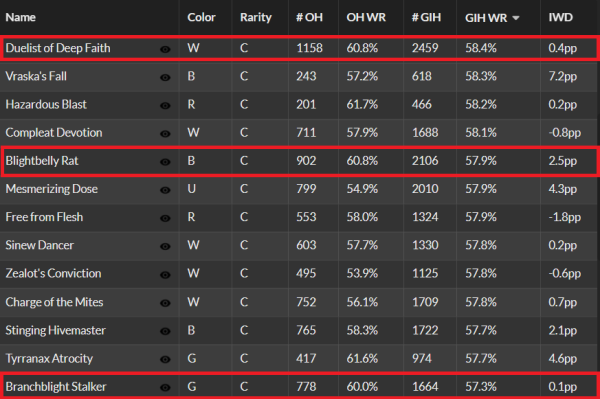
The first batch of two-drops are the toxic brawlers. It's important for Toxic to get those first points of poison in early. Branchblight Stalker and Duelist of Deep Faith do this as early attackers. The duelist boasts a little more consistency, as the first strike can embarrass early blockers. The Stalker, conversely, is begging to be blocked. Its 3/1 sizing and toxic 2 makes opponents want to get in front of it if possible.

While both of these cards play well with combat tricks, the Stalker needs them. However, if we build around the 3/1 properly, we can reap the benefits of a faster clock. Cards like Adaptive Sporesinger, Flensing Raptor, and especially Prosthetic Injector play very nice and help the elf get through. Still, we shouldn't have to do this much work to get the most out of our two-drops.

Blightbelly Rat is another option for poisoning our opponent. It also has toxic, but the death trigger can help further our poison plan while extracting additional value.

The important thing to remember with these cards is that our opponent is going to want to block them. No one wants poison counters, especially not early. Because we can anticipate early blocks, cheap combat tricks will be especially potent. The toxic trio all perform well in the format.

Black's Black Sheep

Pestilent Syphoner is narrow, but can be effective. It does a great job getting that first poison counter, and sometimes it can be a persistent source. However, the measly body means that the card only does one thing. It doesn't trade well, gets bricked easily, and can't help you on defense. We need to really want to get in poison damage to maximize this, though it's a terrifying combo with Necrogen Communion.

This card has been featured in the UB Toxic Control deck, but that hasn't come together particularly well. If we're playing this early, and planning on proliferating with cards like Experimental Augury and Thrummingbird, we need to be concerned with our own life total. This is a racing format. Opponents will be attacking us on the ground and have potent answers of their own.

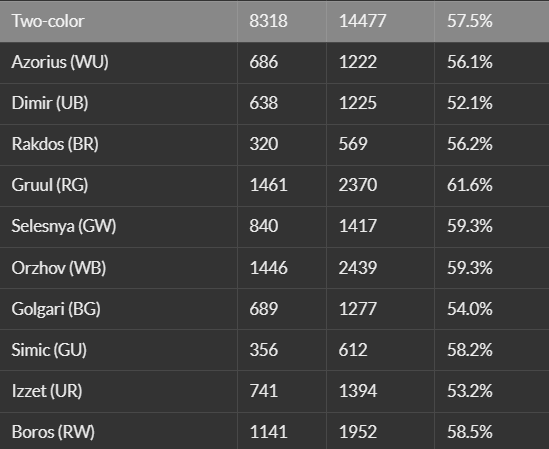
While these decks can be scary, they more often leave us with seven or eight poison counters before falling short. As a result, UB, the natural home for the Syphoner, has the lowest win rate in the format of two-color decks.

Corrupted Payoffs

Only two of the common two-drops qualify as corrupted payoffs, and only one of them is any good. At this point in the format, there simply isn't enough time or a good enough reason to be spending our turns regrowing Fleshless Gladiator. In theory it's a nice piece to pair with Pestilent Syphoner. In reality, this isn't what we want to be doing in the late-game and it's definitely not what we want to be doing in Toxic.

On the other hand, Incisor Glider gets out of control fast. Once our opponent is corrupted , the glider attacks as a 2/4 while giving an anthem to the rest of the team. This effect can end games very quickly.

Oiling Up

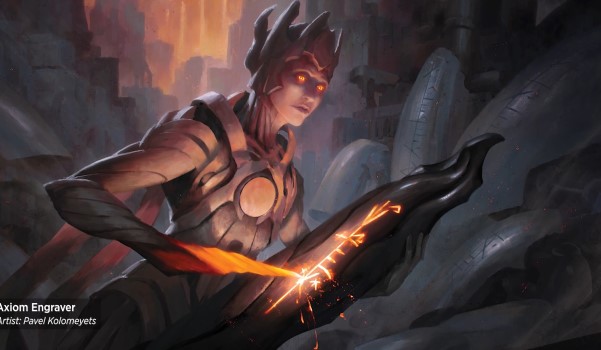
While the toxic decks really want to get damage across, the oil decks prioritize putting dice on the board. There are only two options for common two-drops here. Axiom Engraver has overperformed expectations, currently with a 60.6% GIH WR. While the best defense is probably a good offense in ONE, this card lets us play a slower game. It keeps dice on the board, blocks well (especially when holding up Hexgold Slash and Free from Flesh to offset opposing combat tricks), and helps us smooth out draws. Early on it develops our hands; late game it lets us redraw our lands.

Predation Steward is replaceable, but contributes to the plan. Activating its ability rarely feels good in oil decks, but can be a valuable way to push through toxic damage. That being said, three mana, at sorcery speed, while tapping your creature feels like a waste of a lot of resources. While it has some versatility, this card is not a priority.

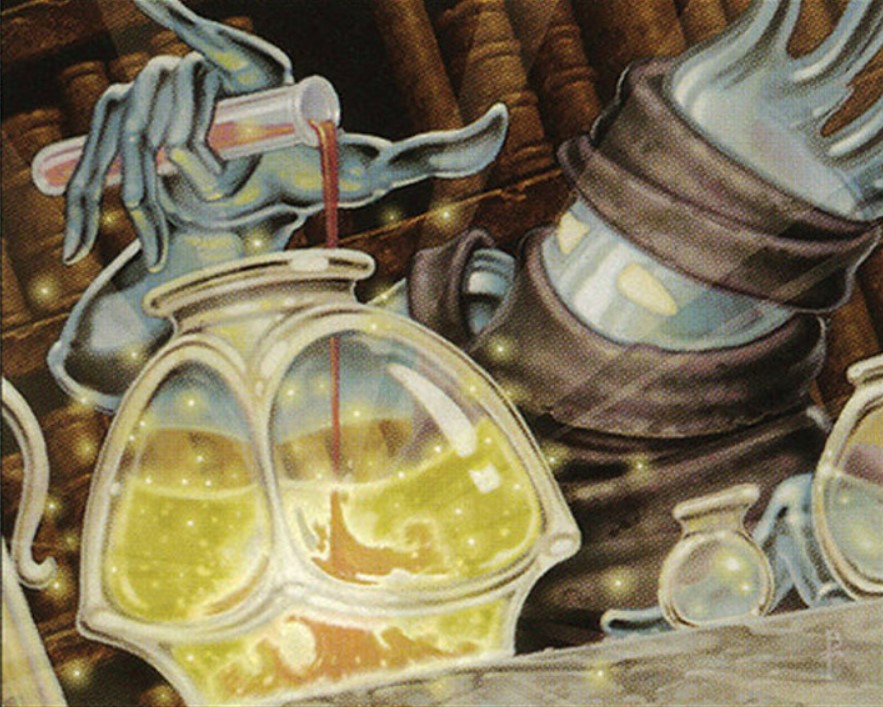
The problem with Ichor Synthesizer isn't an issue of power. This format just doesn't give us time to set up our cards, and that's what this creature needs. The 1/3 body is fine, but not particularly impactful. It can get counters, but because it doesn't enter with them, it can also slow down our development. Turn four is big for the oil decks, and they want to slam something powerful; think an Urabrask's Anointer, Cinderslash Ravager, attacking with our Kuldotha Cackler or ramping out a Oil-Gorger Troll. Not entering with the counter has been costly.

We can supplement the shortage of oil two-drops with ones like Sawblade Scamp, Rustvine Cultivator and Glistener Seer. Outside of the Engraver, the oil two-drops are underwhelming, but getting counters on the board is important.

The Art of Artifacts

In this format, we may end up playing any two-drop in a pinch. Getting on the board early is just that necessary. Still, we should try to avoid including Malcator's Watcher or Escaped Experiment. These don't offer much as proactive game pieces, and that's the name of the game in ONE. We want to be pressuring or developing. These cards don't do that well, and while we might want an artifact for our Eye of Malcator or Unctus's Retrofitter, there are better options.

Take Mandible Justiciar, a reasonable alternative. It's fine on its own, and being able to trade off while gaining life is excellent. The lifelinker plays well with tricks and has a few synergies in the format, but one toughness can be a liability against Toxic, which is the most likely matchup to ignore the additional life it provides. Additionally, there is some crossover synergy between the mites and the artifacts, which could potentially open up an avenue for Incisor Glider to play well in some versions of UW Artifacts.

Utility Twos

Barbed Batterfist is a three-power attacker that leaves material behind upon trading. It's not incredibly powerful, but it has synergies as a noncreature spell and as an artifact. While we don't always have time to juice the synergies, this card doesn't ask anything of us. It's Roc Hunter, but we can bounce it to rebuy the token, or move the equipment to block one-power creatures better. We can boost an evasive attacker's power, which makes it a natural partner with Ichor Synthesizer or fliers. This card is excellent in any red deck and its one of the few cards in the format that's truly flexible.

There was an error retrieving a chart for Barbed Batterfist

Unfortunately, most of the flexible cards in the format are underwhelming. Shrapnel Slinger usually plays like a split-card; either Grizzly Bears or Shatter. Dune Mover is another middling flexible option. Its having toxic means that we can splash while still building out our board. Copper Longlegs offers proliferate, which lets us fill in empty spots to help with oil or toxic. Truth be told, all three of these options are pretty weak. We may find value bringing them out of the sideboard, but we should try and avoid these three.

Ranking the Twos

  • The Great: Axiom Engraver, Barbed Batterfist, Duelist of Deep Faith, Incisor Glider
  • The Good: Blightbelly Rat, Ichor Synthesizer, Mandible Justiciar
  • Playable: Branchblight Stalker, Predation Steward, Pestilent Syphoner
  • The Bad: Dune Mover, Malcator's Watcher, Fleshless Gladiator
  • The Ugly: Copper Longlegs, Escaped Experiment, Shrapnel Slinger

This is a format where we need to make sure we have a plan and that we can deploy it fast. Having effective two-drops is a massive part of executing in this format. Make sure that you hit the ground running, because if our first play is on turn three, we're already a step behind.

If the format has gotten off to a frustrating start, reconsider your mana curve. Make sure you have a deck that can consistently start early, with cards that contribute to a plan. Start fast, build strong, and play tight.

Wizards Is Abandoning the LGS. Can Magic Survive?

Are you a Quiet Speculation member?

If not, now is a perfect time to join up! Our powerful tools, breaking-news analysis, and exclusive Discord channel will make sure you stay up to date and ahead of the curve.

I should start by stating that I do not believe Magic: the Gathering is anywhere near some sort of precipice in which a single step over-dooms the game, nor do I believe that smart Local Game Store (LGS) owners will all go out of business.

Does Wizards of the Coast Still Need the LGS?

When Magic first began in 1993, the internet was in its very infancy. Local game stores and hobby stores were the lifeblood for many hobbies. I fondly remember going to my local hobby store to play Warhammer with friends. I bought my miniatures, paints, books, brushes, and dice from this store. I honestly think my love for medieval fantasy as a whole exists only because of that store.

I was introduced to Magic in 1995 by a classmate, and began to buy packs from my LGS. My first non-kitchen table game was the Invasion release tournament at my local game store. I invested in Magic because I had a great place to play and socialize with people who had similar interests.

There was an error retrieving a chart for Darigaaz, the Igniter

When I moved to a new state in high school, the local game store introduced me to new friends and helped me grapple with a major life change. For me and likely many others, the LGS is a beloved business, and one that is paramount to developing one's hobbies.

However, after reading a fantastic blog post by a large LGS owner who wrote a deep dive into their business, I feel like changes are definitely coming to many LGS business models. In th article, Michael Bahr mentions that their store buylisted much of their Magic singles inventory in 2022 following what they viewed as constant inventory value erosion due to the never-ending reprints from Wizards of the Coast:

The canary in the coal mine for us was not the pace of reprints in products such as Modern Horizons 2 or the Secret Lairs, though neither of those helped. Rather, it was seeing literally hundreds of Commander reprints every six weeks as new Standard and Commander Legends sets included multiple Commander decks and a refreshed List to top it off.

Michael Bahr

He discusses multiple cards that have plummeted from $20-$40 cards down to bulk rares, which while nice for players looking to pick them up, can be devastating for stores that operate on low margins with a glut of inventory. In fact, this strategy by Wizards clearly is aimed at new player engagement at the expense of established player's collection value.

There was an error retrieving a chart for Erosion

While Wizards continues to claim they aren't in the secondary market, I would argue that selling a very small subset of cards in a Secret Lair is essentially a print-to-demand singles selling model. It is glaringly obvious when Wizards chooses one very valuable card and two cheap cards, slaps on new artwork, and stuffs them in a box that everyone is buying the valuable card, and the other two are just throw-ins (looking at you, Bitterblossom Dreams). Wizards is of course free to do this, as they own the rights to the cards and a smart business does its best to make money.

However, there is a hidden cost to this strategy that it seems Wizards is ignoring. If stores feel it is no longer profitable to sell singles, they will stop doing so. That means a reduction in competitive events, as singles sales have much higher profit margins than sealed sales. This in turn means a reduction in active players, and fewer boxes and packs sold, as players don't tend to invest into games that rarely get played.

There was an error retrieving a chart for Symbiosis

Wizards of the Coast seems to have forgotten that its relationship with the LGS is symbiotic. While they do throw a bone to LGSs every once in awhile with some sort of in store exclusive or freebie, eroding a store's inventory by potentially thousands of dollars and then giving them a free $150 bonus won't keep stores in business, let alone happy.

This reminds me of John Nash's theorem regarding game theory, as found in the bar pickup scene from A Beautiful Mind. Nash theorizes that he and his friends should ignore the individual best choice given in favor of a "best for the group" approach.

There was an error retrieving a chart for Brokers Hideout

In this instance, Wizards of the Coast had previously agreed to not maximize profit, and leave room for their LGS partners to make money in order for both to grow and be profitable. It seems Wizards has decided to now "go for the blonde."  This approach will likely net their top executives nice bonuses as sales targets and profitability goals are met and exceeded, at least for the short term. But I can't help but feel like the cost doesn't outweigh the benefits.

Does the LGS Need Wizards of the Coast?

The inverse of our intial question is equally important. As Bahr points out, smart LGSs pivot to what is best for them. They only have so much money to allocate for products at any given time, and inventory that has a slow or non existent turnover must be ignored.

If you were an LGS owner, and your livelihood and that if your family was dependent on selling hobby enthusiasts products, it would make perfect sense to suggest the best option for the customer and for yourself. Say someone comes in looking to try out a new game, and is open to a few options. Why not first suggest the game that best helps your business? Especially because the one that is best for your business is also going to be the one that you support the most, whether that looks like having a larger sealed inventory, more singles, or a more active play scene? The customer will then have more access to the products they want and more opportunities to enjoy those products.

Flesh and Blood, for example, is a recent trading card game that has shown tremendous growth in the last few years. Their core mission is "to bring people together in the flesh and blood through the common language of playing great games," and they help accomplish this by heavily promoting in-person play at local game stores. According to the game's creator, James White, "playing in-person at the local game store level" is the most basic core concept of the game. By focusing on in-person play, the creators affirm that the local game store plays a critical role in the games overall success, which in turn guarantees that the local game store will profit from the game's growth.

There was an error retrieving a chart for Struggle // Survive

I do imagine it may prove difficult for many stores to transition away from the "cash cow" that was Magic: the Gathering for so many years. But given Wizards' other recent blunders, it seems quite obvious that upper management values dollars and cents over happy customers. The D&D community pushed back with the one thing that Wizards understands (to wit, their wallets), and cancelled numerous subscriptions. This will either serve as a wake-up call to the company and they will permanently altar course, or they will bump the heading a smidge and head right back towards the same horizon.

Arena: The Elephant in the Room

Lastly, I want to discuss the effects of MTG: Arena on the game as a whole. First, the positives:

  • It offers people who were/are unable to go to play at local game stores a venue to enjoy their hobby
  • It provides a free way to grow the playerbase
  • It provides a way for people who have limited free time to play the game
  • It provides Wizards with lots of additional data points regarding the formats supported, which can allow them to sculpt the formats faster should they become unfun/boring

As for the negatives:

  • It greatly reduces in-store demand for the supported formats, especially Standard, which is extremely bad for stores. Standard and its constantly shifting metagame used to be one of the biggest drivers of singles sales for the LGS
  • It creates a mentality of "concede and move on" rather than trying to win from a difficult position
  • The ability to draft "for free" by saving up one's gold in a given week eliminates a lot of the casual drafters from in-paper events, as they can get their fix for free
There was an error retrieving a chart for Syphon Mind

The first and last of the negatives feed into the point of this section as yet another example of LGS income being syphoned away by Wizards.

Two Questions Answered; Many Remain

It is important to remember that we live in a time with a plethora of options to keep oneself entertained. There is no shortage of video games, card games , and board games, all vying for what free time we do have. Stores have limited inventory space and money to spend on said inventory, so the smartest ones will focus on the products that are best for them.

I would argue that Wizards of the Coast still needs the local game store in order to survive, but they seem to have forgotten that, making decisions as though their games will survive solely through their own force of will. If I owned a local game store, I would diversify my offerings, which reduces risk and potential losses. And that diversification would look like a reduction in support for Wizards of the Coast products.

Avatar photo

David Schumann

David started playing Magic in the days of Fifth Edition, with a hiatus between Judgment to Shards. He's been playing Commander since 2009 and Legacy since 2010.

View More By David Schumann

Posted in FreeTagged Leave a Comment on Wizards Is Abandoning the LGS. Can Magic Survive?

Have you joined the Quiet Speculation Discord?

If you haven't, you're leaving value on the table! Join our community of experts, enthusiasts, entertainers, and educators and enjoy exclusive podcasts, questions asked and answered, trades, sales, and everything else Discord has to offer.

Want to create content with Quiet Speculation?

All you need to succeed is a passion for Magic: The Gathering, and the ability to write coherently. Share your knowledge of MTG and how you leverage it to win games, get value from your cards – or even turn a profit.

January ’23 Metagame Analysis: Return of Churn

Are you a Quiet Speculation member?

If not, now is a perfect time to join up! Our powerful tools, breaking-news analysis, and exclusive Discord channel will make sure you stay up to date and ahead of the curve.

January was a difficult month to analyze. On the one hand, the top decks from the previous year continue to be the top decks as if nothing's changed. On the other, numerous decks have risen to challenge the lower-tier decks. Thus, there's been some reordering of the metagame, but not enough to actually destabilize it.

With Phyrexia: All Will Be One releasing today, things should be changing. The question is how much.

Confusingly Creative

There is absolutely no stability to the Indomitable Creativity lists online. Last month I was talking about how they'd abandoned 4-Color Creativity for Jund, though the reason was unknown. This month, Jund has apparently lost its luster. It's in third place behind 4-Color and Temur Creativity. I haven't seen any chatter or explanation as to why this is, so the best I can do is speculate. Unfortunately, most of what I said about Jund last month would apply to the Temur lists, especially about Blood Moon. Sooooo... I guess that the online players just can't sit still?

Rentals as Explanation

I meant that last line as a joke, but on reflection, I think it might actually be the best answer. It's much easier to switch decks online than in paper, and players may simply be taking advantage of that benefit. The rental services are the big way, since players have access to everything and can just swap decks as they grow bored. Nothing comparable exists in paper so, once bought, a deck must be committed to, especially at current prices. It's also mechanically easier to move cards around in the Magic Online client than to physically move cards into different decks and re-sleeve them.

There was an error retrieving a chart for Indomitable Creativity

Thus, it makes a lot of sense that online Creativity players are just cycling through builds. They like the gameplay, but after a while, a specific build gets a bit mechanical. Therefore, they try a new version for a while, and the cycle repeats. This could also explain why so many other four-plus-color decks fail to ever settle on a definitive version (looking at you, Omnath, Locus of Creation).

Metagaming Mystery

This explanation goes a bit against the grain, even for me. I said that Jund Creativity made sense as a metagame call and have stated the same about various versions of other decks. I'm questioning how true that ever was, as I can't see how Temur Creativity specifically is better than Jund, both in general and in this metagame.

There was an error retrieving a chart for Persist

Exchanging discard for counterspells helps in some matchups, but hurts in others, and the removal packages are comparable. Temur usually has Explore to accelerate and Jund doesn't, but that's made up for with the swift reanimation package central to Jund's strategy. There doesn't seem to be any advantage, and the metagame hasn't shifted enough for that to be a definite explanation. Thus, Flavor of the Month seems plausible.

Meanwhile, There's 4-Color

And yet, through all of this, 4-Color Creativity continues to simply chug along online while being the only Creativity deck to make the Tier list in paper. A significant part of this is that 4-Color Creativity doesn't represent a single deck, but a compendium of decks with four non-splash colors (remember, Archon of Cruelty doesn't count for color identity). If I was willing to really separate things out, it would look different, but I'd be the only one doing that and it isn't worth the effort.

There was an error retrieving a chart for Leyline Binding

The white-blue-green-red combination has traditionally been the most popular by far thanks to Leyline Binding and Teferi, Time Raveler. However, that version is also now showing the most adaptation and change, especially in its sideboards. This has been particularly noticeable to me as a Burn player, because they're adopting Blossoming Calm and Turn the Earth. The former is decent in the mirror to protect against Archon's trigger and discard generally, but it's devastating against Burn. The latter is okay graveyard hate and protection against Surgical Extraction, but gaining life is also hard to overcome. Burn will need to adapt in turn to protect the matchup.

Checking On the Breach

Last week, I went into detail about Underworld Breach and noted that at that time, Combo and Value Breach were about level. Anyone reading the update data will know that wasn't true a week on. What happened is that Value Breach exploded in the last week of January. It was all over the Challenges, which is also how it did so well on average points. Combo disappeared online, and I still haven't seen any new Jeskai Storm Breach decks. There have been Gruul Storm Breach decks, but they're something else entirely. Value just beat out Combo in paper, but a single event was responsible.

There was an error retrieving a chart for Underworld Breach

I expect this trend to continue in February and likely expand. Every non-Burn red deck is at least experimenting with Breach, and it will likely stick in some decks. Also, Gruul Breach is getting attention now that Venerated Rotpriest is legal. The opinions on the card are all over the place so far, but the potential is real, and so is the excitement.

The Shocking Newcomer

However, the biggest new deck is definitely what I'm calling Mono-Red Artifacts, and nobody else can agree on the name. You'd think this would be straightforward, but the deck is basically in between all the various red aggro decks and takes little bits and pieces into a strange yet effective package.

MR Artifacts, Slasher21 (MTGO Preliminary 3-1)

Creatures

1 Bomat Courier
4 Dragon's Rage Channeler
4 Monastery Swiftspear
4 Ragavan, Nimble Pilferer
4 Voldaren Epicure

Instants

4 Galvanic Blast
4 Lightning Bolt
3 Shrapnel Blast

Sorceries

3 Light Up the Stage

Artifacts

4 Mishra's Bauble
4 Experimental Synthesizer
1 Pyrite Spellbomb
1 Relic of Progenitus

Lands

2 Arid Mesa
1 Bloodstained Mire
2 Den of the Bugbear
5 Mountain
1 Prismatic Vista
1 Scalding Tarn
1 Shinka, the Bloodsoaked Keep
1 Sokenzan, Crucible of Defiance
4 Urza's Saga
1 Wooded Foothills

Sideboard

1 Jegantha, the Wellspring
1 Alpine Moon
1 Pithing Needle
2 Relic of Progenitus
1 Shadowspear
4 Shattering Spree
1 Soul-Guide Lantern
2 Void Mirror
2 Orvar, the All-Form

Part of the problem is that this deck is more like a Pioneer or Pauper red deck than a Modern one. It's built around card advantage and synergy while simultaneously hitting for big chunks of damage. Meanwhile, Burn grinds the opponent's life down, while Izzet Prowess explodes. Thus, Modern players weren't ready for it, and allowed the deck to scream into Tier 2 from the get-go. Online, anyway.

Anomaly or Addition?

I recorded exactly two of these decks in paper in January. As of right now, nothing has changed. The deck is putting up solid numbers online but not showing up in paper. This could obviously change, but it begs the difficult to answer question of why this is happening and what it means for the deck. The short answer is that I don't know, but I have seen this happen before.

There was an error retrieving a chart for Shrapnel Blast

This difficult-to-name red deck is the latest Shrapnel Blast/Goblin Grenade deck in Modern. These decks crop up either online or in paper every few years. 8-Whack is a frequent home for the latter. The former would crop up in Affinity periodically, and I recall there was a more dedicated shell for it at one point, but I can't remember anything else.

Regardless, the older decks (just like the new one) worked on the premise of throwing everything at the opponent before they can react. It only takes a few swings to get into the range of five-damage burn spells. They can be overwhelming, but they're also so all-in that surviving the initial attack (or, having the deck throw a gear) is game-winning. They've typically thrived when the format is looking away and fallen apart as soon as anyone takes notice and prepares, which doesn't bode well for the latest iteration.

The Key Factor

Of course, none of the previous versions had Experimental Synthesizer, Light Up the Stage, and Urza's Saga. The card advantage the first two cards provide closes a major weakness of previous versions. No longer can a deck absorb one hit, clear the board, and then win at its leisure. Artifacts can rebuild, and having fodder available for topdecked Blasts is also very good.

There was an error retrieving a chart for Urza's Saga

That said, I suspect that Saga is the real power of this deck. The card on its own is very strong, but as a long-game tool after beating the opponent low, it's especially dangerous. Better still is the fact that nobody is going to bring in anti-Saga cards against this deck.

Therefore, I know that Artifacts will be a player online for the next month. Whether it lasts longer depends on metagame shifts and its ability to gain converts in paper, where it has burned many pilots before.

Turmoil Invites Opportunity

As for the usual financial advice, this is going to be an unusual month. With One arriving, there is going to be churn and shakeups in Modern. This is, as always, an opportunity for investors to profit. However, there is danger this time, so it will be critical to time everything correctly.

There was an error retrieving a chart for Venerated Rotpriest

As noted above, much of the buzz is centered on Venerated Rotpriest. One is not widely available yet, and many players are unfamiliar with how the cards work, and that is affecting the results. Many players online and in paper can't make use of the cards yet, and so there's no apparent effect, but that's just down to scarcity. But also, many decks that are playing One cards are getting wins thanks to opposing ignorance, which will stop happening soon.

There was an error retrieving a chart for Melira, Sylvok Outcast

That was all a long-winded way of building up to the fact that Rotpriest Storm decks are doing surprisingly well in early testing. Frequent turn-two wins well. Again, that might be down to being a new deck in a stale metagame, but it could also be real. It's too early to tell.

If you haven't sold off the Infect staples and Melira, Sylvok Outcasts you picked up on my advice weeks ago, I'd price them to move. Rotpriest might be as good as I feared and may even warrant a ban. It could also be fine, but I'm not the type to hold on the basis of hope.

Other Risk Factors

That's not the only area where One might threaten existing cards. Cacophony Scamp equipped with Colossus Hammer is a turn-two kill. Hammer Time could already kill on turn two, but Scamp adds a new way to make it happen. Modern Hammer moved away from dedicated fast kills months ago, but Scamp could reignite interest. I know that Scamp is making waves in Pioneer, which might lead to critical Hammer Time pieces getting banned earlier than I anticipated. It might be nothing, but be ready to move product if Scamp takes off.

There was an error retrieving a chart for The Mycosynth Gardens

Similarly, Amulet Titan pieces might be endangered by One. The synergy of The Mycosynth Gardens and Amulet of Vigor was well-known, but how that would impact Amulet Titan wasn't clear.

You have to be a dedicated Amulet Player to understand how or if a card is good in Amulet, and I'm not, so I never commented. I've started hearing murmurs from Amulet players that Gardens breaks the deck, worse than Summer Bloom. Turn-one wins broken. I'm not even sure how that's possible, but if it is, that might be strike three for Wizards and Amulet. Be aware in case the rumors are true.

Brace for Impact

One is a very powerful set, and even if the Modern pickups aren't actually as broken as they appear, Modern is definitely in for a season of extreme churn and change. Everyone needs to be ready to weather the storm, but there will be opportunities as well. Just don't buy into any Infect rush; the time for that was back at the leak.

Top Commander Picks from Phyrexia: All Will Be One

Are you a Quiet Speculation member?

If not, now is a perfect time to join up! Our powerful tools, breaking-news analysis, and exclusive Discord channel will make sure you stay up to date and ahead of the curve.

It's new set time, a great time for Commander enthusiasts! There are a few spicy cards coming out of Phyrexia: All Will Be One, so let's take a look at some interesting and maybe overlooked cards. But first, we'll look to some past cards that are definitely going to see a resurgence in play... and potentially, price.

What's Old Is Good Again

These are splashable, high-impact cards will see a ton of additional play right away. Obliviously the overwhelming crux of play is going to be about poison counters, infect, toxic, and of course proliferate. With these cards in the back of our mind, let's look forward to ONE.

Also, Every Dominus is Busted (Except Black's)

This is my ranking for most powerful (blue) to least (black). Double proliferate is definitely better than double non-creature damage and double death triggers. Double tokens and double combat stats are both very powerful; however, the green Dominus is seven mana and the white Dominus has the second-hardest indestructible activation above only the red Dominus.

Meanwhile, blue has the second-easiest indestructible behind black, and also flies. A top-tier triggered ability, easy-to-activate indestructibility and also flying on top for four mana makes Tekuthal, Inquiry Dominus just a bit better than the rest. Mondrak, Glory Dominus is an Anointed Procession with some upside, so it's yet another auto-include in many decks. Green and red are both credible threats.

White Is Alright

Norn's Choirmaster is reasonable at five mana, but the hidden power of this card is combining it with partnered Commanders. To wit, Rograkh, Son of Rohgahh. The ability to get potentially four proliferate triggers in the same turn is certainly something to consider. With several low-cost partnered commanders to consider and abundant amounts of haste enablers, RW looks like the best combination to make this happen. Certainly I am going to try this card in my deck Dog and Pony Show, which features Yoshimaru, Ever Faithful andKeleth, Sunmane Familiar. The Choirmaster is unlikely to be a game ender, but is definitely a solid value engine.

What is it with white and game-defining enchantments? Norn's Decree is a very interesting card. It's a modern take on a "rattlesnake." First, getting attacked gives your opponent poison. Then, it encourages the entire table to attack them back to get card draw. Talk about a no-win situation for everyone else. At one less mana than Smothering Tithe, this looks like the most promising new white enchantment that can go in any deck.

I think my outlook for Decree is far more positive than other cards like Smuggler's Share for a new hyped white enchantment. Additionally, having two or more of these in play is far more interesting than multiple Tithes, and looks like a great diplomacy card.

Obviously, Clever Concealment is a must-discuss card. A potential replacement for Teferi's Protection, the fact that Concealment has convoke cannot be overlooked. Everyone knows that free spells are powerful, and the fact that you can phase out tokens and have them come back is another reason Concealment may end up seeing a lot of play.

Blue Is, Once More, Big

They missed the mark when printing Ichormoon Gauntlet. This could have easily been an equipment card with the ability to equip to planeswalkers, and it would have had far more interesting synergy than just being an artifact. Maybe they were afraid of power concerns? This is the same set as Elesh Norn, Mother of Machines. Now that you have stopped laughing, Gauntlet easily goes into many different decks with or without planeswalkers. I think it has what it takes to see a bit more play after the ONE hype dies down as decks like Superfriends will love this card forever more.

I've played Jace's Sanctum in a couple of decks and that card is only barely good enough to consider. Mindsplice Apparatus is Sanctum on steroids. It effectively gives you extra mana each turn and turns proliferate cards into mana ramp. Flash is the best addition to a card like this, and I'm not sure it needed to continue to scale upwards to be playable, but scaling definitely takes it to the next level. It's not overpowered but is certainly powerful enough to play!

Absolutely, hands-down, this is my number-one pick for best twilight (sorry red!): Blue Sun's Twilight solves a huge number of situations. Pesky Esper Sentinel being a nuance? Now it serves you for only three mana, and your opponent has to deal with it. Late-game threats starting to get scary? Well, now it's your threat, and here's a bonus copy for you as well! I think a lot of decks are going to slot this card into a removal slot, and it also provides an additional wincon for free. Talk about win-win.

Black is Back... to No Good

Is Vat of Rebirth just Recurring Nightmare with more steps? Yes, absolutely. Is Recurring Nightmare banned in Commander? Yes it is, and for good reason. A more fair card, Vat gives you an easy proliferate target. It cannot win the game by itself, but this card generates far more value than it costs, monetarily or mana wise.

Donate, Harmless Offering, The Beamtown Bullies, and Fateful Handoff... there are simply so many cards that would love to interact with Archfiend of the Dross. Not only that, but it's a pretty large beater with flying for only four mana, so it's not entirely impossible for it to just kill someone in the air before you lose. Of course, its triggered ability can deal some major damage, so this card also can see play in group hug decks. This card will surprise groups, but not as much as the next one.

While it's not on the same level of table-clearing card as Torment of Hailfire or Exsanguinate, Monumental Corruption looks like it can easily delete one opponent for just five mana. You know that Sheoldred, The Apocalypse card we like to complain about here? It combos really well with Monumental Corruption, effectively turning every artifact you have in play into a Lightning Bolt to their face. That happens with any Sheoldred in play, even if it's not your copy. Of course, if you need to draw a ton of cards, you have the flexibility to do that as well. Think of it as the grown up version of Sign in Blood.

Is Red On Fire or Not?

Dragon Tempest sees plenty of play. Roar of Resistance is a very different take on that card, but one with a much easier to access upside. Most tokens are, of course, 1/1s, so tripling their damage for only two mana is an incredible bargain. But do not overlook the fact that you can use this card on the behalf of other players! A very interesting diplomacy card for red because you can bargain on either side of the equation. I look forward to playing this card in several decks.

Who remembers "K-Red?" Gleeful Demolition is a strictly better version of Kuldotha Rebirth. It's at home in Goblins with Krenko, Mob Boss or is just an accelerant for any token deck. But it can always be used as a Smelt. We like to destroy artifacts in this column!

Is Green the Color of Envy, or Disappointment?

First, I have to applaud Wizards for continuing to add to Dinosaur tribal. This is a good idea that I think will displease absolutely no one. Tyrranax Rex is the latest crazy-powerful green super-monster and it does not disappoint. It really pushes the envelope for seven mana, but ultimately, it's just a big monster. Ward 4 makes it hard to kill, but not completely unfair. This card plus Tainted Strike can be a game-ender and I'm sure you'll run into that interaction.

There is a long list of one-mana "save my creature" spells. Tamiyo's Safekeeping and Snakeskin Veil are just a couple of recent examples among many. But I much prefer Tyvar's Stand. While all of those cards tend to save a creature for one mana, only Tyvar's can go over the top and win combat or even a game. Sometimes you get to a point where you are throwing haymakers back and forth and dumping all your mana into a spell or effect can be game-winning. Meanwhile, if it's early, Tyvar's is still good at only one.

Thirsting Roots needs little explanation. It's clearly the best Lay of the Land-style card ever made, and gives you the flexibility of fixing your lands or the huge value of proliferate for just a single mana. This is an acceptable level of power creep and a nice addition to Magic.

Multi-Color

Everyone has wanted three-color Insects, and now you get it with a side of poison! Vishgraz, the Doomhive will definitely will see lots of casual play. The three Mites generated on ETB ensure that any time someone is open, they eat three poison counters to activate the new corrupt condition. This well-designed card has obvious synergies with many existing ones, but does not completely force you into only one build. I'm looking forward to seeing the variations this deck will no doubt undergo.

Not to push more graveyard-based decks in Golgari, but wow, Tyvar, Jubilant Brawler sure pushes BGx graveyard decks. His Thousand-Year Elixir effect works perfectly with the -2 to immediately use anything you reanimate. Of course, there's always simply getting double value from a mana dork. Tyvar is essentially a mana rock with a much bigger upside, and at only three mana, can hit the board easily on turn two to start giving up double tapping value.

Artifacts

Talk about a much more interesting mana rock than usual. Glistening Sphere has a lot going on. Three mana and entering tapped seems medium. However, you get a proliferate trigger out of the deal. Any kind of flicker or copy effect gives you more value. Of course, if you do achieve corrupted, this suddenly becomes three times as good! While I think this card will be over-hyped at first, and then fall off in play shortly thereafter, I think it's good enough to continue to see play over time. It's just another piece in a variety of decks that many players will try.

Graaz, Unstoppable Juggernaut seems like such a fun card. You know, you have a bunch of tokens or mana dorks and then, suddenly, they all turn into copies of the one, the only... Juggernaut, because they must attack and can't be blocked by Walls. This is an awesome effect which shows that someone at Wizards understands how to make cards that reach across the history of Magic. If they use that as a strength in card design, not a weakness, it bodes well for the future of the game. However, it's almost like there are two people in charge of card design...

One. Every. Single. Set.

Thrun, Breaker of Silence is a new take on Thrun, the Last Troll. "The other guy" at Wizards got a hold of it, though. Here's the start of what removing "old rules" like regeneration and protection looks like. Are they now trying to "remove" hexproof, instead making up a new ability? This new ability is four lines of text long. Four lines. Or...

"Hexproof from nongreen?" See how easy that was, Wizards? I used a keyword to describe your new ability that lacks a keyword. Three words versus four lines of text. They boggle my mind. Glaring Spotlight and cards like it interact with keywords. Not putting keywords on cards keeps more obscure cards from seeing play, which is less fun for everyone. If this Thrun gets errata just like the old one, and this is somehow supposed to be a "next level throwback" to cards like Ascetic Troll... I'm not feeling it.

So How Is ONE for Commander?

Not bad! I think it's going to be quite a bit more deck- and format-defining in the short-term than many others believe. I would be shocked if there is not at least one poison or proliferate deck at each table this month. What about for the entire year? There will definitely be a drop-off in those decks once One is no longer the "new hotness," but I do believe a good amount of these cards will stay in pods for the future.

Are there destined to be One cards in the EDREC top 100? Probably not, and if they do get there, they may end up banned. Overall set quality, excellent? No. Good? Hmmm. Decent? Pretty much. And hey... we made it the entire article by mentioning Elesh Norn, Mother of Machines only once!

Is my Dominus ranking correct? How good will toxic be in your Commander games? What did I miss? Let me know in the comments!

January ’23 Metagame Update: Before the Storm

Are you a Quiet Speculation member?

If not, now is a perfect time to join up! Our powerful tools, breaking-news analysis, and exclusive Discord channel will make sure you stay up to date and ahead of the curve.

Welcome to the first Modern Metagame Update of the new year. It's... not going to feel that different from all the previous ones, if I'm honest. Modern has some exciting stuff happening within itself, but it isn't translating into a shakeup. The decks that have been on top for the past year will continue to be on top for the immediate future. The longer-term picture is far muddier, as we don't know exactly how Phyrexia: All Will Be One will impact Modern.

Wild World of Outliers

As has become the norm, the data is affected by statistical outliers. However, this is a weird month as far as they go. Both paper and Magic Online (MTGO) are impacted, but the effects are very different and will be treated accordingly.

There was an error retrieving a chart for Murktide Regent

In paper, UR Murktide is a statistical outlier by most normal tests. However, I left it in the data rather than remove it as I normally would. This is because the paper data is far from normally distributed and removing the outlier made the skew worse. For the statistically literate, the first three quartiles only included the decks with one to four results. Without Murktide in the data, Tier 3 was only four decks, Tier 1 was three, and the rest were in Tier 2. That's... not right, so I didn't remove Murktide from the data.

As for MTGO, the outliers were very severe. Both Murktide and Hammer Time are outliers with more than double the numbers of their closest competitor, Rakdos Scam. Scam in turn was a borderline outlier above fourth place UW Control. Had I left Murktide and Hammer in the data, they would be the only decks in Tier 1, only Scam and Control would have been in Tier 2, and everything else is Tier 3. That's also not right, so Murktide and Hammer were removed. Removing Scam had no effect on the stats, so it stays.

There was an error retrieving a chart for Grief

As always, outliers are in their correct place on the metagame chart, but are excluded from the actual calculations, resulting in an adjusted average and standard deviation.

December Population Metagame

To make the tier list, a given deck has to beat the overall average population for the month. The average is my estimate for how many results a given deck "should” produce in a given month. Being a tiered deck requires being better than “good enough.” Every deck that posts at least the average number of results is "good enough" and makes the tier list.

There was an error retrieving a chart for Fury

Then we go one standard deviation (STdev) above average to set the limit of Tier 3 and the cutoff for Tier 2. This mathematically defines Tier 3 as those decks clustered near the average. Tier 2 goes from the cutoff to the next standard deviation. These are decks that perform well above average. Tier 1 consists of those decks at least two standard deviations above the mean result, encompassing the truly exceptional performing decks. 

The MTGO data nearly exclusively comes from official Preliminary and Challenge results. Leagues are excluded, as they're a curated list and thus invalid. The paper data comes from any source I can find, with all reported events being counted.

The MTGO Population Data

In December, the adjusted average population for MTGO was 8.65, setting the Tier 3 cutoff at nine decks. Even with the outliers removed, this is a high average, but there's a good reason for it that I'll explain shortly. Tier 3, therefore, begins with decks posting nine results. The adjusted STdev was 10.74, which means that Tier 3 runs to 20 results. Again, it's the starting point to the cutoff, then the next whole number for the next Tier. Therefore Tier 2 starts with 21 results and runs to 32. Subsequently, to make Tier 1, 33 decks are required. As with the STdev, these numbers are slightly up from previous months.

There was an error retrieving a chart for Indomitable Creativity

January is always a high point in terms of MTGO participation. I have no idea why, but that's been the case for the past few years and 2023 is no exception. However, this January's size is truly exceptional. January 2022 mustered just 502 total decks while January 2023 has 840. This is partially thanks to many large Preliminaries but also thanks to Daybreak adding more Challenges to the schedule. More events mean more data.

There was an error retrieving a chart for Primeval Titan

A much higher population also means more unique decks. December had 57 decks while January has 74, the same as November. That's actually rather concerning, as November did that with 569 decks. Significantly more decks in the population should yield more uniqueness than it did, which is a bad sign. Of those 74 decks, 27 made the population tier. That's a solid turnout, but again seems low given the starting population.

Deck NameTotal #Total %
Tier 1
UR Murtktide11814.05
Hammer Time10112.02
Rackdos Scam495.83
UW Control374.40
Yawgmoth374.40
Tier 2
Cascade Crashers323.81
Jeskai Value Breach303.57
Amulet Titan293.45
Mono-Green Tron252.98
Temur Creativity242.86
Living End232.74
4-Color Creativity222.61
Tier 3
Mono-Red Artifacts202.38
Jund Creativity202.38
Burn192.26
Grixis Shadow172.02
4-Color Control161.90
Jeskai Storm Breach151.79
Jeskai Combo Breach131.55
Izzet Prowess131.55
Merfolk121.43
4-Color Rhinos121.43
Counter Cat121.43
Mill101.19
Tribal Elementals101.19
Dredge91.07
Jund Saga91.07
The metagame is still top-heavy, but now the un-tiered decks are disappearing.

Notice the enormous gap I mentioned earlier? There's clear bias in the metagame, and it's crowding out alternative decks. It's been nearly a year since this first started, and it will take a seismic shift to change anything. That is not to say that innovation is impossible, just that cracking the top tiers may be out of reach.

The deck I'm calling Mono-Red Artifacts but doesn't have an established name yet is certainly trying to change things. Almost an upscaled Pauper deck, the premise of this deck is to launch the typical Burn/Prowess cheap creature attack and then finish the game with Shrapnel Blast. It exploded out of the gates in January, going from non-existent to nearly Tier 2. This is a deck to watch.

The Paper Population Data

The paper tiers are calculated the same way as the MTGO tiers, just with different data. In most months there are far more reported paper events than online, but paper also tends to report fewer results per event. It's quite annoying, but paper events rarely report more than the Top 8, and far too often for my purposes, the Top 4. This makes the paper data far more variable than MTGO. December saw 594 decks, while January is up to 667. This seems like a big upswing, but is in fact well within the usual monthly variance for paper.

With significantly more decks recorded come more distinct decks. December had 84 but January is up to 101. Of those, 48 were singletons, which is why the data is so skewed. 19 decks made the tier list, which is low but understandable given all the singleton decks. The unadjusted average population was 6.62, so seven decks make Tier 3. The STDev was 12.07, so the increment is 12, on the higher end of what I'm used to. Remember, I always round down if the decimal is under .20. Therefore, Tier 3 runs from 7 to 19, Tier 2 is 20 to 32, and Tier 1 is 33 and over.

Deck Name Total #Total %
Tier 1
UR Murktide7911.84
Hammer Time507.50
Rakdos Scam436.45
4-Color Creativity375.55
Tier 2
Amulet Titan304.50
Merfolk274.05
Burn274.05
Counter Cat253.75
Cascade Crashers243.60
UW Control243.60
4-Color Rhinos203.00
Tier 3
Jeskai Value Breach192.85
Mono-Green Tron192.85
Living End182.70
Yawgmoth182.70
Jeskai Combo Breach172.55
4-Color Elementals121.80
Izzet Prowess101.50
4-Color Blink91.35
Grixis Shadow91.35
Eldrazi Tron81.20
This is a much healthier distribution.

It's interesting how divided the Indomitable Creativity players are, not just between decks but across play type. Temur Creativity just piped 4-Color on MTGO and yet doesn't appear at all on the paper tier. No Creativity deck was Tier 1 on MTGO, while 4-Color is Tier 1 in paper. To me this suggests that the Creativity players are actively metagaming on MTGO and desperately seeking an edge where the paper players either can't or don't want to.

Worth noting that if all Creativity players were lumped together they'd be the third-place deck on MTGO. That's incorrect to do since they play differently, but it is something to contemplate.

December Power Metagame

Tracking the metagame in terms of population is standard practice. But how do results actually factor in? Better decks should also have better results. In an effort to measure this, I use a power ranking system in addition to the prevalence list. By doing so, I measure the relative strengths of each deck within the metagame.

The population method gives a deck that consistently just squeaks into the Top 32 the same weight as one that Top 8's. Using a power ranking rewards good results and moves the winningest decks to the top of the pile and better reflects their metagame potential. 

The MTGO Power Tiers

For the MTGO data, points are awarded based on the population of the event. Preliminaries award points based on record (1 for 3 wins, 2 for 4 wins, 3 for 5), and Challenges are scored 3 points for the Top 8, 2 for Top 16, and 1 for Top 32. If I can find them, non-Wizards events will be awarded points the same as Challenges or Preliminaries depending on what the event in question reports/behaves like. Super Qualifiers and similar higher-level events get an extra point and so do other events if they’re over 200 players, with a fifth point for going over 400 players. There were a few 4-point events and one 5-pointer that drastically increased the points for certain decks.

There was an error retrieving a chart for Puresteel Paladin

Total points rose just like the population, from 754 to 1321. The adjusted average points were 13.53, therefore 14 points made Tier 3. The STDev was 17.96, which is a little high. Thus add 18 to the starting point and Tier 3 runs to 32 points. Tier 2 starts with 33 points and runs to 51. Tier 1 requires at least 52 points.

All the decks from the population tier made the power tier. They're joined by Bring to Light, which doesn't put up many results but its very dedicated players do well in Challenges.

Deck NameTotal PointsTotal %
Tier 1
UR Murtktide20115.22
Hammer Time14611.05
Rackdos Scam866.51
UW Control665.00
Yawgmoth614.62
Tier 2
Jeskai Value Breach513.86
Cascade Crashers503.78
Amulet Titan433.25
Temur Creativity413.10
Living End403.03
4-Color Creativity382.88
Mono-Green Tron352.65
Mono-Red Artifacts332.50
Tier 3
Burn292.19
Jund Creativity261.97
Jeskai Storm Breach261.97
4-Color Control241.82
Grixis Shadow231.74
Merfolk201.51
4-Color Rhinos181.36
Mill181.36
Bring to Light171.29
Jeskai Combo Breach161.21
Izzet Prowess151.14
Counter Cat151.14
Tribal Elementals151.14
Dredge141.06
Jund Saga141.06
It's a very bad sign to have the untiered decks be that low.

That's a ridiculous number of points concentrated in the top decks. Also, I know that last week I said that the divide between Underworld Breach decks was small, but the data from that weekend completely blew that away. Value Breach pulled way ahead at the last minute. I suspect this has less to do with actual power so much as ease of play.

The Paper Power Tiers

Due to paper reporting being inconsistent compared to MTGO, I have to adapt how the points work. Applying the MTGO point system just doesn't work when I don't know how many points to award and there are data gaps. Thus, I award points based on the size of the tournament rather than placement. That way I'm being internally consistent with the paper results.

There was an error retrieving a chart for Expressive Iteration

As I've mentioned previously, the points system for paper is changing starting this month. When I chose the original system last February, I was doing so completely arbitrarily because paper had just come back. A year on, and I have a better handle on what to expect, so here's the new system: For events with no reported starting population and those up to 32 players, one point is awarded. From 33 players up to 128 players gets two points. From 129 players up to 512 players gets three. Above 512 is four points and five points will be reserved for Modern Pro Tours if they ever happen. This lines up the point breakdowns with number of rounds rather than my prior arbitrary picks.

This system means that there were far more events awarding two and three points in January than ever before. I don't remember any event hitting the four-point threshold. December awarded 817 points while January rose to 1178. The average points were 11.68. This sets the cutoff at 12 decks. The STDev was 21.76, thus adding 22 to the starting point and Tier 3 runs to 34 points. Tier 2 starts with 35 points and runs to 57. Tier 1 requires at least 58 points. The total decks rose from 21 to 23. Bring to Light and Hardened Scales made it thanks to big events.

Deck Name Total PointsTotal %
Tier 1
UR Murktide13311.29
Hammer Time937.89
Rakdos Scam796.71
4-Color Creativity776.54
Tier 2
Amulet Titan554.67
Burn473.99
Merfolk463.90
UW Control443.73
Jeskai Value Breach443.73
Cascade Crashers433.65
Counter Cat403.40
4-Color Rhinos373.14
Tier 3
Yawgmoth342.89
Living End332.80
Jeskai Combo Breach322.72
Mono-Green Tron252.12
4-Color Blink191.61
Grixis Shadow191.61
4-Color Elementals171.44
Eldrazi Tron171.44
Izzet Prowess161.36
Bring to Light131.10
Hardened Scales121.02
Still relatively equitable.

Interestingly, the Mono-Red Artifacts deck didn't do anything in paper. I only recorded two the whole month. It makes me wonder if the deck is actually good or just really well positioned for the MTGO meta. I suppose February will have the answer.

Average Power Rankings

Finally, we come to the average power rankings. These are found by taking the total points earned and dividing them by total decks, to measure points per deck. I use this to measure strength vs. popularity. Measuring deck strength is hard. There is no Wins-Above-Replacement metric for Magic, and I'm not certain that one could be credibly devised. The game is too complex, and even then, power is very contextual.

Using the power rankings certainly helps and serves to show how justified a deck’s popularity is. However, more popular decks will still necessarily earn a lot of points. Which tracks, but also means that the top tier doesn't move much between population and power, and obscures whether they really earned their position. 

There was an error retrieving a chart for Yawgmoth, Thran Physician

This is where the averaging comes in. Decks that earn a lot of points because they get a lot of results will do worse than decks that win more events, indicating which deck actually performs better. A higher average indicates lots of high finishes, whereas low averages result from mediocre performances and a high population. Lower-tier decks typically do very well here, likely due to their pilots being enthusiasts. Bear this in mind, and be careful about reading too much into these results. However, as a general rule, decks which place above the baseline average are overperforming and vice versa.

How far above or below that average determines how "justified" a deck's position is on the power tiers. Decks well above baseline are therefore undervalued while decks well below baseline are very popular but aren't necessarily good. 

The Real Story

When considering the average points, the key is looking at how far-off a deck is from the Baseline stat (the overall average of points/population). The closer a deck’s performance to the Baseline, the more likely it is to be performing close to its “true” potential. A deck that is exactly average would therefore perform exactly as well as expected. The greater the deviation from the average, the more a deck under or over-performs. On the low end, a deck’s placing was mainly due to population rather than power, which suggests it’s overrated. A high-scoring deck is the opposite of this. 

I'll begin with the averages for MTGO

Deck NameAverage PointsPower Tier
Bring to Light2.133
Mill1.803
UW Control1.781
Rackdos Scam1.761
Living End1.742
4-Color Creativity1.732
Jeskai Storm Breach1.733
Temur Creativity1.712
UR Murtktide1.701
Jeskai Value Breach1.702
Merfolk1.673
Yawgmoth1.651
Mono-Red Artifacts1.652
Cascade Crashers1.562
Dredge1.563
Jund Saga1.563
Burn1.533
Tier 11.50
4-Color Control1.503
4-Color Rhinos1.503
Tribal Elementals1.503
Amulet Titan1.482
Hammer Time1.451
Mono-Green Tron1.402
Grixis Shadow1.353
Jund Creativity1.303
Counter Cat1.253
Jeskai Combo Breach1.233
Izzet Prowess1.153

Well done, UW Control. As the top-placing Tier 1 deck, you're the Deck of the Month for MTGO. I'm as surprised as anyone.

Next up are the paper averages:

Deck Name Average PointsPower Tier
Hardened Scales3.003
Bring to Light2.603
Jeskai Value Breach2.312
Eldrazi Tron2.133
4-Color Blink2.113
Grixis Shadow2.113
4-Color Creativity2.081
Yawgmoth1.893
Jeskai Combo Breach1.883
Hammer Time1.861
4-Color Rhinos1.852
Rakdos Scam1.841
Amulet Titan1.832
UW Control1.832
Living End1.833
Cascade Crashers1.792
Burn1.742
Merfolk1.702
UR Murktide1.681
Baseline1.61
Counter Cat1.602
Izzet Prowess1.603
4-Color Elementals1.423
Mono-Green Tron1.313

4-Color Creativity, well done. You win for paper. I guess focusing in has its benefits, even if you are an aggregate of many different four-color decks. Congratulations on my refusal to split hairs.

Composite Metagame

That's a lot of data, but what does it all mean? When Modern Nexus first started, we had a statistical method to combine the MTGO and paper data, but the math of that system doesn't work without big paper events. I tried. Instead, I'm using an averaging system to combine the data. I take the MTGO results and average the tier, then separately average the paper results, then average the paper and MTGO results together for final tier placement. 

There was an error retrieving a chart for Ragavan, Nimble Pilferer

This generates a lot of partial Tiers. That's not a bug, but a feature. The nuance separates the solidly Tiered decks from the more flexible ones and shows the true relative power differences between the decks. Every deck in the paper and MTGO results is on the table, and when they don't appear in a given category, they're marked N/A. This is treated as a 4 for averaging purposes.

Deck NameMTGO Pop. TierMTGO Power TierMTGO Average TierPaper Pop. TierPaper Power TierPaper Average TierComposite Tier
UR Murtktide1111111
Hammer Time1111111
Rackdos Scam1111111
UW Control1112221.5
4-Color Creativity2221111.5
Yawgmoth1113332
Cascade Crashers2222222
Amulet Titan2222222
Jeskai Value Breach222322.52.25
Mono-Green Tron2223332.5
Living End2223332.5
Merfolk3332222.5
4-Color Rhinos3332222.5
Counter Cat3332222.5
Burn3332222.5
Temur Creativity222N/AN/AN/A3
Grixis Shadow3333333
Jeskai Combo Breach3333333
Izzet Prowess3333333
Mono-Red Artifacts322.5N/AN/AN/A3.25
Jund Creativity333N/AN/AN/A3.5
4-Color Control333N/AN/AN/A3.5
Jeskai Storm Breach333N/AN/AN/A3.5
Mill333N/AN/AN/A3.5
Tribal Elementals333N/AN/AN/A3.5
Dredge333N/AN/AN/A3.5
Jund Saga333N/AN/AN/A3.5
Bring to LightN/A33.5N/A33.53.5
4-Color ElementalsN/AN/AN/A3333.5
4-Color BlinkN/AN/AN/A3333.5
Eldrazi TronN/AN/AN/A3333.5
Hardened ScalesN/AN/AN/AN/A33.53.75
The distribution is what you'd expect really.

A reminder that the last column is the one that really matters. I normally bold that whole column but a recent update to TablePress made doing so prohibitively difficult. As usual, the decks at the top are exactly what an observant reader would expect.

That's the Way it Was

With this update, we must all bid farewell to that previous metagame and see what is now in store. One has a number of cards that promise to cause major changes in Modern. Whether those promises will be fulfilled or dashed has yet to be seen. I'll be discussing the implication in the Insiders article on Friday.

QS Insiders, join us Friday as I delve the deeper meanings of the January data, including the implications of early results with One. If you're not an Insider, consider subscribing today!

Top 10 Pioneer Cards from ONE

Are you a Quiet Speculation member?

If not, now is a perfect time to join up! Our powerful tools, breaking-news analysis, and exclusive Discord channel will make sure you stay up to date and ahead of the curve.

Welcome back fleshlings. The Mother of Machines seeks an audience as she unveils her new and perfected additions to the Pioneer format. These new staples will ensure Phyrexia's reach to the stars and beyond. Shall we begin?

10. Ossification

There was an error retrieving a chart for Ossification

Ossification is a callback to Chained to the Rocks that, despite costing twice as much, is far easier to cast. Chained to the Rocks needs a Mountain whereas Ossification can use any basic land. While Sacred Foundry and tri lands like Raugrin Triome exist, finding these lands in a format without fetch lands is much less reliable than a basic. Ossification will shine in decks like Mono-White aggro which already play similar cards like Fateful Absence, Portable Hole, and Declaration in Stone.

9. Experimental Augury

There was an error retrieving a chart for Experimental Augury

I didn't Anticipate this much power creep, but I'm not complaining. Experimental Augury is an instant speed card selection spell with proliferate stapled to it. It has a perfect home in UW Control which attempts to win with Teferi, Hero of Dominaria and The Wandering Emperor. Not only does Augury add loyalty to these walkers making them harder to kill and bringing Teferi closer to his ultimate, but The Wandering Emperor puts +1/+1 counters on creatures that can also be duplicated. This can create blowouts in combat, especially since The Wandering Emperor grants first strike to creatures.

Notably, proliferate can also affect sagas, allowing them to advance to the next chapter ahead of schedule. I look forward to moving up the timeline on my opponent's Fable of the Mirror-Breaker // Reflection of Kiki-Jiki in their end step so I can clean up the board with a Supreme Verdict.

7. Phyrexian Arena

There was an error retrieving a chart for Phyrexian Arena

Even after 22 years and twelve printings, Phyrexian Arena is still the same powerhouse its always been. It's hard to overcome the raw card advantage this enchantment provides over a long game. Its life loss is also entirely mitigated by the format staple Sheoldred, the Apocalypse. I could see Phyrexian Arena showing up in the sideboard of RB Midrange to edge out grindy matchups or even in some sort of Mono-Black Devotion style deck with Gray Merchant of Asphodel.

6. Vat of Rebirth

There was an error retrieving a chart for Vat of Rebirth

The cat is out of the bag. Vat of Rebirth is an awesome new inclusion in the RB Sacrifice deck. It works seamlessly with Cauldron Familiar and Witch's Oven, getting counters both when the cat dies and when the food is sacrificed to bring it back, making the prerequisite four oil counters easy to attain. The centerpiece of this archetype is Mayhem Devil which is under strict kill-on-sight orders for any opponent. Vat is a great way to keep the pesky devil around, even through a ton of removal.

5. Nissa, Ascended Animist

There was an error retrieving a chart for Nissa, Ascended Animist

Ok, first I just need to ask, why did compleating Nissa require shaving her head? Nahiri has hair. Jace has hair. Vraska has...snakes I think?

With that off my chest, Nissa Ascended Animist packs a wallop. It can be cast for anywhere between five and seven mana and churns out massive beaters while generating more loyalty. It can also blow up artifacts and enchantments like the ever-present Fable of the Mirror-Breaker, Skysoverign, Consul Flagship, or whatever the opponent's Karn, the Great Creator chooses to bring to the party.

Notably, Nissa adds four devotion for Nykthos, Shrine to Nyx, supercharging it for future activations. Kiora, Behemoth Beckoner, a staple in Mono-Green devotion, synergizes well with Nissa by untapping Nykthos and by drawing cards when Nissa's tokens enter the battlefield.

Finally, Nissa's ultimate does a great Craterhoof Behemoth impression and it can be activated the turn she enters the battlefield, turning Cavalier of Thorns and Old-Growth Troll into game-ending attackers.

The only thing holding Nissa back is Mono-Green Devotion centering around Storm the Festival. Although Nissa can be cast for five mana, she has a mana value of seven, making her a miss for Festival. If the archetype shifts away from Festival, I'm sure Nissa will earn her spot in the archetype.

4. Thrun, Breaker of Silence

There was an error retrieving a chart for Thrun, Breaker of Silence

Guess who's back and just as frustrating to deal with? Thrun, Breaker of Silence is nigh-unkillable for control decks. It can't be countered and it can't be targeted by nongreen spells or abilities the opponent controls. Since it has indestructible on the player's turn, the opponent can't even clear it out with surprise blockers like Shark Typhoon. They will need to rely on board wipes like Supreme Verdict or Farewell to stop him. Edict effects like Liliana of the Veil also work but are much less reliable. For some reason and despite being nearly identical to "hexproof from non-green spells and abilities," Thrun does not have hexproof. As a result Shadowspear can't even lower his shields.

Ultimately, Thrun is a brutal game piece for green-based decks to add to their arsenal and I'm not looking forward to seeing it used against me.

3. Sword of Forge and Frontier

There was an error retrieving a chart for Sword of Forge and Frontier

Do you mean to tell me the format defined by Llanowar Elves and Bonecrusher Giant now has access to a piece of equipment that grants protection from both red and green? Sign me up! Sword of Forge and Frontier looks to be a great sideboard option against Mono-Green Devotion and the RG Vehicles deck, providing card advantage and a way to break through board stalls while also being a great defensive tool. The only downside to this equipment is that red and green are the best at destroying artifacts. A well-timed Boseiju, Who Endures can turn a free attack into a suicide mission. This sword has a very high upside, but it comes with a high risk, so be cautious.

2. Atraxa, Grand Unifier

There was an error retrieving a chart for Atraxa, Grand Unifier

Atraxa, Grand Unifier is a very interesting card and a callback to Niv-Mizzet Reborn. At seven mana across four colors, it's a tall order to cast, but when it hits the battlefield it rains down card advantage in addition to its substantial 7/7 flying, vigilance, deathtouch, and lifelink body.

My goal isn't to cast Atraxa. Rather, I'm interested in cheating it into play thanks to Neoform and delve creatures like Hooting Mandrills. This strategy previously saw some success by putting Velomachus Lorehold into play, but that strategy was fragile at best. Atraxa's immediate card advantage makes it a much more reliable option. Notably, Neoform puts a +1/+1 counter on the creature it finds and Atraxa is an angel, meaning neither Heartless Act nor Power Word Kill can kill it. That leaves Go for the Throat as the only premium black removal spell that can stop Atraxa.

1. Skrelv, Defector Mite

There was an error retrieving a chart for Skrelv, Defector Mite

Skrelv, Defector Mite is a Mother of Runes built for Pioneer. At one mana, it fits well on an aggressive curve and helps to break through board stalls. While the life loss or mana to activate it can create difficult decisions during the course of a match, Skrelv more than makes up for it by ensuring snowball effects like Luminarch Aspirant and Adeline, Resplendent Cathar stick around longer.

Generally speaking, the opponent will need to kill Skrelv early and often so they can clear out the real threats. However, if they kill it, Extraction Specialist will be waiting in the wings to bring it right back.

End Step

There are so many great inclusions in this set that I didn't have a chance to mention like the return of allied fast lands such as Darkslick Shores. With them, Pioneer is finally up-to-speed with the best non-fetch lands from the Modern card pool. I'm looking forward to seeing how this better mana will affect the format and what new archetypes will be unlocked.

I will be testing all of these new cards once ONE officially releases, so be sure to follow me on Twitch and Twitter to stay up to date with all my new brews. See you all next time!

Magic Finance & The Importance of Pacing

Are you a Quiet Speculation member?

If not, now is a perfect time to join up! Our powerful tools, breaking-news analysis, and exclusive Discord channel will make sure you stay up to date and ahead of the curve.

One thing I don’t discuss frequently in this column is my passion for running. I began partaking in this near-daily exercise routine sometime during college, circa 2007. I took a year off here or there throughout the subsequent 16 years, but nowadays I’m as dedicated to the pastime as ever before.

Last weekend I ran a 10K race, approximately 6.2 miles. This was an uncommon race distance for me to run, and I felt the challenge of pacing early on. I have more experience running half marathons, when you want to start much slower and monitor pace throughout, or 5K’s, when you want to go out fast and endure 20-30 minutes of pure pain.

The 10K distance is in-between—thus, you can’t give it your all as you’ll peter out before the finish, but you also can’t go out too slowly at the start because you’ll lose precious time that you won’t be able to make up in the latter miles of the course. The former is what happened to me this time around, as I started out far too fast and then lost a little speed for miles 3-6. Still, I’m happy with the performance overall given that the temperature was around 20 degrees at the start time!

Pacing In Magic Finance

What does this have to do with Magic? Like in running, pacing can be very important when buying and selling cards. There are certain scenarios, like in a shorter race, when you want to buy and/or sell cards quickly and aggressively. On the other hand, some situations merit a slower, more gradual approach, as in a longer race.

To simplify the thought process, I’ve come up with four pacing patterns that should be implemented in different scenarios, depending on the context. The four patterns are:

  • Buy quickly, Sell quickly
  • Buy quickly, Sell slowly
  • Buy slowly, Sell quickly
  • Buy slowly, Sell slowly

Let's break each of these down one at a time.

Scenario 1: Buy Quickly, Sell Quickly

In this situation, the goal is to purchase cards to flip quickly, minimizing hold time and therefore any exposure to the risk of price corrections downward. These are the buyouts that used to happen on a near-daily basis, but still come up time and again in Magic finance. When a new card is spoiled or some new deck breaks out, you want to purchase copies of the newfound cards quickly, before the price climbs higher. Then once those copies come in, you effectively want to sell into the hype as quickly as you can, before the price has a chance to cool off and settle back down.

A great example of this scenario is a card I mentioned last week: Leeches.

There was an error retrieving a chart for Leeches

There’s a reason I advocated not buying this card last week—it had already gone through the buyout phase, and the resulting price correction was imminent. Don’t believe me? Just look at what the card’s price did back in early 2021: it spiked dramatically and then sold off in the following months. If you were going to make money on this card, you would have had to have bought copies immediately as the card started selling out, and then sold the cards as soon after as you could. If you had held onto copies for any real period of time after acquiring them, you would have been selling for a lesser amount.

I believe Leeches is going through the same pattern this time around. There was no time to dilly-dally, and there’s no time to waste selling into the hype right now. Melira, Sylvok Outcast is likely to be going through a similar pattern. Unless the card suddenly breaks Modern, I struggle to see its new price sticking. The same goes for many buyouts that have no substance.

Scenario 2: Buy Quickly, Sell Slowly

Like scenario one, in this scenario you want to purchase the cards in question quickly and aggressively, before the price climbs higher. Unlike the previous scenario, however, these price increases often do have a basis in actual, stable demand. As a result, their prices tend to remain higher and sometimes continue to climb further over the following months.

For example, consider the box set Ponies: the Galloping, released in October 2019. These were precursors to the Secret Lair series and sold directly on Hasbro’s website for $50. When they came out, I hemmed and hawed about the financial prospect of investing in Magic cards themed around My Little Pony. Ultimately, I decided to purchase one three-card box set.

A few months after its release, I noticed this selling for a bit higher than I had paid. Ultimately, I decided to cash out and move on.

I made two errors in this situation. First, I sold far too quickly. Second, I only bought one! These sets are around $175 on TCGplayer now, more than 200% above the original launch price. Looking back, I should have bought more of these quickly during launch, and then sold them gradually as the price continued to climb.

I’ve not dealt with any Secret Lair sets from Hasbro since, but I would imagine that other popular sets could follow a similar trajectory (that is unless Hasbro floods the market and creates too many of these…). If there’s a popular, limited print run product you are interested in, I’d recommend buying sets quickly upon launch and then holding for a while, gradually selling them one at a time as the price climbs higher. Even the much-maligned Magic 30th Anniversary product fits into this scenario.

Scenario #3: Buy Slowly, Sell Quickly

Not all cards should be purchased quickly—there are plenty of scenarios where a more measured approach is merited.

For this scenario, I’m focusing on speculative cards. These are cards you believe have long-term potential, or are one new card away from becoming busted in some deck. Then when that last combo piece or new card comes out, demand surges and you cash out. When the spike does come, you want to sell these cards as quickly as you can, locking in profits during the hype cycle.

This is my favorite scenario because it means you predicted something correctly and can profit on a card while many other players are scrambling to find copies either due to real demand or FOMO.

One recent(ish) example I had success with is the borderless Ikoria triomes.

There was an error retrieving a chart for Raugrin Triome

A few months after Ikoria’s release, I recognized how powerful these three-colored lands could be, not only in Standard but also in Commander. Being able to fetch for one of these triomes essentially turned any fetch land into a potential five-colored card because you could fetch for any color you needed. The borderless ones looked more premium, so I focused my attention on these in particular.

Over the next few months, I dabbled here or there on these lands when I had store credit or a little extra cash sitting in the PayPal account. It didn’t take too long before these climbed into a profitable range, and Card Kingdom’s buylist followed in kind. After sitting on them for just long enough, I cashed out of them all at once to the buylist, locking in my profits.

As the launch of Dominaria United approached (September 2022), the Ikoria triomes were set to rotate out of Standard. With this backdrop, I felt fine selling when I did (despite the fact I think these have longer-term upside from Commander). Sure enough, starting around May or June, just a couple of months before rotation, these saw a measurable dip. They remain well off their highs even today. It was smart to acquire these gradually and then cash out quickly before the threat of rotation had an impact.

Scenario 4: Buy Slowly, Sell Slowly

Lastly, we have cards that should be gradually acquired and gradually sold. This is the category I focus most heavily on because it uses up the least amount of time. If you have many other commitments in life, this is the most time-efficient, lowest-risk approach to Magic finance.

In this category, I place all the Reserved List, Old School, and Four Horsemen cards. There’s an old adage that goes something like, “When is the best time to buy a Reserved List card? Ten years ago. When is the second-best time to buy a Reserved List card? Today!”

The corollary to this is of course “When is the best time to sell a Reserved List card? Tomorrow!”

While Reserved List cards have definitely seen softness over the past few months, the fact of the matter is these continue to be relatively stable ways of holding long-term value in cardboard. While I have moved off much of my collection recently, I still believe in the long-term value of extremely low-print, older cards. Beta rares are about the only cards I’m occasionally looking to buy in today’s market, and I’ve even seen some rebound in their price on Card Kingdom lately.

There was an error retrieving a chart for Gaea's Liege

These are the cards you can take your time acquiring—dollar cost averaging is especially wise in this depressed market. At the same time, it’s also wise to sell them slowly because there’s always more upside potential, as long as the game remains healthy. These are the cards you don’t have to time perfectly when buying or selling. As long as you pay a good price at the time of buying, and you hold long enough, you’ll probably make some profit.

Wrapping It Up

Did you come into this article thinking that running races and Magic finance had nothing in common? Think again! Pacing can be extremely important for both pastimes.

In a race, you can’t afford to go out too quickly if the distance is longer than you are used to. You’ll run out of steam prematurely, and get burned out on the back half of the race. The same applies to Magic finance—if you purchase cards too quickly but don’t sell them quickly enough you could be left holding the bag.

Conversely, if you are running a half-marathon, you need to make sure you pace appropriately throughout the entire distance. If you start too slowly you may have gas left in the tank at the end, leading to a suboptimal race time. Likewise, if you purchase a hot product—such as a popular Secret Lair—too slowly, you’ll make money but won’t have enough copies to maximize profits when the time comes to sell.

The best advice I can give is to go into a Magic purchase knowing which scenario best applies. I wouldn’t enter a race without knowing the distance and respective strategy I’d want to implement. The same holds true in the world of Magic finance.

Big Picture and Little Details in Phyrexia: All Will Be One Limited

Are you a Quiet Speculation member?

If not, now is a perfect time to join up! Our powerful tools, breaking-news analysis, and exclusive Discord channel will make sure you stay up to date and ahead of the curve.

It is here. Phyrexia: All Will Be One brings with it corrupted planeswalkers, Return-of the-Jedidian climactic defeat, and most importantly, a brand-new limited format. We'll dive right into the set's mechanics, then review each color... and at the end, you'll get my top 10 commons and color rankings!

Infect Is Now Toxic

Mechanically, the format skews the gameplay of New Phyrexia (NPH), its spritual forefather. Proliferate returns, and this format offers multiple counters to interact with. While we can still proliferate poison counters, the infect mechanic has been replaced with toxic. Instead of combat damage being dealt in poison counters, our opponents will gain a predetermined number of counters when our creature deals them any combat damage at all. That means no abuse with pump spells.

The corrupted mechanic further incentivizes the poison strategy. If your opponent has three or more poison counters, "corrupted" offers various bonuses, making these cards payoffs for running a lot of toxic creatures.

Corrupgrades

Poison isn't the only target for proliferate. Oil counters are another new mechanic. They stack up on permanents and bestow various effects depending on the card, existing in a space similar to charge counters.

"_____" counters

For Mirrodin! is an exuberant rendition of living weapon, but instead of a 0/0 Germ token, we get a 2/2 red Rebel token. The equipment left behind tends to be less powerful, as some of our mana went into the upgraded body.

The Dark Triad

Early on, the best color in ONE looks to be white. It's extremely deep with a ton of powerful commons. However, the most powerful thing white has going for it is the synergy between toxic, corrupted, and off-color proliferate effects. Because of the way these mechanics work together, we're incentivized to poison our opponents early. The first counter turns all our subsequent proliferate effects into an additional poison counter, and the third one upgrades many of our cards. The tenth one is pretty good too.

White implements this strategy better than any other color. It has the best ability to aggressively pressure opponents for the first, third, and final poison counter.

The porcelain army at common

Once we've unlocked corrupted, we get additional bonuses, which will lead to snowbally games. This is my biggest concern for the format, but it's also the strategy I'm most excited to try.

To support this onslaught, white is also the best color at making Mites, toxic 1/1s that don't block. The combination of Basilica Shepherd and Indoctrination Attendant churns out a bunch, for instance. The Attendant can also reset Planar Disruption, Ossification, and For Mirrodin! equipment, so don't sleep on the utility of that four-drop.

Other colors provide payoffs, but white stands alone when it comes to setting the table. We should expect this to be a contested color, but one that can nonetheless support multiple drafters.

Every deck in the format is going to need to have an answer for white's early game. Falling behind on life, poison, and the advantage corruption provides is devastating. This is the color that will dictate the pace of the format, and will be critical in developing ONE's rules of engagement.

Oil vs. Toxic

In Kamigawa: Neon Dynasty, the format broke down on a spectrum of enchantment to artifact. Green was almost exclusively dedicated to enchantments; white was mostly an enchantment color but dabbled in artifacts. Black wanted a combination of the two, while blue and finally red were more dependent on artifact synergies.

There appears to be a similar spectrum at work in ONE. White is the most toxic color, followed by black. Because so much of blue is focused on proliferation, it makes sense that it can support either side of the spectrum. Green leans closer to oil, but has a few toxic cards. And red has no toxic at all, but plenty of oil.

This potentially reflects the most and least synergistic color pairs. The more "all-in" we are on toxic or oil, the more we gain from their synergies. While we might not rely heavily on either, relying heavily on both toxic and oil feels like a mistake.

The Color of Oil

Red and Green both use oil to enhance their gameplans. Green wants to go big and has great top-end threats to do so. Red has reasonable midrange threats and access to a number of premium commons, but blue can help pump out oil in a big way.

Blue oil

Blue has access to a great mix of oil and proliferate cards. Meldweb Strider might just be a sleeper. When a 1/1 mite could be lethal, vigilance is especially exciting, and a 5/5 looks huge in this format. This is a reason to want to proliferate, and it could be enough to turn Claustrophobia into a desirable card.

Many of its commons play a controlling game, but if we can make Ichor Synthesizer an aggressive card, we might have something in UR.

Izzet real, or trash?

This deck might not be getting enough support from blue to be a consistent player, but the red cards are pretty strong independently. Harnessing the Ichor Synthesizer and strong synergistic pieces is a strategy we should consider. The For Mirrodin! equipment helps us turn on the two-drop and the equipment pairs well with the unblockable Synthesizer.

Green Has an Early-Game Problem

Though green boasts a number of strong commons, the color suffers from a clear weakness when it comes to the early game. The common two-drops both seem eminently replaceable, and the best removal spell is a fight spell, requiring creatures on the battlefield.

Slow and steady

These cards are very powerful, but without early interaction against the corrupted decks, they will often fall short. Whether this top end helps to support our own offensive, or we use defensive cards to develop into the midgame, green will need to be supported in the early game.

In BRO, the most important green common in the format was Citanul Stalwart. Don't be fooled: Rustvine Cultivator is not the second coming of Stalwart, but Thirsting Roots might be.

Is Red Aggressive?

Hexgold Slash and Volt Charge are both excellent removal spells at common. Slash looks especially good. At the start of the format, the Shock is the priority removal spell (for Draft, not Sealed). Being able to dispatch a toxic attacker on our opponent's turn two when we're on the draw will spare us unwinnable game states. It's a testament to the power of the white aggressive decks, but also a precaution to be embraced until proven otherwise.

In our Best of BRO article we awarded Scrapwork Cohort the Uncommon Common award, because it provides so many game pieces. When we get multiple game pieces, we get more agency. For this reason, Barbed Batterfist seems like a premium common, and the other For Mirrodin! equipment seem like overperformers, despite the pricey equip costs on some of them.

Historically speaking, red is the poster boy of aggression in Magic the Gathering. This format has some avenues for red to achieve that status once again, but at common, the deck seems to want to play a more midrange strategy.

Uncommon starts for red

These cards provide a threatening start. They make cards like Free from Flesh, Kuldotha Cackler, and Blazing Crescendo much stronger. If Red Aggro is open, it looks strong, but don't be afraid to skew midrange.

Black Is Shallow

Black has a lot of cards that don't look particularly playable. Its top commons range from good to great, but there's no middle class with black commons. The best ways black has to get corrupted are the measly Pestilent Syphoner and Sheoldred's Headcleaver, which has toxic 2 and menace, but looks pretty soft to the double-block it's asking for. The mosquito probably wants some help with proliferate triggers to push it over the finish line. Sheoldred's Headcleaver pairs really well with Offer Immortality, but why jump through the hoops?

Anoint with Affliction is an efficient removal spell, and Stinging Hivemaster is an above average three-drop. Whisper of the Dross is a card I really want to like, and Bonepicker Skirge will be great if we can activate corrupted, though we already discussed the difficulties that presents.

I wouldn't get into the color for commons, but at higher rarities, we should find more entry points. Black is a solid support color if open. It's the color that most benefits from the self-correcting nature of draft. That is probably the nicest way to put it.

Fixing and Removal

The format has high-quality removal at both common and uncommon. The adage goes there's never a wrong threat, but many wrong answers. In this format, the answers will be right more often than not.

Dies to Doom Blade

These cards will be early picks, but in this format, we should prioritize the early removal to manage toxic threats. On the other hand, this is a format with some absolutely savage bombs. We want to make sure that we aren't dead to our opponent drawing their first pick in a tight game.

My opponent's hand round 1

Either way, the removal looks strong, and necessarily so.

There are a lot of cards that can help us fix our mana in this format, but the cost of fixing is often tempo. If we can build a strong enough defense for the early game, fixing can definitely help us access some off-color bombs. Despite the fixing, a conservative mana base seems like the strongest play out of the gates. It is always best to learn the format's rules of engagement before testing the limits of your greed.

Colorless fixing doesn't exi—

This does not look like a Manalith format, but Dune Mover is an interesting fit. That's right, Campus Guide finally graduated, and the fact that this can fix mana, while playing to the board, while potentially being a toxic threat in our abzan poison-corrupt deck, is very exciting to me.

Top 10 Commons

From best to worst, here are my early pics for the Top 10 commons in ONE Limited:

There was an error retrieving a chart for Crawling Chorus
This is probably our hottest take. The baby-face killer is exactly how the White Toxic decks want to start their offensive. The decks that are able to draft three or more of these cards will aggressively enable corrupt, and pressure opponents with lethal poison. This Doomed Traveler variant plays well with Flensing Raptor, Plated Onslaught, and makes all of the combat tricks much more viable. I expect this to have a Goblin Blast-Runner size impact on this format. 

There was an error retrieving a chart for Contagious Vorrac
Contagious Vorrac is the best Centaur Courser we've ever seen at common. It's a 3/3, it draws you a land, and in a format that really cares about proliferate, provides an opportunity to do so. This card is good when you're ahead or behind.

There was an error retrieving a chart for Hexgold Slash
This card is the early removal spell that can save us, but also snag a much bigger toxic threat. This thing is going to cause Tyrranax Atrocity to earn his name.

There was an error retrieving a chart for Surgical Skullbomb
All of the spellbombs are good flexible cards, but this one is on another level. Every time we see this effect, we forget how good it is. Three mana, bounce a creature, draw a card at sorcery speed was a great play in Dominaria United and Ravnica Allegiance alike, and while this format looks to be a little faster, it should be a solid play here as well.

There was an error retrieving a chart for Anoint With Affliction
For this card to earn its ranking we need to be able to corrupt our opponent, but even if we can't, it's still a reasonable removal spell. It's cheap, instant-speed, and exiles. We just need to work to expand its range. This card gets knocked a few points, as black looks pretty weak.

There was an error retrieving a chart for Duelist of Deep Faith
While we probably aren't picking this over the premium interaction, this is the two-drop we should want to start our draft with. It comes down early, is difficult to block, and plays very well with combat tricks. This is a front-runner for the Gust Walker Trophy.

There was an error retrieving a chart for Flensing Raptor
Wind Drake, what have they done to you? This is a horrifying three-drop that plays very well with Indoctrination Attendant.

There was an error retrieving a chart for Barbed Batterfist
I hated Roc Hunter because it forced a trade, but gave you nothing special in return. Problem solved. This card does a lot in the format. Being a noncreature spell matters. Being an artifact matters. And it's two permanents? That definitely matters.

There was an error retrieving a chart for Planar Disruption
Arrest costs two mana now? This is early removal that hits the bombs too. Some formats can prey on this effect, but this format doesn't look like it has a ton of ready-made answers for it.

There was an error retrieving a chart for Gitaxian Raptor
There is no mana cost to activate this creature, so the turn we want to attack, we can shoot our opponent for four damage easily. If we're able to proliferate, this card can be a real clock, and on defense it's already a 1/4 flyer that can trade up if needed.

Color Rankings

  1. White
  2. Red
  3. Green
  4. Blue 
  5. Black

The drop in quality between white and red is pretty severe. Still, red offers a diverse assortment of tools at common that can make for a strong foundation in a number of different decks. Whether we want an aggressive oil start, or play something more midrange with the removal and above rate creatures, red is a good place to start. 

Green’s strong assortment of commons should play well with White, Red, and Blue, as all creatures are able to present an early game, either on offense, defense or both. Besides, it’s not like green provides no early drops, they’re just not as powerful as some of the other colors. 

Blue will be a versatile support color for a number of decks. It has the worst removal of the bunch, and a lot of its cards need help to reach their potential. Fortunately proliferation is most available in blue, and through that lens, it can sort of help itself. However, we should always prioritize the colors that work for us over the colors that we have to work for. 

The black commons will vary in effectiveness based on the synergies they have with our other cards, however, they are not particularly deep. Until proven otherwise, we should avoid black unless we have a very good reason to head in that direction.

While it’s nice when our color is open, it is equally important to recognize what synergies are open. Each color offers middling commons that can do a lot more if they’re in a deck that optimizes their “archetypical destiny”. Mandible Justiciar is not the two-drop for our toxic deck, however it may be a sign that artifact synergies in WR or UW are available to us. The same can be said for cards like Sawblade Scamp, Plague Nurse, and Annihilating Glare.

Prerelease Fever

There is nothing quite like playing a brand-new limited format, and many of us will get to this weekend. ONE looks to be an exciting landscape with a lot of powerful cards. Bombs always seem bigger in sealed, so be cautious with your removal. We've gotten some great formats recently, and this one looks just as exciting.

Have fun, but be careful out there. Toxic is everywhere. Don't forget to play around Zealot's Conviction and Compleat Devotion, though it may be a luxury we can't afford.

Want Prices?

Browse thousands of prices with the first and most comprehensive MTG Finance tool around.


Trader Tools lists both buylist and retail prices for every MTG card, going back a decade.

Quiet Speculation