menu

Magic Trick: How I Sold MTG at a Pokemon Card Show

Are you a Quiet Speculation member?

If not, now is a perfect time to join up! Our powerful tools, breaking-news analysis, and exclusive Discord channel will make sure you stay up to date and ahead of the curve.

When the opportunity arose for me to be a vendor at a brand new card show right down the road, I was thrilled! I've sold at cons and shows before but have not in several years. Before committing, though, I checked out the event. It was packed! People absolutely everywhere, transactions aplenty, and so much enthusiasm. One thing I didn't find, though, was Magic.

In a large convention center with 20 vendors, I looked and then asked, "Hey where's all the Magic cards?" The universal response was "There's no demand here." I also checked for Yu-Gi-Oh!, and just one vendor had a handful of cards.

What was available? Pokemon and sports cards, but really, Pokemon. And more Pokemon. Unless you've been hiding the last few years, you know that Pokemon is the absolute king of the TCG market. Magic, however, has always maintained dominance of the number two slot.

In any case, I had a decision to make, should I try to sell Magic and hope for the best, or just not bother?

I Had Some Help

It turns out, I knew one of the vendors. We had played together at different events at a nearby LGS. I told them my thoughts and they gave me a Field of Dreams response. You know, if you build a Magic following, they will come to the event. Thing is, no one was coming for Magic, and it was taking up valuable space that could be dedicated to more Pokemon.

Maybe a little creative thinking was in order. I talked to several vendors about splitting a table, and thus, the expense. Frankly, the tables were expensive at this location. Many of the sports card vendors had one case of very high-end cards but nothing else. That empty table space could be mine, and the expense neatly split.

No one was interested. Armed with even more contact information, I reached out to pretty much everyone local. This led me to talking with Patrick and Chris Mangold, identical twin brothers who were planning on running a brand new card show in the Orlando area.

An Interesting Proposition

I could get in on the ground floor, and I would be the only Magic-focused vendor on site. Orlando has a large population with much better potential than where I live two hours away. Of course, it would be the very first show, so attendance was a question mark. But it was priced competitively and management took feedback to improve advertising. It looked extremely promising.

Show Prep

Basically my favorite part is right here. Yes, this is where the majority of the work happens, but that work involves going through piles and piles of cards, which I greatly enjoy. Of course, there's no telling what a particular market wants before selling there, so I had to take a shotgun approach and bring some of this and a little of that.

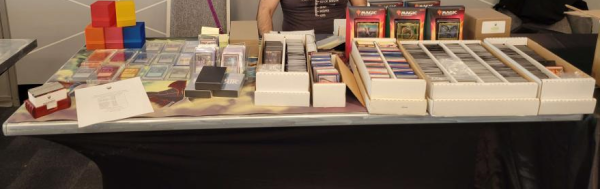
My wares

The total contents included about 2,000 bulk rares and mythics, 1,000 bulk foils, 4,000 playable commons/uncommons, and 500 or so full art, borderless, alternate art cards on one side. On top of that, 2,000 very playable cards, and 600 staples, with a small selection of very high-end vintage, Commander, and Modern cards on the other side. In terms of "sealed" product, I only brought some Commander decks, a few Secret Lairs, and a couple of homemade 40-card and 1,000-card bulk boxes.

Essentially, what I brought was mostly from the last four collections I purchased. I've said it before and I will say it again: buying collections has always yielded the best bang for buck for collecting, reselling, and playing Magic. And there's another advantage to collection buying that we'll cover a little lower.

The Show Must Go On

Our setup was quick because I deliberately did not bring everything I could. I had the table dimensions beforehand and a good idea that I would be using most of the space provided. While I could have brought a little more, I knew it would complicate setup and take up mental capacity that I did not have to spare.

With 30 vendors setting up, I was glad to be seated and ready early. Everyone was incredibly nice and helpful; many people pitched in to help others get their booth or table ready. The atmosphere was very positive and there was a tremendous selection of sports cards and Pokemon cards and accessories to behold. But only one Magic guy. Alright, technically, the event planners also had some Magic, but mostly sealed stuff and quite a bit less than what I brought. Soon enough, the show began, and so kicked in my sense of dread: it soon became obvious I was trying to sell Magic cards at a Pokemon show.

An Hour of Torment

My table was strategically chosen. I wasn't the absolute first table at the main entrance, but it was the most logical place people would funnel through immediately after. The second the event started, a mass of bodies surged into the event hall. This video demonstrates how packed the event really was (and you can catch me around the 12-minute mark).

Anticipating my first customer, I watched and waited as person after person walked up, scanned my entire table, saw I had nothing Pokemon-related, and continued on their way. This continued for the first hour of the event. Yes, I had zero customers for an hour.

The Hydra known as FUD began to manifest. I drove two hours for this? My brain sparked and steamed while it calculated exactly how much time and money I wasted. Hundreds of people walked past my table but no one picked up a single card let alone bought something. Finally, one older man approached and asked if I had a certain card. I told him there was no such card, but I named other potential cards that shared a similar name. Turns out he was looking for a Pokemon set.

However, after that first hour, we had our first customer, and then another, and another, and another, non-stop, until the entire event was over. Not only was the event absolutely packed, but eventually, so was my table!

The Magic MVPs

The single most expensive card I sold was a foil, borderless Myrel, Shield of Argive, followed by a Craterhoof Behemoth. I also sold a regular Myrel, so clearly that card is in demand. In terms of the quantity scale, Sol Ring was the most popular card, by far, followed by Hedron Crab. As an additional data point, I did sell a handful of Yu-Gi-Oh! cards to two people who had also bought Magic cards and happened to ask for them.

I talked to each customer extensively about Magic. The trend in terms of format was clear, as almost every player was a Commander player. No one identified as a Standard player, and just a couple of people mentioned Modern, Pioneer, or Legacy. Let me tell you this Wizards, but more so Hasbro: no one likes you, no one. Also, few people enjoy Arena. Yes, they play it for free, but no more spending money.

That said, the players themselves varied wildly in age, experience, and needs. One gentleman had been playing Commander for two days and was building his own deck. Another wanted singles to complete their set of AFR; they did not actually play. A customer making a Quest for Ula's Temple deck needed Kraken, Leviathan, Octopus, and Serpent cards. Another player looking through singles helped pull those creatures for them.

The fact is, Magic players are a very diverse bunch, and the cards mean many different things to many different people. It's practically impossible to predict why what might appeal to to who, so a broad selection of cards was the best strategy here. Luckily enough, four completely different collections happened to provide that sort of broad selection.

All Good Things Come to an End... With a Twist

Nearly five hours of non-stop sales later, the calm appeared quite suddenly. It was at this time that I was able to give my full attention to the vendor sitting next to me. They represented Vanity Slabs. He had a pretty interesting product, and we chatted about card protection solutions. He was already in the mystery booster market for Pokemon and was interested in trying the same for Magic.

I gave him some quick numbers about rares, foils, and the distribution in each standard $3.99 pack. Sitting next to me was the perfect point of view to see people digging through boxes and buying cards for hours. I had bulk cards, and he wanted to buy bulk cards. We reached an agreement: I got a bunch of top loaders and slabs, and brought far fewer cards home. All told, that boost at the very end put my sales into a much happier place.

I'm sure I was not the most successful vendor at that event, but I feel vindicated. Magic sold well enough for it to be worth doing even in an ocean of Pokemon. What does that mean for my local prospects? It's still too expensive in my opinion, and I'm not sure I want to pay to find out how poorly it will go. However, just a short trip away, there's an extremely attractive alternative. If anyone is thinking Magic is on the way out, a bleak recession is killing sales, and they need to liquidate their position, well, please let me know, because I am buying. Don't succumb to FUD; instead, find other opportunities.

What Did NOT Sell

The most poorly selling "segment" of what I brought was "old stuff." It did not matter if it was graded Revised duals, original Legends cards, or ultra premium foil cards from older sets. Not only did none of those cards sell, no one made an offer on any them.

More than once, people commented on how great my prices were. Realistically, these cards are not worth it for most players, and only appeal to die-hard enthusiasts or collectors. Now, granted, these are the people I figured would attend a card show. However, the simple fact might be that they did not know about the event. Well, I still have the cards for next time!
Also, there were some much more expensive Commander cards like Jeweled Lotus Dockside Extortionist and The Ur-Dragon that didn't sell, so maybe people are feeling the pinch of inflation and economic woes when it comes to bigger-ticket items. Still, I feel that people bought as many cards as they could afford.

See You in Three Months

I will definitely be going back in April. For a first show, the turnout was incredible, so I can only imagine the next one. A special thanks and shout out go here to Mang's/PLM Collectibles for starting up and hosting the show. I think the Mangold brothers took their slightly different outlooks and combined them to find this unique opportunity in a swirling sea of uncertainty.

Nothing beats buying in person. Customers can examine cards up close and be happy with having a card in hand rather than be disappointed when the wrong condition or edition gets shipped to them. There's generally room for a cash discount, haggling, or bulk negotiations; Magic players are all about value! Finally, there's just the thrill of the hunt, which appealed to so many of my customers who spent up to an hour digging through inventory looking for those gems. You know what they say about Magic: gotta gather'em all!

When is the last time you went to a card show? Have you ever been a vendor at a show? Did you enjoy it? Let me know in the comments.

Dam Burst: Underworld Breach Diversifies

Are you a Quiet Speculation member?

If not, now is a perfect time to join up! Our powerful tools, breaking-news analysis, and exclusive Discord channel will make sure you stay up to date and ahead of the curve.

Easily the biggest bonus I get from doing the Modern Metagame Updates (next one's out next week) is watching decks grow and evolve. Magic is not a static game, and even in relatively stable metagames such as Modern, decks are constantly adapting to exploit edges and/or deal with new threats.

January is no exception, and the deck that has shown the most development by far is Jeskai Underworld Breach. Breach itself is something of the card of the month, having managed to worm its way into a lot of decks in January. However, its most common home remains Jeskai Breach, though the deck now takes many forms.

Avoiding Collapse

Among the escape cards from Theros Beyond Death, Underworld Breach has had a strange history. It was the first to be banned (in under two months since release) thanks to being fantastically broken in Legacy, but everywhere else it was overshadowed by Uro, Titan of Nature's Wrath. It was always compared, and not unreasonably so, to the busted Yawgmoth's Will, but never managed to achieve that level of power.

There was an error retrieving a chart for Underworld Breach

The problem has been that the context of Will is very different to Breach's reality. Will was legal at a time when fast mana was omnipresent, but Wizards has learned from past mistakes, and now such acceleration is quite rare. There are far fewer options (in non-Eternal formats) to power out a huge Will turn. Breach also can't get back lands and requires cards to exile, limiting its utility. The difficulty of using Breach versus Will meant that Breach has never lived up to its billing as the next Will.

A Singular Home

That isn't to say that Breach saw no play in 2020-2021. I remember seeing many players try to make various Breach combos happen at various times. However, they never really went anywhere. The combos were too susceptible to graveyard hate, too all-in, and/or poorly optimized. Sometime in late 2021 into 2022, a new version utilizing Grinding Station and Urza's Saga emerged. This one started gaining traction and finally became a regular part of the metagame when Ledger Shredder released. It remained the most common version until very recently.

Jeskai Breach Combo, sshearing (MTGO Preliminary 4-0)

Creatures

4 Ragavan, Nimble Pilferer
3 Ledger Shredder
1 Thassa's Oracle
4 Emry, Lurker of the Loch

Planeswalkers

2 Teferi, Time Raveler

Instants

1 Lightning Bolt
4 Unholy Heat

Sorceries

4 Expressive Iteration

Artifacts

4 Mishra's Bauble
3 Mox Amber
1 Aether Spellbomb
1 Springleaf Drum
3 Grinding Station

Enchantments

4 Underworld Breach

Lands

2 Arid Mesa
2 Flooded Strand
1 Hallowed Fountain
1 Island
1 Mountain
1 Otawara, Soaring City
1 Sacred Foundry
4 Scalding Tarn
2 Spirebluff Canal
2 Steam Vents
4 Urza's Saga

Sideboard

2 Engineered Explosives
1 Tormod's Crypt
1 Pithing Needle
2 Prismatic Ending
1 Shadowspear
2 Spell Pierce
2 Drannith Magistrate
1 Teferi, Time Raveler
1 Wear // Tear
2 Fury

The number of white cards played maindeck has varied, but the deck has always been called Jeskai Breach anyway.

The deck's plan is to use Ragavan, Nimble Pilferer and Saga to prep for the combo, with the former providing mana and fuel while Saga improves Grinding Station. From there, the deck can either just win with the aggro plan or use Shredder and Emry, Lurker of the Loch looping Mishra's Bauble to find Breach, dump their library into their graveyard, and win with Thassa's Oracle.

Poking Holes

In the hands of a master, this deck is a machine. The multiple nonoverlapping gameplans make it hard for opponents to effectively attack the deck. There's the Ragavan tempo plan, the Saga/artifact value plan, and the combo plan, and no clear way to tell which one the opponent is going for until it's too late. The deck can also shift seemingly effortlessly from one plan to another to dodge the opponent's counter. Simultaneously, every gameplan can work with any other one, making this a true whole-greater-than-parts deck. However, this praise just serves to soften the following blow.

There was an error retrieving a chart for Emry, Lurker of the Loch

While this version of Breach has been the most successful, it has never set Modern on its ear. In fact, it's been a pretty minor player overall. The deck tends to do much better online than in paper, but still tends to hang out in mid-Tier 3 to low-Tier 2. Last month it cracked Tier 1 online, but that's thanks entirely to all the outliers. The trend for most of 2022 was for Jeskai Breach Combo to show up in force to win a Challenge, then disappear for a week before repeating.

The Problem

The issue is that all the aspects of Breach Combo that make it a good deck also make it a very hard deck to play well. Knowing when to shift between which plan, and more importantly how to sideboard in every matchup, is extremely important, and not easy to learn. The masters make it look easy, but it isn't, and many unfortunate players found that out the hard way.

There was an error retrieving a chart for Grinding Station

While I appreciated the power of Breach Combo, I've never considered it much of a player or a metagame threat. It has the same popularity problem as Krark-Clan Ironworks. The deck might be a demon in the metagame, but that doesn't matter if it sees little play. A deck that requires mastery to function will only be played by masters, and consequently won't impact the overall metagame much. Given that Breach doesn't have the Ironworks timing weirdness and tournament length issues, I figured that it would remain a curiosity more than a threat.

Floodgates Open

I don't know why, but starting in late December, Breach began to show up in far more decks than before. I'm inclined to blame Aspiringspike popularizing the move, but it also might be coincidence. Izzet Prowess may have been the headliner, but any red deck can have Breach in it these days, even Grixis Shadow. That said, Breach Combo has evolved more than the other decks, and in an unexpected direction.

The First Adjustment

For the first week of January, Jeskai Breach seemed to be chugging along as it always did. Around the 12th, something changed, and players started running an entirely new version.

Jeskai Storm Breach, Dylan Ashcraft (SCG Con New Jersery 20K Trial)

Creatures

4 Dragon's Rage Channeler
4 Ragavan, Nimble Pilferer
4 Ledger Shredder

Planeswalkers

2 Teferi, Time Raveler

Instants

4 Consider
4 Lightning Bolt
2 Spell Pierce
3 Unholy Heat

Sorceries

1 Prismatic Ending
4 Expressive Iteration
1 Grapeshot

Artifacts

4 Mishra's Bauble

Enchantments

4 Underworld Breach

Lands

1 Arid Mesa
1 Fiery Islet
4 Flooded Strand
1 Hallowed Fountain
1 Island
1 Mountain
1 Sacred Foundry
4 Scalding Tarn
3 Spirebluff Canal
2 Steam Vents

Sideboard

2 Alpine Moon
2 Flusterstorm
1 Pithing Needle
2 Prismatic Ending
1 Spell Pierce
3 Dress Down
2 Hallowed Moonlight
2 Test of Talents

While hardly the first time that someone paired Breach with Grapeshot, the above deck represents the first time I had seen this configuration. The idea was to primarily be a straightforward Ragavan tempo deck most of the time, while having a combo kill available with Breach. That meant giving up the Saga package, but in exchange, having no contextually dead cards.

This version will naturally fill its graveyard with Breach fodder, but Dragon's Rage Channeler also ensures a continuous stream of food. There's no way to generate mana, but in a pinch, cycling Bauble will do the job to find Grapeshot and win with four lands. Alternatively, a few Breached Bolts might prove all that's necessary.

Immediately Moving On

This variant lasted about one weekend before being dumped. It appears that it was designed for SCG Con New Jersey, and with that event in the books, Jeskai Storm Breach's play cratered. I'm not certain why, but I suspect that after actually playing the deck, most players decided that Grapeshot wasn't necessary and simply dropped it.

Jeskai Value Breach, Alakai (MTGO Challenge, 2nd Place)

Creatures

4 Dragon's Rage Channeler
4 Ragavan, Nimble Pilferer
4 Ledger Shredder

Planeswalkers

2 Teferi, Time Raveler

Spells

4 Consider
4 Lightning Bolt
1 Prismatic Ending
3 Spell Pierce
1 Spell Snare
2 Unholy Heat
4 Expressive Iteration

Artifacts

4 Mishra's Bauble

Enchantments

4 Underworld Breach

Lands

1 Fiery Islet
4 Flooded Strand
1 Hallowed Fountain
1 Island
1 Mountain
1 Sacred Foundry
4 Scalding Tarn
3 Spirebluff Canal
3 Steam Vents

Sideboard

1 Jegantha, the Wellspring
1 Engineered Explosives
2 Flusterstorm
1 Prismatic Ending
1 Dress Down
2 Hallowed Moonlight
2 Unlicensed Hearse
2 Blood Moon
1 Monastery Mentor
2 Wear // Tear

The current versions of Value Breach look like UR Murktide decks with Breach over Murktide Regent and some added white cards. Which isn't a bad direction, seeing how successful Murktide is.

This deck isn't planning on an actual combo kill at any point. Instead, it intends to use Breach more like Snapcaster Mage on steroids and just out-value the opponent. A solid strategy. However, not so strong that it has rendered Combo Breach totally obsolete.

Where Things Stand

At time of writing, I haven't seen any Storm Breach decks in the data for over a week. It was probably too cute to survive. Meanwhile, Value Breach and Combo Breach are showing up in comparable numbers online, with Combo being slightly more popular in paper. I can't tell if this is a case of two completely separate decks emerging, or if one will eventually consume the other. I do know that it has split Breach's player base and will be lower in the metagame standings than in December.

There was an error retrieving a chart for Ragavan, Nimble Pilferer

Value Breach is a far easier deck to pilot well than Combo, though the ceiling is much lower. So it's likely attracting a lot of players who couldn't hack Combo. Still, the lower ceiling has kept it from placing as well as the Combo variant, and the deck is far more vulnerable to disruption. It only has the one central plan to attack, compared to Combo's three. I'm more afraid of a good Combo player than the average Value player, but I expect to see more Value than Combo in the near future. In paper, anyway.

Fighting the Flood

With Breach decks on the rise, players need to be ready to fight back. The obvious answer is graveyard hate. Emry, Channeler, and Breach itself all need cards in graveyards to do anything. Players know this and have been playing hate against Breach since it came out. It isn't working, and for very predictable reasons. The problem is that Modern players have become complacent. The Dredge Cycle is in full swing.

Hard vs. Soft Hate

The ease of playing Endurance and Relic of Progenitus-type cards maindeck (thanks to Saga) has made players think that they're playing enough graveyard hate. The tale of the tape says that isn't true. Despite the prevalence of the above cards, Dredge is seeing a comeback, and will be Tier 3 this month. The reason is simple: players are reliant on soft hate rather than hard hate against decks where hard hate is necessary.

There was an error retrieving a chart for Endurance

In this context, hard hate signifies cards that permanently remove the graveyard from play, like Rest in Peace. Soft hate is one-shot removal. The former completely guts a graveyard strategy; the latter, merely disrupts. There's nothing wrong with disruption, but graveyard decks can navigate around and through soft hate, while hard hate must be answered.

There was an error retrieving a chart for Rest in Peace

Against Breach and Dredge, the timing of the hate is critical. Too soon, and it will be too easy to rebuild. Too late, and it's too late. With hard hate, you just slam down the cards and hope it sticks.

Breach decks have always had options for building up a graveyard, then protecting it with Teferi, Time Raveler, removing Endurance from consideration. It has been very convenient for players to rely on soft effects, but it makes it much easier for graveyard decks. More hard hate is necessary.

The Right Tool

Of course, the right tool for the job is always necessary. The best hate card will always be matchup-dependent. However, given how all the Breach decks are set up, I'd recommend the following three cards, in this order:

Sanctifier en-Vec: I've slagged off Sanctifier en-Vec for not being hard enough in the past, but this card is the best tool for the job against the Breach decks. Yes, it only removes some cards from the graveyard, but that's usually enough. Against Value and Storm Breach, the red cards are the only threatening ones. Removing red cards makes it significantly harder for Combo to actually combo off. It can't be Spell Pierced, and Breach only plays three-to-four answers. More importantly, Sanctifier also shuts down the Ragavan plan, which all the decks share. You always want the card that does the most, and that's Sanctifier. As a bonus, it completely clowns Dredge.

Rest in Peace: The definitive hard graveyard hate card, Rest in Peace is the best there is at totally hosing down graveyard strategies. The main problem is that is all it does. Value and Storm Breach are, again, crippled by this card, but Combo will just employ Saga value to win. There's also a lot more enchantment hate out there than there used to be too.

There was an error retrieving a chart for Leyline of the Void

Leyline of the Void: While largely replaced by Dauthi Voidwalker, Leyline is much better against Breach decks because it doesn't die to Unholy Heat. It's also nearly immune to Prismatic Ending. The problem is that it is terrible when drawn.

Beat Back the Flood

The lack of hard graveyard hate in Modern is letting all the Breach variants get away with their weaknesses. Sanctifier in particular has been falling off, to the point where it isn't any longer a universal inclusion in Hammer Time. Players have grown complacent, and the graveyard decks are creeping back in. One-shot removal is fine against decks looking for graveyard value, but not good enough against the real graveyard abusers. Don't just lose to Breach if you don't have to... let alone to Dredge!

Top 10 Modern Cards from ONE

Are you a Quiet Speculation member?

If not, now is a perfect time to join up! Our powerful tools, breaking-news analysis, and exclusive Discord channel will make sure you stay up to date and ahead of the curve.

Glory to Phyrexia! The Mother of Machines has graced us with a new array of powerful cards to stand as a Monument to Perfection in her army's expanse into the vast multiverse. Phyrexia: All Will Be One comes with a handful of new additions to compleat your top tier and fringe Modern decks, and even spawn new archetypes all their own.

Join me and the Machine Orthodoxy as we rejoice in our new format staples!

10. Minor Misstep

There was an error retrieving a chart for Minor Misstep

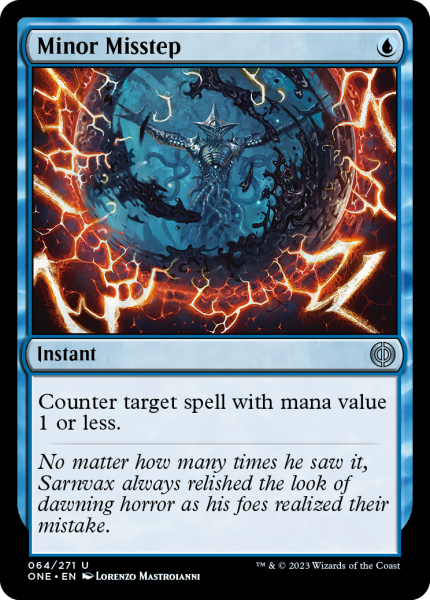
Minor Misstep is a callback to Mental Misstep, a certifiably broken card that was quickly banned in Modern and Legacy as well as restricted in Vintage. While Minor Misstep likely won't reach quite the same heights, it's a strong sideboard addition to combat Cascade decks like Living End and Crashing Footfalls. While Spell Pierce can often accomplish a similar job in the main deck and sideboard answers such as Chalice of the Void may be stronger, Misstep is a nice targeted answer with other practical uses.

Countering big plays from Hammer Time like Esper Sentinel, Sigarda's Aid, and Colossus Hammer is very enticing. Similarly, Misstep is able to answer Ragavan, Nimble Pilferer and Dragon's Rage Channeler as well as stop Unholy Heat and Lightning Bolt from UR Murktide.

Minor Misstep looks to be a solid silver bullet sideboard card against Cascade while also shoring up other popular matchups. That flexibility makes it an excellent addition to a blue deck's counterspell suite.

9. Melira, the Living Cure

There was an error retrieving a chart for Melira, the Living Cure

Melira, the Living Cure is another callback, this time to Saffi Eriksdotter. The key difference between these two creatures is that Saffi sacrifices herself, which opens up avenues for combo potential, while Melira self-exiles. However, Melira comes with a much more enticing stat line. a 3/3 creature for WG with board-wipe protection is very interesting in an aggressive tempo deck like Humans. While the Thalia, Guardian of Thraben deck has struggled in a format with Fury, cards like Extraction Specialist, Unsettled Mariner, and now Melira offer enough protection to possibly stage a comeback.

Notably, Melira works well with cards that want to self-sacrifice like Ranger-Captain of Eos and Burrenton Forge-Tender, while threatening to re-trigger a Thalia's Lieutenant once the opponent is forced to remove it. Overall, she's a solid beater that adds a layer of protection to more essential game pieces.

8. Sheoldred's Edict

There was an error retrieving a chart for Sheoldred's Edict

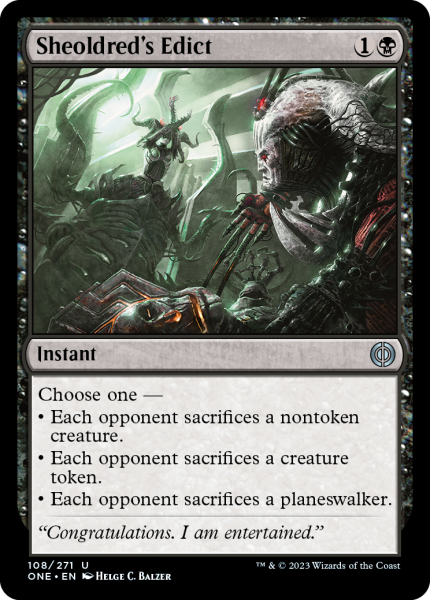
Sheoldred's Edict is one of the strongest edict effects we've seen in quite some time. Realistically, the opponent will only have one planeswalker in play most of the time. Statistically speaking, that's going to either be Wrenn and Six or Teferi, Time Raveler, both cards I would be very happy to clear off the board.

Being able to choose between the edict hitting a token or nontoken creature is also excellent against Indomitable Creativity decks looking to cheat Archon of Cruelty and Emrakul, the Aeons Torn into play. Those decks would normally be able to use a fetch land to find Dwarven Mine and sacrifice the token creature it creates, but Sheoldred's Edict could force them to lose their more threatening creature.

Notably, this is one of only a few two-mana instants that can permanently answer Jace, the Mind Sculptor or Teferi, Hero of Dominaria. Its predecessors Fracture, Baleful Mastery, and Assassin's Trophy are not especially playable.

7. Thirsting Roots

There was an error retrieving a chart for Thirsting Roots

Thirsting Roots is the latest in a long line of Lay of the Land variants. Similar to the Zendikar Rising modal dual-faced cards, cards like Thirsting Roots are helpful as they allow the player to run more spells while still ensuring access to enough mana sources. In this case, the secondary mode being a one-mana proliferate is a huge pick up for Hardened Scales decks looking to maximize counters on their Walking Ballistas and Arcbound Ravagers. The deck currently plays Throne of Geth which costs twice as much to cast.

I see Thirsting Roots as a staple for this archetype going forward and I'm excited to see a resurgence of the archetype.

6. Kemba, Kha Enduring

There was an error retrieving a chart for Kemba, Kha Enduring

Kemba, Kha Enduring is an interesting pickup for the Hammer Time deck which sometimes plays the similar Kor Outfitter in its flex slots. While Kemba can't attach Colossus Hammer to a non-summoning sick creature the way Outfitter can, it offers longevity and a mana sink, which helps expand Hammer's potential lines of play.

Notably, Kemba can auto-equip itself with Kaldra Compleat to become an 8/8 indestructible, trampling, and hasty attacker. Similarly, it can auto-equip with Shadowspear against a Burn opponent to become a 4/4 lifelinker that they'll struggle to answer. I don't see this as a four-of, but one copy in the main deck seems right to me.

5. Capricious Hellraiser

There was an error retrieving a chart for Capricious Hellraiser

I'm not entirely sold on Capricious Hellraiser, but the card has a lot of words on it that I like. With the right setup, this is a three-mana flying 4/4 that potentially draws a free card. In a lot of ways, it's like a Bloodbraid Elf with a body designed for 2023 Magic. Decks like UR Murktide and Prowess variants do a great job at putting spells in the graveyard which helps to reach that critical mass of nine cards for Hellraiser's discount.

While there is combo potential by putting something like Enter the Infinite or Emergent Ultimatum in the graveyard, I think this card is better off as just a value piece casting something like a Bolt or Manamorphose.

My biggest concern is that fetch lands and Dragon's Rage Channeler are the keys to enabling Hellraiser's discounted cost ahead of schedule, but too many of these cards in the graveyard may cause the triggered ability to whiff. It's a delicate balance that I'm not sure how to support in deckbuilding, but I'm curious if someone else can crack the code.

4. The Mycosynth Gardens

There was an error retrieving a chart for The Mycosynth Gardens

If I had a nickel for every time Wizards printed a land that makes Amulet of Vigors, I'd have two nickels, which isn't a lot, but it's weird it happened twice. One of the biggest boons for Amulet Titan was the printing of Urza's Saga, which tutors out its namesake Amulet. The Mycosynth Gardens is a new land that can copy an artifact in play. As far as Amulet Titan is concerned, two amulets is basically infinite mana to work with.

As Gardens can activate at instant speed, it's a nice backup that can make a copy in response to removal on the Amulet.

I also see this card as an auto-include in the Lantern of Insight control deck that wants to use cheap artifacts like Ghoulcaller's Bell to restrict what the opponent draws. The greatest struggle of the deck is having enough mill rocks to remove multiple good cards from the opponent's deck in a single turn. Redundancy for these artifacts with minimal deckbuilding cost is a great quality-of-life upgrade.

3. Nahiri, the Unforgiving

There was an error retrieving a chart for Nahiri, the Unforgiving

Nahiri, the Unforgiving is one of our newly compleated planeswalkers with its own built-in cost reduction. Nahiri does a little bit of everything—from filtering draws, to enabling her own reanimator effect, to protecting herself, to even making chump attackers. All of her effects work well together and it's relatively easy to conceptualize a lower-curve deck with strong enters-the-battlefield effects for her to exploit.

My first thought is her ability to bring back a hasty Stoneforge Mystic, finding and cheating a Kaldra Compleat into play. Alternatively, bringing back Ranger-Captain of Eos is also very powerful. Theoretically, a Mardu Death's Shadow deck could utilize Nahiri's life loss and recursion to buff Shadow as well as make massive surprise attackers.

There is so much to uncover with this card and I'm excited to dig deeper into the possibilities.

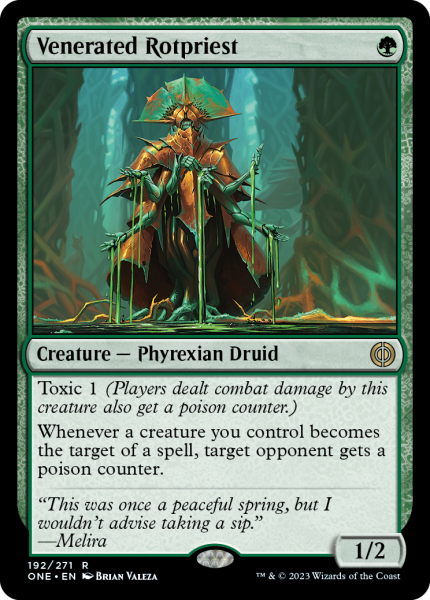
2. Venerated Rotpriest

There was an error retrieving a chart for Venerated Rotpriest

This card is fascinating. Venerated Rotpriest gives a poison counter to the opponent whenever a creature the player controls is targeted by a spell. This includes your spells and copies of spells put on the stack, i.e. storm. Enough net-zero mana spells like Mishra's Bauble and Manamorphose leading into Ground Rift would make Rotpriest lethal as early as turn two. Notably, the one-mana creature's effect stacks with multiple copies. I could easily see a RG Storm deck utilize these cards with Underworld Breach for a combo kill. Alternatively, Niv-Magus Elemental or a creature with magecraft like Dragonsguard Elite can present as massive threats as a plan B.

Admittedly this archetype is fragile to the unconditional removal of the format like Solitude, but could easily win games out of nowhere against unwitting or poorly-equipped opponents.

1. Tyvar, Jubilant Brawler

There was an error retrieving a chart for Tyvar, Jubilant Brawler

It's only fitting that our resident himbo planeswalker, Tyvar, Jubilant Brawler is a Thousand-Year Elixir on steroids. As an elf, it makes sense that he works well well in decks that want to tap creatures for mana. However, instead of a dedicated elf list with Llanowar Elves, I think this fits best within the Devoted Druid combo archetype.

This deck wants to use Devoted Druid with Luxior, Giada's Gift or Vizier of Remedies to create an infinite mana and infinite untap combo. From there, Walking Ballista or Viridian Longbow can deal infinite damage.

Tyvar sidesteps the bottleneck of summoning sickness on Devoted Druid while also picking up disrupted or missing combo pieces from the graveyard. He's a Swiss army knife for all the things the Devoted Druid deck wants to do, and at only three mana, he's priced to move.

End Step

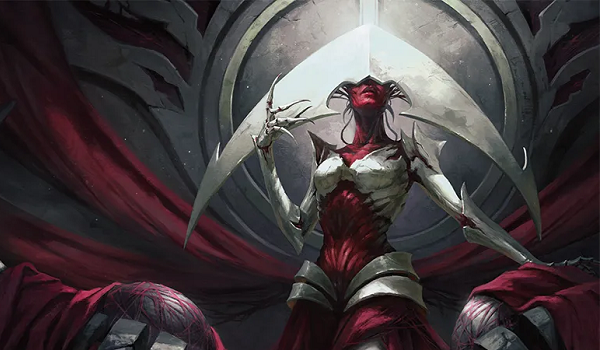
Feast your eyes upon the ossified perfection of New Phyrexia! What future staples did I leave off my list that deserve the honor of becoming part of Elesh Norn's porcelain throne? Leave a comment below (in English or Phyrexian) or tweet me at @AdamECohen to let me know. Next week I'll be back with another list covering new additions to Pioneer. You won't want to miss it!

Toxic’s Not-So-Toxic Impact on Magic Finance

Are you a Quiet Speculation member?

If not, now is a perfect time to join up! Our powerful tools, breaking-news analysis, and exclusive Discord channel will make sure you stay up to date and ahead of the curve.

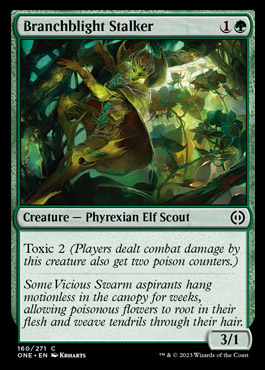
It’s back! After a lengthy, multi-year hiatus, the popular poison ability is returning in Phyrexia: All Will Be One (ONE). Being a seasoned player, the prospect of killing my opponents with the alternate win condition of ten poison counters always puts a smile on my face. I thought the idea was fantastic 25 years ago and I still love the idea now.

This time the effect looks a little different—you could say, it’s an improvement. Creatures aren’t going to have “infect” as they did back in Scars of Mirrodin block. Thankfully, the cards also won’t contain lengthy, confusing text about dealing poison counters like they did when the ability was first introduced in the '90s. Instead, Wizards of the Coast has decided to use the keyword “toxic”. Boomers like myself will think of the catchy Britney Spears song every time they see a toxic creature on the battlefield.

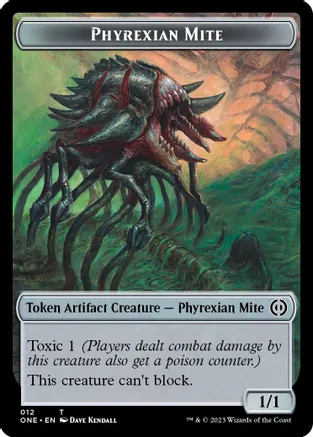
The ability states, “Players dealt combat damage by this creature also get N poison counters.” This is a welcome rewrite because it reduces the tension a player faces between trying to kill their opponent with regular damage and poison counters at the same time. I look forward to seeing this change’s impact on Limited.

A Little History

Poison counters have been around for a long time. They weren’t in Alpha, Beta, or Unlimited, and didn’t show up in Arabian Nights or Antiquities, Magic's first two expansions. Poison counters debuted in the form of two cards from Magic's third expansion, Legends, printed in 1994. The first card was the unassuming common Pit Scorpion.

There was an error retrieving a chart for Pit Scorpion

The second card to mention poison was also the first rare with the ability, Serpent Generator. This was an artifact that could pump out 1/1 snakes that dealt poison counters. The card was reprinted in Chronicles and Fifth Edition, and as a result, the original Legends printing isn’t worth a whole lot.

There was an error retrieving a chart for Serpent Generator

Wizards of the Coast doubled down on poison in The Dark, with the printing of Marsh Viper, an unimpressive four-mana 1/2 creature that dealt two poison counters to an opponent when dealing damage to them. The kid in me reads this card and wants to enchant it with Psionic Gift as an alternate way of dealing poison counters without requiring combat. But I digress.

Wizards printed a smattering of cards containing poison counters throughout the first three years of the game. Poison counters appear in Mirage, Visions, Alliances, and Homelands. After that, the ability kind of disappeared for a while. It didn’t make a comeback until Future Sight in 2007. That set introduced a bunch of new keywords, including poisonous.

There was an error retrieving a chart for Snake Cult Initiation

Poisonous looks similar to the new toxic ability. Where toxic is a static ability that happens when a creature with toxic deals damage, poisonous on the other hand, was a triggered ability that went on the stack and could be responded to.

There was an error retrieving a chart for Virulent Sliver

Following Future Sight, the next major appearance of poison counters came with Scars of Mirrodin block. That’s when poison really took off. The new infect mechanic allowed creatures to deal damage in the form of poison counters to players and became a major strategy in Modern. The rest, as they say, is history, and now we’re coming back to the world of Phyrexia—it only stands to reason that new poison-related cards are going to show up!

Poison Prices

Historically, it seems cards that dealt with poison counters haven’t been worth a whole lot. Even thinking back to the Modern Infect deck days, the creatures with infect themselves weren’t worth a whole lot. Glistener Elf and Blighted Agent were both common in New Phyrexia and therefore quite easy to come by.

The valuable cards in that deck (besides the Fetch Lands and Shock Lands) were Inkmoth Nexus, Noble Hierarch, and to a lesser extent, the efficient instant-speed combat tricks the deck utilized to push poison damage—Might of Old Krosa, Vines of Vastwood, and Mutagenic Growth.

There was an error retrieving a chart for Mutagenic Growth

I’m not sure if cards that deal poison counters from Magic’s history will move in price all that much in response to the introduction of toxic. Perhaps the more interesting cards are the ones that prevent or counteract poison counters.

For example, Melira, Sylvok Outcast’s price has jumped about 50% in response to ONE’s spoiler season. This could be because of its ability to prevent poison counters, but the creature doubles down as a way of interfering with oil counters too.

There was an error retrieving a chart for Melira, Sylvok Outcast

I don’t know if Melira’s new price point is justified or if it’s only temporary—it’ll depend on what decks break out after this set’s release. The last time we had a wave of new poison cards, it created a brand new archetype for Modern. Perhaps the same thing will occur with ONE.

Vorinclex, Monstrous Raider, the mythic rare from Kaldheim, was already quite expensive. Being able to double poison counters and oil counters, however, gives this creature even more applications. I’m not sure what its upside is from here, and I personally wouldn’t sit on a stack of copies as it feels particularly vulnerable to a reprint. That being said, these could be worth picking up in trade for short-term storage of value. Until that reprint comes, I don’t see Vorinclex dropping in price.

There was an error retrieving a chart for Vorinclex, Monstrous Raider

Hand of the Praetors, a rare from Scars of Mirrodin, has also been on the rise since 2021, though its price has fluctuated quite a bit recently. Unfortunately, this poison lord only pumps creatures with infect, so your toxic creatures from ONE won’t benefit. Its third ability, however, could provide some additional poison pressure in the right deck. Still, I think this creature will be relegated to 100-card decks for the foreseeable future.

A couple of other cards mention poison counters but haven’t really moved in price (yet). I’d keep an eye on Decimator Web, which is nearly bulk. The artifact has never seen a reprint and it could be attractive to casual players who are interested in poisoning their opponents and decking them simultaneously. A slew of Phyrexian creatures would also fall on this list, including Phyrexian Crusader, Phyrexian Hydra, Phyrexian Swarmlord, and Phyrexian Vatmother.

Who could forget about Putrefax? Probably most people, as the card is still only worth about fifty cents.

There was an error retrieving a chart for Putrefax

No More FOMO?

A decade or more ago, when Magic finance was a way of life for folks, the spoiling of toxic would have driven a buyout of many infect and poison cards. To the old finance chasers, all these Scars of Mirrodin block infect cards would seem ripe for the picking. Nowadays, people realize that far more often than not, these gut-reaction purchases don’t pay out unless you can sell to a greater fool. It’s actually a relief to see that this FOMO-driven behavior has subsided in recent years. The stabilization of prices is healthier for the game in the long run.

There’s one last card I would be remiss if I failed to mention. I created this section particularly to talk about it. It's the only card on the Reserved List that references poison. It's a white sorcery from Homelands. Can you guess it?

There was an error retrieving a chart for Leeches

That’s right, it’s Leeches. Leeches is the only card ever printed that can directly remove poison counters. Because of this unique ability, the card has spiked and dropped in price multiple times throughout its history. Looking at the current price graph, it appears to be on an upswing yet again.

TCGplayer’s market price is north of $12. This feels crazy for a Homelands card that has seen and will continue to see no play. It isn’t legal in Modern and is too specific for Commander. To become relevant, some unlikely factors would have to occur. First, Legacy would need to resurge in popularity, and toxic/infect strategies would have to dominate the format. Second, players would have to be playing white to even consider sideboarding this card.

It's never going to happen. Don’t buy this card. The top buylist price for this card is $3.70, around 30% of the market price. That’s not a coincidence.

Wrapping It Up

Poison is like a popular comet or astrological phenomenon: it comes back only every so many years. Like a comet, fans look forward to the ability’s return and the chance to experience it in modern times.

For Phyrexia: All Will Be One, the ability received a rewrite so that creatures can deal damage and poison counters at the same time. I think this is a net positive and should make the Limited format more enjoyable as a result. I remember enjoying Limited the last time poison counters were a thing, back in Scars of Mirrodin block, and I hope this set will yield a similar experience.

In fact, writing this article has somewhat rekindled my interest in Limited again. I just wrote about how I’ve been ignoring Magic recently. When researching and writing this article, however, I realized the new set has some real potential, at least when it comes to Limited play. I just may dust off some gold and gems I have lying around on Arena to give this format a spin. It’ll probably be better than The Brothers’ War, right?

I hope other players are also excited to (re-)experience poison in Standard and Limited. The ability creates some fun dynamics, and I suspect this time will be no different.

Just don’t buy Leeches.

Sneaking & Showing: A Legacy Tournament Report

Are you a Quiet Speculation member?

If not, now is a perfect time to join up! Our powerful tools, breaking-news analysis, and exclusive Discord channel will make sure you stay up to date and ahead of the curve.

Legacy is one of my favorite formats, with Commander being the other. One of my local game stores has decided to try to revive our local Legacy scene, which mostly died when Starcity Games stopped having Legacy Opens every Sunday. The store allowed any number of proxies/playtest cards, and was supposed to be free to play with no prize.

There was an error retrieving a chart for Show and Tell

I spent most of the week leading up brewing a new Yorian Bant Blade deck to test out. Unfortunately, a few of the players really wanted prize support and pushed for a $5 entry fee with store credit prize support. I felt that a completely untested deck was not where I wanted to be, so I swapped to good ol' Sneak and Show.

Here's what I played:

Sneak and Show

Creatures

4 Emrakul, the Aeons Torn
4 Griselbrand

Artifacts

4 Lotus Petal

Enchantments

4 Sneak Attack
2 Omniscience

Instants

4 Force of Will
4 Brainstorm
2 Flusterstorm
3 Spell Pierce

Sorceries

4 Show and Tell
4 Ponder
2 Preordain

Lands

4 Scalding Tarn
3 Volcanic Island
4 City of Traitors
4 Ancient Tomb
3 Island
1 Mountain

Sideboard

2 Arcane Artisan
2 Grafdigger's Cage
2 Defense Grid
4 Leyline of Sanctity
1 Red Elemental Blast
1 Echoing Truth
3 Brotherhood's End

While the final outcome was nowhere near where I wanted to be, I always try to look for positives and I was able to find some financial opportunities during my matches.

Sneak and Show Micro-Primer

They key cards in this deck are Sneak Attack and Show and Tell, which are used to cheat out either Griselbrand or Emrakul, the Aeons Torn. The rest of the deck is cantrips and counterspells.

I have cheesed Win-a-Boxes with it, and I know how to pilot it well enough. I should also mention that I haven't played Legacy since before the pandemic, so I am still a little rusty, and the sideboard was not tuned to the current metagame. I did swap out some Blood Moons and an Echoing Truth for Brotherhood's End as a card to beat Elves and Initiative decks, but more on that later.

Round 1: 12 Post (0-1)

Matchup Breakdown: This is a really difficult matchup for Sneak and Show, as 12 Post is one of the only other decks in the format to include creatures on par with our own threats.This typically means that we can't just cast Show and Tell and win the game; we have to either hope they go empty handed or dig for Sneak Attack to win with haste.

Game 1: The first round did not begin well. I ended up mulling to four, as my first three hands all had no lands in them. I finally kept a hand with no blue lands: Ponder, Lotus Petal, Ancient Tomb, and Griselbrand. Not surprisingly, I got nowhere, and my opponent won handily.

Game 2: I resolved a Show and Tell and put in Omniscience, while my opponent put in Emrakul, the Aeons Torn. Luckily for me, I also had an Emrakul, the Aeons Torn, and by casting it with Omniscience I got the extra turn trigger. I annihilated him and we went to game 3.

Even though I won this round, I was really missing those Blood Moons I had replaced with Brotherhood's End.

Game 3: My opponent wisely cast Crop Rotation into Karakas while I was tapped out, which kept me from Show and Telling my Emrakul, the Aeons Torn. I dug for either a Sneak Attack or Omniscience, but he used Cavern of Souls to get a Primeval Titan into play which got him up to Ulamog, the Ceaseless Hunger mana. The Eldrazi the neutered my manabase and ended the game.

Financial takeaways: Elvish Reclaimer was an all-star in my opponent's deck. It allowed him to tutor up Karakas as well as get his mana engine going by converting lands into Cloudposts. We also find Elvish Reclaimer in Modern Primeval Titan-based decks, where it serves as the format's only Crop Rotation effect.

There was an error retrieving a chart for Elvish Reclaimer

While this card is already far above its all-time low, it's still under $8 and even sees play in Commander. The more lands Wizards prints with powerful abilities, the better this card gets. I would look to pick these up before they rise above $10.

Round 2: 4C Control (0-2)

Matchup Breakdown: Our game plan against control is to jam a Show and Tell or Sneak Attack[card] and back it up with counter magic. We typically have to go either really fast with one counter backup or sculpt a hand and eventually aim to win a counter war. Control typically lacks answers to a fielded [card]Emrakul, the Aeons Torn, making it our key threat here.

Game 1: My opponent seemed to be a knowledgeable pilot. That being said, knowledge doesn't beat a turn 3 Emrakul, the Aeons Torn with Force of Will backup.

Game 2: I knew my opponent would likely side in a ton of counter magic, and I had very little to bring in for this matchup as I continued to pine for my Blood Moons. I let him resolve a Minsc & Boo, Timeless Heroes in order to hold up my own counter magic for Show and Tell next turn, but he managed to have both Pyroblast and Force of Will to stop me.

There was an error retrieving a chart for Minsc & Boo, Timeless Heroes

Game 3: In this repeat of game 2, we both spent our early turns cantripping to sculpt our hands. I again let his Minsc & Boo, Timeless Heroes resolve, as I had both Force of Will and Spell Pierce to force through my Show and Tell. Unfortunately, he had 3 Force of Wills, a blue card, and a Pyroblast. So after the stack cleared, we were both empty handed, and Minsc took over the game.

Financial takeaways: Minsc & Boo, Timeless Heroes proved to be a house in both our games, as well as a few I watched my opponent play against other people. It is one of the cards that runs away with the game very quickly. I have also been watching a lot of BoschAndRolls Legacy streams, and his 4C Control decks always seem to win when this spell resolves. Unfortunately, this card is not Modern-legal, meaning little extra demand from other formats, however, Legacy is a format that often drives foil prices, and the foil copies of this card are only 30% more than regular versions, which seems very underpriced. Should Legacy demand ever pickup, I could easily see foils jumping dramatically.

Round 3: Manaless Dredge (1-2)

Matchup Breakdown: This matchup comes down to who can go off faster in game 1, and making sure you have your hate cards for games 2 and 3. The card that really speeds their deck up is Lion's Eye Diamond, a high priority to counter. The good news is we need no counter-their-counter plan.

Game 1: The gentlemen I am paired against is really nice and explains that this is his first ever in-paper tournament. I knew he was on Manaless Dredge when he was playtesting earlier. He won the die roll and elected to draw. My opening hand had a turn 1 Emrakul, the Aeons Torn. Welcome to Legacy, bud!

Game 2: I have 2 Grafdigger's Cage in the sideboard, but my first two hands don't see any. I kept a slower hand that has cantrips and Griselbrand, thinking I can get there. He managed to go off on turn 3 before I had a chance to Sneak my Grislbrand into play.

Game 3: My opening hand included Grafdigger's Cage, a Griselbrand, some lands, and a few cantrips. He realized after I played Cage that it was the reason his sideboard had Force of Vigor. It took me awhile to find a payoff, but since his only way to win was to Creeping Chill me to death, I just made sure I never fell to 12 life. Eventually I found Sneak Attack, and Griselbrand and Emrakul, the Aeons Torn teamed up for a one-turn knockout.

There was an error retrieving a chart for Grafdigger's Cage

Financial takeaways: Grafdigger's Cage has received 3 major printings and a Secret Lair run, so the price ceiling on this card is rather low. That being said, it doesn't have any true "equivalents" in any format.

It seems many decks have switched to using Soul-Guide Lantern as the de-facto artifact to hate on graveyards. Lantern does offer the ability to yoink one card from the graveyard and stick around to threaten opponent's yards again, but smart opponents can force one to pop it and then continue forward. Contrastingly, Grafdigger's Cage serves as a continual hoser that happens to also hit decks that try to cheat creatures out from the deck, such as Elves and Kiki-Chord.

Round: BR Reanimator (1-3)

Matchup Breakdown: Reanimator is similar to Manaless Dredge insofar as "whoever jams their fatty first wins," except unlike Dredge, Reanimator can aggressively attack our hand. That being said, the lack of blue means they can't sculpt hands without using negative card advantage spells like Faithless Looting.

If we can survive the initial onslaught, we have a better long game than they do. It is critical to note that Archon of Cruelty is brutal when they cheat it in off of our Show and Tell, so if we're going to Show and Tell, our best option is to cheat in Omniscience first and then cast the fatty after the Archon's triggers resolve.

Game 1: I kept a turn two Sneak Attack hand with no counter magic. It was no good against my opponent's Dark Ritual, Entomb for Griselbrand, Exhume.

Game 2: Another fast one, as turn two Omniscience into Emrakul, the Aeons Torn takes the game.

Game 3: I keep a hand with Spell Pierce and a turn three Sneak Attacked Griselbrand. He has a turn one Thoughtseize to get my Spell Pierce and a turn two Unmask to get my Sneak Attack, then proceeds to Exhume a Griselbrand off of a turn three Faithless Looting.

There was an error retrieving a chart for Archon of Cruelty

Financial takeaways: Even in this format that can play every creature in the game, Archon of Cruelty has become Legacy's #2 reanimation target, and Modern's #1. It provides value when it enters the battlefield and isn't a legend, which means multiples can be cheated in and it can even be cloned. While the price has already climbed into the $14 range, this is definitely a card that could be $30+ should any deck playing it in Modern become Tier 1. It is also likely to increase slowly over time as more players get ahold of their copies and it maintains tournament relevance.

Tournament Recap

I would have obviously loved to have done better than I did. I haven't played Legacy since before the pandemic, and was definitely a little rusty. I would love to blame my poor performance on bad luck, but I know I kept some "do nothing" hands hoping to win on my deck's power level alone.

I can also confidently admit that my fear of the Initiative decks was likely unnecessary, and the sideboard sacrifices I made ended up hurting me quite a bit. I made those changes spur of the moment, and didn't consider that Sneak and Show is such an unfair deck that my opponent having even 3 turns with Initiative means nothing when their board gets annihilated.

Sneak and Show's route to losing is not resolving the namesake cards. Therefore, my sideboard needs to be adjusted to focus on beating this issue, rather than on having answers to cards that aren't truly threats.

Moral of the story: especially if you're just getting back out into the tournament world, don't try to reinvent the wheel! Ease into things and tweak accordingly. Until next time...

The Best of BRO: Lists, Rankings, and Made-Up Trophies

Are you a Quiet Speculation member?

If not, now is a perfect time to join up! Our powerful tools, breaking-news analysis, and exclusive Discord channel will make sure you stay up to date and ahead of the curve.

And so, the sun sets on yet another Draft format. The Brothers' War (BRO) rewarded tight play and creative deck building, providing many lessons to drafters. To say farewell to this archetype, we'll do what we always do: make a few lists and give out some meaningless awards.

Archetype Power Rankings

  1. Red-Based Aggro: The red aggro decks have access to a strong arsenal of tools, boasting two of the format's top commons in Excavation Explosion and Scrapwork Mutt. Penregon Strongbull plays well with almost all of the best red cards. Aggressive decks rule the day, and red has the best tools to implement this plan. Especially when supported by the synergies of its most threatening one drop, Goblin Blast-Runner
  2. Multi-Color Stalwart: Towards the end of BRO's life cycle, the low ALSA of this powerful enabler made it trivially easy to collect enough to turbo-charge whatever synergies we'd already amassed. We could start in UW Soldiers, RB Sacrifice, or just collect enough glue pieces, all while snagging a few copies of Citanul Stalwart to build whatever deck came our way. Being able to maximize all of the unearth cards means access to an incredible power level.
  3. White-Based Aggro: The white aggro decks aren't exceptionally powerful, but the cards go late and the flyers make for good finishers. If we're free falling, this is the best ripcord. Warlord's Elite[card] is a powerful tool when enabled with one- and two-drops. [card]Phalanx Vanguard is an efficient two-drop and Airlift Chaplain is an evasive threat that will often draw a card. That package provides a reasonable base for the aggressive white decks, especially if you can cherry-pick top cards from a supporting color.
  4. "The Scripted Archetypes:" As we discussed two weeks ago, these decks are not particularly well-supported. If it's open, it's open, however, our power-level will be heavily dependent on uncommons and rares. The major lesson from this format is that sticking to the script won't always provide you the best performance. Simply put, these decks are not what the format is about.

The Uncommon Common

There was an error retrieving a chart for Scrapwork Cohort

It's hard to explain how much this card does in the format. It is both one of the most frightening aggressive threats and one of the best answer to aggressive starts. The colorless front-size compares favorably with many of the four-drops in the format. Even non-white decks can unearth it with Energy Refractor, Citanul Stalwart, or a splashed land. In fact, it's a top-performing common in decks that don't even include white mana. The unearth oftentimes represents free damage, and the tokens it creates, free cardboard.

We always want this in our Stalwart decks. It puts aggressive decks over the top, and is excellent in the midrange decks as well. Furthermore, it plays out with the complexity of an uncommon. It reminds me of Lingering Souls, in that it offers a lot of pieces for us to use, which inherently provides agency. This card lets us make the decisions we want to make, whether we're buying time or putting pressure on opponents. It's the number one reason why white was such a successful color in this format.

The Gust-Walker Trophy

Gusto like you've never seen.

For the third consecutive set, we are giving the Gust-Walker Trophy to the format's most powerful common two-drop. The preseason rankings favored Argothian Sprite and Powerstone Engineer, but after the first week, this felt like a lock.

There was an error retrieving a chart for Scrapwork Mutt

Scrapwork Mutt fixes our hand while applying pressure. This common construct easily trades off before coming back or more. The opportunity to rummage twice helps awkward hands come together. It helps smooth out Stalwart decks, and keep the pressure flowing for aggressive decks. Mutt pitching Mutt is one of my favorite ways to open a game in this format. This is the number one glue card in the set, and something we should be picking very high.

Common Removal Power Rankings

  1. Excavation Explosion: This Lightning Bolt can go to the face, but the powerstone is what puts it over the top. Using EE to ramp into Mishra's Juggernaut or Tocasia's Onulet is an extremely powerful sequence.
  2. Overwhelming Remorse: This is the only other common removal spell in the top tier. Exile anything is enormous in a format with unearth and Wurmcoil Engine. The card is filthy when you get the discount.
  3. Epic Confrontation: The buff on the fight spell feels very powerful and usually leads to some extra damage, but creature sizing is something we have to keep in mind as we build with this card in mind.
  4. Prison Sentence: Scry 2 feels powerful at any point in the game. While [card]Arrest[card] effects are vulnerable, this one played well in the format.
  5. Disfigure: Cheap interaction against aggro decks, plus it kills Citanul Stalwart. Some formats don't care for this effect, but it's excellent here.
  6. Powerstone Fracture: We need to build our deck to support this card. Making powerstones, tokens, or unearthing creatures that will survive combat are amongst the easiest ways to do this.
  7. Unleash Shell: Five mana, kill your thing, shock your face, swing in for lethal. I ended a lot of games this way. The five mana, however, is quite expensive.
  8. Weakstone's Subjugation: Not quite the blue Swords to Plowshares. This card was fine when you needed removal. Probably not as good as Desynchronize and Machine over Matter. Blue does not have great interaction in the format.

Scourge of the Format

To be honest, this format didn't have a real scourge. That's a testament to a well-balanced set. There were no cycling decks, as there were in Ikoria, and while the uncommons are generally powerful, none were as impactful as the Wingmantle Chaplain fiasco of yesteryear.

I considered the turn one Goblin Blast-Runner as a nominee. It elicits plenty of groans and promises plenty of damage. I considered the Stalwart into Howling Mine opening, but that felt too niche. In truth, there was only one correct answer.

There was an error retrieving a chart for Titania's Command

Yes, it feels like cheating to put a rare in this spot, but this card ruined games of Magic. And yes, we did already spend an entire article discussing the overpowered nature of this card, but it's the single card we hoped to dodge the most. If we never played against it, that was a good day, and that's pretty much the definition of the award.

Format Grade

The Brothers' War is a polarizing format, but in my opinion it's a solid A-. The format is challenging and rewards innovation. It evolved a couple of times over its lifetime. Early on it was aggressive, and it aged like most of us: becoming slower, but more interesting with time. Unearth, powerstones, and prototype offered a ton of choices, while the retro artifacts gave the set some interesting wrinkles. It made us build decks without relying on the scripted archetypes, and we're probably better for it.

Next week, we'll be introducing Phyrexia: All Will Be One (ONE). The spoilers are already out, and the set looks extremely powerful. Farewell, BRO. Thanks for the games.

From 1v1 to Multiplayer: 3 Steps to Revamp Your Mindset

Are you a Quiet Speculation member?

If not, now is a perfect time to join up! Our powerful tools, breaking-news analysis, and exclusive Discord channel will make sure you stay up to date and ahead of the curve.

My local venues have suffered a precipitous drop in attendance for both Standard and Modern events. If you still want to play competitive Magic but there are not enough players to support it, what do you do?

Commander is, of course, alive and well and both Commander and cEDH are the answers. While I cannot speak for your locale, I can say that cEDH growth is trending pretty much everywhere. SpellTable used to have a few tables during peak hours, but now ones are up constantly.

While having a competitive mindset eases the transition from 1v1 Magic to multiplayer free-for-all, it is no substitute for specific multiplayer strategies.

Everything You Know Is Wrong... Or Is It?

There was an error retrieving a chart for Multiple Choice

In a heads up competition, there is only one winner, and but one loser. Multiplayer completely obliterates that point of view, and it's important to make that distinction early.

In one example, I had a player completely and totally locked out of the game with Blood Moon. They were playing a three-color Abzan deck, and had zero basic lands in play... well, now they had Mountains! The other two players? A mono-red player who did not care, and an Izzet player who was mildly inconvenienced for a turn or two. This is the perfect illustration of the difference between multiplayer and 1v1. That player, who did not even get to play Magic for nine turns, eventually won the game!

How does that make any sense, at all? Simple: every player at that table misjudged the game state, some more than others. On my part, I had one player virtually helpless, but they did have a full grip of seven cards. Eliminating me would bring a "new" opponent into the game, and one with more resources than me. Did that change either of the other players' decisions to kill me? Not one bit! At a certain point, I was vulnerable, and got killed. Was that the right play, though? No, yes, and no.

In Multiplayer, There Is No Such Thing as "The" Right Play

Magic is a great game with infinite replayability because of imperfect information. Sure, you can analyze the board state, sometimes reveal your opponent's hand, or know what is in a popular meta deck because everyone is playing it. However, it's rare even in a heads up game to have absolute perfect knowledge of every card your opponent has access to in the next turn.

Multiplayer takes this uncertainty and multiplies it by a massive factor. Additionally, it is a skill to size up and anticipate how your opponent will react to the game state. Competitive players are always looking for tells, habits, or other pieces of information that can give them a read on their opponent. Once again, multiplayer takes that requirement and magnifies it. In all of these situations, even skilled players can be vastly wrong in terms of their outlook on board state.

The question thus becomes, how do you retrain yourself to have a better feel for the state of a multiplayer game? And the answer is three-fold.

Step 1: Reevaluate Card Strength

Insurrection has not won a stand up 1v1 tournament in 20 years. I don't say that to exaggerate; I did my best search of Top 8s. A Gruul deck called "The Claw" featured 2x in the sideboard and went 5-8 in... Pro Tour Venice 2003! Huge, splashy cards are typically not viable for competitive 1v1 decks, but in multiplayer, they are regular game winners. The math on cards like Insurrection becomes completely warped with additional players.

What about a card like Smothering Tithe, which has become omnipresent in Commander games? This card sees zero play in Legacy or Vintage. The Tithe itself doesn't do anything, and on average could provide roughly one Treasure per turn as long as your opponent does not pull anything drastic. The situation is again completely different in multiplayer. Obviously, Tithe is a lot more likely to generate three Treasure or vastly more per turn cycle. Adding insult to injury, extra card draw is found in just about all decks of all colors when it comes to multiplayer formats like Commander.

Here's an example of Tithe in action from one of my own games. One player decided to focus on me, and blew up some of my lands and mana rocks. I "responded" by maximizing my card draws and letting the other, Tithing, player generate an absolute bonkers amount of Treasure, which propelled them to the win. Here, when the table probably should have united against the Tithe player, instead the table squabbled amongst themselves, which only benefited the player who was already ahead. Simply put, there was massive table impact from that card, especially when it was deliberately abused to punish another player!

You Can Lead a Magic Player to Water...

The specific examples above show some cards that operate well outside of their normal weight class in multiplayer. Of course, every card has a different value at a full table. Swords To Plowshares, for example, is still the best removal spell in the game. The problem is that other cards like Blasphemous Act can rise to or even eclipse the power of well-established cards simply "because multiplayer."

Both removal spells are on the EDREC Top 100 for good reason. However, more than anything, in multiplayer it's the timing of your removal that matters. Sure, in a duel, you wipe the board when it helps you and hurts your opponent. The math is simple, the timing trivial.

ut in multiplayer? You could end up helping other players more than yourself. Because of hidden information, you may end up unwittingly enabling someone's Living Death or Cosmic Intervention. You might remove something that is hurting you, but also the only thing keeping another player from outright winning the game. How do you manage the game when the value of everything is different than you are used to? Human capital, of course!

Step 2: Play the Players

There was an error retrieving a chart for diplomatic immunity

Your best bet is, in a word, diplomacy. Get other players involved in your decisions. This gives you crucial information like what other players are planning, what they have in their decks, and what they have in hand.

In multiplayer, every decision is a matter of perspective.

A huge play that 15-for-1s the table but does not win the game is going to draw responses from everyone against you. So is that the correct play? Unlikely. However, if you can get a player or two to agree with your point of view that a wipe was necessary, you don't make new enemies. This is playing the players versus playing the cards.

Step 3: Expect the Unexpected

In short, Murphy's Law. Multiplayer games can turn sideways quickly. The solution? Backup plans and redundancy. In particular, this shows why degenerate decks have such a hard time winning more than once: because they lack such safeguards. Once anyone understands the single play a degenerate deck can make, disrupting it proves fairly easy. Building in a secondary win condition, or adding recursion and other flexible solutions, helps to avoid this trap.

While a lot of what I am saying is common in ordinary Commander games, it applies to other multi-player formats and game types as well. And let's not forget the power of theft! Sometimes the best way to solve a situation you did not anticipate is to use someone else's tools.

Consistently Improving

This is where we talk about win percentage. Theoretically, your odds of winning a 1v1 should be about 50%, and your four player FFA about 25%. Statistically speaking, games are either a W or an L. However, I find that in multiplayer you can learn a lot more, even during a loss.

This is outside of playing simply for the experience. Getting a loss but also valuable insight into how other players think and play can be invaluable to increasing your long term wins. Turns tend to be more involved and interaction more nuanced, so the opportunities for learning are much greater. Playing multiplayer Magic is a great way to get better at playing Magic period!

Do you play multiplayer Magic? What about outside of specifically Commander? Let me know in the comments. Until then, good luck... to all of you at the table!

Cogs in the Machine: All Will Be One’s Roleplayers

Are you a Quiet Speculation member?

If not, now is a perfect time to join up! Our powerful tools, breaking-news analysis, and exclusive Discord channel will make sure you stay up to date and ahead of the curve.

In any spoiler season, there comes a point where the flagship cards are all spoiled, and it's time to fill out the rest. Previews for Phyrexia: All Will Be One are approaching that point, but there's still time for something shocking to emerge.

That's not to say that nothing interesting is being spoiled. The last week or so of spoilers is when the solid, but not overly powerful, cards come out. There's nothing necessarily format-shaking this week, but rather a few cards that could do a lot of work in the right deck. If the right deck or metagame exists, anyway.

The Proliferation of Proliferate

While I wouldn't call myself a fan, I do make a point of keeping up with Mark Rosewater's content. As the most prolific member of Wizards in terms of engaging with the community, he is our main source of insight into Wizards' mind and game direction. Most of content being reading the tea leaves of Magic, any inside source is welcome. Which is a long-winded way of saying that One feels, mechanically, like the most MaRo set imaginable.

There was an error retrieving a chart for Doubling Season

What I've learned from Mark's writing is that he likes counters. He likes counters of any type and he likes manipulating them. Doubling Season is one of his favorite cards, and proliferate one of his favorite mechanics. I've always had the impression that he's disappointed/miffed that neither has been relevant in constructed, and he's constantly iterated on their mechanics trying to find a way to make them matter. It's looking like he has finally succeeded.

Counters and proliferate are the central mechanics of One and to boost their power, a lot of cards have proliferate incidentally. Thus, for the first time that the limits of my Google-fu could find, proliferate may show up in serious Standard decks, and maybe even Pioneer. That is a big maybe, though.

Expanding for Value

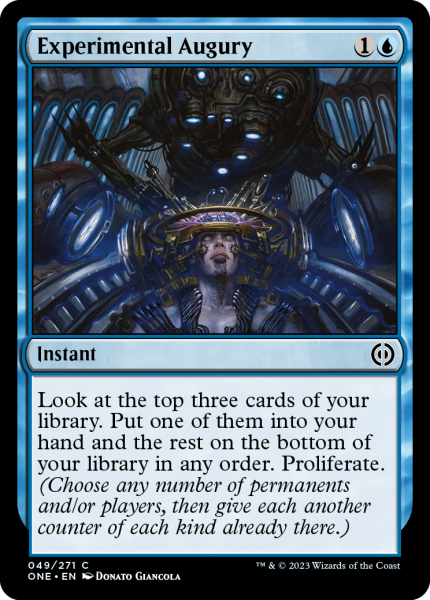
In terms of just gaining value from proliferating counters, the value will be +1/+1 counters and planeswalker loyalty. The poster child for the incidental proliferate cards works well with the latter, but not the former. Experimental Augery is strictly better than Anticipate because it does the same thing plus a cookie. As Anticipate has seen play in both Standard and Pioneer in the past, Augury is certain to see play as well.

A cookie is a cookie, even if only some players want it.

The key phrase being "in the past." Anticipate saw Pioneer play up until Impulse was reprinted last year, rendering it obsolete. As Impulse will be legal for most of Augury's Standard life, I can't imagine that Augury will see play in the near future. For Augury specifically to see play requires that a deck is okay with seeing fewer cards in exchange for getting more counters onto permanents. As all the decks that currently play Impulse are combo or tempo decks without planeswalkers or a counter strategy, it looks like a totally new deck is necessary. Even then, an extra couple counters may still prove worse than looking at more cards.

Expanding to Win

One option is to use proliferate as the means to finish off opponents with poison counters. Remember, Venerated Rotpriest is potentially broken, and once the opponent has even one poison counter, proliferate becomes a clock. Modern Infect would not play any of the (currently-) spoiled proliferate cards. However, a Pioneer or Standard deck likely would.

There's a better image available now!

The best combo with Rotpriest (again, currently spoiled) is technically not proliferate, but it does serve the same purpose. Infectious Bite can clear the way for a toxic creature to attack, and with Rotpriest generates two poison counters, one of which is guaranteed even if Bite is countered. That sounds really great for Standard. It's far from being Modern viable, and I'm not sure such a deck would work in Pioneer given Mono-Green Devotion, Rakdos Midrange, and Humans, but Rotpriest plus the proliferate cards seems like a good place to start.

Of course, fights & bites have never been relevant outside of Standard,

The problem with this all is that outside of proliferating poison counters, Standard and Pioneer poison will always be slower than just killing with damage. Toxic is much worse than infect. Rotpriest offers combo potential, but that will be best unlocked in Modern or maybe Legacy.

I can say with certainty that someone is going to try to make Poison work in both Standard and Pioneer. However, unless they're going for a combo kill with Rotpriest, I'm skeptical that it will be fast enough to compete. In Modern, there are so many better ways to kill with poison that I don't think proliferate has a chance. That said, there will always be those willing to try the weird options.

There's Always One

I'd be remiss at this point not to emphasize how nicely proliferate works with planeswalkers. Yes, I know I did already mention it above, but Wizards really wants to make sure that players are aware of the interaction. Apparently, someone there desperately wants Superfriends to be good, because they printed this card:

Use the second ability to compliment the first, hint, hint!

The idea here is to use the Gauntlet to rapidly amass counters on the tons of planeswalkers a Superfriends deck plays, play more to get more counters as they'll all grow each other with each 0 activation, and then win by taking all of the turns. Which sounds really powerful (and honestly quite fun). The problem is that Superfriends decks have historically not worked because they're really slow and clunky. Once the deck gets going, it's utterly overwhelming, but getting to that point usually takes far too long.

There's nothing in One that will stop Superfriends from being so top-heavy. However, all the incidental proliferate cards will help it get going and rapidly build towards its endgame. This will likely produce viable decks in Standard, while older formats will remain too fast. That said, I do expect to lose to Modern Superfriends in the next year. Not because the deck will actually be good, but because that's how my life works.

Lots of Answers

Whoever was pushing Ichormoon Gauntlet might have been too vocal about the deck, if all the answers to planeswalkers are an indication. I don't know if the number of removal spells for planeswalkers is actually higher in One than other sets (though it would be thematically appropriate), but they all are more aggressively costed than usual. At time of writing, there are three two-mana removal spells (two white, one black) and one at three-mana. Two of the two-mana spells will almost certainly see widespread play, and I'm intrigued by the three-mana one as well.

Ossification

Ossification is at the top of my list for the simple reason that I'm definitely going to play it. Chained to the Rocks has seen at least some play in every non-Vintage format, and is currently a staple in Pioneer Fires of Invention decks. Ossification costs more, but hits planeswalkers too. It also isn't as restrictive about land type, though needing basic lands likely means that Fires won't be switching.

Basics? In Pioneer?

Instead, I will personally be switching out Ossification for my sideboard Portable Holes in Pioneer Humans. One versus two mana is a burden, but that is more than made up for by having more targets. Frequently in the Rakdos and Mono-Green matchups, I've boarded in Hole and wished I could throw something three or more mana into it. Being able to remove Kiora, Behemoth Beckoner or Karn, the Great Creator is incredibly potent, especially since it saves me the trouble of attacking them. Cleanly removing Old-Growth Troll and Graveyard Trespasser // Graveyard Glutton is nothing to sneeze at, either.

Sheoldred's Edict

It's been some time since Diabolic Edict et al. were constructed staples. The problem is that Edicts always trade for the worst target, outside of something like Crackling Doom. The only exception is in Legacy where Sudden Edict sees play, mostly for killing win conditions in grindy control matchups to get around counters. Sheoldred's Edict might be an exception thanks to its versatility.

Precisely targeted sacrificing may be good.

The use that immediately jumped to mind was against Dark Depths in Legacy. Sudden Edict isn't really for that matchup, as there are usually other creatures to sacrifice rather than the Marit Lage token. Sheoldred's might get around that, as not every Depths deck also runs Urza's Saga, meaning that "sacrifice a creature token" really means "sacrifice Marit Lage." There's also the general utility of choosing planeswalkers, which might be enough for Modern play. Unholy Heat makes that less likely, though not impossible.

Vanish into Eternity

White has a lot of ways to answer nonland permanents these days. Every format has Leyline Binding, while Modern and beyond have Prismatic Ending. This suggests that there isn't much room left for these effects. Certainly not ones that can't be cast for one mana. On an intellectual level, I understand this, but I can't shake the feeling that Vanish into Eternity is Modern-playable.

Heroism for heroism's sake?

Not hitting creatures efficiently is a huge ding against Vanish. However, it hits everything else. And gets rid of it for good, to boot. There have been numerous times I've wished that Fate Forgotten was playable against decks that recur artifacts or play Welding Jar, especially against Ensnaring Bridge and Chalice of the Void. That Vanish also vanishes Leyline Binding and Teferi, Hero of Dominaria for three mana is no small thing.

There was an error retrieving a chart for Leyline Binding

The use I'm thinking: in a metagame where prison and control are prevalent, Vanish becomes a very powerful removal spell. Able to deal with all problematic permanents permanently, it serves as a strong counter-boarding option. This wouldn't fly in the metagame Modern currently has, but if enchantments and artifacts receive more widespread maindeck play, this could start to creep in as a utility weapon. I'll definitely be keeping Vanish in mind when building sideboards in the future.

A Minor Callback

The final card today is one that has a very obvious home, and another that players are too hopeful for. Mental Misstep is a very messed-up card, though many today don't realize why. Being able to answer any one-drop for two life is incredibly strong, and the fact that Misstep answers itself ensured that during the (brief) time it was legal, every deck had to play Misstep just to counter Misstep. (The blue decks benefitted most, though, since they could also hard-cast the card.) Wizards has decided to print a fixed and tweaked version, and speculation is running rampant.

Not free, but more flexible. Fair trade.

Memories of Mental are certainly coloring evaluations of Minor Misstep. However, the bigger issue is that players see that there are lots of powerful one-mana spells being played in Modern and think that automatically makes this spell Modern-viable.

There was an error retrieving a chart for Nix

However, if that was the case, then Nix would be played because of cascade spells and Fury et al. The fact that it isn't is strongly informative of Minor's chances in Modern.

Bad Timing, Wrong Answer

In order for a counterspell to be playable, it needs to be both timely and efficient. Counters are great if and only if they are in hand and castable when the spell they need to counter is on the stack. General counters like Counterspell perform well because they are never fully dead, while Flusterstorm and similar narrow counters are confined to the sideboard.

There was an error retrieving a chart for Flusterstorm

Minor's problem is that while it is great on the play to counter an opponent's turn 1, it does nothing on the draw. Countering a turn one Ragavan, Nimble Pilferer is good. Staring down your Misstep while your opponent on the play deploys Ragavan is horrible. In later turns, the value of one-drops, and thus the value of Misstep, drops considerably. This relegates Misstep to a very niche role.

A Legacy Weapon

Where that won't be a problem is Legacy. Countering Ponder on turn five is at least as relevant as countering it one turn one. Arguably moreso in certain grindy matchups. This is also a format where Pyroblast is a frequent sideboard card, meaning that Misstep's targets are much stronger and remain relevant over a longer timeframe. Also, at minimum, in matchups without many one-drops, it can be pitched to Force of Will. I expect Delver decks at minimum to start incorporating a few Missteps very soon.

Incremental Gains

There was nothing truly format-shaking spoiled over the past week, in my book. However, there are a lot of cards that could subtly move the needle for many decks. It doesn't take much of that to set off a chain reaction that can lead to format shakeups. One looks like a very powerful set overall, and while I think the big splashy mythics and rares will get the press (and will keep an eye on Rotpriest), I think that it's the uncommons and commons that will have a lasting impact.

Adam Plays Magic: Standard UR Powerstones

Are you a Quiet Speculation member?

If not, now is a perfect time to join up! Our powerful tools, breaking-news analysis, and exclusive Discord channel will make sure you stay up to date and ahead of the curve.

This week on Adam Plays Magic, we've got a spicy one! UR Powerstones is an artifact-centered deck featuring flashy finishers like Skitterbeam Battalion and Cityscape Leveler that are powered out through artifact-based mana accelerants. In particular, Stern Lesson and The Mightstone and Weakstone are (or generate) powerstones that can be used to cast artifacts. This mana can also be used for activating abilities like that of Reckoner Bankbuster or even Field of Ruin.

This acceleration mixed with card draw is supported through countermagic and removal like Make Disappear and Abrade. Multiple copies of Brotherhood's End do a great job of clearing out popular midrange creatures like Bloodtithe Harvester and Graveyard Trespasser // Graveyard Glutton to ensure access to the late-game.

What I Like

The UR Powerstone deck seems like it always has something to do. Half the deck interacts with the opponent while the rest ramps and draws cards, often on the same spell. Fable of the Mirror-Breaker // Reflection of Kiki-Jiki is the best card in Standard and this deck can take full advantage of it. The treasure generation helps stick a Mightstone and Weakstone by turn four and getting to copy a Cityscape Leveler with Reflections of Kiki-Jiki is game-ending.

While most decks in Standard are playing Reckoner Bankbuster, they tend to run into scenarios where it's better to cast spells rather than activate it. This leaves the artifact sitting in play not doing much. Thanks to all of its powerstone mana, that's rarely the case for this deck. After ramping into Mightstone and Weakstone, its mana can then be used to cast or draw a card from a Bankbuster. Efficiently using additional mana sources is what gives this deck an edge over its competition.

What I Dislike

Between Abrade and Brotherhood's End, UR Powerstones is really good at killing x/3 creatures. Strangle out of the sideboard helps to max out that part of the skill tree. However, there are several highly-played cards in Standard that have more than four toughness and this deck can't easily answer them. In particular, Raffiene, Scheming Seer is a 1/4 with ward that can grow quickly if left unchecked. It's too mana-intensive to clear it out with two removal spells while also paying for ward. Obliterating Bolt or Burn Down the House in the sideboard might help to alleviate the issue in future builds.

I also found that it was difficult to hold up countermagic while also developing a board state. It's a choice between casting Fable or Mightstone and Weakstone on a given turn, or keeping up Make Disappear which has diminishing returns the longer the game goes. It's a tension point that kept coming up, so it's possible replacing blue with green for Argothian Opportunist is a better option going forward.

The Deck

UR Powerstones

Creatures

3 Cityscape Leveler
4 Skitterbeam Battalion

Artifacts

4 Reckoner Bankbuster
4 The Mightstone and Weakstone

Enchantments

Spells

1 Essence Scatter
3 Abrade
4 Stern Lesson
1 Negate
2 Make Disappear
3 Brotherhood's End

Lands

5 Mountain
4 Island
4 Shivan Reef
1 Otawara, Soaring City
1 Sokenzan, Crucible of Defiance
4 Xander's Lounge
4 Stormcarved Coast
4 Field of Ruin

Sideboard

1 Brotherhood's End
2 Disdainful Stroke
4 Thran Spider
1 Spell Pierce
2 Strangle
1 Voltage Surge
2 Unlicensed Hearse
2 Saheeli, Filigree Master

End Step

And that's a wrap on another installment of Adam Plays Magic! I love fiddly decks like this that draw cards and ramp because there's almost always something to do each turn. The finishers also just scratch a Timmy itch in a way that only 12-power hasty creatures know how to do. I'm looking forward to exploring this archetype more when Phyrexia: All Will Be One drops in a few weeks.

In the meantime, you can keep up with me and all my nonsense on Twitch or Twitter, or click the links below to see all the previous work I've done for QuietSpec. It's hard to believe it's already been a year. Can't wait for what comes next.

Personal Reflection: Fading Interest

Are you a Quiet Speculation member?

If not, now is a perfect time to join up! Our powerful tools, breaking-news analysis, and exclusive Discord channel will make sure you stay up to date and ahead of the curve.

It’s Sunday morning. After a restful sleep, I rub the sleepies out of my eyes and check my phone for notifications. After a few minutes of doom scrolling, I’m finally alert enough to make my way downstairs.

The first order of business is ensuring my two kids (ten and five years old) aren’t fighting each other. Once I confirm there is order in the household, I’m free to start my relaxing morning as I please. As recently as a month ago, that would have involved a few games of chess or a match or two of Magic on Arena. Currently, my drive has much diminished in the latter.

There could be a number of reasons for this sudden apathy toward my lifelong passion. I wasn’t thrilled with The Brothers’ War Limited, and I don’t currently have a viable Standard deck for constructed play. The Decathalon event didn’t grip my interest, though I do like watching streamers navigate these long and (in some cases) arduous events.

There was an error retrieving a chart for Portal to Phyrexia

Overall, I’d say my indifference toward Magic boils down to one simple idea: I’ve found better things to do with my time.

The Cyclic Nature of Things

Rest assured, by no means does this apathy indicate my pending departure from the game altogether. Rather, this reflects a regular, cyclical nature of my appreciation for the game—I go through highs and lows on a regular basis, with the average timeline for each cycle in the two-year range.

Thinking back at the history of the game, my excitement and engagement with Magic tends to ebb and flow every couple of years. For example, below is a reflection of when I was most and least into Magic since I began playing back in 1997:

  • 1997-1999: Excited for Magic
  • 1999-2001: Disinterested in Magic
  • 2001-2003: Excited for Magic  (Odyssey block brought me back in)
  • 2003-2005: Disinterested in Magic
  • 2005-2007: Excited for Magic (Ravnica and Time Spiral were two of my favorite sets of all time)
  • 2007-2008: Neutral towards Magic
  • 2008-2013: Peak excitement for Magic, when I was going to FNM weekly and started playing competitively. This is also around the time when I got into Magic finance and started writing for Quiet Speculation.
  • 2013-2015: Disinterested in Magic, though I remember distinctly when Fetch Lands were reprinted and I wasn’t thrilled with that. I did enjoy Modern Masters and Modern Masters 2, but these reprint sets triggered my departure from Modern.
  • 2015-2016: I came back very briefly out of curiosity about Battle for Zendikar and the Expeditions within. This rekindled interest faded quickly this time.
  • 2016-2020: Very little engagement in playing Magic. My daughter was born, and I really hunkered down to focus on Old School as my primary method of engaging in the hobby.
  • 2020-2021: I started dabbling in Arena, and this got me back into Magic from Theros Beyond Death through Zendikar Rising.
  • 2021: I didn’t play any Magic for about a year, missing all expansion sets between Kaldheim and Innistrad: Crimson Vow. During this time, I was most interested in playing chess.
  • 2022: I really enjoyed Kamigawa: Neon Dynasty and Dominaria United Limited formats, and this kept me playing Arena time and again. However, with the release of The Brothers’ War, that interest faded dramatically.
  • 2023: TBD

Cycles weren’t exactly two years in length, of course, but my average duration of peak engagement with the hobby is about two years, as is the average period when I’m disinterested. Something tells me I’ll be diving back into the game sometime in the future. For now, however, I’m content focusing my free time elsewhere.

What About Magic Finance?

While my engagement with the game of Magic has been extremely variable over the years, my interest in the values of Magic cards has remained high nearly throughout my history with the game. In fact, I can mark four distinct instances where I de-prioritized my valuable Magic card collection in favor of some other objective.

  1. During my sophomore year in college (2007-2008) I sold a smattering of cards from my collection on eBay just to raise a little cash. I still distinctly remember being thrilled to sell three played Force of Wills for $28. I also remember selling an Intuition for maybe $15 or so and being shocked this card was worth so much. I had no clue, really.
  2. In 2011 I moved from Cincinnati to Boston, and I traded away all of my bulk to lighten the load of moving. It wasn’t a huge quantity of cards (probably less than 2,000), but I regret severing ties with so many cards I had owned since childhood.
  3. After my son was born, I knew I wanted to start saving for the college fund. So in 2013 while at GP Providence, I sold out of my Legacy collection. Of course, in hindsight, this was far too premature, but it was a commitment to my son that I was serious about using Magic to fund the college fund. This is what started the plan in motion.
  4. Last year at Magic 30, I sold my most valuable Old School and Vintage cards to put a significant dent in the college fund (now requiring double the funds to support both my son and daughter).

Those are the only momentous occasions in my Magic finance career where I made a drastic change in strategy. It’s no surprise that my interest in the game has waned after selling out of so many cards last year. As I said before, however, this doesn’t indicate my complete departure from the hobby. Far from it.

Some Things Never Change

Despite the fact that I sold so many Old School and Reserved List cards, I still appreciate them for their nostalgia and collectability. For this reason, I’ll not be departing from the pastime for good. Rather, my personal rules of engagement are modified to maintain the right balance for my stage of life.

For example, I still have an Old School deck, which I hope to shuffle up once in a blue moon. Instead of filling it with Beta and Arabian Nights cards, however, I’m finding that a deck of wholly white-bordered Revised and Chronicles cards still plays just as effectively. After all, the cards literally do the same thing! Arabian Nights Erhanm Djinns are so much more expensive than their Chronicles reprint.

There was an error retrieving a chart for Erhnam Djinn

For collecting, I still have a smattering of cards I really appreciate for their artwork. In addition, I continue to scour ABUGames’ eBay listings for Beta rares in the hopes of snagging a cheap one or two. I have my eye on a heavily played Beta Disrupting Scepter—an auction that ends today.

If only it didn’t have the multiple creases, this would be a sweet deal.

There was an error retrieving a chart for Disrupting Scepter

Outside of the occasional Beta rare or nostalgic pickup, I really am prepared to step back from Magic for the next year or so. Of course, I’ll continue writing for this site, making observations about data and trends and sharing my endeavors related to all things collectible and finance. It’s safe to say, however, that the tone of my articles will be a little different… at least for the near future.

Wrapping It Up

Here we are. I’m staring at my computer with a near-zero desire to log into Arena to play Magic. I’m OK with this because I’ve been here before, numerous times.

As long as there is some component of the game that continues to glean my occasional attention, I suspect I’ll be sticking around for quite a while. In years past, despite a fading interest in the game, I still enjoyed the occasional game with old friends—that kept me involved. Later, after my kids were born, I still enjoyed the investment side of the game as I watched the value of Reserved List cards explode.

Today, my interest in the game rests on two factors. First, I still have a very nice display of sealed booster boxes on my shelf. Every time I go downstairs I see the impressive (to me) display and I wax nostalgic for the days when I cracked open packs for the sheer thrill of it. The Visions booster box is especially nice as it is a nod to the first expansion I ever opened.

Second, my son’s interest in the game remains an unpredictable wild card. In a way, we encourage (or discourage) each other’s interest in the game. As I go through a period of playing Arena and opening modern booster packs, my son will follow suit and we’ll enjoy the hobby together. Conversely, when I don’t log into Arena for a couple of months and focus my attention elsewhere, my son will step away as well (he’s really into Roblox right now).

These two variables will continue to change over time but should be sufficient in keeping me involved in the game, at least to some degree.

Last but not least, I still have this column, which I have no plans to abandon in the near future. For the past 11+ years I’ve always said, “As long as they pay me, I’ll continue to write.” I really love this role with Quiet Speculation, and I’m grateful for the opportunity. I would not walk away from it so easily. If I had my way, I’d still be writing about Magic another 11 years from now, as my daughter starts applying for colleges. Every dollar made is going to be a huge help when my kids are starting down that route.

Even if my interest in the game fluctuates, writing for this site is one mainstay you can count on!

The Best Offense: Basics for Better Blocking

Are you a Quiet Speculation member?

If not, now is a perfect time to join up! Our powerful tools, breaking-news analysis, and exclusive Discord channel will make sure you stay up to date and ahead of the curve.

Magic is, at its core, a game of resource management. The game's many interactions ask us what resources we value most in any given moment. This decision point manifests itself in a number of ways, none more frequent than blocking.

Should we block? When do we block? And most importantly, why do we block?

The decision to block, like every decision in Magic, is the end result of evaluating context. This week we will explore this context. While the variables can and will always change, we're going to zero in on one specific version of this decision. Extrapolate the variables to your own situation as needed.

The Turn-Two Trade

Our opponent plays a creature on turn two. We play a creature on turn two. Our opponent untaps their lands, draws a card, and attacks.

Do we block? Do we engage in combat and accept the appearance of a trade?

This early offer of an exchange asks us to predict the value of a number of resources, with limited information. We don't know what our opponent is thinking, and as is true in most games of Limited, we don't know the contents of our opponent's deck, let alone their hand.

Life as a Resource

The phrase "life is a resource" is often used immediately before a player treats their life total like it's anything but. It has somehow become a justification for taking unnecessary damage. We want to preserve resources. In fact, as long as we preserve our life total longer than our opponent preserves theirs, we are extremely likely to win the game.

To continue stating the obvious:

  1. Our opponent is attacking us to pressure our life total.
  2. We are blocking to preserve our life total.
  3. If our creature dies in combat, we lose it as an avenue to pressure our opponent's life total.

By trading our creature here, we don't get to pressure our opponent's life total with it as a game piece. We don't know, however, if we're going to have a good attack on our turn. What if after attacking, our opponent deploys a powerful three-drop?Most three-drops can block two-drops profitably. If our opponent plays another two-drop, we can offer to trade two-drops, but that exchange is theoretically equal value to making the initial block.

A core question in assessing the value of a block in the above scenario then becomes thus: "will the exchange we offer on our turn be better than the exchange we could have made by blocking by a difference equal to, or greater than, the amount of life we lost by not blocking?" More often than not, the answer is no. For this reason, our default response to this opening offer should be to block and accept the trade.

However, if for some reason, we value the potential damage our creature represents more than the very real and present damage we're taking, then we shouldn't block. Thereby, the more essential aggression is to our gameplan, the less likely we are to block.

Creatures in Question

Creatures can be valuable for a number of reasons, but their power and toughness are a big part of the equation. The "stats-to-mana-cost" ratio is one of the most common ways to classify creatures. Grizzly Bears, Centaur Courser, Pillarfield Ox, and Wind Drake are all codes in the language of Limited. By engaging in on-curve combat, we're maximizing the value of that ratio. Those stats theoretically decline as the game goes on.

In our hypothetical scenario, we are trading with a creature of about equal value. That creature is earning its value by attacking. Shouldn't ours earn theirs by blocking? We put the two-drop in our deck so we can go to combat on turn three. Well, here we are. Use the card.

Yet, our creature may boast valuable upside. Will our creature get stronger, or generate some advantage over time? Will the game out scale our opponent's threat? In some scenarios, this early combat only hints at a fraction of this creature's ultimate value to our gameplan.

For example, if an opponent attacks a Scrapwork Mutt into our Third Path Iconoclast, we're likely take damage. In this instance, our two drop generates value by living, while their Mutt generates additional value by dying. If they're attacking us with an Argothian Sprite, we're more likely to block, but still may be reluctant to do so.

In this instance, it's not simply the potential damage our creature represents, but the value it generates throughout the game that can inform a decision. We don't need to trade our Third Path Iconoclast with an opponent's Grizzly Bears, especially if we have a Pillarfield Ox in hand to neutralize it later on. The game will out-scale the Grizzly Bears, while our creature still has a lot to give.

Overvaluing Our Creatures

As we draft a deck, it's perfectly normal to get excited about the quality of our cards.

Tantalizing Upside

Some creatures can present massive advantage if the appropriate conditions are met. However, not every game plays out as we might hope. Consider this scenario: Our opponent just played their Roc Hunter on turn two. We respond by playing a Drafna, Founder of Lat-Nam. The remaining cards in our hand include a Mightstone's Animation, a Stern Lesson, an Overwhelming Remorse, two lands, and a splashed Titania's Command.

It's easy to assume our rare legend is worth more than the dime-a-dozen Roc Hunter. Our deck possesses sequences where this creature can become an engine for value. Perhaps our plan was for the artificer to copy Energy Refractor, Phyrexian Rager, or others.

But that is not the reality we look at now. The Roc Hunter presents a clock that we are currently very bad at interacting with. Each turn we delay this decision, we pay a premium of three life. The trade seems imminent and if we're going to make it, we should do so now.

The Combat Trick Fallacy

So far, estimated value to our life totals and the creatures in the equation, both known entities. This is when we start to factor in the known-unknowns. Our opponent has cards in hand and lands untapped. We played our two-drop on turn two and consequently, we're tapped out. A combat trick could be lurking, but which one could it be, and do we even care?

A well-timed combat trick can be devastating. Winning a critical combat can swing games, and these cards can sometimes play out like a removal spell. If it's turn two and creatures are already dueling, there is a good chance that combat trick will be a good card in the game. If an opponent uses it here, you're still trading your early game play with an early game resource. Instead of trading a creature for a creature, you're trading one for a Giant Growth... plus the value of that mana on turn three, plus the value of their combat phase.

These are the questions that we should ask before evaluating.

  1. Will we have access to an answer on a later turn that would blow out their combat trick? For example, if we have a Disfigure, we might want our opponent to use their Whirling Strike on a later turn.
  2. Does the combat trick generate value that we could otherwise minimize? A card like Moment of Defiance can be a blowout if it saves a creature in addition to gaining life, drawing a card, and winning a combat.

In short, what are we playing around and why are we playing around it? In the early game, it's hard to tell what an opponent is holding. If we don't know what we're playing around, we're giving our opponent free equity.

Timing Chump Blocks

Later on in this game, we find ourselves racing an opponent. Our life totals are dwindling, and they attack us with a non-lethal Tocasia's Onulet. Because we are racing, we have insufficient creatures back to trade with the 4/4. We have a 1/1 Artifact Soldier. Do we block?

In games of Magic, it's typically better to delay the situation until the last possible opportunity. It's one of the reasons why instant speed removal plays so much better than sorcery speed versions. We could block this creature next turn and save ourselves the exact same amount of damage, while providing us with one more resource to use to determine our actions next turn. This is especially true if the creature is something like Gixian Skullflayer who might be even bigger next turn. So, don't block, right?

On many boards, this 1/1 token will not be worth very much. The four damage that it can save us from right now is very real. Our opponent can follow up with a lethal evasive threat or a burn spell that will end the game because we took that damage.

By giving our opponent this damage now, for free, we give them far more avenues to kill us within the next turn cycle. The damage we prevent this turn is not guaranteed on a later turn. If the game piece represents very little to us on the board, then it is often worth trading it in for the guaranteed value of a block now.

Shine a Little Light

While we're on the topic of blocking, this week we're going to shine a little light on the only defender in The Brothers' War, Coastal Bulwark.

There was an error retrieving a chart for Coastal Bulwark

When we initially looked at the set, we considered this card as a reasonable blocker. It has reasonable stats and presents an obstacle for opponents to fight through with early ground creatures. However, this card will very rarely be good enough.

This is a card for control decks, but control decks are not a realistic option in BRO Limited. Most decks that get the label of "control" in Limited formats are often just bigger midrange decks. The closest I've come to playing a control deck in this format is a Citanul Stalwart deck that played slow win conditions like Helm of the Host and Urza, Prince of Kroog, as well as a Drafna, Founder of Lat-Nam. Even in this deck, the Bulwark was merely fine.

If a card can't attack, it needs higher upside than the Bulwark. Damage matters, and this card doesn't deal any. This is a card we should almost never play. There are just too many turns where you miss out on damage because this is the two-drop you're playing.

The Most Underrated New Commander Cards in 2023

Are you a Quiet Speculation member?

If not, now is a perfect time to join up! Our powerful tools, breaking-news analysis, and exclusive Discord channel will make sure you stay up to date and ahead of the curve.

With the new year well underway, it's time to return to one of my favorite subjects: card recommendations. It's been a while since I've compiled a list of eclectic, useful, and interesting cards. This list contains cards both new and old, known and relatively unknown. As always, local games and SpellTable are to blame for sourcing these underplayed cards.

As usual, I have my own criteria when talking about why you should include a particular card in any Commander deck. This week, I have included a mix of both old and new cards that might be getting overshadowed by more popular, but not necessarily more powerful or more flavorful ones. Let's dive straight into blue!

Blue Instants

At first, Curfew may look like a relatively innocuous variant of Unsummon. But no! As board control, it offers a complete reset early game. It also gets through hexproof, indestructible, and protection. Late-game it can give you extra enters the battlefield (ETB) triggers for your Snapcaster Mage or other value creature, essentially replacing itself. If they have a Reclamation Sage, bounce it to hurt the other players. With careful timing, you will gain more from your opponents' ETBs than they do.

I have used Interdict to kill Evolving Wilds and draw a card. That's a brutal play. In a fetch-heavy environment, a two-mana Stone Rain that draws a card is amazing. Of course, Interdict does not begin and end at land destruction. It counters a massive amount of potential abilities for only two and replaces itself. This card is effectively a cycling card without cycling. If you're considering a filler card like Deliberate or Curate but low on interaction, Interdict can be both.

Big, Green, and Mean

There was an error retrieving a chart for Gurzigost

This has been a pet card of mine for a long time, and I wanted to share it considering Elesh Norn, Mother of Machines. A massive 6/8 body for only five mana, Gurzigost also has two abilities bolted on. Putting cards back into your library is a nice "drawback" in Commander. Of course, dealing combat damage straight to a player or planeswalker means Gurzigost cannot be chump blocked. With the many new equipment and aura cards that are devastating when you connect for combat damage, this Beast becomes a credible threat. While it "dies to removal," the fact that it is so large means not all removal works. Finally, it's a discard outlet too!

Overlooked Four Mana Enchants

Smothering Tithe gets way too much hype. Seriously! Sometimes the table gangs up on you for taxing everyone, or they pay the tax, which slows them down but doesn't accelerate you. In both cases, you have united the table against you. Compare with Loot Dispute, which grants the table the initiative mechanic for value and interaction. Meanwhile, you get a Treasure and a basic land right away. Treasure on the attack is worthwhile, and you don't even have to deal damage. Finishing a dungeon is tough but not impossible, and a free 5/5 Dragon is just the cherry on top of completing Undercity, which has a large payoff.

Meanwhile, Citadel Siege is super busted. Sure the Khans option is very "medium" and is at home in a +1/+1 counters deck, but size up the Dragons option. You can very effectively control combat for the rest of the game. For four mana, that's a heck of a bargain! You can wheel and deal, tapping down unblockable creatures, flyers, combat damage, combat trigger, or even "surprise" haste creatures. The best part? If someone doesn't like it, they won't be doing much attacking or blocking, so it's better to side with the Sieger than it is to get Sieged.

Intelligent Board Wipe

There was an error retrieving a chart for Promise of Loyalty

The far more intelligent and diplomatic way to clear a board. Everyone hates you a little less after using Promise of Loyalty because at least they get to keep what they want. Another point for this card is that it isn't useless in a one-versus-one situation like similar cards Tragic Arrogance or Divine Reckoning. Unlike those cards, which don't punish Voltron-style decks, Promise lets them keep their buffed-up commander, but makes it useless against you. This is far better than killing it. Keeping things in play but useless sure beats sending them back to the command zone or graveyard, only to be used against you later.

There's Always Room for Rocks

None of these cards should be a surprise, as they all see some play, but I believe it's a lot less than their potential. Moonsilver Key represents, at worst, a second Sol Ring. It can also get more powerful pieces like Mana Crypt or Jeweled Lotus. The fact that it can grab any utility artifact with a mana ability, or a basic land as well, makes it a playable card for any budget.

Meanwhile, both Springleaf Drum and Paradise Mantle are effectively one-mana rocks. In cEDH, these cards are much more common because acceleration is absolutely necessary and low-cost commanders are often part of the plan to win. With numbers of small creatures, tokens, artifacts, or extra untap synergy, Drum and Mantle both scale upwards well.

Red Card Love

There was an error retrieving a chart for Overmaster

An oldie and a goody, Overmaster sees cEDH play but is not on the red top 100. It's an all-star with Krark, the Thumbless and Birgi, God of Storytelling // Harnfel, Horn of Bounty. Keep in mind the absolute floor of the card is one red, draw a card, just like many blue spells. It's time to add a little more reach to your red decks while also adding that extra bit of "no thank you" when facing blue decks, and the reprint in Dominaria Remastered is easy to acquire.

Lands to Consider

A new land to add to what I call "the murder lands," Underdark Rift is a surprisingly strong addition to just about any Commander deck. It enters untapped, and removes not just creatures but also artifacts or planeswalkers.

It's also colorless, so it can go into absolutely any deck. While colorless removal like Universal Solvent, Goblin Firebomb, or Scour From Existence already exists, those can be countered and cost seven or eight. Rift is effectively just six mana and very difficult to stop because it's a land. On average, it removes something for five turns, which is more than enough time. All decks can use a little removal, and this card simply replaces a slightly worse land.

Forsaken City has tremendous synergy with Stasis and Winter Orb, but its use does not begin and end there. You can effectively trade a card for a mana during your upkeep, meaning City taps for two mana in one turn if you need it to. I consider this card vastly better than Rupture Spire for example, and that card does see a fair amount of play. There's even a little bit of bonus synergy from cards like Misthollow Griffin and Nalfeshnee. A five-color land that enters untapped, can be tapped for two, and even has some oddball synergies? Sign me up!

See You Again in Three Months!

Any surprises? Have you never seen some of these cards? Are any super common and I just didn't notice them in my games? As always let me know your favorite underplayed cards in the comments.

Avatar photo

Joe Mauri

Joe has been an avid MTG player and collector since the summer of 1994 when he started his collection with a booster box of Revised. Millions of cards later he still enjoys tapping lands and slinging spells at the kitchen table, LGS, or digital Arena. Commander followed by Draft are his favorite formats, but, he absolutely loves tournaments with unique build restrictions and alternate rules. A lover of all things feline, he currently resides with no less than five majestic creatures who are never allowed anywhere near his cards. When not Gathering the Magic, Joe loves streaming a variety of games on Twitch(https://www.twitch.tv/beardymagics) both card and other.

View More By Joe Mauri

Posted in FreeTagged , , , , , , , , , Leave a Comment on The Most Underrated New Commander Cards in 2023

Have you joined the Quiet Speculation Discord?

If you haven't, you're leaving value on the table! Join our community of experts, enthusiasts, entertainers, and educators and enjoy exclusive podcasts, questions asked and answered, trades, sales, and everything else Discord has to offer.

Want to create content with Quiet Speculation?

All you need to succeed is a passion for Magic: The Gathering, and the ability to write coherently. Share your knowledge of MTG and how you leverage it to win games, get value from your cards – or even turn a profit.

Still Incompleat: A New Nahiri

Are you a Quiet Speculation member?

If not, now is a perfect time to join up! Our powerful tools, breaking-news analysis, and exclusive Discord channel will make sure you stay up to date and ahead of the curve.

Spoiler season is getting off to an unusual start this time. Wizards confirmed that the leak I previously mentioned was real, which means my alarm is more justified than before. Additional testing hasn't changed my mind on Venerated Rotpriest. Wizards has also stated that they're just going to forge ahead with their spoiler schedule as if nothing had happened. Corporate stubbornness at work. That said, there are plenty of cards we haven't seen yet, and another has caught my eye.

Thinning the Herd

The leak and reaction to it aside, this spoiler season has caused a lot of angst among the Vorthoses in the Magic community. The storyline is leading to a lot of planeswalkers (both the beloved and not) being functionally killed off as they are compleated, becoming Phyrexians. This has considerable mechanical and gameplay implications (and will prove our strategic focus today), but more players are focused on the story implications, particularly for the future.

There was an error retrieving a chart for Tamiyo, Compleated Sage

Personally, I'm unconcerned. Partially that's because I learned to not care about Wizards' storytelling, as it is abundantly clear that their only story beat is setting a plane on fire. Also, this is a Hasbro property. They have a history of burning down setting and characters for the sake of thinning out their toy lines. Most players won't know this, but back in 1986, Hasbro released the first Transformers movie. The cartoon had been a runaway success, but the movie was a complete flop.

A significant part of the problem was that the movie was intended to be the transition from the old toy line to the new one. To make that happen, Hasbro literally killed off huge numbers of the original cast. Frequently in horrible ways. Nerds who were alive for the original airing tell me it was a deeply traumatic experience. I wouldn't know, as I wasn't alive back then. I suspect that the intention with Phyrexia: All Will Be One is the same: clear out the old characters to introduce new ones and force players to like them.

The Failed Anti-Villian

For those following Magic's storyline, Nahiri is a controversial character. She's clearly intended to be an anti-villain, but she's never been effective enough to really gain traction. Her role has been to have a conflicting goal to the protagonists, make the situation worse through vindictive self-righteousness, and then lose humiliatingly. Which is good news for the Multiverse, as Nahiri's been compleated, which can only mean that the Phyrexians are doomed to failure as well.

Official preview means better image quality.

Nahiri has history in Modern, but has never really panned out. Anyone else remember when Nahiri, the Harbinger into Emrakul, the Aeons Torn was supposed to be the next Splinter Twin? This Phyrexian Nahiri has some similarities with Harbinger, which isn't a big vote of confidence. However, the context of Modern is very different today, and I think the Unforgiving has potential.

The Key Ability

First thing's first: Nahiri, the Unforgiving has shades of Oko, Thief of Crowns as a (potentially) three-mana planeswalker with no minus abilities and two plus abilities. Of course, Wizards did learn from Oko, and Nahiri's abilities are downgrades. The first is interesting, ensuring that the biggest creature can't attack Nahiri, and can also pick off creatures if you have blockers. The second is standard rummaging, most notable in being straight card draw with an empty hand. However, on their own, the abilities are pretty mediocre.

There was an error retrieving a chart for Recommission

It's the last ability that's interesting. Creating temporary copies of dead creatures and equipment is fairly unique on its own, but add in that it can be used every turn and suddenly Nahiri becomes a value engine. Value engines are always worth investigating, and while I don't know how this plays out in other formats, in Modern there's some solid value to be had.

The Obvious Home

The line "creature or Equipment card" immediately brought Hammer Time to mind. Based on the discussion I've seen so far, that's true of most players. However, Boros Hammer is not a thing anymore to the best of my knowledge. I distinctly remember a few lists running Ragavan, Nimble Pilferer at some point in the last two years, but not anymore. Most lists are either mono-white or white-blue. Some will splash green for Haywire Mite but they never stray far.

Lacking a clear guide for a red Hammer Time deck, I just replaced the Spell Pierces and The Reality Chip that UW Hammer plays with Nahiri.

MC Nahiri, Test Deck

Creatures

4 Ornithopter
4 Esper Sentinel
3 Giver of Runes
1 Gingerbrute
4 Puresteel Paladin
4 Stoneforge Mystic

Planeswalkers

2 Nahiri, the Unforgiving

Instants

2 Blacksmith's Skill

Artifacts

4 Colossus Hammer
1 Shadowspear
3 Springleaf Drum
1 Nettlecyst
1 Kaldra Compleat

Enchantment

4 Sigarda's Aid

Lands

4 Arid Mesa
3 Inkmoth Nexus
4 Urza's Saga
2 Sacred Foundry
2 Inspiring Vantage
4 Plains
3 Sunbaked Canyon

After some testing, I don't think that Nahiri is something Hammer Time wants. Hammer wants to be attacking for massive damage on turn three, and Nahiri doesn't remotely facilitate that plan. Having Pierce was more likely to be relevant than Nahiri, so this particular deck is never going to beat out UW Hammer.

The Reality (Chip) of the Situation

Overall, I'd say that if drawing cards is a thing Hammer Time wants to do, Chip is the right call. It not only synergizes with Stoneforge Mystic and Puresteel Paladin, but on average will draw more cards more quickly than Nahiri can even dream. That's one big strike.

There was an error retrieving a chart for The Reality Chip

However, the biggest is simply that using Nahiri's 0 ability was underwhelming. Animating Stoneforge and immediately getting and playing Kaldra Compleat is pretty good, but that was also only occasionally possible. The best use was getting back Paladin to immediately equip a creature and swing for the win. However, getting any other creature was a waste of time. Also, it was never correct to discard an equipment to set up reanimation, despite Wizards' design intentions.

There was an error retrieving a chart for Kaldra Compleat

Worse, there was never a situation where animating an equipment was a good deal. Nahiri grants the creature or equipment haste, but not Nettlecyst or Kaldra's germ token. Thus, there's no way to get a free attack out of them. Getting Colossus Hammer or Shadowspear was only good if the means to equip it were out, at which point one attack with either wouldn't close the game. I can conceive of times that wouldn't be true, but it seems to me that Nahiri just isn't a good fit in Hammer Time.

Getting Full Value

Trying to utilize the full text line didn't go well, so I decided to cut it down to just creatures. I have been playing around with midrange Boros shells similar to the one Aspiringspike posted for ChannelFireball last week. The problem with my lists and a problem I had with Spike's list is that they feel very mid, even for midrange. The linked list from Spike is not really aggro, it's not really combo, and doesn't have the power to play Jund's game.

However, Nahiri might change that. It is a needed source of card filtering since this type of deck floods easily. When played for four mana, Nahiri can also immediately animate an evoked incarnation, which can be a huge swing. Thus, I proxied up and tested this list:

Nahiri Midrange, Test Deck

Creatures

1 Walking Ballista
4 Esper Sentinel
4 Ragavan, Nimble Pilferer
4 Giver of Runes
4 Luminarch Aspirant
4 Seasoned Pyromancer
4 Ranger-Captain of Eos
4 Fury
4 Solitude

Planeswalkers

4 Nahiri, the Unforgiving

Lands

4 Arid Mesa
4 Marsh Flats
4 Flooded Strand
3 Idylic Grange
5 Plains
3 Sacred Foundry

This deck is still flawed. However, there is tremendous potential here. Nahiri did exactly what I wanted her to do. While the mana curve is still awkward (and this deck desperately needs more disruption), having card filtering fixed the worst floods and provided a kind of bridge between the good early game and fairly mediocre late game. I'm not sure if Seasoned Pyromancer was better than Nahiri in this role or not, but having the option for both was most welcome.

Constant Value

More importantly, in grindy creature matchups, it was utterly backbreaking to simply sit there with Nahiri and zero her for as long as there were targets. Hitting the one- and two-drops was admittedly quite bad, except for one occasion where a cloned Giver allowed an attack for lethal. However, hitting the high drops yielded an avalanche of card advantage that easily turned games around.

There was an error retrieving a chart for Seasoned Pyromancer

The best target was Seasoned Pyromancer, followed by Fury. The latter is second because Pyrokinesis isn't always relevant, despite Fury being the better threat. Ranger-Captain of Eos and Solitude were far more niche, and given the kind of anemic clock, the latter could be a liability. The stream of value can't last forever and extra life can be extra turns. However, the unlimited grinding potential of the deck leaves me to believe that I'm onto something here. There are just some questions to answer.

Lingering Questions

The biggest: how exactly is this deck better than Rakdos Scam? Both have a similar Incarnation value attack-plan, but Rakdos' is much faster and disruptive. My deck's plan is far grindier, but that doesn't always matter. It's comparatively top heavy in order to accomplish this plan, and since all the removal are incarnations it's possible to run out of gas before the value engines are online. Again, there's enough potential to keep investigating the deck but Scam casts a long shadow.

There was an error retrieving a chart for Ragavan, Nimble Pilferer

Then there's the issue of Ragavan. This deck really wants to connect with Ragavan early. All the actually good cards cost three or more, and there's no acceleration in white or red. Without that treasure token, the deck is really clunky and slow. It might be possible to smooth out the curve with more two-drops, but I suspect it might be better to lean into the deck's grind plan.

There was an error retrieving a chart for Ranger-Captain of Eos

This would entail dropping the other one-drops and Ranger-Captain in favor of more removal. It would also need prison pieces to beat non-creature decks. I'm currently investigating the possibility, but that does mean I'm leaning more into Ragavan than ever. Which isn't a problem in theory, but remember that Ragavan is atop the Banning Watchlist. I'm not sure this kind of deck would survive a ban, which makes me question the whole direction.

A Powershift

The more non-rare One cards are spoiled, the more it becomes clear that this is a very powerful set. I've already discussed two cards for Modern in depth, concluding that there is real potential for both to make the cut somewhere. And there are still lots of other cards in the set. This could lead to a major shakeup in the near future.

Want Prices?

Browse thousands of prices with the first and most comprehensive MTG Finance tool around.


Trader Tools lists both buylist and retail prices for every MTG card, going back a decade.

Quiet Speculation