If not, now is a perfect time to join up! Our powerful tools, breaking-news analysis, and exclusive Discord channel will make sure you stay up to date and ahead of the curve.
My "cards to buy" list is pretty small nowadays, mainly focused on cards to flip in the near future. The top 5 on that list are the Streets of New Capenna tri lands: Jetmir's Garden, Raffine's Tower, Ziatora's Proving Ground, Spara's Headquarters, and Xander's Lounge.
These lands complete the three-color, fetchable Triome cycle that was originally released in Ikoria. Today, we'll explore what makes them such great pickups.
A Little History
Ikoria: Lair of Behemoths was released May 15th 2020, which was after most of the world had closed down due to COVID-19. The tri lands were some of the few cards I was really looking forward to in the set. Despite their always coming into play tapped, the ability to fetch a three-color land in Commander seemed like a game changer. This land cycle gave color-heavy decks a reliable mana fixer for turn 1, and I could easily see four-or-more-color decks fetching triomes in their first two turns to ensure perfect mana by turn 3.
Due to the timing of the Ikoria release, it is definitely possible that the prices for the singles were artificially deflated. There were no in-person events at the time, and thus a lot of potential demand was non-existent.
There was an error retrieving a chart for Zagoth Triome
I was not sure how desirable they would end up in other formats, as "enters tapped" is a huge downside to have on lands, and playing off-curve in many formats is a good way to lose a lot of games.Â
The Ikoria Triomes had five versions available: prerelease, regular, foil, showcase, and foil showcase. As many are aware, the recent foiling has been somewhat of an issue, so I opted to go all-in on the showcase variants, as the full art made them easier to find when searching ones deck. I bought 7-10 of each at prices between $5 and $7.50.Â
There was an error retrieving a chart for Savai Triome
It is important to point out that Wizards of the Coast was still "dabbling" in Secret Lairs, and my concerns of a reprint were still relatively low. This is relevant because the massive influx of Lairs adds significant risk for any longer-term holds.
Looking at the price history of the Triomes, we can learn a few important things:
Early on, all the Triomes were roughly the same price, hovering between $5-$7.
Currently, the most valuable ones are the UGx ones, Ketria Triome and Zagoth Triome. This isn't surprising given that these are the most powerful colors in Commander.
The third-most valuable Triome is actually Savai Triome, which was the cheapest upon release.
The showcase variants for most of these Triomes have a TCGPlayer Market price very close to the regular version.
Indatha Triome is the only Triome whose showcase variant has a lower TCGPlayer Market price than its regular variant.
Analyzing Triome Prices
When I look at analyzing the potential of a Triome's future value, I tend to look at what original dual lands it would be paired with and compare their values (TCGPlayer Market values shown).
(UB) Underground Sea - $753
(UR) Volcanic Island -$748
(UG) Tropical Island -$543
(UW) Tundra -$484
(BG) Bayou -$441
(BR) Badlands - $383
(GW) Savannah - $356
(GR) Taiga -$370
(BW) Scrubland -$333
(RW) Plateau - $329
Using this list, I would then add up the "duals" covered by the Triome and use that total to give me insight into which ones to target.
Thus, I focused on acquiring Ketria Triome and Zagoth Triome first, and in larger numbers.
Enter the Streets Tri Lands
Now we get to the main purpose of this article. While I had previously targeted the showcase variant for the Ikoria Triomes, the Streets of New Capenna showcase variants are not borderless, and I personally dislike the artwork on most of them. There are borderless variants that do have decent artwork on them, but their price point is currently $10+ per copy.Â
Given that the borderless variants are already at a price point close to the Ikoria showcase variants, I feel there is likely not a lot of room for growth, and certainly not enough to justify investing in them. The only Streets of New Capenna tri land that has both blue and green mana in it is Spara's Headquarters, which also happens to be the cheapest one as of me writing this article. I do think it wise to emphasize that white is by far the weakest color in Commander, so this pairing is likely still less desirable than either Ketria Triome or Zagoth Triome.
Multiple copies of all of the Streets of New Capenna tri lands can still be acquired in the $5-7 range, so I think there is still potential for growth. Interestingly there is a decent price discrepancy between the cheapest borderless variants, with Jetmir's Garden's TCGPlayer Market price being only $12.71 compared to Raffine's Tower's TCGPlayer Market price being $21.11.
While it doesn't include green, Xander's Lounge is one I would like to pick more copies up of. The Grixis shard is definitely a very powerful one, so its tri land is likely one to make sure you get sooner rather than later. It also has the highest "dual land equivalency" of any tri land and is currently one of the cheaper ones to buy.
Third Color's the Charm
Have you been looking into picking up the tri lands? What systems might you use to compare the value of each one? I'd love to hear your thoughts in the comments. Until then, may you fetch with confidence!
If not, now is a perfect time to join up! Our powerful tools, breaking-news analysis, and exclusive Discord channel will make sure you stay up to date and ahead of the curve.
So there I was, struggling to read the table as I clumsily navigated a draft.
Green was open. That much was clear. I collected a number of powerful cards, but lacked a real plan. Citanul Stalwart never showed up, and my options to splash for various win conditions vanished one pick at a time. Next, black looked like an option, then a few red signals came my way, then the deluge of gold cards in distant combinations pointed to all the great possibilities that would not be. I felt like Sylvia Plath, staring at her splattered figs.
The pool had some okay cards, but without a clear plan, the deck was destined to be a mediocre mess. I tinkered with various versions of the deck, looking to leverage my high powered cards as best as I could. There was a diverse collection of tools, but it wasn't particularly aggressive and didn't really have the top end to win at the late stage of the game. For the sake of science, I tested the generally weak No One Left Behind, and if I was going to play a Zombify effect, I wanted something worth the effort.
It had to be done.
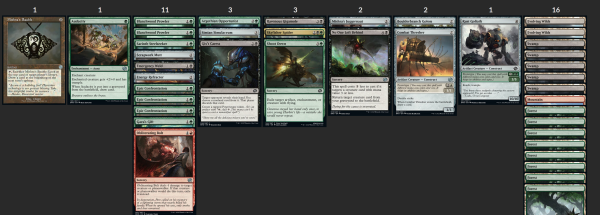
Rust Goliath Reanimator (7-1)
Creatures
1 Sarinth Steelseeker
1 Scrapwork Mutt
2 Blanchwood Prowler
1 Argothian Opportunist
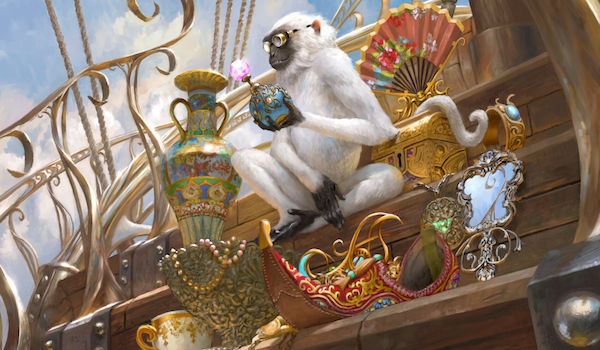
1 Simian Simulacrum
1 Ravenous Gigamole
1 Skyfisher Spider
1 Mishra's Juggernaut
1 Boulderbranch Golem
1 Combat Thresher
1 Rust Goliath
Sorcery
3 Epic Confrontation
1 Obliterating Bolt
1 Gix's Caress
1 Emergency Weld
1 No One Left Behind
1 Shoot Down
Instant
1 Gaea's Gift
Artifacts
1 Mishra's Bauble
1 Energy Refractor
Enchantments
1 Audacity
Land
2 Evolving Wilds
5 Swamp
1 Mountain
8 Forest
Early-Game and Enablers
The developing stages of the game involve generating value from cheap creatures and surviving with cheap interaction. Blanchwood Prowler is the perfect two-drop here. It finds lands, can tussle with the format's many x/1s, and is a body for Epic Confrontation or Powerstone Fracture. Scrapwork Mutt overperforms here as well. While it's nice to get some damage in, our goal is mostly to survive, and trading off serves us well.
Prowler is a perfect partner for unearth creatures. It encourages splashing, as it digs for lands. The unearth cards are eager splashes, as the front side can come down without a single colored mana. While splashing is never truly free, this certainly lessens the risk. This is a strong incentive to be green in any number of shells. Evolving Wilds, Energy Refractor, and Citanul Stalwart all facilitate this game plan nicely.
Green's inherent ability to splash makes it a reasonable home for drafts that have gone off the rails. While we'd prefer to be in something more synergistic, Citanul Stalwart lets you bend those rules of engagement. However, as previously mentioned, we didn't have access to the flexibility the one-drop provides. We would have to work for our wins.
Incidental Value and the Mid-Game
Building up a bank of unearth creatures puts a level of pressure on opponents that can easily be overlooked. If we generate a critical mass, our opponents will eventually look at those creatures as raw damage. As a result, opponents will need to deal with our boardstate more aggressively. Argothian Opportunist and Boulderbranch Golem all perform this role perfectly. They battle just fine, they provide value, and sometimes they'll even eat a removal spell.
At its heart, this deck was a classic GB Value deck. Because of this, trading resources should be a winning strategy in most matchups. Besides, once the dust settles, our 10/10 trampler is going to be bigger than whatever our opponents our doing.
The Problems
Removal is very good in this format and there is a decent amount of it. While our prototype threats duck a lot of the small removal, they die to the various Disenchants in the format. If we're going to do the work required to reanimate an expensive creature, we want to make sure it sticks around.
As we develop, we want to be making trades and pressuring removal. However, sometimes it can help to have proactive approaches. This is especially true because very often we will die on the spot to a Sibling Rivalry.
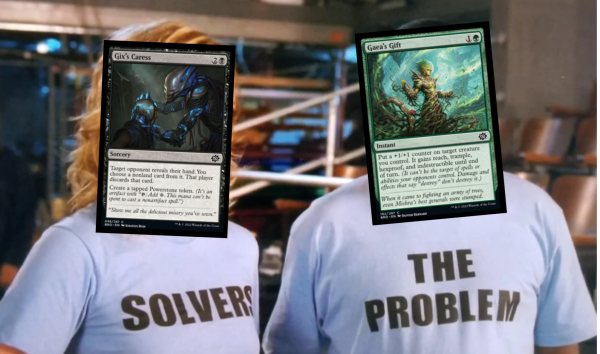
Gix's Caress and Gaea's Gift protect out gameplan. With these two cards, a resolved Rust Goliath will often go uncontested.
So, Is It Real?
Well, no. Not even close, really.
While we went 7-1 with this pile, the deck lacks reliability. Cards like Emergency Weld or even Loran, Disciple of History can help us get back our creatures, but the only piece we need to have in hand is a sorcery. Besides Arcane Proxy, a mythic rare, the format has zero ways to rebuy an instant or sorcery. While GB Value decks might want to use a Reanimate spell to get back any number of powerful options, this shouldn't be the primary plan.
However, GB Value decks are a great place to be positioned at this stage in the format. A value-based gameplan tied to reanimating threats, gumming up the ground, and relying on some flexible removal spells can make for a reasonable strategy. Weeks back we had little interest in green, but now that the format is maturing, the color has new life.
It's So Easy Being Green
Aggressive decks dominated the first weeks of the format. While red is still the best color and the aggressive decks are still strong, the format evolved due to the self-correcting nature of draft. When a color overperforms, it subsequently becomes overdrafted. This has become true of the most effective decks, especially the very synergistic ones. Fixing goes earlier than it originally did, and many of the glue pieces that overlap in multiple synergies are being targeted with earlier picks. Usually I like to talk about how a format evolves, but this one might actually be devolving.
This Benefits Green More Than Any Other Color
Green has a ton of solid pieces at common, but as far as a true identity goes, it's the most flexible. Many of the green commons are just good-rate creatures that can hold the fort or go on the aggressive. They can play a value game, or back up attacks with a grip full of combat tricks. Green's flexibility and high card quality makes it the perfect tool for the late stages of a format, with or without Citanul Stalwart.
So while the reanimator strategy is probably nothing more than "just fun," green has felt like a safe haven over the last few weeks. Everyone wants to be in red, but green is more of a local secret. Because its best commons fit in so many archetypes, it makes for a good color to settle into in difficult pack ones.
Shine a Little Light
If we're going to spend this much time talking about green, we should focus on its most overlooked piece of interaction.
There was an error retrieving a chart for Shoot Down
The first copy of this removal spell is pretty solid in most green decks. It feels like it kills everything (it doesn't). The exile clause is good and between its three legal targets it can get us out of a lot of situations. There is however a huge caveat, and that is the cost. While four mana is a lot, and sorcery speed is an issue, we can build our deck to minimize those problems. However, if we have some one-, two-, and three-drops, Shoot can be a nice addition to our deck. It's not a bomb, but we can feel safe including the first copy almost all the time.
Have you been loving green as much as I? Let me know in the comments.
If not, now is a perfect time to join up! Our powerful tools, breaking-news analysis, and exclusive Discord channel will make sure you stay up to date and ahead of the curve.
While Commander is at heart a multiplayer format, sometimes you only have the time, energy, or players for a 1v1. This specific format is called Duel Commander, or "French Commander," and has format-specific rules that are balanced for competitive decks and players. Certainly you do not need to use Duel Commander rules for a casual 1v1; the normal Commander rules are fine.
Of course, Wizards of the Coast did make several 60-card thematic Duel deck (and reprinted them), but has not made them specifically for Commander. So today we'll explore crafting Commander decks in pairs to provide a fun, interactive Duel deck experience.
But First, a Brief History Lesson
I was not very interested in the previous Duel decks, but Knights Vs. Dragons caught my eye, mostly for picking up a cheap Knight of the Reliquary and Bogardan Hellkite which, at the time, were worth more than the deck. Does this sales tactic sound familiar? In any case, my girlfriend was interested in learning Magic, so I bought the deck and we played... and it was a disaster.
First, she tried playing Dragons. I played some cheap Knights, got double-strike and killed her in short order. She would summon a Dragon and I immediately removed it. It was a frustrating experience and I could see that, yes, the Knights did come out quick and seemed like they had every advantage. Then we swapped decks.
Turns Out, Dragons Could Win
The Dragon deck did have plenty of game against the Knights, so long as you drew it that is. However, with just a little bit of knowledge, I realized that keeping a hand without an early ramp or removal effect was a complete non-starter. The deck did better on the draw than the play and was happy to take mulligans. Eventually we learned both decks and it became a very fair, fun, and, interactive experience. My most efficient $20 for entertainment in 2011, bar none.
If this worked for constructed, well, why not Commander? It does work, and, it works well! I've built Commander Duel deck not only for myself, but also for several friends and to sell. Feedback has been strong and I'd like to share some tips on how I make decks like these work.
Tick, Tock, Play, Counter-Play
Consider a GW deck with a +1/+1 counters theme. Cathars' Crusade is a no-brainer include for that kind of deck. Given we have Crusade, Herd Baloth is a strong consideration. A ten-mana, two-card, infinite combo that does not end the game on the spot might be appropriate. Board wipes or instant speed removal could be valid answers. So long as you're creating a situation the paired deck has the tools to solve, it's fair for that pairing.
The more ramp and tutor effects, the more this combo could happen early. If you do add tutors or ramp, the other deck needs to have tools to make sure it isn't just dead in the water quickly. So long as either deck has access to potentially the right spells at the right time, you will see the game shift back and forth, which is what you want!
Alternatively, you could add a ten-mana, two-card, infinite combo to the second deck, so that each has the same possibility. In either case you are defining the decks relative to each other.
No Really, All the Interaction
When building your "duel pool," make sure you emphasize "interaction" and not "completely one-sided shutdowns." For example, Nevermore is a great card against combo decks that seek to recast their low-cost commander, and also punishes high cost commanders. It's alright if the other deck folds to Nevermore, as you won't get that card every game and have some method of countering it. However, reliably getting your answer to shut out the other commander is unlikely to lead to balanced, fun games! In this case, if one answer is so strong, there needs to be many answers to that card in the other deck.
Then there's hyper-efficient, matchup-dependent bullets. According to EDREC's top commanders, precious few commanders have zero power. However, against both Rograkh, Son of Rohgahh and Doran, The Siege Tower, consider Twisted Image. It kills the commander and draws a card for one mana! Can Swords to Plowshares do that? Talk about unbelievable uncommon efficiency! In a custom Duel deck, you can really show off silver bullets like Twisted Image. Is one deck slower and needs a cheap wipe? Think about Fiery Cannonade. You can carefully select exactly how effective it is by modulating how many Pirates or Changelings are in each deck. Judge threat versus answer, and make sure each deck is roughly equal in both.
A Practical Example: Birdy Vs. Monkey
For the holidays, I'm building my friend Chris a Commander deck. I'm going to build it with a Duel deck mindset. Of course, simultaneously, I am building the deck that I will play against it. Chris loves all things Ape and Monkey, and luckily, they have just made a great new commander in Kibo, Uktabi Prince! There are a large amount of tribal cards, art-inspired includes, iconic cards from throughout Magic's history, and highly thematic cards that all easily fit together. On top of that, there's a pretty easy sub-theme that my deck will play into: artifact destruction.
Artifacts Go Boom
Because I know there are so many artifact answers in Kibo, I am going to heavily lean on them as part of my deck's plan. What do I get to play? Well, Chris has a thick southern accent, so somewhere along the way my nickname "Beardy" started to sound like "Birdy." Checking EDREC tribes there is a huge disparity in numbers; Birds have 1767 decks to browse while Apes have only 413. There are a lot more Bird cards than Ape cards, and this is key to Duel deck design. Since Kibo, Uktabi Prince has fewer options, I have to build Birds to Kibo's level and not the other way around. The wider card pool of Birds will help me modulate its power level appropriateley.
In this specific case I'm going to give myself a small restriction to make sure I "play fair." The total dollar value of my Birds must be lower than Kibo's. The fact is, I have way more options, and some highly thematic cards like Swan Song or Wing Shards may simply be a little too good here.
Some Big, Bad "Birbs"
All these Birds are over-costed and not particularly powerful, even in ideal circumstances. However, Sanctuary Raptor has synergy with Kibo's giving me Banana tokens! That's a novel interaction, so we definitely keep that in. These make for the most memorable situations.
Since I'm going all-in on the artifact plan, I get to run thematic and good cards like Jhoira's Familiar and Artificer's Assistant which won't make the deck overpowered, but more functional. His plan? Make big Apes and throw [card]Banana[/cards]s at me. My plan? Fly over his head and peck for one damage per Bird. Terrible win cons that will lead to extended board states and lots of interaction. And then the bombs drop!
The Fun Stuff
There are more than a handful Un-cards that can go into each deck. Overall they aren't so zany or off-the-wall that they clash with either deck, and I want Kibo to have as many Apes as possible, so this is one way to accomplish that. Chicken a la King has errata; "Chicken" is now "Bird," so this card is super powerful in a Bird deck! However, take a look at Uktabi Kong. He blows up all artifacts and then makes an army of Apes every turn until the game ends. Both of these cards are super-bombs, and each deck has exactly one. Plus: "King/Kong." That, my friends, is no coincidence.
If you haven't tried Duel Commander or just casual 1v1 Commander, give it a shot! If you find it interesting at all, just think of how much better it will be with two carefully crafted decks that are extremely well balanced. This holiday season we settle the age-old debate: when it's Bird versus Monkey, who wins? Let me know in the comments.
If not, now is a perfect time to join up! Our powerful tools, breaking-news analysis, and exclusive Discord channel will make sure you stay up to date and ahead of the curve.
As the year draws to a close, Magic tends to take a breather, recalibrate, and look ahead to the coming year. The past few years have been anything but typical, but 2022 seems to be especially scandal-prone. The latest Hasbro drama is roiling up the community alongside, but there's been rules drama as well over the weekend. Meanwhile, there is turmoil in Legacy. Turmoil that has brought some clarity to a problem I've wrestled with this entire year.
Step Up, Legacy
For the (presumptive) majority of players unconnected to the Legacy scene, there's been a bit of a flap over new cards in the format. This has been going on for a while, to be frank, but the latest bit of angst is over the initiative mechanic that debuted in... in... (discreetly opens Scryfall...) Commander Legends: Battle for Baldur's Gate (Impossible to keep track of these things anymore). The problem seems to be that the mechanic provides too much value too quickly and is ruining the format.
I'm not sure the former is actually true in a format where Uro, Titan of Nature's Wrath is still legal, but the latter just makes me laugh. Too fast in Legacy? The format of fast mana? The only reason there aren't more turn one kills is social convention and fear of Force of Will. All the rituals are legal, and all but the most broken artifact mana as well. More fast mana can be played in a Legacy deck than even Vintage. Saying something is too fast in such a format is the height of irony.
History Lesson
Stompy decks have been a staple of Legacy decks since the format's inception. This permanent-based midrange archetype is defined by using fast mana and Sol lands (Ancient Tomb and City of Traitors) to power out lock pieces and/or huge threats on turns 1-2 and ride them to victory. For a lot of recent Legacy, Stompy has been limited to Red Stompy, which is fringe at best. The initiative decks are white, and seeing far more play and success than the red decks ever did. This is upsetting players.
The funny part is that this isn't really new, and in fact signals a return to Legacy's roots. I started playing competitive Magic when Legacy was still called Type 1.5, and was terrible. The only difference between Type 1.5 and Type 1 (now called Vintage) was that if it was restricted in Type 1, it was banned in 1.5. There were only three decks at the (very limited) Type 1.5 events: the fair blue deck (called Fish, but not Merfolk), the unfair blue deck (High Tide), and Stax (artifact prison named for Smokestack). Even after Wizards changed the names and provided more separation, this division persisted for years, though the nature changed.
The Turning Point
I vividly remember the transition from old to new. In 2002, Onslaught introduced the fetchlands, heralding the fetch-centric manabases that remain a gold standard. However, it was not an instantaneous transition. The store I learned to play in was packed with players from the early days, and many were adamant that these new fetchlands changed nothing about their beloved Type 1. They were having a tournament a few weekends after release, and the owner made a bet that any random kid with a Brainstorm deck with fetchlands could win the tournament.
There was an error retrieving a chart for Black Lotus
Guess who the random kid he selected was? For the only time in my life, I played unproxied paper Vintage with the full Power 9. In normal sleeves, shuffling like the barely-teen I was. Someone else handed a fully Powered UR Fish deck to child me and even covered my entry fee, just to prove a point. I reduced the current market value of someone else's most expensive cards in Magic on purpose. What have you ever done? It was his spare fully Powered deck too (what a time to be alive). I didn't outright win said tournament, but I did Top 8, so the store owner won his bet.
Consequences
While both Standard and Extended had fetchlands for a time, Legacy was their forever home. In Vintage, you either played basic Island or Mishra's Workshop, and those were the formats. Even in Legacy, players were far more cautious about their manabases than today. It wasn't until Delver of Secrets was printed in 2011 that the kind of Legacy manabase most think of today was born, and even that didn't become commonplace until about 2014.
It took time for Legacy players to explore the limits of what they could do. Even Modern in the early days was very conservative mana-wise. Three-color decks posed huge risks in Standard, so everyone had color discipline ingrained into their souls. Just how much fetching for dual lands reduced that risk wasn't fully understood.
Plus, in Legacy, there was the fear of Stax. The threat wasn't really tangible, but there was always the fear that a prison deck would completely shut down whatever you were trying to do with Blood Moon, Chalice of the Void, and/or Trinisphere. It took years for the fear to subside, but not the threat. Prison, be it pure Stax or red-based, was always viable. It was just as powerful as the format-defining Delver decks, but not as consistent in the mid-game. The tradeoff was early game acceleration leading to insurmountable advantages. Instead, it felt more like players had signed onto a social contract to just play Brainstorm decks rather than Sol land decks.
Full Circle
In other words, the new Legacy defined by White Stompy is really just a return to form. A lot of the complaints about this deck being unwelcome in Legacy stem from the belief that such gameplay doesn't belong in Legacy. That sort of blowback is to be expected when an unwritten social contract is broken, but the simple truth is that this gameplay has always been in Legacy, and it used to form an integral piece. It just hasn't been popular for a while.
The Lesson
The above points came from an argument I had with a self-described Legacy master over the weekend. He hates the new white stompy decks because his 4-Color Pile can't compete with initiative's value. He had to concede my point and ultimately admitted that it was salt more than anything driving his feelings, but it all got me thinking.
Every format is defined not just by what players actually want to do, but what they can do. Not what metagame says they should do, but what they're allowed to do in terms of the legal cards and the limitations of their mana. This has led me to finally have an answer for what Pioneer is, after a year of trying to define it.
Limited Possiblities
Pioneer is the fetchless format. Wizards decreed it thus when they banned the allied fetchlands. Yes, Fabled Passage exists, but it's nowhere near the other fetchlands in power and utility. They likely looked at the 4-5 color mess that Frontier and Khans-Block Standard became and learned their lesson. For a lower-power format to work, the mana couldn't be too good. However, this has had the side effect of severely limiting what is possible for players to do in Pioneer.
There was an error retrieving a chart for Lotus Field
As of writing, of the 15 decks on MTGGoldfish's Pioneer page, there are four decks that are actually three colors. Lotus Field combo doesn't count; it's a blue-green deck with some black cards for the combo. The splashes in Green Devotion don't count either. I wouldn't count the split in Fires of Invention decks between decks with Yorion, Sky Nomad and not, but that's irrelevant. The first true tricolor deck on their list is Abzan Greasefang, and I'd say it's a Tier 2 deck.
The cost of playing three or more colors is inconsistent mana, at least in comparison to Legacy and Modern. In Modern, two fetchlands turn into a triome and shockland for all five colors. It's why seven decks on Modern's page are unequivocally three-plus color decks. In Pioneer, hitting all five colors turn 2 requires actually drawing the right triome and shockland, which cannot be guaranteed with the consistency of Modern.
This puts far more strain on manabases and consequently on deckbuilding. Fires is the only deck with four colors in Pioneer not because it's inherently the right way to build multicolor decks, but because Fires itself fixes the otherwise quite questionable manabase.
Bad and Slow
Moreover, the mana in Pioneer is not only bad, but it's slow. There is no fast mana, at least in the way it has been traditionally understood. No rituals. One land that produces more than one mana without conditions (Lotus Field), and only Mox Amber for artifact acceleration. Every other mana source needs to be paid for at a rate equivalent to the source's mana cost. It's all investment mana.
Modern has seen most of its fast mana banned away over the years, leaving the bounce lands, two rituals, Gemstone Cavern, and Chancellor of the Tangle as fast-ish mana above Pioneer's level. Legacy is, as mentioned, the true fast mana format. Consequently, Pioneer and Modern are considerably slower than Legacy.
Fast mana is in many ways the defining line between Modern and Legacy, more even than Reserved List cards or Brainstorm. Legacy's mana allows for far more turn 1 wins than actually happen. In Modern, the only possible turn 1 win is with Neoform, which is so unlikely it's an irrelevant consideration.
Formats as Defined by Mana
With all this in mind, I think I can finally and definitively place each format as a function of what is possible. Regardless of the spells available in each format, it is the mana available that actually determines the gameplay possible, and therefore the format's identity. Through this lens, we can define the major constructed formats as such:
Standard: The rotating format. Is whatever Wizards wants/allows it to be.
Pioneer: No non-basic fetchlands, negligible fast mana. Faster decks with two or less colors rewarded, while many-color decks struggle. Games play out relatively fast. Turn one wins impossible.
Modern: Fetchlands legal, most fast mana banned. Many-color decks easy, few-color decks less powerful. Games tend to be relatively fast. Turn one wins possible but quite rare.
Legacy: Fetchlands legal, most fast mana legal. Many-color decks very easy, fast mana also easy. Games tend to be medium-speed, but turn one wins very possible.
Vintage: Fetchlands legal, all fast mana legal, although the artifacts are restricted. Many-color decks very easy, fast mana omnipresent. Fair decks tend towards medium-speed, combo decks aim for turn-one wins.
The takeaway: regardless of what cards Wizards ends up printing, Pioneer will always be limited by its lack of fetchlands compared to other non-rotating formats. In Modern, much more is possible because the manabase allows for more decks with loose color discipline. That will never be true for Pioneer unless Wizards changes its mind over fetchlands.
Adjust Expectations
So long as the manabase status quo remains, regardless of the dual lands printed, Pioneer will favor one- or two-color decks over all others. Remember, Pioneer has most of the same dual lands as Modern as-is, so more won't change the situation. Multicolor decks in non-rotating formats need fetchlands to keep pace and consistency with few-color decks, and nothing else printed thus far will do.
Meanwhile, Legacy players should just get used to Stompy decks. Even if something is done about initiative, the genie is out of the bottle. Players didn't play Sol land decks before because players didn't like Red Prison. Now that initiative has shown that straight prison is possible with and can benefit from the Sol lands, I'd be shocked if more decks don't come out of the woodwork. The mana has always allowed it, but a good payoff has finally arrived.
Working Within Restrictions
When thinking about formats, there will always be the tension between what is possible and what players actually do. Modern's card base is vast, and there are many more obscure decks that could see play struggle to find traction. This is true of all non-rotating formats. Sometimes the decks aren't up to snuff but often it's just easier to play along with the mainstream. This does mean when something comes along to upset the status quo, it will feel far more jarring and unexpected.
If not, now is a perfect time to join up! Our powerful tools, breaking-news analysis, and exclusive Discord channel will make sure you stay up to date and ahead of the curve.
Following last week's article on my Top 10 Modern Cards of 2022, it only seemed right to highlight my favorites for Pioneer as well. While there will be some overlap with the Modern list, Pioneer is an ecosystem all its own with a plethora of powerhouse cards worthy of a shout-out. As with last week, I will preface this article with a disclaimer that these are just an opinion. If there's a card you were expecting to be on the list or ranked differently than you expected, let me know in the comments below.
10. Liliana of the Veil
Liliana of the Veil was the face of the early days of Modern, serving as the centerpiece of nearly every black-based deck for almost a decade. It was grindy and difficult to answer while taking advantage of the lack of card draw available in the format. With its new-to-Pioneer reprint in Dominaria United, Liliana once again has somewhere to shine.
Pioneer is no stranger to card draw. It's the only competitive format where Treasure Cruise remains legal. However, Liliana's utility goes beyond setting up a one-card soft lock. She is the best recursive discard outlet in the format and punishes control players' reactive draws. Drawing out an Absorb in order to resolve a Greasefang, Okiba Boss or being able to discard Parhelion II to bring back later are common, yet powerful lines. Black midrange decks can combine Liliana's discard with the taxing ward ability on Graveyard Trespasser to keep the opponent from being able to interact with the Trespasser.
Giada, Font of Hope is an interesting inclusion because it's not as flashy as some of the other cards on this list, but it's an important role player. Historically, angels have been big, bomb-y creatures at high mana values like Akroma, Angel of Wrath and Baneslayer Angel. They have all the payoffs for a wow-factor finish, but not a lot of support to get to that point. A trend in recent years has been to print powerful angel creatures at lower mana costs like Righteous Valkyrie, Inspiring Overseer, and Resplendent Angel. Despite a surprisingly deep pool of three-mana angels, prior to Giada, Youthful Valkyrie was the only two-drop.
Giada provides a highly important curve filler, mana acceleration, and a powerful lord effect on an already above-rate body. Its printing has made GW and Bant Collected Company Angels decks something to be feared in the format. For pushing this fan-favorite creature type into the upper echelons of competitive play, Giada earns herself my ninth-place spot.
Including both Misery's Shadow and Tenacious Underdog as my eighth-place card feels a bit like cheating, but the two serve the same function. One of, if not the top deck in Pioneer currently is RB Midrange. The deck features Thoughtseize, a bunch of spot removal, and more three-drops than the opponent can shake a stick at. Graveyard Trespasser, Bonecrusher Giant, Go Blank, et. al. are powerful but clunky. Giving the deck not one, but two powerful two-drops to complement a playset of Bloodtithe Harvester (which has been doing a lot of heavy lifting) brings RB from a dinky pile of good stuff to a top deck with an excellent curve.
Tenacious Underdog shines as a hasty revenge killer against planeswalkers like Liliana of the Veil and the occasional Teferi, Hero of Dominaria that gets value out of discarding or trading off.
Meanwhile, Misery's Shadow hedges against opposing Underdogs as well as popular cards like Kroxa, Titan of Death's Hunger, Arclight Phoenix, and Old-Growth Troll by exiling them when they would leave the battlefield. Given how often RB Midrange makes its way to the late game, Shadow gets to shine as a bear on curve or a massive beat stick down the line.
7. Oni-Cult Anvil
It definitely says something about the Pioneer card pool that two separate Rakdos decks are able to co-exist while fighting on different axes. Oni-Cult Anvil was a major pick up for Caldron Familiar-Witch's Oven decks. This RB Sacrifice deck utilizes various artifact and sacrifice synergies to generate massive board states and card advantage, slowly chipping away at the opponent.
There was an error retrieving a chart for Oni-Cult Anvil
Oni-Cult Anvil is the complementary engine that makes the Cat-Oven plan purr, but the archetype also received support in the form of Ob Nixilis, the Adversary, Experimental Synthesizer, and Mishra's Research Desk this year. It's clear an aristocrats-style deck was a priority for the folks at Wizards, and you don't hear me complaining.
6. Fable of the Mirror-Breaker
What a surprise! Adam is talking about Fable of the Mirror-Breaker in yet another article. Here's the thing, Fable is that good. For three mana, it comes with two must-answer creatures, mana acceleration and fixing, and card selection. It does everything for a surprisingly accessible mana cost and no singular removal spell deals with the value generated from this saga. In most situations, it's going to pull its caster ahead or slam the door shut if they're already winning.
Fable shines both as a midrange card in the Rakdos decks as well as a combo piece in Indomitable Creativity shells, providing ramp, filtering, and fodder to facilitate Torrential Gearhulk casting Magma Opus from the graveyard. If left unchecked, it can even make token copies of Gearhulk to really grind the opponent into the ground.
I don't know who signed off on this card, but I wouldn't be surprised to see it on the Pioneer ban list this time next year.
5. Sheoldred, the Apocalypse
For a four-drop creature with no enters-the-battlefield effect, Sheoldred, the Apocalypse has really been getting around. She has mostly replaced Kalitas, Traitor of Ghet as the top end of RB Midrange, and just like Kalitas, is the deck's primary source of life gain. This helps to fuel cards like Castle Lochtwain and Sorin the Mirthless that trade life for resources as well as offset early aggressive plays from the opponent.
Sheoldred benefits from mediocre non-black removal options as well as a highly resilient five toughness, allowing it to typically block in combat without dying, then immediately recouping life with each draw step. Incidental drawing from Fable of the Mirror-Breaker and Blood tokens also help further pad the player's life total against aggressive strategies like Mono-White and Atarka Red.
Most notably, decks like UR Phoenix and the Hidden Strings-Lotus Field draw a ton of cards. Sheoldred punishes these decks for spinning their wheels, and if the opponent doesn't have an immediate answer, she creates a quick clock as they dig for one.
Everything I said about Unlicensed Hearse in Modern applies to Pioneer as well. After the initial mana cost, Unlicensed Hearse disrupts the opponent's graveyard for no mana. Compare this to similar cards like Lion Sash and Scavenging Ooze which need mana for each activation. Soul-Guide Lantern and Tormod's Crypt can one-shot a graveyard to stop the opponent from doing things once they hit a critical mass, but Hearse prevents them from reaching that mass in the first place. It also threatens to be a "hasty" game-ending creature once the opponent decides to crew it, which must also be respected.
Pioneer is the only format where delve spells like Treasure Cruise and Temporal Trespass are legal and see heavy play. Access to Hearse stops these delve decks from being able to cast their spells for anything short of their full (or nearly full) mana cost, and it does so for zero colored mana required.
With such a low opportunity cost, Hearse gets to wreak havoc on some of the most popular decks and their powerful spells. It's easy to see why Unlicensed Hearse is the most popular card in the format with more than 38% of decks registering at least one copy.
3. The Channel Lands
As with every other format, the channel lands of Boseiju, Who Endures, Otawara, Soaring City, Sokenzan, Crucible of Defiance, Eiganjo, Seat of the Empire, and Takenuma, Abandoned Mire have become must-have staples in every deck that features their respective colors.
These lands tap for colored mana and enter untapped, meaning there is little to no downside in including the first copy. This tracks with their usage as they rank first, second, sixth, tenth, and eleventh in usage for lands respectively, representing 36%-22% metagame saturation. The only other lands to crack the top ten are basics and Den of the Bugbear. I cannot understate how powerful these cards are, or how important the added reach from uncounterable removal, hasty instant-speed creatures, or graveyard recursion in a land slot is.
This cycle is powerful because of its non-existent opportunity cost coupled with providing a free out against mana flood. Never leave home without Channel Lands. For those interested in Magic finance, I strongly recommend picking up as many copies as possible.
Coming in at number two is Greasefang, Okiba Boss, the namesake card that spawned its own top-tier archetype from the moment it was spoiled at the top of the year. Greasefang reanimates and crews a vehicle from the graveyard and gives it haste. The most potent target is Parhelion II, which either kills the opponent in a single shot or gets them very close to dead and cleans up the following turn.
Greasefang decks have gone through several permutations with the current preference seeming to be an Abzan shell with self-mill cards like Grisly Salvage. The green splash gives the deck a midrange plan of just casting and recurring Esika's Chariot over and over, or occasionally casting Skysoverign, Consul Flagship. Both of these options are hard for the opponent to answer and divert attention away from the usual Parhelion lines.
Is this a cheap way out for me to condense my list to just ten items? Maybe, but the Karn, the Great Creator wishboards are very deserving of my number one spot. Mono-Green Ramp continues to be one of the best decks in Pioneer, utilizing Nykthos, Shrine to Nyx to generate ridiculous sums of mana. Karn acts as a payoff, combo piece, and plan B with its ability to pull artifacts from the sideboard. Thanks to multiple artifact-focused sets in 2022, the range of options for these wishboards has gotten particularly scary.
Haywire Mite is a tutorable Naturalize effect which can answer hate pieces like Damping Sphere, turning lights-out Stax effects into mere speedbumps.
There was an error retrieving a chart for Haywire Mite
Cityscape Leveler is a much-needed upgrade over Meteor Golem, blowing up any troublesome nonland from the opponent while offering an 8/8 construct for my troubles.
Finally, Woodcaller Automaton is a wishable ritual effect that untaps Nykthos, reducing the need for either Kiora, Behemoth Beckoner or Teferi, Who Slows the Sunset during the initial stages of a combo turn.
These are just a few of the newest cards to make up the Karnboard. Unlicensed Hearse mentioned above also makes an appearance as well as plenty of 2021 cards like Treasure Vault and Esika's Chariot. Suffice it to say these Karn packages keep getting stronger and stronger. I imagine 2023 will be no different.
End Step
That's a wrap on another countdown list for the most powerful cards from 2022. Were there any significant players from Pioneer that I missed? What does your list look like? Leave a comment or shoot me a message on Twitter @AdamECohen and let me know.
Be sure to get hyped for next week too! Explorer Anthology II drops in a few days and I'm excited to see how it'll upgrade the metagame as we inch closer to true-to-Pioneer territory. Be sure to come back next week to check out my Adam Plays Magic article. You won't want to miss it.
If not, now is a perfect time to join up! Our powerful tools, breaking-news analysis, and exclusive Discord channel will make sure you stay up to date and ahead of the curve.
It may be no coincidence that Hasbro decided to participate in a Fireside Chat with UBS less than a month after Bank of America double-downgraded the stock out of concern for Magic: the Gathering’s ability to deliver on its goals. I couldn’t find anything that directly related the two, but it stands to reason Hasbro would want to defend some of their recent Magic-focused strategies to the analyst community.
Thus, last Thursday, December 8th, Chris Cocks (CEO) and Cynthia Williams (president, Wizards of the Coast and Digital Gaming) joined a conference call with UBS to talk about the business of Magic: the Gathering.
Numerous questions were asked throughout the call, ranging from high-level business strategy to specifics around overprinting cards and the pacing of new set releases.
I had the opportunity to give the recording a listen last weekend and wanted to share a few thoughts on the interview in this week’s article.
TL; DL (Too Long; Didn’t Listen)
Even though the fireside chat was just 40 minutes in length, there were many important sound bites worth unpacking, yielding a fairly dense discussion. That being said, I want to kick off my analysis by providing my take on the synopsis of the interview.
Let’s start with some interesting numbers:
50,000,000: the number of Magic players as reported by Hasbro
30: the average age of a Magic player
> 70%: the approximate percentage of players who play casually
> 10,000,000: the approximate number of players registered on Arena
75%: in-store play participation today is 75% of where they were pre-pandemic
> 10,000: the number of participants in the Magic 30th celebration in Las Vegas
10: the number of years between pricing adjustments for Magic products
6: the number of major “tentpole” releases Hasbro plans per year.
2: the number of months between tentpole releases
> 6,000: number of Wizards Play Network hobby stores
On the call, Hasbro talked about their new market segmentation strategy to deliver products for targeted players to grow the player base and increase dollar sales per player. According to Wizards, this strategy breaks consumers into different categories based on play patterns, such as the casual player, the collector, and the competitive player. These player groups are interested in different kinds of product releases. This is a common, yet effective strategy in consumer goods.
Players who engage in both paper and Arena are engaged the most. These hybrid players report the highest level of satisfaction and spend more annually, about 40% above the average Magic player. Arena also provides a great onboarding ramp for new players.
Regarding print runs, there are no concerns with printing too many cards on Hasbro’s end. They emphasized that many products are printed to demand, so if there’s demand for the product then they print more to meet that demand. It’s only the special collector product where print runs are purposefully limited to create rarity/collectability.
WPN hobby stores’ sales make up a large portion of Wizards’ sales, and a survey of over 2200 hobby stores revealed more than 80% reported growing or equal sales over the past year.
In other words, things are great. Hasbro is executing the deliberate strategy they've put together. The path ahead is clear and well-outlined.
So why all the concern?
Community Reaction
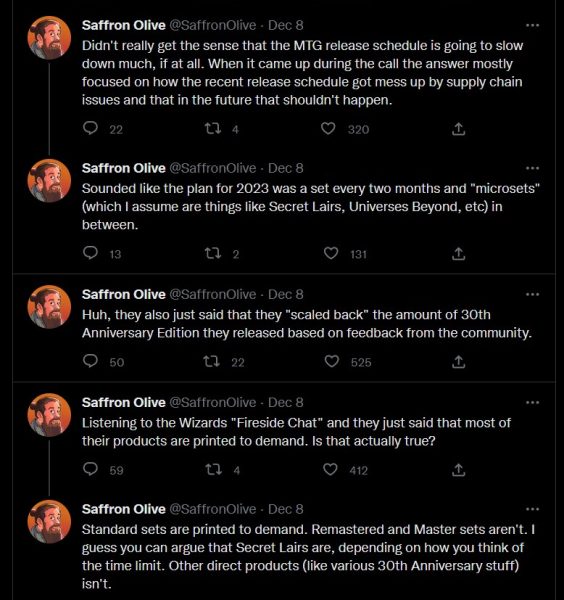
I’ve seen a number of takes on social media (i.e. Twitter) in response to this fireside chat. Popular YouTuber and podcaster @SaffronOlive shared mostly ambivalent comments about the interview.
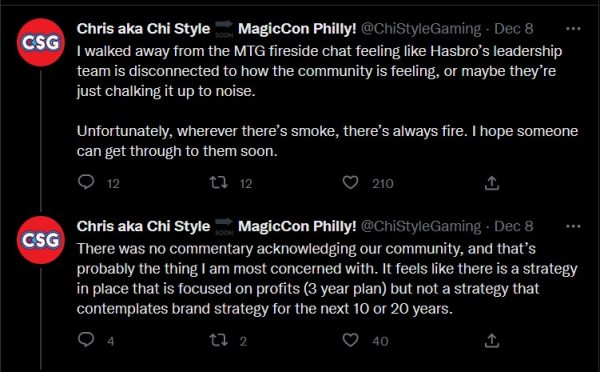
Other responses, such as @ChiStyleGaming, were a bit more negative in tone. There appears to be a lack of confidence in Hasbro’s leadership when it comes to managing Magic.
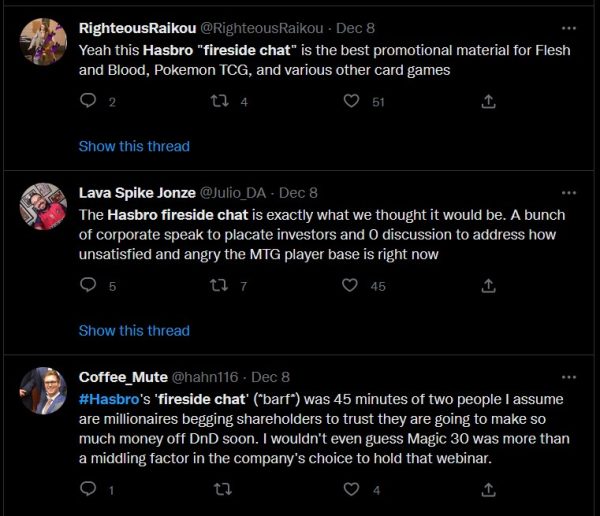
Other members of the Magic Twitter community were, shall we say, a bit blunter.
Why does there appear to be this massive disconnect between the player community and Hasbro’s leadership? Can Wizards of the Coast truly be so ignorant as to ignore the pleas of the community?
Hold your horses! Before getting out your pitchforks and marching on Pawtucket, RI, let’s take a step back first and look at this a little more pragmatically, with emotions removed. Yes, some members of the player base are frustrated, but I don’t think this portends Magic’s imminent death—not by a long shot.
There was an error retrieving a chart for Angry Mob
Let’s Take a Step Back
Let me start with the facts. Hasbro is a huge company. It has a market capitalization of over $8 billion with just about 6,000 employees. I have full confidence in their projection that Magic: the Gathering will become their first billion-dollar brand. Major economic depression aside, the data certain trends in this direction.
First of all, they didn’t get to this point by chance. During the fireside chat, Hasbro’s leaders said that in 2016 Magic sales were in the $350 - $400 million range. There was a heavy focus on competitive play, but they were “afraid” to build products that deviated from their traditional strategies.
With this new player segmentation model, Magic’s business has nearly tripled over the past six years. People will question what they will when it comes to the answers they gave to the UBS analyst’s questions, but I doubt they’re making these numbers up. This is major growth. It shows that their segmentation strategy isn’t just working. It’s firing on all cylinders!
There was an error retrieving a chart for Horn of Plenty
The community is quick to point out that the pacing of new releases is too fast and that Hasbro is taking a misstep by printing products that “aren’t for you.” The very things they are condemning as poor form are the very strategies that are driving tremendous growth for Hasbro. You can’t argue with the results so far.
Addressing Concerns
YES, some of these products aren’t for you. That’s their strategy. They said so on the call! YES, Wizards of the Coast is releasing more products now than before. It’s because they are activating their new consumer segmentation—a segmentation that demands customized releases to meet the different player demands. They need to release products for competitive players, casual players, and collectors alike.
They used to attempt this by putting all three into their limited product offerings. Instead, by releasing targeted products for each demographic, they can better meet the needs of the different player segments without making compromises.
As for the “angry player base”, as one vocal Twitter member called it, I’m not so sure if they’re Hasbro’s target audience. Hasbro has deliberately changed its business strategy to drive revenue growth. Change isn’t always embraced by people—in fact, some people (I’d argue the people who are shouting their disgust with the game) are averse to change. Change is uncomfortable. It means things that we once loved and cherished may not be the same ever again. It’s no wonder some players are reacting as negatively as they are.
However, change is a necessary force in business. I can’t blame Hasbro for taking a risk and trying something new. Had they stuck to the same strategy and release schedule as they did a decade ago, there’s no way Magic would have grown to the place where it is now. If they stuck with the same strategy as they had 20 years ago, there’s a good chance Magic wouldn’t have even made it to its 30th anniversary.
Sig’s Take
I’ll be the first person to admit that I loved what Magic used to be back in 1998-2006. That’s when my love for the game really developed, and I became a solidified player and collector. I remember when Wizards of the Coast first announced the creation of planeswalkers! I was really annoyed and frustrated about how much they could warp a game of Magic. Then they released double-faced cards! Were they crazy?!
It turns out, these changes didn’t destroy the game. Wizards of the Coast will certainly continue to make their share of mistakes, but as long as they’re willing to learn from them and pivot as needed, I think the health of Magic will remain stable. In other words, I didn’t listen to the fireside chat and immediately think that Magic was doomed. I was more inclined to think that Hasbro’s leaders didn’t really share any information that changed my opinion one way or another.
Let’s face it, Chris Cocks and Cynthia Williams spewed a good deal of corporate jargon and pre-rehearsed numbers to highlight the success of the game. I’m not so naïve as to think everything is as perfect as they indicated, but I also don’t think things are as dire as the Twitter community’s perception either. The reality is probably somewhere in between.
The important thing to me is that Hasbro is truly invested in Magic’s success. You know what? I am too! We have similar goals in mind. We both want more people to play Magic. We both want awesome new set releases and cool crossover products. Do I care about every product they release? Of course not!
That’s OK. I recognize I am an individual player with a certain play preference, and that Hasbro is going to release some products for me and some products that aren’t for me. Those products will be for a different player. I can live with that.
Wrapping It Up
I would describe my overall feelings about where Magic is headed in 2023 and beyond as “cautiously optimistic.” I think Hasbro has made a drastic change to its strategy over the past four years, and the data indicate this change has worked exceptionally well to drive sales and engagement with the game.
Will this trajectory of fast growth continue for the next few years, or will players and stores ultimately burn out from the fast pace of releases? Only time will tell. Clearly, Wizards of the Coast has a golden goose in Magic, and I hope they find the right balance between collecting eggs and nurturing that goose so that it can thrive for years to come.
There was an error retrieving a chart for Gilded Goose
No matter what happens, I am confident in one thing: Hasbro will be watching the performance of Magic very closely in the coming years, and they’ll make adjustments to their strategy where needed. If the game starts to show signs of excessive player and wallet fatigue, I trust that Hasbro will take note and adjust accordingly. They’ve made it clear that they’re willing to take some risks and change strategies, so if it becomes necessary to pivot I am confident they will do so.
If nothing else, that’s a positive takeaway from this session. Hasbro cares about Magic. They wouldn’t have done a fireside chat in response to the Bank of America double downgrade if they didn’t care. I also care about Magic. Our interests are sufficiently aligned, and I think it spells positive things for the game this decade.
If not, now is a perfect time to join up! Our powerful tools, breaking-news analysis, and exclusive Discord channel will make sure you stay up to date and ahead of the curve.
While I never advocate strict pick orders, to illustrate a point I'd like to provide a hyperbolic and nuance-free outline for how I want to start my draft. My priorities for pack 1, pick 1 are as follows:
Bombs or near-bombs
Scrapwork Cohort
Removal
Scrapwork Mutt
The two common one drops, Goblin Blast-Runner and Citanul Stalwart
Bombs and removal mostly speak for themselves. We can include any individual card that performs like a bomb in an archetype that we might be soft-forcing in this category as well. Two weeks ago, we discussed the power of the unearth cards. These two are the best performing, and seeded in the best performing colors. The top cards on this list are likely agreed upon as premium picks, even if individual preferences might rattle the precise order. However, placing these one drops on this lofty perch might come under some scrutiny. This disagreement is the topic I am excited to discuss this week.
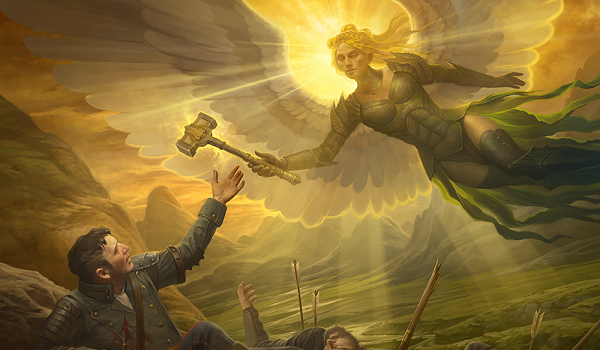
What Is The Brothers' War?
The Brother's War (BRO) is, more than anything else, a tempo format. Being on the front foot is very valuable, and even if we're looking to establish an attrition-based game plan, we don't want to fall too far behind our aggressors. Gaining an early advantage on the battlefield, be it a mana advantage, pressure advantage, or otherwise, leads to a good amount of wins. While a wide range of decks are viable, most of my trophy wins come from being red or white-based aggro.
If our goal is to draft for free, then we want to hit certain thresholds. We want to win four-five games in our Arena Premier Drafts. We want to win two or three matches at our FNMs (though due to changes in prize support, this dream may be dead at some local game shops).
While I enjoy my Elsewhere Flask/Corrupt decks, red and white-based aggro pays the bills.
Boros Bill Payers
There are a lot of cards in this color pair that are on a consistent, creature-based, aggressive plan. As a result, it's feasible to pilot aggressive decks to profit without hitting the lottery on rares and mythics.
Enter the Blast-Runner
Aggressive decks want great two-drops. The only thing better is great one-drops.
This card hits early and often. Being able to peck in for a few points of damage on a clear board is nice, but once we start cracking Evolving Wilds and Retro Artifacts, the damage gets very threatening, very quickly.
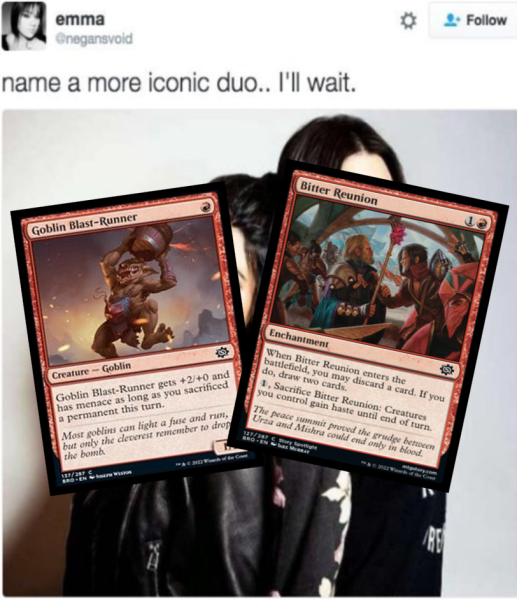
That, however, is not the reason why it is such a high pick for me. The real reason we want to prioritize the goblin is that I want as many as I can get. This one drop represents a plan. The more copies of Blast-Runner, we have, the more consistent that plan becomes. In short, decks that want one Goblin Blast-Runner actually want three or more. Red Aggro is a real deck. It can be built in many ways. Blast-Runner Aggro is a very powerful version of the deck that leans on a few synergies, hopefully in multiples.
Bitter Reunion is the best friend of our one-drop goblin. It lets us pitch lands in search of more goblins, and when we find them, we can give them haste, menace, and more power as we sacrifice the enchantment. When playing Blast-Runner Aggro, we want as many copies of these cards as we can get. Reunion not only fuels our hand but can let us make up the tempo in future turns. Best of all, the more of each, the lower the land count we can play. If we can round out our deck with Penregon Strongbulls, Scrap Mutts, and some curve topping Unleash Shell, we have a solid, threatening plan.
When We Fail to Plan, We Plan to Fail
Goblin Blast-Runner is a card we need to build around. A one-mana 1/2 is not worth a draw step. However, as we begin piecing together our deck, we want to make sure we have Blast Fodder if we're looking to play this creature. We prioritize it because it's an essential part of a plan. It is not, however, an objectively strong piece of any red deck.
As we're drafting red decks we want to take the objectively powerful cards, but the more Goblin Blast-Runners we have, the more supporting pieces we want. We should consider what our deck could look like at the end of the draft. If we have these pieces early enough, it makes it easier to commit to those directions. We can be a good red deck without these synergies. I think we can be a better red deck with these synergies.
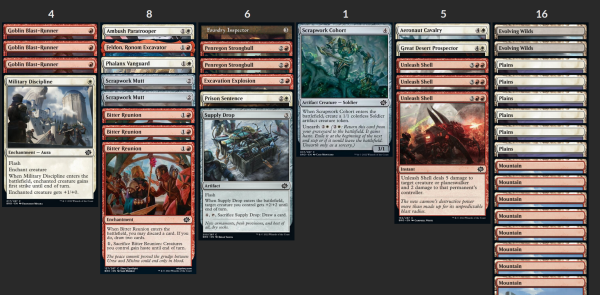
Blast-Runner Aggro (7-2)
Creatures
3 Goblin Blast-Runner
1 Ambush Paratrooper
1 Feldon, Ronom Excavator
2 Scrapwork Mutt
1 Phalanx Vanguard
1 Foundry Inspector
2 Penregon Strongbull
1 Scrapwork Cohort
1 Aeronaut Cavalry
1 Great Desert Prospector
Artifact
1 Supply Drop
Enchantment
1 Military Discipline
3 Bitter Reunion
1 Prison Sentence
Sorcery
1 Excavation Explosion
3 Unleash Shell
Land
2 Evolving Wilds
6 Plains
8 Mountain
The Stalwart Plan
Last week, I expressed some skepticism about this little mana dork. That doubt quickly dissipated after watching Sam Black and chord_o_calls stream. Both players used Citanul Stalwart often and to great success. The card is very real.
Citanul Stalwart occupies a similar space as Goblin Blast-Runner in that, when we want one, we want many. It is a tent pole of an entire archetype. In some instances, it might remind old-school Modern players of Affinity decks. The Stalwarts let us empty our hands quickly, playing similarly to Springleaf Drum.
Sidenote: Springleaf Drum can, coincidentally, fill in for your third or fourth Stalwart. However, one of the valuable aspects of the Stalwart is that it can tap your artifacts, especially Powerstones for colored mana. The Drum is not nearly as flexible.
Why Stalwart?
Citanul Stalwart lets us play a five-color green deck that can access some of the format's most powerful spells. It lets you splash the unearth cost of any of the creatures we happen to draft, and it can splash bomb rares as well. Because we can ramp as early as turn two, we can often put enough material on the board to slow down our opponents until we're able to value them out. Stalwart allows for a flexible shell and can use what the table is giving us. However, there are some cards we need to maximize it.
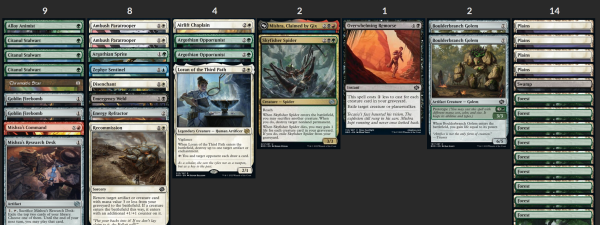
Five-Color Stalwart (5-3)
Creatures
1 Alloy Animist
3 Citanul Stalwart
1 Argothian Sprite
1 Zephyr Sentinel
2 Ambush Paratrooper
1 Airlift Chaplain
1 Loran of the Third Path
2 Argothian Opportunist
1 Mishra, Claimed by Gix
1 Skyfisher Spider
2 Boulderbranch Golem
Artifact
1 Chromatic Star
1 Mishra's Research Desk
2 Goblin Firebomb
1 Energy Refractor
Instant
1 Disenchant
1 Overwhelming Remorse
Sorcery
1 Mishra's Command
1 Emergency Weld
1 Recommission
Land
4 Plains
1 Swamp
9 Forest
Cheap cards like Goblin Firebomb help us activate our Stalwarts to ramp out early Boulderbranch Golem. While this deck could have used a little more top-end, it functioned smoothly on fourteen lands.
Once we've collected at least three Citanul Stalwarts, supplemented by some combination of Energy Refractor and Evolving Wilds, we really have carte blanche to do as we want. We can play a soldier package or use high-quality red cards. We can splash bombs. Whatever the table provides, we can facilitate. This is because, in this specific format, Citanul Stalwart is basically Birds of Paradise (some assembly required). Here's the caveat though: it doesn't work with just one Citanul Stalwart.
Remember That Pick Order?
The biggest reason why we should prioritize these creatures is that they are cards that we want in multiple. They represent a plan. When we move through the draft, we're often times looking for a plan or balancing multiple at once. Some cards offer us inroads to better plans. Sometimes we see valuable pieces that might enhance whatever plan can support their inclusion. While we shouldn't overlook superior options, the case for these two is as follows:
Both Stalwart decks and Blast-Runner decks want multiple copies of their respective one-drops, often more than they want any other card.
Goblin Blast-Runner decks are well-supported at common and pair well with many colors, or simply as mono-red.
Citanul Stalwart decks are flexible enough to incorporate whatever strong plan is available at our table.
While you may disagree with the list at the top of the article (perhaps for good reason), if you find that your decks are lacking a clear plan, prioritizing these two cards might be the direction you need in this format.
Shine a Little Light
This week, we're going to shine a little light, on my new favorite card in the format.
There was an error retrieving a chart for Recommission
There is a setup cost here. Namely, small creatures (or artifacts) need to be in our graveyard. The good news is those small creatures naturally end up in graveyards! Using two mana to get back a three-drop with a counter on it feels like very good value every time it happens. Sometimes it fishes out an Ambush Paratrooper or an Air Marshal to help you push through lethal. Occasionally, it re-buys one of our critical one-drops, which is especially useful for Citanul Stalwart. At higher rarities, it can be back-breaking for opponents. Third Path Iconoclast? Yotian Dissident? How about Skystrike Officer or Siege Veteran?
If we're playing an aggressive deck, which is what white wants to be doing in this format, the card has a very low failure rate. Often times you trade, and the next turn you double spell. Using two mana to get a 5/5 Warlord's Elite, a 3/3 Airlift Chaplain, or a 2/5 Yotian Medic leads to some very powerful turns.
Recommission's 17Lands data is admittedly underwhelming. It claims a GIH WR of 55.1% and has a negative IWD. As far as the eye test goes though, this card has over-performed for me. It has been a flexible and undercosted tool that has won me multiple games. Are my experiences the result of a small sample size or has this card been strong for you? Let me know in the comments.
If not, now is a perfect time to join up! Our powerful tools, breaking-news analysis, and exclusive Discord channel will make sure you stay up to date and ahead of the curve.
Greeting QS Insiders. It's now time for me to dive into the data I presented on Wednesday and also discuss the observations that aren't visible in the data. November is going to be a bit odd in this regard as the observable data doesn't look dramatically different from October. However, that is a bit deceptive, and there's a lot going on beneath the surface. Modern is seeing a burst of brewing which might be a flash in the pan, or it could really turn into something. If it can break through the established players, which is looking... potentially possible. With an asterisk.
The Meta Shift That Wasn't
The first thing to address is the question posed by my previous analysis article in October: what effect will The Brothers' War have on Modern? I can now say that the answer is almost none. It's rather anti-climactic, but very few cards have made it into Modern decks at all and none have had any measurable metagame impact. Haywire Mite has seen the most play, as it's in pretty much every Urza's Saga deck which can produce green mana. It even inspired an attempt to make Insect Tribal a deck. The deck has (many) more legs than I'd expected, but hasn't really done anything in the wider metagame.
There was an error retrieving a chart for Haywire Mite
Outside of Mite, both The Stone Brain and Loran of the Third Path are seeing sideboard play. However, where Loran is seeing more play than I expected, Brain is seeing a lot less. Despite certain expectations, Prison Tron did not see a persistent surge of play, nor did it put up results. As expected, it was popular for the first weekend, then immediately fell off.
Brain does not fix any flaws in the deck. It wasn't good before BRO, and Brain doesn't move the needle enough to change anything. Bitter Reunion is still seeing some niche play as a supplement to Fable of the Mirror-Breaker.
Thinking With Portal
Which isn't to say that BRO might not eventually shake up Modern. There were also expectations for Portal to Phyrexia, both on its own and alongside Shape Anew. As of this moment, those expectations have not been met. There have been dedicated combo decks around the card, but they didn't put any results into my data. There have been some 4-Color Control lists that include the combo, but the current evidence suggests that their success is more down to the rest of the list than the combo itself. In which case, Indomitable Creativity would be better.
That said, there is potential here. Portal is quite expensive, but has two very powerful effects. The current lists all look too cute and/or janky to me, which explains why they're not currently working. With some more refinement, I could see this becoming a Splinter Twin-esqe combo for Modern control decks. However, there is a lot of tension and clunk to work out first.
The Wildcard
On that note, Sarinth Steelseeker has seen unexpected play. Everyone can thank aspiringspike for that; he's single-handedly revived interest in the Hell's Kitchen deck by incorporating Steelseeker. That deck didn't last because unless (deep breath) Asmoranomardicadaistinaculdacar hits play, the critical central engine does nothing. Even when the engine is going, the rest of the deck proved too anemic to cope. Spike has fixed this by adding Wrenn and Six, because adding good cards is always a good move, which makes Saga stronger.
More pertinently, he added Steelseeker, giving the food engine something to do besides fuel The Unpronounceable One. With Steelseeker, every food is an opportunity to rip though the deck and find the few good cards. This has increased the consistency and therefore the power.
However, it's not enough. Spike and all the other Food players did abysmally in the Modern Showcase Qualifier. Food remains a fringe deck, but I now believe that Steelseeker does have untapped potential. How it can be captured is anyone's guess at this point.
The Three-Outlier Metagame
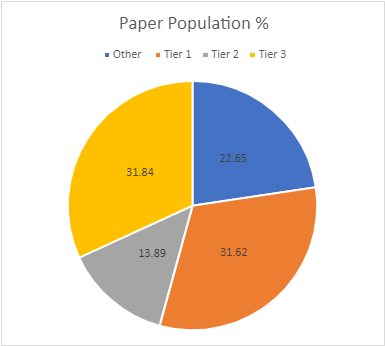
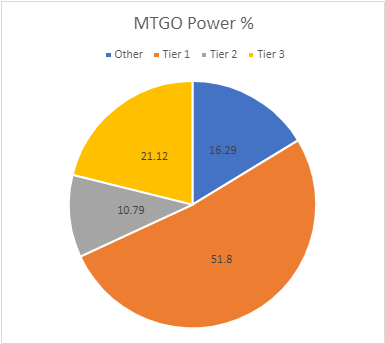
From the hypothetical to the actual, the metagame is beginning to split between the online and paper metagame. Where the online metagame is essentially a continuation of pre-BRO trends, the paper metagame is going another way. It's not exactly rejecting the online trends, but it's not following them either. The reasons for this at the moment are transitory and this could all be moot by the next metagame update. Or there could be a major change in the winds incoming.
All Those Outliers
Addressing the elephant in the room, Magic Online (MTGO) not only produced three statistical outliers, but they're also outliers by a significant margin. Such a margin that I didn't both with my usual battery of statistical tests because the result was obvious. The overall metagame is being inexorably twisted around the pillars of UR Murktide, Rakdos Scam, and Hammer Time. It's not because they're so much more powerful than other decks, as evidenced by their winrates. Rather, these decks take up so much of the metagame that every other deck must be ready for them.
The question then becomes how and why this has happened. The how is straightforward: they show up a lot. Specifically, these three decks show up to an inordinate amount in the Challenges. While Hammer and Murktide do make ok showings in the Preliminaries, they really turn out for the Challenges. Scam takes this to an extreme, rarely showing up in smaller events and doing exceptionally well in the big ones. This is literally driving out the other decks, leaving only the three outliers.
There was an error retrieving a chart for Sigarda's Aid
The why is more complicated. No outlier deck has any particular natural advantage over the others, and each deck has a high enough power level to take any deck on. Murktide has been an enigma all year, being a deck that is absolutely everywhere despite an average win rate. Hammer and Scam are strong decks made outlier strong by the potential for free wins. Hammer can outright win on turn 2 several ways with a god draw. Scam can't outright win early, but it does feel that way when it evokes Grief into Feign Death on turn one. These lines negate some of each deck's weaknesses and make them major metagame players.
The Consequence
While neither deck being extremely popular is a problem on its own, the context and implications are more harrowing. Just look at the rest of the tier chart; the outliers account for over a third of the total results, and exceed their nearest competition by nearly 50% at minimum. Every other deck has cards in their sideboards (at minimum) specifically for the three outliers. Quite literally, all other competition is being crowded out.
When the only consistent outlier was Murktide, this wasn't really a problem. On its own, Murktide was never more than ~13% of Modern, which left plenty of room for other players. Even when it was joined by other decks, they accounted for less than 25% of Modern. This is damning by faint praise, but that's pretty typical for Tier 1 decks. However, the concentration in November is troubling. If it is sustained, there may need to be action to force the online metagame to diversify.
The Counterpoint
Such action would be unfortunate. The paper metagame looks very healthy. November is the second consecutive month without any outliers. It's also the first month since April where Murktide is not the top deck in paper. It is possible that this represents a genuine change in player taste and thus the metagame. It is also possible that it's a function of Modern being out of the spotlight, replaced by Pioneer. I have no way of knowing.
In fact, looking through the paper results (and online, to an extent) reveals a metagame that is very diverse both in terms of individual decks and strategy. The midrange and 4-Color decks are far less prevalent in paper than online, and there are combo decks doing well in the higher portion of the tier list. The MTGO results have that too, but more of them are sneaking in at the bottom of Tier 3. Therefore, they only made the list thanks to my accounting for outliers.
Outside of the warp on MTGO, Modern doesn't look like it needs intervention. There are things that could be improved, but the metagame is generally fulfilling the health criteria. The MTGO warp is the only visible problem, and that's mostly down to player tastes. It would be shame to ruin it for everyone because MTGO chases its own tail, but doing so might be the only way to fix that meta.
Year-End Outlook
What this means for the financially minded out there is unclear. On the face of things, the Modern metagame status quo will remain until at least January. Whether the worrying aspects will be sustained as well is impossible to say, but I don't believe that we'll see anything truly new to shake things up without Wizards intervening before Phyrexia: All Will Be One.
There was an error retrieving a chart for Urza's Saga
Of course, this is tempered by it now being December, a month when competitive Magic traditionally takes a breather. Prices always fall and so do sales. The traditional advice is that this is the time to pick up staples on the cheap and build inventory for the coming year.
While competitive Magic isn't what it once was, there is a new Modern tournament series coming to the US West Coast in 2023. The east has been well-served by both Star City Games and NRG, but there's never been anything like them in the west. This new series, limited though it will be, will drive demand for Modern staples in 2023. Thus, the old advice is still good.
That Controversy
Of course, I can't get away with any finance piece without mentioning all the controversy over Hasbro's actions vis-a-vis Magic, which the QS team has also weighed in on in article form. With the Magic 30 packs apparently failingto sell and Hasbro announcing that it intends to continue and expand its current policies, the financial Magic world is roiling. I don't need to reiterate to the Insiders the conversations happening on the QS Discord over this debacle. The thing is, I'd imagine that everyone reading this has already made up their minds about what they feel about everything, and nothing I say will change your mind about MTG finance in the near future.
There was an error retrieving a chart for Gifts Ungiven
Instead, let me remind everyone of one fact: Magic is the best-selling, most popular trading card game. Period. The game itself isn't going anywhere. The fact that a new tournament series is coming next year is proof of that. For those looking to make money buying and selling cards, that door will always be open. It is those seeking to hold cards as long-term investment opportunities that are affected. I've always been addressing everyone here as players looking to move cards and not investment types, and for those people the end of 2022 should be business as usual, with improved business conditions on the horizon.
Here's to the End
The holiday season is upon us and will be done when next I write this article. I hope everyone has a joyous season of whatever you celebrate and may your purchases be low and sales high. See all you Insiders in the new year!
If not, now is a perfect time to join up! Our powerful tools, breaking-news analysis, and exclusive Discord channel will make sure you stay up to date and ahead of the curve.
Happy holidays! 'Tis the season for giving gifts and receiving awesome Magic stuff. However, there is now more product than ever! What gifts are great versus bland? Here are some ideas that will spark joy for your favorite Magic player or even yourself. Done with your holiday shopping? There are some opportunities to flip as well!
Lands Ahoy!
Lands are the triple threat of Magic and easily the best permanent type. They are necessary, the fundamental building block of every deck, and have always been some of the most valuable and collectible cards as well. Of course, that means the best lands have long been the most expensive cards. However, right now, prices are extremely attractive on some of the absolute best lands ever printed.
Let's take a look at the horizon lands, named for Horizon Canopy. Personally, I think "canopy lands" is a cooler name, but I digress. These debuted in the $15 range and have been steadily creeping to the $5 range for most versions. Can they go much lower? I don't think so. Yes, they will be reprinted, likely in the next Modern Horizons set. However, between now and then, there are a lot of games of Magic to be played, and these lands are straight value in most decks, particularly Commander.
Not only that, but foil versions have decreased, if by quite a bit less, in the last year. For example, Cardkingdom is paying $21.45 in store credit for foil Waterlogged Grove, and there are quite a few available for just about exactly that amount on both TCGplayer and eBay. When I can buy cards for the same price or less than a large card store, it generally means it's a good idea. Here I am leveraging the data, sales, and sentiment of a huge retailer in addition to my own. It's usually been the right move!
Triomes? More Like Du-Omes!
The Triomes are good lands in multiple formats. My empirical evidence has conclusively shown that they are easily as good as any other two-color land, and since they tap for three colors and have cycling, they're just plain better. It is my opinion that they are near the bottom in the pricing cycle, so I am ready to purchase several. Additionally, I cannot see a reason for a reprint in the next year considering they just completed the cycle with Streets of New Capenna. In much the same way as the horizon lands, the foils had dropped previously but are mostly stable or climbing now.
True Duals
Here we are almost entirely talking about Revised edition dual lands. The icy reception to Magic 30th Anniversary did have a chilling effect on ABUR card prices but, in general, expensive Revised cards were hit the hardest. However, it appears that they have mostly recovered in price and are starting to trend back upwards. If you have been waiting for the price to drop on these, well, you mostly missed it. However, it's still a good deal to buy near the bottom. I've picked up several of the cheaper duals and even a graded one for absolutely bargain basement prices but now's sort of a last-chance window to snap them up.
While lands aren't the most exciting or flashy cards, they are some of the most needed. Horizons and Triomes are better than a random pack of cards and a true dual is better than an entire box (or two or three) of new cards. Seriously! Additionally, these lands range at all different price points. Whether regular, foil, showcase or vintage, there's a land for every budget.
Serialized Brothers' War
#007 James, James Wurmcoil
The name is Quiet Speculation, but here I have to open my mouth. I'm very surprised by the somewhat mild prices for serialized cards. With just a handful in existence and the fact that retro and schematic cards look amazing, it's a no-brainer to conclude these have value. However, the price premium is not unattainable. If these cards, particularly "meme" numbers, don't skyrocket in price over the years, I'd be shocked. Now imagine giving or receiving a desired card with a special, personal number? Talk about the perfect gift for any Magic enthusiast, and very nearly one of a kind. There may just be someone out there who would kill for a seemingly random number down the line.
One of the Best Sealed Products Ever, Jumpstart 2022
I'm not a huge fan of the crazy amount of reprints that Wizards dumps into the market. However, Jumpstart 2022 is very good. It's built for packwars, which it does exceedingly well! Furthermore, these aren't just vanilla reprints. You get some very cool, new artwork. And hey, they aren't $250 per pack like 30th Anniversary proxy packs. They are very reasonably priced. I give credit where credit is due. This is a successful execution of what this type of product must be for Magic to grow.
The target audience loves cracking packs, drafting, and sealed, and Jumpstart checks all the boxes. Commander player? There are a lot of great legends. New player? Packwars is an easy way to learn. You cannot go wrong here! Instead of the standard "this product is not for you," Jumpstart really is a product for everyone. That is what makes it a great gift!
The Only Thing Better Than Cards? Accessories!
Dice, sleeves, playmats, life counters, deck boxes; Magic players need a lot of stuff besides cards! A huge number of small businesses produce nothing but completely custom, one-of-a-kind accessories that any Magic player would enjoy. You might expect the price for custom accoutrements to be high, but turns out it's only a slight premium!
Getting matching sleeves, a deck box and playmat for that completed Commander deck is the cherry on top that makes an excellent and thoughtful gift for anyone.
What Not To Gift
Bulk, Bulk, and More Bulk!
Alright, let's talk about bulk lots, grab bags, repacks, mystery boosters, that sort of thing. These are marketed as gift ideas and, for the right person, they are okay. However, if you compare the price paid versus what you could have gotten instead, these are not good buys. Here's just one real life example how.
There was an error retrieving a chart for Yotian Soldier
A good friend of mine from many years ago made a deck full of Yotian Soldier, and I mean full. He rule zero'd and told his opponent his deck had far more than the legal four of and no one complained during casual play. All the time people would hand him another one or two Soldiers and he would add them to the deck. At last count it was something like 100 of them.
He would appreciate finding a Yotian in a bulk lot and it wouldn't matter that the other cards were worth pennies. However, for the same amount of money, I could hand him a stack of Soldiers. Alternatively, I could get them a few copies from Antiquities.
Which would make such a player happier? I'm sure they would rather get either original copies or mass quantities of the single card they want versus a pile of generic cards and only one Soldier. More cards does not equal more happy, but more of the right stuff does.
Of Course, the Best Gift Is You
One gift every Magic player treasures is more Magic players. New to Magic? Well, there's still a great opportunity to learn to play with either Jumpstart or the new Commander Starter decks. These could be the easiest and best ways to introduce your friends or significant other to the game. The gift of time is the most valuable and special of all, and these products allow you to make good use of it.
Hopefully I've helped cut through the myriad choices in the Magic market. There are over 25,000 unique Magic cards and many of them are downright awful. Don't waste your money on awful cards or bulk gambles when there are a lot of sure wins out there. Whether it's sealed, singles, or accessories, you can't go wrong with some of the above items. Believe me, your Magic player will thank you!
What's the best Magic gift someone gave you? What was the best gift you've given? Let me know in the comments!
If not, now is a perfect time to join up! Our powerful tools, breaking-news analysis, and exclusive Discord channel will make sure you stay up to date and ahead of the curve.
It's the penultimate Modern metagame update of 2022. How this year has lurched by. October saw a ban and thus provided incomplete data. November is the first chance to examine the complete monthly data for the post-Yorion, the Sky Nomad metagame. Which is somewhat facetious, as the more things have changed, the more they've stayed exactly the same.
Continuing Continuity, Differentiating Divergence
UR Murktide has been a statistical outlier in the Magic Online(MTGO) data every metagame update since March, and it continues to be one in November. With two exceptions: it has also been an outlier in the paper results. October was the first exception to outlier status since April. I now need to edit the earlier statement to say three exceptions, since Murktide isn't an outlier in paper Modern again. It isn't even the top deck.
In fact, paper doesn't have any outliers. This might be a good sign, indicative of Modern adjusting and adapting. On the other hand, there are confounding factors at play that I'll get to down the page.
MTGO made up for that by having three outliers. Both Hammer Time and Rakdos Scam were well over the minimum threshold to be considered statistical outliers. As always, outliers are in their correct place on the metagame chart but are excluded from the actual calculations, resulting in an adjusted average and standard deviation.
November Population Metagame
To make the tier list, a given deck has to beat the overall average population for the month. The average is my estimate for how many results a given deck "should” produce in a given month. Being a tiered deck requires being better than “good enough.” Every deck that posts at least the average number of results is "good enough" and makes the tier list. Then we go one standard deviation (STdev) above average to set the limit of Tier 3 and the cutoff for Tier 2. This mathematically defines Tier 3 as those decks clustered near the average. Tier 2 goes from the cutoff to the next standard deviation. These are decks that perform well above average. Tier 1 consists of those decks at least two standard deviations above the mean result, encompassing the truly exceptional performing decks.Â
The MTGO Population Data
In November the adjusted average population for MTGO was 5.33, setting the Tier 3 cutoff at six decks. This is a low average and .02 below October's average, but with three excluded outliers it makes sense. Tier 3, therefore, begins with decks posting six results. The STdev was 6.05, which means that Tier 3 runs to 12 results. Again, it's the starting point to the cutoff, then the next whole number for the next Tier. Since 6.05 is so close to 6.00, I rounded down for October. Therefore Tier 2 starts with 13 results and runs to 19. Subsequently, to make Tier 1, 20 decks are required. This is the exact same set of cutoffs as October, coincidentally.
There was an error retrieving a chart for Primeval Titan
Which is not (necessarily) a sign of format health and popularity. MTGO is under new management, and they release more data than Wizards did. Wizards always released the results from Challenge-level events and no more than five Preliminaries every week. Daybreak Games has been releasing every event that fires. I hope it continues as there were three more Prelims on average than before, which means more complete data for me. November was also special thanks to extra events from the Last Chance Qualifiers.
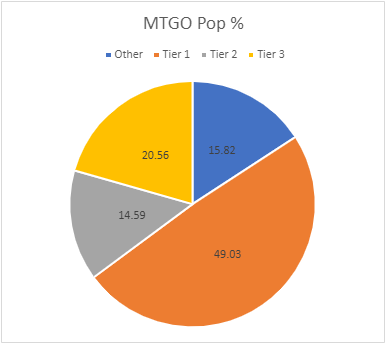
The number of individual decks was up significantly from 57 to 74. More data equals more decks. Of those 74 decks, 27 made the population tier. That is quite high as these go, though it would be lower without the outliers.
Deck Name
Total #
Total %
Tier 1
UR Murktide
79
13.88
Hammer Time
62
10.90
Rakdos Scam
49
8.61
Amulet Titan
25
4.39
UW Control
24
4.22
4-Color Creativity
20
3.51
Burn
20
3.51
Tier 2
Jeskai Breach Combo
19
3.34
Yawgmoth
19
3.34
4-Color Control
16
2.81
Living End
15
2.64
Merfolk
14
2.46
Tier 3
Counter Cat
12
2.11
Bring to Light
10
1.76
Hardened Scales
10
1.76
Mono-Green Tron
8
1.41
Mono-Red Artifacts
8
1.41
5-Color Creativity
8
1.41
4-Color Rhinos
8
1.41
Grixis Death's Shadow
8
1.41
Goblins
7
1.23
Calibrated Blast
7
1.23
Jund Saga
7
1.23
Temur Breach Comob
6
1.05
UW Urza
6
1.05
Mill
6
1.05
Hell's Kitchen
6
1.05
So... yeah. Tier 1.
Thanks to the three outliers soaking up over a third of the total places, Tier 1 accounts of almost half of the total data in November. Interestingly, UW Control has managed to massively surge from mid-Tier 3 to Tier 1. I'd assume that it has more to do with the demise of Omnath, Locus of Creation in the wake of Yorion's ban than an independent increased interest or metagame position. Control can't really keep pace with decks where everything is a two for one or better.
The Paper Population Data
The paper tiers are calculated the same way as the MTGO tiers, just with different data. Typically, there are more paper events are reported each month, but that isn't the case in November. July had 783 decks, June had 640, and August recorded 594. September saw a surge up to 748 decks. The partial data for October had 467 decks, and November only saw 468.
Having a whole month should have produced a lot more than October, but November had confounding variables. The Regional Championships were this month and they're all Pioneer. A lot of stores switched Modern events for Pioneer to help players practice. The larger event organizers followed suit, so few and smaller events are to blame.
Weirdly, this has not affected deck diversity. October had 79 unique decks and so did November. 22 of those decks made the tier list. The average population was 5.92, so six decks make Tier 3. The STDev was 8.91, so the increment is nine. I round down if the decimal is less than .20. Again, the same as in October. Therefore, Tier 3 runs from 6 to 15, Tier 2 is 16 to 25, and Tier 1 is 26 and over.
Deck Name
Total #
Total %
Tier 1
Hammer Time
47
10.04
UR Murktide
37
7.91
4-Color Creativity
34
7.26
Rakdos Scam
30
6.41
Tier 2
Amulet Titan
23
4.91
Jeskai Breach Combo
22
4.70
Burn
20
4.27
Tier 3
UW Control
15
3.20
Merfolk
15
3.20
Yawgmoth
14
2.99
Living End
13
2.78
Affinity
13
2.78
4-Color Rhinos
13
2.78
Cascade Crashers
9
1.92
4-Color Elementals
9
1.92
5-Color Creativity
8
1.71
Counter Cat
8
1.71
Grixis Death's Shadow
7
1.50
Hardened Scales
7
1.50
Ponza
6
1.28
Mono-Green Tron
6
1.28
4-Color Control
6
1.28
Weird seeing Tiers 1 and 3 effectively equal.
Hammer Time is within the limit to be an outlier, despite appearances. It only started to pull away at the end of the month, when it was absurdly prevalent in an NRG event. Up until that point Murktide, Hammer, and 4-Color Creativity were basically equal.
Interestingly, both Crashing Footfalls decks made Tier 3 in November. The 4-Color version is the only one that shows up on MTGO, but both show up in paper all the time. The Temur version has shifted to being more of a Blood Moon deck than before. Whether this is paper players being more locked into decks than MTGO or a genuine metagame driven shift is unknown.
November Power Metagame
Tracking the metagame in terms of population is standard practice. But how do results actually factor in? Better decks should also have better results. In an effort to measure this, I use a power ranking system in addition to the prevalence list. By doing so, I measure the relative strengths of each deck within the metagame. The population method gives a deck that consistently just squeaks into the Top 32 the same weight as one that Top 8's. Using a power ranking rewards good results and moves the winningest decks to the top of the pile and better reflects their metagame potential.
The MTGO Power Tiers
For the MTGO data, points are awarded based on the population of the event. Preliminaries award points based on record (1 for 3 wins, 2 for 4 wins, 3 for 5), and Challenges are scored 3 points for the Top 8, 2 for Top 16, and 1 for Top 32. If I can find them, non-Wizards events will be awarded points the same as Challenges or Preliminaries depending on what the event in question reports/behaves like. Super Qualifiers and similar higher-level events get an extra point and so do other events if they’re over 200 players, with a fifth point for going over 400 players. There were a few 4-point events, but no 5-pointer in November.
Total points fell are up just like the population, from 599 to 890. The adjusted average points were 8.28, therefore nine points made Tier 3. The STDev was 9.05, which is average. Thus add 9 to the starting point and Tier 3 runs to 18 points. Tier 2 starts with 19 points and runs to 28. Tier 1 requires at least 29 points.
Total decks are the same in paper as on MTGO. However, Temur Underworld Breach fell off the list, replaced by Belcher.
Deck Name
Total Points
Total %
Tier 1
UR Murktide
121
13.60
Hammer Time
91
10.22
Rakdos Scam
90
10.11
UW Control
39
4.38
Amulet Titan
32
3.60
Jeskai Breach Combo
30
3.37
4-Color Creativity
29
3.26
Yawgmoth
29
3.26
Tier 2
Burn
28
3.15
Merfolk
26
2.92
4-Color Control
22
2.47
Living End
20
2.25
Tier 3
Counter Cat
17
1.91
Bring to Light
17
1.91
Hardened Scales
17
1.91
Mono-Green Tron
15
1.68
Mono-Red Artifacts
13
1.46
5-Color Creativity
13
1.46
4-Color Rhinos
13
1.46
Goblins
12
1.35
Hell's Kitchen
12
1.35
Grixis Death's Shadow
11
1.24
Mill
11
1.24
Calibrated Blast
10
1.12
Jund Saga
9
1.01
Belcher
9
1.01
UW Urza
9
1.01
And now Tier 1's over 50%. Great.
Tier 1 expanded, with Burn missing the cutoff while Jeskai Breach and Yawgmoth made it. There is a lot of movement within Tier 3, but nothing managed to escape.
It's interesting to note that the metagame has largely moved away from cascade decks in defiance of the trend earlier in the year.
The Paper Power Tiers
Unlike with population, the paper power data works differently than the equivalent MTGO data. The data reported is usually limited to the Top 8 lists, even for big events. Not that I know how big most events are, as that number doesn't always get reported.
In other cases, decks are missing. Applying the MTGO point system just doesn't work when I don't know how many points to award and there are data gaps.Â
There was an error retrieving a chart for Risen Reef
Thus, I award points based on the size of the tournament rather than placement. That way I'm being internally consistent with the paper results.
The current system is that for events that don't report their starting populations or are under 50 players, I'm giving out 1 point. 51-300 players get 2 points. 301 and above get 3 points. I chose these levels based on the rarity of events over 300 compared to 100-200 and the fact that events under 300 tend to be local events in large cities. It feels like it should be 300 for truly unique events, despite there being no Grand Prix yet. I will be changing how the points are allocated next year, starting with the January metagame update.
There were a huge number of events awarding 2 points in July and several 3-point events as well. Altogether November had 660 points, just up from October's 650 points, but again that's to be expected when Pioneer's the focus.
The average points were 8.35. This sets the cutoff at nine decks. The STDev was 12.93, thus adding 13 to the starting point and Tier 3 runs to 22 points. Tier 2 starts with 23 points and runs to 36. Tier 1 requires at least 37 points. The total decks fell from 22 to 19. The only deck with six instances that also had enough points to qualify was 4-Color Control.
Deck Name
Total #
Total %
Tier 1
Hammer Time
71
10.76
UR Murktide
50
7.57
Rakdos Scam
47
7.12
4-Color Creativity
44
6.67
Tier 2
Amulet Titan
35
5.30
Jeskai Breach Combo
32
4.85
Burn
29
4.39
Tier 3
UW Control
21
3.18
Merfolk
21
3.18
4-Color Rhinos
21
3.18
Yawgmoth
19
2.88
Living End
19
2.88
Affinity
17
2.58
Counter Cat
14
2.12
4-Color Elementals
11
1.67
5-Color Creativity
11
1.67
Grixis Death's Shadow
11
1.67
Cascade Crashers
10
1.51
4-Color Control
9
1.36
This is a bit more normal looking.
Big news on this front: I've come to a decision about the Omnath decks and names. The decks that run four Omanth and Solitude but few other creatures are 4-Color Control. If it has Risen Reef and noncreature spells it counts as 4-Color Elementals. If it has Reef, more elementals, and few non-creatures, that's Tribal Elementals. If there are at least three blink effects, it's 4-Color Blink. Of note, Blink has almost disappeared, and even then Ephemerate is gone, replaced by Touch the Spirit Realm.
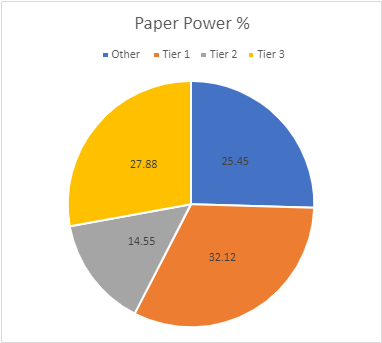
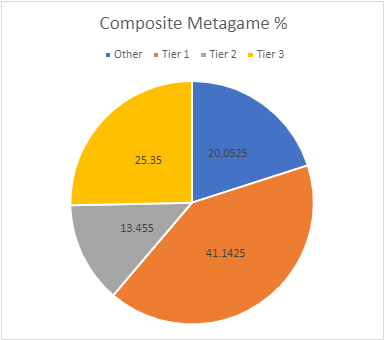
Average Power Rankings
Finally, we come to the average power rankings. These are found by taking the total points earned and dividing them by total decks, to measure points per deck. I use this to measure strength vs. popularity. Measuring deck strength is hard. There is no Wins-Above-Replacement metric for Magic, and I'm not certain that one could be credibly devised. The game is too complex, and even then, power is very contextual.
Using the power rankings certainly helps and serves to show how justified a deck’s popularity is. However, more popular decks will still necessarily earn a lot of points. Which tracks, but also means that the top tier doesn't move much between population and power, and obscures whether they really earned their position.Â
This is where the averaging comes in. Decks that earn a lot of points because they get a lot of results will do worse than decks that win more events, indicating which deck actually performs better. A higher average indicates lots of high finishes, whereas low averages result from mediocre performances and a high population. Lower-tier decks typically do very well here, likely due to their pilots being enthusiasts. Bear this in mind, and be careful about reading too much into these results. However, as a general rule, decks which place above the baseline average are overperforming and vice versa.
How far above or below that average determines how "justified" a deck's position is on the power tiers. Decks well above baseline are therefore undervalued while decks well below baseline are very popular but aren't necessarily good.Â
The Real Story
When considering the average points, the key is looking at how far-off a deck is from the Baseline stat (the overall average of points/population). The closer a deck’s performance to the Baseline, the more likely it is to be performing close to its “true” potential. A deck that is exactly average would therefore perform exactly as well as expected. The greater the deviation from the average, the more a deck under or over-performs. On the low end, a deck’s placing was mainly due to population rather than power, which suggests it’s overrated. A high-scoring deck is the opposite of this.
I'll begin with the averages for MTGO:
Deck Name
Average Points
Power Tier
Belcher
3.00
3
Hell's Kitchen
2.00
3
Mono-Green Tron
1.87
3
Merfolk
1.86
2
Rakdos Scam
1.84
1
Mill
1.83
3
Goblins
1.71
3
Bring to Light
1.70
3
Hardened Scales
1.70
3
UW Control
1.62
1
Mono-Red Artifacts
1.62
3
5-Color Creativity
1.62
3
4-Color Rhinos
1.62
3
Jeskai Breach Combo
1.58
1
Baseline
1.58
UR Murktide
1.53
1
Yawgmoth
1.53
1
UW Urza
1.50
3
Hammer Time
1.47
1
4-Color Creativity
1.45
1
Calibrated Blast
1.43
3
Counter Cat
1.42
3
Burn
1.40
2
4-Color Control
1.37
2
Grixis Death's Shadow
1.37
3
Living End
1.33
2
Jund Saga
1.29
3
Amulet Titan
1.28
1
Congratulations to Rakdos Scam for being the best performing Tier 1 deck on MTGO. You're deck of the month, though we all suspect you cheated. Meanwhile, Amulet Titan, get your act together. No Tier 1 deck has ever been at the bottom of these rankings before. Put some effort into winning or just accept Tier 3 status.
Now, the averages for paper:
Deck Name
Average Points
Power Tier
Counter Cat
1.75
3
4-Color Rhinos
1.61
3
Rakdos Scam
1.57
1
Grixis Death's Shadow
1.57
3
Amulet Titan
1.52
2
Hammer Time
1.51
1
4-Color Control
1.50
3
Living End
1.46
3
Jeskai Breach Combo
1.45
2
Burn
1.45
2
UW Control
1.40
3
Merfolk
1.40
3
Baseline
1.38
5-Color Creativity
1.37
3
Yawgmoth
1.36
3
UR Murktide
1.35
1
Affinity
1.31
3
4-Color Creativity
1.29
1
4-Color Elementals
1.22
3
Cascade Crashers
1.11
3
And Scam sweeps both categories. Check the judge's bank accounts; surely there must be some bribery involved.
Composite Metagame
That's a lot of data, but what does it all mean? When Modern Nexus first started, we had a statistical method to combine the MTGO and paper data, but the math of that system doesn't work without big paper events. I tried. Instead, I'm using an averaging system to combine the data. I take the MTGO results and average the tier, then separately average the paper results, then average the paper and MTGO results together for final tier placement.
This generates a lot of partial Tiers. That's not a bug, it's a feature. The nuance separates the solidly Tiered decks from the more flexible ones and shows the true relative power differences between the decks. Every deck in the paper and MTGO results is on the table, and when they don't appear in a given category, they're marked N/A. This is treated as a 4 for averaging purposes.
Deck Name
MTGO Pop. Tier
MTGO Power Tier
MTGO Average Tier
Paper Pop. Tier
Paper Power Tier
Paper Average Tier
Composite Tier
Rakdos Scam
1
1
1.00
1
1
1.00
1.00
UR Murktide
1
1
1.00
1
1
1.00
1.00
Hammer Time
1
1
1.00
1
1
1.00
1.00
4-Color Creativity
1
1
1.00
1
1
1.00
1.00
Amulet Titan
1
1
1.00
2
2
2.00
1.50
Jeskai Breach Combo
2
1
1.50
2
2
2.00
1.75
Burn
1
2
1.50
2
2
2.00
1.75
UW Control
1
1
1.00
3
3
3.00
2.00
Yawgmoth
2
1
1.50
3
3
3.00
2.25
Merfolk
2
2
2.00
3
3
3.00
2.50
4-Color Control
2
2
2.00
3
3
3.00
2.50
Living End
2
2
2.00
3
3
3.00
2.50
5-Color Creativity
3
3
3.00
3
3
3.00
3.00
4-Color Rhinos
3
3
3.00
3
3
3.00
3.00
Counter Cat
3
3
3.00
3
3
3.00
3.00
Grixis Death's Shadow
3
3
3.00
3
3
3.00
3.00
Mono-Green Tron
3
3
3.00
3
N/A
3.50
3.25
Hardened Scales
3
3
3.00
3
N/A
3.50
3.25
Hell's Kitchen
3
3
3.00
N/A
N/A
N/A
3.50
Mill
3
3
3.00
N/A
N/A
N/A
3.50
Goblins
3
3
3.00
N/A
N/A
N/A
3.50
Bring to Light
3
3
3.00
N/A
N/A
N/A
3.50
Mono-Red Artifacts
3
3
3.00
N/A
N/A
N/A
3.50
UW Urza
3
3
3.00
N/A
N/A
N/A
3.50
Calibrated Blast
3
3
3.00
N/A
N/A
N/A
3.50
Jund Saga
3
3
3.00
N/A
N/A
N/A
3.50
Cascade Crashers
N/A
N/A
N/A
3
3
3.00
3.50
Affinity
N/A
N/A
N/A
3
3
3.00
3.50
4-Color Elementals
N/A
N/A
N/A
3
3
3.00
3.50
Temur Breach
3
N/A
3.50
N/A
N/A
N/A
3.75
Belcher
N/A
3
3.50
N/A
N/A
N/A
3.75
Ponza
N/A
N/A
N/A
3
N/A
3.50
3.75
This metagame chart is heavily skewed and it's MTGO's fault.
Thanks to MTGO's ridiculous number of outliers holding their thumbs on the scale, Tier 1 represented an inordinate percentage of the overall Modern metagame in November. If this continues, it will mostly likely be bad times.
Dynamic Stability
November was very much a continuation of the trends first seen in October. I'd expect that to continue in December, when Magic traditionally takes a breather and events are down. Come 2023, the conclusion of the current Phyrexian storyline will have consequences. Hopefully, not dire, but we'll all see.
If not, now is a perfect time to join up! Our powerful tools, breaking-news analysis, and exclusive Discord channel will make sure you stay up to date and ahead of the curve.
It's finally December and all Magic expansions for the year have officially been released. To celebrate, this week I'll be doing a look back at my top 10 cards released in 2022 that have made waves in the Modern format. I'll preface the article with a disclaimer that these are simply my opinion. If I missed your favorite or something isn't where you'd expect it to rank, let me know in the comments below. With that out of the way, let's get started...
10. Touch the Spirit Realm
Earning the tenth spot on my list is Touch the Spirit Realm, a modal Oblivion Ring variant that can blink a creature or artifact at instant speed. Its channel ability lets it get through Counterspells as well as Teferi, Time Raveler's static ability, creating opportunities to sneak past the opponent's interaction or removal. Most notably, Touch the Spirit Realm started seeing success in Keruga, the Macrosage midrange decks as a companion-compliant alternative to Ephemerate, a midrange staple from before Yorion, Sky Nomad's banning.
A late addition, courtesy of The Brothers' War, Haywire Mite has been a big boon for Modern Urza's Saga decks. It's a tutorable answer to sideboard lock pieces like Leyline of the Void or even just opposing Urza's Sagas. Another card featured on this list, Leyline Binding has proven to be one of the best and most popular removal spells in the format, answering just about any threat. For minimal cost, Haywire Mite shuts down Leyline Binding to get back whichever key piece the opponent needed to deal with.
There was an error retrieving a chart for Haywire Mite
8. Rundvelt Hordemaster/Leaf-Crowned Visionary
Rundvelt Hordemaster and Leaf-Crowned Visionary share the next spot. They represent the top performers of the Dominaria United lord cycle, with Vodalian Hexcatcher in a distant third place. Thanks to Hordemaster, Modern Goblins has access to its first two-mana lord, massively improving its aggro lines. Hordemaster also works exceptionally well with the Conspicuous Snoop combo plan by helping to dig for either Kiki-Jiki, Mirror Breaker on top of the library, or Sling-Gang Lieutenant for the instant kill.
Visionary does two of the three things Elves want: buffing the team and drawing cards. The third piece of the puzzle, mana acceleration, isn't necessarily part of Visionary's portfolio, but it works well with cards like Llanowar Elves that do. If a mana dork comes down before Visionary, its stats are more respectable, and if it comes down after, it's cheap enough to pay the mana to cantrip. Leaf-Crowned Visionary has become a major support piece for Modern elves and it's exactly the kind of card needed to bring the archetype back into consideration.
My number seven pick, Unlicensed Hearse, is the latest in a long line of graveyard hate effects, and easily one of the best. Cards like Tormod's Crypt and Soul-Guide Lantern are powerful for being able to one-shot a graveyard, stopping any value the first time the opponent chooses to utilize the zone as a resource. Relic of Progenitus is in a similar vein, but gets to remove one card a turn, offering the potential of getting ahead of the opponent's critical mass of cards in the graveyard for effects like Living End.
Hearse's play patterns follow a similar mentality to Relic of Progenitus, but by removing two cards a turn, it's much harder for the opponent to overcome the deficit. While Relic and Soul-Guide Lantern both have the potential to cantrip into a random card, Hearse actually becomes a worthwhile card in its own right after locking down the graveyard for a few turns. Each card exiled adds power and toughness to the two-drop vehicle. In just a few turns, that represents a 6/6, 8/8, or 10/10 creature, presumably the biggest body on the board, and can just attack the opponent with its best The Abyss impression. The Hearse is equal parts disruption and finisher making it one of the best ways to combat graveyard strategies.
The Wandering Emperor is one of my favorite planeswalker designs, period. Planeswalkers tend to show up in control strategies that want the game to go long so the planeswalker can activate multiple times and start to snowball card advantage. However, these decks struggle to safely deploy their planeswalkers due to their often expensive mana costs and the need to hold up removal or interaction. Being able to land a planeswalker and keep mana up for interaction is why cards like Teferi, Hero of Dominaria have been so historically successful. The Wandering Emperor takes it one step further with flash. It can be cast after attackers to guarantee it's not being attacked, improving its survivability. And its other static ability lets it activate even on the opponents' turn so the caster isn't missing any value for not playing it on their turn. Alternatively, The Wandering Emperor can be cast in the end step after holding up countermagic and removal. If those interactive spells aren't needed, the player can cast the Emperor to make use of the otherwise unused mana.
Each sequence involving The Wandering Emperor more or less guarantees two or more activations. Given that it can create multiple powerful blockers, act as removal, or buff existing threats, it's exceptionally hard to overcome.
One of the most noteworthy additions to Magic from Streets of New Capenna is the completion of the Tri Land cycle (formerly the Triome cycle started in Ikoria: Lair of Behemoths). With access to Ziatora's Proving Ground, Spara's Headquarters, and the rest of the cycle, color splashing has never been easier. UW Control decks now get splash Wrenn and Six for free while powering up Prismatic Ending and Leyline Binding. Indomitable Creativity decks that require every land to be a Mountain still have access to Teferi, Time Raveler on curve.
Fetchable three-color lands have done more to revolutionize mana bases and how the game is played than nearly any other land cycle. For that reason, they are the fifth entry on my list.
Fable of the Mirror-Breaker is a card I talk about a lot, mainly because it's a powerhouse in every format and does just about everything. Fable is impossible to answer cleanly since it creates two bodies that have the capacity to generate additional forms of card and mana advantage. It also trades in unwanted cards from the player's hand for a shot at something better.
Fable can even act as an enabler for reanimator strategies with Archon of Cruelty and Persist, not only putting the Archon in the graveyard to bring back, but copying it and making an attacking token down the line. This is a common line in the Indomitable Creativity combo, but the card also acts as mana acceleration and token fodder for the namesake Creativity. It can even accomplish this under a Blood Moon which would otherwise lock the Creativity player out of the game.
Coming in third is the cycle of legendary channel lands from Kamigawa: Neon Dynasty, particularly the top two members: Boseiju, Who Endures and Otawara, Soaring City. Simply put, these are among the strongest cards ever printed and have zero opportunity cost.
Boseiju provides decks with mainboard artifact, enchantment, and land removal they otherwise would not be able to accommodate. It widens the range of answerable permanent types in game one. Otawara also answers problematic permanents, and neither can be countered. If needed, these are untapped lands that produce colored mana. There's no downside to including a copy of each in every deck that can support their colors.
For cascade decks, these are huge pickups that can remove Chalice of the Void and Teferi, Time Raveler, both lock pieces that stop the deck from functioning. Midrange decks can utilize Wrenn and Six to keep picking these cards back up from the graveyard and reuse them. Decks like Scapeshift that rely on Valakut, the Molten Pinnacle, Tron using Urza's Tower, and Hammer Time using Sigarda's Aid and Colossus Hammer will struggle from repeatedly having their key resources removed over and over again.
Just like Fable of the Mirror-Breaker, I talk about Ledger Shredder quite a bit, and for good reason. Ledger Shredder is one of the strongest tempo creatures ever printed. It generates value from playing cheap spells and disincentivizes the opponent from casting more than one spell in a turn. In addition to helping draw toward key cards for a matchup, Shredder gets harder and harder to remove the longer it remains in play. In UR Grinding Breach, it fuels the graveyard with fodder for Underworld Breach all while finding the missing combo piece and offering an aggressive beatdown plan as an alternative. It's really hard to go wrong with a threat that's as good offensively as it is defensively.
Taking the top spot on my list is Leyline Binding a revolutionary and powerful removal spell that hits any non-land permanent for the low cost of one mana (with minor setup costs). Modern is a powerful format with a wide array of threats in every card type. Having unconditional, instant-speed removal is critical to staying alive and Leyline Binding is able to do that as early as turn 2.
Binding also has the benefit of a printed mana value of seven, meaning it's compliant with Keruga, the Macrosage and Cascade's deckbuilding requirements. These archetypes historically struggled with the early game due to how few interactive spells let them operate on turns one and two. Frequently, they use Bonecrusher Giant, Fire//Ice, and Mystical Dispute. Other split cards and adventure cards like Dead//Gone and Brazen Borrower sometimes see play, but pickings are slim. The addition of Leyline leaves these decks wanting for very little and further mitigates the downside of their restrictions.
What'd you think of my top 10 Modern cards from 2022? Were there any cards you think I missed? Leave a comment or shoot me a message on Twitter or Twitch to let me know your list.
2022 had a wildly powerful card pool that has forever changed the way Magic is played. With sets like March of the Machine and the direct-to-Modern The Lord of the Rings: Tales of Middle-Earth coming next year, 2023 is poised to be an even bigger upset. I can't wait to see everything that's in store for us.
If not, now is a perfect time to join up! Our powerful tools, breaking-news analysis, and exclusive Discord channel will make sure you stay up to date and ahead of the curve.
I’ve spent the last few weeks writing about my experience at Magic 30 in Las Vegas, looking at it from different angles. I started with an overall impression, followed it up with my Magic finance observations, and then shared my play and networking experiences.
I hope I've given you a sense that this was a productive and highly rewarding trip. It was a rare opportunity for me since I often have weekend commitments with the family that inhibit me from traveling for major Magic events.
Enough looking back—now it’s time to look ahead! MagicCon: Philadelphia is already on the horizon for February 2023. While I don’t think I’ll be able to go to that event myself, I want to share a few tips based on my Vegas experience that will help you maximize your time there, no matter what your priorities are!
Tip 1: If You’re Flying…
To start, some advice if you’re new or relatively inexperienced with flying to Magic events. Every standard airport rule applies, of course, but there are a couple of additional things to watch out for when traveling with valuable cards.
First, be prepared for security to pull aside your backpack/bag containing your Magic cards. This happened to me both on the way to Las Vegas and on the way home. A TSA official pulled my backpack off the belt to open it up and inspect it. They also opened up some of the boxes with the cards inside (I was using the boxes that come with bundles to house my cards).
Once they saw the contents were in fact just trading cards, they packed everything up and I was on my way. Just be prepared for the stoppage. Make sure you keep a very close watch on your stuff. It’s unlikely people will know the value of what you have in your bag, but it never hurts to remain vigilant. Try not to make it obvious that you are walking around with $ 100s or $ 1,000s in Magic cards.
Tip 2: Do Your Homework
I pride myself on how well I prepared to sell cards at this event. Other than the SNAFU I had with the two graded cards I forgot to research, I had a very easy time selling to vendors because I already knew what online buylists looked like. I basically handed over my spreadsheet of numbers on a sheet of paper and asked the vendor if there were any cards on the list that they’d be interested in buying near the prices indicated. Here’s a snapshot showing how I structured this spreadsheet:
Since I primarily buylist to Card Kingdom and ABUGames, I used their buylists as references. I subtracted percentages to adjust for condition (most of my cards were played or HP), which I used as guide rails for negotiation.
While you’re at it, make sure you de-sleeve the small-value cards so it’s easier for vendors to browse through them and inspect their condition. Try to avoid selling double-sleeved cards at all costs, as it’s a major hassle.
Tip 3: Try to Plan Meet-ups in Advance
Since it’s so rare for me to get to a large, in-person Magic event, I try to network as much as possible while there. This time around, I was so focused on the selling aspect that I neglected to coordinate much in terms of social activity. This was the right call given my prioritization, but it did leave me wanting more interaction than I managed throughout the weekend.
My advice: try to plan with friends in advance a time and place to meet (or at least check-in). It was so easy to hang out with a friend before the event, only to lose sight of them for the rest of the day once doors opened. Everyone walks inside together with different goals in mind, and if you don’t have an identical plan as your friend, it’s easy to part ways and lose track of time. If instead, I had agreed on a time and place during the event to meet, I could have deliberately planned that into my day. This would definitely have helped me get more fun Commander games over the weekend.
Tip 4: Don’t Bring Excess
This tip relates to the first three. If you’re planning on selling cards at the next big Magic event, obviously you have to bring those with you. Additionally, if you’re planning to play in certain constructed side events, you’ll need to bring those cards too.
Do you really need to bring eight different Commander decks, though? If you’re not deliberately allocating time to play with them, you likely won’t have the time to use them. For Las Vegas, I packed my three Commander decks as well as some Havic: The Botheringdecks to show off during the weekend. This was unnecessary weight in my backpack, as I had no time to play with these cards.
At least the value of my Commander decks isn’t significant, so I wasn’t taking on additional risk in that way. It was just unnecessary to lug around all weekend. Make sure you know what your priorities are, and bring what you need. There’s no need to bring the kitchen sink—your back will thank you later.
Tip 5: Know the Event Schedule Beforehand
It was easy enough to find the address and hours for the event (though, there was still some uncertainty because different tiers had access to different places at different times). However, I had no clue about the big presentations and events scheduled throughout the weekend. I feel like I missed so much because I didn’t pay attention to the agenda.
Granted, this wasn’t my priority, so I have to be OK with this outcome. Still, I would have liked to have seen the interview with Richard Garfield, the historical lookback in pictures with Mark Rosewater, the big cosplay event, and others. In an alternate universe, I attended these activities instead of playing in side events and had a more fulfilling experience.
Don’t make the same mistake as me. Deliberately scan through the activities scheduled for the weekend, and know what you’re OK to miss and what you really want to see. Plan around that. It may mean skipping a side event that conflicts. There will always be more side events—there are not always more opportunities to watch some of Magic’s biggest personalities present on stage.
Tip 6: If You Want to Maximize Value, Be Prepared to Negotiate
This is a corollary to tip 2. If you have a good bit of data in hand and some off-hand knowledge of card prices, you can leverage this to negotiate a more favorable price. Granted, you can’t go up to a vendor and expect to bully them to get better numbers, nor should you negotiate a dollar here and there on every single card. Instead, try to keep the big picture in mind.
While I was selling to Tales of Adventure, I noticed that they paid very well on some of the cards I offered, such as Revised Volcanic Island. That was great.
They didn’t pay as much as I had hoped, however, on some of the Arabian Nights cards I wanted to sell, including Erhnam Djinn and Serendib Efreet. This was tougher for me to accept, because I knew I could grind more value selling to someone in the Old School Discord, for example.
I reconciled the gap by reminding myself of a few important things:
a) they are paying very well on other cards, so in a way, it balances out. b) I didn’t want to spend all day walking cards around the event hall trying to make 5% more. c) the offer they made was fair relative to online buylists. d) the vendor had cash in hand and was ready to pay immediately (a bird in the hand is worth two in the bush).
These stores have to make money, but they need to pay competitively enough to actually bring in inventory throughout the weekend. It’s about finding that balance—you won’t be happy about every number on every card. If you take the aggregate view, study the data, and negotiate strategically, you’ll accomplish your goals without wasting everybody’s time.
Tip 7: Buy Tickets Early
Last, but certainly not least, make sure you purchase your event tickets as early as you can. Now that Wizards of the Coast is capping these events, they’re at risk of selling out. In my case, I was able to get the basic entry (Emerald Pass) but missed out on the higher-tier passes. I also couldn’t get into some of the side events that interested me because those also sold out very quickly.
If you plan on going, coordinate with friends and pick your side events/entry passes as quickly as possible to ensure you don’t get locked out. It sounds simple, but procrastination is common and can really penalize you here.
Wrapping It Up
Large Magic events always have so much to offer. These 30th-anniversary celebration events are even more jam-packed with activities, events, and opportunities. I’m not sure what Wizards of the Coast plan for large in-person events between 2023 and 2032 (when they’ll plan their 40th-anniversary celebrations), but it’s definitely worth trying to participate if you can.
These events are few and far between. I hope sharing my top tips helps you maximize your enjoyment and productivity at these events. It’s impossible to do everything. Accepting that upfront will enable you to prioritize, while hopefully avoiding the FOMO that inevitably accompanies large events. While I did a decent job, I recognize I left some potential enjoyment on the table due to insufficient planning and a narrow-minded focus.
Looking ahead, my hope is that I’ll be able to put these tips into practice myself at some future event. It likely won’t be the Philadelphia celebration in February, but perhaps later in 2023 or in 2024, I’ll find that next opportunity. One thing is for sure. When I go, my priorities will look a good bit differently, and hopefully, I’ll get to enjoy other aspects of the event that I missed out on in Las Vegas.
If not, now is a perfect time to join up! Our powerful tools, breaking-news analysis, and exclusive Discord channel will make sure you stay up to date and ahead of the curve.
The best part of playing Magic is the virtually limitless number of scenarios you can experience in every one of your games. Even so, Magic players tend to be a weird bunch. There are piles of websites dedicated to ranking cards, decks, and strategies, even though they don't know your local meta, power level, or group identity. The idea of "builds" and "staples" is contrary to the fundamental purpose of the Commander format, yet many Magic players subscribe to these ideas. Why?
My explanation: human nature. Competition is not only an aspect of humanity, but also the Earth. Through billions of years of evolution and natural selection, everything on this planet has become better, stronger, more efficient; humanity is the prime example. There's even a well-known trope for this idea.
When you win or lose, you evaluate what happened, and a lot of players' evaluation ends up being "My cards weren't good enough!" or "I lost to someone else's wallet!" Fewer players think "I played that wrong" or "What could I have done to win that?" In parallel, I've continued to ask the question: "How low can you go?" on budget and power while maintaining a functional deck.
Katilda, Dawnhart Martyr was a Commander custom built deck I picked up off eBay for $12 shipped. The reason that I purchased this deck was not for play, but purely to pick up full-art lands and Commander staples on the cheap. However, that week, I did not have a new deck ready, so I decided to play Katilda. You know, for fun?
The power level of this deck hovers somewhere between a two and three. It's extremely close to what I would call "a pile of cards" and "a pile of somewhat synergistic cards." Here are the breakdowns of cards by type.
Spirits (Creatures) - 15
Enchantments - 22
Artifacts - 12
Sorceries - 6
Instants - 8
Lands - 37
An astute reader may spot an issue here. These add up to 100 cards plus Katilda as 101. Bonus card for me I guess! I cut a basic land to maintain the "integrity" of the original deck designer's "vision," and you will see what I mean by that (and the scare quotes). What does 12 cents a card get you?
Some Absolutely Terrible Choices
Yes, these cards were included in a mono-white deck. While I am a stickler about misusing the term "strictly," I'hat d still argue these are strictly worse for this deck than just basic Plains. There's really no reason to include five color, tapped, pay one mana or sacrifice lands. None at all. This is the worst part of the land base that I played with, but by no means is it the only wrongdoing.
Remember, I paid $12 for this deck, and the inclusion of these lands helped make it very decent in terms of price. But in terms of play? There's no reason for any of them. There's no artifact synergy with the rest of the deck for Ancient Den or Darksteel Citadel. No life gain synergy for Radiant Fountain, or mill protection with Drownyard Temple. Command Tower is absolutely worthless here and should just be a Plains. Finally, Thespian's Stage could at least copy something someone else has and could be decent in theory, but I wonder: in how many games it would really matter?
This is something I am working on; namely, a term that means "did this truly matter?" Since I have been tracking this idea, the difference between, for example, Contaminated Aquifer and Underground Sea has not mattered. I mean this. I've asked around tables if it mattered that this particular land came into play tapped this turn, and the universal answer was "No." That said, obviously it's better to have an untapped land than a tapped land in much the same way that it would obviously be better to have a basic Plains in a mono-white deck than a Stage. But I digress. That's the theory; I'd argue that in practice, in this deck, none of these choices mattered enough to warrant inclusion over basic lands.
What Does It Have?
These are the EDREC top 100 cards in this deck. Comically, not a single top 100 white card is present, even though there are several thematically strong and synergistic cards available that are within the "budget" of this deck like Selfless Spirit or Ethereal Armor. So what did this deck even do? Not much.
In game one I durdled while my opponents assembled value engines, removed threats, and eventually combo'd out the table. My 5/5 flying, protection from Vampires commander did nothing, my random 2/3 vanilla spirits did nothing, and my value enchantments, well, did nothing. I made sure the table knew all about it. So in game two, I decided I was going to do something. I took one mulligan because I wanted to ensure that I had at least a single piece of removal. With removal, I could affect the outcome of the game, or at least attempt to. That piece of removal was Angelic Purge.
The Purge Isn't Just a Movie
It turns out that this extreme budget deck still had some tricks up its sleeve. I decided to sacrifice my commander to Purge a Smothering Tithe that would heavily stall the game. My reasoning for losing my commander rather than another card? Since Katilda had bestow, I could suit up my Phantom Nomad, who would become effectively immune to damage. Way back in 2002, I had felt first hand the devastating power of Phantom Nomad and cards like it. By losing all +1/+1 counters but being enchanted, the creature became immune to damage and nigh-unkillable. When the table was hit with a Blasphemous Act, I just laughed.
Soon after, it was time for diplomacy. A united table ganged up on the Atraxa, Praetors' Voice deck, taking them out. Subsequently, the next player fell to my Nomad in one attack. Suddenly my absolute garbage-tier deck was in a 1v1 situation. How would it fare?
After a few attacks in the air, my opponent produced some reach Spiders courtesy of Lolth, Spider Queen. I tried to overwhelm them with an Inspired Charge but they had removal and enough blockers, barely surviving with critical HP. If I didn't do something soon, they would easily overtake Katilda.
I trusted in the heart of the cards and top-decked a Sigarda's Imprisonment, which locked down one blocker and allowed me to force through lethal. Personally, I was shocked. While I do come to every Commander table ready to play my best, I did not believe the pile of cards purchased off a random seller on eBay with so many build mistakes was capable of winning a single game.
Of course, that was my mistake. Turns out it's not about the deck or the cards in it, but about the player. From the opening decision to keep a hand with some interaction, to working diplomacy on the table, to leveraging an ancient card interaction, I had forgotten that the player is the single most important ingredient in executing a game plan. Far too often, players (including myself) forget that Magic is a game of both chance and skill, knowledge and best guesses. Even in a deck full of powerful Commander staples, you may simply not draw them. You then have to figure out how to win with what you have, not what you want!
Future Plans for Katilda?
I'm going to use part of this deck for my Hofri Ghostforge tribal Spirits deck that will not feature any overlapping Spirits from the Millicent, Restless Revenant deck I play against at home. The value of this purchase has paid massive dividends not just in terms of cash value but also fun factor, replay value, and creative inspiration... look no further than this very article!
Furthermore, it has driven home the point that even budget cards are playable and can put in work at most Commander tables. The vast majority of games are not played at the highest competitive tournament level, but in a social group dynamic; for fun. Lately, I've been playing a lot of the pre-made Commander decks, and they have proven to be both fun and powerful enough to take on my peers.
After my Katilda experiment, I've been trying to get even lower and more random in my budget deck search, but finding entire Commander decks for so little is difficult. Still, I'm someone who will try it! Just wait until the day I buy an entire deck for a penny (I'm counting on it).
What is your favorite budget deck? Budget card? In this era of cheap cards, does it really matter what you play? Let me know in the comments. And as always, have the most fun at your Commander table!
Want Prices?
Browse thousands of prices with the first and most comprehensive MTG Finance tool around.
Trader Tools lists both buylist and retail prices for every MTG card, going back a decade.