menu

Modern on a Budget: Playing Gifts Storm

Are you a Quiet Speculation member?

If not, now is a perfect time to join up! Our powerful tools, breaking-news analysis, and exclusive Discord channel will make sure you stay up to date and ahead of the curve.

Most of my articles are related to the financial aspects of Magic, and this one won't stray too far, at least in spirit. Building Storm is an inexpensive way for a player to get into Modern without giving up much on the competitive front. I honestly believe this deck is a great option right now. I have been playing it to some success and feel confident enough to present it to you as a viable budget-friendly deck. Let's talk about the basics–where the deck is strong, where it lacks, and what kind of sideboarding you can do for common opponents. After all that, I'll offer some passing thoughts on a few Amonkhet spoilers.
The Gifts Storm deck has many different variations, but for the most part builds share the same core. There are 5-8 flex slots in the maindeck, and the sideboards are really all over the place. I am playing the simplest and most straightforward version (in my opinion), until I get a better feel for what I want to change.

Gifts Storm, by Jim Casale

Creatures

4 Baral, Chief of Compliance
4 Goblin Electromancer

Instants

4 Desperate Ritual
4 Pyretic Ritual
4 Manamorphose
4 Gifts Ungiven
3 Remand
1 Thought Scour

Sorceries

4 Serum Visions
4 Sleight of Hand
2 Past in Flames
2 Grapeshot
1 Empty the Warrens
1 Merchant Scroll

Lands

4 Spirebluff Canal
2 Steam Vents
1 Shivan Reef
3 Island
1 Mountain
4 Flooded Strand
3 Polluted Delta

Sideboard

3 Blood Moon
3 Dispel
1 Echoing Truth
3 Lightning Bolt
2 Anger of the Gods
2 Shattering Spree

This maindeck is a nice medium that maxes out on the most relevant combo pieces and removes a lot of the decision-making processes that could cause a newer pilot to lose. The Merchant Scroll was pretty bad in hindsight and I'd probably just play another Thought Scour instead.

One major difference in this list compared to others is the substitution of Scalding Tarn with Flooded Strand. Although it was a pretty small sample size, I'll admit that I never wanted to fetch the basic Mountain in the 20ish matches I've played with this deck. Due to the fact that the deck is pretty land-light to begin with, you frequently find yourself keeping land-light hands that necessitate fetching Steam Vents even against aggressive decks like Burn. If you're going to eschew the Scalding Tarns completely I would probably suggest putting another Shivan Reef into the deck over a basic Mountain. I have drawn the Mountain in my opening hand several times and been forced to mulligan because it doesn't produce blue mana.

The sideboard is also pretty stock. It leverages your ability to Blood Moon some decks out of the game (as early as turn two with a ritual). It also has some of the best answers to the most relevant hate cards. I'll discuss later exactly when I bring in each card, but this is definitely the most broad-reaching sideboard strategy.

Strengths and Weaknesses

Storm is at its best against non-interactive opponents. In a pure race, when both you and your opponent are left to your own devices to execute your gameplans, Storm is consistently the faster deck. That means you're likely favored in a room with lots of other combo decks. Good matchups include Tron, Ad Nauseam, Primeval Titan decks (both Amulet and Valakut), Dredge, Merfolk, and Elves. Matchups that go 50/50 are the linear aggro decks (Burn, Infect, Affinity, Zoo), which present light disruption and a clock just slightly slower than yours.

The deck struggles against strategies with a heavy amount of discard or counterspells, removal, and a clock. These decks include Death's Shadow, Jund, Abzan, Grixis Delver, and basically any deck that plays Inquisition of Kozilek/Thoughtseize, Lightning Bolt/Path to Exile, and Tarmogoyf. Storm is fairly redundant and can function off of relatively few resources. But it can also be picked apart, and it requires more cogs to win the game than most A + B combo decks. The deck is also susceptible to graveyard hate. If your local play group has a lot of people that play Rest in Peace, Ravenous Trap, or Surgical Extraction, I would consider playing something else.

Tips and Tricks

For as far back as I can remember, Storm has been one of the more complicated decks in any format it appears in. That said, the current Modern version should be easy for first-time Storm pilots to pick up. The basic gist of the deck is to stick a mana-reduction creature (Baral, Chief of Compliance or Goblin Electromancer), cast a bunch of rituals, resolve Gifts Ungiven, and then win the game. The most complicated part is figuring out what to Gifts for, and whether to sneak in extra mana-reducers to up the storm count. If you draw a Past in Flames, things change a little.
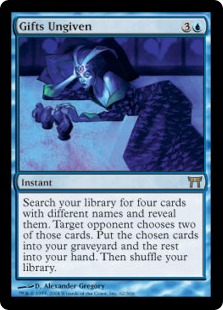
When you cast Gifts, you need to have at least 3 mana floating in order not to fizzle with one mana reducer. If you're sure it won't get countered or killed (i.e. your opponent is tapped out), you can sneak in an extra mana reducer first. Just make sure that you still have 2 mana left over, including 1 red.

The first pile I go for in this case is usually a mana pile of Pyretic Ritual, Desperate Ritual, Manamorphose, and Past in Flames. If you have less than 3 mana floating, your opponent can give you Past in Flames and the Manamorphose and you can fizzle. Past in Flames costs 3 mana with a reduction and Manamorphose nets 1 mana with a reduction, so that leaves you with 4 mana after you cast it. When you cast Past in Flames, make sure you are floating at least 1 red mana or you won't be able to flash back the rituals in your graveyard.

Assuming you have a nicely-stocked graveyard, it's trivial from this point to complete the kill. The next step is to cast all of your rituals and use Manamorphose to make blue mana. If you had to exile your Past in Flames (i.e. the only available copy was in the graveyard), the second Gifts pile must be Manamorphose, Past in Flames, Grapeshot, and either Gifts Ungiven (if you have a lot of mana but not enough storm) or Desperate Ritual (if you have a lot of storm but not a lot of mana).
One surefire way to lose is to unnecessarily expose your mana creature to a removal spell on a turn you can't win. Sometimes you have to play them "naked" on turn two in order to race. But often it's correct to wait until you have three or four lands, in order to chain off spells in response to removal. It's not impossible to win without a mana reducer in play, but it is extremely difficult. Baral is more durable and legendary, so I will generally lead on him first if I have more than one.

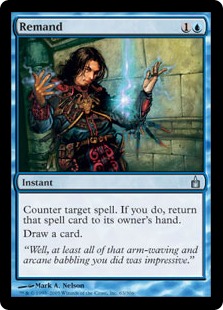
Baral's looting ability is also sometimes relevant. When you Remand a spell, you are technically "countering" it, so that will trigger his loot ability. I have often used Remand on my own spells to filter lands out of my hand while going off. You can also employ the age-old Storm trick and Remand your own Grapeshot or Empty the Warrens to generate extra copies. This lets you play around Surgical Extraction on your Grapeshot, while also reducing the storm count required to deal 20 damage. You can cast Grapeshot for 9 copies, Remand the original, and then cast a second Grapeshot for 11 to win.

Sideboarding

Rather than write up a sideboard plan for every matchup (even among those decks, it's not entirely clear that everyone is playing the same 75), I'll explain how I use the cards in my sideboard.
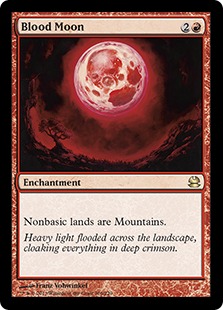
Blood Moon - This card is pretty self-explanatory and common to many Modern sideboards. It gives you free wins against decks that aren't prepared for it, or some opponents who fail to answer it on the spot. Cards that remove Blood Moon itself are usually poor against Storm in general, so opponents may oversideboard in game three. Generally, I will bring these in against any three-plus-color deck and any deck where their lands are important to their game plan (Tron, Valakut, etc.).

Dispel - Another straightforward choice. Dispel comes in against decks that play counterspells and exclusively instant-speed removal (or, Snapcaster Mage decks).

Echoing Truth - I bring in Truth against anything disrupting us with permanents. If you suspect your opponent is playing Worship, Leyline of Sanctity, Eidolon of the Great Revel, Eidolon of Rhetoric, Ethersworn Canonist—basically any permanent that you think could stop you—you should hedge and bring in your Echoing Truth. You can find the singleton with Merchant Scroll if you need to, so I would recommend keeping that in your deck if you choose to side in this card.

Lightning Bolt - Bolt's uses are similar to Echoing Truth's, but the card costs less mana and uses red instead of (our more precious) blue. It's obviously great against any opponent relying on hatebears (Thalia, Guardian of Thraben, Eidolon of the Great Revel, Ethersworn Canonist, etc.) for disruption. I also recommend bringing it in against linear aggro decks like Affinity and Infect. Stunting their development can buy you just enough time to assemble your combo. Affinity is particularly annoying because Cranial Plating on a Vault Skirge can put your opponent out of range of the typical Grapeshot.

I also like bringing Bolts in against Kitchen Finks-based, infinite-life combo decks. Generally these combos are limited to Abzan Company decks, but I have also seen them out of the Elves sideboard.

Anger of the Gods - If Anger of the Gods is likely to sweep your opponent's entire board, then you probably want it. You can slow down against the more aggressive creature-based decks with Anger to lean on. I'd bring it in against Elves, Zoo, all sorts of Collected Company decks, and Affinity.

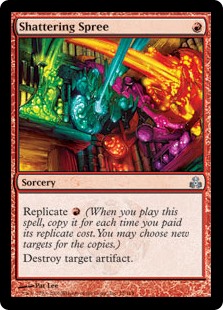
Shattering Spree - Shattering Spree has an odd-use case which is of particular interest when sideboarding: it lets you break out of a Chalice of the Void lock at any number. The way that replicate works is that it does not cast the copies—it just puts them directly onto the stack, which doesn't trigger Chalice of the Void. Therefore, just RRR will break you out of a Chalice on one and a Chalice on two. Be mindful that the original copy is countered by a Chalice on one, so you will generally have to replicate at least once. Other uses for Spree include blowing up the odd Cranial Plating or pesky Vault Skirge.
It's important with this deck not to over-sideboard. You need a very high density of cards to fuel your combo, so you can't start cutting them or you will end up with a non-functional deck. My first cuts are generally the filler cards: Remand, Thought Scour, and Merchant Scroll. Past that, you need a really good reason to bring in more cards. Affinity is the only deck where I could see wanting more, but honestly I'd probably leave the Lightning Bolts in the sideboard unless I saw multiple Ethersworn Canonist effects in the next game.

Amonkhet and Modern

As I'm writing this we don't have the full Amonkhet spoiler available yet. But there are definitely a few cards that stick out to me as being able to slot into some existing Modern decks. For each of these, I'll touch briefly on my impressions of its financial relevance.
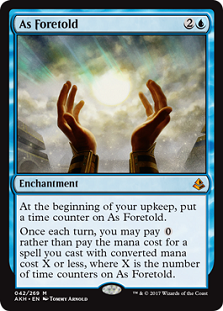
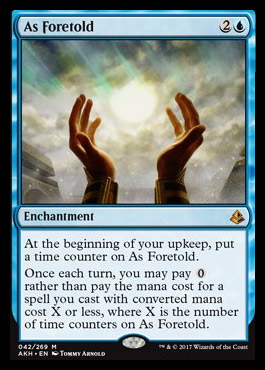
As Foretold: I'm sure you've read loads about how As Foretold lets you cast cards with no mana cost and suspend (Living End, Ancestral Vision, Restore Balance, etc.), but the financial impact on those cards has already been felt. I'd probably wait and see if anyone manages to find a good shell for this card but I think it's more likely to be used in control than combo. Being able to use the free spell on both players' turns can really help to turn the tide in a control deck's favor. I think this is a card to keep an eye on but not to go out and buy now.

Gideon of the Trials: If your Ad Nauseam matchup is really bad I guess you could play this, but I don't see it becoming a Modern all-star. I know I have seen a lot of people talking about the emblem making a lot of decks have to jump through hoops to win, but you could just play Storm instead and ignore it. I would recommend staying away from Gideon right now—its price tag is much too high.

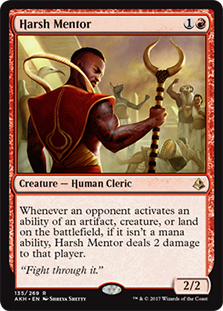
Harsh Mentor: Harsh Mentor has a lot of applications that could be great for aggressive red decks in Modern. I'm not sure if it's maindeck-worthy yet, but being able to tax your opponent's fetchlands at a minimum can help shape this card's future. It's a particularly juicy card to play against Affinity because it triggers off Steel Overseer, Arcbound Ravager, Cranial Plating, and Inkmoth and Blinkmoth Nexus. It won't be as universally good as Eidolon of the Great Revel, but it will likely be an important sideboard card in the future.
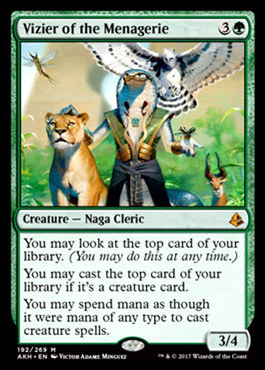
Vizier of the Menagerie: This guy will likely find a home in Elves and potentially other decks due to its stats and power. It's relevant that Vizier of the Menagerie dodges both Lightning Bolt and Abrupt Decay. He will probably replace Lead the Stampede in Elves decks and might find a calling in mono-green devotion-style strategies like Nykthos Green or Tooth and Nail. There may also be some weird combo involving Congregation at Dawn that lets you set up an infinite loop with Melira or the like.

Final Thoughts

I think Storm is in a great position right now, from both a financial and a gameplay standpoint. It's not overbearingly powerful where I would be worried about a ban, but it's also functional enough that you don't feel like you're not playing the same game. Hopefully this helps you out in the future and you enjoy saying "storm count" to your opponents.

Insider: MTGO Market Report for April 12th, 2017

Are you a Quiet Speculation member?

If not, now is a perfect time to join up! Our powerful tools, breaking-news analysis, and exclusive Discord channel will make sure you stay up to date and ahead of the curve.

Welcome to the MTGO Market Report as compiled by Matthew Lewis. The report will cover a range of topics, including a summary of set prices and price changes for redeemable sets, a look at the major trends in various Constructed formats and a "Trade of the Week" section that highlights a particular speculative strategy with an example and accompanying explanation.

As always, speculators should take into account their own budgets, risk tolerance and current portfolios before buying or selling any digital objects. Please send questions via private message or post below in the article comments.

Redemption

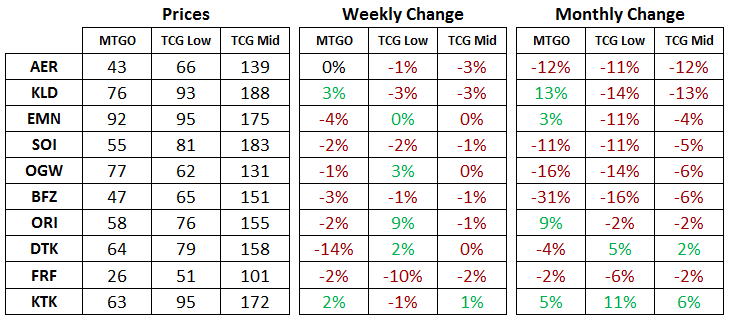
Below are the total set prices for all redeemable sets on MTGO. All prices are current as of April 10, 2017. The TCGplayer low and TCGplayer mid prices are the sum of each set's individual card prices on TCGplayer, either the low price or the mid price respectively.

All MTGO set prices this week are taken from GoatBot's website, and all weekly changes are now calculated relative to GoatBot's "full set" prices from the previous week. All monthly changes are also relative to the previous month's prices, taken from GoatBot's website at that time. Occasionally, full set prices are not available, and so estimated set prices are used instead.

apr10

Standard

At this stage in the draft life of Kaladesh (KLD) and Aether Revolt (AER), it would ordinarily be a fantastic time to be loading up on all the cards from these sets. The shortened redemption window has substantial implications for this strategy, and so a revision to the blind, just-buy-everything approach is needed.

First off, cards from these sets will still hold value after they are no longer redeemable. The prices of every card from these sets are not going to go off a cliff in June. This is obvious if you look at the price of cards from other sets that are not redeemable, like Modern Masters 2017 (MM3). Liliana of the Veil is the flagship card of the set and has been holding to the 60-tix level. The original printing from Innistrad (ISD) has not been redeemable for over two years and remains one of the most expensive cards in Modern. The trick is that for a card to hold value despite being a digital object, it must be in demand.

There was an error retrieving a chart for Verdurous Gearhulk

Redemption always provided a floor of demand, but now every card in demand must be seeing play in Standard or Modern. This is the starting point for considering how the prices of KLD and AER will evolve over the next year. If the card is going to be played in Standard or Modern, then it will be valuable. If it is not going to be played, then it will have very little value and its price will approach zero.

The other factor to keep in mind is that the weather is warming up in the Northern Hemisphere which means that Magic players will start drifting away from the game as outdoor activities gain more appeal. The summer is a tough time to be speculating on MTGO, as you are constantly trying to buck the downward trend in overall player interest. It's much easier to be successful at speculating heading into the fall and winter, the time of the year when Standard prices reach their peaks.

For these reasons, I will not be speculating on Standard singles from KLD and AER at this time. There is too much working against them in the short term and in the long term there's no telling what the fall metagame will look like. The time to take another look at these sets will be at the end of June, after prices have settled down following the redemption cutoff. Rares and mythics that are seeing no play in Standard will be available for less than 0.05 tix, and this could be very fertile ground for long-shot speculating on cards that have at least some potential to see play.

There was an error retrieving a chart for Paradox Engine

I have been a buyer of AER sets due to their historically low prices, but my plan with these is to sell in May prior to the end of redemption. I think this trade is on a good footing, but if the list of playables from this set stays short then the gains will be minimal.

The other safe harbor for speculating in these two sets is play in Modern. Fatal Push is a staple of the format and will be the foreseeable future so there's no harm in picking these up now with an eye to next winter. As an uncommon, the redemption value in this card is quite low so I don't expect to be able to detect the effect of the end of redemption on this card's price in June.

There was an error retrieving a chart for Fatal Push

The time to be a buyer from these sets will be at the point of maximum pessimism. The loss of the price support from redemption means that the market is set to get a whole lot more pessimistic about cards from AER and KLD. Be prepared for the selloff with a few tix in your binder and no extra cards from these sets.

Standard Boosters

After AER boosters approached 4 tix and KLD boosters got near 2 tix, a round of selling has brought their prices back down to 3.4 and 1.7 tix respectively. With only two weeks to go until Amonkhet (AKH) is released on MTGO, people holding these boosters are looking to lighten up their stashes in exchange for tix, including the bot chains that deal in boosters. There will be a buying opportunity on these in the near future, but for now it looks like the race to the bottom has just started.

Trade of the Week

For a complete look at my recent purchases, please check out the portfolio.

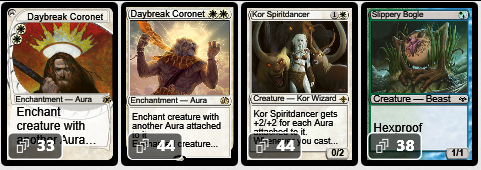
In any market, there is always something on sale. Looking at decks that are out of favor is a great place to find some deals, and one I've been looking at lately is Bogles. This deck is firmly planted in the lower tier of competitive decks in Modern, but it has enough power that a 5-0 list periodically shows up in the top decks of the Modern Constructed Leagues. Examining some of the components of the deck reveals that the prices of Kor Spiritdancer and Daybreak Coronet have been trending downward or staying flat in recent months. A card at a low price relative to their historical price range is a good starting point for any speculative purchase, and pictured below are the recent purchases I've made that are related to the Bogles archetype.

bogles

Although Slippery Bogle is a common, it is routinely priced higher than 1 tix. This is partly as a result of being from Shadowmoor (SHM), a set with low supply due to problems with the client when it transitioned to Version 3. The price is also supported by play in the Pauper version of Bogles. The fact that the deck is supported in two formats provides a little extra diversification, since uptake in either format will drive the price of Slippery Bogle higher.

There was an error retrieving a chart for Daybreak Coronet

The plan for these cards is to sit on them until Bogles makes a big splash, either through shifts in the metagame or a popular brewer championing the deck. Back when Treasure Cruise and Dig Through Time were running rampant in Modern, Bogles was a great choice as a foil to these decks that relied on targeted removal. It's hard to predict these types of shifts, so a good long-term perspective is required on this type of speculative strategy. I'll be willing to hold these cards essentially indefinitely.

One that that can accelerate this process is the printing of new cards that fit into the existing archetype, filling holes in its strategy or just providing a power boost. There is a cycle of common enchantments from AKH that fit the bill as having the potential to see play in Bogles. In particular, Cartouche of Solidarity looks great as a cheap enchantment that is very similar to Hyena Umbra, a card that already sees play in the deck. The big difference is that instead of getting what amounts to a regeneration shield, you get a token, which can give some cover against sacrifice effects as well as serving as a backup creature to load up with auras.


Insider: Under- and Overrated Mythics in Amonkhet

Are you a Quiet Speculation member?

If not, now is a perfect time to join up! Our powerful tools, breaking-news analysis, and exclusive Discord channel will make sure you stay up to date and ahead of the curve.

Everybody is downloading The Bangles' "Walk Like an Egyptian" in anticipation of Amonkhet. Well, everybody who didn't have it on their phone already (I have it on vinyl because I'm cool like that). I had a friend summarize collecting records pretty well: "The thing I like most about collecting records is the tremendous expense and inconvenience..." It checks out. Kind of like collecting Reserved List cards.

Anyways, here comes a new block, Amonkhet. It looks pretty awesome. The new Masterpieces look sweet and the set is not too shabby either. I'll say that it looks like we are taking a step back from the very high power level of Kaladesh block—but as long as the cards provide a fun gameplay experience, that doesn't bother me too much one way or another.

Let's take a quick look at what we've seen so far and discuss some of the cards that are bound to be players or pretenders in the near future!

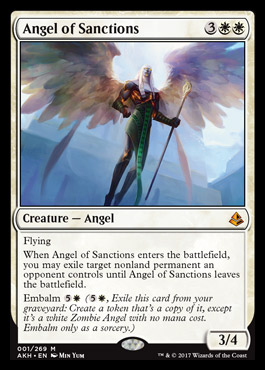
Angel of Sanctions

angelofsanctions

Angel of Sanctions is good card but clearly not on the same level as Archangel Avacyn. Anytime I'd consider bringing this card to the table I would rather just have Avacyn instead.

This is not a card I anticipate playing with until after Avacyn leaves Standard—and even then it would only be to fill a very specific niche in a sideboard. Don't preorder.

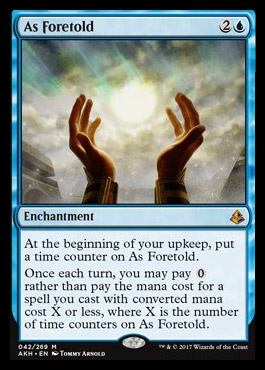
As Foretold

asforetold

My reaction to this card was, "Wait, whaaaaat!?" It's obviously very powerful because it does one of the best things that a card can do in Magic: generate mana!

The obvious place where a card like this will really shine is in Modern. In particular, this card feels great at casting cards without mana costs that are meant to be cast off suspend.

There was an error retrieving a chart for Ancestral Vision
There was an error retrieving a chart for Restore Balance

Ancestral Vision is already expensive but Restore Balance feels like a very spicey speculation target right now. It's a very powerful effect to just slam down with As Foretold. I don't feel like As Foretold will be a huge player in Standard (I could be wrong here) because it does seem kind of slow to build up and the games feel very fast right now.

With that in mind, I expect its value to drop considerably as the primary demand will be for Modern. I think the better spec targets are likely things that could be good in an As Foretold Modern deck.

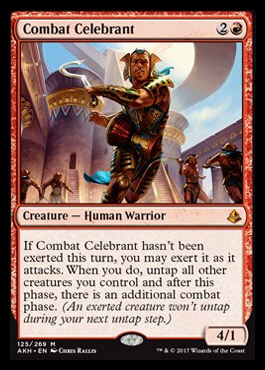
Combat Celebrant

combatcelebrant

I think this card is potentially very underrated. The presale price seems fairly accurate for what I'd expect a card like this to sell for. However, I think there is potential for this card to be in the $10 range if it has a great deck.

It hits pretty hard and the ability to generate another attack step is pretty grand. I see this card as a potential combo with Reckless Bushwhacker—for five mana you give the Celebrant haste, pump your entire team, and attack twice. If there is an aggressive red deck, I feel like this will be its backbone.

Celebrant is a card I'm potentially interested in picking up early.

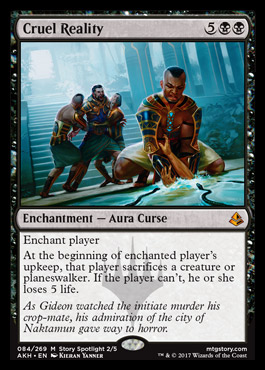
Cruel Reality

cruelreality

It will be a cruel reality to open this junk mythic and feel pretty bad about it.

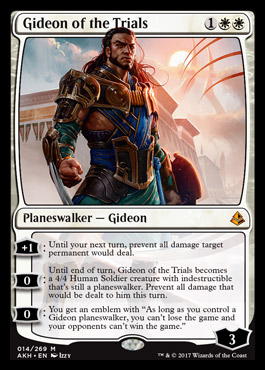
Gideon of the Trials

gideonofthetrials

Three-mana planeswalker that is obviously great? Sure, why not.

Cards like these kind of annoy me from a design standpoint. It's obviously very busted and will be frustrating to lose to in Standard. It'll also be a-crewing the Heart of Kiran.

With that being said, I don't think this is an objectively better card than the last busted Gideon. The $50 presale seems ridiculously high. I'm going to try and avoid having to own this card in lieu of borrowing it until the price comes down by half, which is what I would expect.

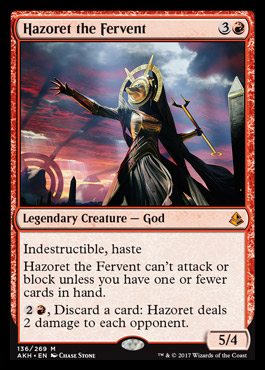
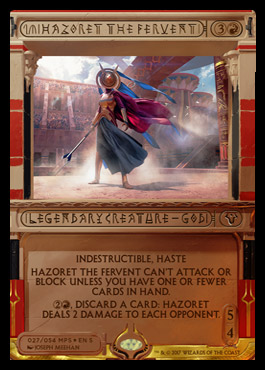
Hazoret the Fervent

hazoretthefervent (1)

I think this card is potentially underpriced right now. It is obviously powerful, and the ability to trade cards for Shocks is potentially great. Especially in a red deck where we don't want to flood out in the late game. The big haste body for four mana is grand.

It is awkward that the creature can't attack until we get hellbent. Hazorat seems at its best in a RB Vampire/Madness strategy where we can ensure we get hellbent and get value out of discarding cards.

My spider sense tells me that this is a "build around me" card that could potentially be a big deal in Standard. It's not a done deal like Gideon, but I feel like some of these red cards hold a lot of promise.

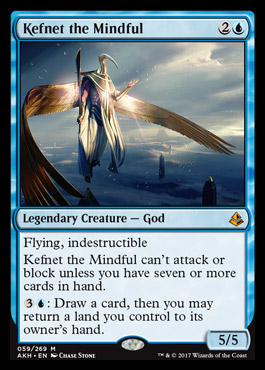
Kefnet the Mindful

kefnetthemindful (1)

I find this card really confusing and I'm not exactly sure what to even do with it.

It feels like a win condition in a counterspell deck, where you want to make a lot of land drops, leave mana open, and deploy a cheap finisher. It is also kind of cool that Kefnet will allow us to potentially bounce cycling lands in the lategame and turn them into relevant spells.

Kefnet is the kind of card where it's pretty obvious that nobody knows exactly what to do with it yet. So if you figure something out, you'll be ahead of the curve to buy in while the price is low. It's also possible these gods are just not very good. These kind of cards are so unique that it is difficult to tell whether they will be duds or studs.

I'm more inclined to think they will be good than bad. This kind of unique, flagship card is the type Wizards often pushes for Constructed. It's pretty weak-sauce to print literal gods and have them be weak.

These might be good cards to think about buying while the presale price is low. If and when pros start writing about them and calling them good, the presale price will go up substantially. That's not guaranteed, but I wouldn't bet against it.

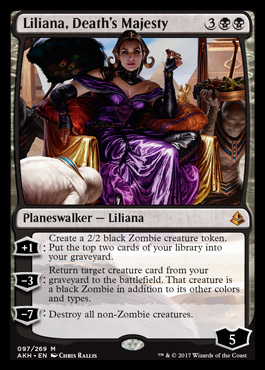
Liliana, Death's Majesty

lilianadeathsmajesty

I don't actually think this card is very good for the cost. Gideon, Ally of Zendikar is more powerful in the abstract and costs a full mana less. I mean, most cards are worse than Gideon—being so doesn't disqualify you straight-up from constructed play—but I'm just not feeling this walker.

Liliana also competes with Ob Nixilis Reignited in the five-drop walker spot and I think Ob Nix is also a better card than Liliana. My thought on Liliana is that it will see play as a one-of in the board of The Rock decks for grindy matchups.

I'm not even remotely interested in this card at the $25 buy-in price. Durdly 5-CMC walkers are not what Standard is about right now.

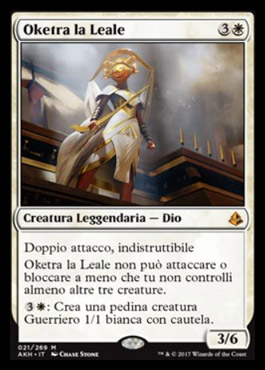
Oketra the True

oketrathetrue

I know I already put in my two cents about my dislike for cards that are obviously OP, but I'm going to dip my toe in the water one last time.

Metagames are about context. The cards that are good or bad occupy that space based on what available cards see play. Gideon, Ally of Zendikar is so powerful for its cost that I'm not interested in playing other four-mana white cards.

Sorry, Oketra the True—but that means you don't make the cut. The tension between Gideon and everything else in the white mana curve is real. It will likely smother this card out of constructed play.

Vizier of the Menagerie

vizierofthemenagerie

Vizier is yet another four-drop that will compete with Gideon, but it doesn't really go in the same decks which gives it a chance to shine. It feels like the type of card that would have been hot fire in the Theros-era green devotion decks. I think we'd want this in a deck that generates a lot of mana and can chain things together. It's a decent body but we would play this card for the mana and card advantage ability. It obviously draws a comparison to Courser of Kruphix, which was a great card (and still is in Modern).

The difference between three and four is pretty huge, and I almost think I'd rather play lands from the top of my deck than creatures. However, it is cool that there isn't a one-creature-per-turn clause on the card, which means we could potentially chain lots of cheap critters together in the same turn. If there's a deck that allows these kinds of shenanigans to take place, this could be a real card.

It's also worth noting that there is the potential to do something special with this card in an eternal format. Maybe we could Glimpse and draw through a deck full of Kobalds or Elves or something? Summoner's Pact can also find this card—so it could be considered as a target in Legacy or Vintage Elves.

Conclusion

Well, Amonkhet looks pretty fun so far. I like the new cards and they feel like they have a unique feel. Gideon of the Trials is probably the card most likely to have a high impact in Standard because 3-CMC Walkers are always nuts (especially so with Heart of Kiran). As Foretold feels like it has a lot of busted applications in Modern or Eternal.

All things considered, I'm looking forward to jamming these cards very soon, and continuing to jam to The Bangles.

Foretelling the Future of Modern: Amonkhet Spoilers

Are you a Quiet Speculation member?

If not, now is a perfect time to join up! Our powerful tools, breaking-news analysis, and exclusive Discord channel will make sure you stay up to date and ahead of the curve.

Time for the quarterly spoilers article! I intended to lead off with a pun on Amonkhet, but all the good ones have been done to death. Then I thought that I could come up with something unique, but expended too much energy last week and just couldn't get going. Many other ideas were assessed and then discarded, looking for something better. Eventually, I decided to write a completely normal intro utterly devoid of subtle allusions. You're welcome.

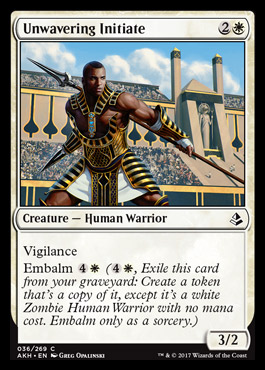
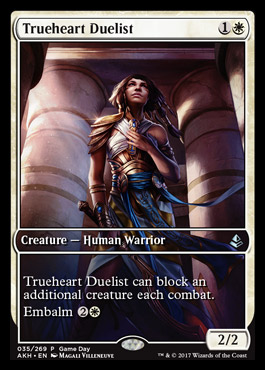
Anyway, Amonkhet is on the horizon and there are some interesting Modern cards. As I'm writing this Monday morning just over half the set is spoiled, and while it looks interesting, there's not a lot for Modern players. This shouldn't be surprising as only one mechanic is playable. While conceptually interesting as mechanics, exert and embalm just don't have the power to make it in Modern. Yes, with vigilance exert creatures are all upside, but the effort required to make that work could be better spent elsewhere. It would take something very busted to make an impact. As for embalm, the problem is that you have to pay mana to bring back creatures as tokens. This is decent as a value plan, but compare them to Dredge's options. There are more efficient ways to get value from your graveyard. Even if that weren't the case, none of the embalm creatures I've seen so far are playable in the first place.

Cycling has been part of the format for some time, though the impact has been limited. The new set may change this, and I will address this later. Beyond that there are standalone cards with brewing promise, though I'm skeptical. Power is definitely there, but only if you jump through hoops. This usually doesn't bode well.

As Foretold

First alphabetically is As Foretold. Jordan covered the card last Friday, and he did a good job. The possibility exists for the card to generate a lot of mana and value, but it is slow. Free mana is broken and this is free mana. Therefore, in theory, this card is also broken.

However, I'm not so sure. The list of things that have to go right for As Foretold to be good is long, and even when it does what are you actually doing? Once you've done it, I'm not sure it was worthwhile or better than other options. Simply put, I think that in most cases, this is a win-more card. Win-the-game cards are good, but historically win-more cards are not.

I think we can all agree that this card will only go into slower decks. It makes absolutely no sense to play it in any kind of aggressive deck. Aether Vial is better there and it is far from universal—why would you pay more for the effect? I doubt midrange decks want this either. They're rarely about playing a lot of spells. Instead they play something more powerful than you. Foretold won't do that right away and midrange has better incremental advantage cards.
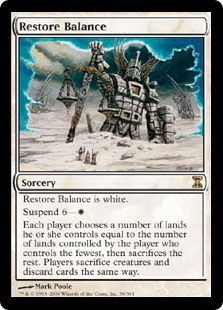
This leaves control and combo, and I'm still skeptical about either being the right home. The format may be slower now but it is still risky to tap out early in the game, especially to durdle. Thus I expect that control decks would rather play this card later in the game. If that is the case, what's the point? Aether Vial is only good because you can play it on turn one. Vial is functionally dead later in the game, and Foretold is arguably worse since it costs more. At that point you won't need the free mana because you have enough lands to play as many things as you want anyway. If you've been holding spells just to use with Foretold you're either so far ahead it doesn't matter or you got mana-screwed and overrun. I don't think this will have any sort of fair use.

Combo Card?

It is more likely that Foretold will find some kind of combo application. I'm just not sure what. Jordan is correct that the suspend-only spells are good partners for Foretold but I'm not sold on Restore Balance. As a free sweeper in a control list it's questionable, since on turn three a control deck will probably have to discard cards against an aggro deck, and in many cases sacrifice lands. I'm not sure it would be worthwhile to build a control deck to take advantage, especially when there are more combo-oriented versions already. Those decks probably don't want Foretold either since it's better for the overall strategy to cascade into Restore.
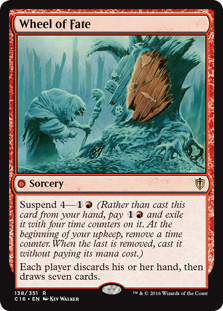
We are looking at Wheel of Fate and Ancestral Vision as our partners. The problem is that I don't know what combo deck actually wants either of those cards. Storm and Ad Nauseam get along fine as is. While both can make use of extra mana, Foretold looks too slow to be useful.
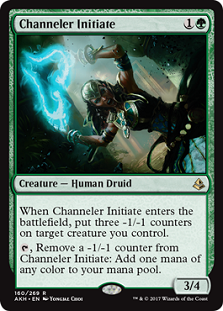
That said, the ceiling is very high on this type of effect and I could see some undiscovered deck breaking it. This makes an actual evaluation difficult. There is no existing deck that actually wants As Foretold, but the deck that does will be a ridiculously broken combo deck. Ironically, determining the fate of Foretold requires precognition. It will either be a bulk rare or broken-in-half. No middle ground.

Channeler Initiate/Exemplar of Strength
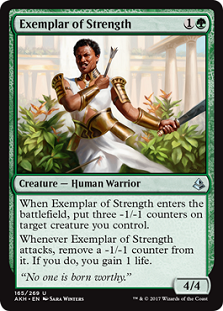
While separate cards, I'm going to talk about these two collectively because Modern's concern with them is identical. They're undercosted creatures with significant drawbacks that have received quite a bit of attention for Modern. So much so that Star City bought up all the available Melira, Sylvok Outcasts in my area. For those who don't know, with Melira out, Channeler and Exemplar have no drawback. Similarly, if you lead with Khalni Garden then you can target the plant instead of the original creature.
While I appreciate the innovation, I think it is misplaced. You're doing a lot of work to make another Tarmogoyf, which isn't even as good as it used to be. I cannot imagine another use for these cards, since neither have Modern-playable abilities. We have access to these effects more reliably and cheaply. Cute, but won't lead anywhere. Now, there might be another card with more impressive stats or abilities still unseen which would be playable. However, if all you're looking for are beefy creatures, look elsewhere. We've got those already.

The Cycling Lands

History lesson time. Years ago there existed a deck built around cycling cards. It was incredibly popular and powerful. However, it was clunky and bad outside of Standard and the greater Magic world moved on. But the enthusiasts have never forgotten Astral Slide.

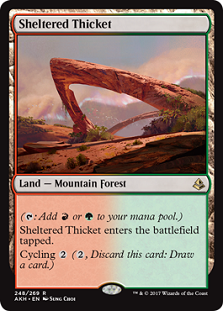
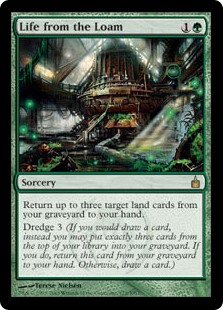
The thing is that what made the Slide decks good wasn't really the namesake card but the cycling lands. The cheap cost and flexibility (land or spell) meant that these cards had an impact far beyond Onslaught block. Slide never caught on outside of Standard but the lands were an Extended institution. In fact, the legendary CAL deck was built around them. That deck used Solitary Confinement to protect itself while churning through its library with cycling lands and Life from the Loam to find Seismic Assault (see, CAL?) and win the game. Even once Confinement rotated, Loam plus cycling lands was an impressive card-advantage engine.
The Cycle Is Not Broken

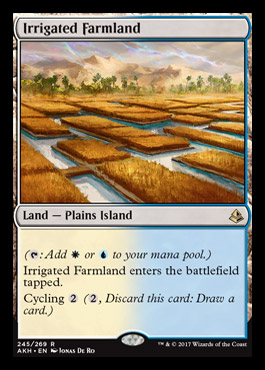
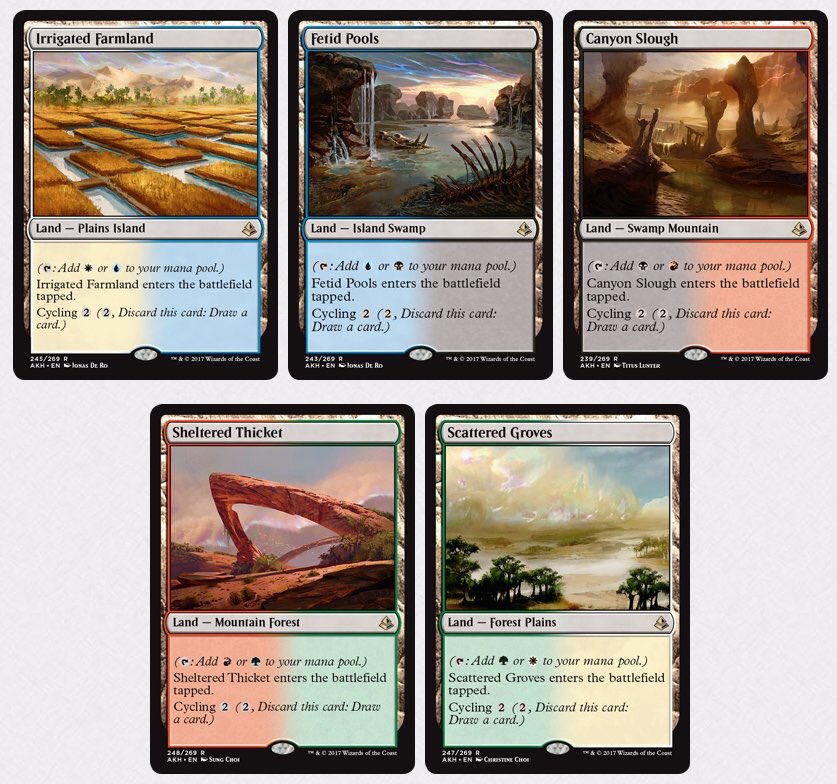
This is all relevant to us today because, for the first time in Modern's history, there are cycling lands in the format. Not just cycling lands but cycling dual lands. Which is utterly irrelevant. Yes, they're fetchable lands but they always enter tapped. Can we all agree that we only care about the cycling part? Nobody will play these over shocklands for mana generation purposes. If you can't abuse the ability, leave them at home.

Okay, so we have the missing piece of the old Loam engine right? We can start building Assault/Pox Loam and have it finally be good. Not quite. Take a look back up the page at those two cards. The new ones cost two to cycle. The old ones cost one. This is everything for their playability since you can cycle half as often now. This may not seem like much, but anybody from the old Extended era will tell you that the cost was the key. The decks that really abused cycling had to maximize their mana efficiency. Using a card to draw a card is only good when done many times a turn and when you can also do other things. While I'm certain that Loam enthusiasts will try to make their engine work again, I doubt it will pay off. It's also worth remembering that this was done in the days before Rest in Peace.
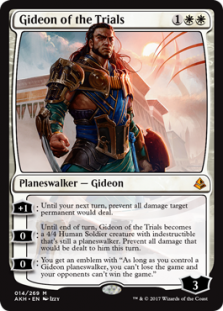
As for the Sliders, we still don't have a good payoff card spoiled yet. Yes, there are some payoff cards; no, they really aren't Modern-playable. I'm skeptical they're even Standard-worthy. I doubt that Wizards will ever allow Astral Slide back into Standard but it is never impossible. If something comes up with a good effect at the right rate I could see these lands making a splash outside of Loam. Otherwise I just don't see it happening.

Gideon of the Trials

Despite what some of the hype says, the newest Gideon does not spell the end for Ad Nauseam. Or any combo deck in any format. At worst, it makes them wait a turn or two until they have enough mana to kill Gideon and you. Every Valakut or Grapeshot deck will just need a few extra points to kill you while Ad Naus will just use Lightning Storm to kill him, and then kill you with Laboratory Maniac. Even in Legacy, Storm can just go for Empty the Warrens. It's not that burdensome.

But even a light burden is still a burden. While Gideon of the Trials won't just win you the game, he does make combo decks more inefficient, which sounds like a Death and Taxes effect. Alongside other disruptive cards like Thalia, Guardian of Thraben, Gideon would act like the final nail in the coffin, delaying the kill and forcing combo decks to expend resources to remove him instead of you. The additional drag may be all you need. Bonus points for Gideon being a reasonable threat as well.
Which makes me wonder if Ad Naus itself will adopt Gideon. In that deck he's a more vulnerable but more flexible Phyrexian Unlife. The emblem works the same way as Angel's Grace so you can protect him with Pact of Negation. As an additional benefit, Gideon is an alternate win condition. The combo doesn't always come together, after all. Worth noting is that the +1 is very good against decks that only have one threat at a time, chiefly Infect. It may never come up, seeing that Infect has declined significantly, but it is relevant. It may not be very likely, but the only reason Ad Naus ever ran Unlife was a lack of alternatives to Grace. In that light, Gideon plausibly competes for the job.

Some Quick Hits

These cards are all worth noting and thinking about, but not enough to get their own section.

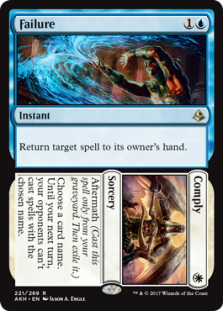
  • Failure to Comply: This card fascinates me. Orim's Chant and the Modern-legal Silence were billed as control cards and yet were actually used as prison and combo cards. This latest version is hard to place. The first half is worse than Unsubstantiate, a mediocre tempo card that sees virtually no play. The second half is more promising. There are too many cards you would want to name for it to protect a combo and it's too narrow for prison decks. The best use I've come up with is as an answer to suspend cards. When you remove the last time counter you attempt to cast the spell, but if you cannot cast it then it just stays in exile. No Visions for you. Not a control-mirror breaker on its face, but maybe a good tool. It's very much a puzzle to be solved.
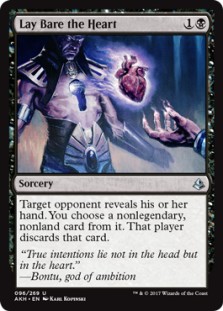
  • Lay Bare the Heart: Likely too expensive to see play, but it does hit 99% of all cards in Modern. Outside of a few creatures like Melira, Thalia, and Kiki-Jiki, there are no legendary creatures in Modern, making this effectively Thoughtseize. Assuming the mana cost is not the barrier to play I think it is, the unanswered question is whether we need Thoughtseize numbers 4-8. Probably not, considering that Thoughtseize is really just extra Inquistion of Kozilek, but 8-Rack does play Blackmail.
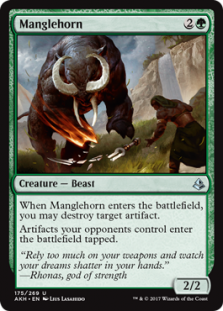
  • Manglehorn: Why isn't this card getting more attention? It's better than Reclamation Sage in every way except creature type. There's no reason for Chord of Calling decks to run the Sage anymore. The beast will also challenge for the Elves job too, not because of the minimal stat boost but because of the Kismet clause. Manglehorn is too costly for this effect to be relevant against Affinity, but artifact combos will suffer. Eggs, Cheeri0s, and even Thopter combo all rely on their artifacts entering play untapped and were incidentally good against decks that ran Reclamation Sage. Manglehorn not only destroys a key component but breaks up the combo. Eggs' Chromatic Stars and Spheres cannot be sacrificed, Mox Opal cannot be tapped for mana, and the Thopters cannot block. I expect this to see considerable play.


Time Will Tell

Spoilers will continue to roll in this week and we may yet see some more Modern cards. I selfishly hope that there are no good cycling payoffs so that I can laugh at all the Slide devotees again, but maybe this is the set that finally makes me eat crow. Was there any card you think I missed or something you disagree with in my analysis? I'm always up for an argument in the comments.

Insider: Analyzing All the Buyouts

Are you a Quiet Speculation member?

If not, now is a perfect time to join up! Our powerful tools, breaking-news analysis, and exclusive Discord channel will make sure you stay up to date and ahead of the curve.

My optimism for MTG finance continues to grow. The past couple months brought many fun, speculation-driven profits based on the reprints of Modern Masters 2017 and the contents of Amonkhet. While cards that spike on such speculation often don’t pan out, they still represent opportunities to make a quick buck. With enough speed and agility, one could really make money on any of the numerous buyouts we’ve had so far in 2017.

However not all buyouts are created equally. Some represent legitimate shifts in demand, suggesting prices will remain elevated for some time and possibly rise even higher. Others require the Greater Fool Theory to generate any financial gains from being involved. While I don’t mind making money in either case, I much prefer putting my resources into the former, because it minimizes risk.

But how do you know if a jump is legitimate or not? When cards are disappearing from TCG Player at a rate of four per minute, it’s easy to let emotions kick in to dictate purchasing decisions. In order to be best prepared, we need to go through the exercise of analyzing previous movements in order to develop strategies for what’s to come.

This week I want to review recent price spikes, sharing thoughts on whether the card’s new price will stick or if there are certain characteristics that spell doom.

Top Movers of Last Week

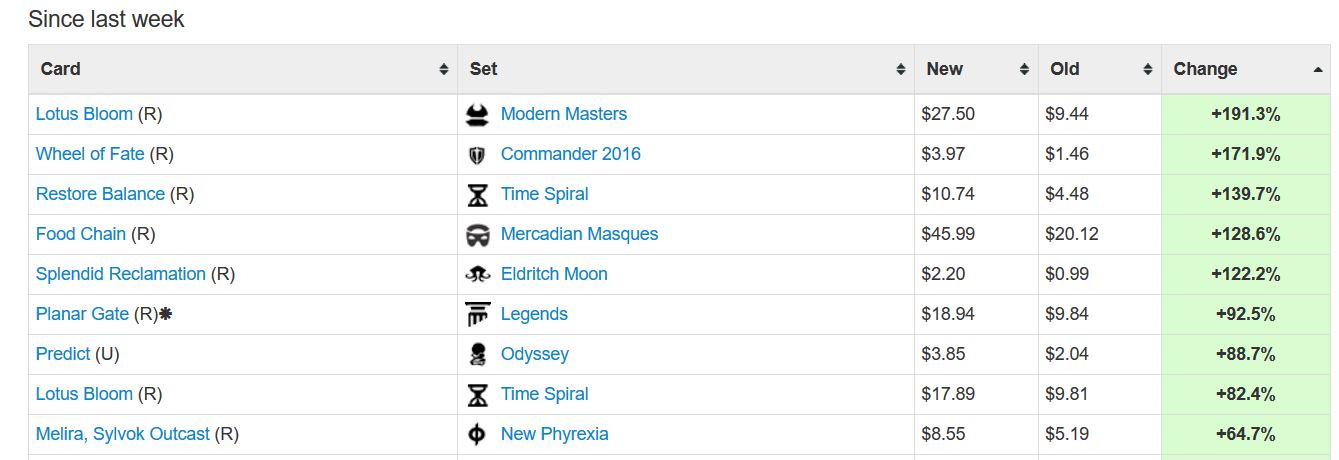
Let’s start with the cards that jumped over the past seven days, according to MTG Stocks’ Interests page.

Interests
(Click to expand.)


There was an error retrieving a chart for Lotus Bloom

Both printings of Lotus Bloom jumped significantly last week. The Modern Masters version took the top spot for rising the most, nearly 200%. This hype is driven by the spoiling of As Foretold out of Amonkhet. Immediately after casting the enchantment you can play any suspend card without a converted mana cost. Lotus Bloom was an obvious target, especially since it already sees competitive Modern play in the Ad Nauseam deck.

I don’t think this stays at $27.50. But $15-$20 seems very possible; it’s been over four years since this card’s last printing, and the print run for the original Modern Masters was pretty small. With the card legitimately seeing Modern play already, this sort of spike is the type to get behind. I wouldn’t rush to buy copies at this new price thinking I could flip them immediately for profit. But because of the card’s scarcity and demand profile, picking this up upon the spoiling of As Foretold was a brilliant move.

Less inspiring were the number two and number three cards.

There was an error retrieving a chart for Wheel of Fate
There was an error retrieving a chart for Restore Balance

Both of these also jumped on the spoiling of As Foretold for the same reason: free casting of suspend-only spells. But unlike Lotus Bloom, these two cards haven’t really seen any Modern play. This speculation requires As Foretold to somehow break these cards enough to elevate them to playable in Modern, and this is a much taller task.

I actually picked up a few Wheel of Fate because they had the lowest entry price (and therefore lowest risk). But with these jumps, I’m inclined to cash out already. The odds of further upside seem low. Expect a race to price bottom in the weeks ahead.

There was an error retrieving a chart for Food Chain

Legacy speculation, something we don’t see nearly as often nowadays! The card has already gone through a couple buyout iterations. Every time this happens, the card sells off gradually afterward but settles at a higher baseline. This is happening because the card is so old and only has the one printing—as a result, when it spikes there aren’t as many people with copies lying around itching to take advantage of the higher price.

This will happen yet again, I’m sure. Anyone who was able to buy at the pre-spike price is going to make good money, and the downside risk was very small due to the card’s age and price stickiness. I expect this to settle in the $25 range, but it’ll take weeks to get there. And of course, there’s always that minuscule chance the deck does break into Tier 1.5 in Legacy.

There was an error retrieving a chart for Planar Gate

If I had to guess, I’d say this card was moving due to play in Commander. According to EDH REC, Planar Gate shows up in just over 1100 decks. That’s a significant amount of demand for a Reserved List card printed in Legends. The card isn’t that useful in Old School MTG, so I believe EDH is the extent of its utility.

With that in mind, it’s pretty much guaranteed this card climbs higher. Commander cards have a tendency to disappear into people’s decks, never to return to the market again. This is the only card on the list that I’d say “buy” right now if you need a copy. This won’t get cheaper.

There was an error retrieving a chart for Predict

This is an uncommon from Odyssey, which means they’re buried in bulk boxes across the country. The card sees play in Legacy, but never as a four-of. I think this is more of a metagame call, and therefore temporary. Even though Odyssey was printed a long time ago, I have to imagine players will gradually be more and more motivated to dig these out of bulk as the price climbs. I’d cash out at these levels, though this card won’t be considered “bulk” ever again.

There was an error retrieving a chart for Melira, Sylvok Outcast

One theme of Amonkhet revolves around aggressively-costed cards that put -1/-1 counters on your creatures. This is a clever way of balancing a card’s power while pushing the envelope a bit. I like the design space a lot.

Once these cards became spoiled, Melira became an obvious target for her ability to prevent -1/-1 counters from being placed on your creatures. This should behave very similarly to Lotus Bloom, in that it has newfound synergies with Amonkhet while already being played in Modern. I don’t suggest you buy fifty copies at $9, but if you don’t want to sell yet because you are waiting for more upside, I wouldn’t blame you.

Monitor the market closely on this one because it won’t take long for the market to determine whether or not Amonkhet synergies are real. If they’re not, Melira will drop in price (though not back to $5 again).

Honorable Mentions

Here are a couple more spikes from this year that merit addressing.

There was an error retrieving a chart for Preacher

Preacher, Falling Star, and Colossus of Sardia are all cards that were bought out speculatively due to their age and rarity. Speculators are starting to reach pretty deep into the well to find Old School playables worth buying. I’m not too excited about all three of these. That said, Preacher and Falling Star are Reserved List cards from 23 years ago. Thus, they won’t pull back all the way to their old prices.

There was an error retrieving a chart for Ad Nauseam

Single printing? Check! Playable in multiple formats? Check! Printed before the recent Magic boom? Check! This card is one of the best places to park money into throughout 2017. It just missed its chance to be reprinted, so I don’t expect we’ll see this before 2018. The recent surge in Ad Nauseam strategies in Modern has generated significant demand for the black instant. I’m 100% behind this card, and think there’s even more upside from here.

There was an error retrieving a chart for Psionic Blast

Here’s a card that is moving on legitimate Old School demand. Psionic Blast is played in many Old School builds. Permanent removal in blue is difficult to come by, so many players default to Psi-blast as a reliable way to destroy Serra Angels or push through that last few damage to win the game.

I like this for a long term-hold, and I wouldn’t fault you for buying your playset now either. Just be aware that you’re buying after a sizable price increase.

Wrapping It Up

I could not asked for a better start to 2017 in MTG finance. We’ve seen a ton of price increases, enabling profitability from many formats. Modern metagame shifts, Legacy speculation, and Old School buying has all taken place in healthy doses. The success of Modern Masters 2017 has surely sparked newfound interest in Modern and the spoiling of Amonkhet thus far has generated a lot of synergy speculation sure to capture the interest of any MTG financier.

For these trends to continue, I really hope Amonkhet does enough to shake up Standard. You may have noticed Standard cards were absent from the list above—the format as it stands is virtually solved, and there is little room for innovation. We can only hope that the introduction of new cards in Amonkhet will be enough to shake up the format.

If that should happen, it will generate even more opportunities to profit on metagame shifts. These profits will help people keep enough powder dry to acquire other cards, and the cycle will continue. We can only hope this is the case.

In the meantime, let’s take a step back, assess all these price spikes, and make sure we’re selling into them appropriately. There have been so many exciting buying opportunities lately that it has become easy for me to forget about the selling part. I need to make sure I maintain sufficient liquidity so I can continue to take advantage of new news and price moves. I’m going to use my observations above to guide me in what I sell and what I keep. Hopefully they help you as well!

…

Sigbits

  • The other day I received an email alert that Star City Games had restocked foil Hardened Scales. I clicked the link immediately to see how many copies they had and at what price. Disappointingly they had only one copy re-listed, though it was at the old price tag of $3.99. Needless to say the card has since sold and they’re once again sold out. Perhaps next time they’ll up their price when they restock.
  • It’s awesome to see Wheel of Fate jump on As Foretold speculation. However I don’t think there’s much more upside from here—$4 is likely the ceiling for now. Star City Games has dozens of copies in stock in this price range, so it would take another wave of speculative buying to break the $4 barrier. I’m a seller at this level.
  • After being sold out for what felt like an eternity, Star City Games finally has a healthy stock of Library of Alexandria. In fact they have so much stock that I think the price won’t be moving upward for quite some time. Star City has 11 copies for sale currently, which may not seem like a lot. But these copies represent over $6,000 in inventory for SCG. I doubt they’re eager to buy more copies. This is in fact consistent with the card’s price graph—after spiking in 2016, Library of Alexandria has drifted downward since. It even stepped a little lower over the past couple weeks. This will be dead money for quite some time.

Maximizing the Grand Prix Experience

Are you a Quiet Speculation member?

If not, now is a perfect time to join up! Our powerful tools, breaking-news analysis, and exclusive Discord channel will make sure you stay up to date and ahead of the curve.

As many of you may be aware, last weekend there was a Limited Grand Prix in the sunny city of Orlando. As you may not be aware, Orlando is also the city I currently call home, so it was an easy decision for me to make my way down to enjoy the event.

There are tons of things that players do at every Grand Prix that spew tons of value. In this article, I want to talk about the best ways to be prepared to buy and sell cards, as well as what events to prioritize playing in.

Before the Grand Prix

The four most common things I see people do at Grand Prix are play events, buy cards, sell cards, and visit artists. The best way to get the most out of your time and money is to make sure you plan your activities for efficiency beforehand. You need to figure out if you're playing in the main event or just side events. You need to make a list of cards that you want to buy or sell. And you need to make sure, if you're planning to buy prints or get cards signed, that you know which artists will be attending and have their cards ready at the event.

Events

As far as I'm concerned, at this point, playing in the main event is the worst thing you can do at most Grand Prix. The time commitment to Magic is pretty high, and if you are not able to attend many Grand Prix, your time is almost assuredly better spent playing side events. The extraordinary cost of entering the main event is also another prohibiting factor if you are unsure if you will be able to place high enough to make money. I've played in many main events and have only "cashed" one (GP Pittsburgh 2015). I'll be the first to admit, they're not as fun as they look. They're long and it's grueling and your margin for error is very small. If you do decide to play in the main event, make sure you pack a sufficient amount of snacks and water to keep yourself fed and hydrated throughout the day.

There was an error retrieving a chart for Clearwater Goblet

If you decide not to play the main event, you will have tons of choices for side events. The first step is to go to the website for the event to find out what specials are going on. The easiest way to make sure you find it is through Wizards's Grand Prix website. If you're going to GP San Antonio (because it's Team Unified Modern, why wouldn't you?), then you can see the side event schedule here. Friday is usually the best day to play side events, and I would recommend if you're making travel plans to try to arrive Thursday nigh,t because Friday is probably the best day of the Grand Prix. If you're scheduling out your day, I would recommend expecting each round to take about 60 to 65 minutes plus adding 60 minutes for Sealed or Draft events to make your deck. With the scheduled events, you can easily play one in the morning before leisurely getting lunch and then playing more in the afternoon or evening. The main event doesn't allow you this luxury, so make sure you bring lunch or have a reliable friend to get you food. You may not have enough downtime to eat if you are playing a slower deck.

Prize support

Every North American (and I assume European and Asian) Grand Prix pay out side events in prize wall tickets. These are useful for buying weird niche products like From the Vaults or more common Standard-legal booster packs. What I would recommend is also taking a look at some of the things that can make the event more special and memorable.

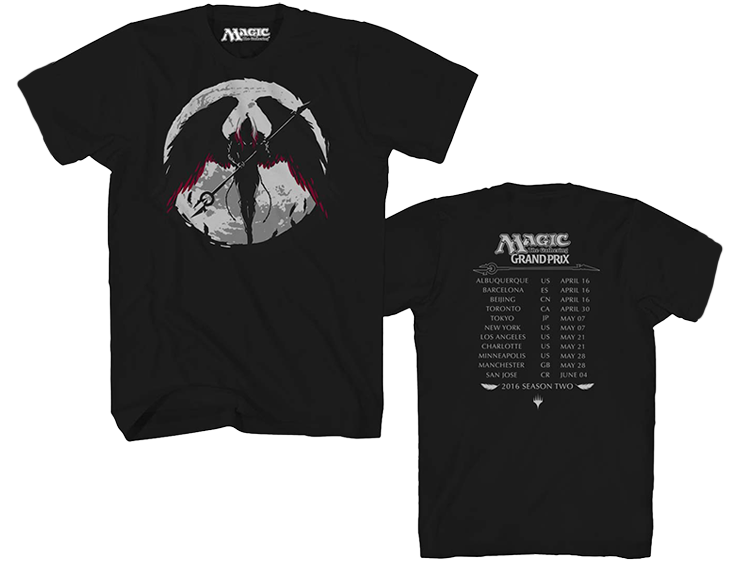
Something that a lot of people don't know is that every Grand Prix has a themed shirt that is available on the prize wall for the most recent set. There is a new shirt for each GP season (every set release) and they're usually pretty sweet. This weekend is still part of the GP season for Aether Revolt, so you can still pick up a Tezzeret shirt to remember your experience by! I couldn't find a great picture of the shirt itself, but here's what the art design looks like. I got a leftover Chandra shirt from the last GP season and a Tezzeret shirt last weekend to go with my Ulamog and Kozilek shirts.

Buying Cards

I purchase cards a lot like I try to purchase groceries: I make a list of what I want before I get to the store and make sure to cross it out as I go up and down the aisles. It helps to prevent me from forgetting a card, but doesn't really help to curb impulse buying.

With Magic cards, I also make sure to write down how much I am willing to pay. Generally this means researching on TCGplayer the morning of the event to find the price of a card.

For example, this last weekend, I wanted to finish my Storm deck and play it in some side events. I was missing three Blood Moons ($20), Shattering Spree ($5), and Pyretic Ritual ($1). I knew that most, if not all, of the vendors are likely to have Blood Moon in stock. It's a staple rare that tons of people need. Shattering Spree and Pyretic Ritual were going to be harder to find, so it is was good to know roughly how much I should expect to pay.

There was an error retrieving a chart for Blood Moon

The price of Blood Moon varied a lot on Friday morning. I saw prices between $22 and $30 from most vendors. I was able to find a vendor that had their Blood Moons listed for $18. I already knew I was expecting to pay $20 and most vendors were above that, so I decided I was not likely to find a better deal than $18. I wasn't able to find any vendors other than Star City with a Pyretic Ritual but Star City's were $1, so it wasn't a big deal. I was also able to find a vendor that had Shattering Spree for only $3, and thanks to my prior research I knew I this was a good deal.

The point of this story is really to know that if you know the price of the cards you want before going to the vendor booths, you are less likely to regret your purchase by finding it for cheaper later in the day. I saved myself $4 per copy by not purchasing the $22 Blood Moons, despite them being "close enough" to my target number. Sometimes you won't be able to find the cards you want for cheaper and it will feel bad to pay extra, but your only other choice is to not have the cards at all.

There was an error retrieving a chart for Pyretic Ritual

In my experience, cards that are harder to find you will likely have to pay a premium on. I've seen some Modern players have the toughest time finding the cards they want due to the size of the format. Many players venture from vendor booth to vendor booth looking for foil Cursecatchers or Simplified Chinese Planeshift Terminates. The little quirky things that people like to add to their decks are much, much harder to find than a set of Expedition fetch lands or any version of Tarmogoyf.

Make sure you temper your expectations, because not everything will be for sale. If you can avoid it, don't go looking for low-dollar value commons or uncommons. Pyretic Ritual was much more difficult to find than I expected and was imperative to play the deck I wanted to play. My last piece of advice is to make sure you do your shopping on Friday or Sunday. Friday will have the biggest stock and Sunday will have the best prices (as most vendors don't want to leave with cards if they don't have to).

Selling Cards

Selling cards is an art if you do it correctly. If you're selling a few cards (probably five or less) that are very popular, you can avoid talking to anyone and just take a peek at the hot list posted near the vendor booth. You really want to decide before you get to the Grand Prix two things: "Are you going to buy cards with the money you get from selling cards?" and "What is the online buylist price of this card right now?"

Armed with this information, you can make the best decision of what you want to do with your cards. If you plan to buy more cards after selling cards, you may want to consider a store that offers a trade-in bonus. Cool Stuff, Inc., for example, offers a 30-percent bonus if you trade in for credit instead of cash. This can end up saving you more money than if you sell your cards to another vendor that offers ten percent more cash value.

There was an error retrieving a chart for Extra Arms

The next big time-saver is making sure your cards are sorted. I would recommend if you have a lot of cards to separate them by how much money you expect to get from them. For example, if you expect to buylist a card for $2, group it in the box with other cards that also buylist for $2. It makes it easier for you to tell if the store you're selling to is not paying the best. This is also known by a lot of Magic finance people as "Ogre-ing," and you can find some more articles on the practice here on Quiet Speculation if you want to go more in depth on the topic.

The bottom line is to make sure your cards are de-sleeved and sorted by price. It will make the process much faster than having someone flip through your binder while you hem and haw about the numbers they offer.

Artists

I don't know how familiar you are with the art of the game, but it turns out people have to paint everything that goes onto a Magic card. That's so cool, right?

Well, a lot of them also play Magic (Noah Bradley played both days of the Grand Prix from his booth). If you are going to your first Grand Prix,  I would recommend setting aside some time to go visit the artist booths and see what they have to offer. Many artists will have prints of their more popular art available for purchase and will sign your cards for a nominal fee.

There was an error retrieving a chart for Anger of the Gods

I will warn you that getting your cards signed by the artist does not increase their value. Please don't get cards signed because you think they will be worth more. They may be worth more to specific people, but generally speaking, they are worth less than a similar-quality card because they've been marked. Artist signatures are not for everyone, but if you have some cards that really mean a lot to you, then you can make them extra special with a signature.

Artists will also sometimes have tokens, playmats and other assorted related goodies for sale at their booth. It's important to know that they are not paid to be there, so if you want to show your support, then you can buy something from them so they can keep making awesome Magic art.

Final Thoughts

Here's some rapid-fire bulletpoints I'll finish this week's article with:

  • Grand Prix are great if you treat them as a convention and not a tournament.
  • Cycling is back in Amonkhet and people have adjusted accordingly by buying Living End. The deck certainly can't get worse.
  • The Amonkhet Invocations are unreadable and a disappointment.
  • Storm is great but Surgical Extraction is a real bummer.
  • Pineapple is fine on pizza, just not pizza I intend to eat.

Restoring Balance with As Foretold

Are you a Quiet Speculation member?

If not, now is a perfect time to join up! Our powerful tools, breaking-news analysis, and exclusive Discord channel will make sure you stay up to date and ahead of the curve.

Amonkhet spoilers have been in effect for a couple weeks now, but nothing's stood out to me as Modern-playable until recently. Cut // Ribbons seems like a solid include in BRx attrition decks like Grixis, while Cast Out could make a decent addition to reactive draw-go shells like UW Control. But the card that has me most excited is As Foretold, a three-mana pseudo-Aether Vial for all spells, which happens to have a busted interaction with the no-cost suspend cards from Time Spiral.

This article takes a look at three brews I've come up with in the 24 hours since As Foretold was spoiled. But there's no reason to keep you in…suspense. Let's get to it!

Brewing with As Foretold

Generating mana is all well and good, but to make a real impact in Modern, three-mana spells usually have to be exploited in a bigger way. Take Brain in a Jar and the Expertise spells—sans their (now defunct) interaction with fuse cards like Breaking // Entering, they would never have seen Modern play. The way As Foretold interacts with spells with no mana cost, though, gives it enough oomph to at least get some talking... and others, brewing. Since spells with no mana cost still have a converted mana cost of 0, we can cast them right away the turn we resolve As Foretold, and again on each following turn.

Finding the Payoff

Modern has a few legal cards with no mana cost, but those with suspend seem like the best payoff cards for As Foretold (sorry, Evermind!). They are Living End, Lotus Bloom, Wheel of Fate, Restore Balance, and Ancestral Vision. Living End requires the whole deck to be built around it, so we'll skip that one. Lotus Bloom is equally unappealing, since As Foretold is already in the business of producing mana.

Wheel of Fate is a bit trickier to evaluate, since it has one of the most historically broken lines of text in Magic, especially on cheaper cards (and what's cheaper than 0?). But Modern lacks the free mana sources of older formats, so I doubt something like As Foretold Storm becomes a thing. Each active copy of Foretold can only cast one Wheel per turn, meaning players need to draw into a second Foretold and the mana to cast it before beginning to turn profits from a new hand. Leveraging card advantage from Wheel fairly is just as unlikely due to the spell's symmetry; drawing opponents seven new ones in Modern is very dangerous.
With the weaker choices eliminated, Ancestral Vision seems like our strongest option. It's on-color with Foretold, and not totally useless when drawn without the enchantment. Vision also provides damage control by helping us quickly dig into interaction, compensating for the tempo loss of setting up As Foretold.

Next up is Restore Balance, which has an effect powerful enough to also boast a Modern deck to its name. Unlike with Living End, though, building around Restore Balance is trivial; players are simply encouraged to run advantage-generating or game-ending permanents that don't count as creatures or cards, and to run light on lands. Balance also helps regain our composure after we spend time setting up As Foretold. Since we can cast it immediately after resolving the enchantment, Restore Balance becomes the cheapest board wipe in Modern at just three mana, making it tricky for opponents to get aggressive with us.

Weighing the Negatives

As Foretold also has a couple problems. For one, what does it even do in multiples? Well, not much. But the card advantage incurred from chaining Ancestral Visions or resolving Restore Balance at will seems to offset the disadvantage of drawing multiple Foretolds quite a bit. Additionally, opponents will be incentivized to remove or counter As Foretold as soon as they see it, which just makes our extra copies live (the "Blood Moon effect").

The enchantment also costs a whopping three mana. Three is no joke in Modern—that's the price of Liliana of the Veil, Blood Moon, and a lethal Become Immense! Luckily, tapping out for Foretold on turn three doesn't mean not impacting the board for a turn. If we can immediately cast Restore Balance, As Foretold acts as a pseudo-ritual effect the turn we cast it by ramping us into a board wipe.

Pillow Fort

The first As Foretold deck I came up with was an Azorius build that walks the line between UW Control and Pillow Fort.

Pillow Fort, by Jordan Boisvert

Planeswalkers

2 Jace, Architect of Thought
2 Gideon of the Trials

Enchantments

4 As Foretold
4 Spreading Seas
4 Ghostly Prison
4 Detention Sphere
1 Nevermore
1 Peace of Mind

Instants

4 Path to Exile
2 Condemn

Sorceries

4 Ancestral Vision
4 Restore Balance
4 Serum Visions

Lands

4 Flooded Strand
4 Ghost Quarter
3 Celestial Colonnade
2 Seachrome Coast
2 Hallowed Fountain
3 Island
2 Plains

Sideboard

3 Leyline of Sanctity
1 Nevermore
2 Runed Halo
2 Porphyry Nodes
2 Stony Silence
2 Rest in Peace
3 Negate

My first order of business with Pillow Fort was to cut the bad enchantments (Sphere of Safety, Nevermore) for the cards I wanted to play. Next, I added in some powerful interactive spells (Path to Exile, Spreading Seas) and called it a day!

Card Choices

Okay, the deck's a little more complicated than that. But not by much. One crucial factor regarding As Foretold is that it changes the way we can build our decks. Since Foretold produces mana for us over the course of a game, like Aether Vial, it incentivizes us to run fewer lands. Traditionally land-heavy strategies like UW Control or Pillow Fort generally rely on card advantage machines such as Sphinx's Revelation to catch up on all the "live" draws missed from slamming Hallowed Fountains. We don't have to—with Foretolds in the deck, we can play a miserly 20 lands (just enough to often make it to our third land drop before stopping) and count on the enchantment to cast our spells later. 20 is a number I borrowed from Burn, but with Serum Visions in the picture, things get a lot less dicey.

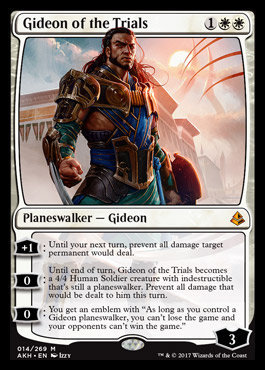
I found while playing this deck that planeswalkers are the ideal permanent type to have in play while ticking up an As Foretold. They don't care about Restore Balance, can win games on their own, interact with the board, and generate advantage, which are all things we want from our spells. The only problem with planeswalkers: not many good ones exist. Something like Nahiri, the Harbinger seemed like the ideal walker for an As Foretold deck, but that would stretch us into three colors, making a low land count unsafe and softening us to hosers like Blood Moon. Without red, we're left with Jace, Architect of Thought and... Gideon of the Trials!

Gideon hasn't blown me away yet, but he takes pressure off our life total with his plus ability and usual planeswalker bulk, and forces opponents to interact with him to get us dead. This last dimension is useful in just about every matchup. Combo decks like Ad Nauseam have no way to beat a Gideon in game one, and aggro decks won't be able to just ignore the 'walker and attack our face. Leyline of Sanctity also works well with Gideon, since it requires opponents to defeat him in combat. Lightning Bolt, Lightning Storm, and company can't target us with Leyline in play, so that damage can't be redirected to our planeswalkers.
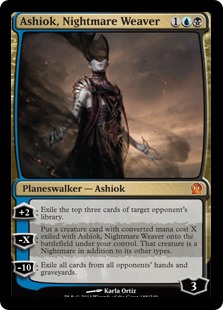
Spreading Seas is awesome right now, but it also gives us a "mana sink" for As Foretold. Between Seas and Serum Visions, we're likely to always have something for Foretold to "cast" (the scare quotes are real in this article) in want of a suspend card.

Peace of Mind is a weirder one. Sometimes, opponents get us down low enough that it's nice to have a way to gain some life. But Peace shines brightest when paired with Restore Balance, allowing us to dump our hand for heaps of life and then force opponents to discard to 0.

Lastly, it's never correct to suspend Restore Balance in this deck. The effect gains most of its power from coming out of the blue. If we're under pressure, that's even more reason to hold it, as we're unlikely to get six full turns before it comes off the stack anyway, and if we topdeck As Foretold, we can just cast it.

UB Control

It only took me a few games with Pillow Fort to realize I would have more fun playtesting with something more interactive. So I dreamt up this bad boy:

UB Control, by Jordan Boisvert

Creatures

2 Snapcaster Mage

Enchantments

4 As Foretold
4 Spreading Seas

Instants

4 Fatal Push

Planeswalkers

4 Liliana of the Veil
3 Ashiok, Nightmare Weaver

Sorceries

4 Ancestral Vision
4 Restore Balance
4 Serum Visions
4 Inquisition of Kozilek
3 Collective Brutality

Lands

4 Polluted Delta
3 Misty Rainforest
4 Darkslick Shores
2 Creeping Tar Pit
2 Watery Grave
3 Island
2 Swamp

Sideboard

1 Vendilion Clique
2 Sun Droplet
1 Pithing Needle
3 Relic of Progenitus
2 Engineered Explosives
2 Dispel
2 Countersquall
2 Lost Legacy

UB Control is a model example of a deck that only exists thanks to Fatal Push. Without the Aether Revolt instant, we'd be forced to dip into a third color for our early-game interaction. Collective Brutality also plugs plenty of holes in blue-black decks by giving us a mainboard-playable hoser for Burn.

Card Choices

This deck is leaner than Pillow Fort and packs a natural punch against fair decks thanks to Liliana of the Veil. Seas continued to impress me here, too. With removing early creatures out of the way, the problem for UB becomes putting away games. Liliana of the Veil's ultimate doesn't quite do it, and we can't really justify playing Liliana, the Last Hope in this deck since we rely so heavily on her big sister and don't stand to gain much from her -2.

All that left me looking to Ashiok, Nightmare Weaver. Milling opponents out is as demoralizing a strategy as any. Ashiok has some tension in this deck, though, since it turns on enemy removal. Stealing a Goyf feels great until it promptly gets Pushed. Having Liliana of the Veil in play greatly mitigates this issue, since we can empty a hand first. Another problem with Ashiok is that we rarely want to use its ultimate, so opponents don't really care about attacking it. Ideally, our planeswalkers draw enemy fire.
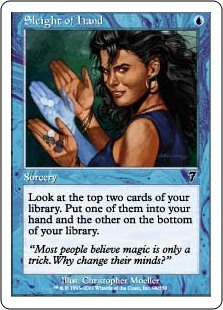
Either way, fair decks are easy to beat with this pile. Ashiok's biggest weakness: it's not fast enough against decks with inevitability. Despite the 4 Seas, Tron can prove problematic for us by slamming Karns and removing our win conditions. Wurmcoil Engine is difficult to answer cleanly in these colors. And don't get me started on Oblivion Stone—that card even wipes out our precious As Foretolds!

Creeping Tar Pit has killed many of my opponents, and using it is essentially free in longer games, since As Foretold will cast our spells. Tar Pit's presence also helps make Snapcaster's body relevant in some matchups.

As for the positives, Liliana of the Veil adds an important dimension to the As Foretold deck. Her minus makes opponents want to go wide to beat us, since they're unlikely to get there with a few efficient threats. But committing lots of cards to the board opens them up to Restore Balance blowouts. It's the old kill-spell-vs-Wrath-of-God conundrum successful control decks have always imposed on their opponents, except our Wraths cost 0 mana.

Inquisition of Kozilek is also great in this deck, as it slows down opponents long enough for us to get our act together. Faster decks like Revolt Zoo go very wide very quickly, and combining Push and Inquisition is a reliable way to buy ourselves the few turns we'll need.

Jeskai Control

We all knew it would come to this.

Jeskai Control, by Jordan Boisvert

Creatures

1 Emrakul, the Aeons Torn

Planeswalkers

4 Nahiri, the Harbinger
3 Chandra, Torch of Defiance

Artifacts

4 Relic of Progenitus

Enchantments

4 As Foretold

Instants

4 Lightning Bolt
4 Path to Exile

Sorceries

4 Ancestral Vision
4 Restore Balance
4 Serum Visions
4 Sleight of Hand

Lands

4 Flooded Strand
4 Scalding Tarn
2 Celestial Colonnade
2 Seachrome Coast
1 Desolate Lighthouse
2 Steam Vents
1 Hallowed Fountain
1 Sacred Foundry
1 Island
1 Mountain
1 Plains

Sideboard

2 Greater Gargadon
2 Spreading Seas
1 Rest in Peace
2 Stony Silence
1 Dispel
2 Lightning Helix
2 Negate
1 Wear // Tear
2 Anger of the Gods

Nahiri really is an ideal As Foretold planeswalker, even if she costs four mana. She ticks all our boxes from before: ends the game on her own, draws enemy fire, interacts with the board, and generates advantage that doesn't translate into cards, lands, or creatures. Chandra, Torch of Defiance rounds out our planeswalker suite, and the rest is standard Jeskai Control fare. Wait a minute... no it's not!

Card Choices

Snapcaster Mage's omission is this list's biggest eyebrow-raiser. Snap's not superb with Restore Balance, and the card advantage he provides pales in comparison to what we get from Ancestral Vision. I have been happier with Relic of Progenitus, a card that went from the UB sideboard to the Jeskai mainboard as soon as I built this deck.

Relic is a permanent we can easily drop from our hand and "hide" from Restore Balance. It interacts efficiently with a large portion of Modern's current top tier (including Death's Shadow Jund) and even cycles when we don't want it. The reason many players don't run Relics themselves is their own reliance on graveyard synergy.

Back to Chandra—she's no Nahiri when it comes to pressure, but this 'walker will still end games on her own. She also has an interesting interaction with suspend cards. Remember all the times you wished you could cast Ancestral Vision off your Chandra activation? Wish no more. If we have As Foretold on the board and plus Chandra, we can use Foretold to cast the exiled card, even if it doesn't have a mana cost. Finally, since Chandra has a minus that removes creatures (like Nahiri), she can pressure an opponent's board development in the same way as Liliana of the Veil.

The eight cantrips also deserve an explanation. Including four-mana 'walkers ups our curve dramatically and incentivizes us to play more lands. But playing more lands is not exactly something I'm fond of. Besides, doing so conflicts with our Restore Balance plan. The solution? Play more cantrips!

Since Modern's blue cantrips can grab anything, they smooth out not just our early land drops, but our gameplan in general. Need a removal spell? Let's dig for one. Need As Foretold? Let's dig for one! I've found casting a turn-three Foretold and immediately chasing it with a suspend spell to be very consistent in this deck, and I owe it all to Serum Visions and Sleight of Hand. Getting off Balance on turn three greatly outweighs any tempo losses incurred by first casting blue sorceries. And when we want to start tapping all our lands for planeswalkers, we can even use As Foretold to cast our cantrips for us.

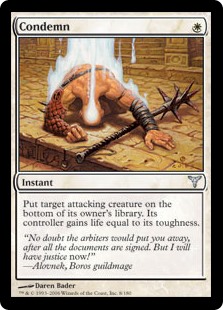
The last cards I want to touch on reside in the sideboard. Anger of the Gods is a nod to value-creature decks like Aristocrats and Abzan CoCo, which were difficult matchups for UB Control. Having to deal with persist creatures twice was backbreaking for that deck. Greater Gargadon is an easy way to nuke our own manabase before casting a 0-mana Restore Balance. The Beast comes in against decks that assemble a critical mass of lands (Tron, Valakut), and the plan is as simple as it sounds. As Foretold will cast our spells after everyone loses their lands, and things get even more lopsided if we already have a planeswalker on the field.

Remain Enchanted

There's no telling if As Foretold will make huge waves in Modern, but I have been impressed so far by its applications in my very limited testing. The builds presented in this article only represent my efforts with the card, and are sure to change drastically if I decide to continue brewing with As Foretold. In fact, I'm already tweaking new versions of Jeskai with Mind Stone—and now Simian Spirit Guide!—in the Relic slots. Either way, I can't help but think we're onto something. Wizards may have taken away one "feels broken" interaction with the split card rules change, but they've given us a shiny new one. What deck will break As Foretold first?

Looking Ahead: Rising Strategies

Are you a Quiet Speculation member?

If not, now is a perfect time to join up! Our powerful tools, breaking-news analysis, and exclusive Discord channel will make sure you stay up to date and ahead of the curve.

I’ve been playing a ton of MTGO recently (mostly with Esper Control) and have come across some…strange decks. Seeing a rogue list 5-0 a League event here and there can be a fun distraction from “business as usual,” but most of these lists tend to be “flash in the pan” rather than “harbinger of the future.” While nowhere near as sexy, the lists that don’t make the winner’s circle, yet nevertheless struggle just outside the spotlight, can give us valuable information regarding the future of the format. If we’re looking to get ahead, this is the best place to start.

Today we’ll be taking a look at some lists that have been seeing a fair amount of play online, but have yet to translate that activity into solid results in high-level events. Close students of Modern will notice lots of Tier 2 and Tier 3 decks make an appearance. Some of these archetypes are traps, some a little rough, and others are the real deal. Welcome to the front lines.

Gifts Storm

UR Gifts Storm is first on this list because, as of this writing, it’s steadily working its way out of the fringe and into the mainstream. Prior to last week, Storm was averaging a 5-0 roughly every four days on MTGO, but it appears that a reliable list has been found, as those numbers have climbed to a steady 5-0 a day.

Gifts Storm, by Hoppelars (5-0, MTGO Competitive League)

Creatures

4 Baral, Chief of Compliance
4 Goblin Electromancer

Instants

4 Desperate Ritual
4 Gifts Ungiven
4 Manamorphose
4 Pyretic Ritual
3 Remand

Sorceries

4 Serum Visions
4 Sleight of Hand
2 Grapeshot
2 Merchant Scroll
2 Past in Flames
1 Empty the Warrens

Lands

4 Scalding Tarn
4 Spirebluff Canal
3 Island
3 Misty Rainforest
2 Steam Vents
1 Mountain
1 Shivan Reef

Sideboard

2 Empty the Warrens
2 Anger of the Gods
2 Shattering Spree
3 Dispel
1 Echoing Truth
3 Lightning Bolt
2 Blood Moon

Several months after the release of Aether Revolt, Pyromancer Ascension is long gone. It's been replaced with Gifts Ungiven and an extra four copies of Goblin Electromancer in the form of Baral, Chief of Compliance. The rest of the list is relatively “business as usual,” but moving from Ascension to Baral results in some cascading effects that influence how matches play out. With eight Electromancer effects, we’re not as “all-in” on our first copy as we used to be. If he dies, he dies. By moving away from Pyromancer Ascension we lose out on some velocity for sure, but we more than make up for it in terms of consistency with Gifts Ungiven and Merchant Scroll. No longer are we beaten by a lowly Fatal Push or Lightning Bolt. This Storm list is more than ready to take the fight past the midgame and go late with any opponent.

Discard is still an enemy we would rather not face, but Gifts Ungiven can work wonders at digging us back from any hand position. We still are looking to dodge Jund at all costs, and Death’s Shadow at the top of the metagame is definitely bad news, but for the most part we face a field that at least allows us to remain competitive. We’re still Storm, and can still kill quickly if allowed to do our thing.

What I like the most about this list is a strong, consistent, proactive Plan A in pre-board games with the opportunity and flexibility to shift against whatever matchup we’re facing. Dispel, Anger of the Gods, and Blood Moon are in the running for top card versus their respective matchups of choice (control, aggro, and combo), and all of our card selection makes it a guarantee we’ll find them when we need them. For a linear combo deck, this UR Storm list is able to transition against specific opponents better than most decks in recent memory. If you haven’t run across it by now, prepare yourself. A Storm is most definitely coming.

RW Prison, by egdirb (5-0, MTGO Competitive League)

Creatures

4 Simian Spirit Guide
1 Emrakul, the Aeons Torn

Artifacts

4 Chalice of the Void

Enchantments

4 Blood Moon
2 Journey to Nowhere
2 Oblivion Ring

Instants

3 Lightning Helix
2 Blessed Alliance

Planeswalkers

4 Nahiri, the Harbinger
2 Ajani Vengeant
2 Gideon Jura
1 Chandra, Torch of Defiance

Sorceries

2 Anger of the Gods
2 Wrath of God

Lands

9 Plains
4 Arid Mesa
4 Temple of Triumph
2 Clifftop Retreat
2 Rugged Prairie
2 Sacred Foundry
1 Mountain
1 Needle Spires

Sideboard

1 Elspeth, Sun's Champion
1 Wrath of God
3 Leyline of Sanctity
4 Rest in Peace
2 Rule of Law
4 Stony Silence

Remember what I said about Anger of the Gods and Blood Moon out of the board in Storm? RW Prison is still floating around, and it gets to play them in the maindeck. In my opinion, RW Prison is still the same deck it’s always been (a collection of bad cards propped up by a few incidental bombs), but it’s hard to argue with how good some of those bombs are against the field right now. Chalice of the Void on one is always going to be good in Modern, and Blood Moon is great against a large portion of the field. Death’s Shadow, Eldrazi Tron, normal Tron, Abzan, control—Blood Moon shuts down a significant portion of the field, and the ability to rush it out a turn earlier with Simian Spirit Guide is scary-good, especially against Death’s Shadow.

With Leyline of Sanctity to cover our bases against discard (our natural enemy), and do double duty against the top two decks in the field (Death’s Shadow Aggro and Burn), RW Prison is strongly positioned to carve out a significant portion of the field if left unchecked. Bant Eldrazi can give it a run for its money, but if RW plays enough removal (and Gideon Jura) and doesn’t get too cute, even that matchup is beatable.

Elves, by ralstn (5-0, MTGO Competitive League)

Creatures

4 Dwynen's Elite
4 Elvish Archdruid
4 Elvish Mystic
3 Elvish Visionary
1 Eternal Witness
2 Ezuri, Renegade Leader
4 Heritage Druid
4 Llanowar Elves
3 Nettle Sentinel
4 Shaman of the Pack
1 Spellskite

Instants

2 Chord of Calling
4 Collected Company

Sorceries

2 Lead the Stampede

Lands

4 Blooming Marsh
4 Cavern of Souls
2 Forest
4 Gilt-Leaf Palace
2 Horizon Canopy
1 Overgrown Tomb
1 Pendelhaven

Sideboard

1 Chord of Calling
1 Creeping Corrosion
2 Dismember
3 Kitchen Finks
1 Lead the Stampede
1 Phyrexian Revoker
2 Reclamation Sage
3 Thoughtseize
1 Yixlid Jailer

Every time I face Elves, I tend to be playing some sort of removal-heavy reactive strategy, and as such crush it into oblivion easily. Still, I’ve noticed the number of competitors playing Elves picking up in the last week, and for good reason. Lead the Stampede is one of the best ways to fight discard that I can think of, and most of the other aggressive decks in the field are going big, rather than wide.

While Death’s Shadow and Eldrazi are discouraging people from playing Anger of the Gods, a bunch of other archetypes are capitalizing on it. Affinity, Dredge, and Elves are just a few of the reasons why Anger is good right now, but until the format wises up, going all-in against a field looking to fight Death’s Shadow’s value is a good spot to be.

One thing you have to remember, of course, is that by sleeving up Elves you are putting yourself slightly below Affinity and Burn in the “life in your opponent’s hands” category. Each of these archetypes has a ton of play to it, of course, but if you run into the Prison deck, or the Grixis deck, or the Esper deck, it can be tough to win. Still, most of those decks are fringe themselves, so as long as you have a plan for the top decks you shouldn’t be discouraged by the bad matchups. Elves looks to line up well against the field right now, so you could definitely do worse.

UW Control, by Gregory Orange (1st, GP San Antonio)

Creatures

3 Snapcaster Mage

Artifacts

1 Crucible of Worlds

Enchantments

2 Detention Sphere
4 Spreading Seas

Instants

1 Blessed Alliance
3 Condemn
3 Cryptic Command
2 Mana Leak
4 Path to Exile
2 Spell Snare

Planeswalkers

1 Elspeth, Sun's Champion
1 Jace, Architect of Thought

Sorceries

4 Ancestral Vision
4 Serum Visions
2 Supreme Verdict

Lands

3 Celestial Colonnade
4 Flooded Strand
4 Ghost Quarter
2 Hallowed Fountain
4 Island
2 Plains
4 Seachrome Coast

Sideboard

2 Celestial Purge
1 Dispel
3 Kor Firewalker
2 Negate
2 Porphyry Nodes
1 Rest in Peace
2 Stony Silence
2 Vendilion Clique

By itself, a third of a share of 1st place at a Team Grand Prix is interesting, to say the least. On the one hand, it made it through a huge field and played a part in taking home the trophy. On the other hand, deckbuilding restrictions can play a huge part in why we see this list in the first place, and the whole “center seat” positioning to beat up on aggro and midrange decks can sway results slightly. Still, its difficult to evaluate how much of the finish is owed to deck merit, and how much is owed to extra factors. It’s best to default to the baseline, which is: “This deck won a Grand Prix, so pay attention.”

Luckily, in the few days since San Antonio, I’ve had a chance to try out the list myself, and some 5-0 results from other players have already begun to trickle in. When we’re not interested in winning by inches, Condemn is just as good if not better than Fatal Push, so why play black? Sure, we don’t get Esper Charm, but once we’re not playing that, we can ditch Think Twice for Ancestral Vision and just try and brute-force opponents.

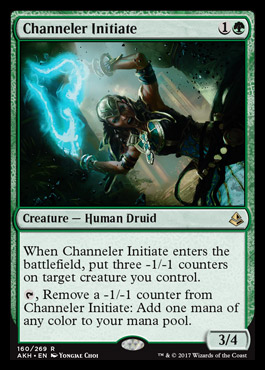
Really, though, the draw to UW over Esper is the ability for us to play Spreading Seas and Ghost Quarter. Tron is not an easy matchup, even for control, as Esper is not built well to stop them from assembling Tron. A year ago this was fine, but with Ulamog, Ceaseless Hunger, Sanctum of Ugin, and Worldbreaker in the mix, they can grind us out pretty regularly. Esper can’t afford to play Ghost Quarter (at least not alongside a playset of Esper Charm and Cryptic Command) and definitely doesn’t have room for Spreading Seas in the maindeck. Against the field, I’d rather have Esper. But right now, with Tron putting up the numbers that it is, UW is the more streamlined, focused option.

Conclusion

Storm, Prison, Elves, UW…whatever your fancy, there appears to be a fringe option for you. A few weeks from now, one or more of these might be in the conversation for top deck(s) in Modern. A few might drop off the radar entirely, only to re-emerge weeks later. Some might not have what it takes, and some might just need a brave champion to pick them up and get to tuning. As for me, I’m working on UW currently, and intend on testing out Storm and RW Prison in the coming days. Let me know what you think in the comments below!

Thanks for reading,
Trevor Holmes
The_Architect on MTGO

Insider: Post-GP San Antonio Picks

Are you a Quiet Speculation member?

If not, now is a perfect time to join up! Our powerful tools, breaking-news analysis, and exclusive Discord channel will make sure you stay up to date and ahead of the curve.

GP San Antonio was a blast! We lost our win-and-in for Top 4 but pulled out an insane match in the last round to finish 11-3 and in 8th place. Team events are literally the best in all of Magic and I'm making it a priority to attend every single one that I possibly can.

Modern is great and the unified format really showed off a lot of cool decks, precisely as I suspected it would. All things considered, with the exception of Pascal Maynard's neat Krark-Clan Ironworks deck (which we beat in the last round!), the format shook out largely as was expected. There was a lot of Death's Shadow, Affinity, Eldrazi, and combo decks. The basic bread and butter of the Modern format.

The trio of decks that my teammates and I selected were RG Scapeshift (with no Through the Breach), Affinity, and Bant Eldrazi. I couldn't have been happier with that configuration. All three are great Modern decks and served us well.

Today, I'd like to take a quick look at what San Antonio taught us about the format. I'll also make some predictions about the cards likely in great territory for price increases in the foreseeable future.

There was an error retrieving a chart for Collected Company

I think we could do a lot worse than investing in Collected Company right now. For starters, I lost against Bant Knightfall in a pretty decisive match. I wrote about the deck last week for Channel Fireball, and I think it is much better than people give it credit for as a real Modern option.

The deck continues to impress me the more I see it in action. To be fair, all of the Collected Company decks (Abzan Melira, Elves, and Spirits) are decks that I secretly fear playing against in tournaments. The matches are always super close and I feel unfavored in the matchup with whatever I'm playing.

Collected Company is also the kind of card that will continue to get better as time goes on. I mean, it's pretty obvious we are not getting a "better CoCo" any time soon—but every time a great creature with CMC three or less gets printed, it becomes a potential option for Collected Company.

My assessment is that Collected Company is currently underplayed in Modern and will likely improve with regard to metagame share as time passes.

There was an error retrieving a chart for Spell Queller

Spell Queller is another card that has tanked pretty hard lately. All things considered, it's a very powerful Magic card. I played against more Quellers last weekend than I would have anticipated. They were very good against me in the Bant CoCo deck, and a pretty surprising blowout from UW Control after sideboard.

I did learn a couple of cool Displacer / Queller interactions.

1. If you blink a Spell Queller with an Eldrazi Displacer, the world basically ends. Just kidding; but what happens is kind of interesting.

Two triggers go onto the stack. 1) To cast the spell that was exiled by Spell Queller. 2) Spell Queller's "Exile a spell from the stack" trigger. Since you haven't actually cast the spell that was exiled yet (the trigger is on the stack but not the actual spell), Spell Queller can't choose it as a target. So blinking Queller is great because you essentially unlock the spell.

The other cool interaction is that if an opponent has a Spell Queller in play and then casts, say, a Monastery Mentor, you can blink the Queller in response and force them to exile their own Mentor! Ding!

I thought those were cool interactions worth sharing, because at the time I had no idea what was going on and had to ask a judge exactly how these things worked to be sure.

Spell Queller is the kind of card that will always be around in Modern as a good option for decks that want to play a flash-style game. I know Kyle Boggemes is very high on his Jeskai Flash deck that also makes great use of Queller.

Despite matching up poorly with Eldrazi Displacer, Spell Queller is a great Magic card in Modern. I also think there is a very legitimate chance that Queller could finally have its day in the sun in Standard with the release of Amonkhet. I think the current low price and the high potential makes Queller a strong card right now to pick up and hold onto.

There was an error retrieving a chart for Scrap Trawler

I actually wrote about Scrap Trawler as a dark-horse pick from Aether Revolt, believing that it had serious combo potential in eternal formats. It only took some time for somebody to figure it out in Modern.

The interaction between sacrificing artifacts to generate mana with KCI and continuing to loop Mox Opals and Chromatic Stars to generate card and mana advantage is pretty insane. I think Pascal's deck from the GP is a legitimate choice in Modern. And seriously, who doesn't enjoy a good "Eggs" deck?

A KCI-style combo deck featuring Trawler could potentially be great in Legacy or Vintage as well. I have a knack for looking at a new card in the abstract, and recognizing unique and powerful cards that will, at some point, eventually find a home in constructed Magic. Trawler was an example of just adding up the stats and saying, "eventually."

Trawler is essentially a bulk rare which makes it a good card to horde up on right now. Keep in mind that Pascal lost a win-and-in for Top 8. One more win would have put him into Top 4 and we likely would have already seen a spike on KCI cards.

There was an error retrieving a chart for Rest in Peace

Rest in Peace is a great pick-up right now. It has been slowly creeping up and I don't anticipate that trend to curtail any time soon. Easily one of the most important sideboard cards in the format and the best graveyard hate card ever printed. Nothing strikes fear into Dredge like a RIP!

If you are playing white in basically any format you are playing Rest in Peace. That is how good the card is. It also didn't see a Modern Masters reprint—let the games begin!

I have a huge stack of these that I've been saving, literally, since RTR came out. because I knew the card was insane, and continued to know the card was insane year after year. If you don't have these yet, I suggest picking up your playset because the sky is the limit.

There was an error retrieving a chart for Stony Silence

A few weeks ago I wrote about my general strategy for approaching Modern Masters 2017 specs. The cliffs notes version was to wait a few weeks for MM17 rares to begin to bottom out, at which point there will be a ton of them floating around. Then they'll slowly start to trickle back up.

Stony Silence is a great example of this philosophy playing out. Stony has plummeted to a low-level-priced rare because of MM17. However, it is still a marquee Modern and eternal staple. While the price has gone down because supply has increased for the moment, we also know that the demand is and will always be high. Eventually, it will balance out and the price will go back up as has been the case with other similar Masters reprints in the past.

Stony Silence is probably the most devastating sideboard card in all of Modern and I don't see that changing. If anything, the card has recently gotten better because it is also a house against Pascal's KCI Eggs combo deck. Basically, I want to acquire every Stony Silence I can trade for while they are $3.

There was an error retrieving a chart for Phantasmal Image

Last but not least, I love Phantasmal Image as an investment card right now. It falls into the same category as Stony Silence: an MM17 reprint where supply has momentarily eclipsed demand. Phantasmal Image is not a dollar card. It is extremely powerful and sees considerable play across various formats. Most importantly, it is unique. We are not going to see another two-mana clone.

It's also quite a house in Collected Company decks, especially when copying Drogskol Captain or other hexproof monsters. It also sees some fringe play in Merfolk. I see Image as a card very likely to rebound in value; so strike while the iron is hot!

Conclusion

Modern felt great last weekend and I'm looking forward to continuing to explore the new metagame in the coming weeks. Keep an eye on those cheap MM17 staples. Abrupt Decay also seems like a hot buy right now. Most importantly, look for cards that are continuing to drop and pick them up low to wait for the value to come back later.

Modern is great. Magic is great. Money is great. Have a great week!

Insider: Splendid Swans- Finding the Next Bulk Rare

Are you a Quiet Speculation member?

If not, now is a perfect time to join up! Our powerful tools, breaking-news analysis, and exclusive Discord channel will make sure you stay up to date and ahead of the curve.

Hey, everyone!

Thanks for tuning into the last Lotus article; I promise I'll shut up about that particular card. Now that the dust is settled there, let's swing the pendulum to the other end of the spectrum, a subject you're probably more used to reading about every Thursday: the juicy 10-cent cards that make up the bulk of my Magic card inventory, and which occasionally make their owners a nice profit after a spike. We saw this happen with a few formerly bulk cards recently.

There was an error retrieving a chart for Swans of Bryn Argoll

We had Swans of Bryn Argoll show up a week or two ago thanks to the helpful push of SaffronOlive and Corbin Hosler, and then Splendid Reclamation quadrupled up from its bulk rare TCGplayer market price to the $2.00 it presently rests at. While it's relatively difficult to make a direct profit on these individual cards as singles, the power of bulk is in quantity over quality. If you bought one Food Chain a month ago and now want to list it on TCGplayer to make a profit, you'll see a lot more gains than if you do the same with a single Splendid Reclamation.

However, those numbers start to change as you get into the habit of being the bulk rare person – the one who's willing to take all of the jank at the table while trading out Walking Ballistas and Chandra, Torch of Defiances. If you're getting multiple playsets of Reclamation over time, then it becomes worth your costs to cash them all out at once while buylisting to ABU Games or another vendor on Trader Tools.

There was an error retrieving a chart for Splendid Reclamation

This is essentially the boat I've found myself in. Dave Schumann gave me a nice shoutout in his recent bulk article yesterday, so I'm not going to reiterate his well-stated points. Instead, this is sort of a follow-up to the first part of his piece on bulk rares.

Once you can establish yourself as someone in the community known for wanting bulk, it's not too terribly difficult to grind your way up. But how are we going to pick out those Hardened Scales-type bulk rares so far in advance? What specific sets and cards should we be considering when we're pulling out certain bulk rares to set aside for later? I'm not looking to go deep on TCGplayer and buy any number of these. In fact, living less than an hour away from the TCGplayer headquarters means that I pay an additional eight-percent sales tax on anything I buy from the site, making speculation less of a sexy option when I'm looking to pick up cards en masse.

There was an error retrieving a chart for Key to the City

One of the key cards I've been picking out as bulk rares get traded to me is Key to the City. Presently worthless in everything but the janky and niche Metalwork Colossus deck, it's a cheap artifact with low downside and some reasonable upside. This isn't a Heartless Summoning-style pick where it gets a brand new facelift with the help of Modern and ends up at a 1000 percent multiplier, but I can see this fitting into the same price graph as Splendid Reclamation. Pure hype from future discard and cycling synergies could drive this up to a home of $1 or $2, at which point we buylist 20 or so at 50 cents a piece to Card Kingdom to pay for our next draft entry at FNM. While artifact synergies are sooooo three months ago, this seems like a semi-obvious discard outlet plant that WotC intended to make work in Standard with some other pieces from Amonkhet. Far-fetched? Maybe, but paying 10 or 12 cents a piece on a card can give you a lot of freedom to make decisions like this.

There was an error retrieving a chart for Dark Intimations

I shouldn't really need to elaborate on this next card. It's one of the five Story Spotlight cards in Aether Revolt, and there's a zero-percent chance that we go through this block without seeing the next incarnation of Nicol Bolas, Planeswalker. I want to own 100 of these over the next three months, although I wouldn't target them too aggressively just yet. I don't expect to see Bolas in this set, instead expecting him in Hour of Devastation. We're seeing a recurring trend of villains in the current two-set block paradigm showing up in the second set: Emrakul in Eldritch Moon, Tezzeret in Aether Revolt... Again, even if Grixis control never manifests as a competitive option in Standard, I think you'll be able to ride a hype wave of a small-set rare up to the $2 retail range, cashing out on buylists at $1 easily as the weeks prior to Hour of Devastation approach.

There was an error retrieving a chart for Scrap Trawler

Lastly, I want to focus on another rare from Aether Revolt that got a lot of hype upon being previewed but quickly dropped to bulk rare status. Saffron gave us a preview of what the Modern deck involving Scrap Trawler might look like, but we all know that's not enough to push a rare from the most recently printed set into the financial spotlight. However, if this deck takes off on camera at a higher-level Modern event (and yes, I understand that "higher-level Modern events" are becoming rarer than uncommons from Eventide), I think we could see the same kind of miniature bump from Scrap Trawler. This is the card I'm the least confident in out of the three, but I find it very hard to emphasize exactly how low-risk bulk rares are. As long as you can find another interested party who agrees with the stuff I'm saying in the article, dumping Scrap Trawler at 25 cents for a double-up shouldn't be difficult, either. Seocnd Sunrise-style decks aren't the most popular archetype due to the complexity of the game states and the game knowledge required to play them, so I'd go looking for Keys or Intimations before Trawler.

End Step

What do you all think will be the next Swans or Splendid Rec? While Necrotic Ooze isn't exactly a bulk rare, it's definitely a pet card of mine that's gotten some new love in the form of a mana dork to pair with Devoted Druid. Channeler Initiate lets you go infinite mana in Modern, although I'm not exactly sure that a Bolt-able and Path-able 4/3 is where you want to be for combo.

channelerinitiate

On the other hand,a blue mythic was spoiled today that lets you cast Restore Balance. I don't need to say anything else.

asforetold

Insider: Amonkhet First Look

Are you a Quiet Speculation member?

If not, now is a perfect time to join up! Our powerful tools, breaking-news analysis, and exclusive Discord channel will make sure you stay up to date and ahead of the curve.

We’re entering a new plane and finally back to the desert! One of the best parts about Magic is the intricate and interesting new worlds we visit. Some are better than others, it's true, but Amonkhet is going bring us groundbreaking new cards with Egyptian themes, and that sounds amazing. Sure, we’ve had sphinxes, clerics and gods before – but never like this!

Let’s jump in and break down some sweet new cards as well as some financial info you need to know.

Gods

First up, we have gods for the first time since Theros.

hazoretthefervent1

Last time around, we had gods like Nylea, God of the Hunt and Athreos, God of Passage, who only became creatures when the player's devotion in a given color was high enough. In Amonkhet, though, we see a completely different way to activate this god. It’s almost like we want to utilize the hellbent mechanic from a card like Jagged Poppet.

Unlike when hellbent was a mechanic, though, we have a built-in way to reduce our hand size for profit! Hazoret lets us Shock each opponent and get rid of a card. So, not only does his ability help us activate him as a creature, but it is also a win condition on its own. I like that in the end game, when your hand is already low, that he has haste so you can just attack immediately.

While the current meta doesn’t seem open to this strategy, at least for this red god, it’s super cool that they are revisiting the god concept and reworking it for this block. Thassa, God of the Sea and Erebos, God of the Dead had huge impacts on the metagame the last time around, so it will be exciting to see if any of these new Amonkhet gods can also shape the meta as well.

I don’t think Hazoret is going to be breaking your wallet or your life total any time soon, though. He does remind me of a Surrak, the Hunt Caller or Hero of Oxid Ridge, but I actually think both of those cards are better than Hazoret, and they both saw minimal amounts of competitive play.

Cycling Duals

Next up, we have a new land cycle and it is awesome!

irrigatedfarmland

First of all, all of these lands have some sick artwork. So far, I’ve been really impressed with the art quality of this set, and this land cycle is a huge part.

We’ve had cycling lands for a while now. Lands from the Lonely Sandbar cycle have been in multiple reprint products like Commander decks. These lands even see play in Legacy.

Until now, though, we have not had any variations as powerful as dual lands with cycling. They may always come into play tapped, but just like Temple of Malady and the other scry lands, there is too much value to not play these new duals. Think about games where you flood out, but instead of flooding, you can cycle a couple lands from your hand to get to other cards.

I love this cycle, and I think they will be great. If players initially undervalue them, as I think may happen, I’d try to obtain as many copies as possible. The new fast lands from Kaladesh, like Spirebluff Canal are great too, and I highly recommend picking those up if you haven’t already. The fast lands we already know are Modern quality lands, but I think the dual cyclers might be Modern quality as well. They might be more niche, but I think they will find a home.

Cool New Cards

There was an error retrieving a chart for Aven Mindcensor

First up, we have a surprising reprint in Aven Mindcensor. We’ve already seen a dip in price on this Modern hoser, and it will likely go down a bit more. The new card is a rare, but there will be tons of them floating around in the market once the release hits. We also get a Masterpiece version of this card, and the art on both looks amazing to me.

Competitively, I’m not certain there is much to gain from playing this guy in Standard. We may see some ability from this set or in a future set that gets nullified by Aven Mindcensor’s ability, but for now, it’s just a cool inclusion in the set.

flamebladeadept

Flameblade Adept reminds me of Monastery Swiftspear. Maybe I’m reaching too far on this one, because a lot of Flameblade’s power comes from the cycling cards in the set. He does work well with Hazoret’s discard ability, though.

My favorite part about this new card is the possibilities it seems to portray. Flameblade suggests that the cycling mechanic will be well supported with benefits based on cycling cards from your hand. The last time that happened we had Astral Slide and Lightning Rift. That was a really cool strategy, and I’d love to see that type of game plan again in Standard.

prowlingserpopard

Prowling Serpopard, besides having an annoyingly difficult name to say, is a very efficient creature. For three mana, it's already a pushed 4/3 body, and we also get the ability to resolve every creature we cast as long as this remains on the battlefield. Previously, we would have had to rely on much weaker versions of this effect like Gaea's Herald. This prowling cat-snake hybrid is a huge upgrade from a decade ago. I don’t know if this is well positioned in Standard right now, but not only does he have Modern potential, but I think its time for the Standard limelight will come down the road once the format rotates some cards out.

Embalm

Wow! This mechanic looks sweet. Not only is it full of Egyptian flavor, but it also seems really powerful. So far, I haven’t seen any creatures that seem particularly pushed that have this ability as well, but I’m watching the spoilers for them. I think the best we have is Trueheart Duelist, a two mana 2/2 that embalms for three mana. That seems pretty great in the long game, but we need something better than that.

trueheartduelist1

If embalm creatures are running around the format, we may need to jump back to more white removal spells like Declaration in Stone and Stasis Snare to prevent the card advantage from occurring.

New Foil Full Art Lands

One cool thing Amonkhet has to offer is a set of new full art basic lands. This time we only get one of each color, but they all have Nicol Bolas's horns in the background! We got our promo copies of these lands at my store already, and they look amazing. You can get one for helping out at the Magic Open House, so stop by your local store and see if you can help out with that event. They will also be in the set, but they will be quite rare, so track down as many copies as you can.

That’s all for the first installment of Amonkhet cards. What do you think of this new gods so far? What about the cycling duals or other cards spoiled so far? Let me know in the comments.

Until next time,
Unleash the Force!

Mike Lanigan
MtgJedi on Twitter

Insider: QS Cast #59: Vendor Series- CFB with Jon Saso and Mashi Scanlan!

Are you a Quiet Speculation member?

If not, now is a perfect time to join up! Our powerful tools, breaking-news analysis, and exclusive Discord channel will make sure you stay up to date and ahead of the curve.

Play

The QS Cast has returned: Chaz Volpe, and Tarkan Dospil continue on with where the cast left off and in this episode they discuss the following:

  • Esteemed guests President and CEO of ChannelFireBall Jon Saso, and Mashi Scanlan Director of Community Engagement!
  • Opening discussion about ChannelFireBall - how they started, their growth in the merchant space and evolving their acclaimed Pro Team via LSV.
  • ChannelFireBall's opperational structure - policies and procedures.
  • Insight into being a large vendor in the market. Is it becoming difficult? Online vs Large LGS.
  • GP Discussion - Now that CFB has the reigns on GP, what can we look forward to? Questions from the community.
  • Details that CFB would like to inform the audience about the GPs.
  • CFB's perspective on "Magic Finance" and Magic as an investment vehicle.
  • Is Magic healthy and thriving?
  • WOTC's reprint policy, increased product volume. How does CFB adapt to those changes? Is the secondary market threatened? Views on their policies and decisions.
  • Specific cards we're looking to acquire. Jon and Mashi provide cards to buy for the listeners!
  • Check out ChannelFireBall - we urge everyone to use their services, they're amazing!
  • Utilize CFB's Buylist - 30% store credit bonus! They're always willing to entertain emails about additional services and quantities!

We want to personally thank Jon and Mashi for taking time out of their schedule and joining us on the Podcast! We're happy to host CFB on the QS Cast Vendor Series, and provide such amazing content to our listeners. Their insight was incredible, and extremely beneficial.

We all had an amazing time recording, and glad we had the time allotted to us. We look forward to hosting CFB again soon!


Cards we discussed: Amonkhet Cycle Lands - Jon and Mashi discuss that Standard Lands may start undervalued during Pre-orders.

C8QiK69VwAENwi1


These cards were also Discussed: Theros Scry Lands

Sell out of: FilterLands

Jon discussed these cards: Oath of the Gatewatch Eldrazi

Insiders: ChannelFireBall is looking to hire buyers! Feel free to inquire at: HR@channelfireball.com

ChannelFireBall wants to improve your GP experience! Help them out here: 

https://www.channelfireball.com/home/how-can-we-improve-your-grand-prix-experience/

As always, please comment and leave questions for us to address on the next cast! We will be making QS Insider questions a priority, and we want to know what you want covered.

Enjoy! We’re glad to be back.

Find us on Twitter: @ChazVMTG  @the_tark @JonSasoCFB @ThaGuyOnTheLeft

Insider: The Advantages of “Bulking Up”

Are you a Quiet Speculation member?

If not, now is a perfect time to join up! Our powerful tools, breaking-news analysis, and exclusive Discord channel will make sure you stay up to date and ahead of the curve.

Welcome back, readers!

You may know DJ often covers his bulk acquisitions, but he isn't the only one on here who is a big fan of bulk. I'm known locally for buying bulk (especially rares), and this practice has been very kind to me over the years.

Back in 2011 I was actually on the other side of this type of trade. We have a guy here in the southeast named Sy who was known to pick up cards at bulk/buylist prices in trades. He would trade you anything he had, as long as you had enough to cover its value in bulk.

I got a good number of my dual lands from him, trading in rares at $0.1. I probably picked up $400 worth of Legacy staples in this manner, and felt really good about it (one saving grace for me is that at the time many blue duals were just cracking $70-80).

The Turning Point

However, once I started writing for QS and delving into the financials of Magic I realized how wrong I was and how right he was.

A bulk rare is worth a dime all the time (at least, there are enough stores that pay this rate that anything below it is just a store trying to squeeze out a bit more profit). This means that 1000 bulk rares is worth $100 in cash. So picking up bulk rares at the going rate in trade is basically selling your cards, except you have to take the rares to a store (instead of a bank) to convert into true currency.

Now, some stores don't want to buy bulk rares predominantly because they only have so much cash to spend on cards, and buying something that may not move (and thus convert back into cash to buy more cards) isn't where they want to park their money. Cash flow is a major concern for many small businesses.

However, for those less concerned about cash flow and more about risk management, the beauty is in the stability of bulk prices. There's very little risk, but often huge upsides.

The Magic of Bulk

There was an error retrieving a chart for Hardened Scales

The biggest upside to bulk rares is that occasionally they become valuable. Do you know how many Hardened Scales I had when they suddenly shot up due to the emergence of the Hardened Scales deck in Standard? The answer is 50. I had 50 copies that I had invested a grand total of $5 into.

I traded 27 copies into a store at $3.26 (in credit) per copy and picked up all the cards I needed for Standard at the time. The rest I sold to online stores and locally. Obviously, only a very small percentage of bulk rares spike like this. But the point is that when you get something at the going cash rate (and said cash rate is stable), you really can't lose money.

As I said before, you're trading the most liquid asset (cash) for a less liquid asset. It may or may not go up in value, but it will at the very least always be worth what you paid for it. So profits from bulk are less risky than other specs.

That said, the amount of bulk you have to pick up for any meaningful profits means you have a lot of money tied up into it. So again, it may not be the best option for anyone concerned about cash flow.

Bulk Commons/Uncommons

As you all know, though, not all bulk is bulk rares. Many people love to draft and opened sealed product, and there are a lot of leftovers worth little to nothing. This often gets dumped into boxes by the players to collect dust, or gets sold as bulk commons/uncommons.

In fact it's this type of bulk that inspired today's article. Below is a picture of the bulk I bought last Sunday evening from a friend (who, in turn, got it in a big collection buy he did a week before).

bulk buy

The grand total was around 138,000 cards, which set me back $450. That means I paid about $3.26 per 1000 (which is above the going rate of $3). If you can't tell from the picture, the boxes have set names on a lot of them and most are organized fairly well (with a good 20k organized alphabetically by set). So the extra money was worth the organization to me.

Now the boxes in the first stack (with the colored stickers on them) are the ones I've already been through and pulled anything of significance. Sadly, a lot of the good stuff was already gone, but with that much stuff some cards were bound to slip through the cracks. I will say I'm not worried about making my money back.

Unlike bulk rares (which one tends to get in a much smaller increment), bulk commons and uncommons are often purchased in the tens of thousands, which means a lot more time is required to go through them. It also means they take up a lot of space (luckily my friend had mentioned he was looking to unload them fairly quickly, so I made sure to clean out some space in my office).

The Downsides

There are downsides to bulk. If you don't have a lot of free time (or don't actively enjoy looking through large amounts of cards), I honestly wouldn't recommend this strategy, only because more often than not the hourly rate is atrocious. However, if you do have a lot of free time, or (like me) you enjoy looking through large amounts of cards, then it's a good way to mitigate risk and store value.

There are also stores that pay more for bulk uncommons (often $10 per thousand). So if you buy enough and have an out for the bulk commons, you can make money simply pulling out the uncommons and reselling them at the higher rate. Granted, because they tend to come at a rate of 3-to-1 to commons (due to their distribution in packs themselves), you typically need more bulk for this.

Filtering

water through hands filter lifestraw

There is also typically a lot of time tied up in filtering bulk. The amount of time you spend is dependent on how "filtered" you want to go.

Quick Pass - This type of filtering means you simply run through the bulk quickly and pull out cards you know are valuable. You leave everything else as is and move on. This route takes the least amount of time, and will likely make about 65-75% of your maximum profits (the exact amount depends on how well you know buylist prices).

Semi-Organized Pass - This type of filtering requires more time than the quick pass (often a significant amount). It involves sorting the cards into at least some form of organization. You could do something as simple as "Modern-legal vs. not Modern-legal," all the way to, "Innistrad block cards." As this type of pass varies, you'll increase your maximum profit percentage the more organized you go, likely putting you in the 75%-90% max profit potential range.

Fully-Organized Pass - This is more time consuming than either of the options listed so far. It requires you to organize everything down to the set level. The beauty of going this far is that not only do you pull out a very high percentage of cards you can buylist, but many stores will pay more for bulk organized by set (because they don't have to pay someone to organize it). You're often able to extract up to 95% of your maximum potential profit.

Alphabetical Pass - This is the most time-consuming of all. You not only sort your cards by set, but then go through and alphabetize them within the set. This allows you to extract the maximum amount of potential profit from your bulk, but requires a significant amount of time to do so. It also minimizes the time it takes to find cards when sending them off to a buylist, and some stores pay even more for alphabetized bulk.

The alphabetical pass also lets you minimize efforts when unloading large amounts of random cards to stores like Card Advantage's BluePrint (which DJ mentioned in his article here). I will throw out this word of caution about the Blueprint: it is amazing for unloading some really random commons and uncommons, but some of the more expensive stuff is often lower (sometimes significantly) than other buylists. So for cards like Delver of Secrets, it's best to compare with other stores on Trader Tools.

Conclusion

Bulk is a fantastic way to reduce risk in MTG finance, and it can pay off in big (and sometimes not so big) ways. If you are in a place in your life where cash flow isn't a huge concern, and you want to spend a good bit of time looking at lots of Magic cards, then "bulking up" might be a good move. At least until your significant other, parents, or roommates start to comment on all the random boxes that have accumulated in your residence...

Want Prices?

Browse thousands of prices with the first and most comprehensive MTG Finance tool around.


Trader Tools lists both buylist and retail prices for every MTG card, going back a decade.

Quiet Speculation