menu

Insider: QS Cast #50: Sigmund’s Optimism

Are you a Quiet Speculation member?

If not, now is a perfect time to join up! Our powerful tools, breaking-news analysis, and exclusive Discord channel will make sure you stay up to date and ahead of the curve.

Play

The QS Cast has returned: Chaz Volpe, and Tarkan Dospil continue on with where the cast left off and in this episode they discuss the following:

  • Sigmund Ausfresser joins the cast again! Is he even a guest at this point? Find his work at Quiet Speculation.
  • General finance talk—Sigmund poses a great question: Is Magic gaining some traction again? Is there reason to be optimistic?
  • We delve further into reasoning on why we could have a great 2017.
  • Interests.
  • What we’re looking to acquire.

Specific cards we discussed:


Chaz throws in a Penny Stock/Super Long Term:

As always, please comment and leave questions for us to address on the next cast! We will be making QS Insider questions a priority, and we want to know what you want covered.

Enjoy! We’re glad to be back.

Find us on Twitter: @ChazVMTG  @the_tark @sigfig8

Insider: Under- and Overrated in Aether Revolt

Are you a Quiet Speculation member?

If not, now is a perfect time to join up! Our powerful tools, breaking-news analysis, and exclusive Discord channel will make sure you stay up to date and ahead of the curve.

I don't know about you but I'm pretty amped up to play some Magic over the course of the next few weeks. Aether Revolt looks to be a pretty decent set and the recent bannings will dramatically change the landscape of both Standard and Modern.

There is a direct correlation between excited tournament players and happy finance people. When the tournament folks are enthusiastic it means they are willing to buy or trade for new cards, which is great news for dedicated sellers and traders.

Aether Revolt isn't the hottest tamale I've ever seen personally, but when five significant cards get banned it really doesn't need to be. The bannings are going to significantly shake up Constructed, and that alone will bring out the crowds.

New sets create a lot of chatter about various cards and strategies that people believe have potential. It goes without saying that many of these initial assessments will be off. Being ahead of the curve lets you make financial decisions with a better idea of where card prices will move in the near term.

In today's article I'm going to weigh in my picks for the most overrated and underrated cards from the new set. Want to know which cards I suggest selling off or buying in on? Well, read on!

Top 8 Overrated

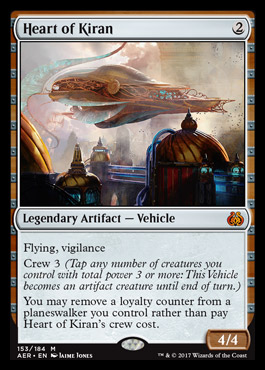
8. Heart of Kiran

heartofkiran

The card has obvious stats but it also feels super narrow with regard to the kind of deck you can put it into. I believe the card has a chance to find a place in Standard, but even if it does it cannot command such a high price tag. The current price is almost certainly the ceiling which makes it an excellent card to move immediately to anybody looking to build around it.

It is cute that Heart of Kiran gets vigilance which makes it able to attack while still protecting a walker on their turn. However, it is also legendary which sucks. Even if the card is better than I'm giving it credit for, I feel confident that a $20 price tag is not even close to sustainable.

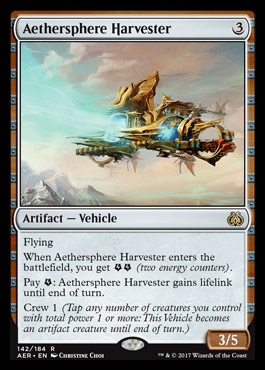
7. Aethersphere Harvester

aethersphereharvester

I'm not a believer. Smuggler's Copter and Fleetwheel Cruiser I understand. These new vehicles are clunky, awkward, and not the kind of cards that impress me. My impression is that we need to work much too hard in order to make these cards above average. When it comes to constructed staples I expect my cards to be always be above average when I cast them (that is the point of selecting the best cards for one's deck) and if I have to work for something I expect it to win games.

I just don't see these cards living up to that level of awesome. I would have expected this to be a bulk rare and was very surprised to see it preselling around $6.

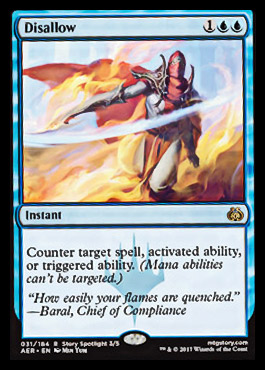
6. Disallow

disallow

Disallow is going to be a Constructed card but I think the price tag is over the top. I'd sell and buy back in later when the card settles down, likely at less than half of the current cost. I would be shocked if there was any room for the card to grow, which makes it a good one to chuck early.

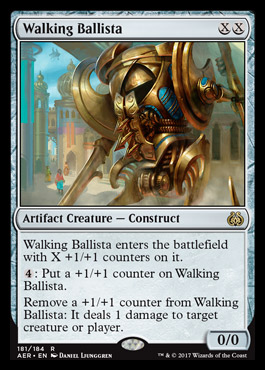
5. Walking Ballista

walkingballista

Don't get me wrong, I love this card. I will certainly play it in a Mishra's Workshop deck at some point in my lifetime. However, cards that DeMars would jam in Workshops does not a money-rare make. If it quacks like a bulk rare, it's a duck. Quack. Quack.

People will play with Walking Ballista but it is not the kind of card that ever holds value. Sell.

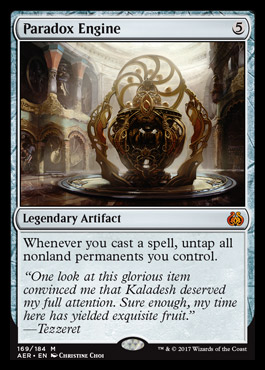
4. Paradox Engine

paradoxengine

I don't understand the price on the card. I get that it is a zany combo card but it costs five. Perhaps the presale price is aimed at Commander combo players? I have no idea, but nonetheless I smell a rat. Send these rats packing. I'd suggesting selling while the price is high.

On the other hand, foil and Masterpiece copies seem like solid acquisitions since there will be lots of players looking to ditch them and they should hold or gain decent value in the long run.

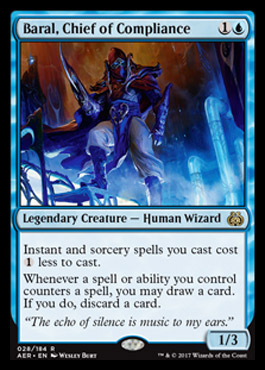
3. Baral, Chief of Compliance

baralchiefofcompliance

Sometimes I feel comfortable being smug about saying a card sucks because I just know. Baral is not one of those cards. I don't like the card but I recognize that it has some practical applications. My issue with it is that the secondary ability is linked to countering spells which is not an ability I'd typically want on a legendary 1/3 creature.

Speaking of reasons I don't like the card... It is legendary which means you can't have multiples in play at the same time and thus reduce the cost of instants and sorceries by two. It is better than a bulk rare but I'm a very firm sell on this card with a $10 price tag.

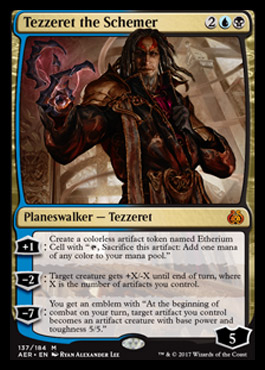
2. Tezzeret the Schemer

tezzerettheschemer

I look at a card like Tezzeret the Schemer and think, "I would probably play this in a blue-black artifacts matter deck." The key word in that sentence is "probably." I think the plus-one ability to make a Lotus Petal is pretty decent. It gains some additional value by casting artifacts with inspire.

I wouldn't risk holding onto Tezzeret in hopes of a spike that likely won't come. I'd be looking to avoid trading for these and hoping to trade off any that I open ASAP.

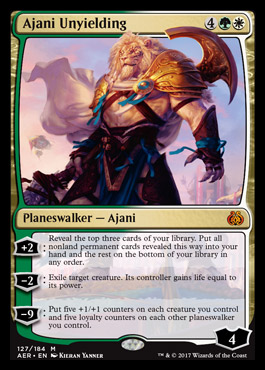
1. Ajani Unyielding

ajaniunyielding

Remember how I said that sometimes I don't feel comfortable being smug about saying a card sucks? Well, this isn't one of those times. Ajani sucks. It takes a lot for a six-cost walker to make an impact in Constructed, and Ajani just doesn't have the right stuff. Think about Elspeth, Sun's Champion or Chandra, Flamecaller. The card has to immediately impact and dominate the game for that investment cost.

Top 8 Underrated

I wasn't sure whether or not to lead with overrated or underrated. I figured that ending with overrated is kind of a downer because it is a nonstop "card x isn't good" parade.

It's more fun to end on a positive and these are the cards that I have really nice things to say about.

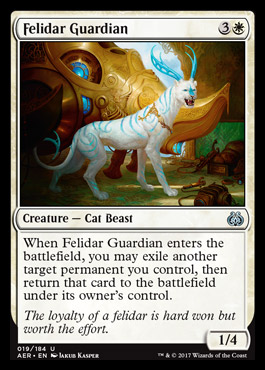
8. Felidar Guardian

felidarguardian

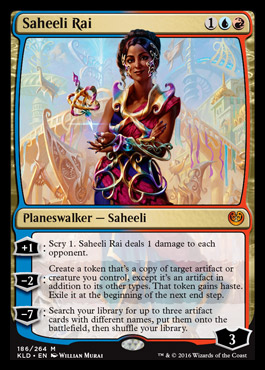
The Saheeli Rai plus Felidar Guardian combo is going to be real. How could it not be? It is an infinite, two-card, win-the-game combination. With that being said I think that people are sleeping on Felidar Guardian as a serious money uncommon.

There are certain uncommons that just have great value because game stores have trouble keeping them in stock. I'm going to open the singles for RIW for the release and I guarantee that after cracking several cases we'll be sold out on Guardian within a few days.

There are certain cards—Silkwrap and Wild Slash both come to mind—that sell and trade above $3 in paper and are really hard to keep in stock. I see Guardian as one of those cards where stocking up will be rewarding.

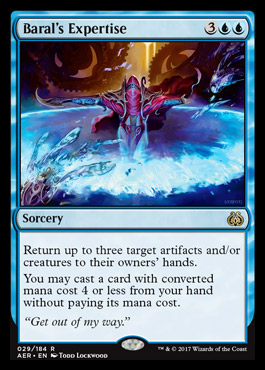
7. Baral's Expertise

baralsexpertise

I have a strong belief that the Expertise cycle will be among the highest-impact cards in Aether Revolt. They make me think of the Command cycle from Lorwyn. Cheating on mana is design space that has consistently proven to be problematic, and I don't believe this cycle will buck the trend.

Baral's Expertise is a card that can seriously swing a game on turn five. Last week I wrote about playing the card alongside Fevered Visions, which has proven really strong. The card is cheap right now and I'm going to be looking to pick up more copies just in case.

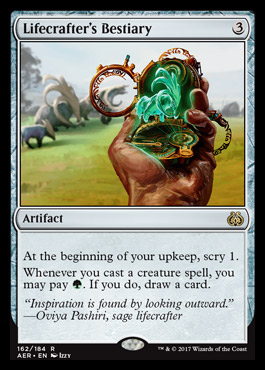
6. Lifecrafter's Bestiary

lifecraftersbestiary

I thought this card was junk and then I played with it at the prerelease. It was so absurdly powerful and game-impacting that I went from thinking it was a cute casual card to a potential Constructed card. I've actually been happy with Bestiary in the sideboard of my BG Delirium deck against control and midrange.

Bestiary is a powerful card and water has a way of finding a level. I'd love to pick this up at a bulk-rare rate.

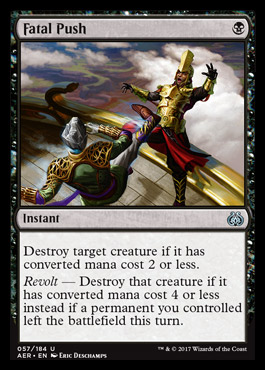
5. Fatal Push

fatalpush

I've said so before, but I think Fatal Push is underrated as a financial card. I see this as an Inquisition of Kozilek, Path to Exile, or even Mental Misstep, where the card is close to $10 while in Standard.

All things considered, Fatal Push is not a card I would be looking to sell into the "presale spike" because I feel strongly that it has room to grow.

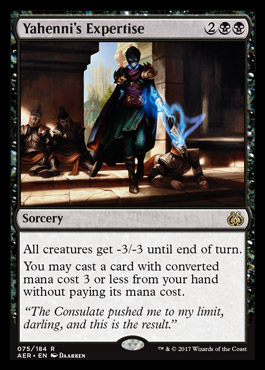
4. Yahenni's Expertise

yahennisexpertise

I've already stated that I have high expectations for the Expertise cycle. With that said, Languish was a $12 card while it was in Standard and Expertise is much, much better. I also believe that Expertise will be highly playable in Modern.

I put the black Expertise into my underrated category because I think it could very well be one of the most sought-after cards in the set from a Constructed standpoint.

It is also worth noting that in Modern you can cast Yahenni's Expertise to control the board and then cast Ancestral Vision from your hand... Ooh, la la.

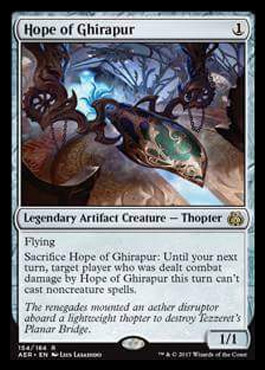
3. Hope of Ghirapur

hopeofghirapur

Sometimes I have a hard time understanding what people get excited about. Baral is a $10 card that has a bunch of random niche applications but likely won't see a ton of play either way. Hope of Ghirapur feels very similar in terms of the number of applications, but I believe it's just much stronger.

I love that decks that used to splash Tropical Island for Xantid Swarm can now forego the green mana and just play Hope of Ghirapur. I would also almost certainly play this card in my Affinity 75. It has a lot of abilities for one mana—expect this to grow in value over time.

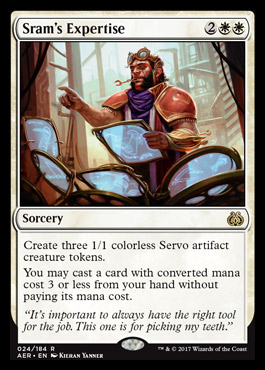
2. Sram's Expertise

sramsexpertise

I've already said that I'm high on the Expertise cycle and Sram's Expertise is another really nice card. The main reason it ended up higher on my list than Yahenni's Expertise is that it currently has a significantly lower starting price than the black one.

It is clutch that you can play Sram's Expertise and then drop a Nissa, Voice of Zendikar or Chief of the Foundry to essentially anthem your team.

The only thing holding Sram's Expertise back is likely the potential of the Copy Cat combo which tends to have a big advantage over decks like this. Either way, it is still a very good card.

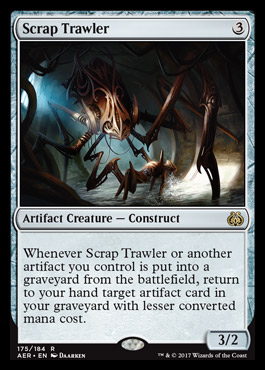
1. Scrap Trawler

scraptrawler

I thought I'd go with a fairly unorthodox #1 pick. I've traditionally done pretty well with picking cards like these out of the barrel. Everything about this card tells me that it is just very good and will eventually have its day. It's a good rate for the body and the fact that it grants its ability to all artifacts is pretty insane—especially in Modern or Vintage.

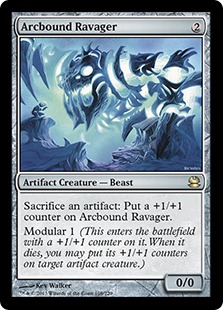
It makes me excited to think about using my Ravager to sacrifice a Springleaf Drum to recur a Hangarback Walker in Modern, or sacrificing Tangle Wires for value in Vintage. Scrap Trawler is exactly the kind of card that is bound to have a breakout performance at some point and spike. Which makes picking them up as bulk rares now a potentially great investment.

Buck the Trend

Aether Revolt has some exciting new stuff, and other stuff that a lot of people are excited about but probably shouldn't be. The key is to pick up the goods before they get hot and unload the jank before it cools down.

Hopefully I've helped you to do just that. Enjoy the new set!

A Blue(ish) Moon on the Rise: Grixis Moon

Are you a Quiet Speculation member?

If not, now is a perfect time to join up! Our powerful tools, breaking-news analysis, and exclusive Discord channel will make sure you stay up to date and ahead of the curve.

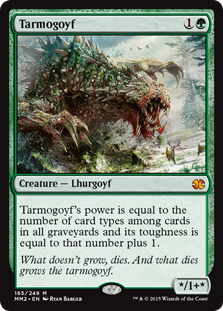
At some point last year I was killing time between rounds and a friend of mine asked if I wanted to jam some Modern. I didn't have a deck on me, but he had both Jund and Blue Moon. "Gimme that Jund deck. I'ma smash you." He was really into Blue Moon, but the deck had a serious Tarmogoyf problem. I went something like 5-0 against him. Long story short, Blood Moon doesn't win games on its own.

There is a long list of Modern decks that Blood Moon has game-changing power against, and while Blood Moon has long been a format staple, it has generally been a tool of fringe strategies. There's a lot going on in Modern. Some decks are heavy on basic lands, some have game-winning threats that can come down before Blood Moon, and it's generally true that drawing multiple copies is the same as mulligaining.

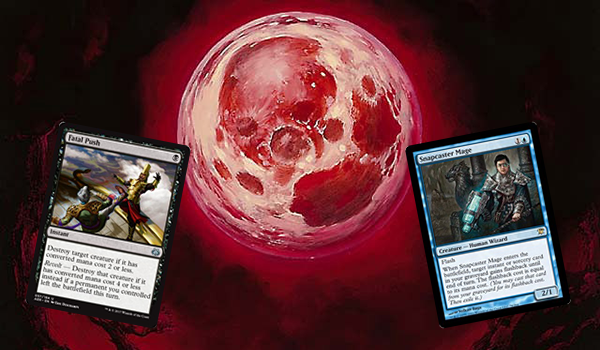
That said, I believe that Blood Moon will be a big winner with the changes to Modern happening this weekend. I've already mentioned my belief that Snapcaster Mage is in a great spot as well. And of course new-kid-on-the-block Fatal Push is likely deserving of the praise it has received everywhere. That's right—I'm brewing up a Grixis Moon.

[wp_ad_camp_1]

Setting the Stage

As we all know, the big news is that Golgari Grave-Troll and Gitaxian Probe are getting banned, and Fatal Push is entering the format. My working theory regarding these changes is that Dredge and the fastest aggressive decks will see a significant downswing, while Tron and the various three-color midrange strategies will be the biggest winners. This is a level-one assessment of immediate impact, and to my knowledge these are fairly common beliefs. Playing one of these decks is a fine choice as players figure out how to navigate post-Aether Revolt Modern. That said, there is plenty to be gained by being one step ahead of the field.

One of the decks that players are discussing as a big gainer with regard to Fatal Push is Faeries, though I personally don't see that one. Yes, Fatal Push is a powerful one-mana removal spell. Yes, Faeries is a deck that struggles with early aggression. So in a strictly literal sense, Faeries got better by some margin. That said, it's still a deck that hinges largely on having turn-two Bitterblossom, and Bitterblossom is still a card that's on average less powerful than Lingering Souls.

Back to Blue Moon

Blue Moon is a deck that has more or less always been fringe, but definitely has games where it just hammers opponents. As I mentioned in the intro, the deck struggles a bit with early creatures. When last I had heard of anybody playing the deck, a black splash for Terminate was being employed to remedy this, and the inclusion of Fatal Push will solidly shore up this weakness.

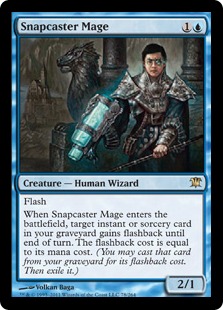
If the field is projected to converge largely around three-color midrange, I definitely like being a Snapcaster Mage deck. I will contend time and again that Snapcaster Mage is the most powerful card currently legal for midrange mirrors. A question worth asking, though, is why I would play Grixis Moon over traditional Grixis Control. The answer is pretty similar to why I play Grixis Delver over Grixis Control: Modern isn't a format that strictly rewards generic interaction. There's too much going on that you need to answer, and actually winning games is paramount. Grixis Control has some powerful tools, but nothing that can close a game quickly.

While it is true that Blood Moon doesn't technically end the game, in the sense of dealing lethal damage to the opponent, a turn-three Blood Moon will effectively be game over a considerable percentage of the time. The more Jund, Abzan, Grixis, Tron, and Eldrazi Temples there are in the format, the more this will be true. Furthermore, less Dredge will also reduce the frequency of games where Blood Moon is irrelevant!

Something that I really like about Blue Moon is that it both benefits from playing Fatal Push, and doesn't care about opposing copies. If the card is anywhere near as popular as it's projected to be, then blanking it is a great spot to be in. The manabase for Grixis Moon is going to be rougher than a straight blue-red build, but I'd much rather have some mana woes than get destroyed by Tarmogoyfs.

Grixis Moon, by Ryan Overturf

Creatures

2 Pia and Kiran Nalaar
4 Snapcaster Mage
1 Vendilion Clique

Instants

2 Electrolyze
4 Lightning Bolt
4 Mana Leak
4 Fatal Push
1 Terminate
2 Cryptic Command
2 Kolaghan's Command
2 Remand
2 Spell Snare

Enchantments

4 Blood Moon

Sorceries

4 Serum Visions

Lands

6 Island
1 Swamp
1 Mountain
4 Polluted Delta
4 Scalding Tarn
2 Bloodstained Mire
2 Steam Vents
1 Watery Grave
1 Blood Crypt

Sideboard

2 Spreading Seas
1 Batterskull
1 Izzet Staticaster
3 Negate
2 Engineered Explosives
2 Anger of the Gods
2 Go for the Throat
1 Dispel
1 Keranos, God of Storms

Heavy on generic interaction, loaded with value, and featuring an auto-win button in the form of Blood Moon. Admittedly, this archetype is significantly different from the manner of Grixis that I usually play, so this shell probably merits some time spent to further refine it. It does look solid in terms of theory though, and I'm much happier pairing Fatal Push with Blood Moon than with Bitterblossom.

The RW Prison Comparison

There are, of course, other Blood Moon decks. The most successful one as of late has been RW Prison, as championed by Todd Stevens. So what can Grixis Moon do that RW Prison can't?

RW Prison a fine deck that can absolutely win games, though it crutches on Simian Spirit Guide and is much more about cheesing decks quickly than effectively playing long games. Blue Moon has a ton of abstractly powerful spells that are great for navigating through the format, whereas Prison jams clunky planeswalkers and hopes they're good enough backed up by a lock piece or two. There is also a matter of taste worth discussing here, and you'd have to pry the Snapcaster Mages out of my cold, dead hands.

RW Prison and Grixis Control are totally fine decks, and either could certainly win a Modern tournament. It is my belief, however, that Blue Moon is a solid hybrid of the two strategies that borrows the relative strengths of both decks while shoring up their weaknesses. It remains to be seen exactly how Modern shakes out with the upcoming major changes, though Blue Moon is definitely a deck to watch.

Et Tu, Delver?

Many of you are probably upset that I'm talking about a Blood Moon deck instead of a Delver deck. The truth is that Delver is way more my style, and I will continue to jam one-mana 1/1s until I'm convinced that I can't win tournaments with them. I just feel that Delver requires very few updates as of now. Really we need to see what people are bringing to the table before messing with the flex slots too much.

From the most recent list I posted, the only change I would make is moving off the graveyard hate in the sideboard. The blue mirror-breaker, Cavern of Souls, and the Fulminator Mages to mess up the unexpectedly non-basic-heavy meta that I played before Dredge popped up, seem just fine to me. It's also worth noting that the advantage of Jeskai Delver I wrote about a few weeks back will be largely disappearing with the bannings. Nothing fancy here, but this is the current Delver list I would play:

Grixis Delver, by Ryan Overturf

Creatures

4 Delver of Secrets
4 Snapcaster Mage
3 Tasigur, the Golden Fang
1 Gurmag Angler

Instants

1 Fatal Push
2 Kolaghan's Command
4 Lightning Bolt
4 Mana Leak
4 Spell Snare
4 Terminate
4 Thought Scour

Sorceries

4 Serum Visions
1 Collective Brutality

Lands

2 Island
1 Mountain
1 Swamp
1 Spirebluff Canal
1 Blood Crypt
2 Bloodstained Mire
4 Polluted Delta
4 Scalding Tarn
2 Steam Vents
2 Watery Grave

Sideboard

2 Engineered Explosives
3 Countersquall
1 Dispel
2 Magma Spray
2 Spell Pierce
1 Go for the Throat
1 Cavern of Souls
3 Fulminator Mage

It's possible that we're supposed to go back to Remand over Collective Brutality, which is an easy swap to make if your meta features a lot of Liliana of the Veils and Islands. I would also turn the second Kolaghan's Command, and possibly the Fatal Push, into Elctrolyzes if Lingering Souls becomes especially popular.

A Send Off

Several years ago, I was a lowly PTQ grinder with not a lot else going on. At this stage in my life the content manager for Quiet Speculation, Tyler Tyssedal, approached me about writing for them. I jumped at the opportunity. It has been a pleasure to produce content for Quiet Speculation and Modern Nexus between then and now, though currently my life is considerably busier. In light of this, next week's article will be my last regular piece for Modern Nexus, and the last article I write for at least the immediate future.

I would like to thank everybody who has taken the time to read my content, and I hope that it has had some positive impact on your life, however small that may be.

I have a pretty high response rate on Twitter, and will still be reachable there. If there is something particularly interesting you'd like my perspective on next week I would be delighted if you would say as much in the comments. I don't intend to do a formal mailbag article or anything, but I do love answering well thought-out questions.

Thanks for reading.

-Ryan Overturf
@RyanOverdrive on Twitter

Insider: MTGO Market Report for January 18th, 2017

Are you a Quiet Speculation member?

If not, now is a perfect time to join up! Our powerful tools, breaking-news analysis, and exclusive Discord channel will make sure you stay up to date and ahead of the curve.

Welcome to the MTGO Market Report as compiled by Matthew Lewis. The report will cover a range of topics, including a summary of set prices and price changes for redeemable sets, a look at the major trends in various Constructed formats and a "Trade of the Week" section that highlights a particular speculative strategy with an example and accompanying explanation.

As always, speculators should take into account their own budgets, risk tolerance and current portfolios before buying or selling any digital objects. Please send questions via private message or post below in the article comments.

Redemption

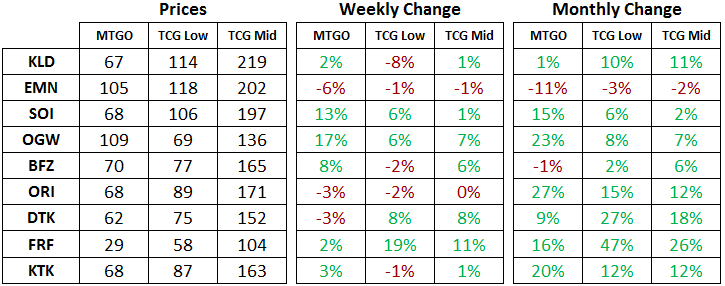
Below are the total set prices for all redeemable sets on MTGO. All prices are current as of January 16 2017. The TCGplayer low and TCGplayer mid prices are the sum of each set's individual card prices on TCGplayer, either the low price or the mid price respectively.

All MTGO set prices this week are taken from GoatBot's website, and all weekly changes are now calculated relative to GoatBot's "full set" prices from the previous week. All monthly changes are also relative to the previous month's prices, taken from GoatBot's website at that time. Occasionally, full set prices are not available, and so estimated set prices are used instead.

jan16

Changes to the MTGO Economy

Lee Sharpe has announced some changes to the MTGO economy that all speculators and players should pay attention to. See the full announcement here. Every time prize structures and entry fees change, it's important to take a step back and see which direction the economy is going to take. In this case, there is one substantial change that has some important ramifications that I want to highlight.

Foil Mythic Rares

The end of prerelease events means that the foil mythic rare trade is back on for players. If you have not read my three-part series on this subject from 2015, I suggest starting there. This analysis was completed before the inclusion of foil rares and foil mythic rares in prerelease card pools. This change completely torpedoed the strategy by printing way more foil rares than previously, the impact you could see in the price of foil uncommons from all sets starting with Shadows over Innistrad (SOI). The removal of prerelease events means the skewed distribution of foils will be over and foil mythic rares will go back to being a store of value.

There was an error retrieving a chart for Tree of Perdition

Unfortunately, the long term outlook for foil mythic rares is not good for speculators, since they have historically seen gains after the set is no longer being drafted, but while the set is still redeemable. The shortening of the redemption window means that buying foil mythic rares is not a safe long-term strategy for speculators.

On the other hand, players should feel free to purchase their playsets of foil mythic rares with confidence in the first two weeks of Aether Revolt's (AER) release. Buying a playset of each of the foil mythic rares will ensure a diversified basket that will hold its value until the end of AER redemption in May. Parts of the basket will rise and fall in price due to how the Standard metagame develops, but as a whole it will maintain its value.

If you want to play with the new cards, buying foil mythic rares ensures you'll get your tix out of these cards when you go to sell them in April or May. If you buy regular mythic rares, the prices are going to be falling as more and more cards are opened. It's the difference between buying a store of value versus buying a depreciating asset. Foil mythic rares will have a much higher upfront cost, but they will hold their value. In April or May, you can feel free to sell your foils and purchase regular ones instead at the tail end of Kaladesh (KLD) block draft.

Standard Boosters

With the end of prerelease events, tix-only entry fees are gone too. This has a couple of important ramifications. The first is that AER boosters will be in high demand as players will be able to use them to enter draft queues and leagues right away. AER boosters will go on sale in the store on January 30, so between January 25 (the day AER goes live on MTGO) and January 30, AER boosters will be very valuable and will probably be priced over 4 tix.

Previously there was a trade where you could buy the new set boosters that players had won from the tix-only events. You would hold them until they could be used as entry, and then resell them for a higher price. This trade is over with the end of tix-only entry fees.

There was an error retrieving a chart for Parting Thoughts

Liquidity Crunch

For speculators, the good news is the liquidity crunch is still on when a new set is released. Players and bots alike will still need tix to buy the new cards and to enter the events, as most players will not have the new boosters yet. The end of tix-only events does mean the edge will be taken off of the liquidity crunch, but it will still exist due to the short-term wants and needs of the average player.

If you are holding onto marginal positions heading into the release of AER on MTGO, you are better off selling now in order to build up your tix and to get liquid. There will be opportunities in cards and boosters at the end of January that players are looking to sell for tix. You should be the buyer at that time and you should not be trying to sell your own stuff. I anticipate KLD boosters will see a substantial drop in price in the last week of January. At the right price, KLD boosters will be a good target for speculators.

Treasure Chests

Lastly, Treasure Chests are changing again, this time awarding play points instead of boosters. This will be very interesting as there was previously no way to assign a price to play points. They are essentially equivalent to tix since they are just as useful for entering events, but since the only way you could get them was through playing and they are untradeable, there was never a market price for them.

Now that they are going to appear in Treasure Chests in a predictable fashion there will be an imputed market price. It's a little messy since the price of chests is higher than their expected value, but it's still possible we'll have a good price for play points at the end of the month. I expect the change from KLD boosters to play points will result in chests becoming more valuable.

There was an error retrieving a chart for Treasure Trove

There are other changes coming to the curated card list, on top of a reduced chance of opening Commander 2016 cards. All of these changes suggest a short-term bump in the market price of Treasure Chests after January 25. I'll be looking for a good price on these over the next week with an eye to reselling them at the end of the month.

Trade of the Week

With all the turmoil in Modern and Standard prices as a result of the recent bans, I've moved to being an aggressive buyer of cards with value in the new metagames. For a complete look at all of my recent purchases, please check out the portfolio, which is available at this link. Today I will hone in on one card that I have been buying and the technique I used to build my position.

There was an error retrieving a chart for Gideon, Ally of Zendikar

Gideon, Ally of Zendikar has been a pillar of Standard and it reached a peak of 38 tix in early December, but it stayed mostly in the 27 to 33 tix range since the release of KLD. After the recent bans it dropped to 23 tix and this decline piqued my interest in the card. Although I can't predict what Standard will look like after AER enters the mix, Gideon, Ally of Zendikar has been one of the best things you can do in Standard. I expect this will continue in some fashion, so when a card of this power drops in price so quickly, it definitely gets my attention.

On Saturday, I decided to start accumulating copies of this card. Although I couldn't be certain where the descent would end, 23 tix seemed a very reasonable price relative to recent prices. My strategy when I opened this position was to buy the cheapest playset I could find as a test purchase and then wait to see what would happen the following day. I would continue to monitor prices and available supply and then respond accordingly. Further price declines would throw up a caution flag, while a stable or rising price would encourage more buying.

Sunday morning rolled around and prices had continued to soften. There were copies available for closer to 22 tix. This gave me some pause but I still felt like the price was an excellent one, so I bought two more copies, half of what I had bought the previous day. This was another test purchase and I resolved to continue to monitor prices and supply.

On Monday morning things had changed. Prices had firmed up and were now sitting closer to 24 tix. Although GoatBots and MTGOTraders were well stocked at this price, a quick scan of the MTGOLibrary bots revealed no copies for sale at 24 tix but some for sale at 25 tix and higher. The MTGOLibrary bots are typically competing at the bottom end of the market, so when there are no copies for sale at prices below the major bot chains, it's a strong signal that the market price for Gideon, Ally of Zendikar had turned higher. This meant my test purchases were at an end and it was time to buy up my full position.

In this case, I would buy a playset each from the major bot chains I use and then I would scour the classifieds for any stragglers that hadn't updated their prices. I think this is an excellent way to probe the market if there is a card that you believe in but are unsure of the price. At the moment, this trade appears to have worked out very well, as the price is back to over 27 tix.

If Gideon remains a pillar of Standard, I expect the price to crest 30 tix again, and at that point I will be a seller. If his role is diminished, then the price will begin drifting down again, at which time I will also be a seller. Once the metagame establishes itself, Gideon's roll in it will be clear and the price will follow. Buying into a selloff gave me a nice margin of safety with some upside if the card continues to be a pillar of Standard.

Stock Watch – Surgical Extraction

Are you a Quiet Speculation member?

If not, now is a perfect time to join up! Our powerful tools, breaking-news analysis, and exclusive Discord channel will make sure you stay up to date and ahead of the curve.

Surgical Extraction has long been a great way to hose graveyard strategies, but it was only recently that the card exploded from $5 to $15+. No doubt some of this movement had to due with Modern Dredge, though even in the wake of the banning of Golgari Grave-Troll, the card is maintaining its price.

There was an error retrieving a chart for Surgical Extraction

It is true that it generally takes longer for cards to lose value than to gain it, and it's also true that Dredge may very well still be fine post-ban, though largely I believe there are just other reasons for demand for this card. Chief among these is Rakdos Reanimator in Legacy, which has caused plenty of market movement itself. The deck is built to be explosive, and tries to Reanimate Sire of Insanity on turn one as often as possible. As such, Surgical Extraction is preferred over cards like Tormod's Crypt and Grafdigger's Cage against this particular strategy. It's also just true that many players overvalue this sort of effect, which has been the case going all the way back to Cranial Extraction.

I would definitely not expect much of any growth in the wake of the Grave-Troll banning, though I think it's also reasonable to expect the new price to hold steady. If you own copies for Modern I would wait and see how popular Dredge is before selling, though now is a fine time to sell any extra copies.

Gears are Turning: Testing Aether Revolt

Are you a Quiet Speculation member?

If not, now is a perfect time to join up! Our powerful tools, breaking-news analysis, and exclusive Discord channel will make sure you stay up to date and ahead of the curve.

Kaladesh block has been very intriguing. There have been a lot of cards and even new decks that looked Modern-playable, and yet the impact so far has been limited. I'm not sure if that is the fault of misplaced expectations or the cards themselves, but only Blossoming Defense has had a noticeable impact. The enemy fastlands have seen play certainly, but the actual effect they've had is relatively limited. Aether Revolt may or may not continue that trend. Excepting Fatal Push, which will see considerable play whether or not you think it should, there aren't many cards that clearly benefit Modern. That's not so surprising considering the power barrier to entry, but it is surprising when you consider the theoretical power of some of the cards. There are several decks from Tier 3 or lower that could benefit a lot from Revolt, enough that I thought it worthwhile to test them out to see if appearances were deceiving.

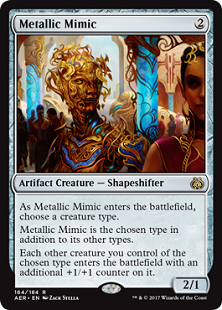
Last week I mentioned a number of new cards that looked Modern-playable. Most of them were niche, situational cards. However, a few stood out. The first was Metallic Mimic, which looked like a Merfolk addition. Less a lord, and more a weaker, colorless Bramblewood Paragon, Mimic provides an effect that Merfolk doesn't have (at the right rate). In a metagame that's likely to see more removal-heavy midrange decks, the permanent boost may be necessary.

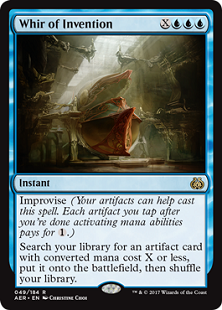
Secondly, some low-tier combo decks received significant boosts to their consistency, which had previously been one of their barriers to playability. Eggs can draw a lot of cards but fail to go off without Krark-Clan Ironworks, while Cheeri0s does nothing without a Puresteel Paladin or Monastery Mentor in play. The addition of Whir of Invention and Sram, Senior Edificer may be their Blue Fairy that can turn them into real decks. So I proxied some decks up and gave them a try. But first, the card that my preferred deck cares about.

[wp_ad_camp_1]

Mimic Merfolk

Merfolk is a deck because of its lords. Silvergill Adept, Cursecatcher, and Master of Waves make it powerful but if it weren't for Master of the Pearl Trident, Lord of Atlantis, and Merrow Reejerey you'd never play the deck. As such, something close to another lord would seem to be a natural boost. However, we have seen something similar to Metallic Mimic before in Adaptive Automaton, an actual colorless lord for any tribal deck. And it saw no play because it cost three mana without a compensating ability like Reejerey's.

There are two differences with Mimic. The most important is that it costs two. Cost is everything, especially when you consider its other ability. This is not a true lord that gives boosts to other members of its tribe. It's Bramblewood Paragon, rewarding tribe members with +1/+1 counters. This is critical, especially when you consider the mana cost. Merfolk already has access to this effect with Sage of Fables, but that card is unplayable because it costs three. Paragon doesn't see much play, but some aggro Elf decks do use her, though mostly for trample. Tribal strategies need to be fast, and a three-mana creature is simply too slow. It comes down after you've played a few creatures and doesn't benefit them. Playing Mimic before other creatures is still playing on curve. Therefore, in theory, this card is acceptable.

On that basis, I proxied a few up and tried them in my pet deck.

UW Mimic Merfolk (Test Deck by David Ernenwein)

Creatures

4 Cursecatcher
4 Silvergill Adept
4 Lord of Atlantis
4 Master of the Pearl Trident
3 Metalic Mimic
2 Merrow Reejerey
2 Kira, Great Glass-Spinner
3 Master of Waves

Artifacts

4 Aether Vial

Enchantments

4 Spreading Seas

Instants

4 Path to Exile
2 Echoing Truth

Lands

4 Wanderwine Hub
4 Seachrome Coast
4 Mutavault
8 Island

It Was… Okay

I wasn't exactly impressed. Mimic isn't bad but it isn't particularly special either. If you played it on curve then it was roughly equivalent to the other lords. If it was later then it was just a 2/1 that didn't cantrip. It's just not that special. The fact that the counters stayed after it had died was nice, but not particularly relevant. Your creatures were still small enough for toughness-based removal to kill them and weren't big enough to attack through other creatures. Against control decks the cards with counters almost always died before anything else, meaning the clock didn't change. The most exciting thing that happened was when a 2/2 Cursecatcher did nearly 20 damage in a test game against Jeskai where the removal flew thick. Maybe that is enough.

The problem is that Merfolk lists are very tight and you really can't cut much to fit in Mimic. The staples are mandatory with the numbers consistent across nearly all lists. There just aren't many flex spots and you do need some interaction. Harbinger of the Tides will get a little worse with gotcha! decks likely to fall off, but I don't think you want to cut them or any instants. If you're the sort of deck running cards like Tidebinder Mage or Phantasmal Image, then Mimic will be better in most cases, but otherwise I'm not convinced you need it.

Strangely, the best use of Mimic in my games was when he wasn't a Merfolk at all. Naming Elemental proved to be far more impactful. Master of Waves is a powerful way to generate board presence, but the tokens are tied to his survival. With the expected increase in black removal this becomes problematic. Mimic lets them live past their Master's death more often, and if Grixis Control becomes a larger metagame presence, this might be a reason to play Mimic.

An Ethereal Home

Mimic may or may not have a home in Merfolk, but I definitely think that it has a place in Modern. A two-mana pseudo-lord might be what some less popular tribal strategies need to move up the tiers. Elves doesn't need it, Goblins has turned into 8-Whack, and it would be redundant in Slivers or Allies, but I think it is what Spirits has been looking for. In my previous investigations of the deck I've noted that it needed more two-drops, since most good Spirits are three mana, and it wanted another lord to help Drogskol Captain. The only problem is that Mimic doesn't fly, but that may not be so bad if it closes those other gaps. I will definitely try it soon. If a 2/2 Cursecatcher is good, a 2/2 Mausoleum Wanderer will be much better.

Support Whirled Eggs

In the history of Magic, the most frequently banned decks are combo decks. By themselves, they're not that much of a problem as most combos are fragile and inconsistent. They become a problem when you throw them the right combination of consistency tools and protection pieces. Eggs is a rare case of a combo deck eating a ban without becoming a dominant player in the metagame. It saw very limited play for a few months before Brian Kibler F6'd and Wizards banned Second Sunrise to reduce the appeal of the deck. And it worked. While the deck is still viable, it's hard enough to go off that the other flaws in the deck keep it from any metagame share.

And the flaw is rather crippling. The one that isn't its weakness to Rest in Peace and Stony Silence. The deck must draw enough Open the Vaults/Faith's Rewards and (in most versions) Krark-Clan Ironworks to actually combo. The deck has to generate a lot of mana and draw a lot of cards, and without KCI it struggles to do both. Second Sunrise made things easier, since the mana required to start the process was low, but since Open costs six you really need KCI to combo off.

As a result, the deck is always at risk of doing nothing until death. It has a lot of cantrips but can't always deploy them quickly enough to find the critical pieces and go off. It has Reshape to find artifacts, but the cost is prohibitive to find KCI, meaning Reshape is mostly used to find Lotus Bloom. Whir of Invention might have a higher color requirement, but it is easier to tutor for anything now. On that assumption, I've been goldfishing the following deck:

Whirled Eggs (Test Deck by David Ernenwein)

Artifacts

4 Chromatic Sphere
4 Chromatic Star
4 Ichor Wellspring
4 Krark-Clan Ironworks
3 Lotus Bloom
4 Mox Opal
1 Codex Shredder
1 Pyrite Spellbomb
3 Conjurer's Bauble

Instants

4 Faith's Reward
4 Whir of Invention

Sorceries

3 Open the Vaults
3 Reshape
1 Banefire

Lands

4 Adarkar Wastes
4 Darksteel Citadel
4 Island
3 Ghost Quarter
1 Plains
1 Academy Ruins

Tutors are Good

Four tutors made the deck playable. More might actually make it good. The only problem I had initially was that I lacked the patience to get to the Conjurer's Bauble/Pyrite Spellbomb kill, so I cut a Lotus for Banefire.

It is far easier to assemble the combo now. A typical hand will be full of redundant cantrips and enough mana to get started. All you need to do is find KCI to actually cycle cards into your graveyard and then a return spell. Whir allows you to find KCI if you don't have it to get started, and if the combo stalls you can find an Ichor Wellspring to keep going. Unlike Reshape, you can use it even when you've gotten caught with all your artifacts in the graveyard. Before, Eggs was prone to doing a great deal of stuff without doing anything. Now it does something most of the time. It still has a reasonable fail rate, but not so much as before. That is good news for its adherents.

How Good?

This version of Eggs is less likely to lose to itself. It's not impossible by any means, but Whir reduces the risk of mid-combo fizzling or failing to draw KCI. However, it changes nothing about its vulnerabilities to hate and to countered Open effects. The odds of starting the combo have only improved slightly, since KCI isn't critical to all lists, meaning the overall impact of Whir is limited.

Whir also doesn't necessarily improve Eggs' speed, since you're still going to have to spend several turns setting up before you can tutor and start comboing. My preliminary analysis is that Eggs combo will more consistently succeed, but it will not make it more dangerous. That said, I'm a researcher, not an enthusiast. The dedicated combo players may know something I don't about this deck.

Cheeri0s

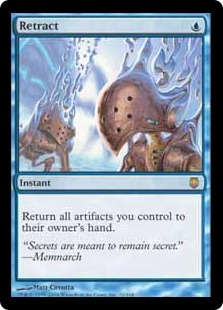
It is tradition for combo decks to be named after breakfast. I have no idea why, but it exists nonetheless. Which brings me to the last deck of the week, Cheeri0s. For those who have never heard of this deck, it is Storm with permanents instead of rituals. You play 0-mana equipment (the "0" in the name) to draw lots of cards with Puresteel Paladin, then use Retract to do it all over again until you find Grapeshot for the win. Another feature is that, outside of the Mox Opals, Cheeri0s is easily the cheapest combo deck in Modern that might actually win a tournament.

And I stress might. This is a massive glass cannon, and a particularly fragile one at that. I've played against this deck a number of times and never lost a match. It's hard to find paper results for it and you rarely see it on MTGO because it is bad. Even the dedicated adherents on MTGSalvation, which I was surprised to find was a thing when doing my research, acknowledge that it is weak. Their dedication is mostly aspirational—the deck has gotten more toys than Storm recently, so they're hoping that soon it will be a real deck.

Which is why I'm going to see for myself if their new messiah, Sram, Senior Edificer, will actually deliver them to relevance. Even if it doesn't, good on them for trying. Innovation and discovery are why we're here in the first place and I keep saying the Modern cardpool is far deeper than players let on. Thanks to those starry-eyed hopefuls for proving my point.

Even without dedicated hate the deck is very easy to disrupt. Most of the deck is air, and it cannot win without Paladin. There have been attempts to develop a backup plan on the thread, including an alternate win condition in Monastery Mentor, but they haven't solved the problem.

The deck simply can't beat Jund. This was not only my personal assessment, but also appears to be the consensus of the Cheeri0ists. The fundamental problem is that Paladin is a fragile 2/2 that has to stick in order to combo. Play it early and they'll probably just kill it; try to slow-roll it until the combo turn and they can just Inquisition it from your hand. Jund is the best at exploiting this flaw, but Cheeri0s suffers against any deck with removal. And this is on top of the high risk of having to mulligan into oblivion for a chance to actually play the game. Before the deck could spike a States here and there, but that was it.

Sram the Savior?

The Cheeri0ists are excited about Sram because they finally have redundancy. Sram is mostly the same as Paladin, so instead of four critical pieces, they have eight, which means that the loss of one is less burdensome. It also means that you don't need to mulligan as aggressively just to find real action anymore. With additional consistency comes power and wins. I tried out this list:

Cheeri0s (Test Deck by David Ernenwein)

Creatures

4 Puresteel Paladin
4 Sram, Senior Edificer
3 Monastery Mentor

Artifacts

4 Accorder's Shield
4 Cathar's Shield
2 Kite Shield
4 Paradise Mantle
4 Spidersilk Net
4 Mox Opal

Enchantments

2 Sigarda's Aid

Instants

1 Noxious Revival
3 Repeal
4 Retract

Sorceries

1 Grapeshot

Lands

4 Flooded Strand
4 Windswept Heath
4 Hallowed Fountain
2 Sacred Foundry
2 Plains

I started with a list from the community page and then cut what I thought were odd cards for lands. The enthusiasts seem to prefer aggressively small land counts and mulliganing. I wanted to cast my spells reliably so I played more lands.

Does it Work?

Well, it was better than the old deck. Think moving from woeful to merely bad. Sram did exactly what he was supposed to do and the deck appeared to be better for his addition. However, in test games I still lost to any interaction from my opponents. Sometimes they did need more interaction than before, but the deck can also still peter out on its own. Basically every deck has a few pieces of interaction thanks to Infect, so without ways to protect Paladin or Sram the deck just couldn't put its plan together. The fundamental problem of the combo has not been fixed, but a flaw with the deck has been improved. So no, I still don't think the deck is a deck yet, but it's closer than before.

That said, I can recommend the deck as an inheritor to Storm. That deck is dead according to the many, many adherents lamenting the loss of Gitaxian Probe. Cheeri0s is a storm deck that plays very similarly to Storm. It's much more fragile, but the enthusiasts are right: Wizards does know to avoid throwing gifts Storm's way; they don't have the same discipline toward Cheeri0s. They're not there yet, but maybe soon they will be. It's worth a try if you're so certain that traditional Storm is dead.

More to Come

These are just my initial impressions based on early testing. There are a lot of other interesting cards to judge and potential decks to explore once Aether Revolt officially releases. I haven't found anything format-shaking yet, but that doesn't mean there's nothing to find. If you've had different results or found something else interesting, I'm eager to hear about it in the comments.

Stock Watch – Nissa, Voice of Zendikar

Are you a Quiet Speculation member?

If not, now is a perfect time to join up! Our powerful tools, breaking-news analysis, and exclusive Discord channel will make sure you stay up to date and ahead of the curve.

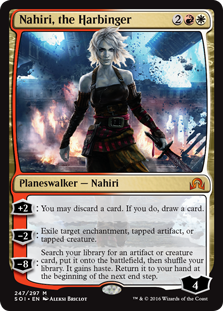
Nissa lost a lot of value when it both say a reprint in a duel deck and the Standard deck it was played in fell out of favor with rotation. This week though, on the eve of the the Aether Revolt release, Nissa has about doubled in value.

There was an error retrieving a chart for Nissa, Voice of Zendikar

With Oath of Ajani and Sram's Expertise becoming Standard legal, people are expecting tokens to make a comeback. There's even Walking Balista to flip your Archangel Avacyn's on command! Dromoka's Command rotating was a big hit to the deck, though the deck still has a lot of power, and the banning of Smuggler's Copter definitely makes casting planeswalkers a lot more inviting.

This is one to watch in the early weeks of the new format, as Oath of the Gatewatch will be rotating out with the release of Amonkhet. Either the deck will be successful and there will be a few weeks to sell into the hype, or the card will come crashing hard in the short term. I definitely wouldn't buy in with the current price point, and would probably sell any copies I wasn't planning on playing as both the current price and the risk of holding are high.

Insider: Getting Down to Specifics

Are you a Quiet Speculation member?

If not, now is a perfect time to join up! Our powerful tools, breaking-news analysis, and exclusive Discord channel will make sure you stay up to date and ahead of the curve.

Lately my articles have involved a 10,000-foot view of Magic finance. In broad strokes I've examined the health of certain formats, trends, and the game as a whole. Hopefully this approach is useful—sometimes it’s more important to invest in the right sector first, at which point picking the right cards in that sector becomes the secondary requirement.

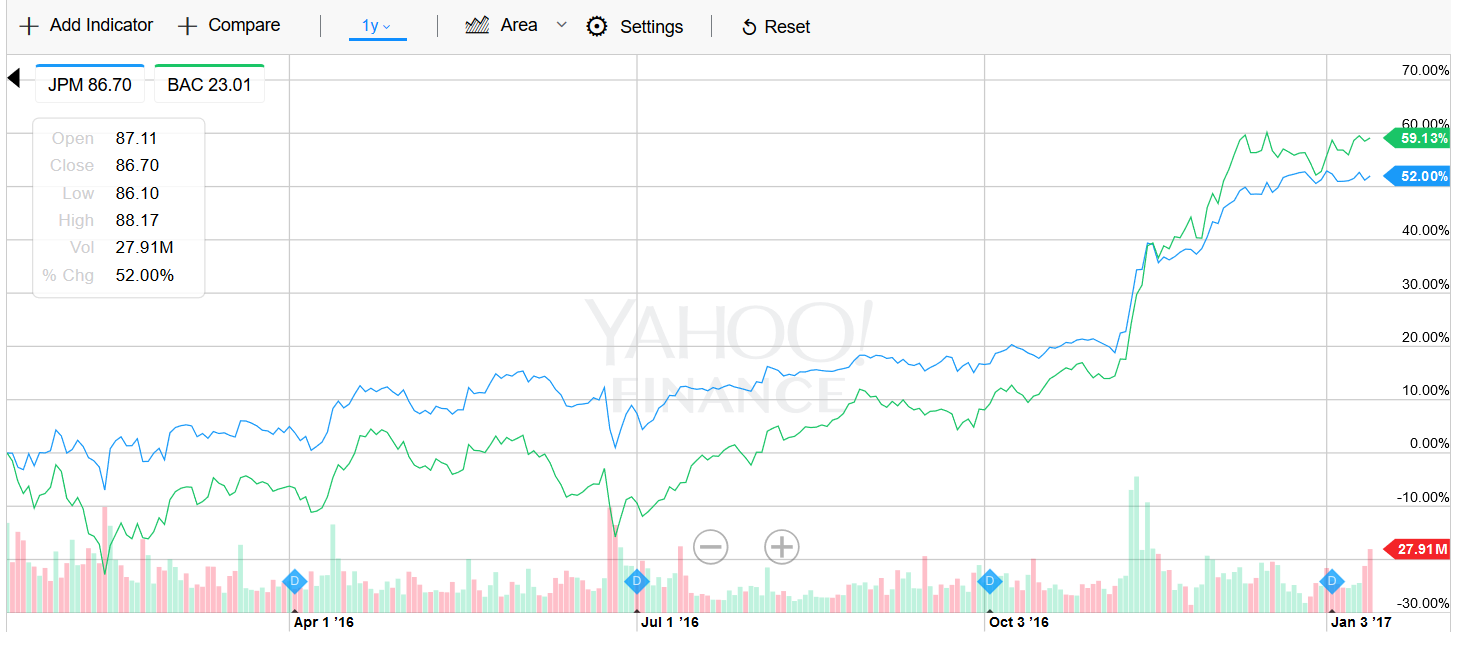
I often pick stocks in this same manner. For example, I really like bank stocks, but once I identify banks as the sector, picking the “right” bank stock becomes secondary as they often move together.

I present to you supporting data below, comparing the one-year performance of JP Morgan and Bank of America stocks.

Banks
(Click to expand.)

This week I want to spin things a little differently. In GP Louisville I cashed out of a lot of cards. Most of them weren’t worth a ton, but the practice really helped me streamline my binder. Now only a few strategic positions remain in my portfolio beyond Old School and Vintage.

This week I want to touch on specific targets that I still own and which I think are worthwhile to hold. Just keep in mind that I have financial interests in each of these items, meaning I stand to gain from everyone else’s speculation. Disclaimer made.

Foils

I still have a few foils that I think have room to run. My favorite is foil Temple Bell.

There was an error retrieving a chart for Temple Bell

This card-drawing favorite of mine was reprinted in a couple Commander decks. But guess how many foil printings of the card exist: one. That’s right, if you want a foil Temple Bell you have to pick up the M11 printing specifically. Maybe this is why foil copies finally took off in Fall of 2016. But going from $2 to $3.75 isn’t relevant here because after fees and shipping there’s not really a profit to be had.

I think there’s still plenty of growth to come as long as the number of foil printings remain one. The card may not be an EDH favorite, but I think it’s close enough to Howling Mine to merit owning for niche decks that want instant-speed card-drawing effects (Leovold?).

The other foil I held onto is admittedly a bandwagon purchase: a couple foil Yisan, the Wanderer Bard.

There was an error retrieving a chart for Yisan, the Wanderer Bard

I witnessed the buyout of this foil creature, so when I found a couple copies on eBay at the old price I snagged them. Sadly they haven’t maintained traction at all. Despite spiking to $20 on paper, I haven’t been able to move my copy on eBay priced down to $10.

I suspect this will drift all the way back down to around $8, at which point it may be worth picking up again. I won’t advocate buying in unless you want personal copies, though, since I’m a little turned off by the manipulation around this card.

Planeswalkers

While in Louisville, I sold my set of Tezzeret the Seeker to a vendor for trade-in credit to pick up a Beta Demonic Tutor. But after I got home, I realized I still like this card a lot so I replaced the set on eBay using my eBay Bucks.

There was an error retrieving a chart for Tezzeret the Seeker

First off, there are only 72 active listings for this card on TCG Player across all three printings. That’s extremely low for something that was reprinted so recently. Secondly, buylists on this card are fairly aggressive, reaching as high as $7 for a card that can still be bought for under $9 on eBay. This is a spread I can get behind, as it represents such small downside risk.

Most importantly, this card is played heavily in the two most popular Commander decks according to EDH REC (rapidly becoming one of my favorite websites). He’s used in 17% of Atraxa decks and a whopping 53% of Breya decks! Considering how heavily used he is, it’s no wonder stock is so low on this card.

With multiple printings I don’t see Tezzeret shooting to the moon overnight, but as volume thins I can see a gradual move towards $15 with buylists jumping to $10. As long as he dodges reprint for a while, this is one of the safer bets you can make.

The other planeswalker I like for upside is Garruk, Apex Predator.

There was an error retrieving a chart for Garruk, Apex Predator

On the plus side, there’s only the one printing. He sees some play in the Atraxa Commander deck, so there’s a slow and steady demand for the card. Four abilities on a planeswalker is also very rare. That said, I don’t like him as much as Tezzeret, and would rather spend $10 on Tezzeret than $10 on Garruk given the choice. Still, it’s good to diversify interests.

What I’m Watching

For non-Old School cards, the above list about summarizes my exposure. I did manage to buy a couple sets of Inexorable Tide when I saw the card jump on MTG Stocks.

I also really like Magistrate's Scepter, which Daivd Schumann mentioned in the forums. Take a second to read what this card does—an artifact with one printing in Mercadian Masques, with text that includes both counters and taking extra turns—to me, this screams “buy.” I’m not one to go deep on specs, but I encourage you to consider picking up a copy or two for personal use if you see the utility in this card as I do. Foils may be particularly attractive given how few must exist.

One other idea I really like is Lux Cannon.

There was an error retrieving a chart for Lux Cannon

This artifact also has only one printing, as a mythic rare in Scars of Mirrodin. Looking at its chart, the card has risen monotonically since 2012, never turning lower. Recently Lux Cannon hit an inflection point, likely due to Atraxa. I've only bought one copy so far, but seeing just 18 results for the card on TCG Player just now has motivated me to grab a couple more. This one is definitely going higher.

Lastly, I’m trying something new out with eBay that I wanted to share. I noticed recently that some Alpha and Beta cards sometimes sell for far below market price (i.e. TCG Player pricing). After further study, it looks like some cards are occasionally listed as auctions on eBay with awkward end times. This may be the middle of the night or, more likely, the middle of the work day.

So I started doing generic searches for “MTG Alpha” or “MTG Beta” and browsing the auctions that end soonest. This alerted me to numerous graded Alpha cards that ended up selling within 10% of buylist.

Now, I wasn’t in the market for a BGS 9.0 Alpha Disrupting Scepter last weekend, but the fact that it sold for around $190 shipped when I know Card Kingdom pays $200 is just wrong. While I missed that one, I did win an auction for a BGS 9.0 Beta Balance last week for $192…I sure hope it ships because nice Alpha and Beta cards that are also playable have a lot of momentum behind them lately.

There was an error retrieving a chart for Balance

I realize that by sharing this strategy, it no longer becomes as attractive if many readers adopt it. But sharing these opportunities is my job, and I definitely put this community’s interests ahead of mine just as a stock broker is supposed to do with their clients. So please have a look, let me know if it works, and share your wins in the comments section. It’s definitely worth the five minutes daily to take a shot.

Wrapping It Up

It’s not often that I share specific ideas for speculation. I tend to shy away from getting too detailed, focusing on broad strokes and market sentiment. But I recognize I should get specific at least occasionally, even if only to share what’s on my radar at a given point in time. This week I have given you just that.

You may have noticed my list of cards is extremely short. That’s for three reasons. First, I am trying to reduce my collection to a more manageable set because my MTG time will be limited once my daughter is born. Second, I really prefer Old School investments for the long haul over stuff that can be reprinted at any time. And third, I find myself less interested in newer cards these days and it’s more fun to make money off cards I also enjoy using rather than cards that collect dust in a binder for months before selling.

In addition to the cards I mentioned, I also have some Beck // Calls I’m continuing to sell at $8.50 - $8.90 a playset on eBay. I have roughly 60 Rainbow Vales for pack wars and personal use. I have a handful of Nephilim. And I have nine Origins Booster Boxes, which have seen some momentum lately off the recent jumps in Jace, Vryn's Prodigy and Hangarback Walker.

I was starting to have regrets about these boxes when I saw Card Kingdom selling them for $90 each during a sale over the holidays. But now that they are back to around $100 shipped on eBay, I really like this investment for a three-to-five year hold.

As 2017 unfolds, I will do my best to continue sharing my personal investments. Not to boast or to gain criticism, but to share openly where I am actually parking my own resources. To me, when a stock picker puts his own money where he is recommending, it gives me confidence that they believe in the idea. As long as there isn’t malicious intent around manipulation and “pump-and-dumps,” it’s important to be transparent with an audience who may be following along.

I hope I provided that transparency sufficiently today. If not, please challenge me and ask questions and I will do my best to reply.

...

Sigbits

  • Solitary Confinement just hit an all-time high. I’m not exactly sure why this card is suddenly seeing demand, but it’s definitely real. At this point Star City Games has only one copy in stock, an MP one for $5.59. Near Mint copies are gone with a $7.99 price tag. Given that this card is $10 on MTG Stocks, I suspect SCG will be increasing their prices pretty soon.
  • I would keep an eye on Clever Impersonator. Buylists seem awfully aggressive for this one. There’s still plenty of supply out there, but it looks like the mythic rare may have bottomed already. If you’re looking for some reasonable copies, SCG has about 21 SP for $2.99 each. This is below TCG market price, so I suspect these won’t be in stock for long.
  • Here’s an Old School one you can take to the bank: check out Arabian Nights JunĂşn Efreet. The card is low in stock and Star City Games is sold out at $17.99. Who would have guessed this nearly-unplayable card would suddenly become so valuable? The crazy part: I think it will go higher as more people try it out in Old School. I have a personal playset, but I don’t advocate buying more than you’ll use because you don’t want to sit on a huge lump of unmovable inventory. Just because this card shows as “$24” doesn’t mean copies sell at that price.

Comparing Format Support: Premier Modern Events in 2017

Are you a Quiet Speculation member?

If not, now is a perfect time to join up! Our powerful tools, breaking-news analysis, and exclusive Discord channel will make sure you stay up to date and ahead of the curve.

I don’t know about you, but I plan on 2017 being anything but business as usual. In the coming weeks, expect some changes to my column here on Modern Nexus (hopefully for the better!) This week, I’m taking one of my new year’s resolutions—to get organized—and applying it to Modern Magic. Too often over this past year I was surprised by a Grand Prix or other high-profile Modern event popping up when I wasn’t prepared for it. So, today I’ll be laying out the year in Modern Magic, organizing Grand Prix, smaller events, larger events, set releases and B&R updates alongside each other to (hopefully) present a reference that players can look back to the entire year. As I’m still me, and can’t resist spicing things up a bit, I’ll use this data as a framework to speculate on Wizards’ thought process behind their format allocation. Let’s get started!

The 2017 Lineup

First, the roster of major tournaments:

[wp_ad_camp_1]

EventDate
SCG Season One RegionalsFeb 4
Grand Prix VancouverFeb 17-19
Grand Prix BrisbaneFeb 17-19
SCG Open IndianapolisFeb 25-26
SCG Open DallasMar 11-12
Grand Prix San Antonio*Mar 31 - Apr 2
SCG Open BaltimoreMay 27-28
Grand Prix CopenhagenMay 26-28
Grand Prix KobeMay 26-28
SCG Open CharlotteJun 10-11
Grand Prix Las VegasJun 16-18
SCG Season One Invitational**Jun 30 - July 2
Grand Prix BirminghamAug 11-13
Grand Prix Sao PauloAug 11-13
2017 World Magic Cup***Dec 1-3
SCG Season Two Invitational** Dec 1-3
Grand Prix Oklahoma CityDec 8-10
Grand Prix Madrid*Dec 8-10

*Team Unified Modern
**Split format Standard/Modern
***Split format Team Sealed/Team Unified Modern

As of January 1st, this list is up to date with all major tournaments known so far. (If I've missed any major third-party tournaments outside of North America, let me know in the comments—in any case these are not on my radar for travel.) Star City Games has only released SCG Open Series dates and locations through June, so be sure to check back at some point in the future when they release the second half of their Open Series offerings. Wizards schedule for premier events can be found here.

So, what can we take from this list? 2017 is not lacking when it comes to high-profile Modern events, with Grand Prix events in February, March, May, June, August, and December, and SCG Tour offerings most months. Both organizations are choosing to skip April for some reason (not counting Grand Prix San Antonio, which falls on the March/April border), but beyond that Modern events in 2017 are relatively spaced out.

It’s interesting to note that Wizards’ double-GP weekends featuring Modern worldwide always follow a month of no Modern Grand Prix events whatsoever. January: no Grand Prix; February: two events. April: no Grand Prix; May: two events. July: no Grand Prix; August: two events. November: no Grand Prix; December: two events. I can’t speak to Organized Play’s sinister motivations, but this clearly seems to me a strategic attempt to motivate interest in attendance at Modern events by restricting their regularity in the public eye. With a Modern Grand Prix every month, it seems their thought process is that players would get tired of a format that has historically been labeled "stale" on the main stage. By spacing out events, leaving more time for set releases and changes in the metagame, Organized Play hopes to see a better turnout at these types of events when they do come around.

Whether this is actually true or not is hard to tell, but it doesn’t seem to be too much of a stretch. Wizards’ has shown at least a hint of a subterranean desire to distance itself from some of the public relations difficulties of our format by removing Modern from the Pro Tour entirely. Professional players and guests to our corner have complained about the format, while die-hards have gone crazy when their favorite decks were (deservedly or not) banned for various reasons. The glory days of Modern aren’t necessarily behind us, but I would expect this to be the new norm going forward unless serious changes happen to Standard or Organized Play.

A Comparison of Format Support

Still, it’s not like Wizards and Star City Games are leaving Modern out in the cold. You guys said you wanted statistical analysis, so here we go!

Yearly Changes (2015 - 17)

Shown below is a simple line graph visualizing the format distribution for Wizards' Grand Prix events, going back two years. For the purposes of this exercise, I'm leaving off Pro Tour events, and lumping mixed-format events in the "other" category. The purpose of this distinction is to (hopefully) isolate the "pure" events—that is, all-Modern, all-Standard, and all-Limited—to try and find a correlation or pattern over time. The math can get a little sticky at times, so stick with me. For example, in this section we're including the Super Sunday Series and MTGO Championship while omitting Pro Tours, while in the following section below the opposite is true.

So, what can we take from this information? Excluding Pro Tours, Wizards' premier events for the past two years total 53 for 2015, 48 for 2016, and 57 for 2017. It's interesting to note the decline in events in 2016, but that's a whole other topic in itself. Really, what we're looking at is the history of Modern offerings over the past two years and how it compares to now. Looking at the chart, the total number of Modern offerings has grown steadily over the past two years, from 8 in 2015, to 9 in 2016, to 11 in 2017. Modern is growing in representation on Wizards' premier event stage, even when the total number of events shrinks (48 in 2016, from 53 in 2015). To me, this shows at the very least continued dedication to a format, even if there are no plans to feature that format on the Pro Tour stage. Based on the data, nothing gives me cause to believe Wizards' might one day give Modern Grand Prix the ax out of nowhere (regardless of what they do with banlist decisions!). Modern is growing, so take delight.

But can't Modern's growth just be attributed to the overall number of Grand Prix going as well? Possibly, but take a look at that Standard data in the chart above. In 2015, Wizards offered 20 Standard Grand Prix, while in 2016 and 2017 they are only bringing 19 events to the table. Sure, this isn't a huge difference, but Standard is their flagship format—during a period of growth of the Grand Prix circuit overall, you would expect it to follow suit. Instead, 2017's nine extra events are distributed among Modern, Limited, and special events. Limited is receiving five extra events, up to 22 from 17.

Why then would Wizards increase Limited offerings, yet keep Standard Grand Prix stagnant? For me, I pin this on the Star City Games Open Series. With events every weekend (and arguably better coverage), SCG has carved out a niche for themselves, wresting viewers away from Wizards towards their own streams. As their events are primarily constructed formats, I would hypothesize that Wizards has crunched the numbers and found the best place for their coverage rests in the Limited market.

Zeroing in on 2017

Next let's take a closer look at the 2017 events to see how the Modern offering compares to the other formats. For this section we'll be including all Pro Tours, Grand Prix, and special events. With 59 official Wizards event offerings in 2017, 11 of those feature Modern in some significant manner. This is actually up from 9 Grand Prix in 2016, and 8 events in 2015. Part of this is due simply to the fact that more Grand Prix events are being held. But it's worth noting that Modern events are growing in regularity along with other formats, in spite of Wizards' rumored dislike for the format.

The 59 premier event offerings are split like so: 23 Standard events, 11 Modern events, and 25 non-Standard/non-Modern events (almost entirely Limited, with some Team Limited and Legacy sprinkled in). As percentages, this breaks down to 39% Standard, 18.6% Modern, and 42% mostly-Limited. This is surprising (to me at least) because it goes against the narrative I’ve held personally, and the general attitude in Modern circles, that Wizards’ is abandoning the format. If we ignore the issue of the canceled Modern Pro Tour (which we have already debated at length and could easily spend an entire article rehashing), the stats reveal that Wizards is only offering Standard events at double the rate of Modern. They are actually offering more pure Limited GPs than Standard GPs, since the four split-format Standard/Limited Pro Tours are included in the "Standard" category. So yes, Modern definitely is Wizards’ third format, but it’s not that far behind the other two.

Format Representation

Or is it? Another way to look at this information is based on representation, or how many times the format is "presented" to the public. Remember above, when we talked about some possible motivations behind Wizards’ tendency to do double Modern GP weekends? If the goal is to control the narrative, how often is the general public seeing Modern on their computer screens when they fire up Twitch on a given weekend?

Of the 37 weekends in which Wizards is hosting a Magic Grand Prix, Pro Tour or special event, the breakdown between formats is as follows:

2017 Major Event Breakdown by Format

Format/Event Type# of EventsPercentage of Total
Pro Tour410.8%
Standard1129.7%
Limited1232.4%
Modern718.9%
Other38.1%

Raw number of events is a useful metric to analyze, as those of us who love Modern are well used to being starved for data and decklists from high profile events. Still, if we’re investigating frequency of format compared to other offerings, treating multiple-event weekends as one seems to be a better indicator of true market division. After all, who is playing in multiple Grand Prix on the same weekend? Who is watching multiple Grand Prix streams?

So with 37 weekends of Magic play, Modern holds 7, compared to 11 for Standard and 12 for Limited (not counting Pro Tours). When viewed this way, it would seem that the divide between Wizards’ redheaded stepchild and its favorite twins is closer than we’ve been led to believe. Take one weekend from Standard and two from Limited and give them to Modern, and we’re even across the board, right?

Unfortunately, it’s not that simple. We’ve forgotten to include the Pro Tours, which at worst should be applied to both Standard and Limited’s totals, and at best should be weighted in terms of importance. Last year I rarely had a weekend off to watch Magic event coverage, but you can bet I made sure to tune in to Pro Tour coverage, or at least catch replays of it. We have four of them, so we can’t really call them our Super Bowl, but they are definitely our Playoffs. To talk about public representation without accounting for Wizards' flagship promotional vehicle would be silly, to say the least.

To try to account for the increased importance of these events, I will weight them double (and an argument could be made for triple). Coverage at the PT spends roughly double the amount of time on Standard (10 Swiss rounds plus the Top 8) as on Limited (two draft portions plus six rounds of play). Thus we'll distribute the Pro Tour "points" in a 2:1 ratio to Standard and Limited. Here's what the breakdown looks like after all that:

2017 Major Event Breakdown by Format (Weighted)

Format/Event Type# of Events (Solo)Modified Pro Tour Score# of Events (Weighted)Percentage of Total
Standard11+5.3316.3340%
Limited12+2.6614.6635.75%
Modern7-717%
Other3-37%

With this shift in place, we’re back to Modern as a clear third-option to Standard and Limited, which isn’t that surprising. What sticks out to me more is the large representation of Limited on the professional stage. For a player like me (competitive, doesn’t draft outside of MTGO, doesn’t watch much coverage), seeing this level of dedication to high-profile Limited play is interesting.

I guess I shouldn't be surprised, given the level of infatuation many of the commentators show towards Draft on each Pro Tour, but I always assumed they were just acting excited to hype up the set and sell their role as commentator. With Star City Games offering almost exclusively Standard/Modern events, I’m beginning to see under the hood a bit and recognizing Wizards’ desire to capitalize on the Limited niche they currently hold a monopoly in.

Long Live Modern

Personally, I found this process interesting as it revealed to me exactly how far behind the "Big Two" Modern lags, and how the numbers bear out a possible reasoning for the clumping of events that we see throughout the year. This ever-present narrative of Modern as the redheaded stepchild is partially true, but the numbers show a policy that doesn't necessarily leave Modern out to dry. With an increase in events year-after-year, coupled with an absolute decrease in Standard offerings, fans of Modern can hardly claim Wizards is abandoning their format.

Sure, the removal of Modern as a Pro Tour format is a whole other topic—but our beloved format on the highest competitive stage has proved problematic in the past and carries with it a myriad of issues. When viewed in comparison to the Standard and Limited offerings, along with the Star City Games events, it's clear to me that Wizards has deliberately relegated Modern to "third-format" status, but that it still intends to support it robustly. While Modern remains secondary as far as official Wizards coverage goes, it's worth recognizing that we, as players, are experiencing no shortage of Modern content in 2017, compared to other formats.

Hopefully this article will be an informative reference when discussion of Wizards’ feelings regarding Modern eventually resurface. And if that never happens (yeah, right) at least it can be used as a quick reference to check the date of the next Modern event! Let’s go, 2017!

Thanks for reading,

Trevor Holmes

The_Architect on MTGO

Twitch.tv/Architect_Gaming

Twitter.com/7he4rchitect

Aether Revolt Prerelease Price Cheatsheets Are Here

Are you a Quiet Speculation member?

If not, now is a perfect time to join up! Our powerful tools, breaking-news analysis, and exclusive Discord channel will make sure you stay up to date and ahead of the curve.

They're back again! Our Aether Revolt price cheatsheets show you what cards are selling for going into this weekend's prereleases. Here they are, organized both alphabetically and by price.

Aether Revolt Cheatsheet (Alpha)

Aether Revolt Cheatsheet (Price)

These prices are pulled from sale prices as of this morning, so this is accurate for what people are actually paying for these cards. A few caveats: no foil prices and no Invention prices yet.

Instant Analysis:

  • Heart of Kiran looks dramatically overpriced right now. Sure, it can protect Planeswalkers, but the playable ones can already save themselves. I think this is mostly just from people trying to find a Smuggler's Copter replacement.
  • Baral's Expertise may be the sleeper card of the set. Yesterday, Brian Demars wrote a glowing article about it on CFB as a one-sided board sweep that can also power out Chandra. Not bad.
  • The biggest breakout card of the set is probably Saheeli Rai from Kaladesh! She jumped 8x over the last week, thanks to Wizards' goof-up with Felidar Guardian.
  • Fatal Push is $5 - that's astounding for an uncommon. Aether Hub is still $3.50 though, which makes me even more incensed that I've never opened one in KLD packs, despite having opened two mythic Metallurgic Summonings...
  • It's normal and natural for the prices to drop a few weeks after release. For a fun historical reference, here's our price guides for Eldritch Moon and for Magic: Origins. Yes, Goblin Piledriver sold for more than Jace, Vryn's Prodigy at prerelease time. Good reminder to trade for future value, not present value.
  • In the end, I am not sure what the chase rare of Aether Revolt is supposed to be. There's nothing in this set that I am thrilled to open aside from an Invention. It all looks good - this isn't OGW - but I can't help but feel that WOTC failed to make clearly exciting cards that people want to open. Eldritch Moon had Emrakul, a few Planeswalkers, some mutant angels. Here, we've got what exactly? Rebels fighting a bureaucracy?

Let me know what you think!

Back in the Woods: Probeless Temur Delver

Are you a Quiet Speculation member?

If not, now is a perfect time to join up! Our powerful tools, breaking-news analysis, and exclusive Discord channel will make sure you stay up to date and ahead of the curve.

When Wizards banned Gitaxian Probe on Monday, many players reached out to me to express their condolences and ask where Temur Delver goes from here. Probe was an integral part of my Monkey Grow deck, and starting games by paying 2 life for the sorcery was some of the most fun I ever had playing Magic. I will sorely miss the cantrip, but I also don't think Temur Delver is going anywhere.

This article proposes a new build of Temur Delver that uses Traverse the Ulvenwald to present pilots with tools to handle any situation.

[wp_ad_camp_1]

Thoughts on the Ban

Before we jump into the deck discussion, I feel compelled to briefly discuss Wizards' January 9th announcement.

First Impressions
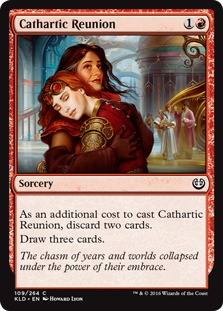
The Grave-Troll ban I'm totally on-board with, as I wrote two weeks ago. Dredge polarized Modern to a frightening extent and greatly lowered the format's diversity. That said, I wish Wizards had made any of these effects explicit in their inexcusably curt explanation of changes. As usual, transparency proves the company's weakest suit. Too bad we can't "Probe" those guys!

The Gitaxian Probe ban took me by surprise. Since I'm a firm believer in Modern's ability to police itself, I prefer conservative management of the banlist and baby-step movements. In my opinion, the Grave-Troll ban alone would have decreased Infect's metagame share by giving midrange decks some room to breathe.

I still think the Probe ban was an elegant way of slowing down the format, since it affects three aggro-combo decks at once. But the Dredge ban, combined with the printing of [tippy title="Fatal Push" width="330" height="330"][/tippy], may have been enough. I feel Wizards implemented this change too quickly. The ban's obvious splash damage, which fundamentally alters certain Delver decks (ahem) and renders Storm unplayable, further calls Wizards' haste into question.
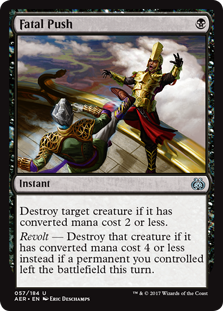
Delving Deeper

It appears from the announcement that aggro-combo decks having access to free information is just not something Wizards wants to be a feature of the format. That's fine with me, so long as Wizards tells us this while acknowledging that Probe didn't violate any of the format's guidelines, at least as overtly as some other banned cards.

At the same time, I probably trust Wizards' management of the list more than most. I've supported even their more controversial decisions since the Nacatl ban, which was also a little heavy-handed for my taste (in that scenario, banning Punishing Fire would likely have been enough to bring x/2 creatures back into the format; banning Wild Nacatl was overkill). With all said and done, though, Wizards has way more data on hand about how games actually play out, and what turn they end on, than we could ever dream of. If they say Probe contributed to an unacceptable number of turn-three kills, I believe them.
Some good may also come of the Probe ban. The now-nerfed UR Prowess is the only deck that Preordain seems scary in, and if blue continues posting miserable numbers this cycle, I'd be surprised if the super-Sleight of Hand continued to rot on the banlist beside the likes of Skullclamp and Treasure Cruise.

Temur Delver Without Probe

Gitaxian Probe held a crucial post in Temur Delver. Without it, the deck needs a complete overhaul. To develop a new build, I considered what Probe did for the deck, and whether to add cards that fulfill similar roles or ones that enabled additional angles of attack.

But Why Play Temur Delver At All?

Grixis Delver had largely transitioned away from running Probe at all by the time it was banned, so I think this question bears revisiting.

Delver strategies occupy a unique space in the Modern metagame, which is defined by the rock-paper-scissors super-archetype triangle of linear aggro (Infect, Affinity), big mana (Tron, Eldrazi), and aggro-control (especially midrange, i.e. Jund, Grixis). Tempo decks are aggro-control decks like midrange, and therefore enjoy favorable matchups against linear aggro. But due to the order in which they deploy threats and disruption, they post favorable matchups against Tron and other big mana strategies, while midrange decks do not.

The reasons to play Temur Delver over Grixis Delver have always been Disrupting Shoal, Blood Moon, and Tarmogoyf. Thanks to these cards, Temur in particular boasts the strongest big mana matchup of all Delver decks. Temur also applies pressure quickly enough that linear aggro-combo has a very difficult time beating it.
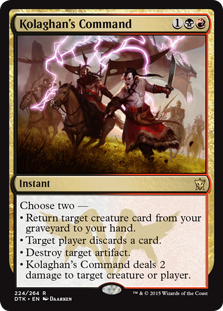
Temur's weakness is Jund and other midrange strategies, which punish it for lacking the tools to keep up with their grinding. Grixis Delver has access to these tools (Kolaghan's Command, Snapcaster Mage, Tasigur).

Losing Gitaxian Probe means adding other sorceries for Tarmogoyf, and I've settled on Traverse the Ulvenwald. This card is the new primary reason to play Temur over Grixis, as it gives Temur tools to beat midrange while retaining its favorable matchups against linear aggro and big mana.

The metagame has been hostile to graveyard strategies lately, but with Dredge taking a hit, I expect Traverse to be safe again and Temur Delver to become well-positioned in Modern. This Probeless build also resists graveyard hate better than its predecessors.

Probe's Roles in Temur

Wizards said of Gitaxian Probe, "Ultimately, the card did too much for too little cost." The statement couldn't hold truer for Temur Delver. In this deck, Probe achieved the following for zero mana:

  • Allowed us to run fewer lands via the Turbo Xerox Rule.
  • Ensured Tarmogoyf would resist Lightning Bolt on turn two.
  • Filled the graveyard for Hooting Mandrills.
  • Gave us an easy Snapcaster target.
  • Turned Serum Visions into Preordain.
  • Pitched to Disrupting Shoal.
  • Transformed Delver of Secrets.
  • Served as a spell to transform Ravager of the Fells back into Huntmaster of the Fells.
  • Trivialized achieving delirium for Traverse the Ulvenwald.
  • Upped our instant/sorcery count in the graveyard for Bedlam Reveler.
  • Provided perfect information at any stage in the game with which to maximally manage limited mana sources; sequence conditional countermagic; know what to dig for while cantripping; choose whether to focus on resolving Blood Moon on turn three; go all-in with Simic Charm for damage or with threats without fearing a board wipe; and more.

Obviously, there's no true substitute for a card that versatile. A couple questions I asked myself after the ban were how many cards I wanted to run that played similar roles to Probe, how much of the deck's core I was comfortable scrapping, and whether to introduce new proactive plans that addressed the deck's previous failings. I came up with this list:

Temur Delver, by Jordan Boisvert

Creatures

4 Delver of Secrets
4 Tarmogoyf
4 Hooting Mandrills
2 Snapcaster Mage

Artifacts

2 Mishra's Bauble

Instants

4 Thought Scour
4 Lightning Bolt
2 Tarfire
1 Vapor Snag
1 Dismember
3 Mana Leak
3 Stubborn Denial

Sorceries

4 Serum Visions
4 Traverse the Ulvenwald

Lands

4 Scalding Tarn
4 Misty Rainforest
2 Wooded Foothills
2 Steam Vents
1 Stomping Ground
1 Breeding Pool
2 Island
1 Forest
1 Mountain

Sideboard

3 Blood Moon
4 Huntmaster of the Fells
2 Bedlam Reveler
2 Pyroclasm
1 Engineered Explosives
2 Destructive Revelry
1 Ancient Grudge

Additions

The Probe axe marks four slots to fill right off the bat, and accommodating for Probe's absence in other ways necessitates even more tweaks. Here's what I added to Temur Delver.

4x Traverse the Ulvenwald

For one mana, Traverse finds us a specific card, instead of whatever's on top of the deck. I have always liked Traverse in this deck, as it combines with Bedlam Reveler to give us a great plan against midrange.
The ceiling on Traverse is very high, especially in sideboarded games. But its floor is still pretty reasonable. At its absolute worst, Traverse is an Evolving Wilds that flips Delver, grows Goyf, pays for Mandrills, buffs Reveler, helps transform Ravager of the Fells, shuffles away a sour card revealed by Bauble, and can be flashed back with Snapcaster. This wealth of possible roles makes Traverse appealing as a Probe replacement.

To my surprise, I didn't encounter much tension between Traverse the Ulvenwald and Hooting Mandrills. While playing those two cards together with Bedlam Reveler tested nightmarishly, omitting the Reveler makes their apparent anti-synergy more than manageable.

Temur Delver wants to land a hard-to-remove threat, protect it with countermagic while disrupting an opponent's plays, and win. A delirium-enabled Traverse can find our first threat (generally Tarmogoyf, but sometimes Mandrills if we'll need mana for countermagic) or add to the clock. The midrange decks that can remove our threats consistently fill the graveyard right back up for delirium. Those that can't are likely to lose to Denial and Leak while we turn the Ape sideways. It's also frequently correct to burn Traverses early and find basics, which gives us more sequencing options in the mid-game.

2x Mishra's Bauble
Mishra's Bauble is the closest Probe analog left in Modern. It provides information (albeit much less) and a card in the graveyard, while cantripping and at no cost. I have experimented with Bauble in Temur Delver shells before, and the card impressed me. But we could never justify cutting Monkey Grow's more impactful or versatile cards for Bauble until now, when we don't have a choice.

Besides helping with delirium, Bauble makes it trivial to grow Tarmogoyf larger than 4/5. I anticipate this benefit to be of great value in the new metagame. Tasigur, the Golden Fang and Reality Smasher are sure to rear their hideous heads, and having Lhurgoyfs that out-body these creatures (eight of them if you count Traverse) should work wonders against the decks that play them.

We never want to see multiple Baubles at a time, and often only want to hit one per game. Thus I don't think it's correct to run more than two.

One-of Additions

  • Thought Scour #4: The most obvious addition to Temur Delver post-ban, a fourth Scour helps us enact our gameplan more often, and fills some of the roles left empty by Probe.
  • Snapcaster Mage #2: Probe gone, Push coming—Modern is sure to slow down. We're adding an 18th land in one Probe slot anyway. A second Snapcaster guarantees we always have one left in the deck to search out with Traverse.
  • Dismember: Not running Probes leaves us with more life than I generally like to have. We take little enough damage now that I'm comfortable playing this powerful spell in the main over the second Vapor Snag.
  • Wooded Foothills #2: Without Probe we should add an 18th land to the deck. I prefer Foothills to Spirebluff Canal—the fetch offers synergies with Bauble, Goyf, Serum, Moon, and delirium, and we have more life to spare without Probe.

Omissions

This new build is also missing some usual suspects. Let's go over some major omissions and the reason I didn't include them.

Disrupting Shoal
We touched above on how Traverse compensates for Disrupting Shoal's absence, especially in a grindier metagame. The linear decks Shoal tends to crush are also sure to take a dive with Probe gone from their repertoire. Running Traverse, Bauble, Dismember, and another land makes it difficult to fit in enough blue spells for Shoal to shine. Finally, the information Probe would grant us at the start of a game greatly improved Shoal's utility, since we could sequence the counterspell perfectly. Blind-Shoaling is much less attractive.

I can see Shoal returning if decks like Bogles and Death's Shadow Zoo make a comeback, but I'm starting off without them in an expected metagame of Abzan, Grixis, and Tron.

Spell Snare

Spell Snare is a card I have advocated for in grindy metagames, especially over Disrupting Shoal. There's also some precedent for its viability—Joshua Yang Zing payed a Snare over one of two axed Shoals in his Top 8 list from GP Singapore.

The main reason I've omitted Snare from this list is space. I found myself wanting to keep my counterspells against interactive decks like Jeskai, but would have to remove Spell Snare when bringing in Bedlam Reveler, since it's too conditional to spend easily before discarding and drawing three. That tension leaves precious few cards in the maindeck that I feel like cutting for a pair of Snares, which I would frequently switch out anyway. At least for now, I'd rather run the classic 3/3 Leak/Denial split and fill out the other interaction slots with removal.

Simic Charm
Charm has also been a staple of the deck since its creation. The matchups Simic Charm excelled in were the midrange ones, where it could push through damage with Mandrills or Goyf despite a blocking behemoth on the other end. Hexproof mode also protects threats from Abrupt Decay and other removal spells, while bounce mode worked best versus linear pump decks.

I prefer to avoid Simic Charm when I'm on Bedlam Reveler, since the midrange matchup becomes much easier with that plan and Snag is simply more efficient. In this particular build, Dismember takes the place of that second Snag anyway.

Sideboard

I'm with Ryan Overturf when it comes to purging the sideboard of graveyard hate until and unless Dredge continues to pose problems. The sideboard I propose here is full of Monkey Grow staples, with an exciting new development: Huntmaster of the Fells and Bedlam Reveler, to date, have been exclusive plans, for reasons of space. With Traverse the Ulvenwald in the mainboard we have room for both, giving us the tools to beat up on go-wide aggro decks, midrange strategies, and graveyard hosers alike.

Moon, Revelry, Grudge, Pyroclasm

These cards are always present in Monkey Grow sideboards. During Dredge's worn-out stay in Modern, we ran Anger of the Gods over Pyroclasm. But in most matchups, including Affinity, Merfolk, Burn, Tokens, and Abzan, the more efficient spell is always superior. Anger is about as strong as Pyroclasm against Coco/Chord decks, contrary to popular belief. I don't see a reason to stay on the clunkier card with Dredge likely to fade away.

Huntmaster of the Fells
Huntmaster of the Fells walks away with games against Merfolk, Affinity, Coco/Chord, Tokens, Burn, and many other aggro decks. He also provides a way to win through Ensnaring Bridge, and joins Delver of Secrets in totally ignoring Rest in Peace effects. Packing Huntmaster in the side gives us a respectable plan against bigger aggro decks and makes it difficult for opponents to hate us out. That he further complicates the midrange matchup for BGx opponents is gravy. The four-Huntmaster board plan also becomes more reliable on a functional 22 lands.

Bedlam Reveler

Bedlam Reveler ensures attrition wars are rarely won against Temur Delver, especially when it's drawing into Huntmasters. Early game we apply pressure and threaten Blood Moon, and then follow up by tutoring for a string of 3/4 draw-threes in the mid-game. This gives us the shot in the arm we needed against Jund and other midrange strategies that have traditionally oppressed Modern's blue Tarmogoyf decks.

Engineered Explosives

I've never played Engineered Explosives in Monkey Grow before, but I think it's quite powerful these days. Aside from providing another out to Chalice of the Void, Explosives can wipe out a swarm of Lingering Souls tokens or remove problematic permanents like Liliana of the Veil—all while pumping Tarmogoyf.

Papa's Got a Brand New Monkey
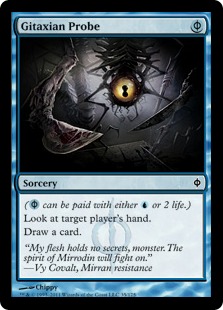
This particular build of Monkey Grow featuring Traverse loses some speed, to be sure, and the information that allowed it to abuse Disrupting Shoal. But I'm optimistic about the deck's chances, no matter if the format leans towards [tippy title="Fatal Push" width="330" height="330"][/tippy], Oblivion Stone, or Mutagenic Growth. Even with the loss of Gitaxian Probe, the stage might finally be set for Delver of Secrets to demonstrate its worth in the format known for Lightning Bolt and Abrupt Decay.

Stock Watch- Saheeli Rai

Are you a Quiet Speculation member?

If not, now is a perfect time to join up! Our powerful tools, breaking-news analysis, and exclusive Discord channel will make sure you stay up to date and ahead of the curve.

When the banlist announcement was moved up, everybody knew there would be cards banned from Standard, though most of it thought it would be an emergency ban of the Saheeli combo. In case you haven't heart about this, here is the "new Splinter Twin":

felidarguardiansaheelirai2

You could make the argument that neither of these cards are as good when you're not comboing as Deceiver Exarch was, and you would probably be right, though the ability to win on turn four is not to be written off. It's also noteworthy than with six lands, you can cast Felidar Guardian, blink a land, and then cast Saheeli Rai and go off that turn. This combo is generating a ton of hype, and as such Saheeli jumped from $5 to $25.

There was an error retrieving a chart for Saheeli Rai

While I do believe that this combo has potential, I believe that Saheeli is a sell as of now. The reason being that it was also announced that there would be another banlist update five weeks after the Pro Tour. As such, if this combo has a dominant Pro Tour performance, it will likely be banned, and if it doesn't perform, then the card will naturally lose value. Saheeli could potentially see more growth in the very short term, though I don't believe that the risk is worth it.

Insider: Standard Market Movements Since the Bannings

Are you a Quiet Speculation member?

If not, now is a perfect time to join up! Our powerful tools, breaking-news analysis, and exclusive Discord channel will make sure you stay up to date and ahead of the curve.

There has been a flurry of financial activity this week since Wizards made their unexpected banned list announcement on Monday.

The banned cards have plummeted in price,of course, but what’s more interesting is the impact on other cards in the market. In some cases, cards associated with banned cards have fallen in price, indicating a lack of confidence in their associated strategies. For example, Ishkanah, Grafwidow and Aetherworks Marvel suffer from losing Emrakul, the Promised End, and Selfless Spirit loses a lot of value when it doesn’t have Smuggler's Copter to protect, and its archetype, White-Blue Flash, is further gutted by the banning of Reflector Mage. Accordingly, each of these cards have seen significant price decreases on Magic Online.

More exciting is the increase in demand and thus prices of cards that are suddenly more desirable in the metagame. Today I’m going to focus on the cards in Standard and Modern that are big winners from the bannings. These cards are poised to be major players in their respective formats, and they are likely to see a significant increase in demand as players adopt them. I’ve been paying attention to the quick-moving Magic Online market as barometer for future paper trends, but in some cases paper prices are already reacting.

There was an error retrieving a chart for Torrential Gearhulk

Control strategies gained a ton of ground with the Standard bannings. Smuggler's Copter was the best tool aggressive decks had against them, and Emrakul, the Promised End was the one card they couldn’t beat, so now it’s smooth sailing ahead. All control cards have room to gain, but Torrential Gearhulk, which is played in all variety of blue control, has seen the biggest initial gains, growing around 50 percent on Magic Online since the announcement.

There was an error retrieving a chart for Dynavolt Tower

Dynavolt Tower could be had for a tenth of a ticket on Monday, but it’s up to almost half a ticket. The paper price is bottomed out at a dollar, and could see some modest gains as control decks start to see more play.

There was an error retrieving a chart for Noxious Gearhulk
There was an error retrieving a chart for Combustible Gearhulk
There was an error retrieving a chart for Verdurous Gearhulk

All of the gearhulks suddenly become more attractive in a world where Emrakul, the Promised End is gone and decks need different finishers. Their prices are starting to creep up online, with the price of Noxious Gearhulk almost doubling over the week, Combustible Gearhulk growing by 75 percent, and Verdurous Gearhulk growing by almost 50 percent.

There was an error retrieving a chart for Chandra, Flamecaller

Another big finisher that might now have room to shine is Chandra, Flamecaller, which has grown by around 25 percent online after months of stagnation.

There was an error retrieving a chart for Ulamog, the Ceaseless Hunger

With Emrakul, the Promised End gone, Aetherworks Marvel decks will seek a direct replacement in Ulamog, the Ceaseless Hunger. Its price immediately spiked in paper from $13 to over $22, and the online price went from 6 tix to 8. There’s a lot of hype to the spike, but with the card also getting better in Modern and having long-term casual appeal, it’s possible the price won’t ever get lower.

There was an error retrieving a chart for Kozilek, the Great Distortion

What hasn’t yet spiked is Kozilek, the Great Distortion, which is another possible replacement to Emrakul, the Promised End. The old style of Aetherworks Marvel decks included eight Eldrazi, and as they are already playing Ulamog, the Ceaseless Hunger, they may turn to Kozilek, the Great Distortion. With Red-Green Marvel dying from the banning, the old style of Marvel deck is poised to make a comeback, especially with Whir of Invention giving it a new tutor, so I’d pay attention to Kozilek, the Great Distortion. The price hasn’t seen much movement online and is still a bargain, but the paper price has actually begun to creep up a few cents.

There was an error retrieving a chart for Nissa, Voice of Zendikar

Smuggler's Copter oppressed planeswalkers because it couldn’t be blocked by Plant or Knight Ally tokens, and it couldn’t be touched by abilities from Liliana, the Last Hope or Dovin Baan. Nissa, Voice of Zendikar was once a major part of the metagame but fell very hard after Kaladesh, and it has the most to gain from the banning. The price has already almost doubled online, and it’s starting to creep up in paper. It also gains from hype over Aether Revolt enabling a +1/+1 counter strategy with Winding Constrictor. The strategy has also increased interest in Drana, Liberator of Malakir, which also has applications in Vampires. Renewed interest in the archetype explains the 35 percent growth of Olivia, Mobilized for War on MTGO.

There was an error retrieving a chart for Oath of Nissa

Renewed interest in planeswalkers bodes well for Oath of Nissa, which has almost doubled in price on Magic Online since the announcement. Not only is it useful in traditional midrange decks, it’s also quite useful for casting Saheeli Rai, which makes it an enabler for the new infinite combo with Felidar Guardian. This combo is going to be everywhere, and anything associated with it or beating it is a good bet, at least in the short term until it potentially gets banned five weeks after the Pro Tour, which would be early March. One spec to keep in mind is Authority of the Consuls, which players are moving to in droves as a way to counteract the combo.

There was an error retrieving a chart for Reality Smasher
There was an error retrieving a chart for Thought-Knot Seer

The Eldrazi have proved good enough for Modern, Legacy, and even Vintage, but they have had minimal impact in Standard, mostly because they were printed in the same set as Reflector Mage. With it removed from the format, there is really nothing holding the Eldrazi in check, and I expect they will begin to invade the metagame. The price of Reality Smasher and Thought-Knot Seer have already seen significant growth online, and I expect they’ll continue to grow.

There was an error retrieving a chart for Nahiri's Wrath

Keep your eyes on Nahiri's Wrath, which has grown from under a ticket to over 1.5 tix online, but is currently at its rock-bottom paper price. It’s suddenly a lot more attractive in a world without Smuggler's Copter, which evaded this sorcery-speed removal.

The bannings have completely shook up the Standard metagame, and that has massive implications for the Standard market. What do you think of these market movements? What Standard cards are on your radar?

--Adam

Want Prices?

Browse thousands of prices with the first and most comprehensive MTG Finance tool around.


Trader Tools lists both buylist and retail prices for every MTG card, going back a decade.

Quiet Speculation