menu

Holiday Break: Stoneforge Mystic Testing Part Two

Are you a Quiet Speculation member?

If not, now is a perfect time to join up! Our powerful tools, breaking-news analysis, and exclusive Discord channel will make sure you stay up to date and ahead of the curve.

Due to complications in my holiday plans, I didn't have time to write an entirely new article this week. As a replacement, please re-enjoy the final results of my Stoneforge Mystic testing with some additional commentary that I left out from the original run. I promise to have something new to start 2017.

Here it is. The actual data from my investigation into Stoneforge Mystic. After well over 600 matches with my Abzan test decks, I can finally give a decidedly data-driven answer to whether or not Stoneforge deserves its place on the banlist and how it would impact Modern.
stoneforge-2-banner-cropped

I tried to be as clinical and scientific as possible in my treatment of the material and how I approached my results. I initially intended to include an actual statistical study, complete with confidence intervals and regression analysis, but my n proved too small for a reasonable margin of error. That requires at least twice as much data, realistically triple, and I don't have the time for that. If anyone wants to do their own data collection and add it to mine, you are welcome to try.

[wp_ad_camp_1]

Hypothesis

If the goal is to be as scientific as possible, then we need a hypothesis to actually test. You cannot just do experiments, you need to be trying to prove or disprove something. For this test I want to avoid something too broad like, "The viability of unbanning Stoneforge Mystic." After looking through postings on the subject throughout the greater Modern community, there is a consensus about why to unban Mystic. To the best of my ability to decipher, it is:

Stoneforge Mystic would allow more fair midrange and control decks to exist in Modern by slowing down aggressive decks and reducing their metagame presence.

Therefore, I will be performing my investigation with this hypothesis in mind. If Stoneforge slows the format down and makes fair decks a more attractive option then it is a good candidate for unbanning. If it does not accomplish that goal it should stay banned.

Describing Matches

I'm going to provide general impressions of the matchups rather than detailed descriptions. Trying to be specific about 600+ matches is a Sisyphean task to write and incredibly boring to read. In addition, most of the games can simply be described as, "If Abzan Liliana of the Veilruns the opponent out of resources it wins, if not it loses." If you want more detail about a specific matchup ask in the comments.
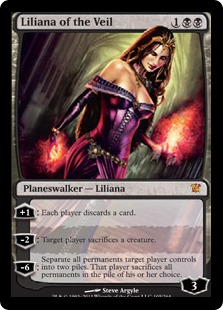
I took copious notes and statistics as I went through and any particularly interesting and relevant ones are included in addition to the research I was actually conducting. Hopefully they will serve to provide additional color to my results and insight into my conclusions.

I looked up the consensus wisdom about whether Abzan was favored or unfavored before each test, partially to guide how I approached the matchup (I wasn't an Abzan player before this test) and to provide some guidance for the validity of the testing. I will include the consensus evaluation alongside my own findings.

Edit: When all was said and done, I was actually really conflicted about Stoneforge Mystic in Abzan. Playing Liliana of the Veil on curve was so powerful that I didn't want to play Stoneforge on turn two if I also had Liliana. Tutoring for a card and then not playing it while discarding cards was a bit inefficient, though it was correct. Had I been more flexible about my testing methodology and allowed myself to change playstyles more often I think that the Infect and Ad Nauseam matchups would have been more in Abzan's favor.

The Stoneforge Data

I will begin by discussing Stoneforge Mystic herself. For the most part, the way I played Mystic did not change between matchups so it makes sense to deal with the associated data separately. Unless otherwise noted, I played Mystic at the earliest opportunity possible opportunity and fetched Batterskull.

  • Opening Hands Containing Mystic: 54%
  • Games including Mystic: 72%
  • Average Mystic Turn: 3.80
  • % Total Games Mystic Played on Turn 2: 49%

This is remarkably close to the results that Sheridan reported. The decreased average Mystic turn is most strongly the result of play adjustments made for the Jeskai matchup. The increased turn two percentage comes from the additional games played and mulliganing decisions, held down again by the Jeskai adjustment, which will be explained in the appropriate section.

Edit: As mentioned above, I think that I really should have delayed playing Mystic more often, giving me a higher average Mystic turn.

Data

Without further ado, in the order that I tested them, here are the results of my investigation by deck with sideboarding information. The specific decklists are in my article from last week. I didn't record sideboarding strategies from my opponents unless they changed them because of Mystic. Also, I never made matchup-specific considerations for my game one mulligans to try and keep things as "real world" as possible.

Infect

Stock List

The community believes that Abzan is favored thanks specifically to Lingering Souls, but it needed disruption to be safe. I tended to mulligan for Souls and/or Inquisition in all my matches as a result.

  • Game One Win %: 48% (24/50)
  • Match Win %: 64% (32/50)

Abzan Sideboarding:

-2 Painful Truths
-2 Tasigur, the Golden Fang

+1 Engineered Explosives
+2 Fulminator Mage
+1 Curse of Death's Hold

Games were not expected to go long and grinding wasn't a factor. Either Abzan died quickly or Infect was successfully exhausted in the opening few turns. I lost a number of game ones due to hands with unplayable Tasigurs, or tapping out for Truths, so they get cut rather than interactive cards.

Losing the dead cards for more answers to Inkmoth Nexus and Blighted Agent drastically improved the matchup, proving the consensus correct. The few games Curse hit play my opponent scooped.

Mystic Abzan

I mulliganed a little less because of keeping hands with Stoneforge Mystic and disruption, but that didn't impact the matchup very much. It was decent against Glistener Elf, but less effective than Souls had been.

  • Game One Win %: 50% (25/50)
  • Total Match Win %: 62% (31/50)

Abzan Sideboarding:

-1 Sword of Feast and Famine
-1 Tasigur, the Golden Fang
-1 Scavenging Ooze

+1 Sword of Fire and Ice
+1 Engineered Explosives
+1 Slaughter Pact

I was decided that the additional creature kill was more important here than discard, so I swapped swords. Explosives and Slaughter Pact were the best removal in the sideboard and I couldn't cut too many threats or any interaction to bring in more. In the end I didn't end up missing the Fulminator Mages and it didn't affect the matchup. I did miss the "I win" aspect of Curse several times. Maelstrom Pulse didn't have much impact game one so I didn't think it necessary games two and three.

Edit: The only real effect was on Glistener Elf kills. Batterskull made them a little more difficult, but Blighted Agent and Inkmoth Nexus don't care about a ground-pounder. Were Mystic to be unbanned I suspect Infect would shift from Elf to Plague Stinger. A slightly slower goldfish, but more reliable.

Burn

Stock List

Burn used to be considered a very good matchup for Abzan, but that was when it ran Kitchen Finks maindeck. Opinions on whether Siege Rhino actually replaces Finks appears mixed, and consensus has weakened on the matchup. I'll take the assumption that it has moved to being more even these days.

  • Game One Win %: 40% (20/50)
  • Total Match Win %: 52% (26/50)

Abzan Sideboarding:

-2 Painful Truths

+2 Timely Reinforcements

Truths cost too much life and Timely was just as many cards if you follow the Philosophy of Fire. Nothing else was expected to have an impact. Thoughtseize was not cut because it gained an average of one life per use. There was also nothing else I wanted to bring in.

Burn Sideboarding:

-3 Searing Blaze

+3 Path to Exile

On the Draw:

-1 Monastery Swiftspear
-1 Goblin Guide

+1 Skullcrack
+1 Deflecting Palm

Abzan didn't give Burn that many targets for Blaze so they were cut for the Siege Rhino answers. On the draw creatures were shaved on the assumption that they would be neutralized earlier and that Burn would have to play a longer game.

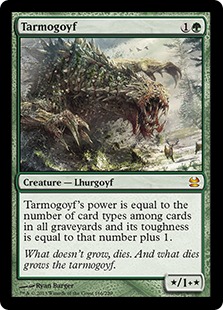
The extra lifegain was very important to pulling up Abzan in games two and three, but most wins still came from early disruption followed by Tarmogoyf. Siege Rhino was impactful, but also easy to anticipate and counter with a sandbagged Atarka's Command or Skullcrack, frequently resulting in Burn victories.

Mystic Abzan

I mulliganed fairly aggressively for Mystic in games two and three, assuming that Batterskull would be very important.

  • Game One Win %: 66% (33/50)
  • Total Match Win %: 60% (30/50)

Batterskull was quite important, and in game ones Burn only won once when it was played turn three thanks to a lot of Skullcracks.

Abzan Sideboarding:

-1 Sword of Feast and Famine
-2 Thoughtseize
-1 Maelstrom Pulse

+1 Sword of Fire and Ice
+2 Duress
+1 Scavenging Ooze

The Sword was changed only because protection from red was relevant. Pulse was unnecessary, and with fewer lifegain spells and Duress available, Thoughtseize was less necessary.

Burn Sideboarding:

-4 Eidolon of the Great Revel
-4 Lava Spike

+4 Destructive Revelry
+1 Searing Blaze
+3 Path to Exile

My opponent wasn't sure what to take out, but knew what to bring in. Answering Stoneforge and Batterskull was the priority and it happened enough to improve the win percentage. I was frequently forced to slow-roll Mystic thanks to hands containing multiple answers, which meant I often had no pressure.

Edit: My test partner kept testing to work out his sideboard strategy. He believes that Eidolon was correct but only one Spike should have been cut for Searing Blaze with no Paths. The critical thing to answer was the Batterskull and he now believes that you have to just race the other threats and forgo answering them.

Ad Nauseam

I know that the Worlds coverage team claimed that combo decks are good against GBx decks, but in my experience the matchup is slightly tilted in GBx's favor, since disruption plus a clock is good against combo and that's all GBx does. This is especially true of combo decks that require multiple cards to win.

Stock Abzan

Consensus was mixed, with the stronger one saying Ad Nauseam is favored. I suspect the dissent comes from the recent addition of Collective Brutality.

  • Game One Win %: 42% (21/50)
  • Total Matches Won: 46% (23/50)
  • Ideal Abzan Opening Hands: 24% (12/50)
  • Ideal Abzan Opening Win %: 91.7% (11/12)
  • Times Ad Nauseam killed itself: 10% (5/50)
  • Times Ad Nauseam would have died anyway: 60% (3/5)

A few things to explain: by "ideal Abzan opening" I mean Thoughtseize, Tarmogoyf, Liliana openings. Ad Nauseam killing itself counted the times it died to Spoils of the Vault, either from exiling all its win conditions or actually killing itself from life loss. My opponent was usually forced to play it to prevent dying next turn and more often than not it didn't work.

Abzan Sideboarding:

-4 Path to Exile
-3 Scavenging Ooze

+3 Stony Silence
+2 Fulminator Mage
+2 Surgical Extraction

Take out dead cards, add in less dead cards. Extraction comes in because taking all of a combo piece, especially Ad Nauseam itself was frequently game over. This was balanced by how powerful Leyline of Sanctity was against Abzan.

Mystic Abzan

It was correct to find Sword of Feast and Famine in this matchup. While the discard was too slow to stop a fast combo, it helped tighten the screws and ensure victory.

  • Game One Win %: 40% (20/50)
  • Total Matches Won: 48% (24/50)
  • Times Ad Nauseam killed itself: 16% (8/50)
  • Times Ad Nauseam would have died anyway: 87.5% (7/8)

I really missed the additional Thoughtseize in the other Abzan list. Sword never won a game where I was behind, but it put me over the top of a few.

Abzan Sideboarding:

-3 Path to Exile
-1 Tasigur, the Golden Fang
-1 Scavenging Ooze
-1 Lingering Souls

+2 Stony Silence
+1 Maelstrom Pulse
+2 Duress
+1 Liliana of the Veil

All the extra discard had a significant impact, as did an additional answer to Leyline.

Edit: I often didn't want to play Mystic at all in this matchup because it was a slower clock than anything else. You could never take a turn off of playing Liliana to use Mystic, so Tarmogoyf was almost always better. The ideal Abzan hand I describe was far more reliable than Mystic. It might be right to cut them entirely in this matchup.

Merfolk

Full disclosure: by this point I was well over 300 matches in with the two Abzan decks and the practice was having an effect on the results. My play and subsequent win rates improved by an unquantifiable amount as I moved through the decks.

Stock Abzan

Based on my experience I expected this to go Merfolk's way. Abzan has less removal than Jund, and Merfolk can power through Lingering Souls more easily than other aggro decks. Abzan wins when it can race with large creatures.

  • Game One Win %: 36% (18/50)
  • Total Matches Won: 44% (22/50)

In game one Merfolk's speed and mana disruption were decisive and Abzan struggled to find its feet. It required a critical mass of answers plus a good clock to power through Merfolk's redundancy, and that didn't come together that often.

Abzan Sideboarding:

-3 Thoughtseize
-1 Lingering Souls
-2 Tasigur, the Golden Fang

+1 Engineered Explosives
+2 Timely Reinforcements
+1 Curse of Death's Hold
+2 Damnation

Take out the less impactful or slow cards and find sweepers and board-cloggers. Truths stayed because you really needed to find a sweeper or two to win.

It didn't change between decks, but I did record Merfolk's sideboarding.

Merfolk Sideboarding:

-4 Aether Vial
-2 Spell Pierce

+3 Tectonic Edge
+3 Relic of Progenitus

Merfolk wants more mana distruption and cantrips rather than tempo cards. Relic also answers Ooze, Tarmogoyf, and sometimes Souls.

Mystic Abzan

The plan was to use Batterskull to race as much as possible. Having slightly less disruption made this far more important.

  • Game One Win %: 44% (22/50)
  • Total Matches Won: 46% (23/50)

Access to Batterskull did make racing easier and made Lingering Souls much more impressive.

Abzan Sideboarding:

-2 Thoughtseize
-1 Tasigur, the Golden Fang
-1 Sword of Feast and Famine

+1 Scavenging Ooze
+1 Engineered Explosives
+1 Slaughter Pact
+1 Maelstrom Pulse

Having fewer sweepers was crippling for the deck and the win percentage suffered as a result. Swords were swapped mostly for protection colors as Fire and Ice killed very few creatures when Abzan wasn't going to win anyway.

Edit: I was generally unimpressed with the Swords. Their impact was unexpectedly low in a lot of games. I think two Batterskulls would be more reliable in actual practice.

Death's Shadow

Stock Abzan

Consensus apparently hasn't been reached about Abzan vs. Death's Shadow, except that Abzan really needs to watch out for an instant kill. On the one hand Abzan is good against Zoo but it's not so good against trampling double-strikers.

  • Game One Win %: 46% (23/50)
  • Total Matches Won: 52% (26/50)
  • Game One Death's Shadow is Zoo: 62% (31/50)
  • Game One Win %, Death's Shadow is Zoo: 65.2% (15/23)
  • Adjusted Win %, Death's Shadow is Zoo: 48% (15/31)
  • Game One Death's Shadow Combos: 38% (19/50)
  • Game One Win %, Death's Shadow Combos: 34.8% (8/23)
  • Adjusted Win %, Death's Shadow Combos: 42% (8/19)

By Zoo vs. Combo I mean the games where Death's Shadow played creatures and attacked over a number of turns and ground down Abzan's life total like a traditional aggro deck, vs. wins by combining Temur Battle Rage and Become Immense. Pulling off the combo was harder than expected. DS was able to find the pieces easily enough---it was keeping Temur Battle Rage and Become Immense in hand long enough that proved challenging. The strategy for Abzan was to not lose and let DS nearly kill itself, then win with Spirit tokens.

Abzan Sideboarding:

-2 Painful Truths
-3 Scavenging Ooze

+2 Timely Reinforcements
+1 Engineered Explosives
+2 Damnation

In comes the anti-creature cards, out go clunkers. Gaining extra life and sweeping the board was very helpful. Ooze never got to grow due to mana constraints and Truths was unnecessary. I wanted to leave in as many naturally large creatures as possible.

Death's Shadow Sideboarding:

On the Draw:

-3 Steppe Lynx

+3 Hooting Mandrills

On the play my opponent thought that the maindeck was fine, but on the draw they thought my discard would assist playing Mandrills early, which was correct for the most part.

Mystic Abzan

Batterskull used to be very good at beating fair creature decks, so I assumed that reliable access would improve things for Abzan.

  • Game One Win %: 44% (22/50)
  • Total Matches Won: 52% (26/50)
  • Game One Death's Shadow is Zoo: 58% (29/50)
  • Game One Win %, Death's Shadow is Zoo: 81.81% (18/22)
  • Adjusted Win %, Death's Shadow is Zoo: 62% (18/29)
  • Game One Death's Shadow Combos: 42% (21/50)
  • Game One Win %, Death's Shadow Combos: 18.18% (4/22)
  • Adjusted Win %, Death's Shadow Combos: 19% (4/21)

I didn't record whether the change in the number of Zoo vs. Combo games was because I disrupted the combo less or they found it more. Still, Abzan logged an improvement in games where DS was forced to play fair like traditional Zoo.

Abzan Sideboarding:

-1 Sword of Feast and Famine
-1 Scavenging Ooze
-1 Tasigur, the Golden Fang

+1 Sword of Fire and Ice
+1 Engineered Exposives
+1 Slaughter Pact

I swapped Swords mostly because discard wasn't very relevant by the time it hit and I wanted to draw more answers.

Death's Shadow Sideboarding:

-2 Mutagenic Growth

+1 Ancient Grudge
+1 Dismember

On the Draw:

-3 Steppe Lynx

+3 Hooting Mandrills

My opponent wanted some answers to Batterskull and cut the least impressive card to do so.

Edit: This matchup was really weird to test since even when I was very far ahead, I never felt safe. Couple that with all of Death's Shadow Zoo's cantrips and I never knew what to expect, which is weird for a Thoughtseize deck. I've tested Jund against this deck and felt much better since I could Bolt the face to win against the combo.

Jeskai

Last matchup!

Stock Abzan

Consensus says its a very even matchup and whoever wins the attrition fight wins the match. Nahiri gives Jeskai the potential for free wins, but in practice she never does unless Jeskai already won the attrition fight.

  • Game One Win %: 48% (24/50)
  • Total Matches Won: 50% (25/50)
  • Game One Jeskai suspends Ancestral Vision turn one: 46% (23/50)
  • Game One Jeskai suspends Ancestral Vision turn one and wins: 87% (20/23)

Winning attrition by drawing cards was quite good and when Jeskai drew more at no cost it had the advantage.

Abzan Sideboarding:

-3 Abrupt Decay

+1 Painful Truths
+2 Fulminator Mage

Extra cards and mana disruption are pretty effective against Jeskai.

Jeskai Sideboarding:

-3 Remand
-1 Vendilion Clique

+2 Spreading Seas
+1 Celestial Purge
+1 Wrath of God

Same plan applies for Jeskai. Remand is great only against flashbacked Souls so it was cut for more impactful cards.

Mystic Abzan

After the practice games we adjusted how I played Stoneforge Mystic. Initially I just played it as soon as possible, but that frequently allowed Jeskai to adjust how it sequenced its plays to answer the equipment more effectively, so I began playing it as the last threat once Jeskai was down on cards.

  • Game One Win %: 54% (27/50)
  • Total Matches Won: 52% (26/50)
  • Game One Jeskai suspends Ancestral Vision turn one: 52% (26/50)
  • Game One Jeskai suspends Ancestral Vision turn one and wins: 80.08% (21/26)

Jeskai got a few extra Ancestrals on the draw due to Abzan missing one Thoughtseize, in addition to normal variance. The increased wins came from Stoneforge being a threat by itself and then finding another threat.

Abzan Sideboarding:

-4 Abrupt Decay
-1 Path to Exile

+1 Liliana of the Veil
+2 Duress
+1 Scavenging Ooze
+1 Sword of Fire and Ice

Additional disruption and another Sword to search for to make Spirits into real threats.

Jeskai Sideboarding:

-3 Remand
-1 Timely Reinforcements
-1 Vendilion Clique

+2 Spreading Seas
+1 Celestial Purge
+1 Wrath of God
+1 Wear // Tear

An answer was required for all my equipment. My opponent tried Stony Silence and found it dead too often to use. The lack of card draw hurt more than expected.

Edit: As I mentioned, simply tutoring for Batterskull was shockingly powerful. That card was surprisingly hard to answer if it resolved. Even with Stony Silence around, sometimes the 4/4 just went unanswered. Playing two maindeck rather than a Sword would have been better for Abzan.

Limitations

No data set is ever perfect, and as a result no analysis will ever be perfect. There are limitations and flaws in any study, and unfortunately my testing was no exception. What I didn't realize when testing began was how the different sideboards would impact matchups. Mystic lacking stock's sweepers had a noticeable effect on the creature matchups, as did the extra discard against combo and control for Mystic. As a result the deviation between total matches won was fairly small, due to cards missing from both sideboards having greater-than-expected impact on the overall win percentage.

To account for that I will be focusing my analysis on the game one win percentages. Maindeck composition between the test decks is very similar and also isolates the impact of Stoneforge Mystic rather than Stoneforge plus sideboard cards, so it is more useful analytically.

Analysis

With our limitations in mind, lets look at the important numbers together.

  • Stock vs. Infect Win %: 48% (24/50)
  • Mystic vs. Infect Win %: 50% (25/50)
  • Stock vs. Burn Win %: 40% (20/50)
  • Mystic vs. Burn Win %: 66% (33/50)
  • Stock vs. Ad Nauseam Win %: 42% (21/50)
  • Mystic vs. Ad Nauseam Win %: 40 % (20/50)
  • Stock vs. Merfolk Win %: 36% (18/50)
  • Mystic vs. Merfolk Win %: 44% (22/50)
  • Stock vs. Death's Shadow Win %: 46% (23/50)
  • Mystic vs. Death's Shadow Win %: 44% (22/50)
  • Stock vs. Jeskai Win %: 48% (24/50)
  • Mystic vs. Jeskai Win %: 54% (27/50)

That's still pretty messy. Let's simplify things by tracking the change between versions.

  • Infect Win % Change: 2%
  • Burn Win % Change: 26%
  • Ad Nauseam Win % Change: -2%
  • Merfolk Win % Change: 8%
  • Death's Shadow Win % Change: -2%
  • Jeskai Win % Change: 6%

Clearly Stoneforge had an effect on some matchups more than others. We can discount the 2% changes, as those represent only a single game's difference, easily ascribed to normal variance. Jeskai, at only three games difference is right on the cusp of being relevant. I will ascribe a weak impact there, with Merfolk having a moderate impact. However Burn has been severely and unequivocally impacted by Stoneforge Mystic. In fact if you group the aggressive decks together you get a total impact of +34% for Abzan.

That would point towards confirming our hypothesis that Mystic would slow the format down by preying on aggro decks. However, that is not the full story. We must also consider Sheridan's results with Affinity, and those indicate a worrying trend.

If we group the decks by fairness and look at the match results again:

Fair

  • Burn: 26%
  • Merfolk: 8%
  • Jeskai: 6%

Less than Fair

  • Death's Shadow: -2%
  • Infect: 2%
  • Affinity: 12%, based on Sheridan's results vs. Frank Karsten's expectations, reported by Sheridan as low-impact.

Unfair

  • Ad Nauseam: 2%

Stoneforge Mystic affected fair decks far more often and more strongly than it did less-than-fair decks. This stands to reason when you consider that Batterskull is just a beater against combo and a much slower one compared to Tarmogoyf. Meanwhile it actively works against the aggro strategy and dominates the mid- to late-game. Even against midrange decks it is a strong, hard-to-kill threat. This split is corroborated, though not confirmed, by investigating the impact on the fair Death's Shadow games vs. the unfair games.

  • Stock vs. Zoo style win %: 48%
  • Stock vs. Combo style win %: 42%
  • Mystic vs. Zoo style win %: 62%
  • Mystic vs. Combo style win %: 19%

Which yields an end result of:

  • Total change vs. Zoo style win %: 14%
  • Total change vs. Combo style win %: -23%

I doubt that Mystic is the actual reason the combo win rate got so much worse, but the results are the results. Adding Mystic to Abzan dramatically increased its win rate when Death's Shadow played fair and hurt its chances at beating unfair attacks.

Impact

So what does all this mean? If my results accurately model real Modern, then it is fair to say that Stoneforge Mystic would not have an absolutely warping effect on the metagame. It is a powerful card but not truly degenerate, and it ultimately advantages fair midrange decks against aggressive decks.
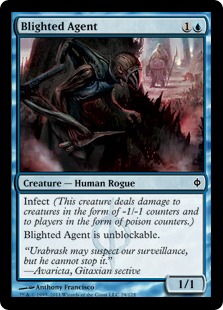
Blighted AgentThe problem comes when we consider what kind of aggressive decks will feel the blow. Fair decks will be impacted much more strongly than unfair decks. Infect definitely doesn't care about Batterskull any more than it does Tarmogoyf, and Affinity can care but it has plenty of options to get around it and win anyway. When Death's Shadow is playing fair it cares as much as any Zoo type deck, but when it assembles its combo kill then Batterskull doesn't matter. I would therefore expect them to try to combo more often.

The only reason that Batterskull would change an unfair combo matchup is by gaining more life than the combo can erase, which is hard considering how slow a clock Skull is compared to a turn two Tarmogoyf.

As a result, I would expect that in the wake of Stoneforge Mystic being unbanned there would in fact be a decrease in the total number of aggressive decks in Modern as Merfolk, Zoo, and Burn take a hit. This would slow things down as more players try slower decks with Mystic. However, after the initial slowdown, the format would accelerate as players notice that unfair decks aren't affected. This will push players to play more Infect, Affinity, and combo decks and the aggro players will try to incorporate more unfair elements to fight back against Batterskull.
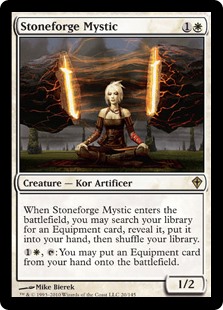
Stoneforge MysticThere is also the effect on other midrange decks to consider. The Jeskai results suggest that those decks that play Mystic will have an advantage over those that don't. I suspect that had the Mystic deck run Painful Truths, Abzan would have been more strongly favored. The fact that Mystic still pushed it over Jeskai suggests that it would drive the format towards greater homogeneity. If you have to play Stoneforge to win, that does limit your deckbuilding options.

Could we adapt? Possibly. The Burn matchup would have been much more in Abzan's favor if not for Destructive Revelry. Adding more targeted artifact removal might keep it in check, but I suspect that if players start doing that then Mystic decks will similarly adjust and run extra equipment and protection for it. This also doesn't consider whether or not decks can afford the space with unfair decks running around.

Conclusion

Based on the results of my testing Stoneforge Mystic in Junk Abzan I recommend against unbanning. My results partially prove the hypothesis true, but analysis of the impact suggests that over the long term it will have the opposite effect.

While its power is manageable and it would give players more reason to play white, its impact would not be positive. It negatively impacts the viability of fair aggro decks and non-Stoneforge midrange decks, while having a negligible impact on the less fair decks. The likely outcome would be a shift to more unfair decks and the speed of the format increasing to try to ignore and invalidate Batterskull and Swords. Therefore there is no reason to unban Stoneforge Mystic.

I'm sure that many of you have questions about my conclusions, methods, or more specifics about how matchups played out. As always I am happy to discuss them with you in the comments. Next week, tune in for something completely different.

Edit: I should stress that my conclusions are based on how Stoneforge would actually impact decks rather than power level. I am less leery of Mystic based purely on power than I was, but after this was written I did some additional tests to confirm my results. The results were consistent: Stoneforge Mystic has a greater impact against fair decks than unfair decks. This takes Mystic out of consideration for unbanning in my mind, since fair decks struggle to gain ground in Modern as is, and I would rather not add another hurdle for them. If the format moves more fair and stays that way I could see Mystic being removed but right now it is not a serious consideration.
Insider: Drawing Inferences From Masterpieces

Are you a Quiet Speculation member?

If not, now is a perfect time to join up! Our powerful tools, breaking-news analysis, and exclusive Discord channel will make sure you stay up to date and ahead of the curve.

Hello, all! I hope everybody out there had a happy holiday and is enjoying the holiday break (Hip, hip, hurray for Christmas vacation!). I hope everybody out there had a wonderful 2016 and that 2017 ends up being even better.

Not to be outdone by the holiday season, Wizards took the opportunity to one-up Santa and Baby Jesus by releasing a complete list of the upcoming Aether Revolt Masterpieces. I've got to admit, they look terrific and I have little doubt that the vast majority of players will be very excited about opening and collecting these cards.

Personally, I'm not a huge fan of foil cards because I don't use them in tournament play. However, from a collectibility standpoint I think making Masterpieces an "every set" occurrence was a grand-slam move for Wizards. It gives people opening packs the opportunity to experience something special and unique, i.e. the lottery effect.

There has already been a lot written about how Masterpieces becoming a mainstay in all new sets will change Standard finance moving forward, suppressing Standard staples and more. Aside from the obvious immediate price impact to specific cards, there is still a lot of finance space yet to be explored.

Today, I'm going to take a look at the growing sample size of Masterpiece crops (from Battle for Zendikar, Oath of the Gatewatch, Kaladesh, and now the upcoming Aether Revolt) and begin to make speculative guesses about what the future may hold for potential investors.

Which Cycles Have Been Pushed So Far?

Our sample size may be relatively small—only four sets worth—but there are some trends that can be discerned.

It is also worth noting that in looking for trends we are limited to only lands (Zendikar Expeditions) and artifacts (Kaladesh Inventions). However, I think that we can look at the types of cards that have been printed so far and begin to predict which cards we may be likely to see in the future.

I've written at length on my wishes that Wizards would be more transparent about their B&R leanings. In particular, I wish that they would make public the cards that are on their "closely watching" list when it comes to possible bannings.

Perhaps the Masterpiece series is a window into what Wizards believes is safe and unsafe...

One thing that I've noticed over the course of exploring the Kaladesh and Aether Revolt Masterpieces is that there are a ton of Modern Affinity cards: Mox Opal, Steel Overseer, and now Arcbound Ravager and Ornithopter. These cards are unilaterally used in Modern Affinity and thus it seems reasonable that Wizards wouldn't print super-premium versions of the cards if it was on their radar to ban something from the deck!

Calls to ban Mox Opal are a mantra that creep up often, and have been a mainstay in discussion on Modern for years. However, I think it's reasonable to assume with so much attention being paid to Affinity staples as premium Masterpieces that it's unlikely.

There was an error retrieving a chart for Mox Opal

There is always a chance that Affinity is getting featured just because Kaladesh Inventions can only be artifacts, but it could go deeper.

Another interesting fact is that Zendikar Expeditions didn't feature the Affinity mainstay rare lands, like Inkmoth Nexus, Glimmervoid or Blinkmoth Nexus. In particular, Inkmoth Nexus would have been a great land to reprint because it sees play in both Affinity and Infect. However, when we look back to what Modern looked like before BFZ was released, it was pretty clear that Affinity was one of the decks being seriously considered for a banning. The plot thickens.

Perhaps, these popular premium Affinity lands were not printed in BFZ because Wizards didn't want to experience backlash if they were forced to ban Mox Opal... Obviously, this is all speculation, but it's plausible.

It is also interesting that Eye of Ugin was in the mix as a Masterpiece and ended up needing to be banned. I take that as a sign that they had absolutely no idea that Eldrazi were going to be as big of a problem as they ended up being! I suspect that if they would have had even the slightest inkling that Eye would be banned that it would not have been selected as a Masterpiece (and that perhaps Eldrazi Temple might have gotten the nod).

So, perhaps investigating which cards are appearing as Masterpieces is an insight into what they are weary of possibly banning from Constructed.

Noticeably Present in Masterpiece Form

Let's take a look at some prominent cards that are present in Masterpiece form.

There was an error retrieving a chart for Ensnaring Bridge

Primarily a Modern staple and used in the infamous Lantern Control deck, which is also a Mox Opal deck. If my hypothesis is correct, an Opal ban is feeling more and more unlikely.

There was an error retrieving a chart for Sphere of Resistance
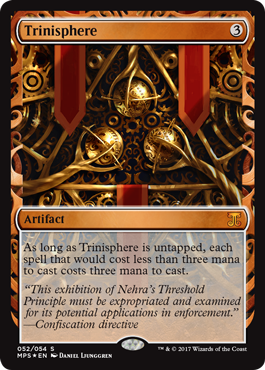
There was an error retrieving a chart for Trinisphere

These are trademark Mishra's Workshop cards. I find it unlikely that Wizards would encourage Vintage Shop players to buy in on super premium foils if they were planning on nerfing the deck in the future. I don't think Shop will ever go bye-bye from Vintage, but this appears to be another confirmation of what I've been saying all along. Shop is effectively unrestrictable.

Noticeably Absent

There was an error retrieving a chart for Sensei's Divining Top

Doesn't Top feel like exactly the kind of card that should be a Masterpiece? Did you even notice its absence across the whole block of prominent reprints in a mono-artifact universe? If you apply my theory about Masterpiece reprints as an indicator of how safe cards are in their respective formats, I think this creates a strong case that Top may be at risk of being banned in Legacy.

Common Masterpieces? Good Grief!

Personally, I love the idea of creating Masterpiece versions of popular common and uncommon cards.

There was an error retrieving a chart for Ornithopter

Poor Ornithopter Masterpiece has been getting a lot of guff, but I anticipate it will be a very popular Masterpiece that players and collectors will want to get their hands on. The idea of extremely rare versions of highly-played commons will drive a lot of demand for those singles.

I think that Ornithopter is a tester card to see how the market and public react to it. Will people be irate and raging when they open a Masterpiece Ornithopter? Or will people be cool with it? Will players and collectors want these cards to max-bling out their Affinity decks? Personally, I think that people will want these cards and they will maintain solid value. We've already learned that Masterpieces can't all have super expensive price tags, and it is nice to have a range.

We also don't want all of the Masterpieces to be super expensive because it wreaks havoc on the Standard singles prices. As we saw with BFZ, too many expensive Expeditions or Masterpieces in one set makes the actual set cards worth too little.

I think we see Wizards experimenting with creating a range of values among the Masterpieces in order to balance the prices of the set in a more palatable way.

Personally, I love the idea of common and uncommon Masterpieces. Can you imagine how desirable cards like Brainstorm and Ponder in Masterpiece form would be? Not just how expensive, but how cool? Lightning Bolt, Blighted Agent, Rhystic Study, Terminate, Stinkweed Imp, Counterspell, Pyroblast, and Relic of Progenitus are other examples of Masterpieces that would be highly desirable despite featuring common cards.

Closing Thoughts

I'm pretty excited about Aether Revolt and impressed with the cards that are being featured as Masterpieces this time around. There are certainly more than a few cards that I'm going to be looking to pick up and add to my Danger Room. It's funny how even though I don't collect foils, I still end up collecting foils. All things considered, Wizards did a good job this time around and I'm also interested in using some of the information to predict possible banned list issues.

Insider: Prices on Paper vs. True Profit

Are you a Quiet Speculation member?

If not, now is a perfect time to join up! Our powerful tools, breaking-news analysis, and exclusive Discord channel will make sure you stay up to date and ahead of the curve.

Welcome back, readers!

Today's article will focus on a fundamental aspect of buying/selling items. You don't make a profit when a card's value goes up—you make a profit when you sell or trade the card at its new value. And the actual money you receive in these transactions can differ markedly from the numbers you see in price charts.

A Concrete Example

Superfriends decks built around planeswalkers have been a popular option in Commander for some time. The printing of Atraxa, Praetors' Voice has renewed interest in these archetypes, which can make especially good use of a repeated proliferate effect. As a result, several cards that interact directly with planeswalkers have seen gains, including The Chain Veil, Teferi, Temporal Archmage and Ajani Steadfast.

Let's take a look at two of these recently spiked cards.

The Chain Veil

I myself didn't stock up on The Chain Veil, though I did purchase two foils for $8 each back in November 2014. I did think the card had strong Commander potential (hence why I went with foil versions).

There was an error retrieving a chart for The Chain Veil

You could buy this card for around $2 for months. Then all of a sudden we see a nice price spike. The card hits $6 before dropping back down to the $5 mark. So if you had been buying up copies at the $2 mark you may look at your stack and think, "Wow, I just made 250% in profit!" But have you?

You can't go into Target and trade in four copies to buy the latest blu-ray movie you wanted, nor can you hand one to the cashier at McDonald's to cover your lunch. I realize that sounds a bit facetious but it's common knowledge that (outside of major Magic events or your local game store) Magic cards don't act like regular currency. They have to be converted into regular currency via transactions.

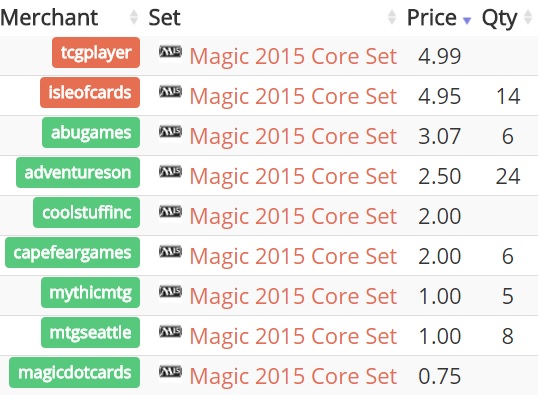
So let's see the actual buylist prices for The Chain Veil.

thechainveil-buylists

Looking to vendors outside of Trader Tools, we also know:

  • Star City Games is paying $2 for NM copies.
  • Channel Fireball is paying $2.50 (for up to 50 copies).

So let's run the numbers. Say you bought 100 copies of The Chain Veil. You could sell:

  • 6 copies to ABU Games for $18.42
  • 50 copies to Channel Fireball for $125
  • 24 copies to Adventures On for $60

And your remaining 20 copies you could cash out at a break-even(ish) price. So all in all you would have invested $200 and made at most $43.42, not including the cost of shipping the cards to said dealers (we're also assuming all copies are actually NM). If we include just the shipping cost we're likely looking at more like $30 in profit.

To be fair, this is a 15% profit margin, which is actually pretty healthy in the business world. But it's a far cry from that 250% figure we initially thought of.

This is also the minimum profit you could expect to make on this spec, because you could throw a bunch of copies up on TCG Player (even at, say, $3.50) which would put you ahead of the buylist prices. But isn't it crazy how a card can jump up 250% in a week and even if we'd stockpiled them we might only make 15% profit?

Another caveat to this is that buylists shift slower than selling prices (for the most part). The major stores don't want to get caught up in a hype-based jump and then lose out when the hype stalls and the card plummets. They tend to simply wait for the market price to reach a steadier state before raising prices. So it is entirely possible that we'll see other buylists start to move upward, which would allow for additional guaranteed minimum profit.

Ajani Steadfast

Here's another card that benefited (most likely) from the printing of Atraxa. Along with Teferi, Temporal Archmage, Ajani Steadfast has seen strong growth in the past month or so.

There was an error retrieving a chart for Ajani Steadfast

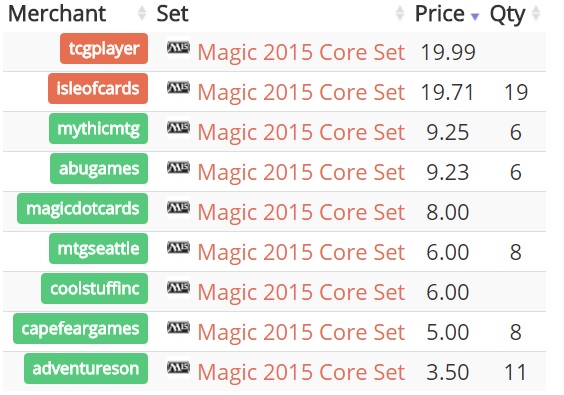
For almost two years, Ajani buylisted in the $4-$5 range and retailed in the $6-$8 range. With the recent spike in Ajani we now have a retail price of almost $20 and buylist prices ranging from $5-$9.25. If we had spent the same $200 as above on Ajani Steadfast, we could have purchased 29 copies (assuming we bought them for an average of around $7 each).

ajanisteadfastbuylist

  • SCG is paying $6 per copy.
  • Channel Fireball is paying $6 per copy.

So again we would sell:

  • 6 copies to MythicMTG for $55.5.
  • 6 copies to ABU Games for $55.38.
  • Finally, if we review MagicDotCards we see that the NM buylist is actually $6.40 ($8 is only for Gem Mint). This is less than what we paid and we'd be losing $0.6 per copy if we sold out. Meaning we will hold all additional copies in the hopes that other buylists go up.

So this time our total minimal profit (again, barring shipping costs and condition downgrades) is $26.88. With shipping to three separate vendors it's likely closer to $20, giving us a decent profit margin of 32%. Again it's important to keep in mind that this is the minimum profit assuming we couldn't out any copies at prices closer to retail via regular sales.

But even then we had a card go from $7 to $20 (a 285% gain) and we're still only making around 32% profit.

The Takeaway

The reason I wanted to emphasize these two examples is because when you first start out speculating it's very easy to get carried away when one of your spec targets jumps in value. The rush you get from a called spec (especially one a lot of people disagreed with you on) is a pretty powerful high, and it's easy to just keep buying into more and more specs, assuming the tide will always keep rising.

Thus it's absolutely critical to understand that just because the retail price on a card jumps, that doesn't mean you've actually made a profit. Profits occur only after you've converted those cards into cold hard cash.

Now, obviously the profit margin is heavily dependent on your initial investment. For this exercise I assumed you purchased the cards at retail prices; you could also set up your own buylist, either as a store or locally. If you can acquire your spec targets for less than retail, then your profit margin will go up (potentially by a considerable amount), but you may have more difficulty acquiring copies as well.

Remembering Risk

One other factor that isn't calculated in these profits is the risk associated with the investment. I realize this is a very amorphous (and exceedingly difficult) factor to include in any type of calculations, but it is one we need to at least keep in mind.

After all, if we had been stocking up on Master Biomancer (which was a solid spec target) then the Commander 2016 reprinting would have shown us a 14% retail price drop and a full 25% buylist price drop.

There was an error retrieving a chart for Master Biomancer

You can look up numerous ways to calculate certain forms of risk, but currently I don't have a great method to apply to Magic cards. I imagine that if someone had a concrete method to calculate risk for Magic specs, they could make a good bit of money selling it to the major stores.

Conclusion

My final thoughts on this matter are simply that we need to understand the true profit we generate from speculating. This means setting realistic expectations, remembering hidden costs like shipping, and understanding that there's always a risk (even if it's extremely difficult to calculate).

If any of my readers do have a good idea of how to approach systematic risk calculation on Magic specs, I'd love to open a discussion, whether on the forums or in the comments below.

Deck Overview- Standard Azorius Vehicles

Are you a Quiet Speculation member?

If not, now is a perfect time to join up! Our powerful tools, breaking-news analysis, and exclusive Discord channel will make sure you stay up to date and ahead of the curve.

We've seen plenty of Vehicles decks in Standard, and the power level of Azorius Flash is no secret, though today's deck puts some of the blue, white, and artifact heavy hitters of Standard to work in a very innovative way. Check out Maruyama25's 5-0 list from a Competitive Standard League:

Azorius Vehicles

Creatures

2 Elder Deep-Fiend
4 Glint-Nest Crane
4 Reflector Mage
4 Scrapheap Scrounger
4 Thraben Inspector
4 Toolcraft Exemplar

Spells

3 Declaration in Stone
3 Fleetwheel Cruiser
2 Skysovereign, Consul Flagship
4 Smuggler's Copter
3 Always Watching

Lands

1 Aether Hub
4 Concealed Courtyard
5 Island
6 Plains
4 Port Town
3 Prairie Stream

Sideboard

1 Declaration in Stone
2 Archangel Avacyn
3 Ceremonious Rejection
2 Fragmentize
3 Negate
2 Stasis Snare
2 Thalia, Heretic Cathar

Glint-Nest Crane isn't the most aggressive card, though it technically increases your artifact count for Toolcraft Exemplar. With there only being 13 artifacts in the deck, you can count on missing with your Crane more than you would like, though with Always Watching in the mix it becomes a formidable 2/4 vigilant flier.

The likelihood of Crane missing and the absence of Gideon, Ally of Zendikar seem questionable to me, though this is the style of deck that is likely to get better with Aether Revolt. I would absolutely be on the lookout for one or two more aggressive artifacts to slot in this deck to make it even more powerful.

Insider: High Stakes MTGO – Dec 18th to Dec 24th

Are you a Quiet Speculation member?

If not, now is a perfect time to join up! Our powerful tools, breaking-news analysis, and exclusive Discord channel will make sure you stay up to date and ahead of the curve.

Hello, and welcome back for the last High Stakes MTGO article of 2016!

The penultimate week of 2016 was one without any buys on my end. Standard and Modern have not been offering a lot of exiting targets for my portfolio lately.

It could, however, be a good time to consider some Standard targets among the Battle for Zendikar and Shadows over Innistrad blocks. These two blocks will rotate out of Standard next fall, and if new cards from these blocks have a chance to shine, it will have to be within the next four to six months.

It's harder for the older cards to spike when a format is established, so the risk is higher with these two blocks. Kaladesh positions, followed by Aether Revolt next, will be best acquired around the release of Amonkhet.

On the other hand, Frontier is really starting to make some noise out there. Enough noise to trigger real, big, and fatty spikes as you may have seen recently. Dig Through Time and Rally the Ancestors spiked significantly last week, seeing their price multiplied by ten or more compared to a month ago. Goblin Rabblemaster, Siege Rhino and Dromoka's Command, some of the presumed staples of this unofficial format, have also confirmed a price rebound lately.

However good this sounds, remember that these price surges are purely speculative at the moment. If this frenzy sustains for a few more days, I will clearly be selling.

I'm also trying to get more liquid these days, another reason why I'm more a seller than a buyer at this time. A certain level of uncertainty for speculators has been floating around for a while, and I would rather hold tix than cards whenever possible.

Let's review what happened in my portfolio this past week. The link to the live portfolio hasn't changed and is here.

Buys This Week

None

Sales This Week

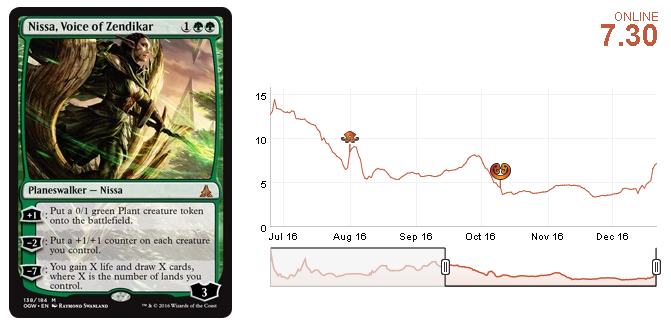
Nissa was gaining some price back, probably due to Oath of Ajani being spoiled last week. While we can certainly imagine a comeback of Nissa, Voice of Zendikar under the spotlight, at this point it's still pure speculation.

I bought Nissa several months ago at 5.7 tix, hoping for a rebound in the 10-15 tix price range after its key role in the oppressive G/W Tokens deck in pre-Kaladesh Standard. Instead, Nissa slowly drifted down to 4 tix. I was not in a mood to test how high this planeswalker could go based only on speculation.

I may be wrong, but this is also part of my strategy to get rid of positions that aren't performing fast enough. I’m trying to be more liquid with my portfolio, and selling Nissa with a 10% profit after being down by about 30% for two and a half months felt like a good move to me. If you have a different perspective it could be worthwhile to hold onto Nissa for a few more weeks.

Following the few copies I initially sold a week and a half ago, I completely closed this position this past week. As with all the other BFZ rare lands, I bought them too early and for too much, but now feels like a good opportunity to exit this position with a moderate profit.

Here as well, I finished selling all the copies of a position I had started to liquidate a week and a half ago. The price is not as high as I wanted, but holding onto Serum Visions gets more and more risky as we approach the release of Modern Masters 2017.

dtk

My initial price target for Dragons of Tarkir (DTK) full sets was 45 to 50 tix, which was reached rather quickly. This fast upward trend may not stop, as Frontier is probably helping pushing DTK prices higher than they should. Still, I’m not willing to push my luck too far. I've already sold five sets over 50 tix—that's more than 40% profit, a great number for a full set spec.

In addition, January often marks a halt in the price increase of full sets that just rotated out of Standard. While we have seen certain full sets maintain an upward trend until the summer, several others have stagnated or even declined. In light of my current returns, and despite DTK prices showing a lot of strength, I won’t wait too long before liquidating all of my full sets. Now I just hope that Magic Origins full sets follow the trend.

fuos

Two foil BFZ mythics that again reached my target price this past week. Opportunities to sell these cards at a profit are rare—often I only manage to find a buyer for one or two copies at a time. I'm very unlikely to actually make a profit on most of my BFZ foil mythic positions; at least I'll make one on these.

On My Radar

I already started selling my DTK full sets and the rest of the stock is likely to follow soon. I'll see how prices evolve in the coming days and weeks, but as I mentioned before I'm likely to sell everything in January.

More generally, and as mentioned in the previous weeks, I'm still paying close attention to Modern prices. I'm trying to transform Modern positions into tix as often as possible these days. My portfolio is likely to see more movement as we approach the release of the first Modern Masters 2017 spoilers.


Thank you for reading,

Sylvain

Insider: Picking Timeframes in the New MTG Finance

Are you a Quiet Speculation member?

If not, now is a perfect time to join up! Our powerful tools, breaking-news analysis, and exclusive Discord channel will make sure you stay up to date and ahead of the curve.

Given the holiday season, my article this week will be somewhat abbreviated. That said, I firmly believe the message should be considered no less important to MTG finance success. But first, let me make an announcement.

MTG Finance Isn’t Dead

I know I have the “doom and gloom” reputation in the MTG finance community—I’m largely okay with that. There are permabears in the stock market as well, and some are very highly regarded among their peers. It’s important to acknowledge the bear case and weigh it against the bull case in any investment decision. I just happen to be more in-touch with the downside.

All that said, Quiet Speculation’s very own Chaz gave me two very immediate, actionable suggestions lately that both led to definitive profits. First, he suggested I purchase Regal Forces from Star City Games during their $1 weekly sale in order to sell to Magic.Cards for $1.60 each. Second, he recommended that I pick up Ajani Steadfasts due to Commander hype.

There was an error retrieving a chart for Ajani Steadfast

Both purchases were profitable immediately upon receipt, and they were all sold within 24 hours of their delivery to my home. Clearly with enough agility and a purposeful strategy, there are still plenty of opportunities to make profits from Magic.

The game as a whole may be in a stagnating correction, but that doesn’t mean there aren’t opportunities out there. Chaz pointed me to this concept firsthand. When combined with arbitrage opportunities from abroad, there are clearly some things worth buying, no matter the health of the game as a whole.

Here Comes the “But”…

There is a caveat to all this. I can’t simply stand here and pound the table demanding everyone start buying Commander staples after spending months highlighting why it’s dangerous to be heavily invested in newer cards now. There has to be some caution involved, and I believe I have pinpointed the best way for me to navigate recent pitfalls of MTG finance.

I believe there are now only two time horizons that work reliably: the extremely short term or the long term.

When dealing in short-term opportunities, it’s critical to remember why you are making your purchases and what your exit strategy is. When I bought Ajani Steadfast it was only because I noticed the card had extremely low stock and I knew it was growing in popularity thanks to Commander. These two factors pointed to an imminent price increase, so I pulled the trigger on a couple copies. My intent was to flip those copies right away, and this is exactly what I did.

A similar story can be told for the Regal Forces I picked up.

There was an error retrieving a chart for Regal Force

I bought 40 copies during the Star City Games sale with one purpose: to buylist them for more. When the copies arrived, I almost hesitated, thinking it would be better to sit on the copies for long-term potential. The card has a loyal casual following, I’m sure, so wouldn’t there be upside in the long run? Luckily I overcame this urge, packaged the cards up, and shipped them for modest profits. I’m reminded here of the adage, “Never turn a trade into an investment.”

For long-term opportunities, I’m referring more towards the drum I have been beating nonstop for many months now. This is the general Reserved List/Old School strategy: picking up rare, collectible gems for long-term gains.

If this is still your main strategy, there’s nothing wrong with sticking to it. Just make sure you have a fully thought-out emergency plan should the market suddenly take another leg lower. Certain cards, such as dual lands, are experiencing additional weakness due to the recent cut in Legacy support, and I don’t know how much more downside remains.

There was an error retrieving a chart for Underground Sea

Additionally, there’s plenty of merit to holding penny stocks for the long haul. I myself have a modest pile of Nephilim and Beck // Calls squirreled away. Penny stocks like these are low on Wizards’ reprint radar and can gradually rise in price to sneak up on Magic players and speculators. Other examples I like are Rainbow Vale, Márton Stromgald, and Koskun Falls—all three of which happen to be on the Reserved List!

There was an error retrieving a chart for Koskun Falls

The Dangerous Chasm In Between

I’m fully convinced there’s plenty of money to be made on the short-term. In addition, buying certain Reserved List cards can offer steady, long-term growth potential. But what about buying cards for the in-between?

This is the part of MTG finance that now worries me most. Those mid-term pickups for formats like Modern (or Frontier?) concern me because of the dangerous reprint potential along with a stagnant tournament scene.

For example, fetches and shocklands should have been tremendous investments in the old world of MTG finance. Now these cards are some of the worst money sinks in recent history. Thoughtseize and Abrupt Decay are two other examples—these cards are ubiquitous across multiple formats and their utility cannot be questioned. Yet for some reason they just can’t seem to gain traction.

There was an error retrieving a chart for Thoughtseize

For the same reason I am nervous about newcomers such as Collected Company, Thought-Knot Seer and Siege Rhino. You would think that these cards have a ton of potential as they gradually age, become scarcer in trade binders, and establish dominance in Modern. But alas, this just hasn’t been the case.

These staples just can’t seem to gain any traction, and to me this is a worrying sign. If Polluted Delta can’t gain in price despite being heavily utilized in Modern, Legacy, Vintage, Commander, and possibly Frontier, then what catalyst will move this card? I’m not so sure, and it’s a major reason why I’m steering clear of any such “mid-term” buys.

There was an error retrieving a chart for Polluted Delta

Wrapping It Up

Despite all my recent negativity, I need to acknowledge that MTG finance is far from dead. A well-timed Pro Tour purchase, currency arbitrage, or Commander hype can all help you generate real profits from the endeavor. I even made a couple bucks on an Urza's Miter recently, which I never would have expected. Clearly there are plenty of cards out there still worth buying.

But while I do believe buying is back, I also think it comes with a giant asterisk. We should not be buying for the mid-term anymore. The current lack of traction combined with a massive run of reprints has made buying into such mid-term cards too dangerous for my liking. There are plenty of better opportunities out there in the short-term or long-term spaces that I don’t see a need to commit resources to anything in between.

Commander 2016 has given us many new areas to speculate on for a zero- to three-month flip. Ajani Steadfast already exploded, but there are likely many other targets out there worth considering.

Sticking on the planeswalker theme, Garruk, Apex Predator seems like it could be gaining a lot of traction recently. Tezzeret the Seeker, while a Duel Deck reprint, has also shown traction. I just picked up a playset of each, and I’m excited to see that the price I paid was very close to top buylist prices, limiting my downside. I can get behind either of these—or an array of similarly in-demand planeswalkers—for a short-term play.

For longer term, stick to high-end Alpha, Beta and Unlimited staples. These should continue to remain strong heading into 2017, especially if Old School continues to be supported at large Grand Prix. Obscure Reserved List cards are never bad to pick up here or there as well, because you never know what the next Urza's Miter will be.

There was an error retrieving a chart for Urza's Miter

It’s great to see that 2017 can be another profitable year for MTG finance as long as a few minor adjustments are made. And I look forward to ringing in the new year with a refreshed strategy, rebalanced portfolio, and a new set of priorities as my family dynamic changes. Despite all this change, one thing remains clear: I will be sticking with MTG finance for many more months to come!

Aether Revolt Inventions Revealed

Are you a Quiet Speculation member?

If not, now is a perfect time to join up! Our powerful tools, breaking-news analysis, and exclusive Discord channel will make sure you stay up to date and ahead of the curve.

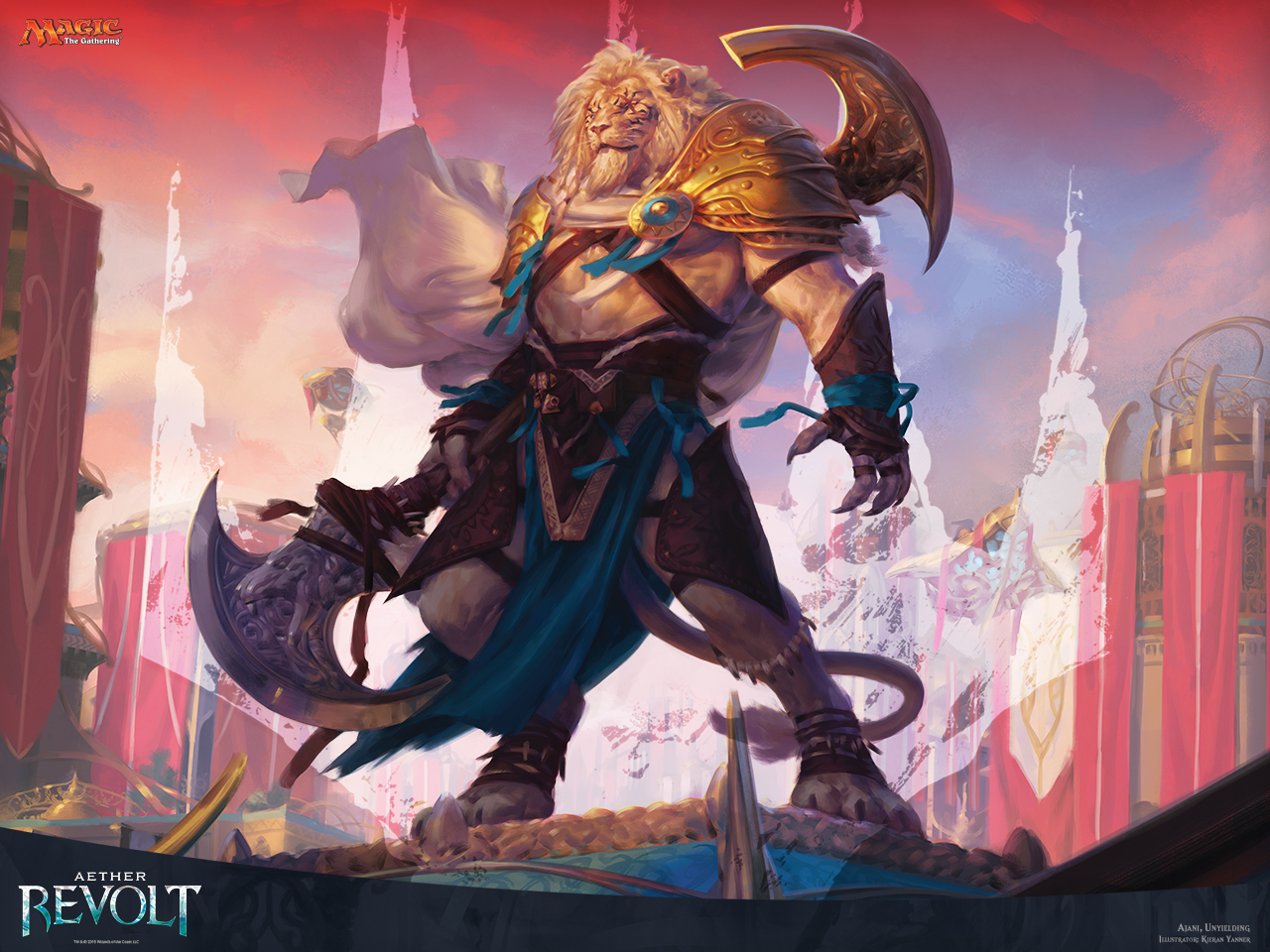
Aether Revolt is just around the corner, and with spoilers pouring in that means that we get to see the new Inventions! More powerful artifacts have been added to the roster, and there are some sweet ones in the gallery, which you can view here. There's a lot of cool ones in this lot, though my personal favorite is Ornithopter.

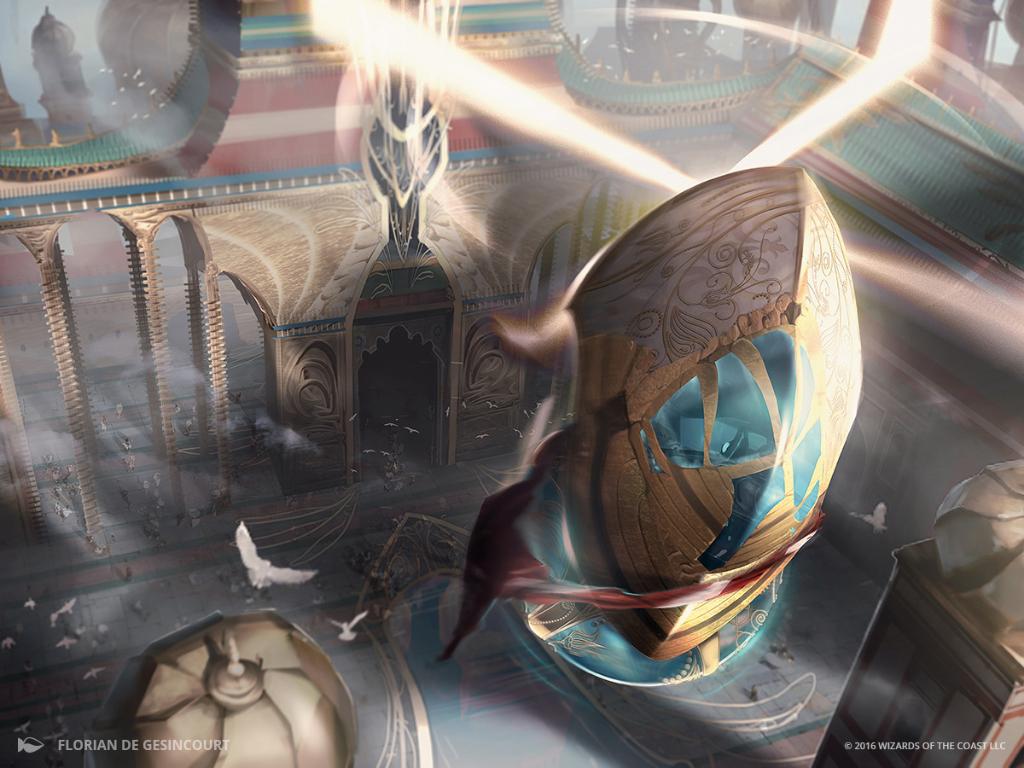
ornithopter

The art on this batch is excellent, and there are a lot of sweet pieces featured. I'm excited to see these Masterpieces in play, and I particularly enjoy that there will be Masterpieces of non-rare cards. I would personally like to get my hands on a Masterpieces Pestilence given that there currently isn't a foil version, and perhaps someday I'll get my wish. For now, this lot is excellent.

Notably, collector's number 43 and 45 are absent from the gallery. This likely means they will be cards from Aether Revolt, though I suppose it's also possible that they're particularly fancy pieces that they're slowrolling.

Avatar photo

Ryan Overturf

Ryan has been playing Magic since Legions and playing competitively since Lorwyn. While he fancies himself a Legacy specialist, you'll always find him with strong opinions on every constructed format.

View More By Ryan Overturf

Posted in FreeTagged , Leave a Comment on Aether Revolt Inventions Revealed

Have you joined the Quiet Speculation Discord?

If you haven't, you're leaving value on the table! Join our community of experts, enthusiasts, entertainers, and educators and enjoy exclusive podcasts, questions asked and answered, trades, sales, and everything else Discord has to offer.

Want to create content with Quiet Speculation?

All you need to succeed is a passion for Magic: The Gathering, and the ability to write coherently. Share your knowledge of MTG and how you leverage it to win games, get value from your cards – or even turn a profit.

In With the New: Observing a Shifting Format

Are you a Quiet Speculation member?

If not, now is a perfect time to join up! Our powerful tools, breaking-news analysis, and exclusive Discord channel will make sure you stay up to date and ahead of the curve.

There's a lot to love about Modern, including its incredible deck diversity, large card pool, and plethora of powerful interactions. An often-understated quality of the format is its dynamism. Modern metagames shift subtly at a much faster rate than sites like Modern Nexus can document—a rise in Infect leads to a rise in Jund, which leads to a rise in Tron, etc. Metagame changes form the most obvious aspect of Modern dynamism, but another lies within the decks themselves. As new strategies crop up and the format aligns itself in different ways, household-name decks make adjustments to beat the expected field.

By now, we know Dredge is here to stay in Modern. Like Bant Eldrazi, the deck showed up, enjoyed tremendous success, and then returned to reasonable representation levels as Modern adjusted to beat it. But the shifts to decks inspired by Dredge's induction into Modern have reshaped the format more dramatically than anything we've seen since the Eye of Ugin ban. We've tread these waters before, but have more changes to report as of last week's Star City Games Players' Championship. Split-format events like this rarely reflect the format perfectly but nonetheless serve as an optimal showcase for new technology. This article identifies and examines these shifts in detail.

[wp_ad_camp_1]

Updates to Major Decks

The aforementioned Infect, Jund, and Tron represent Modern's most obvious rock-paper-scissors dynamic. We've explored Jund's transformation in detail—the GBx behemoth has widely adopted Grim Flayer as a fourth efficient two-drop alongside Dark Confidant, Scavenging Ooze, and Tarmogoyf to fill out its threat suite, a move that helps pressure linear decks early while setting up relevant draws and keeping the disruption flowing. As of the Players' Championship, the format's other two pillars join Jund in receiving significant updates.

Fairer Avenues in Infect

Infect, by Max McVety (15th, SCG Players' Championship

Creatures

4 Blighted Agent
4 Glistener Elf
4 Noble Hierarch
1 Dryad Arbor

Instants

1 Apostle's Blessing
3 Become Immense
2 Blossoming Defense
2 Dismember
4 Might of Old Krosa
4 Mutagenic Growth
1 Spell Pierce
1 Twisted Image
4 Vines of Vastwood

Sorceries

2 Distortion Strike
4 Gitaxian Probe

Lands

2 Forest
2 Breeding Pool
4 Inkmoth Nexus
4 Verdant Catacombs
4 Windswept Heath
1 Wooded Foothills
2 Pendelhaven

Sideboard

4 Tarmogoyf
2 Spellskite
1 Viridian Corrupter
2 Nature's Claim
3 Ravenous Trap
1 Spell Pierce
2 Twisted Image

It's never been uncommon for Infect to board in non-Infect creatures against interactive decks. Kitchen Finks has always served as the deck's go-to, making Liliana of the Veil awkward, blocking Tarmogoyf twice, and pulling weight against Burn, one of Infect's worst matchups. In that matchup, Infect would lose not because it lost too much life, but because all of its threats would die. The Finks's life-gain, then, often proved less relevant than its (two) bodies.

Max McVety, in a bid for greatest Infect deck-builder of all time, ran a set of Tarmogoyf in his sideboard for the Players' Championship. Goyf is harder for midrange decks to remove than Kitchen Finks, and can easily spell doom for Lava Spike players. It's quite rare for Burn to beat a pair of on-curve Goyfs.

Goyf also comes correct on offense. It can swing for lethal fairly quickly, especially with a pump spell or two in tow. Distortion Strike gains additional value with Goyfs in the deck, since it represents ten damage against decks that struggle to remove a 4/5.

Other than the Goyfs, which I hope we'll see a lot more of in future Infect decks, McVety's list looks pretty stock. Ravenous Trap has caught on as the smoothest "no" button for Dredge (barring Rest in Peace in white), mangling Dredge's hands long-game at the expense of not performing in any other matchup. McVety also really didn't want to lose to Spellskite this tournament, packing three Twisted Image in his 75. You have to wonder if he pushed through an extra point of relevant damage by opening the Tarmogoyf plus Twisted Image combo post-board.

Dark Twists in Tron

BG Tron, by Joe Lossett (1st, SCG Players' Championship

Creatures

2 Wurmcoil Engine
2 World Breaker
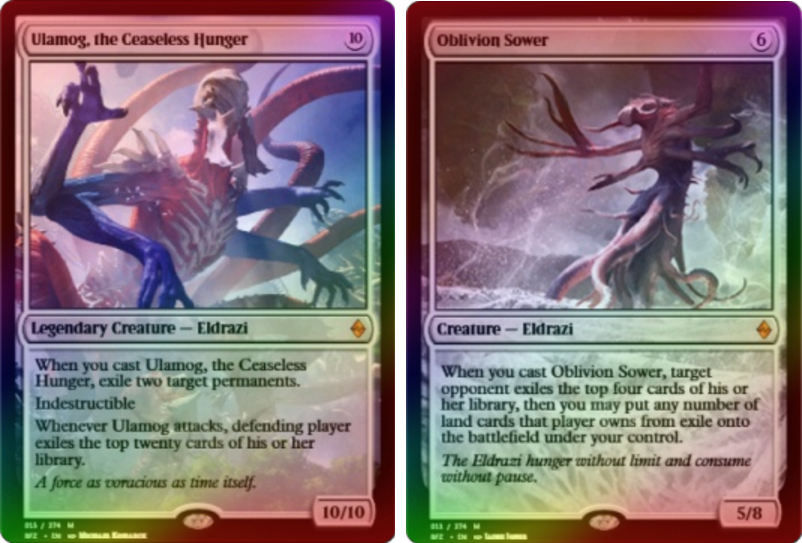
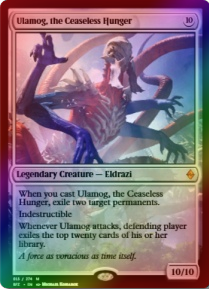
2 Ulamog, the Ceaseless Hunger

Artifacts

4 Chromatic Sphere
4 Chromatic Star
4 Expedition Map
3 Oblivion Stone
2 Relic of Progenitus

Planeswalkers

4 Karn Liberated
2 Ugin, the Spirit Dragon

Sorceries

4 Ancient Stirrings
4 Collective Brutality
4 Sylvan Scrying

Lands

1 Forest
3 Blooming Marsh
1 Ghost Quarter
1 Llanowar Wastes
1 Sanctum of Ugin
4 Urza's Mine
4 Urza's Power Plant
4 Urza's Tower

Sideboard

2 Engineered Explosives
2 Thragtusk
4 Nature's Claim
4 Ravenous Trap
2 Warping Wail
1 Forest

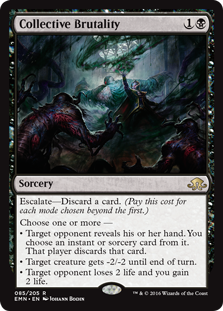
The black splash is a take on Tron we've never seen in Modern, but if any player has the credentials to convince us to take it seriously, it's Joe Lossett. Earlier this year, Lossett made waves (and Top 8) at GP Los Angeles with a set of Bolts in his Tron deck over conventional sweepers. More recently, he helped pioneer Tron's savvy switch from red to white. So I'm pretty inclined to believe that Collective Brutality—the one card in Lossett's deck that actually costs black mana—is as great as it seems.

Brutality is indeed nuts against Infect and Burn, tougher matchups for Tron. Even though Tron isn't a deck with tons of dead cards to throw away, Brutality gets by in the deck based on what it does: more than it costs.
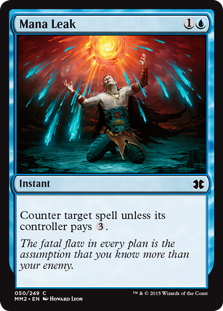
Modern is a format that rewards players for eschewing card advantage in favor of other in-game advantages, including tempo (Disrupting Shoal), mana (Simian Spirit Guide), and card selection (aggressive mulligans). Speedy aggro decks want to have their opponents dead before they get a chance to deploy all the cards in their hands, and Collective Brutality complicates that dreamy scenario.

Without Rest in Peace, Lossett fell back on a full set of Ravenous Trap to punish Dredge. He included these in his deck alongside a pair of mainboard Relic of Progenitus, speaking to Dredge's incredible resilience—the deck's opponents generally need a critical mass of relevant hate to defeat it.

Grixis Delver: A New Hope

Delver as a strategy has historically flourished in varied fields with opponents doing singular, linear things (see: Legacy, Vintage). Until very recently, Modern has not been linear enough for Delver to truly shine.

Grixis Delver isn't exactly a new Modern deck. Our own Ryan Overturf has championed his build of the deck since he joined Modern Nexus some months ago. In the meantime, another group of high-profile Modern players, led by Kevin Jones, have been tweaking a build of the deck heavier on threat diversity.

Grixis Delver, by Kevin Jones (6th, SCG Players' Championship

Creatures

4 Delver of Secrets
1 Gurmag Angler
4 Snapcaster Mage
2 Young Pyromancer
3 Tasigur, the Golden Fang

Instants

1 Dismember
1 Electrolyze
2 Kolaghan's Command
4 Lightning Bolt
2 Mana Leak
1 Murderous Cut
3 Spell Snare
2 Terminate
4 Thought Scour

Sorceries

1 Collective Brutality
2 Gitaxian Probe
4 Serum Visions

Lands

2 Island
1 Mountain
1 Swamp
1 Blood Crypt
1 Darkslick Shores
4 Polluted Delta
4 Scalding Tarn
2 Spirebluff Canal
2 Steam Vents
1 Watery Grave

Sideboard

1 Engineered Explosives
1 Izzet Staticaster
1 Countersquall
2 Dispel
1 Magma Spray
1 Rakdos Charm
4 Surgical Extraction
1 Pia and Kiran Nalaar
1 Collective Brutality
1 Painful Truths
1 Desolate Lighthouse

Ryan vs. Kevin

The Jonesian build of Grixis Delver differs from the Overturf version by including a pair of Young Pyromancer and diversifying the answer suite. Pyromancer has always been quite weak in Modern, but in a format loaded with Rest in Peace and Leyline of the Void, access to early pressure that gets around graveyard hosers seems pretty important. This is part of the reason I went with Counter-Cat over the heavily grave-reliant Temur Delver at the RPTQ last week.

Mana Leak, Spell Snare, and Terminate are also all scaled back to make room for a pair of Kolaghan's Command and some clunky but powerful one-ofs like Electrolyze and Murderous Cut. These changes seem like a concession to the fact that Grixis Delver is unlikely to always possess the initiative in the early turns, and slightly moves the deck up the archetype spectrum towards midrange.
As Joe Lossett is for Tron, Kevin Jones is something of a spokesperson for Grixis Delver in Modern. I'm sure it's no coincidence that the two other Grixis Delver lists that made Top 16 at the Players' Championship look so strikingly similar to Jones's, featuring the same creature suite and close disruption suites. Hopefully we’ll hear more about the subtleties behind the two different builds from Ryan in coming weeks.

3 Years, 5 Months, and 2 Days...

Modern keeps on keeping on and changing. I've recently read pieces suggesting that Wizards implement new ways to introduce cards to the format, to keep it from getting stale, but Modern has changed so much in the last month alone that I'm not sure these kinds of drastic actions are necessary. One thing's for sure: it's great fun to watch a format in flux, and to adapt to the shifting landscape!

Insider: QS Cast #46: Bromat Courier

Are you a Quiet Speculation member?

If not, now is a perfect time to join up! Our powerful tools, breaking-news analysis, and exclusive Discord channel will make sure you stay up to date and ahead of the curve.

Play


The QS Cast has returned and has shuffled once again: Chaz Volpe and Tarkan Dospil continue on with where the previous cast left off. In this episode they discuss the following:

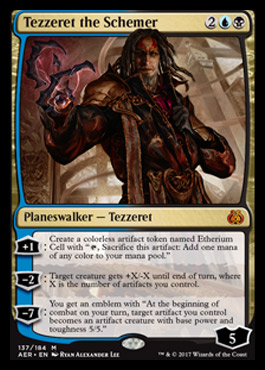
  • More Aether Revolt spoilers – Tezzeret the Schemer, Oath of Ajani
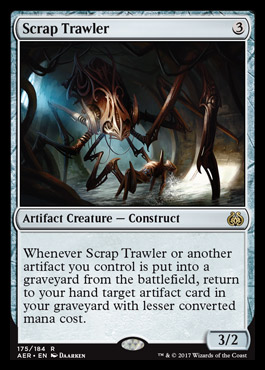
  • Pre-order purchasing – Chaz purchased 20 Oath of Ajani @ $1.99 and all were sold. Tarkan and Chaz still like Scrap Trawler under $2.
  • Some specific cards we wanted to address.
  • What we’re looking to acquire.
  • What’s with some of these Reserved List cards? Urza's Miter!? It doesn’t work!
  • "Bromat Courier" is now a thing on this cast.

*We had some scheduling issues. Some card prices already increased – namely Ajani Steadfast*

Tarkan is trying to find Kaladesh's Ghostfire Blade once Aether Revolt is revealed. We discussed these cards:


As always, please comment and leave questions for us to address on the next cast! We will be making QS Insider questions a priority, and we want to know what you want covered.

Enjoy! We’re glad to be back.

Find us on Twitter: @ChazVMTG  @the_tark

Deck Overview- Death’s Shadow Delirium

Are you a Quiet Speculation member?

If not, now is a perfect time to join up! Our powerful tools, breaking-news analysis, and exclusive Discord channel will make sure you stay up to date and ahead of the curve.

There has been a lot of discussing around potentially banning Mutagenic Growth and/or Become Immense in Modern, though today's deck features Death's Shadow and zero copies of these ubiquitous pump spells. Instead, Lyserg's 5-0 deck from a Competitive Modern League plays a more interactive game of Magic featuring a handful of disruptive elements in addition to Traverse the Ulvenwald for added consistency.

Deaths Shadow Delirium

Creatures

4 Death's Shadow
1 Ghor-Clan Rampager
4 Street Wraith
4 Tarmogoyf

Spells

4 Gitaxian Probe
3 Inquisition of Kozilek
4 Thoughtseize
4 Traverse the Ulvenwald
2 Abrupt Decay
1 Dismember
1 Kolaghan's Command
1 Manamorphose
3 Temur Battle Rage
4 Mishra's Bauble
4 Tarfire

Lands

2 Blood Crypt
3 Bloodstained Mire
1 Forest
1 Overgrown Tomb
1 Stomping Ground
1 Swamp
4 Verdant Catacombs
3 Wooded Foothills

Sideboard

1 Temur Battle Rage
2 Ancient Grudge
2 Anger of the Gods
1 Bojuka Bog
2 Collective Brutality
1 Ghost Quarter
2 Liliana of the Veil
1 Liliana, the Last Hope
1 Maelstrom Pulse
1 Shriekmaw
1 Tireless Tracker

Rather than play pump spells, this deck is committed to making large Death's Shadows and the biggest Tarmogoyfs around. This allows the deck to kill with just Temur Battle Rage instead of relying on additional pump spells.

Tarfire is not the most impressive card in Modern, though the tribal card type is hard to come by, and there are plenty of matchups where it can matter. Against Infect it's as good as any red removal spell, and there are plenty of one or two toughness creatures otherwise. It's no Lightning Bolt, but a little reach is always good in racing situations.

The Traverse the Ulvenwald package forces the inclusion of a couple basic lands, though this also enables a more honest Tarmogoyf plus removal game plan. This list doesn't add a ton of utility to this package with the sideboard, though tutorable Shriekmaw is pretty cool. Even with this package, the deck still has enough effects that cost life to steal some fast games with Death's Shadow.

It's unclear as of yet how this deck compares to more aggressive Death's Shadow builds, though the idea is clear and the deck building decisions are coherent. If you're into this style of deck and are looking for a more consistent if less explosive build, I would give this one a try.

Insider: First Thoughts on Aether Revolt Spoilers

Are you a Quiet Speculation member?

If not, now is a perfect time to join up! Our powerful tools, breaking-news analysis, and exclusive Discord channel will make sure you stay up to date and ahead of the curve.

Spoilers for the next Magic set, Aether Revolt, have already begun, and there’s a lot of great information we can glean from them. More important than the cards themselves are the glimpses they give into future mechanics and their implications for other cards. The earlier we know what’s going on with new next set, the better predictions we can make financially.

Battle at the Bridge introduces the improvise mechanic, which is essentially convoke for artifacts. Cost-reducing abilities are always powerful – and potentially broken – so they are always worth a deeper look. Battle at the Bridge doesn’t scream out to me as being a tournament staple, but it looks playable. More exciting is the prospect for even more powerful cards with improvise. If these cards are worth playing, then artifact-heavy decks built around them will appear, so I’d pay attention to the cards that could potentially enable them. Servo Exhibition and Cogworker's Puzzleknot come to mind as two of the most efficient options available. Clue makers like Thraben Inspector and Tireless Tracker are also strong with improvise cards.

Trophy Mage is simple to understand, and its ability to search for three-cost artifacts is a source of card advantage that is surely competitive. It will increase demand for said artifacts, and there’s a few in particular that will be better than ever upon the release of Aether Revolt. Trophy Mage will be particularly fun with Renegade Freighter, which it could propel to Standard playability because it also crews the card by itself. Cultivator's Caravan requires more help to crew, but it’s another vehicle that I expect to be commonly found by Trophy Mage. Pilgrim's Eye and Filigree Familiar will keep the chain of value going. Deadlock Trap is a powerful option even in a deck without energy producers. Trophy Mage could act as redundant copies of Electrostatic Pummeler in a combo deck built around it, and it conveniently finds Dynavolt Tower, too. Chief of the Foundry and Foundry Inspector are two creatures that could be great targets in the right deck.

Heart of Kiran doesn’t offer much of an upgrade over Smuggler's Copter when crewed with creatures because it offers four power for three (as opposed to three for two), but the potential to crew with a planeswalker makes it a very efficient threat. What makes the card particularly threatening is its vigilance, which means it can attack for four, but stay untapped to protect its planeswalker for the cost of another loyalty. It’s a natural pairing with Liliana, the Last Hope, which follows it on curve, and with its +1 ability containing an enemy creature, is likely to stay around for a few turns. Heart of Kiran also plays well with the three-mana planeswalker Saheeli Rai. There’s no direct synergy between them, because making a copy of the legendary artifact won’t accomplish anything, but the planeswalker is a sustainable source of loyalty. Heart of Kiran is also deceptively powerful with Chandra, Torch of Defiance, because her +1 mana ability can put it into play immediately and set up a defensive position.

Scrap Trawler could set up some value in a Standard deck with Bomat Courier and Scrapheap Scrounger, and it will only get better with any new playable artifacts. It certainly helps the competitive prospects of Syndicate Trafficker, which is competitively costed and slated for Standard success if the right support cast appears.

I’ll admit I wasn’t considering Scrap Trawler for Modern, but Ryan Overturf mentioning its potential in that format got me thinking. Modern Affinity already plays Arcbound Ravager as a sacrifice outlet, and Affinity has a curve of cheap artifacts, even down to zero mana, to gain a lot of value. The deck currently relies on Etched Champion primarily as a way to beat interactive midrange and control decks, and in theory those are the exact decks that would struggle keeping up with Scrap Trawler’s ability to generate card advantage, so it could be switched in as the three-drop of choice in the right metagame. I could see Scrap Trawler being effective in the stock Affinity deck as it stands now, but the deck could also be pushed further to really make the most of it. Disciple of the Vault might be worth dusting off, because it can be paired with Scrap Trawler to set off chains of drains that will quickly end a game. It also could mark the return of the sacrifice-friendly Arcbound Worker. It could even improve the Thopter Foundry and Sword of the Meek combo, which if combined with Mox Opal will allow Mox Opal to be recurred by Sword of the Meek for each iteration. This can be tapped for mana and sacrificed by Thopter Foundry, so it effectively doubles the efficacy of each activation. Adding in Arcbound Ravager as a way to sacrifice the Mox Opal for free will net a mana each activation, which can be paid into Thopter Foundry to effectively go infinite.

I think Quicksmith Rebel is better than it looks for Standard. Its ability is effectively a come-into-play effect that gives you access to the ability for a moment even if the opponent can immediately kill your Rebel, so you’ll always be able to use it has you intend, at least for one turn – assuming you control an artifact, of course. If left in play for longer, its ability will slowly generate value by controlling the battlefield and eventually killing the opponent.

I'm not quite as excited by Quicksmith Spy, but it could be better because drawing a card is so strong in certain matchups, and its higher toughness makes it more likely to stay in play to generate value. These two new cards are promising with Clue tokens or Terrarion, but they are best of all with Key to the City, which will then be able to tap without discarding.

Tezzeret the Schemer is designed for competitive play, and its affordable four-mana price tag and high starting loyalty of five are both great signs that a deck could be built around the card. Its second ability gives it the potential to protect itself from creatures by functioning as a removal spell, another strong sign, but it will require building an artifact-heavy deck to make the most of this ability. Also consider that the ability could be used on one's own creatures as a way to pump power, assuming it has enough toughness to stay alive, so it's also a flexible option that could benefit a more aggressive artifact deck. The first ability of essentially creating a Lotus Petal token is an interesting way to fix and ramp mana, but it might be more important as a way to generate artifact cogs to support things like the second ability or Quicksmith creatures. The ultimate ability is quite affordable, and can be activated just two turns after casting, so it makes the planeswalker a potent finisher and a real threat. It will require loads of support, and that might not even come until a future set, but make no mistake that R&D slated Tezzeret the Schemer to be under the Standard spotlight.

What are your thoughts on the initial Aether Revolt spoilers? Are the planeswalkers Constructed playable? What existing cards do you see as getting better from the new set? Let us know in the comments!

High Stakes MTGO – Dec 11th to Dec 17th

Are you a Quiet Speculation member?

If not, now is a perfect time to join up! Our powerful tools, breaking-news analysis, and exclusive Discord channel will make sure you stay up to date and ahead of the curve.

Hello and welcome back for another High Stakes MTGO article!

Unlike last week, this week was very calm for my portfolio—I barely made a half dozen purchases and sales all combined. Modern hasn't picked up as much as I wanted in December, so even in this sector things have more or less come to a standstill for me. With more triple Zendikar flashback drafts scheduled for early January, all of my ZEN positions have pushed back. I might be waiting another three or four weeks to find a better spot to sell those at high risk of a reprint in Modern Masters 2017.

Besides this, I'm still looking for good targets in the event Frontier breaks out in paper and/or MTGO. Rally the Ancestors has already spiked by 500%! At 0.03 tix there was really zero risk of jumping into this spec, but make no mistake—these 500-plus percentage gains are only a speculative smoke screen that will have no support until the format is at least recognized and supported on MTGO.

With two more weeks to go before 2017, let's review how this quiet past week went for me. The latest snapshot of my portfolio is accessible here.

Buys This Week

rttr

Again this past week I was trying to acquire cards that could potentially see big gains in the long-run if Frontier catches up as a popular format. I'm still trying to accumulate the cheaper cards, and as with Return to the Ranks, if those targets' sets have past the redemption window—which only concerns M15 at this point—even better.

Return to the Ranks is fairly versatile and can be played in different shells, including aggro and combo decks. Its price is currently sitting around 0.5 tix, and has already fluctuated several times between 0.5 and 1.5 tix. In a nutshell, a great entry price for a card with enough long-term potential in my opinion.

sv

This one is a little bit of a gamble as Supreme Verdict could totally be in MM3. However, an uncounterable wrath for four mana may not be what Wizards wants to put in MM3. In addition, both MMA and MM2 don't have any Wrath of God-like sweepers, and Damnation is the much more obvious inclusion for MM3.

Finally, Supreme Verdict is still rather cheap in both paper and online versions, so the card isn't begging for a reprint either. All in all I think the chance of a reprint in MM3 are low overall.

The recent Return to Ravnica block flashback drafts dragged the price of Supreme Verdict below 1 tix. Assuming you find the gamble acceptable, now is a decent opportunity to buy a board sweeper that sees play in all eternal formats. Although I was watching this card for several days, I was too distracted to pull the trigger earlier and was only able to buy eight playsets, under 1.2 tix on average.

Sales This Week

Serum Visions didn’t make it into MM2, receiving a nice price boost when its absence was confirmed and reaching a surreal 12 tix in June 2015. After a crazy summer, the price settled down between 2 and 3 tix as we entered 2016.

Despite this blue cantrip being played in a myriad of Modern decks from aggro, to control, to combo, the price never took off again. My bet was that Serum Visions could see 5 tix again and even after Fifth Dawn flashback drafts it never happened. With a most recent peak at 3.4 tix, this is the best it has been in all of 2016.

This is the best and probably only opportunity I have to sell my Visions before a more-than-likely reprint in MM3. Gambling for a non-reprint in MM3 is too risky in my opinion. I'm closing this position with some profit, but it's not the easy double or triple I had envisioned.

This BFZ land is among several positions I'm looking to close with no or very minimal losses whenever possible, rather than holding them into the dark. So there you go—15 copies sold for a whooping 5.4% profit.

Since this past summer, the Glade was fluctuating between 1 and 2 tix. After the release of Kaladesh, the price rose to fluctuations between 2 and 3 tix. Even with the comeback of the red-green Aetherworks Marvel deck, this land doesn't seem to be heading higher. I'd rather try to sell a few copies now.

I had a good run with Prairie Stream and Smoldering Marsh, and not all lands of a cycle can be profitable—just ask my Magic Origins painland spec. However it is often necessary to buy into the full basket of five different lands to make profit overall. The ORI painlands are again an illustration of this principle.

futch

Ulamog, the Ceaseless Hunger is the only foil mythic from BFZ that has rebounded from the slow price drop half of the BFZ foil mythics have been experiencing since this past summer. The other half of the BFZ foil mythics barely maintained their price.

I had banked on a little more stability, and even a slow and steady increase in price. So now that one BFZ foil mythic is in selling range again, I'm not going to stay undecided too long—especially since moving this type of card at a good price is difficult, considering the narrow demand.

On My Radar

Almost nothing new here for me. The one thing I'm monitoring closely these days is the evolution of the value of a full set of both Magic Origins and Dragons of Tarkir. While the value of a full set of ORI has barely taken off since I bought them, the value of a full set of DTK, on the other hand, is currently up by about 35%.

That's already a good number for a full set spec. While this may be only the beginning of a nice upward trend, I'm very cautious about expecting too much of a full set spec, even if DTK has a lot of to offer in terms of rares and mythics.

As for ORI, I'm expecting some upward movements now that the paper version of Jace, Vryn's Prodigy has grown by 25% over the past two weeks. With Frontier probably adding to the demand, this version of Jace may quickly get more and more expensive, in turn driving the value of online ORI full sets. That's just what I would need to sell my spec here.


Thank you for reading,

Sylvain

Insider: MTGO Cards to Buy, Sell or Hold – Episode 22

Are you a Quiet Speculation member?

If not, now is a perfect time to join up! Our powerful tools, breaking-news analysis, and exclusive Discord channel will make sure you stay up to date and ahead of the curve.

Hello, investors! We had another calm week, and due to the lack of Constructed events in the coming weeks, things should remain like this until the release of Aether Revolt in mid January. Standard prices should slowly go down as a general rule. In most cases, when they hit their historic lows, speculators tend to buy them. This is what I will be monitoring until Aether Revolt reaches the stores.

Let's discuss the five cards I selected for today's Buy, Sell or Hold:

Nissa, Voice of Zendikar

nissa-voice-of-zendikar

Nissa, Voice of Zendikar was one of my speculations that was doing poorly, specially after Kaladesh. Fortunately, the Aether Revolt spoilers plus being featured in a Saffron Olive budget deck rebounded it price. Nissa is a card I would like to have in my portfolio before the first glimpse of the Standard metagame with the new cards, but the card should drop it price in the very short term, making the smartest move selling it now and rebuying in a few days for cheaper.
Verdict: SELL

Sigarda, Heron's Grace

sigarda-herons-grace
Sigarda, Heron's Grace is particularly good in a metagame full of Emrakuls. We don't know what Emrakul's power level will be in Aether Revolt Standard, but its predominance should at least decrease – and with it, Sigarda's price. The legendary angel was recently featured in one of the actual few new decks in Standard, WG Humans. The hype in new decks doesn't remain strong for a long period of time unless they prove to be really powerful, however, so I don't expect Sigarda to go anywhere else than down the hill.
Verdict: SELL

Oath of Nissa

oath-of-nissa
Oath of Nissa's price went up last week pushed by Aether Revolt WG spoilers, and it is another card I want to have in my portfolio before the new Standard metagame shows up. If you are using a short-term strategy, selling it is fine. The problem is that the price won't adjust too much to rebuy it for cheaper later. I value having it in my portfolio more than missing the short-term adjustment.
Verdict: HOLD

Emrakul, the Promised End

emrakul-the-promised-end
Emrakul, the Promised End is the most representative card of the current Standard metagame, but that might be about to change with Aether Revolt. More cards in the format means a wider range of deck possibilities. The first SCG tournament with the new cards will be critical for the Eldrazi's price, because it will show how good the new decks are versus the ones already established. For nowm I think selling it is the best and safer option.
Verdict: SELL

Cinder Glade

cinder-glade
Two-colors rare lands are very sensitive to metagame changes. Cinder Glade is currently above its average historic price. With Aether Revolt around the corner, common sense says now is a good moment to sell.
Verdict: SELL
See you next time. Have a wonderful week!

Want Prices?

Browse thousands of prices with the first and most comprehensive MTG Finance tool around.


Trader Tools lists both buylist and retail prices for every MTG card, going back a decade.

Quiet Speculation