menu

Infographic: Evolution of the Most Played Cards in Modern

Are you a Quiet Speculation member?

If not, now is a perfect time to join up! Our powerful tools, breaking-news analysis, and exclusive Discord channel will make sure you stay up to date and ahead of the curve.

This time we'll take a journey into the recent history of Modern.

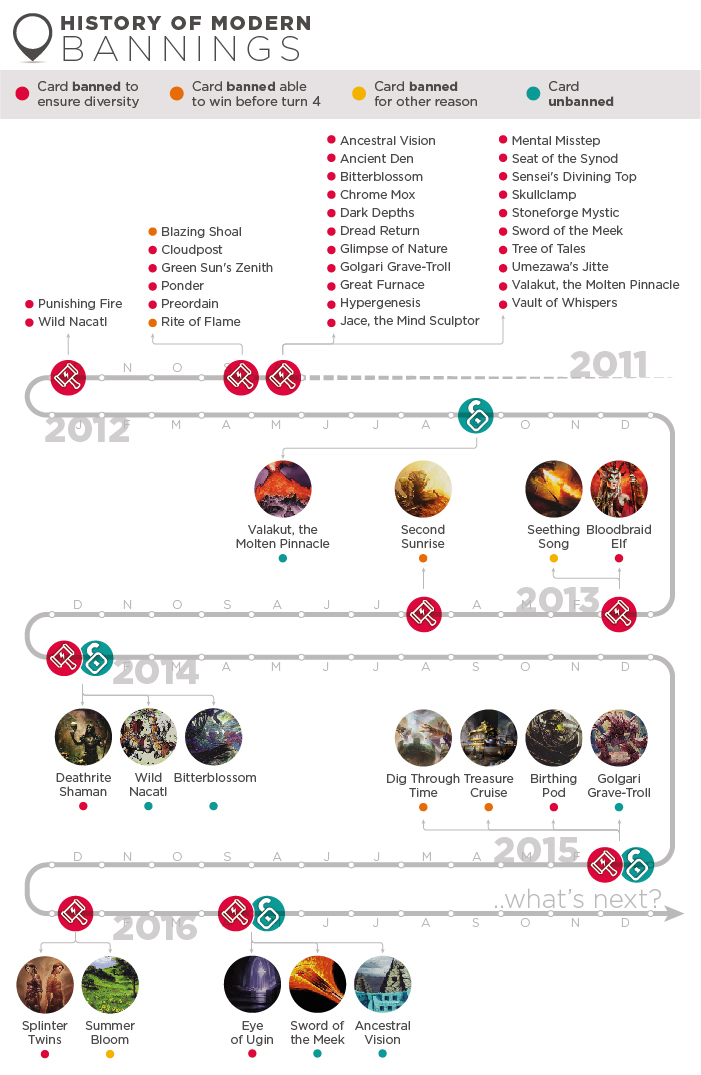
Modern is a great format to play nowadays, but it hasn't always been like this. Wizards and the DCI had a lot of trouble iterating until the format was as healthy as possible. How? With the most invoked and feared instrument in Magic: the banhammer.

There was an error retrieving a chart for Hammer of Bogardan

Let's start with some history.

qs_201612_a-most-played-cards-in-modern-021

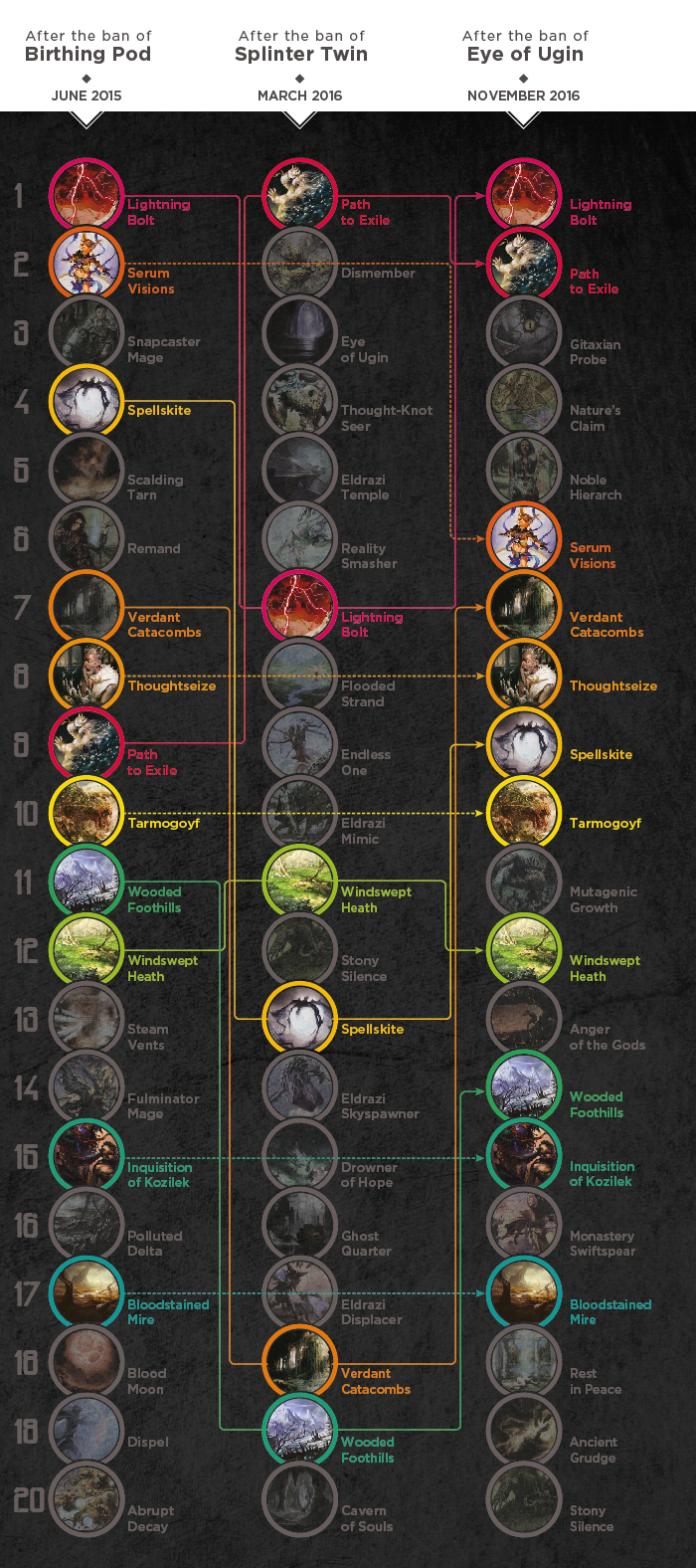
Now let's take a look at how this banning/unbanning history has affected the metagame of the last year and a half.

It's interesting to focus on how some cards found their way to stay in the top 20 cards in the format despite the bans, while others (in grey) made an appearance only to fall back into oblivion.

qs_201612_a-most-played-cards-in-modern-01

That's it for today. See any interesting patterns above? Be sure to point them out in the comments!

Don’t Tilt, Analyze and Learn: RPTQ Report

Are you a Quiet Speculation member?

If not, now is a perfect time to join up! Our powerful tools, breaking-news analysis, and exclusive Discord channel will make sure you stay up to date and ahead of the curve.

The RPTQ weekend is over and many players are now off to try their hand at achieving their Pro Tour dreams. I will not be one of them, unfortunately. Hopefully Jordan will be (I've heard nothing yet). The fact that the PPTQ system requires you to get lucky twice rather than once to actually get the prize is frustrating, to say the least. I'm very annoyed at my performance at this RPTQ, but you cannot let that get to you. Focusing on the frustration will only make it worse and negatively impact future results. You can't get tilted. The best thing to do is let it go and move on, but that doesn't come naturally to me. Instead, I pour my anger into analyzing what went wrong and learning from my missteps. I'm not able to leave the past alone, so rather than wallowing in it, I use my frustration to pick it apart until I have an answer and the anger has dissipated.

Reality Smasher

But first, here are the greatest lessons from my trip to the RPTQ. If you're going to travel in winter, plan for ski traffic. It ruins everything and if you can avoid it, do so. A carful of new Colorado transplants that I didn't know were going to Utah took the route through the mountains. What should have been a seven-and-a-half-hour drive took them eleven hours. I knew to avoid that route and went through Wyoming instead.

Secondly, if you decide to travel in winter by renting a car (because you'd rather not risk your own for the journey) don't go for anything in the economy listings. I don't care how much you save, thin tires and short wheelbases are not ideal in the snow. And those things are only at home in crowded cities, not highways. The money is worth less than the years I lost from stress and terror (Semi!!!!!). Just pay the extra for something big with four-wheel drive.

[wp_ad_camp_1]

My RPTQ Experience

As I mentioned, I didn't specifically prepare that much for the RPTQ. I was more focused on GP Denver and Standard and skimped a bit on Modern testing. I was still playing weekly paper tournaments and getting in some practice on MTGO but no really intense testing. This wasn't necessarily a problem, Modern rewards experience and I have more experience playing Modern than any other format.

Also, as I noted last week, Modern requires fairly rigid gameplay and I knew most of the lines available. Since I knew how I needed to play around or respond to those lines, I felt reasonably confident that I could power through if I got my sideboarding correct. The problem being that my assumption that Jund, Burn, Bant Eldrazi, Infect, and Affinity would be the most popular decks had no proof. I needed some actual data.

Scouting the LCQ

I arrived at Game Haven Sandy, the RPTQ site, on Saturday just in time to watch the Last Chance Qualifier from round two. I'm not sure exactly what I was expecting, but I was surprised by how much space the place had. The LCQ appeared to have 30 players and they were running three other gaming groups without difficulty. Which I guess is why they were able to get the RPTQ in the first place.

Looking around, I was again surprised by how accurate my predictions had been. The tournament was predominately Jund and Burn, with Grixis and Eldrazi tied for distant third. Very little Dredge or Infect. Observing a few rounds and overhearing the conversations of the local players convinced me that this was going to be indicative of the RPTQ the next day. The only thing left to do was go to the hotel and finalize my deck.

Choose Your Weapon

I had a choice to make between Merfolk or Spirits and Taxes, and sideboards to finalize. Each deck has its strengths and weaknesses, so it was just a matter of determining which would be better at this particular event. Given the expected metagame of heavy Jund, Burn, Grixis, and Eldrazi, I went with Merfolk. It has better matchups against Grixis and Jund than Spirits thanks to more cantrips and a faster clock. It's worse against Eldrazi because it lacks disruption compared to Spirits. The Burn matchup is roughly even, with Merfolk's faster clock compensating for the additional disruption from Spirits. With two better matchups, Merfolk was the clear choice.

The second decision was how to build my sideboard. My strategies against Burn, Jund, and Grixis are pretty set in stone but I knew that Eldrazi was going to be a challenge for my normal build of Merfolk. I also wanted additional interaction against Infect, in case there were a large number of metagamers at the tournament. In the end I registered this configuration:

"UW Merfolk, by David Ernenwein (RPTQ Aether Revolt)"

Creatures

4 Cursecatcher
4 Silvergill Adept
4 Lord of Atlantis
4 Master of the Pearl Trident
3 Harbinger of the Tides
3 Merrow Reejerey
2 Kira, Great Glass-Spinner
3 Master of Waves

Artifacts

4 Aether Vial

Enchantments

4 Spreading Seas

Instants

3 Path to Exile
2 Echoing Truth

Lands

7 Island
4 Wanderwine Hub
4 Seachrome Coast
3 Mutavault
2 Tectonic Edge

Sideboard

3 Stony Silence
3 Rest in Peace
2 Hurkyl's Recall
2 Meddling Mage
2 Burrenton Forge-Tender
1 Kira, Great Glass-Spinner
1 Path to Exile
1 Tectonic Edge

The fourth Path was moved to the sideboard so I could run the third Harbinger, which is normally better against Eldrazi. I had cut the Deprives because they're now too slow, and the overabundance of Burn made me want some Forge-Tenders. The fact that a lot of Jund decks were on Anger of the Gods was also a consideration. For reasons you'll see shortly, the only changes I would make if I could do it all over again would be to cut a Rest in Peace for another Forge-Tender and swap the Tectonic Edges for Ghost Quarter.

The Tournament

I failed to win a match on the day. Seriously. I lost effortlessly to Bant Eldrazi and the only Affinity player in the room (as far as I was aware). I stayed in because after coming all that way, I wasn't going to leave after two rounds (and I'd have to pay for my rental for another day anyway). I then proceeded to lose in three each time to both Burn and Infect before giving up. When my deck consistently taunted me with the card I needed to survive on the top of my deck after a land glut in three matches, I can tell when I'm just not meant to play Magic that day.

What happened? One factor was that I had really bad variance and luck. My bad variance was how poorly my deck actually performed, consistently not feeding me removal or lands so that I could race. I had the tools to win but not the means. I was also really unlucky with the pairings. Being paired against the only Affinity player in the room is anomalous, but the next two rounds I was the pair up. There were plenty of other winless players and yet I never played any of them. I can take a hint: I wasn't meant to get a win.

What about my own mistakes? Given my playstyle, preferences, and experience, I had the right deck in the right configuration. There was no way, given my own draws, that I could have won my first two matches. I was running very cold and my opponents ran relatively hot. Going back over my notes, I think that had I taken different lines in both games the best I could have done was lose less lopsidedly.

In the other two, things aren't so clear-cut. I had no chance in either of my game ones, but in the game threes I might have won with different lines. My testing against Burn and Infect told me to favor the more conservative lines of play, but in these cases a more aggressive line might have won. Not a guarantee, but it might have happened. It's hard to call those mistakes because they were based on what worked previously, but the result is unmistakable. It might simply have been that I was an outlier on the data sheet Sunday and I should have taken the statistically worse line to win. You never know until after the fact when that's true.

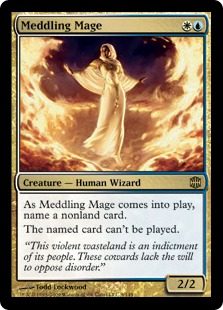
I did make a mistake against Infect that wouldn't have mattered if I had ever drawn one of my 12 remaining answers to Inkmoth Nexus. My opponent dipped his hand at one point and it looked to me like he had Distortion Strike. I had boarded in Meddling Mage with the intention of naming Become Immense, but when I saw his hand I named Strike instead. As it turned out he had Become, not Strike, and I made the wrong play because a trick of the lighting made it look blue. I really need to stop deriving information that way—it keeps not working out for me.

The Rest of the Field

Remember when I said that smaller tournaments tend to have distorted metagames? That has never been better illustrated than this tournament. We had 50 total players and most of them were on either Burn, Bant Eldrazi, or Jund. I estimated they were two thirds of the total while some others said three fourths, but by any count that is impressive. It looked to me like Burn was the most represented, followed by a tie between the others. It was hard to say for certain, since by the time I was able to look around round two a lot of players had dropped.

This was incredibly vindicating for me because those were decks I expected to be huge and I was ready for them. I came prepared for what I was actually going to hit. Things just didn't work out for me. There was only one Dredge player and the only other blue decks were Blue Moon, so I could have cut some graveyard hate for more Burn answers.

For a format that many are decrying as overrun by fast, unfair aggro, this was a remarkably fair tournament. The Infect players got crushed by Burn and Jund, and I saw no actual combo decks. Anger of the Gods drove out the only Dredge deck. Still, the magnitude of the warp around Eldrazi, Burn, and Jund is fascinating. Based on conversations with the other players, it was a combination of metagaming and experience that drove the decisions. The Jund players were all longtime Jund players, but most of the Eldrazi players were planning to feast on Jund while the Burn players expected more Infect. This is too small a sample to make any judgments, but if the stories coming in from other RPTQ's are indicative, then we may be seeing a real trend towards Eldrazi and Jund, and away from Infect and Dredge.

Breaking Down the Top 8

Out of the tournament and with nothing else to do in Salt Lake City on a Sunday afternoon, I stuck around to see how it played out and to cheer on other Colorado players. We put three into the Top 8, two Burn and one Jund, but none of us went through.

Salt Lake City RPTQ Top 8

Deck NameNumber of Copies
Bant Eldrazi3
Jund2
Burn2
RG Tron1

It's not a particularly surprising Top 8. Jund, Bant Eldrazi, and Burn were the most popular decks at the tournament by quite a margin. With those kinds of numbers it would be weird for them not to make up almost the entire Top 8. The Tron player is the only unexpected deck, but I watched his run in Swiss and he was running really hot.

What's interesting is the final result. The Game Haven Sandy RPTQ sent the following decks to Pro Tour Aether Revolt.

Salt Lake City RPTQ Winners

Deck NameNumber of Copies
Bant Eldrazi3
GR Tron1

That...is significant. All the colorless decks went through. About that Eye of Ugin banning, wasn't it supposed to reign in the spaghetti monsters?

Analyzing the Top 4

Yes, I know that Tron and Eldrazi are naturally favored against Jund, but that doesn't explain why these decks thrived to such a staggering degree. The Jund and Burn players all fought through a lot of Eldrazi to get to that point and yet they all fell. For the most part, based on what I saw, it came down to variance. The critical round was when the Eldrazi decks drew well and the other decks stumbled. Tron just keep cruising through their Jund matchup. In a number of cases it came down to Ancient Stirrings finding the right card at the right time, to turn Worship back on and keep it there. Still, the raw power of the colorless menace cannot be denied.

I've still got a lot of notes and discussions to go through, so expect more on this subject next week. Until then, if anyone has their own RPTQ experience I'd love to hear how you did in the comments.

Insider: High Stakes MTGO – Dec 4th to Dec 10th

Are you a Quiet Speculation member?

If not, now is a perfect time to join up! Our powerful tools, breaking-news analysis, and exclusive Discord channel will make sure you stay up to date and ahead of the curve.

Hello, and welcome back for another High Stakes MTGO article!

Last week was rather well balanced for my portfolio, with several buys and profitable sales. I am still in the mindset of cutting my losses and taking my profits early rather than looking for the ultimate selling point, even if this means leaving some tix on the table here and there. I have found this high-turnover strategy very efficient overall, helping to limit variance and reduce stress.

As you may have seen, five of the cards I bought this past week didn't really belong to Standard, Modern or any other current eternal formats. Indeed, they were all made with Frontier in mind.

Frontier may or may not become a mainstream popular format, but it seems like there is enough potential here to warrant a few preemptive specs. Although things were different with Modern, mainly because that format was introduced and supported at the highest levels of competitive play, it is never too early to grab playsets of cheap or bulk cards in case anything happens.

Let's review and discuss the moves I made last week. You can always follow my moves in real-time on my portfolio's spreadsheet here.

Buys This Week

jaot

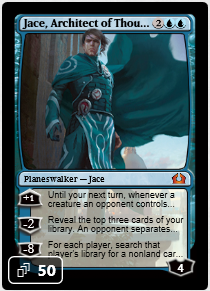
This Jace has very limited applications in Modern but it has appeared in the past in competitive decks. I first bought about ten playsets a few months ago and decided to keep them through Return to Ravnica flashback drafts. Not suprisingly, the price of Jace, Architect of Thought took a hit and went as low as 2 tix earlier this month.

I still think this card has good speculative potential and therefore decided to add about two more playets to my stocks. Although the price was still low, I didn't want to go overboard and own more than 50 copies overall. With a peak price that can easily reach the 5-10 tix range, I'm now hoping this Jace doesn't get reprinted in Modern Masters 2017—a reasonable hope in my opinion.

marvpan

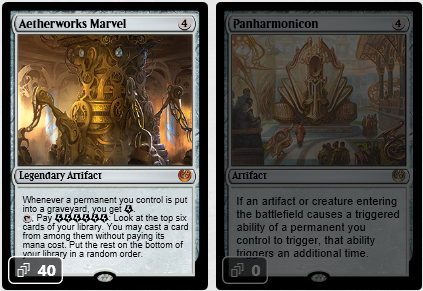
Following last weekend's double Standard GPs, I decided to go for two quickflips with the hot cards from these tournaments. I sold Panharmonicon on Monday with a comfortable 70% profit, although the stakes of that spec were low.

I was probably 12 hours late on Aetherworks Marvel. I was on the verge of selling my copies on Sunday night—barely 12 hours after buying—but ultimately chose not to, waiting for potentially more on Monday after such a good performance at both GPs and the SCG Invitational.

Not exactly the best decision as it stands, although if Aetherworks Marvel is really coming back, I expect the price to get closer to 5 tix soon. What's playing against me is that Kaladesh is still the newest draft set available and supplies are still poring in on MTGO. I'll try to break even at least on this one but am ready for a loss—being too greedy with quicklfips is never a great idea.

frontier

So Frontier may or may not be the next "big" format of Magic. It may or may not be popular and interesting from a competitive perspective, and it may takes months, if not years, to catch up on a large scale. While waiting for Frontier to be the next big thing or the next flop, there might be some speculative opportunities here.

As it was for Modern before and during, I would say, the first year and a half of its inception, every card is worth nothing until it explodes. I still vividly remember buying Chord of Calling in the fall of 2011 for about 0.35 tix. This card quickly rose to about 5 tix, and finally hit 30 tix three years later. You can easily find similar stories with Modern cards, some of which haven't been reprinted yet, leading to ever expanding prices.

Frontier, for now, is clearly not as diverse as Modern. The card pool for potential speculative opportunity is still very small, composed of much more recent sets than Modern was when the format was created. Mirrodin had been released eight years prior to Modern's creation, Magic 2015 was only released two and a half years ago.

Another downside to speculating on anything Frontier right now is that all sets involved, with the exception of M15, are still redeemable. This means prices haven't hit their absolute bottom yet and going full-speed on Frontier speculation now may not be the best option.

That being said, it's doesn't cost much to start accumulating staples of the potential new format. It won't cost much to invest around 50 tix in hundreds of copies of bulk cards, and maybe come back after redemption stops for some of these sets to accumulate another 100 copies for 20 more tix. The risks are very minimal—and will increase after redemption stops for the sets concerned—and the reward could be really high.

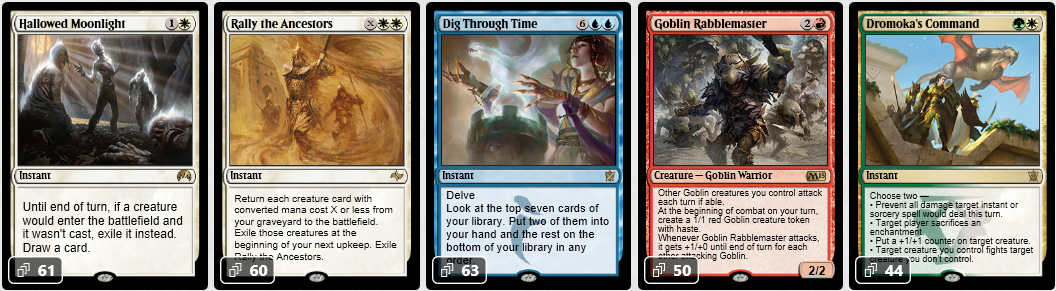
This past week I just started to select cards, based on both the first tournament results and Brian DeMars's article about the format. With the exception of Goblin Rabblemaster, everything else is at or near bulk level already. Dromoka's Command is in a slightly different position, as this card may enjoy some momentum due to possible Modern applications and Dragons of Tarkir redemption support. Apparently this Command could be great in Frontier, but I might be selling it sooner if the price catches up for any reason.

Note that some of the cards I'm picking up now because of Frontier also have a chance to rise because of other formats. I'm not entirely Frontier-dependent for success here.

Sales This Week

A profit of 55-plus tix with only six copies of a card is not your everyday spec. When Liliana of the Veil dropped to 70 tix after Innistrad flashback drafts, there was an opportunity of a low-return, low-risk spec.

A 10% or 20% return might not seem particularly attractive. But the advantage here, provided your bankroll can support the investment, is that you only need a playset or two to grind the number of tix that would usually take a dozen of playsets for any "regular" spec.

This iconic version of Liliana has been oscillating between 70 and 100 tix for almost three years, but with a more-possible-than-ever reprint in MM3 I was only targeting a selling price in the 80-85 tix price range. There might be a little more room for growth if you're still holding onto your copies of Liliana. As far as I'm concerned, the job is done.

I bought the Stone a while ago at an apparently way-too-high price, hoping for a rebound to 25-30 tix. As Eye of Ugin was amputated from Tron decks, the archetype lost its appeal and so did Oblivion Stone. Soon after the release of Kaladesh I had lost more than 50% on the spec and didn't know how I would exit the position without major losses.

Fortunately, Modern is a cyclical format and Tom Ross a great deck builder. His SCG Open win with an unexpected GW Tron deck last month put the deck on the radar again, sending Oblivion Stone back in the 20s-tix range in the process. Although not ideal, that was the opportunity I was waiting for to close this spec with, if not a profit, acceptable losses.

Another flashback draft spec and another success for the leylines. The price of the white leyline was simply entering my range of selling prices. Since the release of the Modern Masters 2015 version of Leyline of Sanctity, 9-10 tix has been the maximum to expect here. Both percentage and profit numbers were totally in line with my expectations, and there was no reason to wait since the price of this card oscillates frequently.

From a big drop to 0.2 tix earlier this past October to 2 tix very recently, Westvale Abbey has been keeping the trend up for more than two months now. This card is a solid one- or two-of in WU Flash decks, but I don't know if that's enough to drive prices higher. A return of 70% and 40 tix in profit are the kind of numbers I'm looking for, so I decided to close this position while it was still very profitable.

On My Radar

Frontier could be only a flash in the pan but it could also be the next gold mine. It's a little bit tricky to buy into something so uncertain when most of the speculative targets are out of Standard but still being redeemed. All that translates to a minimal demand while the absolute bottom is still to come.

Nonetheless, with more and more players talking about it, Frontier can't be totally ignored. Anything that was good in Standard previously is a good starting point for specs. Anything at or near bulk price even more so.


Thank you for reading,

Sylvain

Insider: Hidden Expenses to MTG Finance

Are you a Quiet Speculation member?

If not, now is a perfect time to join up! Our powerful tools, breaking-news analysis, and exclusive Discord channel will make sure you stay up to date and ahead of the curve.

These last couple months I have been fairly bearish on this MTG market. Rampant reprints, less Legacy support, no Modern Pro Tour, and sudden changes to Standard rotation have all been a lowering tide that has dropped many ships. A lot of people have noticed these recent trends, and are sounding the alarm—thus far, I myself have been fairly vocal about selling while the market still has its warmth.

But while cards like Snapcaster Mage continue their monumental decline, the reality is that there are many cards with very bullish momentum. Casual cards are especially hot, as evidenced by the recent spike in The Chain Veil and Contagion Engine.

There was an error retrieving a chart for Contagion Engine

While not nearly as expensive, Standard still has its share of valuable cards, including Liliana, the Last Hope which has stabilized in the $40 range. And while the initial hype has passed, Old School remains a robust format driving appreciable price growth.

With this in mind, I’m going to put bearishness aside this week. After all, I have made some purchases lately and my MTG speculation isn’t extinct. Instead, this week’s article contains caution from a different angle: that of the overlooked pitfalls of MTG finance.

Many times we get caught up in charts on MTG Stocks or buylist arbitrage on Trader Tools, but in reality there are some expenses we incur without even realizing it. I want to make sure I bring up some of these neglected expenses to make sure they’re all considered fully when someone decides to continue their journey through MTG finance.

Condition Errors

It’s easier to find arbitrage on obscure cards that vendors don’t check prices on frequently. Cards from Magic’s earliest years often fall into this category—especially cards that don’t ever appear on the tournament scene. Something like Pyramids from Arabian Nights or Icy Manipulator from Beta both fit this category.

My appreciation for Old School cards has really sharpened my scrutiny of card condition. I really had to when I started messing with Alpha and Beta investing—one minor flaw can transform a NM Alpha from $80 to a $50 SP copy, or even a $40 MP copy. There are many instances where an MP version of an older card is valued 50% or even less than its NM counterpart. Thus, condition is truly critical.

There was an error retrieving a chart for Blessing

Unfortunately, not all sellers adhere to this same level of scrutiny. To some, older cards are expected to have a little wear so they become even less meticulous. This is absolutely the wrong direction to swing, and it has caused me some lost profits in the past. Suddenly that card being sold below top buylist on TCG Player causes you to lose money rather than gain.

Sure, you could ask for a partial refund. But do you think your seller is going to give you a 30-60% refund simply because there was a nick or two in an otherwise Near Mint card? Not likely. And while you could plead your case, chances are you will begin investing far too much time to eek out significantly reduced profits. Best to cut losses and move on at that point.

If this happens just once, it’s easy to isolate the incident in your mind and move on. But if it happens again and again, you can see how the issues could rapidly erode an otherwise profitable venture. Keep this in mind especially when dealing in high-end and Old School cards—sometimes if a price is too good to be true, it probably is. Scrutinize sellers thoroughly before seeking out arbitrage in this space.

Mail Issues

For anyone who has done even the slightest bit of MTG finance, you probably have dealt with this issue before. It doesn’t take long for that first “damaged package” or “incorrectly graded” email to arrive. Not long ago I securely shipped an Arabian Nights Diamond Valley to someone from the High End Facebook group. He was kind enough to send me a picture of the package when it arrived:

package-1package-2

Yikes. I don’t know if the USPS decided to use this package for their vehicle traction control testing or what. Clearly I hadn’t anticipated this possibility. Luckily enough I protected the card sufficiently such that it received no damage from this incident—a dodged bullet for sure. But things could have just as easily turned sour, necessitating a partial or complete refund for a $100 card. Such an occurrence would have completely wiped out profits from many sales just to recoup the loss.

And then there’s the truly inevitable: the missing package. Due to the price differential between tracked shipping and untracked shipping, I tend to mail cards valued under $20 in plain white envelope to preserve some of my profits. This can easily backfire.

It’s the seller’s responsibility to ensure cards arrive at the destination. If they cannot prove this has happened, the seller has no choice but to refund a buyer who states cards never arrived. Even tracked packages can get lost sometimes, especially when shipped internationally. Thus it’s important to factor these losses in when determining profitability of MTG finance because they definitely have a negative impact.

Transportation and Other Hidden Costs

When I first started selling cards to make a little extra cash to support the habit that is Magic, I used to do so in the most inefficient manner possible. I bought a bubble mailer from the store for around $1 to $1.50, I would drive to the USPS, and I would pay the tracked shipping cost in person to mail the card.

There are many flaws with this system that I have since corrected. It’s fairly obvious I was overpaying for my bubble mailers—I have since begun purchasing bubble mailers in bulk 100 at a time to drive cost per envelope down to $0.19 or so. If you do larger volume, you can drive that piece price down even further by purchasing 500 at once—less than $0.07 per envelope! And I now can print my postage online using the PayPal shipping tool, eliminating the need to go into a post office to mail cards.

bubble-mailers

But there is one item that I still overlook, and I suspect it impacts others even more than it impacts me: gas.

I'm talking, of course, about the fuel it takes in your car to get you from A to B for the cause that is MTG finance. Going to scope out a collection from Craigslist? That 20-minute drive you incur could eat up nearly $5 worth of gas. Driving to the post office to pick up a package that someone shipped via registered mail? That’s another couple bucks lost. Heading to a nearby Grand Prix to buylist cards to dealers? That hour drive likely hits you for over $10 when all is said and done!

These hidden transportation expenses are easily overlooked because we look at gasoline as something outside of MTG finance needs. I have to have gas in my car, and I use my car for commuting to work anyway. So if I use a gallon here or there for MTG, I never notice. But the usage adds up to something that is most certainly nonzero and can even be significant without us even noticing!

In addition to fuel for your car, don’t overlook fuel for yourself. How many times have you picked through a collection late into the night with an energy drink at your side? Perhaps you order pizza to eliminate cooking so you can focus on the task at hand? While at that local Grand Prix, are you packing a sandwich or are you eating at the overpriced food vendor onsite?

While it’s true that we have to eat no matter what, it’s very possible we are spending more than we otherwise would have if we had not done the MTG-related task at hand. Such expenses are easy to overlook, but they too could eat into what otherwise would be considered a profitable venture.

Wrapping It Up

It’s easy to solely focus on acquisition price and sale price when calculating the financial reward of MTG finance. “I buy a card for $8 and sell it for $12, netting a $4 profit.” But this is a fallacy. In reality, no one nets profits in this way. Shipping supplies, transportation costs, the occasional partial refund, and downgraded card conditions all eat into our profits in hidden ways.

I’m not saying this is reason to stop bothering with MTG finance—my awareness hasn’t stopped me, after all. But I think it would be reckless not to consider these factors when dabbling in MTG finance going forward.

Pay attention to those occasional lost packages and make a tally. Be smart about fuel usage when driving around town to pick up collections by combining trips. Order shipping supplies in bulk and take advantage of the fact that the USPS picks packages up from your mailbox in most places. Be careful where you are purchasing high-quality Old School cards, sticking to trusted vendors with good history of selling cards with correctly labeled conditions.

All of these strategies can help you avoid incurring unnecessary losses. Just because these losses are hidden from you doesn’t mean they don’t happen. I would even argue such losses are more dangerous for being hidden because it could give us a false sense of profitability.

Perhaps when all of this is factored in, the resultant actual profits aren’t even worth the time spent to generate them? Perhaps. Perhaps this is yet another reason why I’ve been backing off on my MTG speculation lately. Too often the gains at hand end up being very small. And while I enjoy the endeavor as much as the next person, I also need to make sure I prioritize my time carefully. After all, time is the only thing you can’t get back once it’s spent. Therefore, it should be valued highest of all!

…

Sigbits

  • Contagion Engine is nearly sold out at Star City Games. There are only five English copies in stock, SP at $9.35. They have zero foils in stock. If anything were to increase in price I would say it should be the foils. Right now foils are only 45% more expensive than nonfoils and this 1.45 multiplier seems incorrect given the card’s utility in Commander. If you can find foil copies, perhaps that would be the best way to play this one.
  • Keep an eye on casual favorite Thieves' Auction. There are many copies in stock at Star City Games, but I’ve noticed Mercadian Masques copies creeping up on MTG Stocks’ Interests page lately. The spread between SCG’s SP prices and top buy prices are awfully narrow—though keep in mind, that condition downgrade is not negligible and makes the endeavor not immediately profitable. That said, some copies may be worth chasing. In a few months’ time, this could be a $5 rare.
  • It’s been a long time since we last saw the printing of Time Sieve. Thus it’s no surprise the rare from Alara Reborn is at all-time highs lately. Star City Games is completely sold out of non-foils with a $7.99 price tag. MTG Stocks has the card valued at $12-plus so I doubt the price tag will remain under ten bucks for long at Star City Games. If you can find copies at that $8 price point and they’re truly Near Mint, it may be worth going after. Just be careful with those hidden costs I talked about above…a $8 purchase price doesn’t mean you can immediately profit overnight.

Winged Miracles: Innovation In Atlanta

Are you a Quiet Speculation member?

If not, now is a perfect time to join up! Our powerful tools, breaking-news analysis, and exclusive Discord channel will make sure you stay up to date and ahead of the curve.

Every few weeks after a Modern Nexus metagame update, I start to get a little restless. I spend nights prowling sites like mtgtop8 trying to form my own metagame picture. Even if local metagames are slow to change, and those are the ones I play in the most thanks to their ubiquity, I always like tuning and updating my decks to beat the overall Modern metagame as reflected by high-profile events. Seven days ago, the Star City Games Atlanta Invitational tournament (and the SCG Classic two days later) gave us some much-needed datapoints. Trevor dropped in yesterday to tell us how sweet Anger of the Gods is right now. For my part, I'll focus on the successful decks I found the most interesting.

restoration-angel-art-crop

A lot of these results had me alternately raising my eyebrows and nodding in approval. Dredge might have taken the Classic, but Modern still looks fantastic. This article looks at a couple brews as well as some key updates to classic strategies.

[wp_ad_camp_1]

A Path to Victory

Anger of the Gods had a great showing this past week, no doubt. But Path to Exile is the standout major player here for me.

Path in Tron

Path to ExileGW Tron, the only listed UrzaTron deck in either tournament, got 2nd in the Classic. Going forward, the Tron with Path to Exile definitely seems like the best one to me. The tempo loss of giving opponents an extra land is laughable when assembling all three Tron lands gives players a functional four extra lands.

White also gives Tron access to Rest in Peace, a card that walks all over Dredge when it sticks. Another big draw to the splash is Blessed Alliance, which Max Olszac ran three of in his 2nd-place list's sideboard. Alliance helps survive against aggressive decks by gaining life, and punishes pump decks for going all-in on one creature with its non-targeting sacrifice mode. The card's third mode doesn't seem very useful in this deck, although untapping fatties to block a racing deck while forcing opponents to sacrifice another attacker is probably devastating when it comes up. Either way, the other two modes are so powerful in Modern specifically that Alliance is likely to be a staple in slower decks for years to come. That it's on-color with Path to Exile only helps its case.

Hope From the Heavens

One of my eyebrow-raising moments came when I realized there were a bunch of Restoration Angels in the Classic's Top 16. Restoration Angel is a card that's always had the makings of a Modern playable---it resists Lightning Bolt and Abrupt Decay with its four CMC and toughness, doubles as a removal spell against aggro decks with flash, clocks respectably in the air, and offers value with 187 abilities like Snapcaster Mages.

But four mana is still a heck of a lot, and Modern's been fast enough lately that we haven't seen much of Restoration Angel. Atlanta's duelists made sure we hadn't heard the last of her.

Jeskai Flash, by Steve Wilson (4th, SCG Atlanta Classic)

Creatures

3 Spell Queller
2 Blade Splicer
2 Restoration Angel
4 Snapcaster Mage
2 Vendilion Clique

Planeswalkers

1 Gideon, Ally of Zendikar

Artifacts

1 Engineered Explosives

Instants

1 Blessed Alliance
2 Cryptic Command
4 Lightning Bolt
3 Lightning Helix
2 Negate
4 Path to Exile
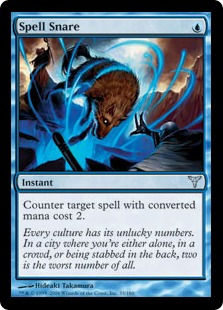
2 Spell Snare

Sorceries

4 Serum Visions

Lands

3 Island
1 Mountain
1 Plains
3 Celestial Colonnade
4 Flooded Strand
1 Ghost Quarter
1 Hallowed Fountain
1 Sacred Foundry
4 Scalding Tarn
2 Steam Vents
2 Sulfur Falls

Sideboard

1 Engineered Explosives
1 Fulminator Mage
1 Izzet Staticaster
2 Runed Halo
2 Dispel
1 Ravenous Trap
3 Surgical Extraction
3 Ancestral Vision
1 Crumble to Dust

Steve Wilson made it all the way to 4th place with Jeskai Flash, a deck that has existed in some capacity since Innistrad but never been so strong. The difference-maker is Spell Queller, who acts as a flying, three-mana Thought-Knot Seer in a lot of matchups, trading some power for a tempo advantage. Queller lets opponents spend mana on their spells before countering them, helping Wilson catch up on the tempo sacrificed by running so many three- and four-drops.

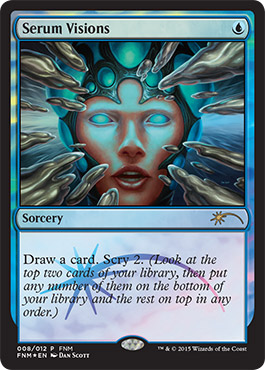
Serum VisionsI'm also happy to see Serum Visions make an appearance. A couple years ago, we rarely saw the card featured in Celestial Colonnade decks. Players seemed convinced Visions was too bad to play. Just as Treasure Cruise is no Ancestral Recall but broken regardless, Serum Visions isn't Ponder, but looking at three cards for one mana is still an awesome rate.

The coolest choice Wilson made with his deck is the pair of Negates. Negate is a card so inefficient it's frequently cast as a sideboard option, but we very rarely see it make the main 60. I guess the ol' Cruise-Recall comparison applies here, too; we don't have Counterspell, but Negate will do in many scenarios. Wilson notably has Bolt, Path, and Helix in these colors (as well as Blessed Alliance!), meaning noncreature spells are the ones he's most concerned about interacting with on the stack.

WR Control, by Christopher Johnson (8th, SCG Atlanta Classic)

Creatures

4 Wall of Omens
4 Restoration Angel
1 Emrakul, the Aeons Torn
2 Kiki-Jiki, Mirror Breaker

Planeswalkers

1 Ajani Vengeant
2 Chandra, Torch of Defiance
4 Nahiri, the Harbinger

Enchantments

4 Blood Moon

Instants

2 Blessed Alliance
4 Lightning Bolt
3 Lightning Helix
4 Path to Exile

Sorceries

2 Anger of the Gods

Lands

1 Mountain
5 Plains
4 Arid Mesa
1 Ghost Quarter
3 Marsh Flats
1 Needle Spires
4 Sacred Foundry
4 Temple of Triumph

Sideboard

1 Batterskull
2 Pithing Needle
2 Spellskite
3 Leyline of Sanctity
2 Rest in Peace
2 Stony Silence
1 Elspeth, Sun's Champion
1 Anger of the Gods
1 Wrath of God

Christopher Johnson's WR Control takes Restoration Angel in a different direction, fitting her into a similar shell but trimming Serum Visions and cute threats for Blood Moon and more planeswalkers. Johnson's deck looks a lot like Todd Stevens' Sun and Moon, a WR Prison deck that gained significant traction a few weeks ago. (One copy of that deck did make the Top 16; kudos to SCG for just calling it WR Prison!)

The biggest difference is Johnson's abandoning of Chalice of the Void and Simian Spirit Guide. This choice grants him Lightning Bolt and Path to Exile, the format's two best removal spells, and improves his big mana matchups. RG Valakut, for instance, could care less about a Chalice (and often runs its own somewhere in the 75). Path to Exile on a precious Titan is much more threatening.

Another change is the introduction of the Kiki-Jiki combo. Even though it's a turn slower, having access to an oops-I-win against decks like Tron and Chord that can stabilize boards beyond repair is a great boon in certain matchups.

A Slimmer, Grimmer Jund

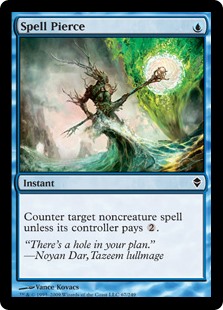
Temur Battle Rage, Cathartic Reunion, Become Immense, Blossoming Defense. All relative Modern newcomers that have created or greatly benefited linear aggro decks. Death's Shadow Aggro and UR Kiln Fiend were not strategies last year, and Infect was practically nowhere. It's no wonder a one-mana, catch-all removal spell is gaining steam in Modern. Or that Spell Pierce is finally getting the play it deserves.

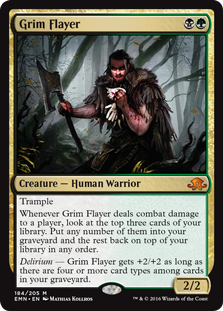
grim-flayerThe format changes made to accommodate this shift can be seen outside of just cards. Jund in particular has undergone a serious, if subtle, transformation over the last couple of months. Dark Confidant and Tarmogoyf have always headlined the deck's threat suite, flanked by some number of Scavenging Ooze. But the rest of the creatures have been up in the air since the Bloodbraid Elf and Deathrite Shaman bans. Kitchen Finks, Kalitas, Fulminator Mage, Tasigur, Huntmaster of the Fells, and Olivia Voldaren have all been commonly featured in the deck at some point.

All of those creatures cost more than two mana, making them sub-optimal for a faster metagame. As of Eldritch Moon, Jund has access to a fourth efficient two-drop. Grim Flayer offers Jund more than just an attractive option for curving---when it connects, Jund gets to "gravescry" 3, ensuring a never-ending stream of gas. When you need to continually dig for answers while aggressing your linear opponent, getting a free Serum Visions every turn is just what the doctor ordered. BGx has never had access to card selection, instead getting by on the sheer power of its cards. With Flayer in the mix, the deck gets much better.

Two of the three Top 16 Jund decks ran three Grim Flayer in the mainboard, as did Todd Anderson in his 7-1 list from the Invitational. I think Flayer will join Confidant, Goyf, and Scooze as a staple Jund creature and further fill out the deck's core.

The Brews That Grew From Concrete

With Jund out of the way, we can focus on some of the less conventional decks from Atlanta.

Strength in Numbers

Ever since its inception, Modern has been especially hostile to certain strategies. Tribal creature strategies are among them, with Merfolk providing a crucial exception to the rule. Amazingly, both UB Faeries and Slivers cracked the Classic's Top 16.

UB Faeries, by Justin Parente (15th, SCG Atlanta Classic)

Creatures

4 Spellstutter Sprite
3 Vendilion Clique
3 Mistbind Clique

Enchantments

4 Bitterblossom

Instants

4 Cryptic Command
1 Doom Blade
3 Mana Leak
1 Murderous Cut
1 Smother
2 Spell Snare
1 Victim of Night
4 Ancestral Vision

Sorceries

3 Collective Brutality
2 Inquisition of Kozilek

Lands

3 Island
1 Swamp
3 Creeping Tar Pit
2 Darkslick Shores
4 Mutavault
4 Polluted Delta
1 River of Tears
4 Secluded Glen
2 Watery Grave

Sideboard

2 Engineered Explosives
2 Grafdigger's Cage
3 Spreading Seas
1 Disfigure
1 Dispel
2 Ravenous Trap
1 Liliana of the Veil
2 Damnation
1 Thoughtseize

Justin Parente relies on Collective Brutality to handle early aggression and otherwise ports the terrifying Extended Faeries deck of yore to Modern. All I can say is I hate to imagine what a set of Wild Nacatls does to this deck.

Spreading Seas seems like a great plan from the board to beat up on big mana strategies like Tron, and it's nice to see Ravenous Trap get some love in Modern. Trap strikes me as a great option for decks that don't present a lot of pressure, aren't in white, and are willing to dedicate two sideboard slots to beating Dredge. It competes with Grafdigger's Cage and Tormod's Crypt for slots, but is notably the hardest of the three for Dredge to actually interact with.

Slivers, by Bradley George (3rd, SCG Atlanta Classic)

Creatures

4 Sedge Sliver
4 Galerider Sliver
4 Manaweft Sliver
4 Sinew Sliver
2 Blur Sliver
4 Predatory Sliver
3 Diffusion Sliver
2 Necrotic Sliver
1 Sentinel Sliver
1 Darkheart Sliver
1 Spellskite

Artifacts

4 Aether Vial

Instants

4 Collected Company
2 Dismember

Lands

4 Cavern of Souls
4 Sliver Hive
4 Mutavault
3 Verdant Catacombs
2 Overgrown Tomb
1 Forest
1 Swamp
1 Breeding Pool

Sideboard

1 Spellskite
1 Bonescythe Sliver
1 Cautery Sliver
1 Diffusion Sliver
2 Frenetic Sliver
3 Harmonic Sliver
1 Homing Sliver
1 Syphon Sliver
1 Telekinetic Sliver
2 Warping Wail
1 Sliver Hivelord

The most impressive deck of the week has to be Bradley George's. There's a lot going on here that I don't really understand (when does Sliver Hivelord come in? Against Terminate decks?), but also a lot to love that I can wrap my head around.

George's manabase is the first big draw to this deck; he's constructed it in a way that he takes hardly any damage from his lands, but can still cast his Slivers consistently. Aether Vial and Collected Company also help on this front. All the colorless-producing lands even enable Warping Wail from the sideboard, which no doubt helps against Wrath of God, Damnation, and, of course, Anger of the Gods.

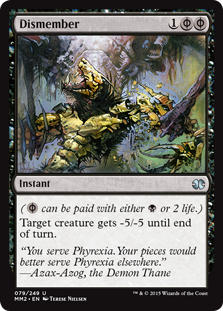
DismemberUnderstanding the importance of interaction in this metagame, George also opted for a pair of Dismember. I lauded Dismember last week as a powerful, splashable card in colors that don't generally have access to efficient removal. Rather than cripple his manabase with a white splash, George called on the classic Phyrexian creature-killer, which can even be hardcast in this deck.

Close inspection of the creature suite, especially when considering the sideboard, reveals that George truly has answers for everything in his deck. It's just a matter of finding the right ones. He's only included a single copy of Homing Sliver in the 75, though, so tracking them down can't be that difficult.

Remember the Titans?

Yeah, so do I. Valakut decks put zero pilots into the Classic's Top 16, but the Invitational saw one player go 7-1 with Modern's original Primeval Titan deck: Amulet Bloom. Er, Amulet... Titan.

Amulet Titan, by Edgar Magalhaes (7-1 or better, SCG Atlanta Invitational)

Creatures

4 Azusa, Lost but Seeking
4 Primeval Titan
4 Sakura-Tribe Scout
1 Thragtusk

Artifacts

4 Amulet of Vigor
1 Batterskull
1 Engineered Explosives

Instants

4 Summoner's Pact
1 Pact of Negation
1 Slaughter Pact

Sorceries

4 Ancient Stirrings
4 Serum Visions

Lands

1 Forest
1 Bojuka Bog
1 Boros Garrison
1 Cavern of Souls
1 Crumbling Vestige
4 Gemstone Mine
1 Grove of the Burnwillows
3 Gruul Turf
1 Khalni Garden
1 Radiant Fountain
1 Selesnya Sanctuary
4 Simic Growth Chamber
1 Slayers' Stronghold
1 Sunhome, Fortress of the Legion
1 Temple of Mystery
3 Tolaria West
1 Vesuva

Sideboard

1 Engineered Explosives
1 Hornet Queen
1 Obstinate Baloth
1 Reclamation Sage
2 Dismember
1 Pact of Negation
2 Swan Song
1 Melira, Sylvok Outcast
1 Ruric Thar, the Unbowed
1 Sigarda, Host of Herons
2 Firespout
1 Ghost Quarter

Incredibly, the deck looks almost identical to its original, now-banned form. Azusa takes the place of the extra Blooms, and some of the midrange fatties make their way from sideboard to mainboard. This build notably abandons the Hive Mind package entirely. There have been a few iterations of Bloomless Titan running around since the Summer Bloom ban, and Magalhaes continues their tradition of packing Sakura-Tribe Scout as a recurring Explore effect alongside Azusa.

I have a feeling Magalhaes was on to something with this deck, and we'll see more Bloomless Titan lists start to crop up in the future.

Moden Will Be Modern

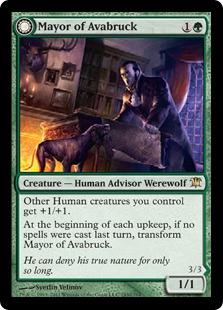
Mayor of AvabruckWatching Modern coverage and hanging out on forums can be headache-inducing. Doomsaying is alive and well. But all the decks explored today---except for Bloomless Titan---are of the interactive variety. That isn't to say there aren't plenty of linear decks in Modern. But there are many avenues yet to be explored when it comes to interacting. As the format shifts, more avenues open up and others close. In any case, the format remains a smashing success according to Wizards' parameters, with a now enormous roster of playable decks to its name. Restoration Angel today, Mayor of Avabruck tomorrow... a guy can dream!

High Stakes MTGO – Nov 27th to Dec 3rd

Are you a Quiet Speculation member?

If not, now is a perfect time to join up! Our powerful tools, breaking-news analysis, and exclusive Discord channel will make sure you stay up to date and ahead of the curve.

Hi, everyone, and welcome back for another High Stakes MTGO article!

After a no-buy week, this past week was more balanced, with a few purchases and sales concerning both Standard and Modern. I'm still buying Modern specs at a clip, although I'm trying to grab positions with low chances of a reprint in Modern Masters 2017. I'll elaborate more on this topic in the Questions & Answers section below.

This past week I closed the biggest single position I had in my portfolio: Battle for Zendikar full sets. Considering the unexpected comeback of the value of BFZ sets, I'm almost having regrets here, but I'll live with it. Still on the topic of BFZ, I have also finished selling my booster position—although in this case the loss was far worse percentage-wise.

Without further introduction, let's see what I did this past week. The latest snapshot of my portfolio is here.

Buys This Week

refill

A little round of reinforcement for these four cards. These are all positions I was still holding while their respective sets were flashback-drafted, or positions I purchased right after said flashback drafts. Still, prices are lower now than they were then, so I thought adding more copies of each to my stocks wouldn't hurt.

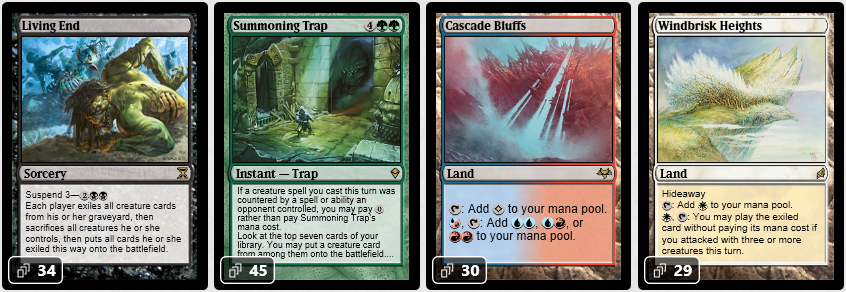
Rare land cycles are among the cards safest from a reprint in MM3. It wouldn't be totally impossible for a reprint of just one card from a given cycle, but that's extremely unlikely given Wizards's past decisions. Needless to say, there are about twenty valuable land cycles out there to choose from for reprints, so it would be very unlikely for the exact cards chosen to be Cascade Bluffs or Windbrisk Heights.

Reprints aside, I'm comfortable gathering more copies of these two cards, considering the speculative potential in case they become played again in trendy Modern decks. I may have to be patient, but since flashback drafts are behind us and reprints are not a concern here, I'm okay in this position.

Although they wouldn't be ideal reprints, Living End and Summoning Trap are certainly more likely to be in MM3. Considering my buying price for the green Trap, I have nothing to lose.

There's a little bit more at stake with Living End, though the risk-reward situation seems decent to me. Living End periodically comes into the spotlight in Modern, with a top price of 10 tix reached several times over the last year and a half. Adding more copies around 2 tix sounds like a good long-term bet.

cos

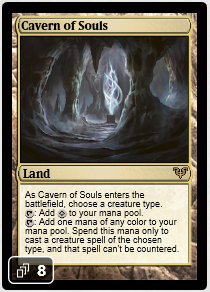
Cavern of Souls is not part of a land cycle, and definitely wouldn't surprise anyone showing up in MM3. However, there are only a handful of lands reprinted at rare and mythic rare in Modern Masters sets. With Avacyn Restored flashback drafts just behind us, this might be the only opportunity to grab copies of the Cavern under 30 tix for a while.

I'm taking the same position as Matt Lewis here. If Cavern of Souls hits the 35-40 tix price range before MM3 spoilers begin, I'll most likely sell. If not, I might gamble a bit and hope to dodge a reprint. Note that if Cavern of Souls doesn't get reprinted, it will likely find its way back to 40-50 tix, as players will be much more confident about the price stability of this multi-format staple.

Sales This Week

The black-white creature land from BFZ is getting some traction recently, cycling closer and closer to the 3 tix bar since the release of Kaladesh. Still, this land is not played in any of the top decks in the current Standard metagame.

As with my other BFZ positions, I was looking to sell this one as soon as I could break even, which is what I've done. My selling price isn't too bad given the price history of Shambling Vent—it's just that my timing on the purchase was poor, as with my other BFZ positions, which meant the buying price was too high.

bfzlog

There you go. I finally closed this giant position that has been dead weight for so long. I thought for long that I would lose a large chunk of tix on this full set spec, partially for having bought these too early in the season, and partially because of the low number of attractive cards in BFZ. At some point the value of a BFZ full set was almost 20 tix under my buying price, whereas now a BFZ full set is flirting with 80 tix.

The new block structure brought a lot of changes that required trial and error on the speculative front, and I paid my dues here. Of course, I wish I had anticipated the still-ongoing rebound BFZ saw after the release of KLD, in which case I wouldn't have sold 15 sets at 46 tix each back in October. All in all, I lost about a thousand tix with my BFZ full set spec, but it could have gone much worse.

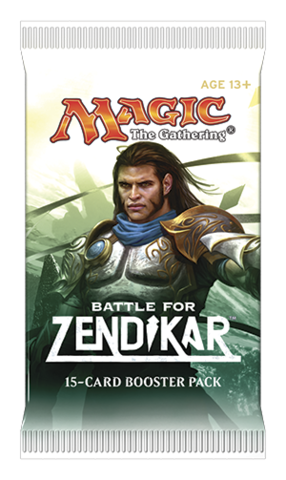
mtgbfz_en_bstr_01_01

BFZ really sucked up a lot of my tix, booster spec included. Here too, I'm done with it—no more BFZ boosters in my portfolio. That's undeniably the biggest loss (-47%) I ever had with a booster spec, but I'll live with it.

Spellskite was a solid, if modest, spec picked up during New Phyrexia flashback drafts. My goal here was 16 tix, and I'm happy I met that goal before getting into potential trouble with MM3 spoilers.

This card could probably see another month or so of slow growth, before Modern interest fades away or it makes an appearance on the MM3 spoilers list. Either way, my investment goals were met here and I leave any extra tix for the next speculator.

On My Radar

Still focusing on Modern for the next few weeks, I'll be looking for Modern staples that have the least chance of being reprinted in Modern Masters 2017.

As it seems, the spoiler season for Aether Revolt has started. There isn't always a good speculative use to make of spoilers in Standard, but it can sometimes lead to momentary spikes. Being the first to buy and then sell into the hype can lead to some nice profits. If you have a good read of the current or future metagame in Standard, new cards from Aether Revolt could be a signal to buy under-valued cards from the previous five Standard sets. That, however, is not a job I'm very good at.

Questions & Answers

Finding Safe(r) Specs Before MM3

Since its inception, Modern has always been a speculative machine. It is almost too easy to find speculative winners, whether established Modern staples (and there's about a truckload of them) or under-the-radar cards just waiting for a Grand Prix or Pro Tour appearance on camera to take off. In many cases the uncertainty was "when," not "if."

Then the Modern Masters series kicked in. A lot of cards, including several expensive staples, took a hit, as they were suddenly reprinted in massive quantities compared to their original set run. We also learned from MMA and MM2 that almost any eligible card can be in the set. Worse, being already reprinted in a previous Modern Masters set doesn't spare you from being in the next one.

Now that MM3 is only three months away, trying to speculate with Modern positions can be like playing a hot potato game—you really don't want to hold the potato when the spoiler season starts. Nevertheless, if the two previous Modern Masters sets are any example, there might be one category of cards with much lower chances of reprint: rare land cycles.

A reprint of an entire cycle of five lands at rare is simply extremely unlikely. One reason for this is Wizards has incentive to save these land cycles, especially those that produce two colors of mana and are currently expensive, to help sell regular sets. Ravnica shocklands and Onslaught fetchlands both got reprinted recently, and it's only a matter of time before we see a new printing of Zendikar fetchlands, Scars of Mirrodin fast lands, allied-colored painlands, or the Worldwake creature lands. But, most importantly, I don't think in Modern Masters 2017.

Wizards has shown their willingness to print only one card out of a cycle—Primeval Titan and Leyline of Sanctity are two great examples—but that would be extremely odd with lands.

What about rare lands that aren't part of a cycle. Only four lands have been reprinted at rare in MMA and MM2: City of Brass, Blinkmoth Nexus, Academy Ruins and Eye of Ugin. So the likelihood of a reprint for any given land is very low, even if there are several good candidates including Cavern of Souls, Mutavault, Horizon Canopy, Grove of the Burnwillows, Pendelhaven, and Inkmoth Nexus.

In conclusion, if you want to gamble a bit and try to dodge the reprint bullet, I think some good opportunities can be found in Modern rare lands. In addition, the reward could be multiplied when the majority of players and speculators learn the cards can't fill the holes in the spoiler list. At that point they might get a nice price boost, as did several cards when they were confirmed out of MM2.

Thank you for reading,

Sylvain

Insider: MTGO Cards to Buy, Sell or Hold – Episode 20

Are you a Quiet Speculation member?

If not, now is a perfect time to join up! Our powerful tools, breaking-news analysis, and exclusive Discord channel will make sure you stay up to date and ahead of the curve.

Welcome back, investors! The last two Grand Prix shook up the quiet Standard landscape (finally!) that was beginning to see complaints about being a two-deck format. All it needed was just a big tournament weekend. The past week was superb for investing, plenty of cards that were stuck spiked, and there will be great buying opportunities in the days to come, as I will write about next:

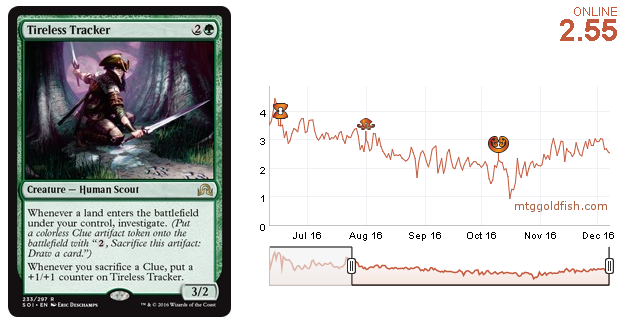
Tireless Tracker

tireless-tracker

I have mentioned it a few times in previous episodes, and I think it is now the time to sell. In my opinion, the card will rise in the long term, but it should go down in the following days. The card was played mainly in BG Delirium, a deck that doesn't seem well positioned anymore. Many players made the transition to RG Aetherworks Marvel, as they share some expensive cards. I expect those players to sell the most expensive cards that are not played in the Marvel deck to buy the new ones, and Tireless Tracker as well as Liliana, the Last Hope and Hissing Quagmire are in that category.
Verdict: SELL

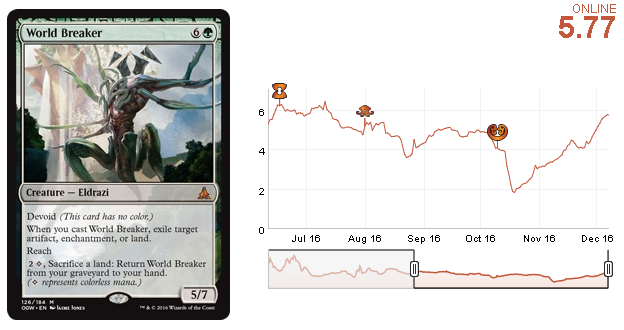
World Breaker

world-breaker
World Breaker is one of the big winners of last weekend. It rebounded from its all-time low of 2 tix two months ago to 5.7 thanks to the great performance of the RG Aetherworks Marvel, even though the deck usually only plays one copy (and in the sideboard, at that). The deck took the paper metagame by surprise but not the MTGO community, as the deck was played heavily long before. Taking that into account, the window for this card to keep rising is very short, because many online players already bought them and only the new players will keep pushing the price up. I consider it much better to sell now than try to get an extra profit.
Verdict: SELL

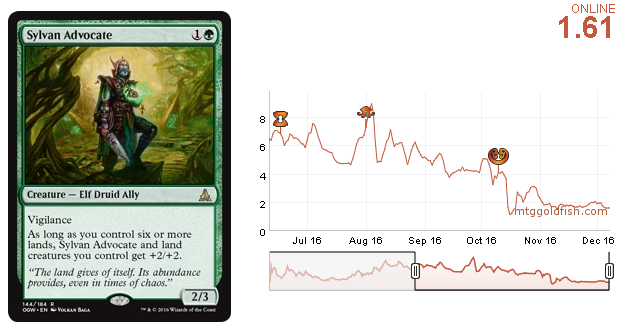
Sylvan Advocate

sylvan-advocate
Sylvan Advocate is one of the few cards worth buying this week, not because there are not interesting cheap cards, but rather because I expect those cards to keep going down in the next days. Sylvan Advocate is the exception, as it is already super cheap and unlikely to go lower. The next set could be the help it needs to be played again, and the Ajani planeswalker spoiled a few days ago could be a hint that WG will have strong cards.
Verdict: BUY
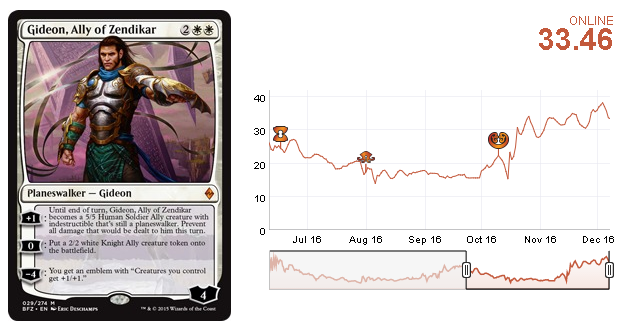
Gideon, Ally of Zendikar
gideon-ally-of-zendikar
UW Flash deck is one of the losers of the past weekend, and not well-positioned in the way the metagame is shifting. Gideon, Ally of Zendikar is the most expensive card in the deck and the most expensive of the entire Standard format as well. I think the planeswalker has reached its all-time high and in the following days it should return to a more reasonable price. I expect the UW Flash players to try different strategies, and the expensive cards will be the first to be sold. The future is not very bright for Gideon, and I recommend you sell your copies as soon as possible.
Verdict: SELL

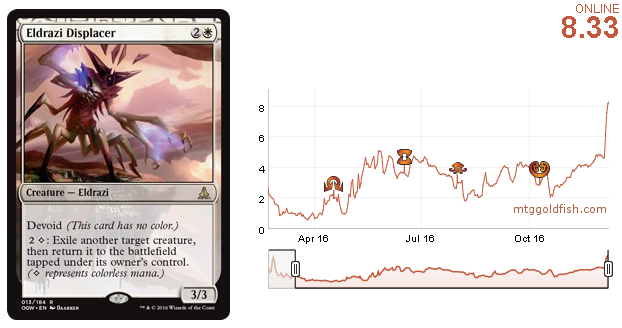
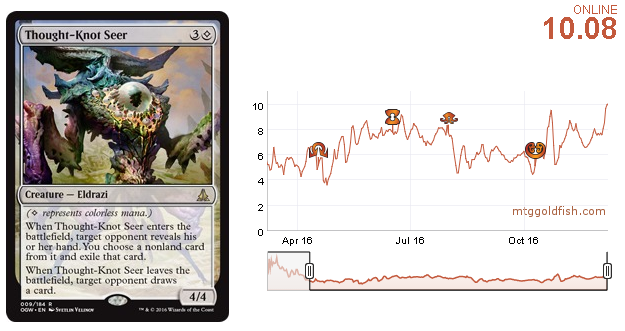
Eldrazi Displacer & Thought-Knot Seer

eldrazi-displacer
 thought-knot-seer
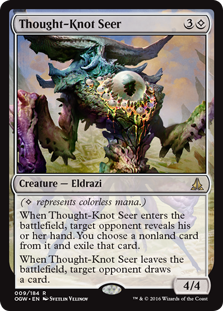
This time I will rate an extra card because they reasons are exactly the same for both. As you may have noticed,  Eldrazi Displacer and Thought-Knot Seer were played in one of the most interesting, completely new decks of the Grand Prix, three and one copies in the maindeck respectively, in the hands of Pascal Maynard and Seth Manfield. I expect many players to try the UW Panharmonicon deck, as it is a fresh new brew and played by top pros, which should cause these prices to go up even higher. The relevant question here is: how high will they go? I think it is worth it to wait a few more days to see what how the Standard metagame transforms to see their real potential. Add to that the modern RPTQ for Aether Revolt that will be played this month, and Bant Eldrazi influence these cards' prices, too.
Verdict: HOLD
See you next week!

Insider: How Many Bulk Rares Is Too Many?

Are you a Quiet Speculation member?

If not, now is a perfect time to join up! Our powerful tools, breaking-news analysis, and exclusive Discord channel will make sure you stay up to date and ahead of the curve.

I've been doing a lot of buying not as much selling lately. I normally turn my TCGplayer store off around Thanksgiving break and then again during finals week, allowing me to focus on hanging out with family and then catching up on schoolwork. Selling can be done whenever, but collection buying can sometimes be a "now or never" kind of deal, especially when the seller is looking to cash out to pay bills, trade off EDH decks for a Modern deck that they need this weekend or even just "person X is gonna pay Y, but he can't meet up till Saturday. Can you match it if you meet up today?"

There was an error retrieving a chart for Bargaining Table

I've run into all of these situations and more, and it usually ends with a giant stockpile of stuff to grade, sort, and inventory. The windfall when I flip chunks of it at Grand Prix used to be nice, but my schedule has more or less prevented me from traveling ever since February when I made the trip to Thomas Dodd's store (a trip that I really want to recreate sometime soon before Vegas, if I get the time).

So where am I going with this? Well, a significant portion of the stuff I've accumulated over the past month or two has been bulk rares. That's not a bad thing – I love bulk rares. I enjoy picking out the Angel of Finalitys, Desecration Demons, and Seances of the "picked bulk."

Up until August or so, I comfortably owned around 10,000 bulk rares. I was able to sort them by color with around 1000 to 2000 for each and leave them at the store where my display case is. I normally sell them for 25 cents a piece, or five for a dollar. After the 10 percent that the store makes off my sales, I'm getting around $.18 per bulk rare. That's a pretty solid margin when I'm buying them for 10 cents each, but the rate of sales is a pretty serious number to take into account. Unfortunately, the store where I keep my display case doesn't keep records of my sales, so I don't know the exact count on how many bulk rares sell on average per day/week/month. It's a videogame store first and foremost, and they just do the exchange of money for me while handing out business cards.

There was an error retrieving a chart for Arms Dealer

The "problem" recently, if you don't judge me and put "first-world" in front of it, is that I'm taking in way more bulk rares than I'm selling through the display case. I currently probably own 25,000 bulk rares, which is a number I'm not used to handling.

The spectrum of people reading this will react to that number in different ways. When I answer my local players who ask, "DJ, how many bulk rares do you have?" their jaws hit the floor. Store owners and people who handle cards on a level above me will laugh at my relatively paltry collection.

But back to the point: I literally don't have room for that many at the display case, so I need to plan ahead on how (or if) I'm going to sort them, then figure out the line of play for selling them for a profit. Some of you might be dealing with this on a smaller scale; maybe you're a long-time Standard and Modern player who cracks boxes and has accumulated a a few thousand rares that are too bulky (physically and financially) to bring to FNM for trades. We're going to go over a couple of options that we have for turning these theoretical dimes into actual cash, even if the multiplier ends up being a little lower than we initially hope for.

There was an error retrieving a chart for Gwafa Hazid, Profiteer

First things first: we should pick bulk rares. Picking bulk rares is kind of like picking bulk commons and uncommons, where most of the cards pulled by competitive players will be cards that are currently in demand for them. You don't really see Brainstorm in common/uncommon bulk unless you're getting it from a very casual player, and it's rare (no pun) in the same vein to get cards like Siege Rhino in a pile of bulk rares, because a decent number of ex-Standard players wanna jam them in Modern or, dare I say it... Frontier....

Your QS Insider sub goes a long way here, because you can use the ION scanner to help pick the true bulk rares from the fake bulk rares. Because I've been doing this for a while, there's not a whole lot of cards that catch me by surprise. If you're a recent Insider or just trying to get serious with Magic finance, I strongly recommend getting set up with ION Core to make your life a bit easier.

Did you know that Detention Sphere still retails for a dollar? Or that you can still buylist it for anywhere between 25 and 75 cents? Those are the kind of margins we're hunting for when you turn into a bulk rare vacuum by matching SCG's pricing on gold symbols. Once you're done picking a few thousand bulk rares, you'll probably have a nice pile of value that will surprise you. Cathars' Crusade, Beck // Call.... all great cards I've picked up for dimes and set aside for later sales.

There was an error retrieving a chart for Fleecemane Lion

The easiest method is to just try and ship the remaining true bulk en masse for a significantly lower margin. Now that we know there's no 50-cent cards waiting in the ranks, we can send off the absolute jank to someone who has a more consistent out. Some vendors at Grands Prix take bulk rares at above the standard 10 cents, but it's always better to ask around first and get there on Friday. There's always several people trying to unload thousands of bulk rares using this method for 11 or 12 cents each, and you need to get there early (late Thursday or early Friday) to beat them to the punch. Alternatively, find someone relatively local to you through Facebook or Twitter and move them that way. Even if the buyer doesn't have a consistent out themselves, they might just be goldfishing for the $1 and $2 cards that you pulled out.

If you want to put a bit more work into it (and you also have piles of bulk common/uncommon cards to spare), you can create instant collections. Grab 15 or 20 rares of varying colors, a certain amount of common/uncommon bulk, and some basic lands – you're good to go! The biggest reason I've strayed away from these is the time investment; I really don't even know if these would be a distinct seller as opposed to someone just buying my bulk C/U and bulk rares separately. You could try your luck selling instant collections on eBay and Amazon, but even then we'd be minnows wading into territory dominated by experienced stores and people who have done this for a while. If you've had success building instant collections and selling them online or in person, I'd love to hear your story in the comments or on Twitter.

There was an error retrieving a chart for Quicken

I've talked a bit about my display case, but I'm also happy to announce that I should be able to branch out from that soon. One of the core tenets to the "bulk life" articles that I write is making connections throughout your community and being "that guy" that everyone knows to go to for cash/cards.

I've been visiting a local store a lot recently, and it looks like I might be able to help them a lot with their singles and other Magic inventory. It's mostly a store for D&D and tabletop stuff, but he's been dipping his toes into Magic events and is increasingly in need for cards for players to purchase. While this isn't an option for everyone, I'm definitely hoping to leave maybe 5000 or 10,000 bulk rares there and seeing how things pan out over the next couple of months. Even if I need to drop my price from 20 cents to 15 and offer the store owner a percentage of my sales, I'm still opening myself up to a whole new and expanding player base. We've been getting close to 15-20 people for Modern every week, and we're running out of chairs and tables as more people flock to the store that suddenly has a really strong inventory and buylist on Tuesday nights.

This last tactic is probably a bit late for most, but I suppose SCG will still be running their weekly sale until the end of the year. Although I didn't personally buy anything from them this time, there are some really good deals to be hunted down if you're willing to put in the ten or fifteen minutes a day scanning through the updates. I buy bulk rares and teach others to buy bulk rares on the premise that in the absolute worst-case scenario, you can always get your money back. Even if it's not SCG, someone out there is willing to pay dimes for your bulk rares – because they also read this article.

When SCG provides us with cherries on top, that's even better. We can abuse that 25-percent trade-in bonus and really wring some value out of the rares we get by getting cards a lot cheaper than they are on TCG, theoretically. Star City has $1 Sol Rings right now, and I've talked before about their Expeditions sale and how you could turn 20,000 bulk rares into an Expedition because of the trade-in bonus. While they're not currently offering any special bonus for rares, you can take comfort in the fact that they will buy any number. So if you picked up 15,000 rares before realizing that you went a bit overboard, you can still have a strategic out that doesn't involve taking a loss by trading into SCG at an opportune time like a sale.

That's it for this week! Questions, comments? You know what to do.


Insider: Masterpiece Finance Trends

Are you a Quiet Speculation member?

If not, now is a perfect time to join up! Our powerful tools, breaking-news analysis, and exclusive Discord channel will make sure you stay up to date and ahead of the curve.

My article for this week was originally going to be on another topic. There was seemingly a lot that happened in Standard over the weekend, and I was going to discuss the financial fallout from the format trying to correct itself from having only two playable decks. Although some new decks did well this past weekend, I didn’t notice much happening on the finance side. Here are the only cards I updated prices on this week:

Aetherworks Marvel $8.5
Emrakul, the Promised End $18
Liliana, the Last Hope $35
Tamiyo, Field Researcher $9.50

Other than Aetherworks Marvel jumping back up due to success this weekend, not much has changed as you can see. I priced my Marvels slightly above the current market price to try and get ahead of the curve on this one. Emrakul bumped up a little because many players are fighting for the fastest cast time on him. Lilly and Tamiyo dipped a little this week, though. I’ve been really impressed with Tamiyo in this format, however. I’ve been casting her a lot lately and she’s always been the best part of my deck.

There was an error retrieving a chart for Tamiyo, Field Researcher

Since there isn’t as much going on with the competitive Standard cards for this article, let’s take a look at a different set of important cards in the format that sometimes goes unnoticed to those of us in the tournament scene.

Expeditioning

When Battle for Zendikar was being spoiled, we all went nuts for the Expeditions. They spoiled the fetches, shocks, and battle lands, and we were pumped for this new rarity and all the possibilities. Dealers and players cracked box loads of packs for inventory, collections, and a variety of other reasons. One of the main driving factors though was the slim possibility that you could open a card worth a couple hundred dollars. So, players who were smart went together to buy cases instead of a box or a couple random packs to essentially guarantee success on the new and exciting Expeditions hunt. I know this marketing stunt pulled me in, and I was more excited to open packs than I have been in a long time.

Modern players devoured the market for these lands. Everyone foiling their Modern deck wants the best and coolest foils, so they dove straight for the Expeditions. When you go to a Star City Modern Open or a Grand Prix featuring the format, you’re likely to see many players sporting these lands. Their price certainly indicated their desirability, as the blue fetches crested $200, with Scalding Tarn jumping to around $300!

What I’ve noticed is that the Battle for Zendikar Expeditions have been knocked down a couple pegs to more reasonable numbers. Take a look at the current market price for these lands.

Scalding Tarn $198
Polluted Delta $180
Misty Rainforest $172
Verdant Catacombs $151
Flooded Strand $141
Arid Mesa $101
Wooded Foothills $101
Windswept Heath $98
Bloodstained Mire $97
Marsh Flats $90

Steam Vents $86
Godless Shrine $72
Overgrown Tomb $72
Stomping Ground $69
Breeding Pool $67
Watery Grave $63
Temple Garden $60
Hallowed Fountain $57
Sacred Foundry $56
Blood Crypt $53
Cinder Glade $31
Prairie Stream $30
Canopy Vista $27
Smoldering Marsh $26
Sunken Hollow $23

From the initial price climb, basically all of the cards in this cycle have fallen down a bit. The buy prices for these lands have also calmed down a bit, too. You can still find dealers buying these lands pretty aggressively, but for the most part, the buy prices have adjusted back to the normal percentages for cards at each price level.

The demand for fetches and shocks is high due to how many players play them in every format they are legal. It’s no surprise that the battle lands have fallen down to around $20 to $30 each. Because those five lands are so cheap, that leaves more room for the other lands in the cycle to be worth more money.

There was an error retrieving a chart for Smoldering Marsh

I think eventually we will see the price of these lands start to incline once more, but for now, they are definitely not growing at all. This initial decline in price took me by surprise because once the original supply dried up, it seemed logical for each land to be sold for more and more money.

The current prices we’re seeing may be the lowest they will ever be, but if the demand never picks back up for these commodities, then they could dip a bit more.

Expeditions, The Sequel

What happened next still surprises me. Wizards chose the most random selection of lands to include in the second half of the Expeditions set. Instead of going with two cycles like the filter lands and man lands, we got a pile of random lands mashed together. Basically what happened is that all the players just wanted lands from the first release and far fewer players sought out lands from Oath of the Gatewatch. These Expeditions too have fallen in value down to more manageable prices for most players.

I think if another decision had been made and a different selection of lands were chosen, we would have seen steeper demand for the second half of the Expeditions. Here’s where we’re at with the Oath Expeditions.

Wasteland $99
Ancient Tomb $98
Horizon Canopy $91
Strip Mine $64

Twilight Mire $50
Eye of Ugin $49
Cascade Bluffs $42
Fetid Heath $42
Mana Confluence $40
Flooded Grove $38
Sunken Ruins $38
Fire-Lit Thicket $38
Mystic Gate $37
Rugged Prairie $33
Dust Bowl $32
Wooded Bastion $31
Kor Haven $30
Forbidden Orchard $30
Graven Cairns $29
Tectonic Edge $29

As you can see, all the filter lands fall in the $30 to $50 dollar range, and that seems appropriate for lands primarily used by Commander players. Some of the utility lands fall in that category as well, which is logical for the same reasons.

Lower demand for the majority of the cycle left Wasteland, Ancient Tomb, Horizon Canopy, and Strip Mine as the top dogs. I thought these four cards would pull away in price and keep rising more, but they have dropped off as well. As a Legacy staples, I thought at least Ancient Tomb and Wasteland would rise above their starting price points.

There was an error retrieving a chart for Ancient Tomb

So, why have all these Expeditions dropped in value? I think there are two reasons. The first is that we hit maximum supply. Once most of the packs were opened from this set, all of the Expeditions were floating out there, and the initial buyers had all gotten their copies, and the rest of the copies didn’t move as quickly. Once Battle for Zendikar and Oath of the Gatewatch go out of print, then I think we should start seeing that supply dwindle which will cause the prices to start recouping their lost ground.

Masterpiece Theater

The second main reason the price of the Expeditions didn’t retain its original value is because Wizards told us that they were no longer as special as they were when the set was released. I think once players realized that Masterpieces were now going to be a regular part of Magic, that the Expeditions weren’t the golden goose we were looking for anymore. If there is going to be a unique cycles of cards in every set, then there is no rush to acquire my piece of this series.

Each part of the Masterpieces series is going to reflect the plane we’re on at the time. So, Battle for Zendikar had lands because landfall plus the landscape being integral to the storyline of that plane. With Kaladesh, artifacts are the central theme, so our Masterpieces here are the Inventions. Take a look at where their prices are at right now.

[Card]Sol Ring[Card/] $121
[Card]Mana Vault[Card/] $117
[Card]Mana Crypt[Card/] $115
[Card]Mox Opal[Card/] $94
[Card]Crucible of Worlds[Card/] $90
[Card]Aether Vial[Card/] $85
[Card]Sword of Fire and Ice[Card/] $78
[Card]Sword of Feast and Famine[Card/] $73
[Card]Sword of Light and Shadow[Card/] $68
[Card]Lotus Petal[Card/] $66

[Card]Chromatic Lantern[Card/] $55
[Card]Torrential Gearhulk[Card/] $51
[Card]Solemn Simulacrum[Card/] $50
[Card]Lightning Greaves[Card/] $48
[Card]Scroll Rack[Card/] $48
[Card]Rings of Brighthearth[Card/] $43
[Card]Steel Overseer[Card/] $42
[Card]Noxious Gearhulk[Card/] $40

[Card]Verdurous Gearhulk[Card/] $37
[Card]Chrome Mox[Card/] $37
[Card]Gauntlet of Power[Card/] $35
[Card]Painter's Servant[Card/] $35
[Card]Combustable Gearhulk[Card/] $35
[Card]Cloudstone Curio[Card/] $34
[Card]Sculpting Steel[Card/] $33
[Card]Hangarback Walker[Card/] $32
[Card]Mind's Eye[Card/] $28
[Card]Cataclysmic Gearhulk[Card/] $28
[Card]Static Orb[Card/] $25
[Card]Champion's Helm[Card/] $24

As you can see, the prices of this cycle mirrors the same layout as that of Battle for Zendikar. The only difference is that the highest prices don’t reach the same heights as its predecessor. The Inventions seemed to follow the structure of the Oath Expeditions more than the Battle ones as well. There are no cycles within the Inventions series, and the only connecting feature is that they are all artifacts.

There was an error retrieving a chart for Mana Vault

We did get part of the "Sword of X and Y" equipment cycle. That means that in Aether Revolt, we can almost certainly rely on Sword of War and Peace as well as Sword of Body and Mind to be part of the Masterpieces series. Some other artifacts that I think are likely would be other equipment like Skull Clamp and Umezawa's Jitte, plus Chalice of the Void, Oblivion Stone, Defense Grid, and more cards from Affinity like Arcbound Ravager. I assume that these cards will seem just as randomly chosen as the first group from Kaladesh, but we should get some cool cards nonetheless. I can’t wait to see which cards were chosen. Post your ideas in the comments below and let’s see if we can narrow down which cards we’re likely to be able to open in Aether Revolt.

What's in the Future?

I don’t expect most of these artifacts to trend upward for quite a long time. There are some that seem like great investments. Gauntlet of Power and Chromatic Lantern are extremely powerful Commander cards and get played frequently. I like the Affinity artifacts Mox Opal and Steel Overseer, too. I could see Aether Vial going back up as well, especially if it picks up traction in Modern. As for the rest of the set, I don’t see much demand for these cards. Everyone needs lands for their decks, while not everyone needs these artifacts.

There was an error retrieving a chart for Noxious Gearhulk

Showdown Packs/Buy a Box Packs

To finish out the article today, I want to get the conversation started about these new promotional packs that Wizards is trying out. We have both Showdown Packs and Buy-a-Box Packs at my store, but I don’t think either is generating much interest. When these were first announced, I was pumped for another way to get players to come out to the store. I was also extremely excited about opening these packs myself.

These two varieties of three-card packs are another way to open Masterpieces, but with their limited supply, I don’t think they will impact the price of these cycles much, if at all. On the other hand, opening one from one of these packs could generate more interest in them than there was before. This is the same mentality of players opening Tarmogoyf from either Modern Masters set. What I saw happen was: a player opened a Goyf, and then instead of thinking, "I don’t need one of this card," shifted their thought process to, "Now I only need three more of this card!" That same type of thinking could come into play with these promo packs, but I’m not sure enough Masterpieces will be opened to make this happen. The percentage chance to open a Masterpiece puts my store averaging one total between all of the packs we got. That’s not very likely to happen. Then again, neither is opening a Masterpiece from a random pack from a box, but I pulled one the other day as have tons of players.

Have you participated in a Standard Showdown event at your LGS? What do you think of these events in general? Let me know in the comments.

That’s all I have this week on the Masterpieces series. I hope it got you caught up on what’s been happening with this rarity and gave you some insight into the future of these cards.

Until next time,
May all your packs have Masterpieces!

Mike Lanigan
MtgJedi on Twitter

The Best Card This Week: Analyzing the Atlanta Invi Results

Are you a Quiet Speculation member?

If not, now is a perfect time to join up! Our powerful tools, breaking-news analysis, and exclusive Discord channel will make sure you stay up to date and ahead of the curve.

This week, we’re digging into Modern decklists from the SCG Invitational in Atlanta, along with the Modern Classic event, looking for sweet tech, spicy brews, cold-hearted killers, and everything in between. Did Atlanta bring with it some harbinger of things to come? Will it instead fall to the groupthink hype propping up its slightly above-average performance? Are we still talking Magic, or have we transitioned to bashing the Atlanta Falcons National Football Franchise? Back on topic...

anger-of-the-gods-banner

We’ve talked before about analyzing split format events, and the inherent dangers present in mis-evaluating information based on possibly flawed data. Normally this would be a pretty big deal—were we looking to trendspot or game the meta, we’d be very interested in ephemeral topics like public perception, targeting, and other concepts. Today, I figured we’d dodge this conversation (as it tends to get pretty thick and technical) and focus instead on decklists. As free individuals exercising our ability to think and do what we want, nobody is telling us what to do with certain information that is presented to us. Sometimes (read: most times) it's best to approach events in as formulaic and scientific a way as possible—you know, so we look smart, feel powerful, and can lord our superior knowledge over all our friends even when we 0-2 drop.

Joking aside, approaching data analysis from a top-down position can give clarity to the chaos that results from pure speculation based on only morsels of information. However, chasing this white rabbit can often lead us down the wrong path based on incorrect initial assumptions, which can cause us to make grave errors like playing Jund in a field full of Eldrazi, or Grixis Delver in a field full of Burn.

Instead, let’s just look at some lists and pull some takeaways from them, separate from metagame speculation.

[wp_ad_camp_1]

Jund

First up, Todd Anderson’s Jund, which was among the 7-1-or-better Modern decks at the Invitational:

Jund, by Todd Anderson (17th, SCG Atlanta Invitational)

Creatures

4 Dark Confidant
3 Grim Flayer
2 Scavenging Ooze
4 Tarmogoyf
1 Kalitas, Traitor of Ghet

Instants

2 Abrupt Decay
1 Kolaghan's Command
4 Lightning Bolt
1 Slaughter Pact
3 Terminate

Planeswalkers

4 Liliana of the Veil

Sorceries

4 Inquisition of Kozilek
1 Maelstrom Pulse
2 Thoughtseize

Lands

1 Forest
2 Swamp
4 Blackcleave Cliffs
1 Blood Crypt
3 Bloodstained Mire
2 Blooming Marsh
2 Overgrown Tomb
2 Raging Ravine
1 Stomping Ground
4 Verdant Catacombs
2 Wooded Foothills

Sideboard

2 Kitchen Finks
3 Leyline of the Void
2 Ancient Grudge
1 Darkblast
1 Kolaghan's Command
1 Night of Souls' Betrayal
3 Anger of the Gods
1 Duress
1 Maelstrom Pulse

This list is relatively standard fare for Jund, but the three copies of Grim Flayer alongside both Dark Confidant and Scavenging Ooze (and Goyf of course) is fairly aggressive, at least for someone not familiar with recent Jund iterations in Modern. Grim Flayer is a fine card on rate alone—it's by no means a powerhouse, but does just enough to be worth considering alongside Scavenging Ooze in certain metagames. grim-flayerWhen we’re hitting, we can ensure we’re only topdecking good stuff, but for the most part the "scry" effect is pretty win-more. If Jund is swinging, sure, sometimes we’re in a position where we need to topdeck action to keep up, but for the most part this guy is either a two mana 4/4 or…well…dead.

The fact that these Jund decks aren’t packing Seal of Fire is interesting to me, especially in such an aggressive field. I know we don’t want it against Dredge or other combo decks, but against all the linear strategies a free removal spell is quite nice, especially when it’s pumping our delirium or Tarmogoyf, and giving us a free kill the turn we play Liliana of the Veil or Kalitas, Traitor of Ghet. I’ve long been a fan of Slaughter Pact in Kalitas Jund lists (specifically in creature-heavy metagames) but the tempo loss that comes from paying three to kill a creature is often too much to ask for a removal spell in a Twin-less format. Sad.

I’ll be honest, the main reason I’m mentioning this deck is because Todd’s list is a perfect example of how good Spell Pierce is out of the board of Infect against Jund. Spell PierceIt makes sense, as everything they have that isn’t a creature is killing our creatures, and they work their way up the curve, so Spell Pierce would have to be solid, right? But it’s not until we see that Jund is now upping their Anger of the Gods count, and playing things like Night of Souls' Betrayal, that we start to recognize exactly how strong Spell Pierce is.
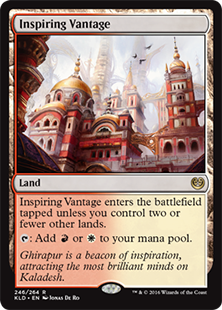
Remember, Infect lists are playing fewer Apostle's Blessing now in favor of Blossoming Defense, which does nothing to protect us against an Anger of the Gods (excluding scenarios where Pendelhaven is a factor). Anger of the Gods in large numbers out of Jund has turned a matchup that was slightly unfavorable decidedly more so, especially when we’re seeing Grim Flayer make an appearance to put on a quick clock. As the Infect player, I’m still ahead in the matchup in games played, even though I’m sure I’m at a disadvantage and probably getting a little lucky. Spell Pierce is the hero to which I owe my success.

Jeskai Aggro

Next up, we have a deck that's been making the rounds more and more, partly butressed by the new enemy-colored fastlands from Kaladesh. While Zack Kanner didn't fare as well as Anderson in the event overall, he still posted a 7-1 record in the Modern portion.

Jeskai Aggro, by Zack Kanner (66th, SCG Atlanta Invitational)

Creatures

4 Mantis Rider
4 Goblin Guide
4 Monastery Swiftspear
4 Snapcaster Mage
4 Stormchaser Mage

Instants

4 Lightning Bolt
4 Lightning Helix
4 Mutagenic Growth
1 Twisted Image
4 Vapor Snag

Sorceries

4 Gitaxian Probe

Lands

1 Island
1 Mountain
2 Arid Mesa
1 Hallowed Fountain
4 Inspiring Vantage
1 Sacred Foundry
4 Scalding Tarn
4 Spirebluff Canal
1 Steam Vents

Sideboard

2 Blessed Alliance
2 Boros Charm
2 Path to Exile
2 Smash to Smithereens
4 Spell Pierce
3 Surgical Extraction

This new breed of Jeskai Aggro takes advantage of playsets of both Inspiring Vantage and Spirebluff Canal to play firmly three colors in an aggressive deck, without giving up free life points to opponents due to self-inflicted damage. Our relatively high creature count pushes us away from Delver of Secrets, which in turn lets us cut do-nothing spells like Thought Scour and Serum Visions. Instead, we’re packed to the rafters with burn and free spells like Gitaxian Probe and Mutagenic Growth.

inspiring-vantageIn most cases, Mutagenic Growth acts as a slightly more flexible, less powerful Lava Spike. So, why aren’t we just playing Lava Spike? With Spike, all our cards are on the table when we’re attacking into potential blockers like Tarmogoyf or Kitchen Finks. Mutagenic Growth will often be two or three damage, but that time when we get to trade up (a card and a little bit less damage dealt in exchange for a premium blocker) is well worth it.
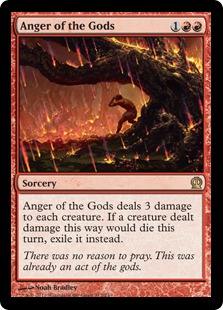
Archetypes like this can play various roles, depending on post-board strategies and metagame positioning. Ancestral Vision is not off the table for sideboard options, as all that burn often gives us inevitability if we can draw enough copies of it. Bedlam Reveler seems like a synergistic inclusion, but if we’re playing that we probably have to cut either Goblin Guide or Mantis Rider. Speaking of Rider, the creature is easily the most inefficient of all of our spells. Still, all that flying and haste adds up to a lot of free damage. That has me looking at what this archetype is trying to do and leads to drawing lots of parallels to Burn. So, why aren’t we playing Burn?

The answer, of course, is the playset of Spell Pierce in the board. Similar to Infect, this Jeskai Aggro list is looking to level up some pump spells with prowess, taking advantage of free spells and a hyper-efficient strategy to push our mana (and our spell quality) to the maximum. Where we benefit from the extra color is in post-board matchups against midrange strategies like Jund, and combo matchups like Tron, Ad Nauseam, and other Burn lists. If the mana is good enough, and we have a good enough plan for decks looking to race, Jeskai Aggro seems to me to be the real deal.

RW Prison

Turning to the Classic, we see a showing from a deck that's largely fallen off the radar.

RW Prison, by Dariusz Szylman (7th, SCG Atlanta Classic)

Creatures

1 Emrakul, the Aeons Torn
4 Simian Spirit Guide

Artifacts

4 Chalice of the Void

Enchantments

4 Blood Moon
2 Journey to Nowhere
1 Oblivion Ring

Instants

1 Blessed Alliance
4 Lightning Helix

Planeswalkers

1 Ajani Vengeant
2 Chandra, Torch of Defiance
2 Gideon Jura
4 Nahiri, the Harbinger

Sorceries

3 Anger of the Gods
2 Wrath of God

Lands

1 Mountain
9 Plains
4 Arid Mesa
1 Needle Spires
3 Rugged Prairie
2 Sacred Foundry
4 Temple of Triumph
1 Gemstone Caverns

Sideboard

3 Leyline of Sanctity
3 Rest in Peace
3 Stony Silence
2 Blessed Alliance
1 Ravenous Trap
1 Elspeth, Sun's Champion
1 Anger of the Gods
1 Wrath of God

RW Prison is back, baby! I never really liked this deck the first time around, and I still think it’s a collection of poor cards supported by Nahiri, the Harbinger, which is much worse in a format that has long since shifted to adapt to her presence. Which is why we don’t see Nahiri, the Harbinger anymore. Which is why Nahiri, the Harbinger might be good again. Welcome to the brain maze.

So, is Nahiri good again? The format is still full of fast, cheap creatures and combo decks, so this narrative doesn’t seem to line up. No, instead, the real answer to this archetype’s success is Anger of the Gods. Great against Infect, great against Affinity, solid against Burn, incredible against Dredge. We’ve found the secret best card in the format, and we weren’t even looking! Isn’t looking at decklists fun!

Raining Down the Anger

If we look at some of the most popular archetypes seeing play right now, Anger of the Gods is literally the best possible thing we can be doing against them, excluding matchup-specific bombs. Anger of the GodsStony Silence knocks out Affinity, but against a lot of boards Anger of the Gods is only slightly worse. Night of Souls' Betrayal kills Infect, but even just getting a two-for-one in the face of protection can often stop them dead. Dredge loses their board to it. Burn, Death's Shadow Zoo, the list goes on and on.

Against some decks in the field, like Jund and Tron, Anger of the Gods isn’t really where we want to be, but the ability to play a maindeck spell that can just win games on its own in certain matchups is well worth the downside of it being dead some of the time. Jund does it with Terminate, and Terminate packs a lot less punch. It sounds like an exaggeration, but I truly believe Anger of the Gods is the best thing to be doing in Modern right now.

However, it also isn't in a color set up to take advantage of it. Sure, Lightning Bolt is and probably always will be the best card in the format—but beyond that, the rest of the color wants to be attacking and dealing damage to players, neither of which synergizes well with Anger of the Gods. The archetypes that can stretch to red to play Anger of the Gods in a reactionary role are midrange decks, which are still getting squeezed out of the metagame from every angle by all the unfair stuff left to roam free in the absence of Splinter Twin. But that’s a conversation for another day. For today, it’s time to decide. Are you going to play Anger of the Gods? Are you going to dodge it? Or are you going to beat it?

Thanks for reading,

Trevor Holmes

The_Architect on MTGO

twitch.tv/Architect_Gaming

twitter.com/7he4rchitect

Insider: QS Cast #44: Sigmund won’t Risk it for the Biscuit

Are you a Quiet Speculation member?

If not, now is a perfect time to join up! Our powerful tools, breaking-news analysis, and exclusive Discord channel will make sure you stay up to date and ahead of the curve.

Play

The QS Cast has returned and has now shuffled once again: Chaz Volpe, and Tarkan Dospil continue on with where the cast left off and in this episode they discuss the following:

  • Sigmund Ausfresser has joined the cast! Find him here on Twitter. Or read his articles every week with the Quiet Speculation Insider service.
  • We discuss Sigmund’s last month’s worth of articles. How consolidation and re-revaluation of your collection can help.
  • Sigmund beleives that changing with the market is necessary – We discuss specific actions we take to avoid being burned. Minimizing risk as best we can.
  • Making choices based on your goals, or on your lifestyle – as those change, so should your purchasing strategies.
  • What factors that are still actionable despite many risks introduced in recent days.
  • Interests
  • What we are looking to acquire based on recent hype.

If you thought Tarkan loves the Reserved List, Sigmund really loves it! But, even has his own concerns for Old School Cards.

Cards we discussed: specifically Wheel of Fate foil versions.

As always, please comment and leave questions for us to address on the next cast! We will be making QS Insider questions a priority, and we want to know what you want covered.

Enjoy! We’re glad to be back.

Find us on Twitter: @ChazVMTG  @the_tark @sigfig8

Insider: Strike While the Iron Is Hot

Are you a Quiet Speculation member?

If not, now is a perfect time to join up! Our powerful tools, breaking-news analysis, and exclusive Discord channel will make sure you stay up to date and ahead of the curve.

Welcome back, readers!

Recently I've been reading a lot of articles (and forum posts) about fellow Magic financiers' growing fear of their investment. There are some valid points brought up. I know I like to quote him a lot, but I think some wisdom from Warren Buffet is again applicable here. When asked about his investment strategy, this was Mr. Buffet's response:

"We simply attempt to be fearful when others are greedy, and to be greedy only when others are fearful."

warren buffet

Currently we have a lot on the fearful side and with prices slipping, the greedy side seems more empty than usual. This is actually a prime time to invest. However, we want to take a well-reasoned, measured approach.

Over the past few weeks we've seen a few spikes in cards like Bloodspore Thrinax, Spike Weaver, Arcum Dagsson, Contagion Engine, and Teferi, Temporal Archmage. What do all these cards have in common? They are all very good in Commander.

There was an error retrieving a chart for Contagion Engine

The important takeaway here is that while competitive Magic may or may not be stagnating (with regards to deck choices, etc.), casual Magic appears to be flourishing. The new Commander decks have provided your local Timmy/Tammy with a whole slew of new cards meant for their favorite format. And that player is clearly happy to brew and pick up the cards that they need for that deck.

I expect we'll continue to see Commander cards moving throughout this holiday season thanks to the new commanders. I've already done two articles highlighting potential cards (where I called the rise of Contagion Engine and Spike Weaver), which can be found here and here.

Now let's get focused on our strategy moving forward. What exactly do I mean by "well-reasoned" and "measured?"

Well-Reasoned Specs

I have repeatedly mentioned a few of the factors I consider when looking to speculate on a card. However, for newer readers (or those who don't want to dive into my four-plus years of articles), I'll reiterate them here.

1. Is this card on the Reserved List?

I know Sigmund keeps talking about the Reserved List but it's definitely an important factor in a card's growth potential. Wizards has doubled down on their commitment to their promise never to reprint any of these cards (we won't get into an argument regarding its validity or necessity here). To me this says that any card on the Reserved List has more speculative potential than any card not on it.

When you have a limited amount of any given commodity (and no more can ever be created), then your supply is fixed and the price is solely dependent on demand. If there's a spike in demand then it will be followed by a strong spike in price.

That isn't to say you should rush out and buy a bunch of Reserved List cards willy-nilly. There are a lot of bulkish rares on the Reserved List (thanks, Homelands and Fallen Empires) that will likely never see play in any format, including casual. However, my personal approach is never to trade away Reserved List cards, no matter how middling they are, unless I'm getting something I really want (which nowadays is hard to find).

2. When was the card last printed?

The Magic playerbase has grown by leaps and bounds since I started playing back in 1997. As sets were printed to demand, this means that older cards tend to be rarer. Generally speaking, the more time that has elapsed since a card's printing, the fewer copies that are available. This is important because a smaller supply is correlated with bigger price spikes when demand increases.

3. Has the card been printed multiple times?

I keep re-iterating that the fewer copies of a card there are in the potential supply base, the more potential it has for larger price swings with an increase in demand. This is just the basic economic principle of supply vs. demand. The more printings a card has (especially large mass reprintings like you see in a Standard-legal set), the more copies that have to be bought up on the demand side for the price to move.

Now, this isn't to say that I won't speculate on a card that has been reprinted. However, I keep this in mind when considering how many copies to buy, and the price point I'm hoping it will reach.

4. What format is this card played in?

The first three factors look at the supply side. This is the first one to consider the demand side. The more formats a card is played in, the more demand we can expect to see—and thus the higher any price jump will likely be.

It's also important to consider that the competitive formats (Standard, Modern, Legacy, Vintage) all allow up to four copies of a given card (save Vintage and the restricted list). This means that if a deck in one of those formats suddenly sees a huge spike in demand, four copies of the card will be needed by each player wanting to play it.

Commander, on the other hand, is a singleton format. If Commander players really want a card for a specific deck they only have to buy one copy. So the obvious correlation is that one would need four Commander players per competitive player for the same increase in demand. The good news is the Commander playerbase is huge, and I would guess it far outweighs the competitive playerbase.

5. What color(s) is the card?

This is going down a level deeper, but the reason this is important is that in certain formats specific colors tend to be more powerful. In Legacy blue cards are more powerful simply because they can be pitched to Force of Will. In Commander green cards are valued higher simply because green is the main color of ramping, which is probably the most consistently successful strategy.

This also means that I tend to pay extra attention to cards that are colorless, simply because they have fewer restrictions on where they can be played. This factor again plays into the demand side of the equation.

6. What is the mana cost of the card?

Similar to point #5, different formats tend to value mana cost differently. Most competitive formats care a lot about the mana cost. Imagine if Tarmogoyf cost 2GG—he would see considerably less play, and possibly none at all.

The Commander format is the exception to this "lower is always better" rule. This format seems to value power level more so than speed (though that isn't the case with every deck). This is why players are happy to cast Time Stretch, despite the fact that it's a 10-drop and basically just two Time Warps stapled together.

There was an error retrieving a chart for Time Stretch

A Measured Approach

Identifying a card we think will appreciate in the future isn't the end of our work. We need to make sure our approach to buying and selling the card makes sense in the context of the real-life market.

I can tell everyone firsthand how much I enjoy the rush of picking out a solid speculation target that meets my criteria, scouring the internet for cheap copies, and then buying as many as I feel is warranted. On the other hand, I can also tell you how difficult it can be to unload larger quantities of cards after they've risen in price.

It's absolutely critical to remember that buylists tend to be based off a percentage of a card. This is especially important when considering more expensive speculation targets.

Let's look at Doubling Season for an example. This card has seen a 35% increase in the past week. But its starting price of around $45 means that even after this increase the buylists are still sitting around $35 each.

There was an error retrieving a chart for Doubling Season

So while the retail price is up $20, the buylist price has only moved up by about $5. The buylists may continue to move up a bit if the new price sticks (and there is little reason to believe it won't). But the more important thing to notice is that if you had purchased a lot of these, you wouldn't be able to unload them to a buylist and make a profit yet. Even with a $20 price increase.

This is why I tend to avoid the higher-cost speculation targets. These cards tend to be harder to move in large quantities because most stores don't want to pay out a huge sum of money for lots of copies of one card (which they then have to find buyers for).

The takeaway here is threefold. First, look at a card's growth in terms of percentage and not dollar value (or whatever currency). Second, have a plan for unloading any speculation targets if and when they hit. Third, if you think you'll have a difficult time moving them after they hit, invest cautiously—pick up a smaller number of copies instead of going all-in on, say, 40-plus copies.

The major caveat to these considerations are spec targets that can be picked at bulk price. The only way you can lose money on these is if the bulk rate itself drops (which, to be fair, is happening in some places). Otherwise, you can always cash out for what you put in. I think of it like buying casino chips—I can sell them right back in a year or more at the exact value I paid for them (assuming the casino doesn't go out of business).

Conclusion

Hopefully most of you haven't been scared off of Magic speculation due these competitive-format doldrums we appear to be in. I also understand that Wizards's small reprint of Eternal Masters has some players spooked regarding the safety of sealed product. I'm actually with you on that one, though I honestly don't have much invested in it.

WoTC has always had the ability to reprint any set, pack, or card not on the Reserved List, but just hasn't chosen to do so. I don't know if anything in Magic is a long-term hold anymore, but that doesn't mean there isn't opportunity for speculation. It just means we may have to reduce our expectations of gains, and sell sooner rather than later. Take a well-reasoned, measured approach moving forward and you should be fine.

Know What You Play: Why Expertise Matters

Are you a Quiet Speculation member?

If not, now is a perfect time to join up! Our powerful tools, breaking-news analysis, and exclusive Discord channel will make sure you stay up to date and ahead of the curve.

Last week I found myself playing a head's-up Cube match against my friend Mike. I was handily crushing him (obviously) and our other friend Kevin asked me, "Do you always just draft blue/red?" It's not my fault! They're the best cards, after all. Throughout the history of Magic there is some truth to there being a disproportionate number of degenerate blue cards, though the same can't be said for red, and certainly not for the particular strategy I tend to favor. There's a lot more going on here, and some underlying themes that I believe lend to my success in the Modern format.

meditation-puzzle-banner

My Origin Story

The first Magic deck I ever owned I bought from the person who taught me how to play. It featured such hits as Sand Squid and Prodigal Sorcerer. More importantly, it featured the full set of Counterspells. For as long as I have been playing Magic, leveraging my mana and Counterspells has been a skill that I was very focused on. That was almost fifteen years ago, and with that much experience I consider myself an expert at playing mediocre threats alongside great answers.

Something that I believe is misunderstood when other players talk about Grixis Delver is that Mana Leak and Spell Snare are extremely powerful cards. Spell SnarePermission decks benefit from the ability to trade on a one-for-one basis in terms of card economy while forcing the opponent to inefficiently use their mana. Spell Snare always trades up on mana, and Mana Leak will very often trade up on mana. If my win condition is Delver of Secrets, that means that I can play my threat while trading up against your threat or interaction in terms of mana on the same turn.

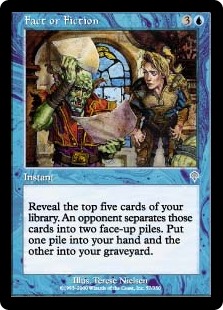
Back in the day, I played a lot of Prodigal Sorcerers on five mana to insulate myself against a troublesome enchantment or creature slipping through, and leveraging tempo with mana-efficient answers is a skill that hasn't really been relevant in Standard since Snapcaster Mage was legal. There was a short window after Pro Tour Kaladesh where Torrential Gearhulk was popular, and I was in heaven. Most control mirrors felt like byes, as leveraging mana in do-nothing mirrors has become a forgotten skill.

We get it, you're good at blue decks. Sorry, I got a little derailed there. There may be a lot of specifics going on in the above text, but I mention them to illustrate a more general concept that I think is important to understand. I came across the following image a while back, and I think it's a really awesome way to visualize the general point that I'm building towards:

phd-general-knowledge

As applied to Magic, what this means is that as we explore an archetype by studying the existing literature, we come closer to understanding everything that the best players know about that strategy. Eventually, if we're good enough, we expand on this sum of knowledge. A great example of a game-changing idea is when Carlos RomĂŁo broke Psychatog mirrors by choosing not to fight counter wars over Fact or Fiction. Carlos learned a way to win the mirror that nobody had access to, and would crush the mirror until everybody else caught on. fact-or-fictionThis expanded what blue mages needed to know to compete on the same level as the best players, and meant there was a new bar for how good you had to be to outperform them under the new paradigm.
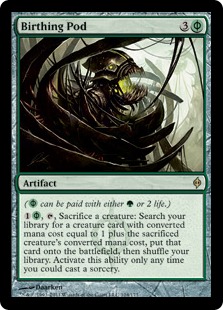
There's a lot of empty space on the circle designated for the scope of existing human knowledge. This will similarly be true for a given player with regard to what is documented, as compared to what they understand, about Magic strategy. We like to laugh at players who stick to playing one type of strategy, though the reality is that they are acquiring some valuable specialized knowledge—assuming they have a good methodology for learning their deck.

When we talk about the players who are excellent at the strategies that they prefer, their particular builds and in-game decisions stop making sense to regular humans like you and I. Tom Ross's understanding of the Modern format breaks the threshold of what can be learned merely be studying existing data. He has explored the format extensively, and the best way for most of us to understand his success is to get that information from Tom himself. I wouldn't think of playing Joe Lossett's 75 in Legacy despite it being great, because it is built according to his play patterns and understanding of the format.

[wp_ad_camp_1]

On "The Best Deck" Mentality

Periodically there comes to be a Modern deck that outperforms the others by a wide margin, due to it fundamentally breaking the rules. Some examples from the past include Jund, Birthing Pod, and arguably, Amulet Bloom. Birthing PodIn the current Modern environment there might be one deck that's theoretically the best one to master, though I believe that trying to identify this deck will generally be less effective than understanding one of the playable decks at a high level.
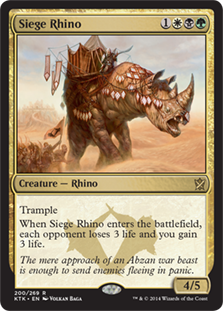
A caveat here is that when I use the word "playable" I don't just mean one of the decks that people play. While I disagree with the notion of finding the best deck or a very small set of best decks, I am very much on board with stating that a lot of the decks that show up to a given Modern tournament are ill-advised choices. If your deck can't offer a kill on about turn 3.5 and/or interact with a wide range of the decks than can, you are in all likelihood making a mistake registering that deck (assuming that your goal is to win the tournament).

However, when it comes to picking a deck, I think arguing among the viable choices is splitting hairs. This is the list, in order, that I presented for the Star City Games Newsletter as the best decks to play in Modern for last week's Invitational:

10. Dredge
9. RW Prison
8. Bant Eldrazi
7. Burn
6. Jund
5. Skred Red
4. GW Tron
3. Valakut
2. Infect
1. Grixis Delver

I won't go into why these decks are in this order or by what margin, as putting the list here is supposed to be illustrative of a point. Even though I believe that Skred Red is a wildly underrated deck, ranked as the fifth best deck compared to Bant Eldrazi in eighth, there is nowhere near enough of a difference in quality between these two decks to jump ship in a short window if you know all of Bant Eldrazi's intricacies and matchups very well.

Executing with What You Know

It's a good idea to have some range of options in your arsenal, but this does not mean simply owning multiple Modern decks. It means putting the reps in and knowing your roles. Your biggest tests in Modern don't come from knowing your sideboard plan against Dredge and Burn, they come from how you tackle matchups against the fringe decks. If you're referencing a sideboard guide or playing somebody else's list, you're going to get thrown a lot of curve balls in most Modern fields. It's likely that you have a sideboard guide for Infect, but what happens when you run into Izzet Kiln Fiend (also known as UR Prowess)?

Izzet Kiln Fiend, by _FIVER777 (5-0, Modern Competitive League)

Creatures

1 Bedlam Reveler
4 Kiln Fiend
4 Monastery Swiftspear
4 Thing in the Ice

Instants

2 Apostle's Blessing
4 Lightning Bolt
4 Manamorphose
4 Mutagenic Growth
1 Stubborn Denial
4 Temur Battle Rage

Sorceries

4 Gitaxian Probe
4 Serum Visions
2 Sleight of Hand

Lands

2 Island
2 Misty Rainforest
1 Mountain
4 Scalding Tarn
4 Spirebluff Canal
2 Steam Vents
1 Stomping Ground
2 Wooded Foothills

Sideboard

1 Bedlam Reveler
1 Stubborn Denial
2 Ancient Grudge
2 Blood Moon
2 Grafdigger's Cage
2 Twisted Image
2 Vapor Snag
3 Young Pyromancer

It's similar enough to Infect, but do you actually have a plan? I think I'd leave that Night of Soul's Betrayal in your sideboard. You'll want it if those Young Pyromancers are coming in though... Path to Exile is great here, but can you keep a hand where your only interaction is Lightning Bolt? Even if you're unfamiliar with this specific matchup, the more reps you have in with the deck you're playing, the less overwhelming it will be to make these calls on the fly.

When I sideboard against the known decks I pretty much do the same thing every time, though beyond that I know what the texture of more general matchup types looks like. My experience in Modern allows me to determine when I'm playing a Mana Leak matchup or a Terminate matchup, in much the same way that there are correct and incorrect spots for Blood Moon that less experienced players often mix up. I know that I have Spell Pierce in my sideboard for the matchups where I have to kill quickly, and that it won't be effective in long games. This abstract understanding of how my 75 works makes navigating against the weird and wild decks that are possible in the format so much easier.

Familiarity's Reward

As an advocate of Grixis Delver, trying to get other good players on the deck has been very difficult. In particular, if you started playing with Gray Merchant of Asphodels and Siege Rhinos in Standard, the play patterns will be strange to you. The best card in the deck is a two-mana 2/1 and the more proactively that you play it, the more likely you are to lose the game. Siege RhinoA number of players were talking with Kevin Jones about the deck this weekend, and he even got Jim Davis to sleeve it up en route to Jim's Invitational Top 8. It's really cool to see more people coming around on the deck's strengths.


If you're not used to a small-ball approach and just pick up the deck, Grixis Delver is a three out of ten. I believe that with tight play and a good build it's more like a nine. There are small maindeck tweaks that you can make and more dramatic sideboard changes you can adopt based on metagame, though it's a deck that I've been very happy with since the banning of Eye of Ugin.

Grixis Delver likely has a wider range than many of the decks in Modern, though Infect is another great example of a deck that great players win way more with. Infect is probably like a five going in cold, and definitely a nine (if not a ten) in the hands of the best pilots. It's going to be very difficult to quantify exactly where your skills are at with a given deck, especially when comparing to a different option for a given weekend, but what is clear is that playing what you know, or rather knowing what you choose to play, goes a long way in a non-rotating format riddled with masters of varying archetypes.

Thanks for reading.

-Ryan Overturf
@RyanOverdrive on Twitter

Want Prices?

Browse thousands of prices with the first and most comprehensive MTG Finance tool around.


Trader Tools lists both buylist and retail prices for every MTG card, going back a decade.

Quiet Speculation