
menu

Insider: Dredge Hate and Other Modern Specs

Are you a Quiet Speculation member?

If not, now is a perfect time to join up! Our powerful tools, breaking-news analysis, and exclusive Discord channel will make sure you stay up to date and ahead of the curve.

I have been playing a ton of Modern lately, and for better or worse, Modern is the most popular format in Magic. Sure, there are some who want to hate and complain that the format is "too this" or "too that," but for its shortcomings (real or imagined), nobody can argue that it is the most played format in the land.

I've always thought that Modern was a great place to find financial value in MTG. There is always the risk of your speculation targets getting reprinted in a Modern Masters set, but if you diversify, buy low, and flip things when they are hot, it's an easy way to continuously add value to your collection. When in doubt, remember: there are more people playing Modern than anything else, which means there are a lot of potential people looking for your cards!

Demand is good and stocking up on cards in anticipation of increasing demand is the name of the game.

In particular, Dredge is the current hotness in Modern, and for good reason: it is the format defining deck. Dredge has an uncanny and degenerate ability to generate a ton of value very quickly and run away with games. It is very difficult for fair deck (or unfair decks for that matter) to keep up with the steady stream of free creatures and spells that Dredge is able to generate.

The majority of actual Dredge staples are already kind of locked in stone and have spiked. Is it possible for Bloodghast or Prized Amalgam to steadily tick up in value? Of course, but the potential gains are likely meager and the risk high because of a potential looming banning. The deck feels unpopular and frustrating to the average Modern player because it is difficult for most decks to actually interact with. They dredge, get free creatures, and bury an opponent quickly.

I think the smarter money is actually on the Dredge hate cards that are becoming increasingly standard in Modern. If you can't beat Dredge by playing "fair" (which you can't) you'll need to rely on specific graveyard hate cards for help.

There was an error retrieving a chart for Rest in Peace

Rest in Peace is potentially the very best hate card against Dredge. It locks out their graveyard and keeps it locked out for as long as it remains in play. It is possible for the Dredge deck to cast Narcomoebas and Prized Amalgams and try to beat down around a RIP, but the odds of them effectively beating an opponent this way are slim to none.

The best part about Rest in Peace is that even if they are able to remove it, the card has already done an unreal amount of damage and set them back to the starting line. Not only do they need to remove it to even play their game but it essentially makes them completely start over.

RIP is fairly inexpensive right now and I think it has a lot of potential room for growth. Comparatively, Stony Silence is a $20 card and sees significantly less play than RIP does right now! There is clearly room for the card to gain in value as we move into RPTQ season.

There was an error retrieving a chart for Surgical Extraction

Surgical Extraction has ticked up a little bit but I think it still has some serious room to grow. Free spells are pretty insane and Surgical is no exception. Obviously, Phyrexian mana is one of the biggest mistakes in Modern MTG design, and a free graveyard hate card that any deck can play is serious business. Against Dredge, knocking out all of their Prized Amalgams sets them waaaaay back and makes dealing with their graveyard-based nonsense much more manageable.

Also, it's worth noting that Lantern Control has proven to be a very solid metagame deck and packs the full playset of these bad boys. It is simply a card that sees widespread play across Modern and will continue to do so because it is so unique and efficient at doing what it does. It has already seen a Modern Masters printing which makes me think it is slightly less likely to be reprinted the next time around—that also can't hurt the upward trending.

There was an error retrieving a chart for Ravenous Trap

Junk uncommon turned Constructed staple? I've jammed Ravenous Trap in Vintage before and the card is the real deal. I also watched all sorts of random decks tearing up Dredge via Trap all weekend long for the past two weekends. I love the way that all of the black graveyard hate can go into any deck... Nice job, color pie... Leyline of the Void, Surgical Extraction, Ravenous Trap—spells that are black but nobody ever wants to pay black mana for!

Ravenous Trap isn't the easiest card to get ahold of right now because it is in high demand. Sure, there are infinite on the internet but many local stores are sold out because of the high demand. It is certainly worth digging through your bulk and pulling them out to trade to local players who need last-minute sideboard cards!

There was an error retrieving a chart for Blade Splicer

Kyle Boggemes's Jeskai Flash deck is pretty awesome, and Blade Splicer is a great card in that deck. Generally speaking, Blade Splicer has always been a good card that finds its way into strong player's decks. The card is just a shade above a bulk rare which makes it a great card to stock up on now while the price is low.

It is actually better than advertised against many of the best decks in the format. Against Affinity the Golem token blocks down Etched Champion and against Dredge the 3/3 first strike is very effective at dealing with Bloodghast and Prized Amalgam turn after turn.

It is a card that has little value but has always been a player—albeit on a small scale in Modern.

There was an error retrieving a chart for Thought-Knot Seer

The card sees zero Standard play and commands a decent price tag. Imagine what happens if it were to suddenly see considerable play after Aether Revolt? Yeah, right.

The other side of the equation is that because it has zero Standard value it likely can't dip much lower post-rotation (which is still a long way off). The card is made for eternal formats like Legacy and Modern and will continue to be a top-played staple for years to come. I recommend continuing to stock up on these while the price is cheap and Standard players have them for trade.

There was an error retrieving a chart for Inkmoth Nexus

Inkmoth Nexus is a staple in two of the best decks in Modern, Affinity and Infect. Considering the card is one of the only playable cards in Mirrodin Besieged and hasn't seen a reprint yet, I think the $25 price tag is rather modest. I can also attest to the fact that the card is virtually impossible to keep in stock at my local game store, which is typically a sign that demand is greater than supply.

Even with a Modern Masters reprint likely in the next couple of years, I still think the value of picking these up and flipping them as they tick up is a great way to use one's trade stock.

There was an error retrieving a chart for Noble Hierarch

Literally, the reason to play green. Are there even decks that make green mana and don't play Hierarch? I'm sure they are, but they're also likely built wrong...

Hierarch is one of the best cards in the entire format, going in everything from Zoo, to Infect, to Collected Company, to Eldrazi. It's a ubiquitous "best" card in Modern. It was reprinted in Modern Masters 2015, which makes me wonder if they would bring it back for an encore performance in MM2017.

Either way, there will be no shortage of people who are looking to add Noble to their collections and decks. One trend I've noticed is that Hierarch is typically a hotter commodity than Snapcaster Mage these days! People actively want Hierarchs and for good reason: They're great!

There was an error retrieving a chart for Become Immense

There has been a lot of talk about banning something from Infect, but for all that chatter I kind of doubt anything will happen. First of all, the DCI has bigger fish to fry with Dredge than Infect, and I'm not even sure that Dredge will need to be banned two months from now. Second of all, Infect is a great deck but it isn't exactly dominating the format. It is good but it has its own issues.

If history has taught us anything it is that the delve mechanic is pretty messed up. Trading useless cards in the graveyard for mana toward casting powerful instants is a great deal.

Become Immense is such a unique card in that it generates so much power for so little mana. I doubt that we'll see anything like it again any time soon which makes it a great speculation target.

~

I'm sure there are a million places to look for awesome value in Modern, but these just so happen to be the ones I've been thinking about lately. Anticipate what Modern players will want and you'll make yourself some solid dollar bills!
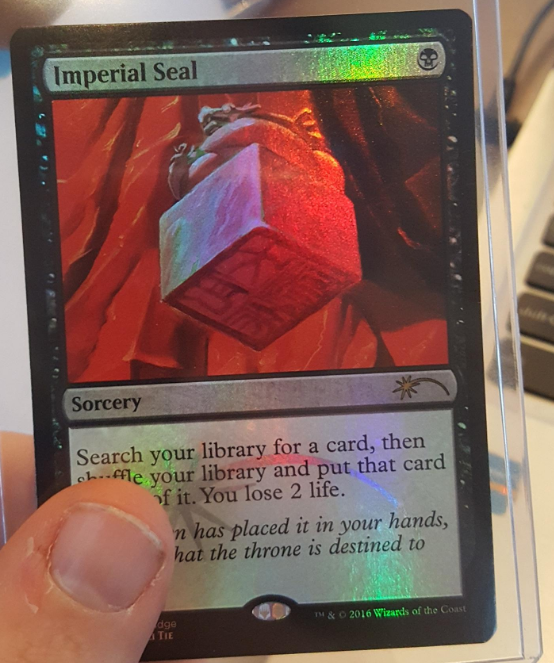
Judge Promo Imperial Seal Announced

Are you a Quiet Speculation member?

If not, now is a perfect time to join up! Our powerful tools, breaking-news analysis, and exclusive Discord channel will make sure you stay up to date and ahead of the curve.

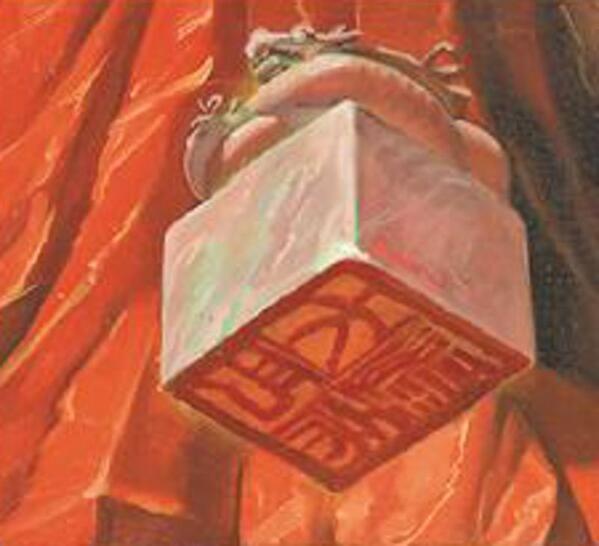
We're gotten some amazing judge promos recently, such as Force of Will and Mana Drain, and the coming wave continues to deliver. If you haven't yet seen this on Reddit, feast your eyes on the upcoming promo:

imp-seal

As we saw with the Mana Drain and Force of Will promos, the price on these will open much higher than where it will ultimately settle. English copies of Imperial Seal are very difficult to come by given Portal: Three Kingdoms being their only printing, and their market price is currently in the $500+ range. The judge promo is likely to open up in the ballpark or higher.

Over time, the price of the foil will lower, and given that Imperial Seal sees such little play and the demand is so low, you can also expect to see a dip in the price of the Portal version. I don't know how much English copies will drop given their relative scarcity, though for the sorts of format that people play Imperial Seal the foil will generally be preferred. I fully expect Japanese copies to take a significant hit.

Avatar photo

Ryan Overturf

Ryan has been playing Magic since Legions and playing competitively since Lorwyn. While he fancies himself a Legacy specialist, you'll always find him with strong opinions on every constructed format.

View More By Ryan Overturf

Posted in FreeTagged , , Leave a Comment on Judge Promo Imperial Seal Announced

Have you joined the Quiet Speculation Discord?

If you haven't, you're leaving value on the table! Join our community of experts, enthusiasts, entertainers, and educators and enjoy exclusive podcasts, questions asked and answered, trades, sales, and everything else Discord has to offer.

Want to create content with Quiet Speculation?

All you need to succeed is a passion for Magic: The Gathering, and the ability to write coherently. Share your knowledge of MTG and how you leverage it to win games, get value from your cards – or even turn a profit.

Insider: QS Cast #41: Partners of Commander 2016

Are you a Quiet Speculation member?

If not, now is a perfect time to join up! Our powerful tools, breaking-news analysis, and exclusive Discord channel will make sure you stay up to date and ahead of the curve.

Insider: The Casual Mindset – Alternate Win Conditions

Are you a Quiet Speculation member?

If not, now is a perfect time to join up! Our powerful tools, breaking-news analysis, and exclusive Discord channel will make sure you stay up to date and ahead of the curve.

A while ago I asked the forums for cards to discuss in my articles. Getting There Games suggested looking at alternate win conditions and I immediately felt that those would likely make a great article on their own. As I look back on writing this article, I believe they do an excellent job of showcasing how to analyze a specific set of cards to look for patterns.

Defining Alternate Win Conditions

What do we mean by an alternate win condition? It may seem like this is an easily answerable question, but do you count poison-based wins or cards that cause a draw? Are milling wins rare enough to be considered an alternate?

For our purposes today, I am counting single cards that either contain text like "you win the game," or something akin to "your opponent loses the game." The latter doesn't actually appear on cards verbatim, but Door to Nothingness comes close.

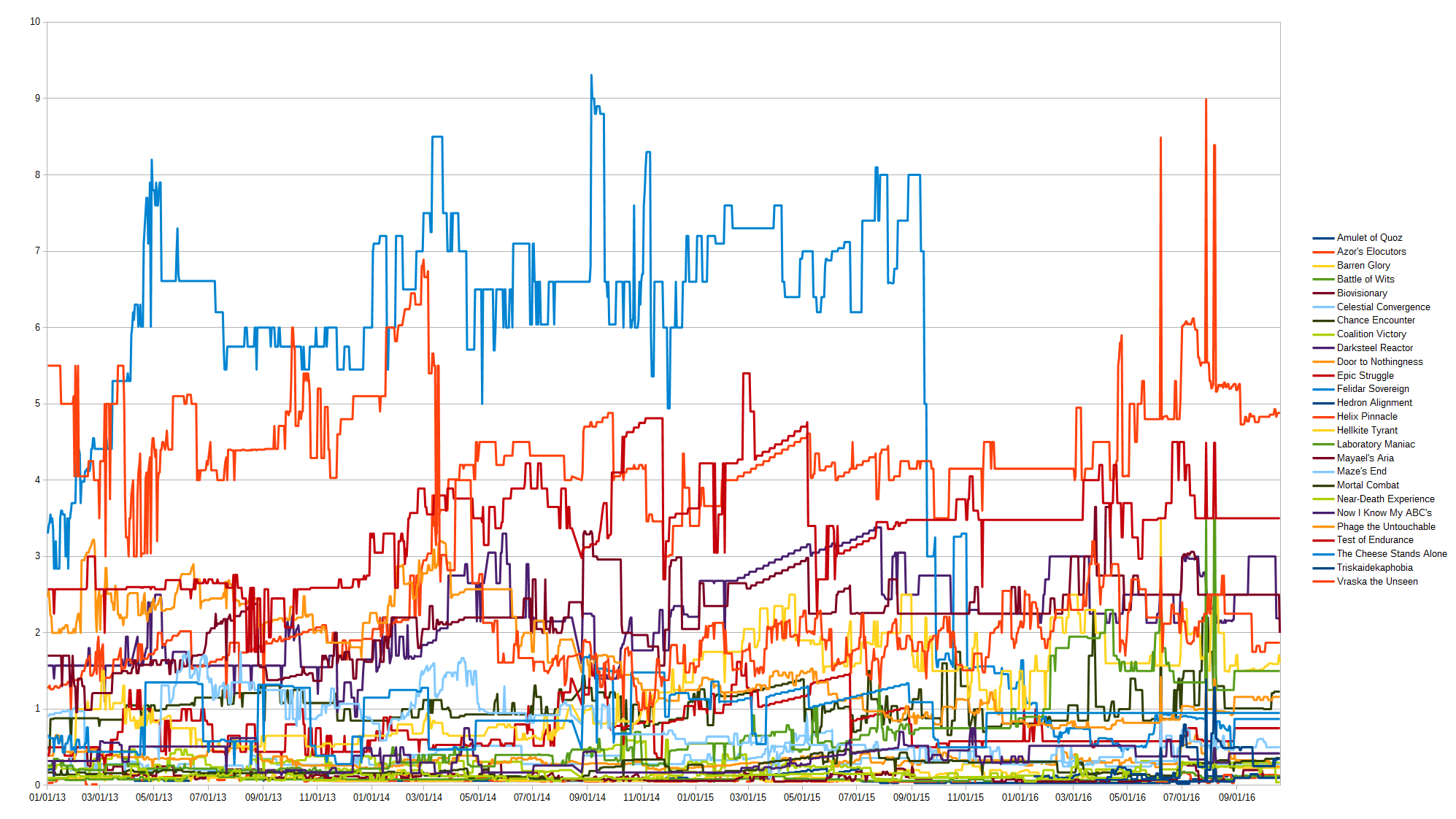
I have taken the liberty of creating a chart with the buylist price graphs of all of these cards that I could find, figuring that buylist prices are a little less prone to sudden swings. The price is the non-foil average if there are multiple printings. None of the cards have particularly rare or valuable older printings that skew the numbers, though I did start the data in January 2013 to keep Vraska the Unseen's very high initial price from skewing the graph.

Kelly has been kind enough to give me direct access to the Trader Tools data, from which I hacked something together—unfortunately you cannot create a similar overview yourself. I cannot say whether any of this will ever be implemented in TT, but I wouldn't recommend holding your breath.

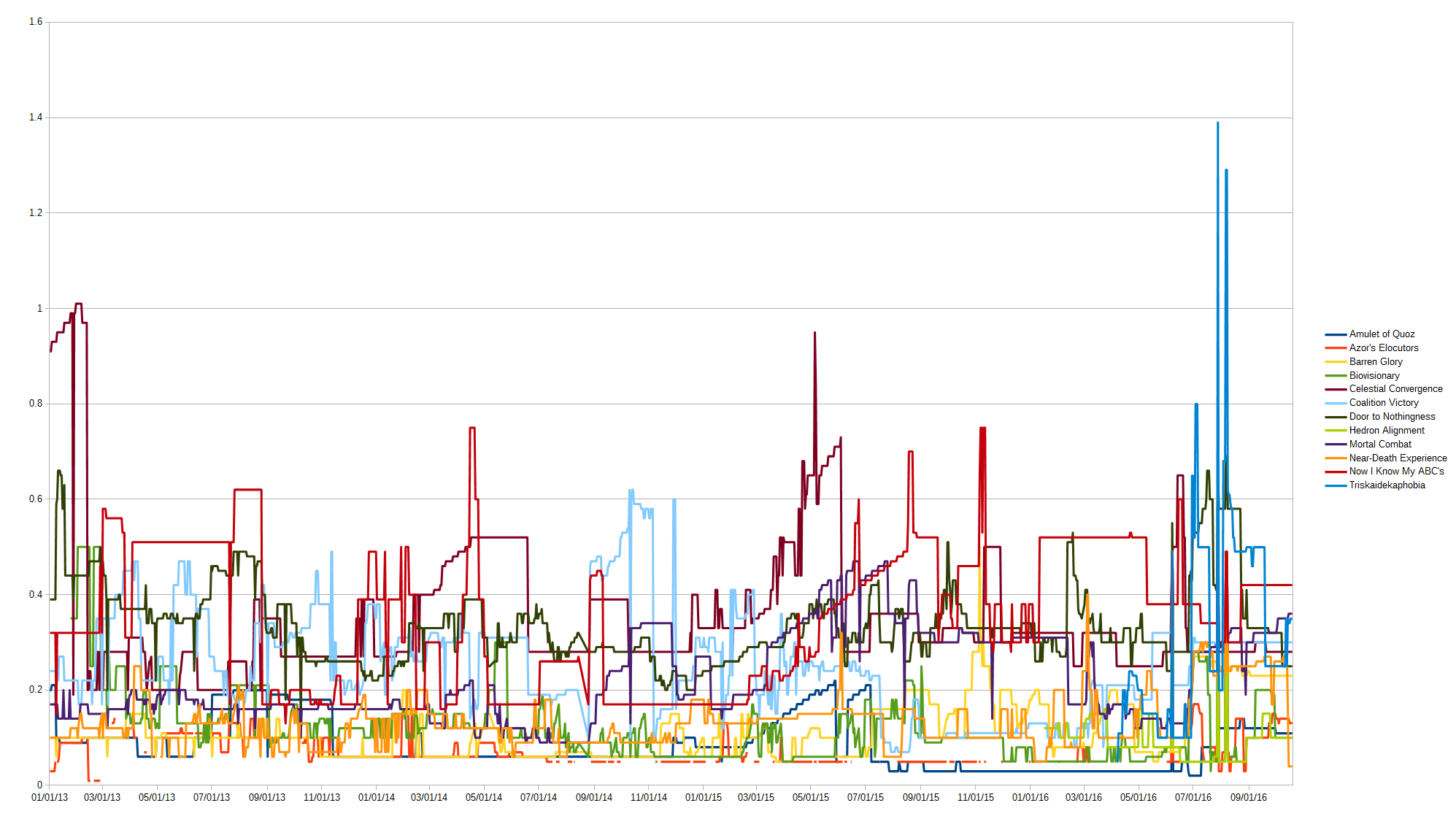
If you wanted, you could do the same analysis by looking at the graphs of individual cards—as you can see by the messiness of the graph below, for a larger number of cards that may actually be preferable.

Click to enlarge.

Casual Analysis

In an earlier article, I laid out my criteria for evaluating a card's casual appeal. Let's take a look at how these alternate win conditions stack up overall for casual play.

  • WOW! Factor: Even when you're completely down on your luck you can still win; they'll never see it coming!
  • Playability: These are usually found in decks built around them specifically, as being able to take advantage of them is seen as a fun challenge. Still, many are a bit tougher to get into play.
  • Scalability: "You win the game" scales perfectly; on the other hand, "they lose" cards take a bit more effort to pull off in a multiplayer game.
  • Taste: Having one of these in play and being able to trigger it is like the ultimate reach: no blocker can stop it. Some players like the challenge of getting the weirder ones to trigger. Others like to add them to decks where they slot in well and randomly win with them every now and then. Some of these cards likely get played for their other abilities. Finally, there are people who just want to do something different and who have taken a particular liking to one of them (whether challenging or not).

I don't really like any of these for casual, but I can't deny that they have their fans. Personally I feel that they all have the capacity to end a fun game prematurely, thereby ruining the experience for the remaining players because everything they did before was pretty much irrelevant. For one-on-one this is not a big problem—you have to win in some way or another—but in multiplayer it may well feel like stealing a win from those more deserving, especially when it happens after a long battle.

I imagine that the people who like these cards fall in the groups described under "Taste" above, and that there are enough of them to generate sufficient demand. To make sense of this, we'll need to dig deeper.

Financial Analysis

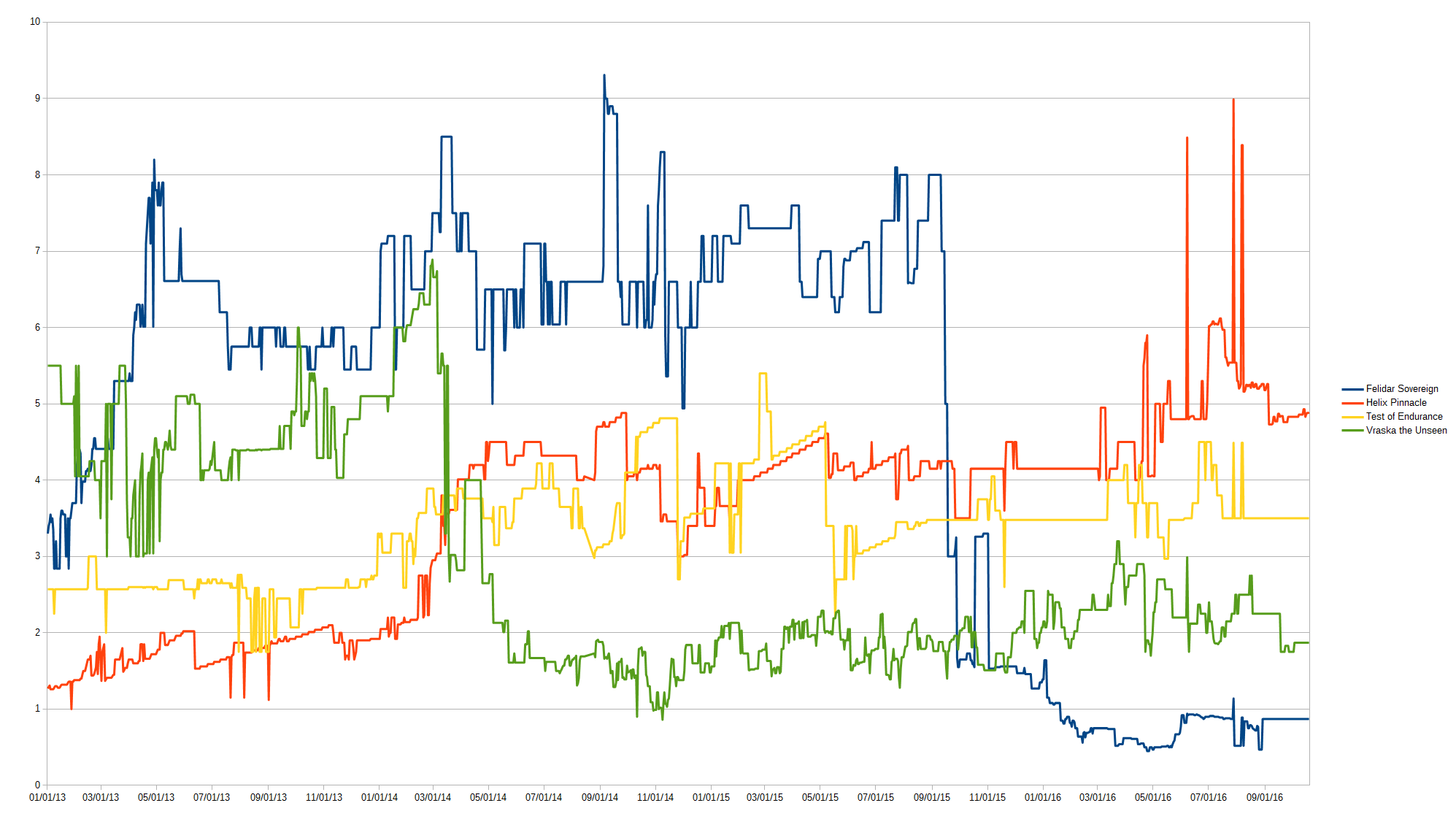
As the first graph is a bit hard to read, I want to pull the data apart to see if we can find patterns in the popular and unpopular cards. The graph below shows all the cards that hit a buylist price of $5 or more at some point since 2013.

Click to enlarge.

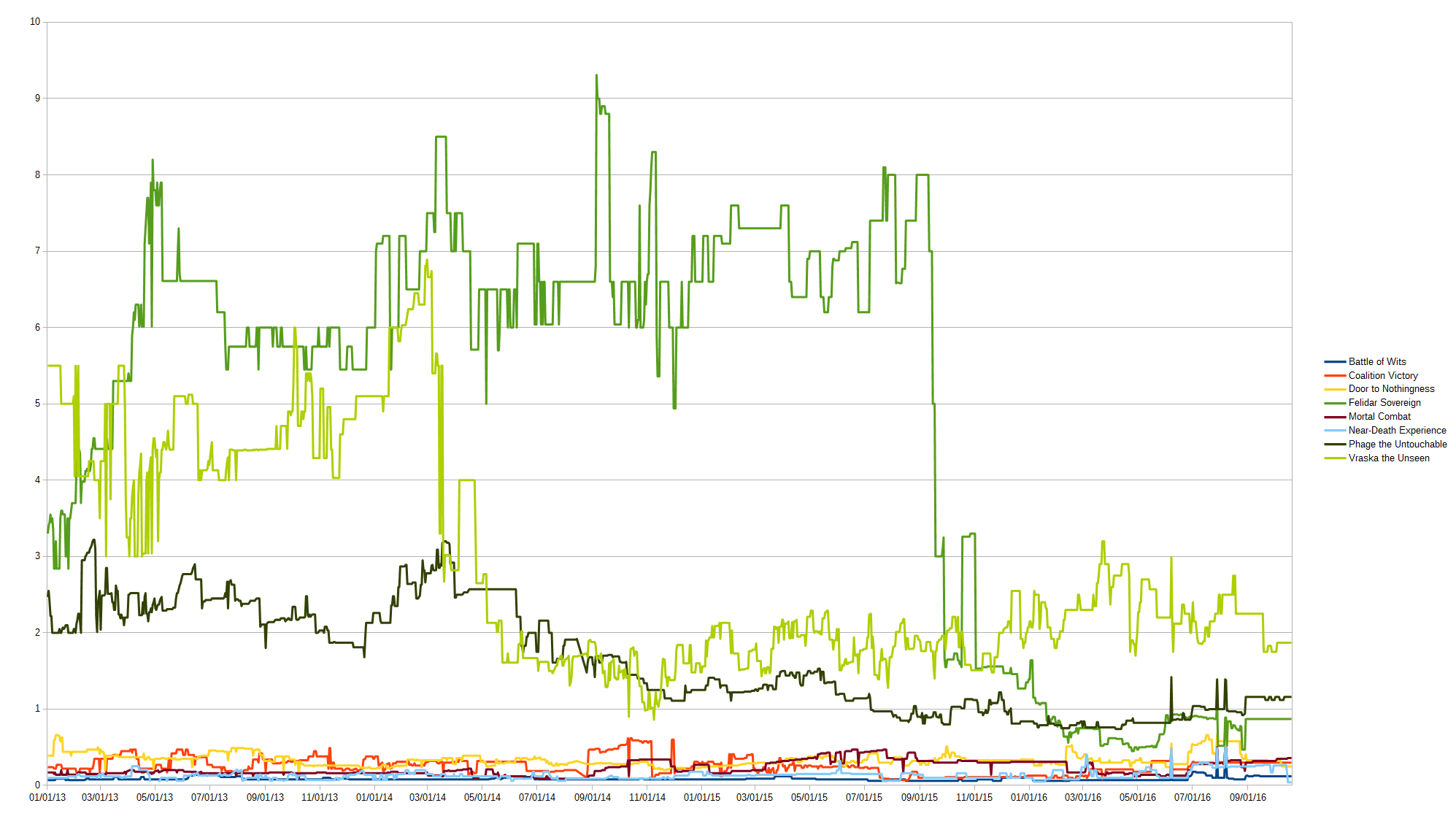
We can see a few things here. Currently only a single alternate win condition card buylists for more than $5 (Helix Pinnacle). Felidar Sovereign and Vraska the Unseen were putting up a good fight until their most recent reprint. Test of Endurance only barely made this chart.

The first lessons to learn from this data are that reprints are pretty bad for these cards, and that $5 is a pretty hard barrier to break.

So we have to wonder, why is the Pinnacle so much higher than the rest? As a card from Eventide, a notoriously underprinted set, it would be expected to sit a little higher naturally. Add to that that the card costs very little to cast, has shroud to prevent opponents from answering it, and asks you to do something its color is very good at, and we seem to have a perfect storm on our hands.

By similar reasoning, we can explain that Test of Endurance sits a bit higher too. It's pretty old, and one of the easier-to-trigger alternate win conditions (it's even likely to go into the same decks as Felidar Sovereign, and we know how popular that used to be).

Given what we've learned, lets look at all the alternate win condition cards that have been reprinted.

Click to enlarge
Click to enlarge.

We see that Phage the Untouchable behaved the same as the cards we just identified, and this was after its third reprint—it sat even higher before that happened. The other reprints are all sitting pretty low, with none of them breaking $1.

In fact, the Sovereign dropped below $1 due to its recent reprint and Phage brings in barely more than that. The data doesn't go back far enough, but I remember Battle of Wits being a $5-plus card long ago, and I believe that reprints killed its value too.

Of all these cards, Vraska sits the highest. I believe this is because of a combination of its mythic rarity, Duel Decks mostly being an entry-level product that's printed in lower volumes, and the card having extra uses beyond creating deadly assassins.

Lets also look at underprinted cards. These should include old sets, third sets and Un-sets while of course ruling out anything that was reprinted.

Click to enlarge
Click to enlarge.

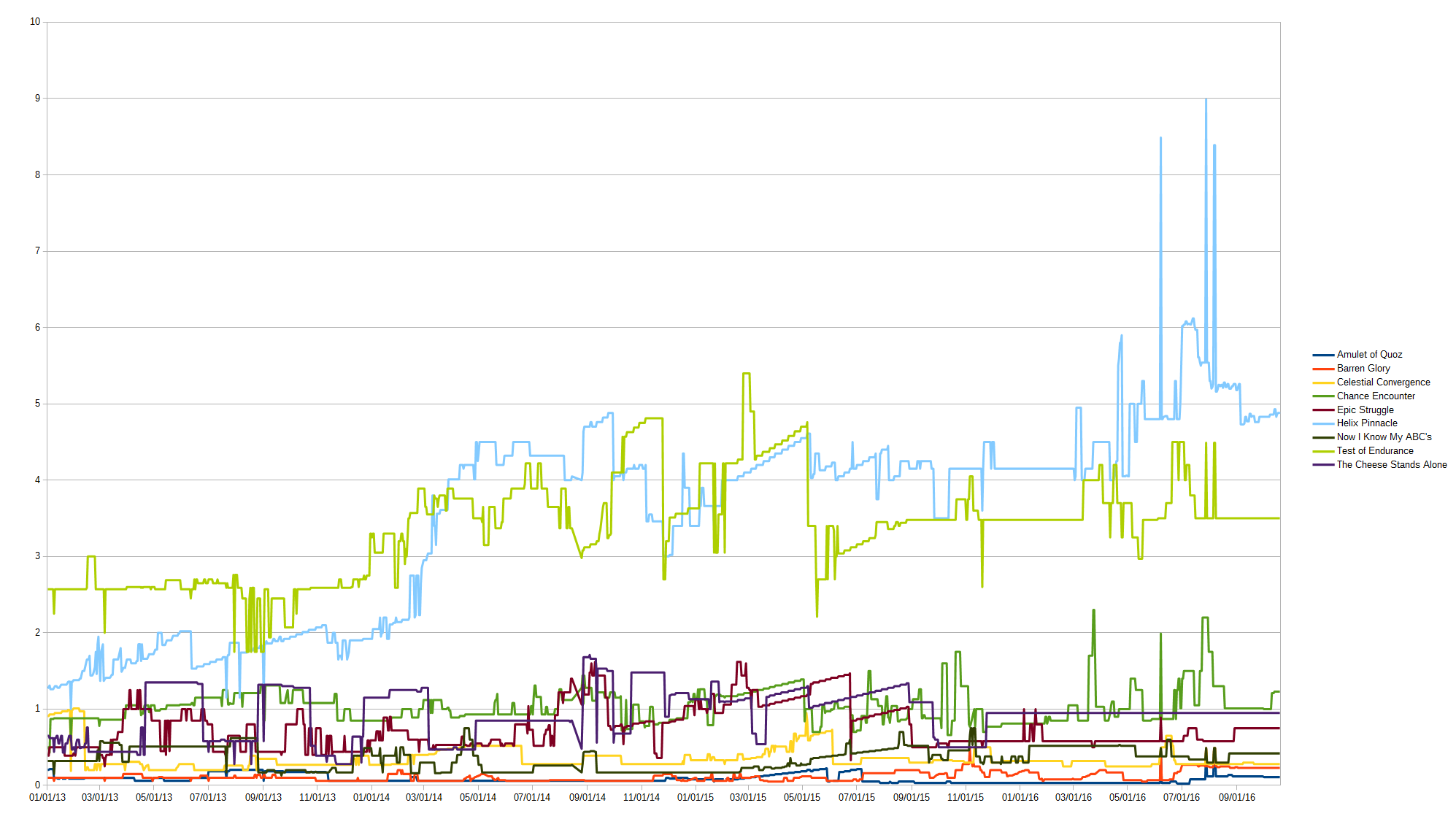
We've seen Helix Pinnacle and Test of Endurance before; the rest barely gets above $1. Clearly, being underprinted by itself is not a good indicator of value, but rarity and playability together can lead to value.

I believe that the cards closer to $1 have the possibility of moving up when something gets printed that increases interest in them. In particular Chance Encounter and Epic Struggle look interesting to me, as they are fairly easy to trigger already—though if you have so much luck or so many creatures: do you really need them to win? I wouldn't go out of my way to pick them up, but if I was holding some I probably wouldn't buylist them either.

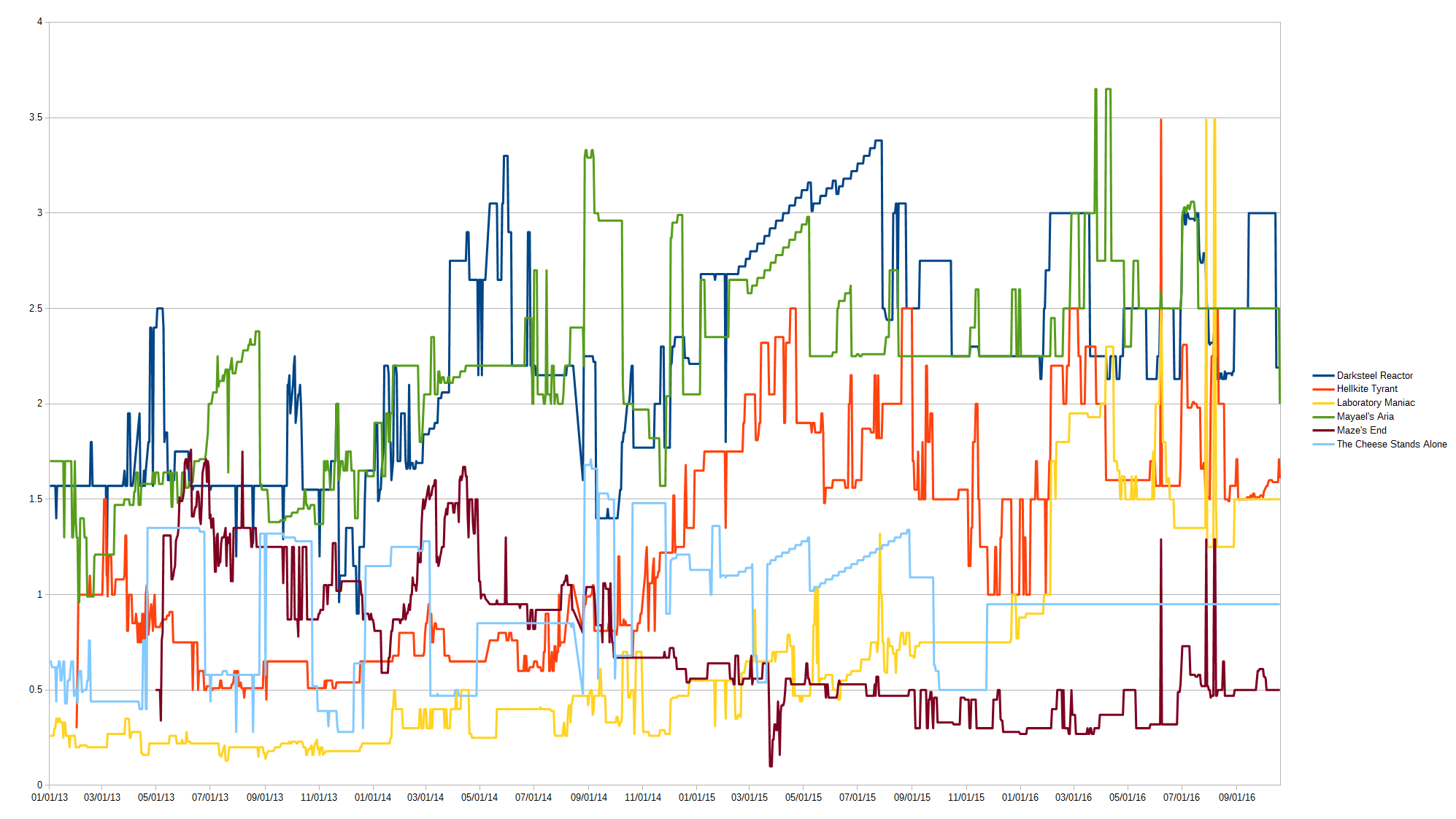
It's clear that it's difficult for these cards to go above $1. Let's list all the ones we haven't already discussed that reached $1.5 or higher and see if we can figure out what pushed them up.

Click to enlarge
Click to enlarge.
  • Darksteel Reactor - The Reactor is colorless, making it fit in many decks. Darksteel probably wasn't printed to nearly the numbers we see today, so rarity may be a factor. Charge counters can be manipulated fairly easily by several cards from the same block. As it's indestructible, the card is very hard to get rid of. If we look at TCG Player's "also purchased," we see Coretapper and a number of other cards which benefit from counters, though there doesn't seem to be a clear deck archetype being bought.
  • Hellkite Tyrant - Dragons are always popular and this one is mythic to boot. His stealing effect is useful in any case, and note that you don't have to give them back when he dies. In fact, I think his alternate win condition is often an afterthought, as a 6/5 flying trampler should do well at killing opponents anyway. If we look at TCG Player again, we mostly see other Dragons, suggesting that this indeed tends to go in Dragon decks.
  • Laboratory Maniac - It's considered general knowledge that casual players like milling. From there it's not a big step to milling yourself as a more original approach to it. This card is a bit of a combo enabler as well, and it even sees some Legacy and Modern play. I would argue that tournament interest is a relevant factor for this card, and that together with casual interest it is pushing up the card's price despite it being newer. Note how Maniac started the lowest of this bunch—it is definitely the kind of card you should be on the lookout for. I don't think TCG Player tells us much extra in this case.
  • Mayael's Aria - The Aria provides some very beneficial effects before winning you the game. I think it's comparable to the Hellkite in that you may very well play it for its other uses, and when we look at TCG Player we see some overlap in the other cards purchased for both of these cards. It's in a good color combination for its sort of effect, and I would look for similar cards from future sets as they may prove to be good to hold for several years.
  • Maze's End - The prerelease printing is probably suppressing this one to some extent, and it's also somewhat hard to trigger. We can clearly see that its popularity dwindled a bit after initial hype, but now it's slowly recovering. This seems like a card that might slowly creep up, and as it refers to Gates specifically it's not easily reprinted. I would recommend holding or even picking up a few extra. TCG Player tells us it's always bought with Gates—what a surprise.
  • The Cheese Stands Alone - Unglued is starting to become a more rare set, and due to its nature it probably wasn't opened much in the first place. There are likely very few people looking to play it, but not many would be needed either. This is usually bought with other Unglued cards that seem to have no other connection to it, perhaps suggesting that at least part of its value comes from collectors completing sets.

Finally we should look at anything that's left, as it's equally important to figure out why the duds failed to reach a higher value.

Click to enlarge
Click to enlarge.
  • Amulet of Quoz - Due to its ante reference this card is clearly unplayable. While I have casually played for ante before, it was never with constructed decks. I'm sure there's someone somewhere playing it, but there just aren't enough of those people around.
  • Azor's Elocutors - Fairly new printing, and you have to do a very boring thing to win: make sure you don't get damaged. I just can't see anybody getting too excited by this.
  • Barren Glory - A challenging condition that leaves you very vulnerable. This is fun for the most die-hard Johnnies, so there is some demand.
  • Biovisionary - Fairly new, but fairly easy to trigger. Does require two specific colors. I imagine this might eventually start rising when demand from a growing player base becomes sufficient. Perhaps set them aside when they come in with bulk.
  • Celestial Convergence - Waiting for seven turns is a lot, and even after that you still aren't guaranteed to win. Difficulty versus fun probably just doesn't balance out well.
  • Coalition Victory - I believe this would sit higher if it wasn't both reprinted and banned in Commander. This would probably see an increase if it was ever unbanned, but I wouldn't count on that happening. As it stands, this is one of the better low-value cards as can be seen by its buy price bouncing around a little. I think it gives a player an interesting challenge while not completely forcing a certain deck type.
  • Door to Nothingness - Comparable to Coalition Victory in many ways and showing similar price behavior. Reprints probably killed this one as a spec too.
  • Hedron Alignment - These come in as bulk all the time. Like some of the popular ones, it protects itself, has a useful ability that lets you find the other copies or stuff to protect it, and it's not too difficult to cast. I would definitely consider picking these out of bulk, but realize that it might take many years before they slowly start increasing.
  • Mortal Combat - You have to wonder if you couldn't have won the game in another way with those 20 creatures. This is another card where milling yourself might be part of the strategy. I notice that recently it has seen some price movement, and of course its reprint happened long ago. I suppose this may very slowly slide upwards over time, though I would place my bets elsewhere unless you consider it likely that a card that breaks it will be printed. I believe if that was going to happen it already would have.
  • Near-Death Experience - Being at one life is a very precarious position, as you'll die to just about anything. The card has a pretty strict color requirement, suggesting a two-color deck at most and probably mono-white. Compared to other alternate win conditions in white, it seems weaker than the ones that gain you life (and therefore protect you in the process), and if you wanted a true challenge then Barren Glory seems more interesting.
  • Now I Know My ABC's - I see a few Unhinged cards in the "other cards purchased" for this card, so I am guessing that again some of this demand is based on collectors. On the other hand, there are some other cards in there too so I do think some people actually try to play it. I suppose we're seeing some rarity influence as well. I don't think there's much to see here otherwise.
  • Triskaidekaphobia - Our newest addition. Flavorwise this card is great. It's not the most challenging to trigger, though not particularly easy either. It's definitely difficult enough to discourage tournament play. The amount printed will likely keep this card down for a long time. I imagine this will ultimately behave similar to Hidetsugu's Second Rite as that also requires a specific amount of life—a card worth only slightly more than bulk.

Summary

  1. Stay very far away when an alternate win condition gets reprinted!
  2. The cards that seem to do best are the rarer ones that are easy to trigger.
  3. Don't discount cards that do more than just winning you the game, as they may see play because of their other abilities.
  4. Feel free to ignore cards that seem particularly challenging to trigger or that seem boring.
  5. Never bother with ante.

Innovations in the Current Modern Environment

Are you a Quiet Speculation member?

If not, now is a perfect time to join up! Our powerful tools, breaking-news analysis, and exclusive Discord channel will make sure you stay up to date and ahead of the curve.

Modern breaks from time to time, and there was significant concern in recent months that the format had become dominated by linear aggressive decks. If you weren't beating down, you weren't trying. More and more articles and tweets have been popping up calling for bans, unbans, and even overhauls, though recent Modern results have demonstrated that there is plenty of space to explore in the format.

path-promo-cropped

My writing as of late has focused on the warping power of Infect and Dredge, as well as the less immediately apparent impact of Bant Eldrazi on the format. That said, these decks are merely powerful, and not completely dominant. Even though I respect their power, I continue to endorse Delver strategies and win matches with them. Kevin Jones put up another great premier event finish this weekend with Grixis Delver, though beyond that there is plenty of room for innovation in the format. Take a look at Tom Ross's winning list from the Star City Games Columbus Open:

[wp_ad_camp_1]

GW Tron, by Tom Ross (1st, SCG Columbus Open, 11/13/2016)

Creatures

2 Wurmcoil Engine
2 World Breaker
2 Ulamog, the Ceaseless Hunger
1 Spellskite

Artifacts

4 Chromatic Sphere
4 Chromatic Star
4 Expedition Map
3 Oblivion Stone
2 Relic of Progenitus

Instants

3 Path to Exile

Planeswalkers

4 Karn Liberated
2 Ugin, the Spirit Dragon

Sorceries

4 Ancient Stirrings
4 Sylvan Scrying

Lands

1 Forest
1 Brushland
1 Ghost Quarter
3 Razorverge Thicket
1 Sanctum of Ugin
4 Urza's Mine
4 Urza's Power Plant
4 Urza's Tower

Sideboard

2 Thragtusk
2 Rest in Peace
3 Blessed Alliance
3 Nature's Claim
1 Ravenous Trap
3 Warping Wail
1 Ghost Quarter

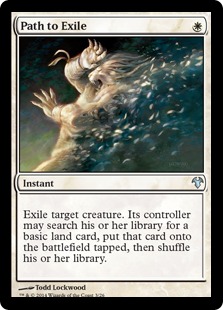
Path to Exile is extremely well-positioned in Modern currently, given the relative power level of Infect and Dredge, and also the likelihood of running into a creature with four or more toughness. Path to ExileThis was one of the big reasons that I believe we're in a good window for Jeskai Delver.
Tron's worst matchups tend to be hyper-aggressive decks, so moving towards the best-positioned interactive spell in addition to some graveyard hate to beat up on the boom in Dredge decks is a brilliant deck-building decision. Playing Rest in Peace over Grafdigger's Cage in an Ancient Stirrings deck is odd at a glance, though this is a nod to the enchantment being more difficult to remove than artifacts are.

The sideboard Blessed Alliances are also a great new innovation, as they both allow a non-targeted catchall removal spell for decks like Infect and Death's Shadow Zoo, but also some lifegain to buy time against Burn. Modern as a format rewards taking a powerful shell and tweaking it for the current week, and Tom Ross has been a shining example of how valuable general knowledge of the format and skill at tuning decks are in the Modern format.

A deck that attacks the format on much the same angle, and one that surprised me until I actually looked at the list, is Kevin Mackie's Skred Red from Grand Prix Dallas.

Skred Red, by Kevin Mackie (1st, GP Dallas, 11/6/2016)

Creatures

3 Pia and Kiran Nalaar
3 Stormbreath Dragon
2 Eternal Scourge

Artifacts

1 Pyrite Spellbomb
4 Relic of Progenitus
4 Mind Stone
1 Batterskull

Enchantments

3 Blood Moon

Instants

4 Lightning Bolt
4 Skred
1 Magma Jet

Planeswalkers

4 Koth of the Hammer
1 Chandra, Torch of Defiance

Sorceries

3 Anger of the Gods

Lands

20 Snow-Covered Mountain
2 Scrying Sheets

Sideboard

2 Shattering Spree
1 Grafdigger's Cage
4 Dragon's Claw
2 Goblin Rabblemaster
4 Molten Rain
2 Ricochet Trap

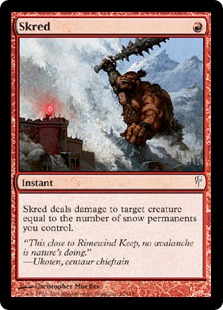
This deck also puts a specific focus on beating Dredge with the four maindeck Relic of Progenitus, which also do a good job of keeping Tarmogoyfs in Lightning Bolt range. I'm one of the bigger detractors when it comes to assessing the drawback of Path to Exile, and given that bias I am extremely jealous of decks that feature Skred while I'm playing Path. SkredIf you could just ignore the snow restriction, it's at least on par with Path on power level, and will very often be better.
This deck doesn't have the free win factor of Tron when it comes to matchups like Tron vs. Jund, though the power of Blood Moon to steal games is to be respected. The deck might look like a bunch of nonsense, but the efficient removal spells and handful of elements that provide interaction advantage against various decks across the format are really impressive. Pia and Kiran Nalaar are excellent against decks like Infect and Affinity, and the Eternal Scourge technology looks amazing against any deck that is going to take its time killing you. This is one of, if not the, most underrated decks in Modern right now, and a great example of how dedication to the format can reward you. Skred Red was a known, if fringe, quantity, but this list is extremely polished relative to anything along these lines that I've seen. Mackie was clearly rewarded for taking the time to hone it.

A deck a bit further off the radar is Kyle Boggemes's 11th place list from the Columbus Open. Jeskai Flash isn't an unheard-of deck in Modern, though there hasn't really been a consensus list to this point. Boggemes is a Pro Tour finalist who has been putting a lot of work into this archetype, and I have every reason to believe that his build is great:

Jeskai Flash, by Kyle Boggemes (11th, SCG Columbus Open, 11/13/2016)

Creatures

2 Blade Splicer
3 Restoration Angel
4 Snapcaster Mage
4 Spell Queller
2 Vendilion Clique

Instants

2 Cryptic Command
4 Lightning Bolt
3 Lightning Helix
2 Negate
4 Path to Exile
2 Spell Snare

Sorceries

4 Serum Visions

Lands

3 Island
1 Mountain
1 Plains
4 Celestial Colonnade
4 Flooded Strand
1 Ghost Quarter
2 Glacial Fortress
1 Hallowed Fountain
1 Sacred Foundry
4 Scalding Tarn
2 Steam Vents

Sideboard

1 Grafdigger's Cage
2 Blade Splicer
2 Izzet Staticaster
1 Rest in Peace
2 Runed Halo
2 Dispel
1 Negate
1 Spell Pierce
3 Ancestral Vision

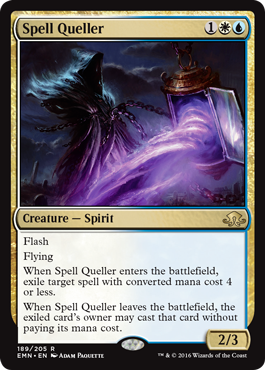
Boggemes's list once again takes advantage of the power of Path to Exile in the current metagame. It also employs Spell Queller, a card that has been making waves in the format and that I have been extremely impressed with against the non-interactive decks. Boggemes's Restoration Angels offer another level of disruption, as they allow him to save his Quellers from spot removal.

Spell QuellerI would be concerned to play this deck against Tron, though until this week we had good reason to believe that Tron would be poorly represented in the format given how it performs against aggressive decks. If the new builds of Tron cause the deck to be a more significant force that would be a strike against this exact 75—though this deck looks amazing at interacting with almost anything else, given how generic the answer cards are and how much card advantage the deck can accrue against fair decks.

As the format became increasingly vulnerable to one-mana removal and exile effects, it rewarded interaction more and more. It's possible that Tom Ross's win this weekend had just as much to do with his ability to beat the interactive decks as it did with his updates to beat aggressive strategies. I'm very curious to see where the format goes from here, and could easily see GW Tron be one of the decks to beat going forward.

An interesting deck that has popped up as of late and is still trying to find its footing is Jeskai Aggro. The deck saw some success on Magic Online as soon as Kaladesh launched, and we saw Jeff Hoogland playing the deck at the Milwaukee Open. Jim Davis and Dan Jessup piloted an updated version to respective 17th and 12th place finishes in Columbus. They made a move to add Goblin Guide to the creature suite and up the threat count, which is a reasonable choice given that the deck doesn't really rely on a high spell threshold.

Jeskai Aggro, by Dan Jessup (12th, SCG Columbus Open, 11/13/2016)

Creatures

4 Goblin Guide
4 Mantis Rider
4 Monastery Swiftspear
4 Snapcaster Mage
4 Stormchaser Mage

Instants

4 Lightning Bolt
4 Lightning Helix
4 Mutagenic Growth
1 Twisted Image
4 Vapor Snag

Sorceries

4 Gitaxian Probe

Lands

1 Island
1 Mountain
2 Arid Mesa
1 Hallowed Fountain
4 Inspiring Vantage
1 Sacred Foundry
4 Scalding Tarn
4 Spirebluff Canal
1 Steam Vents

Sideboard

2 Gut Shot
2 Path to Exile
2 Smash to Smithereens
4 Spell Pierce
3 Surgical Extraction
2 Geist of Saint Traft

I can't help but wonder how good four Mutagenic Growth are as the format moves toward more Path to Exiles. I might be inclined to move the sideboard Geist of Saint Trafts to the main to have more edge against Path and Abrupt Decay.

I like the angle of being aggressive in a way that's resilient to commonly played removal and doesn't get hit by the same hate as the other aggressive decks, but I don't believe Mutagenic Growth hits the mark anymore.

Modern is doing a great job of showcasing how important it is not only to be intimately familiar with your deck and its matchups, but also to make updates from week to week. The pressure points of the format have been pretty consistently in fluctuation as of late, which is awesome for showcasing the skill of metagaming. From a proactive perspective, I would stop skimping on Tron hate for the immediate future, and I would want to feel fine knowing that many of my opponents will be on Path to Exile. From there it's all just a matter of determining what Delver deck to play.

Thanks for reading.

-Ryan Overturf
@RyanOverdrive on Twitter

Stock Watch- Simian Spirit Guide

Are you a Quiet Speculation member?

If not, now is a perfect time to join up! Our powerful tools, breaking-news analysis, and exclusive Discord channel will make sure you stay up to date and ahead of the curve.

A cursory glance at the results of the Modern Open will show a number of familiar archetypes in the Top 8, and most of the attention is likely focused around the innovations that Tom Ross made to Tron. Tom's deck is brilliant, though when I more closely inspected the second place Dredge list, something caught my eye:

Dredge by Matt Ayers

Creatures

4 Bloodghast
4 Golgari Grave-Troll
4 Insolent Neonate
4 Narcomoeba
4 Prized Amalgam
4 Simian Spirit Guide
4 Stinkweed Imp

Spells

1 Rally the Peasants
4 Cathartic Reunion
2 Conflagrate
4 Faithless Looting
2 Life from the Loam

Lands

2 Mountain
4 Blackcleave Cliffs
4 Copperline Gorge
2 Dakmor Salvage
4 Gemstone Mine
3 Mana Confluence

Sideboard

1 Vengeful Pharaoh
4 Leyline of the Void
1 Ancient Grudge
1 Darkblast
1 Gnaw to the Bone
1 Lightning Axe
4 Nature's Claim
2 Collective Brutality

Simian Spirit Guide? In Dredge?! I had seen the idea kicked around given how powerful Cathartic Reunion is and how much speed matters, though a second place finish at an Open is very significant. Simian Spirit Guide consistently finds its way into degenerate decks of many different varieties. Amulet Bloom and Eldrazi are two prominent examples of banned decks that exploited the degenerate mana producer in some capacity. The card has also seen play in Goryo's Vengeance combo, which is a much maligned element of the Modern format.

Of course, while SSG fits into a variety of busted strategies, I'm somewhat skeptical of its future in the format. Given that the Elvish Spirit Guide analog basically only ever assists in degenerate things and shows its head in the 75 of many villains, I have found the card's legality in Modern to be dubious. Should it remain legal, I expect to see it continue to pop into various degenerate strategies, and given the string of "no changes" being made to the banlist this is a real possibility. Should the card remain legal as it continues to pop up in more and more archetypes, like Boros Prison (or Sun and Moon if you're into that...) then it strikes me as a good growth stock. This is one that I would definitely pay attention to when we get the B&R update for Aether Revolt.

Insider: MTGO Market Report for November 16th, 2016

Are you a Quiet Speculation member?

If not, now is a perfect time to join up! Our powerful tools, breaking-news analysis, and exclusive Discord channel will make sure you stay up to date and ahead of the curve.

Welcome to the MTGO Market Report as compiled by Matthew Lewis. The report will cover a range of topics, including a summary of set prices and price changes for redeemable sets, a look at the major trends in various Constructed formats and a "Trade of the Week" section that highlights a particular speculative strategy with an example and accompanying explanation.

As always, speculators should take into account their own budgets, risk tolerance and current portfolios before buying or selling any digital objects. Please send questions via private message or post below in the article comments.

Redemption

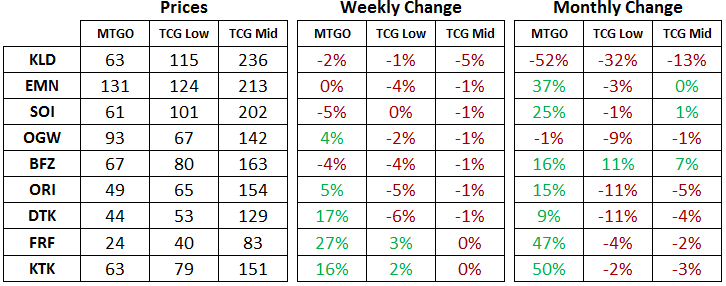
Below are the total set prices for all redeemable sets on MTGO. All prices are current as of November 14, 2016. The TCGplayer low and TCGplayer mid prices are the sum of each set's individual card prices on TCGplayer, either the low price or the mid price respectively.

All MTGO set prices this week are taken from GoatBot's website, and all weekly changes are now calculated relative to GoatBot's "full set" prices from the previous week. All monthly changes are also relative to the previous month's prices, taken from GoatBot's website at that time. Occasionally, full set prices are not available, and so estimated set prices are used instead.

nov14

Flashback Draft of the Week

This week, the flashback draft queues feature Avacyn Restored (AVR), a large set expansion to finish off the first Innistrad block. Here's Paulo Vitor Dama Da Rosa's take on the format. It's generally considered a big step backwards in terms of draft format quality, so its safe to expect a quiet queue.

Although there are no top commons or uncommons in this set, the most expensive card is the rare Cavern of Souls, which weighs in at over 30 tix. This multi-format staple is ripe for a reprinting in Modern Masters 2017, so don't be stuck holding this one too long if you take a position in this card.

Another rare which hasn't seen much fanfare in Modern lately is Restoration Angel. With the current speed of the format, a four-CMC creature that can provide value is out of step at the moment. This is a card that could benefit from a slower format, though it might take a banning for that to happen. Picking this one up this week with an eye to the long term is a decent bet, though all cards from AVR face the risk of reprint in the near term.

Standard

Standard has settled into a fairly stable metagame with U/W Flash and B/G Delirium making up nearly half of the top decks on MTGGoldfish. Until something upsets this balance, prices in Standard will be largely stagnant and unattractive for speculators. We'll need a shakeup with either a brand-new, heretofore-undiscovered archetype – or more likely the release of Aether Revolt (AER) in January 2017.

There was an error retrieving a chart for Part the Waterveil

In the meantime, picking through the cards that are powerful but under played could be worthwhile, but speculators should be wary of parting with tix at the moment. If the metagame remains unchanged, prices on cards that are not being played will drift down, so sitting on tix is a wise strategy. If you've got your eye on a particular card, its price might be attractive today, but it could be even more attractive tomorrow. Modern is also proving a very fertile ground for speculators at the moment.

Modern

Tom Ross brought an innovative Tron build to the Star City Games Modern Open in Columbus and took the trophy home. As a result of his victory, classic Tron pieces like Karn Liberated, Wurmcoil Engine and Oblivion Stone have all jumped higher this week. Ryan Overturf briefly went over the deck for Quiet Speculation readers here, and you should definitely check out the top decks from Columbus.

This is typical of the way Modern prices move up and down over time on MTGO. Decks fall in and out of favor and the pieces of the deck go down and up in price as well. Eventually an old standby, like Tron in this case, finds itself reborn with a slightly different build in the hands of a capable pilot. It's not clear yet whether this version of the archetype is going to establish itself in the upper tier of Modern decks, but players are keen to try it out.

There was an error retrieving a chart for Karn Liberated

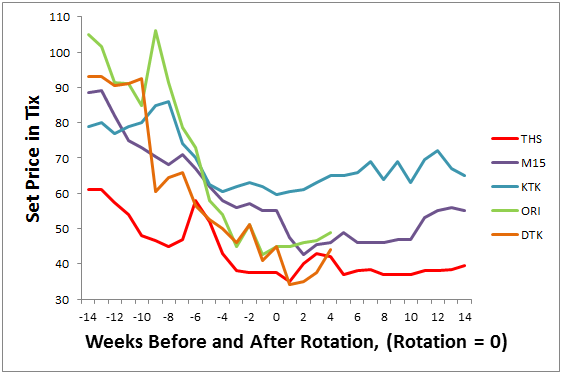
Elsewhere, speculators and players alike should be paying attention to the recently rotated sets to identify a good time to be picking up cards from Magic Origins (ORI) and Dragons of Tarkir (DTK). The chart below shows their set prices from the other three most recent large expansions that have rotated out of Standard. The time frame of the chart is in and around the date of rotation. It can give us a sense of when sets have found a price bottom – and it look like the bottom is in on both ORI and DTK.

oridtk

If you've been humming and hawing about when to pick up a playset of Collected Company, the best time looks to be in the rearview mirror at this point. If you've been a buyer of cards from these sets, then it's time to sit tight and wait for further price increases. Once paper prices establish a firm price bottom, this will set the stage for further price gains on MTGO. In the meantime, expect a flat trend with some ups and downs along the way.

Trade of the Week

As usual, the portfolio is available at this link.

The MTGO market is a competitive one with bot margins under steady pressure. As a result, buy and sell prices on cards don't tend to vary too much between bots, especially for Standard legal cards. But if you start digging into parts of the market where the volume is lower, you can find some interesting discrepancies. This week's trade focuses in on the foil market, this time for SOI and EMN.

Both of these sets had the new style of release events, where the overpriced prerelease events were scrapped, and the new release events gave out a foil rare or foil mythic rare from the new set to use in your sealed deck. With this change, a flood of foil rares and foil mythic rares entered the market and this has depressed their prices relative to other sets.

Foil mythic rares from Battle for Zendikar (BFZ) and Oath of the Gatewatch (OGW) typically go for 10 or more tix while many of the SOI and EMN mythic rares are priced below that level. Notably, this is also a function of the higher quantity of mythic rares in the the latter two sets due to the inclusion of the double-faced cards. Regardless, the relative abundance of foil rares is reflected by the high price of foil uncommons from SOI and EMN, which is where I have been focusing my thoughts lately.

When SOI and EMN rotate out of Standard in October of 2017, both sets will lose a lot of value as usual. When it comes to the foil versions, though, prices tend to be much more stable due to the high prices that foils can fetch in paper. With redemption being the mechanism to remove foil sets from MTGO and converting them into paper, all cards from a given set are needed and in demand from redeemers.

As a result of all of these factors, when a set rotates out of Standard, value tends to flow from the (no longer) Standard playable cards to the most scarce cards, which are usually the foil mythic rares. In the case of SOI and EMN though, the foil uncommons will be part of the equation. There is a strong case to be made that foil uncommons from these two sets will appreciate in value next year around rotation. For more on the foil market and redemption, be sure to read up on my three-part series from last year which gets into more of the details.

With such a long-term perspective and no historical evidence to point to as an example, I want to dig a little deeper and see if there is an advantage to choosing one set over the other. In the case of buying non-foil full sets in September, the clear winner has been EMN as the gains have been in the 50 percent or greater range while SOI sets have gained around 20 percent.

There are two factors which distinguish these sets. The first is that EMN was opened for less time, and the second was that EMN was always opened alongside SOI while being drafted. This means that foil rares and foil mythic rares from EMN might be even more abundant than from SOI, as there has been less time for drafters to open foil uncommons. Therefore I am going to focus my efforts on EMN foil uncommons as a long-term speculative hold.

When I started digging into the market and the prices that foil uncommons were selling for, I noticed two big discrepancies between the two bots I use most often, MTGOTraders and GoatBots. With foil uncommons, MTGOTraders typically has better prices than GoatBots, often with a difference of 10 to 30 percent. In comparison, on a Standard staple like Liliana, the Last Hope, they currently sell this card for 34.50 and 34.03 respectively, a difference of less than two percent. Clearly, shopping around on foil uncommons was going to help me to control costs, so I started buying foil uncommons from MTGOTraders.

But when I got to the lower-priced foil uncommons, the prices on MTGOTraders bottomed out at 0.4 tix or so. A quick scan of GoatBots showed a number of foil EMN uncommons priced in the 0.2 to 0.4 tix range. Here was another market inefficiency. On the one hand, GoatBots was overpriced relative to MTGOTraders for most uncommons, but for the cheaper ones, Goatbots had the preferable price.

With this in mind, the rule of thumb I set out was to buy any foil uncommons from EMN for 0.4 tix or less from GoatBots, and then to fill up the rest of my purchases from MTGOTraders. As a result of this, I have amassed over 400 foil EMN uncommons at an average price of 0.71 tix for a position of roughly 300 tix. We'll see how this spec turns out, but I think this will be a long-term winner. I've purchased most of the uncommons from EMN since I want to make sure I catch the uncommons that are the most scarce and see the biggest prices gains. If you are thinking about following this strategy, I would recommend doing the same. If you want to take a gamble with only a few tix, you could try to hunt around for the cheapest foil uncommons and see what happens.

Insider: Commander 2016 Four-Color Commanders

Are you a Quiet Speculation member?

If not, now is a perfect time to join up! Our powerful tools, breaking-news analysis, and exclusive Discord channel will make sure you stay up to date and ahead of the curve.

Welcome back, readers! I hope you enjoyed last week's article covering the reprints we're seeing in Commander 2016. Now to the fun stuff: the new cards (but more specifically the commanders). We've seen that when Wizards introduces new legendary creatures that look like a lot of fun, or encourage specific shells to be built around them, we often see some older cards spike in response.

If you're like me you got super excited when this guy got spoiled:

There was an error retrieving a chart for Omnath, Locus of Rage

There were quite a few cards that jumped up in value thanks to so many players wanting to build an Omnath, Locus of Rage deck.

There was an error retrieving a chart for Elemental Mastery
There was an error retrieving a chart for Collective Voyage
There was an error retrieving a chart for Perilous Forays

The takeaway here is that while the commander isn't actually worth a whole lot (because it's a new card with a lot of supply) a lot of older cards with much smaller print runs suddenly jumped in value because they play so well together. So the real money to be made on these new commander decks is in figuring out which one will be the most desirable (either powerful or fun to play), and then finding the cards, ideally older ones, that go well with them.

Wizards gave us a whole lot of new commander options (including those with the partner mechanic), but for now we'll focus on the four-color generals.

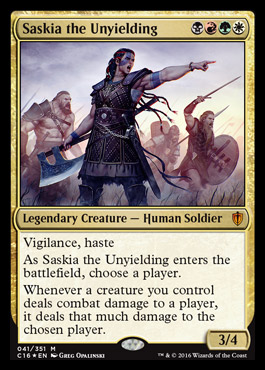
Saskia the Unyielding

saskiatheunyielding

Chaz did a solid initial write-up on this one, found here. However, let's delve a bit deeper. Clearly this is an aggro general, which is great because it's in very aggressive colors. As Chaz mentioned, this is a one-sided Furnace of Wrath effect, which tend to be extremely powerful as well as popular.

I could definitely see some players swapping out their current Jund, Naya, or Abzan commanders for this one and adding the fourth color, but I see it as more of a build-around general. It's important to remember that the more double damage abilities one has active, the damage grows exponentially. So if you have this, Dictate of the Twin Gods, and Furnace of Rath out, you're essentially doing eight times the damage.

Given that, here are my breakout picks for this general:

  • Wound Reflection - A Shadowmoor rare with a single printing. Because it says "each opponent" it too is a one-sided version of this effect.
  • Night Dealings - While this card doesn't actually double damage, it greatly benefits from doubled damage. I'm honestly amazed that this card (also with a single printing, from Kamigawa block) is near bulk. It's a re-useable tutor, which is pretty popular in Commander and thanks to this general's ability it's likely to get a lot of counters on it.
  • Gisela, Blade of Goldnight - I agree with Chaz on this one. Some of you may not remember, but this was a $13 card up until it showed up in the Commander 2015 product. It's just odd enough that I don't see it returning to Standard (especially since we've already moved on from the Innistrad plane) and it's currently sitting at a lowly $4-$4.50.
  • Rage Reflection - This one has been printed twice—in Shadowmoor and a Duel Deck. I don't think either of these printings means there are a ton of them floating around, and this one again has the benefit that it only affects your creatures.

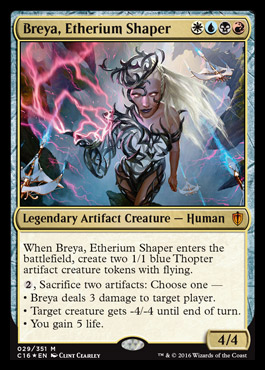
Breya, Etherium Shaper

breyaetheriumshaper

Chaz thinks very highly of Breya—I actually disagree. Esper Commander decks do tend to run a lot of infinite combos (and there are quite a few with artifacts) but the fact that you have to pay two mana and sacrifice two artifacts to activate any of her abilities honestly just says to me that she's more of a support card. I could see her acting as the third piece of a few different combos though.

  • Sword of the Meek - We saw this card jump in price when it was unbanned in Modern, but the Thopter Foundry/ Sword of the Meek combo has never really proven to be powerful enough in Modern (and I promise you I've tried). However, since we're getting another printing of the Foundry in this deck, there will be new players looking for the Sword to combo with it.
  • Time Sieve - There are few things combo Commander decks love more than extra turns. This card also spiked with Sword of the Meek being unbanned in Modern and has been on a downward trend ever since. I think that this commander could breath new life into the card, though. Alara Reborn was not a heavily-opened set (as it was the third set in the Alara block and thus drafted less). It doesn't hurt that casting this commander accounts for three-fifths of the artifacts needed for the extra turn.
  • Ashnod's Altar - If it weren't for the Eternal Masters printing of this card, it would likely be at $5. It's already a key piece in a good number of combos, and it conveniently provides the two colorless needed to activate Breya's ability. So any combo that can spit out an infinite, or near-infinite, number of artifact creature tokens can use this to win immediately (and outside the combat step).

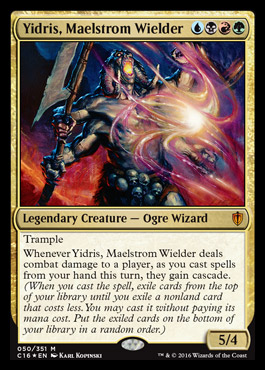
Yidris, Maelstrom Wielder

yidrismaelstromwielder

Ryan did the Commander review of this card, and I tend to agree with his analysis. Cascade has proven to be a very powerful mechanic, especially in normal (i.e. 60-card) formats. In Commander the mechanic has been a bit less abused, partly because of the one-of restriction, and partly because most decks run mana ramp spells that are mediocre hits off of cascade.

What I like about this card is it has the potential to enable many cascades in a single turn, if you can go real big on mana and cast lots of spells at once. When I think of how I'd build this deck, I'd definitely try to "go off" after hitting a player once.

  • Sword of Feast and Famine - This card proved itself in Standard as the best Sword of X and Y to fetch and cheat in with Stoneforge Mystic (which we don't get access to with this commander). Untapping all your lands is huge, especially when you want to cast big spells after combat—making an opponent discard is just gravy.
  • Bear Umbra - Same as the Sword above. I could easily see using something to give Yidris protection, unblockability, or some other evasion, and then getting to re-spend all your mana post combat.
  • Rude Awakening - Another "untap all your lands" card, except unlike the first two this one is basically bulk. It has actually only seen four total printings (Fifth Dawn, Modern Masters, Duel Decks: Garruk vs. Liliana, and the Duel Decks: Anthology). The last three were pretty small print runs and the first was 12 years ago. This one is also a fantastic card to cascade into, because you can tap any remaining lands to float mana with it still on the stack.
  • Nature's Will - Yet another untap effect, this one also taps your opponent out so you're free to go nuts without them intervening. Since it triggers for each creature that deals damage, if you played a lot of instants, you could get an insane amount of cascading (by floating mana in response to each trigger and then casting the instants before combat ends).

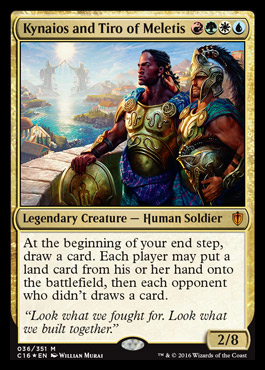
Kynaios and Tiro of Meletis

kynaiosandtiroofmeletis

Again I have to agree with Ryan on this one. This seems like another "group hug" general that just so happens to give you access to red as well. For those who have never built a group hug deck, this style tends to play lots of cards that benefit everyone and thus encourage players not to kill you, lest they lose said benefits.

Now that isn't terrible, but if you wanted to make the ultimate group hug deck you'd probably want something like Zedruu the Greathearted to give other players everything (which is interesting because typically Zedruu decks only give out bad things or things where ownership doesn't really matter). What really sucks is that Kynaios and Tiro triggers on your end step, so all of your opponents will benefit from their extra land drops or extra cards before you do.

There will likely be some Phelddagrif players who trade in the happy hippo for access to red. If enough do, we might see some movement on cards like the following:

  • Swans of Bryn Argoll - I realize this is an odd first choice, but it fits in the spirit of group hug decks. They are typically not super competitive (and I've tried to make mine as competitive as it can be), but they are fun to play. One of the cool things about Swans is that it happens to combo with Seismic Assault, which one never had access to in a typical Bant group hug deck. So the red addition is actually crucial if you want to go down that route. That and the effect is not a may, so if someone swings at you with a huge creature you can block with the Swans and deck them (which is a pretty funny way to end the game). It's important to note that this card is another Shadowmoor card whose only other printing was Modern Masters 2015 (another limited-print-run set) and it's currently sitting near bulk status.
  • Walking Archive - Here we have a typical group hug card with a single printing (Dissension) that's around $1. It's a creature that can be pumped at instant speed right before one's turn begins, to maximize your benefit.
  • Well of Ideas - Here's a Commander 2014 card that is near bulk, but it's hard not to love a Howling Mine effect that immediately cantrips for two and gives the owner a larger benefit. This seems like an obvious inclusion for group hug decks in general, so if they gain in popularity thanks to this general I can see this going up some.

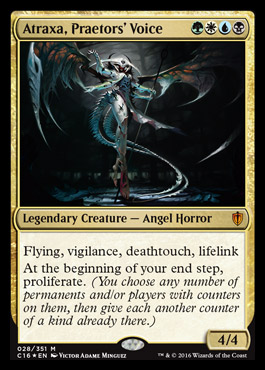
Atraxa, Praetors' Voice

atraxapraetorsvoice

While I'm less confident than Chaz that Atraxa will be a voltron-style general (simply because we have a good number of them and they tend to pump themselves in some way), I do think this one will be a popular pick. Atraxa is the only commander with built-in proliferate, which is a fun and powerful mechanic.

I feel like she'll really shine in a Stax deck (one of the options Chaz mentioned) because of how many artifacts in Magic's history have counters associated with them. I can definitely see her becoming the de-facto general of a lot of Esper players who are thrilled to add green ramp to their decks (to speed up their combos).

Her other abilities aren't too shabby either. Being able to account for an eight-point life swing each turn while sitting back on defense (with deathtouch no less) is nothing to sneeze at. But again I feel the most fun will be with proliferate. Cards to watch:

  • Contagion Engine - This card was quickly brought up in the forums as one that could gain a lot from Atraxa, and it's hard to argue. It's a mini board wipe that also provides continual proliferation. With Atraxa out this will immediately kill off any two-toughness creatures controlled by an opponent, and double proliferate is extremely powerful.
  • Altar of Shadows - This might seem a bit deep, but this is a repeatable, colorless kill spell. The seven mana is a bit much, but once you get a shadow counter on it you can proliferate it a few times and soon enough it can pay for itself. It's also near bulk and only from Mirrodin.
  • Arcbound Reclaimer - I alluded to this card a while back in my Long Shots #2 article. This seems like the perfect type of commander for this card, allowing you to slowly re-buy powerful artifacts over and over, especially since every turn with your commander out means another counter on this guy.
  • Bloodletter Quill - I imagine a lot of you have never seen this card (I hadn't either before doing my research for this article). Repeated card draw is always big in Commander, and trading life for cards is a trade most Commander players are happy to make (hence why Griselbrand is sitting on the banned list). The beauty of this card is that it draws you cards, can be proliferated, and pairs especially well with a lifelink commander like Atraxa. Not to mention that it doesn't cost that much to remove a counter.
  • Clearwater Goblet - While not as spicy as our option above, this is less likely to draw a lot of hate towards you and the fact that you can keep proliferating counters on it means you could be gaining a pretty substantial amount of life in no time. Sunburst hasn't typically been a big mechanic in Commander (thanks to one typically wanting to run two to three colors), but with the new four-color commanders it could see a comeback. This is also near bulk and has just a single printing in the original Fifth Dawn.
  • Darksteel Reactor - A single-print rare from Darksteel, this card plays really well with a heavy proliferate mechanic (and has the words "You win the game" on it, which casual players are pretty partial to).
  • Hangarback Walker - Here's another card that adores the proliferate mechanic. Origins is by no means an old set, and this guy was included in an event deck too. That said, it's a powerful card at any stage of the game, and can get out of hand quickly with proliferate.
  • Lotus Blossom - This one might be a stretch, but it's a rare from Urza's Saga that can make a ton of mana (albeit just once and of only one color). Being this old, if it caught on it would jump considerably.
  • Lux Cannon - While Scars of Mirrodin isn't an old set (by any means), this is a mythic rare in the earlier days of mythic rares. And being able to destroy any permanent is always extremely useful in Commander.
  • Magistrate's Scepter - This is an artifact that gives you extra turns. This card, Contagion Engine, and Atraxa together mean that if you can afford seven mana (or get it past three charge counters) you can take infinite turns. It's from Mercadian Masques, an unpopular set after the awesomeness that was Urza's block. Of all the cards on this list, I can see this one being the biggest breakout star.

Resolving Cliffhangers: Project Updates

Are you a Quiet Speculation member?

If not, now is a perfect time to join up! Our powerful tools, breaking-news analysis, and exclusive Discord channel will make sure you stay up to date and ahead of the curve.

I'll be honest with you. There's a Standard GP coming up in my hometown and preparing for that has dominated most of my recent Magic time. I haven't had time to come up with anything new for this week. What I do have are updates on several Modern projects that I just realized I've left sitting unreported for too long. Convenience!

vintage-brainstorm-banner-cropped

Of course, writer's block altered priorities aren't the only reason to get these updates done this week. The first is one that I promised a month ago and just never got around to delivering on. Writing about Stoneforge Mystic and the Beginner's Guide sidetracked me. The second is simply one that I get a lot of questions about, so I think that an update and explanation are in order.

[wp_ad_camp_1]

The Copter Problem

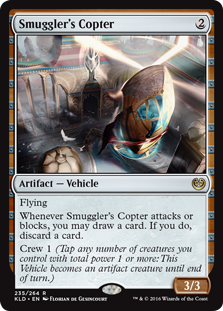
Back in October, I started investigating whether or not Smuggler's Copter had a home in Modern. My conclusion at the time was that it might have a place as a creature buff that wasn't as tempo-negative as equipment. This was completely speculative, so I tested it in actual tournaments using the decklist I thought would benefit most. For reference:

Copters and Taxes, by David Ernenwein

Creatures

4 Thraben Inspector
4 Leonin Arbiter
4 Thalia, Guardian of Thraben
4 Flickerwisp
3 Blade Splicer
3 Kitchen Finks
4 Restoration Angel

Artifacts

4 Aether Vial
4 Smuggler's Copter

Instants

4 Path to Exile

Lands

4 Ghost Quarter
4 Tectonic Edge
2 Mutavault
12 Plains

After several weeks of weekly tournaments I can conclusively say that this list is...okay. It ran very averagely in a field that was relatively hostile to DnT, and I can't say that I was too surprised by my results.

smugglers-copterWhat did surprise me was that I was completely right about Smuggler's Copter. I realize how disingenuous that sounds, but it's true. It did exactly what I expected it to do and nothing else. It didn't floor me or disappoint. It exactly matched my expectations, which was unexpected. You don't anticipate having your null hypothesis confirmed, especially when it's purely built on theory-crafting. Any yet that is what happened.

This deck was better than a more typical Modern Death and Taxes deck, and the addition of Smuggler's Copter was the reason. It allowed the dinky disruptive creatures to jump over opposing blockers, broke stalemates, and improved your hand. It also drew removal away from the "real" creatures, protecting your soft-lock pieces by default. All without spending additional mana. A very solid performance overall.

And yet it wasn't good enough. My overall win percentage with CnT did not improve over regular DnT. The fundamental problem with the deck is that Thalia, Guardian of Thraben is much worse in a format that lacks Brainstorm. There just isn't the same efficiency and velocity to throw a wrench into things compared to Legacy. Death and Taxes works through a combination of persistent disruption against the velocity of Legacy and playing lots of creatures in a format that doesn't play much removal. These things are not true of Modern (most of the time anyway) and so the deck struggles against the plethora of large creatures and walls of removal. Just adding a creature booster wasn't enough to fix the problem.

The Breakthrough

The thing is, I think I figured out my problem well before I tried this experiment with Smuggler's Copter. Back in August I took UW Spirits to 4th place at an IQ. I thought the deck was fine but it needed more work. The following week I updated the list and explained that the flaws in the deck, mostly the two-drop slot and the weakness against aggro decks, were sufficiently high that I was setting the deck aside. I still hold to the sentiment, despite Caleb Durward's success with the Bant version. The thing is, on a whim, I made a change I had talked about in the comments of both articles, and it really improved the deck.

That change was to add Thalia, Guardian of Thraben. She was the two-drop I wanted, so I just started playing her. Then I noticed how good she was at constraining my opponent's mana when combined with Mausoleum Wanderer. Following that discovery, I took things to their logical conclusion and just made a hybridized Spirits and Taxes list.

Spirits and Taxes, by David Ernenwein

Creatures

4 Mausoleum Wanderer
4 Thalia, Guardian of Thraben
4 Leonin Arbiter
4 Selfless Spirit
4 Spell Queller
3 Reflector Mage
3 Flickerwisp

Artifacts

4 Aether Vial

Enchantments

4 Spreading Seas

Instants

4 Path to Exile

Lands

4 Ghost Quarter
4 Seachrome Coast
4 Hallowed Fountain
4 Flooded Strand
4 Plains
2 Island

I was shocked at how well this deck ran. All I did was play the good Spirits, the good disruption creatures, and add in Spreading Seas and Reflector Mage. And I was crushing every deck I faced for weeks. It outground Jund, crushed Tron, and raced Infect thanks to disruption. The addition of the Spirits filled the known holes in DnT and added additional strains to my opponents' mana and answers. It was exactly what I'd been looking for in a disruptive creature deck. I crushed most of September as a result.

Result?

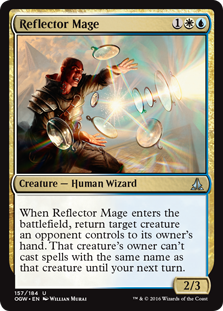
reflector-mageAnd then the metagame adjusted and a swarm of traditional Zoo and Bant Eldrazi crushed me instead. This deck does not want to see larger creatures on the table. Ever. Reflector Mage does a lot of work but it's rarely enough. To realistically have a chance you need to dedicate most of your sideboard space to beating creature decks. And it's still a close run thing. It wasn't working out for me, so I've temporarily set the deck aside while I work on control lists and RPTQ testing. That said, if the observed trend away from fair decks towards Infect and Death's Shadow continues, then SnT may be the ideal ringer.

Do I think this is necessarily the best DnT style deck? No. Eldrazi and Taxes and GW Hatebears have significant advantages in creature-heavy metagames, and tend to kick SnT around as well. However, Infect and combo decks struggle mightily against Wanderer and Thalia, and the additional mana denial turns the screws on fair midrange decks, control, and Tron. If you're the sort of player who wants to play DnT and you're willing to put in the work to understand what version you should be playing, I think you should add Spirits and Taxes to your toolbox.

Jace Needs a Home

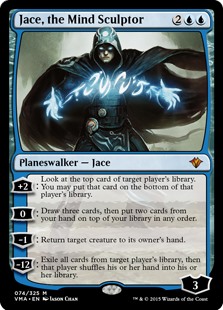
Anyway, now on to the part you really care about. I have been working on choosing a deck ever since you, the people chose Jace, the Mind Sculptor to be the next banned card I test. I was flooded with suggestions when I announced the project online, and have continued to receive suggestions (sometimes even solicited) in person. It's a lot to go through, but I am Jace the Mind Sculptormaking progress. I'm still not sure what deck will ultimately be chosen, but I have figured out a number of decks that will not be used.

I'm going to preface this section by saying that none of these decks were necessarily bad. They're not all good either, but relative deck strength is not a criterion for consideration. I'm looking for decks that highlight the strength of Jace himself, as opposed to the deck. As I mentioned, I'm trying to assess how broken the card is or isn't, and when possible I want to use the deck that got the card banned in the first place. This isn't possible for Jace because Stoneforge Mystic and Preordain are also banned, so Caw Blade doesn't work. And no, I'm not going to test whether Caw Blade is good in Modern. Three banned cards is way too many to test at once. Limit variables, be scientific.

The Rejects

  • UW Midrange/Control - Whether they're the suggested creature-based midrange decks or control decks like the one I suggested last week, UW is not where I want to test Jace. I like these decks—I've frequently run them in the past and I know they're good in Modern. But they're not going to produce the instructive or even interesting results that I'm looking for. The problem is that they're doing a fairly powerful thing that Jace doesn't compliment strongly. The card filtering from Jace is good, but it isn't actually better than just drawing cards, and you're only using the other modes once you've put the game away. I'm biased against testing fair decks anyway, and since the initial assessment of Jace is just that he'll improve these decks incrementally I need to pass.
  • Miracles - Remember when I said that the rejects are not necessarily bad? That doesn't apply here. Every suggestion I've gotten for a Miracles deck with Jace has been bad. Really bad. At best they're bad versions of the above control decks. At worse they're clunky piles. The problem is that adjusting the top card of your library once a turn at sorcery speed is not enough to make Counterbalance good. You have to guess and hope. Yes, you do sometimes get lucky and get a few cards off 'balance, but you cannot rely on it. Crystal Ball was suggested as a Top replacement, but it does a very poor job. Lacking instant-speed card selection, you were at the mercy of drawing your miracles at the wrong time and it just didn't work. Which is the reason that only Bonfire of the Damned really made an impact outside Legacy. Jace doesn't make this deck work, so any more time here is wasted.
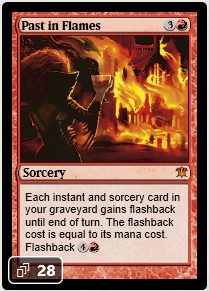
  • Delver/Storm - These decks had the same problem for testing Jace: curve. Normally their mana curves stop at 2 (Past in Flames is the exception). Trying to squeeze in a four-drop planeswalker was not a good idea. Jace sat unused in hand far too often for a good test. The deck should reliably be able, though not necessarily willing, to play Jace on curve. These decks just don't deliver, and adding Jace would slow them down too much to be worth it.
  • Grixis Control - There were a lot of good points about the Grixis control lists as Jace platforms. They liked having cards in hand, were high-velocity, and had additional ways to get rid of dead cards after you Brainstormed. It also suffered from some consistency issues going long that Jace was helping to solve. The problem was mana. Jace needed additional blue lands, and that necessitated a manabase change from my original version. This required a lot of additional tweaks to the answer package, and when I started the trials again the deck was noticeably worse. It also had a problem of periodically milling too many blue lands and stranding Jace by accident. I'm sure these problems are fixable, but I'm not willing to spend the time to do that.

Possibilities

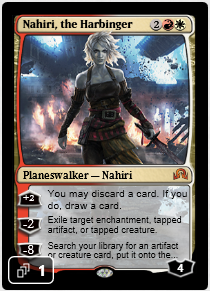
  • Jeskai Control - This is the boring, obvious choice. It's a high-velocity deck with dead draws that needs to find specific answers in specific quantity to win matches. It's also an easy build: just take out the Nahiri/Emrakul package for Jace and another answer. For the sake of time it's a good option. It's also rather boring and predictable.
  • Blue Moon - This deck has been suggested to me more than any other. I'm not sure why—I guess it has a lot of fans? Which makes me wonder why it doesn't see more play, but that's irrelevant. It has reasonable synergy with Jace shuffling away dead cards and searching for the right answer. It also has the ability to lock down the game enough without actually winning for you to plus Jace to victory. Value! The main problem is that I'm concerned that the free wins from Blood Moon will skew the results.
  • RUG Scapeshift - This is my current frontrunner. It's a deck that was once good and has lost its place in the metagame. It's less fair than the other decks, and it makes better use of Jace's filtering than the other decks. Unlike all the others, you actually want to shuffle cards back into your deck with Brainstorm. Drawing too many Mountains has always been a problem for RUG, and Jace provides a fix. Combine that with the need to actually find Scapeshift and you have a strong contender.

Looking Ahead

I'm still taking suggestions for decks and looking for input on existing choices. I'm hoping to make a final choice over the next few weeks so that testing may commence over the holiday season. Then the real grind of actually getting the data will start.

Effects of the New Standard Rotation

Are you a Quiet Speculation member?

If not, now is a perfect time to join up! Our powerful tools, breaking-news analysis, and exclusive Discord channel will make sure you stay up to date and ahead of the curve.

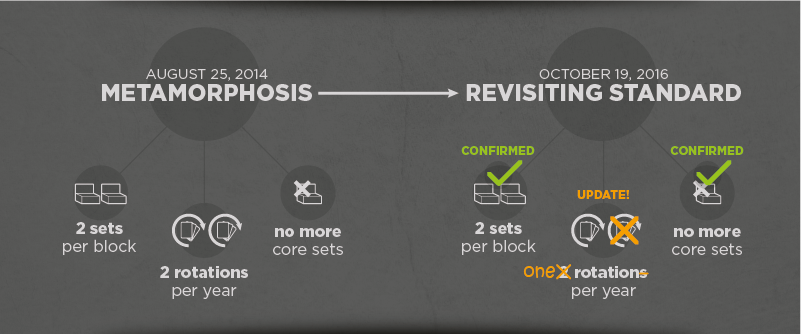
Two years have passed since Mark Rosewater's article Metamorphosis, which announced the new rotation rules for the Standard format.

Recently, Wizards walked this change back. The problem was that Standard – ideally the most welcoming format in Magic – became more difficult to keep up with for the average player. Here's the great news adjacent to all of this: Wizards is listening to their customers!

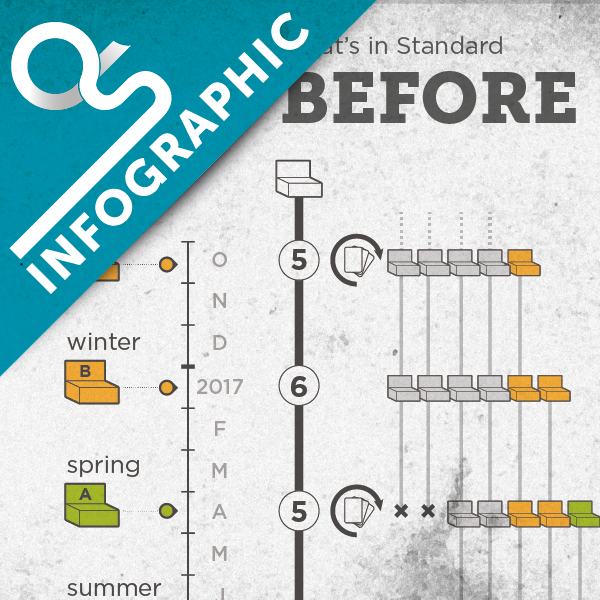
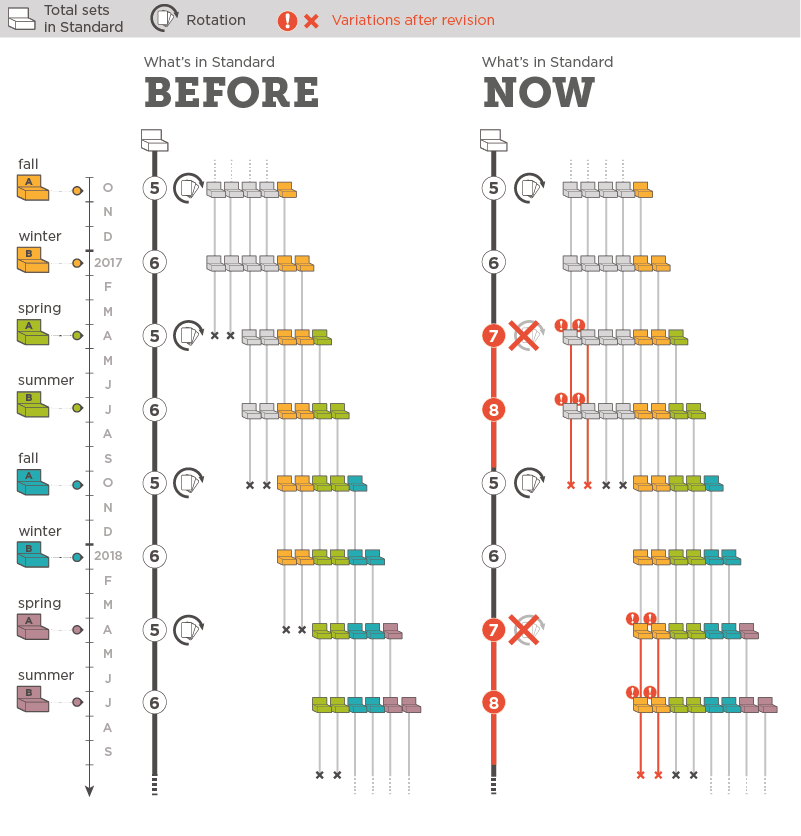
Let's visualize what has happened:

revisiting-std-rotation-02

We know why Standard rotation has changed again. But our interest is: "how does this affect my investments?"

First, here's another visualization (yeah, you know I like them!) of how the Standard rotation is going to change. Hint: Focus on how this changes the life of a single set in Standard.

revisiting-std-rotation-03

So, What Has Changed?

Players will have an easier time entering Standard now that rotations are back to the pre-2014 model. This new Standard is indeed very similar to the pre-Metamorphosis one: we have more variation in the number of playable sets (from five to eight), and the average Standard life of each set varies a lot.

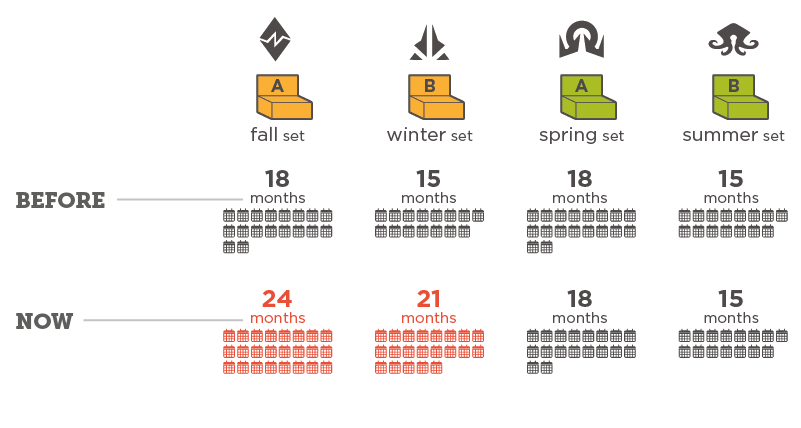
The final infographic today presents our main concern as investors: some sets (from spring and summer) will stay in Standard for less time than others (from fall and winter).

revisiting-std-rotation-04

Generally speaking, we could suppose that sets from the fall-winter block will hold their value longer, making staple cards more solid investments, while the spring-summer block will be more speculative thanks to a shorter life in Standard. Be aware of how these changes might affect you and your investments!

Insider: High Stakes MTGO – Nov 6th to Nov 12th

Are you a Quiet Speculation member?

If not, now is a perfect time to join up! Our powerful tools, breaking-news analysis, and exclusive Discord channel will make sure you stay up to date and ahead of the curve.

Hi everyone, and welcome back for another High Stakes MTGO!

This past week was a little bit more quiet than the previous ones. With Standard settling down, I'm clearly more of a seller, especially with my full set positions, than a buyer at the moment. Maybe next month I'll start looking for bulk cards that may have a shot at spiking in 2017. Speculating on bulk or near-bulk positions doesn't usually involve much risk and can lead to big rewards if you hold a winner.

Not much action in Modern either, as a period of demand for cards in this format is approaching. There might be some decent picks to find, especially with the ongoing series of flashback drafts. But my bankroll is already filled with Modern positons, which I'd rather focus on selling with the best possible outcome. I'll do my best to seize every good selling opportunity, and I anticipate the bulk of my moves here to occur in two or three weeks.

This past week saw a lot of full set movement on my account, and almost no buys. Let's review what motivated these moves. The live portolfio is here in case you still needed the link.

Buys This Week

pif

Here is my second pick from Innistrad after this set was flashback-drafted a couple weeks ago. Past in Flames has very limited applications in Modern and Legacy, but this card does something no other cards do. Wait for Storm to cycle up in popularity and this socery will see its price boosted momentarily.

For almost two years Past in Flames floated between 10 and 15 tix, with a few spikes above 20 tix, mostly in 2014. Falling below 5 tix last week, the lowest this card has ever been in more than three years, makes it an even better pick-up. I'll be considering selling this guy as soon as the price returns in the neighborhood of 10 tix though.

nth

This is a rebuy of a position I short-sold. I think Nahiri, the Harbinger should be priced much lower than what she's at now, but I was looking to rebuy Nahiri to (re)complete my Shadows over Innistrad (SOI) full sets. I barely gained 10% on that spec but I consider this short sale move a bonus to my SOI full set spec.

With this that's two recent short sales that turned out positive, although the profit margins were small, I admit. If you are invsting in full sets, short selling is definitely something to consider to boost your returns.

Sales This Week

soilog

Along with all the other Standard sets, the value of a Shadows over Innistrad full set has stopped rising. It's currently stabilized around 65 tix, with a buying price fluctuating around 55 tix.

Now that I have bought back my copies of Nahiri, the Harbinger from my short sale, my SOI sets are complete again and I've started selling some. For the first eight sets I sold, my profit was very modest and nothing compared to what I made with Eldritch Moon full sets, but I'll take it. My priority here is certainly not be stranded with SOI full sets like I was with the Battle for Zendikar full sets.

bfzlog

Yes, it has happened, I sold eight BFZ full sets this past week at a profit—a very marginal gain of 0.93 tix (2%) per set. Nothing to brag about, although I didn't think this was possible a month and a half ago. It seems, however, that the price of BFZ full sets will not seek higher levels. I'll most likely be selling the rest of my BFZ full sets before the end of November, even if I'm not breaking even any more.

Mentor never saw the price hike I was hoping for, probably because it didn't break through Modern (not yet at least). Until two weeks ago, I thought Monastery Mentor would be one of my far too many Modern specs to register big losses.

Then the Fate Reforged (FRF) mythic doubled in price out of nowhere. As the price was approaching 11 tix, I decided to get rid of my copies to put some tix to the bank, fearing the spike would not hold. And then it kept growing! I virtually broke even on that spec, although I could have posted a 30% profit, or more, if I had waited a few more days.

frf-sets

Fortunately, I didn't miss out on all of the gains involved in Monastery Mentor's spike. As Mentor rose in price so did the value of FRF full sets. The redemption cut-off date for FRF is still about six months away, but the redemption guarantee date is behind us. That means if paper stocks of a given set dry up, redemption will no longer be available, leading to a premature price drop.

This is what happened with Theros, and more recently with Khans of Tarkir (although that decision was reversed later on for KTK). My FRF full set spec was not exactly doing great, so when I saw the price surging I took my chance to exit this position with lower losses.

The interesting story here is that to liquidate these full sets of FRF, I actually sold them as singles. Dojotrade and Clanteam are the only bot chains, as far as I know, that advertise and buy full sets as-is. However, before selling I briefly checked the price of the top five FRF cards, starting with MTGO Traders. I realized they would consistently offer me 1 to 2 more tix than what Clanteam or Dojotrade could offer me for a full set.

Thus I looked for the best buyers among all bots of Monastery Mentor, Ugin, the Spirit Dragon and Tasigur, the Golden Fang. Then I sold the rest of the cards, roughly worth a ticket or so, to MTGO Traders, Goatbots and Clanteam (which buy any cards in any number). I ended up selling my final FRF sets for more than 19 tix, when the best offer for a full set was not even at 18 tix.

fgtbb

The regular version of Gisela, the Broken Blade has come to a stop price-wise around 15 tix. So did the foil version of the legendary Angel. Still with a gap of a few tix, the foil version of mythics can only go as high as the regular version does these days. A 68% profit on a foil spec is definitely a return you have to pay some respect to. I got what I was hoping for here and there's no reason to stick around longer.

On My Radar

My immediate goals for the next few days are to close my SOI and BFZ full set positions, or at least as much as possible. Prices are stabilizing and I have no intention to get stranded with my SOI full sets or hope for more with my BFZ full sets.

I will also keep selling BFZ and OGW boosters while I'm at it. All of this accounts for a lot of tix I want to make sure are free by the end of the year, before Aether Revolt hits and we start getting the first spoilers of Modern Masters 2017.

With Modern prices clearly doing better now, I'm looking for the best possible timing to sell a lot of positions that are up. We all expected this trend to sustain for about a month or so, but here again I don't want to be too greedy, especially with positions I have been holding for several months.

On the buying side there will still be several good opportunities, starting notably with Avacyn Restored flashback drafts firing this Wednesday. I'll be looking for short-term flips as almost every card could potentially be reprinted in Modern Masters 2017.


Thank you for reading,

Sylvain

Insider: A Dropping Tide Lowers All Ships?

Are you a Quiet Speculation member?

If not, now is a perfect time to join up! Our powerful tools, breaking-news analysis, and exclusive Discord channel will make sure you stay up to date and ahead of the curve.

Some of you may have already noticed, but I’ll come out and declare it here: I’ve lost interest in Twitter. As a Twitter shareholder, this is a horrendous and masochistic thing to say as I watch the value of my shares continue to struggle. But I believe in honesty and transparency, so I felt I should begin this week’s article making this declaration.

Of course, I only mention this because of the irony I am about to present: this week’s column was inspired by buzz I first noticed on Twitter. Namely, the announcement that a “modest reprint” of Eternal Masters will be released for the holidays.

To me, this seems like yet another money grab from Hasbro as they seek to forcefully increase sales of Magic. Don’t get me wrong, this will likely work. But do we really need more copies of these cards? Haven’t the reprints already done enough?

There was an error retrieving a chart for Mana Crypt

Thus far I’ve been protecting my portfolio from announcements like these by consolidating resources into Old School and Reserved List cards. But I have some lingering doubts causing me to question even this seemingly fool-proof strategy. Allow me to explain.

A Dropping Tide Lowers All Ships?

I have been an avid supporter of the phrase, “a rising tide lifts all ships.” Put simply, as Standard and Modern prices were on the rise, more players could trade their cards up towards Legacy and ultimately Vintage staples, thus increasing the value of all MTG cards.

For example, when a play set of Jace, the Mind Sculptor could be traded to Star City Games for an MP Time Walk during Jace’s heyday in Standard, there was a clear disconnect. A price correction in Time Walk and the rest of the Power 9 quickly ensued as players realized they could cash out their Standard cards for Power. Notice how this is no longer a remote possibility with any Standard card today.

Then you had Modern Masters, where a playset of Tarmogoyfs could be traded up for Power. This also wasn’t a sustainable circumstance, and since then Modern prices have dropped while Power prices have risen. The same rationale can be used to explain the rise in other high-end cards as well, and Old School provided an additional catalyst.

There was an error retrieving a chart for Tarmogoyf

But now a new trend has evolved. Modern prices are down significantly. Star City Games is reducing their Legacy support. Standard is at its cheapest in many years thanks to the introduction of the Masterpiece Series. Now we’re in a situation where it takes a complete playset of Standard to obtain an attractive piece of Power 9.

Enter my concern.

With Standard and Modern getting cheaper, there will be fewer players able to convert their collections into high-end cards such as Power. The sinking tide on most Magic prices will no longer be a driving force for an increase in high-end pricing. As a result, we are starting to see some very minor weakness in duals and Power. After a massive run, cards like Time Walk are actually dropping—a very rare occurrence indeed!

There was an error retrieving a chart for Time Walk

But What About Old School?

I began my journey into Old School MTG over a year ago at Grand Prix Las Vegas. What started as a $70 HP Juzam Djinn rapidly evolved into my favorite format and a sizable investment. Through publicity and open communication of the format’s attractiveness, prices of Old School went on a tear. Cards like Chaos Orb and Juzam Djinn ran up tremendously fast as players sought to play some of their favorite nostalgic cards, myself included.

There was an error retrieving a chart for Chaos Orb

Surely these cards are primed to rise further right? They aren’t getting easier to find, and the Old School format seems alive and thriving despite weakness in other areas of Magic.

I’m not so sure of this. When I look at the chart of many popular Old School cards, I’m seeing massive spikes followed by an ensuing drift downward in price. It seems the initial “newness” hype has worn off, at least for now.

Don’t get me wrong, prices are still significantly higher than they were just a few months ago. But I confidently believe that most of the popular Old School cards—the ones that have already spiked—are now reaching a new plateau in price. Upward movement may still occur, but it will be at a much slower pace than before.

This naturally means support for crossover cards from Legacy and Vintage will not see much more price support from Old School in the near term. The Tabernacle at Pendrell Vale spiked back in July, but has pulled off its highs since.

There was an error retrieving a chart for The Tabernacle at Pendrell Vale

I’ve already mentioned Power and duals, and their recent pullbacks. Even looking at something seemingly immune to all outside factors, such as Beta Demonic Tutor, we see the same consistent downward motion.

There was an error retrieving a chart for Demonic Tutor

This is all quite concerning.

What Should We Do About It?

Historically I have been a steadfast supporter of these “safer” investments. But even my confidence is shaken when I view charts like the ones presented above. There is a fundamental shift in Hasbro’s strategy with Magic, and this shift is gradually decaying the price of all cards as a whole. I don’t like it one bit.

I dislike it so much that it’s causing me to rethink my strategy altogether. Don’t get me wrong, I don’t plan on suddenly selling everything and putting my head in the sand—we’re not anywhere near a Magic apocalypse. Not yet anyway.

But for my own personal motivations and goals, I have to wonder if these investments are the right areas to park significant funds at this stage in Magic’s history. I still hope to use MTG finance to fund my son’s (and now daughter’s) college educations as best as I can. But to succeed in this endeavor, I need Magic prices to rise. If I truly believe we’re in for a long period of stagnation, then perhaps I need to find a different investment vehicle. I simply cannot afford to sit on a collection and watch it erode in value.

If I was playing Vintage, Legacy, or Old School on a regular basis, things might be different. In that case, I would be netting “utils” (an economic measurement of happiness) by simply owning and playing with these cards. But this isn’t the reality nor is it my primary motivation for owning these cards. Therefore if I believe these cards are going to continue to shed value, then the rational move for me would be to sell.

That is exactly what I’m considering. I haven’t made any final decisions yet, but I am definitely planning on trimming my collection back significantly over the next two months. My goal will be to reduce my holdings to a very small, core group of cards before my daughter is born in late January.

Grand Prix Louisville is less than two months away, and it will likely be an avenue I pursue for unloading most of what I plan on selling. I may be able to eke out greater value from the High End Facebook group, but the minimal effort of selling at a GP (along with instant cash payment and no issues with shipping/grading) is likely to be the most attractive outlet for me.

I’m not saying this decision is correct for everybody, but if your primary motivation for owning Magic cards is to make money over a long-term investment, then I strongly urge you to reconsider your positions. Perhaps this is a temporary setback and there is simply consolidation going on before the next run higher. Personally, I cannot accept a “technical” analysis of prices when I see such certain fundamental shifts taking place. That’s why I’ve decided to start selling.

Wrapping It Up

“The sky is falling, the sky is falling!” I recognize I have a “Chicken Little” reputation. That’s fine. I don’t really care about how others classify me. Most people who try to put me down with these labels don’t understand my motivations for this hobby. With the infinitesimally small amount of Magic play I enjoy nowadays, I can only justify owning cards if they are primed to make me money over time.

Throughout 2015 and 2016, this meant buying into Old School and Reserved List cards. But recent trends in MTG cause me to question this approach. The downward trends are clear to me—the data doesn’t lie.

Therefore, I think it may be time to put my attachments aside and re-focus on my main goal. This means I must start selling some things to protect my capital.

Does this mean I’m officially calling a Magic “top”? I’m not sure I can claim this stance so confidently. All I know is that Magic finance feels different to me now. All these reprints, Wizards’ clear focus on dropping secondary market prices, and Hasbro’s desperation to increase sales are all reasons to take pause and reconsider MTG as a lifetime investment.

There will certainly be price fluctuations going forward, and there will still be plenty of money to be made in the hobby. I just don’t know if “long-term” holdings make sense if the ultimate goal of Hasbro is to sell more product and to make Magic cheaper. This flies in the face of collectors and their investments.

I’m going to think on this some more before making any final conclusions. I just wanted to be transparent to my readers so they can follow along and assess their own situations for themselves. If you don’t play Magic anymore like me, then you may want to think twice about what you want to hold and for how long. Magic has had quite the run lately, and there’d be no shame in taking some profits off the table. As for me, I’ll start planning some sales and will keep you all up to speed on my decisions as they unfold.

Until then, best of luck to all you Old School and Vintage investors out there. Get ready for some low tides ahead.

…

Sigbits

  • One card showing significant strength is Armageddon from Beta and Unlimited. Star City Games is sold out of the Old School staple from both of these sets, with $299.99 and $59.99 price tags respectively. This data point shows that not all cards are peaked and dropping—we just need to look carefully at trends before committing any resources to a long-term investment in a given card.
  • Stone Rain is another Old School card seeing strength. The Beta version of this card just hit another all-time high, and Star City Games is sold out except for one MP copy at $4.99. They have no Alpha copies in stock, at $15.99. Many Old School commons and uncommons are seeing real traction as players—not speculators—are acquiring these cards for play in their nostalgic format.
  • Doubling Season continues to be casual and Commander gold, it seems. The card just recently hit all-time highs despite its reprint in Modern Masters three years ago. Star City Games does have a decent amount in stock, but I was utterly shocked when I saw that $50 price tag. Clearly this card is seeing steadfast demand, and it screams to me that strategic casual cards are a great place to park some money for investing. Just be careful of those reprints…

Deck Overview- Selesnya Tron

Are you a Quiet Speculation member?

If not, now is a perfect time to join up! Our powerful tools, breaking-news analysis, and exclusive Discord channel will make sure you stay up to date and ahead of the curve.

Tom Ross has done it again. By now we should all stop being surprised when Tom shows up and crushes with a different Modern deck, though I definitely wasn't expecting Tom to be on Tron this weekend. Much less an innovative Selesnya build.

Selesnya Tron

Creatures

1 Spellskite
2 Wurmcoil Engine
2 World Breaker
2 Ulamog, the Ceaseless Hunger

Spells

4 Karn Liberated
2 Ugin, the Spirit Dragon
4 Chromatic Sphere
4 Chromatic Star
4 Expedition Map
3 Oblivion Stone
2 Relic of Progenitus
3 Path to Exile
4 Ancient Stirrings
4 Sylvan Scrying

Lands

1 Forest
1 Brushland
1 Ghost Quarter
3 Razorverge Thicket
1 Sanctum of Ugin
4 Urza's Mine
4 Urza's Power Plant
4 Urza's Tower

Sideboard

2 Thragtusk
2 Rest in Peace
3 Blessed Alliance
3 Nature's Claim
1 Ravenous Trap
3 Warping Wail
1 Ghost Quarter

Tron doesn't care about the opponent's life total, which means that Razorverge Thicket and Brushland are both downgrades to Grove of the Burnwillows. To make this switch, you must be confident in the white spells you choose to play. In the maindeck, Tom just has three Path to Exile for this splash, which I accept as an upgrade over Lightning Bolt in this style of deck to beat decks like Infect and Death's Shadow Zoo.

The real upgrades come in the sideboard in the form of Rest in Peace and Blessed Alliance. I think that Tron has a fine Dredge matchup, and Relic of Progenitus and Gravedigger's Cage are easy includes in an Ancient Stirrings deck, but enchantments are tougher for Dredge to deal with than artifacts.

Blessed Alliance is definitely the more significant sideboard upgrade. Fast aggressive decks are bad matchups for Tron across the board. Gaining life and non-targeted removal spells are both exceptional against these decks. Tom's updates seem great, and I'm happy to see him take yet another Open down.

The last thing worth noting, is that cutting Grove of the Burnwillows for white lands significantly reduces the price of the deck. This build is much easier to ease into than Gruul Tron for new Modern players, which could cause some movement on the other pieces of the deck.

Want Prices?

Browse thousands of prices with the first and most comprehensive MTG Finance tool around.


Trader Tools lists both buylist and retail prices for every MTG card, going back a decade.

Quiet Speculation