Are you a Quiet Speculation member?
If not, now is a perfect time to join up! Our powerful tools, breaking-news analysis, and exclusive Discord channel will make sure you stay up to date and ahead of the curve.

If not, now is a perfect time to join up! Our powerful tools, breaking-news analysis, and exclusive Discord channel will make sure you stay up to date and ahead of the curve.
If not, now is a perfect time to join up! Our powerful tools, breaking-news analysis, and exclusive Discord channel will make sure you stay up to date and ahead of the curve.
If you're a Magic speculator who isn't active in the MTGO markets you are doing it wrong.
Becoming a trader on Magic Online (MTGO) is the easiest way to leverage your existing expertise to increase the value of your collection or make money. You’re already tracking cards and formats, so you might as well put that knowledge to work. Once you learn the tricks of the MTGO economy you’ll have a foothold in a frictionless market that offers strong cyclical patterns and excellent returns.
I don’t even trade in paper anymore because it is so much easier to make profits on digital and then just purchase whatever cardboard I might need. In making the switch, I’ve said farewell to buying mailers, packing cards, listing on eBay or TCG Player, opening mail, sorting huge stacks of cardboard, searching for a card that just spiked... I don’t miss it at all.
MTGO does offer some barriers to entry, which is one reason the returns are so strong. The market for digital cards is opaque and confusing, and operates somewhat differently from paper. Plus you have to learn to use the client, which has a longstanding reputation as a bear to navigate. (The client has actually gotten much better, especially for trading, and is pretty easy to use once you learn the interface.)
There are a number of great resources on Quiet Speculation to help you get started. In a future article, I will provide an index of these that will help you get started on MTGO trading. In the meantime, if you’re still not convinced, here are 10 advantages that MTGO speculation has over paper speculation:
It is incredibly easy to buy and sell cards on MTGO. Say goodbye to shopping auctions, scouring TCG, or calculating PucaTrade points. You can open the client, search prices, purchase the card, and receive it immediately---always in the promised condition.
No haggling with buyers who say they didn’t get their cards, no PayPal fees, no calculating shipping, no stocking up and storing shipping materials. Basically, all the things you hate about buying Magic cards disappear. Click and it’s yours. Click and it’s sold.
The MTGO market features a major price driver absent from paper markets: the redemption cycle.
I plan to cover this more in depth in my next article. Redemption is the process through which digital cards are turned into paper cards. It creates very predictable cycles of supply and demand that allow you to profit, at very low risk, if you know when to invest. If you're already an Insider on Quiet Speculation you have lots of resources to help answer that latter question.
On MTGO, your next spec is a click away. In the time it takes for your paper cards to arrive in the mail, you could have sold your target for a tidy profit, reinvested it, and cashed out again. It is this extraordinary velocity that makes MTGO so attractive. Cards spike and prices adjust immediately.
There will be MTGO speculators who buy cards today, on the first day of the Pro Tour, sell them tonight at a profit, invest those profits into new targets, and sell those tomorrow when they appear on camera. If you know the power of compound interest you’ll recognize how powerful this engine can be. I am not a high-velocity trader (I don’t have the time and inclination) but it is a very lucrative trade for those skilled in the MTGO market.
Speculating on boosters in the paper economy is cumbersome and involves long time horizons. In contrast, booster prices on MTGO follow predictable cycles and are easy to buy and sell en masse. The margins are generally low but the profit is secure. Moreover, the small spreads on boosters mean they are a liquid asset that still offers a return.
A good recent example is Shadows of Innistrad boosters—as I suggested in my last article, you could have snagged these when they dropped as low as 3.6 tix during the prerelease events and rose to nearly 4 tix within a day. A 10% return in 24 hours with virtually no risk? Sign me up.
In paper, if you want to play with a speculation target, you need to keep track of its location, un-sleeve and re-sleeve, etc. On MTGO, it’s seamless to add your cards to decks and binders. In fact, if you spec on 4 Lion's Eye Diamond this week (which I highly recommend, as they just dropped in price and are set to bounce back as Eternal Masters approaches) you can play them in Dredge, Storm, Belcher and Oops, All Lands! until you decide to sell.
Remember that time a store modified your order right after a card spiked, claiming they couldn't sell you more than a playset? That doesn’t happen on MTGO. Nor does the buyer who tells you they never received their package, or that the cards weren’t in the right condition, or that they want to return them.
I like to spend my capital on spec targets, rather than bubble envelopes, binders, sleeves, shipping fees, PayPal fees, TCG commission, etc. On MTGO there are no transaction costs. (The one exception is if you choose to operate a bot but, as you'll see, there are ways to keep those costs to a minimum as well.)
If you’re working in paper and happen to be traveling when the ban hammer strikes or the metagame shifts, you’re up a creek. If your cards are digital, it’s easy to log on and sell out from anywhere with an internet connection. The MTGO Forums keep you posted on what’s coming down the pike.
On MTGO, there are fewer collectors. The economy is driven by players who just use the program for drafting and don’t plan to keep the cards. This means at certain moments it's easy to snap up cards from out-of-favor decks or formats at a deep discount.
The seasonal swings on Modern are quite lucrative. MTGO players have a very short-term perspective and don’t recognize their cards as intrinsically valuable the same way paper players do. This creates great opportunities for speculators.
Sylvain Lehoux's “100 tix, 1 year” project resulted in a 642% profit margin. Matthew Lewis is another master speculator who has generated thousands of tix in profit. Learning from them and others, I grew a meager collection to the point where today I can play any deck in any format and still have tix to burn on Limited.
There are lots of other QSers making a killing on MTGO, and a very collaborative community in the forums. And almost all of us do this with a very modest time investment. These types of returns are very hard to achieve in paper unless you devote a ton of time.
~
Alright, I got to 10 already and haven’t even touched on arbitrage, botting, mythic foils, or other winning plays.
There is a literal wealth of information available on the QS MTGO forums and article archives (I'll point you to some of my favorites in my next article). If you already have a subscription, you might as well check these resources out. Otherwise, I recommend starting with Sylvain's “100 tix, 1 year” project or Matt Lewis' discussion of redemption to learn more about the basics of the MTGO market.
-Alexander Carl
@thoughtlaced
If not, now is a perfect time to join up! Our powerful tools, breaking-news analysis, and exclusive Discord channel will make sure you stay up to date and ahead of the curve.
Let's clear the air. I want to write about a pet card 1,000 times (à la Day's Undoing) about as little as you want to read about it. To quote one of the funnier comments on my umpteenth Day's Undoing article, "This series is like watching a bubble burst in slow motion." Funny, yeah, but fun for no one! Still, commenters last week raised some valid points about my consistent inclusion of Serum Powder in Eldrazi decks, and I think it would be interesting for all of us if I addressed their concerns more formally.

For starters, I think I was wrong to keep running Serum Powder during Eldrazi Winter. Literally nobody else ever picked the card up in the Eldrazi shell, and there must surely have been a reason why not. I couldn't put my finger on why at the time; I just knew I wanted to play something "unique," and subsequently brought an unoptimized deck to GP Detroit. After lots of testing with the TarmoDrazi deck, both with and without Serum Powder, I've again come to the conclusion that it has a place here, at least for now (even more testing may indicate the opposite). Moreover, I finally know why Powder didn't work in Eye of Ugin Eldrazi, and why I think it works better now.
For reference, here's my TarmoDrazi deck from last week:
[wp_ad_camp_1]
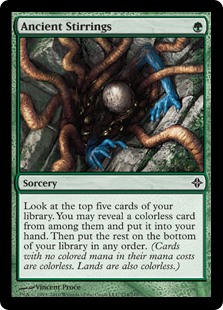
The obvious reason to run Serum Powder is to gain access to a consistency tool in colors or decks that can't afford to run other consistency tools. Vintage Dredge uses the card, for example, to locate Bazaar of Baghdad. Unlike Dredge, TarmoDrazi can and does run other consistency tools---Ancient Stirrings and Traverse the Ulvenwald both dig for crucial permanents. Stirrings and Traverse are traditional cantrips in that they cost just one mana and hold their value during every stage of a game.
 Serum Powder operates within a much narrower window than these two cantrips, but offers a payoff in the vein of Chancellor of the Forge or Leyline of Sanctity. Opening Chancellor can make Goblin Piledriver lethal a critical turn earlier, and mulliganning into Leyline is sometimes gamebreaking enough that certain decks board them without packing any white mana sources. Powder shares with these cards a dependence on opening hand variance, but offers similarly sizable rewards when the stars align. Unlike Stirrings and Traverse, Powder won't dig us out of holes or solidify a board advantage once players have resolved mulligans.
To properly analyze Powder's role as a digging tool, we need to ask ourselves why decks play digging tools in the first place. Deckbuilders include cantrips in their 75 for two reasons:
1. Digging tools help find specific cards as needed. Collected Company in Standard's Bant Company, Serum Visions in Modern's UR Twin Temur Delver, and Ponder in Legacy's Canadian Threshold all help pilots treat their decks like swiss army knives. In these scenarios, cantrips are used to find answers to resolved threats, counterspells for an opponent's impending combo, a fourth land to cast Huntmaster of the Fells, and so on, and are lauded for their versatility.
2. Digging tools help increase the density of a certain card or type of cards. Combo decks use cantrips for this second reason; Magic has this stupid rule that only allows 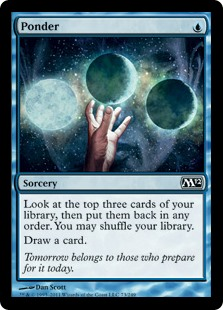 players to pack four copies of each card. That's just four copies of Scapeshift; four copies of Goryo's Vengeance; four copies of
 Splinter Twin Tarmogoyf. Without consistency tools like Serum Visions, combo decks like Ad Nauseam would have a tough time existing in Modern, as they wouldn't find their key cards regularly enough to win a passable percentage of matches.
This second reason also explains the restrictions of Ponder and Brainstorm in Vintage, Magic's oldest format. Wizards doesn't want players casting broken restricted cards like Ancestral Recall and Time Walk in virtually every game, but they can't ask players to play less than one of those cards. As a solution, they restricted the cantrips best at finding blue Power.
Let's apply these two dimensions to Serum Powder.
Powder struggles at finding specific answers, since it exclusively provides consistency at the beginning of a game. The card won't help us adjust to the predicament we find ourselves in; it can only put us on track to play a certain kind of game with some degree of improved competence. In TarmoDrazi, like in Colorless Eldrazi Stompy, we want to maximize our aggressive starts.
Why Powder failed in Colorless: If we want to maximize our aggressive starts, we need to aggressively mulligan into---and Powder into---hands that contain a combination of efficient threats and Sol lands. I originally tried Serum Powder in Eldrazi for reason two, hoping to virtually increase the amount of Sol lands in the deck. But as widespread tournament results indicated, eight Sol lands were more than enough to render the Eldrazi deck tremendously consistent. The verdict: Colorless Eldrazi Stompy didn't need Serum Powder to find its Sol lands on time.
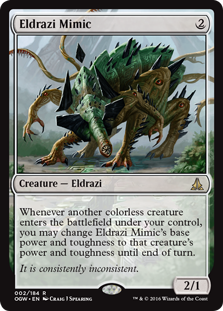 So what about its efficient threats? Again, the Stompy deck had a myriad of options available: Eldrazi Mimic, Endless One, and even Endbringer all spring to mind. UW Eldrazi, which ended up being the best version, played even more efficient threats in Eldrazi Displacer, Eldrazi Skyspawner, and Drowner of Hope, and had the most aggressive starts of any deck in Modern as a result. The verdict: Colorless Eldrazi Stompy also didn't need Powder to find its threats. It could just play more threats instead of Powders and have a better chance of opening competent aggressive hands.
Why I think Powder is better here: Unlike Colorless Eldrazi Stompy, TarmoDrazi can't simply play more efficient threats instead of Serum Powder. Thanks to the Eye of Ugin ban (seriously, what the hell, Wizards!), we now lack the available pool of efficient threats that Colorless Eldrazi Stompy had access to. Tarmogoyf can only get so far on his own. Eldrazi Mimic and Endless One rightfully held uncontested seats at the Eldrazi Core table, but without Eyes to back up our Temples, they do next to nothing.
Let's say we open one Temple. In this case, Eldrazi Mimic will swing for three on turn two if we even have a Matter Reshaper handy, or for four 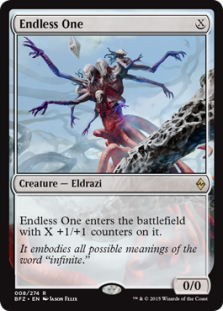 on turn three if we have Thought-Knot. And that's if opponents don't Lightning Bolt our Mimic. In my opinion, the marginal upside of sometimes providing a little bit of extra damage is not worth handing 40% of the metagame a golden opportunity to favorably interact with us. Back in the day, Mimic still offered opponents that opportunity, but he came with the significant upside of usually providing lots of extra damage.
As for Endless One, this creature now comes down as a 3/3 on turn two, or a 4/4 on turn three. For context, that's Watchwolf and Loxodon Smiter, neither of which are particularly fabled for their efficiency. Endless One does have the benefit of being able to come down whenever for all the mana we can muster, but I don't think this deck prizes that sort of flexibility. It mostly wants to maximize aggressive starts, and Endless One doesn't do that for us anymore.
As mentioned above, my initial reasoning for playing Powder in Eldrazi was to increase my Sol land density.
Why Powder failed in Colorless: I also mentioned above that Colorless didn't need to increase its Sol land density to be hugely consistent.
Why I think Powder is better here: Conversely, TarmoDrazi really wants more Sol lands. Four is not enough. Serum Powder is no tutor, though. It won't search for 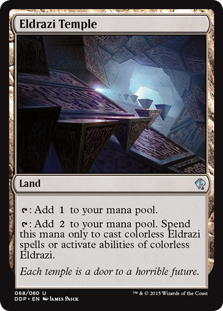 Eldrazi Temple directly, and it offers no guarantee of finding one. But it does greatly improve our chances of opening one, and that's good enough for me. The games we start off with Eldrazi Temple seriously resemble the games Eldrazi decks played when Eye of Ugin was legal, and anyone who played during that time (hopefully, not many of you) can attest to the archetype's power.
There's also a palpable difference between finding Temple with Serum Powder and finding Temple with something like Expedition Map or Sylvan Scrying. Tutors promise to find the land, but they eat up our early mana, depriving us of the ability to execute an optimal midrange plan: disrupt opponents, commit to the board. Map costs one mana to play and two mana to activate.
For the same price, we could Tarfire a creature and follow up with Tarmogoyf. If our mulligans (and hopefully, Serum Powders) aid us in opening the Sol land naturally, we can chase that Tarmogoyf with a turn-three Thought-Knot Seer and practically seal the game on the spot. Looking back at the Map player, that third turn Thought-Knot Seer would mark his first foray into actually impacting the board. In Modern, waiting so long to interact even minimally will usually cost players the game, unless they're doing something enormous like casting Karn Liberated or Wurmcoil Engine. We aren't.
Green cantrips walk the line between the "free" Serum Powder dig and the expensive Map dig when it comes to finding Sol lands. At just one mana, I'm happy to include them in the deck, especially since they also find creatures.
Unlike Chancellor of the Forge in the decks that run him, or Leyline of Sanctity in decks without white, Serum Powders drawn naturally during a game aren't totally dead cards. Granted, nobody would play Powder exclusively for its tap ability, since superior alternatives like Mind Stone and Talisman of Impulse exist. But it's important when analyzing the card not to forget that Powder does tap for one mana if we're willing to cast it.
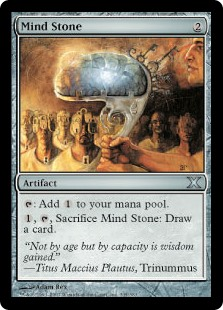 In a deck like Eldrazi, having a mana rock---if an undeniably lackluster one---is far from the end of the world. In fact, the Eye of Ugin-featuring GR Eldrazi deck played Mind Stone or Talisman of Impulse (list depending) in the main, since ramping into World Breaker was so important to that deck's gameplan.
In this version of the deck, Powder's hidden mode of "bad Talisman" has at least some relevance. We too run World Breaker, as well as one sideboard copy of a larger curve-topper, Kozilek, the Great Distortion. Powder also plays nice with Sea Gate Wreckage, helping us rush out a mana source while sort of bypassing the one-land-per-turn rule to achieve hellbent faster. And since Wreckage essentially requires four mana per turn to shine as a draw engine, Powder helps us actually cast the Eldrazi we draw from it.
Similarly, Powder works well with our green cantrips. One mana makes a huge difference in this deck, as evidenced by the amount of speed we gain by pulling a single Eldrazi Temple. Three mana casts Matter Reshaper, four mana casts Thought-Knot Seer, and five mana casts Reality Smasher. With an additional mana source on the board, we can first cantrip to dig for those threats, and then cast them. I realize this notion sounds intuitive---of course having one more mana available lets us do more things. But the extra help from an on-board Serum Powder in maintaining deck velocity, deploying threats, and disrupting opponents within a single turn cycle has come up enough times for me that I feel I need to mention it explicitly.
Since we lack efficient threats without Eye of Ugin, cutting Serum Powder means adding something else. Given the deck's midrangey nature, I think it wants to add interaction. Besides, what else is there? We've already established that we can't add creatures, and we don't want to add so many lands that we flood every game.
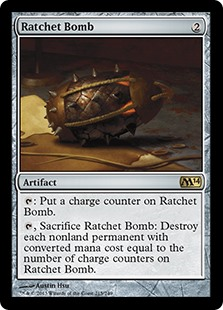 I tested extensively this week without Serum Powder, eventually replacing my playset of the artifact with two copies of Ratchet Bomb, a third Lightning Bolt, and a second Ghost Quarter. The deck was much slower. I couldn't afford to ship all my decent hands without explosive starts, and ended up playing like a less aggressive version of Jund in many games. Serum Powder's main purpose in this deck is to help us assemble hands that enable aggressive starts at a rate better than the normal trade-your-hand-for-one-less-card offered by traditional mulligans.
One other possible inclusion over Serum Powder that I've considered but not yet tested is Oath of Nissa. We've seen that in Game 1, our digging effects (Stirrings, Traverse, and Serum Powder) are usually spent finding us threats or Temples. Oath also finds threats and Temples, and it boasts the flexibility of the other cantrips by remaining useful as the game drags on.
Last week, a commenter mentioned the possibility of a black splash instead of red in TarmoDrazi. That sounds viable to me. As I see it, there are plenty of ways to build TarmoDrazi, just as there are plenty of decks to play in Modern. By that same token, it's fully possible that despite my 2000+ words here, Serum Powder really isn't optimal in this deck. I'll hopefully catch on to that fact before someone else does if it's true, but I don't mind eating my words if it means the deck gets better.
I love Modern because players can pretty much sleeve up anything they want, and I'm sure many players share this sentiment. Whether you're a Powder believer or not, let's toast to the format's unbelievable range and brewing space. It's time to make Eldrazi great again!
If not, now is a perfect time to join up! Our powerful tools, breaking-news analysis, and exclusive Discord channel will make sure you stay up to date and ahead of the curve.
 Kelly Reid and I (Doug Linn) are here in Madrid, covering the Pro Tour for our Insiders! We're going to send you the financial news that you need as it's unfolding on the floor of the PT. This is Standard, so we're expecting big breakout decks and card price swings over the weekend. We will be periodically sending out updates. You'll have them emailed to you; we'll tweet about updates; and we'll post them here. No matter how you get your updates, you'll be able to find them.
We are here to help you. That means that we will research the stories that you want to know about. You can ask us questions on Twitter or on the forum thread (or at the bottom of this page) and we'll answer them for you!
Useful links for the weekend:
Our Twitter feed (no financial stuff posted there since it's public)
The QS chatroom (usually gets started up as Constructed starts)
Our Twitch commentary with Chaz and Ryan
All the drafts are done and it's Standard from here on out. There are definitely some new faces at the top tables. Some people 0-3'd their drafts and packed it up, while others shot up to the top after strong performances this morning. Here are the notes from Kelly and me:
More updates to come!
We have had the opportunity to watch a good deal of games with the G/R Goggle Ramp deck. It looks very good. There were three or four copies of it at the top dozen tables. Notably, the deck runs Draconic Roar and Dragonlord Atarka on the high end. Here's our rundown of the value cards in the deck and where we think they'll end up.
Traverse the Ulvenwald: a key card at the moment. $4, which seems to be the upper limit on it.
Dragonlord Atarka: This has seen prices as high as $30 before. At $10 now, it's probably at its peak price unless it gets into T8 contention.
Drownyard Temple: At $2, this is priced at about where new playable rares end up. I think it could go up to $5, though. It's a good roleplayer card in the deck.
Pyromancer's Goggles: What may have looked cute last week has proven its power now. They sit at $8, but I predict these will hit $25-30 with a T8 showing. Sounds crazy, but Chandra is sitting at $28 now. People like to turn Magmatic Insights into Ancestral Recalls.
Fall of the Titans: I love this card at $0.50 right now. I got to see a fireball for 16 wrap up a game. It's respectable in the ramp deck even without surge. This is a good "penny stock" play if you want one.
Kozilek's Return: I have seen a ton of these in the Ramp decks. I'm a little less confident on it going forward because there are a lot fewer Humans decks. On the other hand, it sweeps up the Nantuko Husk decks nicely. It's $5.50 right now. It preordered for $25, but I don't believe anyone actually paid that price. Still, a good card. It should be $10 soon enough.
World Breaker: Also at $6 right now. This has seen a dramatic price increase so far and shows no signs of stopping, due to being the cornerstone of the ramp deck. The Breaker is a mythic, so I also think this should see $10 soon enough.
After Round 1 of Standard, we sat down with Matthew "Ogre" Stevens of Troll & Toad, who is one of the two vendors on site here at PT:SOI.
Ogre took the time to talk us through the cards that sold well last night and this morning. Here are a few of the highlights:
Nahiri, the Harbinger ($11) was unexpectedly popular at the dealers, and as our previous email stated, she's showing up in force. Her price hasn't moved yet.
The new Avacyn was flying out of the case, even priced at €50 (about $55 US). TNT sold every copy they brought. It's being called the best card in Standard, and at that crazy price tag, it had better be! Can't say there's any financial upside here, but it's good to be aware of what's moving.
Secure the Wastes ($10) was among the Big White cards that were popular. This card is a known quantity and already fairly expensive for a DTK rare.
Westvale Abbey ($11) was also hot on the floor, which is no major surprise. The card's as good as advertised!
Tireless Tracker ($6.50), a personal favorite from the QS Cast, sold out as well. This was one of our early picks from SOI, and it's great to see it panning out.
Despite its crazy high price tag, Declaration in Stone ($13) was selling like mad. "Swords to Clueshares" is shaping up to be a defining removal spell of the format and is positively everywhere.
Due to its usage in the Bant and GW decks that have been enjoying unusual success, Fortified Village ($4) outsold all the other SOI Duals combined.
A tremendous number of the commons and uncommons from the White aggro decks were selling in great quantity as well. Cards like Consul's Lieutenant, Gryff's Boon and Town Gossipmonger were among the array of non-rares that saw unusually high demand in the hours leading up to the PT.
For a more exhaustive list of important cards at this PT, check out this list in Trader Tools I put together.
--Kelly
Round 2 notes!
A CFB player was playing against a VERY interesting looking UW Eldrazi deck at Table 2. I didn't see who won but it went to three games. The player used Eldrazi Displacer to super-power a Whirler Rogue and adroitly contain a Nantuko Husk. They are about $3.50. I am going to keep following that player throughout the day to see his record.
Thought-Knot Seer is another fine target if the deck heats up.
Sphinx of the Final Word is this set's dumb blue finisher. It's at about $1.25 in paper right now and I think it's a good pickup later in the day if Esper Control continues to do well.
If you missed out on Dark Petition and Seasons Past from our previous email, we still think Nissa's Renewal is a great pickup. It's less than $0.50 right now and it's an engine that powers up both G/R Ramp and the Dark Petition deck.
Ruinous Path is another great card to get right now. It is not Hero's Downfall, but it doubles as a kill condition in a ton of these slower decks. Jon attacked with an Awakened land to finish the match in the last round. It can be had for $1.25 right now, and I advocate getting a set or two. It won't see as fast a price hike as Dark Petition, but it's still a fundamental rare-level card.
The CFB Husk deck also runs Liliana, Heretical Healer. She is already $20 though. If you want to get some, get them because you need to complete a set and want them before they go up in price.
No Thing in the Ice anywhere.
Only a few Humans at the top tables.
Round three is starting, back later!
2:24pm Local time, still in Round One
BIG news, big decks. The people who said that Standard was just Humans were woefully mistaken.
If not, now is a perfect time to join up! Our powerful tools, breaking-news analysis, and exclusive Discord channel will make sure you stay up to date and ahead of the curve.
This is a new one. I don't know exactly how competitive Standard leagues are on MTGO right now, though this list certainly has my attention. Today's deck is a Radkos Rock style deck, that in many ways plays like a Jund deck despite sticking to two colors. I don't know if I can endorse every card slot, though the only reason I'm aware of this deck is because it did 5-0 a league.
This is the first Sin Prodder deck that I've seen, and it has the type of spells that you want to pair with the card. When you're flipping four, five, and six mana spells your opponent won't want you to draw them, and by binning them they risk dying to Sin Prodder damage. There are no shortage of lands for the Prodder to whiff with, though this can help enable delirium for Mindwrack Demon. It seems like given the decks reasonable ability to enable delirium that To The Slaughter should be somewhere in the 75, though maybe it's unnecessary.
What this deck boils down to more than anything, is a supporting cast for Goblin Dark-Dwellers and Chandra, Flamecaller. You can theoretically win games just on the back of Prodder and Demon beats, though mostly the game plan is to try to wear your opponent down as you build towards your big finishers. There's a nice mix of options for the Dwellers to flashback, and the Mindwrack Demons will "enable" them by milling random spells to flashback. I find it curious that there is only one Kolaghan's Command, as that card generates absurd value with Dark-Dwellers, though it's possible that nobody is going big enough that you need to go super deep on this level of recursion. It's also true that there aren't really artifacts that you want to Shatter, and a Shock is only so desirable.
I think I'd like this deck more if the Prodders were removed entirely and the deck just featured more Languish. Standard is looking for a Languish deck right now, and if there's a good Mindwrack Demon shell then that sounds like a perfect home. The current list only plays one because it's too heavy on things that die to it, and I'm not convinced that Sin Prodder is anywhere close to worth this concession- especially with Human Aggro being the best or second best deck in Standard.
5-0ing a league is far from a given, though I don't think this deck is there just yet. A deck with many of the same spells could see PT success this weekend, though I'd expect such a list to be heavier on Languish and K-Command and to cut Prodders. I fully expect evolutions of this list to be viable in Standard though.
If not, now is a perfect time to join up! Our powerful tools, breaking-news analysis, and exclusive Discord channel will make sure you stay up to date and ahead of the curve.
If you were looking for some spice from the Columbus Invitational, you're out of luck. Unless you want to play the deck that maindecked Fevered Visions in a field of two great decks that the card is bad against.
Your champion is Human Aggro, and your finalist is Bant Company. The Invitational, like the Baltimore Open, featured seven out of eight white decks in Standard. The Columbus Open had a Top 8 with only six white decks---a non-white deck even won---though five of the Top 8 decks were Bant Company. Humans and Bant will continue to be the decks to beat going into the Pro Tour.
Interestingly, the Humans deck is still quite cheap. The truly expensive cards in the deck are Declaration in Stone, Kytheon, Hero of Akros and Archangel of Tithes. I'm still not convinced of the necessity of Archangel of Tithes, though it and Kytheon have spiked no doubt in part to being from the under-opened Magic Origins.
Meanwhile, the other rares in the deck haven't seen as much movement as I would expect. I think part of this is due to players refusing to believe that Mono-White Aggro could be the best deck in Standard, though here we are a week after the deck swept Bant Company in a best-of-five set to win the Invitational. There were players in the Invi playing mono-white that didn't even pick up Gryff's Boon, which demonstrates to me that many good players are shying away from the deck in part no doubt due to the stigma of Savannah Lions being so bad for so long.
So, with the Origins cards being expensive because they're from Origins and Declaration in Stone being expensive because it's in every Standard deck, I think there's room to grow for the other Shadows over Innistrad cards in the deck that post a good PT performance.
I fully believe that Humans is just a great deck, and should it make the Sunday stage this weekend then you'll see the $3-5 rares like Always Watching and Thalia's Lieutenant balloon up to $8 cards. I think these are solid cards to pick up sets of and to trade for at FNM this week.
With regard to Bant Company, it's pretty bizarre to me that Collected Company has lost a dollar or two in value while being the most represented deck in Standard. It's possible there are just too many Companies out there, though the slightly negative price trend in the wake of overwhelming success just looks odd. If the deck continues to perform anywhere near its current level of success, this should be a good couple of weeks for the price trend of CoCo.
One card from that deck I expect to double or more in the coming weeks is Lumbering Falls. You had the option to pick these up for under a buck for a while, but as of now they're still sub-$2. They're a four-of in Bant Company and play very well with Sylvan Advocate---both of which will survive the next rotation. I like stocking up on Falls a lot if you haven't already.
People have been asking me what the best way to beat Bant Company is. They say, "Ryan, I really want to win but I don't like these ground stalls in the Bant mirrors. What's the best way to beat Bant?" From covering the deck a number of times, I can say that the conversation with regard to haymakers always boiled down to Archangel Avacyn.
This card was a slam-dunk pre-order, and has more than doubled already. It's going to have a great PT weekend, and will see some more growth because of it. Can you reasonably invest at retail at this point? I don't especially think so, but if you want to play Avacyns any time soon, buy them now. It really is the best card in Standard, and it's just great against everybody.
For more under-the-radar picks, Languish has been gaining traction. When you look at paper prices, the card has spiked from sub-$2 to over $4. From an under-opened set, it doesn't take much for this movement to happen. What's more telling to me is that copies have similarly inflated in price on MTGO.
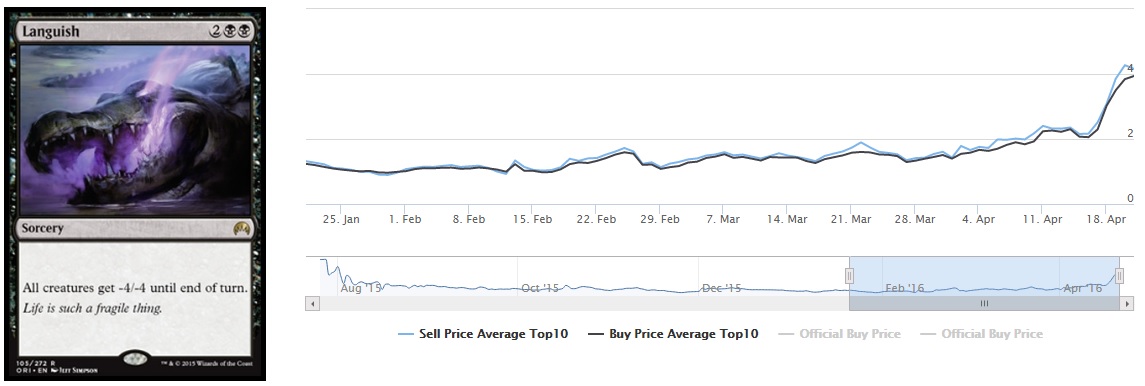
When you look at paper prices, you get some lurking variables such as people wanting Languish for Commander decks or more speculative price increases. With regard to MTGO, prices for Standard-legal cards are pretty concretely tied to Standard play, and the card continued to see growth even after Languish didn't put up results in Columbus.
This suggests that players are picking this card up to jam on MTGO, and it definitely has the potential to line up well against the format. The card is somewhat weak to flash threats, though that's what the rest of your deck is for. If you buy in now, you're definitely behind the initial spike, though if Languish has a good PT it could easily be $10+ next week.
The last pickup that I like for this weekend is Nahiri, the Harbinger. Nahiri didn't really have a big weekend in Columbus, but the card is more promising than it's being given credit for.
Specifically, Nahiri slots perfectly into Goggles Control, with both the ability to rummage madness spells and to tutor for the Goggles. Joe Lossett was playing Nahiri in his list for the Invi, though despite starting 4-0 in Standard his tournament fell apart from there. With Nahiri being able to kill Always Watching on top of her other strengths, the theory for Nahiri is there, she just needs a result.
Interestingly, Nahiri is another card with positive MTGO data to work off of.
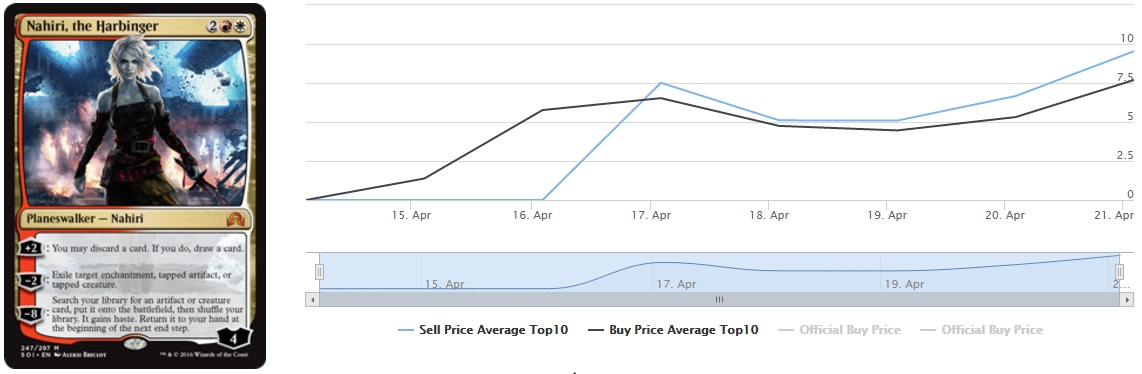
Typically, you'll see card prices drive down in the first couple weeks of a set's availability on MTGO, though a couple days ago you could have bought Nahiri for less than five tix, and now you can sell them for eight. People are buying Nahiris, which indicates players have figured something out, though the real test will be at the PT.
It's unclear how many Nahiris a Goggles deck would play, though with her only costing four and being able to rummage past redundant copies or even sac herself to find a Goggles after a couple turns, it's not hard to imagine the full playset. The paper price for Nahiri is around $10, and if she has a breakout performance at the PT this price could easily double.
The other place to look for price growth this weekend is in Eldrazi Ramp. The deck won the Columbus Open in a Top 8 with five Bant Company decks, and it's the matchup that you should be most scared of if you're trying to do midrangey things.
The reason Bant has run rampant so far is because there hasn't been a Ramp list players are happy to sleeve up. If this deck takes off, expect movement across all of those cheap mythics like World Breaker and Kozilek's Return. This could be a huge weekend for this deck if one of the teams cracks it for the PT.
~
These are my specific picks for this weekend, though as always you'll want to be vigilant in your PT viewing and speculating. Often times, all it takes is one feature match for a card to spike. For a lot of us, if we don't have the cards before the tournament actually starts, we've already missed our opportunity to turn a profit.
Be sure to leverage MTGO to pick up cards in real time as they break out, and to attempt to lock in orders at pre-spike prices as more cards break out. Lastly, don't forget to stop by those local shops who are slow to update prices in the wake of the PT. It's never 100% clear what cards we can profit on, but it's always the case that there's money to be made.
Thanks for reading.
-Ryan Overturf
@RyanOverdrive on Twitter
If not, now is a perfect time to join up! Our powerful tools, breaking-news analysis, and exclusive Discord channel will make sure you stay up to date and ahead of the curve.
Editor's note: Sylvain Lehoux is taking a three-week break from writing due to other commitments. In the meantime he's promised to keep us abreast of any changes to his portfolio via emails to the Quiet Speculation staff. We'll present these purchases/sales in a shortened form along with Sylvain's explanation so you don't miss a beat. Join us back on May 9 when he returns in full form!
Here is the link to the snapshot of the account as of Saturday April 16th.
More Khans of Tarkir full sets and 8 Fate Reforged full sets: I'm counting on redemption to lift up prices for KTK and FRF after their big drop linked to rotation out of Standard.
Mishra's Bauble: Coldsnap flashback drafts really lowered the price on this one. I didn't catch the absolute floor but considerably lowered my average buying price with the Baubles. This is a unique artifact in Modern and the ceiling is fairly high, so I pumped up my stocks here.
Kozilek's Return: This Oath of the Gatewatch mythic is a pretty nice board sweeper than should easily find a home in Standard ramp decks and potentially some decks in Modern as well. 5 tix is not cheap for a mythic but it could pay off quickly depending on what metagame Pro Tour Shadows over Innistrad brings. If the price goes down during SOI release events, as it seems it will, I'll be buying more copies soon.
Archangel of Tithes: After the recent spike, nothing has led me to believe it will get better for Archangel. Nor am I interested in waiting to find out if it will be played at PT SOI. In this regard I'm following my own advice from two weeks ago concerning spiking Standard positions---it's better to sell at a guaranteed profit than hold out for uncertain further gains.
Kytheon, Hero of Akros: Similar to Archangel of Tithes. I sold into this recent initial spike and I'm not willing to wait for what could be next. I've been holding onto a lot of Magic Origins cards for many months now so I'm clearly not going to be too greedy on this one.
If not, now is a perfect time to join up! Our powerful tools, breaking-news analysis, and exclusive Discord channel will make sure you stay up to date and ahead of the curve.
*EDIT – My apologies if you’re just seeing this Friday morning. I did my best to get this out by Thursday AM, but commitments caused delay. - Tarkan
Hello QS readers! We have an exciting weekend coming up with Pro Tour SOI, and I hope to offer what insight I can to increase your odds of financial success. Be sure to tune into the QS Pro Tour coverage, and groups such as the MTGFinance Central Facebook page, as that will help you be one step ahead of surging demand and potential price hikes.
At this point, you should have all of your speculative buys in hand. There are plenty of writers here (such as Adam Yurchick) and elsewhere that have laid out the cards and decks they believe will benefit from the PT, should you decide to make some last minute buys. I’m not a metagame expert, rather I want to outline financial strategies to help you (hopefully) reap rewards. I do have a couple of ideas for cards I think are prime for movement which I’ll touch on later, but the focus will be primarily finance strategy. I’m not reinventing the wheel, here. Much of this you may already know, but hopefully there are a couple of insights that help you this weekend. With that, let’s begin with step 1:
If there’s one point that I want to drive home the hardest, it’s that you need to sell into your gains this weekend! The PT creates a fever pitch of buyer activity, and during this PT hype, it’s a sellers market. The data certainly backs this up. Here are a few sample spike trends from previous pro tours.
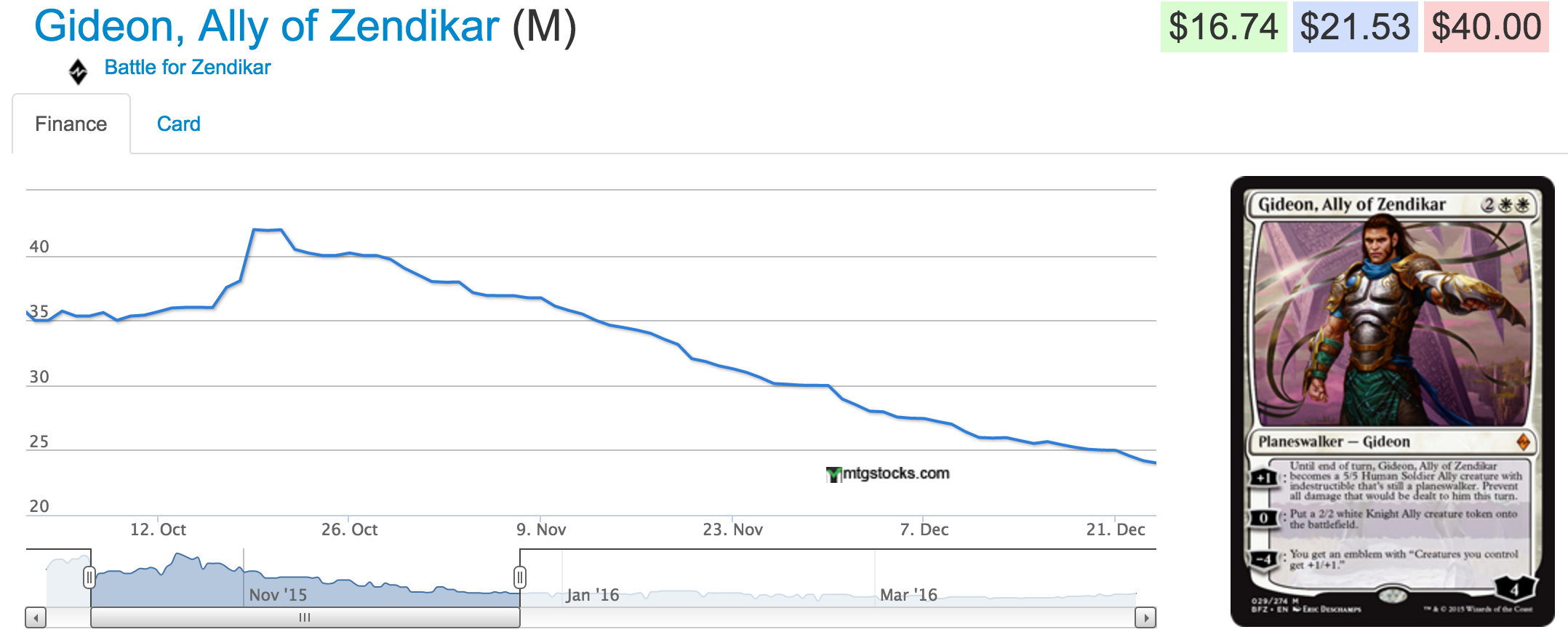
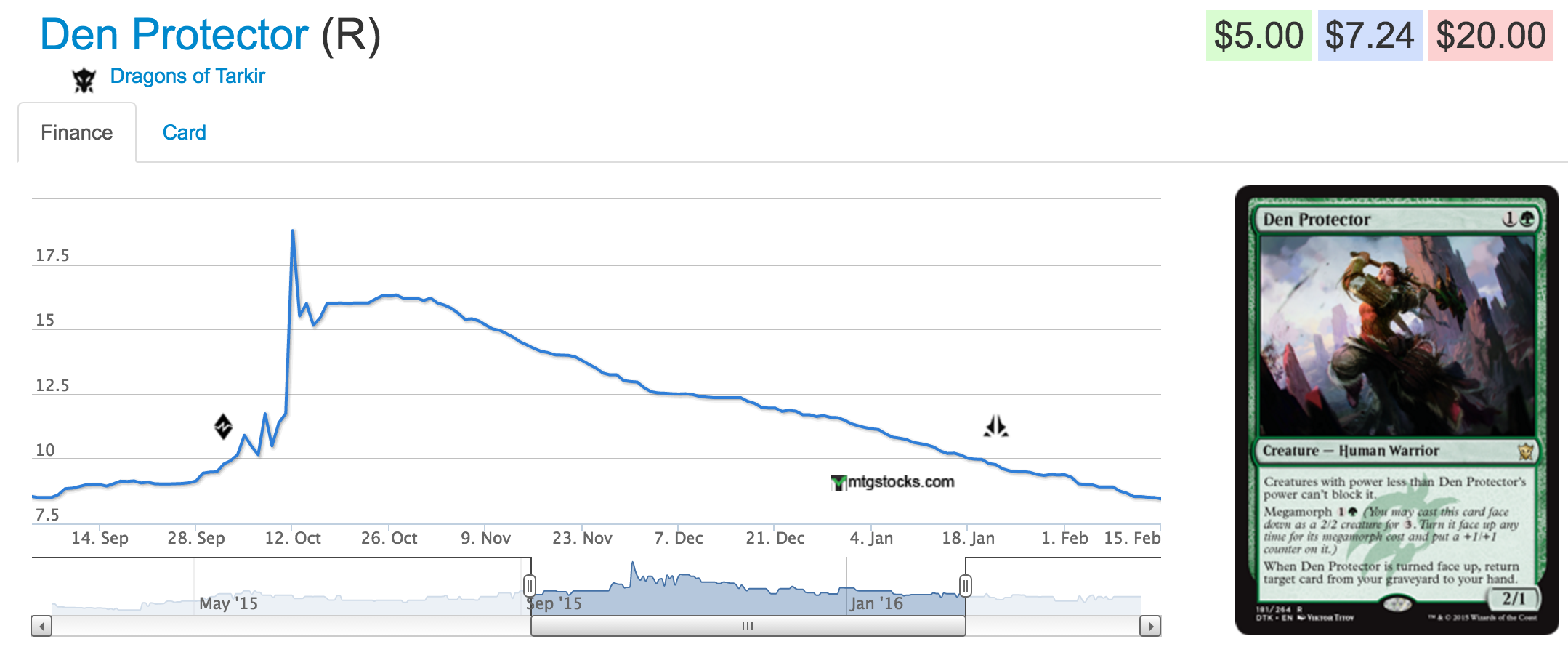
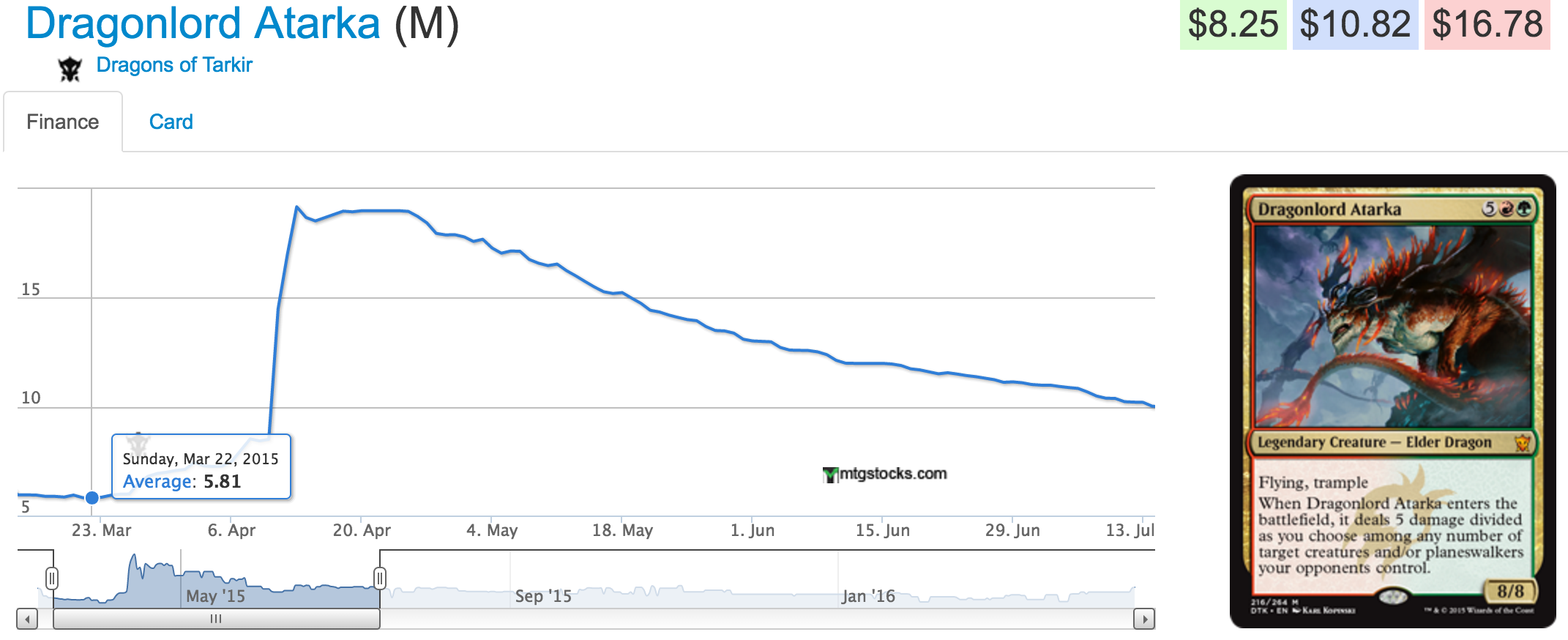
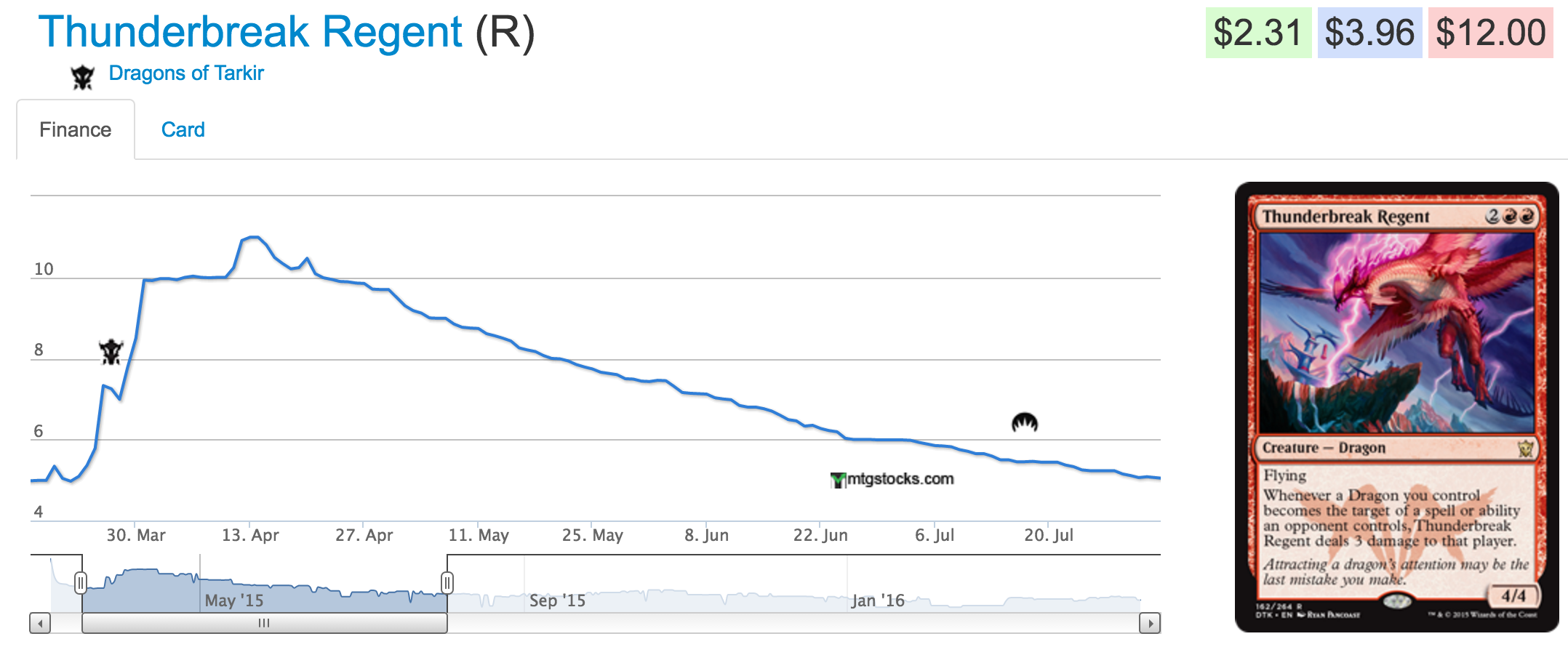
You can see the inflection points during the Pro Tours, followed by a gradual price correction. Rest assured, there will be spikes. Take advantage of this opportunity, particularly with buylists.
The most interesting data point to notice, though, is that while common sense says you need to respond to spikes as soon as possible in order to take advantage of the best prices…the charts do suggest a slightly different story. If you are not able to catch a spike during the event weekend on vendor platforms such as TCGPlayer or eBay, you may still have a small window to move cards to buylists, which will sometimes tick up even higher after the event. This is due to large vendors being bought out and needing to restock, and also because new card demand will sometimes require a market saturation period for players to really dive into the hot decks.
Make no mistake, though - you should not be leisurely about selling this weekend. Take advantage of the hype and lock in your profits ASAP. Buylists provide you with a baseline guaranteed buyer. If you don’t catch a price spike immediately, and notice a ‘race to the bottom’ with sellers attempting to undercut each other on platforms such as TCGPlayer, then calculate your net income after fees. If that number falls within 10% of buylist, I recommend selling to the buylist. Consider that 10% a premium for a guaranteed sale. If you’re confident you can catch the buying wave, then by all means take advantage of it. Just remember that there can be an opportunity cost associated with attempting to engage in the undercutting game.
QS will be hard at work bringing you constant up-to-date coverage from the floor of the PT. If possible, you should be listening. Being ready at 6am PST/9am EST Friday morning and listening throughout the day will give you an educated edge in knowing what vendor activity is occurring. Understandably, not everyone will be able to do this. But if you can, you should! At the very least, stay as informed as possible, keeping your eyes and ears on coverage. The individuals with the knowledge ahead of the pack will have the greatest opportunity for success.
In my last article, I introduced you to the concept of Other People’s Money. That is, 3rd party resources that you can leverage for your bottom-line. For the heavy speculators out there, you may not hit high on all your buys- but that doesn’t mean you have to lose. Cards that are played but aren’t the spotlight of the event still can have an opportunity to see even the slightest gains. You should take advantage of this.
For example, take a look at Utter End -
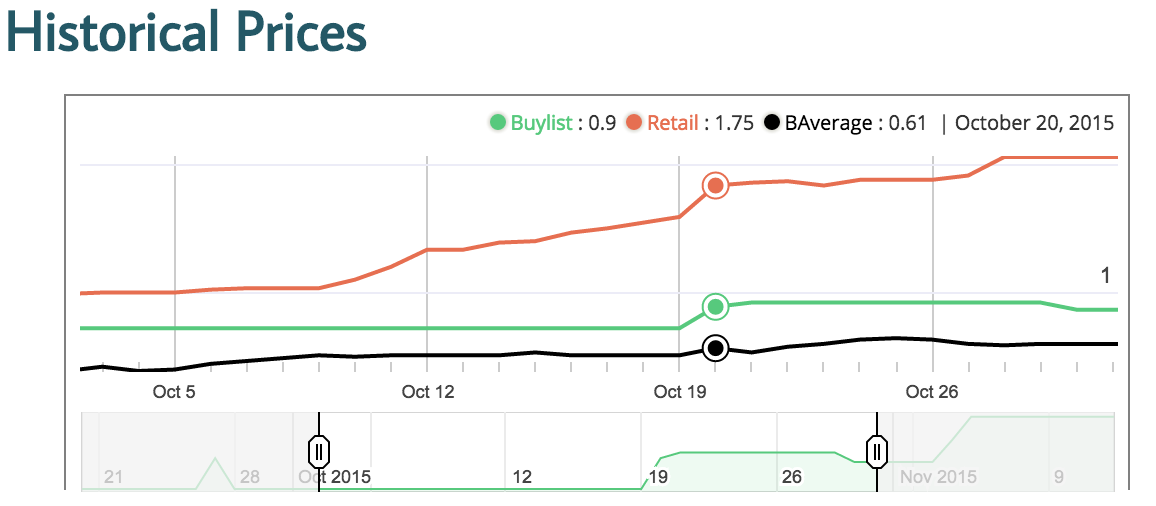
In the weeks leading up to the PT, buylists were flat at 0.75. However, after showing up as a 1-of in the T8 of early iterations of Dark Jeskai at PT BFZ, End inconspicuously saw a small buylist bump to 0.90 the days following. While that spec may seemingly not have panned out quite so well, taking advantage of vendor OPM credit bumps would have actually turned a little profit if you bought at the floor. At the very least, you could've been at break even. Be sure to look at every card that performs well at the event…even the smallest gains can be leveraged to your advantage.
As I mentioned at the beginning of this article, you should have your specs in your binders already. If you don’t, and you want to jump in on cards that begin to move, you must be prepared to act quickly. One strategy that can help with this is having cards you believe will perform already placed in your online shopping carts. This can help you move quickly and avoid delays that may be the difference between you completing a purchase, and a card being bought from under you.
I want to stress however, that you should NOT buy into spiking cards – especially if your intentions are purely financial. You have nothing to gain by purchasing cards as their price is inflating. Part of being prepared is accepting that you likely will not catch some spikes, and you should leave them for the next impulsive buyer.
Even if you need cards for play, I recommend simply demonstrating patience, and purchasing at the lower, post-hype price. Take a look at the data. More often than not, cards will slide back to - or near - their pre-spike price. It's very easy to caught up in the frenzy so don't let that happen. If you firmly believe you can catch a card fast enough, by all means, shop away. Not all vendors play nice, however, and some will cancel your orders due to the card spike. You must be prepared for this possibility, should you decide to buy.
Finally, being prepared also means knowing what you want to buy. It’s important that you create a list of the cards that you want to look out for. This way, if any do spike, you’ll be ready. Be sure you look at the winning SCG Invitational lists. The past two SCG events have provided a picture of what is in store for Standard. You should research the cards in those winning decks, to discern what from them may break out. You should also consider what cards could be metagamed against those decks, and which may break out. Also note rarity – mythics tend to have a higher spike ceiling than rares.
For myself, there are a few cards in particular that I will be keeping my eye on:
(*Disclosure: I own multiple playsets of these)
I’m quite the advocate for Advocate. He’s done considerable work in the Bant Company lists that have had multiple top finishes. He’s also demonstrated strong organic demand with his price history:
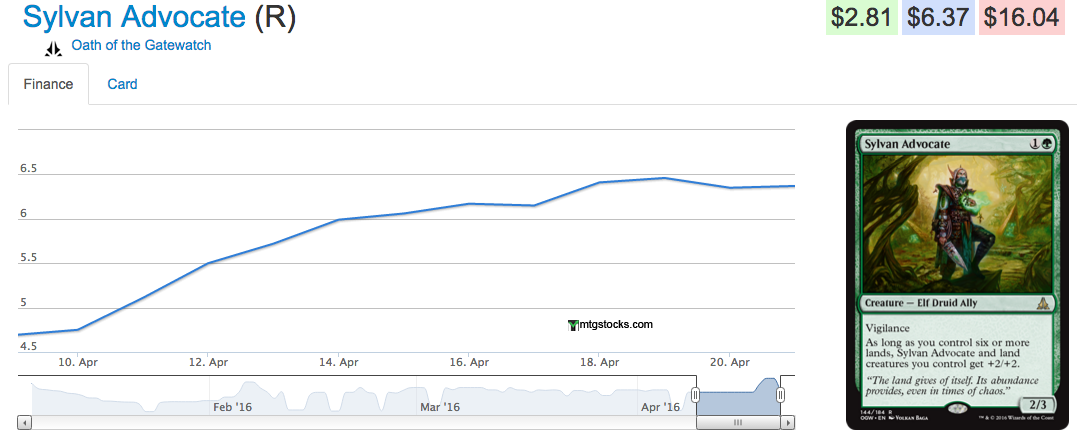
This is my top pick for the event. It's possible Advocate is the next Den Protector, and pricing could follow as such.
Another pick that I believe could see a great percentage bump is this little Slayer:
Hidden Dragonslayer has seen a resurgence, thanks to its part in Bant Company lists. it also has the added benefit of being a Human, a very strong tribe at the moment. Its price trend is exactly what we want to see – organic growing demand based on a potent deck.
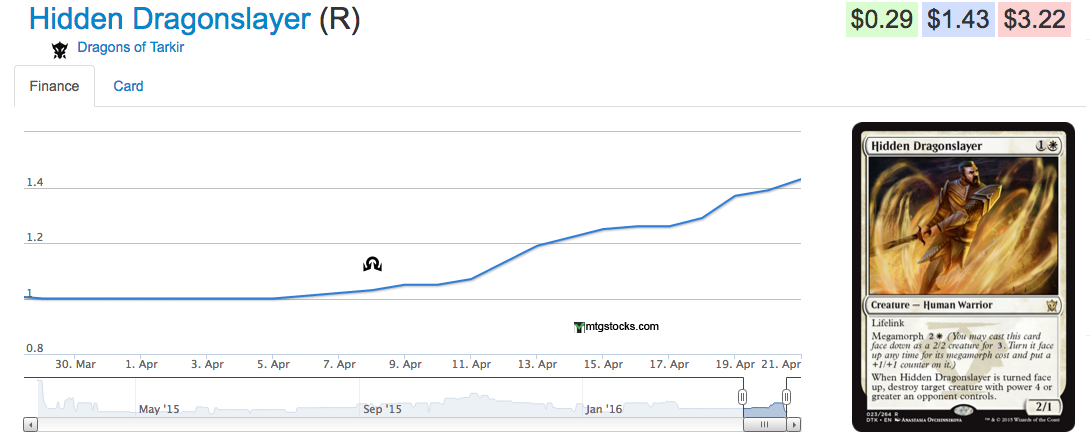
If you have this one sitting in your binder or deck, I would pull them out and be prepared to sell.
This is a nice little bulk rare from Todd Anderson’s UR Control deck that has been in the T8 at both events. While I certainly don’t expect a massive price explosion, if the deck holds its own at the Tour, a bump to $0.80 or more would be nice growth. Bulk rares that are seeing play are fantastic penny stocks. When they pop, they offer a nice hedge against any stagnant positions you may be holding (don't forget about that buylist credit!)
With this article, I’ve tried to present a strategy for you to maximize profits during the PT. There will be spikes, have no doubt. You should have your assets in hand, and ready to sell into surging prices. If you miss a spike, don’t fret. Even your “losing” specs could actually be winners if you take advantage of credit bump bonuses. Data also suggests that you have a small window of opportunity post-PT, when buylists are catching up and demand spreads. If you’re deciding to buy during the event, start early, stack your shopping cart ahead of time, and remain sharply informed and on top of coverage. Pro Tours are always exciting and some of the best opportunities to prosper. Good luck with the event and sell, sell, sell!
-
What are you watching for the PT? Any cards you're convinced will pop? Let's discuss in the comments.
Tarkan Dospil
If not, now is a perfect time to join up! Our powerful tools, breaking-news analysis, and exclusive Discord channel will make sure you stay up to date and ahead of the curve.
This week we’re focusing on one thing: decklists. Shadows Over Innistrad is legal on MTGO, so that means Jace, Unraveler of Secrets everywhere! No? Well, we still have the one-two punch of Eldrazi bannings and Ancestral Vision/Sword of the Meek’s unbanning to shake things up. What does this new Modern look like? How can we gain an edge in the next big event? What the hell am I going to play tomorrow?! Let’s begin.

Modern League finishes have to be taken with a grain of salt, as in my experience they are equal to or possibly slightly more competitive than the average FNM. The FNM crowd at my local shops over the years have ranged from Mindshrieker casual all the way up to Tier 1 Shards of Alara Jund, and everywhere in between, but I’m calling the baseline FNM difficulty somewhere in the middle. A few budget decks, roughly 50% “solid” lists with spicy/questionable changes, and a top tier of grinders/scum/sharks/insert whatever name you choose here. It is quite easy to 5-0 a Modern League while completely dodging anything resembling a fair fight, and it is just as lucky (in my extensive experience) to run up against five tough opponents.
Thus, my philosophy is to approach 5-0 Modern League lists cautiously; recognize them for their achievement, but be quick to throw them out if they show any possibility to disappoint. Kind of like my ex-girlfriend. With Magic, just like relationships, we must be willing and able to spot the warning signs of a bad egg early on, lest we risk finding ourselves three years devoted to a Demon Spawn of the Underworld.
[wp_ad_camp_1]
Look, I’m not going to say I told you so, but this deck is legit. Thalia's Lieutenant is not just a “worse” Champion of the Parish, but rather Mayor of Avabruck with Champion’s ability tacked on for free. Sure, we don’t get to flip, but Mayor was often never flipping unless we were out of cards, at which point either opponent is dead or we are.
Eight Anthem effects (twelve if we’re maxing out Atarka's Command) is just nuts with so many one-drops (and Burning-Tree Emissary letting us double-spell two-drops on turn two). Consider this turn sequence:
 Similarly, we can dash Lightning Berserker and then cast Thalia's Lieutenant for an extra point of damage that turn, bringing us to that sweet seventeen. If our opponent cracked a fetch for Steam Vents to Ancestral Vision turn one, it’s all over.
Small decisions like this one can really influence the match result, where many games will be decided by those crucial last few points before our opponent stabilizes. If we’re focused primarily on value, casting Thalia's Lieutenant early, before haste creatures, will give us a larger threat to survive potential Lightning Bolt/Anger of the Gods shenanigans, but we won’t be able to use that damage that turn. Only in the case of dash are we ever presented with the choice of “losing a counter” as any other situation will result in a counter on the board, whether it’s on Thalia's Lieutenant or some other creature. Use your best Bernie Sanders spread-the-wealth judgment in these situations.
My experience with this archetype has taught me that turn three is by far the hardest. Before we were often split between Mayor of Avabruck to push our opponent into playing at sorcery speed, Thalia, Guardian of Thraben to slow down their interaction/impending sweeper, or double-spell some two-drop and one-drop combination. Burning-Tree Emissary always comes down turn two if possible, as we’d like to save extra one-drops to fill in our curve on later turns.
Now we have Thalia's Lieutenant to add to the mix. Her anthem pushes us to hold onto her as late as possible, but casting her early lets us double/triple-dip on the power boost as we are curving out. It might be enticing to wait for a full board and drop Thalia's Lieutenant at the top of the curve, but if our creatures are sticking on board we’re generally winning anyways. Thalia's Lieutenant gives the deck a level of play that it definitely didn’t have access to previously.
 Here we have a UW Gifts Tron deck incorporating the Thopter/Sword combo into its usual repertoire of tricks. Academy Ruins is present to assemble the combo no matter how our opponent splits our Gifts, and we have the usual Elesh Norn/Iona/Unburial Rites and four-different-sweeper package as well to do fun things.
The best part about this list for me is the two copies of Thought-Knot Seer, which can steal a piece of interaction, give us some information, and play great offense or defense if needed. Adding another dimension of attack to a list like this will keep our opponents honest and works to make cards like Dispel or Negate awkward against us where they are usually quite good.
This list is naturally suited to prey on Ancestral Vision control lists, as Academy Ruins and a playset each of Remand/Gifts Ungiven/Thirst for Knowledge provide a lot of value going late.
The sideboard gives us access to a full playset of Thought-Knot Seer, which can tag in to almost any matchup (though it's definitely at its best in reactive matchups). Thopter/Sword gives this list a better maindeck angle of survival against aggressive decks than “sweeper and pray” and could result in this archetype being a dominant force moving forward. Blood Moon and graveyard hate remain this deck’s weaknesses, however, and I would be interested in seeing the tempo element explored a little further should the deck start attracting hate.
 This type of pure control deck always seemed to get pushed out of the metagame by Amulet Bloom specifically, but more broadly by the pure diversity of powerful options available in Modern. The necessity to devote precious sideboard slots and situational counterspells to fight a wide range of powerful threats has always proved too much for Jeskai pilots not named Shaun McLaren to handle. Without a Counterspell-type counterspell or Ponder-type cantrip, control as an archetype lacked the “punch” necessary to close out a game with sheer power, relying on poor draws or opponent stumbles to get there in most matches. Ancestral Vision promises to change all that, and if control is to be a force in this new Modern, I expect it will look something like this.
As far as “pure control” goes, this is as good as it gets. No win conditions, not even an Ajani Vengeant to make our opponent quit. We’re winning with Celestial Colonnade or not at all. Every non-spell either answers threats or draws cards, but my god are we weak to Ghost Quarter and/or Blood Moon. Only one copy of Wear // Tear in the 75 as an answer to a Blood Moon on the table?! You might think a billion counterspells means it is never resolving, but I’ve been the victim of more than one endstep Boil, untap into Thoughtseize/Blood Moon in the past, and it does not feel good.
Don’t get me wrong, I love this list, but we have to have something to do should Colonnade not be enough. Gideon Jura, Restoration Angel---I don’t care, just have some way to win the game (on time, preferably).
No, no, no, no, no. This is not what I meant. As a preface, I have to say that I’m not picking on David or diminishing his experience---he placed Sixth in Columbus last weekend while I sat on my couch with Cheetoh crumbs on my chest. Seriously, congratulations to him and his achievement, but I respectfully don’t like this list at all, and I think it’s a great case study to demonstrate some classic control-building pitfalls (in my opinion). Let me explain.
To begin, when building and analyzing control decks I start with the endgame. What are we building to? Especially in Modern, where the tools available to us are countless in number, it’s important to have a cohesive gameplan. Are we winning through inevitability? Are we turning the corner at some point? What matchups are we biasing towards in the maindeck? Answering these questions from a top-down standpoint can make secondary and tertiary decisions much easier, such as our opinions on Mana Leak vs. Remand, Electrolyze vs. Tribute to Hunger, Tasigur, the Golden Fang vs. Damnation, etc.
 For example, a planeswalker-centric strategy can take advantage of sweepers as a prominent deckbuilding characteristic, pushing us away from three-mana two-for-one’s like Electrolyze and other four-drops like Cryptic Command.
On the other hand, a Wall of Omens/Restoration Angel/Snapcaster Mage build heavily incentivizes cheap interaction and makes sweepers an absolute last resort, for a few reasons. One, a focus on one- and two-drop interaction lets us double-spell earlier, and more quickly leverage resources gained from Wall of Omens draws. Two, we’ll be able to more effectively gain value from Restoration Angel earlier in the game if we’re blinking Snapcaster Mage to flash back Lightning Bolt and Dispel, instead of Electrolyze or Cryptic Command.
In the list above we have a few competing forces at play that (admittedly) provide alternate angles of attack, but ultimately work against each other. Starting from the top, we have Sphinx's Revelation, Crucible of Worlds, and Gideon Jura, two lategame spells that are useless in the midgame and can be deadly in our opening hand. Our value slots consist of more expensive/situational choices: Vendilion Clique, Ajani Vengeant, and Cryptic Command. On top of this, we have the Thopter/Sword combo (taking up a whole five slots) with removal/card draw filling out the remainder of the maindeck.
All of these choices are fine choices for a control deck, but not all together. If Sphinx's Revelation/Gideon Jura is our lategame, we don’t need to dedicate five slots to the Thopter/Sword combo, and vice versa. Engineered Explosives as a maindeck option in UW Tron could be argued, but here it’s just a maindeck insurance policy against Infect and Affinity, who we would be beating anyway were our deck more streamlined. Sure, it’s got some nice synergy with Academy Ruins, but that’s a one-of that we’re not tutoring for, which means if we’re activating Ruins we’ve made it to the lategame and have plenty of other ways to win. Crucible of Worlds is just getting extra use out of our fetchlands and Ghost Quarters, or rebuying Academy Ruins and Celestial Colonnade should our opponent be dead-set on destroying them, which isn’t even game-breaking as we have a million other ways to win. I would play literal Mana Tithe over this card here.
 The main issue I have with this list is that it completely misses the mark on utilizing Ancestral Vision as a tool to win the game. Once Ancestral Vision is on suspend, the onus is on our opponent to kill us before it resolves, as the expectation is that three free cards for the control deck is “bad news.” Except here, our three cards are as dissociated as they could possibly be.
By turn five, you can infer that we have four/five lands on the battlefield, and have seen twelve cards on the draw, eleven on the play. This means of our 48/49 cards left in library, 19 (37%) are lands, 17 (33%) are duds (lategame cards, counterspells, combo pieces, other Visions) and 15 (30%) are solid draws capable of interaction. This means our Ancestral Vision's draw is giving us two duds an overwhelming majority of the time, and three duds often. When our back is against the wall facing down a Tarmogoyf and Dark Confidant, or our opponent has Scapeshift in hand and we need two pieces of interaction to beat him, drawing Land, Thopter Foundry, Spell Snare is not going to feel good.
All of these cards can exist in combination with each other, just not all at the same time. At the very least, the Sword/Foundry combo could be cut for five more pieces of interaction, or if we’re looking to keep the combo we could cut the top end and the Engineered Explosives and leave a singleton Sphinx's Revelation for some diversity. This list seems to be in prime position to destroy aggressive decks, but absolutely falls apart against Grishoalbrand, Scapeshift, or, you know, the very rare play of Thoughtseize into Tarmogoyf.
Only a couple weeks into this new Modern format we're already seeing some technology start to take shape. A few fresh archetypes are lurking at the periphery, but format stalwarts like Zoo, Affinity, and Burn continue to put up strong numbers. Scapeshift seems to have benefited the most from Eldrazi’s absence, and Jeskai Control decks of all types have been taking advantage of Ancestral Vision the most (so far).
I’m steadily tuning my Grixis Control into the monster I know it can be, and this format looks to be forgiving enough that almost any archetype can put up modest results. Hopefully this article has given you a look into my process of decklist analysis, or at the very least given you something interesting to try out this weekend! Let me know what you think in the comments and I’ll see you guys next week!
Trevor Holmes
The_Architect on MTGO
Twitch.tv/Architect_Gaming
Twitter.com/7he4rchitect
If not, now is a perfect time to join up! Our powerful tools, breaking-news analysis, and exclusive Discord channel will make sure you stay up to date and ahead of the curve.
With it being clear how much better white is in Standard than the other colors, eventually one wonders what happens when you just shove all the best white cards into one deck. No, I'm not talking about the Savannah Lions, I'm talking about the the other white deck. The one that James Wager took to a Top 8 berth of the Columbus Invitational.
Where the Human Aggro deck has some finesse with the discovery of Gryff's Boon, this deck just jams a bunch of good cards. Some of these cards play well with Eldrazi Displacer, but Displacer is also just a good card on its own.
Out of the sideboard things get a little flashier with Linvala, the Preserver. Linvala is a card that hasn't broken through in Standard in the way that some have anticipated that it would, though there are matchups where you can combine Linvala with Displacer to generate crazy amounts of value.
I don't expect this to be a popular choice for the Pro Tour, in particular because despite the fact that white is the best color it does not contain all of the best cards. Adding a second color isn't terribly difficult, and with Thraben Inspector being the only one drop- a card that may or may not make the cut in a two color deck- I can't imagine this deck continuing to exist as the format develops. The simple truth is that if you jam all the good cards, your deck can't be that bad.
More than anything, I would attribute this deck's success to it being a four Avacyn deck. Avacyn is completely absurd relative to the power level of other cards in Standard, and going forward we will see more decks maindecking more copies of her. I pushed pre-ordering her hard, and now her price tag is pushing $50. Get used to playing around Avacyn in Standard. And by that, I mean feeling completely dejected when your opponent passes with five mana up.
If not, now is a perfect time to join up! Our powerful tools, breaking-news analysis, and exclusive Discord channel will make sure you stay up to date and ahead of the curve.
I’m sure you’ve read many tournament reports over the years. This article is not like those articles.
A couple of weeks ago, I had an idea for a very different type of article. Instead of a typical tournament report, we could have a financial tournament report of an event. There could be some competitive information, because much of Magic finance stems from tournament results, but the majority of the article would document the financial state of competitive play.
Let’s start with a reminder about something from last week. One of my main points in my previous article was that it’s worth your time to shop around for buy prices. If you are looking to purchase a card or some product, you take the time to find the cheapest price because saving money in small increments adds up. The same goes for buy prices.
Here’s an example for you. I preordered three play sets of Ulvenwald Hydra at $3 or under for each card. Since the metagame doesn’t appear to be heading in a ramp direction, I felt I needed to move this spec as soon as possible. If the card breaks out at the Pro Tour my decision could cost me some profit, but I am always one to lock in my profit when I can.
There were five dealers at the Star City Games Invitational in Columbus this past weekend. They offered me $1.50, $2, $3, $4, and $4, respectively, for each Hydra. Once I got the last $4, I mentioned that the highest price I was offered matched the $4 they were offering and asked if they could do $4.25.
Now you may think that adding another quarter doesn’t accomplish much but those $.25 and $.5 piles add up and really help your margin. In this case, I made an extra $3 because I found the best price and asked a question. Don’t get your hopes up for this happening every time, but sometimes it will turn out this way. If I had stopped at the first dealer I came to, I would have walked away with $3 per card and made a tiny profit. This way, I made the most money possible for this investment at the time of selling.
I wouldn’t be looking for this card to jump in price anytime soon, but it’s a possibility. My current stance is still to get out if you can fetch a good number.
For this tournament I switched to Bant Company, as did what seemed like half the participants. My list was fairly standard except I squeezed three copies of Clash of Wills into the main deck. That card was amazing for me all weekend. The rest of my deck was quite similar to the stock lists.
There were 752 players at this Invitational, but due to changes in the point structure, this should be the last of its size. What that means for you is that the other Invitationals going forward will be higher value. Keep that in mind if you are qualified or plan on trying to get qualified.
Round 1 - R/B Vampires
Sitting down across from my Vampires opponent I was a little surprised. I thought everyone had agreed that this deck wasn’t playable and should be avoided.
My opponent had a different take on the deck. His focus was more on enabling madness than playing all the sweetest new cards from the vampire tribe. It’s possible that the cards in this deck like Olivia, Mobilized for War and Drana, Liberator of Malakir are destined for the finance spotlight, but at this point I’d have to say it’s unlikely.
Despite its weakness to flyers, my Bant Company deck was able to pin the opposition relatively easily. I feel this is the same way for the other decks in the format as well. I still think that the pros might be able to solve this puzzle and come up with a better build, but what we have right now isn’t good enough. Treat the staple vampires in your collection and trade binders accordingly.
Round 2 - Mono-White Humans
The other deck that was all over the meta was Humans. This deck comes in a variety of colors and sizes, but they tend to use many of the same cards. The key cards are Declaration in Stone and Always Watching.
Declaration was being bought as high as $11 onsite and one dealer was sold out at $20. If you follow me on Twitter @mtgjedi, you heard about this as soon as I found out during the event.
Dealers buying declaration in stone at 11 and selling as high as $20 at the invi. #mtgfinance @QuietSpec
— mike lanigan (@mtgjedi) April 16, 2016
I don’t expect Declaration to be $20 tomorrow but I think it could easily hold at $15. Either way, the best removal spell in the format will be desirable for its duration in Standard.
Additionally, Always Watching at or under $4 is a good deal. I don’t know how this hot card is still that low. Players love this set and are opening a ton of packs but with how popular the enchantment is right now, I’m shocked it can be had for this cheap.
Round 3 - Naya Planeswalkers
Round 4 - B/W Midrange
The biggest hit from my round three and four opponents has to be Archangel Avacyn. We all know this card is bonkers but we're unsure of where she will go from here. My assessment is that she will hold her value because she is just that good. This angel also sees play in tons of archetypes and that will help her stay on top of the price layout in Standard.
All of these matches were interesting but the short story is that I came out on top in each of them. Starting out 4-0 in Standard felt great, but Modern is another story altogether.
For the Modern portion, I chose to try to break the format. Rather than playing a deck like Kiki Chord or something else that I have a lot of positive results with, I tried to revitalize Splinter Twin in Modern. My route took me through Midnight Guard plus Elemental Mastery for my infinite combo.
Since I’m sure you didn’t hear about me playing this crazy deck, you can guess how my Modern rounds turned out. Take a look at the list though because it’s definitely an interesting one.
Round 5 - Tron (Joe Lossett)
Round 6 - Zoo
Round 7 - Melira Company
Round 8 - Lantern
As you can see, this isn’t your typical Modern deck. This brew was developed over the past four months and even though I had fun losing a lot with it, it’s one of the worst-positioned decks I’ve ever played.
I was close to beating all my opponents, but ultimately didn't get there. If I was on the play I would have beaten Tron in my feature match against Joe Lossett. If I didn’t misplay against Zoo, I would have had a chance to win. Melira beat me on mulligans to four and five so I’m not sure that matchup was winnable.
I did best against Lantern but I think my opponent had to get pretty unlucky for that to happen. I do have a lot of burn post-board plus artifact removal, but I still don’t think the match is favorable.
Modern seems to be back to where it was before Eldrazi came and distorted the format. I played against a different Modern deck every round and there are plenty of other good options as well.
All of these decks will be picking up more followers, so my financial stance on Modern is to pick up any staples you can at good prices. Follow normal tips and tricks here---for example, trade Standard cards into any Modern staple and buy discounted Modern cards whenever possible.
I made Day 2 based on my performance with my Standard deck. I was excited to get back into action in Standard and hopeful that I could lean on that deck for my record instead of my Modern brew.
Round 9 - Bant Company (mirror)
Round 10 - Goggles
Round 11 - Bant Company (mirror)
Round 12 - W/r Humans
Day 2 started off with a mirror match of Collected Company. I was able to split my mirror matches, losing the first to start Day 2 but winning the other one two rounds later. Company seems likely to hold strong even after rotation. It’s played in Abzan Company in Modern as well as a few other decks. I would even say it has become a Modern staple.
This is the type of card I would try to isolate in trades whenever possible. It may dip in price after rotation but it should bounce back with continually steady growth. There will only be more and more creatures printed to pair with the green instant so it will get better over time.
Goggles got beaten up pretty badly by the format’s bad guy. I’m not sure that will be a deck going forward. It is definitely decent but not the best. I’d be looking to trade those cards while they're hot. Chandra, Flamecaller into another copy of herself did win a game though, and that card is really strong right now. I’m not sure she can go up any more, so I’d still be looking to unload any extra copies.
Someone needs to identify a deck that can beat both Humans and Company. If such a deck exists, there are huge financial possibilities hidden within. This is the tech I’m looking for from the Pro Tour this weekend. Speculating on Standard is a risky proposition, but in a semi-established metagame like we already have, a breakout deck can easily make prices go crazy.
This deck might be the W/r Humans deck I was defeated by in Round 12. I spoke with my opponent, Zan Syed, at length about his deck and its capabilities. You will likely see him on the Pro Tour soon because he is grinding hard for Pro Points to qualify. Take a look at his very fast version of this deck.
This deck’s goal is to outrace every opponent. You have Always Watching to pump your team as well as Gryff's Boon to give evasion. The deck is very fast but my favorite part is how resilient it is to the card Reflector Mage. There are very few creatures that are reasonable to bounce because they all have effects when they enter the battlefield.
If you enjoyed playing Atarka Red last season, then this is likely the deck for you. This is yet another deck utilizing the powerful new white cards. Any of those cards are good investments because they will move easily.
Round 13 - Infect
Round 14 – Affinity
After these two Modern rounds my record had dropped to 7-7, with six of those wins coming from Standard. Despite my horrendous record in Modern, I learned about how the format is reshaping itself.
Modern is back to where it was before Oath of the Gatewatch was released. There are tons of viable options. Ancestral Vision and Sword of the Meek don’t seem to be destroying the format but they are on the list of playable decks. I think we are back to a place where knowing your deck can get you far.
Most of the financial advice I have in Modern is what I said before: pick up staples and hold them. There are a couple of low-end cards that would be worth having a stack of though.
The first is Sanctum of Ugin. This Battle for Zendikar land is now seeing play in Tron as a replacement for Eye of Ugin. It functionally works the same as a single Eye activation. The upside is that you don’t have to pay mana for the ability and you can trigger it from any colorless spell. We’ve only seen this used with creatures in Standard, but Karn Liberated can let you tutor for something too. At less than $1.5, you can’t go wrong stocking up on this Standard card.
The other investment I want to mention is the Lantern Control deck. I see this deck gaining more and more popularity. It was great against Eldrazi, but I’m not sure it has a place in this metagame. Players disagree with me, but the deck has a rough matchup against many staple decks.
There are some cards in it though that could increase in value if the popularity continues to grow. The first is Pyxis of Pandemonium. Currently Pyxis is a bulk rare so you aren’t risking much by getting some copies, but the deck only plays one copy so I’m not sure its trajectory is quick enough.
The other card is Surgical Extraction. As a staple of Lantern Control, players have been reminded of the power of this Phyrexian mana spell. Although it was reprinted in Modern Masters 2015 last summer, the card has grown back to the $5 it was previously worth.
I think Surgical is a great long-term investment. Many decks want this as a sideboard option and any deck can play it. Make certain you have your copies for whatever Modern deck you are playing because graveyard shenanigans come up time and time again.
~
Well, that’s all for me this week. How did you like my first tournament finance report? Let me know what you thought in the comments. What was missing from the article that you would like to see in the future?
Until next time,
Unleash the Force!
Mike Lanigan
MtgJedi on Twitter
If not, now is a perfect time to join up! Our powerful tools, breaking-news analysis, and exclusive Discord channel will make sure you stay up to date and ahead of the curve.
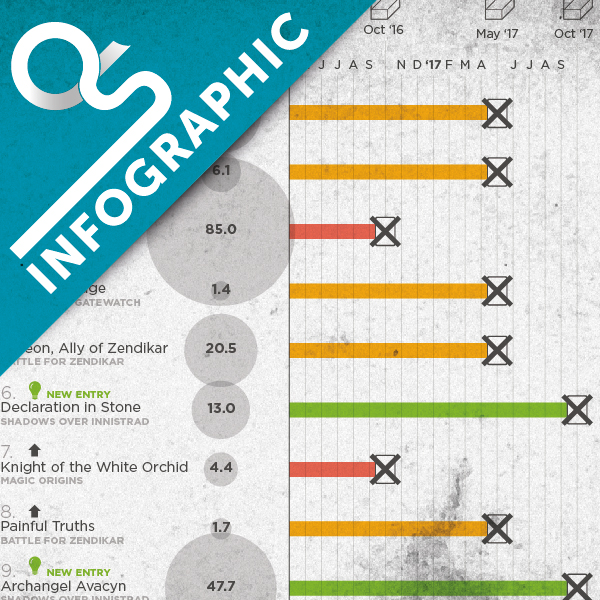
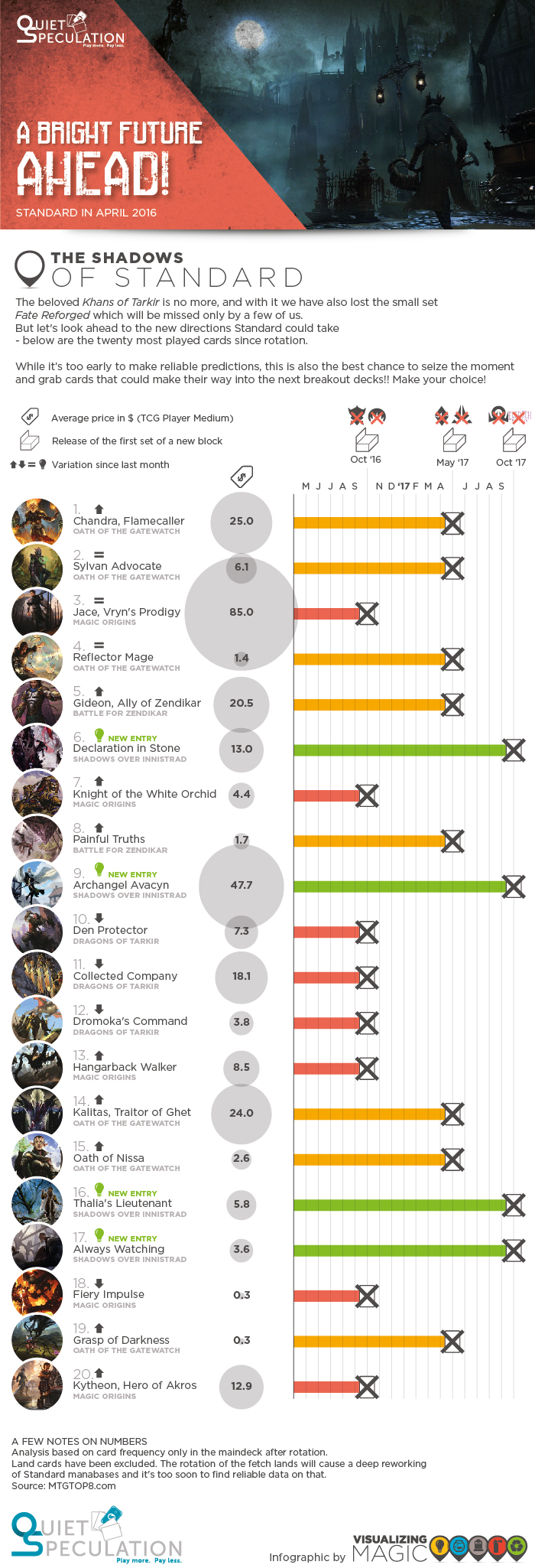
Our visualization this week is dedicated to the shining future of Standard!
While only a few tournaments have taken place since rotation, this is a great time to evaluate the potential of new cards and guess which ones could become the next Standard staples. Our visualization will help you in the evaluation process.
If not, now is a perfect time to join up! Our powerful tools, breaking-news analysis, and exclusive Discord channel will make sure you stay up to date and ahead of the curve.
Time to put your metagame and Modern knowledge through the ringer! This Sunday, Star City Games' Championships Weekend concludes with a full day of Modern. With events for every state in America and province in Canada, the Championship showdown is a no-holds-barred Modern blowout where players from across North America will try their hand in the new format.
Last week, I gave you the metagame projections you would need to get through the second weekend of our evolving format. Today, we'll quickly check in with the format's top decks before unpacking the results for critical takeaways. What tech do you need to know? What strategies do you have to prepare for? What cards and decks should you use or avoid? We're opening up the Modern armory to make sure all of you are ready to rumble at your Sunday venue.
Because my closest tournament sites are hours away in either Madison, Wisconsin or Bloomington, Illinois, I won't be slinging Ad Nauseam this weekend with the rest of the Modern crowd. Honestly, that's probably for the best. I was unlikely to come to a decision between a conventional Esper list and the more versatile but rewarding Glittering Wish build. This uncertainty would likely result in a questionable audible I undoubtedly would regret on Monday. At least I'll enjoy the Top 8 results next week!
Whether you're wrangling transportation, live down the block from your event, or are just excited to see where Modern is heading, today's article will give you the metagame stats you need to know and the maindeck/sideboard takeaways you'll need to remember.
[wp_ad_camp_1]
Sorry, number crunchers. We're not doing the full tier-by-tier breakdown today, so you'll have to content yourself with last week's update as we wait for those SCG Championships standings to roll in. After all, when preparing for a specific event, it's better to zero in on probable opposition than take a broad-strokes, academic overview of the entire format.
Our dataset is up to 35 paper events and just shy of 250 individual decks. We've also started crunching the Magic: The Gathering Online League results, but with only four such MTGO events reported so far, we're deliberately excluding these from today's analysis---even some of our most 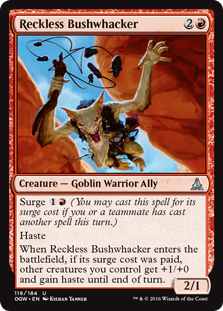 beloved statistical techniques can't improve such a skimpy n.
This exclusion also makes sense in highlighting noteworthy differences between paper and MTGO. For instance, Reddit and forum favorite "8Whack" and its Gruul Zoo variants have been shredding MTGO Leagues since last Thursday. That said, although both Reckless Bushwhacker and his older brother Goblin Bushwhacker are appearing in paper tournaments, there's a significant disparity in their shares: 15% online and only 2.4% in paper. We'll need more MTGO data to sort through differences like this (as well as those surrounding the new BW "Eldrazi and Taxes" lists), so let's bookmark the Bushwhackers and Wasteland Stranglers for another week.
Focusing only on those 35 paper events, below are the 16 most played decks in the first two weeks of the new Modern. I'm listing 16 instead of a more round number like 10 or 15 because all these strategies could meet Tier 1 or Tier 2 criteria depending on our percentage cutoff. 16 is less digestible than 10, but there are important competitors further down the list. In addition, I'm including each deck's percentage change since our last update, just to hint at evolving format trends. Final note: by the time this article goes to press, I'll have added more tournaments to the dataset, so the specific sidebar and Top Decks numbers will be slightly different than those here.
| Deck | Paper % | % Change: 4/12 - 4/18 |
|---|---|---|
| Jund | 11.7% | +.7% |
| Burn | 8.1% | -1.5% |
| Infect | 5.7% | -1.9% |
| Affinity | 5.2% | +.4% |
| Grixis Midrange | 4.8% | -2.7% |
| Scapeshift | 4% | +.6% |
| Merfolk | 4% | -.8% |
| Jeskai Control | 3.6% | +.2% |
| RG Tron | 3.2% | +.5% |
| Kiki Chord | 3.2% | +.5% |
| Abzan Company | 2.8% | +1.4% |
| Living End | 2.4% | +1.1% |
| Gruul Zoo | 2.4% | +.3% |
| Elves | 2.4% | +.3% |
| Naya Company | 2.4% | +.3% |
| Ad Nauseam | 2.4% | -.3% |
Added bonus of a Top 16 instead of a Top 10 listing: Ad Nauseam makes the cut! I might not be Lightning Storming through the top tables at the SCG Championships, but at least my new baby is carving out respectable territory.
Personal bias aside, Modern is still looking unusually healthy and diverse as we head into Sunday. The Top 16 include a heartening mix of archetypes (midrange, control, aggro, etc.), colors (even white pushes Jeskai Control into Top 8 contention!), and decktypes (old favorites like Jund at the top, up-and-comers like Grixis Midrange in the Top 5). This means it's anyone's and anything's format for the taking on Sunday.
In later sections, we'll be converting these metagame shares into actionable maindeck and sideboard advice. For now, here's a series of quick-hit observations on major format themes and how those will affect the field on Sunday.
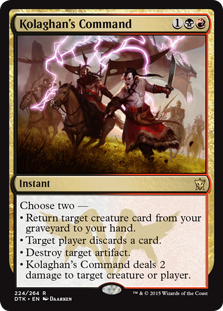
The BGx mainstay was top-dog last week and it's still on top today. Can't bring the Tarmogoyf and Lightning Bolt duo down! Jund's share has even increased over the last weekend, and although some tournaments didn't see as much Terminate and Kolaghan's Command as others, Jund as a whole was up across the board.
Make sure your deck has a plan to beat Jund's hyper-efficient discard and removal suite, not to mention its meaty attackers. Combo players: don't forget those Leyline of Sanctity copies in the board!
Last week it was Burn, Infect, and Affinity. This week it's Burn, Infect, and Affinity all over again. Get used to it because the Big Aggro Three are here to stay. Unsurprisingly, Affinity's share has improved since last week's surprising low under 5%, with both Infect and Burn losing ground on the other end. Don't read too much into these specific shifts. Instead, prepare to face these decks with a hearty helping of spot removal, decisive sideboard bombs, and/or a speedy gameplan capable of racing.
Speaking of aggro, the new metagame follows historical Modern trends of leaning linear in uncertain fields. The Big Aggro Three are joined by Merfolk, Gruul Zoo, Elves, and Naya Company further down the charts, bringing the collective aggro share to 30%. That doesn't even count fringe bruisers like Suicide Zoo, Bogles, Domain Zoo, and similar sluggers.
As the weekend unfolds, do not play strategies which fold to early pressure. Do play a combination of economical one-for-one removal spells and backbreaking two-for-one (or better) sweepers. Blockers too! Wall of Omens goes a long way against some of these decks, and removal can pick up the rest, whether your aggro foe is going wide or just hitting hard.
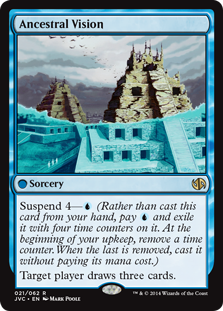
Snapcaster Mage returns! Credit goes less to the Mage himself and more to the recently unbanned Ancestral Vision, a powerful but not warping addition to Modern. Between Grixis Midrange, Temur Scapeshift, Jeskai Control, and a buffet of unlisted Gifts Ungiven and Thopter Foundry/Sword of the Meek experiments, Modern is once again a blue-friendly format. (Sorry, J.C. Tao and pals---neither UR nor UW Eldrazi counted.)
With blue back in vogue, you can expect haymakers like Cryptic Command and Spell Snare trickery once again, along with all the removal and card draw that comes with them. Graveyard hate goes a long way to hampering these strategies, so don't go light on Relic of Progenitus and similar effects. Also, remember these decks aren't your 1994 Draw-Go lists! Many have proactive threats and/or fast clocks---don't be too passive.
In each of these bullet points, we've focused on identifying core format themes before tacking on some brief strategic implications. This is generally a helpful way to approach metagame data before a major event, particularly if it isn't tiered into obvious segments, is built off a smaller n, or is developing in an unstable period of Modern growth. Now it's time to reverse that method---isolating critical maindeck and sideboard choices to prepare for the SCG Championships climate.
I read a lot of tournament reports on Reddit, forums, and in articles across the Magic community. Almost all of these recountings appreciate the importance of sideboarding and mulliganing, of tight play and predicting an opponent's moves. That said, few explicitly acknowledge the importance of picking the right deck before arriving at an event. After the dust has settled, players are quick to point to variance, bad matchups, shoddy judging, and other external factors as reasons for a loss. These elements are certainly at play in every event, but many losses happened the moment you registered the wrong 60 (let alone the wrong sideboard) for your tournament.
Building off our earlier analysis of Modern's current Top 16, here are the key maindeck takeaways you need to incorporate into your archetype and deckbuilding decisions. They will help you avoid making that fatal, and frustrating, mistake at deck registration before you've shuffled up even once.
We can make some Stage 0 assumptions in even the most unstable Modern format. For instance, the Big Aggro Three are generally good bets. You also wouldn't want to gamble against at least one BGx Midrange variant. On the other hand, observations like these are so general and so often true that it's hard to think of them as Stage 0 assumptions of a new format. More like Stage 0 assumptions of Modern period. You are always encouraged to metagame against these kinds of Stage 0 assumptions.
Even so, you should never try and predict beyond Stage 0. Don't bring scissors to beat all the players slinging paper in a format of rock. This generally leaves you smashed by rock without seeing a single paper all day. These dynamics are a little trickier in events with Day 2's (e.g. Grand Prix), but are much safer in 8-9 round tournaments like the SCG Championships. Don't get too clever with your deck choices!
At least 30% of the collective Modern metagame is on some kind of aggressive, creature-based strategy. If you're playing a deck that punts the aggro matchup in Game 1 before trying to improve it in Games 2-3, pick  a new deck. There are just too many categories of aggro: Gruul Zoo goes wide, Infect is just fast, Burn gets reach, Affinity does it all, etc. You can't realistically be confident in your ability to convert a 30-70 Game 1 into a 70-30 Games 2-3 in every last one of these matchups.
Instead, make sure your maindeck can handle aggressive strategies in three ways. First, run a lot of efficient removal. Lightning Bolt is where you want to be all weekend, but don't forget underrated bullets like Disfigure if you can't support the Bolt. Second, include sweepers. Tron gets Pyroclasm, the Esper and Jeskai decks rock Supreme Verdict, and Grixis and Jund can invoke Damnation. Finally, rely on something which trumps the aggressive deck in one blow. That is typically a decisive win (Scapeshift, Goryo's Vengeance) or an unbeatable defense (Ensnaring Bridge). As long as your deck is doing one or more of those three, you could be doing much worse.
At the risk of straying too far from our Stage 0 assumptions, I'm envisioning two possibilities for the SCG Championships. Option one: players get so distracted by making Thopters and drawing three they forget about getting Nacatl-mauled on turns 3-4. Option two: they are 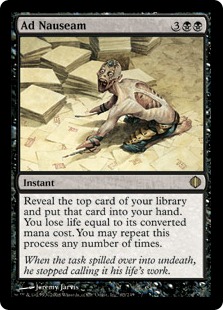 heavily prepared to mow down aggressive masses and aggro gets stumped. Side by side, these scenarios illustrate the exact peril I was talking about earlier with making post-Stage 0 assumptions. They are mutually exclusive and lead to very different conclusions.
That said, there is a common thread in both these conflicting possibilities: aggro is a major force. If I was advising someone on their deck this weekend, I'd want them to be as far away from the aggro interaction axis as possible. Either anti-aggro decks beat you up in the early rounds because players are packing removal, or the few anti-aggro decks rise to the top in later rounds and halt your Round 9 or Top 8 progression.
This should move players to strategies which blank removal altogether (Scapeshift, Ad Nauseam), or minimize it through high-toughness creatures (Grixis delvers, Tarmogoyf). If you do opt for aggro, emphasize decks that can go wide. Players are much more likely to pack Bolts than sweepers, and one-for-one exchanges are not what you want to be doing against a Bushwhacker onslaught.
Mic dropped. I know it's heresy to decry one of Modern's two newest darlings, but the metagame standings don't leave you much choice for now. Although Thopter tinkerers are likely to gravitate towards lists like Gerry Thompson's Gifts build from the Columbus Invitational, I 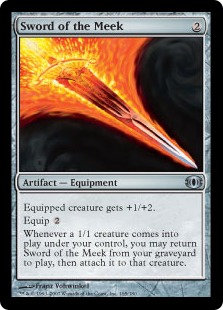 encourage you to avoid these decks on Sunday.
Quite simply, unless you're a master deckbuilder, you are likely going to make mistakes when selecting your core 60. These will range from incorrect ratios (how many useless Talisman of Progress-style effects do you want?) to using the wrong cards (No Ensnaring Bridge or Crucible of Worlds package?). Maybe you get it right and go all the way, but it's significantly less likely than getting it wrong and dying to your deck and enemy Stony Silences.
After all, the Top 16 above represent the topmost 70% of Modern, and less than 2%-3% of them were messing around with the Thopter/Sword combo. Its earliest successes have been in UW Tron and Esper/UW Gifts builds, none of which have cracked 2%. Those numbers further suggest to me that the deck has a lot of work left to do, so unless you think you're the Chapin to crack it, live out your blue fantasies elsewhere---Ancestral Vision is happy to welcome you aboard.
I fully expect Thopter/Sword to be a big Modern player by the end of the summer, but until Grand Prix time, it's not going to get the work and love it needs.
Outside of the first point, I've tried to avoid overly general maindeck advice like, "Do something proactive," or, "Play powerful cards." Although those are rules to live by in most Modern events, they don't necessarily connect with today's Top 16 metagame picture. Keep those sweeping Modern aphorisms in mind as you gear up for Sunday, but not at the expense of these more context-dependent principles.
Because sideboarding is so deck-specific, it's hard to even think about broad sideboard themes which might apply to every player. Instead, we're going to look over four sideboard heavy-hitters I expect to see this weekend, how you can leverage them yourself, and where they are likely to show up.
Raise your hand if you've already heard the Jund or control mage crying foul after getting wrecked by Ulamog, the Ceaseless Hunger on turn five. "Eye of Ugin got banned! That's not a real deck!" the salty sailor will whine. Both Tron and Eldrazi mages are going to justifiably miss this memo, because with players shifting away from land destruction, big-mana ramp decks can really shine in a post-April 4 world.
If you know you're soft to these decks, if you know you want answers to random problems like Inkmoth Nexus, Boseiju, Who Shelters All, and manlands, and if you know losing to Tron will send you on an enraged tilt for the rest of the tournament, bring three Mages into the board. Crumble to Dust is your alternate if you aren't running either Kolaghan's Command or Collected Company.
Many players regard this as a maindeck, not sideboard, removal option in the grindier white decks---Abzan, Jeskai, Hatebears, and Death and Taxes come to mind. Kiki-Chord and Naya Company/Zoo decks play it as well, on top of Bogles. That said, few expect it in hyper-aggressive strategies, like the faster representatives on the Burn-to-Zoo spectrum, or in slot-tight lists like Abzan Company.
In such matchups, don't get caught with your pants down to Path in Games 2-3, where all of those decks have an option to board these in as added removal. Similarly, if you're playing a deck that typically doesn't run Path, look to include them in your sideboard to surprise players trying to goldfish their big critters or combo pieces.
Ah, Ratchet Bomb. I'm already having flashbacks to Colorless and Ux Eldrazi Winter, but I'm also fondly remembering how awesome this unassuming artifact proved as a catch-all answer. Engineered Explosives fills a similar role in decks that support more colors, so you can view this as a joint testimonial to both of the explosive devices. In each case, you have an artifact which can wipe boards and spot-remove serious threats. Moreover, neither artifact is type-restricted. Outside of manlands, they hit everything from troublesome Blood Moons to active Ensnaring Bridges and all the Modern oddballs in between---Bomb has the bonus of taking out Moons even if you are locked on red.
If you're playing against a deck that supports three colors, be careful not to over-extend creatures and permanents alike into Explosives (Ratchet Bomb should be more under the radar). If you're rounding out your sideboard, consider Explosives if you have three colors, or Bomb if you're on one or two.
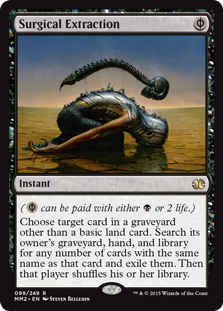
Phyrexian mana is Busted with a capital B, and this lesser-played New Phyrexia gem is extremely well-positioned to remind the new Modern just how unfair the mechanic is. Eldrazi Winter saw both Dismember and Gut Shot take top honors as the Phyrexian bullets of choice, and although those cards are still relevant today, Extraction's versatile hate modes make it even more interesting for Sunday.
For one, it's flexible, free, decisive graveyard sniping against decks which rely on recursion. Extraction nukes the Sword side of the Thopter/Sword combo, Unburial Rites/Gifts Ungiven nonsense, Academy Ruins targets, both the Kitchen Finks and Murderous Redcap ends of the Company combo, vengeful Griselbrands, and even your average Snapcaster Mage trigger.
On top of these applications and dozens more we could list, Extraction plays just as well with discard in black decks or a non-discard gameplan even in decks that don't run black. It's also free, which means opponents will never expect it the first time and won't know you have it the second. Graveyard hate is important in this metagame, and if you can't decide where to invest your slots, Surgical Extraction is waiting for you.
Remember all those sweepers I told you to bring? Elves and Abzan Company players are going to neuter those Anger of the Gods all Sunday long as the green players Chord of Calling up the devastating little Kithkin. You might not see Forge-Tender in decks like Gruul Zoo and Burn, but you should still be wary of similar effects in Boros Charm and Dromoka's Command.
All of these tools are invaluable aggro options against the inevitable sweepers, so if you are taking the aggressive route on Sunday, be sure to dedicate at least two sideboard (or maindeck!) slots to some of these cards.
Playing against aggro? Don't carelessly pitch a sweeper into these spells, especially the two-for-one Dromoka's Command. Keep your countermagic backup handy for the instants (Dispel is another excellent sideboard card to remember on Sunday), and diversify your sweepers against the Forge-Tender (Drown in Sorrow for decks that need to dig for pieces, Flaying Tendrils for those that just need to kill creatures and mess with Company/Chord staples).
Just because it isn't listed doesn't mean it won't crop up on Sunday. Expect all the Stony Silence, Destructive Revelry, Blood Moon, and Ancient Grudge you have come to know and love in Modern. By a similar token, if you have any integral sideboard tech to keep your deck running in Games 2-3, don't ditch it just because it didn't show up here, or because a similar card showed up instead.
It's really too bad SCG Championships and similar events don't have coverage, because I'd watch that Modern extravaganza all Sunday long. As it is, I'll settle for the Top 8 listings as they hit the SCG main page throughout next week. Assuming they are posted before Wednesday, you can expect a breakdown in my subsequent article.
If tournament organizers and/or SCG takes their sweet time in posting the lists (how dare those people with lives and jobs deprive us of our Modern metagame data!), then we'll have to do a round-up a week later. Either way, you can be sure I'll be mining the results for key format takeaways as Modern takes shape following the formative April 4 update.
That's a wrap for today, and I wish all of you the best of luck at your respective SCG Championship this weekend. Or in whatever other local or regional tournament you intend on bringing down. Hopefully at least one of you will champion Ad Nauseam for me, and I'm excited to hear all of your success stories. Remember: if you have a great performance, or at least an interesting one, you can always submit a report via our Volunteer Contributors Program for Modern Nexus publication. Let me know if you have any questions about decks, cards, or the metagame as a whole, and I'll see you all when the Sunday dust has cleared.



![Insider: [Ongoing] Live On-Site Pro Tour SOI Coverage](https://www.quietspeculation.com/wp-content/uploads/2016/04/SIO_Header_New_Preloader.jpg)