
menu

Insider: Oath of the Gatewatch Box Report

Are you a Quiet Speculation member?

If not, now is a perfect time to join up! Our powerful tools, breaking-news analysis, and exclusive Discord channel will make sure you stay up to date and ahead of the curve.

Welcome to another edition of the Box Report. Every set release, I like to look at data and get an idea of the distribution of cards. Today I will break down the spread of each box and provide some firsthand information about the value of Oath of the Gatewatch (OGW).

My goal here is for everyone to have some fun looking at what the possibilities are for opening boxes of this set. We’re all excited about Expeditions too and that makes the pack opening even more fun. Let’s dive right in and see how it turned out.

The first thing I want to do is to list out the cards worth paying attention to in this set. Most likely these are all known quantities, but more knowledge about the set is never a bad thing. Before I was doing these breakdowns I've found a few cards would slip under my radar.

After analyzing my boxes for their value, I walk away with a more thorough picture of the financial layout of each set---I encourage others to follow this same process for these reasons.

Let me first point out that with Battle for Zendikar (BFZ) and OGW, I have a special notification set at my store to remind me that the price ceiling for rares in these sets are lower than normal and it takes an amazing card to break the mold. Expeditions have forced most of the cards in these sets downward.

My typical procedure is to buy a targeted number of playsets and once that number is reached, lower the buy price. During OGW preorders, I lost sight of this principle with my Call the Gatewatch purchases. Even though I was able to get them at really good numbers, the card will have to exceed even my highest expectations in order to reach the necessary price point for me to make money on that investment.

I still believe that is possible, but it will take quite a long time and I could have easily invested my money in the plethora of Modern specs that are providing a much higher return. This is something we should all keep in mind in the future.

Additionally, rares at the bottom of my list above, the ones that range from $1.50 to $3, are in the danger zone. I made my calculations with their current TCG mid price, but by the time this article goes live, they may have already dropped to bulk. Cards like Eldrazi Mimic and Captain's Claws I really like and think have room to grow, while others seem destined for the bulk box like Vile Redeemer and Overwhelming Denial.

Finally, there some uncommons of note worth grabbing from the draft leftovers. Stormchaser Mage seems like an obviously great uncommon, but Reflector Mage and Warping Wail are noteworthy as well. In addition to the uncommons that already hold value, I think Spatial Contortion will rise in value once it starts seeing play across Standard and possibly in Modern.

Foils of these are great pickups as well, especially Stormchaser Mage. After looking at the prices of these foil versions, my assessment was definitely correct. I was surprised that Stormchaser was already double digits and the others were creeping towards double digits as well.

Box 1

Foil Eldrazi Obligator
Foil Island

Kozilek's Return
Thought-Knot Seer
Kalitas, Traitor of Ghet
World Breaker
Hissing Quagmire
Needle Spires
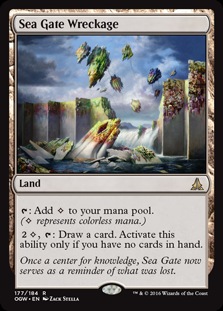
Sea Gate Wreckage
Corrupted Crossroads
Inverter of Truth
Goblin Dark-Dwellers
Bearer of Silence
Captain's Claws
Call the Gatewatch
Eldrazi Mimic

Total: $85

Box 2

Foil Swamp
Foil Corrupted Crossroads
Foil Natural State

Thought-Knot Seer
Chandra, Flamecaller
Matter Reshaper
Oath of Nissa
Reality Smasher
Eldrazi Displacer
Wandering Fumarole
Hissing Quagmire
Needle Spires
Corrupted Crossroads
Sylvan Advocate
Sphinx of the Final Word
Goblin Dark-Dwellers
Jori En, Ruin Diver
Bearer of Silence
Ayli, Eternal Pilgrim
Crush of Tentacles
Oath of Gideon
Eldrazi Mimic

Total: $90

Box 3

Foil Plains
Foil Hedron Allignment

Kozilek, the Great Distortion
Thought-Knot Seer
Chandra, Flamecaller
Kalitas, Traitor of Ghet
Oath of Nissa
Reality Smasher
Wandering Fumarole
Sea Gate Wreckage
Sylvan Advocate
Goblin Dark-Dwellers
Jori En, Ruin Diver
Bearer of Silence
Ayli, Eternal Pilgrim
General Tazri
Captain's Claws
Oath of Gideon
Call the Gatewatch

Total: $105

Box 4

Foil Matter Reshaper
Foil Mountain

Kozilek's Return
Thought-Knot Seer
Linvala, the Preserver
Matter Reshaper
Reality Smasher
World Breaker
Eldrazi Displacer
Mirrorpool
Sea Gate Wreckage
2 Corrupted Crossroads
Inverter of Truth
Sylvan Advocate
Goblin Dark-Dwellers
Bearer of Silence
Crush of Tentacles
Captain's Claws
Oath of Gideon
Call the Gatewatch
Eldrazi Mimic
Vile Redeemer

Total: $119

Box 5

Twilight Mire
Foil Crush of Tentacles
Foil Captain's Claws
Foil Plains
Foil Reckless Bushwhacker

Nissa, Voice of Zendikar
Thought-Knot Seer
Chandra, Flamecaller
Matter Reshaper
Oath of Nissa
2 Reality Smasher
Eldrazi Displacer
2 Wandering Fumarole
Sea Gate Wreckage
Sylvan Advocate
Sphinx of the Final Word
Jori En, Ruin Diver
Bearer of Silence
Ayli, Eternal Pilgrim
Crush of Tentacles
General Tazri
Captain's Claws
Oath of Gideon
Call the Gatewatch
Eldrazi Mimic

Total: $199

Box 6

Foil Eldrazi Mimic
Foil Forest
Foil Stormchaster Mage

Kozilek's Return
Kozilek, the Great Distortion
Thought-Knot Seer
Linvala, the Preserver
Matter Reshaper
Oath of Nissa
Eldrazi Displacer
Mirrorpool
Hissing Quagmire
Needle Spires
Sea Gate Wreckage
Corrupted Crossroads
Sylvan Advocate
Goblin Dark-Dwellers
Jori En, Ruin Diver
Call the Gatewatch
Eldrazi Mimic
Vile Redeemer

Total: $141

As you can see, with OGW, we are getting a decent value from our purchase, with a box average of $123.50.

Most of you know this already, but with this block it has been significantly better to buy cases instead of smaller quantities. This principle still holds true. By committing to less than a sealed case, you are voluntarily risking not opening an Expedition. At minimum you risk losing out on $50-$200. You could have pulled multiple Expeditions too, and in that case, you could be losing more money.

Our readership here at Quiet Speculation understands things like this quite well, but I think it’s our responsibility to spread the word. Not only will this help your friends, but also your local game store. People should be teaming up to buy their case if they can’t afford it on their own. By doing it this way, I think it increases your odds of opening an Expedition. There will always be those players that open an Expedition from a random Walmart pack or in a draft, but give yourself the best shot to get your own Expeditions.

Taking a look at the set, most of the mythics are hits in terms of recouping your investment (The recent jump by Worldbreaker helps with this as well.) There are many rares that will give you some value as well. Thought-Knot Seer is at the top of this list, but there are many other good pulls as well.

Finally, I think this set gives you more chances to open money with your foil slot. Certainly foil rares and mythics will typically be worth a bit, and the foil lands are still bringing in $4 - $9 each, but with OGW we have more chances to get money foils. Because OGW has Wastes and amazing uncommons like Stormchaser Mage, your chances to open a foil worth money have increased. All of these aspects go into making money from your investment.

My boxes ranged from $85 in value all the way up to $199. That’s certainly a huge range, but the point is that the more boxes you open, the higher your average will be. For individual players, I think the sweet spot is a case. If you want to go bigger though and create your own virtual store through TCG Player, eBay, or another outlet, try purchasing multiple cases.

When I was selling singles on my own, I opened two cases of each set. That was enough to all but ensure a minimum of a playset of each mythic and two playsets of each rare. There will be variance of course, but those minimums are a pretty safe base to work from.

For most sets, I have an opportunity to get ahold of extra prerelease kits. This time around, I wanted to include some data about those as well. I’ll let you know ahead of time, they’re a great investment. If you have the opportunity to purchase these boxes, seize on it quickly.

Due to lower-than-usual numbers at my events, I was able to open 18 of these boxes. With each box containing four packs of OGW that gives us a total of 72 packs, or the equivalent of two boxes. Here’s what I opened.

Prerelease Kits

Ancient Tomb
Foil World Breaker
Foil Ayli, Eternal Pilgrim
Foil Needle Spires
Foil Drana's Chosen
Foil Goblin Dark-Dwellers
Foil Island
Foil Mountain
3 Nissa, Voice of Zendikar
Thought-Knot Seer
Kalitas, Traitor of Ghet
4 Matter Reshaper
2 Oath of Nissa
3 World Breaker
2 Eldrazi Displacer
2 Mirrorpool
Needle Spires
5 Sea Gate Wreckage
2 Corrupted Crossroads
2 Sphinx of the Final Word
2 Goblin Dark-Dwellers
Eldrazi Mimic
Ayli, Eternal Pilgrim
3 Crush of Tentacles
2 Captain's Claws
2 Call the Gatewatch
Eldrazi Mimic

Total: $345

If you noticed, each of the normal boxes had one foil rare. With these packs, we averaged double that. Taking a look at the mythic distribution, we had a higher number of mythics in the prerelease boxes as well. The prerelease packs had a total of 14 mythics which averages to seven per box, but the boxes of the set only averaged 4!

The average was also brought up because there was one kit with 5 mythics and one with 6! The other kits contained 2, 3, 3 & 4 each. This seems to be a higher-than-normal distribution. I’m wondering if other people have noted a higher percentage of mythics from this set as well, or if my case was an anomaly.

It has long been rumored that the prerelease product has a higher rate of mythics and desirable cards than the normal packs you can purchase upon release. I am working with a small sample size here, but my data certainly seems to indicate this is true. If we calculate the value of the prerelease kits equivalent to boxes, we would have an average of $172.5.

But wait, there’s more!

Prerelease Promos

Deepfathom Skulker
2 Dimensional Infiltrator
Drana's Chosen
Oath of Chandra
Tyrant of Valakut
Hissing Quagmire
Wandering Fumarole
Oath of Nissa
Stoneforge Masterwork
General Tazri
Linvala, the Preserver
Hedron Alignment
Eldrazi Obligator
2 Fall of the Titans

Total: $70

BFZ Valuables

4 Battle lands
2 Lumbering Falls
2 Ruinous Path
1 Painful Truths
2 Wasteland Strangler
1 Ulamog, the Ceaseless Hunger
1 Sire of Stagnation
Foil Scatter to the Winds
Foil Retreat to Coralhelm

Total: $64

You don’t only get packs of Oath in these prerelease boxes, you also get two packs of BFZ and a promo foil! That was another $134 in value. There’s no argument that these prerelease kits contain much profit within them. There is one downfall though.

With a theoretical few leftovers to pick from, stores tend to price these a bit higher. Some stores will have these priced at the same rate of their tournament entrance fee, while others will increase the price due to a low supply. I can only speak for myself here when I say I charged $30. We sold about a dozen of these kits at that price.

In the past before BFZ block we've been unable to move those prerelease kits, so a lot of the demand is stemming from the Expeditions. Just like with the packs, they help sell product.

Using that $30 per box for my calculations, it would cost you $540 before tax to acquire 18 of the prerelease kits. While they do contain great value, extra mythics, and a higher rate of foils, the total value of the cards I opened was only $479. So, at $30 if your goal is just to turn a profit, it seems not worth the investment. If, however, you were able to buy these at $25 or less per kit, you would be in great shape to profit from the investment.

Also keep in mind from these 18 kits I only opened one Expedition, as opposed to the two from BFZ prerelease kits. So that will result in pretty different returns, obviously.

~

I hope you found this endeavor intriguing and valuable. Use this information to gauge how much you want to invest in this set.

Just keep in mind the barrier to price I mentioned earlier as well. The value of cards in OGW will be dictated directly by how desirable the Expeditions are and how much product they prod people to open. The Expedition lottery is real and it sells packs.

Let me know how your pack opening went and what you learned from it in the comments.

Until next time,

Unleash the Force of the Gatewatch!

Mike Lanigan
MtgJedi on Twitter
Jedicouncilman23@gmail.com

Insider: Risk, Diversification & Market Depth

Are you a Quiet Speculation member?

If not, now is a perfect time to join up! Our powerful tools, breaking-news analysis, and exclusive Discord channel will make sure you stay up to date and ahead of the curve.

What do we mean when we talk about risk?

Risk deals with uncertainty, or when a single choice leads to multiple potential outcomes. In this article I will discuss some of the frameworks and ideas that can inform our investments in cards when the future is unknown.

Problem A: Comparing Investments Against Each Other

We can think of each investment as a lottery. It has multiple potential payouts that are distributed in some probabilistic fashion. So how would we compare two different lotteries against each other assuming we know the exact distributions of their payouts?

A natural first approach would be to pick the lottery with the highest average payout. In general, a higher average is a good sign, but focusing solely on the average can lead us into some problems. Consider the St. Petersburg paradox:

A casino offers a game of chance for a single player in which a fair coin is tossed at each stage. The pot starts at 2 dollars and is doubled every time a head appears. The first time a tail appears, the game ends and the player wins whatever is in the pot. Thus the player wins 2 dollars if a tail appears on the first toss, 4 dollars if a head appears on the first toss and a tail on the second (...) and so on. What would be a fair price to pay the casino for entering the game?

Let's assume we stack lotteries against each other just based on their average payout. Since the average payout of the St. Petersburg lottery is infinite, we would always prefer it to another lottery with a finite average payout, for example a sure bet of winning a million dollars.

So ask yourself now, assuming the prices of both lotteries were the same, would you prefer the St. Petersburg game or a sure bet of a million dollars? I think the answer is quite clear, which says a lot about our preferences---particularly our aversion to risk.

The solution to the St. Petersburg paradox seems to imply the idea that not every dollar won is equally important. Consider the two following lotteries:

  • Lottery A: 50% chance to win $10,000 and 50% chance to win $990,000
  • Lottery B: 50% chance to win $0 and 50% chance to win $1,000,000

People will almost always choose lottery A over lottery B, because going from $0 to $10,000 is a more significant jump than going from $990,000 to $1,000,000.

This idea implies the rule that given two lotteries with equal average payouts, we will prefer the lottery with the lowest variance in payouts. This leads us to a popular school of thought in economics---to judge an investment based on both its mean and its variance.

The more interesting question is then: how do we choose to trade off between mean and variance? How do we pick between two investments, one with a higher mean and variance and one with a lower mean and variance? This will vary depending on the individual investor, as different investors will have different risk preferences.

To consistently make the best investments for your own specific situation, it will be a good idea to figure out your own preferences towards risk. You can ask yourself some questions like:

Would you rather a sure bet of $100 or 50% chance of $40 and 50% chance of $180?

Would you rather a sure bet of $100 or a 50% chance of $60 and 50% chance of $150?

Would you rather a sure bet of $100 or a 90% chance of -$200 and 10% chance of  $3,000?

And so on. Understanding your preferences towards risk will help you decide whether for example you want to make a bet on an already-proven staple with a low but likely payoff or a risky bet on an unproven card with a potentially big payoff.

Problem B: Allocating Funds Across Different Investments

We now have some idea of how to compare investments against each other, but how do we allocate between them? Thinking from a mean/variance perspective, diversification can be a useful tool to manage variance, usually at the cost of the mean payoff, but sometimes at the cost of nothing.

Think of the following problem:

  • Card A: Price $5; in one year has a 50% chance to be worth $5, and a 50% chance to be worth $10.
  • Card B: Price $10; in one year has a 50% chance to be worth $10, and a 50% chance to be worth $20.

Let's say you have a budget of $200, if you invest entirely into card A or entirely into card B, you will have the following payoff:

50% chance to profit $0, 50% chance to profit $200

By using diversification, we can reduce the risk (variance) without changing the average payoff. We can do this if we buy 20 copies of card A and 10 copies of card B. The payoff is now:

25% chance to profit $0, 50% chance to profit $100, 25% chance to profit $200

In this way, diversification can be a very powerful thing, but I would warn against blindly applying it to all situations.

Diversification is a tool that is used only to manage variance, and often comes at the price of your average return. This comes from the assumption that the quality of your investments will not be uniform as they were in the previous example. If we assume that investments all fall on some spectrum of "good" to "bad" then in order to reduce the risk of your best investments through diversification, you will have to introduce lower quality investments into the picture, thus lowering the average return.

For this reason, in my own investments, I choose to diversify as little as possible. I would rather put all my money into the best bet that I can find. This also happens to be the strategy that is heralded by legendary investors such as Warren Buffet and Charlie Munger.

When Warren Buffet gives investment advice, he often has told people to imagine they can only make 10 investments from now until the end of their lives. Such a restraint would force people to put a lot of thought into a small number of high-quality investments. Putting all of your eggs in one basket can reap high rewards if you are a disciplined investor that goes only after the best bets. I highly recommend it!

Problem C: When Investments Can't Be Infinitely Scaled

Sometimes it is not possible to put all of your money into one investment because the scale of your entire portfolio is bigger than any single investment that you can make. This relates to the concept of "market depth."

Market depth is the degree to which a market can be influenced by a single investor. In very large (deep) markets, for example the New York Stock Exchange, you can sink millions of dollars into a single asset without having a large effect on its price. This is clearly not the case when you invest in Magic cards!

I'll give a personal example. A few days ago, I was interested in buying as many Abbot of Keral Keep as I could find for under 3.4 tix but was only able to secure about 80 copies. This is because the market is so shallow, I am effectively raising the price of the card by a few cents every time I buy a playset.

There was an error retrieving a chart for Abbot of Keral Keep

To me, this is the true role of diversification in Magic investment. Since the markets are often quite shallow, you will have diminishing returns on the profit associated with each subsequent purchase of the same card. The diminishing effect is twofold because the next copy you speculate on will both cost more and sell for less.

Taking this into account, my personal strategy is to choose both a maximum price I'm willing to pay and a maximum number of copies I'm willing to buy for each individual investment. The maximum number of copies will vary depending on the market depth of the associated card. A four-of staple in Standard, for example, will have much more market depth than a one-of in Modern.

Keep this in mind when you make your investments. I think it is prudent not to think of the total amount invested into each card, but the amount of each individual card you are buying. I would recommend starting at a reasonably low number and working your way up as you gain more experience investing.

Conclusion

In order to make the best investments for your own personal situation, you should ask yourself how you feel about risk, or how much variance you are willing to put up with for a higher average return. Once you have your risk preferences figured out, I recommend only diversifying if you are very risk-averse or if you believe you're dealing with multiple investments with very similar potential outcomes.

An exception to this rule is when issues of market depth come into play. In shallow markets, it makes sense to diversify because there are steep diminishing returns to profits for each additional card that you buy.

Avatar photo

Luca Ashok

Luca has been playing Magic on and off since Invasion, but for the past year has chosen to shift focus to the financial aspects of the game. He uses his studies in economics at Stanford as a basis for his thoughts on the MTG marketplace. He has been known to play Pauper from time to time and was the first person to develop the Esper Familiars deck for which Frantic Search and Temporal Fissure were eventually banned.

View More By Luca Ashok

Posted in Finance, Free Insider, MTGOTagged 10 Comments on Insider: Risk, Diversification & Market Depth

Have you joined the Quiet Speculation Discord?

If you haven't, you're leaving value on the table! Join our community of experts, enthusiasts, entertainers, and educators and enjoy exclusive podcasts, questions asked and answered, trades, sales, and everything else Discord has to offer.

Want to create content with Quiet Speculation?

All you need to succeed is a passion for Magic: The Gathering, and the ability to write coherently. Share your knowledge of MTG and how you leverage it to win games, get value from your cards – or even turn a profit.

Insider: QS Cast #21 – The Amazing Growth Potential of OGW

Are you a Quiet Speculation member?

If not, now is a perfect time to join up! Our powerful tools, breaking-news analysis, and exclusive Discord channel will make sure you stay up to date and ahead of the curve.

Play

There’s this saying among Italians that they choose a “fat Pope” and then a “skinny Pope” – that is, one sits in the Throne for decades and the following one serves only a few years. Allow the cast to borrow that analogy today as they talk about the bounty of OGW as compared to the Eldrazi-related desolation of BFZ. This week, you’ll hear about cards with the hottest growth potential in both Standard and Modern.

Douglas Linn

Doug Linn has been playing Magic since 1996 and has had a keen interest in Legacy and Modern. By keeping up closely with emerging trends in the field, Doug is able to predict what cards to buy and when to sell them for a substantial profit. Since the Eternal market follows a routine boom-bust cycle, the time to buy and sell short-term speculative investments is often a narrow window. Because Eternal cards often spike in value once people know why they are good, it is essential for a trader to be connected to the format to get great buys before anyone else. Outside of Magic, Doug is an attorney in the state of Ohio.  Doug is a founding member of Quiet Speculation, and brings with him a tremendous amount of business savvy.

View More By Douglas Linn

Posted in Free Insider, QS Cast2 Comments on Insider: QS Cast #21 – The Amazing Growth Potential of OGW

Have you joined the Quiet Speculation Discord?

If you haven't, you're leaving value on the table! Join our community of experts, enthusiasts, entertainers, and educators and enjoy exclusive podcasts, questions asked and answered, trades, sales, and everything else Discord has to offer.

Want to create content with Quiet Speculation?

All you need to succeed is a passion for Magic: The Gathering, and the ability to write coherently. Share your knowledge of MTG and how you leverage it to win games, get value from your cards – or even turn a profit.

Brave New World: Modern Going Forward After SCG Atlanta

Are you a Quiet Speculation member?

If not, now is a perfect time to join up! Our powerful tools, breaking-news analysis, and exclusive Discord channel will make sure you stay up to date and ahead of the curve.

While StarCityGames Classic events are normally considered “low-key” when compared to Open Events and Grand Prix, SCG Atlanta proved to be highly valuable for Modern analysis, coming off the heels of the recent Splinter Twin ban. In case you’ve been living under a rock the past week, check out Wizards’ official announcement here and my analysis-based opinion piece here. Today, we’ll be focusing primarily on defining this new landscape we find ourselves in.

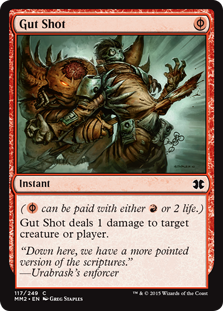
Gut Shot Art

What will the world look like with Splinter Twin gone? Will a new deck rise to take its throne? Will Twin’s absence be the final crack in an old dam that bursts forth, spilling thousands of solitaire combo decks out onto the plains, drowning everything in their path? Let’s find out!

[wp_ad_camp_1]

By The Numbers: SCG Classic Atlanta

The Top 16 of SCG Atlanta Classic featured 10 different archetypes, with six strategies making their way to the Top 8. That’s a slam-dunk in terms of format diversity if we’re counting, but it’s important not to get ahead of ourselves here. This is only “Week 1” of the new format, and it’s at least fair to assume immediate fallout from Twin’s lost market share would be spread among different decks, and not concentrated in one archetype. There very well could be a “best deck” out there that just hasn’t been found yet, or maybe it has been found but Atlanta's conditions weren’t conducive to its success. Still, for those crying “the sky is falling”, SCG Atlanta definitely contains some unavoidable evidence. Let’s dive in a little deeper, first looking at the Top 8, then branching out into the Top 16 and beyond.

Top 8 Statistics

Deck Name# in Top 8
Temur Delver1
Merfolk2
Jund1
Affinity2
Burn1
Zoo1

Leading up to the event, many players expected Infect and R/G Tron to be big winners as a result of the Splinter Twin banning. But hold on, wasn’t Summer Bloom banned as well? Yes, but there’s a big difference between a deck like Amulet Bloom getting the axe and a ban aimed at a Tier 1 archetype. While Amulet Bloom had been around for a significant amount of time, aside from Justin Cohen’s Pro Tour Fate Reforged performance it has never approached Twin status. At the time of its banning, Amulet Bloom, although top-tier, had yet to affect the format in the kind of significant fashion that could change format composition with its absence. In fairness, this was likely the result of everyone assuming Bloom would be banned at some point and preemptively adjusting. If Bloom had survived another year then we might have seen it start to alter Modern as players became more confidant in its place, but that didn't happen. This leaves Twin to take all the attention.

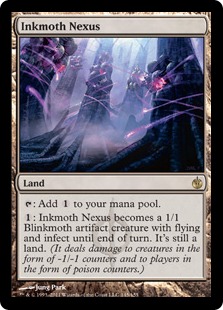
Inkmoth NexusWith this in mind, competitors focused exclusively on Splinter Twin (or the lack thereof) and what that could mean for the format. Inkmoth Nexus and Grove of the Burnwillows spiked on MTGO, as did Through the Breach. The talk of the town had Infect, Tron, and Grishoalbrand as top players with Twin out of the picture.
The result? No Infect, Tron, or Goryo’s Vengeance decks in the Top 8 of SCG Atlanta. In fact, only one Infect list and one Grishoalbrand list even managed to crack the Top 16, coming in at 16th and 15th respectively. Obviously, the Top 16 numbers for Atlanta suggest either the field was prepared for these decks, or they don’t have what it takes to compete for some other reason. Looking to Sheridan's results from yesterday suggests the former is the most likely explanation. To determine the answer to this question, let’s take a look at some lists and see what they can tell us.

The Decks

First up, the champ:

Temur Delver, Todd Anderson (1st, SCG Classic Atlanta 1/24/2016)

Creatures

4 Snapcaster Mage
4 Delver of Secrets
4 Tarmogoyf
2 Hooting Mandrills
1 Young Pyromancer

Instants

1 Dismember
1 Thought Scour
3 Vapor Snag
1 Izzet Charm
4 Lightning Bolt
1 Mutagenic Growth
4 Remand
3 Spell Pierce

Sorceries

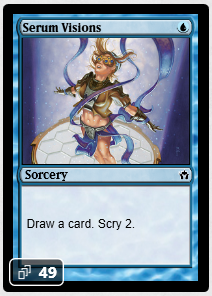
4 Serum Visions
3 Gitaxian Probe

Land

2 Steam Vents
1 Stomping Ground
4 Scalding Tarn
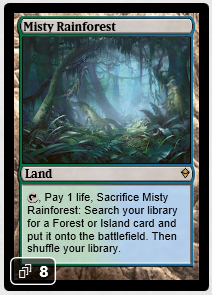
4 Misty Rainforest
1 Mountain
2 Breeding Pool
2 Island
1 Forest
3 Wooded Foothills

Sideboard

3 Ancient Grudge
1 Dispel
2 Grim Lavamancer
2 Gut Shot
3 Spreading Seas
2 Surgical Extraction
2 Threads of Disloyalty

Taking down the field with a “new” archetype, Todd Anderson’s performance definitely provides some validation on the “format diversity” front. It’s definitely interesting to see Todd’s finish after reading this from the January 18th update:

"Similarly, Temur Tempo used to see play at high-level events but has been supplanted by Temur Twin. We considered what one would do with the cards from a Splinter Twin deck with Splinter Twin banned. In the case of some Jeskai or Temur, there are very similar decks to build. In other cases, there is Kiki-Jiki as a replacement. In the interest of competitive diversity, Splinter Twin is banned from Modern"

Again, the naysayers will say “this is Week 1, this is an SCG Classic event, etc…” but I’m starting to become a believer. I love this list, and under the hood it’s apparent Todd was clearly focused on accomplishing some particular objectives.

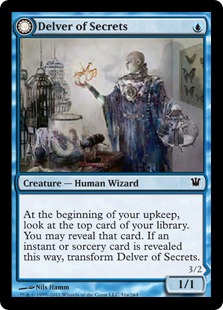
DelverFirst, this is a Delver deck. We’ve seen all 75 of these cards before in other lists (no surprises there) but their unique combination and numbers work together to create something unique. Delver of Secrets is almost always accompanied by Remand, and we see the full four here. Pushing the tempo route, Todd is playing three Spell Pierce and an Izzet Charm, alongside three Vapor Snag. But none of this is necessarily new. So why did Todd take down Atlanta? Because Twin is gone.
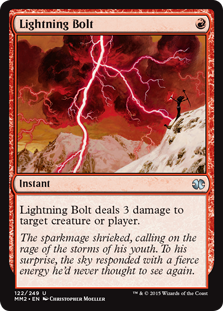
Normally, these Delver tempo decks have difficulty competing when opponents can find a way to kill Delver himself. When it’s ahead, this archetype is eerily efficient in terms of putting the opponent on the back foot and Lightning Boltkeeping them there. It’s always had trouble playing from behind, however, and one of the best ways to fight Delver decks has always been Lightning Bolt. But wait a minute! Twin got banned, not Lightning Bolt! True, third person literary device, but take a look at the frontrunning archetypes. Affinity doesn’t play Bolt. Tron doesn’t play Bolt. Infect doesn’t play Bolt. Abzan (which has been on the rise recently) doesn’t play Bolt. Sidestepping Infect hate with diverse threats like Hooting Mandrills and Tarmogoyf, Todd Anderson capitalized on a lack of Lightning Bolt in the format and punished an apparent field full of greedy players looking to execute their solitaire combos with impunity. Four Remands and four Spell Pierce effects, with four Snapcaster Mage’s in reserve, makes casting Through the Breach or resolving a Living End near impossible. This left Todd free to beat up on the rest of top decks, aiming primarily at Affinity and Tron.
When you’re beating down quickly, Spreading Seas is more than enough to get the job done against Tron, leaving Todd to fill his sideboard with Ancient Grudges and, heck yes, Gut Shot! Take that Affinity! Infect has no chance of fighting through Todd’s bevy of one-mana interaction. Whether this archetype has staying power once the rest of the format starts gunning for it remains to be seen, but for now Todd’s list makes for an explosive start to the new Modern.

Jund, Dustin Green (4th, SCG Atlanta 1/24/2016)

Creatures

4 Dark Confidant
4 Tarmogoyf
1 Kitchen Finks
2 Scavenging Ooze
1 Pia and Kiran Nalaar

Instants

3 Terminate
2 Abrupt Decay
2 Kolaghan's Command
4 Lightning Bolt

Planeswalkers

4 Liliana of the Veil
1 Chandra, Pyromaster

Sorceries

2 Maelstrom Pulse
3 Inquisition of Kozilek
3 Thoughtseize

Land

4 Blackcleave Cliffs
1 Blood Crypt
3 Bloodstained Mire
1 Forest
1 Ghost Quarter
1 Overgrown Tomb
4 Raging Ravine
1 Stomping Ground
2 Swamp
1 Twilight Mire
4 Verdant Catacombs
1 Wooded Foothills

Sideboard

1 Ancient Grudge
4 Crumble to Dust
2 Engineered Explosives
2 Faerie Macabre
2 Kitchen Finks
1 Night of Souls' Betrayal
1 Obstinate Baloth
2 Painful Truths

If we’re expecting a lot of R/G Tron, then Jund is definitely an interesting choice, which makes Dustin’s strong performance an excellent example for analysis. As we saw from the Top 16 statistics, Tron seems to have underperformed, which means it was either hated out of the top tables or doesn’t have what it takes to compete in the new metagame. I think, and Sheridan's stats agree, it’s safe to go with the former, as we’ve seen the power of RG Tron enough that it seems a stretch it would get worse, not better, with Twin gone. Here, the four Crumble to Dusts in Jund’s sideboard shows Dustin is at least planning to face Tron (and some players have gone on record stating the matchup is so bad it’s almost an auto-lose). I know from experience: in my first Modern Nexus Video Series I luckily dodged Tron, but got crushed multiple times in practice games after the series with the deck.

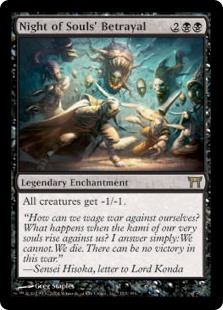
Night of Souls' BetrayalWe also see a Night of Souls' Betrayal in the board to fight Infect, providing further evidence it was probably hated out of the event. Night of Souls' Betrayal has always been an awesome card if you can take the relatively narrow applications, as it only does worthwhile work against Lingering Souls, Infect, and Affinity. In Affinity matchup, it’s pretty much an ongoing Shatterstorm, as Steel Overseer’s aren’t sticking around enough to build up a board presence. Obviously, some things stick around (Ornithopter can still pick up Cranial Plating, and Etched Champion is still a problem) but Night of Souls' Betrayal is still lights out for Affinity in my book.
Dustin’s deck is free to focus on Affinity and Burn with Twin out of the picture, suggesting unless Twin’s metagame share is absorbed by another archetype, we could see the beginnings of a “rock-paper-scissors” metagame developing. I still think it’s too early to call, but I for one prefer that type of format to the previous “Big Three, and try and prepare for as much as possible after that” environment we’ve always had with Modern.

Merfolk, Kevin Rogers (3rd, SCG Atlanta 1/24/2016)

Creatures

4 Master of Waves
4 Lord of Atlantis
4 Master of the Pearl Trident
4 Cursecatcher
4 Harbinger of the Tides
2 Phantasmal Image
2 Tidebinder Mage
4 Silvergill Adept
3 Merrow Reejerey

Artifacts

4 Aether Vial

Instants

2 Spell Pierce

Enchantments

4 Spreading Seas

Lands

1 Cavern of Souls
10 Island
1 Minamo, School at Water's Edge
4 Mutavault
1 Oboro, Palace in the Clouds
2 Wanderwine Hub

Sideboard

2 Dismember
2 Dispel
2 Echoing Truth
3 Negate
2 Relic of Progenitus
4 Tectonic Edge

To be honest, I’m a little surprised to see Merfolk do so well. Two copies in the Top 4 is no joke, and on top of that Merfolk had the highest representation of all archetypes in the Top 16. I’ve worked hard to overcome my bias against this deck. I always fared poorly against Merfolk while I was playing Twin, yet I would also lose when I was on the other side, playing Merfolk against Twin opponents. I would think Twin was an unfavorable matchup, as Merfolk can’t afford much interaction and Twin seems like it could hold off the pressure with Lightning Bolts long enough to combo out. I’ll be honest, I’m not familiar enough with the deck to know. Regardless, less Lightning Bolts is definitely a plus for this deck, though my experience with Grixis Control has taught me Lightning Bolt is nowhere near enough to keep this deck down.

4 Tectonic Edge in the board on top of 4 Spreading Seas in the main is a LOT of Tron hate. I’m also surprised to see Tectonic Edge at all: isn’t Ghost Quarter a better option?  It seems like if they have four lands, the damage has been done, but again, maybe I’m missing something here (Editor's Note: Unless you've played Spreading Seas then yes, it is too slow).

The Top 16

Deck# in Top 16
Burn1
Temur Delver1
Zoo1
Merfolk1
BW Eldrazi1
Abzan Company1
Grishoalbrand1
Infect1

Gut ShotThe rest of the Top 16 is very interesting as well. Eight different decks with no Tron and only one Infect. Taking a look around it's not hard to see why: there's hate aplenty for both decks present. In addition to what I said above, Tye Copeland followed Todd Anderson's lead and played Gut Shot backing it up with Pyroclasm against Infect. Both Affinity lists had Whipflares in addition to Galvanic Blast. The Burn and Zoo decks all had Lightning Bolt and Grim Lavamancer. Infect can deal with a removal spell or two, but not the quantity many of these decks were boarding into. Hats off to Travis Anderson for weathering the removal storm to make Top 16.

Tron had it much worse. Chris Crescenti's Abzan Company list had Fulminator Mage with a full set of Eternal Witness to kill the Urzatron and make sure it stayed dead. Zan Syed and Brian Eason had Molten Rain in their Zoo boards. There were three Merfolk decks with full sets of Spreading Seas, and Jacob Betts also had Sea's Claim. The Eldrazi deck had Ghost Quarter maindecked. In a field this hostile it's no wonder Tron didn't place. Everyone expected it and was ready, a clear case of being hated out.

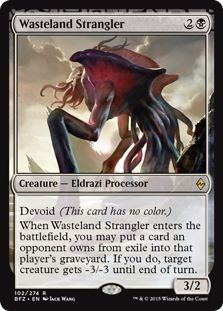
Wasteland StranglerThe only big mana deck was a single copy of BW Eldrazi, which went with the traditional (can something be traditional when it's only a few months old?) processors instead of Heartless Summoning. Tron hate is not always very effective against Eldrazi so I'm not surprised it survived the splash damage. What I am surprised about is, in a very aggressive field, Mahindra Bheodari got that far. Eldrazi is very weak to aggressive decks. What I'm curious about is singleton Celestial Colonnade in the board. I suppose it's possible Oblivion Sower can provide the mana to activate it, but when do you bring it in at all? It's interesting enough that I hope it isn't just a mis-entered Celestial Purge, and that someone can explain its presence and purpose.

The other interesting inclusion is Copeland's Grishoalbrand deck, though maybe that shouldn't be surprising. Goryo's Vengeance does not like Spell Snare or Dispel and with Twin gone those cards are not seeing enough play anymore. The Delver lists had the counters to stop the combo but the rest of the Top 16, not so much. If this continues, I'd expect Grishoalbrand to make more regular appearances in Top 8s and more graveyard hate and counters as a result.

Conclusion

As far as Week 1’s go, SCG Atlanta was particularly exciting. It’s awesome to see a “new” archetype take the trophy, and I’m glad we didn’t just see Infect or Tron slide in to replace Twin. That might still end up being the case, but for now the evidence suggests the tools exist to keep the format diverse and competitive without things becoming unbalanced in Twin’s absence. This is the most excited I’ve EVER been going into a Pro Tour, and I can’t wait to see what happens! See you next week!

Trevor Holmes
Twitch.tv/Architect_Gaming
Twitter.com/7he4rchitect
The_Architect on MTGO

Insider: MTGO Market Report for January 27th, 2016

Are you a Quiet Speculation member?

If not, now is a perfect time to join up! Our powerful tools, breaking-news analysis, and exclusive Discord channel will make sure you stay up to date and ahead of the curve.

Welcome to the MTGO Market Report as compiled by Matthew Lewis. The report will cover a range of topics, including a summary of set prices and price changes for redeemable sets, a look at the major trends in various constructed formats, and a trade of the week section that highlights a particular speculative strategy with an example and accompanying explanation.

As always, speculators should take into account their own budget, risk tolerance and current portfolio before buying or selling any digital objects. Questions will be answered and can be sent via private message or posted in the article comments.

Redemption

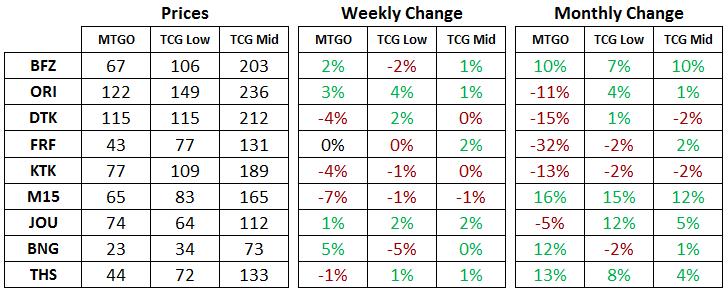
Below are the total set prices for all redeemable sets on MTGO. All prices are current as of January 25th, 2016. The TCG Low and TCG Mid prices are the sum of each set’s individual card prices on TCG Player, either the low price or the mid price respectively.

All MTGO set prices this week are taken from Goatbot’s website, and all weekly changes are now calculated relative to Goatbot’s ‘Full Set’ prices from the previous week. All monthly changes are also relative to the previous month prices, taken from Goatbot’s website at that time. Occasionally ‘Full Set’ prices are not available, and so estimated set prices are used instead.

jan25

Flashback Draft of the Week

The original Mirrodin block flashback drafts have ended, to be followed by a hiatus as Oath of the Gatewatch (OGW) prerelease events begin on Friday and run over the weekend. The next flashback draft will start in three weeks on February 17th and will be triple Champions of Kamigawa draft to kick off Kamigawa block draft.

Modern

After the recent market turmoil due to the banning of Splinter Twin and Summer Bloom, prices have started to come down in general. A former high flier that has really suffered is Keranos, God of Storms from Journey Into Nyx. After peaking near 50 tix, it can now be found rather easily in the 26 to 27 tix range.

This type of drop definitely piques my interest as its very easy to imagine some kind of blue-red deck moving into the void created by the departure of Twin decks. If Keranos continues to show up as a key sideboard card, this recent drop could be a good buying opportunity. A price of 20 tix or less should be a snap buy for players to pick up a couple of copies to keep in their collection.

Speculators and players alike should be taking a hard look at the cards in their collections and judging whether or not its worth keeping something like Grove of the Burnwillows which has recently hit 53 tix. Players who can't imagine playing anything but Tron in Modern should keep their playsets, but this price level for this type of card is extreme. If Tron is that good in the new Modern, it will be under threat of a ban at some point.

Standard

With OGW being released in paper and the first tournament results including this set trickling in, attention is shifting back to Standard. Prices on recent sets are in fluctuation as the format digests the addition of the new cards. MTGO players and speculators alike should be sitting on their excess tix at this point with an eye to scooping up any deals that show up in the next couple of weeks.

Broadly speaking, we should be looking at targeted purchases of cards from Dragons of Tarkir and Magic Origins first. These two sets will still be in Standard after Shadows Over Innistrad is released in April. Today's Standard staple is likely to be player in the next iteration of Standard, although there will always be room for format all-stars to drop in utility and for unplayable cards to find a home.

For speculators that want to keep things simple and avoid picking stocks, adding Battle for Zendikar (BFZ) sets into your collection is an excellent way to diversify and reduce risk. Set prices bottom while a set is being drafted and then rise when a set is not being actively drafted. This simple rule means patient speculators and players can expect modest medium- to long-term gains on BFZ sets purchased over the next month.

Cards from Fate Reforged (FRF) and Khans of Tarkir (KTK) are the riskiest bets at this point. With only a few months left in Standard, the specter of rotation will hang over the price of these sets.

A card like Warden of the First Tree is heavily played in Standard and is at a low price relative to its history. It's a prime candidate for a bounce back in the next three months, but it's not guaranteed. Seeing zero play in Modern means that this card will be heading to below 0.5 tix at some point after April.

Speculating on a Standard-only cards from FRF and KTK is a guaranteed loser in the long term, so only nimble speculators should consider speculating on Standard singles from these two sets.

Standard Boosters

The key booster trade this week is to buy OGW boosters during the prerelease weekend. Events will be tix-only entry and pay out in OGW boosters, which means that players will be looking to sell their prizes in order to play more events as they won't be able to use them to draft or play sealed deck. Once prerelease events wind down on Monday, release drafts will start accepting boosters as an entry option.

What this means is that there is a temporary window where the price of an OGW booster is depressed because it isn't very useful and some players will convert them into tix. After this window closes, the price of an OGW booster will increase along with their utility.

Speculators and players alike should be on the lookout this weekend for discounted OGW boosters. This type of trade can be quite crowded and so don't expect to be able to deploy hundreds of tix at optimal prices. An OGW booster at 3.5 tix or less should be considered a fair price for a short-term gain or just a discount to the store price. If you have the opportunity to buy any amount of boosters at 3.3 tix or less, don't be afraid to snap them up as quickly as you can.

Having said all that, there is no data on how the price of OGW will evolve over the next week. Previously small sets were introduced into draft queues as a single booster, but two boosters of OGW will be used. This will also be the first small set introduced under play points. Both of these new effects are stimulative to demand, so this might mean that boosters prices don't fall below 3.5 tix.

In a situation like this, where there are a lot of unknowns, the best advice is to update your expectations as more data becomes available. If prices start out at 3.1 for an OGW booster on Friday night, this might be a screaming deal or it could be the sign of lower prices to come. My bias would be to expect higher prices than that over the weekend, so I wouldn't be afraid to start buying if I saw prices like 3.1 tix.

However, there would be a nagging doubt about the direction of prices, which could only be allayed by checking back in on Saturday morning. If prices had recovered to 3.3 tix or higher at that point, then I would have no fear of going deeper on OGW boosters as my expectations would be proven correct. But if prices had dipped below 3.0 tix, then I would not be a buyer and would have to go back to the drawing board on my thoughts on booster prices in this new environment.

Elsewhere, FRF boosters have continued to drift down and now sit below 1.6 tix, which is getting very close to their all-time low of 1.4 tix. Players should not be afraid to top up their booster supply at these prices. Speculators will want to deploy tix into FRF boosters with the kick off of OGW release events, though it should be a lower priority booster spec this weekend.

These would be a medium-term spec, looking for a selling window in March of over 2 tix. I put the likelihood of this price move at 60%, but the downside is quite limited. I would say there's only a 5% chance that FRF boosters will drop below 1.4 tix before the first week of March.

KTK boosters have proven to be very stable, and with the presence of the all-format staple fetch lands, there is a very strong reason to suspect prices will not dip in any meaningful way. Look for any price weakness over the next week as an opportunity to stock up on these boosters. I would put the likelihood that KTK boosters crest 3.5 tix again in the next two months at 75% with a small chance of 10% that they drop to 2.8 tix or less.

Trade of the Week

A trade I made over the weekend was to target Serum Visions; you can see the portfolio entry at this link. I bought two playsets; one from Fifth Dawn and the other the promo version. Considering a recent price history fluctuating between 2 and 8 tix, 2.5 tix seemed like a safe level to buy this card. Although it might not hit 8 tix in the next year, I would say there's an 80% chance of a return to 5+ tix over this time frame.

This type of trade should be the bread and butter of any speculator. The temporary supply from flashback drafts is always an opportunity to look for good prices on staples such as Serum Visions. Modern staple commons that have seen prices above 5 tix invariably will see a return to those prices at some point.

The only event that threatens a drastic price decrease on staple commons is a full-on reprint in a current release or a Modern Masters type release. Both of these events are possible in 2016, but unlikely in my mind. Modern Masters sets have so far been well telegraphed in advance, and have occurred every other year up to this point, which points to the next big round of reprints from a Modern Masters set occurring in 2017.

A reprint of Serum Visions in a current release is possible, but with scry having been a mechanic recently seen in quantity out of Theros block, I find it unlikely to see such a narrow reprint in the near-term. Although scry did show up in OGW on Seer's Lantern, this is more a utility card and not a showcase for the mechanic, which is what I'd expect if Serum Visions was reprinted.

New Brews for a New Modern

Are you a Quiet Speculation member?

If not, now is a perfect time to join up! Our powerful tools, breaking-news analysis, and exclusive Discord channel will make sure you stay up to date and ahead of the curve.

Hey there!

I may be late to the party on this one, but hear me out.

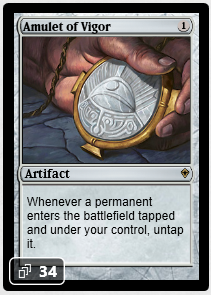
To the shock of literally no one they banned Summer Bloom. Yet, Amulet of Vigor lives to fight another day. Perhaps with Asusa, Lost but Seeking or Explore there is a Hive Mind shell still worth playing, but without the free turn two win the deck certainly seems less appealing.

Very few saw the second ban coming. Splinter Twin is no longer modern legal. This has some serious implications. People keep talking about why Twin was banned and are caught up in the financial hullabaloo or what wizards was thinking. I'm much more invested and interested in getting a grasp of the format before the first major events.

Assumption One: Twin's good matchups will be the first thing people gravitate towards.

Tron, Affinity, and to some extent the Eldrazi Temple decks are the obvious choices. Without a consistent combo-control shell like Twin was, these decks are more appealing than ever. If there is no fear of dying to the control deck with mana up, people will just jam their un-counterable threats into open Islands all day.

Less obvious choices include things like Eggs, Delver of Secrets and Geist of Saint Traft decks. The latter two wanted to play a tempo role against almost every deck; Provide a clock- disrupt accordingly. The problem was that Twin could play card for card with them and never needed to be up on board to win a game. Without Splinter Twin legal, the control decks of the format need to win on board, or with something like Keranos, God of Storms, Vedalken Shackles or Batterskull. Exactly the sorcery speed type things Delver or Geist decks want their opponents to try and resolve through their disruption.

Assumption Two: People hate tron, and want to beat it rather than join it.

Decks like Infect, Burn, Ad Nauseam, GriselCannon, Zoo, and Affinity have an arguably good Tron matchup. These would be the easy choices when people want to beat Tron. Going under the deck is the easiest way to get through them without simply comboing them out.

Assumption Three: If people are playing land based midrange/ramp decks and hyper aggressive decks, Tarmogoyf or Remand will be sub par choices.

Ok, this one is a little bit of a stretch, but I do think there is some merit to the assumption. Very similar to the statement above, If people play Tron, Affinity, and Burn, then Jund or Grixis control aren't the most optimal choices. Sure they can win those matchups with a little luck and enough side-boarding, but keep in mind that everyone gets to skimp on their twin hate. Those Rending Volleys, Torpor Orbs, Slaughter Pacts, Dampening Matrixes, etc... are all easy cuts from sideboards at the moment. Jund and the Control decks get splash hated on via all the Fulminator Mage, Blood Moon, Negates and what not people will be supporting more of.

Conclusion One: The format is about to get a whole lot more aggressive.

If its the case that Tron is the new format overlord, then Overgrown Tomb decks will fade into the shadows, and Infect, Burn, Affinity and Tron's general bad matchups will surface. Trying to go over Tron is not a reliable game plan, leaving only the option to go under, or combo them out. As with life, this is cyclical. The rise of infect and Burn will lead to anti-aggro builds of Jund/Abzan given time.

Conclusion Two: Each deck will be lowering their curve.

As the format progresses, advancing a game plan sooner will likely be the way decks want to be built. Especially if they need to interact with most decks on earlier turns. Playing Kitchen Finks on three into Obstinate Baloth on four is good against burn sure, but Tron and Infect will stomp that game plan.

So what is a brewer to do? If People will still be playing decks all over the spectrum even after the banning, I believe the answer is and always has been:

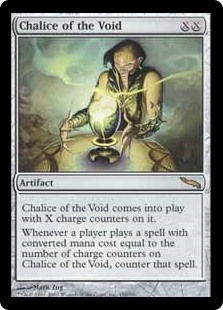
There was an error retrieving a chart for Chalice of the Void

That's right, the card I've been advocating for weeks has gotten even better! The difference this time is that a Blood Moon shell may not be the right home. Which begs the question, what is the right home for a soft-locking artifact? There are plenty of decks that cannot afford to play Chalice on one at any point in the game because of the way they are/needs to be constructed. Here are a few options that can be constructed differently:

UW Emeria Titan

Creatures

2 Jace, Vryn's Prodigy
3 Kitchen Finks
1 Snapcaster Mage
4 Wall of Omens
2 Court Hussar
2 Pilgrim's Eye
4 Sun Titan

Spells

4 Chalice of the Void
3 Journey to Nowhere
2 Mana Leak
1 Mortarpod
1 Negate
2 Think Twice
1 Sphinx's Revelation
1 Ojutai's Command
2 Supreme Verdict

Lands

3 Emeria, the Sky Ruin
4 Flooded Strand
4 Ghost Quarter
4 Hallowed Fountain
2 Island
7 Plains
1 Prairie Stream

This deck has put up occasional results on MTGO and the random Regional event, but has never broken through to be a great deck. Perhaps it's still not time, but outside of Path to Exile, this deck doesn't lose anything by playing Chalice of the Void. Now, it seems like a big loss not having Snapcasters and Path to Exiles, you're asking for trouble against a lot of decks with things like Kitchen Finks or Voice of Resurgence. Hopefully with Wall of Omens and Kitchen Finks of our own there is enough to stall before Sun Titan hits to make them irrelevant.

This deck could even play Trinket Mage with a package involving Spellbombs or Hangarback Walker in addition to the Chalice of the Void. That may be worse than simply playing a gifts package. Lets Look at an actual Trinket Mage deck:

UB Trinket Tezz

Creatures

3 Trinket Mage
1 Hangarback Walker

Spells

2 Engineered Explosives
1 Nihil Spellbomb
4 Thirst for Knowledge
1 Pithing Needle
4 Mox Opal
2 Ensnaring Bridge
4 Chalice of the Void
3 Tezzeret, Agent of Bolas
2 Tezzeret the Seeker
3 Liliana of the Veil
1 Ashiok, Nightmare Weaver
1 Everflowing Chalice
2 Damnation

Lands

2 Swamp
1 Buried Ruin
3 Watery Grave
2 Island
1 Urborg, Tomb of Yawgmoth
1 Sunken Ruins
2 Tectonic Edge
3 Scalding Tarn
2 Verdant Catacombs
4 Darksteel Citadel
1 Creeping Tar Pit
1 Tolaria West
1 Academy Ruins
2 Nephalia Drownyard

Chalice and Pithing Needle don't play along that nicely, but the 1-of Trinket Mage target is likely worth it. It alone can give game against Tron and its many activated abilities. The full set of Mox Opal allows for some nutty draws involving early planeswalkers and empty hands for Ensnaring Bridge purposes. If Kolaghan's Command isn't a prevalent thing, Tezzeret might be able to break into tier one status. Even if Kolaghan's Command decks exist, it's possible grinding them out with planeswalkers is a viable strategy. It is also worth noting that this deck is certainly weak to Stony Silence, though it doesn't outright fold to it.

Tezzeret decks in general do a few things very well. Tezzeret, Agent of Bolas will often read suspend 1: Win the game- an effect that isn't to be ignored. Nor is Tezzeret the Seeker's ability to tutor up Ensnaring Bridge while multiple Nephalia Drownyard ends the game. This isn't the most controlling build of the deck possible, but it should have enough staying power to be a contender against a metagame of everyone trying to hate on Tron, though it is admittedly weak to Tron itself.

Earlier in this article, I pseudo-denounced Blood Moon. Even so, the card still has a role to play in quite a few match ups. Against Tron for example, it can slow them down enough to clock them properly. Against Jund and Abzan lists, it can still lead to free wins. However, against Eldrazi ramp decks, it may not be relevant enough if they simply cast their spells for their intended costs. A turn five Blight Herder still clogs up the board enough to be annoying. Attacking their lands seems like the most obvious way to interact with them, but that doesn't necessarily need to come from Blood Moon. Something like G/W Hate bears could likely be the answer, but that conversely doesn't have a bye against Tron.

There was an error retrieving a chart for Smallpox

New 8 Rack

Spells

4 Inquisition of Kozilek
4 Raven's Crime
4 Smallpox
4 Thoughtseize
2 Warping Wail
4 Liliana of the Veil
1 Dismember
1 Go for the Throat
1 Murderous Cut
4 The Rack
4 Shrieking Affliction
4 Ensnaring Bridge

Lands

2 Ghost Quarter
4 Tectonic Edge
2 Mutavault
2 Sea Gate Wreckage
9 Swamp
4 Urborg, Tomb of Yawgmoth

The lack of Wrench Mind is notable, but with every deck in the expected meta having artifacts the card seems sub par. Attacking lands with Ghost Quarter, Tectonic Edge, and Small Pox may just be good enough to keep the Eldrazi deck off enough mana to cast Oblivion Sower off the top. Preventing them from getting things started allows this deck to Raven's Crime them out of the game.

This deck is quite weak to Chalice of the Void, but before people catch on it may be just the deck to punish some of the land based ramp decks. Plus, this deck has a reasonable Aggro match up and can reliably beat quite a few format outliers by simply resolving an Ensnaring Bridge.

If you are looking for some hot pickups post ban, I'd look for either Tezzeret, as neither has moved price was is quite some time. As with most bannings, people will likely be looking to unearth some of their old favorite archetypes.

That's all for this week, but tell me what you think. Are my assumptions and conclusions correct? Do you think Tron will be our new format overlord? Or will Infect, Burn and Affinity keep its numbers reasonable?

Thanks for reading!

Follow me on Twitter and Twitch @BDP1337

A Dangerous Room for a Dangerous Age

Are you a Quiet Speculation member?

If not, now is a perfect time to join up! Our powerful tools, breaking-news analysis, and exclusive Discord channel will make sure you stay up to date and ahead of the curve.

Call it Danger Room. Call it Battle Box. I call it the most fun a person can have playing Magic with their clothes on.

I've learned to deal with the fact that most people commonly call the format "Battle Box," however with that in mind my Battle Box is the Danger Room. It is the first Battle Box from which all other Battle Boxes originate. I take great pride in that aspect of my stack and I actively put a great deal of effort into balancing it. I'd like to think that not only is it the original Battle Box, but that the Danger Room is the best stack ever assembled.

I haven't gotten much of a chance to write about the Danger Room lately and for good reason---Battle for Zendikar was a terrible Battle Box set. Most of the interesting and/or fun cards of the appropriate power level dealt directly with lands or made Eldrazi scion tokens.

One of the most important elements of the Danger Room is equal mana development for both players, and there are only 10 lands available in any game (five basics and five allied tapped lands). Therefore, landfall is pretty lame (since you can actually draw these cards after you've played your 10th land and they have no ability) and Eldrazi scions are out because they produce additional mana and help players ramp.

Well, if BFZ was milk toast I can only say that Oath of the Gatewatch (OGW) has been full on French toast with a side of bacon and a make-your-own-omelette station!

First of all we get an additional set of comes-into-play-tapped duals to make additional and easily identifiable land sets.

These are a nice addition to the cycles we already have. Invasion, 8th Edition, Coldsnap, Guildgates, and now the Oath cycle! These don't really impact game play in any way but they are a neat change of pace.

My stack has a very strong emphasis on color balance. I always keep the same number of cards. I reworked my stack a while back and ever since then it has remained a consistent 486 cards.

  • 65 cards of each color.
  • 30 artifacts.
  • 100 bicolor multicolor spells (10 of each guild).
  • 30 tricolor multicolor spells (3 of each shard and wedge)
  • 1 Fusion Elemental

Additions From Oath

Slip Through Space

Slip Through Space is a fine card. Kind of like Shadow Rift except that it has devoid. I wanted to showcase a few of the devoid cards because they look cool and are a big part of the current set. It was also nice because a few more unblockable tricks always make for exciting gameplay.

Ayli, Eternal Pilgrim

There was an error retrieving a chart for Ayli, Eternal Pilgrim

Ayli, Eternal Pilgrim is a pretty sweet card. I really enjoy cards that have a bunch of abilities on them and I think that life gain is a difficult thing to find room for in this format. The life gain cards tend to be great---but they are typically just things like Loxodon Hierarch that is a big body with life gain attached to it. Ayli is a decent body with deathtouch that also has some incidental life gain built in. I'm a big fan and love these interesting card designs!

Void Shatter

Another cool devoid card. There are Red Elemental Blast effects in the stack so Void Shatter is a counter that dodges that which is a neat interaction. I also think the card looks sweet in foil. It replaced Dissipate---so just a slightly better version of that card that looks cooler.

Seed Guardian

Seed Guardian is sweet and I'm very excited to play with it. It has a nice body and reach which is pretty sweet in this format where flying matters quite a bit. Also, when it dies---especially if games go long---you have the chance to receive a very, very robust elemental token. Also worth noting is that the elemental token that goes with the Guardian has some of the coolest artwork in the set, period. So, I'm looking forward to getting that into play soon.

Sylvan Advocate

There was an error retrieving a chart for

Another super cool green creature from OGW. I love that this creature is a solid early drop that scales to also be great in the later game. It is always lame to draw little beatdown creatures later on in the game once all ten lands in play, but at least this creature has a big enough body to matter once the game goes long. It is also sweet that he has a 2/3 body which defends well against a lot of the utility bear creatures in the early game.

Goblin Dark-Dwellers

There was an error retrieving a chart for

The card is obviously insanely good but I'm giving it a try. Eyeless goblins that cast spells are intriguing to me. I probably don't need to justify why this is a card people would want to play with. However, just in case an explanation was necessary, here it goes: The card is freaking sweet.

Reflector Mage

Reflector Mage is exactly the kind of card the Danger Room was originally created to facilitate playing! Fun and interesting creature-based Magic. While I think this card will have an impact on Constructed I'm just happy to have picked up a foil one to include in my stack! The foil also looks super sweet because it has a bunch of mirrors in the art that are very foiled out and makes the card look fantastic.

Void Grafter

I love Void Grafter as a Battle Box card. It does a lot of great things. First of all, it is essentially a counterspell for a removal spell targeting one of your creatures. However, it also has a sizable body and can drop down into play during combat to ambush an attacking creature in a pinch. 2/4 is the perfect-sized body for an ambusher.

Stormchaser Mage

Another great multicolor card from OGW. He basically replaced Frostburn Weird in my stack, so a pretty strict upgrade. Always good when I can replace one of the least exciting cards in the stack with a similar card that is much, much better! At the cost of one toughness Stormchaser Mage gains the following abilities +flying, +prowess, +haste...

Baloth Null

I'm kind of on the fence about whether or not Baloth Null will ultimately turn out to be too obnoxious. Getting back two creatures and having a big sassy body is a lot for a card in this format. That being said, zombie beast is a cool creature type and the card is pretty awesome. It might be exactly what a six-drop ought to be in this format!

The Updated List

Blue Creatures

Aeon Chronicler
Bonded Fetch
Cephalid Sage
Delver of Secrets
Dungeon Geist
Jace's Phantasm
Jolting Merfolk
Looter il-kor
Lu Xun, Scholar General
Man-o'-war
Merfolk Looter
Mulldrifter
Neurok Invisimancer
Phantasmal Image
Phyrexian Metamorph
Plaxmanta
Sakashima's Student
Serendib Efreet
Snapcaster Mage
Stratus Dancer
Sun Ce, Young Conquerer
Vesuvan Shapeshifter
Whirler Rogue
Willbender
Wonder

Blue Spells

Allied Strategies
Ancestral Vision
Braingeyser
Careful Consideration
Circular Logic
Complicate
Concentrate
Control Magic
Counterspell
Deep Analysis
Dismiss
Dispell
Envelop
Evasive Action
Exclude
Fact or Fiction
False Summoning
Forbidden Alchemy
Jace's Ingenuity
Jolt
Miscalculation
Negate
Neutralizing Blast
Opportunity
Persuasion
Power Sink
Probe
Psionic Blast
Remand
Remove Soul
Repulse
Sift
Slip Through Space
Steal Artifact
Stolen Identity
Syncopate
Talrand's Invocation
Tidings
Unsummon
Void Shatter

Black Creatures

Bane of the Living
Big Game Hunter
Bloodsoaked Champion
Bone Shredder
Coffin Queen
Crypt Angel
Dakmor Lancer
Dark Hatchling
Entomber Exarch
Gnarled Scarhide
Grim Haruspex
Gurmag Angler
Herald of Torment
Keening Banshee
Lifebane Zombie
Liliana's Specter
Nekrataal
Nezumi Graverobber
Ophiomancer
Phyrexian Gargantua
Phyrexian Rager
Reassembling Skeleton
Royal Assassin
Serpent Assassin
Shriekmaw
Silumgar Assassin
Skeletal Vampire
Skinrender
Vampire Nighthawk
Withered Wretch

Black Spells

Animate Dead
Annihilate
Chainer's Edict
Consuming Vapors
Cremate
Damnation
Dance of the Dead
Dark Banishing
Despise
Dismember
Disturbed Burial
Doomblade
Duress
Ghastly Demise
Go For The Throat
Hymn to Tourach
Inquisition of Kozilek
Last Gasp
Murder
Murderous Cut
Night's Whisper
Ostracize
Rend Flesh
Ribbons of Night
Ritual of the Machine
Sever the Bloodline
Skeletal Scrying
Smother
Sudden Death
Terror
Thoughtseize
Tragic Slip
Unburial Rites
Undying Evil
Unearth

White Creatures

Ancestor's Chosen
Angel of Finality
Azorious Herald
Belfry Spirit
Blade Splicer
Cloudgoat Ranger
Commander Eesha
Eidolon of Countless Battles
Exalted Angel
Flickerwisp
Frontline Medic
Galepowder Mage
Geist-Honored Monk
Hidden Dragonslayer
Imposing Soverign
Isamaru, Hound of Konda
Karmic Guide
Knight of Glory
Kor Sanctifiers
Mardu Woe-Reaper
Mother of Runes
Restoration Angel
Rhox Faithmender
Savannah Lions
Serra Angel
Shrieking Grotesque
Silverblade Paladin
Soldier of the Pantheon
Soulfire Grandmaster
Soul's Attendant
Spectral Lynx
Sunscape Battlemage
Wall of Omens

White Spells

Akroma's Vengeance
Apostle's Blessing
Austere Command
Chained to the Rocks
Dawn Charm
Day of Judgment
Dismantling Blow
Divine Deflection
End Hostilities
Feeling of Dread
Final Judgment
Hallow
Hallowed Burial
Kirtar's Wrath
Lingering Souls
Midnight Haunting
Momentary Blink
Phyrexian Rebirth
Reciprocate
Renewed Faith
Resounding Silence
Rout
Scout's Warning
Seed Spark
Spear of Heliod
Sunlance
Swords to Plowshares
Terminus
Valorous Stance
Wing Shards
Wrath of God

Green Creatures

Ana Battlemage
Basking Rootwalla
Blastoderm
Boon Satyr
Briarhorn
Caller of the Claw
Citanul Woodreaders
Deathmist Raptor
Den Protector
Elvish Visionary
Eternal Witness
Flinthoof Boar
Genesis Hydra
Hooded Hydra
Imperious Perfect
Indrik Stomphowler
Jade Mage
Kava Predator
Kavu Titan
Loaming Shaman
Lumberknot
Master of the Wild Hunt
Mitomic Slime
Obstinate Baloth
Ohran Viper
Patagia Viper
Pelakka Wurm
Phantom Centaur
Polukranos, World Eater
Reclaimation Sage
River Boa
Scavenging Ooze
Seed Guardian
Skyshroud Elite
Stingflinger Spider
Sylvan Advocate
Thragtusk
Thornscape Battlemage
Thornscape Apprentice
Uktabi Orangutan
Vengevine
Wall of Blossoms
Whisperwood Elemental
Wild Mongrel
Wild Nacatyl
Wickerbough Elder
Wolfir Avenger

Green Spells

Avoid Fate
Autumn's Veil
Call of the herd
Forgotten Ancient
Gaea's Might
Giant Growth
Gnaw to the Bone
Harmonize
Moment's Peace
Predator's Strike
Rancor
Regrowth
Resounding Roar
Spider Spawning
Storm Seeker
Tracker's Insight
Whirlwind
Withstand Death

Red Creatures

Alesha, Who Smiles at Death
Anger
Corrupt Eunuchs
Crimson Muckwader
Cunning Sparkmage
Desolation Giant
Dualcaster Mage
Goblin Dark-Dwellers
Feldon of the Third Path
Fire Imp
Flametongue Kavu
Flamewake Phoenix
Fledgling Dragon
Fumiko the Lowblood
Grim Lavamancer
Hound of Griselbrand
Ingot Chewer
Kird Ape
Krenko, Mob Boss
Mindclaw Shaman
Mountain Yeti
Oracle of Bones
Pia and Kiran Nalaar
Siege-Gang Commander
Thunderbreak Regent
Thunderscape Battlemage
Vulshok Sorcerer
Young Pyromancer
Zurgo Bellstriker

Red Spells

Arc Lightning
Arc Trail
Barbed Lightning
Blind with Anger
Brimstone Volley
Burning Oil
Burst Lightning
Carbonize
Chain Lightning
Disintigrate
Expedite
Faithless Looting
Fireball
Firebolt
Flame Slash
Flames of the Firebrand
Forked Bolt
Hordeling Outburst
Incinerate
Lightning Bolt
Lightning Strike
Pillar of Flame
Punishing Fire
Pyroblast
Red Elemental Blast
Resounding Thunder
Roast
Searing Spear
Shock
Shower of Coals
Slice of Dice
Staggershock
Starstorm
Stoke the Flames
Tribal Flames

Artifacts

Basilisk Collar
Brittle Effigy
Chariot of Victory
Crystal Shard
Culling Dais
Duplicant
Engineered Explosives
Etched Oracle
Hangarback Walker
Icy Manipulator
Juggernaut
Lightning Greaves
Living Wall
Loxodon Warhammer
Mask of Memory
Mirror Universe
Nihil Spellbomb
Peace Strider
Perilous Vault
Pierce Strider
Power Matrix
Pyrite Spellbomb
Runechanter's Pike
Serrated Arrows
Spellskite
Sylvok Lifestaff
Tawnos Coffin
Trip Noose
Triskellion
Whispersilk Cloak

Gruul

Artifact Mutation
Assault // Battery
Bloodbraid Elf
Dragonlair Spider
Fanatic of Xenagos
Fires of Yavimaya
Ghor-Clan Rampager
Ground Assault
Huntmaster of the Fells
Savage Twister

Selesnya

Advent of the Wurm
Dromoka's Command
Elderwood Scion
Enlisted Wurm
Kitchen Finks
Loxodon Hierarch
Loxodon Smiter
Mystic Enforcer
Selesnya Charm
Voice of Resurgence

Azorius

Absorb
Azorious Guildmage
Detention Sphere
Hindering Light
Lyev Skyknight
Ojutai's Command
Ordered Migration
Reflector Mage
Supreme Verdict
Wall of Denial

Dimir

Baleful Strix
Consult the Necrosages
Countersquall
Dragonlord Silumgur
Far // Away
Psychatog
Shadowmage Infiltrator
Soul Manipulation
Spite // Malice
Terminate
Woodlot Crawler

Rakdos

Bituminous Blast
Blazing Specter
Blightning
Deepfire Elemental
Hellhole Rats
Kolghan's Command
Murderous Redcap
Rakdos Charm
Shambling Remains

Boros

Basandra, Battle Seraph
Boros Charm
Boros Guildmage
Boros Reckoner
Bull Ceradon
Intimidation Bolt
Lightning Helix
Spitemare
Warleader's Helix
Wear // Tear

Simic

Aether Mutation
Ethereal Ambush
Horizon Chimera
Icefeather Aven
Jungle Barrier
Mystic Snake
Plaxcaster Frogling
Shardless Agent
Simic Charm
Void Grafter

Izzet

Counterflux
Dack's Duplicate
Electrolyze
Etherium-Horn Sorcerer
Fire // Ice
Izzet Charm
Prophetic Bolt
Stormchaser Mage
Swerve
Turn // Burn

Golgari

Abrupt Decay
Baloth Null
Consume Strength
Dreg Mangler
Gleancrawler
Golgari Guildmage
Maelstrom Pulse
Nyx Weaver
Pernicious Deed
Putrefy

Orzhov

Ayli, Eternal Pilgrim
Blind Hunter
Castigate
Death Grasp
Mortify
Orzhov Pontiff
Pillory of the Sleepless
Sin Collector
Utter End
Zealous Persecution

3-Color Multicolor Spells

Crackling Doom
Ponyback Brigade
Mardu Charm

Sidisi, Brood Tyrant
Sultai Charm
The Mimeoplasm

Adun Oakenshield
Jund Charm
Sprouting Thranax

Gwendlyn Di Corci
Slave of Bolas
Tetsuo Umezawa

Bant Charm
Rhox War Monk
Rubina Soulsinger

Dromar's Charm
Esper Charm
Punish Ignorance

Savage Knuckleblade
Temur Ascendancy
Temur Charm

Fiery Justice
Marath, Will of the Wild
Woolly Thoctar

Lightning Angel
Mantis Rider
Sage of the Inward Eye

Abzan Charm
Crime // Punishment
Doran, the Siege Tower

Fusion Elemental

~

And that, ladies and gentlemen, is my current Danger Room stack updated through Oath of the Gatewatch. If you haven't played this format before be sure to check it out. It's an absolute blast to play.

Did I miss anything from the new set? Or any cards that you've got in your stack that you really enjoy that I haven't included? Be sure to let me know in the comments or tweet suggestions at me @briandemars1.

Thanks for reading.

Cheers,
Brian

Early Metagame Snapshot in Twinless Modern

Are you a Quiet Speculation member?

If not, now is a perfect time to join up! Our powerful tools, breaking-news analysis, and exclusive Discord channel will make sure you stay up to date and ahead of the curve.

It hasn't even been a full week since Twin got buried on the Modern banlist, and although Exarch is still mourning, it's time for players to buck up and dive into the new metagame. If you play paper Modern, the controversial January 18th announcement went into effect last Friday the 22nd. MTGO folks had to wait until today, January 27, to wave farewell (or good riddance) to the URx Twin pillar. Although we can't run a proper metagame update without major paper event Day 2 and Top 8 data, not to mention the missing MTGO Dailies and Leagues, I've amassed enough finishes from last weekend to offer an enticing preview of what is to come. In today's article, we'll get our first data-driven snapshot of the Twinless Modern metagame.

Signal Pest art

Modern players, professionals, and pundits have been theorizing about the post-Splinter Twin metagame since the update went live. Writing mere hours after Wizards posted the announcement (they expedited its release due to a MTGO Beta leak), ChannelFireball's Neal Oliver predicted a swell in Infect, Affinity, Bogles, and other unfair decks. He also identified Jund as a possible loser. Since then, other authors have sparred over whether the ban would open space for other decks or lead to a linear coup, with most agreeing on David's "Assumption 1" from yesterday's article: decks with bad Twin matchups get better. It's all been (mostly) educated guesswork so far.

Thankfully, I'm finally armed with a new batch of Saturday and Sunday finishes and ready to unpack the metagame with numbers and not just theory. Read on to see where the speculation went right, where it missed the mark, and overall how the new Modern metagame is taking form!

[wp_ad_camp_1]

Event Data Collection

Our Top Decks spreadsheet has been pining for data since the Twin banning: I've ignored it, knowing there was no reason to enter anything until we had post-ban statistics. Last weekend saw our first batch of 14 new events covering 126 Top 8 and Top 16 decks, all representing a Modern sans Twin. Sadly, we won't have MTGO data until Thursday, so the spreadsheet is going to have some gaping holes until then, but 14 events is more than enough to stake out early projections.

I'm filling in the gaps with some sweet field-wide data from two events. The first comes out of an 80-player Modern 2k hosted by MTG Card Market, an impressive Magic shop in my hometown of Chicago. Big shoutout to the folks at the Market for responding to my request for their data; you are Modern heroes! The second dataset is from the Dutch 4 Your Games Invitational circuit, which saw 44 participants on Sunday. These tournaments not only added Top 8s to the broader paper dataset, but also contributed complete Round 0 listings of who played what deck. By looking at both the paper field in Top 8 and Top 16 performances, along with the Round 0 metagame ledger, we'll get a holistic picture of how the format is shaping out. Naturally, all cautions about small samples apply, but it is much better to analyze an N=14 dataset than debate in an N=0 theoretical whiteroom.

Round 0 Metagame and Expectations

I consider us lucky if tournaments even give us a Day 2 metagame, although I've taken it for granted with Grand Prix events, Pro Tours, and Opens for much of 2015. Most of the time we're stuck on Top 8s. Top 16s too, if we're lucky. The fabled Day 1 metagame is unheard of in Grand Prix coverage: I think the last time we saw one at that tournament level was during Yokohama in June 2012. Pro Tours have featured them in the past but 2015's Fate Reforged event only gave us Day 2 data. Today's article breaks that mold, showcasing Round 0 metagames for two post-Twin paper scenes. Because these were single-day events, we don't have anything fancy like a Day 1 to Day 2 conversion breakdown. I also don't have final standings for all players and decks to track overall success rates by strategy. That said, this type of data is still incredibly valuable because it shows what average Modern players decided to bring to their first post-Twin tournament.

The table below identifies decks with 2+ showings at one individual event, or 2+ appearances total between both. This accounts for 87% of the combined fields. The remaining 13% made only singleton appearances at one tournament or the other, and they are displayed in a spoiler box underneath the table. Columns two and three separate the table data by event. Column four gives a merged share as a percentage of all strategies played in both tournaments combined. Examining all three of these divisions will help us notice variations between combined metagames and individual ones.

Deck4YourGamesMTGCardMarketCombined %
Affinity4 (9.1%)4 (5.6%)7.0%
Burn3 (6.8%)5 (7%)7.0%
RG Tron4 (9.1%)4 (5.6%)7.0%
Jeskai Control0 (0%)7 (9.9%)6.1%
Hatebears3 (6.8%)3 (4.2%)5.2%
Abzan Company3 (6.8%)3 (4.2%)5.2%
Grixis Midrange2 (4.5%)4 (5.6%)5.2%
Bogles1 (2.3%)4 (5.6%)4.3%
Eldrazi0 (0%)5 (7%)4.3%
Living End3 (6.8%)1 (1.4%)3.5%
Gruul Zoo3 (6.8%)1 (1.4%)3.5%
Griselbrand3 (6.8%)1 (1.4%)3.5%
Jund2 (4.5%)2 (2.8%)3.5%
Infect1 (2.3%)3 (4.2%)3.5%
Naya Company1 (2.3%)3 (4.2%)3.5%
Scapeshift1 (2.3%)2 (2.8%)2.6%
Merfolk2 (4.5%)0 (0%)1.7%
Ad Nauseam0 (0%)2 (2.8%)1.7%
Abzan0 (0%)2 (2.8%)1.7%
4C Gifts0 (0%)2 (2.8%)1.7%
BW Tokens0 (0%)2 (2.8%)1.7%
Soul Sisters0 (0%)2 (2.8%)1.7%
Dredgevine1 (2.3%)1 (1.4%)1.7%

As promised, here are the 15 decks that only managed a single appearance at only one of the two tournaments last weekend. Of the lot, only UW Control and Kiki Chord cracked the Nexus Tier 2 listings in 2015. The rest loitered around Tier 3 or lower (plus an unimportant tournament win here and there).

[su_spoiler title="The Rogue 13%" style="fancy" icon="arrow"]

Doran Abzan (4YourGames)
Goblin ElectromancerFaeries (4YourGames)
Mardu Midrange (4YourGames)
Esper Control (4YourGames)
Lantern Control (4YourGames)
UW Control (4YourGames)
Storm (4YourGames)
Jeskai Midrange (4YourGames)
RW Land Destruction (MTGCardMarket)
4C Goodstuff (MTGCardMarket)
Tooth and Nail (MTGCardMarket)
Jeskai Delver (MTGCardMarket)
Martyr Proc (MTGCardMarket)
Kiki Chord (MTGCardMarket)
Death Cloud (MTGCardMarket)

[/su_spoiler]

Again, I emphasize the need for caution in drawing conclusions from only two relatively isolated (and entirely independent) fields. We can mitigate these dataset limitations by treating the tournaments as case studies to illustrate overarching format narratives, not just small N datasets to cycle through some T Tests. Following this approach, there are a few broader themes we can identify that will help you navigate the post-Twin world.

Theme 1: Overwhelming Diversity

Tooth and NailDo you get lost scrolling through the table above? Feeling adrift in this diffuse new field? Excellent! You understand our first finding: the new Modern is staggeringly diverse at a local level. This doesn't even count the additional decks comprising the Rogue 13% that poked up last weekend. You're playing a perilous game if you try to Next Level and metagame in such an environment. There are simply too many potential opponents. Even if you wrangled together 75 cards with a positive Affinity, Tron, and Burn matchup, you still might hit nothing but Ad Nauseam, Abzan, Bogles, Eldrazi, and Scapeshift all day long. And that assumes you dodge oddballs like Tooth and Nail (hopefully with original Mirrodin art), Mardu Midrange, and RW Land Destruction. Don't fall into this trap.
Theme 2: Popular Theory Can Fall Flat

Before this weekend, common wisdom suggested new URx strategies might surface to assume Twin's old shares. Jeskai Control rose to that challenge in Chicago, Cryptic Commanding 9.9% of the MTG Card Market field. Across the Atlantic, however, the URx successor made literally 0 showings. Jeskai also petered out in Chicago, sending none of its pilots to the Top 8. Popular theory also Wasteland Stranglersuggested Bx Eldrazi would wreak so much havoc on Modern that Wizards needed to emergency ban Eye of Ugin before January 22nd came around. Although Eldrazi slithered to a 7% share in the Windy City, the Dutch Great Old Ones put up a fat 0%. Part of the gulf is undoubtedly due to player differences between MTG Card Market (80) and 4 Your Games (44). But that's precisely the point: many of us attend smaller tournaments where this variance plays a huge and underappreciated role.

As we'll see in the more comprehensive metagame analysis, a deck like Eldrazi is still putting up respectable numbers across the amorphous, Modern-wide board (Restoration Angel, not so much). Broader metagame aside, be very careful in making these assumptions at the local, 30-60 player level many of us are a part of. Not every field looks like a Grand Prix Day 2 (let alone a Pro Tour Day 2)! This caution is something we don't talk about a lot in our metagame breakdowns but is more pressing than ever in this unusually open Modern.

Theme 3: Differences Aside, there is Common Ground

For skeptical analysts, experienced Modern players, and cynical readers, it comes as no surprise that relatively small events like these will produce yawning differences. It might come as a much larger surprise, however, that their fields actually have a lot in common. Using this data, I want to highlight shared strategies between tournaments, suggesting a Modern-wide core we'll need to expect in subsequent weekends.

To account for regional differences, a small sample size, and variance between given events, I've filtered the above table to only include the more consistent appearances. I've defined these contenders as decks meeting two criteria. First, they must have 1+ showing at both events, not just 2+ overall. Secondly, their share at any given event cannot be lower than the average share among decks at all events. These parameters halved the Round 0 list to 12 strategies down from 24. I've pulled them out of the above table to highlight below:

Deck4YourGamesMTGCardMarketCombined %
Affinity4 (5.6%)4 (9.1%)7.0%
RG Tron4 (5.6%)4 (9.1%)7.0%
Burn3 (4.2%)5 (11.4%)7.0%
Hatebears3 (4.2%)3 (6.8%)5.2%
Abzan Company3 (4.2%)3 (6.8%)5.2%
Grixis Midrange
2 (2.8%)
4 (9.1%)
5.2%
Living End3 (4.2%)1 (2.3%)3.5%
Gruul Zoo3 (4.2%)1 (2.3%)3.5%
Griselbrand3 (4.2%)1 (2.3%)3.5%
Jund2 (2.8%)2 (4.5%)3.5%
Infect1 (1.4%)3 (6.8%)3.5%
Naya Company1 (1.4%)3 (6.8%)3.5%

Looking solely at what decks people brought to the tournament, these are the 12 strategies I would be prepared to face. Put in reps against these and you'll be ready to rock against about 60% of the field on a given day. That said, and to steal my own thunder from the following section, these aren't the consistent winners in the current Modern field. These are only Round 0 strategies. These are the decks players sleeved up and registered, with no consideration given to their eventual clawing into the Top 8. Although you'll certainly want to brace yourself for those high-profile Top 8 and Top 16 challengers, you'll also need to expect these 12 decks en route to the big leagues. In essence, these are strategies people thought would be well-positioned going into the event. Moderners on both sides of the globe agreed these were smart places to be, and you can bet other pilots will follow that logic in selecting decks at smaller and mid-size tournaments.

Goblin GuideFrom a deck perspective, this field heavily reflects the so-called Assumption 1 everyone has made as they enter into the new Modern. Affinity feels very safe. RG Tron too, although competing metagame forces might work against it at higher tables. Some players made tight metagame calls with trusty Jund and old school Hatebears (which is probably a misclassified Death and Taxes, but I don't have lists to check), although most just went linear. Indeed, the overwhelming majority (~67%) of these 12 decks fall somewhere on the linear gameplan spectrum, with only Jund, Hatebears, Grixis Midrange, and Abzan Company moving into more interactive territory. Even if you migrate Living End and Naya Company into the linear camp, you're still looking at an expected Round 0 field where 53%+ of your decks are solidly linear. We'll explore this linear tendency more in the next section.
Early Round vs. Top Tables

As a whole, the notion of a Round 0 metagame can be very helpful if managed carefully in testing and deck selection, but deeply harmful if misread. Given the nature of this species of data, which Wizards generally doesn't make public, we can't draw too many quantitative conclusions from these numbers. It would be foolish to look at these two tournaments and expect Affinity to be a flat 7% of all other events too. That said, in assessing relative magnitudes between deck shares, and in remembering the overarching themes mentioned above, we can use this data to help us know what to expect (and what not to expect) at all stages of a tournament. As Modern develops more, these Round 0, Assumption 1-style metagame pictures become less helpful. But in this more open phase of Modern realignment, they help anchor us in what the everyman Moderner is up to.

Early Top 8 and Top 16 Picture

Now that we know what people are bringing to tournaments, we can figure out what is actually winning. This next section draws from the 14 events and 126 finishers gathered over last weekend. Like previous metagame breakdowns, I'm aggregating those finishes to create a descriptive, prevalence-based estimate of what decks are appearing in tournament Top 8s. Unlike in your conventional Modern Nexus metagame analysis, I won't be worrying too much about tiering. Although the spreadsheet is hard-coded to tier decks based on their metagame share, it's too early to generalize those rankings into actual Tier 1 and Tier 2 divisions.

The table below shows all the decks currently passing either Tier 1 or Tier 2 benchmarks with our limited sample size. In addition to their metagame-wide share, I also add their Round 0 prevalence as a point of comparison. The final column checks whether any given deck also showed up as a regular Round 0 decks in the "Theme 3" section's table. We can use this binary variable to see which decks are truly common in the new Modern, which decks might be overrepresenting in Top 8s, and which decks could be underperforming relative to theoretical Round 0 presence.

DeckMeta %Round 0 %Round 0
Regular?
Affinity12.5%7%Yes
Burn8.6%7%Yes
Abzan Company6.2%5.2%Yes
RG Tron5.5%7%Yes
Jund5.5%3.5%Yes
Merfolk5.5%1.7%No
Eldrazi5.5%4.3%No
Infect4.7%3.5%Yes
Elves3.1%0%No
Storm2.3%0.8%No
Death and Taxes2.3%5.2%Yes
Ad Nauseam2.3%1.7%No
Griselbrand2.3%3.5%Yes
Naya Company2.3%3.5%Yes

In keeping with the spirit of spotlighting rogue finishes, here are the decks currently scoring a Tier 3 rating on our Top Decks page. I'm not including them on the table above due to lower shares, but don't count them out of the Modern fight yet! Any of these decks could still make waves in the weeks to come.

[su_spoiler title="Top 8/16 Fringe" style="fancy" icon="arrow"]

UR Delver (1.6%)
Slippery BogleBogles (1.6%)
Living End (1.6%)
Gruul Zoo (1.6%)
Kiki Chord (1.6%)
Titan Shift (1.6%)
Temur Delver (1.6%)
Grixis Control (1.6%)

This list excludes decks with solitary appearances at single events. Examples of such decks include more mainstream offerings like Scapeshift, Jeskai Control, BW Tokens, Abzan, and Grixis Midrange, as well as offbeat journeymen such as Goblins, Cheeri0s, Death Cloud, and Jeskai Black.

[/su_spoiler]

Reviewing the above decks and situating them alongside the Round 0 field, we notice a few consistent performers and overall Modern motifs. We'll continue the theme list we started in our first section: even though we've added data to the Modern narrative, all our earlier takeaways are still at play.

Theme 4: Yes, Linear Decks are Strong

The Top 8 field points to an unsurprising confirmation: linear decks are roughly as strong as many suspected they would be. This is clearest in Arcbound Ravagerthe fourth column of the table where we track the overlap between Top 8 and Round 0 datasets (for instance, here's the Top 8 at MTG Card Market). RG Tron, Burn, Infect, Grishoalbrand, Naya Company (depending on how linear you make that deck out to be), and Affinity all emerge as commanding frontrunners in the new Modern. Especially Affinity, which was tied for first in the Round 0 dataset and is about 4% ahead of the next competitor (Burn) in the Top 8/Top 16 metagame. This undoubtedly reflects both the actual strength of Affinity in a Twinless metagame, and also its perceived strength by players whipped into a panic by the robots' theoretical power in the new Modern. Because the format is still evolving, and because the upcoming Theme 5 is very much present, don't be too nervous about this linear uptick, but do prepare to face it in the approaching weeks.
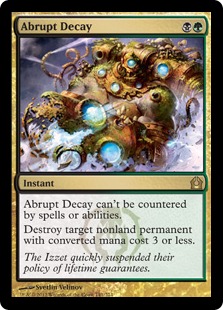
Theme 5: No, Interaction is not Dead

Abrupt DecayDespite a surge in decks trying to goldfish their way to victory, some of the more midrangey, interactive strategies are still alive and kicking. Jund saw as much play as RG Tron over the weekend. Abzan Company, a deck some will erroneously argue as combo, took the Modern bronze as the third most-played deck across all 14 tournaments (at least, using Top 8s as an indicator). Death and Taxes (not Hatebears) brought up the rear in the 2%-3% range, right around Grishoalbrand and Naya Company. These datapoints suggest the tales of interaction's demise have been mightily exaggerated. Don't commit headlong to linear decks just because Reddit tells you to. Today's numbers suggest a number of interactive strategies are much more viable than originally appraised.
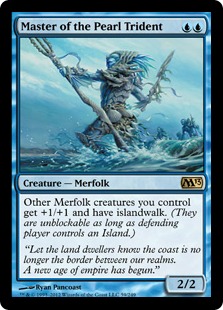
Although we'll certainly need more data to fully confirm or reject Theme 5's longevity, it's a promising trend in this new format.

Theme 6: Beware the Outliers!

Master of the Pearl TridentDiscerning readers will notice Merfolk's and Eldrazi's absence from Themes 4 and 5. If you played at the MTG Card Market tournament, however, you might have seen at least five of Cthulhu's Bx brood stomping around the tables. A BW version even made it into the Top 8 before succumbing to Ad Nauseam in the quarterfinals. Similarly, although Merfolk was relatively unseen in our earlier Round 0 listings, the fish performed much better at a metagame-wide level. Both decks sit at 5.5% alongside Jund and RG Tron and are sure to define the format going ahead. Similarly, Elves had a 0% goose egg in the Round 0 sample, but Lead the Stampede to a 3.1% share overall.
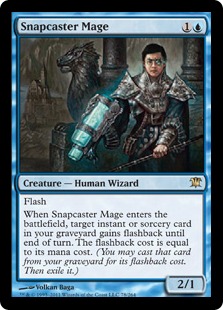
Although today's data analysis does not find sufficient evidence to rank these decks alongside Jund, Burn, Affinity, and RG Tron, we have more than enough datapoints to suggest they can get there. You should expect these strategies at tournaments and prepare for them in your tests. You should also be on the lookout for similar decks to worm out of the woodwork as the field continues to emerge. For example, Ad Nauseam and Storm could be very well positioned in the format.

Where is URx?

Speaking of the discerning readers, many of you will have noticed a potentially alarming, possibly relieving, lack of URx decks in these listings. Indeed, a quick glance at the table earlier in this section shows not a single URx deck in those Top 8/Top 16 fields. We do see many more of them in the "Fringe" spoiler breakout, but this is hardly the URx renaissance Wizards hoped for in banning Splinter Twin. Given that this was explicitly cited as a reason to ban Twin in the first place, this might be cause for worry. Or panic! Or RAAGE!

Snapcaster MageFor now, let's make a collective Feat of Resistance to stay positive. Many players are still looking for the optimal URx configuration. Many more have bought into the narrative of a URx downfall and packed away their Snapcaster Mages. Once we smooth over these early format shocks, I'm confident we'll see more URx decks fill in the gaps. Last weekend already saw early indicators of a blue-red comeback! This included Nicholas Bruno's Jeskai Control list seizing first at an SCG IQ in Columbus, a Top 8 Kiki Control finish Nikolin Lasku in a 116-player Italian Magic League tournament, and, of course, Todd Anderson's Temur Delver win at the Atlanta Classic. Keep testing, stay optimistic like these players, and don't buy into popular frenzies until we get more data.
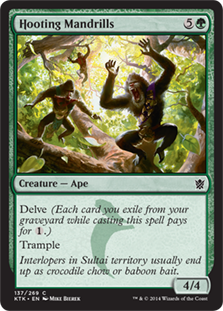
More Metagame Evolutions to Come!

The focused data analysis in today's article should give you firm footing into the coming weeks, at least until those Pro Tour players gum up the works. That said, we need to Hooting Mandrillsexercise caution in viewing today's metagame evaluation like we view the regular Nexus updates during more stable periods. Fluctuations are inevitable in this dynamic Modern context. Perception becomes reality, changing formats from weekend to weekend or even day to day. As an example of this, URx Delver enjoyed very modest success at the weekend-wide tournament level, holding down a mere 3% of the format in all its combined iterations. And yet, Anderson's well-publicized Temur Delver finish at last weekend's Classic might suddenly shift everyone to Hooting Mandrills and the deck's namesake bugman. I'm sure Jordan will do everything in his power to make that a reality! This isn't to say Anderson's finish is an anomaly or that URx Delver is good or bad. It's simply to point out that public reaction to his win will influence next weekend's field as much or more than what decks are actually tested in the metgame. We are going to lack that information for some time, but this is a helpful start.

Thanks for reading and I hope you enjoyed our preview of the unfolding Twinless Modern metagame. We'll keep checking in on how things play out in the following weekend, and I'll be back next week to make some projections about how the Pro Tour field might evolve out of this ever-shifting metagame. What do you think of the different themes and takeaways from today's analysis? Do you have any observations of your own from last weekend? Want to share any tech or ideas as we head into Saturday? As Trevor is going to talk about tomorrow, it's a brave new Modern world, and we should all be excited to see where things lead.


Correction (1/27): An earlier version of this article incorrectly calculated percentages for decks. This has since been adjusted. 

How much are last sets worth?

Are you a Quiet Speculation member?

If not, now is a perfect time to join up! Our powerful tools, breaking-news analysis, and exclusive Discord channel will make sure you stay up to date and ahead of the curve.

After the release day, every set is going to lose some of its value.
This is well known by players as well as investors, but how much value has been lost by the last sets? Which of them is holding more value? How many rare cards are worth buying?

Discover this and other useful data with our new infographic!

QS_model02

QS_model02

Insider: Checking in With Expeditions

Are you a Quiet Speculation member?

If not, now is a perfect time to join up! Our powerful tools, breaking-news analysis, and exclusive Discord channel will make sure you stay up to date and ahead of the curve.

Welcome back, readers! Today's article is going to focus on the Expeditions from Battle for Zendikar (BFZ) and Oath of the Gatewatch (OGW). The aim is to review and analyze the prices compared to the originals.

Card Name Zendikar Expedition Price Pack Price Pack Foil Price Reprint Foil Price Notes
Ancient Tomb $105.20 $13.60 $16.00 FTV Foil only option
Arid Mesa $119.95 $53.49 $88.46
Blood Crypt $75.50 $13.50 $96.58 $24.58
Bloodstained Mire $125.96 $29.59 $134.99 $44.99
Breeding Pool $79.98 $16.00 $117.37 $35.49
Canopy Vista $47.99 $3.59 $9.20
Cascade Bluffs $91.15 $23.46 $65.00
Cinder Glade $48.58 $3.60 $9.05
Dust Bowl $67.73 $8.12 $72.99
Eye of Ugin $169.98 $37.90 $59.95 $46.99 MM2015 foil option as well
Fetid Heath $73.77 $28.80 $63.49
Fire-Lit Thicket $63.74 $12.75 $30.87
Flooded Grove $83.97 $21.15 $63.30
Flooded Strand $211.84 $34.43 $261.25 $72.04
Forbidden Orchard $67.17 $7.37 $18.88 $7.29 FTV Foil option
Godless Shrine $97.27 $12.34 $79.42 $32.89
Graven Cairns $55.99 $7.49 $24.95 $16.60
Hallowed Fountain $79.99 $13.31 $132.47 $36.35
Horizon Canopy $122.00 $65.12 $175.00
Kor Haven $59.13 $7.13 $45.00
Mana Confluence $69.95 $4.43 $18.41
Marsh Flats $119.97 $44.88 $79.76
Misty Rainforest $275.99 $59.85 $145.37
Mystic Gate $85.98 $16.39 $57.00
Overgrown Tomb $88.55 $11.75 $79.02 $30.00
Polluted Delta $259.99 $39.74 $331.10 $80.75
Prairie Stream $52.23 $3.41 $9.79
Rugged Prairie $61.37 $13.68 $30.39
Sacred Foundry $75.00 $14.94 $67.71 $31.21
Scalding Tarn $328.94 $99.73 $193.14
Smoldering Marsh $44.99 $3.06 $8.49
Steam Vents $116.29 $16.91 $109.99 $44.02
Stomping Ground $78.74 $13.58 $99.97 $32.76
Strip Mine $89.25 $14.55 $28.41 FTV Foil only option
Sunken Hollow $53.40 $3.90 $10.71
Sunken Ruins $82.97 $15.59 $52.49
Tectonic Edge $49.99 $2.15 $7.64
Temple Garden $77.12 $12.45 $67.54 $25.99
Twilight Mire $83.30 $37.13 $87.99
Verdant Catacombs $202.99 $61.82 $125.87
Wasteland $275.00 $67.14 $236.54 $195.95 Player Rewards/Judge
Watery Grave $79.41 $12.98 $78.61 $38.92
Windswept Heath $123.47 $26.09 $134.99 $48.49
Wooded Bastion $52.47 $11.49 $32.49
Wooded Foothills $139.95 $33.37 $124.99 $47.74


The next chart focuses on the multiplier on the original foil (usually a pack foil, but sometimes from a supplemental product).

Card Name Zendikar Expedition Price Pack Foil Price Multiplier
Ancient Tomb $105.20 $16.00 6.6
Arid Mesa $119.95 $88.46 1.4
Blood Crypt $75.50 $96.58 0.8
Bloodstained Mire $125.96 $134.99 0.9
Breeding Pool $79.98 $117.37 0.7
Canopy Vista $47.99 $9.20 5.2
Cascade Bluffs $91.15 $65.00 1.4
Cinder Glade $48.58 $9.05 5.4
Dust Bowl $67.73 $72.99 0.9
Eye of Ugin $169.98 $59.95 2.8
Fetid Heath $73.77 $63.49 1.2
Fire-Lit Thicket $63.74 $30.87 2.1
Flooded Grove $83.97 $63.30 1.3
Flooded Strand $211.84 $261.25 0.8
Forbidden Orchard $67.17 $18.88 3.6
Godless Shrine $97.27 $79.42 1.2
Graven Cairns $55.99 $24.95 2.2
Hallowed Fountain $79.99 $132.47 0.6
Horizon Canopy $122.00 $175.00 0.7
Kor Haven $59.13 $45.00 1.3
Mana Confluence $69.95 $18.41 3.8
Marsh Flats $119.97 $79.76 1.5
Misty Rainforest $275.99 $145.37 1.9
Mystic Gate $85.98 $57.00 1.5
Overgrown Tomb $88.55 $79.02 1.1
Polluted Delta $259.99 $331.10 0.8
Prairie Stream $52.23 $9.79 5.3
Rugged Prairie $61.37 $30.39 2.0
Sacred Foundry $75.00 $67.71 1.1
Scalding Tarn $328.94 $193.14 1.7
Smoldering Marsh $44.99 $8.49 5.3
Steam Vents $116.29 $109.99 1.1
Stomping Ground $78.74 $99.97 0.8
Strip Mine $89.25 $28.41 3.1
Sunken Hollow $53.40 $10.71 5.0
Sunken Ruins $82.97 $52.49 1.6
Tectonic Edge $49.99 $7.64 6.5
Temple Garden $77.12 $67.54 1.1
Twilight Mire $83.30 $87.99 0.9
Verdant Catacombs $202.99 $125.87 1.6
Wasteland $275.00 $236.54 1.2
Watery Grave $79.41 $78.61 1.0
Windswept Heath $123.47 $134.99 0.9
Wooded Bastion $52.47 $32.49 1.6
Wooded Foothills $139.95 $124.99 1.1


Looking through this list we see a few that stand out. The highest multipliers likely imply an overconfidence in current price. The best examples of these are Ancient Tomb, Canopy Vista, Cinder Glade, Mana Confluence, Prairie Stream, Smoldering Marsh, Sunken Hollow and Tectonic Edge.

Of these options, Ancient Tomb's only foil is the From the Vault (FTV) version, so it makes sense that the Expedition would be much higher.

There was an error retrieving a chart for Ancient Tomb

Tectonic Edge and Strip Mine are the only other cards originally printed at uncommon, with Tectonic Edge being much more recent (hence why its foil price is so low) whereas Strip Mine's only previous foil was the FTV version.

The most important thing to note here is that with the exception of Tectonic Edge, the BFZ "tango lands" have the highest multipliers across the board. As these lands haven't really found a home in any eternal formats, they are likely overpriced at their current value.

Looking in the other direction we see that the Expeditions that are worth less than their original pack foils are Blood Crypt, Bloodstained Mire, Breeding Pool, Dust Bowl, Flooded Strand, Hallowed Fountain, Horizon Canopy, Polluted Delta, Stomping Ground, Twilight Mire and Windswept Heath. The majority of cards in this list are either fetches or shocks---both of which have been reprinted recently in Standard-legal sets which provide alternate foil options at very large print runs.

The two cards that stand out are Twilight Mire and Dust Bowl, which have only one printing previously and one foil option from that printing. Without a reprint, I expect both of these Expeditions to rise in value to match and exceed their original pack foils.

There was an error retrieving a chart for Dust Bowl
There was an error retrieving a chart for Twilight Mire

If we compare the Expedition price with the reprint foil option we can see that the Expeditions are valued above the reprints by quite a bit. Note that the Wasteland "reprint foil" referenced below is the judge foil.

Card Name Zendikar Expedition Price Reprint Foil Price Multiplier
Blood Crypt $75.50 $24.58 3.1
Bloodstained Mire $125.96 $44.99 2.8
Breeding Pool $79.98 $35.49 2.3
Eye of Ugin $169.98 $46.99 3.6
Flooded Strand $211.84 $72.04 2.9
Forbidden Orchard $67.17 $7.29 9.2
Godless Shrine $97.27 $32.89 3.0
Graven Cairns $55.99 $16.60 3.4
Hallowed Fountain $79.99 $36.35 2.2
Overgrown Tomb $88.55 $30.00 3.0
Polluted Delta $259.99 $80.75 3.2
Sacred Foundry $75.00 $31.21 2.4
Steam Vents $116.29 $44.02 2.6
Stomping Ground $78.74 $32.76 2.4
Temple Garden $77.12 $25.99 3.0
Wasteland $275.00 $195.95 1.4
Watery Grave $79.41 $38.92 2.0
Windswept Heath $123.47 $48.49 2.5
Wooded Foothills $139.95 $47.74 2.9


Next we'll look at the prices for Expeditions, pack foils, and reprint foils alongside each other:

expedition foil reprint comparison

As expected, the original Onslaught foil fetchlands have maintained a premium even over the Expeditions (with the exception of Wooded Foothills). Also to be expected, all of the reprinted foil versions of the shocks are considerably lower than the Expedition prices.

The other bit of information to pull from this is the huge discrepancy between the reprint foil shocks (from RTR block) and the original foil shocks (from Ravnica block). Return to Ravnica and Gatecrash foil shocks are surprisingly cheap right now, with the most expensive, Steam Vents, sitting at only $44 each.

I don't expect we'll see shocks return to Standard for quite some time. As Modern grows we should see a slow but gradual increase in demand for Modern foils (assuming WoTC's ban policy doesn't scare players away from pimping out their decks). Shocks are among the most important staples of the format and are sure to participate in such a trend.

Insider: High Stakes Bankroll Management on MTGO – Jan 17th to Jan 23rd

Are you a Quiet Speculation member?

If not, now is a perfect time to join up! Our powerful tools, breaking-news analysis, and exclusive Discord channel will make sure you stay up to date and ahead of the curve.

Introducing a New Article Series

If you've followed and loved the "100 Tix, 1 Year" project or you've been enjoying the MTGO Market Reports, then you'll probably love the new article series I'm starting today. "High Stakes Bankroll Management on MTGO" aims to be the perfect mix of the two series mentioned above--following realtime trades, bankroll management and perspectives on MTGO speculations.

If you followed the "100 Tix, 1 Year" project, you may have thought that 100 tix was a little too small of a bankroll for your consideration. You may have been right as a fair share of the speculations made within this project were tailored for small bankrolls. Here I'm raising the bar a little bit, about 200 times...

The bankroll I'll be dealing with for this new series is over 20,000 tix and counting. Similarly to the "100 Tix, 1 Year" series, all my trades, buys and sales will be recorded, posted and available in realtime, but this time only for QS Insiders. I set up a google spreadsheet that recapitulates the current state of my portfolio and all the most recent trades to make it easier for viewers to follow the action.

The Spreadsheet

Here is the link to the google spreadsheet. I'll update this spreadsheet within minutes to a few hours after completing any trades.

The way I organize my specs is pretty standard---name of cards, number of copies, total and per-unit prices, Modern, Standard and Other sections. I also include a percentage and tix gained/lost columns.

The recent trades are at the very top of the spreadsheet. Within each subsequent section the closed transactions are at the top followed by open transactions. From time to time I sort all of it in alphabetical order to review my specs more easily.

table

A Weekly Summary of My Transactions

In these weekly articles I will discuss my motivations to buy or sell any given positions during that week. I'll give a little bit of context and share my expectations on newly acquired positions.

Buys This Week

As it will be the case over the next few months, this week I was buying cards from Modern flashback drafted sets---Mirrodin, Darksteel and Fifth Dawn.

I didn't buy into the hype after the announcement of the new B&R list, partially because I was already holding several of the cards that spiked and partially because I was not really available on MTGO to grab the best cards at the best prices. Rather, I bought into cards that were directly affected by the ban of Summer Bloom but that, against all odds, present good speculative opportunities in my opinion.

CCM

As anticipated these three Mirrodin rares took a hit with the Mirrodin block flashback drafts. They are not heavily played in Modern, or in Legacy in the case of Chrome Mox, but I'm simply trying to ride the trend here.

Prices are unlikely to spike in the short term but they can't really go lower, and that's the point. These positions are better than free tix on my account and they always have the potential to spike sometime in the future.

SPST

These two are my current picks in Darksteel as of Saturday. I'm chasing more copies of both of them but I really want to keep my buying prices around 4.5 tix for Serum Powder and 4 tix for Sundering Titan. If prices keeping dropping I'll buy more for sure.

The Titan is almost unseen in Modern at the moment but has a record high above 15 tix. At an almost three-year low, it seems a good bet to me especially with a Modern format about to mutate.

With a current price half of its record high, Serum Powder only sees play in Vintage Dredge. Not great speculative stats here but I'm okay with that. After all Vintage got invigorated by the Power Nine Challenges and if Serum Powder integrated into a competitive Modern deck I would hit the jackpot.

SV

Serum Visions is still the best filtering engine available in Modern. The ban of Splinter Twin and the scheduled flashback drafts of Fifth Dawn are only delaying a large rebound this card should see very soon.

Among others, Storm decks might be returning consumers of the blue sorcery in place of Twin decks. This card is very unlikely to be reprinted in Standard and was not reprinted in Modern Masters 2015. My max buying price is currently 2 tix but I might accumulate more copies in the following days anyway at higher prices if needed.

AoV

I had bought some Amulet of Vigor prior to the announcement of the new B&R list. The bet didn't pay off but it doesn't mean I'm done with this spec.

Summer Bloom has been banned, not Amulet. There's always a chance a similar deck, slower and less explosive most likely, could be viable in Modern---if so, Amulet of Vigor would be a centerpiece. The price has almost doubled since its rebound and I'll buy more copies if the price goes down again.

PT

The idea is the same with Primeval Titan. The green titan got affected by the ban of Summer Bloom but can clearly find a home in other decks. Falling as low as 4.5 tix last week, the lowest it's been in Modern, I think the price drop is undeserved. I'm simply stocking up to be ready for Amulet 2.0 or any other decks using Primeval Titan.

MR

Not sure if the price drop of Misty Rainforest is due to the B&R list changes but it seemed like a good buying opportunity to me. I wanted to buy between 18 and 20 Tix which is why I only grabbed 8 copies. I would have been okay with 4 to 6 more copies at a cheaper price.

The goal with this spec is to see a comeback to the 30ish tix range. I was also lurking after Scalding Tarn but was too slow to pull the trigger and prices got too high for me.

Sn

Cloud of Faeries has been banned in Pauper. Not Snap. A plunge from 6 tix to 2 tix seems totally disproportionate to me. I bought some copies a little bit later than I wanted to but I'm fine at 2.5 tix. I won't be buying very often outside of Standard and Modern, but Snap deserved the extra efforts.

Sales This Week

This past week I continued to sell cards that benefited the most from the recent changes in Modern. These were unexpected profits and they have reached my goals---no reason to be more greedy here. I happily cashed out without having to wait on good or bad news from the Pro Tour.

I'll start with Blood Moon. In between 8th Edition and 9th Edition flashback drafts there will be a small window when the price could theoretically go up. With the banning of the deck that's most sensitive to this card (Amulet Bloom), as well as the deck most likely to play it (Twin), profit margins got too small for me. As the trend looked uncertain I sold now.

These were among the top gainers this past week, going beyond the expectations I had for these cards. A lot of cards spiked after January 17th and, as usual, not all of them will sustain such heights. I'm taking my profits now that I know what I get and will reinvest these tix somewhere else.

Of note, the unexpected extra tix made with these five cards totally made up for the losses I incurred with Splinter Twin, Summoner's Pact and my pre-ban gamble with Amulet of Vigor. As you can see I'm also holding a lot of other Modern staples that may shine sooner rather than later benefiting from these changes in the Modern metagame.

On My Radar

Besides buying Modern staples discounted by the flashback drafts, my next big investment will be Battle for Zendikar (BFZ) full sets. I intend to take advantage of a small dip that should occur during Oath of the Gatewatch (OGW) release events to accumulate several dozen BFZ sets.

BFZ sets got as low as 60 tix in December and may not reach that price in the following weeks. I'll be happy to start accumulating the sets around 63-65 tix. BFZ will still be drafted (as one booster per draft) and prices could dip further even after the release of OWG. If so, I might be buying more sets.

I expect BFZ full set value to start rising when Standard rotates in April with the release of Shadows Over Innistrad, when BFZ won't be among the newest sets to be drafted.

Questions & Anwsers

Here is a little section I'll be dedicating to answer questions or comments in more depth in future articles of this series. Feel free to leave a comment/question after this article, on Twitter (@lepongemagique) or on the forums.


Thank you for reading!

Sylvain Lehoux

Regionals Testing in a New Modern

Are you a Quiet Speculation member?

If not, now is a perfect time to join up! Our powerful tools, breaking-news analysis, and exclusive Discord channel will make sure you stay up to date and ahead of the curve.

Well, it's been quite a week hasn't it? The banning of Splinter Twin really touched a nerve with the whole community. However, that is now firmly behind us and continuing to bemoan (or extoll) that decision adds nothing new or useful. Instead, let us look to the future and answer the burning question: What now?

Lingering-Souls-Art-by-Bud-Cook-615x450[1]

Looking to the immediate future, next weekend there is a StarCityGames Open with a Modern Classic in Columbus. The weekend after there will be a Modern Pro Tour in Atlanta that some of you will be going to, and I wish I would stop getting second at PPTQs so I could join you. Therefore I (and most of the rest of you) will be attending SCG Regionals the Pro Tour weekend instead. To that end I, and all of you I expect, have been extensively testing Twinless Modern. I'm going to share my testing process today, as well as where I am in my deck selection process. Hopefully this will help you to refine or jumpstart your own, or at least avoid some of the pitfalls I've run into. Let's start at the beginning.

[wp_ad_camp_1]

It's a Good Place to Start

When a new set "normally" comes into Modern the main considerations you need to make are:

  1. What was the metagame before the release?Brimaz
  2. Did the release add any new cards/decks?
  3. Do those new cards affect my deck?
  4. Does this affect any of my matchups?

This will obviously depend greatly on the set and your deck. Khans of Tarkir obviously added many new cards and even some decks (Jeskai Ascendancy), drastically changing the Modern landscape (beyond Treasure Cruise I mean). In the Khans case, most players should have been answering "yes" to all those questions. A set like Born of the Gods on the other hand? Not so much (Brimaz, King of Oreskos and Courser of Kruphix see a little play).

This questioning doesn't work when a banning is thrown into the equation. It suddenly becomes a far more complicated affair, with the additions of:

  1. Does the loss of a good/bad matchup make {deck} (un)viable?
  2. Is {brew} now playable?
  3. What becomes of {banned deck} players?
  4. How does my sideboard need/able to change?
  5. What will the metagame look like?

Etc., etc., etc. While these are important questions to consider, addressing them all at once is not just overwhelming but unhelpful. You need to simplify. Scientists seek to test as few variables as possible for a reason, and in analyzing a new metagame, especially one where a format staple is gone, we should follow suit. My education was in economics and in that field we theorize and test variables ceteris paribus or all other things the same. While this isn't the most "complete" way of thinking about a new metagame, it is certainly more digestible, so I always start with a few ceteris paribus assumptions. Here are those assumptions after the Twin banning.

1. Decks with a bad Twin matchup get better
Arcbound RavagerThis shouldn't surprise anyone. Everyone, myself included, has lamented the fact that Affinity's worst matchup is now gone, a matchup that was bad for Tron, Scapeshift, and (depending on who you ask) Infect. Now that the turn four, two-card combo is no more, any deck that struggled to race it suddenly has more time to set up and/or can become more linear by eliminating the interaction they had to run to keep the matchup manageable. Exactly how this will pay out is unclear, but the baseline assumption still holds.

1b. Corollary: The converse is not necessarily true.
Just because a good matchup is suddenly gone does not necessarily mean your deck is not viable. Twin was 12.8% of the metagame on average over the last year so if the only reason to play your deck was because it beat Twin then it probably wasn't all that good to start with. Your deck must still have other good matchups and they remain good without Twin in the picture ceteris paribus.

2.  Everyone knows about Assumption 1
This also shouldn't surprise anyone since it's obvious and has been what everyone has talked about. If you aren't aware of the above Assumption 1 then you're doing a very good job hiding in your cave (can I join you until the election is over?). Across numerous sites and message boards, including our comments section, players and authors have been saying that Affinity is the big winner from the ban so it stands to reason that every enfranchised player is aware of this whether they agree with it or not. Thus, at least some will act on this belief. There will be attempts to "Next Level" the tournament, either through unusual deck selection or metagamed sideboard choices.

3.  Bx Eldrazi will continue to gain popularity
This was true before the ban. There's no reason to think it will stop now. Eldrazi has been everywhere online and in articles and there is no reason to think it is going away.

4. Popular decks will stay popular
Goblin GuideModern decks are expensive so it stands to reason that most players, having invested in a deck prior to January 18, will try to stick with their deck from before unless forced to change. Following this, a Burn player is more likely to remain a Burn player than change decks because a) they're invested both financially and time-wise, b) they already know how to play the deck, c) the Sunk Cost Fallacy means people tend to stick by their investment regardless of the value of doing so, and d) the deck may actually still be good.

You could certainly make more assumptions, but I'm sticking to these since, again, too many variables makes for unfocused study. Also, I have no way of knowing what the former Twin players will be doing. I'd imagine they'll stay URx, but whether or not that will be Delver or Grixis-style control is impossible to know, so I assume nothing about them. Looking at these three-and-a-half points, Assumptions 1 and 3 seem like good places to actually start our investigation. 4 is useful for purposes of testing since it allows us to use known decks from the previous gauntlet without worrying about wild changes being present, but it's not really something we can analyze. Basically it's me calling ceteris paribus on the rest of the metagame.

ForeseeThe problem with Assumption 2 is that it is very murky and relies on your ability to predict your opponents biases and deck selection. Go too far into this line of thought you fall down the rabbit hole of I know you know I know and that just confuses everybody. Unless you're going to a very small tournament, either an Invitational or your LGS, where you know exactly who will be there and what they tend to play, don't try to metagame deck choice in a new format. In an open tournament there is far too great a risk of Next Leveling yourself and picking a deck with no chance of winning against the actual metagame.
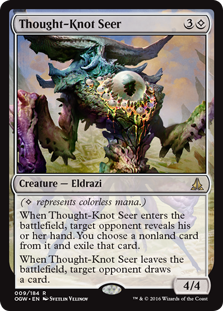
It's like picking Scissors in a field full of Rock, which Mike Flores, Brian Kibler and Richard Feldman wrote about a long time ago. For those too lazy to read those important pieces of theory, picking a targeted anti-deck pays off when you have The Read on a given tournament and fails unless you have a more general Plan B or a transformational sideboard. With this being Modern and sideboard space at a premium, that transition is quite hard. Stick to the variables you can observe and control and disregard everyone else's deck choice in your decision making. It will save you from inbred testing and a severe headache.

What do our Assumptions Mean?

What 1 and 3 suggest to me is that linear aggro and big mana strategies will be more popular than you would "normally" expect, at least in the short-term. Scapeshift is kind of an outlier since it is a combo deck that uses lots of land, similar to how Eldrazi is a midrange/ramp deck that uses a lot of land. That said, all these decks are trying to execute their gameplan while ignoring the opponent as much as possible. This suggests if you want an edge in deck selection you should either seek to force interaction and cripple the opposing game plan or have a faster goldfish. I consider these assumptions my testing parameters and use them to determine which deck(s) I spend my time on. Assumption 4 means that once I establish my deck's viability against the testing parameters, I need to run the full gauntlet and find out if my results are actually valid.

Where I Started

Thought-Knot SeerThose of you who read last week's article will remember I was working on both Esper Mentor and Merfolk. However, they aren't the only decks I keep in stock. I also keep UW Titan and Wx Hatebears mostly built in case the meta becomes favorable. With Twin gone and a poor matchup for the latter two decks eliminated, I gave all four decks a stress test under my established parameters to see how things went. I picked representative Affinity, Tron, and Infect lists from the Charlotte Open (they're all almost the same at this point), Thien Nguyen's Scapeshift list, and built an processor-based and Heartless Summoning version of BW Eldrazi. I modeled it on numerous lists I saw online using Thought-Knot Seer and Matter Reshaper. Then I played as many games against them as I and my testing partners could stand.

UW Titan

My Titan lists harken back to the pre-Deathrite Shaman era of Modern when Bloodbraid Jund dominated and the best way to grind out a win against it was recurring Kitchen Finks (not the best way to beat it, just to grind it out). Instead of the dedicated recursion engine Trevor showcased a while ago, my lists are more about maximizing individual value than the whole being greater than the parts.

UW Titan, by David Ernenwein

Creatures

3 Sun Titan
3 Snapcaster Mage
3 Vendilion Clique
3 Restoration Angel
4 Kitchen Finks

Instants

4 Path to Exile
4 Mana Leak
3 Spell Snare
2 Cryptic Command

Sorceries

4 Serum Visions
2 Supreme Verdict

Lands

4 Celestial Colonnade
4 Hallowed Fountain
4 Flooded Strand
4 Ghost Quarter
2 Prairie Stream
1 Emeria the Sky Ruin
6 Plains

When I've played the deck previously it had a very good matchup against Grixis, Burn, and BGx, and could hold its own against Tron and Bloom thanks to Ghost Quarter. The countermagic kept Scapeshift reasonable. The problem was it was a bit light on creature removal and so was vulnerable to Affinity and Infect pre-board. This was still true now. To make matters worse, Eldrazi is far more resilient to Ghost Quarter than Tron or Bloom since Eldrazi Temple and Eye of Ugin are more readily replaced by basics than Tron pieces are. UW Titan also wasn't fast enough to race Oblivion Sower and Ulamog, the Ceaseless Hunger. While it was still a solid choice against the rest of the metagame, I didn't think it could be made good enough to overcome the test parameters and so I tabled Titan. If BGx comes back in a big way then I'll run it, but not now.

Wx Hatebears/Death and Taxes

The thing about Hatebears/Death and Taxes is that you never ask if the deck is good but rather is Leonin Arbiter plus Ghost Quarter and Thalia, Guardian of Thraben good enough. In my experience, the more degenerate the format is, the better these cards become: making degenerate decks play 'fair' usually causes them to fall apart (just look at Legacy DnT vs. Storm). During the Treasure Cruise era they frequently were, although you also lost to Forked Bolt quite a bit.

Mono-White Death and Taxes, by David Ernenwein

Creatures

4 Leonin Arbiter
4 Dryad Militant
4 Thalia, Guardian of Thraben
3 Serra Avenger
2 Spirit of the Labyrinth
3 Vryn Wingmare
3 Flickerwisp
2 Aven Mindcensor
2 Kitchen Finks

Artifacts

4 Aether Vial

Enchantments

3 Honor of the Pure

Instants

4 Path to Exile

Lands

4 Ghost Quarter
4 Tectonic Edge
2 Mutavault
1 Eiganjo Castle
11 Plains

In the previous metagame, Thalia and Arbiter were rarely enough. Affinity was too fast and creature-heavy for Thalia to be good and too many other decks played too many lands for mana denial to be effective. You'd sometimes get lucky but more often you were just delaying how long it took for your creatures to be hopelessly outclassed.

This proved to be the case again, and while Strip Mine was surprisingly good against Eldrazi, if any of their threats ever resolved it was game over. Also, while the disruption package was decent against Tron, Pyroclasm was much better against us and swung many games in Tron's favor. It's harder for this deck to play around sweepers than Merfolk since your creatures are also your disruption, do not exponentially scale, have low toughness, and you need a more of them in play to win. I tested several different color/card combinations and configurations and the results were the same in all lists: if you couldn't set up the soft lock, took too long to win, or if they wriggled out of it on their own, you lost. Craig Wescoe and Eric Froehlich might disagree, but I don't think Hatebears is a good choice for the new Modern.

Merfolk

The list I showed you last week was the result of changes made based on the above assumptions. So far they've been right on the money and the deck remains unchanged since that past Monday.

UW Merfolk, by David Ernenwein

Creatures

4 Cursecatcher
4 Silvergil Adept
4 Lord of Atlantis
4 Master of the Pearl Trident
3 Harbinger of the Tides
3 Merrow Reejery
2 Kira, Great Glass-Spinner
2 Master of Waves

Artifacts

4 Aether Vial

Enchantments

4 Spreading Seas

Instants

4 Path to Exile
2 Echoing Truth

Lands

8 Island
4 Wanderwine Hub
4 Seachrome Coast
4 Mutavault

Sideboard

3 Stony Silence
2 Hurkyl's Recall
3 Hibernation
2 Kor Firewalker
2 Meddling Mage
1 Kira, Great Glass-Spinner
2 Rest in Peace

Prior to the banning, the deck had poor matchups against Affinity and Infect. It also always lost to Tron when it played Ugin, the Spirit Dragon, but normally won otherwise. Scapeshift was a manageable race and Eldrazi was a cakewalk. The Bx Processors didn't interact enough and was not sufficiently fast to win before you swamped them with fish. With the updates, the Affinity and Infect matchups improved slightly, though you were still unfavorable despite Echoing Truth and Harbinger being very good in both matchups. Scapeshift was worse without the counters, though still reasonable, and Eldrazi was still good even if Thought-Knot Seer proved better than expected. This satisfied me enough that I'm moving ahead with testing this deck for Regionals.

Esper Mentor

Like I said last week, I was very disappointed this deck lost a good matchup in Twin and was worried about both Affinity and Eldrazi. I also noted Affinity was probably fixable with Drown in Sorrow. The price, as it turned out, was that I had to cut the Monastery Mentors to make Drown work.

Esper Tokens, by David Ernenwein

Creatures

3 Snapcaster Mage
2 Vendilion Clique
3 Kitchen Finks
1 Sun Titan

Instants

4 Path to Exile
3 Spell Snare
2 Murderous Cut

Planeswalkers

2 Sorin, Solemn Visitor

Sorceries

4 Inquisition of Kozilek
4 Serum Visions
4 Lingering Souls
2 Painful Truths
2 Drown in Sorrow

Lands

3 Flooded Strand
3 Polluted Delta
2 Marsh Flats
2 Hallowed Fountain
2 Watery Grave
1 Godless Shrine
2 Plains
2 Island
1 Swamp
2 Celestial Colonnade
2 Creeping Tar Pit
1 Shambling Vents
1 Ghost Quarter

Sideboard

3 Wrath of God
3 Stony Silence
2 Duress
2 Dispel
2 Kor Firewalker
2 Relic of Progenitus
1 Negate

The Drowns were surprisingly good against both Infect and Affinity, greatly improving the matchup pre-board. The loss of Mentor was not terrible since it was never great in my bad matchups and died too readily against the midrange decks. He could potentially produce a huge clock against control decks but isn't where you want to be against big mana. Tron, Scapeshift, and Eldrazi were still problems, but that was mostly the result of Inquisition being very bad against them. As this seemed fixable, I decided to move ahead with testing Esper as well.

Where I am Now

There isn't much more to do with the Merfolk list. I've tested Sea Gate Wreckage as a one-of and it's good against attrition decks but pretty useless elsewhere so I'd leave it at home for now. The sideboard is still in flux and I need to wait until we get a better Sea Gate Wreckageidea of where the metagame is heading before I commit to anything. Harm's Way is looking attractive for both Burn and aggro matchups, but I'd rather not board in purely reactive spells. I may end up wanting Sunlance if aggro is big. I'm not as keen on 'Folk as I normally am since it did very well in Atlanta this past weekend and will be on people's minds going forward. It also suggests I should update my sequencing guide for the Merfolk mirror. However, my pet deck continues to prove the Merfolk core is still very strong and resilient despite being a well-known quantity. Harbinger of the Tides finally has the aggro and (judging by Todd Anderson's deck) tempo matchups it needs to really shine. Spreading Seas is proving its worth slowing down Tron and Eldrazi. If Affinity and Infect weren't looming in the background, it would be an easy pick for me.
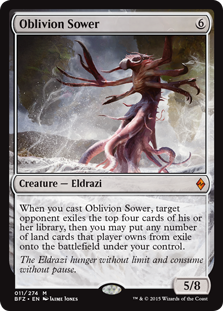
Esper Tokens, on the other hand, is showing considerable promise. It is very strong against Affinity and Infect thanks to discard and Lingering Souls. Swapping out the Inquisitions for Thoughtseize improved the big mana matchups and are still reasonable against aggro (Burn, less so), though I've been swapping them for the less painful option in sideboard games. I want both since extra discard is good against Grixis, Scapeshift, Grishoalbrand, and Jund so it's more a choice of which is the four-of in the maindeck. Esper Tokens is still somewhat weak to them, and that problem may not be fixable, but now you can prevent their big turn more readily and are more likely to race with Finks and Spirits than before.

Esper Tokens

Creatures

3 Kitchen Finks
4 Snapcaster Mage
2 Vendilion Clique

Instants

4 Path to Exile
3 Spell Snare
2 Murderous Cut

Planeswalkers

2 Sorin, Solemn Visitor

Sorceries

4 Thoughtseize
4 Serum Visions
4 Lingering Souls
2 Painful Truths
2 Drown in Sorrow

Lands

3 Flooded Strand
3 Polluted Delta
2 Marsh Flats
2 Hallowed Fountain
2 Watery Grave
1 Godless Shrine
2 Plains
2 Island
1 Swamp
2 Celestial Colonnade
2 Creeping Tar Pit
1 Shambling Vents
1 Ghost Quarter

Sideboard

3 Wrath of God
3 Stony Silence
3 Inquisition of Kozilek
2 Dispel
2 Kor Firewalker
2 Relic of Progenitus

I like the scry from Drown, but if Abzan Company is big in your area then Flaying Tendrils is better. This deck is the Abzan to Grixis' Jund and grinds very hard with Lingering Souls and Sorin. The manlands are also very important in a lot of matchups. I added another Finks over Clique due the former's value in offsetting the additional life you're losing from Thoughtseize. I've still got two weeks to work on it but I'm curious to hear your thoughts as well.

Oblivion SowerThis still doesn't answer the question of what deck I will play for Regionals and the reason is that I don't know yet. Merfolk will be better against a metagame full of big mana while Esper is the pick if aggro decks rule the day. Testing against the rest of the field is underway and, frankly, both decks are about equal for me. Tokens has better aggro matchups while Merfolk's speed is better against combo. Both are reasonable against midrange. In this situation, there is no true "right" decision. Each deck is weak against an opposing end of the metagame spectrum and are good to even against everything in the middle. The choice comes down to personal preference and what you perceive the metagame is doing.
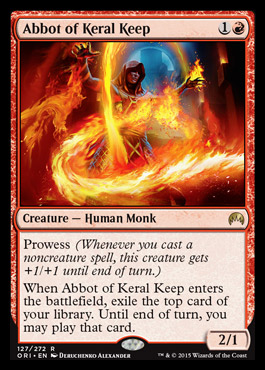


Unfortunately, we just don't have enough information to make a guess (and no matter what anyone says it will be a guess) at what the February 6 metagame will look like. The SCG Atlanta results suggest an aggro metagame, but one datapoint is not a trendline.  If this continues through Columbus at the end of the week, that will be significant and will make my decision easier. If not, then things will get interesting. I'd advise you to keep watching SCG for IQ and Classic results and make your metagame call no later than next Tuesday so that come Friday you will be ready for whichever event you're attending.

Brewing with OGW- Grixis Prowess

Are you a Quiet Speculation member?

If not, now is a perfect time to join up! Our powerful tools, breaking-news analysis, and exclusive Discord channel will make sure you stay up to date and ahead of the curve.

Ross Merriam posted some great content on SCG last week outlining a UR Prowess deck for Oath of the Gatewatch Standard. You can see the deck in action here. The deck was picked up by a number of players for the Atlanta Open, including Dalton Ozman who piloted the deck to a Top 8 berth.

UR Prowess by Dalton Ozman

Creatures

4 Abbot of Keral Keep
4 Monastery Swiftspear
4 Stormchaser Mage
4 Jace, Vryn's Prodigy

Spells

1 Dispel
2 Expedite
4 Fiery Impulse
2 Temur Battle Rage
4 Titan's Strength
2 Roast
4 Slip Through Space
4 Treasure Cruise

Lands

2 Island
3 Mountain
4 Bloodstained Mire
4 Polluted Delta
4 Shivan Reef
1 Smoldering Marsh
1 Sunken Hollow
2 Wandering Fumarole

Sideboard

2 Disdainful Stroke
2 Dispel
1 Murderous Cut
2 Wild Slash
2 Pia and Kiran Nalaar
2 Boiling Earth
2 Duress
1 Painful Truths
1 Roast

This deck falls into my wheelhouse exactly, so when I first saw these lists I was hopeful that they'd be great. There are definitely weaknesses here, specifically being that Expedite and Slip Through Space are conditional cantrips that don't even offer card filtering. As a person who has spoken ill of Gitaxian Probe on more than one occasion- a card better than both of these cards by a fair margin- I'm somewhat skeptical of this deck's staying power. That said, I want this deck to be great so I've been investing some time into polishing it.

Given the weakness of some individual elements of the deck, I find it peculiar that Painful Truths was only a one-of in Mirriam's list and a sideboard card in Ozman's. These decks certainly have explosive potential, but Treasure Cruise as the only good draw spell in a deck that needs to aggressively trigger prowess strikes me as a mediocre mix given the comparison to Atarka Red. If I need to build up for a delve spell I'd rather it just killed my opponent.

There was an error retrieving a chart for Become Immense

That said, tuning up the manabase to fully support Painful Truths adds a level of robustness that is great for decks that are this efficient. The life loss is at its most trivial in a deck that's just great at killing opponents. The other benefit of committing more to black is that we get to play a bunch of Duress. Duress helps build up delve for Treasure Cruise while making sure that our Slip Through Spaces and Titan's Strengths resolve. Hitting ramp spells out of Eldrazi Ramp and Rally the Ancestors is a nice bonus.

I'm not in love with Fiery Impulse in the maindeck, because I think for game one you just need to be a machine focused on getting them dead. This is the list that I intend to test when Oath launches on MTGO.

Grixis Prowess

Creatures

4 Monastery Swiftspear
4 Stormchaser Mage
4 Jace, Vryn's Prodigy
4 Abbot of Keral Keep

Spells

4 Expedite
4 Slip Through Space
3 Treasure Cruise
4 Painful Truths
4 Duress
4 Titan's Strength

Lands

4 Polluted Delta
4 Bloodstained Mire
1 Island
1 Mountain
1 Swamp
2 Sunken Hollow
2 Smoldering Marsh
2 Wooded Foothills
4 Shivan Reef

A lot of comments on Merriam's content have been that Jace has no place here, which I assume is mostly coming from players who want to find reasons not to play Jace because of its price tag. I will grant that Jace might not be the best fit for the deck, but considering that this deck just wants to keep casting spells, the looting Jace provides and the ability to flash spells back both shine here. It's also just another body to target with your cantrips when you don't find any of your 12 threats- a rather low density.

If Jace is wrong and/or out of your price range, I think you want to fill that space with at least two of the four slots going to creatures. Unfortunately, all of the options come with their own downsides. Zurgo Bellstriker is a solid enough card, but I don't think it shines in a shell that only plays Titan's Strength to make it do more than attack for two. Odds are you want to fill this slot with something with prowess.

I'm fairly certain that this deck really wants this slot to cost two mana and have two power. Trying anything else just might not be efficient enough, though Shu Yun is an option that that would be interesting to try. Seeing as this deck is always casting spells and always attacking, I'm inclined to believe that Mage-Ring Bully is the pick. I'm sure you'll catch some crap for battling with it, but that never stopped me from crushing people with it in Origins limited.

I'd flesh the rest of the deck out with one or two copies of Magmatic Insight. I wasn't kidding about wanting that loot effect. According to the comment section on the Vs. Video linked above, Merriam played one copy this weekend and it was great. It's superb at fueling Treasure Cruise, and is a one mana cantrip that does more to build a hand than your other cantrips- provided that you have a land to pitch.

I love the idea of this deck, and I hope that it just ends up being great. If it is to be great, then I'm firmly of the belief that Painful Truths is its future.

Want Prices?

Browse thousands of prices with the first and most comprehensive MTG Finance tool around.


Trader Tools lists both buylist and retail prices for every MTG card, going back a decade.

Quiet Speculation