menu

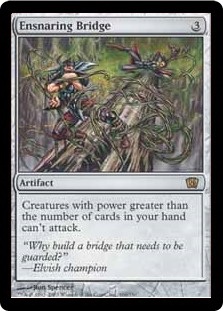
Stock Watch- Ensnaring Bridge

Are you a Quiet Speculation member?

If not, now is a perfect time to join up! Our powerful tools, breaking-news analysis, and exclusive Discord channel will make sure you stay up to date and ahead of the curve.

In recent weeks Ensnaring Bridge has been mentioned as a good spec by multiple Insider authors, and at this point in time cheaper copies of the card have disappeared from TCGPlayer for all three printings. A week ago the card was just over $20 and now the low listings on TCGPlayer are pushing $40.

There was an error retrieving a chart for Ensnaring Bridge

The price hasn't settled just yet, and $40 definitely strikes me as too high. At the time of this writing, buylist prices are close to the former market price, but no buylist is showing the price/confidence that you'd see for a $40 card. Ensnaring Bridge is a rather fringe card, and despite it belonging only to relatively old sets there is only so much demand. There are BIN auctions on Ebay right now in the low $20-$30 range. Assuming no reprint, I expect the value of the card to tick up over time, but don't take the current TCG prices as indicative of the actual current value.

Avatar photo

Ryan Overturf

Ryan has been playing Magic since Legions and playing competitively since Lorwyn. While he fancies himself a Legacy specialist, you'll always find him with strong opinions on every constructed format.

View More By Ryan Overturf

Posted in FreeTagged 2 Comments on Stock Watch- Ensnaring Bridge

Have you joined the Quiet Speculation Discord?

If you haven't, you're leaving value on the table! Join our community of experts, enthusiasts, entertainers, and educators and enjoy exclusive podcasts, questions asked and answered, trades, sales, and everything else Discord has to offer.

Want to create content with Quiet Speculation?

All you need to succeed is a passion for Magic: The Gathering, and the ability to write coherently. Share your knowledge of MTG and how you leverage it to win games, get value from your cards – or even turn a profit.

Deck of the Week – RG Titan Scapeshift

Are you a Quiet Speculation member?

If not, now is a perfect time to join up! Our powerful tools, breaking-news analysis, and exclusive Discord channel will make sure you stay up to date and ahead of the curve.

When I predicted Scapeshift would hit the Top 8 of Grand Prix Pittsburgh, I expected a traditional Temur shell built around the namesake finisher. Thien Nguyen skipped the countermagic and went right for the kill. Piloting an explosive, linear, and focused Scapeshift list, Nguyen blasted his way to a 7th place finish at the Grand Prix. Was it a temporary flareup? Another weird combo emerging in a format friendly to the archetype? I certainly thought so, at least until Joey Mispagel piloted a similar list en route to 12th at the StarCityGames Invitational last weekend. It looks like Scapeshift is blazing new territory and it's up to us to assess this approach.

Khalni Heart Expedition Art

In today's "Deck of the Week" feature, we'll look over Nguyen's and Mispagel's lists to see how they stack up in Modern. We live in a format clogged with oddball Top 8 performances and strange combo decks. This underscores the importance of unpacking these kinds of lists to see if they are breakout stars or one-hit-wonders.

[wp_ad_camp_1]

RG Titan Scapeshift Lists

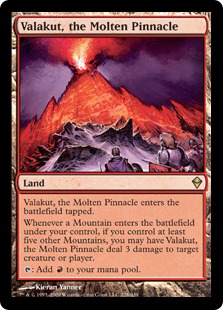
Although Nguyen and Mispagel get the December spotlight for bringing Titan Scapeshift lists back into the Modern spotlight, they are by no means the first players to use the combo-centric RG strategy. Eric Froehlich snagged 76th at Pro Tour Valencia in February 2014 with his own Titan build. We've also seen the Primeval Titan/Valakut, the Molten Pinnacle pairing in Ricardo van den Boogard's hands at Grand Prix Madrid in November of that same year: van den Boogard ditched Scapeshift but the ramp plan is similar. Nguyen and Mispagel carry on this tradition (indeed, Nguyen picked up his list in May 2014, so it's very possible Froehlich inspired him).

Here are both decks with Nguyen's Top 8 list from Pittsburgh presented first. His Grand Prix finish undoubtedly renewed interest in the strategy, and I don't think it's a coincidence that Mispagel sleeved up an almost identical 75 a few weeks after Nguyen seized 7th.

RG Titan Scapeshift, by Thien Nguyen (7th, GP Pittsburgh 2015)

Creatures

4 Primeval Titan
4 Sakura-Tribe Elder

Artifacts

4 Relic of Progenitus

Enchantments

4 Khalni Heart Expedition

Sorceries

2 Commune with Lava
4 Explore
2 Farseek
1 Primal Command
4 Scapeshift
4 Search for Tomorrow

Lands

4 Forest
7 Mountain
4 Cinder Glade
1 Stomping Ground
4 Valakut, the Molten Pinnacle
3 Windswept Heath
4 Wooded Foothills

Sideboard

3 Obstinate Baloth
3 Nature's Claim
3 Rending Volley
3 Anger of the Gods
3 Crumble to Dust

Next we have Mispagel's 75 from the Invitational. It's so similar to Nguyen's I almost didn't include both, but it felt wrong to give one guy too much profile over the other. Both pilots deserve major props for their finishes on this deck, and it's the combination of those performances (not either on its own) that points to the deck's broader relevance in Modern.

RG Titan Scapeshift, by Joey Mispagel (12th, SCG Invitational 2015)

Enchantments

2 Prismatic Omen
3 Khalni Heart Expedition

Creatures

4 Primeval Titan
4 Sakura-Tribe Elder

Artifacts

4 Relic of Progenitus

Sorceries

2 Commune with Lava
4 Explore
2 Farseek
4 Scapeshift
4 Search for Tomorrow

Lands

4 Forest
7 Mountain
4 Cinder Glade
1 Stomping Ground
4 Valakut, the Molten Pinnacle
3 Windswept Heath
4 Wooded Foothills

Sideboard

3 Obstinate Baloth
3 Nature's Claim
3 Rending Volley
3 Anger of the Gods
3 Crumble to Dust

Despite small differences in the list (Titan Scapeshift enthusiasts could spend pages arguing over Mispagel's Prismatic Omens versus Nguyen's Primal Command), these lists are fundamentally identical. Their playstyle is also fundamentally linear, which is why there's not much reason to go into too much detail on their lines. In his tournament report posted to reddit (Interested in this deck? Read it), Nguyen had this to say about Titan Scapeshift. He couldn't have better articulated the deck's mentality:

I don't go into too much detail in my matches because I mostly just played ramp spells and lands until I combo killed my opponent.

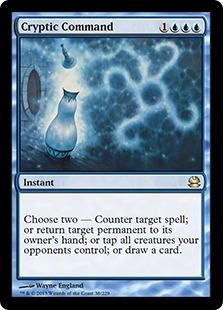
With a mindframe like that, it's no wonder Nguyen and Mispagel passed on Cryptic Commands, Snapcaster Mages, and the other traditional Temur staples. Even the techy Bring to Light would have been too cute in this type of gameplan! When it comes down to it, Nguyen's plan is to build his manabase to 6-7 lands and pull the Valakut trigger as close to turn four as possible. If possible, you can fire with Scapeshift. If not, Titan can take the shot instead. Sideboarding gives you better interactive tools, but the deck remains a goldfish strategy to the core, even if you can change roles to fit certain matchups.

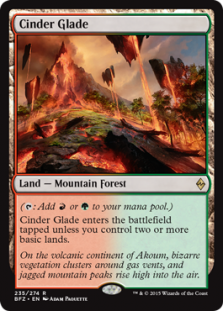
Cinder GladeOn the subject of role-changing, it's easy to oversell the deck's linearity when it also can threaten a strong control game. With seven basic Mountains, four Cinder Glades, and a Stomping Ground, the Titan pilot can easily lock down the board with recurring Bolt effects off an active Valakut. Instant-speed land search, such as fetches and Expeditions, lets you screw with even the Infects, Twins, and Affinitys of the world (you win a prize every time you snipe Etched Champion). This control role is built into the deck and is more a playstyle decision than a construction one, which means you can leverage it as much or as little as the matchup demands. Of course, sideboard cards like Anger of the Gods let you commit more heavily to a control mode, which gives you even more versatility in Games 2-3.

Of course, all this begs some questions. First, what makes Titan Scapeshift better than conventional Scapeshift lists? Also, perhaps more pressingly, why play this over other goldfish combos in Modern? This skeptical (but open!) line of inquiry is how we should approach any new deck, and it's how we analyzed Naya Humans a few weeks ago: this method forces us to put aside hype and consider a deck's strengths in context.

The Interaction Trap

Before the Good Ship Modern set sail, I decided I would be playing Scapeshift Combo in the eventual "Overextended"/"Legacy Lite" format. It had been an Extended favorite of mine for years (Ben Stark was my hero), and I was pumped to play it when Modern inevitably roared onto the competitive scene.

ValakutThen Tom LaPille launched the format with one hand and keelhauled my pet deck with the other. Oh well. Guess I could play Twelvepost instead!

Guess not...

Although Wizards eventually released Valakut from its wrongful incarceration (and it's for the best we only had a few months to enjoy Cloudpost), it quickly became clear that the old Extended Scapeshift strategies had serious issues in Modern. If you've ever tried to play a fair deck in the format, you've encountered one of these problems. If you've ever tried to play an unfair deck in Modern, you've encountered the other. RG Titan Scapeshift seeks to address both of these traditional Scapeshift shortcomings, which is why the deck is such a great choice today.

Cryptic CommandLet's start with the first problem: Modern has so many proactive threats it's almost impossible to reactively answer all of them. This is the longstanding downfall of fair decks and it's plagued Scapeshift since Valakut's 2012 unbanning. When you commit to Temur, you pledge yourself to a familiar set of cards: Snapcaster Mage, Lightning Bolt, Cryptic Command, Remand, etc. This set of cards in particular, and this category of answers more generally, works when you can predict the metagame and when you know the predicted metagame is suited towards your answers. It's much less effective when you bounce between Infect and Affinity in the first few rounds, Amulet Bloom and Burn in the next, and Gruul Zoo and Twin just after that. Add in the Junds, Abzans, and Company decks of the world, and only a quarter of your interaction tends to be live in any given game. You can't run hot with so many dead slots.

BGx decks compensate for this deficiency with the best generic answers in Modern. Jund gets Bolt for low-toughness creatures (which Scapeshift shares), and Abrupt Decay, Thoughtseize, and Inquisition of Kozilek for everything else (which Scapeshift notably lacks). When your own best generic answer, Cryptic Command, doesn't come online until turn four, you're in trouble. That's also at play when aggressive decks laugh your Remand out of the match. RG Titan Scapeshift abandons all this interaction in favor of a streamlined, linear approach: as they say, if you can't beat 'em, join 'em. It's no coincidence that traditional Scapeshift lists have lingered in Tier 2 around the 2%-3.5% mark all year. It's also no coincidence that Grixis decks are shifting away from the kind of interaction seen in old Temur lists and towards the better answers (notably Inquisition) of BGx. The Titan lists also pass on this inferior interaction in favor of something more active.

Turn Four or Bust

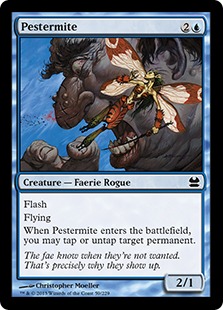
Speaking of active, this brings us to the second problem Titan Scapeshift seeks to address: the closer your proactive deck can get to (or beyond) the turn four win, the more success you tend to enjoy in Modern. Can you win on turn four with these older Temur lists? Sometimes, but it certainly isn't common and your deck isn't designed to push that win. Turn five is much more common, with turn six Pestermiteequally possible depending on your draws. Unfortunately, this can make you feel like you're playing a bad Twin. Yes, Scapeshift can compensate for this by being a one-card combo that blanks creature removal. In practice, however, the comparative advantages of this approach is often outweighed by the disadvantage of being 1-2 turns slower than Twin. It doesn't help that Pestermite and friends enable longer reach if the game draws out. Speed is yet another issue, especially when you need to shelve interaction and head off to the races: your fastest pace is still 1-2 turns slower than even the "fairer" fast decks like Ad Nauseam and Zoo.

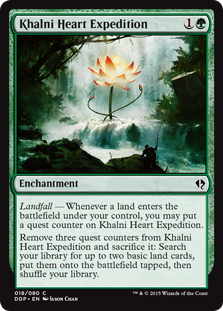
Khalni Heart ExpeditionPrimeval Titan lists tackle this by maximizing turn four wins and minimizing vulnerabilities. Nguyen described Khalni Heart Expedition as the best card of the deck for good reason: it's by far your fastest way to reach lethal by turn four. Most hands with an Expedition are going to threaten that kill, and even the no-Expedition ones can get there: turn one Search for Tomorrow, turn two Farseek, and turn three Elder/Explore will probably enable the full-force Scapeshift when you untap. Perhaps more importantly, the Expedition approach is virtually immune to the creature removal which so stymies Infect, Burn, Affinity, and even Twin. In addition, you're playing a ramp deck with protection not only from anti-Tron Fulminator Mages, but also the terrifying Blood Moon. Few big-mana strategies can claim that dual resistance.

This turn four win potential, on top of the deck's relative resilience to interaction, makes Titan Scapeshift a surprisingly strong choice in unknown metagames. Will you get run over on turns two or three by some opponents? Bet on it. Aaron Webster goldfished his way to a Game 1 Affinity win in the Pittsburgh quarterfinals. Nguyen had a similar issue in Round 10 against a ferocious Burn opener by Wing Chun Yam. If you're playing this deck, expect to lose games when you lose coin flips, and expect to lose when your foes get decent hands. That said, will you punish decks when they stumble? Will your Valakuts chisel away as opponents waste interaction? Bet on all that too. Your list has a dangerous degree of inevitability and redundancy, and although it won't be as fast as something like Amulet Bloom, you have fewer moving parts and more copies of the parts you do have. You can also just topdeck Commune with Lava to Sphinx's Revelation yourself into a win. This joint consistency and proactivity give the deck a big edge in the metagame, especially over conventional Scapeshift lists.

Choosing Your Solitaire Deck

To some extent, many of Titan Scapeshift's edges are also shared by other decks. You don't need to look far in Modern to find strong proactive strategies, especially those winning around turn four. We've addressed why you should be playing this particular Scapeshift over other versions of the one-card combo, but what about selecting this deck over other combo decks more generally? Following our earlier points, here are three general principles underlying Titan Scapeshift's viability in any given metagame. Remember that no single one of the three principles would justify using the deck. It's the combination of all three factors driving the deck's relevance.

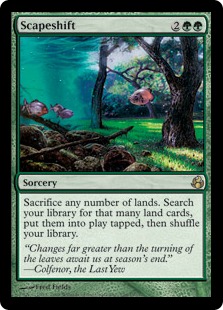
  • ScapeshiftConsistency
    With a playset each of Scapeshift, Titan, and Valakut, on top of the 16+ ramp spells, it's almost impossible to draw a hand that can't win on turn 4-5. Many will lean towards turn four. Other combos will stumble on bad draws and missed land drops. If you trip, it's because you kept a really boneheaded hand or are unluckier than Brian Kibler circa 2012.
  • Inevitability
    Some decks run out of steam, whether due to limited threats or a dependency on synergy-based win conditions that don't work when topdecked on weak boards. Left to its own devices, Titan Scapeshift will get there in the end. Between the Titan/Scapeshift/Valakut trifecta, not to mention the nasty Commune with Lava, the long game will often go to you.
  • Blood MoonResilience
    Titan Scapeshift has a rare combination of innately resilient threats, redundant combo pieces, and a win condition that laughs off most hate. Like Amulet Bloom, you can easily win games without playing a single creature, effectively blanking enemy removal and eliminating interaction angles. Like Burn, you have very few individual cards that "matter", so a discarded or countered threat is easily replaced. And unlike some of Modern's premier combos (the previously mentioned Bloom, along with Tron and Affinity), you don't collapse to specific hate cards. Neither Blood Moon nor Fulminator Mage, nemeses of big-mana decks, stop you for long!
  • Role-shifting
    One of Amulet Bloom's biggest strengths is its ability to trade combo pieces for over-the-top midrange and control elements in certain matchups. This role-switch allows Bloom, a "combo" deck, to enjoy a remarkably neutral (even positive) contest against decks like Jund which should eat combo for breakfast. Titan Scapeshift can do the same, especially depending on how you build your sideboard. Even outside of the board, your Valakuts and 11+ "Mountains" give you ample board-control options whether it's Game 1 or Game 3. Few combo decks boast such a maindeck ability to interact and go linear.

In most cases, you can use these guidelines to pick between decks. Titan Scapeshift vs. Amulet Bloom? Bloom fires on the "consistency", "inevitability", and "role-shifting" cylinders, but crumbles in Blood Moon heavy metagames. That weakness, itself part of the "resilience" department, will determine your choice. What about Ad Nauseam? There's a combo which can match Scapeshift in "consistency" and even "inevitability", but falls flat in "role-shifting". If you want that versatility, especially in a diverse or unknown metagame, this might push you towards Nguyen's and Mispagel's builds. Overall, this kind of comparative method can help you narrow down your choices, as long as you are able to assess other decks for similar strengths and weaknesses.

What's Next for Titan Scapeshift?

Looking to current Tier 2 decks in Modern, Temur Scapeshift still represents the biggest share of the overall Scapeshift showings. The toolbox Bring to Light representatives are close behind, with the upstart Titan lists still gaining ground. Despite Nguyen's and Mispagel's wins, this deck has a long way to go before it can reach those upper echelons. We'll want to see at least a few more datapoints before committing too heavily to this deck or its Modern longevity.

What other experience do you have with the deck? Are there any other considerations you want us to keep in mind when choosing between this Scapeshift and other options? Any improvements you would suggest to the lists? Take it into the comments and I'll see you tomorrow with some exciting test results from one of Modern's most controversial unbanning suggestions...

Deck Overview- Mardu Painful Prowess

Are you a Quiet Speculation member?

If not, now is a perfect time to join up! Our powerful tools, breaking-news analysis, and exclusive Discord channel will make sure you stay up to date and ahead of the curve.

For as great as the mana is in Standard, we haven't seen a ton of innovation from the decks discovered even before PT Battle for Zendikar. There have been a few less popular archetypes that have faded in and out of the limelight, but we're not seeing a great deal of new technology. That said, Painful Truths has come into its own in recent weeks. If you want an example of a deck that really takes advantage of the card, check out Danny Jessup's deck from the Standard Open in Las Vegas last weekend:

Mardu Prowess

Creatures

4 Abbot of Keral Keep
2 Monastery Mentor
4 Monastery Swiftspear
4 Seeker of the Way
3 Soulfire Grand Master

Spells

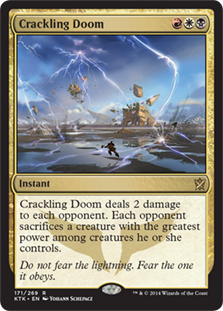
4 Crackling Doom
4 Fiery Impulse
3 Murderous Cut
3 Duress
4 Painful Truths
1 Roast

Lands

3 Mountain
2 Plains
1 Swamp
4 Bloodstained Mire
1 Canopy Vista
1 Cinder Glade
3 Shambling Vent
2 Smoldering Marsh
3 Windswept Heath
4 Wooded Foothills

Sideboard

2 Arashin Cleric
2 Outpost Siege
1 Ob Nixilis Reignited
1 Sarkhan, the Dragonspeaker
1 Duress
3 Radiant Flames
2 Roast
3 Self-Inflicted Wound

The Mardu wedge contains some very powerful cards, though has only really gotten a lot of exposure since the printing of battle lands and the surge of four color decks in Standard. This is the first time I've looked at a Mardu deck and thought that it might have what it takes to be highly competitive. Abbot of Keral Keep contributes significantly to the decks power, and Painful Truths really pulls everything together.

There was an error retrieving a chart for Painful Truths

The problem with Mardu decks was always that you had no card selection. It was easy to run out of gas, and your good cards had to naturally come off the top. Jeskai Black solved this by adding some blue draw spells, and this deck does so without needing the splash. Painful Truths plays very well with the prowess theme of the deck and exceptionally so with Seeker of the Way. Another great aspect of this deck is that by sticking to three colors you're able to play a bunch of Shambling Vents.

I'm always skeptical of any white deck not featuring Gideon, Ally of Zendikar, but I'd definitely give a variant of this deck strong considering for a Standard tournament this weekend.

Insider: Three Modern Gems from the SCG Invitational

Are you a Quiet Speculation member?

If not, now is a perfect time to join up! Our powerful tools, breaking-news analysis, and exclusive Discord channel will make sure you stay up to date and ahead of the curve.

In November Wizards brought the Modern community a Regional Pro Tour Qualifier circuit, Grand Prix Pittsburgh, and the first League decklists on MTGO.

December? Aside from some neat Oath of the Gatewatch spoilers that hit the Magic online community while I was drafting this article, it's a barren month for Modern action. Endless banlist speculation and axe-grinding doesn't count either.

The only exception to this was Star City Games' Invitational in Las Vegas. The three-day tournament saw the best players on the SCG scene dueling out eight rounds each of Standard and Modern.

Usual Suspects at the SCG Invitational

Over the course of the tournament, SCG released the Top 8 decks, the 7-1 or better decks, and a series of deck techs on lower finishers. That included Jeff Hoogland's sleek Grixis Faeries build, which saw Scion of Oona and Spellstutter Sprite fly Hoogland to 15th in the tournament.

These decks collectively give us an excellent source of new technology for those looking to predict where Modern is heading next.

Today, we're going to look over three cards that enjoyed notable successes last weekend. With just eight rounds of Modern, there's only so much we can extrapolate from Invitational finishes, despite the high-caliber players behind these cards. That said, we can certainly use the Invitational to confirm or challenge our ideas about the format.

We've already seen these cards in other decks throughout the season---their reappearance at the Invitational underscores their Modern relevance. You'll want to buy (or sell) accordingly.

1. Pia and Kiran Nalaar

Jace, Vryn's Prodigy was probably the best Modern card out of Magic Origins, but Chandra's parents are quickly closing that gap.

We've seen Pia and Kiran Nalaar in Grixis Midrange lists for a few months now. The card's impressive resume includes Gerry Thompson's 33rd place list at Grand Prix Oklahoma City, almost two dozen Top 8s at SCG States, Corey Burkhart's 5th place finish at Pittsburgh, and Dan Jessup's winning list at a Premier IQ in Coopersburg. All in the last three months!

Following the Invitational, we can add both another Top 8 and a 7-1 list (Gerry T again!) under Pia and Kirans' belts. The red Lingering Souls is getting more real with every weekend.

There was an error retrieving a chart for Pia and Kiran Nalaar

Mama and Papa Nalaar give Grixis (not to mention Jund) some extra reach and width normally unavailable in those colors. Top-decking the Nalaars in the lategame can easily convert to six damage---two from the thopters and four from the Siege-Gang Commander impression. In the mid-game those same tokens can wall opposing Anglers and Goyfs, trade with the Affinity air force, or chisel away at life totals.

Add in Kolaghan's Command or Rise // Fall and things get even crazier. Who said Snapcaster Mage is the only source of value for Grixis?

This flexible, multi-matchup relevance makes Pia and Kiran excellent in a Grixis strategy struggling to keep up. The traditional Cryptic Command-powered control lists, exemplified by Patrick Chapin's at Grand Prix Charlotte, fell from Modern's Tier 1 after only a few months in the spotlight.

Midrange-geared Grixis builds have picked up the slack, driven by Inquisition of Kozilek, Liliana of the Veil, and now Pia and Kiran Nalaar.

The New Face of Modern Grixis

Combined with the two finishes at the Invitational, this history points to the Nalaars as Grixis mainstays moving forward. Even the mighty Liliana hasn't been a regular in all the new Grixis Midrange strategies. Pia and Kiran, however, almost always show up.

Financial Advice: Long-Term Target

Between their newfound Grixis home, scattered Jund appearances and sideboard showings (Grand Prix Pittsburgh champion Alex Bianchi ran one in his Jeskai Twin sideboard), Pia and Kiran are an increasingly valuable investment. By the end of the weekend foil copies had vanished from Star City Games, with TCGplayer stock dropping as well.

The card isn't mythic, which imposes a lower ceiling than we see on something like Jace. Hangarback Walker pushed up to the $12 range at rare, but the Nalaars are unlikely to match Walker's dual Modern and Standard demand. That said, the current $1 price tag is a gross undervaluing of its long-term playability (doubly so for the $4-$5 foil cost, even in spite of the foiled promo edition).

If you're playing Grixis or Jund, get these now and hold on. Same goes for speculators looking to play the long game. You'll also need to keep Pia and Kiran Nalaar in mind when Magic Origins rotates out of Standard down the road.

2. Ugin, the Spirit Dragon

R/G Tron is rapidly solidifying its status as a true Tier 1 deck. Although Karn Liberated and Wurmcoil Engine remain Tron's workhorses, Ugin, the Spirit Dragon has hopped on board as a valuable member of the colorless squad. Joe Lossett and Justin Rios brought R/G Tron to a 6th and 8th place finish respectively, further reinforcing the ramp deck's position in Modern.

There was an error retrieving a chart for Ugin, the Spirit Dragon

Ugin brings a lot of upside to the Tron roster. He clears the board, snipes enemy threats, and wins the game on his own. You aren't dropping Ugin on turn three even with an assembled Urzatron, but he still makes an excellent turn four-to-five play for a deck aiming to go over the top. Extra board-sweeping power, in addition to the staple Oblivion Stone and Pyroclasm, is huge.

Despite his strengths, Ugin rarely occupies more than two slots in your average R/G Tron list. Rios brought a pair to Las Vegas, while Lossett only used one. Another top Moderner at the Invitational, Dylan Stittsworth, also included just a single Ugin in his own 7-1 Tron list (he outperformed Lossett in Modern but fell flat in Standard.) That one-to-two-copy approach mirrors Diego Marquez's 8th place Tron list at Porto Alegre, as well as Ray Montes' SCG Dallas Open build.

Given the relative dearth of Ugins in even the best Tron list, it seems odd to highlight the planeswalker as a major speculation target. Sure, Ugin is likely to stay relevant in Modern as the years go on, but there's only so high singletons can go.

That is, unless Standard has any say.

Financial Advice: Short- to Medium-Term Sell

Ugin, the Spirit Dragon is a major Standard staple these days, which is directly responsible for his big ticket price tag. Esper Dragons plays him. Abzan Control plays him. Jeskai Black sticks him in the sideboard. And Standard Eldrazi Ramp decks do their best R/G Tron impressions with a whopping four Ugins in the main.

That level of demand would drive Ugin's price tag to Gideon, Ally of Zendikar levels. Probably higher, given the dragon planeswaker's casual appeal. Add his R/G Tron importance to the equation, however, and you have a card whose price seems to keep rising.

Ugin and Team in Standard

In my view, all of this makes Ugin a great target for a short- or medium-term sale.

Assuming Oath of the Gatewatch makes colorless cards even better in Standard, Ugin is likely to hit his peak price in the coming months. It's never getting better than this. It might even get worse if Oath brings decent colorless hate or other hosers to the Standard picture.

Ugin is good, but not Jace-levels of good. His $40 price won't climb much higher than $50, and much of that is likely to occur within the next three to six months.

If you're playing Tron in Modern, hold on to 1-2 copies for your own purposes and then sell out the rest when the post-Oath buzz reaches its high point. Don't buy into this card at current prices unless you have deep pockets and are industrious enough to turn these around before June. It's a great card with a lot of post-Invitational significance, but you need to keep Ugin's overall context in mind to make money on him.

3. Cinder Glade

Our last card today is a bigger gamble with fewer data points supporting it---but where's the fun in Modern speculation if you aren't taking some risks?

Scapeshift has been around in Modern since Valakut, the Molten Pinnacle got unbanned in 2012, but mostly in a traditional Temur form. We've also seen the no-Scapeshift builds featuring Valakut, Summoning Trap, and Chalice of the Void, such as Ricardo van den Bogaard's Top 4 list from 2014's Grand Prix Madrid.

Joey Mispagel just added to the Scapeshift continuum with his 7-1 build at the Invitational, a close replica of Thien Nguyen's 7th place strategy at Pittsburgh. These Titan Scapeshift lists are fast, linear, and double-down on one of the so-called "tango lands" from Battle for Zendikar.

There was an error retrieving a chart for Cinder Glade

In my pre-Pittsburgh Modern Nexus article, I predicted a Scapeshift deck would sneak into Top 8 alongside Modern regulars. I didn't think it would be the less-interactive Titan version, and even after seeing the results I wasn't sure if the deck could exceed one-and-done status.

Mispagel's 7-1 Invitational finish doesn't guarantee the R/G Titan build is the real deal, but it's a strong statement for a new type of Scapeshift strategy. Following the footsteps of many established Modern decks, the Titan list goes linear, trading Temur's interaction for more explosive ramp (Khalni Heart Expedition), haymakers (Primeval Titan) and a late-game mana sink (Commune with Lava).

If this approach can work at both a Grand Prix and the Invitational, there's a good chance it will continue to pick up momentum as more players adopt it.

Cinder Glade is central to the Titan Scapeshift manabase and one of the few cards in the deck that isn't already part of another strategy. This niche in Modern makes it one of the better tango land investments, and a nice long-term bet on a new combo build.

Financial Advice: Stay Frosty

The Mispagel and Nguyen Scapeshift builds feel metagamed. Even though they can succeed in the current Modern field, that doesn't mean they have the staying power to be format mainstays. If they can't cut it there, investment into cards like Cinder Glade is unlikely to pay off.

On the other hand, if these decks really have something going for them outside of this particular Modern metagame, then the list's profile (and profit margins) go up considerably.

Whether you are a Scapeshift aficionado or an investor looking to make Modern money, don't dive in on R/G Titan staples until we've seen more results.

Even one more finish at an Open or Grand Prix, or a handful of Top 8's at Premier IQ's or similar venues, would suggest broader viability beyond the hype factor. On the other hand, if no such finishes materialize, it would suggest the deck is too niche to comfortably buy into.

There was an error retrieving a chart for Commune with Lava

It's easy to see Nguyen's or Mispagel's finish and go nuts buying Commune with Lavas in wholesale bulk. The same goes for Cinder Glade and foil Khalni Heart Expeditions. Resist the temptation and wait for the data! Should you see results, snap-buy as much as you want. If the results don't come, then you aren't hundreds of copies into a deck that will never make another Modern showing.

Modern in December

Now that the Invitational is over, we won't see many big Modern events until January. Thankfully, the first month of 2016 will more than make up for it. Star City Games will bring us two Opens, Oath of the Gatewatch will (hopefully) bring us key new staples or reprints, and the January 18 banlist announcement will be making people even crazier than they already are.

You can bet I'll be weighing in on all those issues as we close out December and move into 2016, especially the ban and unban possibilities for the upcoming update. Until then, keep on looking for informative Modern data points and remember to consider all your speculation decisions in the format's broader context.

Any other Invitational cards I missed? Other Modern winners (or losers) you want to call out from the last week? I'll see you in the comments below!

Insider: “Diamond” Mana in OGW – Hunting for Spec Targets

Are you a Quiet Speculation member?

If not, now is a perfect time to join up! Our powerful tools, breaking-news analysis, and exclusive Discord channel will make sure you stay up to date and ahead of the curve.

Welcome back, readers! While a lot of talk was going on about the possibility of a Stoneforge Mystic unban in Modern, some potentially bigger news slipped under many people's radar.

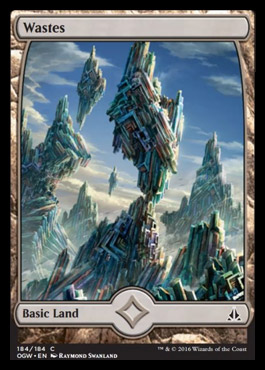
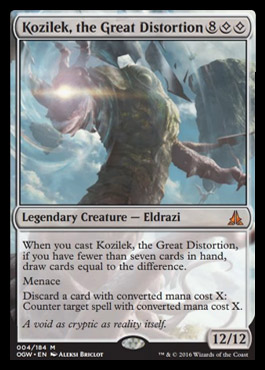
Since it first appeared on unofficial spoilers a few weeks ago, everyone has been speculating about the new colorless mana symbol, "<>" or "diamond." During the World Magic Cup coverage over the weekend, WotC confirmed the mechanic will appear in Oath of the Gatewatch (OGW) and described how it works.

wastes kozilekthegreatdistortion

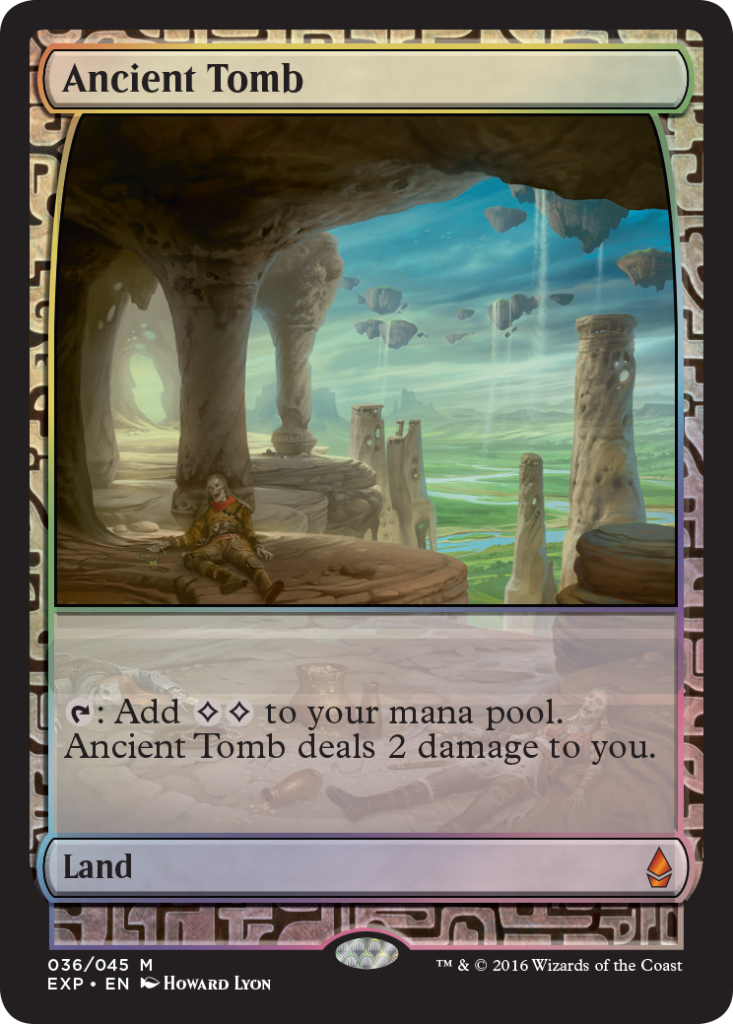
If you haven't heard yet, the symbol will appear on all cards that produce colorless mana. It isn't a change to the rules proper, but rather a new visual convention to clarify how the mana system works. Costs are represented by the traditional number in a circle, whereas mana production is represented by the new symbol.

The one new twist is the Eldrazi's requirement of colorless mana, as seen on the new Kozilek. These cards synergize with every colorless mana producer ever printed, and many an EDH aficionado and Standard brewer will be scouring Gatherer to see what they can use to power out the new monsters.

While old cards are not receiving new functionality per se, their interaction with the OGW cards themselves will be unprecedented. Until now the production of colorless mana has been strict downside---the new mechanic may breath life into older cards.

Given this development, we may want to survey the landscape of old colorless mana producers and see if anything jumps out as a relevant speculation target. Today I'll cover the applications in Standard and Modern. I'll cover Commander and Legacy in a later article.

Let's start with a rough list of the more powerful colorless mana producers from Magic's past:

Colorless-Producing Artifacts

Colorless-Producing Lands

Add to these all the filter lands (Twilight Mire, et.al.), the painlands, and the cycle of utility lands from Innistrad block like Gavony Township. There are obviously more---if you want more examples I suggest googling a Karn Commander deck, as that deck's colorless constraints really pushed people to dig deep.

The first thing you'll notice is a lot of these cards already see significant play in Commander. A few, like the Urzatron lands, filter lands and Mutavault, have a home in Modern. There are even some Legacy and Vintage staples in there, so this could affect all formats.

The format that's likely to have the most potential here is Commander, but as I said that will be reserved for Part 2. Since Standard is the most played format and the one with the smallest card pool to reveiw, let's start there. I'll limit my choices to rares and mythics, as anything else is unlikely to be attractive to speculators.

Standard

That's not too bad, even if none of the cards on this list are mythic (which is normally where I like to focus on speculation opportunities, due to the scarcer supply).

Of these options, I like Shrine of the Forsaken Gods, Sanctum of Ugin and From Beyond the best, due to the fact that they should play very well together in a ramp strategy. Shrine and Sanctum have already found a home in the big Eldrazi ramp decks currently being played in Standard, and I expect these decks to get considerably better with the new Kozilek.

There was an error retrieving a chart for Shrine of the Forsaken Gods

One of the biggest weaknesses of the current Eldrazi Ramp decks is that Sanctum of Ugin only has one good target (Ulamog, the Ceaseless Hunger), and being legendary, casting a second copy just bins the first one. The addition of another target lets you search up whichever one you're missing, and slam it into play if you're so inclined.

The new Kozilek is also just good, and solves one of ramp's main problems, gassing up after you've emptied your hand.

Modern

Here's where it gets interesting. Standard has relatively limited options, whereas Modern has a much larger card pool to dig through and a Tier 1 deck that is heavily colorless to begin with.

I won't reiterate the cards mentioned above, although note they're all Modern-legal (and some may be relevant.) We'll start with rares/mythics, and then cover a few older uncommons with potential.

Rares & Mythics

Modern-legal Rares/Mythics

The first thing to note is that WotC has printed mana rocks predominantly at common and uncommon, and only a few have been deemed "rare-worthy." So most of our initial list is comprised of lands. Again, of note are filters and Innistrad utility lands.

With what we know so for about OGW, Kozilek is the only card that looks likely to have an immediate impact on Modern. One of Tron's problems is that is has very little card advantage, and sometimes can durdle about if its first threat is handled. Kozilek is a nice way to restock.

While I'm currently focused on cards that would make Tron better, that's not to say there isn't potential elsewhere. One card I want to highlight is Thespian's Stage. This card is cheap around $2, and sees heavy Commander play, as well as playing an important role in the Lands deck in Legacy. If I had to pick one land to invest in here, Stage would be it.

There was an error retrieving a chart for Thespian's Stage

Academy Ruins is another option. It's not exactly cheap but the ability is incredibly powerful, allowing indefinite looping of artifacts and a form of inevitability.

Commons & Uncommons

One of the beautiful things about Modern for the speculator is it goes all the way back to 8th Edition, which debuted in 2003. Back then the player base was much smaller, so some of the single-printing commons and uncommons can still jump up and hold value.

Turning to the lower rarities we find a plethora of additional options.

Modern-legal Commons/Uncommons

In the uncommon slot, we also get the original Ravnica block utility lands (Prahv, Spires of Order, etc.)

As far as mana rocks go, the Talisman cycle is probably the most promising. They only have one printing and Talisman of Dominance has shown up in Legacy Tezzerator lists before.

Buried Ruin was reprinted in last year's Commander product, but the ability is very powerful and particularly useful in a deck looking to include a lot of artifacts to begin with. Recursion without fear of countermagic, on a land no less, is nothing to sneeze at.

Scrying Sheets has already seen a decent jump in price thanks to Skred and Commander play, but given it comes from the under-opened Coldsnap there's still room for growth. The same can be said for Mouth of Ronom, but it's not quite as strong a card.

~

Anything glaring I've missed that will combine well with the new Eldrazi mechanic? Let me know in the comments, and tune in for Part 2 when I'll cover Legacy and Commander.

Curious George Goes to a Super Series: Revisiting Monkey Grow, Chapter 2

Are you a Quiet Speculation member?

If not, now is a perfect time to join up! Our powerful tools, breaking-news analysis, and exclusive Discord channel will make sure you stay up to date and ahead of the curve.

Friday, I began chronicling a Mana Deprived Super Series 3K tournament in Montreal. I piloted Monkey Grow to a 6-2 finish. This article concludes the report and gives some closing thoughts on the deck.
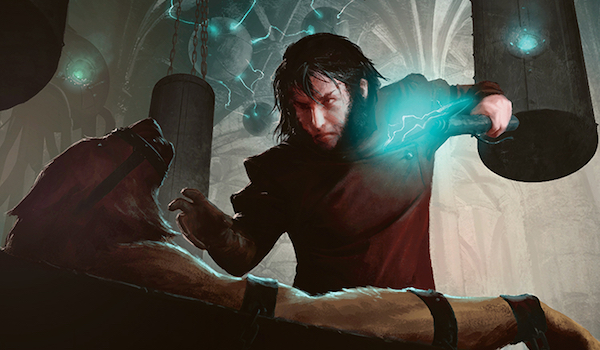
curiosity innistrad art

We ended Chapter 1 on a high note, following an embarrassing loss to Grixis Twin with a triumphant victory over Abzan Midrange. That match ended in less than fifteen minutes, giving me enough time to rush to Domino’s, find out it would take them twenty minutes to make me any kind of pizza, rush instead to a fast food restaurant whose name I’ll omit out of embarrassment, eat something labeled a burger, and get back to Hotel Espresso just after the round ended. My buddy hysterically told me about his time-induced draw with a furious Lantern Control player, who implored him to concede the match because he “had the lock.” Pairings were announced a few laughs and head shakes later.

[wp_ad_camp_1]

Mana Deprived Super Series: Report, Part II

Round 5: Amulet Bloom (2-1, lose roll)

One of my not-so-pleasant memories from the Super Series is the sustained whining about Amulet Bloom’s purported Modern dominance. I constantly heard unsupported (more on this here) claims from down the table, in the corridors, and by the water pitcher room (yes, water pitcher room) about Bloom being “too resilient,” “too fast,” and “too broken” (my personal favorite) for Modern. When my opponent played a tapped Tolaria West in Game 1 and passed the turn, I smiled at the chance to show some onlookers the deck isn’t as scary as Jund pilots might have them believe.

Game 1

My opponent mulligans to six cards, then very slowly ramps up to six mana. Meanwhile, two non-flipping Delvers and a Tarmogoyf munch on his life total, which seesaws every other turn with a Radiant Fountain. Eventually, I Mana Leak his Titan. He lacks double blue for Pact of Negation, so the Leak resolves, and I win with another Leak and Shoal in hand.

Sideboarding:
-2 Hooting Mandrills
-1 Simic Charm
-3 Thought Scour
-4 Lightning Bolt

+3 Blood Moon
+1 Flashfreeze
+2 Destructive Revelry
+2 Ancient Grudge
+2 Curiosity

Against Amulet Bloom and other linear combo decks, Curiosity overperforms. These decks generally leave the board open for you to pressure them as they assemble their kill, but pressure alone is rarely enough. Without adequate disruption, these decks will race a light clock. Curiosity ensures even a lowly 1/1 Wizard will keep the disruption flowing, preventing combo players from ever resolving their key spells and helping make land drops to further our board presence. Since Bloom in particular lacks creature removal, I feel fine boarding out a pair of Mandrills, my slowest threat, and three Thought Scours for relevant hate. Tarfire dramatically increases a Tarmogoyf clock, and can even grow him to larger-than-Titan stats, so it stays in over Lightning Bolt. The two damage is always relevant to the face, and can even kill Azusa, Lost but Seeking.

Game 2

I mulligan to six and keep a one-lander with Mandrills, Disrupting Shoal, Serum Visions, Probe, and Blood Moon.Thragtusk I Shoal a turn one Amulet of Vigor with Probe, then draw another Probe and see Vesuva, Gruul Turf, Thragtusk, Primeval Titan, Summoner's Pact, and Summer Bloom. Mandrills resolves in no time off a topdecked Stomping Ground, and I attack while searching for basic Forest. At one point, I scry a Tarmogoyf to the bottom of the library. My opponent resolves Thragtusk after I get a hit in with Curious George, and we trade a big blow. I attack with Mandrills and finally draw Rainforest, but by now I’m at just 9 life. I fetch Forest anyway and resolve the Blood Moon.
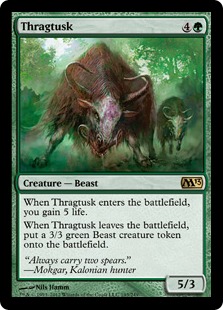
My locked-out opponent calls a judge for a ruling. He whispers to the judge, who loudly responds, “it will enter as a copy of what you choose, but it won’t tap for what you think it will.” I immediately know he’s referring to Vesuva, and jot the land down on my notepad. Despite knowing the judge gave a faulty ruling, I tell my opponent, “that’s unfortunate.” He agrees and falls deep into thought until the judge returns and corrects himself a couple minutes later. Vesuva comes down to copy my Island. My opponent tries Hive Mind, but I Mana Leak. He attacks with the Tusk, putting me to 3. I draw and Serum, looking for a Bolt or that Goyf I scryed away. No luck. Mandrills trades with Thragtusk, and the Beast token kills me next turn.

Game 3
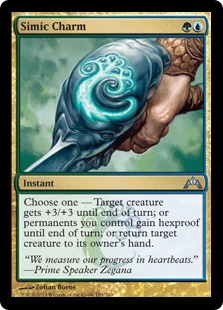
Simic CharmI put Curiosity on Tarmogoyf, which meets a Slaughter Pact. That’s fine with me; I follow the Lhurgoyf with Mandrills and another Goyf. Khalni Garden generates a blocker that I Tarfire before attacking for eight. My opponent retaliates with Radiant Fountain and Primeval Titan, but I have Mana Leak. I attack again and pump for lethal with Simic Charm.

At the end of our match, my opponent chided me for endorsing the judge’s erroneous ruling. I discussed the issue with another judge, who told me I had no obligation to correct that first official, as I could very well not have known the ruling myself. That said, the “ethical play” is pretty obvious here. A friend and I decided it’s important for us to play Magic in an environment where a player legally seeking the correct answer to a rules question has access to that answer. When I tracked down and apologized to my opponent, he said he was upset by my snide remark, and not by my failing to step in.

Either way, I resolved to call the head judge next time I experienced something like this, no matter the level of competition - after all, had I been watching someone else’s match, I wouldn’t have hesitated to challenge the ruling. I’m grateful my opponent confronted me about his misgivings and gave me the opportunity to learn from a mistake.

Round 6: Living End (2-0, win roll)

Many dislike “playing” against linear combo strategies, but I don’t mind getting paired with a few in a row. The grow archetype naturally predates these decks. While linear combo matches may be boring, they at least offer reliable wins. I also enjoy punishing players for sleeving up linear combo in the first place.

Game 1

A Probe shows me three Violent Outburst, two Demonic Dread, a Blood Crypt, and a Monstrous Carabid. I play Delver and my opponent cycles his Carabid, then I blind flip and start hitting for three. He goes for an early Dread to kill Delver and ends up with just the Carabid. I follow with 4/5 Tarmogoyf, and we trade attacks for a turn. Then, and my opponent cascades again to remove it. I find another Goyf, and unfortunately lack the mana to save him with Tarfire when Carabid + Violent Outburst puts five damage on him during combat. Luckily, my opponent naturally drew his third Living End, so the cascade shows me his deck (which looks pretty standard). I play a pair of Mandrills and quickly attack him down to Tarfire range.

Sideboarding:
-3 Simic Charm
-2 Lightning Bolt

+3 Huntmaster of the Fells
+2 Curiosity

I max out on creatures here in the hopes of milling them away with Thought Scour. Stocking my graveyard forces the Living End pilot to spend more time filling his own, slowing down his cascade spells and letting me pressure him with a threat or draw into countermagic for his namesake card. Strapping Curiosity to a resolved threat denies opponents the option to take a few hits before cascading for maximum impact, since every turn they wait potentially draws me two answers.

Game 2

This time, Probe shows me Simian Spirit Guide, Violent Outburst, Monstrous Carabid, Ricochet Trap, Street Wraith, and Avalanche Riders.Living End I play a Delver and my opponent cycles the Carabid and the Wraith. He goes for turn two Living End, which resolves. I play Hooting Mandrills and trade with the Carabid, following up with a 4/5 Tarmogoyf as I stockpile Shoals in my hand. By the end of the match, I’ve drawn three and cast two, conveniently getting around Ricochet Trap with Shoal’s highly specific conditions (the Trap doesn't cost 0!). With my opponent at 6 life, I flash in Snapcaster Mage on his end step. He lets it resolve and casts Violent Outburst. I Shoal the Living End with Mana Leak up.
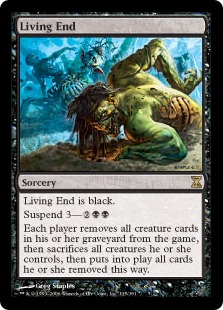
As if drawing, attacking, and passing against Living End wasn’t fun enough, this round had another highlight. Directly to my left, I got to watch Pascal Maynard on Grixis Twin get ranched by a self-proclaimed Modern newbie on Naya Humans. This kid was literally picking up Kolaghan's Command to read it. Pascal didn’t take the loss well, rudely dismissing his talkative opponent (a fan of his) and yelling “STUPID!” while slapping his face after taking lethal damage (this really happened). Unfortunately, the kid didn’t win the event, but it made his day to stomp a disgruntled pro he once admired. It made mine just watching!

Round 7: Affinity (0-2, lose roll)

I consider Affinity the best deck in Modern. It's the fastest and most resilient strategy, putting up finishes even as a known quantity with obvious hosers. Affinity often neglects to run cards like a strictly better Path to Exile and a "Draw 2 cards" effect for U because its other cards are so impressive. It's foolish not to seriously prepare for Affinity at a larger event. Monkey Grow sometimes gets there via tempo in Game 1, but it usually loses the race. The pressure's on my well-oiled sideboard to deliver victories against this deck.

That didn't happen today.

Game 1

After my opponent puts a bunch of mana on the table, I counter his turn two Plating and turn four Steel Overseer with Disrupting Shoals. His other big card, an Etched Champion, goes unanswered. I resolve two Goyfs and we attack each other for a while, me on the ground and him in the air with Blinkmoth Nexus and a Vault Skirge. It’s a tight race, with us both falling to three life, but he gets there with a timely Spell Pierce on my Lightning Bolt.

Sideboard:
-2 Hooting Mandrills
-3 Thought Scour
-2 Gitaxian Probe
-2 Stubborn Denial

+3 Huntmaster of the Fells
+2 Destructive Revelry
+2 Ancient Grudge
+1 Pyroclasm
+1 Firespout

Huntmaster is certainly slow, but after I disrupt my Affinity opponent, he'll win the game on his own. Pyroclasm is mainly useful early on, when it kills a swarm of Ornithopter, Memnite, Signal Pest, and Vault Skirge. Wiping these "mana dorks" slows Affinity way down, and the chance to nab a Steel Overseer makes the card very hot. Mid-game Ravagers can "counter" the sorcery, though. Since Pyroclasm needs to resolve early to do anything, I'm less excited about Firespout here.

Game 2

I mulligan to six, keeping Revelry, Island, Huntmaster, Goyf, Probe, and Visions.Ancient Grudge Had to ship a hand with Grudge, Pyroclasm, Firespout, and a single Forest, and immediately begin doubting the three-mana sweeper. Serum finds me a Stomping Ground, and my opponent plays Vault Skirge and Spellskite. I Grudge the Skite, then try to Grudge the Skirge next turn and get Pierced. Big mistake - I could have just played my third land and had mana for Pierce. Another Skite comes down. Skirge + Blinkmoth start hitting me. I draw the fourth land for Huntmaster a turn too late, as a Galvanic Blast to the face puts me at 1 and the tiny robots finish me off.
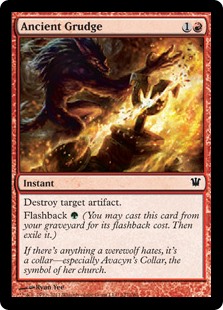
In my testing some months ago, I averaged 70-30 against Affinity post-board, so I'm hesitant to blame the deck for my loss. I stumbled badly on my mana here and unbelievably failed to play around a Spell Pierce I knew my opponent was running.

Round 8: Abzan Midrange (2-1, win roll)

While waiting for the Round 8 pairings, I cracked some Khans and did a few pack wars with a friend. She opened an unbelievable "control deck" with Sultai Charm, Bitter Revelation, foil Mardu Ascendancy, Kin-Tree Warden, Barrage of Boulders, Feat of Resistance, a very relevant Naturalize, and Pearl Lake Ancient. Losing horribly to this busted pack cheered me up after ceding a Top 8 spot to another favorable matchup, but as discussed in Chapter 1, winning a hard matchup can really replenish your joie de vivre. The MDSS hooked me up with another Abzan player to lift my spirits. Having money on the line can stress some players out, so my opponent and I skipped the pleasantries during our games. Still, the dynamic match we played was my favorite of the day.

Game 1

I smugly open with Delver. Then I get Thoughtseized, and my turn two Probe shows me a terrifying hand of double Decay, Marsh Flats, Siege Rhino, Kitchen Finks, and Path to Exile. Delver gets Decayed, and my Mandrills gets Path’d. Rhino and Kitchen Finks resolve. Gavony Township earns my concession.

Sideboarding:
-4 Disrupting Shoal
-3 Thought Scour
-1 Tarfire
-1 Lightning Bolt

+3 Huntmaster of the Fells
+3 Blood Moon
+1 Flashfreeze
+2 Curiosity

Game 2

Inquisition takes away Blood Moon, leaving me with Denial, Leak, Huntmaster, and some lands. I resolve Mandrills, Deny a Path, and Leak a Tasigur. My opponent finds another Path to remove Mandrills and plays a Goyf, which I shrink to tiny proportions by casting another Mandrills. I play Huntmaster, which soon flips and meets Abrupt Decay. (So does the Wolf a couple turns later.) Then, my opponent resolves and flashes back a pair of Lingering Souls, netting him eight tokens; I attack with the Mandrills and he team-blocks. Simic Charm grows Mandrills to 7/7, and a third Mandrills overwhelms my opponent’s single remaining Spirit.

Sideboarding:
-1 Scalding Tarn

+1 Pyroclasm

Forgot about Lingering Souls somehow. Firespout seems bad here, too. On the draw, I don’t mind cutting a land against this horribly slow deck with Path to Exile, though my opponent is stunned when I tell him I was on 16. In hindsight, I should have cut Breeding Pool, the only land that forces you to make a fourth land drop to resolve Blood Moon with perfect mana.

Game 3

My opponent follows his Treetop Village with a Tarmogoyf, and I play one, too.Choke He resolves Choke, freezing my Island, and passes. I play Tarn and attack, bluffing a Bolt or a Simic Charm, and get through for three. My opponent plays a tapped Stirring Wildwood, attacks me back, and passes. Then I fetch a Breeding Pool, shock myself, and resolve Blood Moon, which ends up more debilitating to my opponent than his Choke is to me.
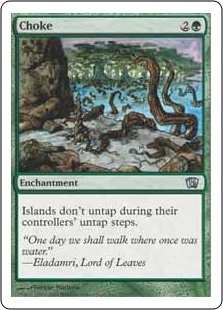
After a few turns, his hand of Tasigur, Path, Voice of Resurgence, Thoughtseize, and Siege Rhino looks pretty dumb, but so does mine: Snapcaster Mage, Stubborn Denial, Flashfreeze, and two Simic Charm. I resolve a Mandrills and eventually force a double-block with Tarmogoyf and a Spirit. I order damage on the 3/4 Goyf and resolve another Mandrills, which teams up with my own Goyf from turn two (now just 2/3!) to dish out lethal.
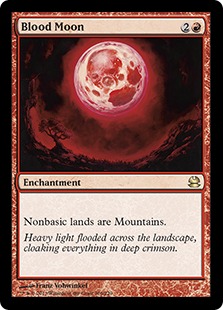
Blood MoonThis match showcases the awesome power of Simic Charm, Blood Moon, and Huntmaster of the Fells against BGx. The Huntmasters didn’t blow any minds at this event, but they quietly ate a pair of removal spells or other creatures every time they resolved. Hooting Mandrills also stood out as an against-all-odds all-star. The card was quickly overshadowed by Treasure Cruise and subsequently outclassed by Tasigur, the Golden Fang after its printing, but its Decay-resistant mana cost, beefy body, and underrated keyword ability make it a Modern staple in my eyes. I got a little too close for comfort with Tasigur while tuning BUG Faeries, and the ability to stabilize out of nowhere on a creature you’d probably run just for the stats is certainly insane. But tacking “trample” onto a similar creature in Tarmogoyf’s colors does even more favors for a tempo deck, forcing weird blocks and turning Simic Charm into a Swiss Army sledgehammer.

The Monkey On My Back

Wins against Abzan Midrange and losses to Grixis Twin and Affinity taught me I still have a lot to learn about Monkey Grow, especially after a many-month hiatus. Playing it in the Super Series energized my love for this challenging deck, and I won’t be leaving it alone again for a while. For now, I’m sticking with the same build, except reverting to Pyroclasm in the sideboard. I brought this "fixed" version to a Face to Face monthly on Saturday and went 4-0-1, drawing into Top 8 and losing to Kiki-Chord on the back of two egregious misplays. But hey, that's how we learn. My faith in this deck has never been higher. This Modern off-season has been a bit slow, but you can expect more monkeys in the Friday-article-barrel the next time a competitive event rolls around.


Insider: Bold Claims About Modern in 2016

Are you a Quiet Speculation member?

If not, now is a perfect time to join up! Our powerful tools, breaking-news analysis, and exclusive Discord channel will make sure you stay up to date and ahead of the curve.

I believe in 2016 there's a good chance this Modern format thing might really catch on... It may sound weird considering the format has been growing for several years now, but next year will be in many ways a breakout year for Modern.

Yes, I know Modern is already popular but I'm preparing for the format to grow by leaps and bounds in 2016.

We know Modern has grown in years previous, and it makes sense that the upward trend will continue. But there are several other reasons to suggest that Modern will surge in popularity in 2016.

Who's Growing Modern and Why?

The two largest and most influential entities in Magic, Wizards of the Coast and Star City Games (SCG), are both pushing to make Modern bigger.

First and foremost, the fact that 2016 starts out with a Modern Pro Tour will shine a light on the format in terms of exposure. Wizards has already shown they are willing to promote the format via high-profile events but a Pro Tour is really the cream of the crop in terms of coverage.

It's also impossible to talk about Modern coverage without mentioning that SCG has expanded their Modern events on the Open and Invitational series.

SCG does a good job of creating coverage that gets viewers engaged and excited to play Magic. I've come to believe that watching Magic played online is a significant factor that drives and motivates players to get out and play Magic in real life. The SCG Open series is also a great one-two punch in the sense that it gets people interested and then gives them an opportunity to show up and participate in either Opens or IQs.

Everybody has a vested interest in the health, popularity, and growth of Modern because the format provides tons of opportunity for Wizards, SCG, and even local game stores to sell stuff to players. It also creates a format where once a player has bought in they can essentially play Magic indefinitely.

One problem that has plagued Magic in the past is players losing interest when Standard rotates and they're confronted with the harrowing realization that all their cards are worthless. Convincing those players to buy into Modern gives them a reason to stick around, and makes them less likely to quit.

A non-rotating format with no Reserve List is absolutely huge for Wizards of the Coast, because it allows them to maintain checks and balances over prices. Eternal formats are too cost-prohibitive for newer, more casual players. If the goal of non-rotating formats is to retain newer players when Standard turns over, this is a deal-breaker.

Wizards can now double-dip, gaining control to some extent over secondary market singles via reprints, and selling more product off the hype of special sets like Modern Masters.

Bolt Is the Brainstorm of Modern

Lightning Bolt is the best card legal in Modern by a mile.

There was an error retrieving a chart for Lightning Bolt

Lightning Bolt is so good in Modern that it probably makes Snapcaster Mage the second-best card (or at least close) just by existing. Snapcaster Mage would be a fine card either way, but flashing back a Bolt against an aggressive deck is such a soul crusher.

I actually think the presence of Lightning Bolt in Modern is a net negative. No other removal spell can compete with it at one mana, which essentially means if you want a 1cc removal spell you must play it. Yes, Path costs one but you can't exactly Path an opponent's turn one Birds of Paradise.

There was an error retrieving a chart for Path to Exile

Legacy has another exceptional one-drop removal spell in Swords to Plowshares, which creates tension for deckbuilders. As the only premier 1cc removal spell in Modern, Bolt greatly constrains deck construction and pushes too many strategies into red.

The same way that an exaggerated number of Legacy decks are pushed into blue for Brainstorm, I see a similar pattern emerging in Modern as deck builders gravitate toward Lightning Bolt.

I also believe Lightning Bolt is super safe from a ban (despite being the overall best card in the format) because it's such an iconic and fan favorite card. Sound familiar?

There was an error retrieving a chart for Brainstorm

Lightning Bolt is the format-defining card of Modern and also its unbannable sacred cow.

From a finance perspective, I think premium versions of Lightning Bolt are possibly underpriced given its ubiquity in Modern. In particular, I could see the price of Alpha and Beta Bolts climbing in the coming months.

In the Future Everyone Will Play Modern

I believe both Wizards and SCG are trying to change the paradigm of how people play Magic. Right now everybody plays Standard, and some people play Modern. The powers that be want everybody to be invested in both.

I wouldn't be surprised if this idea had been discussed explicitly, both in the context of new set releases and efforts to promote and expand branding. We see further evidence of this idea in the way smaller, more localized events such as IQs, PPTQs, and FNMs have all been expanded to include Modern.

Modern will never be as big as Standard, but I think the goal behind all the hype and promotion is to close the gap as much as possible. Modern will grow in 2016 because WotC is actively seeking that growth.

B&R List Shake-Ups Are Coming

The SCG Invitational in Las Vegas once again reaffirmed the fact that the format is diverse and interesting. I've already mentioned the Pro Tour lingering on the horizon.

Last week Wizards announced that Stoneforge Mystic would be next year's Grand Prix promo foil, which has led to rampant speculation that the card will be unbanned in Modern. Whether it will or won't is almost irrelevant---the key is that the announcement has promoted tons of hype and discussion about the format.

There was an error retrieving a chart for Stoneforge Mystic

I think there will be some changes to the Modern Banned & Restricted List after Christmas. The possibility of unbanning Stoneforge Mystic is really interesting because it would wildly shake up Modern.

Personally, I don't think they'll unban Stoneforge. The card is way too powerful and would pressure the format in really unfortunate ways.

Knowing what I know about Stoneforge's possibility of being unbanned, my investment strategy would actually be to pick up some of the rarer equipment cards.

There was an error retrieving a chart for Sword of Feast and Famine

The Mirrodin sword cycle seems like a pretty good place to start. I can't imagine these powerful equipment cards are likely to go down, but if Stoneforge gets unbanned they have a high upside for gains.

I actually don't love the idea of buying up Stoneforge right now because there will be so many GP foil versions floating around!

Ultimately I think people are reading too much into the GP foil. Most of the GP foils have been "Legacy" cards. Look at Griselbrand and Batterskull. While technically legal in Modern, the lion's share of play they see is in Legacy, where they are true staples. Also, isn't it cute that Stoneblade players can pair up the latest two promos?

If the point of this promo was to get people discussing the Modern Banned list, I'd consider it an overwhelming success. I'd also wager something will change with the banned list before the Pro Tour. I don't think it will be Stoneforge---but that would create a wildly different Modern for sure!

Cards That Should Be Banned

The Top 8 competitors at the SCG Invitational were asked what they would change about the Modern B&R list. It's telling that nearly all responded they would ban Summer Bloom.

There was an error retrieving a chart for Summer Bloom

If Wizards' goal is to continue to grow Modern, why keep this highly unpopular deck around? The players don't like it, and it breaks the turn two win rule WotC themselves have placed so much emphasis on.

I think there's a pretty good chance that Summer Bloom will get banned.

The prices of Bloom cards are already suppressed to some extent by the fear of a ban, so either way there is risk-reward going on here. If Bloom gets banned the cards will obviously go down. However, if nothing gets banned then suddenly the cards have some new space to go up in value.

It's a risky premise, but it's possible now is a good time to pick up Bloom cards.

Blood Moon

There was an error retrieving a chart for Blood Moon

Blood Moon is possibly the most miserable card to lose to in all of Modern. Yes, it provides a powerful way of combating unfair land-based decks like Amulet and Tron, which is good. What's awful is the way "fair" decks can lose to it too, because they didn't happen to draw two basics soon enough.

I would be absolutely elated if they banned Blood Moon. The card really is a relic from a vastly different period in Magic, when land destruction and weird hate cards that make your opponents incapable of casting spells were acceptable.

It's extremely rare I meet another player who doesn't agree that Blood Moon is terrible and shouldn't be legal. I'd say close to 9/10 of players wouldn't be opposed to a ban.

There's a chance it gets banned on principle, but there isn't much incentive for WotC to mix things up that way right now.

Goryo's Vengeance

There was an error retrieving a chart for Goryo's Vengeance

Vengeance breaks the turn two win rule and should be banned. However, I highly doubt it will be because the deck isn't extremely popular and has consistency issues.

The deck is quite good though, and could become more popular as the fast combo deck of choice if Amulet Bloom gets banned. Seems like a nice spec target.

Cards That Should Be Unbanned

A lot of cards ended up on the Modern Banned list because they left a bad taste in people's mouths after having dominated Standard and Modern for so long. As the format has developed, it's clear that many of these old boogeymen are not nearly as dominant as they were in their heyday.

Modern is so fast, and the decks so brutally powerful, it's not even clear all the cards on the banned list would make a big impact. It doesn't make much sense to allow some overpowered cards to run around unchecked, and leave other cards on a similar power level on the sidelines.

Personally, I think that if decks like Affinity, Twin, Burn, and Tron are allowed to exist "as is," then there's little harm in allowing many of the other cards on the banned list.

Are cards like Ancestral Vision, Bloodbraid Elf, and Jace, the Mind Sculptor really going to dominate in a manner that warrants being banned in the current metagame? They would merely be powerful cards in a format filled with powerful cards.

Bloodbraid Elf

Bloodbraid Elf is probably the safest card to take off the banned list:

There was an error retrieving a chart for Bloodbraid Elf

It is pretty clear that when they banned Bloodbraid they actually banned the wrong elf! Eventually, they got it right and banned Deathrite Shaman.

Bloodbraid is basically the same thing as Siege Rhino. It is very powerful and costs four mana. Modern has plenty of decks that can win the game on turn four, and a four-mana value card doesn't look nearly as good as it used to. Bloodbraid should come off the list.

Bloodbraid is fairly cheap and will for sure gain value if unbanned, so they're a pretty healthy investment right now. And if Bloodbraid isn't released this time around, there's a fair chance it will be at some point down the line.

Ancestral Vision

There was an error retrieving a chart for Ancestral Vision

Yes the card is great, especially when suspended on the first turn, but it has significant costs. For one you have to have it in your opening hand in order to get the cards at the first opportunity. It's also possible to die before it even goes off.

Don't forget that even in your opening hand, Vision requires you to spend a mana and play down a card for four turns. Is the card powerful? Absolutely. However, I think Modern might be too fast for Vision.

Umezawa's Jitte

There was an error retrieving a chart for Umezawa's Jitte

I have no idea why this card needs to be banned in Modern. It is so slow and the removal is so good! Not to mention there are so many Abrupt Decays and black-red commands floating around.

Every deck that has creatures and cares about Jitte has four Lightning Bolts which make spending the time and mana to suit up a creature a very risky tempo swing. I don't think this card would see much maindeck play in Modern, and would likely be little more than a sideboard card for very aggressive decks.

If that's the case, is Jitte a more messed up sideboard hate card than Choke? Blood Moon? Stony Silence?

Jitte would be a large gainer if it were ever unbanned, because it would see play and is iconic. I like the idea of picking some of these up.

Thopter Sword Combo

There was an error retrieving a chart for Sword of the Meek

I'm not sure what's gained by unbanning Sword of the Meek and enabling the Thopter Sword combo in Modern, but I don't think it would be better than Bloom Titan, Affinity, or Twin. An unbanning here wouldn't be unreasonable.

There was an error retrieving a chart for Thopter Foundry

If it were unbanned in Modern, both Sword and Foundry would assuredly see big price spikes. I like the idea of picking up some copies to hold for the future.

We Will See a Large Spike in Modern Prices

I think 2016 will see large rises in the price of Modern staples across the board. With SCG moving more heavily into Modern tournaments, I'm apt to believe history will repeat itself.

When SCG did the Vintage Power 9 Series and the Legacy Open Series, the respective formats saw across-the-board price increases. I'm betting the exact same thing will happen next year with Modern.

There was an error retrieving a chart for Overgrown Tomb

In particular, I think the shocks are really well primed to jump in price. They've been sitting at the same low price for a while now and it's about time they saw some gains.

I would also keep an eye on format staples: Thoughtseize, Splinter Twin, Abrupt Decay, Inquisition of Kozilek, Remand and Voice of Resurgence are all cards I'll be surprised not to see gain value.

HUGER Oath of the Gatewatch Leak

Are you a Quiet Speculation member?

If not, now is a perfect time to join up! Our powerful tools, breaking-news analysis, and exclusive Discord channel will make sure you stay up to date and ahead of the curve.

Having the new generic mana symbol spoiled along with the new Kozilek wasn't ideal for WotC, but this next leak is much more heinous. Want to know all of the Expeditions as well as a handful of other cards from Oath of the Gatewatch? Well, now you can.

There are several individual cards worth discussing from this leak even outside of the Expeditions. I know that I have plenty to say about that Nissa. For now, I'll leave you to soak in those scans.

Avatar photo

Ryan Overturf

Ryan has been playing Magic since Legions and playing competitively since Lorwyn. While he fancies himself a Legacy specialist, you'll always find him with strong opinions on every constructed format.

View More By Ryan Overturf

Posted in Free, Oath of the GatewatchLeave a Comment on HUGER Oath of the Gatewatch Leak

Have you joined the Quiet Speculation Discord?

If you haven't, you're leaving value on the table! Join our community of experts, enthusiasts, entertainers, and educators and enjoy exclusive podcasts, questions asked and answered, trades, sales, and everything else Discord has to offer.

Want to create content with Quiet Speculation?

All you need to succeed is a passion for Magic: The Gathering, and the ability to write coherently. Share your knowledge of MTG and how you leverage it to win games, get value from your cards – or even turn a profit.

Scrap Savant – Enchanting Myth

Are you a Quiet Speculation member?

If not, now is a perfect time to join up! Our powerful tools, breaking-news analysis, and exclusive Discord channel will make sure you stay up to date and ahead of the curve.

Welcome back, everyone, to another installment of Scrap Savant.

This week's decklist was very fun to play, and I'm so happy with the rate of participation.

It was interesting to build around Myth Realized. The resulting deck really highlighted what I want to do in this series, enabling me to play a variety of bulk rares and use them harmoniously in a single deck.

Needless to say I was quite happy, so let me show you all the revised decklist:

Enchanting Myth

Creatures

2 Blight Herder
4 Herald of the Pantheon

Spells

3 Valorous Stance
2 Retreat to Emeria
2 Suppression Bonds
2 Planar Outburst
4 Pacifism
4 Myth Realized
4 Stasis Snare
4 From Beyond
2 Retreat to Kazandu
2 Sigil of the Empty Throne

Lands

4 Sandsteppe Citadel
13 Plains
4 Forest
4 Blossoming Sands

Sideboard

3 Surge of Righteousness
4 Arashin Cleric
1 Retreat to Kazandu
3 Naturalize
2 Suspension Field

At the time of uploading this to MTGGoldfish, the deck costs a grand total of 7.56 tix or $27.81 in paper.

Clearly our most expensive list so far, in terms of tix---but still extremely affordable in paper. In fact, the cost would have been higher, but I decided to omit Silkwrap (which appears below in the budget upgrades). The cost of the deck was more than expected and I felt Pacifism was a fine replacement.

What's great about the tix and paper cost is that this deck actually uses a multitude of rares, so it will be money well spent.

Herald of the Pantheon, Blight Herder and Planar Outburst are all readily available, relatively cheap, and most importantly, sticking around in Standard for a while longer.

The Games

Round 1 vs. Temur Black

Round 2 vs. 5-Color Rally

Thoughts

The deck was extremely fun to play and I really enjoyed all the matches, whether recorded or otherwise. This is really the type of deck that I envisioned using in this series---like I stated earlier it was awesome to be able to build around Myth Realized and utilize so many bulk rares together like this.

While the deck could obviously benefit from additional tweaking and an extra budget, it does have the capacity for strong plays. Baring any outside variance like land flooding, the deck obviously has a lot of synergy, and Myth Realized can really grow insanely large.

I understand why Myth Realized is beginning to see some fringe play in Standard. It's not a large commitment, and it gains value just sitting on the battlefield. Obviously when paired with additional cards like Silkwrap and Wasteland Strangler like it has been recently, it leads to really large Myth Realized enchantment creatures.

Additional Upgrades

As per usual, I want to provide some extra recommendations to anyone willing to spend additional budget on these decklists. Like I mentioned earlier, first and foremost this deck would love to run Silkwrap.

It's odd to recommend an uncommon as the first upgrade, but when they're a few dollars each it won't always make sense to include them in the initial decklist. Unlike Monastery Swiftspear, you don't get access to Silkwrap on MTGO in the starter pack. In paper they're obviously commanding over a dollar each but the investment will be worth it.

Obviously upgrades to the manabase are welcome, so if you want to jam some Windswept Heath, by all means go ahead. Just remember they're rotating out of Standard soon.

If you really wanted to break the bank on a decklist like this I would even go further to recommend cards like Monastery Mentor or Ulamog, the Ceaseless Hunger.

There's a bevy of options to consider pairing with Myth Realized, considering its flexibility. For this list, I think adding Silkwrap, Quarantine Field and Starfield of Nyx would be interesting.

  • Starfield of Nyx - 1.80 tix / $2.35
  • Quarantine Field - 1.92 tix / $1.96
  • Silkwrap - 1.24 tix / $2.24

Here's a sample list to reflect those changes:

Enchanting Myth (Additional Budget)

Creatures

2 Blight Herder
4 Herald of the Pantheon

Spells

4 Silkwrap
2 Quarantine Field
3 Valorous Stance
2 Retreat to Emeria
2 Planar Outburst
4 Myth Realized
4 Stasis Snare
4 From Beyond
2 Starfeild of Nyx
2 Retreat to Kazandu

Lands

4 Sandsteppe Citadel
13 Plains
4 Forest
4 Blossoming Sands

Sideboard

3 Surge of Righteousness
4 Arashin Cleric
1 Retreat to Kazandu
3 Naturalize
2 Suspension Field

Hope you all enjoyed this week's installment of Scrap Savant featuring "Enchanting Myth." This was a really great decklist and I feel represents the series well.

Let's open the polls. Like last time we'll focus on just one card.

Curious George Goes to a Super Series: Revisiting Monkey Grow, Chapter 1

Are you a Quiet Speculation member?

If not, now is a perfect time to join up! Our powerful tools, breaking-news analysis, and exclusive Discord channel will make sure you stay up to date and ahead of the curve.

Between bouts of jamming Traditional Yu-Gi-Oh! and maniacally sleeving up unplayable cards like Desperate Ritual and Peppersmoke, I haven’t played much competitive Modern lately. In my eyes, participating in two small local tournaments a week doesn’t count, and the last “real” Modern event I played in was a WMCQ in Toronto. As more local gamers started asking me if I would play in the Mana Deprived Super Series 3K, I became increasingly excited about returning to my beloved competitive environment - and about playing a deck with Delvers again. I settled on my long-neglected Monkey Grow for the event.

curiosity 8th art crop

I finished in 11th place. To be clear, 6-2 isn’t a record I’m proud of, but I had a great time and learned a lot at this event. My insights should prove helpful to anyone picking up Monkey Grow or playing other tempo decks in Modern.

[wp_ad_camp_1]

Refining Monkey Grow

I love brewing, but I don’t usually brew seriously. It takes a very special discovery for me to sink more than a month into one deck. My Blood Moon decks (Abzan Moon and MutaMoon) have given me many hours of soul-crushing fun, but for large, competitive events, I’m far more comfortable with a grow deck. Recently, I’ve been half-heartedly tuning Counter-Cat to tackle Modern’s current metagame. While revisiting the deck, I realized it violates a few of my playstyle preferences.

  1. I don’t like playing with too many threats. Counter-Cat runs a threat suite of 4 Wild Nacatl, 4 Delver of Secrets, 4 Tarmogoyf, 2 Hooting Mandrills, and 2 Snapcaster Mage. Nearing aggro-level threat density was my main beef with iGrow, which also runs sixteen creatures. I’d almost always rather be protecting one threat than committing a second.
  2. Path to ExileI don’t like having hard answers for resolved creatures. This quirk may have something to do with my years of playing grow strategies. Call me crazy, but casting Path to Exile on a fat Tarmogoyf just feels dirty to me. I don’t think it should be allowed. It makes me want to apologize to my opponent. It makes me want to take a shower.
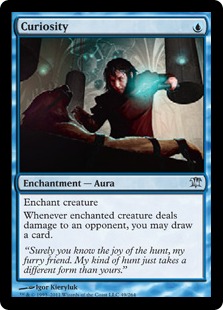
  3. I don’t like creatures that do things. Of Counter-Cat’s threats, only the Snaps “do things,” but they’re integral enough to the deck’s strategy to deter me from not playing them. Obviously, Counter-Cat offends less than a deck like GW Hatebears or Grixis Midrange, but I would never consider playing those decks for this reason.

The revelation I may have outgrown Counter-Cat led me to box up the deck and return to my roots with Monkey Grow. I didn’t play much before the Super Series outside of a few matches on Cockatrice and some coffee shop games with my BFFL (a true Counter-Cat devotee), and I'd settled on a list by then.

Monkey Grow, by Jordan Boisvert

Creatures

4 Delver of Secrets
4 Tarmogoyf
4 Hooting Mandrills
1 Snapcaster Mage

Sorceries

4 Gitaxian Probe
4 Serum Visions

Instants

4 Lightning Bolt
1 Tarfire
3 Thought Scour
4 Disrupting Shoal
3 Mana Leak
3 Stubborn Denial
3 Simic Charm

Enchantments

1 Curiosity

Lands

4 Misty Rainforest
4 Scalding Tarn
1 Wooded Foothills
2 Steam Vents
1 Stomping Ground
1 Breeding Pool
3 Island
1 Forest

Sideboard

3 Huntmaster of the Fells
3 Blood Moon
1 Flashfreeze
2 Destructive Revelry
2 Ancient Grudge
1 Pyroclasm
1 Firespout
2 Curiosity

Build Notes

Those of you unfamiliar with Monkey Grow should check out these articles. This section covers the changes I've since made to the deck.

Curiosity3 Thought Scour, 1 Curiosity: I’ve never loved drawing into Scours during the mid-game, when mana’s tight and threats are at a premium. I also side them out against BGx, inspiring me to cut one for a card that shines in that matchup. Game 1 finds us at our most linear, speeding into threats with Thought Scour and riding them to victory as quickly as possible. In this scenario, Curiosity is a cantrip at worst, and a draw engine at best.
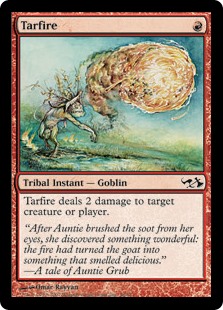
3 Simic Charm,1 Snapcaster Mage: One of the best cards in the deck, Simic Charm admittedly clunks out sometimes at four copies. Snapcaster Mage is a card I’ve long thought about running again, as he gives us a lot of points against BGx and some inevitability in longer games. With 4 Probe, we can even Snapcaster on turn two in lieu of a real threat, and flashing him in to suit him up with Curiosity next turn always gets that evil eye I love from my opponent. The best thing about Snapcaster Mage: in the late-game, he is a Simic Charm!

Tarfire1 Tarfire: I cut this card from the deck shortly after GP Charlotte, but couldn’t bear to part with it after all the smiles we shared in Blood Moon decks. Tarfire is a damage-based removal spell with relevance in matchups these effects traditionally underperform in. Against Tasigur decks like Grixis and Abzan Midrange, having a 5/6 Tarmogoyf is invaluable. Against linear combo decks, an early Tarfire shaves a whole turn off our Goyf clock.
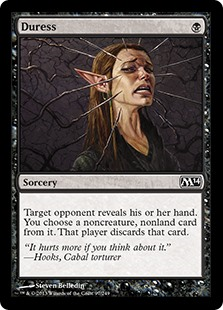
3 Huntmaster of the Fells (SB): Cutting a Thought Scour and adding a Snapcaster Mage makes me think four Huntmasters is a little too greedy for a 17-land deck.

Ancient Grudge2 Ancient Grudge (SB): Thanks to Ancient Grudge, there’s no reason to lose to Affinity in these colors. The matchup gets really good with four hard answers to artifacts, and Grudge’s flashback makes it the best matchup-specific hoser in a tempo shell. Bonus: running two Grudge gives us a ton of splash points against artifact-reliant strategies like GR Tron, Amulet Bloom, Merfolk, and Lantern Control.

1 Firespout (SB): A friend has been nagging me to try Firespout over Pyroclasm for a while now. “It doesn’t kill Delver! It destroys Wild Nacatl! It incinerates Loam Lion!” Loam Lion isn’t exactly a card I care about, but to shut him up, I decided to give it a go over Pyroclasm #2.

2 Curiosity (SB): When I won a StarCityGames IQ with Monkey Grow last summer, Huntmaster-Curiosity-Moon was my go-to plan against Jund, and it worked. I abandoned this plan for GP Charlotte, and paid dearly; after going 7-0, I paired with three straight Jund opponents who slaughtered me. I was anxious to play Curiosity again, so I threw a couple into the sideboard.

Mana Deprived Super Series: Report, Part I

Round 1: Super Rat Friends (2-1, win roll)

During and after the match, my opponent and I went through a number of interesting names for his wonky Mardu Midrange deck. Its combination of Ravenous Rats, Liliana Vess, Liliana's Specter, and Ajani Vengeant initially led him to name it "Walking Rats," but his eyes lit up when I suggested "Super Rat Friends."

Game 1

My opponent mulligans to six. I keep a slow hand of Visions, Bolt, Denial, and lands. A turn two Ravenous Rats from my opponent puts me on edge and takes a Breeding Pool, and I resolve Delver of Secrets and start attacking. I Deny Ajani Vengeant, but Liliana Vess resolves. Delver eats a Lightning Bolt and my new Goyf dies to Gatekeeper of Malakir. Laughing, I admit to my opponent I don't think I'll win the match.

Sideboarding:
-4 Disrupting Shoal
-3 Simic Charm
-3 Thought Scour

+3 Huntmaster of the Fells
+3 Blood Moon
+1 Pyroclasm
+1 Firespout
+2 Curiosity

Attrition decks do Thought Scour's work for free, and Shoal only helps them out. Simic Charm seems lackluster against a deck without juicy bounce targets or much non-creature removal. Huntmaster and Curiosity provide bodies and cards to grind with. Pyroclasm effects handle the rat infestation so Tarmogoyf can connect with planeswalkers.

DuressGame 2

We both mulligan to six. While my opponent Duresses a pair of Blood Moons from my hand, I resolve two Delvers and a Tarmogoyf to start piling on damage. A Thoughtseize eats my Huntmaster of the Fells, but I'm nowhere near four lands and too far ahead on the board for it to make a difference. My opponent casts Liliana's Caress, which I happily let resolve. Drawing Lightning Bolt to kill a defensive Liliana's Specter seals the deal.

Game 3

Probe shows me Godless Shrine, two Plains, Swamp, Lightning Bolt, and Gatekeeper of Malakir. Two Goyfs and a Mandrills end this game before my opponent draws out of his flood.

I often prepare only for "real decks," so getting paired with rogue strategies early on can be pretty spooky. For this reason, I tend to favor versatile answers like Blood Moon and Huntmaster over highly specific ones. These "Abzan hate cards" apply directly to the Super Rat Friends matchup.

Round 2: Waste Not (2-1, win roll)

When my opponent led with Blackcleave Cliffs, Inquisition of Kozilek, I figured I'd failed in dodging the Jund matchup. Turns out I was wrong, but I wasn't too thrilled to see Liliana's Caress again.

Game 1

We both go to six.Burning Inquiry I let two Caresses through, sticking Goyf and then tapping out for Hooting Mandrills as my opponent struggles to find a third land. I'm at 11 life and have Mana Leak in hand, but Goyf is just 3/4. Casting Mandrills gets around a surprise Liliana of the Veil, and it secures a victory immediately if my opponent continues to stumble. Instead, he casts Wrench Mind and Burning Inquiry. I haven't seen this deck in so long that I forgot it even plays Burning Inquiry! Anyway, that's 12 points of damage.
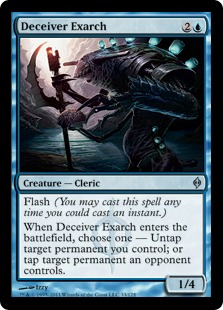
Sideboarding:
-4 Disrupting Shoal
-1 Simic Charm
-3 Thought Scour

+3 Huntmaster of the Fells
+2 Destructive Revelry
+1 Ancient Grudge
+2 Curiosity

Revelry and Grudge come in to deal with Caress, Waste Not, Ensnaring Bridge, and Rack effects.

Game 2

Two Mandrills survive Liliana of the Veil when I offer Delver of Secrets as a sacrifice. My opponent has time to set up as the Monkeys punch him, and resolves two copies of Burning Inquiry with an active Waste Not. Double-blocking Zombie tokens don't beat Simic Charm pumps, and I win with a Lightning Bolt at just two life.

Sideboarding:
-2 Simic Charm
-1 Ancient Grudge

+3 Disrupting Shoal

Didn't see any artifacts for the second time in a row, so out comes the Grudge. I realized in the middle of Game 2 that Waste Not isn't just any attrition deck. It relies heavily on Waste Not and Burning Inquiry resolving. Disrupting Shoal is actually sweet against this deck!

Game 3

Chained Inquisitions take Delver of Secrets and Curiosity, but I topdeck Tarmogoyf for turn two. He resolves at 5/6 and turns sideways while I Shoal and Mana Leak two Waste Nots. Bolt kills my opponent once he falls to three.

I expected to play against Modern's top-tier at this event. The silly boarding and play mistakes I'd already made against rogue "discard" decks had me feeling a bit disoriented going into Round 3.

Round 3: Grixis Twin (1-2, win roll)

When I see Steam Vents and Desolate Lighthouse, I get a little giddy. No more Liliana's Caress! Twin, in all its incarnations, is historically one of Monkey Grow's best matchups.

Game 1

I stick a Tarmogoyf by Shoaling Remand and start beating. Pestermite eats a Mana Leak, and I manage to get Curiosity on the Goyf. My opponent flashes in Snapcaster Mage during combat to block and Bolt, but I Bolt his creature first and draw from my aura. He almost scoops when I Probe him. I see a hand full of black spells, letting me know for the first time he's on Grixis. Curious Goyf connects again and I resolve Mandrills for the concession.

Sideboarding:
-2 Disrupting Shoal
-3 Thought Scour

+3 Huntmaster of the Fells
+2 Curiosity

Grixis Twin generally boards out some combo pieces against me, since Simic Charm blows it out. The Huntmaster+Curiosity plan, incidentally, out-midranges them.

Game 2

Deceiver ExarchI mulligan to six. Delver and Goyf get removed early. I never make a third land drop and get tempo'd out by Snapcaster Mage and Deceiver Exarch. Probe lets me know my opponent has Splinter Twin, so I have to hold up Simic Charm as I take the beating and stare at a bunch of stupid Tarmogoyfs in my hand.

Game 3

I ship three straight no-landers and end up with a decent four cards. Probe shows me a bunch of lands and Kolaghan's Command, letting me know I have limited time before my mana-spoiled opponent finds his money cards. I rush to resolve Hooting Mandrills and start trading attacks with an Exarch. During combat, my opponent goes to Bolt the Mandrills, and I Shoal to protect him from Kolaghan's Command. But he has Snapcaster Mage to block and Bolt with flashback. I never recover.

I learned an important lesson here. Since I did so little testing with Monkey Grow before the event, I didn't have a board plan fleshed out for some of my matchups, including Grixis Twin. Knowing exactly what my plan was against them may have helped me win. Some post-tournament practice points to Blood Moon being really strong.

Round 4: Abzan Midrange (2-0, lose roll)

I'd joked to a friend earlier in the day that my plan for winning this event was to dodge BGx. By BGx, I meant Jund, the deck that terrorized my performance at GP Charlotte last summer. I hadn’t even considered Abzan Midrange, Monkey Grow’s sworn nemesis since I first brewed the deck in January. The insane relevance of Siege Rhino and Tasigur, the Golden Fang against a deck so focused on casting Hooting Mandrills led me to play all those Simic Charms and Huntmasters in the first place. Luckily, those cards pulled their weight in this quick match, a definite pick-me-up after my Grixis loss.

Game 1

I keep a hand of Tarmogoyf, Steam Vents, double Mana Leak, Snapcaster Mage, Serum Visions, Gitaxian Probe, and Stubborn Denial, and get Inquisitioned. My opponent takes Visions and passes. I draw Hooting Mandrills, and Probe shows me two more Inquisitions and a pair of Abrupt Decay before cycling into Thought Scour. I play Steam Vents untapped and pass, Scouring myself in response to another Inquisition. This time I draw Misty Rainforest, and the Mandrills goes unanswered. Four attacks later, we’re sideboarding.

Sideboarding:
-4 Disrupting Shoal
-3 Thought Scour
-1 Tarfire
-1 Lightning Bolt

+3 Huntmaster of the Fells
+3 Blood Moon
+1 Flashfreeze
+2 Curiosity

Bolt is better than Tarfire here since it kills a 3/3 Scavenging Ooze, or combines with Snapcaster Mage to slay Siege Rhino. Abzan's Goyfs benefit from our Tarfire, and are better at staying on the board thanks to Abrupt Decay.

Game 2

Another turn one Inquisition shows my opponent a perfect hand, featuring Delver of Secrets, Tarmogoyf, Simic Charm, Lightning Bolt, Serum Visions, and lands.siege rhino The discard spell takes Delver, but I draw another one. Instead of flipping him, I draw a third Delver. They both flip next turn and attack for six. My opponent resolves Siege Rhino, but I have Tarmogoyf to wall it. Nihil Spellbomb doesn’t neuter the Goyf, but it does find my opponent an Abrupt Decay. Simic Charm saves my Aberration, and I Stubborn Denial a Dismember with ferocious. I reveal Huntmaster of the Fells from the top of my deck for the concession.
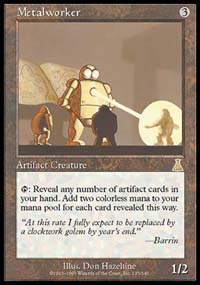

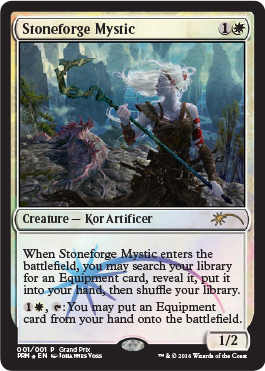
When I played Monkey Grow frequently, Abzan Midrange was the bane of my existence. I simply could not beat it. I’ve undoubtedly improved at Magic since then, but this fifteen-minute match felt a little too easy. Unbeknownst to me now, a decidedly grindier rematch with Abzan in Round 8 would give me some new perspectives on the matchup.

To Be Continued....

I've never written such a detailed tournament report. Information doesn't come cheap in the realm of text, so for spatial reasons, I'll have to conclude the report on Monday. In the meantime, I'll be playing with Monkey Grow all weekend, and possibly adopting an actual monkey to help with testing. More on these exciting developments next week!

Read Chapter 2 here.

David Ochoa Wins His Way into VSL

Are you a Quiet Speculation member?

If not, now is a perfect time to join up! Our powerful tools, breaking-news analysis, and exclusive Discord channel will make sure you stay up to date and ahead of the curve.

Full disclosure, Shops is my least favorite deck in Vintage. I say this having never beaten an Oath of Druids in my life. I find nothing interesting about Mishra's Workshop decks, and most of the games I have played with blue decks against Shops have merely been a matter of lining hands up against each other and factoring in play/draw. Not a lot of actual thinking. This week, for the first time, I witnessed a Shops matchup that involved a lot of impressive play.

There was an error retrieving a chart for Mishra's Workshop

If you haven't seen the video yet, I strongly recommend checking out the finals match for the VSL qualifier. In this match, David Ochoa finds lines better than the lines that LSV suggests while commentating in very impressive fashion. There aren't a ton of recorded matches that I could rewatch, but this one is well worth it. You can find the match on Youtube here. I'm pretty excited to see Ochoa play more Vintage in the league.

Avatar photo

Ryan Overturf

Ryan has been playing Magic since Legions and playing competitively since Lorwyn. While he fancies himself a Legacy specialist, you'll always find him with strong opinions on every constructed format.

View More By Ryan Overturf

Posted in FreeTagged , Leave a Comment on David Ochoa Wins His Way into VSL

Have you joined the Quiet Speculation Discord?

If you haven't, you're leaving value on the table! Join our community of experts, enthusiasts, entertainers, and educators and enjoy exclusive podcasts, questions asked and answered, trades, sales, and everything else Discord has to offer.

Want to create content with Quiet Speculation?

All you need to succeed is a passion for Magic: The Gathering, and the ability to write coherently. Share your knowledge of MTG and how you leverage it to win games, get value from your cards – or even turn a profit.

Insider: Assessing the Modern Banned List

Are you a Quiet Speculation member?

If not, now is a perfect time to join up! Our powerful tools, breaking-news analysis, and exclusive Discord channel will make sure you stay up to date and ahead of the curve.

The announcement of the Stoneforge Mystic GP promo has a lot of people speculating that the card's time on the Modern banned list might be coming to an end. Sheridan wrote a great piece presenting evidence for and against this possibility this week. Today I thought I'd share my own thoughts on the state of the Modern banned list.

Stoneforge Mystic GP Promo

The Obvious

As Modern has developed as a format, we've seen the banlist get more and more refined. WotC has made decisions to ban oppressive cards to better the format, while also unbanning cards that they correctly believed would not ruin anything. The banlist still isn't perfect, but I would argue it's better than ever.

There are some cards on the banlist that are obviously going nowhere, because they're just way too overpowered. The front-runner for this category in my mind is Skullclamp. You will never see this card legal in regular Modern play, unless something very weird happens to the fundamental rules of the game.

There was an error retrieving a chart for Skullclamp

The other category of cards that are all but exempt from an unban in the near future are the ones that recently got the ax. WotC doesn't waffle on things like banlists. Decisions to ban and unban cards aren't taken lightly, and as such there's no way that Birthing Pod will be returning to the fray just yet.

There was an error retrieving a chart for Birthing Pod

There's really no reason to waste time discussing cards of this nature.

On Stoneforge Mystic Itself

Prior to recent discussions, I would have reflexively lumped Stoneforge Mystic into the category of "obviously too powerful." This stems partly from the strong language they used in the original banlist announcement, and partly from the significant role Stoneforge played in the decision to replace four-year Extended with Modern.

Mystic literally killed that format. Mind you, that was an Extended where Thoughtseize, Lightning Bolt, Ponder, Preordain, Jace, the Mind Sculptor, and Bitterblossom were considered fair play. It was one of the most high-powered Extended formats that ever existed, and Stoneforge Mystic was considered the biggest stain on that part of Magic history.

There are definitely differences between Extended then and Modern now that you could use to argue for unbanning Stoneforge Mystic.

Kolaghan's Command is a real, maindeck threat to Stoneforge decks, and decks like Tron that go completely over the top of Batterskull weren't a relevant metagame force back then. The prospect of simultaneously unbanning Stoneforge and banning Batterskull is also worth entertaining.

Conversely, the notion of a Twinblade deck with a Modern manabase is a frightening one. Even without Batterskull, giving the deck access to a tutor for Sword of Feast and Famine and Sword of Fire and Ice to increase the relevance of Deceiver Exarch is alarming.

Twinblade was considered the best version of the best deck in the Caw Blade era, and a high-powered version of this deck is a problem for obvious reasons. You really don't want to burn your player base in the same way twice.

There was an error retrieving a chart for Splinter Twin

Cards as efficient as Stoneforge Mystic are the ones that can easily strangle a format. Seeing as the banlist generally prevents players from winning before turn four, tapping out on turn two is generally a non-issue.

I fully believe Stoneforge Mystic in Modern would be beatable, and have bad matchups. But more than most staples, it would have a warping effect, significantly restricting the types of cards you can play without just snap-losing on turn two. I wouldn't speculate on this potential unbanning, and I'll believe it when I see it.

That said, Bloodbraid Elf once saw a significant spike when players expected it to be unbanned. So there is the possibility of hitting even if Stoneforge remains banned, but tread cautiously. You will only be able to sell to greater fools and the GP promo will damage the card's value for the immediate future.

Potential Unbans

Sword of the Meek

There was an error retrieving a chart for Sword of the Meek

Sheridan has been suggesting that Sword of the Meek could potentially be unbanned in Modern. It gets hit by all the same hate as Affinity, while also having weaknesses to graveyard disruption.

Initially I was taken aback by this suggestion, though upon further reflection I think it might be fine. I'm not entirely sure what Thopter Sword combo decks would look like in today's Modern, and I'd entertain discussions about them.

There was an error retrieving a chart for Thopter Foundry

The combo is as close to a hard lock against aggressive decks as they come, and wouldn't be easy for midrange or controlling decks to beat either, barring direct disruption. I don't think this would be a healthy addition to the format for that specific reason, but it strikes me as possible.

There's no reason for the price of Sword of the Meek to budge much at all in one way or the other for the time being, so there are definitely worse specs. Be warned though, if the card isn't unbanned then moving copies won't be terribly easy.

Jace, the Mind Sculptor

There was an error retrieving a chart for Jace, the Mind Sculptor

This one remains a long shot, but if you look at the potentially unbannable cards in Modern, the list is quite short. The reason for nearly every banning in Modern holds true in significant ways, and the banlist is in a solid place right now. In fact, the main reason why I say Jace could be unbanned in Modern is because he has never actually been given a fair look.

Jace has a horrible reputation. People don't like losing to him. He does everything, and he does it well. This is the part of the Stoneforge Mystic argument that applies to Jace.

On the other side of things, Jace has nowhere near the potential of Stoneforge to be oppressive. There are plenty of decks that are either winning the game on turn four, or patently don't care about Jace. I think it's clear that Jace would see Modern play if unbanned, but I don't believe he'd be anywhere near the dominant force he once was.

That said, I can't imagine Jace ever getting that fair look. The negativity far outweighs any argument to the contrary.

I think Jace is a fine card to own, and realistically Jace should see the light of Modern at some point in time. Jace has held a price tag over $70 without needing any assistance from Modern and will show up in EDH and Legacy decks until the end of time. I've had my set since the card was Standard-legal, and who knows, maybe one day it will pay off in a big way.

Ancestral Vision

I hear people talk about [card]Ancestral Vision05 being unbanned, and let me tell you, Jace is more likely in every way.

There was an error retrieving a chart for Ancestral Vision

Ancestral Vision is similar to Jace on the card advantage front, except it has the same efficiency problem as Stoneforge Mystic. Vision would stink a lot like Treasure Cruise in Modern.

Developing a deck to efficiently trade one-for-one and then reload and overwhelm the opponent is not difficult. When your refuel spell costs a single blue, things get abusive fast. At least with Jace you have to tap out.

~

Speculating on an unban is risky territory no matter how good your information is. If you feel lucky or prescient then by all means, go for it.

Your best bet is to speculate on cards with proven strong price histories, regardless of their time on the banlist. Otherwise you could find yourself with a card that never appreciates and is difficult to sell, or in the case of Stoneforge, one that goes down in price due to an already announced reprint.

On a limited budget, you're much better off buying into proven staples. They yield less explosive returns, but the matter is much more certain.

Thanks for reading.

-Ryan Overturf
@RyanOverdrive on Twitter

Insider: Converting My Collection to Cash

Are you a Quiet Speculation member?

If not, now is a perfect time to join up! Our powerful tools, breaking-news analysis, and exclusive Discord channel will make sure you stay up to date and ahead of the curve.

I enjoy trading, and at different times in the past I have been a very active trader. There was a period of time when people at the local shops knew me more for my eagerness to trade than for my ability to play the game.

Over the past year or so, however, I've only played live Magic at major events where my focus is on the tournament. So my trade binder has been accumulating a lot of dust. The biggest problem afflicting my collection has always been stagnation, and I have often failed to get rid of a card when it was at its peak.

I decided I had to keep my cards moving somehow, and eager to accumulate some cash, I sought to liquidate my trade binder.

I also have a huge assortment of extra staples that aren't doing anything for me. I organized most of my collection into decks or playsets, which left me with a ton of extra cards to sell.

Weighing the Options

I knew there were a lot of ways to sell my cards, and I explored the options.

The first thought many players have is one that sounds easy, selling to a dealer. I knew that a little bit of time spent exploring the dealers at a major constructed event would allow me to quickly turn my cards into cash, but I would pay a premium for the experience.

Dealers come to events with a lot of cash, but their goal is to buy as many cards as cheaply as possible. Many employ teams of buyers paid on commission. These buyers' job is to offer you as low a price as possible while still getting your cards out of your binder.

Anything they buy will be sold to the dealer at their buying price, and anything extra is profit for the employee. This situation does not often lead to the best offers.

TCGplayer

Seeking to make the most from my collection, I elected to sell the cards on my own. In the old days I sold plenty of cards on eBay, but more recently I've switched to TCGplayer. Listing huge numbers of cards is an easier prospect on TCGplayer, and you reach an audience of buyers more specifically looking for Magic cards.

So I set out to list my cards on TCGplayer.com. I went through my binders and listed all cards worth more than a few dollars (or less, if I had multiple copies to list at once).

Selling a lot of cards on TCGplayer means sending out a lot of envelopes, so be prepared. I take a minimalist approach to packaging, placing them in a sleeve and top-loader, taping the top, placing it in the envelope and taping it closed.

I write the addresses by hand, but I could easily type out and print address labels if I had more sales volume. I have moved towards printed return address labels to make my process more efficient. Keep in mind that the price of these shipping supplies are a cost for tax purposes.

Setting Aside Cards to Buylist

For cards in Near Mint (NM) condition, I checked the buylist price on Trader Tools first and set aside anything I'd make more on by selling to one of the listed buylists.

Online buylists are an excellent way to sell cards because prices are typically higher than those offered at live events, even from the same store.

Buylists contain a huge range of cards, so they are a great way to sell those obscure cards that have value but might takes months to sell otherwise. They are also an ideal out for low-price cards that are inefficient to sell on your own, but which can add up quickly.

The downside to buylists is they demand cards be in NM condition. Condition policies are usually laid out on stores' websites---they may make you a revised offer or simply pay you a reduced price if they find the condition unsatisfactory.

Either way it's at the buyer's discretion. Rather than put your cards at risk, just be strict with the condition of cards you sell to buylists.

Finding Buyers Directly

Beyond my trade binder, I also have a small collection of various high-end cards and foils. I have sold cards like this on TCGplayer on the past, but they often take a while to move. Cross-listing on eBay is a good strategy for posting expensive and slower-moving cards, because the more exposure your card has, the more likely it is to sell.

Selling through a third-party site always involves accepting fees. These fees are a cost of doing business for moving smaller cards, but staples and higher-end cards may be better off moved through peer-to-peer transactions.

You can find these on trading boards, specifically Facebook groups like High End Magic stuff for sale! and MAGIC THE GATHERING buy/sell/trade, along with any local or regional Magic groups. These groups offer the ability to sell a card for a fair price and retain the full value by avoiding any fees.

There is some safety that comes with a third-party seller compared to selling to someone you met online, but the reference system means you can have some confidence in your transaction.

~

Regardless of how you buy and sell cards, keep good records for tax purposes. TCGplayer provides great tools for tracking your sales history and eBay provides some ability to view your sales as well. Otherwise, spreadsheets are a great tool for organizing transactions.

I'm still not sure how to handle the huge amount of above-bulk, played cards I have. They don’t seem worth listing online, but they're definitely too valuable to bulk out. Perhaps selling bulk lots on eBay is a good idea. I've also heard that selling lots of cards on Amazon is an option, but I have no experience with it.

What methods do you prefer for selling cards? Is my view of dealers too pessimistic? Where do you draw the line for bulk cards? What about bulk rares?

Share your thoughts in the comments!

- Adam

Avatar photo

Adam Yurchick

Adam started playing Magic in 1999 at age 12, and soon afterwards he was working his trade binder at school, the mall food court, FNM, and the Junior Super Series circuit. He's a long-time Pro Tour gravy-trainer who has competed in 26 Pro Tours, a former US National Team member, Grand Prix champion, and magic.tcgplayer.com columnist. Follow him at: http://twitter.com/adamyurchick

View More By Adam Yurchick

Posted in Finance, Free Insider, Selling2 Comments on Insider: Converting My Collection to Cash

Have you joined the Quiet Speculation Discord?

If you haven't, you're leaving value on the table! Join our community of experts, enthusiasts, entertainers, and educators and enjoy exclusive podcasts, questions asked and answered, trades, sales, and everything else Discord has to offer.

Want to create content with Quiet Speculation?

All you need to succeed is a passion for Magic: The Gathering, and the ability to write coherently. Share your knowledge of MTG and how you leverage it to win games, get value from your cards – or even turn a profit.

Want Prices?

Browse thousands of prices with the first and most comprehensive MTG Finance tool around.


Trader Tools lists both buylist and retail prices for every MTG card, going back a decade.

Quiet Speculation