
menu

Insider: RPTQ Prep Week 4 – PTDTK

Are you a Quiet Speculation member?

If not, now is a perfect time to join up! Our powerful tools, breaking-news analysis, and exclusive Discord channel will make sure you stay up to date and ahead of the curve.

In my quest to qualify at the upcoming regional PTQ, today I will be taking a look at the decks that did well at the Pro Tour and analyzing the metagame shift that will likely happen as a result. The Top 8 decks were all decks you might imagine would make an appearance.

No one could have predicted that three U/B Control decks would have made it into the Top 8 but the fact that the rest was two green devotion decks, Abzan Control, G/R Dragons, and an almost Mono-Red Aggro was not surprising at all. I’ve seen a lot of writers discussing how surprising the return of U/B Control was, but honestly that should have been expected and in higher numbers than any other event because pros love their control decks.

While there was some innovation to these Top 8 decks, they were mostly the same as decks that have been doing well recently. Certainly taking note of the exact configuration of removal spells being played by the control decks is important, but U/B Control is still U/B Control. They might have an Aetherspouts and a couple Silence the Believers to play around, but overall, the deck is going to play the same basic way that it has been playing for a while now.

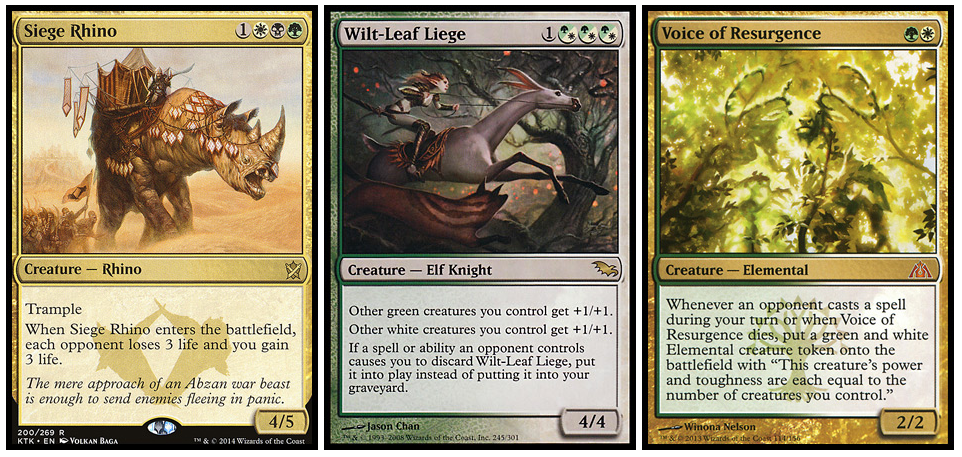
You will need to make sure you can beat this deck because players will rally behind this deck just like they did the last time it did well. The same goes for the green devotion decks. They may be ramping to Dragonlord Atarka instead of Hornet Queen, but the two cards function similarly. None of the Top 8 decks showcase new or innovative strategies, but they are all tweaked solid decks.

Of the Top 8 decks, I will be focusing on none of them today. That’s right, the Top 8 decks are important, but it’s the ones that did well that didn’t receive all the press that I’ll be discussing today. There are four decks that stood out to me from the 24-27 point Standard decks. These decks were the ones that overperformed in the Standard portion. Being able to achieve a 9-1 or 8-2 record at the Pro Tour is no easy feat, but all of the decks I’ll discuss managed to accomplish that goal.

G/w Devotion Aggro by Bram Snapvangers (37th place PTDTK)

Creatures

4 Elvish Mystic
4 Avatar of the Resolute
3 Den Protector
4 Fleecemane Lion
4 Boon Satyr
4 Reverent Hunter
4 Surrak, the Hunt Caller

Spells

4 Collected Company
3 Dromoka's Command
2 Valorous Stance
2 Aspect of Hydra

Lands

6 Forest
2 Plains
4 Windswept Heath
4 Temple of Plenty
2 Wooded Foothills
2 Mana Confluence
2 Nykthos, Shrine to Nyx

Sideboard

1 Dromoka's Command
2 Valorous Stance
1 Aspect of Hydra
2 Archetype of Courage
2 Plummet
4 Nylea's Disciple
1 Reclamation Sage
1 Gods Willing
1 Become Immense

First up, we have one of the most fun looking decks from the event, Green Devotion Aggro! This deck features so many unconventional heroes that it’s compelling to bring this to battle. My experience with green devotion of any type has not been positive but how can you resist playing Avatar of the Resolute in a deck where he can actually get the extra counters?

There is a lot of synergy going on in this deck and it mostly relies on having green symbols in play. This deck features some of the same great lines of play as Abzan Aggro and these potent aggressive starts can be tough for any deck to overcome. Instead of pairing these aggressive creatures with black removal spells though, we are looking to just end the game as quickly as possible. Aspect of Hydra can provide some blowout wins because it’s cheap and unexpected.

Removal spells are particularly good against this deck and in a format filled with good removal, I’m not sure how confidant I would be to bring this to an important event like the Pro Tour. Hall of Famer Bram Snapvangers certainly did well with the deck though. If this fits your play style, it is a honed weapon ready to strike down any foe.

Thinking about updates to the deck going forward, there are a few ways that the deck can utilize its mana in the midgame but I might want a couple more. Somewhere in the 75, I would probably want some copies of Whisperwood Elemental. That card can get out of hand rather quickly and often if one manifest token is made, the game is nearly won. I would probably add in a couple copies of the card even before I tested the deck, but sometimes it’s better to test the successful deck before making adjustments to it.

Overall, the deck seems like tons of fun and is certainly capable of winning out of nowhere. Surprise victories are always great and hard for your opponent to play around. If this deck is for you, figure out how to sideboard with the deck because that’s one of the hardest parts.

R/G Bees by Sam Black (12th place PTDTK)

Creatures

4 Elvish Mystic
4 Sylvan Caryatid
4 Courser of Kruphix
4 Hornet Nest
1 Polukranos, World Eater
1 Ashcloud Phoenix
1 Stormbreath Dragon
2 Whisperwood Elemental
1 Dragonlord Atarka

Spells

3 Roast
3 Setessan Tactics
4 Chord of Calling
3 Xenagos, the Reveler
2 Chandra, Pyromaster

Lands

4 Temple of Abandon
4 Wooded Foothills
1 Rugged Highlands
4 Mountain
9 Forest
1 Mana Confluence

Sideboard

1 Ashcloud Phoenix
1 Stormbreath Dragon
1 Whisperwood Elemental
1 Xenagos, the Reveler
1 Chandra, Pyromaster
2 Rending Volley
3 Magma Spray
1 Arbor Colossus
2 Reclamation Sage
1 Scuttling Doom Engine
1 Boon Satyr

Next up is G/R Dragons! Well, almost. Just like many other decks in Standard, this one also features the great green cards available in the format. We all know how solid Elvish Mystic, Sylvan Caryatid, and Courser of Kruphix are, and they are still good in this shell.

Besides sharing half the deck in common with G/R Dragons, the other half is spicier than most can handle. How many aggro decks are prepared to fight against an army of hornet tokens? Based on his results, I’d say not many. This deck is basically a build your own mini-Hornet Queen strategy. Once you have your Hornet Nest in play, call your swarm by casting Roast, Setessan Tactics, Chandra, Pyromaster, or even Dragonlord Atarka. Any of these ways to deal damage will generate you a pile of hornet tokens to use as you see fit.

The problem with this strategy is that control decks tend to have a good matchup against midrange decks like this. It’s not as bad as it could be because assembling a board state of Hornet Nest plus Chandra, Pyromaster will force your opponent to use an actual removal spell on one or both of your permanents. Getting a control deck to kill your Hornet Nest is like winning the lottery. Not only does it feel good to force your opponent to spend a card on your zero-power creature, but these lines often lead to your victory.

One of the best aspects of this deck is that it utilizes one of the most powerful yet underplayed cards in Standard: Chord of Calling. The creatures in Standard are so powerful it often seems as if you don’t have time to cast a tutor spell like Chord, but it is perfect for this deck.

R/G Bees is a midrange combo deck. The difference between this deck and other combo decks though is that all of the combo pieces are solid spells on their own. We don’t have to play any Briber's Purses in this deck. We get to play Roast as a solid removal spell and sometimes combo piece.

Originally created by Caleb Durward over at Channelfireball, this deck fills a unique role in the metagame of being well positioned against every deck. My main concern would be beating decks with black removal, because they are going to trump your ability to make deathtouch tokens, and strict control decks because there are a lot of your draws that don’t match up with how many removal spells they have. I think this deck is great and I want to test it out. If you have played this deck before, tell me about your experience with it in the comments.

Dragon Control by Josh Utter-Leyton and CFB (11th place PTDTK)

Creatures

3 Dragonlord Ojutai
2 Silumgar, the Drifting Death

Spells

2 Thoughtseize
3 Anticipate
1 Disdainful Stroke
4 Silumgar's Scorn
2 Bile Blight
2 Ultimate Price
3 Hero's Downfall
2 Foul-Tongue Invocation
2 Dissolve
2 Crux of Fate
1 Ugin, the Spirit Dragon
4 Dig Through Time

Lands

2 Haven of the Spirit Dragon
4 Temple of Enlightenment
4 Temple of Deceit
4 Dismal Backwater
4 Polluted Delta
1 Flooded Strand
3 Island
2 Swamp
2 Caves of Koilos
1 Urborg, Tomb of Yawgmoth

Sideboard

2 Thoughtseize
2 Bile Blight
1 Ultimate Price
1 Foul-Tongue Invocation
2 Tasigur, the Golden Fang
1 Negate
2 Dragonlord's Prerogative
2 Drown in Sorrow
2 Dragonlord Silumgar

Now this is a control deck you need to learn to play against. While it does share many cards in common with the other successful decks, it also attacks you from different angles thanks to some help from your friendly neighborhood dragonlords. Playing against either of the two dragons once they’re in play is a nightmare for most decks. You can’t attack through them and you usually can’t kill them. So you’re left trying to overextend and end up getting blown out by their wrath effect.

This deck has solid counters and removal spells as well as hard-to-deal-with threats to back them up. Still, red aggro and Abzan Aggro can be tough for this type of a deck to beat depending on each deck’s draws. I would be concerned about the ability to win control mirrors with this deck and I’m surprised that the deck didn’t feature something like Ashiok, Nightmare Weaver to shore up these matchups.

Abzan Aggro by Brad Nelson(14th place PTDTK)

Creatures

4 Fleecemane Lion
4 Rakshasa Deathdealer
2 Warden of the First Tree
4 Anafenza, the Foremost
4 Siege Rhino
3 Surrak, the Hunt Caller

Spells

3 Dromoka's Command
2 Ultimate Price
3 Abzan Charm
4 Hero's Downfall
1 Valorous Stance

Lands

4 Windswept Heath
1 Mana Confluence
2 Plains
4 Sandsteppe Citadel
2 Forest
2 Urborg, Tomb of Yawgmoth
2 Temple of Malady
2 Temple of Silence
1 Temple of Plenty
3 Caves of Koilos
3 Llanowar Wastes

Sideboard

2 Ultimate Price
3 Thoughtseize
3 Drown in Sorrow
2 Glare of Heresy
2 Elspeth, Sun's Champion
2 Wingmate Roc
1 Sorin, Solemn Visitor

Last up on the list is the deck I am the most excited about. I’ve had a lot of success with Abzan Aggro and Brad and his team showed why the deck is still the real deal. I spent a lot of time over the past couple of weeks working on a green-white centered version of the deck, but what I found was that the black removal was essential to your success. You need cards like Bile Blight and Hero’s Downfall in order to find victory over a number of current strategies. Hornet Queen in particular was terrifying when I faced it repeatedly without my black cards backing me up.

In this version, Brad supported a belief that I’ve had for a while now: don’t play Thoughtseize. He did squeeze a couple copies into his sideboard, but there are zero copies main deck. This is a concept I have been championing since I started playing the deck a couple months ago.

In theory Thoughtseize is amazing and should be an automatic inclusion, but in practice, the cards in players’ decks are too replaceable. You could look at someone’s hand and they have multiples of the same type of effect. This is quite common which makes Thoughtseize underperform.

What I learned from my G/W Abzan deck was that Surrak, the Hunt Caller was pretty amazing. It was one of the only things I liked about the deck. Brad uses Surrak in the exact way I wanted to test out, as his five-drop. If you notice, Surrak took the place of Wingmate Roc in the main deck. That not only lowers the curve a bit but also adds a whole new dimension to the deck.

Players still don’t know that Surrak can trigger other creatures you control. There were plenty of times where I cast Surrak and then gave another creature haste. One example was when the board was clogged up, I made a 2/2 flyer with Sorin, Solemn Visitor and gave it haste. Even if that situation never comes up, you can always follow up your next turn by giving haste to your follow up creature. Just having Surrak in play adds a ton of pressure to your opponent to remove it otherwise they’ll be facing a hasty threat every turn.

The only aspect of the deck I don’t like is his sideboard. The way he is set up to deal with the other decks in the format doesn’t seem optimal to me and I will probably work to see if I can find a better combination.

This version of Abzan Aggro is sleek, consistent and with its 26 lands will never miss a land drop. I’m excited to use this to springboard my testing.

Top Sellers

One of my strengths as a writer is that I am the co-owner of a shop. This gives me real time data to work with and I want to pass it along to you, my readers. In this section, I’ll be highlighting the top selling cards, cards that I am buying at a higher percentage than normal, as well as cards I’ve identified that might increase in price based on the demand I’m noticing. Today, I have a couple of cards from Dragons of Tarkir to talk about.

[cardimage cardname='Thunderbreak Regent']

This efficient dragon was one of my top ten best cards in the set and it sure has been selling that way. This is the only card I’ve been consistently out of stock on. I offer crazy high buylist numbers on this card as well, but it’s so strong that players don’t want to unload them. We all know that this card is seeing tons of play and I could definitely see this card climbing to $15 in the near future. My difficulty keeping this in stock tends to mean a price bump is coming soon. This is a great card to trade into because it’s price isn’t going to drop.

Dragonlords

Hopefully you preemptively were stocking up on all the Dragonlords because they are great stock. Not only are these from one of the most popular creature type, they are also actually Constructed playable, and to top it off they can all be used as commanders! How much better an investment are you looking for?

I doubt you want to get in on Dragonlord Atarka or Dragonlord Ojutai because they are likely at their ceiling. Dragonlord Silumgar is questionable but is also likely at his ceiling. The other two, Dragonlord Dromoka and Dragonlord Kolaghan, are great investments though, because if this cycle ends up playing out similar to the titan cycle, we should see each Dragonlord have their time in the spotlight.

No matter what, these will always trade and sell very well. We are going through a lot of copies at the shop and I expect that to be the case for most of the time they are Standard-playable.

Until next time,
Unleash the Force!

Mike Lanigan
MtgJedi on Twitter
Jedicouncilman23@gmail.com

Insider: MTG Stock Watch for 4/12/15

Are you a Quiet Speculation member?

If not, now is a perfect time to join up! Our powerful tools, breaking-news analysis, and exclusive Discord channel will make sure you stay up to date and ahead of the curve.

Welcome back to our bi-weekly column on what's trending in the MTG "stock" market. This week I'm going to try a slightly different approach. I'm still going to do a breakdown of "penny stocks" and the "blue-chip stocks", but that's it. That being said, I'll be doing more penny stocks and showing the full breakdown of the "blue chip stock" change.

Penny Stocks

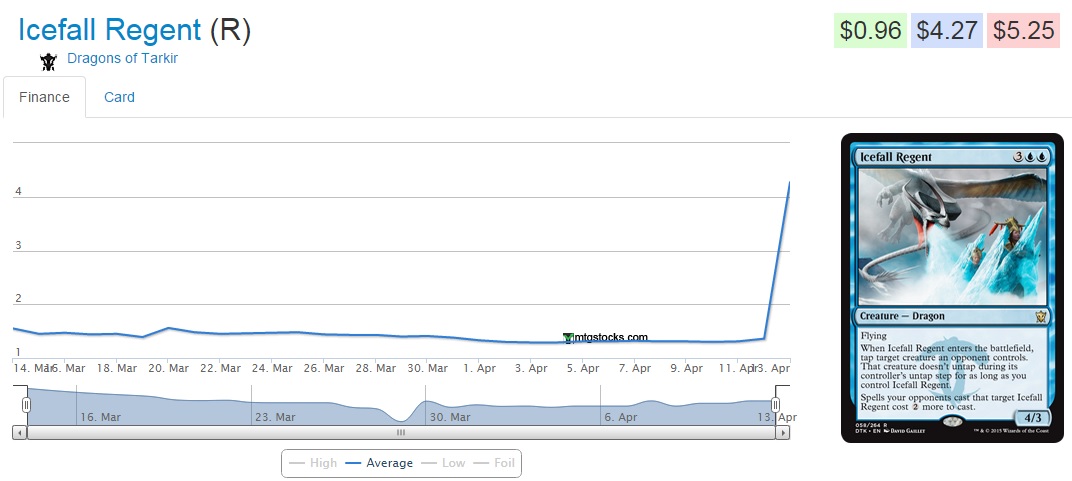
1. Icefall Regent (+226%) - This guy was only in a few of the major teams' PT decks and despite none of them making the Top 8 with him, it's a very strong card (as I've found playtesting a Grixis Control deck my friend and I have come up with). It's not surprising to see him jump dramatically. For those who may not have played during the time the titans were first released, Frost Titan was quickly dismissed as the weakest of them all and forgotten...up until the format became all about dropping a few very large/powerful creatures (mostly titans) and then ol' Frosty trumped them all by locking them down.

Icefall is a pseudo-reprint. For one less mana you get 2 less power and 3 less toughness, but you get evasion. Frost Titan's ability could target any permanent (which could sometimes be lands if it kept your opponent off the 6th mana they needed to drop their own titan), but his ability required you to attack with him to keep the permanent tapped. Icefall can only target creatures, but he keeps them tapped down until he leaves the battlefield and doesn't have to attack.

With a dragon-centric Standard looming in front of us, it's not surprising to see players valuing the creature type a lot higher than usual (especially thanks to DtK's special "dragon-clause" spells. That being said, it would be wise to look at all the Standard legal dragons at this time and give them a second review.

icefall regent

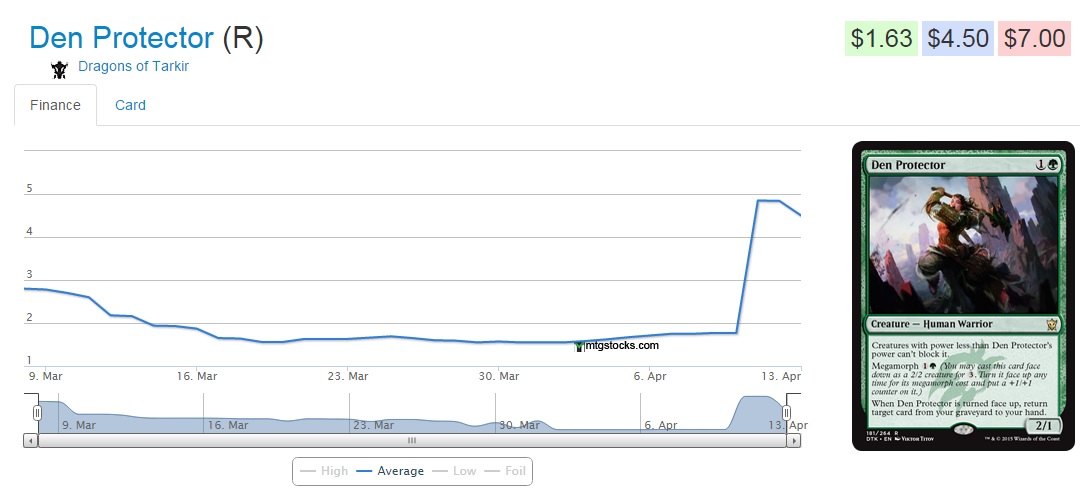
2. Den Protector (+163.2%) - One of the few cards I was actively picking up before the PT, it seems there are a lot of new players who didn't get to play with Eternal Witness in a Standard environment. However, given how prevalent she is in commander the power level is obvious...all it takes it there to be some spells you want to cast over and over. Her evasion is actually quite a bit more relevant as well, since when megamorphed she can go around Courser (which would be her biggest roadblock typically).

den protector

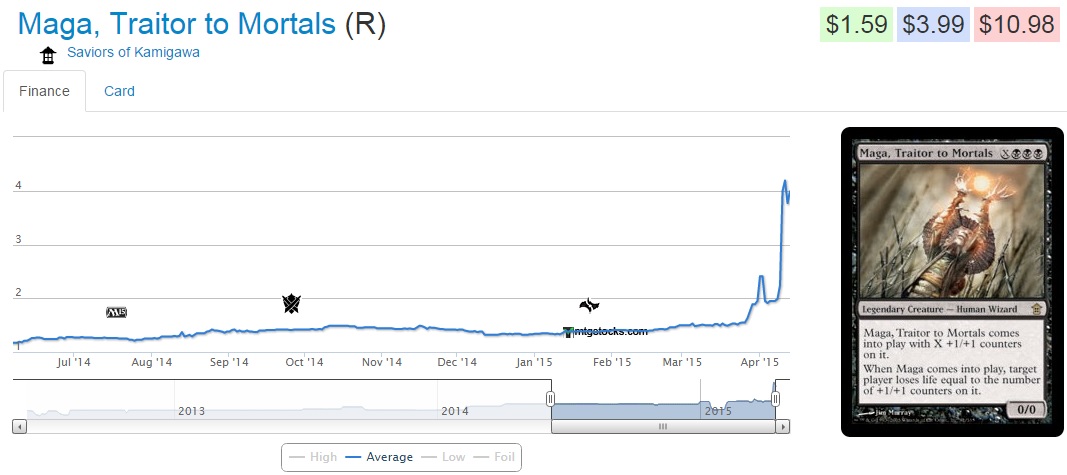
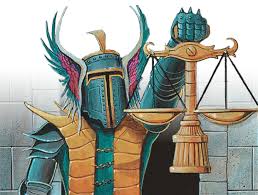
3. Maga, Traitor to Mortals (+104.6%) - This one is likely a carryover from some Tiny Leader speccing. It's important to remember that thanks to Cabal Coffers/Urborg, mono-black has the second best "mass mana" engine for Tiny Leaders (outside of Green). As anyone who has played Tiny Leaders will tell you, X spells are even more powerful in that format thanks to their ability to "break" the three-mana-or-less rule. I imagine this new price will stick, especially given the age of Saviors of Kamigawa and his "uniqueness" as a general.
maga

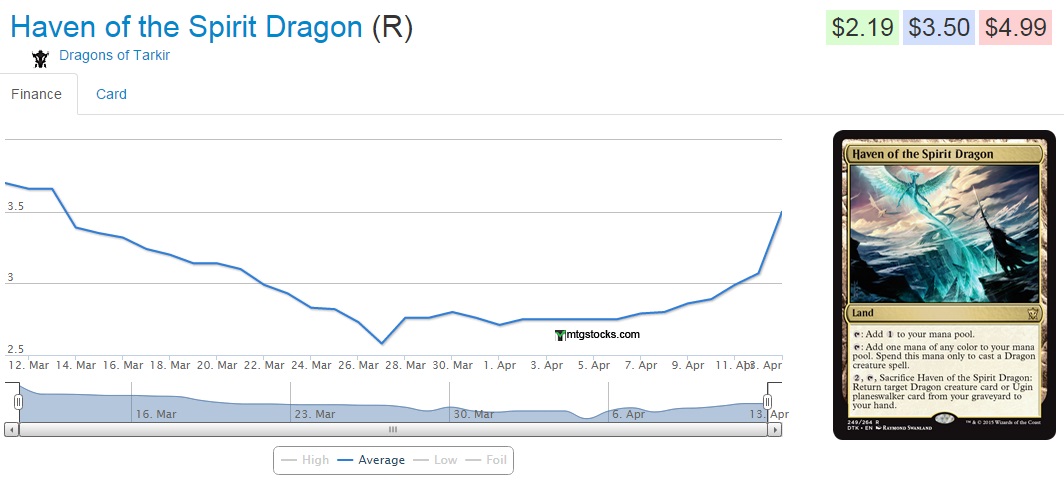
4. Haven of the Spirit Dragon (+27.3%) - Another DtK card with a strong showing at the Pro Tour, this is the land that Crucible of the Spirit Dragon was supposed to be...it provides mana fixing (though limited to casting dragon spells) and can be an uncounterable way to recur a dragon or Ugin that's found its way into the graveyard. This card reminds me a lot of Buried Ruin in that it's not likely to ever reach super expensive heights, but it will always have value and will find its way into Commander with relative ease.

haven

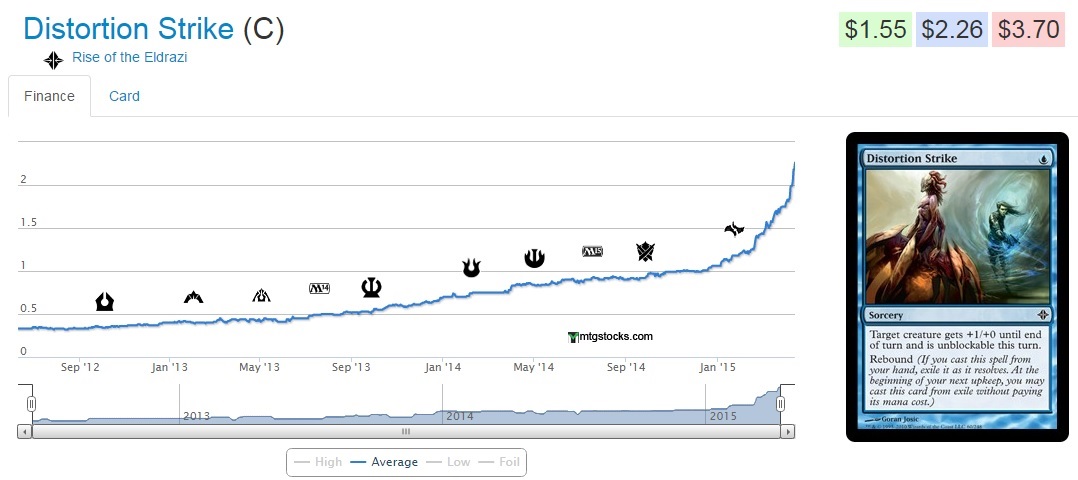
5. Distortion Strike (+22.2%) - This Rise of the Eldrazi common is finding quite a home in the Modern infect decks that have been cropping up a lot lately. It's not surprising given that with the renewal of Junk decks in Modern packing 3-4 Lingering Souls, having a card that helps your infect creature sneak through is critical to the game plan.

distortion strike

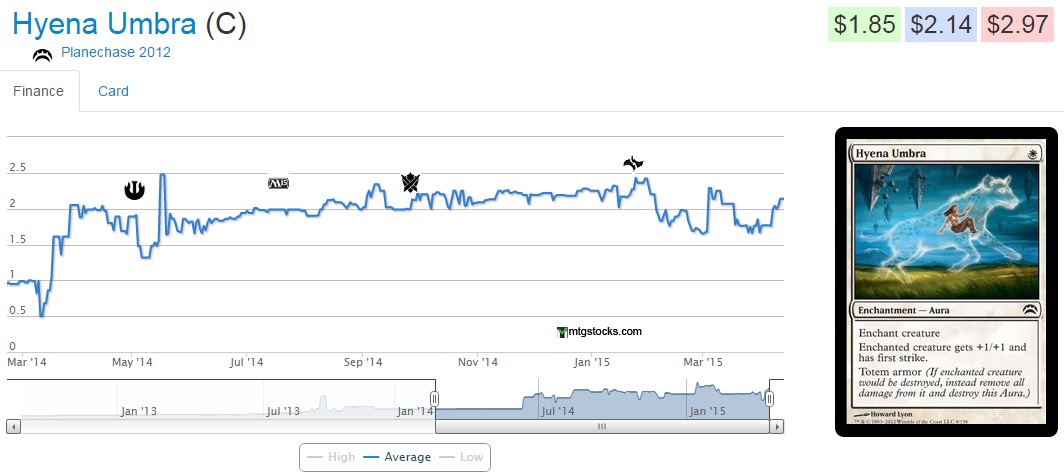
6. Hyena Umbra (+21.6%) - While it seems the regular Rise version isn't seeing the same uptick, this implies that the supply of Planechase versions is low enough that even a small number of purchases of the cheapest copies caused the whole price average to shift upwards. We can confirm this by looking at the TCG player selling page and seeing that there are only a small handful of stores that have these in stock (7 to be specific) compared to 205 stores with the regular Rise copy.
hyena umbra

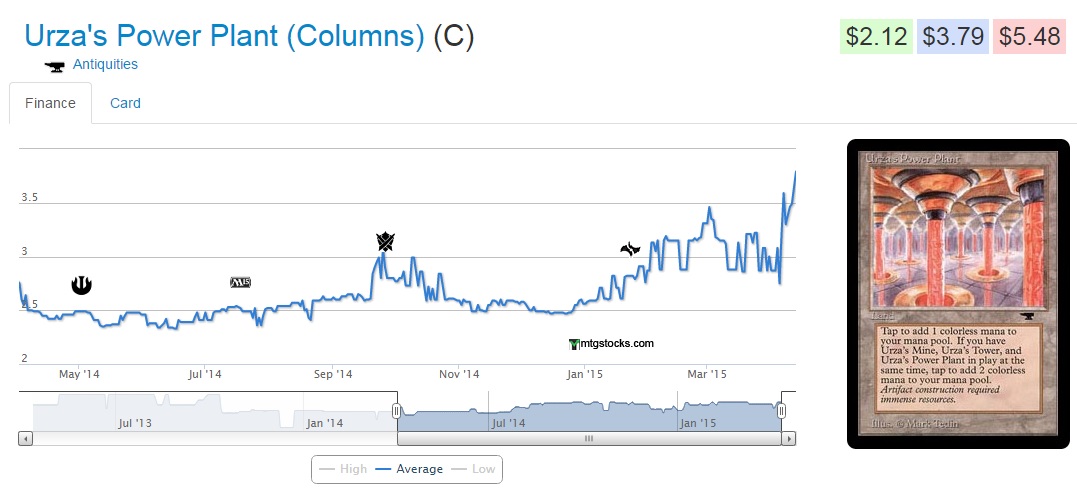
7. Urza's Power Plant (Columns-Antiquities) (+18.1%) - This one is likely similar to the Hyena Umbra situation above (there are only 40 sellers with this card, but only 8 list it at LP-NM condition).

urza

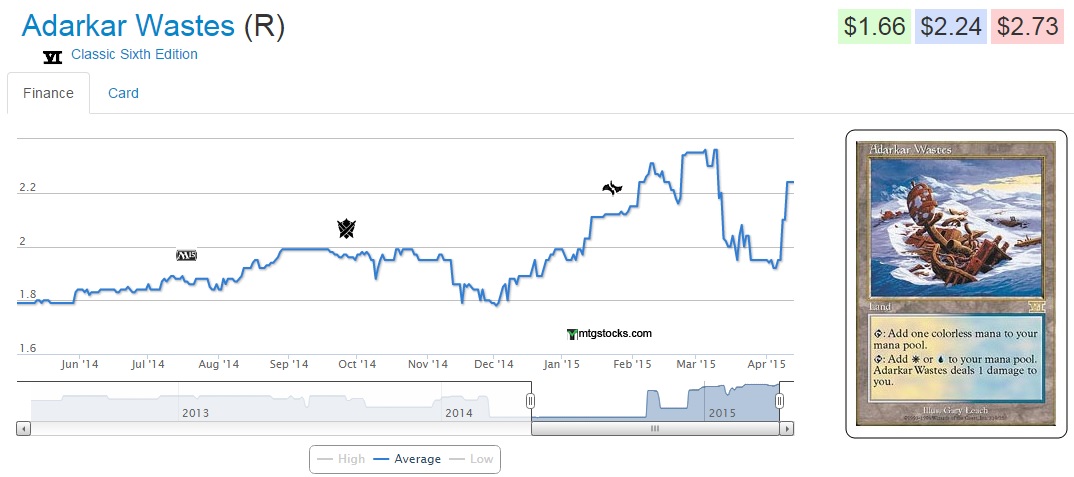
8. Adarkar Wastes (+14.9%) - Yet another example of small supply (only 25 sellers of the 6th Edition version) where a single purchase or two likely causes the price to move up, especially when 14.9% is only around 30 cents.

adarkar wastes

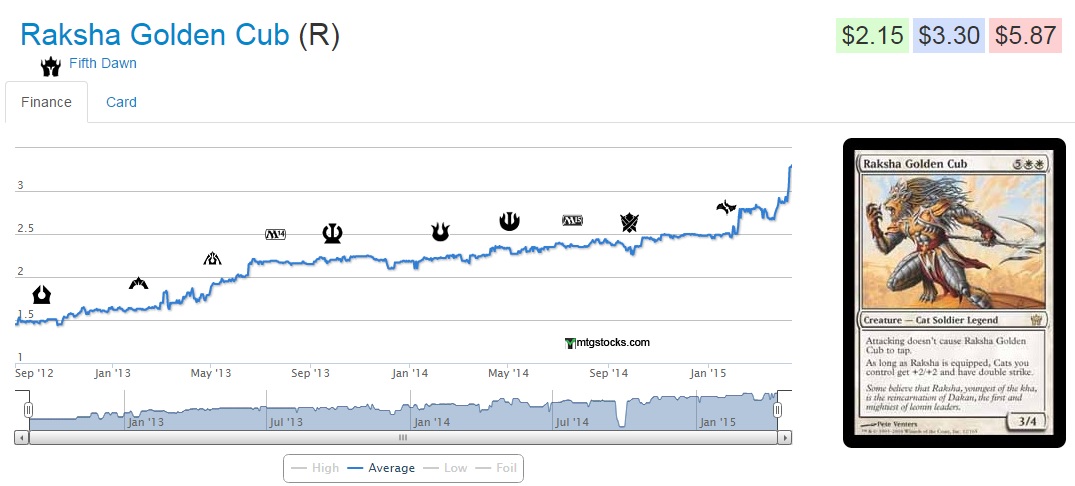
9. Raksha Golden Cub (+12.6%) - Here we have an older rare that happens to fit into a more casual tribal theme deck. Its ability is quite powerful (especially given the person running this is likely running White Sun's Zenith as well). It currently has 62 sellers on TCG player, so I don't think that one or two purchases would have been enough to bump it up by almost 40 cents, especially since it's more likely to be a one-of (if it's for Commander).

raksha

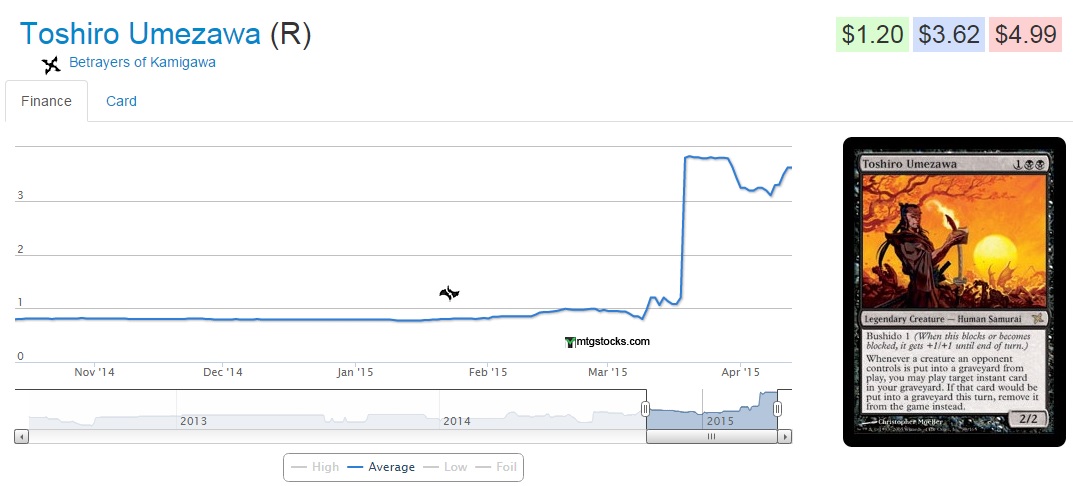
10. Toshiro Umezawa (+11.7%) - There were people on the forums speccing on this card for Tiny Leaders, as he's actually a pretty good TL Commander (if you're playing against another deck which relies on a few creatures to go the distance) and he's from a smaller, older, less loved set. The bigger thing to take away was that he was basically a bulk rare until about March 17th. The sudden spike does imply a buyout, though our own Nick Becvar did point out that the TCG High on this card actually jumped about a week in advance to the mid so the buyout was actually signaled early.

toshiro

Blue Chip Stocks

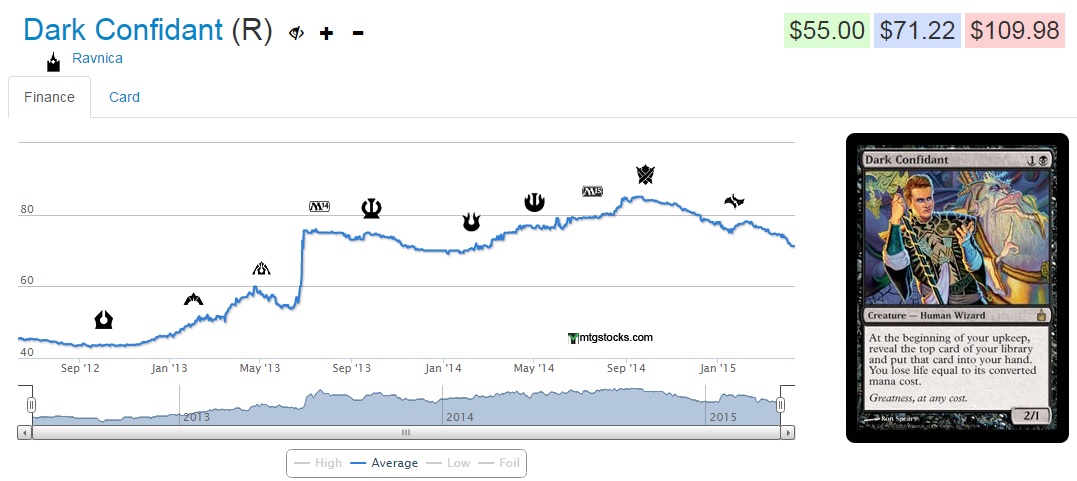
1. Dark Confidant (-3.32%) - With a likely MM2015 reprint on the horizon and still no increase in play, Bob continues to drift downward. Without a significant shift in the metagame, I honestly don't see him being a good long-term bet anymore, though I wouldn't be surprised to see him paired with Courser of Kruphix in Modern at some point.

bob

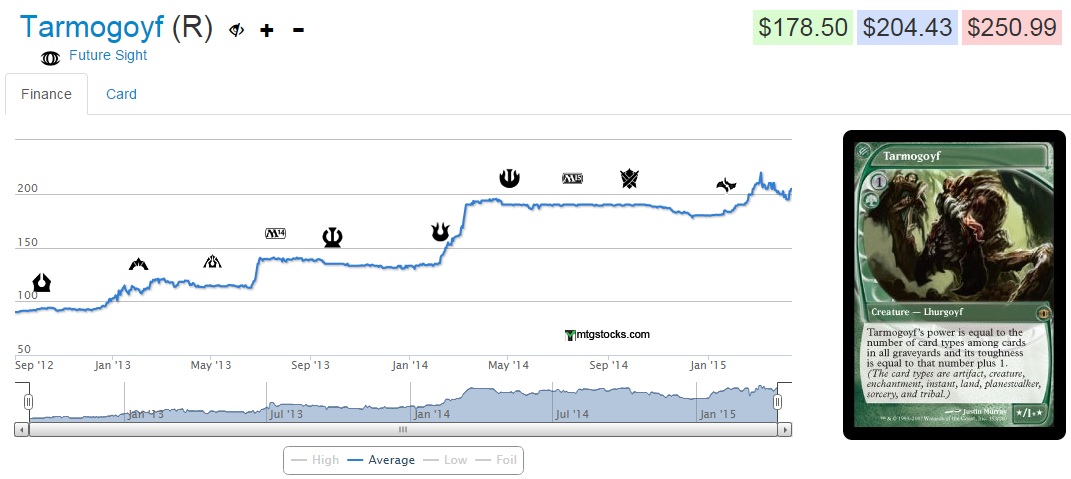
2. Tarmogoyf (+2.411%) - After the recent drop, good ol' Goyf is bouncing right back. While a reprinting does add to the supply, his current price point already proves there's a lot of demand. Even with a much larger print run for MM2015, the recent rise of G/x decks in Modern to fill the Treasure Cruise/Birthing Pod void means that the most efficient green creature ever (many argue he's the most efficient blue creature) has jumped in popularity now that the archetype that wants him the most has become a major contender for best deck in Modern.

goyf

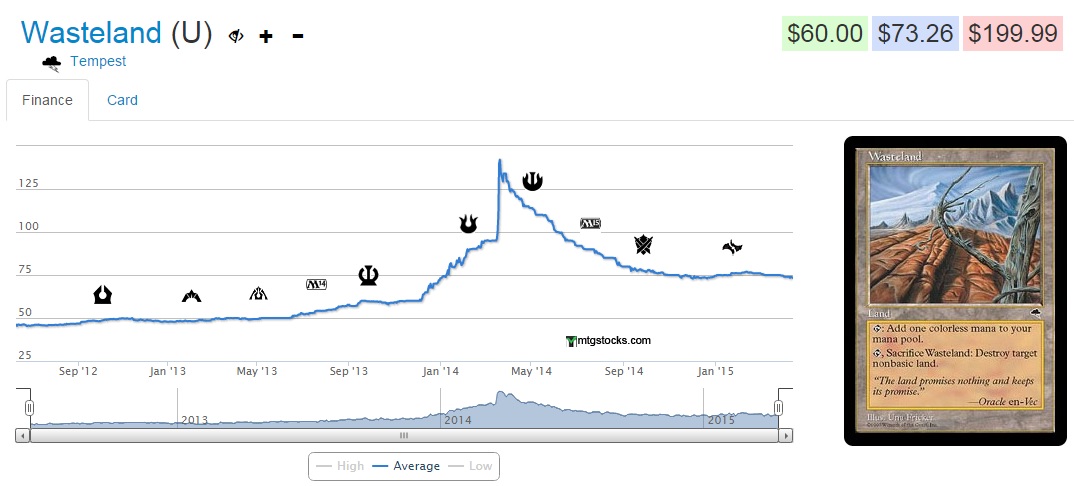
3. Wasteland (-1.76%) - This is a bit surprising given the recent rise of three-color decks back to prominence, including BUG decks which typically run 2-4 of these and also happen to be rather weak to opposing Wastelands. I wouldn't expect this dip to continue for too long though as the Wasteland/Stifle land denial plan of Legacy waxes and wanes every year.

wasteland

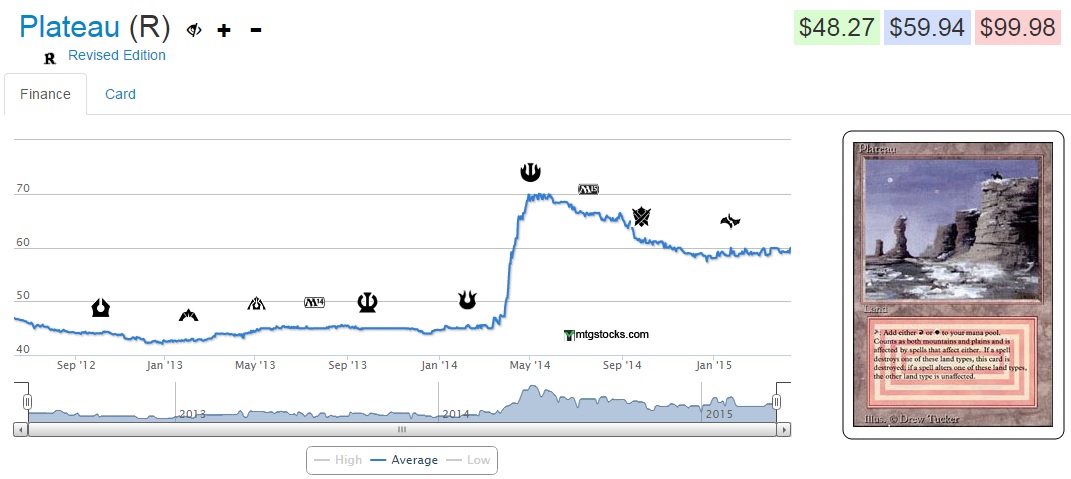
4. Plateau (+1.63%) - We finally start to see some gains on the non-blue duals, though to be fair the only place we typically see this particular dual played in is UWr Stoneblade and Delver variants.

plateau

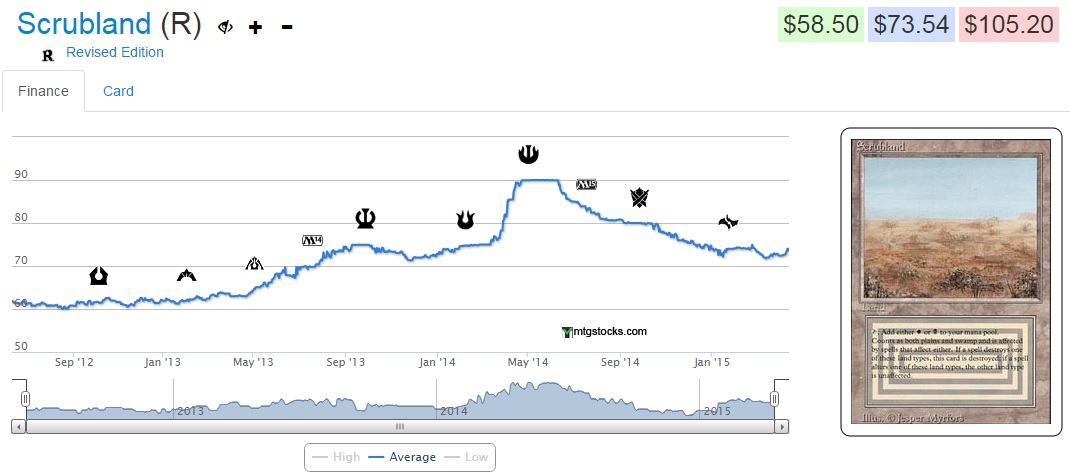
5. Scrubland (+1.55%) - Another non-blue dual rises and again it's typically paired with Underground Sea or Tundra for the Esper Stoneblade decks which are rising in popularity again. This is probably the best color combination of the actual "blade" decks, as the hand disruption of black usually trumps the extra reach of burn (from red).

scrubland

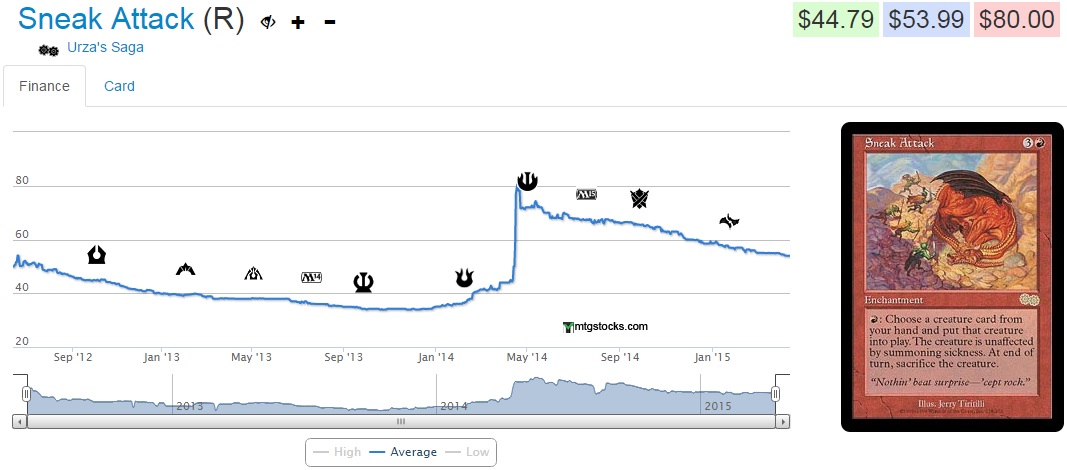
6. Sneak Attack (-1.22%) - Once the most dominant deck in legacy, Sneak and Show continues its steady decline. Players are realizing that it's still very hard to resolve Show and Tell and/or Sneak Attack in a format full of Force of Will, Spell Pierce and Thoughtseize (which we're seeing out of both the Esper decks and the BUG decks).

sneak

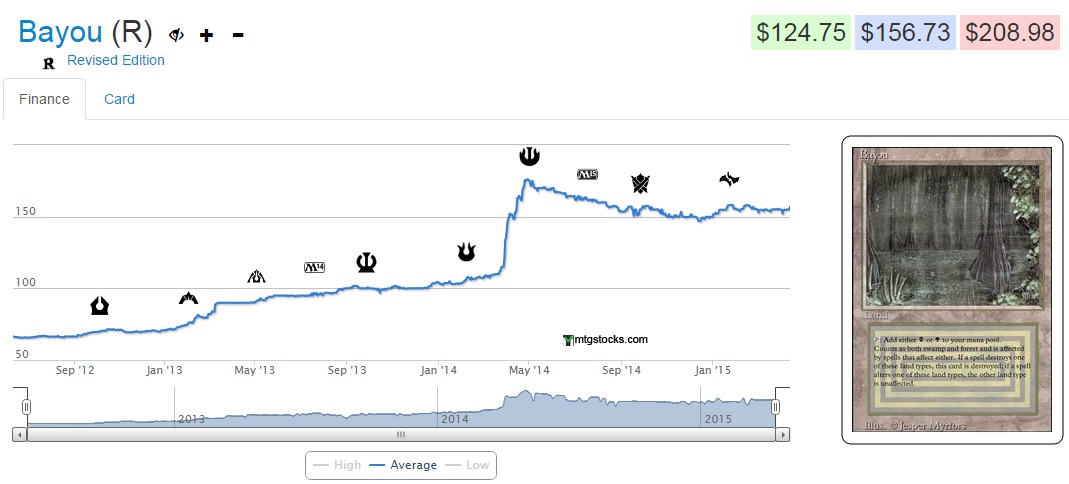
7. Bayou (+1.10%) - I said it a while ago, but the duals were eventually going to bottom out and then would likely start to see a minor rebound; this is the third one with some positive signs. The recent resurgence in BUG style decks is likely the leading factor in the increase in Bayou's demand.

bayou

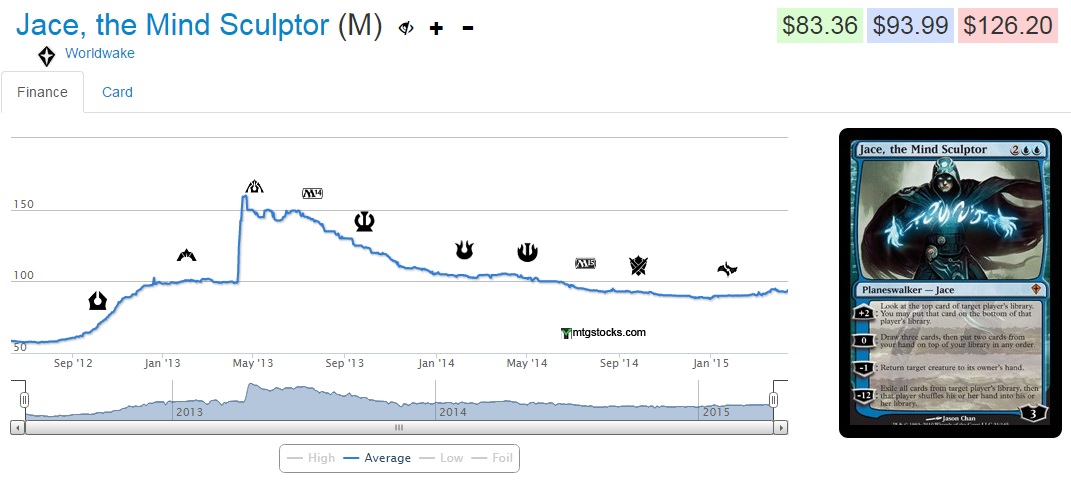
8. Jace, the Mind Sculptor (+1.06%) - The best planeswalker ever printed proves that when you're the best you don't go down for long. As mentioned previously, the increase in both BUG and Esper decks in Legacy means that the once "too expensive" planeswalker (mana-wise...not money-wise) is finding his time back in the sun as games start to go longer and combo gets pushed down thanks to all the Spell Pierces and Thoughtseizes running about.

jace

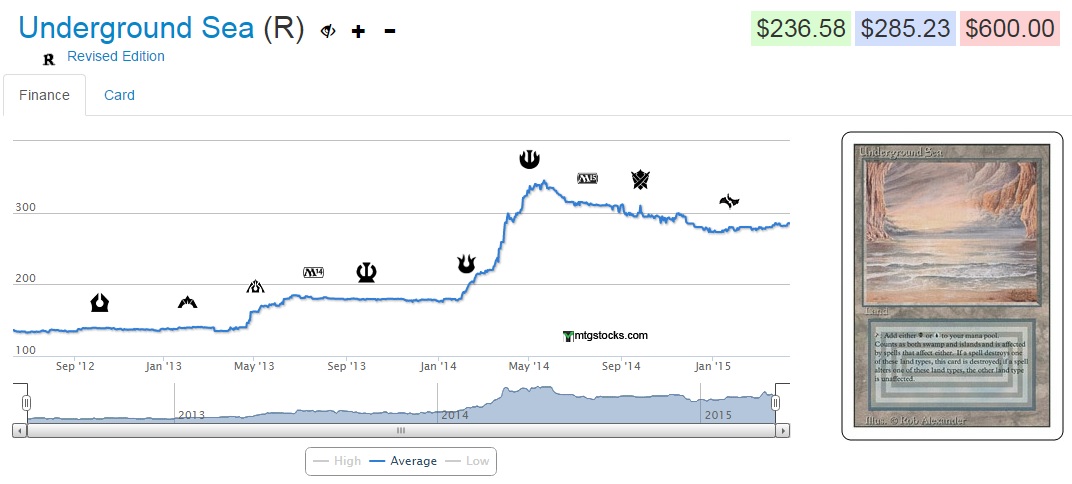
9. Underground Sea (+1.04%) - The other dual shared by both Esper and BUG, it's not surprising to see it rise with Bayou.

sea

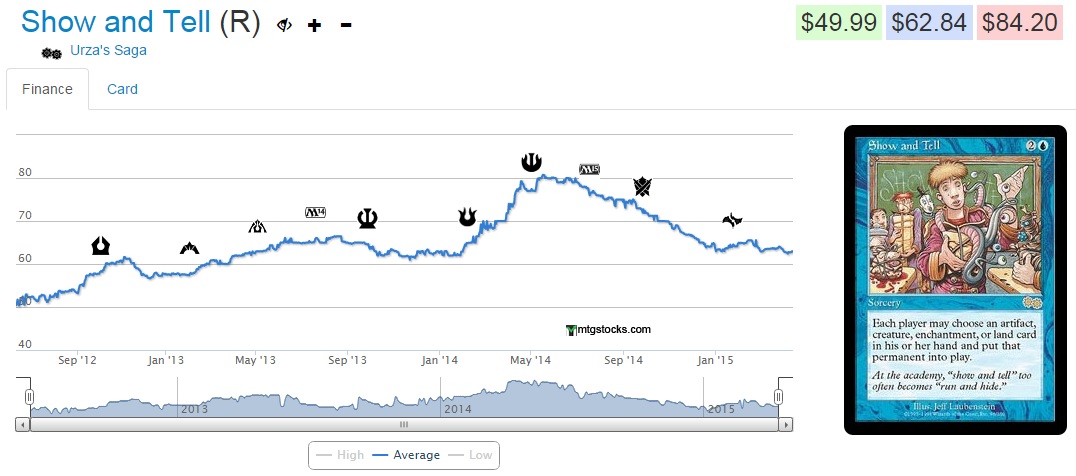
10. Show and Tell (-0.588%) - The partner in crime to Sneak Attack, it's not surprising that as one falls so does the other. Show and Tell at least fits in some other decks (often in Reanimator's sideboard and Know and Tell) so its drop will usually be less than Sneak Attack's.

show

Reprint Predictions for Modern Masters 2

Are you a Quiet Speculation member?

If not, now is a perfect time to join up! Our powerful tools, breaking-news analysis, and exclusive Discord channel will make sure you stay up to date and ahead of the curve.

Wizards made a lot of promises when it founded Modern. Some of these were explicit, like providing a new non-rotating format for high level play. Others were implicit, such as actively supporting Modern with new cards that could improve existing decks. And others were so confusing we are still trying to figure out what Wizards intended, e.g. anything whatsoever involving the banlist.

But one promise that has remained constant since the format's birth is reprints to address card availability issues. As Tom LaPille said in the inaugural "A Modern Proposal" article, "...many of you have called for a non-rotating format that doesn't have the card availability problems of Legacy. We propose Modern as that format." This was the promise, and Modern Masters is the fulfillment of that promise.

Etched Champion Art Cropped

It's no secret the original Modern Masters, a reprint-only set of key Modern staples, was one of (if not the) most successful releases in Magic history. Modern Masters 2015 (MM2) looks to repeat that. With three Grand Prix events in its opening weekend, a higher allocation to stores, and Modern generally growing as a format, "MM2" is poised to be just as successful as MM1, if not moreso. This is true for both Wizards, who will make a small fortune on the product, and for players, who will see card prices drop and format popularity increase. But Modern players don't just care about the product's success, they care much more about what cards are going to be reprinted. We already know Tarmogoyf, Karn, Liberated, and a few others are included, but what else are we likely to see around May 22? In this article, I give a few ideas about cards we might see, and some ways you can try to predict what cards will get reprinted.

[wp_ad_camp_1]


How are Reprints Selected?

Disclaimer alert! We don't actually know how Wizards has selected cards for reprinting in MM2. But we do know a few functions the set needs to serve, and we know what cards were reprinted in MM1. Although this isn't as good as harassing Erik Lauer over Twitter for answers (@ErikLauer...go forth my minions!), it's an effective way to use the information we have to make educated guesses. It's also the framework I'm going to use for the predictions later in this article.

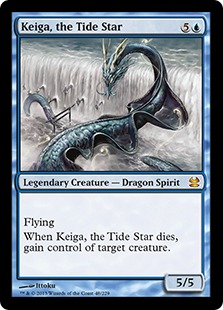
KeigaLet's start with, arguably, the most important feature of MM2: it's both a set for Constructed and for Limited. Just look at the set's tagline on the official release announcement - "Draft Like a Master". Need more proof? Check out that triple GP weekend format. Based on these facts and our knowledge of MM1's draft success last year, we know Limited is an enormously influential element of MM2. Sealed and Draft experiences will determine reprints. Why else do you think Keiga, the Tide Star and company were reprinted at Mythic in MM1? Or why Verdeloth the Ancient was reprinted at all, let alone as a rare? Limited is both a huge market and a huge draw to the game, and nothing screams "Limited cash cow" like a Modern Masters set. This has two critical implications for card reprints.

  • We will see "Limited filler" (and Limited-focused cards). Many of the cards that make for an enjoyable draft experience don't necessarily help you finish out your UR Twin or Affinity deck. We need to expect these kinds of cards. As a corollary to this, we will also see Magic forums' favorite cards to complain about: "EDH/casual trash". See Doubling Season for this principle in action.
  • Rarity will be affected by Limited demands. Some players dream of a world where Goyf is reprinted at common and we can all rejoice in putting that $700-$800 into a family vacation, a new laptop, or more Modern decks! But a draft where every player has 1-2 Goyfs in their deck sounds more like "Draft Like a Masochist" than the intended tagline. This means Wizards will balance the need to reprint cards to lower prices with the need to keep Limited fun and balanced.

Another important datapoint in predicting MM2 reprints is MM1 itself. The first Modern Masters set gives us an idea about how cards get rarity shifted, how the set is balanced between Constructed and Limited, what kind of cards get reprinted, etc. We can use those principles to make a few other guesses about reprint dynamics that will affect the MM2 spoiler.

  • Cycles will return! MM1 saw a number of cycles including Cryptic Command and friends, those awful Kamigawa dragons, the Vivid Marsh lands, and more. MM2 will definitely see its own cycles.
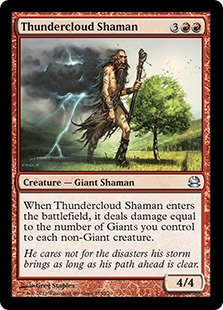
  • Thundercloud ShamanConstructed-worthy mechanics will drive Limited play. Back in 2013, this meant Faeries, Affinity, Storm, and a few other themes that had already proven themselves in Constructed play. It also meant stuff like GIANTS (get 'em Thundercloud Shaman!), which was decidedly not Constructed-worthy.
  • Cards will be reprinted just for Constructed Modern players. MM 1.0 may have had a lot of Limited cards that didn't have a big impact on the Modern economy, but it also had cards that definitely did. This includes Dark Confidant, Arcbound Ravager, Cryptic Command, and many others. These kinds of cards are guaranteed to return in MM2.

We could spend a lot of time brainstorming up different conditions that could affect MM2 reprint decisions (e.g. timeline of making reprint decisions, synergy with current/upcoming Modern cards, price fluctuation delays, likelihood of a Standard reprint, etc). So here's one last piece we need to consider in our predictions: MM2 will see reprints from "Zendikar, Mirrodin, Ravnica, Lorwyn, Kamigawa, and Alara." Looking over our MTG set history, this means we are definitely seeing reprints from both the blocks covered in MM1, but also some new ones. This will include:

  • MM1 repeat blocks: Mirrodin (2003-2004), Kamigawa (2004-2005), Ravnica (2005-2006), Time Spiral (2006-2007: See Goyf), Lorwyn-Shadowmoor (2007-2008)
  • MM2 new blocks: Shards of Alara (2008-2009), Zendikar (2009-2010), Scars of Mirrodin (2010-2011)

MM2 will not go into Innistrad or beyond, which is sad news for Snapcaster Mage and Liliana of the Veil. We are also likely to see core set reprints from this time.

Safe Bet Reprints

Disclaimer alert #2! The author does not take any responsibility for financial decisions made as a result of this article. Also, just because a card feels like a safe bet here, doesn't mean we will actually end up seeing it in MM2. But if any cards feel "guaranteed" in this set, these are the ones to bank on. Or rather, the cards not to bank on because they are about to get reprinted. Because price is a big part of this, I'm including the median card price from TCGplayer for each entry. I'll also include the predicted rarity.

Noble Hierarch ($62) - Rare

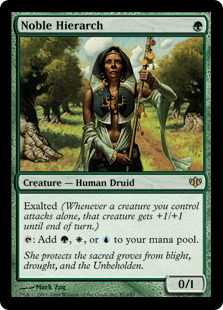
Noble HierarchMana dorks should not cost sixty dollars. Spending a bunch of money on some awesome planeswalker or splashy effect is one thing. Heck, I'd even do it for all-star powerful cards that weren't too splashy, like Goyf. But on a mana dork? A glorified Birds of Paradise? No way. New Modern players don't want to spend that kind of money on a mana dork, and it just feels odd relative to the other cards in this price bracket. Price, however, isn't the only reason for a Noble Hierarch reprint prediction. She has also featured prominently in top-tier Modern strategies for months, whether in Pod before the bannings, Infect and Abzan Liege after, Zoo in between, and a host of other decks. It's not like this card suddenly shot up and became popular overnight, so Lauer and his team had to know about it months ago. Hierarch is also unlikely to totally break the Limited format, which all but solidifies her inclusion in the set.

Why rare and not mythic? Like with the Commands, Ravager, Blinkmoth Nexus, Academy Ruins. Blood Moon, etc., Wizards has shown it is willing to keep cards at rare even if they are powerful. Hierarch is no Bob or Goyf, so she should avoid a jump to mythic. This would do wonders for her price tag.

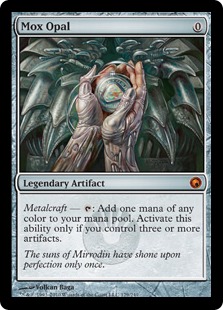
Mox Opal ($48.50) - Mythic

Mox OpalEtched Champion has already been confirmed in MM2, which means metalcraft is coming back. If I'm working at Wizards and want another card to round out my metalcraft theme, Mox Opal is a great choice. Between its home in Modern and Legacy Affinity, not to mention a bunch of more offbeat decks in those formats, it's a reprint guaranteed to please and excite. Opal is also the kind of card that will only go up if left to its own devices, particularly as Affinity grows in popularity. It's flavorful, it's iconic (anything with "Mox" in the name is iconic), it's enduring, and it's overall a strong reprint prediction for the set. That said, there is almost no chance this gets bumped to rare. It's too much of a niche effect to be at rare, and from a draft perspective you don't want too many players opening this (more for draft quality reasons than power ones).

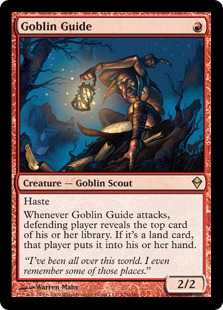
Goblin Guide ($19.75) - Rare

Goblin GuideAffinity might be Modern's oldest top-tier aggro deck, but Burn is probably its oldest. In every Magic format that has ever existed, you can find pesky red mages trying to burn you to death. Modern is no exception, and although Burn wasn't quite a top-tier powerhouse back in 2011 or 2012, it has always been a cheap and surprisingly viable addition to the format. Goblin Guide has been a Burn workhorse since Zendikar started, crossing formats, surviving metagame shifts, and showing the world no one does aggression better than those little greenskins. Wizards has a lot of incentive to keep Burn around as a budget-friendly strategy in Modern, and affordable Guides are a great way to make sure that happens. At just under $20, Guide isn't totally bank-breaking, but it's pricey enough that continued Burn growth (not to mention format growth) will see Guide keep going up without a supply increase. MM2 is a great opportunity to stop that. As for the Limited perspective, Guide is very aggressive and suggests a format where cost-efficient removal will be available enough to keep fast decks in check. But this wouldn't stop him from being reprinted. If anything, it encourages a reprint as part of a RDW or Goblins aggressive strategy.

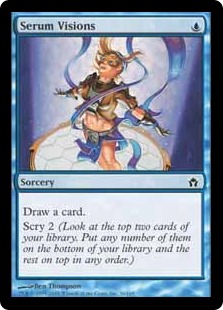
Serum Visions ($8.00) - Common

Serum VisionsWHY IS A COMMON $8.00??? A COMMON PRINTED IN THE LAST 10 YEARS??? Repeat after me: "I will not accept a COMMON being EIGHT DOLLARS". Especially when all that common does is cantrip and scry and sees play in only two top-tier decks (UR Twin and Grixis Delver). Serum Visions is an interesting and totally outrageous case study about what happens when card supply stays constant as demand increases. Wizards hasn't reprinted this card since Fifth Dawn. It was due for a reprint years ago, let alone in 2015. This is exactly the kind of card MM2 exists for, a common that needs a price drop via a huge supply injection. Expect SV's price to completely tank once it's reprinted, which is exactly what Wizards will want to do with this card.

You could probably make reasonable arguments for a number of other inclusions on this list, especially for some of the cards I'm about to talk about in the next section.

Possible Reprints

Ask the average Modern player about what is likely to get reprinted in MM2, and you will probably hear every Modern staple in existence. Wizards has to make 249 tough choices on its end, which means a lot of cards are ultimately not making the cut. The following cards are decent predictions for MM2 inclusion, although they don't have quite as much going for them as do those in the section above.

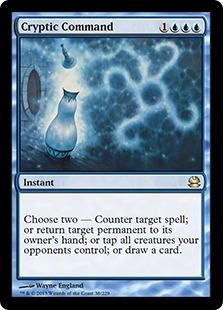
Cryptic Command ($57.00) - Rare

Cryptic CommandLike Goyf, Command was a victim of its own reprinting. Starting in summer 2013, its price seemed to drop as supply increased and control lost relevance in the metagame. But by mid 2014, its price had climbed back to pre-MM1 levels and just kept climbing. Although it eventually dropped a bit and stabilized around $60, that's still a lot of money for a card that was already reprinted once to drive down prices. It's especially problematic given the relative lack of results we see in CC-based decks. Control has enough barriers in Modern, and Wizards is unlikely to want price to be added to those card and metagame-driven ones. The only reason I have Cryptic (and, perhaps by extension, the rest of its cycle) in the "Possible Reprints" section is because we already saw the card in MM1. We know Wizards will reprint cards from MM1 to MM2 (see Goyf), but we don't know if they will do that for rares and/or for a cycle. I suspect they will, both based on their Limited interplay and Cryptic's importance in Constructed, but I also wouldn't be shocked if they didn't get spoiled with the rest of the set.

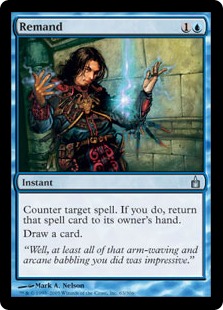
Remand ($15.95) - Uncommon

Remand$16 uncommons are way better than eight dollar commons (looking at you, SV), but this is still not a card price you want to see as a new Modern player. It's not even like Remand has an obvious power level, especially if you are new to the format and don't understand its function in decks that use it. This card would be more expensive than a lot of rares without its Jace vs. Vraska Duel Deck reprinting, and I imagine Wizards doesn't want to deal with this issue for the foreseeable future. Reprinting Remand right now will give the card longterm price stability. Modern was founded on a promise of card availability, and although I'm not going to get into that economically absurd argument MTG players love about availability/affordability, I will just say $16 uncommons are not appealing to new players. This is a safe card for draft, a staple Modern effect in Constructed, and overall a card I think we will see reprinted. The only reason we might not see it is that Jace vs. Vraska was a relatively recent release, and Wizards might have miscalculated the effect it had on Remand's price. If they overestimated the drop, they might not have wanted an MM2 Remand reprint as a result.

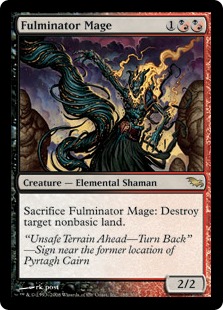
Fulminator Mage ($36) - Rare

Fulminator MageI remember when Fulminator Mage's price exploded: it was a combination of demand from BGx players, a realization its absence from MM1 would mean a sustained supply glut, some success and hype in Living End, and general speculation. But the end result was Mage spiking from around $10 to around $25 practically overnight. That was back in late summer, early fall of 2013, and Mage hasn't looked back since. Like Remand and SV, it's hard to look at this card and understand why the price tag is so high. To be honest, that's actually an issue with a number of Modern cards, but it's very prominent with Mage, a card that feels (both in play and in theory) like a nonbasics-only Rain of Tears with legs. BGx decks, not to mention Living End, have been around for years in Modern, and Mage's entry into their arsenal happened before MM2 development started, or certainly before it was finalized. These factors all make it likely that Mage will see a reprint for this next set.

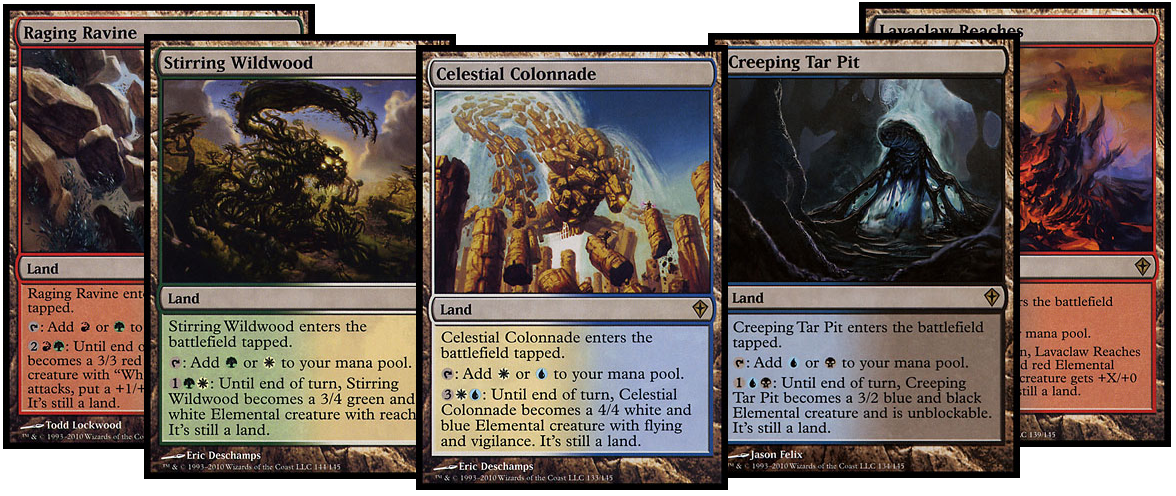
Zendikar manlands (High: Celestial Colonnade $14.75) - Rares

Zendikar Manlands

The allied-color manlands of Zendikar give Wizards a few great opportunities. First, they are very solid cards that make for interesting Limited strategies. Second, they are semi-restricted manafixers that enable a variety of different deckstyles. Third, the cards themselves are expensive, particularly Celestial Colonnade which as only gone up in price as the format has aged (this in spite of UWR decks putting up only mediocre results for months). Wizards probably doesn't want to commit too many rare slots to lands, but given MM2 has 20 more slots overall than did MM1, it's not a big stretch of the imagination to see five of those filled with rare lands needing a reprint anyway.

One argument against these cards might be the upcoming Battle For Zendikar set in September, where Colonnade and co. could get reprinted (along with, perhaps, some other contentious lands). This is possible but, in my view, not very likely. With enemy fetchlands the obvious reprint choice in BFZ, it seems much more likely we will also have enemy manlands to go along with them. Although this puts a lot of emphasis on enemy color pairings instead of balancing it between allied/enemy ones, there is plenty of room in both subsequent BFZ sets and Magic Origins to compensate for this. Besides, the design space in playable enemy manlands is just too cool. That all said, if we don't see these cards, we will likely see the Scars fastlands (Blackcleave Cliffs, etc.) instead, which would mean an almost guaranteed return of these manlands in BFZ.

This was definitely the hardest section to write and the hardest card list to narrow down to just four. Cards like Hurkyl's Recall, Auriok Champion, Tezzeret, Agent of Bolas, and a huge list of other staples also make thematic and financial sense. So don't be discouraged if your pet card didn't make the list (please lord give us some Ensnaring Bridge and Leyline of Sanctity!).

"Don't Bank On It" Reprints

In Magic, there's no such thing as a "sure thing". Except maybe that we won't see delve again for a while. But for the most part, you can never say "never" when it comes to Magic cards. MM2 reprints are no exception, and, ignoring cards that won't be reprinted because of block cutoffs (e.g. Lily and Snapcaster), it's dangerous to say any card just won't make the cut. But with all our earlier principles in mind, here are a few cards I doubt we will see once those MM2 spoilers hit the internet.

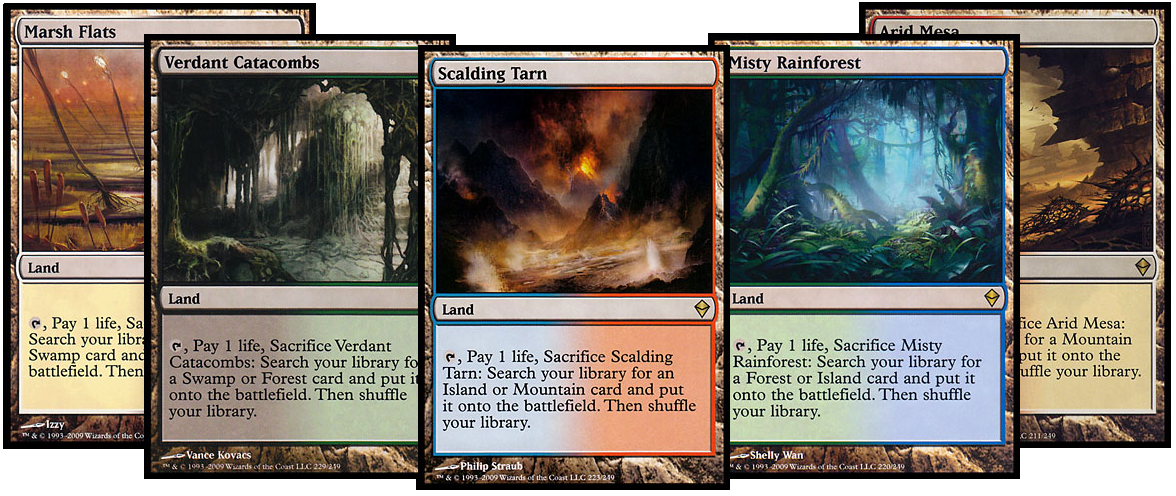
Zendikar fetchlands (High: Scalding Tarn, $43) - Rares

Zendikar Fetchlands

More forum and reddit blood/pixels have been spilled over the great Zendikar fetchland debate than over any other reprint debate I can remember. Even up until the last day of KTK spoilers, we were still seeing users who claimed to know a guy who knew a guy who swore on his mother's 401k these would be in one of the Khans sets. Better not tell mom. A backup option for the fetchlands was always MM2 if the Khans approach never materialized, but I personally didn't find this very convincing. For me, the big sticking point is Battle For Zendikar's (emphasis added) release out in September 2015, and if Wizards learned anything from Khans it's that fetchlands and Modern-reprint appeal drives sales. This suggests they will take a similar approach with BFZ, using the Zendikar fetches as a driving force in that set. BFZ is also going to have a much higher print run than MM2, which will all but guarantee fetchland pricing issues are solved in the long term. A final reason not to expect fetches in MM2 is Standard. Khans showed us contemporary Standard is more than capable of handling these lands in the format, and enemy-colored ones would be unlikely to overturn such a finding. I expect we will see these by year's end, but not in MM2.

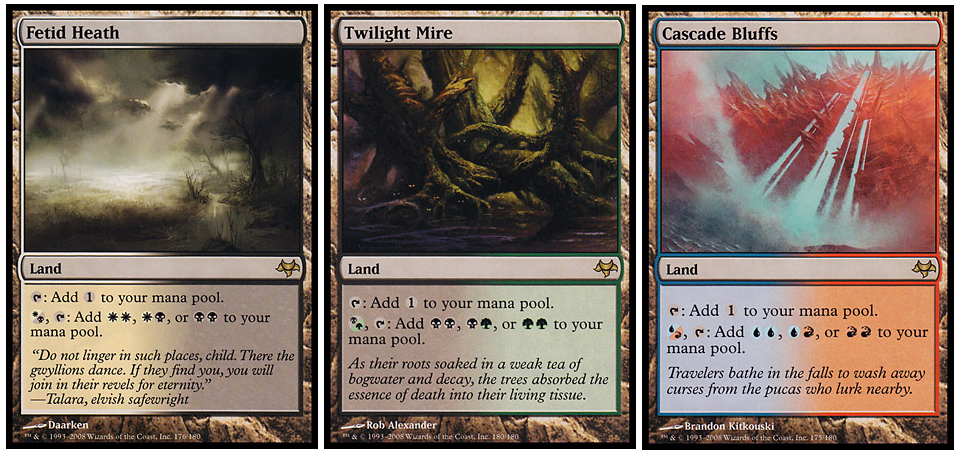
Filter lands (High: Twilight Mire, $34) - Rares

Filterlands

More lands! The ally and enemy-colored filter lands (Twilight Mire, Cascade Bluffs, Fetid Heath, etc.) have always been hot commodities for both Modern, Commander, and casual players. Mire is the most expensive of the batch, but many of their price tags aren't exactly reasonable. MM2 is a decent opportunity for reprinting them. A number of them would be used in Modern, and many more might be used by decks in the future. Unfortunately, this cycle feels unlikely for a few reasons. For one, this is a big cycle taking up a lot of slots. Sure, the set is 249 cards for MM2 instead of 229 for MM1, but Wizards might not want to commit so many valuable slots to a bunch of rare manafixers. Second, I don't see these coming back at uncommon because that would be a big rarity shift relative to their pricetag and we didn't see anything like that in MM1. Wizards could make such a shift if it wanted to, but the precedent isn't there. Finally, I think the Zendikar manlands are much more likely, which makes a cycle of 10 colorfixers an odd inclusion on top of another five dual lands. Especially if they are all at rare.

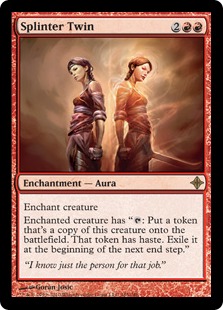
Splinter Twin ($24.50) - Rare

TwinOf the three prediction in this last section, this is the one I might most end up eating my words on. From a price perspective, Splinter Twin needs a reprint. It's also a staple of the format, the linchpin of another iconic Modern top-tier deck. It creates some interesting Limited interactions, is a decent inclusion for a rare slot, and promises to only increase in price over the next months. So why am I betting it won't be reprinted in MM2? The first reason is the price history. Twin wasn't under $10 until about February 2014, when it leaped up to the low $20s in just two months. The Deathrite Shaman banning played a big part in this, as the death of the most overpowered versions of BGx Midrange made Twin a comparatively better deck. But then the price dropped for almost a full year back to $15 or so before spiking again in the last month or two to $25. All of this means that Wizards might not have known to get ahead of the price increase for MM2, especially given the design schedule for this set. Of course, Lauer's team might have predicted the card would go up again, in which case it becomes a more likely reprint target. But it's just as possible that the price pressures went unnoticed in the MM2 planning stages.

The second reason Twin might not be reprinted is the banlist. Although I don't personally think Twin is bannable, I wouldn't be at all surprised if it's on some kind of R&D watchlist, particularly following the DRS banning. Nothing says buzzkill like opening Twin as your rare if the card is banned in the format, and Wizards might have played it safe by keeping it out of circulation. I am not confident in this rationale because I don't know if Wizards operates like this, and we don't have enough datapoints to prove it one way or the other. But if Twin isn't included, these explanations are surely behind that. Again, this is the prediction I'm most likely to be wrong on, because there are some very good reasons for reprinting Twin on top of the reasons not to (lowers price for a tier 1 deck, introduces new players to a staple effect, etc.)

I'm sure there are cards I missed in all these sections people want to talk about, so take it to the comments and let's see what the community is thinking. Overall, I'm getting excited for MM2 and the growth it will help bring to the format. We won't all have Goyf playsets after the release event, but that won't matter much to me if the product is a hit, the reprints are on target, and Goyf gets down to at least a more reasonable $100 or so.

Sphere of Resistance: Tiny Leaders Making Waves?

Are you a Quiet Speculation member?

If not, now is a perfect time to join up! Our powerful tools, breaking-news analysis, and exclusive Discord channel will make sure you stay up to date and ahead of the curve.

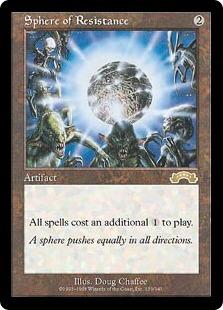
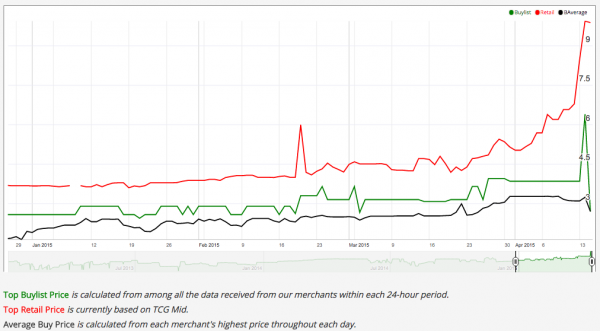
Another little nugget of fun I found in our reports!  This chart for Sphere of Resistance is interesting for 2 reasons.

1)  The spike in late February almost immediately corrected itself, but the marginal increase in buy price remained.

2) The buy price jumped up in the last few days, but almost immediately corrected back down.

These sorts of "sell side first" spikes are fascinating, as I explained in my last post, because they are not based on true demand.   I asked the team what they thought, and the only thing that came up was Tiny Leaders.  I think TL is a great format, but I doubt it's pushing enough volume to move markets overnight;  a spike like this appears to be a concerted effort to bet on a hypothesis by an individual or small group.

Sphere of Resistance: April 14th 2015

Once again David Schumann had additional insight:

It's a solid TL spec (especially for Thalia prison style decks). I'm actually surprised it didn't spike earlier when Chalice of the Void did as a way to help inhibit Delver/TC style decks. The massive sudden increase coupled to the fact that the spread is very high implies that it's a buyout as opposed to an actual increase in demand. I wouldn't be surprised if we see it dip back down within a week, though I imagine (similar to the duals) it's "new price" will be about the average of the old and new. I would not be surprised if we start seeing people target low cost reserved list rares with applications in lower tier legacy decks or that fit into TL.


There was an error retrieving a chart for Sphere of Resistance

Gray Areas- Reviewing the Tape

Are you a Quiet Speculation member?

If not, now is a perfect time to join up! Our powerful tools, breaking-news analysis, and exclusive Discord channel will make sure you stay up to date and ahead of the curve.

The Pro Tour is usually a great spectacle that showcases the game's greatest putting their all into competing for a sizable prize purse. While I enjoyed much of the coverage of Pro Tour Dragons of Tarkir, there was a portion that was simply handled terribly. There is no reason that we should have had to watch Patrick Chapin appeal his game loss for ten minutes while Randy Buehler did his best to make competitive Magic sound like a terrible thing.

Cedric

The scenario was that Patrick activated an Ajani, Mentor of Heroes and failed to reveal the creature that he grabbed before putting it into his hand. Then he appealed for a very long time while the producers refused to cut away from the scene.

Patrick's "this sleeve touched this sleeve" argument was dubious and didn't represent any reason to not give a game loss for drawing extra cards the way that the rule is consistently enforced. If it touches your hand, you drew it, and if you drew it you get nothing. You lose. Good day, sir.

That said, there is an argument that Chapin could have made that carries more weight. Seeing as there is a spotter who records the cards in each players hand and there is a camera reel that could prove what Chapin grabbed with Ajani, it could be demonstrated that he grabbed a legal target. Ultimately, the only reason that you have to reveal in such instances is to prove that you didn't do anything that the card didn't let you do. A quick replay could easily repair the game state.

At this point in time, replays are not used to repair game states or overturn such rulings. There is an argument that could be made for this being bad for coverage. In this instance, a player got a game loss in game three to chalk up his first loss of the tournament. Such a thing just isn't enjoyable to watch.

There was an error retrieving a chart for Slumbering Dragon

Ultimately, the argument against reviewing the tape in order to make judge calls is that it provides special treatment to those in the feature match area. One person might feel cheated when they get a game loss that the camera could easily overturn, but a lot more people will feel cheated if they get a similar game loss while not on camera while some other person gets absolved because their infraction happened to happen under the camera.

So what do you think? Should feature matches get special treatment because the tape is there anyways? Or would such rulings generate too many bad feelings and compromise the integrity of the game?

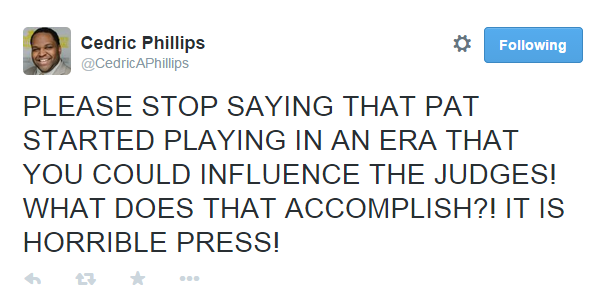
Between writing this and publishing it, Cedric Phillips put a great article on this topic up on SCG. Check out his article here.

Avatar photo

Ryan Overturf

Ryan has been playing Magic since Legions and playing competitively since Lorwyn. While he fancies himself a Legacy specialist, you'll always find him with strong opinions on every constructed format.

View More By Ryan Overturf

Posted in Free, Gray AreasTagged , 7 Comments on Gray Areas- Reviewing the Tape

Have you joined the Quiet Speculation Discord?

If you haven't, you're leaving value on the table! Join our community of experts, enthusiasts, entertainers, and educators and enjoy exclusive podcasts, questions asked and answered, trades, sales, and everything else Discord has to offer.

Want to create content with Quiet Speculation?

All you need to succeed is a passion for Magic: The Gathering, and the ability to write coherently. Share your knowledge of MTG and how you leverage it to win games, get value from your cards – or even turn a profit.

Insider: MTGO Market Report for April 15th, 2015

Are you a Quiet Speculation member?

If not, now is a perfect time to join up! Our powerful tools, breaking-news analysis, and exclusive Discord channel will make sure you stay up to date and ahead of the curve.

Welcome to the MTGO Market Report as compiled by Sylvain Lehoux and Matthew Lewis. The report is loosely broken down into two perspectives. A broader perspective will be written by Matthew and will focus on recent trends in set prices, taking into account how paper prices and MTGO prices interact. Sylvain will take a closer look at particular opportunities based on various factors such as (but not limited to) set releases, flashback drafts and banned/restricted announcements.

There will be some overlap between the two sections. As always, speculators should take into account their own budget, risk tolerance and current portfolio before taking on any recommended positions.

Redemption

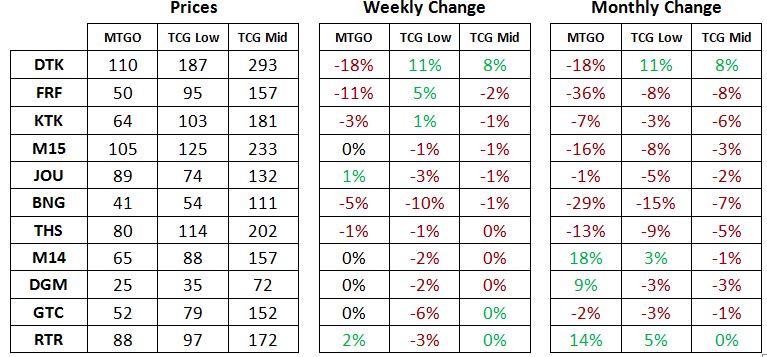
Below are the total set prices for all redeemable sets on MTGO. All prices are current as of April 13th, 2015. The TCG Low and TCG Mid prices are the sum of each set’s individual card prices on TCG Player, either the low price or the mid-price respectively.

Special mention should be made of the MTGO prices this week. It appears that Supernova has set prices on RTR through to M15 at a discount relative to the rest of the market. Usually Supernova’s prices are a good proxy for market prices. They are not perfect, but they are close.

This week’s differences on the older redeemable sets show that this is not an aberration and so Goatbot’s set prices are being substituted in this week for these sets. Thus, the current price listed below for RTR through to M15 is from Goatbot. The weekly change for these sets also represents the change in Goatboat’s set prices from the last week.

Lastly, the monthly change for these sets is a hybrid of Supernova’s prices from a month ago, and Goatbot's prices from this week. The MTGO prices for DTK, FRF and KTK are still collected from Supernova. Going forward, I will continue to review which prices are most suitable for monitoring and make changes as necessary.

Apr15

Return to Ravnica Block and M14

After a period of price weakness coinciding with the release of DTK, paper prices on these sets have fluctuated up and down. No clear trend has established itself, but once the MM2 previews start rolling in and the hype builds around GP Vegas/Utrecht/Chiba, prices are expected to rise. This will support higher prices on all four rotated sets.

The end of DTK release events next week will also signal the end of the usual liquidity crunch in the MTGO economy. Players will also start shifting their attention away from DTK Limited and Standard towards Modern. There’s already some evidence that available supply is dwindling on these sets, so the upcoming events in both paper and online should produce an uptick in prices on RTR, GTC and M14.

Accumulating tix should be the speculator’s main goal prior to the release of MM2. Once DTK events wind down, look for a normalization in prices and tix values as a good signal to start selling cards from these sets. As a backup plan in case prices don’t move very much or something unexpected happens, there will be another selling window prior to the release of Magic Origins.

DGM remains a very poor target from a redemption perspective, but Voice of Resurgence has found its footing at around 16 tix. Brewers are working hard at using Collected Company in the old Birthing Pod shell, but it’s not yet clear whether it will break into the top tier of Modern archetypes. If a successful deck is developed, it’s almost assured that Voice of Resurgence will be included in some capacity.

There’s just too much value out of this two-drop to ignore it. Keep an eye on this mythic rare for a breakout. A high profile finish will push it back over 20 tix in short order. Players looking for a playset would do well in buying at current prices.

Theros Block and M15

The outlook for these sets is unchanged. With rotation looming in the Fall, pricing pressure will be continuous and growing. Any speculative bets made on cards from these sets should be short-term in nature and should not be undertaken lightly. The ultimate bottom on these sets is a long way off, but the trend is irresistible.

Junk mythic rares from M15 and THS are ‘okay’ long-term bets if and only if the price dips below 0.4 tix; typically some of the less played or casual mythic rares will bottom in advance of rotation. Without any utility in Standard, and dwindling value to redeemers, it’s no surprise cards like this will be the first to bottom.

Tarkir Block

To date, the two planeswalkers from DTK have both been missing in action in Standard. The price of Sarkhan Unbroken briefly went below 5 tix this past weekend, while Narset Transcendent has gone below 10 tix. Both are currently being overshadowed by the dragonlords of this set. Keep an eye on both, and don’t be afraid to accumulate Sarkhan Unbroken if it hits 5 tix again. DTK will have 16+ more months in Standard, giving loads of time for the metagame to shift in favor of these two cards.

With FRF continuing to be opened, there’s no sign of a bottom for this set in the short term. Looking out for contrarian plays similar to the DTK planeswalkers is an acceptable strategy, but FRF has been relatively well explored in Standard compared to DTK. With the lower chances of an upside surprise, it’s best to be patient to accumulate cards from this set.

Lastly, KTK is largely unchanged as a set to target. While the price has been largely stable, the end of intensive drafting means the bulk of supply is already on the market. There will be some price fluctuations due to metagame shifts, but overall price gains are inevitable.

As for KTK boosters, they are currently stable at around 1.5 tix. The next five months will provide ample time to whittle down the available supply of boosters. Within the next six weeks, there should be a clear signal whether this speculative position will bear fruit, though I am confident it will.

Modern

Speculation and expectations around Modern are at a standstill. No new information came out during Pro Tour DTK regarding Modern Masters 2015. Even if some prices look very attractive now, a potential reprint jeopardizes most speculative picks. In two or three weeks, cards from Modern Masters 2015 should start to be spoiled so bigger speculative moves will have to wait until mid-May to begin.

The format of the MOCS 7 (running May 27 to June 24) will be Modern. Back in February the previous Modern MOCS, in combination with the Pro Tour, helped prices rise from January to February. This time around, this upcoming Modern MOCS will directly follow MM2 release. Speculators won’t have to wait long to see their speculative targets acquired around the release of MM2 (reprints and non-reprints) to see higher prices.

One more interesting tidbit that came down from WoTC this past week was the change to the paper PPTQ formats going forward. Previously, stores could choose the format that they wanted to run. The change made for the PPTQ season starting in August is for the format to be either Sealed Deck or the constructed format featured at the Pro Tour fed by the qualifiers. This means that Modern will be the constructed format for PPTQs starting in August.

For speculators, this is big news that is currently flying under the radar. Modern season is back! It’s not clear yet whether this policy will translate directly to MTGO, but it’s safe to expect a premium on all Modern staples in the second half of the summer, in paper at least.

If Modern is the only format for constructed PPTQs on MTGO, then there should be a nice premium online as well. After the Modern MOCS, the release of Magic Origins should be an excellent time to accumulate Modern staples in advance of the PPTQ season. Hat tip to Chas Andres for pointing out this change in policy and the implications for speculators in his weekly column over at Starcitygames.

After hitting a record high at 16 Tix, Snapcaster Mage seems to have started cycling down and is now under 13 Tix. This card has a bright future ahead and it is a card worth watching closely to catch him up when he hits a new floor, probably around MM2’s release.

All across Modern, staples are losing ground, including the ZEN fetchlands, Primeval Titan, Leyline of Sanctity, Noble Hierarch, Fulminator Mage and Scapeshift on its way to reach a two year low. Needless to say that in these conditions Scapeshift would be an amazing target if not reprinted in MM2, though being consistently part of the Modern metagame suggests a reprint is very likely.

Waiting for MM2, a few opportunities may nonetheless arise from sets excluded from Modern Masters 2015 reprints. Voice of Resurgence is one example. Another potentially attractive position is Past in Flames.

Vintage and Legacy

Trends of both of these formats remain mostly flat and nothing is expected to happen until the release of Tempest Remastered. The anticipated fall in price of Wasteland and City of Traitors and the potential reprint of expensive Legacy- or Vintage-playable Modern cards in Modern Masters 2015 (Infernal Tutor and Hurkyl's Recall, for instance) should help ramp up demand for these two eternal formats in the long run. The Legacy MOCS in November is the primary targeted time frame for high demand.

Pauper

Although things are still looking good in Pauper, specs may slow down for one more week until the end of DTK release events. From a financial perspective DTK brought us one interesting common. Anticipate will complete the long list of blue draw and selection spells. It may not be added into aggro blue-based decks but could be incorporated into control or combo decks to supplement Impulse.

The demand is currently higher than the supply hence a price in the 0.1-0.2 Tix range, but very soon we expect this card to be at a more respectable price for a common, probably around 0.01 Tix. Being from a 3rd large set gives Anticipate a slim chance to retain some value beyond bulk but only after the summer.

Targeted Speculative Buying Opportunities

Standard

None.

Modern

Voice of Resurgence
Past in Flames

Targeted Speculative Selling Opportunities

None.

Mana-Charged Dragon Spike on TCGPlayer: $15 of Wishful Thinking

Are you a Quiet Speculation member?

If not, now is a perfect time to join up! Our powerful tools, breaking-news analysis, and exclusive Discord channel will make sure you stay up to date and ahead of the curve.

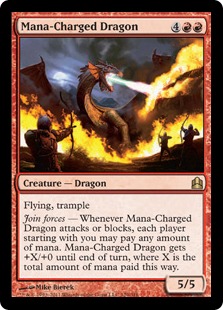
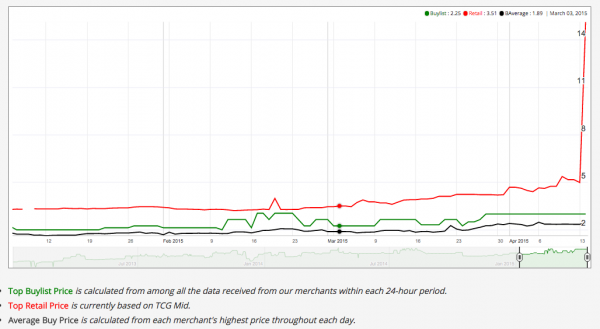
Just quick morning update here, folks. Looks like someone went buy-happy on TCGPlayer last night. The target was Mana-Charged Dragon. Why? Your guess is as good as mine.

Mana-Charged Dragon, 4/14/2015

The utter lack of buy price movement tells me that merchants aren't selling through these, nor are they having much trouble restocking. I'm always very dubious of sell-side-only spikes; they usually represent an individual (or small group) opinion of a card, and are generally compounded by small or limited print runs. Perhaps someone is making a bet on Commander or Casual Dragons as a result of DTK, but I remain unconvinced this is a card worth caring about.

"Legitimate" price changes are driven by true demand, and we have seen, time and time again, that buy prices are usually leading indicators of demand and are predictably followed by sell-side growth. That's not the case here, though we may see a buy price increase. Frankly, with this card TCG-midding at $15, I would not be shocked to see a bunch of people pull them out of binders and rapidly undercut one another.

There was an error retrieving a chart for Mana-Charged Dragon

Elves Daily 4/13: Video

Are you a Quiet Speculation member?

If not, now is a perfect time to join up! Our powerful tools, breaking-news analysis, and exclusive Discord channel will make sure you stay up to date and ahead of the curve.

With a mostly refined and complete list in tow, I finally felt confident enough to bring Elves to a daily yesterday. The matchups were R/G Tron, a strange U/B Merfolk list, Grixis Delver, and Affinity. See what happened in the video below.

llanowar elves

The list is a little different than last time, as I'm still missing the sideboard Spellskite and I'm experimenting with some card counts and tech. Here's what I ran:

[wp_ad_camp_1]


Elves by Sean Ridgeley

Creatures

4 Elvish Mystic
4 Llanowar Elves
4 Heritage Druid
4 Nettle Sentinel
4 Devoted Druid
4 Elvish Visionary
4 Elvish Archdruid
3 Ezuri, Renegade Leader
3 Fauna Shaman
1 Scavenging Ooze
1 Spellskite

Instants

4 Collected Company
2 Chord of Calling

Lands

13 Forest
2 Nykthos, Shrine to Nyx
2 Cavern of Souls
1 Pendelhaven

Sideboard

4 Essence Warden
1 Scattershot Archer
3 Scavenging Ooze
1 Choke
1 Dismember
1 Root Maze
4 Reclamation Sage

Explaining the Changes

After testing more since last time, I've decided to drop the number of Chord of Calling to two, as I was missing too often on Collected Company (also Chord can be awkward sometimes), replacing it with a Fauna Shaman to maintain consistency.

Nykthos and Cavern counts I'm not settled on yet, but after being screwed on Chord by Cavern a few times, and not being able to go off turn 2 with Heritage Druid because of Nykthos a few times, I've tentatively dropped both to 2 each. Definitely running more Cavern in the board is an option (we'd swap Nykthos out for 1-2 more) -- I may try that in the future.

elves nykthos

I'm not big on Dismember but it might be necessary. For now at least, it's just a placeholder for Spellskite.

Root Maze is the "techy" card, which I think has a lot of potential against 3+ colour decks. Originally I thought Affinity as well, but after thinking about it more, it's mostly only good turn 1 on the play -- too situational. In any case, I've heard good things about Maze before from other Elves players. This could very well stay and maybe even see more copies, depending on results.

Elves in Action

Post-Daily Thoughts and Updated List

  • Scattershot Archer seems very solid (it pretty much won an Affinity game for me on its own), and against the decks I want him for (mainly Affinity and Abzan), they are likely to kill the first copy, and 2 out lets me kill Ornithopter, so for now I'm going to bump him up to 2.
  • The 4 Sage plan, while great sometimes, probably isn't optimal. I'm going to swap some out for Fracturing Gust. I like Creeping Corrosion because you have a higher chance at dropping it after a Whipflare, unlike Gust. However, Gust also works great against Auras and random decks that rely on enchantments (like Enchantress, and that Form of the Dragon deck), gains life, and is instant speed (which we love). One Sage should remain because it makes a great tutor target in a variety of matchups, and versus Affinity, hitting it off Company is always welcome.
  • Spellskite is great at protecting Ezuri.

Based on that, here's the new list:

Elves by Sean Ridgeley

Creatures

4 Elvish Mystic
4 Llanowar Elves
4 Heritage Druid
4 Nettle Sentinel
4 Devoted Druid
4 Elvish Visionary
4 Elvish Archdruid
3 Ezuri, Renegade Leader
3 Fauna Shaman
1 Scavenging Ooze
1 Spellskite

Instants

4 Collected Company
2 Chord of Calling

Lands

13 Forest
2 Nykthos, Shrine to Nyx
2 Cavern of Souls
1 Pendelhaven

Sideboard

4 Essence Warden
2 Scattershot Archer
3 Scavenging Ooze
1 Choke
1 Spellskite
1 Root Maze
2 Fracturing Gust
1 Reclamation Sage

Until next time!

Tiny Tuesday- Shu Yun Control

Are you a Quiet Speculation member?

If not, now is a perfect time to join up! Our powerful tools, breaking-news analysis, and exclusive Discord channel will make sure you stay up to date and ahead of the curve.

Jeskai has a lot to offer in Tiny Leaders. If you want to play a tempo deck, you get access to tons of cards that are great in Legacy. Using these cards as a baseline, you could easily set up a powerful tempo deck:

That said, in a format like Tiny Leaders I both dislike Delver of Secrets due to the fact that the card loses a lot of value when you don't have it turn one, and because it's not cool enough. If I'm going to play Jeskai in Tiny Leaders, then I want to fit these cards into my deck:

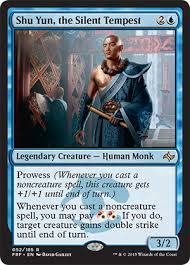
Entreat the Angels and Bonfire of the Damned are the only miracles that you can play in Tiny Leaders, and as such they're very close to the ceiling on power level for individual cards in the format. Playing them without Brainstorm diminishes their power level, and Shu Yun, the Silent Tempest is the only leader that lets us run this trifecta.

There was an error retrieving a chart for Shu Yun, the Silent Tempest

This is my preferred home for Shu Yun:

Tiny Shu Yun

creatures

1 Stoneforge Mystic
1 Snapcaster Mage
1 Trinket Mage

spells

1 Isochron Scepter
1 Sword of Fire and Ice
1 Lightning Bolt
1 Entreat the Angels
1 Bonfire of the Damned
1 Brainstorm
1 Mystical Tutor
1 Pyroclasm
1 Anger of the Gods
1 Slagstorm
1 Sensei's Divining Top
1 Engineered Explosives
1 Ponder
1 Preordain
1 Path to Exile
1 Swords to Plowshares
1 Counterspell
1 Dream Cache
1 Hinder
1 Spell Crumple
1 Spell Snare
1 Mental Misstep
1 Fire // Ice
1 Electrolyze
1 Mizzium Mortars
1 Blue Sun's Zenith

lands

1 Arid Mesa
1 Scalding Tarn
1 Flooded Strand
1 Polluted Delta
1 Misty Rainforest
1 Marsh Flats
1 Windswept Heath
1 Bloodstained Mire
1 Wooded Foothills
1 Tundra
1 Volcanic Island
1 Plateau
1 Hallowed Fountain
1 Steam Vents
1 Island
1 Plains
1 Academy Ruins
1 Mountain
1 Ancient Den
1 Celestial Colonnade

Shu Yun and Stoneforge Mystic combine pretty well in some regards, though Shu Yun and Sword of Fire and Ice don't work great together, as you can't give double strike to something already wearing the sword. That said, it's just the most powerful equipment in the format. I like the idea of having different swords in the sideboard though.

Trinket Mage is awesome in this deck, as it helps us find Sensei's Divining Top to float our miracles or Engineered Explosives to blow up basically anything that you need to. The Academy Ruins lets us keep setting up Explosives, and the miser's Ancient Den gives us a third target for our Mage- which can sometimes be our first choice if we need white mana for whatever reason.

There was an error retrieving a chart for Engineered Explosives

Dream Cache might be too cute, but I like having another way to put cards from my hand back into my deck in case I draw Entreat or Bonfire. It's possible that between Top, Brainstorm and Mystical Tutor that the deck has enough miracle support, but for now I'm happy to give Dream Cache a try.

Building this deck is kind of tough, because the Jeskai wedge offers a lot of powerful options. It's noteworthy that Shu Yun is the only Tiny Leader available for the Jeskai, and seeing as it is an enemy wedge I don't anticipate more options showing up for some time. It's possible that a more tempo-oriented shell that better incorporates him as part of the deck's strategy is the way to go, but there's a lot more raw power and plenty of things to like in my build.

Insider: Artful Maneuvers, an ALTERnative Way to Make Money on Magic

Are you a Quiet Speculation member?

If not, now is a perfect time to join up! Our powerful tools, breaking-news analysis, and exclusive Discord channel will make sure you stay up to date and ahead of the curve.

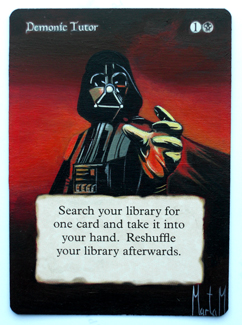
Demonic Tutor...Sith Style
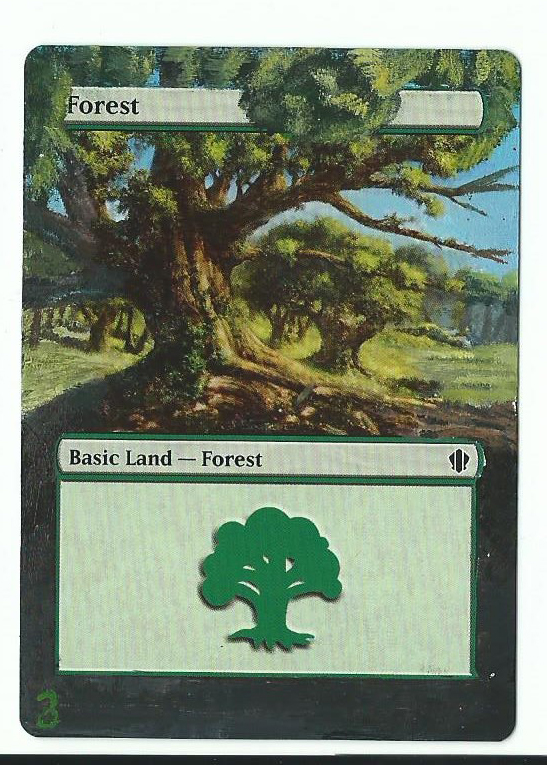
You probably know that one guy at your local shop who can alter cards.

The guy who painted the Eye of Sauron on the Sol Ring and has a Demonic Tutor with Darth Vader on it. His EDH general is borderless and, even though you act like you don't notice, you definitely do.

You may have thought about trying to alter a card yourself, but you are too afraid to ruin your cardboard. Those of you who are more financial minded have probably thought about how the alteration would impact the price of the card.

If you have thought about either of these things, be sure to keep reading.

Before we get into things, I think a quick introduction is in order.

My name is Mike. I’ve been playing Magic for over 9 years now. I'm a pretty decent player in my own right--someone who is certainly capable of owning FNMs here and there--but I'm otherwise unaccomplished.

My greatest accomplishment in Magic was when a fellow player saw a card I altered and liked it so much he paid me to make one for him. He then told his friends, and a couple of them also commissioned me for a couple of cards.

With the help of a little bit of an internet presence, this has become a part time income for me--one that has allowed me to pay for Magic using paint and time rather than cash.

What this column is...

These articles will be (almost) weekly. Every two weeks I will pick a card and alter it, then provide a guide with pictures on how I did so, including step by step instructions and some basic theory along the way.

On some off weeks I will have a more free form column, discussing topics ranging from how best to price and value your alters to tips on trading or selling them. I may even just review some excellent alters from around the internet for inspiration.

Along the way, I greatly welcome any feedback from readers. The more you talk to me, the better I can tailor these lessons to fit you.

What are the benefits?

Well, as I stated above, if you practice enough, you could become the "go to guy" for commission work in your area.

Another benefit is that you have yet another way to “pimp” your decks. Foil cards are generally the way players choose to do this, but imagine having all of your basic lands in exquisite full art. No one at your table, in your area, or even your local Grand Prix, will have a deck as unique as yours.

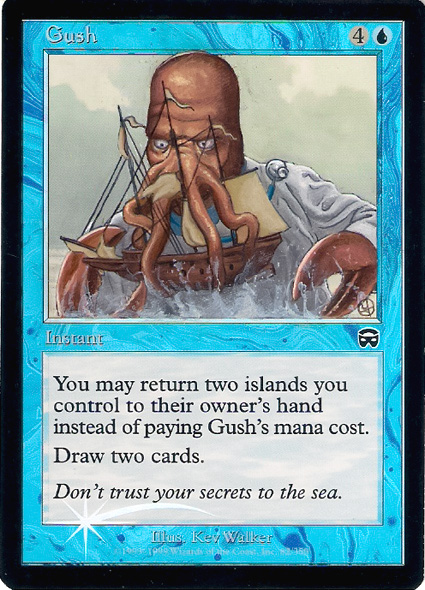
Why not Gush?

What does this have to do with finance?

This is the big question, isn't it? We all have those cards that are not quite bulk, yet not quite wanted, either.

I'm talking about those cards that are certainly EDH playable but aren't foil, or perhaps that fringe Legacy sideboard card you know you don't want to toss into your bulk box.

Simply extending the borders on a card like this not only increases its value, but also makes it a star in your binder. People always notice altered cards and almost always comment on them. This kind of attention isn't too shabby for what used to be a regular old Gush in your binder.

But I’m not an artist….

Whenever people see my cards, the first thing they say, after they ask “did you do that?’, is that they “don’t have the talent” to do something like that.

I believe that this is false. I have always maintained that if you can write with a pen, you can paint.

It does take a bit of practice, though, and, in some cases, a touch of direction. Which is where I come in.

That being said, I think now is a good time for you to start painting. I find that the best way to learn something is to just go for it. This will give you a good idea of your baseline skills and teach you a bit about the hobby before I go ahead with the instruction. Experimenting will lead to more learning than reading a guide will ever do.

Choose a bulk common to practice on. Something with a simple design, perhaps with a small range of color. Basic lands work perfectly for this.

Find yourself a clear surface to work on. Be sure to use newspaper on anything that is not going to be primarily a designated paint area.

Make sure also to have good light to work with. Use your white paint to create a thin primer layer.

While that’s drying, use the paint and your knowledge of the color wheel to try and match the colors on the card. Remember that it won't take very much paint to cover such a small area. If your paint is too thick, you can thin it with a bit of water.

The idea is to train your eye to see through the illusions created by the colors at work. Don’t be discouraged, this is the most difficult thing about altering any card, but it can be mastered with some practice.

Here's what you'll need:

Tools of the Trade:

There are a number of things that can be helpful when painting, but this list will only show you the most basic necessities. I don’t want to price you right out of the game before we start.

  • Paint – I use Liquitex brand acrylic paint. This can be found in a starter set at your local craft store for around $20. The set will include Naphtol Crimson, Phthyalocyanine Green, Cadmium Yellow, Brilliant Blue Purple, Mars Black, and Titanium White. Please don't be intimidated by the names of these colors. And yes, they are ridiculous.
  • Brushes – This is subject to preference, but for the purposes of this list, I like to use a flat blending brush, size number 4 or smaller. These can vary in price from $2-$12, and I haven’t noticed a difference in quality, so feel free to go cheap. It helps to have two or three different sizes, though.
  • Canvas – You’ll notice that I mount my cards on a 4in x 6in canvas. These aren’t necessary, but you do want to find something to mount your cards on. Anything from cardboard to scrap wood will do. The goal is to be able to pick up your card without touching it.
  • Tooth Picks – The most dangerous tool in your arsenal. The hope is that you’ll only use these to clean up edges, but, unfortunately, they will scrape away more than that if you are not careful. A hundred tooth picks might cost you a dollar.
  • Paint Pallet - This gives you a place to actually mix the paints into more interesting and appropriate colors. You can find these next to the paints in your local craft store. A little round plastic one will cost you a dollar, but I use a glossy ceramic tile. It's easier to clean and can often be had for free as a sample from home improvement stores. Another free solution would be a dinner plate, as we are using water based acrylic paint. The paints should come right off.
  • Small Cup – This is for water to rinse your brushes.
  • Paper Towel – Always handy…

So go to town and enjoy! Tweet me your progress, questions and comments @PaintersServant.

See you next week.

Way cooler Forest than you'll ever pull in a pack.


Continue reading "Insider: Artful Maneuvers, an ALTERnative Way to Make Money on Magic"

Insider: Pro Tour Dragons of Tarkir, Before and After

Are you a Quiet Speculation member?

If not, now is a perfect time to join up! Our powerful tools, breaking-news analysis, and exclusive Discord channel will make sure you stay up to date and ahead of the curve.

The Standard decklists from Pro Tour Dragons of Tarkir will define the Standard metagame going forward. Innovations from the pros will be adopted by players across the globe.

The Pro Tour creates not a ripple effect, but a tidal wave through competitive metagames and financial markets. Today I’ll examine key metagame trends from the Pro Tour and explore how they will impact the financial landscape.

Dragon Control

Control decks were out in full force, and true to the Pro Tour’s Dragons of Tarkir moniker, it was Dragon Control decks that found the most success. They came in a variety of forms, with major variations, including finalist Shota Yasooka’s Dimir version, and the Esper variation piloted by Channel Fireball players, including Josh Utter-Leyton to a 9-1 finish. These powerful decks stand to define the metagame going forward.

There was an error retrieving a chart for Dragonlord Ojutai

Dragonlord Ojutai was $17 before the Pro Tour, and it’s now just $18, and the price is probably just right. This card is incredibly strong, and it has not yet been fully realized by the metagame.

It’s viable in more decks than just Esper Dragon Control. For example, Craig Wescoe finished in the Top 16 with his Bant Ojutai deck, and it’s a sideboard card for Jeskai Tokens. This could stand to gain a few dollars, but influx of new cards should help keep the price under control.

There was an error retrieving a chart for Dragonlord Silumgar

Dragonlord Silumgar was just $6 before the Pro Tour, but it has spiked to over $13. This appears to be a price correction, and I expect this is the new selling price going forward as it becomes more widespread in the metagame. This could continue to rise a few dollars, but on the whole it’s not as heavily played as Dragonlord Ojutai, so its price won’t reach such heights.

There was an error retrieving a chart for Icefall Regent

Icefall Regent was completely off the radar before the Pro Tour, but it served Shota Yasooka incredibly well. This Dragon helps make a Dragon control deck possible, especially a blue-black deck that doesn’t require a third color. The price went from around $5 a playset before the Pro Tour to $3 a card now.

The price was just too low, and it’s not going down. This could realistically go up towards $5 if it catches on in more decks, but right now it’s limited enough that I don’t see this hitting Thunderbreak Regent-level prices. On MTGO the price shot up from under a ticket to over 6 tickets, which seems unsustainable, so I’d sell those positions.

There was an error retrieving a chart for Crux of Fate

Crux of Fate is a clear winner from the Dragon Control deck, so it’s poised for steady gains over the next few months. It’s a bargain at $3, and it should trade at no less than $5 this summer.

Gruul

Three different green-red decks reached the Top 8, the G/R Devotion build by Ondrej Strasky, the G/R Devotion deck by Thomas Hendriks, and Jason Chung’s R/G Monsters deck.

There was an error retrieving a chart for Dragonlord Atarka

Dragonlord Atarka featured heavily in the devotion builds, where it served as a top-end trump that went over the top of opponents. Over the week the price went from $6 to over $8, partly on the hype of Chris VanMeter’s SCG Open-winning G/R Dragons deck, but after the Pro Tour it now sits at $19, the most expensive of the Dragonlords. It’s sure to be a hot card this week, and it’s not out of the question that the card demands a price even higher than $20 in dealer cases this weekend.

This price is likely unsustainable, because the hype is sure to die down, and the price should fall to a more reasonable $15 range as more product enters circulation.

This weekend was a breakout for Surrak, the Hunt Caller, which was in two of the Top 8 decks.

There was an error retrieving a chart for Surrak, the Hunt Caller

Surrak, the Hunt Caller has been ticking steadily upward over the weekend online, having now exceeded the prerelease weekend price, but the paper price continues its downward trajectory. I like this card a lot under $4, and it’s only a matter of time before Abzan Aggro catches more popularity and drives the price up 50% or more. This has application in a variety of decks, and it's bound to be a player next year as well.

Abzan Aggro

Another deck to incorporate Surrak, the Hunt Caller is Abzan Aggro. It didn’t reach the spotlight of the Top 8, but Brad Nelson piloted the archetype to 9-1 finish, with some teammates not far behind. The only undefeated day one player was also on the archetype.

Abzan Aggro has been completely reinvigorated with the addition of Surrak, the Hunt Caller. The formidable ability will nearly always be turned on in Abzan Aggro, so it effectively has haste and thus hits extremely hard. This card turns the clock squarely in the favor of Abzan Aggro and puts it as one of the defining decks of the format. It has a strong matchup against U/B Control, and its proactive nature make it great in an open format.

There was an error retrieving a chart for Rakshasa Deathdealer

Rakshasa Deathdealer is too cheap at a buck. There is going to be considerable demand for this card in the summer and likely into next year, and with Khans of Tarkir off the draft table and only being opened by dual hunters, the price should start steadily rising from here. A blue chip until it rotates from Standard, and an all-time casual favorite with some Modern potential.

There was an error retrieving a chart for Anafenza, the Foremost

Anafenza, the Foremost has lost 33% of it’s value, down to $5 from a peak of $7.5 in early March. This card has made a comeback in the metagame, so as a mythic it has potential to spike to upwards of $10. As it stands, it’s a prime target for growth into the summer, profits of 50% likely capturable by summer. It’s likely a strong player until it rotates from Standard.

Moving Beyond Theros

It’s now a good time to move off Theros block positions, which from here on out will start dwindling in price until rotation later this year. Cards like Stormbreath Dragon, Goblin Rabblemaster, and Mana Confluence all hold a strong price but are unlikely to see any sort of sustained growth into the future.

Standard-only staples like Elspeth, Sun's Champion, Hero's Downfall, and Polukranos, World Eater continue to put up strong performances while falling in price, as they will continue to do. Cards with staying power into Modern, like Sylvan Caryatid and Courser of Kruphix are likely to fall more slowly and hold their price going forward, but they aren’t immune to this downward price pressure as players prepare for next season.

There was an error retrieving a chart for Thoughtseize

Thoughtseize is the best Theros block card to hold going forward.

~

Where is the Standard metagame headed?
Are any Dragons of Tarkir cards are still under the radar after the Pro Tour?
What Theros block cards do you have in your long-term portfolio?

Cheers!
Adam

What’s Happening to Mikaeus the Unhallowed’s Buy Price?

Are you a Quiet Speculation member?

If not, now is a perfect time to join up! Our powerful tools, breaking-news analysis, and exclusive Discord channel will make sure you stay up to date and ahead of the curve.

As I was working on our price database this afternoon, I ran a few test reports to see what's been happening in the market lately.  Insiders will get to see the full reveal of these reports in a few weeks, but for now, let me just tease you with what I found on one of them.

Mikaeus, the Unhallowed has been creeping up for a while, but this recent spike seems to have come out of nowhere, and it's not reflected in the retail price...yet.

There was an error retrieving a chart for Mikaeus, the Unhallowed

I asked our team why this might be happening.  David Schumann was quick to reply with a pretty thorough explanation:

It's an amazing EDH/casual card that's always had an insanely low spread.  I've buylisted a few of these last year and the spread was always 15% or below when I did. I even remember one incident in which a vendor looked at the buylist price I'd set, said that seems too high, looked up the price on their computer and then took it at my price. Dark Ascension was a super low EV set that wasn't cracked en masse, similar to Dragon's Maze, any mythic from these types of sets has a much higher price ceiling if it were to break out (even from just casual demand). This particular card combos with:

  • Any creature that comes into play with +1/+1 counters that can be removed for benefit, such as Spike Feeder and Triskelion.
  • Any creature with persist, like Kitchen Finks or Murderous Redcap.
  • I'm currently unaware of any "new" combo with him, but his versatility means that he gets even better as any new creature with good ETB abilities or +1/+1 counters is printed.
Seems like a plausible explanation to me.  I also don't know of any new combos, so this is probably a case of a merchant running low on stock, merchants not getting their buylist orders filled, and low general supply in the market (due to DKA being a small, low-volume set).
I'd never have found this without our Trader Tools Reports, so I'm going to hurry up and get them finished so I can release the feature to our Insiders.

Modern MTGO Deep Dive: Win Rate Analysis

Are you a Quiet Speculation member?

If not, now is a perfect time to join up! Our powerful tools, breaking-news analysis, and exclusive Discord channel will make sure you stay up to date and ahead of the curve.

I'm a big fan of using MTGO data to analyze deck performance. But one of the biggest issues with data available on the Wizards website is it's incomplete. We only see 4-0/3-1 decks, we only see one event per day, and we have no idea what matchups happened on the way to those finishes. Although you can still use this public data to perform some interesting analysis at varying depths (see my past articles on Mono U Tron and Infect), the dataset limitations always leave us wanting more.

Working with a few friends of mine from the MTGSalvation Modern forums, we decided to take an in-depth snapshot of the current Modern MTGO metagame. To do this, we looked past the public data into the MTGO client itself, observing and recording dailies over the past few weeks. The result is almost a dozen events to dig through without any of the limitations we typically see in the public data. This dataset lets us not just look at winning decks but all decks, seeing which decks are performing well relative to every strategy in any given event. The statistical possibilities are almost endless, but this week we are going to use this data to get a sense of the top performing decks on MTGO. I'm sure you will see one of them coming, but another was a total surprise even to me.

Titan Crop

Using some more statistics (didn't think you saw the end of that, did you?), I'm going to look into the match win percentages of these decks to try and identify a few of Modern MTGO's top decks. In doing so, I'm looking both for decks performing significantly above average, but also for some possible explanations about why this might be happening. I'll also give a general rundown of the current Tier 1 and Tier 2 decks on MTGO, showing how their match win percentages rank up relative to the rest. So let's dive in to this rich dataset and see how we can use these numbers to improve our understanding of the format.

[wp_ad_camp_1]


Dataset Description

If you've ever read research articles for work or school (all those 30+ page PDFs you got assigned in college and then only read the abstract), you'll know the importance of describing a dataset before we start. This is particularly important when we aren't all looking over the dataset together. This is actually quite common in both the "hard" sciences and the "soft" ones, although it is relatively rare in Magic where most data is just a click away on a website (e.g. our Top Decks page). So to get us on the same page, here's a bit of background on what we are looking at.

The data covers 11 MTGO events from 3/24 to 4/12. The average event size was about 70 players and there are roughly 750 decks captured, covering thousands of individual matches between those decks. The big difference between this dataset and those we have looked at in the past is the inclusion of 2-2 or worse decks, not just 4-0/3-1 ones.

This might be the most exciting Modern data I have gotten to work with in a while, but it still has its limitations. For one, this is by no means a complete population of all MTGO events in the time frame. It's just 11 dailies over a 2-3 week period, which is actually less than an event per day. Although our deck and match Ns are very large, the event N is quite small, so we need to understand that in analyzing the numbers. Perhaps more importantly, it's not even a random sample. Dailies were just observed whenever my partners and I had time, which is only semi-random at best. These limitations (and others I am sure you can think of; data entry errors are always at play in big, manually recorded datasets) do not undercut the value of what we are doing, but they do force us to consider their effect on our conclusions.

Also, as with all other articles of this kind, all statistics and data analysis disclaimers apply!

Tier 1 Deck Performance

One of the enduring problems of metagame statistics like the ones on our Top Decks page is they are almost entirely based on prevalence. They do not explicitly account for performance of those decks; a deck getting played a lot might be more likely to just win events eventually! Of course, that's not saying any of those decks are bad. We wouldn't keep seeing them time and time again if decks like Abzan, Twin, and Burn were "bad" decks. But prevalence is only one piece of the metagame story. To get to a deck's performance, particularly for decks played less than the top ones, we need to dig deeper.

The Big Three

To try and get at this issue, I analyzed the match win percentage (MWP) of decks in the dataset. MWP is just the sum of a deck's winning matches divided by the total number of matches the deck played. So a deck that went 4-0 on MTGO would have a 100% MWP, a 3-1 deck would have a 75% MWP, etc. We can aggregate this across events to get an overall MWP for any deck; a build with 50 match wins out of 100 matches played would have a 50% overall MWP. We can even augment this statistic with game win percentage (GWP) to see how many games the deck is winning as well. After all, a deck that goes 4-0 off of 2-1, 2-1, 2-1, and 2-1 records has a lower GWP than a deck that does the same off of four 2-0 matches. But they would both have that 100% MWP, which is why it is helpful to have both.

If you were worried there weren't enough statistics here, fear not my loyal readers! I'm also going to give the corresponding statistical significance (p value) for game of chaos artboth the GWP and the MWP, just to make sure the number isn't within expected variance. After all, even a fair coin may flip 3 heads and 7 tails in just 10 trials, and Modern MTGO is much more complicated than that. To check this, I compare the GWPs and MWPs to the weighted average of GWPs/MWPs for all decks in the dataset. This gives us a sense as to whether a deck is actually under/over-performing relative to the average. Remember we are looking for small P values. Anything less than .10 is interesting and anything less than .05 should really catch our attention.
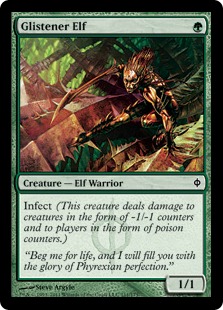
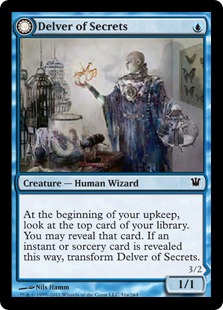
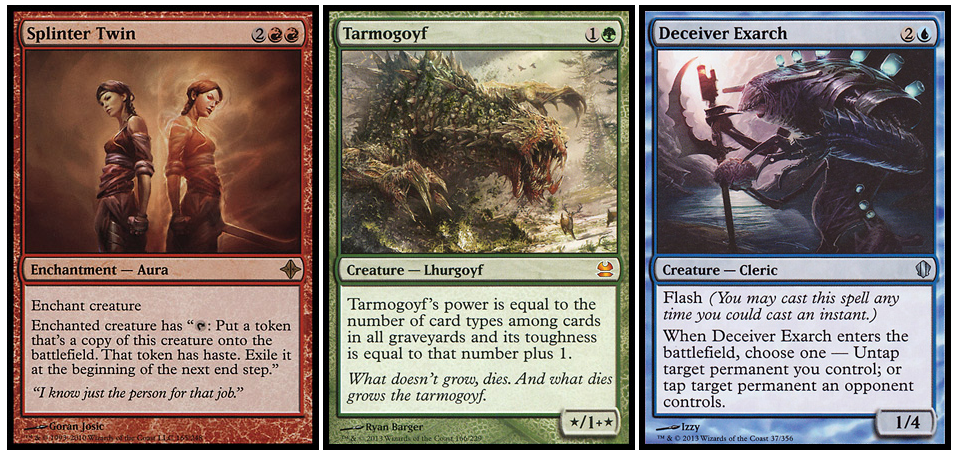
Finally, note GWPs/MWPs are both adjusted to account for byes, mirror matches, drops, splits, and other MTGO quirks skewing our dataset.

With the stat-speak out of the way, it's time to dive right in. Here are the results of this analysis for the Tier 1 decks on our Top Decks page, as of the 3/1 - 4/1 metagame period. I'm also putting in an entry for the MTGO-wide averages, just as a point of comparison. The table's default sort is on MWP.

DeckN (decks
in dataset)
GWPGWP
(p value)
MWPMWP
(p value)
Infect2050.29%0.639
53.73%
0.277
Abzan4043.32%0.833
49.26%
0.584
Affinity6046.60%0.802
49.21%
0.528
Burn7848.53%0.532
47.91%
0.744
MTGO weighted
averages
-na-44.99%-na-46.90%
-na-
UR Twin6443.96%0.870
46.58%
0.923

One of the biggest challenges in looking at average is in understanding variance. Those P values help us in that respect. We shouldn't look at UR Twin and think "below average?? WORST TIER 1 DECK ALERT" or something similar. Instead, we should look at all of those P values and see all of the tier 1 decks are well within the expected performance range for any deck in the format. Infect is a bit higher (which I expected, given my analysis in a previous article), but it's not that much higher than the rest.

When i see the tier 1 decks, I don't see decks above or below an MTGO-wide average. I see decks that get a lot of play, which means they attract a lot of different players. Masters will pilot these decks to 4-0 finishes and MTGO newcomers will pick them up and flop out at 0-2. With tier 1 status comes a lot of profile, which means a lot of people are going to be trying these decks and bringing the GWP/MWP both up and down.

glisetener elfThis all suggests the tier 1 decks are actually pretty similar in terms of their performance. Infect is a bit higher, but overall they are in the same performance band. This is more or less what we should expect of these decks. You can win with them, you can lose with them, and you can get everywhere in between with them too. Because Infect does not have a significant P value (it doesn't even have that large of an N), I also am unwilling to conclude Infect is the "best" of that bunch. They are all strong choices in their own right, depending on playstyle, metagame, preference, etc.

Tier 2 Deck Performance

In moving to the tier 2 decks, our biggest concern starts to be N. With the exception of Grixis Delver, which is more popular on MTGO right now than Ring Pops were in my youth, these decks do not have a lot of representatives. Lower representation can polarize GWPs/MWPs, and makes every individual showing count more. We are more likely to see significant P values with fewer decks in the sample, but that doesn't mean we should discount them entirely. Sample size is just one of many factors to consider and if we make interesting quantitative conclusions matching our qualitative knowledge and suspicions, N might not matter at all.

Here are the tier 2 decks laid out in the same way as the tier 1 decks were. MWP is still the default sorting variable, but pay attention to those P values, because we have some winners in this batch.

DeckN (decks
in dataset)
GWPGWP
(p value)
MWPMWP
(p value)
Temur Twin7
58.98%
0.485
66.67%
0.085 *
Abzan Liege18
54.34%
0.436
58.46%
0.079 *
Amulet Bloom25
55.78%
0.289
56.82%
0.075 *
Jund25
49.79%
0.634
52.81%
0.275
Merfolk22
47.43%
0.820
52.70%
0.329
Bogles13
43.89%
0.938
52.27%
0.489
Blue/Temur
Moon
3
36.67%
0.799
50.00%
0.862
UWR Control15
46.92%
0.882
48.08%
0.868
Grixis Delver49
47.07%
0.771
47.53%
0.873
MTGO weighted
averages
-na-44.99%-na-46.90%
-na-
Scapeshift21
39.33%
0.608
43.94%
0.635
Living End8
45.07%
0.997
43.33%
0.707
RG Tron15
45.33%
0.979
42.55%
0.560

Nothing excites statisticians quite like low P values (except maybe beta values...mmm). It's a rare thrill to come across significant P values in social science analyse like these. Abzan Liege, Amulet Bloom, and Temur Twin really deliver.

Before we jump into these three decks, let's take a look at the overall picture. Despite some really small N's that we almost have to throw out because they are so small (poor Blue Moon on MTGO), these N's Delveraren't so tiny that we can ignore their GWPs/MWPs entirely. A lot of these decks have a respectable number of finishes, certainly enough to analyze with different statistical sampling distributions. Grixis Delver, for example, appears very average in this dataset, despite having a ton of playtime online. Indeed, it has very similar values to those in the tier 1 table, which might suggest it's just as viable on MTGO as any of the big guns like Abzan, Twin, and Burn. A number of other decks are also performing in that expected performance band, except maybe Bogles which is a little lower and Scapeshift that is a lot lower (but still not significantly so). Overall, although I would like to see more representatives of many of these decks, I still think we can look at this and conclude most of the tier 2 decks are all pretty viable. They aren't too different from the heavy hitters in tier 1, and they aren't too different from each other.

But three decks actually are pushing past the average performance of MTGO decks. Yeah, it doesn't quite clear the magical (i.e. semi-arbitrary) 95% significance cutoff we want to see with P < .05, but they are close enough to grab our eye. I want to talk about these decks one-by-one, both to unpack their stats and to give some thoughts on why they are doing so well.

Temur Twin (MWP = 66.77%, P = .085)

I guess good things do come to those who just add Goyf to their deck. Let's start with the bad news for Temur Twin fans out there; of the three decks I'm highlighting in tier 2, this is the one with by far the most alarming N. We're only looking at 7 decks spanning just over 25 matches. It's not really enough data to normalize the effects of luck and chance, even in a dataset we know has a small N overall. So we need to remember this when figuring out why RUG Twin might be good.

temur twin

If Temur Twin is in fact a good deck, and not just a false positive because of a small N, I think a big part of this is actually the prominence of UR Twin itself. You can't leave home without anti-Twin tech in your sideboard and an anti-Twin game 1 plan in your maindeck. Most players also know how to respect the combo and play with it in mind. Tarmogoyf messes with that calculus. A lot of the stuff that works well in fighting stalled Twin board states doesn't do much when facing down the 4/5 Goyf on turn 3. Choke is a great card to land on turn 2-3 against Twin, but it isn't helpful at shutting down Magic's most efficient beatstick. It's easy to misstep against this deck, which can win from so many angles, which might make it a great choice for MTGO where player experience can vary widely. Another possible explanation is in the sideboard, with cards like Ancient Grudge and/or Nature's Claim, which are very strong in a metagame that is increasingly Affinity. I'm not totally sold RUG Twin would keep its status if we added more matches to the dataset, but if it did, it would likely be due to these reasons.

Abzan Liege (MWP = 58.46%, P = .079)

If a deck designed to target the current metagame didn't make this list, all of us would feel very misled by the innovators over at Team Face to Face. But Abzan Liege remains a metagame predator today as much as it was at the PT, reflected in its 58.82% MWP almost reaching the coveted .05 P value. The deck's matchups also reflect its suitability to our current metagame. In all its approximately 65 matchups, it went 4-2 vs. Affinity, 8-5 vs. Burn, 4-2 against UR Twin, 3-0 vs. Junk, and 3-3 against Grixis Delver, which is exactly the kind of match win rates you want to see against top MTGO decks. The deck appears to do less well against weirder, off-beat decks (e.g. Norin the Wary, Smallpox Loam, 4C Gifts, etc.), and is only average against the faster, linear decks like Amulet Bloom, Infect, Bogles, etc. But because MTGO is so dominated by format mainstays like Affinity/Burn/Twin/Grixis Delver (on MTGO at least) and so on, it looks like a great deck to hedge your bets on.

Abzan Liege

A big reason for the deck's success is the MTGO metagame's predictability. All those decks Abzan Liege beats or breaks even with are everywhere online, so between your maindeck and your sideboard, you are ready for a big chunk of the format. The deck's core also has a surprising degree of customization to fill in holes against more erratic matchups like Burn (which can be die-roll dependent) and Twin (which can hinge on drawing/not drawing a critical removal or disruption spell). But unlike with other customizable decks, like Abzan itself, this flexibility doesn't come at the cost of faster starts and aggression, which means you are balancing a proactive, focused gameplan with some reactive elements. So long as the MTGO metagame looks like it does now, this deck is going to remain a safe choice.

Amulet Bloom (MWP = 56.82%, P = .075)

On the one hand, this deck did not turn out to be some unstoppable MTGO force as I feared it might when I started the analysis. On the other hand, Amulet Bloom is still just a really good deck. Overly reactive decks just get crushed in this matchup: 3-0 vs. Scapeshift, 3-0 vs. UWR Control, 3-0 vs. Esper Control, etc. Decks that try to play too fairly also have big trouble here. Grixis Delver looks like a massacre, with Amulet Bloom going 5-1 against that deck. But Jund and Junk remain formidable policing presences against Amulet Bloom. The deck was 2-4 against Jund and 0-4 against Junk. Merfolk also gave Amulet Bloom a lot of trouble, combining hyper-efficient disruption with a fast clock to cause Bloom to go 1-5 against the fish-squad.

Amulet Bloom

Despite its troubles against decks that are supposed to be good against combo anyway, Amulet Bloom remains a great deck. With the exception of perhaps Infect, no other top-tier deck punishes opponents harder for lacking interaction or not playing with disruption ready. And Bloom is actually harder than Infect to interact with in the first place. Even when you are trying to interact with Amulet Bloom, there are a few interesting contexts making this difficult. For one, stuff that is good against Amulet is not always relevant in the broader metagame. As an example, early Blood Moon can be great against this deck, but the kind of deck that packs Moon and either acceleration to power it out and/or disruption backup is not very good in MTGO right now. Some Twin builds are doing this, but with Grixis Delver, Burn, and Affinity having such high metagame shares, Moon isn't always the card you want to rely on.

ThoughtseizeA second factor at play in beating Amulet is experience. We saw countless examples of this at Pro Tour Fate Reforged, where the Twitch stream exploded as a pro player made the wrong removal, countermagic, or discard decision against the deck. Thoughtseize misplays were the most heart-wrenching. Sure, fatigue and expected gameplay errors played a role in this, but a big piece of it was also deck knowledge. This is magnified on MTGO, where player experience is much more variable than on the PT. Amulet really takes advantage of this, both by punishing your deck choice (which itself might be ill-suited for Amulet interaction), and then again by punishing any inexperience you have going into the match.

A final factor here is relative metagame share. The more Amulet you see, the more likely you are to face anti-Amulet cards or players who have experience beating the deck. But when Amulet declines, the cards to beat it might decline alongside, and the collective MTGO experience declines as well. In many respects, this makes Amulet a kind of Dredge of Modern (although that's not entirely fair because Modern seems to have a LOT of "Dredges of Modern" these days). Of course, this leads us to some interesting questions and some even more interesting answers. Why is Amulet declining if it's so good? Are people preparing better for it? Are worse players trying and failing at the deck, leaving it in the hands of masters? Is it just luck? If Amulet were some 8%+ format monster, like Storm in the Seething Song days, then this MWP and its significance would be more straightforward. But because Amulet is seeing a declining share in both paper and MTGO, we need to think of reasons why the deck is both losing its share and still maintaining a strong performance.

Next Steps

My initial draft of this article had another section on some other high (and low!) performing decks that were not tier 1 or tier 2. But because the dataset is so rich and this kind of information so interesting, it makes more sense to split that off into a followup article. That way, we can spend as much time unpacking those decks as we did unpacking these, and we can even revisit some of our conclusions here to see how they fit in the broader metagame context.

Open question until then: what are some other dynamics that can affect MWP and its significance? How should these factors affect our analysis, conclusions, and actions based on those conclusions? As a conversation starter, we already know the most-played decks in the format are not those with the highest MWPs. But we also know that many of those high MWP decks aren't overperforming at higher levels. This is especially true in paper, where a deck like Amulet Bloom has all but disappeared from the paper scene in the past few months. Having just updated the Top Decks page with events from the past two weeks, I can tell you this deck is basically nowhere. How can we reconcile these potentially contradictory numbers? How would we apply that to other decks? I'll touch on some other answers to this in next week's article.

Until next time, keep thinking about MTGO data and how we can use different analytic tools to improve your Modern game.

Want Prices?

Browse thousands of prices with the first and most comprehensive MTG Finance tool around.


Trader Tools lists both buylist and retail prices for every MTG card, going back a decade.

Quiet Speculation