menu

Are Collectors’ Edition Prices Stable?

Are you a Quiet Speculation member?

If not, now is a perfect time to join up! Our powerful tools, breaking-news analysis, and exclusive Discord channel will make sure you stay up to date and ahead of the curve.

About twenty months ago, I wrote a deep dive article into a previously underappreciated set: Collectors’ Edition (and International Collectors’ Edition), or CE/IE for short. Additionally, I provided background on these sets back in a December 2019 article.

The short version is, initially released in December 1993, this extremely low print run collectors’ set was once panned as a collection of unplayable cards best suited to display cases and the like. However the surge in Old School’s popularity, combined with the overall increase in casual play has driven up demand for this set.

Since practically everyone uses sleeves nowadays, there is virtually no downside to shuffling up CE and IE cards as budget alternatives to their original Alpha, Beta, or Unlimited counterparts. In the case of Alpha and Beta, these also offer a similar black-bordered aesthetic, in some cases meriting a premium versus white-bordered sets Unlimited and Revised.

But after surging to new highs in 2021, Collectors’ Edition cards have seen a measurable pullback. What’s going on here? Is the budget Old School trend dying? Or is this a prime pullback opportunity to load up on discounted cards?

A Look at a Few Charts

Don’t take my word for it. Let’s review a few price charts to observe the downward trend I’m noticing in Collectors’ Edition cards. For example, how about Reserved List, Commander staple Copy Artifact?

There was an error retrieving a chart for Copy Artifact

Both retail pricing and buylist pricing are following identical trends on this card. In early 2021, its price spiked and buylists tripled from around $33 to over $90 for near mint copies. The jump in retail pricing was even more significant, increasing as much as fivefold at peak. The buy price peaked at $140 in March 2021, however, the card’s price has been gradually declining. There was a temporary reprieve from the decline in February of this year, but the downward trend picked up once again. Today, the best buy price is in the $70 range.

The trend on Chaos Orb looks fairly similar.

There was an error retrieving a chart for Chaos Orb

The card’s price ran up in early 2021, then peaked before pulling back from highs. Both retail pricing and buylist pricing followed suit here again. Then the top buy price did increase a little bit earlier this year, but that trend looks to have begun a reverse. Additionally, the TCGmid pricing and retail price have both been dropping this year. Another indication of a cool-off.

My final example is Birds of Paradise, another all-around staple with significant play across numerous formats.

There was an error retrieving a chart for Birds of Paradise

If we change the y-axis a little bit, this chart looks identical to that of Copy Artifact. A sudden surge in early 2021 followed by a lengthy cooldown period. However in this case, it’s possible we’re seeing signs of a bottom in 2022. Both the best buylist price and retail price seem to have been stable in April 2022 (the best buylist price even increased during this time).

Is this a screaming buy signal? Can this be the prime opportunity to jump in and acquire Collectors’ Edition cards on the cheap before they return to all-time highs?

Looking Ahead

To cut to the chase, I’m only cautiously optimistic that this is the all-and-out bottom for Collectors’ Edition. On the one hand, too many cards from the set still display some downward pricing momentum as copies continue to return to the market. Likely what we saw in 2021 was a surge in buying, drying up market supply on these incredibly rare cards.

On the other hand, their print run (9,000 CE sets and 5,000 IE sets) are on the order of magnitude of Beta and Unlimited, so the number of copies that exist are relatively tiny. Cards as rare as these are hardly what I would call “plentiful.” We have seen some rebound in supply in these cards as prices climbed. Suddenly, it was worth it for vendors to list their CE/ICE cards for sale on TCGplayer, or start acquiring them on buylists, or start bringing them to large Magic events. As prices climbed, stores restocked from buylisting. However, would you consider this a “healthy supply?”

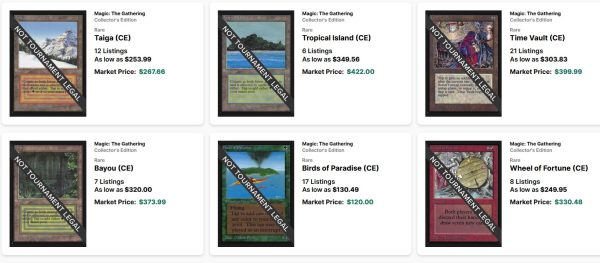
Granted, these listing numbers don’t include any listings that contain pictures. For example, there are actually 22 listings for CE Taiga when listings with pictures are factored in—not the 12 indicated in the picture above. That said, is 22 really all that much of a difference? We’re still talking low double-digit supply on these cards, or even less. The total number of listings for Wheel of Fortune: 9!

There was an error retrieving a chart for Wheel of Fortune

I checked out Card Kingdom’s supply as well, since their pricing is most dynamic. In a few words, I’d describe their Collectors’ Edition inventory as spotty at best. They seem to be out of stock or low in stock on every other card (worth playing).

With supply this inconsistent, I suspect pricing is still going to be in flux as Card Kingdom strives to replace its diminished supply. The result: prices are likely to climb on the cards that are out of stock. The adjustments may not happen overnight and it may not happen on a weekly basis. Over a period of a couple months, however, Card Kingdom is likely to adjust their prices as required to restock inventory.

The story is very similar over at Star City Games—they currently have 78 Collectors’ Edition cards in stock. The rest are sold out.

If we examine this market strictly from the supply side, I’d predict prices are starting to bottom and a bounce is on the horizon. However…

Could Demand Be Softening?

For prices to climb, you need both supply and demand to be working for you in the same direction. I’m observing that supply looks a little thin, but prices won’t necessarily climb unless demand at least remains robust in tandem. I’m not so confident this is currently the case.

For example, during its peak, I saw Collectors’ Edition Power (sans Black Lotus and Timetwister) selling for north of $1,000 on the Old School Discord. These were hot items, and moved fairly quickly. I had a couple moxes myself, which I sold for $900-$1,000 each amongst a backdrop of competitive buyers.

Now I see copies occasionally posted in the $800-$900 range. Sure, this isn’t a significant dropoff, so it may not be all that concerning. Likely the $1,000+ price tags were an overshoot, and now we’re in a more stable price range. But I can’t help but flag this as a minor watchout.

What’s more, I have seen prices on Old School cards specifically gradually pullback. Heavily Played Library of Alexandrias were once easily salable at $1,500—at one point, Card Kingdom was even buying at that rate! But recently, I had difficulty moving my heavily played Library for much more than $1,200.

There was an error retrieving a chart for Library of Alexandria

Likewise on Chaos Orb, I could have sworn Unlimited copies were minimum $1,000. But I couldn’t move a heavily played copy for more than $900, and I see other sellers having equally difficult times selling their copies for four figures. Similarly, I’m seeing Card Kingdom’s buylist pull back from highs on many Old School staples and classic collectibles (outside of Alpha and Beta).

I’m not sure if the Collectors’ Edition market can truly flourish if the broader Old School market is a little soft. There is too much demand from Old School players for this not to have an impact. So we may need to see a stabilization in the broader Old School market before CE and ICE cards can rally once more.

Wrapping It Up

The jury is still out on Collectors’ Edition cards. On the supply side, I’ve observed the available copies for sale are relatively thin. The fact that there are less than 25 copies in stock of many popular Commander staples especially (Wheel of Fortune, Dual Lands) tells me prices could bounce soon. However, I need to see a bit more stabilization in broader Old School demand before I could give the flat-out all clear for buying.

My most pragmatic advice would be to monitor which Commander staples have the thinnest inventory, and prioritize acquiring those cards if you insist on buying up CE cards. Wheel of Fortune would be a good starting point, as there are only 9 listings on TCGplayer. That said, no copies of the card have sold since February of 2022, so don’t expect to flip these for profit anytime soon. This is what I mean by a softening demand, and how we need to see this rebound before prices can really move. Anything you acquire now, plan to sit on for at least a few months and possibly longer.

The good news is, you’ll have plenty of opportunity to shuffle these cards up and play at your kitchen tables while you wait for prices to climb. A card like Wheel of Fortune, or a Dual Land, or Birds of Paradise have plenty of utility across multiple formats. As long as you’re playing in an unsanctioned game and your friends don’t mind, Collectors’ Edition cards are a fantastic way of improving the aesthetic of your deck on a relative budget while also doubling as a rare collectible for long-term investing.

To me, that is the best of both worlds.

Unexpected Stability: April ’22 Metagame Analysis

Are you a Quiet Speculation member?

If not, now is a perfect time to join up! Our powerful tools, breaking-news analysis, and exclusive Discord channel will make sure you stay up to date and ahead of the curve.

Welcome to the second installment of my Insider metagame analysis series. This is the companion article to this month's Modern Metagame Update where I do the non-statistical analysis of the data that there's no room for in the data article.

Insider subscribers are the first to get access to this analysis. If you're reading this as a free article a month after publishing, consider becoming an Insider subscriber to get access to these articles when they are fresh.

Last time looked at where Modern was after the last banning. This month, I'll be looking at how it has evolved over the past month and try to guess where it's going. This will be much less certain than usual given that a new set just released and the actual impact on Magic, never mind Modern, has yet to be seen. It's still too early for any actual trends to emerge, so there will be no trend tracking or graphing this month. Assuming that nothing is banned in May (which is unlikely) it will be that update when I have enough data to finally start making graphs and tracking how Modern is actually evolving. However, based on April's data, it looks like Modern was stabilizing prior to Streets of New Capenna.

A Persistent Outlier

First things first: UR Murktide didn't stop being an outlier in April despite my predictions. The last time that a deck was an outlier for more than one month was... checks the archive... never, actually. Technically, 4-Color Uro-Omnath Pile should have been treated as an outlier prior to Uro, Titan of Nature's Wrath being banned, but I didn't start doing that until after said ban. In every subsequent case, the outlier has disappeared after a month. And technically, it did in paper, so I was half-right.

There was an error retrieving a chart for Omnath, Locus of Creation

Of course, that also means that I was half-wrong, and I don't really know why. UR Murktide performed exactly in line with what its prevalence would predict, so it's not that it wins a lot. Previously, I hypothesized that it was simply a case of the deck being very popular because that cantrip-heavy tempo style is always popular. This is still my go-to answer, but I'd like to modify it slightly.

There was an error retrieving a chart for Murktide Regent

Based on conversations I've had with pilots and posts online, I believe that a major factor is that Murktide players feel that they have high agency. The deck is filled with decisions and ways to make more decisions. It's not quite to the level of Legacy's cantrips, but as close as Modern gets. Players like feeling like they mattered in the game, win or lose. UR Murktide rarely gets completely run over thanks to all the answers letting it put up a fight. It rarely freerolls an opponent either. A deck where pilot skill is intrinsic is very attractive, win or lose.

Can't Touch This

On the other hand, I think it's quite straightforward to explain why Hammer Time was an outlier. It's for entirely the opposite reason that Murktide was: it gets a lot of free wins. Hammer Time has many different ways to win on turn 3 (and an improbable turn 2 kill) and ways to do so through removal. It can play a longer game and win via chip damage and card advantage but that really isn't what it wants to do. Just like Infect years ago, Hammer just wants to slip past the opponent and that's always going to be a solid strategy.

Looking Ahead

Both decks will remain Tier 1 online. They were in March and continued to be in April. Given the current shape and spread of the online metagame, I have no reason to doubt that they will continue to be in May. This is particularly because the cards SNC brings to Modern look mainly like combo pieces and both decks are solid against combo. Should there be a metagame shift, I expect that both will survive largely unscathed.

There was an error retrieving a chart for Puresteel Paladin

As for remaining outliers, that's unlikely but not impossible. Murktide's already defied my expectations once. The decks are very solid and consistently do well in events and that will keep players interested. However, neither does exceptionally well such that players feel compelled to play either. The online metagame remains highly volatile and players could simply abandon either deck. Those looking to speculate online should move with caution.

A Duo Apart

However, moving into Murktide-related cards should be a solid move in paper. The same applies to Cascade Crashers cards as well. For the second month running, those two decks are the only composite Tier 1 decks. This is a very strong argument that they're the best decks in Modern currently. Murktide I'd expect to continue being Tier 1 for previously stated reasons, but Crashers is a harder call.

There was an error retrieving a chart for Crashing Footfalls

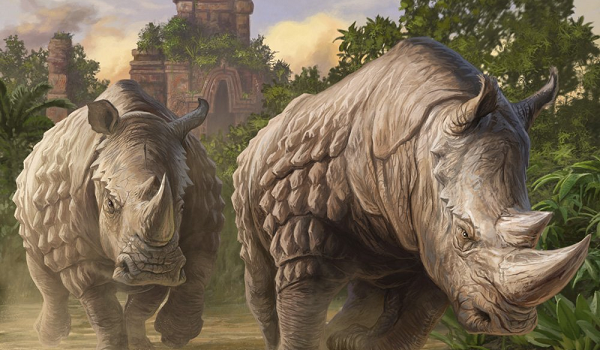
On the one hand, Crashers is the most consistent deck in Modern. It wants to make two 4/4 rhinos on turn 3 and ride them to victory in short order, and executes the former a high percentage of the time. That doesn't sound like it would be good enough on its own, but the deck plays a ton of interaction to clear the road and/or protect the rhinos. And 16 damage is often plenty to secure a win.

There was an error retrieving a chart for Teferi, Time Raveler

On the other, there are a ton of ways to answer cascade. Chalice of the Void and Teferi, Time Raveler are most frequently played, but there's also Void Mirror, Silence, Lavinia, Azorius Renegade, and normal counterspells to name a few. Crashers has answers to all of them, certainly, but they all are much more expensive and/or require card disadvantage to cast. This is fine so long as Crashers stays ahead, but if it falls behind it struggles to catch back up.

Price of Success

It feels like Crashers should start to fall back toward mid-Tier 1, flirting with Tier 2 as it did for most of last year. The sheer number of answers available and Teferi's prevalence in Modern seem deterministic on that front. This is supported by Living End being a top-performing deck and all the hate for Crashers working equally well against Living End. It would make sense to play more broad anti-cascade hate which would bring down both's metagame share.

There was an error retrieving a chart for Living End

Shutting off the cascade spells is worthwhile because, without that interaction, both decks are extremely mediocre. Sans-rhinos, Crashers has to win with Bonecrusher Giant beatdown and Living End must win via expensive draft-fodder beats. It's possible to do, but if that was proposed as the A Plan for a Modern deck it'd be laughed out of the room. Thus, I'd expect the metagame to drive down both deck's metagame share such that following a strong month, they'll have a weak month.

Opportunity Slumbers

However, that hasn't happened to Crashers yet. Given the time both have been hanging around Modern's upper tiers, I'm inclined to think that if it won't. The economic principle of "No Hundred Dollar Bills on the Sidewalk" implies that if an opportunity for gain exists it will quickly be seized. Thus, any apparently unrealized gain must either not be attainable or not actually be a gain. In this case, it suggests that either the opportunity cost of playing more cascade hate is too high relative to the format or it's too easily answered to be worthwhile.

There was an error retrieving a chart for Chalice of the Void

I think that the former is the problem. Living End does demonstrate volatility, moving between Tiers 1 and 2, but that deck is affected by graveyard hate in addition to cascade hate. Graveyard hate is far more common and far more versatile than Void Mirror, which only really hits cascade spells. It is not and has never been actual Tron hate, and so the only reason to play the card is to hit cascade and both decks maindeck artifact removal. Given the breadth of the rest of the metagame, the additional hate simply isn't worthwhile.

Remarkable Stability

This leads to a wider point about the metagame from March to April: it's remarkably stable. Yes, decks move up and down within the tiers quite a bit, but the overall composition of Tiers 1-2 didn't change very much across paper and online standings. Tier 3 is another matter, but given that it's the tier most affected by the cutoff stat changing, that is to be expected. It's also where decks propelled by trends, streaming, and enthusiasm tend to reside. Unless that translates into event wins, they always fade.

There was an error retrieving a chart for Ragavan, Nimble Pilferer

Thus it appears that Modern is finally settling into a relatively predictable metagame. Whether this is a good or bad thing in a vacuum is a matter of perspective. For those looking to try and exploit the metagame, it's definitely a positive. At this point, it's a guarantee that UR Murktide will be highly played regardless of event type or location. Crashers won't be far behind and the usual parade of Omnath decks will be nearby. Whether this will last for another month is unknowable.

Implications

This is all well and good for players, but what does it mean for the Modern marketplace? The knee-jerk response is that if you've invested in a high tier deck it looks to be a safe one. There's no indication that any deck will lose viability in the near future. I don't think that the additions from SNC will be format shaking much less format altering. Moreover, a lot of focus is off Modern right now because Pioneer will be the first qualifier season of the new Pro Tour. Prices should be in a temporary lull and will pick up slightly in the coming months. Not dramatically, but enough for some gain to be made.

There was an error retrieving a chart for Simic Growth Chamber

One deck I'd advise against getting into is Amulet Titan. For players, it's because the deck is extremely hard, and unless you're willing to devote your life to learning all the lines it is punishing. For investors, it's because the unique cards in the deck don't show much growth potential or even price volatility. There may be a slight increase on the basis of its performance in May, but that's down entirely to its performance at Star City events. Amulet has been overrepresented at SCG events for years and continues to be. Don't be fooled.

Keeping Watch

April was a month of metagame stability, and unless I'm very wrong about SNC, May will also show stability. For those concerned, unless Wizards sees something very dangerous in their win-rates data (which we cannot see), then there's no chance of bannings in the immediate future. So enjoy Modern with confidence!

Transforming Double-Faced Cards: More Than Meets the Eye

Are you a Quiet Speculation member?

If not, now is a perfect time to join up! Our powerful tools, breaking-news analysis, and exclusive Discord channel will make sure you stay up to date and ahead of the curve.

Magic introduced transforming double-faced cards (DFCs) in the original Innistrad, making these the earliest DFC design. As more sets have included transforming DFCs, the symbols indicating the front and back faces have changed a few times.

SETFRONT SYMBOLBACK SYMBOL
Innistrad block & Shadows Over Innistradsuncrescent moon
Magic: Origins & Core Set 2019modified Planeswalker iconfull Planeswalker icon
Eldritch Moonfull moonstylized Emrakul
Ixalan & Rivals of Ixalancompass roseland icon

Ulrich of the Krallenhorde uses the sun/crescent moon symbols despite being from Eldritch Moon.

I appreciate that Magic's talented designers wanted to flavorfully show players which face was which. However, here we are years later, needing a chart to keep track of what means what. This is, as the kids say, "not cool."

But enough about that! What's the cool stuff transforming DFCs can do? As it turns out, we can split transforming DFCs into a few different subclasses. First, let's look at the rules that govern all transforming DFCs. Then we can dive into what differentiates "regular" transforming DFCs from daybound/nightbound and disturb cards.

It Happens to Everyone

Anywhere but the battlefield or the stack, transforming DFCs have only the characteristics of their front face. Practically, this means I can't Crumble to Dust my opponent's Azcanta, the Sunken Ruin and exile all of the Search for Azcantas in their deck.

Generally, when a player casts a transforming DFC, they put it on the stack with its front face up. However, if something lets them cast it "transformed," they put it on the stack back face up. The spell has the characteristics of whichever face is up.

A transforming DFC's mana value is calculated using its front face no matter where it is. A transformed Delver of Secrets has a mana value of 1; Dorothea, Vengeful Victim // Dorothea's Retribution has a mana value of 2. However, a copy of the back face of a transforming DFC permanent or spell has a mana value of 0.

A transforming DFC that wasn't cast generally enters the battlefield with its front face up. For example, if my opponent Ephemerates my Insectile Aberration, it has to re-enter as a Delver of Secrets. I'd have to transform it again.

When a transforming DFC transforms, it's still the same object. Any auras, effects, and/or counters remain on the permanent. The exception, of course, is when an instruction tells us to "exile it, then return it transformed" on something like Jace, Vryn's Prodigy. In that case, the DFC would leave and then return to the battlefield. Since it's a new object, it doesn't have any of its old auras, effects, and/or counters.

Transforming DFCs can't be turned face down by effects like Ixidor's. However, a transforming DFC can be manifested with something like Whisperwood Elemental.

Only permanents represented by transforming DFCs can transform. If something tells a player to transform something that isn't represented by a transforming DFC, nothing happens. For instance, if I Clone a Huntmaster of the Fells, my Clone-Huntmaster won't ever transform.

Finally, if a permanent would transform, but its other side is represented by an instant or sorcery card face, nothing happens. The game really doesn't want instants or sorceries on the battlefield, for obvious reasons.

A Little Weirdness

A couple of paragraphs ago I said that only permanents represented by transforming DFCs can transform. If one transforming DFC is a copy of another, it can still transform... but the transformation won't do much.

Let's say I cast Mirrorhall Mimic and have it copy Huntmaster of the Fells. My opponent casts no spells on their turn, then passes back to me. At this point, Huntmaster transforms into Ravager, and the Mimic-Huntmaster transforms into... Huntmaster.

"What?"

Well, our Mimic-Huntmaster is represented by a transforming DFC, so it can transform. However, Mimic's copy effect only copied the face of Huntmaster that was currently face up. While it physically transforms, it still has all the characteristics of Huntmaster of the Falls.

To add another wrinkle of weirdness here, the Mimic-Huntmaster will even trigger the "whenever this creature transforms into Huntmaster of the Fells" trigger each time it transforms. This kind of trigger is a little strange. It doesn't mean that the permanent actually has to change characteristics. Instead, it triggers if the object transforms and it has the specified characteristic immediately after doing so.

Day 'n' Nite

Daybound/nightbound cards are a flavor of transforming DFC found in Innistrad: Midnight Hunt and Innistrad: Crimson Vow. Unlike "regular" transforming DFCs, which usually have a trigger to transform them, these cards are bound by the game's day/night cycle. Hence the name, see.

Day/night is a designation sort of like monarch. It isn't part of the game normally, but once a card introduces it to the game, it lasts forever. If it's day and the previous turn's active player (or active team) didn't cast any spells, it becomes night. If it's night and any of the previous turn's active players cast two or more spells, it becomes day. Some spells and effects like Unnatural Moonrise can also change the day/night cycle.

This day/night song and dance is the only way for a daybound/nightbound card to transform. Sorry, Moonmist fans - these Humans are stuck as Humans until it becomes night somehow.

Players always cast daybound/nightbound spells face up, as their daybound side. If it's currently night, the permanent enters the battlefield with its nightbound face up.

Disturbia

Funnily enough, cards with disturb were also introduced in Innistrad: Midnight Hunt. Disturb lets a player cast a transforming DFC spell from their graveyard for an alternate cost. In doing so, they put the spell on the stack transformed.

So, if I cast Dorothea, Vengeful Victim // Dorothea's Retribution from my graveyard, a few things are true. First, its mana value is 2, as mentioned earlier; it's a legal target for Spell Snare. Other than that, it has all the characteristics of its back face. It's an Enchantment -- Aura, so it's affected by cost reductions like Jukai Naturalist's. Since it's an Aura spell, it also needs a legal target to be cast.

The back faces of disturb cards all have a clause to exile them instead of putting them in the graveyard. Note that this does matter while it's a spell on the stack. If my opponent counters my Dorothea's Retribution, it gets exiled.

Cleanup

This is just a taste of the various and sundry double-faced cards in the game. We've also got modal DFCs and, technically, meld cards. But those are topics for another time.

Have any burning questions about transforming double-faced cards? Did I overlook something? Want to just tell me how handsome I am? Come find me on Twitter or our Insider Discord.

Question of the week: What's your favorite transforming double-faced card? (Mine is Huntmaster of the Fells)

The Best Blockers in the Business

Are you a Quiet Speculation member?

If not, now is a perfect time to join up! Our powerful tools, breaking-news analysis, and exclusive Discord channel will make sure you stay up to date and ahead of the curve.

Let's face it, no matter how diplomatic you may try to be you are going to get attacked. What does it take to be a great blocker in Magic? Toughness and some cool abilities. In no particular order, here are some of the most powerful defensive creatures Magic has ever seen.

But Why Not Just Use Removal?

Overall, I am looking for unique creatures that have high degrees of endurance when faced with uniquely challenging combat situations like those that can occur at your Commander table. That means you may need to block an arbitrarily large creature with four or five abilities in order to see the next turn. While the best answer to this situation is likely something else entirely, you may be stuck with blocking as your only option.

Additionally, I wanted most of the creatures appearing in this list to have some interaction with the HUGE trampling creatures from Sig's recent article. Many of the blockers listed can take on a Polar Kraken or Phyrexian Dreadnaught without cracking a sweat. Others do get smushed into pancakes though, so tread carefully!

A tiny ball of light that costs one black mana, Will-'O flies and regenerates for the same one mana. This card has been blocking almost anything and surviving since '93. In many ways this creature was the golden standard for defense for many years. Trample is the primary weakness of this card and many of the other blockers on this list have ways of dealing with it. Still, as the oldest card on the list, the Wisp does a tremendous job even to this day of providing flying defense at a low mana cost.

I Want More Punch With My Blocks

Okay, so the Wisp is not your style. All defense and zero offense. Do you want to kill something when you block? Or anything? Here are a couple of excellent candidates.

Sworn Defender has a very unique activated ability for one generic mana to change its power and toughness to one less and one more than the creature it is blocking or blocked by. Thus, if a 4/4 was blocking or blocked by the Defender, you could pay one to make it a 3/5. This means that in pure one-on-one combat, the Defender can never lose, no matter how arbitrarily large the creature it is interacting with becomes. Furthermore if you have static buffs like Glorious Anthem, your Defender now defeats anything. I find it particularly funny that various Wall- and Defender-laden decks are out-defended by the Sworn. Does it lose to combat tricks? Not unless you have no mana. As a Knight, Sworn enjoys tons of potential buffs and synergies.

Serene Master has a similar effect, turning the tables on many large creatures for just two mana. However, Serene would NOT be able to deal with a Wall-style deck, and there are potentially many power/toughness combinations that will not result in a kill. In any case, the Master will still achieve a nice block and live to tell the tale

Blocks, Lots of Blocks

There is no shortage of things that can block many things, or even everything. Unfortunately, it's a bit of a gimmick. It's quite rare that another player has an unlimited number of things attacking in the first place. It is much more common that they have one or two things that are difficult to deal with in some special way. Of these mass blockers, Guardian of the Gateless is clearly the best, as it has "reverse rampage" and gains +1/+1 for each thing it blocks. It also flies, and has a good creature typeline in Angel.

Occasionally you might need to block a horde of tokens or copied creatures that will cease to be at the end of turn, and one of these mass blockers could buy you that turn. However, in that case, so could Blaze of Glory: the spell turns any creature into a super-blocker for that one critical turn, and for only one mana. In any situation featuring large board states, having one blocker that is effectively infinite blockers does give you a lot of flexibility, as the shields are never truly down.

All This Stuff Dies to Removal

Anyone playing during Alara likely has strong memories about Wall of Denial, be they centered around loving how great a blocker it was or decrying that same fact. Extremely durable, hard to remove, flying, and also only three mana; this is one of the best-named Walls in Magic. While it cannot defend from absolutely massive threats, it does block most of the creatures in the game. Denial makes sense, but surely the next two don't, right?

Zoetic Cavern is effectively a 2/2 morphed creature. Is someone ever, and I mean *ever* going to use removal to kill a morphed creature? I understand it could be a decent tempo play in a specific situation, but I have not seen that situation yet. So, to me, Cavern effectively dodges removal by virtue of its own badness. The next part, though, is where the fun begins. On more than one occasion, I have blocked a juiced-up super monster that would kill me with my 2/2 colorless, typeless creature and then morphed it into a Land. End result? Their guy counts as blocked and my guy is now safely a land, which won't die to lethal damage. Sometimes you just need a colorless blocker, and Cavern takes up very little "build space" in your 99 as it is a land.

Dryad Arbor is both the same and different all at once. Consider that you can get an Instant-speed blocker with a Forest-finding fetch. This is definitely good and can save you. However, there is the deceptive tactic of "hiding" your Dryad amongst your other lands and then suddenly revealing it as a blocker when it suits your needs. I'm not advocating that you do this, as it is both cheating and bad manners. On SpellTable in particular, it's very tough to differentiate stacks of cards. However, I am absolutely advocating for blocking with your Dryad Arbor when other players don't pay enough attention. Keep in mind lots of removal has a non-land clause (such as Abrupt Decay).

What About Just Stopping or Modifying Combat?

While most of the taxing cards are extremely effective at preventing mass combat, they do a poor job when one or two extra-large monsters are headed your way. Plus, when is the last time you've actually *blocked* with Propaganda? I find Crawlspace to be in a similar boat, as it does defeat mass combat but still leaves you open to those one or two large creatures.

Blazing Archon is so good, however, that it is in a class all its own. The most important part of Blazing Archon is not that no one can attack; it's that no one can attack YOU. If players want to get attack triggers, they must attack someone else. The Archon is effectively the hipster of the blocking world because it could block anything if it wanted to but it never has to.

Finally, Silent Arbiter is both a potential blocker but also an enabler to make your own super blocker really shine. The Arbiter sets up your 1v1 duel that your Sworn Defender or Serene Master won't lose and it also prevents mass combat. A great card for synergy.

The Untouchables

While we have mostly focused on the survival angle, there is the other side of the equation. Any 1/1 with deathtouch is an expendable blocker that can trade favorably and buy you a lot of time. A card like Glissa, The Traitor packs a significantly higher punch by combining deathtouch with first strike. Then there is another extremely notable card from Magic's history, Abu Ja'far. If you take him down you are also going down, and for the low mana cost of just one white. The nice thing about Mr. Ja'Far is the ability to switch from ultimate defense with a Blaze of Glory to ultimate offense by giving him Lure. Turning your one-mana blocker into a one-sided Wrath of God is pretty cool.

I Like Big Blocks and I Cannot Lie

Some of the best interaction in Magic comes from combat. While it is usually more efficient to prevent combat from happening as much as possible it's not always possible. When that happens your best bet is to recruit not the A Team but the B Team.

What's your favorite blocker in Magic? Let me know in the comments.

Real-world Flavor: More Classic Traits of White’s Color Philosophy in Magic Citations

Are you a Quiet Speculation member?

If not, now is a perfect time to join up! Our powerful tools, breaking-news analysis, and exclusive Discord channel will make sure you stay up to date and ahead of the curve.

Let me redeem my brothers both from death.

William Shakespeare

in the last installment, we began dealing with some of the typical values and themes seen in the color White, focusing on Courage and Peace. In this installment, we'll complete our look at White's color philosophy by looking at two more characteristics of the color: Endurance and Honor. I chose the above flavor text to open the piece because of its ambiguity.

As we'll see in more detail later, redeeming someone from death would be accurate for Black, too, if the meaning intended was more in the sense of "retrieving." The only reason why it works on a white card is linked to the fact that the "brothers" it's referring to are still alive... or are they?

We'll come back to this later. For now, let's take a look at some more cards showing typical values of the color White.

Endurance

Fortitude, or the ability to endure adversities, is among the most typical traits of White, in Magic and in other areas of the fantasy genre. Just as happened with Courage in the last installment, you might think it is most easily displayed by creatures. After all, it's creatures that fight in battle and endure the pain of combat. And yet, one of the two cards we are going to see is an Enchantment. Again, the point is that it refers to the area of creatures, as you'll see soon.

Squire

There was an error retrieving a chart for Squire

Of twenty yeer of age he was, I gesse.
Of his stature he was of evene lengthe.
And wonderly delyvere, and of greete strengthe.

Geoffrey Chaucer, The Canterbury Tales

Squire is a funny card for several reasons. First printed in The Dark (1994), it has a name that is weirdly generic. over the course of Magic's history, over a dozen more "Squires" have been printed, each with a specific name reflective of the setting or set of their printing. In past articles, we looked at how naming conventions of Magic cards have evolved over time. As we have discussed, early in the game's creation, it was quite normal to see cards with names referencing generic animals, fantastic beasts, or in this case simply roles.

The second funny thing is the pairing of flavor text and illustration. The flavor text comes from Geoffrey Chaucer's The Canterbury Tales. The words might appear strange to modern readers because they were originally written in Middle English. The modern translation is: "Of twenty years of age he was, I guess. / Of his stature, he was of middle height, / Wonderfully agile, powerful in a fight". The point is that the illustration doesn't live up to expectations. I mean, this is just a 1/2 vanilla creature, but with such an emphatic flavor text one would expect something more. He also looks much older than twenty.

Both text and art convey an idea of humbleness, honesty, and overall simple strength. A very human kind of strength, of course: there is no magic, just hard work, and commitment. Which fits really well with what you'd expect a squire to possess.

Castle

There was an error retrieving a chart for Castle

Hang out our banners on the outward walls;
The cry is still “They come!”; Our castle’s strength
Will laugh a siege to scorn.

William Shakespeare, Macbeth

As we mentioned earlier, Castle is not a creature, but rather an enchantment. Nonetheless, it works with creatures and refers to their field. In fact, it gives your creatures a bonus +0/+2 as long as they are untapped. It's a very White feature, and in this, it's quite similar to what we saw with the card Inspirit in the past installment. Actually, the only reason I put one of them with the tag "Courage" and the other with "Endurance" is that Inspirit also gives a boost to strength.

The flavor text is a quotation from Shakespeare's Macbeth. Right at the beginning of Act 5, Scene 5, the protagonist is preparing for a siege. And he's not particularly worried, as "[his] castle's strength will laugh a siege to scorn". His plan, as he says in the following lines, is just to wait and let the besiegers die of famine. Even if we don't take into account this text, the very name of this card (and its image) are great examples of White's philosophy. It tends to endure, resist, and protect.

Honor

Now let's look at another virtuous color attribute: honor. We've seen numerous white cards in previous installments that share this attribute. Here, we'll look at a few we might not have discussed yet.

Warrior’s Honor

There was an error retrieving a chart for Warrior's Honor

No person was ever honored for what he received. Honor has been the reward for what he gave.

Calvin Coolidge, Have Faith in Massachusetts

Once more, Warrior's Honor is a good example of two different values of White. At the same time, it's about endurance and also about honor. I put it here because its name directly mentions the concept of "Honor." Aside from the name, the card is very similar to Inspirit and Castle.

First printed in Visions, it got this flavor text with its reprint in Ninth Edition. It's a quote from Calvin Coolidge, the 30th president of the United States in the Twenties. The sentence here is quite self-explanatory. Honor is a reward for what you give, not for what you receive. Of course, honor is also something you receive, so you might end up with more material gains, but the point is still true.

The card itself is a three-mana instant that gives your creatures +1/+1 until the end of the turn. We might be used to a higher power level these days, but even that aside, this card is still rather weak. It is a decent example of White's Solidarity cards, pumping your entire team.

Redeem

There was an error retrieving a chart for Redeem

Let me redeem my brothers both from death

William Shakespeare, Titus Andronicus

We'll end with the quote with which we opened the piece. The line is from Shakespeare's first tragedy, Titus Andronicus, and spoken by Lucius Andronicus, son of the protagonist Titus. It's about his brothers, Martius and Quintus. The tragic bit is that in fact they are already dead. Even worse, Lucius and Titus are asked to chop off one of their hands in order to redeem the two prisoners. Since they don't know the brothers have already been killed, Marcus and Lucius begin to quarrel about who is going to sacrifice his hand. Spoiler alert: as soon as they do so, they are presented with the heads of Martius and Quintus.

A bad ending indeed, but the concept of sacrificing yourself for the sake of your friends and for the honor of your family is very White. Redeem, is a rather ambiguous card flavor-wise, having aspects of both white and black. White and black both are able to fight death. Black can reanimate, acting after death, while White seeks to prevent death from happening at all. While the card might not be that impressive, the pairing of it and its flavor quotation works, but misses a bit of the aspect of sacrifice present in the quote but not in the card.

Conclusions

In this piece and the previous installment, we looked at White's color philosophy through the lens of real-world flavor texts. Even from that narrow lens, White's color values still shine through. In the next installments, we will look at the remaining colors in Magic's color pie. What characteristics do you think we will find that define with each color?

A Split Decision: April ’22 Metagame Update

Are you a Quiet Speculation member?

If not, now is a perfect time to join up! Our powerful tools, breaking-news analysis, and exclusive Discord channel will make sure you stay up to date and ahead of the curve.

As the calendar turns over to a new month, I prepare the metagame update for your perusal. And this April's update is rather unusual. It is the only look at a complete month without Lurrus of the Dream-Den around we're going to get before Streets of the New Capenna arrives to shake up Modern. Yes, SNC was legal for the last two days of April, but I didn't see any new cards in the decks that were posted those days. In addition, there are some more statistical anomalies in the data.

Another Set of Outliers

So, just like March's data, April has outliers. Yes, plural. In defiance of my expectations, UR Murktide outstripped the rest of the field by a significant margin. To such an extent that I didn't actually both to run the usual statistical verification. I did have to verify that Hammer Time was an outlier, as it appeared. It was just over the line. Interestingly, removing Murktide from the calculations didn't affect them meaningfully. Removing Hammer Time did impact the data substantially, confirming the outlier effect. Specifically, Hammer was covering up Murktide's effect. Their data is still reported and they're in their correct place on the tiers, but didn't impact the overall analysis.

There was an error retrieving a chart for Murktide Regent

These outliers were only present in the MTGO data. The paper results had no outliers, though the top decks were really close to the line. This is an odd split in the results, and I'm not sure how it happened. Differences in preferences are the most logical answer but I can't prove them. The observed performance of the decks between paper and online aren't really suggestive either. It is what it is, as unsatisfying as I find it right now.

April Population Metagame

To make the tier list, a given deck has to beat the overall average population for the month. The average is my estimate for how many results a given deck “should” produce on MTGO. Being a tiered deck requires being better than “good enough.” Every deck that posts at least the average number of results is "good enough" and makes the tier list. Then we go one standard deviation (STdev) above average to set the limit of Tier 3 and cutoff for Tier 2. This mathematically defines Tier 3 as those decks clustered near the average. Tier 2 goes from the cutoff to the next standard deviation. These are decks which perform well above average. Tier 1 consists of those decks at least 2 standard deviations above the mean result, encompassing the truly exceptional performing decks.

The MTGO Tier Data

In April the average population was 5.92 setting the Tier 3 cutoff at 6 decks, which is still below average like March was. If this keeps up I'll have to redefine the average cutoff. Tier 3 therefore begins with decks posting 6 results. The STdev was 7.60, which means that means Tier 3 runs to 14 results. Again, it's the starting point to the cutoff, then next whole number for the next Tier. Therefore Tier 2 starts with 15 results and runs to 23. Subsequently, to make Tier 1, 24 decks are required. This is closer to average than March's data.

After the decline in March thanks to the banning, April's data is back in line with pre-ban numbers.. January had 502 decks, February had 436 decks, and March only hit 356, but April is up to 437 total decks on MTGO. It's quite the recovery after the drop off and really should have been higher but a number of events weren't reported. There were also fewer non-Wizards results to add into the data. That said, the total number of decks making the tier list is the same as March with 16, out of 64 total unique decks. The outliers soaking up all the results is to blame.

Deck NameTotal # Total %
Tier 1
UR Murktide6414.65
Hammer Time4510.30
Cascade Crashers337.55
Living End327.32
Yawgmoth255.72
Tier 2
4-Color Blink225.03
Amulet Titan225.03
Burn194.35
4-Color Control173.89
Tier 3
Mono-Green Tron143.20
Dredge112.52
Grixis Shadow102.29
Tribal Elementals102.29
UW Control81.83
Jeskai Murktide71.60
UW Titan61.37

The gap between the two outliers and the rest of the data is truly enormous. It is also a bit deceptive. I separate the 4-Color Omnath Money Pile decks into Blink and Control variants based on whether they play Ephemerate. It really does change gameplay enough to warrant the distinction. If I didn't do that, the combined Omnath deck would have bridged the gap between Hammer and Cascade Crashers and might have removed Hammer as an outlier. Which has implications for the overall metagame.

The Paper Tier Data

The paper tiers are calculated the same way as the MTGO tiers, just with different data. While more paper events are represented in the data, they rarely report more than the Top 8 (sometimes less). However, that doesn't mean that the overall population is lower. Indeed, paper Modern is far more popular than online and the data reflects this fact. There were 641 decks in the data, representing 92 unique decks. Anyone who says the metagame is narrow is blind. I initially hypothesized that paper should have more results and decks than paper and it's starting to look like I was right.

There was an error retrieving a chart for Colossus Hammer

Paper's average decks were 6.97, meaning the starting point is 7 decks. Unexpected for it to be higher than online, but maybe that's normal. The STDev is 10.89, so Tier 3 runs from 7 to 18 decks. Tier 2 begins with 19 decks and runs to 30, and Tier 1 requires 31 decks. It will take most of the year to know whether these are indicative of what paper Modern "should" look like. 23 decks made the paper population tier, and it's looking like paper's size should always be higher than online's.

Deck NameTotal # Total %
Tier 1
Cascade Crashers599.20
UR Murktide497.64
4-Color Blink375.77
UW Control355.46
Amulet Titan324.99
Burn324.99
4-Color Control314.84
Tier 2
Hammer Time253.90
Living End243.74
Yawgmoth203.12
Tier 3
Mono-Green Tron182.81
Tribal Elementals172.65
Ponza142.18
8-Cast111.72
Hardened Scales111.72
Jund Saga111.72
4-Color Creativity101.56
Grixis Shadow91.40
Heliod Company91.40
Dredge81.25
Izzet Breach Combo81.25
Merfolk71.09
MR Prowess71.09

Cascade Crashers and Murktide blew the other decks away, but not by quite enough to be outliers. Remove Crashers and Murktide would likely have become an outlier, but as they're not outliers when taken together I didn't remove them.

Worth noting in paper: had I combined the Omnath decks here it would have been the top deck. And possibly shifted the stats enough for it and Crashers to become outliers. Maybe Murktide too, but that's far less likely.

March Power Rankings

Tracking the metagame in terms of population is standard practice. But how do results actually factor in? Better decks should also have better results. In an effort to measure this, I use a power ranking system in addition to the prevalence list. By doing so, I measure the relative strengths of each deck within the metagame. The population method gives a deck that consistently just squeaks into Top 32 the same weight as one that Top 8’s. Using a power ranking rewards good results and moves the winningest decks to the top of the pile and better reflects their metagame potential.

There was an error retrieving a chart for Crashing Footfalls

The MTGO Power Tier

For the MTGO data, points are awarded based on the population of the event. Preliminaries award points for record (1 for 3 wins, 2 for 4 wins, 3 for 5) and Challenges are scored 3 points for Top 8, 2 for Top 16, 1 for Top 32. If I can find them, non-Wizards events will be awarded points the same as Challenges or Preliminaries depending on what the event in question reports/behaves like. Super Qualifiers and similar higher-level events get an extra point and so do other events if they’re over 200 players, with a fifth point for going over 400 players. There was only one 4 point event in April and no 5 pointers.

As with the population numbers, points in April were up from March, from 668 to 729. I didn't have to omit an entire week this time, so it makes sense for the numbers to be up. Still not all the way up to February's numbers, but there were some missing Preliminaries and no non-Wizards events.

The average points were 8.85. Therefore 9 points makes Tier 3. The STDev was 13.16, which is relatively normal normal. Thus add 14 to the starting point and Tier 3 runs to 23 points. Tier 2 starts with 24 points and runs to 38. Tier 1 requires at least 39 points. There was a lot of adjustment from population inside the tiers this month. Surprisingly, there was no change in the decks from population to power tier.

Deck NameTotal PointsTotal %
Tier 1
UR Murktide10514.40
Hammer Time7510.29
Living End608.23
Cascade Crashers537.27
Yawgmoth496.72
Tier 2
4-Color Blink344.66
Amulet Titan334.53
4-Color Control314.25
Burn293.98
Mono-Green Tron263.57
Tier 3
Dredge172.33
Grixis Shadow172.33
UW Control172.33
Tribal Elementals131.78
Jeskai Murktide121.65
UW Titan91.23

The only deck to move between tiers is Mono-Green Tron moving up to Tier 2. Turns out that in a world filled with control decks the old kryptonite has a lot of play.

The Paper Power Tiers

Unlike with population, the paper power data works differently than the equivalent MTGO data. Again, the data is usually limited to Top 8 lists, even for big events. Not that I know how big most events are, that doesn't always get reported. In other cases, decks are missing. SCG Con Indianapolis had a Modern 5ks and numerous smaller events, but decks were missing from the Top 32 and the smaller events reported anywhere from 5 to 21 decks for no obvious reason. Applying the MTGO point system just doesn't work when I don't know how many points to award.

Thus, I award points based on the size of the tournament rather than placement. That way I'm being internally consistent with the paper results. When there's a Modern Pro Tour again it would qualify for 3 points, as would Grand Prix or whatever the GP equivalent will be. Star City Modern Opens also award 3 points. SCG 5k-10k and similar events award 2 points. Side events are evaluated based on the number of players and type of event. The purely local events get 1 point. There were a number of events awarding 2 points in April, but only two 3 point events.

The average points were 9.02. That's close enough to 9 that I rounded down, it just felt too pedantic to place the cutoff at 10. The STDev was 14.84, thus add 15 to the starting point and Tier 3 runs to 24 points. Tier 2 starts with 25 points and runs to 40. Tier 1 requires at least 41 points. There was a lot less movement between the tiers compared to previous months, but Merfolk did fall off Tier 3 and nothing replaced it.

Deck NameTotal # Total %
Tier 1
Cascade Crashers769.16
UR Murktide688.19
Amulet Titan506.02
4-Color Blink485.78
4-Color Control475.66
UW Control435.18
Tier 2
Burn394.70
Hammer Time354.22
Living End354.22
Yawgmoth323.86
Tier 3
Mono-Green Tron202.41
Tribal Elementals202.41
Ponza192.29
Hardened Scales161.93
Jund Saga141.69
8-Cast131.57
4-Color Creativity131.57
Izzet Breach Combo111.32
Grixis Shadow101.20
Heliod Company91.08
Dredge91.08
MR Prowess91.09

As they were the main large events in April, the Star City events had a disproportionate effect on the power tiers. Burn say negligible play in Dallas which contributed to its fall to tier 2. I don't think that Amulet Titan could have been Tier 1 except for its enduring popularity with SCG players.

Average Power Rankings

Finally, we come to the average power rankings. These are found by taking total points earned and dividing it by total decks, which measures points per deck. I use this to measure strength vs. popularity. Measuring deck strength is hard. There is no Wins-Above-Replacement metric for Magic, and I'm not certain that one could be credibly devised. The game is too complex, and even then, power is very contextual. Using the power rankings certainly helps and serves to show how justified a deck’s popularity is. However, more popular decks will still necessarily earn a lot of points. Which tracks, but also means that the top tier doesn't move much between population and power, and obscures whether they really earned their position.

There was an error retrieving a chart for Ragavan, Nimble Pilferer

This is where the averaging comes in. Decks that earn a lot of points because they get a lot of results will do worse than decks that win more events, indicating which deck actually performs better. A higher average indicates lots of high finishes, where low averages result from mediocre performances and high population. Lower-tier decks typically do very well here, likely due to their pilots being enthusiasts. So be careful about reading too much into the results. However, as a general rule decks which place above the baseline average are overperforming and vice versa. How far above or below that average determines how "justified" a decks position on the power tiers are. Decks well above baseline are therefore undervalued while decks well below baseline are very popular but aren't necessarily good.

The Real Story

When considering the average points, the key is looking at how far-off a deck is from the Baseline stat (the overall average of points/population). The closer a deck’s performance to the Baseline, the more likely it is to be performing close to its “true” potential. A deck that is exactly average would therefore perform exactly as well as expected. The greater the deviation from average, the more a deck under- or over-performs. On the low end, a deck’s placing was mainly due to population rather than power, which suggests it’s overrated. A high-scoring deck is the opposite.

I'll begin with the average for MTGO:

Deck NameAverage PointsPower Tier
UW Control2.133
Yawgmoth1.961
Living End1.881
Mono-Green Tron1.862
4-Color Control1.822
Jeskai Murktide1.713
Grixis Shadow1.703
Hammer Time1.671
UR Murktide1.641
Baseline1.63
Cascade Crashers1.611
4-Color Blink1.552
Dredge1.553
Burn1.532
Amulet Titan1.502
UW Titan1.503
Tribal Elementals1.303

Congratulations to BGx Yawgmoth for being the highest placing Tier 1 deck! It didn't show up in many events overall, but enjoyed an oversized appearance and win rate in the Challenges. That's all that's necessary to win Deck of the Month (Online).

Onto the paper averages:

Deck NameAverage PointsPower Tier
Yawgmoth1.602
Amulet Titan1.561
4-Color Control1.521
Living End1.462
Hardened Scales1.453
Hammer Time1.402
UR Murktide1.391
Izzet Breach Combo1.383
Ponza1.363
4-Color Blink1.301
4-Color Creativity1.303
Cascade Crashers1.291
MR Prowess1.293
Jund Saga1.273
UW Control1.231
Burn1.222
Baseline1.18
Tribal Elementals1.183
8-Cast1.183
Dredge1.133
Mono-Green Tron1.113
Grixis Shadow1.113
Heliod Company1.003

While Yawgmoth is the best placing deck overall, the top Tier 1 deck is Amulet Titan, and thus it wins Deck of the Month (Paper). However, I'm going to asterisk that award, and remind readers that the SCG tournaments have featured a disproportionate amount of Amulet stretching back at least 3 years. It has a very dedicated, regional fan club.

Composite Metagame

That's a lot of data, but what does it all mean? When Modern Nexus first started, we had a statistical method to combine the MTGO and paper data, but the math of that system doesn't work without the big paper events. I tried. So, I'm using an averaging system to combine the data. I take the MTGO results and average the tier, then separately average the paper results, then average the paper and MTGO results for the final placement.

This generates a lot of partial Tiers. That's not a bug; it's a feature. The nuance separates the solidly Tiered decks from the more flexible ones and shows the true relative power differences between the decks. Every deck in the paper and MTGO results is on the table, and when they don't appear in a given category they're marked N/A. This is treated as a 4 for averaging purposes.

Deck NamePaper Population TierPaper Power TierAverage Paper TierMTGO Population TierMTGO Power TierAverage MTGO TierOverall Tier
UR Murktide1111111
Cascade Crashers1111111
Hammer Time2221111.5
Amulet Titan1112221.5
Living End2221111.5
Yawgmoth2221111.5
4-Color Blink1112221.5
4-Color Control1112221.5
Burn121.52221.75
UW Control1113332
Mono-Green Tron333322.52.75
Grixis Shadow3333333
Tribal Elementals3333333
Dredge3333333
Jeskai MurktideN/AN/AN/A3333.5
UW TitanN/AN/AN/A3333.5
Jund Saga333N/AN/AN/A3.5
4-Color Creativity333N/AN/AN/A3.5
Ponza333N/AN/AN/A3.5
Hardened Scales333N/AN/AN/A3.5
8-Cast333N/AN/AN/A3.5
Mono-Red Prowess333N/AN/AN/A3.5
Izzet Breach Combo333N/AN/AN/A3.5
Merfolk3N/A3.5N/AN/AN/A3.75

For the second month in a row, Cascade Crashers and UR Murktide are the only purely Tier 1 decks in Modern. Well done them. Given the continuing flux in the data and the outliers observed on MTGO, that is something to keep an eye on.

Stormy Waters Ahead?

With the apparent settling on top of the metagame by UR Murktide and the arrival of a new set, I expect Modern to have quite a bit of churn in May. Whether that will amount to a drastic change in the metagame I have no idea. I hope there is one, as the indications right now point toward unhealthy metagame share.

Adam Plays Magic: Mardu Greasefang

Are you a Quiet Speculation member?

If not, now is a perfect time to join up! Our powerful tools, breaking-news analysis, and exclusive Discord channel will make sure you stay up to date and ahead of the curve.

In my article last week, I wrote about which decks I expect to see in week one of Explorer, the new Pioneer-lite format added to Magic Arena. My primary focus was on decks that have all or most of the key pieces from their tuned Pioneer builds already available on the client.

One of these decks, Mardu Greasefang, only loses a single card on the conversion, Urborg, Tomb of Yawgmoth, which can easily be replaced by a basic land. The list should be playing at least one basic anyway as streamers like @Aspiringspike have been playing lists with various Field of Ruin effects to punish greedy manabases. Players tend to copy cool brews like these, leading to substantial echoes throughout the metagame. There's no need to get got. Just play basics in your decks.

The Greasefang deck is a ton of fun. It's consistent and the combo is compact, offering both power and flexibility. I especially love that you can pivot into a midrange game plan post-board should your opponent have the tools to disrupt you.

What Does it Do?

Greasefang, Okiba Boss's ability allows it to return a vehicle from your graveyard to the battlefield, then give it haste. Since Greasefang is a 4/3, it can easily crew most vehicles by itself, even massive threats like Parhelion II, which can immediately hit your opponent for 13 damage, leaving behind two 4/4 angel tokens. Greasefang returns the vehicle to your hand at the end of the turn, but your deck has plenty of ways to discard it again such as the blood token from Voldaren Epicure. Even if you can't reload the combo on the following turn, the angel tokens can typically finish the job with no additional help.

Your combo is supported through plenty of rummaging effects like Fable of the Mirror-Breaker // Reflections of Kiki-Jiki and self-mill through Stitcher's Supplier. Can't Stay Away provides some redundancy and card advantage as both a way to reanimate a milled Greasefang and a spell to cast from the graveyard. Kroxa, Titan of Death's Hunger takes advantage of your large graveyard and gives you an additional, recursive threat.

What I Like

The Greasefang combo is compact with minimal mana investment, only needing three mana on the combo turn to "go off". Even when the combo is disrupted through graveyard hate, a 4/3 body is substantial and can just attack your opponent. Compare this to other A+B combo decks where the individual components are dead draws that don't meaningfully affect the board.

Mardu allows for a lot of interaction in both the main deck and sideboard. Access to premier removal spells like Fatal Push and disruption such as Thoughtseize helps get you to your combo turn and execute it safely. Ob Nixilis, the Adversary in the sideboard also offers a low-cost, hard-pivot midrange threat that blanks sideboard hate cards and taxes opposing resources.

What I Don't Like

A lot of the cards in your deck act as moving parts. They're necessary features but ultimately hit under par on card quality. Epicure, Supplier, and redundant copies of your vehicles are pretty mediocre top decks when you're behind. This may simply be due to sample size, but I've often found myself either extremely tight on mana, or heavily flooded. I wish there were some additional forms of draw smoothing.

Notably, there is a separate version of the Greasefang combo in an Esper shell. This build utilizes Faithful Mending and Tainted Indulgence to filter through your deck without the need for the dinkier creatures. I may give this version a go down the road.

What's Under the Hood

Mardu Greasefang

Planeswalkers

Creatures

4 Bloodtithe Harvester
4 Greasefang, Okiba Boss
1 Kroxa, Titan of Death's Hunger
4 Stitcher's Supplier
4 Voldaren Epicure

Spells

2 Can't Stay Away
4 Deadly Dispute
2 Fatal Push
1 Lightning Axe
2 Thoughtseize

Artifacts

4 Parhelion II
1 Skysovereign, Consul Flagship

Enchantments

4 Fable of the Mirror-Breaker

Lands

4 Blightstep Pathway
4 Blood Crypt
1 Brightclimb Pathway
4 Concealed Courtyard
2 Godless Shrine
4 Inspiring Vantage
1 Needleverge Pathway
1 Sacred Foundry
1 Takenuma, Abandoned Mire
1 Swamp

Sideboard

2 Portable Hole
2 Fatal Push
2 Thoughtseize
2 Redcap Melee
2 Go Blank
3 Ob Nixilis, the Adversary
1 Deafening Clarion
1 Sorin, Vengeful Bloodlord

End Step

Overall, I really enjoyed the Greasefang combo deck, and it seems to have some serious legs in Explorer. I'm looking forward to tinkering around in the format and finding new and exciting deck options that can thrive in this environment but aren't as strong players in the full Pioneer card pool. In the meantime, you can keep up with me on Twitter at @AdamECohen. Feel free to reach out with any questions, and don't forget to like, comment, and subscribe to the QuietSpeculation Youtube page to keep up with all of our amazing content. I'll see you next week!

A Study of Magic’s Largest Tramplers

Are you a Quiet Speculation member?

If not, now is a perfect time to join up! Our powerful tools, breaking-news analysis, and exclusive Discord channel will make sure you stay up to date and ahead of the curve.

When I first started playing Magic back in the late 1990’s, games often felt like an arms race—whoever can score the biggest creature was likely to break stalemates and win games. This led to our playgroup’s overvaluing of cards like Craw Wurm and Scaled Wurm. Naturally, removal spells such as Terror and Dark Banishing were equally coveted.

But there was a particular group of creatures that were supremely powerful. It was a set of ever-increasing trampling creatures sure to end games in a heartbeat. Never mind that their drawbacks often made these terrible—the games never lasted long enough for that to matter, once these hit the battlefield.

The Mega-trampling Creatures of Yore

From top left to bottom right, here you have the original 7/7 trample, 8/8 trample, 9/9 trample, 10/10 trample, 11/11 trample, and 12/12 trample creatures; each more exciting than the last. Now, 25 years later, I’ve completed this mini-collection for the first time in my life.

Of course, assembling this collection of six cards back in 1997 was nearly impossible for me, being a kid with minimal financial means. I may have had two or even three of these at any given time, but never all six. These were expensive back in the day. Even Revised copies of Lord of the Pit and Force of Nature were difficult to obtain. Forget about trading for one of these; our friends knew these were dominant and held them tightly.

How do their values hold up today, though? Let’s take a look at these and other trampling creatures for their value trends.

Trampling Creature Values, Counting Up

1: Defiant Elf

There was an error retrieving a chart for Defiant Elf

It took nine years from Magic’s initial launch in 1993 until we had our first ever printed 1/1 trampler. Defiant Elf made us chuckle at the paradoxical stats. What good is trample on a creature with one power? Well, it turns out there was a significant Elf theme in Legions, and the idea was to summon a bunch of them, and then pump up Defiant Elf with something like Timberwatch Elf, making the trample ability far more relevant.

That said, it’s no real surprise that this common, even being printed all the way back in Legions in 2002, is still bulk. Nothing to see here.

2: Silver Erne

There was an error retrieving a chart for Silver Erne

While our play group found the concept of a 1/1 trampler kind of amusing, none of us paid any attention to 2/2 trampling creatures. In fact, I had to look this up on Gatherer in order to find the first card printed with power and toughness of two and the trampling keyword. Enter Silver Erne, a 2/2 flying trampler for four mana out of Ice Age.

Once again, we have a bulk card. A number of 2/2 tramplers has been printed since Ice Age, some of them at rare and slightly more value, but if I maintain focus on the oldest creatures that fit the bill, then Silver Erne has its place in history as the first 2/2 trampler.

3: War Mammoth

There was an error retrieving a chart for War Mammoth

War Mammoth was the first 3/3 trampler, printed in Alpha and reprinted in all Core Sets up to Fifth Edition. For four mana, this card never really got people excited, and white bordered versions were easy to acquire and still considered bulk today. Alpha copies, on the other hand, are far from bulk. They’re not even close to the cheapest cards from Alpha. Near Mint copies can buylist for up to $54 according to Trader Tools! Beta, Unlimited, and CE/ICE copies are also worth something.

4: Two-Headed Giant of Foriys

There was an error retrieving a chart for Two-Headed Giant of Foriys

I never owned this rare as a kid—in fact, since Two-Headed Giant of Foriys wasn’t reprinted after Unlimited, I’m pretty sure I didn’t know this card existed back in the day. I started playing Magic in 1997, after booster packs of Unlimited (and Revised for that matter) were no longer readily available at a local game shop.

In any event, while I used to consider Bronze Horse as my default 4/4 trampler for collecting purposes, technically the two-headed giant is the first one to be printed. It’s quite pricey nowadays because it is on the Reserved List and only shows up in Alpha, Beta, and Unlimited. The top buy price for near mint Alpha copies is $1,260! Unlimited copies still buylist for nearly $100; not too shabby if you ask me!

5: Axelrod Gunnarson and Elder Land Wurm

There was an error retrieving a chart for Axelrod Gunnarson
There was an error retrieving a chart for Elder Land Wurm

Legends was the first set to introduce a 5/5 creature with trample, and there are two cards that fit the bill. Axelrod Gunnarson and Elder Land Wurm both carry quite a high mana cost for what they do, but they are both rares from a set printed in 1994 so these are going to have some value. Since Axelrod Gunnarson was reprinted in Chronicles, and the card doesn’t see play, its value is relatively capped; near mint copies buylist for $14.50. Elder Land Wurm is in the same boat—it was reprinted in Fourth Edition and can be buylisted for up to $16.06.

6: Deep Spawn and Orgg

There was an error retrieving a chart for Deep Spawn
There was an error retrieving a chart for Orgg

Both of the cards are basically bulk, though they can probably get you a few pennies on buylists. Deep Spawn is the worse of the two, but Orgg was reprinted in a few sets since. Either way, I wouldn’t bother wasting your time with these 6/6 tramplers—both from a gameplay and MTG finance standpoint.

We didn’t see a 6/6 trampling creature until Fallen Empires came out in late 1994. Without reading the cards, it’s safe to assume that their presence in Fallen Empires means they’ll be absolutely terrible creatures. Maybe Wizards of the Coast was nervous about printing such powerful creatures, so they wanted to make sure there was sufficient drawback to them?

7: Lord of the Pit

There was an error retrieving a chart for Lord of the Pit

Now we’re getting interesting, entering the power of creatures that drew us to Magic back in the day. Lord of the Pit was always a dominant force when it hit the board. I used to combine the card with Breeding Pit to ensure I can keep the lord fed and happy, enabling me to smash in with this 7/7 flying trampler turn after turn.

Nowadays the card doesn’t see much play but older printings maintain value due to their collectability. Alpha copies buylist for up to $1860, Beta for up to $510, Unlimited for up to $58.90, and even Revised will sell for north of a buck. There are numerous other reprints that aren’t much more than bulk.

8: Force of Nature

There was an error retrieving a chart for Force of Nature

Even more powerful than Lord of the Pit was Magic’s first, most powerful creature. Printed in Alpha, nothing was more powerful than this 8/8 trampler back in 1993. Sure, you could pump a Shivan Dragon or grow heads on a Rock Hydra, but nothing beat Force of Nature when it came to raw power. It also had one of those goofy misprints in Alpha, where its upkeep cost is listed as “GGGG” rather than showing four green mana symbols.

Alpha copies buylist for a pretty penny, up to $2160. Beta copies are also expensive and buylist for up to $650 for near mint. Even Unlimited copies will cost you, as they buylist for over $50 if near mint! Like with Lord of the Pit, Force of Nature has been reprinted a bunch more since then and most newer copies are worth little more than bulk. I guess 6 mana for an 8/8 trampler with a steep upkeep cost just isn’t competitive in Magic anymore. Plus, it dies to Doom Blade!

9: Colossus of Sardia

There was an error retrieving a chart for Colossus of Sardia

The Force of Nature reigned as most powerful in Magic for about a year. Then, when Antiquities came out, we found a new king to sit on the throne: a 9/9 trampler for nine mana! This is the first time an artifact creature shows up on this list.

Obtaining this card as a kid was pretty easy since it was reprinted in Fourth Edition and Fifth Edition. This made the card relatively inexpensive. Today, Antiquities copies in nice condition are worth nearly $30. Other printings are not worth much, though Tenth Edition copies are randomly a buck for some reason.

I’m pretty sure I got my hands on it and played it at one point. Then again, by the time I started playing Magic, Colossus of Sardia was old news because a new, bigger creature was in town. (“Really, really big. No, bigger than that. It was big.”)

10: Leviathan

There was an error retrieving a chart for Leviathan

Before we touch on the flavor text above, we need to take a detour to talk about the first 10/10 trampling creature: Leviathan. This is a card I knew existed as a child, but never pursued it. It has a wall of rules text, and it all boils down to a TL;DR that states “this creature is terrible.” I own a copy, yet to this day I don’t know what this creature does outside its power, toughness, and trampling ability.

When The Dark came out, this became the most powerful creature. But because it was reprinted in Fourth Edition and Fifth Edition, this card was also readily available… not that I’d wanted a copy to begin with. Today copies from The Dark are worth $5-$8. In fact, Timeshifted foils are the most valuable copies, around $10.

11: Polar Kraken

There was an error retrieving a chart for Polar Kraken

With the release of Ice Age in 1995, Wizards gave us yet another most powerful creature, this time going up to 11/11 with trample. I distinctly remember casting Polar Kraken and proceeding to smash my opponent before the cumulative upkeep really hurt. Besides, if you have 11 lands to cast the creature to begin with, you can afford to pay its cumulative upkeep for a few turns. And if you’re attacking every turn with an 11/11 trample, your opponent won’t have many turns to live.

Polar Kraken is actually on the Reserved List, so it’ll never see a reprint. Despite that, the card is from Ice Age (i.e. a ton of copies exist) and its not all that powerful. Hence, its buylist barely breaks a buck. Every so often, though, I think someone buys the card out and its price temporarily spikes. You never know when it may happen again, so now is as good a time as any to pick up a copy.

12: Phyrexian Dreadnought

There was an error retrieving a chart for Phyrexian Dreadnought

I remember first learning about this new artifact creature from Mirage. It became a bit of a joke, because you could impress your friends by informing them of the existence of a 12/12 trampling creature that cost just one mana! You’d better believe it!

I also recall pumping up a Carrion Ants to twelve power, and then sacrificing them to cast Phyrexian Dreadnought. This couldn’t have been the most efficient way of getting the 12/12 trampler into play, but it worked. Then when Stifle was printed, Stifle-nought became a legitimate Legacy deck.

While I don’t think Phyrexian Dreadnought sees any top-tier Legacy play anymore, its occasional appearance, along with its presence on the Reserved List, is enough to keep this card relatively pricey. Currently copies buylist for nearly $70, but that is off its highs. Keep an eye on this one, because you never know when a new way to abuse its power will be printed, catalyzing another buyout and a new, higher price.

Wrapping It Up and Honorable Mentions

For years, the Phyrexian Dreadnought was king. It took some years before Wizards would print something more powerful than a 12/12 trample. In Legions they printed Krosan Cloudscraper, a 13/13 creature. But that one didn’t have trample, so it doesn’t get any credit on this list.

In fact, only four creatures have trample with power and toughness greater than 12:

Emrakul, the Promised End: 13/13 Trample
Ludevic's Abomination: 13/13 Trample (that needs to be flipped over from from Ludevic's Test Subject
Withengar Unbound: 13/13 Trample (that needs to be flipped over from Elbrus, the Binding Blade
Worldspine Wurm: 15/15 Trample

Currently Worldspine Wurm reigns supreme as a directly castable 15/15 creature with trample. The only other honorable mention would be to Dark Depths, which of course can be used to generate a 20/20 trampling creature token.

Will Wizards find ways of printing even more powerful trampling creatures in the future? Almost definitely. There still isn’t a 14/14 trampler, so right there is a gap that needs to be filled. This way someone can collect a 1/1 trampling creature all the up through 15/15. The older the card, the more valuable it likely is due to collectability and rarity. Despite seeing little to no play, these older, most powerful creatures are likely solid holds for slow, long-term price appreciation. Just don’t expect to win many games with them.

Three Tips to Navigate Streets of New Capenna Draft

Are you a Quiet Speculation member?

If not, now is a perfect time to join up! Our powerful tools, breaking-news analysis, and exclusive Discord channel will make sure you stay up to date and ahead of the curve.

Applying Lessons From Multi-Color Sets of the Past To New Capenna

Multi-color sets are historically very popular, and their Limited environments are usually equally beloved. The first true multi-color Limited environment was Invasion block, my all-time favorite Limited format. Since Invasion came out, twenty-two years ago, we've had a number of multi-color environments over the years, each bringing something new to the experience. Let's look at some lessons we can learn from these past formats to help us find our way in Streets of New Capenna (SNC) draft.

Lesson One: Take Fixing Early and Often

This lesson is applicable to every multi-colored format in Magic's history but was especially important in Invasion block. Unlike some later multi-color sets, there are no fixed land slots in Invasion block with common duals. The best duals in Invasion were uncommon like Coastal Tower and the allied-color lands in its cycle. There was another cycle of uncommon tri-lands found in Planeshift, and the enemy-color painlands like Battlefield Forge appear at rare in Apocalypse. This puts fixing of any kind at a premium in Invasion block, and SNC is not much different.

There is a land slot in SNC, but it's just for basics. Fortunately, there are not one, but two cycles of common dual lands that can be found mixed into the commons of SNC. The first is a cycle of "enters the battlefield tapped" allied-color duals, and the second is basic land fetching tri-lands tied to one of the five guilds.

Allied Color Duals

Basic-Fetching Tri-Lands

Of course, we also have the allied-color "triomes." Due to their value, I imagine folks will be taking them highly regardless of other draft considerations. There's also an interesting cycle of mana fixers unlike anything we've seen before:

SNC Mana-Fixing Creatures

I said this about this cycle in a previous article: "The coolest part about these mana fixers is you can cast them in the late game to add another threat to the board when you no longer need them to fix your mana. They all have decent stats and abilities for common creatures, so I anticipate seeing them on the battlefield as well as in exile."

Having played with them in the prerelease, and a bit on Arena when the set finally went live, I can confirm that everything I said about them was true. A few, like Rakish Revelers might even be better than I first gave them credit. I'm just as happy to be curving into them on turn five without needing to fix my mana, but it's nice to have the flexibility.

In many ways, the current cycle of mana-fixers that turn into late-game creatures in SNC makes me think of the cycle of three-color creatures in Khans of Tarkir. They just deal with mana-fixing in different ways. Instead of fixing your mana, the 3-color KTK creatures could be played as colorless creatures for three mana until you have the colors available to turn them over. It's kind of a stretch to compare them, but it's the closest comparison I can find between the SNC cycle and any other cards we've seen in the past.

Even in a multi-color set where fixing is crucial, there are sometimes cards that are not bombs but are still too good to pass. This leads us to our next lesson.

Lesson Two: Prioritize Monocolored or Two-Colored Cards in The First Pack

In Return to Ravnica's full-block draft, Dragon's Maze was the first pack opened. If the pack was weak or medium, lacking any of the top tier uncommon removal Like Turn // Burn, Far // Away, Putrefy, or the best common, Zhur-Taa Druid, it was often correct to take the best monocolored card in the pack to leave options open.

Great Monocolored First Picks in Dragon's Maze

SNC features two monocolored commons that I'd happily first pick overall but the biggest bombs and best removal in the set:

These commons are both incredibly pushed in terms of their stats and value for three mana. The treasure Jewel Thief comes with can easily help fix my mana or accelerate me into five-mana plays a turn earlier. Wind Drakes are great in any Limited format. Inspiring Overseer is a Wind Drake that also gains a life and draws a card when it enters the battlefield. Even if my opponent spends a removal spell to take her out, I'm still up a card and a life in the exchange.

In addition to these cards' raw power on their own, the fact that they are monocolored leaves more room to navigate during the course of the draft, allowing me to easily move into any of the three-color gangs matching my first pick, which might be open. The same is also true for the two-color signpost commons like Jetmir's Fixer. Taking the red/green Fixer leaves me open to easily move into either Cabaretti or Riveteers, depending on which is open. This flexibility of choice also means I'm less likely to be forced to abandon early picks if the draft goes in a different direction.

Both of our first lessons revolve around setting up the early stages of our draft, so we may reap the rewards later in the draft. Our final lesson is all about reaping those rewards.

Lesson Three: Take All The Bombs/Play All the Bombs You Are Passed

In triple Khans of Tarkir draft, The fixing, combined with the set's numerous Morph creatures, made it possible, and ultimately rewarding to play as many colors as possible. Off-color morph creatures could simply be played as colorless creatures, allowing a player to get on the board until their mana showed up to allow them to flip. If a player was diligent in following the first two lessons we've discussed, they were in a great position to pick up game-ending cards like Flying Crane Technique and Ankle Shanker that could get passed in pack three because someone upstream didn't take the fixing to allow them to splash them.

In addition to all of the mana fixing we discussed in the first lesson, there are a number of cards in the set that incidentally produce treasures. This means it is conceivably possible to splash a fourth or even fifth color in our three-color SNC decks. If we have enough treasure producers like Glittermonger, we might not even need to run lands to support these splashes. If we've been disciplined about taking fixing highly and keeping our colors limited early in the draft, we are free later in the draft to scoop up any and all bombs that come our way.

While there aren't necessarily cards as game-ending as Flying Crane Technique in the format, I feel like SNC will play out in much the same fashion as Khans, and I will be drafting accordingly.

Last Pick

We've only managed to scratch the surface here in discussing multi-color Limited formats of the past and what we can learn from them. What multi-color sets would you like me to have discussed, and what lessons from these sets are you bringing to your SNC drafts? Let me know in the comments or on Twitter.

Mob Rules: Running the Streets of New Capenna

Are you a Quiet Speculation member?

If not, now is a perfect time to join up! Our powerful tools, breaking-news analysis, and exclusive Discord channel will make sure you stay up to date and ahead of the curve.

Streets of New Capenna hits the streets officially this Friday. As always, a new set means new rules. This week, let's break down some of the new mechanics in Streets of New Capenna and talk about some of the more notable cards.

Connive

Connive is a triggered ability that lets a player draw a card, then discard a card. If they discard a nonland card this way, the conniving creature gets a +1/+1 counter. It's worth noting that conniving is not optional; if something instructs you to connive, you must draw and discard.

A creature can still connive even if it's removed from the battlefield, though of course, it won't get the +1/+1 counter in that case. Similarly, cards like Psychic Pickpocket that have a reflexive trigger "when it connives this way" can still trigger if it's removed before it connives.

Casualties of Society

Casualty is an additional cost that lets a player sacrifice a creature with at least a specified power. For instance, "Casualty 4" asks a player to sacrifice a creature with power 4 or greater. If they sacrifice a creature this way, when the spell becomes cast, a triggered ability creates a copy of that spell. They may choose new targets for the copy.

If a spell has multiple instances of casualty because of something like Anhelo, the Painter, the spell's controller may pay each cost individually. For instance, if I control Anhelo and cast A Little Chat, I can sacrifice my Cabal Evangel and my Fugitive Wizard and get two copies of A Little Chat in addition to the original.

There was an error retrieving a chart for Ob Nixilis, the Adversary

Ob Nixilis, the Adversary uses casualty in a unique way. If I pay Ob Nixilis' casualty cost, the token copy will enter with loyalty X, where X is the power of the sacrificed creature. This changes the copy's copiable values (for a refresher on copiable values, check out my article about copy effects). Let's say I sacrifice a Bonebreaker Giant when I cast Ob Nixilis. If I Clever Impersonator that copy, the Impersonator-Ob will also be a nonlegendary Ob Nixilis with starting loyalty 4.

It's Blitz!

Blitz is an alternative cost vaguely reminiscent of dash. If I cast a spell for its blitz cost, the creature it becomes has haste. I have to sacrifice the creature at the beginning of the next end step. On the upside, when I sacrifice it, I draw a card.

A player may cast a creature for its blitz cost from anywhere they could normally cast the spell. Casting a commander from the command zone for its blitz cost will still increase its commander tax. Sorry, Jaxis, the Troublemaker players!

Shield Counters

Hideaway first showed up in Lorwyn, and had quite a lot of rules baggage hidden behind it. Anything with hideaway entered tapped. Hideaway always looked at just the top four cards of the library to find a card to exile.

Now, hideaway has been repurposed a bit. Cards with hideaway don't necessarily enter tapped anymore (note that the old lands received errata to that effect). Further, hideaway is now "Hideaway X," where X is the number of cards to look at to choose a card to exile.

Lagrella, the Magpie

There was an error retrieving a chart for Lagrella, the Magpie

Streets of New Capenna's winner of the prestigious Most Questions Asked About It Award has to be Lagrella, the Magpie. The card has some unfortunately awkward templating, leading to confusion for players of most any skill level. Let's break it apart a bit.

Lagrell's triggered ability affects "any number of other target creatures controlled by different players." Most folks read "any number" and immediately think, "Wait, I can choose any number of creatures?" Well... no. I promise that a 3-mana creature doesn't have one-sided mass removal attached to it.

Let's focus on "target creatures controlled by different players." If I control Grizzly Bears and my opponent controls Eager Cadet, great! Those are two creatures controlled by different players, so they're legal targets. If instead, I controlled both creatures, I couldn't target both of them. They're controlled by the same player, so they don't meet the targeting requirements.

If it helps, think of Lagrella like Grasp of Fate. For each player, exile up to one other target creature that player controls. The "other target creature" bit means Lagrella can't target herself.

Errant, Street Artist

There was an error retrieving a chart for Errant, Street Artist

I've seen a lot of questions about Errant, specifically what a spell "that wasn't cast" means. Unlike the early '90s public service announcement, Errant wants players to copy that floppy. Simply put, a spell that wasn't cast is usually* a copy of a spell that's already on the stack. Remember casualty from earlier? Nobody cast the casualty-created copy, so it's a legal target for Errant's ability.

*Ertai's Meddling is made up.

Cleanup

That's all for this week! I know, I know: I left out the "alliance" ability word. Turns out ability words don't mean anything! They're dead to me. Call it "manfall" or somethin' cool like that.

Any other burning questions about Streets of New Capenna? Come find me on Twitter or our Insider Discord for any questions, clarifications, random strings of profanity... whatever.

Question of the week: Please tell me about your coolest pre-release moments. Mine involved blowing someone out with a Brokers Charm.


Ten (or More!) Commander Cards Under the Radar, April Edition

Are you a Quiet Speculation member?

If not, now is a perfect time to join up! Our powerful tools, breaking-news analysis, and exclusive Discord channel will make sure you stay up to date and ahead of the curve.

We're back for another round of underplayed, under appreciated and unknown cards that can help spice up your Commander decks! Keep in mind "ten" is a rather loose idea for me as there are almost always significantly more cards mentioned.

But First, The Market Reacts To Treasure/Food/Blood

There was an error retrieving a chart for Viridian Revel

In the past year Viridian Revel has spiked hard and for good reason. More cards than ever generate food, Clue, blood, and the big one, Treasure. Revel rewards you with free card draw. One of the absolutely most anticipated cards from Streets of New Capenna is Bootleggers' Stash.

What does this mean? Simply put, the ability to trounce Artifacts in Commander is becoming much more valuable. In one of my previous top tens I've talked about Crumble and Shenanigans, here. Revel is considered a good card, but I would suggest that it may actually be a little bit underwhelming. Yes, drawing cards is great but it interacts poorly with Smothering Tithe and here is how. You drawing more cards gives the Tithe player more Treasure which allows them to go off exceedingly quickly. It's not particularly likely that you will draw the correct answer and have mana to cast it whereas giving another player, say, three more mana let's them end the game on the spot. I also offer what I believe to be one better answer to Artifact tokens than Revel, and, another soft answer.

The SpellTable Connection

SpellTable is really great—so great, in fact, that I have been able to play dozens of games every week where normally I could only play a handful. All of these bonus games have resulted in a large amount of extra data. This data informs my deck building decisions, as in whether to make a deck more efficient and powerful, or to make a deck less competitive when it's supposed to be more casual. Why do I bring this up? Because more so than Artifacts, it turns out Enchantments are running wild in most Commander games. For this article I am going to show a few extremely underplayed and excellent counters to common Enchantments at many tables, as well as some powerful Enchantments to run yourself.

Better Than Viridian Revel And Less Costly

There was an error retrieving a chart for Titania's Song

This card deals with so many problems and it costs less than $1. I'm genuinely surprised it's not played more. It elimates Clues, Food, Blood, Treasure, and even Mana Crypt or Tormod's Crypt. And it also synergizes completely with Viridian Revel! On top of all that you can now use your other removal spells to deal with newly created bodies.

But Wait, There's MORE!

Song removes all abilities from Artifacts, which neutralizes the pseudo haste effect that non-creature Artifacts enjoy. However, there is another really cool ability Song has that many players are completely unaware of and it is written directly on the card. "If Titania's Song leaves the battlefield, this effect continues until end of turn." That's right, even when it is removed from play, it continues to work until end of turn. I have had players draw their removal spell, kill the Song, and then play an Artifact which *still* has no abilities and is a creature until EoT.

There Can Be Only One, No Really ONLY ONE!

A severely underplayed Enchantment, Leyline of Singularity can potentially exist for an entire game on turn zero for no mana. It stops a player from getting too many copies of those pesky Treasure tokens, among other things.

Farewell To Enchantments

Barrier Breach is ideal for the multi-player nature of Commander. You may think there won't be THREE Enchantments to exile, but it's a lot more common than you would think. Smothering Tithe, Rhystic Study, Mystic Remora and now Viridian Revel show up in an astounding amount of games. Neon Dynasty has re-introduced players to Shrines with Go-Shintai of Life's Origin. Black has plenty of powerful and infinite Enchantments like Necropotence, Phyrexian Arena, Sanguine Bond and Exquisite Blood. The great parts about Barrier Breach are exiling and cycling if you don't need it, something that is not as common on other more flexible Enchantment removals like Disenchant for example.

Then there's the boardwiping card Patrician's Scorn. Patrician's Scorn does this and at Instant speed as well! It pairs with low cost White commanders to consistently make this zero mana but also works fine with several low cost White staple spells like Swords to Plowshares. While there are many cards that potentially destroy all Enchantments, few card do it at Instant speed AND for ZERO mana.

And Now For Something Completely Different

Removal equals interaction. This is not a bold statement. Unfortunately too few players are running sufficient removal. Every player seems to be playing extremely greedy decks whether they be casual or near competitive. One nice thing I can say about players tuning their decks for cEDH is that they do contain a much more prominent interaction dynamic. On the casual front, however, interaction is lacking.

Here I Am, Rock You Like A Tornado

I will be putting this card into my new Falco Spara, Pactweaver deck. For the low cost of three mana you get to blow up any permanent including those pesky Enchantments. Falco has a general theme of "different types of counters" and Tornado has both velocity and age counters thanks to cumulative upkeep. Because of the different types of counters and the many other synergistic cards in the rest of the deck, I'm sure Tornado will find a home in many Falco decks.

Hard To Stop Removal

Leadership Vacuum can deal with a creature that has: hexproof, indestructible, protection from everything, a partner card, totem armor, regeneration, an abitrarily high power/toughness and basically anything else. This card is not seeing anywhere near a sufficient amount of play for how many situations it deals with for a modest mana cost. Oh, and you also get to draw a card! For something to replace itself after saving the game, that's a decent card for Commander.

Mind Games—hear me out: for the low cost of one mana this effectively buys you an entire turn. You can stop an attack trigger. You can tap down a land to take someone off of a color or prevent a spell from being countered on your next turn. These are not bad tempo plays for one Blue. However, for four you can buyback Mind Games. Tapping down one thing per turn can change the course of a game.

But What About More Than One?

As a game progresses and you have eight mana tapping down two artifacts, creatures, or lands at the end of an opponent's turn can create massive space for yourself or someone else on the table. You can influence who attacks and how. You can potentially shut three or more color decks out of one color of mana, or force them to make plays during their upkeep. I've seen this card have an outsized impact. It's basically a tempo version of Capsize. It also has synergy with numerous effects that trigger when you cast a spell and four mana is about as low as it goes for a buyback card. Keeping someone's Commander in play but tapped can oftentimes be far better than removing it. Give this one a try and I think you'll be pleasantly surprised by how decent it truly is.

The Murder Lands

Barbarian Ring, Cabal Pit, Mouth of Ronom. These cards go in virtually any deck for the low cost of nothing, it just takes the place of a mountain, swamp or other land. Now you're no longer vulnerable to a ton of different, terribly annoying effects in stax such as Grand Abolisher or Gaddock Teeg. You can beat protection effects while Cabal Pit beats indestructible with -2/-2. Mouth of Ronom deals four damage which can kill many relevant things. These cards give you a potential out without needing to make space for them in your deck. There are a variety of other Lands that have the ability to remove, but most of them have either a significantly higher cost in terms of mana or budget, or do not directly remove a threat.

April Coming To A Close, What Will May Bring?

Between both Neon Dynasty and Streets I believe the overall Commander metagame is starting to shift and we're seeing that through the interplay of Treasures with Viridian Revel and soon Bootleggers' Stash. But it's important not to focus too much on all the Artifacts that are making noise, because there are plenty of Enchantments trying to slip under the radar.

What's your favorite Enchantment removal for Commander? Leave it in the comments.

Green Cards to Pull From Bulk

Are you a Quiet Speculation member?

If not, now is a perfect time to join up! Our powerful tools, breaking-news analysis, and exclusive Discord channel will make sure you stay up to date and ahead of the curve.

Introduction

The intention of this series is to highlight cards one may find while digging through bulk. Each installment focuses on a different color of bulk cards. I covered gold, colorless, white, black, and red cards previously. I will admit to purposefully doing Green and Blue last as thanks to Commander and Eternal formats they are the colors that tend to have the most cards to dig through. I will also add that I ignore cards whose value is tied to being from Magic's very early sets, i.e. anything that is from The Dark or prior to it is ignored.

Pricing Standards

To keep our list manageable, I'm restricting it to some of the best sub-$5 finds in each color according to TCGPlayer mid price. I have found that understanding the reason for a card's value is extremely beneficial in evaluating other cards and their potential, and have included a bit about each card. Note that I may include cards that are very near to $5, even though there is potential that they breach $5 in the near future.

The List

Commander Demand

1. Lignify

Cheap removal in green is hard to come by. Lignify fills an important role in many Commander decks without access to white or black. The fact that, unlike other enchantment-based removal spells, the creature isn't removed from the game means that when cast on a Commander it can't be moved to the Command zone like it could with an Oblivion Ring type effect.

There was an error retrieving a chart for Lignify

2. Evolution Sage

I have happily pulled out a lot of these from bulk and have been stockpiling them since War of the Spark came out. I knew that there would be a lot of valuable uncommons from this set if only because there were tons of planeswalkers printed at uncommon. What goes great with Planeswalkers? The proliferate mechanic. As most decks that play green already tend to want to run a lot of ramp, Evolution Sage can make those ramp spells more functional in the mid to late game.

There was an error retrieving a chart for Evolution Sage

3. Beast Within

As I already mentioned with Lignify, green's options for removal are typically limited to destroying artifacts and enchantments, so Beast Within acts like a nice catch-all.

There was an error retrieving a chart for Beast Within

4. Time of Need

Tutors are heavily used in Commander, so while this one is limited it still does the trick for a lot of good options.

There was an error retrieving a chart for Time of Need

5. Reap

Interestingly, these types of cards weren't often played when I first started playing Commander (or EDH as it was known back in 2009). Nobody wanted to draw a dead card when no opponents played the color. However, now that most Commander decks are multi-colored, the probability that someone at the table will be playing black is high enough that it warrants playing a card like this, given the upside is massive.

There was an error retrieving a chart for Reap

6. Temur Sabertooth

Given how many creatures in the format have good "Enters the Battlefield" (ETB) triggers, a creature that allows re-use of them repeatedly while providing a useful ability is obviously going to find a home in a lot of decks.

There was an error retrieving a chart for Temur Sabertooth

7. Elemental Bond

Card draw in green is a lot more prevalent now than it used to be. Repeatable card draw with no mana requirements is still rare enough that this card has been reprinted several times and still commands over $2.50

There was an error retrieving a chart for Elemental Bond

8. River Bear

For those unaware, there is a somewhat small but relatively diehard fan base for the Bear creature type. If this card had any other creature type it would be pure bulk, but because it's a bear it's worth a bit of money. Now it's critical to emphasize that most common and uncommon bears are still bulk, but the few that were printed a long time ago in sets that weren't highly opened can be worth a couple of bucks. One of the more popular commanders that plays this card is Ayula, Queen Among Bears. You can find many other valuable bears in this decklist.

There was an error retrieving a chart for River Bear

9. Aspect of Mongoose

I honestly, didn't know this card existed until I started gathering the card list for this article. I haven't seen it played in any decks I've come up against, but the ability to give a creature shroud is a big one in the format. This is especially true if it's a commander that is getting it. It is currently near its all-time high, so I imagine the printing of Sythis, Harvest's Hand and the resurgence of the Enchantress style Commander deck are leading this price growth.

There was an error retrieving a chart for Aspect of Mongoose

Ramp

Green is arguably the best color in Commander. Ramp is one of green's biggest strengths in the format. With that in mind, it seemed important to give ramp its own subsection. Interestingly, all three of the cards in this section have been printed multiple times and yet still maintain value even when they were all printed at common.

10. Farseek

This card has nine printings, including seven at common rarity, yet still commands a price tag of over $1. The ability to fetch shocks or dual lands with it makes it the best two-mana ramp spell we have.

There was an error retrieving a chart for Farseek

11. Kodama's Reach

If Farseek's nine printings are impressive, Kodama's Reach has a whopping 16 printings. Of those printings, 15 were at common rarity, and one was a "rare" in a Secret Lair. Interestingly, Cultivate is a virtually identical card, also with a large number of printings. It doesn't hold nearly the same value as Kodama's Reach. Both cards do, however, seem to frequently be included in at least one of the latest series of Commander decks, so the price for both is bound to eventually drop off.

There was an error retrieving a chart for Kodama's Reach

12. Skyshroud Claim

While it may seem unfathomable to many, back in Magic's old days (pre-Ravnica), the only lands that had multiple types were the dual lands; thus when this card was originally printed back in Nemesis, getting two forests meant one got two basic forests. Since that time, Wizards has produced a fair number of lands with multiple land types which make Skyshroud Claim a suped-up Farseek. It allows one to get two lands that happen to be forests, and they don't even have to enter the battlefield tapped.

There was an error retrieving a chart for Skyshroud Claim

Slivers

Slivers are a beloved creature type in Magic. Every time new Slivers are printed, or older ones reprinted, some of the older and rarer ones spike in price. I pull out all Slivers, even bad ones when picking bulk. One never knows when the next Sliver spoiler will cause demand to shoot up even for a brief time and being able to supply all the Slivers one needs for a deck can persuade someone to buy from one's own store over other stores.

13. Venom Sliver

Deathtouch has been one of the less beloved keywords in Magic's history. While obviously powerful on defense, allowing you to trade up with larger creatures, deathtouch also acts as a pseudo-evasion ability. Because larger creatures will die to smaller deathtouch ones, the opponent can be disincentivized from blocking. While still not as desirable as other evasion abilities, when one's deck is designed to snowball with creatures, making opponents not want to block them does help.

There was an error retrieving a chart for Venom Sliver

14. Manaweft Sliver

Interestingly, Manaweft Sliver is almost exactly the same as Gemhide Sliver, which would have been on this list had I printed this article last year. The big difference is that Wizards changed slivers when they appeared in Magic 2014. Prior to this, a Sliver's abilities affected all Slivers, even ones controlled by opponents. Manaweft not providing opponents with the mana ability makes it a pure upgrade to Gemhide Sliver.

There was an error retrieving a chart for Manaweft Sliver

Elves

Elf is another creature type with a strong following. The fact that many elves produce mana also means they are their own form of ramp.

15. Joraga Treespeaker

Arguably one of the most powerful one-drop mana creatures, Joraga Treespeaker on turn 1 can allow for some very fast and explosive starts. The level up mechanic was mostly a dud, with few creatures worth the mana investment. This is one of the few exceptions. With only one printing, it is likely to remain valuable until reprinted.

There was an error retrieving a chart for Joraga Treespeaker

16. Boreal Druid

Snow Mana has gained a lot more value in the past few years thanks to Kaldheim and Modern Horizons. Prior to those sets, this was a worse Llanowar Elf in almost every situation.

There was an error retrieving a chart for Boreal Druid

Modern

17. Sakura-Tribe Scout

Sakura-Tribe Scout is one of the key cards in the Bloom Titan deck. It now plays an even bigger role thanks to Summer Bloom's banning.

There was an error retrieving a chart for Sakura-Tribe Scout

18. Choke

For a while, this was one of the most expensive uncommons in Modern. It has mostly fallen out of favor at this point and thus lost most of that value. It still sees play in some more competitive Commander decks.

There was an error retrieving a chart for Choke

Legacy

19. Elephant Grass

A staple of many Legacy Enchantress decks' sideboards, the archetype itself has fallen out of favor in a format that itself has sadly fallen out of favor as well. A single printing in Visions though, means that Elephant Grass is rare enough that it can still maintain some value.

There was an error retrieving a chart for Elephant Grass

Pauper

20. Ancestral Mask

Ancestral Mask can be a game-ending card when tossed on any boggle-type creature in Pauper. Its only printings are the Mercadian Masques original, and Eternal Masters and Mystery Booster reprintings.

There was an error retrieving a chart for Ancestral Mask

Real-world Flavor: Classic Traits of White’s Color Philosophy in Magic Citations

Are you a Quiet Speculation member?

If not, now is a perfect time to join up! Our powerful tools, breaking-news analysis, and exclusive Discord channel will make sure you stay up to date and ahead of the curve.

She is a theme of honour and renown,

A spur to valiant and magnanimous deeds,

Whose present courage may beat down our foes,

William Shakespeare, Troilus and Cressida

We have seen a lot of dark cards in our past articles, with no shortage of scary and horrific quotes. When we analyzed citations from Poe and Coleridge we encountered many dreadful cards, and unsurprisingly, most of them were Black. So, why not tackle the opposite side of the Magic color wheel?

In this new installment, we'll deal with some typical values and themes seen in the color White, such as faith, innocence, perseverance, and peace. Let's just take a brief look at some preliminary examples, before moving on to an exploration of major themes.

White: order and morality

As you can see, no matter the card type, the values of White are always clearly discernible in both the image and the flavor text. Pearled Unicorn with its charming Lewis Carrol quote, and Repentant Blacksmith with its image of men hard at work, suitably convey the concepts of faith and endurance. Sacred Nectar, with its Coleridge quote from Kubla Khan about "the milk of paradise" bespeaks an Edenic vibe of blissful innocence. Even Karakas—which is a land and therefore technically not white but rather colorless—partakes of White's usual values through its image of an idyllic temple and its playful Dickinson quote about clovers, bees, and revery.

Now, let's start with the real analysis. This time, we are not going to proceed in chronological order, but rather by grouping together cards that share similar values and discussing them together. There are plenty of cards meeting our parameters, so we'll split this into two parts. In this week's article, we'll deal with Courage and Peace. In the next installment of the series, we'll address Endurance and Honor.

Courage

Bravery is among the most distinctive traits seen in White cards. While it's not necessarily the main characteristic of this color as a whole, when it comes to White creatures, it's possibly the most common theme. In fact, two out of the three cards that we are going to analyze are creatures with a courage theme, and even the third one, despite being an instant, pertains equally to this same matter.

Exalted Angel

There was an error retrieving a chart for Exalted Angel

She is a theme of honor and reknown, [...]
Whose present courage may beat down our foes.

William Shakespeare, Troilus and Cressida

Let's start with an Angel, i.e. one of the most typically white creatures. Ever since Serra Angel, this creature type has been beloved to every Magic player. Exalted Angel was originally printed in Onslaught (2002), a set that used to rely heavily on tribals. In 2006 it was reprinted as one of the Judge Rewards Promos.

The original card had no room for flavor since the box was needed for the reminder of the new ability Morph. Here, instead, we find this quotation from Shakespeare's Troilus and Cressida, a play set during the Trojan War which ends with the death of Hector. The actual quotation, spoken by Troilus, has an extra line. You can read it at the very beginning of this piece, but it was omitted on the card.

The woman Troilus is talking about is no less than Helen, who as you may know was the main impetus behind the entire Trojan War. Here, she is described as a motivation for the Trojan heroes to keep fighting in defense of their city. On the one hand, it feels a bit funny to associate the famously beautiful Helen with such a strong creature (4/5 with Flying and Lifelink). After all, she never fights: she just stays behind the walls of Troy. However, she inspired the Trojans to endure a ten-year siege—not to mention spurring the Greek king Menelaus to start the war to save face in the first place—so the flavor text with its themes of honor and valor is in fact quite fitting.

Seasoned Marshal

There was an error retrieving a chart for Seasoned Marshal

We are not interested in the possibilities of defeat.

Queen Victoria

Seasoned Marshal is a much less impressive creature than the previous one. An uncommon originally printed in Portal (1997), it's a run-of-the-mill card created for core sets and beginners. In fact, it got a few reprints, but mostly in core sets. The version we are interested in is the one from Ninth Edition, which is the only version with a real-world flavor text.

The quotation comes from a letter Queen Victoria wrote to Arthur Balfour during the Boer War. As such, it's similar to some of the cards we discussed in our previous installment. It contains an excerpt which is not coming from a proper book or literary text. The full citation continues with a final statement: "They do not exist," just to make sure she's not been misunderstood.

The illustration by Matthew D. Wilson shows a fierce and confident woman, dressed in armor and holding a banner. While this character may not look like Queen Victoria at all, she nevertheless conveys that same spirit of determination expressed in the letter to Balfour. All around, it's a great pairing of art and flavor, delivering a message of strength and confidence.

Inspirit

There was an error retrieving a chart for Inspirit

The hour of your redemption is here… Rally to me… rise and strike. Strike at every favorable opportunity. For your homes and hearths, strike!

General Douglas MacArthur

Inspirit, as we mentioned in the introduction, is an instant, but still, it has very much to do with creatures. It pumps and untaps a creature of your choice. The first version comes from Onslaught. It received this flavor text when it was reprinted in Ninth Edition.

The person speaking is General MacArthur, and the quote is an excerpt from his speech to the people of the Philippines on October 20th, 1944. Again, it's not from a literary source, but rather from a speech. This makes Inspirit a weird card, as it draws directly from modern history, like Seasoned Marshal. If you are interested, you can listen to the full speech on YouTube.

It's a rousing address, and surely among the strongest quotes that have ever appeared on a Magic card. The fact that it was actually delivered as a public address makes it even more impactful, notwithstanding the perennial issue of real-world quotations disturbing the suspension of disbelief typical of any fantasy work.

Peace

We have just seen three examples of how the color White in Magic is the color of courage, military valor, and strength. On the other hand, it's also the color of peace, and when possible it tends to avoid a conflict altogether. The two cards we are going to look at give proof of this duality, as they both prevent creatures from fighting.

Swords to Plowshares

There was an error retrieving a chart for Swords to Plowshares

Peace hath her victories
No less renownd than war.

John Milton

Possibly the most famous of all White instants, Swords to Plowshares is a super-efficient removal spell. At the cost of just one mana, and at instant speed, it simply exiles a target creature. The only compensation its controller gets is gaining an amount of life equal to the creature's power. Very similar to Path to Exile, it has always been one of the most popular ways for White to deal with enemy creatures.

It has existed ever since Limited Edition Alpha (1993), but this quotation is only present in the version from Friday Night Magic Promos. The quote is from John Milton's sonnet XVI, known as To the Lord General Cromwell, published in 1852. The aim of the persona speaking is to avoid war, and when quoted on a Magic card and out of context it still delivers a clear antiwar message. Of course, if you cast this spell you'll end up exiling a creature, but at least it's not going to fight... right?

Holy Day

There was an error retrieving a chart for Holy Day

The day of spirits; my soul’s calm retreat
Which none disturb!

Henry Vaughan

Let's conclude this article with another white instant costing one mana, but whose effect is unlike the other one. Holy Day is practically a White Fog, much like Darkness, which could be called a Black version of the same. For one mana, Holy Day prevents all combat damage that would be dealt in a given turn. It's not normally seen in competitive play, although it is a crucial card in the archetypal deck known as Turbo Fog.

Just like Swords to Plowshares, it shows White's tendency to avoid conflict when possible. It does so in a different, and even more peaceful way, as it doesn't even remove creatures: it just prevents them from causing harm to each other. It's quite similar to Pacifism, at least when you look at the relationship between a color's philosophy and its actual abilities.

It's also very White from a merely linguistic point of view, in that it mentions concepts such as "spirits", "soul", and "calm". With the addition of some peculiar art by Justin Hampton—which shows a man on his knees, absorbed in contemplation or prayer—it makes for another great card, as far as I'm concerned.

Conclusion

We have only discussed cards from some of White's typically identifiable features, i.e. courage and peace, but in the next piece, we'll complete the picture with some more examples. What do you think so far? Do you have any additions to the list? Let us know in the comments or on Twitter, and stay tuned for the second part of this installment!

Want Prices?

Browse thousands of prices with the first and most comprehensive MTG Finance tool around.


Trader Tools lists both buylist and retail prices for every MTG card, going back a decade.

Latest Magic Sets

Quiet Speculation