
menu

The Good, The Bad, and The Ugly of This Week’s Arena Announcements

Are you a Quiet Speculation member?

If not, now is a perfect time to join up! Our powerful tools, breaking-news analysis, and exclusive Discord channel will make sure you stay up to date and ahead of the curve.

Weekly MTG Revealed Changes Coming to Arena

On this week's Weekly MTG show, Arena Executive Producer Chris Kiritz joined host Blake Rasmussen for a conversation on the Arena economy. You can find a video of that live broadcast, and the accompanying article on DailyMTG.com. Rasmussen described their talk as "The start of a conversation," implying that there will be more down the line. The big takeaway is that there is change coming to Arena, but nothing truly transformative from the formula it's followed since day one of its release. Let's unpack that formula so we can better understand today's announcements.

Arena Founding Principles

According to Kiritz, Arena is "Fun, fast Magic for anyone anywhere," and has been built from the ground up with that as its guiding principle. This puts an emphasis on what Kiritz describes as "Frontlist Magic" ie, current releases, Standard play, etc. These two points, the emphasis on "Fun, fast Magic," and "Frontlist Magic" are the philosophical baseline on which the Arena economy is based.

What is the Arena Economy?

The economy of Arena is all the ways players interact with the game client, including Packs, Gold, Gems, Wildcards, Individual Card Rewards (ICRs), and time. Of all of these, the lynchpin on which the entire Arena economy spins is the opening of packs.

Opening packs provides players with:

  • Cards to add to their collections.
  • Chances of opening Wildcards
  • Credit towards Vault progress (a bonus system for earning additional Wildcards).
  • If a player's collection is robust enough, it can provide Gems for rares and mythics which they already have four of.

In addition to the two founding principles we discussed, there are two assumptions Wizards has made in basing the Arena economy around opening packs. The first is that the goal of a player in the Arena economy is to build a large collection. Opening packs is the most direct way to do that. The second assumption is that opening packs is fun.

With all of these things in mind, let's look at this week's announcements.

The Good

Let's bullet list these items, because frankly there are not that many that matter compared to the other categories, and we'll unpack a few that are particularly relevant.

  • A non-rotating format for tabletop/non-digital-only cards is "coming very soon." The format is a bridge to Pioneer but is not actually Pioneer.
  • Ability to set your favorite basic lands as default
  • An "All Access" mode of some variety is in the process of development to allow players to test decks before committing their wild cards.
  • Constructed Event payouts will be more in line with Limited rewards later this spring (April/May).
  • Constructed Events will have more relevance soon (Tied to Organized Play announcements, which we will know more about on March 31st).
  • Improving Direct challenge features, including allowing friends to share decks to play against each other (no timeline or specifics yet).
  • More Historic Anthologies in the future (no timeline for this).

These are all welcome features and improvements. Of all of them, the most impactful ones feel like the introduction of a new non-rotating format, and the improvements to Constructed events. With Historic moving to be an extension of Alchemy, it's nice to have a new non-rotating format more in line with paper play. We don't have a lot of details yet about Constructed event improvements, but there's room for optimism. So let's talk about the bad parts.

The Bad

No Pioneer

The biggest feel bad here to me is not making the new non-rotating format Pioneer. Even if we don't have all the cards for it on the client, and won't for some time, just making the format everything that's currently legal in Pioneer would be a step towards that. I'm not sure adding another format to keep track of is really what players want.

No Best-of-Three Ranked Drafts

It wasn't brought up on the stream, but one of my personal gripes against Arena is that there is still no Best-of Three (Bo3) Ranked drafting on the platform. The Traditional Draft mode is great, don't get me wrong. However, I do feel like there should be Bo3 that counts towards the ladder though.

Small gripes aside, it's time to look at the concerns on the minds of most Arena players, and Wizards' response (or lack thereof) to them.

The Ugly

For a stream purported to be about addressing player concerns over the Arena economy, the stream brought very little to the table in terms of actually addressing player concerns. Instead, it repeated what many of us already understood about the nature of the economy, and doubled down on not making substantive changes to the formula.

The biggest change request from players which I've heard has been the introduction of a dusting system to allow players to convert unwanted cards in their collection into Wildcards, or other resources they can use to acquire the cards they want for their collections. When asked about the possibility of Arena introducing a dusting system, Kiritz had this to say:

"The wildcard system is effectively the dust system. But rather than tie it to things that are unfun, destroying cards, we tied it to something that is more fun, opening packs. ... Instead of forcing you to destroy the cards, we give it to you upfront." It's clear from this quote that the lack of dusting is an intentional decision on the part of the developers, and that we should not expect that to change.

So if dusting cards from our collections is not an option, what about uptrading Wildcards or allowing some sort of currency conversions between Wildcards, Gems, and Gold? According to Kiritz, that is also not a consideration, as the allotment of wildcards is an intentional part of the economy.

So no dusting or currency conversions, but will players at least get reimbursements if their cards get Nerfed in Historic?

"We don't do refunds."

So What's the Solution?

Having shot down all of the requests from the playerbase about economic improvements, what is Wizards' solution? The introduction of two new products: "mythic guaranteed" booster packs to help players finish collections, and a wildcard bundle with 12 rares and 4 mythics for $49.99. According to Kiritz, this price for wildcards was set based on "the normal rate of opening packs."

Members of the community quickly pointed out that this math doesn't quite check out. Just buying $50 worth of packs may actually be a better value:

Implementing changes to the Arena economy is not an easy task. That said, the solutions presented here feel inadequate at best.

Back in December of last year, in response to the Alchemy announcement, I wrote an article partly addressing the Arena economy. In that article, I proposed three improvements that addressed player concerns and were in line with other digital-first TCGs. These included:

  • Allowing the purchase of wildcards through in-game currency
  • Establishing the ability to dust cards for gold or gems
  • Introducing an exchange rate between gold and gems

Even if the rates for each of these changes were heavily lopsided, I imagine they'd still be highly popular with players. Perhaps unsurprisingly, today's announcement revealed that Wizards is adamantly opposed to these types of structural changes. So where does this leave players? That remains to be seen.

Thoughts on the "Fun Factor" of Opening Packs

I think my biggest problem with the philosophy behind the Arena economy, and with Project Booster Fun in paper Magic, is the assumption that opening booster packs is an enjoyable experience. I might be alone, but outside of Limited play, I just don't think this is the case. To me, opening booster packs on their own is the equivalent of punching out all the pieces to play a board game. It's a requirement to play the game. Do I enjoy opening cool cards? Sure. And I love that new card smell as much as the next person. But they are not the essence of Magic in the same way as the compelling gameplay of the game itself.

What do you think? Is opening packs for the sake of opening packs a fun experience? What do you think about the state of the Arena economy? About today's announcements? Let me know in the comments or on Twitter.
Avatar photo

Paul Comeau

Paul is Quiet Speculation's Director of Content. He first started playing Magic in 1994 when he cracked open his first Revised packs. He got interested in Magic Finance in 2000 after being swindled on a trade. As a budget-minded competitive player, he's always looking to improve his knowledge of the metagame and the market to stay competitive and to share that knowledge with those around him so we can all make better decisions. An avid Limited player, his favorite Cube card is Shahrazad. A freelance content creator by day, he is currently writing a book on the ‘90s TCG boom. You can find him on Twitter and LinkedIn.

View More By Paul Comeau

Posted in Analysis, Arena, Free, Magic: The Gathering Arena, NewsLeave a Comment on The Good, The Bad, and The Ugly of This Week’s Arena Announcements

Have you joined the Quiet Speculation Discord?

If you haven't, you're leaving value on the table! Join our community of experts, enthusiasts, entertainers, and educators and enjoy exclusive podcasts, questions asked and answered, trades, sales, and everything else Discord has to offer.

Want to create content with Quiet Speculation?

All you need to succeed is a passion for Magic: The Gathering, and the ability to write coherently. Share your knowledge of MTG and how you leverage it to win games, get value from your cards – or even turn a profit.

Math Is For Blockers: Combat In Magic

Are you a Quiet Speculation member?

If not, now is a perfect time to join up! Our powerful tools, breaking-news analysis, and exclusive Discord channel will make sure you stay up to date and ahead of the curve.

Let's Get Ready to Rumble

This week we're going to take a close look at the combat phase and some weird or tricky things that can happen in it. Personally, I'm not a big fan of combat. I'm a firm believer that the best win condition is a hideous Rube Goldberg contraption consisting of multiple cards and, ideally, some obscure rules interaction.

But on rare occasions, yeah, I want to turn some creatures sideways. And anybody in the business of turning creatures sideways should understand just how that whole thing works. Let's go!

What's "Combat"?

Combat specifically refers to things that happen in the combat phase of a turn. The combat phase consists of five steps normally: beginning of combat, declare attackers, declare blockers, combat damage, and end of combat. As the term suggests, "combat damage" only refers to damage dealt by attacking or blocking creatures in the combat damage step. Other things that have a creature deal damage, like Rabid Bite or Clash of Titans, are never combat damage.

Beginning of Combat Step

507.1. First, if the game being played is a multiplayer game in which the active player’s opponents don’t all automatically become defending players, the active player chooses one of their opponents. That player becomes the defending player. This turn-based action doesn’t use the stack. (See rule 506.2.)

Magic Comprehensive Rules

Obviously, in a 2-player game of Magic, the only other player is automatically the defending player. However, most people who play multiplayer formats like Commander technically use an optional rule without even knowing it. While this rule says I need to choose one opponent to attack, that basically doesn't happen in the vast majority of Commander pods. Instead, they use the Attack Multiple Players Option, covered in section 802. Basically, every opponent becomes a defending player. Anything that cares about the "defending player" is applied on a case-by-case basis.

Let's say I'm playing a game with Billy, Chris, and Danielle. I attack Billy with Avalanche Tusker and Chris with Armix, Filigree Thrasher. I can only force one of Billy's creatures to block, and I can only give one of Chris's creatures -X/-X.

Declare Attackers Step

The active player decides which of their creatures, if any, will attack. To be a legal attack, the declared set of creatures has to meet as many requirements as possible without violating any restrictions.

A restriction says a creature can't do something - Bonded Construct can't attack alone. Conversely, a requirement says that a creature must do something if able. An effect that refers to "all creatures" like Thantis, the Warweaver's gives a requirement to each individual creature.

Once a creature has been successfully declared as an attacker, it is an "attacking creature" until it's removed from combat, an effect says otherwise, or the combat phase ends. If no attackers are declared and nothing is put onto the battlefield attacking, the game skips the declare blockers and combat damage steps.

Go For the Goad

Goad creates two requirements, which can trip people up. Goad makes the creature attack if able and attack someone other than the person that goaded it if able. This can lead to some not-great situations for the goading player, usually because of something like Ghostly Prison.

It's Combat. What Could It Cost? Ten Dollars?

Effects like Ghostly Prison's that impose a cost to attack a player work opposite any requirements. The attacking player is never forced to pay the mana, even if doing so would increase the number of requirements met. For instance, if I control Ruhan of the Fomori and randomly choose an opponent who controls Ghostly Prison, I'm not forced to pay {2} to attack them. I can pay it if I want to, but I can also attack another player or planeswalker. I can even not attack at all (but if I'm playing Ruhan, what kind of choice is that?).

So what does that mean for a goaded creature? Let's say I goad Billy's creature, but Chris and Danielle each control a Ghostly Prison. Well, the goaded creature still has to attack if able! If Billy doesn't want to pay the {2} to attack either of them, then attacking me with the goaded creature meets the most requirements.

Declare Blockers Step

This step works almost the same as declaring attackers. The defending player(s) choose which creatures block and how. They again have to meet as many requirements as possible without violating any restrictions. Once blockers have been declared, a creature either becomes "blocked" if something is assigned to block it or "unblocked" if not. This is especially relevant for ninjutsu. I can't ninjutsu in my Yuriko, the Tiger's Shadow before this step. A creature remains "blocked" or "unblocked" until it's removed from combat, an effect says otherwise, or the combat phase ends.

Immediately after blockers are assigned, the active player decides the damage assignment order for each of their blocked attacking creatures. Then the defending player does the same for their blocking creatures. It's hugely important to note that damage does not happen yet. So why does damage assignment order matter?

Let's say I attack my opponent with a 3/3 and they block it with Grizzly Bears and Willow Elf. I declare my damage assignment order as Grizzly Bears first, then Willow Elf. Once my opponent gets priority in this step, they can cast Giant Growth on their Grizzly Bears and save both of their creatures from death.

Combat Damage Step

510.1. First, the active player announces how each attacking creature assigns its combat damage, then the defending player announces how each blocking creature assigns its combat damage. This turn-based action doesn’t use the stack. A player assigns a creature’s combat damage according to the following rules:

Magic Comprehensive Rules

Yeah. Damage. That's the good stuff.

The attacking player assigns damage to blockers based on the damage assignment order. They have to assign at least lethal damage to each creature in order before moving on to the next. "Lethal damage" considers damage that's already marked on the creature or damage that's being assigned simultaneously. However, it does not consider any damage amplification effects like Furnace of Rath.

As an example, let's say I control Furnace of Rath and attack with Arrogant Wurm. My opponent blocks it with Durkwood Boars. I have to assign 4 damage to Boars, even though that damage will be doubled when the game processes it. I can't assign 2 to Boars with 2 trampling over to my opponent.

The defending player assigns damage to blocked creatures following the same rules.

Notice that I have to assign at least lethal damage. I can over-assign damage if I want to. This can matter in Modern if the opponent blocks with Death's Shadow.

Immediately after damage assignment, the game processes damage. Nobody gets priority in between "I'll deal 3 to your guy" and the damage actually being dealt.

The First Strike Is the Deepest

If any attacking or blocking creatures have first strike or double strike when the combat damage step begins, only those creatures assign damage. After they do their thing, the game creates another combat damage step. Note that players get priority in both combat damage steps.

End of Combat Step

The end of combat step has no turn-based actions. It exists mostly to clean up any lingering stuff that expires "at end of combat," such as Geist of Saint Traft's token. However, we can still be tricky here.

The game still considers a creature "attacking" or "unblocked" until this step ends. As such, I can activate Reconnaissance targeting each of my attacking creatures to untap them as a weird pseudo-vigilance. Despite what the reminder text says, the game definitely can't go back in time and undo the damage they've already dealt.

I could also ninjutsu something into play in this step.

Cleanup

...No, combat doesn't have a cleanup step. But this article does! For any other burning questions about how to get over with some combat tricks, find me on Twitter or our Insider Discord.

Question of the week: What's the most damage you've dealt in a single combat step?

Getting The Most Out Of Your Commander “Rule 0” Conversation

Are you a Quiet Speculation member?

If not, now is a perfect time to join up! Our powerful tools, breaking-news analysis, and exclusive Discord channel will make sure you stay up to date and ahead of the curve.

Commander is a great format in its emphasis on the fundamental qualities that make Magic a fun game. Interaction, themes, history, and variety are all aspects of The Heart of Commander, my own guide to the social contract of Commander. However, each group has their own take on exactly what makes a game special, social, fun, and sometimes competitive. This is where a Rule 0 Conversation is essential to ensuring the entire table is ready to have an enjoyable time. Let's go over some incredibly simple, easy steps that will quickly identify what players need from their Commander games, and, what else can be changed to allow for more fun.

One note is that if your entire table wants to play an ultra-competitive CEDH game, I generally refer to that as "tournament practice." Obviously, if that is what everyone wants, there's nothing else to discuss; winning is all that matters in such a scenario. I will continue to encourage players to change their terminology from "competitive" to "tournament practice" to emphasize the distinction between that type of game experience and all others (i.e. NOT tournament practice).

The Rule 0 of Rule 0

The absolute most important point that all players need to agree upon is not something amorphous like "power level" or how "casual" they consider their deck to be. Numerous Commander players have expressed how many Magic players tend to severely underestimate the capabilities of their own decks.

There's a relatively simple question with a very simple answer I find to be the single greatest determining factor for correct deck selection pre-game.

"What turn does the game end on?" No matter how competitive or casual your deck is, if you cannot win the game on turn four, you don't have a turn four deck. Further, if everyone has settled on turn six decks, if the game continues into turn seven, all players have an equal expectation that at any moment from this point on, the game might end. Expectations set are expectations met, leaving no one disappointed with their experience.

While you must still trust players to understand how their decks work and you must also trust players to give you truthful answers, there's very little to be gained by being anything other than honest. If a group of four all play decks that seek to combo out and win by turn six, no one should be disappointed if the game ends on turn five, six or seven. Meanwhile, another group can be playing significantly more competitive decks that all focus on turn four wins, with turn three potential wins. Each of these groups would have a significantly worse time if they swapped some players and/or decks with the other group.

Further, if someone claims their deck is a turn eight deck and then proceeds to win on turn four, everyone else at the table is likely to become suspicious. Now, there is room for circumstance. If it's obvious that a player ripped a series of perfect draws or that their deck cannot do what they did without help from the table, that's not on said player. Great luck and outside factors are part of the game. You chalk this off to variance and play another game. But if this continues to happen with the same player making the same poor estimation of their deck, then the table should change their decks to match what that player is doing.

What if I genuinely don't know when my deck wins? If your deck truly has no "win condition," then casting and attacking with your Commander can give you a baseline. A regular 5/5 Commander for, say, five mana can definitely win on turn ten without any help. So, typically, you are doing significantly better than that. Consider the same situation with several cards that grant double-strike or double damage or additional attack steps or a power increase, and you are looking at turn seven or eight. As you can see, very few Commander decks are going to take much longer than seven or eight turns before going for the win. If you can accurately evaluate when the game ends, it sets up very reasonable expectations for all the players to give them time to prepare their defenses or go for their own wins that line up with the table.

Still unsure? The solution lies in playing games to see. As you refine your deck, it should become clearer where you fall. Let the other players know that, for instance, you just built the deck, or it is experimental and you are trying to get a feel for it. Most of the time, groups won't mind even if the deck is too powerful, as long as you give everyone a heads up pre-match and offer to play a different deck instead.

Finally, what if your deck revolves around making the game impossible to play, such as a typical stax deck or a heavy control deck? I would suggest that decks that are devoted to these ideas are not right for the typical Commander table. This is *definitely* a Rule 0 conversation to be had.

Okay, We Know When The Game Can End. Now What?

With the hard part out of the way, the main things left to identify are what amplifies your enjoyment of a game and what sucks the fun right out.

First, the Bad

According to EDREC, these cards are some of the cards that many players find vastly frustrating to play against. You can see a clear theme for most of the saltiest cards in land/resource denial. There are also many extra turn cards and "free" counterspells, with the rest often ending games on the spot. If your deck contains one or many of the cards on this list, make it known to the table. You don't have to necessarily let the table know what the EXACT cards are, but the more of them you run, the more the impetus is on you to find out if you're going to make everyone miserable.

These cards also give you good guidelines for what types of cards are generally responsible for players having a bad time. Just because Zur's Weirding is not on the top 100 saltiest cards list does not mean it is a fair or fun card, and it's a severe resource denial card much of the time.

In the same vein, one Counterspell is likely a non-issue for the vast majority of players, but when a deck has twenty or more counters, many players tune out. If you know your deck has bothered other play groups due to any element that stops players from playing, make sure to caution your table ahead of time.

The Good

For every type of card restriction or unfun thing you don't want to see in your games, you should try and let the table know what you DO enjoy. Like tribal decks? Let the table know! Do you enjoy Rube Goldberg combo decks with five-card interactions? Let the table know! A lot of the time, Rule 0 conversations dwell on what not to play and what can't be allowed, but an equal amount of time should be spent encouraging players to choose decks you want to interact with! Did I mention that playing Commander for Points can oftentimes encourage a variety of different decks to see play by giving creative players a reason to include different strategies?

The Ugly

I love old cards that can have paragraphs of confusing text referencing old terms or abilities that might not even exist in modern Magic. Not every Commander player is like me. I have to accept that my deck full of cards exactly like that might not be fun for many other players. This is not a "power level" thing; it's purely an enjoyment thing. Many players don't want to have to read and re-read every single obscure card that hits the table and it's just a boring game for them. In that case, I try and play something else.

If you know that certain types of cards, effects, decks or Commanders make the game awful for you, let the table know. Tired of extra or infinite turns? Let the table know! Bored playing against Krenko, Mob Boss and Goblin tokens? Let the table know! Again, it's not necessarily a power thing, it can just be an enjoyment thing or a lack there of. Most Commander players have multiple decks and don't mind switching, so assert your preferences.

Practice Makes Perfect

No single Rule 0 discussion can address all of the potential fun or problem cards for a local group. Not everyone is seeking the exact same gameplay experience. The suggestions here are what I have found to be the absolute most important and baseline questions that establish clear and succinct guidelines to get to playing in just a few minutes with complete strangers. If the table has the time and desire to discuss everything in more detail that's great; by all means, discuss away. But if you want to play in just a few minutes, find common ground on when the game is supposed to end, if there are any problem cards or strategies to getting to that end, and if there's anything that's a fun eraser.

Don't forget, though, to mention what you like and could do with seeing more of especially after the game! If you encourage deck building in that direction you will see that, gradually, groups will build into much more interactive and interesting pods.

Are you used to having these conversations with new playgroups? What are your go-to questions for your Commander Rule 0 conversations? Let me know down below!

Avatar photo

Joe Mauri

Joe has been an avid MTG player and collector since the summer of 1994 when he started his collection with a booster box of Revised. Millions of cards later he still enjoys tapping lands and slinging spells at the kitchen table, LGS, or digital Arena. Commander followed by Draft are his favorite formats, but, he absolutely loves tournaments with unique build restrictions and alternate rules. A lover of all things feline, he currently resides with no less than five majestic creatures who are never allowed anywhere near his cards. When not Gathering the Magic, Joe loves streaming a variety of games on Twitch(https://www.twitch.tv/beardymagics) both card and other.

View More By Joe Mauri

Posted in Commander, Free, RulesTagged , , , , , , , , , Leave a Comment on Getting The Most Out Of Your Commander “Rule 0” Conversation

Have you joined the Quiet Speculation Discord?

If you haven't, you're leaving value on the table! Join our community of experts, enthusiasts, entertainers, and educators and enjoy exclusive podcasts, questions asked and answered, trades, sales, and everything else Discord has to offer.

Want to create content with Quiet Speculation?

All you need to succeed is a passion for Magic: The Gathering, and the ability to write coherently. Share your knowledge of MTG and how you leverage it to win games, get value from your cards – or even turn a profit.

Real-World Flavor: Diversifying Flavor with Dual Quotations

Are you a Quiet Speculation member?

If not, now is a perfect time to join up! Our powerful tools, breaking-news analysis, and exclusive Discord channel will make sure you stay up to date and ahead of the curve.

Return from whence ye came…

In the last article, we discussed the Eighth Edition and Ninth Edition, printings of Sacred Nectar in our discussion of quotations about reverie. That version was different from the quotation we'd analyzed in a previous article which appeared on the Portal, Starter, and Seventh Edition printings of the card. As we discussed in the last installment, Sacred Nectar is one of those rare cases in Magic where a card has had two different quotations from the real world at different times.

This has only occurred seven times in the course of Magic’s history. Ignoring Sacred Nectar, which we've already discussed at length. Let’s look at the six remaining cards. Here they are in chronological order:

  • Boomerang (LegendsSeventh Edition)
  • Squall (Starter 1999Seventh Edition)
  • Wind Drake (Portal Seventh Edition)
  • Dark Banishing (Seventh EditionEighth Edition)
  • Archivist (Eighth EditionNinth Edition)
  • Mind Stone (Tenth EditionGateway)

When you look at each of these cards, and their dual quotations, that's a dozen cards with text for us to analyze. To make this easier to deal with, we'll split up our in-depth analysis between the remainder of this piece, and our next installment. Let's dig into these in chronological order starting with Boomerang.

Boomerang

The card Boomerang has been around since Legends (1994). For most of its first reprints (including Fifth Edition), it kept its original quotation from Shakespeare’s King Richard the Second. However, starting with Seventh Edition it got another real-world quote, this time from Edmund Spenser’s The Faerie Queen.

Boomerang is a classic blue instant, able to bounce any permanent to its owner’s hand for the price of two blue mana. It hasn't been reprinted since Tenth Edition, but it’s still a renowned spell, and its effect can be seen imitated by many other cards printed since. Such instants are always handy, although they see the most play in limited formats.

Legends (1994)

O! Call back yesterday, bid time return.

William Shakespeare, King Richard II (1595)

The flavor text in this original Legends version comes from William Shakespeare, and it’s a quote from King Richard the Second. A single line in hendecasyllable (a line with eleven syllables), it seems to fit well on a fast card like Boomerang. In context, it’s part of a longer sentence addressed by the Earl of Salisbury to the eponymous Richard II. The point is that the king has arrived one day too late, and thus lost his chance to have an army. The full quote goes on: “And thou shalt have twelve thousand fighting men!”

While this resonates with the theme of returning to the past, it incongruously implies a lament, wherein the interlocutors wish they could turn back time. Given that this card grants you an annoying ability with which to gleefully foil an opponent's schemes, the quotation appearing in Seventh Edition is perhaps more apropos in spirit.

Seventh Edition (2001)

There was an error retrieving a chart for Boomerang

Return from whence ye came…

Edmund Spenser, The Faerie Queen (1590)

In Seventh Edition, as well as Eighth Edition, Ninth Edition, and the Gateway Promos sets, the quote on Boomerang was changed to the simple yet effective line “Return from whence ye came…” This is one of the most iconic flavor texts ever, in my opinion. It’s from an epic poem published at the end of the 16th century, composed by the English poet Edmund Spenser. Titled The Faerie Queen, it's one of the longest poems ever written in English, with over 36,000 lines.

The change in the flavor text was accompanied by a change in the art, with these editions featuring the work of celebrated Magic artist Rebecca Guay. It seems as if the art was conceived to complement the new text, capturing the vibe perfectly by depicting flying fairies dragging away some sort of treefolk. After Ninth Edition, they went back to the old flavor text and art, until the Gateway Promos version, in which the Spenser quote and the Guay illustration made a return.

Wind Drake

Portal (1997)

No bird soars too high, if he soars with his own wings.

William Blake, The Marriage of Heaven and Hell (1793)

Portal was the first edition containing Wind Drake, and thus this small blue creature started its long journey with a beautiful quote from William Blake. It's an excerpt from The Marriage of Heaven and Hell, a collection of proverb-like short poems, inspired by the Biblical prophetic tradition. This line in particular speaks of freedom and independence, suggesting that there is no sin in ambition as long as one is honest and self-reliant.

Seventh Edition (2001)

There was an error retrieving a chart for Wind Drake

But high she shoots through air and light,
Above all low delay,
Where nothing earthly bounds her flight,
Nor shadow dims her way.

Thomas Moore, O that I had Wings (1855)

We won't spend too much time on this one, as we have already discussed it in one of our recent installments. Let's just say that, starting from Seventh Edition, both the flavor and the text changed. Similar to what happened with Boomerang, it looks like they decided to pair Tom Wänerstrand's new art with a new real-world quotation, this time by Thomas Moore. Wind Drake also had other flavor texts—such as the one from Tempest edition, quoting Orim and Gerrard—however, in these cases, the creative team used their own IP material.

Squall

Squall is not a particularly famous card. There are other sorceries with similar effects, such as the versatile Firespout. It was printed in just three sets and received different flavor and different artwork in each one. Two of them feature real-world quotations, while the one from Mercadian Masques is all original IP text.

Starter 1999 (1999)

There was an error retrieving a chart for Squall

To-night the winds begin to rise… The rooks are blown about the skies…

Lord Alfred Tennyson, In Memoriam (1849)

First printed in Starter 1999, Squall got a quotation from Lord Alfred Tennyson, an English poet who lived through most of the 19th century. Actually, this quotation combines two separate parts of the poem, with two more lines being elided in the middle. The full passage reads: "To-night the winds begin to rise / And roar from yonder dropping day: / The last red leaf is whirl'd away, / The rooks are blown about the skies".

The poem is a requiem for one of Tennyson's friends. The sentimental subtext does not particularly resonate with the card in my opinion. Do you remember the Fifth Edition Hurricane by any chance? While all of its other editions lacked flavor text or used an original one, the Fifth Edition version featured a real-world quotation about a storm, taken from Virgil's Aeneid (an epic poem written in Latin between 29 and 19 BCE). It tells of a sailor cursed by the god Neptune, forced to wander at sea for years on end, facing all sorts of trials and tribulations. The quote reads as follows: "The Raging winds..., settling on the sea, the surges sweep / Raise liquid mountains, and disclose the deep."

Coming from an epic poem full of adventures, this rollicking Virgil quote really captures the experience of the hero Aeneas being tossed about in his boat—it also captures the atmosphere of a Magic duel, with spells flying back and forth, and hapless creatures stuck in the middle. The Tennyson quote, with just a vague sense of gloom, falls flat by comparison.

Seventh Edition (2001)

May the winds blow till they have wakened death...

William Shakespeare, Othello (1603)

Here we have the final printed version of Squall, from Seventh Edition. It's the second quote we see today from Shakespeare, this one taken from Othello. Shakespeare is one of the most frequently quoted English-speaking authors in Magic history, so we'll be looking at many more of his quotes in later articles.

In this case, the excerpt is again a hendecasyllable. As we have seen on many occasions, the words have been twisted in their meaning to fit the context of the card. Edited as such, the quote conveys the impression that someone is actively hoping for some sort of violent winds to rage. However, a glance at the preceding line clarifies the quote's original meaning: "If after every tempest come such calms." Here, Othello is speaking to his beloved wife Desdemona, saying that he doesn't fear death if it comes while he's with her.

Conclusions

Having considered a few cards whose flavor texts were changed from one edition to another, it is a matter of subjective opinion whether you think these changes represent an improvement or not. From my perspective, the only card that saw a real improvement was Boomerang, with the new quotation and art harmonizing nicely.

However, I think a little bit of diversification in content is always a good idea. So we can appreciate these rare instances where Wizards chose to switch things up. In our next installment, we'll explore the three other cards on our list, and draw some conclusions on the whole experiment.

What do you think about today's flavor texts? If you have a favorite, let us know in the comments below!

White Cards to Pull from Bulk

Are you a Quiet Speculation member?

If not, now is a perfect time to join up! Our powerful tools, breaking-news analysis, and exclusive Discord channel will make sure you stay up to date and ahead of the curve.

Introduction

The intention of this series is to highlight cards one may find while digging through bulk. Each installment focuses on a different color of bulk cards. I covered gold and colorless cards previously. This week I'll dive into Magic's weakest color, white.

Pricing Standards

To keep our list manageable, I'm restricting it to some of the best sub-$5 finds in each color according to TCGPlayer mid price. I have found that understanding the reason for a card's value is extremely beneficial in evaluating other cards and their potential, and have included a bit about each card.

Note: As in previous installments, this list isn't in any particular order.

The List

1. Generous Gift

A color-shifted Beast Within, Generous Gift serves as a great catch-all for Commander decks that may have a difficult time removing some permanents.

There was an error retrieving a chart for Generous Gift

2. Portable Hole

A new O-Ring effect for 1 mana, Portable Hole serves as a good early game removal spell. Though, much of its current value lies in standard demand, it is efficient enough that I could see it potentially in other formats. The fact that it is from Adventures in Forgotten Realms, a set that released deep into the Pandemic which means virtually no drafts of it took place so supply is much lower than typical standard sets, helps keep its value up.

There was an error retrieving a chart for Portable Hole

3. Soul's Attendant

A key creature in the Soul Sisters modern decks, Soul's Attendant's value tends to waffle based heavily on how good that deck is in the current metagame. Don't let that cause you to overlook this $2+ common.

There was an error retrieving a chart for Soul's Attendant

4. Kami of False Hope

Kami of False Hope is a pet favorite of mine. I did not play during the original Kamigawa block, but upon finding this gem years ago I tried very hard to make a Sun Titan control deck work in modern by recurring this Kami infinitely. Sadly, it did not pan out. Spore Frog is a useful Commander card, so a color shifted variant with no reprints has potential to grow.

There was an error retrieving a chart for Kami of False Hope

5. Sphere of Safety

This effect originally started out in blue with Propaganda, but the ability shifted to white in original Kamigawa block. Sphere of Safety's original printing was in the heavily printed set Return to Ravnica. That was now 10 years ago though, and the card's only other reprints were in Commander 2016 and the Artist Series: Johannes Voss Secret Lair.

There was an error retrieving a chart for Sphere of Safety

6. Youthful Valkyrie

While Youthful Valkyrie was printed with a Kaldheim set symbol, it is important to note that it only appeared in theme and set boosters, but not draft boosters. You can find more info about that situation here: (https://magic.wizards.com/en/articles/archive/card-preview/set-and-theme-booster-additional-cards-kaldheim-2020-12-16) . This type of card is likely to end up on this list, given that most players don't crack lots of these types of boosters.

There was an error retrieving a chart for Youthful Valkyrie

7. Ghostly Prison

The original color shifted Propaganda, Ghostly Prison was once a $15+ dollar card in the Modern W/R prison deck back in 2016/2017. Thanks to six reprints since then, copies are now sitting in the $2 or less category.

There was an error retrieving a chart for Ghostly Prison

8. Mesa Enchantress

Mesa Enchantress is a color shifted Verduran Enchantress. It was down shifted from rare to uncommon in Eternal Masters which tanked its price. Thanks to a resurgence in enchantress style decks though, its price is on the rise.

There was an error retrieving a chart for Mesa Enchantress

9. Path to Exile

I was truly surprised that Path to Exile falls into our price limits. At multiple times in the past it has been a $7+ card. Numerous reprints, a lack of sanctioned events, and the printing of powerful new white removal spells like Prismatic Ending, March of Otherwordly Light, and Solitude have tanked its price.

There was an error retrieving a chart for Path to Exile

10. Pull from Eternity

Pull from Eternity is a niche uncommon that was used in the turn one Narset, Enlightened Master combo modern deck. It's essentially only had one printing, in Time Spiral. It's reprint as a Mystery Booster Retail Edition foil put a negligible amount of foil copies out in the wild. Niche use, plus one real printing, equals a card with potential.

There was an error retrieving a chart for Pull from Eternity

11. Dispatch

Dispatch can be the best spot removal spell in Modern, when you have metalcraft anyways. Its price heavily follows the playability of affinity-style Modern decks.

There was an error retrieving a chart for Dispatch

12. Nikko-Onna

This was a bulk uncommom until Kamigawa: Neon Destiny. Thanks to a resurgence in enchantment based cards and a return of the spirit creature type though, Nikko-Onna is heating up in demand.

There was an error retrieving a chart for Nikko-Onna

13. Rebuff the Wicked

Rebuff the Wicked is a colorshifted Turn Aside. Anytime we see a card that says "counter target spell" in a color other than blue it usually ends up being worth at least a little bit. It is rare enough to see and a powerful enough effect that it will likely find a home in some Commander decks.

There was an error retrieving a chart for Rebuff the Wicked

14. Samurai of the Pale Curtain

A powerful graveyard hoser that also happens to be a Samarai, Samurai of the Pale Curtain is another card seeing a price resurgence thanks in large part to Kamigawa: Neon Destiny.

There was an error retrieving a chart for Samurai of the Pale Curtain

15. Brave The Sands

Printed originally in Khans of Tarkir, Brave the Sands is a casual favorite, and one that many people pass by while picking. While it doesn't often make many competitive builds, it provides vigilance to all your creatures and allows them to play defense well.

There was an error retrieving a chart for Brave the Sands

Conclusion

I enjoy digging into these types of articles as I often find cards that surprise me. The best characteristic that sets apart great bulk miners from good bulk pickers is knowledge. I hope this article added to your own personal Knowledge Pool. I can honestly say that despite years of picking bulk I still find new hidden gems I had no idea existed are in the Magic Card pool.

Previous installments in this series can be found below:

Gold Cards to Pick from Bulk

Colorless Cards to Pick from Bulk

Lurrus Is Banned: One Week On

Are you a Quiet Speculation member?

If not, now is a perfect time to join up! Our powerful tools, breaking-news analysis, and exclusive Discord channel will make sure you stay up to date and ahead of the curve.

After 22 months, the Nightmare Cat is finally gone. Rather rude of Wizards to do so the day before I released the February Metagame Update and make me look like a chump, but better right then than never. I guess. I mean, I also had to throw out the entire first week of data for the next update. And no, I'm not taking this personally, stop asking!

Timing-related griping aside, getting rid of Lurrus of the Dream-Den is no bad thing for Modern. It was the only card from my Watchlist I definitely thought would be banned this year, it was always a problem that would need to be tackled sooner or later. Which the data was cleanly backing up. However, it does beg the classic question of "What now?" Lurrus has been a defining card for long enough that the format had twisted around it and decks from before are barely recognizable. Except for Burn. While it's still quite early, the answer is quite surprising.

On the Banning

To reiterate, I approve of banning Lurrus. That Cat wore out its welcome a long time ago. To be fair, Lurrus' textbox isn't inherently too powerful. A 3/2 for three with lifelink that gets back a cheap nonland permanent once per turn isn't so impressive. I don't think Lurrus would have seen much Standard play, let alone Modern, if not for the companion mechanic.

There was an error retrieving a chart for Lurrus of the Dream-Den

Companion is an inherently overpowered mechanic. There's never been another mechanic that required functional errata to make acceptable power-wise. I wish that Wizards had been willing to ban the mechanic rather than cards, as all the companions would be fine-to-unplayable maindeck, but I guess they're worried about opening that can of worms. Removing individual text lines from cards via bans has some very troubling implications. Do we really want Wizards to remove text from printed cards? Alchemy is controversial enough as is.

Given the companion issue and Lurrus's status as the most powerful companion by far, the ban was inevitable. I called it in December and all the data since has backed it up. I don't think anything of value has been lost nor that anyone is especially upset by this move. All in all, a good and necessary ban.

On the Timing

My annoyances aside, it did make sense to wait until now. When Wizards had that major (and announced) banning in January, players were shocked that Lurrus wasn't banned then. The data looked unequivocal to all of us; what was keeping them? To do it now (a month and change later) and out of the blue makes it seem like Wizards made a huge mistake then, and this was an emergency measure after another weekend of Lurrus-dominated Challenges.

However, I don't think that's the case. In retrospect, it makes sense that Wizards didn't ban Lurrus in January. Kamigawa: Neon Dynasty was set to release in a few weeks, and Wizards may have hoped that new cards would fix the problem. Specifically, I'm looking at Hidetsugu Consumes All. I don't know what this Saga does in Standard, but in Modern it should (theoretically) ice the Lurrus decks nicely.

There was an error retrieving a chart for Hidetsugu Consumes All

Consider Hammer Time: Hidetsugu "consumes" the vast majority of the nonland permanents in that deck, especially the threatening ones (Colossus Hammer, constructs, and Sigarda's Aid). And at the point on the curve where things start to snowball out of control. Then the second chapter kicks in to leave nothing for Lurrus to recur. I strongly believe that Wizards intended Hidetsugu to deal with Lurrus for them. When that didn't happen, a ban was necessary. And with Pauper needing more bans, the time was right. So, what have the consequences been?

Much Ado About Nothing...

Pretty marginal, all things considered. In short, little has measurably changed about the Modern metagame. Sorry to disappoint anyone, but as of writing this article (Sunday, March 13), the same decks are showing up in the MTGO data as before March 7. And in roughly the same spread as before. If you didn't know that Modern had been heavily defined by Lurrus for nearly two years, there'd be little evidence that anything had happened.

Which is entirely to be expected. Lurrus is not like other banned cards. It was never the flagship card of a deck. It's never even been a maindeck card, save for a few outliers. The decks that actually played Lurrus only had one in the sideboard. In many games, that's where Lurrus stayed. Lurrus was a reward and benefit for the game going longer: fulfil the conditions, get an extra card, and start generating extra value if the initial strike wasn't lethal.

There was an error retrieving a chart for The Reality Chip

Consequently, the disruption caused by this banning is minimal. Hammer Time has already adopted The Reality Chip, a value card at least as potent as Lurrus for the shell. Lurrus decks' mainboards appear unaffected. Directly, anyway. They only need to add an actual sideboard card to be tournament legal. Thus, anyone expecting a complete reordering of Modern had very unrealistic expectations, and is almost certainly sorely disappointed.

...At Least in the Short Run

However, what happens in the long run is entirely another story. Right now, players are enjoying the relative freedom to play 3+ mana permanents without pangs of guilt. And many are simply replacing Lurrus with a 15th sideboard card and continuing to play their decks as if nothing changed. Which, in fairness, is true for most games. Lurrus never got cast in the early game when many games are actually decided. It was a mid- to late-game value/rebuilding engine.

There was an error retrieving a chart for Liliana of the Veil

However, everything has in fact changed, if in a subtle way. Lurrus offered a way to grind out longer games to decks that normally couldn't. I don't believe that Lurrus contributed to games actually going any longer. Games were generally faster prior to Modern Horizons 2's interaction dump than afterward. However, the mid-game is where low-curve decks normally tend to start struggling, as their cards get overpowered and card advantage (which most low-curve decks lack) matters. Lurrus changed that and made aggressive decks better in the later stages of games. Even though Lurrus decks would generally prefer not to reach that stage of the game.

With Lurrus gone, so goes aggro's freest late game engine. There are still many ways to get extra cards these days. Wizards' new design philosophy seems to be to make it easier for everyone to see more cards per game. However, the most obvious engine has been axed. This will have a minimal effect on deck design and matchups in the immediate future, but over time, it will absolutely shift the metagame. How? No idea. But expect substantial changes in Modern's future as a direct result of this ban.

Early Indicators

I am fully cognizant of how dismissive all that sounds. The truth often comes off that way. However, I'm not going to just leave it there. Not the least because it's way below my minimum word count. And there are some signs of where things are heading. Both in terms of deck design and metagame composition. How much these early signs are experiments vs. actual changes is impossible to say. However, this is all the data that I have to work with.

Lurrus Decks Adapt

As noted above, the Lurrus decks don't need to change themselves, strictly speaking. Replacing the companion with another sideboard card is all that's necessary. Still, they are choosing to make changes, and not always in expected ways. Hammer Time and Grixis Shadow were the most prominent Lurrus decks and are also the former Lurrus decks actually putting up results, so I'll be focusing on them, but the changes in both are indicative of other shifts.

There was an error retrieving a chart for Mishra's Bauble

Hammer Time has not been radically redesigned. They've just adjusted slightly. As far as I've seen so far, the Hammer Time decks are only four cards off from their pre-ban configurations. Which might not be too noticeable, as the lists were always highly variable. However, there is one uniform change driving all the other ones. All the Hammer decks I've seen have dropped Mishra's Bauble. Which makes sense: it had two uses in the deck; to a) boost construct tokens and b) become a draw engine with Lurrus. As the latter is impossible and the former is easily achieved with other cards, it makes sense to just cut Bauble.

There does seem to be much dissent over how to replace it. Every deck has a Nettlecyst, but after that, it's personal preference. Some players are opting for a full Stoneforge Mystic package with Kaldra Compleat and Swords of X and Y. Some opt for more Urza's Saga tutor targets and Steelshaper's Gift. Others are all-in on extra Cysts. It will be interesting to see where things settle.

There was an error retrieving a chart for Nettlecyst

On the other hand, Shadow is all over the place. There was a stock-ish Grixis Shadow list pre-ban, but now it's a free-for-all. Some lists are trying to recapture the glory of 2017 Shadow; others are holding to the recent trend, but adding back Street Wraith. It will be interesting to see where this goes.

Decks Set Free

As for the overall metagame, there's been some gentle realignment even in this early post-ban stage. While both Hammer and Shadow had decent showings in the Preliminaries last week, the big events this weekend were dominated by other decks. Specifically, UR Murktide was the most popular deck at the annual Hunter Burton Memorial Open by a wide amount. Indeed, Murktide and Omnath were the top-performing decks that didn't play Lurrus before the ban. Meanwhile, the Saturday Challenge was won by Cascade Crashers, which also did quite well at the HBMO.

There was an error retrieving a chart for Murktide Regent

This being literally the first look at the new metagame, the numbers don't represent the end-all be-all. However, they do indicate where the players' minds were prior to the tournament. And what I get looking at the represented decks is that players proved excited to branch out. Ever since companions were printed, there's been a feeling that if you weren't playing one, you were missing out. Without Lurrus around, that invisible weight has been lifted, making spikes everywhere more comfortable experimenting.

As for Murktide and Cascade specifically, I think they were enjoying the freedom of the former best decks getting taken down a notch. Both decks have been solid performers since MH2 created them, but were never better than the Lurrus-powered alternatives. The main competition is gone (temporarily, probably), so they get to enjoy a weekend unopposed. Whether that will last is unknowable, but a lot of players seem to want them to be good, so maybe the prophecy will self-fulfill.

Now, We Wait

Whether the format will actually open up as players adjust their decklists is impossible to know. The feeling of freedom may be illusory and by next month the metagame may look just like it did pre-ban. However, for the moment, everything looks promising. I'd enjoy it while it lasts.

Alchemy Grixis Two-for-Ones | Adam Plays Magic

Are you a Quiet Speculation member?

If not, now is a perfect time to join up! Our powerful tools, breaking-news analysis, and exclusive Discord channel will make sure you stay up to date and ahead of the curve.

Intro

Hey there gamers, do you like value? How about vampires, ninjas, and dragons? Well then, do I have the deck for you! This past weekend was the Kamigawa: Neon Dynasty Championship, which saw a ton of challengers bringing fascinating decks to the table for Arena's digital-only formats, Alchemy and Historic. Of note, Jim Davis made it through to the top eight without losing a single match, thanks to his unique brew of Grixis Midrange. This deck was on no one's radar, but it certainly should have been.

Equivalent Exchange, but with a Two-for-One Special

Nearly every slot of the deck creates some sort of two-for-one or better with the ninja planeswalker, Kaito Shizuki, and the digital-only Citystalker Connoisseur and Town-Razer Tyrant. These cards all hit above their weight class and help to win attrition battles either by drawing extra cards or taxing your opponent's resources. The new Fable of the Mirror-Breaker enchantment is a whole lot of card for three mana as well. It creates a body with a relevant ability, fixes your draws, and turns into a value engine that rebuys your enters-the-battlefield effects down the line.

A common line for the deck is to activate Reflection of Kiki-Jiki copying your Citystalker Connoisseur in your opponent's draw step once they only have a single card in hand. The Connoisseur forces your opponent to discard, meaning they have to cast their one card per turn immediately at instant speed or discard it. This soft lock, backed up by additional pressure is incredibly difficult to deal with. All the while, you're drawing more cards and casting more value spells.

The Deck

Alchemy Grixis Midrange-Jim Davis

Creatures

2 Graveyard Trespasser
4 Bloodtithe Harvester
4 Citystalker Connoisseur
2 Town-Razer Tyrant
3 Rahilda, Wanted Cutthroat

Planeswalkers

1 Sorin the Mirthless
4 Kaito Shizuki

Spells

2 Duress
2 Power Word Kill
2 Abrade
2 Flame-Blessed Bolt
2 Voltage Surge

Enchantments

4 Fable of the Mirror-Breaker

Lands

2 Hive of the Eye Tyrant
1 Den of the Bugbear
1 Swamp
4 Riverglide Pathway
4 Clearwater Pathway
4 Blightstep Pathway
4 Haunted Ridge
2 Shipwreck Marsh
3 Stormcarved Coast
1 Mountain

Sideboard

1 Sorin the Mirthless
2 Duress
2 Mind Flayer
2 Nighthawk Scavenger
1 Soul Transfer
2 Disdainful Stroke
2 Annul
3 The Meathook Massacre

End Step

Overall, Grixis Midrange was strong, consistent, and exactly the kind of deck I gravitate toward. I can't wait to jam even more games on the Arena ladder. Catch my stream live on Twitch Mondays and Thursdays for more. Also, feel free to reach out with any questions on Twitter at @AdamECohen. See you all next week!

Re-discovering My Passion for Play

Are you a Quiet Speculation member?

If not, now is a perfect time to join up! Our powerful tools, breaking-news analysis, and exclusive Discord channel will make sure you stay up to date and ahead of the curve.

At the beginning of 2022, I wrote an article detailing my top three MTG priorities for the year. As a refresher, these three priorities were:

  1. Take a Pause on Low End Beta Rares
  2. Stay Persistent Shopping for the Small Stuff
  3. Increase Play Time (A Little Bit)

The first quarter of the year is nearly over (already!) and I’m proud to share that I’ve made progress across all three of these priorities. In fact, they are all somewhat related and have resulted in a shift in my focus for acquisitions and selling to change the balance of my collection. Let me explain…

A Fateful Email

Almost a month after this article was published, I received an email in response to one I had sent back in July 2019—a Magic player I met on Twitter was following up on my declared intention to play more Magic in 2022. They asked if I wanted to hop on a webcam to battle some Old School or Alpha 40. Through additional communications, we coordinated a time and had a blast playing our pet Old School decks.

The result: inspiration! I had forgotten how inspiring it can be to actually play this game. It’s one thing to speculate on cards, collect a few different pieces out of appreciation for their art, and hold a modest collection as a potential long-term investment. It’s a whole ‘nother ballgame to shuffle up a deck I built and experience the joys of casting spells. My passion for this game (albeit a version of the game that existed in 1993 & 1994) has been rekindled.

As a result, I have made great progress on my third priority above: increasing play time. What’s more, the increase in play has motivated me to make some changes to my decks, pick up a few strategic cards, and sell a few others to fund new acquisitions. The turnover in my collection is refreshing, and helps me progress on my top two priorities.

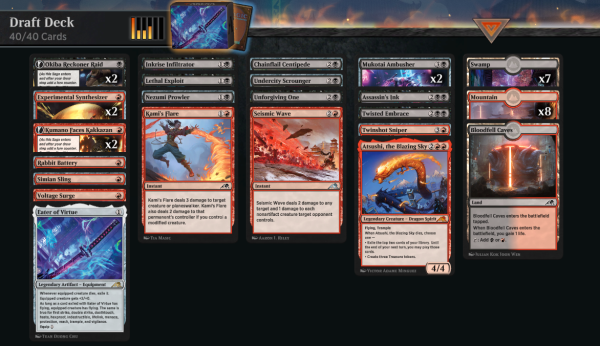
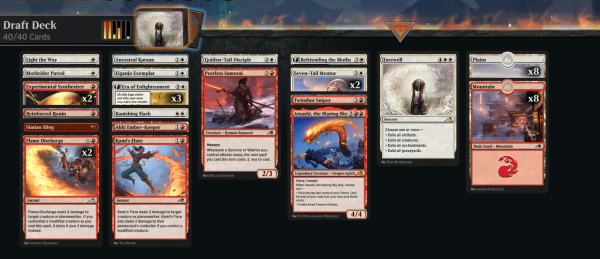
Before I get into those details, I wanted to mention one other step I’ve taken to increase my play time: Magic Arena. I committed to drafting on Arena again once the latest set was released. When Kamigawa: Neon Dynasty came out, I delivered on this self-made promise. Since then I’ve done around ten drafts of the set with varying degrees of success. For those curious, below are images of the two decks with which I’ve earned trophies thus far (disclaimer: I achieved these trophies on the bronze and silver ladder... I have yet to earn a trophy in gold or platinum).

Despite the challenges I’ve faced drafting the most complicated set of all time—at least based on amount of rules text—I have thoroughly enjoyed Kamigawa: Neon Dynasty, and hope to jam another dozen or so drafts before the next set. Fortunately, I saved up plenty of gold and gems in 2020 and sat on them for the duration of 2021 so I have ample resources on that front.

Standard, on the other hand, has been miserable. I face the same couple obnoxious decks over and over again, and the fun mono-White build I’ve been messing around with is completely out of its league. Since when was the bronze tier of Standard so competitive and repetitive? For the time being, I’m going to stick to constructed formats where Black Lotus is legal.

Recent Collection Shifts

I’ve checked the box on my third MTG priority for 2022 by increasing the amount I play. This action has directly fed into helping me achieve my first two priorities.

When I shuffled up my Old School deck and played Magic again, it unlocked the deck brewing kid inside of me. After learning more about the Alpha 40 format I wanted to experience it for myself. However, Alpha cards are not exactly budget friendly—nice condition Alpha Islands are about $100 a pop now, for example.

Luckily for me, there’s a cheaper alternative: Beta. Granted, Beta cards are far from cheap. But, with a few printing exceptions, as long as I don’t include Circle of Protection: Black and Volcanic Island (both of which did not exist in Alpha), then I could adhere to the same rules and deck building limitations with Beta cards as Alpha. What’s more, now that I made a friend who is also into this format, I have a chance to play games with any new deck I can build.

This was enough inspiration for me! I immediately got to work, taking apart the mono-black discard deck I had sitting on the shelf to craft an all-Beta 40 card deck. How did this help me accomplish my other two goals for 2022? Well for one, since I was building an actual deck, I knew I needed to pick up solid Beta cards that would have an actual impact on a game. This means cards like Purelace and Web were out—less purchasing of garbage Beta rares? Check!

There was an error retrieving a chart for Purelace

I also had to raise funds for these purchases, so I sold a bunch of stuff out of the now disassembled Old School deck to create this new Beta deck. While the cards I sold here weren’t exactly low-end and useless, they were lower priority (not to mention redundant in my collection). And while I only sold one low-end Beta rare (a Pirate Ship specifically), building a new deck means I actively seek out playable, mid-tier Beta cards for my deck. So instead of my want list consisting of any Beta rare under $100, I instead have been focusing on cards I’ll actually shuffle up, which tend to be more expensive and have higher demand in general.

There was an error retrieving a chart for Pirate Ship

The best part: I’ve been able to sleeve up some Beta rares that have sat idle in my trade binder for years! Nightmare, Lord of the Pit, and Clockwork Beast can all come off the bench—they didn’t fit into my strategy before, but in an all Alpha/Beta format, they’re quite strong.

New Acquisitions

This brings me to how I am accomplishing priority number two for 2022: acquiring more low-end Old School cards. When I first wrote the article in early January, I was thinking of picking up more inexpensive Legends, Arabian Nights, The Dark, and Antiquities cards to fill out my collection. Granted, I have picked up a few as planned. My favorites include Infernal Medusa, Necropolis, and Exorcist. But I have also redefined my priority with “low end” cards since getting back into deck building again.

There was an error retrieving a chart for Necropolis

Namely, I’m excited to pick up some cheaper Beta commons and uncommons that may be playable in evening webcam battles with my new friend. When I filled out my mono black Beta deck, I recognized a need for some low-end removal. Therefore, I picked up some Paralyzes. I also bought a Drudge Skeletons for their utility in the format. While I haven’t tested it yet, I’ve also been picking up cheap Scathe Zombies to eventually test with Zombie Master. And of course I needed more Beta Swamps.

There was an error retrieving a chart for Scathe Zombies

In this way, I’m still picking up low-end cards for the collection—these cards are all under $15 and some as low as $5-$7. But once again, instead of just picking up cards that will sit in a binder on a shelf, I’m actually seeking out cards that I will potentially play. The print run of Beta commons is on par with some commons in Arabian Nights and Antiquities and uncommons in Legends, so from a collectability standpoint these also help me accomplish my 2022 goal. But instead of picking up random stuff, I’m now deliberate in what I acquire. Less clutter is a good thing!

Wrapping It Up

The impact of actually playing Magic is so profound, it continues to surprise me. In a way, I’m reminded of what it used to feel like playing Magic 25 years ago. By enforcing a budget on my buying, I’m also constrained to what I can afford, just like back in 1997, making the endeavor more challenging (and therefore more rewarding).

As a result, I’ve rediscovered a passion for this game. While I don’t think drafting Kamigawa: Neon Dynasty on Arena will motivate me to buy new paper cards anytime soon, I have definitely rekindled my drive to brew fun Old School style decks to play with friends. Having a new friend in particular who has that same flair for brewing and playing fun cards (i.e. not always playing to win) motivates me even further to reengage with his hobby.

With this newfound joy, you can bet I’ll be staying actively engaged with Magic for the foreseeable future. If 2021 was the year of chess and breaks from Magic, then 2022 is the year of rediscovery of the game. Who knows? Maybe I’ll even be motivated to attend a large in-person event sometime this year. If playing on a webcam reinvigorates me, then playing at a large event and seeing 100’s of eager players may take me even further toward my childhood appreciation for this incredible game. To do so would be complete and utter success for 2022.

Mystery Booster Playtest Cards: Blueprints to the Future of Magic

Are you a Quiet Speculation member?

If not, now is a perfect time to join up! Our powerful tools, breaking-news analysis, and exclusive Discord channel will make sure you stay up to date and ahead of the curve.

The Story of Mystery Booster Playtest Cards

Playtest cards were a special insert Introduced in 2019 as part of Mystery Booster Convention Edition and reprinted in the 2021 version of the product. The Mystery Booster set was designed to mimic the feeling of a Chaos Draft with over 1600 cards in the main set. The Playtest cards upped the chaos factor by being wonky, weird, and sometimes wildly powerful. Not tournament legal outside of Limited, playtest cards introduced an Un-like experience to the Mystery Booster Limited environment, without the silver borders. More on card borders later.

Playtest Cards That Foreshadowed Past/Present Cards and Mechanics

The majority of Mystery Booster Convention Edition (MBCE) consists of reprints going back to Mirage. It does a great job showcasing Magic's rich history. The playtest cards, on the other hand, were a way to look towards the future. According to Gavin Verhey, the set's Chief Architect, the 121 Playtest cards for MBCE were designed from the start with Future Sight in mind. "In fact, I looked through the Future Sight card list many times while making them," he wrote. The Playtest cards were, according to Verhey, "cards that weren't quite silver-bordered but definitely pushed the boundaries of what Magic could do. Some could be nods at Magic players, and others could be things that we may actually do someday..."

With two years of hindsight, we can already look back at Mystery Booster Playtest cards and see them forecasting mechanics in the present and recent past of Magic. Let's look at a few of these cards, and the mechanics they foreshadowed.

Recycla-Bird and Keyword Counters

A tournament-legal version of Recycla-Bird never made it into Ikoria: Lair of Behemoths. The mechanical idea of keyword counters, however, made it onto cards throughout the set, and across all colors.

Common Keyword Counter Creatures

Now that R&D has cracked open this realm of design space, I think it's safe to say that we will be seeing keyword counters quite a bit in the future. They do an elegant job of conveying permanent, or in the case of cards like Kappa Tech-Wrecker and Biting-Palm Ninja not so permanent upgrades to creatures. It's one of the deepest wells in recent design space I feel they've tapped into, and I'm excited to see what else can come from it.

Graveyard Dig - Cleave

Graveyard Dig quite obviously features the Cleave mechanic, though minus the ability word we saw printed in Innistrad: Crimson Vow. I wasn't much of a fan of this reverse-kicker mechanic, but from looking at Graveyard Dig, it's clear that the mechanic ported over into the premier set without much tinkering.

Louvaq, the Aberrant - Modified

While what it means to be modified changed slightly, the essence of what it was on Louvaq, the Aberrant to how the mechanic appears in Kamigawa Neon Dynasty is much the same. On Louvaq, "Modified creatures have a power, toughness, or ability different than their printed versions." The meaning of modified from Neon Dynasty, according to the updated Comprehensive Rules, is "a modified creature is a creature that has a counter on it, is equipped, or is enchanted by an Aura its controller also controls. See rule 700.9."

While not a drastic change, the biggest difference between the two versions is that effects controlled by an opponent do not cause a creature to be modified, where they could under the Louvaq modified rule. From my perspective, the Neon Dynasty version is more intuitive and requires a bit less for both players to keep track of. It's interesting how such a relatively small change can improve the quality of a mechanic, and it's something we see even more obviously in our next example.

Domesticated Watercourse - Reconfigure

The ability on Domesticated Watercourse is a kind of proto-Reconfigure. In this version of the mechanic, the effect is only temporary, but that's not the most interesting thing about it. From my perspective, the most interesting thing about Domesticated Watercourse is that it's a land and not an artifact creature! Creature lands have been part of Magic since Mishra's Factory back in Antiquities, but we've never seen a land equipment before.

It makes sense that in developing this mechanic for a real set they explored other card types to use, and artifact creatures make absolute sense. They make the mechanic play more like a better version of Theros's bestow mechanic, a mechanic I quite enjoyed back in the day. The versatility of being able to Reconfigure not just between creatures, but on and off of creatures makes for interesting gameplay decisions on both sides of the table.

Let's look at another mashing of card types we wouldn't expect to see together.

Enchanted Prairie

There's not a lot to talk about here mechanically. What's important to note about Enchanted Prairie is it was the first Enchantment Land we ever saw until Urza's Saga in Modern Horizons 2. That quirky exception aside, I don't think it is likely we will ever see enchantment lands in a constructed-legal set. We already have the MH2 artifact dual lands, which Enchanted Prairie could likely have helped inspire, but it's territory I'd be surprised to see R&D dip a toe in. That said, as time goes on, more and more things become acceptable to put on the table. In a few years, enchantment lands could be a thing we see. Perhaps when we return to Theros again?

Speaking of Theros, there's one more playtest card I'd like to look at before we start looking at the future of Magic more seriously.

Enchantmentize / One With The Stars

This is the only playtest card I could find from the 121 in the set that went directly into a constructed-legal set almost verbatim as printed. The only change between the two cards was the name to better match the flavor of Theros Beyond Death. These cards are close enough in time, about a year apart, that I'd honestly be surprised if [card]Enchantmentize[card] wasn't in the design file for TBD even before the Mystery Booster version was printed. Perhaps that's a trivia question for me to ask Gavin Verhey at some point?

That wraps up our tour of the present and recent past of Magic and playtest card mechanics that have crossed over into constructed-legal sets. Let's turn now to look at where playtest cards could point us in the future.

What About the Card Borders?

Before getting into looking at Playtest cards with mechanics ripe for future sets, it's important to note one of the more impactful aspects of the printing of Playtest cards to begin with: Their printing in black borders and not silver borders. Prior to the advent of Playtest cards, all cards deemed "Not tournament legal" were printed in silver borders. This was a quick and easy way to distinguish legal and illegal cards, without requiring adding entire sets worth of cards to constructed banned lists, and keeping Un-cards safely out of constructed (including Commander without Rule 0 Discussions).

Playtest cards were the first cards to do away with the silver borders. Instead, they're printed with frames designed to mimic the actual playtest cards used by Wizards R&D, with the words "TEST CARD - Not for constructed play" printed across the bottom where R&D set code information normally goes.

In a way, I think this sort of presaged the move to black borders for the forthcoming Un-set Unfinity. Magic Head Designer and Unfinity design leader, Mark Rosewater discussed the move to black borders in a November 2021 article revealing details about Unfinity. "Over the years, silver border slowly shifted to end up meaning 'not for any official format, casual or not,' which flies in the face of what it was originally intended to do."

With the line between what can and cannot be a constructed-playable Magic card getting fuzzier, I'm interested to see what Unfinity has in store for us later this year. What about actual constructed sets though? Let's look at some Playtest cards whose mechanics have the potential to break through into constructed Magic.

Playtest Cards with Future Set Mechanics

Frogkin Kidnapper / Squidnapper

I forgot both of these cards existed when I was writing my predictions for what mechanics or abilities might be in Streets of New Capenna (SNC). Let me rectify that right now by saying I think there will definitely be a ransom mechanic in SNC. But which one? The ransom mechanics on Frogkin Kidnapper and Squidnapper are similar, but not the same. The Frog has an exile effect affecting a card in hand, and the Squid has a control changing effect affecting a card in play.

I think the exile effect of the Frogkin Kidnapper has a wider potential for use. It's an ability that opens up the possibilities for interesting and cheap removal and interaction to cards from different zones. Then, regardless of the zone in which an opponent's card originates, they will be able to pay the ransom to return the card to their hand. We could see Ransom Oblivion Ring Ransom Thoughtseize, even Ransom Counterspell, or Ransom Wrath of God. The more I think about it, the more I'm intrigued by the possibilities.

Unicycle

Unicycle is one of my favorite playtest cards. The combination of artifact subtypes on the card, Equipment Vehicle, is a combination a long time in the making. I'm confident cards with this combination of subtypes will appear in a constructed-legal set. I can think of no better set to introduce them to Magic in a huge way than the forthcoming The Brother's War set. I mean, the story literally revolves around giant battle mechs fighting. The last time we saw Urza-designed battle mechs in Magic was Invasion block twenty years ago. And let's face it, no one under the age of 35 remembers Power Armor.

The development of awesome artifact subtypes over the last twenty years of Magic design has finally given us a chance to go back and revisit the era of The Brother's War as the giant Gundam fight of which we all had childhood fever dreams. In gameplay terms, equipment vehicles have interesting strategic implications. Which do you equip? Which do you crew? Think about deckbuilding with these and all the Kamigawa Neon Dynasty pilots and cards that care about modified creatures. If this prediction proves true, perhaps we will see a sweet vehicle deck in Standard again?

So far, I'm pretty confident in these predictions based on what we know about forthcoming sets. So much so, that I will be shocked if we don't see these mechanics/card type combinations in 2022. Now, let's go explore some more interesting possibilities.

Some Wild Predictions

Vazal, the Compleat

Over the years, we've seen cards like Relentless Rats and Seven Dwarves who bend the rules on how many copies can be in a deck. Vazal, the Compleat's megalegendary ability works in the opposite direction, allowing only one copy of the card in your deck. For those not old enough to remember, this was actually how the original legend rule worked back when Legends first came out.

While I think the word megalegendary is kinda cheesy, I like where this is going. I can certainly see this ability, or something similar, existing in constructed Magic. I think cards with deckbuilding restrictions built into them have the potential to foster creativity, not just in deckbuilding but in leading to fresh areas of design. That is, if they are not absurdly broken (looking at you companion mechanic).

Spellmorph Raise Dead

The original morph mechanic is one of my favorite mechanics in Magic. It creates interesting tactical decisions for both players, and the hidden information element of the mechanic creates a kind of mini-game within each game. Manifest, and to a lesser extent megamorph, each built on the mechanic in an interesting way. It was always disappointing manifesting a crucial spell, and then not being able to cast it. Spellmorph would create an interesting tension in the same vein as the original morph mechanic, but on a slightly different axis. And you'd still get to play those crucial spells.

I don't think there is much design space left for morph and its variants. Spellmorph is the most obvious variation left that's not been done. The uniqueness of morph-related abilities means the only set it makes sense to see it in, would be in a future Tarkir set. When we go back to Tarkir, I'm confident we will see Spellmorph.

Blood Poet

The idea of spark counters shares a lot with the various other counters players have been able to get over the years. These include experience counters, energy, and even poison. I think the idea of spark counters has potential. What if instead of a new type of counter, though, it was a series of abilities on cards that made use of an existing type of counter? Why not poison counters? Think of the strategic implications!

The delicate balance between having enough poison to activate the poison spark abilities you want, but not so much that an opponent can't give you extra poison and kill you out of nowhere. I think it's more in line with what the energy mechanic should have been. The use of poison as a resource like this is something I think we will see when we get back to Phyrexia. With Planeswalkers getting Compleated left and right this year though, could we even wind up seeing it in Dominaria United?

Honorable Mention - Inspirational Antelope, Gold Mine

I couldn't bring up Unfinity in this article without giving a nod to these two cards. In my predictions article for Magic in 2022, I talked about the possibility of legacy cards appearing in the set. While I'm still more inclined to believe we will see peels or stickers like that MSCHF Secret Lair Plains, the concept of legacy cards is an interesting one ripe with possibility.

Closing Thoughts

The Mystery Booster Convention Edition playtest cards are a wild group of Magic cards. Some, like the ones we've discussed, may creep into constructed paper sets in some capacity. Others have the potential to inspire future Alchemy digital designs. But now I want to hear your thoughts. Are there any recent cards I've missed that you think these Playtest cards inspired? What Playtest card mechanics do you think we are likely to see pop up in constructed sets in the next few years? Let me know in the comments or on Twitter.

Exploring Kamigawa: Neon Dynasty Interactions

Are you a Quiet Speculation member?

If not, now is a perfect time to join up! Our powerful tools, breaking-news analysis, and exclusive Discord channel will make sure you stay up to date and ahead of the curve.

We've had Kamigawa: Neon Dynasty in our hands for a bit now, and nothing gets weird questions flowing quite like a new set. This week I'm going to go over some of the more common questions I've seen popping up over the last few weeks.

Reconfigure

The new mechanic introduced in Kamigawa: Neon Dynasty, reconfigure appears exclusively on Artifact Creature — Equipment permanents and plays a bit like equip. You can pay a permanent's reconfigure cost to attach it to another permanent and pay the cost later to unattach it. It's a bit weird for reconfigure to let us attach a creature to something. Luckily, we've tweaked a few rules to allow this to happen. Below are the relevant rules; I trimmed 301.5c to the relevant bit and added emphasis.

301.5c An Equipment that’s also a creature can’t equip a creature unless that Equipment has reconfigure (see rule 702.151, “Reconfigure”). [...]

Magic Comprehensive Rules

702.151b Attaching an Equipment with reconfigure to another creature causes the Equipment to stop being a creature until it becomes unattached from that creature.

Magic Comprehensive Rules

So... What's All This Mean?

Importantly, reconfigure is not equip. This means equip cost reduction effects like Auriok Steelshaper's or equip alternate costs like the one provided by Bruenor Battlehammer won't apply. You also can't reconfigure any time you could cast an instant if you control Leonin Shikari.

However, all cards that have reconfigure are equipment. This means that you can pay {0} to equip them if you have Puresteel Paladin and enough artifacts for Metalcraft to be online. Note the subtle difference between Bruenor and Puresteel. Bruenor gives your equip abilities an alternate cost. Puresteel, on the other hand, gives all equipment you control a completely different equip ability.

Sigarda's Aid's second ability allows you to attach an equipment with reconfigure when it enters the battlefield.

No Redress

Of course, Dress Down interacts a bit strangely with reconfigure.

Aiden controls an unattached Ogre-Head Helm. They try to attach it to their Grizzly Bears. In response, Naomi flashes in Dress Down. What happens?

The Ogre-Head Helm won't move at all. Because it's a creature while it's unattached, Dress Down removes its abilities. Then, when the reconfigure ability tries to resolve, Ogre-Head Helm no longer has reconfigure. Thanks to 301.5c quoted above, it can't equip a creature. It's an equipment that's also a creature and it doesn't have reconfigure anymore.

Of course, if the Ogre-Head Helm is already attached to something, Dress Down won't affect it at all.

Its Reach Isn't That Long

The Long Reach of Night is good in limited, but a bug on Arena made it a bit better than it should have been. The first and second chapter abilities never force opponents to discard. When an ability is written "[Do X] unless [Y]," this really means "A player may [Y]. If they don't, [X]." If we apply this to The Long Reach of Night, the ability looks something like "Each opponent may discard a card. If they don't, they sacrifice a creature."

An opponent with no creatures can choose to not discard. If they do, the rest of the ability won't have any effect on them.

Harmonius Annoyance

Harmonious Emergence has emerged as quite the question generator in limited formats. I've seen several questions that boil down to "I tried to gain control of the enchanted land and it didn't work. Why?"

Well, there are a few things happening here. First, gaining control of an object doesn't also grant you control of things attached to it. So I cast Invoke the Winds targeting my opponent's Forest enchanted with Harmonious Emergence. As soon as I gain control of the Forest, Harmonious Emergence is no longer enchanting a legal permanent. It can only "enchant land you control." So, since the Forest and Emergence have different controllers now, the aura goes to the graveyard as a state-based action.

Isshin, Many Questions As One

I'm pretty sure Isshin, Two Heavens as One is the single most asked-about card in Kamigawa: Neon Dynasty. It turns out people like combat-focused Mardu commanders!

Isshin cares about things that trigger when a player declares a creature as an attacker. It doesn't matter who controls those creatures. If an opponent attacks another opponent with Breena, the Demagogue, Isshin would double that trigger.

As I talked about in my triggered abilities article, a triggered ability always used "when," "whenever," or "at." This means Isshin doesn't care about effects like Ghostly Prison or Sphere of Safety. Those are static abilities, not triggered abilities.

Isshin also doesn't care about things that might happen as a side effect of declaring attackers. For instance, if I attack with Immersturm Predator, Isshin won't double its "becomes tapped" trigger. Similarly, Isshin won't double anything that triggers from exerting a permanent as it attacks, like Ahn-Crop Crasher.

Finally, Isshin can't double triggers like Guiltfeeder's. Something that triggers when a creature "attacks and isn't blocked" triggers in the declare blockers step if no creatures were assigned to block it.

Is Shrine A Creature Type?

Of course, while Isshin might be the single most asked-about card, this is the one interaction everybody wanted to know about. Apparently, people have been chomping at the bit for Shrine tribal.

Unfortunately, Shrine is not a creature type. Sorry, changeling fans! While it's rather uncommon for creatures to not have a creature type, it's happened before with Nameless Race. In this case, our Kamigawa: Neon Dynasty Shrines have Shrine as an enchantment type and no creature types at all.

The Magic Comprehensive Rules lists all current creature types in rule 205.3m. Other card types' subtypes can be found in 205.3g-n.

Cleanup

I've been loving the excitement around Kamigawa: Neon Dynasty. It seems like one of the best-received sets in quite some time. Hopefully, this article has assuaged any doubts and answered any burning questions.

Question of the week: What's your favorite Kamigawa: Neon Dynasty limited play?

Until next week! Feel free to find me on Twitter or our Insider Discord for any other questions about Kamigaway: Neon Dynasty cards (or anything at all, really!).

Can We Unban These Cards in Commander?

Are you a Quiet Speculation member?

If not, now is a perfect time to join up! Our powerful tools, breaking-news analysis, and exclusive Discord channel will make sure you stay up to date and ahead of the curve.

There are many cards that will always be banned in Commander, and for good reason. But could any of the currently banned cards get a second chance at seeing play? I think so! After all, It wasn't too long ago that Kokusho, the Evening Star was banned in Commander. There's got to be a few other cards on the list that are safe to see play. Let's look at the methodology behind the ban list, and see if there's anything else safe enough to unban.

The Rules Comittee's Ban Philosophy

This quote from an old article by the Rules Committee (RC) from the Wizards website offers a good summary of what makes a card worthy of a ban:

"The primary focus of the list is on cards which are problematic because of their extreme consistency, ubiquity, and/or ability to restrict others' opportunities."

What specific attributes make a card fall into one of these categories? RC Co-Founder Sheldon Menery has a great article detailing what makes a card require a ban. In that article is this list of key features of banworthy cards:

  • Cause severe resource imbalances
  • Allow players to win out of nowhere
  • Prevent players from contributing to the game in a meaningful way
  • Cause other players to feel they must play certain cards, even though they are also problematic
  • Are very difficult for other players to interact with, especially if doing so requires dedicated, narrow responses when deckbuilding
  • Interact poorly with the multiplayer nature of the format or the specific rules of Commander
  • Lead to repetitive gameplay

My Own Ban Methodology

Both of the articles I cited above express some of the same ideas, but I think the first article has the better, more succinct methodology for determining a ban. If a card is too consistent and is in every deck or makes the game unplayable and thus unfun, it needs to be looked at each time bans are being considered.

Based on those criteria alone, a tremendous number of "staple" cards should be banned from Commander. The existence of "staples," — cards so good that they crowd out other similar cards — is a prime example of something that hurts the format for all players. Staples restrict deckbuilding freedom, another one of the points, noted above, making a card ban-worthy.

The Conquest (format) of Commander

Now I know you're thinking "Show us the unbans already," and I will soon, I promise! But first, let's talk about Conquest. Conquest is an alternate ruleset for Commander. With a modified ban list and these additional rules:

  • Commanders can be a legendary creature or planeswalker.
  • Each player has 30 life in multiplayer. 1v1 players have 25 life.
  • Commander damage is set to 12.
  • Each player’s deck is at least 80 cards and is singleton.

What's interesting about Conquest is not the alternative rules, but the modified ban list. It's much longer than the current Commander ban list. That is because it hits so many truly problematic cards! However, It's what is not on this list that leads me to my unban proposals. There are a few cards on the Commander ban list that are NOT banned in Conquest. Much like Kokusho, these cards probably were either considered too powerful or unfair at the time they were banned but maybe were actually never the threats to Commander that we thought? Without further ado, let's look at the cards I think are safe to unban.

Mirror, Mirror On The Banlist

So let me get this straight. Five mana to do nothing the turn you cast it is a problem but the actual card being cast "for free" during your upkeep is fine and dandy? Don't we have a phrase to describe this situation? And it's not just five mana it's five mana plus the cost of the "free" spell to imprint it first? So for something like 11 mana or 12 mana, and a card in hand, I can Imprint one of the numerous extra turn cards. If I wait for an entire extra turn, AND no one has interacted with removal, I've effectively won the game? Gee, aren't there dozens of competitive combos that cost less total mana and end games on the spot? From a competitive standpoint call me unconcerned.

Is the two mana cost and Instant only restriction on Isochron Scepter really a balancing factor that makes Panoptic Mirror ban worthy but Scepter merely good? I'm not convinced. EDREC top 100 has 25 cards for Isochron and a total of 56 for Mirror. This, at first, makes it seem like Mirror is a great idea because it can let you cast those best of the best spells over and over again every turn. That sounds good, in theory. In practice, how often do you have five extra colorless mana to not do anything? How often do you have an extra nine mana and the time to *imprint* Blasphemous Act rather than just wipe the board right now for one?

CEDH decks these days are tuned for ultra-consistent wins as early as turn four with the potential to do so sooner with great draws. Adding Panoptic Mirror to those decks would not make them any faster. I am highly doubtful they would gain any more consistency either, seeing as how the Mirror takes an additional upkeep before any value is gained.

I think this card could be unbanned and it would not make cEDH any more competitive or faster. On the opposite end of the spectrum, many of the cards on the ban list like Flash or Tinker would definitely accelerate an already fast deck and make those decks more consistent. Panoptic Mirror? Not so much.

But what about casual games? Well if your table already frowns on infinite combos or frowns on taking extra turns then people won't play the *problem cards* in their decks so no ban on Mirror is needed. Yes, this card is powerful but there are multiple costs for that power. With the large amount of mana required to cast Mirror AND imprint a big spell what else could you have done? Would you have to wait until your next upkeep for that something else to happen? Further, if you Imprint something low cost you can get your spell on command with Isochron Scepter which also is part of multiple different infinite combos that cost a lot less mana than infinite combos with Mirror.

Is Panoptic Mirror huge value? Yes. Does it offer a powerful advantage every single turn? Yes. Is it extremely low mana? No. Is it at Instant speed? No. Does it have any special kind of interaction required to stop it? No. I think there is a compelling argument for the fact that this is a *powerful* but not completely out of bounds card for Commander and I don't think the format as a whole would take a hit by unbanning this.

Is This Just Primeval Titan?

Primeval Titan can threaten the game in a variety of ways and it's only six mana so it is very possible to play it turn three. Sylvan Primordial at one extra mana only gets Forests. This difference is massive in my opinion. While Primordial is straight value, a minimum of three Stone Rain or three Disenchant effects, it is only one of these per opponent. I think this is a very large factor in considering an unban. Compare this to any of the numerous effects in black that force each opponent to sacrifice something. Is the three Forest upside so powerful that it deserves a ban? Unlike so many of the cards on the ban list that I do agree with, I don't see the game-ending nature of Sylvan Primordial. In multi-player, this card should unite the entire table against you. In that situation, it seems like more of a liability than a reward. Also, you do not have a choice to destroy, so Primordial can have unintended negative consequences or lead to better interaction with cards like Darksteel Citadel or Flagstones of Trokair. Punishing a card for how crazy interactive it can be in multiplayer is the opposite of what I think is supposed to happen.

Then Why Is It Banned?

Now, just because I think this card can be unbanned, should it be unbanned? Green is, of course, the fast mana color. It's possible to turn three the Primordial. But. What exactly is powering out a turn three Primordial? Let's see, turn one Bird or Elf. Turn two…two more Birds or Elves or one ramp spell is fair. Turn three…hmm wait a second. You could have four, five, or even six mana for turn three in Green. Seven? An absolute god draw with multiple Birds and Elves and Gaea's Cradle, sure, but not often unless…Sol Ring. Mana Crypt. Mana Vault. The real "problem cards" have emerged. So yes, Primeval Titan is way easier to power out on turn three, can threaten the game much faster due to picking any two lands, and can continue to trigger just by attacking. And yes, grabbing lands that give you two mana each is more ramp than three Forests or any of a slew of other high power lands like Gaea's Cradle. Sylvan Primordial, in my opinion, is a victim of fast Artifact mana. Yes, it's devastating to destroy a land early in a game and also ramp yourself up tremendously at the same time. With more card support, you could Clone or otherwise continue to get even further ahead. I see the potential problem especially if we are talking about turn three.

However, is a turn five or turn six Primordial back-breaking? I don't think so. Is it really good? Definitely! Is it in the realm of competitive power of other cards that are threatening to end the game for less mana turns earlier? I don't think it's even close. To address the specific points brought up by the Rules Committee, the only one of the seven bullet points that the Primordial is guilty of is the first one, severe resource imbalance. However, the amount of cards that can create a severe resource imbalance at seven mana is, well, a huge amount of them in 2022. Primordial was banned eight years ago and I think it's time it came out of the box!

Without fast Artifact mana I think this card is a lot less unfair and the advantage it gives you should be offset by how much table hatred it should draw. It's possible that in Commander's current form Sylvan Primordial would still be too good and see too much play. But if it's not broken enough to be banned in Conquest, I think that is telling. Additionally, this card came out before Clues, Food, Treasure, or Blood were incorporated into the game. Nowadays you can diplomatically kill someone's Food or Treasure token and they won't be as behind as if you killed their land.

Finally, I had the chance to play the Primordial before it was banned. While personal, anecdotal experience is not worth much, I never got to bully the board. However, I also never got it out on turn three or copied it multiple times, or recurred it multiple times. I can see how it *could* get out of hand. But again I ask, what modern Magic card doesn't go absolutely out of control under those circumstances? I suggest that a card like, say, Dockside Extortionist is ending the game before Primordial hits the table let alone gets copied in most games.

Surely Other Cards Can Be Unbanned

No, I don't think so. The Rules Committee is pretty good when it comes to the overall state of the game and generally is cautious when announcing bans. Almost the entire ban list right now looks extremely solid. However, it's obvious that there are many cards that, if not potentially ban-worthy, are extremely overplayed *cough* Dockside Extortionist *cough*. I hope the RC is keeping a lookout not just for raw power and consistency but also for overwhelming ubiquity. While they are looking for new cards to ban, I think it's just as important to consider what might be the next Kokusho.

Final Thoughts, Including One Ban Suggestion

Why is Aetherflux Reservoir not banned? In my opinion, it is diet Biorhythm. Gaining 11 life is not a steep "cost" and can happen rather incidentally. Four generic mana kill target player, then likely die yourself, just seems extremely unfun and that's the bottom end of the card. On the high end, it can wipe an entire table in multiple different ways. Again, four generic mana. Can go in virtually *any* deck. Just seems like something that should not exist in the format.

What do you think about these unban ideas? About my ban suggestion? Let me know in the comments!

The Cycle Continues: February `22 Metagame Update

Are you a Quiet Speculation member?

If not, now is a perfect time to join up! Our powerful tools, breaking-news analysis, and exclusive Discord channel will make sure you stay up to date and ahead of the curve.

Here's something I haven't done in a long time: the February metagame update! Given that I do one of these articles every month, that statement might seem disingenuous, but it's true. Last February there was no metagame update because Valki, God of Lies and Tibalt's Trickery were so egregious it was obvious that a ban was incoming. Which ultimately rendered the data meaningless. Here we are a year later with no new bans, and that calls for a new metagame article!

And as part of the celebration, the scope of the update is expanding. Last month, I brought in paper results for the first time since 2020. However, it was only population data. There weren't big events for me to award extra points for anything. There have been bigger events in February, and they even reported enough data so that I can do a points system! It's not quite the same as the MTGO system, but I'll get to that. For now though, simply rejoice that I can fully report on the overall metagame rather than a slice.

February Population Metagame

To make the tier list, a given deck has to beat the overall average population for the month. The average is my estimate for how many results a given deck “should” produce on MTGO. Being a tiered deck requires being better than “good enough.” In February the average population was 5.32 setting the Tier 3 cutoff at 6 decks, which is lower than typical but does make sense in context.

There was an error retrieving a chart for Urza's Saga

Tier 3 begins with decks posting 6 results. Then we go one standard deviation above average to set the limit of Tier 3 and cutoff for Tier 2. The STdev was 9.78, which means that means Tier 3 runs to 16 results. Again, it's the starting point to the cutoff, then one above for the next Tier. The STdev was much lower this month, and is one of the lower ones I've ever had. There were fewer singleton decks proportionately than most months, which shrunk the range and lowered the deviation. Therefore Tier 2 starts with 17 results and runs to 27. Subsequently, to make Tier 1, 28 decks are required. This, again, is quite low for post-MH2 Modern, however it didn't substantially alter the usual outcome.

The MTGO Tier Data

February being a short month, one would expect that the population represented would be lower. Fewer days means fewer posted events to include. And one would be right. January had 502 decks, which is slightly below average. February only musters 436 decks, which is low for typical months but again, February is a shorter month. For all I know, this is high for a normal February.

However, beyond that the data is highly unusual. Total decks were down, but unique decks were up, with 82 compared to January's 73. That isn't unexpected as Kamigawa: Neon Dynasty did come out with lots of Modern playables. Players were quite eager to brew as a result. However, less than a quarter of those decks were singletons. That's very low and helps explain why the STDev was so low. What it doesn't explain is why the Tiered decks are down to 15 from January's 18.

Deck NameTotal #Total %
Tier 1
Hammer Time5412.39
Grixis Shadow4710.78
UR Murktide409.17
Amulet Titan327.34
Tier 2
4-Color Control214.82
Blue Living End204.58
Burn184.13
Tier 3
UW Control153.44
Cascade Crashers122.75
4-Color Blink112.52
Belcher92.06
Yawgmoth92.06
Jund Saga81.83
Mono-Red Prowess71.60
4-Color Creativity71.60

Hammer Time is back on top of the metagame after taking a month off. Interestingly, the margin between Hammer and Grixis Shadow is the same this month as it was in January, just reversed. Just odd how that worked out. Amulet Titan also shot up the standings, but I'm guessing that was player enthusiasm after it got Boseiju, Who Endures. We'll see if that enthusiasm sustains it.

There was an error retrieving a chart for Boseiju, Who Endures

4-Color Blink cratered out of Tier 1, and that might surprise players. However, it doesn't surprise me because, for some reason, the Omnath players decided to branch out this month. There was far more variation in Omnath, Locus of Creation decks this month that were sufficiently different to be listed separately. As such, if I were to lump all the variations together they'd be Tier 1 with 39 results. Most of that is from the Control and Blink variations which made the tier list, but there was also a Bring to Light version which put up numbers early then disappeared.

The Paper Tier Data

The paper tiers are calculated the same way as the MTGO tier, just with different data. While more paper events are represented in the data, they rarely report more than the Top 8 (sometimes less). Consequently, the population is much lower at 363 recorded decks, which is still significantly higher than January's 293. Meanwhile, the number of unique decks is lower than MTGO's with 79, but far more decks made the Tier list (22 vs 15). I have no idea why this is the case except that the data says that it is so.

Paper's average decks were 4.59, meaning the starting point is 5 decks. The STDev is 6.41, so Tier 3 runs from 5 to 12 decks. Tier 2 begins with 13 decks and runs to 20, and Tier 1 requires 21 decks. I have no idea how representative of "normal" paper Magic these stats are.

Deck NameTotal #Total %
Tier 1
Grixis Shadow339.09
Hammer Time287.71
Burn226.06
Cascade Crashers215.78
Tier 2
UR Murktide195.23
Amulet Titan195.23
UW Control143.85
4-Color Control133.58
Tier 3
4-Color Blink123.31
Rakdos Rock113.03
Yawgmoth92.48
Mono-Green Tron82.20
4-Color Creativity71.93
Goblins71.93
Mill71.93
Heliod Company71.93
Blue Living End61.65
UW Urzablade61.65
Affinity61.65
Izzet Prowess51.38
Hardened Scales51.38
Eldrazi Tron51.38

I do know that the paper data is a little behind the MTGO results as Grixis Shadow performed better than Hammer Time this month. Burn continues to be a Tier 1 deck in paper despite not doing as well online. I suspect that both Burn and Shadow are doing so well in paper because players have owned these decks for years. Since the cost of switching decks is greater in paper than online, there's a bias against buying the deck of the month, with players more often sticking with the old standby. Hammer Time is not a cheap deck anymore, so it makes sense for the older but updated decks to outperform newcomers in paper.

February Power Rankings

Tracking the metagame in terms of population is standard practice. But how do results actually factor in? Better decks should also have better results. In an effort to measure this, I use a power ranking system in addition to the prevalence list. By doing so, I measure the relative strengths of each deck within the metagame. The population method gives a deck that consistently just squeaks into Top 32 the same weight as one that Top 8’s. Using a power ranking rewards good results and moves the winningest decks to the top of the pile and better reflects their metagame potential.

There was an error retrieving a chart for Omnath, Locus of Creation

For the MTGO data, points are awarded based on the population of the event. Preliminaries award points for record (1 for 3 wins, 2 for 4 wins, 3 for 5) and Challenges are scored 3 points for Top 8, 2 for Top 16, 1 for Top 32. If I can find them, non-Wizards events will be awarded points the same as Challenges or Preliminaries depending on what the event in question reports/behaves like. Super Qualifiers and similar higher-level events get an extra point and so do other events if they’re over 200 players, with a fifth point for going over 400 players. There were three 4 points events in February and no 5 pointers.

The MTGO Power Tier

As with the population numbers, points in February were down from January, from 872 to 779. Fewer events, fewer points. The only reason the drop off wasn't more dramatic was that there were more extra point events in February. The Preliminaries were also smaller on average.

The average points were 9.50. Therefore 10 points makes Tier 3. The STDev was 17.65, which again is on the lower end of normal. Thus add 18 to the starting point and Tier 3 runs to 28 points. Tier 2 starts with 29 points and runs to 47. Tier 1 requires at least 48 points. The composition of the Tier list did not change, though the position of a number of decks did.

Deck NameTotal #Total %
Tier 1
Hammer Time9712.45
Grixis Shadow8911.42
UR Murktide658.34
Amulet Titan567.19
Tier 2
4-Color Control435.52
Blue Living End415.26
Tier 3
Burn273.46
UW Control232.95
Cascade Crashers222.82
4-Color Blink222.82
Belcher182.31
Yawgmoth151.93
Jund Saga151.93
4-Color Creativity141.80
Mono-Red Prowess131.67

As is typical, Tier 2 shrunk as Burn didn't get enough points to stay. That was the only movement between tiers, thought there was some reshuffling in Tier 3. Not much though.

The Paper Power Tiers

Unlike with population, the paper power data works differently than the equivalent MTGO data. Again, the data is usually limited to Top 8 lists, even for big events. Not that I know how big most events are, that doesn't always get reported. In other cases, decks are missing. SCG Con Philidelphia had two Modern 10ks, but neither event reported a full Top 32. And other similar (though smaller) events had similar problems. Applying the MTGO point system just doesn't work when I don't know how many points to award.

Thus, I went back to the older system of just awarding an extra point for placement in a bigger tournament. That way I'm being internally consistent with the paper results. If we ever get Grand Prix and Pro Tours back, they (and any similar event) would get another point but for now, most events only award one point per result and a few give two. However, the calculations are the same.

The average points were 5.67. Therefore 6 points makes Tier 3. The STDev was 8.70, thus add 9 to the starting point and Tier 3 runs to 15 points. Tier 2 starts with 16 points and runs to 25. Tier 1 requires at least 26 points. The upper Tiers didn't change but Izzet Prowess fell out of Tier 3. It was replaced by Jund Shadow, which didn't put up results outside of big events.

Deck NameTotal #Total %
Tier 1
Grixis Shadow4810.71
Hammer Time398.70
Cascade Crashers296.47
Burn286.25
Tier 2
UR Murktide245.35
Amulet Titan224.91
4-Color Control184.02
UW Control163.85
Tier 3
4-Color Blink143.13
Rakdos Rock122.68
Yawgmoth112.46
Heliod Company92.01
Mono-Green Tron81.79
Mill81.79
Blue Living End81.79
Hardened Scales81.79
4-Color Creativity71.56
Goblins71.56
UW Urzablade61.34
Affinity61.34
Jund Shadow61.34
Eldrazi Tron61.34

Average Power Rankings

Finally, we come to the average power rankings. These are found by taking total points earned and dividing it by total decks, which measures points per deck. I use this to measure strength vs. popularity. Measuring deck strength is hard. There is no Wins-Above-Replacement metric for Magic, and I'm not certain that one could be credibly devised. The game is too complex, and even then, power is very contextual. Using the power rankings certainly helps and serves to show how justified a deck’s popularity is. However, more popular decks will still necessarily earn a lot of points. Which tracks, but also means that the top tier doesn't move much between population and power, and obscures whether they really earned their position.

There was an error retrieving a chart for Solitude

This is where the averaging comes in. Decks that earn a lot of points because they get a lot of results will do worse than decks that win more events, indicating which deck actually performs better. A higher average indicates lots of high finishes, where low averages result from mediocre performances and high population. Lower-tier decks typically do very well here, likely due to their pilots being enthusiasts. So be careful about reading too much into the results. However, as a general rule decks which place above the baseline average are overperforming and vice versa. How far above or below that average determines how "justified" a decks position on the power tiers are. Decks well above baseline are therefore undervalued while decks well below baseline are very popular but aren't necessarily good.

The Real Story

When considering the average points, the key is looking at how far-off a deck is from the Baseline stat (the overall average of points/population). The closer a deck’s performance to the Baseline, the more likely it is to be performing close to its “true” potential. A deck that is exactly average would therefore perform exactly as well as expected. The greater the deviation from average, the more a deck under- or over-performs. On the low end, a deck’s placing was mainly due to population rather than power, which suggests it’s overrated. A high-scoring deck is the opposite.

I'll begin with the average for MTGO:

Deck NameTotal #Power Tier
4-Color Control2.052
Blue Living End2.052
4-Color Blink2.003
Belcher2.003
4-Color Creativity2.003
Grixis Shadow1.891
Jund Saga1.883
Mono-Red Prowess1.863
Cascade Crashers1.833
Hammer Time1.801
Baseline1.77
Amulet Titan1.751
Yawgmoth1.673
UR Murktide1.631
UW Control1.533
Burn1.503

Grixis Shadow is the highest placing Tier 1 deck, and therefore February's MTGO deck of the month. However, both Tier 2 decks outperformed everyone, which strongly suggests that they were far better positioned than players thought. The baseline stat was fairly high but there were a lot of high point earning non-Tiered decks thanks to rogues performing well in Super Qualifiers and PTQs.

Onto the paper averages:

Deck NameAverage PointsPower Tier
Jund Shadow2.003
Hardened Scales1.603
Grixis Shadow1.451
Hammer Time1.401
Cascade Crashers1.391
4-Color Control1.382
Blue Living End1.333
Heliod Company1.293
Burn1.271
UR Murktide1.262
Yawgmoth1.223
Eldrazi Tron1.203
4-Color Blink1.173
Baseline1.16
Amulet Titan1.162
UW Control1.142
Mill1.143
Rakdos Rock1.093
Mono-Green Tron1.003
4-Color Creativity1.003
Goblins1.003
UW Urzablade1.003
Affinity1.003

Again, Grixis Shadow is the best performing Tier 1 deck, but it's by a smaller margin than for MTGO. What's interesting is how many decks made the Power Tier with the same points as their population. That's impossible in the MTGO data.

Composite Metagame

That's a lot of data, but what does it all mean? When Modern Nexus first started, we had a statistical method to combine the MTGO and paper data, but the math of that system doesn't work without the big paper events. I tried. So, I'm using an averaging system to combine the data. I take the MTGO results and average the tier, then separately average the paper results, then average the paper and MTGO results for the final placement.

This generates a lot of partial Tiers. That's not a bug; it's a feature. The nuance separates the solidly Tiered decks from the more flexible ones and shows the true relative power differences between the decks. Every deck in the paper and MTGO results is on the table, and when they don't appear in a given category they're marked N/A. This is treated as a 4 for averaging purposes.

Deck NamePaper Population TierPaper Power TierAverage Paper TierMTGO Population TierMTGO Power TierAverage MTGO TierOverall Tier
Grixis Shadow1111111
Hammer Time1111111
UR Murktide2221111.5
Amulet Titan2221111.5
Burn111232.51.75
Cascade Crashers1113332
4-Color Control2222222
UW Control2223332.5
Blue Living End3332222.5
4-Color Blink3333333
Yawgmoth3333333
4-Color Creativity3333333
Rakdos Rock333N/AN/AN/A3.5
Heliod Company333N/AN/AN/A3.5
Mono-Green Tron333N/AN/AN/A3.5
Mill333N/AN/AN/A3.5
Hardened Scales333N/AN/AN/A3.5
Goblins333N/AN/AN/A3.5
UW Urzablade333N/AN/AN/A3.5
Affinity333N/AN/AN/A3.5
Eldrazi Tron333N/AN/AN/A3.5
BelcherN/AN/AN/A3333.5
Jund SagaN/AN/AN/A3333.5
Mono-Red ProwessN/AN/AN/A3333.5
Jund ShadowN/A33.5N/AN/AN/A3.75
Izzet Prowess3N/A3.5N/AN/AN/A3.75

To the surprise of nobody, Hammer Time and Grixis Shadow are the only purely Tier 1 decks in Modern for February. There are a number of partial Tier 1 decks as well, but the strongest have definitely been separated. The huge number of paper decks compared to MTGO decks means that most decks are considered Tier 3.5 or lower, but that does makes logical sense. If a deck can't get traction in all forms of Modern, how good is it really?

A More Complete Picture

So that was February's metagame. Now, if everyone could completely forget about all that data, it is utterly irrelevant. I wrote this article on Sunday, and then on Monday Wizards made the surprise announcement that Lurrus of the Dream-Den is banned. Which means that March's metagame will look nothing like February's. But, such is Magic. Now we wait and see how this plays out.

Taxing and Attacking with Standard MonoW Aggro | Adam Plays Magic

Are you a Quiet Speculation member?

If not, now is a perfect time to join up! Our powerful tools, breaking-news analysis, and exclusive Discord channel will make sure you stay up to date and ahead of the curve.

Tax Day Came Early This Year

This week on Adam Plays Magic, we're sleeving up some good ol' fashioned Standard. After some time playing in Arena's digital-only formats, boy, does it feel good to play Luminarch Aspirant the way Richard Garfield intended.

The Mono-White Aggro deck has been a mainstay in Standard for the last year or so. Along the way, it's picked up key upgrades like Thalia, Guardian of Thraben, and most recently, The Wandering Emperor. The addition of Eiganjo, Seat of the Empire was also incredibly helpful. It functions as both a land and a spell in the deck, giving you ways to mitigate mana flood.

Notably, Faceless Haven was a four-of in the deck but recently received a ban alongside Alrund's Epiphany and Divide By Zero. Despite the nerf, Mono-White (MonoW) walked away ahead, simply replacing Haven with Cave of the Frost Dragon and Crawling Barrens. Meanwhile, blue-based decks had their engines wiped from the format.

As Kamigawa: Neon Dynasty cards have worked their way into Standard and the metagame has coalesced, more specific, targeted hate-pieces can better be utilized in MonoW. Specifically, Archon of Emeria stops the Runes deck (which we played an Alchemy version of last week) dead in its tracks. The front side of Reidane, God of the Worthy // Valkmira, Protector's Shield is brutal against the Blood on the Snow-based black decks, while the back is a beating against Oni-Cult Anvil aristocrats decks.

All in all, MonoW is very well positioned and continues to appear at the top of the Magic Online Standard Challenges. Without further ado, let's get to the deck.

The Deck

MonoW Aggro

Creatures

2 Usher of the Fallen
4 Hopeful Initiate
4 Intrepid Adversary
4 Luminarch Aspirant
4 Thalia, Guardian of Thraben
4 Archon of Emeria
3 Reidane, God of the Worthy // Valkmira, Protector's Shield
4 Skyclave Apparition
1 Legion Angel

Planeswalker

4 The Wandering Emperor

Lands

3 Cave of the Frost Dragon
3 Eiganjo, Seat of the Empire
16 Plains
4 Crawling Barrens

Sideboard

1 Eiganjo, Seat of the Empire
1 Reidane, God of the Worthy // Valkmira, Protector's Shield
3 Legion Angel
2 Valorous Stance
4 Brutal Cathar
4 Guardian of Faith

End Step

Don't forget to drop a like on the video and subscribe to the Quiet Speculation YouTube channel. Every little bit helps us grow and lets us do more content like this more often. As always, if you have any questions, reach out to me on Twitter at @AdamECohen. I'll catch you all next week.

Want Prices?

Browse thousands of prices with the first and most comprehensive MTG Finance tool around.


Trader Tools lists both buylist and retail prices for every MTG card, going back a decade.

Quiet Speculation