
menu

Everything’s Relative: Card Power Examined

Are you a Quiet Speculation member?

If not, now is a perfect time to join up! Our powerful tools, breaking-news analysis, and exclusive Discord channel will make sure you stay up to date and ahead of the curve.

I love receiving feedback on articles. Not only is it critical to finding out what readers want to see, it's a loaded vein of content ideas. I can't think of everything, after all, and more importantly other people will ask questions I'd never consider and/or seem obvious to me. But only because I'm me. If I knew my own blind spots, they wouldn't be blind spots. Also, sometimes readers ask questions about things that I do consider but don't have space to adequately explain and/or the topic is too big or tangential to cover in the same article. The latter is the case for today's topic: Why is Ragavan, Nimble Pilferer more powerful than Dragon's Rage Channeler?

Context Is Everything

The short answer is that power in a vacuum is meaningless; the only thing that matters is power in context. And I'd like to leave it there, but I definitely wouldn't get paid for that, so now it's time to explain myself.

There was an error retrieving a chart for Ragavan, Nimble Pilferer

As to the topic: When I posted the Modern Banlist Watcchlist a few weeks ago, I put Ragavan on the list for being a little too close to Deathrite Shaman for comfort. In the subsequent reddit discussions a lot of players were questioning having Ragavan and not Dragon's Rage Channeler (DRC) on the list. Some felt it should be there in addition to Rags, and some thought it should be instead of Rags. And honestly, had I been writing that article back in August, DRC would have been there instead of Rags. However, the intervening months shifted my thinking. And as with all things, the context is key.

Case in Point

Often, players want to examine and discuss all things Magic: The Gathering in a vacuum. That's wrong. Everything must be put in the context because the game doesn't occur in a vacuum, it occurs in context.

Consider a thought experiment: Which card is better, Tarmogoyf or Rotting Regisaur? Every single competitive player reading this just rolled their eyes, declaring "Tarmogoyf! OBVIOUSLY." To which I respond with a smug smile and reply, "Really? Why?" And a conversation similar to the following will take place.

There was an error retrieving a chart for Tarmogoyf

Tarmogoyf[/card] costs less. Sure, that's a huge point in its favor. Cost is a big driver of power. However, that also means that Goyf is always dead to [card]Fatal Push, where Regisaur isn't without revolt.

[card]Tarmogoyf[/card] is playable in more decks than Regisaur. That's a good point. There certainly are deck that want a lower curve and/or need to keep cards in hand.

[card]Tarmogoyf[/card] can be an 8/9 for two mana. Regisaur is a 7/6 for three with a drawback. Those are good points, but let me counter:

  1. Goyf can be an 8/9, but it probably won't be unless you're really trying. That requires both the unlikely enchantments and tribal cards in the graveyards. Bitterblossom and Tarfire don't see any play, and enchantments are trickier to destroy than most permanent types. The typical upper limit for Goyf's stats is 5/6 (artifact, creature, land, instant, sorcery) and sometimes 6/7 from dead planeswalkers. Or, smaller than Regisaur.
  2. Goyf's stats are actually */*+1, where * is the card types in graveyards. Against a Rest in Peace, that amounts to 0/1. Regisaur is always a 7/6.
  3. How big a drawback is Regisaur's drawback? Midrange Jund empties its own hand with Liliana of the Veil anyway. And if you can't discard, so what? Doesn't make you sacrifice the Regisaur, meaning it's a live topdeck in the mid- to late-game, just like Goyf.

Protection form black is really common. Protection from green is not. Again, very true. However, that's a quirk of the current metagame. If this were 2018, that distinction would be irrelevant.

There was an error retrieving a chart for Rotting Regisaur

This will go on as long as I want to play Socrates and/or you don't angrily stomp off. The point is not that Regisaur is actually better than Tarmogoyf (don't be ridiculous). The point is that there will always be circumstances when a "worse" card will be better than the "better" card. What matters is the relevance of that difference in practice.

A Tale of Red One Drops

With that explained, I can now circle back to my original topic. The reason that Rags is on my list rather than DRC is that in the context of the metagame, everything Ragavan does is more powerful than DRC. DRC is a powerful card in Modern and Legacy. However, DRC's power isn't intrinsic to the card, where Ragavan is great anywhere. Which may be why it shows up everywhere.

There was an error retrieving a chart for Dragon's Rage Channeler

Which is ultimately the largest single complaint I'm hearing about Modern: Red one drops are omnipresent. This isn't something new and isn't necessarily a problem. Lightning Bolt is the most played card in the history of Modern, and the margin isn't close. What's changed is that Bolt's been joined by Ragavan, DRC, and Unholy Heat, and it now feels like every deck must play those four cards. It isn't true, but it does feel that way.

Which then leads players to ask how whether something needs to be done. And while the consensus is that Modern is good right now, right now is the key. This feels like a metagame that can't be sustained indefinitely, and the prevalence of red cards is a concern. And when players are looking at potential problems, DRC and Rags are at the top of the list. But it's not clear which one, if either, are the problem.

Experience Matters

I didn't think Rags was better than DRC when Modern Horizons 2 dropped, and initial impressions backed up my assessment. Ragavan usually died without gaining value, where DRC and Mishra's Bauble do gain value. At the time, Izzet Prowess was still everywhere, meaning so was Lava Dart. Thus, attacking with an X/1 was unlikely. DRC netting immediate value outweighed everything else.

There was an error retrieving a chart for Mishra's Bauble

However, as players got better at playing with Ragavan and Prowess faded away, the scales began to turn. The strategic and operation-based implications of both cards became more pronounced and Ragavan's impact on games fully emerged. It was the experience of actually playing both cards that changed my mind, especially next to each other. Which is a great way to explain why context is so important to card power.

Head to Head

First, consider the cards on their own.

  1. Mana Cost: Exactly the same
  2. Stat line: Ragavan is a 2/1 while DRC is a 1/1
  3. Vulnerability: Removal that kills one will kill the other if they're just cast. If Ragavan is dashed, it dodges sorcery-speed removal. If DRC is delirious, it's protected from Dart et al. Every creature that would block and kill one of them also kills the other.
  4. Abilities: Ragavan has dash and a two-part ability that triggers on damage to a player. Said ability generates a treasure token and exiles the top card of the opponent's library, to potentially be cast. DRC adds a surveil trigger to each non-creature spell played and with delirium gains flying and +2/+2, but must attack each turn if able.

On their own, the cards are fairly evenly matched, but DRC is ahead. Ragavan starts with better stats but DRC gets better as the game progresses and can facilitate the transformation. Surveil is a known good ability, and given Modern's graveyard synergies, DRC is a decent enabler. Dash was great in Khans of Tarkir draft, but I don't remember it being too relevant in constructed, and definitely never in Modern. And a trigger that only triggers when attacking and unblocked doesn't sound powerful, especially on a fragile X/1.

The Tricky Part

But, what about when Rags does connect? That's where things change. Stealing the opponent's top card is a rare ability that has only been Constructed-relevant once (to the best of my memory): Nightveil Specter was a great card in Khans Standard. Admittedly, that was primarily for the devotion is provided, but stealing cards was frequently relevant, particularly against UW Control when it stole land drops or counterspells to sandbag. However, Rags doesn't steal lands, and stolen spells must be used that turn. That all sounds weaker than Specter, which isn't Modern playable.

There was an error retrieving a chart for Nightveil Specter

Additionally, the spell can't be cast with just any mana, as with Specter. To make that happen Rags makes a treasure token each time he steals a card. Which is really hard to evaluate. On the one hand, Lotus Petal is a cornerstone of many Eternal combo decks, Simian Spirit Guide is banned, and there's never been a Modern-playable card that makes treasure repeatedly. On the other, Rags has to connect multiple times to cast any off-color spell with more than one mana pip, limiting the utility of the stolen card.

Which means that while DRC is fairly straightforward to understand and evaluate, Ragavan has a number of problems. One half of an ability is obviously strong, but the rest of it is marginal at best. Its other ability is similarly pretty marginal. Thus, a standard evaluation would have DRC as far more powerful.

Experience Teaches Otherwise

And that's why it is so important to test cards. Once players started playing with them, Rags has emerged as the far more useful card. A significant part of that is Rags fits into any deck with red mana while DRC requires a lot of non-creature spells to be useful, severely impacting its splashability. However, it goes far deeper than that; on a strategic level, Ragavan is far more flexible than DRC, which is a key to power. And the stealing ability has proven much better in practice than it looked.

Treasure Is Valuable

The main thing is that players have discovered is that the payoff of Ragavan isn't the extra card. The odds of stealing a non-land card are 2/3 or less, given typical Modern land counts. Of those cards, how many will be relevant the turn they're stolen and usable? However, the treasure token is useful 100% of the time. The banned list tells the tale: free mana is extremely powerful because casting more and/or bigger spells than the opponent should win the game.

There was an error retrieving a chart for Lotus Petal

In fact, using the treasure to actually cast stolen spells often feels weak compared to holding onto it. For UR decks, it's preferred to keep the treasure around to cast Counterspell after tapping out for Murktide Regent. In Jund Saga, the treasure is better served casting additional spells each turn or buffing construct tokens.

Losing cards to Ragavan feels bad, especially when it was something critical or something that wrecks you. Losing to your own cards just hurts worse. However, the real danger are the treasure tokens building up into an overwhelming advantage. And that causes fear, which changes player behavior.

The Board Stall

Which leads to the unexpected effect of Ragavan both causing and winning board stalls. Normally, if I play a one-drop and my opponent also plays a one-drop, I want to attack mine into theirs if it will trade. I get use from mine while denying them use of theirs and I get the damage race going in my favor. If the opposing one-drop is Ragavan, however, the decision calculus changes. I feel the need to keep Rags from hitting me for the above reasons, so I hold back unless I can immediately remove it. Just by existing, Rags creates a board stall, and that effect continues the more creatures are added to the board.

There was an error retrieving a chart for Prismatic Ending

However, Rags can also break stalls. Having dash means that Rags is a surprise attacker on an otherwise stalled-out board. When that happens, Rags will usually draw a blocker that might otherwise be useful elsewhere because players don't want to absorb its hit. Damage that otherwise wouldn't get through then does, and/or blocks end up more favorable than otherwise. Dash also means that players need never expose Rags to sorcery speed removal, which is huge in the world of Prismatic Ending.

DRC can be used to beat a stalled board, but it is riskier. Flying is explicitly an evasion ability, meaning that when the ground is filled with constructs and Goyfs, DRC nonetheless attacks for lethal. But then, there's no choice. Gaining flying comes with the attacks-every-turn drawback. A delirious DRC must be attacked into Endurance, where Rags can wait for a better opportunity.

Strategic Considerations

Which is the headline reason that Rags is the far more strategically flexible card even in decks that can support both. DRC is a straightforward card, and some of the decisions are taken out of its controller's hands. More importantly, the opponent knows what to expect from DRC and doesn't have to wonder if they should be afraid, meaning it doesn't alter play patterns advantageously.

Leaving DRC on the board isn't great, but it isn't as dangerous as Rags. As Search for Azcanta proved, repeatedly surveilling is good, not game breaking. If your early Regent gets answered, what was really accomplished? Meanwhile, an unmolested Ragavan will have produced a huge mana advantage and maybe some hard card advantage. Not to mention the Splinter Twin effect of striking fear and uncertainty into the heart of an opponent's plays. And that's better.

There was an error retrieving a chart for Splinter Twin

Conversely, players getting hit with DRC don't have to fear anything. It's one or three damage a turn with no additional effects. That's not great, but it's manageable. Rags hits for two and gains value while doing so. That alters the clock in ways that are hard to quantify, but definitely to be avoided.

Heed the Lesson

Ultimately, that was the decider for me on the list. Repeated Ragavan hits lead to the game slipping away regardless of anything else happening. And that's the biggest sign that it is more powerful than DRC.

Arena Cube Draft | Adam Cohen

Are you a Quiet Speculation member?

If not, now is a perfect time to join up! Our powerful tools, breaking-news analysis, and exclusive Discord channel will make sure you stay up to date and ahead of the curve.

Pure Magic Goodness

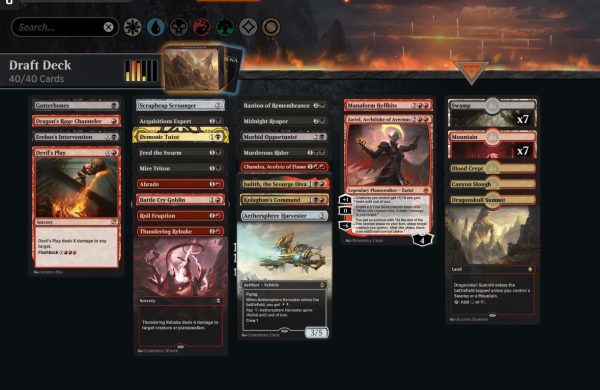
A little-known fact about me is that I am a glutton for Cube Draft. It combines the purest form of Magic, Limited, with the heavy concentration of top-tier staples typically found in Constructed. In this video, I take on the latest iteration of the Arena Cube with a very spicy Red-Black Aristocrats deck.

Raw Power VS. Flexibility

This cube can pull you into a handful of different directions but emphasizes the importance of card flexibility. This is especially important in best-of-one, where you don't have access to a sideboard to swap out ineffective cards. Some drafters might just take their favorite card out of the first pack and try to make their preferred deck work. It's more reliable though to start off with cards that excel in a variety of different decks and archetypes.

For example, I chose Abrade as my first pick as it's an efficient removal spell for both creatures and artifacts. With most decks playing at least some number of creatures and the cube hosting artifacts like The Immortal Sun and Midnight Clock, it's rarely a dead card.

Notably, I picked Abrade over Magma Opus despite Opus being the stronger card in a vacuum. This is because Abrade can slot in far more decks. Opus fits into control shells and the spell reanimator sub-archetype with Torrential Gearhulk and Mizzix's Mastery. Control though can win with just about any big mana spell, like Overwhelming Splendor or Approach of the Second Sun. Gearhulk and Mastery are strong on their own and work with any number of other spells. Abrade, on the other hand, is just an effective tool that simply always makes the cut.

I go into detail as I make each of my draft picks, but if you have any questions on why I made the choices I did, feel free to leave a comment or tweet me @AdamECohen.

Unmuddle Modern with Pillar Thinking

Are you a Quiet Speculation member?

If not, now is a perfect time to join up! Our powerful tools, breaking-news analysis, and exclusive Discord channel will make sure you stay up to date and ahead of the curve.

If the last time you sat down to a game of Modern was before the pandemic, you're in for a rude awakening. The format has been turned completely on its head. Luckily, we've got you covered—today's article applies pillar thinking to Modern, identifying five distinct macro-archetypes to carve out a holistic picture of the format.

Just Like a Pillar

Discussion of larger non-rotating formats (especially Vintage) sometimes circles back to the idea of pillars, reference points often represented by one or two key cards or interactions. By virtue of their power or ubiquity, format pillars guide and shape the way formats are experienced, contributing to notions of speed, health, brokenness, and so on. As the name suggests, no matter how diverse a format might be in terms of individual decks, only a few larger pillars hold up the structure; multiple decks then fall under each umbrella, such that each pillar claims a sizeable metagame share.

There was an error retrieving a chart for Tarmogoyf

Historically, Modern's pillars have been relegated to color combinations and card interactions. Think back to 2015, when Modern's popularity was exploding; on the interactive side of things, UR Twin and BGx Rock were the pillars keeping things together, while linear aggro (Infect, Affinity, Burn, etc.) and combo (Amulet, Scapeshift, Grishoalbrand, etc.) made up the other two.

As will always be the case with sweeping simplifications, some decks were naturally caught in the middle, such as low-to-the-ground aggro-control decks like Zoo and Merfolk. But the idea of these three or four macro pillars nonetheless proved an extremely valuable way to approach the format from a strategic metagaming perspective, aiding analysts and grinders alike in their quest for top-tier Modern mastery.

Take Them Five

The same can be said today. Once the dust settled from Modern Horizons 2, five distinct pillars emerged, each hinging on one or two specific cards.

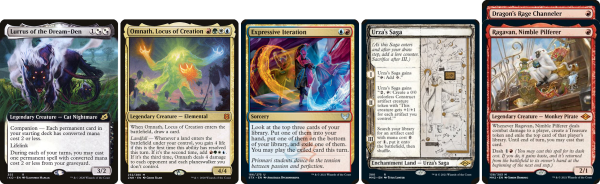
Not one of these cards existed during Modern's packed-LGS heyday. The earliest to the party was Lurrus of the Dream-Den, on May 15, 2020. Omnath, Locus of Creation and Expressive Iteration followed in subsequent expansions, with the Ragavan, Nimble Pilferer/Dragon's Rage Channeler package and Urza's Saga taking up the rear in Modern Horizons 2. In other words, they all moved into town once we were safely locked inside our homes—and now, each sits atop the Modern format in its own way, informing how players ignore or interact with each other while respectively clawing to victory.

On de Grind

Lurrus, Omnath, Iteration, and Saga all share an obvious strategic alignment: they provide the caster with value. For a time, Modern's best creatures were those that dodged Lightning Bolt and demanded clunky answers if they were to trade at parity; now, between Fatal Push, Prismatic Ending, and Unholy Heat, there's no shortage of efficient ways to dispatch of a Tarmogoyf.

Similarly, I once wrote a whole article decrying card advantage as a lost cause for many Modern players, then rode that philosophy to years of competitive success and a Classic win on the mull-to-four machine that was Colorless Eldrazi Stompy. These days, the best spells in the format are those that put pilots up on cards. The influx of efficient answers is precisely what has elevated card advantage's standing in Modern. When you're seeing answers as good as Ending and Heat, those draws become way more relevant to a game's outcome, and in a best-case scenario, your creatures play to that same goal.

There was an error retrieving a chart for Dragon's Rage Channeler

For their part, Ragavan and Channeler are so appealing as Stage 1 creatures because despite sharing a casting cost and potential damage output with the likes of Goblin Guide, they reward players with card advantage over the course of a longer game. Ragavan connects and creates a Simian Spirit Guide; on a good day, he'll also dig up your opponent's Thoughtseize or Lightning Bolt. Many have likened scry 2.5 to draw a card; surveil is a good deal stronger, and those sleeving up Channeler have no problem setting off the Shaman multiple times per turn. Good-bye, big butts—in this day and age, blue-chip aggro threats aspire as much to Monastery Swiftspear (once the format's premier aggressive creature) as they do to Dark Confidant.

A Tale of Twos

Next, let's apply our pillar thinking to the metagame at large and see how these forces dictate what we play. Drawing from the power rankings of our December metagame update, we can see that each pillar is heavily represented at the top of the charts:

Deck NameTotal Points Total %
Tier 1
Hammer Time13715.41
4-Color Blink11312.71
Grixis Death's Shadow11012.37
UR Murktide788.77
Tier 2
UW Control485.40
Tier 3
Cascade Crashers394.39
Yawgmoth394.39
Jund Saga303.37
Burn293.26
Amulet Titan252.81
Rakdos Rock182.02

Indeed, after the first four decks, there's a significant drop-off in power rankings. To quote David, "There have been big gaps in the data before, but they've never been as big as this. 20 results separate the bottom of Tier 1 and all of Tier 2, a tier that just barely has any decks at all since UW Control and Cascade Crashers are right on the cutoff." What do the Tier 1 decks have that the others don't?

There was an error retrieving a chart for Lurrus of the Dream-Den

Well, all of them run not one, but two pillars. Hammer Time uses Saga as a tutor for its win condition while recurring everything with Lurrus. Blink runs the best cards in its colors as an excuse to abuse Omnath, among them Expressive Iteration. UR Murktide combines the awesome offensive power of Ragavan and Channeler with the velocity-forward card advantage engine of 4 Iterations. And Grixis Shadow does the same thing but trades in Murktide Regent for Lurrus of the Dream-Den, a third metagame pillar. Three pillars in one deck... to quote David again, "here's your headline: as the Tier 1 deck with the highest average points, Grixis Death's Shadow was the top deck of December 2021!" Coincidence?

Take a look at the lower-charting decks. UW Control, Cascade Crashers, Yawgmoth, Burn, and Amulet Titan all run zero pillars. No wonder they're outliers! But then there's Rakdos Rock and Jund Saga, both black-based rock decks combining the Lurrus and Ragavan pillars. Jund Saga even packs the enchantment land, also making for a total of three pillars... but not amounting to a Tier 1 bid. Why not?

There was an error retrieving a chart for Expressive Iteration

With the pillars established, we can closely examine the compromises each deck is making to grasp, say, what Grixis Shadow offers over Jund Saga. For starters, they're both Lurrus-Ragavan decks. But Grixis surrenders the grinding plan of Urza's Saga to claim that of Expressive Iteration. Given its success over Jund, my takeaway from this development is that Iteration is the better grinding card in a low-curve deck, while Saga wins out given tangible synergy incentives, as in Hammer Time; alternately, Wrenn and Six bringing the land back may be a bit durdly for the current landscape, especially now that players have adapted to fighting huge constructs. Then, Goyf becomes Death's Shadow, a creature that more easily resists Unholy Heat and doesn't trade down on mana when it does get sniped—more of a no-brainer.

Speaking of no-brainers, Rakdos Rock is even easier to parse—this is just Grixis without Expressive Iteration! Not to mention Terminate over Drown in the Loch... no wonder it can't keep up with Shadow. What's the story, then, with UR Murktide? Here's a two-pillar deck that would adore Lurrus as a companion, but instead opts for Murktide Regent, the best closer in the format for fair decks (better mana is a nice pickup, too). Therein lies the difference between Grixis and UR, and the reason UR plays and feels like the more aggressive deck: its top-end tool of choice prioritizes damage, not card advantage.

Let's Have a Party

Thinking about the metagame in terms of pillars can help make sense of strategic tech choices, larger trends among successful decks, and even financial swings. But it also allows for top-down deckbuilding, wherein we attempt to jam as many pillar-defining cards together as we can and explore the possibilities.

There was an error retrieving a chart for Esper Sentinel

Limitations: We can't run them all together because Lurrus's companion condition excludes Omnath. So it's one or the other, and I'm not about to try my hand at rebuilding the Omnath deck already devouring offshoots left and right. Running either Omnath or Iteration, both of which are quite color-intensive, pretty much eliminates Saga, a land that taps for colorless. Realistically, then, we can run up to three pillars in one pile, something Grixis Shadow and Jund Saga are already doing.

What are we left with? Off the top of my head, we could try a Prismatic Ending-backed Jeskai Tempo shell with Lurrus, Ragavan, and Iteration. Maybe a Naya Saga midrange list dropping the targeted discard to pull in some creature combo synergies or disruptive beaters like Esper Sentinel.

Let me know what you come up with! Modern may emerge from quarantine deeply altered, but so long as we strive to understand the format, she'll always be our oyster.

A Little Magic Finance Nostalgia

Are you a Quiet Speculation member?

If not, now is a perfect time to join up! Our powerful tools, breaking-news analysis, and exclusive Discord channel will make sure you stay up to date and ahead of the curve.

It shouldn’t come as a shock to readers that I’m a nostalgic guy. This is evidenced by my interest in Old School and collecting cards from Magic’s earliest years. Memories of sleeveless decks, cards blowing away during playground games, and complete and utter ignorance of card rarities bring a sense of joy.

Even though my engagement in Magic finance didn’t begin until much later—around 2009—my thirteen-ish-year pursuit of this hobby has aged sufficiently to grant me nostalgic pangs for days of yore. For those who have been around the Magic finance block as many times as I have, perhaps you’d like to re-live some of my favorite memories in Magic finance with me? A few things come to mind which still bring memories of excitement even now.

For those who are much newer to buying, selling, and trading Magic cards to save or make some money, perhaps these memories will inspire you in some way. If nothing else, it’ll be a reminder for folks as to how different things were even just a few years ago relative to my understanding of the pursuit today.

Remember When...

…Pro Tours really shook the Magic market? Back when there were major Pro Tours, played quarterly, in person, with live coverage, there was a thrill in the air in anticipation for the upcoming event. I knew the Pro Tour schedule sufficiently to remember to tune into live coverage of each event. When day one of the tournament would commence, on Friday, I would do everything possible to catch glimpses of the first rounds of Standard (or Modern) to see what cards the pros were tapping into for their innovative decks.

Since I work Monday through Friday, this often meant listening to coverage on my car ride to and from work and catching occasional glimpses of the action throughout the workday. It would be impossible for me to stream live Magic coverage all day at work, so I found an alternative way to remain abreast of all the latest developments: the Quiet Speculation Discord!

Years ago, a subset of the Quiet Speculation community would live in the Discord for that entire weekend, reporting on decklists, sharing results, and identifying pricing trends as soon as they began. There would even be folks on-the-ground at the event in person sharing additional insights whenever possible. The goal was to be the first to know about new tech, a new card making waves, and a new opportunity to make a buck from Magic.

There are numerous examples where this happened, but my absolute favorite was when Return to Ravnica first debuted, and Angel of Serenity surprised players at the Pro Tour.

There was an error retrieving a chart for Angel of Serenity

It was early 2013 when I saw rumblings of the card’s strength on Twitter, before the main event. I sent an email blast to the Quiet Speculation community with the suggestion that this card could make waves at the Pro Tour. Sure enough, the card showed up, made itself known in some games on live coverage, and the mythic rare spiked from a couple of bucks to $20 for a brief time. I still have the email acknowledging my bold call and contribution to the community.

This email really motivated me to engage even more with Magic, tracking Standard trends to stay ahead of the curve as much as possible.

This was a different time, though. Such activity may not be as fruitful today because…

Remember When…

…the most popular Standard non-foil rares would exceed $20 and mythic rares would approach $50? Going a little further back, there were some occasions when Standard cards would be even more expensive (*cough* Jace, the Mind Sculptor). But there seemed to be at least one $20 rare and one $50 mythic rare in Standard at any given time.

This made trying to guess which cards would be the chase rares and mythics during spoiler season quite the thrill. Some cards would come out with an excessive preorder price, eliminating any opportunity for profit. But once in a while, there would be something under the radar that people didn’t fully expect to dominate Standard, and there would be a chance to buy low and sell high.

Nowadays, you can still open a $50 card out of a booster pack. But the problem is, there are so many special and alternate printings of Standard cards now that you really need to get one of the special printings in order to achieve that level of value. Opening a regular, non-foil mythic rare just doesn’t have the same ā€œwowā€ factor it used to.

For example, right now the most valuable card (regular printing) in Standard is The Meathook Massacre.

There was an error retrieving a chart for The Meathook Massacre

It looks like this is a $44 card, so you’re not too far off from that $50 threshold—that’s pretty consistent with days of the past. There are a couple of other mythics worth over $20 (though not many). The most valuable regular printing, Standard rare I can find is Shipwreck Marsh, worth about $9.

There was an error retrieving a chart for Shipwreck Marsh

That seems pretty low for a ā€œmost valuable rareā€, and I suspect it’s because Standard prices are hindered by all the special printings of new cards ā€œabsorbingā€ a set’s value. A given booster box of a new set can only be worth so much before people and stores will just crack them open for the singles, increasing supply and driving down values. By sprinkling in all sorts of alternate arts and foil versions of cards, it distributes a set’s value more widely across cards in the set, bringing down the average value of any given card.

I remember a time when you could open one of a number of rares in a set and double or triple your money spent on the booster pack. Remember when you could buy a $4 booster pack and open a Snapcaster Mage, which you could immediately sell for $30?

There was an error retrieving a chart for Snapcaster Mage

Now it seems like you need to open a specific card or two, or else you’re losing money on that $4 booster pack.

Not to mention the limited upside makes speculating on Standard less interesting than it was in the ā€œold daysā€.

Remember When…

…there were ā€œseasonsā€ that caused predictable fluctuation in card prices? There used to be these events called ā€œPro Tour Qualifiersā€, or PTQs for short, that would earn winners invitations to the season’s next Pro Tour. These qualifiers would be a set format depending on which ā€œseasonā€ you were in. Most frequently, those seasons were either Standard, Extended, Sealed, or Modern (later).

Depending on which season you were in, you would see a significant fluctuation in card prices. This was most relevant when it came time for either Extended or Modern PTQ seasons because these formats involved older cards from sets that weren’t opened as often anymore. This meant the supply was a little more inelastic, driving greater upside for prices.

The strategy was simple: a month before the next Extended season, you would start trading out your Standard cards for Extended playables like Dark Confidant and Lotus Bloom. When Shock Lands were in Extended but out of Standard, you’d see a bump in their prices as well. The same went for other popular Extended lands, such as Gemstone Mine or Flagstones of Trokair.

There was an error retrieving a chart for Flagstones of Trokair

The trend was fairly reliable, and a common strategy in the Magic finance community. Because PTQ’s were widespread, played all over the world, and seasons lasted a few months, there would be a dependable jump in demand for these key cards. There was no sketchy manipulation involved, here. It was merely a matter of getting ahead of the curve and picking up cards before they became the talk of the town.

Then during the peak, about two-thirds through the PTQ Extended season, you’d cash out and move back into Standard (or better yet, Legacy) cards to bank your profits. Rinse and repeat.

Wrapping It Up

As I wrote this article, I reminded myself how engaging and dynamic Magic finance was five to ten years ago. PTQ seasons, Pro Tours, and expensive Standard cards kept the hobby exciting. Because of these cyclical trends punctuated by Pro Tour events, it was always beneficial to remain engaged with a community with similar interests. This way, we would work together to find the best opportunities and most impactful trends.

There are other things I also long for from those days. For example, I remember when spoiler season was actually a big deal. Of course, seeing new cards is always exciting, but you used to only get spoilers for new sets about two weeks before the set came out. Each day, a few key cards would be spoiled on Wizards' website, and then that would be it until the next day.

Nowadays, the constant rolling of spoilers day and night from content creators throughout the community isn’t necessarily a bad thing. But by having spoilers come out nonstop, there’s a feeling of dilution for each individual spoiled card. Don’t like the last spoiler? Just wait a few minutes for the next one.

Oh, and it doesn’t help that there are way more products being released in a given year nowadays. This means we went away from four to five spoiler seasons a year to a seemingly nonstop flow of new products. It turns out there can be too much of a good thing when it comes to spoilers—the concept has become mundane to the point now where I don’t even follow the new cards anymore. There are simply too many to track.

I don’t expect we’ll ever go back to the days of yore, five to ten years ago, when Magic and particularly Magic finance looked very different. Therefore, I have adapted my engagement with the hobby to embrace the aspects of the game I like most, largely ignoring the rest. It’s not an ideal solution, I’ll grant you. But I still talk about and buy cards, 25 years after I started playing, so my strategy must be working. If I ever completely lose interest, that’ll be the day I cash out completely and move on to something different.

Hopefully, that day is far into the future.

Avatar photo

Sigmund Ausfresser

Sigmund first started playing Magic when Visions was the newest set, back in 1997. Things were simpler back then. After playing casual Magic for about ten years, he tried his hand at competitive play. It took about two years before Sigmund starting taking down drafts. Since then, he moved his focus towards Legacy and MTG finance. Now that he's married and works full-time, Sigmund enjoys the game by reading up on trends and using this knowledge in buying/selling cards.

View More By Sigmund Ausfresser

Posted in Finance, Finance History, Pro Tour, StandardLeave a Comment on A Little Magic Finance Nostalgia

Have you joined the Quiet Speculation Discord?

If you haven't, you're leaving value on the table! Join our community of experts, enthusiasts, entertainers, and educators and enjoy exclusive podcasts, questions asked and answered, trades, sales, and everything else Discord has to offer.

Want to create content with Quiet Speculation?

All you need to succeed is a passion for Magic: The Gathering, and the ability to write coherently. Share your knowledge of MTG and how you leverage it to win games, get value from your cards – or even turn a profit.

A Simple Guide to Buying Magic Collections

Are you a Quiet Speculation member?

If not, now is a perfect time to join up! Our powerful tools, breaking-news analysis, and exclusive Discord channel will make sure you stay up to date and ahead of the curve.

I have acquired the vast majority of my personal Magic collection through buying the collections of others. I am confident that it maximizes dollar value; especially if you collect, play, trade, and sell.

The Who and How

At some Local Game Stores (LGSs) that I frequent that are NOT primarily Magic shops, players know that I am "the guy." Among my friends and personal associates, everyone knows that I am always buying Magic. If you become "the guy" you will have a steady stream of people coming to you with the intention to sell; this is the best "job" you can possibly have!

2014 was my biggest buying year—I purchased two million cards. Almost all of these were private collection purchases, but, I did buy out two stores—one that had been closed for a couple of years and another that was in the process of closing. If you are ever in the position to help a store close out, it can be a tremendous opportunity and a unique experience as well.

I am always on the lookout for new collections to purchase and I hope that I can show you some of the massive upsides to expanding your collection this way while also providing some insight to lower the overall costs of these types of purchases.

An example of the average collection purchase

Set Expectations

The vast majority of collections are bulk cards. Bulk rares, bulk uncommons/commons, and basic land are almost always 99% of what is there. For a collection of 3,000 cards that means there could be about 30 cards of significant value and 2,970 cards of almost zero value. Has the seller done the work for you, sorting all their valuable cards and being clear with what kind of value they expect? If so, great. Settle on a price for their valuable cards and bulk the rest. Sounds so easy, buying collections must be like this every time right?

No, heavens, no.

I don't want to disparage the typical Magic seller, but, it's not a fun or reasonable experience. So where do we find sellers who are reasonable?

The Lifecycle of a Magic Player

The absolute most important of these rules is understanding the seller. I make sure that the seller is done playing Magic. No one can afford to pay for "sentimental value" because it is not attached to "dollar value." If the seller wants to keep one or two decks—ALWAYS see these decks. Without exception, the best cards in the entire collection seem to end up right there. If they insist on keeping their best cards, that's fine, just remember it should be reflected in your willingness to buy. I truly want all the cards and if they are through playing Magic they should be ready to let go.

It is that simple—the best collections come from players who are finished playing. I generally avoid purchasing from anyone else for every reason possible. As the buyer, you have all the "power" in the transaction. Believe me, there is no end to the number of collections you can buy. Unless the seller is a former Wizards employee or store, it is unlikely they have something once in a lifetime. Even in the rare case that the seller does have something great, do they have something amazing at an unbeatable price? You can pay two mana for a Grizzly Bears or two mana for a Tarmogoyf every single day—don't spend four mana for a bear or five mana for a Goyf!

There was an error retrieving a chart for Tarmogoyf

Condition Matters

Keep in mind it's unlikely you will thoroughly inspect every single card in a collection unless it is very small or high-end. Cards often have hidden damage. The amount of time it would take to inspect 1,000 cards is quite high and generally not worth doing; most average collections are two to three times that size. Do you really care if a Crimson Vow non-full art regular Forest is in near mint condition? The answer is no, but also, it is yes!

Point out the condition of every single card that has any kind of defect whatsoever. Make sure that the seller is aware that condition matters! Every vendor has the same caveat when they are buying bulk: "These prices reflect 1,000 near mint cards." Make sure you operate the same way.

For chase cards or older vintage cards, the condition is twice as important. Generally, buyers fall into two camps. Some want the absolute best condition, most expensive top-end printing of a card aka "collectors." Others want the least expensive version of a tournament playable card aka "players." In each case, condition matters! MP cards tend to be the toughest sale as they are neither the cheapest nor the best condition; point this out! It's also very easy when looking at a long box of cards to check for significant edge wear or discoloration on the corners and sides of cards and this takes just a second of scanning to save you time and money.

Organic VS Inorganic

Most MTG collections range from 1,000-3,000 cards with 3,000 as a rough average. In the grand history of Magic, you primarily purchased packs of 15 cards with one rare. A collection of 3000 cards bought in 15 card packs would require 200 packs of cards to achieve; thus I am expecting right around 200 rares in an organic collection of that type. Additionally, at $3.99 a pack, the seller may have paid $800 for their cards. They may expect that, no matter what they actually have, their collection has significant value because of how much they paid.

Granted, there are so many ways to buy new cards today that these old ratios have shifted, but the idea is still true. If a 3,000 card collection has more than 200 rares that means the seller has likely added significantly to the average value of the collection and you should be more interested. If there are far fewer than 200 rares that's generally a sign that they have sold off much of the value. Obviously, if you detect 200 bulk rares with zero mythic rares, and few if any foils, this collection is "inorganic" and likely to be avoided unless bulk pricing is accepted.

Quantity is a Quality All Its Own

For me, a "huge" collection is about 30,000 cards or larger. Organic collections at this quantity are fairly rare. When presented with large quantity buying opportunities it's always better to be cautious because it takes several hours to go through every card. Purchasing bulk cards at around $6/thousand is not a very rare opportunity. If the seller does not have rares/foils/etc sorted then check one or two boxes, thoroughly, skim the remaining cards and assign a bulk value based on that.

Only once have I purchased a couple of long boxes without taking a look through everything because they only wanted $10; in these cases, nearly one entire 1,000 count box was just basic lands of no significant age or value, but, all the cards were in pristine near mint condition which I saw right away from perfect, clean white borders. For the cost of the long boxes and a couple of other alright cards in the other box, I did not risk much.

While I have found many good cards worth tens or dozens of dollars this way, I have never found anything of massive value in collections like this, and I have been doing this for many years. Never buy based on hope, only buy based on value. They may have lots of cards, but, they generally do not have lots of value.

The Ceiling and the Floor

For me bulk pricing is the floor and, generally, I am offering between two to three times bulk rates on a given unsorted collection unless the condition is an issue. The ceiling is definitely far more variable but I have mentioned that, for me, unless a collection is dripping with low cost, mint condition, vintage cards I do not want to invest a lot in reprintable, modern, cards.

Many years ago my rule was very different—I would never pay more than the cost of a Revised dual land for a collection unless it had Revised dual lands or better. Nowadays the market is different and the rules have changed. The more expensive a collection is, the greater a deal I want to get, percentage-wise. A recent example was purchasing a collection where the single most valuable card was Gravecrawler. Shortly thereafter it was reprinted in a Secret Lair. However, I did not overpay for the collection so, overall, it was still a home run. I am acutely aware of any purchase with significant amounts of modern cards that will inevitably be reprinted.

There was an error retrieving a chart for Gravecrawler

Don't overpay for cards! Especially cards that are likely to be reprinted. Set a ceiling and stick to it! There is always another collection just around the corner. FOMO is a dangerous thing, do not succumb to it!

What About Singles and High End Cards?

My experience buying high-end cards and singles tends to go poorly; in most cases, I feel I can purchase the same card for less elsewhere. One extremely useful guide is the MTG Sick Deals Facebook Group. Here you can purchase cards for 10% discounts off eBay and TCGLow every single day of the week. For me, that is the starting price for singles negotiations. The only time I pay "market price" for a card I need is when a tournament is a few days away. Additionally, I've gotten so much value purchasing entire collections that buying single cards, unless at a considerably discounted price, is just inefficient for me. I get more bang for my buck buying everything, and I do mean everything!

To put this another way, if you overpay for singles, you have less of a bankroll to finance your collection buying activities. If you can get great deals on singles, awesome, go for it! For everyone else, collections seem to just offer significantly better value; and not just monetary value!

Swag and Entertainment Value

Many people consider that breaking down and searching a collection takes considerable time; for me, it can save time and add value. Not only do you get a huge inventory of new cards to sell but also draft, do sealed, and get ideas for new decks to build. When I was working on three different Commander decks, rather than pulling those cards from my collection, I spent time sorting and buylisting cards. While doing that I pulled many of the cards I needed straight from purchased collections and, thus, saved some time!

Additionally, everyone loves accessories. Dice, sleeves, binders, deck boxes, and mats can all be fairly valuable addons for either resale or acquiring them without paying full price; thanks to buying entire collections I have not had to buy any accessories for years.

Finally, the Ion Scanner has saved me a ton of time and it has made the entire process significantly easier. Time is money and saving that time is worth every penny.

Four Collections Purchased This Year

I've briefly touched on general collection buying in this article. Next week, I will go over the four collections I have purchased already in 2022. They are very different in terms of size, content, price, how they were purchased and who the sellers were. I will also touch on some of the challenges of collection buying and pitfalls that I encountered with these specific buys.

Avatar photo

Joe Mauri

Joe has been an avid MTG player and collector since the summer of 1994 when he started his collection with a booster box of Revised. Millions of cards later he still enjoys tapping lands and slinging spells at the kitchen table, LGS, or digital Arena. Commander followed by Draft are his favorite formats, but, he absolutely loves tournaments with unique build restrictions and alternate rules. A lover of all things feline, he currently resides with no less than five majestic creatures who are never allowed anywhere near his cards. When not Gathering the Magic, Joe loves streaming a variety of games on Twitch(https://www.twitch.tv/beardymagics) both card and other.

View More By Joe Mauri

Posted in Free InsiderTagged , , , , , Leave a Comment on A Simple Guide to Buying Magic Collections

Have you joined the Quiet Speculation Discord?

If you haven't, you're leaving value on the table! Join our community of experts, enthusiasts, entertainers, and educators and enjoy exclusive podcasts, questions asked and answered, trades, sales, and everything else Discord has to offer.

Want to create content with Quiet Speculation?

All you need to succeed is a passion for Magic: The Gathering, and the ability to write coherently. Share your knowledge of MTG and how you leverage it to win games, get value from your cards – or even turn a profit.

The Exciting New Future of Quiet Speculation

Are you a Quiet Speculation member?

If not, now is a perfect time to join up! Our powerful tools, breaking-news analysis, and exclusive Discord channel will make sure you stay up to date and ahead of the curve.

A lot has been happening behind the scenes here at Quiet Speculation. Today I'm going to break down what we've been working on, and some of the exciting things in the works for 2022, including new content offerings.

Modern Nexus Joins Quiet Speculation

If you haven't already seen the announcement on our Twitter, the Modern Nexus team is now a part of the Quiet Speculation family. This means that all of the data-driven Modern coverage you've loved from them can now be found here, reinforced by our financial tools and pricing insights. Going forward, all Modern-related content published by QS will also appear on the Modern Nexus website. Readers of both sites will have more Modern content than ever before right at their fingertips.

New Team Members

With Modern Nexus becoming part of QS, We're excited to welcome Jordan Boisvert to our team as Assistant Director of Content, and David Ernenwein as our Modern metagame expert. In addition to Jordan and David, Andrew Villarrubia and Adam Cohen also joined us this month. Andrew is our rules guru, with content breaking down rules concepts to help improve your game Send your rules questions over to him on Twitter. Adam is our resident Johnny-Spike, self-described "Aggressively Izzet gamer," and constructed specialist. Look for metagame analysis and deep dives into individual archetypes from him. I'm very excited about all the content these talented folks have in the works.

New Publishing Schedule

With all these new additions, our publishing schedule for each week going forward looks something like this:

Insider Content is Back

If you haven't already noticed from the homepage, or our publishing schedule above, Insider content is back! We're slowly reincorporating it into our regular rotation, starting with features on Fridays from various authors on our team. Insider content will highlight the spiciest of our metagame tech and the hottest of our financial specs for our most dedicated audience. Whether you're looking to have the edge at your next event or make a profit from your collection, our Insider content will give you the info you need.

In addition to the inside line on the latest info, the Insider subscription also gives you access to a robust set of pricing and collection tracking tools. This includes our industry-leading card scanning software ION, which has just been updated with a ton of features and improvements. Click here to read more about Insider, or here to sign up directly.

Not to worry, with the reintroduction of Insider content, our free daily articles aren't going away. They will continue to be packed with the insightful content you've come to expect from our creators. This includes some content we have not approached in quite a while.

Video Content is Coming

That's right, Quiet Speculation has video content in the works. I can't comment much on it just yet, but suffice to say, we have a YouTube channel, that's been dormant for a number of years, and you're going to see lots of content on it in 2022, and moving forward.

Still Hiring

We are actively recruiting new content creators with fresh ideas and unique perspectives. If you're an existing content creator, or you've always had an interest in making Magic-related content, we want to talk to you! Check out our call for creators for more details.

More On The Horizon

We have a lot more exciting projects in the works for 2022, but that's all I can talk about for today. Before I close, I want to take a moment to give a shout-out to both our amazing content and our amazing tech teams. It's their combined efforts that keep the content you see on the site happening week in and week out.

Of course, none of this is possible without our loyal Insider subscribers. It's your financial support every month that keeps us up and running. If you enjoy the content we produce, please consider becoming a QS Insider today.

Are you as excited as I am about all the projects we have in the works? What sort of content would you like to see us offer? I'm always open to feedback either here in the comments or directly on Twitter.

Avatar photo

Paul Comeau

Paul is Quiet Speculation's Director of Content. He first started playing Magic in 1994 when he cracked open his first Revised packs. He got interested in Magic Finance in 2000 after being swindled on a trade. As a budget-minded competitive player, he's always looking to improve his knowledge of the metagame and the market to stay competitive and to share that knowledge with those around him so we can all make better decisions. An avid Limited player, his favorite Cube card is Shahrazad. A freelance content creator by day, he is currently writing a book on the ā€˜90s TCG boom. You can find him on Twitter and LinkedIn.

View More By Paul Comeau

Posted in Announcement, Feature, Free, NewsTagged , , Leave a Comment on The Exciting New Future of Quiet Speculation

Have you joined the Quiet Speculation Discord?

If you haven't, you're leaving value on the table! Join our community of experts, enthusiasts, entertainers, and educators and enjoy exclusive podcasts, questions asked and answered, trades, sales, and everything else Discord has to offer.

Want to create content with Quiet Speculation?

All you need to succeed is a passion for Magic: The Gathering, and the ability to write coherently. Share your knowledge of MTG and how you leverage it to win games, get value from your cards – or even turn a profit.

Priority And You: A Primer

Are you a Quiet Speculation member?

If not, now is a perfect time to join up! Our powerful tools, breaking-news analysis, and exclusive Discord channel will make sure you stay up to date and ahead of the curve.

Who's This Guy?

Hello! My name is Andrew, and I do all of the rules things. I learned to judge in the Dallas/Fort Worth metroplex. If you’ve attended basically any large Magic event in Texas in the last four-ish years you’ve probably seen me around. You can also find me hanging out in the rules IRC answering questions or writing for Cranial Insertion.

Starting today, I also write for Quiet Speculation! I'll write about something rules-related every week. If you have any topics you'd like to see covered, you should ping me on Twitter or our Insider Discord.

Today I want to write about priority. Players generally have a vague notion of it, but they tend to forget some of the finer details.

Some Basics of Priority

Magic uses the priority system to determine who can do something at any given time. A player with priority can cast spells, activate abilities, and take special actions. Each player in the game gets priority in each step of the turn except for the untap step and usually the cleanup step. We'll talk about exceptions later.

Any time a new object goes on the stack, there’s a fresh round of priority. Each player can choose to respond or not, and if nobody does, the top object of the stack resolves. If everybody passes priority without taking any actions while the stack is empty, the game moves to the next step or phase.

As a rule, the active player gets priority first at the beginning of each step and phase after the game handles turn-based actions and puts any triggered abilities on the stack. The active player also gets priority after a spell or a non-mana ability resolves.

Holding Priority

Strictly speaking, a player gets priority after they cast a spell, activate an ability, or take a special action. However, we generally take a shortcut and assume a player passes priority after they do something. A player can hold priority if they explicitly say they want to do so.

I want to clarify a bit about what ā€œholding priorityā€ does. This enables a player to cast several spells and/or activate several abilities in succession, but that's it! I often see players think it somehow works like split second or otherwise locks players out of responding. This is simply not the case. You can hold priority and cast your two Lightning Bolts, but you have to pass priority in order for either one to resolve, and they still resolve individually. An opponent can let the first Bolt resolve and respond to the second one.

The Long Part About Shortcuts

ā€œWhat’s a shortcut?ā€ you ask. Without shortcuts, you'd probably enjoy paper Magic much less. For instance, if players had to clearly pass priority each time they wanted or needed to, games would take forever. Even in a turn where nobody does anything, each player passes priority eight times. Could you imagine playing a game of Magic like that?

Instead of having to be painfully specific about the flow of the game, we have some handy dandy shortcuts. Most shortcuts in the Magic Tournament Rules formed over the years by just watching Magic players play. Every time you say ā€œLand, go,ā€ congratulations! You just took a common shortcut that means ā€œlet’s both pass priority until it’s your turn.ā€ That beats you and your opponent(s) having to say ā€œI pass priorityā€ back and forth for 30 seconds.

Several of the other defined tournament shortcuts involve priority.

The Combat Shortcut

If the active player passes priority with an empty stack during their first main phase, the non-active player is assumed to be acting in beginning of combat unless they are affecting whether a beginning of combat ability triggers. Then, after those actions resolve or no actions took place, the active player receives priority at the beginning of combat. Beginning of combat triggered abilities (even ones that target) may be announced at this time.

Magic Tournament Rules, 4.2 - Tournament Shortcuts

That’s a lot of words, so let’s cover some situations. I'll always use a name starting with A for the active player and a name starting with N for the nonactive player.

Situation A:  Abby controls a Goblin Rabblemaster. Abby says ā€œcombat?ā€ Nate, not wanting the Rabblemaster trigger to happen, says, ā€œDoom Blade your Rabblemaster.ā€ Doom Blade resolves. The game is still in Abby’s first main phase. Abby has priority.
Situation B: Ant controls two Grizzly Bears. Ant says, ā€œcombat?ā€ Nico says, ā€œDoom Blade a Bear.ā€ Doom Blade resolves. The game is in Ant’s beginning of combat step. Ant has priority.

Putting Multiple Objects on the Stack

Next up, we have this shortcut that was relevant during Walking Ballista’s heyday.

If a player adds a group of objects to the stack without explicitly retaining priority, they are assumed to be adding them to the stack individually and allowing each to resolve before adding the next. If another player wishes to take an action at a point in the middle of this sequence, the actions should be reversed to that point.

Magic Tournament Rules, 4.2 - Tournament Shortcuts

Let’s say Anita has a Walking Ballista in play with six +1/+1 counters on it. If she says, ā€œActivate Ballista six times targeting you,ā€ what this really means is ā€œactivate Ballista once, then let it resolve,ā€ six times. If instead Anita says, ā€œHold priority, activate Ballista six times targeting you,ā€ this means ā€œput all six activations on the stack one after another.ā€ In the latter situation, none of the abilities start to resolve until they’ve all been put on the stack.

Making Choices Prematurely

We have one more shortcut that directly mentions priority, and it’s one of my favorites!

If a player casts a spell or activates an ability and announces choices for it that are not normally made until resolution, the player must adhere to those choices unless an opponent responds to that spell or ability. If an opponent inquires about choices made during resolution, that player is assumed to be passing priority and allowing that spell or ability to resolve.

Magic Tournament Rules, 4.2 - Tournament Shortcuts

If Archibald casts Pithing Needle and Noelle asks, ā€œNaming what?ā€ Noelle has passed her priority to counter the Needle. On the flip side, if Archibald casts Pithing Needle and immediately says, ā€œnaming Flooded Strand,ā€ he’s stuck with that choice unless Noelle responds to the spell in some way. If she cracks her Strand, Archibald can change his mind and name something else.

Cleanup

Earlier, I mentioned that players usually don’t get priority in the cleanup step. Of course, that means that sometimes you can get priority then, usually with the help of a triggered ability.

Let’s look at a card like Necropotence. Its activated ability lets me exile the top card of my library now, then put it into my hand at the beginning of my next end step. Let’s say I do this a bunch of times and end up with 15 cards in my hand. When we move to the cleanup step, I have to discard down to my maximum hand size of 7. Then Necropotence puts its triggered ability on the stack for each card I discarded.

In short, if any state-based actions have to happen or triggered abilities need to go on the stack in the cleanup step, the active player will get priority. I used a triggered ability as the example because it’s much more common than state-based actions happening here, though it’s possible!

Degenerate Decks in Commander

Are you a Quiet Speculation member?

If not, now is a perfect time to join up! Our powerful tools, breaking-news analysis, and exclusive Discord channel will make sure you stay up to date and ahead of the curve.

Magic is an Extremely Diverse Game

Stompy, Combo, Permission, RDW, Suicide Black, Manaless Dredge—the list goes on and on. Magic has the best names when it comes to deck names and archetypes and none of this would be possible if the game were not truly diverse.

Today I'm going to talk about a less considered but still important deck archetype; the degenerate deck. What makes a deck degenerate you say? In a word; simplicity. The entire essence of the deck has been distilled, reductio ad absurdum, to a singular form with singular purpose. Are these decks or are they thought experiments? Both, really!

My First Exposure to True Degeneracy

Fluctuator, which is still a combo deck in the pre-Modern format, was the first truly degenerate deck that I ever owned. I still have it to this day and continue to tinker with and update it. Read an awesome primer on Fluctuator by Kyle Monson here! Essentially, you play a Fluctuator and then cycle your entire deck into the graveyard and combo off from there. Will this deck ever be a Tier One deck in any format? It's not likely. Is it still my go-to deck when showing new players to Magic just how absolutely bonkers the game can be? Yes, it is.

The Myth of the Perfect Deck

Ever been to tournaments with no ban lists or deck-building restrictions whatsoever? I have! These are some of the most fun, zany events I've ever had the pleasure of attending. Without *any restrictions* there has got to be a perfect deck that automatically wins, right? My go-to when explaining this is the 60 Chancellor of the Dross deck.

What a beautiful theoretical deck. During the beginning of the game, you reveal seven Chancellors of the Dross and your opponent takes 21 damage and is dead. Your opponent, whether they go first or not, dies before drawing for turn or playing a land! Unbeatable, right? Well, not exactly. If the Chancellor deck ever took off people might start to play Nourishing Shoal in their sideboard or the maindeck of a Neobrand/Grishoalbrand deck. Thus, to win a best of three against a deck that could gain even two life, the Chancellor deck would be forced to have a game plan in the sideboard to defeat it. Adding any cards into a deck like this makes it no longer function, thus, it's not perfect and it's far from unbeatable!

Threats and Answers

An old, but still very true, Magic concept is that cards in your deck represent either Threats or Answers. If a deck is not functioning well one easy fix is to adjust the amounts of both. Degenerate decks completely remove all answers and simply try to end the game as efficiently as possible; they have no interaction and they fold to any interaction; they are the most all-in of any all in deck because when they fail it's spectacular.

The Importance of Degenerate Decks

These decks offer inspiration for future builds, show how to find a way to defeat an "unbeatable" strategy, and chip away at our idea of what counts as unfair, overpowered, or just plain silly. Gaining perspective and experience helps us become better Magic players. It might seem like decks that can attempt to win turn five every single game are unfair, but, until you actually play one how can you really know?

Ad Nauseam Degenerates

Whether your Commander is Maralen of the Mornsong or Sidisi, Undead Vizier or Varragoth, Bloodsky Sire the game plan is exactly the same; play Swamp until you cast your Commander, use your Commander to search for Ad Nauseam then draw your entire deck. The degeneracy is that you know you cannot die from Ad Nauseam because your deck is almost entirely Swamps.

One of the easiest finishers is Lotus Petal, Dark Ritual, and then Sickening Dreams discarding Swamps to finish off the entire table while using Dark Sphere to not die yourself. Because of the extremely high amount of Swamps, it's impossible not to hit your land drops and if you happen to draw one of the cards you would search for, you can just search for another instead.

Adding cards like Duress or Thoughtseize allows you to fight blue but the simple fact is that if you have done nothing for four turns, not had your Commander killed or countered, resolved Ad Nauseam and drawn your entire deck you probably are getting a win and a lot of dirty looks with or without discards.

The First Trickery

Another deck full of lands, The First Sliver uses 97 in fact. The only non-land cards in the deck are the banned in Modern Tibalt's Trickery and the completely cool and non-threatening Cultivator Colossus. The game plan is exceedingly simple; hit five lands, cast your Commander, cascade into Tibalt's Trickery which counters your The First Sliver, and then pseudo-cascade into Cultivator Colossus. You can then play your entire deck of lands including Maze's End and all the Guild Gates and then activate it during your upkeep and win! At $40 it's a pretty budget-friendly deck and entertaining for the two minutes or so it takes to play it.

Entirely degenerate and a bit hilarious as you convince everyone at the table that it's your new Slivers deck. While the deck runs fine off of basic lands and gates, you can put in a lot of utility lands to try and make the deck significantly more legitimate. My favorite tech are the indestructible artifact lands, Phrexian Core, and Academy Ruins, to prevent me from decking out if I am somehow allowed to continue playing after a failed win attempt. The backup plan at that point is to kill someone with any creature land and Kessig Wolf Run.

Once anyone knows your game plan, your chance of victory should be roughly 0%. If you're really a degenerate of culture, play an actual Sliver deck with The First Sliver for a couple of weeks before switching to the Trickery.

Everyone Loves Kiki

A degenerate classic, the deck needs absolutely zero explanation, which is exactly how powerful the deck actually is. It's one of the slower degens at turn eight, but, I include it to talk about the potential. When I first saw Maelstrom Wanderer this is exactly where I went with the deck—entirely thought experiment level. I don't think I ever won a game with it while demonstrating Wanderer. However, over time, I experimented with some ideas and they changed the rules for cascade and split cards with regards to cascade, which lead to more cards being playable in it, and also, they added Keruga, The Macrosage which can be played as a companion for laughs. I have the same style of deck but it plays a lot more non-land cards that cannot be cascaded into that have some form of use such as Magma Opus. This way it looks like I'm doing something, but really, I'm just trying to kill everyone with Pestermite and Kiki-Jiki, Mirror Breaker.

The Rest of the Gang

There are more examples out there like Kaho, Minamo Historian, and the ever famous The Gitrog Monster. In particular, Gitrog is really cool because it relies on rules knowledge of the cleanup step to function; if you've never seen it or your opponents have never seen it, prepare to learn about End of Turn and Cleanup. A Gitrog primer could make a good rules article for the future.

Should I Bring one of These to Play?

That depends on your group. If no one has ever seen the gimmick and you know they like Magic for all of its highs and lows, then definitely try it. If your group is laid back, really casual and just wants to tap lands and cast spells it's likely to just frustrate people. What about as an extremely budget-friendly, yet, competitive deck? Honestly? It's not that bad of an idea.

If you're struggling to come up with ideas for decks, or have never felt competitive but want to get into cEDH you should try one of these extremely all-in decks. You have an, albeit low, chance at winning but, more importantly, you will learn something each game. What you learn will prove to be invaluable for future deck design. You will appreciate firsthand how a competitive deck needs to function on both offense and defense to take down both careful, controlling opponents, and reckless all in decks. This is the kind of experience that you cannot get just from theory crafting and really need to experience as a player. Remember, no plan survives contact with the enemy.

Plus, it's not that these decks can't win, it's that they should never be *allowed* to win. So go out there, steal a game off someone and promise to never, ever do it again... until a new degenerate Commander gets printed.

A Year in Review: The Complete 2021 Modern Metagame

Are you a Quiet Speculation member?

If not, now is a perfect time to join up! Our powerful tools, breaking-news analysis, and exclusive Discord channel will make sure you stay up to date and ahead of the curve.

It's time to wrap up 2021. For real this time. Sorry to disappoint anyone, but I can't fully close the books on last year until I have fully unloaded the books about the year. Which is my way of saying that I have an entire year's worth of data accumulated, and now it's time to display and explain it. Today then, I bring you the full metagame for post-ban 2021 Modern.

I feel the need to lead with a confession. It didn't occur to me to combine the data for the full year last year. So I didn't. Thankfully, comments coming in around August put it back on my radar. Because I didn't plan this out, I didn't worry about full deck-name consistency month to month. If a deck didn't consistently show up on the Tier list, there wasn't much need to worry about what it was called. This created considerable headaches once I combined the data because I reused a lot of names for decks that changed considerably over the year. I'll be better about watching for that next time.

Methodology

This both is and is not a typical metagame article. It is just like any other metagame article I've done over the past 18 months because all I'm doing is aggregating the data I've previously reported. I literally just added each month's total data together to generate the total data for the year. Mechanically, everything is the same as it is for a normal monthly metagame update.

There was an error retrieving a chart for Consider

What is very different is the scope of this analysis. Specifically, a normal update is for one month, while this one comprises ten. I did not include the data for January because it represented a metagame that was banned away, and I didn't bother doing an update for February for the same reason. That means that decks that have disappeared from the current metagame are not only present but have a strong impact on the data.

It also means that there are a ton of singleton decks, which significantly alters the data. The standard deviation (STDev) is extremely high thanks partially to time pressures, but also to the vast distance from the bottom to the top. In short, the number of decks making the tier list is high, but at the same time, every outlier test essentially fails. By most normal tests, every Tiered deck is an outlier. I've decided to ignore this and press ahead because it won't affect the conclusions. To any statisticians out there: I'd love to hear what you would have done!

2021 Metagame

To make the yearly tier list, a given deck has to beat the overall average population for that year. The average is my estimate for how many results a given deck ā€œshouldā€ produce on MTGO since that's what's being sampled. Being a tiered deck requires being better than ā€œgood enough;ā€ for 2021 the average population was 21.96 setting the Tier 3 cutoff at 22 decks. (I told you this would like the monthly updates, just with a twist.)

Tier 3 begins with decks posting 22 results. Then we go one standard deviation above average to set the limit of Tier 3 and cutoff for Tier 2. The STdev was 51.77, which means that means Tier 3 runs to 74 results. Again, it's the starting point to the cutoff, then one above for the next Tier. That's an STdev to make statistics projects worry, but it makes sense given the data set. Tier 2 starts with 75 results and runs to 127. Subsequently, to make Tier 1, 128 decks are required. Which sounds very high, but actually isn't in aggregate.

The Tier Data

Unsurprisingly, with 10 months' worth of data included, the number of decks being analyzed is staggering. Between March and December 2021, 4,811 individual results were posted, representing 220 unique decks. Mostly unique, anyway. Remember my opening confession? That applies here. Grixis Control is the worst offender. In March, that deck was a pure control deck. These days it's more like Death's Shadow-less Grixis Shadow. Recognizable as derivative, but not exactly the same deck. And those are the most similar decks; I called almost every Grixis-colored deck without Shadow "control." Therefore, its numbers are arguably inflated. This is true of a number of other decks too, but there's not much to be done about it this go-round.

Of those 220 unique decks, 41 had enough representatives to make the tier list. This is much less than I thought would make it, considering that most months put ~15 decks on the list. But the data is what it is.

Deck NameTotal #Total %
Tier 1
Hammer Time4218.75
UR Murktide3006.24
UW Control2344.86
Burn2214.59
Cascade Crashers2024.20
Amulet Titan1893.93
Izzet Prowess1873.89
Heliod Company1533.18
Blue Living End1362.83
4-Color Blink1312.72
Mono-Green Tron1282.66
Tier 2
Jund Saga1152.39
Grixis Death's Shadow1102.29
Eldrazi Tron1092.27
Jund Death's Shadow1072.22
Yawgmoth1062.20
Tribal Elementals831.73
Mill791.64
Tier 3
Rakdos Rock741.54
Grixis Control731.52
Ponza721.50
Niv 2 Light621.29
Dredge621.29
Death and Taxes591.23
Esper Control591.23
Jund551.14
4-Color Bring to Light541.12
4-Color Creativity491.02
Mono-Red Prowess420.87
Boros Prowess410.85
Humans390.81
4-Color Control350.72
Belcher340.71
Urza's Kitchen290.60
4-Color Omnath290.60
Hardened Scales270.56
Infect260.54
Ad Nauseam250.52
WB Stoneblade240.50
Spirits230.48
Izzet Through the Breach230.48

Congratulations to Hammer Time, the most successful deck of 2021 by population. And by a considerable distance. This makes perfect sense, given that it has been #1 on my charts since July and has at least made Tier 3 since March. As far as I remember, the former is the longest streak for a single deck since Splinter Twin was banned. Grixis Shadow is the only deck that comes close to that mark with a reign lasting from Summer to Fall of 2017. The latter is far less unique, lots of decks hang around month-in, month-out.

Lingering Relics

I'd like to draw attention to Izzet Prowess and Heliod Company. Neither has been a metagame force (or in Company's case, made the monthly Tier list) since Modern Horizons 2 (MH2) was released. However, their results from those three months of Tier 1 placement were enough to carry them for the entire year. Neither deck completely disappeared, and I did see them in the total data periodically. Still, it was pretty dramatic how both cratered once Solitude entered the format. Does anyone else remember the chatter around Company being too good?

Up-And-Comers

On that same note, the impact of MH2 has been quite dramatic. Neither UR Murktide nor Cascade Crasher was possible prior to the printing of Murktide Regent and Shardless Agent. However, they've firmly placed themselves in the top half of Tier 1. Living End provides a mild counterpoint. It had moved away from its Jund roots before Agent became legal, but Agent noticeably improved the deck. That's not to say that Modern has devolved into MH2 Block Constructed. Hammer Time, Burn, UW Control, and Amulet Titan were all successful decks prior to MH2. Many of the more MH2-heavy decks are low in Tier 3 (a valuable datapoint supporting the argument that Horizons sets enable lesser-played strategies).

In fact, I was quite surprised to see Burn take fourth place in Tier 1. It's spent most of the year as a Tier 3 deck, always hanging around but not making itself known. It only made Tier 1 September and October. Nonetheless, by being a presence in the metagame consistently, it amassed sufficient results to hang with the flashier decks. Cascade is in a similar position where it doesn't perform exceptionally month-to-month, but it does always perform.

Power Rankings

Tracking the metagame in terms of population is standard practice. But how do results actually factor in? Better decks should also have better results. In an effort to measure this, I use a power ranking system in addition to the prevalence list. By doing so, I measure the relative strengths of each deck within the metagame. The population method gives a deck that consistently just squeaks into Top 32 the same weight as one that Top 8’s. Using a power ranking rewards good results and moves the winningest decks to the top of the pile and better reflects its metagame potential.

There was an error retrieving a chart for Wrenn and Six

Points are awarded based on the population of the event. Preliminaries award points for record (1 for 3 wins, 2 for 4 wins, 3 for 5) and Challenges are scored 3 points for Top 8, 2 for Top 16, 1 for Top 32. If I can find them, non-Wizards events will be awarded points the same as Challenges or Preliminaries are depending on what the event in question reports/behaves like. Super Qualifiers and similar higher-level events get an extra point and so do other events if they’re over 200 players, with a fifth point for going over 400 players. Which is really important for the monthly updates and utterly irrelevant for this yearly update.

The Power Tiers

Just like with the population, the point total is extremely high. The Modern metagame earned 5,592 total points in 2021, with an average of 37.79 per deck. Therefore 38 points makes Tier 3. The STDev was 90.83, which is enormous just like with population. And again, given the size and dispersion of the data it makes statistical sense. Thus add 91 to the starting point and Tier 3 runs to 129 points. Tier 2 starts with 130 points and runs to 221. Tier 1 requires at least 222 points. Which again, sounds like a lot, but as it turns out, over the course of a year really isn't.

The number of decks on the power tiers fell slightly from 41 to 39. The bottom three decks from the population tier didn't earn enough points to stay on the tier list, but there was one deck that wasn't popular enough to make the population that was surprisingly successful and made the power tier.

Deck NameTotal PointsTotal %
Tier 1
Hammer Time73013.05
UR Murktide5389.62
UW Control4037.21
Burn3746.69
Cascade Crashers3526.29
Amulet Titan3315.92
Izzet Prowess3185.69
Heliod Company2805.00
Blue Living End2514.49
4-Color Blink2444.36
Tier 2
Mono-Green Tron2063.68
Yawgmoth2023.61
Jund Saga2013.59
Grixis Death's Shadow1993.56
Jund Death's Shadow1983.54
Eldrazi Tron1873.34
Mill1542.75
Tribal Elementals1522.72
Rakdos Rock1342.40
Tier 3
Grixis Control1192.13
Death and Taxes1132.02
Niv 2 Light1122.00
Ponza1101.97
Dredge1081.93
Esper Control921.65
4-Color Bring to Light921.65
Jund881.57
4-Color Creativity771.38
Boros Prowess681.21
Mono-Red Prowess671.20
Belcher621.11
Humans611.09
4-Color Control581.04
Urza's Kitchen490.88
Hardened Scales470.84
Ad Nauseam450.80
4-Color Omnath440.79
Infect410.73
Lorehold Turns380.68

So once again, congratulations to Hammer Time for being the winningest deck by quite a margin. If you'd kindly apply everything I said about Hammer Time under the population list to the power list as well, we'll be free to move on to a new topic.

What surprises me is how stable Tier 1 is. Tron fell off into Tier 2, but the order of decks didn't change at all. In stark contrast, Tiers 2-3 are shaken up significantly. It goes to show that the best decks really are the best decks. It also shows how much mastery and enthusiasm for a deck matter in the lower tiers. The popular decks perform well for everyone and put lots of players into contention. The lower the popularity, the more individual results matter and true masters/enthusiasts will earn more points than an average player, pushing their deck higher on the power charts than in population.

Average Power Rankings

Finally, we come to the average power rankings. These are found by taking the total points earned and dividing it by total decks, which measures points per deck. I use this to measure strength vs. popularity. Measuring deck strength is hard. There is no Wins-Above-Replacement metric for Magic, and I'm not certain that one could be credibly devised. The game is too complex, and even then, power is very contextual. Using the power rankings certainly helps and serves to show how justified a deck’s popularity is. However, more popular decks will still necessarily earn a lot of points. Which tracks, but also means that the top tier doesn't move much between population and power, and obscures whether they really earned their position.

This is where the averaging comes in. Decks that earn a lot of points because they get a lot of results will do worse than decks that win more events, indicating which deck actually performs better. A higher average indicates lots of high finishes, where low averages result from mediocre performances and a high population. Lower-tier decks typically do very well here, likely due to their pilots being enthusiasts. So be careful about reading too much into the results. However, as a general rule decks which place above the baseline average are overperforming and vice versa. How far above or below that average determines how "justified" a decks position on the power tiers are. Decks well above baseline are therefore undervalued while decks well below baseline are very popular but necessarily especially good.

The Real Story

When considering the average points, the key is looking at how far-off a deck is from the Baseline stat (the overall average of points/population). The closer a deck’s performance to the Baseline, the more likely it is to be performing close to its ā€œtrueā€ potential. A deck that is exactly average would therefore perform exactly as well as expected. The further away the greater the deviation from average, the more a deck under- or over-performs. On the low end, the deck’s placing was mainly due to population rather than power, which suggests it’s overrated. A high-scoring deck is the opposite.

Deck NameAverage PointsPower Tier
Mill1.952
Yawgmoth1.912
Death and Taxes1.913
4-Color Blink1.861
Blue Living End1.851
Jund Death's Shadow1.852
Heliod Company1.831
Tribal Elementals1.832
Belcher1.823
Grixis Death's Shadow1.812
Rakdos Rock1.812
Niv 2 Light1.813
Lorehold Turns1.813
Ad Nauseam1.803
UR Murktide1.791
Amulet Titan1.751
Jund Saga1.752
Cascade Crashers1.741
Dredge1.743
Hardened Scales1.743
Hammer Time1.731
UW Control1.721
Eldrazi Tron1.722
Izzet Prowess1.701
4-Color Bring to Light1.703
Burn1.691
Urza's Kitchen1.693
Boros Prowess1.663
4-Color Control1.663
Grixis Control1.633
Mono-Green Tron1.612
Jund1.603
Baseline1.59
Mono-Red Prowess1.593
Infect1.583
4-Color Creativity1.573
Esper Control1.563
Humans1.563
Ponza1.533
4-Color Omnath1.523

Congratulations to 4-Color Blink, the highest performing Tier 1 deck for 2021. That's amazing considering it only made the Tier list after it became a Yorion, the Sky Nomad/Omnath, Locus of Creation pile in the last few months.

There was an error retrieving a chart for Omnath, Locus of Creation

The baseline stat is quite low at 1.59, as expected given the data. The number of decks with an average point of 1 is quite high, and not all of those are singleton entries. Thus, a lot of decks necessarily look like they're over-performing, when in fact they're mostly performing in line with expectations. More surprising is that no deck managed to break an average of 2 points for the whole year. There are always decks doing so in the monthly updates, but I guess the pressures of the full year preclude such a feat.

Bye for Good, 2021!

And with that done, we can safely close the books on 2021, the Year of the Hammer. Whether this honorary will apply to 2022 is yet to be seen. I'm hoping that the metagame begins to churn and new decks are able to dethrone the champs, but we shall see. There is a new set about to drop, after all.

My Honorable Mentions of 2021 for Modern

Are you a Quiet Speculation member?

If not, now is a perfect time to join up! Our powerful tools, breaking-news analysis, and exclusive Discord channel will make sure you stay up to date and ahead of the curve.

Last week, I shared my top 10 most impactful cards for 2021 for the Modern format. In crafting that list, I left off any reprints along with some cards that just narrowly missed the cutoff. However, these are still major players in the Modern metagame that need the limelight they deserve!

Without further adieu, here are my honorable mentions.

10. Dress Down

Coming in at number 10 is Dress Down. Innocuous at first, Dress Down seems like a variant of Stifle. With flash, it's a great answer to powerful enters-the-battlefield abilities against cards like Primeval Titan. As a permanent, it continues to lock down follow-up plays for the remainder of the turn until it sacrifices itself.

Upon further inspection, it removes all abilities for the turn. This includes those that set variable power and toughness, like Urza's Saga tokens meaning the tokens all become 0/0s and die to state-based actions. Creatures with protection like Sanctifier En-Vec that are extremely difficult to kill can suddenly be exposed to removal. You can also use it proactively to power up your own creatures. Death's Shadow and Kroxa, Titan of Death's Hunger are creatures with detrimental abilities that you can temporarily wipe clean for an instantly large 13/13 or a two-mana 6/6 that doesn't sacrifice itself when cast from your hand.

By combining Dress Down with Lurrus of the Dream-Den, you can cast Dress Down from your graveyard during each of your end steps to stop your opponents from having any creature abilities during their turn. Several top decks in Modern struggle with this interaction as it can prevent primary removal spells like Solitude from functioning.

9. Thought Monitor

My ninth slot, Thought Monitor, revisits a fan favorite archetype: Affinity. With the plethora of cheap artifacts available in Modern, this cost reduction mechanic lets you cast spell after spell with little to no mana required. The card velocity featured in Affinity decks is second to none and is powered primarily through the draw spell Thoughtcast.

Thought Monitor adds a critical density to the Affinity card draw package. This allows you to overwhelm the board quickly while digging for your Cranial Platings and Nettlecysts. Hilariously, the printed mana value of Thought Monitor is seven (though rarely ever cast for it). This means it can be Neoformed into game-enders like Griselbrand and Craterhoof Behemoth in hybrid Affinity aggro-combo decks.

8. Asmoranomardicadaistinaculdacar/The Underworld Cookbook

Perhaps one of the strangest cards to come out of Modern Horizons 2 (MH2) is Asmoranomardicadaistinaculdacar (Asmor). Asmor is a zero-mana 3/3 that can only be cast if you've discarded a card during the same turn. When you do, you can tutor out her signature artifact, The Underworld Cookbook, which is another discard outlet. Asmor slots well into a handful of archetypes, both with her at the helm and with her as a supporting role. Most notably are the Golgari and Grixis Food builds which look to generate Food tokens by discarding Ovalchase Daredevil to Cookbook, which immediately returns Daredevil to your hand.

Excess food tokens translate into repeatable removal spells with Asmor as well as life total padding against aggro matchups. These decks can play Asmor as early as turn one by cycling Street Wraith. Green builds can play Asmor via Finale of Devastation and skip the discard requirement altogether. Grixis builds lean more on the Cookbook than Asmor herself, and take advantage of the excess artifact generation with payoffs like Urza, Lord High Artificer.

Potentially underexplored areas for Asmor are the red-based Hollow One shells that were popular prior to the Faithless Looting ban in 2019. These decks focus on high-velocity drawing and discarding to play zero-mana Hollow Ones and Vengevines. Asmor having ample discard outlets, replacing itself with a card, and acting as an aggressive 3/3 body makes that archetype a very comfy home.

7. Faithful Mending

On the subject of Faithless Looting, its spiritual successor arrived in Innistrad: Midnight Hunt in the form of Faithful Mending. While twice as much mana and in different colors, the instant speed and life gain for this effect are far from trivial. The color shift also encourages a slower approach, curving well into Teferi, Time Raveler or setting up Persist and Unburial Rites. Pitching to both Solitude and Force of Negation are also major upsides. While it hasn't been able to fill the void that Looting left in the Arclight Phoenix archetype, it can still set up impressive Phoenix turns as early as turns three and four.

6. Fire // Ice

Fire // Ice is perhaps one of the strongest supporting role-players in Modern and it's a card that I've been clamoring to get a reprint of since Return to Ravnica. At a total mana value of four, Fire // Ice gets around the deck restriction for cascade decks while providing early interaction and removal.

Tapping down your opponent's lands with Ice can deny them an entire turn's worth of spells. This line can also be critically important leading into your cascade turn by tapping down your opponent's second blue source, preventing them from casting Counterspell. With Ragavan, Nimble Pilferer, and Dragon's Rage Channeler ubiquitous in the format, it's possible to two-for-one your opponent's early plays with Fire. Acting as a blue or red card to pitch to either Force of Negation and Fury is also very useful.

5. Grist, The Hunger Tide

If Asmor isn't the weirdest card to come out of MH2, that title certainly goes to Grist, the Hunger Tide. Grist is a planeswalker that masquerades as a 1/1 insect in every zone other than the battlefield. That means you can tutor her with cards like Chord of Calling or Collected Company. She functions similarly to Daretti, Ingenious Iconoclast in that she ticks up to protect herself and downticks as repeatable removal.

This gives creature-heavy decks some much-needed flexibility at an efficient rate. She sees play in the Yawgmoth combo deck, Elves, and midrange Jund-style decks. The only thing holding her back from ubiquitous play is her incompatibility with Lurrus, one of the premier midrange cards of Modern.

4. Sanctifier En-Vec

Sanctifer En-Vec is just... I don't even know, man. This card is hateful. Sanctifier is a callback to Auriok Champion with its WW casting cost and protection from red and black. Red and black are the most common removal colors in magic. This is especially true with cards like Unholy Heat and Fatal Push functioning as near-unconditional removal. Sanctifier not only laughs at these removal spells but is a hatebear for red and black cards in graveyards.

This is a near lights-out against Dredge where all of the payoffs are either red or black. Sanctifier blocks Death's Shadow like a champ. It invalidates Dragon's Rage Channeler by turning off Delirium, and laughs off Ragavan's attacks. The main reanimator threat of the format is Archon of Cruelty which simply doesn't work as long as Sanctifier is in play. For red and black decks, the only way to deal with this frustrating creature is by playing Dress Down to clear out Sanctifier's protection ability and then remove it, or use colorless answers like Pyrite Spellbomb.

3. Kaldra Compleat

Coming in third and the last non-reprint card on my list is Kaldra Compleat. It's not every day Stoneforge Mystic gets a new toy. In many ways, Kaldra Compleat is an upgraded Batterskull. It sports the living weapon ability which always gives it a body to latch onto. It also has a wall of text that makes the equipment very difficult to answer. First strike, trample, haste, and "super deathtouch" on a 5/5 is either a four-turn clock or an indestructible The Abyss. Again, if not for its incompatibility with Lurrus, I would expect Kaldra Compleat to see much more Modern play.

2. Counterspell

My runner-up counts as the bluest spell that ever countered a spell, Counterspell. This namesake blue interrupt instant originated in Alpha and has been on the Modern wish list for as long as the format has existed. At two mana, it trades one-for-one with anything, no questions asked, and no hoops to jump through. We've gotten countless imitations over the years, but they've almost all paled in comparison to the original.

The printing of Counterspell signifies that the costs of proactive threats have gotten more low-to-the-ground. The original argument against it becoming Modern-legal was that it almost always traded up on mana and tempo. However, it's increasingly more common for it to trade evenly on mana, or even at a deficit thanks to the powerful one-and two-mana threats like Ragavan and Puresteel Paladin.

Big mana decks like Amulet Titan and Eldrazi Tron run Cavern of Souls to force through their threats against countermagic so trading up isn't even necessarily a guarantee. Even still, Counterspell is an incredibly powerful and iconic card. Modern has reached a place where it's not necessarily the de facto best thing you can do, but it's still a very strong option. I'm thrilled it's finally an available tool in blue decks' arsenals.

1. Shardless Agent

Topping off my list is the cascade menace originally printed in Planechase 2012, Shardless Agent. This creature revolutionized the cascade archetypes by streamlining the mana into Temur colors rather than Jund or four- and five-color piles. Shardless allows for a critical mass of blue and green spells, meaning cascade decks can now support Force of Negation and Force of Vigor, providing much-needed interaction.

The most successful of the cascade decks post-MH2 intends to cheat Crashing Footfalls onto the stack. A net total of 10 power for 3 mana with tempo support can close games out very quickly. While "Crashcade" is the most popular, Living End is still very successful and the Glimpse of Tomorrow deck is incredibly strong despite seeing relatively minimal play. Shardless ultimately wins its spot as my top runner-up for upgrading a fringe archetype to tier one status. I have no doubt that it will continue to be a format staple for years to come.

End Step

That wraps up my top 10 honorable mentions list! Did your favorite show up this week? You can let me know by leaving a comment or tweeting me at @AdamECohen. I had a blast revisiting the top cards of 2021 and I can't wait to see what 2022 has in store. Stay tuned!

Sig’s Top Three MTG Priorities for 2022

Are you a Quiet Speculation member?

If not, now is a perfect time to join up! Our powerful tools, breaking-news analysis, and exclusive Discord channel will make sure you stay up to date and ahead of the curve.

Happy Belated New Year! I suppose a New Year-themed article would have made more sense last week, but I was really interested in last week’s topic, which distracted me from the fact that we just turned over to 2022!

This week I’m going to focus back on the holiday, and use this time as an opportunity to re-focus my priorities for Magic and Magic finance in 2022. I started going down a couple of different paths in the last quarter of 2021, and I need to get deliberate about where I want to go from here—especially since my Magic account has dwindled significantly of late (i.e. I’ve done a lot of buying but not as much selling).

Without further delay, I’m going to jump in and share my top three priorities for Magic in 2022!

Priority #1: Take a Pause on Low End Beta Rares

This is my top priority because it will take the most discipline for me to uphold. Over the past few months, I’ve noticed that Star City Games has gradually been restocking played and heavily played Beta cards (they were sold out for a long duration). With this restock, I’ve been able to grab some very inexpensive Beta rares. This includes Beta Drain Power, Righteousness, Deathlace, Web, Purelace, etc.

There was an error retrieving a chart for Purelace

In an ideal world, I would keep every single Beta rare that I acquire. But I ran into an issue buying so many budget-friendly Beta rares: I ran out of funds to purchase cards I actually want for my collection! Yes, I find the art of the original Righteousness cool, and the ability always interested me, but I don’t really need the card right now.

Meanwhile, I pursued an upgrade for my deck last month, switching out Unlimited Disrupting Scepters for Beta copies—no inexpensive task!

There was an error retrieving a chart for Disrupting Scepter

I found myself regretting buying these Beta rares, eating up my Magic budget. Sure, any Beta rare is likely to be worth more in 2023 than it is in 2022. So you could argue I’m not making any financial errors here. But the reality is, I would rather be buying one or two more useful, playable Beta cards than a handful of budget stuff just because it’s cheap.

In 2022, I’m going to switch that. If I can flip small stuff for store credit, and use that credit to get an inexpensive Beta rare here or there, I’ll certainly jump on the opportunity. But when it comes to spending my hard-earned dollars, I am going to save that for Beta cards the next tier up. Cards I will play, such as Disrupting Scepter, Granite Gargoyle, or even Royal Assassin.

There was an error retrieving a chart for Royal Assassin

To enable these purchases, I may even have to sell a couple of the low-end Beta rares I picked up in 2021. These are the cheapest rares in the set for a reason, so I anticipate I may get another chance at grabbing them again in the future should I experience any seller’s remorse.

Priority #2: Stay Persistent Shopping for the Small Stuff

I went through a phase in 2021 where I attempted to consolidate some of my collection (the cards not in my decks, that is). I would send my played Arabian Nights, Legends, and Antiquities commons/uncommons to Card Kingdom for some store credit. This was my way of attempting to ā€œtrade upā€ā€”it’s nice going from 10 or even 50 small cards into one more significant card.

There was an error retrieving a chart for Moorish Cavalry

There are three problems with this strategy, however. First, I quickly ran out of the low-end stuff I was willing to part with. To use a common analogy, the well ran dry. Each time I decided to repeat the process, I’d have fewer and fewer cards of value worth shipping to Card Kingdom and ABUGames, which meant my buylists were becoming uninspired, and therefore not worth it!

Second, I started experiencing seller’s remorse on some of these cards. I was so eager to submit a buylist for ā€œsomething to doā€ and ā€œto consolidateā€, that I started cutting cards I liked. One example was Season of the Witch, a cool card from The Dark with a unique ability and a really sweet artwork. It was painful to buy this one back (which I did), and I won’t be so eager to let it go anymore.

There was an error retrieving a chart for Season of the Witch

Other examples of smaller cards I regret shipping to Card Kingdom include Titania's Song, Colossus of Sardia, and Blood of the Martyr, the latter I actually bought another copy of to replace.

Finally, I regretted selling these small cards because many of them have been climbing in value lately! When I shipped Blood of the Martyr to Card Kingdom, they were probably paying around $0.40 for near mint copies. Recently, they were paying up to a buck! These are small numbers, but these differences really add up across a stack of cards. I wouldn’t be surprised if I could have gotten double or even triple the store credit for the small cards I shipped in 2021, had I held them until 2022.

For these three reasons, I’m going to spend some time in 2022 browsing inventory across the web to try and find a few cool small cards to put back into my collection, this time to hold! This means I’ll have to maintain some discipline when I do my buy-listing. I’ll ask myself, ā€œAm I OK not owning this card anymore? Are the cards I plan on trading toward more desirable than the cards I’m shipping?ā€ This will force me to stop and think about whether I’m shipping cards for the sake of shipping cards, or if there’s really a favorable trade-in I’m looking to make.

This will help me stop myself from shipping cards for store credit, and then realize after the fact that the very cards I shipped were the ones I would have wanted to spend the store credit on!

Priority #3: Increase Play Time (A Little Bit)

If 2020 was my ā€œyear of Magic Arenaā€ (I hit mythic multiple times, and I played in multiple qualifier events), then 2021 was my ā€œyear of abstinence from Magic Arena." I probably booted the game up no more than four times from February through November last year.

For paper Magic, I hopped on a webcam to play Old School no more than once, and Vintage the same. Each time I do the webcam games, I have a great time, meet someone really friendly, and become re-inspired to maintain or improve my decks. The last time I played Old School, I decided I wanted to try Diamond Valley in the list. That's a pricey card of course, but the idea motivated me to sell and trade cards with a purpose. It's a good feeling.

I want to try and do this a little bit more this year. And if COVID can finally calm down again, I may even try to stop by my LGS for a draft (no promises, though).

As for Magic Arena, I don’t want to let it eat such a significant amount of my time like it did in 2020. But I would like to re-engage if just to stay more in touch with what’s going on in the hobby. I have almost no cards in my collection now that were released in 2021, so playing Standard right off the bat will be tough. But when the next set is released, I can try to hop onto the drafting bandwagon to enjoy the game once again.

This will help rekindle my interest in the game, which will help me stay focused on my other two priorities for 2022 at the same time.

Wrapping It Up

It has become an annual tradition, for me to establish my priorities for Magic at the beginning of each year. Going through this exercise helps me think critically about where I want to spend my time and resources going forward, and also helps drive some accountability as I share this with the community. Now when you see me selling a few random, low-end Beta rares, and asking to buy some others, you’ll understand where I’m coming from.

How about you, the reader? Do you have some New Years’ priorities for 2022 in Magic (or otherwise)? Feel free to message me on Discord or Twitter with your own goals for the year. We can have a dialogue about our ideas, and help hold each other accountable.

As for my 2022 resolutions outside of Magic, I will share two that I’ve come up with. First, every time I go to a restaurant I’ve been to before, I will order something to eat that I have never ordered before. I have fallen too much into a rut with my dining out, ordering the same things over and over again, that I’ve lost a little bit of my flair for adventure. I wish to reclaim that.

Second, I want to cut down on alcohol for 2022 so I intend on doing this by enforcing a strict, $500 budget for alcohol for the year. Note this includes not just trips to the liquor store, but also ordering drinks at restaurants, bars, etc. To give me a strong start, I’m doing ā€œDry Januaryā€ again this year, so that means I’ll only have to manage this budget across 11 months.

There, now I’ve shared my personal resolutions for 2022 as well. Hold me accountable, and wish me luck!

My Three Magic Resolutions for 2022

Are you a Quiet Speculation member?

If not, now is a perfect time to join up! Our powerful tools, breaking-news analysis, and exclusive Discord channel will make sure you stay up to date and ahead of the curve.

New Year's Resolutions

Happy New Year! I've got a lot to look forward to in 2022, both in Magic and in life. I hope you do as well. While I'm not normally one to make New Year's Resolutions, I do have three Magic-related goals I'd like to share with you that I'll be working on for 2022. These goals are a reflection of where I'm at as a player, the current state of Magic, and the state of the world.

Goal One: Play More Commander

The printing of Garth One-Eye in Modern Horizons 2 last year inspired me to do something I hadn't done in nearly a decade: build a new Commander deck. The few games I played with Garth were enjoyable, but most of the time he died before I could activate him. For whatever reason, the threat of his activation was such that most players would kill him on sight, and fixing my mana to make WUBRG every game was quite tedious. I was lucky enough to open this card in a prize pack though, to get the gears in my brain turning:

Prior to Garth, my Commander of choice for nearly ten years was Nin, the Pain Artist. The deck was mostly a value engine/politicking deck, that could occasionally combo kill if it could make infinite mana, and opponents had creatures on board to target. I built it for our Local Game Store's (LGS) Commander league and left it together, mostly unchanged over the years.

Building Eloise, Nephalia Sleuth I'm going for a similar value engine deck as my old Nin deck, minus the politicking aspect, or the combo kill potential. I just want something that's fun to play, has the potential to win, but won't necessarily have a target on its back from the moment it's revealed.

Commander is a huge part of our LGS community. Not everyone I know plays Modern or Legacy, but every player I know, even more Limited-focused ones like myself, have at least one Commander deck ready to go. I'll have this at the ready in my bag for whenever folks want to get a game going.

While I'm interested in playing Commander for fun, it's also important to me to start playing Commander again regularly as a content creator. Commander is now the most popular Magic format of all. I want to embrace that by immersing myself in the format. Who knows, maybe I'll write about my Eloise deck in a future article?

Goal Two: Organize My Collection

The massive endeavor of organizing my Magic collection has been on my To-Do list for over a year now. With tens of thousands of cards, spread across two rooms of my house, it's not an easy task. There's also the question of how I should sort it. By color? By format? What about by expansion set? There's also the question of how I want to store my collection once it's sorted. For years I've kept the bulk of my collection in 5,000 count cardboard storage boxes. They're not particularly attractive, nor are they utilitarian.

A related concern to organizing the collection is storing all of my decks, and my cubes. My Un-Cube is stored in a Gamegenic Dungeon, but I'd need something at least twice the size to accommodate my Invasion Block Cube. It's currently stored in multiple separate 1,000 count cardboard boxes. In addition, I have about a dozen deckboxes with complete or partially complete decks in them for various formats.

My Un-Cube is stored in a Gamegenic Dungeon like the one pictured.

I've seen collectors use converted library card catalogs to store trading card collections. Ultimately when the collection is organized I'd like some sort of classy furniture piece in which to store it.

Goal Three: Play More Magic Over Spelltable/Webstream

With the infection rate spiking all over the world, I'm staying home from playing in-person Magic for the foreseeable future. While I applaud the safety precautions taken by my LGS and other venues, I just don't want to risk getting myself or my family sick. Playing Magic: Arena sustained me through the shutdown of 2020 when there was no chance for in-person Magic. for 2022, I'll still be playing Arena regularly to get my Limited fix, but I also want to be more social, even if it's from the comfort of home. To that end, I want to get into playing paper Magic via webstream.

I have one decent camera, and a microphone which I use for videoconferencing. It shouldn't be too hard to get my office area set up so that I can stream my end of a Commander game. The bigger issue will be cleaning my desk so the mess doesn't enter the battlefield.

Goals and Resolutions

There are plenty more Magic-related goals I could come up with for the year. These are the three that loom largest in my mind on a personal level. What is your New Year's Resolution this year? What are your Magic-related goals for 2022? Let me know your suggestions for accomplishing my Magic goals in the comments or on Twitter.

Avatar photo

Paul Comeau

Paul is Quiet Speculation's Director of Content. He first started playing Magic in 1994 when he cracked open his first Revised packs. He got interested in Magic Finance in 2000 after being swindled on a trade. As a budget-minded competitive player, he's always looking to improve his knowledge of the metagame and the market to stay competitive and to share that knowledge with those around him so we can all make better decisions. An avid Limited player, his favorite Cube card is Shahrazad. A freelance content creator by day, he is currently writing a book on the ā€˜90s TCG boom. You can find him on Twitter and LinkedIn.

View More By Paul Comeau

Posted in Collecting, FreeTagged , , Leave a Comment on My Three Magic Resolutions for 2022

Have you joined the Quiet Speculation Discord?

If you haven't, you're leaving value on the table! Join our community of experts, enthusiasts, entertainers, and educators and enjoy exclusive podcasts, questions asked and answered, trades, sales, and everything else Discord has to offer.

Want to create content with Quiet Speculation?

All you need to succeed is a passion for Magic: The Gathering, and the ability to write coherently. Share your knowledge of MTG and how you leverage it to win games, get value from your cards – or even turn a profit.

Ten (or More!) Commander Cards That Are Under the Radar

Are you a Quiet Speculation member?

If not, now is a perfect time to join up! Our powerful tools, breaking-news analysis, and exclusive Discord channel will make sure you stay up to date and ahead of the curve.

Unplayable, Unknown or Unaffordable?

While everyone is entitled to an opinion on card power, EDHREC does have quantifiable statistics on submitted decks. It is reasonable to conclude that the more times a card appears in decklists the higher the synergy and general power of the said card. Within the Top 100 All, or a Top 100 category, there are underrated cards. Today though, I'm concentrating on cards that fall completely outside ANY Top 100 list.

Sure, there are dozens of underplayed cards that are great in extremely niche decks. The following list of cards though is a lot more general-purpose. These cards can fit into many different Commander decks. While there are some spicy vintage cards that definitely deserve a shout-out, I understand they are not in everyone's price range. For this list, many of the cards included are budget-friendly!

One final caveat up front: I cheated with my idea of "Ten Cards." In some examples, I'm presenting a few cards that more or less do the same thing and am counting that as one card "idea" or "theme." Variety, right? Without further ado, some spicy Commander cards of days long past and even some brand new ones!

Fast Mana and Faster Mana

Dark Ritual, Cabal Ritual and Culling the Weak are all in the Top 100 for black but NOT these cards? Obviously, both Sacrifice and Burnt Offering are exactly the same strength as Culling the Weak if the creature sacrificed is four or more mana. Sacrifice and Burnt Offering both have the advantage of scaling and potentially mana fixing as well. The downside? Decks with lots of tokens and creatures that cost three or less. Do the numbers support the idea that Culling is significantly better and these cards are significantly worse?

Within the Top 48 Black creatures, 25 of them are four mana or higher. More than half of the Rakdos commanders are four mana or higher. 20 out of 48 Top red creatures are four mana or higher. I think, from a numbers standpoint, both of these cards have potential. If you're already playing Culling the Weak, consider adding Sacrifice and/or Burnt Offering as secondary or tertiary copies. If one is good, two is better, right?

There's also the hidden secret mode of these spells which is "one mana, put my creature into the graveyard"; if you don't want your creature to be exiled or otherwise put into a non-graveyard zone these spells do it for effectively free.

Midnight Clock's Older Cousins

Appearing in just two percent and one percent of all decks, respectively, I think that these two artifacts are slowly being forgotten. With both more and more powerful artifacts in print, the value of both of these clocks has only increased. Most Commander decks seem to run at least ten artifacts and, also, newer commander decks all include many artifact tokens.

One thing I have always enjoyed is Clock of Omens turning my non-mana rocks into one half a mana or more. It can also turn your treasure tokens into permanent mana and give artifact creatures the potential for pseudo-vigilance.

More than ever there are always extra artifacts on the board, and, there is always an opportunity to use mana to crack a clue, eat a food, sacrifice a blood or otherwise gain an advantage; these clocks make both happen, virtually for free, multiple times per round.

This is No Mox

This may sound insane but my play experience tells me Jeweled Amulet is close to Lotus Petal and Mox Amber in total power and both of those cards make the Top 100 for Mana Rocks.

It does not matter what kind of deck you are running, it simply gets you one mana further on your next turn. Many times you have extra mana to charge the Amulet and there is no real cost to using it. In decks that are willing to pay a card for one extra mana Amulet is another way to essentially do the same thing. Paying in time is generally looked down upon, but, Search For Tomorrow is in the green Top 100 and that takes an "unplayable" two whole turns and costs a mana.

Both the ceiling and floor for the Amulet are wrong; it is slightly better in any deck than estimated and also way better in decks with significant synergy. Jeweled Amulet is a bad Mox, but, it's a good rock. Try it out!

The First Rule About Symbol

A game-ending card for three mana that generates an insane amount of +1/+1 counters for a paltry amount of life. This card is way underrated at one percent. Just in terms of the current Top Ten Commanders by deck representation, Unspeakable Symbol has tremendous synergy with two of them, Atraxa, Praetors' Voice and Sisay, Weatherlight Captain, and strong synergy with two others, Alela, Artful Provocateur and Lathril, Blade of the Elves, respectively. If your deck seeks to leverage infect, proliferate, lifelink, double strike, commander damage, and of course +1/+1 counters, then this card is a slam dunk.

On top of that, you can put counters on other creatures to control combat, save creatures you want to steal later, or even modulate your life total at will.

I Always Feel Like Somebody Is Watching Me

Imagine if you always had perfect information before making any play. What if I told you that the cost of that would be one blue or even one colorless? That's an unbelievable bargain, right? What if I also said you could add a massively disruptive element into your game by bluffing or by taking away the ability to bluff?

If you're playing blue Telepathy is extremely powerful for just one mana. Once everyone else is busy looking at everyone else's hand you can just quietly play lands, sit back and offer some "helpful" advice. Make sure to announce when you miss a land drop and that you can't make any plays. Quickly pass and move on to the next player; everyone forgets you are even in the game. Think this doesn't happen? Try it.

Glasses of Urza gives you and only you hidden information to do with what you please. Feel free to tell the table exactly what is in someone's hand, or, make stuff up. Definitely tell the blue players that they need to hold up a counterspell for the combo another player has - whether that is true or not.

The Flex Seal of Commander

A long time ago it felt like if you had a counterspell or powerful removal spell up then you were in control of a game. Now? Not so much. Today's cards are incredibly powerful. You need something over the top that assures you are still in control of a game. Sudden Substitution has split second so it's hard to counter which is a huge selling point. Think back to every multiplayer game you have played where someone removed the wrong threat; now YOU can fix it! Is the balance of power in a game shifting drastically the wrong way? Now YOU can fix it!

Flexible and relatively uncounterable; if you have Substitution and mana up YOU are in charge of the game!

Kill All Artifacts

There are six enchantments in the Top 100 cards but there are 24 artifacts. Thus, artifact removal should be prioritized. Green already has Nature's Claim but why not Crumble? As a one-mana removal spell it's just as efficient as Claim and usually gives up less life as well. It can't hit enchantments but so what? Artifacts are six times as numerous, and, green has access to other top cards to deal with the occasional enchantment that gets through. I say in 2022 everyone should get a chicken in every pot and a Crumble for every Sol Ring!

In the same vein, red has tons of artifact removal, sometimes too much. In comes Shenanigans! If you need artifact kill, you have it. If you don't great, you do not have to draw a second, third, or fourth copy of Shatter. Shenanigans gives you all the removal *and* all the choices at the same time.

You're Not Going Anywhere

Darksteel Mutation shows it is better to keep a creature, particularly a commander, in play than remove it and for that reason, it's a Top 100 card for White. Faith's Fetters and Prison Term, however, are reasonable additional copies that force your opponent to answer the aura or kill their own creature. On top of that, unlike Oblivion Ring and Banishing Light opponents will not get another enters the battlefield trigger if they remove these auras.

Humility is in a category all its own for both crazy rules conundrums and raw creature neutralizing power and is vastly underappreciated while also being less expensive monetarily than, say, Jeweled Lotus. The idea of keeping problem cards in play but neutralized is a strong one and Humility does it exceptionally well.

Try Something New in 2022

If you've read my article about the Heart of Commander then I hope you use the New Year as a springboard for trying out new cards, new strategies, and maybe even giving some formerly played cards a second chance.

There are a large number of cards that are nearly as good as many of the much more commonly played cards. In some cases, these other cards solve problems in a different way. Without trying out different ideas a deck can never ascend to its ultimate, perfect form.

Also, there are so many cards I want to share that this may be the list for the month of January. What are your favorite unsung Commander cards? Let me know in the comments!

Want Prices?

Browse thousands of prices with the first and most comprehensive MTG Finance tool around.


Trader Tools lists both buylist and retail prices for every MTG card, going back a decade.

Quiet Speculation