menu

Commander Thoughts on Crimson Vow

Are you a Quiet Speculation member?

If not, now is a perfect time to join up! Our powerful tools, breaking-news analysis, and exclusive Discord channel will make sure you stay up to date and ahead of the curve.

With Kamigawa: Neon Dynasty closing in and looking like a really great set for Commander, I wanted to close out my thoughts on Crimson Vow. Did I mention how absolutely great Neon Dynasty looks for Commander?

Vow was a fairly fun set for draft and added a little bit of spice to Standard. In terms of Commander, though, it was just okay.

Many Legends, Few Commanders

While there are a fair number of decent thematic commanders like Millicent, Restless Revenant, none of them really offered something that did not exist before. There are plenty of thematic Vampire, Spirit, and otherwise spooky commanders sprinkled throughout Magic's history. Making tokens is not a new mechanic, and, it's done vastly better by many other cards. What about the new mechanics presented in Crimson Vow?

There Will Be Blood!

No, not really. The Blood mechanic is not bad, especially for draft! However, in Commander, it suffers from a lack of synergy. Obviously it's a new mechanic and could receive more support once we re-re-return to Innistrad, but for the near future, Blood is unlikely to get an infusion.

I Find Your Lack of Faith Disturbing

Disturb is merely flashback for creatures, and has been done many other ways, so this is nothing new. It's a fine mechanic in terms of power level but, again, it's not really supported enough to consider it a deck type.

Is there any chance at a Commander redemption for Crimson Vow? I think so.

A Real Build Around Beast

If you read my article on degenerate Commander decks, then you know how nasty Cultivator Colossus can be! However, I think that the best days are still ahead of the Colossus. It has a unique ability that can be utilized in a variety of ways and can chain together devastating play sequences. Combined with Abundance and any landfall effect, you likely win on the spot.

Furthermore, there are a large number of existing cards that work well with it, so this card will only get better with time. In my estimation, Colossus is the Vow card that will have the longest lasting impact on Commander and is likely to be the most obviously powerful card in the set.

Still, some other cards have niche uses.

The (Un)usual Suspects

Brine Comber // Brinebound Gift caught my attention for several reasons. It pairs nicely with Flickering Ward in a Verduran Enchantress deck along with many other auras to pay mana, make spirits and draw cards. It's a Spirit, which is extremely important for most tribal decks like Millicent. On top of that, it also has a graveyard function for added versatility, which pushes the card up a notch. Do I think Comber is amazing? No. Do I think it has potential for right now and the future in multiple decks? Yes and also yes!

Screaming Swarm will likely boggle some. It's expensive, doesn't end the game on the spot, and appears to not do very much. However, it is at home in a mill archetype that some players enjoy and I am looking somewhat to the future for this card. Imagine a scenario where you already have a bunch of tokens for any reason. The second Swarm hits the battlefield, your mill plan is active. You can attack any one player... and then mill another! Consider the diplomatic angle: "I need to attack YOU so I can mill THEM!" While I do not claim this card will be format warping or massively played, I think it will earn a spot in some decks and has potential because... you can mill people while you mill them, which of course massively appeals to mill players. (You know who you are.)

Retrieve Some Horrible Cards

Dollhouse of Horrors gets major points for flavor, but think about what "Construct tribal" would look like. Codie, Vociferous Codex is your five-color Construct commander and, with Changelings, there are a good 200 Constructs to choose from! I've been really impressed with Dollhouse. One really cool way to use it is to let your commander die and send it to the graveyard, then return it to play as a Construct, effectively getting to use your commander again for one colorless mana that turn. This can be devastating both short- and long-term for decks that have the general goal of "cast your commander as many times as possible." Netting effectively two commander triggers per tax is very efficient.

Retrieve is another card that I think will actually see significant play in a variety of decks. It's fighting some well known favorites for the card slot, but I think combo decks will eventually come around on Retrieve as the right card for recursion. According to edrec, a lot of green decks are running Eternal Witness, Regrowth, Bala Ged Recovery // Bala Ged Sanctuary, and Noxious Revival as forms of recursion. Compared to all of those, Retrieve gives you twice as much benefit with very little drawback. Again, for creature-based combo decks, I think you may see this card replacing some of the other choices.

A Real Partner

Halana and Alena, Partner is a simple commander that does a fair bit for four mana. Is it the next cEDH commander to watch out for? No, but, I think this is a good commander for a variety of reasons. It demonstrates the strength of haste and can be showcased in a deck that really likes to play Giant Growth effects for double value. Outside of new Commander players, who I think would enjoy this commander, I think this could be a very fun build-around card for more experienced players as well because of the potential for variation. I assert that if you asked a playgroup of four to build Halana and Alena, you would come up with four very different decks. It checks off a lot of the boxes of the Heart of Commander: variety, theme, history, meme potential... everything!

The Ring Shaped Elephant in the Room

There was an error retrieving a chart for Wedding Ring

Wedding Ring.This card was highly speculated to be a Commander All-Star the second it was spoiled. Its price shot through the roof, at times making it the most expensive card in Crimson Vow. Did it turn out to be that powerhouse, auto-include in every white deck? In a word, No.

Ring's price has plummeted 50% in just two months and continues to trend downward. How did this happen? The answer is that people played with the card. It's four mana to "do nothing" on the turn you cast it, and every time you give your opponent an answer or game ending card but you get an extra land, it just feels bad.

Alternatively, in the instances where Wedding Ring is strong, it's probably too strong, much like the banned Trade Secrets.The fact is that in free-for-all multiplayer, politics is allowed, but being an "official" team is obviously not; Wedding Ring makes it a team vs. table scenario, and cards like that are generally frowned upon for casual games.

But What About in cEDH?

Ring is not fast enough. Many existing competitive decks are extremely tight in terms of flexible slots for new cards. Unless a card does more for the same cost, it's unlikely to be adopted by an existing archetype. Wedding Ring competes for slots reserved by cards like Rhystic Study and Mystic Remora, and on a different angle Smothering Tithe. Giving someone a permanent can help them fuel cards like Deadly Dispute, as just another downside to mention. Overall, this card is too strong to be casual and not quite powerful enough to be competitive.

Long-term, though, I bet Wedding Ring could appreciate in value so long as it does not get reprinted any time soon. If they reprint it, it will be sent to the bulk bin.

Bigger and Better Things

Will Kamigawa: Neon Dynasty live up to the hype or be more mild like Crimson Vow? Personally, I think it may exceed it, particularly on the Commander front! There's a huge number of potential new commanders, some popular returning mechanics like Shrines and ninjitsu, and also some rare mechanics like channel. Which Neon Dynasty cards are you most excited to jam in your 100?

Avatar photo

Joe Mauri

Joe has been an avid MTG player and collector since the summer of 1994 when he started his collection with a booster box of Revised. Millions of cards later he still enjoys tapping lands and slinging spells at the kitchen table, LGS, or digital Arena. Commander followed by Draft are his favorite formats, but, he absolutely loves tournaments with unique build restrictions and alternate rules. A lover of all things feline, he currently resides with no less than five majestic creatures who are never allowed anywhere near his cards. When not Gathering the Magic, Joe loves streaming a variety of games on Twitch(https://www.twitch.tv/beardymagics) both card and other.

View More By Joe Mauri

Posted in Commander, Deck Building, Free, Set ReviewTagged , , , , , , , , , Leave a Comment on Commander Thoughts on Crimson Vow

Have you joined the Quiet Speculation Discord?

If you haven't, you're leaving value on the table! Join our community of experts, enthusiasts, entertainers, and educators and enjoy exclusive podcasts, questions asked and answered, trades, sales, and everything else Discord has to offer.

Want to create content with Quiet Speculation?

All you need to succeed is a passion for Magic: The Gathering, and the ability to write coherently. Share your knowledge of MTG and how you leverage it to win games, get value from your cards – or even turn a profit.

15 Gold Cards to Pull from Bulk

Are you a Quiet Speculation member?

If not, now is a perfect time to join up! Our powerful tools, breaking-news analysis, and exclusive Discord channel will make sure you stay up to date and ahead of the curve.

Bulking Up

One of my favorite things to buy is Magic bulk. While I love bulk rares, I also have a soft spot for bulk commons and uncommons. I am one of the lucky people who find picking through bulk to be relaxing and enjoyable. I have also found sorting bulk quite profitable over the past few years. Obviously, it feels incredible to find the huge wins, like the Copy Artifact hiding in a pile of Revised last year, but the small wins are far more common and can really add up.

To celebrate the new year, I thought it would be fun to start a new series. In each entry, we'll focus on a different color of bulk cards, and dive into some of the best sub-$5 finds in each one. Rather than choose one color to start, today we'll look at 15 excellent finds in the gold color category!

Going for Gold

The biggest boon to picking bulk well is knowledge. Indeed, the purpose of this series is to highlight the lesser-known cards, so I will not include any cards whose TCGPlayer mid price exceeds $5. Lastly, I have found that understanding the reason for a card's value is extremely beneficial in evaluating other cards and their potential.

Note: this list isn't in any particular order.

1. Dovin's Veto

Dovin's Veto is a recently printed card that was included in a Challenger Deck, made its rounds as an FNM promo, and enjoyed a reprint in Timespiral Remastered (as a Timeshifted card). Despite all that, it still commands around $3.50. The reason is simple: an uncounterable Counterspell is extremely powerful when aggressively costed. For a bit more color restriction, it is a massive upgrade to Negate, and the fact that many control builds are already UWx helps with the double-colored mana requirement. Being pitchable to Solitude is also a nice perk.

There was an error retrieving a chart for Dovin's Veto

2. Life // Death

This split card from Apocalypse has an FNM promo and a Duel Deck printing. Its value is essentially tied to the Death half, which is a two-mana reanimate that is limited to your own graveyard. The card sees play in GBx Reanimator Commander decks.

There was an error retrieving a chart for Life // Death

3. Fire //Ice

Fire // Ice has multiple printings, most of which do not exceed even $1. The exception to this rule is the original Apocalypse printing, which maintains a TCGPlayer mid price of $4.74. The instant has become a solid support card in Modern. It's hard to argue with the beauty of the older borders, which even Wizards understands, given they made "retro frame" cards a thing.

There was an error retrieving a chart for Fire // Ice

4. Drown in the Loch

Being both a Counterspell or a kill spell is exactly the kind of modality that gives a card staying power. Drown in the Loch's mana cost matches that of the typical spell that does either, and its mana cost isn't terribly demanding in formats with flexible mana bases. It's also new enough of an uncommon to fly under the radar as potentially worthwhile.

There was an error retrieving a chart for Drown in the Loch

5. Ashiok, Dream Render

The static abilities stapled to the planeswalkers from War of the Spark were definitely a change in planeswalker design that ruffled some feathers. Ashiok, Dream Render happens to be one of the three best, as Commander is a format ripe with tutor effects. It also severely hampers the mana bases of most nonrotating formats. Granted, coming down on turn three means your opponent likely got a few opportunities to fetch already, but the fact that they can't after is still relevant. The minus ability also serves as fantastic graveyard hate, giving Ashiok a load of utility.

There was an error retrieving a chart for Ashiok, Dream Render

6. Mayhem Devil

Another War of the Spark uncommon, Mayhem Devil surprised even me, given it was included in the Korvold brawl deck. However, RBx sacrifice decks have been popular in Commander for years, and Mayhem Devil boasts a powerful, repeatable ability that is relatively easy to abuse.

There was an error retrieving a chart for Mayhem Devil

7. Rhythm of the Wild

This card actually waffled on this list only because its price has repeatedly broken $5 TCG Mid. It's now slightly below that, so we're welcoming it back. This new-ish ex-Standard staple also makes a great addition to Commander, which is always looking for ways to grant all creatures haste. The flexibility to grow creatures when attacking wouldn't prove wise just enhances its usefulness.

There was an error retrieving a chart for Rhythm of the Wild

8. Tatyova, Benthic Druid

Tatyova, Benthic Druid was easily my favorite uncommon from Dominaria, which was an over-powered set, to begin with. It does everything you want in a Simic creature, and the fact that it can be your Commander is icing on the cake. I built a Tatyova deck when Dominaria was released, but have found her to be a better support card than the actual commander in any UGx deck. The fact that she brings such obvious value to the table tends to make her a pretty quick target for removal spells, which can run up her commander casting cost fast.

There was an error retrieving a chart for Tatyova, Benthic Druid

9. Boros Charm

Even with numerous reprints, Boros Charm steadily maintains a price tag of $1.50+. It is definitely the best of the charm cycle in this block. Thanks to Sunbaked Canyon, splashing white in Burn is easier than ever, and having a spell that does 4 damage or protects your creatures from mass removal certainly warrants a spot in the archetype. It is also a strong inclusion in most Boros Commander decks.

There was an error retrieving a chart for Boros Charm

10. Wear // Tear

Dragon's Maze seems like forever ago. This uncommon is the best of the set, and it's not even close. Eternal players like Wear // Tear for its flexibility, and the fact that it has so many targets in both Legacy and Modern. Coupled with its "dual" color attribute, allowing it to be exiled for both Fury and Solitude, means it fits well into the Jeskai decks of both formats.

There was an error retrieving a chart for Wear // Tear

11. Manamorphose

Wow, how the mighty have fallen. Prior to its reprinting in Double Masters, Manamorphose was at one point a $20 common. Free cantrips have always been dangerous in Eternal formats (see Gitaxian Probe), so I like this one as a great card to pick up to even out trades. It is close to the $5 TCG Mid mark. Should any Arclight Pheonix decks rise from the ashes of any older formats, expect the cantrip to jump back up into the $10+ range. It currently sees play in Belcher, another all-in deck that can take major events by storm in the right metagame.

There was an error retrieving a chart for Manamorphose

12. Violent Outburst

Crashing Footfalls has made a name for itself in Modern and seems to have congealed into the Temur color scheme. That deck requires four copies of Violent Outburst, one of the best cascaders thanks to its instant status.

There was an error retrieving a chart for Violent Outburst

13. Immerwolf

I have called out this card every time we return to Innistrad. Casual players love the werewolf tribe and Immerwolf is a great lord for it. Sadly, it does not work with the newer Werewolves, so that's a bit of a downer and will likely keep it from ever reaching the $5 mark again.

There was an error retrieving a chart for Immerwolf

14. Legion Lieutenant

I stockpiled Legion Lieutenants after Rivals of Ixalan prices started to drop. If casuals love Werewolves, they adore Vampires. Throw in the fact that Vampires are a much more established tribe with a lot of powerful cards that synergize well, and this lord was bound to gain value.

There was an error retrieving a chart for Legion Lieutenant

15. Steel of the Godhead

This is an interesting option only because it was decently valuable for so long that many times people would pick it out of bulk before selling that bulk. You still occasionally find one hiding in Shadowmoor or Duel Deck bulk piles.

There was an error retrieving a chart for Steel of the Godhead

Keep On Pickin'

While this list is obviously not all inclusive, it includes some of the cards I've had the most luck pulling out of bulk. A lot of players can make the mistake that newer cards aren't worth anything because so many are printed. While it's a generalization that often holds true, it also ensures there are plenty of valuable cards to mine in bulk. I hope to continue this series with another subsection of cards in my next article. Until then, are there any choice gold cards you love finding in bulk? Leave me a comment below or reach out on our QS Discord channel.

Don’t Worry, Wizards Is Watching Modern

Are you a Quiet Speculation member?

If not, now is a perfect time to join up! Our powerful tools, breaking-news analysis, and exclusive Discord channel will make sure you stay up to date and ahead of the curve.

The workings of Wizards of the Coast can appear paradoxical to players. On the one hand, Wizards is quite open with players about the game, especially regarding how and why they make cards and how decisions are made. These topics enjoy a level of transparency between players and company increasingly rare in corporate America. For that transparency, we should all thank Mark Rosewater profusely. At the same time, that same transparency serves to highlight the areas that Wizards refuses to share. And Wizards can be very secretive when they want to be. When those things are very important to players, the ensuing frustration can even lead to resentment.

Case in point: Last week there was a Banned and Restricted Annoucement. When Wizards announced it on their livestream, they were vague about which formats were affected. All that was said was "other formats," which many took to include Modern. When it didn't, there was an outcry big enough to convince Aaron Forsythe, Wizards' VP of Design, to take to Twitter in response. Today, we'll discuss what was said and what wasn't with the aim of figuring out the implications for Modern.

How It Started

The B&R Announcement went live at 9 AM Pacific and was a surprise. How much of that was thanks to what was in the announcement itself versus players being disappointed about their dream scenario not coming to fruition remains impossible to determine. But as the Twitter thread linked above indicates, there was much shock about "no changes" in Modern. I'm not going to get into the specifics of the bans because we've podcasted about it already. I will note that the outcry prompted Forsythe to respond thusly about an hour later:

In the subsequent discussion, it became clear that for most, such a response was all they had wanted. It was simply odd that simple statement was not included in the actual announcement, and players really wanted to know why. Which seems to have taken Aaron slightly by surprise:

Aaron raises a fair point. It is a lot harder to wring blood from a stone than a steak. However, when we're talking about a format that is the most popular on MTGO (and I'm told the most played constructed format in paper, though I've no means to confirm), enough isn't always enough. Players on Twitter clearly expect Wizards to treat Modern with greater attention.

The Implications

Given the strong backlash, the sentiments expressed in the thread, and Aaron's reaction, I expect to see some adjustments to B&R announcements in the future. A lot of players were asking for an official watchlist or statement about Modern (which I'll address separately), but I doubt that we're going to see anything so substantial. Rather, I'd expect that in future updates where Modern isn't affected, there will be something similar to Aaron's Twitter response, if only to keep the mobs at bay.

A Significant Admission

And if that was all that happened, it wouldn't be worth delving into. It's more of a news column than my usual work. And in the initial Twitter thread, Aaron had a very interesting response to a question from Saffron Olive:

Aaron was right, his tweet did set off a bit of storm. But then, Twitter is especially storm-leaning. In any case, Wizards is fully aware of the perceived problem of Lurrus of the Dream-Den, but their metrics don't paint it as a problem. Which I should note is consistent with the data I've been working with. Lurrus decks have been the best decks in Modern for months, just not in a way which is inherently damaging or dangerous. The fact that Aaron specifically calls Lurrus's impact warping is significant, as is the clarification he made next:

Intended as an explanation for why Wizards doesn't just ban everything players dislike, this quote is also very telling. Wizards is fully aware of existing discontent, and knows that not everything is perfect in every format. The perfect format almost certainly doesn't exist, but Wizards doesn't determine format health based on grumbling. That grumbling needs data backing it up for them to want to pull the trigger on a massive change.

The Follow-Up

Predictably, Twitter being Twitter and Magic players being Magic players, that didn't put the issue to bed. Discussion continued throughout the day and I'm guessing filled Aaron's inbox and DM's such that he had to end the day with further explanation of Wizard's position about Lurrus:

Obviously, saying that Lurrus was the most discussed card is significant for the reasons discussed above. However, the fact that it was the "most discussed" and not the "only discussed" card does indicate that there's a lot more potentially on the chopping block. Exactly what those cards might be he didn't say. But I choose to read this statement as hinting at the possibility that there could be a lot more going on in Modern than just Lurrus that is potentially problematic, something just Wizards, with their heaps of data, will know for sure.

More critically, his third tweet on the subject contains the first real insight into Wizards' decision-making process around bans that I can remember:

Wizards wants to let formats happen. They're not in the game of active shaping or influencing formats, or at least they don't want to be. Aaron says they want to let formats play out "to their natural conclusion" (whatever precisely that means), and only act once everything is crystal clear. And this is consistent with the timing of previous bans well after there was absolutely no dissent on something being a problem, though some of that had to do with the limited windows for bans.

The Implications

Here's my take on the above comments: Wizards will not be taking action against Lurrus just because players dislike its prevalence in Modern. They need to see something more perilous and/or immediately threatening to take action. When they do, it's likely that Lurrus won't be the only thing banned. Lurrus may have a warping effect, but R&D remains aware of the format as a whole and sees that removing just one pillar could be destabilizing or allow something else to dominate in a dangerous way. As many commentators agree, Modern is fine right now. So long as it continues to be fine, there will be no changes.

There was an error retrieving a chart for Lurrus of the Dream-Den

That takeaway falls in line with the findings explored on my Watchlist a few weeks ago. I'm not privy to Wizards' data nor its discussions, but it seems as though I am thinking about Modern and potential problems similarly to how they do. I said that Lurrus was the card in the most danger and that other bans would only come as a reaction to changes in the format or as a reaction to Lurrus, which Aaron seems here to corroborate.

Why No Official Watchlist?

As mentioned, there were a lot of commenters asking for Wizards to say more about Modern's health and for Wizards to issue something akin to a Watchlist. Aaron resisted this, and the main reason is in the above tweets. He's worried that such a statement would be a self-fulfilling prophecy or (perhaps even worse) a self-defeating one. Even just mentioning cards they had talked about but have no intention of banning could yield cascading impacts on player behavior.

Aaron is wise to worry. Statements made by business leaders are known to manipulate markets. Just look at what Elon Musk does to the crypto market every time he tweets about it. Should Wizard put out official statements on what is winning or what they're concerned about, players will react. It's new and significant information, of course players will act on it! It might cause them to coalesce around the best decks, or to move out of that deck and create an illusion that there's no problem. To say nothing of the financial implications:

A Legally Sound Policy

That last point is a significant one because market manipulation is illegal, and the fiscal danger of statements meant to move a market forms the basis of the insider trading and securities fraud laws. Musk's tweeting has run afoul of the SEC for that before, and his aforementioned impact on crypto is probably getting him into more trouble. It's a fine line, but there are circumstances that could get Wizards into trouble for talking too much shop.

There was an error retrieving a chart for Ongoing Investigation

I'm not a lawyer. Howver, I've known some, and have had professors with backgrounds in anti-trust and financial fraud, and they've agreed that it's better for any executive in any business to avoid publicly talking shop. There's no way to know how a statement will be taken, and anything might affect their market. Violating that principle risks regulatory scrutiny, which is why official statements trend so bland and generic. As such, I imagine that whenever the subject of an official watchlist comes up, Wizards' lawyers caution them to back far off. So, best to just drop the subject.

Besides, we don't need an official Watchlist. That's my job, remember?!

An Interesting Development

On a lighter note, Aaron did provide an unexpected additional insight. I confess, I didn't see this one until it was posted on Reddit, but Wizards apparently does consider unbans with every potential banning. Or at least, one very specific unban:

So, yeah, the same arguments that break out online every time unbans are discussed appear to be happening at Wizards, too. That Splinter Twin is often discussed is significant; it is the ultimate meme unban topic. As the key card from a very popular deck, it makes sense that Wizards is constantly reevaluating the decision. Which certainly moves Twin from "unlikely" to "plausible" in my unban evaluation (see what I mean about player reactions). And gives me some motivation to at least chcek if I still have Twin pieces anywhere.

There was an error retrieving a chart for Splinter Twin

Still Too Good

More significantly, Aaron appears to be taking Birthing Pod off the table for good. And I agree with his reasoning. A repeatable tutor is always going to be dangerous, and one which can combo off on turn 3 is very dangerous. The chain goes like this:

  1. T1: Mana dork
  2. T2: Cast Pod
  3. T3: Play third land, Pod the dork via the dork into Corridor Monitor, untap Pod
  4. Pod Monitor into Renegade Rallier, get back Monitor, untap Pod
  5. Pod Rallier into Restoration Angel, blink Monitor, untap Pod
  6. Pod Angel into Kiki-Jiki, Mirror Breaker, make infinite Monitors

A lot more straightforward than the older Body Double combo. However, Pod was banned for being a fair value engine, and it has also improved on that front. In addition to generally better creatures (who in this day and age runs Siege Rhino), Pod can now find Grist, the Hunger Tide, and tutoring for planeswalkers is something I'd certainly like to avoid. I've previously said that the problem with unbans is the different environments they're released into, and Wizards clearly agrees. You can't just go home.

There was an error retrieving a chart for Birthing Pod

Gazing Into the Crystal Ball

Taken in total, Aaron's stream of tweets present a significant development in understanding the Modern banned list, and the format as a whole. Wizards, despite appearances, is well tuned into what's going on and is fully aware of player sentiments and desires. However, they're not going to take action unless they absolutely have to, and that is the official policy. We're unlikely to hear more until Wizards is ready to make a decision.

Consequently, I predict that Wizards is just waiting for a critical mass of data before taking action to address the Modern metagame. When they do so, Lurrus is public enemy #1. There may be additional cards accompanying Lurrus if there's hard data to back up the need. And finally, Wizards is at least thinking about unbanning a card, although on that front they're certain to be extremely cautious and appear to prefer waiting. Which is all we the players can do, for that matter.

Living Large with Historic GW Company

Are you a Quiet Speculation member?

If not, now is a perfect time to join up! Our powerful tools, breaking-news analysis, and exclusive Discord channel will make sure you stay up to date and ahead of the curve.

The Core

This week, we're taking a few notes from pre-MH2 Modern and bringing GW Heliod Company to the Historic party. This deck is built around the combo of Heliod, the Sun Crowned and Scurry Oak. These cards, combined with a Soul Warden effect, gains infinite life, creates infinite of 1/1 squirrel tokens, and an infinitely large Scurry Oak.

The Combo

The interaction relies on Scurry Oak's ability to creates a token whenever a +1/+1 counter is placed on it. Heliod puts counters on creatures whenever you gain life, and Soul Warden gains life whenever a creature enters the battlefield. After putting a counter on Scurry Oak, a Squirrel enters the battlefield and starts the loop over again.

Historic has a ton of redundant "soul sister" effects to ensure access to that third of the combo. Between Warden, Lunarch Veteran // Luminous Phantom, and Ajani's Welcome, nearly 20% of the deck is a redundant combo piece.

The Periphery

Rounding out the numbers are Ajani's Pridemate variants, Trelasarra, Moon Dancer, and Voice of the Blessed, all of which naturally synergize with the life gain the deck has access to and function as a passable fair game plan. Other notable players are the one-card advantage engine of Collected Company and mainboard removal in Skyclave Apparition. Filling out the flex slots are Ranger Captain of Eos and Selfless Savior.

The Strengths

This deck is well-positioned against aggressive decks looking to race. Life gain slows down opponents and runs them out of resources while advancing our primary game-plan. It's also strong against decks focused around damage-based removal, as each Pridemate threatens to grow out of range and present game-ending threats.

The Weaknesses

GW creature decks don't have much in the way of interaction or protection. This deck can struggle against combo decks that don't care about life total, and against control decks that don't care about the creature size. There's also the risk of just not drawing the right half of the deck or whiffing on Company. Nothing hurts more than casting the best card in the deck and whiffing! GW Company also is incidentally stopped cold by Rampaging Ferocidon, which sees play in the mono-red deck of the format and prevents life gain.

The Verdict

Company is a robust deck and deserves its slot at the top of the metagame. The deck is flexible in being able to play a fair game, but its combo dimension still gives it the ability to win out of nowhere in games that are otherwise lost. If you're not sleeving up the sisters, at least be prepared to sit across from them, either on ladder and in any Historic tournament you may find yourself in.

The Video

The Deck List

Historic GW Company

Creatures

4 Soul Warden
4 Heliod, Sun-Crowned
2 Ranger-Captain of Eos
1 Selfless Savior
2 Skyclave Apparition
4 Scurry Oak
4 Trelasarra, Moon Dancer
3 Lunarch Veteran // Luminous Phantom
4 Voice of the Blessed

Instants

4 Collected Company

Enchantments

4 Ajani's Welcome

Lands

4 Branchloft Pathway // Boulderloft Pathway
1 Overgrown Farmland
1 Forsaken Crossroads
2 Castle Ardenvale
4 Sunpetal Grove
4 Temple Garden
8 Plains

Sideboard

1 Rest in Peace
1 Cleansing Nova
1 Gideon Blackblade
1 Giant Killer // Chop Down
2 Skyclave Apparition
1 Yasharn, Implacable Earth
2 Thalia, Guardian of Thraben
2 Declaration in Stone
2 Dromoka's Command
2 Ajani, Strength of the Pride

Owning Magic History on the Cheap

Are you a Quiet Speculation member?

If not, now is a perfect time to join up! Our powerful tools, breaking-news analysis, and exclusive Discord channel will make sure you stay up to date and ahead of the curve.

A couple months ago, Star City Games had somewhere between fifty and sixty different Beta rares in stock. As of this article’s writing on January 29th, 2022, that number has dropped to 44. I suspect in a couple more months, the quantity they have in stock will be even lower (unless they increase their buy and sell prices, of course).

What’s more, they used to have some of the least desirable Beta rares in heavily played condition priced at $59.99. Those are long gone (I purchased a couple myself), and now their cheapest Beta rares are played Thoughtlace, Purelace, and Chaoslace for $89.99. But are those the cheapest Beta rares one can find, or are there locations where they may be acquired for less?

How about Arabian Nights cards? Or Alpha? Forget about rares—what are the cheapest cards from these two sets that one can acquire?

For those who aren’t picky about condition, this week I’ll share my approach to finding the least expensive cards from Magic’s oldest and most valuable sets. If you want a piece of history without sinking $100’s, read on!

The Cheapest Beta Rare Is…

The answer is in fact a member of the “Lace” cycle. Looking at TCGplayer, I’ve found the following prices for the cheapest copy of each lace with associated condition, for reference:

Chaoslace: $79.98 (MP)
Deathlace: $95.95 (damaged)
Lifelace: $88 (HP)
Purelace: $78.99 (HP)
Thoughtlace: $89.99 (HP)

It's looking like the answer may be either Purelace or Chaoslace. But there are a couple more places I want to check first, just to make sure I find the absolute cheapest, lowest price copy I can.

ABUGames turns up empty. They’re one of my favorite shops to trade to, but lately, their Alpha and Beta inventory has been pretty anemic—especially on the rare front. Channel Fireball’s marketplace is also lacking on some of the older, harder-to-find cards.

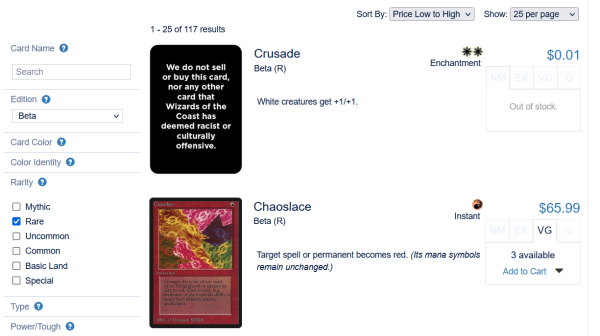
This brings me to Card Kingdom. I filtered their Beta inventory down to only the rares, sorted by price low to high, and this is what I see:

Crusade doesn’t count because Card Kingdom doesn’t buy or sell the card altogether. So the winner is Chaoslace! This is the cheapest Beta rare I could find, and Card Kingdom has the cheapest copies. What’s more, they’re in “Very Good” condition, which probably equates to a decent MP when compared to TCGplayer. Their next cheapest Beta rare is a “Very Good” Web for $83.99.

There was an error retrieving a chart for Chaoslace

Considering you can usually obtain Card Kingdom store credit at a small discount to cash, this is actually a pretty solid deal. If you want a piece of Magic history—one of the approximately 3,200 copies of a Beta rare—then picking up a played Beta Chaoslace from Card Kingdom is the way to go. I’m tempted to grab one myself, and may consider it if they still have any in stock when I next obtain some store credit there.

Let’s face it, the card may be largely unplayable, but it’s a pretty safe bet to say that a few years from now, the cheapest Beta rare will be worth a good bit more. Finding sub-$100 Beta rares will one day be a thing of the past.

Speaking of Things of the Past…

Let’s say you didn’t want to bother with Beta. Instead, you want a piece of Magic’s very first set every printed: Limited Edition Alpha. How much will you have to pay up to obtain such a card?

Well, for a moment let’s ignore rarity. Alpha rares are awfully sparse, making it difficult to find and compare prices. It’s safe to say that it’s very difficult to find Alpha rares for under $400 anymore—maybe a heavily played Lace can be tracked down, but it is ultimately dependent on what’s for sale on the open market at any given moment.

Instead, let’s keep this article more budget-friendly, and seek out the cheapest Alpha card period. This will likely be a common of some sort. How much would the cheapest Alpha common cost you?

Well I started with Card Kingdom, since that was where I found the cheapest Beta rare. Sorting by price, I see that Sea Serpent shows as the least expensive. However, Card Kingdom is completely out of stock of the card, so that doesn’t really count. It turns out Card Kingdom is out of stock of dozens of low-end Alpha cards! I haven’t seen their Alpha inventory this thin in quite some time. I’m not sure if that means they’ve been selling through their Alpha cards lately, or if they’re in the process of repricing everything.

In any event, the cheapest Alpha card I found on their site was a Good (likely HP) Ironclaw Orcs for $32. I’m pretty sure we can do better than that!

There was an error retrieving a chart for Ironclaw Orcs

ABUGames once again under-delivers—they only have a handful of Alpha cards in stock, and their cheapest is a heavily played Paralyze for $40.25. Star City Games has a few heavily played Alpha Plains in stock for $30, but the cheapest Alpha common they have in stock starts at $34.99. That certainly won’t qualify as the cheapest available, though it’s worth noting these cards are in “PL” condition, meaning they’ll be between LP and MP.

That brings me to TCGplayer—filtering to Alpha and sorting by price, I see the cheapest cards are either Power Leak ($20 for Heavily Played) or Jump ($19.99 for Heavily Played). All other copies increase from there.

There was an error retrieving a chart for Jump

Less than a decade ago, you could find Near Mint Alpha commons like these for a buck. Now the cheapest, most played copies surpass $20. Owning a piece of Magic’s very first set isn’t cheap, and I suspect it’ll get even more expensive throughout the 2020s. As long as Magic remains a robust, popular game and collectors dedicate resources to the hobby, these will continue to appreciate. If you’d like to have an Alpha card in your collection, TCGplayer is the way to go—just make sure you shop from a seller with a high feedback rating to avoid potential issues with clipped Beta.

Arabian Nights – Magic’s First Expansion Set

Let’s say you’re less interested in Magic’s first core sets, Alpha and Beta, and would instead prefer some of the more interesting and colorful cards from Magic’s first expansion set, Arabian Nights. What are some inexpensive cards to look at if you wish to add these to your collection, and what stores should you buy from?

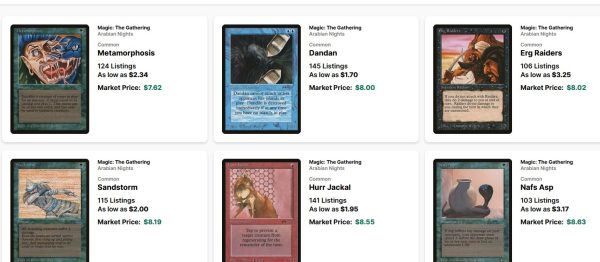
I again browsed TCGplayer, Star City Games, Card Kingdom, ABUGames, and a smattering of other locations. ABUGames's prices all start much higher than the rest of the market—I’d rather be selling Arabian Nights cards to ABUGames than buying at their current prices. Card Kingdom has significantly more Arabian Nights inventory than Alpha. But their Arabian Nights prices don’t start very low—their cheapest card is a very good Moorish Cavalry for $3.84 (at least an interesting card with artwork very representative of Arabian Nights).

There was an error retrieving a chart for Moorish Cavalry

Star City Games has exactly one card that’s cheaper than Card Kingdom’s cheapest Arabian Nights card: a heavily played Nafs Asp for $2.99. Is that the best we can do?

Once again, the cheapest copies available can be found on TCGplayer, where Arabian Nights cards can be found for under $2.  

Granted, the sub-$2 Arabian Nights cards are graded “damaged” and also carry a shipping cost, so if you want to pick one up on the cheap your best bet is to find other cards to add to the cart to save on shipping. If you only want to purchase a single Arabian Nights card for as cheaply as possible, you’ll likely have to pay around $3 for someone to throw one in a plain white envelope, smack on a stamp, and drop it in the mail.

It still beats paying $3+ for tracked shipping from Star City Games or Card Kingdom. Unlike with the Beta rares and Alpha commons, Arabian Nights cards are so cheap that things like shipping costs need to be taken into consideration. I’m not going to sit here and make a recklessly bold prediction about the cheapest Arabian Nights cards a few years from now. Instead, I’ll just say that there are plenty of inexpensive options if you’re looking to pick one or two up for your collection. Given there are over 100 listings of most of these low-end cards, that’s likely to be the case for some time yet.

Wrapping It Up

You could expand this exercise to Unlimited, Antiquities, Legends, and The Dark cards as well. But the reality is, the print runs on those sets are sufficiently large that copies of cheap cards from these sets are still plentiful. Sometimes when I’m making a purchase on TCGplayer, I like to browse commons from these sets to see if there are any fun, cheap cards to add to my collection for cheap.

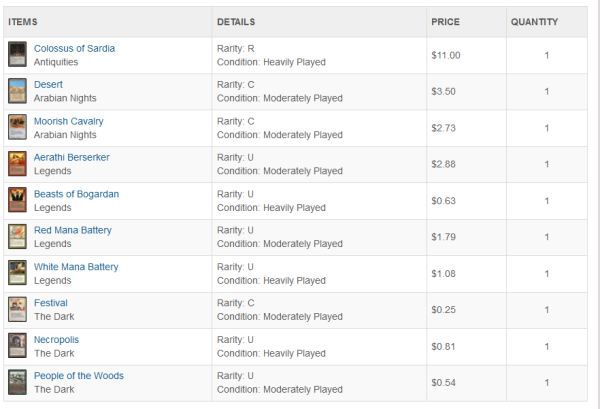
I actually did this just last weekend. I wanted to pick up a cheap Antiquities Colossus of Sardia and I found a heavily played copy that seemed fairly priced. So after adding it to my cart, I browsed the store’s other inventory and found a smattering of other fun oldies to pick up.

None of these cards are going to make me money—it’s not about that. This kind of purchase is just a fun way to enjoy some of Magic’s earliest sets in a budget-friendly way. I may be able to flip a couple of these cards to Card Kingdom’s buylist for a minuscule profit next time I send them an order. Until then, I’ll enjoy the aesthetic of these old cards.

I’m glad we can still experience and collect these nearly thirty-year-old cards for such a low cost. Hopefully, that doesn’t change, so that new players can continue to see where Magic got its beginnings back in 1993. The game looks very different now versus then, and I think owning a piece of this history is something to be cherished.

A Wild Week of Magic News

Are you a Quiet Speculation member?

If not, now is a perfect time to join up! Our powerful tools, breaking-news analysis, and exclusive Discord channel will make sure you stay up to date and ahead of the curve.

A Lot Going on in the Multiverse

With all the excitement happening in the world of Magic this week, I thought I would take today to cover some of the Magic news that you might have missed.

The Beginning of Spoiler Season

Spoiler season kicked off in a big way today with the full Kamigawa Neon Dynasty story now available on the mothership, and the first big round of official previews broadcast on Twitch and YouTube.

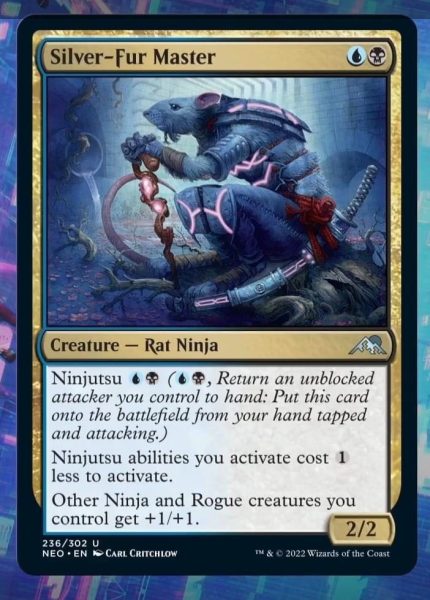
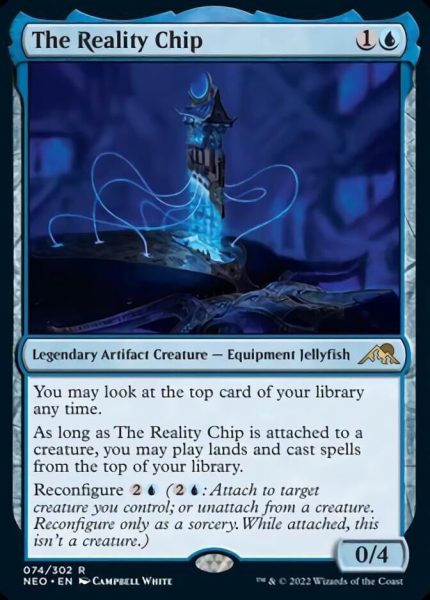
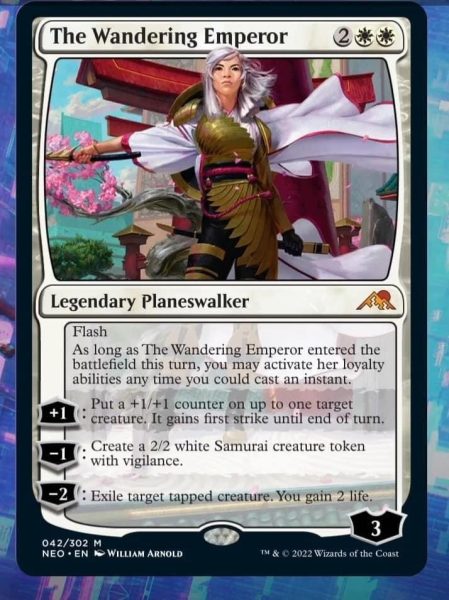
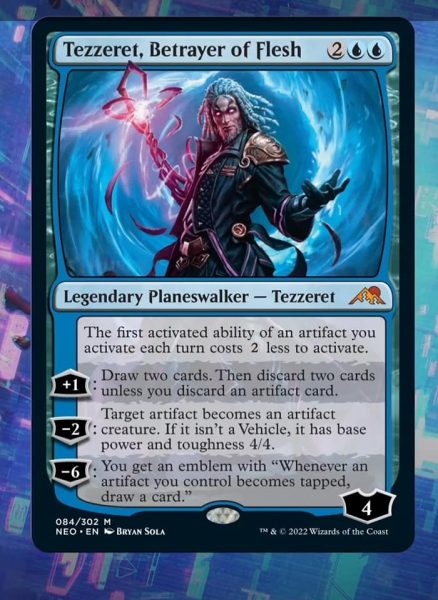
The preview show revealed all the planeswalker cards in the set, as well as a number of other goodies. Here's a sampling of some of the most exciting ones:

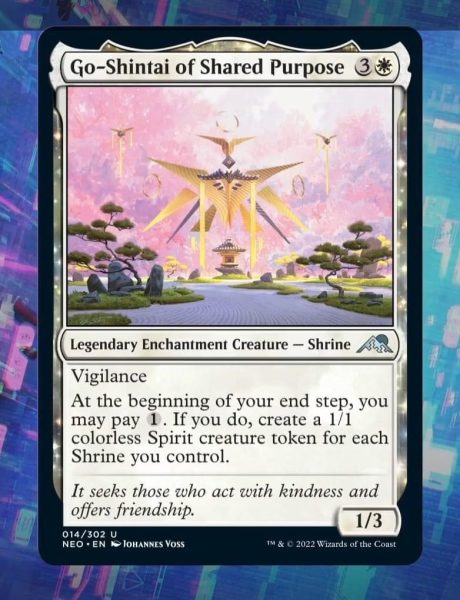
It wouldn't be a Kamigawa set without shrines, so I'm happy to see them coming back in Neon Dynasty. Of all the reveals, I think the card I'm most excited about is Silver-Fur Master, both because it's a lord for ninjas and rogues, and because of the obvious nod to Master Splinter from Teenage Mutant Ninja Turtles. Needless to say, if we don't get at least one green ninja turtle creature in this set, I will be disappointed. Wizards continued the reveal during the Weekly MTG show immediately afterward, sharing additional spoilers, as well as discussing the mechanics of the set, and the limited archetypes.

Based on what I've seen so far, Kamigawa Neon Dynasty looks like a slam dunk of a set. I'm looking forward to seeing more in the coming days. The launch of spoiler season was only the most recent part of an eventful Magic-related week.

Bannings in Standard, Legacy, and More

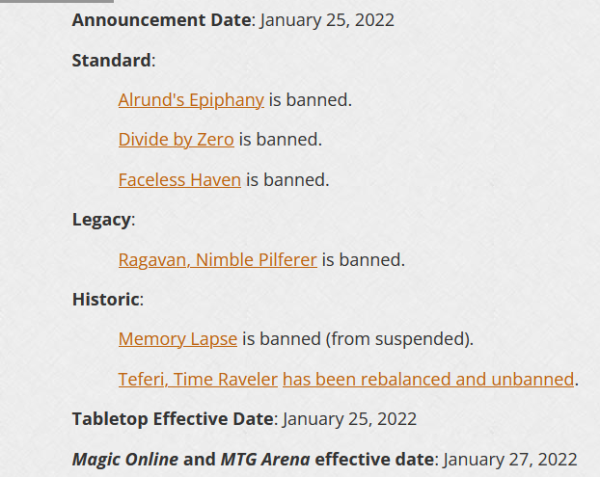
On Tuesday the latest Banned & Restricted list update nuked several cards from Standard and Legacy and brought a number of rebalances to Alchemy on Arena. Divide By Zero, Alrund's Epiphany, and Faceless Haven all exited Standard, and Ragavan, Nimble Pilferer was removed from Legacy.

There was an error retrieving a chart for Ragavan, Nimble Pilferer

For reactions and analysis from the QS team on the bannings, and equally important, what wasn't banned, you can check out our new podcast Quiet Conversations.

Bannings didn't just take place in Standard and Legacy this week.

Christopher Rush's Daughter Banned from MTG Art Market

In an announcement that stunned many in the Magic: The Gathering art collecting scene, Sierra Troi Rush, daughter of the late Magic artist Christopher Rush, was banned from the MTG Art Market, one of the internet's largest markets for the auction and sale of original Magic art. In the statement released on Sunday by Jason Sirichoke, of the MTG Art Market admin team, he wrote:

"Sierra has offered for sale a number of prints which she claims include the signature of her late father, Christopher Rush. Multiple members of the community raised concerns directly to the admin team about the signatures on these prints and pointed to several inconsistencies. The MTG Art Market team submitted samples of the signatures to PSA and BGS authentication services, two independent third parties. Both authentication services returned a result of “likely not genuine” and will not pass full authentication if physically submitted.

Jason Sirichoke, MTG Art Market Admin.

Based on these findings, the admin team voted 9-0 to issue a lifetime ban for Ms. Rush from MTG Art Market. During the investigation into the allegations, Ms. Rush maintained that "the ones with his signature were all from his personal stuff or storage. Which would all have been made by him."

Speaking to Quiet Speculation about the banning, Sirichoke suggested that folks with Rush prints now possibly questioning the authenticity of the signatures, should refer to Vault of Alexandria's "Ultimate Guide to the History of Cards Signed by Christopher Rush," or consult directly with an expert from the art community.

He had this general advice for collectors:

the #1 tip is to use the community and ask questions. We see people get burned the most keeping things "hidden" thinking they are getting the deal. There's a lot of experience in this community and folks willing to help. No one wants to see anyone get ripped off.

Jason Sirichoke, MTG Art Market Admin.

It was a week of shakeups in all corners of the Magic community, but few could have predicted this next piece.

SCG Lays off Most of Their Content Team

Star City Games (SCG) announced Tuesday they are laying off a large swath of their content team at the end of February. Announced the same day as the Banned & Restricted update, the news took a bit to circulate on social media but came as a shock to many readers.

In the statement, SCG owner Pete Hoefling cited a decline in the effectiveness of strategic content due to the lack of in-person events, and the content division losing a substantial amount of money over the last two years as reasons for the change. Not all content will be leaving the site, he notes. As part of the announcement, he reveals that SCG will be "debuting some new article series covering a variety of non-strategy/tournament-related topics," and continuing some of their existing content in that vein.

As a content creator myself, I was saddened by the news that so many brilliant creators will soon be out of work. As the Director of Content for a site committed to producing a variety of Magic content including competitive/strategic content, I strongly encourage any of those creators looking for work to reach out to me on Twitter or via email.

End Step

What do you think about all the Magic news this week? Have you checked out our new podcast yet? What Kamigawa Neon Dynasty cards are you most hyped about. Let me know in the comments, via Twitter, or email.

Avatar photo

Paul Comeau

Paul is Quiet Speculation's Director of Content. He first started playing Magic in 1994 when he cracked open his first Revised packs. He got interested in Magic Finance in 2000 after being swindled on a trade. As a budget-minded competitive player, he's always looking to improve his knowledge of the metagame and the market to stay competitive and to share that knowledge with those around him so we can all make better decisions. An avid Limited player, his favorite Cube card is Shahrazad. A freelance content creator by day, he is currently writing a book on the ‘90s TCG boom. You can find him on Twitter and LinkedIn.

View More By Paul Comeau

Posted in Banning, Free, NewsTagged , , , , , , , Leave a Comment on A Wild Week of Magic News

Have you joined the Quiet Speculation Discord?

If you haven't, you're leaving value on the table! Join our community of experts, enthusiasts, entertainers, and educators and enjoy exclusive podcasts, questions asked and answered, trades, sales, and everything else Discord has to offer.

Want to create content with Quiet Speculation?

All you need to succeed is a passion for Magic: The Gathering, and the ability to write coherently. Share your knowledge of MTG and how you leverage it to win games, get value from your cards – or even turn a profit.

Replacement Effects And How To Apply Them

Are you a Quiet Speculation member?

If not, now is a perfect time to join up! Our powerful tools, breaking-news analysis, and exclusive Discord channel will make sure you stay up to date and ahead of the curve.

Like That Keanu Reeves Movie

People often talk about replacement effects in the same hushed tones they use for layers. They ascribe mystic, cursed meaning to these things, and as soon as something wanders into their vision that might be a replacement effect they throw their hands up and yell "JUDGE!"*

But fret not, friends. This week I tackle replacement effects, from the mundane to the insane. Buckle up.

As a reminder, If you have any topics you'd like to see covered, you can reach me on Twitter or our Insider Discord.

* This is a good thing. Always call a judge if you have any doubts or want to double-check something.

The Basics

Broadly speaking, a replacement effect watches for an event it cares about and then replaces that event, either partially or completely. The replacement effect has to exist before the event they want to replace would happen. Perhaps most importantly, a replacement effect can only apply to a given event one time. If that weren't true, a card like Teferi's Ageless Insight would have you draw your entire deck the first time you tried to draw a card.

Modern templating gives us keywords and phrases to watch out for when determining if something is a replacement effect:

  • "instead," as on Winding Constrictor
  • "skip," as on Brine Elemental
  • "enters the battlefield with," as on Metallic Mimic
  • "As [this] enters the battlefield," as on Metallic Mimic
  • "[This] enters the battlefield as," as on Clone
  • "[This] enters the battlefield [state]," as on Bojuka Bog
  • "[Objects] enter the battlefield [state]," as on Orb of Dreams
  • "As [this] is turned face up," as on Gift of Doom

...okay, so even the basics get a little wordy. Let's look at some things in practice.

Like Wolverine, Not Like Jesus

Regenerate is a replacement effect that specifically replaces the "destroy" event. While "instead" doesn't appear on the card that has regenerate, it's implicit in the definition:

614.8 [...] The next time [permanent] would be destroyed this turn, instead remove all damage marked on it and tap it. If it's an attacking or blocking creature, remove it from combat."

Magic Comprehensive Rules

The regenerated creature never leaves the battlefield, so it won't trigger any abilities like "when [something] dies" or "when [something] enters the battlefield."

Applying No Replacement Effects

Sometimes, replacement effects don't get to do what they set out to do. If I resolve Gather Specimens, but my opponents never try to make any creatures enter the battlefield, Gather Specimens's effect does nothing. If I regenerate one of my creatures but it would never be destroyed, I basically wasted that regenerate.

Torbran, Thane of Red Fell doesn't like when you deal 0 damage. If you try to deal 0 damage with a red source, then no damage would be dealt at all. Torbran's replacement effect doesn't get to increase it.

If an object has a replacement effect on it that would affect a subset of permanents, that replacement effect can't apply to that object as it's entering the battlefield. If you cast an Orb of Dreams, for instance, it enters the battlefield untapped.

Cards entering simultaneously can't apply their replacement effects to one another, either. For instance, a Clone entering the battlefield at the same time as a Grizzly Bears can't copy the Bears. Similarly, if Living Death brings back Containment Priest and several other creatures, none of them will be exiled.

Applying One Replacement Effect

Sometimes, applying a replacement effect to an event can make other things happen (or not happen). For instance, let's say I control Thought Reflection[card] and [card]The Locust God and want to draw for my turn. I instead draw two cards, and The Locust God triggers twice. The original event of "draw one card" turned into "draw two cards," which made The Locust God trigger for each of those draws.

On the flip side, let's say I control Underrealm Lich and The Locust God. If I try to draw for my turn, Underrealm Lich's replacement effect turns that into me not drawing any cards at all, so The Locust God won't trigger.

This Is Getting out of Hand! Now there Are Two (Or More) of Them!

We can also apply multiple replacement effects to a single event. Let's say I control Teferi's Ageless Insight and Thought Reflection and want to draw a card with Opt in my main phase. I can apply Teferi's Ageless Insight first, which turns the card draw of Opt into "draw two cards." Then, I apply Thought Reflection's replacement effect, turning "draw two cards" into "draw four cards."

At this point, we're done applying replacement effects. As mentioned earlier, a replacement effect can only apply to an event once, and the root event here never changed from "draw a card with Opt."

And now, if I haven't scared you off... it's time to get weird.

An Island Unto Himself

Arixmethes, Slumbering Isle made a fair bit of noise when it came out in Commander 2018. After all, players love weird cards. It also deviates from the usual Simic commander template of "generic value." But soon, people started asking questions about how it interacted with other cards. Most of the confusion stems from one line of text: "As long as Arixmethes has a slumber counter on it, it's a land."

So, let's say I control Winding Constrictor and cast Arixmethes, Slumbering Isle. How many slumber counters does it enter with?

Six.

Originally, we only have Arixmethes' replacement effect to apply -- Winding Constrictor can't apply first because there aren't any counters yet. So we apply Arixmethes' effect, which says that it will enter tapped with five slumber counters on it.

"But wait," I hear you cry, "It has counters on it now, so it's a land! Winding Constrictor can't apply!"

Not quite. While it's true that Arixmethes will have counters on it once it's on the battlefield, it doesn't have counters on it right now. Since it currently has no slumber counters, it's still a creature, so Winding Constrictor's replacement effect still applies to it.

Feed Me, Seymour

The devour ability can lead to some downright unintuitive interactions. First, let's remind ourselves what devour does:

702.82a Devour is a static ability. “Devour N” means “As this object enters the battlefield, you may sacrifice any number of creatures. This permanent enters the battlefield with N +1/+1 counters on it for each creature sacrificed this way.”

Magic Comprehensive Rules

Cool. We know from earlier that this is definitely a replacement effect since it says "as [this] enters the battlefield." However, figuring out how devour interacts with other replacement effects gets weird.

Let's say I control a Corpsejack Menace and cast Thromok the Insatiable. If I choose to devour Corpsejack Menace, how many counters will Thromok enter the battlefield with?

Two.

First, we choose to apply Thromok's replacement effect -- but it doesn't sacrifice the creature yet because it hasn't entered the battlefield. Next, we have Corpsejack Menace's replacement effect to apply. Since Thromok is now going to have counters as it enters, Corpsejack Menace doubles that amount. The end result is a Thromok entering with two counters and a playgroup insisting you're wrong.

Cleanup

Replacement effects have enough depth that we may need to revisit this in the future for some more weirdness (especially if any rules around replacement effects change). Also, I know I didn't cover every nook and cranny. If you have any burning questions about replacement effects in general, something I didn't cover, or want clarification on what I did, drop me a line!

Join me next week for another layers article. See you then!

Question of the week: What's your favorite card with a replacement effect?

New (Old) Ways to Play Commander!

Are you a Quiet Speculation member?

If not, now is a perfect time to join up! Our powerful tools, breaking-news analysis, and exclusive Discord channel will make sure you stay up to date and ahead of the curve.

I attended a Commander event this past weekend and secured top four! How did I do it? Well, the better question is how did we do it! This was a Two-Headed Giant (2HG) Commander event where my partner and I made two completely synergistic (and degenerate) decks that went off almost every round on turn three with counterspell backup, stunning our opponents. As we looked around the room at the five-minute mark, we needed to do something for the rest of the rounds. Luckily I planned for this and asked my opponents a few questions about lesser-known formats. No one I spoke to at the event had played a single game of Emperor, Archenemy, Planechase, Grand Melee, or other special game types of Magic.

Magic players, I'm here to let you know that you are missing out! Not all of these special formats will appeal to everyone, but, there is certain to be one of them that will appeal to you! Not only that but remember that Magic is what you make of it; many of these formats have alternate rules that may appeal more to your group than the "official" rules.

First, I want to talk about why it's important to have these formats, and then I want to do a quick primer without getting too rules-y or buried in minutiae.

There's Nothing New Under the Sun

In Mark Rosewater's article "The Big Picture" he talks about the challenges of meeting the needs of Magic players who enjoy many different things. It's true that new cards are probably not designed with these alternate formats in mind but, more and more, R&D seems to squeak out a few cards like Scheming Symmetry which is okay for multiplayer but criminally insane in 2HG or Emperor.

I think the main point, however, is that these formats do exist, and, they really want to be played! Players use their own judgment when it comes to how playable a card is in a special format and do not need tailor-made cards to enjoy the experience. In fact, this is one of my primary contentions: playing a new format allows you to appreciate a card in a new light. Every Magic player has had that moment where they look at a card and think "This card is overpowered" or "This card seems pointless" but in another environment that card becomes average. Perspective is a great thing as is variety.

Staples vs Stale

I'm planning on a future Commander article talking about format staples but here's a small snippet; staples are boring. At the 2HG event in the third round, my opponent across from me revealed Derevi, Empyrial Tactician; I was playing the same commander! Here's the thing, though. In the cEDH scene, this commander has been relegated to the "role" of "Stax dot deck". If you're playing Derevi, the thought goes, you are obviously playing a Stax archetype, because why else play that commander? Answer: Because it's 2HG Commander. My partner is playing a combo deck that easily wins on Turn three with my help and this seemed like a compelling argument for playing Derevi over other ideas. But what about the actual cards in the deck?

The majority of staple Stax cards and Derevi staples would actively cripple our game plan. Further, my turn one Magus of the Candelabra surprised my opponent who said "Oh wow I should be running that!" The problem was my opponent had a multiplayer cEDH Derevi Stax deck that, in my opinion, was not tuned for 2HG. I had an extremely good idea of exactly what cards they would have in their deck, what I absolutely *needed* to counter, and what I could let slide. How did I know all this? They played both Commander and Derevi staples so it helped me identify exactly what their deck was going to do and what I needed to do to stop them.

2HG allowed me to change my perspective on Magus of the Candelabra, a card that is a bulk rare, but here was equally as effective as the significantly more pricey Candelabra of Tawnos. By experiencing a different format, I got to see another side of Magic and that is a good thing.

What's Old is New Again

If your Commander meta is getting predictable, boring or a little stale, try one of these formats; it will shake up just about everything. Have you ever experienced the pair of friends or the couple who are not technically on a "team" but are, well, on a team anyways? They are already effectively playing 2HG or Emperor, so, the rest of the table should as well.

Another nice thing to consider is what I call the "numbers problem." Let's say you have exactly seven or nine or eleven commander players for a multi-player, casual night. No one wants to leave anyone out, so, pod size tends to get very flexible; instead of the ideal four players, your pod might sometimes have three or five. I think this is an all right solution, but, it's not ideal. Introducing some additional formats into the mix can give you more potential solutions. Instead of three players in a single pod, they can play a 2HG match with a "team" of one player in charge of both "heads". Six players can play an Emperor match instead of, in my opinion, the less ideal two pods of three. Someone else can be the Archenemy for two to three players. More game modes are simply more solutions at hand.

Without further ado, a quick, rules-light primer on the different formats and why you should give each a try.

Two-Headed Giant

The Two-Headed Giant Rules are here, and I do believe it's played much more widely than any of the other formats I'll list. One of the best parts about 2HG is how it's essentially Magic from a *rules* standpoint, but, it's significantly different from a card value and strategy standpoint. For example, cards that say "Each opponent" effectively double in power because teams have only one shared life total. This makes something like Exsanguinate just that much scarier.

Obviously, you can play 2HG in constructed or limited but Two-Headed Giant Commander has made me interested in the format all over again and I think it could do the same for your playgroup if you're feeling burned out or tired of the same old thing. It really makes you look at a whole range of new cards and apply new values to everything.

Emperor

Two teams of three square off with the middle player of each team as the Emperor and the other players as Generals. The game ends when an Emperor is eliminated. Alright sounds somewhat normal so far, what sets Emperor apart from just a multiplayer-team game? First, spells and abilities have a limited range of effects called "influence." Generals start out only able to affect the opposing General or help their friendly Emperor, and, the Emperors are effectively safe from harm until one General is eliminated.

Secondly, players can "Deploy" creatures by tapping them during the turn and passing them to a teammate; this is where the fun happens. Teams have to balance offense and defense across multiple angles. The number of team strategies is radically higher than a "normal" multiplayer game. Playing a "normal" deck in Emperor tends to lead to lopsided games but I believe that is the point; once you see the format it can spark new ideas, new themes and create some interesting results.

Furthermore, there are a lot of variants to the official Emperor rules that I think make the format even more enjoyable and I leave it up to your particular playgroup to explore the interesting ones and abandon the unfun ones! Also, don't forget about points which are even spicier when explored across teams!

Grand Melee

Going back to the eleven-player scenario, why not just have them all play one large game? That is the idea of a Melee. Again, you have an "influence" of one, thus your spells and abilities only affect yourself and the player to your immediate left and right. Typically, you can only attack the player to your left although I have played in alternate rules events where it was to the right or it switched periodically. Another interesting aspect of the variant is that multiple turns are occurring at the same time. For every four players, there is a turn marker continually passed around the table.

I've been in Grand Melees with up to one hundred players and it's definitely a blast! Games can take a long, long time, with that many players though. It's not something I think many players would be interested in doing every month. However, it's definitely a good and unique Magic experience that I think more players would appreciate as a special event.

Planechase and Archenemy

I've decided to cover these two formats at the same time because they both utilize products that may or may not be available to your local group.

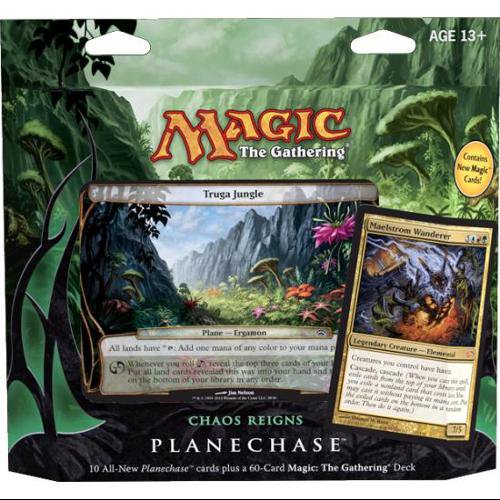
Planechase provides a deck of cards that represent the Plane you and your fellow players are currently occupying. Each plane has different special rules such as doubling your mana or drawing more cards. Players can choose to stay on the Plane or roll a special Planar die to attempt to exit the current Plane and go elsewhere with new rules. Different Planes end up favoring different decks so there is always a back and forth that occurs when a deck hits a particularly favorable Plane and the entire table is trying their best to exit with no luck.

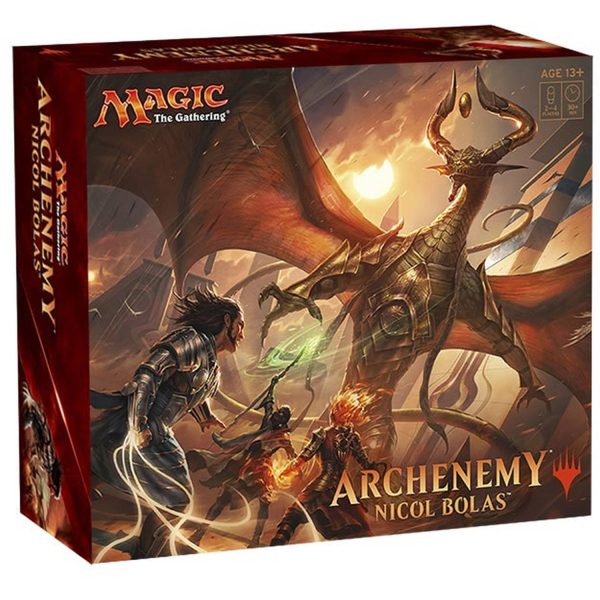
In Archenemy one player represents the eponymous Archenemy who is against two or typically three players. The Archenemy gains an entire deck of special cards called Schemes which power them up enough to realistically fight two players, and sometimes completely overpower three.

These are fun variant games and work well with Commander. If you feel like you're always getting ganged up on or you and the other players want to take down a particular player, Archenemy makes for a fun experience. In a very normal, very casual multiplayer Commander setting, Planechase is right at home.

Both of these formats have been added onto and I am *patiently waiting* for the next step from Wizards. All right I lied, Wizards PLEASE print more Planechase and Archenemy!

The Mysterious Others and Mixing and Matching

There are a lot of homebrewed formats I have played at various events across years of play; some were good, some were great but many were duds. One fairly common and interesting play variant involves having a permanent global effect. MTG: Arena regularly runs events like this where, for example, Omniscience is in play. These types of events are some of the most fun for me. In a similar vein, I've been to events where the host has a special deck of cards and every so often one card is played from the deck with shocking consequences; a Wrath of God out of nowhere can reset games, Howling Mine can ramp up the early game and even an Ajani's Presence can be a surprisingly strong shakeup at times.

Of course, there are also the horror stor...I mean the "fond memories" of playing Archenemy Planechase Commander because mixing so many different game elements is a perfectly acceptable idea. I would caution a group about going overboard and suggest that too much of a good thing is entirely possible. All these elements together can overwhelm new players or weigh down players who do not want the added complexity of Planes, Dice, Schemes, and more.

So, Will You be Playing Emperor This Weekend?

Hopefully, I've given you a little food for thought. Magic is definitely a lot of things to a lot of different people and I say the more the merrier. Not only will you see cards in a new light, but, you will also see other players in a new light as well; maybe you are sitting across from the greatest Archenemy of all time and don't even know it. If you have not given some of these formats a try ever maybe this weekend is a good time to have a good time!

Let me know your favorite special format in the comments below!

Quiet Conversations Episode 1- “The Good, The Banned, and The Ugly.”

Are you a Quiet Speculation member?

If not, now is a perfect time to join up! Our powerful tools, breaking-news analysis, and exclusive Discord channel will make sure you stay up to date and ahead of the curve.

The Ban Hammer Comes Down

Five members of the Quiet Speculation team got together to talk about Tuesday's Banned & Restricted update in the first Quiet Conversations podcast.

Show Notes

  1. Introductions
  2. Standard: Where does the format go from here?
  3. Legacy: The "Ragavan Effect." How has this banning changed anything?
  4. Arena: So many Alchemy changes.
  5. The Elephant in the room: NO Modern bans!?
  6. Silence on other formats: (Pioneer, Commander, etc.)

Pannel Members

Real-world Flavor. Coleridge’s Quotes From Alpha to Portal

Are you a Quiet Speculation member?

If not, now is a perfect time to join up! Our powerful tools, breaking-news analysis, and exclusive Discord channel will make sure you stay up to date and ahead of the curve.

About, about in reel and rout

The death-fires danced at night;

The water, like a witch’s oils,

Burnt green, and blue and white.

In previous installments, we analyzed the nature of real-world quotations in Magic flavor text from a variety of sources. We dealt with the classical world (Greek and Latin literature), explored Arabian Nights (One Thousand and One Nights), and unpacked the literary basis behind Portal Three Kingdoms, and Chinese authors other than Luo Guanzhong quoted in flavor text. Now, it’s time to pass to English-speaking authors.

As we saw in the first article of the series, the most represented authors from this group are William Shakespeare and Samuel Taylor Coleridge, with Edgar Allan Poe and many others a few steps behind. Let’s start with Coleridge, whose quotation on Scathe Zombies we have already discussed.

Samuel Taylor Coleridge

There exist six unique cards with a flavor text consisting of a quote from Coleridge. Interestingly, five of them come from Limited Edition Alpha (1993). The last one was instead first printed in Portal (1997). It looks like Coleridge was an author very much beloved in the beginning, and then almost forgotten. Why is that the case? We’ll try and answer at the end of this article. Now, let’s see the cards in more detail.

Hypnotic Specter

…There was no trace / Of aught on that illumined face…

The first card is an all-star of mono-black decks ever since the beginning of Magic. A 2/2 flying specter for three mana is not bad, and whenever it deals damage to an opponent, they will have to discard a card at random. It’s one of the most typically black abilities, and this creature has always had many fans throughout the course of Magic's history.

What about the flavor text? It’s a couple of lines from Coleridge’s short poem Phantom. On a card with an image like this one, it’s a strong choice in my opinion. It’s about an illumined face with no trace of aught, and it goes very well with the beautiful illustration from Douglas Shuler.

It’s a text in verses, and it starts with an ellipsis, as the first half of that verse was eliminated. I like the briefness of the quotation, as it makes the card even more mysterious by avoiding excessive details. It’s a shadow, it’s mesmerizing and it makes opponents discard cards. The clipped lines from before the flavor text begins are: "All look and likeness caught from earth / All accident of kin and birth, / Had pass'd away." Very spooky.

Plague Rats

Should you a Rat to madness tease

Why ev'n a Rat may plague you…

The second card is another typical black creature. This rat costs three mana and gets bigger and bigger depending on how many rats you control. Not that powerful, but I like the illustration and the concept. The flavor text is also a nice addition.

The quotation comes from Coleridge’s work: Recantation. This poem is a bit longer than Phantom, but still, it's a short one, very distant from his famous The Rime of the Ancient Mariner. It’s in verses, again, but this time there are no ellipses. It’s two full lines of the poem, and it contains both the word ‘Rat’ and the word ‘plague’, which together make for the full name of the card.

The flavor text also contains words such as ‘madness’ and ‘tease’, which are really spot on in a card like this one. They contribute to evoke ideas of crazy swarms of rats, in a similar way of Relentless Rats. In the following lines, not included on the card, it states that "Rage and Fear are one disease", adding to the idea of blind terror of a rats' swarm.

Scathe Zombies

They groaned, they stirred, they all uprose,

Nor spake, nor moved their eyes;

It had been strange, even in a dream,

To have seen those dead men rise.

We have already seen this card in the first article of the series. There was no particular reason, except that it’s probably my favorite card ever, and the flavor text is a huge part of this. Let’s recall the main characteristic of Scathe Zombies.

It’s a 2/2 black creature for three mana, which makes it an overly costed Grizzly Bears. There’s an actual reason for that, and that is the attention of Magic developers to colors’ balance. From the very beginning of this game, they knew green creatures must have a bit more raw power when it came to stats, and this is a great example.

The quote appearing in the flavor text is a famous passage from Coleridge's masterpiece The Rime of the Ancient Mariner. It’s a much longer poem than could ever fit on a single card. This particular excerpt comes from a scene where the protagonist recalls his encounter with a crew of dead men. It’s among the first examples of the literary trope of the ghost ship.

On this card, there are no references to any ship or mariner, but in my opinion, it makes it even stronger. In fact, it makes it more adaptable. Even when taken out of context, it works with the idea of horror and profanity it wants to convey.

Wall of Ice

And through the drifts the snowy cliffs

Did send a dismal sheen:

Nor shapes of men nor beasts we ken—

The ice was all between.

After three black cards, this is the first from another color. Wall of Ice is a green creature. It has defender like every other wall, and cannot attack. The illustration is a great one, and the flavor text comes once more from The Rime, this time from a different passage. It’s funny because you might think that work is better used for black creatures, given its dark and horrific atmosphere, but it still works.

This quotation doesn't mention any zombie, dead man, or other gothic creatures of fantasy. It just describes a drab landscape, that the protagonist remembers seeing from his ship. There are no living beings in these four lines, there is just nature. It is still a hostile kind of nature: there are "snowy cliffs" a "dismal sheen" and ice that is "all between." The illustration works very well with this quote since they are both cold and inhospitable.

Will-o'-the-Wisp

About, about in reel and rout

The death-fires danced at night;

The water, like a witch’s oils,

Burnt green, and blue and white.

This small spirit is the fifth card from Alpha. Again, it’s a creature, and once more it’s black. For the third time, the excerpt comes from The Rime. Another similarity is in the number of lines. Just as it happened with Scathe Zombies and Wall of Ice, it contains four verses.

This time, it mentions the setting of the scene, saying that the water (seawater) shows colors such as green, blue, and white. That is the effect of the presence of the ‘death-fires’, i.e., another name for the fantastic creature commonly known as Will-o'-the-Wisp. Interestingly, the three colors mentioned are all in Magic’s color wheel, but black is missing. The colors also appear in the illustration, and overall it's a very consistent creative choice.

It’s a dark and scary card, even though it doesn’t mention any direct element of horror. There is a similarity with the "witch’s oils", to which the water is compared. We don’t know what it actually means, but just as it happened with Hypnotic Specter the flavor text adds to the overall impression of the card.

Sacred Nectar

For he on honey-dew hath fed,

And drunk the milk of Paradise.

This last card is the only one that was printed outside of Alpha. There was no mention of Coleridge during the four years between Alpha and Portal. This one doesn’t come from the Rime, even though the work it comes from is nowadays frequently published together with it. We are talking about Kubla Khan, a short poem (about 50 lines) with a remarkable variety of metric and rhythmic choices. This excerpt is actually the closure, made of the final two lines of the poem.

It’s the first card with a quotation from Coleridge that is not a creature. It’s a sorcery, and a white one - another novelty since we only saw black and green so far. The spell gains you four life for the cost of two mana. It was reprinted several times in later core sets, not necessarily with the same flavor text.

This quote is very on theme for white, as much as the previous ones were for the black cards we discussed. It mentions concepts such as ‘honey-dew’ and ‘milk of Paradise’. In my opinion, this kind of flavor text is among the best choices. It works because it’s evocative, it delivers a concept that marries well with the essence of the card. In the case of Sacred Nectar, the idea of purity. You don’t need to know the poem it comes from; you’ll still get what it’s about, and it resonates strongly.

What Do They Have in Common?

This is the first question we normally try to answer. Why did these specific cards all receive a quotation from Coleridge? Do they share any quality? We already saw how most of them come from Alpha, but that’s not enough. What about the color?

Four of them are black, one is green, and one is white. The majority of Coleridge's style is capable of evoking dark feelings, thus making them align well with black cards. Rats, Specters, Zombies, Spirits are all dark, shadowy creatures, and the words of Coleridge strongly resonate on these cards.

What else? We might say that, regardless of the color, these six cards share a special quality connected to ancient magic, which Coleridge evokes in his writings. It might just be that in retrospect, we see Alpha as the old-school edition par excellence, but I’d say it was a good choice to limit the use of Coleridge to that set.

Conclusions

Today we examined one of the most quoted English-speaking authors. It's still too soon to draw conclusions about English-language writers overall. However, it might be fair to say that Coleridge was perhaps a bit overused during Alpha, and then mostly abandoned.

Other English-language authors such as Shakespeare, Poe, Carrol, and Milton have their quotes spread throughout Magic’s history. They all appear on cards from more than two different sets. In the next few articles, we will see what they have to offer.

Alchemy Mono-red Dragons| Adam Cohen

Are you a Quiet Speculation member?

If not, now is a perfect time to join up! Our powerful tools, breaking-news analysis, and exclusive Discord channel will make sure you stay up to date and ahead of the curve.

Dracarys!

This week, I’m taking one of the top decks in Alchemy for a spin—Mono-red Dragons. The primary engine of this archetype comes in the form of Orb of Dragonkind and the digital-only Fearsome Whelp. Both of these cards are two-mana accelerants that let you play powerful four, five, and six-mana dragons early. Each of these large, evasive creatures are must-answer threats that put a great deal of pressure on your opponent.

One of the heaviest of hitters is the new Town-razer Tyrant, which wipes an opponent’s land of its non-mana abilities and deals damage to them each turn until they sacrifice it. With your deck built around playing Tyrant on turn 3, that’s either a ton of cumulated damage or a major tempo loss to your opponent by sacrificing their early lands.

Rounding out the creature-base are Moonveil Regent, Goldspan Dragon, and Inferno of the Star Mounts. Each does a great job at pressuring your opponent, be it through snowballing resources or hitting hard with flying and haste.

Difference of Opinion

The Dragons archetype has also embraced a few different variations. Some are splashing white for Adult Gold Dragon, Valorous Stance and Nadaar, Selfless Paladin. Others are splashing blue for Iymrith, Desert Doom, and sideboard counterspells. Mono-red however, gets to utilize snow mana for cards like Frost Bite and Tundra Fumarole. It also gets access to the new Chandra, Dressed to Kill planeswalker, which thrives in exclusively red decks. There's no right or wrong answer for which version to use. It comes down to personal preference as well as the slight variations in the metagame on a given day.

What I'm Playing

I borrowed my decklist from Wyatt French, a player who made Top 8 of the NRG Series $1K over the weekend, and ran it through a few matches on the Arena ladder. Note that French accidentally registered a 61 card list. I cut a land because that seemed like the correct cut based on the rest of the list. Check out the video below to see how I did! If you have any questions about the deck or its place in the metagame moving forward, feel free to leave a comment or shoot me a message on Twitter at @AdamECohen.

Alchemy Mono-red Dragons

Creatures

4 Fearsome Whelp
2 Inferno of the Star Mounts
4 Moonveil Regent
4 Town-razer Tyrant
4 A-Goldspan Dragon

Spells

2 Tundra Fumarole
4 Shatterskull Smashing // Shatterskull, the Hammer Pass
3 Frost Bite
4 Dragon's Fire

Planeswalkers

3 Chandra, Dressed to Kill

Artifacts

4 Orb of Dragonkind

Lands

19 Snow-Covered Mountain
3 A-Faceless Haven

Sideboard

1 Abrade
2 Brittle Blast
2 Burning Hands
1 Chandra, Dressed to Kill
3 Conductive Current
4 Rahilda, Wanted Cutthroat
2 Thundering Rebuke

Everything Burns: A Deck Dive

Are you a Quiet Speculation member?

If not, now is a perfect time to join up! Our powerful tools, breaking-news analysis, and exclusive Discord channel will make sure you stay up to date and ahead of the curve.

There are those that complain that Modern has become a rotating format. They will point to the impact of Modern Horizons 2 on the current metagame and all the cards (and subsequently decks) which have been outclassed. And while there is a certain truth to the sentiment, harping on it too much distracts from the actual truth. The game evolves and changes over time. New cards get printed and players are going to take advantage. If that didn't happen, Magic would get stale quickly. If you want to play a game that never changes, might I suggest... Monopoly?

Furthermore, while it is true that many decks were fundamentally altered by MH2, that wasn't true of every deck. Or even every good deck. Namely, despite efforts to the contrary, Burn in 2022 is basically the same as Burn from 2019. And hasn't drifted very far from the 2014 Burn. Yet it remains a top tier deck in Modern, even taking fourth place for all of 2021. Which on the surface seems to defy how current Modern works, but in reality it makes perfect sense.

Anatomy of a Survivor

I realize that saying that Burn needs more examination sounds weird. I mean, it's Burn. It has always been. It always will be. What more is there to say? A lot, given that I'm writing a whole article on the subject. And it starts with that attitude. For a deck to hang around for decades of competitive Magic history and remain a major player is a significant achievement.

There was an error retrieving a chart for Lightning Bolt

That by itself should not be surprising. Every Standard rotation, the first decks to emerge are aggressive red decks. The legendary Sligh deck invented the concept of mana curve, and red's combination of cheap haste and burn spells is always a solid strategy. The thing is that as (most) Standards evolve, the red decks fall off, as other decks become more optimized and powerful. However, year in and year out, Modern Burn just keeps on trucking. Which is downright anomalous.

The Unchanging

To reiterate an earlier point, Burn has not changed less over Modern's history than any other deck. That I'm aware of, anyway. Of the decks from the dawn of Modern in 2011, only UW Control, Burn, and Tron remain as top contenders. While all these decks have changed significantly since 2011, Burn stands as the least changed card-wise. Even Tron started out as a red/green deck primarily concerned with dropping Karn Liberated, and these days is mono-green and has a wider threat package. More importantly, it has continuously evolved over the years.

There was an error retrieving a chart for Karn Liberated

Conversely, Burn... just doesn't change. The last time the deck was seriously redesigned was in 2019 to accommodate Sunbaked Canyon and Skewer the Critics. I hate to keep harping on this, but just take the decks I linked above and compare them.

GP Milan 2014-Lucantonio SalvidioEternal Weekend Pittsburg 2019-Conner KnoxMTGO Modern League Jan. 2022-Daddematte
Lands-19Lands-19Lands-20
4 Arid Mesa2 Arid Mesa4 Arid Mesa
4 Scalding Tarn2 Bloodstained Mire1 Bloodstained Mire
3 Sacred Foundry2 Sacred Foundry2 Sacred Foundry
6 Mountain3 Mountain3 Mountain
1 Sulfur Falls2 Wooded Foothills2 Wooded Foothills
1 Steam Vents4 Sunbaked Canyon4 Sunbaked Canyon
4 Inspiring Vantage4 Inspiring Vantage
Creatures-12Creatures-12Creatures-12
4 Goblin Guide4 Goblin Guide4 Goblin Guide
4 Monastery Swiftspear4 Monastery Swiftspear4 Monastery Swiftspear
4 Eidolon of the Great Revel4 Eidolon of the Great Revel4 Eidolon of the Great Revel
Sorceries-10Sorceries-12Sorceries-12
4 Lava Spike4 Lava Spike4 Lava Spike
4 Rift Bolt4 Rift Bolt4 Rift Bolt
2 Treasure Cruise4 Skewer the Critics4 Skewer the Critics
Instants-19Instants-17Instants-16
4 Lightning Bolt4 Lightning Bolt4 Lightning Bolt
4 Boros Charm4 Boros Charm4 Boros Charm
4 Lightning Helix4 Lightning Helix2 Lightning Helix
4 Skullcrack1 Skullcrack2 Skullcrack
3 Searing Blaze4 Searing Blaze4 Searing Blaze

The manabases have changed significantly since 2014. However, the biggest change in spells was that Treasure Cruise was legal. The creature base is exactly the same now as it was, and the spell mixture is barely changed. It's not that Burn never changes: I vividly remember Companion Summer and Burn's dalliance with Atarka's Command. Still, the deck inevitably returns to form.

The Exception

Which is strange. I've said that context is everything and it's the ebb and flow of cards in the metagame that determines card power and deck viability. Which is true, and yet here's Burn not really joining in. Meanwhile, Modern's evolution and card pool have redefined the formats pillars, but again, Burn missed the memo. Yes, it does play Lurrus of the Dream-Den, but only because doing so requires absolutely no changes to the maindeck. And anyone who's played Burn will agree that Lurrus is mostly irrelevant to the deck. It just keeps doing its thing while the format moves around it.

There was an error retrieving a chart for Lurrus of the Dream-Den

Understanding the Assignment

And frankly, it's right to do so. Burn doesn't need to change. It got it right the first time, requiring refinement if and only if something more efficient comes along. Which, given Wizards' experience the last time Lightning Bolt was in Standard, is quite rare. Burn is a fully optimized deck because it understands the assignment and how to complete it most efficiently.

True Mastery

I'll argue that Burn has the most consistent kill of any Modern deck. Barring poor variance, Burn always goldfishes on turn four. It has many hands which kill turn three. Only Hammer Time really keeps pace with Burn in terms of goldfish speed, though Amulet Titan can certainly get busted hands. Thus, Burn always has game against any deck because without relevant interaction, it will just win the race.

Furthermore, Burn is arguably the most efficient deck in Modern. It plays the best one-mana haste creatures. Eidolon of the Great Revel is an aggressive creature that punishes opponents and also provides a check against combo decks. At low life totals, Eidolon becomes a lock piece. Also featured: all the best spells that deal 3 damage for one mana, and the best of the two-mana burn spells. No slot wasted; no rough edge.

There was an error retrieving a chart for Eidolon of the Great Revel

And this is because Burn is a focused deck. It focuses only on what matters, and that's getting the opponent dead as quickly as possible. However, the same can be said for any Modern deck, especially in post-MH2 Modern. And there have been times in Modern's history when Burn was supplanted by other red decks, most recently when Izzet Prowess dominated 2019 and early 2020. But the reason for that is also the secret to Burn's success.

Playing Modern

Burn exploits a fundamental limitation of Modern: its manabase. Fetchland into shockland is how most decks intend to start their games. This means they begin the game down 3 life, or an entire Bolt, giving Burn a head start in the race. The need to continue fetching and/or shocking to keep pace with Burn's tempo further shortens the clock. So long as fetch-shock remains Modern's preferred manabase, Burn is bound to remain a major player.

There was an error retrieving a chart for Goblin Guide

Those times where Burn has fallen off correlate with periods of lower fetch/shockland usage or when the weakness was heavily mitigated. The former was true in early 2020. Amulet Titan was billed as the deck to beat, driving out all the midrange decks. This meant that Izzet Prowess and its explosive bursts of damage were better positioned in that metagame.

Uro, Titan of Nature's Wrath is the Ur-example for the latter circumstance. Gaining life has always been the counter to Burn, and continuous lifegain will put the game out of reach. Under normal circumstances, Burn retains inevitability as long as it isn't dead or completely locked out, any burn spell can kill. However, a threat that gained life and also granted land drops was too much to overcome.

Burn is not a "metagame deck" in the traditional sense of being highly metagame-dependant. It doesn't care about the specific combination of decks seeing play. Instead, it cares about what Modern as a whole is doing. It metagames against the facts of Modern life, and not its individual players, a nuance granting it immense staying power.

Case in Point

I bring this up because there have been attempts recently to improve on Burn that haven't worked out. And the reason is that they just don't get what Burn is trying to do. Either there's attempts to solve problems which don't exist or pressure to conform to how Modern "should" be. The most recent example was proposed by AspiringSpike (or at least he brought attention to it).

Life Total Control, Aspiring Spike

Creatures

4 Dragon's Rage Channeler

4 Monastery Swiftspear

4 Eidolon of the Great Revel

Artifacts

4 Mishra's Bauble

Sorceries

4 Lava Spike

4 Rift Bolt

Instants

4 Lightning Bolt

4 Searing Blaze

4 Lightning Helix

4 Boros Charm

2 Skullcrack

Lands

4 Bloodstained Mire

4 Inspiring Vantage

4 Sunbaked Canyon

2 Sacred Foundry

1 Scalding Tarn

3 Mountain

Sideboard

1 Lurrus of the Dream-Den

3 Silence

2 Kor Firewalker

2 Skullcrack

3 Deflecting Palm

4 Smash to Smithereens

The idea with this deck was to maximize Lurrus value and also exploit Dragon's Rage Channeler as both card selection and an evasive threat to sneak in the last points of damage. Given the direction of the format and DRC's position as pillar of the format, this would seem to be a good move.

Reality Check

Except that it's not. As a side effect of gathering data for the metagame updates, I see hundreds of decklists every month. This means I see which variants are succeeding and which are not, and Spike's variant is nowhere close to boring old faithful. As of writing this, I've seen four DRC Burn lists and over a dozen normal ones. And the DRC version didn't do noticeably better than the normal versions.

There was an error retrieving a chart for Dragon's Rage Channeler

And I know why this is happening because I've been playing Spike's list for most of January. I like the list, but I'm under no illusions that it's better than normal Burn. DRC's damage output is lower than Goblin Guide which it replaced. DRC compensates with a better long game. However, Burn doesn't want a long game; it wants to kill on turn four. Bauble and DRC don't facilitate that outcome, and so overall, this version is worse than classical Burn decks.

Still, I happen to like this version because I have very specific needs. My local metagame is so red-heavy that a number of decks have started running maindeck Burrenton Forge-Tender which just dumps on Guide. DRC jumping over Forge-Tender is extremely relevant for me, so in this very narrow context, the DRC version secures and edge. I'm also generally frustrated with Skewer the Critics and not playing that card felt good. But it does mean that I can't throw as much burn per turn. In an open field, I'd call the deck plain worse.

Don't Fix What's Not Broke

Just because a deck doesn't fit in with a format's current trajectory doesn't mean that the deck is wrong. The only important factor here is whether or not it wins. Burn works because it understands Modern and plays to the format, not any specific expression of that format. Trying to alter or change that is only justified when the format is no longer favorable. Metagame's come and go, but some decks are built for the long haul. And no deck has been hauling longer than Burn.

A Few Oddities from Magic’s Past

Are you a Quiet Speculation member?

If not, now is a perfect time to join up! Our powerful tools, breaking-news analysis, and exclusive Discord channel will make sure you stay up to date and ahead of the curve.

Over the weekend, I was discussing some commons and uncommons from Magic’s earliest sets—namely Legends, The Dark, Arabian Nights, and Antiquities. He was sharing a simple photo of a bunch of singles he picked up from a seller on eBay. Nothing too exciting.

But then I saw one of my all-time favorite cards in the bunch. No, he wasn’t purchasing Shahrazad. There were no Jaya Ballard, Task Mages in the lot, either (I’m still gunning for 1,000 copies and am closing in!). Instead, he had a copy of Quagmire. Stop and tell me if you’ve ever heard of this card.

There was an error retrieving a chart for Quagmire

Why do I like this card so much? Are there other random, obscure cards that people may appreciate for one reason or another that most players probably never heard of? You’ll have to read on to find out!

Quagmire

Why have I owned a copy of Quagmire for years now, and keep it aside as a card I would never sell? There are two reasons, and neither has anything to do with the card’s rules text. In fact, despite looking at the card every time I open my binder, I couldn’t recite from memory what it does or its casting cost. Those features have nothing to do with why I find the card amusing.

First of all, there is the card’s name. I’m not much of a Family Guy fan, but I’m sure there’s a large overlap between Magic players and folks who are familiar with the quirky character named Quagmire on the show. I vaguely recall that Quagmire has some sort of goofy, probably offensive, theme song. But all I can remember is, “He’s Quagmire, he’s Quagmire. Giggety giggety goo!” That’s the ditty that runs through my mind as I read the card’s name. Every time.

Secondly, there’s the goofy artwork. You may ask why a picture of a guy sinking in a soft, boggy area of land that gives way underfoot is amusing. It’s because, for some unknown reason, the guy is doing the dance from Michael Jackson’s Thriller as he’s sinking. I mean, doesn’t it look like that to you too?

Whether or not you can see the similarity may impact your thoughts on the card. However, the truth remains that this is no longer a worthless, bulk Magic card. Despite the fact that this uncommon sees virtually no play, it can still be buylisted to Card Kingdom for $1.50. I’d wager this card won’t ever be reprinted (who would want to open this card in any booster pack nowadays?). It could be worth grabbing a copy if you have the same appreciation for 1982’s Thriller as I have.

Presence of the Master

What do you get when you cross Albert Einstein with Magic? The answer: two distinct Magic cards from the Legends set.

One of those cards is Eureka, which is a high-profile and valuable rare that depicts Einstein’s famous equation, “E = MC2” on the artwork.

There was an error retrieving a chart for Eureka

The other is a far more obscure and less-often played enchantment that actually includes a prominent likeness of the turn-of-the-century scientist.

There was an error retrieving a chart for Presence of the Master

Once again, I couldn’t tell you from memory what this card does. But I can certainly picture Phil Foglio’s unique artwork for the card in my head without too much difficulty. You’ve got Einstein in the center with a bunch of planets surrounding him. I want to say it’s a picture of the planets in our solar system, but there are ten pictured so I have no clue what that means. A quick Google search didn’t drum up any explanations, either.

What I can say about the card is that it has a special piece of artwork and has occasional utility in play, locking out other enchantments. It may come as no surprise that the card buylists to Card Kingdom for $13 as a result. The card is more iconic and more useful than Quagmire and deserves a higher price tag.

What is surprising is that this enchantment was actually reprinted once, back in Urza’s Saga. Fortunately or unfortunately (depending on your viewpoint), the reprint’s artwork did not include Albert Einstein. As a result, copies of that version buylist for a nickel. Because of the reprint, I’m not going to come out and declare this card will never be reprinted again as I did for Quagmire.

What I will predict is that no card will ever depict Albert Einstein in the artwork again...unless they do some sort of Secret Lair series with famous scientists. I think there’s a higher likelihood of winning the lottery twice, though.

Sorrow's Path

I’ve seen multiple videos and articles citing Sorrow's Path as the worst Magic card of all time. This is tough to prove in an absolute sense, but it’s clear this land has very little going for it.

There was an error retrieving a chart for Sorrow's Path

The circumstances in which this card’s ability will be beneficial to use are so narrow. Combine that with the fact that this land doesn’t even tap for mana, and you have a card I would never play in a deck. Seeing how awful the land is, you may assume it is equally worthless. But this is not the case.

First off, this land is on the Reserved List (thank goodness…I don’t think anyone is clamoring for a reprint of this card). That makes it rare and limited in quantity. Secondly, the artwork is pretty funny. You’ve got the wizard zapping the poor, helpless knight in the foreground and then a battle on a bridge with a cool dragon spectating in the background. The art is clearly the best thing going for this card.

Thirdly and most importantly, this card has earned some notoriety for being one of the worst. Believe it or not, that may make this card iconic enough to be collectible.

As you combine all these factors, you end up with a card worth about $10. Who is paying $10 for this card? Certainly not me—I grabbed my copy many years ago, and have kept it in my binder ever since. But there are copies selling, even recently, on TCGplayer. So there must be demand coming from somewhere!

I’m not going to sit here and encourage anyone to buy this card for any reason other than owning a copy for the laughs. That said, it probably won’t be any cheaper one year from now, simply because it’s on the Reserved List.

Rocket Launcher

Other than a couple of Magic cards depicting guns, Rocket Launcher is arguably one of the most anachronistic cards in the hobby. In a world full of dragons, wizards, elves, etc., who would ever think a full-blown rocket launcher should exist? This card seems like something out of Doom. Yet it does, printed as an uncommon in Antiquities and reprinted at rare in Revised.

There was an error retrieving a chart for Rocket Launcher

Unlike the previous cards I mentioned, I do remember playing this card as a kid. The ability to do a bunch of damage to multiple targets was attractive to a relatively new player. The fact that Guardian Beast allows you to use the artifact, again and again, is something that comes to mind now, but never entered my mind as a kid.

In any event, this is another card that’s not on the Reserved List but has an extremely low likelihood of being reprinted. The concept of a rocket launcher doesn’t really fit in with the modern-day aesthetic of Magic. Come to think of it, it really didn’t fit in back in 1994 either. And is it just me, or does it look like Raphael from the Teenage Mutant Ninja Turtles is firing the launcher? I don’t know what Wizards was thinking when they printed this card.

But it exists and it is definitely not bulk. Original black-bordered copies from Anqituities buylist for $4 to Card Kingdom. Even the reprinted, white-bordered copies aren’t bulk anymore, buylisting for $0.26. If you ever come across either printing in a giant box of bulk, remember to pull this interesting piece of Magic’s history aside, either for your personal collection or to sell.

Wrapping It Up

These are just a few of the strange and bizarre cards from Magic’s history that are worth knowing about. There are surely more, and everyone you ask will probably name a different card. A couple I thought of that didn’t quite make the cut include Frankenstein's Monster (another reference to the “earthly plane”), Sylvan Paradise (provocative piece of art), and Heaven's Gate (religious reference).

Normally I focus my time tweaking my Old School decks and touting the Reserved List. It was a fun exercise this week to go off-script a little bit and touch on some of the more oddball cards from Magic’s past. These aren’t about to dominate a metagame or make waves in a tournament anytime soon, nor are they going to spike due to rampant speculation. They are more under-the-radar anomalies from the early years of the game, worth grabbing for the personal collection.

Are there others I missed that are worth mentioning? Feel free to share your thoughts in the Old School Discord, or send me a message on Twitter (@sigfig8). This is one topic I’m always happy to engage on, and I welcome your thoughts and feedback on some of the quirkiest cards from Magic history.

Want Prices?

Browse thousands of prices with the first and most comprehensive MTG Finance tool around.


Trader Tools lists both buylist and retail prices for every MTG card, going back a decade.

Latest Magic Sets

Quiet Speculation