menu

A Few Oddities from Magic’s Past

Are you a Quiet Speculation member?

If not, now is a perfect time to join up! Our powerful tools, breaking-news analysis, and exclusive Discord channel will make sure you stay up to date and ahead of the curve.

Over the weekend, I was discussing some commons and uncommons from Magic’s earliest sets—namely Legends, The Dark, Arabian Nights, and Antiquities. He was sharing a simple photo of a bunch of singles he picked up from a seller on eBay. Nothing too exciting.

But then I saw one of my all-time favorite cards in the bunch. No, he wasn’t purchasing Shahrazad. There were no Jaya Ballard, Task Mages in the lot, either (I’m still gunning for 1,000 copies and am closing in!). Instead, he had a copy of Quagmire. Stop and tell me if you’ve ever heard of this card.

There was an error retrieving a chart for Quagmire

Why do I like this card so much? Are there other random, obscure cards that people may appreciate for one reason or another that most players probably never heard of? You’ll have to read on to find out!

Quagmire

Why have I owned a copy of Quagmire for years now, and keep it aside as a card I would never sell? There are two reasons, and neither has anything to do with the card’s rules text. In fact, despite looking at the card every time I open my binder, I couldn’t recite from memory what it does or its casting cost. Those features have nothing to do with why I find the card amusing.

First of all, there is the card’s name. I’m not much of a Family Guy fan, but I’m sure there’s a large overlap between Magic players and folks who are familiar with the quirky character named Quagmire on the show. I vaguely recall that Quagmire has some sort of goofy, probably offensive, theme song. But all I can remember is, “He’s Quagmire, he’s Quagmire. Giggety giggety goo!” That’s the ditty that runs through my mind as I read the card’s name. Every time.

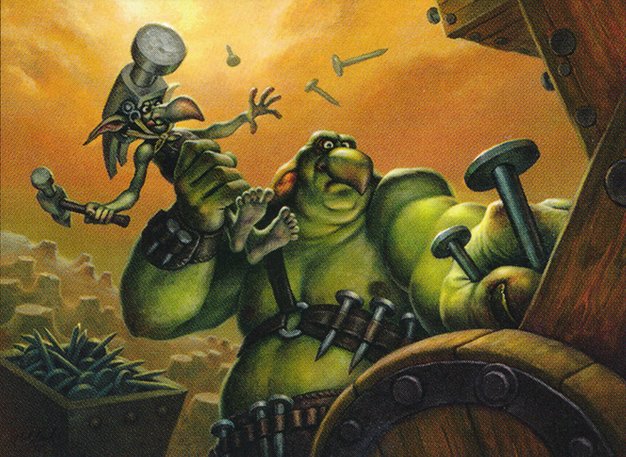
Secondly, there’s the goofy artwork. You may ask why a picture of a guy sinking in a soft, boggy area of land that gives way underfoot is amusing. It’s because, for some unknown reason, the guy is doing the dance from Michael Jackson’s Thriller as he’s sinking. I mean, doesn’t it look like that to you too?

Whether or not you can see the similarity may impact your thoughts on the card. However, the truth remains that this is no longer a worthless, bulk Magic card. Despite the fact that this uncommon sees virtually no play, it can still be buylisted to Card Kingdom for $1.50. I’d wager this card won’t ever be reprinted (who would want to open this card in any booster pack nowadays?). It could be worth grabbing a copy if you have the same appreciation for 1982’s Thriller as I have.

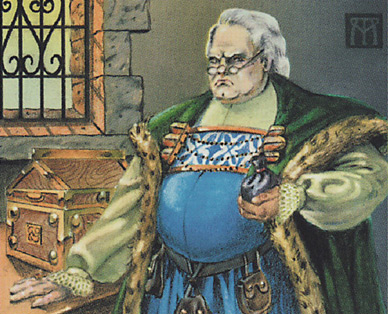
Presence of the Master

What do you get when you cross Albert Einstein with Magic? The answer: two distinct Magic cards from the Legends set.

One of those cards is Eureka, which is a high-profile and valuable rare that depicts Einstein’s famous equation, “E = MC2” on the artwork.

There was an error retrieving a chart for Eureka

The other is a far more obscure and less-often played enchantment that actually includes a prominent likeness of the turn-of-the-century scientist.

There was an error retrieving a chart for Presence of the Master

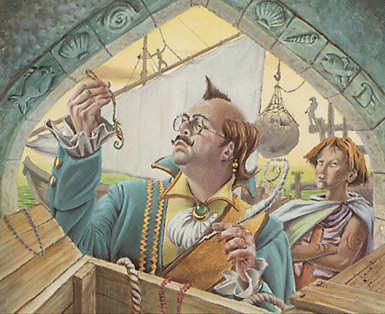
Once again, I couldn’t tell you from memory what this card does. But I can certainly picture Phil Foglio’s unique artwork for the card in my head without too much difficulty. You’ve got Einstein in the center with a bunch of planets surrounding him. I want to say it’s a picture of the planets in our solar system, but there are ten pictured so I have no clue what that means. A quick Google search didn’t drum up any explanations, either.

What I can say about the card is that it has a special piece of artwork and has occasional utility in play, locking out other enchantments. It may come as no surprise that the card buylists to Card Kingdom for $13 as a result. The card is more iconic and more useful than Quagmire and deserves a higher price tag.

What is surprising is that this enchantment was actually reprinted once, back in Urza’s Saga. Fortunately or unfortunately (depending on your viewpoint), the reprint’s artwork did not include Albert Einstein. As a result, copies of that version buylist for a nickel. Because of the reprint, I’m not going to come out and declare this card will never be reprinted again as I did for Quagmire.

What I will predict is that no card will ever depict Albert Einstein in the artwork again...unless they do some sort of Secret Lair series with famous scientists. I think there’s a higher likelihood of winning the lottery twice, though.

Sorrow's Path

I’ve seen multiple videos and articles citing Sorrow's Path as the worst Magic card of all time. This is tough to prove in an absolute sense, but it’s clear this land has very little going for it.

There was an error retrieving a chart for Sorrow's Path

The circumstances in which this card’s ability will be beneficial to use are so narrow. Combine that with the fact that this land doesn’t even tap for mana, and you have a card I would never play in a deck. Seeing how awful the land is, you may assume it is equally worthless. But this is not the case.

First off, this land is on the Reserved List (thank goodness
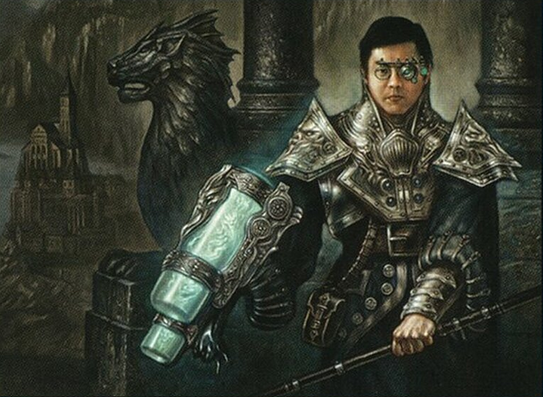
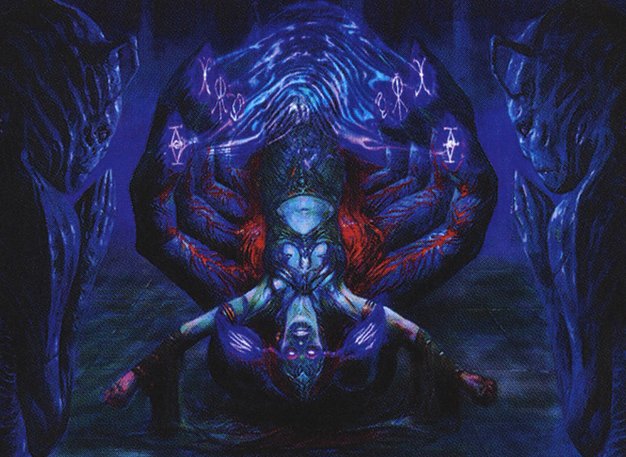
I don’t think anyone is clamoring for a reprint of this card). That makes it rare and limited in quantity. Secondly, the artwork is pretty funny. You’ve got the wizard zapping the poor, helpless knight in the foreground and then a battle on a bridge with a cool dragon spectating in the background. The art is clearly the best thing going for this card.

Thirdly and most importantly, this card has earned some notoriety for being one of the worst. Believe it or not, that may make this card iconic enough to be collectible.

As you combine all these factors, you end up with a card worth about $10. Who is paying $10 for this card? Certainly not me—I grabbed my copy many years ago, and have kept it in my binder ever since. But there are copies selling, even recently, on TCGplayer. So there must be demand coming from somewhere!
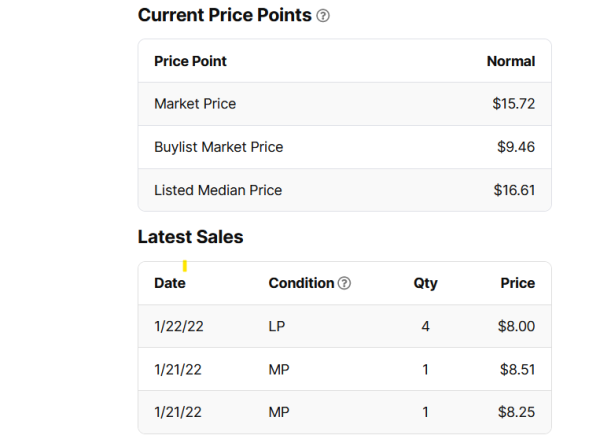
I’m not going to sit here and encourage anyone to buy this card for any reason other than owning a copy for the laughs. That said, it probably won’t be any cheaper one year from now, simply because it’s on the Reserved List.

Rocket Launcher

Other than a couple of Magic cards depicting guns, Rocket Launcher is arguably one of the most anachronistic cards in the hobby. In a world full of dragons, wizards, elves, etc., who would ever think a full-blown rocket launcher should exist? This card seems like something out of Doom. Yet it does, printed as an uncommon in Antiquities and reprinted at rare in Revised.

There was an error retrieving a chart for Rocket Launcher

Unlike the previous cards I mentioned, I do remember playing this card as a kid. The ability to do a bunch of damage to multiple targets was attractive to a relatively new player. The fact that Guardian Beast allows you to use the artifact, again and again, is something that comes to mind now, but never entered my mind as a kid.

In any event, this is another card that’s not on the Reserved List but has an extremely low likelihood of being reprinted. The concept of a rocket launcher doesn’t really fit in with the modern-day aesthetic of Magic. Come to think of it, it really didn’t fit in back in 1994 either. And is it just me, or does it look like Raphael from the Teenage Mutant Ninja Turtles is firing the launcher? I don’t know what Wizards was thinking when they printed this card.

But it exists and it is definitely not bulk. Original black-bordered copies from Anqituities buylist for $4 to Card Kingdom. Even the reprinted, white-bordered copies aren’t bulk anymore, buylisting for $0.26. If you ever come across either printing in a giant box of bulk, remember to pull this interesting piece of Magic’s history aside, either for your personal collection or to sell.

Wrapping It Up

These are just a few of the strange and bizarre cards from Magic’s history that are worth knowing about. There are surely more, and everyone you ask will probably name a different card. A couple I thought of that didn’t quite make the cut include Frankenstein's Monster (another reference to the “earthly plane”), Sylvan Paradise (provocative piece of art), and Heaven's Gate (religious reference).

Normally I focus my time tweaking my Old School decks and touting the Reserved List. It was a fun exercise this week to go off-script a little bit and touch on some of the more oddball cards from Magic’s past. These aren’t about to dominate a metagame or make waves in a tournament anytime soon, nor are they going to spike due to rampant speculation. They are more under-the-radar anomalies from the early years of the game, worth grabbing for the personal collection.

Are there others I missed that are worth mentioning? Feel free to share your thoughts in the Old School Discord, or send me a message on Twitter (@sigfig8). This is one topic I’m always happy to engage on, and I welcome your thoughts and feedback on some of the quirkiest cards from Magic history.

Four Collections Purchased – A Breakdown

Are you a Quiet Speculation member?

If not, now is a perfect time to join up! Our powerful tools, breaking-news analysis, and exclusive Discord channel will make sure you stay up to date and ahead of the curve.

Greetings! This is a continuation of my article from last week, A Simple Guide to Buying Magic Collections!

So, now that we've talked about some general rules for purchasing collections, here are four I purchased this month with a story and some numbers. A few notes on the monetary side of things. In all cases the rares, foils and other most valuable cards have been put through the Ion Scanner to make my life easier and give you an initial estimation of value. Getting the last bit of worth from everything else takes time so the ultimate value will end up a bit higher.

The First is the Worst

I found an ad listed on Facebook Marketplace and the description was limited on details. There was one picture of just a binder and a couple of deck boxes with the claim that "The cards in the binder alone were worth far more than asking price." One other significant detail, they lived two hours away. Normally, I never travel more than about an hour away without more information but they stated very clearly that they were done playing Magic, so I was interested. But still, two hours there, two hours back, just a massive amount of driving time, gas, etc.

However, it seems that I was destined to purchase these cards. We needed to drive for a flight and, well, this place was on the way! I checked if the cards were still available and to get an address; they had dropped their asking price!

I was greeted at the door by the seller's wife as the seller was occupied with their children. Next thing I know, here's FedEx with a package; and then the dog runs out of the house and starts jumping on me. Extremely chaotic! Even though I'm a cat guy, I don't mind dogs. I started looking through two deck boxes. These were former commander decks with 100 sleeves but not 100 sleeved cards in each box. Additionally, we had to make it to the airport on time so I could not spend too long scrutinizing this collection.

Lots of bulk rares, bulk EDH staples and very little value dotted the pages of the binder with lots of empty sleeves. Running out of time, and halfway through the binder, I asked if there was any chance they were flexible on price.

Spoiler Alert, the Answer is "No."

They shrugged and wouldn't budge as they had already lowered their price. I continued looking. Finally, on the last two pages of the binder, a few Khans fetch lands and a Force of Vigor. Begrudgingly, I made the purchase. At the time I felt that this low-value collection would be fodder for this article, but not very profitable. I was wrong.

Ion Scanner to the Rescue!

When I got to the car I looked again; there was a fair bit more value than I had seen at first. I drove the rest of the way so I put the collection out of my mind. When I finally had time to sit down I was then seeing what I had missed. My guess is the chaos and confusion, plus the urgency of the situation made me a little blind. Thankfully, the Ion Scanner doesn't get confused, doesn't get sad, it doesn't laugh at my jokes, it just scans cards. This was by far the collection I felt the worst about buying and was the absolute smallest in terms of collection size at under 400. Let it be known that the seller knew someone was getting a good deal, and, they did not care because they were done playing Magic.

Biggest Hits

Purchase Price: $80 Total Buylst: $339.21

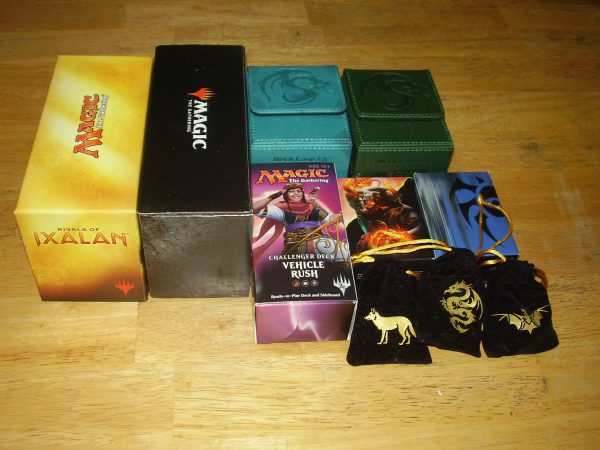
The first collection.

Second is the Best

This was another Facebook Marketplace ad. No pictures but they were extremely local so the opportunity cost was zero. They showed me some nice-looking deck boxes and a few small boxes of cards. Turns out prior to moving into the area they played but their new job was more demanding and almost two entire years had passed. I looked through some modest commander decks and then one box of commons, tokens, and basic lands. Nothing so far. I asked them why they were selling; they were ready to move again. I looked through two pre-made decks that were 100% stock while they mentioned that someone else had inquired about their collection. Due to how far away that buyer was they demanded pictures of "everything." This seller obliged them but then got an offer significantly lower than their asking price and finally, that buyer did not show. At this point, I told the seller that, so far, I had seen nothing of significant value and I agreed with the other buyer. Putting the boxes down I thought I would not be purchasing a collection today.

I made a judgment call based on the deck boxes, dice bags, and dice and just made the same offer as the other buyer. As mentioned in my previous article, I seldom buy without looking everything over but the seller's ask was just too much. They told me they did not want the hassle of driving out to meet another person who might not show so they accepted the offer; I now own (more) cool dice and dice bags.

But What About the Other Boxes?

Firstly, the Vehicle Rush Challenger Deck turned out to be a LOT cooler. It had been heavily improved with multiple copies of rares and mythic rares including four Heart of Kiran and a couple of rare lands. While Heart is solidly bulk now, it was a cool and desirable card during the Kaladesh block and maybe one day could regain some value. With zero expectations I went through the last box and, well, pretty much all the rares and value was right here. I scored a Zacama, Primal Calamity, and some other very decent rares. Not bad at all. Without the Zacama it would have still been a win, but with it, this collection turned out to be my favorite purchase. Quick, easy, and, percentage-wise, awesome!

Biggest Hits

Purchase Price: $20 Total Buylist: $79.39

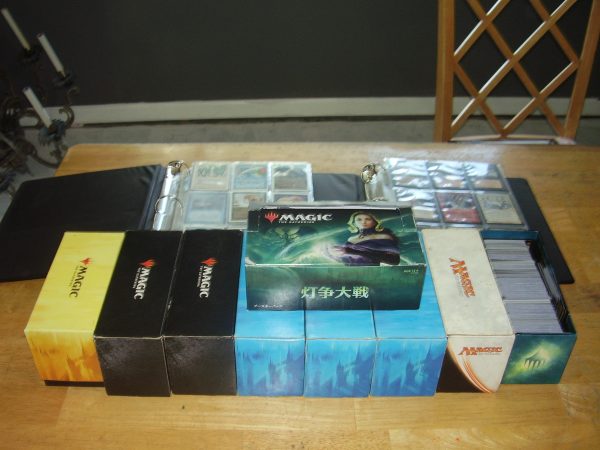
The second collection.

A Once in a Lifetime Collection

This ad I found off Craigslist. I know, who uses Craigslist anymore? In the early 2000s, it was absolutely incredible for acquiring cards but it's pretty barren now. However, it has gifted me a LARGE number of stories from my card buying travels. These sellers were playing online now and this was the last of their collection. The first things that caught my eye were the HOT NEON pink and green binders with copyright date 1990. Dear readers, you won't believe what I found in these binders!

Alphabetized sets of Revised, Fallen Empires, Ice Age, Homelands, Chronicles, and 4th Edition
.

...missing all the valuable cards. Flipping through the binders I hunted for any notable cards. What caught my attention, in particular, was that cards like Deflection, a highly desirable card during Ice Age, Brainstorm and Dark Ritual were all here which lead me to believe they had sold off the value recently. Also, I was sure to point out that metal ring binders have a tendency to damage cards and this was no exception. I showed them several cards that were dented badly; pay close attention any time you see metal ring binders!

Next, I tackled the deck boxes and right away found something odd; almost 100% of these cards were in penny sleeves. Here I did spend considerable time going through several thousand cards because of the large number of older cards that were present in the binders, the general strangeness of the thousands of penny-sleeved cards, and the asking price. Unfortunately, there were very few rares, not nearly enough foils, and after going through many boxes of cards I reached a conclusion; these were draft decks stripped of rares and foils, accumulated over many years of play. Each roughly 40 card chunk included basic lands which made up one-third of the total collection. During the time I spent hunting through the cards I talked to the sellers and I feel that we made a connection while recounting our favorite sets, cards, and even Magic rules that have come and gone.

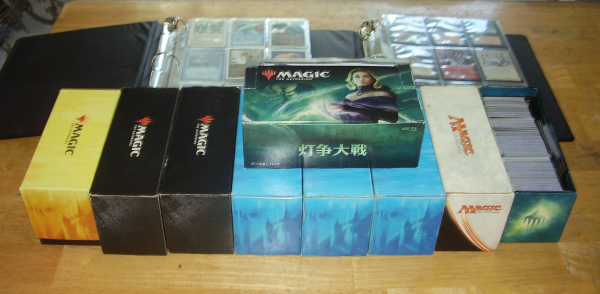
Finally, I went through the box of Japanese War of the Spark because I was hoping to find the Holy Grail of the set: the Alternate Art Liliana, Dreadhorde General. While there were a few alternate art planeswalkers, a nice surprise, there was no Liliana. A Japanese God-Eternal Bontu was the only thing of note and it was the only mythic rare in the entire collection.

Finally finished I asked if they were flexible on price considering the condition of the cards, the fact that this was basically a bulk lot and there were massive piles of basic lands/tokens - what I call an "inorganic" collection. They agreed with me and accepted my offer.

Let me describe how long it takes to remove just under two thousand penny sleeves; five-ever, which is one longer than forever. Factoring out the basic lands, it turns out it was only around 2000 total cards including the binders. I believe the full value in this collection will not be recovered immediately and will rely on holding the 94', 95' cards, most of which are in absolutely minty condition. These vintage cards are not counted in the buylist value below. In terms of immediate value, well, there is a little but not much!

Biggest Hits

Purchase Price: $40 Total Buylist: $44.39

The third collection.

The Buckeye State

This was a word-of-mouth collection I purchased from someone I game with online. Lately, a lot of people I know have jumped onto the Arena train and, of course, I let them know "I'm the guy." It turns out that one of them had stopped playing in paper almost a year ago just after spending a ton of money buying into the Modern format. They had good, Modern, cards but wanted a lot. Additionally, they had brought their cards to a local shop and did not like the shop's offer. I talked to them, with some supporting evidence, to show them that once their cards rotated out of standard a chunk of value would be gone and the shop was just trying to make a fair profit based on that; they still did not want to sell. Months later I asked if they still had their cards and if they were still interested in selling. Running some numbers, many of formerly valuable cards were losing some value and many more had plummeted. It seemed like they were coming to the conclusion that even though they overpaid in the past, it was a sunk cost.

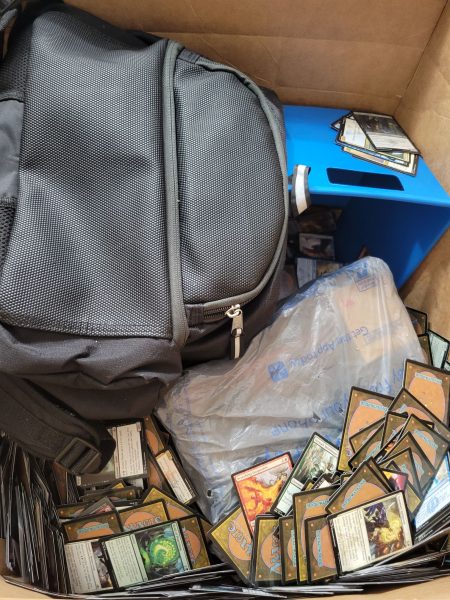
This was by far the largest collection in card count, absolute value, and also price of the four. Overall, I'm not a huge fan of investing in Modern cards; they are a few reprints away from becoming bulk rares. On top of that, I am a player and collector first and second, with seller at a distant third. Additionally, these cards would be shipped to me sight unseen so there was no telling what the general card condition was. Further, I'm fairly paranoid about fakes; while I knew and trusted the seller, I didn't trust whoever sold him his cards. The shipment arrived in a huge box, take a look!

Cards dumped everywhere.

Unfortunately, shippers are very rough with packages, and the seller did not pack the collection well at all; another potential pitfall when purchasing collections. As I scooped out pile after pile of cards I noticed many were played, chipped, or damaged in some way. After sorting the mess, the overall card condition was much the same; many of these cards had significant play wear. A significant number of them felt either incredibly waxy or too glossy and I was nervous as I compared cards. In a playset, three cards looked identical but the fourth would be a different saturation and feel. Very sus. I did a closer examination with a loupe and every card passed the Green Dot test. Some of these cards failed the light test, but, some bulk commons from the same set, from this same collection, did as well. Can someone at Wizards please improve QC?

Biggest Hits

Purchase Price: $430 Total Buylist:$1,639.58

The final collection.

Dealing with Tough Sellers

My top advice for how to deal with sellers who give you a hard time is, don't. There is no end to the number of card collections available for purchase. You have eBay, Craigslist, Facebook Marketplace, and simple word of mouth; players are transitioning through the Magic player lifecycle all the time. The biggest problem for buyers is thinking they are stuck with sellers who are trapped by sentimental value and the sunk cost fallacy. Both of these issues are not rational and cannot be reasoned through. Players who are finished playing Magic do not have the same hangups and see cards as just pieces of cardboard which, ultimately, is what they are. There are two more collections I can look at and purchase this week alone; I feel absolutely no pressure to do so unless it's on my terms.

Other Value From Buying Collections

Not only do I get to expand my overall collection, make a profit, chat with fellow Magic players both past and present, but I also get to go through cards; thousands and thousands of cards! During this sort, I pulled dozens of cards I need for Commander decks, gifts, cube projects and also found some miscut cards! Just wading through set after set is some of the best inspiration for deck design or other Magic projects and this is my personal favorite thing about collection buying.

I hope you enjoyed this primer on what I believe makes this process easy, high value, and ultimately fun too!

Getting the Banned Back Together

Are you a Quiet Speculation member?

If not, now is a perfect time to join up! Our powerful tools, breaking-news analysis, and exclusive Discord channel will make sure you stay up to date and ahead of the curve.

Pauper Format Panel Shakes Things Up

This week the newly-enacted Pauper Format Panel is already making moves to shake up the format, with three bans hitting arguably the top two decks in the format, Affinity, and Tron.

In his article announcing the ban, Wizards' Gavin Verhey laid out the reasoning behind the bannings of these cards, and a bit more of the philosophy of the format. One of the first quotes that immediately stuck out to me was: "On a larger format scale, we think cards that let you easily play all five colors "for free" (replacing themselves) are probably not healthy for the format."

This is a good rule of thumb, as it improves format diversity by reducing the possibility for 'good stuff' decks, playing all the best cards in all five colors, as both Affinity and Tron have done in the past. Bonder's Ornament and Prophetic Prism were selected for this reason. Additionally, both cards were targeted over other color fixers like Manalith, because they were card neutral. This means that they both replace themselves with card draws, fixing your mana without the cost of a card. "This issue concerns having the mana to cast combined with returning your card," Verhey said.

The Fall of Atog

While sad, the banning of everyone's favorite grinning monster Atog makes sense, as it was the cleanest way to reduce the power of the Affinity deck. The most interesting note to me about the Atog ban was not the explanation of the ban itself, but this note at the end: "Finally, because I am sure some people will be curious, with Atog banned, we also think there is a decent chance we can return Sojourner's Companion to the deck in a future banned and restricted announcement."

Even without the beloved Atog, the Affinity deck will remain a top deck in Pauper and may end up getting an old toy back in the future.

Does This Make Pauper A Wide-Open Format?

I don't think this will turn Pauper into a fully wide-open format where previously tier three or two decks will suddenly be contenders. These bans only serve to bring the S-tier decks back down to tier-one level. Boros Monarch, Izzet Skred, and other top decks in the format remain good, and will now have a more even playing field on which to do battle with Tron and Affinity. Bearing all those factors in mind then, what should we play?

Play What You Like

The deck I'm most excited to sleeve back up and bring to the table is the deck I always play in Pauper: Faeries. Spellstutter Sprite is one of my all-time favorite cards. As both interaction and a small threat, Spellstutter is the kind of card that plays well in the vein of my favorite style of Magic decks, regardless of format. Faeries is definitely one of those decks. There are two versions of Faeries in the current Pauper, but the one that appeals most to me is Dimir Faeries. This is the pre-banning version of the deck:

Dimir Faeries

Main Deck

4 Augur of Bolas
3 Faerie Seer
2 Gurmag Angler
3 Ninja of the Deep Hours
4 Spellstutter Sprite
2 Thorn of the Black Rose
4 Preordain
3 Brainstorm
3 Cast Down
4 Counterspell
1 Devour Flesh
1 Dispel
2 Echoing Decay
3 Snuff Out
1 Suffocating Fumes
3 Ash Barrens
2 Evolving Wilds
3 Ice Tunnel
10 Island
2 Swamp

Sideboard

1 Thorn of the Black Rose
1 Dispel
1 Suffocating Fumes
1 Bonder's Ornament
1 Chainer's Edict
2 Duress
1 Echoing Truth
4 Hydroblast
2 Nihil Spellbomb
1 Stormbound Geist

Bonder's Ornament is obviously out, but I'm not sure what comes in to replace it. I will likely add an additional Chainer's Edict until I have an idea of what to expect from the format.

More Bannings On The Horizon?

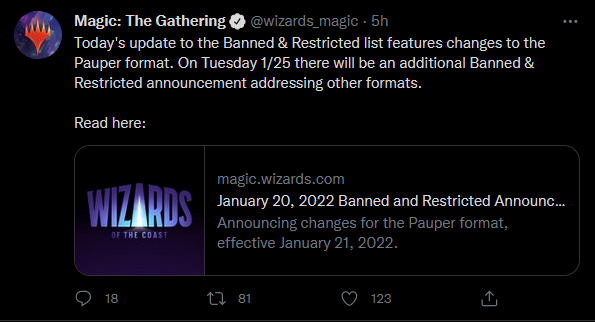
When they announced the Pauper ban on Twitter, Wizards also noted that we will have an additional B&R announcement on Tuesday.

This has many speculating that Wizards could take action on Modern and Legacy. I'm not enough of an expert to speak on the current state of Legacy. From what I've read on Twitter, the pitchforks are no longer out over Ragavan, Nimble Pilferer, though the monkey remains a strong pillar of the format. That leads me to believe that we won't see any action on Legacy. Modern on the other hand is a different story.

If you've been following the Modern metagame in the last year, you'll note that the curves of many decks have been getting lower. It's all to accommodate having Lurrus of the Dream-Den as our fuzzy companion. David had this card in his sights when he did his Modern Banlist Watch List update back at the end of December. If Wizards is taking action on Modern, I strongly suspect the Cat Nightmare is at the top of their list of cards. Five of the top 15 archetypes in Modern, Hammer Time, Death's Shadow, Burn, Jund, and Mill, have all dropped the mana values of their permanents to accommodate Lurrus.

I'd go so far as to make the claim that the only reason Mill is currently a Tier-one strategy, is because the curves of these decks have gotten so low. A single Tasha's Hideous Laughter can now wipe out nearly a third of a player's library. When you compare library vs. life total, Tasha's Hideous Laughter is at a better rate than any single spell in the Burn deck.

Bans Beyond Lurrus

Short of Wizards banning every card on David's watchlist, I don't anticipate them taking action against any card beyond Lurrus in Modern if they even do that. Like it or not, the post-Horizons Modern format is here to stay. Of course, Modern is not the only format where Lurrus is legal. It's possible, though unlikely, that they might take it out of Pioneer as well if they do.

There was an error retrieving a chart for Lurrus of the Dream-Den

End Step

It's quite possible there are formats I'm not even thinking about at the moment that Wizards is preparing to drop the ban hammer on. That said, what do you think? Do you agree with the Pauper bannings? Should Lurrus be banned in Modern? Is Ragavan fine in Legacy? If you could have something banned from any format, what would it be? Let me know in the comments or on Twitter.

Avatar photo

Paul Comeau

Paul is Quiet Speculation's Director of Content. He first started playing Magic in 1994 when he cracked open his first Revised packs. He got interested in Magic Finance in 2000 after being swindled on a trade. As a budget-minded competitive player, he's always looking to improve his knowledge of the metagame and the market to stay competitive and to share that knowledge with those around him so we can all make better decisions. An avid Limited player, his favorite Cube card is Shahrazad. A freelance content creator by day, he is currently writing a book on the ‘90s TCG boom. You can find him on Twitter and LinkedIn.

View More By Paul Comeau

Posted in Banning, Free, Legacy, Modern, PauperTagged , , , , , 6 Comments on Getting the Banned Back Together

Have you joined the Quiet Speculation Discord?

If you haven't, you're leaving value on the table! Join our community of experts, enthusiasts, entertainers, and educators and enjoy exclusive podcasts, questions asked and answered, trades, sales, and everything else Discord has to offer.

Want to create content with Quiet Speculation?

All you need to succeed is a passion for Magic: The Gathering, and the ability to write coherently. Share your knowledge of MTG and how you leverage it to win games, get value from your cards – or even turn a profit.

Commander Deck Design and You: The Fundamentals

Are you a Quiet Speculation member?

If not, now is a perfect time to join up! Our powerful tools, breaking-news analysis, and exclusive Discord channel will make sure you stay up to date and ahead of the curve.

Today I wanted to share some of the ways that I build my Commander decks, both casual and competitive. While I have talked about my deck design philosophy before, this article is about some of the nuts and bolts aspects of deck design. Grab a coffee, popcorn, or wrench, and let's begin!

I Have an Idea

I say these words two or three times a week. Maybe the spark is from seeing new cards that can upgrade an already existing deck. Sometimes it's seeing Commander in a new light that could open up a new way to play an existing deck. Other times it's a brand new commander that will have a totally unique game plan; those are usually my favorite. Once I have decided to build a new deck, there's just one question I need to be answered before I can really get to deckbuilding.

The Casual/Competitive Split

Next, I need to know if this deck is going to be used for tournament play or tournament practice, otherwise, I consider it a casual deck. This choice alters my design philosophy on every card. Every choice, every include, must be scrutinized not only for power and synergy but also for meta if it's a competitive deck. If I know there is a lot of anti-blue hate in most local decks, it's going to steer me away from blue whether I think blue is great or not.

On the casual side, it's entirely the opposite. I don't really care what people are playing, what the local meta is like, or if a card is powerful enough to make the cut; I have played decks based on artwork, people. My only goal in a casual match is to interact and get everyone involved and maybe to get a win with Triskaidekaphobia.

Once I've chosen that, it's on to the next step.

Theme and Synergy

In terms of competitive, replace "theme" with "wincon" and you have the same idea. Here the idea is balancing the speed of a win with the consistency of achieving that win while also being mindful of the other players attempting to do the same thing. There are a massive number of budget decks and degenerate decks that have a deterministic wincon on turn five. Given a great opening hand there are plenty of Commander decks that can win on turn two, three, or four. But, how often will it resolve into a win? Focusing on the competitive side of deck design seeks to balance these factors.

On the casual side, again, none of this truly matters. Typically, I don't include too many ideas of a wincon in casual decks. That does not mean I can't win, it just means it's not a priority. If a commander is a 5/5, that's potentially five attacks to end the game; most of the time that sounds fine to me. What is the point of trying so very hard to end the game sooner? As long as most of the time everyone gets to tap lands, cast spells, and play Magic for longer than they are shuffling it's likely to be a fun table. Occasionally someone will "Happy Birthday" into a win and that's all right.

The main draw here for a casual deck is showing the synergy and theme of every card in the deck, even if that reduces win percentage. Playing a dragon deck and resolving a Crux of Fate for non-dragons just feels so much better than casting Toxic Deluge and wiping the board for three mana. One is definitely more efficient, and one is definitely more memorable.

Pull Cards

Sometimes I grab stacks of cards while in the process of deckbuilding. I feel that it can help get the creativity going if you're stuck. Some other great tools I've used to help are Magic Workstation, Cockatrice, and LackeyCCG. I find that these programs let me make large "piles" quickly and see interaction, synergy and do basic counts very quickly. In just a couple of seconds I can filter all multi-colored merfolk that have flying to see my options and including a "maybe board" takes up no room, digitally speaking, whereas my kitchen table could never be big enough.

Consult the Hive Mind

If I feel like I've looked through enough cards and have a deck more or less constructed, then and only then do I go to EDHREC, cEDH Decklist Database, MTGDecks, or any of another dozen sites to get thousands of second opinions. I think this is a very important detail. If you seek out what others are playing before you yourself try to build, you risk denying the unique take you had on the deck. For casual play that is a sin of the highest order!

For competitive, though, it's exactly the opposite. You should be able to say that you know your version is better for running Brainspoil because it's an uncounterable tutor but also sometimes a removal spell and that may be a significantly better card in your local meta.

The Final Step to Deckbuilding

In a word: PLAY! It's extremely important to get out there and play your deck! Every Magic player has had the experience of, perhaps, not remembering to put basic lands into their deck, forgetting one card of a two-card combo, or otherwise making some form of basic human error. The solution here is to play so you can work out the kinks. If you can play online, great! Solitaire? Works all right but not ideal. Have a friend, roommate or SO that plays? Awesome! Test your deck; you might be surprised at how great or terrible some of the cards turn out to be and you may have made a fundamental error somewhere during the deckbuilding process.

The Final FINAL Step

All right, you've built your deck and tested it out. Now, armed with field data, it's time to refine your deck. What cards worked, and which ones failed? Is your wincon too slow, or too hard to protect? Did anyone laugh at your boat puns? These are all data points that steer your decision-making when going over the deck. This continual process of refinement is what keeps Magic players interested in Commander, whether they are competitive or casual. Note, however, how I said refinement and not upgrading or improving. For a casual deck that turns out to just be too powerful, refining the deck can mean tuning it down.

The Next Big Thing

It's Kamigawa: Neon Dynasty. More and more cards are being spoiled, daily. I'm already expecting cards for multiple Commander decks. Edric, Spymaster of Trest leads my team of unblockable creatures; Ninjitsu won't be hard to pull off. My new Millicent, Restless Revenant pure spirit tribal deck would love new bodies and mechanics. Let's not forget one of the most powerful equipment cards for many years Umezawa's Jitte could return in a new, powered up for 2022 form!

Avatar photo

Joe Mauri

Joe has been an avid MTG player and collector since the summer of 1994 when he started his collection with a booster box of Revised. Millions of cards later he still enjoys tapping lands and slinging spells at the kitchen table, LGS, or digital Arena. Commander followed by Draft are his favorite formats, but, he absolutely loves tournaments with unique build restrictions and alternate rules. A lover of all things feline, he currently resides with no less than five majestic creatures who are never allowed anywhere near his cards. When not Gathering the Magic, Joe loves streaming a variety of games on Twitch(https://www.twitch.tv/beardymagics) both card and other.

View More By Joe Mauri

Posted in Commander, Deck Building, EDHREC, FreeTagged , , , , , , , Leave a Comment on Commander Deck Design and You: The Fundamentals

Have you joined the Quiet Speculation Discord?

If you haven't, you're leaving value on the table! Join our community of experts, enthusiasts, entertainers, and educators and enjoy exclusive podcasts, questions asked and answered, trades, sales, and everything else Discord has to offer.

Want to create content with Quiet Speculation?

All you need to succeed is a passion for Magic: The Gathering, and the ability to write coherently. Share your knowledge of MTG and how you leverage it to win games, get value from your cards – or even turn a profit.

Layers, Part One: Copiable Values

Are you a Quiet Speculation member?

If not, now is a perfect time to join up! Our powerful tools, breaking-news analysis, and exclusive Discord channel will make sure you stay up to date and ahead of the curve.

What's a "Layer"?

Like onions, ogres, and some cakes, Magic has layers. The layers system determines how continuous effects interact with one another. If you've ever seen a question about how Humility and Opalescence work together, layers define that interaction.

This week, we'll take a look at the first of the seven layers: copiable values. Fret not — I'll definitely tackle that Humility/Opalescence interaction in a future article!

As a reminder, If you have any topics you'd like to see covered, you can reach me on Twitter or our Insider Discord.

This Is Simple!

613.1a Layer 1: Rules and effects that modify copiable values are applied.

Magic Comprehensive Rules

On the surface, this rule says exactly what it is. "Copiable values?" you think to yourself. "I've cast Clone before. This is easy!" And, for a lot of situations, you'd be correct. You can think of copying an object like running the card through a Xerox machine. You end up with what's printed on the card. A copy doesn't copy any other effects such as granted abilities (Fly), modified power and/or toughness (Might of the Masses), or added counters (Battlegrowth) to the object it's copying.

Unfortunately, Magic life is rarely simple. For every ten obvious situations, we have something weird to deal with.

...Except for Mutate

Ah, mutate. I could write an entire article about this mechanic. Today, though, I'm going to spare you all and focus on how it interacts with copy effects.

First, a brief reminder of how mutate actually works. As you resolve a mutated creature spell, you choose whether it goes on top or bottom of the pile (it can't go in the middle). The resulting mutated permanent includes all of its parts in its copiable values. For instance, if you mutate Chittering Harvester onto Ajani's Sunstriker:

  • If you put Chittering Harvester on top, the resulting permanent has the types Creature — Nightmare and the name "Chittering Harvester." Its P/T is 4/6 and it's a black permanent with mana value 6.
  • If you put Chittering Harvester on bottom, the resulting permanent has the types Creature — Cat Cleric and the name "Ajani's Sunstriker." Its P/T is 2/2 and it's a white permanent with mana value 2.
  • In either case, the resulting permanent has the abilities "Whenever this creature mutates, each opponent sacrifices a creature" and "Lifelink."

The properties above become the card's "copiable values." So, if you Clone this mutated permanent, you'll end up with a copy of the entire pile, as it were. Note that this new permanent hasn't mutated before since "how many times has this mutated?" isn't a copiable value. Even if the original mutated permanent has a whole mess of Huntmaster Ligers in it and may have mutated a half dozen times, the Clone of that permanent doesn't know anything about that.

...Except for Status

A copy's status applies after its copiable values and can alter the end result. A permanent has four kinds of status: tapped/untapped, flipped/unflipped, face up/face down, and phased in/phased out. A permanent has one of each pair at a time. By default, a permanent enters the battlefield untapped, unflipped, face-up, and phased in.

But what happens when a permanent's status changes after becoming a copy of something else? Let's look at some examples.

  1. You control a flipped Jushi Apprentice // Tomoya the Revealer. If Tomoya becomes a copy of Nezumi Shortfang // Stabwhisker the Odious, the permanent has all the characteristics of Stabwhisker the Odious. First it copies Nezumi Shortfang, then its flipped status applies.
  2. You control a face-down Grinning Demon. If Grinning Demon becomes a copy of Branchsnap Lorian, it's still a face-down 2/2 colorless creature... for now. If you want to turn it face up for its morph cost, you have to pay {G} - the morph cost of Branchsnap Lorian. First the Demon copies the Lorian, then its face-down status applies. This also means that if your Demon copies a Grizzly Bears, you can't turn it face-up because Grizzly Bears doesn't have a morph cost!

...Except for Exceptions

Some cards give us exceptions to the copy process. These usually have the form "becomes a copy, except it's [some characteristic]." Any of these exceptions become part of the copiable values of the permanent. For instance, if you copy your Grizzly Bears with Quicksilver Gargantuan, the resulting permanent is a 7/7 Grizzly Bears. Then if you copy that permanent with Clone, the resulting permanent is also a 7/7 Grizzly Bears. The exception in Quicksilver Gargantuan's copy effect makes the 7/7 part of the permanent's copiable values.

Exceptions can also remove some abilities. Let's have the Comprehensive Rules lay this one out for us:

707.9d When applying a copy effect that doesn’t copy a certain characteristic, retains one or more original values for a certain characteristic, or provides a specific set of values for a certain characteristic, any characteristic-defining ability (see rule 604.3) of the object being copied that defines that characteristic is not copied. If that characteristic is color, any color indicator (see rule 204) of that object is also not copied. This rule does not apply to copy effects with exceptions that state the object is a certain card type, supertype, and/or subtype “in addition to its other types.” In those cases, any characteristic-defining ability that defines card type, supertype, and/or subtype is copied.

Magic Comprehensive Rules

That's a lot of words! If Quicksilver Gargantuan copies a Tarmogoyf, the resulting permanent is just a vanilla 7/7 creature. Tarmogoyf's characteristic-defining ability isn't copied at all because the exception from [c]Quicksilver Gargantuan[/card] precludes it. Great news for all you Muraganda Petroglyphs players!

...Except for Some Very Specific Cards

Some of the rules in 707 Copying Objects apply only to a small number of cards.

707.9e Some replacement effects that generate copy effects include an exception that’s an additional effect rather than a modification of the affected object’s characteristics. If another copy effect is applied to that object after applying the copy effect with that exception, the exception’s effect doesn’t happen.

Magic Comprehensive Rules

This rule applies to cards like Spark Double and Altered Ego. Since their exception is an additional effect, we can't chain them together to get an arbitrarily large Spark Double. This slipped through the cracks originally. For a while you could keep copying a Spark Double that hadn't copied anything, piling up +1/+1 counters along the way. People may have abused it a little on Arena.

...Except for Even More Specific Cards

707.9f Some exceptions to the copying process apply only if the copy is or has certain characteristics. To determine whether such an exception applies, consider what the resulting permanent’s characteristics would be if the copy effect were applied without that exception, taking into account any other exceptions that effect includes.

Magic Comprehensive Rules

This rule applies exclusively to Moritte of the Frost. If you have Moritte enter as a copy of an animated Lavaclaw Reaches, look at the result of the copy without looking at any changes Moritte wants to make. Since Lavaclaw Reaches would be a non-creature land, Moritte won't give it extra counters or the changeling type. However, it will still be legendary and snow since those changes don't have any prerequisites.

And to wrap it up this week,

707.9g Some replacement effects that generate copy effects are linked to triggered abilities written in the same paragraph. (See rule 603.11.) If another copy effect is applied to that object after applying the copy effect with the linked triggered ability, the ability doesn’t trigger.

Magic Comprehensive Rules

This rule applies to Wall of Stolen Identity. To quote then-rules manager Eli Shiffrin when he added this rule,

This rule spells out that Wall of Stolen Identity only gets to trigger if its copy effect is the last one to copy the creature. This stops any sort of awful loops where Wall of Stolen Identity can tap down multiple creatures.

Eli Shiffrin, Comprehensive Rules Changes - 27 Sept 2019

Now, I can't think of any way to make that happen off the top of my head. If I overlooked something, please point it out! Otherwise, this rule may just pre-patch some eventual situations.

Cleanup

That's all this week, friends. Join me next week for a look at replacement effects. If you think layers get weird, you're in for an adventure.

Question of the week: What's your favorite card or ability that can copy another object? This can include cards like our old friend Clone, Thousand-Year Storm, or new hotness like Double Major.

Real-world Flavor. Quotations From Three Kingdoms

Are you a Quiet Speculation member?

If not, now is a perfect time to join up! Our powerful tools, breaking-news analysis, and exclusive Discord channel will make sure you stay up to date and ahead of the curve.

We three, though of separate ancestry, join in brotherhood . . . . We dare not hope to be together always but hereby vow to die the selfsame day.

MTG Wiki makes it clear: "Unless otherwise noted, all quotations on Portal Three Kingdoms cards are from Guanzhong Luo, Three Kingdoms: A Historical Novel (Beijing Foreign Language Press/Berkeley: University of California Press, 1991), Moss Roberts, trans." This means that every flavor text showing up between quotation marks, unless otherwise noted, comes from that book.

That is why Luo Guanzhong, although never mentioned directly, is the most quoted among real-world authors, with over 40 unique cards. After dealing with all the other thinkers and writers of Chinese literature in Magic flavor text the past two installments, let's conclude by dedicating this whole article to Guanzhong's historical novel: Three Kingdoms.

Three Kingdoms: A Historical Novel

Written in the 14th century by Luo Guanzhong, Three Kingdoms is set during the 2nd and 3rd centuries, more than one thousand years earlier. It's known as a "historical novel" because it's not exactly a historical treatise, nor does it contain a made-up plot. Based on true events, it romanticizes the clashes of feudal lords that took place at the end of the Han Dynasty.

Interestingly, there are some parallels with Roman history of the same period. At the end of the 2nd century, a coup d'état took place in Rome, ending the Antonine dynasty abruptly. Since then, several emperors quickly succeeded one another, with no stability for a few years.

It certainly seems like a great source for flavor text, and that's the reason why it was chosen as the main setting of Portal Three Kingdoms. More than 40 cards feature excerpts from this work in their flavor text, and 12 of them compose the "Chinese Zodiac" cycle. While we won't be able to analyze all of them, we are going to try and emphasize the most interesting pieces, in order to draw some conclusions on this edition. I will pick a card from each color.

Peach Garden Oath

We three, though of separate ancestry, join in brotherhood . . . . We dare not hope to be together always but hereby vow to die the selfsame day.

Peach Garden Oath

Let's start with a significant example of what we can expect, from the point of view of lore. The quotation on Peach Garden Oath comes straight from Luo Guanzhong's novel. We can already see what is going to be a big difference in the cards we are analyzing today. It's not a generic sentence trying to suggest a way of behaving or a rule for life, as we've seen many times in the previous installments. Instead, it refers to a very specific passage from a certain novel, which in turn refers to historical happenings.

We may not be familiar with it, but let's not forget that Portal Three Kingdoms was designed specifically for the east-Asian market. As we will see, that heavily influenced flavor choices, among other things. The image shows three fighters (Liu Bei, Zhang Fei, and Guan Yu) swearing an oath that will make them brothers. It represents the ideal of true fraternal loyalty, but they also swear to "perform our duty to the Emperor and protect the common folk of the land".

The oath would go on for a couple more lines: "Let shining heaven above and the fruitful land below bear witness to our resolve. May heaven and man scourge whoever fails this vow." I greatly enjoy the use of this passage in the flavor text. Overall, Peach Garden Oath is one of my favorite cards from this set. I like the art, the quote and the concept of deep friendship it depicts.

Zhou Yu, Chief Commander

After making me, Zhou Yu, did you have to make Kongming?

—Zhou Yu crying to heaven on his deathbed

Here's another quotation coming directly from the novel. Again, it's a very specific one. This time, the very name of the card is a reference to a historical person. Zhou Yu was a general and strategist who lived in the third century, during the aforementioned period of civil wars. He is also one of the major characters in Three Kingdoms. In this flavor text, we read his final words, pronounced after having been shot by an arrow during the Battle of Jiangling.

It appears a pattern is emerging. When flavor text in Portal Three Kingdoms comes from Luo Guanzhong's novel, it's usually referencing specific characters and historical events from the novel. Otherwise, when coming from Confucius, Lao Tzu, and other authors, the quotes are more generic, more in line with what we are used to seeing in the other sets.

Famine

But it was a year of dearth. People were reduced to eating leaves of jujube trees. Corpses were seen everywhere in the countryside.

I wasn't expecting it, but it looks like this actually contradicts what we were starting to define as a pattern. In fact, despite coming from the Three Kingdoms, Famine does not mention any specific person or event. It is totally possible that people with a deeper knowledge of Chinese culture recognize this as a quotation, of course. On the other hand, it makes perfect sense even when taken out of context.

Somehow, it reminds me of what we saw happening with cards such as Fissure and Soltari Priest. The point is that, if you are fond of literature, you might recognize those flavor texts as coming from Plato, Seneca, and Luo Guanzhong. Otherwise, they are still totally understandable, because they refer to generic concepts such as war and death.

This black Sorcery deals three damage to each creature and player. It's a common effect for black: just think of Pestilence, Pox, and all the other cards that affect each player and creature at the same time. I believe this is a great choice for a card called Famine, and it also makes a good addition to this pool of similar black cards.

Independent Troops

The empire, long united, must divide, and long divided, must unite.

This is another good one, in my opinion. Independent Troops is not a powerful creature, being a vanilla 2/1 for two mana. And the flavor text is perhaps a bit too pompous on such a humble card. What is interesting, though, is that this sentence is the opening of the whole novel. We could consider this card as the ideal opposite to Zodiac Dragon, whose flavor text quotes the end of the novel.

If you are curious, the book goes on with another bit of text that I find interesting: "Thus it has ever been". It's not crucial, as it is already clear from the first sentence that it refers to a cyclical and ever-present condition. Nevertheless, I believe it would have been a nice addition to this flavor text.

Since an incipit, the opening words of a text, is so important to the work it comes from, we can deduce this must be a well-known quotation. It probably sounds more or less how "Sing, o Muse, of the rage of Achilles" from Homer's Illiad sounds to the ears of a Westerner.

Zodiac Tiger

. . . Three kings no more—Chenliu, Guiming, Anle. / The fiefs and posts must now be filled anew. . . .

Let's close our brief analysis with a green creature, Zodiac Tiger. The Tiger is part of the "Chinese Zodiac" cycle of creatures in the set. All twelve of these creatures contain flavor text in verse, coming from a poetic section of the novel. Zodiac Tiger is a 3/4 creature with forestwalk for four mana. Decent stats compared to the other cards in this cycle.

As for the text, it sounds like a dramatic moment in the book. We get that it's important, even if we don't know or don't remember the exact reference. It's a time when the political balance needs to be renewed. This is a transferable concept, as similar moments have happened in the course of every empire, all over the world.

Uniqueness of Portal Three Kingdoms

After analyzing the flavor text of a few cards, I think we have found a way to approach understanding this unique set. From a western perspective, Three Kingdoms might seem like a very obscure book on which to base a Magic set. To the Asian market though, especially China, Three Kingdoms is as ubiquitous as the legends of King Arthur in the west.

When studying the set, we must keep in mind two things: that the set was intended from the start for publication only in the Asian market, and the ubiquity of the Three Kingdoms novel in that market. When you consider both of those things, all the major decisions on the set seem like a no-brainer. This includes not just the decision to design the set top-down, with the Three Kingdoms novel as the source.

Everything from the individual cards created, the references used within flavor text, and even the artists chosen to illustrate the cards, were all made with that in mind. That those of us outside the Asian market know of and care deeply about this set more than 20 years after its publication is a testament not just to the success of the set, but to the worldwide popularity of Magic.

Understanding Portal Three Kingdoms in Context

When quotes take the form of proverbs and maxims, they are typically more understandable to the general public, even if they are not familiar with the source material. This was as true with other sets as with Portal Three Kingdoms (think of Famine). On the other hand, when flavor text refers to specific characters and quasi-historical events, more knowledge of the source material might be needed to properly appreciate them. This makes Portal Three Kingdoms unique, in that no other Magic set save Arabian Nights has come close to the same depth of literary and cultural significance.

To truly understand the depth of that significance, imagine if Wizards designed a set based on the legends of King Arthur. In order to capture a similar effect, they would have to make cards for all the characters, places, and events from those legends. Additionally, they'd have to embed quotes from the legends throughout the flavor text of the cards.

When we examine Portal Three Kingdoms in that context, we recognize the great scope of it, from a flavor point of view. It is the depth and scale of the project overall, and how well they executed it that is truly impressive, (especially when you consider that most of the design was done by one person). Even when there are individual pieces of flavor text that are weak, there are others that are more spot-on that make up for it. This is of course true of all Magic sets, as we've seen.

Conclusions

Based on what we've studied throughout this series, I believe there are two extremes to avoid when creating flavor text. The first is the usage of overly generic sentences (such as Seneca's maxims), which may often sound boring and obvious. The second is the usage of overly specific references, which may sound academic and lead to the danger of "perceived edutainment," which we discussed in the first article of this series.

The flavor of Portal Three Kingdoms is quite well-conceived. As we saw in the last three articles, there are only a few excesses on one side or the other. Overall the set is a remarkable and memorable work both in terms of design and flavor. Will that trend continue as we move on to examine other authors? In the next article, we'll turn to English-speaking authors such as Shakespeare, Coleridge, and Poe. Stay tuned!

Everything’s Relative: Card Power Examined

Are you a Quiet Speculation member?

If not, now is a perfect time to join up! Our powerful tools, breaking-news analysis, and exclusive Discord channel will make sure you stay up to date and ahead of the curve.

I love receiving feedback on articles. Not only is it critical to finding out what readers want to see, it's a loaded vein of content ideas. I can't think of everything, after all, and more importantly other people will ask questions I'd never consider and/or seem obvious to me. But only because I'm me. If I knew my own blind spots, they wouldn't be blind spots. Also, sometimes readers ask questions about things that I do consider but don't have space to adequately explain and/or the topic is too big or tangential to cover in the same article. The latter is the case for today's topic: Why is Ragavan, Nimble Pilferer more powerful than Dragon's Rage Channeler?

Context Is Everything

The short answer is that power in a vacuum is meaningless; the only thing that matters is power in context. And I'd like to leave it there, but I definitely wouldn't get paid for that, so now it's time to explain myself.

There was an error retrieving a chart for Ragavan, Nimble Pilferer

As to the topic: When I posted the Modern Banlist Watcchlist a few weeks ago, I put Ragavan on the list for being a little too close to Deathrite Shaman for comfort. In the subsequent reddit discussions a lot of players were questioning having Ragavan and not Dragon's Rage Channeler (DRC) on the list. Some felt it should be there in addition to Rags, and some thought it should be instead of Rags. And honestly, had I been writing that article back in August, DRC would have been there instead of Rags. However, the intervening months shifted my thinking. And as with all things, the context is key.

Case in Point

Often, players want to examine and discuss all things Magic: The Gathering in a vacuum. That's wrong. Everything must be put in the context because the game doesn't occur in a vacuum, it occurs in context.

Consider a thought experiment: Which card is better, Tarmogoyf or Rotting Regisaur? Every single competitive player reading this just rolled their eyes, declaring "Tarmogoyf! OBVIOUSLY." To which I respond with a smug smile and reply, "Really? Why?" And a conversation similar to the following will take place.

There was an error retrieving a chart for Tarmogoyf

Tarmogoyf[/card] costs less. Sure, that's a huge point in its favor. Cost is a big driver of power. However, that also means that Goyf is always dead to [card]Fatal Push, where Regisaur isn't without revolt.

[card]Tarmogoyf[/card] is playable in more decks than Regisaur. That's a good point. There certainly are deck that want a lower curve and/or need to keep cards in hand.

[card]Tarmogoyf[/card] can be an 8/9 for two mana. Regisaur is a 7/6 for three with a drawback. Those are good points, but let me counter:

  1. Goyf can be an 8/9, but it probably won't be unless you're really trying. That requires both the unlikely enchantments and tribal cards in the graveyards. Bitterblossom and Tarfire don't see any play, and enchantments are trickier to destroy than most permanent types. The typical upper limit for Goyf's stats is 5/6 (artifact, creature, land, instant, sorcery) and sometimes 6/7 from dead planeswalkers. Or, smaller than Regisaur.
  2. Goyf's stats are actually */*+1, where * is the card types in graveyards. Against a Rest in Peace, that amounts to 0/1. Regisaur is always a 7/6.
  3. How big a drawback is Regisaur's drawback? Midrange Jund empties its own hand with Liliana of the Veil anyway. And if you can't discard, so what? Doesn't make you sacrifice the Regisaur, meaning it's a live topdeck in the mid- to late-game, just like Goyf.

Protection form black is really common. Protection from green is not. Again, very true. However, that's a quirk of the current metagame. If this were 2018, that distinction would be irrelevant.

There was an error retrieving a chart for Rotting Regisaur

This will go on as long as I want to play Socrates and/or you don't angrily stomp off. The point is not that Regisaur is actually better than Tarmogoyf (don't be ridiculous). The point is that there will always be circumstances when a "worse" card will be better than the "better" card. What matters is the relevance of that difference in practice.

A Tale of Red One Drops

With that explained, I can now circle back to my original topic. The reason that Rags is on my list rather than DRC is that in the context of the metagame, everything Ragavan does is more powerful than DRC. DRC is a powerful card in Modern and Legacy. However, DRC's power isn't intrinsic to the card, where Ragavan is great anywhere. Which may be why it shows up everywhere.

There was an error retrieving a chart for Dragon's Rage Channeler

Which is ultimately the largest single complaint I'm hearing about Modern: Red one drops are omnipresent. This isn't something new and isn't necessarily a problem. Lightning Bolt is the most played card in the history of Modern, and the margin isn't close. What's changed is that Bolt's been joined by Ragavan, DRC, and Unholy Heat, and it now feels like every deck must play those four cards. It isn't true, but it does feel that way.

Which then leads players to ask how whether something needs to be done. And while the consensus is that Modern is good right now, right now is the key. This feels like a metagame that can't be sustained indefinitely, and the prevalence of red cards is a concern. And when players are looking at potential problems, DRC and Rags are at the top of the list. But it's not clear which one, if either, are the problem.

Experience Matters

I didn't think Rags was better than DRC when Modern Horizons 2 dropped, and initial impressions backed up my assessment. Ragavan usually died without gaining value, where DRC and Mishra's Bauble do gain value. At the time, Izzet Prowess was still everywhere, meaning so was Lava Dart. Thus, attacking with an X/1 was unlikely. DRC netting immediate value outweighed everything else.

There was an error retrieving a chart for Mishra's Bauble

However, as players got better at playing with Ragavan and Prowess faded away, the scales began to turn. The strategic and operation-based implications of both cards became more pronounced and Ragavan's impact on games fully emerged. It was the experience of actually playing both cards that changed my mind, especially next to each other. Which is a great way to explain why context is so important to card power.

Head to Head

First, consider the cards on their own.

  1. Mana Cost: Exactly the same
  2. Stat line: Ragavan is a 2/1 while DRC is a 1/1
  3. Vulnerability: Removal that kills one will kill the other if they're just cast. If Ragavan is dashed, it dodges sorcery-speed removal. If DRC is delirious, it's protected from Dart et al. Every creature that would block and kill one of them also kills the other.
  4. Abilities: Ragavan has dash and a two-part ability that triggers on damage to a player. Said ability generates a treasure token and exiles the top card of the opponent's library, to potentially be cast. DRC adds a surveil trigger to each non-creature spell played and with delirium gains flying and +2/+2, but must attack each turn if able.

On their own, the cards are fairly evenly matched, but DRC is ahead. Ragavan starts with better stats but DRC gets better as the game progresses and can facilitate the transformation. Surveil is a known good ability, and given Modern's graveyard synergies, DRC is a decent enabler. Dash was great in Khans of Tarkir draft, but I don't remember it being too relevant in constructed, and definitely never in Modern. And a trigger that only triggers when attacking and unblocked doesn't sound powerful, especially on a fragile X/1.

The Tricky Part

But, what about when Rags does connect? That's where things change. Stealing the opponent's top card is a rare ability that has only been Constructed-relevant once (to the best of my memory): Nightveil Specter was a great card in Khans Standard. Admittedly, that was primarily for the devotion is provided, but stealing cards was frequently relevant, particularly against UW Control when it stole land drops or counterspells to sandbag. However, Rags doesn't steal lands, and stolen spells must be used that turn. That all sounds weaker than Specter, which isn't Modern playable.

There was an error retrieving a chart for Nightveil Specter

Additionally, the spell can't be cast with just any mana, as with Specter. To make that happen Rags makes a treasure token each time he steals a card. Which is really hard to evaluate. On the one hand, Lotus Petal is a cornerstone of many Eternal combo decks, Simian Spirit Guide is banned, and there's never been a Modern-playable card that makes treasure repeatedly. On the other, Rags has to connect multiple times to cast any off-color spell with more than one mana pip, limiting the utility of the stolen card.

Which means that while DRC is fairly straightforward to understand and evaluate, Ragavan has a number of problems. One half of an ability is obviously strong, but the rest of it is marginal at best. Its other ability is similarly pretty marginal. Thus, a standard evaluation would have DRC as far more powerful.

Experience Teaches Otherwise

And that's why it is so important to test cards. Once players started playing with them, Rags has emerged as the far more useful card. A significant part of that is Rags fits into any deck with red mana while DRC requires a lot of non-creature spells to be useful, severely impacting its splashability. However, it goes far deeper than that; on a strategic level, Ragavan is far more flexible than DRC, which is a key to power. And the stealing ability has proven much better in practice than it looked.

Treasure Is Valuable

The main thing is that players have discovered is that the payoff of Ragavan isn't the extra card. The odds of stealing a non-land card are 2/3 or less, given typical Modern land counts. Of those cards, how many will be relevant the turn they're stolen and usable? However, the treasure token is useful 100% of the time. The banned list tells the tale: free mana is extremely powerful because casting more and/or bigger spells than the opponent should win the game.

There was an error retrieving a chart for Lotus Petal

In fact, using the treasure to actually cast stolen spells often feels weak compared to holding onto it. For UR decks, it's preferred to keep the treasure around to cast Counterspell after tapping out for Murktide Regent. In Jund Saga, the treasure is better served casting additional spells each turn or buffing construct tokens.

Losing cards to Ragavan feels bad, especially when it was something critical or something that wrecks you. Losing to your own cards just hurts worse. However, the real danger are the treasure tokens building up into an overwhelming advantage. And that causes fear, which changes player behavior.

The Board Stall

Which leads to the unexpected effect of Ragavan both causing and winning board stalls. Normally, if I play a one-drop and my opponent also plays a one-drop, I want to attack mine into theirs if it will trade. I get use from mine while denying them use of theirs and I get the damage race going in my favor. If the opposing one-drop is Ragavan, however, the decision calculus changes. I feel the need to keep Rags from hitting me for the above reasons, so I hold back unless I can immediately remove it. Just by existing, Rags creates a board stall, and that effect continues the more creatures are added to the board.

There was an error retrieving a chart for Prismatic Ending

However, Rags can also break stalls. Having dash means that Rags is a surprise attacker on an otherwise stalled-out board. When that happens, Rags will usually draw a blocker that might otherwise be useful elsewhere because players don't want to absorb its hit. Damage that otherwise wouldn't get through then does, and/or blocks end up more favorable than otherwise. Dash also means that players need never expose Rags to sorcery speed removal, which is huge in the world of Prismatic Ending.

DRC can be used to beat a stalled board, but it is riskier. Flying is explicitly an evasion ability, meaning that when the ground is filled with constructs and Goyfs, DRC nonetheless attacks for lethal. But then, there's no choice. Gaining flying comes with the attacks-every-turn drawback. A delirious DRC must be attacked into Endurance, where Rags can wait for a better opportunity.

Strategic Considerations

Which is the headline reason that Rags is the far more strategically flexible card even in decks that can support both. DRC is a straightforward card, and some of the decisions are taken out of its controller's hands. More importantly, the opponent knows what to expect from DRC and doesn't have to wonder if they should be afraid, meaning it doesn't alter play patterns advantageously.

Leaving DRC on the board isn't great, but it isn't as dangerous as Rags. As Search for Azcanta proved, repeatedly surveilling is good, not game breaking. If your early Regent gets answered, what was really accomplished? Meanwhile, an unmolested Ragavan will have produced a huge mana advantage and maybe some hard card advantage. Not to mention the Splinter Twin effect of striking fear and uncertainty into the heart of an opponent's plays. And that's better.

There was an error retrieving a chart for Splinter Twin

Conversely, players getting hit with DRC don't have to fear anything. It's one or three damage a turn with no additional effects. That's not great, but it's manageable. Rags hits for two and gains value while doing so. That alters the clock in ways that are hard to quantify, but definitely to be avoided.

Heed the Lesson

Ultimately, that was the decider for me on the list. Repeated Ragavan hits lead to the game slipping away regardless of anything else happening. And that's the biggest sign that it is more powerful than DRC.

Arena Cube Draft | Adam Cohen

Are you a Quiet Speculation member?

If not, now is a perfect time to join up! Our powerful tools, breaking-news analysis, and exclusive Discord channel will make sure you stay up to date and ahead of the curve.

Pure Magic Goodness

A little-known fact about me is that I am a glutton for Cube Draft. It combines the purest form of Magic, Limited, with the heavy concentration of top-tier staples typically found in Constructed. In this video, I take on the latest iteration of the Arena Cube with a very spicy Red-Black Aristocrats deck.

Raw Power VS. Flexibility

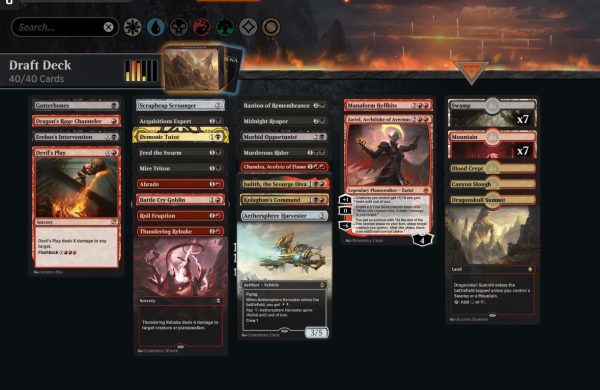
This cube can pull you into a handful of different directions but emphasizes the importance of card flexibility. This is especially important in best-of-one, where you don't have access to a sideboard to swap out ineffective cards. Some drafters might just take their favorite card out of the first pack and try to make their preferred deck work. It's more reliable though to start off with cards that excel in a variety of different decks and archetypes.

For example, I chose Abrade as my first pick as it's an efficient removal spell for both creatures and artifacts. With most decks playing at least some number of creatures and the cube hosting artifacts like The Immortal Sun and Midnight Clock, it's rarely a dead card.

Notably, I picked Abrade over Magma Opus despite Opus being the stronger card in a vacuum. This is because Abrade can slot in far more decks. Opus fits into control shells and the spell reanimator sub-archetype with Torrential Gearhulk and Mizzix's Mastery. Control though can win with just about any big mana spell, like Overwhelming Splendor or Approach of the Second Sun. Gearhulk and Mastery are strong on their own and work with any number of other spells. Abrade, on the other hand, is just an effective tool that simply always makes the cut.

I go into detail as I make each of my draft picks, but if you have any questions on why I made the choices I did, feel free to leave a comment or tweet me @AdamECohen.

Unmuddle Modern with Pillar Thinking

Are you a Quiet Speculation member?

If not, now is a perfect time to join up! Our powerful tools, breaking-news analysis, and exclusive Discord channel will make sure you stay up to date and ahead of the curve.

If the last time you sat down to a game of Modern was before the pandemic, you're in for a rude awakening. The format has been turned completely on its head. Luckily, we've got you covered—today's article applies pillar thinking to Modern, identifying five distinct macro-archetypes to carve out a holistic picture of the format.

Just Like a Pillar

Discussion of larger non-rotating formats (especially Vintage) sometimes circles back to the idea of pillars, reference points often represented by one or two key cards or interactions. By virtue of their power or ubiquity, format pillars guide and shape the way formats are experienced, contributing to notions of speed, health, brokenness, and so on. As the name suggests, no matter how diverse a format might be in terms of individual decks, only a few larger pillars hold up the structure; multiple decks then fall under each umbrella, such that each pillar claims a sizeable metagame share.

There was an error retrieving a chart for Tarmogoyf

Historically, Modern's pillars have been relegated to color combinations and card interactions. Think back to 2015, when Modern's popularity was exploding; on the interactive side of things, UR Twin and BGx Rock were the pillars keeping things together, while linear aggro (Infect, Affinity, Burn, etc.) and combo (Amulet, Scapeshift, Grishoalbrand, etc.) made up the other two.

As will always be the case with sweeping simplifications, some decks were naturally caught in the middle, such as low-to-the-ground aggro-control decks like Zoo and Merfolk. But the idea of these three or four macro pillars nonetheless proved an extremely valuable way to approach the format from a strategic metagaming perspective, aiding analysts and grinders alike in their quest for top-tier Modern mastery.

Take Them Five

The same can be said today. Once the dust settled from Modern Horizons 2, five distinct pillars emerged, each hinging on one or two specific cards.

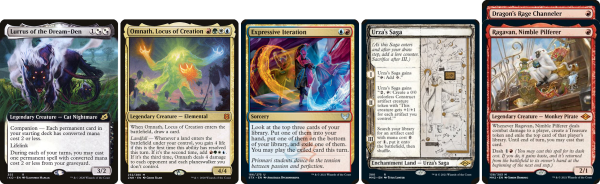
Not one of these cards existed during Modern's packed-LGS heyday. The earliest to the party was Lurrus of the Dream-Den, on May 15, 2020. Omnath, Locus of Creation and Expressive Iteration followed in subsequent expansions, with the Ragavan, Nimble Pilferer/Dragon's Rage Channeler package and Urza's Saga taking up the rear in Modern Horizons 2. In other words, they all moved into town once we were safely locked inside our homes—and now, each sits atop the Modern format in its own way, informing how players ignore or interact with each other while respectively clawing to victory.

On de Grind

Lurrus, Omnath, Iteration, and Saga all share an obvious strategic alignment: they provide the caster with value. For a time, Modern's best creatures were those that dodged Lightning Bolt and demanded clunky answers if they were to trade at parity; now, between Fatal Push, Prismatic Ending, and Unholy Heat, there's no shortage of efficient ways to dispatch of a Tarmogoyf.

Similarly, I once wrote a whole article decrying card advantage as a lost cause for many Modern players, then rode that philosophy to years of competitive success and a Classic win on the mull-to-four machine that was Colorless Eldrazi Stompy. These days, the best spells in the format are those that put pilots up on cards. The influx of efficient answers is precisely what has elevated card advantage's standing in Modern. When you're seeing answers as good as Ending and Heat, those draws become way more relevant to a game's outcome, and in a best-case scenario, your creatures play to that same goal.

There was an error retrieving a chart for Dragon's Rage Channeler

For their part, Ragavan and Channeler are so appealing as Stage 1 creatures because despite sharing a casting cost and potential damage output with the likes of Goblin Guide, they reward players with card advantage over the course of a longer game. Ragavan connects and creates a Simian Spirit Guide; on a good day, he'll also dig up your opponent's Thoughtseize or Lightning Bolt. Many have likened scry 2.5 to draw a card; surveil is a good deal stronger, and those sleeving up Channeler have no problem setting off the Shaman multiple times per turn. Good-bye, big butts—in this day and age, blue-chip aggro threats aspire as much to Monastery Swiftspear (once the format's premier aggressive creature) as they do to Dark Confidant.

A Tale of Twos

Next, let's apply our pillar thinking to the metagame at large and see how these forces dictate what we play. Drawing from the power rankings of our December metagame update, we can see that each pillar is heavily represented at the top of the charts:

Deck NameTotal Points Total %
Tier 1
Hammer Time13715.41
4-Color Blink11312.71
Grixis Death's Shadow11012.37
UR Murktide788.77
Tier 2
UW Control485.40
Tier 3
Cascade Crashers394.39
Yawgmoth394.39
Jund Saga303.37
Burn293.26
Amulet Titan252.81
Rakdos Rock182.02

Indeed, after the first four decks, there's a significant drop-off in power rankings. To quote David, "There have been big gaps in the data before, but they've never been as big as this. 20 results separate the bottom of Tier 1 and all of Tier 2, a tier that just barely has any decks at all since UW Control and Cascade Crashers are right on the cutoff." What do the Tier 1 decks have that the others don't?

There was an error retrieving a chart for Lurrus of the Dream-Den

Well, all of them run not one, but two pillars. Hammer Time uses Saga as a tutor for its win condition while recurring everything with Lurrus. Blink runs the best cards in its colors as an excuse to abuse Omnath, among them Expressive Iteration. UR Murktide combines the awesome offensive power of Ragavan and Channeler with the velocity-forward card advantage engine of 4 Iterations. And Grixis Shadow does the same thing but trades in Murktide Regent for Lurrus of the Dream-Den, a third metagame pillar. Three pillars in one deck... to quote David again, "here's your headline: as the Tier 1 deck with the highest average points, Grixis Death's Shadow was the top deck of December 2021!" Coincidence?

Take a look at the lower-charting decks. UW Control, Cascade Crashers, Yawgmoth, Burn, and Amulet Titan all run zero pillars. No wonder they're outliers! But then there's Rakdos Rock and Jund Saga, both black-based rock decks combining the Lurrus and Ragavan pillars. Jund Saga even packs the enchantment land, also making for a total of three pillars... but not amounting to a Tier 1 bid. Why not?

There was an error retrieving a chart for Expressive Iteration

With the pillars established, we can closely examine the compromises each deck is making to grasp, say, what Grixis Shadow offers over Jund Saga. For starters, they're both Lurrus-Ragavan decks. But Grixis surrenders the grinding plan of Urza's Saga to claim that of Expressive Iteration. Given its success over Jund, my takeaway from this development is that Iteration is the better grinding card in a low-curve deck, while Saga wins out given tangible synergy incentives, as in Hammer Time; alternately, Wrenn and Six bringing the land back may be a bit durdly for the current landscape, especially now that players have adapted to fighting huge constructs. Then, Goyf becomes Death's Shadow, a creature that more easily resists Unholy Heat and doesn't trade down on mana when it does get sniped—more of a no-brainer.

Speaking of no-brainers, Rakdos Rock is even easier to parse—this is just Grixis without Expressive Iteration! Not to mention Terminate over Drown in the Loch... no wonder it can't keep up with Shadow. What's the story, then, with UR Murktide? Here's a two-pillar deck that would adore Lurrus as a companion, but instead opts for Murktide Regent, the best closer in the format for fair decks (better mana is a nice pickup, too). Therein lies the difference between Grixis and UR, and the reason UR plays and feels like the more aggressive deck: its top-end tool of choice prioritizes damage, not card advantage.

Let's Have a Party

Thinking about the metagame in terms of pillars can help make sense of strategic tech choices, larger trends among successful decks, and even financial swings. But it also allows for top-down deckbuilding, wherein we attempt to jam as many pillar-defining cards together as we can and explore the possibilities.

There was an error retrieving a chart for Esper Sentinel

Limitations: We can't run them all together because Lurrus's companion condition excludes Omnath. So it's one or the other, and I'm not about to try my hand at rebuilding the Omnath deck already devouring offshoots left and right. Running either Omnath or Iteration, both of which are quite color-intensive, pretty much eliminates Saga, a land that taps for colorless. Realistically, then, we can run up to three pillars in one pile, something Grixis Shadow and Jund Saga are already doing.

What are we left with? Off the top of my head, we could try a Prismatic Ending-backed Jeskai Tempo shell with Lurrus, Ragavan, and Iteration. Maybe a Naya Saga midrange list dropping the targeted discard to pull in some creature combo synergies or disruptive beaters like Esper Sentinel.

Let me know what you come up with! Modern may emerge from quarantine deeply altered, but so long as we strive to understand the format, she'll always be our oyster.

A Little Magic Finance Nostalgia

Are you a Quiet Speculation member?

If not, now is a perfect time to join up! Our powerful tools, breaking-news analysis, and exclusive Discord channel will make sure you stay up to date and ahead of the curve.

It shouldn’t come as a shock to readers that I’m a nostalgic guy. This is evidenced by my interest in Old School and collecting cards from Magic’s earliest years. Memories of sleeveless decks, cards blowing away during playground games, and complete and utter ignorance of card rarities bring a sense of joy.

Even though my engagement in Magic finance didn’t begin until much later—around 2009—my thirteen-ish-year pursuit of this hobby has aged sufficiently to grant me nostalgic pangs for days of yore. For those who have been around the Magic finance block as many times as I have, perhaps you’d like to re-live some of my favorite memories in Magic finance with me? A few things come to mind which still bring memories of excitement even now.

For those who are much newer to buying, selling, and trading Magic cards to save or make some money, perhaps these memories will inspire you in some way. If nothing else, it’ll be a reminder for folks as to how different things were even just a few years ago relative to my understanding of the pursuit today.

Remember When...


Pro Tours really shook the Magic market? Back when there were major Pro Tours, played quarterly, in person, with live coverage, there was a thrill in the air in anticipation for the upcoming event. I knew the Pro Tour schedule sufficiently to remember to tune into live coverage of each event. When day one of the tournament would commence, on Friday, I would do everything possible to catch glimpses of the first rounds of Standard (or Modern) to see what cards the pros were tapping into for their innovative decks.

Since I work Monday through Friday, this often meant listening to coverage on my car ride to and from work and catching occasional glimpses of the action throughout the workday. It would be impossible for me to stream live Magic coverage all day at work, so I found an alternative way to remain abreast of all the latest developments: the Quiet Speculation Discord!

Years ago, a subset of the Quiet Speculation community would live in the Discord for that entire weekend, reporting on decklists, sharing results, and identifying pricing trends as soon as they began. There would even be folks on-the-ground at the event in person sharing additional insights whenever possible. The goal was to be the first to know about new tech, a new card making waves, and a new opportunity to make a buck from Magic.

There are numerous examples where this happened, but my absolute favorite was when Return to Ravnica first debuted, and Angel of Serenity surprised players at the Pro Tour.

There was an error retrieving a chart for Angel of Serenity

It was early 2013 when I saw rumblings of the card’s strength on Twitter, before the main event. I sent an email blast to the Quiet Speculation community with the suggestion that this card could make waves at the Pro Tour. Sure enough, the card showed up, made itself known in some games on live coverage, and the mythic rare spiked from a couple of bucks to $20 for a brief time. I still have the email acknowledging my bold call and contribution to the community.

This email really motivated me to engage even more with Magic, tracking Standard trends to stay ahead of the curve as much as possible.

This was a different time, though. Such activity may not be as fruitful today because


Remember When


the most popular Standard non-foil rares would exceed $20 and mythic rares would approach $50? Going a little further back, there were some occasions when Standard cards would be even more expensive (*cough* Jace, the Mind Sculptor). But there seemed to be at least one $20 rare and one $50 mythic rare in Standard at any given time.

This made trying to guess which cards would be the chase rares and mythics during spoiler season quite the thrill. Some cards would come out with an excessive preorder price, eliminating any opportunity for profit. But once in a while, there would be something under the radar that people didn’t fully expect to dominate Standard, and there would be a chance to buy low and sell high.

Nowadays, you can still open a $50 card out of a booster pack. But the problem is, there are so many special and alternate printings of Standard cards now that you really need to get one of the special printings in order to achieve that level of value. Opening a regular, non-foil mythic rare just doesn’t have the same “wow” factor it used to.

For example, right now the most valuable card (regular printing) in Standard is The Meathook Massacre.

There was an error retrieving a chart for The Meathook Massacre

It looks like this is a $44 card, so you’re not too far off from that $50 threshold—that’s pretty consistent with days of the past. There are a couple of other mythics worth over $20 (though not many). The most valuable regular printing, Standard rare I can find is Shipwreck Marsh, worth about $9.

There was an error retrieving a chart for Shipwreck Marsh

That seems pretty low for a “most valuable rare”, and I suspect it’s because Standard prices are hindered by all the special printings of new cards “absorbing” a set’s value. A given booster box of a new set can only be worth so much before people and stores will just crack them open for the singles, increasing supply and driving down values. By sprinkling in all sorts of alternate arts and foil versions of cards, it distributes a set’s value more widely across cards in the set, bringing down the average value of any given card.

I remember a time when you could open one of a number of rares in a set and double or triple your money spent on the booster pack. Remember when you could buy a $4 booster pack and open a Snapcaster Mage, which you could immediately sell for $30?

There was an error retrieving a chart for Snapcaster Mage

Now it seems like you need to open a specific card or two, or else you’re losing money on that $4 booster pack.

Not to mention the limited upside makes speculating on Standard less interesting than it was in the “old days”.

Remember When


there were “seasons” that caused predictable fluctuation in card prices? There used to be these events called “Pro Tour Qualifiers”, or PTQs for short, that would earn winners invitations to the season’s next Pro Tour. These qualifiers would be a set format depending on which “season” you were in. Most frequently, those seasons were either Standard, Extended, Sealed, or Modern (later).

Depending on which season you were in, you would see a significant fluctuation in card prices. This was most relevant when it came time for either Extended or Modern PTQ seasons because these formats involved older cards from sets that weren’t opened as often anymore. This meant the supply was a little more inelastic, driving greater upside for prices.

The strategy was simple: a month before the next Extended season, you would start trading out your Standard cards for Extended playables like Dark Confidant and Lotus Bloom. When Shock Lands were in Extended but out of Standard, you’d see a bump in their prices as well. The same went for other popular Extended lands, such as Gemstone Mine or Flagstones of Trokair.

There was an error retrieving a chart for Flagstones of Trokair

The trend was fairly reliable, and a common strategy in the Magic finance community. Because PTQ’s were widespread, played all over the world, and seasons lasted a few months, there would be a dependable jump in demand for these key cards. There was no sketchy manipulation involved, here. It was merely a matter of getting ahead of the curve and picking up cards before they became the talk of the town.

Then during the peak, about two-thirds through the PTQ Extended season, you’d cash out and move back into Standard (or better yet, Legacy) cards to bank your profits. Rinse and repeat.

Wrapping It Up

As I wrote this article, I reminded myself how engaging and dynamic Magic finance was five to ten years ago. PTQ seasons, Pro Tours, and expensive Standard cards kept the hobby exciting. Because of these cyclical trends punctuated by Pro Tour events, it was always beneficial to remain engaged with a community with similar interests. This way, we would work together to find the best opportunities and most impactful trends.

There are other things I also long for from those days. For example, I remember when spoiler season was actually a big deal. Of course, seeing new cards is always exciting, but you used to only get spoilers for new sets about two weeks before the set came out. Each day, a few key cards would be spoiled on Wizards' website, and then that would be it until the next day.

Nowadays, the constant rolling of spoilers day and night from content creators throughout the community isn’t necessarily a bad thing. But by having spoilers come out nonstop, there’s a feeling of dilution for each individual spoiled card. Don’t like the last spoiler? Just wait a few minutes for the next one.

Oh, and it doesn’t help that there are way more products being released in a given year nowadays. This means we went away from four to five spoiler seasons a year to a seemingly nonstop flow of new products. It turns out there can be too much of a good thing when it comes to spoilers—the concept has become mundane to the point now where I don’t even follow the new cards anymore. There are simply too many to track.

I don’t expect we’ll ever go back to the days of yore, five to ten years ago, when Magic and particularly Magic finance looked very different. Therefore, I have adapted my engagement with the hobby to embrace the aspects of the game I like most, largely ignoring the rest. It’s not an ideal solution, I’ll grant you. But I still talk about and buy cards, 25 years after I started playing, so my strategy must be working. If I ever completely lose interest, that’ll be the day I cash out completely and move on to something different.

Hopefully, that day is far into the future.

Avatar photo

Sigmund Ausfresser

Sigmund first started playing Magic when Visions was the newest set, back in 1997. Things were simpler back then. After playing casual Magic for about ten years, he tried his hand at competitive play. It took about two years before Sigmund starting taking down drafts. Since then, he moved his focus towards Legacy and MTG finance. Now that he's married and works full-time, Sigmund enjoys the game by reading up on trends and using this knowledge in buying/selling cards.

View More By Sigmund Ausfresser

Posted in Finance, Finance History, Pro Tour, StandardLeave a Comment on A Little Magic Finance Nostalgia

Have you joined the Quiet Speculation Discord?

If you haven't, you're leaving value on the table! Join our community of experts, enthusiasts, entertainers, and educators and enjoy exclusive podcasts, questions asked and answered, trades, sales, and everything else Discord has to offer.

Want to create content with Quiet Speculation?

All you need to succeed is a passion for Magic: The Gathering, and the ability to write coherently. Share your knowledge of MTG and how you leverage it to win games, get value from your cards – or even turn a profit.

A Simple Guide to Buying Magic Collections

Are you a Quiet Speculation member?

If not, now is a perfect time to join up! Our powerful tools, breaking-news analysis, and exclusive Discord channel will make sure you stay up to date and ahead of the curve.

I have acquired the vast majority of my personal Magic collection through buying the collections of others. I am confident that it maximizes dollar value; especially if you collect, play, trade, and sell.

The Who and How

At some Local Game Stores (LGSs) that I frequent that are NOT primarily Magic shops, players know that I am "the guy." Among my friends and personal associates, everyone knows that I am always buying Magic. If you become "the guy" you will have a steady stream of people coming to you with the intention to sell; this is the best "job" you can possibly have!

2014 was my biggest buying year—I purchased two million cards. Almost all of these were private collection purchases, but, I did buy out two stores—one that had been closed for a couple of years and another that was in the process of closing. If you are ever in the position to help a store close out, it can be a tremendous opportunity and a unique experience as well.

I am always on the lookout for new collections to purchase and I hope that I can show you some of the massive upsides to expanding your collection this way while also providing some insight to lower the overall costs of these types of purchases.

An example of the average collection purchase

Set Expectations

The vast majority of collections are bulk cards. Bulk rares, bulk uncommons/commons, and basic land are almost always 99% of what is there. For a collection of 3,000 cards that means there could be about 30 cards of significant value and 2,970 cards of almost zero value. Has the seller done the work for you, sorting all their valuable cards and being clear with what kind of value they expect? If so, great. Settle on a price for their valuable cards and bulk the rest. Sounds so easy, buying collections must be like this every time right?

No, heavens, no.

I don't want to disparage the typical Magic seller, but, it's not a fun or reasonable experience. So where do we find sellers who are reasonable?

The Lifecycle of a Magic Player

The absolute most important of these rules is understanding the seller. I make sure that the seller is done playing Magic. No one can afford to pay for "sentimental value" because it is not attached to "dollar value." If the seller wants to keep one or two decks—ALWAYS see these decks. Without exception, the best cards in the entire collection seem to end up right there. If they insist on keeping their best cards, that's fine, just remember it should be reflected in your willingness to buy. I truly want all the cards and if they are through playing Magic they should be ready to let go.

It is that simple—the best collections come from players who are finished playing. I generally avoid purchasing from anyone else for every reason possible. As the buyer, you have all the "power" in the transaction. Believe me, there is no end to the number of collections you can buy. Unless the seller is a former Wizards employee or store, it is unlikely they have something once in a lifetime. Even in the rare case that the seller does have something great, do they have something amazing at an unbeatable price? You can pay two mana for a Grizzly Bears or two mana for a Tarmogoyf every single day—don't spend four mana for a bear or five mana for a Goyf!

There was an error retrieving a chart for Tarmogoyf

Condition Matters

Keep in mind it's unlikely you will thoroughly inspect every single card in a collection unless it is very small or high-end. Cards often have hidden damage. The amount of time it would take to inspect 1,000 cards is quite high and generally not worth doing; most average collections are two to three times that size. Do you really care if a Crimson Vow non-full art regular Forest is in near mint condition? The answer is no, but also, it is yes!

Point out the condition of every single card that has any kind of defect whatsoever. Make sure that the seller is aware that condition matters! Every vendor has the same caveat when they are buying bulk: "These prices reflect 1,000 near mint cards." Make sure you operate the same way.

For chase cards or older vintage cards, the condition is twice as important. Generally, buyers fall into two camps. Some want the absolute best condition, most expensive top-end printing of a card aka "collectors." Others want the least expensive version of a tournament playable card aka "players." In each case, condition matters! MP cards tend to be the toughest sale as they are neither the cheapest nor the best condition; point this out! It's also very easy when looking at a long box of cards to check for significant edge wear or discoloration on the corners and sides of cards and this takes just a second of scanning to save you time and money.

Organic VS Inorganic

Most MTG collections range from 1,000-3,000 cards with 3,000 as a rough average. In the grand history of Magic, you primarily purchased packs of 15 cards with one rare. A collection of 3000 cards bought in 15 card packs would require 200 packs of cards to achieve; thus I am expecting right around 200 rares in an organic collection of that type. Additionally, at $3.99 a pack, the seller may have paid $800 for their cards. They may expect that, no matter what they actually have, their collection has significant value because of how much they paid.

Granted, there are so many ways to buy new cards today that these old ratios have shifted, but the idea is still true. If a 3,000 card collection has more than 200 rares that means the seller has likely added significantly to the average value of the collection and you should be more interested. If there are far fewer than 200 rares that's generally a sign that they have sold off much of the value. Obviously, if you detect 200 bulk rares with zero mythic rares, and few if any foils, this collection is "inorganic" and likely to be avoided unless bulk pricing is accepted.

Quantity is a Quality All Its Own

For me, a "huge" collection is about 30,000 cards or larger. Organic collections at this quantity are fairly rare. When presented with large quantity buying opportunities it's always better to be cautious because it takes several hours to go through every card. Purchasing bulk cards at around $6/thousand is not a very rare opportunity. If the seller does not have rares/foils/etc sorted then check one or two boxes, thoroughly, skim the remaining cards and assign a bulk value based on that.

Only once have I purchased a couple of long boxes without taking a look through everything because they only wanted $10; in these cases, nearly one entire 1,000 count box was just basic lands of no significant age or value, but, all the cards were in pristine near mint condition which I saw right away from perfect, clean white borders. For the cost of the long boxes and a couple of other alright cards in the other box, I did not risk much.

While I have found many good cards worth tens or dozens of dollars this way, I have never found anything of massive value in collections like this, and I have been doing this for many years. Never buy based on hope, only buy based on value. They may have lots of cards, but, they generally do not have lots of value.

The Ceiling and the Floor

For me bulk pricing is the floor and, generally, I am offering between two to three times bulk rates on a given unsorted collection unless the condition is an issue. The ceiling is definitely far more variable but I have mentioned that, for me, unless a collection is dripping with low cost, mint condition, vintage cards I do not want to invest a lot in reprintable, modern, cards.

Many years ago my rule was very different—I would never pay more than the cost of a Revised dual land for a collection unless it had Revised dual lands or better. Nowadays the market is different and the rules have changed. The more expensive a collection is, the greater a deal I want to get, percentage-wise. A recent example was purchasing a collection where the single most valuable card was Gravecrawler. Shortly thereafter it was reprinted in a Secret Lair. However, I did not overpay for the collection so, overall, it was still a home run. I am acutely aware of any purchase with significant amounts of modern cards that will inevitably be reprinted.

There was an error retrieving a chart for Gravecrawler

Don't overpay for cards! Especially cards that are likely to be reprinted. Set a ceiling and stick to it! There is always another collection just around the corner. FOMO is a dangerous thing, do not succumb to it!

What About Singles and High End Cards?

My experience buying high-end cards and singles tends to go poorly; in most cases, I feel I can purchase the same card for less elsewhere. One extremely useful guide is the MTG Sick Deals Facebook Group. Here you can purchase cards for 10% discounts off eBay and TCGLow every single day of the week. For me, that is the starting price for singles negotiations. The only time I pay "market price" for a card I need is when a tournament is a few days away. Additionally, I've gotten so much value purchasing entire collections that buying single cards, unless at a considerably discounted price, is just inefficient for me. I get more bang for my buck buying everything, and I do mean everything!

To put this another way, if you overpay for singles, you have less of a bankroll to finance your collection buying activities. If you can get great deals on singles, awesome, go for it! For everyone else, collections seem to just offer significantly better value; and not just monetary value!

Swag and Entertainment Value

Many people consider that breaking down and searching a collection takes considerable time; for me, it can save time and add value. Not only do you get a huge inventory of new cards to sell but also draft, do sealed, and get ideas for new decks to build. When I was working on three different Commander decks, rather than pulling those cards from my collection, I spent time sorting and buylisting cards. While doing that I pulled many of the cards I needed straight from purchased collections and, thus, saved some time!

Additionally, everyone loves accessories. Dice, sleeves, binders, deck boxes, and mats can all be fairly valuable addons for either resale or acquiring them without paying full price; thanks to buying entire collections I have not had to buy any accessories for years.

Finally, the Ion Scanner has saved me a ton of time and it has made the entire process significantly easier. Time is money and saving that time is worth every penny.

Four Collections Purchased This Year

I've briefly touched on general collection buying in this article. Next week, I will go over the four collections I have purchased already in 2022. They are very different in terms of size, content, price, how they were purchased and who the sellers were. I will also touch on some of the challenges of collection buying and pitfalls that I encountered with these specific buys.

Avatar photo

Joe Mauri

Joe has been an avid MTG player and collector since the summer of 1994 when he started his collection with a booster box of Revised. Millions of cards later he still enjoys tapping lands and slinging spells at the kitchen table, LGS, or digital Arena. Commander followed by Draft are his favorite formats, but, he absolutely loves tournaments with unique build restrictions and alternate rules. A lover of all things feline, he currently resides with no less than five majestic creatures who are never allowed anywhere near his cards. When not Gathering the Magic, Joe loves streaming a variety of games on Twitch(https://www.twitch.tv/beardymagics) both card and other.

View More By Joe Mauri

Posted in Free InsiderTagged , , , , , Leave a Comment on A Simple Guide to Buying Magic Collections

Have you joined the Quiet Speculation Discord?

If you haven't, you're leaving value on the table! Join our community of experts, enthusiasts, entertainers, and educators and enjoy exclusive podcasts, questions asked and answered, trades, sales, and everything else Discord has to offer.

Want to create content with Quiet Speculation?

All you need to succeed is a passion for Magic: The Gathering, and the ability to write coherently. Share your knowledge of MTG and how you leverage it to win games, get value from your cards – or even turn a profit.

The Exciting New Future of Quiet Speculation

Are you a Quiet Speculation member?

If not, now is a perfect time to join up! Our powerful tools, breaking-news analysis, and exclusive Discord channel will make sure you stay up to date and ahead of the curve.

A lot has been happening behind the scenes here at Quiet Speculation. Today I'm going to break down what we've been working on, and some of the exciting things in the works for 2022, including new content offerings.

Modern Nexus Joins Quiet Speculation

If you haven't already seen the announcement on our Twitter, the Modern Nexus team is now a part of the Quiet Speculation family. This means that all of the data-driven Modern coverage you've loved from them can now be found here, reinforced by our financial tools and pricing insights. Going forward, all Modern-related content published by QS will also appear on the Modern Nexus website. Readers of both sites will have more Modern content than ever before right at their fingertips.

New Team Members

With Modern Nexus becoming part of QS, We're excited to welcome Jordan Boisvert to our team as Assistant Director of Content, and David Ernenwein as our Modern metagame expert. In addition to Jordan and David, Andrew Villarrubia and Adam Cohen also joined us this month. Andrew is our rules guru, with content breaking down rules concepts to help improve your game Send your rules questions over to him on Twitter. Adam is our resident Johnny-Spike, self-described "Aggressively Izzet gamer," and constructed specialist. Look for metagame analysis and deep dives into individual archetypes from him. I'm very excited about all the content these talented folks have in the works.

New Publishing Schedule

With all these new additions, our publishing schedule for each week going forward looks something like this:

Insider Content is Back

If you haven't already noticed from the homepage, or our publishing schedule above, Insider content is back! We're slowly reincorporating it into our regular rotation, starting with features on Fridays from various authors on our team. Insider content will highlight the spiciest of our metagame tech and the hottest of our financial specs for our most dedicated audience. Whether you're looking to have the edge at your next event or make a profit from your collection, our Insider content will give you the info you need.

In addition to the inside line on the latest info, the Insider subscription also gives you access to a robust set of pricing and collection tracking tools. This includes our industry-leading card scanning software ION, which has just been updated with a ton of features and improvements. Click here to read more about Insider, or here to sign up directly.

Not to worry, with the reintroduction of Insider content, our free daily articles aren't going away. They will continue to be packed with the insightful content you've come to expect from our creators. This includes some content we have not approached in quite a while.

Video Content is Coming

That's right, Quiet Speculation has video content in the works. I can't comment much on it just yet, but suffice to say, we have a YouTube channel, that's been dormant for a number of years, and you're going to see lots of content on it in 2022, and moving forward.

Still Hiring

We are actively recruiting new content creators with fresh ideas and unique perspectives. If you're an existing content creator, or you've always had an interest in making Magic-related content, we want to talk to you! Check out our call for creators for more details.

More On The Horizon

We have a lot more exciting projects in the works for 2022, but that's all I can talk about for today. Before I close, I want to take a moment to give a shout-out to both our amazing content and our amazing tech teams. It's their combined efforts that keep the content you see on the site happening week in and week out.

Of course, none of this is possible without our loyal Insider subscribers. It's your financial support every month that keeps us up and running. If you enjoy the content we produce, please consider becoming a QS Insider today.

Are you as excited as I am about all the projects we have in the works? What sort of content would you like to see us offer? I'm always open to feedback either here in the comments or directly on Twitter.

Avatar photo

Paul Comeau

Paul is Quiet Speculation's Director of Content. He first started playing Magic in 1994 when he cracked open his first Revised packs. He got interested in Magic Finance in 2000 after being swindled on a trade. As a budget-minded competitive player, he's always looking to improve his knowledge of the metagame and the market to stay competitive and to share that knowledge with those around him so we can all make better decisions. An avid Limited player, his favorite Cube card is Shahrazad. A freelance content creator by day, he is currently writing a book on the ‘90s TCG boom. You can find him on Twitter and LinkedIn.

View More By Paul Comeau

Posted in Announcement, Feature, Free, NewsTagged , , Leave a Comment on The Exciting New Future of Quiet Speculation

Have you joined the Quiet Speculation Discord?

If you haven't, you're leaving value on the table! Join our community of experts, enthusiasts, entertainers, and educators and enjoy exclusive podcasts, questions asked and answered, trades, sales, and everything else Discord has to offer.

Want to create content with Quiet Speculation?

All you need to succeed is a passion for Magic: The Gathering, and the ability to write coherently. Share your knowledge of MTG and how you leverage it to win games, get value from your cards – or even turn a profit.

Priority And You: A Primer

Are you a Quiet Speculation member?

If not, now is a perfect time to join up! Our powerful tools, breaking-news analysis, and exclusive Discord channel will make sure you stay up to date and ahead of the curve.

Who's This Guy?

Hello! My name is Andrew, and I do all of the rules things. I learned to judge in the Dallas/Fort Worth metroplex. If you’ve attended basically any large Magic event in Texas in the last four-ish years you’ve probably seen me around. You can also find me hanging out in the rules IRC answering questions or writing for Cranial Insertion.

Starting today, I also write for Quiet Speculation! I'll write about something rules-related every week. If you have any topics you'd like to see covered, you should ping me on Twitter or our Insider Discord.

Today I want to write about priority. Players generally have a vague notion of it, but they tend to forget some of the finer details.

Some Basics of Priority

Magic uses the priority system to determine who can do something at any given time. A player with priority can cast spells, activate abilities, and take special actions. Each player in the game gets priority in each step of the turn except for the untap step and usually the cleanup step. We'll talk about exceptions later.

Any time a new object goes on the stack, there’s a fresh round of priority. Each player can choose to respond or not, and if nobody does, the top object of the stack resolves. If everybody passes priority without taking any actions while the stack is empty, the game moves to the next step or phase.

As a rule, the active player gets priority first at the beginning of each step and phase after the game handles turn-based actions and puts any triggered abilities on the stack. The active player also gets priority after a spell or a non-mana ability resolves.

Holding Priority

Strictly speaking, a player gets priority after they cast a spell, activate an ability, or take a special action. However, we generally take a shortcut and assume a player passes priority after they do something. A player can hold priority if they explicitly say they want to do so.

I want to clarify a bit about what “holding priority” does. This enables a player to cast several spells and/or activate several abilities in succession, but that's it! I often see players think it somehow works like split second or otherwise locks players out of responding. This is simply not the case. You can hold priority and cast your two Lightning Bolts, but you have to pass priority in order for either one to resolve, and they still resolve individually. An opponent can let the first Bolt resolve and respond to the second one.

The Long Part About Shortcuts

“What’s a shortcut?” you ask. Without shortcuts, you'd probably enjoy paper Magic much less. For instance, if players had to clearly pass priority each time they wanted or needed to, games would take forever. Even in a turn where nobody does anything, each player passes priority eight times. Could you imagine playing a game of Magic like that?

Instead of having to be painfully specific about the flow of the game, we have some handy dandy shortcuts. Most shortcuts in the Magic Tournament Rules formed over the years by just watching Magic players play. Every time you say “Land, go,” congratulations! You just took a common shortcut that means “let’s both pass priority until it’s your turn.” That beats you and your opponent(s) having to say “I pass priority” back and forth for 30 seconds.

Several of the other defined tournament shortcuts involve priority.

The Combat Shortcut

If the active player passes priority with an empty stack during their first main phase, the non-active player is assumed to be acting in beginning of combat unless they are affecting whether a beginning of combat ability triggers. Then, after those actions resolve or no actions took place, the active player receives priority at the beginning of combat. Beginning of combat triggered abilities (even ones that target) may be announced at this time.

Magic Tournament Rules, 4.2 - Tournament Shortcuts

That’s a lot of words, so let’s cover some situations. I'll always use a name starting with A for the active player and a name starting with N for the nonactive player.

Situation A:  Abby controls a Goblin Rabblemaster. Abby says “combat?” Nate, not wanting the Rabblemaster trigger to happen, says, “Doom Blade your Rabblemaster.” Doom Blade resolves. The game is still in Abby’s first main phase. Abby has priority.
Situation B: Ant controls two Grizzly Bears. Ant says, “combat?” Nico says, “Doom Blade a Bear.” Doom Blade resolves. The game is in Ant’s beginning of combat step. Ant has priority.

Putting Multiple Objects on the Stack

Next up, we have this shortcut that was relevant during Walking Ballista’s heyday.

If a player adds a group of objects to the stack without explicitly retaining priority, they are assumed to be adding them to the stack individually and allowing each to resolve before adding the next. If another player wishes to take an action at a point in the middle of this sequence, the actions should be reversed to that point.

Magic Tournament Rules, 4.2 - Tournament Shortcuts

Let’s say Anita has a Walking Ballista in play with six +1/+1 counters on it. If she says, “Activate Ballista six times targeting you,” what this really means is “activate Ballista once, then let it resolve,” six times. If instead Anita says, “Hold priority, activate Ballista six times targeting you,” this means “put all six activations on the stack one after another.” In the latter situation, none of the abilities start to resolve until they’ve all been put on the stack.

Making Choices Prematurely

We have one more shortcut that directly mentions priority, and it’s one of my favorites!

If a player casts a spell or activates an ability and announces choices for it that are not normally made until resolution, the player must adhere to those choices unless an opponent responds to that spell or ability. If an opponent inquires about choices made during resolution, that player is assumed to be passing priority and allowing that spell or ability to resolve.

Magic Tournament Rules, 4.2 - Tournament Shortcuts

If Archibald casts Pithing Needle and Noelle asks, “Naming what?” Noelle has passed her priority to counter the Needle. On the flip side, if Archibald casts Pithing Needle and immediately says, “naming Flooded Strand,” he’s stuck with that choice unless Noelle responds to the spell in some way. If she cracks her Strand, Archibald can change his mind and name something else.

Cleanup

Earlier, I mentioned that players usually don’t get priority in the cleanup step. Of course, that means that sometimes you can get priority then, usually with the help of a triggered ability.

Let’s look at a card like Necropotence. Its activated ability lets me exile the top card of my library now, then put it into my hand at the beginning of my next end step. Let’s say I do this a bunch of times and end up with 15 cards in my hand. When we move to the cleanup step, I have to discard down to my maximum hand size of 7. Then Necropotence puts its triggered ability on the stack for each card I discarded.

In short, if any state-based actions have to happen or triggered abilities need to go on the stack in the cleanup step, the active player will get priority. I used a triggered ability as the example because it’s much more common than state-based actions happening here, though it’s possible!

Want Prices?

Browse thousands of prices with the first and most comprehensive MTG Finance tool around.


Trader Tools lists both buylist and retail prices for every MTG card, going back a decade.

Quiet Speculation