If not, now is a perfect time to join up! Our powerful tools, breaking-news analysis, and exclusive Discord channel will make sure you stay up to date and ahead of the curve.
Epic Experiment has been a favorite of mine since its release. I tried to make it work so many times pre-Theros but it never quite came together. The math of the deck rarely worked out; consider the following deck construction criteria:
Your deck must be mostly instants and sorceries and...
They must actually do something on an empty board because..
You probably can't play many, if any, creatures because they'll dilute your Experiment.
You need a lot of mana to operate yet you are penalized for having too many land.
You can't play Counterspells unless you want to screw around with Quicken, so...
You probably just pack a ton of burn and hope for the best.
These do not inspire a whole lot of confidence.
These are not exactly a set of rules I want to build around.
But I'm going to try, at the very least so I can set this concept aside forever and put my troubled mind to rest.
Let's get one thing out of the way quickly: Goblin Electromancer and Guttersnipe don't belong in this deck. Relying on 2-toughness creatures in any sort of combo deck that can't run countermagic is a losing proposition. I love those two guys, but we must set them aside for now. That's a different deck.
Let's focus on burn.
The list of burn cards in Standard that are worth playing is pretty unappealing. I stopped my initial search for burn spells at CMC 4 because I honestly don't see this deck surviving long enough to hit more than 6 land drops. The list is as follows:
Cheap Burn
We can consider Rakdos Charm and Toil // Trouble if we want to dig deep and are OK with conditional damage spells, but let's put Rakdos Charm in the 'board for now. That's 32 cards, plus 4 Epic Experiment. Add 24 lands and you have what might, loosely, be considered a deck of Magic cards.
Anyone can assemble a pile of burn and call it a deck, but we need to justify building around Epic Experiment as opposed to just playing burn and creatures. I'm going to make a few assumptions to do some math.
We will presume that over the course of the first 6 turns we draw 6 lands and 1 Epic Experiment.
We will presume that we have not drawn any extra cards in any way.
We will assume a perfectly random distribution of cards in our Epic Experiment and no knowledge of what may or may not be on top of our deck.
We'll be playing first so we have enough mana to kill threats as they hit the board.
Over the course of the first few turns of the game, we'll use our burn to stay alive by killing their guys and aim to fire off an Epic Experiment for a minimum of X=4. Anything less is just a waste and anything more is assuming too much longevity. Now we have to do some math to figure out if this deck is worth playing at all.
On turn 6 ( on the play ) we'll have drawn a total of 12 cards, 6 of which will be lands and one of which will be an Epic Experiment. The remaining 5 will be some random burn spells. Thus, our remaining deck contains 48 cards of which 27 are eligible for the Experiment. Let's go with the best case scenario when X=4 and you hit 4 burn spells. If the average burn spell in this deck does 2.875 damage, that's only 11.5 damage.
There was an error retrieving a chart for lava axe
If we swap Shock for Lava Axe and increase X to 5, we get up to 16.25 damage in this insane Magical Christmas Land where our experiment hits 100% of the time. That's a respectable total considering we'll probably have enough burn in-hand to do the last 3.75 damage.
Sadly, this is not Magical Christmas Land. The probability of hitting one of 27 burn spells on our first reveal for Experiment is around 55%. I'm doing some serious napkin math here, but I'd be glad to base my math around hitting 2.75 live burn spells in the average case. With an average burn spell value of 3.25 once we swap out Shock for Lava Axe, that puts us just shy of 9 damage per Epic Experiment. Hardly impressive for a 7-mana sorcery. At that CMC, there are probably better things to do.
Now, there will be cases when the Experiment reveals some devastating mix of Warleader's Helix and Lava Axe, but I am honestly not equipped to do the math to estimate the probability of such an outcome. What I know is that the average scenario results in about 9 damage for 7 mana and I'm not wiling to build a deck around that concept, no matter how cool it would be to watch. I will applaud anyone who can build this deck and win matches with it, but based on the napkin math I'm not willing to call this a successful brew.
Experiment Over. Time to grab a beer and drink this idea out of my head forever. Unless...hmm...Modern....
If not, now is a perfect time to join up! Our powerful tools, breaking-news analysis, and exclusive Discord channel will make sure you stay up to date and ahead of the curve.
Welcome back readers, speculators, insiders or potentially future insiders (depending on when you read this)!
Last week's article focused on specific cards (specifically ones not to buy) and I like to waffle between specific and generic (also I like to use the word waffle whenever possible....most often at breakfast, but in this case it doesn't mean a delicious bread-like treat I get to have when the stars align and milk, eggs, and waffle mix--Banana Nut, because that's how I roll--are all together at once in my fridge).
Any who, back to the subject you actually came to read about, Magic investment/trading/speculation.
<Brag>
I've gotten to the point with my collection where there isn't much I need to trade. Thanks to the massive influx of value traders it's getting more and more difficult for me to trade with people.
</Brag>
Sure, I have what you want, but you often don't have anything I want, thus I look through a lot of binders but rarely see anything I need. It's even harder when my trade partner finds exactly what they want really quickly.
Now, this issue wouldn't be as much of a problem if I was active in online selling. However, my regular job takes up a lot of time (and often times some of my "free" time) so I don't put the effort necessary to run a good store.
The new "dropship" upgrade for TCG player will likely keep me from opening up a TCG store and I'll just stick to eBay (even though I lose out on a little bit of money from fees), the ability to sell playsets together is really nice. I'll likely take up buylisting more now as a way to just convert cards into cash quickly and easily.
Bulking and Buylisting
The only exception is bulk rares. I love bulk rares and will always trade into them when I can. The reason is simple. I'm a pretty conservative investor and bulk rares are about as conservative of an MTG investment as you can make.
I like to compare them to gold, which used to be very stable and occasionally jumped up in value but rarely lost value. That and it's awesome when cards like Porphyry Nodes jump to $5 and you got six of them at $0.1 each.
Unfortunately, it's not often you'll find people willing to bulk out, for the same reason (the cards are always worth their bulk rates). Your best bet is to have high-dollar Eternal staples, as I've found people are much more willing to "bulk out" or "buylist out" for cards that are expensive and difficult to acquire. My Legacy trade binder is full of these sorts of cards because that's primarily what I want to entice potential bulk traders into.
One of the biggest challenges of being a bulk trader is maintaining "fairness". When you find someone willing to bulk out to you, they'll often hand you a stack/box/pile/binder and let you go wild. More often than not there are some non-bulk cards in there. It's up to you to determine the level of honesty you want to approach this subject.
I pull out the stuff I know is bulk. The other benefit of doing so is that it shows your trade partner that you're more honest and provides them with a higher level of comfort. If they see $4-5 cards in the $0.1 pile they are going to think you're just ripping them off.
Now, on the flip side of that coin it's impossible to know the buylist of every card in MTG. So, it's critical to just have a general idea or level of comfort with most cards. If you hand me a pile of 100 random MTG rares, I can usually guess which ones are more than bulk. I may be off on my price somewhat if I haven't seen them in a while, but you still can get a general idea.
This is why it's important to do multiple piles. Just because you aren't getting a card at the lowest bulk rate doesn't mean you're still not getting a great deal on it. I've gotten numerous piles of cards at $0.25 or $0.5 each only to find they buylist for $1-$2...which is still amazing profit. Paying more than bulk rates for cards is what's called "buylisting," as you aren't getting them at bulk prices, but rather buylist (or better) prices.
The last thing you need to determine is what rate you'll be using for bulk. I personally use SCG's bulk rates because they are pretty common now and accepted by the player base. (It's really hard to convince someone to sell you cards at $0.08 when they can walk over to the big name vendor and get $0.10 per card).
You also have to price your own cards fairly. If someone wants your Volcanic Island and is willing to bulk out, using TCG mid seems pretty fair (it's also hard to convince most people that they should trade for your dual land at a store's sell price when they can go trade into that store and get store credit in addition to the bulk rate for said card).
I've honestly found that fairly evaluating cards has still been profitable and several people I've met at nearby events told me that the next time the event rolls into town they'll bring me more stuff. Repeat business is always better than instant maximum profit.
The Rub
As you might guess, bulking and buylisting is how a lot of larger stores make their money, so some stores frown on anyone else doing this. So before you even consider it, you'll need to determine if they allow it. One of the easiest ways to bulk out quickly and effectively was to have a playmat with card prices listed; unfortunately almost all venues (depending on the TO) now will not allow these mats by anyone other than a store paid to be there.
I'm currently in the process of figuring out a good way to sort without use of my mat. (I can tell you firsthand how confusing it can get keeping track of 14-20 piles of cards. I imagine using stacks of coins would be bad because it might look like "selling" and I know WoTC doesn't like coins being used even for tokens (to prevent any resemblance to gambling).
One friend mentioned using dice, which I really like so I'll be trying that for now. Of course if you have a good memory or do it a lot, you could just space the cards out in front of you in a specific order (usually one that mimics a buymat) to keep them sorted properly.
If not, now is a perfect time to join up! Our powerful tools, breaking-news analysis, and exclusive Discord channel will make sure you stay up to date and ahead of the curve.
This week I'll share with you I have been buying and watching these days.
One more time, some good Modern picks, usual and unusual suspects. Whenever a format staple is dipping to its bottom, it is a nearly instant, no-brainer pickup. In 99% of the cases, a rebound will follow, especially with the Modern season to come.
I also have picked a wide variety of cards this week: Standard, Pauper and junk rares.
Finally, two cards that I'm not buying right now but that we should keep an eye on, as they might be potential winners in a near future.
Buying
Windbrisk Heights
This card is now well established in several variants of token decks. Recent changes in the B&R list and the shattering return of Bitterblossom probably drove the price of the white hideaway land a little bit over the top last month. With no appearance at the PT Born of the Gods, its price went back to its six-month low, a little bit below 4 tix.
Windbrisk Heights and token decks always have their share of play online, I'm expecting this card to move back to the 6-8 tix range for a comfortable 50% or more profit this spring.
Shadow of Doubt
This card moved from complete anonymity (0.1 tix) to the 1-2 tix range last year in January. Shadow of Doubt finally made a big jump between May an August to an almost 8-tix ceiling.
I had picked up few copies early this January at 3.9 tix. Shadow of Doubt is currently back to 2 tix, the bottom it has hit twice already since last year. I'm not necessarily expecting the blue-black instant to jump back to 8 tix, but I expect a return to about 4 tix this Modern season. I am reinforcing my position on this card.
Chromanticore
This five-color card was initially seen as a near junk mythic. Near because despite an impressive colored-mana requirement to cast it, the Chromanticore is extremely versatile and possesses a great combination of abilities. This mythic enchantment creature is seeing fringe play in Theros Block Constructed decks. In addition, a deck with four-of even posted a 4-0 in a Standard Daily Event (DE)!
With some casual appeal, in the line of Horde of Notions or Genju of the Realm, Chromanticore is for me underpriced at around 1.5 tix. I like this pick because it doesn't carry a lot of risks, probably a loss of 50% at most, and has great potential, either soon in Theros Block Constructed or later next year. If conditions are favorable, this mythic could easily break 5+ tix.
Ancestral Mask
Because diversification is a good thing, here is a pick that is non-Modern and non-Standard. Ancestral Mask is a Pauper and casual card. Mercadian Masques flashback drafts last December contributed to the fall of this common from 8 tix to 2 tix. Now back to 3-3.5 tix, this card is an excellent opportunity for the mid- to long-term. My goal with this card is in the 5 to 6 tix range.
Serum Powder
Another usual spec here in the name of diversification. This pick is based on its current chart trend and on its potential in a couple of months for Dredge decks in Vintage (it's a four-of). If Serum Powder has currently no application in Modern, and might not have any, this card has a very unique effect among Magic cards.
If a Modern deck happens to exploit the free mulligan artifact, very likely as a four-of, the price will go through the roof.
At an almost one-year low now, this simply sounds like a good pick to me.
Low Price Opportunities
Junk, or close to, cards with some potential could be attractive and easy specs for small bankrolls. They could also be attractive for bigger bankrolls if you consider buying 100 or 200 copies and forget about them until they really breakout. The Modern format is full of these "from zero to hero" success stories and I plan on writing an article fully dedicated to these "junk specs" in a very near future.
For now, here are the cards I think are worth considering.
Spoils of the Vault is pretty much unplayed at this point, occasionally appearing in some combo decks in Legacy. This card is also Modern-legal but doesn't fit in any competitive decks as of now.
I have seen some Modern casual deck list using Spoils of the Vault, and, surprisingly, it peaked at more than 1 tix right before Theros was released. This card is a typical sleeper that I am acquiring just in case. Nothing to lose and a minimum 1000% potential profits if something happens. Good enough for me.
Emeria, the Sky Ruin sees rare play in Modern, mostly in Martyr Proclamation decks. The card oscillates between 0.1 and 0.5 tix. The land from Zendikar is now at its all-time lowest, a great time to buy.
Leonin Arbiter. This cat is seeing more and more play as a member of the Hatebears horde in Modern, Legacy and Vintage. Currently at 0.5 tix and on the rise, I think Leonin Arbiter has a nice future ahead.
Watch List
Two cards I have been following the last couple of weeks which I am considering buying. I'm waiting for more information and/or a good opportunity to take position.
Ashen Rider
This archon from Theros was a little above junk mythic until Born of the Gods brought cards enabling a better graveyard reanimation strategy in Theros block and a little bit in Standard. Having replaced Angel of Despair in Legacy decks, Ashen Rider moved from 0.5 tix to more than 2 tix this past month.
At 2 tix, it is still a good deal, especially if Ashen Rider keeps being played in Theros Block decks after the released of Journey into Nyx.
However, in the past, Block strategies elaborated with only the first two sets were not necessarily valid after the addition of the third set. From this angle, the Rider might be a risky pick. On the other hand, if future Standard sets bring reliable reanimation spells, Ashen Rider is sure to have a place in the graveyard--2 tix is pretty cheap for such a mythic.
Gitaxian Probe
Now pretty low compared to its height, the free draw spell is a useful common for several Modern and Legacy decks. However, Scars block flashback drafts are just around the corner this week. Wherever the price will be this weekend, I'll try to get a bucket full. Gitaxian Probe is a guaranteed 1 tix or more during Modern season and a common staple for the years to come.
If not, now is a perfect time to join up! Our powerful tools, breaking-news analysis, and exclusive Discord channel will make sure you stay up to date and ahead of the curve.
Speculation sure is sexy, isn't it? Having that card you sat on forever finally hit feels great. I used to do a lot more short-term specs, so it was obvious that I should sell those as soon as they hit, but lately I have been finding a lot more long-term specs and have had to sit on cards wondering if they would ever go up.
This month has been good for my long-term stuff, and my faith in Legacy cards has paid dividends lately as a lot of that stuff hit historic highs. I don't know whether these new prices are sustainable, especially since Tropical Island was under $100 for 20 years and then spent 20 seconds between $100 and $300 on SCG. Still, specs like Ancient Tomb hit this month, and with a $10 buy-in, that feels great.
It's like I won the lottery! And I hope you know what that feels like, too. Speculating is like playing the lottery, and when it pays off, sometimes it pays off big and you are a big winner.
However, I have been thinking a lot about how much of what I do is actually speculating. When I really boil down how much of my money is tied up in specs vs. "inventory", how much of my time is spent working on things relating to Magic finance that aren't specs and how much of my energy is devoted to speculation, I'd say it's about 5-10% of what I do.
Considering my podcast does a "Pick of the Week" segment every week but I only buy specs every few months when I see an especially good opportunity, I'm making money for other people but not myself, but that's fine with me.
Growing Up?
I mention the "Medina method" frequently in my writing, which refers to Jon Medina's preference for just buying cards for 50% of retail and selling them for retail. If a card goes up, great, pay more and sell it for more. He didn't "waste" time or energy speculating (as he saw it) but rather just turning over inventory by buying it with a built-in margin.
There was no secret to his method, just connections that had to be made, work that needed to put in to having the infrastructure to make that work and the manpower to process the cards. It takes a lot more cards to make the same money just buying and selling compared with having a hot spec hit, so speculation appeals a lot to people who see it for what it is--fun.
Speculating is a lot of fun, and that's why I still do it. But if I had to speculate to eat... well, despite what I think is a pretty good track record (punctuated by some embarrassing picks!) I wouldn't rely on it for income.
Ryan Bushard, the financier who got me to come over to the "dark side" of MTG finance, is starting to shift his attention as well. The fundamentals of MTG finance that he and I have honed over the years have made us able to recognize trends and extrapolate to predict future growth, but a lot of that has been upended lately and I find myself learning on the fly. It's fun, it's exciting and it allows me to write interesting articles.
Still, at the end of the day, a majority of the money I make does not come from speculation. It's a majority of the fun I had, and I couldn't imagine doing this if I couldn't speculate a little just to see if I still have the skills to, well, not pay the bills, but get some thrills, maybe. I feel like I have the skills to get some thrills. Yeah, I like that (no I don't).
So with people who have been at this a long time eventually ending up feeling like the best money is in non-speculation if they didn't already, where is their article? With websites like Reddit bringing new speculators into our community every day, there will always be demand for articles about specs.
I don't plan to quit advising people about speculation any time soon. After all, it's my favorite thing! But there are some real "nuts and bolts" finance techniques that people who have been at this way longer than I have know intuitively.
A lot of our Insiders have their own store, whether it's a brick and mortar, a TCG Player or eBay store or a case at an LGS they stock. Some of them are expanding, looking into buying and selling at every level--prerelease, PTQ, Grand Prix. All of that sounds like a huge commitment, which is why speculation appeals to new financiers so much.
Still, I don't necessarily feel like some of the boilerplate stuff I do has no application for "hobbyists" or people who are new to finance. I think the earlier people start, the better they'll get, and the quicker they'll get better. too.
Future Sight
I think there's a lot of "free money" in MTG finance there for the taking but which requires some work to extract. It's not as sexy as speculation but it is rewarding in its own way.
I have done a lot in Magic finance these last few years since I started out at QS, finding pictures of mana symbol cupcakes on Reddit.
I've stocked a case at an LGS, sold ogred boxes on the floor of a GP, buylisted mountains of cards, transitioned from eBay to TCG Player. I've done shady, offsite cash deals in hotel lobbies, gone shot for shot with GP dealers on St Patrick's day and bought a collection from a guy's trunk in the parking lot of a strip club. If I can't make some of that seem as sexy, or at least as useful as speculation, I should probably stop calling myself a writer.
The future is a little murky right now. I hope to still bring you my weekly dose of snark and tournament results in my Alticle each week. I also want to impart a little of my experience with the "unsexy" side of Magic. Whatever the future holds, my goal is the same as it's always been--make you some money, and see how much finance info I can cram into a free article before management gets wise. Don't expect that to ever change.
Grand Prix Cincinnati
GP Cinci was this weekend, and as much as I wanted to be there, I couldn't. I didn't get home from Montreal until Tuesday and I didn't have enough time to prepare to hit up another GP so soon. I used to chain those stupid things together and spend almost all summer on the road, but since I'm running a card empire (heh) out of my basement and trying to buylist what seems like a million cards, I need to spend some time at home.
I hope at least a few of you met each other at the event and I hope some of you hopped across the river to hit up the Pepper Pod. I love a good steak at St. Elmo's when I'm in Indy, or a trip to Fogo de Chão and we're always finding new sushi joints we like, but for my money, you can't beat a good 24-hour diner, especially with the bizarro sleep schedule I am on.
For those who were there to play, there was a bit of heartache. A friend of mine, Kalamazoo Michigan Magic phenom Deshaun Baylock lost his win-and-in and has been beating himself up about it since it was the result of a play mistake. Still, it's not as though he lost to a total nobody. The opponent who capitalized on the mistake? GP winner Kyle Boggemes.
Deshaun is in good company. Everyone lost to Kyle this weekend. Not only that, I lose to Kyle Boggemes pathologically. As if the skill differential weren't enough, sometimes it feels like the universe conspires against me.
Growing up in Michigan, I have had plenty of opportunities to lose to Kyle over the years, sometimes spectacularly. I've lost to exactsies when I had him dead on board, lost to topdecks, lost games where I only needed one more land and had five turns and two draw spells to get there. I've lost PTQ win-and-ins. I have lost feature matches. I have lost in Limited, Constructed--I think I lost a match of Extended to Kyle in like 2005 because that is how long he's been pulling my pants down.
A Michigan State Champion at 13, Kyle plays out of RIW Hobbies, a store that was issued a Wizards of the Coast license to print champions. When your FNM is attended by the likes of Pat Chapin, Ari Lax, Michael Jacob and Mark Heberholtz, you pick up a few tricks. It's not surprising that Kyle won the GP. It's surprising that he won the GP with like, no practice.
Kyle played Esper Control, because if you are going to come home from college for the weekend, playtest for two hours and go "yeah, I got this" you should play a deck with Sphinx's Revelation. I know Kyle wanted to play a Sphinx's Rev deck because QS' own Corbin Hosler said so in his new capacity as tech coverage writer for Wizards. They even let him update the official Wizards Twitter feed. Heliod help us all.
The rest of the field was kind of boring as far as the Top 8 was concerned. Three Esper, two B/W, two Mono-Black and Naya Hexproof, the only deck in the Top 8 that even mildly excited me. We may as well skip the Top 8 because it's nothing new.
The Top 16 had a lot of gas, though. Ari Lax played a sweet Dredge list that looks odd but seems to hang together well. Event winner Kyle Boggemes talked about how often he boarded in Nightveil Specter which underpins nicely the point I want to make about Herald of Torment.
Initially, H.O.T. looked like a pretty mediocre rare to me, but I made the mistake of looking at it in a vacuum where the rest of my Brainstorm Brewery cohosts liked it very much in context. Specifically the context of stuffing Nightveil Specter and other nuisance fliers as well as being bestowed on something big to make it bigger and nastier and give you some gas after they dealt with the first creature.
I disagree that this is the next Desecration Demon as I think it will get worse with rotation, not better, but I expect this card to tick up. Black lists are playing it more and more, and by the playset. They are gettable for practically bulk right now, and I think there is a lot of upside, although I think maybe its upside is limited to the next six months.
There was a lot more Mono-Black and Esper in the Top 16. Boring.
Esper Control wins again, and with a stock list to boot. Let's see if there is anything noteworthy at all here. That Esper on Esper finals match must have been approximately as much fun to watch as a game of intramural croquet.
I like this burn deck a lot. I was really disappointed that Warleader's Helix wasn't even close to as good as Lightning Helix, but if you play it, it likely doesn't feel "weak" when you're winning the game off the back of an eight-point life swing.
Helix takes down stubborn creatures in Standard that regular Helix's three damage couldn't handle and, come on, it's Standard. You will play some sub-standard cards because they are Standard legal. Which makes them just standard. Not really sub-standard at all. Sub-Modern, maybe.
Anyway, the deck looks fun to play, and I think quite a bit of the field is likely to have issues dealing with it. I love and have always loved Chandra's Phoenix. Did a lack of Searing Spear in M14 hurt it? That would be a lot of Spear action with Lightning Strike in Theros, I suppose. In any case, I like Phoenix and think it is the best phoenix we have in Standard.
Burn is fun, creatures give it reach and it's a venue for Satyr Firedancer, a card the Canadian dealers in Montreal decided should have a negative spread when they took them from my binder.
Someone once told me that Jund is life. Maybe that's true, because like life, Jund, uh, finds a way.
Jund in another format? Just feed me to the T-Rex.
Jund, uh, found a way and came about when G/R Monsters players stared at their opponents' board states and said things like "I'd give my left testicle for a Doom Blade right about now" (heard at my FNM). No testicles need be given up, or anything else, really, as the G/R Monsters manabase and its maindeck Sylvan Caryatid accommodated a little black mana nicely.
Doom Blade, Dreadbore, Rakdos's Return, Slaughter Games, Thoughtseize, Vraska the Unseen--once R/G Monsters went black, it never went back. This deck is the real deal, but it's not playing anything new, just jamming the same old velveeta into a brand new shell.
The biggest surprise of this season has been that Ash Zealot is getting more play now that half of it is switched off. Red really just wants its own version of White Knight right now, and it's getting it. It hasn't helped the price, but it seems like it's in a lot more decks, possibly due to devotion being a thing.
Standard was "meh" and Legacy was exciting, so let's move on.
Too many Pet Decks to even call a winner. If the East Coast meta is dominated by decks like Reanimator and Painted Stone and most West Coast events are dominated by decks like Sneak and Show, LA seems to have a meta of "play whatever the hell you want to a Top 8 berth." Crazy.
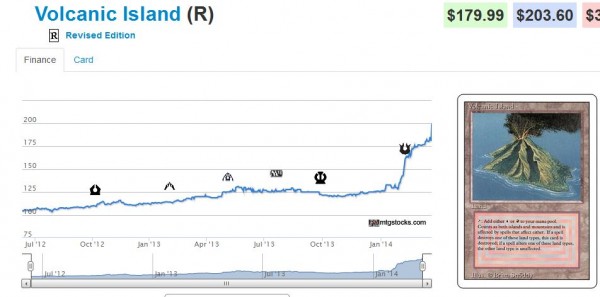
Are these alternative decks cropping up due to people not having $1,200 to shell out for a set of Volcanic Island? Only time will tell. I was never super jazzed about decks that played those lands anyway, and I expect the price to end up lower than that. I don't think the market can bear that cost, but who will be the first to drop their price? We are in for some interesting times ahead, and Legacy as a format may pay dearly in the meantime.
BUG Delver and U/R Delver took the top two spots, which is kind of disappointing given the wacky Top 8.
Death And Taxes has lots of $100 lands in it, but it may be the "budget" deck of the future. My box of Thalia is looking very good right now that it's spiked above $7. I sat on those for way longer than I'd like to admit, but it's finally paying off.
I wouldn't wait to get similar cards. An FNM foil and a Commander deck printing haven't curbed the price of Mother of Runes much--expect all Death and Taxes-able cards to stabilize just under $10 in the future.
Punishing Jund has always been a good deck, and with its manabase considerably cheaper than RUG Delver's it may be an even more appealing choice moving forward.
Future Uncertain
I don't know what the future of Legacy is, folks. I do know it's an enjoyable format to play and that proxy tournaments have drawn crowds. I don't expect the format to die and I don't expect people to pay $300 for Tropical Island. I know they're never printing more, but I also know that you can get a beat up Mox for $300 and Vintage can't draw the crowds Legacy SCG Sundays can. Magic card prices are a market, and markets self-correct.
Don't panic, buy stuff that gets played in Nekusar decks and make some time to do things other than speculating. Go to GPs, meet new people, play EDH, read lots of articles, listen to lots of podcasts, play Star Realms, teach a new friend to play, stock an LGS case, hold a proxy tournament at your store, check Craigslist for collections and always try to get a discount for paying in cash. That's how I roll, anyway.
If not, now is a perfect time to join up! Our powerful tools, breaking-news analysis, and exclusive Discord channel will make sure you stay up to date and ahead of the curve.
If you've been following my column over the last few months of it's infantile age - you've probably notice I jump back and forth between base concepts that I believe we all need to have, speculation targets, and talking about Modern. I talk about the concepts the most, because honestly - there is no greater source than QuietSpeculation for really fine tuning your approach to finance. Let's face it - there are a 1,000,000 +1 ways to be in this business. Each one is completely different from the next and there's really no "right" way to go about it. There's a lot of flailing around and trying to figure out what works best for you. Trying to find the best way of combining your strengths, time, and money into a cohesive strategy for making money and keeping Magic fresh. Let's not forget - this is still a game to be played and enjoyed.
One thing that has come up time and time again, though, was figuring out base assumptions though. Whenever I thought about my life, I knew I went to school. I knew my friend Jon went to school, for example. I knew that I studied the colors and that Jon did, too. I knew that my school might look a little different than his, but at the core everything else was the same. This simply was not the truth though.
Let me introduce you to the "Familiarity Concept." Whatever we are intimately familiar with becomes our expectation of what the norm is. I'll stop using big words for a second and break it down for you. What if you and I are having a conversation and during that conversation I keep referring to "Blue." You think: "Blue? Oh ya! I know Blue! I've known Blue forever. I love Blue. Blue is my favorite color. I know EXACTLY what you are talking about."
Here's the crux: What if I grew up thinking that Blue actually described Green?
How would we ever know that? It would take a unique parallel in the conversation to illuminate that basic assumption. If that thought alone never revealed itself in conversation, in application, or during our interaction - how would we ever realize that we are actually talking about two separate things?
This is why I love to bring up the basics along with other concepts involved with Magic Finance. Bringing that spotlight to bare on what and how you think is a great exercise and allows us to find the best way to fit our unique circumstances, budget, and time available. This is also the same reason that I believe firmly in the concept of a Paradigm Shift. Sometimes it takes throwing out everything you know, or think you know, in order to find the break through you're looking for.
One new concept I've found recently came from one of the epitomes of consistency.
Jerry Seinfeld
One of the most successful Comedians of all time? What does that have to do with Magic? Nothing, in actuality. What does is his method.
The Seinfeld Method
Show after show, year after year, Jerry Seinfeld put together a resume that is the bar for quality. The way he did it is very simple. How do you become a better Comedian? Write better jokes. How do you create better jokes? Create jokes all the time. Like most of life, if you make it a "When," not "If" scenario - something will stick and be comedy gold. Taking that approach really just makes it a numbers game.
So Jerry described his method for making better jokes:
"Get a big wall calendar that has a whole year on one page and hang it on a prominent wall. The next step was to get a big red magic marker. For each day that I do my task of writing, I get to put a big red X over that day. After a few days you'll have a chain. Just keep at it and the chain will grow longer every day. You'll like seeing that chain, especially when you get a few weeks under your belt. Your only job is to not break the chain."
I can hear you now: "That's great, Dylan. Ok, don't break the chain. WHAT DOES THIS HAVE TO DO WITH FINANCE?!"
People learn new languages by immersion. A person can learn a craft by sitting at the table, working at their craft. How else do the movers and shakers know when to sell, and when to buy? By being a part of it. If you're struggling to find the time to truly be immersed in finance - start by just doing one small thing each day. Read an article. Pay attention to a price change. Look at one collection and figure out it's value.
Just don't break the chain!
If that train continues, if that immersion happens, like Neo in the Matrix - you'll start seeing the code. The only difference is just how fast it will happen for you. Those that have more time, will see the patterns sooner and more applications for financial gain will arise from the static. Didn't see Wasteland's price spike coming?
[cardimage cardname='Wasteland']
Not everyone did. If you're immersed though, you've noticed the change in how the markets react. You've noticed that the game of Finance has changed. You'd notice that maybe your method needs to change along with it. Maybe something is just not working. You'll never see all the angles unless you can be a part of your craft. Make a conscious decision. Sit down and the whet wheel and hone your craft. Find a reasonable amount of time that fits your lifestyle. Remember why you're focusing on finance. Remember what you want to achieve, and then settle on a time frame for accomplishing it. Next, don't break the chain.
If not, now is a perfect time to join up! Our powerful tools, breaking-news analysis, and exclusive Discord channel will make sure you stay up to date and ahead of the curve.
With consistent opportunities in Modern, I haven’t been paying much attention to Standard finance in the last several months. Individual specs are too volatile, sometimes short-lived, and often don’t hit even when all the evidence says they should. But I’ve been observing a larger, longer-term trend that is applicable to heavy drafters, traders, and folks who open lots of sealed product.
My hypothesis today is that with a holistic, complete-set approach, we can determine general guidelines for acquiring and selling current Standard-legal cards on a yearly schedule. To identify any patterns, we’ll take a look at data pulled from MTG Goldfish for the last three blocks. If your time to devote to MTG finance is limited, today’s article will help you make the most of the time that you can commit.
Large Fall Sets
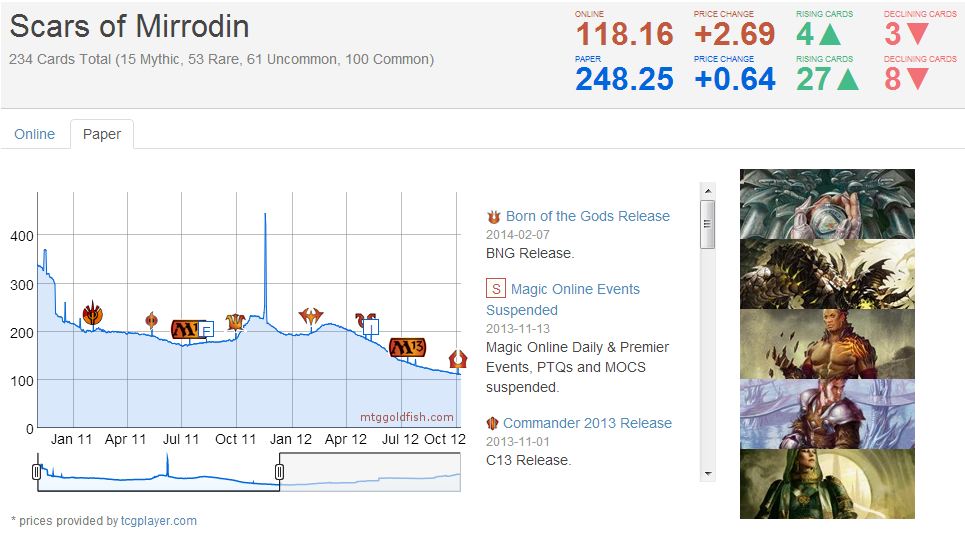
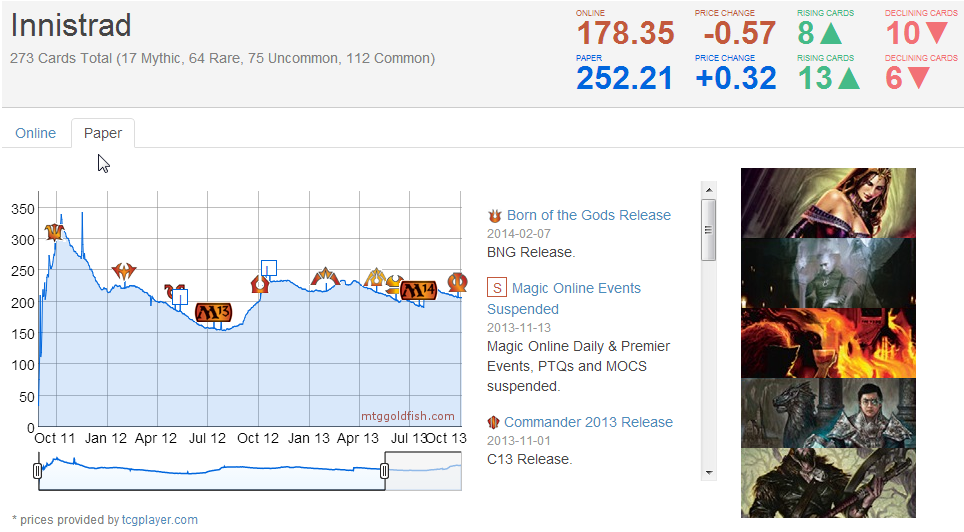
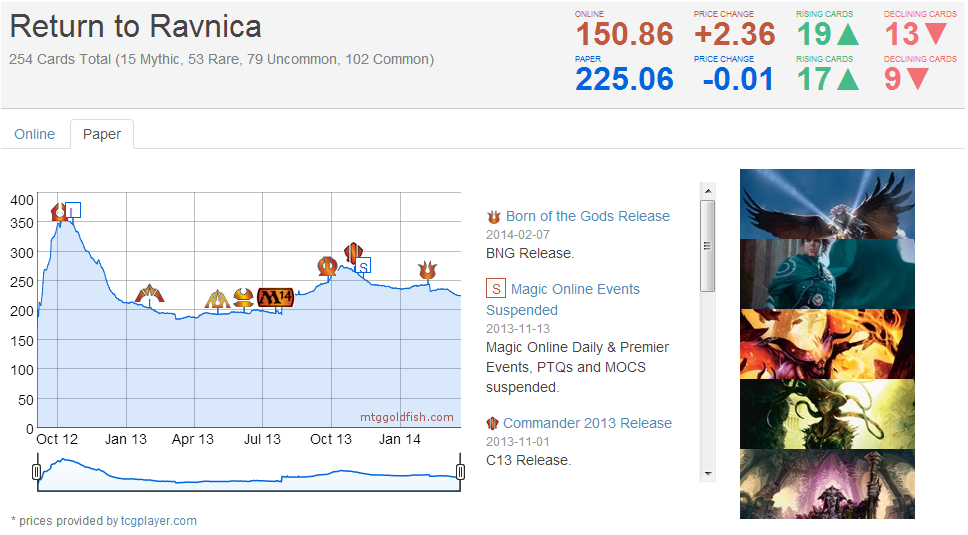
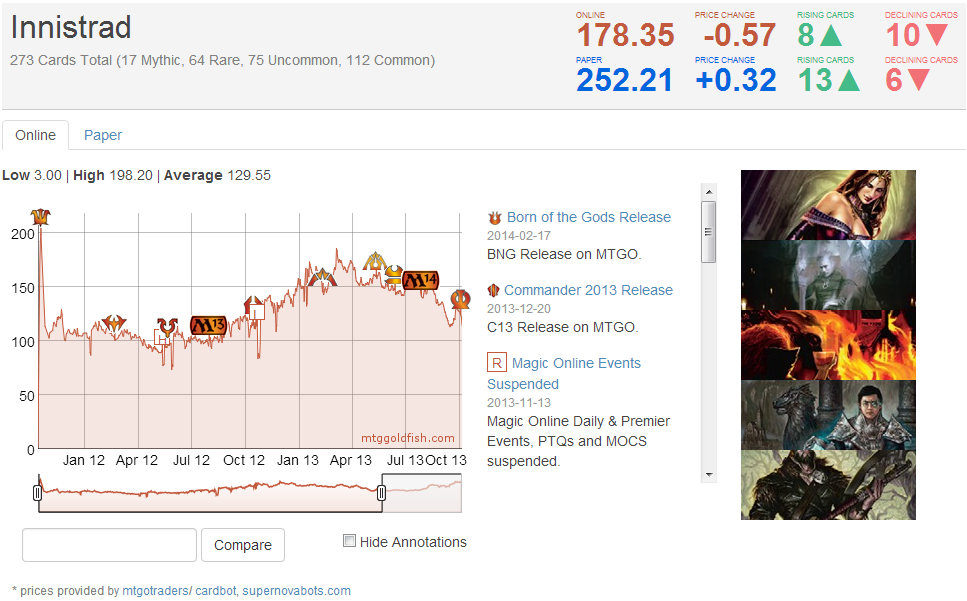
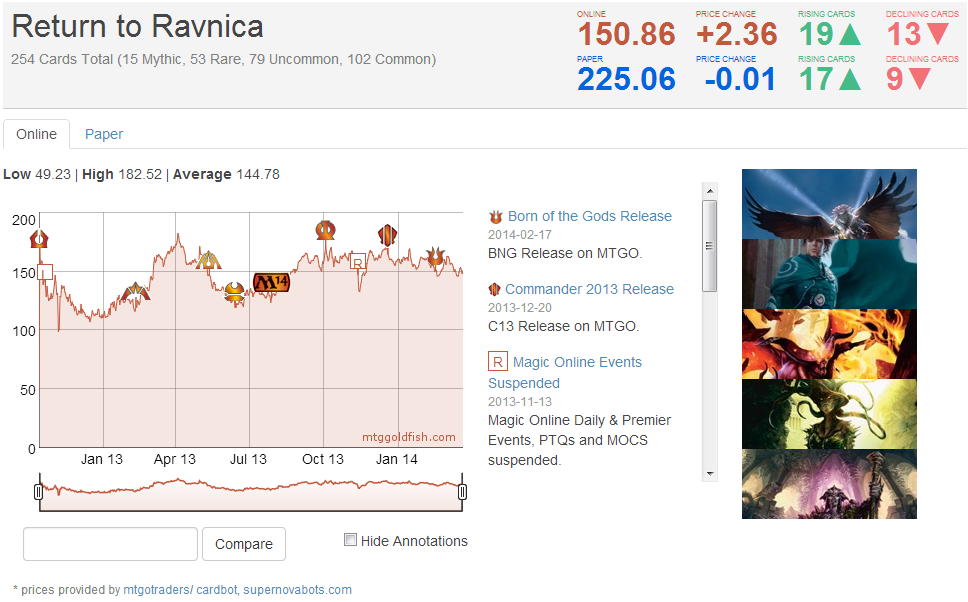
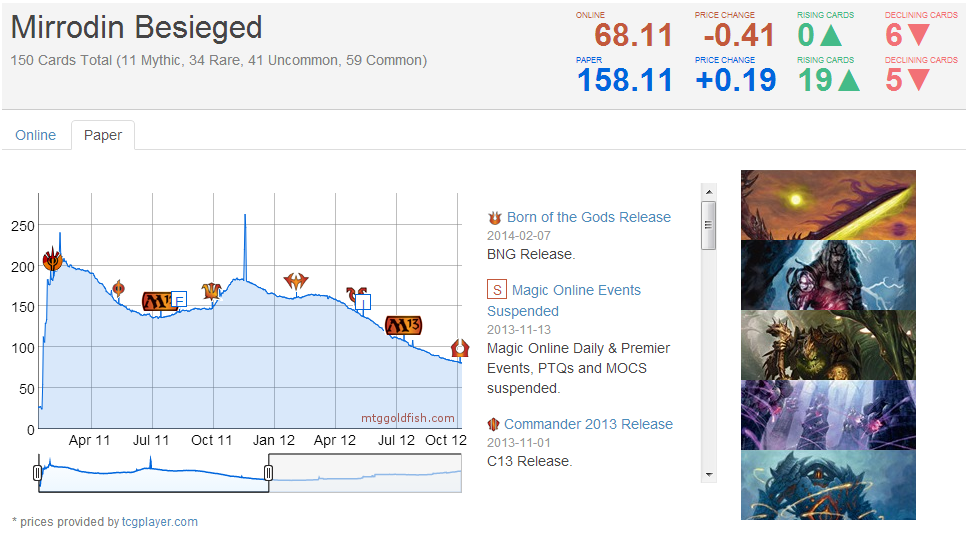
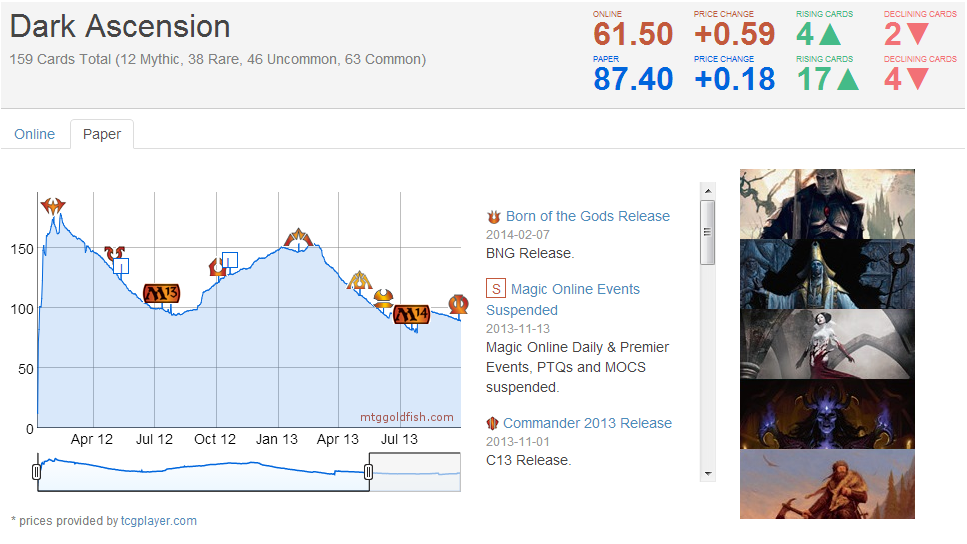
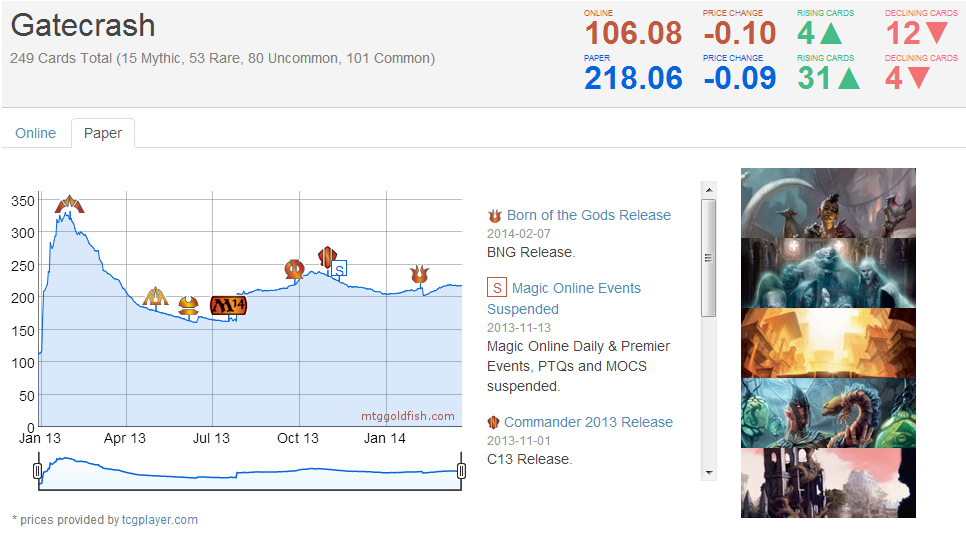
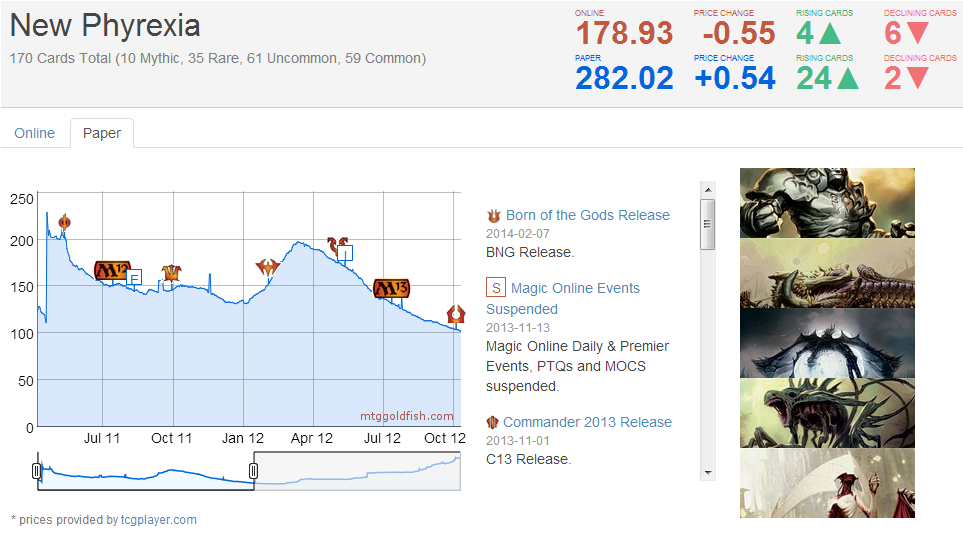
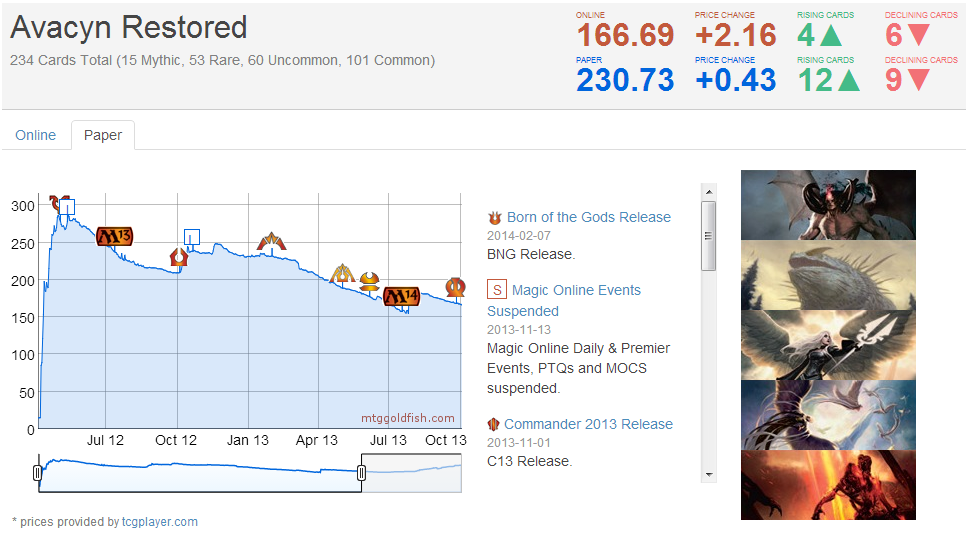
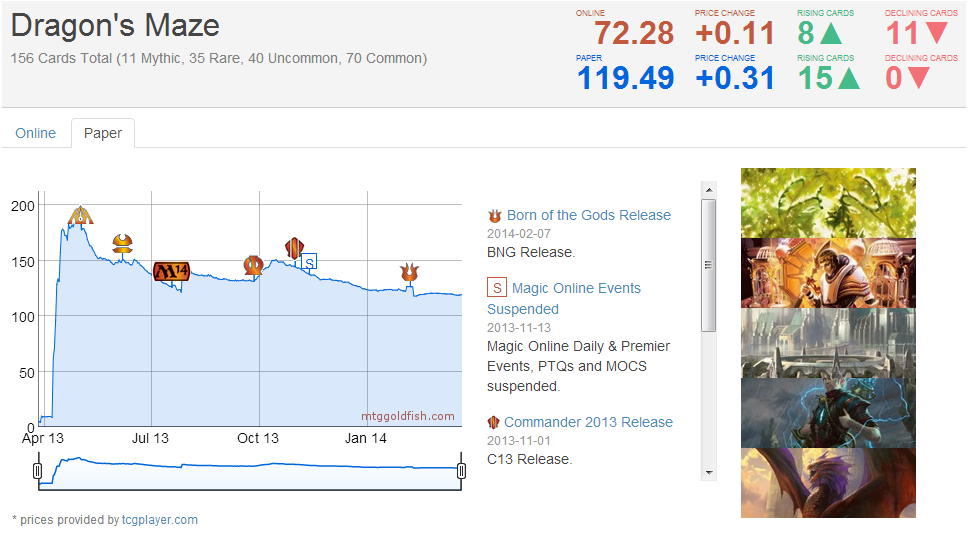
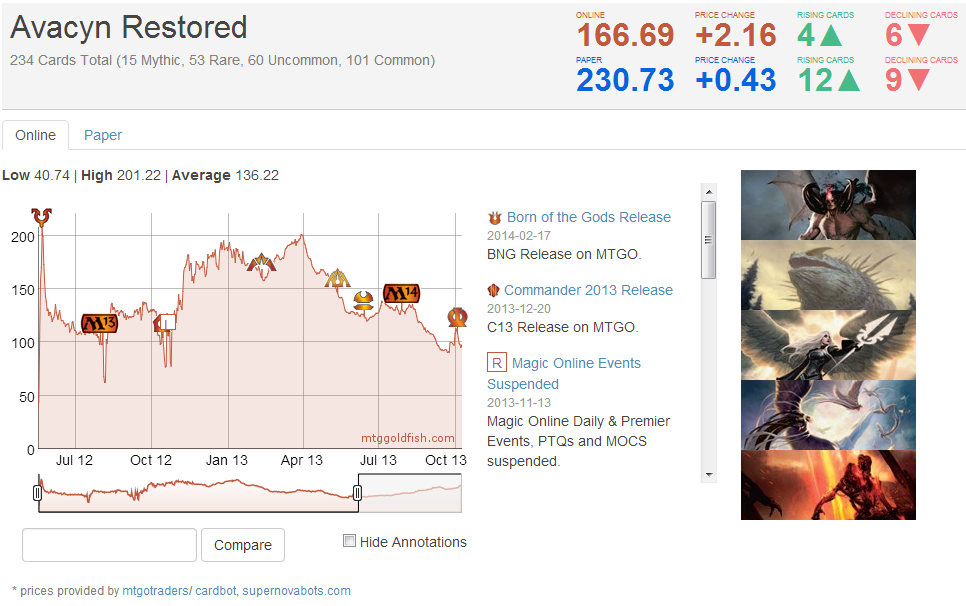
Take a look at the total set value for each of the last three large fall sets. The dates are limited to only the set’s time in Standard.
To me, there are three interesting pieces of information that each of these graphs share:
Without fail, the time a set index is the highest (at least during its time in Standard), is at the time of the set’s release. This is expected. Cards are new and people are excited to play with them. Nobody really knows which cards will be good and which won’t, so prices are based on speculation rather than results. And of course, there are fewer cards available, so basic economics dictate that the lower supply will mean higher prices.
After a set’s release, the set index steadily declines and generally reaches its floor at the time of the summer core set release. This also makes sense. The summer lull is an often-observed phenomenon, and many players cut back or take a break from MTG during these months. We’ve also reached the peak amount of drafting done with the previous year’s set, meaning card supply is at its highest. With fewer people playing, supply exceeding demand, and Standard in a state of flux, prices naturally fall to their lowest points.
The weeks immediately following a fall set release are the best time to sell cards from the previous fall’s release. In other words, the best time to sell Return to Ravnica cards was right after Theros became Standard legal. I’ve been saying for a while that RTR block cards should be sold by now, and it’s nice to see that point backed up with data here.
A very hands-off, big-picture approach dictates the following yearly pattern for Standard cards: sell whatever you get at a set’s release, start holding all of the current set’s cards during the subsequent months, acquire any additional cards around the time of the core set release, then sell out completely after the following year’s fall release.
Like I said, this is a big-picture approach. Individual analysis of particular cards may lead you to believe buying and selling at different times is the best strategy. If you have strong reasoning for breaking these patterns, you absolutely should! I’m not trying to suggest that every card in every fall set follows this trajectory. Instead, I’m merely suggesting that if your interest in Standard is secondary to other MTG finance opportunities, these are some good rules of thumb to allow you to have a hand in the format without spending a large amount of time studying it.
Comparing to MTGO
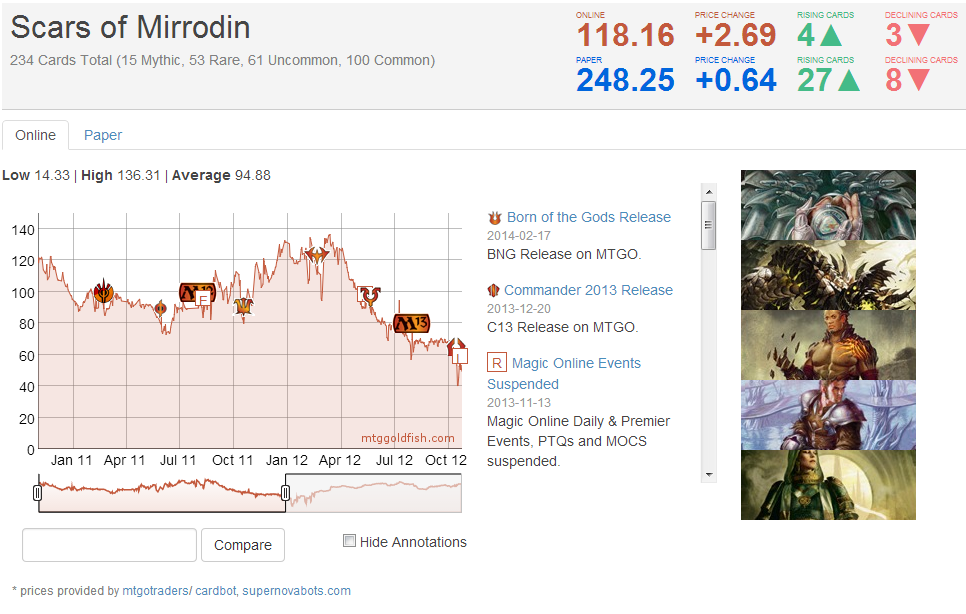
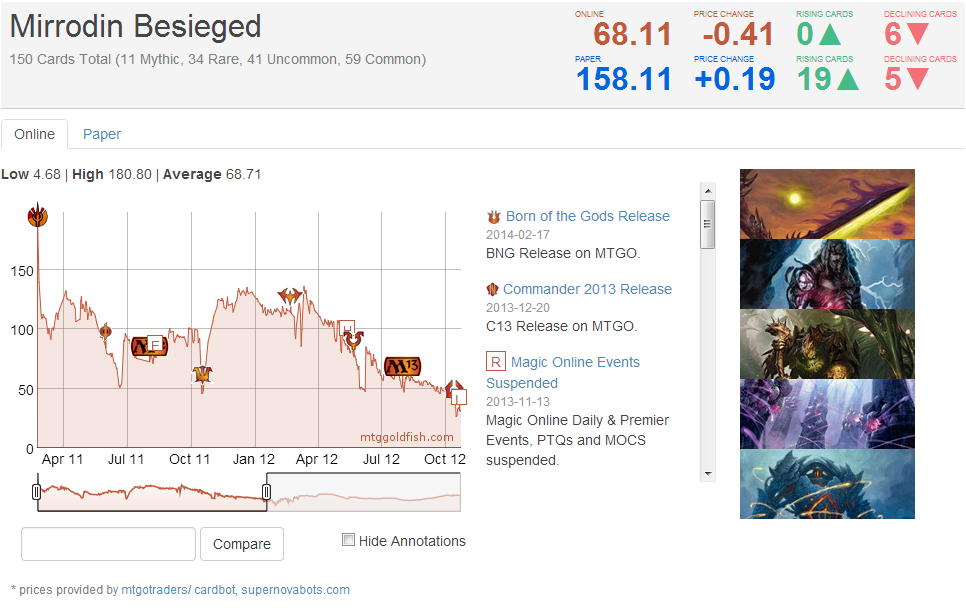
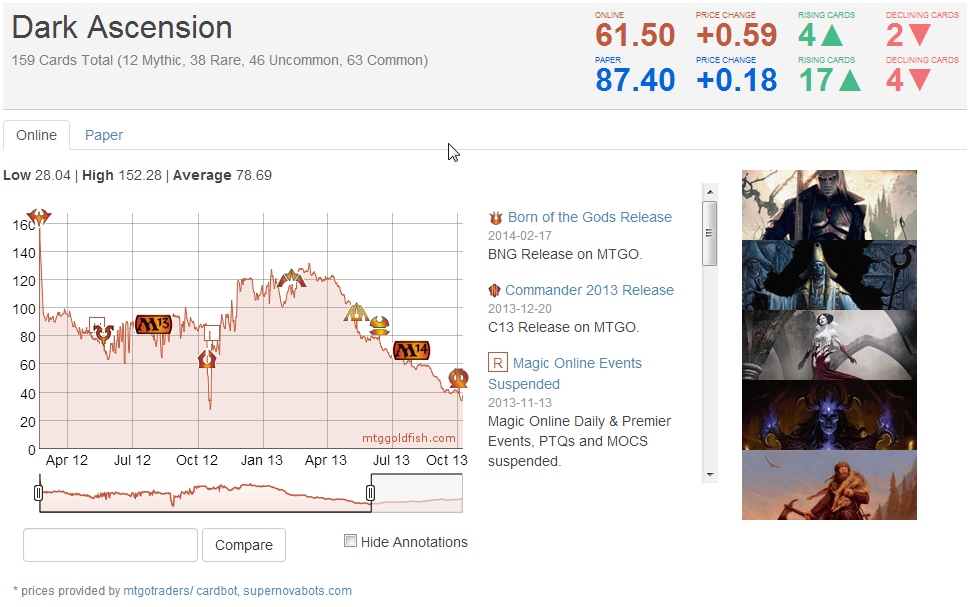
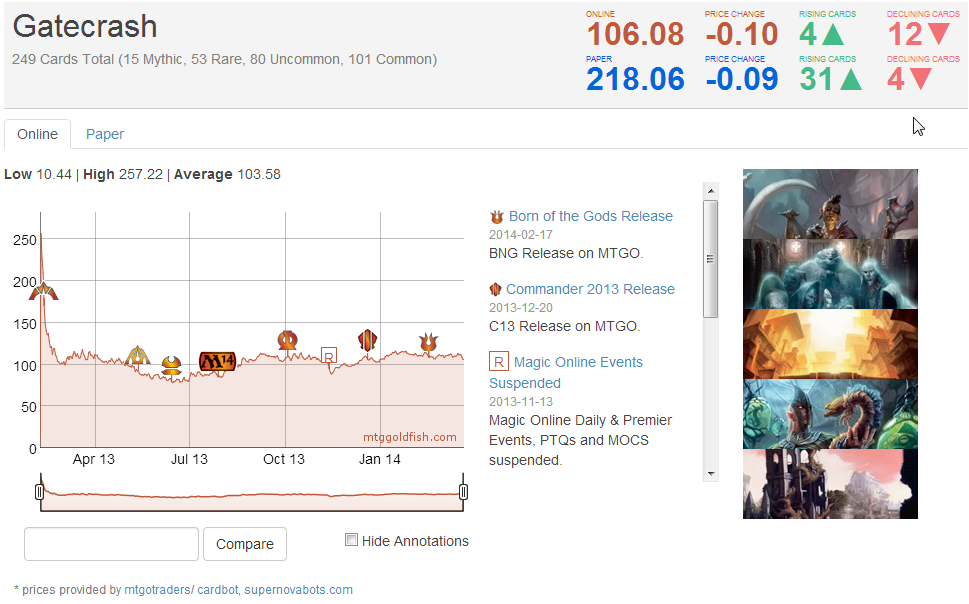
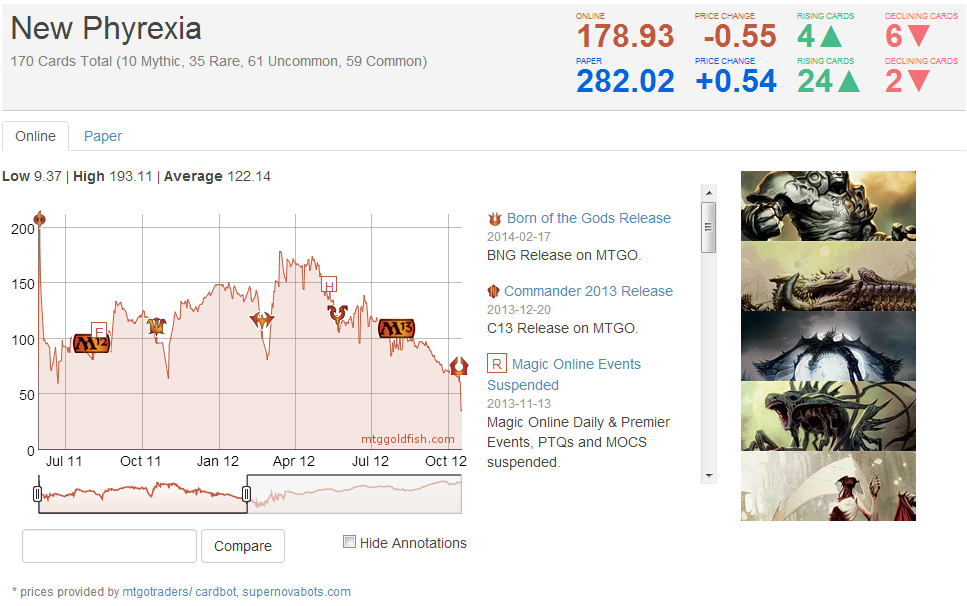
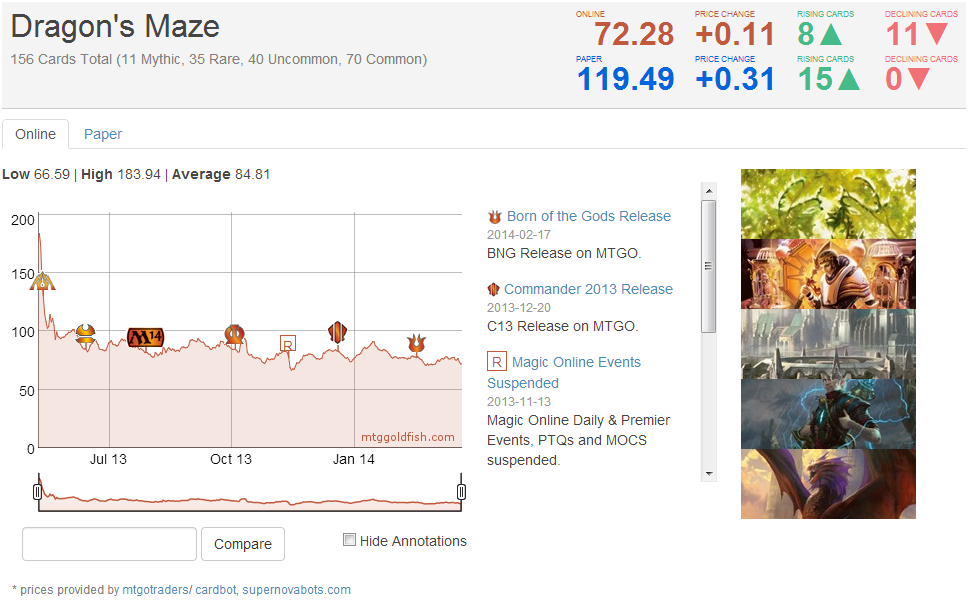
Here are the graphs for the same set's time periods on MTGO:
Prices are much more volatile on MTGO. But although there are some additional peaks and valleys, the basic pattern remains the same.
I’m hardly an MTGO finance expert, but I do draft a lot online. I first started drafting online during Innistrad, but only started doing it very frequently during Return to Ravnica. At the time, my idea was to draft complete sets and redeem them, since I’m more comfortable working with paper cards from a financial perspective. But I never did open a Sphinx's Revelation, and by the time Theros came out, MTGO prices on RTR block cards were very high. I ended up just selling out for tickets, and today, I’ve done over 80 Theros block drafts without having put any money into the system since Gatecrash.
I’m not at all comfortable describing myself as “infinite,” but can say that I’ve played more than $1000 worth of drafts in the last six months for less than a couple hundred dollars…that I spent in early 2013. I attribute this to all of the RTR-block cards I held for a year, and this will be my strategy moving forward. I regretfully have sold a fair amount of Theros cards, but I am holding everything else, especially mythics, for sale during next year’s Standard.
I won’t really know for a few years if this is a viable long-term plan, but the last several months have felt like a breakthrough in my attempts to play for free, so I’m sharing this strategy in hopes that you can benefit, as well. The cool thing is that I made zero speculative purchases to fuel my play—everything I sell is something I’ve drafted. The downside, of course, is that if you’re holding cards for a year, that first year will require some real-money investment to play enough drafts to fuel future years. But if this continues to work out, that first year is the only time that significant money needs to be put down.
I’ve been putting off a long-standing goal to learn the MTGO marketplace, but just because I’m not yet making speculative purchases on the platform doesn’t mean I’m not thinking about things in a financial sense. Even if there are areas of the game (MTGO vs. paper, particular formats, etc.) that MTG finance is not your priority, you can still make smart decisions that benefit you financially. That’s what I’m attempting to do on MTGO, and as I observe and learn more about the platform, my play will be cheaper and I may even make a few bucks. I’ll keep you updated of any strategies that start working.
A Few More Graphs for Your Amusement
I’ve made the points I need to make today. Winter and spring sets largely follow the same trends, so I don’t feel the need to go into further analysis on each of them. However, for your enjoyment, I’m copying the pertinent graphs below. If you have any questions or comments, please let me know below or on Twitter, @dbro37.
If not, now is a perfect time to join up! Our powerful tools, breaking-news analysis, and exclusive Discord channel will make sure you stay up to date and ahead of the curve.
Since discussions about buying collections seem to be all the rage these days, here's another gem from /r/mtgfinance. ( some formatting and spell-correcting done by us, because we care ). Answers in the thread range from "screw them for every last penny you can" to "give them the most for their money" to "take their asking price if you can make money on it" and everything in between.
The original poster, Quacksalvar said:
I searched the history of this group and did not find any discussions regarding this, so I thought I'd ask.
I am interested in starting to purchase collections from leads found on craigslist. What is considered reasonable or unreasonable during these transactions? Do you guys ask them what they wish to get from the collection to see if they throw out a low number? Do you guys search ALL of their cards? Do you guys throw buylist prices at them? Do you guys go over or under buylist?
I've heard some buyers look through for some notable cards, and then buy based on those prices, taking the rest as surplus/profit. Is this a common method?
I'm not interested in screwing the sellers over, though I am not interested in losing myself money either. What is "respectable" and common practice in dealing with this kind of thing?
The first reply endorsed using retail prices on a few key cards and getting bulk as a throw-in. There's definitely a danger in looking up a card or two, because you run the risk of someone realizing they don't know what anything's worth and looking up every damn card. You don't want someone with 3 booster boxes of Ravnica realizing that Remand isn't "just some uncommon" and getting cold feet.
There was an error retrieving a chart for counterbalance
problemgambler replied:
As one who has purchased collections before, buying a whole collection can be tough, especially when you have no idea what you're walking into (90% of Craigslist). If the seller has no idea about current prices, I try to be honest and show them TCG mid on their high ticket items, then offer roughly 60% of that, with any remaining bulk as a throw-in.
If the collection is larger, this can get time consuming, so I try to finger though and get an idea of the value (bulk commons and uncommons vs. unsorted w/ rares) and offer based on that. Very rarely do people want full retail, they know they're losing a percentage, so just don't rip them off.
I've found that being honest about prices then explaining things like ebay fees nets me more eager sellers in the long run. You'd be surprised how often a satisfied seller can lead to more referrals, which is more profitable in the long-run than scumbagging somebody.
Points for endorsing honesty, especially for using things like eBay fees to haggle down prices. You don't have to even use eBay, you'll probably get less than buy list prices that way.
invertation added, politely:
If you want the cards to keep, offer buylist. If you're looking to flip them, consider the effort involved in that process, sorting, condition of the cards etc. Your knowledge of the system is of value to you, not them. They are attempting to gain value off your experience. Let them, pay them 80-90% of buylist based on condition and dont include the bulk.
It takes your time and energy to sort and ship that. If you "feel" like you're ripping them off when you do that, remind yourself its your gut talking. Your gut has shit for brains. Pay yourself a fair wage for sorting their bulk. If you can't afford their collection, explain that to them, and offer what you can afford. Explain how they would have a difficult time getting the max % and if they are willing to bring for 6 or 8 months to get a little bit more out of it, thats fine, but your offer is firm and have the cash in hand.
Never Lie about a cards value. Almost every time i have interacted with someone on craigslist they have looked up 1 or 2 cards and this will cause to headaches. Always take the time to explain that retail is what stores with bills and returning customers can charge. they dont pay that. You are under no obligation to tell them what it is worth.
Avoid Quoting card prices. if asked "what are these worth", Hedge with "i'm going to need to look them over to figure that out". Or "I'll pay you xyz us cash dollars" They are not all reasonable. You will often times not close the deal. Not buying cards is better then paying full retail to some random for cards you didn't want as singles from a reputable dealer. If we all wanted all the cards at retail, there wouldn't be any for sale.
Also, a websites determination of value is not a full accounting of value, not the actual value either. Worth = what someone would pay for something. Thats worth xyz to me. Shorting people makes you an ahole, don't do it. Be fair, and honest where possible. Read an article or two by someone scumy and avoid doing all that shit.
Another vote for "honesty is the best policy" with a little bit of "take everything, give nothing back". Definitely points for "value your own time and knowledge too". I also must agree with the concept that it's better to let a collection go than to pay full retail. If you wanted to pay retail, just order from Star City Games or something. You don't even need to meet in a Denny's parking lot.
There was an error retrieving a chart for grim tutor
There was an error retrieving a chart for sea drake
It's hard to flip through bulk and not grin like the cheshire cat when you see stuff like that. If you know about it before you close the deal, will your conscience be clear?
pixel_juice added:
My method (far from perfect) is to ask them what they would like for the collection, look through it (just a cursory flip through), and if I can make at least a reasonable profit we're done.
If I can't profit with their offer, I will counter with a reasonable offer that lets me at least break even and hope to get value out of trades later. My offer is based on what I see and what they were hoping to get.
I don't low ball, I don't part out the good stuff (as this will waste the seller's and their next potential buyer's time).
Sometimes we can't come to an agreement and that's OK.
I don't lie to them, but I also don't worry about protecting them from themselves (unless they are under 21). Anyone can easily find current prices on cards and if they don't want to spend the time to look it up, that's their business.
But my experience so far is that you don't find power 9 or crazy deals these days. People have an idea what the cards are worth or have asked a friend to help them figure it out before they even post the ad.
At no point do I take out my phone to look anything up. That way lies madness.
The key to all this is "what they hoped to get". It's not my job to make sure they squeeze every dime out of the collection. I just want them to feel satisfied with the transaction and so far I've had no issues from sellers.
Yet another vote for "don't lie but don't tell too much of the truth either". The "under 21" part kind of confuses me. Is that some sort of ethical line we as a collective agreed upon? Last I checked, 18 year olds had computers and smart phones and a working knowledge of, you know, numbers.
Ultimately, it seems like there's no group consensus on The One True Path. But everyone agrees that the name of the game is getting paid, not doing a favor to a stranger. What do you think? What are your rules and guidelines for buying collections?
If not, now is a perfect time to join up! Our powerful tools, breaking-news analysis, and exclusive Discord channel will make sure you stay up to date and ahead of the curve.
The QS Booze Cube is an ongoing project to support QS Insider member and all-around good guy Scott Peitzer's popular passion project. The Booze Cube is just for fun (and adults over the legal drinking age, ideally). Don't sell these or try to make money from them in any way. You can't buy these cards from us. If you want to give us money (and really, who doesn't?), sign up for a QS Insider subscription instead.
Hypnotic Hopsbeast
Design Goals: This strange Mystic Snake wanna-be is another of the "Guild Hill Giant" cycle first discussed in the post about Porcelain Lurker. The initial idea was a sort of Mana Leak variety - counter the spell unless its controller pays X mana. But, as discussed in the Goblin Shot-Shooter preview, Drink X abilities that aren't limited by in-game factors should be considered, basically, unlimited. Thus, we decided to turn this into a hard counter.
Each card in this cycle is a 3/3 for 4 with an ETB ability and at least 1 other (usually core) ability. We had to consider whether it deserved anything else beyond Flash, and decided against it. We considered Hexproof ( which fits the 'hypnotic' theme a bit ) or Trample ( because it's a rabbit with horns..? ) but ultimately thought that a 3/3 and a Cancel for 4 mana was solid enough.
But, you make the call. That's why we put a poll at the end of each Booze Cube preview card - if enough people think this is under-powered, we'll probably revise it. So, what do you think?
[yop_poll id="5"]
Inspiration: A stupid pun and alliteration. Hops are both something rabbits do and an essential ingredient in brewing beer. To some degree, Mystic Snake. We'd be lying if we told you we didn't start with the art and work backwards.
Some notes: We don't try to replicate proper Magic templating language in the rules text of cards. We do this to save space and make the cards more human-readable. Remember, you're probably real drunk when you're playing and the subtleties of the Intervening-If clause may elude you.
If not, now is a perfect time to join up! Our powerful tools, breaking-news analysis, and exclusive Discord channel will make sure you stay up to date and ahead of the curve.
QS Insider writer Corbin Hosler made a great post over on Empeopled.com about the upside potential of this Commander powerhouse. I remember my Rafiq commander deck from way back in the day and man was it fun. Check out an excerpt from his post below.
You may not know it, but Rafiq was a key player during its time in Standard as well. The headliner of the “Mythic” deck, a Bant-flavored midrange deck that played a lot of Mythics and things like Finest Hour to really abuse the attack step. It eventually morphed into “Mythic Conscription,” which adopted Sovereigns of Lost Alara to top out the deck in order to bring the absurdly powerful Eldrazi Conscription to the table
Can you count to 21? He can.
...the market works these days I wouldn’t be surprised if at some point there’s a mini-run on the card and it jumps to $15. There are no hard and fast rules in this market anymore, and you can’t rule anything out. But what you can do is find good targets worth looking into. And Rafiq, that means we’re looking at you.
If not, now is a perfect time to join up! Our powerful tools, breaking-news analysis, and exclusive Discord channel will make sure you stay up to date and ahead of the curve.
Last weekend I had the pleasure of attending my seventh Grand Prix, in Cincinnati, OH. If the format was anything but Standard I may have participated in the main event. But since the format was Standard and this particular Standard format bores me to oblivion, I decided to focus on selling to dealers, trading and networking.
Mission accomplished. Well, sort of. While I had some specific cash goals in mind for the GP I ended up falling a little short. Allow me to explain.
Star City Games Does It Again
Star City Games strives to maintain sufficient stock of all relevant Magic cards. When they struggle to keep certain cards in stock they will increase their buy and sell prices to reflect these market changes. Sometimes they can be a bit more…dramatic with their price hikes.
Some recent developments triggered by Star City Games influenced me towards trading into a few specific cards due to their recent price increases. For those unaware, SCG just increased their buy and sell prices on three dual lands: Volcanic Island, Underground Sea and Plateau.
What possessed the world’s largest MTG retailer to make this price adjustment? When I spoke with the buyers last weekend, they told me it was simply due to the fact that they couldn’t keep these duals in stock for long. So they resorted to price adjustments.
This seemed reasonable to me, but it did alter my strategy some. Instead of taking cash on a few buylist sales to Star City Games (I’ll come back to this) I went with the trade-in option.
This netted me an additional 25% in value from my sales, and enabled me to purchase a few dual lands which haven’t spiked yet. But if you think these are the only three dual lands that will receive the price bump treatment you would be a bit too narrow-minded. Other duals will follow soon enough, and I wanted a position in these to capitalize on the recent growth.
Other Bumps From SCG
While I can fully appreciate SCG’s motivation for bumping dual lands, I still question two other price adjustments they made recently: Ancient Tomb and promo Gitaxian Probe.
By increasing their buy and sell prices on Ancient Tomb to $15 and $29.99, respectively, Star City Games has strong-armed a 100% spike in value of this Tempest uncommon. Our very own Jason Alt has been on this spec for months now and I followed suit when I read his rationale. But neither of us expected this behavior. When I asked the SCG vendor their rationale for doubling this card’s price so suddenly when dozens of cheaper copies were available online, I simply received a shrug in reply.
In any event when I saw this price hike (thanks to Nick Becvar @Becvar) I went to Card Shark, placed an order for six copies at about $11 each, and then simply sold SCG all copies in my possession for $15. Free money? Sure, why not?
There is one other SCG price hike of which the MTG finance community is aware: promo Gitaxian Probe.
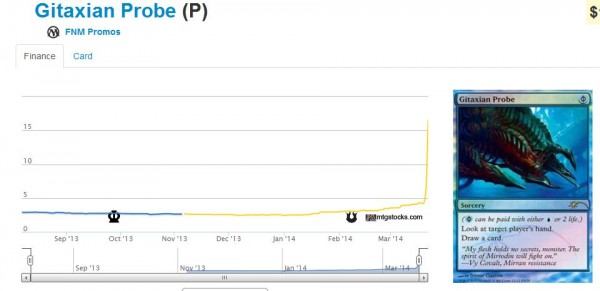
By increasing their buy price to $10 and sell price to $19.99 they single-handedly orchestrated a rampant buy-out of the blue sorcery. If they had trouble keeping these in stock before, they sure won’t anymore.
Other Buylisting Notes
As I mentioned before, I was delighted to sell Star City Games my Ancient Tombs at their newly profitable buy price. I also shipped them my Temporal Manipulation, which they insist is a $120 card.
After buying this one on Amazon.com for $65 I was more than happy to trade it to SCG for $100 in store credit, which bought me a “Heavily Played” (read: Moderately Played) Scrubland and Taiga. Trading them my Ancient Tombs bought me a similarly conditioned Tundra. Money well spent.
Oh, and I also traded them my two foil Little Girls for another $50 in credit to obtain another HP Scrubland simply because no one else in the entire room wanted them for this much.
My observations of other dealers’ buylists were fairly mixed. I was eager to sell some recently spiked Modern staples to some vendors, but not all Modern cards were looked upon favorably. Despite recent buyout attempts, the best I could get on my Birthing Pods was $11. This is about the proceeds one would obtain from selling them on eBay after fees and shipping so I accepted.
There was an error retrieving a chart for Birthing Pod
Spellskite buy prices were actually a little higher, which was favorable. On the other hand the best I could get on my Inkmoth Nexus was $7.25ish. I still sold most of mine, again because the amount I’d make selling on eBay would be only marginally higher.
There was an error retrieving a chart for Inkmoth Nexus
Other sales I gladly made were my Snapcaster Mages at $27, Defense Grids at $5, Torpor Orbs at $2 and white-bordered Chokes at $1. All of these sales led to ample profit.
What I Didn’t Sell
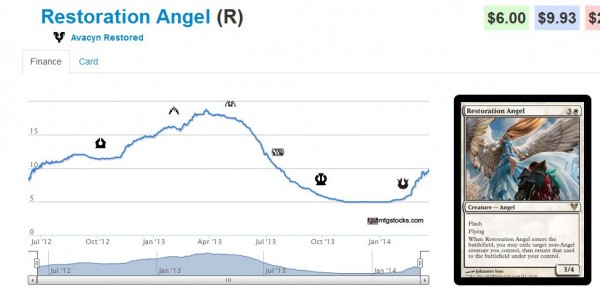
The number one card I refused to let go of was Restoration Angel. The best buy price I received on this versatile angel was $6 but I know they will climb higher. After all, some announcers claim she sees more play than Tarmogoyf in Modern now. While the statement may be a bit hyperbolic, I still believe there’s merit to the sentiment. I’m holding.
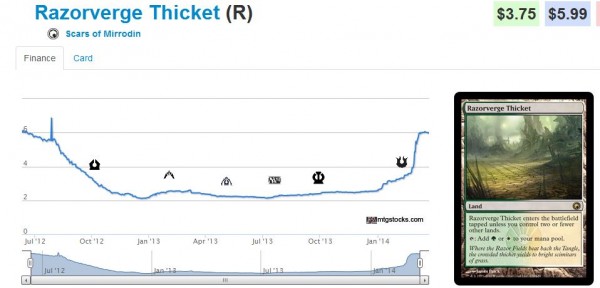
I also refused to sell any shocklands or Scars of Mirrodin fast lands. The only buylist that was remotely tempting was a $4 offer on Razorverge Thicket. Being the most played fast land in all of Magic, I know this number will inevitably go higher. I decided to wait.
What I (Tried to) Acquire
On the other end of the spectrum there were a number of cards I actively acquired throughout the day. Dual lands were the biggest target after the recent price bumps. But I also pursued a few Modern cards.
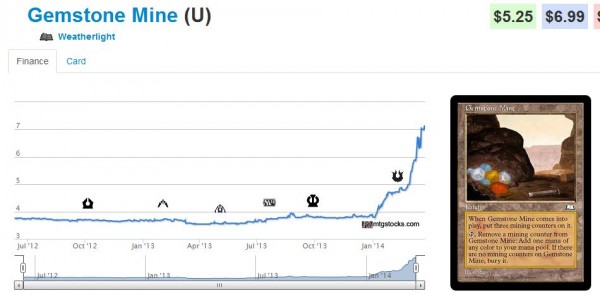
I managed to find a set of SP Gemstone Mine at $4 each. This land has been on a tear of late, and I see it hitting $10 before too long. Unfortunately most dealers had zero in stock so this was all I could obtain.
I also traded for another Cavern of Souls and Arcbound Ravager. I like both of these heading into Modern PTQ season and even beyond. I don’t expect Ravager to see another reprint after appearing in Modern Masters and it may be a bit too soon for a Cavern reprint. Hopefully this pays off.
Refocusing for the Future
After a GP I like to take a step back, reorganize my binder and identify my MTG finance strategy for the future. It’s important that I assess where I succeeded in speculating (Torpor Orb, Snapcaster Mage) and where I didn’t do so well (Geist of Saint Traft, Azusa, Lost But Seeking). By learning from my past decisions I can become a more capable MTG investor going forward.
This time around I solidified my MTG finance mission statement: “My goal is not to make the most money possible. It’s just to make money.” I could have held out on some of my sales in anticipation of reaping larger profits. But the ease of selling to vendors at a Grand Prix for immediate cash is just too advantageous to pass up. By turning over inventory I am enabled to refocus my resources into better planned, more focused positions.
And while I did sell a few things I perhaps should have held onto longer, I don’t regret a single sale. Cards I felt had significantly more room to run I kept or even acquired. And I’m confident I’ll make smarter investment decisions moving forward.
This is a priceless benefit of attending a major event like a Grand Prix. The experiences, knowledge acquired, connections made, and vendor relationships established are extremely valuable going forward. The fact that I can reap all of these non-monetary benefits while also making some cash is an underlying motivator for MTG finance.
…
Sigbits
I didn’t realize how expensive Gitaxian Probe has become. It’s difficult to find many copies under $2 on the internet, and Star City Games has theirs stocked at $2.49. What’s most impressive, however, are their foil prices. $34.99 (and out of stock of NM) is quite the jump!
While Volcanic Island and Underground Sea got most of the love with recent price hikes, I don’t think Tundra will lag behind much. At $199.99 for NM and $174.99 for SP, Star City Games has just two each in stock. If they struggle to keep many of these in inventory, the next price tier for the white-blue dual land is $249.99. And with Tropical Island being completely sold out at $149.99, I can almost guarantee these will be restocked at a $199.99 price point.
Up for a gamble? While the recent price hikes in blue dual lands are getting all the attention, many have overlooked the hike in Plateau. This card is retailing at $79.99 and SCG is sold out of NM copies. Their buy price is $50, and there are a number of “Near Mint” copies under this price on TCG Player and Card Shark. Buy at your own risk.
If not, now is a perfect time to join up! Our powerful tools, breaking-news analysis, and exclusive Discord channel will make sure you stay up to date and ahead of the curve.
The QS Booze Cube is an ongoing project to support QS Insider member and all-around good guy Scott Peitzer's popular passion project. The Booze Cube is just for fun (and adults over the legal drinking age, ideally). Don't sell these or try to make money from them in any way. You can't buy these cards from us. If you want to give us money (and really, who doesn't?), sign up for a QS Insider subscription instead.
Porcelain Lurker
Design Goals: This is part of a series of 2-color Hill Giants, each with abilities that scale as the game goes on. When I posted Goblin Shot-Shooter, I discussed the fact that "drink X" abilities are generally a problem because there is no in-game mechanism to limit them. With this cycle, we decided that drinking X was fine, as long as there were parameters set on X that were in some way limited by the game state.
The goal of Porcelain Lurker was simple: turn drinking into damage. Simply saying "drink X, target opponent loses X life" would be tantamount to "You Win The Game" (and lose your dignity and at least one friend). So, we set up the card to force the caster to engineer a board state that's optimal before playing this. If you can set up a turn that causes an opponent to drink 20, then cast this, you probably deserve to win the game (but not before you have to endure 20 drinks yourself).
[yop_poll id="4"]
Inspiration: Our own sick twisted minds. You've heard the phrase "porcelain throne", right?
Some notes: We don't try to replicate proper Magic templating language in the rules text of cards. We do this to save space and make the cards more human-readable. Remember, you're probably real drunk when you're playing and the subtleties of the Intervening-If clause may elude you.
If not, now is a perfect time to join up! Our powerful tools, breaking-news analysis, and exclusive Discord channel will make sure you stay up to date and ahead of the curve.
You may have noticed that Magic cards are expensive. Specifically, Modern-era cards. It's no secret that cards like Scalding Tarn, Cryptic Command, Tarmogoyf and a slew of others have rocketed up in price lately. This has led to a lot of questions about the sustainability of these prices. I know QS is supposed to have All The Answers, but the answer is "we don't know". There's no precedent for what's happening to Magic card prices in the wake of Modern's sudden boom. What we know is that it's fostered a ton of great discussion in our forums, on Twitter, and on /r/mtgfinance. A recent thread in Reddit's magic finance sub called attention to this specific fact. The discussion took many tangents, but here are a few of the highlights:
There was an error retrieving a chart for tarmogoyf
The playerbase is getting older and a large portion (majority) of modern/legacy/vintage players have career-level jobs. Shelling out more money for cards is easier to justify when it's a smaller chunk of your disposable income.
Greed. The demand curve for magic cards looks to be less elastic than before (mostly due to factor #1). If I really want a playset of something, I'll go buy them.
Expectations. People are getting more used to these comparably high card prices. As these prices seem more normal, people become more inclined to buy cards again. This causes people to raise prices even more, likely hoping to create an impression of normalcy at an even higher price index. Rinse repeat.
There was an error retrieving a chart for old fogey
We talk about price memory on QS a lot. The fact that so many cards are rising in value together sets a new norm, one that is hard to clear out of the mind once it's happened. The age of the player base is definitely growing as well, with the guys who started in their teens during the Revised era now entering that magical stage of their life.
You know, the one after they stop working minimum wage jobs and before their girlfriend becomes their wife and stops letting them go to FNM and spend their own money.
One of the replies elaborated a bit, and discussed emotional investing (another thing we talk about a lot on QS). Understanding the irrationality behind the actions of MTG players is key to understanding what's going on in the game right now.
from sirolimusland:
So, the lack of elasticity in MTG cards has less to do with greed, and more to do with emotional attachment. I ran some informal surveys and it looks like people who own certain key staples are loathe to part with them because they like playing the decks those cards enable.
Take me, for instance. I know deep down, that holding my Tarns and Mistys is super risky, but I love playing Modern, and the decks I like tend to have blue in them. So I hold. That said, I can tell you now that if the blue fetches hit the ~$200 mark, I would immediately liquidate.
I think that if it ever gets that high, it would be followed by harsh correction, possibly an exploitable over-correction as "investors" overreact and panic sell. I think $100 fetchlands is the new reality (at least in the runup to Modern PTQ season), and I think anything WotC does to try and fix it (short of reprinting them in a Standard legal set) will not massively affect their price.
As for the age of people playing the game, I can only hope those of you who are parents or educators are passing on the game! I want Magic to still be around when I'm 50!
Emotional attachment to pieces of pretty colored cardboard sounds absurd to an outsider, but it's a reality of our game. Don't believe me? Try to explain why an Underground Sea is worth as much as it is to someone who knows nothing about Magic. Then watch them look at you like they don't even know you anymore.
Seriously, it's that strange. But in our world, it makes total sense.
I like the theory behind a massive market correction based on panic-selling. Actually, I don't, but I like that there are people who recognize the fact that over-correction means "buy-in" time. This happens to our friend BitCoin every few months; something insane happens, the price is shattered, but then recovers over a couple days. Each time this happens, there is money to be made. Another user brings up a good point about the growth of Magic and the increasing frequency of boxed sets and reprint sets. Emphasis added by me.
from foldingcouch:
Magic is growing fast. More importantly, it's growing faster than WotC was prepared for, or faster than they are willing to support (meaning that to produce product that matches the demand and the pace of growth, they'd be in serious danger of collapsing the brand value with inflation.) The result of this is we have more people - and more importantly more people with substantial budgets - that are adding to demand faster than WotC is producing product to meet that demand.
On that basis, these jumps will be the new normal for the next year or two, and then things should return to normal. The action necessary to correct the volatility of the market is for WotC to release more product. This is difficult for them to do, given that the majority of the demand is in out of print cards, many of which can't be reprinted and the rest of which can only be reprinted sporadically. Their release schedule is going to make it difficult to put out the kind of product necessary to match the growth of the game, but they're going to get there. It's just going to take about two years for us to reach that point.
Two years from now we'll have two core sets, another 1.66 blocks, Conspiracy and (persumably) MM2 under our belts. That is a lot of opportunity for WotC to fix the supply of Modern staples and (more importantly) for the growth of the game to normalize.
When WotC has growth projections that they're confident in, they're going to be able to handle their reprint schedule better and prevent the kinds of spikes that we're seeing that are an unavoidable part of the unprecedented growth in the game over the past few years.
There was an error retrieving a chart for carrion ants
There was an error retrieving a chart for killer bees
Modern Masters could have been Chronicles 2.0, but instead it seemed to do the opposite; it primed just enough people to care about modern without screwing up the supply. Just ask anyone who owned Carrion Ants in 1993 how they felt about reprints. Your mother would wash their mouth out with soap for what they'd say. We have no real idea what Conspiracy is about, but if it's something meant to support cube draft, it's a prime place to reprint all 5 fetch lands.
Redditor Polarbeer101 summed it all up nicely in one sentence, which I will leave you all to ponder. There's more truth to this glib remark that meets the eye.
I guess the lesson we can take from this is that nerds make too much money, right?
If not, now is a perfect time to join up! Our powerful tools, breaking-news analysis, and exclusive Discord channel will make sure you stay up to date and ahead of the curve.
The QS Booze Cube is an ongoing project to support QS Insider member and all-around good guy Scott Peitzer's popular passion project. The Booze Cube is just for fun (and adults over the legal drinking age, ideally). Don't sell these or try to make money from them in any way. You can't buy these cards from us. If you want to give us money (and really, who doesn't?), sign up for a QS Insider subscription instead.
Goblin Shot-Shooter
Design Goals: This card is almost entirely a functional reprint of Goblin Sharpshooter, a fun and powerful card in non-alcoholic Magic. The main challenge was how to turn this into a proper Booze Cube card. It's not enough to just slap "Drink Beer" onto a card and call it a day. Well, actually it is. But we...aim...to be a bit more clever than that. For better or worse.
This brings up an important aspect of our Booze Cube designs. Drinking is meant to be a cost of sorts, just like tapping, mana, or paying life. There's one problem: there is no in-game mechanism to limit drinking. The only limit is your liver and sense of self-worth. So, cards that permit unlimited drinking like "Drink (1): +1/+1 until EOT" essentially read "drink yourself ad nauseam and win the game. Hilarious, but not really balanced. So, drinking has to be a cost with other limitations attached. Or a consequence. Or, in this case, both. So, Goblin Shot-Shooter has the potential to lead to some pretty insane turns that leave boards empty and bellies (and toilets) full. But it has inherent limits imposed by the game state.
We think this is a faithful representation of the original card ( mostly because we straight-up jacked the entire concept word-for-word ) and adds the drinking element in a fun and limited way. Print off a copy and throw it into your cube. It might not be first-pickable but damned if it ain't fun.
Some notes: We don't try to replicate proper Magic templating language in the rules text of cards. We do this to save space and make the cards more human-readable. Remember, you're probably real drunk when you're playing and the subtleties of the Intervening-If clause may elude you.
Want Prices?
Browse thousands of prices with the first and most comprehensive MTG Finance tool around.
Trader Tools lists both buylist and retail prices for every MTG card, going back a decade.




![Insider: [MTGO] Weekly Market Selection](https://www.quietspeculation.com/wp-content/uploads/2014/01/IMG_7555.jpg)