menu

Insider: A Whole New Ball Game

Are you a Quiet Speculation member?

If not, now is a perfect time to join up! Our powerful tools, breaking-news analysis, and exclusive Discord channel will make sure you stay up to date and ahead of the curve.

Welcome back readers!

So last week we got a pretty big bomb dropped on us.....

chris christie

Chris Christie's office closed a roadway in New Jersey to get back at someone (or something like that)...O...M...G! Also there was that whole thing about Chinese fakes that I wrote my last article about and crashed the QS website. So....

Im-Sorry-About-To-Cry

Anywho, so the cat's out of the bag and the MTG community is deeply concerned over these fakes. A lot of players are contemplating getting out (though not nearly as many as I'd expect, at least not according to this poll started by our own Sean Johnson). What this means is that consumer confidence is shaken, but not broken.

Panic Like It's Y2K

I'm not going to advocate selling your whole collection, buying a small cabin in the woods, and burying gold bars in your backyard. I'm also not going to advocate ignoring this issue and continually going down the MTG finance path blindly following the old ways. As the title says, It's a whole new ball game.

I personally am going to reduce my exposure. I'm going to keep the cards in the decks I enjoy playing (even if it means risking my $2000 deck becoming $50 bucks) and I'm keeping my one-of EDH cards that I've spent the last five years collecting so I can build janky fun EDH decks.

However, I am going to stop picking up dual lands just to trade and I'm not going to hoard cards as "long-term investments". I've pulled some of my personal Legacy playsets that I haven't played, either in a long time or in some cases ever, and placed them in my trade binder. I'm still keeping some of the really fun EDH ones that aren't stupidly over priced.

Each player is left to make their own decisions which need to be based on their own personal feelings and their tolerance for risk. Those who hate risk will be the ones who sell out, those who just want to play and only trade/speculate to keep the cost of their hobby down will continue going forward (though again, hopefully a bit more cautiously).

However the best way to make your decision is to look at the facts and the likelihood of events.

Facts:

  1. There have been counterfeits for years. We've all heard of fake power (whether it was printed or rebacked Collectors Edition).
  2. The Chinese government is very lax about enforcing other countries' copyright and trademark laws. This couldn't have been more evident than when I was in China (in 2011) and there were stores with giant windows on the main streets selling obviously bootlegged copies of various movies, TV shows, and software. There aren't a lot of Best Buy type stores in China and the few that are don't even bother to carry music, movies, software because the culture just doesn't value the concept of copyright law.
  3. Magic card values have been growing exponentially the last few years. As demand continues to grow there is a lot of money to be made buying/selling Magic cards.
  4. Counterfeiting is a major problem across numerous industries.
  5. Wizards of the Coast likes to make money and will protect their assets to the best of their ability.

Likelihood:

  1. 1:999999999999 the likelihood that WoTC will just give up and stop making Magic because of the counterfeiters.
  2. 1:1 the likelihood that WoTC will seek legal action against counterfeiting operations.
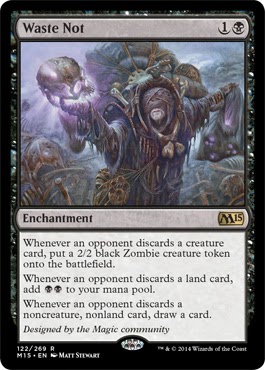
  3. 1:1 The likelihood that WoTC will try to make their cards harder to counterfeit (as seen by the new card frame below) wastenot
  4. 100000:1 The likelihood that adding a little holofoil in the center of the card frame will stop the counterfeiters. I believe WoTC will discover what the US government is always discovering...you have to keep upgrading the security measures you use to prevent counterfeits because the criminals will keep upgrading their equipment to make them.

How did I come up with these likelihoods, you might ask. As usual I used powerful data mining tools and a complex analytical algorithm created by super geniuses at MIT, most often used for government cryptography. Of course I can't discuss them anymore.

Combating Counterfeits

The point is we have to accept the realities before us. Luckily, WoTC's best interest is also our best interest, so they will do whatever they can to keep the game we love safe. The downside is there's not much they can do to protect older cards.

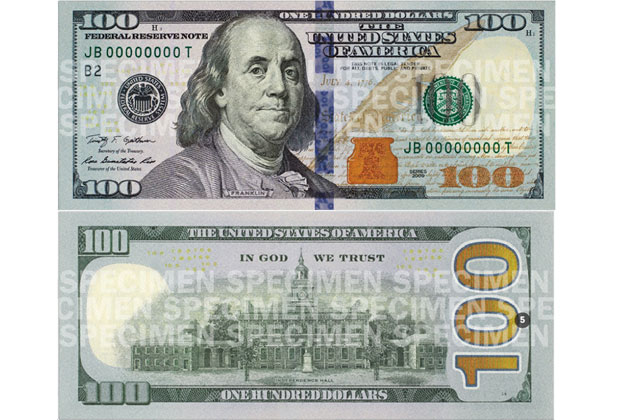
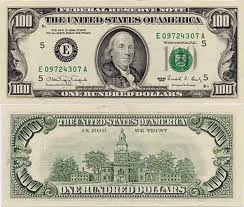
This is the same issue the US Mint has with all the new security measures they've added to numerous bills.

0503_hundredDollarBill_630x420

You can add all the super fancy security measures to your new stuff...but you still gotta accept the old stuff.

oldhundred dollar bill

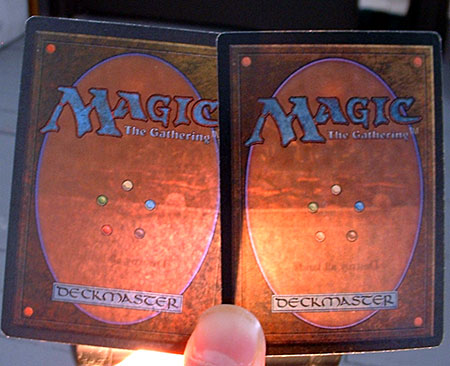
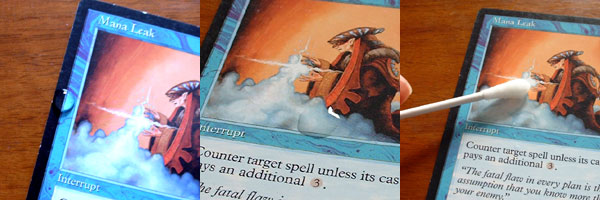
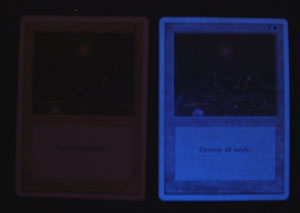
Thus, all WoTC's countermeasures will be good going forward, but have no bearing on the past. Assuming you've read my previous article on fakes, you'll know that WoTC was smart enough to include security measures in their original printings. The blue paper in the middle, the specialized fonts, the specific card thickness and printing process, and the UV ink. So thank God for WoTC thinking ahead on that one.

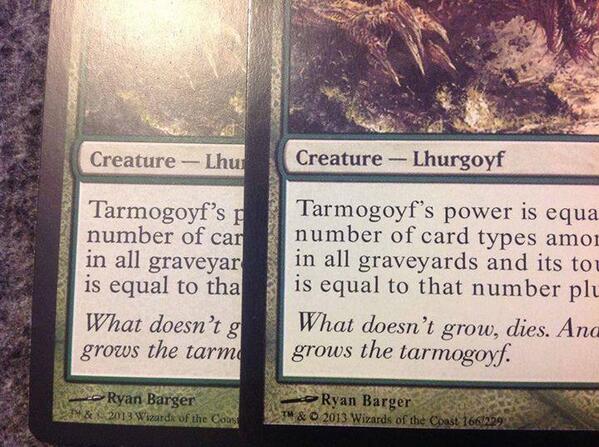
However, as I previously mentioned (and the 100-dollar bill pictures emphasize), the counterfeiters will work on correcting their errors. Ironically, our desire to spread the word and alert people of what to look for is the exact "debugging" they need done.

Players' Reactions

The caveat is that people will need to purchase cards from them for them to keep making money. The burden falls onto the player base to keep that one in check.

I realize there will always be people who don't care how unethical something is. These will be the guys who buy the fakes and then try to unload them via eBay, trading venues, buylists, etc. The best way for us to fight this is to be vigilant and to speak up.

If you see someone peddling fakes at a venue immediately tell the T.O. These people are violating the law and are subject to criminal prosecution. With any luck this will be the first line of defense, the second being we players not falling for the siren song of "cheap staples".

Numerous reddit readers felt that the counterfeit issue was a good way to air their grievances about the massive increase in card prices the past five years. They complain that the cost of Legacy is too much and willingly admit that if they get the opportunity to purchase fakes that are only somewhat likely to be discovered they will.

But they fail to realize that encouraging counterfeits to make a format affordable will actually just kill the format and likely the game in general. Legacy is a format that is not really supported by WoTC, it is supported by the secondary market (mainly stores, one store particularly). If that format becomes unprofitable for the stores due to massive decrease in demand for the cards, then there is no economical sense to continue to support it and the format dies.

So these same players will spend $50 on a playset of fake dual lands and within a year or two have nowhere but their kitchen table to play them. The same issue will occur across all formats.

The strength and success of Magic has relied on people's faith that when they buy a pack of cards the cards retain some value. Granted a lot of the time the value is considerably lower than the pack price, but every once in awhile it's higher.

I've witnessed first hand how one player getting something amazing from a pack can cause several others to go buy packs despite the fact that the probability of hitting a high-dollar card is likely to have decreased after the first card is pulled.

This would not be the case if massive amounts of counterfeits and a player base with no qualms about playing them entered the market. If a booster pack is $3.99 but the most expensive card in a set is $2, then no one will open booster packs anymore, WoTC will go under and the game will die. That's not doomsday prophecy, that is just plain economics.

Let this be a warning to the player base. Counterfeits are not beneficial to players (in the long run), even if they seem so (in the short run).

Insider: [MTGO] Buying Tix on MTGO

Are you a Quiet Speculation member?

If not, now is a perfect time to join up! Our powerful tools, breaking-news analysis, and exclusive Discord channel will make sure you stay up to date and ahead of the curve.

Speculating on MTGO, compared to paper, is rather easy and doesn't involve extra costs. All transactions are lightning fast and cards are always gem mint. But unlike in the paper version of the game, successful speculation on MTGO does not generate real money.

Prior to investing on MTGO you need to acquire tix. The event ticket ("tix" for short in plural) is the in-game currency. You invariably need them to buy cards and they constitute the payment you receive when selling cards.

As your MTGO bankroll grows you may want to sell some of these tix and finally get your cash back. I intend to cover this process in future articles.

In this article I'll talk about the different options available for buying tix. The difference between the cheapest and most expensive options can be up to 50%. But each has advantages and disadvantages, so you may want to consider them all.

The Value of a Ticket

What's the average cost of a ticket in real-world currency (dollars, euros, etc.)? An easy answer would be to check the MTGO official store. This is probably the most convenient place to buy tix, with an extremely stable price of $1.00 per ticket + taxes. This price has been constant since the beginning of MTGO.

If you look around a little bit, you'll find that it's fairly easy to buy tix below $1.00/ticket. Based on my experience, I think $0.95/ticket is a good average price and is my reference price nowadays. That's what a ticket is worth to me. I try not to sell tix below this value or buy tix above it.

With this in mind, buying tix at any price below $0.95 is a good deal, and at any price above $0.95 a not-so-good deal. Everything depends mainly on how much effort and time you are willing to put into your search for a good deal.

Here is a list of, to my knowledge, all the different sources to buy tix from, with their expected prices and advantages/disadvantages.

The Official MTGO Store

This one isn't big news. The easiest and most convenient place to buy tix is undoubtedly the official in-game MTGO store. The price never changes and is $1.00 per ticket (+ taxes). Having tix readily available 24/7 with zero risk of being scammed is undoubtedly an advantage.

The disadvantage with the official provider is that, depending on where you live, some extra taxes may be added to the bill. If I'm correct, sometimes up to 20%, making the MTGO store the most expensive place to buy tix. In some countries and some US states, like in Georgia, there are no taxes and tix can be purchased at $1.00/ticket.

You will probably never use the official store to buy tix, at least not directly. However, there is a trick that works from time to time to acquire discounted tix.

Special decks such as Commander or Planechase can offer an avenue for this. Prepackaged decks like this are usually a pile of known junk plus one or two valuable, sometimes as-yet unprinted, cards. People pay little attention to these sets, with the exception of these one or two chase cards.

You would think that the sum of the individual cards equals the cost of the deck. But when an individual card, such as Baleful Strix, is drawing attention its price rises. Sometimes that's enough to create a situation where the individual cards can be sold to bots (mostly Mtgotraders, as not all bots accept special set cards) for more than the value of the deck.

For instance, it is possible to buy a $19.99 deck and the individual cards for, let say, 24.7 tix. This would be the equivalent of buying 24.7 tix at $0.81/tix, a pretty good price in deed.

The Other MTGO Stores

Many other online stores also sell tix for cash. Among the most known and trusted you will find Mtgotraders, Goatbots, and Mtgotickets.

These sites are selling tix at $1.11, $1.00 and $0.98 - 1.09, respectively. You might be able to find other stores selling tix at prices close to $0.99/ticket, or maybe even lower.

Most, if not all, of these stores also sell credits for their bots, usually around $0.95/ea. While this sounds like a good deal at first glance, the restriction to a certain bot chain is significant. No single store has the lowest prices on every card, so ultimately this method won't save nearly as much money as the difference would imply. Buying tix offers you the most flexibility.

eBay

Three years ago, eBay had a lots of auctions for MTGO tix, and you could get more tix for your cash. Now, there are only few auctions or Buy It Now for tix.

In theory, eBay's auction structure lets items be acquired at low prices. In practice, this is very rare. Usually, auctions end at about $1.00/ticket.

Occasionally ticket auctions go relatively unnoticed. Watching regularly eBay auctions is your chance to get tix at a good price if you happen to be the one paying attention to a specific auction.

Looking from another angle, eBay can be a hidden gem when it comes to buying tix. As with the official MTGO store, another trick is to buy cards and sell them to bots in exchange for tix.

Buying individual cards and collections can sometimes be quite profitable. If most of the collections sold on eBay have prices close to or higher than the sum of the individual cards, I have also won collections at ridiculously low prices and turned them into a nice pile of tix.

Here is how I have proceeded in these cases:

  1. Once I have spotted an interesting collection on eBay, I estimate its value using Goatbots buy prices (for Standard/MMA cards) or using 80% of the Mtgotraders sell prices for non-Standard cards (80% is about what I should be able to sell the cards for). I take into account only the cards with a value of more than 0.10 tix. Junk rares, and most of the uncommons and commons have virtually no value here; at best that's a bonus.
  2. When I have estimated the "buy price" of a collection, lets say a 100-ticket collection, I use my price reference for tix. Here, the collection is worth $95 to me. To give me a margin of error (in case buy prices change by the time I win the auction for instance) and to make sure I get a good deal, I'm usually willing to pay no more than 80-85% of that $95, so about $78. These numbers can be changed to whatever you're comfortable with.
  3. Once I have won and collected the collection I make the cards tradable and check Aboshanbots bots, Hotlist (from Mtgotraders) and Goatbots for offers. These three bots offer the best combined buy prices out there. I sell the cards to the best offer. Afterwards, I also check Mtgo_Bazaar for low-value uncommons and commons, which this bot chain frequently buys at a decent price. I do all of this on a secondary MTGO account, to process the newly acquired collection more conveniently without interfering with cards on my primary account.

To give you an idea of the potential of such a process, six months ago I managed to buy a great collection for $590, mostly composed of Standard cards. I sold the entire collection, with the exception of junk uncommons and commons, for more than 840 tix.

That's $0.70/tix, my best rate for tix so far in three years! It's definitely worth the time to check MTGO collections on eBay.

On the Classifieds, Directly from Humans

Different offers can be seen from the Classifieds on MTGO, the in-game marketplace. Prices are usually good, around $0.96/ticket, sometimes more, sometimes less. Some offers refer to online stores and their websites, other are directly from humans. Some humans sell tix recurrently, others just once.

Trust is the key factor here. If you're buying from humans, you can ask for references and to see the tix first. If you're not sure, buy small quantities at a time, 50 tix or less. Also pay attention to potential Paypal fees when it comes time to make a payment. Paypal Gift is free if used between two verified accounts of the same currency.

You can also find some offers on different forums all over the web. Buying small quantities is again a safe play if you're not sure.

From QS Members

Lastly, some of us Insiders are selling (and buying) tix. Check on the forum topic, Buying and Selling MTGO Tickets Here, and post your offer.

I might sell some myself early this Spring, probably at $0.95/tix.

With all these options, and a little patience, you should be able to find tix at an attractive price.

However, buying tix is the easiest part of investing on MTGO. Now, you'll face another challenge--finding your way through the jungle of the thousands of vendors, bots and humans to acquired digital cards and start speculating. That will be the topic of my next article.

Current Transactions

A brief review of my transactions these days:

Buying

  • THS boosters are still on my buy list, at 3.00 tix or less. It seems like their price has increase recently. I try to buy as close as possible to 3 tix/boosters and wait for Born of the Gods to make a bigger move.
  • Deathrite Shaman is a major player in Modern. I bought a few copies at 4 tix and I'll be chasing more if its price drops again under 4 tix. As it doesn't see any play in Standard, its price is only sustained by Modern, Legacy and casual. I anticipate a stronger demand during Modern season and I'll start stocking them now. And if Born of the Gods makes the shaman playable in Standard that will be the jackpot. This past weekend, 16 copies of Deathrite Shaman made Top8 at GP Prague.
  • Coralhelm Commander and Gravecrawler have decent buy prices now, as well as Copperline Gorge and Seachrome Coast, which are about half of their historic highest and decreasing.
  • The new double-colored devotion gods may or may not be playable, but I think taking advantage of hype surrounding them is a good short-term speculation. Any B/R, G/W or U/W card is potentially good: Fleecemane Lion, Trostani, Selesnya's Voice, Rakdos, Lord of Riots, Tymaret, the Murder King. The two mythics have the most potential as they are enough to turn a god into a creature on their own.

Selling

  • M14 Boosters. Still selling a little bit everyday. They are getting more and more closer to 3.5 tix/boosters.
  • I noticed on Sunday that Enter the Infinite has just passed 1.5 tix. I had no idea why at the moment, but as I had bought three dozen of copies at around 0.9 tix last summer I am unloading some now.

Thanks for reading,

Sylvain Lehoux

Insider: Strange Times and Spoilers

Are you a Quiet Speculation member?

If not, now is a perfect time to join up! Our powerful tools, breaking-news analysis, and exclusive Discord channel will make sure you stay up to date and ahead of the curve.

It’s a weird time to be an MTG financier. Last week I wrote an article about how Avacyn Restored cards are good long-term targets, and within a couple days Craterhoof Behemoth and Griselbrand shot up by about 50 and 20 percent, respectively. As someone not professionally involved in MTG finance, I wrote last week’s article because I wanted to call cards you should be looking to acquire gradually over the next six to twelve months. I don’t personally have a ton of time to trade, list items for sale online, or go to the post office, so I like to pick up the slow-but-steady growers that aren’t going to gain or lose me a ton of profit based on the amount of time I have to devote to MTG during a given week.

That being the case, it was both gratifying and annoying to see Craterhoof and Griselbrand spike further. They had both, of course, been on an upward trajectory leading up to my article, but I thought they had plateaued as of last week’s submission. I was wrong, and acquired exactly zero of either card before the increase. There’s still time to acquire cards like Restoration Angel and Cavern of Souls, among others, but I am starting to wonder if my six-to-twelve-month estimate is high. All the good Modern picks in the last few months have just been spiking irrespective of the PTQ format being Standard. Meanwhile, Standard is boring and hasn’t offered up nearly as much opportunity to make money. What is going on?

The Times, They Are a-Changin’

For me, this scenario keeps repeating itself: I see the appeal in a Modern card, maybe read some discussion regarding it on the QS forums or on Twitter, and come to the conclusion that it’s a good spec. I think to myself, “I’m going to pick up some extra copies of this at my next FNM,” but then by the time Friday rolls around, the card has doubled. Standard cards, on the other hand, have stayed basically stagnant, despite the PTQ season that is currently ongoing. Return to Ravnica cards spiked when Theros was released, and Theros cards are flooding the market right now, keeping prices depressed.

How awkward is it that the Standard PTQ season ends on March 9 but Born of the Gods isn’t being released until February 7? Having had no good opportunity to get out, I am still very deep in shock lands and have been holding out hope that the new set would drive up their prices enough to be profitable. But with only five short weeks between the new set’s release and the end of the PTQ season, there may not be enough time for new decks to receive the appropriate hype to cause price spikes.

After that, we’re looking at another Sealed PTQ season, followed by Modern. This is a new schedule, and while nobody can know for sure, I’m strongly anticipating that the typical Standard drop-off is going to occur much sooner than usual. PTQ grinders will have no reason to hold onto Standard cards after the season ends, so expect some big dips in March and April. I’ll be working toward being out of my Standard wares by that time, and I suggest you do the same.

Only Three Scry Lands

I feel a bit Vindicated today, as this article on Daily MTG seems to indicate that we’re getting only three of the remaining five scry lands in Born of the Gods. I have been arguing this case for months, ever since Sam Stoddard revealed the lands for Theros in this article and said, “This left us with five more for the rest of the block. What will the order be for their release? You'll have to wait and see.” Despite him all but telling us they would be split up, the overwhelming majority online and at my LGS seemed to believe all five remaining lands were coming in the next set.

What does this mean financially? Since we’re getting scry lands for the Selesnya, Azorius, and Rakdos color pairs, this means Golgari and Izzet are being left for Journey into Nyx. This could have one of two effects on Steam Vents and Overgrown Tomb. On one hand, if two-color decks become all the rage, then there will probably be very little demand for these two shock lands, leading to further stagnation or maybe even decline. On the other hand, if three-color decks start seeing more play, these lands will be crucial in those strategies. For example, if a Jund deck takes over the format, Overgrown Tomb will be the only GB land available for it (besides Golgari Guildgate). I’ll be keeping a close eye on the meta before determining how to proceed.

Getting the GW scry land could mean a big boost for GW aggro strategies, which have already been seeing some play with gates. Being from Dragon’s Maze, I think Advent of the Wurm and Scion of Vitu-Ghazi have the most room to grow in this deck. As a rare from a large fall set, I don’t want to mess with Fleecemane Lion at $3—maybe if it was a bulk rare. The other lands open up doors as well, but to me, the GW scry land is the most important of the three being added to the format—at least given the decks that are currently seeing play. Maybe the extra consistency for UW control will make it a much bigger player.

Don’t Spec on Magical Christmas Land

With the first wave of spoilers, we were also introduced to the inspire mechanic. This is a triggered ability that happens whenever the inspired permanent untaps. However, in order for the ability to trigger, one has to figure out how to first get the creature tapped.

When new sets come out, brewers, wide-eyed innocents, and speculators like to think about what kind of crazy things could happen due to synergy. In this case, my first thought went to Ral Zarek. “Man, that crappy plus-one might not be so bad with this!” I thought. But then I considered that we’re not getting the Izzet scry land, nor has any UR deck been particularly good in this meta, nor has Ral Zarek seen any play since bursting onto the scene.

Then; I looked up the price, because even with all those factors going against the card, I still thought it might be worth picking up a few copies if it was at $3-4, generally the low for a planeswalker. But no, Ral Zarek is a $9 card. I would say it’s inexplicable, but being from Dragon’s Maze has its baggage. Sure, if the card does take off, it could get to astronomical levels, but is it really worth the risk of buying in at nearly $10 a pop?

What I’m trying to say is be careful this spoiler season. Don’t drink and buy. Don’t live in Magical Christmas Land. Don’t think a tier-three strategy is the next coming of Caw Blade. New cards are exciting, there’s no denying, but keep a level head and don’t do anything you’ll regret later. Make money, but play it safe—buy in on cards that are low, not cards that are hyped. Don’t be the greater fool.

I close today with a question: what are you going to do with your copies of Birthing Pod? I’ve been on this card since my earliest articles here at Quiet Speculation, and am happy to see that it’s finally spiked. But I think it could go a few dollars higher in Modern season, or even before. When a long-term spec hits, sometimes it can be hard to know the exact time to get out. So what’s your strategy been so far? Please share in the comments. See you next time!

Jason’s Alticle: Sheep Get Slaughtered

Are you a Quiet Speculation member?

If not, now is a perfect time to join up! Our powerful tools, breaking-news analysis, and exclusive Discord channel will make sure you stay up to date and ahead of the curve.

Greetings, Sheep Herders

Funny story, as I was writing that, I couldn't remember if "Sheep Herder" was an insult in Wheel of Time or Song of Ice and Fire (Game of Thrones to the illiterate) so I looked it up. Apparently "Sheep Herder" is slang for a homosexual according to my google results (thanks, Urban Dictionary!), which I can only assume has something to do with the movie Brokeback Mountain.

Anyway, since "Sheep Herder" is apparently slang outside of the Wheel of Time Universe, I should change the greeting. But I won't.

Why Bring Up Sheep at All?

I'm glad I pretended you asked that.

Readers of the Quiet Speculation forums will be aware that I made a pretty gloomy proclamation about the coming dark days in MTG Finance fueled by an influx of Greater Fools into the marketplace. Most people don't share my Feeling of Dread, which I suppose is good.

I'm certainly not advocating selling all of your cards in a blind panic - if I didn't do it when we saw near-perfect Chinese fakes poised to flood the market, I certainly wouldn't advocate that because of a bunch of competition for singles in the marketplace. I advocate selling all of your cards in a calm, orderly fashion and using that money to buy more cards. I think that's the play.

But I think everyone should know that the face of MTG finance has changed profoundly in the past few months and might take some time to return to normal. So what's making card prices spike so hard and fast with seemingly no justification whatsoever? An influx of sheep.

Baaad Metaphor

Before now, I used the term "sheep" for someone useful who provided you with value. I like to use the phrase "you can shear a sheep lots of times but you can only skin it once," indicating you are better off being honest and transparent with trade partners because if you rip people off, they will feel bad and refuse to deal with you again.

I am not someone who is inclined to rip people off as a rule, but the more I thought about it, the more I realized it doesn't make sense for anyone to rip people off. Even if you think you can profit big through dishonesty, wouldn't you rather have a steady source of wool than one bloody pelt?

I try not to overuse that metaphor because it has other connotations--sheep are followers. They are herd animals and follow the herd so mindlessly that a few dogs or low rock walls or gay cowboys are all it takes to keep them in line. I didn't want anyone to think of potential trade partners as dumb, mindless animals.

Sheep don't know why they follow, they just do. I would not classify most Quiet Speculation Insiders or experienced financiers as sheep because even if they follow advice, that is not the same as following a herd mentality.

Even with the recent QS Insider e-mail blast that advocated picking up Genesis Wave at $2ish not everyone was convinced. Sigmund Ausfresser advocated selling as quickly as possible because the price would likely return to roughly double the pre-spike price. The QS forums had a discussion about this card and a lot of people opted out.

The point is, a conversation took place and people took a bit of time to make a decision. Speculation requires some thought after all. QS deciding whether or not to buy this card around $2 was the first "wave" of the Genesis Wave spike.

Then, something curious happened, which I think will be the new reality of MTG finance for the time being.

Sites like Reddit got a hold of the spec and the second "wave" occurred in a matter of hours. The card was bought out at $5 and above in a feeding frenzy that cleared the internet out. People who bought in at $2 and had time to list their copies at $5 were bought out, but as quickly as it started, it petered out. It hit $10 a lot of places, and some managed to get that $10, but for the most part, this peaked at $5.

And that's the problem for a lot of the second wave people who bought in at $5. With no time to debate the merits of the card or make an informed decision, many people saw the card shooting up to $10 and decided to buy in at $5. Still holding those $5 copies and watching copies on TCG Player for $4.50 not sell, I am not sure what they must be thinking right now. I imagine it wasn't a pleasant experience.

Folks, when you follow the herd and are forced to make a snap "buy now or lose out forever" decision, you are acting like a sheep, and sheep get slaughtered. If you buy a $5 card at $5 because you think it will be $10, all you did was make $3 for the guy who bought in at $2, and if you contribute to a frenzy around the card, you get that guy his $3 profit a lot faster.

It's rare to benefit from a card spike by being behind it. Obviously there are exceptions to that rule, but if you don't have the time to discover why the current situation is different from the myriad instances where buying in after the hype train has left hypeington station will leave you holding a bag of dicks, you should probably opt out.

No one likes to see other people make money without being part of it, but that desire is leading a lot of people who don't know what they're doing to get turned into sausage by the cold, impersonal wheels of the MTG finance machine.

Which is a worse feeling? Feeling left out because everyone else is making a ton of money and you waited too long, or holding onto a card that sells for less than you paid because you got swept up in mob mentality? I'd rather feel left out with my money in my pocket than feel left out holding onto cards I can't sell for even less than I paid because there was never any actual demand.

Here are some rules I follow.

  • You are only going to buy in cheap if you anticipate a price spike. If the card starts to move and you're not there within mere hours, you're likely losing out. This is a 24-hour business.
  • Set yourself up to actually profit if you're right. If you correctly predict a $1 card will double and you have 7 copies, congratulations on breaking even after fees. If it triples, you may be able to buy a pizza. Go deep or go home.
  • Reddit is not a primary source of price spike information, it is the pen where the sheep hang out. If you see a good topic posted before a card has spiked, verify elsewhere first.
  • Don't make a hasty decision because the market moving quickly is putting pressure on you. If you weren't ahead of it or can't talk to anyone who was, stay away.
  • Remember that speculation should be a small percentage of MTG finance. You're using your knowledge, but you're still gambling. Speculate for fun, not to eat.
  • Make sure you get information from a lot of sources--you never know which one will yield fruit but make sure none of those sources are secretly terrible.

Remember, blindly following the herd will not always lead to profitable opportunities. Lately, almost every time it leads to you getting treated like the sheep you're acting like--you'll get slaughtered.

A Late Addition

Just before publication of this article, a post went up in the QS forums urging us to think about things from the sheep's perspective and blaming a history of "pump and dump" tactics for the way things are now.

Is what I have written sympathetic to the plight of the sheep? No, but that's not the point. There will always be sheep as long as people see what they think is a quick money-making scheme and don't have the experience with MTG finance to help them tell a good spec from a bad one.

We're not going to get rid of sheep culture overnight; my point today is to remind my readers not to think like sheep. Don't be a blind follower, don't speculate with money you can't afford to lose and don't buy in when the window has passed.

What Was There to be Sheepish About This Weekend?

A Star City Open that no one paid much attention to occurred, but it was overshadowed by Modern coverage. Since Prague is six or seven hours ahead of the Eastern Time Zone in the US (I could easily look it up, couldn't I?) those of us who stayed up super late or got up at a decent time could watch during normally unproductive hours of the day.

Fist of Suns spiked hard. Paul Feudo wrote about the deck on Friday morning and $2 was a good buy-in point, but by Saturday these were $10.

This may be the new face of Speculation--you used to be able to wait until the deck actually put up some results and decide to buy in. That's not a thing anymore, so if you want a seat at the table you're going to have to buy in hard and early.

The information market is just as efficient as the card market now, and with a huge influx of new people paying attention, they aren't going to bother to wait and see if Jan Van Der Vegt got Top 8 with his "Tin Fist" deck (he didn't) or if Fist made the deck more efficient despite the blow to the mana base (it doesn't) or if the excited report of a turn two Emrakul was because of Fist being in the deck (it wasn't).

If you wait and get in on these cards before the sheep do you will have a good view to see if they are merely walking up the ramp to the slaughterhouse, but you won't have a crack at the pre-spike copies of the cards, either. This is a new era of MTG finance so make sure you're ready for it.

GP Prague Top 8 Coverage

So Jan Van Der Vegt isn't in the Top 8. In fact,

Untitled

We took a "vote of confidence" and the nays have it.

Actual decks made up the Top 8, including some cards non-sheep are excited about. Restoration Angel, featured prominently in Hrvatska's winning deck, is pretty cheap right now and doesn't pass the "under 30 copies left on TCG Player" test that seems to be the one criteria necessary to cause an ovine stampede.

Restoration Angel looks like it won't spike but will almost certainly go up, leaving you able to pick these up in trade at a leisurely pace in trading, buying from shops and from sites like Cardshark where your buying behavior is unlikely to be noticed and used to trigger a panic.

I don't do much speculating these days--why get heartburn trying to flip Fist of Suns when you can look at a card like Verdant Catacombs and say "There is no good reason for this not to be $60" and pick them up over a few months. I feel like Restoration Angel is in that category, and the fact that Reddit seems to disagree makes it seem even safer.

Bernhard Wurmitzer lived up to his namesake and played Wurmcoil Engine in his Tron deck, one too many if you ask him. That card has taken off and will be buoyed by Tron and EDH for the foreseeable future. He advocated cutting one for more LD. I don't know how good Tectonic Edge is against Tron, but that card is spiking way up lately. Stone Rain may be the card Wurmitzer wants, though.

Emanuele Giusti also wanted more LD in the form of Sowing Salt, a good move if you ask me. Tron rolls over and dies to it. Giusti said he loved Lightning Bolt, and I can see why given the field. Jund was everywhere.

Marcel Kachapow opted for Tempo Twin, but there isn't much that's actionable here.

Robin Dolar put white in his Jund deck, which we've seen before. Lingering Souls is a pretty good card. Timely Reinforcements is also good, but not good enough not to cut.

Carlos Moral played U/R Delver because someone told him the format was Legacy, I guess. All jokes aside, Young Pyromancer is silly and he's only getting more play. Foils of him are underpriced, as are Gitaxian Probes, especially the promos.

Dolar convinced Andrej Rutar to play Ajundi as well. Lots of stupid Jund in this Top 8, but I don't mind so much anymore.

Jeremy Dezani decided to go so far into his white splash that he cut the red. He said he missed Bolt, but white is good enough to splash into Jund that you may as well just cut bolt and Ajani and improve your manabase a bit.

Vjeran Horvat won the event with U/W/R Geist, making GOST go up a bit on MODO. I think more cards from his deck have potential, but there is nothing new here. The biggest new deck of the weekend didn't do well and its creator suggesting abandoning it. This leads me to believe that although Modern changes in fits and starts, it also just improves slowly.

Invest in gainers. If you had bought Griselbrand three months ago you'd be happier than a guy who found $2 Genesis Waves, and everyone knew Griselbrand would go up, but they acted shocked, angry and surprised when it finally did. Same thing with Stoneforge Mystic.

There is a lot of stuff in Modern that has yet to correct its price, so pick something, go after them slowly and deliberately, and wait for everyone to realize you were right all along. No need to sell into hype when you can sell into results.

SCG Orlando

SCG Orlando Standard Top 8

There isn't a whole lot to talk about here. Mono-Blue Devotion won it all, but that was to be expected as the Top 8 would seem to indicate it was out in full force. I was encouraged to see a B/W midrange and B/W control build, though. Obzedat is all but forgotten given how good Blood Baron is.

Will any of the current decks benefit from the new Pain Seer? With no way to tap him right now besides attacking, I can't imagine a Grizzly Bear breaking the format wide open. People thought Blood Scrivener was the next Bob and look how that turned out.

I wouldn't bet on it, and people trying to jam it might have people rediscover Underworld Connections. A tap outlet better than Springleaf Drum might change things, but I doubt it. Pain Seer would be mythic if it were going to be as good as Bob.

I love the one-of Pyrewild Shaman in the R/W deck. There is no financial opportunity here, I just always loved that card. It is the closest thing to Hammer of Bogardan we'll ever see again, and it seems like it must have done some work.

The Naya Midrange has really perked up sales of Advent of the Wurm, at least for me. I sold multiple playsets over the weekend and think the green-white Temple only adds to the excitement. We already saw the spoiling of a 2GGG card that puts two 3/3 centaurs into play and scrys 2. Advent is the king of token making spells and I expect good things. Trostani has room to go up as well, I would take a hard look at it.

SCG Orlando Legacy Top 8

2012's BUG list won the event. No True-Name Nemesis evident in the 75 at all! I can't think of any names, but I know I saw people use the "b" word in conjunction with Nemesis. That's so silly. Just adapt.

Nearly winning it all was Reanimator which is getting a lot of play lately. The deck has always been a thing and lately more people are trying it in events. Still, this may be regional and east coast events typically have more Reanimator.

Omni-Tell will probably be a thing for a long time. It's hard to put Legacy decks in "tiers" because people base that on number of finishes more than "percentage of good matchups" so I will say that this is a deck that doesn't need to sideboard as aggressively as other decks. It does its thing and does it well. That's good, because Tyler ran a wish board and some Leylines.

ANT isn't really a pet deck, but it's still a welcome sight in the Top 8.

We had to check 5th place to finally see a U/W/R Delver build. Stoneforge could go back down from its current perch, especially if Nemesis blade decks become less ubiquitous in the future.

I will go ahead and give Elves the pet-deck-of-the-week award. Is its one-of copy of Craterhoof responsible for that card's precipitous spike? No. I'm not sure why I set myself up like that. It's probably a contributing factor, but so is EDH, casual and people trying to jam it in Modern.

The card should never have gotten as cheap as it did, but I should have bought in sooner. Oh well, maybe I missed out because I didn't see any other sheep on the ramp and I figured I must be wrong. Trust your instincts, folks. I made a mint off of Craterhoof once before, I don't know why I assumed I couldn't do it again.

Jund and U/R Delver rounded out the Top 8, which didn't feature much True-Name Nemesis. In fact, there was only one more build running it in the Top 16.

The Top 16 also featured two Death and Taxes builds. Karakas is still going up. I can't envision a scenario where in six months you say, "Wow, so glad I paid $120 for that Karakas," but stranger things have happened. Fist of Suns is $10 after all.

Follow Me Here

That does it for this week. Remember, if you're going to be a follower you may spend too much time looking at another sheep's butthole to notice you're on a ramp to the slaughterhouse.

You're better off investing in real estate, Staples (both good, ubiquitous cards and shares of the office supply store chain) and going with your gut. Why dump into hype when you could be sitting on a beach earning 20%?


Insider: Scars Block Joins the Buyout Party

Are you a Quiet Speculation member?

If not, now is a perfect time to join up! Our powerful tools, breaking-news analysis, and exclusive Discord channel will make sure you stay up to date and ahead of the curve.

Note: By the time this article goes live my cast will mere hours from being removed! But alas I am writing this article Sunday morning, so the same unfortunate rule applies. My typing is much slower and so my article will be a bit shorter as I recover. Apologies for the inconvenience.

So this was an interesting week in MTG finance.

Interets

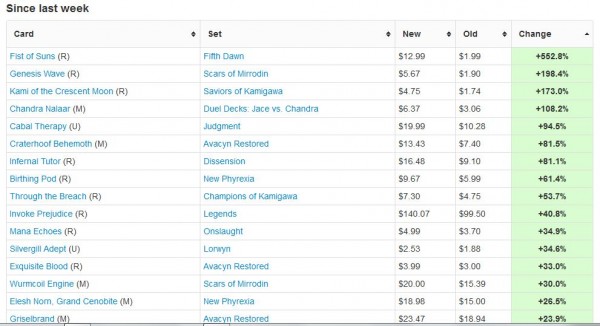
Duel Deck Chandra aside, there were thirteen cards last week that went up by at least 30%. Fist of Suns, of course, takes the prize home this week due to its fivefold gain after showing up in Prague fueling early Emrakuls.

MTG finance news is happening so quickly I am struggling to identify what topic I should focus on! But I started this article with specifics in mind so I'll run with it.

Scars of Mirrodin Block Joins the Speculation Party

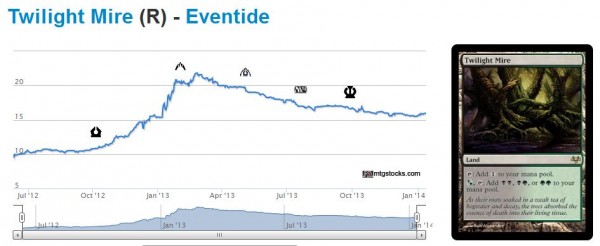
Last Modern season saw significant jumps in price for Zendikar fetchlands. Lorwyn filter lands also saw a nice price bump throughout the season, though these have retracted a bit due to lighter demand off-season. In fact these were already a bit costly even heading into last Modern season.

Mire

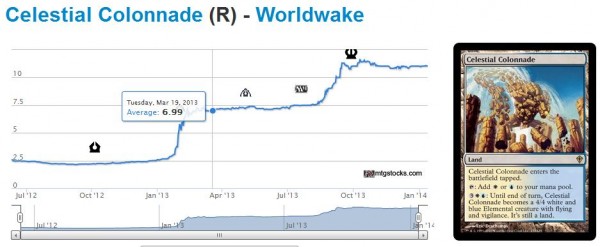
Last Modern season it was the popular Worldwake manland, Celestial Colonnade, which received the spike treatment.

Colonnade

This year Raging Ravine became the third manland to exceed $5 thanks to its popularity in Modern Jund.

Despite this surge in demand, last Modern season had seemingly no impact on Scars of Mirrodin dual land prices. In fact, many rares from this block were surprisingly cheap. Birthing Pod, Spellskite, Melira, Sylvok Outcast, and recent buyout target Genesis Wave.

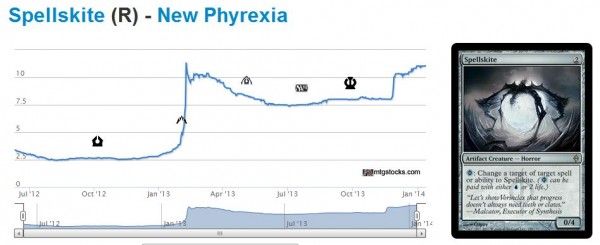
To be fair, Spellskite did in fact jump in price. But after Modern season ended (and then was delayed), the card gave up about one-third of its earlier gains.

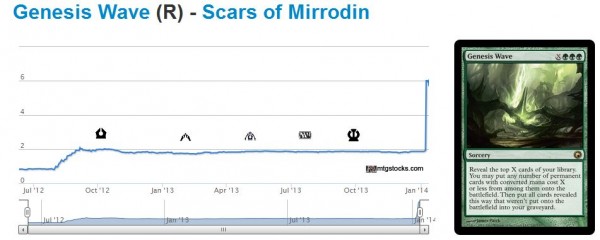
Now, almost five months before the next Modern season, these cards are on the move. Genesis Wave was “discovered” and immediately bought out. Spellskite has reached its former highs, with momentum still positive.

Spellskite

Looking at the top mtgstocks.com interests, a number of cards from Scars of Mirrodin block are finally on the move.

This week it was Genesis Wave, Birthing Pod, Wurmcoil Engine and Elesh Norn, Grand Cenobite. Despite not appearing on the top of this list, we have also seen Karn Liberated rally like crazy. Venser's Journal has rallied from its lows and received attention in the QS forums.

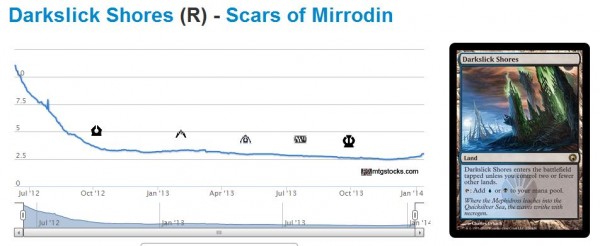
Even a few of the Scars fast lands are finally moving higher in price. It’s about time.

Old Enough at Last

I bought into many of these fast lands over a year ago, anticipating a profitable opportunity during last year’s Modern season. It never happened. There were just too many in people’s binders. The set was too recent.

All that has finally changed. We are finally seeing spikes in prices from Scars block, and this trend will accelerate as we approach Modern season. Scars fast lands will finally have their day in the sun. I don’t expect them to hit $10, but $5-$8 feels very reasonable depending on the land. I am confident these will finally get the attention they deserve now that they are sparse enough.

Granted, they have a ways to go. They are a far cry from their Standard highs. But I believe the trend is finally positive, and popular Modern cards from Scars of Mirrodin block will have their share of price increases along with the rest.

Shores

As For Newer Cards…

Many newer Modern cards such as Abrupt Decay and the shocklands will of course become more in-demand as Modern season approaches. But I don’t expect the buyouts and price increases to be nearly as drastic this year. They are simply too new.

If history is any indication of the future, I would expect Innistrad block cards to become more attractive investments for next year’s Modern season. Aging that one additional year is critical. It appears a set should be at least three years old (i.e. a full year out of Standard) to be vulnerable to major price jumps.

As a corollary, Return to Ravnica block cards will have their day as well. But for those heavily invested in shocklands like me, we will likely have to wait two years for these investments to really pay off.

Mythic rares can spike much earlier, by the way. We are already seeing Griselbrand on the move due to its multi-format popularity. But when it comes to rares on the move and getting bought out, that three- to four-year time frame is absolutely critical. When we can trade Scars fast lands into shocklands in a year, this trend will be validated.

Of course, this is all assuming no reprints or counterfeit scandals driving significant price drops.

Speaking of Which

No, never mind. My focus is on MTG finance for mostly conservative investors. I am not here to stir the nest and forecast doom and gloom. Counterfeiting does bother me, as do all the crazy buyouts occurring thanks to Reddit. These are dangerous factors in the world of MTG investing.

For now my advice is to remain focused and always avoid getting swept up by hype. If you do insist on speculating and playing the quick flip game, only do so if you can buy cards near their original prices.

If you buy cards on the way up you risk getting burned by being unable to move them for profit once the hype passes. I pity those who paid more than $4 on their Genesis Waves recently--they are likely to lose money after fees and shipping.

Wave

Always remember the exit strategy and always estimate what price you plan to sell at before buying any copies of a hyped card. In the case of Genesis Wave I fully expected this card to drop back to $5 after spiking near $10 for about an hour.

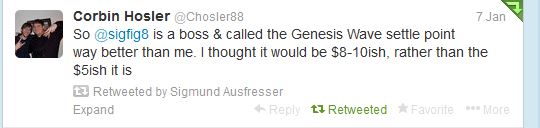
tweet

(Corbin should not be surprised I am including this Tweet. I should print this out and throw it on my fridge. Okay, end of shameless bragging at Corbin's expense.)

With this estimate in mind, I decided it was safe to buy copies up to $3 but probably not much higher. In order to avoid getting burned by this pastime I would recommend adopting a similarly conservative approach.

Roughly speaking, the older the card, the rarer it is, the higher it will spike, and ultimately settle. As Scars of Mirrodin block ages further, expect many of our investments from last year to finally pay off this summer--just be prepared to sell into hype when it happens. The window to maximize profit is rapidly shrinking due to all this speculation!

Holiday Cube Draft #1

Are you a Quiet Speculation member?

If not, now is a perfect time to join up! Our powerful tools, breaking-news analysis, and exclusive Discord channel will make sure you stay up to date and ahead of the curve.

Draft

Round 1

Round 2

Round 3

Avatar photo

Ryan Overturf

Ryan has been playing Magic since Legions and playing competitively since Lorwyn. While he fancies himself a Legacy specialist, you'll always find him with strong opinions on every constructed format.

View More By Ryan Overturf

Posted in FreeTagged 31 Comments on Holiday Cube Draft #1

Have you joined the Quiet Speculation Discord?

If you haven't, you're leaving value on the table! Join our community of experts, enthusiasts, entertainers, and educators and enjoy exclusive podcasts, questions asked and answered, trades, sales, and everything else Discord has to offer.

Want to create content with Quiet Speculation?

All you need to succeed is a passion for Magic: The Gathering, and the ability to write coherently. Share your knowledge of MTG and how you leverage it to win games, get value from your cards – or even turn a profit.

Insider: MTGO Redemption Report

Are you a Quiet Speculation member?

If not, now is a perfect time to join up! Our powerful tools, breaking-news analysis, and exclusive Discord channel will make sure you stay up to date and ahead of the curve.

Fall Standard rotation is a time of great upheaval in the most played constructed format and a great time to buy up Modern staples on sale. If you read this column regularly, you know I also advocate buying mythic rares from the rotating sets.

Due to the effects of redemption, these cards tend to hold value while the non-mythic rares plunge in price. The drop in price of the set as a whole sets the stage for gains to be made as redeemers steadily remove cards from the MTGO economy in order to profit on price differences between paper and digital.

In the past, prices have bottomed on rotating sets somewhere near the end of October. This year was a little different. Avacyn Restored (AVR) bottomed in mid September (though late October prices were not much higher). Dark Ascension (DKA) did end up bottoming in October along with Innistrad (ISD).

In addition, prices never really went "on sale." Compared to past years the bottoms on the rotating sets were shallower.

For example, Scars of Mirrodin was going for about 56 tix in November of 2012. Today, Mox Opal alone is priced at around 50 tix.

With set prices not bottoming out like they had in years gone by, it was hard to recommend blindly buying mythic rares.

Let's examine how this has played out since October.

Innistrad

Presented below are daily price changes in percentage terms for ISD from Supernovabots and from TCG using Mid prices. All prices are based to the October 9th price, ie the October 9th price is 100%. Generally we see that the paper price for ISD has been sluggish, trending down with a recent change, possibly signalling further increases.

In contrast, the digital price for ISD has been trending higher. If you look closely, you can also see the drop associated with the suspension of DEs back in November. This effect was not very big though and didn't last long.

Let's come back to this chart while we examine the other rotated sets. On its own, this chart seems to confirm that demand from redeemers does in fact drive digital prices higher over time. However, it's best to examine all the evidence before drawing a conclusion. If each of the sets that have rotated is acting in a similar way, our hypothesis will be strengthened.

Dark Ascension

The chart for DKA is quite similar to the chart for ISD. Again, the theory that redeemers will drive digital prices higher appears confirmed.

There has been some recent price weakness for a digital DKA set. With a stagnant paper price, it appears as if digital prices can only go so high. Let's check in on the last set of ISD block.

Avacyn Restored

Now we are getting somewhere. Looking at this chart, we can see a clear bottom for paper prices in the middle of November, with a strong price move higher which is still ongoing. Unlike ISD and DKA, the price of a paper AVR set is higher today than it was back in October.

MTGO prices have been following suit, with a strong growth pattern that appears likely to continue. Higher paper prices combined with demand from redeemers looks ready to drive prices on digital AVR mythic rares even higher.

Set Prices and the Digital-to-Paper Ratio

Let's look at how the sets compare through lens of the digital-to-paper ratio. This is calculated as a simple ratio of Supernova prices to TCG Mid prices, with $5 added to the digital price to represent the redemption fee.

These values are taken from the same data set as the above charts, meaning they cover the range from the first week of October 2013 to today, January 9th 2014.

ISD DKA AVR
Low 0.60 0.57 0.60
High 0.79 0.78 0.78
Current 0.78 0.74 0.75


Based on the ratio, the ISD Block sets are all roughly in line with each other. From this perspective, one set does not represent good value over another, and each of the sets' ratios is closer to its high than its low.

The Takeaway

At this point though, it looks like further gains for ISD and DKA will be driven largely by playability rather than redemption. With stagnant paper prices for these sets, redemption activity is probably lower than it would be if paper prices were growing.

For ISD, the gains in price can largely be attributed to Liliana of the Veil, which has moved up about 20 tix in price since the second week of October. Most of the junk mythic rares are lounging in the 0.75 to 1.5 tix price range.

For most of the ISD mythic rares to start making gains, an expansion in paper prices encouraging redemption would be necessary. Fortunately, Modern PTQ season is not far away, so it might be time to see Liliana poke over the $50 mark. Once she is on her way to $60, there should be some interest from redeemers.

I am decidedly uninterested in DKA at the moment. There are fewer Modern and Legacy staples in this set than ISD or AVR, and so future price increase for a paper set of DKA is not certain at the moment. We've already seen the price of DKA come down in recent weeks, and like ISD, the price of junk mythics has been pretty sluggish. I'm not counting on further increases from this set in the near term.

On the other hand, AVR is seeing growth in paper and corresponding growth on MTGO. Griselbrand is on track to break through 30 tix shortly and even a mythic like Misthollow Griffin, available for about 0.6 tix at its low, is now above 2 tix.

In hindsight, AVR has clearly been the best choice out of the ISD block sets for speculation based on an redemption strategy. It also looks set to head higher in paper, meaning digital prices should continue to rise. If you are holding mythic rares from AVR, keep riding this trend out as the gains are set to continue.

Moving Forward with Standard

Are you a Quiet Speculation member?

If not, now is a perfect time to join up! Our powerful tools, breaking-news analysis, and exclusive Discord channel will make sure you stay up to date and ahead of the curve.

Heading into the new year, I, like so many others, find my resolve renewed once again. I’m excited about more opportunities to prove my skills and qualify for the Pro Tour.

With the release of Born of the Gods coming up, a new Standard format is swiftly approaching. Even though I am eagerly awaiting a new format to brew in, I’m not going to sit around and wait for some new cards to play with.

If you know me, you know that I never stop searching for the perfect deck that attacks the metagame from just the right angle. While I did take some time off from competitive Magic over the holiday season, I didn’t stop crafting new decks to battle with.

Last week I showed everyone some best-case-scenario decks that have huge potential for wins, but accomplish that goal sporadically, aka Magical Xmasland scenarios. It was enjoyable to dwell on best-case draws for a moment, but my competitive blood burns for tournament-winning decks.

If you have been keeping up with the competitive scene in the last month or so, you may have noticed some white-based aggro decks doing well. The strategy I play the most successfully is aggro with a bit of disruption, so this development perked my interest.

Shortly after those decks wrecked some Star City tournaments though, we had a resurgence of U/W and Esper Control to keep them in check. Once the control fad died down a bit, the metagame stabilized to basically what it has been the whole season.

There are lots of playable devotion decks and some control decks as well. In an open metagame, my strategy of aggro plus disruption is at its best, I just needed to find the right mix of cards.

New Beginnings

Starting with the successful white aggro deck seemed like the best place to embark on my new mission. There were some things I didn’t like about it though. Here’s the list that got the gears turning.

Ben Stark's Mostly White Orzhov Aggro
Top 8 - Standard – Grand Prix Dallas Fort Worth 2013

Untitled Deck

Creatures

4 Soldier of the Pantheon
4 Dryad Militant
4 Boros Elite
4 Daring Skyjek
4 Precinct Captain
3 Imposing Sovereign
2 Xathrid Necromancer
4 Banisher Priest

Spells

4 Brave the Elements
3 Orzhov Charm
2 Spear of Heliod

Lands

4 Temple of Silence
4 Godless Shrine
1 Orzhov Guildgate
4 Mutavault
8 Plains
1 Swamp

Sideboard

2 Profit // Loss
3 Dark Betrayal
3 Doom Blade
2 Xathrid Necromancer
2 Sin Collector
2 Thoughtseize
1 Orzhov Charm

The strategy behind this deck is solid and it helped a number of players find success. With the state of the metagame being more spread out now, some cards need to change though. Let’s start with the creatures because they are the most important part of the deck.

Daring Skyjek

Of all the batallion creatures, Daring Skyjek is one of the best. The problem is that it doesn’t hold up well against any other creatures. Against decks with no removal, there is no problem and he is a decent three-power two-drop, but against many decks I find him severely lacking.

Boros Elite

Cards like Boros Elite need a much bigger payoff than a couple bonus points of power for me to be interested in using them. If the majority of the time he’s a one mana 1/1, the payoff is not worth the risk.

Dryad Militant

Jamming as many one-mana 2/1’s as possible is exactly what this deck wants. The problem is that he’s not a human and the secondary ability is not relevant in this format. If it were a human, I’d be much more excited to play it in this deck. His stock goes down because of my next point as well.

Xathrid Necromancer

From other aristocratic endeavors in previous formats, my love for this zombie-making necromancer runs deep. Every single time I cast it, it feels like one of the most powerful things in the format and the times when I cast two of them feels like I have an unfair advantage.

Playing with the Rotlung Reanimator update reminds me of when I first started playing competitive Magic as I crush my opponent. Certainly they may kill him, but at minimum you are getting a 2/2 replacement, sometimes more than one 2/2.

My biggest complaint about this version of the deck is that it does not have four Xathrid Necromancers in it. I view it as the best card by a large margin, so including less than four cannot be correct from my vantage point.

Brave the Elements

It seems logical that you don’t want many non-white creatures if your plans involve protecting them with a sweet protection spell like Brave the Elements. The problem is that I want to play more black creatures.

I tried cutting down on the numbers of this card, but it was rare that I had a board state where I wanted this effect in hand. Unless all your creatures are white, you are really not getting the most out of the card anyway. And it couldn't protect my best creature, Xathrid Necromancer.

For a brief time, I tried Gods Willing in place of Brave the Elements, but as you can imagine, that didn’t work out as well as I hoped. In the end, I decided to be brave and remove the card completely.

Spear of Heliod

Even though I like Spear, the card did not work as well with this version. Keeping the double-white cards to a minimum seemed like a good plan because of the increase in black mana and most of the time I would rather have another creature anyway.

If I change the deck further in the future, I will keep this card in mind because it does add another dimension to the deck. Especially if the next set adds any token producers, look to bring back Spear of Heliod.

Replacements

Thoughtseize

There was a gaping hole in this deck that needed to be filled by one of the most powerful cards in Standard. While Thoughtseize was in the sideboard, it seemed like a crime to not have access to such a powerful card in the maindeck. Removing Brave the Elements had also freed up some spell spots in the deck.

Upon further analysis, the two cards play similarly to each other. The difference is that Thoughtseize takes care of the problem before it is an issue, whereas Brave rots in your hand until the moment when it's useful. Thoughtseize is a powerful tool that works well in the majority of matchups.

Cartel Aristocrat

Another way to strengthen the deck versus control or random removal spells is to add a sturdy creature that is resistant to those cards. Enter Cartel Aristocrat.

In addition to staying alive, the sacrifice effect comes up more often than you would think, especially when making 2/2 zombies is an option. While not quite as good as he was in The Aristocrats, Cartel Aristocrat fills an important role in this deck and is a solid replacement for Daring Skyjek.

Tormented Hero

To be 100% honest, the best part about Tormented Hero is his creature type. The fact that he is a human matters quite a bit. Because I was adding more black cards, I was able to add more black mana so casting it is not too awkward. The pros and cons of Tormented Hero are much better suited to this deck than Dryad Militant and since I made the swap, I have not looked back.

Sin Collector/Blood Baron of Vizkopa

After freeing up some slots in the deck, I needed to fix a couple weaknesses. In a deck with this structure, I like having a bigger threat to cast if the game goes long. For this role I chose Blood Baron of Vizkopa, not only because of his protections but also because of the lifelink ability.

Ideally I would like a four-cost creature instead of five, but I like what Blood Baron brings to the table.

Sin Collector is a card that is really great in some matchups, but not all. Running two copies of Sin Collector maindeck has worked out well for me so far, but it often gets the cut after sideboard depending on the matchup. Even in matchups where it misses most of the time, nearly every deck has a couple cards you can hit and the information about their hand is valuable.

W/B Humans

Untitled Deck

Creatures

4 Soldier of the Pantheon
4 Tormented Hero
4 Precinct Captain
4 Imposing Sovereign
4 Cartel Aristocrat
4 Xathrid Necromancer
3 Banisher Priest
2 Sin Collector
2 Blood Baron of Vizkopa

Spells

3 Thoughtseize
3 Orzhov Charm

Lands

4 Godless Shrine
4 Temple of Silence
2 Mutavault
9 Plains
4 Swamp

Sideboard

2 Mogis's Marauder
2 Rootborn Defenses
2 Sin Collector
2 Duress
2 Glare of Heresy
1 Dark Betrayal
2 Ultimate Price
2 Gift of Orzhova

Overall, I think this deck is great. It gives you the ability to beat your opponent quickly, but also has some late game potential, all while disrupting them a little along the way.

One major plus is that it has great matchups against most of the top decks. Mono-Black Devotion for example, is a great matchup because you can strip their hand and then put too many creatures on the board for them to keep up with. Any control deck is pretty good as well because of your disruption and recursive creatures.

The sideboard is in progress right now and many of the spots I am testing out to see how strong they prove to be.

Take Mogis's Marauder for example. This seems like a great tool to fight against any other aggressive or midrange deck because it gives you the ability to punch through those last points of damage. I am not sure if this deck needs that type of effect yet until I test it out more, but for the moment I like it.

Many of the cards in the sideboard are like that as well. Gift of Orzhova could be amazing against a red deck because you’ll gain a lot of life, or against a green deck to let you fly over top of their defenses, but at the same time, it’s still an aura and I think casting auras is usually a recipe for disaster.

Some cards I am considering adding are more Dark Betrayals because I think it’s the best sideboard card right now and Profit // Loss because I think it would be strong against any decks similar to this one.

This deck keeps creeping up in tournaments and I think this version is the next advancement of the strategy. Maindeck Thoughtseize is such a potent tool and it’s great in every matchup. The same can be said for Xathrid Necromancer.

In closing, I am excited about this deck for competitive play and although we are getting a new set filled with new tools soon, there is still time to make a splash with this deck.

Until Next Time,

Unleash the Force!

Mike Lanigan
MtgJedi on Twitter
Jedicouncilman23@gmail.com

Insider: Restoring Avacyn to Your Binder

Are you a Quiet Speculation member?

If not, now is a perfect time to join up! Our powerful tools, breaking-news analysis, and exclusive Discord channel will make sure you stay up to date and ahead of the curve.

Greetings, QSers!

I’ve been on a brief hiatus while traveling for the holidays, but I’m excited to be back. Lots has been happening in the world of MTG finance during my absence, but being members here at Quiet Speculation, you all know that. These out-of-season Modern spikes have been interesting to observe and make me wonder how things will look during actual Modern season. I’ve definitely got a few specs I’m anticipating cashing out in a few months, but with the way things are going, I may not have to wait that long!

The recent ascent of Stoneforge Mystic reminds me that time moves quickly, and sets that were just yesterday considered “recent” are now becoming “old.” As time passes and new players enter the game, we’re seeing that cards from Zendikar and Scars of Mirrodin blocks are not as abundant as we thought. TCG Player has been bought out on more than a few items recently, and you can expect that more buyouts are on the way. (Whether all of this is sustainable is a topic for another day.)

Although I will sometimes jump in on a good-looking spec right before a spike, getting on the hype train like that isn’t really my style. I prefer to judge cards on quality, gradually accumulate copies via bargain-hunting and/or trade, and wait for a price correction to cash out. With that in mind, today I’d like to discuss a set that’s just starting to go from being fresh in people’s minds to being a thing of the past: Avacyn Restored.

The Worst Limited Format in Recent Memory?

As a Limited player, I cringe when I hear “Avacyn Restored,” or just the letters AVR, or the word soulbond, or basically anything associated with the set. As bad as it was, I drafted it a lot, because I’m a Draft junkie and that’s what was available. So I can say from experience that it really was as bad as it’s made out to be (Except for Mist Raven, which I still recall with great fondness. Sometimes I get attached to commons with no financial relevance, and this bothers me, as I want the cards I love to also make me money. Can’t have it all, I guess. Oh well.)

Not everyone is as hooked on drafting as I am. The Limited format being bad meant that a lot of people just didn’t draft this set, and that led to many of the cards being overpriced during the set’s time in Standard. Remember $50 Bonfire of the Damned? Drafting makes up a significant portion of packs opened, so if a set is underdrafted, fewer of its cards will be on the market.

This makes it the perfect time to start looking at Avacyn Restored cards. The set is recent enough that you may still be able to find AVR cards in trade binders, but it’s also out of Standard, so many players will not be attached to the cards in any way. The set is old enough that cards could start spiking soon, especially when Modern season hits, but it’s recent enough that prices are somewhat deflated right now.

Get to the Picks, Already

Alright, alright. Enough theorycrafting, let’s get down to details.

Simply Miraculous

Bonfire of the Damned was all the rage while in Standard, but I write about it here to warn you to stay away. At a TCG Player average of $5.44, where can this card possibly go? It has no Eternal playability, is not particularly appealing in EDH, and isn’t really a high pick in Cube. Its current price is basically a symptom of price memory due to its time in Standard. Avoid this one.

Entreat the Angels and Terminus have both seen play in Legacy Counter-Top decks, and are at $4.74 and $2.44, respectively. As a mythic, Entreat has the most room to grow, but is also much more narrow and usually played as a singleton, as opposed to the four-of status Terminus usually receives. Of course, Counter-Top decks have been kept down of late due to Abrubt Decay, but if anything in the meta changes, both of these cards could be poised for a spike. Despite it being only a rare, I think the wider utility and lower price of Terminus makes it a better buy.

Temporal Mastery saw a lot of hype upon its release, then did almost nothing during its time in Standard (save for a blue version of Wolf Run Ramp popularized by Reid Duke). However, the hype was for its Legacy appeal, and while that hasn’t panned out, the card says, “Take an extra turn,” which is huge for casual players.

The average price for the cheapest version of Time Warp is $6.66. Time Stretch is $5.89. Even overcosted nonsense like Beacon of Tomorrows is nearly $3. At $3.71 and a mythic, Temporal Mastery will likely double up by this time next year, and if it ever gets broken in Legacy or with a sweet new Commander, don’t be surprised to see more pronounced growth. I wouldn’t go throwing money at this one, but I’ll be trading for every copy I see.

Finally, Reforge the Soul[card] is only about $0.50 and goes well with [card]Nekusar, the Mindrazer. A bunch of stuff spiked due to this new Commander—is Reforge the Soul next? The risk factor is certainly low, even if the card isn’t great.

Casually Interested

There are a bunch of sweet casual cards in Avacyn Restored. Many are underpriced. Casual-only all-stars from Scars of Mirrodin block are spiking lately, so you probably have about a year before AVR cards start seeing the same kind of trajectory. Take that year to scoop up cheap copies of cards like these:

Primal Surge requires a very special type of deck to play, but decks that want it really want it—they might even build around it. As a mythic that costs less than a dollar, why not pick up copies as throw-ins? The ceiling isn’t too high on it, sure, but cheap mythics with niche appeal can still be profitable.

Deadeye Navigator is a full-fledged EDH staple at this point. People at my LGS seem to hate it, which bodes well for the card’s power level. It’s only $0.44 and an argument could be made that it should go in every blue Commander deck. I’m honestly kind of baffled how this isn’t at least a dollar. This could be one worth spending your spec money on.

Conjurer's Closet is a really strong card that is also only about $0.50, and as more creatures with sweet enter-the-battlefield abilities get printed, this card will get better and better. I don’t see it in as many decks as I think I should, but based on power level alone, I think it’s worth getting these as throw-ins.

Eternally Appealing

Around rotation, I told you to stay away from Griselbrand, not because I think the card is bad, but because I think the card is too good and could get banned. I still think banning is a possibility someday, but what I failed to recognize is all the money you could have made in the interim. If a banning doesn’t happen, expect Griselbrand to follow the price trajectory of Emrakul, the Aeons Torn. There was a spike recently, but I think there’s money to be made on this card in the long-term. Just don’t be too deep when the B&R list is updated.

I’m still bullish on Restoration Angel, even though it hasn’t budged since the last time I mentioned it. It’s good in Modern, acting as both a value play and a combo piece, and is currently at its all-time low. It also has casual appeal in that it’s reasonable in Commander and is an angel. There’s money to be made here.

Cavern of Souls is also at its all-time low, and is good in all formats—Legacy, Modern, Commander, anywhere you can play tribal decks. You can find copies of this card for under $10 right now, and I don’t think it will be less than $20 in a year. If a tribal deck becomes tier-one in Modern, crazy things could happen to the price.

Finally, Craterhoof Behemoth is on the upswing. It has taken over Progenitus’s role as the game-winning combo piece in the Legacy Elves deck. What card is better at ending the game in a creature-based combo deck? It’s currently $6-7, which is a little higher than I normally like to buy in, but it touched $20 while it was in Standard and has a lot of appeal in both competitive and casual formats. Keep an eye out for spare copies and snap them up if you can.

That’s it for today. I’m glad to be back, and I hope you all had a nice holiday season! Have some more picks from Avacyn Restored? Sound off in the comments!

Insider: New Market Realities in 2014

Are you a Quiet Speculation member?

If not, now is a perfect time to join up! Our powerful tools, breaking-news analysis, and exclusive Discord channel will make sure you stay up to date and ahead of the curve.

When I’m not doing Magic, I work at my “day job” as a journalist. Specifically, I’m a sportswriter. But no matter what branch of journalism you’re in, be it newspaper, TV, radio, or even strictly the internet, there is one global truth:

Adapt or die.

Newspapers didn’t do a good job of this 15 years ago and are paying the price today. All over, newspapers are going broke and out of business or moving to an online-only presence.

Rather than adapt to the new reality of the internet they tried to stick it out with their century-old strategy, and problems ensued. Newspapers were hopelessly behind the wave of the internet, and as a result lost out on opportunities to pioneer in the field. Instead, they were replaced.

These days, things are a bit different. I do a lot more than write for a newspaper. I tweet coverage regularly, I do pieces for a partner magazine, I’m on a weekly radio show/video webcast about Oklahoma high school football, and text messaging and tweets have become a credible way to obtain information from sources.

In short, the reality of the field has completely changed.

Magic finance is no different.

Seconds Matter

It used to be that hours or even days mattered in speculating. When I caught onto Stoneforge Mystic in 2010, I remember going to my LGS and trading for several playsets at FNM a few days later.

If 2010 was the advent of the MTG finance knowledge spike and rise of smartphone trading, then 2014 is the start of a new age in speculating.

Just a year or two ago you could realistically wait until day two or three of the Pro Tour to figure out what the spec was. Recently it’s been as soon as Round 2 when the “hot” cards go nuts. And in some cases, it’s even earlier. QS’s man on the floor at PT Theros alerted us to Master of Waves before the event even started, and we were able to profit from that.

Back to Stoneforge. As you know, the card recently began picking up some heat again. When it climbed from $10 to 12 last week, I posted in the forums that there wasn’t anything to dislike about this spec and it would probably be $20 by the summer. That seemed like a realistic growth pattern.

Instead, the market at large (the Hive Mind, if you will) caught onto Stoneforge and suddenly the price everywhere is $30. This happened in a matter of about 24 hours rather than the weeks I expected.

Genesis Wave showed this trend at its extreme. It was a great spec when the QS Insider blast went out on Tuesday, and I know many of you were able to get in for cheap. And that turned out to be quite a profitable move, because as soon the rest of the world caught on, the card sold out everywhere. For a moment in time (literally moments), it was $20.

Fast-forward two hours later, and the card is down to $5-6, a realistic range for a card with huge EDH/Casual appeal and a hint of Modern playability. Again, this was a card I really liked as a medium-to-long-term spec before the Modern deck came onto the scene. I certainly didn’t expect it to blow up like it did.

But within literally hours the market had re-adjusted itself. No longer are people waiting 2-3 days to get their copies in stock before repopulating the TCGPlayer market with lower-priced copies. We saw buyout, price spike and price correction all within the time it takes you to go see a movie. That’s never happened before.

Everyone’s Doing It

Here's what lies at the heart of the changes I outlined above. Thanks to the quickly-growing MTGFinance subreddit, the fact that everyone can now easily sell on TCGPlayer and the ease at which people can speculate, the number of players on the market has vastly increased.

I think the TCGPlayer move is the biggest culprit here; not that it’s a bad thing. Sure, anyone could sell on eBay before, but those sales were never hugely factored into market price the way TCGMid is among the general population. It’s become the default outlet for selling, and the fact that there are simply so many people on there translates to accelerated cycles.

The same goes for speculating. Everyone thinks they have the hot new spec, and everyone wants to make it happen. So it does. I know it may not seem like a monumental shift, but the rise of the subreddit has made a difference. Adding 3-4,000 people into the speculating market, when coupled with more people selling on TCGPlayer, has everyone following along the pricing trends and jumping on the bandwagon.

These things snowball quickly now. That’s just the new reality that isn’t going away.

What Does That Mean for Us?

It means that to stay ahead of the market, you must truly be ahead. You can’t just be “quick” any more; you have to be truly ahead. Luckily, the QS forums are still the best collection of speculating talent there is, which is why we’re able to stay ahead of the game. Raging Ravine, Stoneforge Mystic, Phyrexian Obliterator, Genesis Wave, all of these things originated here.

I’m not saying this to flatter anyone. It matters. The fact we’re able to be a few days ahead on these spikes means not only do we get profitable prices when we buy in, but more importantly that orders will actually be filled. You may be the first person to buy Phyrexian Obliterator when Twitter explodes about it, but it won’t matter if the store cancels your order when they get to it the next day and the price has doubled.

And given that we’re able to stay ahead of the market, the inevitable spikes when the general population catches onto the trend means we’ll continue to have great selling opportunities.

Because, as I’ve discussed before--what I've termed the Myth of Making Profits--you have to actually sell the cards you have. It doesn’t matter if something quadruples in price if you stick it in your binder for six months until it falls back to its original price.

My response to everything that has happened in the last month is increased caution. It’s a heck of a lot smarter to miss out on a spec than to buy in too late and eat losses because you didn’t want to be left behind.

Find the cards you’re confident in, pick your spots, take your positions, and wait for it to happen. You can’t force it but you also can’t buy in once it’s already happening. Don’t get caught up in the hypetrain or momentum of a spec. Stay level-headed and you’ll stay profitable.

I’ll be back next week when we get some Born of the Gods spoilers! By the way, Kiora, the Crashing Wave is super overpriced at $20.

Thanks for reading,

Corbin Hosler

@Chosler88 on Twitter

Insider: Spotting Fakes

Are you a Quiet Speculation member?

If not, now is a perfect time to join up! Our powerful tools, breaking-news analysis, and exclusive Discord channel will make sure you stay up to date and ahead of the curve.

Special Thanks: A lot of the images in this article were found spread out over the internet. Much of the basic information and images come from Apathy House (http://www.apathyhouse.com/fake/), which has done a tremendous job on this subject already. Additional resources came from Wizards of the Coast and the MOTL Trading Forum.

Today's article will focus on fake and counterfeit Magic cards. Many people know about fake Power 9 cards, for a long time the only cards known to be faked (mainly due to the high value and rarity). In fact, I wouldn't consider picking up power or any older cards worth more than $200 without a thorough knowledge on what to look for. But what do we look for?

There are many types of fake cards. Here is a breakdown.

Counterfeit Cards

These cards are printed by other printing companies/printers. There are many possible characteristics to look for when trying to spot counterfeits. The easiest are obvious miscolorations. For example:

209_CardBackFake 209_CardBackReal


The card on the left is the fake, whereas the card on the right is real.

Another print/ink issue to look for is the "dot pattern" on real Magic cards. Real cards have patterns like the ones below (excuse the ? mark next to dot pattern B, the pictures were gathered from a forum and that was in the picture):

a dot pattern

dot pattern b

dot pattern c


Dot patterns on fake cards are usually much less intricate. This is one of the easiest things to look for when checking older cards (though to see the dot patterns properly you'll probably need to pick up a jeweler's loop). It is important to keep in mind that dot patterns will vary from set to set. It is a good idea to have a common that you know is legitimate from the same set when doing side by side comparisons.

Another printer discrepancy that may indicate a fake is a minor difference or variation in the card or artwork itself. Many fakes will display differences in the artwork or text such as in the picture below (the card name text is clearly off).

fake printing

A more destructive test can be done if you tear a card in half.

209_PaperSplit

Real cards will show that blue line inside the card.

When it comes to Beta cards one of the easiest things to look for are the white "dots" in the corners of the card (seen below).

vaultfront


You can see the little white dots in the corners (especially the bottom corners). Almost all Beta cards will show these dots, the known exceptions are Volcanic Island, COP: Black, and Red Elemental Blast.

A special section of older counterfeits have been dubbed, "Dark Beta" which was done by a former Carta Mundi employee after normal work hours. The cards are very hard to distinguish from actual cards as that employee was using actual Carta Mundi card stock the bend/water/etc test would all pass muster. Apparently they had a bit of an issue with the proper ink and the cards came out slightly off.

dark beta moat_front0629132233

   "Dark Beta" Moat                                                                          Real Moat

The light test is another non-destructive way to determine if a card is fake. Magic cards are semi-transparent under a very bright light. The level of transparency is difficult for other printers to match so compare the card(s) in question with a known card (a common from the same set will work fine).

light01

The bend test is a non-destructive test (assuming the card is real) that can be used on cards of all sets. Real Magic cards will recover from being bent (even as harshly as in the picture below). Fakes will not recover and will either stay bent or leave a big crease line. However, even a real card will leave a crease line if you push from the sides (so only bend from the top and bottom edges as seen in the picture). Real cards will fail this test eventually, however most fakes fail it in the first go. If you have a card that doesn't appear to be beat up, then doing the bend test once or twice shouldn't leave any noticeable damage.

bend01

The water test is another form of non-destructive test (for real cards). Simply put some water onto a q-tip or paper towel and drip some on the card. Real cards won't be damaged from small amounts of water pooled onto the surface (obviously if you soak them they will start to fall apart...as my friend Kyle can attest to).

water01

The blacklight test is an easy non-destructive way to determine the validity of a Magic card. Real ones will glow under black light as seen below, whereas many fakes will not glow at all.

blacklight01It's important to note that Alternate 4th edition cards will not glow under black light even though they may be legit.


Rebacked Cards

These are cards with real backs and fronts from different Magic cards pasted on. They're usually made using Collector's Edition power, by splitting each card and posting the Collector's Edition front onto a real Magic card back, thus giving the appearance of "real" power. This process tends to thicken the card, as it's quite difficult to split a card exactly in half.

Some rebacked cards are made when the back of the card was considered marked or unplayable, and someone put the front on a new back to allow the card to be "playable" again.

I've only ever heard of this approach being done with power, but as we'll discuss later, the astronomic rise in card prices provides more incentive to fake cards.

For rebacked cards you can usually use the bend test (which will usually cause the two pieces to separate a bit near the crease). Or you can look at the edges (preferably with some sort of optical magnification).

fakeedge

Here we can see a fake edge with a clear "split" in between the two card pieces.

realedge

Here is the edge of a real card. As you can see it is one piece. The color of the line may be either black or blue.

New Fakes

Recently a new, much more pressing concern has arisen. Apparently there are printing shops in China which have no qualm illegally printing Magic cards (http://www.alibaba.com/product-gs/1532783589/wholesale_Gatherer_Magic_The_Gathering_for.html?s=p is the one that was found by fellow facebookers with relative ease).

It is expected that these cards will fail many of the tests above, however, the fact that this has popped up so recently means that fakes are branching out from just power and other high-end cards to encompass just about anything.

goyf

This picture was posted on the MTG Misprints/Oddities Facebook Page. The Tarmogoyf on the top is the fake. The letters are spaced out more and the paintbrush next to the artist's name is obviously a bit different. This Tarmogoyf was purchased online.

This is a huge problem for all of us who buy and sell cards online.

First, smart buyers will ignore cards without crisp, clear photos. Thus if you don't have a high-end camera (many of us use our phones), you'll risk reaching a smaller population who wants to buy from you.

Even more concerning is when you trade for cards in person you'll have to look much more carefully at the cards, especially the highly desirable, more valuable ones.

This is the type of issue that can potentially kill card values. Were some unscrupulous people to purchase a large quantity of fake cards and then trade or sell them for profits, it could absolutely devastate the secondary market. If people are afraid to buy and trade cards lest they receive a fake, card values (both real and fake) will plummet.

The sellers in China have been offering a 55-card pack of the following cards, with presumably one of each in a pack. Nobody knows if these complete packs made it over, but Jaces, Domri Rade and Tarmogoyf have all been spotted. Be very careful when trading for the following cards on this list:

Tropical Island
Temple Garden
Stomping Ground
Overgrown Tomb
Scared Foundry
Breeding Pool 
Misty Rainforst
Celestial Colonnade
Flooded Strand
Arid Mesa
Wasteland
Inkmoth Nexus
Elspeth Sun's Champion
Tarmogoyf
Cavern of Souls
Scalding Tarn
Hallowed Fountain
Polluted Delta
Surgical Extraction
Sol Ring
Underground sea 
Maesh Flats
Reflecting Pool
Mutavault
Wooded Foothills
Windswept Health
Watery Grave
Godless Shrine
Nykthos, Shrine to Nyx
Savannah
Blood Crypt
Verdant Catacombs
Kalonian Hydra
Avacyn, Angel of Hope
Thassa, God of the sea,
Jace, Architect of Thought
Swords to Plowshares
Chalice of the Void
Goblin guide
it that betrays
sword of war and peace
sword of fire and ice
purphoros god of the forge
sun titan
sensei's divining top
demonic tutor
elspeth knight-errant
thoughtseize
pernicious deed
sword of feast and famine
goblin lackey
goblin pilcdriver
inquistion of kozilek
engineered explosives
kokusho the evening star
bonfire of the damned
ral zarek
stoneforge mystic 
lona shield of emeria
spellskite
karn liberated
tundra
path to exile
figure of destiny
Ather Vial
Vampiric Tutor
Snapcaster Mage
Academy Ruins
Batterskull
Forcc of Will
Leyline of Sanctity
Intuition
Sphinx's Revelation
Reanimate

New...er News!

Apparently there is another fake printer group out there. This one is focused on foils. They are printing high dollar fake foils for the "pimp" groups (EDH/Legacy/etc). From what I've been hearing it was originally started as a kickstarter business printing foil playmats (which I must admit would be pretty cool). Sadly they didn't reach their kickstarter goal (or anywhere near it). Someone bought some foil dark rituals off ebay and took some higher res pictures of them when they noticed something was off (the picture below shows the fake on the left and a real one on the right). The fakes don't "pop" out as much and look slightly grainer. They are also missing some of the "bubbles" in the frame.

fake dark rituals_highlighted

Unfortunately, the fakes do have a dot pattern that looks close to correct, so just using a jewelers loop won't protect you.

dot pattern issue

Luckily, it appears that all of the foils look a bit off so far so keeping a watchful eye and being weary of ebay prices that seem to good to be true are the first line of defense. The second will come when trading, when something looks a bit off you should immediately start to focus more and look for other issues.

fake wrath

The current list of known fakes includes;

  • Foil Onslaught Fetches
  • Foil Dark Ritual
  • Foil Wrath of God (7th ed)
  • Foil Glorious Anthem(7th ed)
  • Foil Lord of Atlantis (7th ed)

The Good News

The good news is that the human brain is very good at spotting patterns, and (just as importantly) changes in a pattern. If you actually pay attention to the cards you're trading for, your brain will often subconsciously find things "off" on many fakes. I've run across a few during trades and they tended to stand out because I was aware that fakes existed.

Sideboarding with R/w Devotion

Are you a Quiet Speculation member?

If not, now is a perfect time to join up! Our powerful tools, breaking-news analysis, and exclusive Discord channel will make sure you stay up to date and ahead of the curve.

Last week I posted my list for R/w Devotion, so this week the natural progression seems to be discussing sideboarding. Sideboarding with Rw is fairly straightforward, but in the game of Magic it’s best not to take anything as a given. Before we get too deep into things let’s take a look at my updated sideboard:

Wear/Tear really wasn’t doing anything for me. I just feel like this deck needs to be proactive as much as possible, and having a strictly reactive card that only interacts with a small percentage of every established deck wasn’t working. With no card draw and minimal card selection Wear/Tear really underperformed.

With the notion against control decks being to just have as many threats as possible, Boros Charm started to make a lot of sense. I initially eschewed the card largely because the color requirement was troublesome- I don’t usually leave home with only ten sources of any of my colors. I’ve found myself wishing I could safely commit more threats into Supreme Verdict on more than one occasion, and there just isn’t a ton that I can do to fix this problem if I stick to only red cards. Having something to kill the Jace, Architect of Thought that is blanking my Assemble the Legion is a nice perk as well.

Last Breath was cut for all the reasons discussed last week. The lifegain tended to matter too much in every matchup where I wanted removal. I mentioned last week that I don’t like Electrickery against Mono U, and that hasn’t change. Rather, the card has made it onto my sideboard for Daring Skyjek decks. I do bring in Electrickery against Mono U, but the card is more of a replacement for Chandra Pyromaster that has splash damage against Mono U, though that splash damage is rather minimal.

Chandra really wasn’t carrying her weight against control decks. Between Pithing Needle, Detention Sphere and Mutavault they’re pretty good at dealing with her. Even when she lives they generate way more card advantage than she does, and her +1 and ultimate do close to nothing. I only really liked seeing her against Daring Skyjek decks, and Electrickery is far more efficient in that role.

Glare of Heresy is new and pretty untested, but the theory behind it is sound. It’s an efficient removal spell against aggressive white decks with some additional utility in specific matchups. In particular it answers Detention Sphere out of the aggressive Esper deck and Unflinching Courage out of GW decks.

With Standard being as diverse as it is and with the strategy of RW being as streamlined as it is, I believe that discussing the usage of specific cards is more useful than discussing specific matchups. Let’s start with what to bring in, where and why:

Ins

Chandra's Phoenix and Boros Charm

In almost every matchup where you want one of these cards you also want the other. This is not just because of the obvious interaction between the two, but also because the matchups where you want them you’re just trying to deal as much damage as possible as fast as possible. These matchups are of course any control matchup where your opponent is UW(x).

I bring in Phoenix without Charm only against decks without sweepers that feature quality blockers- such as GB decks featuring Reaper of the Wild. I can’t imagine bringing in Charm without Phoenix.

Assemble the Legion

Assemble is good against anything controlling and nothing aggressive. It can be too slow against Black Devotion, but it’s an out to Desecration Demon that embarasses their removal-heavy threat-light draws.

I haven’t been bringing it in against the Xathrid Necromancer/Supreme Verdict deck, though this could be wrong. Instead I’ve just been boarding as if they were aggressive while doing my best not to be destroyed by Supreme Verdict. They also have Detention Sphere, which can make playing Assemble just plain bad. That said, I could see trying a sideboard strategy that employs Assemble.

Burning Earth

I’ve wanted this card against exactly three decks- UWx control, Jund and Naya control. They all have answers, but really need to draw them quickly in order to win.

I’ve been paired against the matchups where I want this card less and less as of late, but it’s such a huge trump that I think it warrants inclusion. I wouldn’t fault anybody for cutting it, but I already feel like my list has all of the best cards against its worst matchups.

Electrickery

This card is pretty straightforward in its application. If your opponent has a high threshold of x/1s, bring it in. It’s particularly useful against aggressive white decks, the Akroan Crusader red deck and Master of Waves. I can think of other decks with killable targets, but no other decks where Electrickery is good enough.

Warleader's Helix

Initially I put this card in my board to combat the burn heavy RW deck. The application against aggressive decks is obvious. It has potential use against decks like Green, Blue and Black Devotion, but it’s impact just isn’t high enough in those matchups. I believe that in order to want the card the lifegain needs to be relevant and/or it needs to kill the most relevant card in the matchup. With Desecration Demon, Master of Waves and Arbor Colossus all being immune Warleader's Helix ends up being underwhelming against their trademark cards.

Glare of Heresy

Glare’s uses were all discussed above. While it does serve as an answer to Detention Sphere and Elspeth, Sun's Champion, you just need to be more proactive against control decks.

Mizzium Mortars

Again, this one is an obvious include against aggressive decks. Unlike Warleader's Helix, it’s also good against Black, Blue, and Red Devotion. While it can’t kill Master of Waves or Desecration Demon, it can kill all of the Elemental tokens and everything else at a very good rate. The difference in mana cost makes a ton of difference here, as killing Nightveil Specter and Pack Rat are time sensitive issues.

Having some number of Mortars is also important against Blood Baron of Viskopa. Even though they’re likely to have four Barons, I don’t think you want more than two Mortars. The idea is to kill the opposing player the turn after Baron comes online. Trying to play the control and waiting around to remove every Baron is a losing proposition. There will be games where you might wish you had more Mortars, but there will definitely be more where you wish you had fewer. It’s also important to note that Stormbreath Dragon provides a good foil to Blood Baron as well.

Outs

Hammer of Purphoros

These are just too slow against aggressive decks. There are some matchups where the games can boil down to a race, and in some of those games drawing one can be amazing, but it’s bad more often than it’s good. I leave both in against removal-heavy decks and cut both against aggressive decks. I’d consider leaving one in against the Xathrid Necromancer/Supreme Verdict deck.

Mizzium Mortars and Chained to the Rocks

These are pretty easy cuts against all of the UW variants- save the occasional Blood Baron battle. I also trim a couple of the Chains against the burn heavy deck when they don’t have Young Pyromancer. They’re pretty important everywhere else.

Fanatic of Mogis

While Fanatic is one of the best cards in the deck, it also gets boarded out quite often. Your devotion is usually pretty low against control decks and he’s very expensive for a blocker that just trades against aggressive decks. I frequently board out 2-3 against the UW variants and the aggressive decks alike.

Stormbreath Dragon

Dragon comes out entirely against non-white aggressive decks and Black Devotion, and I generally board out two copies against white aggressive decks. Basically, he’s bad when he’s on blocking duty or when he’s likely to just eat a removal spell. It’s true that UW decks have removals and counters, but he’s just too good of a threat when he resolves to not want in those matchups.

While he’s slow to the part against aggressive white decks, the protection ends up being relevant enough to make a couple copies worth the cost. Not to mention that he comes in for the kill very quickly when it comes time to become the aggressor.

Mindsparker

While most lists don’t feature Mindsparker at all, I personally only bring any out against Black Devotion. Even there I only bring out two. It’s vulnerable to Pharika's Cure, but it does attack well into a couple Pack Rats as well as Nightveil Specter. Against everyone else it attacks and/or blocks extremely well. I strongly encourage trying it out if you haven’t yet.

~

It’s a bit unconventional, but I think that guides like this are a lot more beneficial than copy/pasting lists of what to add and cut and where. Having ideas and theories to operate off of instead of just numbers makes it easier to know what to do or not do on the fly. Additionally, knowing the theory behind the idea presents something more concrete with which to agree or disagree. At any rate, I hope this was informative for everybody grinding Standard right now, and I thank you for reading.

-Ryan Overturf

Insider: [MTGO] Exploring Investment on Magic Online

Are you a Quiet Speculation member?

If not, now is a perfect time to join up! Our powerful tools, breaking-news analysis, and exclusive Discord channel will make sure you stay up to date and ahead of the curve.

Hi QS readers,

It has been more than two years now since I made my debut investing and speculating on MTGO. My first year was full of mistakes. My return on investment was positive but relatively low--I didn't really know what I was doing.

About a year and a half ago I became a member of the QS community. I rapidly filled the gap of my ignorance with the help of Insider articles and fruitful discussions on the QS forums.

Since the beginning of 2013, I've been doing pretty well. I became more confident in my trades and I regularly generate significant profits. Now I would like to give back to the community and share my experience with other QS members.

A Little Bit About Me

I began playing Magic in 1998, first with my brother and some friends. I quickly moved to local tournaments and finally across France and Europe for PTQs, GPs and PTs. At that time, MTGO was not really part of my world because I couldn't sell digital cards for cash after drafting, which made it too expensive.

In 2010, when I had the opportunity to move to Atlanta for my job, I was excited to discover another country and perfect my English. With no Magic connections and less free time, I sold my collection and almost stopped playing Magic for good. I only kept one copy of each card, with the hope of playing Commander once I settled in Atlanta. Eventually I sold the rest of my cards on eBay, as I didn't find time--or people--to play with.

Magic Online: Savings Account, Hedge Fund Management or Lottery?

Summer 2011. Two things happen almost simultaneously. I was shocked to discover that my American savings account paid about 0% interest (compared to 2-4% for regular French savings accounts). Second, I remembered that I had a MTGO account with a couple of cards on it.

Getting more interested in MTGO, I realized soon that "older" cards (meaning non-Standard cards) were valuable and had shown a steady increase over the past two years.

Okay, wait--instead of having my money do nothing on my bank account, can I invest it on MTGO and trade cards like you trade stocks?

I bought several hundred Tix in a two-month period and bought a bunch of cards, mostly Legacy staples… and a lots of crap. My challenge was to make a 10% profit in one year. Even though I think I made it, I also made many mistakes: poor investments, bad choices, bad timing, blind bets, etc.

I was trying to follow the fluctuations of the market with the tools I had at that time, but I didn't really know much about the MTGO economy. I thought that what I knew from the paper version would be sufficient to create profit.

To be simple: paper Magic and MTGO are pretty different when it comes to their markets.

The next summer I discovered Quiet Speculation and signed up for three months to give it a shot and see if I could learn something, improve my skills, and at least recoup my membership fee.

After a year and a half of QS membership, I can say that it was fully recovered. Even with the tremendous amount of knowledge and experience I gained here, the QS community is always telling me something I don't know, which keeps my membership paying for itself year to year.

A recent concrete example: I was not aware of the Zur the Enchanter deck in Modern until Matt Lewis posted about it on the MTGO QS forum. The profits I'll make with Zur the Enchanter will probably pay for three months of membership. Without QS I would have missed this one for sure.

One thing is certain after all this time: I don't know everything, I miss opportunities every week and I still make mistakes. But with the help of the QS community members, I'm making smarter and better choices, and I generate more profit than two years ago, no doubt about it.

Now I want to contribute more actively to this community and share the knowledge I have accumulated.

Topics to Cover

The series of articles I want to write could be called “Weekly Market Selection” or "Tips of the Week for Better MTGO Investments." I want to focus on concrete, weekly buys and sells, discuss immediate, previous and future moves, and give helpful hints to maximize your profits on MTGO.

These articles won’t deal with deep strategic analyses or complex theories that drive the MTGO market. Matt Lewis already does a great job covering that every Friday.

I also want to make my own portfolio as transparent as possible and keep track of it all year long with you. Maybe once a month, I want to (re)evaluate the state of my transactions and discuss what I did right, what I did wrong, and what to expect for the coming month.

I will share with you the tools I'm using and discuss their usefulness. I may also share some experiences and reflections about a specific topic or investment.

I hope my articles will benefit particularly the newest Insiders and people not yet familiar with MTGO. The more experienced of us might still benefit from these articles as a complement for what's hot this week, as it can be challenging to keep track of every opportunity in the MTGO world.

I will start with a series of articles addressing:

  • Buying on MTGO: from cash to Tix to cards
  • Selling on MTGO: from cards to Tix to cash
  • How to manage your portfolio and why it's important to keep track of everything

MTGO Investment Types

Today I want to share a little bit of how I see my MTGO investments.

To me, there are three ways to invest on MTGO. Each of your speculation/investments should fit one of these categories. It's also important to know and identify which category a given investment falls into. Profit expectations, timing and risks are different for each.

1. Cyclical Investments

I refer to cyclical investments when the evolution of a given card's price is "cyclical" and therefore extremely predictable.

In this category you'll find Modern cards, cards rotating out of Standard, and mythics from both the core set and the first Standard block (Ravnica, in our current Standard). Actually, anything with the exception of the newest Standard sets could fit this category. Boosters have their place here too.

By looking at past prices and/or past events you can predict when prices will be low and high. Modern cards are probably your best friends here--there are hundreds that fluctuate by a factor of up to four in between low and high season.

Typically, cyclical investments are very low-risk, fairly profitable and require you to hold your position for several months on average. To me, this should form the core of your portfolio.

2. Speculation

This type of investment relates more to "pure" speculation. Here, there's no (or little) history to help you predict the trajectory of a card. You have to rely only on your good judgment and on information you can gather here and there, like the anticipation of a metagame shift or pros who have started talking about a new card or deck.

But in the end it's up to you and nothing is really sure here. This applies particularly for Standard cards. Buying mythics at 0.30 Tix or rares at 0.05 Tix is a typical example. You buy a bunch of these hopping for one or more to break out.

This type of speculation can be very risky, especially if you don't buy at absolute bottoms, but has potential for high returns. The timing here can be variable, from a couple of days to years. Holding too many of these speculative cards can totally undermine your bankroll if you don't buy wisely and carefully.

3. Short-Term Investments (Quick Flips)

This type of investment is a sort of "predictable speculation", the happy ending of the category 2) if you prefer. The trick here is that you're betting only when you already know the card is sure to appreciate. This type of opportunity happens every time a specific card is spotlighted by an event: PT, GP, ban list announcement, SCG tournament, video from Travis Woo, et.al.

You have surely noticed that around the end of a GP or a PT if a new deck or card breaks out, their prices increase substantially within the next hours. The same thing happens during spoiler season or after announcement of ban list changes.

Some examples? The titans' prices increased when Cavern of Souls was spoiled; Scapeshift saw its price multiply by ten when Valakut was unbanned in Modern; or, more recently, Blood Baron of Vizkopa jumped from 14 to 19 Tix after Fort Worth GP.

You can also yield small but totally risk free profits by playing the arbitrage between two bots, one selling lower than the buying price of the second one.

If you're quick enough, this type of investment is virtually risk-free for moderate to high profits in a couple of hours or days.

The downside is that you have to be there when it happens--not two days, or even five hours, later. Also, you can't invest 1000 Tix in one hour in a single card that everybody else is chasing. This is why I always keep some Tix available on my account.

Remembering Your Goal

Always know where and why you are investing Tix in a card, and try your best to stick to your goal.

If you buy a card with a quick flip perspective, don't keep it more than a week, take your profit and move on. If you buy a card because you detected a cycle, prepare yourself to hold on to it until the next predicted peak and don't panic in between.

As of now, my portfolio is composed of about 70-75% of cyclical investments (mostly Modern cards), 10-15% of speculation (on both Standard and Classic cards), and finally 10 to 20% of bankroll is available Tix.

Buying and Selling

Before letting you go, and since it will be the focus of my articles, here is briefly what I'm trading these days:

Buying

  • THS boosters, following the consensus on boosters speculation as discussed in the MTGO forums, I'm buying 12 to 24 packs whenever they hit 3.00 Tix or less. It happens now and then on Goatbots.
  • MM Gush has dropped a lot, to 2 Tix or so. It seems like a good midterm target. I don't expect it to recover to 6 Tix any time soon, but I'll consider selling them whenever they are in the 3-4 Tix range.
  • Vengevine and Emrakul. I have bought a few copies last month around 7 and 7.5 Tix, respectively. Their price is pretty low compare to the benefits they could offer during Modern season.
  • THS complete set. I'll talk more about this in a future article but I'm experimenting with the redemption system as an alternative way to exchange Tix for cash. THS sets are lower than ever and can be acquired at 96 Tix or less if you spend some time scanning bots for the best prices on individual cards.

Selling

  • A lot of Modern cards I bought a month or two ago have reached their ceiling or are very near. That was my target and I think they might drop again approaching Born of the Gods release events, so for these reasons I gladly take my profits and move on. I might buy them back if they effectively drop during the release events in a month and a half. These cards include: Remand, Living End, Torpor Orb, Spellskite, Spectral Procession, Creeping Tar Pit, Through the Breach, Serra Ascendant, and Blackcleave Cliffs. Most of them have doubled in a two-month period.
  • M14 Boosters. I started selling in mid-December and am looking to sell the rest in the coming days, at any price in the 3.35-3.45 range.

Thank you for reading. Next week I'll review the different options to convert your cash into Tix.

Sylvain Lehoux

Want Prices?

Browse thousands of prices with the first and most comprehensive MTG Finance tool around.


Trader Tools lists both buylist and retail prices for every MTG card, going back a decade.

Quiet Speculation